

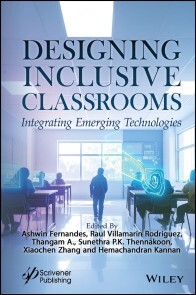

Designing Inclusive Classrooms
Regulärer Preis:
210,99 €
Sofort verfügbar
Designing Inclusive Classrooms, Wiley
Integrating Emerging Technologies
Von Ashwin Fernandes, Raul Villamarin Rodriguez, Thangam A., Sunethra Pushpa Kumari Thennakoon, Xiaochen Zhang, Hemachandran Kannan, im heise shop in digitaler Fassung erhältlich
Produktinformationen "Designing Inclusive Classrooms"
Equip yourself with the essential conceptual frameworks and actionable strategies needed to address digital disparities and leverage cutting-edge technologies like AI and virtual reality for creating truly equitable and socially just learning environments.
Recently, both the education and technology fields have acknowledged a rising
awareness that traditional teaching practices, curricula, and institutional
policies can frequently uphold inequalities. These disparities have a greater
impact on students belonging to marginalized communities, such as low-income
backgrounds, students with disabilities, and racial and ethnic minorities. The
global transition to digital and online learning has worsened this problem,
highlighting disparities in access and inclusivity. This book will serve as a
comprehensive reference for understanding how to create equitable and socially
just learning environments by leveraging emerging technologies. The book will
cover a wide range of topics, from foundational theories of equity and justice
in education to practical applications of cutting-edge technologies such as
artificial intelligence, virtual reality, and digital learning platforms. It
will provide both a conceptual framework and actionable strategies for designing
classrooms that meet the diverse needs of students while promoting fairness,
inclusivity, and engagement. In addition to practical guidance, the book will
critically examine the challenges and ethical considerations of using technology
in the pursuit of equity and social justice. This book will serve as an
invaluable resource across the fields of education and technology to create a
more equitable future.
Designing Inclusive Classrooms
Recently, both the education and technology fields have acknowledged a rising
awareness that traditional teaching practices, curricula, and institutional
policies can frequently uphold inequalities. These disparities have a greater
impact on students belonging to marginalized communities, such as low-income
backgrounds, students with disabilities, and racial and ethnic minorities. The
global transition to digital and online learning has worsened this problem,
highlighting disparities in access and inclusivity. This book will serve as a
comprehensive reference for understanding how to create equitable and socially
just learning environments by leveraging emerging technologies. The book will
cover a wide range of topics, from foundational theories of equity and justice
in education to practical applications of cutting-edge technologies such as
artificial intelligence, virtual reality, and digital learning platforms. It
will provide both a conceptual framework and actionable strategies for designing
classrooms that meet the diverse needs of students while promoting fairness,
inclusivity, and engagement. In addition to practical guidance, the book will
critically examine the challenges and ethical considerations of using technology
in the pursuit of equity and social justice. This book will serve as an
invaluable resource across the fields of education and technology to create a
more equitable future.
Ashwin Fernandes, PhD is the Executive Director of Amesa Engineering. He
founded India’s first nationwide private sector evaluation framework called QS
I-GAUGE. He has met with senior leaders and is often invited to speak at
conferences and events on university rankings, ratings, education, and higher
education.
Raul Villamarin Rodriguez, PhD is a Professor and the Vice President of
Woxsen University. He has made significant research contributions with more than
800 publications to his credit. His research focuses on artificial intelligence,
machine learning, and cognitive psychology.
Thangam A., PhD is an Assistant Professor in the Department of English at
the Dr. M.G.R. Educational and Research Institute. She has three journal
publications to her credit.
Sunethra P.K. Thennakoon, PhD is a Professor of Geography and the
Director of the International Center for Multidisciplinary Studies at the
University of Sri Jayewardenepura. She has more than 70 publications in
international journals and conferences. Her research interests include strategic
and organizational management and entrepreneurship.
Xiaochen Zhang, PhD is Chief Responsible AI Officer and Executive
Director at AI 2030 and Global Head of Innovation and Go-to-Market at Amazon Web
Services with more than 20 years of experience. He is the founder and CEO of
FinTech4Good and an investor at Gaingels, focusing on FinTech and AI ventures.
He is a frequent speaker on responsible AI, blockchain, digital finance, policy,
climate innovation, and impact investing.
Hemachandran Kannan, PhD is the Associate Dean and Director of the AI
Research Center at Woxsen University. He has more than 130 publications to his
credit, including articles in international journals and conferences. His
research interests include artificial intelligence, machine learning, VLSI
design, and embedded systems.
Artikel-Details
- Anbieter:
- Wiley
- Autor:
- Ashwin Fernandes, Raul Villamarin Rodriguez, Thangam A., Sunethra Pushpa Kumari Thennakoon, Xiaochen Zhang, Hemachandran Kannan
- Artikelnummer:
- 9781394389209
- Veröffentlicht:
- 03.03.26
- Seitenanzahl:
- 400