

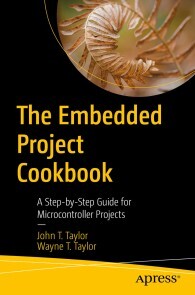

The Embedded Project Cookbook
Regulärer Preis:
64,99 €
Sofort verfügbar
The Embedded Project Cookbook, Apress
A Step-by-Step Guide for Microcontroller Projects
Von John T. Taylor, Wayne T. Taylor, im heise Shop in digitaler Fassung erhältlich
Produktinformationen "The Embedded Project Cookbook"
Learn how to create and release an embedded system in a fast and reliable manner. This book will help you build and release a commercially viable product that meets industry standards for quality. The book is not just about code: it covers non-code artifacts such as software processes, requirements, software documentation, continuous integration, design reviews, and code reviews.
While specifically targeting microcontroller applications, the processes in this book can be applied to most software projects, big or small. Additionally, the book provides an open-source C++ framework that can be used to quick start any embedded project. This framework has an OSAL (OS Abstraction Layer) and essential middleware that is needed for many embedded systems. Using a hands-on approach of building-and-testing the software application first allows you to develop a significant amount of production quality code even before the hardware is available, dramatically reducing the start-to-release duration for a project.
As you follow the recipes in this book, you will learn essential software development processes, perform just in time design, create testable modules, and incorporate continuous integration (CI) into your day-to-day developer workflow. The end-result is quality code that is maintainable and extensible, and can be reused for other projects, even when presented with changing or new requirements.
_The Embedded Project Cookbook _is focused on the _how_ of developing embedded software. For a discussion of the _why_, readers are invited to refer to the optional companion book _Patterns in the Machine: A Software Engineering Guide to Embedded Development_.
WHAT YOU WILL LEARN
* Separate software architecture from software design
* Write software documents that are intrinsically resistant to going out-of-date.
* Identify the processes, workflows, and best practices for the team to follow.
* Initiate code reviews before code is checked intoa stable branch.
* Design testable modules and implement automated unit testing that doesn’t require hardware.
* Incorporate continuous integration into the day-to-day developer workflow, including automated integration testing.
* Create a code base that can be reused on other projects.
WHO THIS BOOK IS FOR
Mid-level developers and software leads who are looking to get up and running without all the underlying theories. This book is also for professionals looking to learn how to productize a concept or technology and sell the results to a customer.
JOHN TAYLOR has been an embedded developer for over 30 years. He has worked as a firmware engineer, technical lead, system engineer, software architect, and software development manager for companies such as Ingersoll Rand, Carrier, Allen-Bradley, Hitachi Telecom, Emerson, and several start-up companies. He has developed firmware for products that include HVAC control systems, telecom SONET nodes, IoT devices, micro code for communication chips, and medical devices. He is the co-author of five US patents and holds a bachelor’s degree in mathematics and computer science.
WAYNE TAYLOR has been a technical writer for 27 years. He has worked with companies such as IBM, Novell, Compaq, HP, EMC, SanDisk, and Western Digital. He has documented compilers, LAN driver development, storage system deployment and maintenance, and dozens of low-level and system-management APIs. He also has ten years of experience asa software development manager. He is the co-author of two US patents and holds master’s degrees in English and human factors. He is a co-author of _OS/2 and NetWare Programming_ (Van Nostrand Reinhold, 1995).
Chapter 1: Introduction.- Chapter 2: Requirements.- Chapter 3: Analysis.- Chapter 4: Software Development Plan.- Chapter 5: Preparation.- Chapter 6: Foundation.- Chapter 7: Building Applications with the Main Pattern.- Chapter 8: Continuous Integration Builds.- Chapter 9: Requirements Revisited.- Chapter 10: Tasks.- Chapter 11: Just in Time Detailed Design.- Chapter 12: Coding, Unit Tests, and Pull Requests.- Chapter 13: Integration Testing.- Chapter 14: Broad Support Package.- Chapter 15: Drivers.- Chapter 16: Release.- Appendix A: Getting started with the Source Code.- Appendix B: Running the Example Code.- Appendix C: Introduction to the Data Model Architecture.- Appendix D: LHeader and LConfig Patterns.- Appendix E: CPL C++ framework.- Appendix F: LHeader and LConfig Patterns.- Appendix G: Ratt.- Appendix H: GM6000 Requirements.- Appendix I: GM6000 System Architecture.- Appendix J: GM6000 Software Architecture.- Appendix K: GM6000 Software Development Plan.- Appendix L: GM6000 Software Detailed Design.- Appendix M: GM6000 Software Detailed Design.- Appendix N: GM6000 Fuzzy Logic Temperature Control.- Appendix O: Software C/C++ Embedded Coding Standard.- Appendix P: GM6000 Software Requirements Trace Matrix.- Appendix Q: GM6000 Software Bill of Materials.- Appendix R: GM6000 Software Release Notes.
While specifically targeting microcontroller applications, the processes in this book can be applied to most software projects, big or small. Additionally, the book provides an open-source C++ framework that can be used to quick start any embedded project. This framework has an OSAL (OS Abstraction Layer) and essential middleware that is needed for many embedded systems. Using a hands-on approach of building-and-testing the software application first allows you to develop a significant amount of production quality code even before the hardware is available, dramatically reducing the start-to-release duration for a project.
As you follow the recipes in this book, you will learn essential software development processes, perform just in time design, create testable modules, and incorporate continuous integration (CI) into your day-to-day developer workflow. The end-result is quality code that is maintainable and extensible, and can be reused for other projects, even when presented with changing or new requirements.
_The Embedded Project Cookbook _is focused on the _how_ of developing embedded software. For a discussion of the _why_, readers are invited to refer to the optional companion book _Patterns in the Machine: A Software Engineering Guide to Embedded Development_.
WHAT YOU WILL LEARN
* Separate software architecture from software design
* Write software documents that are intrinsically resistant to going out-of-date.
* Identify the processes, workflows, and best practices for the team to follow.
* Initiate code reviews before code is checked intoa stable branch.
* Design testable modules and implement automated unit testing that doesn’t require hardware.
* Incorporate continuous integration into the day-to-day developer workflow, including automated integration testing.
* Create a code base that can be reused on other projects.
WHO THIS BOOK IS FOR
Mid-level developers and software leads who are looking to get up and running without all the underlying theories. This book is also for professionals looking to learn how to productize a concept or technology and sell the results to a customer.
JOHN TAYLOR has been an embedded developer for over 30 years. He has worked as a firmware engineer, technical lead, system engineer, software architect, and software development manager for companies such as Ingersoll Rand, Carrier, Allen-Bradley, Hitachi Telecom, Emerson, and several start-up companies. He has developed firmware for products that include HVAC control systems, telecom SONET nodes, IoT devices, micro code for communication chips, and medical devices. He is the co-author of five US patents and holds a bachelor’s degree in mathematics and computer science.
WAYNE TAYLOR has been a technical writer for 27 years. He has worked with companies such as IBM, Novell, Compaq, HP, EMC, SanDisk, and Western Digital. He has documented compilers, LAN driver development, storage system deployment and maintenance, and dozens of low-level and system-management APIs. He also has ten years of experience asa software development manager. He is the co-author of two US patents and holds master’s degrees in English and human factors. He is a co-author of _OS/2 and NetWare Programming_ (Van Nostrand Reinhold, 1995).
Chapter 1: Introduction.- Chapter 2: Requirements.- Chapter 3: Analysis.- Chapter 4: Software Development Plan.- Chapter 5: Preparation.- Chapter 6: Foundation.- Chapter 7: Building Applications with the Main Pattern.- Chapter 8: Continuous Integration Builds.- Chapter 9: Requirements Revisited.- Chapter 10: Tasks.- Chapter 11: Just in Time Detailed Design.- Chapter 12: Coding, Unit Tests, and Pull Requests.- Chapter 13: Integration Testing.- Chapter 14: Broad Support Package.- Chapter 15: Drivers.- Chapter 16: Release.- Appendix A: Getting started with the Source Code.- Appendix B: Running the Example Code.- Appendix C: Introduction to the Data Model Architecture.- Appendix D: LHeader and LConfig Patterns.- Appendix E: CPL C++ framework.- Appendix F: LHeader and LConfig Patterns.- Appendix G: Ratt.- Appendix H: GM6000 Requirements.- Appendix I: GM6000 System Architecture.- Appendix J: GM6000 Software Architecture.- Appendix K: GM6000 Software Development Plan.- Appendix L: GM6000 Software Detailed Design.- Appendix M: GM6000 Software Detailed Design.- Appendix N: GM6000 Fuzzy Logic Temperature Control.- Appendix O: Software C/C++ Embedded Coding Standard.- Appendix P: GM6000 Software Requirements Trace Matrix.- Appendix Q: GM6000 Software Bill of Materials.- Appendix R: GM6000 Software Release Notes.
Artikel-Details
- Anbieter:
- Apress
- Autor:
- John T. Taylor, Wayne T. Taylor
- Artikelnummer:
- 9798868803277
- Veröffentlicht:
- 07.10.24
- Seitenanzahl:
- 450
Barrierefreiheit
This PDF does not fully comply with PDF/UA standards, but does feature limited screen reader support, described non-text content (images, graphs), bookmarks for easy navigation and searchable, selecta
- keine Vorlesefunktionen des Lesesystems deaktiviert (bis auf) (10)
- navigierbares Inhaltsverzeichnis (11)
- logische Lesereihenfolge eingehalten (13)
- kurze Alternativtexte (z.B für Abbildungen) vorhanden (14)
- Inhalt auch ohne Farbwahrnehmung verständlich dargestellt (25)
- hoher Kontrast zwischen Text und Hintergrund (26)
- Navigation über vor-/zurück-Elemente (29)
- alle zum Verständnis notwendigen Inhalte über Screenreader zugänglich (52)
- Kontakt zum Herausgeber für weitere Informationen zur Barrierefreiheit (99)