

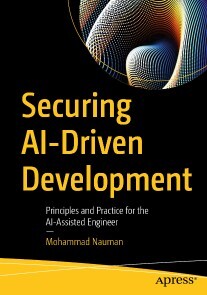

Securing AI-Driven Development
Regulärer Preis:
62,99 €
Sofort verfügbar
Securing AI-Driven Development, Apress
Principles and Practice for the AI-Assisted Engineer
Von Mohammad Nauman, im heise shop in digitaler Fassung erhältlich
Produktinformationen "Securing AI-Driven Development"
Software development has undergone a fundamental transformation as AI coding
assistants redefine how software is built. Tasks that once required days now
take hours, and complex systems are increasingly created by individuals rather
than teams. This acceleration has introduced a hidden cost: security risks that
accumulate quietly beneath polished, functional code. AI-generated outputs often
appear correct and secure on the surface, yet frequently contain structural
flaws such as outdated cryptographic practices, weak authorization controls, and
overly permissive infrastructure. The common instinct to simply request
‘secure’ code from an AI misses a critical reality. Security is not
an added feature but the result of deliberate architectural thinking and
informed design choices.
This book builds this mindset from the ground up. It begins by challenging the
illusion that security can be appended through prompts, reframing it instead as
a continuous balance of risk, cost, and usability. It introduces practical
threat modeling and emphasizes the importance of strict trust boundaries to
defend against adversarial inputs. The discussion then moves into core
engineering practices, covering least privilege, compartmentalization, secrets
management, and the prevention of context leakage in modern workflows. It
addresses common cryptographic mistakes generated by AI systems and explains how
to select and apply secure primitives correctly. The book then expands to
real-world systems, focusing on APIs, middleware, and distributed architectures
where authorization flaws and verification gaps often arise. It establishes
disciplined validation processes that combine automated analysis with human
judgment. Finally, it explores the emerging risks of autonomous AI agents,
presenting strategies such as minimal agency, sandboxing, and structured prompt
design, alongside practical patterns for building secure AI-assisted workflows
and end-to-end system hardening through realistic case studies.
By the end of this book, you will have developed a rigorous and practical
security mindset for the AI-driven era, enabling you to critically evaluate
generated code, design systems with structural resilience, and guide AI tools
toward outcomes that are not only efficient but fundamentally secure.
What You Will Learn:
- Why AI coding assistants fail at security and precisely where to intervene
- How to apply the core principles of security engineering to AI-generated code
- How to audit, test, and verify code generated by an AI tool
- How to work securely at the frontier of agentic development
Artikel-Details
- Anbieter:
- Apress
- Autor:
- Mohammad Nauman
- Artikelnummer:
- 9798868832529
- Veröffentlicht:
- 23.10.26
Barrierefreiheit
This PDF has been created in accordance with the PDF/UA-1 standard to enhance accessibility. It includes screen reader support, descriptions for Non-text content (such as images and graphs), bookmarks
- entspricht den Vorgaben der PDF / UA 1 (05)
- nicht oder eingeschränkt barrierefrei (09)
- keine Vorlesefunktionen des Lesesystems deaktiviert (bis auf) (10)
- navigierbares Inhaltsverzeichnis (11)
- logische Lesereihenfolge eingehalten (13)
- kurze Alternativtexte (z.B für Abbildungen) vorhanden (14)
- Inhalt auch ohne Farbwahrnehmung verständlich dargestellt (25)
- hoher Kontrast zwischen Text und Hintergrund (26)
- Navigation über vor-/zurück-Elemente (29)
- alle zum Verständnis notwendigen Inhalte über Screenreader zugänglich (52)
- Kontakt zum Herausgeber für weitere Informationen zur Barrierefreiheit (99)