

Computer und IT

SAP-Schnittstellenprogrammierung
Sie wollen SAP- und externe Systeme oder Cloud- und On-Premise-Systeme verbinden? In diesem Buch lernen Sie alle Schnittstellentechnologien und Protokolle kennen. Sie erfahren, wie Sie die erforderlichen Komponenten der ABAP-Plattform konfigurieren und ansprechen. Mit zahlreichen Beispielen in ABAP, Java, C, C++ und C#. Aus dem Inhalt: Schnittstellenprogrammierung auf der ABAP-Plattform und der SAP BTPRemote Function Call mit ABAP, Java, C/C++ und C#Business Application Programming Interface (BAPI)IDoc und ALESOAPOData und SAP GatewayOData mit RAP und CAPABAP Push und Message Channels SAP Business Accelerator HubSAP Event MeshSAP Integration Suite Einleitung ... 17 TEIL I. Grundlagen ... 21 1. Grundlagen der SAP-Schnittstellenprogrammierung ... 23 1.1 ... Die ABAP-Plattform ... 23 1.2 ... Sicherheit ... 39 1.3 ... Programmierung auf der ABAP-Plattform ... 51 1.4 ... Überblick über die Schnittstellentechnologien von SAP ... 63 2. Grundlagen der Schnittstellenprogrammierung auf der SAP Business Technology Platform ... 87 2.1 ... Einführung in die SAP Business Technology Platform ... 87 2.2 ... Aufbau der Infrastruktur ... 97 2.3 ... Sicherheit ... 130 2.4 ... Entwicklungsinfrastruktur aufsetzen ... 141 TEIL II. Schnittstellenprogrammierung auf der ABAP-Plattform ... 149 3. Remote Function Call mit ABAP ... 151 3.1 ... RFC-Funktionsbausteine in ABAP ... 151 3.2 ... Transaktionaler RFC ... 162 3.3 ... Queued RFC ... 169 3.4 ... Background-RFC ... 176 3.5 ... Business-Objekte und BAPIs ... 184 4. Remote Function Call mit C/C++ ... 213 4.1 ... SAP NetWeaver RFC SDK ... 213 4.2 ... Einfache SAP-NetWeaver-RFC-Clients ... 221 4.3 ... Komplexe SAP-NetWeaver-RFC-Clients ... 235 4.4 ... SAP-NetWeaver-RFC-Server ... 250 5. Remote Function Call mit Java ... 269 5.1 ... SAP Java Connector ... 269 5.2 ... RFC-Server ... 290 6. Remote Function Call mit C# ... 301 6.1 ... SAP Connector for Microsoft .NET ... 301 6.2 ... Einfache RFC-Clients ... 304 6.3 ... Komplexe RFC-Clients ... 323 6.4 ... RFC-Server ... 345 7. IDocs und Application Link Enabling ... 363 7.1 ... IDocs ... 363 7.2 ... Application Link Enabling ... 376 7.3 ... IDoc-Programmierung mit dem SAP NetWeaver RFC SDK ... 387 7.4 ... IDoc-Programmierung mit Java und dem SAP Java Connector ... 391 7.5 ... IDoc-Programmierung mit dem SAP Connector for Microsoft .NET ... 401 8. SOAP-Webservices ... 405 8.1 ... Inside-Out-Webservices und -Webclients mit der ABAP-Plattform ... 405 8.2 ... Outside-In-Webservices und -Webclients mit der ABAP-Plattform ... 420 8.3 ... SOAP-Programmierung mit Java ... 432 8.4 ... SOAP-Programmierung mit C# ... 446 9. SAP Gateway und OData ... 451 9.1 ... SAP Gateway ... 451 9.2 ... OData-Protokoll ... 454 9.3 ... OData-Services entwickeln ... 460 9.4 ... OData-Services mit SAPUI5 konsumieren ... 484 9.5 ... OData-Services mit C# konsumieren ... 506 9.6 ... OData-Services mit Java konsumieren ... 514 10. SAP HANA und ABAP Core Data Services ... 525 10.1 ... Einführung in die Programmierung mit ABAP CDS ... 525 10.2 ... ABAP-CDS-Views implementieren ... 527 10.3 ... OData-Service registrieren und testen ... 538 11. ABAP RESTful Application Programming Model und OData ... 545 11.1 ... Einführung in das ABAP RESTful Application Programming Model ... 546 11.2 ... Design des virtuellen Datenmodells ... 548 11.3 ... Implementierung eines virtuellen Datenmodells ... 550 11.4 ... Business Services implementieren ... 556 11.5 ... OData-Services mit SAP Fiori Elements konsumieren ... 571 12. ABAP Channels ... 587 12.1 ... ABAP Push Channels ... 588 12.2 ... ABAP Message Channels ... 593 12.3 ... Kollaborationsszenario mit ABAP Channels ... 599 12.4 ... ABAP-Plattform als Push-Channel-Client ... 605 TEIL III. SAP-Schnittstellenprogrammierung in der Cloud ... 613 13. SAP Cloud Application Programming Model und OData ... 615 13.1 ... Einführung in das SAP Cloud Application Programming Model ... 615 13.2 ... Eine CAP-Anwendung mit OData-Service entwickeln ... 620 13.3 ... Deployment einer CAP-Anwendung ... 643 14. SAP Business Accelerator Hub ... 657 14.1 ... Einführung in den SAP Business Accelerator Hub ... 657 14.2 ... Mit dem SAP Business Accelerator Hub arbeiten ... 660 14.3 ... Services konsumieren ... 667 14.4 ... Nutzung des Service Centers im SAP Business Application Studio ... 680 15. Echtzeitkommunikation mit Event-driven Architecture ... 693 15.1 ... SAP Event Mesh ... 694 15.2 ... Eine ereignisbasierte Architektur mit SAP Event Mesh einrichten ... 695 15.3 ... SAP Integration Suite ... 705 15.4 ... Ausblick ... 715 Literaturhinweise ... 717 Die Autoren ... 719 Index ... 721

SAP HANA - Sicherheit und Berechtigungen
Schützen Sie Ihre SAP-HANA-Daten umfassend vor unberechtigten Zugriffen. Dieses Buch zeigt Ihnen, wie Sie für kontinuierliche Systemsicherheit sorgen, ein Rollen- und Berechtigungskonzept erarbeiten und praktisch umsetzen und wie Sie sich auf einen Audit vorbereiten. Inkl. Anleitungen für Berechtigungen in SAP HANA Cloud! Aus dem Inhalt: Berechtigungen und RollenBerechtigungskonzept erstellen und umsetzenUser-AdministrationBerechtigungen optimieren und Fehler analysierenVerschlüsselung und AnonymisierungSicherheitsrelevantes MonitoringDatenschutz und AuditingSAP HANA CloudSAP HANA Extended Application Services Einleitung ... 21 1. Einführung in SAP HANA ... 25 1.1 ... Der technische Aufbau von SAP HANA ... 26 1.2 ... SAP HANA Cockpit ... 33 1.3 ... SAP HANA Database Explorer ... 50 1.4 ... SAP HANA Web-based Development Workbench ... 57 1.5 ... SAP HANA Studio ... 62 1.6 ... hdbsql ... 73 1.7 ... DBA Cockpit ... 77 1.8 ... SAP HANA XS Advanced ... 81 1.9 ... SAP HANA und SAP ERP bzw. SAP S/4HANA ... 86 1.10 ... Leitfäden und SAP-Hinweise zur SAP-HANA-Sicherheit ... 90 2. Netzwerk- und Betriebssystemsicherheit ... 93 2.1 ... Absicherung der Unix-Benutzer ... 93 2.2 ... Schutz von Dateien und Verzeichnissen ... 99 2.3 ... Zugriff auf die Unix-Ebene vom ABAP-Stack aus ... 103 2.4 ... Protokollierung von Aktionen unter Unix ... 108 3. Systemsicherheit in SAP HANA ... 111 3.1 ... Lizenzen verwalten ... 111 3.2 ... Systemparameter pflegen ... 116 3.3 ... Daten verschlüsseln ... 135 3.4 ... Kommunikation verschlüsseln ... 152 3.5 ... Verbindungen zu anderen Systemen -- Remote Sources ... 157 3.6 ... Skripte zur Prüfung der Systemsicherheit ... 171 3.7 ... Alerts ... 178 4. Sicherheit in Multi-Tenant-Datenbanken ... 189 4.1 ... Das Konzept der Tenant-Datenbanken ... 189 4.2 ... Tenant-übergreifende Zugriffe ... 197 4.3 ... Nicht änderbare Parameter in Tenants ... 198 4.4 ... Einschränkung von Funktionen in Tenants ... 199 4.5 ... High Isolation Level für Tenants ... 201 4.6 ... Protokollierung von Änderungen an Tenants ... 205 5. Authentifizierung in SAP HANA ... 207 5.1 ... Authentifizierungsmethoden ... 207 5.2 ... Kennwortrichtlinien ... 221 6. Benutzerverwaltung in SAP HANA ... 239 6.1 ... Der Benutzerstammsatz ... 239 6.2 ... SAP-HANA-XS-Advanced-Benutzer ... 264 6.3 ... SAP-HANA-Standardbenutzer ... 272 6.4 ... Remote-Benutzer ... 278 6.5 ... Benutzergruppen ... 282 7. Das Berechtigungskonzept von SAP HANA ... 291 7.1 ... Konzept der SAP-HANA-Berechtigungen ... 292 7.2 ... System Privileges ... 293 7.3 ... Object Privileges ... 307 7.4 ... Package Privileges ... 320 7.5 ... Analytic Privileges ... 325 7.6 ... Application Privileges ... 326 7.7 ... Berechtigungen weitergeben ... 331 7.8 ... Daten maskieren ... 333 7.9 ... Privileges on Users ... 335 7.10 ... Berechtigungen kopieren ... 335 7.11 ... Berechtigungsfehler analysieren ... 338 7.12 ... Trace von Berechtigungen ... 340 7.13 ... Berechtigungen in SAP HANA XS Advanced ... 352 7.14 ... Berechtigungsverwaltung protokollieren ... 361 8. Das Rollenkonzept von SAP HANA ... 363 8.1 ... Eigenschaften von Rollen ... 363 8.2 ... Runtime-Katalogrollen ... 368 8.3 ... Design-Time-Repository-Rollen (XSC) ... 379 8.4 ... Design-Time-HDI-Rollen (XSA) ... 394 8.5 ... SAP-HANA-Standardrollen ... 406 9. Das SAP-HANA-Berechtigungskonzept analysieren ... 411 9.1 ... Tabellen und Views zur Analyse von Berechtigungen ... 412 9.2 ... Analysen aus Benutzersicht ... 413 9.3 ... Analysen zum Rollenkonzept ... 418 9.4 ... Effektive Berechtigungen auswerten ... 421 9.5 ... Das Skript »HANA_Security_GrantedRolesAndPrivileges« ... 429 9.6 ... Praktische Beispiele für Berechtigungsanalysen ... 431 9.7 ... Automatisierte Analysen mit SAP GRC Access Control ... 439 10. Auditing in SAP HANA ... 443 10.1 ... Auditing in SAP HANA konfigurieren ... 443 10.2 ... Policies einrichten ... 453 10.3 ... Auditing auswerten ... 476 10.4 ... Auditing-Protokolle löschen ... 486 10.5 ... Auditing in SAP HANA XSA ... 487 10.6 ... SAP-Standard-Policies ... 494 10.7 ... Best-Practice-Empfehlungen ... 497 11. Sicherheit und Berechtigungen in SAP HANA Cloud ... 515 11.1 ... Aufbau von SAP HANA Cloud ... 516 11.2 ... Systemsicherheit in der SAP-HANA-Datenbank-Instanz ... 521 11.3 ... Benutzerverwaltung in SAP HANA Cloud ... 527 11.4 ... Das Berechtigungskonzept von SAP HANA Cloud ... 530 11.5 ... Auditing in SAP HANA Cloud ... 534 12. Checklisten zur Analyse der Sicherheit von SAP HANA ... 539 12.1 ... Einführung in SAP HANA ... 539 12.2 ... Netzwerk- und Betriebssystemsicherheit ... 545 12.3 ... Systemsicherheit in SAP HANA ... 550 12.4 ... Sicherheit in Multi-Tenant-Datenbanken ... 560 12.5 ... Authentifizierung in SAP HANA ... 563 12.6 ... Benutzerverwaltung in SAP HANA ... 568 12.7 ... Das Berechtigungskonzept von SAP HANA ... 574 12.8 ... Das Rollenkonzept von SAP HANA ... 582 12.9 ... Das SAP-HANA-Berechtigungskonzept analysieren ... 589 12.10 ... Auditing in SAP HANA ... 591 12.11 ... Sicherheit und Berechtigungen in SAP HANA Cloud ... 596 Anhang ... 601 A ... Sicherheitsrelevante Systemparameter ... 601 B ... Sicherheitsrelevante Views in SAP HANA ... 607 Der Autor ... 613 Index ... 615
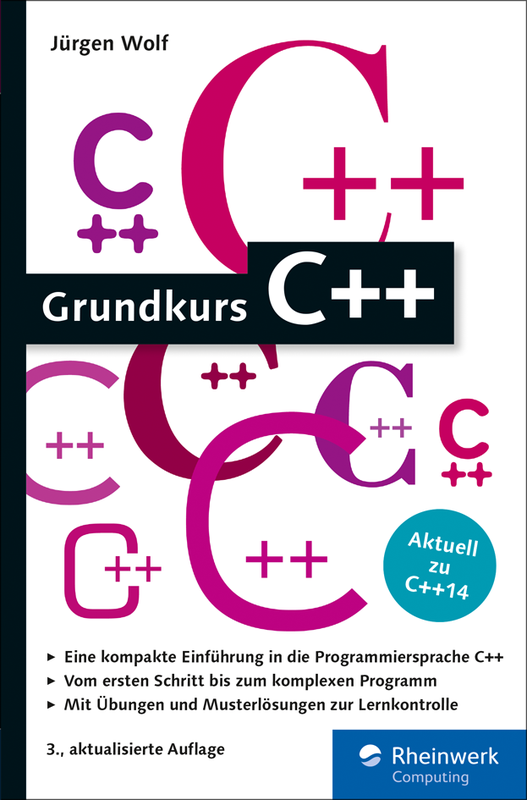
Grundkurs C++
Das gesamte Grundwissen zu C++ im praktischen Taschenbuchformat – zum Lernen und Nachschlagen. Vom ersten einfachen Programm bis zu komplexen Anwendungen. Übungen am Ende jedes Kapitels helfen Ihnen bei der Lernkontrolle. Sämtliche Grundlagen (Klassen, Vererbung, Polymorphie, Templates usw.) werden kurz und übersichtlich dargestellt. Diese dritte Auflage berücksichtigt die Standards C++11 und C++14.

Don't be evil
Entdecke, wie ethisches Marketing zum Erfolg führt! Alexandra Polunin zeigt, wie Selbstständige und Unternehmen verantwortungsvoll und wertebasiert agieren können. Sie deckt problematische Praktiken wie Social Washing und Dark Patterns auf und bietet Alternativen. Lerne, wie du mit Transparenz, Diversität und Nachhaltigkeit echten Mehrwert schaffst. Ein praxisnahes Handbuch für alle, die Marketing neu denken wollen – mit konkreten Strategien für soziale Verantwortung, Inklusion und Datenschutz. Nutze die Chance, dein Marketing ethisch und erfolgreich zu gestalten! Aus dem Inhalt: Don't be evil: Einführung in ethisches MarketingSocial Washing: Vermeide irreführende PraktikenDiskriminierung im Marketing erkennen und vermeidenDark Patterns: Designtricks, die in die Irre führenPsychologische Tricks: Manipulation oder legitimes Marketing?Soziale Verantwortung: von innen nach außenDiversität: Vielfalt als Chance im MarketingInklusion: Zugänglichkeit für alle schaffenWahlfreiheit: Kommunikation auf AugenhöheDatenschutz: verantwortungsvoller Umgang mit Kundendaten 1. Don't be evil ... 13 1.1 ... Don't be evil! Können wir Googles altem Motto neues Leben einhauchen? ... 14 1.2 ... Was ist gutes Marketing? ... 15 1.3 ... Warum genau jetzt die richtige Zeit für gutes Marketing ist ... 17 1.4 ... Das gute Marketing als Chance für Selbstständige und Unternehmen ... 21 1.5 ... Was dich in diesem Buch erwartet ... 28 1.6 ... An wen richtet sich dieses Buch? ... 30 1.7 ... Wer ich bin und aus welcher Perspektive ich das Buch schreibe ... 31 TEIL I. Marketing zum Abgewöhnen: Was Selbstständige und Unternehmen verlernen dürfen ... 33 2. Social Washing ... 35 2.1 ... Was ist Social Washing? ... 35 2.2 ... Greenwashing ... 36 2.3 ... Femwashing ... 44 2.4 ... Rainbowwashing ... 53 2.5 ... Weitere Formen von Social Washing im Überblick ... 59 2.6 ... Social Washing als Risiko für Selbstständige und Unternehmen ... 64 2.7 ... Unlearn Social Washing: Das Wichtigste in Kürze ... 66 3. Diskriminierung ... 69 3.1 ... Was ist die Unconscious Bias? ... 69 3.2 ... Rassismus im Marketing ... 70 3.3 ... Sexismus im Marketing ... 77 3.4 ... Homophobie und Transfeindlichkeit im Marketing ... 86 3.5 ... Antisemitismus im Marketing ... 90 3.6 ... Ableismus im Marketing ... 92 3.7 ... Lookismus im Marketing ... 96 3.8 ... Ageismus im Marketing ... 102 3.9 ... Provokation oder Diskriminierung? Der Fall True Fruits ... 107 3.10 ... Unlearn Diskriminierung: Das Wichtigste in Kürze ... 109 4. Dark Patterns ... 117 4.1 ... Was sind Dark Patterns? ... 117 4.2 ... Zwölf Dark Patterns zum Abgewöhnen ... 118 4.3 ... Mehr als »nur« Marketing: Dark Patterns als Herausforderung für Politik und Gesellschaft ... 126 4.4 ... Unlearn Dark Patterns: Das Wichtigste in Kürze ... 128 5. Psychologische Tricks und Manipulation ... 131 5.1 ... Künstliche Verknappung ... 132 5.2 ... Preisstrategien ... 138 5.3 ... Erfolg als Köder ... 144 5.4 ... Klassische Launchstrategien unter der Lupe ... 148 5.5 ... Emotionale Manipulation ... 156 5.6 ... Der Gipfel der Manipulation: Hochpreiscoachings ... 166 5.7 ... Unlearn Manipulation: Das Wichtigste in Kürze ... 170 TEIL II. Herzlich willkommen auf der guten Seite des Marketings ... 173 6. Deine Toolbox fürs gute Marketing ... 175 6.1 ... Compliance ... 175 6.2 ... Unternehmenswerte ... 177 6.3 ... Purpose ... 184 6.4 ... Ethische Prinzipien ... 188 6.5 ... Erfolg definieren ... 190 6.6 ... Die Toolbox für das gute Marketing: das Wichtigste in Kürze ... 191 7. Verantwortung ... 193 7.1 ... Eine Frage der Verantwortung ... 193 7.2 ... Verantwortung von innen her übernehmen ... 200 7.3 ... Verantwortung nach außen kommunizieren -- wichtige Spielregeln ... 213 7.4 ... Verantwortung im Marketing: Das Wichtigste in Kürze ... 236 8. DEI: Vielfalt, Gerechtigkeit und Inklusion ... 239 8.1 ... DEI von innen beginnen ... 240 8.2 ... DEI nach außen kommunizieren -- wichtige Spielregeln ... 248 8.3 ... Marketing für alle: Das Wichtigste in Kürze ... 281 9. Transparenz und Wahlfreiheit ... 283 9.1 ... Wie gelingt Kommunikation auf Augenhöhe? Sechs Ideen ... 283 9.2 ... Verkaufen, ohne zu manipulieren -- die wichtigsten Grundsätze ... 295 9.3 ... Datenschutz ... 308 9.4 ... Wahlfreiheit und Transparenz im Marketing: Das Wichtigste in Kürze ... 317 10. Die Zukunft gehört dem guten Marketing! ... 321 10.1 ... Was Marketingverantwortliche verlernen dürfen ... 321 10.2 ... Was Marketingverantwortliche lernen dürfen ... 324 10.3 ... Tipps zur Umsetzung ... 328 10.4 ... Hilfreiche Onlinetools im Überblick ... 333 10.5 ... Marketing wie Mr. Burns oder Lisa Simpson? Du entscheidest! ... 334 Danksagung ... 335 Index ... 336

Einfach klar!
Verständlichkeit ist der Schlüssel zu erfolgreicher Kommunikation. Petra van Laak zeigt Ihnen, wie Sie klare, präzise und zugängliche Inhalte für berufliche und formelle Kontexte schreiben. Egal ob im Unternehmen, in Behörden, im Bildungswesen oder privat – mithilfe praxisnaher Anleitungen und aktueller Tools gestalten Sie Ihre Texte effizient und wirkungsvoll. Die Expertin für professionelle Kommunikation und Textentwicklung vermittelt fundiertes Wissen und praktische Beispiele, um Missverständnisse zu vermeiden, Botschaften prägnant zu formulieren und Leserinnen und Leser zu überzeugen. Von Grundlagen über Zielgruppenanalyse bis hin zu gendersensibler Sprache und Barrierefreiheit. Aus dem Inhalt: Was einen Text verständlich machtZielgruppenanalyse und präzises SchreibenTextaufbau und innere LogikStil und TonalitätKI-Tools zur TextoptimierungGendersensible und inklusive SpracheRedigieren und OptimierenEmotionen in TextenChecklisten und spannende Vorher-Nachher-BeispieleBarrierefreiheit in der TextgestaltungPräzision und Fachjargon Versteht sich doch von selbst -- oder? ... 9 VERSTEHEN! ... 13 Was einen verständlichen Text ausmacht ... 15 Verständlichkeitsmodelle und (KIgestützte) Messbarkeit von Verständlichkeit ... 32 Wie Texte richtig wirken -- mit Logos, Ethos und Pathos ... 40 Lesevergnügen: die Sinne ansprechen, den Leser überraschen ... 51 WISSEN! ... 67 Für wen schreiben Sie? -- Zielgruppen richtig ansprechen ... 69 Texte logisch aufbauen ... 91 Präzise formulieren ... 113 Fachjargon und Standardsprache: das richtige Maß finden ... 123 Impuls und Inspiration: Texte, die bewegen ... 138 Redigieren: Kill your Darlings ... 150 KI-Textgeneratoren einsetzen ... 160 Gendersensible Sprache ... 173 Barrierefreiheit mitdenken ... 192 Vielfalt beachten -- wertschätzend schreiben ... 208 MACHEN! ... 223 Antwort auf Beschwerde ... 225 Aushang ... 229 Formular (Antrag auf Balkonkraftwerk) ... 232 Kondolenzbrief ... 235 Geschäftsbericht, hier: Aktionärsbrief ... 238 Information an Mitarbeitende im Intranet ... 242 Kundenbrief ... 245 Online registrieren ... 249 Protokoll, hier: Eigentümerversammlung ... 256 Instagram-Post ... 260 LinkedIn-Post ... 263 Freudiger Anlass: Gratulation ... 266 Geheimhaltungsvereinbarung ... 270 Information vom Amt ... 276 Anleitung ... 280 Kontomitteilung ... 284 Merkblatt für die Briefwahl ... 289 Unternehmensleitbild ... 293 Aufruf zum ehrenamtlichen Engagement ... 297 Stornierung bestätigen ... 301 CHECKLISTEN ... 305 Checkliste 1: Was einen verständlichen Text ausmacht ... 307 Checkliste 2: Verständlichkeitsmodelle und (KIgestützte) Messbarkeit von Verständlichkeit ... 310 Checkliste 3: Wie Texte richtig wirken -- mit Logos, Ethos und Pathos ... 312 Checkliste 4: Lesevergnügen: die Sinne ansprechen, den Leser überraschen ... 314 Checkliste 5: Für wen schreiben Sie? -- Zielgruppen richtig ansprechen ... 316 Checkliste 6: Texte logisch aufbauen ... 319 Checkliste 7: Präzise formulieren ... 321 Checkliste 8: Fachjargon und Standardsprache: das richtige Maß finden ... 323 Checkliste 9: Impuls und Inspiration: Texte, die bewegen ... 325 Checkliste 10: Redigieren: Kill your Darlings ... 327 Checkliste 11: KITextgeneratoren einsetzen ... 330 Checkliste 12: Gendersensible Sprache ... 332 Checkliste 13: Barrierefreiheit mitdenken ... 335 Checkliste 14: Vielfalt beachten -- wertschätzend schreiben ... 337 ANHANG ... 341 Literaturverzeichnis ... 342 Dank ... 346 Index ... 349

Swift (5. Auflage)
Mit Swift und SwiftUI erstellen Sie professionelle und moderne Apps für macOS und iOS. Wie das geht, zeigt Ihnen Michael Kofler in diesem vollständig neu konzipierten Swift-Handbuch. Von den ersten Zeilen in Xcode über das Design Ihrer neuen App mit SwiftUI bis zur Veröffentlichung im App-Store lernen Sie alle Schritte der Anwendungsentwicklung kennen und machen sich mit den neuen Features von Swift 6 vertraut. Ideal für das Selbststudium und den Unterricht. Aus dem Inhalt: Crashkurs XcodeSchleifen, Funktionen und ClosuresStrukturen, Klassen und ProtokolleViews anwenden und selbst programmierenApp-Design und AnimationData Binding, SwiftData und iCloudInternationalisierung und App Store

Windows 11 (7. Auflage)
Windows 11 sicher beherrschen! Jörg Hähnle und Mareile Heiting zeigen Ihnen in diesem kompakten Handbuch den Weg. In wenigen Schritten installieren Sie das Betriebssystem, nutzen Apps und Programme, verwalten Ihre Daten, stellen eine Internetverbindung her und genießen Fotos, Musik und Videos an Ihrem Rechner. Sie lernen auch, wie Sie Ihre Daten schützen und was bei Problemen zu tun ist. Farbige Abbildungen, zahlreiche Tipps und ein ausführliches Stichwortverzeichnis machen dieses Buch zu einer praktischen Bedienungsanleitung für Einsteiger und Fortgeschrittene.Aus dem Inhalt: Windows 11 installierenBei Windows anmeldenWo finde ich was in Windows 11?Programme und AppsDatei- und Ordnerverwaltung mit dem ExplorerDateien und Ordner suchenIns Internet mit Windows 11Surfen mit Microsoft EdgeSicherheit im InternetKontakte speichern und verwaltenDie Kalender-App verwendenMit OneDrive Daten online in der Cloud speichernWindows 11 individuell anpassenDie Bildschirmeinstellungen ändernDen Desktop einrichtenBenutzerkonten erstellen, verwenden und verwaltenGeräte anschließenDrucken mit Windows 11USB-Sticks und -Festplatten anschließenBilder, Musik und VideosEin Netzwerk einrichtenEine Netzwerkverbindung herstellenCopilot richtig einsetzenFernsteuerung und Fernwartung: Remotezugriff mit Windows 11Warten, pflegen, absichernDie Festplatte defragmentierenProgramme deinstallierenWindows-UpdatesAntivirenprogramm und FirewallBackup: Sichern und wiederherstellenDer DateiversionsverlaufDatenschutz und PrivatsphäreProbleme lösenAbgestürzte Programme beendenÄltere Programme unter Windows 11 nutzenTastenkürzel, Fehlermeldungen und Hilfe

Grundkurs Grafik und Gestaltung
Wer sich zum ersten Mal mit dem Thema Layout, Grafikdesign und Gestaltung beschäftigt, hat viele Fragen. Wo soll ich anfangen, wenn ich vor einer leeren weißen Seite stehe, die »gestaltet« werden will? Welche Formate bieten sich an? Welche Schriften passen am besten zusammen? Wie erzeuge ich Aufmerksamkeit? Und gilt das alles auch fürs Web? Da ist es gut, ein verlässliches Lern- und Praxisbuch zur Hand zu haben, das die Geheimnisse guter Gestaltung verständlich erklärt. Claudia Korthaus führt Sie Schritt für Schritt in die Welt der Gestaltung ein. Sie zeigt Ihnen, welche Grundregeln es zu beachten gilt und wie Sie sie auf die verschiedenen Bereiche wie Layout, Farbe, Bilder und Schriften anwenden können. Dank zahlreicher Beispiele, Vorher-nachher-Vergleichen und praktischer Checklisten lernen Sie schnell, worauf es bei guter Gestaltung ankommt und erstellen schon bald ansprechende Designs, die auch Profis überzeugen. So werden Sie fit für Ausbildung und Studium! Aus dem Inhalt: Drei Regeln für die GestaltungSeitenformat und SatzspiegelGestaltungsrasterElemente gekonnt platzierenFormen und GestaltgesetzeFarbharmonie und -kontrastFarbsysteme und TechnikBildwirkungDie richtige SchriftwahlSchriftkombinationenKorrekte DruckausgabeGestaltung, Farbe und Schrift im Web 1. Grundlagen der Gestaltung ... 18 1.1 ... Variabeln in der Gestaltung ... 18 1.2 ... Für jede Leseart die richtige Typografie ... 23 1.3 ... Reihenfolge der Gestaltung ... 26 1.4 ... Die erste Grundregel: Blickfang ... 32 1.5 ... Die zweite Grundregel: Gruppen ... 37 1.6 ... Die dritte Grundregel: Wiedererkennung ... 41 1.7 ... Zusammengefasst: Gestaltungsgrundlagen ... 47 2. Layout ... 52 2.1 ... Die Raumaufteilung ... 52 2.2 ... Wie finde ich das optimale Format? ... 53 2.3 ... Optimales Teilungsverhältnis:Goldener Schnitt und Co. ... 59 2.4 ... Wie entsteht ein Satzspiegel? ... 62 2.5 ... Das Gestaltungsraster ... 72 2.6 ... Wozu Spalten -- und wie viele? ... 81 2.7 ... Tipps für ein professionelles Layout ... 86 2.8 ... Seiten im Web ... 92 2.9 ... Webdesign für verschiedene Endgeräte ... 95 2.10 ... Zusammengefasst: Layout ... 103 3. Formen ... 106 3.1 ... Welche Wirkung haben Formen? ... 106 3.2 ... Die richtige Gewichtung ... 111 3.3 ... Gestaltgesetze ... 114 3.4 ... Anordnung und Kombination ... 120 3.5 ... Formen im Web ... 129 3.6 ... Zusammengefasst: Formen ... 132 4. Farben ... 138 4.1 ... Wieso wirken Farben? ... 138 4.2 ... Farbe verstehen ... 141 4.3 ... Der Farbkreis ... 148 4.4 ... Farbkontrast ... 150 4.5 ... Farbharmonie ... 153 4.6 ... Wie Farben wirken ... 158 4.7 ... Farbwahl am Beispiel ... 169 4.8 ... Farbe im Webdesign ... 173 4.9 ... Zusammengefasst: Farbe ... 178 5. Bilder ... 182 5.1 ... Ein Bild, was ist das eigentlich? ... 182 5.2 ... Woher nehmen und nicht stehlen? ... 184 5.3 ... Die Bildwirkung ... 187 5.4 ... Die Technik dahinter ... 205 5.5 ... Bilder im Web ... 210 5.6 ... Zusammengefasst: Bilder ... 215 6. Schrift ... 218 6.1 ... Schriften wirken ... 218 6.2 ... Die Schriftklassifikation ... 220 6.3 ... Die richtige Schrift wählen ... 233 6.4 ... Schriften kombinieren ... 241 6.5 ... Texte gestalten ... 254 6.6 ... Effekte ... 276 6.7 ... Schrift im Web ... 281 6.8 ... Schrifttechnik ... 292 6.9 ... Schriftpraxis am Beispiel ... 295 6.10 ... Zusammengefasst: Schrift ... 302 7. Ausgabe ... 306 7.1 ... Farbwiedergabe im Druck ... 306 7.2 ... Farbmanagement ... 308 7.3 ... Farbe in Photoshop und InDesign ... 311 7.4 ... Drucktechnische Besonderheiten ... 317 7.5 ... Papier ... 321 7.6 ... Datenübergabe per PDF ... 325 7.7 ... Zusammengefasst: Ausgabe ... 331 Index ... 335

GIMP 3 - Praxiswissen für Einsteiger
Viele Beispiele und kleine Projekte mit GIMPGIMP ist kostenlos, frei verfügbar und steht mit der neuen Version 3 den professionellen und oft teuren Software-Produkten in nichts nach. In diesem Buch zeigt Ihnen Winfried Seimert ausführlich, wie Sie GIMP anwenden und eigene Fotos bearbeiten können. Dabei geht er Schritt für Schritt vor und erklärt alles anhand leicht nachvollziehbarer Beispiele und kleiner Projekte.Ganz einfach Fotos bearbeiten und retuschierenNachdem Sie die Benutzeroberfläche kennengelernt haben, erfahren Sie, wie Sie Fotos mit ein paar schnellen Klicks optimieren können. Sie lernen sowohl, wie Sie Ihre Bilder freistellen, um nur bestimmte Bereiche zu bearbeiten, als auch, wie Sie die hilfreichen Ebenen sinnvoll nutzen. Außerdem demonstriert der Autor, wie Sie z.B. trübe Himmel aufhübschen, unerwünschte Bildteile entfernen oder sogar mithilfe der verschiedenen Filter beeindruckende Kunstwerke erstellen.Lassen Sie Ihrer Kreativität freien Lauf, wenden Sie das Erlernte sofort an Ihren eigenen Fotos an und erzielen Sie tolle Bild-Ergebnisse!Aus dem Inhalt: Basiswissen GIMP Arbeiten mit Bilddateien Grundlegende Bildbearbeitung Separieren und Freistellen Einsatz von Ebenen Bilder im rechten Licht Fotos retuschieren Werkzeug- und Trickkiste GIMP erweiternLeseprobe (PDF-Link)Über den Autor:Winfried Seimert ist IT-Dozent, Consultant und Autor zahlreicher Fachbücher insbesondere zu den Themen Software und Betriebssysteme. Dabei hat er immer den Komfort des Anwenders im Blick und erklärt entsprechend praxisnah. So erfreuen sich seine Bücher aufgrund ihrer durchdachten Struktur seit vielen Jahren großer Beliebtheit.

PHP, MySQL, & JavaScript All-In-One For Dummies
LEARN THE ESSENTIALS OF CREATING WEB APPS WITH SOME OF THE MOST POPULAR PROGRAMMING LANGUAGESPHP, MySQL, & JavaScript All-in-One For Dummies bundles the essentials of coding in some of the most in-demand web development languages. You'll learn to create your own data-driven web applications and interactive web content. The three powerful languages covered in this book form the backbone of top online apps like Wikipedia and Etsy. Paired with the basics of HTML and CSS—also covered in this All-in-One Dummies guide—you can make dynamic websites with a variety of elements. This book makes it easy to get started. You'll also find coverage of advanced skills, as well as resources you'll appreciate when you're ready to level up.* Get beginner-friendly instructions and clear explanations of how to program websites in common languages* Understand the basics of object-oriented programming, interacting with databases, and connecting front- and back-end code* Learn how to work according to popular DevOps principles, including containers and microservices* Troubleshoot problems in your code and avoid common web development mistakesThis All-in-One is a great value for new programmers looking to pick up web development skills, as well as those with more experience who want to expand to building web apps. RICHARD BLUM is a highly experienced programmer and systems administrator. He is also author of the most recent editions of Linux For Dummies and Linux All-in-One For Dummies.

Blockchain Technology for the Engineering and Service Sectors
BLOCKCHAIN TECHNOLOGY FOR THE ENGINEERING AND SERVICE SECTORS IS ESSENTIAL FOR ANYONE LOOKING TO UNDERSTAND HOW TO HARNESS BLOCKCHAIN TECHNOLOGY, DRIVING INNOVATION AND EFFICIENCY ACROSS VARIOUS SECTORSBlockchain technology stands as one of the most transformative innovations of the 21st century, significantly impacting sectors including finance, manufacturing, and the service industry. Despite its relatively recent emergence, blockchain has the potential to revolutionize a wide array of industries, including tourism, agriculture, healthcare, and automobiles. With the growing interest in decentralized finance, governments and businesses are increasingly investing in research and development to enhance blockchain’s capabilities. As the technology continues to evolve, we can expect even more ground-breaking advancements in the near future. Blockchain Technology for the Engineering and Service Sectors is designed to provide a comprehensive exploration of blockchain technology, divided into two key areas of study. The first section delves into the history and technical evolution of blockchain, tracing its development from the inception of Bitcoin to its integration with other advanced technologies like the Internet of Things. The second section focuses on the frameworks and applications of blockchain, examining its use across various industries, including supply chain management, tourism, banking, healthcare, and automation. Additionally, the book addresses current challenges, emerging trends, and the future potential of blockchain technology. Through a detailed and structured presentation of these topics, readers will gain a deep understanding and expertise in the field of blockchain technology. AUDIENCEResearchers, engineers, and industry professionals working in research and development to explore the possibilities of blockchain.

Integrating Neurocomputing with Artificial Intelligence
INTEGRATING NEUROCOMPUTING WITH ARTIFICIAL INTELLIGENCE PROVIDES UNPARALLELED INSIGHTS INTO THE CUTTING-EDGE CONVERGENCE OF NEUROSCIENCE AND COMPUTING, ENRICHED WITH REAL-WORLD CASE STUDIES AND EXPERT ANALYSES THAT HARNESS THE TRANSFORMATIVE POTENTIAL OF NEUROCOMPUTING IN VARIOUS DISCIPLINES.Integrating Neurocomputing with Artificial Intelligence is a comprehensive volume that delves into the forefront of the neurocomputing landscape, offering a rich tapestry of insights and cutting-edge innovations. This volume unfolds as a carefully curated collection of research, showcasing multidimensional perspectives on the intersection of neuroscience and computing. Readers can expect a deep exploration of fundamental theories, methodologies, and breakthrough applications that span the spectrum of neurocomputing. Throughout the book, readers will find a wealth of case studies and real-world examples that exemplify how neurocomputing is being harnessed to address complex challenges across different disciplines. Experts and researchers in the field contribute their expertise, presenting in-depth analyses, empirical findings, and forward-looking projections. Integrating Neurocomputing with Artificial Intelligence serves as a gateway to this fascinating domain, offering a comprehensive exploration of neurocomputing’s foundations, contemporary developments, ethical considerations, and future trajectories. It embodies a collective endeavor to drive progress and unlock the potential of neurocomputing, setting the stage for a future where artificial intelligence is not merely artificial, but profoundly inspired by the elegance and efficiency of the human brain. ABHISHEK KUMAR, PHD is a professor and Assistant Director in the Computer Science and Engineering Department at Chandigarh University, Punjab with over 13 years of teaching experience. He has published over 170 peer-reviewed papers, seven books, and one patent and edited over 50 volumes. His research interests include artificial intelligence, renewable energy systems, image processing, and data mining. PRAMOD SINGH RATHORE is an assistant professor in the Department of Computer and Communication Engineering at Manipal University with over 11 years of teaching experience. He has published over 55 papers in reputable national and international journals, books, and conferences. His research interests include NS2, computer networks, mining, and database management systems. SACHIN AHUJA, PHD is the Executive Director of Engineering at Chandigarh University with extensive research and academic experience. He has served in key academic positions at various reputed higher education institutes, guiding several master’s and doctoral scholars in areas including artificial intelligence, machine learning, and data mining. UMESH KUMAR LILHORE, PHD is affiliated with Galgotias University where he actively engages in academic leadership, research, and mentoring. He has published over 100 scholarly articles and is a senior member of the Institue for Electrical and Electronics Engineers. His areas of expertise include artificial intelligence, machine learning, Internet of Things (IoT), cloud computing, and cybersecurity.
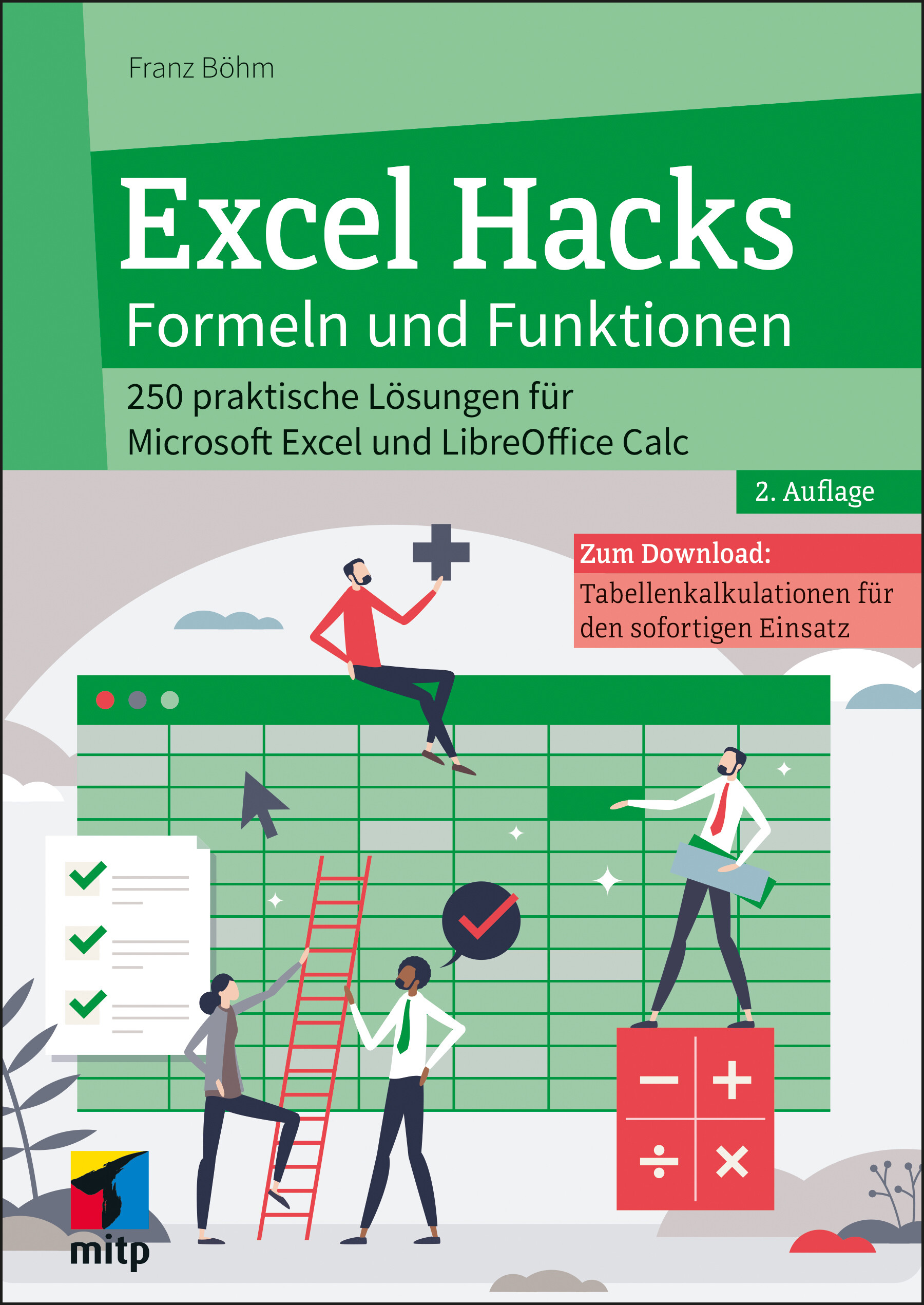
Excel Hacks (2. Auflg.)
250 sofort anwendbare Lösungen für Ihre TabellenkalkulationMit Microsoft Excel oder LibreOffice Calc können Sie all Ihre Aufgaben der Tabellenkalkulation bewältigen – vorausgesetzt, Sie kennen die passenden Funktionen und wissen, wie man sie effektiv kombiniert. Dieses Buch liefert Ihnen 250 erprobte Lösungen für typische Problemstellungen im Alltag und Beruf.Von Datum bis Datenbank: Verständliche Lösungen für alle AnforderungenOb Datums- und Uhrzeitberechnungen, Umsatzermittlung, statistische Auswertungen, bedingte Formatierungen oder die Arbeit mit Datenbanken – dieses Buch bietet Ihnen zu jedem Thema praxiserprobte Lösungen. Dank leicht verständlicher Schritt-für-Schritt-Anleitungen ist es ideal für Einsteiger und Fortgeschrittene geeignet.Sofort starten mit fertigen BeispieldateienAlle Formeln und fünf umfassende Beispielanwendungen – darunter ein Urlaubskalender und ein Haushaltsbuch – stehen zum Download bereit. Die Dateien sind im Excel-Format (.xlsx) und im Calc-Format (.ods) verfügbar und können unabhängig von der Softwareversion direkt eingesetzt werden.Aus dem Inhalt: Datums- und Uhrzeitfunktionen Geburtstage und Feiertage Kapital und Anlagen Zinsen, Kredite und Abschreibung Informationsfunktionen Umsatz- und Gewinnermittlung Rangfolgen und Runden Rechenfunktionen in der Praxis Textfunktionen Bedingte Formatierungen Tabellen und Datenbanken: Zeilen und Spalten Zellinhalte suchen und anzeigen Zellbereiche auswerten Tabellenkalkulation mit Copilot Anwendungen zum Download: Haushaltsbuch Quittungsformular Urlaubskalender Jahreskalender SternzeichenberechnungLeseprobe (PDF)

Autodesk Fusion
Learning by DoingDieses Workshop-Buch führt Sie Schritt für Schritt in die Arbeit mit Autodesk Fusion ein. Anhand anschaulicher Beispiele und klar strukturierter Übungen lernen Sie die wichtigsten Funktionen des leistungsstarken CAD-Programms von Grund auf kennen. Ob einfache Bauteile, komplexe Baugruppen oder animierte Explosionsdarstellungen: Sie wenden das Gelernte sofort praktisch an.Einfach erklärt – auch ohne CAD-Erfahrung leicht verständlichDie Anleitungen sind so gestaltet, dass sie sich leicht nachvollziehen lassen – ganz gleich, ob Sie beruflich mit CAD arbeiten, als Student erste Erfahrungen sammeln oder als Maker Ihre Projekte verwirklichen möchten. Dank zahlreicher Abbildungen und präziser Erläuterungen eignet sich das Buch ideal für den Einstieg.Perfekt abgestimmt auf die kostenlose Fusion-VersionAlle Projekte und Übungen sind auf die kostenlose Version von Autodesk Fusion für Privatanwender ausgerichtet und lassen sich damit ohne Einschränkungen umsetzen. Gleichzeitig bilden sie eine solide Grundlage für den professionellen Einsatz mit der kostenpflichtigen Vollversion.Aus dem Inhalt: Volumenkörper über Skizzen modellieren Einfache Volumenkörper mittels Extrusion (Austragung) und Rotation (Drehen) Gebogene Teile mittels Sweep mit Pfaden Bohrungen und Gewinde Modellieren über Flächen Zusammenfügen von Einzelkörpern zu Baugruppen Einfügen von Zukaufteilen aus Katalogen Gelenke definieren und Animation von Bewegungen Fotorealistische Darstellungen Ableiten technischer Zeichnungen mit Ansichten und Schnitten Erstellen von Werkzeugbahnen zur Fertigung auf NC-Maschinen Datenausgabe für 3D-DruckLeseprobe (PDF)

Penetrationstests erfolgreich umsetzen
Dieses Buch ist ein Praxisleitfaden für Verantwortliche in Unternehmen, die Pentests erfolgreich umsetzen wollen. Dabei werden aktuelle regulatorische Anforderungen und Herausforderungen ebenso beleuchtet wie die unterstützende Wirkung der KI.Professionelle Dienstleister decken durch Pentests Schwachstellen in Komponenten auf, damit Betroffene diese proaktiv beheben können. Dabei werden Vorgehen und Methoden echter Angreifer angewendet.Die Autoren geben praxisnahe Tipps zum Vorgehen, beginnend bei der Planung erster Pentests bis zur Nachbereitung. Es wird in sämtlichen Phasen aufgezeigt, wie für alle Seiten ein optimaler Nutzen aus Pentest-Projekten gezogen wird, bei gleichzeitig rechtlich sicheren Rahmenbedingungen.NINA WAGNER hat nach ihrem Mathe-Studium die IT-Sicherheitsbranche fasziniert, besonders das proaktive Aufdecken von Schwachstellen. Vor der Gründung ihrer eigenen Firma, der MindBytes GmbH, hat sie bereits mehrere Jahre als Pentesterin und Red Teamerin gearbeitet.HORST SPEICHERT ist Partner der Kanzlei esb Rechtsanwälte und seit mehr als 25 Jahren als Rechtsanwalt spezialisiert auf IT-Recht, Datenschutz und Informationssicherheit.DR. STEPHEN FEDTKE ist Wirtschaftsingenieur der Elektrotechnik (TH Darmstadt, Regelungstechnik), Autor und Herausgeber im Springer Verlag, und CTO des Sicherheits- und Compliance-Lösungsanbieters Enterprise-IT-Security.com.BERNHARD C. WITT berät seit 1998 zu Informationssicherheit und ist als Principal on Cybersecurity and Critical Entities Protection bei der SITS Deutschland GmbH beschäftigt. Er ist ein ausgewiesener Experte zur neuen Regulierung zur Cybersicherheit und hat zahlreiche Prüfungen kritischer Infrastrukturen nach § 8a Abs. 3 BSIG durchgeführt oder begleitet.Einleitung.- Testgegenstände.- Anbieterauswahl.- Ablauf eines Pentests.- Pentests rechtssicher umsetzen.- Woher kommen Pflichten für Pentests.- Erste Pentests umsetzen.- Pentests und künstliche Intelligenz.- Anhang.

Metaversum
Die Entwicklung des Internets, insbesondere des WWW, stößt aktuell an ihre Grenzen – sowohl technisch als auch sozio-kulturell und ökonomisch. Als Lösung wird ein neues Internet versprochen, das die Grenzen der realen und der virtuellen Welt überwinden und Realität und Digitalität verschmelzen soll – das Metaversum. Technische, semantische und organisatorische Details greifen hierzu eng ineinander. Was aber bedeutet dies bei genauerer Betrachtung? Welche technisch-technologischen Herausforderungen müssen bewältigt werden, um ein solches Verschmelzen zu erreichen? Welche ökonomischen Möglichkeiten eröffnen sich– und welche verbieten sich möglicherweise? Wie kann erreicht werden, dass ein offenes und für jeden benutzbares Metaversum entsteht? Und wie kann vermieden werden, dass auch in diesem neuen Metaversum wenige große Anbieter ihre proprietären Ideen durchsetzen? Für diese Fragen soll dieses Buch Antworten aufzeigen. In der vorliegenden Auflage wurden zudem aktuelle Trends sowie der Beitrag der künstlichen Intelligenz zum Metaversum ergänzt.DR. PETER HOFFMANN, einerseits Hochschullehrer für Wirtschaftsinformatik, andererseits Medieninformatiker mit Herz und Seele, beschäftigt sich seit mittlerweile mehr als 20 Jahren mit den Fragen danach, was „digitale Medien“ und „virtuelle Welten“ eigentlich sind und wie der Benutzer mit ihnen interagieren kann.Metaversum?.- Woher … wohin … oder: was überhaupt.- Das Verschmelzen von Welten und …versen.- Eine andere Dimension: Ökonomisches Verschmelzen.- Was nicht fehlen darf: Kritik.- Die wirkliche Vision.- Jetzt ist die Zeit zum Bauen!.- Nachtrag 1 - Weil es so aktuell ist: Künstliche Intelligenz im Metaversum?.

Praxisbuch Windows-Sicherheit
Das Lehr- und Experimentierwerk zur Windows-SicherheitsarchitekturDieses Buch ist ein Muss für alle, die die Low-Level-Implementierungen des Windows-Betriebssystems verstehen müssen, um neue Schwachstellen zu entdecken oder sich gegen bekannte zu schützen. Entwickler*innen, DevOps und Sicherheitsforschende finden hier einen unvergleichlichen Einblick in die Schlüsselelemente und Schwachstellen des Betriebssystems, der sogar die offizielle Dokumentation von Microsoft übertrifft. James Forshaw, renommierter Bug Hunter und Sicherheitsexperte, stellt anhand von sorgfältig ausgearbeiteten PowerShell-Beispielen, mit denen experimentiert und modifiziert werden kann, die wichtigsten Themen der Windows-Sicherheit vor. Er deckt dabei alles von der grundlegenden Analyse der Ressourcensicherheit bis hin zu fortgeschrittenen Techniken wie der Verwendung der Netzwerkauthentifizierung ab. Interaktive PowerShell-Beispiele helfen Ihnen, das Systemverhalten aktiv zu testen und zu manipulieren. Sie lernen dabei, wie Windows Dateien und die Registrierung sichern, Zugriff auf eine Ressource gewährt oder die Authentifizierung sowohl lokal als auch über ein Netzwerk implementiert.Es behandelt:Die Sicherheitsarchitektur von Windows, einschließlich des Kernels und der Anwendungen im BenutzermodusDer Windows Security Reference Monitor (SRM), einschließlich Zugriffstoken, Abfrage und Einstellung des Sicherheitsdeskriptors einer Ressource sowie Zugriffskontrolle und AuditingInteraktive Windows-Authentifizierung und Speicherung von Anmeldeinformationen im Security Account Manager (SAM) und Active DirectoryMechanismen von Netzwerk-Authentifizierungsprotokollen, einschließlich NTLM und KerberosÜber den Autor:James Forshaw ist ein renommierter Experte für Computersicherheit im Project-Zero-Team von Google. In seiner mehr als 20-jährigen Erfahrung bei der Analyse und Ausnutzung von Sicherheitsproblemen in Microsoft Windows und anderen Produkten hat er Hunderte Sicherheitslücken in Microsoft-Plattformen entdeckt. Andere zitieren häufig seine Forschungsergebnisse, die er in Blogs, in Vorträgen oder durch neuartige Tools präsentiert, und er hat zahlreiche Forscher in der Branche inspiriert. Wenn er nicht gerade die Sicherheit andere Produkte knackt, arbeitet James als „Abwehrspieler“, berät Teams bei ihrem Sicherheitsdesign und verbessert die Chromium Windows Sandbox, um Milliarden von Nutzern weltweit zu schützen.Richtet sich an:System- und NetzwerkadminsMitarbeitende in der IT-SicherheitProgrammierer*innenStudierende (Informatik, IT-Sicherheit)

Barrierefreie Webentwicklung
Barrierefreie Websites gemäß Barrierefreiheitsstärkungsgesetz – technische Umsetzung und Best PracticesSpätestens zum 28. Juni 2025 muss das Barrierefreiheitsstärkungsgesetz angewendet werden. Dies bedeutet nicht nur eine gesetzliche Verpflichtung für viele Unternehmen, sondern bietet auch Vorteile: Barrierefreie Websites erreichen eine größere Zielgruppe, sorgen für eine bessere UX und stärken das Markenimage.Dieses praxisorientierte Buch ist essenziell für alle, die sich mit der Erstellung barrierefreier Webinhalte befassen. Maria Korneeva vermittelt die Grundlagen der digitalen Barrierefreiheit und die relevanten rechtlichen Rahmenbedingungen und Richtlinien, darunter das Barrierefreiheitsstärkungsgesetz (BFSG), die Web Content Accessibility Guidelines (WCAG) und EN 301 549. Anhand von anschaulichen Beispielen lernen Sie, Barrieren im Web selbst zu erleben und zu verstehen. Zudem erhalten Sie verständliche Anleitungen und praxisnahe Codebeispiele, die Ihnen helfen, Barrierefreiheit erfolgreich in Ihre Projekte zu integrieren. Automatisierte Tests unterstützen Sie schließlich dabei, die langfristige Einhaltung der Barrierefreiheitsanforderungen sicherzustellen.Bedeutung und Vorteile digitaler BarrierefreiheitGesetzliche Vorgaben, Normen und Richtlinien (inkl. BFSG, EAA und WCAG)Umgang mit ScreenreadernGrundsätze der Barrierefreiheit: Responsiveness, Farbgestaltung, Tastaturbedienbarkeit, AlternativtexteSemantisches HTML, ARIA, Accessibility Tree, zugänglicher Name und BeschreibungBarrierefreie Implementierung von Navigation, Links, Buttons, Bildern, Cookie-Bannern, Tabellen, Formularen und weiteren UI-ElementenBarrierefreiheit von Web Components und Single Page ApplicationsTools für automatisierte BarrierefreiheitschecksLinters und Plug-ins für Unit- und End-to-End-TestsIntegration in CI/CD-PipelinesKünstliche Intelligenz, zukunftsweisende Entwicklungen und aktuelle Einschränkungen Maria Korneeva ist Frontend Technology Lead und Google Developer Expert mit Fokus auf Angular und Barrierefreiheit. Sie arbeitet freiberuflich an der Entwicklung von Frontend-Anwendungen und leitet Workshops zu Web-Technologien. Ihre Erkenntnisse aus dem Coding-Alltag teilt sie gerne auf Konferenzen und Meetups.Richtet sich an:Webentwickler*innenInformatikstudierendeTeam-LeadsTech-Leads

Getting Started with .NET Aspire
Learn to master the brand-new .NET Aspire stack to simplify the creation of cloud-native and distributed applications. You will learn how .NET Aspire combines all the necessary tools, templates, and packages to minimize friction for applications that draw on a broad array of servers.Experienced software engineer Dave Rael explains how to leverage .NET Aspire. He begins by describing the motivations for .NET Aspire and how it improves upon current approaches for distributed applications. Then, he shows you how to use .NET Aspire and its associated tools and libraries in your projects, whether your project is completely from scratch or builds upon a previously existing solution.WHAT YOU WILL LEARN:* Gain a solid understanding of the .NET Aspire stack* Create rich and dynamic distributed apps using .NET Aspire* Test, deploy, and observe your cloud-native app* Leverage built-in tools to use unit testing and integration testing with your projectsWHO THIS BOOK IS FOR:This book is for both students and .NET developers who want to build cloud-native, distributed applications using the .NET Framework. A working knowledge of C# is recommended to follow the examples used in the book.DAVE RAEL is a father, husband, and seasoned software professional. He has worked as a software developer, analyst, tester, engineer, and architect in numerous verticals and industries over the course of more than 25 years. In 1999, he started in professional software development for a large telecom company working with C++, Visual Basic, .NET, and C#. He created and published the popular podcast _Developer On Fire_ from 2015-2019, in which he interviewed software professionals to gather stories from the world of software. The project of raising excellent offspring is his most important and most successful project to date.Chapter 1: Introducing .NET Aspire.- Chapter 2: Getting Started with .NET Aspire.- Chapter 3: .NET Aspire Project Types and Templates.- Chapter 4: System Architecture Considerations.- Chapter 5: Testing Your Systems.- Chapter 6: .NET Aspire Integrations.- Chapter 7: Deploying Your Aspire-Based System.- Chapter 8: System Observability with .NET Aspire.- Chapter 9: Greenfield: Implementing New Systems with .NET Aspire.- Chapter 10: Brownfield: Using .NET Aspire with Existing Systems.- Chapter 11: Wrapping Up.

Designing Websites with Publii and GitHub Pages
Does getting online seem overwhelmingly difficult? Are you paying too much for your hosting solution? Have you always wanted to have a blog but don’t know where to start? Do you settle for a Facebook page for your business website but know you need more? The solution to these problems is choosing the right tools. This book will guide you through the process of setting up a Publii-based publishing platform and hosting your site for free on GitHub.Publii is a free, open source, desktop application that runs on Windows, Mac, and Linux and makes building the website or blog you dream of is a simple process. This book walks you through the process of installing and using Publii, setting up accounts on GitHub and hosting a static blog or website there. You will gain background insights on here to get no-cost imagery for website, how to leverage AI to generate ideas, outlines, and images. You’ll also review search engine optimization (SEO) best practices to ensure your site is searchable._Designing Websites with Publii and GitHub Pages_ is your roadmap to creating a website and understanding how the publishing workflow works.WHAT YOU WILL LEARN* Use text editors such as WYSIWYG, Block, and Markdown* Make a page from a post.* Work on advanced processes such as installing themes and plugins* Manage and back up your data* Explore GDRP and cooking banner considerationsWHO THIS BOOK IS FORThose with limited or no programming or compute skills who want to learn how to set up a website.BRAD MOORE is a technical writer and blogger based in Kentucky, USA. who has been involved in web development for 20 years. He has helped clients host sites with WordPress, Grav and Publii since 2023. Brad enjoys programming, electronics, microprocessors, and model trains. Brad is married and has three children.PART I.- 1: Introduction.- 2: Getting Started.- 3: Getting Publii Running.- 4: Getting Ready for Content.- 5: Adding Content.- 6: Page Building in Publii.- 7: Creating a GitHub Page.- 8: Configure Publii for Sync.- PART II.- 9: Backups and Sites.- 10: Themes.- 11: Single Page Sites.- 12: Gallery & Contacts.- 13: Internet Real Estate.- PART III.- 14: Plugins and Cookies.- 15: CSS Tricks.

Autodesk Fusion - Der praktische Einstieg in die 3D-Modellierung
Learning by Doing Dieses Workshop-Buch führt Sie Schritt für Schritt in die Arbeit mit Autodesk Fusion ein. Anhand anschaulicher Beispiele und klar strukturierter Übungen lernen Sie die wichtigsten Funktionen des leistungsstarken CAD-Programms von Grund auf kennen. Ob einfache Bauteile, komplexe Baugruppen oder animierte Explosionsdarstellungen: Sie wenden das Gelernte sofort praktisch an. Einfach erklärt - auch ohne CAD-Erfahrung leicht verständlich Die Anleitungen sind so gestaltet, dass sie sich leicht nachvollziehen lassen - ganz gleich, ob Sie beruflich mit CAD arbeiten, als Student erste Erfahrungen sammeln oder als Maker Ihre Projekte verwirklichen möchten. Dank zahlreicher Abbildungen und präziser Erläuterungen eignet sich das Buch ideal für den Einstieg. Perfekt abgestimmt auf die kostenlose Fusion-Version Alle Projekte und Übungen sind auf die kostenlose Version von Autodesk Fusion für Privatanwender ausgerichtet und lassen sich damit ohne Einschränkungen umsetzen. Gleichzeitig bilden sie eine solide Grundlage für den professionellen Einsatz mit der kostenpflichtigen Vollversion. Aus dem Inhalt: * Volumenkörper über Skizzen Modellieren * Einfache Volumenkörper mittels Extrusion (Austragung) und Rotation (Drehen) * Gebogene Teile mittels Sweep mit Pfaden * Bohrungen und Gewinde * Modellieren über Flächen * Zusammenfügen von Einzelkörpern zu Baugruppen * Einfügen von Zukaufteilen aus Katalogen * Gelenke definieren und Animation von Bewegungen * Fotorealistische Darstellungen * Ableiten technischer Zeichnungen mit Ansichten und Schnitten * Erstellen von Werkzeugbahnen zur Fertigung auf NC-Maschinen * Datenausgabe für 3D-Druck Detlef Ridder hat langjährige Erfahrung im Bereich CAD und bereits zahlreiche Bücher zu AutoCAD, Inventor, Revit und Archicad veröffentlicht. Er gibt Schulungen zu diesen Programmen und zu CNC und weiß daher, welche Themen für Einsteiger besonders wichtig sind.

Excel Hacks - Formeln und Funktionen
* Funktionen von Excel oder Calc effektiv kombinieren, um alltägliche Aufgaben zu lösen * Leicht verständliche Schritt-für-Schritt-Anleitungen für Alltag und Beruf * Zum Download: Alle Lösungen als Tabellenkalkulation für den sofortigen Einsatz * Geeignet für alle Versionen von Microsoft Excel (2024 und älter sowie Microsoft 365) und LibreOffice Calc 250 sofort anwendbare Lösungen für Ihre Tabellenkalkulation Mit Microsoft Excel oder LibreOffice Calc können Sie all Ihre Aufgaben der Tabellenkalkulation bewältigen - vorausgesetzt, Sie kennen die passenden Funktionen und wissen, wie man sie effektiv kombiniert. Dieses Buch liefert Ihnen 250 erprobte Lösungen für typische Problemstellungen im Alltag und Beruf. Von Datum bis Datenbank: Verständliche Lösungen für alle Anforderungen Ob Datums- und Uhrzeitberechnungen, Umsatzermittlung, statistische Auswertungen, bedingte Formatierungen oder die Arbeit mit Datenbanken - dieses Buch bietet Ihnen zu jedem Thema praxiserprobte Lösungen. Dank leicht verständlicher Schritt-für-Schritt-Anleitungen ist es ideal für Einsteiger und Fortgeschrittene geeignet. Sofort starten mit fertigen Beispieldateien Alle Formeln und fünf umfassende Beispielanwendungen - darunter ein Urlaubskalender und ein Haushaltsbuch - stehen zum Download bereit. Die Dateien sind im Excel-Format (.xlsx) und im Calc-Format (.ods) verfügbar und können unabhängig von der Softwareversion direkt eingesetzt werden. Aus dem Inhalt: * Datums- und Uhrzeitfunktionen * Geburtstage und Feiertage * Kapital und Anlagen * Zinsen, Kredite und Abschreibung * Informationsfunktionen * Umsatz- und Gewinnermittlung * Rangfolgen und Runden * Rechenfunktionen in der Praxis * Textfunktionen * Bedingte Formatierungen * Tabellen und Datenbanken: * Zeilen und Spalten * Zellinhalte suchen und anzeigen * Zellbereiche auswerten * Tabellenkalkulation mit Copilot * Anwendungen zum Download: * Haushaltsbuch * Quittungsformular * Urlaubskalender * Jahreskalender * Sternzeichenberechnung Franz Böhm beschäftigt sich bereits seit über 20 Jahren intensiv mit Microsoft Excel und den freien Varianten OpenOffice/LibreOffice Calc und kennt daher die Gemeinsamkeiten, aber auch die Unterschiede dieser Programme sowie Lösungswege für alle Problemstellungen.

Cybersecurity Threats and Attacks in the Gaming Industry
Learn about the most common and known threats and attacks in the gaming industry. Cybersecurity is a critical concern in the gaming industry due to the significant financial investments, personal data, and intellectual property at stake. Game developers, publishers, and players all have a vested interest in maintaining a secure gaming environment.This pocketbook is about why cybersecurity in the gaming industry is essential to protect player data, maintain a secure gaming environment, and safeguard intellectual property. Both players and game developers need to remain vigilant, educate themselves about potential threats, and employ best practices to ensure a safe and enjoyable gaming experience. We will describe the most common type of targeted games facing cybersecurity attacks as well as some of the most common types of cyber threats faced by the gaming industry such as malware, distributed denial of service (DDoS) attacks, data breaches, etc.WHAT YOU WILL LEARN* Describes the importance cybersecurity in the gaming industry* Explains key aspects of cybersecurity in the gaming* Describes the common types of cyber threats faced by the gaming industryWHO IS THIS BOOK FORThe book assumes you have strong gaming development and security knowledge. The book will be written mainly for developers who want to learn how to choose the right tools, what are the best practice, the threats, and vulnerabilitiesMASSIMO NARDONE has more than 27 years of experience in information and cybersecurity for IT/OT/IoT/IIoT, web/mobile development, cloud, and IT architecture. His true IT passions are security and Android. He has been programming and teaching how to program with Android, Perl, PHP, Java, VB, Python, C/C++, and MySQL for more than 27 years. He holds an M.Sc. degree in computing science from the University of Salerno, Italy. Throughout his working career, he has held various positions starting as programming developer, then security teacher, PCI QSA, Auditor, Assessor, Lead IT/OT/SCADA/SCADA/Cloud Architect, CISO, BISO, Executive, Program Director, OT/IoT/IIoT Security Competence Leader, etc.In his last working engagement, he worked as a seasoned Cyber and Information Security Executive, CISO and OT, IoT and IIoT Security competence Leader helping many clients to develop and implement Cyber, Information, OT, IoT Security activities.His technical skills include Security, OT/IoT/IIoT, Android, Cloud, Java, MySQL, Drupal, Cobol, Perl, web and mobile development, MongoDB, D3, Joomla!, Couchbase, C/C++, WebGL, Python, Pro Rails, Django CMS, Jekyll, and Scratch. He has served as a visiting lecturer and supervisor for exercises at the Networking Laboratory of the Helsinki University of Technology (Aalto University).He stays current to industry and security trends, attending events, being part of a board such as the ISACA Finland Chapter Board, ISF, Nordic CISO Forum, Android Global Forum, etc.He holds four international patents (PKI, SIP, SAML, and Proxy areas). He currently works as a Cyber Security Freelancer for IT/OT and IoT. He has reviewed more than 55 IT books for different publishers and has coauthored _Pro Spring Security_ (Apress, 2023) _Pro JPA 2 in Java EE 8_ (Apress, 2018), _Beginning EJB in Java EE 8_ (Apress, 2018), and _Pro Android Games_ (Apress, 2015).Chapter 1: Introduction of Cybersecurity in the Gaming Industry.- Chapter 2: Key aspects of Cybersecurity in Gaming Industry.- Chapter 3: Games Target of Cybersecurity Attacks.- Chapter 4: Cybersecurity Threats & Attacks in Gaming Industry.

Exploring Blazor
Build and develop web applications with Blazor in C#. This new edition not only covers the new structure for the Blazor environment, it also demonstrates the latest features, such as rendering, hosting types, improved security arrangements, and updates the syntax. Two new chapters on Forms and Validation along with Security in Blazor are also added. The code and project layout have been updated in .NET 9 for this new edition.The book starts with an introduction to Blazor, along with its various categories and its basics and syntax, including Razor syntax implementation. You will go through Blazor navigation and life cycle followed by its components. You will then learn features specific to each Blazor type. You will see how Blazor works with storage, files, and JavaScript, and you will create a Blazor code library. You will also create web applications in Blazor using practical implementations and real-life scenarios for both the server side and the client side.After reading this book, you will be able to build web applications with Blazor in C#11 and .NET Core 9.0.WHAT YOU WILL LEARN* Bind data and handle events in C# Blazor* Handle components and page navigation in Blazor* Connect Blazor front-end to APIs* Interact with files using Blazor* Understand the layout of Visual Studio Blazor project templates WHO THIS BOOK IS FORC# and .NET Core developers.TAURIUS LITVINAVICIUS is a businessman and technology expert based in Lithuania who has worked with organizations in building and implementing various projects in software development, sales, and other fields of business. He currently works on modern financial applications and consults companies on technology and cost-related issues. As with most of his projects, this book uses cutting-edge technologies, such as Blazor. Taurius is responsible for technological improvements, development of new features, and general management.Chapter 1: Introduction to Blazor.- Chapter 2: Razor Syntax and the Basics of Blazor.- Chapter 3: Blazor Components and Navigation.- Chapter 4: Blazor Components.- Chapter 5: Specifics of Different Types of Blazor.- Chapter 6: Forms in Blazor.- Chapter 7: General Blazor.- Chapter 8: Security in Blazor.- Chapter 9: Practice Tasks for Server rendering Blazor.- Chapter 10: Practice Tasks for Client (WebAssembly) Blazor.