

Computer und IT

Neural Networks with TensorFlow and Keras
Explore the capabilities of machine learning and neural networks. This comprehensive guidebook is tailored for professional programmers seeking to deepen their understanding of neural networks, machine learning techniques, and large language models (LLMs). The book explores the core of machine learning techniques, covering essential topics such as data pre-processing, model selection, and customization. It provides a robust foundation in neural network fundamentals, supplemented by practical case studies and projects. You will explore various network topologies, including Deep Neural Networks (DNN), Recurrent Neural Networks (RNN), Long Short-Term Memory (LSTM) networks, Variational Autoencoders (VAE), Generative Adversarial Networks (GAN), and Large Language Models (LLMs). Each concept is explained with clear, step-by-step instructions and accompanied by Python code examples using the latest versions of TensorFlow and Keras, ensuring a hands-on learning experience. By the end of this book, you will gain practical skills to apply these techniques to solving problems. Whether you are looking to advance your career or enhance your programming capabilities, this book provides the tools and knowledge needed to excel in the rapidly evolving field of machine learning and neural networks. What You Will Learn * Grasp the fundamentals of various neural network topologies, including DNN, RNN, LSTM, VAE, GAN, and LLMs * Implement neural networks using the latest versions of TensorFlow and Keras, with detailed Python code examples * Know the techniques for data pre-processing, model selection, and customization to optimize machine learning models * Apply machine learning and neural network techniques in various professional scenarios Explore the capabilities of machine learning and neural networks. This comprehensive guidebook is tailored for professional programmers seeking to deepen their understanding of neural networks, machine learning techniques, and large language models (LLMs). The book explores the core of machine learning techniques, covering essential topics such as data pre-processing, model selection, and customization. It provides a robust foundation in neural network fundamentals, supplemented by practical case studies and projects. You will explore various network topologies, including Deep Neural Networks (DNN), Recurrent Neural Networks (RNN), Long Short-Term Memory (LSTM) networks, Variational Autoencoders (VAE), Generative Adversarial Networks (GAN), and Large Language Models (LLMs). Each concept is explained with clear, step-by-step instructions and accompanied by Python code examples using the latest versions of TensorFlow and Keras, ensuring a hands-on learning experience. By the end of this book, you will gain practical skills to apply these techniques to solving problems. Whether you are looking to advance your career or enhance your programming capabilities, this book provides the tools and knowledge needed to excel in the rapidly evolving field of machine learning and neural networks. What You Will Learn * Grasp the fundamentals of various neural network topologies, including DNN, RNN, LSTM, VAE, GAN, and LLMs * Implement neural networks using the latest versions of TensorFlow and Keras, with detailed Python code examples * Know the techniques for data pre-processing, model selection, and customization to optimize machine learning models * Apply machine learning and neural network techniques in various professional scenarios Who This Book Is For Data scientists, machine learning enthusiasts, and software developers who wish to deepen their understanding of neural networks and machine learning techniques Chapter 1: Introduction to Neural Networks.- Chapter 2: Using Tensors.- Chapter 3: How Machines Learn.- Chapter 4: Network Layers.- Chapter 5: The Training Process.- Chapter 6: Generative Models.- Chapter 7: Re-enforcement Learning.- Chapter 8: Using Pre-trained Networks. Philip Hua brings over 30 years of experience in investment, risk management, and IT. He has held senior positions as a partner at a hedge fund, led risk and IT departments at both large and boutique firms, and co-founded a successful fintech company. Alongside Dr. Paul Wilmott, he developed the CrashMetrics methodology, a crucial tool for evaluating severe market risk in portfolios. Philip holds a PhD in Applied Mathematics from Imperial College London, an MBA, and a BSc in Engineering.

Regenerating Learning
The perfect storm of learning provoked by generative AI is not just about learning how to use the technology to change human patterns of work and life. The technologies are re-orienting how we think we learn, how we communicate with each other, and the economic, social, political, creative, and ethical factors that inform how we navigate human-influenced existence on this planet. This book addresses the need for workers in any industry to take responsibility for learning how to best use generative AI systems in their unique contexts. Generative AI can navigate you towards learning, but also towards conducting research and teaching yourself things; to empower you in reimagining and reinventing how you learn while doing your work. Just like you can regenerate content persistently using generative AI systems, so too can you regenerate what and how you learn. Chapters will prepare you to inform and guide the small team you are a part of, or influence leadership to navigate the territory of leveraging generative AI systems responsibly. Besides pointing to all the more obvious benefits of learning how to use generative AI systems more effectively, this book provides use cases, research and educational theory to propose that interacting with the technology leads to a number of unanticipated learning outcomes. These outcomes challenge the very way in which we have come to learn, what we have learned, and what we may need to unlearn. As generative AI becomes increasingly integrated within workplace environments at some point or other we will each reach a critical point of having to decide if we are going to use the technology and how. The perfect storm of learning provoked by generative AI is not just about learning how to use the technology to change human patterns of work and life. The technologies are re-orienting how we think we learn, what we learn, what we need to learn, when and where we learn about knowledge production, how humans communicate with each other, the economic, social, political, creative, ethical and technological factors that inform how we navigate human influenced existence on this planet. The technology empowers you to reimagine and reinvent how you learn while doing your work. Just like you can regenerate content persistently using generative AI systems, so too can you regenerate what and how you learn. Regenerating Learning will help guide the small team you are a part of, or influence leadership to leverage generative AI systems responsibly. Besides pointing to all the more obvious benefits of learning how to use generative AI systems more effectively, this book provides use cases, research and educational theory to propose that interacting with the technology leads to a number of unanticipated learning outcomes. These outcomes challenge the very way in which we have come to learn, what we have learned, and what we may need to unlearn. As generative AI becomes increasingly integrated within workplace environments at some point or other we will each need to decide if we are going to use the technology and how. What You will Learn • Methods and techniques to re-learn how you learn through your interactions with different generative AI. • Strategic approaches to integrate generative AI within your workflows. • How to iterate, adapt, prototype and learn continuously with generative AI. • A variety of tools and approaches to reconcile your organization’s use of generative AI. • How to develop a road map towards the integration of AI systems within your organization. Who this Book Is For Creatives, team leaders, managers and leadership in different organizations; teams in collaborative and creative industries; managers and employees in organizational learning Patrick Parra Pennefather is an Associate Professor and Researcher at the University of British Columbia within the Faculty of Arts and the Emerging Media Lab. His research is focused on Collaborative Learning Practices, Emerging technology development, Research Creations, and GraphRAG research and development within the field of machine learning. Patrick also works with learning organizations and technology companies around the world to adopt generative AI strategically within complex and inter-dependent team environments, and design learning courses that meets the needs of diverse communities to aid the development of the next generation of technology designers and developers. 1: Ready Yourself to Learn From AI.- 2: Reprogram Your Learning Patterns.- 3: Regulate How You Learn.- 4: Re-Learn While Working.-5: Design Your Own Learning.- 6: Re-energize Doing.- 7: Re-Assess with Generative AI.- 8: Re-Adjust with AI.- 9: Prototype Learning.- 10: Re-Iterate How You Learn.- 11:Reconciling Using Generative AI.- 12: Remember the Algorithms.- 13: Continuously Improve and Learn with AI.- 14: Build Your Own Teaching Bots.- 15: Re-Invent Reinforcement.- 16: Learn with Other Bots.- 17: Transform Your Organization.- 18: Reclaim Your Creative Content.- 19: Fill in the Blanks.- 20: An Intelligent Conclusion.

Principles and Applications of Blockchain Systems
Technical theory, key technologies, and practical applications for consortium blockchains, with a solution to the CAP trilemma problem Principles and Applications of Blockchain Systems provides a comprehensive introduction to consortium blockchains, including the physical, network, consensus, and contract layers, covering technical theory, key technologies, and practical applications. Beyond the technical side, this book visually showcases the application potential of consortium blockchains, with information on implementation cases in network management (Multi-Identifier System) and secure storage (Mimic Distributed Storage System). This book thoroughly addresses the CAP trilemma problem for consortium blockchains, a major barrier to scalability, by presenting a novel quantifiable impossibility triangle with a solution. Additionally, optimization techniques in consortium blockchains, such as P2P protocols for future networks and consensus algorithms, are discussed in detail. Written by two highly qualified academics with significant experience in the field, Principles and Applications of Blockchain Systems discusses topics such as: Peer-to-peer networks in consortium blockchains, covering P2P network architecture and node discovery, data synchronization, and gossip protocolsBasic concepts of distributed consistency, including the SMR model in blockchain systems, assumptions for distributed networks, and the Byzantine Generals problemConsensus mechanisms evolution process from voting-based, including PBFT, RPCA, SCP, and CoT; to proof-based including PoW, PoS, and PoX; finally optimized by fusion both voting-based and proof-based, including PoV, PPoV, HotStuffTypes of vulnerability for smart contracts, covering solidity code, EVM execution, and blockchain system layersHistorical trend of upgrade from electronic consensus to quantum consensus With highly comprehensive coverage of the subject, Principles and Applications of Blockchain Systems serves as an ideal textbook for blockchain students and researchers, and a valuable reference book for engineers and business leaders involved in developing real-world blockchain systems. Foreword by Peter Major xv Foreword by Zhang Jing-an xvii Foreword by Yale li xix Foreword by Feng Han xxi Foreword by Ramesh Ramadoss xxv About the Author xxvii Preface xxix Acknowledgments xxxiii Introduction xxxv 1 Fundamentals of Blockchain 1 1.1 Introduction to Blockchain 1 1.2 Evolution of Blockchain 4 1.3 Blockchain-Layered Architecture 13 1.4 Theoretical Constraints of Blockchain Trilemma 16 1.5 Chapter Summary 26 Discussion Questions 27 References 28 2 Physical Topology in Blockchain 31 2.1 Basic Physical Topology of Computer Network 31 2.2 N-Dimensional Hypercube-Based Topology – Making it Possible to Reach CAP Guarantee Bound in Consortium Blockchain 40 2.3 Hierarchical Recursive Physical Topology of N-Dimensional Hypercube 43 2.4 Theoretical Analysis 45 2.5 Chapter Summary 54 Discussion Questions 54 References 56 3 P2P Network in Blockchain 59 3.1 P2P Network Structure 59 3.2 Node Discovery Method 64 3.3 Broadcast Protocol 69 3.4 Chapter Summary 83 Discussion Questions 83 References 84 4 Blockchain Consensus 87 4.1 Basic Concepts of Distributed Consistency 87 4.2 Byzantine Generals Problem 95 4.3 Voting-Based Consensus 100 4.4 Proof-Based Consensus 115 4.5 Consensus Integrating Proof and Voting 130 4.6 Evaluation and Analysis of Blockchain Consensus 155 4.7 Chapter Summary 160 Discussion Questions 163 References 164 5 Smart Contract and Its Security in Blockchain 169 5.1 Concept of Smart Contracts 169 5.2 Vulnerability in Smart Contracts 171 5.3 Taxonomy of Approaches to Detecting Vulnerabilities 175 5.4 Detection Tools for Smart Contract Vulnerability 186 5.5 Chapter Summary 195 Discussion Questions 196 References 197 6 Multi-Identifier System Based on Large-Scale Consortium Blockchain 203 6.1 Background Introduction and Requirement Analysis 203 6.2 System Architecture 204 6.3 Core Functions 215 6.4 Building a Community of Shared Future in Cyberspace with Sovereign Blockchain 222 6.5 Chapter Summary 236 Discussion Questions 237 References 238 7 Integrating Consortium Blockchain and Mimic Security in Distributed Storage System 241 7.1 Background Introduction and Requirement Analysis 241 7.2 Mimic Distributed Secure Storage System 249 7.3 Logging System in Mimic Storage Based on Consortium Blockchain 256 7.4 Chapter Summary 267 Discussion Questions 267 References 268 8 Quantum Blockchain and Its Potential Applications 271 8.1 Quantum Computing and Communication Theory 271 8.2 Quantum Blockchain – Solving Trilemma of Distributed Systems 308 8.3 Scalable Quantum Computer Network 322 8.4 Chapter Summary 342 Discussion Questions 343 References 344 9 Practical Application of Large-Scale Blockchain 347 9.1 Construction of Network Topology 347 9.2 P2P Broadcast Protocol 353 9.3 Solidity Language 357 9.4 Establishment of Blockchain Infrastructure 369 9.5 Smart Contract Security Detection 373 9.6 Chapter Summary 374 Discussion Questions 375 References 375 Index 377 Hui Li, School of Electronic and Computer Engineering, Peking University Shenzhen Graduate School, Shenzhen, China. Li received the World Leading Internet Scientific and Technological Achievements award at the 6th World Internet Conference in 2019. His research interests include network architecture, cyberspace security, distributed storage, and blockchain. Han Wang, School of Electronic and Computer Engineering, Peking University Shenzhen Graduate School, Shenzhen, China.

Wellness Management Powered by AI Technologies
This book is an essential resource on the impact of AI in medical systems, helping readers stay ahead in the modern era with cutting-edge solutions, knowledge, and real-world case studies. Wellness Management Powered by AI Technologies explores the intricate ways machine learning and the Internet of Things (IoT) have been woven into the fabric of healthcare solutions. From smart wearable devices tracking vital signs in real time to ML-driven diagnostic tools providing accurate predictions, readers will gain insights into how these technologies continually reshape healthcare. The book begins by examining the fundamental principles of machine learning and IoT, providing readers with a solid understanding of the underlying concepts. Through clear and concise explanations, readers will grasp the complexities of the algorithms that power predictive analytics, disease detection, and personalized treatment recommendations. In parallel, they will uncover the role of IoT devices in collecting data that fuels these intelligent systems, bridging the gap between patients and practitioners. In the following chapters, readers will delve into real-world case studies and success stories that illustrate the tangible benefits of this dynamic duo. This book is not merely a technical exposition; it serves as a roadmap for healthcare professionals and anyone invested in the future of healthcare. Readers will find the book: Explores how AI is transforming diagnostics, treatments, and healthcare delivery, offering cutting-edge solutions for modern healthcare challenges;Provides practical knowledge on implementing AI in healthcare settings, enhancing efficiency and patient outcomes;Offers authoritative insights into current AI trends and future developments in healthcare;Features real-world case studies and examples showcasing successful AI integrations in various medical fields. Audience This book is a valuable resource for researchers, industry professionals, and engineers from diverse fields such as computer science, artificial intelligence, electronics and electrical engineering, healthcare management, and policymakers. Bharat Bhushan, PhD, is an assistant professor in the Department of Computer Science and Engineering, School of Engineering and Technology, Sharda University, Greater Noida, India. He has published more than 150 research papers, contributed over 30 book chapters, and edited 20 books. Akib Khanday, PhD, is a post-doctoral research fellow in the Department of Computer Science and Software Engineering-CIT, United Arab Emirates University, Abu Dhabi, United Arab Emirates. His research interests include computational social sciences, natural language processing (NLP), and machine/deep learning. Khursheed Aurangzeb, PhD, is an associate professor in the Department of Computer Engineering, College of Computer and Information Sciences, King Saud University, Riyadh, Saudi Arabia. Over his 15 years of research, he has been involved in several projects related to machine/deep learning and embedded systems. His research interests focus on computer architecture, signal processing, and wireless sensor networks. Sudhir Kumar Sharma, PhD, is a professor and head of the Department of Computer Science at the Institute of Information Technology & Management, affiliated with GGSIPU, New Delhi, India. His research interests include machine learning, data mining, and security. He has published more than 60 research papers in various international journals and conferences and is the author of seven books in the fields of IoT, wireless sensor networks (WSN), and blockchain. Parma Nand, PhD, is the dean of the School of Engineering and Technology, Sharda University, Greater Noida, India. His expertise includes wireless and sensor networks, cryptography, algorithms, and computer graphics. He has published more than 85 papers in peer-reviewed journals and filed two patents.
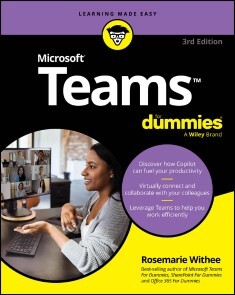
Microsoft Teams For Dummies
Learn to be a good Teams player Microsoft Teams is everyone’s favorite app to use at work. Okay, maybe it’s not your favorite, but you’ll appreciate it more when you discover how it can make your workday easier. Microsoft® Teams™ For Dummies gets you started with the basics, then shows you how to make the most of chatting, file sharing, video conferencing, and beyond. Plus, you’ll get a rundown on Copilot—Microsoft’s new AI assistant—including how it can streamline your processes, summarize meetings, and generally make your life easier. Let’s get Team-ing! Inside… Using the Teams mobile appMaking and receiving callsImproving your Teams meetingsManaging teams and channelsUncovering Teams administrationHosting hybrid meetingsIntegrating other appsUsing Teams for small business Unlock the full power of Microsoft Teams, including brand-new AI functionality, with your friends at For Dummies Looking for a fast and easy guide to Microsoft Teams, the collaboration software used by millions of people and companies around the world? In Microsoft Teams For Dummies, 3rd edition, you'll find the must-know tips, hidden tricks, and handy hacks you need to help you rock your workday and get things done lightning-fast. You'll learn how to incorporate Teams into your everyday workflow and use functionality like chatting, file sharing, team organization, videochat, and more. You'll even learn how to use Microsoft's brand-new AI companion Copilot to help you improve your processes and productivity. You'll find out how to: Connect with colleagues and collaborate remotely, from across the hall or from the other side of the worldUse little-known Teams features to help you supercharge your productivity and get more done in a dayCustomize your Teams installation and make it work better for you and your teammates An engaging and effective roadmap to one of Microsoft's most popular apps, Microsoft Teams For Dummies is a must-read for everyone who uses—or wants to use—this powerful software at work or anywhere else. Grab a copy today! Rosemarie Withee is president of Portal Integrators, a Scrum-based software and services firm. Rosemarie has authored a number of books in the For Dummies series, including the most recent editions of Office 365 For Dummies and SharePoint For Dummies.

AI in Disease Detection
Comprehensive resource encompassing recent developments, current use cases, and future opportunities for AI in disease detection AI in Disease Detection discusses the integration of artificial intelligence to revolutionize disease detection approaches, with case studies of AI in disease detection as well as insight into the opportunities and challenges of AI in healthcare as a whole. The book explores a wide range of individual AI components such as computer vision, natural language processing, and machine learning as well as the development and implementation of AI systems for efficient practices in data collection, model training, and clinical validation. This book assists readers in assessing big data in healthcare and determining the drawbacks and possibilities associated with the implementation of AI in disease detection; categorizing major applications of AI in disease detection such as cardiovascular disease detection, cancer diagnosis, neurodegenerative disease detection, and infectious disease control, as well as implementing distinct AI methods and algorithms with medical data including patient records and medical images, and understanding the ethical and social consequences of AI in disease detection such as confidentiality, bias, and accessibility to healthcare. Sample topics explored in AI in Disease Detection include: Legal implication of AI in healthcare, with approaches to ensure privacy and security of patients and their dataIdentification of new biomarkers for disease detection, prediction of disease outcomes, and customized treatment plans depending on patient characteristicsAI’s role in disease surveillance and outbreak detection, with case studies of its current usage in real-world scenariosClinical validation processes for AI disease detection models and how they can be validated for accuracy and effectiveness Delivering excellent coverage of the subject, AI in Disease Detection is an essential up-to-date reference for students, healthcare professionals, academics, and practitioners seeking to understand the possible applications of AI in disease detection and stay on the cutting edge of the most recent breakthroughs in the field. Dr. Rajesh Singh, Professor, Electronics & Communication Engineering and Director, Research & Innovation, Uttaranchal University, India. Dr. Singh was featured among the top ten inventors in 2010 to 2020 by Clarivate Analytics in “India’s Innovation Synopsis” in March 2021. Dr. Anita Gehlot, Professor, Electronics & Communication Engineering and Head -Research and Innovation, Uttaranchal University, India. Dr. Navjot Rathour, Associate Professor, Electronics & Communication Engineering, Chandigarh University, Mohali, India. Dr. Shaik Vaseem Akram, Assistant Professor, Electronics & Communication Engineering, S R University, Telangana, India.

GIMP - Einstieg und Praxis (2. Auflg.)
GIMP – Praxisnaher Einstieg für Anfänger und Fortgeschrittene – klar, verständlich, visuell erklärt. In 2. Auflage aus Dezember 2024.GIMP ist eine der beliebtesten Open-Source-Programme für Bildbearbeitung. Dieses Buch hilft Ihnen, sich mit der optimierten Benutzeroberfläche und zahlreichen neuen Funktionen vertraut zu machen. Nach einer Einführung in die wichtigsten Werkzeuge und Funktionen setzen Sie Ihr Wissen direkt praktisch um: Verbessern Sie die Schärfe und den Kontrast Ihrer Fotos, entfernen Sie störende Elemente und bearbeiten Sie gezielt bestimmte Bildbereiche mit den Auswahlwerkzeugen. Für komplexere Anpassungen arbeiten Sie mit Ebenen, und dank Filtern und Effekten verleihen Sie Ihren Bildern einen völlig neuen Stil. Aus dem Inhalt:12 einfach nachvollziehbare Lektionen für beeindruckende Ergebnisse Einführung in Arbeitsoberfläche, Werkzeuge und Voreinstellungen Schnelle sowie anspruchsvolle Bildkorrekturen Effiziente Nutzung von Auswahlwerkzeugen Kreatives Arbeiten mit Ebenen, Filtern und Effekten Erstellung professioneller Schriftzüge Praktische Tastenkombinationen für alle zentralen Funktionen

Nachhaltige Künstliche Intelligenz
Die aus KI entstehenden Möglichkeiten sind immens. Speziell das maschinelle Lernen ist für viele deutsche Unternehmen mittlerweile kein Fremdwort mehr. In durchweg allen Branchen werden die Einsatzmöglichkeiten von trainierten Modellen evaluiert, die neue Geschäftsfelder entstehen lassen oder bestehende Abläufe optimieren. In der Euphorie werden von vielen Akteurinnen und Akteuren Nachhaltigkeitsaspekte vernachlässigt. Zum Beispiel kann das Training von KI-Algorithmen und der Betrieb der Systeme durchaus ressourcenintensiv sein kann. Die derzeitige Entwicklung zielt darauf ab, bestehende Modelle noch akkurater bzw. performanter zu machen. Dabei müssen Performance und Nachhaltigkeit von KI-Systemen kein Widerspruch sein.Dieses Buch verfolgt das Anliegen, die Chancen nachhaltiger KI-Ansätze darzustellen. Es wird detailliert auf Nachhaltigkeit in der IT, Nachhaltigkeit durch KI sowie auf Digitale Ethik eingegangen. Nicht alle 17 UN-Agenda 2030 Ziele werden behandelt, der Fokus liegt auf der ökologischen Nachhaltigkeit. Das Buch ist kein Theoriewerk. Es beinhaltet diverse konkrete Empfehlungen für zur direkten Anwendung für nachhaltigere KI-Projekte.Aus dem Inhalt: Einleitung und Problemstellung – 6 Problemstellung – 8 UN-Agenda 2030: 17 Nachhaltigkeitsziele und KI – 11 Aufbau des Buches – 14 Literatur – 16 Nachhaltigkeit in KI – 18 Deep Learning: Innovation oder ein wachsendes Problem? – 20 Technische Grundlagen – 23 Technische Möglichkeiten zur Reduzierung des Energieverbrauchs – 26 Lösungen für praktische Anwendungen – 29 Literatur – 32 Nachhaltigkeit durch KI – 33 Einleitung – 33 Stand der Forschung – 35 Typen von KI für Nachhaltigkeit – 40 Decision Trees – 40 Support Vector Machines – 42 K-Nearest Neighbor (KNN) – 43 Clustering – 44 Deep Learning und neuronale Netze – 45 Reinforcement Learning – 47 Few Shot Learning – 47 Long-Short-Term-Memory (LSTM) – 49 KI für (mehr) Nachhaltigkeit – 51 Use-Cases KI für Nachhaltigkeit – 58 Leitfaden für die KI-Implementierung im Unternehmen – 69 Phase 1 – Zielsetzung und Folgenabschätzung – 74 Phase 2 – Planung und Gestaltung – 74 Phase 3 – Vorbereitung und Implementierung – 75 Phase 4 – Evaluation und Anpassung – 78 Literatur – 78 Nachhaltigkeitsethik und Künstliche Intelligenz – 81 Ethische Implikationen der Nachhaltigkeit – 81 Ethische und nachhaltige Maßstäbe des Handelns – 82 Die Verantwortung von Unternehmen – 82 Digitale Ethik – 83 Freiwillige Standards vs. gesetzliche Regulierungen – 84 Freiwillige Standards – 84 Gesetzliche Regulierungen – 85 Digitale Ethik im Unternehmen – 86 Fazit – 88 Literatur – 88 Zusammenfassung und Ausblick – 91 Zusammenfassung – 91 Ausblick – 97

Cracking the Data Code
Why do we continue to struggle with data? With all the powerful tools we have in processing power, data tools, and computer programming, we still search for some elusive truth to pervasive problems. AI hallucinates, 'good data' that we started with is suddenly unintelligible, systems that should talk to each other seamlessly continually experience errors and need correction.What we fail to incorporate into our data world is the fact that DATA IS LANGUAGE and has entwined in that language its own code that does not get captured in databases, APIs, LLMs and the systems we use day in and day out. SO, HOW CAN WE CRACK THIS DATA CODE?By stepping back, we can incorporate the tools that already exist in applied linguistics used to crack the human language code into our approaches in how we tackle the data code challenge. Just because we call it DATA doesn’t mean that it doesn’t suffer from bias or the need for context. But by recognizing these linguistic challenges, and infusing that inside the data, we can create data code that can be cracked, data that tells us its biases, context, and purpose, and for who that data is actually useful to, and for whom it is not.If you are interested in data, and why understanding language and jargon can help you crack the data code, this book is for you. If you’ve had a data challenge and have struggled to find a way to understand it, the practical foundational principles inside can help you frame your problem in a different way. And in doing so, help you crack the data code.

Digitally Hijacked: The Age of Influence
In an age when digital media permeates every aspect of our lives, understanding its influence is more critical than ever. This book serves as a compass, guiding readers through the complexities of our interconnected world. From the moment we wake to a flurry of notifications to the late-night scrolling that often accompanies our downtime, we find ourselves enmeshed in a digital landscape that shapes our perceptions, relationships, and routines. The journey ahead will illuminate the dual-edged nature of technology--its ability to connect and empower as well as its potential to isolate and overwhelm. By examining the algorithms that curate newsfeeds and the social media platforms that redefine communication, this book unpacks the intricacies of modern digital life. But beyond the challenges lie opportunities; this book also highlights the ways in which digital media fosters social activism and creative expression, showcasing the remarkable power of collective voices and innovative ideas. Whether digital natives or just beginning to explore this expansive realm, readers will be equipped by this exploration with insights and tools to navigate the digital age thoughtfully. Discover how to harness technology's potential, ensuring it enriches rather than diminishes our lives. Muhammad Atique holds a PhD in digital governance and is a fellow of the Higher Education Academy (HEA-UK). With over fifteen years of experience in the media industry and academia, he specializes in digital media and culture, and technology adoption. His research provides valuable insights into contemporary media trends and the implications of emerging technologies.
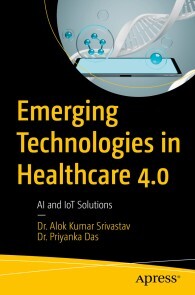
Emerging Technologies in Healthcare 4.0
Delve into the evolution of healthcare technologies, exploring their impact on patient care and management. This book provides a comprehensive exploration of the industrial revolution in healthcare. In this book, you'll cover the fundamentals of artificial intelligence (AI) in healthcare, including an overview of AI and machine learning, applications in healthcare domains, and challenges and opportunities in AI implementation. It progresses to explore integration of AI and IoT in Healthcare 4.0, discussing synergies, real-time data analysis, and future trends in telemedicine. The book also addresses critical aspects such as data security and privacy, focusing on regulations, standards, and strategies for ensuring data protection. Practical applications of AI and IoT in remote patient monitoring, disease diagnosis, and healthcare operations management are thoroughly examined, alongside ethical and legal considerations in Healthcare 4.0. The final chapters offer insights into emerging trends, potential challenges, and recommendations for successfully adopting AI and IoT in healthcare. Readers will gain a comprehensive understanding of how AI and IoT are revolutionizing healthcare, from enhancing patient outcomes and operational efficiencies to navigating the ethical and legal landscapes of data privacy. This book equips healthcare professionals, policymakers, and technology enthusiasts with the knowledge to navigate and leverage the transformative potential of Healthcare 4.0 technologies effectively. What You Will Learn * Explore the integration of AI with IoT Technologies in Healthcare 4.0 * Gain insights into the ethical and legal considerations surrounding AI and IoT implementations in healthcare Discover case studies and practical examples illustrating the transformative impact of AI and IoT on patient care Delve into the evolution of healthcare technologies, exploring their impact on patient care and management. This book provides a comprehensive exploration of the industrial revolution in healthcare. In this book, you'll cover the fundamentals of Artificial Intelligence (AI) in healthcare, including an overview of AI and machine learning, applications in healthcare domains, and challenges and opportunities in AI implementation. It progresses to explore integration of AI and IoT in Healthcare 4.0, discussing synergies, real-time data analysis, and future trends in telemedicine. The book also addresses critical aspects such as data security and privacy, focusing on regulations, standards, and strategies for ensuring data protection. Practical applications of AI and IoT in remote patient monitoring, disease diagnosis, and healthcare operations management are thoroughly examined, alongside ethical and legal considerations in Healthcare 4.0. The final chapters offer insights into emerging trends, potential challenges, and recommendations for successfully adopting AI and IoT in healthcare. Readers will gain a comprehensive understanding of how AI and IoT are revolutionizing healthcare, from enhancing patient outcomes and operational efficiencies to navigating the ethical and legal landscapes of data privacy. This book equips healthcare professionals, policymakers, and technology enthusiasts with knowledge to navigate and leverage transformative potential of Healthcare 4.0 technologies effectively. You Will * Explore the integration of AI with IoT technologies in Healthcare 4.0 * Gain insights into the ethical and legal considerations surrounding AI and IoT implementations in healthcare * Learn about emerging trends and future perspectives in Healthcare 4.0, including the potential challenges and recommendations * Discover case studies and practical examples illustrating the transformative impact of AI and IoT on patient care Who Is This Book For Readers with foundational understanding of healthcare systems and technologies will benefit most from this book. Specifically, a basic knowledge of healthcare operations, medical terminology, and information technology would be advantageous. Familiarity with concepts related to AI and IoT in healthcare, though not mandatory, would also enhance comprehension of the advanced topics covered in the book. Dr. Alok Kumar Srivastav is an accomplished Assistant Professor in the Department of Health Science at the University of the People, Pasadena, California, USA. His academic background includes a Ph.D., M.Tech, M.Sc. in Bio-Technology; a Post-Doctoral Fellowship (Research) in Bio-Technology from Lincoln University College, Malaysia; and an MBA in Human Resource Management. He is a distinguished figure in academia and research, honored with the "International Pride of Educationist Award" at AIT, Thailand, in 2022, for pioneering contributions to advancing education in the digital era and receiving a prestigious accolade "Innovative Academic Researcher Award" at HULT, France, UK in 2024 for his exceptional creativity, innovation, and impact in academic research. Dr. Priyanka Das serves as an Assistant Professor in the Department of Health Science at the prestigious University of the People in Pasadena, California, USA. She holds a Ph.D., M.Tech, and M.Sc. in Biotechnology along with an MBA in Human Resource Management. Prior to her current position, she was a Post-Doctoral Fellow (Research) in Biotechnology at Lincoln University College, Malaysia. Dr. Priyanka Das is a dedicated scholar, contributing significantly to the field of Biotechnology. Chapter 1: Introduction to Healthcare 4.0.- Chapter 2: Fundamentals of Artificial Intelligence (AI) in Healthcare.- Chapter 3: Internet of Things (IoT) in Healthcare.- Chapter 4: Integration of AI and IoT in Healthcare 4.0.- Chapter 5: Data Security and Privacy in Healthcare 4.0.- Chapter 6: AI and IoT in Remote Patient Monitoring.- Chapter 7: AI and IoT in Disease Diagnosis and Management.- Chapter 8: AI and IoT in Healthcare Operations Management.- Chapter 9: Ethical and Legal Considerations in Healthcare 4.0.- Chapter 10: Future Perspectives and Challenges.- Bibliography.

Network Models in Finance
NETWORK MODELS in FINANCE An insightful exploration of the theory and application of networks as applied to investment management Network Models in Finance: Expanding the Tools for Portfolio and Risk Management is a singularly incisive and unique discussion of networks and graph theory as applied to the financial and investment markets. Researchers and authors Gueorgui Konstantinov and Frank Fabozzi walk you through a comprehensive overview of networks in investment management, providing deep insight into their implementation in portfolio and risk management. You’ll discover how to construct diversified and risk-optimized portfolios by linking the price and return movements of different asset classes and factors. You’ll also find out how to better manage risk by properly understanding systematic, counterparty, and systemic risk, and by monitoring changes in the financial system that may indicate a coming financial crisis. Network Models in Finance delivers practical examples of a wide variety of financial data that can be used to visualize, describe, and investigate markets in an entirely new way, and explains the interactions and causal relationships that operate within a network-based framework. This book is a must-read for investors, asset managers, and other finance practitioners with an interest in a largely underexplored area of investing. Expansive overview of theory and practical implementation of networks in investment management Guided by graph theory, Network Models in Finance: Expanding the Tools for Portfolio and Risk Management provides a comprehensive overview of networks in investment management, delivering strong knowledge of various types of networks, important characteristics, estimation, and their implementation in portfolio and risk management. With insights into the complexities of financial markets with respect to how individual entities interact within the financial system, this book enables readers to construct diversified portfolios by understanding the link between price/return movements of different asset classes and factors, perform better risk management through understanding systematic, systemic risk and counterparty risk, and monitor changes in the financial system that indicate a potential financial crisis. With a practitioner-oriented approach, this book includes coverage of: Practical examples of broad financial data to show the vast possibilities to visualize, describe, and investigate markets in a completely new wayInteractions, Causal relationships and optimization within a network-based framework and direct applications of networks compared to traditional methods in financeVarious types of algorithms enhanced by programming language codes that readers can implement and use for their own data Network Models in Finance: Expanding the Tools for Portfolio and Risk Management is an essential read for asset managers and investors seeking to make use of networks in research, trading, and portfolio management. Preface ix Acknowledgments xv About the Authors xvii Part One Chapter 1 Introduction 3 Chapter 2 The Basic Structure of a Network 29 Chapter 3 Network Properties 45 Chapter 4 Network Centrality Metrics 71 Part Two Chapter 5 Network Modeling 95 Chapter 6 Foundations for Building Portfolio Networks – Link Prediction and Association Models 117 Chapter 7 Foundations for Building Portfolio Networks – Statistical and Econometric Models 141 Chapter 8 Building Portfolio Networks – Probabilistic Models 163 Chapter 9 Network Processes in Asset Management 181 Chapter 10 Portfolio Allocation With Networks 227 Part Three Chapter 11 Systematic and Systemic Risk, Spillover, and Contagion 261 Chapter 12 Networks in Risk Management 277 References 313 Index 327 GUEORGUI S. KONSTANTINOV, PHD, has over 17 years’ experience in portfolio management, managing global bond portfolios and currencies for institutional investors and pension funds. He is an advisory board member of the Journal of Portfolio Management and the coauthor of Quantitative Global Bond Portfolio Management. FRANK J. FABOZZI, PHD, is Professor of Practice at John Hopkins University’s Carey Business School. He has authored over 100 books and edited The Handbook of Fixed Income Securities and The Handbook of Mortgage-Backed Securities. He holds the CFA and CPA professional designations.

Applied Satisfiability
Apply satisfiability to a range of difficult problems The Boolean Satisfiability Problem (SAT) is one of the most famous and widely-studied problems in Boolean logic. Optimization versions of this problem include the Maximum Satisfiability Problem (MaxSAT) and its extensions, such as partial MaxSAT and weighted MaxSAT, which assess whether, and to what extent, a solution satisfies a given set of problems. Numerous applications of SAT and MaxSAT have emerged in fields related to logic and computing technology. Applied Satisfiability: Cryptography, Scheduling, and Coalitional Games outlines some of these applications in three specific fields. It offers a huge range of SAT applications and their possible impacts, allowing readers to tackle previously challenging optimization problems with a new selection of tools. Professionals and researchers in this field will find the scope of their computational solutions to otherwise intractable problems vastly increased. Applied Satisfiability readers will also find: Coding and problem-solving skills applicable to a variety of fieldsSpecific experiments and case studies that demonstrate the effectiveness of satisfiability-aided methodsChapters covering topics including cryptographic key recovery, various forms of scheduling, coalition structure generation, and many more Applied Satisfiability is ideal for researchers, graduate students, and practitioners in these fields looking to bring a new skillset to bear in their studies and careers. Xiaojuan Liao, PhD, is an Associate Professor in the College of Computer and Cyber Security, Chengdu University of Technology, Chengdu, China. Miyuki Koshimura, PhD, is an Assistant Professor in the Faculty of Information Science and Electrical Engineering, Kyushu University, Fukuoka, Japan.

The Complete Engineering Manager
Take a 360-degree tour of the engineering manager’s role and responsibilities. This book brings them to life with practical scenarios and references and ensures their relevance to your daily work.From upkeeping technical skills, to managing people and stakeholders, to ensuring timely deliverables, the job of the engineering manager is fast-paced, complex, and often short on learning resources. Fear not, this book has you covered with tips on managing evolving processes, delivering impactful projects in a timely manner, setting goals and priorities among product and technical initiatives, and helping your team focus and deliver.Business priorities are changing at a much faster pace than ever before with new technologies being introduced and adopted regularly. This book will help managers adopt modern practices to meet this moment and aid them in helping engineering teams succeed. _The Complete Engineering Manager_ will leave you with a broader perspective and deeper skill set to apply to engineering management.WHAT YOU WILL LEARN* Employ the SELF framework for self-management and learn to build trust with team members* Manage performance and craft individualized growth plans for employee success* Evolve your team’s development, delivery, and technical processes to improve their efficiency* Drive impact for your organization through prioritization, strategy and value delivery* Adopt modern engineering management practices such as utilizing AIWHO THIS BOOK IS FORNew, aspiring, and experienced engineering managers who are looking for resources to address challenges in their role.Ananth Ramachandran is a seasoned engineering leader who has experience in building happy, productive and high-performing engineering teams. He started his career in a Fortune 500 company as a software engineer and later found his passion in startups and building engineering teams from the ground up. He’s passionate about scaling up people, product and technology strategy and ultimately contributing to an organization’s success.He runs a newsletter for Engineering Managers, techmanagerguide.substack.com, where he writes about day-to-day experiences, challenges, and modern engineering management practices and techniques. He speaks on podcasts and at meetups, and mentors and trains software professionals and aspiring leaders.PART 1: Congratulations, You're an Engineering Manager.- Chapter1: Engineering Manager's Starter Kit.- PART 2: Managing People.- Chapter 2: Self-Management.- Chapter 3: It’s All About Trust.- Chapter 4: Mindful One-on-Ones.- Chapter 5: Managing Performance.- Chapter 6: Working with Your Manager.- PART 3: Managing Processes.- Chapter 7: Evolving Processes and Bringing Change.- Chapter 8: Development and Delivery Processes. Chapter 9: Technical Processes.- PART 4: Mastering Prioritization.- Chapter 10: The Bigger Picture.- Chapter 11: Pragmatic Approach To Prioritization.- Chapter 12: Prioritizing Technical Initiatives.- PART 5: Delivering Impactful Projects.- Chapter 13: Modern Delivery Practices.- Chapter 14: Measuring Delivery Effectiveness.- Chapter 15: Managing Stakeholders, Blockers and Progress.- PART 6: Building High-Performing Teams.- Chapter 16: Make Your Team Great Again.- Chapter 17: Building a Strong Engineering Culture.- Chapter 18: Becoming an Organizational Leader.

Wellness Management Powered by AI Technologies
THIS BOOK IS AN ESSENTIAL RESOURCE ON THE IMPACT OF AI IN MEDICAL SYSTEMS, HELPING READERS STAY AHEAD IN THE MODERN ERA WITH CUTTING-EDGE SOLUTIONS, KNOWLEDGE, AND REAL-WORLD CASE STUDIES.WELLNESS MANAGEMENT POWERED BY AI TECHNOLOGIES explores the intricate ways machine learning and the Internet of Things (IoT) have been woven into the fabric of healthcare solutions. From smart wearable devices tracking vital signs in real time to ML-driven diagnostic tools providing accurate predictions, readers will gain insights into how these technologies continually reshape healthcare. The book begins by examining the fundamental principles of machine learning and IoT, providing readers with a solid understanding of the underlying concepts. Through clear and concise explanations, readers will grasp the complexities of the algorithms that power predictive analytics, disease detection, and personalized treatment recommendations. In parallel, they will uncover the role of IoT devices in collecting data that fuels these intelligent systems, bridging the gap between patients and practitioners. In the following chapters, readers will delve into real-world case studies and success stories that illustrate the tangible benefits of this dynamic duo. This book is not merely a technical exposition; it serves as a roadmap for healthcare professionals and anyone invested in the future of healthcare. Readers will find the book:* Explores how AI is transforming diagnostics, treatments, and healthcare delivery, offering cutting-edge solutions for modern healthcare challenges;* Provides practical knowledge on implementing AI in healthcare settings, enhancing efficiency and patient outcomes;* Offers authoritative insights into current AI trends and future developments in healthcare;* Features real-world case studies and examples showcasing successful AI integrations in various medical fields.AUDIENCEThis book is a valuable resource for researchers, industry professionals, and engineers from diverse fields such as computer science, artificial intelligence, electronics and electrical engineering, healthcare management, and policymakers. BHARAT BHUSHAN, PHD, is an assistant professor in the Department of Computer Science and Engineering, School of Engineering and Technology, Sharda University, Greater Noida, India. He has published more than 150 research papers, contributed over 30 book chapters, and edited 20 books. AKIB KHANDAY, PHD, is a post-doctoral research fellow in the Department of Computer Science and Software Engineering-CIT, United Arab Emirates University, Abu Dhabi, United Arab Emirates. His research interests include computational social sciences, natural language processing (NLP), and machine/deep learning. KHURSHEED AURANGZEB, PHD, is an associate professor in the Department of Computer Engineering, College of Computer and Information Sciences, King Saud University, Riyadh, Saudi Arabia. Over his 15 years of research, he has been involved in several projects related to machine/deep learning and embedded systems. His research interests focus on computer architecture, signal processing, and wireless sensor networks. SUDHIR KUMAR SHARMA, PHD, is a professor and head of the Department of Computer Science at the Institute of Information Technology & Management, affiliated with GGSIPU, New Delhi, India. His research interests include machine learning, data mining, and security. He has published more than 60 research papers in various international journals and conferences and is the author of seven books in the fields of IoT, wireless sensor networks (WSN), and blockchain. PARMA NAND, PHD, is the dean of the School of Engineering and Technology, Sharda University, Greater Noida, India. His expertise includes wireless and sensor networks, cryptography, algorithms, and computer graphics. He has published more than 85 papers in peer-reviewed journals and filed two patents.

Microsoft 365 PowerPoint For Dummies
PRESENT LIKE A PRO, WITH THE TOP-SELLING POWERPOINT BOOK ON THE MARKETSince 1999, PowerPoint For Dummies has been giving readers a jargon-free way to compose compelling presentations. This update covers the latest release of Office and Office 365. Learn the basics of creating a slide deck in PowerPoint, then discover the dynamic features you can use to give your slides a bit of pizazz. Import data from other applications, collaborate in the cloud, and incorporate charts, graphics, and videos into your presentations. Plus, learn how to use Microsoft's new Copilot AI tool—integrated right into the application. Consider this book your first step to making a splash with PowerPoint!* Create your first PowerPoint slide deck and add presentation notes* Improve the design of your slides with templates and best-practice tips* Add animations, change your font style, and insert images and drawings* Share your presentation with audiences in a virtual settingNew and not-so-new PowerPoint users who need a guide to the basics of building a successful presentation will love this up-to-date, beginner-friendly book. DOUG LOWE is the information technology director for a civil engineering firm. He has been managing networks for more than 20 years and is the best-selling author of more than 30 For Dummies books, including Networking For Dummies and Networking All-in-One For Dummies.

Microsoft 365 Excel VBA Programming For Dummies
YOUR STEP-BY-STEP GUIDE TO DOING MORE WITH MICROSOFT EXCELFully updated for the latest version of Office 365, Excel VBA Programming For Dummies will take your Excel knowledge to the next level. With a little background in Visual Basic for Applications (VBA) programming, you can go well beyond basic spreadsheets and functions. Learn the coding basics and syntax you need to write simple or complex macros that can automate your routine Excel tasks. Become an Excel power user by automating data management, user forms, pivot tables, and beyond. When you use VBA to perform Excel operations, you can reduce errors, save time, and integrate with other Microsoft applications. This handy guide also teaches you how to control the security settings for your macros and save macros to use across files and apps. Plus, you'll get updated coverage of Copilot AI integration. Your spreadsheets are about to get much more powerful.* Get stared with VBA coding to create macros and automate tasks in Excel* Follow step-by-step instructions to write and execute your first scripts* Learn about the advanced functions available with the VBA language* Perform tasks faster and integrate excel with other Microsoft appsThis Dummies guide is right up your alley if you're an Excel user looking to learn some next-level features. Students and professionals alike will reap the benefits of automation, thanks to Excel VBA Programming For Dummies.DICK KUSLEIKA has more than 25 years’ experience helping Office users get the most out of Microsoft’s bestselling software. From online forums to blogs, books, and conferences, he delivers sound and straightforward advice to readers of all skill levels.

Microsoft 365 Word For Dummies
TAKE A DEEP DIVE INTO THE MOST POPULAR WORD PROCESSOR ON THE PLANETWord, Microsoft's powerful and popular word processor, is capable of extraordinary things. From template building to fancy formatting and even AI-powered editing and proofing, your copy of Word stands ready to help you supercharge your productivity and save you time and energy. You just need to learn how it's done. And, thanks to this easy-to-understand book, learning is the easy part!This latest edition of Word For Dummies is packed with the essentials you need to turn any old copy of the famous word processor into a document-creating, table-formatting, graphics-editing super app. You'll even learn how to customize your version of Microsoft Word so it's absolutely perfect for you, at home and at work. You'll also find out how to:* Navigate the Word interface and menus and figure out a ton of hotkey shortcuts* Edit, format, and comment documents to make team collaboration a breeze* Use the new Microsoft Copilot's AI capabilities to make Word even more powerfulSo, grab your copy of the latest edition of Word For Dummies today. It's perfect for casual users interested in upgrading their knowledge of this ubiquitous app as well as power users looking for the latest productivity tips and tricks. DAN GOOKIN wrote the first-ever For Dummies book in 1991. The author of several bestsellers, Dan’s books have been translated into 32 languages and have more than 11 million copies in print. Dan is the bestselling author of all editions of Word For Dummies.

Microsoft Teams For Dummies
UNLOCK THE FULL POWER OF MICROSOFT TEAMS, INCLUDING BRAND-NEW AI FUNCTIONALITY, WITH YOUR FRIENDS AT FOR DUMMIESLooking for a fast and easy guide to Microsoft Teams, the collaboration software used by millions of people and companies around the world? In Microsoft Teams For Dummies, 3rd edition, you'll find the must-know tips, hidden tricks, and handy hacks you need to help you rock your workday and get things done lightning-fast. You'll learn how to incorporate Teams into your everyday workflow and use functionality like chatting, file sharing, team organization, videochat, and more. You'll even learn how to use Microsoft's brand-new AI companion Copilot to help you improve your processes and productivity. You'll find out how to:* Connect with colleagues and collaborate remotely, from across the hall or from the other side of the world* Use little-known Teams features to help you supercharge your productivity and get more done in a day* Customize your Teams installation and make it work better for you and your teammatesAn engaging and effective roadmap to one of Microsoft's most popular apps, Microsoft Teams For Dummies is a must-read for everyone who uses—or wants to use—this powerful software at work or anywhere else. Grab a copy today! ROSEMARIE WITHEE is president of Portal Integrators, a Scrum-based software and services firm. Rosemarie has authored a number of books in the For Dummies series, including the most recent editions of Office 365 For Dummies and SharePoint For Dummies.

Microsoft Copilot For Dummies
STRAIGHTFORWARD GUIDANCE ON THE AI TOOL THAT'S BUILT INTO WINDOWS, MICROSOFT 365, AND MOREMicrosoft is enhancing all its most widely used productivity software—including Windows and apps like Word and Excel—with the power of AI. And now you can learn to make the most of this revolutionary new tool with Microsoft Copilot For Dummies!You'll discover how to write Copilot-friendly prompts, enhance output with integrated Copilot tools, and how to apply Copilot functions to project management and other specific tasks and disciplines. In the book, you'll find out how to:* Use text or your voice to prompt reliable results from Microsoft Copilot* Customize Microsoft Copilot to respond to your unique needs and demands* Add plug-ins to the Microsoft Copilot service to extend its functionality even moreLearn to supercharge your efficiency with Microsoft Copilot For Dummies. This book is perfect for professional and home users of Windows, Microsoft 365, and other Microsoft products and software who want to increase their productivity. Grab a copy today! CHRIS MINNICK is an accomplished author, teacher, and programmer. Minnick has authored or coauthored over 20 books, including titles in the For Dummies series. He has developed video courses for online training providers, and he teaches programming and machine learning to professional developers at leading companies globally. He is author of Coding with AI For Dummies and JavaScript All-in-One For Dummies.

Reinforcement Learning for Cyber Operations
A COMPREHENSIVE AND UP-TO-DATE APPLICATION OF REINFORCEMENT LEARNING CONCEPTS TO OFFENSIVE AND DEFENSIVE CYBERSECURITYIn Reinforcement Learning for Cyber Operations: Applications of Artificial Intelligence for Penetration Testing, a team of distinguished researchers delivers an incisive and practical discussion of reinforcement learning (RL) in cybersecurity that combines intelligence preparation for battle (IPB) concepts with multi-agent techniques. The authors explain how to conduct path analyses within networks, how to use sensor placement to increase the visibility of adversarial tactics and increase cyber defender efficacy, and how to improve your organization’s cyber posture with RL and illuminate the most probable adversarial attack paths in your networks. Containing entirely original research, this book outlines findings and real-world scenarios that have been modeled and tested against custom generated networks, simulated networks, and data. You’ll also find:* A thorough introduction to modeling actions within post-exploitation cybersecurity events, including Markov Decision Processes employing warm-up phases and penalty scaling* Comprehensive explorations of penetration testing automation, including how RL is trained and tested over a standard attack graph construct* Practical discussions of both red and blue team objectives in their efforts to exploit and defend networks, respectively* Complete treatment of how reinforcement learning can be applied to real-world cybersecurity operational scenariosPerfect for practitioners working in cybersecurity, including cyber defenders and planners, network administrators, and information security professionals, Reinforcement Learning for Cyber Operations: Applications of Artificial Intelligence for Penetration Testing will also benefit computer science researchers. DR. ABDUL RAHMAN holds PhDs in physics, math, information technology–cybersecurity and has expertise in cybersecurity, big data, blockchain, and analytics (AI, ML). DR. CHRISTOPHER REDINO holds a PhD in theoretical physics and has extensive data science experience in every part of the AI / ML lifecycle. MR. DHRUV NANDAKUMAR has extensive data science expertise in deep learning. DR. TYLER CODY is an Assistant Research Professor at the Virginia Tech National Security Institute. DR. SACHIN SHETTY is a Professor in the Electrical and Computer Engineering Department at Old Dominion University and the Executive Director of the Center for Secure and Intelligent Critical Systems at the Virginia Modeling, Analysis and Simulation Center. MR. DAN RADKE is an Information Security professional with extensive experience in both offensive and defensive cybersecurity.

Principles of AI Governance and Model Risk Management
Navigate the complex landscape of Artificial Intelligence (AI) governance and model risk management using a holistic approach encompassing people, processes, and technology. This book provides practical guidance, oversight structure and centers of excellence, and actionable insights for organizations seeking to harness the power of AI responsibly, ethically, and transparently. By addressing the technical, ethical, and societal dimensions of AI governance, organizations will be empowered to build trustworthy AI systems that benefit both their bottom line and the broader community. Featuring successful mitigating controls based on proven use cases, the book underscores the importance of aligning AI strategy with AI governance, striking a balance between AI innovation, risk mitigation as well as broader business goals. You’ll receive pointers for designing a well-governed AI development lifecycle, emphasizing transparency, accountability, and continuous monitoring throughout the AI development lifecycle. This book highlights the importance of collaboration between stakeholders, i.e., boards of directors, CxOs, corporate counsel, compliance officers, audit executives, data scientists, developers, validators, etc. You’ll gain practical advice on addressing the challenges related to the ownership of AI-generated content and models, stressing the need for legal frameworks and international collaboration. You’ll also learn the importance of auditing AI systems, developing protocols for rapid response in case of AI-related crises, and building capacity for AI actors through education. Principles of AI Governance and Model Risk Management demonstrates its value-added uniqueness by detailing a strategy to ensure a cohesive approach to managing AI-related risks, global compliance, policy, privacy, and AI-human collaboration and oversight. What You Will Learn Different approaches to AI adoption, from building in-house AI capabilities to partnering with external providersKey factors to consider when choosing an AI solution and how to ensure its successful integration into existing workflowsAI technologies, their business impact, and ethical considerations to make informed decisions and foster responsible AIThe environmental impacts of AI systems and the need for sustainable practices in AI development and deployment. Who This Book is For Business executives and process owners/representatives, risk officers, cybersecurity professionals, legal counsel and ethics officers, human resource professionals, data scientists, AI developers, and CTOs.

Generative AI Apps with LangChain and Python
Future-proof your programming career through practical projects designed to grasp the intricacies of LangChain’s components, from core chains to advanced conversational agents. This hands-on book provides Python developers with the necessary skills to develop real-world Large Language Model (LLM)-based Generative AI applications quickly, regardless of their experience level.Projects throughout the book offer practical LLM solutions for common business issues, such as information overload, internal knowledge access, and enhanced customer communication. Meanwhile, you’ll learn how to optimize workflows, enhance embedding efficiency, select between vector stores, and other optimizations relevant to experienced AI users. The emphasis on real-world applications and practical examples will enable you to customize your own projects to address pain points across various industries._Developing LangChain-based Generative AI LLM Apps with Python_ employs a focused toolkit (LangChain, Pinecone, and Streamlit LLM integration) to practically showcase how Python developers can leverage existing skills to build Generative AI solutions. By addressing tangible challenges, you’ll learn-by-be doing, enhancing your career possibilities in today’s rapidly evolving landscape.WHAT YOU WILL LEARN* Understand different types of LLMs and how to select the right ones for responsible AI.* Structure effective prompts.* Master LangChain concepts, such as chains, models, memory, and agents.* Apply embeddings effectively for search, content comparison, and understanding similarity.* Setup and integrate Pinecone vector database for indexing, structuring data, and search.* Build Q & A applications for multiple doc formats.* Develop multi-step AI workflow apps using LangChain agents.WHO THIS BOOK IS FORPython programmers who aim to develop a basic understanding of AI concepts and move from LLM theory to practical Generative AI application development using LangChain; those seeking a structured guide to enhance their careers by learning to create robust, real-world LLM-powered Generative AI applications; data scientists, analysts, and experienced developers new to LLMs.RABI JAY has over 15 years of experience driving digital transformation with a unique blend of technical depth and business acumen. His background as a Java and SAP ABAP developer provides insights into the enterprise systems LLMs often needed to integrate with. As a leader in Deloitte’s Digital / Cloud Native practice, he has gained cross-industry experience applying AI solutions, positioning him to identify where LLMs offer the greatest potential for business impact.He is passionate about making complex technology accessible, leading him to authoring books on SAP NetWeaver Portal Technology and "Enterprise AI in the Cloud" along with regular contributions to industry publications. His role as a technical reviewer for Large Language Model Based Solutions, Modern Python Development Using ChatGPT, and as Vice President at HCL America, focused on digital transformation, demonstrate his active engagement in the LLM field. Additionally, he runs a LinkedIn newsletter ("Enterprise AI Transformation") and free LinkedIn course (“Generative AI for Business Innovation”).Chapter 1: Introduction to LangChain and LLMs.- Chapter 2: Integrating LLM APIs with LangChain.- Chapter 3: Building Q&A and Chatbot Apps.- Chapter 4: Exploring LLMs.- Chapter 5: Mastering Prompts for Creative Content.- Chapter 6: Building Chatbots and Automated Analysis Systems Using Chains.- Chapter 7: Building Advanced Q&A and Search applications Using Retrieval-Augmented Generation (RAG).- Chapter 8: Your First Agent App.- Chapter 9: Building Different Types of Agents.- Chapter 10: Projects: Building Agent Apps for Common Use Cases. - Chapter 11: Building & Deploying a ChatGPT Like App Using Streamlit.

Hands-on Deep Learning
This book discusses deep learning, from its fundamental principles to its practical applications, with hands-on exercises and coding. It focuses on deep learning techniques and shows how to apply them across a wide range of practical scenarios.The book begins with an introduction to the core concepts of deep learning. It delves into topics such as transfer learning, multi-task learning, and end-to-end learning, providing insights into various deep learning models and their real-world applications. Next, it covers neural networks, progressing from single-layer perceptrons to multi-layer perceptrons, and solving the complexities of backpropagation and gradient descent. It explains optimizing model performance through effective techniques, addressing key considerations such as hyperparameters, bias, variance, and data division. It also covers convolutional neural networks (CNNs) through two comprehensive chapters, covering the architecture, components, and significance of kernels implementing well-known CNN models such as AlexNet and LeNet. It concludes with exploring autoencoders and generative models such as Hopfield Networks and Boltzmann Machines, applying these techniques to a diverse set of practical applications. These applications include image classification, object detection, sentiment analysis, COVID-19 detection, and ChatGPT.By the end of this book, you will have gained a thorough understanding of deep learning, from its fundamental principles to its innovative applications, enabling you to apply this knowledge to solve a wide range of real-world problems.WHAT YOU WILL LEARN* What are deep neural networks?* What is transfer learning, multi-task learning, and end-to-end learning?* What are hyperparameters, bias, variance, and data division?* What are CNN and RNN?WHO THIS BOOK IS FORMachine learning engineers, data scientists, AI practitioners, software developers, and engineers interested in deep learningHARSH BHASIN is a researcher and practitioner. He has completed his PhD in Diagnosis and Conversion Prediction of Mild Cognitive Impairment Using Machine Learning from Jawaharlal Nehru University, New Delhi. He worked as a Deep Learning consultant for various firms and taught at various Universities, including Jamia Hamdard, and DTU. He is currently associated with Bennett University.Harsh has authored 11 books, including _Programming in C#_ and _Algorithms._ He has authored more than 40 papers that have been published in international conferences and renowned journals, including Alzheimer’s and Dementia, Soft Computing, Springer, BMC Medical Informatics & Decision Making, AI & Society, etc. He is the reviewer of a few renowned journals and has been the editor of a few special issues. He has been a recipient of Visvesvaraya Fellowship, Ministry of Electronics and Information Technology.His areas of expertise include Deep Learning, Algorithms and Medical Imaging. Apart from his professional endeavours, he is deeply interested in Hindi Poetry: the progressive era and Hindustani Classical Music: percussion instruments.Chapter 1: Revisiting Machine Learning.- Chapter 2: Introduction to Deep Learning.- Chapter 3: Neural Networks.- Chapter 4: Training Deep Networks.- Chapter 5: Hyperparameter Tuning.- Chapter 6: Convolutional Neural Networks: Part 1.- Chapter 7: Convolutional Neural Networks : Part 2.- Chapter 8: Transfer Learning.- Chapter 9: Recurrent Neural Networks.- Chapter 10: LSTM and GRU.- Chapter 11: Autoencoders.- Chapter 12: Introduction to Generative Models.- Appendices A-G.