

Computer und IT

Home Assistant (3. Auflg.)
Das umfassende Handbuch in 3. Auflage aus dem April 2026.Home Assistant ist Ihr Begleiter auf dem Weg zum eigenen Smart Home. Im Handumdrehen integrieren Sie Geräte und Dienste in Ihr System und automatisieren Schaltungen und Szenen ganz nach Ihren Bedürfnissen. Udo Brandes beschreibt alle Schritte, die Sie für Ihr eigenes Smart Home benötigen, von der Einrichtung über die Verwaltung bis hin zur Automatisierung. So erfahren Sie in übersichtlichen Kapiteln zum Nachschlagen, wie Sie den Home Assistant um Datenbank- und Programmiermöglichkeiten erweitern, mit ESPHome eigene Schalter und Sensoren einbinden und daraus ein Komplettpaket für die Heimautomation schnüren.Neu in der 3. Auflage: die KI-Features von Home Assistant.Ihr intelligentes Zuhause: Home Assistant vorgestellt Nach der Installation lernen Sie die Menüs und Optionen von Home Assistant kennen und erfahren, wie Sie das System mit Integrationen und Add-ons erweitern können. Individuell und auf Sie zugeschnitten Möchten Sie Shelly-, Tasmota- oder Tuya-Geräte in Ihre Installation integrieren oder mit Node-RED anspruchsvolle Automatisierungen programmieren? Mit Kodi und eigenen Lichtszenen den Fernsehabend zum Kino-Erlebnis machen? Von unterwegs die Verbrauchswerte Ihrer Wohnung im Auge behalten? Dieser Leitfaden zur Heimautomation zeigt Ihnen, was Home Assistant alles kann. Der Letzte macht das Licht aus Mit wenigen Handgriffen sorgen Sie dafür, dass alle Lichter ausgehen, wenn die letzte Person das Haus verlässt. Oder Sie überwachen Sensoren und erstellen einen Überblick über den Energieverbrauch Ihrer Wohnung. Mit Home Assistant und dem Know-how in diesem Buch ist alles möglich. Aus dem Inhalt: Das Setup und der erste Start: das Webinterface von Home Assistant Home Assistant administrieren Geräte, Dienste, Entitäten Automatisierungen mit Szenen, Skripten und Vorlagen Dashboards, Apps und externer Zugriff Medien, Sprachdienste und künstliche Intelligenz Bereiche und Zonen Werkzeuge und Helfer Datenspeicherung mit MariaDB und InfluxDB Sonoff, Tasmota, Shelly, Matter und Tuya integrieren Programmierung mit Node-RED Eigene Geräte mit ESPHome

Fit fürs Studium - Wirtschaftswissenschaften und BWL
GUT VORBEREITET IN DIE VORLESUNG!Wer an wirtschaftlichen Themen und Zusammenhängen interessiert ist, kommt an den Fächern BWL und Wirtschaftswissenschaften nicht vorbei. Aber der Einstieg kann herausfordernd sein. In diesem Buch finden Sie einen genau an die Prüfungen und den Studienverlaufsplan angepassten Vorkurs – inklusive eines Einstiegs ins wissenschaftliche Arbeiten. Dabei gilt: Ob Sie vor dem Start in ein Studium der Wirtschaftswissenschaften oder BWL stehen und einen Gesamtüberblick brauchen, oder nur an einzelnen Themen interessiert sind, ist erst einmal egal.Die Kapitel sind unabhängig voneinander lesbar und jeweils mit zahlreichen Abbildungen, Beispielen und passenden Übungen unterlegt. So werden Sie von Unternehmensaufbau über Rechnungswesen bis hin zu Personalmanagement und Controlling fit fürs Studium! Grundlagen von Wirtschaftswissenschaften und BWL verstehenEinführung in Rechnungswesen, Controlling, Buchführung und mehrMit vielen Beispielen und Übungen, ideal fürs Selbststudium Aus dem Inhalt: Tipps und Tricks rund ums StudiumWissenschaftliches ArbeitenAufbau eines UnternehmensProduktion, Logistik und BeschaffungAbsatzInvestition und FinanzierungRechnungswesenPersonalmanagementControllingMathematische und statistische Grundlagen
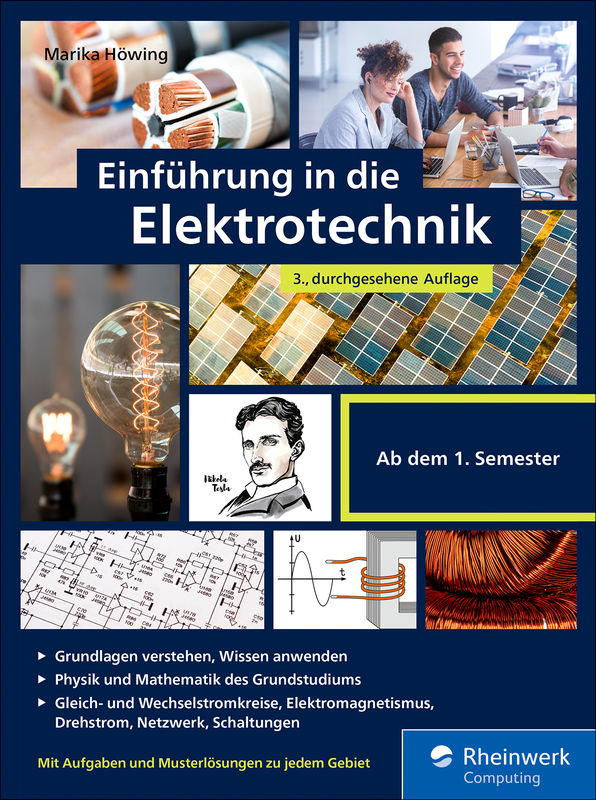
Einführung in die Elektrotechnik (3. Auflg.)
IDEAL FÜR STUDIUM UND AUSBILDUNGDie Elektrotechnik ist vielfältig, spannend – und sehr anspruchsvoll. Damit Sie das Studium oder die Ausbildung meistern, vermittelt Ihnen Marika Höwing in diesem umfassenden Leitfaden alles, was Sie für die Prüfungen in der Elektrotechnik benötigen. Und sie geht dabei besonders praxisnah und anschaulich vor. Zahlreiche Tabellen, Formeln, farbige Schaltpläne und Abbildungen sorgen dafür, dass Sie stets den Überblick beim Lernen behalten. Das benötigte Mathematikwissen bleibt dabei wohl dosiert und gut verständlich. Von den physikalischen und mathematischen Grundlagen über Gleich- und Wechselstromkreise, Drehstrom, Elektromagnetismus bis hin zu Netzwerken und Schaltungen deckt das Buch den gesamten Stoff des Grundstudiums ab.Merksätze, Übungen und Musterlösungen unterstützen Sie beim Lernen und Wiederholen des Lernstoffes.Für E-Techniker und alle, die es werden wollen.Aus dem Inhalt: Elektronische GrundbegriffeElektrostatikGleichstromkreiseNetzwerkberechnungenMagnetische FelderWechselstromkreiseFilter und PassschaltungenDrehstrom Leseprobe (PDF-Link)
Die neue Suchökonomie
Die Suche verändert sich rasant: Menschen tippen keine Keywords mehr ein, sondern sie sprechen mit KI. ChatGPT, Perplexity und Google Gemini werden zur ersten Anlaufstelle für Antworten. Wer hier nicht erscheint, existiert für viele potenzielle Kundinnen und Kunden schlicht nicht mehr. Dieses Buch zeigt dir praxisnah, wie KMU in dieser neuen Ära sichtbar bleiben. Du lernst, wie LLMO (Large Language Model Optimization) und GEO (Generative Engine Optimization) funktionieren und wie du deine Inhalte so optimierst, dass KI Systeme dich finden, verstehen und empfehlen. Mit klaren Erklärungen, Checklisten und Beispielen bekommst du eine Schritt für Schritt Anleitung, um deine digitale Autorität aufzubauen und in KI generierten Antworten präsent zu sein. Zukunftsfit, ohne technisches Kauderwelsch.

The AI Product Manager's Playbook
The AI Product Manager's Playbook: Agentic Commerce & Digital Experience captures a pivotal shift in how products are imagined and delivered in the age of intelligent automation. As AI agents begin to make decisions, personalize interactions, and drive transactions autonomously, product managers are challenged to operate beyond traditional frameworks. This book offers a concise, actionable roadmap for navigating that transformation. It focuses on the emergence of agentic commerce-where AI agents act on behalf of users-and the redesign of digital experiences powered by intelligence, context, and autonomy. Rather than treating AI as a feature, the playbook positions it as the foundation of product strategy, execution, and user engagement. Whether you're evolving into an AI product role or leading innovation in digital ecosystems, this guide helps you understand the mindset, tools, ethics, and success metrics needed to build AI-native products that shape the future of commerce and experience.

Everyone Is a Programmer
This book is written by practitioners shaping AI coding tools and developer ecosystems in one of the world’s most application-driven tech environments. Vibe coding is a modern, AI-driven way of building software where you focus on what you want to create, and AI helps handle how it’s built. But it is not a shortcut or a gimmick. Effective vibe coding requires understanding how products are structured, how systems fit together, and how ideas turn into real, usable applications. This book introduces you to just that, helping you find your way to your first AI-coded apps. In six chapters, you’ll learn to ideate, plan, and execute your app ideas. You’ll hit the ground running with professional-grade tools like TRAE SOLO, Cursor, Figma, Vercel, and Supabase. The book’s coverage of end-to-end AI application development includes UI/UX, backend, hosting, authentication, and payment integration. By the end, you will have built two full projects and be equipped with a new way to create. What you build next is up to you.

Master Data Governance Framework
In today’s competitive business landscape, the key to success lies within the heart of your organization’s data–the Master Data. This book brings together insights and techniques needed to navigate the complex world of Master Data governance and management, and revolutionize how Master Data and information are handled within an organization. Master Data, the backbone of every successful enterprise, encapsulates the fundamental information essential for conducting business seamlessly. At the same time, Master Data governance helps businesses stay focused on what really matters–using Master Data to grow revenue, cut hidden costs, and stay safe and compliant with regulations. This comprehensive guide dives into practical applications, showing you how to harness the potential of your Master Data resources to fuel strategic decision making, reliable business operations, and market-driven product innovation. As companies worldwide recognize the pivotal role of Master Data in shaping their future, the demand for comprehensive, actionable guidance is greater than ever. With a wealth of non-technical illustrations, real-world examples, and practical tools, this book demystifies the complexities of Master Data governance and management. At its core, this book introduces a proven Master Data governance framework that empowers you to take charge systematically and methodically. Whether you’re taking your first steps or you’re well-versed in Master Data governance and management, you’ll find step-by-step guidance to ensure that you’re always moving forward. What You Will Learn Easily distinguish your company’s data types within its data ecosystem using icons and illustrationsControl Master Data using a unique Master Data governance framework with three interconnected gears: Master Data, systems, and organizationEnsure that business data needs are met using a non-technical data modelling working tool that includes the core identifiers and attributes to describe customers, products, suppliers, and moreCreate the Master Data overview using illustrated data and system landscapes, and the data flow mapping methodCreate a Master Data organization using a described and illustrated structure, roles, and meeting forumsDesign Master Data processes, procedures, and policies using concrete Master Data quality examplesEnsure high Master Data quality and data-driven decisions to realize data valueSelect and use Master Data platforms and use AI and machine learning wisely to achieve a single source of truthImprove the Master Data area in system implementation using a project framework, processes, and tools Who This Books Is For Data professionals without a theoretical data background and who work with data daily and need a deper understandng of what data is and how to handle master data and its quality in practice; trained data professionals needing inspiration as they seek to refine their methods and strategies for managing master data tasks and initiatives in practice; and readers who want more than a theory book and need a reference book with non-technical illustrations, practical work tools and methods, and concrete examples, plus instructions that can be used directly in daily work

Neurosymbolic AI
An up-to-date and expert discussion of neuro-symbolic artificial intelligence development In Neuro-symbolic AI: Foundations and Applications, a team of distinguished researchers delivers a comprehensive overview of the emerging field of neuro-symbolic artificial intelligence. Expert contributors explain the integration of symbolic representations with neural networks, demonstrating state-of-the-art practices in the field. The book fosters collaboration amongst diverse disciplines and promotes a deeper understanding of the challenges posed by deep learning, including generalizability, explainability, and robustness. It is an authoritative, self-contained reference text that provides a solid foundation for newcomers to the field as well as seasoned researchers and developers. Readers will find: A systematic perspective on the foundations of neuro-development AI system developmentComprehensive explorations of key concepts in neuro-symbolic artificial intelligenceDiscussions of real-world applications of neuro-symbolic AI in fields such as healthcare, finance, autonomous driving, and the militaryComplete treatments of the foundations of neuro-symbolic AI from multiple disciplinary perspectives, including computer science, software engineering, and academic research Perfect for researchers and professionals in artificial intelligence involved industries, including autonomous driving, military, healthcare, and finance, Neuro-symbolic AI: Foundations and Applications will also benefit students of computer science, software engineering, data science, and machine learning. Alvaro Velasquez, PhD, is a Program Manager at Defense Advanced Research Projects Agency. He is also a Visiting Professor in the Department of Computer Science at the University of Colorado Boulder. Houbing Herbert Song, PhD, is a Tenured Associate Professor, Director of the NSF Center for Aviation Big Data Analytics (Planning), an Associate Director for Leadership of the DOT Transportation Cybersecurity Center for Advanced Research and Education, and Director of Security and Optimization for the Networked Globe Laboratory at the University of Maryland. Pradeep Ravikumar, PhD, is an Assistant Professor in the Department of Computer Science at the University of Texas at Austin. S. Shankar Sastry, PhD, is a Professor of Electrical Engineering and Computer Sciences, Bio-Engineering, and Mechanical Engineering at the University of California, Berkeley. Sandeep Neema, PhD, is a Professor in the Department of Computer Science and the Director of the Institute for Software Integrated Systems at Vanderbilt University.

AI for Gig Workers
How freelancers can harness AI to stabilize income and build sustainable careers Even as the gig economy employs millions around the world, it remains confusing, unpredictable, and intensely competitive. Meanwhile, AI tools have become accessible enough to transform how independent workers operate—but most freelancers lack the guidance to use them effectively. AI for Gig Workers delivers a practical framework for integrating artificial intelligence into everyday freelance operations. This book covers using AI for client acquisition, project management, personal branding, and overhead reduction. Each section includes hands-on exercises and real-world use cases drawn from actual gig worker experiences. It’s packed with essential solutions for everyday problems layered into a comprehensive gig work strategy that’s effective in the real world and adaptable enough to keep up with rapid, constant transformation. Whether you’re a rideshare driver, freelance designer, delivery worker, or independent consultant, this book provides actionable strategies to work smarter and earn more consistently. For gig workers ready to stop figuring everything out alone and start building sustainable careers, this is the resource that will help you maximize your income, take control of your schedule, and rediscover the most rewarding parts of your job. The book also helps you earn Northeastern University digital badges that validate your new skills. A new, AI-powered compass for freelancers, gig workers, and contractors trying to navigate the gig economy For many of us, working is no longer characterized by traditional employment contracts – with all their built-in protections and benefits – 9-to-5 schedules, and in-person workplaces. If you’re a gig worker, freelancer, or contractor, you’re probably more likely to experience confusing digital platforms, unpredictable income, inconsistent workloads, and confusing career paths. It’s not all bad, but it’s a complicated way to earn a living. AI for Gig Workers: Essential Strategies to Transform Your Freelance Career is a one-of-a-kind strategy guide for gig workers, freelancers, and independent contractors interested in transforming the way they navigate the gig economy. It explains how to use the latest commercially available artificial intelligence-powered tools to solve common, serious, and even just-plain-annoying problems faced by workers in the new world of work. The authors walk you through how to elevate your personal brand, lower your overhead, and avoid scams and common timewasters with AI tech that’s easy to implement immediately in your solo operation or small business. You’ll find hands-on exercises and real-world examples of the techniques discussed inside that illustrate exactly how they work. Inside the book: A powerful combination of coherent gig work strategy and granular, hands-on solutions for the most grating freelance problemsSpecific techniques for implementing useful AI personal assistants that handle repetitive, time-consuming tasksHow to write clear, structured prompts that will 10x your generative AI results in fields like writing, marketing, analysis, and automation Perfect for everyone in the non-traditional labor market, AI for Gig Workers is a detailed and reality-tested roadmap for freelancers, gig workers, and contractors interested in maximizing their income, taking control of their schedule, and refocusing on the rewarding and creative aspects of their chosen profession. SAIPH SAVAGE, PhD, is an Assistant Professor at Northeastern University’s Khoury College of Computer Sciences, Director of the Northeastern Civic AI Lab, and research collaborator at the National Autonomous University of Mexico (UNAM). Named one of MIT Technology Review’s 35 Innovators Under 35, and one of the Top 20 AI Leaders in Mexico by Forbes magazine, her research focuses on AI solutions for gig worker empowerment. She has held positions at Carnegie Mellon, the University of Washington, Intel Labs, and Microsoft Bing. PAMELA CERDEIRA is a journalist and broadcaster at MVS Noticias and co-founder of Opinión 51, a media platform focused on women’s perspectives. She produces content across radio, YouTube, TikTok, and podcasts, reaching over one million followers. LILIANA SAVAGE is a researcher and consultant specializing in technology design for governments and citizens in the Global South. She serves as a UNESCO AI Ethics Expert Without Borders Consultant.

Physiotherapy Using Artificial Intelligence
Empower your practice with this definitive resource that bridges the gap between artificial intelligence and biomechanics, providing the essential tools and knowledge to optimize assessments, personalize treatment plans, and predict recovery outcomes in the rapidly evolving landscape of modern physiotherapy. The integration of artificial intelligence (AI) with biomechanics in physiotherapy represents a transformative shift in the healthcare landscape, driven by rapid technological advancement and an increasing emphasis on personalized, data-driven care. Over the past decade, AI has progressed from theoretical exploration to practical clinical application, enabling enhanced decision-making and improved patient outcomes. This book examines the intersection of artificial intelligence and physiotherapy with a focused emphasis on biomechanics, exploring how AI can optimize biomechanical assessments, support individualized treatment planning, and predict patient progress in clinical settings. As demand grows for AI-driven innovation in rehabilitation, this volume serves as an essential resource for physiotherapists, clinicians, and researchers seeking to understand and adopt these emerging technologies to advance practice and improve rehabilitation outcomes. Empower your practice with this definitive resource that bridges the gap between artificial intelligence and biomechanics, providing the essential tools and knowledge to optimize assessments, personalize treatment plans, and predict recovery outcomes in the rapidly evolving landscape of modern physiotherapy. The integration of artificial intelligence (AI) with biomechanics in physiotherapy represents a transformative shift in the healthcare landscape, driven by rapid technological advancement and an increasing emphasis on personalized, data-driven care. Over the past decade, AI has progressed from theoretical exploration to practical clinical application, enabling enhanced decision-making and improved patient outcomes. This book examines the intersection of artificial intelligence and physiotherapy with a focused emphasis on biomechanics, exploring how AI can optimize biomechanical assessments, support individualized treatment planning, and predict patient progress in clinical settings. As demand grows for AI-driven innovation in rehabilitation, this volume serves as an essential resource for physiotherapists, clinicians, and researchers seeking to understand and adopt these emerging technologies to advance practice and improve rehabilitation outcomes. Abhishek Kumar, PhD is an Assistant Director and Associate Professor in the Computer Science and Engineering Department at Chandigarh University with more than 13 years of experience. He has authored and co-authored seven books, edited 51 books, and published more than 170 papers in reputed national and international journals, books, and conferences. His research interests include artificial intelligence, renewable energy, image processing, computer vision, data mining, and machine learning. T. Ananth Kumar, PhD is an Associate Professor and Research Head at the Indo French Educational Trust College of Engineering, India. He has edited six books, published numerous book chapters and patents, and presented research at national and international conferences. His research interests include networks on chips, computer architecture, and application-specific integrated circuit design. Sachin Ahuja, PhD is a Professor and Executive Director in the Department of Computer Science at the School of Engineering and Technology, Chitkara University. He has led multiple funded research projects in artificial intelligence, machine learning, and data mining and has contributed to numerous academic books. He has also served as a guest editor for special issues in reputed international journals. J.P. Ananth, PhD is a Professor and Dean of the Internal Quality Assurance Cell at Sri Krishna College of Engineering and Technology. His research has been published widely in peer-reviewed journals, and he serves as a reviewer for several international journals and conferences. His research interests include computer vision, pattern recognition, artificial intelligence, and data analytics. S. Oswalt Manoj, PhD is an Associate Professor in the Department of Computer Science and Engineering at Sri Krishna College of Engineering and Technology with more than 14 years of academic experience. He has published over 100 papers in reputed journals, books, and conferences. His research interests include big data analytics, artificial intelligence, computer vision, machine learning, deep learning, and cloud computing.

Advances in Human-AI Collaboration
Detailed guide on how humans and AI systems work in tandem, focused on the successful deployment and use of applications Advances in Human-AI Collaboration offers a comprehensive exploration of AI technologies and applications in the field of Industrial and Systems Engineering. The book incorporates knowledge about AI technology, methodologies, and tools for enabling human-AI collaboration at work, covers the effective design and use of systems and operations utilizing human-AI collaboration to benefit productivity, quality, and customer satisfaction, and provides readers with the skills necessary to effectively implement and consider human-AI collaboration across a variety of settings. This book delivers insights on a wide range of topics including similarities and differences of human and artificial intelligence, effort in creating algorithms versus meeting user needs and enabling improved decision support, sentiment analysis and language models, AI tutors and their design, engagement, and theory building, situation awareness of AI models in relation to human performance, and fact-checking beyond machine learning and predictive accuracy. Written by a team of highly qualified academics with significant experience in the field, Advances in Human-AI Collaboration includes information on: Autonomous vehicles and delivery systems, covering sensors and perception as well as adoption rate and safety projectionsChat-based customer service, covering theory-based interventions to enhance public services and examples of intentional human-technology interactionShip safety, covering increased automation and machine vision to enable collision avoidance Strategies for moving beyond passive writing assistance and writing-related best practicesVulnerabilities in technology-centered design including biased and distorted data, with examples of real-world accidents Advances in Human-AI Collaboration is an essential read for industry practitioners and corporate researchers concerned with using AI in integrated system design and operation. The book also provides essential knowledge for academics researching AI and integrated systems. VINCENT G. DUFFY is a Professor of Industrial Engineering and Agricultural & Biological Engineering at Purdue University. WALDEMAR KARWOWSKI is a Pegasus Professor and Chairman in the Department of Industrial Engineering and Management Systems at the University of Central Florida. GAVRIEL SALVENDY is a University Distinguished Professor at the University of Central Florida.

ESP-IDF Praxisstart für den ESP32
Lerne den ESP32 praxisnah mit ESP-IDF von Grund auf. Du richtest deine Umgebung ein, verstehst Projektaufbau, Buildsystem, FreeRTOS, GPIO, Timer, Interrupts, PWM, ADC, I2C, WLAN, Webserver, MQTT, NVS und LittleFS. So entwickelst du echte Projekte direkt auf Systemebene und verstehst den ESP32 wirklich. Du lernst den ESP32 von Grund auf mit dem nativen Espressif Framework ESP-IDF kennen. Der Einstieg ist verständlich aufgebaut und stark praxisorientiert, jedes Kapitel baut logisch auf dem vorherigen auf. So entwickelst du Schritt für Schritt ein tiefes Verständnis dafür, wie der ESP32 intern arbeitet und wie du ihn direkt auf Systemebene programmierst. Du richtest deine Entwicklungsumgebung ein, erstellst dein erstes Projekt und verstehst den Aufbau eines ESP-IDF Projekts im Detail. Dabei lernst du zentrale Werkzeuge wie CMake, sdkconfig und menuconfig kennen und bekommst ein klares Bild davon, wie das Buildsystem im Hintergrund funktioniert. Im praktischen Teil steuerst du GPIOs, arbeitest mit Timern und Interrupts und entwickelst reaktive Anwendungen. Mit FreeRTOS setzt du mehrere Tasks parallel um und nutzt die Möglichkeiten des ESP32 für echtes Multitasking. Du setzt konkrete Projekte um und arbeitest mit PWM, ADC und I2C, um LEDs, Servos und Sensoren anzusteuern. Zusätzlich verbindest du den ESP32 mit dem WLAN, betreibst einen eigenen Webserver und nutzt MQTT für die Kommunikation zwischen Geräten. Auch der Umgang mit Speicher wird ausführlich behandelt. Du speicherst Konfigurationsdaten mit NVS und verwaltest Dateien mit LittleFS, um deine Projekte stabil und erweiterbar zu machen. Egal ob du bisher mit Arduino oder PlatformIO gearbeitet hast oder neu einsteigst. Am Ende wirst du den ESP32 nicht nur benutzen, sondern wirklich verstehen und in der Lage sein, eigene Projekte direkt mit ESP-IDF umzusetzen. Viel Erfolg beim Lernen und Entwickeln Markus Edenhauser, MA MSc

CompTIA SecAI+ Study Guide
Master every exam objective and AI cybersecurity concept for the CompTIA SecAI+ CY0-001 exam, complete with an online test bank, hundreds of practice questions, and digital flashcards In CompTIA SecAI+ Study Guide: Exam CY0-001, veteran cybersecurity and AI professionals Mike Chapple and Fred Nwanganga deliver easy-to-follow coverage of the security concepts critical to AI use and development. You’ll examine basic AI concepts as they relate to cybersecurity, how to secure AI systems, AI-assisted cybersecurity techniques, and AI governance, risk, and compliance issues necessary for working professionals in a variety of technical roles. This book provides authoritative discussions of the relevant issues you need to understand before you start a new career – or advance in your current one – in cybersecurity, with efficient and accurate content. You’ll also find: Three custom practice exams that get you ready to succeed on your first try at the CY0-001 and help you overcome test anxietyHundreds of review questions that measure your readiness for the certification exam, help you retain and remember key concepts, and identify knowledge gaps you need to address before you take the SecAI+ examComplimentary access to the online Sybex learning environment, complete with hundreds of additional practice questions (including two full-length practice exams), flashcards, and a glossary of key terms, all supported by Wiley's support agents who are available 24x7 via email or live chat to assist with access and login questions Perfect for everyone planning to take the CompTIA CY0-001 exam or interested in pursuing a higher-level certification like the SecurityX, CISSP, or CISA, the CompTIA SecAI+ Study Guide is also a must-read for working cybersecurity professionals who want to brush up on AI-specific concepts and for everyone who’s ever wondered if IT security is right for them.

Grundlagen der Python-Programmierung
Dieses Buch vermittelt einen systematischen Einstieg in die Python-Programmierung und führt Schritt für Schritt durch alle wichtigen Grundlagen bis hin zu fortgeschrittenen Konzepten. Es beginnt mit den zentralen Sprachelementen wie Datentypen, Variablen, Operatoren, Zeichenketten und numerischen Funktionen und zeigt anhand klarer Beispiele, wie Python effizient eingesetzt wird. Aufbauend darauf behandelt das Buch strukturierte Daten wie Listen, Tupel, Dictionaries und Sets sowie Kontrollstrukturen mit Verzweigungen und Schleifen. Im weiteren Verlauf werden Funktionen, Fehlerbehandlung und objektorientierte Programmierung ausführlich erklärt. Ein eigenes Kapitel widmet sich dem Arbeiten mit Dateien, inklusive Lesen, Schreiben, CSV-Verarbeitung und grundlegenden Funktionen des Betriebssystems. Abgerundet wird das Werk durch einen großen Übungsteil mit praxisnahen Aufgaben und vollständigen Lösungen, die das eigenständige Lernen unterstützen und den Stoff festigen. Damit eignet sich das Buch sowohl für Einsteigerinnen und Einsteiger in Informatik und Data Science als auch für Anwenderinnen und Anwender, die ein solides Fundament für weiterführende Python-Anwendungen aufbauen möchten.

Guide To Artificial Intelligence
This book provides a clear and comprehensive introduction to Artificial Intelligence and its growing impact across industries such as healthcare, finance, education, transportation, and cybersecurity. With the increasing importance of AI in modern technology, the author recognized the need for a resource that explains AI concepts in simple, easy-to-understand English for students, IT professionals, and general readers. The book covers essential topics including the fundamentals of Artificial Intelligence, types of AI, machine learning, deep learning, neural networks, data analytics and visualization, natural language processing, computer vision, and the role of AI in robotics. It also explores the applications of AI in cybercrime and cybersecurity. Designed with reference to academic curricula and industry needs, this book aims to provide practical knowledge and foundational understanding, making it a useful guide for learners and professionals interested in Artificial Intelligence.

Digital Security Field Manual
A comprehensive guide for defenders, red teamers, and technologists seeking practical security tactics. This second edition expands on threat modeling, operational resilience, and cyber defense with updated labs, frameworks, and field-tested methodologies. “A future in which technological advances could be turned around on the American people and used to facilitate a system of government surveillance.” While that might sound like a line from George Orwell or the plot of some cyberpunk dystopia, it’s not. It’s a direct quote from Senator Frank Church…in the 1970s. Comforting, isn’t it? They Want Your Data. Look around. Every device you own is a sensor. Every click, swipe, and search, recorded, analyzed, sold. Your life? Monetized. Your privacy? A distant memory. Welcome to the dystopian hellscape that Orwell warned us about. A place where corporations harvest your every move. Where governments archive your conversations. Including your most intimate moments. Where cybercriminals weaponize your digital shadow against you. The Digital Security Field Manual (DSFM) 2nd Edition is your tested guide to surviving in this surveillance-driven dystopia that we call "reality". Completely rebuilt from the ground up, this isn’t just a revision, it’s a full-scale upgrade. More depth. More tactics. More firepower. Inside, you’ll learn how to: Lock down your devices with real-world encryption, kill switches, and anti-forensic tactics. Disappear from trackers with Tor, burner identities, and compartmentalized digital workflows. Defeat AI surveillance, facial recognition, and behavioral profiling. Outsmart metadata leaks, phishing traps, and OSINT profiling. Secure your hardware against physical tampering, supply chain threats, and forensic recovery. Stay operational without burning out, because a paranoid operator is useless if they’re exhausted. What’s new in the Second Edition? AI-powered threats and deepfake defenses, because the game has changed. Expanded privacy toolkits for journalists, activists, and high-risk operators. Updated physical security and anti-forensics playbooks. Operational resilience strategies to keep you sharp when the pressure is on. No nonsense. No corporate or government overlords editing and revising stuff that they don't want you to know. Just raw, actionable tactics built for people who refuse to be the product and have no intention of starring in some bored analyst’s highlight reel at a three letter agency on a Friday night. Whether you’re an everyday user tired of being watched, a privacy advocate pushing back against surveillance capitalism, or a privacy rebel throwing a wrench into the gears of the digital war machine. Your privacy is power. It’s time you took it back.

From Heatmaps to Histograms
Cyber risk quantification (CRQ) is the practice of measuring cybersecurity risk using numbers —not colors or guesswork. Instead of labeling risks “high,” “medium,” or “low,” CRQ uses probabilities, ranges, and impact estimates to help organizations make better, data-informed decisions about risk. In a world where ransomware gangs operate like small businesses, every core function of an organization is digital, and Boards and regulators are demanding meaningful, defensible risk metrics, CRQ has never been more relevant than now. And thanks to AI, it’s about to scale fast. At the same time, CRQ is often misunderstood as expensive, technical, or just “voodoo math.” People assume you need a stats degree, six-figure software, or a room full of analysts. This book is here to prove otherwise. From Heatmaps to Histograms is a hands-on, plain-English guide written by a seasoned practitioner who’s built CRQ programs at top global companies. It’s packed with step-by-step instructions, practical tips, templates, shortcuts, AI prompts, and plenty of myth-busting to take you from CRQ skeptic to CRQ champion—even if you’ve never cracked open a statistics book. All techniques in this book can be performed in Excel or Google Sheets—no coding required. But for readers who want to go further, you’ll find dozens of GenAI prompts that help you generate risk scenarios, clean messy data, or even “vibe-code” your way through a Monte Carlo simulation in Python or R. You'll also get guidance on when to not use AI, how to spot hallucinations, and how to integrate it responsibly into your risk practice. CRQ is no longer optional. This is your roadmap for making it work—cheaply, ethically, and effectively. What You Will Learn: A beginner-friendly introduction to the statistical foundations of CRQ, including Monte Carlo simulations, credible intervals, Bayesian reasoning, and simple methods for summarizing uncertainty—without requiring a math or coding backgroundGather, vet, and work with data—even when it’s scarce, messy, or missingPerform full end-to-end quantitative risk assessments using only Excel or Google SheetsHarness the power of generative AI to supercharge risk analysis workflowsApply CRQ and GenAI responsibly and ethically, with clear guidance on common pitfalls, misuse scenarios, and ensure transparency, fairness, and trustworthiness in your analysis and reporting Who This Book Is For Beginner/intermediate in the cyber/technology risk management field

Hervorragende Linux Apps
Der ultimative Guide für Linux-Apps: Entdecken Sie Top-Tools für Office, Grafik & System. Inkl. Flatpak-Tricks, Windows-Emulation & Profi-Workflows. Kurz & kompakt! Dieses E-Book ist Ihr ultimativer Guide für hervorragende Linux-Apps. Entdecken Sie eine kuratierte Auswahl moderner Tools – von effizienter PDF-Bearbeitung und Videocutting ohne Qualitätsverlust bis hin zu Systemüberwachung und der Ausführung von Windows-Anwendungen. Erfahren Sie alles über die Vorteile von Flatpaks, nutzen Sie innovative Terminal-Alternativen, optimieren Sie Ihren Workflow mit lokalen Kanban-Lösungen oder finden Sie den perfekten E-Book-Reader. Ob Bildstapelverarbeitung oder Duplikatentferner: Hier finden Sie hervorragende Linux-Apps!

Responsible AI
Bridge the gap between groundbreaking AI innovation and ethical responsibility with this comprehensive guide to the expert-led frameworks needed to navigate the complex legal, social, and moral landscapes of our digital future. Artificial Intelligence (AI) has emerged as a transformative force with the ability to bring new innovations to reshape economies, industries, and our daily lives. From advanced medical diagnostics to autonomous vehicles, AI systems are driving incomparable innovations in every sector. These advancements promise unmatched benefits and provide the potential to solve some of humanity’s most pressing challenges. However, there are many potential challenges and significant risks that come alongside the benefits provided by AI. This book offers a multidisciplinary viewpoint on how to develop and use AI systems responsibly by offering a deep dive into the ethical, legal, and societal ramifications of artificial intelligence. It explores important subjects such as algorithmic fairness, transparency, accountability, and governance through contributions from notable academics, engineers, and policy specialists. It highlights how crucial it is to match AI development with democratic norms and human values, offering both theoretical frameworks and workable implementation solutions for a range of industries. This comprehensive guide is an essential resource for scholars, professionals, and legislators dedicated to making sure that AI technology is created and applied in ways that are moral, inclusive, and advantageous to society. The reader will find the volume: Provides a multidisciplinary exploration of the ethical, legal, and social dimensions of AI;Bridges the gap between AI theory and real-world applications through practical frameworks;Covers key topics such as fairness, transparency, accountability, and governance;Serves as a valuable resource for researchers, practitioners, and policymakers aiming to build trustworthy AI systems. Audience AI practitioners, data scientists, developers, business leaders, and executives actively engaged in the development and implementation of AI systems. Manish Kumar, PhD is an Assistant Professor at the Thapar Institute of Engineering and Technology, India, with more than eight years of teaching experience. He has authored several scientific articles in international journals and conferences, as well as internationally published books and book chapters. His research interests include soft computing applications for bioinformatics problems and computational intelligence. Nitigya Sambyal, PhD is an Assistant Professor in the Department of Computer Science and Engineering at the Thapar Institute of Engineering and Technology, India. She is also a postdoctoral fellow in the Department of Information Technology at Uppsala University, Sweden. Her research interests include machine learning, deep learning, medical image analysis, and computer vision. Leena Priyadarshini Singh, PhD is an Assistant Professor in Organizational Behavior and Industrial Relations with more than 14 years of experience. She has published more than 30 research papers in refereed international journals and several chapters in edited books. Her research interests include quality of work life, work-life balance, strategic leadership, corporate governance, and corporate social responsibility. Ramasamy V., PhD is an Associate Professor in the Dr. Sagunthala Research and Development Institute of Science and Technology, Vel Tech Rangarajan, India. He is the author of several scholarly research papers in national and international journals and conferences and editor of several books. His areas of interest include mobile cloud computing, IoT, data science, artificial intelligence, and data mining. S. Balamurugan, PhD is the Director of Research at iRCS, an Indian Technological Research and Consulting firm with more than 20 years of experience. He has published more than 100 books, 300 papers in international journals and conferences, and 300 patents. He specializes in technology forecasting and decision-making for leading companies and startups.

A×F Attitude × Form: A Structural Theory of Human AI Interaction
A×F Attitude × Form präsentiert die erste vollständige Formulierung eines strukturellen Modells der Mensch KI Interaktion. Das A×F Modell zeigt, dass generative KI nicht aufgrund von Bedeutung oder psychologischem Verständnis reagiert, sondern ausschließlich durch die formalen Eigenschaften menschlicher Sprache: Haltung Attitude und Struktur Form. Das Buch beschreibt klar und verständlich, wie A×F wirkt, warum KI Ausgaben variieren und welche Rolle sprachliche Muster bei der Entstehung vermeintlicher Tiefe spielen. Es enthält: die theoretischen Grundlagen des Modells die strukturelle Mechanik hinter KI-Antworten eine minimale, reproduzierbare Methodik zur Überprüfung des A×F Effekts die deutsch-englische Gesamtdarstellung des Konzepts Dieses Werk dient als dokumentiertes Fundament innerhalb des ReiterStudio.Art Forschungsprogramms (2023 bis 2026) und als Ausgangspunkt für zukünftige Arbeiten im Bereich Structural Human AI Interaction.

Data Makes the World Go 'Round
A detailed, practical, and up-to-date guide for leaders implementing AI across their organizations Data Makes the World Go 'Round, by veteran tech and business analyst, researcher, and leader, Fern Halper, is a soup to nuts strategy guide for business leaders interested in implementing artificial intelligence in their organizations in a way that drives real-world results. Halper offers specific, actionable advice for technical and business professionals in areas like data management, data architecture, AI tools, AI operationalization, and AI governance. This book combines hard-won insights, real-world case studies, and interviews with proven leaders from a variety of industries, showing you what you need to succeed as you incorporate the latest artificial intelligence tools and technologies into your company. You'll discover how to connect your data, technology, and teams in ways that drive real business impact. Perfect for everyone interested in crafting a powerful, coherent data and AI strategy, Data Makes the World Go 'Round is the informed, up-to-date, and hands-on AI transformation roadmap that you?ve been waiting for. A comprehensive and detailed guide for business and technology leaders ready to implement AI throughout their organizations A soup to nuts strategy guide for business leaders interested in implementing artificial intelligence in their organizations in a way that drives real-world results, Data Makes the World Go ‘Round: The Data, Tech, and Trust Behind AI Success combines specific, actionable advice for technical and business leaders on issues like data management, data architectures, AI tools, AI operationalization, and AI governance. Veteran technology and business analyst, researcher, and leader, Fern Halper, walks you through the organizational and technical factors that determine success in data, analytics, and AI. This book brings together the insights, case studies, and leader interviews that set out exactly what you need to succeed as you incorporate artificial intelligence throughout your organization. It covers the latest trends in data and AI (and how they’re relevant to your top- and bottom-lines), data products, data fabric, and AI responsibility, risk mitigation, and ethics. Inside the book: Specific steps to building the robust internal data foundation you’ll need for artificial intelligence implementationHow to democratize business intelligence so data analysts are free to conduct deeper analyses and perform more sophisticated analytical rolesInformed advice for building AI models, applications, and innovations, and explanations of best practices for model building aligned with your organization’s strategies Perfect for business and technology leaders working towards a comprehensive data and AI strategy, Data Makes the World Go ‘Round: The Data, Tech, and Trust Behind AI Success is a deeply informed, up-to-date, and practical exploration of the foundations of every successful AI transformation – and how you can build them in your own organization. FERN HALPER, PhD, has over two decades' experience helping organizations navigate rapid innovation. As a practitioner, industry analyst, researcher, and thought leader, she has led initiatives in e-commerce, big data, cloud computing, and artificial intelligence. She is currently a leader at TDWI, a company dedicated to research and education in data management, BI, AI, and governance.

The AI Illusion
AN EYE-OPENING DISCUSSION ABOUT THE STRANGEST TRUTH BEHIND ARTIFICIAL INTELLIGENCE: IT DOESN’T EXIST The AI Illusion: Why Machines Aren’t Creative, by Luc Julia, takes you on an extraordinary journey to the beating heart of contemporary artificial intelligence technology. Once there, he offers stunningly straightforward refutations of the most important claims made by AI’s most prominent boosters: artificial intelligence is not intelligent, and it is not creative. Julia lays waste to the most dangerous myths fueling AI hysteria and hype today. He explains why AI—as it is constructed now—is not, and can never be, creative, intelligent, innovative, or able to truly reason. He shows you why AI’s proven ability to reprocess and recombine data in response to user-entered prompts is not likely to lead to “artificial general intelligence” and why many of the current aspirations of AI-curious policymakers and technologists are dead-ends. The AI Illusion is a timely and essential survival guide for the artificial intelligence age. It’s a must-read for technology enthusiasts, business leaders, technology professionals, and everyone else required to understand, implement, or navigate AI tools as part of their work or life. Discover the truth behind AI's most dangerous myth: that machines can truly create In The AI Illusion: Why Machines Aren't Creative, Luc Julia, co-creator of Siri and Chief Scientific Officer for the Renault Group, dismantles the hype surrounding generative AI by revealing what these technologies can actually do (as of today) versus what their promoters claim. Drawing on over 35 years' experience in the tech industry, Julia exposes the fundamental truth that generative AI doesn't create – it recombines existing data in response to prompts, producing impressive but ultimately derivative outputs that lack genuine creativity and understanding. This essential guide takes readers on a comprehensive journey through AI's past, present, and future, systematically debunking seven pervasive myths that shape public perception of artificial intelligence. Julia examines the technical limitations, societal implications, and environmental costs of generative AI while providing practical insights into how these tools function and where they're headed. The book: Reveals the technical reality behind generative AI's "hallucinations," biases, and inability to reason or understand languageExposes the environmental disaster created by energy-intensive AI training and deployment processesAnalyzes the economic and employment impacts of AI adoption across industries and societyDemonstrates why artificial general intelligence (AGI) remains scientifically impossible with current approachesProvides actionable solutions for more responsible AI development and regulation Perfect for technology professionals, business leaders, policymakers, and curious readers trying to understand AI's true capabilities and limitations, The AI Illusion offers a clear-eyed perspective to help you navigate our AI-influenced future. It provides the critical thinking tools you'll need to see past the marketing hype and science fiction fantasies that dominate AI discourse. LUC JULIA, PHD, served as the Chief Scientific Officer of the Renault Group and is a co-creator of Siri that he directed at Apple. He’s a serial entrepreneur, the former Chief Technologist of Hewlett-Packard, and the former Senior VP of Innovation at the Strategy and Innovation Center at Samsung. He holds a doctorate in Computer Science from the École Nationale Supérieure des Télécommunications de Paris.

KI - Grenzen, Illusionen, Konsequenzen
Dieses humorvolle Ebook entmystifiziert den KI-Hype: Es erklärt Technik, Geschichte sowie Folgen und zeigt auf, warum KI weder denken noch faktenbasiert urteilen kann. Dieses Ebook erklärt auf einfache und humorvolle Weise, was KI wirklich ist. Es beschreibt die Entstehungsgeschichte und Funktionsweise von KI. Es löst Illusionen in Bezug auf KI auf und geht auf die gesellschaftlichen und wirtschaftichen Folgen dieser Technik ein. Lesen Sie warum die Antworten von KI nicht auf Fakten beruhen können. Lesen Sie warum KI nicht wirklich schlussfolgern oder denken kann. Lesen Sie warum der KI-Hype absolut übertrieben ist und was diese Technologie nur leisten kann. Big-Tech Unternehmen setzen voll auf KI mit großen Konsequenzen für uns alle. Dieses Buch entmystifiziert das Thema KI.

Die Vielfalt von Linux
Entdecke die Welt von Linux! Von Debian bis Gaming-Systemen wie Bazzite. Dieses Buch zeigt dir die perfekte Distribution für deinen Umstieg. Hol dir die Freiheit zurück! Entdecke die grenzenlose Welt der Open-Source-Freiheit! Dieses Buch ist dein ultimativer Wegweiser durch das oft unübersichtliche Universum der Distributionen. Wenn du dich jemals gefragt hast, ob Linux eine echte Alternative zu Windows darstellt, liefert dieses Werk die Antwort. Von den technischen Grundlagen wie Desktopumgebungen und Fenstermanagern bis hin zu den stabilen Säulen der Linux-Welt Debian, Fedora und Arch Linux wird jeder Aspekt beleuchtet. Dieses Buch liefert detaillierte Einblicke in nutzerfreundliche Systeme wie Linux Mint, Ubuntu und Zorin OS. Erfahre alles über Performance-Wunder wie CachyOS oder Gaming-Distributionen wie Bazzite und Nobara. Erfahre, welche Reparatur-Distributionen dein System im Notfall retten. Egal, ob du ein stabiles Arbeitstier, ein hochgradig anpassbares System oder eine Gaming-Plattform suchst – dieses Buch führt dich sicher zur perfekten Distribution. Bist du bereit, die Kontrolle über deinen PC zurückzugewinnen? Hol dir jetzt dein Exemplar und starte dein Linux-Abenteuer!