

Computer und IT

MCA Microsoft Certified Associate Azure Security Engineer Study Guide
PREPARE FOR THE MCA AZURE SECURITY ENGINEER CERTIFICATION EXAM FASTER AND SMARTER WITH HELP FROM SYBEXIn the MCA Microsoft Certified Associate Azure Security Engineer Study Guide: Exam AZ-500, cybersecurity veteran Shimon Brathwaite walks you through every step you need to take to prepare for the MCA Azure Security Engineer certification exam and a career in Azure cybersecurity. You’ll find coverage of every domain competency tested by the exam, including identity management and access, platform protection implementation, security operations management, and data and application security. You’ll learn to maintain the security posture of an Azure environment, implement threat protection, and respond to security incident escalations. Readers will also find:* Efficient and accurate coverage of every topic necessary to succeed on the MCA Azure Security Engineer exam* Robust discussions of all the skills you need to hit the ground running at your first—or next—Azure cybersecurity job* Complementary access to online study tools, including hundreds of bonus practice exam questions, electronic flashcards, and a searchable glossaryThe MCA Azure Security Engineer AZ-500 exam is a challenging barrier to certification. But you can prepare confidently and quickly with this latest expert resource from Sybex. It’s ideal for anyone preparing for the AZ-500 exam or seeking to step into their next role as an Azure security engineer. ABOUT THE AUTHORSHIMON BRATHWAITE is Editor-in-Chief of securitymadesimple.org, a website dedicated to teaching business owners how to secure their companies and helping cybersecurity professionals start and advance their careers. He is the author of three cybersecurity books and holds CEH, Security+, and AWS Security specialist certifications. Introduction xixAssessment Test xxvCHAPTER 1 INTRODUCTION TO MICROSOFT AZURE 1What Is Microsoft Azure? 3Cloud Environment Security Objectives 4Confidentiality 4Integrity 4Availability 5Nonrepudiation 5Common Security Issues 5Principle of Least Privilege 5Zero-Trust Model 6Defense in Depth 6Avoid Security through Obscurity 9The AAAs of Access Management 9Encryption 10End-to-End Encryption 11Symmetric Key Encryption 11Asymmetric Key Encryption 11Network Segmentation 13Basic Network Configuration 13Unsegmented Network Example 14Internal and External Compliance 15Cybersecurity Considerations for the Cloud Environment 16Configuration Management 17Unauthorized Access 17Insecure Interfaces/APIs 17Hijacking of Accounts 17Compliance 18Lack of Visibility 18Accurate Logging 18Cloud Storage 18Vendor Contracts 19Link Sharing 19Major Cybersecurity Threats 19DDoS 19Social Engineering 20assword Attacks 21Malware 21Summary 24Exam Essentials 24Review Questions 26CHAPTER 2 MANAGING IDENTITY AND ACCESS IN MICROSOFT AZURE 29Identity and Access Management 31Identifying Individuals in a System 31Identifying and Assigning Roles in a System and to an Individual 32Assigning Access Levels to Individuals or Groups 33Adding, Removing, and Updating Individuals and Their Roles in a System 33Protecting a System’s Sensitive Data and Securing the System 33Enforcing Accountability 34IAM in the Microsoft Azure Platform 34Creating and Managing Azure AD Identities 34Managing Azure AD Groups 37Managing Azure Users 39Adding Users to Your Azure AD 39Managing External Identities Using Azure AD 40Managing Secure Access Using Azure Active Directory 42Implementing Conditional Access Policies, Including MFA 44Implementing Azure AD Identity Protection 45Enabling the Policies 47Implement Passwordless Authentication 50Configuring an Access Review 52Managing Application Access 57Integrating Single Sign-On and Identity Providers for Authentication 57Creating an App Registration 58Configuring App Registration Permission Scopes 58Managing App Registration Permission Consent 59Managing API Permission to Azure Subscriptions 60Configuring an Authentication Method for a Service Principal 61Managing Access Control 62Interpret Role and Resource Permissions 62Configuring Azure Role Permissions for Management Groups, Subscriptions, Resource Groups, and Resources 63Assigning Built-In Azure AD Roles 64Creating and Assigning Custom Roles, Including Azure Roles and Azure AD Roles 65Summary 66Exam Essentials 67Review Questions 70CHAPTER 3 IMPLEMENTING PLATFORM PROTECTIONS 73Implementing Advanced Network Security 75Securing Connectivity of Hybrid Networks 75Securing Connectivity of Virtual Networks 77Creating and Configuring Azure Firewalls 78Azure Firewall Premium 79Creating and Configuring Azure Firewall Manager 82Creating and Configuring Azure Application Gateway 82Creating and Configuring Azure Front Door 87Creating and Configuring a Web Application Firewall 91Configuring Network Isolation for Web Apps and Azure Functions 93Implementing Azure Service Endpoints 94Implementing Azure Private Endpoints, Including Integrating with Other Services 97Implementing Azure Private Link 98Implementing Azure DDoS Protection 101Configuring Enhanced Security for Compute 102Configuring Azure Endpoint Protection for VMs 102Enabling Update Management in Azure Portal 104Configuring Security for Container Services 108Managing Access to the Azure Container Registry 109Configuring Security for Serverless Compute 109Microsoft Recommendations 111Configuring Security for an Azure App Service 112Exam Essentials 118Review Questions 122CHAPTER 4 MANAGING SECURITY OPERATIONS 125Configure Centralized Policy Management 126Configure a Custom Security Policy 126Create Custom Security Policies 127Creating a Policy Initiative 128Configuring Security Settings and Auditing by Using Azure Policy 129Configuring and Managing Threat Protection 130Configuring Microsoft Defender for Cloud for Servers (Not Including Microsoft Defender for Endpoint) 131Configuring Microsoft Defender for SQL 134Using the Microsoft Threat Modeling Tool 139Azure Monitor 147Visualizations in Azure Monitor 148Configuring and Managing Security Monitoring Solutions 149Creating and Customizing Alert Rules by Using Azure Monitor 149Configuring Diagnostic Logging and Retention Using Azure Monitor 157Monitoring Security Logs Using Azure Monitor 159Microsoft Sentinel 167Configuring Connectors in Microsoft Sentinel 170Evaluating Alerts and Incidents in Microsoft Sentinel 175Summary 176Exam Essentials 177Review Questions 179CHAPTER 5 SECURING DATA AND APPLICATIONS 183Configuring Security for Storage in Azure 184Storage Account Access Keys 185Configuring Access Control for Storage Accounts 185Configuring Storage Account Access Keys 189Configuring Azure AD Authentication for Azure Storage and Azure Files 191Configuring Delegated Access for Storage Accounts 202Configuring Security for Databases 220Summary 254Exam Essentials 255Review Questions 257APPENDIX A AN AZURE SECURITY TOOLS OVERVIEW 261Chapter 2, “Managing Identity and Access on Microsoft Azure” 262Azure Active Directory (AD) 262Microsoft Authenticator App 265Azure API Management 265Chapter 3, “Implementing Platform Protections” 266Azure Firewall 266Azure Firewall Manager 267Azure Application Gateway 269Azure Front Door 273Web Application Firewall 273Azure Service Endpoints 274Azure Private Links 274Azure DDoS Protection 275Microsoft Defender for Cloud 276Azure Container Registry 277Azure App Service 278Chapter 4, “Managing Security Operations” 279Azure Policy 279Microsoft Threat Modeling Tool 281Microsoft Sentinel 287How Does Microsoft Sentinel Work? 289Automation 290Chapter 5, “Securing Data and Applications” 290Azure Key Vault 299APPENDIX B ANSWERS TO REVIEW QUESTIONS 301Chapter 1: Introduction to Microsoft Azure 302Chapter 2: Managing Identity and Access in Microsoft Azure 303Chapter 3: Implementing Platform Protections 304Chapter 4: Managing Security Operations 305Chapter 5: Securing Data and Applications 306Index 309

CompTIA Project+ Practice Tests
AN INDISPENSABLE STUDY AID FOR AN IN-DEMAND PROJECT MANAGEMENT CERTIFICATIONIn the newly updated second edition of CompTIA Project+ Practice Tests: Exam PK0-005, veteran tech educator and project manager Brett J. Feddersen delivers an indispensable study aid for anyone preparing for the CompTIA Project+ certification exam or a new career in project management. This new edition is fully revised to reflect recent changes to the Project+ PK0-005 exam, and offers new questions that emphasize the importance of agile and other iterative project management methodologies commonly used in IT environments. You’ll explore every objective covered by the Project+ exam, including project management concepts, project life cycle phases, project tools and documentation, and the basics of information technology and governance. You’ll also find:* Hands-on and practical information you can use immediately to prepare for a new career in project management, or for expanding your existing skillset* Hundreds of domain-by-domain questions that pinpoint exactly where you excel and where you need more training* A true-to-life testing format that prepares you for the real-world exam and reduces test anxiety so you can focus on succeeding your first time taking the testA can’t-miss resource for aspiring and veteran project managers, CompTIA Project+ Practice Tests: Exam PK0-005, Second Edition, belongs in the hands of anyone hoping to master the latest version of the Project+ exam or distinguish themselves on their first day of a new project management job. ABOUT THE AUTHORBRETT J. FEDDERSEN, Project+, MPS, PMP, is a career public servant with 25 years of experience in government including the United States Marine Corps, the state of Colorado, the city of Boulder (Colorado), and with the Regional Transportation District (RTD) in the Denver/Metro area. Brett has been a certified project manager since 2007, and has contributed to several books on both CompTIA Project+ and the PMP exams. In additional to his commitment to the project management community, Brett is passionate about leadership and organizational excellence, and has contributed to several cultural revolutions helping government agencies transform into high performing organizations. Introduction xvChapter 1 Project Management Concepts (Domain 1.0) 1Chapter 2 Project Life Cycle Phases (Domain 2.0) 39Chapter 3 Tools and Documentation (Domain 3.0) 79Chapter 4 Basics of IT and Governance (Domain 4.0) 123Chapter 5 Practice Test 1 163Chapter 6 Practice Test 2 183APPENDIX ANSWERS TO REVIEW QUESTIONS 203Chapter 1: Project Management Concepts (Domain 1.0) 204Chapter 2: Project Life Cycle Phases (Domain 2.0) 218Chapter 3: Tools and Documentation (Domain 3.0) 232Chapter 4: Basics of IT and Governance (Domain 4.0) 246Chapter 5: Practice Test 1 261Chapter 6: Practice Test 2 268Index 275

Android Smartphones For Dummies
BECOME SMARTPHONE SAVVY WITH DUMMIESAndroid Smartphones For Dummies is the all-new guide to Android phones with the familiar Dummies charm everyone loves. This book will give Android rookies a crash-course in how to use these popular phones. You’ll go beyond the basics of texting and taking photos—we’ll walk you through all the pro tips and tricks for customizing your phone, optimizing all your settings, using social media (safely), and making the most of apps and widgets. We’ll even teach you how to make calls, because phones can still do that.* Set up and customize your new Android phone* Take stunning pictures, video, and even selfies* Find the best apps to make your life easier and more fun* Keep your data secure and private while you browse the internetNew and inexperienced Android users will love the helpful, step-by-step guidance and friendly advice in Android Smartphones For Dummies. J.F. DIMARZIO has nearly 30 years’ experience developing games and applications for a variety of operating systems and in several programming languages. He is a veteran Android developer, the author of 15 books, and has worked with organizations including The Walt Disney Company and the U.S. Department of Defense. Introduction 1PART 1: THE UNBOXING 3Chapter 1: Introducing All Things Android 5Chapter 2: Checking Out and Charging What’s in the Box 11Chapter 3: Deciding on Carrier Service 25Chapter 4: Setting Up Your Device 31Chapter 5: Tapping and Swiping Your Way around the Phone 43PART 2: THE GRAND TOUR 53Chapter 6: Unlocking the Secrets of the Screens 55Chapter 7: G-Whiz: The Google Experience 67Chapter 8: Investigating Apps for Everything 89Chapter 9: Finding Widgets for Your Gadget 105Chapter 10: Enjoying Quick Access Features 113Chapter 11: Staying in the Know with Notifications 125Chapter 12: Customizing Your Settings. 135PART 3: COMMUNICATING ANYTIME, ANYWHERE 153Chapter 13: Texting to Keep in Touch 155Chapter 14: Using the Phone as a Phone 169Chapter 15: Browsing the Internet and Maintaining Your Privacy 181Chapter 16: Keeping It Social 191Chapter 17: Smile! Using the Camera 199PART 4: PERSONALIZING JUST THE WAY YOU LIKE IT 221Chapter 18: Customizing Your Device 223Chapter 19: Saying ‘Hey’ to Google 233PART 5: THE PART OF TENS 245Chapter 20: Ten Cool Tips and Tricks 247Chapter 21: Ten Settings to Enable 255Chapter 22: Ten Settings to Disable. 259Index 263
Building Quality Shaders for Unity®
Understand what shaders are and what they’re used for: Shaders are often seen as mystical and difficult to develop, even by skilled programmers, artists, and developers from other game design disciplines. This book dispels that idea by building up your shader knowledge in stages, starting with fundamental shader mathematics and how shader development mindset differs from other types of art and programming, and slowly delves into topics such as vertex and fragment shaders, lighting, depth-based effects, texture mapping, and Shader Graph.This book presents each of these topics with a comprehensive breakdown, the required theory, and some practical applications for the techniques learned during each chapter. The HLSL (High Level Shading Language) code and Shader Graphs will be provided for each relevant section, as well as plenty of screenshots.By the end of this book, you will have a good understanding of the shader development pipeline and you will be fully equipped to start making your own aesthetic and performant shader effects for your own games!YOU WILL LEARN TO• Use shaders across Unity’s rendering pipelines• Write shaders and modify their behavior with C# scripting• Use Shader Graph for codeless development• Understand the important math behind shaders, particularly space transformations• Profile the performance of shaders to identify optimization targetsWHO IS THIS BOOK FORThis book is intended for beginners to shader development, or readers who may want to make the jump from shader code to Shader Graph. It will also include a section on shader examples for those who already know the fundamentals of shaders and are looking for specific use cases. Daniel Ilett is an ambitious and motivated PhD student at the University of Warwick. He is a passionate game developer, specialising in shaders and technical art. He publishes a range of educational and tutorial content, including videos and written work, aimed at beginners and intermediate developers. He also does freelance work on shaders and visual effects for games. Chapter 1: Introduction to Shaders in UnitySub-topics:• Brief overview of shader fundamentals• Unity’s built-in pipeline• URP (Universal Render Pipeline)• HDRP (High Definition Render Pipeline)Chapter 2: Maths for Shader DevelopmentSub-topics:• Vectors in 2D and 3D• Dot product, cross product, and other vector operations• Matrices• Multiplication, transpose, inverse, and common matrix operations• Important spaces in computer graphics• Homogeneous coordinate systems• Transformation between spacesChapter 3: Your Very First ShaderSub-topics:• The shader pipeline, and data flow• ShaderLab, SubShaders and Fallbacks• Shader Tags• The appdata struct: Input to the vertex shader• The vertex shader• The v2f struct: Data passed between the vertex and fragment shader• The fragment shaderChapter 4: Shader GraphSub-topics:• The argument for node-based editors• The vertex and fragment stages• Shader nodes & properties• Your first Shader GraphChapter 5: Textures, UV Coordinates & Normal MappingSub-topics:• What is texture mapping?• What are UV coordinates?• Scaling, rotating and offsetting UVs• Sampler states• Normal mapping & tangent spaceChapter 6: TransparencySub-topics:• Transparency vs opacity• Alpha-blended transparency• Sorting• Screen-door (“dithered”) transparencyChapter 7: The Depth Buffer• What is the depth buffer?• Depth-testing and culling• Depth-based shader effectsChapter 8: More Shader FundamentalsSub-topics:• Shader keywords and variants• Single- and multi-pass shaders• GrabPass and UsePass• Unity’s standard shader librariesChapter 9: Lighting & ShadowsSub-topics:• Lighting theory: Diffuse, specular, ambient, and Fresnel light• Phong shading• Physically based rendering• Shadow castingChapter 10: Image Effects & Post ProcessingSub-topics:• Post Processing in the Built-in pipeline, URP and HDRP• Convolution kernels, Gaussian blur and multi-pass effects.• Edge detection with a Sobel kernel• Better edge detection using the depth texture and normal textureChapter 11: Advanced ShadersSub-topics:• Geometry shaders: adding or modifying vertices• Tessellation shaders: subdividing a mesh• Building an LOD system with tessellation shaders• Compute shaders: arbitrary computation on the GPUChapter 12: Profiling & OptimizationSub-topics:• The Unity Profiler and Frame Debugger• Branching in shaders• Avoiding overdraw• Multi-material objects• BatchingChapter 13: Shader Recipes For Your GamesSub-topics:• World-space reconstruction in post processing shaders• Custom lighting: cel-shading (toon shading)• Vertex displacement – realistic water (Gerstner waves)• Refraction by modifying the framebuffer• Interactive snow layers (modifying the height of a mesh based on gameplay actions)• Holograms using emissive colour• Using Voronoi noise to make marble
Hyperrealität und Transhumanismus
Digitale Technologien sind heute ein fester Bestandteil des Alltags. Der Mensch wird zunehmend selbst zu einem Teil dieses Netzwerks aus Maschinen. Der französische Soziologe Jean Baudrillard beschreibt bereits vor mehreren Jahrzehnten eine solche Welt, in der sich Realität und Fiktion nicht länger unterscheiden lassen. Sie verschmelzen untrennbar zu einer neuen Realität, einer Hyperrealität, in der jeglicher Bezug zu den eigentlichen Phänomenen verloren gegangen ist. Der Transhumanismus hat die Verbesserung des Menschen durch Technologien im Fokus. Durch die Verbindung des biologischen Körpers mit Maschinen sollen die natürlichen Grenzen seiner physischen und mentalen Leistungsfähigkeit überwunden werden. Der Mensch soll seine Evolution aktiv gestalten, um sich letztendlich zu einem posthumanen Wesen zu entwickeln. Dieser Fortschritt erscheint nötig, um nicht durch Maschinen ersetzt zu werden. Auf den ersten Blick wirken viele Ideen zu Cyborgs und Künstlicher Intelligenz wie Science-Fiction Vorstellungen. Jean Baudrillard greift Bilder dieser Art auf und illustriert an ihnen, wie die Welt bereits ist. Eine fiktive Welt, die zur Wirklichkeit wird – Mirco Spiegel untersucht in diesem Buch, ob Visionen des Transhumanismus ein Teil davon sind.

Weighted Automata, Formal Power Series and Weighted Logic
The main objective of this work is to represent the behaviors of weighted automata by expressively equivalent formalisms: rational operations on formal power series, linear representations by means of matrices, and weighted monadic second-order logic. First, we exhibit the classical results of Kleene, Büchi, Elgot and Trakhtenbrot, which concentrate on the expressive power of finite automata. We further derive a generalization of the Büchi–Elgot–Trakhtenbrot Theorem addressing formulas, whereas the original statement concerns only sentences. Then we use the language-theoretic methods as starting point for our investigations regarding power series. We establish Schützenberger’s extension of Kleene’s Theorem, referred to as Kleene–Schützenberger Theorem. Moreover, we introduce a weighted version of monadic second-order logic, which is due to Droste and Gastin. By means of this weighted logic, we derive an extension of the Büchi–Elgot–Trakhtenbrot Theorem. Thus, we point out relations among the different specification approaches for formal power series. Further, we relate the notions and results concerning power series to their counterparts in Language Theory. Overall, our investigations shed light on the interplay between languages, formal power series, automata and monadic second-order logic. Introduction.- Languages, Automata and Monadic Second-Order Logic.- Weighted Automata.- The Kleene–Schützenberger Theorem.- Weighted Monadic Second-Order Logic and Weighted Automata.- Summary and Further Research.

Beginning Eleventy
Leverage the power of Eleventy to quickly produce static sites that are efficient and fast. This project-oriented book simplifies the process of setting up Eleventy and manipulating content, using little more than a text editor or free software.It will equip you with a starting tool set that you can use to develop future projects or incorporate into your existing workflow. More importantly, you'll take websites to the next level, reducing the reliance on tools that are bloated, prone to being hacked and not the most efficient. Beginning Eleventy is an excellent resource for getting acquainted with creating and manipulating blogs using a static site generator approach. It takes the view that you don’t have to create something complex and unwieldy; you can build something quickly, then extend it using the power of the API and plugins over time, without sacrificing speed or features.WHAT YOU’LL LEARN:* Implement the Eleventy framework in a project* Explore some of the options for customizing content using the framework* Gain an appreciation of pointers around maintenance requirements, and how this might compare to other blog systems* Work through some example projects, to help build up a working blog from standalone demos to implementing with other tools or librariesTHIS BOOK IS FOR?* Website developers who are already familiar with JavaScript, who are looking for a fast and simple framework to deliver high quality results fast* Developers who are looking to leverage the Eleventy framework to quickly create an online blog using little more than a text editor, producing optimized content in modern browsers using tools they will already have* Those in agile development teams, where time is of the essence and need to deliver high quality results quicklyALEX LIBBY is a frontend engineer and seasoned computer book author who hails from England. His passion for all things Open Source dates back to the days of his degree studies, where he first came across web development and has been hooked ever since. His daily work involves extensive use of React, NodeJS, JavaScript, HTML, and CSS; Alex enjoys tinkering with different open source libraries to see how they work. He has spent a stint maintaining the jQuery Tools library and enjoys writing about Open Source technologies, principally for front end UI development.INTRODUCTIONChapter 1: Introducing EleventyChapter 2: Creating StructureChapter 3: Sourcing DataChapter 4: Creating TemplatesChapter 5: Configuring OptionsChapter 6: Styling the Site and ContentChapter 7: Creating PluginsChapter 8: Internationalizing the SiteChapter 9: Localizing ContentChapter 10: Polishing the SiteChapter 11: Deployment and Publishing

Cognitive Computing Models in Communication Systems
COGNITIVE COMPUTING MODELS IN COMMUNICATION SYSTEMSA CONCISE BOOK ON THE LATEST RESEARCH FOCUSING ON PROBLEMS AND CHALLENGES IN THE AREAS OF DATA TRANSMISSION TECHNOLOGY, COMPUTER ALGORITHMS, AI-BASED DEVICES, COMPUTER TECHNOLOGY, AND THEIR SOLUTIONS.The book provides a comprehensive overview of state-of-the-art research work on cognitive models in communication systems and computing techniques. It also bridges the gap between various communication systems and solutions by providing the current models and computing techniques, their applications, the strengths and limitations of the existing methods, and the future directions in this area. The contributors showcase their latest research work focusing on the issues, challenges, and solutions in the field of data transmission techniques, computational algorithms, artificial intelligence (AI)-based devices, and computing techniques. Readers will find in this succinctly written and unique book:* Topics covering the applications of advanced cognitive devices, models, architecture, and techniques.* A range of case studies and applications that will provide readers with the tools to apply cutting-edge models and algorithms.* In-depth information about new cognitive computing models and conceptual frameworks and their implementation.AUDIENCEThe book is designed for researchers and electronics engineers, computer science engineers, industrial engineers, and mechanical engineers (both in academia and industry) working in the fields of machine learning, cognitive computing, mobile communication, and wireless network system. BUDATI ANIL KUMAR, PHD, is an associate professor in the ECE Department, Gokaraju Rangaraju Institute of Engineering & Technology (Autonomous), Hyderabad, India. He has more than 12 years of experience in teaching and six years of experience in research and has published more than 50 research articles in journals and conferences. His current research interests include cognitive radio networks, software-defined radio networks, artificial intelligence, 6G emerging technologies, mulsemedia computing, and UAVs in 5G and 6G. S. B. GOYAL, PHD, is Director, Faculty of Information Technology, City University, Malaysia. He has more than 20 experience and has published 100+ papers in journals and conferences. SARDAR M.N. ISLAM, PHD, is Director of Decision Sciences and Modelling Program at Victoria University, Australia. He has authored 31scholarly academic books in different disciplines, as well as more than 250 journal articles in his specialized research areas. Preface xiAcknowledgement xiii1 DESIGN OF A LOW-VOLTAGE LDO OF CMOS VOLTAGE REGULATOR FOR WIRELESS COMMUNICATIONS 1S. Pothalaiah, Dayadi Lakshmaiah, B. Prabakar Rao, D. Nageshwar Rao, Mohammad Illiyas and G. Chandra Sekhar1.1 Introduction 21.2 LDO Controller Arrangement and Diagram Drawing 21.2.1 Design of the LDO Regulator 41.2.1.1 Design of the Fault Amplifier 41.2.1.2 Design of the MPT Phase 81.3 Conclusion 14References 142 PERFORMANCE ANALYSIS OF MACHINE LEARNING AND DEEP LEARNING ALGORITHMS FOR SMART CITIES: THE PRESENT STATE AND FUTURE DIRECTIONS 15Pradeep Bedi, S. B. Goyal, Sardar MN Islam, Jia Liu and Anil Kumar Budati2.1 Introduction 162.2 Smart City: The Concept 162.3 Application Layer 182.3.1 Smart Homes and Buildings 182.3.1.1 Smart Surveillance 182.3.2 Smart Transportation and Driving 192.3.3 Smart Healthcare 192.3.4 Smart Parking 192.3.5 Smart Grid 192.3.6 Smart Farming 192.3.7 Sensing Layer 202.3.8 Communication Layer 202.3.9 Data Layer 202.3.10 Security Layer 212.4 Issues and Challenges in Smart Cities: An Overview 212.5 Machine Learning: An Overview 222.5.1 Supervised Learning 222.5.2 Support Vector Machines (SVMs) 222.5.3 Artificial Neural Networks 232.5.4 Random Forest 242.5.5 Naïve Bayes 252.6 Unsupervised Learning 262.7 Deep Learning: An Overview 262.7.1 Autoencoder 272.7.2 Convolution Neural Networks (CNNs) 272.7.3 Recurrent Neural Networks (RNNs) 282.8 Deep Learning vs Machine Learning 292.9 Smart Healthcare 302.9.1 Evolution Toward a Smart Healthcare Framework 302.9.2 Application of ML/DL in Smart Healthcare 312.10 Smart Transport System 332.10.1 Evolution Toward a Smart Transport System 332.10.2 Application of ML/DL in a Smart Transportation System 342.11 Smart Grids 362.11.1 Evolution Toward Smart Grids 362.11.2 Application of ML/DL in Smart Grids 382.12 Challenges and Future Directions 402.13 Conclusion 41References 413 APPLICATION OF MACHINE LEARNING ALGORITHMS AND MODELS IN 3D PRINTING 47Chetanpal Singh3.1 Introduction 483.2 Literature Review 503.3 Methods and Materials 653.4 Results and Discussion 693.5 Conclusion 70References 724 A NOVEL MODEL FOR OPTIMAL RELIABLE ROUTING PATH PREDICTION IN MANET 75S.R.M. Krishna, S. Pothalaiah and R. Santosh4.1 Introduction 764.2 Analytical Hierarchical Process Technique 774.3 Mathematical Models and Protocols 784.3.1 Rough Sets 784.3.1.1 Pawlak Rough Set Theory Definitions 784.3.2 Fuzzy TOPSIS 794.4 Routing Protocols 804.4.1 Classification of Routing Paths 804.5 RTF-AHP Model 814.5.1 Rough TOPSIS Fuzzy Set Analytical Hierarchical Process Algorithm 814.6 Models for Optimal Routing Performance 834.6.1 Genetic Algorithm Technique 844.6.2 Ant Colony Optimization Technique 844.6.3 RTF-AHP Model Architecture Flow 844.7 Results and Discussion 854.8 Conclusion 88References 885 IOT-BASED SMART TRAFFIC LIGHT CONTROL 91Sreenivasa Rao Ijjada and K. Shashidhar5.1 Introduction 925.2 Scope of the Proposed Work 935.3 Proposed System Implementation 945.4 Testing and Results 995.5 Test Results 1005.6 Conclusion 104References 1056 DIFFERENTIAL QUERY EXECUTION ON PRIVACY PRESERVING DATA DISTRIBUTED OVER HYBRID CLOUD 107Sridhar Reddy Vulapula, P. V. S. Srinivas and Jyothi Mandala6.1 Introduction 1076.2 Related Work 1086.3 Proposed Solution 1106.3.1 Data Transformation 1106.3.2 Data Distribution 1136.3.3 Query Execution 1146.4 Novelty in the Proposed Solution 1156.5 Results 1156.6 Conclusion 119References 1207 DESIGN OF CMOS BASE BAND ANALOG 123S. Pothalaiah, Dayadi Lakshmaiah, Bandi Doss, Nookala Sairam and K. Srikanth7.1 Introduction 1247.2 Proposed Technique of the BBA Chain for Reducing Energy Consumption 1257.3 Channel Preference Filter 1307.4 Programmable Amplifier Gain 1327.5 Executed Outcomes 1337.6 Conclusion 135References 1358 REVIEW ON DETECTION OF NEUROMUSCULAR DISORDERS USING ELECTROMYOGRAPHY 137G. L. N. Murthy, Rajesh Babu Nemani, M. Sambasiva Reddy and M. K. Linga Murthy8.1 Introduction 1388.2 Materials 1398.3 Methods 1408.4 Conclusion 142References 1429 DESIGN OF COMPLEMENTARY METAL–OXIDE SEMICONDUCTOR RING MODULATOR BY BUILT-IN THERMAL TUNING 145P. Bala Murali Krishna, Satish A., R. Yadgiri Rao, Mohammad Illiyas and I. Satya Narayana9.1 Introduction 1469.2 Device Structure 1479.3 dc Performance 1499.4 Small-Signal Radiofrequency Assessments 1499.5 Data Modulation Operation (High Speed) 1509.6 Conclusions and Acknowledgments 152References 15310 LOW-POWER CMOS VCO USED IN RF TRANSMITTER 155D. Subbarao, Dayadi Lakshmaiah, Farha Anjum, G. Madhu Sudhan Rao and G. Chandra Sekhar10.1 Introduction 15610.2 Transmitter Architecture 15710.3 Voltage-Controlled Ring Oscillator Design 15810.4 CMOS Combiner 16110.5 Conclusion 163References 16311 A NOVEL LOW-POWER FREQUENCY-MODULATED CONTINUOUS WAVE RADAR BASED ON LOW-NOISE MIXER 165Dayadi Lakshmaiah, Bandi Doss, J.V.B. Subrmanyam, M.K. Chaitanya, Suresh Ballala, R. Yadagirir Rao and I. Satya Narayana11.1 Introduction 16611.2 FMCW Principle 16811.3 Results 17411.4 Conclusion 178References 17912 A HIGHLY INTEGRATED CMOS RF T XUsed for IEEE 802.15.4 181Dayadi Lakshmaiah, Subbarao, C.H. Sunitha, Nookala Sairam and S. Naresh12.1 Introduction 18212.2 Related Work 18212.3 Simulation Results and Discussion 18512.4 Conclusion 186References 18713 A NOVEL FEEDFORWARD OFFSET CANCELLATION LIMITING AMPLIFIER IN RADIO FREQUENCIES 189Dayadi Lakshmaiah, L. Koteswara Rao, I. Satya Narayana, B. Rajeshwari and I. Venu13.1 Introduction 19013.2 Hardware Design 19013.2.1 Limiting Amplifier 19013.2.2 Offset Extractor 19213.2.3 Architecture and Gain 19213.2.4 Quadrature Detector 19213.2.5 Sensitivity 19413.3 Experimental Results 19513.4 Conclusion 195References 19614 A SECURED NODE AUTHENTICATION AND ACCESS CONTROL MODEL FOR IOT SMART HOME USING DOUBLE-HASHED UNIQUE LABELED KEY-BASED VALIDATION 199Sulaima Lebbe Abdul Haleem14.1 Introduction 20014.2 Challenges in IoT Security and Privacy 20314.2.1 Heterogeneous Communication and Devices 20314.2.2 Physical Equipment Integration 20414.2.3 Resource Handling Limitations 20414.2.4 Wide Scale 20414.2.5 Database 20414.3 Background 20914.4 Proposed Model 21014.4.1 Communication Flow 21414.4.1.1 IoT Node and Registration Authority 21414.4.1.2 User and Local Authorization Authority 21514.5 Results 21514.6 Conclusion 21814.7 Claims 218References 219Index 221

Battery-less NFC Sensors for the Internet of Things
The implementation of near-field communication (NFC) technology in smartphones has grown rapidly, especially due to the use of this technology as a payment system. In addition, the ability to use the energy transmitted not only for communication, but also for feeding other devices, which together with the low cost of NFC chips and the internet connectivity of the smartphones, allows the design of battery-less RF tags with sensing capabilities, whose information can be sent to the cloud. This is of great interest in the increasing amount of IoT (Internet of Things) scenarios.This book studies the feasibility of these sensors, analyzing the different parameters that have an influence on performance and in the range of operation. It also presents techniques to increase the range and analyzes the effects of certain materials when they are close to the antenna. The design and analysis of several sensors that can be powered and read by any NFC enabled device are presented in this work.MARTÍ BOADA is a postdoctoral researcher in the Department of Electronic, Electric and Automatic Engineering (URV), Tarragona, Spain, and has a PhD in telecommunication engineering.ANTONIO LAZARO is a full-time professor in the Department of Electronic, Electric and Automatic Engineering (URV), Tarragona, Spain, and has a PhD in telecommunication engineering.DAVID GIRBAU is a full-time professor in the Department of Electronic, Electric and Automatic Engineering (URV), Tarragona, Spain, and has a PhD in telecommunication engineering.RAMÓN VILLARINO is an assistant professor in the Department of Electronic, Electric and Automatic Engineering (URV), Tarragona, Spain, and has a PhD in telecommunication engineering.1. Wireless Power Transfer Applied to NFC2. Case Study 1: Soil Moisture Sensor3. Case Study 2: Smart Diaper4. Case Study 3: NFC Sensor for pH Monitoring5. Case Study 4: Fruit Ripeness Sensor
Data Science Handbook
DATA SCIENCE HANDBOOKTHIS DESK REFERENCE HANDBOOK GIVES A HANDS-ON EXPERIENCE ON VARIOUS ALGORITHMS AND POPULAR TECHNIQUES USED IN REAL-TIME IN DATA SCIENCE TO ALL RESEARCHERS WORKING IN VARIOUS DOMAINS.Data Science is one of the leading research-driven areas in the modern era. It is having a critical role in healthcare, engineering, education, mechatronics, and medical robotics. Building models and working with data is not value-neutral. We choose the problems with which we work, make assumptions in these models, and decide on metrics and algorithms for the problems. The data scientist identifies the problem which can be solved with data and expert tools of modeling and coding.The book starts with introductory concepts in data science like data munging, data preparation, and transforming data. Chapter 2 discusses data visualization, drawing various plots and histograms. Chapter 3 covers mathematics and statistics for data science. Chapter 4 mainly focuses on machine learning algorithms in data science. Chapter 5 comprises of outlier analysis and DBSCAN algorithm. Chapter 6 focuses on clustering. Chapter 7 discusses network analysis. Chapter 8 mainly focuses on regression and naive-bayes classifier. Chapter 9 covers web-based data visualizations with Plotly. Chapter 10 discusses web scraping.The book concludes with a section discussing 19 projects on various subjects in data science.AUDIENCEThe handbook will be used by graduate students up to research scholars in computer science and electrical engineering as well as industry professionals in a range of industries such as healthcare.KOLLA BHANU PRAKASH, PHD, is a Professor and Research Group Head for A.I. & Data Science Research group at K L University, India. He has published more than 80 research papers in international and national journals and conferences, as well as authored/edited 12 books and seven patents. His research interests include deep learning, data science, and quantum computing.Acknowledgment xiPreface xiii1 DATA MUNGING BASICS1 Introduction 11.1 Filtering and Selecting Data 61.2 Treating Missing Values 111.3 Removing Duplicates 141.4 Concatenating and Transforming Data 161.5 Grouping and Data Aggregation 20References 202 DATA VISUALIZATION 232.1 Creating Standard Plots (Line, Bar, Pie) 262.2 Defining Elements of a Plot 302.3 Plot Formatting 332.4 Creating Labels and Annotations 382.5 Creating Visualizations from Time Series Data 422.6 Constructing Histograms, Box Plots, and Scatter Plots 44References 543 BASIC MATH AND STATISTICS 573.1 Linear Algebra 573.2 Calculus 583.2.1 Differential Calculus 583.2.2 Integral Calculus 583.3 Inferential Statistics 603.3.1 Central Limit Theorem 603.3.2 Hypothesis Testing 603.3.3 ANOVA 603.3.4 Qualitative Data Analysis 603.4 Using NumPy to Perform Arithmetic Operations on Data 613.5 Generating Summary Statistics Using Pandas and Scipy 643.6 Summarizing Categorical Data Using Pandas 683.7 Starting with Parametric Methods in Pandas and Scipy 843.8 Delving Into Non-Parametric Methods Using Pandas and Scipy 873.9 Transforming Dataset Distributions 91References 944 INTRODUCTION TO MACHINE LEARNING 974.1 Introduction to Machine Learning 974.2 Types of Machine Learning Algorithms 1014.3 Explanatory Factor Analysis 1144.4 Principal Component Analysis (PCA) 115References 1215 OUTLIER ANALYSIS 1235.1 Extreme Value Analysis Using Univariate Methods 1235.2 Multivariate Analysis for Outlier Detection 1255.3 DBSCan Clustering to Identify Outliers 127References 1336 CLUSTER ANALYSIS 1356.1 K-Means Algorithm 1356.2 Hierarchial Methods 1416.3 Instance-Based Learning w/ k-Nearest Neighbor 149References 1567 NETWORK ANALYSIS WITH NETWORKX 1577.1 Working with Graph Objects 1597.2 Simulating a Social Network (ie; Directed Network Analysis) 1637.3 Analyzing a Social Network 169References 1718 BASIC ALGORITHMIC LEARNING 1738.1 Linear Regression 1738.2 Logistic Regression 1838.3 Naive Bayes Classifiers 189References 1959 WEB-BASED DATA VISUALIZATIONS WITH PLOTLY 1979.1 Collaborative Aanalytics 1979.2 Basic Charts 2089.3 Statistical Charts 2129.4 Plotly Maps 216References 21910 WEB SCRAPING WITH BEAUTIFUL SOUP 22110.1 The BeautifulSoup Object 22410.2 Exploring NavigableString Objects 22810.3 Data Parsing 23010.4 Web Scraping 23310.5 Ensemble Models with Random Forests 235References 254DATA SCIENCE PROJECTS 25711 COVID19 DETECTION AND PREDICTION 259Bibliography 27512 LEAF DISEASE DETECTION 277Bibliography 28313 BRAIN TUMOR DETECTION WITH DATA SCIENCE 285Bibliography 29514 COLOR DETECTION WITH PYTHON 297Bibliography 30015 DETECTING PARKINSON’S DISEASE 301Bibliography 30216 SENTIMENT ANALYSIS 303Bibliography 30617 ROAD LANE LINE DETECTION 307Bibliography 31518 FAKE NEWS DETECTION 317Bibliography 31819 SPEECH EMOTION RECOGNITION 319Bibliography 32220 GENDER AND AGE DETECTION WITH DATA SCIENCE 323Bibliography 33921 DIABETIC RETINOPATHY 341Bibliography 35022 DRIVER DROWSINESS DETECTION IN PYTHON 351Bibliography 35623 CHATBOT USING PYTHON 357Bibliography 36324 HANDWRITTEN DIGIT RECOGNITION PROJECT 365Bibliography 36825 IMAGE CAPTION GENERATOR PROJECT IN PYTHON 369Bibliography 37926 CREDIT CARD FRAUD DETECTION PROJECT 381Bibliography 39127 MOVIE RECOMMENDATION SYSTEM 393Bibliography 41128 CUSTOMER SEGMENTATION 413Bibliography 43129 BREAST CANCER CLASSIFICATION 433Bibliography 44330 TRAFFIC SIGNS RECOGNITION 445Bibliography 453

Modern C Up and Running
Learn how to program in modern C, from the basics through the advanced topics required for proficiency. This book is the fastest path to C fluency for anyone experienced in a general-purpose programming language. From start to finish, code examples highlight the idioms and best practices behind efficient, robust programs in a variety of areas.The book opens with a thorough coverage of syntax, built-in data types and operations, and program structure. C has quirks and presents challenges, which are covered in detail. The coverage of advanced features is what sets this book apart from others. Among the advanced topics covered are floating-point representation in the IEEE 754 standard; embedded assembly language in C code for overflow detection; regular expressions, assertions, and internationalization; WebAssembly through C; and software libraries for C and other clients.Memory efficiency and safety are the two major challenges in C programming, and you’ll explore these challenges through a series of C examples. Arrays and structures, which are the means to high-level data representation, are covered in connection with pointers, which provide efficiency. The book again uses code examples in covering networking and wire-level security; concurrency (multiprocessing and multithreading); instruction-level parallelism; and interprocess communication through shared memory and files, pipes, message queues, and signals.Many books introduce C, but few also explain how to use it properly and optimally. Essential C does just that.WHAT YOU'LL LEARN* Accelerate your path to C mastery with this book for experienced programmers* Refresh your approach to program structure and data types* Dive into aggregates and pointers using modern C language* Revisit storage classes and scope* Dive into concurrency (multiprocessing and multithreading) and instruction-level parallelism* Finish with regular expressions, assertions, signals, locales and moreWHO THIS BOOK IS FORProfessional programmers or software developers who has prior experience with C or in general wanting an accelerated learning guide to modern C programming language.Martin Kalin has a Ph.D. from Northwestern University and is a professor in the College of Computing and Digital Media at DePaul University. He has co-written a series of books on C and C++ and written a book on Java for programmers. He enjoys commercial programming and has co-developed large distributed systems in process scheduling and product configuration.1. Program Structure2. Basic Data Types3. Aggregates and Pointers4. Storage Classes5. Input and Output6. Networking7. Concurrency and Parallelism8. Miscellaneous Topics

Generic Multi-Agent Reinforcement Learning Approach for Flexible Job-Shop Scheduling
The production control of flexible manufacturing systems is a relevant component that must go along with the requirements of being flexible in terms of new product variants, new machine skills and reaction to unforeseen events during runtime. This work focuses on developing a reactive job-shop scheduling system for flexible and re-configurable manufacturing systems. Reinforcement Learning approaches are therefore investigated for the concept of multiple agents that control products including transportation and resource allocation.ABOUT THE AUTHORSCHIRIN BÄR researched at the RWTH-Aachen University at the Institute for Information Management in Mechanical Engineering (IMA) on the optimization of production control of flexible manufacturing systems using reinforcement learning. As operations manager and previously as an engineer, she developed and evaluated the research results based on real systems. Introduction.- Requirements for Production Scheduling in Flexible Manufacturing.- Reinforcement Learning as an Approach for Flexible Scheduling.- Concept for Multi-Resources Flexible Job-Shop Scheduling.- Multi-Agent Approach for Reactive Scheduling in Flexible Manufacturing.- Empirical Evaluation of the Requirements.- Integration into a Flexible Manufacturing System.- Bibliography.

Big Data - Big Accountability
Mit dem Phänomen „Big Data“ als Teil einer datengetriebenen Zukunft verbinden sich seit Jahren enorme Hoffnungen und große Ängste. Immer mehr Akteure aus dem privaten und öffentlichen Sektor sammeln und nutzen solche Datenmassen zu vielfältigen Zwecken. Dabei stellt sich aus datenschutzrechtlicher Perspektive die Frage: Ist es möglich, Big-Data-Verfahren im Einklang mit der Datenschutz-Grundverordnung durchzuführen oder bedeutet Big Data zwangsläufig „Small Privacy“? Am Beispiel der Betrugsbekämpfung mit Big Data in der Kraftfahrzeughaftpflichtversicherung analysiert Constantin Herfurth die datenschutzrechtlichen Rahmenbedingungen und entwickelt neue Modelle, um bewährte Datenschutzgrundsätze innovativ anwenden zu können und eine "Big Accountability" zu schaffen. Dabei zeichnet er nicht nur ein differenzierteres Bild von Big Data, sondern zeigt auch Wege für eine datenschutzkonforme Gestaltung auf und regt die Weiterentwicklung bestehender Mechanismen und Instrumente der Datenschutz-Grundverordnung an.CONSTANTIN HERFURTH war als wissenschaftlicher Mitarbeiter mit dem Forschungsschwerpunkt Big Data und Datenschutz von 2016 bis 2018 am Fachgebiet Öffentliches Recht, IT-Recht und Umweltrecht von Prof. Dr. Gerrit Hornung, LL.M. an der Universität Kassel tätig. Seit 2018 arbeitet er als Rechtsanwalt für eine internationale Kanzlei in München und berät zu Datenschutz und Cybersecurity.Einführung.- Versicherungsbetrug in der Kraftfahrzeug-Haftpflichtversicherung.- Bekämpfung von Versicherungsbetrug mittels Big Data.- Rechtsrahmen des europäischen und nationalen Datenschutzrechts.- Anwendungsbereich der Datenschutz-Grundverordnung.- Anforderungen der Datenschutz-Grundverordnung.- Zusammenfassung.

System Firmware
Find the right bootloader solution or combination of firmware required to boot a platform considering its security, product features, and optimized boot solutions. This book covers system boot firmware, focusing on real-world firmware migration from closed source to open source adaptation.The book provides an architectural overview of popular boot firmware. This includes both closed sourced and/or open source in nature, such as Unified Extensible Firmware Interface (UEFI), coreboot, and Slim Bootloader and their applicable market segments based on product development and deployment requirements.Traditional system firmware is often complex and closed sourced whereas modern firmware is still a kind of hybrid between closed and open source. But what might a future firmware model look like? The most simplistic boot firmware solution uses open source firmware development. This bookhelps you decide how to choose the right boot firmware for your products and develop your own boot firmware using open source. Coverage includes:* Why open source firmware is used over closed source* The pros and cons of closed and open source firmware* A hybrid work model: for faster bring-up activity using closed source, binary integrated with open source firmwareWHAT YOU WILL LEARN* Understand the architecture of standard and popular boot firmware* Pick the correct bootloader for your required target hardware* Design a hybrid workflow model for the latest chipset platform* Understand popular payload architectures and offerings for embedded systems* Select the right payload for your bootloader solution to boot to the operating system* Optimize the system firmware boot time based on your target hardware requirement* Know the product development cycle using open source firmware developmentWho This Book Is ForEmbedded firmware and software engineers migrating the product development from closed source firmware to open source firmware for product adaptation needs as well as engineers working for open source firmware development. A secondary audience includes engineers working on various bootloaders such as open source firmware, UEFI, and Slim Bootloader development, as well as undergraduate and graduate students working on developing firmware skill sets.SUBRATA BANIK is a Firmware Engineer with more than a decade being spent in the computer industry and acquired experiences in system firmware design, development and debugging across various firmware architectures like UEFI, coreboot, Slim bootloader etc. for x86 and ARM platforms. Subrata has profound experience on platform enablement that leads into working for all the leading PC-makers’ products. Subrata is an active member of open-source firmware (OSF) development across different projects like coreboot, oreboot, flashrom, EDKII etc., where he is one of the leading contributors in the open firmware (coreboot) development. Subrata has received multiple US Patents and is very passionate about learning new technology and sharing knowledge among enthusiast engineers. Subrata has presented his technical talks at industry events such as Open Source Firmware conference, Institute for Security and Technology, Intel Developer Forum etc.When not writing or working, he can be found enjoying watching sports (especially football) or spending time with his daughter. A fun fact about Subrata is, he is a strong believer of Time travel existence.VINCENT ZIMMER has been working on embedded firmware for the last 30 years. Vincent has contributed to or created firmware spanning various firmware initiatives, including the Extensible Firmware Interface, where Vincent presently leads the Security subteam in the UEFI Forum. Vincent has also co-authored various papers and books, along with being a named co-inventor on over 450 US patents.PREFACE: This section to capture the author's personal experience about the current available bootloader solutions for target hardware and why authors think this book might be helpful for the target audience.ACKNOWLEDGEMENT: This section acknowledges the contribution of domain expert(s) who has contributed into this book apart from the authors.CHAPTER 1: INTRODUCTION ABOUT THE BOOK: SYSTEM FIRMWARE: AN ESSENTIAL GUIDE TO OPEN SOURCE AND EMBEDDED SOLUTIONS book is a handbook for target audience to learn about the basics of system boot firmware, understand various different types of solutions available while designing system firmware for target embedded system. This book will help its reader to understand the minimal knowledge required to start the firmware journey, understanding the different system firmware architecture and find the right bootloader solution or combinations of firmware’s required to boot the platform.This section would cover:* Motivation for this book* Who is the Reader?* Top reasons to migrate to open source firmware solution from close sourceWhat are the contents?CHAPTER 2: STARTER: To provide the historical introduction about the boot firmware, its origin, what all different solutions available like closed soured boot firmware and open source boot firmware. Define the goals for readers to create their own open source boot firmware for target hardware, create hybrid work model if case SoC vendors still has some proprietary close source firmware to work with open source firmware to develop the target hardware along with non-goals like understanding the architecture of all possible bootloaders, payloads and firmware offerings, understand the bootloader security aspect while developing the product, scope of improving the quality of service for boot firmware using multi core environment, learn from the case study about optimizing boot firmware boot prints and boot time by introducing various concepts.CHAPTER 3: KNOWING YOUR HARDWARE: This section provides detailed understanding of hardware interfaces that firmware needs to manage prior to boot to an operating system. This is a very basic understanding section of system boot firmware without which one really can’t make progress further into their bootloader journey. A good understanding of hardware interfaces and how to program those interfaces is a minimum expectation from any BIOS engineer while working on any hardware project. Idea here is to provide ample details on any sample motherboard design and required programmable hardware interface at boot time, for example: UART, SPI, USB, SATA, Display etc.CHAPTER 4: UNDERSTANDINGBOOTLOADER AND ITS MINIMUM REQUIREMENTS: There are many different types of firmware that exist based on underlying hardware requirements like system boot firmware, device firmware, platform security firmware, manageability firmware. Each firmware has its minimum requirements to complete its assigned task to initialize the underlying hardware and/or abstract the hardware to higher level applications. This section is to focus on system boot firmware and provide details about what is a bootloader, what are the basic characteristics a firmware must call it bootloader, finally understanding the minimum requirement to design a bootloader. This book would be like a handbook for the reader where the reader would be in a comfortable position to design its own bootloader at the end of this session. It won’t be possible to do so unless the reader has understood the basic expectation from the bootloader and upcoming chapters would guide readers to choose the appropriate bootloader for the target hardware.CHAPTER 5: DIFFERENT TYPES OF BOOTLOADERS: BIOS as acronym suggest is responsible for BASIC INPUT/ OUTPUT SYSTEM. The BIOS in modern PCs initializes and tests the system hardware components and loads an operating system from a mass memory device. If a developer wants to write their own bootloader on any architecture, (ARM, IA, RISC etc.) then they must gather the appropriate documents (which aren’t always known), hence Chapter 3 is to provide those specific details about designing their own bootloader. And this section is to provide the architectural details about the popular or market leading bootloaders along with its applicable market segments because of its characteristics: idea here is to understand the Pros and Cons of each offering.* EFI came during early development of the first Intel–HP Itanium systems in the mid-1990s. Then transform into UEFI and become widely used bootloaders for consumer electronic products in the modern era. UEFI has several implementations, with the EFI Developer Kit II (EDKII) being the most prominent.* COREBOOT, formerly known as LINUXBIOS, is an open software project aimed at replacing proprietary firmware (BIOS or UEFI). So far widely used over specific areas like Chrome platforms like Chromebook, Chromebox, Chrome tablets/ slates, Govt. projects etc. Interestingly in the last few years coreboot has seen a major adaptation by several industry leaders for their product lines.* SLIM BOOTLOADER is an open-source boot firmware, built from the ground up to be small, secure and optimized running on Intel x86 architecture.CHAPTER 6: HYBRID WORK MODEL: Open source bootloader development has enormous dependency over SoC vendors for providing the documentation and reference code for CPU, memory and chipset initialization. A real desire to have an entire product developed with an open source concept, be it like SoC, hardware schematics, firmware and software. But the majority of silicon vendors are yet to adopt the open source development model for their products, resulting in sharing SoC reference code as part of license agreement among a small group typically known as Independent BIOS Vendors (IBVs). This section defines the possible hybrid work model where users can still build their open source bootloader solution while working with closed or restricted SoC, hardware platform.* FIRMWARE SUPPORT PACKAGE (FSP) - A new industry specification to work with all sorts of possible closed source SoC, CPU and/or hardware design using standard APIs to communicate with any bootloader. Over the last few years, industry has shown great adaptation towards FSP and this eventually helped many SoC vendors to migrate their reference code solutions from closed source code sharing among specific groups to API based open source binary blobs for interoperability with any bootloader.CHAPTER 7: PICKING THE CORRECT PAYLOAD: As salt is a very important ingredient for preparing good food, the same is also applicable for bootloaders as well, for any bootloader the payload is like salt. There are few bootloaders where payload is already integrated into it by default and one can’t likely replace it with other payload offerings. There is some boot firmware to allow selection of payload as per product need. The payload is a very essential entity in boot firmware due to various reasons like, an efficient payload can eventually reduce the boot firmware boot print and allow smooth transitions towards operating system, also provide early interactive interface or test framework to execute various utilities to measure hardware health. This section provides architecture details of all popular payloads and its current offerings to help users to choose the correct payload for their product.* TIANOCORE – Mostly integrated with UEFI bootloader by default and widely used payload solution.* LINUXBOOT – Perfect payload for simple bootloader like coreboot and allowing more runway for Linux like payload to load compatible operating system,* DEPTHCHARGE – Payload with specific product requirements like Chromebooks.An idea to share the design principle for future proof concepts like Universal Payload where these payloads are getting mutual benefit from each other and define unified APIs expectations from boot firmware.CHAPTER 8: CASE STUDIES: This section to capture the case study done on real hardware on below topics. This real-life example will help users to think through more innovation while designing their own open source boot firmware· REDUCE FIRMWARE BOOT TIME: To demonstrate the boot optimization done on a real hardware platform using open source firmware development model.· Supporting new CPU architecture migration with UEFI: DEMONSTRATE AN EFFICIENT EVALUATION BOARD HARDWARE DESIGN BASED ON ARM SOC IN A VISION TO REDUCE THE FIRMWARE BOUNDARY. · Reducing the system firmware boundary with LinuxBoot: HIGHLIGHTING THE VALUE OF LINUXBOOT IN THE FUTURE SYSTEM FIRMWARE DESIGN, NOT ONLY HELPS TO SHRINK THE FIRMWARE SPACE BUT ALSO BRINGS THE VALUE OF THE BOOT KERNEL INTO FIRMWARE TO DO MORE POWERFUL OPERATION WITH EASE.· ADOPTING HYBRID FIRMWARE DEVELOPMENT MODEL: Real life example from product development journey based on latest IA chipset platform to demonstrate hybrid firmware development model combining open source bootloader, payload solutions and closed source binary blobs.Apart from this APPENDIX sections for source code references based on Chapter 8 Case Study.GLOSSARY and INDEX as applicable for connecting back the main topics.

Getting Started with the Uno Platform and WinUI 3
Get ready to build applications that can run anywhere using the Uno Platform and WinUI.Modern application development can be an intimidating and complex topic, especially when you are building cross-platform applications that need to support multiple operating systems and form factors. There are so many options when it comes to frameworks and selecting the right one for your enterprise is critical in delivering a successful product to market. For the developer who has zero experience building apps with Xamarin, UWP, WinUI, or the Uno Platform, this book deconstructs those complex concepts into tangible building blocks so that productivity gains are immediately recognized.You will start off learning basic concepts and get a bird's-eye view of the enabling technologies to ensure that you feel comfortable with the tools and terminology. From there, you will learn about some of the more popular options in the .NET ecosystem, understand their attributes and shortcomings, and learn why the Uno Platform is ideal for building a cross-platform application that targets Android, iOS, Windows, WASM (Web Assembly), Linux, and MacOS.Then, you will follow a product release timeline that takes you through building an application, introducing key concepts at every step of the way. Each section of the book is chock full of tips and edge case documentations for the different platforms.WHAT YOU WILL LEARN* Manage multi-targeting solutions: specifically, how to handle the different project heads* Effectively write cross-platform software and handle the edge cases of the different platforms* Understand the fundamentals of working with Uno Platform WinUI apps* Explore enterprise-grade application architecture using MVVM* Understand Dependency Injection and how it applies to application architectureWHO THIS BOOK IS FORDevelopers who understand some basics of C# and object-oriented programmingSKYE HOEFLING is a Lead Software Engineer and works on cross-platform apps for desktop, mobile, and web using Xamarin and .NET technologies. She has been using .NET and Microsoft technologies since 2006 and has a Bachelor of Science degree from Rochester Institute of Technology in Game Design and Development. Skye has a background in enterprise software, building custom web portals for large corporations as well as small projects used by general consumers. She is an active Open Source contributor, a Microsoft MVP in Developer Technologies, and a .NET Foundation Member. You can find her on twitter @SkyeTheDev as well at her software development blog, SkyeTheDev, where you will find a wide range of blogs.Chapter 1: Introduction to Uno PlatformChapter 2: File New ProjectChapter 3: Your First PageChapter 4: Application StylesChapter 5: Platform Specific Code and XAMLChapter 6: Master-Detail Menu and DashboardChapter 7: Custom FontsChapter 8: Model-View-ViewModel (MVVM)Chapter 9: Dependency Injection and LoggingChapter 10: Application NavigationChapter 11: Authentication with Azure Active DirectoryChapter 12: ConvertersChapter 13: Microsoft Graph, Web APIs, and MyFilesPageChapter 14: Microsoft Graph and Dashboard MenuChapter 15: Images and GridViewChapter 16: SelectorsChapter 17: OneDrive NavigationChapter 18: Offline Data AccessChapter 19: Complete App

Enterprise Systems Architecture
Enhance your technical and business skills to better manage your organization’s technology ecosystem. This book aims to explain how to align the technology landscape to service your company’s business operating model.The book begins by exploring different architectural approaches before taking a deep dive into multiple layers of the architectural stack and the methodology of each component. You’ll also learn about the many products delivered by enterprise architecture. To complete the book, author Daljit Banger delves into the various roles and responsibilities of an enterprise architect.After completing Enterprise Systems Architecture, you will understand how to develop an ICT (Information Communication Technology) strategy to meet the needs of your organization.WHAT WILL YOU LEARN* Gain a complete understanding of enterprise architecture* Conceptualize the enterprise ecosystem using the EsA canvas* Master the products and services of an enterprise architecture functionWHO THIS BOOK IS FORArchitects (Enterprise, Solution, or Technical), CTOs, Business Analysts, or any stakeholder in delivering technology services to their organization.DALJIT BANGER has 40 years of solid IT Industry experience, having undertaken assignments in locations across the globe, including the UK, USA, Sweden, Switzerland, Finland, Hong Kong, and Brazil on behalf of large multinational companies.Daljit has successfully managed several large professional teams of Architects, written in several publications and is the author of several freeware software products for Enterprise Architecture.Daljit holds a Master of Science (MSc) Degree and is a Chartered IT Fellow of the British Computer Society and Chairs the British Computer Society Enterprise Architecture Specialist Group.Chapter 1: Architectural Approaches* MODAF (Ministry of Defense Architecture Framework)* DODAF (Department of Defense Architecture Framework)* TOGAF (The Open Group Architecture Framework)* Zachman Framework* Federal Enterprise Architecture* Meta ModelsChapter 2: Layers Expanded and Explores* Layer 0 (Business Operating Model)* Layer 1 (Business Process Later)* Layer 2 (Capabilities and Services)* Layer 3 (Applications)* Layer 4 (Data/Information Services)* Layer 5 (Technological Services)Chapter 3: Products for Delivering the EA.* Background* Contributing Factors* IT Governance * Technical Debt Management Chapter 4: Roles and Responsibilities* Enterprise Architect * Solutions Architect* Technical Architect* Aligning Architect Chapter 5: Developing the ICT Strategy* Simple Strategy Plan * Strategy CycleChapter 6: Final Note

Hybrid Intelligent Approaches for Smart Energy
HYBRID INTELLIGENT APPROACHES FOR SMART ENERGYGREEN TECHNOLOGIES AND CLEANER ENERGY ARE TWO OF THE MOST IMPORTANT TOPICS FACING OUR WORLD TODAY, AND THE MARCH TOWARD EFFICIENT ENERGY SYSTEMS, SMART CITIES, AND OTHER GREEN TECHNOLOGIES, HAS BEEN, AND CONTINUES TO BE, A LONG AND INTRICATE ONE. BOOKS LIKE THIS ONE KEEP THE VETERAN ENGINEER AND STUDENT, ALIKE, UP TO DATE ON CURRENT TRENDS IN THE TECHNOLOGY AND OFFER A REFERENCE FOR THE INDUSTRY FOR ITS PRACTICAL APPLICATIONS.Energy optimization and consumption prediction are necessary to prevent energy waste, schedule energy usage, and reduce the cost. Today, smart computing technologies are slowly replacing the traditional computational methods in energy optimization, consumption, scheduling, and usage. Smart computing is an important core technology in today’s scientific and engineering environment. Smart computation techniques such as artificial intelligence, machine learning, deep learning and Internet of Things (IoT) are the key role players in emerging technologies across different applications, industries, and other areas. These newer, smart computation techniques are incorporated with traditional computation and scheduling methods to reduce power usage in areas such as distributed environment, healthcare, smart cities, agriculture and various functional areas. The scope of this book is to bridge the gap between traditional power consumption methods and modern consumptions methods using smart computation methods. This book addresses the various limitations, issues and challenges of traditional energy consumption methods and provides solutions for various issues using modern smart computation technologies. These smart technologies play a significant role in power consumption, and they are cheaper compared to traditional technologies. The significant limitations of energy usage and optimizations are rectified using smart computations techniques, and the computation techniques are applied across a wide variety of industries and engineering areas. Valuable as reference for engineers, scientists, students, and other professionals across many areas, this is a must-have for any library. JOHN A, PHD, is an assistant professor at Galgotias University, Greater Noida, India, and he received his PhD in computer science and engineering from Manonmaniam Sundaranar University, Tirunelveli, India. He has presented papers in various national and international conferences and has published papers in scientific journals. SENTHIL KUMAR MOHAN, PHD, is an associate professor in the Department of Software and System Engineering at the School of Information Technology and Engineering, Vellore Institute of Technology, Vellore, India. He received his PhD in engineering and technology from Vellore Institute of Technology, and he has contributed to many research articles in various technical journals and conferences. SANJEEVIKUMAR PADMANABAN, PHD, is a faculty member with the Department of Energy Technology, Aalborg University, Esbjerg, Denmark. He has almost ten years of teaching, research and industrial experience and is an associate editor on a number of international scientific refereed journals. He has published more than 300 research papers and has won numerous awards for his research and teaching. YASIR HAMID, PHD, is an assistant professor in the Department of Information Security Engineering Technology at Abu Dhabi Polytechnic. He earned his PhD in 2019 from Pondicherry University in Computer Science and Engineering. Before joining ADPOLY, he was an assistant professor in the Department of Computer Science, Islamic University of Science and Technology, India. He is an editorial board member on many scientific and technical journals. List of Contributors xiiiPreface xvAcknowledgements xix1 REVIEW AND ANALYSIS OF MACHINE LEARNING BASED TECHNIQUES FOR LOAD FORECASTING IN SMART GRID SYSTEM 1Shihabudheen KV and Sheik Mohammed S1.1 Introduction 21.2 Forecasting Methodology 41.3 AI-Based Prediction Methods 51.3.1 Single Prediction Methods 51.3.1.1 Linear Regression 51.3.1.2 Artificial Neural Networks (ANN) 71.3.1.3 Support Vector Regression (SVR) 81.3.1.4 Extreme Learning Machine 91.3.1.5 Neuro-Fuzzy Techniques 101.3.1.6 Deep Learning Techniques 111.3.2 Hybrid Prediction Methods 121.3.2.1 Combined AI-Based Prediction Techniques 121.3.2.2 Signal Decomposition Based Prediction Techniques 131.3.2.3 EMD Based Decomposition 141.3.2.4 Wavelet Based Decomposition 141.4 Results and Discussions 151.4.1 Description of Dataset 151.4.2 Performance Analysis of Single Prediction Methods for Load Forecasting 161.4.2.1 Feature Selection 161.4.2.2 Optimal Parameter Selection 171.4.2.3 Prediction Results of Single Prediction Methods 171.4.3 Performance Analysis of Hybrid Prediction Methods for Load Forecasting 171.4.4 Comparative Analysis 211.5 Conclusion 22References 232 ENERGY OPTIMIZED TECHNIQUES IN CLOUD AND FOG COMPUTING 27N.M. Balamurugan, TKS Rathish babu, K Maithili and M. Adimoolam2.1 Introduction 282.2 Fog Computing and Its Applications 332.3 Energy Optimization Techniques in Cloud Computing 382.4 Energy Optimization Techniques in Fog Computing 422.5 Summary and Conclusions 44References 453 ENERGY-EFFICIENT CLOUD COMPUTING TECHNIQUES FOR NEXT GENERATION: WAYS OF ESTABLISHING AND STRATEGIES FOR FUTURE DEVELOPMENTS 49Praveen Mishra, M. Sivaram, M. Arvindhan, A. Daniel and Raju Ranjan3.1 Introduction 503.2 A Layered Model of Cloud Computing 523.2.1 System of Architecture 533.3 Energy and Cloud Computing 543.3.1 Performance of Network 553.3.2 Reliability of Servers 553.3.3 Forward Challenges 553.3.4 Quality of Machinery 563.4 Saving Electricity Prices 563.4.1 Renewable Energy 573.4.2 Cloud Freedom 573.5 Energy-Efficient Cloud Usage 583.6 Energy-Aware Edge OS 583.7 Energy Efficient Edge Computing Based on Machine Learning 593.8 Energy Aware Computing Offloading 613.8.1 Energy Usage Calculation and Simulation 633.9 Comments and Directions for the Future 63References 644 ENERGY OPTIMIZATION USING SILICON DIOXIDE COMPOSITE AND ANALYSIS OF WIRE ELECTRICAL DISCHARGE MACHINING CHARACTERISTICS 67M.S. Kumaravel, N. Alagumurthi and P. Mathiyalagan4.1 Introduction 674.2 Materials and Methods 694.3 Results and Discussion 724.3.1 XRD Analysis 724.3.2 SEM Analysis 734.3.3 Grey Relational Analysis (GRA) 734.3.4 Main Effects Graph 764.3.5 Analysis of Variance (ANOVA) 774.3.6 Confirmatory Test 784.4 Conclusion 80Acknowledgement 80References 805 OPTIMAL PLANNING OF RENEWABLE DG AND RECONFIGURATION OF DISTRIBUTION NETWORK CONSIDERING MULTIPLE OBJECTIVES USING PSO TECHNIQUE FOR DIFFERENT SCENARIOS 83Balmukund Kumar and Aashish Kumar Bohre5.1 Introduction 845.2 Literature Review for Recent Development in DG Planning and Network Reconfiguration 845.3 System Performance Parameters and Index 875.4 Proposed Method 885.4.1 Formulation of Multi-Objective Fitness Function 885.4.2 Backward-Forward-Sweep Load Flow Based on BIBC-BCBV Method 895.5 PSO Based Optimization 905.6 Test Systems 925.7 Results and Discussions 925.8 Conclusions 101References 1026 INVESTIGATION OF ENERGY OPTIMIZATION FOR SPECTRUM SENSING IN DISTRIBUTED COOPERATIVE IOT NETWORK USING DEEP LEARNING TECHNIQUES 107M. Pavithra, R. Rajmohan, T. Ananth Kumar, S. Usharani and P. Manju Bala6.1 Introduction 1086.2 IoT Architecture 1116.3 Cognitive Spectrum Sensing for Distributed Shared Network 1136.4 Intelligent Distributed Sensing 1156.5 Heuristic Search Based Solutions 1176.6 Selecting IoT Nodes Using Framework 1186.7 Training With Reinforcement Learning 1196.8 Model Validation 1206.9 Performance Evaluations 1236.10 Conclusion and Future Work 125References 1267 ROAD NETWORK ENERGY OPTIMIZATION USING IOT AND DEEP LEARNING 129N. M. Balamurugan, N. Revathi and R. Gayathri7.1 Introduction 1297.2 Road Network 1327.2.1 Types of Road 1327.2.2 Road Structure Representation 1347.2.3 Intelligent Road Lighting System 1357.3 Road Anomaly Detection 1397.4 Role of IoT in Road Network Energy Optimization 1417.5 Deep Learning of Road Network Traffic 1427.6 Road Safety and Security 1427.7 Conclusion 144References 1448 ENERGY OPTIMIZATION IN SMART HOMES AND BUILDINGS 147S. Sathya, G. Karthi, A. Suresh Kumar and S. Prakash8.1 Introduction 1488.2 Study of Energy Management 1508.3 Energy Optimization in Smart Home 1508.3.1 Power Spent in Smart-Building 1538.3.2 Hurdles of Execution in Energy Optimization 1568.3.3 Barriers to Assure SH Technologies 1568.4 Scope and Study Methodology 1578.4.1 Power Cost of SH 1588.5 Conclusion 159References 1599 MACHINE LEARNING BASED APPROACH FOR ENERGY MANAGEMENT IN THE SMART CITY REVOLUTION 161Deepica S., S. Kalavathi, Angelin Blessy J. and D. Maria Manuel Vianny9.1 Introduction 1629.1.1 Smart City: What is the Need? 1629.1.2 Development of Smart City 1639.2 Need for Energy Optimization 1669.3 Methods for Energy Effectiveness in Smart City 1669.3.1 Smart Electricity Grids 1669.3.2 Smart Transportation and Smart Traffic Management 1699.3.3 Natural Ventilation Effect 1729.4 Role of Machine Learning in Smart City Energy Optimization 1739.4.1 Machine Learning: An Overview 1739.5 Machine Learning Applications in Smart City 1759.6 Conclusion 177References 17810 DESIGN OF AN ENERGY EFFICIENT IOT SYSTEM FOR POULTRY FARM MANAGEMENT 181G. Rajakumar, G. Gnana Jenifer, T. Ananth Kumar and T. S. Arun Samuel10.1 Introduction 18210.2 Literature Survey 18310.3 Proposed Methodology 18710.3.1 Monitoring and Control Module 18810.3.2 Monitoring Temperature 18810.3.3 Monitoring Humidity 18910.3.4 Monitoring Air Pollutants 18910.3.5 Artificial Lightning 19010.3.6 Monitoring Water Level 19010.4 Hardware Components 19010.4.1 Arduino UNO 19010.4.2 Temperature Sensor 19010.4.3 Humidity Sensor 19110.4.4 Gas Sensor 19210.4.5 Water Level Sensor 19210.4.6 LDR Sensor 19310.4.7 GSM (Global System for Mobile Communication) Modem 19410.5 Results and Discussion 19510.5.1 Hardware Module 19510.5.2 Monitoring Temperature 19610.5.3 Monitoring Gas Content 19810.5.4 Monitoring Humidity 19810.5.5 Artificial Lighting 19810.5.6 Monitoring Water Level 19810.5.7 Poultry Energy-Efficiency Tips 19910.6 Conclusion 201References 20311 IOT BASED ENERGY OPTIMIZATION IN SMART FARMING USING AI 205N. Padmapriya, T. Ananth Kumar, R. Aswini, R. Rajmohan, P. Kanimozhi and M. Pavithra11.1 Introduction 20611.2 IoT in Smart Farming 20811.2.1 Benefits of Using IoT in Agriculture 20811.2.2 The IoT-Based Smart Farming Cycle 20911.3 AI in Smart Farming 21011.3.1 Artificial Intelligence Revolutionises Agriculture 21011.4 Energy Optimization in Smart Farming 21111.4.1 Energy Optimization in Smart Farming Using IoT and AI 21211.5 Experimental Results 21511.5.1 Analysis of Network Throughput 21611.5.2 Analysis of Network Latency 21711.5.3 Analysis of Energy Consumption 21811.5.4 Applications of IoT and AI in Smart Farming 21911.6 Conclusion 220References 22112 SMART ENERGY MANAGEMENT TECHNIQUES IN INDUSTRIES 5.0 225S. Usharani, P. Manju Bala, T. Ananth Kumar, R. Rajmohan and M. Pavithra12.1 Introduction 22612.2 Related Work 22712.3 General Smart Grid Architecture 22912.3.1 Energy Sub-Sectors 23012.3.1.1 Smart Grid: State-of-the-Art Inside Energy Sector 23012.3.2 EV and Power-to-Gas: State-of-the-Art within Biomass and Transport 23112.3.3 Constructing Zero Net Energy (CZNE): State-of-the-Art Inside Field of Buildings 23312.3.4 Manufacturing Industry: State-of-the-Art 23412.3.5 Smart Energy Systems 23512.4 Smart Control of Power 23612.4.1 Smart Control Thermal System 23612.4.2 Smart Control Cross-Sector 23712.5 Subsector Solutions 23812.6 Smart Energy Management Challenges in Smart Factories 23912.7 Smart Energy Management Importance 24012.8 System Design 24112.9 Smart Energy Management for Smart Grids 24112.10 Experimental Results 24712.11 Conclusions 250References 25113 ENERGY OPTIMIZATION TECHNIQUES IN TELEMEDICINE USING SOFT COMPUTING 253R. Indrakumari13.1 Introduction 25313.2 Essential Features of Telemedicine 25513.3 Issues Related to Telemedicine Networks 25613.4 Telemedicine Contracts 25713.5 Energy Efficiency: Policy and Technology Issue 25813.5.1 Soft Computing 25813.5.2 Fuzzy Logic 26013.5.3 Artificial Intelligence 26013.5.4 Genetic Algorithms 26313.5.5 Expert System 26313.5.6 Expert System Based on Fuzzy Logic Rules 26413.6 Patient Condition Monitoring 26613.7 Analysis of Physiological Signals and Data Processing 27113.8 M-Health Monitoring System Architecture 27213.9 Conclusions 275References 27614 HEALTHCARE: ENERGY OPTIMIZATION TECHNIQUES USING IOT AND MACHINE LEARNING 279G. Vallathan, Senthilkumar Meyyappan and T. Rajani14.1 Introduction 28014.2 Energy Optimization Process 28114.3 Energy Optimization Techniques in Healthcare 28314.3.1 Energy Optimization in Building 28314.3.2 Machine Learning for Energy Optimization 28414.3.3 Reinforcement Learning for Energy Optimization 28614.3.4 Energy Optimization of Sustainable Internet of Things (IoT) 28714.4 Future Direction of Energy Optimizations 28814.5 Conclusion 289References 28915 CASE STUDY OF ENERGY OPTIMIZATION: ELECTRIC VEHICLE ENERGY CONSUMPTION MINIMIZATION USING GENETIC ALGORITHM 291Pedram Asef15.1 Introduction 29215.2 Vehicle Modelling to Optimisation 29515.2.1 Vehicle Mathematical Modelling 29515.2.2 Vehicle Model Optimisation Process: Applied Genetic Algorithm 29815.2.3 GA Optimisation Results and Discussion 30115.3 Conclusion 305References 305About the Editors 307Index 309
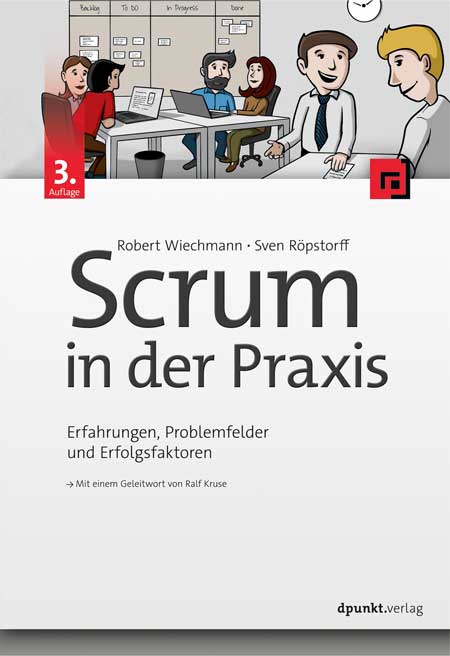
Scrum in der Praxis (3. Auflg.)
Erfahrungen, Problemfelder und ErfolgsfaktorenScrum ist die in Unternehmen am häufigsten verwendete agile Methode. Allerdings bietet Scrum zunächst lediglich ein Rahmenwerk, das durch eigene Ideen und Kreativität ausgefüllt und gestaltet werden muss. Um Scrum effizient anzuwenden, sind umfassende praktische Erfahrungen und ein grundlegendes Verständnis des agilen Wertesystems unabdingbar.Hier hilft dieses Buch: Anhand zahlreicher Praxisbeispiele wird dargestellt, wie Scrum aufgesetzt und durchgeführt werden kann, welche typischen Herausforderungen dabei auftreten und wie diesen entgegnet werden kann. Vorgestellt werden Handlungsalternativen, die dabei helfen, ein Projekt zielgerichtet und schnell auf die Erfolgsspur zu bringen. Auf Basis eines beispielhaften Projekts werden die Schlüsselstellen und konkrete anwendbare Empfehlungen zur Ausgestaltung gegeben.Die 3. Auflage enthält viele weitere Praxistipps und ein neues Kapitel zur Remote-Arbeit mit Scrum. Weiter werden die neuesten Anpassungen des Scrum Guide berücksichtigt.Autoren:Robert Wiechmann unterstützt seit 2008 mit Herzblut Organisationen bei ihrer agilen Transition. Seine Motivation als selbstständiger Berater und Coach ist es seit jeher, die Menschen von einer wert-, menschen- und kundenzentrierten Zusammenarbeit zu begeistern. Wertschätzung und Vertrauen bilden die Basis seiner Arbeit. Neben seiner beratenden und coachenden Tätigkeit ist er unter anderem als Trainer und Moderator tätig. Als Autor und Mitbegründer der agilen Community „Agile by Nature“ leistet er zudem seinen Beitrag, die Idee eines neuen Miteinanders in der Arbeitswelt zu verbreiten.Sven Röpstorff ist Gesellschafter der kommitment GmbH & Co. KG in Hamburg, wo er als Agile Coach, Trainer und Interim Manager tätig ist. Sein Ziel ist die nachhaltige Entwicklung von Organisationen, wobei für ihn immer der Mensch im Mittelpunkt steht. Sven ist stets auf der Suche nach Verbesserungen und neuen Wegen, um Agilität einem immer größer werdenden Publikum auf interessante und spielerische Weise nahezubringen. Seiner Meinung nach kann man agile Vorgehensweisen am besten dadurch veranschaulichen, dass man sie für die Menschen sichtbar, fühlbar, und erlebbar macht. Seine Erfahrungen aus vielen Jahren in unterschiedlichen Rollen und Projekten teilt er als Autor, Konferenzsprecher und Blogger und ist Mitbegründer der „Agile by Nature“ Community.Zielgruppen:Scrum Master, Agile CoachesProjektleiter*innenProduktmanager*innenEntwickler*innenIT-Management

Handbook for SAP PP in S/4HANA
If you're looking to increase your knowledge of one of the core modules of SAP S/4HANA, this is the book for you. Settle in and let a long-time SAP professional guide you through the SAP Production Planning and Execution module.Author Himanshu Goel begins by explaining the nuts and bolts of production planning in SAP S/4HANA, before delving into various manufacturing methodologies such as discrete manufacturing, repetitive manufacturing, and process industry. He'll then walk you through setting up master data such as the material master, bill of material, work center, routing, and production version. You'll then learn, step-by-step, how SAP PP processes are established from production order-based manufacturing to process order-based manufacturing.This book explains the complex concepts of production planning and execution in a straightforward manner and makes for an invaluable guide for SAP PP users from production planners to shop floor managers and even junior/mid-level SAP PP consultants. After reading this book, you'll fully understand the concepts of SAP PP, and have insight into the latest developments in S/4HANA.WHAT YOU WILL LEARN* Understand master data in SAP PP* Study production planning; i.e., SOP and demand management* Explore discrete and repetitive manufacturing* Acquire knowledge on Process IndustryWHO IS THIS BOOK FORProduction planners, shop floor managers, and junior or mid-level SAP PP consultants who are looking to understand the concepts of SAP PP in SAP S/4HANA.HIMANSHU GOEL is an SAP-certified Solution Architect. He has more than 15 years of experience in designing and deploying SAP solutions primarily in production planning and execution, quality management, and plant maintenance. He’s a supply chain professional focused on solving business problems and delivering customer-centric solutions. He has worked on several large-scale, end-to-end SAP implementation and rollout projects. He authored the e-bite Introducing the Material Master in SAP S/4HANA, published by SAP Press, and has also contributed several entries on blogs.sap.com. He is quite passionate about SAP and loves all things SAP.Chapter 1: IntroductionCHAPTER GOAL: This section introduces the three production execution methodologies made possible in SAP software, and at a high level describes what developments have happened related to discrete manufacturing in SAP S/4HANANo of pages: 10SUB -TOPICS :1.1 Manufacturing Types1.1.1 Discrete Manufacturing1.1.2 Repetitive Manufacturing1.1.3 Process ManufacturingChapter 2: Master DataCHAPTER GOAL: This section explains the master data needed for discrete manufacturing process.NO OF PAGES: 50SUB - TOPICS1. Material Master2. BOM3. Work Center4. Routing5. Production VersionCHAPTER 3: PRODUCTION PLANNINGCHAPTER GOAL: Production PlanningNO OF PAGES: 40SUB - TOPICS:1. Sales & Operation Planning2. Demand ManagementChapter 4: Material Requirement PlanningCHAPTER GOAL: This chapter explains the concepts of Material Requirement Planning in SAP.NO OF PAGES: 30SUB - TOPICS:1. Material Requirement Planning2. Master Production Scheduling3. Consumption Based PlanningChapter 5: Production Order ManagementCHAPTER GOAL: This chapter explains the production execution with Production order based manufacturing.No of pages: 40SUB - TOPICS:1. Production Order2. Goods Issue3. Confirmation4. Goods ReceiptChapter 6: Repetitive ManufacturingCHAPTER GOAL: This chapter explains the production execution with Repetitive manufacturing.No of pages: 20SUB - TOPICS:1. Master data for REM2. Production execution with REMChapter 7: Process Order ManagementChapter Goal: This chapter explains the production execution with Process order based manufacturing.NO OF PAGES: 40SUB - TOPICS:1. Process Order2. Goods Issue3. Confirmation4. Goods ReceiptCHAPTER 8: CAPACITY REQUIREMENT PLANNINGCHAPTER GOAL: This chapter explains the capacity requirement planning.No of pages: 20SUB - TOPICS:1. Capacity Evaluation2. Capacity LevellingCHAPTER 9: REPORTSCHAPTER GOAL: This chapter explains the important reports and tools that can be used in SAP PPNO OF PAGES: 20SUB - TOPICS:1. Stock Requirement List2. Production Order List3. Stock List4. Where used listCHAPTER 10: INNOVATIONS IN S/4HANACHAPTER GOAL: This chapter explains the latest innovations in S/4HANANO OF PAGES: 40SUB - TOPICS:1. Demand Driven MRP2. MRP Live3. Predictive MRP

Firmware Development
Build your own system firmware. This book helps you understand system firmware architecture and minimalistic design, and provides a specialized knowledge of firmware development. The book includes guidance on understanding the system firmware build procedure, integrating pieces of firmware and allowing configuration, updating system firmware, creating a development infrastructure for allowing multi-party collaboration in firmware development, and gaining advanced system firmware debugging knowledge.After reading the book you will be able to assume better control while developing your own firmware and know how to interact with native hardware while debugging. You will understand key principles for future firmware development using newer technology, and be ready for the introduction of modern safe programming languages for firmware development. Detailed system firmware development case studies using a futuristic approach cover:* Future scalable system firmware development models* Types of firmware development (system firmware, device firmware, manageability firmware)* Tools and their usage while creating system firmware* How to build infrastructure for seamless firmware development using a multi-party development model* Debugging methodologies used during various phases of firmware product development* Setting up key expectations for future firmware, including thinner firmware footprints and faster execution time, easier configuration, and increased transparent securityWHAT YOU WILL LEARN* Understand the system firmware working model of the future* Gain knowledge to say goodbye to proprietary firmware for different types of firmware development* Know the different types of tools required for creating firmware source code before flashing the final image into the boot device of the embedded system* Develop skills to understand the failure in firmware or in the system and prepare the debugging environment to root cause the defects* Discern the platform minimal security requirement* Optimize the system firmware boot time based on the target hardware requirement* Comprehend the product development cycle using open source firmware developmentWHO THIS BOOK IS FOREmbedded firmware and software engineers migrating the product development from closed source firmware to open source firmware for product adaptation needs as well as engineers working for open source firmware development. A secondary audience includes engineers working on various bootloaders such as open source firmware, UEFI, and Slim Bootloader development, as well as undergraduate and graduate students working on developing firmware skill sets.SUBRATA BANIK is a Firmware Engineer with more than a decade being spent in the computer industry and acquired experiences in system firmware design, development and debugging across various firmware architectures like UEFI, coreboot, Slim bootloader etc. for x86 and ARM platforms. Subrata has profound experience on platform enablement that leads into working for all the leading PC-makers’ products. Subrata is an active member of open-source firmware (OSF) development across different projects like coreboot, oreboot, flashrom, EDKII etc., where he is one of the leading contributors in the open firmware (coreboot) development. Subrata has received multiple US Patents and is very passionate about learning new technology and sharing knowledge among enthusiast engineers. Subrata has presented his technical talks at industry events such as Open Source Firmware conference, Institute for Security and Technology, Intel Developer Forum etc.When not writing or working, he can be found enjoying watching sports (especially football) or spending time with his daughter. A fun fact about Subrata is, he is a strong believer of Time travel existence.VINCENT ZIMMER has been working on embedded firmware for the last 30 years. Vincent has contributed to or created firmware spanning various firmware initiatives, including the Extensible Firmware Interface, where Vincent presently leads the Security subteam in the UEFI Forum. Vincent has also co-authored various papers and books, along with being a named co-inventor on over 450 US patents.PREFACE: This section to capture the author's personal experience about the need for advanced knowledge for system firmware development and why authors think this book might be helpful for the target audience.ACKNOWLEDGEMENT: This section acknowledges the contribution of various domain experts.CHAPTER 1: INTRODUCTION ABOUT THE BOOK: SYSTEM FIRMWARE: AN ESSENTIAL GUIDE TO OPEN SOURCE AND EMBEDDED SOLUTIONS book is an essential book to understand the basic system firmware knowledge and SPECIALIZED SYSTEMIC KNOWLEDGE FOR FIRMWARE DEVELOPMENT is about to going deep into other associated pieces which make the system firmware development complete like understanding the build tools for creating the final firmware image, allow configuration which working between multiple independent firmware block, ensure seamless update of the system firmware. This book will help its reader to understand how critical system firmware security is to define a secure platform. It’s also a handbook for learning basic source code management required for system firmware development.This section would cover:* Motivation for this book* Who is the Reader?* Top reasons to migrate to open source firmware solution from close source* What are the contents?CHAPTER 2: SPOTLIGHT ON FUTURE FIRMWARE: Chapter 4 and 7 has already provided details on specific boot firmware and payloads. This section to share additional work relationship with those various firmware combinations as below:* System Firmware Development model using open source firmwareHybrid system firmware development model on x86 systems.* boot firmware (coreboot) + FSP + payload (linuxboot)* EDKII Minplatform* Open Source System firmware development on RISC-V using Oreboot (Coreboot without ‘C’)* Device Firmware Development model using open source firmware* Explaining the evolution in Discrete Graphics Device firmware from legacy Option ROM till modern EDKII-based driver to nullify the legacy concepts.* Manageability Firmware Development using future adaptive firmware migration:* BMC Firmware -> Open BMC Firmware* Embedded Controller -> Zephyr RTOS open sourceCHAPTER 3: TOOLS: Since the historical past, tools were something that remain constant indicators for human race progress. It can easily refer to tool-based progression, starting from stone age to iron age and even tools being used in the modern era, all intended to ease human effort. Similarly, there is a significant need to have the right tools while developing the boot firmware product. This section focuses on the details on various types of tools that a user should be equipped with while creating their own boot firmware.* BUILD TOOL: As explained earlier in Chapter 4 and 8 about the various ingredients inside the boot firmware and the stitching tool is required to combine all of these to create the final ROM.* CONFIGURATION TOOL: The need of configuration tools become inevitable when a user decides to adopt the Hybrid work model as explained in Chapter 6. Users would need more configuration options while working with closed sourced binary. The need for configuration tools is more when users don’t have provision to modify the source code for an example: hardware validation, firmware validation, system integration etc.* FLASHING/UPDATE TOOL: There might be several instances where product integrators or users would like to update the pre-flash boot firmware without the hardware-based utilities.CHAPTER 4: INFRASTRUCTURE FOR BUILDING OWN SYSTEM FIRMWARE. This chapter would focus on understanding the open source project infrastructure like GitHub and its code upstreaming process, review process etc. Also, migrating the project from closed source system firmware to open source firmware also needs an adaptation towards “Code of Conduct”, “Coding Standard” etc.CHAPTER 5: DEBUGGING: In a product development cycle debugging is the most widely used area where users would like to explore the different means to identify how to fix a problem. This section provides different debugging methodology used in boot firmware like legacy methods, advanced software-based debug, hardware-based debug, source code level debug etc.CHAPTER 6: SECURITY IN ITS CORE: Firmware being closed to hardware and abstracting the operating system from underlying hardware provides more reason to ensure the communication channel is secure. This section is to focus on designing the boot firmware, keeping security in mind. As industry is moving towards more cloud driven services hence need to ensure the secure firmware communication within firmware space and even from OS to firmware using trusted APIs.CHAPTER 7: LOOKING INTO THE FUTURE OF SYSTEM FIRMWARE: This section discusses some key forward looking items that system firmware in the future would inherit to design a simple, high performing, open source friendly and secure solution.PART I: DESIGNING LITE FIRMWARE: The real need of the firmware is to perform essential hardware initialization to boot the platform to the operating system. But the firmware boundary has grown so much in the last 10 years that sometimes it's very obviously referred to as beyond BIOS. The goal of this section is to design a LITE boot firmware to shrink the firmware boundary by adopting 4 principals as Performance, Simplicity, Security and Open Source.PART II: DESIGNING FEATURE KERNEL: Payload being the integral part of system firmware is responsible of doing very minimum and redundant task that could easily be replaced with a boot kernel, this process would also helps to bring the kernel into TCB (Trusted Computing Boundary) to allow performing advance operations into boot firmware space with reduced firmware boundary.PART III: DESIGN MULTITHREAD BOOT FIRMWARE: There are multiple ways to design a fast boot firmware solution, the easiest solution would be choosing a high cost BOM (Bill of Material) which pre-initialized hardware controller by its device firmware. But the real exploration would be how to design a fast boot firmware without increasing the platform BOM cost. The best applicable method in that case would be utilizing the existing CPU capabilities, on modern hardware, all SoC vendors are providing way more required numbers of cores or logical processors hence future boot firmware should adopt this hardware or CPU capabilities to reduce platform boot time.PART IV: INNOVATION IN HARDWARE DESIGN: System firmware being complicated due to the limited innovation in hardware design and to support legacy hardware. An efficient hardware design can help to reduce the system firmware boundary and make the design more scalable without increasing the platform BoM cost.Apart from this APPENDIX(S) sections for discussing the definition of future firmware programming using safe programming language.

Beginning Azure Static Web Apps
Create rich and dynamic web applications on the Azure cloud platform using static web development techniques built around Blazor WebAssembly, APIs, and Markup, while leveraging the paradigm commonly known as JAMstack.This book starts off showing you how to create an environment for deploying your first application. You will create an Azure Static Web App using a Blazor WebAssembly application and adding dynamic content using an Azure function before deploying from GitHub. You will learn to debug your Static Web App locally, both inside of Visual Studio and from the command line using a simple Static Web App CLI command. The book takes a deep dive into the CLI to allow you to emulate all of the features available in the Azure environment. You will learn the authentication and authorizing options with your app and create new blog posts with the post creation function. Included in the book is setting a custom domain and discussion of the options. The book also explores the differences between the free and standard hosting tiers for Static Web Apps.After reading this book, you will be able to create Azure Static Web Apps using Blazor technology.WHAT WILL YOU LEARN* Connect with external authentication services from Twitter, Google, Microsoft, GitHub, and more* Work with the GitHub deployment flow, including using staging environments* Explore the scaffolded Blazor app* Understand differences between the pricing tiers and know which to chooseWHO THIS BOOK IS FORWeb developers looking to deploy feature-rich applications to the cloudSpeaker, author and software developer- STACY has been developing solutions since the mid-1990s in various companies and industries ranging from facilitating contract jobbing to allowing consumers to close a mortgage without the help of a financial adviser – with lots in between.She has a passion for sharing knowledge: using story telling for sharing her experiences to help teams grow in the ways that they develop software and work together, and performing live coding demonstrations to inspire others to try new technologies.For her effort in the community, Stacy has been awarded the Microsoft MVP for Developer Technologies since 2020.PART I GETTING STARTEDBefore we start to build our Blog application we are going to take a look at the tools needed for building the static web app and take a look at the languages that can be used (and which are used in the book).Then we are going to create a near untouched scaffolded solution, deploy to our Static Web App to Azure before finally looking at a couple of simple ways we can run the application locally.CHAPTER 1. SETTING UP YOUR ENVIRONMENT (20 PAGES)Work through the requirements for working through the book• Azure Account• GitHub Account• Creating the GitHub repo, and cloning it the local machine• Visual Studio 2022 (used in book examples) / Visual Studio Code• Alternative languages (book is written in Blazor/C# Azure Functions, but you can follow along with any SPA front end language and Azure Function language)CHAPTER 2. DEPLOYING YOUR FIRST APPLICATION (20 pages)• Creating the client application• Exploring the scaffolded Blazor app• Adding the API application• Creating an Azure Function to consume• Consuming the function in the Client App• Pushing to GitHubCHAPTER 3. CREATING THE STATIC WEB APPWA (15 pages)• Creating the Azure Static Web Appo Create Resource Groupo Create SWA Base subscription information Logging into GitHub Setup for the Blazor Build• Overview of the GitHub action• Viewing the deployed applicationCHAPTER 4: SIMPLE DDEBUGGING (15 pages)• Difference between local and Azure environments• Visual Studio debuggingo Local settings for finding the Azure Functiono Setting up CORS for the API Azure Functiono Setting start up projectso Running the app locallyo Checking origin of pages and datao Limitations of running in this way• Static Web App CLIo Brief introo Installingo Combining Visual Studio and SWA CLIo Overview of other functionality (to be covered in detail later in the book)PART II. STARTING OUR BLOG APPLICATIONNow that we have our scaffolder solution built, it’s time to build communication with the outside world, and authenticate ourselves to the applicationChapter 5: Retrieving Data (15 pages)• Cleanup existing code before continuingo Remove unused pages/functions/navigation• Add a shared project for shared models between client and API• Add a shared model for passing data from the API to the client• Add a model in the API layer for getting data from an outside data source• Retrieve the data and convert to internal formato Example of real world datao Introduction to JSON file used for the application (to keep the project simple)• Return data to clientCHAPTER 6: DISPLAYING DATA (15 PAGES)• Add Client Service to retrieve and cache data from API• New pages for blog posts, and retrieve data from service• Add component for blog post, use on blog posts page• Add route in navigation menu• Add earliest blog post to the home page• Redeploy application and check productionCHAPTER 7 STATIC WEB APP CONFIGURATION FILE (10 pages)• Limitations of application to dateo Refresh page when not on index page• Add Static Web Application Configuration• Add fall back route• Add route for pages to date• Overriding HTTP response codes• Adding Global headers• Networking options (Standard Tier)• Forwarding (Standard Tier)PART III . AUTHENTICATING WITH OUR APPLICATIONCHAPTER 8 AUTHENTICATION (20 pages)• Built in authentication options• Authorization optionso Free 25 users with roleso Standard 25 users with roles Unlimited with function authorizationo Built in role management• Functionality available to use from the /.auth endpointso Providerso Logouto “Me endpoint”CHAPTER 9 CREATING NEW BLOG POSTS (40 pages)• Add authentication to the applicationo Add authentication to start-upo Using authentication on pageso Role based authenticationo Not authorized/authorized contento Allowing users to logouto Adding redirection on autho Show app working• Add authentication to APIo Getting access to the headero Checking roleso Checking user IDs• Add blog creation pageo New page for blog creationo Navigationo Adding route information to SWA config file (including authorized/role based information)o Adding (simple) input for blog posto Save post to API• App blog post creation functiono Get datao Check rightso Create save modelo Fake save dataPART IV STATIC WEB APP WORKING FLOWSCHAPTER 10 SWA STATIC WEB APP CLI COMMAND LINE INTERFACE (15 pages)• Reintroduction to SWAo Recap on current usage• Serving code using the app parameterso Serve static content from disk Publish client application Run application pointing to publish folder + VS running APIo Service code using HTTP endpoint• Using the SWA to serve API functionso Using a running functiono Running the functiono Changing the API port• Debugging scenarioso Everything inside of visual studioo Client inside of visual studioo API inside of visual studio• Configuring the SWA using the swa-config-location parameters• Controlling where the SWA is located using the host and port parameters• Turning on SSL using the ssl parameters• Running scripts on startup using the run parameter• Using the devserver-timeout parameterCHAPTER 11 TESTING IN A PRODUCTION- LIKE ENVIRONMENT (15 pages)• Deeper look at GitHub action• Staging changeso Making a change to the siteo Create branch and push to GitHubo Create Pull requesto Anatomy of Stage URLo Thing to consider with Staging Environments• Adding automatic checks• Creating pipelines outside of GitHub• Managing Deployment Management tokensPART V WORKING IN AN ENTERPRISE ENVIRONMENTChapter 12 Exploring Advanced SWA Options (20 pages)• Adding custom domains to our application• Adding private endpoints (Standard Tier)• Adding managed identity (Standard Tier)• Adding Managed Functions (Standard Tier)o Why managed functionso Setting up a managed functiono Staging considerations with managed functions• Monitoring your Static Web AppAppendices

PHP 8 for Absolute Beginners
Embark on a practical journey of building dynamic sites aided by multiple projects that can be easily adapted to real-world scenarios. This third edition will show you how to become a confident PHP developer, ready to take the next steps to being a Full Stack Developer and/or successful website or web application programmer.You won't be swamped with every detail of the full PHP language up front – instead, you’ll be introduced to a small, versatile subset of PHP by learning to use it creatively to develop dynamic projects. You will see how to use variables, control structures, functions, and object-oriented programming. Secure programming techniques are used throughout the book to demonstrate the proper way to defend against hackers. You will learn how to plan and create MySQL/MariaDB databases and access them using PHP. During this process, you will be introduced to data objects, UI design concepts, and design patterns. Model-View-Controller (MVC) methodology will be used to keep a consistent logical design for each project.Four main projects will be introduced: an image gallery, a blogging system, a data management dashboard, and an interactive game. Initially, a general discussion of how operating systems make programming easier, more reliable, and efficient will be provided. A brief example will follow to demonstrate installation of the latest versions of Apache, PHP, and MySQL/MariaDB. Basic PHP logic will be used during the development of the first project, an image gallery. Once these concepts have been absorbed, a further review of additional concepts of PHP 8 will be discussed, followed by an extensive blogging system will use MVC to reinforce and introduce additional PHP techniques. You’ll also discover the use of Google Charts to create a data management dashboard. Finally, you’ll explore arrays in more depth by developing logic for a checkers game. Along the way, exercises and projects are provided to reinforce what has been learned.What You'll Learn* Explore the basics of PHP syntax, structures, functions, modules and more* Design and develop of interactive UIs* Build dynamic UIs using SQL to access MySQL/MariaDB Databases* Understand the development of secure and efficient Object-Oriented classes and objectsApply the knowledge learned when creating four real-world PHP projectsWHO THIS BOOK IS FORAspiring web developers and designers who are new to web development and/or PHP; programmers who are new to PHP and even programming itself.JASON LENGSTORF is a turbogeek from Portland, OR. He started building websites in his late teens when his band couldn t afford to pay someone to do it, and he continued building websites after he realized his band wasn t actually very good. He s been a full-time freelance web developer since 2007, and expanded his business under the name Copter Labs, which is now a distributed freelance collective, keeping about 10 freelancers worldwide busy. He is also the author of PHP for Absolute Beginners and Pro PHP and jQuery.THOMAS BLOM HANSEN has extensive experience teaching web programming in the Digital section of the Copenhagen School of Design and Technology. When he is not teaching, you can find Thomas fly-fishing for sea-run brown trout in the coastal waters around Denmark or possibly hiking some wilderness area in southern Scandinavia. Thomas lives in a small village with his wife, three kids, too few fly rods, and a lightweight camping hammockSTEVE PRETTYMAN is a college instructor on PHP programming, web development, and related technologies. He is and has been a practicing web developer and is a book author. He has authored several books on PHP including Learn PHP 7 and PHP Arrays for Apress.1: Getting Ready to Program.2: Understanding PHP: Language Basics.3: Form Management.4: Building a Dynamic Image Gallery.5: Reviewing PHP 8 Basic Syntax.6: Databases, MVC, and Data Objects.7: Building the Basic Blog System.8: Basic Blog: Entries and Comments.9: Basic Blog: Images and Authentication.10: Data Dashboard and Gaming.

Cognitive Computing Models in Communication Systems
COGNITIVE COMPUTING MODELS IN COMMUNICATION SYSTEMSA CONCISE BOOK ON THE LATEST RESEARCH FOCUSING ON PROBLEMS AND CHALLENGES IN THE AREAS OF DATA TRANSMISSION TECHNOLOGY, COMPUTER ALGORITHMS, AI-BASED DEVICES, COMPUTER TECHNOLOGY, AND THEIR SOLUTIONS.The book provides a comprehensive overview of state-of-the-art research work on cognitive models in communication systems and computing techniques. It also bridges the gap between various communication systems and solutions by providing the current models and computing techniques, their applications, the strengths and limitations of the existing methods, and the future directions in this area. The contributors showcase their latest research work focusing on the issues, challenges, and solutions in the field of data transmission techniques, computational algorithms, artificial intelligence (AI)-based devices, and computing techniques. Readers will find in this succinctly written and unique book:* Topics covering the applications of advanced cognitive devices, models, architecture, and techniques.* A range of case studies and applications that will provide readers with the tools to apply cutting-edge models and algorithms.* In-depth information about new cognitive computing models and conceptual frameworks and their implementation.AUDIENCEThe book is designed for researchers and electronics engineers, computer science engineers, industrial engineers, and mechanical engineers (both in academia and industry) working in the fields of machine learning, cognitive computing, mobile communication, and wireless network system. BUDATI ANIL KUMAR, PHD, is an associate professor in the ECE Department, Gokaraju Rangaraju Institute of Engineering & Technology (Autonomous), Hyderabad, India. He has more than 12 years of experience in teaching and six years of experience in research and has published more than 50 research articles in journals and conferences. His current research interests include cognitive radio networks, software-defined radio networks, artificial intelligence, 6G emerging technologies, mulsemedia computing, and UAVs in 5G and 6G. S. B. GOYAL, PHD, is Director, Faculty of Information Technology, City University, Malaysia. He has more than 20 experience and has published 100+ papers in journals and conferences. SARDAR M.N. ISLAM, PHD, is Director of Decision Sciences and Modelling Program at Victoria University, Australia. He has authored 31scholarly academic books in different disciplines, as well as more than 250 journal articles in his specialized research areas. Preface xiAcknowledgement xiii1 DESIGN OF A LOW-VOLTAGE LDO OF CMOS VOLTAGE REGULATOR FOR WIRELESS COMMUNICATIONS 1S. Pothalaiah, Dayadi Lakshmaiah, B. Prabakar Rao, D. Nageshwar Rao, Mohammad Illiyas and G. Chandra Sekhar1.1 Introduction 21.2 LDO Controller Arrangement and Diagram Drawing 21.2.1 Design of the LDO Regulator 41.2.1.1 Design of the Fault Amplifier 41.2.1.2 Design of the MPT Phase 81.3 Conclusion 14References 142 PERFORMANCE ANALYSIS OF MACHINE LEARNING AND DEEP LEARNING ALGORITHMS FOR SMART CITIES: THE PRESENT STATE AND FUTURE DIRECTIONS 15Pradeep Bedi, S. B. Goyal, Sardar MN Islam, Jia Liu and Anil Kumar Budati2.1 Introduction 162.2 Smart City: The Concept 162.3 Application Layer 182.3.1 Smart Homes and Buildings 182.3.1.1 Smart Surveillance 182.3.2 Smart Transportation and Driving 192.3.3 Smart Healthcare 192.3.4 Smart Parking 192.3.5 Smart Grid 192.3.6 Smart Farming 192.3.7 Sensing Layer 202.3.8 Communication Layer 202.3.9 Data Layer 202.3.10 Security Layer 212.4 Issues and Challenges in Smart Cities: An Overview 212.5 Machine Learning: An Overview 222.5.1 Supervised Learning 222.5.2 Support Vector Machines (SVMs) 222.5.3 Artificial Neural Networks 232.5.4 Random Forest 242.5.5 Naïve Bayes 252.6 Unsupervised Learning 262.7 Deep Learning: An Overview 262.7.1 Autoencoder 272.7.2 Convolution Neural Networks (CNNs) 272.7.3 Recurrent Neural Networks (RNNs) 282.8 Deep Learning vs Machine Learning 292.9 Smart Healthcare 302.9.1 Evolution Toward a Smart Healthcare Framework 302.9.2 Application of ML/DL in Smart Healthcare 312.10 Smart Transport System 332.10.1 Evolution Toward a Smart Transport System 332.10.2 Application of ML/DL in a Smart Transportation System 342.11 Smart Grids 362.11.1 Evolution Toward Smart Grids 362.11.2 Application of ML/DL in Smart Grids 382.12 Challenges and Future Directions 402.13 Conclusion 41References 413 APPLICATION OF MACHINE LEARNING ALGORITHMS AND MODELS IN 3D PRINTING 47Chetanpal Singh3.1 Introduction 483.2 Literature Review 503.3 Methods and Materials 653.4 Results and Discussion 693.5 Conclusion 70References 724 A NOVEL MODEL FOR OPTIMAL RELIABLE ROUTING PATH PREDICTION IN MANET 75S.R.M. Krishna, S. Pothalaiah and R. Santosh4.1 Introduction 764.2 Analytical Hierarchical Process Technique 774.3 Mathematical Models and Protocols 784.3.1 Rough Sets 784.3.1.1 Pawlak Rough Set Theory Definitions 784.3.2 Fuzzy TOPSIS 794.4 Routing Protocols 804.4.1 Classification of Routing Paths 804.5 RTF-AHP Model 814.5.1 Rough TOPSIS Fuzzy Set Analytical Hierarchical Process Algorithm 814.6 Models for Optimal Routing Performance 834.6.1 Genetic Algorithm Technique 844.6.2 Ant Colony Optimization Technique 844.6.3 RTF-AHP Model Architecture Flow 844.7 Results and Discussion 854.8 Conclusion 88References 885 IOT-BASED SMART TRAFFIC LIGHT CONTROL 91Sreenivasa Rao Ijjada and K. Shashidhar5.1 Introduction 925.2 Scope of the Proposed Work 935.3 Proposed System Implementation 945.4 Testing and Results 995.5 Test Results 1005.6 Conclusion 104References 1056 DIFFERENTIAL QUERY EXECUTION ON PRIVACY PRESERVING DATA DISTRIBUTED OVER HYBRID CLOUD 107Sridhar Reddy Vulapula, P. V. S. Srinivas and Jyothi Mandala6.1 Introduction 1076.2 Related Work 1086.3 Proposed Solution 1106.3.1 Data Transformation 1106.3.2 Data Distribution 1136.3.3 Query Execution 1146.4 Novelty in the Proposed Solution 1156.5 Results 1156.6 Conclusion 119References 1207 DESIGN OF CMOS BASE BAND ANALOG 123S. Pothalaiah, Dayadi Lakshmaiah, Bandi Doss, Nookala Sairam and K. Srikanth7.1 Introduction 1247.2 Proposed Technique of the BBA Chain for Reducing Energy Consumption 1257.3 Channel Preference Filter 1307.4 Programmable Amplifier Gain 1327.5 Executed Outcomes 1337.6 Conclusion 135References 1358 REVIEW ON DETECTION OF NEUROMUSCULAR DISORDERS USING ELECTROMYOGRAPHY 137G. L. N. Murthy, Rajesh Babu Nemani, M. Sambasiva Reddy and M. K. Linga Murthy8.1 Introduction 1388.2 Materials 1398.3 Methods 1408.4 Conclusion 142References 1429 DESIGN OF COMPLEMENTARY METAL–OXIDE SEMICONDUCTOR RING MODULATOR BY BUILT-IN THERMAL TUNING 145P. Bala Murali Krishna, Satish A., R. Yadgiri Rao, Mohammad Illiyas and I. Satya Narayana9.1 Introduction 1469.2 Device Structure 1479.3 dc Performance 1499.4 Small-Signal Radiofrequency Assessments 1499.5 Data Modulation Operation (High Speed) 1509.6 Conclusions and Acknowledgments 152References 15310 LOW-POWER CMOS VCO USED IN RF TRANSMITTER 155D. Subbarao, Dayadi Lakshmaiah, Farha Anjum, G. Madhu Sudhan Rao and G. Chandra Sekhar10.1 Introduction 15610.2 Transmitter Architecture 15710.3 Voltage-Controlled Ring Oscillator Design 15810.4 CMOS Combiner 16110.5 Conclusion 163References 16311 A NOVEL LOW-POWER FREQUENCY-MODULATED CONTINUOUS WAVE RADAR BASED ON LOW-NOISE MIXER 165Dayadi Lakshmaiah, Bandi Doss, J.V.B. Subrmanyam, M.K. Chaitanya, Suresh Ballala, R. Yadagirir Rao and I. Satya Narayana11.1 Introduction 16611.2 FMCW Principle 16811.3 Results 17411.4 Conclusion 178References 17912 A HIGHLY INTEGRATED CMOS RF T X USED FOR IEEE 802.15.4 181Dayadi Lakshmaiah, Subbarao, C.H. Sunitha, Nookala Sairam and S. Naresh12.1 Introduction 18212.2 Related Work 18212.3 Simulation Results and Discussion 18512.4 Conclusion 186References 18713 A NOVEL FEEDFORWARD OFFSET CANCELLATION LIMITING AMPLIFIER IN RADIO FREQUENCIES 189Dayadi Lakshmaiah, L. Koteswara Rao, I. Satya Narayana, B. Rajeshwari and I. Venu13.1 Introduction 19013.2 Hardware Design 19013.2.1 Limiting Amplifier 19013.2.2 Offset Extractor 19213.2.3 Architecture and Gain 19213.2.4 Quadrature Detector 19213.2.5 Sensitivity 19413.3 Experimental Results 19513.4 Conclusion 195References 19614 A SECURED NODE AUTHENTICATION AND ACCESS CONTROL MODEL FOR IOT SMART HOME USING DOUBLE-HASHED UNIQUE LABELED KEY-BASED VALIDATION 199Sulaima Lebbe Abdul Haleem14.1 Introduction 20014.2 Challenges in IoT Security and Privacy 20314.2.1 Heterogeneous Communication and Devices 20314.2.2 Physical Equipment Integration 20414.2.3 Resource Handling Limitations 20414.2.4 Wide Scale 20414.2.5 Database 20414.3 Background 20914.4 Proposed Model 21014.4.1 Communication Flow 21414.4.1.1 IoT Node and Registration Authority 21414.4.1.2 User and Local Authorization Authority 21514.5 Results 21514.6 Conclusion 21814.7 Claims 218References 219Index 221

Test Your Skills in C# Programming
Review the fundamental constructs in C# using Q&As and program segments to boost your confidence and gain expertise. This book will help you analyze your programs more efficiently and enhance your programming skills.The book is divided into three parts, where you will learn the fundamentals, object-oriented programming, and some advanced features of C#. In the first part, you will review C# and .NET basics along with the important constructs such as strings, arrays, and structures. In the second part, you'll review the concepts of object-oriented programming in detail. Here, you will go through various program segments in class and objects, inheritance, polymorphism, abstraction, encapsulation, and much more. You will also analyze the output of the given programs with the help of Q&A sections. The uses of interfaces, static class, and exception handling are discussed in the book along with some other important concepts in C#. In the third and last part, you will learn advanced features of C# programming such as delegates, events, lambdas, generics, and multithreading. Here, you'll also cover some of the latest features of C#.After reading this book, you will be able to analyze and apply the basic and frequently used features along with the advanced features of C#.WHAT WILL YOU LEARN* Understand the core and some of the latest features in C#* Review your programming skills along with some of the latest features in C#* Know how object-oriented programming (OOP) is used in C#* Get up and running on the advanced features of C# such as delegates, lambdas, generics, and moreWHO THIS IS BOOK FORProgrammers with basic knowledge of C#VASKARAN SARCAR obtained his Master of Engineering in software engineering from Jadavpur University, Kolkata (India) and an MCA from Vidyasagar University, Midnapore (India). He was a National Gate Scholar (2007-2009) and has more than 12 years of experience in education and the IT industry. Vaskaran devoted his early years (2005-2007) to the teaching profession at various engineering colleges, and later he joined HP India PPS R&D Hub Bangalore. He worked there until August 2019. At the time of his retirement from HP, he was a Senior Software Engineer and Team Lead at HP. To follow his dream and passion, Vaskaran is now an independent full-time author. Other Apress books by him include: _Java Design Patterns Third Edition, _Simple and Efficient Programming in C#, _Design Patterns in C# Second Edition, __Getting Started with Advanced C#, __Interactive Object-Oriented Programming in Java Second Edition,__ __Java Design Patterns Second Edition, __Design Patterns in C#, __Interactive C#, __Interactive Object-Oriented Programming in Java, _Java Design Patterns.PART I FUNDAMENTALSCHAPTER 1: LANGUAGE BASICSCHAPTER GOAL: THIS CHAPTER DISCUSSES THE FOLLOWING TOPICS:The important concepts in .NETThe basic programming constructs in C#.Use of some useful data types including the var type.Use of some useful operators and explicit-casting.Use of the selection statements and case guards.Use of iteration statements.Use of the jump statements.Use of the ternary operator.No of pages: 28SUB - TOPICS NCHAPTER 2: STRING AND ARRAYSCHAPTER GOAL:ONCE YOU FINISH THIS CHAPTER, YOU CAN ANSWER THE FOLLOWING QUESTIONS AND RELATED AREAS:How can you use string datatype in your program?How can you use the common in-built methods from the String class?How a String variable is different from a StringBuilder?How can you convert a string to an int?How can you use nullable reference type in a program?How to create arrays in C#?What are the different types of C# arrays and how to use them?How to use common in-built methods from the System.Array class?How can you iterate over a string or an array?NO OF PAGES 23SUB - TOPICS NACHAPTER 3: ENUMERATION AND STRUCTURESCHAPTER GOAL: This chapter discusses the following topics:The enum fundamentalsFlags enumerationDefaut value expressionsThe struct fundamentalsNon-destructive mutationsNO OF PAGES: 26SUB - TOPICS NAPART II OBJECT-ORIENTED PROGRAMMINGCHAPTER 4: CLASS AND OBJECTSCHAPTER GOAL: This chapter focuses on the following topics:Classes and objects creations.Instance fields and methods.Constructors and their usage.Optional parameters.Object initializers.Nested classes.The uses of private, internal, and public modifiers inside a class.NO OF PAGES: 17SUB - TOPICS NACHAPTER 5: INHERITANCECHAPTER GOAL: This chapter covers the following topics:Inheritance and types.Method and constructor overloading.Method overriding.Use of virtual, override, and new keywords.Use of the sealed keyword.Introductory discussion on covariance and contravarianceNO OF PAGES 33Sub - Topics NAChapter 6: PolymorphismCHAPTER GOAL: This chapter helps you to review:Polymorphism and its benefits.Abstract classes and their uses.Interfaces and their uses.Different types of interfaces.Writing polymorphic codes using abstract classes and interfacesNO OF PAGES: 30SUB - TOPICS NAChapter 7: EncapsulationCHAPTER GOAL: This chapter covers the following topics:What is encapsulation? How is it different from an abstraction?Properties and their usage.Different ways to create a property.The usage of the get and set accessors.Virtual and abstract properties.The discussion of the init accessor.Indexers and their usage.How can the indexers and properties work with an interface?Discussion on different aspects of properties and indexers.NO OF PAGES: 26SUB - TOPICS NAChapter 8: Exception HandlingCHAPTER GOAL: This chapter covers the following topics:Exception and its uses in C# programming.Use of the try, catch, and finally blocks.Use of multiple catch blocks in a program.Use of a general catch block.How to throw and re-throw an exception.Use of exception filters.Custom exception class and its usage.NO OF PAGES: 23SUB - TOPICS NAChapter 9: Useful ConceptsChapter Goal: Q&A and program segments on some useful constructs such as casting and boxing, static class and methods, passing value type by value, passing value type by references(using ref and out keyword), extension methods, and so on.NO OF PAGES: 15-25+SUB - TOPICS NAPart III Advanced Features Chapter 10: DelegatesCHAPTER GOAL: This chapter covers the following topics:Delegates and their usesMulticast delegatesSome commonly used in-built delegatesCovariance and contravariance using delegatesNO OF PAGES: 20SUB - TOPICS NAChapter 11: EventsCHAPTER GOAL: This chapter helps you to review your understanding of events and discusses the following:Events creation and their uses.How to pass the event data.Use of event accessors.Use of interface events (both implicit and explicit).Simplified coding with events.NO OF PAGES: 22SUB - TOPICS NAChapter 12: LambdasCHAPTER GOAL: This chapter focuses on this and covers the following topics:Lambda expressions and their useExpression-bodied membersUse of local variables inside lambda expressions.Event handling using lambda expressions.Use of a static lambda.Understanding natural type.NO OF PAGES: 22SUB - TOPICS NACHAPTER 13: GENERICSCHAPTER GOAL: This chapter focuses on the following topics:The motivation behind generics.The fundamentals of generic programs.Use of generic interfaces.Use of generic constraints.Use of covariance and contravariance using generics.Self-referencing generic type.Experimenting with generic method’s overloading and overriding.Analyzing the static data in the context of generics.NO OF PAGES: 35SUB - TOPICS NACHAPTER 14: MULTITHREADINGChapter Goal: Upon completion of this chapter, you’ll be able to answer the following questions:What are the threads and how can you create them?What is a multithreaded program? How does it differ from a single-threaded application?Why are the ThreadStart and ParameterizedThreadStart delegates important in thread programming?How to block a thread using Sleep or Join methods?How can you use lambda expressions in a multithreaded program?How to use important Thread class members?How a foreground thread is different from a background thread?What is synchronization and why is it needed?How can you implement thread safety in C# using lock statements?How can you implement an alternative approach to lock statements using Monitor’s Entry and Exit Method?What is a deadlock and how can you detect the deadlock in your system?What is the purpose of using the ThreadPool class? What are the associative pros and cons of using it?How to cancel a running thread in the managed environment?And many more.NO OF PAGES: 40SUB - TOPICS NACHAPTER 15: MISCELLANEOUSCHAPTER GOAL: Q&A and program segments on the related latest features that are covered in the previous chapters and any other important topics(if any).NO OF PAGES: 10-20+SUB - TOPICS NA