

Computer und IT

Pro Serverless Data Handling with Microsoft Azure
Design and build architectures on the Microsoft Azure platform specifically for data-driven and ETL applications. Modern cloud architectures rely on serverless components more than ever, and this book helps you identify those components of data-driven or ETL applications that can be tackled using the technologies available on the Azure platform. The book shows you which Azure components are best suited to form a strong foundation for data-driven applications in the Microsoft Azure Cloud.If you are a solution architect or a decision maker, the conceptual aspects of this book will help you gain a deeper understanding of the underlying technology and its capabilities. You will understand how to develop using Azure Functions, Azure Data Factory, Logic Apps, and to employ serverless databases in your application to achieve the best scalability and design. If you are a developer, you will benefit from the hands-on approach used throughout this book. Many practical examples and architectures applied in real-world projects will be valuable to you on your path to serverless success.WHAT YOU WILL LEARN* Know what services are available in Microsoft Azure that can deal with large amounts of data* Design modern data applications based on serverless technology in the cloud* Transform and present data without the use of infrastructure* Employ proven design patterns for rapid implementation of serverless data applications* Choose the correct set of development tools for the services you are using* Understand the term "serverless" and how it can be a benefit* Identify scenarios in which serverless is not the best option availableWHO THIS BOOK IS FORArchitects and decision makers who want to understand how modern architectures are designed and how to modernize their applications. The book is aimed at the developer who needs a steppingstone to quickly implement a serverless data application. And the book is for any IT professional who seeks a head start to serverless computing for data-heavy applications on the Azure platform.DR. BENJAMIN KETTNER is co-founder and CTO of ML!PA Consulting GmbH. Since 2020, he has been a Microsoft Data Platform MVP and a Friend of Red Gate. He received his doctorate in applied mathematics at the Free University of Berlin in 2012. At the time of his doctorate, he was a member of the DFG Research Center Matheon-Mathematics for Key Technologies, and a member of the Computational Nano Optics group at the Zuse Institute Berlin.FRANK GEISLER is owner and CEO of GDS Business Intelligence GmbH, a Microsoft Gold Partner in five categories. He is located in Lüdinghausen, in the lovely Münsterland. He is a Data Platform MVP, MCT, MCSE-Business Intelligence, MCSE-Data Platform, MCSE-Azure Solutions Architect, and DevOps Engineer Expert. In his job he is building business intelligence systems based on Microsoft technologies, mainly on SQL Server and Microsoft Azure. He has also a strong focus on Database DevOps.PART I. THE BASICS1. Azure Basics2. Serverless Computing3. Data Driven ApplicationsPART II. HANDS-ON4. Azure Functions5. Logic Apps6. Azure Data Factory7. Database and Storage Options8. IoT Hub, Event Hub, and Streaming Data9. Power BIPART III. DESIGN PRACTICES10. Achieving Resiliency11. Queues, Messages, and Commands12. Processing Streams of Data13. Monitoring Serverless ApplicationsPART IV. PUTTING IT ALL TOGETHER14. Tools and Helpers15. Data Loading Patterns16. Data Storage Patterns17. Architecture for a Modern Data Driven Application

Python for MATLAB Development
MATLAB can run Python code!Python for MATLAB Development shows you how to enhance MATLAB with Python solutions to a vast array of computational problems in science, engineering, optimization, statistics, finance, and simulation. It is three books in one:* A thorough Python tutorial that leverages your existing MATLAB knowledge with a comprehensive collection of MATLAB/Python equivalent expressions* A reference guide to setting up and managing a Python environment that integrates cleanly with MATLAB* A collection of recipes that demonstrate Python solutions invoked directly from MATLABThis book shows how to call Python functions to enhance MATLAB's capabilities. Specifically, you'll see how Python helps MATLAB:* Run faster with numba* Distribute work to a compute cluster with dask* Find symbolic solutions to integrals, derivatives, and series summations with SymPy* Overlay data on maps with Cartopy* Solve mixed-integer linear programming problems with PuLP* Interact with Redis via pyredis, PostgreSQL via psycopg2, and MongoDB via pymongo* Read and write file formats that are not natively understood by MATLAB, such as SQLite, YAML, and iniWHO THIS BOOK IS FORMATLAB developers who are new to Python and other developers with some prior experience with MATLAB, R, IDL, or Mathematica.ALBERT DANIAL is an aerospace engineer with 30 years of experience, currently working for Northrop Grumman near Los Angeles. Before Northrop Grumman, he was a member of the NASTRAN Numerical Methods team at MSC Software and a systems analyst at SPARTA. He has a Bachelor of Aerospace Engineering degree from the Georgia Institute of Technology, and Masters and Ph.D. degrees in Aeronautics and Astronautics from Purdue University. He is the author of cloc, the open source code counter.Al has used MATLAB since 1990 and Python since 2006 for algorithm prototyping, earth science data processing, spacecraft mission planning, optimization, visualization, and countless utilities that simplify daily engineering work. Chapter 1: IntroductionGoal: Describe the book’s goals, what to expect, what benefit to gain.• Learn Python through MATLAB Equivalents• Is Python really free?• What About Toolboxes?• I already know Python. How do I call Python functions in MATLAB?• What you won’t find in this book• Beyond MATLABPart I – Learning Python through MATLAB comparisonsChapter 2: InstallationGoal: Create a working Python installation on the computer with MATLAB• Downloads• Post-Install Checkout• ipython, IDE’s• Python and MATLAB Versions Used in This BookChapter 3: Language BasicsGoal: Learn the basic mechanics of Python• Assignment• Printing• Indentation• Indexing• `for` Loops• `while` Loops• `if` Statements• Functions• Comments• Line Continuation• Exceptions• Modules and PackagesChapter 4: Data ContainersGoal: Learn about lists, dictionaries, etc, and how these compare to MATLAB matrices and cell arrays• NumPy Arrays• Strings• Python Lists and MATLAB Cell Arrays• Python Tuples • Python Sets and MATLAB Set Operations• Python Dictionaries and MATLAB Maps• Structured Data• Tables• Caveat: ```=`'' copies a reference for non-scalars!Chapter 5: Date and TimeGoal: Learn about measuring, storing, and converting temporal values.• Time• Dates• Timezones• Time Conversions to and from `datetime` ObjectsChapter 6: Input and OutputGoal: Learn about reading and writing data, with emphasis on numeric data and scientific file formats like HDF and NetCDF.• Reading and Writing Text Files• Reading and Writing Binary Files• Reading and Writing Pickle Files• Reading and Writing `.mat` files• Command Line Input • Interactive Input• Receiving and Sending over a Network• Interacting with DatabasesChapter 7: Interacting with the File SystemGoal: Show how Python manages file system operations.• Reading Directory Contents• Finding Files• Deleting Files• Creating Directories• Deleting Directories• Walking Directory TreesChapter 8: Interacting with the Operating System and External ExecutablesGoal: Show how to make system calls in Python and how these differ from MATLAB.• Reading, setting environment variables• Calling External Executables• Inspecting the Process Table and Process ResourcesPart II – MATLAB with PythonChapter 9: MATLAB/Python IntegrationGoal: Show how to make system calls in Python and how these differ from MATLAB.• MATLAB’s `py` Module• System calls and File I/O• TCP/IP ExchangeChapter 10: Object Oriented ProgrammingGoal: Demonstrate Python’s OO semantics compared to MATLAB• Classes• Custom Exceptions• Performance ImplicationsChapter 11: NumPy and SciPyGoal: Introduce Python’s numeric and scientific computing capability. This is by far the largest chapter in the book.• NumPy Arrays• Linear Algebra• Sparse Matrices• Interpolation • Curve Fitting• Statistics• Finding Roots• Optimization • Differential Equations• Symbolic Mathematics• Unit SystemsChapter 12: PlottingGoal: Demonstrate how publication-quality plots are produced in Python alongside MATLAB equivalents• Point and Line Plots• Area Plots• Animations• Plotting on Maps• 3D Plots• Making plots in batch modeChapter 13: Tables and DataframesGoal: Show Pandas dataframes in comparison to MATLAB tables (and how the former pre-dates the latter by five years)• Loading tables from files• Table summaries• Cleaning data• Creating tables programmatically• Sorting rows• Table subsets• Iterating over rows• Pivot tables• Adding columns• Deleting columns• Joins across tablesChapter 14: High Performance ComputingGoal: Demonstrate techniques for profiling Python code and making computationally intensive Python code run faster. Significant performance advantages over MATLAB are shown.• Paths to faster Python code• Reference Problems• Reference Hardware and OS• Baseline performance• Profiling Python Code• Vectorization• Cython• Pythran• Numba• Linking to C, C++, Fortran• Distributed memory parallel processingChapter 15: `py` Module ExamplesGoal: A collection of examples that show how Python enables the core MATLAB product to perform tasks that would either require a Toolbox or less-vetted code from the MathWorks’ user contributed FileExchange.• Read a YAML File• Write a YAML File• Compute Laplace Transforms• Interact with Redis• Units• Propagate a satellite’s orbit• Controls• Plotting on mapsChapter 16: Language WartsGoal: Identify MATLAB and Python language ‘features’ that often cause beginners grief.• Dangerous language features• MATLAB• Python• Common Errors
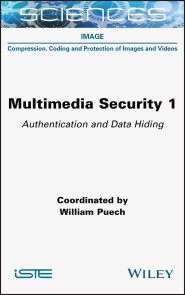
Multimedia Security 1
Today, more than 80% of the data transmitted over networks and archived on our computers, tablets, cell phones or clouds is multimedia data - images, videos, audio, 3D data. The applications of this data range from video games to healthcare, and include computer-aided design, video surveillance and biometrics.It is becoming increasingly urgent to secure this data, not only during transmission and archiving, but also during its retrieval and use. Indeed, in today’s "all-digital" world, it is becoming ever-easier to copy data, view it unrightfully, steal it or falsify it.Multimedia Security 1 analyzes the issues of the authentication of multimedia data, code and the embedding of hidden data, both from the point of view of defense and attack. Regarding the embedding of hidden data, it also covers invisibility, color, tracing and 3D data, as well as the detection of hidden messages in an image by steganalysis. WILLIAM PUECH is Professor of Computer Science at Université de Montpellier, France. His research focuses on image processing and multimedia security in particular, from its theories to its applications.Foreword by Gildas Avoine xiForeword by Cédric Richard xiiiPreface xvilliam PUECHCHAPTER 1 HOW TO RECONSTRUCT THE HISTORY OF A DIGITAL IMAGE, AND OF ITS ALTERATIONS 1Quentin BAMMEY, Miguel COLOM, Thibaud EHRET, Marina GARDELLA, Rafael GROMPONE, Jean-Michel MOREL, Tina NIKOUKHAH and Denis PERRAUD1.1 Introduction 21.1.1 General context 21.1.2 Criminal background 31.1.3 Issues for law enforcement 41.1.4 Current methods and tools of law enforcement 51.1.5 Outline of this chapter 51.2 Describing the image processing chain 81.2.1 Raw image acquisition 81.2.2 Demosaicing 81.2.3 Color correction 101.2.4 JPEG compression 111.3 Traces left on noise by image manipulation 111.3.1 Non-parametric estimation of noise in images 111.3.2 Transformation of noise in the processing chain 131.3.3 Forgery detection through noise analysis 151.4 Demosaicing and its traces 181.4.1 Forgery detection through demosaicing analysis 191.4.2 Detecting the position of the Bayer matrix 201.4.3 Limits of detection demosaicing 231.5 JPEG compression, its traces and the detection of its alterations 231.5.1 The JPEG compression algorithm 231.5.2 Grid detection 251.5.3 Detecting the quantization matrix 271.5.4 Beyond indicators, making decisions with a statistical model 281.6 Internal similarities and manipulations 311.7 Direct detection of image manipulation 331.8 Conclusion 341.9 References 35CHAPTER 2 DEEP NEURAL NETWORK ATTACKS AND DEFENSE: THE CASE OF IMAGE CLASSIFICATION 41Hanwei ZHANG, Teddy FURON, Laurent AMSALEG and Yannis AVRITHIS2.1 Introduction 412.1.1 A bit of history and vocabulary 422.1.2 Machine learning 442.1.3 The classification of images by deep neural networks 462.1.4 Deep Dreams 482.2 Adversarial images: definition 492.3 Attacks: making adversarial images 512.3.1 About white box 522.3.2 Black or gray box 622.4 Defenses 642.4.1 Reactive defenses 642.4.2 Proactive defenses 662.4.3 Obfuscation technique 672.4.4 Defenses: conclusion 682.5 Conclusion 682.6 References 69CHAPTER 3 CODES AND WATERMARKS 77Pascal LEFEVRE, Philippe CARRE and Philippe GABORIT3.1 Introduction 773.2 Study framework: robust watermarking 783.3 Index modulation 813.3.1 LQIM: insertion 813.3.2 LQIM: detection 823.4 Error-correcting codes approach 823.4.1 Generalities 843.4.2 Codes by concatenation 863.4.3 Hamming codes 883.4.4 BCH codes 903.4.5 RS codes 933.5 Contradictory objectives of watermarking: the impact of codes 963.6 Latest developments in the use of correction codes for watermarking 983.7 Illustration of the influence of the type of code, according to the attacks 1023.7.1 JPEG compression 1033.7.2 Additive Gaussian noise 1063.7.3 Saturation 1063.8 Using the rank metric 1083.8.1 Rank metric correcting codes 1093.8.2 Code by rank metric: a robust watermarking method for image cropping 1133.9 Conclusion 1213.10 References 121CHAPTER 4 INVISIBILITY 129Pascal LEFEVRE, Philippe CARRE and David ALLEYSSON4.1 Introduction 1294.2 Color watermarking: an approach history? 1314.2.1 Vector quantization in the RGB space 1324.2.2 Choosing a color direction 1334.3 Quaternionic context for watermarking color images 1354.3.1 Quaternions and color images 1354.3.2 Quaternionic Fourier transforms 1374.4 Psychovisual approach to color watermarking 1394.4.1 Neurogeometry and perception 1394.4.2 Photoreceptor model and trichromatic vision 1414.4.3 Model approximation 1444.4.4 Parameters of the model 1454.4.5 Application to watermarking color images 1464.4.6 Conversions 1474.4.7 Psychovisual algorithm for color images 1484.4.8 Experimental validation of the psychovisual approach for color watermarking 1514.5 Conclusion 1554.6 References 157CHAPTER 5 STEGANOGRAPHY: EMBEDDING DATA INTO MULTIMEDIA CONTENT 161Patrick BAS, Remi COGRANNE and Marc CHAUMONT5.1 Introduction and theoretical foundations 1625.2 Fundamental principles 1635.2.1 Maximization of the size of the embedded message 1635.2.2 Message encoding 1655.2.3 Detectability minimization 1665.3 Digital image steganography: basic methods 1685.3.1 LSB substitution and matching 1685.3.2 Adaptive embedding methods 1695.4 Advanced principles in steganography 1725.4.1 Synchronization of modifications 1735.4.2 Batch steganography 1755.4.3 Steganography of color images 1775.4.4 Use of side information 1785.4.5 Steganography mimicking a statistical model 1805.4.6 Adversarial steganography 1825.5 Conclusion 1865.6 References 186CHAPTER 6 TRAITOR TRACING 189Teddy FURON6.1 Introduction 1896.1.1 The contribution of the cryptography community 1906.1.2 Multimedia content 1916.1.3 Error probabilities 1926.1.4 Collusion strategy 1926.2 The original Tardos code 1946.2.1 Constructing the code 1956.2.2 The collusion strategy and its impact on the pirated series 1956.2.3 Accusation with a simple decoder 1976.2.4 Study of the Tardos code-Škori´c original 1996.2.5 Advantages 2026.2.6 The problems 2046.3 Tardos and his successors 2056.3.1 Length of the code 2056.3.2 Other criteria 2056.3.3 Extensions 2076.4 Research of better score functions 2086.4.1 The optimal score function 2086.4.2 The theory of the compound communication channel 2096.4.3 Adaptive score functions 2116.4.4 Comparison 2136.5 How to find a better threshold 2136.6 Conclusion 2156.7 References 216CHAPTER 7 3D WATERMARKING 219Sebastien BEUGNON, Vincent ITIER and William PUECH7.1 Introduction 2207.2 Preliminaries 2217.2.1 Digital watermarking 2217.2.2 3D objects 2227.3 Synchronization 2247.3.1 Traversal scheduling 2247.3.2 Patch scheduling 2247.3.3 Scheduling based on graphs 2257.4 3D data hiding 2307.4.1 Transformed domains 2317.4.2 Spatial domain 2317.4.3 Other domains 2327.5 Presentation of a high-capacity data hiding method 2337.5.1 Embedding of the message 2347.5.2 Causality issue 2357.6 Improvements 2367.6.1 Error-correcting codes 2367.6.2 Statistical arithmetic coding 2367.6.3 Partitioning and acceleration structures 2377.7 Experimental results 2387.8 Trends in high-capacity 3D data hiding 2407.8.1 Steganalysis 2407.8.2 Security analysis 2417.8.3 3D printing 2427.9 Conclusion 2427.10 References 243CHAPTER 8 STEGANALYSIS: DETECTION OF HIDDEN DATA IN MULTIMEDIA CONTENT 247Remi COGRANNE, Marc CHAUMONT and Patrick BAS8.1 Introduction, challenges and constraints 2478.1.1 The different aims of steganalysis 2488.1.2 Different methods to carry out steganalysis 2498.2 Incompatible signature detection 2508.3 Detection using statistical methods 2528.3.1 Statistical test of χ2 2528.3.2 Likelihood-ratio test 2568.3.3 LSB match detection 2618.4 Supervised learning detection 2638.4.1 Extraction of characteristics in the spatial domain 2648.4.2 Learning how to detect with features 2698.5 Detection by deep neural networks 2708.5.1 Foundation of a deep neural network 2718.5.2 The preprocessing module 2728.6 Current avenues of research 2798.6.1 The problem of Cover-Source mismatch 2798.6.2 The problem with steganalysis in real life 2798.6.3 Reliable steganalysis 2808.6.4 Steganalysis of color images 2808.6.5 Taking into account the adaptivity of steganography 2818.6.6 Grouped steganalysis (batch steganalysis) 2818.6.7 Universal steganalysis 2828.7 Conclusion 2838.8 References 283List of Authors 289Index 293

Hands-on Machine Learning with Python
Here is the perfect comprehensive guide for readers with basic to intermediate level knowledge of machine learning and deep learning. It introduces tools such as NumPy for numerical processing, Pandas for panel data analysis, Matplotlib for visualization, Scikit-learn for machine learning, and Pytorch for deep learning with Python. It also serves as a long-term reference manual for the practitioners who will find solutions to commonly occurring scenarios.The book is divided into three sections. The first section introduces you to number crunching and data analysis tools using Python with in-depth explanation on environment configuration, data loading, numerical processing, data analysis, and visualizations. The second section covers machine learning basics and Scikit-learn library. It also explains supervised learning, unsupervised learning, implementation, and classification of regression algorithms, and ensemble learning methods in an easy manner with theoretical and practical lessons. The third section explains complex neural network architectures with details on internal working and implementation of convolutional neural networks. The final chapter contains a detailed end-to-end solution with neural networks in Pytorch.After completing Hands-on Machine Learning with Python, you will be able to implement machine learning and neural network solutions and extend them to your advantage.WHAT YOU'LL LEARN* Review data structures in NumPy and Pandas * Demonstrate machine learning techniques and algorithm* Understand supervised learning and unsupervised learning * Examine convolutional neural networks and Recurrent neural networks* Get acquainted with scikit-learn and PyTorch* Predict sequences in recurrent neural networks and long short term memoryWHO THIS BOOK IS FORData scientists, machine learning engineers, and software professionals with basic skills in Python programming.Ashwin Pajankar holds a Master of Technology from IIIT Hyderabad, and has over 25 years of programming experience. He started his journey in programming and electronics with BASIC programming language and is now proficient in Assembly programming, C, C++, Java, Shell Scripting, and Python. Other technical experience includes single board computers such as Raspberry Pi and Banana Pro, and Arduino. He is currently a freelance online instructor teaching programming bootcamps to more than 60,000 students from tech companies and colleges. His Youtube channel has an audience of 10000 subscribers and he has published more than 15 books on programming and electronics with many international publications.Aditya Joshi has worked in data science and machine learning engineering roles since the completion of his MS (By Research) from IIIT Hyderabad. He has conducted tutorials, workshops, invited lectures, and full courses for students and professionals who want to move to the field of data science. His past academic research publications include works on natural language processing, specifically fine grain sentiment analysis and code mixed text. He has been the organizing committee member and program committee member of academic conferences on data science and natural language processing.Chapter 1: Getting Started with Python 3 and Jupyter NotebookChapter Goal: Introduce the reader to the basics of Python Programming language, philosophy, and installation. We will also learn how to install it on various platforms. This chapter also introduces the readers to Python programming with Jupyter Notebook. In the end, we will also have a brief overview of the constituent libraries of sciPy stack.No of pages - 30Sub -Topics1. Introduction to the Python programming language2. History of Python3. Python enhancement proposals (PEPs)4. Philosophy of Python5. Real life applications of Python6. Installing Python on various platforms (Windows and Debian Linux Flavors)7. Python modes (Interactive and Script)8. Pip (pip installs python)9. Introduction to the scientific Python ecosystem10. Overview of Jupyter Notebook11. Installation of Jupyter Notebook12. Running code in Jupyter NotebookChapter 2: Getting Started with NumPyChapter Goal: Get started with NumPy Ndarrays and the basics of NumPy library. The chapter covers the instructions for installation and basic usage of NumPy.No of pages: 10Sub - Topics:1. Introduction to NumPy2. Install NumPy with pip33. Indexing and Slicing of ndarrays4. Properties of ndarrays5. Constants in NumPy6. Datatypes in datatypesChapter 3 : Introduction to Data VisualizationChapter goal – In this chapter, we will discuss the various ndarray creation routines available in NumPy. We will also get started with Visualizations with Matplotlib. We will learn how to visualize the various numerical ranges with Matplotlib.No of pages: 15Sub - Topics:1. Ones and zeros2. Matrices3. Introduction to Matplotlib4. Running Matplotlib programs in Jupyter Notebook and the script mode5. Numerical ranges and visualizationsChapter 4 : Introduction to PandasChapter goal – Get started with Pandas data structuresNo of pages: 10Sub - Topics:1. Install Pandas2. What is Pandas3. Introduction to series4. Introduction to dataframesa) Plain Text Fileb) CSVc) Handling excel filed) NumPy file formate) NumPy CSV file readingf) Matplotlib Cbookg) Read CSVh) Read Exceli) Read JSONj) Picklek) Pandas and webl) Read SQLm) ClipboardChapter 5: Introduction to Machine Learning with Scikit-LearnChapter goal – Get acquainted with machine learning basics and scikit-Learn libraryNo of pages: 101. What is machine learning, offline and online processes2. Supervised/unsupervised methods3. Overview of scikit learn library, APIs4. Dataset loading, generated datasetsChapter 6: Preparing Data for Machine LearningChapter Goal: Clean, vectorize and transform dataNo of Pages: 151. Type of data variables2. Vectorization3. Normalization4. Processing text and imagesChapter 7: Supervised Learning Methods - 1Chapter Goal: Learn and implement classification and regression algorithmsNo of Pages: 301. Regression and classification, multiclass, multilabel classification2. K-nearest neighbors3. Linear regression, understanding parameters4. Logistic regression5. Decision treesChapter 8: Tuning Supervised LearnersChapter Goal: Analyzing and improving the performance of supervised learning modelsNo of Pages: 201. Training methodology, evaluation methodology2. Hyperparameter tuning3. Regularization in linear regression4. Regularization in logistic regression5. Regularization in decision trees6. Crossvalidation, K-fold cross validation7. ROC CurveChapter 9: Supervised Learning Methods - 2Chapter Goal: Learn more algorithmsNo of Pages: 151. Naive bayes2. Support vector machines3. Visualization of decision boundariesChapter 10: Ensemble Learning MethodsChapter Goal: Learn the in-depth background of ensemble learning methodsNo of Pages: 101. Bagging vs boosting2. Random forest3. Adaboost4. Gradient boostingChapter 11: Unsupervised Learning MethodsChapter Goal: Detailed theory and practically oriented introduction to dimensionality reduction and clustering algorithmsNo of Pages: 201. Dimensionality reduction2. Principle components analysis3. Clustering4. K-Means method5. Density-based methodChapter 12: Neural Networks and Pytorch BasicsChapter Goal: Understand the basics of neural networks, deep learning, and PytorchNo of Pages: 101. Introduction to Pytorch, tensors2. Tensor operations3. ExercisesChapter 13: Feedforward Neural NetworksChapter Goal: In-depth introduction to basic dense neural networks along with necessary mathematical background and implementation. (chapter might split into two while writing)No of Pages: 201. Perceptron model2. Neural network and activation functions3. Multiclass classification4. Cost functions and gradient descent5. Backpropagation6. Pytorch gradients7. Linear regression with PyTorch8. Basic dense network with PyTorch for regression9. Basic dense network with Pytorch for classificationChapter 14: Convolutional Neural NetworkChapter Goal: Explore details behind CNNs and implement two solutions for image classificationNo of Pages: 201. Dense network for digits classification2. Image filters and kernels3. Convolutional layers4. Pooling layers5. CNN for digits classification6. CNN for image classificationChapter 15: Recurrent Neural NetworkChapter Goal: Understand sequence networks and implement them for forecasting values (or text classification)No of Pages: 151. Introduction to recurrent neural networks2. Vanishing gradient problem3. LSTM4. RNN batches, LSTM5. Text classification Problem (or forecasting problem)Chapter 16: Bringing It All TogetherChapter Goal: Discuss, conceptualize, design, and develop end to endNo of Pages: 201. Project 12. Project 2

Wireshark Fundamentals
Understand the fundamentals of the Wireshark tool that is key for network engineers and network security analysts. This book explains how the Wireshark tool can be used to analyze network traffic and teaches you network protocols and features.Author Vinit Jain walks you through the use of Wireshark to analyze network traffic by expanding each section of a header and examining its value. Performing packet capture and analyzing network traffic can be a complex, time-consuming, and tedious task. With the help of this book, you will use the Wireshark tool to its full potential. You will be able to build a strong foundation and know how Layer 2, 3, and 4 traffic behave, how various routing protocols and the Overlay Protocol function, and you will become familiar with their packet structure.Troubleshooting engineers will learn how to analyze traffic and identify issues in the network related to packet loss, bursty traffic, voice quality issues, etc. The book will help you understand the challenges faced in any network environment and how packet capture tools can be used to identify and isolate those issues.This hands-on guide teaches you how to perform various lab tasks. By the end of the book, you will have in-depth knowledge of the Wireshark tool and its features, including filtering and traffic analysis through graphs. You will know how to analyze traffic, find patterns of offending traffic, and secure your network.WHAT YOU WILL LEARN* Understand the architecture of Wireshark on different operating systems* Analyze Layer 2 and 3 traffic frames* Analyze routing protocol traffic* Troubleshoot using Wireshark GraphsWHO THIS BOOK IS FORNetwork engineers, security specialists, technical support engineers, consultants, and cyber security engineersVINIT JAIN, CCIE No. 22854 (R&S, SP, Security & DC), is a Sr. Technical Leader for Network Engineering at Cisco focusing on architecting network infrastructure for edge computing solutions. Prior to that, he worked as a Network Development Engineer at Amazon as part of Amazon’s backbone network operations team and as a technical leader at Cisco Technical Assistance Center (TAC), providing escalation support in enterprise, service provider, and data center technologies.Vinit is a speaker at various networking forums, including Cisco Live events, NANOG, and CHINOG. He has co-authored several Cisco Press books and video courses with Cisco Press. Vinit holds a Bachelor of Arts degree in Mathematics from Delhi University and also holds a Master of Science in Information Technology. Apart from CCIE, he also holds multiple certifications in programming, database, and system administration and is also a Certified Ethical Hacker. Vinit can be found on twitter @vinugenie.Chapter 1: Introduction to WiresharkCHAPTER GOAL: THE GOAL OF THE CHAPTER IS TO HELP THE READERS UNDERSTAND THE NEED FOR WIRESHARK TOOL AND WHAT ARE THE VARIOUS WAYS TO INSTALL THE TOOL ON DIFFERENT OPERATING SYSTEMS.NO OF PAGES 20-30SUB -TOPICS1. Introduction to Network Traffic Analysisa. Network Sniffing2. Wiresharka. Installing Wireshark3. Setting up Port Mirroringa. SPAN on Cisco IOS/IOS-XEb. SPAN on Cisco Nexusc. Enabling Port Mirroring on Arista EOSd. Enabling Port Mirroring on JunOSChapter 2: Getting Familiar with WiresharkCHAPTER GOAL: THE GOAL OF THIS CHAPTER IS TO FAMILIARIZE THE READERS WITH THE WIRESHARK TOOLS, ITS CAPABILITIES AND HOW IT CAN BE USED IN DIFFERENT SCENARIOS.NO OF PAGES: 40-50Sub - Topics1. Overview of Wireshark Toola. Wireshark Preferences2. Performing Packet Capturea. Dissectorsb. Configuration Profilesc. Filtering with Wireshark3. Wireshark Capture Filesa. PCAP vs. PCAPngb. Splitting Packet Captures into multiple filesc. Merging multiple capture files4. Analyzing packets in Wiresharka. OSI Modelb. Analyzing packetsChapter 3: Analyzing Layer-2 and Layer-3 TrafficCHAPTER GOAL: THE GOAL OF THIS CHAPTER IS TO FAMILIARIZE THE READERS HOW TO ANALYZE LAYER-2 AND LAYER-3 TRAFFIC AND THE VARIOUS FIELDS THAT ONE NEEDS TO LOOK AT WHEN ANALYZING NETWORK TRAFFIC.NO OF PAGES: 60-70SUB - TOPICS1. Layer-2 Framesa. Ethernet Frames2. Layer-3 Packetsa. Address Resolution Protocolb. IPv4 Packetsc. IPv6 Packets3. Analyzing QoS MarkingsChapter 4: Analyzing Layer-4 TrafficCHAPTER GOAL: GOAL OF THIS CHAPTER IS TO HELP THE READERS HOW TO ANALYZE TCP AND UDP TRAFFIC STREAMS AND HOW TO IDENTIFY PACKET LOSS ISSUESNO OF PAGES : 40-50SUB - TOPICS:1. Understanding TCP/IP Modela. Problem of Ownership2. Transmission Control Protocola. TCP Flagsb. TCP 3-way Handshakec. Port Scanningd. Investigating Packet Losse. Troubleshooting with Wireshark Graphsf. TCP Expert3. User Datagram ProtocolChapter 5: Analyzing Routing Protocol TrafficCHAPTER GOAL: GOAL OF THIS CHAPTER IS TO HELP THE READERS GET FAMILIAR WITH VARIOUS ROUTING PROTOCOL PACKET FORMATS AND TO IDENTIFY ANY POSSIBLE ISSUES WITH THOSE PROTOCOLSNO OF PAGES : 40-50SUB - TOPICS:1. Routing Protocols1. OSPF2. EIGRP3. BGP4. PIM2. Analyzing Overlay Traffic1. GRE2. IPSEC3. LISP4. VXLAN

Snowflake Access Control
Understand the different access control paradigms available in the Snowflake Data Cloud and learn how to implement access control in support of data privacy and compliance with regulations such as GDPR, APPI, CCPA, and SOX. The information in this book will help you and your organization adhere to privacy requirements that are important to consumers and becoming codified in the law. You will learn to protect your valuable data from those who should not see it while making it accessible to the analysts whom you trust to mine the data and create business value for your organization.Snowflake is increasingly the choice for companies looking to move to a data warehousing solution, and security is an increasing concern due to recent high-profile attacks. This book shows how to use Snowflake's wide range of features that support access control, making it easier to protect data access from the data origination point all the way to the presentation and visualization layer. Reading this book helps you embrace the benefits of securing data and provide valuable support for data analysis while also protecting the rights and privacy of the consumers and customers with whom you do business.WHAT YOU WILL LEARN* Identify data that is sensitive and should be restricted* Implement access control in the Snowflake Data Cloud* Choose the right access control paradigm for your organization* Comply with CCPA, GDPR, SOX, APPI, and similar privacy regulations* Take advantage of recognized best practices for role-based access control* Prevent upstream and downstream services from subverting your access control* Benefit from access control features unique to the Snowflake Data CloudWHO THIS BOOK IS FORData engineers, database administrators, and engineering managers who want to improve their access control model; those whose access control model is not meeting privacy and regulatory requirements; those new to Snowflake who want to benefit from access control features that are unique to the platform; technology leaders in organizations that have just gone public and are now required to conform to SOX reporting requirementsJESSICA MEGAN LARSON was born and raised in a small town across the Puget Sound from Seattle, but now calls Oakland, California home. She studied cognitive science with a minor in computer science at University of California Berkeley. She thrives on mentorship, solving data puzzles, and equipping colleagues with new technical skills. Jessica is passionate about helping women and non-binary people find their place in the technology industry. She was the first engineer within the Enterprise Data Warehouse team at Pinterest, and additionally helps to develop fantastic women through Built By Girls. Previously, she wrangled data at Eaze and Flexport. Outside of work, Jessica spends her time soaking up the California sun playing volleyball on the beach or at the park. PART I. BACKGROUND1. What is Access Control?2. Data Types Requiring Access Control3. Data Privacy Laws and Regulatory Drivers4. Permission typesPART II. CREATING ROLES5. Functional Roles - What A Person Does6. Team Roles - Who A Person Is7. Assuming A Primary Role8. Secondary RolesPART III. GRANTING PERMISSIONS TO ROLES9. Role Inheritance10. Account and Database Level Privileges11. Schema-Level Privileges12. Table and View Level Privileges13. Row-Level Permissioning and Fine-Grained Access Control14. Column-Level Permissioning and Data MaskingPART IV. OPERATIONALLY MANAGING ACCESS CONTROL15. Secure Data Sharing16. Separating Production from Development17. Upstream & Downstream Services18. Managing Access Requests
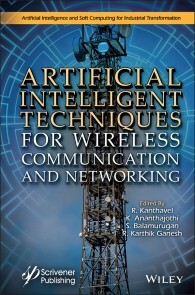
Artificial Intelligent Techniques for Wireless Communication and Networking
ARTIFICIAL INTELLIGENT TECHNIQUES FOR WIRELESS COMMUNICATION AND NETWORKINGTHE 20 CHAPTERS ADDRESS AI PRINCIPLES AND TECHNIQUES USED IN WIRELESS COMMUNICATION AND NETWORKING AND OUTLINE THEIR BENEFIT, FUNCTION, AND FUTURE ROLE IN THE FIELD. Wireless communication and networking based on AI concepts and techniques are explored in this book, specifically focusing on the current research in the field by highlighting empirical results along with theoretical concepts. The possibility of applying AI mechanisms towards security aspects in the communication domain is elaborated; also explored is the application side of integrated technologies that enhance AI-based innovations, insights, intelligent predictions, cost optimization, inventory management, identification processes, classification mechanisms, cooperative spectrum sensing techniques, ad-hoc network architecture, and protocol and simulation-based environments. AUDIENCEResearchers, industry IT engineers, and graduate students working on and implementing AI-based wireless sensor networks, 5G, IoT, deep learning, reinforcement learning, and robotics in WSN, and related technologies. R. KANTHAVEL, PhD is a Professor in the Department of Computer Engineering, King Khalid University Abha, Kingdom of Saudi Arabia. He has published more than 150 research articles in reputed journals and international conferences as well as published 10 engineering books. He specializes in communication systems engineering and information and communication engineering.K. ANANTHAJOTHI, PhD is an assistant professor in the Department of Computer Science and Engineering at Misrimal Navajee Munoth Jain Engineering College, Chennai, India. He has published a book on "Theory of Computation and Python Programming" and holds 2 patents.S. BALAMURUGAN, PhD is the Director of Research and Development, Intelligent Research Consultancy Services (iRCS), Coimbatore, Tamilnadu, India. He is also Director of the Albert Einstein Engineering and Research Labs (AEER Labs), as well as Vice-Chairman, Renewable Energy Society of India (RESI), India. He has published 45 books, 200+ international journals/ conferences, and 35 patents.R. KARTHIK GANESH, PhD is an associate professor in the Department of Computer Science and Engineering, SCAD College of Engineering and Technology, Cheranmahadevi, Tamilnadu, India. His research interests are in wireless communication, video and audio compression, image classification, and ontology techniques.Preface xvii1 COMPREHENSIVE AND SELF-CONTAINED INTRODUCTION TO DEEP REINFORCEMENT LEARNING 1P. Anbalagan, S. Saravanan and R. Saminathan1.1 Introduction 21.2 Comprehensive Study 31.3 Deep Reinforcement Learning: Value-Based and Policy-Based Learning 71.4 Applications and Challenges of Applying Reinforcement Learning to Real-World 91.5 Conclusion 122 IMPACT OF AI IN 5G WIRELESS TECHNOLOGIES AND COMMUNICATION SYSTEMS 15A. Sivasundari and K. Ananthajothi2.1 Introduction 162.2 Integrated Services of AI in 5G and 5G in AI 182.3 Artificial Intelligence and 5G in the Industrial Space 232.4 Future Research and Challenges of Artificial Intelligence in Mobile Networks 252.5 Conclusion 283 ARTIFICIAL INTELLIGENCE REVOLUTION IN LOGISTICS AND SUPPLY CHAIN MANAGEMENT 31P.J. Sathish Kumar, Ratna Kamala Petla, K. Elangovan and P.G. Kuppusamy3.1 Introduction 323.2 Theory--AI in Logistics and Supply Chain Market 353.3 Factors to Propel Business Into the Future Harnessing Automation 403.4 Conclusion 434 AN EMPIRICAL STUDY OF CROP YIELD PREDICTION USING REINFORCEMENT LEARNING 47M. P. Vaishnnave and R. Manivannan4.1 Introduction 474.2 An Overview of Reinforcement Learning in Agriculture 494.3 Reinforcement Learning Startups for Crop Prediction 524.4 Conclusion 575 COST OPTIMIZATION FOR INVENTORY MANAGEMENT IN BLOCKCHAIN AND CLOUD 59C. Govindasamy, A. Antonidoss and A. Pandiaraj5.1 Introduction 605.2 Blockchain: The Future of Inventory Management 625.3 Cost Optimization for Blockchain Inventory Management in Cloud 665.4 Cost Reduction Strategies in Blockchain Inventory Management in Cloud 715.5 Conclusion 726 REVIEW OF DEEP LEARNING ARCHITECTURES USED FOR IDENTIFICATION AND CLASSIFICATION OF PLANT LEAF DISEASES 75G. Gangadevi and C. Jayakumar6.1 Introduction 756.2 Literature Review 766.3 Proposed Idea 826.4 Reference Gap 866.5 Conclusion 877 GENERATING ART AND MUSIC USING DEEP NEURAL NETWORKS 91A. Pandiaraj, S. Lakshmana Prakash, R. Gopal and P. Rajesh Kanna7.1 Introduction 917.2 Related Works 927.3 System Architecture 947.4 System Development 967.5 Algorithm-LSTM 1007.6 Result 1007.7 Conclusions 1018 DEEP LEARNING ERA FOR FUTURE 6G WIRELESS COMMUNICATIONS--THEORY, APPLICATIONS, AND CHALLENGES 105S.K.B. Sangeetha and R. Dhaya8.1 Introduction 1068.2 Study of Wireless Technology 1088.3 Deep Learning Enabled 6G Wireless Communication 1138.4 Applications and Future Research Directions 1179 ROBUST COOPERATIVE SPECTRUM SENSING TECHNIQUES FOR A PRACTICAL FRAMEWORK EMPLOYING COGNITIVE RADIOS IN 5G NETWORKS 121J. Banumathi, S.K.B. Sangeetha and R. Dhaya9.1 Introduction 1229.2 Spectrum Sensing in Cognitive Radio Networks 1229.3 Collaborative Spectrum Sensing for Opportunistic Access in Fading Environments 1249.4 Cooperative Sensing Among Cognitive Radios 1259.5 Cluster-Based Cooperative Spectrum Sensing for Cognitive Radio Systems 1289.6 Spectrum Agile Radios: Utilization and Sensing Architectures 1289.7 Some Fundamental Limits on Cognitive Radio 1309.8 Cooperative Strategies and Capacity Theorems for Relay Networks 1319.9 Research Challenges in Cooperative Communication 1339.10 Conclusion 13510 NATURAL LANGUAGE PROCESSING 139S. Meera and S. Geerthik10.1 Introduction 13910.2 Conclusions 152References 15211 CLASS LEVEL MULTI-FEATURE SEMANTIC SIMILARITY-BASED EFFICIENT MULTIMEDIA BIG DATA RETRIEVAL 155D. Sujatha, M. Subramaniam and A. Kathirvel11.1 Introduction 15611.2 Literature Review 15811.3 Class Level Semantic Similarity-Based Retrieval 15911.4 Results and Discussion 16412 SUPERVISED LEARNING APPROACHES FOR UNDERWATER SCALAR SENSORY DATA MODELING WITH DIURNAL CHANGES 175J.V. Anand, T.R. Ganesh Babu, R. Praveena and K. Vidhya12.1 Introduction 17612.2 Literature Survey 17612.3 Proposed Work 17712.4 Results 18012.5 Conclusion and Future Work 19013 MULTI-LAYER UAV AD HOC NETWORK ARCHITECTURE, PROTOCOL AND SIMULATION 193Kamlesh Lakhwani, Tejpreet Singh and Orchu Aruna13.1 Introduction 19413.2 Background 19613.3 Issues and Gap Identified 19713.4 Main Focus of the Chapter 19813.5 Mobility 19913.6 Routing Protocol 20113.7 High Altitude Platforms (HAPs) 20213.8 Connectivity Graph Metrics 20413.9 Aerial Vehicle Network Simulator (AVENs) 20613.10 Conclusion 20714 ARTIFICIAL INTELLIGENCE IN LOGISTICS AND SUPPLY CHAIN 211Jeyaraju Jayaprakash14.1 Introduction to Logistics and Supply Chain 21214.2 Recent Research Avenues in Supply Chain 21714.3 Importance and Impact of AI 22214.4 Research Gap of AI-Based Supply Chain 22415 HEREDITARY FACTOR-BASED MULTI-FEATURED ALGORITHM FOR EARLY DIABETES DETECTION USING MACHINE LEARNING 235S. Deepajothi, R. Juliana, S.K. Aruna and R. Thiagarajan15.1 Introduction 23615.2 Literature Review 23715.3 Objectives of the Proposed System 24415.4 Proposed System 24515.5 HIVE and R as Evaluation Tools 24615.6 Decision Trees 24715.7 Results and Discussions 25015.8 Conclusion 25216 ADAPTIVE AND INTELLIGENT OPPORTUNISTIC ROUTING USING ENHANCED FEEDBACK MECHANISM 255V. Sharmila, K. Mandal, Shankar Shalani and P. Ezhumalai16.1 Introduction 25516.2 Related Study 25816.3 System Model 25916.4 Experiments and Results 26416.5 Conclusion 26717 ENABLING ARTIFICIAL INTELLIGENCE AND CYBER SECURITY IN SMART MANUFACTURING 269R. Satheesh Kumar, G. Keerthana, L. Murali, S. Chidambaranathan, C.D. Premkumarand R. Mahaveerakannan17.1 Introduction 27017.2 New Development of Artificial Intelligence 27117.3 Artificial Intelligence Facilitates the Development of Intelligent Manufacturing 27117.4 Current Status and Problems of Green Manufacturing 27217.5 Artificial Intelligence for Green Manufacturing 27617.6 Detailed Description of Common Encryption Algorithms 28017.7 Current and Future Works 28217.8 Conclusion 28318 DEEP LEARNING IN 5G NETWORKS 287G. Kavitha, P. Rupa Ezhil Arasi and G. Kalaimani18.1 5G Networks 28718.2 Artificial Intelligence and 5G Networks 29118.3 Deep Learning in 5G Networks 29319 EIDR UMPIRING SECURITY MODELS FOR WIRELESS SENSOR NETWORKS 299A. Kathirvel, S. Navaneethan and M. Subramaniam19.1 Introduction 29919.2 A Review of Various Routing Protocols 30219.3 Scope of Chapter 30719.4 Conclusions and Future Work 31120 ARTIFICIAL INTELLIGENCE IN WIRELESS COMMUNICATION 317Prashant Hemrajani, Vijaypal Singh Dhaka, Manoj Kumar Bohra and Amisha Kirti Gupta20.1 Introduction 31820.2 Artificial Intelligence: A Grand Jewel Mine 31820.3 Wireless Communication: An Overview 32020.4 Wireless Revolution 32020.5 The Present Times 32120.6 Artificial Intelligence in Wireless Communication 32120.7 Artificial Neural Network 32420.8 The Deployment of 5G 32620.9 Looking Into the Features of 5G 32720.10 AI and the Internet of Things (IoT) 32820.11 Artificial Intelligence in Software-Defined Networks (SDN) 32920.12 Artificial Intelligence in Network Function Virtualization 33120.13 Conclusion 332References 332Index 335
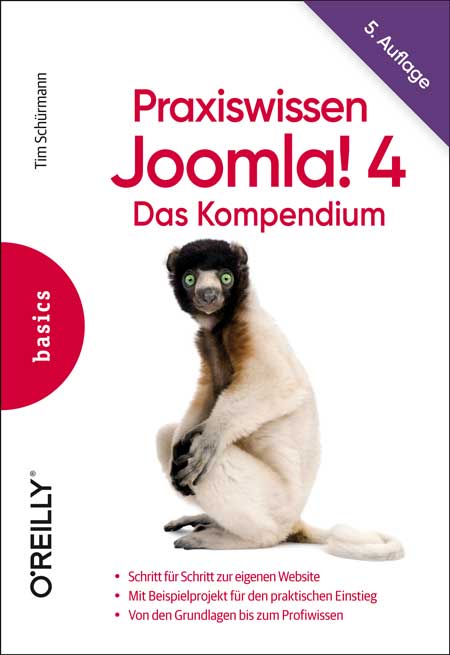
Praxiswissen Joomla! 4 - Das Kompendium
Das bewährte Standardwerk zu Joomla! jetzt aktualisiert auf Version 4Sie möchten Schritt für Schritt und ohne langwieriges Ausprobieren eine eigene Website mit Joomla! aufsetzen? Dann ist dieser praxisorientierte Leitfaden zur Joomla!-Version 4 genau das Richtige für Sie. Tim Schürmann führt Sie anhand eines Beispielprojekts in den Aufbau und die Pflege eines Webauftritts ein und behandelt dabei das komplette Joomla!-Themenspektrum von den Grundlagen bis hin zum Profiwissen. Sie erfahren, wie Sie Joomla! installieren, Bilder und Texte verwalten, Ihrer Webpräsenz mit Templates ein unverwechselbares Look-and-feel geben und Ihre Website um zusätzliche Funktionen wie einen Kalender, Kommentarmöglichkeiten oder eine eigene Erweiterung ergänzen. Kapitel zu Suchmaschinenoptimierung, Barrierefreiheit und Datenbankpflege runden das Handbuch ab. Es deckt umfassend die in Joomla! enthaltenen Funktionen ab und eignet sich daher sowohl als Einstieg als auch als Nachschlagewerk.Zielgruppe: Webentwickler*innenalle, die mit Joomla! eine eigene Webpräsenz aufbauen möchtenAutor: Tim Schürmann ist selbständiger Diplom-Informatiker und derzeit hauptsächlich als freier Autor unterwegs. Seine zahlreichen Artikel erscheinen in führenden Zeitschriften und wurden in mehrere Sprachen übersetzt. Er hat bereits einige erfolgreiche Bücher geschrieben, darunter mehrere Auflagen von Praxiswissen Joomla! oder WordPress komplett – Das Kompendium für Websites und Blogs (O’Reilly Verlag). Die Entwicklung von Joomla! verfolgt er nicht nur seit dessen Anfängen, er folterte das Content-Management-System selbstverständlich auch schon in der Praxis mit schwer verdaulichen Inhalten. Seine Steckenpferde sind die Programmierung, Algorithmen, freie Software, Computergeschichte, Schokoladeneis und der ganz alltägliche Wahnsinn.

Patterns of Software Construction
Master how to implement a repeatable software construction system. This book closely examines how a system is designed to tie a series of activities together that are needed when building software-intensive systems.Software construction and operations don't get enough attention as a repeatable system. The world is stuck in agile backlog grooming sessions, and quality is not increasing. Companies' budgets are shrinking, and teams need a way to get more done with less, consistently. This topic is very relevant to our current economic conditions and continuing globalization trends. A reason we constantly need more hands-on-the-keyboards is because of all the waste created in development cycles. We need more literature on how to "do software" not just write software.These goals are accomplished using the concept of evolutions, much like the Navy SEALS train their team members. For LIFT, the evolutions are: Plan, Build, Test, Release, Operate and Manage. The entire purpose of the book is instructing professionals how to use these distinct evolutions while remaining agile. And then, inside of each evolution, to explicitly break down the inputs to the evolution, outputs and series of activities taking place. Patterns of Software Construction clearly outlines how together this becomes the system.WHAT YOU WILL LEARN* Optimize each evolution of a software delivery cycle* Review best practices of planning, highest return in the build cycle, and ignored practices in test, release, and operate * Apply the highest return techniques during the software build evolutionWHO THIS BOOK IS FORManagers, developers, tech lead, team lead, aspiring engineer, department leaders in corporations, executives, small business owner, IT DirectorStephen Rylander is currently SVP, Global Head of Engineering Company at Donnelley Financial Solutions. He is a software engineer turned technical executive who has seen a variety of industries from music, to ecommerce, to finance and more. He is invested in improving the practice of software delivery, operational platforms and all the people involved in making this happen. He has worked on platforms handling millions of daily transactions and developed digital transformation programs driving financial platforms. He has also had the opportunity to construct platforms with digital investing advice engines and has a history of dealing with scale and delivering results leading local and distributed teams.For fun he used to also run the API Craft Chicago Meetup, help organize Morningstar Tech Talks and has been a member mentor at 1871 - Chicago's Technology & Entrepreneurship Center.Chapter 1: Not a Processo 1.1 Systemo 1.2 The Problemo 1.3 Realityo 1.4 The Solutiono 1.5.The EvolutionsChapter 2 LIFT System EvolutionsChapter 3 Plano 3.1 Plano 3.1 Targeto 3.1 Map it outo 3.1 Development StrategyChapter 4 Buildo 4.1 Anatomy of a Sprinto 4.2 Most Software Looks like this.o 4.3 Non-functional Requirements Pay the Billso 4.4 …Chapter 5 TestChapter 6 ReleaseChapter 7 OperateChapter 8 ManageChapter 9 The Long GameChapter 10 - Summary

Introducing Software Verification with Dafny Language
Get introduced to software verification and proving correctness using the Microsoft Research-backed programming language, Dafny. While some other books on this topic are quite mathematically rigorous, this book will use as little mathematical symbols and rigor as possible, and explain every concept using plain English. It's the perfect primer for software programmers and developers with C# and other programming language skills.Writing correct software can be hard, so you'll learn the concept of computation and software verification. Then, apply these concepts and techniques to confidently write bug-free code that is easy to understand. Source code will be available throughout the book and freely available via GitHub.After reading and using this book you'll be able write correct, big free software source code applicable no matter which platform and programming language you use.WHAT YOU WILL LEARN* Discover the Microsoft Research-backed Dafny programming language* Explore Hoare logic, imperative and functional programs* Work with pre- and post-conditions* Use data types, pattern matching, and classes* Dive into verification examples for potential re-use for your own projectsWHO THIS BOOK IS FORSoftware developers and programmers with at least prior, basic programming experience. No specific language needed. It is also for those with very basic mathematical experience (function, variables).BORO SITNIKOVSKI has over ten years of experience working professionally as a software engineer. He started programming with assembly on an Intel x86 at the age of ten. While in high school, he won several prizes in competitive programming, varying from 4th, 3rd, and 1st place. He is an informatics graduate - his bachelor’s thesis was titled “Programming in Haskell using algebraic data structures”, and his master’s thesis was titled “Formal verification of Instruction Sets in Virtual Machines”. He has also published a few papers on software verification. Other research interests of his include programming languages, mathematics, logic, algorithms, and writing correct software. He is a strong believer in the open-source philosophy and contributes to various open-source projects. In his spare time, he enjoys some time off with his family.Introduction: Languages and SystemsChapter 1: Our First ProgramChapter 2: LogicChapter 3: ComputationChapter 4: Mathematical FoundationsChapter 5: ProofsChapter 6: SpecificationsChapter 7: Mathematical InductionChapter 8: Verification ExercisesChapter 9: Implementing a Formal SystemConclusionBibliographyAppendix A: Gödel’s Theorems

Modellselektion
Die Modellselektion ist der Bereich der Statistik, welcher Wissenschaftlern eine Möglichkeit bietet ein Modell für die Analyse von Rohdaten zu geben. Dabei ist die Wahl eins geeigneten Modells entscheidend, da mit der Wahl eines geeigneten Modells die jeweilige Theorie einer wissenschaftlichen Forschung unterstützt werden kann. In der wissenschaftlichen Praxis stehen hierfür diverse Ansätze zur Verfügung. Die Modellselektion bietet, mit diversen Ansätzen, einen Anhaltspunkt, wie Modelle selektiert werden können, um die vorhandenen Daten zu analysieren und in der Folge die Theorie zu verifizieren bzw. falsifizieren.Hierbei stehen Wissenschaftlern diverse Ansätze und Selektionskriterien zur Verfügung, welche die Wissenschaftler dabei unterstützen können, ein geeignetes Modell für die Analyse der Daten zu selektieren. Die Selektion kann dabei mittels Tests und der Richtung der Modellselektion, mittels diversen mittels Shrinkageansätzen oder auf Basis eines Informationskriteriums erfolgen. Die Wahl eines Informationskriteriums findet in der Folge Anwendung in einer Regressionsanalyse. Dabei stehen dem Wissenschaftler diverse univariate und multivariate Regressionsmodelle zur Verfügung. Falls die Daten von Kollinearität gekennzeichnet sind, sollten Verfahren, wie die Ridge Regression oder die LASSO Regression den linearen Regressionsmodellen bevorzugt werden.

Mastering Snowflake Solutions
Design for large-scale, high-performance queries using Snowflake’s query processing engine to empower data consumers with timely, comprehensive, and secure access to data. This book also helps you protect your most valuable data assets using built-in security features such as end-to-end encryption for data at rest and in transit. It demonstrates key features in Snowflake and shows how to exploit those features to deliver a personalized experience to your customers. It also shows how to ingest the high volumes of both structured and unstructured data that are needed for game-changing business intelligence analysis.MASTERING SNOWFLAKE SOLUTIONS starts with a refresher on Snowflake’s unique architecture before getting into the advanced concepts that make Snowflake the market-leading product it is today. Progressing through each chapter, you will learn how to leverage storage, query processing, cloning, data sharing, and continuous data protection features. This approach allows for greater operational agility in responding to the needs of modern enterprises, for example in supporting agile development techniques via database cloning. The practical examples and in-depth background on theory in this book help you unleash the power of Snowflake in building a high-performance system with little to no administrative overhead. Your result from reading will be a deep understanding of Snowflake that enables taking full advantage of Snowflake’s architecture to deliver value analytics insight to your business.WHAT YOU WILL LEARN* Optimize performance and costs associated with your use of the Snowflake data platform* Enable data security to help in complying with consumer privacy regulations such as CCPA and GDPR* Share data securely both inside your organization and with external partners* Gain visibility to each interaction with your customers using continuous data feeds from Snowpipe* Break down data silos to gain complete visibility your business-critical processes* Transform customer experience and product quality through real-time analyticsWHO THIS BOOK IS FORData engineers, scientists, and architects who have had some exposure to the Snowflake data platform or bring some experience from working with another relational database. This book is for those beginning to struggle with new challenges as their Snowflake environment begins to mature, becoming more complex with ever increasing amounts of data, users, and requirements. New problems require a new approach and this book aims to arm you with the practical knowledge required to take advantage of Snowflake’s unique architecture to get the results you need.ADAM MORTON is a senior data and analytics professional with almost two decades of experience. He has architected, designed, and led the implementation of numerous data warehouse and business intelligence solutions. Adam has extensive experience and certifications across several data analytics platforms ranging from Microsoft SQL Server, Teradata, and Hortonworks, to modern cloud-based tools such as AWS Redshift, Google Big Query, and Snowflake.Having successfully combined his experience with traditional technologies with his knowledge of modern platforms, Adam has accumulated substantial practical expertise in data warehousing and analytics in Snowflake, which he has captured and distilled into this book. Today, Adam runs his own data and analytics consultancy which focuses on helping companies solve problems with data, along with designing and executing modern data strategies to deliver tangible business value. Adam currently lives in Sydney, Australia and is the proud recipient of a Global Talent Visa. 1. Snowflake Architecture2. Data Movement3. Cloning4. Managing Security and User Access Control5. Protecting Data in Snowflake6. Business Continuity and Disaster Recovery7. Data Sharing and the Data Cloud8. Programming9. Advanced Performance Tuning10. Developing Applications in Snowflake

Analytics Optimization with Columnstore Indexes in Microsoft SQL Server
Meet the challenge of storing and accessing analytic data in SQL Server in a fast and performant manner. This book illustrates how columnstore indexes can provide an ideal solution for storing analytic data that leads to faster performing analytic queries and the ability to ask and answer business intelligence questions with alacrity. The book provides a complete walk through of columnstore indexing that encompasses an introduction, best practices, hands-on demonstrations, explanations of common mistakes, and presents a detailed architecture that is suitable for professionals of all skill levels.With little or no knowledge of columnstore indexing you can become proficient with columnstore indexes as used in SQL Server, and apply that knowledge in development, test, and production environments. This book serves as a comprehensive guide to the use of columnstore indexes and provides definitive guidelines. You will learn when columnstore indexes should be used, and the performance gains that you can expect. You will also become familiar with best practices around architecture, implementation, and maintenance. Finally, you will know the limitations and common pitfalls to be aware of and avoid.As analytic data can become quite large, the expense to manage it or migrate it can be high. This book shows that columnstore indexing represents an effective storage solution that saves time, money, and improves performance for any applications that use it. You will see that columnstore indexes are an effective performance solution that is included in all versions of SQL Server, with no additional costs or licensing required.WHAT YOU WILL LEARN* Implement columnstore indexes in SQL Server* Know best practices for the use and maintenance of analytic data in SQL Server* Use metadata to fully understand the size and shape of data stored in columnstore indexes* Employ optimal ways to load, maintain, and delete data from large analytic tables* Know how columnstore compression saves storage, memory, and time* Understand when a columnstore index should be used instead of a rowstore index* Be familiar with advanced features and analyticsWHO THIS BOOK IS FORDatabase developers, administrators, and architects who are responsible for analytic data, especially for those working with very large data sets who are looking for new ways to achieve high performance in their queries, and those with immediate or future challenges to analytic data and query performance who want a methodical and effective solutionEdward Pollack has over 20 years of experience in database and systems administration, architecture, and development, becoming an advocate for designing efficient data structures that can withstand the test of time. He has spoken at many events, such as SQL Saturdays, PASS Community Summit, Dativerse, and at many user groups and is the organizer of SQL Saturday Albany. Edward has authored many articles, as well as the book Dynamic SQL: Applications, Performance, and Security, and a chapter in Expert T-SQL Window Functions in SQL Server.In his free time, Ed enjoys video games, sci-fi & fantasy, traveling and baking. He lives in the sometimes-frozen icescape of Albany, NY with his wife Theresa and sons Nolan and Oliver, and a mountain of (his) video game plushies that help break the fall when tripping on (their) kids’ toys.1. Introduction to Analytic Data in a Transactional Database2. Transactional vs. Analytic Workloads3. What are Columnstore Indexes?4. Columnstore Index Architecture5. Columnstore Compression6. Columnstore Metadata7. Batch Execution8. Bulk Loading Data9. Delete and Update Operations10. Segment and Rowgroup Elimination11. Partitioning12. Non-Clustered Columnstore Indexes on Rowstore Tables13. Non-Clustered Rowstore Indexes on Columnstore Tables14. Columnstore Index Maintenance15. Columnstore Index Performance

Machine Learning for Auditors
Use artificial intelligence (AI) techniques to build tools for auditing your organization. This is a practical book with implementation recipes that demystify AI, ML, and data science and their roles as applied to auditing. You will learn about data analysis techniques that will help you gain insights into your data and become a better data storyteller. The guidance in this book around applying artificial intelligence in support of audit investigations helps you gain credibility and trust with your internal and external clients. A systematic process to verify your findings is also discussed to ensure the accuracy of your findings.MACHINE LEARNING FOR AUDITORS provides an emphasis on domain knowledge over complex data science know how that enables you to think like a data scientist. The book helps you achieve the objectives of safeguarding the confidentiality, integrity, and availability of your organizational assets. Data science does not need to be an intimidating concept for audit managers and directors. With the knowledge in this book, you can leverage simple concepts that are beyond mere buzz words to practice innovation in your team. You can build your credibility and trust with your internal and external clients by understanding the data that drives your organization.WHAT YOU WILL LEARN* Understand the role of auditors as trusted advisors* Perform exploratory data analysis to gain a deeper understanding of your organization* Build machine learning predictive models that detect fraudulent vendor payments and expenses* Integrate data analytics with existing and new technologies* Leverage storytelling to communicate and validate your findings effectively* Apply practical implementation use cases within your organizationWHO THIS BOOK IS FORAI AUDITING is for internal auditors who are looking to use data analytics and data science to better understand their organizational data. It is for auditors interested in implementing predictive and prescriptive analytics in support of better decision making and risk-based testing of your organizational processes.MARIS SEKAR is a professional computer engineer, Certified Information Systems Auditor (ISACA), and Senior Data Scientist (Data Science Council of America). He has a passion for using storytelling to communicate on high-risk items within an organization to enable better decision making and drive operational efficiencies. He has cross-functional work experience in various domains such as risk management, data analysis and strategy, and has functioned as a subject matter expert in organizations such as PricewaterhouseCoopers LLP, Shell Canada Ltd., and TC Energy. Maris’ love for data has motivated him to win awards, write LinkedIn articles, and publish two papers with IEEE on applied machine learning and data science.PART I. TRUSTED ADVISORS1. Three Lines of Defense2. Common Audit Challenges3. Existing Solutions4. Data Analytics5. Analytics Structure & EnvironmentPART II. UNDERSTANDING ARTIFICIAL INTELLIGENCE6. Introduction to AI, Data Science, and Machine Learning7. Myths and Misconceptions8. Trust, but Verify9. Machine Learning Fundamentals10. Data Lakes11. Leveraging the Cloud12. SCADA and Operational TechnologyPART III. STORYTELLING13. What is Storytelling?14. Why Storytelling?15. When to Use Storytelling16. Types of Visualizations17. Effective Stories18. Storytelling Tools19. Storytelling in AuditingPART IV. IMPLEMENTATION RECIPES20. How to Use the Recipes21. Fraud and Anomaly Detection22. Access Management23. Project Management24. Data Exploration25. Vendor Duplicate Payments26. CAATs 2.027. Log Analysis28. Concluding Remarks

Data Science
Dieses Buch entstand aus der Motivation heraus, eines der ersten deutschsprachigen Nachschlagewerke zu entwickeln, in welchem relativ simple Quellcode-Beispiele enthalten sind, um so Lösungsansätze für die (wiederkehrenden) Programmierprobleme in der Datenanalyse weiterzugeben. Dabei ist dieses Werk nicht uneigennützig verfasst worden. Es enthält Lösungswege für immer wiederkehrende Problemstellungen die ich über meinen täglichen Umgang entwickelt habe Zweifellos gehört das Nachschlagen von Lösungsansätzen in Büchern oder im Internet zur normalen Arbeit eines Programmierers. Allerdings ist diese Suche in der Regel ein unstrukturierter und damit, zumindest teilweise, ein zeitaufwendiger Prozess.Unabhängig davon, ob Sie das Buch als Student, Mitarbeiter oder Gründer lesen, hoffe ich, dass Ihnen dieses Nachschlagewerk ein wertvoller Helfer für die ersten Anfänge sein wird. Ich gehe davon aus, dass jede Person die Grundlagen der Datenanalyse mit Hilfe moderner Programmiersprachen erlernen kann.Seit März 2018 forscht und promoviert Herr BENJAMIN M. ABDEL-KARIM im Bereich der künstlichen Intelligenz im Kontext der Wissensextraktion. Das spezielle Augenmerk seiner Forschung sind künstliche neuronale Netze, beispielsweise zur Modellierung komplexer Finanzmarktstrukturen. Zuvor hat er eine klassische Bankausbildung sowie ein Bachelor- und Masterstudium in der Wirtschaftsinformatik absolviert. Seit März 2021 bringt Herr Benjamin M. Abdel-Karim als Berater sein Fachwissen aus Forschung und Entwicklung bei der Unternehmungsberatung Capgemini im Bereich Financial Services mit ein.Data Science - Datenanalyse - Python - Quellcode-Beispiele - Datenauswertung - Datentypen - Datenstrukturen - Kontrollstrukturen - Funktionen -Anwendungsbeispiele Data Science.

Pro ASP.NET Core 6
Professional developers will produce leaner applications for the ASP.NET Core platform using the guidance in this best-selling book, now in its 9th edition and updated for ASP.NET Core for .NET 6. It contains detailed explanations of the ASP.NET Core platform and the application frameworks it supports. This cornerstone guide puts ASP.NET Core for .NET 6 into context and dives deep into the tools and techniques required to build modern, extensible web applications. New features and capabilities such as MVC, Razor Pages, Blazor Server, and Blazor WebAssembly are covered, along with demonstrations of how they are applied.ASP.NET Core for .NET 6 is the latest evolution of Microsoft’s ASP.NET web platform and provides a "host-agnostic" framework and a high-productivity programming model that promotes cleaner code architecture, test-driven development, and powerful extensibility.Author Adam Freeman has thoroughly revised this market-leading book and explains how to get the most from ASP.NET Core for .NET 6. He starts with the nuts-and-bolts topics, teaching you about middleware components, built-in services, request model binding, and more. As you gain knowledge and confidence, he introduces increasingly more complex topics and advanced features, including endpoint routing and dependency injection. He goes in depth to give you the knowledge you need.This book follows the same format and style as the popular previous editions but brings everything up to date for the new ASP.NET Core for .NET 6 release and broadens the focus to include all of the ASP.NET Core platform. You will appreciate the fully worked case study of a functioning ASP.NET Core application that you can use as a template for your own projects.Source code for this book can be found at https://github.com/Apress/pro-asp.net-core-6.WHAT YOU WILL LEARN* Explore the entire ASP.NET Core platform* Apply the new ASP.NET Core for .NET 6 features in your developer environment* See how to create RESTful web services, web applications, and client-side applications* Build on your existing knowledge to get up and running with new programming models quickly and effectivelyWHO THIS BOOK IS FORWeb developers with a basic knowledge of web development and C# who want to incorporate the latest improvements and functionality in ASP.NET Core for .NET 6 into their own projects.ADAM FREEMAN is an experienced IT professional who has held senior positions in a range of companies, most recently serving as chief technology officer and chief operating officer of a global bank. Now retired, he spends his time writing and long-distance running.Part 11. Putting ASP.NET Core into Context2. Getting Started3. Your First ASP.NET Core Application4. Using the Development Tools5. Essential C# Features6. Unit Testing ASP.NET Core Applications7. SportsStore8. SportsStore: Navigation & Cart9. SportsStore: Completing the Cart10. SportsStore: Adminstration11. SportsStore: Security & DeploymentPart 212. Understanding the ASP.NET Core Platform13. Using URL Routing14. Using Dependency Injection15. Using the Platform Features, Part 116. Using the Platform Features, Part 217. Working with DataPart 318. Creating the Example Project19. Creating RESTFul Web Services20. Advanced Web Service Features21. Using Controllers with Views22. Using Controllers with Views, Part 223. Using Razor Pages24. Using View Components25. Using Tag Helpers26. Using the Built-In Tag Helpers27. Using the Forms Tag Helpers28. Using Model Binding29. Using Model Validation30. Using Filters31. Creating Form ApplicationsPart 432. Creating the Example Application33. Using Blazor Server, Part 134. Using Blazor Server Part 235. Advanced Blazor Features36. Blazor Forms and Data37. Blazor Web Assembly38. Using ASP.NET Core Identity39. Applying ASP.NET Core Identity

Java 17 Recipes
Quickly find solutions to dozens of common programming problems encountered while building Java applications, with recipes presented in the popular problem-solution format. Look up the programming problem that you want to resolve. Read the solution. Apply the solution directly in your own code. Problem solved!Java 17 Recipes is updated to reflect changes in specification and implementation since the Java 9 edition of this book. Java 17 is the next long-term support release (LTS) of the core Java Standard Edition (SE) version 17 which also includes some of the features from previous short term support (STS) releases of Java 16 and previous versions.This new edition covers of some of the newest features, APIs, and more such as pattern matching for switch, Restore Always-Strict-Floating-Point-Semantics, enhanced pseudo-random number generators, the vector API, sealed classes, and enhancements in the use of String. Source code for all recipes is available in a dedicated GitHub repository.This must-have reference belongs in your library.WHAT YOU WILL LEARN* Look up solutions to everyday problems involving Java SE 17 LTS and other recent releases* Develop Java SE applications using the latest in Java SE technology* Incorporate Java major features introduced in versions 17, 16, and 15 into your codeWHO THIS BOOK IS FORProgrammers and developers with some prior Java experience.JOSH JUNEAU has been developing software and enterprise applications since the early days of Java EE. Application and database development have been his focus since the start of his career. He became an Oracle database administrator and adopted the PL/SQL language for performing administrative tasks and developing applications for the Oracle database. In an effort to build more complex solutions, he began to incorporate Java into his PL/SQL applications and later developed standalone and web applications with Java. Josh wrote his early Java web applications utilizing JDBC and servlets or JSP to work with backend databases. Later, he began to incorporate frameworks into his enterprise solutions, such as Java EE and JBoss Seam. Today, he primarily develops enterprise web solutions utilizing Java EE and other technologies. He also includes the use of alternative languages, such as Jython and Groovy, for some of his projects. Over the years, Josh has dabbled in many different programming languages, including alternative languages for the JVM, in particular. In 2006, Josh began devoting time to the Jython Project as editor and publisher of the Jython Monthly newsletter. In late 2008, he began a podcast dedicated to the Jython programming language. Josh was the lead author for The Definitive Guide to Jython, Oracle PL/SQL Recipes, and Java 7 Recipes, and a solo author of Java EE 7 Recipes and Introducing Java EE 7, which were all published by Apress. He works as an application developer and system analyst at Fermi National Accelerator Laboratory, and he also writes technical articles for Oracle and OTN. He was a member of the JSR 372 and JSR 378 expert groups, and is an active member of the Java Community, helping to lead the Chicago Java User Group’s Adopt-a-JSR effort. When not coding or writing, Josh enjoys spending time with his wonderful wife and five children, especially swimming, fishing, playing ball, and watching movies. To hear more from Josh, follow him on Twitter at @javajuneau.LUCIANO MANELLI earned a PhD in computer science from the IT department, University of Bari-Aldo Moro. His PhD focused on grid computing and formal methods, and he published the results in international publications. Luciano obtained several certificates in the IT sector, and, in 2014, began working for the Port Network Authority of the Ionian Sea–Port of Taranto, after working for 13 years for InfoCamere SCpA. He has worked mainly in the design, analysis, and development of large software systems; research and development; testing; and production with roles of increasing responsibility in several areas over the years. Luciano has developed a great capability to make decisions in a technical and business context and is mainly interested in project management and business process management. In his current position, he deals with port community systems and software innovation. Additionally, he has written several IT books and is a contract professor at the Polytechnic of Bari (foundations of computer science), and at the University of Bari-Aldo Moro (programming for web, computer science, and computer lab).1. Getting Started with Java 172. Java 17 Enhancements3. Strings4. Numbers and Dates5. Object-Oriented Java6. Lambda Expressions7. Data Structures and Collections8. Input and Output9. Exceptions and Logging10. Concurrency11. Debugging and Unit Testing12. Unicode, Internationalization, and Currency Codes13. Working with Databases14. JavaFX Fundamentals15. Graphics with JavaFX16. Media with JavaFX17. Java Web Applications18. Nashorn and Scripting19. E-mail20. JSON and XML Processing21. Networking22. Java Modularity

Introducing Blockchain with Java
Create your own crypto currency by implementing blockchain technology using Java. This step-by-step guide will teach you how to create a user interface using Java FX and implement SQLite DB using JDBC Driver for the blockchain.INTRODUCING BLOCKCHAIN WITH JAVA includes numerous exercises and test questions to help you solidify what you have learned as you progress through the book, and provides ideas on expanding the codebase to make it your own. You will have access to a fully-functioning repository with Java code.Upon completing this book, you will have the knowledge necessary to program your own blockchains with Java and you will have a completed project for your portfolio.WHAT YOU WILL LEARN* Know the most important theoretical concepts of the blockchain* Code the blockchain in Java* Create a user interface with JavaFX* Implement SQLite DB using JDBC Driver* Create a P2P multi-threaded app * Create your own cryptocurrency app with full functionality* Implement blockchain technology on a P2P network from scratch using Java, JavaFX, and SQLWHO THIS BOOK IS FORAnyone with a basic level knowledge of: Java or similar object-oriented programming language, FXML or HTML or similar markup language, and SQLSPIRO BUZHAROVSKI is a full-stack software developer in the IT sector. He has a degree in mechanical engineering and has worked as an engineer in the oil and gas sector for more than six years. His interests include Java frameworks, blockchain, and the latest high-tech trends. Inspiration for this book came while working as a technical reviewer on the Apress book by Boro Sitnikovski, Introducing Blockchain with Lisp: Implement and Extend Blockchains with the Racket Language.1. Introduction to Blockchain . . . . . . . .1.1. Motivation and basic definitions . .1.2. Encryption . . . . . . . . . . . . . . .1.2.1. Functions . . . . . . . . . . . .1.2.2. Symmetric-key algorithm . .1.2.3. Asymmetric-key algorithm .1.3. Hashing . . . . . . . . . . . . . . . . .1.4. Smart contracts . . . . . . . . . . . .1.5. Bitcoin . . . . . . . . . . . . . . . . . .1.6. Example workflows . . . . . . . . . .Summary . . . . . . . . . . . . . . . . . . .2. Blockchain Core - Model . . . . . . . .2.1 Block.java . .2.2. Transaction.java . . . . . . . . . . . . . . .2.3. Wallet.java . . . . . . . . . . . . . . . . .Summary . . . . . . . . . . . . . . . . .3. Database Setup. . . . . . . .3.1. SQLite Database Browser Quick Setup .3.2. Blockchain.db3.3. Wallet.db . . . . . . . . . . . . . . . . . .3.4 JDBC Driver for SQLite setup3.5 Writing your App init() method.Summary . . . . . . . . . . . . . . . . . . .4. Service Layer Implementation. . . . . .4.1. BlockData.java44.2. WalletData.javaSummary . . . . . . . . . . . . . . . . .5. UI – View Layer. . . . . .5.1. SceneBuilder Quick Setup5.2. Creating Your Views3.2.1. MainWindow.fxml . . . . . . . . . . . . . . . .3.2.2. AddNewTransactionWindow.fxml . . . . . . . . . . . . . . . .5.3. Creating Your View Controllers5.3.1 MainWindowController.java5.3.1 AddNewTransactionController.javaSummary . . . . . . . . . . . . . . . . .6. Network Handlers – Networking Layer. . . . . .6.1. UI Thread6.2. Peer Client Thread6.3. Peer Server Handler – Multithreading requests 6.3.1 Peer Request Thread6.4. Mining ThreadSummary . . . . . . . . . . . . . . . . .

Azure Virtual Desktop Specialist
Enhance your knowledge and become certified with the Azure Virtual Desktop technology. This book provides the theory, lab exercises, and knowledge checks you need to prepare for the AZ-140 exam.The book starts with an introduction to Azure Virtual Desktop and AZ-140 exam objectives. You will learn the architecture behind Azure Virtual Desktop, including compute, identity, and storage. And you will learn how to implement all of the services that make up the Azure Virtual Desktop platform. Each chapter includes exam and practice questions. The book takes you through the access and security of Azure Virtual Desktop along with its user environment and application. And it teaches you how to monitor and maintain an Azure Virtual Desktop infrastructure.After reading this book, you will be prepared to take the AZ-140 exam.WHAT YOU WILL LEARN* Plan an Azure Virtual Desktop architecture* Install and configure apps on a session host* Plan and implement business continuity and disaster recovery* Understand user environment and applications in Azure Virtual DesktopWHO THIS BOOK IS FORAzure administrators who wish to increase their knowledge and become certified with the Azure Virtual Desktop technologySHABAZ DARR has more than 15 years of experience in the IT industry and more than eight years working with cloud technologies. Currently, he is working as a Senior Infrastructure Specialist for Netcompany. He is a certified Microsoft MVP in Enterprise Mobility, a certified Microsoft trainer with certifications in Azure Virtual Desktop Administrator, Office 365 Identity and Services, Modern Workplace Administrator Associate, and Azure Administrator Associate.CHAPTER 1: EXAM OVERVIEW & INTRODUCTION TO AZURE VIRTUAL DESKTOPCHAPTER GOAL: Introduce Microsoft Certification exams and Azure Virtual DesktopNO OF PAGES: 15SUB -TOPICS1. Prepare for your Microsoft exam and AZ-140 objectives2. Introduction to Azure Virtual DesktopCHAPTER 2: PLAN AN AZURE VIRTUAL DESKTOP ARCHITECTURECHAPTER GOAL: Outline the architecture behind Azure Virtual Desktop, including compute, identity and storage.NO OF PAGES: 35SUB - TOPICS1. Design the Azure Virtual Desktop architecture2. Design for User identities and profiles3. Knowledge CheckCHAPTER 3: IMPLEMENT AN AZURE VIRTUAL DESKTOP INFRASTRUCTURECHAPTER GOAL: Learn how to implement all services that make up the Azure Virtual Desktop platformNO OF PAGES : 45SUB - TOPICS:1. Implement and manage networking for Azure Virtual Desktop2. Implement and manage storage for Azure Virtual Desktop3. Create and configure host pools and session hosts.4. Create and manage session host images5. Knowledge CheckCHAPTER 4: MANAGE ACCESS AND SECURITY TO AZURE VIRTUAL DESKTOPCHAPTER GOAL: Learn how to secure user access and implement additional security within Azure for AVDNO OF PAGES: 35SUB - TOPICS:1. Manage Access to Azure Virtual Desktop2. Manage Security for Azure Virtual Desktop3. Knowledge CheckCHAPTER 5: MANAGE USER ENVIRONMENT AND APPLICATIONS FOR AZURE VIRTUAL DESKTOPCHAPTER GOAL: Learn how to implement and Manage the user experience and deploy applications within Azure Virtual Desktop.NO OF PAGES: 40SUB-TOPICS:1. Implement and manage FSLogix2. Configure user experience settings3. Install and configure apps on a session host4. Knowledge CheckCHAPTER 6: MONITOR AND MAINTAIN AN AZURE VIRTUAL DESKTOP INFRASTRUCTURECHAPTER GOALS: Learn how to monitor and keep an Azure Virtual Desktop Infrastructure fully up-to-dateNO OF PAGES: 45SUB-TOPICS:1. Plan and implement business continuity and disaster recovery2. Automate Azure Virtual desktop management tasks3. Monitor and manage performance tasks4. Knowledge check

Linux System Administration for the 2020s
Build and manage large estates, and use the latest OpenSource management tools to breakdown a problems. This book is divided into 4 parts all focusing on the distinct aspects of Linux system administration.The book begins by reviewing the foundational blocks of Linux and can be used as a brief summary for new users to Linux and the OpenSource world. Moving on to Part 2 you'll start by delving into how practices have changed and how management tooling has evolved over the last decade. You’ll explore new tools to improve the administration experience, estate management and its tools, along with automation and containers of Linux.Part 3 explains how to keep your platform healthy through monitoring, logging, and security. You'll also review advanced tooling and techniques designed to resolve technical issues. The final part explains troubleshooting and advanced administration techniques, and less known methods for resolving stubborn problems.With Linux System Administration for the 2020s you'll learn how to spend less time doing sysadmin work and more time on tasks that push the boundaries of your knowledge.WHAT YOU'LL LEARN* Explore a shift in culture and redeploy rather than fix* Improve administration skills by adopting modern tooling* Avoid bad practices and rethink troubleshooting* Create a platform that requires less human interventionWHO THIS BOOK IS FOREveryone from sysadmins, consultants, architects or hobbyists.Ken Hitchcock currently is a Principal Consultant working for Red Hat, with over twenty years of experience in IT. He has spent the last eleven years predominately focused on Red Hat products, certificating himself as a Red Hat Architect along the way. The last eleven years have been paramount in his understanding of how large Linux estates should be managed and in the spirit of openness, was inspired to share his knowledge and experiences in this book. Originally from Durban South Africa, he now lives in the south of England where he hopes to not only continue inspiring all he meets but also to continue improving himself and the industry he works in.PART ONE: Laying the foundation.- CHAPTER 1: Linux at a Glance.- PART TWO : Strengthening core skills.- CHAPTER 2: New tools to improve the administration experience.- CHAPTER 3: Estate management.- CHAPTER 4: Estate Management Tools.- CHAPTER 5: Automation.- CHAPTER 6: Containers.-PART THREE: Day two practices and keeping the lights on.-CHAPTER 7: Monitoring.-CHAPTER 8: Logging.-CHAPTER 9: Security.-CHAPTER 10: Maintenance tasks and planning.- PART FOUR: See, analyze and act.-CHAPTER 11: Troubleshooting.-CHAPTER 12: Advanced Administration
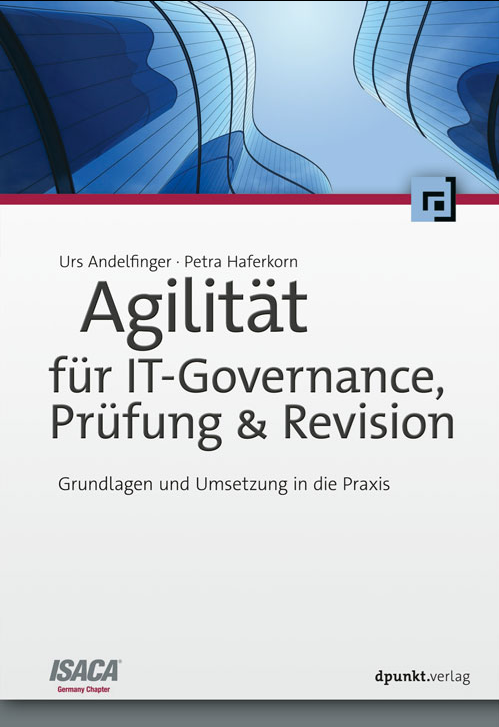
Agilität für IT-Governance, Prüfung & Revision
Agilität und der Einsatz agiler Methoden sind heute nicht mehr nur auf IT-Projekte begrenzt, sondern prägen zunehmend ganze Organisationen. Dieses Buch zeigt auf, wie sich IT-Governance, Prüfung und Revision erfolgreich dem durch Agilität ausgelösten Wandel stellen können und wie sich der Umgang mit den Kernthemen Risiko und Unsicherheit verändert. Zum einen werden Ansätze für eine agile IT-Governance und eine agile Prüfung und Revision beschrieben, indem sie sich agile Werte und Vorgehensweisen zu eigen machen. Zum anderen werden IT-Governance, Prüfung und Revision befähigt, agile Projekte angemessen steuern und wirksam prüfen zu können. Zielgruppe:IT-Leiter*innen und -FührungskräfteIT-Governance-Verantwortliche(IT-)Prüfer*innen und Revisor*innenRisikomanager*innen und Compliance-BeauftragteDatensicherheits- und Informationssicherheitsbeauftragte Autor: Urs Andelfinger ist Professor an der Hochschule Darmstadt und unterrichtet Wirtschaftsinformatik und Softwaretechnik. Er ist CMMI-Instruktor sowie SAFe Agilist und begleitet Organisationen in (nicht nur agilen) IT-Projekten sowie bei Digitalisierungsvorhaben. Petra Haferkorn ist Regierungsdirektorin bei der BaFin und prüft die Governance von Banken und Versicherungen vor Ort. Seit zwei Jahren leitet sie IT-Prüfungen mit den Schwerpunkten IT-Governance und Informationssicherheitsmanagement. Daneben ist sie als Dozentin an der Frankfurt School of Finance and Management in der Executive Education tätig.

Azure Arc-enabled Data Services Revealed
Get introduced to Azure Arc-enabled Data Services and the powerful capabilities to deploy and manage local, on-premises, and hybrid cloud data resources using the same centralized management and tooling you get from the Azure cloud. This book shows how you can deploy and manage databases running on SQL Server and Postgres in your corporate data center or any cloud as if they were part of the Azure platform. This second edition has been updated to the latest codebase, allowing you to use this book as your handbook to get started with Azure Arc-enabled Data Services today. Learn how to benefit from Azure's centralized management, the automated rollout of patches and updates, managed backups, and more.This book is the perfect choice for anyone looking for a hybrid or multi-vendor cloud strategy for their data estate. The authors walk you through the possibilities and requirements to get Azure SQL Managed Instance and PostgresSQL Hyperscale deployed outside of Azure, so the services are accessible to companies that cannot move to the cloud or do not want to use the Microsoft cloud exclusively. The technology described in this book will benefit those required to keep sensitive services, such as medical databases, away from the public cloud equally as those who can’t move to a public cloud for other reasons such as infrastructure constraints but still want to benefit from the Azure cloud and the centralized management and tooling that it supports.WHAT YOU WILL LEARN* Understand the fundamentals and architecture of Azure Arc-enabled data services* Build a multi-cloud strategy based on Azure Data Services* Deploy Azure Arc-enabled data services on premises or in any cloud* Deploy Azure Arc-enabled SQL Managed Instance on premises or in any cloud* Deploy Azure Arc-enabled PostgreSQL Hyperscale on premises or in any cloud* Backup and Restore your data that is managed by Azure Arc-enabled data services* Manage Azure-enabled data services running outside of Azure* Monitor Azure-enabled data services through Grafana and Kibana* Monitor Azure-enabled data services running outside of Azure through Azure MonitorWHO THIS BOOK IS FORDatabase administrators and architects who want to manage on-premises or hybrid cloud data resources from the Microsoft Azure cloud. Especially for those wishing to take advantage of cloud technologies while keeping sensitive data on premises and under physical control.BEN WEISSMAN is the owner and founder of Solisyon, a consulting firm based in Germany and focused on business intelligence, business analytics, and data warehousing. He is a Microsoft Data Platform MVP, the first German BimlHero, and has been working with SQL Server since SQL Server 6.5. Ben is also an MCSE, Charter Member of the Microsoft Professional Program for Big Data, Artificial Intelligence, and Data Science, and he is a Certified Data Vault Data Modeler. If he is not currently working with data, he is probably travelling to explore the world.ANTHONY E. NOCENTINO is the Founder and President of Centino Systems as well as a Pluralsight author, a Microsoft Data Platform MVP, and an industry recognized Kubernetes, SQL Server, and Linux expert. In his consulting practice, Anthony designs solutions, deploys the technology, and provides expertise on system performance, architecture, and security. He has bachelor's and master's degrees in computer science, with research publications in machine virtualization, high performance/low latency data access algorithms, and spatial database systems. 1. A Kubernetes Primer2. Azure Arc-Enabled Data Services3. Getting Ready for Deployment4. Installing Kubernetes5. Deploying a Data Controller in Indirect Mode6. Deploying a Data Controller in Direct Mode7. Deploying an Azure Arc-Enabled SQL Managed Instance8. Deploying Azure Arc-Enabled PostgreSQL Hyperscale9. Monitoring and Management
Artificial Intelligence Programming with Python
A HANDS-ON ROADMAP TO USING PYTHON FOR ARTIFICIAL INTELLIGENCE PROGRAMMINGIn Practical Artificial Intelligence Programming with Python: From Zero to Hero, veteran educator and photophysicist Dr. Perry Xiao delivers a thorough introduction to one of the most exciting areas of computer science in modern history. The book demystifies artificial intelligence and teaches readers its fundamentals from scratch in simple and plain language and with illustrative code examples. Divided into three parts, the author explains artificial intelligence generally, machine learning, and deep learning. It tackles a wide variety of useful topics, from classification and regression in machine learning to generative adversarial networks. He also includes:* Fulsome introductions to MATLAB, Python, AI, machine learning, and deep learning* Expansive discussions on supervised and unsupervised machine learning, as well as semi-supervised learning* Practical AI and Python “cheat sheet” quick referencesThis hands-on AI programming guide is perfect for anyone with a basic knowledge of programming—including familiarity with variables, arrays, loops, if-else statements, and file input and output—who seeks to understand foundational concepts in AI and AI development. PERRY XIAO, PHD, is Professor and Course Director of London South Bank University. He holds his doctorate in photophysics and is Director and co-Founder of Biox Systems Ltd., a university spin-out company that designs and manufactures the AquaFlux and Epsilon Permittivity Imaging system.Preface xxiiiPART I INTRODUCTIONCHAPTER 1 INTRODUCTION TO AI 31.1 What Is AI? 31.2 The History of AI 51.3 AI Hypes and AI Winters 91.4 The Types of AI 111.5 Edge AI and Cloud AI 121.6 Key Moments of AI 141.7 The State of AI 171.8 AI Resources 191.9 Summary 211.10 Chapter Review Questions 22CHAPTER 2 AI DEVELOPMENT TOOLS 232.1 AI Hardware Tools 232.2 AI Software Tools 242.3 Introduction to Python 272.4 Python Development Environments 302.4 Getting Started with Python 342.5 AI Datasets 452.6 Python AI Frameworks 472.7 Summary 492.8 Chapter Review Questions 50PART II MACHINE LEARNING AND DEEP LEARNINGCHAPTER 3 MACHINE LEARNING 533.1 Introduction 533.2 Supervised Learning: Classifications 55Scikit-Learn Datasets 56Support Vector Machines 56Naive Bayes 67Linear Discriminant Analysis 69Principal Component Analysis 70Decision Tree 73Random Forest 76K-Nearest Neighbors 77Neural Networks 783.3 Supervised Learning: Regressions 803.4 Unsupervised Learning 89K-means Clustering 893.5 Semi-supervised Learning 913.6 Reinforcement Learning 93Q-Learning 953.7 Ensemble Learning 1023.8 AutoML 1063.9 PyCaret 1093.10 LazyPredict 1113.11 Summary 1153.12 Chapter Review Questions 116CHAPTER 4 DEEP LEARNING 1174.1 Introduction 1174.2 Artificial Neural Networks 1204.3 Convolutional Neural Networks 1254.3.1 LeNet, AlexNet, GoogLeNet 1294.3.2 VGG, ResNet, DenseNet, MobileNet, EffecientNet, and YOLO 1404.3.3 U-Net 1524.3.4 AutoEncoder 1574.3.5 Siamese Neural Networks 1614.3.6 Capsule Networks 1634.3.7 CNN Layers Visualization 1654.4 Recurrent Neural Networks 1734.4.1 Vanilla RNNs 1754.4.2 Long-Short Term Memory 1764.4.3 Natural Language Processing and Python Natural Language Toolkit 1834.5 Transformers 1874.5.1 BERT and ALBERT 1874.5.2 GPT-3 1894.5.3 Switch Transformers 1904.6 Graph Neural Networks 1914.6.1 SuperGLUE 1924.7 Bayesian Neural Networks 1924.8 Meta Learning 1954.9 Summary 1974.10 Chapter Review Questions 197PART III AI APPLICATIONSCHAPTER 5 IMAGE CLASSIFICATION 2015.1 Introduction 2015.2 Classification with Pre-trained Models 2035.3 Classification with Custom Trained Models: Transfer Learning 2095.4 Cancer/Disease Detection 2275.4.1 Skin Cancer Image Classification 2275.4.2 Retinopathy Classification 2295.4.3 Chest X-Ray Classification 2305.4.5 Brain Tumor MRI Image Classification 2315.4.5 RSNA Intracranial Hemorrhage Detection 2315.5 Federated Learning for Image Classification 2325.6 Web-Based Image Classification 2335.6.1 Streamlit Image File Classification 2345.6.2 Streamlit Webcam Image Classification 2425.6.3 Streamlit from GitHub 2485.6.4 Streamlit Deployment 2495.7 Image Processing 2505.7.1 Image Stitching 2505.7.2 Image Inpainting 2535.7.3 Image Coloring 2555.7.4 Image Super Resolution 2565.7.5 Gabor Filter 2575.8 Summary 2625.9 Chapter Review Questions 263CHAPTER 6 FACE DETECTION AND FACE RECOGNITION 2656.1 Introduction 2656.2 Face Detection and Face Landmarks 2666.3 Face Recognition 2796.3.1 Face Recognition with Face_Recognition 2796.3.2 Face Recognition with OpenCV 2856.3.3 GUI-Based Face Recognition System 288Other GUI Development Libraries 3006.3.4 Google FaceNet 3016.4 Age, Gender, and Emotion Detection 3016.4.1 DeepFace 3026.4.2 TCS-HumAIn-2019 3056.5 Face Swap 3096.5.1 Face_Recognition and OpenCV 3106.5.2 Simple_Faceswap 3156.5.3 DeepFaceLab 3226.6 Face Detection Web Apps 3226.7 How to Defeat Face Recognition 3346.8 Summary 3356.9 Chapter Review Questions 336CHAPTER 7 OBJECT DETECTIONS AND IMAGE SEGMENTATIONS 3377.1 Introduction 337R-CNN Family 338YOLO 339SSD 3407.2 Object Detections with Pretrained Models 3417.2.1 Object Detection with OpenCV 3417.2.2 Object Detection with YOLO 3467.2.3 Object Detection with OpenCV and Deep Learning 3517.2.4 Object Detection with TensorFlow, ImageAI, Mask RNN, PixelLib, Gluon 354TensorFlow Object Detection 354ImageAI Object Detection 355MaskRCNN Object Detection 357Gluon Object Detection 3637.2.5 Object Detection with Colab OpenCV 3647.3 Object Detections with Custom Trained Models 3697.3.1 OpenCV 369Step 1 369Step 2 369Step 3 369Step 4 370Step 5 3717.3.2 YOLO 372Step 1 372Step 2 372Step 3 373Step 4 375Step 5 3757.3.3 TensorFlow, Gluon, and ImageAI 376TensorFlow 376Gluon 376ImageAI 3767.4 Object Tracking 3777.4.1 Object Size and Distance Detection 3777.4.2 Object Tracking with OpenCV 382Single Object Tracking with OpenCV 382Multiple Object Tracking with OpenCV 3847.4.2 Object Tracking with YOLOv4 and DeepSORT 3867.4.3 Object Tracking with Gluon 3897.5 Image Segmentation 3897.5.1 Image Semantic Segmentation and Image Instance Segmentation 390PexelLib 390Detectron2 394Gluon CV 3947.5.2 K-means Clustering Image Segmentation 3947.5.3 Watershed Image Segmentation 3967.6 Background Removal 4057.6.1 Background Removal with OpenCV 4057.6.2 Background Removal with PaddlePaddle 4237.6.3 Background Removal with PixelLib 4257.7 Depth Estimation 4267.7.1 Depth Estimation from a Single Image 4267.7.2 Depth Estimation from Stereo Images 4287.8 Augmented Reality 4307.9 Summary 4317.10 Chapter Review Questions 431CHAPTER 8 POSE DETECTION 4338.1 Introduction 4338.2 Hand Gesture Detection 4348.2.1 OpenCV 4348.2.2 TensorFlow.js 4528.3 Sign Language Detection 4538.4 Body Pose Detection 4548.4.1 OpenPose 4548.4.2 OpenCV 4558.4.3 Gluon 4558.4.4 PoseNet 4568.4.5 ML5JS 4578.4.6 MediaPipe 4598.5 Human Activity Recognition 461ActionAI 461Gluon Action Detection 461Accelerometer Data HAR 4618.6 Summary 4648.7 Chapter Review Questions 464CHAPTER 9 GAN AND NEURAL-STYLE TRANSFER 4659.1 Introduction 4659.2 Generative Adversarial Network 4669.2.1 CycleGAN 4679.2.2 StyleGAN 4699.2.3 Pix2Pix 4749.2.4 PULSE 4759.2.5 Image Super-Resolution 4759.2.6 2D to 3D 4789.3 Neural-Style Transfer 4799.4 Adversarial Machine Learning 4849.5 Music Generation 4869.6 Summary 4899.7 Chapter Review Questions 489CHAPTER 10 NATURAL LANGUAGE PROCESSING 49110.1 Introduction 49110.1.1 Natural Language Toolkit 49210.1.2 spaCy 49310.1.3 Gensim 49310.1.4 TextBlob 49410.2 Text Summarization 49410.3 Text Sentiment Analysis 50810.4 Text/Poem Generation 51010.5.1 Text to Speech 51510.5.2 Speech to Text 51710.6 Machine Translation 52210.7 Optical Character Recognition 52310.8 QR Code 52410.9 PDF and DOCX Files 52710.10 Chatbots and Question Answering 53010.10.1 ChatterBot 53010.10.2 Transformers 53210.10.3 J.A.R.V.I.S. 53410.10.4 Chatbot Resources and Examples 54010.11 Summary 54110.12 Chapter Review Questions 542CHAPTER 11 DATA ANALYSIS 54311.1 Introduction 54311.2 Regression 54411.2.1 Linear Regression 54511.2.2 Support Vector Regression 54711.2.3 Partial Least Squares Regression 55411.3 Time-Series Analysis 56311.3.1 Stock Price Data 56311.3.2 Stock Price Prediction 565Streamlit Stock Price Web App 56911.3.4 Seasonal Trend Analysis 57311.3.5 Sound Analysis 57611.4 Predictive Maintenance Analysis 58011.5 Anomaly Detection and Fraud Detection 58411.5.1 Numenta Anomaly Detection 58411.5.2 Textile Defect Detection 58411.5.3 Healthcare Fraud Detection 58411.5.4 Santander Customer Transaction Prediction 58411.6 COVID-19 Data Visualization and Analysis 58511.7 KerasClassifier and KerasRegressor 58811.7.1 KerasClassifier 58911.7.2 KerasRegressor 59311.8 SQL and NoSQL Databases 59911.9 Immutable Database 60811.9.1 Immudb 60811.9.2 Amazon Quantum Ledger Database 60911.10 Summary 61011.11 Chapter Review Questions 610CHAPTER 12 ADVANCED AI COMPUTING 61312.1 Introduction 61312.2 AI with Graphics Processing Unit 61412.3 AI with Tensor Processing Unit 61812.4 AI with Intelligence Processing Unit 62112.5 AI with Cloud Computing 62212.5.1 Amazon AWS 62312.5.2 Microsoft Azure 62412.5.3 Google Cloud Platform 62512.5.4 Comparison of AWS, Azure, and GCP 62512.6 Web-Based AI 62912.6.1 Django 62912.6.2 Flask 62912.6.3 Streamlit 63412.6.4 Other Libraries 63412.7 Packaging the Code 635Pyinstaller 635Nbconvert 635Py2Exe 636Py2app 636Auto-Py-To-Exe 636cx_Freeze 637Cython 638Kubernetes 639Docker 642PIP 64712.8 AI with Edge Computing 64712.8.1 Google Coral 64712.8.2 TinyML 64812.8.3 Raspberry Pi 64912.9 Create a Mobile AI App 65112.10 Quantum AI 65312.11 Summary 65712.12 Chapter Review Questions 657Index 659

Windows 11 Made Easy
Get started with Windows 11. This book shows you how to set up and personalize your PC in order to get the best experience from your documents, photos, and your time online. The book introduces you to the new desktop, start menu, and settings panel. It covers everything that’s been changed, added, or removed.Next, you will learn how to personalize and customize your PC, laptop, and tablet and how to make Windows 11 safer to use for your children and family. The book takes you through how to keep your personal information safe and secure, and how to make sure your precious documents and photos are backed-up with OneDrive.The book shows you how to use accessibility tools to make Windows 11 easier to use, see, hear, and touch, and how to have fun with Android apps and Xbox gaming. You will also learn how to become more productive, how to connect to your college or workplace, and how you can use multiple desktops and snap layouts to get stuff done.After reading this book, you will be able to install, manage, secure, and make the best of Windows 11 for your PC.What Will You Learn* Install and use the Android apps on your PC* Safely back up and safeguard your documents and photos* Maximize battery life on your laptop or tablet* Make Windows 11 easier to see, hear, touch, and useWHO THIS BOOK IS FORAnyone planning to install Windows 11 and customize their PC with the new updatesMIKE HALSEY is a recognized technical expert. He is the author of help and how-to books for Windows 7, 8, and 10, including accessibility, productivity, and troubleshooting. He is also the author of The Green IT Guide (Apress). Mike is well-versed in the problems and issues that PC users experience when setting up, using, and maintaining their PCs and knows how difficult and technical it can appear.He understands that some subjects can be intimidating, so he approaches each subject area in straightforward and easy-to-understand ways. Mike is originally from the UK, but now lives in the south of France with his rescue border collies, Evan and Robbie. You can contact Mike on Twitter @MikeHalsey.CHAPTER 1: FINDING YOUR WAY AROUND WINDOWS 11 (15 PAGES)Introducing Windows 11 and guiding you around what’s new, what’s moved, and what’s important, from the new desktop and Start Menu experience, to the Settings panel, the Microsoft Store now with Android apps, and the apps and tools you’ll want to use.1) Introducing the Windows 11 Desktop and Start Menu2) Configuring and Customizing Settings3) Introducing The Microsoft Store4) Accessing Documents and Photos5) Finding and Running Software and AppsCHAPTER 2: PERSONALIZING WINDOWS 11 (15 PAGES)Everybody wants to be able to personalize and customize their devices, and here we look at the many different ways you can do this with one of the most customizable and flexible operating systems available.1) Customizing How Windows 11 Looks and Feels2) Managing Multiple User-Accounts3) Setting Up Email and Other Accounts4) Managing Child Accounts in Windows 11CHAPTER 3: GETTING ONLINE AND USING THE INTERNET (15 PAGES)Everybody Needs to be online, and in this chapter we’ll look at how to connect to Wi-Fi networks safely and securely, and how to use Microsoft’s Edge web browser to browse the Internet safely and securely.1) Connecting to Wi-Fi Networks2) Getting Started with Microsoft’s Edge Browser3) Customizing and Configuring Edge4) Managing Internet DownloadsCHAPTER 4: USING WINDOWS AND ANDROID APPS (10 PAGES)There are several different ways and different types of apps that you can install in Windows 11, including many Android apps. In this chapter we’ll look at how you can install, manage, and get the best from them, in addition to seeing how you can play Xbox games on your PC.1) Installing and Managing Software on your PC2) Installing and Managing Apps from the Microsoft Store3) Install and Manage Android Apps in Windows 114) Connecting to Xbox Gaming Services and Playing GamesCHAPTER 5: MANAGING FILES, DOCUMENTS AND ONEDRIVE (10 PAGES)Managing and keeping your documents, photos and files safe and organized can be tricky, so here we’ll look at how to manage your files, keep them safely backed up, and how you can make sure they’ll always be secure and in-sync across your PCs.1) Managing Documents, Pictures, Videos, and Music2) Setting Up and Using OneDrive Cloud Storage3) Using Multiple Disks with Files and DocumentsCHAPTER 6: MAKING WINDOWS 11 EASIER TO USE (12 PAGES)There are many ways to make Windows 11 easier to use, and these can benefit anybody from children and older people, to those with color-blindness or dyslexia, shaky hands or a harder to manage disability. Here we look at all the ways to make your PC easier to use.1) Make Windows 11 Easier to Use2) Make Windows 11 Easier to See3) Make Windows 11 Easier to Hear4) Make Windows 11 Easier to TouchCHAPTER 7: BEING MORE PRODUCTIVE WITH WINDOWS 11 (15 PAGES)We all want to get stuff done on our PCs, so in this chapter we’ll examine all the top productivity tips including managing multiple windows, desktops and even monitors, how to print and share files and documents, and how to manage running apps.1) Switching Between Running Apps2) Managing Windows and Using Window Layouts3) Using Multiple Desktops in Windows 114) Searching for Files, Documents and More in Windows 115) Printing Files and Saving Files as PDFs6) Using Multiple Displays with Your PCCHAPTER 8: GETTING WORK DONE (10 PAGES)With more people working from home, you all need to be able to connect to your company or organization’s services and files. Here we show you how to get your home PC working with any business or school system safely and quickly.1) Connect to Your Company, Organization, or School2) Use OneDrive for Business3) Getting Started with Microsoft OfficeCHAPTER 9: MANAGING YOUR PRIVACY AND SECURITY (15 PAGES)We all need to be safe and secure online, and here we’ll examine how to prevent your PC becoming infected with malware, and how to help make sure you don’t fall victim to scammers. Additionally we’ll look at how you secure your own privacy on your PC with the websites and apps you like to use.1) Signing Into Your PC with Windows Hello2) The Windows Security Center3) Managing Privacy and Security Settings4) Top Tips for Security and Staying SafeCHAPTER 10: CONNECTING AND USING PERIPHERALS AND HARDWARE (10 PAGES)If you use any kind of device with your PC, from a printer to Bluetooth headphones or an Xbox controller, you’ll know they don’t always behave themselves. Here we’ll look at how you install and manage all types of devices in Windows 11.1) Adding and Managing Printers2) Adding and Managing Bluetooth Devices3) Connecting to Other Devices in Your Home or Workplace4) Fixing Problems with Hardware PeripheralsCHAPTER 11: KEEPING YOUR PC UPDATED AND RUNNING SMOOTHLY (10 PAGES)We need to keep our PCs up to date with security and stability patches, to keep ourselves and our files safe. Here we’ll look at managing Windows Updates, how to defer ones you don’t want yet, and how to quickly fix any problem that might be caused.1) Installing and Managing Windows Updates2) Deferring and Troubleshooting Updates3) What is the Windows Insider ProgramCHAPTER 12: TOP TIPS FOR GETTING THE VERY BEST FROM WINDOWS 11 (15 PAGES)There is so much you can do to make your experience using Windows 11 better, so here we share our top tips for getting the very best from your Windows 11 PCs.1) Using Keyboard Shortcuts with Windows 112) Getting the Best from Touch and Trackpad Gestures3) Maximize Battery Life on Your Laptop or Tablet4) Repurposing an Old PC To Sell or Donate5) Fixing Common PC Problems