

Programmierung

Concepts and Semantics of Programming Languages 2
This book – composed of two volumes – explores the syntactical constructs of the most common programming languages, and sheds a mathematical light on their semantics, providing also an accurate presentation of the material aspects that interfere with coding.Concepts and Semantics of Programming Languages 2 presents an original semantic model, collectively taking into account all of the constructs and operations of modules and classes: visibility, import, export, delayed definitions, parameterization by types and values, extensions, etc. The model serves for the study of Ada and OCaml modules, as well as C header files. It can be deployed to model object and class features, and is thus used to describe Java, C++, OCaml and Python classes.This book is intended not only for computer science students and teachers but also seasoned programmers, who will find a guide to reading reference manuals and the foundations of program verification.THERESE HARDIN is Professor Emeritus at the Laboratoire d'Informatique de Paris 6 (LIP6), Sorbonne University, France.MATHIEU JAUME is a lecturer at the Laboratoire d'Informatique de Paris 6 (LIP6), Sorbonne University, France.FRANÇOIS PESSAUX is Associate Professor in the Computer Science and Systems Engineering Unit (U2IS) of ENSTA Paris, France.VERONIQUE VIGUIE DONZEAU-GOUGE is Professor Emeritus at the Centre d'études et de recherche en informatique (CEDRIC) of the Conservatoire national des arts et métiers (Cnam Paris), France.Foreword ixPreface xiCHAPTER 1. NAMESPACES: MODEL AND OPERATIONS 11.1. Reusing, dividing, confining 21.1.1. Analysis of some developer needs 21.1.2. Meeting developer needs 31.2. Namespaces 51.2.1. Namespaces definition 61.2.2. Extending notions of environment and binding 81.3. kit development 121.3.1. Namespace of a kit 141.3.2. Order of fields introduction 151.3.3. Typing kits 151.3.4. kit values 181.3.5. kit export, confining fields 221.3.6. kits import 281.3.7. Stages of kit development 321.4. Incomplete kits 331.4.1. Type and value of an incomplete kit 341.4.2. Completion of an incomplete kit 341.4.3. Confining an incomplete kit 361.5. Parameterized kits 361.5.1. kits parameterized by a type 361.5.2. kits parameterized by types and values 411.5.3. Confinement, parametrization, incomplete kits and export 451.6. Functors of kits 461.7. kit extension 491.7.1. Presentation of extension 491.7.2. Confinement and extension 551.8. Conclusion 59CHAPTER 2. MODULES 612.1. Modules in Ada 622.1.1. Developing modules 622.1.2. Export and confinement 652.1.3. Nesting modules 662.1.4. Importing a module 662.1.5. Flattening an import 672.1.6. Generic modules 682.1.7. Modules and separate compilation 712.2. Modules in OCaml 712.2.1. Module definition 722.2.2. Export and confinement 732.2.3. Confinement of type definitions 782.2.4. Functors 822.3. Modularity, namespaces and W-kit 852.3.1. Declaration interfaces 852.3.2. W-kits 862.3.3. Modularity and header files in C 86CHAPTER 3. CLASS AND OBJECT FEATURES 933.1. Object-oriented features 933.1.1. Objects 943.1.2. Classes 953.2. kits and object features 1043.2.1. Modeling classes 1043.2.2. Modeling objects 1073.2.3. Inheritance, redefinition and late binding 1093.2.4. Incomplete C-kits, parameterized C-kits 1133.2.5. Subclassing, subtyping 1153.2.6. Type languages, classes and objects 119CHAPTER 4. CLASSES IN SELECTED LANGUAGES 1234.1. Classes in Java 1234.1.1. General presentation 1234.1.2. Modules and packages 1244.1.3. Classes 1254.1.4. Marks 1314.1.5. Developing classes 1344.2. Classes in C++ 1444.2.1. Header files, namespaces, confinement 1454.2.2. Classes 1484.2.3. Inheritance and confinement 1554.2.4. Overloading in C++ 1654.2.5. Parameterized classes 1684.3. Classes in OCaml 1744.3.1. Presentation 1744.3.2. An overview of classes 1744.3.3. Marks, incomplete classes, parametrization 1814.3.4. Objects 1864.3.5. Class signatures: confinement and inheritance 1924.3.6. Multiple inheritance 1954.3.7. Other features 1974.4. Presentation of Python 1974.4.1. Getting started 1984.4.2. An overview of classes, modules and types 1994.4.3. Names and assignment 2084.4.4. Assignment and typechecking 2114.4.5. Overloading 2134.4.6. Modules and packages 2174.4.7. Confinement 2184.4.8. Inheritance 2194.4.9. Incomplete C-kits and abstract classes 2214.4.10. Other features 222Appendix: Questions to Guide Learning 225List of Notations 229References 231Index 233

Practical Vaadin
Implement web applications in Java using the open-source Vaadin framework version 20 and later. This easy-to-follow book covers all the key concepts and steps to become competent with modern versions of Vaadin. The book covers everything from setting up the development environment to implementing advanced features such as Server Push and database connectivity. The book helps you become proficient in the Vaadin framework, prepare for Vaadin certifications, and shows you how to apply the power of the Java programming language in developing applications for the web.Author Alejandro Duarte starts with an introduction to web development and its key technologies. He then describes and demonstrates how Vaadin simplifies web development by allowing you to implement web graphical user interfaces using the Java programming language without having to code in JavaScript or HTML. Once a solid foundation on the key web and Vaadin concepts is established, Duarte digs deeper into explaining layouts and user interface components such as combo boxes, dialogs, upload fields, and data grids. He also covers topics such as styling with CSS, data binding, client-side views implementation with TypeScript, and integration with Spring Boot and Jakarta EE.WHAT YOU WILL LEARN* Build web applications in Java using Servlet technology and Vaadin* Combine layouts and user interface components to create views in Java* Connect values in UI components to Java objects in the server through data binding* Customize display styles and add responsive capabilities using CSS* Display tabular data using the Grid component* Implement client-side views using TypeScript* Integrate Vaadin applications with Spring Boot and Jakarta EE* Connect Vaadin applications to SQL databasesWHO THIS BOOK IS FORDevelopers with a basic or higher knowledge of Java programming who want to build on their Java skills to create web graphical user interfaces, Java developers who want to create web applications without having to code in JavaScript, and developers who are preparing to take and pass Vaadin certification examsALEJANDRO DUARTE is a Software Engineer currently working for Vaadin Ltd as their Developer Relations Manager. This is his third book on Vaadin. Alejandro started to code at age 13 using the BASIC programming language on a black screen with a blinking cursor serving as the IDE. He quickly moved to the C and C++ languages—which he still loves and enjoys—and then to Java during his Computer Science studies at the National University of Colombia from where he graduated. Alejandro moved to the UK and later to Finland to foster his career in the open-source software industry. He became one of the well-known faces in the Vaadin and Java communities, having published articles and videos with hundreds of thousands of views in official Vaadin channels and other content portals, and presented technical topics at international Java conferences and Java User Groups. Alejandro splits his free time between his passion for the electric guitar and the photography world. PART I. GETTING STARTED1. The World of Vaadin2. Setting Up the Development EnvironmentPART II. THE FUNDAMENTALS OF VAADIN3. Layouts4. UI Components5. Data Binding6. The Grid ComponentPART III. ADVANCED FEATURES7. Multi-view Navigation and Routing8. Server Push9. The Element API10. Custom Styles and Responsiveness11. Client-side Views with TypeScriptPART IV. INTEGRATIONS AND DATABASE CONNECTIVITY12. Spring Boot13. Jakarta EE
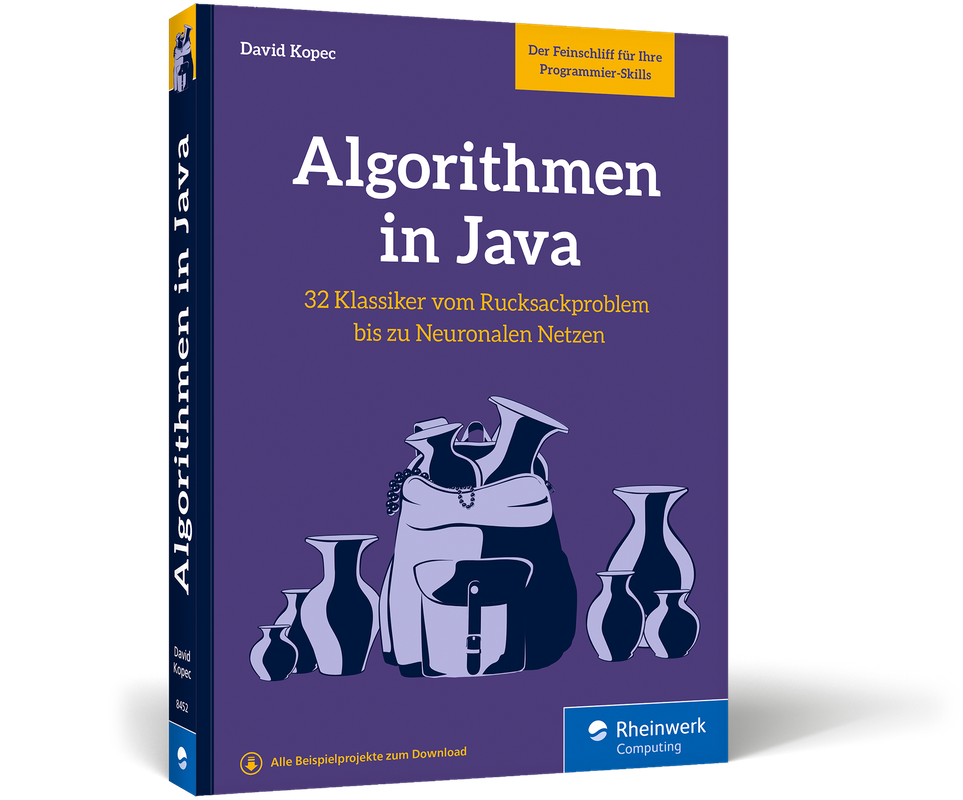
Algorithmen in Java
Programmieren will trainiert werden, und Algorithmen gehören zum Rüstzeug hinzu. Schlagen Sie zwei Fliegen mit einer Klappe und verbessern Sie Ihre Java-Skills anhand klassischer Algorithmen, von der Suche im Binärbaum über k-Means bis zum Rucksackproblem. Dieses Buch ist Grundausbildung und Fundgrube für Coding Workouts zugleich. Profitieren Sie von der Lehr- und Praxiserfahrung des Autors: David Kopec hat 32 Klassiker der Informatik für Sie herausgesucht, die Ihnen wichtige Lösungsstrategien aufzeigen und einen starken Trainingseffekt versprechen.Ideal für alle, die ihre ersten Schritte in der Programmierung hinter sich haben und jetzt voll durchstarten wollen!Aus dem Inhalt:Zum Einstieg: Unknackbare Verschlüsselung, Fibonacci-Folge, die Türme von HanoiSuchalgorithmen: DNS-Suche, Labyrinthe u.v.m.Bedingungserfüllung: Wortsuchrätsel, Acht-Damen-Problem u.v.m.Grafen, kürzeste Wegek-Means-ClusteringEinfache neuronale NetzeMinimax: Tic-tac-toe, Vier gewinntLeseprobe (PDF)

Essential Java for AP CompSci
Gain the essential skills for computer science using one of today's most popular programming languages, Java. This book will prepare you for AP CompSci Complete, but you don’t need to be sitting that class to benefit. Computer science has become a basic life skill that everyone is going to need to learn. Whether you are going into a career or side hustle in business, technology, creativity, architecture, or almost any other field, you will find coding and computer science play a role.So when we learn programming we are going to focus on three things: what is the process; what is the syntax; and what is the flow. The process is represented as a flowchart. We will learn how to make these to help you plan out what you are going to do before you write a line of code. At first, the flowcharts will be pretty simple, but then they will get more complex. The syntax is the code: this is what you write that translates the process you create in a flowchart to the instructions that the computer can understand. Finally, there is the flow. This is where you trace through the code and see how the data and information it stores along the way changes. You can see how the operation of the program cascades from line to line. You will be building charts that will capture the programming flow so you can better understand how the computer processes code to make your next program easier to conceive and code.Along the way to aid in the learning of the essential Java skills, there will be three kinds of project types throughout this book: business software projects for applications where you work for a company and need to complete an internal project for a team such as the sales, marketing, or data science teams; social good projects where you are working for non-profits or for agencies that are trying to research and provide solutions to economic, environmental, medical, or humanitarian projects; and game development projects for games based on player input, random chance, or other mechanics for the use of entertainment.What is unique about computer science is how it has become a skill, and not just a career. While there are jobs and titles of “computer scientist”, the skill of computer science, and specifically programming, are almost everywhere. After reading and using this book, you'll have the essential skills to think like a computer scientist, even if you are not. As a result you’ll be of greater value to your clients, your company, and yourself.WHAT YOU WILL LEARNDiscover the primary building blocks of programming using the Java programming language * See terminology and best practices of software development* Work with object-oriented programming concepts* Use common-language definitions and examples to help drive understanding and comprehension of computer science fundamentalsWHO THIS BOOK IS FORThose who want to learn programming and want to think like a computer scientist. Ideal for anyone taking AP CompSci Complete.Doug Winnie is director of learning experience at H&R Block, responsible for learning and development platforms supporting associates across the organization. Previously, Doug was principal program manager at Microsoft and LinkedIn leading the LinkedIn Learning instructor community, curriculum strategy for technology learning content, and as a member the Windows Insider team supporting educational and career growth for millions of Windows Insiders worldwide.Throughout his career and consulting with companies such as Adobe, PG&E, Safeway, HP, and the US Army, Doug has worked to help developers and designers through education, product management, and interactive development. Doug was honored with two Webby award nominations with projects for Industrial Light and Magic and has written multiple publications to teach beginners how to code. He is also an AP Computer Science teacher, teaching the next generation of developers. Doug lives in the Kansas City metro area and Palm Springs, California.1. WELCOME TO COMPUTER SCIENCE2. SPRINT 01: INTRODUCTION3. SPRINT 02: SETTING UP THE JAVA JDK AND INTELLIJ4. SPRINT 03: SETTING UP GITHUBa. QUIZ 01b. QUIZ 025. SPRINT 04: PROGRAMMING LANGUAGES6. SPRINT 05: HISTORY AND USES OF JAVA7. SPRINT 06: HOW JAVA WORKSa. QUIZ 038. SPRINT 07: FLOWCHARTINGa. ASSIGNMENT 01: PBJ’Db. QUIZ 049. SPRINT 08: HELLO, WORLDa. QUIZ 0510. SPRINT 09: SIMPLE JAVA PROGRAM STRUCTURE11. SPRINT 10: TEXT LITERALS AND OUTPUTa. ASSIGNMENT 02: EE’D12. SPRINT 11: VALUE LITERALS13. SPRINT 12: OUTPUT FORMATTING14. SPRINT 13: COMMENTS AND WHITESPACE15. SPRINT 14: ABSTRACTION OF NUMBERS16. SPRINT 15: BINARYa. QUIZ 0617. SPRINT 16: UNICODE18. SPRINT 17: VARIABLES19. SPRINT 18: MATH. UGH.a. QUIZ 07b. ASSIGNMENT 03: SILO’D20. SPRINT 19: MATH FUNCTIONS21. SPRINT 20: MANAGING TYPEa. ASSIGNMENT 04: SPACE’Db. QUIZ 08c. QUIZ 09d. QUIZ 10e. QUIZ 1122. SPRINT 21: RANDOM NUMBERS23. SPRINT 22: CAPTURE INPUT24. SPRINT 23: CREATING TRACE TABLES25. SPRINT 24: FUNCTIONSa. ASSIGNMENT 05: ORC’D26. SPRINT 25: NESTED FUNCTIONS27. SPRINT 26: FUNCTIONS AND VALUESa. QUIZ 1228. SPRINT 27: FUNCTIONS AND SCOPEa. QUIZ 13b. QUIZ 14c. QUIZ 15d. ASSIGNMENT 06: ULTIMA’De. ASSIGNMENT 07: CYCLONE’D29. SPRINT 28: BOOLEAN VALUES AND EQUALITYa. QUIZ 16b. ASSIGNMENT 08: SPRINT’Dc. USER STORY: 52-PICKUP30. SPRINT 29: SIMPLE CONDITIONAL STATEMENTSa. USER STORY: YAHTZEEb. USER STORY: YAHTZEE TESTINGc. QUIZ 17d. QUIZ 18e. QUIZ 1931. SPRINT 30: MATCHING CONDITIONS WITH THE SWITCH STATEMENT32. SPRINT 31: THE TERNARY OPERATOR33. SPRINT 32: THE STACK AND THE HEAP34. SPRINT 33: TESTING EQUALITY WITH STRINGSa. ASSIGNMENT 09: ESCAPE’Db. USER STORY: ESCAPE’D WHITE BOX35. SPRINT 34: DEALING WITH ERRORS36. SPRINT 35: DOCUMENTING WITH JAVADOC37. SPRINT 36: FORMATTED STRINGS38. SPRINT 37: THE WHILE LOOPa. QUIZ 20b. QUIZ 21c. QUIZ 2239. SPRINT 38: AUTOMATIC PROGRAM LOOPS40. SPRINT 39: THE DO/WHILE LOOPa. ASSIGNMENT 10: SEQUENCE’Db. USER STORY: DICEYc. USER STORY SOLUTION: DICEYd. USER STORY: CONVERTERe. USER STORY SOLUTION: CONVERTER41. SPRINT 40: PROBABILITY42. SPRINT 41: SIMPLIFIED ASSIGNMENT OPERATORS43. SPRINT 42: THE FOR LOOPa. QUIZ 23b. ASSIGNMENT 11: ODDS’D44. SPRINT 43: NESTING LOOPSa. USER STORY: MAP BUILDER45. SPRINT 44: STRINGS AS COLLECTIONSa. ASSIGNMENT 12: PALINDROME’Db. QUIZ 2446. SPRINT 45: MAKE COLLECTIONS USING ARRAYSa. QUIZ 2547. SPRINT 46: CREATING ARRAYS FROM STRINGSa. ASSIGNMENT 13: ELECTION’Db. QUIZ 2648. SPRINT 47: MULTIDIMENSIONAL ARRAYS49. SPRINT 48: LOOPING THROUGH MULTIDIMENSIONAL ARRAYSa. QUIZ 27b. QUIZ 2850. SPRINT 49: BEYOND ARRAYS WITH ARRAYLISTS51. SPRINT 50: INTRODUCING GENERICS52. SPRINT 51: LOOPING WITH ARRAYLISTSa. ASSIGNMENT 14: LIST’D53. SPRINT 52: USING FOR…EACH LOOPSa. ASSIGNMENT 15: NUMBER’Db. QUIZ 29c. QUIZ 3054. SPRINT 53: THE ROLE-PLAYING GAME CHARACTERa. ASSIGNMENT 16: ROLL’D55. SPRINT 54: POLYMORPHISMa. ASSIGNMENT 17: EXTEN’D56. SPRINT 55: MAKE ALL THE THINGS…CLASSES57. SPRINT 56: CLASS, EXTEND THYSELF!a. QUIZ 3158. SPRINT 57: I DON'T COLLECT THOSE; TOO ABSTRACT.59. SPRINT 58: ACCESS DENIED: PROTECTED AND PRIVATEa. QUIZ 32b. QUIZ 3360. SPRINT 59: INTERFACING WITH INTERFACESa. QUIZ 34b. QUIZ 35c. QUIZ 36d. QUIZ 37e. ASSIGNMENT 18: STARSHIP’D61. SPRINT 60: ALL I'M GETTING IS STATIC62. SPRINT 61: AN ALL-STAR CAST, FEATURING NULL63. ANSWER KEY

SAP Mobile Services
Mobile Apps flexibel entwickeln! Dieses Buch stellt Ihnen den kompletten Funktionsumfang der SAP Mobile Services vor (vormals SAP Cloud Platform Mobile Services). Ob Sie native Apps für iOS oder Android programmieren oder Ihren Mitarbeitenden Mobile Cards für den schnellen Zugriff auf Informationen bereitstellen möchten: Für alle App-Typen und SDKs finden Sie ausführliche Beispiele. Die Autoren zeigen Ihnen außerdem, wie Sie Ihre Apps absichern und verwalten. Aus dem Inhalt: Native Apps für iOS und AndroidHybride AppsSAP-Fiori-AppsSAP Mobile CardsPush-BenachrichtigungenOffline-DatenhaltungApp-UpdatesCloud ConnectorNeo- und Cloud-Foundry-UmgebungIdentity Propagation und AuthentifizierungGit Einleitung ... 13 1. Historie der SAP Mobile Services ... 19 1.1 ... Erste Technologien für mobile Apps ... 20 1.2 ... Sybase Unwired Platform ... 22 1.3 ... Syclo Agentry ... 26 1.4 ... SAP Mobile Platform ... 28 1.5 ... SAP Mobile Services ... 31 2. App-Typen ... 39 2.1 ... Native Apps ... 40 2.2 ... Hybride Apps ... 48 2.3 ... SAP Fiori Client ... 51 2.4 ... Mobile Development Kit ... 55 2.5 ... SAP Mobile Cards ... 57 3. Einführung in die SAP Mobile Services ... 59 3.1 ... Funktionsumfang der SAP Mobile Services ... 59 3.2 ... Vergleich zwischen Neo- und Cloud-Foundry-Umgebung ... 107 3.3 ... Migration von der Neo- in die Cloud-Foundry-Umgebung ... 109 4. Entwicklung einer nativen App mit dem SAP BTP SDK for iOS ... 111 4.1 ... Einführung in die SAP Fiori Design Guidelines ... 112 4.2 ... Einführung in SAP Fiori Mentor ... 116 4.3 ... Datenmodell für die im Buch verwendeten Beispiele ... 120 4.4 ... Projekt mit dem SAP BTP SDK Assistant for iOS erstellen ... 123 5. Entwicklung einer nativen App mit dem SAP BTP SDK for Android ... 133 5.1 ... SAP Fiori for Android ... 134 5.2 ... SAP Fiori Mentor für Android ... 136 5.3 ... Projekt mit dem SAP BTP SDK Wizard for Android erstellen ... 140 6. Entwicklung einer hybriden App mit dem Mobile Development Kit ... 157 6.1 ... Entwicklungsumgebung einrichten ... 157 6.2 ... OData-basierte App mit dem Mobile Development Kit erstellen ... 163 7. Entwicklung einer hybriden App mit dem Hybrid Application Toolkit ... 191 7.1 ... Entwicklungsumgebung einrichten ... 192 7.2 ... Eine hybride App in der SAP Web IDE entwickeln ... 196 8. Entwicklung einer Mobile Card ... 215 8.1 ... SAP Mobile Cards installieren und vorbereiten ... 216 8.2 ... Eine Mobile Card erstellen ... 218 9. Integration mit On-Premise- und Cloud-Systemen ... 237 9.1 ... Einführung in den Cloud Connector ... 237 9.2 ... Zugriff auf On-Premise-Systeme ... 255 9.3 ... Zugriff auf Cloud-Systeme ... 270 10. Sicherheit der SAP Mobile Services ... 273 10.1 ... Einführung in die Sicherheitsarchitektur der SAP Business Technology Platform ... 273 10.2 ... Standardrollen für die SAP Mobile Services ... 276 10.3 ... Identity Propagation ... 278 10.4 ... Anwenderauthentifizierung ... 287 10.5 ... SAP Authenticator ... 297 10.6 ... Datenschutz ... 299 11. Softwarelogistik ... 303 11.1 ... Softwarelogistik für mobile Lösungen ... 303 11.2 ... Versionsverwaltung mobiler Apps mit Git ... 305 11.3 ... Continuous Integration und Delivery ... 313 12. Integration von Drittanbieterfunktionalität ... 337 12.1 ... Plug-ins in mobile SAP-Fiori-Apps integrieren ... 339 12.2 ... Plug-ins in iOS-Apps integrieren ... 347 12.3 ... Plug-ins in Android-Apps integrieren ... 350 13. Mobile SAP-Standard-Apps ... 353 13.1 ... SAP Analytics Cloud ... 353 13.2 ... SAP Work Manager ... 356 13.3 ... SAP SuccessFactors Mobile ... 357 13.4 ... Mobile App für SAP Concur ... 359 13.5 ... SAP Sales Cloud ... 360 13.6 ... SAP Jam ... 362 Das Autorenteam ... 365 Index ... 367

Get Started with the MAX78000FTHR Development Board
The MAX78000FTHR from Maxim Integrated is a small development board based on the MAX78000 MCU. The main usage of this board is in artificial intelligence applications (AI) which generally require large amounts of processing power and memory. It marries an Arm Cortex-M4 processor with a floating-point unit (FPU), convolutional neural network (CNN) accelerator, and RISC-V core into a single device. It is designed for ultra-low power consumption, making it ideal for many portable AI-based applications.This book is project-based and aims to teach the basic features of the MAX78000FTHR. It demonstrates how it can be used in various classical and AI-based projects. Each project is described in detail and complete program listings are provided. Readers should be able to use the projects as they are, or modify them to suit their applications. This book covers the following features of the MAX78000FTHR microcontroller development board:> Onboard LEDs and buttons> External LEDs and buttons> Using analog-to-digital converters > I2C projects> SPI projects> UART projects> External interrupts and timer interrupts > Using the onboard microphone> Using the onboard camera> Convolutional Neural Network (CNN) > Artificial Intelligence projectsProf Dr Dogan Ibrahim has a BSc degree in electronic engineering, an MSc degree in automatic control engineering, and a PhD degree in digital signal processing. Dogan has worked in many indus-trial organizations before he returned to academic life. Prof Ibrahim is the author of over 60 technical books and over 200 technical articles on microcontrollers, microprocessors, and related fields. He is a Chartered electrical engineer and a Fellow of the Institution of Engineering Technology.

C++ Schnelleinstieg
* C++ PROGRAMMIEREN LERNEN OHNE VORKENNTNISSE * ALLE GRUNDLAGEN FÜR DEN PROFESSIONELLEN EINSATZ* EINFACHE PRAXISBEISPIELE UND ÜBUNGSAUFGABENMit diesem Buch gelingt Ihnen der einfache Einstieg in die C++-Programmierung.Alle Grundlagen werden in 14 Kapiteln anschaulich und leicht nachvollziehbar anhand von Codebeispielen erläutert. Übungsaufgaben am Ende der Kapitel helfen Ihnen, das neu gewonnene Wissen schnell praktisch anzuwenden und zu vertiefen.Der Autor führt Sie Schritt für Schritt in die Welt der Programmierung ein: von den Grundlagen über Objektorientierung bis zur Entwicklung von Anwendungen mit grafischer Benutzungsoberfläche. Dabei lernen Sie ebenfalls, was guten Programmierstil ausmacht und wie man Fehler in Programmtexten finden und von vornherein vermeiden kann.So sind Sie perfekt auf den Einsatz von C++ im professionellen Umfeld vorbereitet.* Alle Grundlagen einfach erläutert* Objektorientierte Programmierung* Einsatz von Open-Source-Bibliotheken* Grafische Benutzungsoberflächen (GUI)* Internetanfragen und JSON-Parsing* Zeiger und virtuelle Methoden* Fehlersuche und Debugging* Moderner Programmierstil* Programmcode, Lösungen und Glossar zum DownloadPhilipp Hasper ist Gründer eines Augmented-Reality-Startups und hat jahrelange Erfahrung in der akademischen und industriellen Entwicklung von KI-Technologien. Er entwickelt mit C++, Java, Python und Typescript und hat bei zahlreichen Open-Source-Projekten mitgewirkt.

Generating a New Reality
The emergence of artificial intelligence (AI) has brought us to the precipice of a new age where we struggle to understand what is real, from advanced CGI in movies to even faking the news. AI that was developed to understand our reality is now being used to create its own reality.In this book we look at the many AI techniques capable of generating new realities. We start with the basics of deep learning. Then we move on to autoencoders and generative adversarial networks (GANs). We explore variations of GAN to generate content. The book ends with an in-depth look at the most popular generator projects.By the end of this book you will understand the AI techniques used to generate different forms of content. You will be able to use these techniques for your own amusement or professional career to both impress and educate others around you and give you the ability to transform your own reality into something new.WHAT YOU WILL LEARN* Know the fundamentals of content generation from autoencoders to generative adversarial networks (GANs)* Explore variations of GAN* Understand the basics of other forms of content generation* Use advanced projects such as Faceswap, deepfakes, DeOldify, and StyleGAN2WHO THIS BOOK IS FORMachine learning developers and AI enthusiasts who want to understand AI content generation techniquesMICHEAL LANHAM is a proven software and tech innovator with more than 20 years of experience. During that time, he has developed a broad range of software applications in areas including games, graphics, web, desktop, engineering, artificial intelligence (AI), GIS, and machine learning (ML) applications for a variety of industries as an R&D developer. At the turn of the millennium, Micheal began working with neural networks and evolutionary algorithms in game development. He is an avid educator, has written more than eight books covering game development, extended reality, and AI, and teaches at meetups and other events. Micheal also likes to cook for his large family in his hometown of Calgary, Canada. Chapter 1: Deep Learning PerceptronChapter Goal: In this chapter we introduce the basics of deep learning from the perceptron to multi-layer perceptron.No of pages: 30Sub -Topics1. Understanding deep learning and supervised learning.1. Using the perceptron for supervised learning.2. Constructing a multilayer perceptron.3. Discover the basics of activation, loss, optimization and back propagation for problems of regression and classification.Chapter 2: Unleashing Autoencoders and Generative Adversarial NetworksChapter Goal: This chapter introduces the autoencoder and GAN for simple content generation. Along the way we also learn about using convolutional network layers for better feature extraction.No of pages: 30Sub - Topics1. Why we need autoencoders and how they function.2. Improving on the autoencoder with convolutional network layers.3. Generating content with the GAN.4. Explore methods for improving on the vanilla GAN.Chapter 3: Exploring the Latent SpaceChapter Goal: In this chapter we discover the latent space in AI. What it means to move through the AI latent space using variational autoencoders and conditional GANs.No of pages : 30Sub - Topics:1. Understanding variation and the variational autoencoder.2. Exploring the latent space with a VAE.3. Extending a GAN to be conditional.4. Generate interesting foods using a conditional GAN.Chapter 4: GANs, GANs and More GANsChapter Goal: In this chapter we begin uncovering the vast variations in GANs and their applications. We start with basics like the double convolution GAN and work up to the Stack and Progressive GANs.No of pages: 30Sub - Topics:1. Look at samples from the many variations of GANs.2. Setup and use a DCGAN.3. Understand how a StackGAN works.4. Work with and use a ProGAN.Chapter 5: Image to Image Translation with GANsCovers: Pix2Pix and DualGAN, side projects for understanding with ResNET and UNET, advanced network architectures for image classification/generationChapter 6: Translating Images with Cycle ConsistencyCovers: Cycle consistency loss and the CycleGAN, BiCycleGAN and StarGANChapter 7: Styling with GANsCovers: StyleGAN, Attention and the Self-attention GAN with a look at DeOldifyChapter 8: Developing DeepFakesChapter Goal: DeepFakes are taking the world by storm and in this chapter, we explore how to use a DeepFakes project. No of pages: 301. Learn how to isolate faces or other points of interest in images or video.2. Extract and replace faces from images or video.3. Use DeepFakes GAN to generate facial images based on input image.4. Put it all together and allow the user to generate their own DeepFake video.Chapter 9: Uncovering Adversarial Latent AutoencodersChapter Goal: GANs are not the only technique that allows for content manipulation and generations. In this chapter we look at the ALAE method for generating content.No of pages:1. Look at how to extend autoencoders for adversarial learning.2. Understanding how AE can be used to explore the latent space in data.3. Use ALAE to generate conditional content.4. Revisit our previous foods example and see what new foods we can generate.Chapter 10: Video Content with First Order Model MotionChapter Goal: In this chapter we explore a new technique for animating static images called First Order Model Motion. At the end of this chapter we will use this technique to create avatars for Skype or Zoom.No of pages: 301. Discover the basic of First Order Model Motion, what it is and how it works.2. Be able to apply FOMM to a number of static image datasets for various applications.3. Use the project Avatarify for generating real-time avatars from static avatars.4. Use Avatarify real-time in applications like Zoom or Skype.

Einführung in Python 3
EINFÜHRUNG IN PYTHON 3 //- Lehrbuch und Nachschlagewerk- Farbige Syntaxdarstellung- Geeignet für Programmieranfänger, aber auch für Umsteiger von anderen Sprachen wie z. B. C, C++, C#, Java- Systematische Einführung in Python, aufbauend auf den Erfahrungen aus Hunderten von Schulungen des Autors- Praxisnahe Übungen mit ausführlich dokumentierten Musterlösungen- Ihr exklusiver Vorteil: E-Book inside beim Kauf des gedruckten BuchesDie wesentlichen Begriffe und Techniken der Programmierung wie auch die zugrunde liegenden Ideen werden anschaulich erklärt. Anhand typischer Beispiele werden unterschiedliche Problemstellungen verdeutlicht, die sich dann leicht auf andere Anwendungsfälle übertragen lassen. Die Übungsaufgaben mit ausführlich dokumentierten Musterlösungen dienen zur Vertiefung des Stoffs und zeigen exemplarische Vorgehensweisen, die in vielen anderen Bereichen verwendet werden können.Als idealer Einstieg für Programmieranfänger und für Umsteiger behandelt dieses Buch alle grundlegenden Sprachelemente von Python. Auch für Python-Kenner bietet das Buch viele weiterführende Themen wie Funktionale Programmierung mit Dekorateuren, Generatoren, Klasseninstanzen als aufrufbare Objekte, Systemprogrammierung, Forks, Ausnahmehandlungen und Modultests.Entsprechend ihrer Bedeutung ist der Objektorientierung ein umfangreicher Teil des Buchs gewidmet. In anschaulicher und leicht verständlicher Weise wird in die Thematik der OOP eingeführt und dabei der pythonische Stil demonstriert, der sich deutlich von C++ und Java unterscheidet. Außerdem wurden nun auch eigene Kapitel zu Slots, dynamischer Erzeugung von Klassen, Metaklassen und Abstrakten Klassen aufgenommen.Die Funktionale Programmierung wird in einem eigenen Teil behandelt. Dazu wurden die Kapitel über Dekorateure und Generatoren grundlegend überarbeitet und erweitert.AUS DEM INHALT //- Grundlagen: Sequentielle Datentypen, Dictionaries, Mengen, Verzweigungen, Schleifen- Flaches und tiefes Kopieren- Funktionen- Modularisierung- Objektorientierte Programmierung: Grundlagen, Aufrufbare Objekte (Callables), Vererbung, Mehrfachvererbung, Slots, Klassendekoration, Metaklassen, Abstrakte Klassen- Funktionale Programmierung: lambda, map, filter und Listen-Abstraktion, Generatoren und Iteratoren, Dekorateure- Tests und Fehler- Daten konservieren- Reguläre Ausdrücke- Typ-Anmerkungen- Systemprogrammierung- Forks Der Diplom-Informatiker Bernd Klein ist der Inhaber und Gründer des Schulungsanbieters Bodenseo. Er kennt sich bestens mit der Theorie und Praxis von Programmiersprachen aus. In zahlreichen Projekten hat er wertvolle praktische Erfahrungen gesammelt, die in seine Kurse und Bücher einfließen. Seit 2010 hat er sich auf Python konzentriert und sich zum international anerkannten Experten entwickelt.Seine didaktischen Fähigkeiten und seine Sachkompetenz stellt er auf den beiden Webseiten www.python-kurs.eu und www.python-course.eu unter Beweis.

Mit Arduino die elektronische Welt entdecken (4. Auflg.)
Das Arduino-Standardwerk in 4., komplett überarbeiteter Auflage, Juli 2021.Der Arduino-Mikrocontroller ist aus der Elektronikwelt nicht mehr wegzudenken, er hat sich zu einem Standard im Hobbybereich entwickelt. In unzähligen Projekten kommt das Arduino-Board zum Einsatz, Hunderttausende von ausgereiften Softwarelösungen stehen für jeden zugänglich und unter freier Lizenz zur Verfügung. Der Arduino ist leicht zu programmieren. Preiswerte elektronische Bauteile wie LCDs, Sensoren und Motoren können an das Arduino-Board angeschlossen und damit gesteuert werden.Mit "Arduino die elektronische Welt entdecken" führt den Leser in die faszinierende Welt der Elektronik und Programmierung ein. Die Hardware wird leicht verständlich dargestellt und die Programmierung des Mikrocontrollers Schritt für Schritt grundsätzlich erklärt. Herzstück des Buches sind 48 detailliert beschriebene Arduino-Bastelprojekte, wobei sich die Komplexität von Projekt zu Projekt steigert. In jedem Bastelprojekt wird ein neues Grundlagenthema behandelt, neue Hardware wird eingeführt und neue Programmierkniffe und –werkzeuge werden vorgestellt.Jedes Bastelprojekt ist mit zahlreichen Fotos und Abbildungen illustriert und kann Schritt für Schritt nachgebaut werden. Alle verwendeten Bauteile werden genau erklärt und in ihrer prinzipiellen Funktionsweise vorgestellt. Die Bastelprojekte können beliebig erweitert und für andere Zwecke angepasst werden.Generationen von Hobbybastlern haben mit Erik Bartmanns Bestsellerbuch bereits die Arduino-Programmierung gelernt. In der komplett überarbeiteten 4. Neuauflage des Arduino-Standardwerkes wurden neue Bauteile wie der ESP32 oder LoRaWAN aufgenommen und neue Entwicklerwerkzeuge wie Node-RED, KiCad und MQTT behandelt.Inhalt (PDF-Link)Index (PDF-Link)Download der im Buch verwendeten Arduino-Sketche (ZIP-Link)

Beginning C# and .NET
GET A RUNNING START TO LEARNING C# PROGRAMMING WITH THIS FUN AND EASY-TO-READ GUIDEAs one of the most versatile and powerful programming languages around, you might think C# would be an intimidating language to learn. It doesn’t have to be!In Beginning C# and .NET: 2021 Edition, expert Microsoft programmer and engineer Benjamin Perkins and program manager Jon D. Reid walk you through the precise, step-by-step directions you’ll need to follow to become fluent in the C# language and .NET.Using the proven WROX method, you’ll discover how to understand and write simple expressions and functions, debug programs, work with classes and class members, work with Windows forms, program for the web, and access data. You’ll even learn about some of the new features included in the latest releases of C# and .NET, including data consumption, code simplification, and performance.The book also offers:* Detailed discussions of programming basics, like variables, flow control, and object-oriented programming that assume no previous programming experience * “Try it Out” sections to help you write useful programming code using the steps you’ve learned in the book * Downloadable code examples from wrox.com Perfect for beginning-level programmers who are completely new to C#, Beginning C# and .NET: 2021 Edition is a must-have resource for anyone interested in learning programming and looking for a fun and intuitive place to start.ABOUT THE AUTHORSBENJAMIN PERKINS is a Sr. Escalation Engineer at Microsoft. His experience includes designing, developing, deploying, administering, and managing enterprise-level IT solutions. JON D. REID is a Program Manager in Research and Development at IFS AB, specializing in Field Service Management using C# and .NET. Introduction xxviiPART I: THE C# LANGUAGECHAPTER 1: INTRODUCING C# 3What Is .NET? 3.NET Framework, .NET Standard, and .NET Core 4Writing Programs Using .NET 5CIL and JIT 5Assemblies 6Managed Code 7Garbage Collection 7Fitting It Together 7Linking 8What Is C#? 8Applications You Can Write with C# 9C# in This Book 10Visual Studio 10Visual Studio Products 10Solutions 11CHAPTER 2: WRITING A C# PROGRAM 13The Visual Studio Development Environment 14Console Applications 18The Solution Explorer 21The Properties Window 22The Error List Window 23Desktop Applications 23CHAPTER 3: VARIABLES AND EXPRESSIONS 29Basic C# Syntax 30Basic C# Console Application Structure 33Variables 34Simple Types 34Variable Naming 39Literal Values 39Binary Literals and Digit Separators 40String Literals 41Expressions 42Mathematical Operators 43Assignment Operators 48Operator Precedence 49Namespaces 50CHAPTER 4: FLOW CONTROL 55Boolean Logic 56Boolean Bitwise and Assignment Operators 58Operator Precedence Updated 60Branching 60The Ternary Operator 61The if Statement 61Checking More Conditions Using if Statements 64The switch Statement 65Looping 68do Loops 68while Loops 71for Loops 73Interrupting Loops 74Infinite Loops 75CHAPTER 5: MORE ABOUT VARIABLES 79Type Conversion 80Implicit Conversions 80Explicit Conversions 82Explicit Conversions Using the Convert Commands 84Complex Variable Types 87Enumerations 87Defining Enumerations 88Structs 91Defining Structs 92Arrays 94Declaring Arrays 95foreach Loops 98Pattern Matching with switch case Expression 98Multidimensional Arrays 102Arrays of Arrays 104String Manipulation 105CHAPTER 6: FUNCTIONS 113Defining and Using Functions 114Return Values 117Parameters 118Parameter Matching 121Parameter Arrays 121Reference and Value Parameters 123Out Parameters 125Tuples 126Variable Scope 128Variable Scope in Other Structures 131Parameters and Return Values versus Global Data 132Local Functions 134The Main() Function 135Struct Functions 137Overloading Functions 138Using Delegates 140CHAPTER 7: DEBUGGING AND ERROR HANDLING 145Debugging in Visual Studio 146Debugging in Nonbreak (Normal) Mode 147Outputting Debugging Information 148Tracepoints 152Diagnostics Output versus Tracepoints 154Debugging in Break Mode 155Entering Break Mode 155Monitoring Variable Content 158Stepping through Code 161Immediate and Command Windows 162The Call Stack Window 163Error Handling 163try. . .catch. . .finally 164Throw Expressions 172Listing and Configuring Exceptions 172CHAPTER 8: INTRODUCTION TO OBJECT-ORIENTED PROGRAMMING 175What Is Object-Oriented Programming? 176What Is an Object? 177Properties and Fields 178Methods 179Everything’s an Object 180The Life Cycle of an Object 180Constructors 180Destructors 181Static and Instance Class Members 181Static Constructors 181Static Classes 182OOP Techniques 182Interfaces 182Disposable Objects 184Inheritance 184Polymorphism 187Interface Polymorphism 188Relationships between Objects 189Containment 189Collections 190Operator Overloading 191Events 191Reference Types versus Value Types 192OOP in Desktop Applications 192CHAPTER 9: DEFINING CLASSES 199Class Definitions in C# 200Interface Definitions 202System.Object 205Constructors and Destructors 207Constructor Execution Sequence 209OOP Tools in Visual Studio 212The Class View Window 212The Object Browser 214Adding Classes 216Class Diagrams 217Class Library Projects 219Interfaces versus Abstract Classes 223Struct Types 225Shallow Copying versus Deep Copying 227CHAPTER 10: DEFINING CLASS MEMBERS 231Member Definitions 232Defining Fields 232Defining Methods 233Defining Properties 234Tuple Deconstruction 239Refactoring Members 240Automatic Properties 241Additional Class Member Topics 242Hiding Base Class Methods 242Calling Overridden or Hidden Base Class Methods 244The this Keyword 244Using Nested Type Definitions 245Interface Implementation 247Implementing Interfaces in Classes 248Explicit Interface Member Implementation 249Additional Property Accessors 249Partial Class Definitions 250Partial Method Definitions 251Example Application 252Planning the Application 253The Card Class 253The Deck Class 253Writing the Class Library 253Adding the Suit and Rank Enumerations 254Adding the Card Class 256Adding the Deck Class 258A Client Application for the Class Library 261The Call Hierarchy Window 262CHAPTER 11: COLLECTIONS, COMPARISONS, AND CONVERSIONS 265Collections 266Using Collections 267Defining Collections 272Indexers 273Adding a CardCollection to CardLib 275Keyed Collections and IDictionary 278Iterators 279Iterators and Collections 284Deep Copying 285Adding Deep Copying to CardLib 286Comparisons 288Type Comparisons 288Boxing and Unboxing 289The is Operator 290Pattern Matching with the is Operator Pattern Expression 293Value Comparisons 294Operator Overloading 294Adding Operator Overloads to CardLib 299The IComparable and IComparer Interfaces 304Sorting Collections 306Conversions 309Overloading Conversion Operators 310The as Operator 311CHAPTER 12: GENERICS 315What Are Generics? 316Using Generics 317Nullable Types 317Operators and Nullable Types 318The ?? Operator 319The ?. Operator 320Working with Nullable Types 321The System.Collections.Generic Namespace 325List 326Sorting and Searching Generic Lists 327Dictionary 333Modifying CardLib to Use a Generic Collection Class 334Defining Generic Types 335Defining Generic Classes 336The default Keyword 338Constraining Types 338Inheriting from Generic Classes 344Generic Operators 345Generic Structs 346Defining Generic Interfaces 346Defining Generic Methods 346Defining Generic Delegates 348Variance 348Covariance 349Contravariance 350CHAPTER 13: ADDITIONAL C# TECHNIQUES 355The :: Operator and the Global Namespace Qualifier 356Custom Exceptions 357Adding Custom Exceptions to CardLib 358Events 359What Is an Event? 359Handling Events 361Defining Events 363Multipurpose Event Handlers 367The EventHandler and Generic EventHandler Types 370Return Values and Event Handlers 370Anonymous Methods 370Expanding and Using CardLib 371Attributes 380Reading Attributes 380Creating Attributes 381Initializers 382Object Initializers 383Collection Initializers 385Type Inference 388Anonymous Types 390Dynamic Lookup 394The dynamic Type 395Advanced Method Parameters 399Optional Parameters 399Optional Parameter Values 400The OptionalAttribute Attribute 400Optional Parameter Order 401Named Parameters 401Lambda Expressions 405Anonymous Methods Recap 405Lambda Expressions for Anonymous Methods 407Lambda Expression Parameters 410Lambda Expression Statement Bodies 411Lambda Expressions as Delegates and Expression Trees 412Lambda Expressions and Collections 413PART II: DATA ACCESSCHAPTER 14: FILES 423File Classes for Input and Output 424The File and Directory Classes 424The FileInfo Class 426The DirectoryInfo Class 428Path Names and Relative Paths 428Streams 429Classes for Using Streams 429The FileStream Object 429File Position 430Reading Data 432Writing Data 434The StreamWriter Object 436The StreamReader Object 439Reading Data 440Asynchronous File Access 441Reading and Writing Compressed Files 442Monitoring the File System 445CHAPTER 15: XML AND JSON 453XML Basics 454JSON Basics 455XML Schemas 455XML Document Object Model 458The XmlDocument Class 458The XmlElement Class 459Changing the Values of Nodes 463Inserting New Nodes 465Deleting Nodes 467Selecting Nodes 469Searching XML with XPath 469JSON Serialization and Deserialization 473CHAPTER 16: LINQ 479LINQ to XML 480LINQ to XML Functional Constructors 480Working with XML Fragments 483LINQ Providers 486LINQ Query Syntax 486Declaring a Variable for Results Using the var Keyword 488Specifying the Data Source: from Clause 489Specify Condition: where Clause 489Selecting Items: select Clause 490Finishing Up: Using the foreach Loop 490Deferred Query Execution 490LINQ Method Syntax 490LINQ Extension Methods 491Query Syntax versus Method Syntax 491Lambda Expressions 492Ordering Query Results 494Understanding the orderby Clause 495Querying a Large Data Set 496Using Aggregate Operators 498Using the Select Distinct Query 502Ordering by Multiple Levels 504Using Group Queries 506Using Joins 508CHAPTER 17: DATABASES 513Using Databases 514Entity Framework 514Code-First versus Database-First 514Migrations and Scaffolding 515Install SQL Server Express LocalDB 515A Code-First Database 516Exploring Your Database 527Navigating Database Relationships 530Creating and Querying XML from an Existing Database 536PART III: ADDITIONAL TECHNIQUESCHAPTER 18: .NET AND ASP.NET 545Cross-Platform Basics and Key “Must Know” Terms 547What was .NET Standard? 549Shared Project, PCL, and .NET Standard 551Building and Packaging a .NET Standard Library 553Referencing and Targeting .NET 557What was .NET Core? 558Cross Platform 558Open Source 559Optimized for the Cloud 560Performance 560Modular Design 561Self-ContainedDeployment Model 562Porting from .NET Framework to .NET 565Identifying Third-Party Dependencies 567Understanding Which Features Are Not Available 567Upgrading the Current .NET Framework Target 567Overview of Web Applications 568Which ASP.NET to Use and Why 569ASP.NET Web Forms 570Server Controls 572Input Validation 573State Management 574Authentication and Authorization 575ASP.NET Web Site versus ASP.NET Web Applications 575ASP.NET MVC/ASP.NET Core Web App MVC 577ASP.NET Core Web API 579ASP.NET Core Web App 580IIS and Kestrel 581Blazor App and Razor Pages 582Input Validation 584State Management 585Authentication and Authorization 586Dependency Injection 586CHAPTER 19: BASIC CLOUD PROGRAMMING 591The Cloud, Cloud Computing, and the Cloud Optimized Stack 592Cloud Patterns and Best Practices 595Using Microsoft Azure C# Libraries to Create a Storage Container 597Creating an ASP.NET Core Web Application That Uses the Storage Container 607CHAPTER 20: BASIC WEB API AND WCF PROGRAMMING 617Creating an ASP.NET Core Web API 617Consuming an ASP.NET Core Web API 622What Is REST? 629What Is WCF? 630WCF Concepts 631WCF Communication Protocols 631Addresses, Endpoints, and Bindings 632Contracts 634Message Patterns 634Behaviors 635Hosting 635WCF Programming 635The WCF Test Client 642Defining WCF Service Contracts 644Data Contracts 645Service Contracts 645Operation Contracts 646Message Contracts 647Fault Contracts 647Self-HostedWCF Services 652CHAPTER 21: BASIC DESKTOP PROGRAMMING 663XAML 664Separation of Concerns 665XAML in Action 665Namespaces 666Code-BehindFiles 667The Playground 667WPF Controls 669Properties 670Dependency Properties 673Attached Properties 673Events 674Handling Events 675Routed Events 676Routed Commands 676Control Types 679Control Layout 679Basic Layout Concepts 679Stack Order 679Alignment, Margins, Padding, and Dimensions 680Border 680Visual Debugging Tools 681Layout Panels 682Canvas 682DockPanel 684StackPanel 686WrapPanel 687Grid 688The Game Client 691The About Window 691Designing the User Interface 692The Image Control 692The Label Control 692The TextBlock Control 693The Button Control 693The Options Window 696The TextBox Control 697The CheckBox Control 698The RadioButton Control 699The ComboBox Control 700The TabControl 701Handling Events in the Options Window 705Data Binding 707The DataContext 708Binding to Local Objects 708Static Binding to External Objects 709Dynamic Binding to External Objects 710Starting a Game with the ListBox Control 712Creating and Styling Controls 716Styles 716Templates 717Triggers 719Animations 720WPF User Controls 721Implementing Dependency Properties 722The Main Window 736The Menu Control 736Routed Commands with Menus 736Putting It All Together 741Refactoring the Domain Model 741The View Model 748Completing the Game 757Appendix: Exercise Solutions 769Index 809
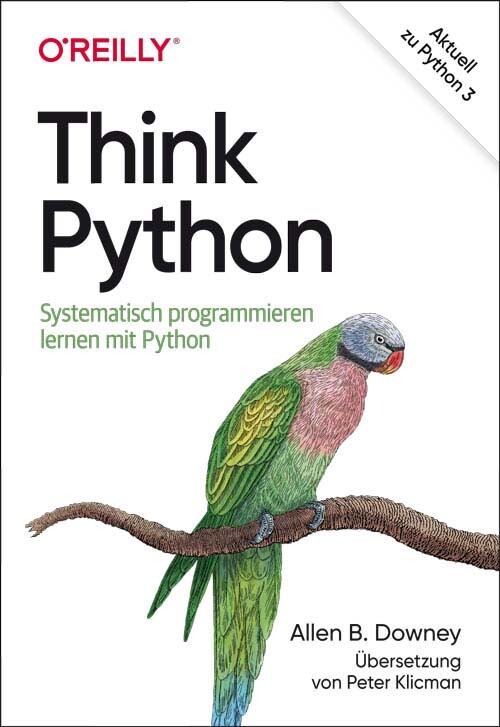
Think Python
Lernen, wie ein Informatiker zu denken – der abwechslungsreiche Praxiskurs für Python.Wenn Sie programmieren lernen wollen, eignet sich Python hervorragend als Einstieg. Dieses Praxisbuch führt Sie Schritt für Schritt durch die Sprache, beginnend mit grundlegenden Programmierkonzepten, über Funktionen, Syntax und Semantik, Rekursion und Datenstrukturen bis hin zum objektorientierten Design.Lernen Sie, wie ein Programmierprofi zu denken! Allen Downey führt Sie nicht nur fundiert in Python ein, sondern leitet Sie auch an, über die Sprachkonstrukte nachzudenken, und vermittelt Ihnen so grundlegende Problemlösungsstrategien der Informatik. Die Kapitel enthalten jeweils ein Glossar der Fachbegriffe sowie Übungen und Fallstudien, kurze Verständnistests und kleinere Projekte, an denen Sie die neu erlernten Programmierkonzepte gleich ausprobieren können. Auf diese Weise wenden Sie das Gelernte direkt an und festigen Ihr Verständnis für die konkrete Programmierpraxis.Starten Sie mit den Grundlagen, einschließlich Sprachsyntax und SemantikEntwickeln Sie eine klare Vorstellung von den jeweiligen ProgrammierkonzeptenLernen Sie Werte, Variablen, Anweisungen, Funktionen und Datenstrukturen in einer logischen Abfolge kennenEntdecken Sie, wie Sie mit Dateien und Datenbanken arbeiten könnenVerstehen Sie Objekte, Methoden und objektorientierte ProgrammierungWenden Sie Debugging-Techniken an, um Syntax-, Laufzeit- und Semantikfehler zu behebenErforschen Sie Funktionen, Datenstrukturen und Algorithmen anhand aussagekräftiger BeispieleInhalt (PDF-Link)

Decoupled Django
Apply decoupling patterns, properly test a decoupled project, and integrate a Django API with React, and Vue.js. This book covers decoupled architectures in Django, with Django REST framework and GraphQL. With practical and simple examples, you’ll see firsthand how, why, and when to decouple a Django project.Starting with an introduction to decoupled architectures versus monoliths, with a strong focus on the modern JavaScript scene, you’ll implement REST and GraphQL APIs with Django, add authentication to a decoupled project, and test the backend. You’ll then review functional testing for JavaScript frontends with Cypress. You will also learn how to integrate GraphQL in a Django project, with a focus on the benefits and drawbacks of this new query language.By the end of this book, you will be able to discern and apply all the different decoupling strategies to any Django project, regardless of its size.WHAT YOU'LL LEARN* Choose the right approach for decoupling a Django project* Build REST APIs with Django and a Django REST framework* Integrate Vue.js and GraphQL in a Django project* Consume a Django REST API with Next.js* Test decoupled Django projectsWHO THIS BOOK IS FORSoftware developers with basic Django skills keen to learn decoupled architectures with Django. JavaScript developers interested in learning full-stack development and decoupled architectures with Django.Valentino Gagliardi is a freelance consultant with a wealth of experience in the IT industry. He spent the last 8 years as a front-end consultant, providing advice and help, coaching and training on JavaScript and React. He worked as an instructor for multiple training agencies around the country, running in-person workshops and creating learning paths for aspiring developers. He loves to share his knowledge on his blog with tutorials reaching over 100,000 monthly visits. An avid Django user, he is active in the Python community as a speaker, and as a coach for Django Girls.Chapter 1: Introduction to the decoupled world.Chapter Goal: Introduce the reader to terminology and structure of a decoupled architecture.No of pages: 16Sub -Topics1. A review of the concept of monolithic applications vs decoupled applications.2. What is decoupling?3. Why and when to decouple?4. A brief introduction to REST.5. A brief introduction to GraphQL.Chapter 2: JavaScript meets django.Chapter Goal: Introduce the reader to the modern JavaScript scene, help the reader understand how modern frontend tools fit within Django.No of pages: 13Sub -Topics1. An overview of modern JavaScript.2. An overview of JavaScript and Django in production setups.3. A review of the most popular frontend libraries: Vue, React, Next.js, and the differences between them.Chapter 3: Modern Django and Django REST Framework.Chapter goal: Introduce the reader to intermediate Django concepts, and Django REST framework.No of pages: 11Sub -Topics1. A brief introduction to Django REST framework and how it fits within a Django project, compared to the basic Django building blocks (MVT architecture, forms, models, views).2. An introduction to ASGI and async Django.Chapter 4: Advantages and disadvantages of a decoupled architecture.Chapter Goal: Help the reader make an informed choice by outlining advantages and disadvantages of a decoupled architecture.No of pages: 12Sub -Topics1. Why and when to decouple?2. An overview of the various approaches for decoupling a Django project. How to choose between the various approaches.3. Advantages of decoupling a Django project.4. Disadvantages of decoupling a Django project.Chapter 5: Setting up a Django project.Chapter Goal: Help the reader to prepare a Django project.No of pages: 9Sub -Topics1. How to split setting files.2. How to configure Django to use environment variables.3. How to run Django under ASGI.Chapter 6: Decoupled Django with Django REST Framework.Chapter Goal: Help the reader understand how to decouple a Django project with Django REST framework.No of pages: 31Sub -Topics1. How to install and enable Django REST framework.2. Django REST framework serializers.3. How to create API endpoint with Django REST framework.4. Django REST relationships.5. Working with Vue.js in Django.Chapter 7: API security, and deploymentChapter Goal: Help the reader secure and deploy a decoupled Django project.No of pages: 23Sub -Topics1. Django and Django REST hardening2. Deploying a decoupled Django projectChapter 8: Django REST meets Next.js.Chapter Goal: Help the reader pair a Django REST project with Next.js, the React framework.No of pages: 24Sub -Topics1. Django as a headless CMS2. A reintroduction to React and its ecosystem3. Working with Next.js and Django RESTChapter 9: Testing in a Decoupled World.Chapter Goal: Teaches the reader how to test a decoupled Django REST project and a JavaScript frontend.No of pages: 22Sub -Topics1. A brief introduction to functional and unit testing.2. Testing the frontend with Cypress3. Testing Django REST framework and DjangoChapter 10: Authentication and authorization Django REST framework.Chapter Goal: Help the reader understand how to set up authentication and authorization in a decoupled Django project.No of pages: 21Sub -Topics1. A review of the most important authentication mechanisms in Django and Django REST framework2. What is token based authentication? What is JWT? JWT drawbacks3. Using session-based authentication for single-page apps4. How to handle authentication in the frontendChapter 11: GraphQL in Django with Ariadne.Chapter Goal: Help the reader understand what GraphQL is and how it fits into the Python/Django landscape.No of pages: 39Sub -Topics1. Creating a GraphQL schema in Ariadne2. Working with resolvers3. Implementing mutations4. Connecting React to a GraphQL backendChapter 12: GraphQL in Django with Strawberry.Chapter Goal: Help the reader understand in practice how to decouple a Django project with GraphQL and Strawberry.No of pages: 30 (estimated)Sub -Topics1. Creating a GraphQL schema in Straberry2. Working with resolvers3. Implementing mutations in the frontend

Advanced Forecasting with Python
Cover all the machine learning techniques relevant for forecasting problems, ranging from univariate and multivariate time series to supervised learning, to state-of-the-art deep forecasting models such as LSTMs, recurrent neural networks, Facebook’s open-source Prophet model, and Amazon’s DeepAR model.Rather than focus on a specific set of models, this book presents an exhaustive overview of all the techniques relevant to practitioners of forecasting. It begins by explaining the different categories of models that are relevant for forecasting in a high-level language. Next, it covers univariate and multivariate time series models followed by advanced machine learning and deep learning models. It concludes with reflections on model selection such as benchmark scores vs. understandability of models vs. compute time, and automated retraining and updating of models.Each of the models presented in this book is covered in depth, with an intuitive simple explanation of the model, a mathematical transcription of the idea, and Python code that applies the model to an example data set.Reading this book will add a competitive edge to your current forecasting skillset. The book is also adapted to those who have recently started working on forecasting tasks and are looking for an exhaustive book that allows them to start with traditional models and gradually move into more and more advanced models.WHAT YOU WILL LEARN* Carry out forecasting with Python* Mathematically and intuitively understand traditional forecasting models and state-of-the-art machine learning techniques* Gain the basics of forecasting and machine learning, including evaluation of models, cross-validation, and back testing* Select the right model for the right use caseWho This Book Is ForThe advanced nature of the later chapters makes the book relevant for applied experts working in the domain of forecasting, as the models covered have been published only recently. Experts working in the domain will want to update their skills as traditional models are regularly being outperformed by newer models.Joos is a data scientist, with over five years of industry experience in developing machine learning tools, of which a large part is forecasting models. He currently works at Disneyland Paris where he develops machine learning for a variety of tools. His experience in writing and teaching have motivated him to make this book on advanced forecasting with Python.PART I: Machine Learning for ForecastingChapter 1: Models for ForecastingChapter Goal: Explains the different categories of models that are relevant for forecasting in high level languageNo pages: 10Sub -Topics1. Time series models2. Supervised vs unsupervised models3. Classification vs regression models4. Univariate vs multivariate modelsChapter 2: Model Evaluation for ForecastingChapter Goal: Explains model evaluation with specific adaptations to keep in mind for forecastingNo pages: 15Sub -Topics1. Train test split2. Cross validation for forecasting3. BacktestingPART II: Univariate Time Series ModelsChapter 3: The AR ModelChapter Goal: explain the AR model (intuitively, mathematically and give python application with code and data set)No pages: 8Sub -Topics1. Understanding AR model2. Mathematical explanation of the AR model3. Worked out Python forecasting example with the AR modelChapter 4: The MA modelChapter Goal: explain the MA model (intuitively, mathematically and give python application with code and data set)No pages: 8Sub -Topics1. Understanding MA model2. Mathematical explanation of the MA model3. Worked out Python forecasting example with the MA modelChapter 5: The ARMA modelChapter Goal: explain the ARMA model (intuitively, mathematically and give python application with code and data set)No pages: 8Sub -Topics1. Understanding ARMA model2. Mathematical explanation of the ARMA model3. Worked out Python forecasting example with the ARMA modelChapter 6: The ARIMA modelChapter Goal: Explains the ARIMA model (intuitively, mathematically and give python application with code and data set)No pages: 8Sub -Topics1. Understanding ARIMA model2. Mathematical explanation of the ARIMA model3. Worked out Python forecasting example with the ARIMA modelChapter 7: The SARIMA ModelChapter Goal: Explains the SARIMA model (intuitively, mathematically and give python application with code and data set)No pages: 8Sub -Topics1. Understanding SARIMA model2. Mathematical explanation of the SARIMA model3. Worked out Python forecasting example with the SARIMA modelPART III: Multivariate Time Series ModelsChapter 8: The VAR modelChapter Goal: Explains the VAR model (intuitively, mathematically and give python application with code and data set)No pages: 8Sub -Topics1. Understanding VAR model2. Mathematical explanation of the VAR model3. Worked out Python forecasting example with the VAR modelChapter 9: The Bayesian VAR modelChapter Goal: Explains the Bayesian VAR model (intuitively, mathematically and give python application with code and data set)No pages: 8Sub -Topics1. Understanding Bayesian VAR model2. Mathematical explanation of the Bayesian VAR model3. Worked out Python forecasting example with the Bayesian VAR modelPART IV: Supervised Machine Learning ModelsChapter 10: The Linear Regression modelChapter Goal: Explains the Linear Regression model (intuitively, mathematically and give python application with code and data set)No pages: 8Sub -Topics1. Understanding Linear Regression model2. Mathematical explanation of the Linear Regression model3. Worked out Python forecasting example with the Linear Regression modelChapter 11: The Decision Tree modelChapter Goal: Explains the Decision Tree model (intuitively, mathematically and give Python application with code and data set)No pages: 8Sub -Topics1. Understanding Decision Tree model2. Mathematical explanation of the Decision Tree model3. Worked out Python forecasting example with the Decision Tree modelChapter 12: The k-Nearest Neighbors VAR modelChapter Goal: explain the k-Nearest Neighbors (intuitively, mathematically and give python application with code and data set)No pages: 8Sub -Topics1. Understanding k-Nearest neighbors model2. Mathematical explanation of the k-Nearest neighbors model3. Worked out Python forecasting example with the k-Nearest neighbors modelChapter 13: The Random Forest ModelChapter Goal: explain the Random Forest (intuitively, mathematically and give python application with code and data set)No pages: 8Sub -Topics1. Understanding Random Forest model2. Mathematical explanation of the Random Forest model3. Worked out Python forecasting example with the Random Forest modelChapter 14: The XGBoost modelChapter Goal: Explains the XGBoost model (intuitively, mathematically and give python application with code and data set)No pages: 10Sub -Topics1. Understanding XGBoost model2. Mathematical explanation of the XGBoost model3. Worked out Python forecasting example with the XGBoost modelChapter 15: The Neural Network modelChapter Goal: Explains the Neural Network model (intuitively, mathematically and give python application with code and data set)No pages: 10Sub -Topics1. Understanding Neural Network model2. Mathematical explanation of the Neural Network model3. Worked out Python forecasting example with the Neural Network modelPart V: Advanced Machine and Deep Learning ModelsChapter 16: Recurrent Neural NetworksChapter Goal: Explains Recurrent Neural Networks (intuitively, mathematically and give python application with code and data set)No pages: 10Sub -Topics1. Understanding Recurrent Neural Networks2. Mathematical explanation of Recurrent Neural Networks3. Worked out Python forecasting example with Recurrent Neural NetworksChapter 17: LSTMsChapter Goal: Explains LSTMs (intuitively, mathematically and give python application with code and data set)No pages: 10Sub -Topics1. Understanding LSTMs2. Mathematical explanation of LSTMs3. Worked out Python forecasting example with LSTMsChapter 18: Facebook’s Prophet modelChapter Goal: Explains Facebook’s Prophet model (intuitively, mathematically and give Python application with code and data set)No pages: 10Sub -Topics1. Understanding Facebook’s Prophet model2. Mathematical explanation of Facebook’s Prophet model3. Worked out Python forecasting example with Facebook’s Prophet modelChapter 19: Amazon’s DeepAR ModelChapter Goal: Explains Amazon’s DeepAR model (intuitively, mathematically and give python application with code and data set)No pages: 10Sub -Topics1. Understanding Amazon’s DeepAR model2. Mathematical explanation of Amazon’s DeepAR model3. Worked out Python forecasting example with Amazon’s DeepAR modelChapter 20: Deep State Space ModelsChapter Goal: Explains Deep State Space models (intuitively, mathematically and give Python application with code and data set)No pages: 10Sub -Topics1. Understanding Deep State Space models2. Mathematical explanation of Deep State Space models3. Worked out Python forecasting example with Deep State Space modelsChapter 21: Model selectionChapter Goal: Give elements to select the best model for a specific situationNo pages: 16Sub -Topics1. Benchmark scores vs understandability of models vs compute time2. Black swan outlier problems3. Automated retraining and updating of models4. Conclusion

Künstliche Intelligenz - Wie sie funktioniert und wann sie scheitert
Wie KI funktioniert und wann sie scheitert. Eine unterhaltsame Reise in die seltsame Welt der Algorithmen, neuronalen Netze und versteckten Giraffen.Wir verlassen uns jeden Tag auf künstliche Intelligenz, wenn es um Empfehlungen, Übersetzungen und Katzenohren für unsere Selfie-Videos geht. Wir vertrauen KI auch in Fragen von Leben und Tod, auf der Straße und in unseren Krankenhäusern. Aber wie intelligent ist KI wirklich, auf welche Weise löst sie Probleme, wie versteht sie Menschen?Janelle Shane liefert Antworten auf Fragen zu KI, die Sie sich schon immer gestellt haben, und auf einige, auf die Sie definitiv noch nicht gekommen sind: Wie kann ein Computer das perfekte Sandwich entwerfen? Und kann man einer KI beibringen, zu flirten oder gute Witze zu erzählen?In dieser klugen, oft sehr lustigen Einführung in die interessanteste Wissenschaft unserer Zeit zeigt Janelle Shane, wie KI-Algorithmen lernen, wo sie versagen und wie sie sich anpassen. Sie erfahren, wie KIs trainiert werden, was Deep Learning ist, wo die Gefahren bei selbstfahrenden Autos liegen, wie sich Vorurteile aus KI-Trainingsdaten auf Bewerbungsverfahren auswirken – und warum Bilderkennungs-KIs auf Giraffen fixiert sind.Das perfekte Buch für alle, die sich eine informierte Meinung bilden möchten und neugierig darauf sind, wie die KI-Roboter in unserem Leben funktionieren.

SAP Cloud Integration
Sie möchten SAP-Cloud-Services zusammen mit Ihren On-Premise-Anwendungen einsetzen? Dann lesen Sie in diesem Buch, wie Sie Integration Flows modellieren und überwachen, um Daten zwischen diesen beiden Welten auszutauschen. Sie werden durch alle Bereiche von SAP Cloud Integration (vormals SAP Cloud Platform Integration) geführt und lernen dabei die Verwendung der verschiedenen Komponenten wie Events und Routing sowie die Anwendung der unterschiedlichen Connectivity-Adapter. Aus dem Inhalt: Architektur und VersionenNeo- und Cloud-Foundry-UmgebungKonfiguration und EinrichtungIntegrationskomponenten und AdapterMonitoring und SicherheitIntegrationsflüsse modellieren und ausführenMit Mappings- und XML-Daten arbeitenCloud Connector und API-ZugriffeTransport von Integrationen Einleitung ... 15 1. Grundlagen ... 21 1.1 ... Cloud Computing ... 21 1.2 ... SAP Business Technology Platform ... 26 1.3 ... Einführung in SAP Cloud Integration ... 37 1.4 ... SAP Integration Suite ... 41 1.5 ... Zusammenfassung ... 51 2. Einrichtung von SAP Cloud Integration ... 53 2.1 ... Einen Trial Account für SAP Cloud Integration einrichten ... 53 2.2 ... SAP Cloud Integration in der Neo-Umgebung einrichten ... 67 2.3 ... Ihre erste Integration erstellen ... 70 2.4 ... Zusatzinformationen und Dokumentation verwenden ... 74 2.5 ... Zusammenfassung ... 78 3. Discover-Oberfläche ... 79 3.1 ... Einführung in die Discover-Oberfläche ... 79 3.2 ... Beispiele für vordefinierte Integrationsszenarien ... 91 3.3 ... Prozessinformationen mit dem SAP Best Practices Explorer abrufen ... 96 3.4 ... Zusammenfassung ... 100 4. Design-Oberfläche ... 101 4.1 ... Pakete und Artefakte ... 101 4.2 ... Versionierung ... 121 4.3 ... Grundlagen zur Erstellung einer Integration ... 123 4.4 ... Zusammenfassung ... 138 5. Monitor-Oberfläche ... 139 5.1 ... Startseite der Monitor-Oberfläche im Überblick ... 139 5.2 ... Integration Flows überwachen ... 143 5.3 ... Veröffentlichte Artefakte überwachen ... 155 5.4 ... Sicherheitseinstellungen ... 160 5.5 ... Datenspeicherung verwalten ... 185 5.6 ... Log-Einträge ... 191 5.7 ... Gesperrte Objekte verwalten ... 194 5.8 ... Zusammenfassung ... 195 6. Settings-Oberfläche ... 197 6.1 ... Produktprofile ... 198 6.2 ... Transporteinstellungen ... 202 6.3 ... ES Repository ... 203 6.4 ... Custom Tags ... 207 6.5 ... Zusammenfassung ... 213 7. Komponenten und Adapter ... 215 7.1 ... Integrationskomponenten ... 215 7.2 ... Adapter ... 282 7.3 ... Zusammenfassung ... 311 8. Wichtige Grundfunktionen ... 313 8.1 ... Apache Camel und Expressions ... 314 8.2 ... Bedingungen mit Vergleichsoperatoren definieren ... 317 8.3 ... XML und XPath ... 319 8.4 ... Parametrisierung mit der Funktion »Externalize« ... 322 8.5 ... Migration von Komponenten ... 327 8.6 ... Erweiterungskonzept für Integrationsszenarien ... 329 8.7 ... Aufbau von Nachrichten ... 334 8.8 ... Dokumentation der Header- und Property-Variablen ... 335 8.9 ... Partner Directory ... 336 8.10 ... Verfügbarkeit von Services und Rechenzentren prüfen ... 340 8.11 ... Zusammenfassung ... 343 9. Ergänzende Werkzeuge ... 345 9.1 ... HTTP-Anfragen mit Postman verschicken ... 345 9.2 ... WSDL-Dateien mit SoapUI öffnen ... 354 9.3 ... Große Dateien mit Notepad++ bearbeiten ... 357 9.4 ... Groovy-Skripte mit Atom entwickeln ... 360 9.5 ... Weitere Werkzeuge der SAP Community ... 363 9.6 ... Zusammenfassung ... 370 10. Design Guidelines zur Anwendung der Komponenten ... 371 10.1 ... Enterprise Integration Patterns ... 372 10.2 ... Fehlerbehandlung ... 389 10.3 ... Skripte erweitern ... 401 10.4 ... Sicherheit ... 415 10.5 ... Mit dem Partner Directory arbeiten ... 424 10.6 ... Zusammenfassung ... 429 11. Prüfen, Testen und Debugging ... 431 11.1 ... Simulation ... 431 11.2 ... Debugging und Tracing ... 438 11.3 ... Debugging-Skripte ... 444 11.4 ... Zusammenfassung ... 449 12. Konnektivität ... 451 12.1 ... Transport von Integrationen ... 451 12.2 ... Cloud Connector ... 466 12.3 ... API-Zugriff auf SAP Cloud Integration ... 489 12.4 ... SAP Cloud Integration im Zusammenspiel mit anderen Services der SAP BTP ... 501 12.5 ... Zusammenfassung ... 504 13. Beispiele für Integrationsszenarien ... 505 13.1 ... Einen Lead in SAP Sales Cloud anlegen ... 506 13.2 ... Serviceabruf in SAP Field Service Management ... 530 13.3 ... Lieferantenrechnung in SAP S/4HANA Cloud anlegen ... 547 13.4 ... Zusammenfassung ... 575 14. Ausblick und weiterführende Informationen ... 577 14.1 ... Weiterführende Informationen ... 577 14.2 ... Geplante Funktionen ... 592 14.3 ... Zusammenfassung ... 596 Der Autor ... 597 Index ... 598
Daily Play
»Ein toller Ansatz, um Menschen miteinander ins Gespräch zu bringen, Ideen zu diskutieren und Denkblockaden zu durchbrechen.« Coworking Map, 07/2021Ein inspirierendes Buch für alle, die Workshops moderieren, sowie für Scrum Master und Coaches, die agile Spiele in ihren Trainings einsetzen möchten. Mit agilen Spielen förderst du Interaktion, Produktivität und nachhaltiges Lernen in deinen Teams. Das erfahrene Autorenteam zeigt in 25 Spielen, worauf es dabei ankommt, inklusive ausführlicher Spielanleitungen mit Hinweisen zu Vorbereitung, Moderation und Auswertung. Zudem gibt es einiges zu deiner Rolle als Spielleitung zu wissen – wirkungsvoll agil zu moderieren ist nämlich eine Kunst! Schärfe deinen Blick für Ziele und entwickle ein gutes Gespür für Situationen, Teamprozesse und Möglichkeiten. So setzt du agile Spiele in deinem Umfeld erfolgreich ein.Aus dem Inhalt:Über 20 konkrete AnleitungenFundierte EinführungZum Spiel einladen und eine wertschätzende Atmosphäre schaffenÜbersicht nach Funktion – finde das richtige SpielGekonnte Spielleitung und ModerationAufwärmen und mit Widerständen umgehenZielgruppen definierenZufall, Regeln und Hindernisse einsetzenErlebnisse teilen und auswertenEigene Spiele entwickelnLeseprobe (PDF-Link)

AI for Healthcare with Keras and Tensorflow 2.0
Learn how AI impacts the healthcare ecosystem through real-life case studies with TensorFlow 2.0 and other machine learning (ML) libraries.This book begins by explaining the dynamics of the healthcare market, including the role of stakeholders such as healthcare professionals, patients, and payers. Then it moves into the case studies. The case studies start with EHR data and how you can account for sub-populations using a multi-task setup when you are working on any downstream task. You also will try to predict ICD-9 codes using the same data. You will study transformer models. And you will be exposed to the challenges of applying modern ML techniques to highly sensitive data in healthcare using federated learning. You will look at semi-supervised approaches that are used in a low training data setting, a case very often observed in specialized domains such as healthcare. You will be introduced to applications of advanced topics such as the graph convolutional network and how you can develop and optimize image analysis pipelines when using 2D and 3D medical images. The concluding section shows you how to build and design a closed-domain Q&A system with paraphrasing, re-ranking, and strong QnA setup. And, lastly, after discussing how web and server technologies have come to make scaling and deploying easy, an ML app is deployed for the world to see with Docker using Flask.By the end of this book, you will have a clear understanding of how the healthcare system works and how to apply ML and deep learning tools and techniques to the healthcare industry.WHAT YOU WILL LEARN* Get complete, clear, and comprehensive coverage of algorithms and techniques related to case studies * Look at different problem areas within the healthcare industry and solve them in a code-first approach* Explore and understand advanced topics such as multi-task learning, transformers, and graph convolutional networks* Understand the industry and learn MLWHO THIS BOOK IS FORData scientists and software developers interested in machine learning and its application in the healthcare industryANSHIK has a deep passion for building and shipping data science solutions that create great business value. He is currently working as a senior data scientist at ZS Associates and is a key member on the team developing core unstructured data science capabilities and products. He has worked across industries such as pharma, finance, and retail, with a focus on advanced analytics. Besides his day-to-day activities, which involve researching and developing AI solutions for client impact, he works with startups as a data science strategy consultant. Anshik holds a bachelor’s degree from Birla Institute of Technology & Science, Pilani. He is a regular speaker at AI and machine learning conferences. He enjoys trekking and cycling.Chapter 1: Healthcare Market: A PrimerChapter Goal: Know how sub-markets like pharmaceutical, medicaltechnology, and hospital come together to form the healthcare ecosystem. Learn on how digital and mobile are shaping and reforming traditional health. With technology available and permissible to large masses via internet things like telehealth have become a norm. Also, what kind ofproblems are being solved at industry level and at various startups.Sub Topics:Healthcare Marketplace Overview● Map of how different stakeholder comes together to form the system● Medicare Overview● Paying Doctors● Healthcare CostsEmerging Trends● Changing role of consumer in healthcare● Future of Healthcare Payments● Quality of Healthcare DeliveryIndustry 4.0 and HealthcareChapter 2: Multi Task Deep Learning To Predict HospitalRe-admissionsChapter Goal: A real world case study showing how re-admissions whichcosts billions of dollars to the US healthcare system can be addressed. We will be using EHR data to cluster patients on their baseline characteristics and clinical factors and correlate with their readmission rates.Sub Topics:● Introduction to EHR data.● Exploring MIMIC III datasets● Establishing a baseline model to assess re-admission rates usingensemble of classification models with handling class imbalance.● Using auto-encoder to create a distributed representation of features.● Clustering patients● Analyzing readmission rate based on clusters.● Comparative analysis between baseline and deep learning basedmodel.Chapter 3: Predict Medical Billing Codes from Clinical NotesChapter Goal: Clinical notes contain information on prescribed proceduresand diagnosis from doctors and are used for accurate billings in the current medical system, but these are not readily available. One has to extract them manually for the process to be carried out seamlessly. We are attempting to solve this problem using a classification model using the MIMIC III datasets introduced above.Sub Topics:● Introduction to case study data.● Learn about transfer learning in NLP by fine-tuning the BERT modelfor your task.● Using various attention based sequence modelling architectures likeLSTM and transformers to predict medical billing codes.Chapter 4: Extracting Structured Data from Receipt ImagesChapter Goal: Just like any other sales job, the sales rep of a Pharma firm isalways on the field. While being on the field lots of receipts get generated for reimbursement on food and travel. It becomes difficult to keep track of bills which don’t follow company guidelines. In this case study we will explore how to extract information from receipt images and structure various information from it.Sub Topics:● Introduction to information extraction through Images.● Exploring receipt data● Using graph CNN to extract information○ What is a graph convolutional architecture○ How is it different from traditional convolutional layers○ Applications○ Hands on example to demonstrate training of a graph CNN● Exploring recent trends in extracting information from templatedocuments.Chapter 5: Handle Availability of Low-Training Data in HealthcareChapter Goal: Availability of training data has limited the use of advancedmodels and general interest for problems in the healthcaredomain. Get introduced to weak supervision techniques that canbe used to handle low training data. Also learn about upcominglibraries (like Snorkel and Astron) and research in this field.Sub Topics:● Explore weak supervision learning using Snorkel and Astron● Learn to create label functions● Hands on experimentation with a simple classification problem onapplication of concepts from weak supervised learningChapter 6: Federated Learning and HealthcareChapter Goal: Federated learning enables distributed machine learning inwhich machine learning models train on decentralized data.This is deemed as the future of ML models as sharing patientlevel data becomes more difficult for organizations due toprivacy and security concerns.Sub Topics:● Introduction to federated learning and what it means for healthcare● Hands on example on how to use the concepts of federated learningin one of your project○ Load and prepare an example decentralized datasets○ Design a federated learning architecture to predict diagnosisof inflammation in bladder.● Learn about TensorFlow federatedChapter 7: Medical ImagingChapter Goal: Complete end to end analysis of how to develop a deep -learning based medical diagnosis system using images. Learn about different kinds of image scans available like (cellular images, X-Ray scans etc.) . Also learn about the challenges such as accessibility of data, difference in image quality and how to address it, explainability etc. in disease detection via images.Sub Topics:● What is medical imaging● Different kinds of image analysis● Deep learning based methods for image analysis● Understanding how to deal with 2-D and 3-D images● Solve image classification and segmentation problem● Understand challenges like accessibility of data, image quality issues,explainability etc.Chapter 8: Machine has all the Answers, Except What’s the Purpose of Life.Chapter Goal: Introduction to concepts of a Question & Answering system.Comparative analysis of different Question and Answering architectures. Hands-on-Example of building your own Q&A system to ask and query questions over published medical papers on pubmed.Sub Topics:● Review and understand various Question & Answering Techniques.● Comparative analysis of different Question and Answeringarchitectures● What is BERT architecture ?● Using Bio-Bert architecture to train your own Q&A SystemChapter 9: You Need an Audience NowChapter Goal: Learned something from the book, excited to show it to theworld. In this chapter we are going to do exactly that, we are going to learn how to bring your models live and let the world interact with it. We will be building a Django app taking the Question Answering case study in point and also learning the basics of using docker for deployment.Sub Topics:● Understand technologies like Streamlit, Flask and Django that can helpyou deploy your model depending upon the use case.● What is docker and why should we dockerize our solutions.● Building a production grade docker application.● Django basics● Using services like Heroku or Github SPAs to deploy your DjangoApp and bring it live.

Clean C++20
Write maintainable, extensible, and durable software with modern C++. This book, updated for the recently released C++20 standard, is a must for every developer, software architect, or team leader who is interested in well-crafted C++ code, and thus also wants to save development costs. If you want to teach yourself about writing better C++ code, Clean C++20 is exactly what you need. It is written for C++ developers of all skill levels and shows by example how to write understandable, flexible, maintainable, and efficient C++ code. Even if you are a seasoned C++ developer, there are nuggets and data points in this book that you will find useful in your work.If you don't take care with your codebase, you can produce a large, messy, and unmaintainable beast in any programming language. However, C++ projects in particular are prone to get messy and tend to slip into a maintenance nightmare. There is lots of C++ code out there that looks as if it was written in the 1980s, completely ignoring principles and practices of well-written and modern C++.It seems that C++ developers have been forgotten by those who preach Software Craftsmanship and Clean Code principles. The web is full of C++ code examples that may be very fast and highly optimized, but whose developers have completely ignored elementary principles of good design and well-written code. This book will explain how to avoid this and how to get the most out of your C++ code. You'll find your coding becomes more efficient and, importantly, more fun.WHAT YOU WILL LEARN* Gain sound principles and rules for clean coding in C++* Carry out test-driven development (TDD)* Better modularize your C++ code base* Discover and apply C++ design patterns and idioms* Write C++ code in both object-oriented and functional programming stylesWHO THIS BOOK IS FORAny C++ developer or software engineer with an interest in producing better code.STEPHAN ROTH is a coach, consultant, and trainer for systems and software engineering with German consultancy company oose Innovative Informatik eG located in Hamburg. Before he joined oose, he worked for many years as a software developer, software architect, and systems engineer in the field of radio reconnaissance and communication intelligence systems. He has developed sophisticated applications, especially in a high-performance system environment, and graphical user interfaces using C++ and other programming languages. Stephan is an active supporter of the Software Craftsmanship movement and is concerned with principles and practices of Clean Code Development (CCD).CH01 - IntroductionCH02 - Build a Safety NetCH03 - Be PrincipledCH04 - Basics of Clean C++CH05 - Advanced concepts of modern C++CH06 - Object OrientationCH07 - Functional ProgrammingCH08 - Test Driven DevelopmentCH09 - Design Patterns and IdiomsAppendix A - Small UML GuideBibliography

Multi-Platform Graphics Programming with Kivy
Modern science requires computer graphics models to provide realistic visual renderings. Learning the appropriate programming tools for 2D and 3D modeling doesn’t have to be so difficult. This book reviews the best programming tools to achieve this and explains how to apply them to mobile platforms like Android.Multi-Platform Graphics Programming with Kivy provides a straightforward introductory approach for designing 2D, 3D, and stereoscopic applications, using analytical equations from vector algebra. Throughout the book you’ll look closely at this approach and develop scenes in Kivy, taking advantage of powerful mathematical functions for arrays by NumPy for Python.Unbuntu is used to develop the programs, which allows you to easily convert to Android platform. Each chapter contains step-by-step descriptions on each subject and provides complete program listings.WHAT YOU’LL LEARN* Work with Kivy, a modern, powerful multi-platform graphics system* Convert and run programs on Android devices* Program, fill faces, and rotate 2D and 3D polygons* Apply the concepts of 2D and 3D applications* Develop stereoscopic scenes* Review a straightforward introduction to 2D, 3D, and stereoscopic graphics applications* Use simple analytical equations from vector algebraWHO THIS BOOK IS FORThe primary audience is students and researchers in graphics programming with experience in analytical equations.Moisés Cywiak is a researcher in physical optical sciences with over 20 years of teaching experience in physics, mathematics, electronic engineering, and programming in C, C++, and python, in Centro de Investigaciones en Óptica A.C.David Cywiak received his Ph.D. degree in physics in 2014 from Universidad de Guanajuato. From 2012 to 2013 he collaborated as a guest researcher at the Dalton Cardiovascular Research Center, University of Missouri-Columbia, in the development of an optical-photoacoustic system intended for the detection of photoacoustic signals generated by cancerous cells. Since 2014 he has been working as a metrologist in the Thermometry Department at Centro Nacional de Metrologia, México. His research includes photoacoustics, optical engineering and radiation thermometry. He has over 7 years of experience teaching physics, mathematics and programming in C for undergraduate students. He also has over 5 years of experience teaching Temperature measurement techniques and calibration of instruments in the thermometry area for industry professionals.Chapter 1: Preliminaries. Software installation1.1. installing pip3 and IDLE1.2. Installing kivy1.3. Installing buildozerChapter 2: Polygon rotation in two dimensions2.1. Rotation equations2.2. Mapping equations to the screenChapter 3: Two dimensional polygon programming3.1. Polygon structure3.2. Drawing the edges of the polygon3.3. Filling the polygon with lines3.4. Rotating the polygon3.5. The kivy platform3.6. main.py listing3.7. File.kv lisitng3.8. Using buildozerChapter 4: Three-dimensional projections and rotations4.1. Projection of a three-dimensional point into a plane4.2. Rotation of a point in a planeChapter 5: Programming three-dimensional polygons5.1. Polygon structure5.2. Basic functions5.3. main.py listing5.4. File.kvChapter 6: Stereoscopic 3D Programming6.1. Basics of a stereoscopic view6.2. Programming and ORing the images6.3. Projections6.4. Polygon structure6.5. DrawAxes function6.6. Points of projection6.7. main.py listing6.8. File.kvChapter 7: 3D plots programming7.1. Program basic operations7.2. Function overview7.3. Generating the axes, the mesh and the function7.4. Plotting the function in the screen7.5. Rotating the plot7.6. main.py listing7.7. File.kv listingChapter 8: Stereoscopic 3D plots8.1. Creating the function, coordinates and mesh8.2. Creating two images for stereoscopic effects8.3. Drawing the plot8.4. main.py listing8.5. File.kv listing8.6. Surfaces with saddle pointsChapter 9: 3D parametric plots9.1. Parametric equations9.2. Plotting9.3. main.py9.4. File.kvChapter 10: Stereoscopic 3D parametric plots10.1. Generating the function10.2. Creating PIL images for the stereoscopic effect10.3. Plotting the function10.4. main.py10.5. File.kvChapter 11: Sympy11.1. Analytical expressions and symbols11.2. Declaring functions with analytical expressions11.3. Solving equations11.4. Solving simultaneous equations11.5. Differentiation11.6. IntegrationChapter 12: Plotting functions in spherical coordinates12.1. Spherical coordinates12.2. Spherical differential equation example12.3. The associated Legendre polynomials12.4. Plotting 3D spherical coordinates12.5. main.py listing12.6. File.kv listing12.7. Incorporating sympy into the Android projectChapter 13. Stereoscopic plots of spherical functions13.1. Creating the stereoscopic scenes13.2. main.py listing13.3. File.kv listingChapter 14. Stereoscopic simple numerical method for the gravitational N-body problem14.1. The gravitational N-body problem14.2. Motion equations14.3. Numerical approach of the dynamic equations14.4. Capturing numerical data14.5. Five planets example14.6. main.py listing14.7. File.kvChapter 15. Stereoscopic cylindrical coordinates plotting. Aberrations of optical lenses15.1. Ideal lens focusing. The Fresnel diffraction integral15.2. Departure from the ideal lens15.3. The wave aberration function in cylindrical coordinates15.4. Stereoscopic plot of the wave aberration terms in cylindrical coordinates15.5. main.py listing15.6. File.kv listingChapter 16. Stereoscopic plotting of three-dimensional conics16.1. Analytical approach16.2. Stereoscopic ellipsoid plotting16.3. main.py (Ellipsoid)16.4. File.kv16.5. HyperboloidChapter 1: Preliminaries. Software installation1.1. installing pip3 and IDLE1.2. Installing kivy1.3. Installing buildozerChapter 2: Polygon rotation in two dimensions2.1. Rotation equations2.2. Mapping equations to the screenChapter 3: Two dimensional polygon programming3.1. Polygon structure3.2. Drawing the edges of the polygon3.3. Filling the polygon with lines3.4. Rotating the polygon3.5. The kivy platform3.6. main.py listing3.7. File.kv lisitng3.8. Using buildozerChapter 4: Three-dimensional projections and rotations4.1. Projection of a three-dimensional point into a plane4.2. Rotation of a point in a planeChapter 5: Programming three-dimensional polygons5.1. Polygon structure5.2. Basic functions5.3. main.py listing5.4. File.kvChapter 6: Stereoscopic 3D Programming6.1. Basics of a stereoscopic view6.2. Programming and ORing the images6.3. Projections6.4. Polygon structure6.5. DrawAxes function6.6. Points of projection6.7. main.py listing6.8. File.kvChapter 7: 3D plots programming7.1. Program basic operations7.2. Function overview7.3. Generating the axes, the mesh and the function7.4. Plotting the function in the screen7.5. Rotating the plot7.6. main.py listing7.7. File.kv listingChapter 8: Stereoscopic 3D plots8.1. Creating the function, coordinates and mesh8.2. Creating two images for stereoscopic effects8.3. Drawing the plot8.4. main.py listing8.5. File.kv listing8.6. Surfaces with saddle pointsChapter 9: 3D parametric plots9.1. Parametric equations9.2. Plotting9.3. main.py9.4. File.kvChapter 10: Stereoscopic 3D parametric plots10.1. Generating the function10.2. Creating PIL images for the stereoscopic effect10.3. Plotting the function10.4. main.py10.5. File.kvChapter 11: Sympy11.1. Analytical expressions and symbols11.2. Declaring functions with analytical expressions11.3. Solving equations11.4. Solving simultaneous equations11.5. Differentiation11.6. IntegrationChapter 12: Plotting functions in spherical coordinates12.1. Spherical coordinates12.2. Spherical differential equation example12.3. The associated Legendre polynomials12.4. Plotting 3D spherical coordinates12.5. main.py listing12.6. File.kv listing12.7. Incorporating sympy into the Android projectChapter 13. Stereoscopic plots of spherical functions13.1. Creating the stereoscopic scenes13.2. main.py listing13.3. File.kv listingChapter 14. Stereoscopic simple numerical method for the gravitational N-body problem14.1. The gravitational N-body problem14.2. Motion equations14.3. Numerical approach of the dynamic equations14.4. Capturing numerical data14.5. Five planets example14.6. main.py listing14.7. File.kvChapter 15. Stereoscopic cylindrical coordinates plotting. Aberrations of optical lenses15.1. Ideal lens focusing. The Fresnel diffraction integral15.2. Departure from the ideal lens15.3. The wave aberration function in cylindrical coordinates15.4. Stereoscopic plot of the wave aberration terms in cylindrical coordinates15.5. main.py listing15.6. File.kv listingChapter 16. Stereoscopic plotting of three-dimensional conics16.1. Analytical approach16.2. Stereoscopic ellipsoid plotting16.3. main.py (Ellipsoid)16.4. File.kv16.5. Hyperboloid16.6. main.py (Hyperboloid)Chapter 17. Two-dimensional Fourier transform17.1. One-dimensional Fourier transform17.2. Rectangular and sinc functions17.3. Code for calculating the discrete one-dimensional Fourier transform17.4. Two-dimensional Fourier transform17.5. Discrete two-dimensional Fourier transform17.6. main.py lisitng17.7. File.kv listing17.8. The Fourier transform of the circular function17.9. Analytical formulation for the Fourier transform of the circular functionChapter 18. Stereoscopic two-dimensional Fourier transform18.1. Piloting the functions18.2. main.py listing18.3. File.kv listing16.6. main.py (Hyperboloid)Chapter 17. Two-dimensional Fourier transform17.1. One-dimensional Fourier transform17.2. Rectangular and sinc functions17.3. Code for calculating the discrete one-dimensional Fourier transform17.4. Two-dimensional Fourier transform17.5. Discrete two-dimensional Fourier transform17.6. main.py lisitng17.7. File.kv listing17.8. The Fourier transform of the circular function17.9. Analytical formulation for the Fourier transform of the circular functionChapter 18. Stereoscopic two-dimensional Fourier transform18.1. Piloting the functions18.2. main.py listing18.3. File.kv listing

Introduction to Python for Kids
Want to create cool games and apps to impress your friends (or yourself), but not sure where to start? Or, have you tried your hand at programming, but got utterly bored after combing through hundreds of pages of dry text? Then you’ve come to the right place! This book is the perfect blend of education and fun for kids 8 years and above looking to learn the magic of Python, one of the easiest and most powerful programming languages around, all while solving fun puzzles and building your own projects on the way.Yes, there’ll be chapters on the fundamentals of Python, such as variables, numbers, strings, automation with conditions, loops and functions, objects, and files. But, early on in the book you’ll get started with Turtle, a Python package that was custom-made for kids like you. It lets you literally draw and animate on your computer! Every concept will be interspersed with a fun mini project with Turtle, so you’ll never get bored. Once you get the fundamentals down, you’ll dive right into Tkinter and Pygame, more fun Python packages (goodbye theory!) and you’ll learn all about creating apps and games like the ones you see and use every day (bouncing ball, temperature converter, calculator, rock-paper-scissors, and so much more!).There are also four capstone projects at the end of the book that convert everything you’ve learned so far into full-blown apps and games that you can show off to your friends, parents, and even teachers! You’ll be creating a snake game with Turtle, a tic tac toe game with Tkinter, a full-fledged paint app, again with Tkinter, and finally, a classic space shooters game with Pygame (the cherry on top). Every project chapter will be accompanied with the logic behind the game/app and an explanation on how you’ve arrived at the logic. You’ll develop strong problem solving skills that’ll help you create future projects on your own.There are also two chapters dedicated to just creating fun mini projects and puzzles, one of them placed in the middle of the book to give you a welcome break from all the learning. The book ends with an overview on web development with Python and ideas for more fun projects and puzzles you can solve on your own. Become the “most likely to succeed” kid in your grade while having the most fun getting there!WHAT YOU'LL LEARN* Gain a gentle, but thorough introduction into the world of programming and Python* Create programs and solve problems with core Python concepts* Build mini projects and capstone projects (showcase worthy) with Turtle, Tkinter, and Pygame * Develop programming skills while doing the puzzles and activities described in the book WHO THIS BOOK IS FORKids 8 years and above.Aarthi Elumalai is a programmer, educator, entrepreneur, and innovator. She has a Bachelor of Engineering degree in Computer Science from Anna University, Chennai.Since then, she has managed a team of programmers and worked with 100s of clients. She is also launched a dozen web apps, plugins and software that are being used by thousands of customers online.She has over 15 years of experience in programming. She started coding in Basics at the age of 12, but her love for programming took root when she came across C programming at the age of 15.She is the founder of DigiFisk, an E-learning platform that has more than 60,000 students all over the world. Her courses are well-received by the masses, and her unique, project-based approach is a refreshing change to many. She teaches the complex world of programming by solving a ton of practical exercises and puzzles along the way. Her courses and books always come with hands-on training in creating real world projects using the knowledge learned so her students get better equipped for the real world.When she is not working on her next course or book, you'll see her researching her next product idea and refining her existing products. She is currently committed to bringing the sheer power of artificial intelligence to make life easier for small business owners.Chapter 1. Did You Know?.- Chapter 2. Let's Install Python.- Chapter 3. Your First Python Program.- Chapter 4. Python Loves Numbers.- Chapter 5. Let's Play With Our Numbers.- Chapter 6. Draw Cool Stuff with Turtle.- Chapter 7. A Turtle Deep Dive.- Chapter 8. Play with Letters and Words.- Chapter 9. Follow My Command! . Chapter 10. Automate a Little.- Chapter 11. Lots and Lots of Information.- Chapter 12. Fun Mini Projects Galore.- Chapter 13. Automate with Functions.- Chapter 14. Let’s Create Real World Objects.- Chapter 15. Python and Files.- Chapter 16. Create Cool apps with TKinter.-Chapter 17. Tic Tac Toe Game with Tkinter .- Chapter 18. Project: Paint App with Tkinter.- Chapter 19. Project: Snake Game with Turtle .- Chapter 20. Become a Game Developer with PyGame.- Chapter 21. Project: Space Shooters Game with PyGame.- Chapter 22. Web Development with Python.- Chapter 23. More Mini Projects.- Chapter 24. What’s Next?.

Introduction to Video Game Engine Development
Start your video game development journey by learning how to build a 2D game engine from scratch. Using Java (with NetBeans as your IDE and using Java’s graphics framework) or by following along in C# (with Visual Studio as your IDE and using the MonoGame framework), you’ll cover the design and implementation of a 2D game engine in detail. Each class will be reviewed with demonstration code. You’ll gain experience using the engine by building a game from the ground up.Introduction to Video Game Engine Development reviews the design and implementation of a 2D game engine in three parts. Part 1 covers the low-level API class by class. You’ll see how to abstract lower-level functionality and design a set of classes that interact seamlessly with each other. You’ll learn how to draw objects, play sounds, render text, and more. In Part 2, you’ll review the mid-level API that is responsible for drawing the game, loading resources, and managing user input. Lastly, in Part 3, you’ll build a game from the ground up following a step-by-step process using the 2D game engine you just reviewed.On completing this book, you’ll have a solid foundation in video game engine design and implementation. You’ll also get exposure to building games from scratch, creating the solid foundation you’ll need to work with more advanced game engines, and industry tools, that require learning complex software, APIs, and IDEs.WHAT YOU WILL LEARN* Gain experience with lower-level game engine APIs and abstracting framework functionality* Write application-level APIs: launching the game, loading resources, settings, processing input, and more * Discover cross-platform APIs in the game engine projects written in both Java and C#/MonoGame * Develop games with an SDK-based game engine and simplified tool chain focused on direct control of the game through code* Master creating games by using the game engine to build a game from the ground up with only code and an IDEWHO THIS BOOK IS FORThose of you out there with some programming experience, moderate to advanced, who want to learn how to write video games using modern game engine designs.Victor Brusca is an experienced software developer specializing in building cross-platform applications and APIs. He regards himself as a self-starter with a keen eye for detail, an obsessive protection of systems/data, and a desire to write well-documented, well-encapsulated code. With over 14 years' software development experience, he has been involved in game and game engine projects on J2ME, T-Mobile SideKick, WebOS, Windows Phone, Xbox 360, Android, iOS, and web platforms.Chapter 1: MmgBase API IntroductionChapter 2: Base ClassesChapter 3: Helper ClassesChapter 4: Other ClassesChapter 5: Advanced ClassesChapter 6: Widget ClassesChapter 7: Animation ClassesChapter 8: Game Screen ClassesChapter 9: MmgCore API IntroductionChapter 10: Static Main Entry PointChapter 11: Dynamic SettingsChapter 12: Event HandlersChapter 13: Resource LoadingChapter 14: Game ScreensChapter 15: Game Build IntroductionChapter 16: PongClone Project SetupChapter 17: PongClone Main Menu ScreenChapter 18: PongClone Game ScreenChapter 19: Conclusion

Visual Studio Code Distilled
Use Visual Studio Code to write and debug code quickly and efficiently on any platform, for any device, using any programming language, and on the operating system of your choice.Visual Studio Code is an open source and cross-platform development tool that focuses on code editing across a variety of development scenarios, including web, mobile, and cloud development. This second edition of VISUAL STUDIO CODE DISTILLED has been updated and expanded with two new chapters on writing apps with Python and building apps for the cloud and deployment to Azure.The book teaches you how to be immediately productive with Visual Studio Code, from the basics to some of the more complex topics. You will learn how to work on individual code files, complete projects, and come away with an understanding of advanced code-editing features that will help you focus on productivity, and source code collaboration with Git.WHAT YOU WILL LEARN* Get started with practical guidance on Visual Studio Code, including expansive guidance on writing apps with C# and Python* Comprehend Visual Studio Code in a way that is not just theory or a list of features, but an approach driven by developer tasks and needs* Understand integrated support for team collaboration with Git for executing and debugging code, and the many ways you can extend and customize Visual Studio Code* Debug code on multiple platforms through real-world guidance, such as working under corporate networks* Expand your coding intelligence from web to mobile to the cloud* Acquire valuable tips, tricks, and suggestions from hard-earned, real-world experience to be more productiveWHO THIS BOOK IS FORAll developers (including JavaScript, Java, NodeJS), not just those with a Microsoft background, who will benefit from learning and using VS code as a cross-platform and cross-language toolALESSANDRO DEL SOLE is Senior Software Engineer for a healthcare company, building mobile apps for doctors and dialysis patients. He has been in the software industry for more than 20 years, focusing on Microsoft technologies such as .NET, C#, Visual Studio, and Xamarin. He has been a trainer, consultant, and a Microsoft MVP since 2008 and is the author of many technical books. He is a Xamarin Certified Mobile Developer, Microsoft Certified Professional, and a Microsoft Programming Specialist in C#.Chapter 1: Introducing Visual Studio CodeChapter 2: Getting to Know the EnvironmentChapter 3: Language Support and Code Editing FeaturesChapter 4: Working with Files and FoldersChapter 5: Customizing Visual Studio CodeChapter 6: Installing and Managing ExtensionsChapter 7: Source Control with GitChapter 8:Automating TasksChapter 9: Building and Debugging Applications: .NET 5 and Other PlatformsChapter 10: Building Applications with PythonChapter 11: Deploying Applications to Azure
Visual Studio Code for Python Programmers
BECOME PROFICIENT AND EFFICIENT WITH VISUAL STUDIO CODE AND LEARN HOW TO INTEGRATE ALL YOUR EXTERNAL TOOLS!Visual Studio Code for Python Programmers helps Python developers become not just familiar, but productive in Visual Studio Code. To start, you’ll find the steps for installing Visual Studio Code on Windows, Mac and Linux platforms, along with an introduction to the editing features of the workspace. Coverage of more advanced functionality includes managing source code, debugging, unit testing, and Jupyter Notebook support. The book finishes with a walk-through of real-world projects which utilize Visual Studio Code features introduced in the book.For developers, the choice of an editor is a very personal one. You have idiosyncratic needs and wants that are unique to you as a developer. This book will help you learn how to customize Visual Studio Code to meet your needs and Python development workflow.* Introduces you to the features of the Visual Studio Code workspace and how those features can be customized* Demonstrates how Visual Studio Code allows you to choose your structure according to your needs* Covers editing code in Python, including syntax highlighting, code completion, object definition, refactoring, and code navigation* Describes Git integration and how to perform common Git functions (commits, checkouts, branches, and merges) from within Visual Studio Code* Highlights debugging features for Python developersA final section on Real World Applications will step you through several examples (and features integration with Django, Flask, Jupyter Notebook, Docker, and Azure), so you can hit the ground running with Visual Studio Code.APRIL SPEIGHT is a developer who specializes in Python and conversational design for chat bots and AI Assistants. Her passion for learning and teaching Python led to her first published title, Bite-Size Python: An Introduction to Python Programming. She currently works on content creation and developer community engagement for Spatial Computing and Mixed Reality at Microsoft. Introduction xixPART I WELCOME TO VISUAL STUDIO CODE 1CHAPTER 1 GETTING STARTED 3Installing Visual Studio Code 4The Visual Studio Code User Interface 4Activity Bar 5Side Bar 6Editor 7Panels 11Status Bar 12Command Palette 12Extensions 14Customizations 15Settings 16Color Themes and Icons 18Keybindings 18Display Langage 18Summary 19CHAPTER 2 HELLO WORLD FOR PYTHON 21Installing a Python Interpreter 21macOS 22Linux 22Windows 22Installing the Python Extension for Visual Studio Code 22Creating a Python File 23Selecting an Interpreter 24Setting a Default Interpreter 26Settings Editor 26settings.json File 26Selecting a Linter 26Editing a Python File 27Running a Python File 29Workflow Recap 30Summary 31CHAPTER 3 EDITING CODE 33Quick Fixes 34Code Completion, Definitions, and Declarations 35Formatting 38Edit Formatting Settings in the Settings Editor 39Edit Formatting Settings in settings.json 40Linting 41Enable and Disable Linting 41Run Linting 42Linting Settings 43Refactoring 44Extract Variable 44Extract Method 45Sort Imports 46Snippets 47Summary 48PART II ADDITIONAL VISUAL STUDIO CODE FEATURES 51CHAPTER 4 MANAGING PROJECTS AND COLLABORATION 53Files and Folders 53Open a Project 54Navigate Files 56Search across Files 57Close a File or Folder 60Environments 60Virtual Environments 61Conda Environments 61Source Control 63Initialize a Repository 65Commit Changes 66Branches 69Remotes 70Gutter Indicators 71View Diffs 71Push and Merge Commits 73Pull Requests 74Live Share 74Install Live Share 75Sign In to Live Share 76Share a Project 76Join a Session 78Editing and Collaboration 80Follow a Participant 80Share a Terminal 81Summary 82CHAPTER 5 DEBUGGING 83Starting a Debug Session 84Debug Commands 89Continue 89Step Over 90Step Into 90Step Out 91Stop 91Restart 92Call Stack 92Triggering a Breakpoint 93Logpoints 95Watch 96The Debug Console 98Launch Configurations 101Summary 104CHAPTER 6 UNIT TESTING 105Enable and Discover Tests 105Run Tests 109Debug Tests 113Summary 115CHAPTER 7 JUPYTER NOTEBOOK 117Creating and Opening a Jupyter Notebook 118Code Cell Modes 120Adding Cells 121Editing Cells 122Running a Cell 124Running a Single Cell 124Running All Code Cells 124Running Cells Above and Below a Code Cell 125Additional Commands 126Viewing Variables and Data 126Viewing Plots 128Debugging a Jupyter Notebook 129Connecting to a Remote Server 130Exporting a Notebook 131Summary 132CHAPTER 8 USING GIT AND GITHUB WITH VISUAL STUDIO CODE 135Getting Started 135GitHub Pull Requests and Issues Extension 136Publish a Project to GitHub 139Push Changes to GitHub 141Manage Pull Requests and Issues 143Pull Requests 144Issues 147Clone Repository 152Timeline View 154Summary 156CHAPTER 9 DEPLOY A DJANGO APP TO AZURE APP SERVICE WITH THE AZURE APP SERVICE EXTENSION 157Getting Started 157Creating a Django Project 159Creating an App 161Creating a Home Page 163Creating Website Pages 166Deploying to Azure 168Summary 175CHAPTER 10 CREATE AND DEBUG A FLASK APP 177Getting Started 177Create a Flask App 178Create and Render a Template 180Debug the Flask App 184Summary 187CHAPTER 11 CREATE AND DEPLOY A CONTAINER WITH AZURE CONTAINER REGISTRY AND AZURE APP SERVICE 189Getting Started 189Create a Container 191Add Docker Files to the Project 191Build an Image 193Build and Run a Container 195Debug a Container 197Push an Image to the Registry 197Create an Azure Container Registry 198Determine the Image’s Registry Location 199Deploy the Container Image to Azure 201Make Changes to the App and Deploy 205Multicontainer Apps 206Summary 207CHAPTER 12 DEPLOY AN AZURE FUNCTION TRIGGER BY A TIMER 209Getting Started 210Create an Azure Function 211Invoke the Function Locally 213Add the Code to the Function 214Deploy the Function to Azure 215Summary 220APPENDIX GETTING STARTED WITH AZURE 221Index 225