

Software

MATLAB For Dummies
GO FROM TOTAL MATLAB NEWBIE TO PLOTTING GRAPHS AND SOLVING EQUATIONS IN A FLASH!MATLAB is one of the most powerful and commonly used tools in the STEM field. But did you know it doesn’t take an advanced degree or a ton of computer experience to learn it? MATLAB For Dummies is the roadmap you’ve been looking for to simplify and explain this feature-filled tool.This handy reference walks you through every step of the way as you learn the MATLAB language and environment inside-and-out. Starting with straightforward basics before moving on to more advanced material like Live Functions and Live Scripts, this easy-to-read guide shows you how to make your way around MATLAB with screenshots and newly updated procedures. It includes:* A comprehensive introduction to installing MATLAB, using its interface, and creating and saving your first file * Fully updated to include the 2020 and 2021 updates to MATLAB, with all-new screenshots and up-to-date procedures * Enhanced debugging procedures and use of the Symbolic Math Toolbox * Brand new instruction on working with Live Scripts and Live Functions, designing classes, creating apps, and building projects * Intuitive walkthroughs for MATLAB’s advanced features, including importing and exporting data and publishing your work Perfect for STEM students and new professionals ready to master one of the most powerful tools in the fields of engineering, mathematics, and computing, MATLAB For Dummies is the simplest way to go from complete newbie to power user faster than you would have thought possible.JOHN PAUL MUELLER is an author and technical editor with experience in application development, database management, machine learning, and deep learning. He has written hundreds of books and articles helping everyday people learn everything from networking to database management.INTRODUCTION 1About This Book 1Foolish Assumptions 2Icons Used in This Book 3Beyond the Book 4Where to Go from Here 4PART 1: GETTING STARTED WITH MATLAB 7CHAPTER 1: INTRODUCING MATLAB AND ITS MANY USES 9Putting MATLAB in Its Place 10Understanding how MATLAB relates to a Turing machine 10Using MATLAB as more than a calculator 13Determining why you need MATLAB 14Discovering Who Uses MATLAB for Real-World Tasks 17Knowing How to Get the Most from MATLAB 18Getting the basic computer skills 18Defining the math requirements 19Applying what you know about other procedural languages 19Understanding how this book will help you 20Getting Over the Learning Curve 20CHAPTER 2: STARTING YOUR COPY OF MATLAB 21Installing MATLAB 22Discovering which platforms MATLAB supports 22Getting your copy of MATLAB 23Performing the installation 23Activating the product 24Meeting the MATLAB Interface 25Starting MATLAB for the first time 25Considering the default Toolstrip tabs 27Working with the Quick Access toolbar (QAT) 29Employing the Command Window 30Getting additional help with MATLAB 31Using the Current Folder toolbar 32Viewing the Current Folder window 32Changing the MATLAB layout 38CHAPTER 3: INTERACTING WITH MATLAB 41Using MATLAB as a Calculator 42Entering information at the prompt 42Entering a formula 44Copying and pasting formulas 44Changing the Command Window formatting 46Suppressing Command Window output 47Understanding the MATLAB Math Syntax 48Adding, subtracting, multiplying, and dividing 48Working with exponents 50Organizing Your Storage Locker 51Using ans — the default storage locker 52Creating your own storage lockers 52Operating MATLAB as More Than a Calculator 54Learning the truth 54Using the built-in functions 54Accessing the function browser 56Recovering from Mistakes 57Understanding the MATLAB error messages 58Stopping MATLAB when it hangs 58CHAPTER 4: STARTING, STORING, AND SAVING MATLAB FILES 61Examining MATLAB’s File Structure 62Understanding the MATLAB files and what they do 63Exploring folders with the GUI 65Exploring folders with commands 69Working with files in MATLAB 72Accessing and Sharing MATLAB Files 74Opening 74Exporting 75Importing 76Saving Your Work 78Saving variables with the GUI 78Saving variables using commands 78Saving commands with the GUI 79Saving commands using commands 79Using online storage 80PART 2: MANIPULATING AND PLOTTING DATA IN MATLAB 81CHAPTER 5: EMBRACING VECTORS, MATRICES, AND HIGHER DIMENSIONS 83Working with Vectors and Matrices 84Understanding MATLAB’s perspective of linear algebra 84Entering data 86Adding and Subtracting 92Understanding the Many Ways to Multiply and Divide 94Performing scalar multiplication and division 94Employing matrix multiplication 95Dividing two vectors 98Effecting matrix division 98Creating powers of matrices 101Using complex numbers 102Working with exponents 104Working with Higher Dimensions 105Creating a multidimensional matrix 105Accessing a multidimensional matrix 108Replacing individual elements 109Replacing a range of elements 110Modifying the matrix size 112Using cell arrays and structures 113Using the Matrix Helps 117CHAPTER 6: UNDERSTANDING PLOTTING BASICS 121Considering Plots 121Understanding what you can do with plots 122Comparing MATLAB plots to spreadsheet graphs 122Creating a plot using commands 123Creating a plot using the Workspace window 125Creating a plot using the Plots tab options 126Using the Plot Function 128Working with line color, markers, and line style 128Creating multiple plots in a single command 129Modifying Any Plot 130Making simple changes 130Adding to a plot 132Deleting a plot 134Working with subplots 134Plotting with 2D Information 137CHAPTER 7: USING ADVANCED PLOTTING FEATURES 139Plotting with 3D Information 140Using the bar() function to obtain a flat 3D plot 140Using bar3() to obtain a dimensional 3D plot 144Using barh() and more 146Enhancing Your Plots 147Getting an axes handle 147Modifying axes labels 148Adding a title 150Rotating label text 151Employing annotations 153Printing your plot 154Using the Plot Extras 155Creating axes dates using datetick() 155Creating plots with colorbar() 157Interacting with daspect 159Interacting with pbaspect 161PART 3: STREAMLINING MATLAB 163CHAPTER 8: AUTOMATING YOUR WORK 165Understanding What Scripts Do 166Creating less work for yourself 166Defining when to use a script 167Creating a Script 168Writing your first script 168Using commands for user input 170Copying and pasting into a script 171Converting the Command History into a script 172Continuing long strings 172Adding comments to your script 174Revising Scripts 179Calling Scripts 179Improving Script Performance 180Analyzing Scripts for Errors 181Using the MATLAB Profiler to Improve Performance 182CHAPTER 9: EXPANDING MATLAB’S POWER WITH FUNCTIONS 185Working with Built-in Functions 186Learning about built-in functions 186Sending data in and getting data out 191Creating a Function 191Understanding script and function differences 192Understanding built-in function and custom function differences 193Writing your first function 193Using the new function 195Passing data in 196Passing data out 198Creating and using global variables 199Using subfunctions 202Nesting functions 203Using Other Types of Functions 204Inline functions 204Anonymous functions 205CHAPTER 10: ADDING STRUCTURE TO YOUR SCRIPTS 207Making Decisions 208Using the if statement 208Using the switch statement 212Understanding the switch difference 214Deciding between if and switch 214Creating Recursive Functions 215Performing Tasks Repetitively 219Using the for statement 219Using the while statement 220Starting a new loop iteration using continue 221Ending processing using break 222Ending processing using return 223Determining which loop to use 225Creating Menus 225CHAPTER 11: WORKING WITH LIVE SCRIPTS 229Comparing a Live Script to a Regular Script 230Working with the Live Editor 231Opening the Live Editor 232Working with the Output pane 232Adding formatted text 235Using plots within the coded area 236Incorporating graphics 237Incorporating controls 238Running Live Script Sections 241Diagnosing Coding Errors 242CHAPTER 12: WORKING WITH LIVE FUNCTIONS 245Comparing a Live Function to a Regular Function 246Understanding Live Function Flexibility Differences 247Creating a Live Function 247Running a Live Function 248Refactoring a Live Function 249Using the specialized coding buttons 253Going to a specific function 254Converting a Function to a Live Function 255Sharing Live Functions and Live Scripts 256Using an interactive document 256Employing a full screen presentation 257Working with plain text 257Creating a static document 257Performing Comparisons and Merges 259Comparing Live Functions and Live Scripts 259Merging Live Functions and Live Scripts 260CHAPTER 13: DESIGNING AND USING CLASSES 263A Brief Overview of Object-Oriented Programming (OOP) 264Defining an object 264Considering how properties define an object 265Using methods to interact with an object 266Listening to an object using events 267Understanding the need for privacy 268Understanding OOP in MATLAB 268Comparing MATLAB OOP to other languages 269Uses of classes and objects in MATLAB 270Performing tasks with objects in MATLAB 271Creating a Basic MATLAB Class 272Starting the class 272Adding properties 275Specifying methods 278CHAPTER 14: CREATING MATLAB APPS 281Working with the App Designer 282Understanding apps 282Getting apps 283Starting the App Designer 286Defining an Interface 290Understanding the various components 290Changing the component properties 292Making the Interface Functional 293Working with Code View 294Creating a callback function 295Running the App 297Packaging Your App 298CHAPTER 15: BUILDING PROJECTS 301Considering the Need for Projects 302Creating a New Project 303Choosing a project type 303Using the Project editor 305Understanding the Project Dependencies 309Running Required Checks 311Checking project integrity 311Looking for potential updates 311PART 4: EMPLOYING ADVANCED MATLAB TECHNIQUES 315CHAPTER 16: IMPORTING AND EXPORTING DATA 317Importing Data 318Avoiding older import/export function calls 319Performing import basics 319Importing mixed strings and numbers 325Importing selected rows or columns 327Exporting Data 328Performing export basics 328Exporting scripts and functions 331Working with Images 332Exporting images 332Importing images 333CHAPTER 17: PRINTING AND PUBLISHING YOUR WORK 335Using Commands to Format Text 336Modifying font appearance 336Using special characters 344Adding math symbols 346Publishing Your MATLAB Data 350Performing advanced script and function publishing tasks 350Saving your figures to disk 354Printing Your Work 355Configuring the output page 355Printing the data 356CHAPTER 18: RECOVERING FROM MISTAKES 357Working with Error Messages 358Responding to error messages 359Understanding the MException class 361Creating error and warning messages 362Setting warning message modes 365Understanding Quick Alerts 366Relying on Common Fixes for MATLAB’s Error Messages 368Making Your Own Error Messages 369Developing the custom error message 370Creating useful error messages 374Using Good Coding Practices 375PART 5: SPECIFIC MATLAB APPLICATIONS 379CHAPTER 19: SOLVING EQUATIONS AND FINDING ROOTS 381Working with the Symbolic Math Toolbox 382Obtaining your copy of the Symbolic Math Toolbox 382Installing the Symbolic Math Toolbox 384Working with the GUI 386Typing a simple command in the Command Window 387Performing Algebraic Tasks 388Differentiating between numeric and symbolic algebra 389Solving quadratic equations 390Working with cubic and other nonlinear equations 392Understanding interpolation 393Working with Statistics 395Understanding descriptive statistics 395Understanding robust statistics 398Employing the Symbolic Math Toolbox for plotting 401CHAPTER 20: PERFORMING ANALYSIS 405Using Linear Algebra 406Working with determinants 406Performing reduction 407Using eigenvalues 409Understanding factorization 409Employing Calculus 411Working with differential calculus 411Using integral calculus 413Working with multivariate calculus 413Solving Differential Equations 415Using the numerical approach 415Using the symbolic approach 416PART 6: THE PART OF TENS 419CHAPTER 21: THE TOP TEN USES OF MATLAB 421Working with Linear Algebra 422Performing Numerical Analysis 422Designing a Neural Network Simulation 423Getting Involved in Science 423Logging Sensor Data 424Exploring Research 424Creating Light Animations Using Arduino 425Employing Image Processing 425Controlling Industrial Equipment 426Performing Audio Compression Using Wavelets 427CHAPTER 22: TEN WAYS TO MAKE A LIVING USING MATLAB 429Working with Green Technology 430Creating Speech Recognition Software 430Performing Antenna Analysis and Design 431Getting Disease under Control 432Becoming a Computer Chip Designer 432Working with Robots 433Keeping the Trucks Rolling 433Designing Equipment Used in the Field 434Reducing Risks Using Simulation 434Creating Security Solutions 435Appendix A: MATLAB Functions 437Appendix B: MATLAB’s Plotting Routines 447Index 453

Teach Yourself VISUALLY Microsoft Teams
DISCOVER THE POWER OF MICROSOFT TEAMS WITH THIS INTUITIVE AND TIMELY NEW GUIDEMicrosoft Teams is unlocking the potential of remote work and virtual meetings at a time when they couldn’t be more necessary. Its feature-rich interface and ease-of-use promise to bring your team together—as long as you can harness its full suite of capabilities.In Teach Yourself VISUALLY Microsoft Teams, Microsoft experts and authors Matt Wade and Sven Seidenberg turn their years of engineering and IT experience loose on the virtual collaboration software now used by over one hundred million people across the globe. Using the book’s huge collection of vibrant and full-sized images and walkthroughs, you’ll see exactly what you need to do in order to:* Realize the key benefits of Teams by using its messaging and video-conferencing capabilities to stay connected with your colleagues* Manage multiple teams and channels to use Teams across your organization* Extend the functionality of Teams by using additional apps and add-ons* Learn valuable tips, best practices, and work-arounds to make the most of and avoid the landmines in TeamsRapidly becoming the central hub for working in Microsoft 365, Microsoft Teams promises to transform the way you work and communicate. And you’ll master it faster and easier by using this ultimate guide to get the most out of Microsoft’s latest and greatest software! MATT WADE is an engineer-turned IT nerd and Microsoft MVP. He's best known for his SharePoint and Office 365 infographics and advocating AI and chatbots to automate business workloads.SVEN SEIDENBERG is a Microsoft 365 advocate and Microsoft Teams geek with a strong focus on Microsoft Teams administration, change management, and adoption. He consults with organizations to develop procedures and best practices for using Microsoft 365 apps and services to work more productively and efficiently.CHAPTER 1 GETTING STARTED WITH TEAMSLog into Teams 4Install the Desktop App 10Modify Your Personal Settings 11Switch Between Dark Mode and Light Mode 12Add or Update Your Profile Photo 14Access and Manage Your Saved Messages 15Access a List of Keyboard Shortcuts 16Set Up and Manage Your Video and Audio Devices 17View a Person’s Contact Card 18View the Organization Chart 19Switch Between Organizations as a Guest 20Leave an Organization as a Guest 21Log Out of Teams 24CHAPTER 2 NOTIFICATIONS AND THE ACTIVITY FEEDNavigate the Activity Feed 28Filter the Activity Feed by Notification Type 29Set Your Status 30Set Your Status Message 31Enable Do Not Disturb 32Manage Priority Access 33Customize Your Notifications on the Desktop App 34Customize Your Notifications on the Mobile App 35Enable Quiet Hours on Mobile 37CHAPTER 3 THE FILES APPNavigate the Files App 42Add Outside Cloud Storage Locations 44CHAPTER 4 SEARCH AND SEARCH BOX FEATURESSearch in Teams 50Use Microsoft Search 52Search Tricks in Teams 54Use Hashtags 56Slash Commands 57CHAPTER 5 APPS, TABS, AND CONNECTORSOverview and Using the App Store 60Install an App from the App Store 62Pin an App to the App Bar 64Add a Tab to a Private Chat 65Add a Tab to a Channel 67Make an Office File a Tab 69Make a PDF File a Tab 71Add a SharePoint Page as a Tab 73Add a SharePoint Document Library as a Tab 76Add a Website as a Tab 79Add a Team (Channel) Calendar 81Send a File for Approval 84Respond to an Approval Request 85Add a Poll to a Conversation 86CHAPTER 6 PRIVATE CHATStart a Chat with Someone in Your Organization 90Start a Chat with a Teams User OutsideYour Organization 91Start a Chat with a Skype for Business or SkypeConsumer User Outside YourOrganization 92Add Someone to an Ongoing Chat 93Rename a Chat 94Format Your Chat Message 95@mention an Individual 96Mark Your Chat Message as Important 97Mark Your Chat Message as Urgent 98Add an Emoji, GIF, Sticker, or Memeto Your Chat Message 99Send Praise to Someone in Your Chat Message 100Edit a Chat Message 101Like or React to a Chat Message 102Save a Chat Message 103Delete a Chat Message 104Mark a Chat Message as Read or Unread 105Share a Chat Message to Outlook 106Translate a Chat Message 107Mute a Chat 108Pin a Chat 109Pop Out a Chat in a New Window 110Leave a Group Chat 111Delete or Hide a Chat 112Turn Chat Read Receipts On or Off 113Filter Your Chat Listing by Person,Read Status, and More 114Send a Quoted Reply 115Create a Buddy List of Important Contacts 116CHAPTER 7 FILES IN A PRIVATE CHATShare Files in a Private Chat 120Set Permissions of a File in a Private Chat 121Change Permissions of a File in a Private Chat 122Access Shared Files in a Private Chat 124Delete Files in a Private Chat 125CHAPTER 8 TEAMSUnderstanding a Team 130Create a Team from Scratch 132Create a Team from a Template 134Create a Team from an Existing SharePointOnline Team Site 137Create a Team from an ExistingMicrosoft 365 Group 138Search for a Team to Join 140Edit a Team Name and Description 141Edit Your Team Settings 142Add Internal People to Your Team by Invitation 143Add External Guests to Your Team by Invitation 144Remove People from a Team 146Accept Pending Join Requests for a Team 147Add People to a Team Using a Join Code 148Share a Team Using a Link 150Limit Who Can @mention Teams and Channels 151Create a Teams Tag 152Leave a Team 154Archive a Team 155Delete a Team 156Hide a Team 157CHAPTER 9 CHANNELSCreate a Standard Channel 160Create a Private Channel 161Add People to a Private Channel 162Manage Private Channel Owners 163Edit a Channel Name and Description 164Manage a Channel 165Delete a Channel 166Restore a Deleted Channel 167Set Channel Notifications 168Pin a Channel 169Moderate a Channel 170Share a Link to a Channel 171Send an Email to a Channel 172Share an Email from Outlook to Teams 174Email a Channel vs. Share to a Channel 176Silence a Channel 178Hide a Channel 179Leave a Channel 180Follow a Channel 181CHAPTER 10 CHANNEL CONVERSATIONSThe Case for Conversations Over Email 184Create a Standard Channel Conversation 186Create a Multichannel Conversation 187Create an Announcement 189Reply to a Channel Conversation 190Set Who Can Reply to Your Channel Conversation 191Format Your Channel Message 192Add a Subject to a New Channel Conversation 193@mention an Individual, Channel, or Team 194Mark Your Channel Message as Important 195Add an Emoji, GIF, Sticker, or Meme to YourChannel Message 196Send Praise to Someone in Your Channel Message 198Edit a Channel Message 199Like or React to a Channel Message 200Save a Channel Message 201Delete a Channel Message 202Delete an Entire Channel Conversation 203Mark a Channel Message as Read or Unread 204Get the Link to a Channel Message 205Share a Channel Conversation to Outlook 206Translate a Channel Message 207Pin a Channel Conversation 208Silence a Channel Conversation 209CHAPTER 11 FILES IN A TEAMUnderstanding Files in a Team 212Create a File in a Team 214Upload Files to a Team 215Upload Folders to a Team 216Attach Files to a Channel Conversation 217Rename a File in a Team 218Open and Edit Office Files in Teams or theDesktop App 219Co‐author Office Files 220Pin Files and Folders to the Top of the Tab 221Sort, Filter, and Group Files into Views 222View Your Files in List or Tile View 226Sync Files to Your Desktop 227Sync Files to Your Smartphone or Tablet 228Share a Link to an Existing File or Folder with aTeam Member 229Add a File to a Channel Conversation 230Start a Conversation Based on a File 231Move or Copy Files Between Teams, SharePoint,or OneDrive 232Download a File 233Check Files In and Out 234Delete a File or Folder 235Understanding Files in Private Channels 236Open Your Team’s Files in SharePoint 237Revert to a Previous Version of a File 238Restore a Deleted File or Folder 239Share a File Externally 241CHAPTER 12 CALLING AND VOICEMAILThe Calls App 244Set Up Your Voicemail 245Check Your Voicemail 246Call a Teams User in Your Organization or anExternal Guest 247Call a Teams User Outside Your Organization 248Call a Skype for Business or Skype ConsumerUser Outside Your Organization 249Dial an Outside Phone Number 251CHAPTER 13 PLANNING A MEETINGStart a Meet Now Meeting from a Private Chat 254Start a Meet Now Meeting from Your Calendar 255Start a Meet Now Meeting from a Channel 256Schedule a Meeting with Internal and/orExternal Attendees 257Schedule a Meeting from an Ongoing Private Chat 259Schedule a Meeting from Outlook 260Schedule a Channel Meeting 261Understanding Channel Meetings 262Find the Right Meeting Time 263Chat with Meeting Participants Before the Meeting 264Manage Meeting Options 265Change Who Can Bypass the Lobby 266Assign Meeting Roles 267Set Whether Attendees Can Unmute Themselves (Hard Mute) 269Set Whether the Meeting Chat Is Enabled 270Include a Dial‐in Number with a Meeting Invitation 271Update a Scheduled Meeting 272RSVP to a Meeting 273CHAPTER 14 JOINING A MEETINGJoin from Teams 276Join from Outlook 277Join from a Link or Email Invitation 278Join from a Telephone or Smartphone 280Select Your Audio and Video Devices 282Set Your Video Background 283Add a Room to a Meeting When Joining 285CHAPTER 15 DURING A MEETINGChange Your Meeting View and Layout 288Pin a Participant 290Spotlight a Participant 292Record a Meeting 294Let People in from the Meeting Lobby 295Add People to an Ongoing Meeting 296Mute Yourself 298Mute Someone Else 299Mute Everyone in the Meeting 300Force All Attendees to Stay on Mute (Hard Mute) 301Turn Your Video On or Off 302Set Background Blur or a Background Image 303Raise Your Hand 305React During a Meeting 306Share Your Screen During a Meeting 307Share a Single Window During a Meeting 309Present a PowerPoint Slide Deck During a Meeting (PowerPoint Live) 311Share the Meeting Whiteboard During a Meeting 314Share Your Video and Content Side by Side 316Share Files During a Meeting 318Share a Poll During a Meeting 322Enable Live Captions or Transcription 327Use the Meeting Chat 328Change Meeting Roles 329Take Meeting Notes 331Change Your Audio and Video Devices 333Turn Off Incoming Video to Improve Your Connection 334Transfer a Meeting or Call from Desktop to Mobile 335Remove a Participant from a Meeting 336Manage Meeting Options During a Meeting 337Meeting Settings Best Practices 338CHAPTER 16 MEETING BREAKOUT ROOMSCreate Breakout Rooms 342Assign or Switch Participants BetweenBreakout Rooms 343Rename Breakout Rooms 344Add a Breakout Room 345Delete a Breakout Room 346Set Participants to Join Breakout Rooms Automatically 347Open Breakout Rooms 348Allow Participants to Return to the Main Meeting 349Set a Time Limit for Breakout Rooms 350Send an Announcement to All Breakout Rooms 351Join a Breakout Room as the Organizer 353View Breakout Room Chat Without Joiningthe Breakout Room 354Record Breakout Rooms 355Send a Chat Message to the Organizeras a Breakout Room Attendee 356Close One or All Breakout Rooms 357CHAPTER 17 CLOSING A MEETINGLeave or End a Meeting 360Access the Meeting Recap 361Download the Attendance Report 362Access and Share the Meeting Recording 364Download the Meeting Transcript 366Use the Meeting Chat After the Meeting 367Index 368
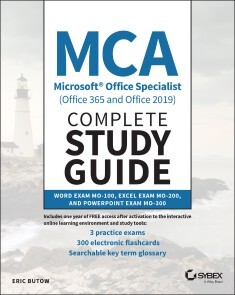
MCA Microsoft Office Specialist (Office 365 and Office 2019) Complete Study Guide
MASTER ONE OF THE MOST ESSENTIAL SKILL SETS FOR THE CONTEMPORARY OFFICEAs Microsoft Office becomes ever more ubiquitous in modern offices across the world, competence and familiarity with its intricacies is more important than ever. Now you can set yourself apart from the pack and prove your skills with the Microsoft Office Specialist certification.The MCA Microsoft Office Specialist (Office 365 and Office 2019) Complete Study Guide : Word Associate Exam MO-100, Excel Associate Exam MO-200, and PowerPoint Associate Exam MO-300 delivers a comprehensive roadmap to achieving the certification with easy-to-follow instruction for each of the three required proficiencies: Word, Excel, and PowerPoint. You’ll enjoy access to chapter review questions and Exam Essentials, a feature that identifies critical subject areas.Discover practical, hands-on exercises that prepare you for real-world roles and jobs, and gain valuable experience as you reinforce key Microsoft Office skills that you’ll be expected to demonstrate in job interviews and your day-to-day professional life. Learn to manage and create text documents in Word, perform operations with formulas in Excel, and create engaging slideshows and presentations in PowerPoint.This practical book also provides:* Fully updated information for the latest Microsoft Office Specialist certification exams covering Microsoft Office 365 * Access to new career opportunities with a professional certification that’s relevant to virtually any office environment * Access to the Sybex online study tools, with chapter review questions, full-length practice exams, hundreds of electronic flashcards, and a glossary of key terms The MCA Microsoft Office Specialist (Office 365 and Office 2019) Complete Study Guide offers crystal-clear organization, comprehensive coverage, and easy-to-understand instruction. It’s perfect for anyone who hopes to prove their skills with the Microsoft Office Specialist certification or to improve their mastery of Microsoft Office 365.ABOUT THE AUTHORERIC BUTOW is the author of 41 books on technology topics and has developed and taught networking, computing, and usability courses for Ed2Go, Virtual Training Company, California State University, Sacramento, and Udemy. He has been using Office since 1994. He’s served as a technical writer for companies like Intel, Wells Fargo, Cisco Systems, and Hewlett-Packard. He is the founder and owner of Butow Communications Group in Jackson, California.Introduction xxiAssessment Test xxviiiAnswers to Assessment Test xlPART I WORD EXAM MO-100 1CHAPTER 1 WORKING WITH DOCUMENTS 3Navigating Within Documents 4Searching for Text 4Linking to Locations Within Documents 8Moving to Specific Locations and Objects in Documents 9Showing and Hiding Formatting Symbols and Hidden Text 10Formatting Documents 13Setting Up Document Pages 14Applying Style Settings 15Inserting and Modifying Headers and Footers 17Configuring Page Background Elements 18Saving and Sharing Documents 20Saving Documents in Alternative File Formatting 20Changing Basic Document Properties 21Modifying Print Settings 23Sharing Documents Electronically 24Inspecting Documents for Issues 26Locating and Removing Hidden Properties and Personal Information 26Finding and Fixing Accessibility Issues 28Locating and Correcting Compatibility Issues 29Summary 30Key Terms 31Exam Essentials 31Review Questions 33CHAPTER 2 INSERTING AND FORMATTING TEXT 35Adding and Replacing Text 36Finding and Replacing Text 36Inserting Symbols and Special Characters 40Formatting Text and Paragraphs 42Adding Text Effects 42Applying Formatting by Using Format Painter 43Setting Line and Paragraph Spacing and Indentation 43Applying Built-In Styles to Text 46Clearing Formatting 47Creating and Configuring Document Sections 50Formatting Text in Multiple Columns 50Inserting Page, Section, and Column Breaks 52Changing Page Setting Options for a Section 53Summary 56Key Terms 57Exam Essentials 57Review Questions 58CHAPTER 3 MANAGING TABLES AND LISTS 61Creating Tables 62Converting Text to Tables 64Switching Tables to Text 65Creating Tables by Specifying Rows and Columns 66Modifying Tables 68Sorting Table Data 68Configuring Cell Margins and Spacing 70Merging and Splitting Cells 73Resizing Tables, Rows, and Columns 75Splitting Tables 80Configuring a Repeating Row Header 82Creating and Formatting Lists 85Structuring Paragraphs as Numbered and Bulleted Lists 85Changing Bullet Characters and Number Formatting 86Defining Custom Bullet Characters and Number Formatting 88Increasing and Decreasing List Levels 91Restarting and Continuing List Numbering 92Setting Starting Number Values 94Summary 95Key Terms 96Exam Essentials 96Review Questions 97CHAPTER 4 BUILDING REFERENCES 99Creating and Managing Referencing Elements 100Inserting Footnotes and Endnotes 100Modifying Footnote and Endnote Properties 103Creating and Modifying Bibliography Citation Sources 104Inserting Citations for Bibliographies 107Working with Referencing Tables 109Inserting Tables of Contents 109Customizing Tables of Contents 110Adding Bibliographies 112Summary 113Key Terms 113Exam Essentials 114Review Questions 115CHAPTER 5 ADDING AND FORMATTING GRAPHIC ELEMENTS 117Inserting Illustrations and Text Boxes 118Adding Shapes 118Including Pictures 120Inserting 3D Models 121Adding SmartArt Graphics 122Placing Screenshots and Screen Clippings 123Inserting Text Boxes 125Formatting Illustrations and Text Boxes 127Applying Artistic Effects 127Adding Picture Effects and Picture Styles 128Removing Picture Backgrounds 131Formatting Graphic Elements 132Setting Up SmartArt Graphics 134Working with 3D Models 136Adding and Organizing Text 137Formatting Text in Text Boxes 137Adding Text in Shapes 139Changing SmartArt Graphic Content 141Modifying Graphic Elements 142Positioning Objects 142Wrapping Text Around Objects 143Adding Alt Text to Objects 146Summary 148Key Terms 148Exam Essentials 148Review Questions 149CHAPTER 6 WORKING WITH OTHER USERS ON YOUR DOCUMENT 151Adding Comments 152Inserting Comments 152Reviewing and Replying to Comments 153Resolving Comments 154Deleting Comments 155Tracking Your Changes 157Turning On Track Changes 157Reviewing Tracked Changes 158Accepting and Rejecting Tracked Changes 159Locking and Unlocking Change Tracking 162Summary 165Key Terms 165Exam Essentials 165Review Questions 166PART II EXCEL EXAM MO-200 169CHAPTER 7 MANAGING WORKSHEETS AND WORKBOOKS 171Importing Data into Workbooks 172Bringing in Data from TXT Files 173Importing Data from CSV Files 174Navigating Within Workbooks 178Searching for Data Within a Workbook 178Navigating to Named Cells, Ranges, or Workbook Elements 180Inserting and Removing Hyperlinks 182Formatting Worksheets and Workbooks 190Modifying Page Settings 190Adjusting Row Height and Column Width 192Customizing Headers and Footers 200Customizing Options and Views 206Customizing the Quick Access Toolbar 207Displaying and Modifying Workbook Content in Different Views 211Freezing Worksheet Rows and Columns 214Changing Window Views 216Modifying Basic Workbook Properties 218Displaying Formulas 219Configuring Content for Collaboration 222Setting a Print Area 222Saving Workbooks in Other File Formats 224Configuring Print Settings 224Inspecting Workbooks for Issues 225Summary 229Key Terms 229Exam Essentials 229Review Questions 231CHAPTER 8 USING DATA CELLS AND RANGES 233Manipulating Data in Worksheets 234Pasting Data by Using Special Paste Options 234Filling Cells by Using Auto Filling 238Inserting and Deleting Multiple Columns or Rows 240Adding and Removing Cells 242Formatting Cells and Ranges 245Merging and Unmerging Cells 245Modifying Cell Alignment, Orientation, and Indentation 246Formatting Cells by Using Format Painter 249Wrapping Text Within Cells 250Using Number Formatting 252Applying Cell Formatting from the Format Cells Dialog Box 253Working with Cell Styles 254Clearing Cell Formatting 256Defining and Referencing Named Ranges 258Defining a Named Range 258Naming a Table 263Summarizing Data Visually 265Inserting Sparklines 265Applying Built-In Conditional Formatting 269Removing Conditional Formatting 271Summary 275Key Terms 275Exam Essentials 275Review Questions 277CHAPTER 9 WORKING WITH TABLES AND TABLE DATA 279Creating and Formatting Tables 280Creating Excel Tables from Cell Ranges 280Applying Table Styles 282Converting Tables to Cell Ranges 283Modifying Tables 285Adding or Remove Table Rows and Columns 285Configuring Table Style Options 288Inserting and Configuring Total Rows 289Filtering and Sorting Table Data 292Filtering Records 292Sorting Data by Multiple Columns 296Summary 298Key Terms 299Exam Essentials 299Review Questions 300CHAPTER 10 PERFORMING OPERATIONS BY USING FORMULAS AND FUNCTIONS 303Inserting References 304Inserting Relative, Absolute, and Mixed References 305Referencing Named Ranges and Named Tables in Formulas 307Calculating and Transforming Datas 310Performing Calculations Using the AVERAGE(), MAX(), MIN(), and SUM() Functions 310Perform Conditional Operations by Using the IF() Function 321Formatting and Modifying Text 325Formatting Text Using the RIGHT(), LEFT(), and MID() Functions 325Formatting Text Using the UPPER(), LOWER(), and LEN() Functions 329Formatting Text Using the CONCAT() and TEXTJOIN() Functions 333Summary 336Key Terms 337Exam Essentials 337Review Questions 338CHAPTER 11 MANAGING CHARTS 341Creating Charts 342Building Charts 342Working with Chart Sheets 344Modifying Charts 348Adding Data Series to Charts 348Switching Between Rows and Columns in Source Data 351Adding and Modifying Chart Elements 352Formatting Charts 355Using Chart Layouts 356Applying Chart Styles 364Adding Alternative Text to Charts for Accessibility 366Summary 368Key Terms 368Exam Essentials 369Review Questions 370PART III POWERPOINT EXAM MO-300 373CHAPTER 12 CREATING PRESENTATIONS 375Modifying Slide Masters, Handout Masters, and Note Masters 377Changing the Slide Master Theme or Background 378Modifying Slide Master Content 383Creating Slide Layouts 384Modify Slide Layouts 389Modifying the Handout Master 393Modifying the Notes Master 400Changing Presentation Options and Views 406Changing the Slide Size 406Displaying Presentations in Different Views 408Setting Basic File Properties 410Configuring Print Settings for Presentations 411Printing All or Part of a Presentation 411Printing Notes Pages 413Printing Handouts 414Printing in Color, Grayscale, or Black and White 415Configuring and Presenting Slideshows 417Creating Custom Slideshows 417Configuring Slideshow Options 422Rehearsing Slideshow Timing 423Setting Up Slideshow Recording Options 427Presenting Slideshows by Using Presenter View 430Preparing Presentations for Collaboration 436Mark Presentations as Final 437Protecting Presentations by Using Passwords 438Inspecting Presentations for Issues 439Adding and Managing Comments 441Preserving Presentation Content 446Exporting Presentations to Other Formats 447Summary 456Key Terms 457Exam Essentials 457Review Questions 459CHAPTER 13 MANAGING SLIDES 461Inserting Slides 462Importing Word Document Outlines 462Inserting Slides from Another Presentation 465Inserting Slides and Selecting Slide Layouts 467Inserting Summary Zoom Slides 469Duplicating Slides 474Modifying Slides 475Hiding and Unhiding Slides 476Modifying Individual Slide Backgrounds 477Inserting Slide Headers, Footers, and Page Numbers 480Ordering and Grouping Slides 484Creating Sections 484Modifying the Slide Order 486Renaming Sections 488Summary 489Key Terms 490Exam Essentials 490Review Questions 491CHAPTER 14 INSERTING AND FORMATTING TEXT, SHAPES, AND IMAGES 493Formatting Text 495Applying Formatting and Styles to Text 495Formatting Text in Multiple Columns 501Creating Bulleted and Numbered Lists 502Inserting Links 504Inserting Hyperlinks 504Inserting Section Zoom Links and Slide Zoom Links 505Inserting and Formatting Images 509Resizing and Cropping Images 511Applying Built-In Styles and Effects to Images 513Inserting Screenshots and Screen Clippings 515Inserting and Formatting Graphic Elements 518Inserting and Changing Shapes 518Drawing by Using Digital Ink 520Adding Text to Shapes and Text Boxes 523Resizing Shapes and Text Boxes 525Formatting Shapes and Text Boxes 527Applying Built-In Styles to Shapes and Text Boxes 529Adding Alt Text to Graphic Elements for Accessibility 532Ordering and Grouping Objects on Slides 534Ordering Shapes, Images, and Text Boxes 534Aligning Shapes, Images, and Text Boxes 535Grouping Shapes and Images 537Displaying Alignment Tools 538Summary 539Key Terms 540Exam Essentials 540Review Questions 541CHAPTER 15 INSERTING TABLES, CHARTS, SMARTART, 3D MODELS, AND MEDIA 543Inserting and Formatting Tables 544Creating and Inserting Tables 544Inserting and Deleting Table Rows and Columns 545Applying Built-In Table Styles 548Inserting and Modifying Charts 551Creating and Inserting Charts 551Modifying Charts 554Inserting and Formatting SmartArt Graphics 560Inserting SmartArt Graphics 560Converting Lists to SmartArt Graphics 560Adding and Modifying SmartArt Graphic Content 563Inserting and Modifying 3D Models 565Inserting 3D Models 565Modifying 3D Models 567Inserting and Managing Media 568Inserting Audio and Video Clips 568Creating and Inserting Screen Recordings 576Configuring Media Playback Options 581Summary 584Key Terms 585Exam Essentials 585Review Questions 587CHAPTER 16 APPLYING TRANSITIONS AND ANIMATIONS 589Applying and Configuring Slide Transitions 590Applying Basic and 3D Slide Transitions 590Configuring Transition Effects 592Animating Slide Content 596Animating Text and Graphic Elements 596Animating 3D Models 606Configuring Animation Effects 609Configuring Animation Paths 612Reordering Animations on a Slide 617Setting Timing for Transitions 619Setting Transition Effect Duration 619Configuring Transition Start and Finish Options 620Summary 622Key Terms 622Exam Essentials 623Review Questions 624APPENDIX ANSWERS TO REVIEW QUESTIONS 627PART I: WORD EXAM MO-100 628Chapter 1: Working with Documents 628Chapter 2: Inserting and Formatting Text 628Chapter 3: Managing Tables and Lists 629Chapter 4: Building References 630Chapter 5: Adding and Formatting Graphic Elements 630Chapter 6: Working with Other Users on Your Document 631PART II: EXCEL EXAM MO-200 632Chapter 7: Managing Worksheets and Workbooks 632Chapter 8: Using Data Cells and Ranges 632Chapter 9: Working with Tables and Table Data 633Chapter 10: Performing Operations by Using Formulas and Functions 634Chapter 11: Managing Charts 634PART III: POWERPOINT EXAM MO-300 635Chapter 12: Creating Presentations 635Chapter 13: Managing Slides 636Chapter 14: Inserting and Formatting Text, Shapes, and Images 636Chapter 15: Inserting Tables, Charts, SmartArt, 3D Models, and Media 637Chapter 16: Applying Transitions and Animations 638Index 639

Lean Excellence in der Informationstechnologie
Jeder Prozess hat seine Verschwendungen: Dieser Umstand sorgt für einen enormen Organisationsaufwand und spielt gerade in der Wirtschaft eine bedeutende Rolle. Häufig kommt es vor, dass ein guter oder smarter Prozess zum Wettbewerbsvorteil oder gar zur Position des Weltmarktführers führt. Um einen verschwendungsarmen Prozess zu gestalten bedarf es an Führung, Organisation, bestimmten Methoden und Unternehmenskultur – diese bilden das Rückgrat der operativen Exzellenz. Wie ist das möglich, gerade wenn Prozesse kontinuierlich hinterfragt werden?Dieses Buch bietet eine mögliche Lösung: An einem konkreten Fallbeispiel wird detailliert erklärt, wie mit Hilfe eines Makigamis jegliche Prozesse aufgenommen und entsprechend aufbereitet werden. Das Makigami bietet uns eine einfache Möglichkeit, um hochindividuelle Prozesse standardisiert zu mappen, jegliche Arten der Verschwendung transparent darzustellen, sowie diese gleichzeitig zu quantifizieren.Der höchste Schwierigkeitsgrad der Prozessoptimierung ist in diesem Buch durch ein Fallbeispiel veranschaulicht. Rückblickend sind Prozessoptimierungen im physikalischen Umfeld gestartet. Nachfolgend konnten administrative Prozesse gestaltet und verbessert werden. Zuletzt sind es Prozessabläufe, die sich in der Interaktion unserer Computer wiederfinden.Nikola Vidovic wurde 1986 geboren. Nach seiner Berufsausbildung zum Bürokaufmann in einem Energieversorgungsunternehmen entschied er sich, nebenberuflich den Bachelor of Science in Wirtschaftsinformatik zu absolvieren. Dies erfolgte an der Hochschule Wismar, mit dem Schwerpunkt Operative Exzellenz in der IT. Anschließend erlangte er seinen Master of Science in IT-Management, mit dem Schwerpunkt Blockchain in der Energiewirtschaft. Mit der Erfahrung aus 16 Jahren Energiewirtschaft und seinen zahlreichen erfolgreich abgeschlossenen IT-Projekten ist Nikola Vidovic in der Rolle des Produktmanagers kontinuierlich dabei, die Digitalisierung mit digitalen Lösungen und den neuesten Methoden voranzutreiben.
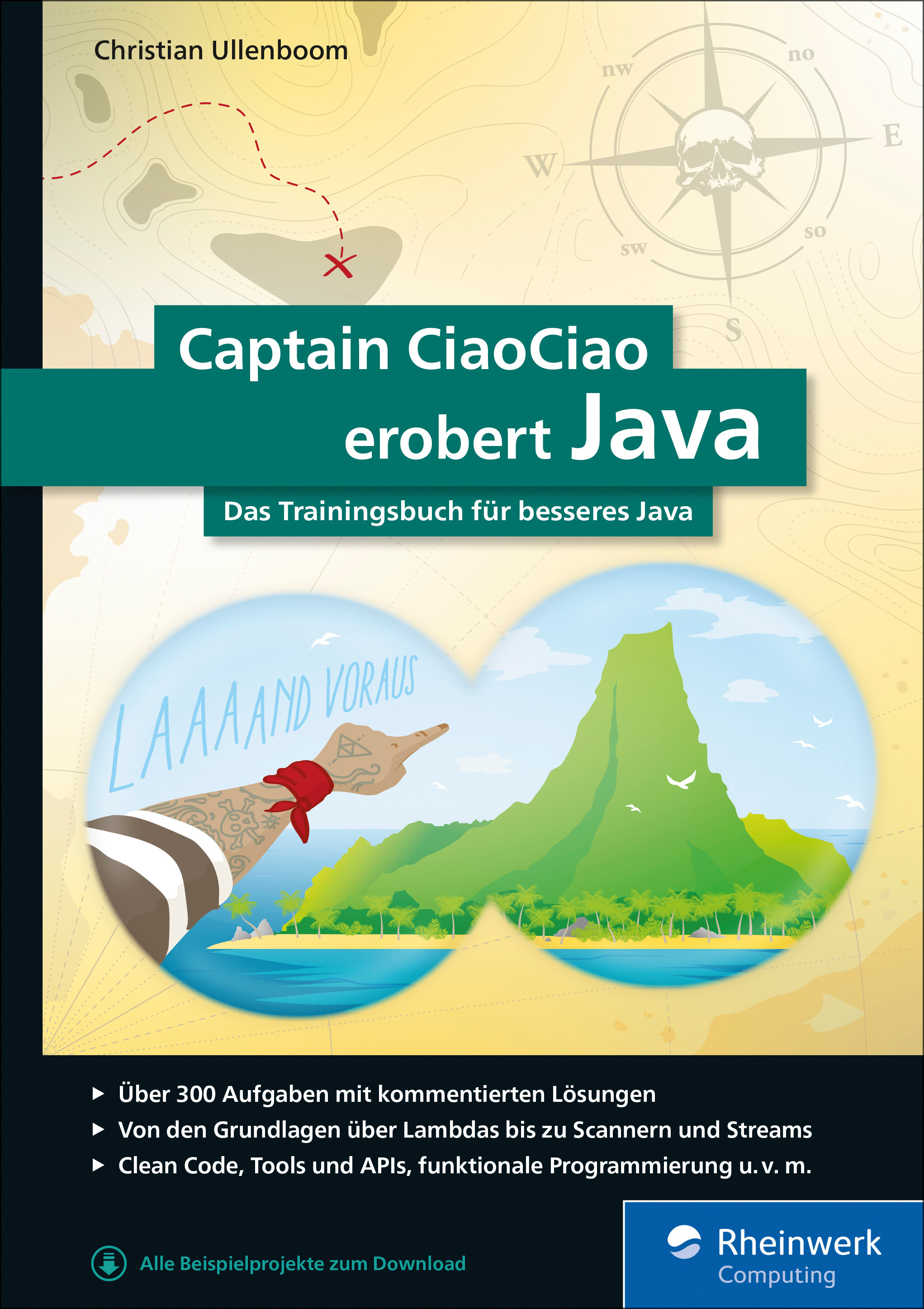
Captain CiaoCiao erobert Java
Bessere Java-Skills entwickeln und trainieren. Das Trainingsbuch für besseres Java.Das große Java-Trainingsbuch – vom Autor des Klassikers »Java ist auch eine Insel«. Heben Sie Ihre Coding-Fähigkeiten auf das nächste Level und testen Sie Ihre Java-Kenntnisse an kniffligen Programmieraufgaben rund um den Piratenkapitän CiaoCiao. Christian Ullenboom bietet Ihnen alles, was Sie dazu brauchen: Übungen zu Features und Kniffen, die man als Profi im Detail kennen sollte, sowie ein intensives Training für Clean Code und durchdachtes Design, das auch komplexe Software trägt. Zahlreiche Best Practices und ausführlich kommentierte Lösungen zu den Aufgaben machen dieses Buch zum perfekten Workout für die professionelle Softwareentwicklung mit Java.Aus dem InhaltAlle BasicsAufgaben in drei SchwierigkeitsstufenThemen auf vielen NiveausThreadsicherheitStrings und reguläre AusdrückeFunktionale ProgrammierungComparator- und Comparable-InterfaceXML, JSON und mehr verarbeitenSchnittstellen zum BetriebssystemReflection-API von A bis ZStreams, Datenbanken u. v. m.Annotations gekonnt einsetzenInhalt (PDF-Link)Leseprobe (PDF-Link)

ABAP in Eclipse
Master Advanced Business Application Programming (ABAP) Development Tools by installing, customizing, and using them in Eclipse.The book begins by describing the installation and customization of ABAP Development Tools in Eclipse and how to adjust the IDE to meet your requirements. You will discover the ABAP Development Tools functionality that helps you be more efficient in programming in the ABAP language, including refactoring, markers, quick fixes, unit testing, and much more. Moving on, you will cover the available Eclipse plugins that you can use with ABAP Development Tools to make Eclipse even more developer-friendly: ABAP Continuous Integration and ABAP Extensions. Finally, you will learn how to create your own Eclipse plugin that is integrated with ABAP Development Tools.This book is perfect for every ABAP developer who wants to get started with ABAP Development Tools in Eclipse, as well as experienced ADT users who would like to take advantage of hidden functions or external extensions for ADT and Eclipse.WHAT YOU WILL LEARN* Install and configure your ABAP in Eclipse to meet your personal requirements* Discover the functionalities of ABAP in Eclipse that will accelerate your development* Use additional extensions to make your work with Eclipse more enjoyable* Create your own plugin that works with ABAP in EclipseWHO THIS BOOK IS FORABAP developers that want or need to switch to Eclipse and current ABAP in Eclipse users who want to learn its possibilities and hidden features.Łukasz is IT manager for SAP applications at Hager Group. He has been active in the SAP community for more than ten years. He mostly shares his knowledge on his blog (Abap Blog). He is a creator of the following Eclipse plugins: ABAP Favorites, ABAP Extensions, and ABAP Quick Fix. He also shares his ABAP projects or frameworks on GitHub as fidley; these include: Fast ALV Grid, JSON2ABAPType, Customers, and ALV Grid in a Nutshell. He was a speaker at the last four #sitWROs and attended a few others around Europe. SAP Developer Hero 2016 and SAP Champion from 2019. He can also teach you how to brew a beer. Chapter 1: Installation, Basic ConfigurationCHAPTER GOAL: PROVIDE INFORMATION ABOUT HOW TO GET STARTED WITH ABAP IN ECLIPSESUB -TOPICS1. How to install Eclipse & ABAP Development Tools2. How to create ABAP Projects and structure of the project explorer3. Perspectives4. Standard Eclipse and ADT Views5. Eclipse PreferencesChapter 2: Eclipse and ADT PreferencesCHAPTER GOAL: EXPLAIN POSSIBILITIES OF CONFIGURATION OF YOUR ECLIPSE ENVIRONMENTSUB -TOPICS1. Update sites2. Debug preferences3. ABAP Development Preferences4. Syntax highlighting5. Eclipse PreferencesChapter 3: How to Use ABAP in Eclipse to Accelerate your WorkCHAPTER GOAL: DESCRIBE ALL KNOWN FUNCTIONALITIES OF ABAP IN ECLIPSE THAT WILL MAKE THE DEVELOPER LIFE EASIERSUB - TOPICS1. Refactoring2. Quick fixes3. Completion assistant4. Markers5. Formatting, Formatting of block6. Block Selection7. ATC8. Unit Test9. etc.. all functionalities of10. Shortcuts CheatSheetChapter 4: Eclipse Extensions that will make the differenceCHAPTER GOAL: DESCRIPTION OF ECLIPSE PLUGINS FOR ABAP AND GLOBAL, THAT CAN ENHANCE HUGELY THE WORK WITH ADTNO OF PAGES :SUB - TOPICS:1. ABAP CI plugin2. abapGit Plugin3. ABAP Favorites4. ABAP Extensions5. ABAP Quick Fixes6. ABAP Tags7. Darkest Dark8. Any Edit9. etc.Chapter 5: CHAPTER GOAL: EXPLAIN THE WAY OF CREATION OF ECLIPSE PLUGINSSUB - TOPICS:1. Basic information about creating an Eclipse plugin2. Creation of Eclipse plugin with TreeView or Table control and testing it3. Explanation of features and update sitesChapter 6: Extending ABAP Development ToolsCHAPTER GOAL: SHOW EXAMPLE OF SIMPLE ECLIPSE PLUGIN THAT WORKS WITH ABAP DEVELOPMENT TOOLS TO SUPPORT THE DEVELOPER & HOW TO CREATE YOUR OWN QUICK FIXES FOR ATC CHECKSSUB - TOPICS:1. Creation of Eclipse plugins calling ABAP backend2. Creating quick fix for ATC Checks

Mastering Voice Interfaces
Build great voice apps of any complexity for any domain by learning both the how's and why's of voice development. In this book you’ll see how we live in a golden age of voice technology and how advances in automatic speech recognition (ASR), natural language processing (NLP), and related technologies allow people to talk to machines and get reasonable responses. Today, anyone with computer access can build a working voice app. That democratization of the technology is great. But, while it’s fairly easy to build a voice app that runs, it's still remarkably difficult to build a great one, one that users trust, that understands their natural ways of speaking and fulfills their needs, and that makes them want to return for more.We start with an overview of how humans and machines produce and process conversational speech, explaining how they differ from each other and from other modalities. This is the background you need to understand the consequences of each design and implementation choice as we dive into the core principles of voice interface design. We walk you through many design and development techniques, including ones that some view as advanced, but that you can implement today. We use the Google development platform and Python, but our goal is to explain the reasons behind each technique such that you can take what you learn and implement it on any platform.Readers of Mastering Voice Interfaces will come away with a solid understanding of what makes voice interfaces special, learn the core voice design principles for building great voice apps, and how to actually implement those principles to create robust apps. We’ve learned during many years in the voice industry that the most successful solutions are created by those who understand both the human and the technology sides of speech, and that both sides affect design and development. Because we focus on developing task-oriented voice apps for real users in the real world, you’ll learn how to take your voice apps from idea through scoping, design, development, rollout, and post-deployment performance improvements, all illustrated with examples from our own voice industry experiences.WHAT YOU WILL LEARN* Create truly great voice apps that users will love and trust* See how voice differs from other input and output modalities, and why that matters* Discover best practices for designing conversational voice-first applications, and the consequences of design and implementation choices* Implement advanced voice designs, with real-world examples you can use immediately.* Verify that your app is performing well, and what to change if it doesn't Who This Book Is ForAnyone curious about the real how’s and why’s of voice interface design and development. In particular, it's aimed at teams of developers, designers, and product owners who need a shared understanding of how to create successful voice interfaces using today's technology. We expect readers to have had some exposure to voice apps, at least as users.Ann Thymé-Gobbel's career has focused on how people use speech and natural language to communicate with each other and with technology. After completing her PhD in cognitive science and linguistics from UC San Diego, she's held a broad set of voice-related UI/UX design roles in both large corporations and small start-ups, working with diverse teams in product development, client project engagements, and R&D. Her past work includes design, data analysis and establishing best practices at Nuance, voice design for mobile and in-home devices at Amazon Lab 126, and creating natural language conversations for multimodal healthcare apps at 22otters. Her research has covered automatic language detection, error correction, and discourse structure. She is currently Director of UI/UX Design at Loose Cannon Systems, the team bringing to market Milo, a handsfree wearable communicator. Ann never stops doing research: she collects and analyzes data at every opportunity and enjoys sharing her findings with others, having presented and taught at conferences internationally.Charles Jankowski has over 30 years’ experience in industry and academia developing applications and algorithms for real-world users incorporating advanced speech recognition, speaker verification, and natural language technologies. He has used state-of-the-art machine learning processes and techniques for data analysis, performance optimization, and algorithm development. Charles has highly in-depth technical experience with state-of-the-art technologies, effective management of cross-functional teams for all facets of application deployment, and outstanding relationships with clients. Currently, he is Director of NLP at Brain Technologies, creating the Natural iOS application with which you can “Say it and Get it.” Previously he was Director of NLP and Robotics at CloudMinds, Director of Speech and Natural Language at 22otters, Senior Speech Scientist at Performance Technology Partners, and Director of Professional Services at Nuance. He has also been an independent consultant. Charles holds S.B., S.M., and Ph.D. degrees from MIT, all in electrical engineering.PART 1 – Voice System FoundationsChapter 1: Say Hello to Voice SystemsChapter goal: Introduce the reader to voice-first technology, its core concepts, and typical phases of development through an explanatory background for the current state and challenges of voice.No of pages - 20Sub-topics1. Voice-first, voice-only, and conversational everything2. Introduction to voice technology components (Speech to text, Natural languageunderstanding, Dialog management, Natural language generation, Text to speech)3. The phases of voice development success (Plan, Design, Build, Test, Deploy &Assess, Iterate)4. Hope is not a strategy – but to plan & execute isChapter 2: Keeping Voice in MindChapter goal: Explain to the reader how humans and computers “talk” and “listen.”What’s easy and hard for the human user and the technology in a dialog, and why.No of pages - 15Sub-topics1. Why voice is different2. Hands-on: A pre-coding thought experiment3. Voice dialog and its participants• The Human: spoken natural language understanding• The Computer: voice system recognition and interpretation• Human-computer voice dialog - Successful voice-first development is all aboutcoordinating human abilities with the technology to allow conversations betweentwo very different dialog participants.Chapter 3: Running a Voice Implementation—and Noticing IssuesChapter goal: Allow the reader to put into practice their newly learned foundation byimplementing and running a simple voice application in the Google Assistant framework,and experiencing how quickly even a simple voice interaction needs improvement.No of pages - 15Sub-topics1. Hands-on: Preparing a restaurant finder2. Introducing voice platforms3. Hands-on: Implementing the restaurant finderBasic setup, Specifying a first intent, Doing something, What the user says,What the VUI says, Connecting Dialogflow to Actions on Google, Testingthe app, Saving the voice interaction4. Google’s voice development ecosystem, and why we're using it here5. The pros and cons of relying on tools6. Hands-on: Making changes - testing and iterating (Adding phrases to handle the same meaning, additional content, and more specific)PART 2 – Planning Voice System InteractionsChapter 4: Defining your Vision: Building What, How, and Why for WhomChapter goal: Introduce voice-focused requirement discovery, highlighting differencesfrom other modalities and devices and showingNo of pages - 25Sub-topics1. Functional requirements: What are you building? (General and detailed functionality)2. Non-functional business requirements: Why are you building it? (Purpose, underlyingservice and existing automation, branding and terminology, data needs, access andavailability, legal and business constraints)3. Non-functional user requirements: Who will use it and what do they want? (Userpopulation demographics and characteristics, engagement patterns, mental modelsand domain knowledge, environment and state of mind)4. Non-functional system requirements; How will you build it? (Available options forrecognizer, parser, and interpreter, external data sources, data storage and data access, other system concerns)Chapter 5: From Discovery to UX and UI Design: Tools of the Voice-First TradeChapter goal: Show how to turn discovery findings into high-level architectural designs,using flows diagrams, sample dialogs, and detailed dialog management specs.No of pages - 20Sub-topics1. Where to find early user data on any budget (online research, crowd sourcing, dialogparticipant observation, focus groups, interviews, and surveys)2. How discovery results feed into VUI design decisions (dialog manager graphs)3. Capturing and documenting VUI design (dialog flows, sample dialogs, detaileddesign specifications, VUI design documentation approaches)4. Prototyping and testing your assumptions (early voice UX and prototypingapproaches)PART 3 – Building Voice System InteractionsChapter 6: Applying Human 'Rules of Dialog' to Reach Conversation ResolutionChapter goal: Learn that voice-first dialogs have resolutions. Learn how to design andimplement fully specified requests in the 3 core dialog types: question-answer, actionrequests, and task completion requests.No of pages - 30Sub-topics1. Dialog acts, games and turns – and Grice2. Question answering3. Action requests4. Task completion requests5. Fully specified request (Single slot and Multi-slot requests)6. Determining dialog acts based on feature discovery7. Dialog completion (Responding to 'goodbye' and 'thanks')Chapter 7: Resolving Incomplete Requests Through DisambiguationChapter goal: Explain how to handle incomplete and ambiguous requests, includingcommon disambiguation methods (yes/no, A/B sets, lists and menus) and when to apply each.No of pages - 30Sub-topics1. Incomplete requests - how to reach completeness2. Ambiguous requests3. Disambiguation methods (Logic-based assumptions, Yes/No questions, A/B sets,Static lists, Dynamic lists, Open sets, Menus)4. Testing on the device to find and solve issues5. Toward code independence: using webhooks (fulfillment, contexts, contextparameters, and follow-up)Chapter 8: Conveying Reassurance with Confidence and ConfirmationChapter goal: Teach the importance of conveying reassurance and how to apply different confirmation strategies. Introduce discourse markers and backchannels.No of pages - 30Sub-topics1. Conveying reassurance and shared certainty - Setting expectations2. Webhooks, Take 2 (Dialogflow system architecture, webhook request and response,Implementing the webhook)3. Confirmation methods (Non-verbal confirmation, Generic acknowledgment, Implicitand Explicit confirmations)4. Confirmation placement – confirming slots versus intents5. Disconfirmation: dealing with “no”6. Additional reassurance techniques and pitfalls (System pronunciation, Backchannels,Discourse markers, VUI architecture)7. Choosing the right reassurance methodChapter 9: Helping Users Succeed Through ConsistencyChapter goal: Explore how to navigate an audio interaction that is by nature fleeting andsequential. Provide design and implementation that incorporates consistency throughcorrectly scoped global commands, landmarks, non-verbal audio.No of pages - 20Sub-topics1. Universals (Uses: clarification and additional information, allow a do-over, providean exit)2. Navigation (Landmarks, Non-verbal audio, Content playback navigation, Listnavigation)3. Consistency, variation and randomization (built-in global intents, consistency acrossVUIs and frameworksChapter 10: Creating Robust Coverage for Speech-to-Text ResolutionChapter goal: Teach the nuts and bolts of the computer-side of "listening," starting withthe mapping of sounds to words and how to create solid synonym coverage. Topicsinclude different approaches to recognition, including regular expressions and statisticalmodels, dictionaries, domain knowledge, normalizing, and bootstrapping.No of pages - 25Sub-topics1. Recognition is speech-to-text interpretation2. Recognition engines3. Grammar concepts (Coverage, Recognition space, Static or dynamic, End-pointing,Multiple hypotheses)4. Types of grammars (Rule-based grammars, Statistical models, Hot words, Wakewords and invocation names)5. Working with grammars (Writing rule-based regular expressions)6. How to succeed with grammars (Bootstrapping, Normalizing punctuation andspellings, Handling unusual pronunciations, Using domain knowledge, the strengthsand limitations of STT)7. A simple example (Sample phrases in Dialogflow, Regular expressions in thewebhook)8. Limitations on grammar creation and useChapter 11: Reaching Understanding Through Parsing and Intent ResolutionChapter goal: Explore the second part of computer "listening": interpreting the meaning.Topics cover intent resolution, parsing and multiple passes, the use of tagging guides and middle layers.No of pages - 20Sub-topics1. From words to meaning (NLP, NLU)2. Parsing3. Machine learning and NLU4. Ontologies, knowledge bases and content databases5. Intents (Intent tagging and tagging guides, Middle layers: semantic tags versus systemendpoints)6. Putting it all together (Matching wide or narrow, Multiple grammars, multiple passes)7. A simple example (The Stanford Parser revisited, Determining intent, Machinelearning and using knowledge)Chapter 12: Applying Accuracy Strategies to Avoid MisunderstandingsChapter goal: Explain how misunderstandings happen and how to avoid them throughtechniques that minimize errors and the need to start over. Topics include design andimplementation of a wide set of robustness techniques, including powerful advancedtechniques.No of pages - 25Sub-topics1. Accuracy robustness underlying concepts2. Accuracy robustness strategies (Examples, Providing help, Just-in-time information,Hidden options and "none of those", Recognize-and-reject, One-step-correction,Tutorials, Spelling, Narrowing recognition space)3. Advanced techniques (Multi-tiered behavior and confidence scores, N-best and skiplists, Probabilities, Contextual latency)Chapter 13: Choosing Strategies to Recover from MiscommunicationChapter goal: Explore how to recover when miscommunication happens. Show how torecover and get users back on track quickly, and when to stop trying. Topics includedesign and implementation of several recovery strategies.No of pages - 15Sub-topics1. Recovery from what?2. Recovery strategies (Meaningful contextual prompts, Escalating prompts, Taperedprompts, Rapid reprompt, Backoff strategies)3. When to stop trying (Max error counts, Transfers)4. Choosing recovery strategy (Recognition, intent, or fulfillment errors)Chapter 14: Using Context and Data to Create Smarter ConversationsChapter goal: Explain why context is king in spoken conversation. Show how to accessand update data from various sources, and how to use that data within and across dialogs to create smarter interactions. Topics focus on how to design and implement context aware dialogs using anaphora, proactive behaviors, proximity, geo-location, domain knowledge, and other powerful methods.No of pages - 25Sub-topics1. Why there’s no conversation without context2. Reading and writing data (External accounts and services)3. Persistence within and across conversations4. Context-aware and context-dependent dialogs (Discourse markers andacknowledgments, Anaphora resolution, Follow-up dialogs and linked requests,Proactive behaviors, Topic, domain and world knowledge, Geo location-basedbehavior, Proximity and relevance, Number and type of devices, Time and day, Useridentity, preferences and account types, User utterance wording, System conditions5. Tracking context in modular and multiturn dialogsChapter 15: Creating Secure Personalized ExperiencesChapter goal: Cover personalization and customization. Topics include identification,authentication, privacy and security concerns, system persona audio, and working withTTS versus recorded prompts.No of pages - 25Sub-topics1. The importance of knowing who’s talking2. Individualized targeted behaviors (Concepts in personalization and customization,Implementing individualized experiences3. Authorized secure access4. Approaches to identification and authentication (Implementing secure gated access)5. Privacy and security concerns6. System persona (Defining and implementing a system persona, How persona affectsdialogs7. System voice audio (TTS or voice talent, generated or recorded, Finding and workingwith voice talents, One or several voices, Prompt management)8. Emotion and style9. Voice for specific user groupsPART 4 – Verifying and Deploying Voice System InteractionsChapter 16: Testing and Measuring Performance in Voice SystemsChapter goal: Explain the do’s and don’ts of QA testing a voice system. Topics includeuser testing methods that work best for voice, the code needed to support them, and how to improve system performance based on findings.No of pages - 20Sub-topics1. Testing voice system performance (Recognition testing, Dialog traversal: functionalend-to-end testing, Wake word and speech detection testing, Additional systemintegration testing)2. Testing usability and task completion (Voice usability testing concepts, Wizard of Ozstudies)3. Tracking and measuring performance (Recognition performance metrics, Taskcompletion metrics, User satisfaction metrics)Chapter 17: Tuning and Deploying Voice SystemsChapter goal: Show how to improve, or tune, voice solutions before and after deploying a voice system. Teach what real user data says about the system performance, what to log and track, how to measure accuracy, and how to interpret the data.No of pages - 25Sub-topics1. Tuning: what is it and why do you do it? (Why recognition accuracy isn’t enough,Analyzing causes of poor system performance)2. Tuning types and approaches (Log-based versus transcription-based tuning, Coveragetuning, Recognition accuracy tuning, Finding and using recognition accuracy data,Task completion tuning, Dialog tuning, Prioritizing tuning efforts)3. Mapping observations to the right remedy (Reporting and using tuning results)4. How to maximize deployment success (Know when to tune, Understand tuningcomplexities to avoid pitfalls)

Extending Kubernetes
Rely on this comprehensive guide to understand the extension patterns and discover the extension plugins for Kubernetes.In this book, state-of-the-art extension patterns and extension points of Kubernetes are covered in depth with real-life use cases and examples. There are comprehensive discussions in the text on all possible aspects of Kubernetes, starting from end-user to the fully-automated controller development. The book focuses on creating applications that work on Kubernetes and also interact and operate Kubernetes itself.The book starts with a recap of Kubernetes, its rich configuration options, extension patterns, and points. The journey of extending Kubernetes starts with the CLI tool plugins. By the end of this section, you will be able to create and manage kubectl plugins. Then, the API access plugins with authentication and authorization webhooks are presented. In this section, you will learn how to extend and interfere with the API flow of Kubernetes. You then move on to learn how to extend Kubernetes API with new resources and controllers. You will make Kubernetes API work for you by creating a Kubernetes operator. Extensions for Kubernetes schedulers are covered to create a custom scheduler and run it side-by-side with the default scheduler. Finally, the last extension points will be discussed for the infrastructure, such as networking or storage. At the end of the text, you will learn the upcoming extension points. This book is designed to cover all the extension points of Kubernetes with state-of-the-art implementations.This book is intended for those who wish to understand Kubernetes in depth and go further by making Kubernetes work for their custom requirements. By the end of this book, readers with a cloud-native mindset will broaden their vision to create future-proof applications. Rather than focus on overwhelming theoretical information and YAML files for Kubernetes resources, readers are provided with the philosophy behind Kubernetes extensions. With real-life examples and hands-on development steps, you will be more confident in working with Kubernetes.WHAT YOU WILL LEARN* Know the Kubernetes extension patterns and available extension points * Be familiar with the philosophy behind Kubernetes extensions and how they should be integrated into the clusters* Design Kubernetes extensions and make Kubernetes work for you* Develop, deploy, and operate plugins for Kubernetes ranging from the CLI tool to custom resources, schedulers, infrastructure, and more * Study real-life use cases for extending Kubernetes with code examplesWHO THIS BOOK IS FORSoftware engineers, developers, DevOps engineers, cloud security analysts, architects, and managers who have Kubernetes in their short- and long-term plansONUR YILMAZ is a senior software engineer at a multinational enterprise software company. He is a Certified Kubernetes Administrator (CKA) and works on Kubernetes and cloud management systems. He is a keen supporter of cutting-edge technologies, including Docker, Kubernetes, and cloud-native applications. He is the author of multiple books on Kubernetes, Docker, serverless architectures, and cloud-native continuous integration and delivery. He has one master and two bachelor degrees in the engineering field.Chapter 1: IntroductionCHAPTER GOAL: Provide an introduction to Kubernetes, configuration options, extension patterns, and extension points with real-life use casesNO OF PAGES: 25-30SUB-TOPICS:1. Kubernetes Recap2. Configuring Kubernetes Cluster3. Kubernetes Extension Patterns4. Kubernetes Extension PointsChapter 2: kubectl pluginsCHAPTER GOAL: Understand how to extend Kubernetes CLI tool, kubectl, for the custom requirements. How to develop, install and release new plugins for kubectlNO OF PAGES: 30-35SUB-TOPICS:* kubectl Installation and Usage* kubectl Plugin Design* Create Your First kubectl Plugin* Plugin Repository and LifecycleCHAPTER 3: API FLOW EXTENSIONSCHAPTER GOAL: Understand the flow of Kubernetes API server to handle requests. Learn how to extend the flow with authentication, authorization, and admission controls.NO OF PAGES: 25-30SUB -TOPICS:* Authentication WebhooksAuthorization Webhooks * Dynamic Admission ControlCHAPTER 4: EXTENDING KUBERNETES APICHAPTER GOAL: Discuss how Kubernetes API can be extended with custom resources and the automation of the custom resources, namely operators.NO OF PAGES: 50-55SUB-TOPICS:* Kubernetes API Overview* Kubernetes Client Libraries* Custom Resources in Kubernetes* Operator Pattern in Kubernetes* kubebuilder Framework* Operators in ActionCHAPTER 5: SCHEDULER EXTENSIONSCHAPTER GOAL: Learn how Kubernetes scheduling mechanism works and how it could be extended. Write, deploy, and use a custom scheduler for Kubernetes cluster.NO OF PAGES: 35-40SUB-TOPICS:* Kubernetes Scheduler OverviewDevelop and Deploy a Custom Scheduler * Configure and Manage Multiple Schedulers CHAPTER 6: INFRASTRUCTURE EXTENSIONSCHAPTER GOAL: Discover how Kubernetes interacts with the infrastructure in terms of storage and networking. Learn how to extend Kubernetes clusters with new pod networking and volume drivers.NO OF PAGES: 25-30SUB-TOPICS:* Storage Plugins* Network Plugins (They are still in development, and in alpha stage, if they become stable, it is an excellent asset to have in the book) CHAPTER 7: UPCOMING EXTENSION POINTSCHAPTER GOAL: Summarize the extension points of Kubernetes and discuss the upcoming trends and libraries in the market.NO OF PAGES: 20-25

Programmieren lernen für Dummies (2. Auflg.)
Haben Sie auch schon mal den Wunsch verspürt, programmieren zu können? Oder wenigstens zu verstehen, wie Computer ticken, die unser Leben bestimmen? Dieses Buch führt in die Denkweise von Programmierern und die Funktionsweise von Programmen ein und zeigt Ihnen, worauf Sie beim Programmieren achten müssen: Geben Sie eindeutige Anweisungen, sichern Sie sich immer gegen alle Eventualitäten ab und kommen Sie mit den gegebenen, beschränkten Mitteln aus. Gut, dass der Computer wenigstens nicht murrt, wenn er monotone Tätigkeiten ausführen muss! Am Ende des Buches angelangt, haben Sie einen wichtigen Ausschnitt unserer Welt besser kennen gelernt und Einblicke in allgemeine Programmierkonzepte und zwei Programmiersprachen erhalten. Dann sind Sie in der Lage, fundiert zu entscheiden, ob und wie Sie Ihr Wissen weiter vertiefen wollen. Daniel Lorig programmiert bereits seit seiner Schulzeit und hat 2010 sein Master-Studium in Informatik an der Universität des Saarlandes in Saarbrücken abgeschlossen. Danach hat er als Softwareentwickler in einem saarländischen Unternehmen gearbeitet. Mittlerweile selbstständig, liegt sein Fokus nun auf der Programmierung und Gestaltung von Webseiten.Über den Autor 7Einleitung 21TEIL I: GRUNDLAGEN DER PROGRAMMIERUNG29Kapitel 1: Von der Idee zum Programm 31Kapitel 2: Programmiersprachen: Ein Überblick 41Kapitel 3: So lernen Sie programmieren 53Kapitel 4: Was sich alles programmieren lässt 61Kapitel 5: Algorithmen erstellen 77Kapitel 6: Wichtige Konzepte in Programmiersprachen 87Kapitel 7: Fortgeschrittene Programmiertechniken 107TEIL II: PROGRAMMIEREN MIT JAVA135Kapitel 8: Compiler und Entwicklungsumgebung 137Kapitel 9: Die ersten Schritte in der Java-Programmierung 145Kapitel 10: Variablen und Datentypen in Java 161Kapitel 11: Ablaufsteuerung in Java 177Kapitel 12: Objektorientierte Programmierung in Java 189Kapitel 13: Weitere Features von Java 221Kapitel 14: Die Klassenbibliothek von Java 241Kapitel 15: Grafische Benutzeroberflächen 263TEIL III: PROGRAMMIERUNG FÜR DAS WEB MIT PHP291Kapitel 16: Einführung in HTML 293Kapitel 17: Werkzeuge für die Webprogrammierung 311Kapitel 18: Einstieg in die PHP-Programmierung 321Kapitel 19: Datenbankprogrammierung 349Kapitel 20: Dynamische Webseiten programmieren 365TEIL IV: WERKZEUGE FÜR PROGRAMMIERER399Kapitel 21: Fehler finden und beseitigen 401Kapitel 22: Die Macht des Internets nutzen 419Kapitel 23: Versionskontrolle 427TEIL V: DER TOP-TEN-TEIL439Kapitel 24: (Ungefähr) 10 externe Zusatzbibliotheken für Java 441Kapitel 25: (Mehr als) 10 nützliche Webseiten für Programmierer 447Stichwortverzeichnis 453

Pro PHP 8 MVC
Examine the building blocks that make any good MVC framework using PHP 8. This book exposes all the considerations that many developers take for granted when using a popular framework, and teaches you how to make this MVC framework your own.You'll quickly get started writing your first bit of framework code, then, you build a variety of examples using aspects of an MVC framework, including a router, a template engine, a database library, a persistence engine (ORM), and a testing framework. In the next section, you'll implement sessions, caches, file systems, queues, logging, and mail. You'll wrap up by building a larger scale sample web application: a sales website for a company that sells rockets.Along the way, this book lays bare all the secret parts of MVC to take with you to apply to your own PHP-based MVC projects.WHAT YOU WILL LEARN* Build PHP-based web applications using the model view controller (MVC) architecture * Write your first bit of framework code* Compare the code you write with how the popular frameworks do the same kinds of thingsCreate various aspects of applications, engines, and other frameworks * Wrap up with a sample case study applicationWHO THIS BOOK IS FORExperienced PHP and web developers. Some prior experience with PHP and web development at least recommended.Christopher Pitt is an experienced PHP and JavaScript/CSS web developer and writer, working at SilverStripe. He usually works on application architecture, though sometimes you’ll find him building compilers or robots. He is also the author of several web development books and is a contributor on various open source projects such as AdonisJs and Masonite.1: Ways to Use PHP2: Writing Our First Bit of Code3: Building a Router4: Building a Template Engine5: Building a Validator6: Building a Database Library7: Building an Object-Relational Mapper Library8: Building a Dependency Injection Container9: Testing Our Framework10: Config, Cache, Sessions, Filesystems11: Queues, Logging, Emails12: Publishing Your CodeAfterword: Wrapping Up
UX-Design überzeugend vermitteln
Erfolgreich mit Kunden und Stakeholdern kommunizieren und die bestmögliche User Experience erzielen.Wie gut Ihr Design auch sein mag: Ohne die Unterstützung von Nicht-Designerkollegen, Stakeholdern und Kunden werden aus Ihren Entwürfen niemals Produkte. UX-Designer und -Designerinnen verbringen den größten Teil ihrer Arbeitszeit nicht mit dem Design selbst, sondern mit der Kommunikation und Diskussion von Designentscheidungen.Dieser praktische Leitfaden konzentriert sich auf Prinzipien, Taktiken und umsetzbare Methoden zur erfolgreichen Präsentation Ihrer Entwürfe. Ganz gleich, ob Sie Apps, Websites oder Produkte designen: Sie werden lernen, wie Sie sich die Unterstützung derjenigen Personen sichern, die wirklichen Einfluss auf ein Projekt haben – immer mit dem Ziel, die bestmögliche User Experience zu realisieren.Zum AutorTom Greever entwirft seit mehr als 20 Jahren Schnittstellen und leitet Designteams. Sein umfangreiches Wissen darüber, wie bessere Kommunikation zu großartigem Design führt, geht auf seine breite Erfahrung als UX Designer, Executive Design Leader und Consultant zurück. Er coacht und berät Teams zu Designpraktiken und Kommunikation sowohl in großen Unternehmen als auch in kleinen Start-ups rund um die Welt.

Introduction to Python Network Automation
Learn and implement network automation within the Enterprise network using Python 3. This introductory book will be your guide to building an integrated virtual networking lab to begin your Network Automation journey and master the basics of Python Network Automation.The book features a review of the practical Python network automation scripting skills and tips learned from the production network, so you can safely test and practice in a lab environment first, various Python modules such as paramiko and netmiko, pandas, re, and much more. You'll also develop essential skills such as Python scripting, regular expressions, Linux and Windows administration, VMware virtualization, and Cisco networking from the comfort of your laptop/PC with no actual networking hardware. Finally, you will learn to write a fully automated and working Cisco IOS XE upgrade application using Python.Introduction to Python Network Automation uses a canonical order, where you begin at the bottom and by the time you have completed this book, you will at least reach the intermediate level of Python coding for enterprise networking automation using native Python tools.WHAT YOU'LL LEARN* Build a proper GNS3-based networking lab for Python network automation needs* Write the basics of Python code in both the Windows and Linux environments* Control network devices using telnet, SSH, and SNMP protocols using Python codes* Understand virtualization and how to use VMware workstation* Examine virtualization and how to use VMware Workstation Pro* Develop a working Cisco IOS upgrade application WHO THIS BOOK IS FORIT engineers and developers, network managers and students, who would like to learn network automation using Python.Brendan is currently working as a Senior Technical Consultant for Australia’s leading Telco, Telstra. Telstra is the largest Australian Internet Service Provider (ISP) as well as one of the leading IT System Integrator and Managed Services Provider in Australian IT industry. He has more than 15 years of hands-on experience working with Cisco Networking, Unified Collaboration, VMware Virtualization and Operating System Administration. He began his IT career in Cisco Systems and then moved onto various roles in leading System Integrators in Australian IT scenes. He is currently working on a number of external clients’ environment and supports a diverse IT ecosystem, currently focusing on Python Network Automation. This book is largely based on Python network Automation he has developed in his previous job and the original book, “Python Network Automation: by building a virtual lab”. Also, this book is a memoir of Network Automation Journey leveraging off the power of Python as the preferred Programming Language.INTRODUCTION TO PYTHON NETWORK AUTOMATIONChapter 1: Introduction to Python Network AutomationChapter 2: Learn Python Basics on WindowsChapter 3: More Python ExercisesChapter 4: Introduction to VMware WorkstationChapter 5: Creating Virtual Machines Using Ubuntu 20 Server ImageChapter 6: Creating Virtual Machines Using CentOS 8 Server ImageChapter 7: Linux FundamentalsChapter 8: Linux Basic AdministrationChapter 9: Regular Expressions for Network AutomationChapter 10: GNS3 BasicsChapter 11 Cisco IOS LabsChapter 12. Building a Python Automation Lab EnvironmentChapter 13. Python Network Automation Lab: Basic TelnetChapter 14. Python Network Automation Labs: SSH Paramiko and NetmikoChapter 15. Python Network Automation Labs: Cron and SNMPv3Chapter 16. Python Network Automation Labs: Ansible, pyATS, Docker, and Twilio APIChapter 17. Upgrading Multiple Cisco IOS XE RoutersChapter 18. Python Network Automation Lab: Cisco IOS Upgrade mini-tools DevelopmentChapter 19. Python Network Automation Labs Combining and Completing Cisco IOS Upgrade Application

How to Make a Game
Get a head start on making your games efficiently by avoiding common design and development pitfalls. Video games combine art and programming; this unique position has opened up opportunities for many pitfalls. This book takes you through the fundamentals of game making and the usual mistakes and bad practices that can harm your games.We start with the common difficulties and challenges, ways to find the gaps, and game design. Next, we discuss game engines and other tools you need to choose while making a game, how you should choose them, and the design documents you need to make. We also cover simple but important tweaks in game mechanics as well as the look and feel of your game. We will also discuss conventions for naming, code structuring, project structuring, and coding.Your thought process will be guided in a way that you can look for the proper approach to make a successful game. The book sheds light upon how to improve the overall game experience and finalize the game for release. Along the journey, we will explore some interesting stories of games and mythology as well.By the end of the book, you will know about the basic life cycle of a game development process and how to not make a game.WHAT YOU WILL LEARN* Discover the fundamentals of game design * See some intermediate coding tricks to make your games better* Grasp the pitfalls to avoid while designing and programming games* Master the different conventions and practices for file naming and structuring your projects WHO THIS BOOK IS FORPeople who want to make games. Basic programming experience is assumed.MINHAZ-US-SALAKEEN FAHME is the co-founder and CEO of Battery Low Interactive Ltd—a company that makes wishes come true. It started as a game studio in 2015 and over the years, grew into a bunch of wings- each working dedicatedly on serious games; web and app development; business and marketing solutions using augmented reality and virtual reality; digital marketing; and small-scale indie games. With their outreach campaigns, Battery Low has reached half a million kids with the experience of immersive technology for the first time. Fahme also conducts sessions on AR, VR, MR, game design, entrepreneurship, career, and leadership for youth and entrepreneurs in educational institutions, national, and international events. He is a blogger and game designer/writer by passion while cats, travels, live concerts, epic fantasies keep him running.TANIMUL HAQUE KHAN is the head of the Unity department of Brain Station 23, a service-based company. He along with his team has been providing AR/VR enterprise solutions since 2018. He has been working with Unity technologies since 2015. He has played an uncountable number of games across multiple platforms mostly on PC and console. He is one of the most well-recognized Unity developers in Bangladesh. Aside from the tech industry he has also co-founded the very first cat cafe in Bangladesh known as Capawcino.Chapter 1: Don'tChapter Goal: In this chapter, you will get introduced to the core difficulties and challenges of the game making journey.Chapter 2: The Fault in Our StarsChapter Goal: This chapter will discuss the first encounters with games as well as the process of finding the gaps and lacking. We will also discuss game analysis in this chapter.Chapter 3: Don't Reinvent the WheelChapter Goal: We will discuss the game engine and the purpose they serve as powerful and necessary tools in game development.Chapter 4: Choose Your ArsenalChapter Goal: We will learn about game engines in greater detail including their pros n cons by building a RPG.Chapter 5: It's All in My Head/ Don't Keep It All in Your HeadChapter Goal: Learn to make Game Design Document, writing practices, and hurdles that may be stopping you from writing it.Chapter 6: A Stitch in Time Saves NineChapter Goal: This chapter teaches conventions of file naming, structuring, project structuring, coding (with some examples)Chapter 7: Git GoodChapter Goal: We will learn about version controlChapter 8: Get Smart!Chapter Goal: This chapter shows the ill effects of hard code. This would enable you to differentiate between good and bad approaches towards code and learn how to eliminate them.Chapter 9: Game Design - The Three musketeers!Chapter Goal: You will learn the overall journey of game design, understanding all the components, their role, and how to roll them properly.Chapter 10: Game Feel and EffectsChapter Goal: We will learn about camera effect, audio effect, particle effect in this chapter.Chapter 11: Input MattersChapter Goal: Learn about choosing input styles properly.Chapter 12: Help!Chapter Goal: This chapter will helping you transcend through reality (pseudo code), dynamic difficulty.Chapter 13: Platform Choosing (Pros n Cons)Chapter Goal: This chapter will help you choose the right platform to publish your game.Chapter 14: The Great Filter/Fermi ParadoxChapter Goal: In this chapter, you will learn how to test your game and how to approach publishing and assessing the success.Chapter 15: Gameover - The Myth of Sisyphus/Insanity Loop/Core LoopChapter Goal: In the final chapter, we will evaluate all we have learnt by studying this game, its success, and the future

Pro Power BI Theme Creation
Use JSON theme files to standardize the look of Power BI dashboards and reports. This book shows how you can create theme files using the Power BI Desktop application to define high-level formatting attributes for dashboards as well as how to tailor detailed formatting specifications for individual dashboard elements in JSON files. Standardize the look of your dashboards and apply formatting consistently over all your reports. The techniques in this book provide you with tight control over the presentation of all aspects of the Power BI dashboards and reports that you create.Power BI theme files use JSON (JavaScript Object Notation) as their structure, so the book includes a brief introduction to JSON as well as how it applies to Power BI themes. The book further includes a complete reference to all the current formatting definitions and JSON structures that are at your disposal for creating JSON theme files. Finally, the book includes dozens of theme files, from the simple to the most complex, that you can adopt and adapt to suit your own requirements.WHAT YOU WILL LEARN* Produce designer output without manually formatting every individual visual in a Power BI dashboard* Standardize presentation for families of dashboard types* Switch presentation styles in a couple of clicks* Save dozens, or hundreds, of hours laboriously formatting dashboards* Define enterprise-wide presentation standards* Retroactively apply standard styles to existing dashboardsWHO THIS BOOK IS FORPower BI users who want to save time by defining standardized formatting for their dashboards and reports, IT professionals who want to create corporate standards of dashboard presentation, and marketing and communication specialists who want to set organizational standards for dashboard deliveryADAM ASPIN is an independent business intelligence consultant based in the United Kingdom. He has worked with SQL Server for over 25 years, and now focuses on Power BI. During this time, he has developed several dozen BI and analytics systems based on the Microsoft BI product suite. Adam has been creating JSON theme files since the feature was first introduced in Power BI Desktop, and has delivered corporate Power BI themes for dozens of clients across Europe.Adam is a graduate of Oxford University. He has applied his skills for a range of clients in finance, banking, utilities, telecoms, construction, and retail. He is the author of Apress books: SQL Server Data Integration Recipes; Business Intelligence with SQL Server Reporting Services; High Impact Data Visualization in Excel with Power View, 3D Maps, Get and Transform and Power BI; Pro Power BI Desktop; and Data Mashup with Microsoft Excel Using Power Query and M. 1. Introduction to Power BI Themes2. Create and Customize a Theme In Power BI Desktop3. High-Level Theme Definition4. Default Visual Styles5. Object Visual Styles6. Card and Table Visual Styles7. Classic Chart Visual Styles8. Complex Chart Visual Styles9. Other Chart Visual Styles10. Maps11. Miscellaneous Visual Styles12. Dashboard Styling13. Cascading Styles

SAP S/4HANA Embedded Analytics
Imagine you are a business user, consultant, or developer about to enter an SAP S/4HANA implementation project. You are well-versed with SAP’s product portfolio and you know that the preferred reporting option in S/4HANA is embedded analytics. But what exactly is embedded analytics? And how can it be implemented? And who can do it: a business user, a functional consultant specialized in financial or logistics processes? Or does a business intelligence expert or a programmer need to be involved? Good questions!This book will answer these questions, one by one. It will also take you on the same journey that the implementation team needs to follow for every reporting requirement that pops up: start with assessing a more standard option and only move on to a less standard option if the requirement cannot be fulfilled. In consecutive chapters, analytical apps delivered by SAP, apps created using Smart Business Services, and Analytical Queries developed either using tiles or in a development environment are explained in detail with practical examples. The book also explains which option is preferred in which situation. The book covers topics such as in-memory computing, cloud, UX, OData, agile development, and more.Author Freek Keijzer writes from the perspective of an implementation consultant, focusing on functionality that has proven itself useful in the field. Practical examples are abundant, ranging from “codeless” to “hardcore coding.”WHAT YOU WILL LEARN* Know the difference between static reporting and interactive querying on real-time data* Understand which options are available for analytics in SAP S/4HANA* Understand which option to choose in which situation* Know how to implement these optionsWho This Book is ForSAP power users, functional consultants, developersFREEK KEIJZER has a background in science (physics), industry (manufacturing, process industry) and ICT (SAP system integration), holding various project management, people management, and specialist positions. He holds degrees in natural sciences (PhD) and information management (MIM). In 1996, he became involved in an SAP implementation, initially as an R/3 key user, later as internal project leader, interim manager of the support organization, and (international) information manager. Since 2001, he has focused on SAP BI consultancy, working for three consultancy firms and more than 50 clients. His responsibilities as a consultant include product development, team competence development, sales support, and resourcing. Freek's specialties (technical) include SAP Business Intelligence, Hana, NetWeaver, and ERP integration. His roles include project leader, lead consultant, business consultant, (interim) manager, and scrum master.Since 2015, Freek has been a brewer/owner of the Rubelijn craft beer brand.CHAPTER 1: BEFORE THE WORK STARTSCHAPTER GOAL: Miscellaneous intro topics.NO OF PAGES: 40SUB -TOPICS1. Business Intelligence: the art of enriching data2. HANA changing the OLTP versus OLAP game3. Cloud flavors: SaaS versus IaaS4. The latest thing: CDS-views5. Frontend: Fiori and UI56. SAP’s BI portfolio7. S/4HANA and Embedded AnalyticsCHAPTER 2: NO WORK: USE WHAT IS DELIVEREDCHAPTER GOAL: S/4HANA comes with rich analytical apps that can be used immediately. This chapter focuses on the content delivered by SAP.NO OF PAGES: 20SUB - TOPICS1. Discover analytical apps2. Activate them3. Use themCHAPTER 3: SOME WORK: SMART BUSINESS SERVICECHAPTER GOAL: S/4HANA has built-in functions for codeless creation of simple analytical apps. Target group of these functions are power users, but in practice functional (non-BI) consultants are most suitable to use this functionality.Functions are made available as a group of Fiori-tiles under the product name “Smart Business Service”.NO OF PAGES : 30SUB - TOPICS:1. Tiles “KPI Design”2. Tiles “Report Design”3. Tile “Analysis Path Framework Modeling”4. The end-result: again tilesCHAPTER 4: MORE WORK: BUILDING ANALYTICAL QUERIES USING TILESCHAPTER GOAL: S/4HANA comes with tiles to create so-called “Analytical Queries” starting from SAP-delivered CDS-views. Analytical Queries are not static reports, but versatile, interactive queries on real-time data.For the SaaS version of S/4HANA, this is the only option to create Analytical Queries.NO OF PAGES: 40SUB - TOPICS:1. Discovery of SAP-delivered CDS-views with tile “View Browser”2. Enriching CDS-views with tiles “Custom CDS Views”3. Building an Analytical Query with tile “Custom Analytical Query”4. Running the query with tile “Query Browser”5. How to navigate within an Analytical Query.6. Creating a dedicated tile for the queryCHAPTER 5: MOST WORK: BUILDING ANALYTICAL QUERIES IN A DEVELOPMENT ENVIRONMENTCHAPTER GOAL: Starting from real-life business requirements, often the conclusion is reached that SAP-delivered CDS-views won’t do the trick. For a SaaS version of S/4HANA, the process following this conclusion is called “managing expectations”. For an on-premise version, a development environment can be applied. And then … the sky is the limit! Development can start not only from SAP-delivered CDS-views but also from tables.NO OF PAGES: 60SUB - TOPICS:1. Layered approach towards the analytical query2. Data-integration3. “Cube-view”4. Analytical query5. Examples transaction data6. Examples master data7. Example: Replacing custom ABAP-report by analytical query8. Performance considerations; balance between performance and support-friendliness9. Access and data authorizationCHAPTER 6: EXTENSIBILITY, ODATA AND BEYONDCHAPTER GOAL: Miscellaneous outro topics related to Embedded AnalyticsNO OF PAGES: 20SUB - TOPICS:1. S/4HANA Extensibility2. OData and APIs3. Agile development and Devops4. Ideal skill-set for an Embedded Analytics expert

Transactional Machine Learning with Data Streams and AutoML
Understand how to apply auto machine learning to data streams and create transactional machine learning (TML) solutions that are frictionless (require minimal to no human intervention) and elastic (machine learning solutions that can scale up or down by controlling the number of data streams, algorithms, and users of the insights). This book will strengthen your knowledge of the inner workings of TML solutions using data streams with auto machine learning integrated with Apache Kafka.Transactional Machine Learning with Data Streams and AutoML introduces the industry challenges with applying machine learning to data streams. You will learn the framework that will help you in choosing business problems that are best suited for TML. You will also see how to measure the business value of TML solutions. You will then learn the technical components of TML solutions, including the reference and technical architecture of a TML solution.This book also presents a TML solution template that will make it easy for you to quickly start building your own TML solutions. Specifically, you are given access to a TML Python library and integration technologies for download. You will also learn how TML will evolve in the future, and the growing need by organizations for deeper insights from data streams.By the end of the book, you will have a solid understanding of TML. You will know how to build TML solutions with all the necessary details, and all the resources at your fingertips.WHAT YOU WILL LEARN* Discover transactional machine learningMeasure the business value of TML * Choose TML use cases* Design technical architecture of TML solutions with Apache Kafka* Work with the technologies used to build TML solutions* Build transactional machine learning solutions with hands-on code together with Apache Kafka in the cloudWHO THIS BOOK IS FORData scientists, machine learning engineers and architects, and AI and machine learning business leaders.Sebastian Maurice is founder and CTO of OTICS Advanced Analytics Inc. and has over 25 years of experience in AI and machine learning. Previously, Sebastian served as Associate Director within Gartner Consulting focusing on artificial intelligence and machine learning. He was instrumental in developing and growing Gartner’s AI consulting business. He has led global teams to solve critical business problems with machine learning in oil and gas, retail, utilities, manufacturing, finance, and insurance. Dr. Maurice also brings deep experience in oil and gas (upstream) and was one of the first in Canada to apply machine learning to oil production optimization, which resulted in a Canadian patent: #2864265.Sebastian is also a published author with seven publications in international peer-reviewed journals and books. One of his publications (International Journal of Engineering Education, 2004) was cited as landmark work in the area of online testing technology. He also developed the world’s first Apache Kafka connector for transactional machine learning: MAADS-VIPER.Dr. Maurice received his PhD in electrical and computer engineering from the University of Calgary, and has a master’s in electrical engineering, and a master’s in agricultural economics, with bachelors in pure mathematics and bachelors (hon) in economics.Dr. Maurice also teaches a course on data science at the University of Toronto and actively helps to develop AI course content at the University of Toronto. He is also active in the AI community and an avid blogger and speaker. He also sits on the AI advisory board at McMaster University.Chapter 1: Introduction: Big data, Auto Machine Learning and Data StreamsChapter 2: Transactional Machine LearningChapter 3: Industry Challenges with Data Streams and AutoMLChapter 4: The Business Value of Transactional Machine LearningChapter 5: The Technical Components and Architecture for Transactional Machine LearningOverview of a TML SolutionChapter 6: Template for Transactional Machine Learning SolutionsCHAPTER 7: Visualize Your TML Model Insights: Optimization, Predictions and AnomaliesChapter 8: Evolution and Opportunities For Transactional Machine Learning in Almost Every IndustryChapter 9: Conclusion and Final Thoughts.

Learn to Program with Kotlin
Teach yourself programming starting with the basics and progressing to a series of exciting projects using Kotlin, one of today's hottest programming languages. This book starts with the absolute basics and then introduces just enough syntax to get into some fascinating projects. These include text processing: a statistical analysis of Jane Austen's novels, solving anagrams, and working with palindromes; image processing: cropping and resizing images, and pixel transformation; and computer vision: finding digits, parsing images, and reading speed signs.The projects are developed in tiny steps and complete solutions are provided. Some of these projects include core data science concepts, giving you skills in one of the most important areas of modern programming. Along the way you’ll cover functional programming, object-oriented programming (OOP), refactoring, and writing unit tests.After reading Learn to Program with Kotlin, you'll come away with practical insights and code to get you started right away with programming using Kotlin for your own projects.WHAT YOU WILL LEARN* Gain the basics of Kotlin using the IntelliJ Java IDE* Implement OOP with Kotlin along with unit testing and code refactoring using a series of text-related projects* Harness functional programming with Kotlin by building an image-processing library* Write software to locate and read speed signs in photosWHO IS THIS BOOK FORAnyone who wants to learn how to program or code from scratch. Also great for experienced programmers who want to know more about Kotlin. Tim Lavers is a senior software engineer at KPMG with expertise in Java, Kotlin, and other programming languages employed for data engineering and enterprise software projects. He is also a mathematical hobbyist in his spare time.PART 1 - BASICSThe very basics of programming in Kotlin using the IntelliJ code editor.Chapter 1: Getting StartedChapter 2: Simple patternsChapter 3: Arrays and loopsChapter 4: Binary choicesChapter 5: IntegersChapter 6: Values and variablesChapter 7: StringsChapter 8: Data structuresChapter 9: The file systemPART II - TEXTObject-Oriented Programming, Unit Testing and code refactoring through a series of fascinating text-related projects.Chapter 10: Project AustenChapter 11: AnagramsChapter 12: PalindromesChapter 13: Word switchPART III - IMAGESThis part of the book introduces Functional Programming by building a basic image processing library.The culmination of this is a CGI (Computer Generated Imagery) project.Chapter 14: Colour picturesChapter 15: Pixel transformationsChapter 16: Cropping and resizing imagesChapter 17: Project DinoPART IV - VISIONWe cap it all of with a project in which we write software to locate and read speed signs in photos.Chapter 18: OverviewChapter 19: Finding digitsChapter 20: Parsing the imagesChapter 21: Reading speed signs
JavaServer Faces und Jakarta Server Faces 2.3 (3.Auflg.)
Das Arbeitsbuch für Java-Webentwickler in aktualisierter 3. Auflage.JavaServerTM Faces und Jakarta Server Faces 2.3 sind ein Framework für die Entwicklung von Benutzerschnittstellen für bzw. als Teil einer Java-Web-Anwendung. Dieses Arbeitsbuch führt Sie Schritt für Schritt in die Programmierung mit JSF ein. Sie erfahren, wie Sie damit moderne Benutzerschnittstellen für die Praxis entwickeln.Und natürlich geht es auch darum, wie JSF in eine Java-Web-Anwendung zu integrieren sind. Behandelt werden auch Themen wie die Anbindung an eine Datenbank mit JPA, die Verwendung von CDI sowie Authentifizierung und Autorisierung.Verfolgen Sie Schritt für Schritt die Entwicklung einer betrieblichen Anwendung und lernen Sie so anhand realer Aufgabenstellungen alle wichtigen Aspekte von JSF 2.3 kennen. Mit Hilfe der Übungen, deren Lösungen sich von der Website zum Buch und von GitHub herunterladen lassen, können Sie das Gelernte selbst ausprobieren und umsetzen.Aus dem Inhalt:EinleitungJSF im DetailContext und Dependency InjectionWeiterführende ThemenClassic ModelsSpezialthemenVerwendete SystemeAusblick/Anhang: Die Tags der Standardbibliotheken

MCA Microsoft Office Specialist (Office 365 and Office 2019) Study Guide
MCA Microsoft Office Specialist Study Guide: PowerPoint Associate Exam MO-300is your roadmap to preparing for taking the MO-300 exam and earning the PowerPoint Associate (PowerPoint and PowerPoint 2019) certification. The following objectives are covered:* Manage presentations* Manage slides* Insert and format text, shapes, and images* Insert tables, charts, smartArt, 3D models, and media* Apply transitions and animationsMajor topics include creating, editing, and enhancing presentations and slideshows, including the ability to create and manage presentations, insert and format shapes and slides, create slide content, apply transitions and animations, and manage multiple presentations. This Study Guide also covers creating professional-grade sales presentations, employee training, instructional materials, and kiosk slideshows.Readers will also have access to Sybex's superior online test bank, includng hundreds of practice questions, flashcards, and a glossary of important terms.ERIC BUTOW is the author of 39 books on technology topics and has developed and taught networking, computing, and usability courses for Ed2Go, Virtual Training Company, California State University, Sacramento, and Udemy. He has been using PowerPoint professionally since 1994. He's served as a technical writer for companies like Intel, Wells Fargo, Cisco Systems, and Hewlett-Packard. He is the founder and owner of Butow Communications Group in Jackson, California.Introduction xiAssessment Test xvCHAPTER 1 CREATING PRESENTATIONS 1Modifying Slide Masters, Handout Masters, and Note Masters 3Changing the Slide Master Theme or Background 4Modifying Slide Master Content 9Creating Slide Layouts 10Modify Slide Layouts 15Modifying the Handout Master 19Modifying the Notes Master 26Changing Presentation Options and Views 32Changing the Slide Size 32Displaying Presentations in Different Views 34Setting Basic File Properties 36Configuring Print Settings for Presentations 37Printing All or Part of a Presentation 37Printing Notes Pages 39Printing Handouts 40Printing in Color, Grayscale, or Black and White 41Configuring and Presenting Slideshows 43Creating Custom Slideshows 43Configuring Slideshow Options 48Rehearsing Slideshow Timing 49Setting Up Slideshow Recording Options 53Presenting Slideshows by Using Presenter View 56Preparing Presentations for Collaboration 62Mark Presentations as Final 63Protecting Presentations by Using Passwords 64Inspecting Presentations for Issues 65Adding and Managing Comments 67Preserving Presentation Content 72Exporting Presentations to Other Formats 73Summary 82Key Terms 83Exam Essentials 83Review Questions 85CHAPTER 2 MANAGING SLIDES 87Inserting Slides 88Importing Word Document Outlines 88Inserting Slides from Another Presentation 91Inserting Slides and Selecting Slide Layouts 93Inserting Summary Zoom Slides 95Duplicating Slides 100Modifying Slides 101Hiding and Unhiding Slides 102Modifying Individual Slide Backgrounds 103Inserting Slide Headers, Footers, and Page Numbers 106Ordering and Grouping Slides 110Creating Sections 110Modifying the Slide Order 112Renaming Sections 114Summary 115Key Terms 116Exam Essentials 116Review Questions 117CHAPTER 3 INSERTING AND FORMATTING TEXT, SHAPES, AND IMAGES 119Formatting Text 121Applying Formatting and Styles to Text 121Formatting Text in Multiple Columns 127Creating Bulleted and Numbered Lists 128Inserting Links 130Inserting Hyperlinks 130Inserting Section Zoom Links and Slide Zoom Links 131Inserting and Formatting Images 135Resizing and Cropping Images 137Applying Built-In Styles and Effects to Images 139Inserting Screenshots and Screen Clippings 141Inserting and Formatting Graphic Elements 144Inserting and Changing Shapes 144Drawing by Using Digital Ink 146Adding Text to Shapes and Text Boxes 149Resizing Shapes and Text Boxes 151Formatting Shapes and Text Boxes 153Applying Built-In Styles to Shapes and Text Boxes 155Adding Alt Text to Graphic Elements for Accessibility 158Ordering and Grouping Objects on Slides 160Ordering Shapes, Images, and Text Boxes 160Aligning Shapes, Images, and Text Boxes 161Grouping Shapes and Images 163Displaying Alignment Tools 164Summary 165Key Terms 166Exam Essentials 166Review Questions 167CHAPTER 4 INSERTING TABLES, CHARTS, SMARTART, 3D MODELS, AND MEDIA 169Inserting and Formatting Tables 170Creating and Inserting Tables 170Inserting and Deleting Table Rows and Columns 171Applying Built-In Table Styles 174Inserting and Modifying Charts 177Creating and Inserting Charts 177Modifying Charts 180Inserting and Formatting SmartArt Graphics 186Inserting SmartArt Graphics 186Converting Lists to SmartArt Graphics 186Adding and Modifying SmartArt Graphic Content 189Inserting and Modifying 3D Models 191Inserting 3D Models 191Modifying 3D Models 193Inserting and Managing Media 194Inserting Audio and Video Clips 194Creating and Inserting Screen Recordings 202Configuring Media Playback Options 207Summary 210Key Terms 211Exam Essentials 211Review Questions 213CHAPTER 5 APPLYING TRANSITIONS AND ANIMATIONS 215Applying and Configuring Slide Transitions 216Applying Basic and 3D Slide Transitions 216Configuring Transition Effects 218Animating Slide Content 222Animating Text and Graphic Elements 222Animating 3D Models 232Configuring Animation Effects 235Configuring Animation Paths 238Reordering Animations on a Slide 243Setting Timing for Transitions 245Setting Transition Effect Duration 245Configuring Transition Start and Finish Options 246Summary 248Key Terms 248Exam Essentials 249Review Questions 250APPENDIX ANSWERS TO REVIEW QUESTIONS 253Chapter 1: Creating Presentations 254Chapter 2: Managing Slides 254Chapter 3: Inserting and Formatting Text, Shapes, and Images 255Chapter 4: Inserting Tables, Charts, SmartArt, 3D Models, and Media 256Chapter 5: Applying Transitions and Animations 256Index 259

Programming Microcontrollers with Python
For the first time microcontrollers are powerful enough to be programmed in Python. The landscape of embedded systems development is changing, microcontrollers are becoming more powerful, and the rise of the internet of things is leading more developers to get into hardware. This book provides the solid foundation to start your journey of embedded systems development and microcontroller programming with Python.You’ll quickly realize the value of using Python. The theme of the book is simplicity and the cleanness and elegance of Python makes that possible. Featuring a step-by-step approach, this single source guide balances complexity and clarity with insightful explanations that you’ll easily grasp.Python is quickly becoming the language of choice for applications such as machine learning and computer vision on embedded devices. What would previously be daunting and exceedingly difficult to do in C or C++ is now possible with Python because of its level of abstraction. Programming Microcontrollers with Python is your path to bringing your existing skills to the embedded space.WHAT YOU’LL LEARN* Review microcontroller basics and the hardware and software requirements * Understand an embedded system’s general architecture* Follow the steps needed to carry a product to market * Take a crash course in Python programming * Program a microcontroller* Interface with a microcontroller using LCD and Circuit Python* Use and control sensorsWHO THIS BOOK IS FORThose getting started with microcontrollers, those new to C, C++, and Arduino programming, web developers looking to get into IoT, or Python programmers who wish to control hardware devices.Armstrong Subero started learning electronics at the age of 8. One of the happiest memories in his childhood was when he finally figured out how to make a light bulb. It took off from there as he taught himself more advanced topics in electronics, before delving into computer architecture, and eventually discovering the joys of microcontrollers and FPGAs.He currently works for the Ministry of National Security in his country and writes software, design circuits, courses, robots as well as write books, and blogs about technology on trinirobotics.com in his free time. He is also a contributing author to Free Code Camp and has degrees in Computer Science and Liberal Arts and Sciences from Thomas Edison State University. He is the author of "Programming PIC Microcontrollers in XC8" and "Codeless Data Structures and Algorithms" both published by Apress Media LLC. Preface• Why Did I Write This Book?• Who Is This Book For?• What You Will Need For This Book?• What Will I learn in This Book?• About the Author• Errata and SuggestionsChapter 1: Getting Ready In this chapter we begin learning about microcontrollers what they are and the various languages we can use for them. Things like what software and hardware you will need to follow along with the book as well as the recommended boards to use CircuitPython is covered in this chapter.• Introduction to Microcontrollers• Microcontroller Programming Languages• Assembly Language• C• C++• BASIC• Rust• Python• Selecting a Board• Adafruit Metro M0 Express• Adafruit Feather M0 Express• Adafruit Metro M4 Express• Adafruit Grand Central M4 Express• The Arduino Zero• The STM32F746ZG Nucleo• Device Comparison• The Component List• The Mu Editor• Putty• Setting up Your Own Board• ConclusionChapter 2: Electronics Primer picks up where chapter one leaves off and we move our discussion into the realm of electronics giving an overview of passive analog electronic components such as resistors, capacitors, and inductors. Along the way we learn about breadboards before diving into semiconductor electronics and basic digital electronics.• Electrical Wires• The Breadboard• Electronic Schematics• Passive Components• Resistors• Capacitors• Polarized Capacitors• Non-Polarized Capacitors• Capacitor Schematic Symbols• Inductors• Semiconductors• Diode• Light Emitting Diode• Transistor• Metal Oxide Semiconductor Field Effect Transistors• Integrated Circuits• Digital Logic• Logic Level Conversion• Flip-Flop• Registers and Shift Register• Multiplexers and Demultiplexers• ConclusionChapter 3: Embedded Systems Overview covers the software side of things. We learn about embedded systems, its structure, hardware and software systems and the general architecture of embedded systems. Things like toolchains, testing and a heavy emphasis on software architecture is covered. For those of you reading this book to make and sell your own product, I cover the steps you need to take to carry a product to market.• An Overview of Embedded Systems• Microcontroller vs Applications Processor• Embedded Systems Structure• The Hardware System• The software System• The Toolchain• Software Testing• Embedded Software Architecture• The Driver Layer• Hardware Abstraction Layers (HAL)• Board Support Package (BSP)• Middleware• Software Framework• Code Generator• Platform• Embedded Systems Constrains• Cost• Performance• Energy budget• Embedded Systems Classification• Small Scale Systems• Medium Scale Systems• High Performance Systems• Distributed Embedded Systems• Seven Steps to Developing an Embedded Product• ConclusionChapter 4: Python Programming looks at the python programming language you get a crash course in the core features of the language that you can use to write your own programs. If is written in such a way that even if you never used python, but have some experience programming you will be able to follow along.• Writing Python Programs• Whitespace• Comments• Variables and Constants• Data Types• Operators• Lists• Tuples• If Statement• Else statement• For Loop• While Loop• Functions• Lambda Functions• Exception Handling• Object Oriented Programming• Random and Time• Python vs CircuitPython• How Does My Python Program Run?• ConclusionChapter 5: Digital Control introduces us to programming the input and output on microcontrollers. We finally start to use microcontrollers and we learn a little bit about how microcontrollers work and learn how to interface them to switches and LEDs.• Microcontroller I/O• Output and Input on Microcontroller Hardware• Going Deeper into Microcontroller I/O• Output in CircuitPython• LED Control• Output with MCU Schematic• Output Circuit Connection Tips• Output with CircuitPython Program• LED Blink with CircuitPython Program• Pull-up vs Pull-Down Resistors• Switch Debouncing• Input in CircuitPython• Input with MCU Schematic (Pullup)• Pushbutton Pullup Circuit Connection Tips• Pushbutton Pullup with CircuitPython Program• Input with MCU Schematic (Pulldown)• Pushbutton Pulldown Circuit Connection Tips• Pushbutton Pulldown with CircuitPython Program• ConclusionChapter 6: Data Conversion covers analog input on our microcontroller, and we cover how analog to digital conversion works on the microcontroller. Using this information, we learn how to read potentiometers, photoresistors and temperature sensors using our microcontroller.• Analog To Digital Conversion• ADC Hardware• Going Deeper into ADC• The Potentiometer• Analog to Digital Conversion in CircuitPython• ADC with MCU Schematic• ADC Circuit Connection Tips• CircuitPython with Potentiometer Program• Photoresistor• Photoresistor with MCU Schematic• Photoresistor Circuit Connection Tips• Photoresistor with Circuitpython Program• Temperature Sensor• Temperature Sensor with MCU Schematic• Temperature Sensor Circuit Connection Tips• Temperature Sensor with Circuitpython Program• ConclusionChapter 7: Communication Protocol discusses serial communication protocols on microcontrollers, and we use USART, SPI and I2C. We cover not only how to use these protocols, but also how they operate internally. In this chapter we will cover how to use USB-UART and also how we can read the information from a accelerometer and gyroscope.• Microcontroller Communications• USART Communications• Deeper into UART• UART in CircuitPython• USB-UART with MCU Schematic• MCU with USB-UART Circuit Connection Tips• UART with CircuitPython Program• SPI Communications• Deeper into SPI• Board with Potentiometer Circuit Connection Tips• SPI with CircuitPython Program• I2C Communications• Deeper into I2C• I2C Support in CircuitPython• The MPU6050• I2C with MCU Schematic• I2C Circuit Connection Tips• I2C with CircuitPython Program• Adding Libraries• MPU6050 with CircuitPython Program• ConclusionChapter 8: Display Interfacing teaches us the basics of display interfacing with microcontrollers. We learn about how the LCD works and learn how to use them with our CircuitPython microcontroller. We also learn about OLEDs and learn how we can drive an OLED using CircuitPython.• The Liquid Crystal Display• Using a GLCD• Monochrome GLCD Schematic• PCD8544 with CircuitPython• Troubleshooting• The Framebuffer• OLED• Using an OLED• MCU with OLED Schematic• CircuitPython with OLED Program• ConclusionChapter 9: Controlling DC Actuators is about controlling DC actuators. We will learn about things like DC motors, stepper motors and servo motors and learn how to control them with the microcontroller devices. PWM is covered in this chapter as well.• DC Motors• Driving DC Motors• Pulse Width Modulation• PWM in CircuitPython• PWM with CircuitPython Program• Controlling Motor Speed• The H-Bridge• H-Bridge with MCU Schematic• H-Bridge with CircuitPython Program• Servo Motors• Servo Motors in CircuitPython• Servo Motor with MCU Schematic• Servo Motor with CircuitPython Program• Stepper Motors• Stepper Motors in CircuitPython• Stepper Motor with MCU Schematic• Stepper Motor with CircuitPython Program• ConclusionChapter 10: Python MCU Interfacing presents specifics of using and controlling some sensors you are likely to want to use in your own projects. These include RGB LEDs, ultrasonic sensors, piezo speakers, and humidity sensors.• RGB LED• RGB LED with MCU Schematic• RGB LED Circuit Connection Tips• Libraries We’ll Need• RGB LED with Circuitpython Program• HC-SR04• HC-SR04 with MCU Schematic• HC-SR04 Circuit Connection Tips• Libraries We’ll Need• HC-SR04 with Circuitpython Program• Piezo Speaker• Piezo with MCU Schematic• Piezo Circuit Connection Tips• Libraries We’ll Need• Piezo with Circuitpython Program• DHT11• DHT11 with MCU Schematic• DHT11 Sensor Circuit Connection Tips• Libraries We’ll Need• DHT11 Sensor with CircuitPython Program• Conclusion

Digitale Transformation von Geschäftsmodellen
Dieses Buch zeigt, wie es Unternehmen gelingt, ihre Geschäftsmodelle auf die digitale Zukunft vorzubereiten und wie dadurch Wettbewerbsvorteile geschaffen und Kundenanforderungen besser erfüllt werden können. Die Autoren aus Praxis und Wissenschaft zeigen die digitale Transformation von Unternehmen über die gesamte Wertschöpfungskette hinweg. Die Beiträge behandeln Ansätze und Instrumente, Studienergebnisse und Best Practices unterschiedlicher Industrien im Kontext der digitalen Transformation. Die Inhalte berücksichtigen divergierende Anforderungen von Unternehmen und Industrien und können nach Bedarf kombiniert und erweitert werden, um sie an die spezifischen Rahmenbedingungen eines Unternehmens anzupassen. Die zweite aktualisierte Auflage wurde überarbeitet und enthält neue wissenschaftliche und praktische Beiträge zu den folgenden drei zentralen Themen: Ansätze und Instrumente, Studienergebnisse sowie Best Practices aus den Bereichen Mobilität, Gesundheit, Maschinenbau, Medien, Lebensmittel, Banken und Handel. Ansätze und Instrumente.- Studienergebnisse.- Best Practices aus den Bereichen Mobilität, Gesundheit, Maschinenbau, Medien, Lebensmittel, Banken und Handel.
Multimedial lehren und lernen
Für alle Lehrkräfte, die digitale Lehrinhalte schnell und einfach gestalten wollen. Lesen Sie, wie Sie mit H5P multimedial lehren und lernen können.Für die Nutzung ist außer einem modernen Webbrowser keine zusätzliche Software erforderlich, so dass H5P-Inhalte auf jedem PC und jedem Smartphone nutzbar sind.Die Inhalte können problemlos in die Lernplattform Moodle sowie in die Content-Management-Systeme WordPress und Drupal integriert werden.Das Werk stellt mehr als 40 H5P-Inhaltstypen und ihren Einsatz im Detail vor. Wer mehr über die Webtechnologien wissen und die Hintergründe verstehen möchte, findet in Workshops zum Webdesign einen Einstieg in die grundlegenden Technologien.H5P ist die kommende Technologie zur Gestaltung multimedialer und interaktiver Lehrmaterialien – auch als offene Inhalte im Interesse für ein breites Bildungsangebot. Die Inhalte eignen sich sowohl für rein digitales Lehren als auch unterstützend für den klassischen Präsenzunterricht.Aus dem Inhalt:Qualitätsverbesserung statt Rationalisierung in der LehreDas H5P-Projekt: Einladung zum MitgestaltenH5P in der Praxis einsetzenH5P-Inhaltstypen – Wissen vermitteln und reflektierenFotos und multimediale Inhalte für Distance-Learning gestalten/Rechtliche AspekteDie Technik im Hintergrund: Einführungen in HTML, CSS, JavaScript und PHPLeseprobe (PDF-Link)

Oracle Database Programming with Visual Basic.NET
ORACLE DATABASE PROGRAMMING WITH VISUAL BASIC.NETDISCOVER A DETAILED TREATMENT OF THE PRACTICAL CONSIDERATIONS AND APPLICATIONS OF ORACLE DATABASE PROGRAMMING WITH VISUAL BASIC 2019Oracle Database Programming with Visual Basic.NET: Concepts, Designs, and Implementations delivers a comprehensive exploration of the foundations of Oracle database programming using Visual Basic.NET. Using Visual Basic.NET 2019, Visual Studio.NET 2019, and Oracle 18c XE, the book introduces the Oracle database development system, Oracle SQL Developer and Modeler, and teaches readers how to implement a sample database solution. The distinguished author also demonstrates the use of dotConnect for Oracle to show readers how to create an effective connection to an Oracle 18c XE database. The current versions of the .NET framework, ASP.NET, and ASP.NET 4.7 are also explored and used to offer readers the most up to date web database programming techniques available today. The book provides practical example projects and detailed, line-by-line descriptions throughout to assist readers in the development of their database programming skill. Students will also benefit from the inclusion of:* A thorough introduction to databases, including definitions, examples, descriptions of keys and relationships, and some database components in popular databases, like Access, SQL, and Oracle* An exploration of ADO.NET, including its architecture and components, like the DataReader class, DataSet component, DataTable component, and the command and parameter classes* A discussion of Language Integrated Query (LINQ), including its architecture and components, its relationship to objects, DataSet, Oracle, and Entities* An explanation of how to access data in ASP.NET and ASP.NET Web Services with multiple real project examples.Perfect for college and university students taking courses related to database programming and applications, Oracle Database Programming with Visual Basic.NET will also earn a place in the libraries of programmers and software engineers seeking a comprehensive reference for database coding in Visual Basic.NET. YING BAI, PHD, is Professor in the Department of Computer Science and Engineering at Johnson C. Smith University. He is the author of Practical Microcontroller Engineering with ARM Technology, Practical Database Programming with Visual Basic.NET, 2nd Edition, Practical Database Programming with Java, and Practical Database Programming with Visual C#.NET.

JavaServer™ Faces und Jakarta Server Faces 2.3
DAS ARBEITSBUCH FÜR JAVA-WEBENTWICKLER // - Steigen Sie mit diesem fundierten Arbeitsbuch in die Entwicklung von Benutzerschnittstellen mit JavaServerTM Faces und Jakarta Server Faces 2.3 ein. - Anhand einer Beispielanwendung werden alle wichtigen Aspekte von JSF erläutert. - Vertiefen und erweitern Sie Ihre Fertigkeiten mit den zahlreichen Übungen. - Verwendet werden ausschließlich Open-Source-Systeme, so dass Sie alle Übungen und Beispiele ohne weitere Lizenzkosten nachvollziehen können. - Im Internet: Quell-Code zu den Beispielen und Lösungen der Übungen auf der Autorenwebsite zum Buch und GitHub - Ihr exklusiver Vorteil: E-Book inside beim Kauf des gedruckten Buches JavaServerTM Faces und Jakarta Server Faces 2.3 sind ein Framework für die Entwicklung von Benutzerschnittstellen für bzw. als Teil einer Java-Web-Anwendung. Dieses Arbeitsbuch führt Sie Schritt für Schritt in die Programmierung mit JSF ein. Sie erfahren, wie Sie damit moderne Benutzerschnittstellen für die Praxis entwickeln. Und natürlich geht es auch darum, wie JSF in eine Java-Web-Anwendung zu integrieren sind. Behandelt werden auch Themen wie die Anbindung an eine Datenbank mit JPA, die Verwendung von CDI sowie Authentifizierung und Autorisierung. Verfolgen Sie Schritt für Schritt die Entwicklung einer betrieblichen Anwendung und lernen Sie so anhand realer Aufgabenstellungen alle wichtigen Aspekte von JSF 2.3 kennen. Mit Hilfe der Übungen, deren Lösungen sich von der Website zum Buch und von GitHub herunterladen lassen, können Sie das Gelernte selbst ausprobieren und umsetzen. AUS DEM INHALT // Einleitung/JSF im Detail/Context und Dependency Injection/Weiterführende Themen/Classic Models/Spezialthemen/Verwendete Systeme/Ausblick/Anhang: Die Tags der Standardbibliotheken