

Computer und IT

Weltraum 4D - Sterne - Planeten - Galaxien
Dieses Buch enthält eine spannende Reise durch die unendlichen Weiten des Weltraums! Es bietet, zusammen mit der kostenlosen App fürs Tablet oder Smartphone, die einzigartige Chance, besondere Orte unseres Sonnensystems und fremder Galaxien zu entdecken.Mithilfe der bahnbrechenden Augmented Reality können Sterne, Planeten und Galaxien hautnah erforscht werden. Das Buch behandelt die Struktur der Planeten, ihre Oberfläche und Temperaturen, die Entfernung zur Sonne und ihre Position im Sonnensystem. Was ist der Unterschied zwischen Astronomie und Astrologie? Wie entsteht ein Stern?Dieses Buch vermittelt Wissen leicht verständlich und interaktiv.

CorelDRAW Graphics Suite 2019-2021
Die Neuerungen von CorelDRAW 2020/2021: das umfassende Handbuch zu CorelDRAW in aktueller Auflage, September 2021.Wie Sie mit dem umfangreichen Softwarepaket von Corel Bildbearbeitung, Vektorgrafiken, Layout und Design kreativ umsetzen, dabei hilft Ihnen dieses Buch mit verständlichen Schritt-für-Schritt-Anleitungen und anschaulichen Beispielen.Sie starten mit der grundlegenden Arbeitsweise, indem Sie alle wichtigen Bedienelemente, Menüs und Funktionen kennenlernen. Danach geht es an die praktische Umsetzung mit CorelDRAW und Corel PHOTO-PAINT.AutorMichael Gradias ist seit 1980 selbstständiger Grafikdesigner und Fotograf.Seit 1997 hat er über 120 Fachbücher in den Bereichen Grafik, Video und Fotografie veröffentlicht, die teilweise in acht Sprachen übersetzt wurden. Außerdem schreibt er regelmäßig für diverse Fachzeitschriften Artikel. Er fotografiert seit 1985 mit Nikon-Kameras und sammelt diese auch. Auf seiner Website www.gradias.de finden Leser viele weitere Informationen zu den jeweiligen Themen. Seine Kompetenz als Fotograf stellt er auf www.gradias-foto.de unter Beweis.Leseprobe (PDF-Link)

Anatomie 4D - die menschlichen Organe
Dieses Buch zeigt den menschlichen Körper aus einer ganz anderen Perspektive. Es eröffnet neue Horizonte für die Erforschung der menschlichen Organe. Im Zusammenspiel mit der kostenlosen App für das Tablet oder Smartphone zeigt das Buch auf visuelle Weise die Strukturen und Funktionen der inneren Organe des Menschen.Die bahnbrechende Augmented Reality ermöglicht es, die inneren Organe hautnah in Aktion zu erleben. Die interaktiven Modelle können ganz einfach gedreht werden, um sie aus verschiedenen Blickwinkeln zu betrachten.

Threat Hunting in the Cloud
IMPLEMENT A VENDOR-NEUTRAL AND MULTI-CLOUD CYBERSECURITY AND RISK MITIGATION FRAMEWORK WITH ADVICE FROM SEASONED THREAT HUNTING PROSIn Threat Hunting in the Cloud: Defending AWS, Azure and Other Cloud Platforms Against Cyberattacks, celebrated cybersecurity professionals and authors Chris Peiris, Binil Pillai, and Abbas Kudrati leverage their decades of experience building large scale cyber fusion centers to deliver the ideal threat hunting resource for both business and technical audiences. You'll find insightful analyses of cloud platform security tools and, using the industry leading MITRE ATT&CK framework, discussions of the most common threat vectors.You'll discover how to build a side-by-side cybersecurity fusion center on both Microsoft Azure and Amazon Web Services and deliver a multi-cloud strategy for enterprise customers. And you will find out how to create a vendor-neutral environment with rapid disaster recovery capability for maximum risk mitigation.With this book you'll learn:* Key business and technical drivers of cybersecurity threat hunting frameworks in today's technological environment* Metrics available to assess threat hunting effectiveness regardless of an organization's size* How threat hunting works with vendor-specific single cloud security offerings and on multi-cloud implementations* A detailed analysis of key threat vectors such as email phishing, ransomware and nation state attacks* Comprehensive AWS and Azure "how to" solutions through the lens of MITRE Threat Hunting Framework Tactics, Techniques and Procedures (TTPs)* Azure and AWS risk mitigation strategies to combat key TTPs such as privilege escalation, credential theft, lateral movement, defend against command & control systems, and prevent data exfiltration* Tools available on both the Azure and AWS cloud platforms which provide automated responses to attacks, and orchestrate preventative measures and recovery strategies* Many critical components for successful adoption of multi-cloud threat hunting framework such as Threat Hunting Maturity Model, Zero Trust Computing, Human Elements of Threat Hunting, Integration of Threat Hunting with Security Operation Centers (SOCs) and Cyber Fusion Centers* The Future of Threat Hunting with the advances in Artificial Intelligence, Machine Learning, Quantum Computing and the proliferation of IoT devices.Perfect for technical executives (i.e., CTO, CISO), technical managers, architects, system admins and consultants with hands-on responsibility for cloud platforms, Threat Hunting in the Cloud is also an indispensable guide for business executives (i.e., CFO, COO CEO, board members) and managers who need to understand their organization's cybersecurity risk framework and mitigation strategy.CHRIS PEIRIS, PHD, has advised Fortune 500 companies, Federal and State Governments, and Defense and Intelligence entities in the Americas, Asia, Japan, Europe, and Australia New Zealand. He has 25+ years of IT industry experience. He is the author of 10 published books and is a highly sought-after keynote speaker.BINIL PILLAI is a Microsoft Global Security Compliance and Identity (SCI) Director for Strategy and Business Development focusing on the Small Medium Enterprise segment. He has 21+ years of experience in B2B cybersecurity, digital transformation, and management consulting. He is also a board advisor to several start-ups to help grow their businesses successfully. ABBAS KUDRATI is a CISO and cybersecurity practitioner. He is currently Microsoft Asia’s Lead Chief Cybersecurity Advisor for the Security Solution Area and serves as Executive Advisor to Deakin University, LaTrobe University, HITRUST ASIA, and EC Council ASIA. Foreword xxxiIntroduction xxxiiiPART I THREAT HUNTING FRAMEWORKS 1CHAPTER 1 INTRODUCTION TO THREAT HUNTING 3The Rise of Cybercrime 4What Is Threat Hunting? 6The Key Cyberthreats and Threat Actors 7Phishing 7Ransomware 8Nation State 10The Necessity of Threat Hunting 14Does the Organization’s Size Matter? 17Threat Modeling 19Threat-HuntingMaturity Model 23Organization Maturity and Readiness 23Level 0: INITIAL 24Level 1: MINIMAL 25Level 2: PROCEDURAL 25Level 3: INNOVATIVE 25Level 4: LEADING 25Human Elements of Threat Hunting 26How Do You Make the Board of Directors Cyber-Smart? 27Threat-Hunting Team Structure 30External Model 30Dedicated Internal Hunting Team Model 30Combined/Hybrid Team Model 30Periodic Hunt Teams Model 30Urgent Need for Human-Led Threat Hunting 31The Threat Hunter’s Role 31Summary 33CHAPTER 2 MODERN APPROACH TO MULTI-CLOUD THREAT HUNTING 35Multi-Cloud Threat Hunting 35Multi-Tenant Cloud Environment 38Threat Hunting in Multi-Cloud and Multi-Tenant Environments 39Building Blocks for the Security Operations Center 41Scope and Type of SOC 43Services, Not Just Monitoring 43SOC Model 43Define a Process for Identifying and Managing Threats 44Tools and Technologies to Empower SOC 44People (Specialized Teams) 45Cyberthreat Detection, Threat Modeling, and the Need for Proactive Threat Hunting Within SOC 46Cyberthreat Detection 46Threat-Hunting Goals and Objectives 49Threat Modeling and SOC 50The Need for a Proactive Hunting Team Within SOC 50Assume Breach and Be Proactive 51Invest in People 51Develop an Informed Hypothesis 52Cyber Resiliency and Organizational Culture 53Skillsets Required for Threat Hunting 54Security Analysis 55Data Analysis 56Programming Languages 56Analytical Mindset 56Soft Skills 56Outsourcing 56Threat-Hunting Process and Procedures 57Metrics for Assessing the Effectiveness of Threat Hunting 58Foundational Metrics 58Operational Metrics 59Threat-Hunting Program Effectiveness 61Summary 62CHAPTER 3 EXPLORATION OF MITRE KEY ATTACK VECTORS 63Understanding MITRE ATT&CK 63What Is MITRE ATT&CK Used For? 64How Is MITRE ATT&CK Used and Who Uses It? 65How Is Testing Done According to MITRE? 65Tactics 67Techniques 67Threat Hunting Using Five Common Tactics 69Privilege Escalation 71Case Study 72Credential Access 73Case Study 74Lateral Movement 75Case Study 75Command and Control 77Case Study 77Exfiltration 79Case Study 79Other Methodologies and Key Threat-Hunting Tools to CombatAttack Vectors 80Zero Trust 80Threat Intelligence and Zero Trust 83Build Cloud-Based Defense-in-Depth 84Analysis Tools 86Microsoft Tools 86Connect To All Your Data 87Workbooks 88Analytics 88Security Automation and Orchestration 90Investigation 91Hunting 92Community 92AWS Tools 93Analyzing Logs Directly 93SIEMs in the Cloud 94Summary 95Resources 96PART II HUNTING IN MICROSOFT AZURE 99CHAPTER 4 MICROSOFT AZURE CLOUD THREAT PREVENTION FRAMEWORK 101Introduction to Microsoft Security 102Understanding the Shared Responsibility Model 102Microsoft Services for Cloud Security Posture Management and Logging/Monitoring 105Overview of Azure Security Center and Azure Defender 105Overview of Microsoft Azure Sentinel 108Using Microsoft Secure and Protect Features 112Identity & Access Management 113Infrastructure & Network 114Data & Application 115Customer Access 115Using Azure Web Application Firewall to Protect a Website Against an “Initial Access” TTP 116Using Microsoft Defender for Office 365 to Protect Against an “Initial Access” TTP 118Using Microsoft Defender Endpoint to Protect Against an “Initial Access” TTP 121Using Azure Conditional Access to Protect Against an “Initial Access” TTP 123Microsoft Detect Services 127Detecting “Privilege Escalation” TTPs 128Using Azure Security Center and Azure Sentinel to Detect Threats Against a “Privilege Escalation” TTP 128Detecting Credential Access 131Using Azure Identity Protection to Detect Threats Against a “Credential Access” TTP 132Steps to Configure and Enable Risk Polices (Sign-in Risk and User Risk) 134Using Azure Security Center and Azure Sentinel to Detect Threats Against a “Credential Access” TTP 137Detecting Lateral Movement 139Using Just-in-Time in ASC to Protect and Detect Threats Against a “Lateral Movement” TTP 139Using Azure Security Center and Azure Sentinel to Detect Threats Against a “Lateral Movement” TTP 144Detecting Command and Control 145Using Azure Security Center and Azure Sentinel to Detect Threats Against a “Command and Control” TTP 146Detecting Data Exfiltration 147Using Azure Information Protection to Detect Threats Against a “Data Exfiltration” TTP 148Discovering Sensitive Content Using AIP 149Using Azure Security Center and Azure Sentinel to Detect Threats Against a “Data Exfiltration” TTP 153Detecting Threats and Proactively Hunting with Microsoft 365 Defender 154Microsoft Investigate, Response, and Recover Features 155Automating Investigation and Remediation with Microsoft Defender for Endpoint 157Using Microsoft Threat Expert Support for Remediation and Investigation 159Targeted Attack Notification 159Experts on Demand 161Automating Security Response with MCAS and Microsoft Flow 166Step 1: Generate Your API Token in Cloud App Security 167Step 2: Create Your Trigger in Microsoft Flow 167Step 3: Create the Teams Message Action in Microsoft Flow 168Step 4: Generate an Email in Microsoft Flow 168Connecting the Flow in Cloud App Security 169Performing an Automated Response Using Azure Security Center 170Using Machine Learning and Artificial Intelligence in Threat Response 172Overview of Fusion Detections 173Overview of Azure Machine Learning 174Summary 182CHAPTER 5 MICROSOFT CYBERSECURITY REFERENCE ARCHITECTURE AND CAPABILITY MAP 183Introduction 183Microsoft Security Architecture versus the NIST Cybersecurity Framework (CSF) 184Microsoft Security Architecture 185The Identify Function 186The Protect Function 187The Detect Function 188The Respond Function 189The Recover Function 189Using the Microsoft Reference Architecture 190Microsoft Threat Intelligence 190Service Trust Portal 192Security Development Lifecycle (SDL) 193Protecting the Hybrid Cloud Infrastructure 194Azure Marketplace 194Private Link 195Azure Arc 196Azure Lighthouse 197Azure Firewall 198Azure Web Application Firewall (WAF) 200Azure DDOS Protection 200Azure Key Vault 201Azure Bastion 202Azure Site Recovery 204Azure Security Center (ASC) 205Microsoft Azure Secure Score 205Protecting Endpoints and Clients 206Microsoft Endpoint Manager (MEM) Configuration Manager 207Microsoft Intune 208Protecting Identities and Access 209Azure AD Conditional Access 210Passwordless for End-to-EndSecure Identity 211Azure Active Directory (aka Azure AD) 211Azure MFA 211Azure Active Directory Identity Protection 212Azure Active Directory Privilege IdentityManagement (PIM) 213Microsoft Defender for Identity 214Azure AD B2B and B2C 215Azure AD Identity Governance 215Protecting SaaS Apps 216Protecting Data and Information 219Azure Purview 220Microsoft Information Protection (MIP) 221Azure Information Protection Unified Labeling Scanner (File Scanner) 222The Advanced eDiscovery Solution in Microsoft 365 223Compliance Manager 224Protecting IoT and Operation Technology 225Security Concerns with IoT 226Understanding That IoT Cybersecurity Starts with a Threat Model 227Microsoft Investment in IoT Technology 229Azure Sphere 229Azure Defender 229Azure Defender for IoT 230Threat Modeling for the Azure IoT Reference Architecture 230Azure Defender for IoT Architecture (Agentless Solutions) 233Azure Defender for IoT Architecture (Agent-based solutions) 234Understanding the Security Operations Solutions 235Understanding the People Security Solutions 236Attack Simulator 237Insider Risk Management (IRM) 237Communication Compliance 239Summary 240PART III HUNTING IN AWS 241CHAPTER 6 AWS CLOUD THREAT PREVENTION FRAMEWORK 243Introduction to AWS Well-Architected Framework 244The Five Pillars of the Well-Architected Framework 245Operational Excellence 246Security 246Reliability 246Performance Efficiency 246Cost Optimization 246The Shared Responsibility Model 246AWS Services for Monitoring, Logging, and Alerting 248AWS CloudTrail 249Amazon CloudWatch Logs 251Amazon VPC Flow Logs 252Amazon GuardDuty 253AWS Security Hub 254AWS Protect Features 256How Do You Prevent Initial Access? 256How Do You Protect APIs from SQL Injection Attacks Using APIGateway and AWS WAF? 256Prerequisites 257Create an API 257Create and Configure an AWS WAF 259AWS Detection Features 263How Do You Detect Privilege Escalation? 263How Do You Detect the Abuse of Valid Account to Obtain High-Level Permissions? 264Prerequisites 264Configure GuardDuty to Detect Privilege Escalation 265Reviewing the Findings 266How Do You Detect Credential Access? 269How Do You Detect Unsecured Credentials? 269Prerequisites 270Reviewing the Findings 274How Do You Detect Lateral Movement? 276How Do You Detect the Use of Stolen Alternate Authentication Material? 277Prerequisites 277How Do You Detect Potential Unauthorized Access to Your AWS Resources? 277Reviewing the Findings 278How Do You Detect Command and Control? 280How Do You Detect the Communications to a Command and Control Server Using the Domain Name System (DNS)? 281Prerequisites 281How Do You Detect EC2 Instance Communication with a Command and Control (C&C) Server Using DNS 281Reviewing the Findings 282How Do You Detect Data Exfiltration? 284Prerequisites 285How Do You Detect the Exfiltration Using an Anomalous API Request? 285Reviewing the Findings 286How Do You Handle Response and Recover? 289Foundation of Incident Response 289How Do You Create an Automated Response? 290Automating Incident Responses 290Options for Automating Responses 291Cost Comparisons in Scanning Methods 293Event-Driven Responses 294How Do You Automatically Respond to Unintended Disabling of CloudTrail Logging? 295Prerequisites 296Creating a Trail in CloudTrail 296Creating an SNS Topic to Send Emails 299Creating Rules in Amazon EventBridge 302How Do You Orchestrate and Recover? 305Decision Trees 305Use Alternative Accounts 305View or Copy Data 306Sharing Amazon EBS Snapshots 306Sharing Amazon CloudWatch Logs 306Use Immutable Storage 307Launch Resources Near the Event 307Isolate Resources 308Launch Forensic Workstations 309Instance Types and Locations 309How Do You Automatically Recover from Unintended Disabling of CloudTrail Logging? 310Prerequisites 311Aggregate and View Security Status in AWS Security Hub 311Reviewing the Findings 312Create Lambda Function to Orchestrate and Recover 314How Are Machine Learning and Artificial Intelligence Used? 317Summary 318References 319CHAPTER 7 AWS REFERENCE ARCHITECTURE 321AWS Security Framework Overview 322The Identify Function Overview 323The Protect Function Overview 324The Detect Function Overview 325The Respond Function Overview 325The Recover Function Overview 325AWS Reference Architecture 326The Identify Function 326Security Hub 328AWS Config 329AWS Organizations 330AWS Control Tower 331AWS Trusted Advisor 332AWS Well-Architected Tool 333AWS Service Catalog 334AWS Systems Manager 335AWS Identity and Access Management (IAM) 337AWS Single Sign-On (SSO) 338AWS Shield 340AWS Web Application Firewall (WAF) 340AWS Firewall Manager 342AWS Cloud HSM 343AWS Secrets Manager 345AWS Key Management Service (KMS) 345AWS Certificate Manager 346AWS IoT Device Defender 347Amazon Virtual Private Cloud 347AWS PrivateLink 349AWS Direct Connect 349AWS Transit Gateway 350AWS Resource Access Manager 351The Detect and Respond Functions 353GuardDuty 354Amazon Detective 356Amazon Macie 357Amazon Inspector 358Amazon CloudTrail 359Amazon CloudWatch 360Amazon Lambda 361AWS Step Functions 362Amazon Route 53 363AWS Personal Health Dashboard 364The Recover Functions 365Amazon Glacier 366AWS CloudFormation 366CloudEndure Disaster Recovery 367AWS OpsWorks 368Summary 369PART IV THE FUTURE 371CHAPTER 8 THREAT HUNTING IN OTHER CLOUD PROVIDERS 373The Google Cloud Platform 374Google Cloud Platform Security Architecture alignment to NIST 376The Identify Function 376The Protect Function 378The Detect Function 380The Respond Function 382The Recover Function 383The IBM Cloud 385Oracle Cloud Infrastructure Security 386Oracle SaaS Cloud Security Threat Intelligence 387The Alibaba Cloud 388Summary 389References 389CHAPTER 9 THE FUTURE OF THREAT HUNTING 391Artificial Intelligence and Machine Learning 393How ML Reduces False Positives 395How Machine Intelligence Applies to Malware Detection 395How Machine Intelligence Applies to Risk Scoring in a Network 396Advances in Quantum Computing 396Quantum Computing Challenges 398Preparing for the Quantum Future 399Advances in IoT and Their Impact 399Growing IoT Cybersecurity Risks 401Preparing for IoT Challenges 403Operational Technology (OT) 405Importance of OT Security 406Blockchain 406The Future of Cybersecurity with Blockchain 407Threat Hunting as a Service 407The Evolution of the Threat-Hunting Tool 408Potential Regulatory Guidance 408Summary 409References 409PART V APPENDICES 411APPENDIX A MITRE ATT&CK TACTICS 413APPENDIX B PRIVILEGE ESCALATION 415APPENDIX C CREDENTIAL ACCESS 421APPENDIX D LATERAL MOVEMENT 431APPENDIX E COMMAND AND CONTROL 435APPENDIX F DATA EXFILTRATION 443APPENDIX G MITRE CLOUD MATRIX 447Initial Access 447Drive-byCompromise 447Exploiting a Public-FacingApplication 450Phishing 450Using Trusted Relationships 451Using Valid Accounts 452Persistence 452Manipulating Accounts 452Creating Accounts 453Implanting a Container Image 454Office Application Startup 454Using Valid Accounts 455Privilege Escalation 456Modifying the Domain Policy 456Using Valid Accounts 457Defense Evasion 457Modifying Domain Policy 457Impairing Defenses 458Modifying the Cloud Compute Infrastructure 459Using Unused/Unsupported Cloud Regions 459Using Alternate Authentication Material 460Using Valid Accounts 461Credential Access 461Using Brute Force Methods 461Forging Web Credentials 462Stealing an Application Access Token 462Stealing Web Session Cookies 463Using Unsecured Credentials 464Discovery 464Manipulating Account Discovery 464Manipulating Cloud Infrastructure Discovery 465Using a Cloud Service Dashboard 466Using Cloud Service Discovery 466Scanning Network Services 467Discovering Permission Groups 467Discovering Software 468Discovering System Information 468Discovering System Network Connections 469Lateral Movement 469Internal Spear Phishing 469Using Alternate Authentication Material 470Collection 471Collecting Data from a Cloud Storage Object 471Collecting Data from Information Repositories 471Collecting Staged Data 472Collecting Email 473Data Exfiltration 474Detecting Exfiltration 474Impact 475Defacement 475Endpoint Denial of Service 475Resource Hijacking 477APPENDIX H GLOSSARY 479Index 489
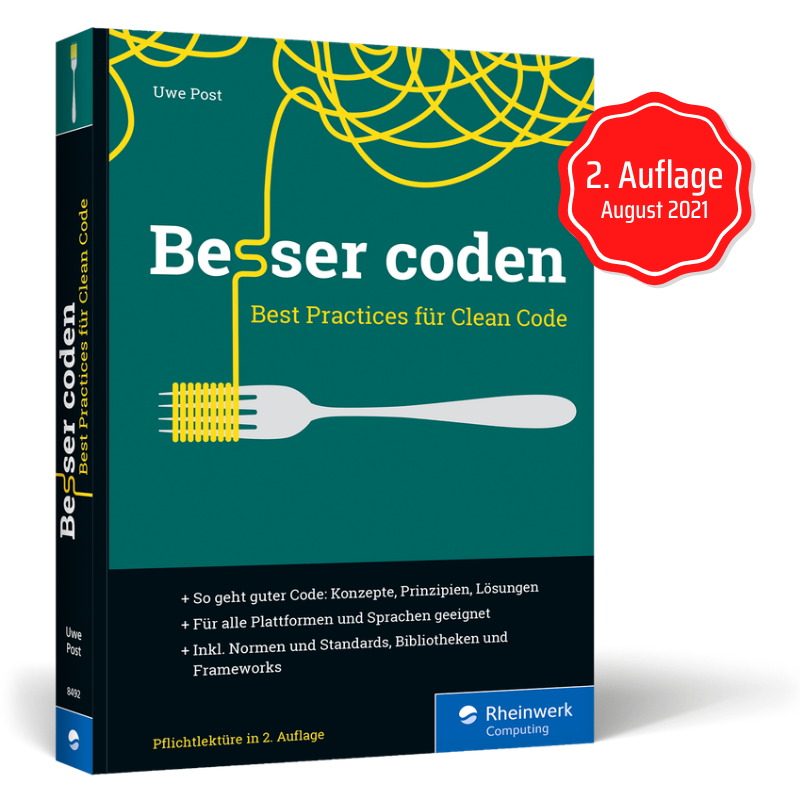
Besser coden (2. Auflg.)
Best Practices für Clean Code, der beste Weg zu gutem Code. In aktualisierter und erweiterter 2. Auflage August 2021. Guter Code ist essenziell für gute Software. Die Hürden bei der Programmierung sind aber oft vielfältig: Code glänzt mit schlechter Testbarkeit oder die Wartung lässt das Budget komplett aus dem Rahmen laufen. Punkten Sie mit besserem Code: performant, verständlich, wartbar. Uwe Post hat bereits einige Bugs in seinem Trophäenschrank. Mit einer ordentlichen Prise Humor und viel Projekterfahrung zeigt er, worauf es bei erfolgreichen Software-Projekten wirklich ankommt. In seinem Buch bietet er zeitlose Best Practices und aktuelle Tipps aus seinem Erfahrungsschatz. Seine Insider-Tipps und Anekdoten aus der Softwareentwicklung helfen Ihnen, stetig an der Qualität Ihres Codes zu arbeiten. Sie werden sehen: Clean Code geht jeden an, der besser programmieren möchte, ob in Java, C++ oder Python.Aus dem Inhalt:EntwurfsmusterReibungsloses TeamworkAktuelle Sicherheitsprobleme und was Sie damit zu tun habenTest Driven DevelopmentLegacy-Code und RefactoringQuizfragenDer Umgang mit den lieben KollegenDeadlocksContinuous IntegrationAutor: Uwe Post, Jahrgang 1968, ist Chefentwickler einer Firma, die Apps herstellt, hält Schulungen und berät Entwicklungsteams. Er schreibt neben IT-Büchern auch Science Fiction – davon sogar deutlich mehr. Sein Roman »Walpar Tonnraffir und der Zeigefinger Gottes«, gewann den Kurd-Laßwitz-Preis und den Deutschen Science-Fiction-Preis. Post lebt mit Frau und Tochter am südlichen Rand des Ruhrgebiets. Unter www.besser-coden.de geht er nicht nur auf Quellcode-Höllen ein, die er selbst er- und überlebt hat, sondern auch auf aktuelle Sicherheitsthemen und wie sie mit der Codequalität zusammenhängen. InhaltsverzeichnisLeseprobe (PDF-Link)
Continuous Integration mit Jenkins
Moderne Softwareentwicklung braucht mehr als nur guten Code und starken Kaffee. Ohne passende Deployment-Strategien und eine saubere Release-Verwaltung laufen selbst kleine Projekte schnell aus dem Ruder und werden unbeherrschbar. Dieses Praxisbuch gibt Ihnen einen Überblick über eine zeitgemäße CI-Pipeline aus Git, Jenkins und Nexus. So erfahren Sie, was für erfolgreiche Software-Projekte essenziell ist: gutes Source Control Management, flächendeckende Softwaretests mit einer sinnvollen Qualitätskontrolle und ein sauber organisiertes Deployment. Marco Schulz gibt Ihnen seine Erfahrung aus zahlreichen internationalen IT-Projekten weiter und hält eine Menge Tipps und Überlegungen zu gutem Software Engineering für Sie parat. Aus dem InhaltThe Big Picture: DevOps und die SoftwareentwicklungSoftware testen: Test Driven Development, Unit- und IntegrationstestsAgiles Release Management: Sprints vs ReleaseDeployment-StrategienSource Control ManagementJenkins einrichten und betreibenBuild ManagementBuild Jobs schreiben und optimierenJenkins Pipelines mit Blue OceanQualitätskontrolle mit SonarQubeRepository Management mit NexusAutor:Autor: Marco Schulz studierte an der HS Merseburg Informatik und twittert regelmäßig als @ElmarDott über technische Themen. Seine Schwerpunkte sind Build- und Konfigurationsmanagement, Software-Architekturen und Release Management. Seit über fünfzehn Jahren realisiert er anspruchsvolle Entwicklungsprojekten für namhafte Unternehmen aus aller Welt und arbeitet als unabhängiger Consultant/Trainer. Sein Wissen teilt er mit anderen Technikbegeisterten auf Konferenzen, wenn er nicht gerade wieder einmal an einem neuen Fachbeitrag schreibt.

Daten- und Prozessanalyse für Fachinformatiker*innen
Ideal für Aus- und Weiterbildung Big Data, Machine Learning und künstliche Intelligenz sind aktuell wohl die am schnellsten wachsenden Teilgebiete der Informatik. Nicht umsonst wurde daher 2020 der neue Fachinformatik-Ausbildungsgang Daten- und Prozessanalyse eingeführt. Worauf es dabei ankommt, zeigt dieses neue Lehr- und Praxisbuch. Auszubildende dieser Fachrichtung finden hier alle nötigen mathematischen Grundlagen, eine Einführung in die Python-Programmierung, Algorithmen und insbesondere Machine-Learning-Verfahren sowie in die Geschäftsprozessanalyse. Für alle Themen kommen praxiserprobte Sprachen, Tools und Bibliotheken zum Einsatz. Inkl. zahlreicher Übungsaufgaben. Arbeitsoberfläche, Navigation und ObjekteModelling und SculptingShading, Texturing und MappingLichtquellen, Kameras und TrackingAnimationen mit Keyframes, Pfaden und DrivernPartikelsysteme, Haare und KollisionenRauch, Feuer und FlüssigkeitenDie neuen Geometry Nodes2D-Animationen mit Grease PencilRendering mit Eevee und CyclesCompositing, Schnitt und TonImport und ExportAutor: Sascha Kersken arbeitet seit vielen Jahren als Softwareentwickler sowie als Trainer für EDV-Schulungen in den Themengebieten Netzwerke und Internet, interaktive Medien und Programmierung. Er hat zahlreiche Fachbücher und Artikel zu verschiedenen IT-Themen geschrieben.Leseprobe (PDF-Link)

Fotorecht (4. Auflage)
Das Standardwerk in 4. Auflage. Inklusive EU-Drohnenverordnung 2021! Darf ich das fotografieren? Darf ich das Foto veröffentlichen? Wolfgang Rau sagt Ihnen, was geht und was nicht. Ob es sich um Fotos von Natur, Architektur oder Menschen handelt, um Begriffe wie Urheberrecht, Panoramafreiheit oder das Recht am eigenen Bild, um die Frage, wie Sie Ihre Rechte schützen oder selbst Verträge aufsetzen – alles wird in diesem Buch kompetent und verständlich erklärt. Aus dem Inhalt:Lichtbild, Lichtbildwerk, SchöpfungshöheUrheberpersönlichkeits- und NutzungsrechtePanoramafreiheit, Hausrecht, PrivatsphäreRecht am eigenen Bild, Einwilligung, Bildnis und Erkennbarkeit StraßenfotografieBildrecht bei Facebook, Instagram & Co.Unbemannte Luftfahrtsysteme und die EU-DrohnenverordnungModel und Property ReleaseAbmahnung, Schadensersatz, StrafenGewerblich fotografierenFoto- und Bildrecht in Österreich und der SchweizMusterverträge zum DownloadLeseprobe (PDF-Link)

Introductory Guideline for Using Twilio Programmable Messaging and Programmable Voice Services
Twilio.com is an American cloud communications platform. Twilio allows software developers to programmatically make and receive phone calls, send and receive text messages, and perform other communication functions using its web service APIs.Twilio uses Amazon Web Services to host telephony infrastructure and provide connectivity between HTTP and the public switched telephone network (PSTN) through its APIsTwilio has very complicated system to understand and use. Its services mainly provided for qualified software developers. But in this report, I will provide introductory guideline for using the Twilio Programmable Messages and Programmable Voices services for simple use without the need to have deep knowledge in Programming. The report consists from the following sections:1.Opening a Twilio Account and get a Twilio Trial Number2.Upgrading the Twilio account 3.Twilio guideline for sending and receiving SMS 4.TwiML for Programmable SMS 5.TwiML for Programmable Voice 6.Basic steps to build Programmable Voice7.Using TwiML Bins functions8.Xampp and Ngrok web server setup for Twilio development 9.Sending messages from the dashboard of the Twilio account 10.Auto Dialer for Twilio Platform11.Summary of testing Programmable Voice using different options12.Summary of testing Programmable Messaging through different options13.Creating free website to save the files on it14.Making voice call using Twilio in browserI am Dr. Hidaia Mahmoud Mohamed Alassouli. I completed my PhD degree in Electrical Engineering from Czech Technical University by February 2003, and my M. Sc. degree in Electrical Engineering from Bahrain University by June 1995. I completed also one study year of most important courses in telecommunication and computer engineering courses in Islamic university in Gaza. So, I covered most important subjects in Electrical Engineering, Computer Engineering and Telecommunications Engineering during my study. My nationality is Palestinian from gaza strip.I obtained a lot of certified courses in MCSE, SPSS, Cisco (CCNA), A+, Linux.I worked as Electrical, Telecommunicating and Computer Engineer in a lot of institutions. I worked also as a computer networking administrator. I had considerable undergraduate teaching experience in several types of courses in many universities. I handled teaching the most important subjects in Electrical and Telecommunication and Computer Engineering. I could publish a lot of papers a top-tier journals and conference proceedings, besides I published a lot of books in Publishing and Distribution houses.I wrote a lot of important Arabic articles on online news websites. I also have my own magazine website that I publish on it all my articles: http:// www.anticorruption.000space.comMy personal website: www.hidaia-alassouli.000space.comEmail: hidaia_alassouli@hotmail.com

The Personal Computer Past, Present and Future 1975/2021
This book relates the story of the Personal Computer, from 1975 to 2021. It discusses the spectacular growth in sales over the first 36 years to 2011 and the techniques used by entrepreneurs to make this happen.The next six years to 2017 are years of precipitous decline in Personal computer sales. We explain the causes of this decline.We conclude by an examination of PC sales to 2021, when they enjoyed a resurgence and speculate on why this has been happening.

Datenvisualisierung mit Excel
Zu jeder Datenanalyse gehört eine klare Visualisierung. Werden Datensätze als Grafiken und Diagramme dargestellt, erleichtert dies das Verständnis von Zusammenhängen und Auffälligkeiten. Excel bietet vielfältige Möglichkeiten, um auch komplexere Daten zu visualisieren. Jedoch ist die richtige Umsetzung ansprechender Diagramme alles andere als einfach. Sie müssen nicht nur die Möglichkeiten der Software kennen. Vielmehr gilt es auch die richtige Darstellungsform für den jeweiligen Zweck zu identifizieren. Welche Daten einer umfangreichen Tabelle sind relevant, wie müssen sie strukturiert und aufbereitet werden, welche Diagrammform ist für diesen Fall besonders geeignet? Dirk Siegmann zeigt in seinem Praxisbuch, wie Sie mit Excel Daten visuell richtig und sicher aufbereiten. Sie erhalten aufeinander aufbauende und verständliche Erklärungen anhand vieler Beispiele. So lernen Sie, wie Sie Daten aus den unterschiedlichen Bereichen anschaulich nur mit den Bordmitteln von Excel visualisieren können. Die Beispiele erlauben Ihnen eine leichte Überführung des Gezeigten auf Ihre eigenen Anwendungszwecke. Der Autor gibt Ihnen hilfreiche Tipps, die Ihnen bei der erfolgreichen Arbeit mit Excel direkt helfen. Aus dem Inhalt: Informationen mit Excel anschaulich machenÜbersicht über die Diagramme von ExcelDaten richtig verarbeitenTabellenstrukturen, Datenreihe, Zahlenformate, ListenEin erstes Diagramm erstellenStandard-Diagramme: Säulen, Balken, Kreise und mehrVarianten und Kombinationen von DiagrammenBedingte FormatierungenErweiterte Diagramm-TypenDie Könisgklasse: individuelle Diagramme mit Excel erstellenDiagramme und VBA 1. Einführung ... 17 1.1 ... Datenvisualisierung -- Informationen anschaulich machen ... 17 1.2 ... Beispieldaten und Aufbau dieses Buches -- der rote Faden ... 19 1.3 ... Diagrammtypen -- eine Übersicht der Excel-Diagramme ... 20 1.4 ... Möglichkeiten und Grenzen von Excel ... 38 2. Daten -- Basis für Diagramme ... 41 2.1 ... Excel-Tabellenblätter -- Daten manuell erfassen ... 41 2.2 ... Textdateien -- Inhalte von CSV- und TXT-Dateien einfügen ... 48 2.3 ... Externe Quellen -- Abfrage von Daten ... 55 2.4 ... Verbund von Daten -- Bereiche als Tabelle formatieren ... 62 2.5 ... Zahlenformate -- Ansichten von Daten anpassen ... 67 2.6 ... Daten berechnen und aggregieren -- Einsatz von Formeln ... 72 3. Das erste Diagramm ... 83 3.1 ... Erstellung eines Diagramms -- verschiedene Wege zum Ziel ... 83 3.2 ... Hinzufügen und Entfernen von Elementen eines Diagramms ... 90 3.3 ... Die Elemente im Einzelnen ... 92 3.4 ... Gestaltung und Formatierung -- das Erscheinungsbild individuell anpassen ... 104 3.5 ... Achsen eines Diagramms -- ein Rahmen für die Visualisierung ... 128 3.6 ... Datenbasis modifizieren -- Erweitern, Reduzieren und Verändern der Diagrammdaten ... 145 4. Standarddiagramme ... 151 4.1 ... Säulen -- Vergleich von Werten zwischen Rubriken ... 151 4.2 ... Balken -- Rangfolgen darstellen ... 155 4.3 ... Linien -- Entwicklung und Trends über Zeiträume visualisieren ... 159 4.4 ... Kreise -- Werte als Proportion anzeigen ... 165 4.5 ... Netze -- Werte relativ zu einem Mittelpunkt darstellen ... 167 4.6 ... Punkte (XY) -- Wertepaare als Basis für neue Darstellungsformen ... 169 4.7 ... Flächen -- Vergleich von Mengen ... 175 4.8 ... Trichter -- Darstellung von Reduktionen ... 178 4.9 ... Sparklines -- Miniaturdiagramme in Zellen ... 179 5. Varianten und Kombinationen von Diagrammen ... 185 5.1 ... Farbpaletten -- Ändern der Standardfarben ... 185 5.2 ... Änderung eines Diagramms -- Ort und Typ neu festlegen ... 190 5.3 ... Kombidiagramme -- unterschiedliche Typen in einem Diagramm kombinieren ... 194 5.4 ... Kreisdiagramm -- kleine Anteile als separaten Kreis oder Säule anzeigen ... 202 5.5 ... 3D-Formatierungen -- optische Effekt hinzufügen ... 204 5.6 ... 3D-Diagramme -- zusätzliche Informationen mit einer Tiefenachse ... 213 5.7 ... Blasendiagramme -- eine dritte Information einem Punkt hinzufügen ... 219 6. Bedingte Formatierungen ... 225 6.1 ... Prinzip der bedingten Formatierung ... 225 6.2 ... Regeltypen -- alle Zellen oder nur bestimmte Zellen formatieren ... 227 6.3 ... Vorgefertigte Regeln für alle Zellen -- Balken, Farben und Symbole ... 231 6.4 ... Vorgefertigte Regeln für bestimmte Zellen -- Wertevergleich ... 235 6.5 ... Neue Regeln erstellen -- individuelle Anpassungen der Vergleichs- und Schwellenwerte und der Formate ... 240 6.6 ... Regeln verwalten -- bedingte Formate auffinden und Gültigkeitsbereiche modifizieren ... 253 6.7 ... Formeln in Regeln -- eigene Berechnungen für logische Vergleiche nutzen ... 258 7. Spezielle Diagramme ... 265 7.1 ... Wasserfalldiagramme -- positive und negative Veränderungen als Säulen darstellen ... 265 7.2 ... Statistische Diagramme ... 268 7.3 ... Hierarchische Diagramme ... 279 7.4 ... Kursdiagramme -- charakteristische Werte eines Finanzprodukts an der Börse ... 286 7.5 ... Flächenkartogramme -- geografische Daten visualisieren ... 290 7.6 ... 3D-Karten ... 294 8. Pivot-Tabellen und -Diagramme ... 303 8.1 ... Daten für Pivot-Analysen ... 303 8.2 ... Erstellen einer Pivot-Tabelle -- Daten aggregieren ... 306 8.3 ... Pivot-Diagramm -- Visualisierung einer Pivot-Tabelle ... 316 8.4 ... Datenanalyse ... 323 9. Individuelle Diagramme ... 337 9.1 ... Veränderungsdiagramme -- prozentuale Änderung zweier Werte visualisieren ... 337 9.2 ... Punktposition -- Prozentwert auf einer Linie positionieren ... 341 9.3 ... Statusanzeige -- einen Wert auf einer Grün-Gelb-Rot-Skala anzeigen ... 344 9.4 ... Tachometer -- Wertungen mittels Ring- und Punktdiagramm darstellen ... 347 9.5 ... Gestapelte Kästchen -- Säulen in kleine Einheiten aufteilen ... 351 9.6 ... Flächenvergleich -- Relation zweier Werte als Quadratflächen anzeigen ... 356 9.7 ... Muster hervorheben -- unterschiedliche Punktgrößen in einem Raster ... 359 9.8 ... Stufendiagramm -- Veränderungen als senkrechte Sprünge einer Linie aufzeigen ... 364 9.9 ... Strichliste -- Werte als Blöcke aus fünf Strichen anzeigen ... 366 9.10 ... Pegelanzeige -- Werte in Form einer fünfteiligen Säule darstellen ... 370 9.11 ... Stabdiagramm -- sehr schmale Säulen in einem Diagramm ... 374 9.12 ... Abweichungen zweier Linien -- farbliche Unterscheidung mit Fehlerindikatoren ... 376 9.13 ... Gantt-Diagramm -- zeitliche Verläufe von Aktivitäten darstellen ... 379 9.14 ... Grafische Elemente in Diagrammen -- Bilder in Säulen ... 386 9.15 ... Diagrammvorlagen -- eigene Formatierungen mehrfach nutzen ... 388 Danksagung ... 391 Index ... 393

Finance meets Logistics
Mit diesem Handbuch für Logistikerinnen und Controller optimieren Sie Ihre Prozesse und sorgen für reibungslose Abläufe. Christian Weißenborn "übersetzt" zwischen den Fachbereichen und stellt Ihnen typische Szenarien für die Integration von MM, PP, SD und FI/CO vor. Ob Lieferanten-Konsignation, Fremdbearbeitung oder Variantenfertigung – dank anschaulicher Prozessdiagramme und passender Buchungsschemas sind Sie bestens gerüstet für Ihr nächstes SAP-Projekt! Aus dem Inhalt: Grundlagen und SAP-FachbegriffeSchwimmbahndiagramme und BuchungsschemasSzenarien ohne Produktion, z.B. Einkauf Lagermaterial, StreckengeschäftSzenarien mit anonymer Produktion, z.B. Diskrete und SerienfertigungSzenarien mit kundenauftragsorientierter Produktion, z.B. Kundeneinzelfertigung und Automotive-RückmeldungSzenarien mit Kundenauftrags-ControllingServicaufträgeKundenprojekte Einleitung ... 15 1. Grundlagen und SAP-Fachbegriffe ... 19 1.1 ... Buchhaltung ... 19 1.2 ... Controlling ... 25 1.3 ... Logistik ... 32 1.4 ... Prozessdarstellung ... 41 1.5 ... Organisationsstruktur ... 43 1.6 ... Elemente des Buchungsschemas ... 45 2. Szenarien ohne Produktion ... 47 2.1 ... Einkauf Lagermaterial ... 48 2.2 ... Verkauf Eigenerzeugnis aus Lager ... 53 2.3 ... Handelsware mit Verkauf ab Lager ... 67 2.4 ... Handelsware mit Einzelbestellung ... 72 2.5 ... Streckengeschäft ... 83 2.6 ... Streckengeschäft ohne Lieferavis ... 90 2.7 ... Lohnbearbeitung ... 96 2.8 ... Lieferantenkonsignation ... 109 2.9 ... Kundenkonsignation ... 116 2.10 ... Buchungskreisübergreifender Verkauf ... 126 3. Szenarien mit anonymer Produktion ... 139 3.1 ... Diskrete Fertigung ... 140 3.2 ... Diskrete Fertigung mit Ware in Arbeit und Abweichung ... 155 3.3 ... Serienfertigung ... 182 3.4 ... Serienfertigung mit WIP und Abweichung ... 197 3.5 ... Fremdbearbeitung ... 221 3.6 ... Fremdbearbeitung mit Lohnbearbeitung ... 234 3.7 ... Fertigungsauftrag mit Produktkostensammler ... 248 3.8 ... Kuppelproduktion mit Fertigungsauftrag ... 264 4. Szenarien mit kundenauftragsorientierter Produktion ... 289 4.1 ... Kundeneinzelfertigung ... 289 4.2 ... Variantenfertigung ... 310 4.3 ... Kundenauftragsorientierte Serienfertigung ... 328 4.4 ... PP/DS-Produktionsrückmeldung ... 344 5. Szenarien mit Kundenauftragscontrolling ... 375 5.1 ... Kundenauftragscontrolling mit bewertetem Kundenauftragsbestand ... 375 5.2 ... Kundenauftragscontrolling mit unbewertetem Kundenauftragsbestand ... 396 6. Weitere Szenarien ... 425 6.1 ... Serviceauftrag mit aufwandsbezogener Faktura ... 425 6.2 ... Kundenprojekt ... 450 7. Zusammenfassung ... 489 7.1 ... Anwendung der Buchungsschemata ... 489 7.2 ... Aus der Praxis ... 494 Anhang ... 495 A ... Kontenzuordnung Bilanz- und GuV-Struktur ... 497 B ... MM-Kontenfindung -- Vorgänge ... 501 C ... Transaktionen ... 505 Autor ... 511 Index ... 513

Besser coden
Guter Code ist essenziell für gute Software. Und die Schwierigkeiten sind vielfältig: Code glänzt mit schlechter Testbarkeit oder die Wartung lässt das Budget komplett aus dem Rahmen laufen. Uwe Post packt die Praxisprobleme mit zeitlosen Best Practices und aktuellen Tipps aus seinem Erfahrungsschatz an. Punkten Sie mit besserem Code: performant, verständlich, wartbar. Uwe Post hat bereits einige Bugs in seinem Trophäenschrank. Mit einer ordentlichen Prise Humor und viel Projekterfahrung zeigt er, worauf es bei erfolgreichen Software-Projekten wirklich ankommt. Seine Insider-Tipps und Anekdoten aus der Softwareentwicklung helfen Ihnen, stetig an der Qualität Ihres Codes zu arbeiten. Sie werden sehen: Clean Code geht jeden an, der besser programmieren möchte, ob in Java, C++ oder Python. Aus dem Inhalt: GrundregelnCode ReviewTest Driven DesignContinuous IntegrationReibungsloses TeamworkAutomatisierte Build- und VersionskontrollsystemeEntwurfsmusterAutomatisierte UI-TestsDependency InjectionISO 25010Build ToolsUmgang mit Legacy Code 1. Verhindern Sie den Weltuntergang! ... 13 1.1 ... Vorwort ... 13 1.2 ... Schöne neue Welt ... 14 1.3 ... Was läuft falsch? ... 16 1.4 ... Weltuntergang verhindern - aber wie? ... 17 2. Konventionen ... 21 2.1 ... Vereinbarungen im Team ... 21 2.2 ... Wenn die Variable »a« sagt (und sonst nichts) ... 26 2.3 ... Code-Fokus ... 34 2.4 ... Checkliste ... 36 3. Willkommen im Team! ... 39 3.1 ... Check this out: Subversion ... 40 3.2 ... Teamwork integriert: Git ... 51 3.3 ... »Guckstu!« ... 58 3.4 ... Doppelt hält besser: Pair Programming ... 63 3.5 ... Wer macht wann was? ... 66 4. Gut, besser, 91,2 %: Software-Qualität messen ... 75 4.1 ... Muss funktionieren! ... 76 4.2 ... Muss schön sein! ... 81 4.3 ... ISO 25010 und andere Buzzword-Sammlungen ... 101 5. Jeder ist Architekt ... 107 5.1 ... Normalisierte Daten ... 107 5.2 ... Alles ist ein Objekt, aber welches? ... 117 5.3 ... Entwurfsmuster ... 120 5.4 ... Was ist eigentlich ein »Item«? ... 141 5.5 ... Effiziente Software ... 151 5.6 ... Do- und Don't-Merksatz-Akronyme ... 158 5.7 ... Neue Räder extra teuer! ... 163 5.8 ... Meins! (Wirklich?) ... 168 6. Erst mal testen ... 173 6.1 ... Gute und schlechte Unit-Tests ... 174 6.2 ... Testbar und nicht so gut testbar ... 187 6.3 ... Umgekehrt wird ein Schuh draus ... 194 6.4 ... Alles einzeln testen ... 199 6.5 ... Millionen Mausklicks ... 204 7. Continuous Integration ... 211 7.1 ... Digitaler Bauunternehmer ... 211 7.2 ... Java-Builds mit Maven ... 213 7.3 ... Gradle en vogue ... 227 7.4 ... Jenkins, stets zu Ihren Diensten! ... 234 7.5 ... Continuous Integration in der Cloud ... 239 7.6 ... Nicht nur eine Frage des Stils ... 244 7.7 ... NuGet für .NET und MS Azure ... 248 8. Dokumentation, Kommentare & Tools ... 257 8.1 ... Kommentare sind wie Tooltipps ... 257 8.2 ... Dokumentiert sich von allein ... 262 8.3 ... Teamwork online ... 269 9. Betriebssicherheit ... 283 9.1 ... »Es ist ein Fehler aufgetreten. Versuchen Sie es noch einmal.« ... 284 9.2 ... Festplattenweise Protokolle ... 296 9.3 ... Ungebetene Besucher ... 306 10. Schrottcode pimpen ... 323 10.1 ... Was macht der da? ... 323 10.2 ... Refactoring mit Tools ... 328 10.3 ... Who sprech Svenska? ... 340 10.4 ... Endlich: Tests ... 343 11. Trollfütterung ... 349 11.1 ... Umsteiger und Ahnungslose im kalten Wasser ... 349 11.2 ... Früher war alles besser, auch die Betonköpfe ... 352 11.3 ... Das Patchwork-Team ... 354 11.4 ... Billig im Osten ... 357 11.5 ... Der Hase der Produktmanagerin ... 361 11.6 ... Arbeiten wie die Profis ... 364 11.7 ... Leuchtendes Beispiel ... 366 12. Parallelwelten ... 369 12.1 ... Parallel arbeiten ... 369 12.2 ... Losgelöst ... 381 12.3 ... .NET async ... 385 Anhang ... 389 A ... Quizfragen ... 389 B ... Lösungen der Quizfragen ... 395 Index ... 399

Adobe Photoshop
Sie sind begeistert von den Möglichkeiten der Bildbearbeitung und wollen nun Photoshop von Grund auf kennenlernen? Dann werden Sie dieses Buch lieben, denn hier erhalten Sie in über 120 Workshops ein wahres Feuerwerk an Tricks und Kniffen, um das Beste aus Ihren Bildern herauszuholen. Markus Wäger, Photoshop-Profi und Adobe Certified Instructor, hat attraktive Beispiele aus den unterschiedlichsten Gebieten der Photoshop-Welt ausgewählt, die Sie leicht auf Ihre eigenen Bilder übertragen können. Sie korrigieren Farben und Kontraste, ändern Bildausschnitte, erstellen Montagen und Collagen, nutzen Masken, Filter u.v.m. So tauchen Sie immer tiefer in die Welt von Photoshop ein und haben die Software sicher im Griff! Aus dem Inhalt: Photoshop-GrundlagenAuflösung und BildgrößeArbeiten mit Farbe: malen und färbenBelichtungskorrektur: Helligkeit und KontrastFarbkorrektur und SchwarzweißFreistellen und isolierenMontage und CompositingFotografische AufgabenRetuschieren und verbessernFilter und EffekteRaw und HDRAusgabe für Druck, Web und Automatisierung Der Download zum Buch ... 12 Über dieses Buch ... 13 1. Grundlagen ... 14 Einstellungen zurücksetzen ... 16 Voreinstellungen ... 17 Arbeitsbereich einrichten ... 18 Ansicht ändern ... 22 Ein neues Dokument erstellen ... 25 Ein Bild platzieren ... 27 Auf Hintergrundebene reduzieren ... 29 Photoshop-Dokument speichern ... 30 Als TIFF speichern ... 31 Als JPEG speichern ... 32 Als PNG speichern ... 33 2. Bildgröße und Auflösung ... 34 Grundlagenexkurs: Bildgröße und Auflösung ... 36 Druckformat ermitteln ... 46 Bilder verkleinern ... 48 Bilder vergrößern ... 49 Bilder zuschneiden ... 50 Freistellen und Auflösung anpassen ... 53 Arbeitsfläche erweitern ... 55 Ebene skalieren ... 56 Ein Smartobjekt skalieren ... 58 Perspektive korrigieren ... 60 Bilder nachschärfen ... 63 Maskiertes Schärfen ... 65 Drucken ... 68 3. Farbe einstellen und auftragen ... 70 Grundlagenexkurs: Farbe ... 72 Farben definieren ... 82 Fläche füllen ... 85 Farbmischung festlegen ... 88 Eine Füllebene erstellen ... 90 Pinsel einstellen und anwenden ... 92 Mit dem Pinsel arbeiten ... 96 Eine Füllebene bearbeiten ... 100 Mit dem Pinsel umfärben ... 102 Bearbeitung ausradieren ... 104 Nicht-destruktiv umfärben ... 106 Pixel ausradieren ... 108 4. Fläche, Text und Stil ... 110 Eine Ebene mit Verlauf füllen ... 112 Mit Formebenen arbeiten ... 114 Flächentext setzen ... 118 Punkttext setzen ... 122 Texteffekt und Deckkraft ... 124 Eine Vignette hinzufügen ... 128 Ebenen zuschneiden ... 130 Eine Verlaufsebene erstellen ... 132 Gebogenen Text setzen ... 136 Muster erstellen ... 140 Bluttriefende Texte gestalten ... 144 Ein Bild in ein Wort legen ... 148 5. Auswählen und maskieren ... 152 Rund und weich zuschneiden ... 154 Einen Hintergrund umfärben ... 156 Einen Himmel vergrößern ... 159 Farbe und Schwarzweiß mischen ... 162 Einen Filter selektiv anwenden ... 164 Objekte umfärben ... 166 Farbe zu Weiß ... 171 Ein pelziges Tier freistellen ... 174 Hintergrund einer Person tauschen ... 178 Unscharfe Kanten freistellen ... 184 Text hinter Landschaft montieren ... 188 Komplexe Objekte umfärben ... 191 6. Freistellen ... 196 Eine Box mit Pfad freistellen ... 198 Vom Pfad zu Auswahl und Maske ... 201 Schattenwurf simulieren ... 205 Pfade mit Kurven und Ecken ... 210 Freistellen mit Alphakanälen ... 216 Freistellen mit Vektormaske ... 220 Bilder identisch zuschneiden ... 223 7. Bildmontage ... 228 Ein Bild in ein Display montieren ... 230 Weiches Überblenden ... 232 Einen Hintergrund austauschen ... 234 Tag- und Nachtaufnahme vereinen ... 239 Himmel austauschen ... 244 Spiegeln und weich ausblenden ... 248 Zoomeffekt ... 252 Speed-Effekt ... 254 Montage aus zwei Belichtungen ... 258 Einsetzen und Form anpassen ... 260 Ein Logo auf ein Shirt montieren ... 264 Text perspektivisch einfügen ... 268 8. Helligkeit und Kontrast ... 272 Grundlagenexkurs: Tonwertkorrektur ... 274 Automatische Tonwertkorrektur ... 286 Manuelle Tonwertkorrektur ... 289 Kontrast erhöhen ... 292 Kontrast reduzieren ... 296 Dunst entfernen ... 298 Gegenlichtaufnahme verbessern ... 300 RAW-Grundeinstellungen ... 303 RAW-Entwicklung ... 308 Korrektur mit Verlaufsmaske ... 314 Mit Luminanzmasken arbeiten ... 318 Dodge and Burn ... 321 Spiegelungen entfernen ... 324 9. Farbkorrektur ... 326 Grundlagenexkurs: Grundlagen der Farbkorrektur ... 328 Farbkorrektur per Pipette ... 332 Farb- und Tonwertkorrektur ... 335 Weiß, Schwarz und Grau per Klick ... 337 Manuelle Korrektur ... 340 Farbkorrektur mit Messpunkten ... 343 Farbkorrektur beim Porträt ... 347 Weißabgleich in Camera Raw ... 351 Weißabgleich mit Graukarte ... 353 Camera Raw für JPEG & Co ... 355 Farbton und Sättigung ... 358 Einstellungen synchronisieren ... 361 Digitales Zähnebleichen ... 364 Farbtöne gezielt beeinflussen ... 366 10. Retusche ... 370 Elemente duplizieren ... 372 Gespiegelt kopieren ... 375 Ein altes Bild restaurieren ... 378 Störende Elemente entfernen ... 381 Gezielt ausbessern ... 384 Person aus Landschaft entfernen ... 386 Inhaltsbasierte Füllung ... 388 Perspektivisch retuschieren ... 391 Ein Kabel entfernen ... 394 Hautretusche ... 396 Haut glätten ... 398 Augen retuschieren ... 400 Manuelle Hautglättung ... 404 11. Spezielle Aufgaben ... 408 Bildbereiche modellieren ... 410 Schwarzweiß entwickeln ... 414 Volltonfarbe ... 417 Gescannte Unterschrift verbessern ... 420 Pixelige Grafik verbessern ... 422 Aktionen aufzeichnen ... 424 Aktionen bearbeiten ... 430 Aktionen anpassen ... 432 Stapelverarbeitung ... 434 Bilder im Stapel kleiner rechnen ... 437 Animation ... 438 Index ... 442
Beginning Programming with Java For Dummies
BECOME A JAVA WIZARD WITH THIS POPULAR PROGRAMMING GUIDEConsider Beginning Programming with Java For Dummies your indispensable guide to learning how to program in one of the most popular programming languages—Java! Java is an invaluable language to master, as it's widely used for application development, including Android, desktop, and server-side applications.Beginning Programming with Java For Dummies is written specifically for newbies to programming. The book starts with an overview of computer programming and builds from there; it explains the software you need, walks you through writing your own programs, and introduces you to a few of the more-complex aspects of programming in Java. It also includes step-by-step examples you can try on your own (and email the author if you need help). As you work through the book, you'll get smart about these Java features:* Object-oriented programming (OOP), a Java mainstay* IntelliJ IDEA, an integrated development environment (IDE), that gives you one place to do all your programming, including debugging code* Loops, branches, and collections* Variables and operators* Expressions, statements, and blocksBeginning Programming with Java For Dummies translates all this foreign programming and computer syntax into plain English, along with plenty of helpful examples and tips. Learning a new language—and coding is definitely its own language—should be a fun endeavor. With this book as your handy interpreter, you’ll be on your way to fluency, speaking the language of coders everywhere!BARRY BURD, PHD holds an MS in Computer Science from Rutgers University and a PhD in Mathematics from the University of Illinois. Barry is the author of numerous For Dummies books, including Java For Dummies and Beginning Programming with Java For Dummies.Introduction 1PART 1: GETTING STARTED WITH JAVA PROGRAMMING 5Chapter 1: The Big Picture 7Chapter 2: Setting Up Your Computer 21Chapter 3: Running Programs 47PART 2: WRITING YOUR OWN JAVA PROGRAMS 71Chapter 4: Exploring the Parts of a Program 73Chapter 5: Composing a Program 95Chapter 6: Using the Building Blocks: Variables, Values, and Types 127Chapter 7: Numbers and Types 149Chapter 8: Numbers? Who Needs Numbers? 173PART 3: CONTROLLING THE FLOW 197Chapter 9: Forks in the Road 199Chapter 10: Which Way Did He Go? 219Chapter 11: Around and Around It Goes 251Chapter 12: Circling Back to Java Loops 275PART 4: THE INSIDE SCOOP 293Chapter 13: Programming with Objects and Classes 295Chapter 14: Using Methods and Fields from a Java Class 315Chapter 15: Creating New Java Methods 347PART 5: SMART JAVA TECHNIQUES 375Chapter 16: Piles of Files: Dealing with Information Overload 377Chapter 17: How to Flick a Virtual Switch 401Chapter 18: Creating Loops within Loops 423Chapter 19: Out of Many, One 443Chapter 20: Oooey-GUI Was a Worm 477PART 6: THE PART OF TENS 503Chapter 21: Ten Useful Classes in the Java API 505Chapter 22: Ten Bits of Advice for New Software Developers 511Index 517
Professional C# and .NET
GET THE LATEST COVERAGE OF THE NEWEST FEATURES IN C#9 AND .NET 5In Professional C# and .NET: 2021 Edition, Microsoft MVP for Visual Studio and Development Technologies and veteran developer, Christian Nagel, delivers a comprehensive tour of the new features and capabilities of C#9 and .NET 5.Experienced programmers making the transition to C# will benefit from the author’s in-depth explorations to create Web- and Windows applications using ASP.NET Core, Blazor, and WinUI using modern application patterns and new features offered by .NET including Microservices deployed to Docker images, GRPC, localization, asynchronous streaming, and much more.The book also offers:* Discussions of the extension of .NET to non-Microsoft platforms like OSX and Linux* Explanations of the newest features in C#9, including support for record types, and enhanced support for tuples, pattern matching, and nullable reference types* Integrating .NET applications with Microsoft Azure services such as Azure App* Configuration, Azure Key Vault, Azure Functions, the Azure Active Directory, and others Downloadable code examples from wrox.com and github.com with online updates for C# 10 and .NET 6Perfect for programmers with a background in C#, Visual Basic, Java, or C/C++, Professional C# and .NET: 2021 Edition will also earn a place in the libraries of software architects seeking an up-to-date and fulsome treatment of the latest C# and .NET releases.CHRISTIAN NAGEL is a Microsoft MVP for Visual Studio and Development Technologies, software architect, and veteran developer who has been building solutions with .NET technologies since 2000. He has authored many acclaimed .NET books, and he also speaks at such international conferences as Ignite (formerly TechEd) and Tech Days. A supporter of .NET user groups, Christian is a Microsoft Certified Trainer and Professional Developer for WinUI and .NET MAUI Apps, ASP.NET Core, and Microsoft Azure.Introduction xxxixPART I: THE C# LANGUAGEChapter 1: .Net Applications And Tools 3Chapter 2: Core C# 24Chapter 3: Classes, Records, Structs, And Tuples 59Chapter 4: Object-Oriented Programming In C# 95Chapter 5: Operators And Casts 119Chapter 6: Arrays 153Chapter 7: Delegates, Lambdas, And Events 177Chapter 8: Collections 193Chapter 9: Language Integrated Query 226Chapter 10: Errors And Exceptions 263Chapter 11: Tasks And Asynchronous Programming 288Chapter 12: Reflection, Metadata, And Source Generators 307Chapter 13: Managed And Unmanaged Memory 335PART II: LIBRARIESChapter 14: Libraries, Assemblies, Packages, And Nuget 377Chapter 15: Dependency Injection And Configuration 392Chapter 16: Diagnostics And Metrics 419Chapter 17: Parallel Programming 440Chapter 18: Files And Streams 485Chapter 19: Networking 52Chapter 20: Security 558Chapter 21: Entity Framework Core 582Chapter 22: Localization 644Chapter 23: Tests 668PART III: WEB APPLICATIONS AND SERVICESChapter 24: Asp.Net Core 687Chapter 25: Services 714Chapter 26: Razor Pages And Mvc 752Chapter 27: Blazor 779Chapter 28: Signalr 801PART IV: APPSChapter 29: Windows Apps 819Chapter 30: Patterns With Xaml Apps 876Chapter 31: Styling Windows Apps 899Index 933

Storytelling im UX-Design
Ideen, Inspirationen und Erkenntnisse aus dem traditionellen Storytelling für next-level UX-DesignAngesichts der Vielfalt der Geräte, Schnittstellen und Kanäle haben Sie heutzutage immer weniger Kontrolle darüber, wie Nutzer:innen Ihre sorgfältig konzipierten Produkte erleben. Trotzdem ist es für Sie sehr wichtig zu verstehen, an welchen Punkten der User Journey Ihre Kund:innen sich befinden, damit Sie die passenden Inhalte und interaktiven Elemente zur richtigen Zeit und auf dem richtigen Gerät bereitstellen können.Mit diesem praktischen Leitfaden lernen Sie, welchen positiven Einfluss Storytelling auf Ihr Produktdesign haben kann und wie es Ihnen dabei hilft, die UX Ihrer Produkte entscheidend zu verbessern. Anna Dahlström zeigt anhand zahlreicher spannender Beispiele, wie Sie Storytelling einsetzen und bewährte Prinzipien aus Film und Literatur wie Heldenreise und Storyboards anwenden, um großartige Produkterfahrungen zu erzeugen. Aus dem Inhalt:Erfahren Sie, wie die Anatomie einer guten Geschichte Ihr Produktdesign maßgeblich verbessern kann.Entdecken Sie, wie sich traditionelle Prinzipien, Werkzeuge und Techniken des Storytellings auf wichtige Faktoren des Produktdesigns auswirken.Lernen Sie, wie Sie mit zielgerichtetem Storytelling die richtige Geschichte erzählen und Menschen zum Handeln motivieren.Nutzen Sie die Regeln des Storytellings, um Ihre Produkte vorzustellen, zu präsentieren und zu verkaufen.»Anna Dahlström leistet großartige Arbeit bei der Anwendung von UX- und Designprinzipien auf Storytelling und Kommunikation. Sie greift auf Theater sowie historisches und modernes Storytelling zurück, um eine fesselnde Erzählung zu schaffen. Ich empfehle dieses Buch allen Designern, die ihre internen und externen Kommunikationsfähigkeiten verbessern wollen, insbesondere denjenigen, die in Führungspositionen aufsteigen wollen.«— Ellen Chisa, Mitbegründerin und CEO, Dark

High-Quality Illumination of Virtual Objects Based on an Environment Estimation in Mixed Reality Applications
Visualizations of virtual objects in the real environment is often done by a simplified representation with simple surfaces and without reference to the surrounding environment. The seamless fusion of the virtual and real environment is, however, an essential factor in many areas, which is of particular importance when calculating lighting in mixed realities on mobile devices. Current approaches focus on approximations, which allow the calculation of diffuse lighting, whereby the rendering of glossy reflection properties is often neglected. The aim of this book is to enable the visualization of mirror-like reflective surfaces in mixed reality. In order to achieve this goal, various approaches are explored enabling high-quality visualization of virtual objects in realtime with a focus on the use of common hardware such as cameras, sensors in mobile devices, and partially depth sensors. Complete ambient lighting can be estimated, which enables detailed reflections. The results provide a novel way to embed complex and simple geometric shapes with glossy surfaces in the real world which offers a higher level of detail in the reflections without using additional hardware.TOBIAS SCHWANDT´S professional and personal focus at the TU Ilmenau is the area of Mixed-Reality (MR). Within his dissertation, he particularly concerned himself with the topic of illumination of virtual content in AR, its influence on the real environment, the reconstruction of the environment light, and the manipulation of real geometry by virtual content.Introduction.- Fundamentals & State of the Art.- Illumination in Mixed Reality.- Realization.- Results.- Discussion & Limitations.- Conclusion & Outlook.

The Protractor Handbook
Learn to quickly set up Protractor and dive into the amazing possibilities that this tool offers for automating browser interactions for a user for any Angular web application. Software testing is here to stay, and an integral part of this is test automation. Protractor is one of the most evolved test automation frameworks that every software testing professional working with an Angular application should know.You will to automate a vast range of actions that a user takes to interact with the browser. From a simple ‘click’ to more complex user actions such as frame switches, selecting from drop-downs, and file downloads using Protractor APIs for Angular-based websites. You will also learn about assertions, timeouts, waits, parallel testing frameworks that are available, and the general pros and cons you should be aware of.With over 150 working code samples demonstrating various test scenarios that you require in your day-to-day automation testing, and examples that may be given in interviews, this book will be your practical handbook to all the key Protractor API implementations.WHAT YOU'LL LEARN* Set up and install Protractor efficiently* Implement Angular-specific locator strategies* Automate Angular web pages* Run parallel execution using Protractor* Explore all the pros, cons and challenges you may face while using Protractor* Use specific notes around each API to ensure optimum usage and avoid common mistakesWHO THIS BOOK IS FORIdeal for test engineers who have a basic understanding of test automation with Selenium, developers who want to implement this testing tool for internal testing, Test Managers/IT Project Managers who want to get some general understanding of this tool and its advantages, and students who want to pursue career in test automation.SHASHANK SHUKLA has been working in software testing for over a decade and is passionate about tools and technology that can be leveraged to enrich the testing experience and optimize the quality of delivery. This is his second Apress book.1. Getting Started2. Installationa. Prerequisitesb. Installation processc. Installation Details3. Locatorsa. IDb. Classc. Name Attributed. Tag Namee. Link Textf. Partial Link Textg. Element with certain texth. CSS Query Selectori. xPathj. JS Functionk. Chain Selectorsl. React Selectorsm. Custom Selectors4. Browser APIsa. Get count of elements returned from an Array of elementb. Get First element returned from an Array of elementc. Get Text of an elementd. Get any element returned from an Array of elementse. Get Last element returned from an Array of elementsf. 'Then' functiong. Iterate all elementsh. Getting all links of a pagei. Map functionj. Reduce functionk. Returns the most relevant locator of an elementl. Scroll an element Into Viewm. Click on an elementn. Double Click on an elemento. Right click on an elementp. Send text to an Input fieldq. Send text to an Input field via addValuer. Send Keyboard keys to an elements. Get Value of an elementt. Clear the text inside an Input fieldu. Hover Mouse on an elementv. Navigating to new URL in a browserw. Navigating Back in a browserx. Navigating Forward in a browsery. Refreshing a web-pagez. Restarting a browseraa. Getting & Setting Window Size & positionbb. Getting Element Sizecc. Maximizing the Browserdd. Minimizing the Browseree. Browser fullscreen modeff. Open a new Windowgg. Get the URL of the current pagehh. Get the Title of the current pageii. Send JavaScript to do a task Vanilla JSCodejj. Send JavaScript to do a task Handeling Datepickerkk. Send JavaScript to do a task Clickingll. Send JavaScript to do a task Detecting Broken imagemm. Taking Full page Screenshotnn. Switching Between Windowsoo. Switching between Framespp. Closing the pageqq. Closing the browserrr. Alerts Accepting an Alertss. Alerts Dismissing an Alerttt. Alerts Reading message of an Alertuu. Alerts Sending message to an Alertvv. Selecting from a Dropdownww. Drag and Dropxx. Uploading a fileyy. Submitting a formzz. Display Cookiesaaa. delete Cookiesbbb.Set Cookiesccc. Basic authenticationddd.GeoLocations5. Element APIsa. Is the element Present? isExistingb. Is the element Present? toExistc. Is the element Present? ToBePresentd. Is the element Present in DOM? ToBeExistinge. Is the element Present inside another element?f. Is the element Enabled? IsEnabledg. Is the element Enabled? ToBeEnabledh. Is the element Disabled? ToBeEnabledi. Is the element Visible? IsDisplayedj. Is the element Visible? ToBeDisplayedk. Is the element Visible? toBeVisiblel. Is the element Visible on the screen? toBeDisplayedInViewportm. Is the element Visible on the screen? toBeVisibleInViewportn. Is the element Selected? isSelectedo. Is the element Selected? ToBeSelectedp. Is the element Selected? ToBeCheckedq. Is the element Clickable? isClickabler. Is the element Clickable? toBeClickable6. Some Additional Protractor IO Methodsa. Is the element Focused? isFocusedb. Is the element Focused? toBeFocusedc. Does the element have a specific Attribute? toHaveAttributed. Does the element have a specific Attribute? toHaveAttre. Does element contains a specific text Attribute? toHaveAttributeContainingf. Does the element have a specific Class? toHaveClassg. Does element contains specific text in Class? toHaveClassContainingh. Does the element have a specific Property? toHavePropertyi. Does the element have a specific Value? toHaveValuej. Does the element have a specific Href? toHaveHrefk. Does element contains specific text in Href? toHaveHrefContainingl. Does the element have specific Link? toHaveLinkm. Does element contains specific text in Link? toHaveLinkContainingn. Does the element have a specific text toHaveTexto. Does element contains a specific text?p. Does the element have specific ID?q. Count of Element7. Waitsa. Wait untilb. Hard Sleepc. Wait for element to be Clickabled. Wait for element to be Displayede. Wait for element to be Enabledf. Wait for element to Existg. Chapter 8: Other APIsh. Dealing with shadow DOMi. Getting the page sourcej. Getting active elementk. Getting the Property of elementl. Getting the CSS Property of elementm. Getting the Tag Name of the elementn. Getting the Location of an elemento. Getting Size of the elementp. Getting the HTML build of the elementq. Debug8. Jasmine Assertionsa. To verify if strings match by valueb. To verify if strings match by value & typec. To verify if a value is Truthyd. To verify if a value is Falsye. To verify if a value is equal(==)f. To verify if a value & type both are equal(===)g. To verify if a value is not equal(==)h. To verify if a value & type are not equal(==)i. To verify if a value is abovej. To verify if a value is belowk. To verify if a Expected is Truel. To verify if a Expected is falsem. To verify if a Expected is an arrayn. To verify if a Expected is a Stringo. To verify if Array contains a valuep. To verify length of an Array9. Timeoutsa. Setting & Getting various Timeoutb. Session Script Timeoutc. Session Page Load Timeoutd. Session Implicit Wait Timeoute. WaitForTimeout Protractor related timeoutsf. Framework related timeouts10. Parallel Executiona. Framework Optionsb. Protractor with Mochac. Protractor with Jasmined. Protractor with Cucumbere. Protractor with Mocha & TypeScript11. Conclusiona. Advantagesb. Disadvantagesc. Challenges

Azure Security Handbook
Did you know that the most common cloud security threats happen because of cloud service misconfigurations, not outside attacks? If you did not, you are not alone. In the on-premises world, cybersecurity risks were limited to the organization’s network, but in the era of cloud computing, both the impact and likelihood of potential risks are significantly higher. With the corresponding advent of DevOps methodology, security is now the responsibility of everyone who is part of the application development life cycle, not just the security specialists. Applying the clear and pragmatic recommendations given in this book, you can reduce the cloud applications security risks in your organization.This is the book that every Azure solution architect, developer, and IT professional should have on hand when they begin their journey learning about Azure security. It demystifies the multitude of security controls and offers numerous guidelines for Azure, curtailing hours of learning fatigue and confusion. Throughout the book you will learn how to secure your applications using Azure’s native security controls. After reading this book, you will know which security guardrails are available, how effective they are, and what will be the cost of implementing them. The scenarios in this book are real and come from securing enterprise applications and infrastructure running on Azure.WHAT YOU WILL LEARN* Remediate security risks of Azure applications by implementing the right security controls at the right time* Achieve a level of security and stay secure across your Azure environment by setting guardrails to automate secure configurations* Protect the most common reference workloads according to security best practices* Design secure access control solutions for your Azure administrative access, as well as Azure application accessWHO THIS BOOK IS FORCloud security architects, cloud application developers, and cloud solution architects who work with Azure. It is also a valuable resource for those IT professionals responsible for securing Azure workloads in the enterprise.KARL OTS is a cloud and cybersecurity leader with more than a decade of experience in Microsoft Azure security. He has worked with large enterprises in fields such as technology, manufacturing, and finance. Karl is recognized as a Microsoft Regional Director, a patented inventor, a LinkedIn Learning instructor, and a Microsoft Azure MVP. He holds the Azure Security Engineer, SABSA Foundation SCF, and CISSP certifications. Karl is a frequent speaker on cloud security topics at global conferences such as Microsoft Ignite or (ISC)2 Security Congress. He hosts the Cloud Gossip podcast.1. Introduction to Cloud Security Architecture2. Identity and Access Management3. Logging and Monitoring4. Network Security5. Workload Protection- Data6. Workload Protection- Platform-as-a-Service7. Workload Protection- Containers8 Workload Protection- IaaS

Practical Enterprise React
Learn to write a real-world enterprise app using the fundamentals of React and the most popular React libraries. Knowing the basics of React is important, but what is more important is knowing the common third-party libraries and how to use them. The book is perfect for intermediate to experienced React developers or busy React developers who would like to get things done and have maintainable React code.Practical Enterprise React features popular libraries such as React Router v6 for route navigation, Redux with Saga and Thunk for state management, and Formik with Yup for form and input validations. You'll also work with Material UI 5 (the next major version of the most popular UI component library in React), Axios as the HTTP client library, JWT auth for client app authentication, and TypeScript. Finally, you'll learn to deploy the app to Netlify, and containerize the React app to ship it as a standalone container instance or in a Kubernetes cluster.Become a more effective React developer by using what is available out there instead of trying to reinvent the wheel. This book reveals how to save time and money, and build better apps for your clients. Get practical with React enterprise app development and enhance your career.WHAT YOU'LL LEARN* Use TypeScript in React and React Hooks* Work with Redux Toolkit, and TypeScript* Build an inventory dashboard, charts, and calendar* Write forms with Formik* Validate inputs with Yup* Use Material UI for fast user interface building* Secure your React app by building a login form and protecting the routesWHO THIS BOOK IS FORThose interested in writing React enterprise apps. Knowledge of HTML, CSS and JavaScript/TypeScript is required, and experience with JavaScript libraries/frameworks would be useful.Devlin Duldulao is a Filipino full-stack cloud engineer (web, mobile, backend, cloud services developer) based in Norway. He is a Microsoft MVP, an Auth0 Ambassador, a corporate on-site trainer for the past four years, a Microsoft certified trainer, an international conference speaker, and a senior consultant at Inmeta. He loves going to universities and user groups after office hours or during the weekend to share his expertise. If he is not coding or speaking at conferences, he is probably traveling around the world with his wife; trying local foods in different cities. You can find him on Twitter @DevlinDuldulao.Ruby Jane Canagbot is a serendipitous Filipina React.js developer with a wanderlust heart but currently living in Norway. She is based in Oslo, Norway, with about three years of experience as a developer and over ten years as a content writer/manager. She believes that one can still teach old dogs new tricks, even coding.Written by a professional React developer andChapter 1. Getting Ahead in ReactChapter 2. Getting Started with Node Package ManagerChapter 3. Getting Started with React Function Components and TypescriptChapter 4. Setting Up an Enterprise-level AppChapter 5. Navigating the React RouterChapter 6. Writing Local State, Sending HTTP Requests, & ApexChartsChapter 7. Writing Data Tables, Formik Forms, and Yup ValidationsChapter 8. Writing Data Tables, Formik Forms, and Yup Validations -- Part 2Chapter 9: Managing State Using Redux with Redux ToolkitChapter 10: Setting Up Redux Toolkit and Dispatching an Asynchronous ActionChapter 11: Creating, Deleting, and Updating Events on FullCalendar Using RTKChapter 12: Protecting Routes and Authentication in ReactChapter 13: Writing Profile Form and Syncing Profile to ComponentsChapter 14: Updating the Dashboard Sidebar NavigationChapter 15: Creating the Notifications, Security, and Subscription PagesChapter 16: Making the App Mobile-FriendlyChapter 17: Styling Methods for React ComponentsChapter 18: Deploying React in Netlify and in DockerChapter 19: Reusing React Skills in Other Platforms and Frameworks

Tools für Social Listening und Sentiment-Analyse
Mit diesem Buch lernen Sie, wie Sie Social Listening und Sentiment-Analyse professionell einsetzen können. Der Leser erhält Schritt-für-Schritt-Beschreibungen für verschiedene Einsatzszenarien, gekoppelt mit Übungsaufgaben und nützlichen Materialien, darunter ein Merkblatt für Kennzahlen, eine Checkliste für die Toolauswahl und ein Glossar für Fachbegriffe. Dieses Lehr- und Praxisbuch verdeutlicht anhand von Anwendungsszenarien und Praxisbeispielen, wie Tools und Technologien für Social Listening und Sentiment-Analyse für die Analyse deutschsprachiger Online-Textdaten angewandt werden können und welche Vorteile diese bringen. Der Leser erhält einen Überblick über wichtige Funktionalitäten aktuell verfügbarer Social-Listening-Tools und deren Einsatzmöglichkeiten.MELPOMENI ALEXA ist Professorin an der Hochschule Darmstadt und unterrichtet dort Methoden und Einsatz von Tools für Online Monitoring, Sentiment-Analyse/Opinion Mining und Social Listening im Fachgebiet Onlinekommunikation.MELANIE SIEGEL ist Professorin an der Hochschule Darmstadt und unterrichtet dort Verfahren zur automatischen Analyse von Sprache im Fachgebiet Information Science.Einleitung, Hintergrund und Motivation.- Grundlagen: Social Listening und Sentimentanalyse.- Anwendungsfelder.- Überblick Tools und Technologien.- Tool-Funktionalitäten und Elemente (was wird wie bewertet?).- Anwendungsszenarien: Ziel, Toolauswahl, Analyse, Alarms, Reports inkl. Datenvisualisierung.- Herausforderungen, Grenzen (inkl. Opinion Spam, Sarkasmus, Ironie).- Ausblick (inkl. Sentimentanalyse von Bild und Video).

Certified Ethical Hacker (CEH) Preparation Guide
Know the basic principles of ethical hacking. This book is designed to provide you with the knowledge, tactics, and tools needed to prepare for the Certified Ethical Hacker(CEH) exam—a qualification that tests the cybersecurity professional’s baseline knowledge of security threats, risks, and countermeasures through lectures and hands-on labs.You will review the organized certified hacking mechanism along with: stealthy network re-con; passive traffic detection; privilege escalation, vulnerability recognition, remote access, spoofing; impersonation, brute force threats, and cross-site scripting. The book covers policies for penetration testing and requirements for documentation.This book uses a unique “lesson” format with objectives and instruction to succinctly review each major topic, including: footprinting and reconnaissance and scanning networks, system hacking, sniffers and social engineering, session hijacking, Trojans and backdoor viruses and worms, hacking webservers, SQL injection, buffer overflow, evading IDS, firewalls, and honeypots, and much more.WHAT YOU WILL LEARN* Understand the concepts associated with Footprinting* Perform active and passive reconnaissance* Identify enumeration countermeasures* Be familiar with virus types, virus detection methods, and virus countermeasures* Know the proper order of steps used to conduct a session hijacking attack* Identify defensive strategies against SQL injection attacks* Analyze internal and external network traffic using an intrusion detection systemWHO THIS BOOK IS FORSecurity professionals looking to get this credential, including systems administrators, network administrators, security administrators, junior IT auditors/penetration testers, security specialists, security consultants, security engineers, and moreAHMED SHEIKH is a Fulbright alumnus and has earned a master's degree in electrical engineering from Kansas State University, USA. He is a seasoned IT expert with a specialty in network security planning and skills in cloud computing. Currently, he is working as an IT Expert Engineer at a leading IT electrical company.CHAPTER 1. INTRODUCTION TO ETHICAL HACKINGIdentify the five phase of ethical hacking.Identify the different types of hacker attacks.CHAPTER 2. FOOTPRINTING AND RECONNAISSANCE & SCANNING NETWORKSIdentify the specific concepts associated with Footprinting.Describe information gathering tools and methodology.Explain DNS enumeration.Perform active and passive reconnaissance.Recognize the differences between port scanning, network scanning and vulnerability scanning.Identify TCP flag types.Identify types of port scans.Identify scanning countermeasuresCHAPTER 3. ENUMERATIONExplain enumeration techniques.Recognize how to establish sessions.Identify enumeration countermeasures.Perform active and passive enumeration.CHAPTER 4. SYSTEM HACKINGIdentify different types of password attacks.Use a password cracking tool.Identify various password cracking countermeasures.Identify different ways to hide files.Recognize how to detect a rootkit.Identify tools that can be used to cover attacker tracks.CHAPTER 5. TROJANS AND BACKDOOR VIRUSES AND WORMSExplain how a Trojan infects a system.Identify ports used by Trojans and Trojan countermeasures.Identify the symptoms of a virus.Describe how a virus works.Identify virus types, virus detection methods, and virus countermeasures.CHAPTER 6. SNIFFERS AND SOCIAL ENGINEERINGIdentify types of sniffing, and protocols vulnerable to sniffing.Recognize types of sniffing attacks.Identify methods for detecting sniffing.Identify countermeasures for sniffing.Identify different types of social engineering, and social engineering countermeasures.CHAPTER 7. DENIAL OF SERVICEIdentify characteristics of a DoS attack.Analyze symptoms of a DoS attack.Recognize DoS attack techniques.Identify detection techniques, and countermeasure strategies.CHAPTER 8. SESSION HIJACKINGIdentify the proper order of steps used to conduct a session hijacking attack.Recognize different types of session hijacking.Identify TCP/IP hijacking.Describe countermeasures to protect against session hijacking.CHAPTER 9. HACKING WEBSERVERSDefine Web Server architecture.Explain Web server vulnerabilities.Explore various Web Server attacks.CHAPTER 10. HACKING WEB APPLICATIONSIdentify Web application components.Describe Web application attacks.Identify countermeasures.CHAPTER 11. SQL INJECTIONExamine SQL Injection Attacks.Identify defensive strategies against SQL injection attacks.CHAPTER 12. HACKING WIRELESS NETWORKSIdentify various types of wireless networks.Identify authentication methods, and types of wireless encryption.Explain the methodology of wireless hacking.Apply wireless commands and tools.Examine plain text wireless traffic, wired equivalent privacy (WEP)CHAPTER 13. EVADING IDS, FIREWALLS, AND HONEYPOTSIdentify intrusion detection systems, and techniques.Identify the classes of firewalls.Define a honeypot.Analyze internal and external network traffic using an intrusion detection system.CHAPTER 14. BUFFER OVERFLOWDefine a buffer overflow.Identify a buffer overflow.Identify buffer overflow countermeasures.CHAPTER 15. CRYPTOGRAPHYRecognize public key cryptography.Identify a digital signature.Define a message digest.Define secure sockets layer (SSL).Analyze encrypted email.CHAPTER 16. PENETRATION TESTINGIdentify types of security assessments.Identify steps of penetration testing.Examine risk management.Identify various penetration testing tools.

Teach Yourself VISUALLY Zoom
LEARN ZOOM IN A FLASH WITH STEP-BY-STEP INSTRUCTIONS AND CLEAR, FULL-SIZE SCREENSHOTSFor anyone looking for a fast and easy way to learn the most popular videoconferencing software on the market today, Teach Yourself VISUALLY Zoom is your secret weapon. This hands-on guide skips the long-winded explanations and actually shows you how to do what you need to do in Zoom with full-size, color pictures and screenshots.Whether you’re a total newbie to Zoom or you just need to brush up on some of the finer points of this practical software, you’ll be up and running in no time at all. From joining and hosting Zoom meetings to protecting your privacy and security while you’re online, Teach Yourself VISUALLY Zoom hits all the key features that make online meetings a breeze. You’ll also learn to:* Integrate Zoom with other apps and share screens and PowerPoints with other meeting attendees * Schedule, record, and replay your meetings so you never miss out on the important stuff * Update your Zoom installation to ensure you’re using the latest security patches and upgrades Perfect for anyone expected to use Zoom at school or at work, Teach Yourself VISUALLY Zoom is the most useful and simplest Zoom handbook currently available.PAUL MCFEDRIES has been writing about computers and technology for nearly 30 years. He has authored more than 100 books including the bestselling Teach Yourself VISUALLY Windows 10.CHAPTER 1 GETTING STARTEDUnderstanding Zoom Meetings 4Understanding Other Zoom Products 5Create a Basic Zoom Account 6Sign In to Your Zoom Account 7Upgrade Your Zoom Account 8Download and Install the Zoom App 10Join a Test Meeting 12Explore the Zoom Desktop Window 14Explore the Zoom Mobile Window 15Understanding Presence Status 16Set Your Presence Status 17CHAPTER 2 HOSTING A MEETINGStart an Instant Meeting 20Start an Instant Meeting in Your PersonalMeeting Room 21Invite People to a Meeting 22Schedule a Meeting 24Schedule a Recurring Meeting 26Start a Scheduled Meeting 28Explore Host Controls 30Allow a Person into Your Meeting 31Enable the Co‐Host Option 32Make an Attendee a Meeting Co‐Host 33Assign an Attendee to Type Closed Captions 34Enable Screen Sharing for Participants 35Enable Breakout Rooms for Participants 36Create Breakout Rooms 37Enable Recording for Participants 38End a Meeting 39CHAPTER 3 JOINING A MEETINGJoin a Meeting via the Desktop App 42Join a Meeting via the Mobile App 44Accept a Direct Meeting Invitation 46Join a Meeting via an Invitation Link 47Join a Meeting via the Web 48Configure Meeting Settings 50Explore Attendee Controls 52Keep Meeting Controls On‐Screen 53Change Your Display Name 54Raise Your Hand 55Send a Reaction 56Send Nonverbal Feedback 57Join a Breakout Room 58Change the View 60Show Your Connected Time 61Leave a Meeting 62CHAPTER 4 WORKING WITH MEETING AUDIOTest Your Audio Devices 66Select a Different Audio Output Device 68Select a Different Audio Input Device 70Mute and Unmute Participants 72Mute and Unmute Your Microphone 74Mute Your Microphone Automatically 75Enable Push-to-Talk 76Suppress Background Noise 77Join a Meeting with Audio Automatically 78CHAPTER 5 WORKING WITH MEETING VIDEOSelect a Different Camera 82Stop and Start a Participant’s Video 84Stop and Start Your Video 86Turn Off Video Automatically 87Bypass the Video Preview 88Adjust Video for Low Light 89Choose a Video Filter 90Choose a Virtual Background 92Pin a Participant’s Video 94Spotlight Participant Videos 96CHAPTER 6 SHARING YOUR SCREENShare Your Screen 100Explore Sharing Controls 102Share a Portion of the Screen 103Share Your iPhone or iPad Device Screen 104Share a Whiteboard 106Share a Video 108Share Audio 110Share Video from a Second Camera 112Annotate a Shared Screen 113Share Slides as a Virtual Background 114Host a Screen Share–Only Meeting 116View a Shared Screen in Side‐by‐Side Mode 117Request Control of a Screen Share 118CHAPTER 7 RECORDING A MEETINGCreate a Local Recording 122Configure Cloud Recording 124Create a Cloud Recording 126Set Up Automatic Meeting Recording 128View a Recording 130Delete a Recording 132CHAPTER 8 CONFIGURING SETTINGSAccess Your Zoom Profile 136Change Your Profile Picture 138Change Your Email Address 140Configure Date and Time Settings 142Configure Scheduled Meeting Settings 144Change Basic Meeting Settings 146Change Advanced Meeting Settings 148Control Email Notifications 150Make Zoom Accessible 152Set Meeting Options at the Account andGroup Levels 154Customize Your Host Key 156CHAPTER 9 CONFIGURING SECURITYSet a Strong Password 160Enable Two‐Factor Authentication 162Sign Out of All Devices 166Enable the Waiting Room 168Allow Only Authenticated App Users 170Allow Only Authenticated Web Users 171Disable Passcode Embedding 172Create a Custom Personal Meeting Passcode 173Set Security Options at the Account and Group Levels 174Set In‐Meeting Security Options 176CHAPTER 10 MANAGING USERS AND CONTACTSView Users 180Add a User 182Resend a User Invitation 184Delete a Pending User 185Edit a User 186Change a User’s Role 187Unlink a User 188Delete a User 189Customize the Admin Role 190Create a New Role 192Create a User Group 194Add Members to a Group 196Move a User to Another Group 198Set a User’s Primary Group 199Add an External Contact 200Accept a Contact Request 202CHAPTER 11 CHATTING WITH ZOOMStart a New Chat 206Reply to a Chat Message 208Reply with a Screenshot 210Send a File 212Reply with an Audio Message 214Manage Important Chat Messages 216Configure Chat Notifications 218Create a Channel 220Add Members to a Private Channel 222Join a Public Channel 223Insert Chat Mentions 224Start an Instant Meeting from Chat 225Start a Meeting with a Channel’s Members 226Leave a Channel 227Add Data to Your Personal Chat Space 228CHAPTER 12 MAKING CALLS WITH ZOOM PHONESet Up Zoom Phone 232Configure Zoom Phone Settings 234Make a Call 236Receive a Call 238Listen to Voicemail 239Manage a Call 240Exchange SMS Messages 242Invite a Caller to a Meeting 244Manage Call History 246CHAPTER 13 SETTING UP WEBINARSCreate a Webinar 250Invite People to Your Webinar 252Create a Poll 254Create a Survey 256Configure Q&A Settings 258Start Your Webinar 259Share Your Screen 260Record the Webinar 261Handle Q&A 262Live‐Stream the Webinar 264End the Webinar 265CHAPTER 14 INTEGRATING WITH OTHER APPSSet Up File‐Sharing Integration 268Integrate Calendar and Contacts 270Integrate Dropbox 272Navigate App Marketplace 274Install Zoom Apps 276Index 278