

Computer und IT
70 Tips and Tricks for Mastering the CISSP Exam
Learn how to think and apply knowledge in a practical way. Tackling the CISSP exam is vastly different from simply understanding the subject matter. Even the most experienced security professionals can fail because the questions are tricky and ask the test taker to pick the best of the options given.The CISSP exam conducted by ISC2 is the hardest and most rewarded cybersecurity examination. The test has several domains and sub-domains and covers a wide range of topics on security, including cyber and physical building security fields. It also covers breaches, discovery of breaches, and how to report data breaches.Because the subject area is vast and the questions are almost never repeated, it is hard for the exam taker to memorize or quickly discover the correct solution. The four options given as answers typically have two very close matches to the question. With quick analysis, it is possible to discover from the verbiage of a question what is truly being asked and learn how to find the closest possible solution without spending too much time on each question.WHAT YOU WILL LEARN* Think outside the box (the CISSP exam demands this of candidates)* Quickly discern the gist of a question, eliminate the distractors, and select the correct answer* Understand the use of words such as MOST, BEST, FIRST, LAST in the questions* Select the correct answer when multiple options look like possible solutionsWHO THIS BOOK IS FORExperienced security practitioners, managers, and executives interested in proving their knowledge across a wide array of security practices and principles, including chief information security officers, chief information officers, directors of security, IT directors and managers, security systems engineers, security analysts, security managers, security auditors, security architects, security consultants, private contractors, and network architectsR. SARMA DANTURTHI, PHD, PMP, CISSP has a doctoral degree in engineering from the University of Memphis, Memphis, TN, USA and has taught graduate-level courses in engineering, microprocessors, and computer science. He has been in the IT field for several years and his earlier experience included designing processor-level boards with interfaces and programming with various languages such as C and C++. His current experience includes design, coding, cyber security, leading project teams, and project management. He has published several papers in peer-reviewed journals, and has written book chapters on software interfaces, modeling, IT security, and simulation. His interests include evolving cyber security, cloud computing, intelligent interfaces, and mobile application development. Besides being proficient in various programming languages, he has certifications in Java, Project Management Institute's PMP, CompTIA Sec+, and ISC2 CISSP.

Designing Digital Products for Kids
Childhood learning is now more screen-based than ever before, and app developers are flocking in droves to this lucrative and exciting market. The younger generation deserves the best, and growing up in a digital world has made them discerning and demanding customers. Creating a valuable user experience for a child is as complex and involved as when designing a typical app for an adult, if not more, and Designing Digital Products for Kids is here to be your guide.Author and designer Rubens Cantuni recognizes the societal importance of a high-quality and ethical app experience for children. There is room for significant improvement in this space, and Cantuni helps you optimize it. Designing Digital Products for Kids walks hopeful developers through digital product design—including research, concept, design, release, marketing, testing, analyzing, and iterating—all while aiming to build specifically for children.Industry experts and their real-world advice are showcased in this book, along with careful advice for the ethics that go along with this unique market. These tips include complex needs regarding mental development, accessibility, conscious screen time limits, and content sensitivity. Children, parents, and teachers alike are hungry for more thoughtful players in the kids’ app space, and Designing Digital Products for Kids is your ticket to successfully developing and educating for the future.WHAT YOU WILL LEARN* Design platforms specifically for children, to entertain and educate them* Work with a complex audience of parents, teachers and kids* Understand how different monetization strategies work in this industry and why WHO THIS BOOK IS FORUser experience designers, UI designers, product owners, teachers and educators, startup founders. The range of topics is so wide that anyone interested or involved in digital products could find something interesting to learn.RUBENS CANTUNI is an Italian digital product designer with 15 years of experience across two continents. Winner of an EMMY AWARD in the “Outstanding Interactive” category, a WEBBY AWARD nomination, and several PARENTS' CHOICE AWARDS and TEACHERS’ CHOICE AWARDS with his work on digital products for children. His experience spans from agencies to startups to big corporations, covering multiple design roles for a wide variety of clients in different industries. He also writes about design on Medium and Builtin.com and has past experience as a character designer and illustrator, freelancing for many companies worldwide.1. Why Design Apps for Kids?2. Before You Start, Know the Industry3. Know Your Target Audience4. Concept5. Gamification6. Safety Measures.7. Interaction Design8. UI Design9. User Testing with Kids10. Market Your Product11. Beyond the Screen12. Conclusion
MonoGame Mastery
Master the art of game creation with MonoGame—the cross-platform framework of choice for independent developers. Learn the various aspects needed to create your next game by covering MonoGame framework specifics, engine creation, graphics, patterns, and more.The MonoGame framework provides an incredible canvas for the programmer to create their next 2D game, and this book teaches you to make the most of it. You will start from the ground up, beginning with the basics of what MonoGame is, the pipeline, and then how to build a reusable game engine on top of the framework. You will deep dive into various components of each aspect of a game, including graphics, input, audio, and artificial intelligence. The importance of game tooling is also covered. By the end, you will have a mastery level of understanding of how to create a 2D game using MonoGame.With a fully functional 2D game, aspiring developers will have the ideal blueprint to tackle their next fully featured game. The material covered is applicable for almost any 2D game project ranging from side scrolling adventures to fighting games.WHAT YOU WILL LEARN* Learn to build a game with the MonoGame framework.* Understand game engine architecture and how to build an engine onto the MonoGame framework.* Grasp common design patterns used in game development and in fully featured engines, such as Unity.WHO THIS BOOK IS FORBeginner to advanced MonoGame programmer would find this book helpful. The audience is expected to have a working knowledge of C#.JARRED CAPELLMAN has been professionally developing software for over 13 years and is a Director of Engineering at SparkCognition in Austin, Texas. He started making QBasic text-based games when he was nine years old. He learned C++ a few years later before studying OpenGL with the eventual goal of entering the gaming industry. Though his goal of professionally developing games didn’t come to fruition, he continued deep diving into frameworks such as MonoGame, Vulkan, and DirectX as an important part of his free time. When not programming, he enjoys writing music and is working on his DSc in Cybersecurity, focusing on applying Machine Learning to security threats.LOUIS SALIN has been a developer for more than 15 years in a wide variety of fields, developing on Windows in the early days in C, C++, and eventually C# before working as a developer on Linux-based web applications using different scripting languages, such as Ruby or Python. His early love for coding comes from all the time he spent as a kid copying video games written in Basic from books borrowed from the library. He wrote his first game in high school and took many classes in computer graphics.
Pro Microsoft Teams Development
Leverage the Microsoft Teams developer platform to integrate and build your apps in Teams.Busy developers will want to integrate it with other applications, both existing and new ones. Use this practical, hands-on guide to get you started building amazing custom solutions on and for Microsoft Teams, the new collaboration workspace in Office 365 and the fastest growing app in Microsoft history.Get ready to learn how to interact with data inside of Teams and how to surface your data on top of Teams, so that it is easily searchable and better supports people in their day-to-day jobs. Teams development expert Rick Van Rousselt starts at the beginning, helping you set up your environment, and takes you step by step through the process. You will begin with low code, simple integrations, and progress in your learning to increasingly more complex, multi-faceted applications that use every aspect of the extension capabilities of Teams.And a bonus for developers is that integrating your own apps into the Teams developer platform is an excellent opportunity for those apps to get more visibility and usage.WHAT YOU WILL LEARN* Understand the different development extension points and frameworks that are available in the Teams developer platform* Create custom tabs, bots, connectors, messaging extensions, and webhooks* Set up your development environment and speed up the development process* Enlist best practices and easy wins that will make an application stand out inside the Teams ecosystem* Explore advanced scenarios where the integrations of Office 365 meet inside of Microsoft TeamsWHO THIS BOOK IS FORDevelopers (front end, back end, C#, or Node.js) and architects. Readers should be familiar with C# or Node.js and tools such as Visual Studio or Visual Studio Code and have some experience with Microsoft Teams. Beyond that, no further knowledge is required because the book starts at the beginning, setting up a development environment.RICK VAN ROUSSELT is a managing partner at Advantive, a Microsoft Gold Partner. He is an Office Apps and Services Microsoft MVP who has been working with SharePoint since 2007, eventually transitioning to Office 365. With a strong focus on development, his current position has given him a diverse skill set and expertise in Office 365, Azure, and all related technologies. His inquisitive disposition motivates him to continuously gain knowledge and share what he learns with those interested in learning the same technologies. He is often pounding pavement in the global tech community, speaking at events such as Microsoft Ignite, ESPC, Collaboration, SharePoint Saturdays, and more, most recently on the topic of Teams development.PART I: BEFORE YOU CAN START BUILDINGChapter 1: What’s requiredChapter 2: Additional toolsChapter 3: Make it easy on yourselfPart II: TabsChapter 4: Teams Client JavaScript SDKChapter 5: Static and configurable tabsChapter 6: Authentication inside tabsChapter 7: Integrating Teams and SharePointPART III: BOTSChapter 8: Introducing BotsChapter 9: Natural Language Processing BotsChapter 10: Activity Feed BotsChapter 11: Teams specific bot integrationsChapter 12: Calling and media botsPART IV: WEBHOOKSChapter 13: Incoming webhooksChapter 14: Outgoing webhooksPART V: MESSAGING EXTENSIONSChapter 15: Search Based ExtensionsChapter 16: Action-based extensionsPART VI: DEVELOPING AGAINST MICROSOFT TEAMSChapter 17: Microsoft Graph for TeamsChapter 18: PowerShell for TeamsPART VII: APPENDICESChapter 19: Appendix A: Advanced Teams developmentChapter 20: Appendix B: Add your solution to the Microsoft Teams app store
Evaluation of Some SMS Verification Services and Virtual Credit Cards Services for Online Accounts Verifications
Today a lot of sites require SMS verification code for registration account. If you do not want to use your personal phone number to verify or activate account, use virtual phone number. Thus, there is no need for a SIM card in your mobile phone, only need access to the Internet. You can receive text messages via WEB interface or API. There are a lot of websites that offer temporary free, as well as private numbers from around the world to receive activation codes and SMS confirmations online.Their private numbers are intended for two types of SMS reception: disposable virtual numbers and numbers for rent. You can receive SMS online and use the numbers to sign up or verify for any services like Telegram, Facebook, Google, Gmail, WhatsApp, Viber, Line, WeChat, KakaoTalk etc.In the first part of the book I will mention the best websites that offer virtual phone numbers from around the world to receive activation codes and SMS confirmations online..The VCC is a short form of Virtual Credit Card that can be used for online verification, PayPal, EBay, Amazon and Google Adwords account verification. The second part of the book will guide you to how to obtain virtual debit/credit cards for sake of online accounts verification. There are bulk numbers of banks and debit/credit cards issuers that offer virtual or physical debit/credit card. But I will not go through any of them as I covered them in a book I published previously. I will only concentrate on some quick methods to obtain debit/credit cards for sake of online account verification. I will briefly talk about generating virtual debit/credit cards namso gold CC BIN generator for verification of some online services. Then I will talk about paypalvccs.com website that offers Virtual Visa Card for sake of online accounts verification. At the end I will mention how to get USA shipment address through Viabox.com website, and I will list some of the free VPN Services I commonly useThe book consists from the following parts:1. Some free websites that can be used to receive SMS online using numbers from some countries.2. Some paid (not free) websites that can be used to receive SMS online using numbers from some countries.3. Getting free phone number in US or Canada and Other Countries:4. Best websites that offer SMS verification, sending SMS and renting number services.5. Generating some virtual debit/credit cards through BIN Codes for verification of some online services.6. Paypalvccs.com website that offer Virtual Visa Card for sake of account verifications.7. Getting USA shipment address through Viabox.com.8. Some of the free VPN Services I commonly use.I am Dr. Hidaia Mahmoud Mohamed Alassouli. I completed my PhD degree in Electrical Engineering from Czech Technical University by February 2003, and my M. Sc. degree in Electrical Engineering from Bahrain University by June 1995. I completed also one study year of most important courses in telecommunication and computer engineering courses in Islamic university in Gaza. So, I covered most important subjects in Electrical Engineering, Computer Engineering and Telecommunications Engineering during my study. My nationality is Palestinian from gaza strip.I obtained a lot of certified courses in MCSE, SPSS, Cisco (CCNA), A+, Linux.I worked as Electrical, Telecommunicating and Computer Engineer in a lot of institutions. I worked also as a computer networking administrator. I had considerable undergraduate teaching experience in several types of courses in many universities. I handled teaching the most important subjects in Electrical and Telecommunication and Computer Engineering. I could publish a lot of papers a top-tier journals and conference proceedings, besides I published a lot of books in Publishing and Distribution houses.I wrote a lot of important Arabic articles on online news websites. I also have my own magazine website that I publish on it all my articles: http:// www.anticorruption.000space.comMy personal website: www.hidaia-alassouli.000space.comEmail: hidaia_alassouli@hotmail.com
Projektmanagement mit Excel
• Projekte planen und steuern mit Excel• Mit Praxisbeispiel, Schritt für Schritt aufgebaut• Termine, Kosten und Ressourcen im Griff• Nützliche VBA-Makros für Projektmanager• Business Intelligence-Berichte mit PowerQuery und Power BI DesktopProjekte planen, überwachen und steuern – das geht auch mit Excel in Microsoft 365. Ignatz Schels und Prof. Dr. Uwe M. Seidel sind erfahrene Projektmanager und Projektcontroller. Sie zeigen Ihnen, wie Sie das Kalkulationsprogramm von Microsoft für effizientes Projektmanagement nutzen können.Hier üben Sie an einem realen Projekt: Sie erstellen Checklisten, Projektstrukturen und Kostenpläne, überwachen Termine und Budgets und dokumentieren mit Infografiken und Diagrammen. Sie lernen mit den beiden Autoren die besten Funktionen und die wichtigsten Analysewerkzeuge von Excel kennen und programmieren Ihre ersten Makros mit der Makrosprache VBA. Projektmanagement mit Excel – probieren Sie es aus, es funktioniert!In der Neuauflage finden Sie praxisnahe Beispiele zu den BI-Tools PowerQuery, Power Pivot und Power BI sowie Tipps zu den aktuellsten Excel-Funktionen und -werkzeugen wie dynamische Arrays.Alle Beispiele, Tools und VBA-Makros stehen zum Download unter plus.hanser-fachbuch.de bereit. Ignatz Schels ist Technik-Informatiker, zertifizierter Projektfachmann (GPM / IPMA) und Excel-Experte derSpitzenklasse. Er programmiert Praxislösungen mit VBA und erstellt Access-Datenbanken. Viele seiner zahlreichen Fachbücher für Controller und Projektmanager sind Bestseller.Uwe M. Seidel ist Professor für Betriebswirtschaft an der OTH Regensburg und Berater für Unternehmen und öffentliche Institutionen in den Bereichen Rechnungswesen, Controlling und Projektmanagement. Außerdemist er freiberuflicher Trainer der Controller Akademie AG und leitet den AK Süd I des Internationalen Controllervereins ( ICV ).

Geschäftsrisiko Cyber-Security
Nicht erst seit Corona warnen Beobachter und Behörden vor einem zu erwartenden rasanten Anstieg von Cyberkriminalität im privaten sowie beruflichen Umfeld. Die Digitalisierung von Geschäftsmodellen, intensivere Vernetzung von Prozessen, Produkten und Geräten und die zuletzt stärkere Nutzung von Netzwerken und Geräten im Homeoffice sind die Treiber im Kampf für mehr IT-Sicherheit. Das essential wendet sich insbesondere an Geschäftsführer von kleinen und mittelständischen Unternehmen, für die der Aufbau einer wirksamen und nachhaltigen Cyber-Security mit hohem Aufwand verbunden ist. Das Buch ermöglicht ein grundlegendes Verständnis zu potenziellen Bedrohungen der Cyber-Security sowie den Auswirkungen und bietet einen Leitfaden für die Entwicklung eines resilienten Sicherheits-Ökosystems.
Learn Microservices with Spring Boot
Build Java-based microservices architecture using the Spring Boot framework by evolving an application from a small monolith to an event-driven architecture composed of several services. This revised book follows an incremental approach in teaching the structure of microservices, test-driven development, and common patterns in distributed systems such as service discovery, load balancing, routing, centralized logs, per-environment configuration, and containerization.This updated book now covers what's been added to the latest Spring Boot release, including support for the latest Java SE; more deep-dive knowledge on how Spring Boot works; testing with JUnit 5; changes in the Spring Cloud tools used for service discovery and load balancing; building Docker images using cloud-native buildpacks; a basic centralized logging solution; E2E traceability with Sleuth; centralized configuration with Consul; many dependency upgrades; support for Spring Data Neumann; and more.Author Moises Macero uses a pragmatic approach to explain the benefits of using this type of software architecture, instead of keeping you distracted with theoretical concepts. He covers some of the state-of-the-art techniques in computer programming, from a practical point of view. You’ll focus on what's important, starting with the minimum viable product but keeping the flexibility to evolve it.WHAT YOU WILL LEARN* Build microservices with Spring Boot* Discover architecture patterns for distributed systems such as asynchronous processing, eventual consistency, resilience, scalability, and more* Use event-driven architecture and messaging with RabbitMQ* Master service discovery with Consul and load balancing with Spring Cloud Load Balancer* Route requests with Spring Cloud Gateway* Keep flexible configurations per environment with Spring Cloud Consul* Trace every request from beginning to end with Sleuth and centralized logging* Deploy your microservices anywhere as Docker containers* Start all the components in the microservice architecture with Docker ComposeWHO THIS BOOK IS FORThose with at least some prior experience with Java programming. Some prior exposure to Spring Boot recommended but not required.MOISÉS MACERO GARCÍA has been a software developer since he was a kid, when he started playing around with BASIC on his ZX Spectrum. During his career, Moisés has most often worked in development and architecture for small and large projects, and for his own startups as well. He enjoys making software problems simple, and he likes working in teams where he can not only coach others, but also learn from them.Moisés is the author of the blog thepracticaldeveloper.com, where he shares solutions for technical challenges, guides, and his view on different ways of working in IT companies. He also organizes workshops for companies that need a practical approach to software engineering. In his free time, he enjoys traveling and hiking.* Introduction* Core concepts* A basic Spring Boot app* A minimal frontend with React* The data layer* Starting with Microservices* Event-Driven Architecture* Cloud native patterns* End-to-End tests with Cucumber
Pro Google Kubernetes Engine
Discover methodologies and best practices for getting started with Google Kubernetes Engine (GKE). This book helps you understand how GKE provides a fully managed environment to deploy and operate containerized applications on Google Cloud infrastructure.You will see how Kubernetes makes it easier for users to manage clusters and the container ecosystem. And you will get detailed guidance on deploying and managing applications, handling administration of container clusters, managing policies, and monitoring cluster resources. You will learn how to operate the GKE environment through the GUI-based Google Cloud console and the "gcloud" command line interface.The book starts with an introduction to GKE and associated services. The authors provide hands-on examples to set up Container Registry and GKE Cluster, and you will follow through an application deployment on GKE. Later chapters focus on securing your GCP GKE environment, GKE monitoring and dashboarding, and CI/CD automation. All of the code presented in the book is provided in the form of scripts, which allow you to try out the examples and extend them in interesting ways.WHAT YOU WILL LEARN* Understand the main container services in GCP (Google Container Registry, Google Kubernetes Engine, Kubernetes Engine, Management Services)* Perform hands-on steps to deploy, secure, scale, monitor, and automate your containerized environment* Deploy a sample microservices application on GKE* Deploy monitoring for your GKE environment* Use DevOps automation in the CI/CD pipeline and integrate it with GKEWHO THIS BOOK IS FORArchitects, developers, and DevOps engineers who want to learn Google Kubernetes EngineNAVIN SABHARWAL has more than 20 years of industry experience and is an innovator, thought leader, patent holder, and author in the areas of cloud computing, artificial intelligence and machine learning, public cloud, DevOps, AIOPS, infrastructure services, monitoring and management platforms, big data analytics, and software product development. He works at HCL Technologies and is responsible for DevOps, artificial intelligence, cloud life cycle management, service management, monitoring and management, IT Ops Analytics, AIOPs and machine learning, automation, operational efficiency of scaled delivery through Lean Ops, strategy, and delivery.PIYUSH PANDEY has more than 10 years of industry experience. He is currently working at HCL Technologies as Automation Architect, delivering solutions catering to hybrid cloud using cloud-native and third-party solutions. The automation solutions cover use cases such as Enterprise Observability, Infra as Code, Server Automation, Runbook Automation, Cloud Management Platform, Cloud Native Automation, and Dashboard/Visibility. He is responsible for designing end-to-end solutions and architecture for enterprise automation adoption. Ch01 - Getting Started with Containers on Google GKE• Introduction to Docker• Sign up for Google Cloud• Setting up environment for Google GKE• Support services for ContainersCh02-Container Image Management with Google Container Registry• Introduction to Google Container Registry• Setting up Google Container Registry• Push Docker image to Google container registryCh03 - Deploy Containerized applications with Google GKE• Setup Google GKE• Create, manage and scale GKE Cluster• Deploy Containers on GKE• Deleting a ClusterCh04-Secure your Containerized Environment• Protect your Containers and Container host on GKE• Protect your code and deploymentsCh05- Scale GKE Containerized environment• Autoscaling a Cluster• Vertical autoscaling a pod• Cluster upgrade and resizingCh06- Monitor your Containerized environment• Monitoring approaches for GKE• Using Stackdriver for GKE Monitoring• Using Prometheus for GKE MonitoringCh07- Automate your Containerized environment• Using Infra as Code solution for Automation• Continuous integration and delivery Automation
Python Testing with Selenium
Implement different testing techniques using Selenium WebDriver with the Python programming language. This quick reference provides simple functional test cases with a syntax-based approach for Selenium WebDriver.You’ll begin by reviewing the basics of Selenium WebDriver and its architectural design history and then move on to the configuration and installation of Selenium library for different web browsers, including the basic commands needed to start test scripts in various browsers. You’ll review action commands of keyboard and mouse for testing user interactions in a web page and see how hyperlinks are tested.The book also examines various web elements using eight different locators provided by Selenium to help you choose the one best suited to your needs. All Python scripts are ready to test real examples, all of which are explained thoroughly with problem statements. You’ll use different Python design patterns to automate test scripts that can be incorporated with Selenium.In the end, Python Testing with Selenium will provide you with the expertise to write your own test cases in future.WHAT YOU’LL LEARN* Install and configure Selenium WebDriver with Python for different web-browsers * Review basic commands of Selenium* Locate web elements * Work with UI based web elements* Assert web elements and handle exceptions* Write test scripts in Page Object Model * Write test cases with Unittest framework WHO THIS BOOK IS FORPython developers/testers who want to test their web applicationsSujay Raghavendra works mainly in the field of data science, machine/deep learning, and artificial intelligence and is currently Executive Director of Raghavendra Training & Consultancy (RTC), a start up company based in Dharwad, Karnataka, India. RTC was co-founded with his brother Sumedh Raghavendra in 2014.He also plans and evaluates new technological projects for research and product development to various companies at RTC. Some of his projects include analyzing pap smear filter for microscopic medical images, thermal heat sensing in hospitals, ocr for handwritten characters, satellite image analysis, network automation for maps, forecasting model, text analytics & predictions, etc.Raghavendra has been a consultant for helping and building research centers for technical universities and colleges and his recent interest includes automating testing cases using machine learning. He has published numerous research articles in international journals and was part of a reviewer committee in various journals and conferences.PYTHON TESTING WITH SELENIUMChapter 1: Introduction to SeleniumChapter 2: Getting StartedChapter 3: Mouse & Keyboard ActionsChapter 4: Web ElementsChapter 5: NavigationChapter 6: Buttons, Checkbox & Select ListChapter 7: Frames and Text BoxesChapter 8: AssertionsChapter 9: Exception HandlingChapter 10: WaitsChapter 11: Page ObjectsChapter 12: Using Test Cases with a Screenshot
A Complete Guide to Burp Suite
Use this comprehensive guide to learn the practical aspects of Burp Suite—from the basics to more advanced topics. The book goes beyond the standard OWASP Top 10 and also covers security testing of APIs and mobile apps.Burp Suite is a simple, yet powerful, tool used for application security testing. It is widely used for manual application security testing of web applications plus APIs and mobile apps. The book starts with the basics and shows you how to set up a testing environment. It covers basic building blocks and takes you on an in-depth tour of its various components such as intruder, repeater, decoder, comparer, and sequencer. It also takes you through other useful features such as infiltrator, collaborator, scanner, and extender. And it teaches you how to use Burp Suite for API and mobile app security testing.WHAT YOU WILL LEARN* Understand various components of Burp Suite* Configure the tool for the most efficient use* Exploit real-world web vulnerabilities using Burp Suite* Extend the tool with useful add-onsWHO THIS BOOK IS FORThose with a keen interest in web application security testing, API security testing, mobile application security testing, and bug bounty hunting; and quality analysis and development team members who are part of the secure Software Development Lifecycle (SDLC) and want to quickly determine application vulnerabilities using Burp SuiteSAGAR RAHALKAR is a seasoned information security professional with more than 13 years of experience in various verticals of information security. His domain expertise is mainly in AppsSec, cyber crime investigations, vulnerability assessments, penetration testing, and IT GRC. He holds a master’s degree in computer science and several industry-recognized certifications such as CISM, ISO 27001LA, and ECSA. He has been closely associated with Indian law enforcement agencies for more than three years, dealing with digital crime investigations and related training, and received awards from senior officials of the police and defense organizations in India. He also is an author and reviewer for several publications.Chapter 1: Introduction to Burp SuiteCHAPTER GOAL: INTRODUCE THE BURP SUITE TO THE USERS EXPLAINING ITS NEED AND A HIGH-LEVEL OVERVIEW. IT WOULD SET THE CONTEXT FOR REST OF THE CHAPTERS.NO OF PAGES – 6-8SUBTOPICS1. Introduction to application security testing2. Some basics of application security3. A brief introduction to Burp Suite4. Need for Burp Suite5. Peer comparison6. Burp Suite features and versions7. High level feature overviewChapter 2: Setting up the environmentCHAPTER GOAL: HELP THE READERS TO SETUP THE TESTING ENVIRONMENT FOR REST OF THE CHAPTERSNO OF PAGES 6SUBTOPICS1. Burp Suite installation2. Setting up vulnerable target web application3. Configuring the browser4. Using the Burp Suite CA certificateChapter 3: User options, project options, proxyCHAPTER GOAL: INTRODUCE THE READERS TO THE USER OPTIONS, PROJECT OPTIONS AND PROXY TAB OF BURP SUITE. THESE ARE SOME BASIC BUILDING BLOCKS TO GET STARTED FURTHER.NO OF PAGES 20-25SUBTOPICS1. Platform authentication, upstream proxy servers, SOCKS proxy2. Defining the hotkeys3. Automatic project backups4. Rest API5. Proxy interception, proxy history logging6. Performance feedback7. Project Options – Time outs, host name resolution, out of scope requests, redirections, TLS configuration, session handling rules, cookie jar and macros8. Proxy – Intercept, HTTP History, web socket history and optionsCHAPTER 4: DASHBOARD, TARGET, ENGAGEMENT TOOLSCHAPTER GOAL: INTRODUCE THE READERS TO THE DASHBOARD, TARGET TABS AND THE ENGAGEMENT TOOLSNO OF PAGES 10-15SUBTOPICS1.Dashboard overview2.Target Tab – introduction to various panes, filters3.Engagement toolsChapter 5: IntruderCHAPTER GOAL: INTRODUCE THE READERS TO THE BURP SUITE INTRUDER TOOL.NO OF PAGES 10SUBTOPICS1. Target tab2. Positions3. Payloads4. OptionsChapter 6: Repeater, sequencer, decoder and comparerCHAPTER GOAL: INTRODUCE THE READERS TO REPEATER, SEQUENCER, DECODER AND COMPARERNO OF PAGES 10 - 15SUBTOPICS1. Repeater – request and response, search filters, show response and render2. Sequencer – Live capture, manual load and analysis options3. Decoder – Encoding, Decoding and Hashing4. Efficiently using comparerChapter 7: Infiltrator, Collaborator and ClickbanditCHAPTER GOAL: INTRODUCE THE READERS TO INFILTRATOR, COLLABORATOR AND CLICKBANDIT TOOLSNO OF PAGES 10-15SUBTOPICS1. Infiltrator – patching the java binaries2. Collaborator basics for out of the band attacks3. Introduction to clickbandit for clickjacking POC’s.Chapter 8: Scanner and ReportingCHAPTER GOAL: INTRODUCE THE READERS TO BURP SUITE SCANNER AND VARIOUS REPORTING OPTIONSNO OF PAGES 6-8SUBTOPICS1. Crawl, audit2. Scan configuration3. Application login4. Resource poolsChapter 9: Extending Burp SuiteChapter Goal: Introduce the readers to Burp Suite extenderNO OF PAGES 15-20SUBTOPICS1. Burp Suite extensions2. Manual installation3. BApp store4. Other useful extensionsChapter 10: Testing mobile apps and API’s with Burp SuiteCHAPTER GOAL: Introduce the readers to techniques for performing security testing on mobile apps and API’s with Burp SuiteNO OF PAGES 15-20SUBTOPICS1. API security testing with Burp Suite2. Mobile App Security Testing with Burp Suite

Erfolgreicher Online-Handel für Dummies
Erfolgreicher Online-Handel: ein Fachbuch aus der bekannten "... für Dummies"-Reihe. Als ePub im heise Shop erhältlich.Sie möchten Produkte über das Internet verkaufen? Dann sollten Sie Ihre Online-Strategie sorgfältig planen. Dieses Buch verschafft Ihnen einen guten Überblick über die gängigen Verkaufs- und Marketingkanäle. Vom eigenen Shop über Amazon und andere Marktplätze bis hin zu Social Media. Damit erleichtert Ihnen das Buch die Auswahl der richtigen Kanäle. Gleichzeitig verrät es Ihnen wichtige Tipps, Tricks und Tools, um auf den jeweiligen Kanälen erfolgreich zu sein. Profitieren Sie vom Praxiswissen zweier sehr erfahrener Autoren!►►► Für dieses ePub E-Book hat der herausgebende Verlag Wiley einen DRM-Schutz verfügt. Wie Sie E-Books mit DRM-Schutz öffnen können, erfahren Sie in unseren heise Shop-FAQ.Über die Autoren:GIL LANG ist ein gefragter Speaker und E-Commerce-Experte. Viel Herzblut steckt er in seine Direct-to-Consumer-Health-Marke InnoNature.STEFFEN OTTEN hat sich nach seiner Zeit als Unternehmensberater auf den Onlinehandel spezialisiert. Steffen ist Gründer der Sportmarke runamics.Zum Inhalt: Einführung: 27 Teil I E-Commerce – das Ökosystem verstehen: 33 Teil II Vertriebskanäle: 63 Teil III Marketing-Kanäle: 89 Teil IV Hybride Kanäle: 227 Teil V Strategie und Controlling: 263 Teil VI Operatives Geschäft – schlauer verkaufen: 291 Teil VII Die Zukunft des E-Commerce: 345 Teil VIII Der Top-Ten-Teil: 357 Leseprobe (PDF-Link)Inhaltsverzeichnis (PDF-Link)Index (PDF-Link)
Practical Azure SQL Database for Modern Developers
Here is the expert-level, insider guidance you need on using Azure SQL Database as your back-end data store. This book highlights best practices in everything ranging from full-stack projects to mobile applications to critical, back-end APIs. The book provides instruction on accessing your data from any language and platform. And you learn how to push processing-intensive work into the database engine to be near the data and avoid undue networking traffic. Azure SQL is explained from a developer's point of view, helping you master its feature set and create applications that perform well and delight users.Core to the book is showing you how Azure SQL Database provides relational and post-relational support so that any workload can be managed with easy accessibility from any platform and any language. You will learn about features ranging from lock-free tables to columnstore indexes, and about support for data formats ranging from JSON and key-values to the nodes and edges in the graph database paradigm. Reading this book prepares you to deal with almost all data management challenges, allowing you to create lean and specialized solutions having the elasticity and scalability that are needed in the modern world.WHAT YOU WILL LEARN* Master Azure SQL Database in your development projects from design to the CI/CD pipeline* Access your data from any programming language and platform* Combine key-value, JSON, and relational data in the same database* Push data-intensive compute work into the database for improved efficiency* Delight your customers by detecting and improving poorly performing queries* Enhance performance through features such as columnstore indexes and lock-free tables* Build confidence in your mastery of Azure SQL Database's feature setWHO THIS BOOK IS FORDevelopers of applications and APIs that benefit from cloud database support, developers who wish to master their tools (including Azure SQL Database, and those who want their applications to be known for speedy performance and the elegance of their codeDAVIDE MAURI is Program Manager in the Azure SQL Database product group. He has been working in the IT field since 1997 and was awarded Data Platform MVP status for 12 consecutive years. He started his career as a full-stack and back-end developer, then focused on databases and data science for 15 years while still keeping alive his passion for development (mainly in C# and Python). He then moved to the Internet of Things (IoT) and big data space where ingesting, processing, and analyzing millions of data points in near real time was his everyday challenge. Building from that experience, he joined Microsoft to help companies worldwide to leverage stream processing at scale. He now works for Azure SQL Database as the developer's voice inside the product group, working to make sure that Azure SQL Database is, and will be, the best database option for developers.SILVANO CORIANI has worked on SQL and other data technologies more than 25 years. He started as an embedded systems developer in industrial automation and moved to data acquisition, processing, and analysis in distributed solutions. He has worked on several RDBMS engines (SQL Server 6.0 and later releases, Oracle, IBM DB2, and more recently PostgreSQL), and on NoSQL and other analytical engines such as Spark and Hadoop. He also has experience in C/C++, Visual Basic, Java, and .NET. He has worked in several industries, including manufacturing, retail, and financial services. Since joining Microsoft in 2003, he has been busy helping ISVs and enterprise customers to learn and adopt Microsoft technologies. His experience includes being Developer Evangelist, Software Engineer in the SQL Customer Advisory Team, and most recently working in SQL Customer Success Engineering for the Azure Data team. He is also an active speaker at industry conferences such as PASS Summit and Microsoft Ignite.ANNA HOFFMAN is Data & Applied Scientist on the Azure Data team at Microsoft. She has worked in Microsoft Research, AI Engineering, and Microsoft Services in her time at Microsoft. She spent several years working on .NET, Python, R, and Java, to democratize AI via tools and services such as Azure Cognitive Services, Azure Machine Learning, and SQL Server (Machine Learning Services and Big Data Clusters). She now spends most of her time working on the Azure SQL Database product team and participating in the community. She has an undergraduate engineering degree from Georgia Institute of Technology, and she is wrapping up a Master of Science in analytics, also at Georgia Institute of Technology (he is always learning). You can follow her on Twitter at @AnalyticAnna.SANJAY MISHRA is Product Leader in Microsoft Azure Data. He leads product management for the Azure SQL Database team, which includes products such as Azure SQL DB, SQL Hyperscale, Elastic Pools. Prior to this role, he served as Technical Advisor to the VP of Azure Data PM, and led the eminent SQLCAT and DataCAT teams.JOVAN POPOVIC is Senior Program Manager working on Microsoft SQL Server, Azure SQL Database, and Azure Synapse Analytics. He is working in Microsoft Development Center Serbia as Program Manager on several developer-facing SQL Server/Azure SQL features such as T-SQL language enhancements, JSON/temporal support, columnstore/in-memory technologies, and built-in intelligence. He has more than 15 years of experience in various Microsoft technologies with a focus on SQL Server, Azure, ASP.NET, C#, and JavaScript. He has been working in various Microsoft Data Platform teams since 2012. He is a former Microsoft MVP for ASP.NET and has a PhD degree in software engineering from the University of Belgrade. He is am public speaker at top Microsoft conferences, and is author of several books and open-source projects. He enjoys exploring technologies (especially SQL Server capabilities) and finding the best ways to implement the most efficient solutions using them.1. Introduction2. Azure SQL Kickstart3. Connecting and Querying Azure SQL4. Developing with Azure SQL - Foundations5. Developing with Azure SQL - Advanced6. Practical Use of Tables and Indexes7. Scalability, Consistency, and Performance8. Multi-model Capabilities9. More Than Tables10. Monitoring and Debugging11. DevOps with Azure SQL

Windows 10
Das umfassende Lernbuch und Nachschlagewerk inkl. Updates Winter 2020/2021:- Anschauliche Anleitungen mit vielen Abbildungen - Vom Startmenü über Apps bis zur Sicherheit im Internet - Geeignet für PC, Laptop und Tablet Lernen Sie das Betriebssystem Windows 10 von Grund auf kennen und werden Sie sicher in der Anwendung ! Dieses Handbuch ist ein hilfreicher Ratgeber für Einsteiger und ein praktisches Nachschlagewerk im Arbeitsalltag für den versierten Nutzer. Alle wichtigen Funktionen werden von den beiden Autorinnen Schritt für Schritt erklärt. Sie beginnen mit grundlegenden Techniken und gehen mit gut nachvollziehbaren Anleitungen zu komplexen Themen über, wie z. B. das Verwenden mehrerer Desktops oder die Datensicherung. Egal ob Sie mit PC, Laptop oder Tablet arbeiten: Startmenü, Explorer und der Cloud-Speicher OneDrive sind Ihnen bald genauso vertraut wie der Umgang mit den integrierten Apps Mail, Kalender, Fotos und dem Browser Edge . Darüber hinaus widmet sich ein Kapitel den Einstellungen für Sicherheit und Virenschutz . Dank der Tipps und Beispiele der erfahrenen Dozentinnen werden Sie rundum fit in Microsoft Windows 10 . Aus dem Inhalt: - Grundlegende Eingabetechniken einfach erklärt - So funktionieren Startmenü, Taskleiste und Info-Center - Die Übersicht behalten mithilfe des Aktivitätsverlaufs - Dateien erstellen, bearbeiten, speichern und organisieren - Datensicherung mit dem Cloudspeicher OneDrive - Die Benutzeroberfläche anpassen - Wichtige Einstellungen zu Sicherheit und Datenschutz - Apps installieren und deinstallieren - Microsoft Edge zum Surfen im Internet verwenden - Kommunikations- und Zeitmanagement mit den Apps Mail, Kontakte und Kalender - Wie Sie mit der App Fotos Ihre Bilder verwalten und bearbeiten

Data Control
Businesses are becoming increasingly aware of the importance of data and information. As such, they are eager to develop ways to �manage� them, to enrich them and take advantage of them. Indeed, the recent explosion of a phenomenal amount of data, and the need to analyze it, brings to the forefront the well-known hierarchical model: �Data, Information, Knowledge�.Foreword ixAcknowledgements xiiiIntroduction xvCHAPTER 1. FROM DATA TO DECISION-MAKING: A MAJOR PATHWAY 11.1. Background on economic intelligence 21.2. Strategic economic intelligence revisited 31.2.1. The three major steps for decision support 31.2.2. Modeling the concept of strategic business intelligence 41.3. Conclusion 9CHAPTER 2. DATA: AN INDISPENSABLE PLATFORM FOR COMPANIES 112.1. The key figures of digital technology 142.1.1. Figures on social networks 202.1.2. Numbers: Big Data 222.1.3. Key figures: the Internet of Things 242.2. The power of data: a major challenge 282.3. The Big Data revolution, “Mega Data” 302.3.1. Understanding the world of Big Data 312.3.2. Open data: a new challenge 412.4. Developing the culture of data sharing 552.5. Storage of data in databases 562.6. The appearance of buzzwords: Big, Open, Viz, etc. 582.7. Conclusion 59CHAPTER 3. FROM DATA TO INFORMATION: ESSENTIAL TRANSFORMATIONS 633.1. Value creation from data processing 633.2. Value creation and analysis of open databases 693.3. From data to information: the “DataViz” or data visualization 733.4. From data to information: statistical processing 743.4.1. Phases of data processing 753.4.2. Processing the data 753.5. Turning mass data into an opportunity for innovation 813.6. Development of company assets in the web of data 873.7. Conclusion 91CHAPTER 4. INFORMATION: CONTEXTUALIZED AND MATERIALIZED DATA 934.1. What is information? 944.1.1. How can we define information? 944.2. Internal and external information 1004.2.1. Internal information 1004.2.2. External information 1004.3. Formal and informal information 1004.3.1. Formal information 1004.3.2. Informal information 1014.4. Importance of information 1014.4.1. White information 1014.4.2. Gray information 1014.4.3. Black information 1014.5. Décodex set up by Le Monde 1024.6. Conclusion 103CHAPTER 5. FROM INFORMATION TO KNOWLEDGE: VALUING AND INNOVATING 1055.1. Innovation as a driving force of growth 1055.1.1. Innovation and the intangible economy 1065.2. Knowledge: the key to innovation 1085.3. Building knowledge: economic intelligence 1095.3.1. The EI process and the transition from information to knowledge 1105.3.2. Managing the data warehouse to extract knowledge and insight 1115.4. Data mining, Statistica and Tibco 1145.5. Information an economic good? 1155.5.1. Innovation as a driving force of growth 1155.5.2. Strategic business intelligence 1165.6. What is data science? 1185.7. Conclusion 119CHAPTER 6. FROM KNOWLEDGE TO STRATEGIC BUSINESS INTELLIGENCE: DECISION-MAKING 1216.1. Data valuation mechanisms 1216.2. How do you value data? 1226.3. Data governance: a key factor in valuation 1326.4. EI: protection and enhancement of digital heritage 1386.5. Data analysis techniques: data mining/text mining 1436.6. Conclusion 148Conclusion 151Glossary 157References 159Index 173

Educational System in a Globalized World
Educational System in a Globalize World is a book that will help individual situates themselves to earn income at home in teaching online. Also, taking classes online this book is your tools on how to guide yourself in taking classes online.
GraphQL
API-Design mit GraphQL für Um- und Einsteiger- Einführung in GraphQL und die GraphQL-Spezifikation- Beispielimplementierungen in Java und JavaScript- Vorteile und Unterschiede zu REST und anderen API-DesignsIn Anwendungen, bei denen es auf komplexe aber dennoch schlanke Datenabfragen ankommt, spielt GraphQL seine Vorteile aus. Dominik Kress gibt Ihnen dafür das nötige Wissen rund um API-Design und die GraphQL-spezifischen Datenmodelle an die Hand.Entwickler*innen, die bereits Erfahrungen mit APIs und beispielsweise REST gesammelt haben, können ihr Wissen auffrischen und dann direkt mit den Details von GraphQL starten.Zwei Praxisprojekte – eins in JavaScript und eins in Java – zeigen, wie Entwickler*innen mit den Besonderheiten von GraphQL umgehen können und wie ein Datenschema und die GraphQL-Spezifikation in der Praxis umgesetzt werden. Der Code der Projekte liegt auf GitHub zum Download bereit und lässt sich als idealen Ausgangspunkt für die ersten eigenen GraphQLProjekte nutzen. Dominik Kress ist Software Engineer mit Heimat im E-Commerce. In seiner langjährigen Arbeit bei der größten Retail-Gruppe Europas hilft er bei der Modernisierung der internationalen Onlineshop-Systeme. Bei der Transformation von einem klassischen On-Premise-Monolithen zu einer Cloud-basierten Self-Contained-Systems-Architektur entwickelte und vertiefte sich seine Liebe zum Thema APIs. Sowohl im Umfeld seiner Arbeit als auch in privaten Projekten probiert er sich leidenschaftlich gerne an neuen Technologien, Spezifikationen und Methodiken. Daher ist für ihn der Austausch von Wissen und Erfahrungen auf Veranstaltungen und Konferenzen, die er auch gerne selbst nebenbei organisiert, besonders wichtig.
Data Parallel C++
Learn how to accelerate C++ programs using data parallelism. This open access book enables C++ programmers to be at the forefront of this exciting and important new development that is helping to push computing to new levels. It is full of practical advice, detailed explanations, and code examples to illustrate key topics.Data parallelism in C++ enables access to parallel resources in a modern heterogeneous system, freeing you from being locked into any particular computing device. Now a single C++ application can use any combination of devices—including GPUs, CPUs, FPGAs and AI ASICs—that are suitable to the problems at hand.This book begins by introducing data parallelism and foundational topics for effective use of the SYCL standard from the Khronos Group and Data Parallel C++ (DPC++), the open source compiler used in this book. Later chapters cover advanced topics including error handling, hardware-specific programming, communication and synchronization, and memory model considerations.Data Parallel C++ provides you with everything needed to use SYCL for programming heterogeneous systems.WHAT YOU'LL LEARN* Accelerate C++ programs using data-parallel programming* Target multiple device types (e.g. CPU, GPU, FPGA)* Use SYCL and SYCL compilers * Connect with computing’s heterogeneous future via Intel’s oneAPI initiativeWHO THIS BOOK IS FORThose new data-parallel programming and computer programmers interested in data-parallel programming using C++.James Reinders is a consultant with more than three decades experience in Parallel Computing, and is an author/co-author/editor of nine technical books related to parallel programming. He has had the great fortune to help make key contributions to two of the world's fastest computers (#1 on Top500 list) as well as many other supercomputers, and software developer tools. James finished 10,001 days (over 27 years) at Intel in mid-2016, and now continues to write, teach, program, and do consulting in areas related to parallel computing (HPC and AI).Chapter 1: IntroductionSets expectation that book describes SYCL 1.2.1 with Intel extensions, and that most extensions are proof points of features that should end up in a future version of SYCL. Overview notion of different accelerator architectures doing well on different workloads, and introduce accelerator archs (but don’t overdo the topic). Overview/level setting on parallelism and relevant terminology, language landscape, SYCL history.• SYCL key feature overview (single source, C++, multi-accelerator) - intended to draw people in and show simple code• Language versions and extensions covered by this book• Mixed-architecture compute and modern architectures• Classes of parallelism• Accelerator programming landscape (OpenMP, CUDA, TBB, OpenACC, AMD HCC, Kokkos, RAJA)• Evolution of SYCLChapter 2: Where code executesDescribes which parts of code run natively on CPU versus on "devices". Differentiate between accelerator devices and the "host device". Show more code to increase reader familiarity with program structure.• Single source programming model• Built-in device selectors• Writing a custom device selectorChapter 3: Data management and ordering the uses of dataOverview the primary ways that data is accessible by both host and device(s): USM and buffers. Introduce command groups as futures for execution, and concept of dependencies between nodes forming a DAG.• Intro• Unified Shared Memory• Buffers• DAG mechanismChapter 4: Expressing parallelismThe multiple alternative constructs for expressing parallelism are hard to comprehend from the spec, and for anyone without major parallel programming experience. This chapter must position the parallelism mechanisms relative to each other, and leave the reader with a conceptual understanding of each, plus an understand of how to use the most common forms.• Parallelism within kernels• Overview of language features for expressions of parallelism• Basic data parallel kernels• Explicit ND-Range kernels• Hierarchical parallelism kernels• Choosing a parallelism/coding styleChapter 5: Error handlingSYCL uses C++-style error handling. This is different/more modern than people using OpenCL and CUDA are used to. This chapter must frame the differences, and provide samples from which readers can manage exceptions easily in their code.• Exception-based• Synchronous and asynchronous exceptions• Strategies for error management• Fallback queue mechanismChapter 6: USM in detailUSM is a key usability feature when porting code, from C++ for example. When mixed with differing hardware capabilities, the USM landscape isn’t trivial to understand. This key chapter must leave the reader with an understanding of USM on different hardware capabilities, what is guaranteed at each level, and how to write code with USM features.• Usability• Device capability levels• Allocating memory• Use of data in kernels• Sharing of data between host and devices• Data ownership and migration• USM as a usability feature• USM as a performance feature• Relation to OpenCL SVMChapter 7: Buffers in detailBuffers will be available on all hardware, and are an important feature for people writing code that doesn’t have pointer-based data structures, particularly when implicit dependence management is desired. This chapter must cover the more complex aspects of buffers in an accessible waym, including when data movement is triggered, sub-buffer dependencies, and advanced host/buffer synchronization (mutexes).• Buffer construction• Access modes (e.g. discard_write) and set_final_data• Device accessors• Host accessors• Sub-buffers for finer grained DAG dependencies• Explicit data motion• Advanced buffer data sharing between device and hostChapter 8: DAG scheduling in detailMust describe the DAG mechanism from a high level, which the spec does not do. Must describe the in-order simplifications, and common gotchas that people hit with the DAG (e.g. read data before buffer destruction and therefore kernel execution).• Queues• Common gotchas with DAGs• Synchronizing with the host program• Manual dependency managementChapter 9: Local memory and work-group barriers• "Local" memory• Managing "local" memory• Work-group barriersChapter 10: Defining kernels• Lambdas• Functors• OpenCL interop objectsChapter 11: Vectors• Vector data types• Swizzles• Mapping to hardwareChapter 12: Device-specific extension mechanism• TBDChapter 13: Programming for GPUs• Use of sub-groups• Device partitioning• Data movement• Images and samplers• TBDChapter 14: Programming for CPUs• Loop vectorization• Use of sub-groups• TBDChapter 15: Programming for FPGAs• Pipes• Memory controls• Loop controlsChapter 16: Address spaces and multi_ptr• Address spaces• The multi_ptr class• Intefacing with external codeChapter 17: Using libraries• Linking to external code• Exchanging data with librariesChapter 18: Working with OpenCL• Interoperability• Program objects• Build options• Using SPIR-V kernelsChapter 19: Memory model and atomics• The memory model• Fences• Buffer atomics• USM atomics
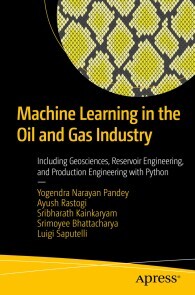
Machine Learning in the Oil and Gas Industry
Apply machine and deep learning to solve some of the challenges in the oil and gas industry. The book begins with a brief discussion of the oil and gas exploration and production life cycle in the context of data flow through the different stages of industry operations. This leads to a survey of some interesting problems, which are good candidates for applying machine and deep learning approaches. The initial chapters provide a primer on the Python programming language used for implementing the algorithms; this is followed by an overview of supervised and unsupervised machine learning concepts. The authors provide industry examples using open source data sets along with practical explanations of the algorithms, without diving too deep into the theoretical aspects of the algorithms employed. Machine Learning in the Oil and Gas Industry covers problems encompassing diverse industry topics, including geophysics (seismic interpretation), geological modeling, reservoir engineering, and production engineering.Throughout the book, the emphasis is on providing a practical approach with step-by-step explanations and code examples for implementing machine and deep learning algorithms for solving real-life problems in the oil and gas industry.WHAT YOU WILL LEARN* Understanding the end-to-end industry life cycle and flow of data in the industrial operations of the oil and gas industry* Get the basic concepts of computer programming and machine and deep learning required for implementing the algorithms used* Study interesting industry problems that are good candidates for being solved by machine and deep learning* Discover the practical considerations and challenges for executing machine and deep learning projects in the oil and gas industryWHO THIS BOOK IS FORProfessionals in the oil and gas industry who can benefit from a practical understanding of the machine and deep learning approach to solving real-life problems.Yogendra Pandey is a senior product manager at Oracle Cloud Infrastructure. He has more than 14 years of experience in orchestrating intelligent systems for the oil and gas, utilities, and chemical industries. He has worked in different capacities with oil and gas, and utilities companies, including Halliburton, ExxonMobil, and ADNOC. Yogendra holds a bachelor’s degree in chemical engineering from the Indian Institute of Technology (BHU), and a PhD from the University of Houston, with specialization in high-performance computing applications to complex engineering problems. He served as an executive editor for the Journal of Natural Gas Science and Engineering. Also, he has authored/co-authored more than 25 peer-reviewed journal articles, conference publications, and patent applications. He is a member of the Society of Petroleum Engineers.Ayush Rastogi is a data scientist at BPX Energy, Denver CO. His research interests are based on multi-phase fluid flow modeling and integrating physics-based and data-driven algorithms to develop robust predictive models. He has published his work in the field of machine learning and data-driven predictive modeling in the oil and gas industry. He has previously worked with Liberty Oilfield Services in the technology team in Denver, prior to which he worked as a field engineer in TX, ND, and CO as a part of his internship. He also has experience working as a petroleum engineering consultant in Houston, TX. Ayush holds a PhD in petroleum engineering with a minor in computer science from Colorado School of Mines, and is an active member of the Society of Petroleum Engineers.Sribharath Kainkaryam leads a team of data scientists and data engineers at TGS. Prior to joining TGS in 2018, he was a research scientist working on imaging and velocity model building challenges at Schlumberger. He graduated with a masters in computational geophysics from Purdue University and has an undergraduate degree from the Indian Institute of Technology, Kharagpur.Srimoyee Bhattacharya is a reservoir engineer in the Permian asset team in the Shell Exploration and Production Company. She has over 11 years of combined academic and professional experience in the oil and gas industry. She has worked in reservoir modeling, enhanced oil recovery, history matching, fracture design, production optimization, proxy modelling, and applications of multivariate analysis methods. She also worked with Halliburton as a research intern on digitalization of oil fields and field-wide data analysis using statistical methods. Srimoyee holds a PhD in chemical engineering from the University of Houston, and a bachelor’s degree from the Indian Institute of Technology, Kharagpur. She has served as a technical reviewer for the SPE Journal, Journal of Natural Gas Science and Engineering, and Journal of Sustainable Energy Engineering. She has authored/co-authored more than 25 peer-reviewed journal articles, conference publications, technical reports, and patent application.Luigi Saputelli is a reservoir management expert advisor to ADNOC and Frontender Corporation with over 28 years of experience. He worked in various operators and services companies around the world including PDVSA, Hess, and Halliburton. He is a founding member of the Real-time Optimization TIG and Petroleum Data-driven Analytics technical section of the Society of Petroleum Engineers, and recipient of the 2015 Society of Petroleum Engineers international production and operations award. He also received the 2007 employee of the year award from Halliburton. He has published more than 90 industry papers on applied technologies related to reservoir management, real-time optimization, and production operations. Saputelli is an electronic engineer with a masters in petroleum engineering, and a PhD in chemical engineering. He also serves as managing partner in Frontender Corporation, a petroleum engineering services firm based in Houston.MACHINE LEARNING IN THE OIL AND GAS INDUSTRY WITH PYTHONChapter 1: Towards Oil and Gas 4.0Chapter Goal: This chapter provides an overview of the digital transformation state-of-the-art in the Oil & Gas industry. The overview includes a literature review of the publications from the academic and industrial institutions, available in the public domain. It follows a theme of end-to-end Oil & Gas exploration and production project lifecycle.CHAPTER 2: PYTHON PROGRAMMING PRIMERChapter Goal: This chapter provides a brief primer of the Python programming language. The idea is to make the user familiar with the basic syntax on Python programming language. This chapter also briefly touches on the numpy, pandas, and a selected visualization (to be selected from matplotlib/seaborn/bokeh) library.CHAPTER 3: OVERVIEW OF MACHINE AND DEEP LEARNING CONCEPTSChapter Goal: This chapter introduces supervised and unsupervised machine learning concepts with the code examples using simplistic and clean data sets. The aim is to provide readers with understanding of practical concepts of different machine and deep learning algorithms, along with simple coding examples. Scikit-learn and Keras will be used for machine and deep learning code samples respectively.CHAPTER 4: GEOPHYSICS AND SEISMIC DATA PROCESSINGChapter Goal: This chapter will focus on using seismic data available from open data sources, e.g., Equinor Volve project, to provide two example applications for seismic data interpolation, and fault identification. Further, it will also discuss other problems, such as, horizon identification, and salt dome identification, without going in to too much details, while providing enough pointers and resources to the interested users.CHAPTER 5: GEOMODELINGChapter Goal: This chapter focuses on the geological modeling problems, including unsupervised learning for clustering different rock types based upon the petrophysical well logs, and estimation of the petrophysical properties away from the well locations by applying supervised machine learning techniques.CHAPTER 6: RESERVOIR ENGINEERINGChapter Goal: This chapter focused on the approaches for developing machine learning based proxy models to replace a full-physics reservoir simulator, and the use of these proxy models for generating production forecasts. The chapter will also cover related topics of interest including well placement optimization, and planning future wells based upon the historical production data.CHAPTER 7: PRODUCTION ENGINEERINGChapter Goal: This chapter will cover the topic of production modeling using machine learning methodologies. The topics will include identification of specific completion design for a well to achieve optimal production rates, and identifying the producing wells, which may benefit from the workover activities. A part of chapter will also provide methodology for equipment failure analytics, and predictive maintenance for production equipment, e.g., electrical submersible pumps (ESPs).CHAPTER 8: OPPORTUNITIES, CHALLENGES, AND EXPECTED FUTURE TRENDSChapter Goal: This chapters gleans over the challenges arising in the execution of the machine learning based digital transformation projects, the pitfalls leading to the project failure. Also, the opportunities that inherently lie in addressing these challenges are discussed from both the executive and practitioners’ perspective. Finally, an overview of the expected roadmap for the industry over the next decade will be discussed.
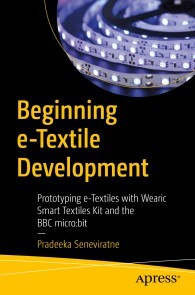
Beginning e-Textile Development
Electronic textiles (e-textiles) involves the combination of electronics and textiles to form "smart" textile products. It is an emerging technology with immense opportunities in the field of wearables fashion technology. And while there are many e-textile development platforms available on the market, this book uses the Wearic smart textile kit, a modular prototyping platform, to get you building projects and experiments easily and quickly.This book presents the essential skills required to get started developing e-textiles. The code presented is built using MakeCode blocks, an easy-to-use visual programming language. You'll use the BBC micro:bit microcontroller for all the projects, and with few exceptions, they require no soldering and wiring. In the end, you'll be able to apply and sew electronics to wearables, garments, and fabrics in this emerging technology.Beginning e-Textile Development presents the essential components to get you started with developing e-textiles.WHAT YOU'LL LEARN* Program with the BBC micro:bit* Add lights to your wearables using LED textiles* Use different textile sensors to measure heat, detect water, actuate attachments, and enable sense touch and pressure* Actuate attachments on wearables with muscle activity and heartbeat* Make chemistry-based color-changing fabrics using thermochromic pigments* Utilize Bluetooth Low Energy to send sensor data to mobile apps and WiFi to send sensor data to the ThingSpeak IoT analytics platform serviceWHO THIS BOOK IS FORBeginners to the e-textile industry seeking a comprehensive toolkit. Fashion designers, Makers, engineers, scientists, and students can all benefit from this book.Pradeeka Seneviratne is a software engineer with over 10 years of experience in computer programming and systems design. He is an expert in the development of Arduino and Raspberry Pi-based embedded systems and is currently a full-time embedded software engineer working with embedded systems and highly scalable technologies. Previously, Pradeeka worked as a software engineer for several IT infrastructure and technology servicing companies.Chapter 1. Getting StartedChapter Goal: This chapter will get you started with your Wearic Smart Textiles kit. It will also set the stage for the experiments and projects you will find in the following chapters. You will learn how to program the microcontroller using the Arduino IDE and MakeCode blocks.• Introduction to the wearable electronics• Introduction to the Wearic Smart Textiles kit• Setting up the development environment• Writing your first program to control the onboard LEDChapter 2. Making Wearables Attractive and Visible Using LightsChapter Goal: In this chapter, you will learn how to use the Wearic LED textile to add lights to your wearables. LEDs are a beautiful way to add light to wearable tech garments. Different lighting effects make your textile more attractive and highly visible. Sometimes LEDs use as indicators. You will learn basic sewing skills with conductive threads, basic electronics, and basic programming (to create different lighting effects). The skills you gain by this chapter will help you to follow the rest of the chapters.• Learn about the LED textile in detail• Applications in fashion and other industries• Testing: finding LED polarity, Use batteries and wires to test LEDs• Sewing LEDs onto the LED textile• Snapping LED textile to the expansion board• Programming: Creating light effects (i.e: blinking both LEDs, toggle LEDs, fading)• Controlling other types of LEDs (RGB, NeoPixels, etc)Chapter 3. Physical Controlling with ButtonsChapter Goal: In this chapter, you will learn how to use the Wearic Push-button textile to your wearables. A push-button textile consists of two soft-push buttons. By programming the microcontroller these buttons can be used to control actuators such as LEDs, heating textiles, wet textiles, etc. The skills you gain by this chapter will help you to follow the rest of the chapters.• Learn about the Push button textile• Applications in the fashion industry• Snapping Push-button textile to the expansion board• Programming: learning about different button status by controlling LEDSChapter 4. Staying WarmChapter Goal: In this chapter, you will learn how to use the Wearic Heating textile to keep your wearables warm. You will learn various techniques on how to program the heated textile to make different heating effects/experiences. By following this chapter the reader will able to make textiles by adding heating textiles, sensors, and LEDs (actuators).• Learn about the ‘Heating textile’ in detail• Alternatives/ Industrial applications• Testing: Use batteries and wires to test the heating textile• Snapping Heating textile to the expansion board• Programming: Controlling heating textile through the microcontroller• Programming: Using PWM to control the heating textile.• Programming: Using a feedback mechanism to keep the temperature at a specific level using a temperature sensor.• Programming: Putting them all together to build a heated mat with feedback LEDs.Chapter 5. Your Second SkinChapter Goal: In this chapter, you will learn how to use the Wearic textile pressure sensor to enable your wearable touch and pressure-sensitive. By following this chapter the reader will able to make textiles by adding pressure-sensitive textiles, sensors, and actuators.• Learn about the ‘Textile pressure sensor’ in detail.• Alternatives / Applications in fashion tech / Applications in medical• Snapping textile pressure sensor to the expansion board.• Programming: Sensing pressure, low and high-pressure levels• Programming: Using a pressure threshold level to control the LED textile• Programming: Occupancy detection• Making your own pressure sensorsChapter 6. Know When Your Garments is WetChapter Goal: In this chapter, you will learn how to use the Wearic wetness sensor to sense if your garments/wearables getting wet by water or any liquids. By following this chapter the reader will able to make textiles by adding wetness sensors, and actuators.• Learn about the ‘Wetness sensor’ in detail• Alternatives/ Applications in fashion tech / Applications in medical• Snapping wetness sensor to the expansion board.• Programming: Sensing wetness, exploring different wetness levels.• Programming: Using the wetness sensor to control the LED textile.Chapter 7. Muscle Activity and HeartbeatChapter Goal: In this chapter, you will learn to use Textile Skin Electrodes (EMG|EEG|ECG) to detect your muscle activity and heartbeat. By following this chapter the reader will able to make textiles by adding Skin Electrodes to activate different actuators by using muscle activity and heartbeat measures.• Learn about the Textile Skin Electrodes (EMG|EEG|ECG)• Wiring Textile Skin Electrodes• Programming: heartbeat LEDs• Programming: Muscle activated LEDsChapter 8. Color Changing FabricsChapter Goal: In this chapter, you will learn how to make color-changing fabrics by using the Wearic heated textile and temperature sensors (the skills you gained in chapter 4). You will learn how to apply thermochromic pigments onto the fabrics and build a control circuit using the Wearic textiles kit.• Introduction to Thermochromic/chemistry based color changing• Applications in the fashion industry• Choosing the correct thermochromic pigments• Applying thermochromic pigments onto the fabric• Direct powering• Programming: Temperature control
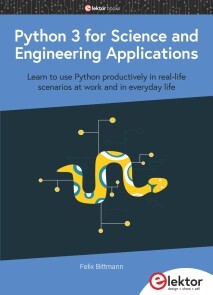
Python 3 for Science and Engineering Applications
If you have mastered the basics of Python and are wanting to explore the language in more depth, this book is for you. By means of concrete application examples used in different applications, you are guided on how Python can be used tackle a wide range of problems. Including general ideas and solutions, the specifics of Python and how these can be practically applied are discussed. The book illustrates many aspects of programming including algorithms, recursion, data structures, and helps develop problem-oriented thinking.Python 3 for Science and Engineering Applications includes:>practical and goal-oriented learning>basic Python techniques> modern Python 3.6+ including comprehensions, decorators andgenerators>complete code available online> more than 40 exercises, solutions documented online>no additional packages or installation required, 100% pure PythonTopics cover:>identifying large prime numbers and computing Pi> writing and understanding recursive functions with memorisation>computing in parallel and utilising all system cores>processing text data and encrypting messages>comprehending backtracking and solving Sudokus>analysing and simulating games of chance to develop optimalwinning strategies>handling genetic code and generating extremely long palindromesFelix Bittmann is a research associate at the Leibniz Institute for Educational Trajectories and a doctoral candidate at the University of Bamberg, Germany. His research interests include social inequality, the role of education in the course of life, quantitative methods, and the philosophy of science. With a focus on statistical analysis and applied research, Python is an integral and multifunctional tool of his daily workflow.
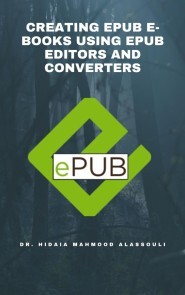
Creating EPUB E-books Using EPUB Editors and Converters
Creating E-books in epub format is very important to sell E-books in electronic book stores. Most publishing and distribution E-book stores will not accept the epub format document for E-book if it includes any warnings or errors when validated and that is a very big challenge to all authors.I devoted this book to evaluate some tools that can be used for creating, validating and editing E-books to be in proper Epub format without errors.Personally, I suggest the following guidelines for preparing E-book in Epub format.• Write the document in Microsoft word as .docx file. Make sure to properly setup the h1headings and h2 headings and h3 headings on each section of the document as these data are the most important data used by the Epub management software to convert the document to epub format.• Convert the Microsoft document to Epub format using Calibre E-book management software. Add all required metadata and the cover and also create a table of contents when converting the file.• Using any Epub reader, check if the layout of epub document according to the headings you made on the word document is good and comfortable to any reader.• Validate the epub document to see if it has errors and warnings using the website http://validator.idpf.org.• Then try to troubleshoot and identify the exact location of the errors detected by the epub validator on the epub document by tracing the code view of the epub document using Sigil epub editor. Then, modify the word document to eliminate the errors. And reconvert the word document to epub format using Calibre E-book management software. Validate the updated epub document for any errors again.This book contains the following sections:1. Some online publishing and distribution stores2. Epub Validators3. Creation Epub file through online websites4. Common software's to convert a file to Epub format5. Converting document to Epub format using Calibre software6. Editing Epub documents using Sigil Epub Editor

Practical Apache Lucene 8
Gain a thorough knowledge of Lucene's capabilities and use it to develop your own search applications. This book explores the Java-based, high-performance text search engine library used to build search capabilities in your applications.Starting with the basics of Lucene and searching, you will learn about the types of queries used in it and also take a look at scoring models. Applying this basic knowledge, you will develop a hello world app using basic Lucene queries and explore functions like scoring and document level boosting.Along the way you will also uncover the concepts of partial searching and matching in Lucene and then learn how to integrate geographical information (geospatial data) in Lucene using spatial queries and n-dimensional indexing. This will prepare you to build a location-aware search engine with a representative data set that allows location constraints to be specified during a search. You’ll also develop a text classifier using Lucene and Apache Mahout, a popular machine learning framework.After a detailed review of performance bench-marking and common issues associated with it, you’ll learn some of the best practices of tuning the performance of your application. By the end of the book you’ll be able to build your first Lucene patch, where you will not only write your patch, but also test it and ensure it adheres to community coding standards.WHAT YOU’LL LEARN* Master the basics of Apache Lucene* Utilize different query types in Apache Lucene* Explore scoring and document level boosting* Integrate geospatial data into your applicationWHO THIS BOOK IS FORDevelopers wanting to learn the finer details of Apache Lucene by developing a series of projects with it.Atri is a distributed systems engineer with expertise in building and scaling large data oriented systems, and an Apache Lucene/Solr committer. He has worked for Microsoft, where he was responsible for scaling the storage and query engines for Azure CosmosDB. He is also a long time PostgreSQL contributor and an Apache committer and PMC member for HAWQ, MADLib, and Apex.CHAPTER 1: MEETING THE BEAST -- HOIA LUCENE! - 15 PAGESThis chapter will go over basics of Lucene and search, and give details of basic query structures in Lucene along with the different data structures and types in Lucene which can be diverse in application and usage.1. What Is Search, Anyway?2. Meet Lucene3. Types of Structures In Lucene4. Query Types -- Done The Lucene Way5. Lucene Vs Relational DatabasesCHAPTER 2: HELLO WORLD -- THE LUCENE WAY - 10 PAGESThis chapter will try out a few basic Lucene queries on a standard data set. User will index some standard data set and query different types of queries on top of it. The user will explore scoring, document level boosting and queries like TopN hits, uses of Collectors.1. Index Data In Lucene2. Internals of a Lucene Index3. Scoring and Boosting4. Doing your first query5. TopN Hits -- Why Should I Care About the 100th Hit?6. Collectors -- The Life Of Your ApplicationCHAPTER 3: BUILD A PERSONAL DESKTOP FILE SEARCHER - 40 PAGESThis chapter will go over details of building a file searcher using Lucene which will have the capability to search across the entire file system of the user’s computer and provide search results to the user for relevant documents and files given a partial or complete keyword.1. Basics of Document Searching with Lucene2. Partial Searches and Matching3. A Bit About TF/IDF4. Build The Core of Our Searcher5. Building the File System Seek and Search Functionality6. Bringing It All TogetherCHAPTER 4: A BIT ABOUT SPATIAL INDEXING - 20 PAGESBasics of Spatial Indexing and space vectors. The chapter will cover spatial indexing and querying in Lucene and advanced level details of N dimensional indexing and searching.1. Spatial Indexing2. Lucene’s Spatial Indexing Basics3. When To Use Spatial Indexing?4. N Dimensional Indexing5. Lucene Spatial Query TypesCHAPTER 5: DEVELOPING A LOCATION AWARE SEARCH ENGINE - 40 PAGESThis chapter will go over details of building a location aware search engine with representative data set and allowing location constraints to be specified during a search.1. What is Location Aware Searching?2. Representing Data As Spatial Data3. Metadata Searches4. Combining Searches -- Actual Text and Location CombinedCHAPTER 6: CREATE A TEXT CLASSIFIER WITH APACHE MAHOUT AND LUCENE - 30 PAGESThis chapter will go over building a classifier using Apache Mahout, a popular Machine Learning framework and Lucene.1. What is Mahout?2. What is a Text Classifier Engine?3. Building The Model in Mahout4. Building the Parser in Lucene5. Bringing It All TogetherCHAPTER 7: PERFORMANCE TUNING YOUR LUCENE APPLICATIONS - 15 PAGESPerformance is key to any search applications and small changes to the application can cause amplified changes to the performance of the application. We will performance benchmark applications, learn common pitfalls and learn best practices to tune performance in search applications with Lucene.1. Lucene Performance Basics2. Performance Bench-marking3. Lucene Performance Tuning4. Lucene Performance with System Performance ToolsCHAPTER 8: YOUR FIRST LUCENE PATCH - 15 PAGESThis chapter will focus on building your first patch to the heart of the engine itself. We will go through the cycle of writing a patch, testing it, adhering to community code standards, JIRA navigation, community interaction etc.1. Lucene Internals2. Working with Git3. Writing a Patch4. Test Test Test!5. Opening a JIRA for your issue6. Community Interaction
Azure SQL Revealed
Access detailed content and examples on Azure SQL, a set of cloud services that allows for SQL Server to be deployed in the cloud. This book teaches the fundamentals of deployment, configuration, security, performance, and availability of Azure SQL from the perspective of these same tasks and capabilities in SQL Server. This distinct approach makes this book an ideal learning platform for readers familiar with SQL Server on-premises who want to migrate their skills toward providing cloud solutions to an enterprise market that is increasingly cloud-focused.If you know SQL Server, you will love this book. You will be able to take your existing knowledge of SQL Server and translate that knowledge into the world of cloud services from the Microsoft Azure platform, and in particular into Azure SQL. This book provides information never seen before about the history and architecture of Azure SQL. Author Bob Ward is a leading expert with access to and support from the Microsoft engineering team that built Azure SQL and related database cloud services. He presents powerful, behind-the-scenes insights into the workings of one of the most popular database cloud services in the industry.WHAT YOU WILL LEARN* Know the history of Azure SQL* Deploy, configure, and connect to Azure SQL* Choose the correct way to deploy SQL Server in Azure* Migrate existing SQL Server instances to Azure SQL* Monitor and tune Azure SQL’s performance to meet your needs* Ensure your data and application are highly available* Secure your data from attack and theftWHO THIS BOOK IS FORThis book is designed to teach SQL Server in the Azure cloud to the SQL Server professional. Anyone who operates, manages, or develops applications for SQL Server will benefit from this book. Readers will be able to translate their current knowledge of SQL Server—especially of SQL Server 2019—directly to Azure. This book is ideal for database professionals looking to remain relevant as their customer base moves into the cloud.BOB WARD is a principal architect for the Microsoft Azure Data Server team, which owns the development for all SQL Server versions. He has worked for Microsoft for more than 27 years on every version of SQL Server shipped from OS/2 1.1 to SQL Server 2019, including Azure SQL. Bob is a well-known speaker on SQL Server, often presenting talks on new releases, internals, and performance at events such as PASS Summit, Red Hat Summit, Microsoft //build, SQLBits, SQLIntersection, Microsoft Inspire, and Microsoft Ignite. You can follow him at @bobwardms and linkedin.com/in/bobwardms. Bob is the author of the Apress books Pro SQL Server on Linux and SQL Server 2019 Revealed. 1. SQL Server Rises to the Clouds2. What is Azure SQL?3. SQL Server on Azure Virtual Machine4. Deploying Azure SQL5. Configuring Azure SQL6. Securing Azure SQL7. Monitoring and Tuning Performance for Azure SQL8. Availability for Azure SQL9. Completing Your Knowledge of Azure SQL10. Go Big with the Cloud