

Computer und IT

Big Public Data aus dem Programmable Web
Die Verbreitung des Internets und die zunehmende Digitalisierung in der öffentlichen Verwaltung und Politik haben über die letzten Jahre zu einer starken Zunahme an hochdetaillierten digitalen Datenbeständen über politische Akteure und Prozesse geführt. Diese big public data werden oft über programmatische Schnittstellen (Web APIs; programmable Web) verbreitet, um die Einbettung der Daten in anderen Webanwendungen zu vereinfachen. Die Analyse dieser Daten für wissenschaftliche Zwecke in der politischen Ökonomie und Politologie ist vielversprechend, setzt jedoch die Implementierung einer data pipeline zur Beschaffung und Aufbereitung von Daten aus dem programmable Web voraus. Dieses Buch diskutiert die Chancen und Herausforderungen der praktischen Nutzung dieser Datenbestände für die empirische Forschung und zeigt anhand einer Fallstudie ein mögliches Vorgehen zur systematischen Analyse von big public data aus dem programmable Web auf.ULRICH MATTER ist Assistenzprofessor für Volkswirtschaftslehre an der Universität St. Gallen.Einleitung.- Chancen: Datengenerierung und Datenqualität.- Herausforderungen: Webtechnologien und Variabilität der Daten.- Konzeptioneller Lösungsansatz: Data pipelines.- Fallstudie: Religion in der US Politik.- Replizierbarkeit und Verifizierbarkeit der Datensammlung.- Diskussion und Ausblick

Advanced Platform Development with Kubernetes
Leverage Kubernetes for the rapid adoption of emerging technologies. Kubernetes is the future of enterprise platform development and has become the most popular, and often considered the most robust, container orchestration system available today. This book focuses on platforming technologies that power the Internet of Things, Blockchain, Machine Learning, and the many layers of data and application management supporting them._Advanced Platform Development with Kubernetes_ takes you through the process of building platforms with these in-demand capabilities. You'll progress through the development of Serverless, CICD integration, data processing pipelines, event queues, distributed query engines, modern data warehouses, data lakes, distributed object storage, indexing and analytics, data routing and transformation, query engines, and data science/machine learning environments. You’ll also see how to implement and tie together numerous essential and trending technologies including: Kafka, NiFi, Airflow, Hive, Keycloak, Cassandra, MySQL, Zookeeper, Mosquitto, Elasticsearch, Logstash, Kibana, Presto, Mino, OpenFaaS, and Ethereum.The book uses Golang and Python to demonstrate the development integration of custom container and Serverless functions, including interaction with the Kubernetes API. The exercises throughout teach Kubernetes through the lens of platform development, expressing the power and flexibility of Kubernetes with clear and pragmatic examples. Discover why Kubernetes is an excellent choice for any individual or organization looking to embark on developing a successful data and application platform.WHAT YOU'LL LEARN* Configure and install Kubernetes and k3s on vendor-neutral platforms, including generic virtual machines and bare metal* Implement an integrated development toolchain for continuous integration and deployment* Use data pipelines with MQTT, NiFi, Logstash, Kafka and Elasticsearch* Install a serverless platform with OpenFaaS* Explore blockchain network capabilities with Ethereum * Support a multi-tenant data science platform and web IDE with JupyterHub, MLflow and Seldon Core* Build a hybrid cluster, securely bridging on-premise and cloud-based Kubernetes nodes WHO THIS BOOK IS FORSystem and software architects, full-stack developers, programmers, and DevOps engineers with some experience building and using containers. This book also targets readers who have started with Kubernetes and need to progress from a basic understanding of the technology and "Hello World" example to more productive, career-building projects.Craig Johnson currently holds the positions of CTO and partner in Deasil Cognitive, Inc. and Chief Architect at Deasil Works, Inc and has been developing software for over 25 years. Craig’s expertise revolves around microservices, artificial intelligence, algorithms, machine learning and blockchain technologies.Craig has helped lead his team to significantly improved productivity and return on investment across many client projects; leveraging Kubernetes, Docker, Golang, Cassandra, Kafka and Elastic to name a few. The team and he are developing more productive, stable, clean and faster applications than ever in the past, and the results are beautiful and innovative IoT management systems, IoT implementations, mobile applications, business intelligence, data management and machine learning platforms.As the former Director of R&D at Napster and later a hand full of Universal and Sony subsidiaries, Craig has been fortunate to spend many of my early days on the bleeding edge, in the open green fields of new media and disruptive technology.Craig is successfully operating multiple commercial Kubernetes platforms utilizing nearly all the technology and concepts proposed in Platform Development with Kubernetes. Over the next 8-12 months he will be developing the next iteration of these concepts for a number of clients. Platform Development with Kubernetes will be based on successful real-world systems currently in development and production.ADVANCED PLATFORM DEVELOPMENT WITH KUBERNETESPart 1: InfrastructureChapter 1: Platform as InfrastructureChapter 2: DevOpsChapter 3: Development EnvironmentChapter 4: CI/CDPart 2: Data PlatformChapter 5: PipelineChapter 6: Indexing, Analysis, and VisualizationChapter 7: Lakes and WarehousesChapter 8: Routing and TransformationPart 3: ApplicationChapter 9: Blockchain PlatformChapter 10: Blockchain EventsChapter 11: AI/ML AutomationChapter 12: Kubernetes API
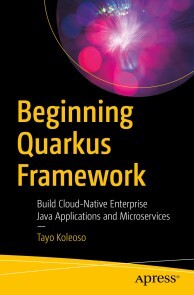
Beginning Quarkus Framework
Harness the power of Quarkus, the supersonic subatomic cloud-native Java platform from Red Hat. This book covers everything you need to know to get started with the platform, which has been engineered from the ground up for superior performance and cloud-native deployment.You’ll start with an overview of the Quarkus framework and its features. Next, you'll dive into building your first microservice using Quarkus, including the use of JAX-RS, Swagger, Microprofile, REST, reactive programming, and more. You’ll see how to seamlessly add Quarkus to existing Spring framework projects. The book continues with a dive into the dependency injection pattern and how Quarkus supports it, working with annotations and facilities from both Jakarta EE CDI and the Spring framework. You’ll also learn about dockerization and serverless technologies to deploy your microservice.Next you’ll cover how data access works in Quarkus with Hibernate, JPA, Spring Boot, MongoDB, and more. This will also give you an eye for efficiency with reactive SQL, microservices, and many more reactive components. You’ll also see tips and tricks not available in the official documentation for Quarkus.Lastly, you'll test and secure Quarkus-based code and use different deployment scenarios to package and deploy your Quarkus-based microservice for the cloud, using Amazon Web Services as a focus. After reading and using Beginning Quarkus Framework, you'll have the essentials to build and deploy cloud-native microservices and full-fledged applications.Author Tayo Koleoso goes to great lengths to ensure this book has up to date material including brand new and some unreleased features!WHAT YOU WILL LEARN* Build and deploy cloud-native Java applications with Quarkus* Create Java-based microservices* Integrate existing technologies such as the Spring framework and vanilla Java EE into the Quarkus frameworkWork with the Quarkus data layer on persistence with SQL, reactive SQL, and NoSQL* Test code in Quarkus with the latest versions of JUnit and Testcontainers* Secure your microservices with JWT and other technologies* Package your microservices with Docker containers and GraalVM native image tooling* Tips and techniques you won't find in the official Quarkus documentationWHO THIS BOOK IS FORIntermediate Java developers familiar with microservices, the cloud in general, and REST web services, but interested in modern approaches.TAYO KOLEOSO is a full-time technical lead and consulting architect with a burning passion for learning - because he knows there’s too much he doesn’t know; and teaching - because it’s the best way to reinforce knowledge. He’s an in-person instructor and author, dedicated to topics and technologies he’ll have to study religiously to deliver. His journey started from Lagos, in Nigeria, bringing him to the United States as an immigrant software engineer. Across industries, from finance to cybersecurity, he has led teams; architected complicated integrations; broken and built many fun and mission-critical projects in the enterprise space, with Java and Python, in the cloud. Quarkus is his latest victim.Outside of technology, he’s very passionate about personal finance and the securities market. Throw a couple of habanero peppers in, and he’s happy! You can watch and follow his courses on LinkedIn Learning.1. Welcome to Quarkus – Gives the reader a high-level overview of the Quarkus platform, the goals, features and a comparison with alternatives- Supersonic Subatomic!- Quarkus Feature Tour- Quarkus vs Springboot vs JavaEE- Getting started with Quarkus2. Microservices – Gets the reader started with building microservices with Quarkus, including production-grade features- Getting started with microservices in Quarkus- Swagger Support- OpenAPI Documentation- SwaggerUI- Microprofile Support (I might add a few more microprofile-specific components if there’s any Quarkus-flavored twist to them)- REST Client- Security- Validation- Reactive Programming- Vert.x- Reactive Routes- Reactive Filters- Configuration - Configuration Options- Configuration Management with HashiCorp Vault3. Dependency Injection - Shows the reader how Quarkus works with existing DI frameworks in the Java ecosystem- CDI- Spring4. Quarkus Data Layer – Introduce the reader to handling data using Quarkus- Reactive SQL- JSON- Flyway- DynamoDB- MongoDB5. Batch Processing – Show the reader how to perform batch operations in Quarkus6. Testing – Show the reader how to test Quarkus-based code7. Quarkus Security – Implement Quarkus-specific security features (might roll this into the Microservice chapter)8. Deployment and Packaging – Introduce the reader to different deployment scenarios that Quarkus is engineered for (might whittle down/collapse some of these as the writing progresses)- Basic Deployment- Native Packaging- Kubernetes- GraalVM - Hot Reloading Code- Serverless

Introducing Deno
Learn everything there is to know about the new secure runtime for JavaScript: Deno. A proposed replacement for Node.js envisioned and created by the same developer who wrote the first version of Node, Deno is a simple, modern and secure runtime for JavaScript and TypeScript that uses V8 and is built in Rust. This book will cover everything from its inception to the currently available version.You’ll see how to take advantage of the security layer in order to avoid unwanted security holes, and how to use TypeScript to develop your applications without having to manually set up a build process. You'll also learn how to create and use modules without having to depend on a package manager, and much more. Armed with these newly learned concepts, by the time you finish this book, you’ll be ready to build and test your own Deno applications.Whether you’re a brand new developer to the back end with a JavaScript background or a seasoned Node.js developer looking to understand this competing technology, Introducing Deno will put you on the right path.WHAT YOU'LL LEARN* Learn why Deno was created and why it is different from Node* Build real applications using Deno and related technologies* Create backend applications with Typescript * Resolve how to live without npm and package.json* Set permissions and default behaviorWHO THIS BOOK IS FORAnyone with knowledge of back-end development looking to learn a new way of doing things and those with a basic understanding of JavaScript and Node.js core concepts.FERNANDO DOGLIO has been a part of the Software Development industry for the past 16 years. He’s worked on countless web projects, which include (amongst other things) APIs, Web Services, SPA, Node.js applications, PHP, Ruby, and a lot of JavaScript/HTML/CSS. He was there when SOAP hit the web and it was all the rage and he was also there when XML was the magic X on AJAX. He’s worked with Node.js for several years now and he’s written several books and countless articles about it, covering everything from the art of designing REST APIs with it to understanding the best design patterns and how they can be implemented with it. Now, working as a Technical Manager, he’s an eager evangelist of using JavaScript for backend development given how flexible and powerful this language is. You can find him on Twitter @deleteman123.CHAPTER 1: WHY DENO?Covering the reasons why Deno was created, what new features and improvements it brings over Node.js, and some basic code samples.● What problems is it trying to solve?● A quick overview of what’s new○ TypeScript as first-class citizen○ Security○ Top-level await○ Extended and improved standard library○ No more npm● Trying Deno○ Online playgrounds○ Installing Deno on your computerCHAPTER 2: TYPESCRIPT YOU NEED TO KNOWThe chapter will cover the basic concepts of TypeScript to make sure the reader understands the basics for the code samples that will follow.CHAPTER 3: LIVING A SECURE LIFEA more in-depth chapter covering everything about the new security layer and code examples to showcase the feature.● Understanding how to set permissions & default behavior● Code examplesCHAPTER 4: NO MORE NPMA detailed chapter covering how Deno intends to handle modules including several code examples showcasing the different features.● Importing external modules● Handling versions● Importing once, requiring many times● What happened to package.json?● What if the external resource is removed?● Potential pitfallsCHAPTER 5: EXISTING MODULESReview of the standard library and some already existing ports from Node.js that can be used with Deno. All covered modules will have at least one code sample associated with them.● The standard library, what is it and how can we use it?● Ported modules from NodeCHAPTER 6: PUTTING IT ALL TOGETHER-SAMPLE APPSThe final chapter will cover a few practical projects to showcase how different types of applications can look like using Deno and how to structure them.● Building an API with Deno and Mongo● Building a chat server with Deno● Building a command line tool with Deno

Spring Quick Reference Guide
Quickly gain the insight necessary to address a multitude of Java-based Spring Framework and Spring Boot coding challenges using this succinct reference guide. Short, focused code examples will help you master many of the Spring elements such as AOP, data access, MVC for web development, security, web services/REST for microservices development, Batch for large data sets, and more. You’ll also get a rundown of the increasingly popular Spring Boot microframework as well.You won’t find any technical jargon, bloated samples, drawn out history lessons, or witty stories in this book. What you will find is a language reference that is concise, to the point, and highly accessible. The book is packed with useful information and is a must-have for any Java programmer.WHAT YOU WILL LEARN* Discover the Spring Framework and its many sub-projects* Work with the Spring Boot microframework* Program with the Spring Boot framework to build Java-based* microservices, native cloud applications, and more* Use some of the lesser-known but still important frameworks and tools such as REST Docs, HATEOAS, Cloud, and more* Leverage these Spring frameworks and tools for building your next Java-based cloud applicationWHO THIS BOOK IS FORThose with prior experience with Java who want a quick and handy reference to using Spring.Adam L. Davis makes software. He’s spent many years developing in Java (since Java 1.2) and has enjoyed using Spring and Hibernate for more than a decade. Since 2006 he’s been using Groovy, Grails, HTML, CSS, and JavaScript, in addition to Java to create SaaS web applications that help track finances for large institutions (among other things).Adam has a Masters and a Bachelors degree in Computer Science from Georgia Tech. He is also the author of Reactive Streams in Java (Apress, 2019) and Learning Groovy: Second Edition (Apress, 2019).1. Introduction2. Core3. Libraries4. Spring AOP5. Spring Data6. Spring MVC7. Spring Mobile8. Spring Security9. Spring Web Services10. Spring REST11. Reactor12. Spring XD13. Spring Batch14. Spring Social15. Spring Boot16. Spring Boot with WebFlux17. Spring IO18. Spring Shell19. Spring Cloud
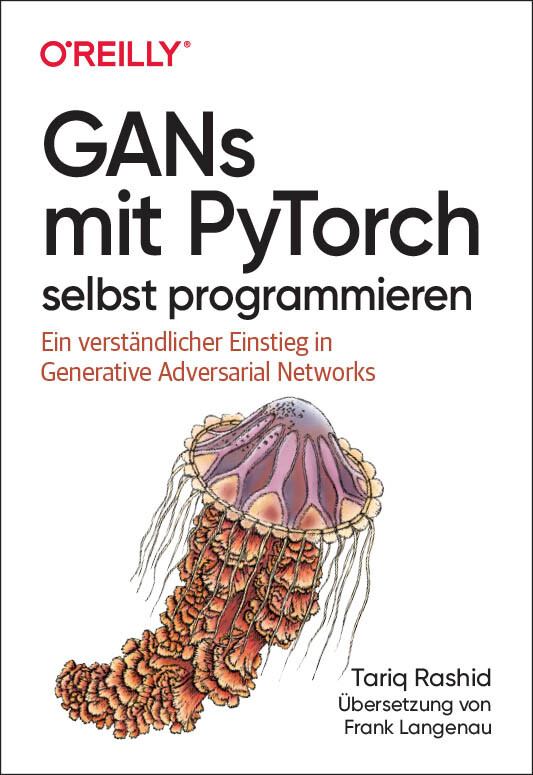
GANs mit PyTorch selbst programmieren
GANs mit PyTorch selbst programmieren - Ein verständlicher Einstieg in Generative Adversarial NetworksNeues von Bestsellerautor Tariq Rashid: Eine Einführung in die innovative Deep-Learning-Technik GANsGANs sind »die coolste Idee im Deep Learning in den letzten 20 Jahren« – sagt Yann LeCun, einer der weltweit führenden Forscher auf dem Gebiet neuronaler Netze, über Generative Adversarial Networks. Bei dieser noch neuen KI-Technik treten zwei neuronale Netze gegeneinander an mit dem Ziel, realistisch wirkende Fotos, Videos oder Texte neu zu generieren. Die Netze trainieren sich gegenseitig: Auf Basis realer Daten erzeugt der Generator künstliche Inhalte, der Diskriminator weist Daten mit schlechter Qualität zurück.Mit diesem Buch können Sie selbst ganz praktisch ausprobieren, wie GANs funktionieren. Wie in seinem Bestseller Neuronale Netze selbst programmieren, auf den dieses Buch aufbaut, erläutert Tariq Rashid jede Technik Schritt für Schritt mit vielen anschaulichen Abbildungen. Sie erfahren, wie Sie mit dem populären Framework PyTorch Ihre eigenen GANs erstellen und trainieren:Sie lernen die Grundlagen von PyTorch und programmieren damit Ihr erstes neuronales Netz auf Google ColabSie starten dann mit einem einfachen GAN, um einen typischen Workflow einzurichten, und üben erste Techniken anhand der MNIST-Datenbank mit handgeschriebenen ZahlenMit diesem Wissen programmieren Sie ein GAN, das realistische menschliche Gesichter erzeugen kannSie finden heraus, wo das GAN versagt, schaffen Abhilfe und verbessern die Leistung und Stabilität Ihres ModellsAbschließend erkunden Sie auch anspruchsvollere Themen wie Convolutional und Conditional GANsLeseprobe (PDF-Link)Inhaltsverzeichnis (PDF-Link) Tariq Rashids besondere Fähigkeit, komplexe Ideen verständlich zu erklären, macht diese schwierige Materie für jeden Interessierten zugänglich und praktisch nachvollziehbar.

Pro C# 8 with .NET Core 3
This essential classic provides a comprehensive foundation in the C# programming language and the frameworks it lives in. Now in its 9th edition, you will find the latest C# 8 and .NET Core features, along with new chapters on Microsoft’s lightweight, cross-platform framework, .NET Core 3.1. Coverage of ASP.NET Core, Entity Framework Core, and more, sits alongside the latest updates to .NET Core, including Windows Presentation Foundation (WPF). Not only does this book cover all of the latest features in C# 8, but all chapters and code samples have been rewritten for this latest release.Dive in and discover why this book has been a favorite of C# developers worldwide for more than 15 years. Gain a solid foundation in object-oriented development techniques, attributes and reflection, generics and collections, and numerous advanced topics not found in other texts (such as CIL opcodes and emitting dynamic assemblies). With the help of Pro C# 8 with .NET Core 3 gain the confidence to put C# into practice and explore the .NET Core universe on your own terms.WHAT YOU WILL LEARN* Discover the bells and whistles of C# 8 features and updates to previous features* Hit the ground running with ASP.NET Core web applications and web services, and Entity Framework Core* Work with the latest version of Windows Presentation Foundation, now a part of .NET Core* Understand the philosophy behind .NET and the cross-platform alternative, .NET Core* Develop applications with C# and modern frameworks for services, web, and smart client applicationsWHO THIS BOOK IS FORDevelopers who are interested in .NET programming and the C# language“Amazing! Provides easy-to-follow explanations and examples. I remember reading the first version of thisbook; this is a 'must-have' for your collection if you are learning .NET Core!”– Rick McGuire, Senior Application Development Manager, Microsoft“Phil is a journeyman programmer who brings years of experience and a passion for teaching to make this fully revised and modernized ‘classic’ a ‘must-have’. Any developer who wants full-spectrum, up-to-date coverage of both the C# language and how to use it with .NET Core and ASP.NET Core should get this book.”– Brian A. Randell, Partner, MCW Technologies and Microsoft MVPANDREW TROELSEN has more than 20 years of experience in the software industry. Over this time he has worked as a developer, educator, author, public speaker, and now team lead and lead engineer. He is the author of numerous books in the Microsoft universe. He holds a master of science degree in software engineering (MSSE) from the University of St. Thomas and another in computational linguistics (CLMS) from the University of Washington.PHIL JAPIKSE is an international speaker, Microsoft MVP, ASPInsider, Professional Scrum Trainer, and a passionate member of the developer community. He is the lead director of the Cincinnati .NET User Group and the Cincinnati Software Architect Roundtable, and he founded the CincyDeliver conference, Currently, Phil works as a Director of Consulting and Enterprise Architect. Follow Phil on his blog (skimedic.com) or on Twitter @skimedic.PART I: INTRODUCING C# AND .NET CORE.- Chapter 1: Introducing .NET Core.- Chapter 2: Building C# Applications.- PART II: CORE C# PROGRAMMING.- Chapter 3: Core C# Programming Constructs, Part I.- Chapter 4: Core C# Programming Constructs, Part II.- PART III: OBJECT ORIENTED PROGRAMMING WITH C#.- Chapter 5: Understanding Encapsulation.- Chapter 6: Understanding Inheritance and Polymorphism.- Chapter 7: Understanding Structured Exception Handling.- Chapter 8: Working with Interfaces.- Chapter 9: Understanding Object Lifetime .- PART IV: ADVANCED C# PROGRAMMING.- Chapter 10: Collections and Generics.- Chapter 11: Advanced C# Language Features.- Chapter 12: Delegates, Events, and Lambda Expressions.- Chapter 13: LINQ To Objects.- Chapter 14: Processes, AppDomains, and Load Contexts.- Chapter 15: Multithreaded, Parallel, and Async Programming.- PART V: PROGRAMMING WITH .NET CORE ASSEMBLIES.- Chapter 16: Building and Configuring Class Libraries.- Chapter 17: Type Reflection, Late Binding, and Attribute-Based Programming.- Chapter 18: Dynamic Types and the Dynamic Languare Runtime.- Chapter 19:Understanding CIL and the Role of Dynamic Assemblies.- PART VI: FILE AND DATA HANDLING.- Chapter 20: File I/O and Object Serialization.- Chapter 21: Data Access with ADO.NET.- Chapter 22: Introducing Entity Framework Core.- Chapter 23: Finishing the Data Access Layer.- PART VII: WINDOWS CLIENT DEVELOPMENT.- Chapter 24: Introducing Windows Presentation Foundation and XAML.- Chapter 25: WPF Controls, Layouts, Events, and Data Binding.- Chapter 26: WPF Graphics Rendering Services.- Chapter 27: WPF Resources, Animations, Styles, and Templates.- Chapter 28: WPF Notifications, Validations, Commands, and MVVM.- PART VIII: ASP.NET CORE.- Chapter 29: Introducing ASP.NET Core.- Chapter 30: Restful Services with ASP.NET Core.- Chapter 31: MVC Applications with ASP.NET Core.

Rust for the IoT
Get started programming Rust applications for the Internet of Things (IoT). This book is a programming skills migration book that teaches you the Rust programming techniques most useful for IoT applications. You'll step through from server to board development in creating a set of IoT applications.In Rust for the IoT, you'll learn how to build a modern server-side application using Rust on the backend. Then you'll use docker and Kubernetes to deploy these to a managed cloud. Finally you will use a Raspberry Pi with a SenseHat and Camera to capture the world around you and send that information to the cloud.While you will be able to follow along without any cloud or hardware, to make the most of it we recommend a few cloud pieces and hardware that is designed to integrate with the software in this book. After reading and using this book, you'll see how to apply Rust to the Internet of Things.WHAT YOU WILL LEARN* Create a modern Rust backend complete with handling eventual consistency and interacting via a GraphQL interface* Use the Raspberry PI to serve as a cheap IoT device that one can easily deploy around the house* Capture temperature, video, and use the interactive joystick to interact with the software you’ve created* Use OpenCV to perform facial detection from the PI’s camera and save that information to the cloud.* Create deployable helm charts for the cloud, and for the device create complete ISOs that allow you to easily deploy the Pi’s OS + custom softwareWHO THIS BOOK IS FORYou will need to have a basic understanding of cloud application development at a minimum and the basics of Rust coding. This book is for those interested in or working with the IoT and the Raspberry Pi who want to learn how Rust can work for them.JOSEPH FAISAL NUSAIRAT is a a senior partner at Integrallis Software and is a software developer who has been working full-time in the Columbus, Ohio, area since 1998, primarily focused on Java and most recently Rust application development. His career has taken him into a variety of Fortune 500 industries, including military applications, data centers, banking, Internet security, pharmaceuticals, and insurance. Throughout this experience, he has worked on all varieties of application development from design to architecture to development. Joseph, like most Java developers, is particularly fond of open source projects and tries to use as much open source software as possible when working with clients. Joseph is a graduate of Ohio University with dual degrees in computer science and microbiology and a minor in chemistry. While at Ohio University, Joseph also dabbled in student politics and was a research assistant in the virology labs.* Introduction, covers what this book is going to solve, we tackle the issues and problems surrounding IoT applications and their architecture. We also go over the hardware that is needed for this book and the chapter ends with some simple Rust examples.* Server Side, starts with setting up and creating our first microservice the retrieval_svc, this will set up simple calls to it and integrate and set up the database for it.* File Uploading and Parsing, this chapter is more heavily focused on the upload_svc and in here we learn how to upload images and video files to store locally. We then parse the metadata out of the files and call the retrieval_svc to store their metadata.* Messaging and GraphQL, back to the retrieval_svc we add GraphQL to use on top of the web tier instead of pure RESTful endpoints. We also create the mqtt_service that will serve as our bridge to communicate between the backend and the Pi using MQTT.* Performance, enhancing both the retrieval_svc and the mqtt_service by instead having the communication between the two be REST calls, instead they will use serialized binary data via Cap’n Proto to talk. Also on the retrieval_svc side we add CQRS and eventual consistency to our graph mutations for comments.* Security, this adds using Auth0 to authenticate the user so that our database can identify a device to a user. We also add self signed certificates to secure the communication of the MQTT.* Deployment, this chapter we learn how to create Docker images of all our microservices, combining them with Kubernetes and deploying to a cloud provider with Helm charts.* Sense HAT, our first hands on chapter with the Raspberry Pi we will set up the heartbeat to communicate to the MQTT backend we created earlier.* Sense HAT, this incorporates the Sense HAT device to gather data about our environment to the Pi. The SenseHat provides us a visual LED display, temperature sensors, and a joystick for interactions.* Camera, this chapter we add a camera to the device which will allow us to do facial tracking and recording.* Integration, one of the last chapters we incorporate the video camera to send data back to the cloud as well as allowing the Pi to receive recording commands from the cloud and finally we allow the Pi to be used as a HomeKit device to show temperature and motion.* Final Thoughts, this final short chapter discusses how we would build an ISO image for our given application and other bundling issues.

GNU Octave by Example
Get a quick start to learn, understand, and apply GNU Octave using a math- and programming-friendly approach. This book focuses on an end-to-end track to teach mathematical programming, data science, signal processing, and image processing with GNU Octave.GNU Octave by Example starts with an introduction to GNU Octave, a free and open-source alternative to MATLAB. Next, it explains the processes to install GNU Octave on popular operating systems such as Windows, Ubuntu, Raspberry Pi, and other platforms. Further, it covers hands-on exercises with GNU Octave exploring the basic functionality and command line in interactive mode. This is followed by covering matrices and various operations including how to read and analyze data from various sources. Moving forward, it introduces commonly used programming constructs in data visualization. It explains 2D and 3D data visualization along with data analysis. It also demonstrates the concepts related to geometry and its application with GNU Octave. It concludes with coverage of signal processing followed by image, video, and audio processing techniques.After reading this book, you will be able to write your own programs for scientific and numerical applications.WHAT YOU WILL LEARN● Understand the practical aspects of GNU Octave with math and programming-friendly abstractions● Install GNU Octave on multiple platforms including Windows, Raspberry Pi, and Ubuntu● Work with GNU Octave using the GUI, the command line, and Jupyter notebooks● Implement 2D and 3D data visualization and analysis with GNU OctaveWHO THIS BOOK IS FORSoftware engineers, data engineers, data science enthusiasts, and computer vision professionals.ASHWIN PAJANKAR holds a Master of Technology from IIIT Hyderabad. He started programming and tinkering with electronics at the tender age of seven. BASIC was the first programming language he worked with. He was gradually exposed to C programming, 8085, and x86 assembly programming during his higher secondary schooling. He is proficient in x86 assembly, C, Java, Python, and shell programming. He is also proficient with Raspberry Pi, Arduino, and other single board computers and microcontrollers. Ashwin is passionate about training and mentoring. He has trained more than 60,000 students and professionals in live and online training courses. He has published more than a dozen books with many international and Indian publishers. He has also reviewed numerous books and educational video courses. This is his fourth book with Apress and he is working on more books. He regularly conducts programming bootcamps and hands-on training for software companies.He is also an avid YouTuber with more than 10,000 subscribers to his channel. You can find him on LinkedIn.SHARVANI CHANDU holds an MS in Computer Vision from CMU and BTech in Electronics and Communication Engineering from IIIT Hyderabad. She has research experience in the areas of computer vision and machine learning. She currently works for Amazon and has also worked in Bangalore as a software engineer for a couple of years focusing on machine learning and natural language processing. During her undergraduate and graduate studies, she worked as a research intern, teaching assistant, and research assistant. She has also published research papers related to her work. She is enthusiastic about working in the areas of mathematics, computer vision, and programming.You can find her on LinkedIn.Chapter 1: An introduction to GNU OctaveCHAPTER GOAL: Introduce the reader to the GNU Octave tool and steps for the installation on various popular platformNO OF PAGES - 15 (will include the screenshots of GUI too)SUB -TOPICS1. What is GNU Octave and its history2. Applications3. Limitations of Octave4. The Octave Community5. Comparison with other tools (MATLAB and Scilab)6. Install Octave and Jupyter● Windows● Ubuntu● Raspberry Pi7. Octave Programming Modes● Octave CLI and launching CLI from the command prompt● Octave GUI and *.m files● Jupyter NotebookChapter 2: Action with Octave ProgrammingCHAPTER GOAL: Help the reader to engage with hands-on exercises with GNU Octave. Readers will explore the basic functionality of the GUI and command line in the interactive mode.No of pages: 10SUB - TOPICS1. Getting started with the interactive mode2. Basics of variables3. Data types and naming conversions4. Global and local variables5. Clear the screen and get the help6. Writing scripts and launching them from the command prompt7. Predefined constants and common mathematical functions8. Complex variables9. Various Operations on variablesChapter 3: Matrices and OperationsCHAPTER GOAL: Demonstrate the multidimensional data with matrices and their operations with GNU OctaveNO OF PAGES: 15Sub - Topics:1. Scalars, vectors, and matrices2. Operations on Matrices and ArraysChapter 4: Scripts, Loops, and User defined functionsChapter Goal: Write Scripts and Loops. Learn how to write own custom user defined functions in GNU Octave. This chapter heavily focuses on scripting part and programming constructs. We will also see how to read the data from various sources for further working.NO OF PAGES: 15SUB - TOPICS:1. Scripts2. Loops3. Define functions4. Inline functions5. Save data into files6. Read data from csv files7. Work with online data sources8. Binary file formatCHAPTER 5 : DATA VISUALIZATIONChapter goal – Learn to visualize data with octave. Readers working in the data science and visualization domains will be benefited from this.NO OF PAGES: 15SUB - TOPICS:1. 2D Plotting2. 3D Plotting3. Surface PlottingCHAPTER 6 : DATA ANALYSISCHAPTER GOAL – Learn to analyze data with octave. Again, the readers working in the domain of data science and analytics will benefit from this.No of pages: 10SUB - TOPICS:1. Simple descriptive statistics2. Histogram and moments3. Comparing data sets4. Function fitting5. Polynomial fittingChapter 7 : GeometryCHAPTER GOAL – Understand geometry and its applications with octave. We will explore the GNU Octave implementation of important geometry related algorithms.NO OF PAGES: 10Sub - Topics:1. Delaunay Triangulation2. Voronoi Diagrams3. Convex Hull4. Interpolation on Scattered DataCHAPTER 8 : SIGNAL PROCESSINGCHAPTER GOAL – Learn to work with Fourier analysis and processing techniques for signal.No of pages: 10SUB - TOPICS:1. Signal Generation2. Fourier AnalysisCHAPTER 9 : IMAGE, VIDEO, AND AUDIO PROCESSINGCHAPTER GOAL – Learn to process images, video, and audio. We will see all the techniques in details.NO OF PAGES: 20SUB - TOPICS:1. Image Processing2. Video Processing3. Audio ProcessingAPPENDIXChapter goal – This chapter will have all assorted topics that are not related to each other but very important for readers.NO OF PAGES: 10SUB - TOPICS:1. Oct2py2. Structures and cellarrays

Modeling of Real Fuels and Knock Occurrence for an Effective 3D-CFD Virtual Engine Development
To drastically reduce the emission of greenhouse gases, the development of future internal combustion engines will be strictly linked to the development of CO2 neutral fuels (e.g. biofuels and e-fuels). This evolution implies an increase in development complexity, which needs the support of engine 3D-CFD simulations. Francesco Cupo presents approaches to accurately describe fuel characteristics and knock occurrence in SI engines, thus improving the current simulation capability in investigating alternative fuels and innovative combustion processes. The developed models are successfully used to investigate the influence of ethanol-based fuels and water injection strategies on knock occurrence and to conduct a virtual fuel design for and engine operating with the innovative SACI combustion strategy. Detailed description of real fuels.- Locally-distributed auto-ignition model and knock detection.- Influence of ethanol-based fuels and water injection on combustion and knock.- Virtual fuel design for SACI combustion strategy.

Einsatz der Blockchain-Technologie im Energiesektor
Die Blockchain-Technologie erweist sich als eine neue, hochinteressante Technologie, die seit der Einführung des Bitcoins in zahlreichen Anwendungsfeldern diskutiert wird. Die zahlreichen Forschungsprojekte untermauern die hohen Erwartungen an diese Technologie. Das vorliegende Essential soll ein grundlegendes Verständnis über die Blockchain-Technologie vermitteln und insbesondere den Fokus auf die technologische Ausgestaltung und Konzeptentwicklung in ausgewählten Bereichen der Energiewirtschaft legen.

Self-Service AI with Power BI Desktop
This book explains how you can enrich the data you have loaded into Power BI Desktop by accessing a suite of Artificial Intelligence (AI) features. These AI features are built into Power BI Desktop and help you to gain new insights from existing data. Some of the features are automated and are available to you at the click of a button or through writing Data Analysis Expressions (DAX). Other features are available through writing code in either the R, Python, or M languages. This book opens up the entire suite of AI features to you with clear examples showing when they are best applied and how to invoke them on your own datasets.No matter if you are a business user, analyst, or data scientist – Power BI has AI capabilities tailored to you. This book helps you learn what types of insights Power BI is capable of delivering automatically. You will learn how to integrate and leverage the use of the R and Python languages for statistics, how to integrate with Cognitive Services and Azure Machine Learning Services when loading data, how to explore your data by asking questions in plain English ... and more! There are AI features for discovering your data, characterizing unexplored datasets, and building what-if scenarios.There’s much to like and learn from this book whether you are a newcomer to Power BI or a seasoned user. Power BI Desktop is a freely available tool for visualization and analysis. This book helps you to get the most from that tool by exploiting some of its latest and most advanced features.WHAT YOU WILL LEARN* Ask questions in natural language and get answers from your data* Let Power BI explain why a certain data point differs from the rest* Have Power BI show key influencers over categories of data* Access artificial intelligence features available in the Azure cloud* Walk the same drill down path in different parts of your hierarchy* Load visualizations to add smartness to your reports* Simulate changes in data and immediately see the consequences* Know your data, even before you build your first report* Create new columns by giving examples of the data that you need* Transform and visualize your data with the help of R and Python scriptsWHO THIS BOOK IS FORFor the enthusiastic Power BI user who wants to apply state-of-the-art artificial intelligence (AI) features to gain new insights from existing data. For end-users and IT professionals who are not shy of jumping into a new world of machine learning and are ready to make that step and take a deeper look into their data. For those wanting to step up their game from doing simple reporting and visualizations by making the move into diagnostic and predictive analysis.MARKUS EHRENMUELLER-JENSEN is a data professional who started his career as a consultant for Business Intelligence solutions on an IBM AS/400 system before he was introduced into the world of Microsoft’s Data Platform in 2006. He has since built Data Warehouses and Business Intelligence solutions for a wide variety of clients. His portfolio includes training and workshops, architectural designs, and the development of data-oriented solutions. In 2018 he founded Savory Data, an independent consultancy company.Markus is certified as a Microsoft Certified Solution Expert (MCSE) for Data Platform and Business Intelligence, and as a Microsoft Certified Trainer (MCT). He teaches databases, information management, and project management at HTL Leonding, Austria. He co-founded both PASS Austria and PUG Austria and co-organizes the yearly SQL Saturday in Vienna. He has been a Microsoft Most Valuable Professional (MVP) each year since 2017. 1. Asking Questions in Natural Language2. The Insights Feature3. Discovering Key Influencers4. Drill-Down and Decomposing Hierarchies5. Adding Smart Visualizations6. Experimenting with Scenarios7. Characterizing a Dataset8. Creating Columns from Example9. Executing R and Python Visualizations10. Transforming Data with R and Python11. Execute Machine Learning Models in the Azure Cloud

CompTIA Security+ Certification Study Guide
Prepare for the CompTIA Security+ certification exam that covers the skills required to perform core security functions and pursue a career in IT. You will learn the basic principles of network security.Computer network vulnerabilities and threats are covered and you will learn how to safeguard computer networks. Network security planning, technology, and organization are discussed along with associated legal and ethical issues.Lesson objectives and instruction succinctly review each major topic, including: network fundamentals, operational and organizational security, risk management, wireless security, change management, physical security, forensics, network attacks, and much more.WHAT YOU WILL LEARN* Identify the concepts of confidentiality, integrity, and availability* Implement secure network administration principles* Apply appropriate risk mitigation strategies* Explain the impact of physical security on computer and network security* Use assessment tools to discover security threats and vulnerabilities* Implement appropriate security controls when performing account managementWHO THIS BOOK IS FORSecurity professionals looking to get this credential, including systems administrators, network administrators, security administrators, junior IT auditors and penetration testers, security specialists, security consultants, security engineers, and moreAHMED SHEIKH is a Fulbright alumnus and has earned a master's degree in electrical engineering from Kansas State University, USA. He is a seasoned IT expert with a specialty in network security planning and skills in cloud computing. Currently, he is working as IT Expert Engineer at a leading IT electrical company.CHAPTER 1. GENERAL CONCEPTSIdentify the concepts of confidentiality, integrity and availability.Perform packet level analysis.CHAPTER 2. CHAPTER 2. NETWORK FUNDAMENTALS INFRASTRUCTURE SECURITYExplain the security function and purpose of network devices and technologies.Implement secure network administration principles.Differentiate network design elements and compounds.Use common protocols to employ infrastructure security.Identify commonly used default network ports.CHAPTER 3. IDS WIRELESS SECURITYExplain the security function and purpose of network devices and technologies.Apply secure network administration principles.Implement a wireless network in a secure manner.CHAPTER 4. ROLE OF PEOPLE IN SECURITY—OPERATIONAL AND ORGANIZATIONAL SECURITYExplain the importance of security-related awareness and training.CHAPTER 5. RISK MANAGEMENTExplain risk related concepts.Apply appropriate risk mitigation strategies.CHAPTER 6. CHANGE MANAGEMENTCompare aspects of business continuity.Execute disaster recovery plans and procedures.CHAPTER 7. PHYSICAL SECURITYExplain the impact of physical security on computer and network security.Explain the impact and proper use of environmental controls.CHAPTER 8. FORENSICS, LEGAL ISSUES, PRIVACYApply appropriate incident response procedures.Identify the various laws that affect cybersecurity.CHAPTER 9. ATTACKSIdentify the different types of malware that exist.Describe computer attacks.CHAPTER 10. NETWORK ATTACKSIdentify different types of network attacks.Use assessment tools to discover security threats and vulnerabilities.CHAPTER 11. BASELINE SECURE SOFTWARE DEVELOPMENTExplain the importance of application security.Carry out appropriate procedures to establish host security.Explain the importance of data security.CHAPTER 12. EMAIL AND IM WEB COMPONENTSDescribe security issues associated with Email and Instant Messaging.Explain web applications, plug-ins, and related security issues.Explain web-based application security issues.CHAPTER 13. AUTHENTICATION AND REMOTE ACCESSExplain the function and purpose of authentication services.Explain the fundamental concepts and best practices related to authentication.Identify the methods and protocols used for remote access to networks.CHAPTER 14. ACCESS CONTROL AND PRIVILEGE MANAGEMENTExplain the fundamental concepts and best practices related to authorization and access control.Implement appropriate security controls when performing account management.CHAPTER 15. CRYPTOGRAPHYSummarize general cryptography concepts.Apply appropriate cryptographic tools and products.CHAPTER 16. PUBLIC KEY INFRASTRUCTUREExplain the core concepts of public key infrastructure.Implement Public Key Infrastructure (PKI), certificate management and associated components.

Firewalls Don't Stop Dragons
Rely on this practical, end-to-end guide on cyber safety and privacy written expressly for a non-technical audience. You will have just what you need to protect yourself—step by step, without judgment, and with as little jargon as possible. Just how secure is your computer right now? You probably don't know. Computers and the Internet have revolutionized the modern world, but if you are like most people, you have no clue how these things work and don't know the real threats. Protecting your computer is like defending a medieval castle. While moats, walls, drawbridges, and castle guards can be effective, you would go broke trying to build something dragon-proof. This book is not about protecting yourself from a targeted attack by the NSA; it is about arming yourself against common hackers and mass surveillance. There are dozens of no-brainer things we all should be doing to protect our computers and safeguard our data—just like wearing a seat belt, installing smoke alarms,and putting on sunscreen. Author Carey Parker has structured this book to give you maximum benefit with minimum effort. If you just want to know what to do, every chapter has a complete checklist with step-by-step instructions and pictures. This revised and expanded fourth edition contains more than 170 tips to make you and your family safer. It includes: * Updates for Windows 10 (May 2020) and Mac OS 10.15 (Catalina) * Updates for iOS 13 and Android 10 * Updated recommendations on the best apps, products, and services * More than 170 tips with complete step-by-step instructions and pictures * A preview of Mac OS 11 Big Sur and iOS 14 You will: * Create killer passwords that you do not have to remember * Browse the web safely and with confidence * Protect your data and reclaim your privacy * Shop and bank online with maximum security * Defend against identity theft * Protect yourself from viruses and scams * Maximize your smartphone security and privacy * Safeguard your children online * Block online tracking and dangerous ads * Send files and messages securely and privately * Set up secure home networking * Keep your smart devices from spying on you * Stop oversharing on social media * Create automated backups of all your devices * Learn how the Internet actually works * And more! Rely on this practical, end-to-end guide on cyber safety and privacy written expressly for a non-technical audience. You will have just what you need to protect yourself—step by step, without judgment, and with as little jargon as possible. Just how secure is your computer right now? You probably don't know. Computers and the Internet have revolutionized the modern world, but if you are like most people, you have no clue how these things work and don't know the real threats. Protecting your computer is like defending a medieval castle. While moats, walls, drawbridges, and castle guards can be effective, you would go broke trying to build something dragon-proof. This book is not about protecting yourself from a targeted attack by the NSA; it is about arming yourself against common hackers and mass surveillance. There are dozens of no-brainer things we all should be doing to protect our computers and safeguard our data—just like wearing a seat belt, installing smoke alarms,and putting on sunscreen. Author Carey Parker has structured this book to give you maximum benefit with minimum effort. If you just want to know what to do, every chapter has a complete checklist with step-by-step instructions and pictures. This revised and expanded fourth edition contains more than 170 tips to make you and your family safer. It includes: * Updates for Windows 10 (May 2020) and Mac OS 10.15 (Catalina) * Updates for iOS 13 and Android 10 * Updated recommendations on the best apps, products, and services * More than 170 tips with complete step-by-step instructions and pictures * A preview of Mac OS 11 Big Sur and iOS 14 What You Will Learn * Create killer passwords that you do not have to remember * Browse the web safely and with confidence * Protect your data and reclaim your privacy * Shop and bank online with maximumsecurity * Defend against identity theft * Protect yourself from viruses and scams * Maximize your smartphone security and privacy * Safeguard your children online * Block online tracking and dangerous ads * Send files and messages securely and privately * Set up secure home networking * Keep your smart devices from spying on you * Stop oversharing on social media * Create automated backups of all your devices * Learn how the Internet actually works * And more! Who This Book Is For Those who use computers and mobile devices, but do not know (or care) how they work. The book is for people who want to know what they need to do to protect themselves—step by step, without judgment, and with as little jargon as possible. Chapter 1: Before We Begin.- Chapter 2: Cybersecurity 101.- Chapter 3: First Things First.- Chapter 4: Passwords.- Chapter 5: Computer Security.- Chapter 6: Lan Sweet Lan.- Chapter 7: Practice Safe Surfing.- Chapter 8: Secure Communication.- Chapter 9: Online Accounts and Social Media.- Chapter 10: Parental Guidance.- Chapter 11: Don’t Be a Smart Phone Dummy.- Chapter 12: Odds and Ends.- Chapter 13: Parting Thoughts.- Chapter 14: Glossary. Carey Parker, CIPM was born and raised in Indiana, an only child who loved to tear apart his electronic toys and reassemble them in interesting ways. He began programming computers in middle school when personal computers were just starting to become popular. For years, these twin interests percolated until he attended Purdue University and learned that you could get paid to do this stuff—it was called electrical engineering! After obtaining both bachelor and master degrees in electrical engineering, Carey launched his career in telecommunications software development at Bell Northern Research (aka the "Big Nerd Ranch"). Over the next 20 years, he wrote software for multiple companies, large and small, and lived in various cities across the southern United States. In recent years, particularly after the Edward Snowden revelations in 2013, Carey became deeply concerned about computer security and privacy. In 2014, he began combining his passion for computers, cybersecurity,and fantasy novels with his long-time desire to write a book, and the result is Firewalls Don't Stop Dragons. This eventually launched a blog, newsletter, and weekly podcast of the same name.

MongoDB Topology Design
Create a world-class MongoDB cluster that is scalable, reliable, and secure. Comply with mission-critical regulatory regimes such as the European Union’s General Data Protection Regulation (GDPR). Whether you are thinking of migrating to MongoDB or need to meet legal requirements for an existing self-managed cluster, this book has you covered. It begins with the basics of replication and sharding, and quickly scales up to cover everything you need to know to control your data and keep it safe from unexpected data loss or downtime.This book covers best practices for stable MongoDB deployments. For example, a well-designed MongoDB cluster should have no single point of failure. The book covers common use cases when only one or two data centers are available. It goes into detail about creating geopolitical sharding configurations to cover the most stringent data protection regulation compliance. The book also covers different tools and approaches for automating and monitoring a cluster with Kubernetes, Docker, and popular cloud provider containers.WHAT YOU WILL LEARN* Get started with the basics of MongoDB clusters* Protect and monitor a MongoDB deployment* Deepen your expertise around replication and sharding* Keep effective backups and plan ahead for disaster recovery* Recognize and avoid problems that can occur in distributed databases* Build optimal MongoDB deployments within hardware and data center limitationsWHO THIS BOOK IS FORSolutions architects, DevOps architects and engineers, automation and cloud engineers, and database administrators who are new to MongoDB and distributed databases or who need to scale up simple deployments. This book is a complete guide to planning a deployment for optimal resilience, performance, and scaling, and covers all the details required to meet the new set of data protection regulations such as the GDPR. This book is particularly relevant for large global organizations such as financial and medical institutions, as well as government departments that need to control data in the whole stack and are prohibited from using managed cloud services.NIC COTTRELL has used MongoDB for many software development projects since version 2.0 and before joining the company in 2017. He worked as a consulting engineer, delivering training and helping enterprise customers optimize and scale their big data projects. He transitioned to a technical services role in late 2018, helping customers triage critical problems with their MongoDB deployments. Nic gives regular talks, including at MongoDB local events and at MongoDB World in NYC. He holds dual Australian and Swedish citizenship and lives in France. 1. Core Concepts2. Fault-Tolerant Design3. Security4. Compliance and GDPR5. Basic Topologies6. Global Topologies7. Deployment and Monitoring8. Special Use Cases and Configurations9. Backups and Restores10. Advanced Sharding11. Extreme Sharding

Beginning Android Games Development
Do you have an awesome idea for the next break-through mobile gaming title? This updated edition will help you kick-start your project as it guides you through the process of creating several example game apps using APIs available in Android.You will learn the basics needed to join the ranks of successful Android game app developers. the book starts with game design fundamentals using Canvas and Android SDK 10 or earlier programming basics. You then will progress toward creating your own basic game engine and playable game apps that work on Android 10 or earlier smartphones and tablets. You take your game through the chapters and topics in the book to learn different tools such as OpenGL ES.And you will learn about publishing and marketing your games to monetize your creation.WHAT YOU WILL LEARN* Gain knowledge on the fundamentals of game programming in the context of Android* Use Android's APIs for graphics, audio, and user input to reflect those fundamentals* Develop two 2D games from scratch, based on Canvas API and OpenGL ES* Create a full-featured 3D game* Publish your games, get crash reports, and support your users* Complete your own playable 2D OpenGL gamesWHO THIS BOOK IS FORThose with basic knowledge of Java who want to write games on the Android platform, and experienced game developers who want to know about the pitfalls and peculiarities of the platformTED HAGOS is CTO and Data Protection Officer of RenditionDigital International, a software development company based out of Dublin, Ireland. Before joining RDI, he had various software development roles and also spent time as a trainer at IBM Advanced Career Education, Ateneo ITI, and Asia Pacific College. He spent many years in software development, dating back to Turbo C, Clipper, dBase IV, and Visual Basic. Eventually, he found Java and spent many years there. Nowadays, he is busy with full-stack JavaScript and Android.MARIO ZECHNER runs Badlogic Games, a game development shop focused on Android.JF DIMARZIO is a seasoned Android developer and author. He began developing games in Basic on the TRS-80 Color Computer II in 1984. Since then, he has worked in the technology departments of companies such as the US Department of Defense and the Walt Disney Company. He has been developing on the Android platform since the beta release of version .03. He is also an accomplished author. Over the last 20 years, he has released fifteen books, including Android: A Programmer's Guide. His books have been translated into four languages and published worldwide. His writing style is very easy to read and understand, which makes the information on the topics that he presents more retainable.ROBERT GREEN is a mobile video game developer from Portland, Oregon who develops and publishes mobile games under the brand Battery Powered Games. He has developed over a dozen mobile games and graphically interactive apps for himself and clients in the last two years, which include 2D and 3D action, puzzle, racing, and casual games. Before diving full time into video game development, he worked for software companies in Minneapolis, Minnesota and Chicago, Illinois, including IBM Interactive. His current focus is on cross-platform game development and high-performance mobile gaming.1. ANDROID, SETUP AND CONFIGURATIONa. Installing Android Studiob. Configuring Android Studio2. QUICK TOUR OF ANDROID STUDIOa. The IDEb. Composing activitiesc. Runningd. Debugging3. ANDROID FOR GAME DEVELOPERSa. What makes up a projectb. Activitiesc. Basic I/Od. Resources4. GAME DEVELOPMENT 101a. Genresb. Game framework5. BALLOON POPPERa. Describe the game’s logicb. What the finished game will look and feel likec. Creating the project in Android Studio6. DEFINING VISUAL PRESENTATIONa. Background imageb. Adding the game controlsc. Implementing the Visual objects7. GAME LOGIC FOR BALLOON POPPERa. Thinking about levelsb. Popping the balloonsc. Managing game resources8. ADDING AUDIOa. The media playerb. Sound effects9. INTRODUCTION TO OPENGL ESa. What’s OpenGL ESb. Texture mappingc. Transformations10. BALLOON POPPER IN OPENGL ES11. OPENGL ES 3Da. Vertices in 3Db. Z-bufferc. Meshes12. MARKETING AND MONETIZINGa. Advertisingb. Discoveryc. In-app purchasesd. Virtual currency13. PUBLISHING THE GAMEa. Cleaning up the buildb. A checklist before publishingc. Signing the APKd. Google Play14. WHERE TO GO FROM HEREa. Discussions on popular enginesb. Unityc. Coronad. Vulkan

Benutzerzentrierte Unternehmensarchitekturen
Unternehmensarchitektur-Management unterstützt die Planung und Durchführung von Geschäftstransformation. Existierende Ansätze können in portfolio- und projekt-orientierte Ansätze eingeteilt werden. Die Synthese dieser Ansätze bietet das Beste aus beiden Welten. Das Buch stellt den kombinierten Ansatz vor.Der Inhalt gliedert sich in ausgewählte Best-Practice-Szenarien. Der Fokus liegt jeweils auf dem Thema Benutzererfahrung – ein Schwerpunkt, der in Transformationsprojekten oftmals vernachlässigt wird.Zur Evaluierung von Unternehmensarchitekturen aus Sicht der Benutzer steht unter ww.omilab.org/usercentricassessment ein Online-Service zur Verfügung.DIE HERAUSGEBERO. UNIV.-PROF. PROF.H.C. DR. DIMITRIS KARAGIANNIS ist an der Universität Wien tätig, wo er die Forschungsgruppe Knowledge Engineering der Fakultät für Informatik leitet.DR. CHRISTOPH MOSER ist Produktmanager von ADOIT, der von Analystenhäusern als Leader eingestuften EA-Suite.DR. ANKE HELMES ist als Senior Management Consultant bei der BOC Gruppe tätig und trägt die Regionalverantwortung für den süddeutschen Raum.Geschäftstransformation – Eine Notwendigkeit.- Das Zusammenspiel zwischen TOGAF®, ArchiMate® und EA-Szenarien.- Transformationsportfolio-Management.- Capability-Portfolio-Management.- Applikationsportfolio-Management.- Datenportfolio-Management.- Technologieportfolio-Management.- Compliance-Portfolio-Management.- Benutzererfahrung als Wegweiser in der Geschäftstransformation.

Representations of the social actor today
The book in question considers, in the essays that constitute it, the conditions of the contemporary social actor in the era of social distancing policies. In the first essay, an essential characteristic of the social actor, the existing tension between the rigidity of roles assumed and freedom of action is analyzed in the light of the practical and theoretical experiments carried out in the Commedia dell'Arte, as renewed by George and Maurice Sand, Goffman's symbolic interactionism and Naranjo's psychology of ennaeatypes. In the second essay, the studies carried out on the pseudo-social personality allow us to grasp an important aspect of the influence of social distancing policies on the contemporary social actor, the clear separation between survival strategies and communicative action, since in the era of the Covid 19 infection only the reduction of face-to-face relations seems to allow an adequate survival strategy. This implies the assumption of a prominent role by communication technologies, with psycho-social consequences that seem to go in the direction of a general increase of pseudo-sociality.
The Product-Led Organization
A PLAYBOOK ON PRODUCT-LED STRATEGY FOR SOFTWARE PRODUCT TEAMSThere's a common strategy used by the fastest growing and most successful businesses of our time. These companies are building their entire customer experience around their digital products, delivering software that is simple, intuitive and delightful, and that anticipates and exceeds the evolving needs of users. Product-led organizations make their products the vehicle for acquiring and retaining customers, driving growth, and influencing organizational priorities. They represent the future of business in a digital-first world.This book is meant to help you transform your company into a product-led organization, helping to drive growth for your business and advance your own career. It provides:* A holistic view of the quantitative and qualitative insights teams need to make better decisions and shape better product experiences.* A guide to setting goals for product success and measuring progress toward meeting them.* A playbook for incorporating sales and marketing activities, service and support, as well as onboarding and education into the product* Strategies for soliciting, organizing and prioritizing feedback from customers and other stakeholders; and how to use those inputs to create an effective product roadmapThe Product-Led Organization: Drive Growth By Putting Product at the Center of Your Customer Experience was written by the co-founder and CEO of Pendo—a SaaS company and innovator in building software for digital product teams. The book reflects the author’s passion and dedication for sharing what it takes to build great products.TODD OLSON is CEO and co-founder of Pendo, a platform that accelerates and deepens product adoption for companies everywhere. He has raised over $200 million in venture capital, counts over 1,500 customers, and employs 450 people in six offices around the world. Preface ixIntroducing Product-led Strategy xvSECTION ONE LEVERAGING DATA TO CREATE A GREAT PRODUCTChapter 1 Start with the End in Mind 3Chapter 2 You Are What You Measure 27Chapter 3 Turning Customer Data into Insights 45Chapter 4 How to Measure Feelings 63SECTION TWO PRODUCT IS THE CENTER OF THE CUSTOMER EXPERIENCEChapter 5 Marketing in a Product-led World 81Chapter 6 Converting Users into Customers 95Chapter 7 Getting Customers Off to a Fast Start Through Onboarding 99Chapter 8 Delivering Value 121Chapter 9 Customer Self-Service 133Chapter 10 Renew and Expand: Creating Customers for Life 145SECTION THREE A NEW WAY OF DELIVERING PRODUCTChapter 11 Product-led Design 157Chapter 12 Launching and Driving Adoption 161Chapter 13 The Art of Letting Go 175Chapter 14 What Users Want 183Chapter 15 Dynamic Roadmapping 195Chapter 16 Building Modern Product Teams 207Conclusion: A Call to Action 217Acknowledgments 219About the Author 221Index 223

Jumpstart UIKit
Learn to build modern, sleek, and powerful websites quickly and easily with UIKit, an open-source, responsive, and lightweight framework. This book reveals the massive potential of this amazing framework to help you prototype, develop, and customize your web projects as per your business requirementsResponsive web design is imperative nowadays as mobile sites become the de-facto standard. UIKit makes front-end design easier and helps speed up the development process significantly. You can build enterprise-level, feature-rich websites that work elegantly with a wide range of different device sizes and resolutions with minimum fuss.You'll play with the mobile-first grid component and an expansive set of intuitive CSS elements. UIKit simplifies the difficult task of crafting intricate and robust websites. Instead of loads of theory, this good read will help you get comfortable with the various utilities using comprehensive coding examples in an easy-to-understand manner.WHAT YOU'LL LEARN* Set up the UIKit's required build tools to get started* Create a fully responsive, fluid, and nested grid layout* Use UIKit to take your first steps in responsive web design* Play with the wide-range of CSS components and elements* Work with design web elements such as Navigation, Cards, Modals, Forms, and Accordion.WHO THIS BOOK IS FORThis book is aimed at newbies and beginners, who are keen to build responsive websites using the solid UIkit framework. It can also be a quick reference for web designers, who are acquainted with or use the UIkit toolset for their important projects.A Senior Technical writer by profession, ARAVIND SHENOY's core interests are Technical Writing, Content Writing, Content Development, Web Design, and Business Analysis. He was born and raised in Mumbai and resides there. A music buff - he loves listening to Rock n' Roll and Rap. Oasis, R.E.M, The Doors, Dire Straits, Coldplay, Jimi Hendrix, U2, Guns n’ Roses and Michael Jackson rule his playlists. An engineering graduate from the Manipal Institute of Technology and an author of several books, he is a keen learner and believes that there is always a steep learning curve as Life is all about learning. In summary, as he quips “The most important thing is to be happy - it’s all that matters. After all, we are here for a good time, not a long time.1. Quickstart UIkit2. Grid System, Containers, and Helper Classes3. Navigation and Media Attributes4. Active CSS and JavaScript Components5. Forms and Tables6. Web Design: Peek into the Upcoming Trends in 2020.

Designing Internet of Things Solutions with Microsoft Azure
Build a strong and efficient IoT solution at industrial and enterprise level by mastering industrial IoT using Microsoft Azure. This book focuses on the development of the industrial Internet of Things (IIoT) paradigm, discussing various architectures, as well as providing nine case studies employing IoT in common industrial domains including medical, supply chain, finance, and smart homes.The book starts by giving you an overview of the basic concepts of IoT, after which you will go through the various offerings of the Microsoft Azure IoT platform and its services. Next, you will get hands-on experience of IoT applications in various industries to give you a better picture of industrial solutions and how you should take your industry forward. As you progress through the chapters, you will learn real-time applications in IoT in agriculture, supply chain, financial services, retail, and transportation. Towards the end, you will gain knowledge to identify and analyze IoT security and privacy risks along with a detailed sample project.The book fills an important gap in the learning of IoT and its practical use case in your industry. Therefore, this is a practical guide that helps you discover the technologies and use cases for IIoT. By the end of this book, you will be able to build industrial IoT solution in Microsoft Azure with sensors, stream analytics, and serverless technologies.WHAT YOU WILL LEARN* Provision, configure, and connect devices with Microsoft Azure IoT hubStream analytics using structural data and non-structural data such as images * Use stream analytics, serverless technology, and IoT SaaS offerings* Work with common sensors and IoT devicesWHO THIS BOOK IS FORIoT architects, developers, and stakeholders working with the industrial Internet of Things.NIRNAY BANSAL is certified solution architect and working at Microsoft Corp, Redmond, WA since 2015. He graduated in computer science from BITS, Pilani and MBA from Louisiana State University (S). He has been working for over 15 years on large and complex IT projects. He is a technical specialist in providing architecture, development, and consultancy, using Microsoft technologies including Microsoft Azure. Among his past clients are Frontier communication, Fidelity, PricewaterHouseCoopers and Dell.Nirnay is one of the well-known experts when it comes to designing cloud-based solution and data scenarios. Additionally, he participates in public events as speaker for Code Camps. Along with various Microsoft certifications, he is a Microsoft Certified Trainer (MCT) and a certified Solution Architect from IASA. He is Co-founder and CTO of Mobile application development company www.TechValens.com, helping small to mid size client across the globe.He loves trekking and skating. He spends his spare time and holidays with wife Dharna, son Neev along with his father Rajkishore and mother Kusumlata in the India.You can contact Nirnay through his Twitter handle @nirnaybansal, on LinkedIn at www.linkedin.com/in/nirnaybansal or by sending him an e-mail at nirnaybansal@gmail.comCHAPTER 1: BASIC IOT CONCEPTS 15This chapter provides overview of exciting and relevant technical areas essential to professionals in the IoT industry. Chapter provides an introduction to Internet of Things (IoT) and covers the concepts, hardware, and platforms of an IoT solution available in the market.IntroductionBuilding blocksDesign PrinciplesIoT Devices and SensorsIoT PlatformsIndustrial IoTCHAPTER 2: MICROSOFT AZURE IOT PLATFORM 20This chapter introduces with various offerings of Microsoft Azure IoT platform and its service offerings. Reader will learn various solution architecture suiting with different business needs, like single and bi-directional communication Architecture.IntroductionIoT ServicesArchitectCHAPTER 3: STREAMING IOT DATA TO MICROSOFT AZURE 20This chapter provides hands-on experience registering and configuring device, setting up IoT environment and invoking messages. Students will learn to stream data (ingesting the telemetry) from simulated device to IoT hub.Manage IoT hubDevice registrationStream structural data and non-structural dataStoring dataLab - Using simulated deviceCHAPTER 4: IOT APPLICATIONS IN MANUFACTURING 25This chapter introduces possible real-time applications of IoT in Manufacturing business. Managers will learn How to run an IoT enabled Manufacturing business using Microsoft Azure. Developers will gain hands-on experience in Stream Analytics by analyzing stream of data in real-time using a SQL-like language. This makes it possible for monitor asset, detecting anomalies, checking conditions and displaying real-time data for preventive maintenance.IntroductionApplicationsLab - Asset Monitoring and Preventive maintenanceCHAPTER 5: IOT APPLICATIONS IN AGRICULTURE 25This chapter introduces possible real-time applications of IoT in Agriculture business. Managers will learn How to run an IoT enabled Agriculture business using Microsoft Azure. Developers will gain hands-on experience on getting information from various sensors. We will focus on the most common ones like the humidity, temperature and Location sensor.IntroductionApplicationsLab - Working with sensorsCHAPTER 6: IOT APPLICATIONS IN ENERGY 25This chapter introduces possible real-time applications of IoT in Energy business. Managers will learn How to run an IoT enabled Energy business using Microsoft Azure. Developers will gain hands-on experience of analyzing most common nonstructural data source like images from drone camera.IntroductionApplicationsLab - Camera-mounted dronesIoT enabled solar panelsCHAPTER 7: IOT APPLICATIONS IN HOME AUTOMATION AND SMART HOMES 25This chapter introduces possible real-time applications of IoT in smart home business. Managers will learn How to run an IoT enabled home automation business using Microsoft Azure. Developers will gain hands-on experience with the smart smoke detector, smart lock and like.IntroductionApplicationsLab - Working with Personal assistants like Amazon’s EchoCHAPTER 8: IOT APPLICATIONS IN SUPPLY CHAIN 25This chapter introduces possible real-time applications of IoT in supply chain business. Managers will learn How to run an IoT enabled home supply chain business using Microsoft Azure. Developers will gain hands-on experience of inventories tracking using structured data of RFID tag systems.SUB -TOPICSIntroductionApplicationsLab - Working with Radio-frequency identification (RFID)CHAPTER 9: IOT APPLICATIONS IN FINANCIAL SERVICES 25This chapter introduces possible real-time applications of IoT in financial services business. Managers will learn How to run an IoT enabled security system in financial services business using Microsoft Azure. Developers will gain hands-on experience of building real-time face recognition and weapon recognition security system.SUB -TOPICSIntroductionApplicationsLab - IoT as vehicle for greater securityCHAPTER 10: IOT APPLICATIONS IN HEALTHCARE 25This chapter introduces possible real-time applications of IoT in healthcare services business. Managers will learn How to run an IoT enabled patient care in healthcare business using Microsoft Azure. Developers will gain hands-on experience of working with wearable devices.SUB -TOPICSIntroductionApplicationsLab - audio devices and WearablesCHAPTER 11: IOT APPLICATIONS IN RETAIL 25This chapter introduces possible real-time applications of IoT in Retail business. Managers will learn How to run an IoT enabled Retail business using Microsoft Azure. Developers will gain hands-on experience querying and visualizing data and learn visual analytics using use case of Retail businesses.SUB -TOPICSIntroductionApplicationsLab - Visual analyticsCHAPTER 12: IOT APPLICATIONS IN TRANSPORTATION 25This chapter introduces possible real-time applications of IoT in transportation business. Managers will learn How to run an IoT enabled transportation business using Microsoft Azure. Developers will gain hands-on experience working with offline devices due to no signal zones and how to get data in batch.SUB -TOPICSIntroductionApplicationsLab - logistics monitoring and routingCHAPTER 13: RISK 10In this chapter, reader will gain knowledge to identify and analyze IoT security and privacy risks, and concept design secure hardware and software. Learn how to design a secure system.SUB -TOPICSPrivacySafetyIoT Standards & RegulationsSAMPLE PROJECT 2Sample project for you to engage fully in the process of designing an IoT solution, from initial analysis to planning out the product, design, and implement.CONCLUSION 1INDEX 3
MCA Modern Desktop Administrator Practice Tests
EXAM MD-100 AND MD-101* Provides 1,000 practice questions covering all exam objectives.* Compliments the MCA Modern Desktop Administrator Complete Study Guide: Exam MD-100 and Exam MD-101QUICK, FOCUSED REVIEW FOR MD-100 AND MD-101Microsoft's new Certified Associate Modern Desktop qualification verifies your skill as an administrator of Windows 10 technologies and modern desktop management. With a focus on the intricacies of Microsoft 365, this certification is in high demand. The 2 practice exams PLUS domain-by-domain questions in this book will help you target your study and sharpen your focus—1000 questions total! So now tackle the certification exam with confidence. Expertly crafted questions cover 100% of the objectives for both the MD-100 and MD-101 exams, enabling you to be fully prepared. COVERAGE OF 100% OF ALL EXAM OBJECTIVES IN THESE PRACTICE TESTS MEANS YOU'LL BE READY FOR:* Desktop and Device Deployment* Windows Management and Monitoring* OS Updates and Upgrades* Core Services Support* Data Access and Usage* Networking Security* Driver and Device Installation* Remote Access Configuration* System Backup and RestoreINTERACTIVE LEARNING ENVIRONMENTTake your exam prep to the next level with Sybex's superior interactive online study tools. To access our learning environment, simply visit WWW.WILEY.COM/GO/SYBEXTESTPREP, register to receive your unique PIN, and instantly gain one year of FREE access to the interactive test bank with two practice exams and domain-by-domain questions. 1000 questions total!* INTERACTIVE TEST BANK Use the interactive online version of the book's 2 practice exams to help you identify areas where further review is needed. Get more than 90% of the answers correct, and you're ready to take the certification exam. 100 questions total!ABOUT THE MCA PROGRAMThe MCA Microsoft 365 Certified: Modern Desktop Administrator Associate certification helps Modern Desktop Administrators deploy, configure, secure, manage, and monitor devices and client applications in an enterprise environment. Exam MD-100, Windows 10, measures your ability to accomplish the following technical tasks: deploy Windows; manage devices and data; configure connectivity; and maintain Windows. Exam MD-101, Managing Modern Desktops, measures your ability to accomplish the following technical tasks: deploy and update operating systems; manage policies and profiles; manage and protect devices; and manage apps and data. Visit www.microsoft.com/en-us/ learning/modern-desktop.aspx for more information. ABOUT THE AUTHORCRYSTAL PANEK, MCP, MCP+I, MCSA, MCSE, MCTS, MCDBA. For many years, Crystal trained as a contract instructor teaching at such locations as MicroC, Stellacon Corporation, and the University of New Hampshire. She then became the vice-president for a large IT training company and for 15 years she developed training materials and courseware to help 1000's of students get through their certification exams. She currently works on a contract basis creating courseware for several large IT training facilities. Introduction xviiPART I MODERN DESKTOP ADMIN, EXAM MD-100 1Chapter 1 Deploy Windows 3Chapter 2 Manage Devices and Data 25Chapter 3 Configure Connectivity 57Chapter 4 Maintain Windows 83PART II MODERN DESKTOP ADMIN, EXAM MD-101 115Chapter 5 Deploy and Update Operating Systems 117Chapter 6 Manage Policies and Profiles 151Chapter 7 Manage and Protect Devices 183Chapter 8 Manage Apps and Data 211Chapter 9 Practice Exam 1: MD-100 237Chapter 10 Practice Exam 2: MD-101 249APPENDIX ANSWERS AND EXPLANATIONS 261Chapter 1: Deploy Windows 262Chapter 2: Manage Devices and Data 280Chapter 3: Configure Connectivity 303Chapter 4: Maintain Windows 323Chapter 5: Deploy and Update Operating Systems 349Chapter 6: Manage Policies and Profiles 375Chapter 7: Manage and Protect Devices 402Chapter 8: Manage Apps and Data 432Chapter 9: Practice Exam 1: MD-100 460Chapter 10: Practice Exam 2: MD-101 468Index 479
WordPress 5
WORDPRESS 5 // - Zeigt das Anpassen und Erweitern von WordPress 5 an Ihre Bedürfnisse - Erklärt detailliert das Arbeiten mit dem neuen Block-Editor (Gutenberg) - Behandelt ausführlich die Benutzerverwaltung - Bietet Lösungsansätze für mehrsprachige Websites - Ist auch für EinsteigerInnen ohne Programmierkenntnisse geeignet WordPress 5 – Block-Editor, (Child-)Themes und Plugins auf dem eigenen Server« führt Sie vom Installieren von WordPress ab Version 5.2 auf dem eigenen Server als CMS-Basis für eine dynamische Website bis hin zum Erstellen eines site-spezifischen Plugins sowie Definieren und Anwenden von Menüs und Widgets. Neben dem individuellen Anpassen eines bestehenden Themes mit dem Customizer und dem Arbeiten mit Child-Themes wird auch das Entwickeln eines neuen responsiven Themes (u. a. mit One-Page-Layout) nach dem Mobile-first-Ansatz lokal auf XAMPP thematisiert. Weitere Themen sind die Erreichbarkeit der Website über die Domain bei Installation von WordPress in einem Unterordner, die Migration eines Blogs bzw. einer Website von WordPress.com auf den eigenen Server, SEO sowie Problematik und Optionen bei mehrsprachigen Websites. Auch der neue Block-Editor (Gutenberg) wird detailliert vorgestellt und individuell angepasst. Dadurch ist das Buch sowohl für den Einsteiger interessant als auch für den Hobby-Programmierer und den Profi, der tiefer in die WordPress-Welt der Widgets, Themes, Template Tags, Loops, Menüs und Blöcke eintauchen und ein eigenes Theme entwickeln möchte. AUS DEM INHALT // Anpassen des Themes mit dem Customizer/Arbeiten mit Child-Themes/Grundlegende Einstellungen/ Migration von WordPress.com auf den eigenen Server/Navigationsmenüs und Menüpositionen/Neues Responsive Theme entwickeln (One-Page-Layout)/Site-spezifisches Plugin erstellen/Umstellung von HTTP auf HTTPS/Widgets und Widgetbereiche

Learn Windows Subsystem for Linux
Become productive with seamless interoperability between Windows and the Linux subsystem, and understand the problems that Windows Subsystem for Linux (WSL) solves. Microsoft has pushed the boundaries of open source research with WSL and you don't want to miss this ride.You will learn keywords, definitions, new features, setup, and use cases around WSL, starting from downloading to setup to interoperability between Windows and Linux subsystems. You will understand the architecture of WSL and all the new features in WSL 2. This book includes wonderful use cases, including a dedicated chapter to how to start programming and web development on WSL, and the ability to use containerization solutions like Docker and Kubernetes.WSL is a great solution to work natively in a Linux environment from your Windows 10 machines. Modern applications demand integration of cross-platform tools, services and technologies. WSL makes life for developers and system administrators easy because it allows Linux applications to run on Windows without worrying about installing a Linux distribution on a traditional Virtual Machine. It is remarkable product with powerful functionality – get started with it using this book today.WHAT YOU'LL LEARN* Review the workings and internals of WSL and WSL2 * Run Linux-based applications natively on Windows* Establish your development environment in WSL* Build mixed experiences (Windows-Linux)* Set up and manage WSL and supported distribution packages.WHO THIS BOOK IS FORProgrammers, web developers and system administrators working on Windows and Linux environments who want to bridge the gap between operating systems by running a Linux as a subsystem on Windows to boost their overall productivity, performance and delivery.PRATEEK SINGH is an IT Infrastructure and cloud developer, an avid PowerShell blogger, and an open source community contributor. In 2017 and 2018, FeedSpot and SQLHack recognized his blog RidCurious.com as among the “Top 50 PowerShell blogs in the world”. Prateek has written more than 250 articles on his blog and several other websites such as 4SysOps.com, IPSwitch.com, and TechTarget.com and also runs a YouTube channel on PowerShell Scripting and Azure.1. What is WSL?2. Downloading, Installation and Setup3. Building Mixed Experiences4. Managing WSL Distributions5. Exploring WSL26. File System7. Networking8. Linux Development on WSL9. Linux Desktop on WSL