

Computer und IT

SQL All-in-One For Dummies
THE MOST THOROUGH SQL REFERENCE, NOW UPDATED FOR SQL:2023SQL All-in-One For Dummies has everything you need to get started with the SQL programming language, and then to level up your skill with advanced applications. This relational database coding language is one of the most used languages in professional software development. And, as it becomes ever more important to take control of data, there’s no end in sight to the need for SQL know-how. You can take your career to the next level with this guide to creating databases, accessing and editing data, protecting data from corruption, and integrating SQL with other languages in a programming environment. Become a SQL guru and turn the page on the next chapter of your coding career.* Get 7 mini-books in one, covering basic SQL, database development, and advanced SQL concepts* Read clear explanations of SQL code and learn to write complex queries* Discover how to apply SQL in real-world situations to gain control over large datasets* Enjoy a thorough reference to common tasks and issues in SQL developmentThis Dummies All-in-One guide is for all SQL users—from beginners to more experienced programmers. Find the info and the examples you need to reach the next stage in your SQL journey. ALLEN G. TAYLOR is a 30-year veteran of the computer industry and the author of more than 40 books, including previous editions of SQL For Dummies and SQL All-in-One For Dummies. RICHARD BLUM has more than 30 years of experience in the IT industry as a systems and network administrator. He is author of Linux All-in-One For Dummies 7th Edition, and PHP, MySQL, & JavaScript All-in-One For Dummies.

Atomic Scaling
Crack the code to supercharging your business.For the last two decades, gaming has outperformed nearly every other industry. Gaming companies produce three times more revenue than Hollywood. A single product boasts $20 billion in revenue. Products crafted by a few routinely reach more than a billion consumers, and their economies outperform most governments.Serial entrepreneur LUDOVIC BODIN knows the reason for such success. _Atomic Scaling_ holds the key.Although first developed within the gaming industry, the principles of _Atomic Scaling _can be applied to any organization. Whether you are involved in startups or Fortune 500 companies, discover how you can exponentially increase your customer base, revenue, and profit while lowering overhead. Quit playing games with your bottom line. Instead, explore bold new ways to fulfill your mission and increase your impact.

Hacking
SCHWACHSTELLEN ERKENNEN UND GEGENMAẞNAHMEN DURCHFÜHRENDies ist ein praxisorientierter Leitfaden für angehende Hacker, Penetration Tester, IT-Systembeauftragte, Sicherheitsspezialisten und interessierte Poweruser. Der Fokus liegt auf der Perspektive des Angreifers und auf den Angriffstechniken, die jeder Penetration Tester kennen muss. Darüber hinaus erläutern die Autoren für alle Angriffe effektive Gegenmaßnahmen. So gibt dieses Buch Ihnen alle Mittel und Informationen an die Hand, um Ihre Systeme auf Herz und Nieren zu prüfen und effektiv vor Angriffen zu schützen.ZAHLREICHE PRAXIS-WORKSHOPS UND SCHRITT-FÜR-SCHRITT-ANLEITUNGENMithilfe vieler Workshops, Schritt-für-Schritt-Anleitungen sowie Tipps und Tricks lernen Sie die Werkzeuge der Hacker und Penetration Tester sowie die Vorgehensweise eines professionellen Hacking-Angriffs kennen. Sie finden zahlreiche Beispiele, die anhand konkreter Szenarien direkt zum Mitmachen gezeigt werden. So haben Sie die Möglichkeit, die Angriffstechniken selbst zu erleben und zu üben.PRÜFUNGSVORBEREITUNG FÜR DIE ZERTIFIZIERUNG CEHV12Sowohl der Inhalt als auch die Methodik orientieren sich an der Zertifizierung zum Certified Ethical Hacker (CEHv12) des EC-Council. Testfragen am Ende jedes Kapitels helfen dabei, das eigene Wissen zu überprüfen und für die CEH-Prüfung zu trainieren.Damit eignet sich das Buch hervorragend als ergänzendes Material zur Prüfungsvorbereitung.AUS DEM INHALT:* Hacking-Labor einrichten* Einführung in Kali Linux* Sicher und anonym im Internet kommunizieren* Reconnaissance (Informationsbeschaffung)* Vulnerability-Scanning* Password Hacking* Bind und Reverse Shells* Mit Malware das System übernehmen* Spuren verwischen* Lauschangriffe und Man-in-the-Middle* Social Engineering* Web- und WLAN-Hacking* Angriffe auf IoT-Systeme* Cloud-Hacking und -Security* Penetrationstests durchführenERIC AMBERG ist selbstständiger Experte für IT-Netzwerke und -Sicherheit und hat in den letzten 20 Jahren zahlreiche Projekte aller Größenordnungen durchgeführt. Er verfügt über zahlreiche Zertifizierungen, unter anderem CEH, CISSP, CCNP Security, LPIC-2 und ist zertifizierter Cisco-Trainer (CSI # 34318).DANIEL SCHMID ist seit über 10 Jahren bei einem großen Energiekonzern im Bereich Netzwerke und Security tätig und leitet dort große, teils internationale Projekte.Die Autoren sind Gründer der Hacking-Akademie (https://hacking-akademie.de).

Hackbibel 3
Lange erwartet und nun endlich da – die Hackbibel 3. Sie führt die Tradition der Hackerbibeln aus den 80er-Jahren fort und erzählt Geschichten des Chaos Computer Clubs e. V. und der Hacker*innenkulturen.Seit seiner Gründung im Jahre 1981 hat sich der Chaos Computer Club stets in politisch-technische Debatten eingemischt. In diesen mehr als 40 Jahren ist viel passiert: Die Wiedervereinigung brachte Computerkulturen aus Ost und West zusammen, der Chaos Communication Congress ist riesig geworden, die Piratenpartei ist auf- und niedergegangen und feministische Hack-Gruppen haben sich gegründet. Die Hacker*innen programmierten nicht nur sichere Kommunikationswege und freizugängliche Software oder hackten Wahlcomputer und Fingerabdrücke von Politikern, sie zogen manchmal auch bis vors Bundesverfassungsgericht. Der CCC hat das Land entscheidend mitgeprägt.Davon erzählt die Hackbibel 3 und bietet Einblicke in Hacktivismus und Aktivismus, IT-Sicherheit und Recht und zeigt eine vielfältige, diverse Kultur, die sich durch Spaß am Gerät, an Basteleien und sehr viel Witz auszeichnet.Leseprobe (PDF-Link)

Barrieren bei der Einführung innovativer IT-Anwendungen
Patricia Brunkow gibt einen Überblick über relevante Barrieren bei der Einführung von IT-Anwendungen in Unternehmen und stellt zwei Instrumente zur Identifikation und Vermeidung von Barrieren vor. Die Ergebnisse dieser Arbeit bieten aufgrund der Datenerhebung in einem Automobilunternehmen besonders praxisnahe Erkenntnisse.Einleitung.- Einführung von innovativen Technologien.- Innovationsbarrieren.- Studie zur Identifikation von Barrieren bei der Einführung von innovativen Technologien.- Interpretation der Studienergebnisse.- Werkzeuge zur Identifikation von Barrieren.- Diskussion.- Zusammenfassung und Ausblick.- Literaturverzeichnis.
AI in Leadership: Navigating the Future
Artificial Intelligence (AI) stands as a transformative force reshaping industries, economies, and societies worldwide. This book aims to provide an overview of AI, elucidating its definition, historical evolution, and the profound impact it has on modern civilization. By examining AI's inception and development this book navigates the landscape of AI, unraveling its significance and future trajectory in leadership and business.

Automatic Speech Recognition and Translation for Low Resource Languages
AUTOMATIC SPEECH RECOGNITION AND TRANSLATION FOR LOW-RESOURCE LANGUAGESTHIS BOOK IS A COMPREHENSIVE EXPLORATION INTO THE CUTTING-EDGE RESEARCH, METHODOLOGIES, AND ADVANCEMENTS IN ADDRESSING THE UNIQUE CHALLENGES ASSOCIATED WITH ASR AND TRANSLATION FOR LOW-RESOURCE LANGUAGES. Automatic Speech Recognition and Translation for Low Resource Languages contains groundbreaking research from experts and researchers sharing innovative solutions that address language challenges in low-resource environments. The book begins by delving into the fundamental concepts of ASR and translation, providing readers with a solid foundation for understanding the subsequent chapters. It then explores the intricacies of low-resource languages, analyzing the factors that contribute to their challenges and the significance of developing tailored solutions to overcome them. The chapters encompass a wide range of topics, ranging from both the theoretical and practical aspects of ASR and translation for low-resource languages. The book discusses data augmentation techniques, transfer learning, and multilingual training approaches that leverage the power of existing linguistic resources to improve accuracy and performance. Additionally, it investigates the possibilities offered by unsupervised and semi-supervised learning, as well as the benefits of active learning and crowdsourcing in enriching the training data. Throughout the book, emphasis is placed on the importance of considering the cultural and linguistic context of low-resource languages, recognizing the unique nuances and intricacies that influence accurate ASR and translation. Furthermore, the book explores the potential impact of these technologies in various domains, such as healthcare, education, and commerce, empowering individuals and communities by breaking down language barriers. AUDIENCEThe book targets researchers and professionals in the fields of natural language processing, computational linguistics, and speech technology. It will also be of interest to engineers, linguists, and individuals in industries and organizations working on cross-lingual communication, accessibility, and global connectivity. L. ASHOK KUMAR, PHD, is a professor in the Department of Electrical and Electronics Engineering, PSG of Technology, Tamil Nadu, India. He has published more than 175 papers in international and national journals and received 26 awards for his PhD project on wearable electronics at national and international levels. He has created eight Centres of Excellence at PSG in collaboration with government agencies and industries such as the Centre for Audio Visual Speech Recognition and the Centre for Excellence in Solar Thermal Systems. Twenty-three out of 27 of his products have been technologically transferred to government funding agencies. D. KARTHIKA RENUKA, PHD, is a professor at PSG of Technology, Tamil Nadu, India. Her main areas of study focus on data mining, evolutionary algorithms, and machine learning. She is a recipient of the Indo-U.S. Fellowship for Women in STEMM. She has organized two international conferences on The Innovation of Computing Techniques and Information Processing and Remote Computing.BHARATHI RAJA CHAKRAVARTHI, PHD, is an assistant professor in the School of Computer Science, University of Galway, Ireland. His studies focus on multimodal machine learning, abusive/offensive language detection, bias in natural language processing tasks, inclusive language detection, and multilingualism. He has published many papers in international journals and conferences. He is an associate editor of the journal Expert System with Application and an editorial board member for Computer Speech & Language. THOMAS MANDL, PHD, is a professor of Information Science and Language Technology, University of Hildesheim, Germany. His research interests include information retrieval, human-computer interaction, and internationalization of information technology and he has published more than 300 papers on these topics. He coordinated tracks at the Cross Language Evaluation Forum (CLEF), the European information retrieval evaluation initiative. Thomas Mandl is the co-chair at FIRE, the evaluation initiative for Indian languages, since 2020 and coordinates the HASOC track on hate speech detection.

Metaheuristics for Machine Learning
METAHEURISTICS FOR MACHINE LEARNINGTHE BOOK UNLOCKS THE POWER OF NATURE-INSPIRED OPTIMIZATION IN MACHINE LEARNING AND PRESENTS A COMPREHENSIVE GUIDE TO CUTTING-EDGE ALGORITHMS, INTERDISCIPLINARY INSIGHTS, AND REAL-WORLD APPLICATIONS.The field of metaheuristic optimization algorithms is experiencing rapid growth, both in academic research and industrial applications. These nature-inspired algorithms, which draw on phenomena like evolution, swarm behavior, and neural systems, have shown remarkable efficiency in solving complex optimization problems. With advancements in machine learning and artificial intelligence, the application of metaheuristic optimization techniques has expanded, demonstrating significant potential in optimizing machine learning models, hyperparameter tuning, and feature selection, among other use-cases. In the industrial landscape, these techniques are becoming indispensable for solving real-world problems in sectors ranging from healthcare to cybersecurity and sustainability. Businesses are incorporating metaheuristic optimization into machine learning workflows to improve decision-making, automate processes, and enhance system performance. As the boundaries of what is computationally possible continue to expand, the integration of metaheuristic optimization and machine learning represents a pioneering frontier in computational intelligence, making this book a timely resource for anyone involved in this interdisciplinary field. Metaheuristics for Machine Learning: Algorithms and Applications serves as a comprehensive guide to the intersection of nature-inspired optimization and machine learning. Authored by leading experts, this book seamlessly integrates insights from computer science, biology, and mathematics to offer a panoramic view of the latest advancements in metaheuristic algorithms. You’ll find detailed yet accessible discussions of algorithmic theory alongside real-world case studies that demonstrate their practical applications in machine learning optimization. Perfect for researchers, practitioners, and students, this book provides cutting-edge content with a focus on applicability and interdisciplinary knowledge. Whether you aim to optimize complex systems, delve into neural networks, or enhance predictive modeling, this book arms you with the tools and understanding you need to tackle challenges efficiently. Equip yourself with this essential resource and navigate the ever-evolving landscape of machine learning and optimization with confidence. AUDIENCEThe book is aimed at a broad audience encompassing researchers, practitioners, and students in the fields of computer science, data science, engineering, and mathematics. The detailed but accessible content makes it a must-have for both academia and industry professionals interested in the optimization aspects of machine learning algorithms. KANAK KALITA, PHD, is a professor in the Department of Mechanical Engineering, Vel Tech Rangarajan Dr. Sagunthala R&D Institute of Science and Technology, Avadi, India. He has more than 190 articles in international and national journals and 5 edited books. Dr. Kalita’s research interests include machine learning, fuzzy decision-making, metamodeling, process optimization, finite element method, and composites. NARAYANAN GANESH, PHD, is an associate professor at the Vellore Institute of Technology Chennai Campus. His extensive research encompasses a range of critical areas, including software engineering, agile software development, prediction and optimization techniques, deep learning, image processing, and data analytics. He has published over 30 articles and written 8 textbooks and has been recognized for his contributions to the field with two international patents from Australia. S. BALAMURUGAN, PHD, is the Director of Research and Development, Intelligent Research Consultancy Services (iRCS), Coimbatore, Tamilnadu, India. He is also Director of the Albert Einstein Engineering and Research Labs (AEER Labs), as well as Vice-Chairman, Renewable Energy Society of India (RESI), India. He has published 45 books, 200+ international journals/ conferences, and 35 patents.

New Area-Based Anti-Aliasing for CGI
Computer-Generated Imagery (CGI) consists of computer applications for creating images in art, printed media, video games, simulators and computer animation. These images consist of 2 dimensional arrays of pixels (picture elements). When images are computed using a single sample per pixels, they show aliasing artifacts such as stairsteps on feature edges (jaggies). In dynamic scenes, aliasing artifacts are amplified, resulting in edge crawling, line breaking and small features popping in-and out. Aliasing artifacts can be minimized, by applying Anti-Aliasing (AA) techniques, such as Super-Sampling (SSAA). With SSAA, static images are computed at higher resolution, then downscaled with filtering. For real-time (RT) CGI applications like computer games and flight simulators, a similar approach consists of Multi-Sample AA (MSAA), With MSAA, several images are computed for a few sample points, followed by images averaging. The MSAA method can be computation intensive and costly. This book has two versions and this is the expanded or more detailed version.

Anti-Aliasing with MSAA vs ABAA
Computer-Generated Imagery (CGI) consists of computer applications for creating images in art, printed media, video games, simulators and computer animation. These images consist of 2 dimensional arrays of pixels (picture elements). When images are computed using a single sample point per pixels, they show aliasing artifacts such as stairsteps on feature edges (jaggies). In dynamic scenes, aliasing artifacts are amplified, resulting in edge crawling, line breaking and small features popping in-and out. Aliasing artifacts can be minimized, by applying Anti-Aliasing (AA) techniques, such as Super-Sampling (SSAA). With SSAA, static images are computed at higher resolution, then downscaled with filtering. For real-time (RT) CGI applications like computer games and flight simulators, a similar approach consists of Multi-Sample AA (MSAA), With MSAA, several images are computed for a few sample points, followed by images averaging. The MSAA method can be computation intensive and costly. This book has two versions and this is the simpler version.

Microsoft SharePoint Premium in the Real World
SKILLFULLY DEPLOY MICROSOFT SHAREPOINT PREMIUM TO AUTOMATE YOUR ORGANIZATION’S DOCUMENT PROCESSING AND MANAGEMENTIn Microsoft SharePoint Premium in the Real World: Bringing Practical Cloud AI to Content Management, a team of veteran Microsoft AI consultants delivers an insightful and easy-to-follow exploration of how to apply Syntex’ content AI and advanced machine learning capabilities to your firm’s document processing automation project.Using a simple, low-code/no-code approach, the authors explain how you can find, organize, and classify the documents in your SharePoint libraries. You’ll learn to use Microsoft SharePoint Premium to automate forms processing, document understanding, image processing, content assembly, and metadata search.Readers will also find:* Strategies for using both custom and pre-built, “off-the-rack” models to build your solutions* The information you need to understand the Azure Cognitive Services ecosystem more fully and how you can use it to build custom tools for your organization* Examples of solutions that will allow you to avoid the manual processing of thousands of your own documents and filesAn essential and hands-on resource for information managers, Microsoft SharePoint Premium in the Real World is a powerful tool for developers and non-developers alike.JACOB SANFORD leads a team at Slalom that creates Cognitive Services AI solutions for clients. He has almost 25 years’ experience in IT and AI. WOODROW WINDISCHMAN is a consultant at Slalom and helps clients around the world design and deploy information management solutions. DUSTIN WILLARD is a Microsoft MVP and a Global Modern Work Leader at Slalom. He has over 15 years’ experience in the SharePoint and M365 space architecting enterprise solutions. RYAN DENNIS is a consultant at Slalom with deep expertise in intranets, information management, platform architecture, search, and user experience.

Beginning Git and GitHub
Learn the fundamentals of version control through step-by-step tutorials that will teach you the ins-and-outs of Git. This updated version introduces Github workflows, and contains new chapters on how to make Git and GitHub truly yours, covers additional common problems and how to solve them, along with new features of Github pull requests.Divided into three parts – Version Control, Project Management and Teamwork – this book reveals what waits for you in the real world and how to resolve the problems you may run into. Once past the basics of Git, you'll see how to manage a software project, and finally how to utilize Git and GithHub to work effectively as a team. You'll examine how to plan, follow and execute a project with GitHub, and then apply those concepts to real-world situations. Workaround the pitfalls that most programmers fall into when driving a project with Git by using proven tactics to avoid them. You will also be taught the easiest and quickest ways to resolve merge conflicts.A lot of modern books on Git don’t go into depth about non-technical topics. Beginning Git and GitHub is your complete guide to how Git and GitHub work in a professional team environment and will help you cover all the bases right at the start of your career.WHAT YOU'LL LEARN* Review basic and advanced concepts of Git* Apply Project Management skills using GitHub * Solve conflicts or, ideally, avoid them altogether* Use advanced concepts for a more boosted workflowWHO THIS BOOK IS FORNew developers, developers that have never worked in a team environment before, developers with basic knowledge of Git or GitHub, or anyone who works with text documents.MARIOT TSITOARA is a Software Engineer with a passion for the Open Web. He has been involved with Mozilla as a Rep and a Tech Speaker since 2015 and has spoken extensively about Open Source and new technology, including Rust, WebVR and online privacy. You can reach him at mariot@tsitoara.fr.PART I: VERSION CONTROL WITH GIT.- 1: Version Control Systems.- 2: Installation and Setup.- 3: Getting Started.- 4: Diving into Git.- 5: Commits.- 6: Git Best Practices.- 7: Remote Git.- PART II: PROJECT MANAGEMENT WITH GITHUB.- 8: GitHub Primer.- 9: Quick Start with GitHub.- 10: Beginning Project Management: Issues.- 11: Diving into Project Management: Branches.- 12: Better Project Management: Pull Requests.- PART III TEAMWORK WITH GIT.- 13: Merge Conflicts.- 14: More about conflicts.- 15: Git GUI Tools.- 16: Advanced Git.- PART IV: MORE WITH GITHUB.- 17: More with GitHub.- 18: Common Git Problems.- 19: Git and GitHub Workflow. 20: Making Git Yours With Aliases
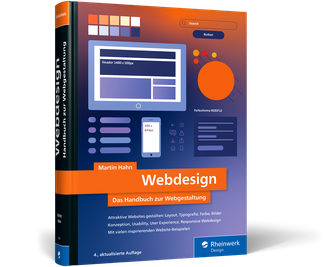
Webdesign - Das Handbuch (4. Auflage)
Webdesign. Das Handbuch zur Webgestaltung. In 4., aktualisierter Auflage (März 2024). 50 Millisekunden – so viel Zeit haben Sie im Durchschnitt, einen Nutzer davon zu überzeugen, dass sich der Besuch Ihrer Website lohnt. Dieses Buch vermittelt die Designprinzipien, mit denen Sie diese Herausforderung annehmen können! Es begleitet Sie auf rund 650 Seiten bei allen Fragestellungen, die für die Gestaltung einer attraktiven Website wichtig sind. Sie lernen, worauf es bei Schriftwahl, dem Einsatz von Farben und unterschiedlichen Medien ankommt, gestalten Layouts und Navigationsmenüs und erfahren, was alles bei der Konzeption beachtet werden muss. Dabei zeigt Ihnen Martin Hahn auch, welche technischen Aspekte Sie bei der Gestaltung berücksichtigen müssen und wie Sie ästhetische Ansprüche und Usability unter einen Hut bekommen. Auch auf Barrierefreiheit und Responsive Webdesign geht der Autor natürlich ausführlich ein.Gutes Design – auch im Web!1. Schön von <head> bis <foot>Dieses Buch führt Sie durch den gesamten Gestaltungsprozess moderner und attraktiver Websites: von der Konzeption und dem perfekten Layout über passende Farben und Typografie bis hin zum Design von Grafiken, Bildern und Navigationsmenüs wird der gesamte Design-Workflow erklärt.2. Inspirationsquelle und IdeengeberDie vielen abwechslungsreichen Beispiele schulen Ihren Blick und bieten Inspiration. Dabei zeigen Ihnen Anleitungen, wie Sie die Gestaltungsprinzipien im Web konkret anwenden und umsetzen. Nutzen Sie das Buch als Ideengeber – und perfektionieren Sie Ihre Webdesigns!3. Modern und responsiveGestalten Sie Websites, die auf allen Geräten und Auflösungen gut aussehen. Zahlreiche Kniffe aus der Praxis und die vielen Profitipps helfen Ihnen, ästhetische Ansprüche und Usability unter einen Hut zu bekommen – dank HTML5, CSS3 und Responsive Webdesign auch auf Smartphone, Tablet und Co. Grundkenntnisse in HTML und CSS werden vorausgesetzt.Aus dem InhaltPrinzipien modernen WebdesignsBriefing, Website-Konzeption, ProjektmanagementTypografie und WebfontsFarbe im Web, Farbkonzepte und -harmonienLayout und RasterInformationsarchitekturNavigation, Buttons, LinksGrafiken, Bilder, IconWebdesign-Stile, aktuelle WebtrendsAnimationen, multimediale ElementeUsability, User Experience, BarrierefreiheitResponsive Webdesign, HTML5 und CSS3Leseprobe (PDF-Link)

Meta-Heuristic Algorithms for Advanced Distributed Systems
META-HEURISTIC ALGORITHMS FOR ADVANCED DISTRIBUTED SYSTEMSDISCOVER A COLLECTION OF META-HEURISTIC ALGORITHMS FOR DISTRIBUTED SYSTEMS IN DIFFERENT APPLICATION DOMAINSMeta-heuristic techniques are increasingly gaining favor as tools for optimizing distributed systems—generally, to enhance the utility and precision of database searches. Carefully applied, they can increase system effectiveness, streamline operations, and reduce cost. Since many of these techniques are derived from nature, they offer considerable scope for research and development, with the result that this field is growing rapidly. Meta-Heuristic Algorithms for Advanced Distributed Systems offers an overview of these techniques and their applications in various distributed systems. With strategies based on both global and local searching, it covers a wide range of key topics related to meta-heuristic algorithms. Those interested in the latest developments in distributed systems will find this book indispensable. Meta-Heuristic Algorithms for Advanced Distributed Systems readers will also find:* Analysis of security issues, distributed system design, stochastic optimization techniques, and more* Detailed discussion of meta-heuristic techniques such as the genetic algorithm, particle swam optimization, and many others* Applications of optimized distribution systems in healthcare and other key??industriesMeta-Heuristic Algorithms for Advanced Distributed Systems is ideal for academics and researchers studying distributed systems, their design, and their applications. ROHIT ANAND, PHD, is an Assistant Professor in the Department of Electronics and Communication Engineering at G. B. Pant DSEU Okhla-1 Campus (formerly G. B. Pant Engineering College), Government of NCT of Delhi, New Delhi, India. He has more than 21 years of teaching experience. He is a Life Member of the Indian Society for Technical Education (ISTE) and holds 4 patents. ABHINAV JUNEJA, PHD, is a Professor at the KIET Group of Institutions, Ghaziabad, India. He has also worked as Associate Director and Professor at BMIET, Sonepat, India. He has more than 20 years of teaching experience. DIGVIJAY PANDEY, PHD, works in the Department of Technical Education, Kanpur, Government of Uttar Pradesh, India. He has more than 12 years of experience in the fields of industry and teaching. He holds 5 patents. SAPNA JUNEJA, PHD, is a Professor in the KIET Group of Institutions, Ghaziabad, India. She has more than 17 years of teaching experience. NIDHI SINDHWANI, PHD, is an Assistant Professor in Amity Institute of Information Technology, Amity University, Noida, India. She has more than 17 years of teaching experience. She is a Life Member of the ISTE and a Member of IEEE. She holds 4 patents. About the Book xixAbout the Editors xxiList of Contributors xxiiiPreface xxxiii1 THE FUTURE OF BUSINESS MANAGEMENT WITH THE POWER OF DISTRIBUTED SYSTEMS AND COMPUTING 1Venkateswararao Podile, Nitin Kulshrestha, Sushmita Goswami, Lavanya Durga, B. Rachanasree, T. Pavan Reddy, and P. Shreya Sarojini1.1 Introduction 11.2 Understanding Distributed Systems and Computing 21.3 Applications of Distributed Systems and Computing in Business Management 61.4 Limitations of Distributed Systems in Business Management 111.5 Future Developments and Opportunities 151.6 Conclusion 17References 182 APPLICATIONS OF OPTIMIZED DISTRIBUTED SYSTEMS IN HEALTHCARE 21Ayush Thakur, Suruchi Verma, Nidhi Sindhwani, and Rashmi Vashisth2.1 Introduction 212.2 Literature Survey 232.3 Real Cases 322.4 Conclusion 34References 353 THE IMPACT OF DISTRIBUTED COMPUTING ON DATA ANALYTICS AND BUSINESS INSIGHTS 39Haider Mehraj, Vinay K. Nassa, A.S.K. Reddy, K.V.D. Sagar, Dilip K. Sharma, Shyamasundar Tripathy, and Franklin J. Selvaraj3.1 Introduction 393.2 Distributed Computing and Data Analytics 413.3 Business Insights and Decision-Making 453.4 Challenges and Limitations 473.5 The Impact of Distributed Computing on Data Analytics 483.6 Conclusion 50References 504 MACHINE LEARNING AND ITS APPLICATION IN EDUCATIONAL AREA 53Abhinav Tripathi, Yashasvi Singh, Arti Sharma, Ajay Kumar Shrivastava, and Saurabh Sharma4.1 Introduction 534.2 Previous Work 544.3 Technique 544.4 Analysis of Data 564.5 Educational Data Mining 564.6 Hadoop Approach 574.7 Artificial Neural Network (ANN) 584.8 Decision Tree 594.9 Results/Discussion 594.9.1 Personalized Learning Through Adaptive Learning 594.10 Increasing Efficiency Using Learning Analytics 604.11 Predictive Analysis for Better Assessment Evaluation 614.12 Future Scope 614.13 Conclusion 61References 625 APPROACHES AND METHODOLOGIES FOR DISTRIBUTED SYSTEMS: THREATS, CHALLENGES, AND FUTURE DIRECTIONS 67Bhawna and Veena Parihar5.1 Introduction 675.2 Distributed Systems 685.3 Literature Review 695.4 Threats to Distributed Systems Security 705.5 Security Standards and Protocols 725.6 Network Security 735.7 Access Control 745.8 Authentication and Authorization 765.9 Privacy Concerns 785.10 Case Studies 795.11 Conclusion 805.12 Future Scope 81References 816 EFFICIENT-DRIVEN APPROACHES RELATED TO META-HEURISTIC ALGORITHMS USING MACHINE LEARNING TECHNIQUES 85Ashima Arya, Swasti Singhal, and Rashika Bangroo6.1 Introduction 856.2 Stochastic Optimization 866.3 Heuristic Search 896.4 Meta-Heuristic 906.5 Machine Learning 94References 997 SECURITY AND PRIVACY ISSUES IN DISTRIBUTED HEALTHCARE SYSTEMS – A SURVEY 103Manish Bhardwaj, Samad Noeiaghdam, and Yu-Chen Hu7.1 Introduction 1037.2 Previous Study 1067.3 Security and Privacy Needs 1097.4 Security and Privacy Goals 1117.5 Type of Attacks in Distributed Systems 1147.6 Recommendations and Future Approaches 1167.7 Conclusion 117References 1188 IMPLEMENTATION AND ANALYSIS OF THE PROPOSED MODEL IN A DISTRIBUTED E-HEALTHCARE SYSTEM 123Manish Bhardwaj, Sanjiv Sharma, and Amit K. Gupta8.1 Introduction 1238.2 Outmoded Systems 1258.3 Distributed Systems 1268.4 Previous Work 1298.5 Service-Oriented Architecture of e-Healthcare 1318.6 Implementation of the Proposed Model 1338.7 Evaluation of the Proposed Model Performance 1348.8 Conclusion and Future Work 135References 1369 LEVERAGING DISTRIBUTED SYSTEMS FOR IMPROVED EDUCATIONAL PLANNING AND RESOURCE ALLOCATION 141S. Durga, Priti Gupta, Latika Kharb, P.S. Ranjit, Venkata Harshavardhan Reddy Dornadula, Kali Charan Modak, and Geetha Manoharan9.1 Introduction 1419.2 Theoretical Framework 1449.3 Distribution System in Education 1489.4 Technical Aspects of Distributed Systems in Education 1499.5 Challenges and Limitations 1539.6 Discussion 1559.7 Conclusion 156References 15710 ADVANCES IN EDUCATION POLICY THROUGH THE INTEGRATION OF DISTRIBUTED COMPUTING APPROACHES 161W. Vinu, Luigi P.L. Cavaliere, K. Suresh Kumar, Y. Venkata Ramana, Kunjan Shah, Kapil Joshi, and Nadanakumar Vinayagam10.1 Introduction 16110.2 Distributed Computing Approaches 16410.3 Advances in Education Policy Through Distributed Computing Approaches 16710.4 Challenges: Privacy Concerns 17110.5 Conclusion 174References 17411 REVOLUTIONIZING DATA MANAGEMENT AND SECURITY WITH THE POWER OF BLOCKCHAIN AND DISTRIBUTED SYSTEM 177Radha R. Chandan, Fred Torres-Cruz, Ernesto N.T. Figueroa, Charles I. Mendoza-Mollocondo, Dharini R. Sisodia, Tanweer Alam, and Mohit Tiwari11.1 Introduction 17711.2 Blockchain Technology 17911.3 Distributed System 18211.4 Revolutionizing Data Management and Security with Blockchain and Distributed Systems 18411.5 Challenges of Using Blockchain and Distributed Systems 18611.6 Discussion 18711.7 Conclusion 188References 18812 ENHANCING BUSINESS DEVELOPMENT, ETHICS, AND GOVERNANCE WITH THE ADOPTION OF DISTRIBUTED SYSTEMS 193Aarti Dawra, K.K. Ramachandran, Debasis Mohanty, Jitendra Gowrabhathini, Brijesh Goswami, Dhyana S. Ross, and S. Mahabub Basha12.1 Introduction 19312.2 Applications of Distributed Systems in Business Development 19512.3 The Importance of Ethics in Distributed Systems 19812.4 Governance in Distributed Systems 20112.5 Conclusion 206References 20613 LEVERAGING DISTRIBUTION SYSTEMS FOR ADVANCED FRAUD DETECTION AND PREVENTION IN FINANCE 211Venkateswararao Podile, Satish M. Dhoke, Shouvik K. Guha, Frakruddin A. Ahmed, T.V.N.J.L. Haritha, V. Abhinav, and M. Anirudh13.1 Introduction 21113.2 Benefits of Distributed Systems 21313.3 Prevention Techniques 21513.4 Leveraging Distributed Systems for Fraud Detection and Prevention 22013.5 Future Directions 22313.6 Conclusion 225References 22514 ADVANCES IN E-COMMERCE THROUGH THE INTEGRATION OF DISTRIBUTED COMPUTING APPROACHES 229Venkateswararao Podile, K. Suresh Kumar, Luigi P.L. Cavaliere, Sri R.R. Annapureddy, Katakam V. Siva Praneeth, Kanamarlapudi P.S. Sabareesh, and Devati B. Sambasiva Rao14.1 Introduction 22914.2 Distributed Computing Approaches for E-commerce 23114.3 Integration of Distributed Computing Approaches in E-commerce 23314.4 Advancements in E-commerce Through the Integration of Distributed Computing Approaches 23614.5 Future Trends in the Integration of Distributed Computing Approaches in E-commerce 24014.6 Conclusion 241References 24215 THE IMPACT OF DISTRIBUTED COMPUTING ON ONLINE SHOPPING AND CONSUMER EXPERIENCE 245K. Suresh Kumar, Luigi P.L. Cavaliere, Mano A. Tripathi, T.S. Rajeswari, S.S.C. Mary, G.H.A. Vethamanikam, and Nadanakumar Vinayagam15.1 Introduction 24515.2 Benefits of Distributed Computing for Online Shopping 24815.3 Limitations of Distributed Computing in Online Shopping 25115.4 Impact of Distributed Computing on Online Shopping Trends 25415.5 Ethical Implications of Distributed Computing in Online Shopping 25615.6 Conclusion 257References 25716 WIRELESS SENSOR-BASED IOT SYSTEM WITH DISTRIBUTED OPTIMIZATION FOR HEALTHCARE 261Rohit Anand, Digvijay Pandey, Deena N. Gupta, M.K. Dharani, Nidhi Sindhwani, and J.V.N. Ramesh16.1 Introduction 26116.2 Literature Review 27416.3 Challenges Faced by Existing Research 27816.4 Proposed Research Methodology 27816.5 Simulation of Research 27916.6 Conclusion 28316.7 Future Scope 283References 28417 OPTIMIZING FINANCIAL TRANSACTIONS AND PROCESSES THROUGH THE POWER OF DISTRIBUTED SYSTEMS 289K. Bhavana Raj, Kamakshi Mehta, Someshwar Siddi, M.K. Sharma, Dilip K. Sharma, Sunil Adhav, and José L.A. Gonzáles17.1 Introduction 28917.2 Overview of Financial Transactions and Processes 29017.3 Distributed Systems in Finance 29217.4 Blockchain Technology and Finance 29517.5 Smart Contracts 29717.6 Conclusion 299References 30018 LEVERAGING DISTRIBUTED SYSTEMS FOR IMPROVED MARKET INTELLIGENCE AND CUSTOMER SEGMENTATION 305Luigi P.L. Cavaliere, K. Suresh Kumar, Dilip K. Sharma, Himanshu Sharma, Sujay M. Jayadeva, Makarand Upadhyaya, and Nadanakumar Vinayagam18.1 Introduction 30518.2 Distributed Systems for Customer Segmentation 30918.3 Distributed Systems for Market Intelligence 31018.4 Distributed Systems for Customer Segmentation 31118.5 Challenges in Integrating Distribution System in Market Intelligence 31218.6 Conclusion 316References 31719 THE FUTURE OF FINANCIAL CRIME PREVENTION AND CYBERSECURITY WITH DISTRIBUTED SYSTEMS AND COMPUTING APPROACHES 321Veer B.P. Singh, Pratibha Singh, Shouvik K. Guha, Asif I. Shah, Abdullah Samdani, M.Z.M. Nomani, and Mohit Tiwari19.1 Introduction 32119.2 Distributed Systems and Computing Approaches for Financial Crime Prevention and Cybersecurity 32619.3 Challenges and Opportunities in Implementing Distributed Systems and Computing Approaches 33019.4 Benefits of Distributed Systems in Financial Crime Prevention 33519.5 Limitations of Distributed Systems in Financial Crime Prevention 33519.6 Conclusion 336References 33720 INNOVATIONS IN DISTRIBUTED COMPUTING FOR ENHANCED RISK MANAGEMENT IN FINANCE 341Venkateswararao Podile, Syed M. Faisal, Gangu N. Mandala, Shaik Altaf , Nayana Harshitha, Cheedella A.S. Lakshmi, and Chunduru R. Chandan20.1 Introduction 34120.2 Theoretical Framework 34320.3 Comparison of Distributed Computing Approaches for Finance Risk Management 34520.4 Innovations in Distributed Computing for Enhanced Risk Management in Finance 34520.5 Challenges and Limitations of Distributed Computing for Finance Risk Management 34820.6 Future Directions 35020.7 Conclusion 353References 35421 LEVERAGING BLOCKCHAIN AND DISTRIBUTED SYSTEMS FOR IMPROVED SUPPLY CHAIN TRACEABILITY AND TRANSPARENCY 359Luigi P.L. Cavaliere, S. Silas Sargunam, Dilip K. Sharma, Y. Venkata Ramana, K.K. Ramachandran, Umakant B. Gohatre, and Nadanakumar Vinayagam21.1 Introduction 35921.2 Overview of Blockchain and Distributed Systems 36221.3 Applications of Blockchain and Distributed Systems in Supply Chain 36521.4 Benefits and Limitations of Blockchain and Distributed Systems in Supply Chain 36821.5 Conclusion 371References 37122 ADVANCES IN RESOURCE MANAGEMENT THROUGH THE INTEGRATION OF DISTRIBUTED COMPUTING APPROACHES 375K. Jayalakshmamma Veena P. Vemuri, Elena Y. Zegarra, Jitendra Gowrabhathini, Fred Torres-Cruz, Julio C.L. Huanca, and José L.A. Gonzáles22.1 Introduction 37522.2 Distributed Computing Approaches for Resource Management 37722.3 Integration of Distributed Computing Approaches for Resource Management 38122.4 Future Directions and Research Challenges 38422.5 Discussion 38822.6 Conclusion 389References 390Index 395

Advances in Fuzzy-Based Internet of Medical Things (IoMT)
ADVANCES IN FUZZY-BASED INTERNET OF MEDICAL THINGS (IOMT)THIS BOOK EXPLORES THE LATEST TRENDS, TRANSITIONS, AND ADVANCEMENTS OF THE INTERNET OF MEDICAL THINGS WHOSE INTEGRATION THROUGH CLOUD-HOSTED SOFTWARE APPLICATIONS ADDS REQUIRED INTELLIGENCE FROM TOOLS SUCH AS MEDICAL INSTRUMENTS, SCANNERS, AND APPLIANCES, ENABLING FUZZY LOGIC TO HELP MEDICAL PROFESSIONALS ESTABLISH LINGUISTIC CONCEPTS IN DECIDING DIAGNOSIS AND PROGNOSIS. The main goal of the book is to strengthen medical professionals and caregivers by providing methods for achieving fuzzy logic-based health diagnosis and medication. The health condition and various physical parameters of humans, such as heartbeat rate, sugar level, blood pressure, temperature, and oxygen quality, are captured through a host of multifaceted sensors. Additionally, remote health monitoring, medication, and management are being facilitated through a host of ingestible sensors, 5G communication, networked embedded systems, AI models running on cloud servers and edge devices, etc. Furthermore, chronic disease management is another vital domain getting increased attention. The distinct advancements in the fuzzy logic field are useful in various advanced medical care functionalities and facilities. The readers will discover:* new and innovative features of health care by using fuzzy logic that raises economic efficiency at macro and micro levels;* expounds on fuzzy logic techniques used in medical science;* describes the evolution of the fuzzy logic paradigm and how it helps physicians decide on diagnosis and prognosis;* uncovers how trust management is dealt with between patients and medical officials to help advance the fuzzy logic field;* provides case studies, various technology advancements, and practical aspects on the impacts and challenges of fuzzy-based Internet of Medical Things.AUDIENCE The book will be read and used by researchers in artificial intelligence, fuzzy logic, medical professionals, caregivers, health administrators, and policymakers. SATYA PRAKASH YADAV is an associate professor at GL Bajaj Institute of Technology & Management in Uttar Pradesh, India. He completed a PhD in science and technology from the Dr. A.P.J. Abdul Kalam Technical University, Lucknow, India. He has 17 years of education experience, 4 published books, and has two patents. Yadav is the chief editor of the Journal of Cyber Security in Computer Systems Science and Engineering. SUDESH YADAV is an assistant professor at Government College in Haryana, India. She has a PhD in computer science from Guru Gobind Singh Indraprastha University, Delhi, India. Her main areas of interest are artificial intelligence, digital image processing, and soft computing. Along with publishing research papers, Yadav has also reviewed research papers from international journals and conferences. PETHURA RAJ is chief architect and vice president at Reliance Jio Platforms Ltd in Bangalore, India. He has a PhD in computer science and automation from the Indian Institute of Science in Bangalore, India. His areas of interest focus on artificial intelligence, model optimization, and reliability engineering. He has published thirty research papers and edited forty-two books. VICTOR HUGO C. DE ALBUQUERQUE works in the Department of Teleinformatics Engineering at the Federal University of Ceara, Brazil. He has a PhD in mechanical engineering from the Federal University of Paraiba. His research concentrates on applied computing, Intelligent systems, and artificial intelligence. He is Editor-in-Chief of the Journal of Artificial Intelligence and Systems. Preface xv1 IoMT--Applications, Benefits, and Future Challenges in the Healthcare Domain 1E. M. N. Sharmila, K. Rama Krishna, G. N. R. Prasad, Byram Anand, Chetna Vaid Kwatra and Dhiraj Kapila2 Fuzzy-Based IoMT System Design Challenges 25Ramakrishna Kolikipogu, Shivaputra and Makarand Upadhyaya3 Development and Implementation of a Fuzzy Logic-Based Framework for the Internet of Medical Things (IoMT) 39Santosh Reddy P., Mamatha A., Akshatha Kamath, Sreelatha P. K., Santosh Y. N. and Pallavi C. V.4 Detecting Healthcare Issues Using a Neuro-Fuzzy Classifier 59D. Saravanan, R. Parthiban, G. Arunkumar, D. Suganthi, Revathi R. and U. Palani5 Development of the Fuzzy Logic System for Monitoring of Patient Health 75Norma Ramírez-Asís, Ursula Lezameta-Blas, Anil Kumar Bisht, G. Arunkumar, Jose Rodriguez-Kong and D. Saravanan6 Management of Trust Between Patient and IoT Using Fuzzy Logic Theory 93L. Rajeshkumar, J. Rachel Priya, Konatham Sumalatha, G. Arunkumar, D. Suganthi and D. Saravanan7 Improving the Efficiency of IoMT Using Fuzzy Logic Methods 107K. Kiran Kumar, S. Sivakumar, Pramoda Patro and RenuVij8 An Intelligent IoT-Based Healthcare System Using Fuzzy Neural Networks 121Chamandeep Kaur, Mohammed Saleh Al Ansari, Vijay Kumar Dwivedi and D. Suganthi9 An Enhanced Fuzzy Deep Learning (IFDL) Model for Pap-Smear Cell Image Classification 135Rakesh S., Smrita Barua, D. Anitha Kumari and Naresh E.10 Classification and Diagnosis of Heart Diseases Using Fuzzy Logic Based on IoT 149Srinivas Kolli, Pramoda Patro, Rupak Sharma and Amit Sharma11 Implementation of a Neuro-Fuzzy-Based Classifier for the Detection of Types 1 and 2 Diabetes 163Chamandeep Kaur, Mohammed Saleh Al Ansari, Vijay Kumar Dwivedi and D. Suganthi12 IoMT Type-2 Fuzzy Logic Implementation 179Sasanko Sekhar Gantayat, K. M. Pimple and Pokkuluri Kiran Sree13 Feature Extraction and Diagnosis of Heart Diseases Using Fuzzy-Based IoMT 195Tribhangin Dichpally, Yatish Wutla, Vallabhaneni Uday and Rohith Sai Midigudla14 An Intelligent Heartbeat Management System Utilizing Fuzzy Logic 211K. Suresh Kumar, R. Sudha, T. Suguna and M. K. Dharani15 Functional Fuzzy Logic and Algorithm for Medical Data Management Mechanism Monitoring 225U. Moulali, Bhargavi Peddi Reddy, Srikanth Bhyrapuneni, Shruthi S.K., Shaik Khaleel Ahamed and Harikrishna Bommala16 Using IoT to Evaluate the Effectiveness of Online Interactive Tools in Healthcare 239K. Suresh Kumar, Chinmaya Kumar Nayak, Chamandeep Kaur and Ahmed Hesham Sedky17 Integration of Edge Computing and Fuzzy Logic to Monitor Novel Coronavirus 255K. Rama Krishna, R. Sudha, G. N. R. Prasad and Jithender Reddy Machana18 Implementation of IoT in Healthcare Barriers and Future Challenges 271Aravindan Srinivasan, Veeresh Rampur, Munagala Madhu Sudhan Rao and Ravinjit SinghReferences 283Index 287

Samsung Galaxy A25 5G
Die verständliche Anleitung für Ihr Smartphone:- Alle Funktionen & Einstellungen auf einen Blick- Schritt für Schritt erklärt – mit praktischen Tipps Mit diesem smarten Praxisbuch gelingt Ihnen der schnelle und sichere Einstieg in Ihr Smartphone. Lernen Sie das Samsung Galaxy A25 5G von Grund auf kennen und beherrschen! Anschauliche Anleitungen, Beispiele und Bilder zeigen Ihnen gut nachvollziehbar, wie Sie Ihr mobiles Gerät optimal handhaben – von der Ersteinrichtung und Personalisierung über die große Funktionsvielfalt bis zu den wichtigsten Anwendungen. Nutzen Sie darüber hinaus die übersichtlichen Spicker-Darstellungen: Damit können Sie jene Bedienungsschritte, die man am häufigsten braucht, aber immer wieder vergisst, auf einen Blick finden und umsetzen. Freuen Sie sich auf viele hilfreiche Tipps und legen Sie ganz einfach los!Aus dem Inhalt:- Alle Bedienelemente des Samsung Galaxy A25 5G auf einen Blick- Ersteinrichtung und Tipps zum Umzug- Google-Konto erstellen und verwalten- Die Benutzeroberfläche Ihres Smartphones personalisieren- Apps aus dem Play Store herunterladen- Kontakte anlegen und im Adressbuch verwalten- Anrufe tätigen und SMS austauschen- Nachrichten über Mail und WhatsApp versenden und empfangen- Uhr, Kalender, Maps und andere praktische Apps nutzen- Fotos sowie Videos aufnehmen, verwalten und teilen- Ins Internet gehen über WLAN und mobile Daten- Updates, Datenschutz und Sicherheit

Objektorientierte Softwareentwicklung mit UML (4. Auflage)
Objektorientierte Softwareentwicklung mit UML. In 4., aktualisierter und erweiterter Auflage, März 2024. Das Buch bietet einen Einstieg in die objektorientierte Spezifikation mit UML (Unified Modeling Language), einem Standard für die objektorientierte Softwareentwicklung.Neben der Nutzung der Sprachelemente von UML werden Vorgehensweisen für eine benutzerzentrierte Softwareentwicklung vorgestellt und diskutiert. Das beginnt bei der Analyse von Anforderungen und deren Spezifikation durch Szenarien und Anwendungsfallmodelle. Die Idee der Entwurfsmuster wird präsentiert und die Notationsmöglichkeiten in UML diskutiert. Beispiele für viel genutzte Entwurfsmuster und ihre Anwendung bei der Programmierung ergänzen den Inhalt. Sowohl Zustands- als auch Aktivitätsdiagramme werden ausführlich vorgestellt. Daneben sind auch Möglichkeiten aufgezeigt, wie die besonders bei Banken und Versicherungen beliebten Ereignis-Prozess-Ketten in UML notiert werden können.Es wird eine Einführung in die Notation von OCL (Object Constraint Language) gegeben, die als Teilsprache von UML notwendig ist, wenn grafische Darstellungen nicht genügend Ausdrucksstärke besitzen. Das neue Kapitel Kollaborative Analyse und Design wurde in Zusammenarbeit mit Dr.-Ing. Anke Dittmar verfasst.Aus dem Inhalt: AnwendungsfälleKlassendiagrammeZustandsdiagrammeAktivitätsdiagrammeEntwurfsmusterSoftwarequalitätskriterienEntwicklungsprozessePrototypingPersonasModellintegrationLeseprobe (PDF-Link)

Einfache & effektive strategische IT-Planung
- Strategische IT-Planung einfach & effektiv meistern - Liefert Best-Practices für eine lean und systematische strategische IT-Planung und Planung der digitalen Transformation - Basiert auf erprobten Methoden und Vorgehensweisen - Strukturiert das Thema für die Praxis mit einer konsistenten Begriffswelt - Neu in der 2. Auflage: Handhabbare strategische IT-Planung lean & systematisch mit allen Methoden und Leitfäden, die dafür erforderlich sind – mit Erfolgsgarantie; Methoden für Erstellung und Pflege einer Business Capability Map - Ihr exklusiver Vorteil: E-Book inside beim Kauf des gedruckten Buches Veränderungen in den Geschäftsmodellen durch den digitalen Wandel und die fundamentalen Umbrüche infolge von z.B. Energiekrise und Pandemie sowie kürzer werdende Innovations- und Produktlebenszyklen stellen neben einem zuverlässigen Geschäftsbetrieb hohe Anforderungen an IT-Verantwortliche. Effizienz und Qualität in der Leistungserbringung, Time-to-market, Flexibilität und Innovationsfähigkeit sind die zentralen Herausforderungen, die gleichzeitig mit zunehmender IT-Komplexität bewältigt werden müssen. Die IT muss strategisch ausgerichtet und auf Veränderungen vorbereitet werden, um ihren Wertbeitrag signifikant zu erhöhen. Best-Practice-Bausteine und Schritt-für-Schritt-Leitfäden geben Ihnen Hilfestellungen für die individuelle Gestaltung Ihres Ziel-Bilds für einen erfolgreichen digitalen Wandel. AUS DEM INHALT // - Strategische IT-Planung - Business Architecture 4 Digitalization - Gestaltung des fachlichen Ziel-Bilds - Ableitung des IT-Ziel-Bilds - Operationalisierung der strategischen IT-Planung - IT-Governance Best-Practices - Herausforderungen der Digitalisierung und deren Einbezug in der strategischen Planung

Business-Analyse - einfach und effektiv (3. Auflg.)
- Systematische und durchgängige Darstellung der Tätigkeit der Business-Analyse und der Disziplin Demand Management- Strategische, taktische und operative Planungsebene in ihrem Zusammenspiel- Durchgängiges Praxisbeispiel- Sammlung von Best-Practices für die Business-Analyse und die Werkzeugunterstützung sowie organisatorische Verankerung des Demand Management- Ausführliche Beschreibung der Ergebnistypen der Business-Analyse mit Tipps und Tricks für die Nutzung inklusive Business-Case-Betrachtung- Schritt-für-Schritt-Anleitung für die Ableitung von Business-ServicesUnternehmen müssen in der Lage sein, sich zu verändern und an die jeweiligen Markt- und Wirtschaftsbedingungen schnell anzupassen. Die Tätigkeit der Business-Analyse und deren organisatorische Verankerung im Demand Management sind wesentliche Erfolgsfaktoren dafür. Die erforderlichen Veränderungen werden erkannt, fachlich gestaltet und umgesetzt. Das Projektportfolio sowie die einzelnen Projekte und Wartungsmaßnahmen werden an den Geschäftserfordernissen ausgerichtet und die Produktivität bei der Umsetzung wird gesteigert. Anzahl und Umfang von Geschäftsanforderungen werden durch frühzeitige Prüfung auf Nutzen, Konsistenz und Wichtigkeit deutlich reduziert. Unnötige Doppelarbeiten und wertvernichtende Projekte werden vermieden. So entstehen Freiräume für strategische Vorhaben.Wir stellen in diesem Buch Grundlagen und Best-Practices zur Durchführung der Business-Analyse bereit und helfen Ihnen, das Demand-Management bei klassischem und agilem Vorgehen mit Leben zu füllen.AUS DEM INHALT //Einleitung/Einführung in die Business-Analyse/Von der Geschäftsanforderung zum IT-Projekt/Best-Practices der Business-Analyse/Ergebnistypen der Business-Analyse/Business Capability Management & Business-Services Inge Hanschke, Dipl.-Inf., ist Expertin in der digitalen Transformation, Datenmanagement, Organisation 4.0, Enterprise Architecture Management, Business-Analyse & Demand Management, Lean Management, Informationssicherheit und Datenschutz. In über 30 Berufsjahren hat sie als Innovator, IT-Managerin bei Anwenderunternehmen, in einem ERP-Produkthaus und als IT-Dienstleister konsequent die Brücke zwischen Business und IT geschlagen. Sie hat in vielen Unternehmen deren Geschäftsmodell sowie die IT digitalisiert, die IT an Geschäftsanforderungen ausgerichtet, das IT-Management professionalisiert und damit die Unternehmen für den digitalen Wandel vorbereitet.Daniel Goetze arbeitet als Senior Business Analyst. In mehr als 27 Berufsjahren hat er Unternehmen erfolgreich dabei unterstützt, fachliche Anforderungen in angemessene IT-Lösungen zu überführen. Er lebt in Hallbergmoos.

Storytelling: Digital - Multimedial - Artificial
- Experten von u.a. Adobe, Microsoft, Storymaker berichten aus der Praxis ihrer täglichen Arbeit- Praktisches Know-how zur sofortigen Umsetzung- Viele Tipps aus der langjährigen Praxiserfahrung der Autorin- Die Webseite zum Buch: www.story-baukasten.de- Ihr exklusiver Vorteil: E-Book inside beim Kauf des gedruckten BuchesMittlerweile haben alle Kommunikationsbereiche erkannt, dass Storytelling das mächtigste Mittel zur authentischen Zielgruppenansprache ist. Geschichten bewegen uns, wecken Emotionen und gute Storys bleiben langfristig in Erinnerung.Dieses Buch regt zum Nachdenken an, liefert Lösungen und lässt Storytelling-Praktiker zu Wort kommen, die bereits erfolgreich umgesetzte Storys präsentieren. Experten erläutern aus der Praxis ihres Berufsalltags heraus, was Storytelling bedeutet und wie sie es als Methode ein- und umsetzen:Rufus Deuchler, Adobe // Mariano Mailos, Microsoft // Carsten Rossi, Kammann Rossi GmbH // Björn Eichstädt, Storymaker // Michael Katzlberger, https://katzlberger.ai // Markus Kaiser, TH Nürnberg und CGI Deutschland // Amelie Reigl, https://diewissenschaftlerin.de // Kai Heddergott, https://www.heddergott.de // Thomas Riedel, https://www.droid-boy.deAUS DEM INHALT //Storytelling in Unternehmen/Sustainable Storytelling/Grundelemente/Story-Baukasten/Visual Storytelling/Multimedial, Digital, Crossmedial, Transmedial/Storytelling-Kanäle/Streaming/Storytelling im Metaverse/Artificial Storytelling/New Experience Storytelling/Tools und Checklisten Pia Kleine Wieskamp studierte Kunst, Kunstgeschichte, Pädagogik und Germanistik in Deutschland und Italien. Die Kommunikationsexpertin und Autorin trainiert und coacht seit einigen Jahren Firmen sowie Fach- und Führungskräfte in den Themen Digitale Kommunikation und Marketing. Ihre Schwerpunkte liegen in den Bereichen Storytelling, Visual Storytelling und Social Media in PR und Marketing. Einen großen Erfahrungsschatz erlangte Pia Kleine Wieskamp in ihren Tätigkeiten als PR- und Marketingmanagerin, Bloggerin, Journalistin und Redakteurin für TV, Magazine und Verlage.

Scalable AI and Design Patterns
Understand and apply the design patterns outlined in this book to design, develop, and deploy scalable AI solutions that meet your organization's needs and drive innovation in the era of intelligent automation.This book begins with an overview of scalable AI systems and the importance of design patterns in creating robust intelligent solutions. It covers fundamental concepts and techniques for achieving scalability in AI systems, including data engineering practices and strategies. The book also addresses scalable algorithms, models, infrastructure, and architecture considerations. Additionally, it discusses deployment, productionization, real-time and streaming data, edge computing, governance, and ethics in scalable AI. Real-world case studies and best practices are presented, along with insights into future trends and emerging technologies.The book focuses on scalable AI and design patterns, providing an understanding of the challenges involved in developing AI systems that can handle large amounts of data, complex algorithms, and real-time processing. By exploring scalability, you will be empowered to design and implement AI solutions that can adapt to changing data requirements.WHAT YOU WILL LEARN* Develop scalable AI systems that can handle large volumes of data, complex algorithms, and real-time processing* Know the significance of design patterns in creating robust intelligent solutions* Understand scalable algorithms and models to handle extensive data and computing requirements and build scalable AI systems* Be aware of the ethical implications of scalable AI systemsWHO THIS BOOK IS FORAI practitioners, data scientists, and software engineers with intermediate-level AI knowledge and experienceABHISHEK MISHRA is a seasoned data science and analytics professional with extensive expertise in information technology services and products. With a remarkable 15-year track record, Abhishek has leveraged his data science knowledge and engineering skills to analyze vast datasets, interpret findings, and communicate actionable insights to drive effective business decision making. He has successfully led global analytics teams, developed cutting-edge machine learning solutions, and formulated data analytics strategies for esteemed organizations such as Marsh and McLennan, Fiserv India Pvt Ltd, and Deloitte Inc.Chapter 1: Introduction to Scalable AI Systems.- Chapter 2: Fundamentals of Scalability in AI.- Chapter 3: Data Engineering for Scalable AI.- Chapter 4: Scalable AI Algorithms and Models.- Chapter 5: Scalable AI Infrastructure and Architecture.- Chapter 6: Scalable AI Deployment and Productionization.- Chapter 7: Scalable AI for Real-time and Streaming Data.- Chapter 8: Scalable AI for Edge Computing.- Chapter 9: Scalable AI Governance and Ethics.- Chapter 10: Case Studies and Best Practices.- Chapter 11: Future Trends and Emerging Technologies.- Chapter 12: Conclusion and Final Thoughts.

Beginning STM32
See how using FreeRTOS and libopencm3 instead of the Arduino software environment will help you develop multi-tasking applications that go beyond Arduino norms. This updated version includes expanded coverage of software setup for Windows 10 and 11, additional TM32 hardware capabilities, including clear explanations of "totem pole outputs" versus "open drain outputs," and a new section on project showcasing an interrupt-driven approach for processing USART data.Each chapter contains clear explanations of the STM32 hardware capabilities to help get you started with the device, including GPIO and several other ST Microelectronics peripherals like USB and CAN bus controller. You’ll learn how to download and set up the libopencm3 + FreeRTOS development environment, using GCC. With everything set up, you’ll leverage FreeRTOS to create tasks, queues, and mutexes. You’ll also learn to work with the I2C bus to add GPIO using the PCF8574 chip. And how to create PWM output for RC control using hardware timers.You'll be introduced to new concepts that are necessary to master the STM32, such as how to extend code with GCC overlays using an external Winbond W25Q32 flash chip. Your knowledge is tested at the end of each chapter with exercises. Upon completing this book, you’ll be ready to work with any of the devices in the STM32 family.Beginning STM32, Second Edition provides the professional, student, or hobbyist a way to learn about ARM without costing an arm!WHAT YOU'LL LEARN* Initialize and use the libopencm3 drivers and handle interrupts* Use DMA to drive a SPI based OLED displaying an analog meter* Read PWM from an RC control using hardware timers* Understand STM32 capabilities, including USB controller, RTC, DMA, CAN bus, and moreWHO THIS BOOK IS FORExperienced embedded engineers, students, hobbyists and makers wishing to explore the ARM architecture, going beyond Arduino limits.WARREN GAY has been an electronics enthusiast since childhood and often dragged discarded TV sets home after school. In high school he learned to program the IBM-1130 and then pursued a career in software development at Ryerson Polytechnical, in Toronto. Since then he has worked professionally for over 30 years, mainly in C/C++, under Unix and Linux. Meanwhile, the love of electronics has never faded since the early creation of his home-brewed Intel 8008 system in the 70's to the present day projects employing the Raspberry Pi. Warren also holds an advanced amateur radio license and was able to work the Mir space station (U2MIR) using packet radio in August 1991. He's authored other books including Sams Teach Yourself Linux in 24 Hours, Linux Socket Programming by Example, and Advanced Unix Programming.Chapter 1.- Introduction.-Chapter 2. Software Setup.- Chapter 3. Power up and Blink.- Chapter 4. GPIO.- Chapter 5. FreeRTOS.- Chapter 6. USART.- Chapter 7. USB Serial.- Chapter 8. SPI Flash.- Chapter 9. Code Overlays.- Chapter 10. Real Time Clock (RTC).- Chapter 11. I2C.- Chapter 12. SPI OLED.- Chapter 13. OLED Using DMA.- Chapter 14. ADC.- Chapter 15. Clock Tree.- Chapter 16. PWM With Timer 2.- Chapter 17. PWM Input with Timer 4.- Chapter 18. CAN Bus.- Chapter 19 CAN Bus Software.- Chapter 20. New Projects.- 21.- Troubleshooting. 22.- Appendix A Answers to Exercises.- 23. Appendix B.

Modern C for Absolute Beginners
Learn the basics of C, the C standard library, and modern C standards. Complete with modern, up-to-date examples and screenshots, this new edition is fully updated and reworked with the latest C23 standards and features.C is a language that is as popular today as it was decades ago. It can be used to program a microcontroller or to develop an entire operating system. Author Slobodan Dmitrović takes you on a journey through the C programming language, the standard library, and the C standards basics. Each chapter is the right balance of theory and code examples.Written in a concise and easy-to-follow manner, this book will provide you all the essentials needed to start programming in modern C.WHAT YOU WILL LEARN* Understand C programming language and C standard library fundamentals* Work with new C standards features* Study the basics of types, operators, statements, arrays, functions, and structs* Review the fundamentals of pointers, memory allocation, and memory manipulation* Take advantage of best practices in CWHO THIS BOOK IS FORBeginner or novice programmers who wish to learn the C programming language. No prior programming experience is required.SLOBODAN DMITROVIĆ is a software consultant, trainer, and entrepreneur. He is the CEO and founder of “Clear Programming Paradigm”, an LLC that provides outsourcing and training services. Slobodan’s ability to summarize complex topics and provide insightful training made him a sought after consultant for the automotive, fintech, and other industries. Slobodan has a strong interest in C, C++, software architecture, training, and R&D.Part I: The C Programming Language.- Chapter 1: Introduction.- Chapter 2: Our First Program.- Chapter 3: Types and Declarations.- Chapter 4: Exercises.- Chapter 5: Operators.- Chapter 6: Expressions.- Chapter 7: Statements.- Chapter 8: Exercises.- Chapter 9: Arrays.- Chapter 10: Pointers.- Chapter 11: Command-line Arguments.- Chapter 12: Exercises.- Chapter 13: Functions.- Chapter 14: Exercises.- Chapter 15: Structures.- Chapter 16: Unions.- Chapter 17: Conditional Expression.- Chapter 18: Typedef.- Chapter 19: Const Qualifier.- Chapter 20: Enumerations.- Chapter 21: Function Pointers.- Chapter 22: Exercises.- Chapter 23: Preprocessor.- Chapter 24: Exercises.- Chapter 25: Dynamic Memory Allocation.- Chapter 26: Storage and Scope.- Chapter 27: Exercises.- Chapter 28: Standard Input and Output.- Chapter 29: File Input and Output.- Chapter 30: Exercises.- Chapter 31: Header and Source Files.- Part II: The C Standard Library.- Chapter 32: Introduction to C Standard Library.- Part III: Modern C Standards.- Chapter 33: Introduction to C 11 Standards.- Chapter 34: The C 17 Standard.- Chapter 35: The Upcoming C2X Standard.- Part IV: Dos and Don'ts.- Chapter 36: Do Not Use the gets Function.- Chapter 37: Initialize Variables Before Using Them.- Chapter 38: Do Not Read Out of Bounds.- Chapter 39: Do Not Free the Allocated Memory Twice.- Chapter 40: Do Not Cast the Result of malloc.- Chapter 41: Do Not Overflow a Signed Integer.- Chapter 42: Cast a Pointer to void* When Printing Through printf.- Chapter 43: Do Not Divide by Zero.- Chapter 44: Where to Use Pointers?.- Chapter 45: Prefer Functions to Function-like Macros.- Chapter 46: Static Global Names.- Chapter 47: What to Put in Header Files?.- Part V: Appendices.- Appendix A: Linkage.- Appendix B: Time and Date.- Appendix C: Bitwise Operators.- Appendix D: Numeric Limits.- Appendix E: Summary and Advice.

Meta-Heuristic Algorithms for Advanced Distributed Systems
META-HEURISTIC ALGORITHMS FOR ADVANCED DISTRIBUTED SYSTEMSDISCOVER A COLLECTION OF META-HEURISTIC ALGORITHMS FOR DISTRIBUTED SYSTEMS IN DIFFERENT APPLICATION DOMAINSMeta-heuristic techniques are increasingly gaining favor as tools for optimizing distributed systems—generally, to enhance the utility and precision of database searches. Carefully applied, they can increase system effectiveness, streamline operations, and reduce cost. Since many of these techniques are derived from nature, they offer considerable scope for research and development, with the result that this field is growing rapidly. Meta-Heuristic Algorithms for Advanced Distributed Systems offers an overview of these techniques and their applications in various distributed systems. With strategies based on both global and local searching, it covers a wide range of key topics related to meta-heuristic algorithms. Those interested in the latest developments in distributed systems will find this book indispensable. Meta-Heuristic Algorithms for Advanced Distributed Systems readers will also find:* Analysis of security issues, distributed system design, stochastic optimization techniques, and more* Detailed discussion of meta-heuristic techniques such as the genetic algorithm, particle swam optimization, and many others* Applications of optimized distribution systems in healthcare and other key??industriesMeta-Heuristic Algorithms for Advanced Distributed Systems is ideal for academics and researchers studying distributed systems, their design, and their applications. ROHIT ANAND, PHD, is an Assistant Professor in the Department of Electronics and Communication Engineering at G. B. Pant DSEU Okhla-1 Campus (formerly G. B. Pant Engineering College), Government of NCT of Delhi, New Delhi, India. He has more than 21 years of teaching experience. He is a Life Member of the Indian Society for Technical Education (ISTE) and holds 4 patents. ABHINAV JUNEJA, PHD, is a Professor at the KIET Group of Institutions, Ghaziabad, India. He has also worked as Associate Director and Professor at BMIET, Sonepat, India. He has more than 20 years of teaching experience. DIGVIJAY PANDEY, PHD, works in the Department of Technical Education, Kanpur, Government of Uttar Pradesh, India. He has more than 12 years of experience in the fields of industry and teaching. He holds 5 patents. SAPNA JUNEJA, PHD, is a Professor in the KIET Group of Institutions, Ghaziabad, India. She has more than 17 years of teaching experience. NIDHI SINDHWANI, PHD, is an Assistant Professor in Amity Institute of Information Technology, Amity University, Noida, India. She has more than 17 years of teaching experience. She is a Life Member of the ISTE and a Member of IEEE. She holds 4 patents. About the Book xixAbout the Editors xxiList of Contributors xxiiiPreface xxxiii1 THE FUTURE OF BUSINESS MANAGEMENT WITH THE POWER OF DISTRIBUTED SYSTEMS AND COMPUTING 1Venkateswararao Podile, Nitin Kulshrestha, Sushmita Goswami, Lavanya Durga, B. Rachanasree, T. Pavan Reddy, and P. Shreya Sarojini1.1 Introduction 11.2 Understanding Distributed Systems and Computing 21.3 Applications of Distributed Systems and Computing in Business Management 61.4 Limitations of Distributed Systems in Business Management 111.5 Future Developments and Opportunities 151.6 Conclusion 17References 182 APPLICATIONS OF OPTIMIZED DISTRIBUTED SYSTEMS IN HEALTHCARE 21Ayush Thakur, Suruchi Verma, Nidhi Sindhwani, and Rashmi Vashisth2.1 Introduction 212.2 Literature Survey 232.3 Real Cases 322.4 Conclusion 34References 353 THE IMPACT OF DISTRIBUTED COMPUTING ON DATA ANALYTICS AND BUSINESS INSIGHTS 39Haider Mehraj, Vinay K. Nassa, A.S.K. Reddy, K.V.D. Sagar, Dilip K. Sharma, Shyamasundar Tripathy, and Franklin J. Selvaraj3.1 Introduction 393.2 Distributed Computing and Data Analytics 413.3 Business Insights and Decision-Making 453.4 Challenges and Limitations 473.5 The Impact of Distributed Computing on Data Analytics 483.6 Conclusion 50References 504 MACHINE LEARNING AND ITS APPLICATION IN EDUCATIONAL AREA 53Abhinav Tripathi, Yashasvi Singh, Arti Sharma, Ajay Kumar Shrivastava, and Saurabh Sharma4.1 Introduction 534.2 Previous Work 544.3 Technique 544.4 Analysis of Data 564.5 Educational Data Mining 564.6 Hadoop Approach 574.7 Artificial Neural Network (ANN) 584.8 Decision Tree 594.9 Results/Discussion 594.9.1 Personalized Learning Through Adaptive Learning 594.10 Increasing Efficiency Using Learning Analytics 604.11 Predictive Analysis for Better Assessment Evaluation 614.12 Future Scope 614.13 Conclusion 61References 625 APPROACHES AND METHODOLOGIES FOR DISTRIBUTED SYSTEMS: THREATS, CHALLENGES, AND FUTURE DIRECTIONS 67Bhawna and Veena Parihar5.1 Introduction 675.2 Distributed Systems 685.3 Literature Review 695.4 Threats to Distributed Systems Security 705.5 Security Standards and Protocols 725.6 Network Security 735.7 Access Control 745.8 Authentication and Authorization 765.9 Privacy Concerns 785.10 Case Studies 795.11 Conclusion 805.12 Future Scope 81References 816 EFFICIENT-DRIVEN APPROACHES RELATED TO META-HEURISTIC ALGORITHMS USING MACHINE LEARNING TECHNIQUES 85Ashima Arya, Swasti Singhal, and Rashika Bangroo6.1 Introduction 856.2 Stochastic Optimization 866.3 Heuristic Search 896.4 Meta-Heuristic 906.5 Machine Learning 94References 997 SECURITY AND PRIVACY ISSUES IN DISTRIBUTED HEALTHCARE SYSTEMS – A SURVEY 103Manish Bhardwaj, Samad Noeiaghdam, and Yu-Chen Hu7.1 Introduction 1037.2 Previous Study 1067.3 Security and Privacy Needs 1097.4 Security and Privacy Goals 1117.5 Type of Attacks in Distributed Systems 1147.6 Recommendations and Future Approaches 1167.7 Conclusion 117References 1188 IMPLEMENTATION AND ANALYSIS OF THE PROPOSED MODEL IN A DISTRIBUTED E-HEALTHCARE SYSTEM 123Manish Bhardwaj, Sanjiv Sharma, and Amit K. Gupta8.1 Introduction 1238.2 Outmoded Systems 1258.3 Distributed Systems 1268.4 Previous Work 1298.5 Service-Oriented Architecture of e-Healthcare 1318.6 Implementation of the Proposed Model 1338.7 Evaluation of the Proposed Model Performance 1348.8 Conclusion and Future Work 135References 1369 LEVERAGING DISTRIBUTED SYSTEMS FOR IMPROVED EDUCATIONAL PLANNING AND RESOURCE ALLOCATION 141S. Durga, Priti Gupta, Latika Kharb, P.S. Ranjit, Venkata Harshavardhan Reddy Dornadula, Kali Charan Modak, and Geetha Manoharan9.1 Introduction 1419.2 Theoretical Framework 1449.3 Distribution System in Education 1489.4 Technical Aspects of Distributed Systems in Education 1499.5 Challenges and Limitations 1539.6 Discussion 1559.7 Conclusion 156References 15710 ADVANCES IN EDUCATION POLICY THROUGH THE INTEGRATION OF DISTRIBUTED COMPUTING APPROACHES 161W. Vinu, Luigi P.L. Cavaliere, K. Suresh Kumar, Y. Venkata Ramana, Kunjan Shah, Kapil Joshi, and Nadanakumar Vinayagam10.1 Introduction 16110.2 Distributed Computing Approaches 16410.3 Advances in Education Policy Through Distributed Computing Approaches 16710.4 Challenges: Privacy Concerns 17110.5 Conclusion 174References 17411 REVOLUTIONIZING DATA MANAGEMENT AND SECURITY WITH THE POWER OF BLOCKCHAIN AND DISTRIBUTED SYSTEM 177Radha R. Chandan, Fred Torres-Cruz, Ernesto N.T. Figueroa, Charles I. Mendoza-Mollocondo, Dharini R. Sisodia, Tanweer Alam, and Mohit Tiwari11.1 Introduction 17711.2 Blockchain Technology 17911.3 Distributed System 18211.4 Revolutionizing Data Management and Security with Blockchain and Distributed Systems 18411.5 Challenges of Using Blockchain and Distributed Systems 18611.6 Discussion 18711.7 Conclusion 188References 18812 ENHANCING BUSINESS DEVELOPMENT, ETHICS, AND GOVERNANCE WITH THE ADOPTION OF DISTRIBUTED SYSTEMS 193Aarti Dawra, K.K. Ramachandran, Debasis Mohanty, Jitendra Gowrabhathini, Brijesh Goswami, Dhyana S. Ross, and S. Mahabub Basha12.1 Introduction 19312.2 Applications of Distributed Systems in Business Development 19512.3 The Importance of Ethics in Distributed Systems 19812.4 Governance in Distributed Systems 20112.5 Conclusion 206References 20613 LEVERAGING DISTRIBUTION SYSTEMS FOR ADVANCED FRAUD DETECTION AND PREVENTION IN FINANCE 211Venkateswararao Podile, Satish M. Dhoke, Shouvik K. Guha, Frakruddin A. Ahmed, T.V.N.J.L. Haritha, V. Abhinav, and M. Anirudh13.1 Introduction 21113.2 Benefits of Distributed Systems 21313.3 Prevention Techniques 21513.4 Leveraging Distributed Systems for Fraud Detection and Prevention 22013.5 Future Directions 22313.6 Conclusion 225References 22514 ADVANCES IN E-COMMERCE THROUGH THE INTEGRATION OF DISTRIBUTED COMPUTING APPROACHES 229Venkateswararao Podile, K. Suresh Kumar, Luigi P.L. Cavaliere, Sri R.R. Annapureddy, Katakam V. Siva Praneeth, Kanamarlapudi P.S. Sabareesh, and Devati B. Sambasiva Rao14.1 Introduction 22914.2 Distributed Computing Approaches for E-commerce 23114.3 Integration of Distributed Computing Approaches in E-commerce 23314.4 Advancements in E-commerce Through the Integration of Distributed Computing Approaches 23614.5 Future Trends in the Integration of Distributed Computing Approaches in E-commerce 24014.6 Conclusion 241References 24215 THE IMPACT OF DISTRIBUTED COMPUTING ON ONLINE SHOPPING AND CONSUMER EXPERIENCE 245K. Suresh Kumar, Luigi P.L. Cavaliere, Mano A. Tripathi, T.S. Rajeswari, S.S.C. Mary, G.H.A. Vethamanikam, and Nadanakumar Vinayagam15.1 Introduction 24515.2 Benefits of Distributed Computing for Online Shopping 24815.3 Limitations of Distributed Computing in Online Shopping 25115.4 Impact of Distributed Computing on Online Shopping Trends 25415.5 Ethical Implications of Distributed Computing in Online Shopping 25615.6 Conclusion 257References 25716 WIRELESS SENSOR-BASED IOT SYSTEM WITH DISTRIBUTED OPTIMIZATION FOR HEALTHCARE 261Rohit Anand, Digvijay Pandey, Deena N. Gupta, M.K. Dharani, Nidhi Sindhwani, and J.V.N. Ramesh16.1 Introduction 26116.2 Literature Review 27416.3 Challenges Faced by Existing Research 27816.4 Proposed Research Methodology 27816.5 Simulation of Research 27916.6 Conclusion 28316.7 Future Scope 283References 28417 OPTIMIZING FINANCIAL TRANSACTIONS AND PROCESSES THROUGH THE POWER OF DISTRIBUTED SYSTEMS 289K. Bhavana Raj, Kamakshi Mehta, Someshwar Siddi, M.K. Sharma, Dilip K. Sharma, Sunil Adhav, and José L.A. Gonzáles17.1 Introduction 28917.2 Overview of Financial Transactions and Processes 29017.3 Distributed Systems in Finance 29217.4 Blockchain Technology and Finance 29517.5 Smart Contracts 29717.6 Conclusion 299References 30018 LEVERAGING DISTRIBUTED SYSTEMS FOR IMPROVED MARKET INTELLIGENCE AND CUSTOMER SEGMENTATION 305Luigi P.L. Cavaliere, K. Suresh Kumar, Dilip K. Sharma, Himanshu Sharma, Sujay M. Jayadeva, Makarand Upadhyaya, and Nadanakumar Vinayagam18.1 Introduction 30518.2 Distributed Systems for Customer Segmentation 30918.3 Distributed Systems for Market Intelligence 31018.4 Distributed Systems for Customer Segmentation 31118.5 Challenges in Integrating Distribution System in Market Intelligence 31218.6 Conclusion 316References 31719 THE FUTURE OF FINANCIAL CRIME PREVENTION AND CYBERSECURITY WITH DISTRIBUTED SYSTEMS AND COMPUTING APPROACHES 321Veer B.P. Singh, Pratibha Singh, Shouvik K. Guha, Asif I. Shah, Abdullah Samdani, M.Z.M. Nomani, and Mohit Tiwari19.1 Introduction 32119.2 Distributed Systems and Computing Approaches for Financial Crime Prevention and Cybersecurity 32619.3 Challenges and Opportunities in Implementing Distributed Systems and Computing Approaches 33019.4 Benefits of Distributed Systems in Financial Crime Prevention 33519.5 Limitations of Distributed Systems in Financial Crime Prevention 33519.6 Conclusion 336References 33720 INNOVATIONS IN DISTRIBUTED COMPUTING FOR ENHANCED RISK MANAGEMENT IN FINANCE 341Venkateswararao Podile, Syed M. Faisal, Gangu N. Mandala, Shaik Altaf , Nayana Harshitha, Cheedella A.S. Lakshmi, and Chunduru R. Chandan20.1 Introduction 34120.2 Theoretical Framework 34320.3 Comparison of Distributed Computing Approaches for Finance Risk Management 34520.4 Innovations in Distributed Computing for Enhanced Risk Management in Finance 34520.5 Challenges and Limitations of Distributed Computing for Finance Risk Management 34820.6 Future Directions 35020.7 Conclusion 353References 35421 LEVERAGING BLOCKCHAIN AND DISTRIBUTED SYSTEMS FOR IMPROVED SUPPLY CHAIN TRACEABILITY AND TRANSPARENCY 359Luigi P.L. Cavaliere, S. Silas Sargunam, Dilip K. Sharma, Y. Venkata Ramana, K.K. Ramachandran, Umakant B. Gohatre, and Nadanakumar Vinayagam21.1 Introduction 35921.2 Overview of Blockchain and Distributed Systems 36221.3 Applications of Blockchain and Distributed Systems in Supply Chain 36521.4 Benefits and Limitations of Blockchain and Distributed Systems in Supply Chain 36821.5 Conclusion 371References 37122 ADVANCES IN RESOURCE MANAGEMENT THROUGH THE INTEGRATION OF DISTRIBUTED COMPUTING APPROACHES 375K. Jayalakshmamma Veena P. Vemuri, Elena Y. Zegarra, Jitendra Gowrabhathini, Fred Torres-Cruz, Julio C.L. Huanca, and José L.A. Gonzáles22.1 Introduction 37522.2 Distributed Computing Approaches for Resource Management 37722.3 Integration of Distributed Computing Approaches for Resource Management 38122.4 Future Directions and Research Challenges 38422.5 Discussion 38822.6 Conclusion 389References 390Index 395