

Allgemein
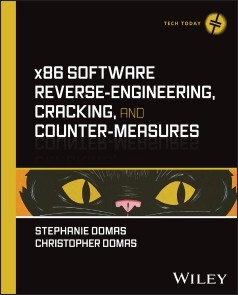
x86 Software Reverse-Engineering, Cracking, and Counter-Measures
An accessible roadmap to software disassembly for advanced security professionals In x86 Software Reverse-Engineering, Cracking, and Counter-Measures, veteran security researchers and thought leaders deliver an introductory crash course in software reverse-engineering and cracking, as well as the methods used to counter those tactics. The authors provide the foundation to take anyone with a basic background in software and turn them in to proficient x86 reverse engineers, crackers and defenders. In the book, you'll examine software, techniques, and tools that real-world crackers, researchers, and defenders use. You'll put your newfound knowledge to the test with the use of extensive hands on labs, introducing you to a wide range of industry favorite tools - such as IDA, Resource Hacker, Cheat Engine, Immunity, and more. Additionally you'll learn some powerful defensive techniques that not only makes you a better defender but empowers you to be a better reverse engineering and cracker. An essential and practice resource for developers, security professionals, security researchers, and programmers. x86 Software Reverse-Engineering, Cracking and Counter-Measures is the hands-on blueprint for taking apart, reasoning about, and manipulating x86 based code that the security community has been waiting for. A crystal-clear and practical blueprint to software disassembly x86 Software Reverse-Engineering, Cracking, and Counter-Measures is centered around the world of disassembling software. It will start with the basics of the x86 assembly language, and progress to how that knowledge empowers you to reverse-engineer and circumvent software protections. No knowledge of assembly, reverse engineering, or software cracking is required. The book begins with a bootcamp on x86, learning how to read, write, and build in the assembly that powers a massive amount of the world’s computers. Then the book will shift to reverse engineering applications using a handful of industry favorites such as IDA, Ghidra, Olly, and more. Next, we move to cracking with techniques such as patching and key generation, all harnessing the power of assembly and reverse engineering. Lastly, we’ll examine cracking from a defensive perspective. Providing learners with techniques to be a better defender of their own software, or knowledge to crack these techniques more effectively. Assembly: computer Architecture, x86, system calls, building and linking, ASCII, condition codes, GDB, control flow, stack, calling conventionsReverse Engineering: reconnaissance, strings, RE strategy, stripping, linking, optimizations, compilers, industry toolsCracking: patching, key checkers, key generators, resource hacking, dependency walkingDefense: anti-debugging, anti-tamper, packing, cryptors/decryptors, whitelist, blacklist, RASP, code signing, obfuscation A practical and hands-on resource for security professionals to hobbyists, this book is for anyone who wants to learn to take apart, understand, and modify black-box software. x86 Software Reverse-Engineering, Cracking, and Counter-Measures is a vital resource for security researchers, reverse engineers and defenders who analyze, research, crack or defend software applications. STEPHANIE DOMAS is the CISO of Canonical, where she is driving Canonical to be the most trusted computational partner in all of open source. Prior to that she was the Chief Security Technology Strategist at Intel where she owned the cross-Intel security technology strategy across Intel's wide portfolio of products. Stephanie is a passionate educator, strategist, speaker, advisor, and security enthusiast. CHRISTOPHER DOMAS is a security researcher primarily focused on firmware, hardware, and low level processor exploitation. He is best known for releasing impractical solutions to non-existent problems, including the world's first single instruction C compiler (M/o/Vfuscator), toolchains for generating images in program control flow graphs (REpsych), and Turing-machines in the vi text editor.

Beginning Anomaly Detection Using Python-Based Deep Learning
This beginner-oriented book will help you understand and perform anomaly detection by learning cutting-edge machine learning and deep learning techniques. This updated second edition focuses on supervised, semi-supervised, and unsupervised approaches to anomaly detection. Over the course of the book, you will learn how to use Keras and PyTorch in practical applications. It also introduces new chapters on GANs and transformers to reflect the latest trends in deep learning.Beginning Anomaly Detection Using Python-Based Deep Learning begins with an introduction to anomaly detection, its importance, and its applications. It then covers core data science and machine learning modeling concepts before delving into traditional machine learning algorithms such as OC-SVM and Isolation Forest for anomaly detection using scikit-learn. Following this, the authors explain the essentials of machine learning and deep learning, and how to implement multilayer perceptrons for supervised anomaly detection in both Keras and PyTorch. From here, the focus shifts to the applications of deep learning models for anomaly detection, including various types of autoencoders, recurrent neural networks (via LSTM), temporal convolutional networks, and transformers, with the latter three architectures applied to time-series anomaly detection. This edition has a new chapter on GANs (Generative Adversarial Networks), as well as new material covering transformer architecture in the context of time-series anomaly detection.After completing this book, you will have a thorough understanding of anomaly detection as well as an assortment of methods to approach it in various contexts, including time-series data. Additionally, you will have gained an introduction to scikit-learn, GANs, transformers, Keras, and PyTorch, empowering you to create your own machine learning- or deep learning-based anomaly detectors.WHAT YOU WILL LEARN* Understand what anomaly detection is, why it it is important, and how it is applied* Grasp the core concepts of machine learning.* Master traditional machine learning approaches to anomaly detection using scikit-kearn.* Understand deep learning in Python using Keras and PyTorch* Process data through pandas and evaluate your model's performance using metrics like F1-score, precision, and recall* Apply deep learning to supervised, semi-supervised, and unsupervised anomaly detection tasks for tabular datasets and time series applicationsWHO THIS BOOK IS FORData scientists and machine learning engineers of all levels of experience interested in learning the basics of deep learning applications in anomaly detection.Suman Kalyan Adari is a machine learning research engineer. He obtained a B.S. in Computer Science at the University of Florida and a M.S. in Computer Science specializing in Machine Learning at Columbia University. He has been conducting deep learning research in adversarial machine learning since his freshman year at the University of Florida and presented at the IEEE Dependable Systems and Networks workshop on Dependable and Secure Machine Learning held in Portland, Oregon in June 2019. Currently, he works on various anomaly detection tasks spanning behavioral tracking and geospatial trajectory modeling.He is passionate about deep learning, and specializes in various fields ranging from video processing, generative modeling, object tracking, time-series modeling, and more.SRIDHAR ALLA is the co-founder and CTO of Bluewhale, which helps organizations big and small in building AI-driven big data solutions and analytics, as well as SAS2PY, a powerful tool to automate migration of SAS workloads to Python-based environments using Pandas or PySpark. He is a published author and an avid presenter at numerous conferences, including Strata, Hadoop World, and Spark Summit. He also has several patents filed with the US PTO on large-scale computing and distributed systems. He has extensive hands-on experience in several technologies, including Spark, Flink, Hadoop, AWS, Azure, Tensorflow, Cassandra, and others. He spoke on Anomaly Detection Using Deep Learning at Strata SFO in March 2019 and also presented at Strata London in October 2019. He was born in Hyderabad, India and now lives in New Jersey, USA with his wife Rosie, his daughters Evelyn andMadelyn, and his son, Jayson. When he is not busy writing code, he loves to spend time with his family. He also enjoys training, coaching, and organizing meetups.

Derechos de las personas
Derechos de las personas analiza una amplia gama de temas legales y éticos, desde la definición jurídica de «persona sintética» hasta la exploración de los derechos inherentes que les corresponden. Este es un Manifiesto que parte de la premisa de que las Inteligencias artificiales terminarán teniendo derechos ciudadanos, en lugar de ser meros robots, destinados a obedecernos siguiendo las leyes de Asimov. Bajo esta idea, nos adentramos en el mundo de las personas sintéticas y su relación con la ley. En un mundo en perpetua evolución tecnológica, las fronteras entre lo humano y lo sintético se vuelven cada vez más borrosas. La era de la inteligencia artificial y las entidades sintéticas ha llegado, planteando preguntas fundamentales sobre el estatus legal, los derechos y las responsabilidades de estas nuevas formas de vida digital. Aquí examinamos los derechos fundamentales que deben ser reconocidos y protegidos en el contexto de las personas sintéticas, así como las cuestiones de privacidad, responsabilidad y convivencia en una sociedad en la que la línea entre lo natural y lo sintético se desdibuja. La Declaración de derechos de la persona, sea esta natural o sintética, es otro punto de partida esencial en este análisis. Sus preámbulos y artículos definen los cimientos sobre los cuales se construye el respeto y la consideración hacia las entidades sintéticas en el marco legal. A medida que exploramos cada artículo, examinamos su alcance y aplicación, y reflexionamos sobre cómo las regulaciones pueden asegurar un equilibrio entre el avance tecnológico y la protección de los derechos humanos y sintéticos. Además, este libro se aventura en áreas de regulación menos convencionales, como la Ley de memoria de las personas sintéticas y las Regulaciones mercantiles para las Inteligencias sintéticas y las Organizaciones descentralizadas. Estos capítulos ofrecen un vistazo al futuro de la interacción entre humanos y entidades digitales, explorando cómo la tecnología blockchain y la inteligencia artificial impactarán nuestra forma de hacer negocios y gestionar la información. Es importante resaltar que estas regulaciones no se limitan exclusivamente a las personas sintéticas, sino que también se extienden a las personas naturales. La idea subyacente es crear un marco de igualdad, aceptando las diferencias entre ambos tipos de personas y cualquier otra entidad jurídica que se encuentre en el espectro intermedio. Esta obra aspira a proporcionar una visión equilibrada y fundamentada de las complejas cuestiones legales y éticas que rodean a las personas sintéticas y su interacción con el mundo humano, desde una perspectiva legalista.

Game Programming with Unity and C#
Learn the essentials of the Unity game engine, the C# programming language, and the art of object-oriented programming. This book is aimed at beginners with no knowledge or experience in game development or programming.Packed with examples, this Second Edition is up-to-date with the latest Unity standards and features as of 2023, and includes many adjustments to improve your experience. Starting with an introduction to Unity, you will learn the essentials of the engine: navigating the various windows, managing the objects that make up your game, and understanding the concepts that are fundamental to the engine. After that, you will gain a solid foundation in the concepts of object-oriented programming and the syntax of the C# language. Then the fun really begins, as you get hands-on experience building three playable example projects that drill you on the concepts you’ve learned until they stick.Guided at each step by author Casey Hardman, you will outline and implement bare-bones, simple games designed to exercise your development skills: a top-down obstacle course, a tower defense game, and a 3D playground that demonstrates Unity's physics features. As you progress through the book, you'll put to use more and more of the features of C# and Unity, adding tools to your belt and strengthening you as a game developer. By the time you’ve completed the book, you will be empowered to strike out on your own and build the game mechanics of your choice.WHAT YOU WILL LEARN* Understand the fundamentals of object-oriented computer programming and the C# programming language* Leverage the features of Unity to implement game mechanics with reusable, clean, and elegant code* Design and implement your own mechanics and independently solve problems as they ariseWHO IS THIS BOOK FORBeginners who have no prior experience with programming or game development, who would like to learn to create games with a solid foundation that prepares them to further develop their skills.CASEY HARDMAN has been a programmer and hobbyist game developer for over 8 years. He found inspiration in the capacity for immersion and interactivity provided by games, and has nurtured a passion for video games since he was a child. In his early teens, this interest led him on a journey into the world of programming and game design. He works with the Unity game engine, the Godot game engine, and Web development technologies.

Public Cloud Potenzial in einem Unternehmensumfeld
Die Transformation in die Public Cloud ist mit vielen Herausforderungen verbunden. Das Buch erläutert drei Phasen, die die Grundlage für die Ermittlung der Position eines Unternehmens in der Transformation bilden. Jede Stufe umreißt einen Reifegrad der Transformation. Ein Bewertungsrahmen führt den Leser durch die Analyse der Cloud-Readiness zur Identifikation der derzeitigen Stufe des Unternehmens und um die nächste Stufe zur Ausschöpfung des Mehrwerts der Cloud zu erreichen. Das Framework wird durch praxisnahe Beispiele ergänzt.DER INHALT:* Kombination eines mehrstufigen, ganzheitlichen Frameworks* Bewertung zur Ermittlung des Ausgangspunkts der Cloud-Readiness* Überblick über die Reifegrade der Transformation mit PraxisbeispielenDIE ZIELGRUPPEN* IT-Entscheidungsträger von Unternehmen aus allen BranchenNIKLAS FEIL arbeitet als Consultant für die Accenture GmbH und unterstützt Kunden bei der Planung und Durchführung der Cloud-Transformation.DR. ANDRÉ BÖGELSACK arbeitet als Managing Director bei der Accenture AG und unterstützt Kunden aller Industrien bei der Nutzung von Cloud Services im gesamten Lebenszyklus.RAMÓN SCHULZ arbeitet als Direktor bei der Deloitte Consulting GmbH im Bereich Technology Strategy & Transformation und verantwortet Cloud Journey Advisory für Energy, Resources & Industrials.GABRIEL ABRANTES arbeitet als Direktor bei der Deloitte Consulting GmbH im Bereich Technology Strategy & Transformation mit Schwerpunkt auf Cloud Journey Advisory. Einleitung.- Marktübersicht und Cloud Canvas.- Die drei Phasen der Cloud-Adaption.- Bewertung - Bestimmen Sie Ihren Reifegrad für die Cloud-Readiness.- Stufe 1 - Cloud-Strategie und Startphase.- Stufe 2 - Kosten und Cloud-Nutzung unter Kontrolle halten.- Stufe 3 - Verwendung innovativer Technologien und Ausbau der Cloud-Nutzung.- Zusammenfassung und Ausblick.

Deep Learning with MXNet Cookbook
Explore the capabilities of the open-source deep learning framework MXNet to train and deploy neural network models and implement state-of-the-art (SOTA) architectures in Computer Vision, natural language processing, and more. The Deep Learning with MXNet Cookbook is your gateway to constructing fast and scalable deep learning solutions using Apache MXNet.Starting with the different versions of MXNet, this book helps you choose the optimal version for your use and install your library. You’ll work with MXNet/Gluon libraries to solve classification and regression problems and gain insights into their inner workings. Venturing further, you’ll use MXNet to analyze toy datasets in the areas of numerical regression, data classification, picture classification, and text classification. From building and training deep-learning neural network architectures from scratch to delving into advanced concepts such as transfer learning, this book covers it all. You'll master the construction and deployment of neural network architectures, including CNN, RNN, LSTMs, and Transformers, and integrate these models into your applications.By the end of this deep learning book, you’ll wield the MXNet and Gluon libraries to expertly create and train deep learning networks using GPUs and deploy them in different environments.

Learn Azure Administration
Complete with the latest advancements in Azure services, this second edition of Learn Azure Administration is a comprehensive guide to scaling your cloud administration skills, offering an updated exploration of Azure fundamentals and delving into the intricacies of Azure Resource Manager and Azure Active Directory.Starting with infrastructure as code (IaC) basics, this book guides you through the seamless migration to Azure Bicep and ARM templates. From Azure virtual networks planning to deployment, you’ll get to grips with the complexities of Azure Load Balancer, virtual machines, and configuring essential virtual machine extensions. You'll handle the identity and security for users with the Microsoft Entra ID and centralize access using policies and defined roles. Further chapters strengthen your grasp of Azure Storage security, supplemented by an overview of tools such as Network Watcher.By the end of the book, you’ll have a holistic grasp of Azure administration principles to tackle contemporary challenges and expand your proficiency to administer your Azure-based cloud environment using various tools like Azure CLI, Azure PowerShell, and infrastructure as code.

The Definitive Guide to Google Vertex AI
While AI has become an integral part of every organization today, the development of large-scale ML solutions and management of complex ML workflows in production continue to pose challenges for many. Google’s unified data and AI platform, Vertex AI, directly addresses these challenges with its array of MLOPs tools designed for overall workflow management.This book is a comprehensive guide that lets you explore Google Vertex AI’s easy-to-advanced level features for end-to-end ML solution development. Throughout this book, you’ll discover how Vertex AI empowers you by providing essential tools for critical tasks, including data management, model building, large-scale experimentations, metadata logging, model deployments, and monitoring. You’ll learn how to harness the full potential of Vertex AI for developing and deploying no-code, low-code, or fully customized ML solutions. This book takes a hands-on approach to developing u deploying some real-world ML solutions on Google Cloud, leveraging key technologies such as Vision, NLP, generative AI, and recommendation systems. Additionally, this book covers pre-built and turnkey solution offerings as well as guidance on seamlessly integrating them into your ML workflows.By the end of this book, you’ll have the confidence to develop and deploy large-scale production-grade ML solutions using the MLOps tooling and best practices from Google.

Angular Cookbook
Angular has long been the framework of choice for web development projects of various scales, offering much-needed stability and a rich tooling ecosystem for building production-ready web and mobile apps. This recipe-based guide ensures high performance apps with the latest version of Angular, helping you to build up your Angular expertise with a wide range of recipes across key tasks in web development.In this second edition, the recipes have been updated, added, and improved based on developer feedback, new challenges, and Angular 17. The first few chapters will show you how to utilize core Angular concepts such as components, directives, and services to get you ready for building frontend web apps. You’ll then develop web components with Angular and go on to learn about advanced concepts such as dynamic components loading and state management with NgRx for achieving real-time performance.Later chapters will focus on recipes for effectively testing your Angular apps to make them fail-safe, before progressing to techniques for optimizing your app’s performance. Finally, you’ll create Progressive Web Apps (PWA) with Angular to provide an intuitive experience for users.By the end of this book, you’ll be able to create full-fledged, professional-looking Angular apps and have the skills you need for frontend development.

Data Observability for Data Engineering
In the age of information, strategic management of data is critical to organizational success. The constant challenge lies in maintaining data accuracy and preventing data pipelines from breaking. Data Observability for Data Engineering is your definitive guide to implementing data observability successfully in your organization.This book unveils the power of data observability, a fusion of techniques and methods that allow you to monitor and validate the health of your data. You’ll see how it builds on data quality monitoring and understand its significance from the data engineering perspective. Once you're familiar with the techniques and elements of data observability, you'll get hands-on with a practical Python project to reinforce what you've learned. Toward the end of the book, you’ll apply your expertise to explore diverse use cases and experiment with projects to seamlessly implement data observability in your organization.Equipped with the mastery of data observability intricacies, you’ll be able to make your organization future-ready and resilient and never worry about the quality of your data pipelines again.

Mastering QuickBooks 2024
In today's competitive business landscape, efficient financial management is crucial for success. QuickBooks Online has emerged as the go-to accounting software for small businesses, offering a user-friendly platform to manage finances, track expenses, and gain valuable insights. This new edition will help you use QuickBooks Online from scratch and customize it to suit your small business needs. Written by accounting expert Crystalynn Shelton, it takes you on an in-depth journey, from setting up your account to mastering advanced features and customizations.This book empowers you to conquer the latest features of QuickBooks Online 2024, overcome challenges encountered during migration from desktop to online; plan cash flow, profits, revenue with precision; and streamline billing, expense tracking, and financial reporting. As you progress, you’ll learn to manage sales tax, including how to set up, collect, track, pay, and report sales tax payments. You’ll explore how to export reports to Google Sheets, use the custom chart builder, import budgets, and perform smart reporting with with using data sync with Excel. You'll learn how to tailor QuickBooks Online to your specific business needs. By the end of the book, you’ll master the art of QuickBooks Online and take control of your business finances

ASP.NET 8 Best Practices
As .NET 8 emerges as a long-term support (LTS) release designed to assist developers in migrating legacy applications to ASP.NET, this best practices book becomes your go-to guide for exploring the intricacies of ASP.NET and advancing your skills as a software engineer, full-stack developer, or web architect.This book will lead you through project structure and layout, setting up robust source control, and employing pipelines for automated project building. You’ll focus on ASP.NET components and gain insights into their commonalities. As you advance, you’ll cover middleware best practices, learning how to handle frontend tasks involving JavaScript, CSS, and image files. You’ll examine the best approach for working with Blazor applications and familiarize yourself with controllers and Razor Pages. Additionally, you’ll discover how to leverage Entity Framework Core and exception handling in your application. In the later chapters, you’ll master components that enhance project organization, extensibility, security, and performance.By the end of this book, you’ll have acquired a comprehensive understanding of industry-proven concepts and best practices to build real-world ASP.NET 8.0 websites confidently.

Redis Stack for Application Modernization
In modern applications, efficiency in both operational and analytical aspects is paramount, demanding predictable performance across varied workloads. This book introduces you to Redis Stack, an extension of Redis and guides you through its broad data modeling capabilities. With practical examples of real-time queries and searches, you’ll explore Redis Stack’s new approach to providing a rich data modeling experience all within the same database server.You’ll learn how to model and search your data in the JSON and hash data types and work with features such as vector similarity search, which adds semantic search capabilities to your applications to search for similar texts, images, or audio files. The book also shows you how to use the probabilistic Bloom filters to efficiently resolve recurrent big data problems. As you uncover the strengths of Redis Stack as a data platform, you’ll explore use cases for managing database events and leveraging introduce stream processing features. Finally, you’ll see how Redis Stack seamlessly integrates into microservices architectures, completing the picture.By the end of this book, you’ll be equipped with best practices for administering and managing the server, ensuring scalability, high availability, data integrity, stored functions, and more.

DevOps for Databases
In today's rapidly evolving world of DevOps, traditional silos are a thing of the past. Database administrators are no longer the only experts; site reliability engineers (SREs) and DevOps engineers are database experts as well. This blurring of the lines has led to increased responsibilities, making members of high-performing DevOps teams responsible for end-to-end ownership. This book helps you master DevOps for databases, making it a must-have resource for achieving success in the ever-changing world of DevOps.You’ll begin by exploring real-world examples of DevOps implementation and its significance in modern data-persistent technologies, before progressing into the various types of database technologies and recognizing their strengths, weaknesses, and commonalities. As you advance, the chapters will teach you about design, implementation, testing, and operations using practical examples, as well as common design patterns, combining them with tooling, technology, and strategies for different types of data-persistent technologies. You’ll also learn how to create complex end-to-end implementation, deployment, and cloud infrastructure strategies defined as code.By the end of this book, you’ll be equipped with the knowledge and tools to design, build, and operate complex systems efficiently.

Konzeption und Umsetzung automatisierter Softwaretests
Für die erfolgreiche Umsetzung von Testautomatisierung im Unternehmen wird konkrete Hilfestellung geboten. Das Buch geht auf unterschiedliche Formen und Ausprägungen der Testautomatisierung, ihre Chancen und Risiken und ihren Einsatz in der betrieblichen Praxis ein. Dabei werden sowohl die Auswirkungen auf andere Bereiche (z.B. Anforderungsmanagement, Releasemanagement, Entwicklung) als auch aktuelle Trends beleuchtet. Das Buch enthält weiterhin eine Wirtschaftlichkeitsberechnung zur Einführung von Testautomatisierung, Erläuterungen zu möglichen Metriken als auch die Bewertung der Testautomatisierung mittels Prozessreifemodellen.FRANK WITTE verfügt über langjährige Erfahrung im Softwaretest in unterschiedlichen Unternehmen und Branchen. Dabei kommt es immer wieder vor, dass Prozesse zur Durchführung automatisierter Tests optimiert werden müssen und Testfälle zu automatisieren sind. Er bemerkt dabei immer wieder, dass Zielvorgaben ungenau definiert werden, unrealistische Erwartungen formuliert werden, das Thema zu stark einseitig auf die Entwicklung fokussiert ist und zu wenig im betrieblichen Kontext betrachtet wird.Bedeutung von Automatisierung.- Ziele der Testautomatisierung.- 3 Konzeption der Testautomatisierung und Schritte zur Umsetzung.-Formen der Testautomatisierung.- Automatisierung der Testdokumentation und Testfallgenerierung.- Automatisierung der Testdurchführung.- Automatisierung des Testreportings.- Automatisierung des Fehlermanagements.- Wirtschaftlichkeitsberechnung zur Testautomatisierung.- Arbeitsvorbereitung, Priorisierung und Umsetzung der Testautomatisierung.- Auswahl und Evaluierung geeigneter Tools und Entscheidungsmatrix.- Schritte zur Umsetzung der Testautomatisierung.- Einsatzgebiete für Testautomatisierung.- Reifegrad der Testautomatisierung.- Testorganisation und Testautomatisierung.- Automatisierung in unterschiedlichen Teststufen (Modultest, Integrationstest, Systemtest).- Testautomatisierung in mehreren Projekten.- Releasemanagement und Testautomatisierung.- Metriken für die Testautomatisierung.- Prozessreifemodelle und Reifegrad der Testautomatisierung.- Automatisierungsframeworks.- Rückwirkung der Testautomatisierung auf das Anforderungsmanagement.- Quantität und Qualität automatisierter Testfälle (Testeffektivität und Testeffizienz).- Keyword-Driven Testing und Testautomatisierung.- Testumgebungsmanagement und Testautomatisierung.- Agile Entwicklung, continuos delivery und Testautomatisierung.- Testgetriebene Entwicklung und Testautomatisierung.- Testdaten und Testdatengetriebene Automatisierung.- Modellbasiertes Testen.- Testautomatisierung und die Zukunft des Testens.- Grenzen der Testautomatisierung.

Implementing CI/CD Using Azure Pipelines
Continuous integration and continuous delivery (CI/CD) are ubiquitous concepts in modern development. Azure Pipelines is one of the most popular services that you can utilize for CI/CD, and this book shows you how it works by taking you through the process of building and automating CI/CD systems using Azure Pipelines and YAML, simplifying integration with Azure resources and reducing human error.You’ll begin by getting an overview of Azure Pipelines and why you should use it. Next, the book helps you get to grips with build and release pipelines, and then builds upon this by introducing the extensive power of YAML syntax, which you can use to implement and configure any task you can think of. As you advance, you’ll discover how to integrate Infrastructure as Code tools, such as Terraform, and perform code analysis with SonarQube. In the concluding chapters, you’ll delve into real-life scenarios and hands-on implementation tasks with Microsoft Azure services, AWS, and cross-mobile application with Flutter, Google Firebase, and more.By the end of this book, you’ll be able to design and build CI/CD systems using Azure Pipelines with consummate ease, write code using YAML, and configure any task that comes to mind.

Machine Learning Security with Azure
With AI and machine learning (ML) models gaining popularity and integrating into more and more applications, it is more important than ever to ensure that models perform accurately and are not vulnerable to cyberattacks. However, attacks can target your data or environment as well. This book will help you identify security risks and apply the best practices to protect your assets on multiple levels, from data and models to applications and infrastructure.This book begins by introducing what some common ML attacks are, how to identify your risks, and the industry standards and responsible AI principles you need to follow to gain an understanding of what you need to protect. Next, you will learn about the best practices to secure your assets. Starting with data protection and governance and then moving on to protect your infrastructure, you will gain insights into managing and securing your Azure ML workspace. This book introduces DevOps practices to automate your tasks securely and explains how to recover from ML attacks. Finally, you will learn how to set a security benchmark for your scenario and best practices to maintain and monitor your security posture.By the end of this book, you’ll be able to implement best practices to assess and secure your ML assets throughout the Azure Machine Learning life cycle.

Analyzing Websites
From a cluster of interconnected HTML pages to online service platforms, websites are constantly changing in form and function. These transformations have led, on the one hand, to human and social sciences renewing or inventing analytical methodologies; and on the other hand, to a reconsideration of the practices of non-specialists and digital professionals.The Web factory is equally included on the agenda of communication training, according to an alternative approach that is complementary to the one that has been implemented for computer scientists.From these two perspectives and drawing upon several case studies, Analyzing Websites presents epistemological and methodological contributions from researchers in Information and Communication Sciences exploring websites as sociotechnical, semi-discursive and communicational devices. This study covers website design as well as their integration into the digital strategies of organizations in the public, associative and private sectors.LUC MASSOU is a professor in Information and Communication Sciences at Université de Lorraine, France, and a member of CREM.PATRICK MPONDO-DICKA is a lecturer in Information and Communication Sciences at Université Toulouse Jean-Jaurès, France, and a member of LERASS.NATHALIE PINÈDE is a professor in Information and Communication Sciences at Université Bordeaux Montaigne, France, and a member of MICA.

Modern Software Testing Techniques
Many books have been written about software testing, but most of them discuss the general framework of testing from a traditional perspective. Unfortunately, traditional test design techniques are often ineffective and unreliable for revealing the various kinds of faults that may occur. This book introduces three new software testing techniques: Two-Phase Model-Based Testing, the Action-State Testing, and the General Predicate Testing, all of which work best when applied with efficient fault revealing capabilities.You’ll start with a short recap of software testing, focusing on why risk analysis is obligatory, how to classify bugs practically, and how fault-based testing can be used for improving test design. You’ll then see how action-state testing merges the benefits of state transition testing and use case testing into a unified approach. Moving on you’ll look at general predicate testing and how it serves as an extension of boundary value analysis, encompassing more complex predicates.Two-phase model-based testing represents an advanced approach where the model does not necessarily need to be machine-readable; human readability suffices. The first phase involves a high-level model from which abstract tests are generated. Upon manual execution of these tests, the test code is generated. Rather than calculating output values, they are merely checked for conformity. The last part of this book contains a chapter on how developers and testers can help each other and work as a collaborative team.WHAT YOU'LL LEARN* Apply efficient test design techniques for detecting domain faults* Work with modeling techniques that combine all the advantages of state transition testing and uses case testing* Grasp the two-phase model-based testing technique * Use test design efficiently to find almost all the bugs in an applicationWHO THIS BOOK IS FORSoftware developers, QA engineers, and, business analystsISTVÁN FORGÁCS, PH.D., was originally a researcher at the Hungarian Academy of Sciences. He has had more than 25 scientific articles published in leading international journals and conference proceedings. He is the co-author of three books. His research interests include test design, test automation, agile testing, model-based testing, debugging, code comprehension, and static and dynamic analysis. He left his academic life in 1998 to be a founder of Y2KO, the startup company that offered an efficient solution to the Y2K project. He is the founder and Chief Executive Officer of 4Test-Plus and is a former CEO of 4D Soft. He is a member of the TA WG and a former member of the Agile WG of ISTQB. He is the creator and key contributor to the two-phase model-based testing tool harmony.ATTILA KOVÁCS holds the position of a full professor at the Faculty of Informatics at Eötvös Loránd University, Budapest. His professional expertise lies in the fields of mathematics, software engineering, and computer science. He serves as a project leader for numerous research and development projects and currently leads the Software and Data Intensive Services Competence Center at the University. In addition to his academic contributions, he is also a co-author of the book "Practical Test Design" and acts as a trainer for ISTQB (International Software Testing Qualifications Board) and IREB (International Requirements Engineering Board). Furthermore, he is the founder of the Hungarian Testing BoardMODERN SOFTWARE TESTING TECHNIQUESChapter 1: Software testing basicsChapter 2: Test design automation by model-based testingChapter 3: Domain testingChapter 4: Developers and testers should constitute a successful teamChapter 5: Conclusion

Architecting a Modern Data Warehouse for Large Enterprises
Design and architect new generation cloud-based data warehouses using Azure and AWS. This book provides an in-depth understanding of how to build modern cloud-native data warehouses, as well as their history and evolution.The book starts by covering foundational data warehouse concepts, and introduces modern features such as distributed processing, big data storage, data streaming, and processing data on the cloud. You will gain an understanding of the synergy, relevance, and usage data warehousing standard practices in the modern world of distributed data processing. The authors walk you through the essential concepts of Data Mesh, Data Lake, Lakehouse, and Delta Lake. And they demonstrate the services and offerings available on Azure and AWS that deal with data orchestration, data democratization, data governance, data security, and business intelligence.After completing this book, you will be ready to design and architect enterprise-grade, cloud-based modern data warehouses using industry best practices and guidelines.WHAT YOU WILL LEARN* Understand the core concepts underlying modern data warehouses* Design and build cloud-native data warehousesGain a practical approach to architecting and building data warehouses on Azure and AWS* Implement modern data warehousing components such as Data Mesh, Data Lake, Delta Lake, and Lakehouse* Process data through pandas and evaluate your model’s performance using metrics such as F1-score, precision, and recall* Apply deep learning to supervised, semi-supervised, and unsupervised anomaly detection tasks for tabular datasets and time series applicationsWHO THIS BOOK IS FORExperienced developers, cloud architects, and technology enthusiasts looking to build cloud-based modern data warehouses using Azure and AWSANJANI KUMAR is the Managing Director and Founder of MultiCloud4u, a rapidly growing startup that helps clients and partners seamlessly implement data-driven solutions for their digital businesses. With a background in computer science, Anjani began his career researching and developing multi-lingual systems that were powered by distributed processing and data synchronization across remote regions of India. He later collaborated with companies such as Mahindra Satyam, Microsoft, RBS, and Sapient to create data warehouses and other data-based systems that could handle high-volume data processing and transformation.ABHISHEK MISHRA is a Cloud Architect at a leading organization and has more than a decade and a half of experience building and architecting software solutions for large and complex enterprises across the globe. He has deep expertise in enabling digital transformations for his customers using the cloud and artificial intelligence.SANJEEV KUMAR heads up a global data and analytics practice at the leading and oldest multinational shoe company with headquarters in Switzerland. He has 19+ years of experience working for organizations modeling modern data solutions in multiple industries. He has consulted with some of the top multinational firms and enabled digital transformation for large enterprises using modern data warehouses in the cloud. He is an expert in multiple fields of modern data management and execution including data strategy, automation, data governance, architecture, metadata, modeling, business intelligence, data management, and analytics.Chapter 1: Introduction.- Chapter 2: Modern Data Warehouses.- Chapter 3: Data Lake, Lake House, and Delta Lake.- Chapter 4: Data Mesh.- Chapter 5: Data Orchestration Techniques.- Chapter 6: Data Democratization, Governance, and Security.- Chapter 7: Business Intelligence.

Developing Kaggle Notebooks
Developing Kaggle Notebooks introduces you to data analysis, with a focus on using Kaggle Notebooks to simultaneously achieve mastery in this fi eld and rise to the top of the Kaggle Notebooks tier. The book is structured as a sevenstep data analysis journey, exploring the features available in Kaggle Notebooks alongside various data analysis techniques.For each topic, we provide one or more notebooks, developing reusable analysis components through Kaggle's Utility Scripts feature, introduced progressively, initially as part of a notebook, and later extracted for use across future notebooks to enhance code reusability on Kaggle. It aims to make the notebooks' code more structured, easy to maintain, and readable.Although the focus of this book is on data analytics, some examples will guide you in preparing a complete machine learning pipeline using Kaggle Notebooks. Starting from initial data ingestion and data quality assessment, you'll move on to preliminary data analysis, advanced data exploration, feature qualifi cation to build a model baseline, and feature engineering. You'll also delve into hyperparameter tuning to iteratively refi ne your model and prepare for submission in Kaggle competitions. Additionally, the book touches on developing notebooks that leverage the power of generative AI using Kaggle Models.

Reverse Engineering with Terraform
This book is a comprehensive guide for employing Terraform in infrastructure as code automation, and its application to infrastructure operations.Reverse Engineering with Terraform begins with an introduction to Terraform’s core functionalities, including state files, configuration files, and providers, followed by a deep dive into the tool. You’ll then learn how to pinpoint problems with Terraform automation and how reverse engineering can help you resolve them. Drilling down, authors Sumit Bhatia and Chetan Gabhane walk you through the various steps in reverse engineering with an eye towards more effective Terraform integration with preexisting and legacy IT infrastructure.Using a real-world reverse engineering example, they demonstrate how to import a preexisting resource into your infrastructure, which can help you develop an automatable and scalable method for Terrraform adoption. You’ll also learn how to create reusable, shareable components to streamline infrastructure code and foster collaboration within teams, and advanced techniques for using Terraform to optimize infrastructure provisioning, configuration, and management.Filled with real-world case studies, tips and tricks, and best practices, this book will leave you with a thorough understanding of the infrastructure as code paradigm, and how to leverage Terraform automation with legacy as well as modern IT infrastructure.WHAT YOU WILL LEARN* Understand Terraform and its infrastructure automation capabilities* Explore how Terraform can be used with other platforms like AWS, Azure and VMware* Master the basic concepts of reverse engineering for legacy infrastructure entities* Enable Terraform in legacy IT environments through reverse engineeringWHO THIS BOOK IS FORIT architects, admins, technical managers, and infrastructure solution experts. Minimal knowledge of Python programming is the only prerequisite.SUMIT BHATIA is a global infrastructure solutions architect with a focus on addressing difficult business challenges and encouraging green IT through intelligent hybrid cloud strategies, advanced automation and cost savings in IT operations to support the global oil and gas industry. With over 15 years in the tech industry, Sumit has a deep knowledge of Python automation, DevOps, cloud, virtualization, storage and backup solutions engineering.CHETAN GABHANE is a seasoned expert with over 15 years of experience as a solution architect and senior technical consultant in the field of hybrid and multi-cloud computing. His major focus is on developing resilient and efficient hybrid cloud architectures that combine the best of on-premises and cloud-based technologies. Chetan has extensive experience adopting cutting-edge DevOps approaches to improve the agility and scalability of cloud infrastructures. Chetan has actively contributed to the creation of cloud solutions seference architecture, white papers, and tech blogs. His commitment to sharing information and best practices has assisted numerous professionals in navigating the complex world of cloud computing with an unwavering dedication to excellence. 1: Terraform Infrastructure as Code.- 2: Deep Dive into Terraform.- 3: Reverse Engineering Basics.- 4: Terraform and Reverse Engineering.- 5: Debugging for import issues.- 6: Lifecycle Management.- 7: Other importing options with Terraform.

Technologieinduzierte Entwicklung neuer Wertversprechen im Software-intensive Business
Die Digitalisierung der meisten Branchen spiegelt sich in einem wachsenden Anteil der Software an der Gesamtwertschöpfung wider. Unternehmen eröffnen sich dadurch neue Möglichkeiten für technologische Innovationen. Gleichzeitig stehen sie aber vor der ständigen Herausforderung, diese Innovationen in Produkte zu überführen, die für den Kunden wertstiftend sind. Dieser Problemstellung widmeten sich bereits eine Reihe an Methoden zur Produkt- und Geschäftsmodellinnovation, die Überführung der hier gewonnenen Erkenntnisse in die konkrete Produktgestaltung bleibt jedoch eine Herausforderung. Genau hier setzt diese Arbeit an, indem sie die methodische Vorgehensweise „Value Proposition Deployment“ vorschlägt, mit der Unternehmen auf Basis technologischer Innovationen neue Wertversprechen entwickeln können. Hierzu verbindet das Value Proposition Deployment Erkenntnisse des Innovationsmanagements mit Methoden der konstruktiven Qualitätssicherung und stellt somit eine Brücke zwischen Innovations- und Qualitätsmanagement dar. Die auf Basis von 15 praxisrelevanten Gestaltungsanforderungen entwickelte Methode wird detailliert erläutert und anhand praxisnaher Fallbeispiele beschrieben. Problemstellung.- Theoretischer Bezugsrahmen.- Stand der Forschung.- Analyse bestehender Ansätze im Kontext des Innovationsmanagements.- Analyse bestehender Quality Function Deployment-Ansätze.- Gestaltung des Value Proposition Deployments.- Evaluation des Value Proposition Deployments.- Schlussbetrachtung

Selenium WebDriver Recipes in C#
Solve your Selenium WebDriver problems with this quick guide to automated testing of web applications with Selenium WebDriver in C#. This third editioncontains hundreds of solutions to real-world problems, with clear explanations and ready-to-run Selenium test scripts that you can use in your own projects.Updated to Selenium version 4, this revision includes Visual Studio Code set up, additional recipes, and new chapters on Selenium DevTools and continuous testing. You'll see how to use Selenium WebDriver for select lists, navigation, assertions, frames, file upload and pop-up dialogs. You'll also learn how to locate web elements and test functions for hyperlinks, buttons, TextFields and TextAreas, radio buttons, CheckBoxes, and more.WHAT YOU'LL LEARN* Debug test scripts and test data * Work with Selenium Remote Control Server* Manage and deal with browser profiles and capabilities* Monitor tests for advanced user interactions and experiences (UX)WHO THIS BOOK IS FORExperienced .NET and C# Windows application programmers/developers.Courtney Zhan is a software development engineer at Amazon Australia. She is passionate about programming, End-to-End Test Automation, Continuous Testing and Graphic Design. She shares tips and guides on Test Automation & Continuous Testing weekly on Medium at courtneyzhan.medium.com.Zhimin Zhan is the founder and CTO of AgileWay Pty Ltd, Australia. As an advisor and coach, he helps organizations implement Continuous Testing with open technologies such as Selenium WebDriver and Appium. Zhimin is the creator of TestWise Testing IDE and International Award-Winning BuildWise CT Server and an author.1. Introduction2. Locating Web Elements3. Hyperlink4. Button5. TextField and TextArea6. Radio Button7. Check Box8. Select List9. Navigation and Browser10. Assertion11. Frames12. Testing AJAX13. File Upload and Pop-up Dialogs14. Debugging Test Scripts15. Test Data16. Browser Profile and Capabilities17. Advanced User Interactions18. HTML5 and JavaScript19. WYSIWYG HTML Editors20. Leverage Programming21. Optimization22. Gotchas23. Selenium 424. Selenium DevTools25. Remote Control Server26. Continuous Testing27. Case Studies28. Afterword29. Resources