

Software

Mein Chromebook optimal nutzen
Mein Chromebook optimal nutzen- Den kleinen Alleskönner kennen- und beherrschen lernen.- Von der Installation bis zur unkomplizierten Anwendung.- Schnell, sicher & produktiv: ideal für Privatnutzung & Homeoffice.Chromebooks sind leichte und schnelle Notebooks mit dem Chrome OS-Betriebssystem, die optimal mit Android-Smartphones und allen Google-Onlinediensten zusammenarbeiten. Sie eignen sich für fast alle Aufgaben aus dem privaten Computeralltag, überzeugen durch ihre lange Akkulaufzeit und lassen sich überall dort nutzen, wo es WLAN gibt.Dieses Buch hilft Ihnen dabei, Ihr Chromebook Schritt für Schritt bedienen zu lernen. Richten Sie es individuell nach Ihren Bedürfnissen ein, synchronisieren Sie es mit allen Ihren Android-Geräten und nutzen Sie die vielen praktischen Anwendungen: Vom Verfassen von Textdokumenten über Onlinerecherche, Streaming und Videokonferenzen bis hin zu Fotoverwaltung und -bearbeitung wird das Chromebook Ihr zuverlässiger Begleiter. Und mit der Launcher-Taste finden Sie schnell, wonach Sie suchen: Apps, Dateien und natürlich Antworten aus dem Internet sind stets parat. Freuen Sie sich auf gut nachvollziehbare Anleitungen und hilfreiche Tipps des Profis – für die unkomplizierte und effiziente Nutzung Ihres Chromebooks!Aus dem Inhalt:- Was ist ein Chromebook?- Mit dem Google-Konto anmelden- Daten mit dem Smartphone synchronisieren- Apps installieren und einrichten- Google Drive, der optimale Cloud-Speicher- Texte schreiben mit Google Docs & Word- Videokonferenzen mit Google Meet- Fotos auf dem Chromebook bearbeiten- Google Photos, Snapseed & Lightroom- CAD-Zeichnungen erstellen und editieren- Medien-, Video- und Musikstreaming- Multiplayer Games und E-Sport- Einsatz der Konsole in Chrome OSChristian Immler war viele Jahre als Dozent für Computer Aided Design an der Fachhochschule Nienburg und an der University of Brighton tätig. Seit mehr als 25 Jahren befasst er sich als erfolgreicher Autor mit Spezialthemen wie 3D-Visualisierung, Smartphone-Betriebssysteme, Linux und Windows. Seine Leser schätzen seine Fähigkeit, selbst die kompliziertesten Sachverhalte gut nachvollziehbar zu erklären.

Social Business Transformation
Die Zukunft der Arbeit verlagert sich zunehmend in den digitalen Raum. Deutsche Unternehmen positionieren sich in der Gestaltung dieses Raumes bislang häufig in der Rolle der Nachzügler, weil sie die Bedeutung des Einsatzes sozialer Technologien (z.B. Enterprise Social Networks) für das Unternehmen unterschätzen. Das resultierende Risiko im globalen Wettbewerb unterzugehen, ist gerade für den Mittelstand erheblich.Um zukunftsfähige Wege einzuschlagen, braucht es neue Gestaltungsansätze. Einer davon ist Social Business. Social Business wird im vorliegenden Werk als ganzheitliches Konzept beschrieben, welches durch den systematischen Einsatz digitaler und kollaborativer Werkzeuge neue Möglichkeiten der Innovation und Wertschöpfung schafft. Soziale Technologien ermöglichen eine proaktive Gestaltung unternehmensinterner und -übergreifender Prozesse und bieten insbesondere im Wissensmanagement, in der Kommunikation sowie der Zusammenarbeit produktionssteigernde Potenziale.Im Rahmen dieses Werkes werden praktische Anwendungen, Konzepte zur Umsetzung von Social Business und Leitlinien für den Transformationsprozess wissenschaftlich fundiert und praxisnah präsentiert.DR. CHRISTIAN ZINKE-WEHLMANN arbeitet als Leiter der Service and Knowledge Management Gruppe am Institut für Angewandte Informatik (InfAI) der Universität Leipzig im Bereich sozio-technischer Unterstützungssysteme. Er arbeitet an der Schnittstelle zwischen Technologie, Arbeit und Dienstleistungssystemen und hat 2017 promoviert. Seine Forschung konzentriert sich auf Digitale Zusammenarbeit, Linked Data, Service Engineering und Management sowie Wissensmanagement. Diese Expertise ist in mehr als 40 weiteren Veröffentlichungen zu finden.JULIA FRIEDRICH ist Wissenschaftlerin in der Forschungsgruppe „Service und Knowledge Management“ mit langjähriger Erfahrung in den Bereichen Wissensmanagement und Gamification.Einführung.- Was ist Social Business?.- Wozu braucht es Leitlinien?.- Der Weg zum Social Business.- Darstellung des Transformationsprozesses.- Ein Blick in die Praxis.- Allgemeine Leitlinien und Empfehlungen.

Beginning Windows Mixed Reality Programming
Develop applications and experiences for Microsoft’s HoloLens 2 and other Windows mixed reality devices. This easy-to-follow guide removes the mystery behind creating amazing augmented reality and virtual reality experiences. Mixed reality development tools and resources are provided.BEGINNING WINDOWS MIXED REALITY PROGRAMMING, 2ND EDITION clearly explains all the nuances of mixed reality software development. You will learn how to create 3D objects and holograms, interact with holograms using voice commands and hand gestures, use spatial mapping and 3D spatial sound, build with toolkits such as Microsoft's Mixed Reality Toolkit and Unity’s AR Foundation and XR Platform, create intuitive user interfaces, and make truly awe-inspiring mixed reality experiences. This newly revised edition also includes updated content for HoloLens 2 development, including tutorials for new interactions such as hand tracking and eye tracking.WHAT YOU WILL LEARN* Prototype ideas quickly for the HoloLens 2 and Windows mixed reality devices* Get started with Unity, the preferred tool for developing 3D experiences* Locate and import 3D models for your project, or make your own* Use spatial sound, voice commands, gestures, hand tracking, and eye tracking* Build with Microsoft's Mixed Reality Toolkit and other toolkits to make apps the easy way* Publish to the Windows Store and make money from your appWHO THIS BOOK IS FORProgrammers looking to quickly learn how to create experiences for HoloLens 2. Also for programmers interested in building applications for the growing crop of virtual reality devices that support the Windows Mixed Reality platform.SEAN ONG is an author, engineer, entrepreneur, and tech influencer who has written on topics ranging from renewable energy to augmented reality. Sean and his wife Neisha Ong founded the mixed reality development company, Ong Innovations, in 2014. Sean and his team at Ong Innovations actively work with clients and partners around the globe to push the boundaries of mixed reality and spatial computing. Sean is also co-founder of the VR telepresence robotics platform company, Laborbot, founder of the AR/VR venue-based entertainment company, Manuvr Entertainment Inc., co-founder of the AR/VR app creation platform company, Inflexion Point Inc., and serves as partner and shareholder at numerous other AR/VR startup companies around the globe. He resides in Seattle, WA with his wife and three kids, where he and his family relentlessly build the holographic future of tomorrow using today’s XR devices.PART I: GETTING STARTED1. Gear Up: The Necessary Hardware and Software Tools2. Unity Crash CoursePART II: BUILDING HOLOGRAPHIC EXPERIENCES3. Creating Your First Hologram4. Introduction to the Mixed Reality Toolkit5. Interacting with Holograms6. Using Spatial Awareness7. Spatial SoundPART III: GROWING AS A HOLOGRAPHIC DEVELOPER8. Azure Spatial Anchors9. Shared Experiences10. Awe Inspiring Experiences11. Turning Holograms into Money12. Community Resources

Basiswissen Abnahmetest
Grundlagen des Abnahmetests für Product Owner, Business-Analysten und TesterMit Abnahmetests – Acceptance Testing – wird überprüft, ob eine Software aus Sicht des Benutzers wie beabsichtigt funktioniert und dieser die Software akzeptiert.Das Buch »Basiswissen Abnahmetest« verbindet die Business-Analyse und Softwaretesten mit Blick auf die Konzepte, Methoden und Praktiken der Zusammenarbeit zwischen Business-Analysten und Testern beim Abnahmetest.Business-Analysten und Projektleiter lernen, wie sie durch die Unterstützung bei der Ausrichtung des Produkts an den Geschäftsanforderungen zu den Abnahmetestaktivitäten in einer Organisation beitragen.Tester erfahren, wie sie effizient mit Business-Analysten und anderen Stakeholdern während allen Abnahmetestaktivitäten zusammenarbeiten.Dieses Buch umfasst das erforderliche Wissen als Vorbereitung auf die Prüfung zum »Certified Tester (Foundation Level) – Acceptance Testing« nach ISTQB®-Standard. Ein durchgängiges Fallbeispiel verbindet das theoretische Wissen des Lehrplans mit dessen praktischer Anwendung beim Abnahmetest. Das Buch eignet sich damit nicht nur bestens für die Prüfungsvorbereitung, sondern dient gleichzeitig als kompaktes Basiswerk zu diesen Themen in der Praxis und an Hochschulen.Über die Autoren:Florian Fieber ist Gründer und Geschäftsführer der QualityDojo IT-Consulting GmbH in Berlin und seit knapp 15 Jahren als Berater und Trainer im Bereich der Qualitätssicherung von Softwaresystemen tätig. Seine Schwerpunkte liegen im Testmanagement, der Verbesserung von Testprozessen sowie der Businessanalyse von Enterprise-Anwendungen. Er ist Leiter der Arbeitsgruppe Acceptance Testing beim GTB (German Testing Board e.V.).Marc-Florian Wendland ist wissenschaftlicher Mitarbeiter des Geschäftsbereichs SQC (System Quality Center) im Fraunhofer Institut FOKUS in Berlin. Seine Interessen umfassen die modellgetriebene Softwareentwicklung, den automatisierten Testentwurf und Testautomatisierungsstrategien. Er ist im GTB aktiv in den Arbeitsgruppen „Testautomatisierungsentwickler“ und „Acceptance Testing“. Bei der OMG leitet er die Weiterentwicklung des UML Testing Profile (UTP).

Java Übungsbuch
* TRAINIEREN SIE IHRE JAVA-KENNTNISSE* LEARNING BY DOING ANHAND PRAKTISCHER ÜBUNGEN* MIT VOLLSTÄNDIGEN UND KOMMENTIERTEN LÖSUNGENDieses Buch ist kein Lehrbuch, sondern ein reines Übungsbuch und wendet sich an Leser, die ihre Java-Kenntnisse anhand zahlreicher praktischer Übungen durch »Learning by Doing« vertiefen und festigen möchten. Es ist ideal, um sich auf Prüfungen vorzubereiten oder das Programmieren mit Java praktisch zu üben.Jedes Kapitel beginnt mit einer kompakten Zusammenfassung des Stoffs, der in den Übungsaufgaben dieses Kapitels verwendet wird. Anschließend haben Sie die Möglichkeit, zwischen Aufgaben in drei verschiedenen Schwierigkeitsstufen - von einfach bis anspruchsvoll - zu wählen. Anhand dieser Aufgaben können Sie Ihr Wissen praktisch testen. Am Ende der Kapitel finden Sie vollständige und kommentierte Musterlösungen.ES WERDEN FOLGENDE THEMEN ABGEDECKT:Die Kapitel 1 bis 3 enthalten Aufgaben zur objektorientierten Programmierung mit Java.In Kapitel 4 geht es im Detail um Generics und das Collection Framework, seine generischen Klassen und Interfaces sowie die Definition von Enumerationen. Kapitel 5 erläutert das Exception Handling.Kapitel 6 beschäftigt sich mit den neuen Sprachmitteln von Java 8, Lambdas und Streams. Kapitel 7 bietet einen Einblick in die mit Java 9 vorgenommene Modularisierung der Java-Plattform.In Kapitel 8 werden Weiterentwicklungen aus den Java-Versionen 14 bis 17 behandelt. Dazu gehören die Einführung von Records und Sealed Classes sowie das Pattern Matching (sowohl für den instanceof-Operator als auch für switch). Kapitel 9 enthält viele Aufgaben zu Tests mit JUnit 5 und Gradle sowie eine kurze Einführung in beide Systeme.Nach dem Durcharbeiten des Buches verfügen Sie über fundierte Programmierkenntnisse und einen umfangreichen Fundus an Beispielcode.AUS DEM INHALT:* Klassendefinition und Objektinstanziierung* Abgeleitete Klassen und Vererbung* Abstrakte Klassen und Interfaces* Die Definition von Annotationen* Innere Klassen* Generics und Reflection* Lambdas* Funktionale Interfaces* Switch Expressions* Local Variable Type Inference* Definition und Nutzung von Streams* Das Modulsystem von Java* Records* Sealed Classes und Interfaces* Pattern Matching für den instanceof-Operator* Pattern Matching für switch* Tests mit JUnit 5 und GradleElisabeth Jung ist freie Autorin und wohnhaft in Frankfurt am Main. Nach dem Studium der Mathematik an der Universität Temeschburg in Rumänien hat Elisabeth Jung Grundlagen der Informatik und Fortran unterrichtet. Im Jahr 1982 hat sie bereits eine Aufgabensammlung für Fortran an der gleichen Universität veröffentlicht.
Scrum-Training
Der Praxisleitfaden für Agile CoachesImmer mehr Firmen wollen zu agilen Unternehmen werden und eine »New Work«-Kultur etablieren. Das beliebte agile Rahmenwerk Scrum ist dazu oft ein wichtiger Baustein, um selbstverwaltete Teams zu etablieren. Erfolgreiche Scrum-Trainings helfen, eine agile Transformation wirksam anzustoßen, durchzuführen und insgesamt zu erleichtern.Dieses Buch bietet Ihnen als Agile Coach, Scrum Master, Trainer oder Berater einen bewährten Praxisleitfaden, um die Essenz aus Scrum interaktiv z.B. in Workshops zu vermitteln. Vielfach erprobte Übungen bieten den idealen Rahmen, damit die teilnehmenden Personen selbst zu zentralen Erkenntnissen gelangen. Der klare Tagesplan liefert dabei stets Orientierung.Doch Seminare bergen immer auch Herausforderungen. Daher werden auch der Umgang mit eher skeptischen Menschen, die Gestaltung von Lernreisen und die Steuerung von Gruppendynamik thematisiert. Durch persönliche Beispiele lebt das Autorenteam nahbar vor, wie sich eine persönliche Haltung von Agilität positiv auf das Geschehen und den Fortgang auswirkt.Nach der Lektüre des Buches wissen Sie, wie Sie ein zweitägiges Scrum-Training so aufbauen, dass dieses eine intensive und auch nachhaltige Wirkung auf alle Beteiligten entfaltet.

Optimizing Visual Studio Code for Python Development
Learn Visual Studio Code and implement its features in Python coding, debugging, linting, and overall project management. This book addresses custom scenarios for writing programs in Python frameworks, such as Django and Flask.The book starts with an introduction to Visual Studio Code followed by code editing in Python. Here, you will learn about the required extensions of Visual Studio Code to perform various functions such as linting and debugging in Python. Next, you will set up the environment and run your projects along with the support for Jupyter. You will also work with Python frameworks such as Django and go through data science specific-information and tutorials. Finally, you will learn how to integrate Azure for Python and how to use containers in Visual Studio Code.Optimizing Visual Studio Code for Python Development is your ticket to writing Python scripts with this versatile code editor.WHAT YOU'LL LEARN* Execute Flask development in Visual Studio Code for control over libraries used in an application* Optimize Visual Studio Code to code faster and better* Understand linting and debugging Python code in Visual Studio Code* Work with Jupyter Notebooks in Visual Studio CodeWHO THIS BOOK IS FORPython developers, beginners, and experts looking to master Visual Studio CodeSufyan bin Uzayr is a web developer with over 10 years of experience in the industry. He specializes in a wide variety of technologies, including JavaScript, WordPress, Drupal, PHP, and UNIX/Linux shell and server management, and is the author of four previous books. Sufyan is the Director of Parakozm, Kazakistan a design and development consultancy firm that offers customized solutions to a global clientele. He is also the CTO at Samurai Servers, a server management and security company catering mainly to enterprise-scale audience. He takes a keen interest in technology, politics, literature, history and sports, and in his spare time he enjoys teaching coding and English to students.OPTIMIZING VISUAL STUDIO CODE FOR PYTHON DEVELOPMENTCHAPTER ONE – INTRODUCTION TO VISUAL STUDIO CODEo Basic introduction to Visual Studio CodeCHAPTER TWO – GETTING STARTED WITH PYTHON PROGRAMS IN VS CODEo Getting started with code editingo Required extensionso Lintingo DebuggingCHAPTER THREE – SETTING UP THE ENVIRONMENT AND TESTINGo Setting up your environmento Running your projectso Support for JupyterCHAPTER FOUR – WORKING WITH PYTHON FRAMEWORKSo Django Developmento Flask Developmento Data Science specific information and tutorialsCHAPTER FIVE – WORKING WITH CONTAINERS AND MS AZUREo Integrating Azure for your Python projectso Using containers in VS Codeo Conclusion

IoT Standards with Blockchain
Implement a standardized end-to-end IoT implementation based on best practices and proven successes in IoT across multiple industries. With this book you'll discover the three business strategies for enterprises to adopt and remain relevant in the marketspace —the Customer Engagement strategy, the Business Transformation strategy, and the Business Productivity Improvement strategy. Pick the right strategy for your enterprise to ensure a clear mission and vision is established based on which IoT roadmap can be defined. Subsequently all business processes pertaining to the chosen business strategy are investigated to define use cases where IoT can be adopted to achieve that business strategy.Start by learning the generic industry perspective on digital transformation using IoT. Then move on to the IoT Standards Reference Model. It’s an abstract framework consisting of an interlinked set of clearly defined components for enterprises to successfully implement an IoT solution. The IoT Standards Reference Model can be applied for IoT use cases across any industry and is kept abstract in order to enable many, potentially different, IoT architectures to be implemented based on the model.With IoT thoroughly covered, you’ll dive into Blockchain and AI technology. This book will discuss the importance of using private blockchains for IoT use cases. You’ll also discover the five IoT-Blockchain implementation patterns that enterprises can enable for seamless communication between IoT devices, IoT Smart Gateways, and IoT platforms. These patterns help achieve trust, interoperability, and extendibility. Then you’ll work with AI and the IoT Standards Reference Model. The reference model recommends applying AI patterns to generate insights from data and take appropriate actions automatically.IoT Standards with Blockchain also provides perspective on how and when to apply AI in an IoT Context. In the end, you’ll have a solid methodology to execute large scale, enterprise-level IoT implementations. You’ll have an enterprise digital transformation framework for IoT that will enable your enterprise to operate better.WHAT YOU'LL LEARN* Facilitate IoT interoperability with best practices* Implement IoT platform security* Feed data and analytics to AI modelsWHO THIS BOOK IS FORC-suite leaders and IT program managers across all industries, including manufacturing (Industry 4.0), logistics, oil and gas, transportation, energy, mining and metals, aviation, pharmaceuticals, medical devices, and hospitality. VENKATESH UPADRISTA leads UKI delivery for HCL Technologies—an 8 Billion Solutions IT Services company. He is recognized as an exceptional digital talent leader by UK Tech Nation and speaks at industry conferences on topics covering the Internet of Things and other digital focuses.Part 1: IoT Business StrategyChapter 1: Getting StartedDesigning Business for FutureThe Triple Challenges in IoTChapter 2: IoT Business StrategyCustomer Engagement StrategyBusiness Transformation StrategyBusiness Productivity ImprovementChoosing Between Customer Engagement, Business Transformation, and Business Productivity Improvement StrategyChapter 3: IoT Standards Business Transformation ModelWhat next after your business strategy is chosenThe IoT Use Case Reference Model (IoT UCR ModeL)Applying IoT Treatments on Use CasesPart II: The IoT Reference ModelChapter 4: The IoT Reference ModelTh IoT Standards Reference ModelFullStack IoT PlatformTypical activities performed by Smart IoT gateway and Full Stack IoT PlatformSecurityBlockchainChapter 5: IoT Device and Their CommunicationDevice TypesCommunication ProtocolsChapter 6: The Smart IoT GatewayData Volume and AnalyticsIoT GatewaysSmart IoT GatewaysChoosing the right Smart IoT gatewayIoT gateway ComparisonsChapter 7: IoT Cloud PlatformIoT Basics SixSpecific CapabilitiesProof-of-Concept (PoC)Chapter 8: Security in IoTSecure by DESIGN (Securing the whole IoT ecosystem)Securing IoT Using BlockchainPart III: AI and Blockchain as Enablers for IoTChapter 9: Blockchain with IoTPublic BlockchainPrivate BlockchainIoT Blockchain implementation PatternsChapter 10: Artificial Intelligence in the IoT World (Applied IoT)Robotic process automationArtificial IntelligenceArtificial Intelligence & IoTLessons learned in applying AI in IoT Use Cases (Applied IoT)Part IV: IoT Implementation AspectsChapter 11: Big Data and AnalyticsDebugging Capabilities(Big) Data First Reference ModelChapter 12: Product Mindset for IoT Use Case ImplementationProduct OrganizationIoT Product Lifecycle with Product MindsetChapter 13: IoT Product TeamIoT Product TeamIoT Product Team IdentificationAudience: Intermediate

Qualitätsmanagement in den 20er Jahren - Trends und Perspektiven
Zielsetzung der Gesellschaft für Qualitätswissenschaft e.V. ist es, die Qualitätswissenschaft in Lehre und Forschung zu fördern und den Wissenstransfer in die industrielle Anwendung zu unterstützen. Geschehen soll dies unter anderem durch Pflege des wissenschaftlichen Erfahrungsaustauschs unter den auf diesem Gebiet tätigen Personen und Institutionen und der Verbreitung von Forschungs- und Entwicklungsergebnissen sowie der Unterstützung des Wissenstransfers zwischen Forschung und Praxis. Unter dem Leitthema „Qualitätsmanagement in den 20er Jahren - Trends und Perspektiven“ hat die Gesellschaft für Qualitätsmanagement gemeinsam mit der Hochschule Koblenz zur GQW Tagung 2020 eingeladen. Wir freuen uns, dass wir Ihnen nun den zugehörigen Tagungsband vorstellen können. Wenn man nach den Trends der kommenden Jahre fragt, muss in vielen Branchen und Disziplinen fast zwingend die Digitalisierung genannt werden. So bildet dieses Thema auch einen starken Schwerpunktin diesem Tagungsband. Die Beiträge beschäftigen sich mit künstlicher Intelligenz beim autonomen Fahren, der Rolle der Digitalisierung bei Nachweissystemen für Zusatzqualifikationen und Zutrittszertifikaten sowie der Integration von Industrie 4.0-Elementen in ganzheitlichen Produktionssystemen. Auch die Frage, welche Rolle die Blockchain-Technologie im Qualitätsmanagement spielen könnte, wird betrachtet. Eine weitere Facette bildet der Beitrag über den Einsatz von Eye-Tracking in der Produktentwicklung. Die aktuelle Corona-Krise wird ebenfalls aufgegriffen und erste Analysen zum Einfluss des digitalen Reifegrads auf das Arbeitszeitmodell in Krisenzeiten vorgestellt. Aber auch Beiträge zur Rolle von Erfahrungswissen im Qualitätsmanagement, zur Messung der Qualität in Produkt-Service-Systemen, zur ganzheitlichen Fehleranalyse, zu geometrischen Produktspezifikationen und Montagereihenfolgen finden Sie in diesem Band. Ein breiter Kanon spannender und aktueller Themen also, der zur Diskussion über das Qualitätsmanagement von morgen einlädt.

LEGO®-Roboter bauen, steuern und programmieren mit Raspberry Pi und Python
* BAU- UND PROGRAMMIERANLEITUNGEN FÜR MEHR ALS 10 SPANNENDE ROBOTER-PROJEKTE* LABYRINTHE LÖSEN, PAPPKARTEN PER BILDERKENNUNG ABSCHIEẞEN, FORMEN MIT EINEM NEURONALEN NETZ ERKENNEN U.V.M.* PROGRAMMCODE UND BAUANLEITUNGEN FÜR ALLE ROBOTER ZUM DOWNLOADLEGO®-Steine - sei es als selbstgebaute LEGO®-Fahrzeuge, -Roboter oder als LEGO®-Fertigmodelle - lassen sich hervorragend mit Elektronikkomponenten zum Leben erwecken und programmieren. Hierfür ist der Mikrocontroller Raspberry Pi besonders gut geeignet. Anhand konkreter Projekte zeigt Ihnen der Autor, wie Sie Sensoren und Motoren von LEGO® sowie weitere Elektronikkomponenten mit dem Raspberry Pi verbinden und Ihre Roboter programmieren. Durch den Einsatz der Programmiersprache Python können die Roboter einfache und komplexe Aufgaben lösen bis hin zu Linienverfolgung mit einem neuronalen Netz oder Bilderkennung.Im ersten Teil des Buches erhalten Sie eine kurze Einführung in den Mikrocontroller Raspberry Pi sowie den BrickPi, der für die Verbindung von LEGO®-Sensoren mit dem Raspberry Pi benötigt wird. Außerdem vermittelt der Autor die Grundlagen zu allen Elektronikkomponenten, mit denen Sie Ihre LEGO®-Modelle oder -Roboter ausstatten können. Dazu zählen unter anderem mittlere und große LEGO®-Motoren sowie folgende Komponenten: Color-Sensor, Touch-Sensor und Infrarot-Sensor von LEGO®, Kompass-Sensor und Gyro-Sensor von Hitechnic, Raspberry-Pi-Kamera, Fototransistor, LEDs und Motoren.Im zweiten Teil des Buches finden Sie eine kurze Einführung in die Grundlagen der Programmierung mit Python, gefolgt von einem umfangreichen Projektteil mit 11 spannenden Robotern, die diverse Aufgaben lösen, wie zum Beispiel:* Gegenstände erkennen und diesen ausweichen* Lösen eines Labyrinths mithilfe von künstlicher Intelligenz* Linienverfolgung und Formen erkennen mit einem neuronalen Netz* Pappkarten abschießen per Bilderkennung* Sammeln farbiger Joghurtbecher* Texte morsen inkl. Anleitung zum Basteln eines eigenen Touch-SensorsBei allen Projekten erläutert der Autor sowohl den Bau der Roboter als auch die entsprechende Programmierung.HARDWARE:Für die Projekte im Buch werden sowohl die LEGO®-eigenen Komponenten als auch günstige handelsübliche Motoren und Sensoren eingesetzt. Sie können einen eigenen Roboter bauen, die LEGO®-Roboter im Buch nachbauen oder als Grundlage ein LEGO®-Fertigmodell verwenden. Für alle im Buch verwendeten LEGO®-Roboter gibt es die Bauanleitungen zum kostenlosen Download.Thomas Kaffka hat als Softwareingenieur sowie Projektleiter in Softwarehäusern und Wirtschaftsprüfungs- und Beratungsgesellschaften gearbeitet. Er ist ein echter Maker und beschäftigt sich mit verschiedenen Themen wie etwa dem Bau von LEGO®-Robotern, der Künstlicher Intelligenzforschung sowie dem 3D-Druck.
Die ultimative QNAP NAS Bibel
Mit diesem Praxisbuch zu den vielseitigen NAS-Systemen des Anbieters QNAP bekommen Sie einen umfassenden Einblick in das Thema der Network-Attached-Storage-Geräte.Eine anschauliche Schrittanleitung führt Sie durch den Installationsvorgang. Wenn Sie Ihr NAS schon eingerichtet haben, finden Sie viele praktische Tipps für die optimale und sichere Konfiguration, die Einrichtung eines eigenen Mailservers, die Verwendung als Fotospeicher, Musikarchiv und weitere spannende Funktionen.Die Ergänzung im Beiheft bietet Ihnen Veränderungen und Neuigkeiten der aktuellsten Soft- und Hardware mit weiteren Tipps an,

Cryptography and Cryptanalysis in MATLAB
Master the essentials of cryptography and cryptanalysis and learn how to put them to practical use. Each chapter of this book starts with an introduction to the concepts on which cryptographic algorithms are based and how they are used in practice, providing fully working examples for each of the algorithms presented. Implementation sections will guide you through the entire process of writing your own applications and programs using MATLAB.Cryptography and Cryptanalysis in MATLAB will serve as your definitive go-to cryptography reference, whether you are a student, professional developer, or researcher, showing how a multitude of cryptographic challenges can be overcome using the powerful tools of MATLAB.WHAT YOU WILL LEARN* Discover MATLAB’s cryptography functions* Work with conversion mechanisms in MATLABImplement cryptographic algorithms using arithmetic operations * Understand the classical, simple cryptosystems that form the basis of modern cryptography* Develop fully working solutions (encryption/decryption operations)* Study pseudo-random generators and their real-life implementations* Utilize hash functions by way of practical examples* Implement solutions to defend against practical cryptanalysis methods and attacks* Understand asymmetric and symmetric encryption systems and how to use themLeverage visual cryptography, steganography, and chaos-based cryptographyWHO THIS BOOK IS FORThose who are new to cryptography/analysis. Some prior exposure to MATLAB recommended.MARIUS IULIAN MIHAILESCU, PHD is CEO at Dapyx Solution Ltd., a company based in Bucharest, Romania and involved in information security- and cryptography-related research projects. He is a lead guest editor for applied cryptography journals and a reviewer for multiple publications with information security and cryptography profiles. He authored and co-authored more than 30 articles in conference proceedings, 25 articles in journals, and three books. For more than six years he has served as a lecturer at well-known national and international universities (University of Bucharest, “Titu Maiorescu” University, Kadir Has University in, Istanbul, Turkey). He has taught courses on programming languages (C#, Java, C++, Haskell), and object-oriented system analysis and design with UML, graphs, databases, cryptography and information security. He served for three years as IT Officer at Royal Caribbean Cruises Ltd. where he dealt with IT infrastructures, data security, and satellite communications systems. He received his PhD in 2014 and his thesis was on applied cryptography over biometrics data. He holds two MSc in information security and software engineering.STEFANIA LOREDANA NITA, PHD is a software developer at the Institute of Computer Science of the Romanian Academy and a Fellow PhD with her thesis on advanced cryptographic schemes using searchable encryption and homomorphic encryption. She has served more than two years as an assistant lecturer at the University of Bucharest where she taught courses on subjects such as advanced programming techniques, simulation methods, and operating systems. She has authored and co-authored more than 15 workpapers at conferences and journals, and has authored two books on he Haskell programming language. She is a lead guest editor for special issues on information security and cryptography such as Advanced Cryptography and Its Future: Searchable and Homomorphic Encryption. She holds an MSc in software engineering and two BSc in computer science and mathematics.NEW ToCChapter 01 – IntroductionChapter 02 – MATLAB Cryptography FunctionsChapter 03 – Conversions used in CryptographyChapter 04 – Basic Arithmetic FoundationsChapter 05 – Number TheoryChapter 06 – Classical Cryptography6.1. Caesar Cipher6.2. VigenereChapter 07 – Pseudo Random GeneratorsChapter 08 – Hash FunctionsChapter 09 – Formal Techniques for CryptographyChapter 10 – Symmetric Encryption Schemes10.1. Case Study: The Data Encryption Standard (DES)10.2. Advanced Encryption Standard (AES)Chapter 11 – Asymmetric Encryption Schemes11.1. RSA11.2. El Gamal11.3. Knapsack11.4. Merkle-HellmanChapter 12 – Visual CryptographyChapter 13 – SteganographyChapter 14 – Chaos-based CryptographyPART 1 - FOUNDATIONS.1. Cryptography Fundamentals2. Mathematical Background and Its Applicability3. Large Integer Arithmetic4. Floating-point Arithmetic5. New Features in MATLAB 106. Secure Coding Guidelines7. Cryptography Libraries in MATLABPART 2 – PRO CRYPTOGRAPHY.8. Elliptic-curve Cryptography and Public Key Algorithms9. Lattice-based Cryptography10. Searchable Encryption11. Homomorphic Encryption12. Learning with Errors and Ring Learning with Errors Cryptography13. Chaos-based Cryptography14. Big Data Cryptography15. Cloud Computing Cryptography.PART 3 – PRO CRYPTANALYSIS16. Introduction to Cryptanalysis17. General notions for Conducting Cryptanalysis Attacks18. Linear and Differential Cryptanalysis19. Integral Cryptanalysis20. Attacks21. Text Characterization22. Basic Implementations of Cryptanalysis Methods.

Basic Python for Data Management, Finance, and Marketing
Learn how to gather, manipulate, and analyze data with Python. This book is a practical guide to help you get started with Python from ground zero and to the point where you can use coding for everyday tasks.Python, the most in-demand skill by employers, can be learned in a matter of months and a working knowledge will help you to advance your career. This book will teach you to crunch numbers, analyze big-data, and switch from spreadsheets to a faster and more efficient programming language. You'll benefit from the numerous real-life examples designed to meet current world challenges and from step-by-step guidance to become a confident Python user.Python is used in all aspects of financial industry, from algo trading, reporting and risk management to building valuations models and predictive machine learning programs. Basic Python for Data Management, Finance, and Marketing highlights how this language has become a useful skill with digital marketers, allowing them to analyze data more precisely and run more successful campaigns.WHAT YOU'LL LEARN* Get started with Python from square one* Extend what's possible on excel with Python* Automate tasks with Python* Analyze data more preciselyWHO THIS BOOK IS FORProfessionals who want to find a job in the modern world or advance their careers within field of Python programming language.Art Yudin is a FinTech enthusiast who has a great passion for coding and teaching. He earned a Master of Science in Banking and Finance from Adelphi University, Garden City, New York.Mr. Yudin previously held asset management positions with international financial institutions such as Merrill Lynch and Allianz Investments. Currently, Art Yudin develops FinTech software for well known financial giants. Art Yudin has founded Practical Programming in New York. Practical Programing is a Python bootcamp. Art leads classes and workshops in Python at Practical Programming in New York and Chicago.BASIC PYTHON FOR DATA MANAGEMENT, FINANCE, AND MARKETING1. Getting started with Python- Variables and numeric data types- Python containers to hold our data- Definite loops- Building a mortgage calculator2. Writing your own Python scripts- Custom functions- Indefinite loops- Immutable containers - tuples- Pseudo code to problem solving3. Extending Excel with Python- Dictionaries- Reading and writing csv files with Python- CSV and Urllib modules4. Data Analysis with NumPy and Pandas- NumPy as an extension of Python- Series and DataFrame- Manipulate and plot data with Pandas5. Solving common problems with Pandas- Concatinate and merge datasets- Group by keys- How to use logic in Pandas6. Gathering data with Python- Web Scraping with Python- Reading PDF files with Python- Cleaning data- Storing data7. Building predictive models- User authentication- Linear reression- K-nearest- CART – decision tree- Matplotlib to plot data8. Automating tasks with Python- Sending emails- Deploying your script to a server- Running tasks at specific time

Programming Basics
Explore the basics of the three most popular programming languages: C#, Java, and Python and see what it's like to function in today's world from the perspective of a programmer. This book's uses is highly practical approach with numerous code listings aimed at bringing generations together through the intricacies of technology.You'll learn how understanding the basics of coding benefits non-programmers working with software developers. Those in the gaming/media industry will also benefit from understanding a programmer's point of view. The same applies to software testers and even company executives, who might have an education in business instead of computer science.WHAT YOU'LL LEARN* Think and read code-listings like a programmer* Gain a basic working proficiency in three popular programming languages* Communicate more efficiently with programmers of all experience levels in a work-based environment* Review advanced OOP concepts such as exceptions and error handling* Set up your programming environments for Windows, MacOS, and LinuxWHO THIS BOOK IS FORThose looking to discover programming, including beginners in all fields, and professionals looking to understand how code works.Robert Ciesla is an author and filmmaker from Helsinki, Finland. He is also a freelance-programmer working mostly in the indie game scene. He is the author of Encryption for Organizations and Individuals (2020), Game Development with Ren'Py (2019) and Mostly Codeless Game Development (2017).Chapter 1. Why kids love to code (and you will too)* Motivation for and the benefits of programming* The basic hardware components of a computerChapter 2. What is programming? (and what does it take)* Basic programming concepts explained with some specifics for C#, Java, and Python* What an integrated development environment (IDE) refers to* The gist of variables, variable manipulation, and flow control logicChapter 3. Setting up your programming environments for Windows, MacOS, and LinuxChapter 4. Object-Oriented Programming (OOP)* The object-oriented programming paradigm explained in detail* The basics of UMLChapter 5. File Operations, Multithreading, and Other Wonders of Java* Small tutorials for the language demonstrating the more advanced mechanics of the languageChapter 6. And now for something completely different: Python* More Python techniques (file operations etc.)Chapter 7. C#: A jack of most programming tasks* Deploying C# for desktop, online, and mobile platformsChapter 8. Advanced OOP Techniques* Advanced OOP concepts: exceptions, error handling, etc.Chapter 9. Unified Modeling Language (UML)* Detailed techniques (class relationships and multiplicity, etc.)* Software tools for modeling in UML

Programmieren mit LEGO® MIND-STORMS® 51515 und SPIKE® Prime
Scratch und Python mit der neuen LEGO-Roboter-Generation* Programmieren lernen leicht gemacht: Steuerungsbefehle schreiben und real mit LEGO-Robotern ausführen* Beispiele in Scratch und Python * für die neue LEGO-Mindstorms-Generation "Robot Inventor" und den kompatible Spike PrimeProgrammieren lernen muss nicht theoretisch sein: Zusammen mit den LEGO-Modellreihen Mindstorms Robot Inventor 51515 oder dem kompatiblen Spike Prime können Sie Ihre Programmzeilen direkt mit selbstgebauten Modellen ausprobieren. Die Code-Beispielen in diesem Buch erklären Schritt für Schritt, was gutes und effizientes Programmieren ausmacht. Die direkte Ausführung mit einem Roboter macht mehr Spaß als Befehlebüffeln und führt auf praktische Weise zum Lernerfolg.Das Buch bietet einen methodisch sinnvollen Weg, die zwei Sprachen zu erlernen, die LEGO für die Modellreihen vorsieht. Leserinnen und Leser können die Lösungen zu Programmier-Aufgabenstellungen jeweils in beiden Sprachen verfolgen und lernen dabei ihre Unterschiede und Stärken kennen:- Scratch, das mit grafischen Textblöcken arbeitet, eignet sich besonders gut für Einsteigerinnen und Einsteiger.- Python dient als einfacher Zugang zur textbasierten Programmierung und ermöglicht auch komplizierte Abläufe.- Experimente und intuitives Lernen mit dem exklusiven Beispielroboter, der aus Teilen der Sets gebaut werden kann.Das Robotermodell lässt sich aus Teilen des Sets LEGO Mindstorms Robot Inventor 51515 bzw. demLEGO-Education-Spike-Prime-Set 45678 aufbauen.Alexander Schulze blickt auf eine 35-jährige Erfahrung im Umgang mit Computern und Programmierung zurück und hat sein Hobby nach dem Studium der Technischen Informatik (Berufsakademie) zum Beruf gemacht. Mit mehr als 20 Jahren Erfahrung in der Java-Programmierung arbeitet er als Senior-IT-Architekt in Projekten für Großkunden.Seine LEGO-begeisterten Kinder haben ihn zu LEGO Mindstorms geführt und die Leidenschaft für die Programmierung von Robotern entfacht.Verschiedene Workshops an einer Grundschule sowie die Unterstützung der Robotik-AG an einem Gymnasium im Unterallgäu legten den Grundstein für das Buch "LEGO Mindstorms programmieren – Robotikprogrammierung mit grafischen Blöcken, Basic und Java für LEGO EV3" für den LEGO Mindstorms EV3 und für dieses Buch. Dabei stand von Beginn an die Teilnahme an verschiedenen Wettbewerben mit den Schülern im Vordergrund, um mit ihnen auf ein konkretes Ziel hinzuarbeiten.

Einfach Java
Java lernen – von Anfang an wie ein Experte* Grundlagen der Java-Programmierung leicht und verständlich* Java interaktiv im Selbststudium* Aufgaben und Musterlösungen, Code zum DownloadSie wollen endlich Programmieren lernen und ihre ersten Projekte umsetzen? Dazu bietet sich Java als eine der populärsten Programmiersprachen geradezu an. Dieses Buch erleichtert Ihnen den Einstieg, denn Sie werden auf Ihrer Entdeckungsreise vom Java-Experten Michael Inden begleitet. Er erklärt Ihnen die Grundlagen der Java-Programmierung leicht und verständlich. Insbesondere wird die trockene Theorie auf ein Minimum reduziert und Sie legen immer mit kleinen Beispielen los.Eine große Rolle dabei spielt der interaktive Einstieg mithilfe der JShell. Damit können kleine Programme direkt ausprobiert werden und Erfolgserlebnisse stellen sich schnell ein. Dieses Vorgehen eignet sich ideal, um im eigenen Tempo Java im Selbststudium zu erlernen. Allmählich werden sowohl die Themen anspruchsvoller als auch die zu erstellenden Programme größer. Als Hilfsmittel lernen Sie dann den Einsatz einer Entwicklungsumgebung sowie der objektorientierten Programmierung kennen. Mit den erlernten Grundlagen können Sie sich immer zielsicherer mit eigenen Projekten beschäftigen.Das Buch besteht aus in sich abgeschlossenen, aber aufeinander aufbauenden Kapiteln zu den wichtigen Bereichen der Programmiersprache Java. Jedes Kapitel beschreibt die für den Einstieg wichtigen Sprachelemente.Abgerundet werden viele Kapitel mit Aufgaben und Musterlösungen, sodass das zuvor Gelernte direkt anhand neuer Problemstellungen praktiziert und das Wissen vertieft werden kann. Auch lassen sich die eigenen Fortschritte abschätzen und gegebenenfalls eine Ehrenrunde zur Vertiefung des Wissens einlegen.Zahlreiche kurze Codebeispiele verdeutlichen die Lerninhalte und laden oftmals zum Experimentieren ein. Gleich von Anfang an lernen Sie, ihren Sourcecode sauber zu strukturieren und einen guten Stil zu verfolgen.Dipl.-Inform. Michael Inden ist Oracle-zertifizierter Java-Entwickler. Nach seinem Studium in Oldenburg hat er bei diversen internationalen Firmen in verschiedenen Rollen etwa als Softwareentwickler, -architekt, Consultant, Teamleiter, CTO sowie Leiter Academy gearbeitet. Zurzeit ist er freiberuflich als Autor und Trainer in Zürich tätig.Michael Inden hat über zwanzig Jahre Berufserfahrung beim Entwurf komplexer Softwaresysteme gesammelt, an diversen Fortbildungen und mehreren Java-One-Konferenzen teilgenommen. Sein besonderes Interesse gilt dem Design qualitativ hochwertiger Applikationen sowie dem Coaching. Sein Wissen gibt er gerne als Trainer in internen und externen Schulungen und auf Konferenzen weiter, etwa bei der JAX/W-JAX, JAX London, Oracle Code One, ch.open sowie bei der Java User Group Switzerland.
Microsoft SharePoint - Das Praxisbuch für Anwender
Sie stehen vor der Aufgabe, SharePoint Server 2019 oder SharePoint Online in Ihrem Unternehmen oder in Ihrer Fachabteilung einzuführen bzw. einzusetzen? Dieses Praxisbuch für Anwender zeigt Ihnen, wie. Sie lernen nicht nur die Möglichkeiten der bereitgestellten SharePoint-Technologien von Grund auf kennen, sondern erlernen anhand der praxisorientierten Beispiele auch den sicheren Umgang mit SharePoint und erfahren, wie Sie es effektiv einsetzen.Dieses Buch unterstützt Sie Schritt für Schritt bei Ihrem SharePoint-Projekt. Es richtet sich an alle SharePoint-Anwender ohne spezifisches technisches Vorwissen, die einen Überblick über SharePoint erhalten und effizienter mit dem System arbeiten möchten.Melanie Schmidt gibt Ihnen zahlreiche Tipps und Empfehlungen für das eigene SharePoint-Projekt und erklärt, was Sie bei der Anwendung der unterschiedlichen Technologien beachten sollten und wie Sie typische Fehler vermeiden. Auch alltägliche Aufgaben von der Abteilungsanforderung bis zu Routinearbeiten in der SharePoint-Umgebung werden von der Autorin beschrieben. Außerdem erfahren Sie, welche Entscheidungen und Vorüberlegungen getroffen und welche Voraussetzungen geschaffen werden müssen, damit ein SharePoint-Projekt erfolgreich umgesetzt werden kann. Zusätzlich erklärt sie Ihnen in diesem Buch typische Abteilungsanforderungen anhand konkreter, praktischer Beispiele, sodass Sie schnell eigene Ideen entwickeln und mit der jeweils passenden SharePoint-Technologie realisieren können.Die Autorin orientiert sich dabei immer am SharePoint-Standard und erläutert, welche Funktionen mit welcher SharePoint-Server-Technologie möglich sind. Dadurch können alle Anwender die aufgeführten Beispiele nachvollziehen und in der Praxis anwenden.
CorelDRAW Graphics Suite 2019-2021
Die Neuerungen von CorelDRAW 2020/2021: das umfassende Handbuch zu CorelDRAW in aktueller Auflage, September 2021.Wie Sie mit dem umfangreichen Softwarepaket von Corel Bildbearbeitung, Vektorgrafiken, Layout und Design kreativ umsetzen, dabei hilft Ihnen dieses Buch mit verständlichen Schritt-für-Schritt-Anleitungen und anschaulichen Beispielen.Sie starten mit der grundlegenden Arbeitsweise, indem Sie alle wichtigen Bedienelemente, Menüs und Funktionen kennenlernen. Danach geht es an die praktische Umsetzung mit CorelDRAW und Corel PHOTO-PAINT.AutorMichael Gradias ist seit 1980 selbstständiger Grafikdesigner und Fotograf.Seit 1997 hat er über 120 Fachbücher in den Bereichen Grafik, Video und Fotografie veröffentlicht, die teilweise in acht Sprachen übersetzt wurden. Außerdem schreibt er regelmäßig für diverse Fachzeitschriften Artikel. Er fotografiert seit 1985 mit Nikon-Kameras und sammelt diese auch. Auf seiner Website www.gradias.de finden Leser viele weitere Informationen zu den jeweiligen Themen. Seine Kompetenz als Fotograf stellt er auf www.gradias-foto.de unter Beweis.Leseprobe (PDF-Link)
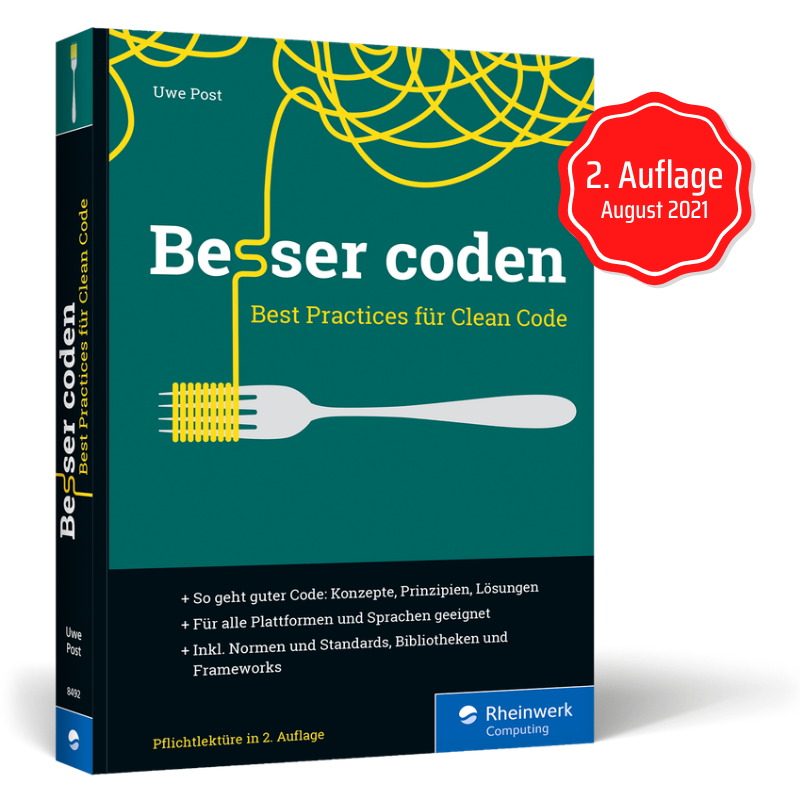
Besser coden (2. Auflg.)
Best Practices für Clean Code, der beste Weg zu gutem Code. In aktualisierter und erweiterter 2. Auflage August 2021. Guter Code ist essenziell für gute Software. Die Hürden bei der Programmierung sind aber oft vielfältig: Code glänzt mit schlechter Testbarkeit oder die Wartung lässt das Budget komplett aus dem Rahmen laufen. Punkten Sie mit besserem Code: performant, verständlich, wartbar. Uwe Post hat bereits einige Bugs in seinem Trophäenschrank. Mit einer ordentlichen Prise Humor und viel Projekterfahrung zeigt er, worauf es bei erfolgreichen Software-Projekten wirklich ankommt. In seinem Buch bietet er zeitlose Best Practices und aktuelle Tipps aus seinem Erfahrungsschatz. Seine Insider-Tipps und Anekdoten aus der Softwareentwicklung helfen Ihnen, stetig an der Qualität Ihres Codes zu arbeiten. Sie werden sehen: Clean Code geht jeden an, der besser programmieren möchte, ob in Java, C++ oder Python.Aus dem Inhalt:EntwurfsmusterReibungsloses TeamworkAktuelle Sicherheitsprobleme und was Sie damit zu tun habenTest Driven DevelopmentLegacy-Code und RefactoringQuizfragenDer Umgang mit den lieben KollegenDeadlocksContinuous IntegrationAutor: Uwe Post, Jahrgang 1968, ist Chefentwickler einer Firma, die Apps herstellt, hält Schulungen und berät Entwicklungsteams. Er schreibt neben IT-Büchern auch Science Fiction – davon sogar deutlich mehr. Sein Roman »Walpar Tonnraffir und der Zeigefinger Gottes«, gewann den Kurd-Laßwitz-Preis und den Deutschen Science-Fiction-Preis. Post lebt mit Frau und Tochter am südlichen Rand des Ruhrgebiets. Unter www.besser-coden.de geht er nicht nur auf Quellcode-Höllen ein, die er selbst er- und überlebt hat, sondern auch auf aktuelle Sicherheitsthemen und wie sie mit der Codequalität zusammenhängen. InhaltsverzeichnisLeseprobe (PDF-Link)
Continuous Integration mit Jenkins
Moderne Softwareentwicklung braucht mehr als nur guten Code und starken Kaffee. Ohne passende Deployment-Strategien und eine saubere Release-Verwaltung laufen selbst kleine Projekte schnell aus dem Ruder und werden unbeherrschbar. Dieses Praxisbuch gibt Ihnen einen Überblick über eine zeitgemäße CI-Pipeline aus Git, Jenkins und Nexus. So erfahren Sie, was für erfolgreiche Software-Projekte essenziell ist: gutes Source Control Management, flächendeckende Softwaretests mit einer sinnvollen Qualitätskontrolle und ein sauber organisiertes Deployment. Marco Schulz gibt Ihnen seine Erfahrung aus zahlreichen internationalen IT-Projekten weiter und hält eine Menge Tipps und Überlegungen zu gutem Software Engineering für Sie parat. Aus dem InhaltThe Big Picture: DevOps und die SoftwareentwicklungSoftware testen: Test Driven Development, Unit- und IntegrationstestsAgiles Release Management: Sprints vs ReleaseDeployment-StrategienSource Control ManagementJenkins einrichten und betreibenBuild ManagementBuild Jobs schreiben und optimierenJenkins Pipelines mit Blue OceanQualitätskontrolle mit SonarQubeRepository Management mit NexusAutor:Autor: Marco Schulz studierte an der HS Merseburg Informatik und twittert regelmäßig als @ElmarDott über technische Themen. Seine Schwerpunkte sind Build- und Konfigurationsmanagement, Software-Architekturen und Release Management. Seit über fünfzehn Jahren realisiert er anspruchsvolle Entwicklungsprojekten für namhafte Unternehmen aus aller Welt und arbeitet als unabhängiger Consultant/Trainer. Sein Wissen teilt er mit anderen Technikbegeisterten auf Konferenzen, wenn er nicht gerade wieder einmal an einem neuen Fachbeitrag schreibt.
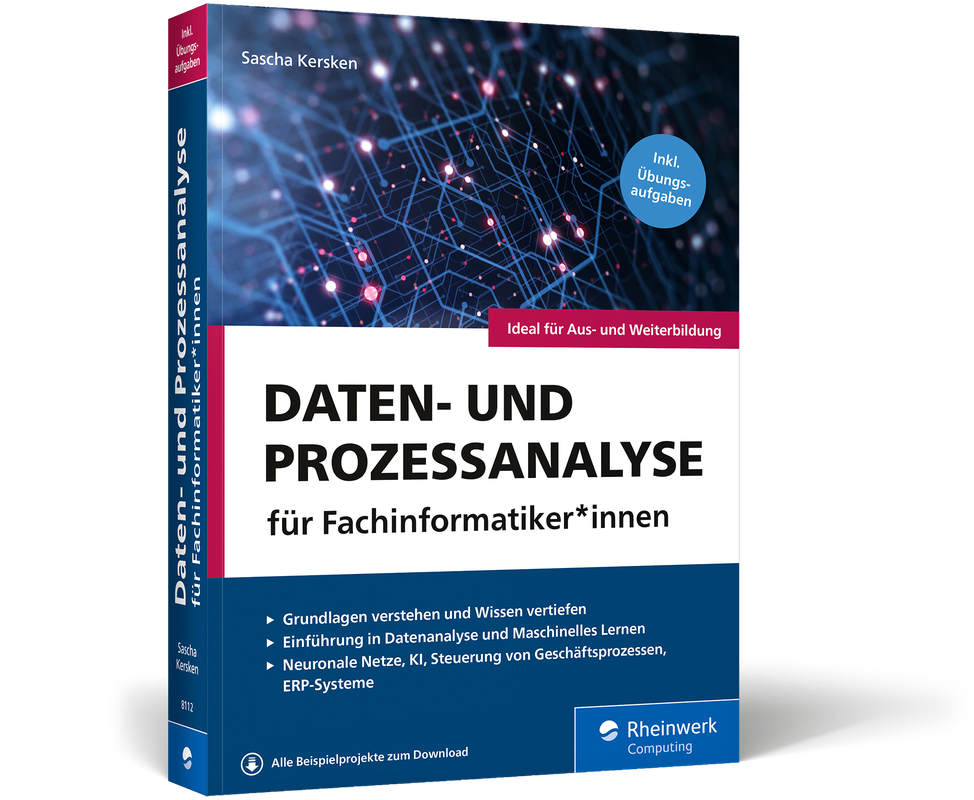
Daten- und Prozessanalyse für Fachinformatiker*innen
Ideal für Aus- und Weiterbildung Big Data, Machine Learning und künstliche Intelligenz sind aktuell wohl die am schnellsten wachsenden Teilgebiete der Informatik. Nicht umsonst wurde daher 2020 der neue Fachinformatik-Ausbildungsgang Daten- und Prozessanalyse eingeführt. Worauf es dabei ankommt, zeigt dieses neue Lehr- und Praxisbuch. Auszubildende dieser Fachrichtung finden hier alle nötigen mathematischen Grundlagen, eine Einführung in die Python-Programmierung, Algorithmen und insbesondere Machine-Learning-Verfahren sowie in die Geschäftsprozessanalyse. Für alle Themen kommen praxiserprobte Sprachen, Tools und Bibliotheken zum Einsatz. Inkl. zahlreicher Übungsaufgaben. Arbeitsoberfläche, Navigation und ObjekteModelling und SculptingShading, Texturing und MappingLichtquellen, Kameras und TrackingAnimationen mit Keyframes, Pfaden und DrivernPartikelsysteme, Haare und KollisionenRauch, Feuer und FlüssigkeitenDie neuen Geometry Nodes2D-Animationen mit Grease PencilRendering mit Eevee und CyclesCompositing, Schnitt und TonImport und ExportAutor: Sascha Kersken arbeitet seit vielen Jahren als Softwareentwickler sowie als Trainer für EDV-Schulungen in den Themengebieten Netzwerke und Internet, interaktive Medien und Programmierung. Er hat zahlreiche Fachbücher und Artikel zu verschiedenen IT-Themen geschrieben.Leseprobe (PDF-Link)

Introductory Guideline for Using Twilio Programmable Messaging and Programmable Voice Services
Twilio.com is an American cloud communications platform. Twilio allows software developers to programmatically make and receive phone calls, send and receive text messages, and perform other communication functions using its web service APIs.Twilio uses Amazon Web Services to host telephony infrastructure and provide connectivity between HTTP and the public switched telephone network (PSTN) through its APIsTwilio has very complicated system to understand and use. Its services mainly provided for qualified software developers. But in this report, I will provide introductory guideline for using the Twilio Programmable Messages and Programmable Voices services for simple use without the need to have deep knowledge in Programming. The report consists from the following sections:1.Opening a Twilio Account and get a Twilio Trial Number2.Upgrading the Twilio account 3.Twilio guideline for sending and receiving SMS 4.TwiML for Programmable SMS 5.TwiML for Programmable Voice 6.Basic steps to build Programmable Voice7.Using TwiML Bins functions8.Xampp and Ngrok web server setup for Twilio development 9.Sending messages from the dashboard of the Twilio account 10.Auto Dialer for Twilio Platform11.Summary of testing Programmable Voice using different options12.Summary of testing Programmable Messaging through different options13.Creating free website to save the files on it14.Making voice call using Twilio in browserI am Dr. Hidaia Mahmoud Mohamed Alassouli. I completed my PhD degree in Electrical Engineering from Czech Technical University by February 2003, and my M. Sc. degree in Electrical Engineering from Bahrain University by June 1995. I completed also one study year of most important courses in telecommunication and computer engineering courses in Islamic university in Gaza. So, I covered most important subjects in Electrical Engineering, Computer Engineering and Telecommunications Engineering during my study. My nationality is Palestinian from gaza strip.I obtained a lot of certified courses in MCSE, SPSS, Cisco (CCNA), A+, Linux.I worked as Electrical, Telecommunicating and Computer Engineer in a lot of institutions. I worked also as a computer networking administrator. I had considerable undergraduate teaching experience in several types of courses in many universities. I handled teaching the most important subjects in Electrical and Telecommunication and Computer Engineering. I could publish a lot of papers a top-tier journals and conference proceedings, besides I published a lot of books in Publishing and Distribution houses.I wrote a lot of important Arabic articles on online news websites. I also have my own magazine website that I publish on it all my articles: http:// www.anticorruption.000space.comMy personal website: www.hidaia-alassouli.000space.comEmail: hidaia_alassouli@hotmail.com

Datenvisualisierung mit Excel
Zu jeder Datenanalyse gehört eine klare Visualisierung. Werden Datensätze als Grafiken und Diagramme dargestellt, erleichtert dies das Verständnis von Zusammenhängen und Auffälligkeiten. Excel bietet vielfältige Möglichkeiten, um auch komplexere Daten zu visualisieren. Jedoch ist die richtige Umsetzung ansprechender Diagramme alles andere als einfach. Sie müssen nicht nur die Möglichkeiten der Software kennen. Vielmehr gilt es auch die richtige Darstellungsform für den jeweiligen Zweck zu identifizieren. Welche Daten einer umfangreichen Tabelle sind relevant, wie müssen sie strukturiert und aufbereitet werden, welche Diagrammform ist für diesen Fall besonders geeignet? Dirk Siegmann zeigt in seinem Praxisbuch, wie Sie mit Excel Daten visuell richtig und sicher aufbereiten. Sie erhalten aufeinander aufbauende und verständliche Erklärungen anhand vieler Beispiele. So lernen Sie, wie Sie Daten aus den unterschiedlichen Bereichen anschaulich nur mit den Bordmitteln von Excel visualisieren können. Die Beispiele erlauben Ihnen eine leichte Überführung des Gezeigten auf Ihre eigenen Anwendungszwecke. Der Autor gibt Ihnen hilfreiche Tipps, die Ihnen bei der erfolgreichen Arbeit mit Excel direkt helfen. Aus dem Inhalt: Informationen mit Excel anschaulich machenÜbersicht über die Diagramme von ExcelDaten richtig verarbeitenTabellenstrukturen, Datenreihe, Zahlenformate, ListenEin erstes Diagramm erstellenStandard-Diagramme: Säulen, Balken, Kreise und mehrVarianten und Kombinationen von DiagrammenBedingte FormatierungenErweiterte Diagramm-TypenDie Könisgklasse: individuelle Diagramme mit Excel erstellenDiagramme und VBA 1. Einführung ... 17 1.1 ... Datenvisualisierung -- Informationen anschaulich machen ... 17 1.2 ... Beispieldaten und Aufbau dieses Buches -- der rote Faden ... 19 1.3 ... Diagrammtypen -- eine Übersicht der Excel-Diagramme ... 20 1.4 ... Möglichkeiten und Grenzen von Excel ... 38 2. Daten -- Basis für Diagramme ... 41 2.1 ... Excel-Tabellenblätter -- Daten manuell erfassen ... 41 2.2 ... Textdateien -- Inhalte von CSV- und TXT-Dateien einfügen ... 48 2.3 ... Externe Quellen -- Abfrage von Daten ... 55 2.4 ... Verbund von Daten -- Bereiche als Tabelle formatieren ... 62 2.5 ... Zahlenformate -- Ansichten von Daten anpassen ... 67 2.6 ... Daten berechnen und aggregieren -- Einsatz von Formeln ... 72 3. Das erste Diagramm ... 83 3.1 ... Erstellung eines Diagramms -- verschiedene Wege zum Ziel ... 83 3.2 ... Hinzufügen und Entfernen von Elementen eines Diagramms ... 90 3.3 ... Die Elemente im Einzelnen ... 92 3.4 ... Gestaltung und Formatierung -- das Erscheinungsbild individuell anpassen ... 104 3.5 ... Achsen eines Diagramms -- ein Rahmen für die Visualisierung ... 128 3.6 ... Datenbasis modifizieren -- Erweitern, Reduzieren und Verändern der Diagrammdaten ... 145 4. Standarddiagramme ... 151 4.1 ... Säulen -- Vergleich von Werten zwischen Rubriken ... 151 4.2 ... Balken -- Rangfolgen darstellen ... 155 4.3 ... Linien -- Entwicklung und Trends über Zeiträume visualisieren ... 159 4.4 ... Kreise -- Werte als Proportion anzeigen ... 165 4.5 ... Netze -- Werte relativ zu einem Mittelpunkt darstellen ... 167 4.6 ... Punkte (XY) -- Wertepaare als Basis für neue Darstellungsformen ... 169 4.7 ... Flächen -- Vergleich von Mengen ... 175 4.8 ... Trichter -- Darstellung von Reduktionen ... 178 4.9 ... Sparklines -- Miniaturdiagramme in Zellen ... 179 5. Varianten und Kombinationen von Diagrammen ... 185 5.1 ... Farbpaletten -- Ändern der Standardfarben ... 185 5.2 ... Änderung eines Diagramms -- Ort und Typ neu festlegen ... 190 5.3 ... Kombidiagramme -- unterschiedliche Typen in einem Diagramm kombinieren ... 194 5.4 ... Kreisdiagramm -- kleine Anteile als separaten Kreis oder Säule anzeigen ... 202 5.5 ... 3D-Formatierungen -- optische Effekt hinzufügen ... 204 5.6 ... 3D-Diagramme -- zusätzliche Informationen mit einer Tiefenachse ... 213 5.7 ... Blasendiagramme -- eine dritte Information einem Punkt hinzufügen ... 219 6. Bedingte Formatierungen ... 225 6.1 ... Prinzip der bedingten Formatierung ... 225 6.2 ... Regeltypen -- alle Zellen oder nur bestimmte Zellen formatieren ... 227 6.3 ... Vorgefertigte Regeln für alle Zellen -- Balken, Farben und Symbole ... 231 6.4 ... Vorgefertigte Regeln für bestimmte Zellen -- Wertevergleich ... 235 6.5 ... Neue Regeln erstellen -- individuelle Anpassungen der Vergleichs- und Schwellenwerte und der Formate ... 240 6.6 ... Regeln verwalten -- bedingte Formate auffinden und Gültigkeitsbereiche modifizieren ... 253 6.7 ... Formeln in Regeln -- eigene Berechnungen für logische Vergleiche nutzen ... 258 7. Spezielle Diagramme ... 265 7.1 ... Wasserfalldiagramme -- positive und negative Veränderungen als Säulen darstellen ... 265 7.2 ... Statistische Diagramme ... 268 7.3 ... Hierarchische Diagramme ... 279 7.4 ... Kursdiagramme -- charakteristische Werte eines Finanzprodukts an der Börse ... 286 7.5 ... Flächenkartogramme -- geografische Daten visualisieren ... 290 7.6 ... 3D-Karten ... 294 8. Pivot-Tabellen und -Diagramme ... 303 8.1 ... Daten für Pivot-Analysen ... 303 8.2 ... Erstellen einer Pivot-Tabelle -- Daten aggregieren ... 306 8.3 ... Pivot-Diagramm -- Visualisierung einer Pivot-Tabelle ... 316 8.4 ... Datenanalyse ... 323 9. Individuelle Diagramme ... 337 9.1 ... Veränderungsdiagramme -- prozentuale Änderung zweier Werte visualisieren ... 337 9.2 ... Punktposition -- Prozentwert auf einer Linie positionieren ... 341 9.3 ... Statusanzeige -- einen Wert auf einer Grün-Gelb-Rot-Skala anzeigen ... 344 9.4 ... Tachometer -- Wertungen mittels Ring- und Punktdiagramm darstellen ... 347 9.5 ... Gestapelte Kästchen -- Säulen in kleine Einheiten aufteilen ... 351 9.6 ... Flächenvergleich -- Relation zweier Werte als Quadratflächen anzeigen ... 356 9.7 ... Muster hervorheben -- unterschiedliche Punktgrößen in einem Raster ... 359 9.8 ... Stufendiagramm -- Veränderungen als senkrechte Sprünge einer Linie aufzeigen ... 364 9.9 ... Strichliste -- Werte als Blöcke aus fünf Strichen anzeigen ... 366 9.10 ... Pegelanzeige -- Werte in Form einer fünfteiligen Säule darstellen ... 370 9.11 ... Stabdiagramm -- sehr schmale Säulen in einem Diagramm ... 374 9.12 ... Abweichungen zweier Linien -- farbliche Unterscheidung mit Fehlerindikatoren ... 376 9.13 ... Gantt-Diagramm -- zeitliche Verläufe von Aktivitäten darstellen ... 379 9.14 ... Grafische Elemente in Diagrammen -- Bilder in Säulen ... 386 9.15 ... Diagrammvorlagen -- eigene Formatierungen mehrfach nutzen ... 388 Danksagung ... 391 Index ... 393

Besser coden
Guter Code ist essenziell für gute Software. Und die Schwierigkeiten sind vielfältig: Code glänzt mit schlechter Testbarkeit oder die Wartung lässt das Budget komplett aus dem Rahmen laufen. Uwe Post packt die Praxisprobleme mit zeitlosen Best Practices und aktuellen Tipps aus seinem Erfahrungsschatz an. Punkten Sie mit besserem Code: performant, verständlich, wartbar. Uwe Post hat bereits einige Bugs in seinem Trophäenschrank. Mit einer ordentlichen Prise Humor und viel Projekterfahrung zeigt er, worauf es bei erfolgreichen Software-Projekten wirklich ankommt. Seine Insider-Tipps und Anekdoten aus der Softwareentwicklung helfen Ihnen, stetig an der Qualität Ihres Codes zu arbeiten. Sie werden sehen: Clean Code geht jeden an, der besser programmieren möchte, ob in Java, C++ oder Python. Aus dem Inhalt: GrundregelnCode ReviewTest Driven DesignContinuous IntegrationReibungsloses TeamworkAutomatisierte Build- und VersionskontrollsystemeEntwurfsmusterAutomatisierte UI-TestsDependency InjectionISO 25010Build ToolsUmgang mit Legacy Code 1. Verhindern Sie den Weltuntergang! ... 13 1.1 ... Vorwort ... 13 1.2 ... Schöne neue Welt ... 14 1.3 ... Was läuft falsch? ... 16 1.4 ... Weltuntergang verhindern - aber wie? ... 17 2. Konventionen ... 21 2.1 ... Vereinbarungen im Team ... 21 2.2 ... Wenn die Variable »a« sagt (und sonst nichts) ... 26 2.3 ... Code-Fokus ... 34 2.4 ... Checkliste ... 36 3. Willkommen im Team! ... 39 3.1 ... Check this out: Subversion ... 40 3.2 ... Teamwork integriert: Git ... 51 3.3 ... »Guckstu!« ... 58 3.4 ... Doppelt hält besser: Pair Programming ... 63 3.5 ... Wer macht wann was? ... 66 4. Gut, besser, 91,2 %: Software-Qualität messen ... 75 4.1 ... Muss funktionieren! ... 76 4.2 ... Muss schön sein! ... 81 4.3 ... ISO 25010 und andere Buzzword-Sammlungen ... 101 5. Jeder ist Architekt ... 107 5.1 ... Normalisierte Daten ... 107 5.2 ... Alles ist ein Objekt, aber welches? ... 117 5.3 ... Entwurfsmuster ... 120 5.4 ... Was ist eigentlich ein »Item«? ... 141 5.5 ... Effiziente Software ... 151 5.6 ... Do- und Don't-Merksatz-Akronyme ... 158 5.7 ... Neue Räder extra teuer! ... 163 5.8 ... Meins! (Wirklich?) ... 168 6. Erst mal testen ... 173 6.1 ... Gute und schlechte Unit-Tests ... 174 6.2 ... Testbar und nicht so gut testbar ... 187 6.3 ... Umgekehrt wird ein Schuh draus ... 194 6.4 ... Alles einzeln testen ... 199 6.5 ... Millionen Mausklicks ... 204 7. Continuous Integration ... 211 7.1 ... Digitaler Bauunternehmer ... 211 7.2 ... Java-Builds mit Maven ... 213 7.3 ... Gradle en vogue ... 227 7.4 ... Jenkins, stets zu Ihren Diensten! ... 234 7.5 ... Continuous Integration in der Cloud ... 239 7.6 ... Nicht nur eine Frage des Stils ... 244 7.7 ... NuGet für .NET und MS Azure ... 248 8. Dokumentation, Kommentare & Tools ... 257 8.1 ... Kommentare sind wie Tooltipps ... 257 8.2 ... Dokumentiert sich von allein ... 262 8.3 ... Teamwork online ... 269 9. Betriebssicherheit ... 283 9.1 ... »Es ist ein Fehler aufgetreten. Versuchen Sie es noch einmal.« ... 284 9.2 ... Festplattenweise Protokolle ... 296 9.3 ... Ungebetene Besucher ... 306 10. Schrottcode pimpen ... 323 10.1 ... Was macht der da? ... 323 10.2 ... Refactoring mit Tools ... 328 10.3 ... Who sprech Svenska? ... 340 10.4 ... Endlich: Tests ... 343 11. Trollfütterung ... 349 11.1 ... Umsteiger und Ahnungslose im kalten Wasser ... 349 11.2 ... Früher war alles besser, auch die Betonköpfe ... 352 11.3 ... Das Patchwork-Team ... 354 11.4 ... Billig im Osten ... 357 11.5 ... Der Hase der Produktmanagerin ... 361 11.6 ... Arbeiten wie die Profis ... 364 11.7 ... Leuchtendes Beispiel ... 366 12. Parallelwelten ... 369 12.1 ... Parallel arbeiten ... 369 12.2 ... Losgelöst ... 381 12.3 ... .NET async ... 385 Anhang ... 389 A ... Quizfragen ... 389 B ... Lösungen der Quizfragen ... 395 Index ... 399