

Computer und IT

Learn to Program with Kotlin
Teach yourself programming starting with the basics and progressing to a series of exciting projects using Kotlin, one of today's hottest programming languages. This book starts with the absolute basics and then introduces just enough syntax to get into some fascinating projects. These include text processing: a statistical analysis of Jane Austen's novels, solving anagrams, and working with palindromes; image processing: cropping and resizing images, and pixel transformation; and computer vision: finding digits, parsing images, and reading speed signs.The projects are developed in tiny steps and complete solutions are provided. Some of these projects include core data science concepts, giving you skills in one of the most important areas of modern programming. Along the way you’ll cover functional programming, object-oriented programming (OOP), refactoring, and writing unit tests.After reading Learn to Program with Kotlin, you'll come away with practical insights and code to get you started right away with programming using Kotlin for your own projects.WHAT YOU WILL LEARN* Gain the basics of Kotlin using the IntelliJ Java IDE* Implement OOP with Kotlin along with unit testing and code refactoring using a series of text-related projects* Harness functional programming with Kotlin by building an image-processing library* Write software to locate and read speed signs in photosWHO IS THIS BOOK FORAnyone who wants to learn how to program or code from scratch. Also great for experienced programmers who want to know more about Kotlin. Tim Lavers is a senior software engineer at KPMG with expertise in Java, Kotlin, and other programming languages employed for data engineering and enterprise software projects. He is also a mathematical hobbyist in his spare time.PART 1 - BASICSThe very basics of programming in Kotlin using the IntelliJ code editor.Chapter 1: Getting StartedChapter 2: Simple patternsChapter 3: Arrays and loopsChapter 4: Binary choicesChapter 5: IntegersChapter 6: Values and variablesChapter 7: StringsChapter 8: Data structuresChapter 9: The file systemPART II - TEXTObject-Oriented Programming, Unit Testing and code refactoring through a series of fascinating text-related projects.Chapter 10: Project AustenChapter 11: AnagramsChapter 12: PalindromesChapter 13: Word switchPART III - IMAGESThis part of the book introduces Functional Programming by building a basic image processing library.The culmination of this is a CGI (Computer Generated Imagery) project.Chapter 14: Colour picturesChapter 15: Pixel transformationsChapter 16: Cropping and resizing imagesChapter 17: Project DinoPART IV - VISIONWe cap it all of with a project in which we write software to locate and read speed signs in photos.Chapter 18: OverviewChapter 19: Finding digitsChapter 20: Parsing the imagesChapter 21: Reading speed signs

The Fast-Track Guide to VXLAN BGP EVPN Fabrics
Master the day-to-day administration and maintenance procedures for existing VXLAN fabrics. In this book you’ll discuss common issues and troubleshooting steps to help you keep your environment in stable operation. The Fast-Track Guide to VXLAN BGP EVPN Fabrics is a guide for network engineers and architects who can’t spend too much time learning everything about VXLAN. It has been created with the end goal of providing you with a straightforward approach to understand, implement, administer, and maintain VXLAN BGP EVPN-based data center networks.Using this book, you will understand Virtual Extensible LAN (VXLAN) as a technology that combines network virtualization and service provider class network attributes to solve the performance and scalability limitations in a three-tier design. You will learn to combine multiple links and provide equal-cost multipathing to effortlessly scale speed requirements without being worried about potential loops.You will learn VXLAN BGP EVPN configuration procedures with graphical step-by-step examples. You will be introduced to foundational concepts in VXLAN without the need to go over hundreds of documentation pages. This book is a clear and precise guide to implementing a spine and leaf architecture running with VXLAN. It explains how to perform day-to-day maintenance and administration tasks after implementing your first VXLAN fabric. It also explains how to integrate external devices such as firewalls, routers, and load balancers to VXLAN; how to leverage your VXLAN fabric; and how to create multiple tenant networks to secure your critical infrastructure.WHAT YOU WILL LEARN* Discover the advantages of a VXLAN spine and leaf fabric over a traditional three-tier network design* Work with the BGP L2VPN EVPN control plane VXLAN* Examine the purpose of underlay and overlay in VXLAN* Use multitenancy and tenant anycast gateways* Connect your VXLAN fabric to external networksWHO THIS BOOK IS FORSenior network engineers, solutions architects, and data center engineers.Rene Cardona, CCIEx2 - PCNSE is a truly passionate and dedicated IT professional with a major focus in the network security and datacenter realm. His experience is vastly diverse, from working with SMBs to performing large-scale datacenter infrastructure architecture designs for major corporations in the public and private sector. He has a pronounced emphasis on detail. You will not see him spending time with people that don’t truly appreciate and have a passion for technology and are not willing to spend nights and weekends devoted to learning and working with it.Chapter 1: Introduction to Spine and Leaf TopologiesCHAPTER GOAL: Get the audience familiarized with the concepts and introduce them to the foundational aspects of software defined networking and BGP EVPN for the Data Center which drives today's major cloud computing environments.No of pages: 30- 40 PagesSUB -TOPICS1. Spine and Leaf Topology Advantages.2. Underlay Networking3. Overlay Networking4. Spine and Leaf Fabric Traffic flowChapter 2: Logical Components of Spine and Leaf ArchitectureChapter Goal: Review one by one each logical component and its role in the VXLAN BGP EVPN fabricNO OF PAGES: 50 pagesSUB - TOPICS1. Broadcast, Unknow Unicast and Multicast (BUM)2. OSPF Point-to-Point for underlay - Option 13. IS-IS Point-to-Point for underlay - Option 24. Multicast (PIM Sparse) and Rendezvous Points (RPs)5. BGP L2VPN EVPN Address FamilyChapter 3: Encapsulating Layer2 over Layer3 with VXLANChapter Goal: Discuss the main aspect of VXLAN and how it solves the performance and scalability issues of STPNo of pages: 20 pagesSUB - TOPICS:1. VTEP and VTEP (NVE) Interface2. EVPN Route-Target3. L2VNI and L3VNIs4. VXLAN packet flowChapter 4: VXLAN Fabric Features Chapter Goal: Review the available fabric features in VXLAN BGP EVPN which provides data center class virtualized switching and routing capabilities. No of pages: 20SUB - TOPICS:1. Fabric Anycast Gateways2. Multi-tenancy with VRF's.3. BGP IPv4 Unicast Address Family4. Route Leaking between VRF's.Chapter 5: VXLAN Fabric to External Networks Chapter Goal: Discuss how we can integrate a VXLAN Spine and Leaf Fabric to an external network by designating border leaf’s. No of pages: 20 pagesSUB - TOPICS:1. Route Redistribution from OSPF to BGP IPv42. Route Redistribution from BGP IPv4 to OSPF3. Dynamic Routing protocols under VRFs (or VRF Lite).4. Default Route Advertisement.CHAPTER 6: VXLAN FABRIC TOPOLOGY DESIGNSCHAPTER GOAL: Discuss the VXLAN Architecture design types available for each required case.No of pages: 15 pagesSUB - TOPICS:1. VXLAN MultiPod2. VXLAN MultiSite and Border Gateway Leafs (BGW)3. VXLAN Ingress Replication (Head-End)CHAPTER 7: VXLAN FABRIC CONFIGURATION TEMPLATES.CHAPTER GOAL: Sample configuration templates to deploy different VXLAN architectures.No of pages: 10 pagesSUB - TOPICS:1. VXLAN Spine and Leaf Fabric (Standalone)2. VXLAN MultiPod Spine and Leaf (Dual topology)3. VXLAN MultiSite Spine and Leaf Fabric.4. VXLAN Ingress Replication - No Spines
From Traditional Fault Tolerance to Blockchain
This book covers the most essential techniques for designing and building dependable distributed systems, from traditional fault tolerance to the blockchain technology. Topics include checkpointing and logging, recovery-orientated computing, replication, distributed consensus, Byzantine fault tolerance, as well as blockchain.This book intentionally includes traditional fault tolerance techniques so that readers can appreciate better the huge benefits brought by the blockchain technology and why it has been touted as a disruptive technology, some even regard it at the same level of the Internet. This book also expresses a grave concern on using traditional consensus algorithms in blockchain because with the limited scalability of such algorithms, the primary benefits of using blockchain in the first place, such as decentralization and immutability, could be easily lost under cyberattacks.DR. ZHAO received the PhD degree in Electrical and Computer Engineering from the University of California, Santa Barbara, in 2002. He is now a Full Professor in the Department of Electrical Engineering and Computer Science at Cleveland State University. He has more than 200 academic publications and three of his recent research papers in the dependable distributed computing area have won the best paper awards. Dr. Zhao also has two US utility patents and a patent application on blockchain under review.List of Figures xiiiList of Tables xixAcknowledgments xxiPreface xxiiiReferences xxix1 INTRODUCTION 11.1 Basic Concepts and Terminologies for Dependable Computing 21.1.1 System Models 21.1.2 Threat Models 31.1.3 Dependability Attributes and Evaluation Metrics 61.2 Means to Achieve Dependability 91.2.1 Fault Avoidance 91.2.2 Fault Detection and Diagnosis 91.2.3 Fault Removal 101.2.4 Fault Tolerance 111.3 System Security 13References 182 LOGGING AND CHECKPOINTING 212.1 System Model 222.1.1 Fault Model 232.1.2 Process State and Global State 232.1.3 Piecewise Deterministic Assumption 262.1.4 Output Commit 262.1.5 Stable Storage 272.2 Checkpoint-Based Protocols 272.2.1 Uncoordinated Checkpointing 272.2.2 Tamir and Sequin Global Checkpointing Protocol 292.2.3 Chandy and Lamport Distributed Snapshot Protocol 352.2.4 Discussion 382.3 Log Based Protocols 402.3.1 Pessimistic Logging 422.3.2 Sender-Based Message Logging 51References 603 RECOVERY-ORIENTED COMPUTING 633.1 System Model 653.2 Fault Detection and Localization 683.2.1 Component Interactions Modeling and Anomaly Detection 723.2.2 Path Shapes Modeling and Root Cause Analysis 763.2.3 Inference-Based Fault Diagnosis 803.3 Microreboot 893.3.1 Microrebootable System Design Guideline 903.3.2 Automatic Recovery with Microreboot 913.3.3 Implications of the Microrebooting Technique 923.4 Overcoming Operator Errors 933.4.1 The Operator Undo Model 943.4.2 The Operator Undo Framework 95References 994 DATA AND SERVICE REPLICATION 1034.1 Service Replication 1054.1.1 Replication Styles 1074.1.2 Implementation of Service Replication 1094.2 Data Replication 1114.3 Optimistic Replication 1164.3.1 System Models 1174.3.2 Establish Ordering among Operations 1194.3.3 State Transfer Systems 1224.3.4 Operation Transfer System 1264.3.5 Update Commitment 1314.4 CAP Theorem 1364.4.1 2 out 3 1394.4.2 Implications of Enabling Partition Tolerance 140References 1435 GROUP COMMUNICATION SYSTEMS 1475.1 System Model 1495.2 Sequencer Based Group Communication System 1525.2.1 Normal Operation 1535.2.2 Membership Change 1575.2.3 Proof of Correctness 1655.3 Sender Based Group Communication System 1665.3.1 Total Ordering Protocol 1675.3.2 Membership Change Protocol 1745.3.3 Recovery Protocol 1835.3.4 The Flow Control Mechanism 1905.4 Vector Clock Based Group Communication System 192References 1976 CONSENSUS AND THE PAXOS ALGORITHMS 1996.1 The Consensus Problem 2006.2 The Paxos Algorithm 2026.2.1 Algorithm for Choosing a Value 2026.2.2 Algorithm for Learning a Value 2046.2.3 Proof of Correctness 2046.2.4 Reasoning of the Paxos Algorithm 2066.3 Multi-Paxos 2126.3.1 Checkpointing and Garbage Collection 2136.3.2 Leader Election and View Change 2146.4 Dynamic Paxos 2166.4.1 Dynamic Paxos 2176.4.2 Cheap Paxos 2206.5 Fast Paxos 2276.5.1 The Basic Steps 2286.5.2 Collision Recovery, Quorum Requirement, and Value Selection Rule 2296.6 Implementations of the Paxos Family Algorithms 2356.6.1 Hard Drive Failures 2366.6.2 Multiple Coordinators 2366.6.3 Membership Changes 2376.6.4 Limited Disk Space for Logging 241References 2427 BYZANTINE FAULT TOLERANCE 2457.1 The Byzantine Generals Problem 2467.1.1 System Model 2477.1.2 The Oral Message Algorithms 2507.1.3 Proof of Correctness for the Oral Message Algorithms 2607.2 Practical Byzantine Fault Tolerance 2617.2.1 System Model 2627.2.2 Overview of the PBFT Algorithm 2637.2.3 Normal Operation of PBFT 2657.2.4 Garbage Collection 2677.2.5 View Change 2687.2.6 Proof of Correctness 2717.2.7 Optimizations 2737.3 Fast Byzantine Agreement 2777.4 Speculative Byzantine Fault Tolerance 2787.4.1 The Agreement Protocol 2797.4.2 The View Change Protocol 2837.4.3 The Checkpointing Protocol 2887.4.4 Proof of Correctness 288References 2908 CRYPTOCURRENCY AND BLOCKCHAIN 2958.1 History of Cryptocurrency 2958.2 Bitcoin 2988.2.1 Decentralized Network and Architecture 3018.2.2 Self-Contained Cryptography 3028.2.3 Decentralized Data Structure 3048.2.4 Decentralized Algorithms 3138.3 Ethereum 3178.3.1 Ethereum Computing Model 3188.3.2 Block and Consensus 3268.3.3 Tokenization 3408.4 Attacks on Blockchain 342References 3479 CONSENSUS ALGORITHMS FOR BLOCKCHAIN 3499.1 Model on Blockchain Consensus 3539.1.1 Requirements on Puzzle Design 3549.1.2 Zero-Knowledge Proof 3559.2 Proof of Work 3569.3 Proof of Resources 3579.3.1 Using Storage as Resource 3579.3.2 Using Computing as Resource 3599.4 Virtual Mining 3609.4.1 PeerCoin PoS 3609.4.2 Fixed-Epoch Time Based PoS Schemes 3689.4.3 Proof of Elapsed Time 371References 37510 BLOCKCHAIN APPLICATIONS 37710.1 The Value of Blockchain 37810.1.1 Non-Functional Benefits 37910.1.2 Functional Benefits 38210.2 Blockchain-Enabled Cyber-Physical Systems 38310.2.1 Cyber-Physical Systems 38310.2.2 Application Categories 38510.2.3 Blockchain-Enabled Operations in CPS 39010.3 On Blockchain Throughput 39810.3.1 On-Chain Approach 39910.3.2 Off-Chain Approach 40210.4 A Critical Look on Blockchain from Economy Perspective 40810.4.1 Blockchain Technology from the Economic View 40910.4.2 Economic Functions of Blockchain 41210.4.3 Blockchain as a Financial Infrastructure 416References 419Index 427
Roboter in der Bildung
Wie Robotik das Lernen im digitalen Zeitalter bereichern kann.Der Bildungsbereich verändert sich durch die Einführung digitaler Technologien. Roboter sind die Brücke zwischen der digitalen und der physischen Welt und daher ein wesentliches Thema in und für die Bildung. Dies hat einen direkten Einfluss darauf, wie und was wir den Lernenden beibringen.Dieses Buch bietet eine Einführung in die Verwendung und den Einsatz von Robotern in der Bildung und hilft Forschern geeignete Soft- und Hardware zu entwickeln. Lehrer und Trainer erfahren, wie sie Roboter in ihrer Arbeit mit Schülern und Studenten einsetzen können. Es bietet eine Einführung in die einschlägigen Lehr- und Lerntheorien im Zusammenhang mit dem veränderten Lernen sowie praktische Ratschläge zum Einsatz von Robotern als Teil eines Lehrplans.Leseprobe (PDF-Link)

JavaServer Faces und Jakarta Server Faces 2.3 (3.Auflg.)
Das Arbeitsbuch für Java-Webentwickler in aktualisierter 3. Auflage.JavaServerTM Faces und Jakarta Server Faces 2.3 sind ein Framework für die Entwicklung von Benutzerschnittstellen für bzw. als Teil einer Java-Web-Anwendung. Dieses Arbeitsbuch führt Sie Schritt für Schritt in die Programmierung mit JSF ein. Sie erfahren, wie Sie damit moderne Benutzerschnittstellen für die Praxis entwickeln.Und natürlich geht es auch darum, wie JSF in eine Java-Web-Anwendung zu integrieren sind. Behandelt werden auch Themen wie die Anbindung an eine Datenbank mit JPA, die Verwendung von CDI sowie Authentifizierung und Autorisierung.Verfolgen Sie Schritt für Schritt die Entwicklung einer betrieblichen Anwendung und lernen Sie so anhand realer Aufgabenstellungen alle wichtigen Aspekte von JSF 2.3 kennen. Mit Hilfe der Übungen, deren Lösungen sich von der Website zum Buch und von GitHub herunterladen lassen, können Sie das Gelernte selbst ausprobieren und umsetzen.Aus dem Inhalt:EinleitungJSF im DetailContext und Dependency InjectionWeiterführende ThemenClassic ModelsSpezialthemenVerwendete SystemeAusblick/Anhang: Die Tags der Standardbibliotheken

MCA Microsoft Office Specialist (Office 365 and Office 2019) Study Guide
MCA Microsoft Office Specialist Study Guide: PowerPoint Associate Exam MO-300is your roadmap to preparing for taking the MO-300 exam and earning the PowerPoint Associate (PowerPoint and PowerPoint 2019) certification. The following objectives are covered:* Manage presentations* Manage slides* Insert and format text, shapes, and images* Insert tables, charts, smartArt, 3D models, and media* Apply transitions and animationsMajor topics include creating, editing, and enhancing presentations and slideshows, including the ability to create and manage presentations, insert and format shapes and slides, create slide content, apply transitions and animations, and manage multiple presentations. This Study Guide also covers creating professional-grade sales presentations, employee training, instructional materials, and kiosk slideshows.Readers will also have access to Sybex's superior online test bank, includng hundreds of practice questions, flashcards, and a glossary of important terms.ERIC BUTOW is the author of 39 books on technology topics and has developed and taught networking, computing, and usability courses for Ed2Go, Virtual Training Company, California State University, Sacramento, and Udemy. He has been using PowerPoint professionally since 1994. He's served as a technical writer for companies like Intel, Wells Fargo, Cisco Systems, and Hewlett-Packard. He is the founder and owner of Butow Communications Group in Jackson, California.Introduction xiAssessment Test xvCHAPTER 1 CREATING PRESENTATIONS 1Modifying Slide Masters, Handout Masters, and Note Masters 3Changing the Slide Master Theme or Background 4Modifying Slide Master Content 9Creating Slide Layouts 10Modify Slide Layouts 15Modifying the Handout Master 19Modifying the Notes Master 26Changing Presentation Options and Views 32Changing the Slide Size 32Displaying Presentations in Different Views 34Setting Basic File Properties 36Configuring Print Settings for Presentations 37Printing All or Part of a Presentation 37Printing Notes Pages 39Printing Handouts 40Printing in Color, Grayscale, or Black and White 41Configuring and Presenting Slideshows 43Creating Custom Slideshows 43Configuring Slideshow Options 48Rehearsing Slideshow Timing 49Setting Up Slideshow Recording Options 53Presenting Slideshows by Using Presenter View 56Preparing Presentations for Collaboration 62Mark Presentations as Final 63Protecting Presentations by Using Passwords 64Inspecting Presentations for Issues 65Adding and Managing Comments 67Preserving Presentation Content 72Exporting Presentations to Other Formats 73Summary 82Key Terms 83Exam Essentials 83Review Questions 85CHAPTER 2 MANAGING SLIDES 87Inserting Slides 88Importing Word Document Outlines 88Inserting Slides from Another Presentation 91Inserting Slides and Selecting Slide Layouts 93Inserting Summary Zoom Slides 95Duplicating Slides 100Modifying Slides 101Hiding and Unhiding Slides 102Modifying Individual Slide Backgrounds 103Inserting Slide Headers, Footers, and Page Numbers 106Ordering and Grouping Slides 110Creating Sections 110Modifying the Slide Order 112Renaming Sections 114Summary 115Key Terms 116Exam Essentials 116Review Questions 117CHAPTER 3 INSERTING AND FORMATTING TEXT, SHAPES, AND IMAGES 119Formatting Text 121Applying Formatting and Styles to Text 121Formatting Text in Multiple Columns 127Creating Bulleted and Numbered Lists 128Inserting Links 130Inserting Hyperlinks 130Inserting Section Zoom Links and Slide Zoom Links 131Inserting and Formatting Images 135Resizing and Cropping Images 137Applying Built-In Styles and Effects to Images 139Inserting Screenshots and Screen Clippings 141Inserting and Formatting Graphic Elements 144Inserting and Changing Shapes 144Drawing by Using Digital Ink 146Adding Text to Shapes and Text Boxes 149Resizing Shapes and Text Boxes 151Formatting Shapes and Text Boxes 153Applying Built-In Styles to Shapes and Text Boxes 155Adding Alt Text to Graphic Elements for Accessibility 158Ordering and Grouping Objects on Slides 160Ordering Shapes, Images, and Text Boxes 160Aligning Shapes, Images, and Text Boxes 161Grouping Shapes and Images 163Displaying Alignment Tools 164Summary 165Key Terms 166Exam Essentials 166Review Questions 167CHAPTER 4 INSERTING TABLES, CHARTS, SMARTART, 3D MODELS, AND MEDIA 169Inserting and Formatting Tables 170Creating and Inserting Tables 170Inserting and Deleting Table Rows and Columns 171Applying Built-In Table Styles 174Inserting and Modifying Charts 177Creating and Inserting Charts 177Modifying Charts 180Inserting and Formatting SmartArt Graphics 186Inserting SmartArt Graphics 186Converting Lists to SmartArt Graphics 186Adding and Modifying SmartArt Graphic Content 189Inserting and Modifying 3D Models 191Inserting 3D Models 191Modifying 3D Models 193Inserting and Managing Media 194Inserting Audio and Video Clips 194Creating and Inserting Screen Recordings 202Configuring Media Playback Options 207Summary 210Key Terms 211Exam Essentials 211Review Questions 213CHAPTER 5 APPLYING TRANSITIONS AND ANIMATIONS 215Applying and Configuring Slide Transitions 216Applying Basic and 3D Slide Transitions 216Configuring Transition Effects 218Animating Slide Content 222Animating Text and Graphic Elements 222Animating 3D Models 232Configuring Animation Effects 235Configuring Animation Paths 238Reordering Animations on a Slide 243Setting Timing for Transitions 245Setting Transition Effect Duration 245Configuring Transition Start and Finish Options 246Summary 248Key Terms 248Exam Essentials 249Review Questions 250APPENDIX ANSWERS TO REVIEW QUESTIONS 253Chapter 1: Creating Presentations 254Chapter 2: Managing Slides 254Chapter 3: Inserting and Formatting Text, Shapes, and Images 255Chapter 4: Inserting Tables, Charts, SmartArt, 3D Models, and Media 256Chapter 5: Applying Transitions and Animations 256Index 259

Text Processing for Students
Long and structured texts can be tricky. Not only regarding the technical content, also regarding layout and usability. Still, everything can integrate smoothly and look professional, if everything is properly prepared. Here, we are looking at all the parts required for technical and scientific texts: Styles, figures, tables of content, covers and oversized items to be printed crosswise. Additionally, ways to co-operate and meanwhile keep track of changes. Now, every author can concentrate solely on the factual content!Ina Koys is an experienced instructor for Microsoft Office. Many questions are frequently asked in trainings, but seldom covered in books. Now she answers some of them in her originally German "short & spicy" series. A little accent will add to the fun :-)
Sozioinformatik
Ein neuer Blick auf Informatik und Gesellschaft. Einführung in die Modellierung und Analyse digitaler Technikfolgen.Welche Auswirkungen könnte es haben, wenn Technik in den Körper implantiert wird und sich Menschen zunehmend zu Cyborgs entwickeln? Wie kann es passieren, dass sich mazedonische Jugendliche in den Präsidentschaftswahlkampf der USA einmischen? Wann entstehen Filterblasen?In den letzten Jahren konnten viele gewollte und ungewollte Technikfolgen der digitalen Transformation beobachtet werden. Die in diesem Buch vorgestellte Sozioinformatik befasst sich mit der Modellierung und Analyse solcher Phänomene: Sie untersucht dafür die Folgen der informatischen Gestaltung unter interdisziplinären Aspekten, insbesondere denen der Verhaltensökonomie.Zentrales Hilfsmittel der Analyse ist der Aufbau eines visuellen Wirkungsgefüges, mit dem verschiedene Dynamiken und Technikfolgen in der digitalen Transformation abgeschätzt werden können. Damit wird erklärbar, wann man eine Filterblase erwarten kann, warum manche digitale Technik unsere Aufmerksamkeit so effektiv bindet, und warum Software dazu verführen kann, Einfluss auf Wahlen in einem anderen Land zu nehmen.Das Buch eignet sich als Grundlage für »Informatik und Gesellschaft« Vorlesungen in der Informatik, genauso als Grundlage für Seminare in den Gesellschaftswissenschaften oder zur Besprechung digitaler Phänomene in der Schule. Es bietet zudem eine neue Kommunikationsmethode, die im Journalismus, der Politik oder in der Beratung eingesetzt werden kann.Leseprobe (PDF-Link)

Getting Started with WidgetKit
Develop handy, UI/UX friendly and eye-pleasing widgets using the brand new WidgetKit. Apple’s brand new widgets allow iOS users to work with their favorite apps in the home screen of their iPhone or iPad without even opening the app!Join us in this exciting journey as we explore the APIs introduced in Apple’s WidgetKit framework. You'll dive into the human interface guidelines (HIG) for creating widgets and review the recommendations Apple gives to developers for developing widgets with intuitive, easy-to-learn, and consistent user interfaces. In addition, you’ll take a look at some SwiftUI views that are useful not only in creating widgets for iOS apps, but also for creating iOS apps themselves.You’ll put everything you learn into practical application by actually writing code and creating widgets. Get a clear view of how everything works so that you’re able to incorporate widgets into your real-world projects authentically and successfully.WHAT YOU'LL LEARN* Configure widgets and make them talk to APIs using URLSession* Work with timelines and event handling in widgets* Fetch content from a remote server and display the data in a widget* Make content dynamic both remotely and locallyWHO THIS BOOK IS FORiOS developers working in the Apple ecosystem with a basic understanding of SwiftUI.SAGUN RAJ LAGE started his professional career in software development as a Full Stack Web Developer and later moved into developing iOS applications. He has been a part of development teams on applications used in fields such as transportation, multimedia, shopping, finance, astrology, and management. He is actively involved in organizing developer events and in contributing as a mentor and tutor in programming bootcamps. Apart from software development and programming, he enjoys reading and writing blogs, music, graphic design, and video editing.PRAKSHAPAN SHRESTHA is an entrepreneurial app developer with 6 years of iOS development experience. He devoutly follows the latest tools and technologies that make a developer's life easier and actively helps out budding developers. Aside from software development, Prakshapan enjoys hiking and heading his recent venture, Pregasathi, which provides new families in need of baby products with help. Chapter 1: Getting Familiar with WidgetKit in a FlashChapter 2: SwiftUI, Human Interface Guidelines and Widget FamilyChapter 3: Writing Your First WidgetChapter 4: Making Widgets Configurable and InteractiveChapter 5: Fetching Configuration Options for Configurable Widgets

Programming Microcontrollers with Python
For the first time microcontrollers are powerful enough to be programmed in Python. The landscape of embedded systems development is changing, microcontrollers are becoming more powerful, and the rise of the internet of things is leading more developers to get into hardware. This book provides the solid foundation to start your journey of embedded systems development and microcontroller programming with Python.You’ll quickly realize the value of using Python. The theme of the book is simplicity and the cleanness and elegance of Python makes that possible. Featuring a step-by-step approach, this single source guide balances complexity and clarity with insightful explanations that you’ll easily grasp.Python is quickly becoming the language of choice for applications such as machine learning and computer vision on embedded devices. What would previously be daunting and exceedingly difficult to do in C or C++ is now possible with Python because of its level of abstraction. Programming Microcontrollers with Python is your path to bringing your existing skills to the embedded space.WHAT YOU’LL LEARN* Review microcontroller basics and the hardware and software requirements * Understand an embedded system’s general architecture* Follow the steps needed to carry a product to market * Take a crash course in Python programming * Program a microcontroller* Interface with a microcontroller using LCD and Circuit Python* Use and control sensorsWHO THIS BOOK IS FORThose getting started with microcontrollers, those new to C, C++, and Arduino programming, web developers looking to get into IoT, or Python programmers who wish to control hardware devices.Armstrong Subero started learning electronics at the age of 8. One of the happiest memories in his childhood was when he finally figured out how to make a light bulb. It took off from there as he taught himself more advanced topics in electronics, before delving into computer architecture, and eventually discovering the joys of microcontrollers and FPGAs.He currently works for the Ministry of National Security in his country and writes software, design circuits, courses, robots as well as write books, and blogs about technology on trinirobotics.com in his free time. He is also a contributing author to Free Code Camp and has degrees in Computer Science and Liberal Arts and Sciences from Thomas Edison State University. He is the author of "Programming PIC Microcontrollers in XC8" and "Codeless Data Structures and Algorithms" both published by Apress Media LLC. Preface• Why Did I Write This Book?• Who Is This Book For?• What You Will Need For This Book?• What Will I learn in This Book?• About the Author• Errata and SuggestionsChapter 1: Getting Ready In this chapter we begin learning about microcontrollers what they are and the various languages we can use for them. Things like what software and hardware you will need to follow along with the book as well as the recommended boards to use CircuitPython is covered in this chapter.• Introduction to Microcontrollers• Microcontroller Programming Languages• Assembly Language• C• C++• BASIC• Rust• Python• Selecting a Board• Adafruit Metro M0 Express• Adafruit Feather M0 Express• Adafruit Metro M4 Express• Adafruit Grand Central M4 Express• The Arduino Zero• The STM32F746ZG Nucleo• Device Comparison• The Component List• The Mu Editor• Putty• Setting up Your Own Board• ConclusionChapter 2: Electronics Primer picks up where chapter one leaves off and we move our discussion into the realm of electronics giving an overview of passive analog electronic components such as resistors, capacitors, and inductors. Along the way we learn about breadboards before diving into semiconductor electronics and basic digital electronics.• Electrical Wires• The Breadboard• Electronic Schematics• Passive Components• Resistors• Capacitors• Polarized Capacitors• Non-Polarized Capacitors• Capacitor Schematic Symbols• Inductors• Semiconductors• Diode• Light Emitting Diode• Transistor• Metal Oxide Semiconductor Field Effect Transistors• Integrated Circuits• Digital Logic• Logic Level Conversion• Flip-Flop• Registers and Shift Register• Multiplexers and Demultiplexers• ConclusionChapter 3: Embedded Systems Overview covers the software side of things. We learn about embedded systems, its structure, hardware and software systems and the general architecture of embedded systems. Things like toolchains, testing and a heavy emphasis on software architecture is covered. For those of you reading this book to make and sell your own product, I cover the steps you need to take to carry a product to market.• An Overview of Embedded Systems• Microcontroller vs Applications Processor• Embedded Systems Structure• The Hardware System• The software System• The Toolchain• Software Testing• Embedded Software Architecture• The Driver Layer• Hardware Abstraction Layers (HAL)• Board Support Package (BSP)• Middleware• Software Framework• Code Generator• Platform• Embedded Systems Constrains• Cost• Performance• Energy budget• Embedded Systems Classification• Small Scale Systems• Medium Scale Systems• High Performance Systems• Distributed Embedded Systems• Seven Steps to Developing an Embedded Product• ConclusionChapter 4: Python Programming looks at the python programming language you get a crash course in the core features of the language that you can use to write your own programs. If is written in such a way that even if you never used python, but have some experience programming you will be able to follow along.• Writing Python Programs• Whitespace• Comments• Variables and Constants• Data Types• Operators• Lists• Tuples• If Statement• Else statement• For Loop• While Loop• Functions• Lambda Functions• Exception Handling• Object Oriented Programming• Random and Time• Python vs CircuitPython• How Does My Python Program Run?• ConclusionChapter 5: Digital Control introduces us to programming the input and output on microcontrollers. We finally start to use microcontrollers and we learn a little bit about how microcontrollers work and learn how to interface them to switches and LEDs.• Microcontroller I/O• Output and Input on Microcontroller Hardware• Going Deeper into Microcontroller I/O• Output in CircuitPython• LED Control• Output with MCU Schematic• Output Circuit Connection Tips• Output with CircuitPython Program• LED Blink with CircuitPython Program• Pull-up vs Pull-Down Resistors• Switch Debouncing• Input in CircuitPython• Input with MCU Schematic (Pullup)• Pushbutton Pullup Circuit Connection Tips• Pushbutton Pullup with CircuitPython Program• Input with MCU Schematic (Pulldown)• Pushbutton Pulldown Circuit Connection Tips• Pushbutton Pulldown with CircuitPython Program• ConclusionChapter 6: Data Conversion covers analog input on our microcontroller, and we cover how analog to digital conversion works on the microcontroller. Using this information, we learn how to read potentiometers, photoresistors and temperature sensors using our microcontroller.• Analog To Digital Conversion• ADC Hardware• Going Deeper into ADC• The Potentiometer• Analog to Digital Conversion in CircuitPython• ADC with MCU Schematic• ADC Circuit Connection Tips• CircuitPython with Potentiometer Program• Photoresistor• Photoresistor with MCU Schematic• Photoresistor Circuit Connection Tips• Photoresistor with Circuitpython Program• Temperature Sensor• Temperature Sensor with MCU Schematic• Temperature Sensor Circuit Connection Tips• Temperature Sensor with Circuitpython Program• ConclusionChapter 7: Communication Protocol discusses serial communication protocols on microcontrollers, and we use USART, SPI and I2C. We cover not only how to use these protocols, but also how they operate internally. In this chapter we will cover how to use USB-UART and also how we can read the information from a accelerometer and gyroscope.• Microcontroller Communications• USART Communications• Deeper into UART• UART in CircuitPython• USB-UART with MCU Schematic• MCU with USB-UART Circuit Connection Tips• UART with CircuitPython Program• SPI Communications• Deeper into SPI• Board with Potentiometer Circuit Connection Tips• SPI with CircuitPython Program• I2C Communications• Deeper into I2C• I2C Support in CircuitPython• The MPU6050• I2C with MCU Schematic• I2C Circuit Connection Tips• I2C with CircuitPython Program• Adding Libraries• MPU6050 with CircuitPython Program• ConclusionChapter 8: Display Interfacing teaches us the basics of display interfacing with microcontrollers. We learn about how the LCD works and learn how to use them with our CircuitPython microcontroller. We also learn about OLEDs and learn how we can drive an OLED using CircuitPython.• The Liquid Crystal Display• Using a GLCD• Monochrome GLCD Schematic• PCD8544 with CircuitPython• Troubleshooting• The Framebuffer• OLED• Using an OLED• MCU with OLED Schematic• CircuitPython with OLED Program• ConclusionChapter 9: Controlling DC Actuators is about controlling DC actuators. We will learn about things like DC motors, stepper motors and servo motors and learn how to control them with the microcontroller devices. PWM is covered in this chapter as well.• DC Motors• Driving DC Motors• Pulse Width Modulation• PWM in CircuitPython• PWM with CircuitPython Program• Controlling Motor Speed• The H-Bridge• H-Bridge with MCU Schematic• H-Bridge with CircuitPython Program• Servo Motors• Servo Motors in CircuitPython• Servo Motor with MCU Schematic• Servo Motor with CircuitPython Program• Stepper Motors• Stepper Motors in CircuitPython• Stepper Motor with MCU Schematic• Stepper Motor with CircuitPython Program• ConclusionChapter 10: Python MCU Interfacing presents specifics of using and controlling some sensors you are likely to want to use in your own projects. These include RGB LEDs, ultrasonic sensors, piezo speakers, and humidity sensors.• RGB LED• RGB LED with MCU Schematic• RGB LED Circuit Connection Tips• Libraries We’ll Need• RGB LED with Circuitpython Program• HC-SR04• HC-SR04 with MCU Schematic• HC-SR04 Circuit Connection Tips• Libraries We’ll Need• HC-SR04 with Circuitpython Program• Piezo Speaker• Piezo with MCU Schematic• Piezo Circuit Connection Tips• Libraries We’ll Need• Piezo with Circuitpython Program• DHT11• DHT11 with MCU Schematic• DHT11 Sensor Circuit Connection Tips• Libraries We’ll Need• DHT11 Sensor with CircuitPython Program• Conclusion

R für Dummies (3. Auflg.)
Wollen Sie auch die umfangreichen Möglichkeiten von R nutzen, um Ihre Daten zu analysieren, sind sich aber nicht sicher, ob Sie mit der Programmiersprache wirklich zurechtkommen? Keine Sorge - dieses Buch zeigt Ihnen, wie es geht - selbst wenn Sie keine Vorkenntnisse in der Programmierung oder Statistik haben. Andrie de Vries und Joris Meys zeigen Ihnen Schritt für Schritt und anhand zahlreicher Beispiele, was Sie alles mit R machen können und vor allem wie Sie es machen können. Von den Grundlagen und den ersten Skripten bis hin zu komplexen statistischen Analysen und der Erstellung aussagekräftiger Grafiken. Auch fortgeschrittenere Nutzer finden in diesem Buch viele Tipps und Tricks, die Ihnen die Datenauswertung erleichtern. Andrie de Vries ist Berater in einem Marktforschungsunternehmen und hat sich auf die statistische Auswertung von Umfragen spezialisiert. Joris Meys ist Statistiker und R-Programmierer an der Faculty of Bio-Engineering der University of Ghent. Er hat zahlreiche R-Packages entwickelt.Über die Autoren 7Einleitung 21TEIL I: SIND SIE BEREIT? 29Kapitel 1: R im Überblick 31Kapitel 2: R erkunden 37Kapitel 3: Die Grundlagen von R 53TEIL II: ARBEITEN MIT R67Kapitel 4: Erste Schritte mit Arithmetik 69Kapitel 5: Erste Schritte im Lesen und Schreiben 95Kapitel 6: Ihr erstes Date mit R 119Kapitel 7: Arbeiten in höheren Dimensionen 129TEIL III: PROGRAMMIEREN IN R163Kapitel 8: Mehr Fun mit Funktionen 165Kapitel 9: Die Ablauflogik kontrollieren 185Kapitel 10: Fehlersuche 205Kapitel 11: Hilfe erhalten 221TEIL IV: DATEN ZUM REDEN BRINGEN231Kapitel 12: Daten lesen und schreiben 233Kapitel 13: Mit Daten arbeiten 249Kapitel 14: Daten verdichten 283Kapitel 15: Differenzen und Relationen untersuchen 307TEIL V: MIT GRAFIKEN ARBEITEN333Kapitel 16: Mit den Basisfunktionen für Grafik arbeiten 335Kapitel 17: Rastergrafiken mit »lattice«351Kapitel 18: Grammatik für Grafik: »ggplot2« 369TEIL VI: DER TOP-TEN-TEIL385Kapitel 19: Zehnmal R statt Excel 387Kapitel 20: Zehn Tipps zum Arbeiten mit Packages 397Anhang A: R und RStudio installieren 403Anhang B: Das »rfordummies«-Paket 409Stichwortverzeichnis 413
Digitale Transformation von Geschäftsmodellen
Dieses Buch zeigt, wie es Unternehmen gelingt, ihre Geschäftsmodelle auf die digitale Zukunft vorzubereiten und wie dadurch Wettbewerbsvorteile geschaffen und Kundenanforderungen besser erfüllt werden können. Die Autoren aus Praxis und Wissenschaft zeigen die digitale Transformation von Unternehmen über die gesamte Wertschöpfungskette hinweg. Die Beiträge behandeln Ansätze und Instrumente, Studienergebnisse und Best Practices unterschiedlicher Industrien im Kontext der digitalen Transformation. Die Inhalte berücksichtigen divergierende Anforderungen von Unternehmen und Industrien und können nach Bedarf kombiniert und erweitert werden, um sie an die spezifischen Rahmenbedingungen eines Unternehmens anzupassen. Die zweite aktualisierte Auflage wurde überarbeitet und enthält neue wissenschaftliche und praktische Beiträge zu den folgenden drei zentralen Themen: Ansätze und Instrumente, Studienergebnisse sowie Best Practices aus den Bereichen Mobilität, Gesundheit, Maschinenbau, Medien, Lebensmittel, Banken und Handel. Ansätze und Instrumente.- Studienergebnisse.- Best Practices aus den Bereichen Mobilität, Gesundheit, Maschinenbau, Medien, Lebensmittel, Banken und Handel.
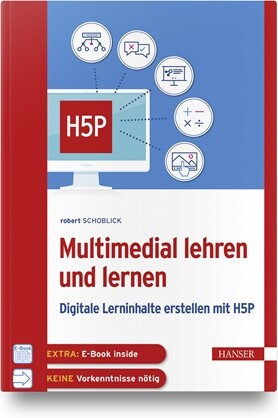
Multimedial lehren und lernen
Für alle Lehrkräfte, die digitale Lehrinhalte schnell und einfach gestalten wollen. Lesen Sie, wie Sie mit H5P multimedial lehren und lernen können.Für die Nutzung ist außer einem modernen Webbrowser keine zusätzliche Software erforderlich, so dass H5P-Inhalte auf jedem PC und jedem Smartphone nutzbar sind.Die Inhalte können problemlos in die Lernplattform Moodle sowie in die Content-Management-Systeme WordPress und Drupal integriert werden.Das Werk stellt mehr als 40 H5P-Inhaltstypen und ihren Einsatz im Detail vor. Wer mehr über die Webtechnologien wissen und die Hintergründe verstehen möchte, findet in Workshops zum Webdesign einen Einstieg in die grundlegenden Technologien.H5P ist die kommende Technologie zur Gestaltung multimedialer und interaktiver Lehrmaterialien – auch als offene Inhalte im Interesse für ein breites Bildungsangebot. Die Inhalte eignen sich sowohl für rein digitales Lehren als auch unterstützend für den klassischen Präsenzunterricht.Aus dem Inhalt:Qualitätsverbesserung statt Rationalisierung in der LehreDas H5P-Projekt: Einladung zum MitgestaltenH5P in der Praxis einsetzenH5P-Inhaltstypen – Wissen vermitteln und reflektierenFotos und multimediale Inhalte für Distance-Learning gestalten/Rechtliche AspekteDie Technik im Hintergrund: Einführungen in HTML, CSS, JavaScript und PHPLeseprobe (PDF-Link)
Oracle Database Programming with Visual Basic.NET
ORACLE DATABASE PROGRAMMING WITH VISUAL BASIC.NETDISCOVER A DETAILED TREATMENT OF THE PRACTICAL CONSIDERATIONS AND APPLICATIONS OF ORACLE DATABASE PROGRAMMING WITH VISUAL BASIC 2019Oracle Database Programming with Visual Basic.NET: Concepts, Designs, and Implementations delivers a comprehensive exploration of the foundations of Oracle database programming using Visual Basic.NET. Using Visual Basic.NET 2019, Visual Studio.NET 2019, and Oracle 18c XE, the book introduces the Oracle database development system, Oracle SQL Developer and Modeler, and teaches readers how to implement a sample database solution. The distinguished author also demonstrates the use of dotConnect for Oracle to show readers how to create an effective connection to an Oracle 18c XE database. The current versions of the .NET framework, ASP.NET, and ASP.NET 4.7 are also explored and used to offer readers the most up to date web database programming techniques available today. The book provides practical example projects and detailed, line-by-line descriptions throughout to assist readers in the development of their database programming skill. Students will also benefit from the inclusion of:* A thorough introduction to databases, including definitions, examples, descriptions of keys and relationships, and some database components in popular databases, like Access, SQL, and Oracle* An exploration of ADO.NET, including its architecture and components, like the DataReader class, DataSet component, DataTable component, and the command and parameter classes* A discussion of Language Integrated Query (LINQ), including its architecture and components, its relationship to objects, DataSet, Oracle, and Entities* An explanation of how to access data in ASP.NET and ASP.NET Web Services with multiple real project examples.Perfect for college and university students taking courses related to database programming and applications, Oracle Database Programming with Visual Basic.NET will also earn a place in the libraries of programmers and software engineers seeking a comprehensive reference for database coding in Visual Basic.NET. YING BAI, PHD, is Professor in the Department of Computer Science and Engineering at Johnson C. Smith University. He is the author of Practical Microcontroller Engineering with ARM Technology, Practical Database Programming with Visual Basic.NET, 2nd Edition, Practical Database Programming with Java, and Practical Database Programming with Visual C#.NET.

JavaServer™ Faces und Jakarta Server Faces 2.3
DAS ARBEITSBUCH FÜR JAVA-WEBENTWICKLER // - Steigen Sie mit diesem fundierten Arbeitsbuch in die Entwicklung von Benutzerschnittstellen mit JavaServerTM Faces und Jakarta Server Faces 2.3 ein. - Anhand einer Beispielanwendung werden alle wichtigen Aspekte von JSF erläutert. - Vertiefen und erweitern Sie Ihre Fertigkeiten mit den zahlreichen Übungen. - Verwendet werden ausschließlich Open-Source-Systeme, so dass Sie alle Übungen und Beispiele ohne weitere Lizenzkosten nachvollziehen können. - Im Internet: Quell-Code zu den Beispielen und Lösungen der Übungen auf der Autorenwebsite zum Buch und GitHub - Ihr exklusiver Vorteil: E-Book inside beim Kauf des gedruckten Buches JavaServerTM Faces und Jakarta Server Faces 2.3 sind ein Framework für die Entwicklung von Benutzerschnittstellen für bzw. als Teil einer Java-Web-Anwendung. Dieses Arbeitsbuch führt Sie Schritt für Schritt in die Programmierung mit JSF ein. Sie erfahren, wie Sie damit moderne Benutzerschnittstellen für die Praxis entwickeln. Und natürlich geht es auch darum, wie JSF in eine Java-Web-Anwendung zu integrieren sind. Behandelt werden auch Themen wie die Anbindung an eine Datenbank mit JPA, die Verwendung von CDI sowie Authentifizierung und Autorisierung. Verfolgen Sie Schritt für Schritt die Entwicklung einer betrieblichen Anwendung und lernen Sie so anhand realer Aufgabenstellungen alle wichtigen Aspekte von JSF 2.3 kennen. Mit Hilfe der Übungen, deren Lösungen sich von der Website zum Buch und von GitHub herunterladen lassen, können Sie das Gelernte selbst ausprobieren und umsetzen. AUS DEM INHALT // Einleitung/JSF im Detail/Context und Dependency Injection/Weiterführende Themen/Classic Models/Spezialthemen/Verwendete Systeme/Ausblick/Anhang: Die Tags der Standardbibliotheken

Email Marketing Best Practices for Beginners
E-mail marketing is hands down the most powerful and effective form of online marketing. Nothing comes close. Seriously. Even search marketing with all its hype and tried-and-proven success can't even hold the candle to just how effective list marketing can be. It's easy to see why, survey after survey, marketing firms keep putting e-mail marketing at or near the top of their advertising preferences. Here are the reasons why.Through e-mail marketing, you can get in front of the eyeballs of your audience members anytime anywhere. That's right. You can be at a beach in the Bahamas somewhere writing an e-mail update. Plug that in to your e-mail service provider and your audience, regardless of where they may be in the world and regardless of what they're doing, are sure to get your e-mail. After all, most people check their e-mail inboxes. Isn't that awesome?This enables you to sell more products. Since you have a de facto relationship with people who voluntarily got on your mailing list, you are able to keep the conversation going. You don't get just one bite at the apple in trying to get list members to buy.Hello my name is Mey Irtz and I am the author of several books in the area of health, relationships and others. I love to write books and share my knowledge.

Blogging for Money for Beginners
Making a living as a blogger has to be one of the sweetest gigs out there.As a blogger, you'll be able to earn passive income which means that your money will flow in even as you're sleeping, travelling or relaxing with friends. You're no long trading time for income and this is the point you need to get to if you want to really be free and financially independent (even being self-employed with clients is still pretty much like having a job).What's more, blogging means you get to earn that money by writing on a topic that you find fascinating and you even get to become something of a minor celebrity in your chosen niche. You can earn a lot of money here too – if a blog takes off and becomes really successful then in theory you can earn thousands a day. It's incredibly scalable and there's no 'upper limit' for what you can achieve.Hello my name is Mey Irtz and I am the author of several books in the area of health, relationships and others. I love to write books and share my knowledge.
Cognitive Engineering for Next Generation Computing
The cognitive approach to the IoT provides connectivity to everyone and everything since IoT connected devices are known to increase rapidly. When the IoT is integrated with cognitive technology, performance is improved, and smart intelligence is obtained. Discussed in this book are different types of datasets with structured content based on cognitive systems. The IoT gathers the information from the real time datasets through the internet, where the IoT network connects with multiple devices.This book mainly concentrates on providing the best solutions to existing real-time issues in the cognitive domain. Healthcare-based, cloud-based and smart transportation-based applications in the cognitive domain are addressed. The data integrity and security aspects of the cognitive computing main are also thoroughly discussed along with validated results.KOLLA BHANU PRAKASH is Professor and Research Group Head for Artificial Intelligence and Data Science Research Group in CSE Department, K L University, Andhra Pradesh, India. He received his MSc and MPhil in Physics from Acharya Nagarjuna University and his ME and PhD in Computer Science & Engineering from Sathyabama University, Chennai, India. Dr. Prakash has 14+ years of experience working in academia, research, and teaching. He has published multiple SCI journal articles as well as been granted 5 patents.G. R. KANAGACHIDAMBARESAN received his BE degree in Electrical and Electronics Engineering from Anna University in 2010; ME in Pervasive Computing Technologies in Anna University in 2012, and his PhD in Anna University Chennai in 2017. He is currently an associate professor, Department of CSE, Veltech Rangarajan Dr. Sagunthala R&D Institute of Science and Technology.SRIKANTH VEMURU is a professor in the Department of Computer Science and Engineering, K L University. He received his PhD degree from Acharya Nagarjuna University (ANU) in 2011. He has more than 17 years of academic experience and in the software industry, and has published more than over 60 research papers in SCI journals and flagship conferences.VAMSIDHAR ENIREDDY is an associate professor in CSE Department, K L University, Andhra Pradesh, India. He received his PhD from JNTU Kakinada, India. Dr. Enireddy has 17+years of experience working in academia, research, and teaching. He has authored over 28 research papers in various national and international journals and conferences as well as been granted 3 patents and 1 patent filed.Preface xviiAcknowledgments xix1 INTRODUCTION TO COGNITIVE COMPUTING 1Vamsidhar Enireddy, Sagar Imambi and C. Karthikeyan1.1 Introduction: Definition of Cognition, Cognitive Computing 11.2 Defining and Understanding Cognitive Computing 21.3 Cognitive Computing Evolution and Importance 61.4 Difference Between Cognitive Computing and Artificial Intelligence 81.5 The Elements of a Cognitive System 111.5.1 Infrastructure and Deployment Modalities 111.5.2 Data Access, Metadata, and Management Services 121.5.3 The Corpus, Taxonomies, and Data Catalogs 121.5.4 Data Analytics Services 121.5.5 Constant Machine Learning 131.5.6 Components of a Cognitive System 131.5.7 Building the Corpus 141.5.8 Corpus Administration Governing and Protection Factors 161.6 Ingesting Data Into Cognitive System 171.6.1 Leveraging Interior and Exterior Data Sources 171.6.2 Data Access and Feature Extraction 181.7 Analytics Services 191.8 Machine Learning 221.9 Machine Learning Process 241.9.1 Data Collection 241.9.2 Data Preparation 241.9.3 Choosing a Model 241.9.4 Training the Model 241.9.5 Evaluate the Model 251.9.6 Parameter Tuning 251.9.7 Make Predictions 251.10 Machine Learning Techniques 251.10.1 Supervised Learning 251.10.2 Unsupervised Learning 271.10.3 Reinforcement Learning 271.10.4 The Significant Challenges in Machine Learning 281.11 Hypothesis Space 301.11.1 Hypothesis Generation 311.11.2 Hypotheses Score 321.12 Developing a Cognitive Computing Application 321.13 Building a Health Care Application 351.13.1 Healthcare Ecosystem Constituents 351.13.2 Beginning With a Cognitive Healthcare Application 371.13.3 Characterize the Questions Asked by the Clients 371.13.4 Creating a Corpus and Ingesting the Content 381.13.5 Training the System 381.13.6 Applying Cognition to Develop Health and Wellness 391.13.7 Welltok 391.13.8 CaféWell Concierge in Action 411.14 Advantages of Cognitive Computing 421.15 Features of Cognitive Computing 431.16 Limitations of Cognitive Computing 441.17 Conclusion 47References 472 MACHINE LEARNING AND BIG DATA IN CYBER-PHYSICAL SYSTEM: METHODS, APPLICATIONS AND CHALLENGES 49Janmenjoy Nayak, P. Suresh Kumar, Dukka Karun Kumar Reddy, Bighnaraj Naik and Danilo Pelusi2.1 Introduction 502.2 Cyber-Physical System Architecture 522.3 Human-in-the-Loop Cyber-Physical Systems (HiLCPS) 532.4 Machine Learning Applications in CPS 552.4.1 K-Nearest Neighbors (K-NN) in CPS 552.4.2 Support Vector Machine (SVM) in CPS 582.4.3 Random Forest (RF) in CPS 612.4.4 Decision Trees (DT) in CPS 632.4.5 Linear Regression (LR) in CPS 652.4.6 Multi-Layer Perceptron (MLP) in CPS 662.4.7 Naive Bayes (NB) in CPS 702.5 Use of IoT in CPS 702.6 Use of Big Data in CPS 722.7 Critical Analysis 772.8 Conclusion 83References 843 HEMOSMART: A NON-INVASIVE DEVICE AND MOBILE APP FOR ANEMIA DETECTION 93J.A.D.C.A. Jayakody, E.A.G.A. Edirisinghe and S.Lokuliyana3.1 Introduction 943.1.1 Background 943.1.2 Research Objectives 963.1.3 Research Approach 973.1.4 Limitations 983.2 Literature Review 983.3 Methodology 1013.3.1 Methodological Approach 1013.3.1.1 Select an Appropriate Camera 1023.3.1.2 Design the Lighting System 1023.3.1.3 Design the Electronic Circuit 1043.3.1.4 Design the Prototype 1043.3.1.5 Collect Data and Develop the Algorithm 1043.3.1.6 Develop the Prototype 1063.3.1.7 Mobile Application Development 1063.3.1.8 Completed Device 1073.3.1.9 Methods of Data Collection 1093.3.2 Methods of Analysis 1093.4 Results 1103.4.1 Impact of Project Outcomes 1103.4.2 Results Obtained During the Methodology 1113.4.2.1 Select an Appropriate Camera 1113.4.2.2 Design the Lighting System 1123.5 Discussion 1123.6 Originality and Innovativeness of the Research 1163.6.1 Validation and Quality Control of Methods 1173.6.2 Cost-Effectiveness of the Research 1173.7 Conclusion 117References 1174 ADVANCED COGNITIVE MODELS AND ALGORITHMS 121J. Ramkumar, M. Baskar and B. Amutha4.1 Introduction 1224.2 Microsoft Azure Cognitive Model 1224.2.1 AI Services Broaden in Microsoft Azure 1254.3 IBM Watson Cognitive Analytics 1264.3.1 Cognitive Computing 1264.3.2 Defining Cognitive Computing via IBM Watson Interface 1274.3.2.1 Evolution of Systems Towards Cognitive Computing 1284.3.2.2 Main Aspects of IBM Watson 1294.3.2.3 Key Areas of IBM Watson 1304.3.3 IBM Watson Analytics 1304.3.3.1 IBM Watson Features 1314.3.3.2 IBM Watson DashDB 1314.4 Natural Language Modeling 1324.4.1 NLP Mainstream 1324.4.2 Natural Language Based on Cognitive Computation 1344.5 Representation of Knowledge Models 1344.6 Conclusion 137References 1385 IPARKING—SMART WAY TO AUTOMATE THE MANAGEMENT OF THE PARKING SYSTEM FOR A SMART CITY 141J.A.D.C.A. Jayakody, E.A.G.A. Edirisinghe, S.A.H.M. Karunanayaka, E.M.C.S. Ekanayake, H.K.T.M. Dikkumbura and L.A.I.M. Bandara5.1 Introduction 1425.2 Background & Literature Review 1445.2.1 Background 1445.2.2 Review of Literature 1455.3 Research Gap 1515.4 Research Problem 1515.5 Objectives 1535.6 Methodology 1545.6.1 Lot Availability and Occupancy Detection 1545.6.2 Error Analysis for GPS (Global Positioning System) 1555.6.3 Vehicle License Plate Detection System 1565.6.4 Analyze Differential Parking Behaviors and Pricing 1565.6.5 Targeted Digital Advertising 1575.6.6 Used Technologies 1575.6.7 Specific Tools and Libraries 1585.7 Testing and Evaluation 1595.8 Results 1615.9 Discussion 1625.10 Conclusion 164References 1656 COGNITIVE CYBER-PHYSICAL SYSTEM APPLICATIONS 167John A., Senthilkumar Mohan and D. Maria Manuel Vianny6.1 Introduction 1686.2 Properties of Cognitive Cyber-Physical System 1696.3 Components of Cognitive Cyber-Physical System 1706.4 Relationship Between Cyber-Physical System for Human–Robot 1716.5 Applications of Cognitive Cyber-Physical System 1726.5.1 Transportation 1726.5.2 Industrial Automation 1736.5.3 Healthcare and Biomedical 1766.5.4 Clinical Infrastructure 1786.5.5 Agriculture 1806.6 Case Study: Road Management System Using CPS 1816.6.1 Smart Accident Response System for Indian City 1826.7 Conclusion 184References 1857 COGNITIVE COMPUTING 189T Gunasekhar and Marella Surya Teja7.1 Introduction 1897.2 Evolution of Cognitive System 1917.3 Cognitive Computing Architecture 1937.3.1 Cognitive Computing and Internet of Things 1947.3.2 Cognitive Computing and Big Data Analysis 1977.3.3 Cognitive Computing and Cloud Computing 2007.4 Enabling Technologies in Cognitive Computing 2027.4.1 Cognitive Computing and Reinforcement Learning 2027.4.2 Cognitive Computive and Deep Learning 2047.4.2.1 Rational Method and Perceptual Method 2057.4.2.2 Cognitive Computing and Image Understanding 2077.5 Applications of Cognitive Computing 2097.5.1 Chatbots 2097.5.2 Sentiment Analysis 2107.5.3 Face Detection 2117.5.4 Risk Assessment 2117.6 Future of Cognitive Computing 2127.7 Conclusion 214References 2158 TOOLS USED FOR RESEARCH IN COGNITIVE ENGINEERING AND CYBER PHYSICAL SYSTEMS 219Ajita Seth8.1 Cyber Physical Systems 2198.2 Introduction: The Four Phases of Industrial Revolution 2208.3 System 2218.4 Autonomous Automobile System 2218.4.1 The Timeline 2228.5 Robotic System 2238.6 Mechatronics 225References 2289 ROLE OF RECENT TECHNOLOGIES IN COGNITIVE SYSTEMS 231V. Pradeep Kumar, L. Pallavi and Kolla Bhanu Prakash9.1 Introduction 2329.1.1 Definition and Scope of Cognitive Computing 2329.1.2 Architecture of Cognitive Computing 2339.1.3 Features and Limitations of Cognitive Systems 2349.2 Natural Language Processing for Cognitive Systems 2369.2.1 Role of NLP in Cognitive Systems 2369.2.2 Linguistic Analysis 2389.2.3 Example Applications Using NLP With Cognitive Systems 2409.3 Taxonomies and Ontologies of Knowledge Representation for Cognitive Systems 2419.3.1 Taxonomies and Ontologies and Their Importance in Knowledge Representation 2429.3.2 How to Represent Knowledge in Cognitive Systems? 2439.3.3 Methodologies Used for Knowledge Representation in Cognitive Systems 2479.4 Support of Cloud Computing for Cognitive Systems 2489.4.1 Importance of Shared Resources of Distributed Computing in Developing Cognitive Systems 2489.4.2 Fundamental Concepts of Cloud Used in Building Cognitive Systems 2499.5 Cognitive Analytics for Automatic Fraud Detection Using Machine Learning and Fuzzy Systems 2549.5.1 Role of Machine Learning Concepts in Building Cognitive Analytics 2559.5.2 Building Automated Patterns for Cognitive Analytics Using Fuzzy Systems 2559.6 Design of Cognitive System for Healthcare Monitoring in Detecting Diseases 2569.6.1 Role of Cognitive System in Building Clinical Decision System 2579.7 Advanced High Standard Applications Using Cognitive Computing 2599.8 Conclusion 262References 26310 QUANTUM META-HEURISTICS AND APPLICATIONS 265Kolla Bhanu Prakash10.1 Introduction 26510.2 What is Quantum Computing? 26710.3 Quantum Computing Challenges 26810.4 Meta-Heuristics and Quantum Meta-Heuristics Solution Approaches 27110.5 Quantum Meta-Heuristics Algorithms With Application Areas 27310.5.1 Quantum Meta-Heuristics Applications for Power Systems 27710.5.2 Quantum Meta-Heuristics Applications for Image Analysis 28110.5.3 Quantum Meta-Heuristics Applications for Big Data or Data Mining 28210.5.4 Quantum Meta-Heuristics Applications for Vehicular Trafficking 28510.5.5 Quantum Meta-Heuristics Applications for Cloud Computing 28610.5.6 Quantum Meta-Heuristics Applications for Bioenergy or Biomedical Systems 28710.5.7 Quantum Meta-Heuristics Applications for Cryptography or Cyber Security 28710.5.8 Quantum Meta-Heuristics Applications for Miscellaneous Domain 288References 29111 ENSURING SECURITY AND PRIVACY IN IOT FOR HEALTHCARE APPLICATIONS 299Anjali Yeole and D.R. Kalbande11.1 Introduction 29911.2 Need of IoT in Healthcare 30011.2.1 Available Internet of Things Devices for Healthcare 30111.3 Literature Survey on an IoT-Aware Architecture for Smart Healthcare Systems 30311.3.1 Cyber-Physical System (CPS) for e-Healthcare 30311.3.2 IoT-Enabled Healthcare With REST-Based Services 30411.3.3 Smart Hospital System 30411.3.4 Freescale Home Health Hub Reference Platform 30511.3.5 A Smart System Connecting e-Health Sensors and Cloud 30511.3.6 Customizing 6LoWPAN Networks Towards IoT-Based Ubiquitous Healthcare Systems 30511.4 IoT in Healthcare: Challenges and Issues 30611.4.1 Challenges of the Internet of Things for Healthcare 30611.4.2 IoT Interoperability Issues 30811.4.3 IoT Security Issues 30811.4.3.1 Security of IoT Sensors 30911.4.3.2 Security of Data Generated by Sensors 30911.4.3.3 LoWPAN Networks Healthcare Systems and its Attacks 30911.5 Proposed System: 6LoWPAN and COAP Protocol-Based IoT System for Medical Data Transfer by Preserving Privacy of Patient 31011.6 Conclusion 312References 31212 EMPOWERING SECURED OUTSOURCING IN CLOUD STORAGE THROUGH DATA INTEGRITY VERIFICATION 315C. Saranya Jothi, Carmel Mary Belinda and N. Rajkumar12.1 Introduction 31512.1.1 Confidentiality 31612.1.2 Availability 31612.1.3 Information Uprightness 31612.2 Literature Survey 31612.2.1 PDP 31612.2.1.1 Privacy-Preserving PDP Schemes 31712.2.1.2 Efficient PDP 31712.2.2 POR 31712.2.3 HAIL 31812.2.4 RACS 31812.2.5 FMSR 31812.3 System Design 31912.3.1 Design Considerations 31912.3.2 System Overview 32012.3.3 Workflow 32012.3.4 System Description 32112.3.4.1 System Encoding 32112.3.4.2 Decoding 32212.3.4.3 Repair and Check 32312.4 Implementation and Result Discussion 32412.4.1 Creating Containers 32412.4.2 File Chunking 32412.4.3 XORing Partitions 32612.4.4 Regeneration of File 32612.4.5 Reconstructing a Node 32712.4.6 Cloud Storage 32712.4.6.1 NC-Cloud 32712.4.6.2 Open Swift 32912.5 Performance 33012.6 Conclusion 332References 333Index 335

Wireless Network Simulation
Learn to run your own simulation by working with model analysis, mathematical background, simulation output data, and most importantly, a network simulator for wireless technology. This book introduces the best practices of simulator use, the techniques for analyzing simulations with artificial agents and the integration with other technologies such as Power Line Communications (PLC).Network simulation is a key technique used to test the future behavior of a network. It’s a vital development component for the development of 5G, IoT, wireless sensor networks, and many more. This book explains the scope and evolution of the technology that has led to the development of dynamic systems such as Internet of Things and fog computing.You'll focus on the ad hoc networks with stochastic behavior and dynamic nature, and the ns-3 simulator. These are useful open source tools for academics, researchers, students and engineers to deploy telecommunications experiments, proofs and new scenarios with a high degree of similarity with reality. You'll also benefit from a detailed explanation of the examples and the theoretical components needed to deploy wireless simulations or wired, if necessary.WHAT YOU’LL LEARN* Review best practices of simulator uses* Understand techniques for analyzing simulations with artificial agents* Apply simulation techniques and experiment design* Program on ns-3 simulator* Analyze simulation results* Create new modules or protocols for wired and wireless networksWHO THIS BOOK IS FORUndergraduate and postgraduate students, researchers and professors interested in network simulations. This book also includes theoretical components about simulation, which are useful for those interested in discrete event simulation DES, general theory of simulation, wireless simulation and ns-3 simulator.HENRY ZÁRATE CEBALLOS received his PhD in Engineering Computing and Systems and Masters Degree in Telecommunications from the National University of Colombia. Henry is currently a researcher with the TLÖN Group. Henry has worked extesensively with the Ns-2 and Ns-3 simulators and wireless distributed operative systems.JORGE ERNESTO PARRA AMARIS received his Masters Degree in Telecommunication from the National University of Colombia, and is an Electronics Engineer from the Colombian School of Engineering Julio Garavito. Jorge's Masters thesis proposed a unique algorithm which was validated through simulation using NS-3.HERNÁN JIMÉNEZ JIMÉNEZ received his postgraduate Masters in Telecommunications from the National University of Colombia. Hernán is currently a researcher at TLÖN Group.DIEGO ALEXIS ROMERO RINCÓN received his Masters in Electronics from the National University of Colombia and is currently a researcher with the TLÖN Group. Diego focused his Masters thesis on on the NS-3 simulator. Deigo is currently a lecturer at the National University of Colombia.OSCAR AGUDELO ROJAS is a systems engineer and lecturer at the National University of Colombia, where he also received his Masters degree in Telecommunications. His research work includes networks (wired and wireless), network coding, simulation (ns2-ns3) and parallel and distributed systems.JORGE EDUARDO ORTIZ TRIVIÑO received his PhD in Engineering Computing Systems and Masters Degrees in Telecommunications, Statistics, and Philosophy from the National University of Colombia. Jorge is currently a professor at the National University of Colombia, while also working as a network specialist.Chapter 1: Introduction to Simulation 3.- Chapter 2: Wireless and Ad hoc Networks.- Chapter 3: Design of Simulation Experiments.- Chapter 4: Network Simulation using NS3.- Chapter 5: Analyses of Results.- Chapter 6: Manet Simulation on NS3.- Chapter 7: Manets and PLC on NS3.-Appendix A: Basic Statistics.- Appendix B: NS3 Installation.- Appendix C: Mininet.- Appendix C: NS3-GYM: Openai Gym Integration.- Appendix E: Experiment.- Appendix F: PLC Code Experiment.-

Information Refinement Technologies for Crisis Informatics
Marc-André Kaufhold explores user expectations and design implications for the utilization of new media in crisis management and response. He develops a novel framework for information refinement, which integrates the event, organisational, societal, and technological perspectives of crises. Therefore, he reviews the state of the art on crisis informatics and empirically examines the use, potentials and barriers of both social media and mobile apps. Based on these insights, he designs and evaluates ICT concepts and artifacts with the aim to overcome the issues of information overload and quality in large-scale crises, concluding with practical and theoretical implications for technology adaptation and design.About the author:Marc-André Kaufhold is a postdoc at the Chair of Science and Technology for Peace and Security (PEASEC) in the Department of Computer Science at the Technical University of Darmstadt. His research focuses on the user-centred design and evaluation of mobile apps and social media technologies in the context of crisis and security research.Part I: Outline.- Part II: Theoretical and Empirical Findings.- Part III: Design and Evaluation Findings.- Part IV: Conclusion and Outlook.

Configuration of Apache Server To Support ASP
The paper aim is to configure Apache Server to support ASP. Two methods were tested. The first, by installing Bundle::Apache::ASP, and the second, by installing SUN ONE ASP Server. Two possible options for connecting to a Microsoft Access database with Sun ONE ASP for UNIX or Linux, using the using SequeLink, and using the Sun ONE ASP Database Publisher tool to migrate an Access database to MySQL, were studied. The paper is composed from the following parts,1. Setting up working environment when working with CodeCharge Studio program, software for building web applications.2. Connecting to databases in ASP.3. ASP program example.4. Configuring apache server to support ASP by installing Bundle::Apacahe::ASP.5. Configuring apache server to support ASP by installing Sun ONE ASP.I am Dr. Hidaia Mahmoud Mohamed Alassouli. I completed my PhD degree in Electrical Engineering from Czech Technical University by February 2003, and my M. Sc. degree in Electrical Engineering from Bahrain University by June 1995. I completed also one study year of most important courses in telecommunication and computer engineering courses in Islamic university in Gaza. So, I covered most important subjects in Electrical Engineering, Computer Engineering and Telecommunications Engineering during my study. My nationality is Palestinian from gaza strip.I obtained a lot of certified courses in MCSE, SPSS, Cisco (CCNA), A+, Linux.I worked as Electrical, Telecommunicating and Computer Engineer in a lot of institutions. I worked also as a computer networking administrator.I had considerable undergraduate teaching experience in several types of courses in many universities. I handled teaching the most important subjects in Electrical and Telecommunication and Computer Engineering.I could publish a lot of papers a top-tier journals and conference proceedings, besides I published a lot of books in Publishing and Distribution houses.I wrote a lot of important Arabic articles on online news websites. I also have my own magazine website that I publish on it all my articles: http:// www.anticorruption.000space.comMy personal website: www.hidaia-alassouli.000space.comEmail: hidaia_alassouli@hotmail.com

Cisco Networks
For beginning and experienced network engineers tasked with building LAN, WAN, and data center connections, this book lays out clear directions for installing, configuring, and troubleshooting networks with Cisco devices. Cisco Networks, 2nd Edition is a practical guide and desk reference for Cisco engineers. This new edition will discuss tools that can be used to automate and troubleshoot networks. A new chapter on quality of service has been added to teach managing network resources by prioritizing specific types of network traffic. The new edition has an updated wireless section which focuses on an updated controller and integration with Cisco Identity Services Engine (ISE) and Cisco Prime Infrastructure.This practical desk companion doubles as a comprehensive overview of the basic knowledge and skills needed by CCNA and CCNP exam takers. Prior familiarity with Cisco routing and switching is desirable but not necessary, as Chris Carthern, Dr. Will Wilson, and Noel Rivera start their book with a review of network basics. Further they explain practical considerations and troubleshooting when establishing a physical medium for network communications. Later they explain the concept of network layers, intermediate LAN switching, and routing. Next they introduce you to the tools and automation used with Cisco networks. Moving forward they explain management planes, data planes, and control planes. Next they describe advanced security, trouble shooting, and network management. They conclude the book with a section which focuses on using network automation to automate Cisco IOS networks.WHAT YOU WILL LEARN* Configure Cisco switches, routers, and data center devices in typical corporate network architectures* Use black-hat tools to conduct penetration testing on the security of your network* Configure and secure virtual private networks (VPNs)* Enable identity management in your network with the Cisco Identity Services Engine (ISE) WHO THIS BOOK IS FORNetwork designers, engineers, programmers, managers, and students.CHRIS is a senior network engineer for Mantech and has worked for the department of defense. He is responsible for designing, installing, and maintaining the Cisco network infrastructure and mentoring junior network engineers. Carthern took his BS (honors) in computer science from Morehouse College and his MS in system engineering from the University of Maryland Baltimore County (UMBC). He holds the following certifications: Cisco Certified Network Professional (CCNP), Certified Information Systems Security Professional (CISSP), Brocade Certified Network Professional (BCNP), and ITIL v3. He is also an award winning photographer and indie movie producer.NOEL RIVERA is a systems architect with CACI who specializes in communications networks, IT security, and infrastructure automation. He has worked at NASA, DoD, Lockheed Martin, and CACI. Mr. Rivera holds a bachelors of electrical engineering from the University of Puerto Rico at Mayaguez and two masters degrees one in electrical engineering and another in computer science from Johns Hopkins University. Mr. Rivera holds the following certifications: Cisco Internetwork Expert in Routing and Switching (CCIE-RS), Cisco Internetwork Expert in Security (CCIE-SEC), Certified Systems Security Professional (CISSP), Certified Ethical Hacker (CEH), Juniper Network Certified Service Provider Professional (JNCIP-SP ), Juniper Networks Certified Cloud Professional (JNCIP-Cloud), VMWare Certified Data Center Virtualization Professional (VCP-DCV), VMWare Certified Network Virtualization Professional (VCP-NV), ITILv3 and is currently working on his Juniper Networks Certified Service Provider Expert certification (JNCIE-SP) and Microsoft Azure Solutions Architect Expert certification.DR. WILSON is a senior network consulting engineer. He specializes in optimization of routing and in security. He is responsible for assisting customers with resolving complex architectural and operation issues. He holds a bachelor’s degree in mathematics from the University of Colorado. His doctorate is in computer science with a focus on applications of artificial intelligence in information security. He maintains the following certifications: Cisco CCIE Routing and Switching, CCIE Security, all of the CCNP tracks, Cisco DevNet Professional, VMware VCP-NV, Certified Ethical Hacker, CISSP, MCSE, and PMP.CHAPTER 1. PRACTICAL NETWORKING INTRO[The purposes and functions each layer in network communications; discussion of OSI and TCP/IP protocols. How the layers work together and what do they tell us about the layers below.]1.1 OSI Model1.2 Physical layer1.3 Data Link layer1.4 Network layer1.5 Transport layer1.6 Session layer1.7 Presentation layer1.8 Application layer1.9 TCP/IP Protocol1.10 Port Numbers - (List common enterprise port numbers)1.11 Types of Communications - Broadcast, Unicast, Multicast and Anycast1.12 Types of Networks1.13 Network Architectures1.14 Intro and use case for software define networking1.15 SummaryCHAPTER 2. THE PHYSICAL MEDIUM[Practical considerations and troubleshooting when establishing a physical medium for network communications. Common problems at the physical layer.]2.1 Physical medium2.2 Standards2.3 Cables2.4 Ethernet2.5 Negotiation2.6 Duplex2.7 Unidirectional Link Detection (UDLD)2.8 Common issues2.9 SummaryCHAPTER 3. PROTOCOLS AND THE DATA LINK LAYER[The idea of protocols and their use, functions of the data link layer using IEEE 802.3 and switching. What the data link tells about the physical medium state and the higher layer protocols.]3.1 Protocols -- Ethernet, MPLS, LLDP, CDP, Spanning Tree, LACP, DOT1Q,3.2 Link layer functions3.3 Link layer discovery protocol3.4 Link layer related to other layers3.5 Types of messages3.6 SummaryCHAPTER 4. THE NETWORK LAYER[The concept of routing, which protocol transmissions are routable and IP addressing, including architecture requirements for IPv4 and IPv6 networks; subnetting. Observing the protocol layer transitions with packet captures]4.1 IP Communication Types - Broadcast, Multicast, Unicast, Anycast4.2 IP Addressing (Public vs Private) Bogons and Martians4.3 CIDR4.4 IPv44.5 IPv64.6 Subnetting4.7 Subnetting exercises4.8 SummaryCHAPTER 5. INTERMEDIATE LAN SWITCHING[Basic switching concepts, switch operations, common switching helper protocols their use and functions: (Trunking 802.1q, EtherChannels 802.3ad, RSTP 802.1D. Review the purpose of VLANs; their implementation and multilayer devices.]5.1 Switching5.2 LAGs5.3 Spanning Tree and Spanning Tree interop, Spanning Tree Convergence5.4 VLANs5.5 Trunking5.6 VTP5.7 MSTP5.8 Labs; Exercises5.9 SummaryCHAPTER 6. ROUTING[Routing concepts with practical implementation, including static routing and dynamic protocols such as OSPF, BGP, RIP and EIGRP.]6.1 Static routing6.2 Routing protocols6.3 IS-IS6.4 EIGRP6.5 OSFP6.6 BGP6.7 Labs; Exercises6.8 SummaryCHAPTER 7. INTRODUCTION TO TOOLS AND AUTOMATION[Introduction into using tools and automation that will be used in further chapters for different use cases.]7.1 Tools overview7.2 Introduction to prime infrastructure7.3 Introduction to ISE7.4 Introduction to SD-WAN / vManage7.5 Introduction to DNACHAPTER 8. SWITCH AND ROUTER TROUBLESHOOTING (NOTE: NEEDS WORK, ADD MPLS TROUBLESHOOTING.ROUTING TROUBLESHOOTING CAN BE QUIET BIG SHOULD WE BREAK IT DOWN?WE ALSO NEED TO ADD DATA STRUCTURES FOR SWITCHING/ROUTING: MAC TABLE, ARP TABLE, CEF ADJACENCY TABLE, FIB TABLES, RIB TABLE ETC.)[How to troubleshoot and resolve issues with Cisco network devices and Client side tools.]8.1 Techniques8.2 VLANs8.3 Trunking8.4 Routing8.5 Dynamic routing8.6 Spanning tree8.7 EtherChannel8.8 Tools8.9 Labs; Exercises8.10 SummaryCHAPTER 9. NAT/DHCP (ADD A SECTION ON NAT AND IPSEC AND NAT AFFECTED PROTOCOLS)[The purpose of NAT and DCHP and how to configure them on network devices.]9.1 NAT9.2 Static Nat9.3 Dynamic Nat9.4 PAT9.5 DHCP9.6 Setting up router as DHCP server9.7 NAT affected protocols9.8 Labs; Exercises9.9 SummaryCHAPTER 10. MANAGEMENT PLANE[How to administer Cisco devices, including booting, working from rommom, managing cisco images, upgrading the IOS, and configuring syslog and SNMPv3. Also port security, access-lists, password security and ssh, SNMPv3, TACACS, RADIUS, Logging]10.1 Authentication and authorization10.2 SSH10.3 Password recovery10.4 User accounts10.5 Logging10.6 Banners10.7 AAA10.8 Disabling services10.9 IOS switch upgrade10.10 Configuration using prime infrastructure10.11 Introduction to netconf10.12Labs; Exercises10.13 SummaryCHAPTER 11. DATA PLANE[Commons traffic protocols and the applications of filters. Netflow/Sflow]11.1 Traffic protocols11.2 Filters11.3 Netflow/Sflow11.4 Labs; Exercises11.5 SummaryCHAPTER 12. CONTROL PLANE[Securing the protocol exchange, IGP, BGP, DNS and NTP]12.1 Layer 212.2 IGP12.3 BGP12.4 DNS12.5 Protocol independent multicasting12.6 NTP12.7 Managing control plane using tools12.8 Labs; Exercises12.9 SummaryCHAPTER 13. INTRODUCTION TO AVAILABILITY[Redundancy at layer 2 and layer 3: GLBP, VRRP and multilinks. How to VoIP and video configurations; creating high availability and redundancy.]13.1 High availability13.2 HSRP13.3 VRRP13.4 GLBP13.5 SLB13.6 Multilinks13.7 Layer 2 extensions overview13.8 Labs; Exercises13.9 SummaryCHAPTER 14. ADVANCED ROUTING[How to implement multi-area OSPF, eBGP, IPv6 routing, IPv4 route redistribution to static routes, and dynamic routing protocols; layer 3 path control; implementing basic teleworker and branch services, including GRE tunnels]14.1 Route maps14.2 Policy based routing14.3 Redistribution14.4 EIGRP14.5 Multi-area OSPF14.6 BGP14.7 IPv6 routing14.8 GRE tunnels14.9 IPsec VPNs14.10 Labs; Exercises14.11 SummaryCHAPTER 15. QOS[How to implement, manage and optimize QoS in Cisco Networks]15.1 Intro to QoS15.2 Classification and marking15.3 Policing and shaping15.4 QoS in IPv615.5 QoS design strategies15.6 QoS for tunnels and sub-interfaces15.7 Troubleshooting15.8 Labs15.9 SummaryCHAPTER 16. ADVANCED SECURITY[How to implement advanced security solutions, including private VLANs, VACLs and PACLs; implementing port authentication, and Extended ACLs.]16.1 Private VLANs16.2 Dot1x16.3 Extended ACL16.4 VACL16.5 PACL16.6 MAC ACL16.7 DHCP snooping16.8 IDS/IPS16.9 MAC SEC16.10 Compliance16.11 Labs; Exercises16.12 SummaryCHAPTER 17. ADVANCED TROUBLESHOOTING[How to verify advanced routing problems, including EIGRP, OSPF, eBGP, route redistribution, NAT, DHCP, VACLs, PACLs, and IPv6 routing.]17.1 Route redistribution17.2 ACLs17.3 NAT17.4 PACL17.5 Dynamic routing protocols17.6 IPv617.7 IPsec17.8 GRE tunnels17.9 HSRP, VRRP, GLBP17.10 Labs; Exercises17.11 SummaryCHAPTER 18. EFFECTIVE NETWORK MANAGEMENT[Aggregation of data from the control, data and managementplane for effective network and data flow management. Use of logs, SNMP, IDSalerts and Netflow/Sflow]18.1 Logs18.2 SNMP18.3 SLAs and embedded event manager18.4 sFlow/NetFlow18.5 Tools18.6 Labs; Exercises18.7 SummaryCHAPTER 19. DATA CENTER[How to configure VLANs and interswitch communications using a Nexus with NX-OS software; configuring routing on NX-OS software, including OSPF and BGP; port channels and port profiles; configuring the Nexus for Fabric Extender (FEX) support.]19.1 NX-OS19.2 NX-OSv overview19.3 VLAN19.4 VTP19.5 Virtual Route Forwarding (VRF)19.6 EIGRP19.7 OSPF19.8 BGP19.9 Port profiles19.10 Fabric extenders19.11 Fabric design19.12 GLBP19.13 Virtual Port Channel (vPC)19.14Virtual Device Context (VDC)19.15 VXLAN19.16 OTV19.17 ACI overview19.18 Labs; Exercises19.19 SummaryCHAPTER 20. WIRELESS LAN[The basic components of the Cisco Wireless Network architecture; how to install access points and wireless controllers and incorporate them into switches; wireless security, including port authentication, authentication, and encryption.]20.1 Wireless components20.2 Wireless access points20.3 Wireless controllers20.4 Integration with ISE20.5 Cisco prime infrastructure20.6 Security and authentication20.7 Labs; Exercises20.8 SummaryCHAPTER 21. FIREPOWER[The basic components of the Cisco Firepower; how to configure and manage firewalls and Intrusion Prevention and incorporating them into network architectures, including traffic analysis, Packet filtering, NAT, VPNs, Remote Access and device management.]21.1 Testing Policies in a Safe Environment21.2 Baseline network21.3 Access rules21.4 Open services21.5 Anti-Spoofing21.6 Service policies21.7 Cluster21.8 Multi-Context21.9 Virtual21.10 Active/Active21.11 Active/Standby21.12 SGT based ACLs21.13 Routing21.14 VPNs21.15 Labs; Exercises21.16 SummaryCHAPTER 22. NETWORK PENETRATION TESTING[This section will focus on testing the security of your network; performing basic network penetration testing using NMAP, NESSUS, Linux Backtrack and Metasploit tools.]22.1 Reconnaissance and scanning22.2 Vulnerability assessment22.3 Exploitation22.4 Labs22.5 SummaryCHAPTER 23. MPLS[This section will focus on Multiprotocol Label Switching (MPLS) and its implementation in modern networks that is mostly used by enterprises and service providers.]23.1 Intro to MPLS23.2 LDP23.3 MPLS Layer3 VPN23.4 MPLS Layer2 VPN (VPLS)23.5 VRF Lite23.6 IPv6 over MPLS23.7 MPLS troubleshooting23.8 Labs23.9 SummaryCHAPTER 24. DMVPN[This section will focus on the implementation of dynamic multipoint virtual private networks (DMVPN). We will explore implementing DMVPNs with a hub and spoke architecture; using routing protocols and IPsec.]24.1 Intro DMVPN24.2 Phase 124.3 Phase 224.4 Phase 324.5 Flex VPN24.6 DMVPN troubleshooting24.7 Labs24.8 SummaryCHAPTER 25. NETWORK AUTOMATION[This section will focus on using network automation to automate Cisco IOS networks.]25.1 Python25.2 Python APIs25.3 Napalm25.4 Nornir25.5 Labs25.6 Summary
Machine Learning for Healthcare Applications
When considering the idea of using machine learning in healthcare, it is a Herculean task to present the entire gamut of information in the field of intelligent systems. It is, therefore the objective of this book to keep the presentation narrow and intensive. This approach is distinct from others in that it presents detailed computer simulations for all models presented with explanations of the program code. It includes unique and distinctive chapters on disease diagnosis, telemedicine, medical imaging, smart health monitoring, social media healthcare, and machine learning for COVID-19. These chapters help develop a clear understanding of the working of an algorithm while strengthening logical thinking. In this environment, answering a single question may require accessing several data sources and calling on sophisticated analysis tools. While data integration is a dynamic research area in the database community, the specific needs of research have led to the development of numerous middleware systems that provide seamless data access in a result-driven environment.Since this book is intended to be useful to a wide audience, students, researchers and scientists from both academia and industry may all benefit from this material. It contains a comprehensive description of issues for healthcare data management and an overview of existing systems, making it appropriate for introductory and instructional purposes. Prerequisites are minimal; the readers are expected to have basic knowledge of machine learning.This book is divided into 22 real-time innovative chapters which provide a variety of application examples in different domains. These chapters illustrate why traditional approaches often fail to meet customers’ needs. The presented approaches provide a comprehensive overview of current technology. Each of these chapters, which are written by the main inventors of the presented systems, specifies requirements and provides a description of both the chosen approach and its implementation. Because of the self-contained nature of these chapters, they may be read in any order. Each of the chapters use various technical terms which involve expertise in machine learning and computer science.SACHI NANDAN MOHANTY received his PhD from IIT Kharagpur in 2015. He has recently joined as an associate professor in the Department of Computer Science & Engineering at ICFAI Foundation for Higher Education Hyderabad. His research areas include data mining, big data analysis, cognitive science, fuzzy decision making, brain-computer interface, and computational intelligence. He has published 20 SCI journal articles and has authored/edited 7 books.G. NALINIPRIYA is a professor in the Department of Information Technology, Anna University, Chennai where she also obtained her PhD. She has more than 23 years of experience in the field of teaching, industry and research and her interests include artificial intelligence, machine learning, data science and cloud security.OM PRAKASH JENA is an assistant professor in the Department of Computer Science, Ravenshaw University, Cuttack, Odisha. He has 10 years of teaching and research experience and has published several technical papers in international journals/conferences/edited books. His current research interests include pattern recognition, cryptography, network security, soft computing, data analytics and machine automation.ACHYUTH SARKAR received his PhD in Computer Science and Engineering from the National Institute of Technology, Arunachal Pradesh in 2019. He has teaching experience of more than 10 years.Preface xviiPART 1: INTRODUCTION TO INTELLIGENT HEALTHCARE SYSTEMS 11 INNOVATION ON MACHINE LEARNING IN HEALTHCARE SERVICES—AN INTRODUCTION 3Parthasarathi Pattnayak and Om Prakash Jena1.1 Introduction 31.2 Need for Change in Healthcare 51.3 Opportunities of Machine Learning in Healthcare 61.4 Healthcare Fraud 71.4.1 Sorts of Fraud in Healthcare 71.4.2 Clinical Service Providers 81.4.3 Clinical Resource Providers 81.4.4 Protection Policy Holders 81.4.5 Protection Policy Providers 91.5 Fraud Detection and Data Mining in Healthcare 91.5.1 Data Mining Supervised Methods 101.5.2 Data Mining Unsupervised Methods 101.6 Common Machine Learning Applications in Healthcare 101.6.1 Multimodal Machine Learning for Data Fusion in Medical Imaging 111.6.2 Machine Learning in Patient Risk Stratification 111.6.3 Machine Learning in Telemedicine 111.6.4 AI (ML) Application in Sedate Revelation 121.6.5 Neuroscience and Image Computing 121.6.6 Cloud Figuring Systems in Building AI-Based Healthcare 121.6.7 Applying Internet of Things and Machine-Learning for Personalized Healthcare 121.6.8 Machine Learning in Outbreak Prediction 131.7 Conclusion 13References 14PART 2: MACHINE LEARNING/DEEP LEARNING-BASED MODEL DEVELOPMENT 172 A FRAMEWORK FOR HEALTH STATUS ESTIMATION BASED ON DAILY LIFE ACTIVITIES DATA USING MACHINE LEARNING TECHNIQUES 19Tene Ramakrishnudu, T. Sai Prasen and V. Tharun Chakravarthy2.1 Introduction 192.1.1 Health Status of an Individual 192.1.2 Activities and Measures of an Individual 202.1.3 Traditional Approach to Predict Health Status 202.2 Background 202.3 Problem Statement 212.4 Proposed Architecture 222.4.1 Pre-Processing 222.4.2 Phase-I 232.4.3 Phase-II 232.4.4 Dataset Generation 232.4.4.1 Rules Collection 232.4.4.2 Feature Selection 242.4.4.3 Feature Reduction 242.4.4.4 Dataset Generation From Rules 242.4.4.5 Example 242.4.5 Pre-Processing 262.5 Experimental Results 272.5.1 Performance Metrics 272.5.1.1 Accuracy 272.5.1.2 Precision 282.5.1.3 Recall 282.5.1.4 F1-Score 302.6 Conclusion 31References 313 STUDY OF NEUROMARKETING WITH EEG SIGNALS AND MACHINE LEARNING TECHNIQUES 33S. Pal, P. Das, R. Sahu and S.R. Dash3.1 Introduction 343.1.1 Why BCI 343.1.2 Human–Computer Interfaces 343.1.3 What is EEG 353.1.4 History of EEG 353.1.5 About Neuromarketing 353.1.6 About Machine Learning 363.2 Literature Survey 363.3 Methodology 453.3.1 Bagging Decision Tree Classifier 453.3.2 Gaussian Naïve Bayes Classifier 453.3.3 Kernel Support Vector Machine (Sigmoid) 453.3.4 Random Decision Forest Classifier 463.4 System Setup & Design 463.4.1 Pre-Processing & Feature Extraction 473.4.1.1 Savitzky–Golay Filter 473.4.1.2 Discrete Wavelet Transform 483.4.2 Dataset Description 493.5 Result 493.5.1 Individual Result Analysis 493.5.2 Comparative Results Analysis 523.6 Conclusion 53References 544 AN EXPERT SYSTEM-BASED CLINICAL DECISION SUPPORT SYSTEM FOR HEPATITIS-B PREDICTION & DIAGNOSIS 57Niranjan Panigrahi, Ishan Ayus and Om Prakash Jena4.1 Introduction 574.2 Outline of Clinical DSS 594.2.1 Preliminaries 594.2.2 Types of Clinical DSS 604.2.3 Non-Knowledge-Based Decision Support System (NK-DSS) 604.2.4 Knowledge-Based Decision Support System (K-DSS) 624.2.5 Hybrid Decision Support System (H-DSS) 644.2.6 DSS Architecture 644.3 Background 654.4 Proposed Expert System-Based CDSS 654.4.1 Problem Description 654.4.2 Rules Set & Knowledge Base 664.4.3 Inference Engine 664.5 Implementation & Testing 664.6 Conclusion 73References 735 DEEP LEARNING ON SYMPTOMS IN DISEASE PREDICTION 77Sheikh Raul Islam, Rohit Sinha, Santi P. Maity and Ajoy Kumar Ray5.1 Introduction 775.2 Literature Review 785.3 Mathematical Models 795.3.1 Graphs and Related Terms 805.3.2 Deep Learning in Graph 805.3.3 Network Embedding 805.3.4 Graph Neural Network 815.3.5 Graph Convolution Network 825.4 Learning Representation From DSN 825.4.1 Description of the Proposed Model 835.4.2 Objective Function 845.5 Results and Discussion 845.5.1 Description of the Dataset 855.5.2 Training Progress 855.5.3 Performance Comparisons 865.6 Conclusions and Future Scope 86References 876 INTELLIGENT VISION-BASED SYSTEMS FOR PUBLIC SAFETY AND PROTECTION VIA MACHINE LEARNING TECHNIQUES 89Rajitha B.6.1 Introduction 896.1.1 Problems Intended in Video Surveillance Systems 906.1.2 Current Developments in This Area 916.1.3 Role of AI in Video Surveillance Systems 916.2 Public Safety and Video Surveillance Systems 926.2.1 Offline Crime Prevention 926.2.2 Crime Prevention and Identification via Apps 926.2.3 Crime Prevention and Identification via CCTV 926.3 Machine Learning for Public Safety 946.3.1 Abnormality Behavior Detection via Deep Learning 956.3.2 Video Analytics Methods for Accident Classification/Detection 976.3.3 Feature Selection and Fusion Methods 986.4 Securing the CCTV Data 996.4.1 Image/Video Security Challenges 996.4.2 Blockchain for Image/Video Security 996.5 Conclusion 99References 1007 SEMANTIC FRAMEWORK IN HEALTHCARE 103Sankar Pariserum Perumal, Ganapathy Sannasi, Selvi M. and Kannan Arputharaj7.1 Introduction 1037.2 Semantic Web Ontology 1047.3 Multi-Agent System in a Semantic Framework 1067.3.1 Existing Healthcare Semantic Frameworks 1077.3.1.1 AOIS 1077.3.1.2 SCKE 1087.3.1.3 MASE 1097.3.1.4 MET4 1107.3.2 Proposed Multi-Agent-Based Semantic Framework for Healthcare Instance Data 1117.3.2.1 Data Dictionary 1117.3.2.2 Mapping Database 1127.3.2.3 Decision Making Ontology 1137.3.2.4 STTL and SPARQL-Based RDF Transformation 1157.3.2.5 Query Optimizer Agent 1167.3.2.6 Semantic Web Services Ontology 1167.3.2.7 Web Application User Interface and Customer Agent 1167.3.2.8 Translation Agent 1177.3.2.9 RDF Translator 1177.4 Conclusion 118References 1198 DETECTION, PREDICTION & INTERVENTION OF ATTENTION DEFICIENCY IN THE BRAIN USING TDCS 121Pallabjyoti Kakoti, Rissnalin Syiemlieh and Eeshankur Saikia8.1 Introduction 1218.2 Materials & Methods 1238.2.1 Subjects and Experimental Design 1238.2.2 Data Pre-Processing & Statistical Analysis 1258.2.3 Extracting Singularity Spectrum from EEG 1268.3 Results & Discussion 1268.4 Conclusion 132Acknowledgement 133References 1339 DETECTION OF ONSET AND PROGRESSION OF OSTEOPOROSIS USING MACHINE LEARNING 137Shilpi Ruchi Kerketta and Debalina Ghosh9.1 Introduction 1379.1.1 Measurement Techniques of BMD 1389.1.2 Machine Learning Algorithms in Healthcare 1389.1.3 Organization of Chapter 1399.2 Microwave Characterization of Human Osseous Tissue 1399.2.1 Frequency-Domain Analysis of Human Wrist Sample 1409.2.2 Data Collection and Analysis 1419.3 Prediction Model of Osteoporosis Using Machine Learning Algorithms 1449.3.1 K-Nearest Neighbor (KNN) 1449.3.2 Decision Tree 1459.3.3 Random Forest 1459.4 Conclusion 148Acknowledgment 148References 14810 APPLICATIONS OF MACHINE LEARNING IN BIOMEDICAL TEXT PROCESSING AND FOOD INDUSTRY 151K. Paramesha, Gururaj H.L. and Om Prakash Jena10.1 Introduction 15210.2 Use Cases of AI and ML in Healthcare 15310.2.1 Speech Recognition (SR) 15310.2.2 Pharmacovigilance and Adverse Drug Effects (ADE) 15310.2.3 Clinical Imaging and Diagnostics 15310.2.4 Conversational AI in Healthcare 15410.3 Use Cases of AI and ML in Food Technology 15410.3.1 Assortment of Vegetables and Fruits 15410.3.2 Personal Hygiene 15410.3.3 Developing New Products 15510.3.4 Plant Leaf Disease Detection 15610.3.5 Face Recognition Systems for Domestic Cattle 15610.3.6 Cleaning Processing Equipment 15710.4 A Case Study: Sentiment Analysis of Drug Reviews 15810.4.1 Dataset 15910.4.2 Approaches for Sentiment Analysis on Drug Reviews 15910.4.3 BoW and TF-IDF Model 16010.4.4 Bi-LSTM Model 16010.4.4.1 Word Embedding 16010.4.5 Deep Learning Model 16110.5 Results and Analysis 16410.6 Conclusion 165References 16611 COMPARISON OF MOBILENET AND RESNET CNN ARCHITECTURES IN THE CNN-BASED SKIN CANCER CLASSIFIER MODEL 169Subasish Mohapatra, N.V.S. Abhishek, Dibyajit Bardhan, Anisha Ankita Ghosh and Shubhadarshinin Mohanty11.1 Introduction 16911.2 Our Skin Cancer Classifier Model 17111.3 Skin Cancer Classifier Model Results 17211.4 Hyperparameter Tuning and Performance 17411.4.1 Hyperparameter Tuning of MobileNet-Based CNN Model 17511.4.2 Hyperparameter Tuning of ResNet50-Based CNN Model 17511.4.3 Table Summary of Hyperparameter Tuning Results 17611.5 Comparative Analysis and Results 17611.5.1 Training and Validation Loss 17711.5.1.1 MobileNet 17711.5.1.2 ResNet50 17711.5.1.3 Inferences 17711.5.2 Training and Validation Categorical Accuracy 17811.5.2.1 MobileNet 17811.5.2.2 ResNet50 17811.5.2.3 Inferences 17811.5.3 Training and Validation Top 2 Accuracy 17911.5.3.1 MobileNet 17911.5.3.2 ResNet50 17911.5.3.3 Inferences 18011.5.4 Training and Validation Top 3 Accuracy 18011.5.4.1 MobileNet 18011.5.4.2 ResNet50 18011.5.4.3 Inferences 18111.5.5 Confusion Matrix 18111.5.5.1 MobileNet 18111.5.5.2 ResNet50 18111.5.5.3 Inferences 18211.5.6 Classification Report 18211.5.6.1 MobileNet 18211.5.6.2 ResNet50 18211.5.6.3 Inferences 18311.5.7 Last Epoch Results 18311.5.7.1 MobileNet 18311.5.7.2 ResNet50 18311.5.7.3 Inferences 18411.5.8 Best Epoch Results 18411.5.8.1 MobileNet 18411.5.8.2 ResNet50 18411.5.8.3 Inferences 18411.5.9 Overall Comparative Analysis 18411.6 Conclusion 185References 18512 DEEP LEARNING-BASED IMAGE CLASSIFIER FOR MALARIA CELL DETECTION 187Alok Negi, Krishan Kumar and Prachi Chauhan12.1 Introduction 18712.2 Related Work 18912.3 Proposed Work 19012.3.1 Dataset Description 19112.3.2 Data Pre-Processing and Augmentation 19112.3.3 CNN Architecture and Implementation 19212.4 Results and Evaluation 19412.5 Conclusion 196References 19713 PREDICTION OF CHEST DISEASES USING TRANSFER LEARNING 199S. Baghavathi Priya, M. Rajamanogaran and S. Subha13.1 Introduction 19913.2 Types of Diseases 20013.2.1 Pneumothorax 20013.2.2 Pneumonia 20013.2.3 Effusion 20013.2.4 Atelectasis 20113.2.5 Nodule and Mass 20213.2.6 Cardiomegaly 20213.2.7 Edema 20213.2.8 Lung Consolidation 20213.2.9 Pleural Thickening 20213.2.10 Infiltration 20213.2.11 Fibrosis 20313.2.12 Emphysema 20313.3 Diagnosis of Lung Diseases 20413.4 Materials and Methods 20413.4.1 Data Augmentation 20613.4.2 CNN Architecture 20613.4.3 Lung Disease Prediction Model 20713.5 Results and Discussions 20813.5.1 Implementation Results Using ROC Curve 20913.6 Conclusion 210References 21214 EARLY STAGE DETECTION OF LEUKEMIA USING ARTIFICIAL INTELLIGENCE 215Neha Agarwal and Piyush Agrawal14.1 Introduction 21514.1.1 Classification of Leukemia 21614.1.1.1 Acute Lymphocytic Leukemia 21614.1.1.2 Acute Myeloid Leukemia 21614.1.1.3 Chronic Lymphocytic Leukemia 21614.1.1.4 Chronic Myeloid Leukemia 21614.1.2 Diagnosis of Leukemia 21614.1.3 Acute and Chronic Stages of Leukemia 21714.1.4 The Role of AI in Leukemia Detection 21714.2 Literature Review 21914.3 Proposed Work 22014.3.1 Modules Involved in Proposed Methodology 22114.3.2 Flowchart 22214.3.3 Proposed Algorithm 22314.4 Conclusion and Future Aspects 223References 223PART 3: INTERNET OF MEDICAL THINGS (IOMT) FOR HEALTHCARE 22515 IOT APPLICATION IN INTERCONNECTED HOSPITALS 227Subhra Debdas, Chinmoy Kumar Panigrahi, Priyasmita Kundu, Sayantan Kundu and Ramanand Jha15.1 Introduction 22815.2 Networking Systems Using IoT 22915.3 What are Smart Hospitals? 23315.3.1 Environment of a Smart Hospital 23415.4 Assets 23615.4.1 Overview of Smart Hospital Assets 23615.4.2 Exigency of Automated Healthcare Center Assets 23915.5 Threats 24115.5.1 Emerging Vulnerabilities 24115.5.2 Threat Analysis 24415.6 Conclusion 246References 24616 REAL TIME HEALTH MONITORING USING IOT WITH INTEGRATION OF MACHINE LEARNING APPROACH 249K.G. Maheswari, G. Nalinipriya, C. Siva and A. Thilakesh Raj16.1 Introduction 25016.2 Related Work 25016.3 Existing Healthcare Monitoring System 25116.4 Methodology and Data Analysis 25116.5 Proposed System Architecture 25216.6 Machine Learning Approach 25216.6.1 Multiple Linear Regression Algorithm 25316.6.2 Random Forest Algorithm 25316.6.3 Support Vector Machine 25316.7 Work Flow of the Proposed System 25316.8 System Design of Health Monitoring System 25616.9 Use Case Diagram 25716.10 Conclusion 258References 259PART 4: MACHINE LEARNING APPLICATIONS FOR COVID-19 26117 SEMANTIC AND NLP-BASED RETRIEVAL FROM COVID-19 ONTOLOGY 263Ramar Kaladevi and Appavoo Revathi17.1 Introduction 26317.2 Related Work 26417.3 Proposed Retrieval System 26617.3.1 Why Ontology? 26617.3.2 Covid Ontology 26617.3.3 Information Retrieval From Ontology 26917.3.4 Query Formulation 27217.3.5 Retrieval From Knowledgebase 27217.4 Conclusion 273References 27318 SEMANTIC BEHAVIOR ANALYSIS OF COVID-19 PATIENTS: A COLLABORATIVE FRAMEWORK 277Amlan Mohanty, Debasish Kumar Mallick, Shantipriya Parida and Satya Ranjan Dash18.1 Introduction 27818.2 Related Work 28018.2.1 Semantic Analysis and Topic Discovery of Alcoholic Patients From Social Media Platforms 28018.2.2 Sentiment Analysis of Tweets From Twitter Handles of the People of Nepal in Response to the COVID-19 Pandemic 28018.2.3 Study of Sentiment Analysis and Analyzing Scientific Papers 28018.2.4 Informatics and COVID-19 Research 28118.2.5 COVID-19 Outbreak in the World and Twitter Sentiment Analysis 28118.2.6 LDA Topic Modeling on Twitter to Study Public Discourse and Sentiment During the Coronavirus Pandemic 28118.2.7 The First Decade of Research on Sentiment Analysis 28218.2.8 Detailed Survey on the Semantic Analysis Techniques for NLP 28218.2.9 Understanding Text Semantics With LSA 28218.2.10 Analyzing Suicidal Tendencies With Semantic Analysis Using Social Media 28318.2.11 Analyzing Public Opinion on BREXIT Using Sentiment Analysis 28318.2.12 Prediction of Indian Elections Using NLP and Decision Tree 28318.3 Methodology 28318.4 Conclusion 286References 28719 COMPARATIVE STUDY OF VARIOUS DATA MINING TECHNIQUES TOWARDS ANALYSIS AND PREDICTION OF GLOBAL COVID-19 DATASET 289Sachin Kamley19.1 Introduction 28919.2 Literature Review 29019.3 Materials and Methods 29219.3.1 Dataset Collection 29219.3.2 Support Vector Machine (SVM) 29219.3.3 Decision Tree (DT) 29419.3.4 K-Means Clustering 29419.3.5 Back Propagation Neural Network (BPNN) 29519.4 Experimental Results 29619.5 Conclusion and Future Scopes 305References 30620 AUTOMATED DIAGNOSIS OF COVID-19 USING REINFORCED LUNG SEGMENTATION AND CLASSIFICATION MODEL 309J. Shiny Duela and T. Illakiya20.1 Introduction 30920.2 Diagnosis of COVID-19 31020.2.1 Pre-Processing of Lung CT Image 31020.2.2 Lung CT Image Segmentation 31120.2.3 ROI Extraction 31120.2.4 Feature Extraction 31120.2.5 Classification 31120.3 Genetic Algorithm (GA) 31120.3.1 Operators of GA 31220.3.2 Applications of GA 31220.4 Related Works 31320.5 Challenges in GA 31420.6 Challenges in Lung CT Segmentation 31420.7 Proposed Diagnosis Framework 31420.7.1 Image Pre-Processing 31520.7.2 Proposed Image Segmentation Technique 31520.7.3 ROI Segmentation 31820.7.4 Feature Extraction 31820.7.5 Modified GA Classifier 31820.7.5.1 Gaussian Type—II Fuzzy in Classification 31820.7.5.2 Classifier Algorithm 31920.8 Result Discussion 31920.9 Conclusion 321References 321PART 5: CASE STUDIES OF APPLICATION AREAS OF MACHINE LEARNING IN HEALTHCARE SYSTEM 32321 FUTURE OF TELEMEDICINE WITH ML: BUILDING A TELEMEDICINE FRAMEWORK FOR LUNG SOUND DETECTION 325Sudhansu Shekhar Patra, Nitin S. Goje, Kamakhya Narain Singh, Kaish Q. Khan, Deepak Kumar, Madhavi and Kumar Ashutosh Sharma21.1 Introduction 32521.1.1 Monitoring the Remote Patient 32621.1.2 Intelligent Assistance for Patient Diagnosis 32621.1.3 Fasten Electronic Health Record Retrieval Process 32621.1.4 Collaboration Increases Among Healthcare Practitioners 32621.2 Related Work 32721.3 Strategic Model for Telemedicine 32821.4 Framework for Lung Sound Detection in Telemedicine 33021.4.1 Data Collection 33021.4.2 Pre-Processing of Data 33121.4.3 Feature Extraction 33121.4.3.1 MFCC 33121.4.3.2 Lung Sounds Using Multi Resolution DWT 33221.4.4 Classification 33421.4.4.1 Correlation Coefficient for Feature Selection (CFS) 33421.4.4.2 Symmetrical Uncertainty 33421.4.4.3 Gain Ratio 33521.4.4.4 Modified RF Classification Architecture 33521.5 Experimental Analysis 33521.6 Conclusion 340References 34022 A LIGHTWEIGHT CONVOLUTIONAL NEURAL NETWORK MODEL FOR TUBERCULOSIS BACILLI DETECTION FROM MICROSCOPIC SPUTUM SMEAR IMAGES 343Rani Oomman Panicker, S.J. Pawan, Jeny Rajan and M.K. Sabu22.1 Introduction 34322.2 Literature Review 34522.3 Proposed Work 34622.4 Experimental Results and Discussion 34922.5 Conclusion 350References 35023 ROLE OF MACHINE LEARNING AND TEXTURE FEATURES FOR THE DIAGNOSIS OF LARYNGEAL CANCER 353Vibhav Prakash Singh and Ashish Kumar Maurya23.1 Introduction 35323.2 Clinically Correlated Texture Features 35823.2.1 Texture-Based LBP Descriptors 35823.2.2 GLCM Features 35823.2.3 Statistical Features 35923.3 Machine Learning Techniques 35923.3.1 Support Vector Machine (SVM) 35923.3.2 k-NN (k-Nearest Neighbors) 36023.3.3 Random Forest (RF) 36123.3.4 Naïve Bayes 36123.4 Result Analysis and Discussions 36123.5 Conclusions 366References 36624 ANALYSIS OF MACHINE LEARNING TECHNOLOGIES FOR THE DETECTION OF DIABETIC RETINOPATHY 369Biswabijayee Chandra Sekhar Mohanty, Sonali Mishra and Sambit Kumar Mishra24.1 Introduction 36924.2 Related Work 37024.2.1 Pre-Processing of Image 37124.2.2 Diabetic Retinopathy Detection 37224.2.3 Grading of DR 37424.3 Dataset Used 37424.3.1 DIARETDB1 37424.3.2 Diabetic-Retinopathy-Detection Dataset 37624.4 Methodology Used 37724.4.1 Pre-Processing 37724.4.2 Segmentation 37724.4.3 Feature Extraction 37824.4.4 Classification 37824.5 Analysis of Results and Discussion 37924.6 Conclusion 380References 381Index 383
Digital Cities Roadmap
DIGITAL CITIES ROADMAPTHIS BOOK DETAILS APPLICATIONS OF TECHNOLOGY TO EFFICIENT DIGITAL CITY INFRASTRUCTURE AND ITS PLANNING, INCLUDING SMART BUILDINGS.Rapid urbanization, demographic changes, environmental changes, and new technologies are changing the views of urban leaders on sustainability, as well as creating and providing public services to tackle these new dynamics. Sustainable development is an objective by which the processes of planning, implementing projects, and development is aimed at meeting the needs of modern communities without compromising the potential of future generations. The advent of Smart Cities is the answer to these problems.Digital Cities Roadmap provides an in-depth analysis of design technologies that lay a solid foundation for sustainable buildings. The book also highlights smart automation technologies that help save energy, as well as various performance indicators needed to make construction easier. The book aims to create a strong research community, to have a deep understanding and the latest knowledge in the field of energy and comfort, to offer solid ideas in the nearby future for sustainable and resilient buildings. These buildings will help the city grow as a smart city. The smart city has also a focus on low energy consumption, renewable energy, and a small carbon footprint.AUDIENCEThe information provided in this book will be of value to researchers, academicians and industry professionals interested in IoT-based architecture and sustainable buildings, energy efficiency and various tools and methods used to develop green technologies for construction in smart cities. ARUN SOLANKI PhD is an assistant professor in the Department of Computer Science and Engineering, Gautam Buddha University, Greater Noida, India, where he has been working since 2009. His research interests span expert systems, machine learning, and search engines. He has published many research articles in international journals/conferences.ADARSH KUMAR PhD is an associate professor at the University of Petroleum & Energy Studies, Dehradun, India. His main research interests are cybersecurity, cryptography, network security, and ad-hoc networks. He has published 60+ research papers in reputed journals, conferences and workshops.ANAND NAYYAR PhD is currently working in the Graduate School, Duy Tan University, Da Nang, Vietnam. He is a certified professional with more than 75 Professional Certificates from CISCO, Microsoft, Oracle, Google, Beingcert, EXIN, GAQM, Cyberoam, and many more. He published more than 300 research articles in various national and international journals and conferences. He has authored, coauthored or edited about 30 books and has been granted two patents in the areas of Internet of Things and speech processing.Preface xix1 THE USE OF MACHINE LEARNING FOR SUSTAINABLE AND RESILIENT BUILDINGS 1Kuldeep Singh Kaswan and Jagjit Singh Dhatterwal1.1 Introduction of ML Sustainable Resilient Building 21.2 Related Works 21.3 Machine Learning 51.4 What is Resilience? 61.4.1 Sustainability and Resiliency Conditions 71.4.2 Paradigm and Challenges of Sustainability and Resilience 71.4.3 Perspectives of Local Community 91.5 Sustainability and Resilience of Engineered System 121.5.1 Resilience and Sustainable Development Framework for Decision-Making 131.5.2 Exposures and Disturbance Events 151.5.3 Quantification of Resilience 151.5.4 Quantification of Sustainability 161.6 Community and Quantification Metrics, Resilience and Sustainability Objectives 171.6.1 Definition of Quantification Metric 181.6.2 Considering and Community 191.7 Structure Engineering Dilemmas and Resilient Epcot 211.7.1 Dilation of Resilience Essence 211.7.2 Quality of Life 221.8 Development of Risk Informed Criteria for Building Design Hurricane Resilient on Building 271.9 Resilient Infrastructures Against Earthquake and Tsunami Multi-Hazard 281.10 Machine Learning With Smart Building 291.10.1 Smart Building Appliances 291.10.2 Intelligent Tools, Cameras and Electronic Controls in a Connected House (SRB) 291.10.3 Level if Clouds are the IoT Institute Level With SBs 311.10.4 Component of Smart Buildings (SB) 331.10.5 Machine Learning Tasks in Smart Building Environment 461.10.6 ML Tools and Services for Smart Building 471.10.7 Big Data Research Applications for SBs in Real-Time 511.10.8 Implementation of the ML Concept in the SB Context 511.11 Conclusion and Future Research 53References 582 FIRE HAZARD DETECTION AND PREDICTION BY MACHINE LEARNING TECHNIQUES IN SMART BUILDINGS (SBS) USING SENSORS AND UNMANNED AERIAL VEHICLES (UAVS) 63Sandhya Tarar and Namisha Bhasin2.1 Introduction 642.1.1 Bluetooth 652.1.2 Unmanned Aerial Vehicle 652.1.3 Sensors 652.1.4 Problem Description 672.2 Literature Review 682.3 Experimental Methods 712.3.1 Univariate Time-Series 732.3.1.1 Naïve Bayes 742.3.1.2 Simple Average 742.3.1.3 Moving Average 752.3.1.4 Simple Exponential Smoothing (SES) 762.3.1.5 Holt’s Linear Trend 762.3.1.6 Holt–Winters Method 762.3.1.7 Autoregressive Integrated Moving Average Model (ARIMA) 772.3.2 Multivariate Time-Series Prediction 802.3.2.1 Vector Autoregressive (VAR) 802.3.3 Hidden Markov Model (HMM) 812.3.4 Fuzzy Logic 852.4 Results 892.5 Conclusion and Future Work 89References 903 SUSTAINABLE INFRASTRUCTURE THEORIES AND MODELS 97Saurabh Jain, Keshav Kaushik, Deepak Kumar Sharma, Rajalakshmi Krishnamurthi and Adarsh Kumar3.1 Introduction to Data Fusion Approaches in Sustainable Infrastructure 983.1.1 The Need for Sustainable Infrastructure 983.1.2 Data Fusion 993.1.3 Different Types of Data Fusion Architecture 1003.1.3.1 Centralized Architecture 1003.1.3.2 Decentralized Architecture 1013.1.3.3 Distributed Architecture 1013.1.3.4 Hierarchical Architecture 1023.1.4 Smart Cities Application With Sustainable Infrastructures Based on Different Data Fusion Techniques 1023.2 Smart City Infrastructure Approaches 1043.2.1 Smart City Infrastructure 1043.2.2 Smart City IoT Deployments 1053.2.3 Smart City Control and Monitoring Centers 1063.2.4 Theory of Unified City Modeling for Smart Infrastructure 1083.2.5 Smart City Operational Modeling 1093.3 Theories and Models 1103.3.1 Sustainable Infrastructure Theories 1103.3.2 Sustainable Infrastructure Models 1123.4 Case Studies 1133.4.1 Case Studies-1: Web Browsing History Analysis 1133.4.1.1 Objective 1153.4.2 Case Study-2: Data Model for Group Construction in Student’s Industrial Placement 1173.5 Conclusion and Future Scope 121References 1224 BLOCKCHAIN FOR SUSTAINABLE SMART CITIES 127Iftikhar Ahmad, Syeda Warda Ashar, Umamma Khalid, Anmol Irfan and Wajeeha Khalil4.1 Introduction 1284.2 Smart City 1304.2.1 Overview of Smart City 1304.2.2 Evolution 1304.2.3 Smart City’s Sub Systems 1304.2.4 Domains of Smart City 1324.2.5 Challenges 1344.3 Blockchain 1364.3.1 Motivation 1374.3.2 The Birth of Blockchain 1374.3.3 System of Blockchain 1374.4 Use Cases of Smart City Implementing Blockchain 1384.4.1 Blockchain-Based Smart Economy 1384.4.1.1 Facilitating Faster and Cheaper International Payment 1394.4.1.2 Distributed Innovations in Financial Transactions 1394.4.1.3 Enhancing the Transparency of Supply/Global Commodity Chains 1404.4.1.4 Equity Crowd Funding 1414.4.2 Blockchain for Smart People 1414.4.2.1 Elections through Blockchain Technology 1414.4.2.2 Smart Contract 1434.4.2.3 Protecting Personal Data 1444.4.2.4 E-Health: Storing Health Records on Blockchain 1454.4.2.5 Intellectual Property Rights 1454.4.2.6 Digital Payments 1464.4.2.7 Other Use Cases 1464.4.3 Blockchain-Based Smart Governance 1474.4.3.1 Transparent Record Keeping and Tracking of Records 1474.4.3.2 Fraud Free Voting 1484.4.3.3 Decision Making 1504.4.4 Blockchain-Based Smart Transport 1504.4.4.1 Digitizing Driving License 1504.4.4.2 Smart Ride Sharing 1504.4.5 Blockchain-Based Smart Environment 1514.4.5.1 Social Plastic 1514.4.5.2 Energy 1524.4.5.3 Environmental Treaties 1524.4.5.4 Carbon Tax 1534.4.6 Blockchain-Based Smart Living 1534.4.6.1 Fighting Against Frauds and Discriminatory Policies and Practices 1544.4.6.2 Managing Change in Ownership 1544.4.6.3 Sustainable Buildings 1544.4.6.4 Other Use Cases 1554.5 Conclusion 156References 1565 CONTEXTUALIZING ELECTRONIC GOVERNANCE, SMART CITY GOVERNANCE AND SUSTAINABLE INFRASTRUCTURE IN INDIA: A STUDY AND FRAMEWORK 163Nitin K. Tyagi and Mukta Goyal5.1 Introduction 1645.2 Related Works 1665.2.1 Research Questions 1665.3 Related E-Governance Frameworks 1785.3.1 Smart City Features in India 1815.4 Proposed Smart Governance Framework 1815.5 Results Discussion 1855.5.1 Initial Stage 1855.5.2 Design, Development and Delivery Stage 1865.6 Conclusion 186References 1886 REVOLUTIONIZING GERIATRIC DESIGN IN DEVELOPING COUNTRIES: IOT-ENABLED SMART HOME DESIGN FOR THE ELDERLY 193Shubhi Sonal and Anupadma R.6.1 Introduction to Geriatric Design 1946.1.1 Aim, Objectives, and Methodology 1966.1.2 Organization of Chapter 1976.2 Background 1976.2.1 Development of Smart Homes 1976.2.2 Development of Smart Homes for Elderly 1986.2.3 Indian Scenario 2006.3 Need for Smart Homes: An Assessment of Requirements for the Elderly-Activity Mapping 2016.3.1 Geriatric Smart Home Design: The Indian Context 2026.3.2 Elderly Activity Mapping 2026.3.3 Framework for Smart Homes for Elderly People 2066.3.4 Architectural Interventions: Spatial Requirements for Daily Activities 2076.3.5 Architectural Interventions to Address Issues Faced by Elderly People 2086.4 Schematic Design for a Nesting Home: IoT-Enabled Smart Home for Elderly People 2086.4.1 IoT-Based Real Time Automation for Nesting Homes 2086.4.2 Technological Components of Elderly Smart Homes 2126.4.2.1 Sensors for Smart Home 2126.4.2.2 Health Monitoring System 2136.4.2.3 Network Devices 2136.4.2.4 Alerts 2146.5 Worldwide Elderly Smart Homes 2146.5.1 Challenges in Smart Elderly Homes 2156.6 Conclusion and Future Scope 216References 2167 SUSTAINABLE E-INFRASTRUCTURE FOR BLOCKCHAIN-BASED VOTING SYSTEM 221Mukta Goyal and Adarsh Kumar7.1 Introduction 2227.1.1 E-Voting Challenge 2247.2 Related Works 2247.3 System Design 2277.4 Experimentation 2307.4.1 Software Requirements 2307.4.2 Function Requirements 2307.4.2.1 Election Organizer 2317.4.2.2 Candidate Registration 2317.4.2.3 Voter Registration Process 2327.4.3 Common Functional Requirement for All Users 2337.4.3.1 Result Display 2337.4.4 Non-Function Requirements 2337.4.4.1 Performance Requirement 2337.4.4.2 Security Requirement 2337.4.4.3 Usability Requirement 2337.4.4.4 Availability Requirement 2347.4.5 Implementation Details 2347.5 Findings & Results 2377.5.1 Smart Contract Deployment 2417.6 Conclusion and Future Scope 242Acknowledgement 246References 2468 IMPACT OF IOT-ENABLED SMART CITIES: A SYSTEMATIC REVIEW AND CHALLENGES 253K. Rajkumar and U. Hariharan8.1 Introduction 2548.2 Recent Development in IoT Application for Modern City 2568.2.1 IoT Potential Smart City Approach 2578.2.2 Problems and Related Solutions in Modern Smart Cities Application 2598.3 Classification of IoT-Based Smart Cities 2628.3.1 Program Developers 2638.3.2 Network Type 2638.3.3 Activities of Standardization Bodies of Smart City 2638.3.4 Available Services 2698.3.5 Specification 2698.4 Impact of 5G Technology in IT, Big Data Analytics, and Cloud Computing 2708.4.1 IoT Five-Layer Architecture for Smart City Applications 2708.4.1.1 Sensing Layer (Get Information from Sensor) 2728.4.1.2 Network Layer (Access and Also Transmit Information) 2728.4.1.3 Data Storage and Analyzing 2738.4.1.4 Smart Cities Model (Smart Industry Model, Smart Healthcare Model, Smart Cities, Smart Agriculture Model) 2738.4.1.5 Application Layer (Dedicated Apps and Services) 2738.4.2 IoT Computing Paradigm for Smart City Application 2748.5 Research Advancement and Drawback on Smart Cities 2808.5.1 Integration of Cloud Computing in Smart Cities 2808.5.2 Integration of Applications 2818.5.3 System Security 2818.6 Summary of Smart Cities and Future Research Challenges and Their Guidelines 2828.7 Conclusion and Future Direction 287References 2889 INDOOR AIR QUALITY (IAQ) IN GREEN BUILDINGS, A PRE-REQUISITE TO HUMAN HEALTH AND WELL-BEING 293Ankita Banerjee, N.P. Melkania and Ayushi Nain9.1 Introduction 2949.2 Pollutants Responsible for Poor IAQ 2969.2.1 Volatile Organic Compounds (VOCs) 2969.2.2 Particulate Matter (PM) 2989.2.3 Asbestos 2999.2.4 Carbon Monoxide (CO) 2999.2.5 Environmental Tobacco Smoke (ETS) 3009.2.6 Biological Pollutants 3019.2.7 Lead (Pb) 3039.2.8 Nitrogen Dioxide (NO2) 3049.2.9 Ozone (O3) 3059.3 Health Impacts of Poor IAQ 3069.3.1 Sick Building Syndrome (SBS) 3069.3.2 Acute Impacts 3079.3.3 Chronic Impacts 3089.4 Strategies to Maintain a Healthy Indoor Environment in Green Buildings 3089.5 Conclusion and Future Scope 313References 31410 AN ERA OF INTERNET OF THINGS LEADS TO SMART CITIES INITIATIVES TOWARDS URBANIZATION 319Pooja Choudhary, Lava Bhargava, Ashok Kumar Suhag, Manju Choudhary and Satendra Singh10.1 Introduction: Emergence of a Smart City Concept 32010.2 Components of Smart City 32110.2.1 Smart Infrastructure 32310.2.2 Smart Building 32310.2.3 Smart Transportation 32510.2.4 Smart Energy 32610.2.5 Smart Health Care 32710.2.6 Smart Technology 32810.2.7 Smart Citizen 32910.2.8 Smart Governance 33010.2.9 Smart Education 33010.3 Role of IoT in Smart Cities 33110.3.1 Intent of IoT Adoption in Smart Cities 33310.3.2 IoT-Supported Communication Technologies 33310.4 Sectors, Services Related and Principal Issues for IoT Technologies 33610.5 Impact of Smart Cities 33610.5.1 Smart City Impact on Science and Technology 33610.5.2 Smart City Impact on Competitiveness 33910.5.3 Smart City Impact on Society 33910.5.4 Smart City Impact on Optimization and Management 33910.5.5 Smart City for Sustainable Development 34010.6 Key Applications of IoT in Smart Cities 34010.7 Challenges 34310.7.1 Smart City Design Challenges 34310.7.2 Challenges Raised by Smart Cities 34410.7.3 Challenges of IoT Technologies in Smart Cities 34410.8 Conclusion 346Acknowledgements 346References 34611 TRIP-I-PLAN: A MOBILE APPLICATION FOR TASK SCHEDULING IN SMART CITY’S SUSTAINABLE INFRASTRUCTURE 351Rajalakshmi Krishnamurthi, Dhanalekshmi Gopinathan and Adarsh Kumar11.1 Introduction 35211.2 Smart City and IoT 35411.3 Mobile Computing for Smart City 35711.4 Smart City and its Applications 36011.4.1 Traffic Monitoring 36011.4.2 Smart Lighting 36111.4.3 Air Quality Monitoring 36211.5 Smart Tourism in Smart City 36311.6 Mobile Computing-Based Smart Tourism 36611.7 Case Study: A Mobile Application for Trip Planner Task Scheduling in Smart City’s Sustainable Infrastructure 36811.7.1 System Interfaces and User Interfaces 37111.8 Experimentation and Results Discussion 37111.9 Conclusion and Future Scope 373References 37412 SMART HEALTH MONITORING FOR ELDERLY CARE IN INDOOR ENVIRONMENTS 379Sonia and Tushar Semwal12.1 Introduction 38012.2 Sensors 38212.2.1 Human Traits 38312.2.2 Sensors Description 38412.2.2.1 Passive Sensors 38512.2.2.2 Active Sensors 38612.2.3 Sensing Challenges 38712.3 Internet of Things and Connected Systems 38712.4 Applications 38912.5 Case Study 39212.5.1 Case 1 39212.5.2 Case 2 39312.5.3 Challenges Involved 39312.5.4 Possible Solution 39312.6 Conclusion 39512.7 Discussion 395References 39513 A COMPREHENSIVE STUDY OF IOT SECURITY RISKS IN BUILDING A SECURE SMART CITY 401Akansha Bhargava, Gauri Salunkhe, Sushant Bhargava and Prerna Goswami13.1 Introduction 40213.1.1 Organization of the Chapter 40413.2 Related Works 40513.3 Overview of IoT System in Smart Cities 40713.3.1 Physical Devices 40913.3.2 Connectivity 40913.3.3 Middleware 41013.3.4 Human Interaction 41013.4 IoT Security Prerequisite 41113.5 IoT Security Areas 41313.5.1 Anomaly Detection 41313.5.2 Host-Based IDS (HIDS) 41413.5.3 Network-Based IDS (NIDS) 41413.5.4 Malware Detection 41413.5.5 Ransomware Detection 41513.5.6 Intruder Detection 41513.5.7 Botnet Detection 41513.6 IoT Security Threats 41613.6.1 Passive Threats 41613.6.2 Active Threats 41713.7 Review of ML/DL Application in IoT Security 41813.7.1 Machine Learning Methods 42113.7.1.1 Decision Trees (DTs) 42113.7.1.2 K-Nearest Neighbor (KNN) 42313.7.1.3 Random Forest 42413.7.1.4 Principal Component Analysis (PCA) 42513.7.1.5 Naïve Bayes 42513.7.1.6 Support Vector Machines (SVM) 42513.7.2 Deep Learning Methods 42613.7.2.1 Convolutional Neural Networks (CNNs) 42713.7.2.2 Auto Encoder (AE) 42913.7.2.3 Recurrent Neural Networks (RNNs) 42913.7.2.4 Restricted Boltzmann Machines (RBMs) 43213.7.2.5 Deep Belief Networks (DBNs) 43313.7.2.6 Generative Adversarial Networks (GANs) 43313.8 Challenges 43413.8.1 IoT Dataset Unavailability 43413.8.2 Computational Complications 43413.8.3 Forensics Challenges 43513.9 Future Prospects 43613.9.1 Implementation of ML/DL With Edge Computing 43713.9.2 Integration of ML/DL With Blockchain 43813.9.3 Integration of ML/DL With Fog Computing 43913.10 Conclusion 439References 44014 ROLE OF SMART BUILDINGS IN SMART CITY—COMPONENTS, TECHNOLOGY, INDICATORS, CHALLENGES, FUTURE RESEARCH OPPORTUNITIES 449Tarana Singh, Arun Solanki and Sanjay Kumar Sharma14.1 Introduction 44914.1.1 Chapter Organization 45314.2 Literature Review 45314.3 Components of Smart Cities 45514.3.1 Smart Infrastructure 45514.3.2 Smart Parking Management 45614.3.3 Connected Charging Stations 45714.3.4 Smart Buildings and Properties 45714.3.5 Smart Garden and Sprinkler Systems 45714.3.6 Smart Heating and Ventilation 45714.3.7 Smart Industrial Environment 45814.3.8 Smart City Services 45814.3.9 Smart Energy Management 45814.3.10 Smart Water Management 45914.3.11 Smart Waste Management 45914.4 Characteristics of Smart Buildings 45914.4.1 Minimal Human Control 45914.4.2 Optimization 46014.4.3 Qualities 46014.4.4 Connected Systems 46014.4.5 Use of Sensors 46014.4.6 Automation 46114.4.7 Data 46114.5 Supporting Technology 46114.5.1 Big Data and IoT in Smart Cities 46114.5.2 Sensors 46214.5.3 5G Connectivity 46214.5.4 Geospatial Technology 46214.5.5 Robotics 46314.6 Key Performance Indicators of Smart City 46314.6.1 Smart Economy 46314.6.2 Smart Governance 46414.6.3 Smart Mobility 46414.6.4 Smart Environment 46414.6.5 Smart People 46414.6.6 Smart Living 46514.7 Challenges While Working for Smart City 46514.7.1 Retrofitting Existing Legacy City Infrastructure to Make it Smart 46514.7.2 Financing Smart Cities 46614.7.3 Availability of Master Plan or City Development Plan 46614.7.4 Financial Sustainability of ULBs 46614.7.5 Technical Constraints ULBs 46614.7.6 Three-Tier Governance 46714.7.7 Providing Clearances in a Timely Manner 46714.7.8 Dealing With a Multivendor Environment 46714.7.9 Capacity Building Program 46714.7.10 Reliability of Utility Services 46814.8 Future Research Opportunities in Smart City 46814.8.1 IoT Management 46814.8.2 Data Management 46914.8.3 Smart City Assessment Framework 46914.8.4 VANET Security 46914.8.5 Improving Photovoltaic Cells 46914.8.6 Smart City Enablers 47014.8.7 Information System Risks 47014.9 Conclusion 470References 47115 EFFECTS OF GREEN BUILDINGS ON THE ENVIRONMENT 477Ayushi Nain, Ankita Banerjee and N.P. Melkania15.1 Introduction 47815.2 Sustainability and the Building Industry 48015.2.1 Environmental Benefits 48115.2.2 Social Benefits 48315.2.3 Economic Benefits 48315.3 Goals of Green Buildings 48415.3.1 Green Design 48515.3.2 Energy Efficiency 48515.3.3 Water Efficiency 48715.3.4 Material Efficiency 48915.3.5 Improved Internal Environment and Air Quality 49015.3.6 Minimization of Wastes 49215.3.7 Operations and Maintenance Optimization 49215.4 Impacts of Classical Buildings that Green Buildings Seek to Rectify 49315.4.1 Energy Use in Buildings 49415.4.2 Green House Gas (GHG) Emissions 49415.4.3 Indoor Air Quality 49415.4.4 Building Water Use 49615.4.5 Use of Land and Consumption 49615.4.6 Construction Materials 49715.4.7 Construction and Demolition (C&D) Wastes 49815.5 Green Buildings in India 49815.6 Conclusion 503Acknowledgement 504Acronyms 504References 505Index 509