

Computer und IT

Medieninnovationen AR und VR
Augmented und Virtual Reality sind Medieninnovationen mit spezifischen Merkmalen. Sie erzeugen beim Nutzer eine Immersion, da der Nutzer in das Medium und seine 360° Umgebung hineintaucht.Um erfolgreich Inhalte und Anwendungen für AR und VR zu entwickeln, müssen psychologische Wirkungsweisen, die Besonderheiten der 360° Umgebung, die Geschichte und die Art der Mediennutzug mit den Bedürfnissen und Erlebnissen des Nutzers abgestimmt werden.Contentproduzenten stellt das vor neuartige Herausforderungen bei der Contententwicklung, der Methodenwahl, der Teamarbeit und dem gesamten Herstellungsprozess von AR und VR Experiences.Das Buch führt den Leser in die Merkmale der immersiven Medien ein und bietet ihm wissenschaftliche Belege und praxisrelevante Tipps, die ihm helfen, hochwertige und nutzerzentrierte Inhalte für die Immersiven Medien zu produzieren. Die wissenschaftlich hergeleiteten Erfolgsfaktoren in Form von Checklisten sind ein Leitfaden und eine ideale Grundlage, um den Herstellungsprozess zu standardisieren und die eigenen Projekte weiterzuentwickeln.ELLE LANGER ist eine erfahrene und mehrfach ausgezeichnete Innovationsmanagerinfür Medien- und Kommunikationsprodukte. Für nationale und internationaleAuftraggeber (TV und Unternehmen) hat sie zahlreiche Formate entwickelt undproduziert. 2014 hat sie sich auf die immersiven Medien AR und VR spezialisiert.Mit ihrer Agentur pimento formate unterstützt sie Unternehmen bei VR und AR Projekten für Edutainment, Kunst, Musik und Mental Health und Kommunikationsprojekte.Als Vorstandsmitglied des Virtual Reality Berlin-Brandenburg e.V. hilft sie mit, dieImmersiven Medien in Deutschland aufzubauen.Einleitung.- Methoden.- Begriffserklärungen.- AR und VR im Medienkontext.- Nutzererleben und Bedürfnisse.- Prouzenten für Experteninterviews.- Analyse der Experteninterviews.- Ausblick.- Anhang 1.- Anhang 2.- Anhang 3.- Anhang 4.

iPhone Tipps und Tricks für Dummies (4. Auflg.)
Wissen Sie, wie man aus dem iPhone eine Fernbedienung macht? Oder dass Ihr iPhone nicht nur auf Tippen und Wischen, sondern auch auf wildes Schütteln reagiert? Neben allen Grundfunktionen verrät Sebastian Schroer Ihnen viele Tipps und Tricks, wie Sie Ihr iPhone nicht nur schneller und effektiver nutzen, sondern damit auch noch jede Menge Spaß haben können. Erfahren Sie beispielsweise, wie Sie den Akku schonen und Klingeltöne selbst erstellen, welche Apps Sie unbedingt haben sollten und was Sie zum Schutz Ihrer Privatsphäre und Daten tun können. Sebastian Schroer ist iPhone-Nutzer der ersten Generation. Er berät Unternehmen und Organisationen in Fragen des Marketings und der digitalen Kommunikation und ist regelmäßig als Dozent tätig.Über die Autor 7Einleitung 17Symbole, die in diesem Buch verwendet werden 18KAPITEL 1 ERSTE SCHRITTE UND EINSTELLUNGEN19Ihr iPhone und die SIM-Karte aktivieren 19Face ID aktivieren 20Hintergrundbild einrichten 21Darkmode aktivieren 22Inhalte von einem alten iPhone übertragen 23Seitentasten 24Ein/Aus-Taste 24Laut/Leise-Tasten 25Stummschalter 25Touchscreen-Fingerspiele 25Die Mitteilungszentrale 27Das Kontrollzentrum 28Widgets 30Sachen suchen 31Apps 31KAPITEL 2 ALLES ORGANISIERT: KONTAKTE UND KALENDER37Kontakte importieren 37Den Kontakten Bilder zuweisen 38Mehrere Kalender nutzen 38Nützliche Kalender abonnieren 38Kalender gemeinsam nutzen 39KAPITEL 3 TELEFONIEREN41Während des Telefonats 41Anruf ablehnen 43Visual Voicemail 44Videotelefonate mit FaceTime oder Skype 44FaceTime 44Mit Skype telefonieren und chatten 44Anrufe aus einer E-Mail oder Website starten 45KAPITEL 4 NOTIZEN, NACHRICHTEN UND E-MAILS SCHREIBEN47Kopieren und Einfügen 47Autoergänzung 47Tippen im Querformat 48Wischen statt Tippen 48Umlaute und Sonderzeichen 51Emoji, Animoji und Memoji 51Textkürzel 53Auto-Korrektur 54Schütteln mit Funktion 55Texte diktieren 56Nachrichten 56SMS- und iMessage-Lesebestätigung 58E-Mails 58Accounts anlegen und synchronisieren 58E-Mail-Signatur 59E-Mail-Anhänge speichern 60Kopie und Blindkopie 60Fotos per E-Mail versenden 60Zitatebene 62KAPITEL 5 FOTOS UND VIDEOS63Kamera schneller einsatzbereit 63Kamera-Einstellungen 64Im Dunkeln fotografieren 66Porträt-Modus 67Fotos bearbeiten 69Fotos nach Orten, Motiven und Menschen durchsuchen 71Fotos und Videos auf den Computer übertragen 73Fotos vom Computer auf das iPhone übertragen 73Fotos versenden 74Fotos mit Airdrop teilen 74Fotos mit WhatsApp teilen 75Hintergrundbild festlegen 75Bildschirmfotos machen 75KAPITEL 6 MUSIK GENIEẞEN77Musik streamen oder kaufen? 77Musik kostenlos oder bezahltes Abo? 77Lautstärke begrenzen und Sound anpassen 78iPhone als Stereoanlage 78Fernbedienung für Musik und Fernsehen 79Kopfhörer-Tricks 80Kabellose Kopfhörer 80Individuelle Klingeltöne 81KAPITEL 7 BROWSEN AUF WEBSEITEN83Browser-Alternativen 83Zwischen Seiten wechseln 85Lesezeichen synchronisieren 86Artikel später lesen 86Bilder von Websites speichern und weiterleiten 87Website-Links teilen 88Website-Inhalte als PDF speichern 89Kennwörter merken 89Formulare automatisch ausfüllen 90KAPITEL 8 SICHERHEIT UND PRIVATSPHÄRE91PIN der SIM-Karte ändern 91Code-Sperre und Face ID 91Bitte nicht stören 92Privates Surfen 93Kindersicherung 93Ihre Daten in der Wolke mit iCloud 95KAPITEL 9 PRAKTISCHE HELFERLEIN97Erinnert werden 97Mit Siri sprechen 98Sprachaufnahmen machen 100Im Liegen lesen 101Kosten im Blick 102Mehrere Bankkonten im Blick 104Paketsendungen nachverfolgen 104Taschenrechner-Tipps 105Auf Dateien zugreifen 105Auf einen Computer zugreifen 106Ausdrucken 106Inhalte auf dem Fernseher anschauen 107KAPITEL 10 MIT DEM IPHONE AUF REISEN109Das iPhone als WLAN-Station 109Akkulaufzeit verlängern 110Externe Akkus 115Strom vom Laptop 116Akkuüberwachung 116Reisen außerhalb der EU 118Das iPhone als Navigationsgerät 120Autofahren mit CarPlay 122Nie mehr geblitzt werden 123Kontakte in Karten finden 123Orte bewerten 123Taxi und neue Mobilitätsdienste 125Notfall-Anruf 127Notfallpass hinterlegen 127Geocaching 127KAPITEL 11 SHOPPING VON ZU HAUSE UND UNTERWEGS 129Flohmarkt zu Hause 129Bahn- und Flugtickets 130Handyporto und Briefkasten-Suche 131Apps statt Kundenkarten 132Apple Pay 133QR-Codes und Barcodes erkennen 134Preisvergleich und Schnäppchenjagd 136KAPITEL 12 PROBLEME LÖSEN139iPhone ist kaputt 139Versicherungen 140Eine App stürzt ab 141Verlorenes iPhone wiederfinden 142iPhone ist veraltet 144iPhone lädt nicht mehr 145Fotos sind unscharf 145KAPITEL 13 DER TOP-TEN-TEIL: ZEHN DINGE, DIE EINFACH SPAẞ MACHEN1471 Unter Wasser fotografieren 1472 Videos in Zeitraffer oder Zeitlupe 1483 iPhone mit Handschuhen benutzen 1494 Simultan-Übersetzer 1505 Selbstzerstörung bei Diebstahl 1516 Schritte zählen 1517 Echte Postkarten verschicken 1538 Neue Wohnung einrichten 1539 Parkplatz wiederfinden 15310 Zum Schluss: Einschlafen mit dem iPhone 154Stichwortverzeichnis 157
Practical Oracle Cloud Infrastructure
Use this fast-paced and comprehensive guide to build cloud-based solutions on Oracle Cloud Infrastructure. You will understand cloud infrastructure, and learn how to launch new applications and move existing applications to Oracle Cloud. Emerging trends in software architecture are covered such as autonomous platforms, infrastructure as code, containerized applications, cloud-based container orchestration with managed Kubernetes, and running serverless workloads using open-source tools. Practical examples are provided.This book teaches you how to self-provision the cloud resources you require to run and scale your custom cloud-based applications using a convenient web console and programmable APIs, and you will learn how to manage your infrastructure as code with Terraform. You will be able to plan, design, implement, deploy, run, and monitor your production-grade and fault-tolerant cloud software solutions in Oracle's data centers across the world, paying only for the resources you actually use.Oracle Cloud Infrastructure is part of Oracle's new generation cloud that delivers a complete and well-integrated set of Infrastructure as a Service (IaaS) capabilities (compute, storage, networking), edge services (DNS, web application firewall), and Platform as a Service (PaaS) capabilities (such as Oracle Autonomous Database which supports both transactional and analytical workloads, the certified and fully managed Oracle Kubernetes Engine, and a serverless platform based on an open-source Fn Project).WHAT YOU WILL LEARN* Build software solutions on Oracle Cloud* Automate cloud infrastructure with CLI and Terraform* Follow best practices for architecting on Oracle Cloud* Employ Oracle Autonomous Database to obtain valuable data insights* Run containerized applications on Oracle’s Container Engine for Kubernetes* Understand the emerging Cloud Native ecosystemWho This Book Is ForCloud architects, developers, DevOps engineers, and technology students and others who want to learn how to build cloud-based systems on Oracle Cloud Infrastructure (OCI) leveraging a broad range of OCI Infrastructure as a Service (IAAS) capabilities, Oracle Autonomous Database, and Oracle's Container Engine for Kubernetes. Readers should have a working knowledge of Linux, exposure to programming, and a basic understanding of networking concepts. All exercises in the book can be done at no cost with a 30-day Oracle Cloud trial.MICHAŁ TOMASZ JAKÓBCZYK is a cloud integration architect at the Oracle Corporation and works in Europe. He consults with and provides advice to clients on integration architecture and cloud infrastructure. He holds a bachelor of science in engineering in the field of decision support systems, computer science from Warsaw University of Technology. He speaks Polish, English, and German.1. Introducing Oracle Cloud Infrastructure2. Building Your First Cloud Application3. Automating Cloud Infrastructure4. Cloud Security and Project Environments5. Data Storage in the Oracle Cloud6. Patterns for Compute and Networking7. Autonomous Databases8. Oracle Container Engine for Kubernetes9. Cloud-native Architecture
Introducing Algorithms in C
Study elementary and complex algorithms with clear examples and implementations in C. This book introduces data types (simple and structured) and algorithms with graphical and textual explanations. In the next sections, you’ll cover simple and complex standard algorithms with their flowcharts: everything is integrated with explanations and tables to give a step-by-step evolution of the algorithms.The main algorithms are: the sum of three or n numbers in a loop, decimal-to-binary conversion, maximum and minimum search, linear/sequential search, binary search, bubble sort, selection sort, merging of two sorted arrays, reading characters from a file, stack management, and factorial and Fibonacci sequences.The last section of Introducing Algorithms in C is devoted to the introduction of the C language and the implementation of the code, which is connected to the studied algorithms. The book is full of screenshots and illustrations showing the meaning of the code.WHAT YOU WILL LEARN* Implement algorithms in C * Work with variables, constants, and primitive and structured types* Use arrays, stacks, queues, graphs, trees, hash tables, records, and files* Explore the design of algorithms * Solve searching problems, including binary search, sorting, and bubble/selection sort* Program recursive algorithms with factorial functions and Fibonacci sequencesWHO THIS BOOK IS FORPrimarily beginners: it can serve as a starting point for anyone who is beginning the study of computer science and information systems for the first time.LUCIANO MANELLI is a professionally certified engineer and author of several IT books for different publishers. In 2014 he started working for the Taranto Port Authority, after working for 13 years for InfoCamere SCpA. In 2012, he received a PhD in computer science from the Department of Informatics, University of Bari Aldo Moro. In his doctoral thesis, he analyzed grid computing and distributed abstract state machines and published the results in international publications. He is a contract professor at the Polytechnic of Bari (foundations of computer science) and at the University of Bari Aldo Moro (programming for the Web, computer science, and computer lab). He graduated in electronic engineering from the Polytechnic of Bari at 24 years of age and then served as an officer in the navy.1. Data Structures2. Design of Algorithms3. Implementation of Algorithms in C

Hunting Cyber Criminals
The skills and tools for collecting, verifying and correlating information from different types of systems is an essential skill when tracking down hackers. This book explores Open Source Intelligence Gathering (OSINT) inside out from multiple perspectives, including those of hackers and seasoned intelligence experts. OSINT refers to the techniques and tools required to harvest publicly available data concerning a person or an organization. With several years of experience of tracking hackers with OSINT, the author whips up a classical plot-line involving a hunt for a threat actor. While taking the audience through the thrilling investigative drama, the author immerses the audience with in-depth knowledge of state-of-the-art OSINT tools and techniques. Technical users will want a basic understanding of the Linux command line in order to follow the examples. But a person with no Linux or programming experience can still gain a lot from this book through the commentaries.This book’s unique digital investigation proposition is a combination of story-telling, tutorials, and case studies. The book explores digital investigation from multiple angles:* Through the eyes of the author who has several years of experience in the subject.* Through the mind of the hacker who collects massive amounts of data from multiple online sources to identify targets as well as ways to hit the targets.* Through the eyes of industry leaders.This book is ideal for:Investigation professionals, forensic analysts, and CISO/CIO and other executives wanting to understand the mindset of a hacker and how seemingly harmless information can be used to target their organization.Security analysts, forensic investigators, and SOC teams looking for new approaches on digital investigations from the perspective of collecting and parsing publicly available information.CISOs and defense teams will find this book useful because it takes the perspective of infiltrating an organization from the mindset of a hacker. The commentary provided by outside experts will also provide them with ideas to further protect their organization’s data.ABOUT THE AUTHORVINNY TROIA is a cybersecurity evangelist and hacker with Night Lion Security. He is an acknowledged expert in digital forensics investigations, security strategies, and security breach remediation. Vinny possesses deep knowledge of industry-standard security and compliance controls, is frequently seen providing security expertise on major TV and radio networks, and recently introduced Data Viper, his own threat intelligence and cyber-criminal hunting platform. Prologue xxvCHAPTER 1 GETTING STARTED 1Why This Book is Different 2What You Will and Won’t Find in This Book 2Getting to Know Your Fellow Experts 3A Note on Cryptocurrencies 4What You Need to Know 4Paid Tools and Historical Data 5What about Maltego? 5Prerequisites 5Know How to Use and Configure Linux 5Get Your API Keys in Order 6Important Resources 6OSINT Framework 6OSINT.link 6IntelTechniques 7Termbin 8Hunchly 9Wordlists and Generators 9SecLists 9Cewl 10Crunch 10Proxies 10Storm Proxies (Auto-Rotating) 10Cryptocurrencies 101 11How Do Cryptocurrencies Work? 12Blockchain Explorers 13Following the Money 15Identifying Exchanges and Traders 17Summary 18CHAPTER 2 INVESTIGATIONS AND THREAT ACTORS 19The Path of an Investigator 19Go Big or Go Home 20The Breach That Never Happened 21What Would You Do? 22Moral Gray Areas 24Different Investigative Paths 25Investigating Cyber Criminals 26The Beginning of the Hunt (for TDO) 27The Dark Overlord 27List of Victims 28A Brief Overview 29Communication Style 30Group Structure and Members 30Cyper 31Arnie 32Cr00k (Ping) 35NSA (Peace of Mind) 36The Dark Overlord 38Summary 41PART I NETWORK EXPLORATION 43CHAPTER 3 MANUAL NETWORK EXPLORATION 45Chapter Targets: Pepsi.com and Cyper.org 46Asset Discovery 46ARIN Search 47Search Engine Dorks 48DNSDumpster 49Hacker Target 52Shodan 53Censys (Subdomain Finder) 56Censys Subdomain Finder 56Fierce 57Sublist3r 58Enumall 59Results 60Phishing Domains and Typosquatting 61Summary 64CHAPTER 4 LOOKING FOR NETWORK ACTIVITY (ADVANCED NMAP TECHNIQUES) 67Getting Started 67Preparing a List of Active Hosts 68Full Port Scans Using Different Scan Types 68TCP Window Scan 70Working against Firewalls and IDS 70Using Reason Response 71Identifying Live Servers 71Firewall Evasion 73Distributed Scanning with Proxies and TOR 73Fragmented Packets/MTU 74Service Detection Trick 74Low and Slow 76Bad Checksums, Decoy, and Random Data 76Firewalking 79Comparing Results 79Styling NMAP Reports 81Summary 82CHAPTER 5 AUTOMATED TOOLS FOR NETWORK DISCOVERY 83SpiderFoot 84SpiderFoot HX (Premium) 91Intrigue.io 95Entities Tab 96Analyzing uberpeople.net 99Analyzing the Results 104Exporting Your Results 105Recon-NG 107Searching for Modules 111Using Modules 111Looking for Ports with Shodan 115Summary 116PART II WEB EXPLORATION 119CHAPTER 6 WEBSITE INFORMATION GATHERING 121BuiltWith 121Finding Common Sites Using Google Analytics Tracker 123IP History and Related Sites 124Webapp Information Gatherer (WIG) 124CMSMap 129Running a Single Site Scan 130Scanning Multiple Sites in Batch Mode 130Detecting Vulnerabilities 131WPScan 132Dealing with WAFs/WordPress Not Detected 136Summary 141CHAPTER 7 DIRECTORY HUNTING 143Dirhunt 143Wfuzz 146Photon 149Crawling a Website 151Intrigue.io 152Summary 157CHAPTER 8 SEARCH ENGINE DORKS 159Essential Search Dorks 160The Minus Sign 160Using Quotes 160The site: Operator 161The intitle: Operator 161The allintitle: Operator 162The fi letype: Operator 162The inurl: Operator 163The cache: Operator 165The allinurl: Operator 165The fi lename: Operator 165The intext: Operator 165The Power of the Dork 166Don’t Forget about Bing and Yahoo! 169Automated Dorking Tools 169Inurlbr 169Using Inurlbr 171Summary 173CHAPTER 9 WHOIS 175WHOIS 175Uses for WHOIS Data 176Historical WHOIS 177Searching for Similar Domains 177Namedroppers.com 177Searching for Multiple Keywords 179Advanced Searches 181Looking for Threat Actors 182Whoisology 183Advanced Domain Searching 187Worth the Money? Absolutely 188DomainTools 188Domain Search 188Bulk WHOIS 189Reverse IP Lookup 189WHOIS Records on Steroids 190WHOIS History 192The Power of Screenshots 193Digging into WHOIS History 193Looking for Changes in Ownership 194Reverse WHOIS 196Cross-Checking All Information 197Summary 199CHAPTER 10 CERTIFICATE TRANSPARENCY AND INTERNET ARCHIVES 201Certificate Transparency 201What Does Any of This Have to Do with Digital Investigations? 202Scouting with CTFR 202Crt.sh 204CT in Action: Side-stepping Cloudflare 204Testing More Targets 208CloudFlair (Script) and Censys 209How Does It Work? 210Wayback Machine and Search Engine Archives 211Search Engine Caches 212CachedView.com 214Wayback Machine Scraper 214Enum Wayback 215Scraping Wayback with Photon 216Archive.org Site Search URLs 217Wayback Site Digest: A List of Every Site URL Cached by Wayback 219Summary 220CHAPTER 11 IRIS BY DOMAINTOOLS 221The Basics of Iris 221Guided Pivots 223Configuring Your Settings 223Historical Search Setting 224Pivootttt!!! 225Pivoting on SSL Certificate Hashes 227Keeping Notes 228WHOIS History 230Screenshot History 232Hosting History 232Bringing It All Together 234A Major Find 240Summary 241PART III DIGGING FOR GOLD 243CHAPTER 12 DOCUMENT METADATA 245Exiftool 246Metagoofil 248Recon-NG Metadata Modules 250Metacrawler 250Interesting_Files Module 252Pushpin Geolocation Modules 254Intrigue.io 257FOCA 261Starting a Project 262Extracting Metadata 263Summary 266CHAPTER 13 INTERESTING PLACES TO LOOK 267TheHarvester 268Running a Scan 269Paste Sites 273Psbdmp.ws 273Forums 274Investigating Forum History (and TDO) 275Following Breadcrumbs 276Tracing Cyper’s Identity 278Code Repositories 280SearchCode.com 281Searching for Code 282False Negatives 283Gitrob 284Git Commit Logs 287Wiki Sites 288Wikipedia 289Summary 292CHAPTER 14 PUBLICLY ACCESSIBLE DATA STORAGE 293The Exactis Leak and Shodan 294Data Attribution 295Shodan’s Command-Line Options 296Querying Historical Data 296CloudStorageFinder 298Amazon S3 299Digital Ocean Spaces 300NoSQL Databases 301MongoDB 302Robot 3T 302Mongo Command-Line Tools 305Elasticsearch 308Querying Elasticsearch 308Dumping Elasticsearch Data 311NoScrape 311MongoDB 313Elasticsearch 314Scan 314Search 315Dump 317MatchDump 317Cassandra 318Amazon S3 320Using Your Own S3 Credentials 320Summary 321PART IV PEOPLE HUNTING 323CHAPTER 15 RESEARCHING PEOPLE, IMAGES, AND LOCATIONS 325PIPL 326Searching for People 327Public Records and Background Checks 330Ancestry.com 331Threat Actors Have Dads, Too 332Criminal Record Searches 332Image Searching 333Google Images 334Searching for Gold 335Following the Trail 335TinEye 336EagleEye 340Searching for Images 340Cree.py and Geolocation 343Getting Started 343IP Address Tracking 346Summary 347CHAPTER 16 SEARCHING SOCIAL MEDIA 349OSINT.rest 350Another Test Subject 355Twitter 357SocialLinks: For Maltego Users 358Skiptracer 361Running a Search 361Searching for an Email Address 361Searching for a Phone Number 364Searching Usernames 366One More Username Search 368Userrecon 370Reddit Investigator 372A Critical “Peace” of the TDO Investigation 374Summary 375CHAPTER 17 PROFILE TRACKING AND PASSWORD RESET CLUES 377Where to Start (with TDO)? 377Building a Profile Matrix 378Starting a Search with Forums 379Ban Lists 381Social Engineering 381SE’ing Threat Actors: The “Argon” Story 383Everyone Gets SE’d—a Lesson Learned 387The End of TDO and the KickAss Forum 388Using Password Reset Clues 390Starting Your Verification Sheet 391Gmail 391Facebook 393PayPal 394Twitter 397Microsoft 399Instagram 400Using jQuery Website Responses 400ICQ 403Summary 405CHAPTER 18 PASSWORDS, DUMPS, AND DATA VIPER 407Using Passwords 408Completing F3ttywap’s Profile Matrix 409An Important Wrong Turn 412Acquiring Your Data 413Data Quality and Collections 1–5 413Always Manually Verify the Data 415Where to Find Quality Data 420Data Viper 420Forums: The Missing Link 421Identifying the Real “Cr00k” 422Tracking Cr00k’s Forum Movements 423Timeline Analysis 423The Eureka Moment 427Vanity over OPSEC, Every Time 429Why This Connection is Significant 429Starting Small: Data Viper 1.0 430Summary 431CHAPTER 19 INTERACTING WITH THREAT ACTORS 433Drawing Them Out of the Shadows 433Who is WhitePacket? 434The Bev Robb Connection 435Stradinatras 436Obfuscation and TDO 437Who is Bill? 439So Who Exactly is Bill? 440YoungBugsThug 440How Did I Know It Was Chris? 441A Connection to Mirai Botnet? 442Why Was This Discovery So Earth-Shattering? 444Question Everything! 445Establishing a Flow of Information 446Leveraging Hacker Drama 447Was Any of That Real? 448Looking for Other Clues 449Bringing It Back to TDO 450Resolving One Final Question 451Withdrawing Bitcoin 451Summary 452CHAPTER 20 CUTTING THROUGH THE DISINFORMATION OF A 10-MILLION-DOLLAR HACK 453GnosticPlayers 454Sites Hacked by GnosticPlayers 456Gnostic’s Hacking Techniques 457GnosticPlayers’ Posts 459GnosticPlayers2 Emerges 461A Mysterious Third Member 462NSFW/Photon 463The Gloves Come Off 464Making Contact 465Gabriel/Bildstein aka Kuroi’sh 465Contacting His Friends 467Weeding through Disinformation 468Verifying with Wayback 468Bringing It All Together 469Data Viper 469Trust but Verify 472Domain Tools’ Iris 474Verifying with a Second Data Source 475The End of the Line 476What Really Happened? 476Outofreach 476Kuroi’sh Magically Appears 477What I Learned from Watching Lost 477Who Hacked GateHub? 478Unraveling the Lie 479Was Gabriel Involved? My Theory 479Gabriel is Nclay: An Alternate Theory 479All roads lead back to NSFW 480Summary 481Epilogue 483Index 487
LPIC-1
* UMFASSENDES LINUX-WISSEN FÜR ADMINISTRATOREN* AKTUELLE LPIC-1-PRÜFUNGSZIELE (VERSION 5.0)* ALLE INHALTE FÜR DIE PRÜFUNGEN AUSFÜHRLICH ERLÄUTERT INKLUSIVE KONTROLLFRAGENTDieses Buch dient der effektiven Vorbereitung auf die LPI-Prüfungen 101 und 102, die zum LPIC-1-Zertifikat führen. Der Inhalt des Buches entspricht den aktuellen Prüfungszielen aus dem Oktober 2018 (Version 5.0).Anselm Lingnau bereitet den prüfungsrelevanten Stoff für Sie geordnet und verständlich auf. Er behandelt alle Themen, die Sie zum erfolgreichen Bestehen der beiden LPIC-1-Prüfungen beherrschen müssen, wie zum Beispiel:* Umgang mit der Linux-Kommandozeile und den wichtigsten Hilfsprogrammen* Grundkenntnisse SQL, Lokalisierung und Shellprogrammierung* Einfache Administrationsaufgaben: Umgang mit Protokolldateien, Verwalten von Benutzerkonten und Gruppen, Systemstart und -stopp* Installation eines Arbeitsplatzrechners und Anschließen an ein existierendes lokales NetzKontrollfragen am Ende des Buches bieten Ihnen eine effektive Möglichkeit zum LPIC-1-Selbststudium. So werden Sie zum Linux-Experten und können Ihre Zertifizierung erfolgreich meistern.AUS DEM INHALT:* LPI-Prüfung: Organisation und Tipps* Dokumentation* Kommandos* Pipelines und Filter* Reguläre Ausdrücke und Editoren* Prozesse* Hardware* Plattenspeicher* Systemstart und Init-System* Software- und Paketverwaltung* Virtualisierung* Shells und Skripte* X11* Systemverwaltung* Drucken* Internationalisierung und Lokalisierung* Netzwerke* SicherheitAnselm Lingnau beschäftigt sich seit mehr als 25 Jahren mit Linux und war über ein Jahrzehnt lang als Trainer, Fachautor und Berater für die Linup Front GmbH im Einsatz. Er und seine Kollegen haben zahlreichen Kursteilnehmern geholfen, LPI-Prüfungen zu bestehen. Außerdem hielt Anselm Lingnau Vorträge und Workshops über Linux- und Open-Source-Themen auf Veranstaltungen wie LinuxTag, CeBIT sowie FrOSCon und ist aktiv beim LPI engagiert. Aktuell ist er als Softwareentwickler für die Arxes-Tolina GmbH tätig.
CompTIA Cloud Essentials+ Study Guide
PREPARE FOR SUCCESS ON THE NEW CLOUD ESSENTIALS+ EXAM (CLO-002)The latest title in the popular Sybex Study Guide series, CompTIA Cloud Essentials+ Study Guide helps candidates prepare for taking the NEW CompTIA Cloud Essentials+ Exam (CLO-002). Ideal for non-technical professionals in IT environments, such as marketers, sales people, and business analysts, this guide introduces cloud technologies at a foundational level. This book is also an excellent resource for those with little previous knowledge of cloud computing who are looking to start their careers as cloud administrators.The book covers all the topics needed to succeed on the Cloud Essentials+ exam and provides knowledge and skills that any cloud computing professional will need to be familiar with. This skill set is in high demand, and excellent careers await in the field of cloud computing.* Gets you up to speed on fundamental cloud computing concepts and technologies* Prepares IT professionals and those new to the cloud for the CompTIA Cloud Essentials+ exam objectives* Provides practical information on making decisions about cloud technologies and their business impact* Helps candidates evaluate business use cases, financial impacts, cloud technologies, and deployment models* Examines various models for cloud computing implementation, including public and private clouds* Identifies strategies for implementation on tight budgetsInside is everything candidates need to know about cloud concepts, the business principles of cloud environments, management and technical operations, cloud security, and more. Readers will also have access to Sybex's superior online interactive learning environment and test bank, including chapter tests, practice exams, electronic flashcards, and a glossary of key terms.ABOUT THE AUTHORS QUENTIN DOCTER, CLOUD ESSENTIALS+, A+, NETWORK+, IT FUNDAMENTALS+, MCSE, CNE, CCNA, SCSA, is an IT consultant and author who started in the industry in 1994. Since then, he's worked as a tech and network support specialist, trainer, consultant, and web developer. CORY FUCHS, CLOUD ESSENTIALS+, A+, NETWORK+, MCSE, CCNA, RHNA, AWS CP, AWS SAA, AWS SAPRO, is a Cloud Architect working for several Fortune 500 companies. He has worked in IT for over 25 years as a systems administrator, network engineer, trainer, and consultant.Introduction xixAssessment Test xxvCHAPTER 1 CLOUD PRINCIPLES AND DESIGN 1Understanding Cloud Principles 2Virtualization 5Service Models 9Deployment Models 16Cloud Characteristics 17Shared Responsibility Model 19Exploring Cloud Design 21Redundancy and High Availability 22Disaster Recovery 25Summary 27Exam Essentials 27Written Lab 29Review Questions 30CHAPTER 2 CLOUD NETWORKING AND STORAGE 35Understanding Cloud Networking Concepts 36Networking: A Quick Primer 37Connecting to the Cloud 39Cloud Networking Services 47Understanding Cloud Storage Technologies 57How Cloud Storage Works 57Cloud-Based Storage Providers 59Cloud Storage Terminology 59Content Delivery Networks 68Summary 70Exam Essentials 70Written Lab 72Review Questions 73CHAPTER 3 ASSESSING CLOUD NEEDS 77Using Cloud Assessments 79Gathering Current and Future Requirements 80Using Baselines 85Running a Feasibility Study 86Conducting a Gap Analysis 86Using Reporting 88Understanding Benchmarks 88Creating Documentation and Diagrams 89Understanding Cloud Services 91Identity Access Management 91Cloud-Native Applications 95Data Analytics 97Digital Marketing 100Autonomous Environments 103Internet of Things 104Blockchain 110Subscription Services 113Collaboration 114VDI 115Self-Service 117Summary 118Exam Essentials 118Written Lab 121Review Questions 122CHAPTER 4 ENGAGING CLOUD VENDORS 127Understanding Business and Financial Concepts 129Expenditures and Costs 129Licensing Models 132Human Capital 135Professional Services 136Finding and Evaluating Cloud Vendors 138Gathering Information 138Performing Evaluations 144Negotiating Contracts and Billing 146Choosing a Migration Approach 150Migration Principles 150Lift and Shift 152Rip and Replace 153Hybrid and Phased Migrations 153Summary 154Exam Essentials 155Written Lab 156Review Questions 158CHAPTER 5 MANAGEMENT AND TECHNICAL OPERATIONS 163Explain Aspects of Operating within the Cloud 166Data Management 166Availability 169Disposable Resources 173Monitoring and Visibility 175Optimization 176Explain DevOps in Cloud Environments 180Provisioning 182Continuous Integration/Continuous Delivery 185Testing in QA Environments 186Configuration Management 188API Integration 193Financial Planning of Cloud Resources 194Storage 194Network 197Compute 198Chargebacks 199Maintenance 200Instances 201Licensing Types 204License Quantity 206Summary 207Exam Essentials 207Written Lab 210Review Questions 211CHAPTER 6 GOVERNANCE AND RISK 215Recognize Risk Management Concepts Related to Cloud Services 217Risk Assessment 219Risk Response 225Documentation 227Vendor Lock-in 230Data Portability 231Explain Policies or Procedures 233Standard Operating Procedures 234Change Management 235Resource Management 237Security Policies 238Access and Control Policies 240Department-Specific Policies 242Communication Policies 243Summary 244Exam Essentials 245Written Lab 246Review Questions 248CHAPTER 7 COMPLIANCE AND SECURITY IN THE CLOUD 253Identify the Importance and Impacts of Compliance in the Cloud 255Data Sovereignty 256Regulatory Concerns 258Industry-Based Requirements 260International Standards 265Certifications 269Explain Security Concerns, Measures, or Concepts of Cloud Operations 270Threat 270Vulnerability 272Security Assessments 273Data Security 278Application and Infrastructure Security 290Summary 293Exam Essentials 294Written Lab 296Review Questions 298APPENDIX A ANSWERS TO WRITTEN LABS 303Chapter 1: Cloud Principles and Design 304Chapter 2: Cloud Networking and Storage 304Chapter 3: Assessing Cloud Needs 304Chapter 4: Engaging Cloud Vendors 305Chapter 5: Management and Technical Operations 305Chapter 6: Governance and Risk 306Chapter 7: Compliance and Security in the Cloud 306APPENDIX B ANSWERS TO REVIEW QUESTIONS 307Chapter 1: Cloud Principles and Design 308Chapter 2: Cloud Networking and Storage 310Chapter 3: Assessing Cloud Needs 312Chapter 4: Engaging Cloud Vendors 315Chapter 5: Management and Technical Operations 317Chapter 6: Governance and Risk 319Chapter 7: Compliance and Security in the Cloud 321Index 323
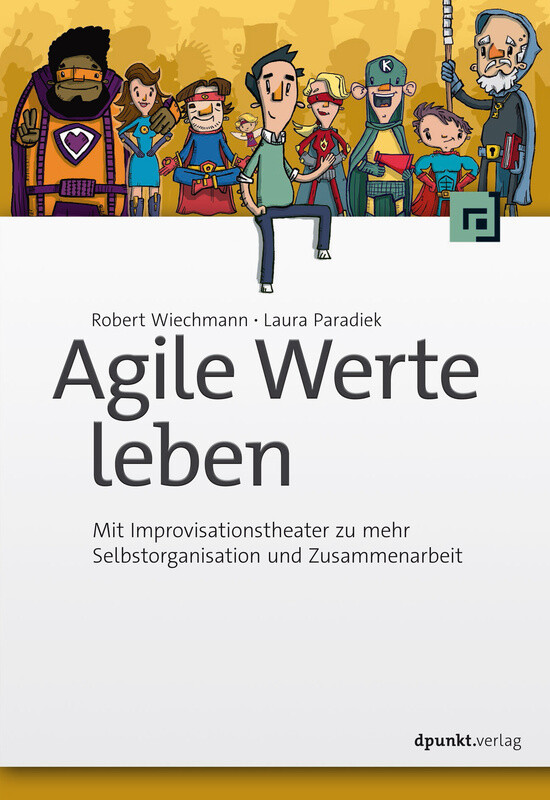
Agile Werte leben
Mit Improvisationstheater zu mehr Selbstorganisation und ZusammenarbeitWas hat Improvisationstheater mit Agilität zu tun? Eine ganze Menge! Denn Agilität ist mehr als Kanban-Kärtchen durch die Gegend schieben, Planning Poker spielen und einen Scrum-Sprint zu planen.Agile Werte und die aus ihnen abgeleiteten Prinzipien in der täglichen Arbeit von Teams oder gar ganzen Organisationen zu verankern, ist keine einfache Aufgabe. Denn oft scheinen diese zu abstrakt und wenig alltagsnah. Und gerade bei verteilten Teams ist es schwierig diese umzusetzen.Robert Wiechmann und Laura Paradiek zeigen Übungen und Techniken aus dem Improvisationstheater, die helfen diese Werte greifbar und erfahrbar zu machen. Hollywoodreife Schauspielkünste sind dafür nicht nötig. Denn im Impro geht es darum, gemeinsam Ideen zu entwickeln, aufeinander zu achten, zusammenzuarbeiten, miteinander zu kommunizieren und aufeinander zu zählen. Auch wenn man sich nur per Kamera sieht.Die Spanne reicht von ganz einfachen bis zu komplizierteren Übungen, damit sich jeder zutraut, mitzumachen. Aha-Momente und ein besseres Verständnis der agilen Werte sind vorprogrammiert.Dieses Buch ...führt in agile Werte ein und erklärt, warum diese so wichtig sind.zeigt, was Improtheater eigentlich ist und warum es agilen Teams und Organisationen helfen kann.gibt übersichtlich und strukturiert Improübungen an die Hand.Über den Autor:Diplom-Kaufmann Robert Wiechmann unterstützt mit Herzblut Organisationen bei ihrer agilen Transition. Neben dem Aufbau und der Beratung von Scrum- und Kanban-Teams in der Softwareentwicklung lässt er auch alle weiteren Unternehmensbereiche nicht aus dem Auge. Er hat Freude daran, Teams jeglicher Fasson zu einer Einheit zusammenzuschweißen und sich dabei ständig weiterzuentwickeln. Die Basis seiner Arbeit baut auf Respekt, Vertrauen sowie Wertschätzung auf. Wichtig ist ihm das Zusammenspiel von Zielorientierung, Klarheit, Einfachheit, Selbstverantwortung, Kreativität und Spaß. Sein Mut, offen auch unbequeme Dinge anzusprechen, lässt die Arbeit mit ihm praxisorientiert und auf Augenhöhe sein. Seine Arbeit als Agiler Coach ist von Kreativität geprägt und scheut auch nicht die Beschreitung neuer Wege.Laura Paradiek ist Kommunikationsfachfrau, Schauspielerin und ausgebildete Business-Trainerin. Nach ihrem Studium der Gesellschafts- und Wirtschaftskommunikation in Berlin führte sie ihr Weg in viele kleine und große Unternehmen. Ob in der Kommunikationsplanung, Veranstaltungsorganisation oder dem Management von Webprojekten – agile Projektmanagementmethoden sind ihr A und O. Neben Scrum und Kanban setzt sie auf Methoden aus dem Improvisationstheater und der Visualisierung. Seit sie 12 Jahre alt ist, steht sie auf der Bühne, u. a. mit der Theater Jugend Hamburg, dem Maxim Gorki Theater in Berlin oder der Hamburger Improvisationstheatergruppe SchillerKiller.

Mit grünen Informationssystemen ineffektive Datentransfers vermeiden. Ein Ansatz zur Nachhaltigkeit in Unternehmen
Um heute wettbewerbsfähig zu bleiben, müssen Unternehmen ihren Mitarbeitern eine Vielzahl von Informationen zur Verfügung stellen. Häufig werden dabei auch viele irrelevante oder veraltete Daten übermittelt, sodass die Mitarbeiter die Suche nach den wichtigen Informationen als ineffektiv empfinden. Gleichzeitig kostet jeder Datentransfer Energie.Welche ökologischen Auswirkungen haben der Abruf und die Übertragung von unnützen Daten? Wie kann eine benutzerzentrierte Ausrichtung der Informationsbereitstellung Energie einsparen? Inwiefern unterscheidet sich ein „Green Knowledge Managementsystem“ von einem „traditionellen“ Wissensmanagementsystem?Nathalie Serban stellt ein „grünes“ Informationssystem vor. Hiermit können Unternehmen mehr Transparenz über Ansprechpartner, Zuständigkeiten, Informationen und Projekte im Aufgabenbereich des jeweiligen Mitarbeiters schaffen und somit irrelevante Datentransfers vermeiden. Ihr Buch richtet sich an Manager, Führungskräfte und IT-Beauftragte.Aus dem Inhalt:- Wissensmanagement;- Umwelt;- CO2;- Ökologie;- E-Mail;- Wettbewerb
Advances in Data Science
PART 1. SYMBOLIC DATA 1CHAPTER 1. EXPLANATORY TOOLS FOR MACHINE LEARNING IN THE SYMBOLIC DATA ANALYSIS FRAMEWORK 3Edwin DIDAY1.1. Introduction 41.2. Introduction to Symbolic Data Analysis 61.2.1. What are complex data? 61.2.2. What are “classes” and “class of complex data”? 71.2.3. Which kind of class variability? 71.2.4. What are “symbolic variables” and “symbolic data tables”? 71.2.5. Symbolic Data Analysis (SDA) 91.3. Symbolic data tables from Dynamic Clustering Method and EM 101.3.1. The “dynamical clustering method” (DCM) 101.3.2. Examples of DCM applications 101.3.3. Clustering methods by mixture decomposition 121.3.4. Symbolic data tables from clustering 131.3.5. A general way to compare results of clustering methods by the “explanatory power” of their associated symbolic data table 151.3.6. Quality criteria of classes and variables based on the cells of the symbolic data table containing intervals or inferred distributions 151.4. Criteria for ranking individuals, classes and their bar chart descriptive symbolic variables 161.4.1. A theoretical framework for SDA 161.4.2. Characterization of a category and a class by a measure of discordance 181.4.3. Link between a characterization by the criteria W and the standard Tf-Idf 191.4.4. Ranking the individuals, the symbolic variables and the classes of a bar chart symbolic data table 211.5. Two directions of research 231.5.1. Parametrization of concordance and discordance criteria 231.5.2. Improving the explanatory power of any machine learning tool by a filtering process 251.6. Conclusion 271.7. References 28CHAPTER 2. LIKELIHOOD IN THE SYMBOLIC CONTEXT 31Richard EMILION and Edwin DIDAY2.1. Introduction 312.2. Probabilistic setting 322.2.1. Description variable and class variable 322.2.2. Conditional distributions 332.2.3. Symbolic variables 332.2.4. Examples 352.2.5. Probability measures on (ℂ, C), likelihood 372.3. Parametric models for p = 1 382.3.1. LDA model 382.3.2. BLS method 412.3.3. Interval-valued variables 422.3.4. Probability vectors and histogram-valued variables 422.4. Nonparametric estimation for p = 1 452.4.1. Multihistograms and multivariate polygons 452.4.2. Dirichlet kernel mixtures 452.4.3. Dirichlet Process Mixture (DPM) 452.5. Density models for p ≥ 2 462.6. Conclusion 462.7. References 47CHAPTER 3. DIMENSION REDUCTION AND VISUALIZATION OF SYMBOLIC INTERVAL-VALUED DATA USING SLICED INVERSE REGRESSION 49Han-Ming WU, Chiun-How KAO and Chun-houh CHEN3.1. Introduction 493.2. PCA for interval-valued data and the sliced inverse regression 513.2.1. PCA for interval-valued data 513.2.2. Classic SIR 523.3. SIR for interval-valued data 533.3.1. Quantification approaches 543.3.2. Distributional approaches 563.4. Projections and visualization in DR subspace 583.4.1. Linear combinations of intervals 583.4.2. The graphical representation of the projected intervals in the 2D DR subspace 593.5. Some computational issues 613.5.1. Standardization of interval-valued data 613.5.2. The slicing schemes for iSIR 623.5.3. The evaluation of DR components 623.6. Simulation studies 633.6.1. Scenario 1: aggregated data 633.6.2. Scenario 2: data based on interval arithmetic 633.6.3. Results 643.7. A real data example: face recognition data 653.8. Conclusion and discussion 733.9. References 74CHAPTER 4. ON THE “COMPLEXITY” OF SOCIAL REALITY. SOME REFLECTIONS ABOUT THE USE OF SYMBOLIC DATA ANALYSIS IN SOCIAL SCIENCES 79Frédéric LEBARON4.1. Introduction 794.2. Social sciences facing “complexity” 804.2.1. The total social fact, a designation of “complexity” in social sciences 804.2.2. Two families of answers 804.2.3. The contemporary deepening of the two approaches, “reductionist” and “encompassing” 814.2.4. Issues of scale and heterogeneity 824.3. Symbolic data analysis in the social sciences: an example 834.3.1. Symbolic data analysis 834.3.2. An exploratory case study on European data 834.3.3. A sociological interpretation 944.4. Conclusion 954.5. References 96PART 2. COMPLEX DATA 99CHAPTER 5. A SPATIAL DEPENDENCE MEASURE AND PREDICTION OF GEOREFERENCED DATA STREAMS SUMMARIZED BY HISTOGRAMS 101Rosanna VERDE and Antonio BALZANELLA5.1. Introduction 1015.2. Processing setup 1035.3. Main definitions 1045.4. Online summarization of a data stream through CluStream for Histogram data 1065.5. Spatial dependence monitoring: a variogram for histogram data 1075.6. Ordinary kriging for histogram data 1105.7. Experimental results on real data 1125.8. Conclusion 1165.9. References 116CHAPTER 6. INCREMENTAL CALCULATION FRAMEWORK FOR COMPLEX DATA 119Huiwen WANG, Yuan WEI and Siyang WANG6.1. Introduction 1196.2. Basic data 1226.2.1. The basic data space 1226.2.2. Sample covariance matrix 1236.3. Incremental calculation of complex data 1246.3.1. Transformation of complex data 1246.3.2. Online decomposition of covariance matrix 1256.3.3. Adopted algorithms 1286.4. Simulation studies 1316.4.1. Functional linear regression 1316.4.2. Compositional PCA 1336.5. Conclusion 1356.6. Acknowledgment 1356.7. References 135PART 3. NETWORK DATA 139CHAPTER 7. RECOMMENDER SYSTEMS AND ATTRIBUTED NETWORKS 141Françoise FOGELMAN-SOULIÉ, Lanxiang MEI, Jianyu ZHANG, Yiming LI, Wen GE, Yinglan LI and Qiaofei YE7.1. Introduction 1417.2. Recommender systems 1427.2.1. Data used 1437.2.2. Model-based collaborative filtering 1457.2.3. Neighborhood-based collaborative filtering 1457.2.4. Hybrid models 1487.3. Social networks 1507.3.1. Non-independence 1507.3.2. Definition of a social network 1507.3.3. Properties of social networks 1517.3.4. Bipartite networks 1527.3.5. Multilayer networks 1537.4. Using social networks for recommendation 1547.4.1. Social filtering 1547.4.2. Extension to use attributes 1557.4.3. Remarks 1567.5. Experiments 1567.5.1. Performance evaluation 1567.5.2. Datasets 1577.5.3. Analysis of one-mode projected networks 1587.5.4. Models evaluated 1607.5.5. Results 1607.6. Perspectives 1637.7. References 163CHAPTER 8. ATTRIBUTED NETWORKS PARTITIONING BASED ON MODULARITY OPTIMIZATION 169David COMBE, Christine LARGERON, Baptiste JEUDY, Françoise FOGELMAN-SOULIÉ and Jing WANG8.1. Introduction 1698.2. Related work 1718.3. Inertia based modularity 1728.4. I-Louvain 1748.5. Incremental computation of the modularity gain 1768.6. Evaluation of I-Louvain method 1798.6.1. Performance of I-Louvain on artificial datasets 1798.6.2. Run-time of I-Louvain 1808.7. Conclusion 1818.8. References 182PART 4. CLUSTERING 187CHAPTER 9. A NOVEL CLUSTERING METHOD WITH AUTOMATIC WEIGHTING OF TABLES AND VARIABLES 189Rodrigo C. DE ARAÚJO, Francisco DE ASSIS TENORIO DE CARVALHO and Yves LECHEVALLIER9.1. Introduction 1899.2. Related Work 1909.3. Definitions, notations and objective 1919.3.1. Choice of distances 1929.3.2. Criterion W measures the homogeneity of the partition P on the set of tables 1939.3.3. Optimization of the criterion W 1959.4. Hard clustering with automated weighting of tables and variables 1969.4.1. Clustering algorithms MND–W and MND–WT 1969.5. Applications: UCI data sets 2019.5.1. Application I: Iris plant 2019.5.2. Application II: multi-features dataset 2049.6. Conclusion 2069.7. References 206CHAPTER 10. CLUSTERING AND GENERALIZED ANOVA FOR SYMBOLIC DATA CONSTRUCTED FROM OPEN DATA 209Simona KORENJAK-ČERNE, Nataša KEJ?AR and Vladimir BATAGELJ10.1. Introduction 20910.2. Data description based on discrete (membership) distributions 21010.3. Clustering 21210.3.1. TIMSS – study of teaching approaches 21510.3.2. Clustering countries based on age–sex distributions of their populations 21710.4. Generalized ANOVA 22110.5. Conclusion 22510.6. References 226List of Authors 229Index 233
CCNA Certification Study Guide, Volume 2
CISCO EXPERT TODD LAMMLE PREPARES YOU FOR THE NEW CISCO CCNA CERTIFICATION EXAM!Cisco, the world leader in network technologies, has released the new Cisco Certified Network Associate (CCNA) exam. This consolidated certification exam tests a candidate’s ability to implement and administer a wide range of modern IT networking technologies. The CCNA Certification Study Guide: Volume 2 Exam 200-301 covers every exam objective, including network components, IP connectivity and routing, network security, virtual networking, and much more. Clear and accurate chapters provide you with real-world examples, hands-on activities, in-depth explanations, and numerous review questions to ensure that you’re fully prepared on exam day.Written by the leading expert on Cisco technologies and certifications, this comprehensive exam guide includes access to the acclaimed Sybex online learning system—an interactive environment featuring practice exams, electronic flashcards, a searchable glossary, a self-assessment test, and video tutorials on critical Cisco networking concepts and technologies.* Covers 100% of all CCNA Exam 200-301 objectives* Provides accurate and up-to-date information on core network fundamentals* Explains a broad range of Cisco networking and IT infrastructure* Features learning objectives, chapter summaries, ‘Exam Essentials’ and figures, tables, and illustrationsThe CCNA Certification Study Guide: Volume 2 Exam 200-301 is the ideal resource for those preparing for the new CCNA certification, as well as IT professionals looking to learn more about Cisco networking concepts and technologies.TODD LAMMLE, Cisco certified in almost every category, is the authority on Cisco networking and certification. His three decades of real-world experience is prevalent in his writing. He is an experienced networking engineer with very practical experience working on the largest bounded and unbounded networks in the world at such companies as Xerox, Hughes Aircraft, Texaco, AAA, Cisco, and Toshiba, among many others. Todd has published over 60 books, including the very popular and bestselling CCNA Cisco Certified Network Associate Study Guide and Cisco Firepower NGIPS. Todd runs an international training company from Texas, and a large-scale consulting business out of Colorado. You can reach Todd through his forum and blog at www.lammle.com/ccna.Introduction xxvAssessment Test xlCHAPTER 1 NETWORK FUNDAMENTALS 1Network Components 2Next-Generation Firewalls and IPS 6Network Topology Architectures 10Physical Interfaces and Cables 17Ethernet Cabling 19Summary 24Exam Essentials 24Review Questions 26CHAPTER 2 TCP/IP 29Introducing TCP/IP 30TCP/IP and the DoD Model 31IP Addressing 60IPv4 Address Types 67Summary 71Exam Essentials 71Review Questions 73CHAPTER 3 EASY SUBNETTING 75Subnetting Basics 76Summary 102Exam Essentials 102Review Questions 103CHAPTER 4 TROUBLESHOOTING IP ADDRESSING 105Cisco’s Way of Troubleshooting IP 106Summary 114Exam Essentials 114Review Questions 115CHAPTER 5 IP ROUTING 117Routing Basics 119The IP Routing Process 121Configuring IP Routing 132Configuring IP Routing in Our Network 141Dynamic Routing 150Routing Information Protocol (RIP) 152Summary 159Exam Essentials 159Review Questions 161CHAPTER 6 OPEN SHORTEST PATH FIRST (OSPF) 163Open Shortest Path First (OSPF) Basics 164Configuring OSPF 171OSPF and Loopback Interfaces 179Verifying OSPF Configuration 182Summary 188Exam Essentials 188Review Questions 189CHAPTER 7 LAYER 2 SWITCHING 193Switching Services 194Configuring Catalyst Switches 204Summary 215Exam Essentials 215Review Questions 216CHAPTER 8 VLANS AND INTER-VLAN ROUTING 219VLAN Basics 220Identifying VLANs 224Routing Between VLANs 229Configuring VLANs 231Summary 247Exam Essentials 247Review Questions 248CHAPTER 9 ENHANCED SWITCHED TECHNOLOGIES 251Spanning Tree Protocol (STP) 252Types of Spanning-Tree Protocols 259Modifying and Verifying the Bridge ID 267Spanning-Tree Failure Consequences 273PortFast and BPDU Guard 275EtherChannel 278Summary 284Exam Essentials 284Review Questions 285CHAPTER 10 ACCESS LISTS 289Perimeter, Firewall, and Internal Routers 290Introduction to Access Lists 291Standard Access Lists 295Extended Access Lists 303Monitoring Access Lists 313Summary 316Exam Essentials 316Review Questions 317CHAPTER 11 NETWORK ADDRESS TRANSLATION (NAT) 319When Do We Use NAT? 320Types of Network Address Translation 322NAT Names 322How NAT Works 323Testing and Troubleshooting NAT 328Summary 333Exam Essentials 333Review Questions 334CHAPTER 12 IP SERVICES 337Exploring Connected Devices Using CDP and LLDP 338Network Time Protocol (NTP) 347SNMP 348Syslog 352Secure Shell (SSH) 357Summary 358Exam Essentials 358Review Questions 360CHAPTER 13 SECURITY 363Network Security Threats 365Three Primary Network Attacks 365Network Attacks 366Security Program Elements 374Layer 2 Security Features 378Authentication Methods 381Managing User Accounts 386Security Password Policy Elements 389User-Authentication Methods 398Setting Passwords 400Summary 407Exam Essentials 407Review Questions 408CHAPTER 14 FIRST HOP REDUNDANCY PROTOCOL (HSRP) 411Client Redundancy Issues 412Introducing First Hop Redundancy Protocol (FHRP) 414Hot Standby Router Protocol (HSRP) 416Summary 429Exam Essentials 429Review Questions 430CHAPTER 15 VIRTUAL PRIVATE NETWORKS (VPNS) 433Virtual Private Networks 434GRE Tunnels 441Summary 447Exam Essentials 447Review Questions 448CHAPTER 16 QUALITY OF SERVICE (QOS) 451Quality of Service 452Trust Boundary 454QoS Mechanisms 455Summary 461Exam Essentials 461Review Questions 462CHAPTER 17 INTERNET PROTOCOL VERSION 6 (IPV6) 465Why Do We Need IPv6? 467The Benefits and Uses of IPv6 467IPv6 Addressing and Expressions 469How IPv6 Works in an Internetwork 473IPv6 Routing Protocols 483Configuring IPv6 on Our Internetwork 484Configuring Routing on Our Internetwork 487Summary 490Exam Essentials 490Review Questions 492CHAPTER 18 TROUBLESHOOTING IP, IPV6, AND VLANS 495Endpoints 496Servers 497IP Config 498Troubleshooting IP Network Connectivity 507Troubleshooting IPv6 Network Connectivity 522Troubleshooting VLAN Connectivity 531Summary 544Exam Essentials 545Review Questions 546CHAPTER 19 WIRELESS TECHNOLOGIES 549Wireless Networks 551Basic Wireless Devices 553Wireless Principles 556Nonoverlapping Wi-Fi channels 565Radio Frequency (RF) 569Wireless Security 581Summary 588Exam Essentials 588Review Question 590CHAPTER 20 CONFIGURING WIRELESS TECHNOLOGIES 595WLAN Deployment Models 596Setting Up a Wireless LAN Controller (WLC) 602Joining Access Points (APs) 607Wireless LAN Controllers (WLC) 610WLC Port Types 611WLC Interface Types 614AP Modes 629AP and WLC Management Access Connections 633Summary 655Exam Essentials 655Review Questions 657CHAPTER 21 VIRTUALIZATION, AUTOMATION, AND PROGRAMMABILITY 661Virtual Machine Fundamentals 662Virtualization Components 665Virtualization Features 666Virtualization Types 668Virtualization Solutions 669Automation Components 670Summary 684Exam Essentials 684Review Questions 685CHAPTER 22 SDN CONTROLLERS 689Traditional Network Monitoring Systems (NMS) 690Traditional Network Configuration Managers (NCM) 699Traditional Networking 702Introduction to SDN 706Separating the Control Plane 709Controller-Based Architectures 710SDN Network Components 712DNA Center Overview 718Summary 736Exam Essentials 737Review Questions 738CHAPTER 23 CONFIGURATION MANAGEMENT 743Team Silos 744DevOps 748Infrastructure as Code (IaC) 748Ansible 750Ansible Tower/AWX 763Puppet 764Chef 772Summary 781Exam Essentials 782Review Questions 783APPENDIX ANSWER TO REVIEW QUESTIONS 787Chapter 1: Network Fundamentals 788Chapter 2: TCP/IP 788Chapter 3: Easy Subnetting 789Chapter 4: Troubleshooting IP Addressing 790Chapter 5: IP Routing 791Chapter 6: Open Shortest Path First (OSPF) 792Chapter 7: Layer 2 Switching 792Chapter 8: VLANs and Inter-VLAN Routing 794Chapter 9: Enhanced Switched Technologies 795Chapter 10: Access Lists 796Chapter 11: Network Address Translation (NAT) 797Chapter 12: IP Services 797Chapter 13: Security 798Chapter 14: First Hop Redundancy Protocol (HSRP) 799Chapter 15: Virtual Private Networks (VPNs) 800Chapter 16: Quality of Service (QoS) 801Chapter 17: Internet Protocol Version 6 (IPv6) 802Chapter 18: Troubleshooting IP, IPv6, and VLANs 803Chapter 19: Wireless Technologies 803Chapter 20: Configuring Wireless Technologies 805Chapter 21: Virtualization, Automation, and Programmability 806Chapter 22: SDN Controllers 806Chapter 23: Configuration Management 808Index 809
Blender For Dummies
MAKE YOUR 3D WORLD A REALITYSome of the dramatic visual effects you've seen in top-grossing movies and heralded television series got their start in Blender. This book helps you get your own start in creating three-dimensional characters, scenes, and animations in the popular free and open-source tool.Author Jason van Gumster shares his insight as an independent animator and digital artist to help Blender newcomers turn their ideas into three-dimensional drawings. From exporting and sharing scenes to becoming a part of the Blender community, this accessible book covers it all!* Create 3D characters—no experience required* Build scenes with texture and real lighting features* Animate your creations and share them with the world* Avoid common rookie mistakesThis book is the ideal starting place for newcomers to the world of 3D modeling and animation.JASON VAN GUMSTER, author of all previous editions of Blender For Dummies, has used Blender in animation, video, and digital design for over 20 years. A Blender Foundation Certified Trainer, he has taught numerous students and serves as lead moderator on BlenderArtists.org, the largest Blender community website. INTRODUCTION 1About This Book 2Foolish Assumptions 2Icons Used in This Book 4Beyond the Book 4Where to Go from Here 5PART 1: WRAPPING YOUR BRAIN AROUND BLENDER 7CHAPTER 1: DISCOVERING BLENDER 9Getting to Know Blender 10Discovering Blender’s origins and the strength of the Blender community 11Making open movies and games 12Getting to Know the Interface 15Working with an interface that stays out of your way 17Resizing areas 19Maximizing an area 20The menu that is a pie 22CHAPTER 2: UNDERSTANDING HOW BLENDER THINKS 25Looking at Editor Types 25General editors 26Animation editors 28Scripting editors 29Data editors 29Understanding the Properties editor 30Navigating in Three Dimensions 32Orbiting, panning, and zooming the 3D Viewport 32Changing views 35Selecting objects 40Taking advantage of the 3D cursor 40Extra Features in the 3D Viewport 44Quad View 44Regions 45Collaborating (with others and yourself) with annotations 48Don’t know how to do something? Hooray for fully Integrated search! 49Customizing Blender to Fit You 50Using preset workspaces 51Blender workflows 55Setting user preferences 57Using custom event maps 58Speeding up your workflow with Quick Favorites 61CHAPTER 3: GETTING YOUR HANDS DIRTY WORKING IN BLENDER 63Grabbing, Scaling, and Rotating 64Differentiating Between Coordinate Systems 64Transforming an Object by Using Object Gizmos 67Activating object gizmos 68Using object gizmos 69Saving Time by Using Hotkeys 72Transforming with hotkeys 73Hotkeys and coordinate systems 73Numerical input 76The Sidebar 76CHAPTER 4: WORKING IN EDIT MODE AND OBJECT MODE 77Making Changes by Using Edit Mode 77Switching between Object mode and Edit mode 78Selecting vertices, edges, and faces 79Working with linked vertices 84Still Blender’s No 1 modeling tool: Extrude 85Adding to a Scene 90Adding objects 90Meet Suzanne, the Blender monke 92Joining and separating objects 93Creating duplicates and links 95Discovering parents, children, and collections 101Saving, opening, and appending 108PART 2: CREATING DETAILED 3D SCENES 111CHAPTER 5: CREATING ANYTHING YOU CAN IMAGINE WITH MESHES 113Pushing Vertices 114Getting familiar with Edit mode tools 116Adding geometry by insetting 117Cutting edges with the Knife 122Rounding your corners by beveling 126Spiraling new geometry into existence with the Spin tool 130Working with Loops and Rings 131Understanding edge loops and face loops 132Selecting edge rings 134Creating new loops 135Simplifying Your Life as a Modeler with Modifiers 137Understanding modifier types 140Doing half the work (and still looking good!) with the Mirror modifier 147Smoothing things out with the Subdivision Surface modifier 149Using the power of Arrays 153CHAPTER 6: SCULPTING IN VIRTUAL SPACE 157Adding Background Images in the 3D Viewport 158Mastering the types of image objects 159Changing image object properties 160Adjusting your image objects 162Setting Up Your Sculpting Workspace 163Sculpting a Mesh Object 166Understanding sculpt tool types 166Tweaking brush properties 173Refining control of your tools 174Creating custom brushes 176Using Blender’s texture system to tweak brushes 176Sculpting with the Multiresolution modifier 177Freeform Sculpting with Dynamic Topology (Dyntopo) 180Understanding the Basics of Retopology 184CHAPTER 7: USING BLENDER’S NON-MESH PRIMITIVES 189Using Curves and Surfaces 190Understanding the different types of curves 192Working with curves 193Understanding the strengths and limitations of Blender’s Surfaces 212Using Metaball Objects 213Meta-wha? 214What metaball objects are useful for 217Adding Text 217Adding and editing text 218Controlling text appearance 219Deforming text with a curve 227Converting to curves and meshes 228CHAPTER 8: CHANGING THAT BORING GRAY DEFAULT MATERIAL 229Understanding Materials and Render Engines 230Quick ’n’ Dirty Coloring 233Setting diffuse colors 233Assigning multiple materials to different parts of a mesh 235Using vertex colors 240Setting Up Node Materials 247Adjusting your workspace to work with materials 248Working with nodes 249Understanding shaders 250Playing with Materials in Blender 251Demystifying the Principled BSDF 252Combining shaders with the Mix Shader node 258Playing with the Shader to RGB node 263CHAPTER 9: GIVING MODELS TEXTURE 267Adding Textures 267Using Procedural Textures 268Understanding Texture Mapping 272Making simple adjustments with the Texture Mapping panel 272Using texture coordinates 273Understanding Object coordinates and the UV Project modifier 278Unwrapping a Mesh 281Marking seams on a mesh 282Adding a test grid 283Generating and editing UV coordinates 284Painting Textures Directly on a Mesh 287Preparing to paint 288Working in Texture Paint mode 290Using textures on your Draw tool 292Saving Painted Textures and Exporting UV Layouts 295CHAPTER 10: LIGHTING AND ENVIRONMENT 297Lighting a Scene 297Understanding a basic three-point lighting setup 298Knowing when to use which type of light 301Lighting for Speedy Renders 317Working with three-point lighting in Blender 318Using Look Dev to set up lighting 318Setting Up the World 320Changing the sky to something other than dull gray 320Understanding ambient occlusion 325Working with Light Probes in Eevee 328Baking from your light probes 330Understanding the limitations of light probes 332PART 3: GET ANIMATED! 333CHAPTER 11: ANIMATING OBJECTS 335Working with Animation Curves 336Customizing your screen layout for Animation 338Inserting keys 340Working with keying sets 345Working in the Graph Editor 351Editing motion curves 352Using Constraints Effectively 356The all-powerful Empty! 357Adjusting the influence of a constraint 360Using vertex groups in constraints 361Copying the movement of another object 361Putting limits on an object 363Tracking the motion of another object 365CHAPTER 12: RIGGING: THE ART OF BUILDING AN ANIMATABLE PUPPET 367Creating Shape Keys 368Creating new shapes 368Mixing shapes 370Knowing where shape keys are helpful 372Adding Hooks 373Creating new hooks 373Knowing where hooks are helpful 375Using Armatures: Skeletons in the Mesh 375Editing armatures 376Putting skin on your skeleton 390Bringing It All Together to Rig a Character 396Building Stickman’s centerline 396Adding Stickman’s appendages 397Taking advantage of parenting and constraints 400Comparing inverse kinematics and forward kinematics 403Making the rig more user friendly 407CHAPTER 13: ANIMATING OBJECT DEFORMATIONS 411Working with the Dope Sheet 411Selecting keys in the Dope Sheet 412Working with markers 415Recognizing different kinds of keyframe indicators 416Animating with Armatures 418Principles of animation worth remembering 420Making sense of quaternions (or, “Why are there four rotation curves?!”) 423Copying mirrored poses 424Doing Nonlinear Animation 425Working with actions 426Mixing actions to create complex animation 429Taking advantage of looped animation 430CHAPTER 14: LETTING BLENDER DO THE WORK FOR YOU 433Using Particles in Blender 435Knowing what particle systems are good for 436Using force fields and collisions 440Using particles for hair and fur 442Giving Objects Some Jiggle and Bounce 446Dropping Objects in a Scene with Rigid Body Dynamics 449Simulating Cloth 450Splashing Fluids in Your Scene 452Smoking without Hurting Your Lungs: Smoke Simulation in Blender 457Creating a smoke simulation 457Rendering smoke 458CHAPTER 15: MAKING 2D AND 2.5D ANIMATION WITH GREASE PENCIL 461Getting Started with the 2D Animation Workspace 462Working with Grease Pencil tools 464Drawing with Grease Pencil 465Sculpting Grease Pencil objects 470Editing Grease Pencil objects 472Understanding Grease Pencil Materials 473Mastering Grease Pencil Layers 478Automating Your Drawings with Grease Pencil Modifiers 482Animating with Grease Pencil 488Using a hand-drawn animation workflow with Grease Pencil objects 488Rigging Grease Pencil objects for animation 492Integrating Grease Pencil with a 3D Scene 495PART 4: SHARING YOUR WORK WITH THE WORLD 497CHAPTER 16: EXPORTING AND RENDERING SCENES 499Exporting to External Formats 499Rendering a Scene 502Creating a still image 502Creating a sequence of still images for editing or compositing 509CHAPTER 17: EDITING VIDEO AND ANIMATION 513Comparing Editing to Compositing 514Working with the Video Sequencer 514Adding and editing strips 518Adding effects and transitions 525Rendering from the Video Sequencer 527CHAPTER 18: COMPOSITING IMAGES AND VIDEO 531Understanding Nodes 531Getting Started with the Compositor 534Rendering in Passes and Layers 535Discovering Passes Available in Eevee and Cycles 536Understanding Cycles-only Light Passes 540Meet Cryptomatte 542Working with Nodes 544Configuring the backdrop 545Identifying Parts of a Node 547Navigating the Compositor 548Adding nodes to your compositing network 549Grouping nodes together 550Discovering the Nodes Available to You 550Rendering from the Compositor 552CHAPTER 19: MIXING VIDEO AND 3D WITH MOTION TRACKING 553Making Your Life Easier by Starting with Good Video 554Knowing your camera 554Keeping your lighting consistent 556Having images in good focus 557Understanding the scene 558Getting Familiar with the Motion Tracking Workspace 559Tracking Movement in Blender 561Adding markers and tracking 563Solving camera motion from tracker data 569Setting up your scene for integrating with your video footage 573Where to Go from Here 575PART 5: THE PART OF TENS 577CHAPTER 20: TEN TIPS FOR WORKING MORE EFFECTIVELY IN BLENDER 579Use Tooltips and Integrated Search 579Take Advantage of the Quick Favorites Menu 580Look at Models from Different Views 580Don’t Forget about Add-ons 582Lock a Camera to an Animated Character 582Name Everything 583Do Low-Resolution Test Renders 583Use Annotations to Plan 586Ask for Help 586Have Fun, but Take Breaks 587CHAPTER 21: TEN EXCELLENT COMMUNITY RESOURCES 589Blender org 589Blender ID 590Blender manual 590Developer blog 590Bug reporting and developer discussions 590builder blender org 591Blender Cloud 592BlenderArtists org 592BlenderNation 592BlenderBasics com 593Blender Stackexchange com 593CGCookie com 593Blend Swap (blendswap com) 593Blender community 594Blender Today 594Right-Click Select 594Blender NPR 595Social Media 595Blender chat 596Index 597

Produkt-Entwicklung
PRODUKTENTWICKLUNG LEAN & AGILE //- Hier erfahren Sie, wie Sie agile Ansätze erfolgreich bei der Entwicklung von physischen Produkten einsetzen können.- Sie lernen die Grundlagen des Lean Development kennen, mit dem Sie Ihren eigenen Weg zur Verbesserung Ihrer Abläufe finden.- Sie profitieren von der Praxiserfahrung des Autors und vielen Beispielen aus der agilen Entwicklung von Mechanik- und Elektronikprodukten.- Zusätzlich: Impulse für Lean / Agil in der Organisationsentwicklung- Sonderkapitel: Compliance am Beispiel ISO26262 und Automotive SPICE®Scrum, Kanban und Co sind längst aus der Welt der Softwareentwicklung ausgebrochen: Von Nockenwellen über Maschinen und Halbleiter bis hin zu Flugzeugen – immer mehr Unternehmen profitieren von Konzepten wie Lean Development oder agile Produktentwicklung.Dieses Buch stellt dar, wie Lean Development und agile Ansätze zur Entwicklung von physischen Produkten erfolgreich eingesetzt werden können.Aus Sicht des Engineering liegt dabei der Fokus auf der Definition des Produkt-Inkrements, agilen Systemarchitekturen und neuen Technologien. Als Praxishandbuch zeigt es Vorgehen und Beispiele für die ersten Schritte: Welche Trainings und Workshops bereiten die Organisation für den Start vor? Wie läuft ein agiles Entwicklungsvorhaben ab?Verschiedene Ansätze zur Umsetzung über die Team-Ebene hinaus sowie viele Praxistipps runden dieses Werk ab.AUS DEM INHALT //- Teil I: GrundlagenMotivation für Lean/Agil // Lean Production // Engpasstheorie // Lean Development // Scrum // Kanban // Menschen und Teams- Teil II: HerausforderungenDefinition des Produkt- Inkrements // Vergleich zu Inkrementen bei der Software // Reduzierung von Zykluszeiten // Management und Leadership // PEP und Unterstützungsprozesse // Prozessreifegradmodelle / Funktionale Sicherheit- Teil III: UmsetzungAuswahl des Konzepts // Scrum-Teams // Kanban- Teams // Umsetzung auf Wertstromebene // Planen und Verfolgen // Schnittstellen zu Kunden und Lieferanten // Lernen auf Team und Organisationsebene // Portfolio Management // Einladungsbasierte Organisationsentwicklung Joachim Pfeffer ist Unternehmensberater und agiler Coach. Nach über zehn Jahren in der Produktentwicklung (Software, Elektronik, Mechanik) und sechs Jahren Beratungspraxis in Entwicklungs- und Dienstleistungsprozessen beschäftigt sich Joachim Pfeffer heute hauptsächlich mit der Einführung von Lean/Agile in der Embedded- und Mechanik-Entwicklung sowie in administrativen Prozessen. Sein besonderes Augenmerk liegt dabei auf der ökonomischen Optimierung von Entwicklungsprojekten. Als Inhaber einer Berufspilotenlizenz überträgt Joachim Pfeffer Teamkonzepte aus der Luftfahrt auf Management und Entwicklungsteams. Er kommt aus Wangen im Allgäu.
Architecting Enterprise Blockchain Solutions
DEMYSTIFY ARCHITECTING COMPLEX BLOCKCHAIN APPLICATIONS IN ENTERPRISE ENVIRONMENTSArchitecting Enterprise Blockchain Solutions helps engineers and IT administrators understand how to architect complex blockchain applications in enterprise environments. The book takes a deep dive into the intricacies of supporting and securing blockchain technology, creating and implementing decentralized applications, and incorporating blockchain into an existing enterprise IT infrastructure.Blockchain is a technology that is experiencing massive growth in many facets of business and the enterprise. Most books around blockchain primarily deal with how blockchains are related to cryptocurrency or focus on pure blockchain development. This book teaches what blockchain technology is and offers insights into its current and future uses in high performance networks and complex ecosystems.* Provides a practical, hands-on approach* Demonstrates the power and flexibility of enterprise blockchains such as Hyperledger and R3 Corda* Explores how blockchain can be used to solve complex IT support and infrastructure problems* Offers numerous hands-on examples and diagramsGet ready to learn how to harness the power and flexibility of enterprise blockchains!JOSEPH HOLBROOK is an expert on enterprise cloud and blockchain architectures, a widely published course author, and owner of the online learning platform myblockchainexperts.com. Joe is a Certified Bitcoin Professional (CBP), Certified Blockchain Solutions Architect (CBSA), and holds industry certifications from Amazon Web Services, Google Cloud Platform, Brocade, CompTIA, Blockchain Training Alliance, and numerous others. He has worked for companies such as HDS, 3PAR Data, Brocade, Northrup Grumman, Siemens Nixdorf, and Hitachi Data Systems. Foreword xxiIntroduction xxiiiCHAPTER 1 INTRODUCTION TO BLOCKCHAIN TECHNOLOGIES 1What is a Blockchain? 2My Approach to the Definition3Technical Audience 3Business Audience 3Legal Audience 5Three Definitions of Blockchain 5History of Blockchains 5Blockchain vs Traditional Database 9Distribution of Trust 10Consensus and Trust 10Summary of Differences Between Ledgers and Traditional Databases 10Cap Theorem 12Common Properties of Permissionless Blockchains 13Why the Blockchain is Considered Revolutionary 15Blockchain Principles 15Trust or Trustless 16Transparency and Blockchain 18Blockchain Transaction Basics 20Consensus 20Blocks 20Types of Blockchains 21Public, Private, and Hybrid Blockchains 21Summary 27CHAPTER 2 ENTERPRISE BLOCKCHAINS: HYPERLEDGER, R3 CORDA, QUORUM, AND ETHEREUM 29Comparing Enterprise Blockchains 29Introducing the Hyperledger Project 31Hyperledger Frameworks 32Introducing Hyperledger Fabric 35Hyperledger Fabric Ledger 37Hyperledger Fabric Consensus 38Hyperledger Fabric Transactions 38Hyperledger Fabric Nodes 40Hyperledger Fabric Business Networks 40Hyperledger Fabric Chaincode (Smart Contracts) 41Hyperledger Fabric Development Tools 41Hyperledger Fabric Governance 43Introducing R3 Corda 43R3 Corda Blockchain Fundamentals 46R3 Corda Network 46R3 Corda Ledger 47R3 Corda Consensus 48R3 Corda Nodes 49R3 Corda States 49R3 Corda Transactions 50R3 Corda Client Applications 50R3 Corda Smart Contracts 51R3 Corda Development Tools 52R3 Corda Governance 53Introducing Quorum 54Quorum Blockchain Fundamentals 55Quorum Ledger 56Quorum Consensus 56Quorum Smart Contracts 56Quorum Tools and Utilities 57Quorum Governance 58Introducing Ethereum 58Ethereum Blockchain Fundamentals 60Ethereum Ledger 61Ethereum Node EVM 61Ethereum Client Apps 63Ethereum Transactions 64Ethereum Smart Contracts 64Ethereum Wallets 66Ethereum Tools and Utilities 66Ethereum Governance 68Summary 68CHAPTER 3 ARCHITECTING YOUR ENTERPRISE BLOCKCHAIN 69Blockchain Technology Focus Areas 69Blockchain Success Areas 70Blockchain Compliance 71Architecting a Blockchain Solution 71Blockchain Design Workflow 72Use Case Potential 72Blockchain Structure and Components 77Blockchain Structure 77Blockchain Core Components 79Enterprise Blockchain Architectures 81TOGAF Domains 81What, Who, and How of Enterprise Architecture 82Tenets 82Blockchain Design 83Enterprise Blockchain Adoption Challenges 84Risk Management 84Blockchain as a Hammer 85Enterprise Blockchain Design Principles 85Enterprise Blockchain Design Requirements 86Other Concerns—Deployment Model 90Hyperledger Fabric 90Hyperledger Fabric’s Main Selling Points 91Hyperledger Fabric’s Blockchain Design Considerations 91Hyperledger Fabric’s Advantages 91Hyperledger Fabric’s Design Example Architectures 96R3 Corda 98R3 Corda’s Main Selling Points 98R3 Corda’s Design Considerations 98R3 Corda’s Design Example Architectures 102Ethereum 104Ethereum’s Selling Points 104Ethereum’s Blockchain Design 105Ethereum’s Design Example Architectures 107Quorum 109Quorum’s Selling Points 109Quorum’s Blockchain Design Principles 111Quorum’s Design Example Architectures 113Summary 114CHAPTER 4 UNDERSTANDING ENTERPRISE BLOCKCHAIN CONSENSUS 117Blockchain Consensus Methods from a Historical Perspective 118The Importance of Consensus 118Byzantine Generals Problem 119Byzantine Fault Tolerance 121Comparing Enterprise Blockchain Consensus Methods 121Proof-of-Work Consensus 122Proof-of-Stake Consensus 124Comparing Proof of Work and Proof of Stake 125Proof of Elapsed Time 126Delegated Proof of Stake 128Delegated Byzantine Fault Tolerance 129Practical Byzantine Fault Tolerance 130Istanbul Byzantine Fault Tolerance 130Raft Consensus 131Directed Acyclic Graph 132Blockchain Consensus Evaluation 134Summary 135CHAPTER 5 ENTERPRISE BLOCKCHAIN SALES AND SOLUTIONS ENGINEERING 137Enterprise Blockchain Sales Cycle 137Blockchain Roles (Stakeholders) 139IT-Based Sales Cycles 141Presales Tasks 143Selling Enterprise Blockchain Solutions 152Sales Engineering Success 159Summary 162CHAPTER 6 ENTERPRISE BLOCKCHAIN ECONOMICS 163Introduction to Enterprise Blockchain Economics 163Enterprise Ecommerce Business Models 163Value Creation 164Blockchain Payment Gateways 164Stablecoins 165Blockchain Funding and Costs 166CAPEX and OPEX 166Cost Considerations 168Enterprise Blockchain Cost Models 173Return on Investment 174Total Cost of Ownership 176ROI vs TCO 177Potential Cost Efficiencies 177Reducing Burdened Labor Costs 177Using OPEX over CAPEX 179Lower Transaction Costs 179Costless Verification 179Intermediary Roles and Blockchain 179Summary 181CHAPTER 7 DEPLOYING YOUR BLOCKCHAIN ON BAAS 183Blockchain as a Service Overview 183Why Use a Blockchain as a Service? 184Benefits of Using a Blockchain as a Service 184Negatives of Using a Blockchain as a Service 185Blockchain as a Service for Sales Teams 186Blockchain as a Service Providers 186Amazon Web Services Options 187AWS Blockchain templates Deployment High-Level Steps 189Understanding AWS Regions and Availability Zones 189Deploying Hyperledger on AWS 191Deploying AWS Managed Blockchain 221IBM Cloud Blockchain Platforms 231Blockchain Platform 2.0 231Summary 239CHAPTER 8 ENTERPRISE BLOCKCHAIN USE CASES 241Merits of Blockchain Acceptance 241Technical Merits of Blockchain 242Business Merits of Blockchain 243Common Elements of Blockchain Adoption 244Financial Sector Use Cases 244Cross-Border Payments 245Know Your Customer 247Peer-to-Peer Lending 248Security Tokenization 248Logistics Use Cases 249Supply Chain 250Internet of Things 250Farm to Table 251Government Use Cases 252City/State of Dubai 252Country of Georgia 252Healthcare Use Cases 253Other Potential Use Cases 254Zero-Knowledge Proofs 254Social Impact, Charity, and Fundraising 255Distributed Cloud Storage 255Identity Management 255Summary 256CHAPTER 9 BLOCKCHAIN GOVERNANCE, RISK, AND COMPLIANCE (GRC), PRIVACY, AND LEGAL CONCERNS 257Governance, Risk, and Compliance 257Compliance Benefits 258Regulatory Oversight 259Common Compliance Requirements 261Smart Contract Legal Concerns 271Smart Contract Enforcement 272Smart Contract Adaptability 273Legal Jurisdiction 274Liability of Services 274Financial Sector Compliance 275Handling Customer Data 275Intellectual Property 275Auditing and Logging 276Summary 277CHAPTER 10 BLOCKCHAIN DEVELOPMENT 279Common Programming Languages 279Most Common Development Languages 280Less Widely Used Development Languages 282Summary of Blockchain Platforms 283Ethereum Development 284Smart Contracts 284Ethereum Ecosystem 288Ethereum Networks 291Ethereum Nodes 295Solidity Programming Language 296Ethereum APIs 297Ethereum Testing 299Hyperledger Development 303Chaincode 303Hyperledger Fabric Consensus Options 305Hyperledger Fabric Database Options 305Client Applications 306Fabric REST Services 307Service Discovery 307Hyperledger Composer 307R3 Corda Development 310Corda Consensus Model 311CorDapps 311Corda Network and Nodes 312Corda Service Hub 312Corda Doorman 313Corda Flows 313Client RPC 313Oracles 313Corda DemoBench 313Quorum Development 315Quorum vs Ethereum 315Quorum Cakeshop 315Blockchain Performance 316Permission or Permissionless Performance 318Performance Testing 319Blockchain Integration and Interoperability 320Data Exchange Methods 321Hash Timed Locks 321Relays and Gateways 321Summary 322CHAPTER 11 BLOCKCHAIN SECURITY AND THREAT LANDSCAPE 323Blockchain Security Basics 323Confidentiality, Integrity, and Availability 324Blockchain Best Practices 325Blockchain Security Audits 327Blockchain Security Assumptions 328Blockchain Cryptography 328Blockchain Risks 332Risk Assessment 332Risk Mitigation 333Blockchain Threat Landscape 33551 Percent Attacks 335Phishing Attacks 336DDOS Attacks 336DNS Hijacking Attacks 337Eclipse Attacks 337Insider Attacks 338Replay Attacks 338Routing Attacks 339Sybil Attacks 339Smart Contract Security 339Smart Contract Legal Prose 339Smart Contract Vulnerabilities 340Blockchain-Specific Features 340Ethereum 341Hyperledger Fabric 343R3 Corda Blockchain 344Quorum 345Summary 347CHAPTER 12 BLOCKCHAIN MARKETPLACE OUTLOOK 349Technology Investments 349Investments in Blockchain350Blockchain Market Patents 350Blockchain Market Growth 352Complementary and Adverse Blockchain Acceptance Drivers 352Blockchain Expertise Demand 353Blockchain Market Expertise Expansion 353Blockchain Certifications 354Blockchain Institute of Technology 355Blockchain Council 355Blockchain Training Alliance 356Summary 357Index 359

Topics in Multiphase Transport Phenomena
Chapter 1 A Fluid-Porous Solid Reaction Model With Structural Changes, supplies details on modeling reactions with porous catalysts. The unique feature of this chapter is the pore closing, pore opening condition. This analysis is particularly useful for improving the design of storage batteries. Until the publication of “A Model for Discharge of Storage Batteries” by Dimitri Gidaspow and Bernard S. Baker, Journal of the Electrochemical Society,120, 1005-1010 (1973) the discharge of batteries was described by a purely empirical equation as a function of time. Chapter 2 Kinetics of the Reaction of CO2 With Solid K2CO3, complements U.S. patent No. 3,865,924 (February 11,1975) by Dimitri Gidaspow and Michael Onischak, on rates of carbon dioxide (CO2) capture. These rates of reaction were measured in a parallel plate channel at several laminar flow velocities. An integral equation flow analysis was used to obtain diffusion independent rates of reactions. Chapter 3 Silicon Deposition Reactor Using High Voltage Heating, describes an internally heated fluidized bed with no size limitations and with no bubble formation and its simulation. Chapter 4 Alternative Methods of Deriving Multiphase Field Equations, constitutes a literature review of approaches that have been used and/or proposed in the literature to derive multiphase flow equations which could form the basis of the theory and computation of dense suspensions of particulates such as coal-water slurries or blood flow.

Introduction to Oracle Database Administration
This book is not Oracle theory or database management system theory book. It is not Oracle programming book either. It is an Oracle DBA (Database Administrator) practice process and scripts and documentations based on author’s working experiences. The readers can be people who are interested in learning knowledge on Oracle database administrations like developers working on Oracle database, Oracle DBA beginners who wants to know how to manage their Oracle database, IT managers who wants to have some concepts and knowledge on Oracle DBA jobs etc. In this book, the author provides process, scripts, tools and methods to do Oracle DBA jobs like backup/recover methods and scripts, database clone scripts, regular database maintenance like index defragmentation scripts etc in Oracle 11g and 12C and Windows Server environments.
Applied Incident Response
Incident response is critical for the active defense of any network, and incident responders need up-to-date, immediately applicable techniques with which to engage the adversary. Applied Incident Response details effective ways to respond to advanced attacks against local and remote network resources, providing proven response techniques and a framework through which to apply them. As a starting point for new incident handlers, or as a technical reference for hardened IR veterans, this book details the latest techniques for responding to threats against your network, including:* Preparing your environment for effective incident response* Leveraging MITRE ATT&CK and threat intelligence for active network defense* Local and remote triage of systems using PowerShell, WMIC, and open-source tools* Acquiring RAM and disk images locally and remotely* Analyzing RAM with Volatility and Rekall* Deep-dive forensic analysis of system drives using open-source or commercial tools* Leveraging Security Onion and Elastic Stack for network security monitoring* Techniques for log analysis and aggregating high-value logs* Static and dynamic analysis of malware with YARA rules, FLARE VM, and Cuckoo Sandbox* Detecting and responding to lateral movement techniques, including pass-the-hash, pass-the-ticket, Kerberoasting, malicious use of PowerShell, and many more* Effective threat hunting techniques* Adversary emulation with Atomic Red Team* Improving preventive and detective controlsSTEVE ANSON is a SANS Certified Instructor and co-founder of leading IT security company Forward Defense. He has over 20 years of experience investigating cybercrime and network intrusion incidents. As a former US federal agent, Steve specialized in intrusion investigations for the FBI and DoD. He has taught incident response and digital forensics techniques to thousands of students around the world on behalf of the FBI Academy, US Department of State, and the SANS Institute. He has assisted governments in over 50 countries to improve their strategic and tactical response to computer-facilitated crimes and works with a range of multinational organizations to prevent, detect and respond to network security incidents. PART I PREPARE 1CHAPTER 1 THE THREAT LANDSCAPE 3Attacker Motivations 3Intellectual Property Theft 4Supply Chain Attack 4Financial Fraud 4Extortion 5Espionage 5Power 5Hacktivism 6Revenge 6Attack Methods 6DoS and DDoS 7Worms 8Ransomware 8Phishing 9Spear Phishing 9Watering Hole Attacks 10Web Attacks 10Wireless Attacks 11Sniffing and MitM 11Crypto Mining 12Password Attacks 12Anatomy of an Attack 13Reconnaissance 13Exploitation 14Expansion/Entrenchment 15Exfiltration/Damage 16Clean Up 16The Modern Adversary 16Credentials, the Keys to the Kingdom 17Conclusion 20CHAPTER 2 INCIDENT READINESS 21Preparing Your Process 21Preparing Your People 27Preparing Your Technology 30Ensuring Adequate Visibility 33Arming Your Responders 37Business Continuity and Disaster Recovery 38Deception Techniques 40Conclusion 43PART II RESPOND 45CHAPTER 3 REMOTE TRIAGE 47Finding Evil 48Rogue Connections 49Unusual Processes 52Unusual Ports 55Unusual Services 56Rogue Accounts 56Unusual Files 58Autostart Locations 59Guarding Your Credentials 61Understanding Interactive Logons 61Incident Handling Precautions 63RDP Restricted Admin Mode and Remote Credential Guard 64Conclusion 65CHAPTER 4 REMOTE TRIAGE TOOLS 67Windows Management Instrumentation Command-Line Utility 67Understanding WMI and the WMIC Syntax 68Forensically Sound Approaches 71WMIC and WQL Elements 72Example WMIC Commands 79PowerShell 84Basic PowerShell Cmdlets 87PowerShell Remoting 91Accessing WMI/MI/CIM with PowerShell 95Incident Response Frameworks 98Conclusion 100CHAPTER 5 ACQUIRING MEMORY 103Order of Volatility 103Local Memory Collection 105Preparing Storage Media 107The Collection Process 109Remote Memory Collection 117WMIC for Remote Collection 119PowerShell Remoting for Remote Collection 122Agents for Remote Collection 125Live Memory Analysis 128Local Live Memory Analysis 129Remote Live Memory Analysis 129Conclusion 131CHAPTER 6 DISK IMAGING 133Protecting the Integrity of Evidence 133Dead-Box Imaging 137Using a Hardware Write Blocker 139Using a Bootable Linux Distribution 143Live Imaging 149Live Imaging Locally 149Collecting a Live Image Remotely 154Imaging Virtual Machines 155Conclusion 160CHAPTER 7 NETWORK SECURITY MONITORING 161Security Onion 161Architecture 162Tools 165Snort, Sguil, and Squert 166Zeek (Formerly Bro) 172Elastic Stack 182Text-Based Log Analysis 194Conclusion 197CHAPTER 8 EVENT LOG ANALYSIS 199Understanding Event Logs 199Account-Related Events 207Object Access 218Auditing System Configuration Changes 221Process Auditing 224Auditing PowerShell Use 229Using PowerShell to Query Event Logs 231Conclusion 233CHAPTER 9 MEMORY ANALYSIS 235The Importance of Baselines 236Sources of Memory Data 242Using Volatility and Rekall 244Examining Processes 249The pslist Plug-in 249The pstree Plug-in 252The dlllist Plug-in 255The psxview Plug-in 256The handles Plug-in 256The malfi nd Plug-in 257Examining Windows Services 259Examining Network Activity 261Detecting Anomalies 264Practice Makes Perfect 273Conclusion 274CHAPTER 10 MALWARE ANALYSIS 277Online Analysis Services 277Static Analysis 280Dynamic Analysis 286Manual Dynamic Analysis 287Automated Malware Analysis 299Evading Sandbox Detection 305Reverse Engineering 306Conclusion 309CHAPTER 11 DISK FORENSICS 311Forensics Tools 312Time Stamp Analysis 314Link Files and Jump Lists 319Prefetch 321System Resource Usage Monitor 322Registry Analysis 324Browser Activity 333USN Journal 337Volume Shadow Copies 338Automated Triage 340Linux/UNIX System Artifacts 342Conclusion 344CHAPTER 12 LATERAL MOVEMENT ANALYSIS 345Server Message Block 345Pass-the-Hash Attacks 351Kerberos Attacks 353Pass-the-Ticket and Overpass-the-Hash Attacks 354Golden and Silver Tickets 361Kerberoasting 363PsExec 365Scheduled Tasks 368Service Controller 369Remote Desktop Protocol 370Windows Management Instrumentation 372Windows Remote Management 373PowerShell Remoting 374SSH Tunnels and Other Pivots 376Conclusion 378PART III REFINE 379CHAPTER 13 CONTINUOUS IMPROVEMENT 381Document, Document, Document 381Validating Mitigation Efforts 383Building On Your Successes, and Learning from Your Mistakes 384Improving Your Defenses 388Privileged Accounts 389Execution Controls 392PowerShell 394Segmentation and Isolation 396Conclusion 397CHAPTER 14 PROACTIVE ACTIVITIES 399Threat Hunting 399Adversary Emulation 409Atomic Red Team 410Caldera 415Conclusion 416Index 419

Protektion 4.0: Das Digitalisierungsdilemma
Das Buch beschreibt Datenschutz erstmals als Offenheit (Transparenz) statt Datensparsamkeit. Der Autor beschreibt als Voraussetzung dazu einen Besitztitel auf Daten. Die Umsetzung erfolgt über Big Data, deren Techniken so ausgelegt sind, dass Daten zur „handelbaren“ Ware werden können, indem dokumentierbar wird, wie von wem wozu Daten verwendet worden sind. Transparente Verwendung auch in Hinsicht auf den Nutzen oder die Notwendigkeit statt Verbergen wird als neues Privatheitsmodell vorgeschlagen. Die Synchronisation der Entwicklung von Technik und Gesellschaft steht dabei im Vordergrund. Zahlreiche Fallstudien erhöhen den praktischen Nutzen des Buches.PROFESSOR GÜNTER MÜLLER hat als Direktor der IBM Forschung Europa mit der Entwicklung zu Datennetzen die Digitalisierung gefördert.Sicherheit und Privatheit als Kontrollelement der Innovation war sein Thema an der Universität Freiburg und am von ihm gegründeten Institut für Informatik und Gesellschaft. Er konnte dazu internationale Netzwerke etablieren; insbesondere das Daimler-Benz-Kolleg, den Schwerpunkt „Sicherheit“ in der DFG, die Mitgliedschaft im Feldafinger Kreis, die bis heute anhaltende Kooperationen mit den Universitäten Wien, Tokio und Harvard und nicht zuletzt die richtungsweisende ACTECH-Studie zu Privatheit und die Zusammenarbeit mit Fraunhofer Darmstadt. Eine algorithmische Ordnung der Plattformen gefährdet das Gemeinwohl und reduziert die Potentiale der Informationstechnik zur Lösung der wichtigen Probleme der Menschheit. Für sein Wirken wurde ihm die Ehrendoktorwürde der TU Darmstadt und das Ehrenkreuz der Republik Österreich verliehen.

Digitalization of Society and Socio-political Issues 2
Introduction xiiiÉric GEORGEPART 1. THE DIGITAL AND INFORMATION 1CHAPTER 1. NEW NEWS FORMATS ON/BY DIGITAL SOCIAL NETWORKS 3Valérie CROISSANT and Annelise TOUBOUL1.1. Framework for the exploratory analysis 41.2. Media temporalities 61.2.1. Signifying time 61.2.2. The media agenda 71.3. Media territories 101.3.1. Broadcasting tactics on Konbini 101.3.2. Tactics and dependencies for Brut and Le Monde 111.4. Conclusion 121.5. References 13CHAPTER 2. NEW INFORMATION PRACTICES AND AUDIENCES IN THE DIGITAL AGE 15Pascal RICAUD2.1. Understanding the reality of media change in a context of digital transition 152.2. A new media contract 172.2.1. Redefining the problematic figure of an audience 182.2.2. What is the real place and involvement of the audience? 202.3. The new intermediate figures of information (the partition of participation) 212.4. Conclusion 232.5. References 23CHAPTER 3. THE EFFECTS OF INNOVATION ON THE CAREERS OF JOURNALISTS 27Fábio Henrique PEREIRA3.1. Theoretical framework 273.1.1. Profession and segments 273.1.2. A transnational identity for online journalists? 283.2. Methodology 303.3. Results 313.3.1. Ideological injunctions to innovation 313.3.2. Innovation discourses found in careers 343.3.3. An international circulation of discourses on innovation? 373.4. Conclusion 373.5. References 38CHAPTER 4. VIRTUAL REALITY AND ALTERNATIVE FACTS: THE SUBJECTIVE REALITIES OF DIGITAL COMMUNITIES 41Louis-Philippe RONDEAU4.1. Social media and alternative facts 414.2. VR: a surrogate reality 424.3. Convergence of social and virtual realities 454.4. Virtual reality as a vector of empathy 464.5. Conclusion 474.6. References 48CHAPTER 5. PROFESSIONAL STRUCTURING OF POLITICAL CONTENT CREATORS ON YOUTUBE 51Alexis CLOT5.1. Being political on the Internet 535.1.1. Algorithms and buzz 535.1.2. Moderation and openness 535.1.3. To take on or not to take on politics 555.2. New grammars and old practices 565.2.1. Doing politics differently (Interview 7, 2018) 565.2.2. Journalists and videographers: “rival partners”? 575.3. Conclusion 595.4. References 59CHAPTER 6. WHEN VLOGGING EDUCATES IN POLITICS: THE FRENCH CASE OF “OSONS CAUSER” 61Christelle COMBE6.1. Theoretical anchoring 626.1.1. Computer-mediated multimodal communication and digital discourse analysis 626.1.2. Multimodal interactive platforms and participatory culture 636.2. Purpose of the research and methodological approach 646.2.1. The vlog “Osons Causer” 646.2.2. The methodological approach 646.3. Analyses 656.3.1. Digital writing and building an ethos 656.3.2. Educating for politics: digital rhetoric and elements of didacticity 676.3.3. Relationality of native digital discourse 706.4. Conclusion 756.5. References 76PART 2. DIGITAL AND MOBILIZATIONS 79CHAPTER 7. EL DIA DE LA MÙSICA: THE DIGITAL ORGANIZATION OF THE 2017 CATALAN REFERENDUM 81Philippe-Antoine LUPIEN7.1. Context: the organization of Catalan civil society 827.2. The alternative organization of the Catalan referendum 857.2.1. Broadcast: IPFS protocol to bypass censorship 867.2.2. Mobilization and tactical communication: Telegram Messenger, official ANC channel 887.2.3. Voting: the “computer heroes” of October 1 897.3. Conclusion 917.4. References 92CHAPTER 8. DIGITALIZATION AND CIVIC ENGAGEMENT FOR THE ENVIRONMENT: NEW TRENDS 93Ghada TOUIR8.1. Case study and methodology 958.2. Results and analyses 978.2.1. News/monitoring 988.2.2. Contact/networking 988.2.3. Mobilization/action 988.2.4. Sharing of know-how and knowledge 988.3. Conclusion 1008.4. References 101CHAPTER 9. ONLINE ANTIFEMINIST DISCOURSE AND THE REPUBLICAN LEFT 103Sklaerenn LE GALLO9.1. Republican feminism, universalist feminism 1049.1.1. Liberty, equality, fraternity 1049.1.2. Thinking about secularism 1059.1.3. A differentiated citizenship? 1069.2. The case of Jean-Luc Mélenchon 1089.2.1. On communitarianism 1089.2.2. About Jeuxvideo.com’s forum 18-25 1099.3. Conclusion 1109.4. References 111CHAPTER 10. DIGITAL SOCIAL MEDIA AND ACCESS TO PUBLIC SPHERE 113Raymond CORRIVEAU and France AUBIN10.1. Research question 11410.2. Public space and its challenges 11410.3. Methodological design 11510.4. Demonstration of evidence 11610.5. Results 11810.5.1. Visibility and consultation 11910.5.2. The interaction 11910.5.3. The follow-up 11910.6. Reminder of the approach 12010.7. Discussion 12110.8. Conclusion 12210.9. References 122CHAPTER 11. CIVIL SOCIETY AND ONLINE EXCHANGES: SOME DIGITAL CONTINGENCIES 123Martin BONNARD11.1. Materialistic approach and transindividual communication milieu 12311.2. Apparatuses and mediation through technology 12411.3. Three digital contingencies 12611.4. Conclusion 12811.5. References 129PART 3. DIGITAL: SOME MAJOR ISSUES TO CONCLUDE 133CHAPTER 12. TRANSPARENCY, THE PUBLIC’S RIGHT TO INFORMATION VERSUS SECURITY AND STATE SECRECY IN THE DIGITAL AGE 135Ndiaga LOUM12.1. Relationships of power and domination between fields: research questions 13712.2. Illustrative case studies of power relationships 13912.2.1. The sponsorship scandal: a Canadian case study 13912.2.2. The unique and specific case of WikiLeaks: freedom of information versus the need for state security 14312.3. Conclusion 14512.4. References 146CHAPTER 13. INFORMATION COMMONS AND THE NEOLIBERAL STATE 149Lisiane LOMAZZI13.1. The history and evolution of the commons 15013.1.1. Legal and economic concepts of common goods 15013.1.2. Political economy of the commons: the commons as institutional arrangements 15113.1.3. The socio-politics of the common: the common as a political principle 15213.2. The relationship between the commons and the neoliberal state 15313.2.1. Article 8 of the Digital Republic Bill 15313.2.2. The European Digital Summit 15413.3. Conclusion 15613.4. References 157CHAPTER 14. DIGITALIZATION OF SOCIETY: ELEMENTS FOR AN ECOLOGY OF SOLICITATION? 159Dominique CARRÉ14.1. Social computerization, digitalization of society: two different processes or a new step in the same rationalization process? 16014.2. Relevance of communication studies to understand the process of social computerization (digitalization) 16014.3. Outline of a new research orientation: moving towards an ecology of solicitation? 16214.4. Which approach should be adopted? 16414.5. Conclusion 16514.6. References 165CHAPTER 15. WHAT IS THE CONCEPT OF HUMANITIES IN FRANCOPHONE DIGITAL HUMANITIES? 169Christophe MAGIS15.1. The emergence of Francophone digital humanities 16915.2. Digital humanities in the changing world of universities and HSS 17115.3. Towards a critical theory of the humanities in the digital age: experience, interpretation and speculative thinking 17415.4. Conclusion 17815.5. References 178CHAPTER 16. THE DIGITAL HUMANITIES AS A SIGN OF THEIR TIME 181Luiz C. MARTINO16.1. Breaking down the barriers between digital humanities 18316.2. Actuality 18416.3. Theory and practices 18616.4. Conclusion 18916.5. References 190Conclusion 193Michel SÉNÉCALList of Authors 205Index 207
Refactoring Legacy T-SQL for Improved Performance
Breathe new life into older applications by refactoring T-SQL queries and code using modern techniques. This book shows you how to significantly improve the performance of older applications by finding common anti-patterns in T-SQL code, then rewriting those anti-patterns using new functionality that is supported in current versions of SQL Server, including SQL Server 2019. The focus moves through the different types of database objects and the code used to create them, discussing the limitations and anti-patterns commonly found for each object type in your database.Legacy code isn’t just found in queries and external applications. It’s also found in the definitions of underlying database objects such as views and tables. This book helps you quickly find problematic code throughout the database and points out where and how modern solutions can replace older code, thereby making your legacy applications run faster and extending their lifetimes. Author Lisa Bohm explains the logic behind each anti-pattern, helping you understand why each pattern is a problem and showing how it can be avoided. Good coding habits are discussed, including guidance on topics such as readability and maintainability.WHAT YOU WILL LEARN* Find specific areas in code to target for performance gains* Identify pain points quickly and understand why they are problematic* Rewrite legacy T-SQL to reduce or eliminate hidden performance issues* Write modern code with an awareness of readability and maintainability* Recognize and correlate T-SQL anti-patterns with techniques for better solutions* Make a positive impact on application user experience in your organizationWHO THIS BOOK IS FORDatabase administrators or developers who maintain older code, those frustrated with complaints about slow code when there is so much of it to fix, and those who want a head start in making a positive impact on application user experience in their organizationLISA BOHM leads a team of database administrators for a software development company. Her history with legacy database code began early in her career with a summer project to rewrite the chemical inventory database for the research division of a local VA hospital. From there, she went on to building front-end web applications. When the web calls timed out, Lisa dug in to learn what databases can do. She has since transitioned into database administration, inheriting and improving legacy applications along the way. Her personal focus remains on solid database architecture and writing well-performing T-SQL.PART I. EVERYTHING IS SLOW1. T-SQL Triage2. DocumentationPART II. DATABASE STRUCTURE3. Database Tables4. Database ViewsPART III. CRUD OBJECTS5. Triggers6. Stored Procedures7. FunctionsPART IV. THE BAD AND THE UGLY8. Agent Jobs9. External Influences

Formative Assessment and Feedback Tool
In this book, Kevin Duss tackles the well-known problem in the teaching structure of today’s universities that despite the immense potential of formative feedback towards students is not or only insufficiently applied. The author uses existing research and modern technologies to develop a web-based feedback application that enhances both objective and perceived student performance. This work makes a first step towards a design theory for formative feedback applications and gives guidance for their successful implementation.

Programming Persistent Memory
Beginning and experienced programmers will use this comprehensive guide to persistent memory programming. You will understand how persistent memory brings together several new software/hardware requirements, and offers great promise for better performance and faster application startup times—a huge leap forward in byte-addressable capacity compared with current DRAM offerings.This revolutionary new technology gives applications significant performance and capacity improvements over existing technologies. It requires a new way of thinking and developing, which makes this highly disruptive to the IT/computing industry. The full spectrum of industry sectors that will benefit from this technology include, but are not limited to, in-memory and traditional databases, AI, analytics, HPC, virtualization, and big data.PROGRAMMING PERSISTENT MEMORY describes the technology and why it is exciting the industry. It covers the operating system and hardware requirements as well as how to create development environments using emulated or real persistent memory hardware. The book explains fundamental concepts; provides an introduction to persistent memory programming APIs for C, C++, JavaScript, and other languages; discusses RMDA with persistent memory; reviews security features; and presents many examples. Source code and examples that you can run on your own systems are included.WHAT YOU’LL LEARN* Understand what persistent memory is, what it does, and the value it brings to the industry* Become familiar with the operating system and hardware requirements to use persistent memory* Know the fundamentals of persistent memory programming: why it is different from current programming methods, and what developers need to keep in mind when programming for persistence* Look at persistent memory application development by example using the Persistent Memory Development Kit (PMDK)* Design and optimize data structures for persistent memory* Study how real-world applications are modified to leverage persistent memory* Utilize the tools available for persistent memory programming, application performance profiling, and debuggingWHO THIS BOOK IS FORC, C++, Java, and Python developers, but will also be useful to software, cloud, and hardware architects across a broad spectrum of sectors, including cloud service providers, independent software vendors, high performance compute, artificial intelligence, data analytics, big data, etc.STEVE SCARGALL is a persistent memory software/cloud architect within Intel’s Data Center Group (DCG). He contributes to the SNIA NVM Programming Technical Work Group, PMDK, NDCTL, and other open sources projects. With more than 18 years of enterprise application and filesystem IO performance analysis, Steve now works on the exciting and disruptive bleeding edge of persistent memory application design solutions. He works with ISVs and CSPs to enable and deliver persistent memory solutions.CHAPTER 1: INTRODUCTION TO PERSISTENT MEMORYThis introduces the reader to the Persistent Memory technology. What is it, What does it do, and Why the industry needs it.1. Introduction2. Describe current dominant architecture designs using DRAM and Storage3. Definition of Persistent Memorya. Type N NV-DIMM as first instantiation of Persistent Memory (PM)b. 3DXP as first NVDIMM-P technology4. Brief introduction of new capability enabled with Persistent Memory5. Describe why persistent memory is required and what benefits it bringsCHAPTER 2: OPERATING SYSTEM SUPPORT FOR PERSISTENT MEMORYThis chapter describes the requirements to use Persistent Memory hardware.1. Recap of traditional File-based programming model for I/O-based storage2. ACPI extensions – how OS recognizes PM3. Using as fast storage via driver4. DAX and the Programming Model. Mmap today with buffer cache vs. DAX5. Windows vs. Linux considerations.6. Emulating Persistent MemoryCHAPTER 3: FUNDAMENTAL CONCEPTS OF PERSISTENT MEMORY PROGRAMMINGThis chapter introduces the fundamentals of persistent memory programming. Why it’s different to current programming methods, and what developers need to keep in mind when programming for persistence.1. Cover variety of basic concepts: Relative pointers, consistency/atomicity across power fails, re-do logs2. Cache hierarchy and need for flushing3. Powerfail safe domain and different architecturesCHAPTER 4: PERSISTENT MEMORY PROGRAMMING APISWalk through the PMDK (Persistent Memory Developer Kit) and describe the intent behind each one. Examples will use C and C++ (low-level programming).CHAPTER 5: JAVA, PYTHON AND OTHER HIGH LEVEL LANGUAGESThis chapter will describe how to use the high level language bindings delivered by PMDK using Java and Python examples.CHAPTER 6: CREATING AN IN-MEMORY DATABASE STORAGE ENGINEThis chapter describes how to write an in-memory database storage engine from scratch using the PMDK. It will describe the new thinking model required for application developers and describe how the new programming paradigm should be used. By the end of the chapter, the reader will have implemented a working storage engine for a popular open source in-memory database.CHAPTER 7: TOOLS FOR PROFILING AND DEBUGWalk through the tools available for persistent memory programming, application performance profiling, and debugging issues.

Maschinen der Kommunikation
EIN BUCH ÜBER MENSCHEN, MASCHINEN UND IHRE VERBINDUNGENDigitale Endgeräte sind längst zu einem festen Bestandteil unserer Gesellschaft geworden. Aber wie wirkt sich der technische Fortschritt auf unser tägliches Zusammenleben aus? Antworten auf diese Frage liefert das neue Buch über die wechselseitigen Beziehungen zwischen Mensch und Maschine.DIGITALISIERUNG ALS KULTURELLE REVOLUTIONDass neue Technologien industrielle und wirtschaftliche Prozesse verändern, lässt sich leicht anhand von Portalen wie eBay oder Amazon belegen. Das Internet setzt aber auch weniger sichtbare Veränderungen in Gang. So nehmen technische Innovationen Einfluss darauf, wie wir Menschen Informationen vermitteln, aufnehmen und verarbeiten. Zu solchen Innovationen zählen:* Chatbots* Humanoide Roboter* Digitale AgentenDer Wandel kultureller Praktiken bedeutet jedoch nicht, dass menschliches Miteinander auf Kosten eines automatisierten Überwachungsapparates verloren geht. Die Herausgeber Klimczak, Petersen und Schilling rufen in ihrem Buch zu einem fachübergreifenden Austausch über die Kommunikationsweisen zwischen Mensch und Maschine auf.POSTHUMANISMUS AUS INTERDISZIPLINÄRER SICHTDie Herausgeber dieses Buchs über Mensch, Maschine und Gesellschaft arbeiten an der Technischen Universität in Brandenburg in den Bereichen Medienforschung und Kognitive Systeme. Ihre Kollaboration basiert auf einer engen Vernetzung von kulturwissenschaftlichen und informationstechnologischen Disziplinen. Konkret bedeutet das:* Geisteswissenschaftler müssen die maschinellen Grundlagen ihrer digitalen Untersuchungsobjekte verstehen.* Technische Entwickler müssen verstehen, wie ihre Erfindungen kulturelle Verhältnisse verändern. Auch wenn die Herausgeber für ihr Buch über die komplexen Zusammenhänge zwischen Mensch und Maschine eine Vielzahl an Perspektiven heranziehen, werden immer wieder Überschneidungen deutlich. Deshalb richtet sich dieses Werk an Forscher und Praktiker aus verschiedensten Fachgebieten, darunter:* Informatik* Nachrichtentechnik* Kulturwissenschaft* Soziologie* PhilosophieNur, wenn all diese Disziplinen an einem Strang ziehen, kann unsere Gesellschaft die Herausforderungen meistern, die Neue Medien und Künstliche Intelligenz mit sich bringen.PETER KLIMCZAK, Dr. phil. et Dr. rer. nat. habil., ist Privatdozent an der MINT-Fakultät der Brandenburgischen Technischen Universität.CHRISTER PETERSEN, Dr. phil., ist Professor für Angewandte Medienwissenschaften an der Brandenburgischen Technischen Universität.SAMUEL SCHILLING, M.A., ist Projektmitarbeiter am Forschungscluster Kognitive Systeme der Brandenburgischen Technischen Universität.Metadaten.- Wissen und Suchmaschinen.- Personalisierung.- Mensch, Maschine, Gesellschaft.- Maschinenlernen.- Normativität.

Controlling im Betrieblichen Gesundheitsmanagement
Das Betriebliche Gesundheitsmanagement wird zunehmend komplexer und damit schwieriger zu steuern. Dieses Buch unterstützt die Verantwortlichen bei der professionellen Bewältigung dieser Steuerungsaufgabe. Es führt in das umfangreiche Thema des Controllings im Betrieblichen Gesundheitsmanagement ein, erläutert die Grundbegriffe und liefert einen Orientierungsrahmen für die professionelle Planung wirkungsvoller Gesundheitsmaßnahmen. Im Mittelpunkt steht das 7-Schritte-Modell des Controllings – ein Tool zur Strukturierung von Kennzahlen für einen zielgerichteten und wirksamen Einsatz, das sich flexibel an die Unternehmensstrategie anpasst und den Anforderungen an ein modernes und agiles Controlling gerecht wird. Ein Muss zum Aufbau und zur Erhaltung eines nachhaltigen Betrieblichen Gesundheitsmanagements!