

Computer und IT
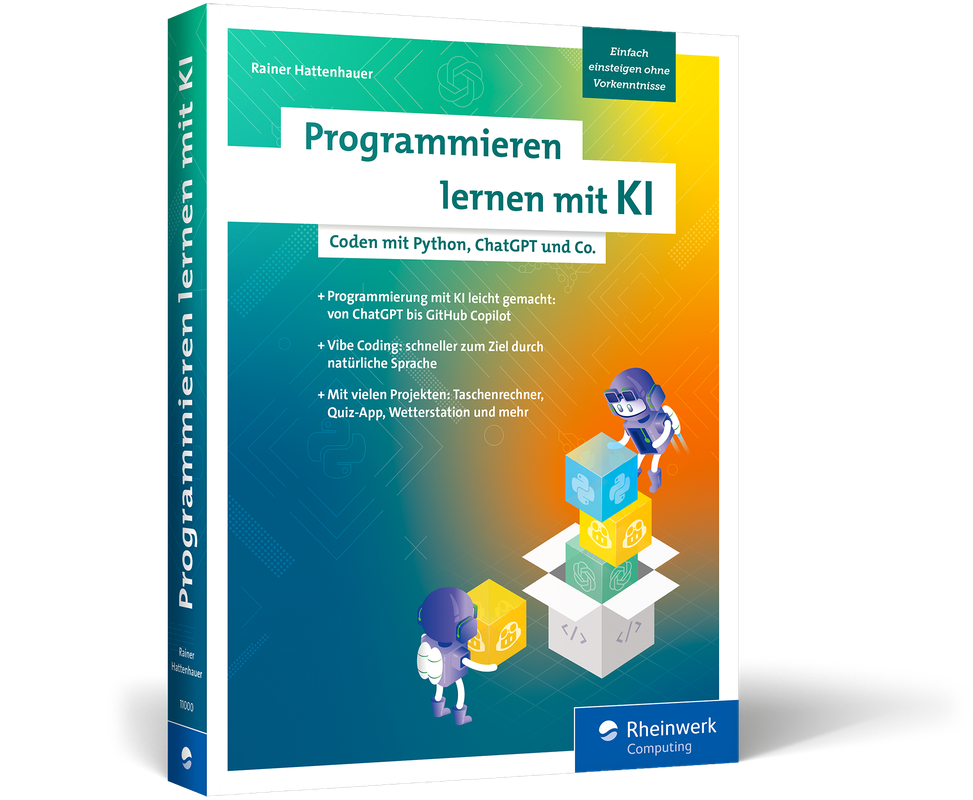
Programmieren lernen mit KI
Programmierung mit KI leicht gemacht – von der Idee zum funktionierenden Programm! Dieses Buch zeigt dir, wie du mithilfe von KI-Tools wie ChatGPT & Co. ganz einfach programmieren lernst, auch ohne Vorkenntnisse. Rainer Hattenhauer verbindet klassische Programmierthemen mit modernen KI-Methoden. Lerne die wichtigsten KI-Assistenten kennen, richte deine Entwicklungsumgebung ein und starte direkt mit ersten Projekten durch: vom einfachen Taschenrechner über Datenverarbeitung bis hin zu grafischen Benutzeroberflächen. Schritt für Schritt steigerst du die Komplexität und erweiterst dein Coding-Know-how. Fortgeschrittene Themen wie Objektorientierung, Datenbanken, App-Entwicklung, Hardware-Projekte und ein Ausflug ins Machine Learning runden das Werk ab.Aus dem Inhalt:KI-gestützter Einstieg ins ProgrammierenDie perfekte Entwicklungsumgebung einrichtenErste Programme schreiben (lassen)Mit Variablen, Verzweigungen und Schleifen arbeitenDaten verarbeiten und visualisierenGUIs und Grafiken programmierenHardware-Projekte mit dem Funduino CubeFortgeschrittene Themen: OOP, Datenbanken, AppsAusflug ins maschinelle LernenTroubleshooting und Optimierung mit KILeseprobe (pdf-Link)

SAP S/4HANA Finance - Customizing
Mit diesem Buch navigieren Sie sicher durch die Konfiguration von FI/CO in SAP S/4HANA. Ein durchgehendes Beispiel zeigt Ihnen, wie Sie alle wichtigen Einstellungen vornehmen. Sie lernen, wie Sie Stammdaten anlegen und Organisationsstrukturen aufbauen. Außerdem erfahren Sie, wie Sie die zentralen Prozesse in Finanzwesen und Controlling einrichten. Das Buch erklärt auch, welche Wege sich für die Migration bewährt haben. Die komplett überarbeitete 4. Auflage berücksichtigt alle Funktionen von Release 2023 – zum Beispiel die Advanced Valuation. Viele Screenshots und praktische Tipps helfen Ihnen dabei, SAP S/4HANA Finance erfolgreich einzuführen. Aus dem Inhalt: OrganisationsstrukturenStammdatenNeuer Geschäftspartner (Business Partner)SAP FioriHauptbuchhaltungDebitoren- und KreditorenbuchhaltungBankbuchhaltungAnlagenbuchhaltungGemeinkostencontrollingProduktkostenrechnungErgebnisrechnung (CO-PA)SAP Advanced Financial ClosingMigration Einleitung ... 17 1. Einführung in SAP S/4HANA Finance ... 23 1.1 ... Die Entwicklung von SAP S/4HANA Finance ... 23 1.2 ... Was ist neu in SAP S/4HANA Finance? ... 27 1.3 ... Exkurs: Abgrenzung zum Customizing von SAP Central Finance ... 38 1.4 ... Exkurs: SAP S/4HANA Public Cloud Edition im Überblick ... 43 1.5 ... Exkurs: Universal Parallel Accounting ... 59 1.6 ... Zusammenfassung ... 62 2. Organisationsstrukturen ... 63 2.1 ... Mandant ... 63 2.2 ... Ledger ... 66 2.3 ... Buchungskreis ... 67 2.4 ... Gesellschaft ... 73 2.5 ... Kostenrechnungskreis ... 75 2.6 ... Kontenplan ... 81 2.7 ... Ergebnisbereich ... 97 2.8 ... Profit-Center ... 108 2.9 ... Segment ... 116 2.10 ... Funktionsbereich ... 117 2.11 ... Geschäftsbereich ... 117 2.12 ... Bewertungsplan und Anlagenklassen ... 119 2.13 ... Zusammenfassung: Empfehlungen für Ihre Organisationsstrukturen ... 122 3. Stammdaten ... 129 3.1 ... Sachkonten ... 130 3.2 ... Anlagen ... 135 3.3 ... Kostenstellen ... 153 3.4 ... Innenaufträge ... 159 3.5 ... Projekte (PSP-Elemente) ... 169 3.6 ... Statistische Kennzahl ... 177 3.7 ... Globale Hierarchien ... 178 3.8 ... Zentraler Geschäftspartner ... 183 3.9 ... Zusammenfassung ... 211 4. Hauptbuchhaltung ... 215 4.1 ... Standardfelder und kundeneigene Felder ... 215 4.2 ... Ledger ... 236 4.3 ... Integration des Controllings mit dem Finanzwesen ... 266 4.4 ... Funktionsbereich für das Umsatzkostenverfahren ... 270 4.5 ... Belegaufteilung ... 277 4.6 ... Belegarten und Belegnummernkreise ... 321 4.7 ... Kontenfindungen ... 328 4.8 ... Substitution und Validierung im Buchhaltungsbeleg ... 330 4.9 ... Finanzdatenkonsistenzanalyse ... 336 4.10 ... Zusammenfassung ... 341 5. Debitoren ... 343 5.1 ... Zahlungsbedingungen ... 344 5.2 ... Mahnverfahren ... 356 5.3 ... EU-Datenschutz-Grundverordnung ... 373 5.4 ... Zusammenfassung ... 376 6. Kreditoren ... 377 6.1 ... Grundlagen ... 378 6.2 ... Nachrichtensteuerung ... 379 6.3 ... Sonderhauptbuchkennzeichen ... 385 6.4 ... Steuerkennzeichen ... 391 6.5 ... Zusammenfassung ... 401 7. Bankbuchhaltung ... 403 7.1 ... Hausbanken ... 404 7.2 ... Zahlungsprogramm ... 418 7.3 ... Lebenszyklus der Zahlungsträgerformate ... 443 7.4 ... Umstellung des Formatbaums von DMEE auf DMEEX ... 446 7.5 ... Elektronischer Kontoauszug ... 449 7.6 ... Kassenbuch ... 470 7.7 ... Zusammenfassung ... 478 8. Anlagenbuchhaltung ... 479 8.1 ... Veränderungen in der Anlagenbuchhaltung ... 479 8.2 ... Parallele Anlagenbuchhaltung ... 487 8.3 ... Anlagenklassen ... 507 8.4 ... Integration mit dem Hauptbuch ... 515 8.5 ... Abschreibungsschlüssel ... 539 8.6 ... Prüfreport für das Customizing ... 547 8.7 ... Altdatenübernahme für Anlagen ... 552 8.8 ... Zusammenfassung ... 562 9. Gemeinkostencontrolling ... 563 9.1 ... Kostenstellen ... 564 9.2 ... Projekte ... 596 9.3 ... COGS-Split ... 611 9.4 ... Zusammenfassung ... 617 10. Produktkostenrechnung ... 619 10.1 ... Produktkostenkalkulation ... 619 10.2 ... Kostenträgerrechnung ... 664 10.3 ... Periodenabschluss in der Kostenträgerrechnung ... 678 10.4 ... Material-Ledger ... 702 10.5 ... Zusammenfassung ... 707 11. Ergebnis- und Marktsegmentrechnung ... 709 11.1 ... Einführung in die Ergebnisrechnung ... 709 11.2 ... Grundeinstellungen für die Margenanalyse ... 718 11.3 ... Istwertefluss ... 750 11.4 ... Predictive Accounting in SAP S/4HANA ... 767 11.5 ... Zusammenfassung ... 772 12. Abschlussarbeiten ... 773 12.1 ... Abschlussarbeiten in der Hauptbuchhaltung ... 774 12.2 ... Abschlussarbeiten in der Anlagenbuchhaltung ... 842 12.3 ... Abgrenzungsverwaltung mit dem Accruals Management ... 871 12.4 ... SAP-Fiori-App »Kontenverlauf im Hauptbuch« ... 899 12.5 ... Zusammenfassung ... 903 13. SAP Advanced Financial Closing ... 905 13.1 ... Einführung in SAP Advanced Financial Closing ... 906 13.2 ... Implementierung von SAP Advanced Financial Closing ... 907 13.3 ... Allgemeine Customizing-Einstellungen für SAP Advanced Financial Closing ... 909 13.4 ... Spezielle Customizing-Einstellungen in SAP Advanced Financial Closing ... 921 13.5 ... Abschlussaufgabenplan verwalten ... 939 13.6 ... Zusammenfassung ... 948 14. Migration nach SAP S/4HANA ... 951 14.1 ... Was ist eine Migration? ... 951 14.2 ... Datenbereinigung ... 955 14.3 ... Voraussetzungen für eine SAP S/4HANA Conversion ... 959 14.4 ... SAP-S/4HANA-Release-Strategie und Upgrade-Pfade ... 982 14.5 ... Eine SAP S/4HANA Conversion durchführen ... 986 14.6 ... Altdatenmigration nach SAP S/4HANA ... 1001 14.7 ... Erweiterungsmöglichkeiten in SAP S/4HANA ... 1010 14.8 ... Zusammenfassung ... 1020 Anhang ... 1021 A ... Änderungen am Datenmodell ... 1023 B ... Änderungen an Transaktionen ... 1031 C ... Wichtige SAP-Hinweise ... 1037 Das Autorenteam ... 1047 Index ... 1049

Excel Tipps und Tricks für Dummies
Praktische Kniffe und Lösungen für alle Excel-Anwender in Alltag und Beruf Erfahren Sie in der 5. Auflage des Bestsellers, wie Sie mit Excel versionsübergreifend noch schneller, besser und effizienter arbeiten! Zeigen Sie Fachwissen im Excel-Alltag, indem Sie gelungene Kombinationen aus Formeln und Funktionen meistern. Holen Sie zum Beispiel mehr aus WENN-Funktionen heraus – ganz ohne ABER, dafür mit großem AHA-Effekt! Oder entdecken Sie verborgene Funktionen in Excel. Dieses Buch bietet Ihnen neben vielen Tipps, Tricks und Tastenkombinationen auch clevere und praxistaugliche Lösungen für den direkten Einsatz in Alltag und Beruf. Sie erfahren Wie Sie mit Excel rechnen, Daten erfassen und auswertenWie Sie Funktionen und Formeln kombinierenWelche Tastenkombinationen hilfreich sindWie Sie rechtzeitig Fehler vermeiden Rainer Schwabe sammelt akribisch Excel-Tipps, schreibt regelmäßig Excel-Artikel für Computer-zeitschriften und ist renommierter Autor zahlreicher Office-Bücher. Er führt bundesweit Schulungen durch und ist ein gefragter Ansprechpartner für Unternehmen, wenn es um praxisnahe Lösungen mit Excel geht.

Künstliche Intelligenz für Alltag und Beruf
Künstliche Intelligenz für Alltag und BerufFür alle, die KI nicht nur verstehen, sondern sinnvoll nutzen und mitgestalten wollen!Die Künstliche Intelligenz verändert unsere Welt in rasantem Tempo – im privaten Alltag ebenso wie im Berufsleben. Dieses Buch bietet eine umfassende Einführung in die transformative Kraft der KI und zeigt, wie sie Lebensqualität, Produktivität und Entscheidungsprozesse neu definiert. Gleichzeitig beleuchtet es kritisch die ethischen, gesellschaftlichen und technologischen Herausforderungen, die mit dieser Entwicklung einhergehen.Ob im Management, im Ingenieurwesen oder im täglichen Leben – anhand zahlreicher praxisnaher Beispiele und fundierter Analysen erhalten Leserinnen und Leser einen vielschichtigen Einblick in die Wirkweise und Auswirkungen moderner KI-Systeme.Beschrieben werden u. a. private bzw. berufliche Anwendungen wie Spracherkennung, Finanzprognosen, maschinelles Sehen, medizinische Diagnosesysteme und Mensch-Maschine-Interaktionen. Ethische Herausforderungen und Fairnessprobleme werden aufgezeigt, um eine Vertrauenskrise zu vermeiden.Dieses Buch ist nicht nur ein informativer Leitfaden, sondern auch ein Denkanstoß: Es lädt dazu ein, die Rolle der KI in einer global vernetzten Welt zu hinterfragen, neue Kompetenzprofile zu entdecken und sich aktiv an der Gestaltung einer fairen, inklusiven und nachhaltigen Technologiezukunft zu beteiligen.Leseprobe (Link)Prof. Dr. Günter Hofbauer lehrt und forscht an der Technischen Hochschule Ingolstadt. Seine Schwerpunkte liegen im Innovations- und Technologiemanagement im internationalen Kontext. Der Forschungsschwerpunkt fokussiert sich auf die Anwendung der künstlichen Intelligenz in der Industrie, aber auch im Alltag. Er forscht als Gastprofessor an der Shenzhen Technology University in China.Dr. Ruimei Zhou ist Dekanin an der L.K. Group Industrial Technology Empowerment Akademie in Shenzhen, an der KI-Anwendungen gelehrt werden. Davor war sie tätig im Management der Shenzhen Artificial Intelligence Industry Association und des Standing Committee of the All-China Federation of Industry and Commerce Artificial Intelligence Committee. Sie hat mehr als 20 Jahre Management-Erfahrung in der Industrie und drei Jahre Lehrtätigkeit an einer Universität.

Rechnernetze (8. Auflg.)
Dieses einführende Lehrbuch für Studierende der Informatik und ingenieurwissenschaftlicher Studiengänge an Hochschulen und Berufsakademien vermittelt praxisnah und leicht verständlich die Grundlagen der Netzwerktechnik und der Netzwerkarchitektur. Es erläutert die Voraussetzungen, die Funktionsweise und die technischen Hintergründe von Computernetzwerken. Das Buch befähigt nicht nur zur Beurteilung der Technik, sondern hilft auch, praktische Abwägungen und Entscheidungen bei der Netzwerkplanung zu treffen. Es zeigt neben den Basiskomponenten, Übertragungsverfahren und Verbindungskomponenten auch strategische Aspekte, Trends und zukünftige Entwicklungslinien und vermittelt die Grundlagen zu Strategien und Methoden der Computervernetzung. Neu in der achten Auflage: Neue Transportprotokolle und Sicherheit in Transportkontrollen: Transport Layer Security (TLS), QUIC; Erweiterung Routing-Protokolle: Border Gateway Protocol (BGP); Sicherheit bei der Namensauflösung: DNS über HTTPS; neuer WLAN-Standard: Wifi7; Trends im Ethernet: automotive Ethernet, Time Sensitive Networking; Standards im und Organisation des Internets. Auf plus.hanser-fachbuch.de finden Sie zu diesem Titel digitales Zusatzmaterial: Lehrvideos, Quizzes zur Lernkontrolle, Mind-Maps der wichtigsten Konfigurationsbefehle für Cisco Router/Switches und die Lösungen zu den Aufgaben.

Das etwas andere Datenbank-Buch
Dieses Buch richtet sich an alle, die Datenbanken nicht nur technisch umsetzen, sondern wirklich verstehen wollen. Ob Du privat ein Projekt planst, im Job mehr Struktur brauchst oder einfach neugierig bist: Hier bekommst Du eine praxisnahe Einführung, die ohne Fachchinesisch auskommt - dafür mit vielen Beispielen, Denkanstößen und echten Aha-Momenten.Vom Kopf zur Datenbank - Schritt für Schritt:Der Schwerpunkt dieses Buches liegt auf dem "Datenbankdenken": Wie strukturiert man Informationen sinnvoll? Wie entstehen aus Ideen Tabellen, Felder und Beziehungen? Und warum scheitern so viele Software-Projekte genau daran?Du lernst, wie Du mit einfachen Mitteln erste eigene Datenbanken planst - egal ob auf Papier, mit FileMaker, mit SQL oder mit modernen No-Code-Plattformen wie Airtable, Ninox oder Baserow.Praxisnah und verständlich erklärt:- Was ist eigentlich eine Datenbank - und warum hast Du längst schon eine im Kopf?- Wie du mit SQL-Abfragen Daten abfragen und auswerten kannst - auch ohne Programmierer zu sein- Warum Excel und Word oft in eine Sackgasse führen, wenn es um Struktur geht- Wie Du mit FileMaker innerhalb von 30 Minuten eine eigene kleine Anwendung erstellst- Wie moderne No-Code-Tools funktionieren und wo ihre Grenzen liegenIdeal für Einsteiger, Selbstständige, Kreative und QuerdenkerDieses Buch ist keine trockene Technik-Anleitung, sondern ein Einladung zum Mitdenken. Es zeigt, wie man Schritt für Schritt von der Idee zur funktionierenden Datenbank kommt - egal, ob Du damit ein Hobbyprojekt organisieren oder ein professionelles Kundenverwaltungssystem bauen möchtest. Für alle, die endlich anfangen wollen - ohne sich von Technik abschrecken zu lassen.

Decentralized Finance and the End of Traditional Banking
This book provides the essential knowledge needed to navigate the revolutionary future of finance with confidence through its comprehensive and accessible exploration of decentralized finance. This book is an in-depth exploration of the transformative power of decentralized finance (DeFi) and its potential to revolutionize the global financial system through in-depth analyses of the rise of DeFi, covering a wide range of topics such as cryptocurrencies, blockchain technology, smart contracts, decentralized exchanges, stablecoins, governance, and more. The volume offers readers a comprehensive understanding of the various aspects and components of the decentralized finance ecosystem. Adopting a forward-looking approach, the book examines the long-term implications for the financial industry, regulatory bodies, and the global economy. It explores the potential consequences of this paradigm shift, equipping readers with the knowledge to navigate the future of finance with confidence. By striking a balance between technical accuracy and accessibility, this book ensures that readers from various backgrounds will gain a comprehensive understanding of the complex concepts associated with DeFi. Readers will find the book: Introduces the emerging DeFi ecosystem and its potential to transform the financial industry, providing a glimpse into the future of finance;Provides practical advice on how to invest in DeFi and navigate the rapidly evolving landscape, offering insights into the DeFi revolution and how to generate higher returns;Offers a comprehensive, in-depth exploration of the technologies driving DeFi, from blockchain technology to smart contracts;Explains how DeFi is challenging the traditional banking model and disrupting the financial industry, making it a must-read for anyone interested in the future of finance. Audience Academics, finance professionals, policymakers and regulators working with decentralized finance to revolutionize the world of banking. Jyoti Verma, PhD is an associate professor in the Chitkara Business School at Chitkara University. She has authored one book, edited two books, numerous book chapters, and over 30 research papers in various national and international journals and conferences. Her core expertise is in the areas of service quality, blockchain, and behavioral finance. Amandeep Singh, PhD is a professor in the Chitkara Business School at Chitkara University with over 16 years of teaching experience. He has published 48 research papers in various journals and conferences and edited over 10 books. His main areas of research are consumer sciences and business innovations. Gagandeep, PhD is an assistant professor in marketing at Chitkara University with over 14 years of research and teaching experience. He has published over ten research papers. His areas of interest include marketing research, research methodology, management science, applied operations research, marketing management, and strategic management.

Programmieren mit PHP
Programmieren mit PHP: Einstieg in die serverseitige Webprogrammierung. Erstauflage aus Oktober 2025.Dieses Einsteigerbuch zu PHP vermittelt grundlegende Konzepte und Techniken der Programmiersprache PHP. Leser lernen, wie man einfache Webanwendungen entwickelt, HTML mit PHP dynamisch kombiniert und Formulardaten verarbeitet. Quasi nebenbei wird damit auch ein grundlegender Einstieg in die allgemeinen Konzepte der Programmierung vermittelt.Das Buch führt durch grundlegende Syntax, Variablen, Kontrollstrukturen (wie Schleifen und Bedingungen), Funktionen sowie den Umgang mit Datenbanken (meist mit MySQL). Es bietet praktische Übungen, um Leser Schritt für Schritt in die Erstellung interaktiver Webseiten und die Verarbeitung von Benutzereingaben einzuführen. Am Ende ist der Leser in der Lage, einfache, datenbankgestützte Webanwendungen zu programmieren.Aus dem Inhalt: Voraussetzungen Einführung in PHP Was ist PHP? Das Konzept von PHP Historie und die verschiedenen Versionen Die aktuelle Version 8 Informationen zu PHP Notwendige Software Installation und Konfiguration Editoren und IDEs Webserver direkt installieren und verwalten PHP direkt installieren PEAR MySQL/MariaDB direkt installieren und verwalten XAMPP – ein Rundumsorglospaket Mit XAMPP arbeiten PHP-Code in Webseiten HTML-Grundlagen Grundgerüst einer Webseite Ressourcen in eine Webseite einbinden Webseiten über den Webserver aufrufen SSI und PHP-Skripte über den Webserver aufrufen und ausführen Webseiten mit PHP generieren bzw. PHP in HTML einbinden Aufruf von PHP-Dateien über den Browser Daten im Browser ausgeben Übungen und Praxis CGI und die Datenübergabe zum Client Grundlagen des Datenverkehrs im WWW CGI GET und POST Übungen und Praxis Grundlegende Sprachelemente in PHP Codieren von PHP-Skripten Anweisungsarten und Techniken Kommentare Literale und Token Interpretation und andere Varianten der Übersetzung Grundlagen zur Fehlersuche in PHP-Skripten Übungen und Praxis Datentypen, Variablen und Operatoren Datentypen Variablen Konstanten Vordefinierte Variablen und Konstanten Die verfügbaren Operatoren in PHP Übungen und Praxis Kontrollstrukturen Kontrollstrukturen einsetzen Die verschiedenen Arbeiten Entscheidungsanweisungen Schleifen Sprunganweisungen Übungen und Praxis Funktionen Was sind Funktionen bzw. allgemein Unterprogramme? Standardfunktionen in PHP Funktionen erstellen und aufrufen Mit Funktionen arbeiten Der Gültigkeitsbereich von Variablen PHP-Dateien einbinden mit include() und require() Übungen und Praxis Arrays Grundlagen zu Arrays Indizierte eindimensionale Arrays Assoziative eindimensionale Arrays Arrays mit der Kurzschreibweise erstellen Mehrdimensionale indizierte Arrays Mehrdimensionale assoziative Arrays Array-Funktionen Arrays und Schleifen (foreach und Iterationsfunktionen) Superglobale Arrays Übungen und Praxis Mit Formularen arbeiten Interaktion mit PHP Formulare mit PHP auswerten Übungen und Praxis Externe Dateien Externe Dateien nutzen Dateien öffnen, lesen und schließen Verschiedene Datei-Funktionen Allgemeine Datei- und Verzeichnisoperationen Übungen und Praxis Zeichenketten-Funktionen Unterschiedliche Aktionen bei Zeichenketten Arrays und Zeichenketten Reguläre Ausdrücke nutzen Übungen und Praxis Umgang mit Datum und Uhrzeit Datum und Zeit ermitteln Datum und Zeit formatieren Datumsangabe anpassen Verschiedene Datum- und Zeitfunktionen Übungen und Praxis Umgang mit Sessions Was sind Sessions? Cookies & Co. Mit Sessions arbeiten Session starten bzw. fortsetzen Daten in einer Session speichern Daten einer Session abrufen Session-Daten und Session löschen Übungen und Praxis Kurzeinblick in OOP Was ist OOP? Das Verhältnis von PHP zu OOP Objekte in PHP verwenden Übungen und Praxis Grundlagen des Datenbankzugriffs mit MySQL/MariaDB Was ist ein DBMS? Die Datenbanken MySQL und MariaDB Zugriff mit dem DB-Client auf Konsolenebene MySQL-Datenbanken mit phpMyAdmin verwalten PHP und der Zugriff auf MySQL/MariaDB mysql vs mysqli vs PDO MySQL-Abfragen Rückgabe aus MySQL-Abfrage auswerten Formulardaten in einer MySQL-Datenbank speichern Übungen und Praxis Quellen Stichwortverzeichnis

Observability For Legacy Systems
Become an expert in implementing observability methods for legacy technologies and discover how to use AIOps and OpenTelemetry to analyze root causes and solve problems in banking and telecommunications. Through this book, you will engage with issues that occur in kernels, networks, CPU, and IO by developing skills to handle traces and logs, as well as Profiles (eBPF) and debugging. The real-world examples in the book will enable you to analyze and aggregate observability data, helping you gain competence in automating systems and resolving business-critical issues rapidly and efficiently.The book will introduce you to new observability approaches, describe different types of errors, and explain how observability addresses them. It will provide training on how to develop dashboards and charts and design a root cause analysis process. Emphasizing trace-centric observability, you will gain expertise in using EAI servers to integrate legacy tech and using extensions to complement the OpenTelemetry Agent. You will also understand the varied practical uses of OpenTelemetry through examples from multiple industries, as well as an OpenTelemetry demo application.The book then takes you through infrastructure observability and infrastructure anomaly detection, enabling you to visualize and trace problems, and helping you identify and proactively respond to anomalies in system resources. In the final chapters, you will learn how to aggregate and analyze observability data using Presto and Druid. Finally, you will familiarize yourself with AIOps and learn how to implement it with Langchain and RAGs.By the end of this book, you will be fully trained in the practical implementation of observability and using observability data to identify, analyze, and solve problems for large industries like finance and telecommunications.WHAT YOU WILL LEARN* Integrate observability with legacy technology* Perform root cause analysis using observability platforms like OpenTelemetry* Analyze and aggregate observability data to solve business problems* Use AIOps and anomaly detection tools to automate operations and reduce costsWHO THIS BOOK IS FORSystem developers, data engineers, SREs, infrastructure engineers, system architects, Java developers, and DevOps engineers who are enthusiastic about observability and want to implement it with legacy technology.Chapter 1: Root Cause Analysis.- Chapter 2: The Observability Approach.- Chapter 3: Trace-centric Observability.- Chapter 4: Observability Examples by Industry.- Chapter 5: OpenTelemetry Demo Application.- Chapter 6: Infrastructure Observability.- Chapter 7: Infrastructure Anomaly Detection.- Chapter 8: Analyze Observability Data.- Chapter 9: Aggregate Observability Data.- Chapter 10: AIOps.

Implementing Identity Management on GCP
"Identity Management on GCP" is a detailed step-by-step guide that helps readers through Identity Management within the Google Cloud Platform (GCP). Even though it is a comprehensive guide to GCP IAM, it provides precise definitions of the main concepts, practical recommendations, and best practices for identity management in cloud environments.The topics described in the book, with the help of clear explanations and examples, include connecting on-premise identity systems to GCP, managing admin and workforce identities, and securing applications running on GCP. It also considers issues of integrating IAM with the business environment and compliance, providing the readers with information on implementing IAM solutions that are effective and can be scaled easily.At the end of the book, the readers will have effectively gained knowledge on GCP IAM and can implement improved security measures and manage and optimize identity processes in their cloud environments effectively. Cloud security specialists, identity engineers, and IT administrators are the primary target audience of this book.YOU WILL:* Understand the core concepts and principles of Identity and Access Management (IAM) in Google Cloud Platform (GCP)* Learn to manage administrative and workforce identities effectively* Implement IAM solutions that align with business needs and regulatory compliance requirementsTHIS BOOK IS FOR: Cloud Security Specialists, Identity Engineers and Compliance Engineers, Site Reliability Engineers, Cloud Architects, Cloud Ops EngineersChapter 1: Introduction to Identity and Access Management on Google Cloud Platform.- Chapter 2: Managing Roles, Policies and Permissions.- Chapter 3: Advanced IAM Features.- Chapter 4: Service Accounts and Workload Identity.- Chapter 5: Securing APIs and Workloads.- Chapter 6: Automating IAM Policies.- Chapter 7: Auditing and Monitoring IAM Policies.- Chapter 8 : Managing Multi-Cloud and Hybrid IAM.- Chapter 9:Securing Sensitive Data with IAM.- Chapter 10: AI-Driven Identity and Access Management.
Business Valuation Across the Industry Life Cycle
This book examines the valuation of internet-enabled businesses across their industry life cycles, demonstrating the shifts in valuation multiples and drivers over time, providing a comprehensive framework to better understand and optimize business valuations. Internet Evolution as Natural Experiment: The internet’s rise – from innovation to necessity, driven by 5G and AI – offers a unique lens on valuation methodologies across industry life cycles.Methodological Approach: Unprecedented quantitative and qualitative research analyzing 1,767 companies globally across 21 industries and 15 years, covering 120 multiples, 216 drivers, and 100 million data points.Valuation Framework: It proposes a groundbreaking framework linking valuation multiples and drivers to industry life cycles, illustrating the shift from revenue- to profitability-based multiples and from growth-centric to growth-and-profitability drivers as companies mature.Practical Implications: It concludes with recommendations for stakeholders on monitoring valuation multiples and drivers for value-maximizing strategies across virtually all mature and emerging technologies.Introduction And Research Objective.- The Research Context And Challenge - The Internet As A Natural Experiment For The Study Of Finance.- Literature Review: Research Hypotheses And Methodology.- Definition And Characterization Of The Research Sample: The Considered Companies And Their Business Models.- Acquisition And Processing Of The Data For The Study.- Descriptive Statistics.- Testing The Hypothesis And The Model (Inferential Statistics).- Conclusions: Original Contributions And Future Research.- References Thesis.

Programmieren lernen
Grundlagen für Studium und Beruf - praxisnah und sprachunabhängig.Sie möchten programmieren lernen, wissen aber nicht, mit welcher Sprache Sie beginnen sollen? Dieses Buch bietet Ihnen einen leicht verständlichen Einstieg in die Welt der Programmierung – ganz ohne Vorkenntnisse. Statt sich auf eine bestimmte Programmiersprache zu beschränken, vermittelt es Ihnen die grundlegenden Konzepte, die in jeder modernen Sprache von Bedeutung sind.Sie lernen Schritt für Schritt die Funktionsweise von Variablen, Schleifen, Verzweigungen, Arrays, Datentypen sowie die Prinzipien der objektorientierten Programmierung mit Klassen und Vererbung kennen. Anhand von einfachen Codebeispielen werden die Inhalte anschaulich erläutert und lassen sich mühelos jede Sprache übertragen.Unabhängig davon, für welche Sprache Sie sich entscheiden, legen Sie mit diesem Buch ein solides Fundament, um Ihre Programmierkenntnisse in der Praxis einzusetzen. Aus dem Inhalt: Grundlagen aller modernen Programmiersprachen Daten abbilden: Variablen, Datentypen, Arrays und Collections Berechnungen und logische Operatoren Programmfluss kontrollieren: Schleifen, Verzweigungen und Funktionen Objektorientierte Programmierung: Klassen, Objekte und Vererbung Entwicklungsumgebung und Fehlersuche Programmieren in der Praxis Entscheidungshilfe für die erste Programmiersprache Übungen mit Lösungen im Anhang Leseprobe (PDF-Link) Über den Autor:Nach fast zwei Jahrzehnten als Programmierer betreut Andreas Hofmann als Scrum Master Softwareteams in der agilen Softwareentwicklung.

3D-Druck - Praxisbuch für Einsteiger (4. Auflg.)
Mit diesem Buch entdecken Sie die nahezu unbegrenzten Möglichkeiten des 3D-Drucks – egal, ob Sie einen eigenen 3D-Drucker besitzen, öffentlich zugängliche Geräte nutzen oder auf Online-Druckservices zurückgreifen. Sie werden Schritt für Schritt an die Technik herangeführt und lernen, wie Sie Ihre eigenen 3D-Objekte gestalten und Druckprojekte realisieren.15 kreative Projekte – direkt zum Nachmachen Das Herzstück des Buchs ist der umfangreiche Praxisteil: 15 vollständige 3D-Druck-Projekte zeigen Ihnen konkret, wie Sie eigene Ideen umsetzen können. Dabei lernen Sie verschiedene Modellierungstechniken, den Umgang mit unterschiedlichen Filamenten sowie Methoden zur Nachbearbeitung und Veredelung kennen.Modelle selbst gestalten oder herunterladen Sie lernen, wie Sie mit kostenloser Software wie Fusion, Blender oder SketchUp eigene Modelle entwerfen und reale Objekte 3D-scannen. Darüber hinaus erhalten Sie viele Tipps, wie und wo Sie fertige Vorlagen finden. Alle im Buch vorgestellten 3D-Modelle stehen zusätzlich auf der Webseite zum Buch zum kostenlosen Download bereit. Aus dem Inhalt: Aufbau und Funktionsweise des 3D-Druckers Schmelzschicht-Druckverfahren im Detail (FDM/FFF) Öffentliche Drucker verwenden 3D-Druckservices Einführung in die 3D-Modellierung 3D-Scan (Infrarot, Fotogrammetrie) Slicer-Programme und Druckparameter 3D-Druck mit und ohne Druckbettheizung Verschiedene Filamente verwenden: PLA, PLA Compound, ABS und mehr Objekte veredeln Troubleshooting und nützliche Tipps Rechtliche Fragen Über den Autor: Thomas Kaffka hat als Softwareingenieur sowie Projektleiter in Softwarehäusern und Wirtschaftsprüfungs- und Beratungsgesellschaften gearbeitet. Er ist ein echter Maker und beschäftigt sich mit verschiedenen Themen wie etwa dem Bau von LEGO®-Robotern, künstlicher Intelligenzforschung sowie dem 3D-Druck.

Design for Reliability und Lebensdauerabsicherung
Die zuverlässige, robuste Gestaltung und Absicherung von mechanischen, mechatronischen und elektronischen Systemen wird in diesem Lehrbuch besprochen. Dabei wird dem Leser anhand eines dem entwicklungsorientiertem V-Diagramm zu jedem Handlungsschritt entsprechende Methoden in einer ausreichenden Tiefe vorgestellt, mit dessen er in die Lage versetzt wird, praxisorientierte Fragestellungen zu beantworten. Schwerpunkte sind dabei wie die kundenspezifischen Anforderungen in die Lastableitung (Mission Profile) systematisch einzubinden sind, bis hin zu Wirkmechanismen. Hierfür werden entsprechend aktuelle Methoden wie Data-Mining, künstliche Intelligenz oder Statistische Versuchsplanung anwendungsnah vorgestellt. Entsprechend den potentiellen Ausfallmechanismen werden passenden Umweltprüfungen auf Basis beschleunigender Testverfahren mit Praxisbeispielen aufgezeigt und durch die Bauteil- und Prozessfreigabe bis hin zur Verarbeitung und der Interpretation von Felddaten abgerundet. Zieldieses Buches ist es, den Einstieg oder den Umstieg in das Themenfeld der Zuverlässigkeitsgestaltung elektronischer Systeme handhabbar sowie praxisorientiert zu ermöglichen.Einführung und Motivation.- Besonderheiten im Entwicklungsablauf elektronischer Systeme.- Grundlagen und Methoden der Zuverlässigkeitstechnik.- Data-Science im Entwicklungsbereich.- Anforderungen und Mission Profile.- Denkbare Szenarien zur Vorgehensweise.- Beschleunigungsgesetze.- Beschleunigte Testverfahren.- Umweltsimulation.- Elektromagnetische Verträglichkeit und Elektrostatische Entladung.- Screening.- Methoden zur Freigabe und Überwachung in der Praxis.

GitHub Copilot Certification Study Guide
A hands-on guide to preparing for the GitHub Copilot certification exam The GitHub Copilot Certification Study Guide is a complete resource for accurate coverage of the challenging GitHub Copilot certification exam. This Sybex Study Guide covers all of the exam’s domain competencies. You’ll prepare smarter and faster with Sybex thanks to efficient and accurate content including, assessment tests that validate test readiness, objective maps, real-world examples and scenarios, practical exercises, and challenging chapter review questions. Retain what you’ve learned with the Sybex online learning environment and test bank, accessible across multiple devices. Get prepared for the GitHub Copilot certification exam with Sybex. Coverage of 100% of all exam objectives in this Study Guide means you’ll be ready for: Responsible AIGitHub Copilot® plans and featuresHow GitHub Copilot works and handles dataPrompt crafting and Prompt engineeringDeveloper use cases for AITesting with GitHub CopilotPrivacy fundamentals and context exclusions ABOUT THE GitHub COPILOT CERTIFICATION EXAM The GitHub Copilot certification exam is designed for individuals in the field of software development who are proficient in using GitHub, including software developers, administrators, and project managers. This certification is intended for individuals who have a foundational understanding of GitHub Copilot as a product and its available features, along with hands-on experience in optimizing software development workflows using GitHub Copilot. Interactive learning environment Take your exam prep to the next level with Sybex’s superior interactive online study tools. To access our learning environment, simply visit www.wiley.com/go/sybextestprep, register your book to receive your unique PIN, and instantly gain one year of FREE access after activation to: Interactive test bank with a practice exam to help you identify areas where further review is needed. Get more than 90% of the answers correct, and you’re ready to take the certification exam.100 electronic flashcards to reinforce learning and last-minute prep before the examComprehensive glossary in PDF format gives you instant access to the key terms so you are fully prepared The fastest, most effective way to prepare for the GitHub Copilot certification exam and hone your skills with the popular AI-powered programming tool In the GitHub Copilot Certification Study Guide, tech entrepreneur and Pluralsight trainer, Tom Taulli, delivers a concise and accurate walkthrough of the AI-powered programming tool. Perfect for everyone preparing to take the new GitHub Copilot Certification exam, as well as programmers who regularly use the tool in their day-to-day work, this Study Guide helps you optimize your software development workflows, understand the structure of the test, and learn the material covered by it. This book explains every topic covered by the GitHub Copilot Certification exam, including: Responsible AIGitHub Copilot plans and featuresThe inner workings of GitHub Copilot and how it handles dataPrompt crafting and prompt engineeringDeveloper use casesTesting workflows with GitHub CopilotPrivacy fundamentals and context exclusions From step-by-step tutorials of the GitHub Copilot installation process to proven exam-taking techniques from the experts at Sybex, the GitHub Copilot Certification Guide explores everything you need to understand to succeed on the test and improve your on-the-job coding performance. It offers: Job-ready strategies and techniques for avoiding common generative AI-enhanced programming pitfalls and making use of its many benefitsUp-to-date descriptions of the most useful features and functions of GitHub Copilot, including Copilot EditsComplimentary access to a practice Assessment Test, a Practice Exam, 100 digital flashcards, and a glossary of key terms on the Sybex online learning environment Generative AI tools, like GitHub Copilot, have transformed the software engineering and programming landscapes. If you're preparing for the certification exam, or you wish to expand your AI coding skillset, grab a copy of the GitHub Copilot Certification Study Guide today. ABOUT THE AUTHOR TOM TAULLI is an author, speaker, Pluralsight trainer, and startup advisor. He is the author of AI-Assisted Programming: Better Planning, Coding, Testing, and Deployment, as well as other AI-focused technology books.
Microsoft Windows Server 2025 - Das Handbuch
Das Standardwerk zur neuen Version: praxisnah und kompetent - Sie finden alle wichtigen Themen in einem Buch: Planung, Migration, Administration, Konfiguration und Verwaltung - Profitieren Sie von zahlreichen praxisnahen Beispielen und Workshops - Mit hilfreichen Schritt-für-Schritt-Anleitungen Diese komplett überarbeitete und aktualisierte Auflage des Klassikers zu Windows Server gibt Ihnen einen tiefgehenden Einblick in den praktischen Einsatz von Windows Server 2025. Das Buch richtet sich sowohl an Neueinsteiger*innen in Microsoft-Servertechnologien als auch an Umsteiger*innen von Vorgängerversionen. Planung und Migration, Konzepte und Werkzeuge der Administration sowie die wichtigsten Konfigurations- und Verwaltungsfragen werden praxisnah behandelt. Alle wichtigen Funktionen werden ausführlich vorgestellt, ebenso die effiziente Zusammenarbeit mit Windows 10/11-Clients. Es erwarten Sie über 1000 Seiten praxisnahes und kompetentes Insiderwissen mit vielen hilfreichen Anleitungen und Profitipps. Aus dem Inhalt:Alle Neuerungen von Windows Server 2025 und Änderungen im Vergleich zu Windows Server 2022 Lizenzierung und Installation Verwalten von Datenträgern und Speicherpools, Hochverfügbarkeit, Datensicherung und -wiederherstellung Secured Core Server, Secure DNS und weitere Sicherheitsneuerungen in der Praxis Lokale Rechenzentren an Microsoft Azure anbinden Betreiben und Erweitern von Active Directory Verwaltung mit dem Windows Admin Center Hochverfügbarkeit und Lastenausgleich Windows Server Update Services (WSUS) Diagnose und Überwachung für System, Prozesse und Dienste Viele neue PowerShell-Befehle für die Verwaltung von Windows Server 2025 Windows Server Container, Docker und Hyper-V-Container Virtualisierung mit Hyper-V Fehlerbehebung und Troubleshooting

Data Product Management in the AI Age
“_An outstanding companion for any data professional seeking to deepen their expertise and grow in the field of Data Product Management_.” (Eduardo Juremeira, Data Engineering Manager, Adyen)“_This book is a valuable resource for data professionals, offering clear concepts and practical tools_.” (Luis Oliveira, Analytics Engineering Tech Manager, Nubank)A PRACTICAL GUIDE TO MASTERING DATA PRODUCT MANAGEMENT—BRIDGING STRATEGY, ARCHITECTURE, AND EXECUTION FOR THE AI ERA.We have firmly entered the age of artificial intelligence (AI). Data, the backbone of this technology, is more crucial than ever. If the algorithm is the brain, data is the content that feeds it. This book argues that to succeed in this era, organizations should adopt a holistic approach to data—one that uses product management principles to inform how data is sourced, designed, managed, maintained, optimized, and leveraged.This book is divided into two sections, moving from fundamentals to practical applications. In the first part, you’ll learn about the concepts that underlie product theory, the data architecture journey, and the essential knowledge needed to manage data products. The second part focuses on putting everything into practice, with particular attention to designing solutions, ongoing maintenance, and optimization.Additionally, the book introduces the Golden Data Platform and the Data Product Management Canvas, important tools and frameworks coined by author Jessika Milhomem. These resources will help you begin transforming your organization’s data strategy, empowering you to stay ahead of the competition and thrive in the AI age.WHAT YOU WILL LEARN* Explore the evolution of data architecture and strategies* Understand the fundamentals of data product management* Differentiate between Data Product and Data as a Product* Know what the Golden Data Platform is and how to use it* Utilize the Data Product Management Canvas effectively* Reorient your data strategy with product management principles* Examine the concepts of products and data architecture evolution in relation to leadership* Evaluate how to solve data architecture without bias by technology* Design and implement Data as a Product and Data Products through a project* Maintain and enhance Data Products once launchedWHO THIS BOOK IS FORData leaders and managers responsible for designing and delivering data products, as well as product managers who want to collaborate more effectively with data teams. Analytics engineers, data engineers, data scientists, and machine learning engineers will find practical guidance for building impactful data solutions. Developers and data professionals aiming to move into leadership or product roles will also find valuable insights throughout.Part I: Fundamentals for Data Product Management.- Chapter 1: Data Product Management Introduction.- Chapter 2: Data Analytical Architecture - Traditional Architecture.- Chapter 3 : Data Analytical Architecture - Big Data Architecture.- Chapter 4: Consolidating the Analytics Journey Knowledge.- Part II: Data Product Management in Practice.- Chapter 5: Golden Data Platform to Manage Data as a Product.- Chapter 6: Data Product Management.- Chapter 7: Designing the Product of Data - Understanding Phase.- Chapter 8: Designing the Product of Data - Exploring Phase.- Chapter 9: Designing the Data Product - Materializing Phase.- Chapter 10: Ownership process - Recurrent Cycle - Ongoing.

Mastering Text Analytics
This book is a comprehensive guide to mastering Natural Language Processing (NLP), a rapidly growing field in AI-powered text and data analytics. It equips you with tools and techniques to extract valuable insights from both structured and unstructured data, enabling you to uncover insights beyond the reach of traditional data analysis methods and stay competitive in this evolving domain.The book starts with foundational concepts, such as collecting and extracting data for NLP projects, before progressing to advanced topics like applications of transfer learning in NLP and Large Language Models (LLMs). Each chapter emphasizes real-world applications and includes practical case studies to ensure the knowledge is immediately applicable. Throughout the book, readers will find Python code demonstrations, hands-on projects, and detailed explanations of key concepts. Special features include business use cases from industries like healthcare and customer service, practice exercises to reinforce learning, and explorations of emerging NLP technologies. These elements make the book not only informative but also highly engaging and interactive.By the end of the book, the reader will have a solid foundation in Generative AI techniques to apply them to complex challenges. Whether you’re a budding data scientist or a seasoned professional, this guide will help you harness the power of AI-driven text and data analytics effectively.What you will learn:* Understand NLP with easy-to-follow explanations, examples, and Python implementations.* Explore techniques such as transformers, word embeddings, and pragmatic analysis in real-world contexts.* Work with real-world datasets and apply pre-processing, tokenization, and text extraction using NLP libraries.* How to build complete NLP pipelines from data collection to model implementation, including sentiment analysis and chatbots.* Learn state-of-the-art methods like deep learning techniques in NLP, large language models (LLMs), and zero-shot learning in NLP.Who this book is for:This book is tailored for data scientists, machine learning engineers, AI practitioners, and software developers seeking to learn NLP techniques and apply them to solve problems.Chapter 1. Natural Language Processing: An Introduction.- Chapter 2. Collecting and Extracting the Data for NLP Projects.- Chapter 3. NLP Data Preprocessing Tasks Involving Strings & Python Regular Expressions.- Chapter 4. NLP Data Preprocessing Tasks with nltk.- Chapter 5. Lexical Analysis.- Chapter 6. Syntactic and Semantic Techniques in NLP.- Chapter 7. Advanced Pragmatic Techniques and Specialized Topics in NLP.- Chapter 8. Transformers, Generative AI, & LangChain.- Chapter 9. Advancing with LangChain & OpenAI.- Chapter 10. Case Study on Symantec Analysis.

Cybersecurity Law
Comprehensive textbook covering the latest developments in the field of cybersecurity law Cybersecurity Law offers an authoritative guide to the key statutes, regulations, and court rulings that pertain to cybersecurity, reflecting the latest legal developments for this constantly evolving subject since the previous edition was released in 2022. This comprehensive text deals with all aspects of cybersecurity law, including data security and enforcement actions, anti-hacking laws, surveillance and privacy laws, and national and international cybersecurity law. In this new edition, readers will find insights on revisions to regulations and guidance concerning cybersecurity from federal agencies, such as 2023 SEC cybersecurity regulations for all publicly traded companies, and the Cyber Incident Reporting for Critical Infrastructure Act and its impact on the obligations of companies across the United States. Other recent developments discussed in this book include litigation from customers against companies after data breaches and the resulting legal articulation of companies’ duties to secure personal information, the increased focus from lawmakers and regulators on the Internet of Things (IoT), and the FDA’s guidelines for medical device cyber security. Readers of Cybersecurity Law will also find new information on: Litigation cases where courts ruled on whether plaintiffs stated viable causes of action in data breach cases, including the Eleventh Circuit’s opinion in Ramirez v. Paradies Shops Fourth Amendment opinions involving geofence warrants and keyword search warrants Courts’ applications of the Supreme Court’s first Computer Fraud and Abuse Act opinion, Van Buren v. United States NIST’s 2024 revisions to its popular Cybersecurity Framework Version 2 of the Cybersecurity Maturity Model Certification Cybersecurity Law is an ideal textbook for undergraduate and graduate level courses in cybersecurity, cyber operations, management-oriented information technology (IT), and computer science. It is also a useful reference for IT professionals, government personnel, business managers, auditors, cybersecurity insurance agents, and academics in these fields. Jeff Kosseff, JD, MPP, is a cybersecurity and privacy lawyer. He frequently speaks and writes about cybersecurity and was a journalist covering technology and politics at The Oregonian, a finalist for the Pulitzer Prize, and a recipient of the George Polk Award for national reporting.

Recht für Online-Marketing und KI
Dieses Handbuch bietet eine umfassende Rechtsberatung zu allen aktuellen Fragen rund um Online-Marketing und KI-Einsatz. Der Jurist Dr. Thomas Schwenke bringt die relevanten Rechtsfragen verständlich auf den Punkt und gibt konkrete, umsetzbare Handlungsempfehlungen. Sie lernen rechtliche Risiken einzuschätzen und Rechtsverstöße zu vermeiden. Juristische Kenntnisse werden nicht vorausgesetzt.KI in der Praxis: Alles rund um KI – von der Nutzung KI-generierter Inhalte über Deepfakes bis zur KI-VerordnungUrheberrecht im Marketing: User-generated Content, Memes, Creative-Commons-Lizenzen, StockbildarchiveDirektmarketing: Double-Opt-in, Newsletter-Tracking und die Zusammenarbeit mit Versanddienstleistern rechtssicher gestaltenDatenschutz und Barrierefreiheit: Die DSGVO und das Barrierefreiheitsstärkungsgesetz (BFSG) praktisch umsetzenGewinnspiele, Influencer-Verträge und Co: Ratschläge für alle Fragen des Joballtags – von rechtlich korrekten Werbeaussagen und Gewinnspielen bis zu KI-Richtlinien für MitarbeitendeHaftung, Abmahnung und eigene Ansprüche: Wann Sie für Mitarbeitende haften, was bei Abmahnungen zu tun ist und wie Sie Ihre Interessen durchsetzenChecklisten und Mustertexte: Übersichtslisten, sofort einsetzbare Textvorschläge und anschauliche Fallbeispiele unterstützen Sie bei der korrekten UmsetzungLeseprobe (pdf-Link)Über den Autor:Dr. Thomas Schwenke, LL.M., Dipl.FinWirt (FH), ist ein renommierter Rechtsanwalt und Datenschutzauditor. Er unterstützt weltweit Unternehmen bei der Bewältigung rechtlicher Herausforderungen im Datenschutz, Online-Marketing und beim Einsatz von KI. Er ist Co-Host des Podcasts „Rechtsbelehrung“ und ein geschätzter Experte in der Rechtsbranche. Er ist als Gründer von Datenschutz-Generator.de und durch seine gefragten Vorträge bekannt. Thomas Schwenke versteht es, komplexe Rechtsthemen verständlich zu erklären und praxisnahe Lösungen aufzuzeigen.
Quantitative Prognosen in der externen Unternehmensrechnung
Barwertkalküle erfordern Prognosen künftiger Zahlungsströme oder Gewinne, haben sich zur vorherrschenden Bewertungsmethodik entwickelt und kommen immer häufiger zur Anwendung. In dieser Arbeit werden ausgewählte quantitative Prognoseverfahren aufgezeigt, empirisch evaluiert und daraus Empfehlungen für die Anwendung innerhalb der Rechnungslegung sowie für die Unternehmensbewertung abgeleitet. Betrachtet werden etablierte sowie neuere Methoden aus dem Bereich des maschinellen Lernens. Darüber hinaus werden die Prognosefelder der handelsrechtlichen und internationalen Rechnungslegung sowie die Auswirkungen von Rechnungslegungspolitik evaluiert. Die Untersuchungen liefern wichtige Erkenntnisse für die Unternehmensanalyse auf Basis von Daten der Finanzberichterstattung und die Ermittlung von Unternehmenswerten. Der Autor empfiehlt zudem methodische Vorgaben für Prognosen in der externen Unternehmensrechnung. Quantitative Prognosen in der Rechnungslegung.- Zukunftsorientierung der Rechnungslegung.- Methodik und Datenbasis.- Cashflow- und Erfolgsprognosen.- Rechnungslegungspolitik als begrenzender Faktor quantitativer Modellierungen.- Modellgestützte Erfolgsprognosen für die Unternehmensbewertung.- Schlussbetrachtung und Fazit.

Künstliche Intelligenz und politischer Extremismus
Dieses essential bietet einen Überblick über die Nutzung von KI durch Extremist*innen. Es werden Beispiele für die Nutzung von KI durch Extremist*innen angeführt. Zudem wird diskutiert, wie diese dadurch gezielt etwa Propaganda, Hass und Hetze verbreiten. Ferner werden Chancen und Möglichkeiten für (Sicherheits-)Behörden und andere Institutionen für den Umgang mit der Nutzung von KI durch Extremist*innen sowohl in der Bekämpfung von Extremismus als auch der Prävention thematisiert. Relevant ist der Band somit für Vertreter*innen von (Sicherheits-)Behörden, für Mitarbeitende bei Trägern der Extremismusprävention, für Wissenschaftler*innen, aber auch etwa für die IT-Branche. Begriffsklärungen und Einordnung.- Wofür Extremist*innen KI nutzen (können).- Gründe für die Nutzung von KI durch Extremist*innen.- Die Nutzung von KI gegen Extremismus.- Herausforderungen für die Nutzung von KI gegen Extremismus.- Wie KI die Entwicklung weiter beeinflussen wird.

Android 16 - Der schnelle Smartphone-Einstieg
für Pixel, Sony Xperia, Motorola & alle weiteren Geräte mit purem AndroidMit diesem smarten Praxisbuch gelingt Ihnen der sichere Einstieg in Ihr Smartphone. Lernen Sie Ihr Handy mit dem puren Android 16-Betriebssystem kennen und beherrschen! Anschauliche Anleitungen, Beispiele und Bilder zeigen Ihnen gut nachvollziehbar, wie Sie Ihr mobiles Gerät optimal handhaben – von der Ersteinrichtung und Personalisierung über die große Funktionsvielfalt bis zu den wichtigsten Anwendungen.Nutzen Sie darüber hinaus die übersichtlichen Spicker-Darstellungen: Damit können Sie jene Bedienungs-schritte, die man am häufigsten braucht, aber immer wieder vergisst, auf einen Blick finden und umsetzen. Freuen Sie sich auf viele hilfreiche Tipps und legen Sie ganz einfach los!Aus dem Inhalt:- Alle Bedienelemente Ihres Android 16-Smartphones auf einen Blick● Ersteinrichtung sowie Erstellung und Verwaltung Ihres Google-Kontos● KI-Funktionen, Datenschutz, Sicherheit und Berechtigungskontrolle● Die Benutzeroberfläche Ihres Smartphones personalisieren● Apps herunterladen, nutzen und Updates durchführen● Kontakte anlegen, verwalten und Anrufe tätigen● Nachrichten austauschen via SMS/RCS, E-Mail & WhatsApp● Fotos sowie Videos aufnehmen und verwalten● Uhr, Kalender, Maps und andere praktische Apps nutzen● Verbindungen herstellen und im Internet surfen● Datenübertragung, Back-Ups und Tipps zum UmzugInklusive der neuen Features des Herbst-Updates 2025

Science MashUp: Games und schulische Bildung
Spielen in der Schule? Spielen und schulische Bildung schlossen sich lange Zeit aus: Spiel fand in der Freizeit statt, Schule bereitete auf den Arbeitsprozess vor. Doch die Integration von digitalen Spielen in den schulischen Bildungsbereich hat in den letzten Jahren zunehmend an Bedeutung gewonnen.Der Band _Science MashUp: Games und schulische Bildung_ versammelt die Beiträge zur gleichnamigen Tagung im April 2024 in Leipzig. Die Perspektiven von Lehrkräften, Eltern und Schülern stehen dabei im Fokus von drei Themenbereichen: 1. Standpunkte: Games in der Schule, 2. Best Practices: Games im Unterricht, 3. Spiele, Technik und Wissen: Digitale Bildungskultur im Wandel.Grußwort.- Einleitung.- Standpunkte: Games in der Schule.- Best Practice: Games im Unterricht.- Spiele, Wissen und Technik: Digitale Bildungskultur im Wandel.- Podiuumsdiskussion.