

Computer und IT

Einstieg in Linux Mint 22 (6. Auflg.)
Einstieg Linux Mint 22 (6. Auflg.)Mit diesem Buch wird der Einstieg in Linux ganz leicht! Aufschlagen, Mint installieren und los geht's. Dirk Becker führt Sie Schritt für Schritt durch die beliebte Linux-Distribution, die genau auf die Bedürfnisse von Linux-Neulingen und Anfängern zugeschnitten ist. Er zeigt Ihnen, welche Variante für Sie die richtige ist und wie Sie das große Angebot an Apps für sich nutzen. Mit dabei sind natürlich die beliebte Office-Suite Libre Office, die Bildbearbeitung mit GIMP sowie die Virtualisierungs-Software Wine, mit der sich Windows-Anwendungen und Games auch auf einem Linux-System nutzen lassen. Tipps zum Arbeiten mit der Konsole und zur Wartung des Systems sowie ein umfangreicher Troubleshooting-Guide machen das Buch zum Must-have für Linux-Einsteiger.Aus dem Inhalt :Linux Mint installierenParallelbetrieb mit WindowsOffice-Anwendungen nutzenIm Internet mit Linux MintMultimedia und SpieleBackup, Datensicherung und VerschlüsselungSystemverwaltung, Terminal, TreiberWindows-Programme mit Wine installierenDateien im Netz freigebenÜber den Autor :Dirk Becker, bekennender Linuxer und zugleich Windows-Administrator, ist ausgebildeter Energieanlagenelektroniker und Informatiker und arbeitet seit 1999 selbstständig in Projekten als Administrator, Programmierer und als Dozent.
Blender
Blender - das umfassende HandbuchDas große Handbuch zu allen wichtigen Funktionen von Blender. Dieses Buch von Andreas Asanger bietet einen fundierten Einstieg in die 3D-Software und in die Grundlagen des 3D-Designs. Aber es geht noch weiter: Es begleitet Sie vom Modelling über Texturing und Shading, die Beleuchtung, Rigging und Animation bis hin zu Simulation, Rendering und Postproduktion. In Schritt-für-Schritt-Anleitungen konstruieren, texturieren und animieren Sie Ihre eigenen 3D-Objekte und setzen das Gelernte direkt in die Praxis um. Das verlässliche Lern- und Nachschlagewerk für alle Anwender und Anwendinnen. Aus dem Inhalt:Arbeitsoberfläche, Navigation und ObjekteModelling und SculptingShading, Texturing und MappingLichtquellen, Kameras und TrackingAnimationen mit Keyframes, Pfaden und DrivernCharacter AnimationPartikelsysteme, Haare und KollisionenRauch, Feuer und FlüssigkeitenGeometry Nodes und Simulation Nodes2D-Animationen mit Grease PencilRendering mit EEVEE Next und CyclesCompositing, Schnitt und Ton, Import und ExportÜber den Autor:Andreas Asanger ist als technischer Redakteur und Medienentwickler in den Bereichen Grafik, Visualisierung und 3D-Animation tätig.
Let's Code! (2. Auflage)
Let's Code! Programmieren lernen in der Minecraft-Welt, in 2. Auflage von Dezember 2024.Willkommen in TurtleCity! Du hast nicht nur ein Buch aufgeschlagen, du bist auch in Minecraft unterwegs und lernst dort Programmieren: Eine Robo-Schildkröte folgt genau deinen Befehlen. Du lässt sie verrückte Sachen bauen, nach Schätzen graben, und zusammen geht ihr so manche Challenge an. So lernst du das ABC der Programmierung von Schleifen über Variablen bis zu Unterprogrammen fast wie nebenbei. Lasse dich von den Aufgaben und Projekten überraschen! Sie haben in Workshops schon hunderte Kinder und Jugendliche begeistert und sind entsprechend erprobt. Programmieren zu lernen, fördert das logische Denken, Hartnäckigkeit und Kreativität. Aber vor allem – und das gilt auch für Große – macht es Spaß! Für Kinder, Jugendliche und alle, die Lust haben, ab 8 Jahren. Die Minecraft-Erweiterung ist kostenlos, einfach zu installieren und für Windows, Linux sowie macOS geeignet. Mit Kapiteln für Eltern und Lehrkräfte.Inklusive dem neuen ComputerCraft-Mod und wichtigen Lua-Grundlagen!Aus dem Inhalt:Installation nach AnleitungDie Schritte der Schildkröte fernsteuernWenn – dann: Bedingungen einbauenEinmal, zweimal, hundert Mal ... mit wenigen Befehlen viel erreichenImmer wieder, bis ... Schleifen programmierenInteraktion mit Redstone-SchaltungenBaumfäller, Schürf-Roboter und andere nützliche Helfer programmierenProgramme speichern und wieder ladenDer neue ComputerCraft-Mod: Steuere die Schildkröten mit LuaWeiterführende Infos zur ProgrammierungKapitel für Eltern und für Lehrkräfte
Schrödinger programmiert C# (4. Auflg.)
Schrödinger ist unser Mann fürs Programmieren. Er kann schon was, aber noch nicht C#. Zum Glück hat er einen richtigen Profi an seiner Seite, der auf jede Frage eine Antwort weiß. Und weil Schrödinger zwar schlau ist, aber auch ein wenig ungeduldig, gibt es nach der nötigen Theorie immer sofort etwas zu tun. Mit viel Code und Beispielen, die ihr nicht wieder vergesst. Ob es ums Einparken ohne Crash geht oder um Schuhschränke, die immer größer werden: Die Übungen schafft ihr (aber nicht immer mit links), die Pausen sind verdient, und am Ende jedes Kapitels dürft ihr euch einen Spickzettel einstecken – Achievement Unlocked, Ready for Next Level. Fantastisch illustriert. Für Einsteiger, Umsteiger und Fans.1. Gründlicher EinstiegSchrödinger macht's vor: Es geht direkt los mit dem Coden – vom Einfachen zum Schwierigen und von Anfang an mit kurzen Übungen. Lasst euch durch Visual Studio führen und macht euch mit Variablen, Schleifen und Co. vertraut.2. So macht guter Code SpaßWie ihr.NET umfassend nutzt, eigene Datentypen und sinnvolle Objekte erstellt, richtig mit Fehlern und Ausnahmen umgeht, lernt ihr hier. Und zwar immer gleich so, dass sich euer Code in der Welt der Profis sehen lassen kann.3. GUIs, Design Patterns, AppsFür grafische Oberflächen lernt ihr XAML, für einen robusten Aufbau das Architekturmuster MVVM. Ob es um den Desktop geht oder um mobile Apps: So nehmt ihr eure Nutzer in den Blick und entwickelt ansprechende GUIs.4. Mitmachen und genießenZu jedem Kapitel gibt es viele Beispiele, die Spaß machen, und Aufgaben mit Lösungen. Schrödinger stellt die Fragen, die ihr auch stellen würdet, Bernhard Wurm hat den Code kommentiert, und Leo Leowald hat zu jedem Thema eine Zeichnung parat ... also, dann kann's ja losgehen!Aus dem InhaltOperatoren, Schleifen, DatentypenKlassen, Objekte und VererbungDatenbanken und LINQGUI-Entwicklung mit XAMLawait/async geschickt verwendenDateizugriffe und StreamsMultithreadingMit Ausnahmen und Fehlern umgehenÜber den Autor:Bernhard Wurm ist Softwareentwickler aus Leidenschaft und kann sich noch sehr gut an seine ersten Programmierversuche erinnern.Leseprobe (PDF-Link)

ChatGPT & Co. (2. Auflage)
Das einführende Workbook zum Thema KI in aktualisierter 2. Auflage aus dem Dezember 2024.Du möchtest wissen, wie du KI richtig nutzt und davon profitieren kannst? Dann wird dir dieses Workbook eine große Hilfe sein. Rainer Hattenhauer zeigt anhand vieler praktischer Beispiele aus den unterschiedlichsten Anwendungsbereichen ganz konkret, wie Künstliche Intelligenz dir das Leben erleichtern kann. Egal, ob du Texte schreiben, recherchieren, Bilder generieren oder deinen eigenen Programmcode erstellen möchtest. Hier kannst du ohne Vorkenntnisse direkt loslegen und die gängigsten KI-Tools ausprobieren. Lass die KI für dich arbeiten Lerne die wichtigsten KI-Frontends und ihre Stärken kennen. Eine Vielzahl an praktischen Beispielen zeigen dir, wie du einen konkreten Nutzen aus den neuen Möglichkeiten ziehen kannst. Alle notwendigen Erläuterungen und Informationen werden dir in kurzen Exkursen bereitgestellt. Beste Ergebnisse durch gute Prompts Um von der KI zu profitieren, musst du die richtigen Fragen stellen und klare Anweisungen geben. Du erfährst, was einen guten Prompt ausmacht. So kannst du mit dem KI-Tool richtig recherchieren und sogar eigenen Programmcode erstellen. Alle wichtigen KI-Tools in einem Buch Je nach Einsatzgebiet eignet sich ein bestimmtes KI-Tool. Hier lernst du nicht nur die wichtigsten Chatbots kennen, der Autor zeigt dir hilfreiche Synergieeffekte beim Einsatz unterschiedlicher KI-Systeme. Inklusive ChatGPT, DALL-E, Midjourney, DeepL Write etc. Aus dem Inhalt: KI-Bots – die Kreativitäts-Booster Produktivität steigern durch KI Intelligente Textverarbeitung KI in Bildung und Wissenschaft Kunst schaffen mit KI Nützliche KI im Alltag Programmiereinstieg mit KI Tipps und Tricks für Fortgeschrittene Ausblick: KI und kein Ende? Leseprobe (PDF-Link)Rainer Hattenhauer ist promovierter Physiklehrer und unterrichtet zudem Informatik und Mathematik an einem Gymnasium.

Blender 4
PRAXISNAHER EINSTIEG ANHAND VON WORKSHOPSMit diesem Buch erhalten Sie einen leichten und umfassenden Einstieg in Blender. Anhand von Workshops lernen Sie Schritt für Schritt, die einzelnen Funktionen direkt in der Praxis einzusetzen. Zahlreiche Tipps und Tricks helfen Ihnen dabei, schnell eigene Projekte umzusetzen.ALLE BEREICHE DER 3D-GRAFIK DETAILLIERT ERLÄUTERTDie fünf Teilbereiche der 3D-Grafik, d.h. Modellierung, Texturierung, Animation, Szenenaufbau und Rendern werden im Detail behandelt und in einem einzigen Filmprojekt zusammengeführt.FÜR EINSTEIGER UND UMSTEIGER GEEIGNETDie dem Buch zugrunde liegende Lernmethode basiert auf der jahrelangen Erfahrung des Autors als professioneller Trainer für 3D-Software. So sind alle Erläuterungen sehr gut für Einsteiger ohne Vorkenntnisse nachvollziehbar und ebenfalls für Umsteiger von anderen 3D-Applikationen geeignet.AUS DEM INHALT:* Alle Arten der Modellierung, inkl. Character-Modeling* Sculpting* Texturierung, inklusive UV-Bearbeitung und Paint* Character-Rigging* Szenenaufbau mit Kamera, Licht und Umgebung* 3D-Animation und Simulation* 2D-Animation* Die beiden Render-Engines EEVEE und Cycles* Compositing* Filmschnitt inklusive SoundZUM DOWNLOAD:* Alle Blender-Dateien der Projekte und Workshops* Alle benötigten Materialien wie Bild- und Sound-Dateien* Die fertigen Projekte zum VergleichMAIK ECKARDT ist selbstständiger 3D-Grafiker und Trainer für Cinema 4D und Blender u.a. am SAE-Institute, am Institute of Design (IN.D), an der Berliner Technischen Kunsthochschule (BTK) und an der HTK Academy Berlin. Er hat bereits zahlreiche Bücher zum Thema 3D-Grafik veröffentlicht, u.a. zu Cinema 4D.

PostgreSQL Skills Development on Cloud
This book provides a comprehensive approach to manage PostgreSQL cluster databases on Amazon Web Services and Azure Web Services on the cloud, as well as in Docker and container environments on a Red Hat operating system. Furthermore, detailed references for managing PostgreSQL on both Windows and Mac are provided. This book condenses all the fundamental and essential concepts you need to manage a PostgreSQL cluster into a one-stop guide that is perfect for newcomers to Postgres database administration. Each chapter of the book provides historical context and documents version changes of the PostgreSQL cluster, elucidates practical "how-to" methods, and includes illustrations and key word definitions, practices for application, a summary of key learnings, and questions to reinforce understanding. The book also outlines a clear study objective with a weekly learning schedule and hundreds of practice exercises, along with questions and answers. With its comprehensive and practical approach, this book will help you gain the confidence to manage all aspects of a PostgreSQL cluster in critical production environments so you can better support your organization's database infrastructure on the cloud and in containers. What You Will Learn * Install and configure Postgres clusters on the cloud and in containers, monitor database logs, start and stop databases, troubleshoot, tune performance, backup and recover, and integrate with Amazon S3 and Azure Data Blob * Manage Postgres databases on Amazon Web Services and Azure Web Services on the cloud, as well as in Docker and container environments on a Red Hat operating system * Access sample references to scripting solutions and database management tools for working with Postgres, Redshift (based on Postgres 8.2), and Docker * Create Amazon Machine Images (AMI) and Azure Images for managing a fleet of Postgres clusters on the cloud * Reinforce knowledge with a weekly learning schedule and hundreds of practice exercises, along with questions and answers * Progress from simple concepts, such as how to choose the correct instance type, to creating complex machine images * Gain access to an Amazon AMI with a DBA admin tool, allowing you to learn Postgres, Redshift, and Docker in a cloud environment * Refer to a comprehensive summary of documentations of Postgres, Amazon Web services, Azure Web services, and Red Hat Linux for managing all aspects of Postgres cluster management on the cloud Who This Book Is For Newcomers to PostgreSQL database administration and cross-platform support DBAs looking to master PostgreSQL on the cloud. 1. Introduction to PostgreSQL Database Management.- 2. Capacity Planning.- 3. Amazon EC2/Azure VM Linux Install Tasks.- 4. PostgreSQL Software Installation on Amazon EC2/Azure VM Linux.- 5. Client Tools.- 6. PostgreSQL on AWS RDS/Azure SQL Database.- 7. PostgreSQL on Docker.- 8. Postgres Cluster and Database Backup.- 9. PostgreSQL on Windows Server in Cloud.- 10. PostgreSQL Post Installation Tasks.- 11. Sequences.- 12. Postgres Cluster Upgrade.- 13. PostgresSQL Recovery.- 14. PostgresSQL High Availability.- 15. Table Partition.- 16. Postgres Tablespaces.- 17. Multi-Version Concurrency Control (MVCC).- 18.- Projects.

The Definitive Guide to Modern Java Clients with JavaFX
Build enhanced visual experiences and design and deploy modern, easy-to-maintain, client applications across a variety of platforms. This book will show you how these applications can take advantage of JavaFX’s latest user interface components, 3D technology, and cloud services to create immersive visualizations and allow high-value data manipulation. This book is a professional reference for building Java applications for desktop, mobile, and embedded in the Cloud age. It offers end-to-end coverage of the latest features in JavaFX 21 and 23. This third edition has been updated to include new features introduced in JavaFX 21 and 23, including NEW APIs: Map, FlatMap, and OrElse fluent bindings for ObservableValue, along with the new Subscription API. Additionally, it's updated to account for new bug fixes and overall improvements to existing functionality in Java. After reading this book, you will be equipped to upgrade legacy client applications, develop cross-platform applications in Java, and build enhanced desktop and mobile native clients. What You Will Learn * Create modern client applications in Java using the latest JavaFX 17 and Java 17 LTS * Build enterprise clients that will enable integration with existing cloud services * Use advanced visualization and 3D features * Deploy on desktop, mobile, and embedded devices Build enhanced visual experiences and design and deploy modern, easy-to-maintain, client applications across a variety of platforms. This book will show you how these applications can take advantage of JavaFX’s latest user interface components, 3D technology, and cloud services to create immersive visualizations and allow high-value data manipulation. This book is a professional reference for building Java applications for desktop, mobile, and embedded in the Cloud age. It offers end-to-end coverage of the latest features in JavaFX 21 and 23. This third edition has been updated to include new features introduced in JavaFX 21 and 23, including NEW APIs: Map, FlatMap, and OrElse fluent bindings for ObservableValue, along with the new Subscription API. Additionally, it's updated to account for new bug fixes and overall improvements to existing functionality in Java. After reading this book, you will be equipped to upgrade legacy client applications, develop cross-platform applications in Java, and build enhanced desktop and mobile native clients. What You Will Learn * Create modern client applications in Java using the latest JavaFX 21 and 23 * Build enterprise clients that will enable integration with existing cloud services * Use advanced visualization and 3D features * Deploy on desktop, mobile, and embedded devices Who This Book Is For Professional Java developers who are interested in learning the latest client Java development techniques to fill out their skills set 1: Getting Started with Client Java.- 2: JavaFX Fundamentals.- 3: Properties and Bindings.- 4: JavaFX Controls Deep Dive.- 5: Mastering Visual and CSS Design.- 6: High Performance Graphics.- 7: Bridging Swing JavaFX Style.- 8: JavaFX 3D.- 9: JavaFX to Web and Cloud.- 10: Packaging Apps for the Desktop.- 11: Native Mobile Apps.- 12: JavaFX 11 on Raspberry Pi.- 13: Machine Learning and JavaFX.- 14: Java Science. Stephen Chin is VP of Developer Relations at Neo4j and author of additional titles, including Raspberry Pi with Java, Pro JavaFX Platform, and DevOps Tools for Java Developers. He has keynoted numerous conferences around the world, including AI DevSummit, Devoxx, DevNexus, JNation, JavaOne, Joker, swampUP, and Open Source India. Stephen is an avid motorcyclist who has done evangelism tours in Europe, Japan, and Brazil, interviewing hackers in their natural habitat. When he is not traveling, he enjoys teaching kids how to do AI, and embedded and robot programming, together with his daughters. Johan Vos started to work with Java in 1995. He was part of the Blackdown team, porting Java to Linux. His main focus is on end-to-end Java, combining backend systems and mobile/embedded devices. He received a Duke Choice award in 2014 for his work on Javafx on mobile. In 2015, he co-founded Gluon, which allows enterprises to create (mobile) Java Client applications leveraging their existing backend infrastructure. Gluon received a Duke Choice award in 2015. Johan is a Java Champion and an Oracle Developer Champion, a member of the BeJUG steering group and the Devoxx steering group, and he is a JCP member. He has been a speaker at numerous conferences on Java. James Weaver is a Java developer, author, and speaker with a passion for cloud-native applications, machine learning, and quantum computing. He is a Java Champion, and a JavaOne Rockstar. James has written books, including Inside Java, Beginning J2EE, the Pro JavaFX series, and Java with Raspberry Pi. As a Pivotal Developer Advocate, James speaks internationally at software technology conferences. He tweets as @JavaFXpert.

Full Stack Development with Microsoft Blazor
Become a full-stack web developer using the Microsoft Blazor framework and the techniques shown in this book. This new edition will have you building all kinds of applications in C# and Microsoft .NET 8, from static web sites to fully interactive single page applications, and desktop and mobile applications, in no time. At it's core, this book teaches you to build user interfaces and present data to a user for display and modification, capturing the user’s changes via data binding. The book shows you how to access a rich library of .NET functionality such as a component modeling for building composable user interfaces—including developing reusable components that can be used across many pages and websites. New for this edition, the book now covers server communication using SignalR and/or gRPC, the use of virtualization to load large quantities of data efficiently, deployment and ahead-of-time compilation into WASM, new unit testing features, security using OpenID Connect, and more features added in Blazor in .NET 8. At it's core, Blazor provides a fresh take on web development by eliminating the need to learn different languages and frameworks for client- and server-side development. It also allows C# and .NET to be used on all sides—both server-side and client-side—providing a robust feature set that is well suited toward scalable, enterprise-level applications. With Blazor you can use all your experience in .NET 8 along with thousands of existing libraries, right in the browser. This book gets you proficient using this important toolkit for web application development. What You Will Learn * Build user interfaces and display data for users to edit * Capture user edits and changes via data binding * Transfer data back and forth between server and client * Communicate with services using REST, SignalR, or gRPC * Develop reusable components and assemble them into bigger components * Use routing to build single-page applications (SPAs) * Build stable and maintainable software using unit testing * Internationalize your application to reach more users * Secure your Blazor application with OpenID Connect * Build static interactive pages web pages optimized for SEO * Use the same components to build mobile and desktop applications Become a full-stack web developer using the Microsoft Blazor framework and the techniques shown in this book. This new edition will have you building all kinds of applications in C# and Microsoft .NET 8, from static web sites to fully interactive single page applications, and desktop and mobile applications, in no time. At it's core, this book teaches you to build user interfaces and present data to a user for display and modification, capturing the user’s changes via data binding. The book shows you how to access a rich library of .NET functionality such as a component modeling for building composable user interfaces—including developing reusable components that can be used across many pages and websites. New for this edition, the book now covers server communication using SignalR and/or gRPC, the use of virtualization to load large quantities of data efficiently, deployment and ahead-of-time compilation into WASM, new unit testing features, security using OpenID Connect, and more features added in Blazor in .NET 8. At it's core, Blazor provides a fresh take on web development by eliminating the need to learn different languages and frameworks for client- and server-side development. It also allows C# and .NET to be used on all sides—both server-side and client-side—providing a robust feature set that is well suited toward scalable, enterprise-level applications. With Blazor you can use all your experience in .NET 8 along with thousands of existing libraries, right in the browser. This book gets you proficient using this important toolkit for web application development. What You Will Learn * Build user interfaces and display data for users to edit * Capture user edits and changes via data binding * Transfer data back and forth between server and client * Communicate with services using REST, SignalR, or gRPC * Develop reusable components and assemble them into bigger components * Use routing to build single-page applications (SPAs) * Build stable and maintainable software using unit testing * Internationalize your application to reach more users * Secure your Blazor application with OpenID Connect * Build static interactive pages web pages optimized for SEO * Use the same components to build mobile and desktop applications Who This Book is For Experienced .NET developers who want to apply their existing skills toward building professional-quality and server- or client-side web applications that run in any browser; also for web developers who want to step away from JavaScript and its complexities, and instead apply a proven technology (C# and .NET8) that is robust toward creating enterprise-quality applications that scale and are reliable and provide a good user experience Peter Himschoot works as a lead trainer, architect, and strategist at U2U. He has a wide interest in software development that includes applications for the web, Windows, and mobile devices. He has trained thousands of developers, is a regular speaker at international conferences, and has been involved in many web and mobile development projects as a software architect. He has been a Microsoft Regional Director (from 2003 to 2019) tasked with advising developer and IT professional audiences, as well as Microsoft. Chapter 1. Introduction to Full Stack Development with Blazor.-Chapter 2. Blazor Components.-Chapter 3. Data Binding.- Chapter 4. Blazor Forms and Validation.- Chapter 5. Advanced Components.-Chapter 6. Built-In Components.-Chapter 7. Component Libraries.-Chapter 8. Application Rendering Modes.-Chapter 9. Services and Dependency Injection.-Chapter 10. Data Storage.-Chapter 11. REST Communication.-Chapter 12. Single Page Applications and Routing.-Chapter 13. JavaScript Interoperability .- Chapter 14. Blazor State Management.- Chapter 15. Unit Testing Components with bUnit.- Chapter 16. Building Real-Time Applications with Blazor and SignalR.-Chapter 17. Efficient Communication with gRPC.- Chapter 18. Supporting Multiple Languages in your Blazor Application.- Chapter 19. Deploying Your Blazor Application.- Chapter 20. Blazor Hybrid Applications.- Chapter 21. Security with OpenID Connect.- Chapter 22. Securing Blazor.

Fullstack-Entwicklung mit SAP
Erfahren Sie, was Sie brauchen, um eigene Apps in der Fullstack-Entwicklung zu erstellen. Erfahren Sie, wie OData und Core Data Services (CDS) im Backend mit SAP Fiori, SAPUI5 und TypeScript im Frontend zusammenspielen und lernen Sie bewährte Tools kennen. Ob moderne oder ältere Landschaften: Mit diesem Buch meistern Sie die Fullstack-Entwicklung. Aus dem Inhalt: SAPUI5SAP Fiori ElementsOData V4 und OData V2Core Data Services (CDS)TypeScriptSAP Cloud Application Programming ModelABAP RESTful Application Programming ModelSAP Gateway Service BuilderEntwicklung von BenutzeroberflächenFlexible Programming ModelErweiterbarkeit und Bereitstellung Einleitung ... 17 Einführung ... 25 TEIL I. Einführung ... 25 1. Einführung in die Fullstack-Entwicklung ... 27 1.1 ... Was ist ein Fullstack-Entwickler? ... 28 1.2 ... SAP-Programmiermodelle ... 33 1.3 ... HTTP-Grundlagen ... 52 1.4 ... Zusammenfassung ... 56 2. Einführung in SAPUI5 und SAP Fiori ... 57 2.1 ... SAPUI5 versus SAP Fiori ... 57 2.2 ... SAP Fiori Launchpad ... 67 2.3 ... SAP Fiori Design Guidelines ... 73 2.4 ... Entwicklungswerkzeuge ... 74 2.5 ... Zusammenfassung ... 81 3. Einführung in OData ... 83 3.1 ... Einführung ... 84 3.2 ... OData-Services entwickeln ... 102 3.3 ... OData testen ... 116 3.4 ... Zusammenfassung ... 131 4. Einführung in CDS ... 133 4.1 ... Entwicklung von Core Data Services ... 134 4.2 ... Assoziationen und Navigationseigenschaften ... 146 4.3 ... CDS-View-Erweiterung ... 150 4.4 ... Berechtigungen ... 153 4.5 ... Zusammenfassung ... 157 5. Einführung in TypeScript ... 159 5.1 ... TypeScript-Grundlagen ... 159 5.2 ... TypeScript der nächsten Generation ... 165 5.3 ... Klassen und Interfaces ... 174 5.4 ... Generics ... 182 5.5 ... Modulentwicklung ... 188 5.6 ... Zusammenfassung ... 190 TEIL II. Entwicklung ... 191 6. Entwicklung von OData-V4-Services mit dem ABAP RESTful Application Programming Model (Managed Scenario) ... 193 6.1 ... Entwicklung von Business-Objekten ... 194 6.2 ... Aktionen ... 224 6.3 ... Erweiterte Funktionen ... 228 6.4 ... Berechtigungsprüfung ... 237 6.5 ... Verschachtelte Business-Objekte ... 240 6.6 ... Zusammenfassung ... 242 7. Entwicklung von OData-V4-Services mit dem SAP Cloud Application Programming Model ... 243 7.1 ... Domänenmodellierung ... 244 7.2 ... Service-Bereitstellung ... 259 7.3 ... Aufsetzen einer SAP-Cloud-Application-Programming-Model-Anwendung ... 267 7.4 ... Autorisierungsprüfungen ... 281 7.5 ... Zusammenfassung ... 283 8. Entwicklung von OData-V2-Services mit dem SAP Gateway Service Builder ... 285 8.1 ... Servicemodellierung in der Transaktion SEGW ... 286 8.2 ... Create, Read, Update, Delete und Query ... 299 8.3 ... SADL-basierte OData-Services ... 328 8.4 ... Zusammenfassung ... 336 9. Entwicklung von SAPUI5-Freestyle-Anwendungen ... 337 9.1 ... SAPUI5 (Basic-)Projekt anlegen ... 339 9.2 ... View aufbauen und UI-Komponenten verwenden ... 350 9.3 ... Applikationslogik, Formatter und Event Handler implementieren ... 362 9.4 ... Datenbindung ... 367 9.5 ... Navigation und Routing ... 386 9.6 ... Mehrsprachigkeit/Internationalization (i18n) ... 396 9.7 ... Deployment ... 398 9.8 ... Zusammenfassung ... 403 10. Entwicklung von SAPUI5-Freestyle-Anwendungen mit OData-V4-Services ... 405 10.1 ... Projekt anlegen ... 407 10.2 ... OData-Model-V4 ... 412 10.3 ... Startseite implementieren ... 425 10.4 ... Navigation einbauen ... 432 10.5 ... Detailseite implementieren ... 434 10.6 ... Fragmente ... 435 10.7 ... SAPUI5-Projekte von einem Git Repository klonen ... 447 10.8 ... Zusammenfassung ... 450 11. Entwicklung von SAPUI5-Freestyle-Anwendungen mit OData-V2-Services ... 453 11.1 ... Projekt anlegen ... 455 11.2 ... OData-Model-V2 ... 460 11.3 ... Startseite implementieren ... 472 11.4 ... Navigation einbauen ... 481 11.5 ... Detailseite implementieren ... 484 11.6 ... Fragmente ... 488 11.7 ... SAPUI5-Projekte von einem Git Repository klonen ... 500 11.8 ... Zusammenfassung ... 503 12. Entwicklung von Benutzeroberflächen mit SAP Fiori Elements ... 505 12.1 ... List Report ... 506 12.2 ... Object Page ... 514 12.3 ... Overview Page ... 527 12.4 ... Generische Annotationen ... 540 12.5 ... Zusammenfassung ... 543 13. Entwicklung von Benutzeroberflächen mit dem Flexible Programming Model ... 545 13.1 ... Einleitung ... 545 13.2 ... Programming Model Explorer ... 546 13.3 ... Building Blocks ... 553 13.4 ... Implementieren des Flexible Programming Model ... 561 13.5 ... Zusammenfassung ... 579 TEIL III. Fortgeschrittene Themen ... 581 14. Datei-Upload ... 583 14.1 ... Media Entitys ... 583 14.2 ... OData V2 ... 584 14.3 ... OData V4 ... 597 14.4 ... Zusammenfassung ... 600 15. Formularvalidierung und Error Handling ... 601 15.1 ... Formularvalidierung ... 601 15.2 ... Fehlerbehandlung ... 619 15.3 ... Zusammenfassung ... 626 16. Entity Tags und Soft State ... 627 16.1 ... Soft-State-Aktivierung ... 627 16.2 ... ETags ... 631 16.3 ... Zusammenfassung ... 633 17. Erweiterbarkeit ... 635 17.1 ... Adaptation Projects ... 635 17.2 ... Key-User-Erweiterbarkeit ... 647 17.3 ... Zusammenfassung ... 653 18. Bereitstellung ... 655 18.1 ... Continuous Integration, Continuous Delivery und Continuous Deployment ... 656 18.2 ... Bereitstellung in SAP S/4HANA ... 672 18.3 ... Bereitstellung in der SAP Business Technology Platform ... 676 18.4 ... Zusammenfassung ... 680 Das Autorenteam ... 681 Index ... 683

Let's code!
Willkommen in TurtleCity! Du hast nicht nur ein Buch aufgeschlagen, du bist auch in Minecraft unterwegs und lernst dort Programmieren: Eine Robo-Schildkröte folgt genau deinen Befehlen. Du lässt sie verrückte Sachen bauen, nach Schätzen graben, und zusammen geht ihr so manche Challenge an. So lernst du das ABC der Programmierung von Schleifen über Variablen bis zu Unterprogrammen fast wie nebenbei. Lasse dich von den Aufgaben und Projekten überraschen! Sie haben in Workshops schon hunderte Kinder und Jugendliche begeistert und sind entsprechend erprobt. Programmieren zu lernen, fördert das logische Denken, Hartnäckigkeit und Kreativität. Aber vor allem – und das gilt auch für Große – macht es Spaß! Für Kinder, Jugendliche und alle, die Lust haben, ab 8 Jahren. Die Minecraft-Erweiterung ist kostenlos, einfach zu installieren und für Windows, Linux sowie macOS geeignet. Mit Kapiteln für Eltern und Lehrkräfte. Inklusive dem neuen ComputerCraft-Mod und wichtigen Lua-Grundlagen! Aus dem Inhalt: Installation nach AnleitungDie Schritte der Schildkröte fernsteuernWenn – dann: Bedingungen einbauenEinmal, zweimal, hundert Mal ... mit wenigen Befehlen viel erreichenImmer wieder, bis ... Schleifen programmierenInteraktion mit Redstone-SchaltungenBaumfäller, Schürf-Roboter und andere nützliche Helfer programmierenProgramme speichern und wieder ladenDer neue ComputerCraft-Mod: Steuere die Schildkröten mit LuaWeiterführende Infos zur ProgrammierungKapitel für Eltern und für Lehrkräfte Vorwort ... 11 Einführung ... 13 »ComputerCraftEdu« -- Basis für die Programmierung in Minecraft ... 14 Minetest -- Open Source, inspiriert von Minecraft ... 16 Installation & Vorbereitung ... 19 Vorbereitung und Installation ... 20 Erster Start ... 23 Level 1: Dein neues Haustier: Robokröti! ... 25 Minecraft starten und die Abenteuerwelt laden ... 25 Grundausstattung: Gibt es beim Butler ... 28 Robokröti muss an die frische Luft ... 29 Die Kröte mit der Fernbedienung steuern ... 31 Lauf los, Robokröti! ... 31 Deine Challenge: Finde den mysteriösen Gegenstand! ... 34 Lösung: der mysteriöse Gegenstand ... 35 Style mich! ... 35 Level 2: Wie komme ich hier nur wieder raus? Oder: Das erste Programm! ... 37 Dein erstes Programm ... 40 Neues Programm erstellen ... 40 Challenge: Schreibe ein Labyrinth-Programm! ... 41 Tipps & Tricks ... 42 Level 3: Lass die Kröten tanzen! Oder: Schleifen ... 45 Challenge 1: Wie viele Schildkröten passen gleichzeitig in dein Labyrinth? ... 51 Gemeinsame Disko -- ein Ausflug nach TurtleCity ... 53 Smaragdmäher! Oder: verschachtelte Schleifen ... 53 Lösung -- die ersten beiden Reihen ... 56 Schleifen in Schleifen ... 57 Challenge 2: Alternative Mähmethode ... 59 Level 4: Ich kann sehen! Oder: Ich bin zu faul zum Selberzählen ... 61 Das unbekannte Labyrinth -- Automatik-Kröte. Oder: »WENN ... DANN« ... 68 Challenge 1: Erkenne das Ende! ... 73 Challenge 2: Unterirdisch! ... 75 Level 5: Wir lassen bauen! ... 77 Bau mir was, Schildkröte! ... 77 Bau gleich mal richtig viel, Schildkröte! ... 80 Challenge: Todessprung-Treppenhaus ... 82 Lösung: Todessprung-Challenge ... 82 Baue bis zu den Wolken: Auswahl des richtigen Slots/Materials ... 83 Kann man das essen? Oder: Programme speichern und teilen ... 85 Ich brauche mehr Platz! Oder: Unterprogramme ... 91 Dein erstes Unterprogramm ... 91 Unterprogramme praktisch einsetzen: Schreibe deinen Namen! ... 93 So geht's: dein Name in Blöcken gebaut ... 95 Level 6: Binärer Alptraum! Oder: wahr oder falsch? ... 99 Variablen und Unterprogramme ... 103 Ich kann zählen! Oder: der schiefe Turm von Krötenburg ... 104 Variablen-Basics ... 104 Challenge: Schiefer Turm mit Variablen ... 107 Level 7: Übersinnliche Fähigkeiten: Redstone ... 109 Redstone erkennen und aktivieren ... 109 Challenge: Redstone erkennen und weitersagen ... 113 Weitere Redstone-Experimente ... 115 Level 8: End-Boss: Baumfäller-Roboter! ... 117 Teil 1: Finde Bäume! Der Baumfäller-Roboter ... 117 Teil 2: Ernte den Baum! ... 125 Wie fällt man einen Baum? ... 126 Challenge 1: Bau alles zusammen und teste es! ... 130 Das komplette Programm -- Teil 1 und 2 zusammen ... 130 Challenge 2: Ein noch besseres Baumfäller-Programm ... 132 Lösung: die bessere Baumfäller-Schildkröte ... 133 Challenge 3: Roboter in der Wildnis ... 134 TurtleCity ... 137 Was ist TurtleCity? ... 137 Zugang zu TurtleCity ... 138 Starthilfe -- wie bekomme ich alles, was ich brauche? ... 139 Spielmodus -- Abenteuer- und Überlebensmodus ... 140 Bauplätze -- eigene Grundstücke sichern ... 141 Kaufen, kaufen, kaufen! ... 142 Autobahnen -- schneller ist besser! ... 144 Du hast Post -- Briefe und Gegenstände verschicken ... 146 Übersicht: Karte von TurtleCity ... 147 Erstelle deine eigene Mod -- mit MCreator ... 149 MCreator installieren ... 149 Erstelle einen Arbeitsbereich ... 154 Erstelle den neuen Block ... 156 Drop-Eigenschaft -- was springt für mich dabei heraus? ... 160 Ausprobieren! ... 161 Deine Challenge: Droppe mehr als einen Dia! ... 164 Das Zufallsprogramm ... 164 Lust auf mehr? ... 169 Wie geht's weiter? ... 171 Lua -- die Sprache hinter den Blöcken ... 171 Noch mehr Schildkröten und Computer gefällig? ... 172 Danke und viel Spaß! ... 174 Weitere Infos, Hilfe, Fragen & Antworten ... 175 Welten verwalten, sichern & wiederherstellen ... 175 Bauen AFK (away from keyboard) ... 178 Fehler & Lösungen ... 179 Mods allgemein ... 180 Kontakt zum Autor, Updates und mehr ... 181 Tipps und Tricks für Eltern, Pädagogen & Lehrkräfte ... 183 Einsatz von Minecraft und der Schildkröte im Unterricht ... 184 Das KidsLab Mod-Pack ... 187 Minetest im Unterricht ... 188 Index ... 189
Programmieren lernen mit Java
Programmieren lernen leicht gemacht: Dieses Buch führt Sie auf besonders verständliche Weise in die Programmierung mit Java ein. Schritt für Schritt erfahren Sie alles, was Sie wissen müssen: angefangen bei der Installation und den absoluten Java-Basics bis zur objektorientierten Programmierung. Auch die Entwicklung von Benutzeroberflächen und die Arbeit mit Dateien wird ausführlich erläutert.Am Ende binden Sie sogar eine Datenbank ein.Anschauliche Beispiele stellen sicher, dass Sie den Stoff gut nachvollziehen können. Viele Übungsaufgaben mit Musterlösungen helfen Ihnen, Ihre neuen Kenntnisse zu festigen.So ausgerüstet, werden Ihnen Ihre ersten eigenen Java-Programme sicher gelingen!Aus dem Inhalt: Grundlagen Java und Eclipse Variablen und ihre Reichweite Bedingungen, Schleifen & Co. Die Welt der Objekte Klassen, Objekte, Methoden Zugriffsschutz richtig setzen Fehler und Ausnahmen Grafische Benutzeroberflächen Fenster, Schaltflächen & Co. GUI-Komponenten mit dem WindowBuilder Animationen erstellen Dateien und Datenbanken Lese- und Schreibzugriff Datenbanken mit JDBC Datensätze präsentieren
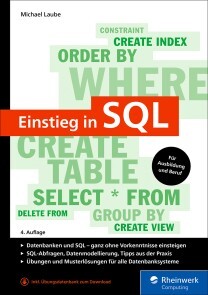
Einstieg in SQL
Den leichten Einstieg in SQL und die Modellierung von Daten finden Sie hier! Schritt für Schritt führt Sie Michael Laube in diesem Leitfaden durch die SQL-Kommandos und macht Sie mit allen wichtigen Befehlen vertraut. Auf diesem Fundament aufbauend lernen Sie, wie Sie Ihre Daten richtig modellieren, verknüpfen und bearbeiten. Mithilfe dieser Anleitungen wird die Datenmodellierung mit SQL einfach und unkompliziert: So schaffen Sie Ordnung und sorgen für performante Abfragen. Aus dem Inhalt: Grundlagen kennenlernen und verstehenGrundfunktionen der TabellenabfrageZeilen einfügen, ändern und löschen (INSERT, UPDATE und DELETE)Tabellen mit CREATE TABLE anlegenMengenoperationenDatenbanken modellierenDatenmodelle optimierenDatenmodelle in Tabellen überführenBeziehungen zwischen Tabellen: JOINsTransaktionenSkalarfunktionenBedingungslogikMit Zeit und Datum arbeitenSpaltenwerte mit GROUP BY gruppierenUnterabfragenVIEWS: Abfragen in virtuellen Tabellen speichernPerformance optimieren 1. Grundlagen kennenlernen und verstehen ... 21 1.1 ... Die Tabelle als zentrales Element ... 21 1.2 ... Eine kleine Historie von SQL ... 23 1.3 ... Datenbanksysteme ... 24 1.4 ... SQL -- ein Standard und seine Umsetzung ... 25 1.5 ... Zu diesem Buch ... 27 1.6 ... MySQL unter Windows installieren ... 28 1.7 ... Die MySQL-Übungsdatenbank anlegen ... 36 1.8 ... Eine erste Abfrage an die Datenbank senden ... 39 1.9 ... Kommentarfunktion ... 42 2. Los geht's: Die Grundfunktionen der Tabellenabfrage (SELECT) ... 47 2.1 ... Mit einer SELECT-Anweisung Tabellen abfragen ... 47 2.2 ... Zeilen in einer Abfrage mit WHERE filtern ... 51 2.3 ... Filterbedingungen mit AND (NOT) und OR (NOT) logisch verknüpfen ... 91 2.4 ... Ergebniszeilen einer SELECT-Anweisung einschränken ... 109 2.5 ... Datensätze sortiert abfragen ... 111 2.6 ... Konstanten in die Spaltenauswahlliste aufnehmen ... 124 2.7 ... Spalten einen Alias zuordnen ... 127 2.8 ... Gleiche Ergebniszeilen ausschließen (DISTINCT) ... 131 3. Zeilen einfügen (INSERT), ändern (UPDATE) und löschen (DELETE, TRUNCATE) ... 135 3.1 ... Zeilen mit einer INSERT-Anweisung einfügen ... 135 3.2 ... Zeilen mit einer UPDATE-Anweisung ändern ... 145 3.3 ... Zeilen mit einer DELETE-Anweisung löschen ... 156 3.4 ... Alle Zeilen einer Tabelle mit einer TRUNCATE-Anweisung löschen ... 161 4. Tabellen anlegen (CREATE TABLE) ... 165 4.1 ... Datentypen ... 165 4.2 ... Datentypen umwandeln ... 179 4.3 ... Explizite und implizite Typkonvertierung ... 180 4.4 ... Einfache Tabellen mit CREATE TABLE erstellen ... 187 4.5 ... Spalten Einschränkungen (CONSTRAINTS) zuordnen ... 199 4.6 ... Spalten auf Tabellenebene Einschränkungen (CONSTRAINT) zuordnen ... 214 5. Mengenoperationen anwenden ... 229 5.1 ... Mengenoperationen auf Ergebnistabellen anwenden ... 229 5.2 ... Eine Vereinigungsmenge bilden (UNION) ... 236 5.3 ... Die Schnittmenge von Ergebnistabellen bilden (INTERSECT) ... 245 5.4 ... Eine Differenzmenge aus Ergebnistabellen bilden (EXCEPT) ... 250 5.5 ... Mengenoperationen in Kombination mit einer WHERE-Klausel verwenden ... 253 5.6 ... Vereinigungsmengen in Kombination mit einer ORDER BY-Klausel ... 255 6. Benutzer, Rollen und ihre Berechtigungen ... 259 6.1 ... Benutzer anlegen (CREATE USER) ... 260 6.2 ... Benutzer entfernen ... 261 6.3 ... Eine Verbindung für einen Datenbankbenutzer erstellen ... 262 6.4 ... Berechtigungen verwalten ... 268 6.5 ... Mit Rollen Berechtigungen zuordnen ... 270 6.6 ... Übungen ... 273 7. Datenbanken modellieren ... 279 7.1 ... Anforderungskatalog ... 279 7.2 ... Entitäten identifizieren und modellhaft abbilden ... 280 7.3 ... Beziehungen zwischen Entitäten festlegen ... 287 7.4 ... Datenmodelle in der UML-Notation darstellen ... 302 7.5 ... Übungen ... 305 8. Datenmodelle optimieren (Normalisierung) ... 309 8.1 ... Redundanzen erkennen ... 309 8.2 ... Die 1. Normalform anwenden ... 312 8.3 ... Die 2. Normalform anwenden ... 314 8.4 ... Die 3. Normalform anwenden ... 316 8.5 ... Denormalisierung ... 318 8.6 ... Übungen ... 320 9. Datenmodelle in Tabellen überführen ... 323 9.1 ... Die Ausbildungsdatenbank anlegen ... 323 9.2 ... Tabellen mit Beziehungen zu anderen Tabellen erstellen ... 325 9.3 ... Übung ... 332 9.4 ... Die referenzielle Integrität verstehen ... 334 10. Operationen auf Tabellen in Beziehungen anwenden ... 341 10.1 ... Zeilen in Tabellen einfügen, die in Beziehung zueinander stehen ... 341 10.2 ... Zeilen aus Tabellen, die in Beziehung stehen, mit JOIN verbunden abfragen ... 351 10.3 ... Beziehungen (Schlüsselbeziehungen) ändern ... 388 10.4 ... Beziehungen (Schlüsselbeziehungen) aufheben oder löschen ... 399 11. Transaktionen ... 411 11.1 ... Forderungen an relationale Datenbanksysteme ... 412 11.2 ... Transaktionen verstehen ... 414 11.3 ... Übungen ... 421 12. Tabellenstrukturen verändern ... 423 12.1 ... Eine Tabelle umbenennen ... 423 12.2 ... Spalten einer Tabelle ändern ... 425 12.3 ... Spalten hinzufügen und entfernen ... 438 12.4 ... Beziehungen zwischen Tabellen herstellen und entfernen ... 440 12.5 ... Übungen ... 443 13. Mit SQL rechnen ... 451 13.1 ... Spaltenwerte addieren ... 452 13.2 ... Spaltenwerte subtrahieren ... 454 13.3 ... Spaltenwerte multiplizieren ... 455 13.4 ... Spaltenwerte dividieren ... 455 13.5 ... Den Restwert einer Division von Spaltenwerten berechnen ... 456 13.6 ... Nach dem Ergebnis einer Berechnung filtern ... 457 13.7 ... Nach dem Ergebnis einer Berechnung sortieren lassen ... 458 13.8 ... Übungen ... 459 14. Skalarfunktionen anwenden ... 463 14.1 ... Funktionen für Textwerte ... 464 14.2 ... Funktionen für Zahlenwerte ... 476 14.3 ... Verschachtelte Funktionsaufrufe ... 482 15. Bedingungslogik ... 487 15.1 ... Die CASE-Klausel ... 487 15.2 ... Bedingungslogik in einer Spaltenauswahlliste einer SELECT-Anweisung anwenden ... 488 15.3 ... Bedingungslogik in einer ORDER BY-Klausel anwenden ... 490 15.4 ... Übungen ... 492 16. Mit Zeit und Datum arbeiten ... 495 16.1 ... Datumsformate ... 496 16.2 ... Skalarfunktionen für Zeit- und Datumsangaben in SQL nutzen ... 496 16.3 ... Zeit- und Datumsangaben formatieren ... 499 16.4 ... Datumsangaben extrahieren (EXTRACT) ... 515 16.5 ... Mit Datumsangaben rechnen ... 520 17. Spaltenwerte gruppieren (GROUP BY) ... 529 17.1 ... Die Aggregatfunktion COUNT anwenden ... 530 17.2 ... Die Aggregatfunktion SUM anwenden ... 535 17.3 ... Die Aggregatfunktion AVG anwenden ... 537 17.4 ... Die Aggregatfunktion MAX anwenden ... 539 17.5 ... NULL-Werte berücksichtigen ... 541 17.6 ... Nach aggregierten Werten einer Gruppierung filtern (HAVING) ... 545 17.7 ... Nach zwei oder mehr Spalten gruppieren ... 548 18. Mächtiges Werkzeug: Die Unterabfragen (Subqueries) ... 553 18.1 ... Unterabfragen, die in Korrelation zueinander stehen ... 554 18.2 ... Unterabfragen, die nicht in Korrelation zueinander stehen ... 560 18.3 ... Vergleichsoperatoren auf Unterabfragen mit ANY, SOME und ALL anwenden ... 566 18.4 ... Auf die Existenz von Ergebniszeilen aus Unterabfragen prüfen (EXISTS) ... 571 19. Views: Abfragen in virtuellen Tabellen speichern ... 575 19.1 ... Einfache Views anlegen ... 576 19.2 ... Views und ORDER BY ... 581 19.3 ... INSERT, UPDATE und DELETE auf Views anwenden ... 584 19.4 ... Views entfernen oder ersetzen ... 596 20. Abfragen mit einem Index optimieren ... 599 20.1 ... Einführung ... 599 20.2 ... Syntax: Index erstellen ... 602 20.3 ... Eine Tabelle mit vielen Zeilen generieren ... 602 20.4 ... Einen Index für eine Tabelle anlegen ... 604 20.5 ... Einen Index über mehrere Spalten anlegen ... 606 20.6 ... Den Index einer Tabelle löschen ... 609 20.7 ... Fremdschlüsselspalten indexieren ... 609 20.8 ... Übungen ... 613 21. Skalarfunktionen entwickeln ... 617 21.1 ... Funktionen mit einem Rückgabewert erstellen ... 618 21.2 ... Funktionen mit Parameter entwickeln ... 623 21.3 ... Funktionen entfernen ... 627 21.4 ... Übungen ... 628 22. Prozeduren entwickeln ... 631 22.1 ... Prozeduren ausführen ... 631 22.2 ... Prozeduren anlegen ... 632 22.3 ... Übung ... 636 Index ... 639
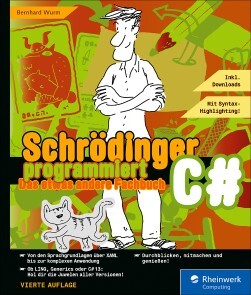
Schrödinger programmiert C#
Schrödinger ist unser Mann fürs Programmieren. Er kann schon was, aber noch nicht C#. Zum Glück hat er einen richtigen Profi an seiner Seite, der auf jede Frage eine Antwort weiß. Und weil Schrödinger zwar schlau ist, aber auch ein wenig ungeduldig, gibt es nach der nötigen Theorie immer sofort etwas zu tun. Mit viel Code und Beispielen, die du nicht wieder vergisst. Ob es ums Einparken ohne Crash geht oder um Schuhschränke, die immer größer werden: Die Übungen schafft ihr (aber nicht immer mit links), die Pausen sind verdient, und am Ende jedes Kapitels dürft ihr euch einen Spickzettel einstecken – Achievement Unlocked, Ready for Next Level. Fantastisch illustriert. Für Einsteiger, Umsteiger und Fans. Aus dem Inhalt: Operatoren, Schleifen, DatentypenKlassen und VererbungWichtige EntwurfsmusterGUI-Entwicklung mit XAMLLINQ einsetzenasync/await geschickt verwendenDateizugriffe und StreamsMultithreadingInternetzugriffMit Fehlern und Ausnahmen umgehen 1. Ein guter Start ist der halbe Sieg. Compiler und Entwicklungsumgebungen ... 25 Compiler und Compiler ... 26 Du brauchst eine IDE! ... 30 Der Spaß geht los! ... 32 Dein erstes Projekt ... 33 Theorie und Praxis ... 39 Was gelernt! ... 41 2. Ein netter Typ. Datentypen und deren Behandlung ... 43 Dieses Glas für diesen Wein ... 44 Grundlagen im Kamelreiten ... 48 Übungen für den Barkeeper ... 50 Rechnen mit Transvestiten ... 50 Alles nur Klone! ... 56 Ja oder nein? ... 57 Was gibt's zu essen? ... 58 Das ständige Hin und Her zwischen ja und nein ... 60 Gut kommentieren! ... 61 Kommentare im Einsatz ... 62 Andere für sich denken lassen ... 62 Compiler-Spiele ... 63 Viele neue Freunde ... 64 3. Alles unter Kontrolle. Bedingungen, Schleifen und Arrays ... 65 Bedingungen ... 66 In der Kürze liegt die Würze ... 69 Durch Variationen bleibt es interessant ... 70 Der Herr der Fernbedienung ... 72 Ist noch Bier da? ... 74 Switch-Expressions ... 77 Pattern-Matching ... 78 Zwillinge ... 79 Zwillinge ... 79 Ein Schuhschrank muss her ... 82 Arbeiten in den Tiefen des Schuhschranks -- von Kopf bis Fuß ... 83 Die ganze Welt ist Mathematik und aller guten Dinge sind vier ... 85 Schau's dir an mit dem Debugger ... 86 Solange du nicht fertig bist, weitermachen ... ... 87 Ich habe es mir anders überlegt ... 88 Oder mach doch weiter ... ... 89 Zurück zu den Schuhschränken ... 90 Wenn aus einem Schuhschrank eine Lagerhalle wird ... 91 Wiederholung, Wiederholung! ... 93 Code muss man auch lesen können ... 94 Jetzt kommt das coole Zeug! ... 96 Arrays verbinden ab C# 12 ... 100 Der Blick durchs Fenster ... 102 ... oder einmal alles ... 103 4. Sexy Unterwäsche -- von kleinen Teilen bis gar nichts. Strings, Characters und Nullable Types ... 105 Zeichenketten -- Strings ... 106 Kleine Teile -- einzelne Zeichen ... 107 Kleine und große Teile ... 108 Einfacher und schneller ... 109 Noch einfacher: Variablen im Text verwenden ... 112 Etwas Besonderes sollte es sein ... 113 Verdrehte Welt ... 114 Sein oder nicht sein? ... 117 Verweise auf nichts ... 120 Nichts im Einsatz ... 122 Damit bei so viel null nichts verloren geht ... 123 5. Eine endliche Geschichte. Enumerationen ... 125 Rot -- Gelb -- Grün ... 126 Tageweise ... 128 Tell me why I don't like mondays ... ... 131 WoW-Völker ... 132 Eine Mischung aus Zahlen und Arrays ... 134 Stimmungsbilder in der Praxis ... 137 Haltet das Banner hoch! ... 140 Auf wenige Sätze heruntergebrochen ... 143 6. Teile und herrsche. Methoden ... 145 Teilen statt Kopieren ... 146 Originale und überteuerte Kopien ... 149 Eins ist nicht genug ... 153 Wenn sich nichts bewegt und alles statisch ist ... 155 Ich hätte gerne das Original! ... 155 Sommerschlussverkauf -- alles muss raus ... 156 Tauschgeschäfte, die nicht funktionieren ... 158 TryParse und Enums ... 159 Zum Schluss noch ganz kurz ... ... 161 Ich will das ganz anders oder auch gar nicht -- Methoden überladen ... 163 Das Ganze noch einmal umgerührt ... 166 Ein knurrender Magen spornt bestimmt zu Höchstleistungen an ... 168 Originale zurücksenden ... 169 Maximale Originale ... 171 Eine kleine Zusammenfassung für dich ... 172 7. Klassengesellschaft. Objekte, Eigenschaften und Sichtbarkeiten ... 173 Mein Alter, meine Augenfarbe, mein Geburtsdatum ... 174 Eine Aufgabe für den Accessor ... 178 Ich sehe was, was du nicht siehst ... 179 Eigenschaften aufpoliert und bereit für die Bühne ... 180 Tanzen mit Elvis -- wenn keiner da ist, ist keiner da ... 182 Geheimniskrämerei und Kontrollfreak ... 183 Darf ich jetzt oder nicht? ... 184 Zusammen, was zusammengehört! ... 188 Zusammen und doch getrennt ... 190 Laufen, kämpfen, sterben ... 192 Vom Leben und Sterben ... 193 Geburtenkontrolle und detektivisches Talent ... 197 Mehrlingsgeburt ... 201 Partielle Klassen ... 204 Meine partiellen Daten ... 206 Gemeinsame Werte von dicken Freunden ... 207 Eigene Wertetypen ... 208 Strukturen überall ... 210 Strukturen ohne Namen ... 214 Ich habe viele Namen ... 216 Eigene Typen nochmals vom Sofa aus betrachtet ... 217 Die Nachteile der Wertetypen ausgetrickst ... 220 Gelernt ist gelernt! ... 223 8. Es wird Zeit für Übersicht! Namespaces ... 225 Eine Ordnung für die Klassen ... 226 Was ist denn nur in diesem Namespace vorhanden? ... 229 Vorhandene Systembausteine ... 231 Visual Studio findet die Namespaces für dich ... 234 Statische Klassen einbinden ... 234 Mathematik für Einsteiger ... 235 Zum Mitnehmen ... 236 9. Erben ohne Sterben. Objektorientierte Programmierung ... 237 Geisterstunde ... 238 Schleimgeister sind spezielle Geister ... 240 Fünf vor zwölf ... 242 Geister fressen, Schleimgeister fressen, Kannibalen fressen -- alles muss man einzeln machen ... 248 Enterben ... 249 Geister haben viele Gestalten ... 249 Geister, die sich nicht an die Regeln halten ... 252 Gestaltwandler unter der Lupe ... 253 Nochmals drüber nachgedacht ... 254 Hier noch ein Merkzettel ... 258 10. Abstrakte Kunst. Abstrakte Klassen und Interfaces ... 259 Abstrakte Klassen ... 260 Unverstandene Künstler ... 262 Das Meisterwerk nochmals betrachtet ... 264 Abstrakte Kunst am Prüftisch ... 265 Allgemein ist konkret genug ... 267 Fabrikarbeit ... 268 Alles unter einem Dach ... 269 Kaffee oder Tee? Oder doch lieber eine Cola? ... 270 Kaffeemaschine im Einsatz ... 272 Eine Cola bitte ... 274 Freundin vs. Chef -- Runde 1 ... 276 Bei perfekter Verwendung ... ... 277 Freundin vs. Chef -- Runde 2 ... 278 Freundin vs. Chef -- Runde 3 ... 280 Interfaces außer Rand und Band ... 281 In der Praxis: Mehr als nur Beschreibungen ... 282 Abstraktion und Interfaces auf einen Blick ... 287 11. Gleich und doch ganz anders. Records, der Star unter den eigenen Datentypen ... 289 Immutability -- die Würfel sind gefallen ... 290 Orcs, Trolle und Elfen als Klassen, Strukturen und Records ... 293 12. Airbags können Leben retten. Exceptionhandling ... 297 Mach's stabil! ... 298 Einen Versuch war es wert ... 300 Nur unter bestimmten Umständen ... 303 Fehler über Fehler ... 304 Über das Klettern auf Bäume ... 308 Klettern auf nicht vorhandene Bäume -- NullReferenceException ... 308 Auf Sträucher klettern -- FormatException ... 309 Sträucher im Sägewerk -- ArgumentException ... 310 Bezahlung ohne Ware -- ArgumentNullException ... 310 Bewusste Fehler ... 311 Selbst definierte Fehler ... 312 Fehler in freier Wildbahn ... 313 Das Matruschka-Prinzip ... 314 Alles noch einmal aufgerollt ... 316 Dein Fehler-Cheat-Sheet ... 320 13. Ein ordentliches Ablagesystem muss her. Collections und Laufzeitkomplexität ... 321 Je größer der Schuhschrank, desto länger die Suche ... 322 Komplizierte Laufschuhe ... 323 Geschwindigkeitsprognosen ... 326 Es muss nicht immer gleich quadratisch sein ... 328 Geschwindigkeitseinschätzung und Buchstabensuppe ... 330 Selbstwachsende Schuhschränke ... 334 Eine Array-Liste ... 335 Ringboxen ... 336 Listige Arrays und ihre Eigenheiten ... 337 Listige Arrays und ihre Verwendung ... 337 The Need for Speed ... 338 The Need for Speed ... 338 The Need for Speed ... 338 The Need for Speed ... 338 Es wird konkreter ... 339 Sortieren bringt Geschwindigkeit -- SortedList ... 342 Listenreiche Arbeit ... 344 Es geht noch schneller! ... 346 Im Rausch der Geschwindigkeit ... 348 Alternative Initialisierungen ... 350 Wörterbücher in der Anwendung... oder was im Regelfall schiefgeht ... 351 Von Bäumen und Ästen ... 355 Ein Verwendungsbeispiel ... 356 Alles eindeutig -- das HashSet ... 357 Schnelles Arbeiten mit Sets ... 358 Das große Bild ... 360 Der große Test, das Geheimnis und die Verwunderung ... 363 Noch einmal durchleuchtet ... 368 Dein Merkzettel rund um die Collections aus Laufzeiten ... 373 14. Allgemein konkrete Implementierungen. Generizität ... 375 Konkrete Typen müssen nicht sein ... 376 Das große Ganze ... 377 Mülltrennung leicht gemacht ... 378 Der Nächste bitte ... 381 Allgemein, aber nicht für jeden! ... 383 Immer das Gleiche und doch etwas anderes ... 385 Fabrikarbeit ... 387 Aus allgemein wird konkret ... 388 Hier kommt nicht jeder Typ rein. ... 389 Ähnlich, aber nicht gleich! ... 390 Varianzen hin oder her ... 392 Varianzen in der Praxis ... 395 WoW im Simulator ... 398 Damit's auch hängen bleibt ... 400 15. Linke Typen, auf die man sich verlassen kann. LINQ ... 401 Shoppen in WoW ... 405 Gesund oder gut essen? ... 408 Listen zusammenführen ... 409 Fix geLINQt statt handverlesen ... 416 Merkzettel ... 420 16. Blumen für die Dame. Delegaten und Ereignisse ... 421 Ein Delegat übernimmt die Arbeit ... 422 Im Strudel der Methoden ... 425 Die Butlerschule ... 428 Die Wahl des Butlers ... 431 Ereignisreiche Tage ... 432 Eine Runde für alle ... 435 Auf in die Bar! ... 436 Wiederholung, Wiederholung ... 439 Die delegierte Zusammenfassung ... 442 17. Der Standard ist nicht genug. Extension-Methoden und Lambda-Expressions ... 443 Extension-Methoden ... 444 Auf die Größe kommt es an ... 448 Erweiterungen nochmals durchschaut ... 450 Softwareentwicklung mit Lambdas ... 452 Lambda-Expressions auf Collections loslassen ... 455 Ein Ausritt auf Lamas ... 456 Filtern ... 456 Gruppieren ... 458 Verknüpfen ... 459 Gruppieren und Verknüpfen kombiniert ... 460 Left Join ... 461 VerLINQte LAMbdAS ... 463 Lamas im Schnelldurchlauf ... 466 18. Die Magie der Attribute. Arbeiten mit Attributen ... 467 Die Welt der Attribute ... 468 Die Magie erleben ... 470 Das Ablaufdatum-Attribut ... 472 Die Magie selbst erleben ... 473 Eine magische Reise in dein Selbst ... 474 In den Tiefen des Kaninchenbaus ... 477 Der Attribut-Meister erstellt eigene Attribute! ... 480 Meine Klasse, meine Zeichen ... 482 Selbstreflexion ... 484 Die Psychologie lehrt uns: Wiederholung ist wichtig! ... 488 19. Ich muss mal raus. Dateizugriff und das Internet ... 489 Daten speichern ... 490 Rundherum oder direkt rein ... 491 Rein in die Dose, Deckel drauf und fertig ... 493 Deine Geheimnisse sind bei mir nicht sicher ... 494 Das Mysterium der Dateiendungen ... 497 Das Gleiche und doch etwas anders ... 500 Das Lexikon vom Erstellen, Lesen, Schreiben, Umbenennen ... 501 Ran an die Tastatur, rein in die Dateien ... 506 Von der Sandburg zum Wolkenkratzer ... 508 Fließbandarbeit ... 512 Wenn das Fließband nicht ganz richtig läuft ... 515 Dem Fließband vorgeschalteter Fleischwolf ... 519 Nutze die Attributmagie! ... 521 X(M)L entspricht XXL ... 522 Der Größenvergleich ... 523 Die kleinste Größe -- JSON ... 524 Wir sind viele ... 525 Schru00F6dinger ... 529 Das World Wide Web. Unendliche Weiten ... 532 Deine Seite, meine Seite ... 534 Probe, Probe, Leseprobe ... 536 Punkt für Punkt fürs Hirn ... 538 20. Komm zurück, wenn du fertig bist. Asynchrone und parallele Programmierung ... 539 Zum Beispiel ein Download-Programm ... 540 Was so alles im Hintergrund laufen kann ... 547 Gemeinsam geht es schneller ... 549 Jetzt wird es etwas magisch ... 553 Wenn jeder mit anpackt, dann geht alles schneller ... 555 Rückzug bei Kriegsspielen ... 558 async/await/cancel ... 560 Unkoordinierte Koordination ... 562 Anders und doch gleich ... 567 Gemeinsam Kuchen backen ... 568 Wenn das Klo besetzt ist ... 573 Das Producer-Consumer-Problem ... 573 Dein Spickzettel ... 579 21. Nimm doch, was andere schon gemacht haben. Die Paketverwaltung NuGet ... 581 Bibliotheken für Code ... 582 Fremden Code aufspüren ... 585 Eigene NuGet-Pakete erstellen ... 588 Pakete statt Projekte ... 591 Die Welt ist schon fertig ... 592 22. Die schönen Seiten des Lebens. Einführung in XAML ... 593 Unendliche Weiten ... 594 Hinzufügen der Komponenten für MAUI-Apps in Visual Studio ... 597 Die MAUI-Architektur ... 598 Diese X-Technologien ... 600 Grundstruktur des Projekts ... 602 Ruf deine Freundin an ... 608 Layouthelferlein ... 612 Tabellen über Tabellen ... 613 Schrödingers Notizen ... 617 Das ist alles eine Stilfrage ... 631 Von der Seite in die Anwendung ... 633 Sonne, Strand und XAML ... 636 23. Models sind doch schön anzusehen. Das Model-View-ViewModel-Entwurfsmuster ... 639 Mein erstes eigenes Model ... 644 Eine Technik, sie alle zu binden! ... 648 Eine Eigenschaft für alle Infos ... 650 Wenn nur jeder wüsste, was er zu tun hätte ... 651 Los geht's! Notify-Everybody ... 654 Ein Laufsteg muss es sein! ... 657 Über Transvestiten und Bindungsprobleme ... 666 Über Bindungsprobleme und deren Lösungen ... 667 Alleine oder zu zweit? ... 668 Aus Klein mach Groß und zurück ... 669 Klein aber fein ... 670 Notizen über Models ... 673 Auf mein Kommando ... 683 Dem Zufall das Kommando überlassen ... 689 MVVM Punkt für Punkt ... 694 24. Weniger ist mehr. MVVM Community Toolkit ... 695 Programmcode generieren lassen ... 696 Lass uns mal rechnen, aber möglichst ohne Aufwand ... 701 Das solltest du trotz Automatik noch wissen ... 710 25. Funktioniert das wirklich? Unit-Testing ... 715 Das Problem: Testen kann lästig werden ... 716 Die Lösung: Unit-Tests -- Klassen, die Klassen testen ... 717 Das Testprojekt erstellen ... 720 Die Ausführung ist das A und O! ... 722 Spezielle Attribute ... 723 Unit-Tests sind nicht alles ... 723 Testgetriebene Softwareentwicklung -- oder wie du Autofahren lernst ... 724 Darfst du schon fahren? ... 725 Let's do it! ... 730 Dein Test-Merkzettel ... 731 26. Schrödingers Zukunft. Vorschau auf C# 13 und .NET9 ... 733 Schrittweise verfeinert ... 733 Params für alle ... 734 Alles erweitern! ... 735 Lange Eigenschaften gekürzt ... 739 Neuerungen in LINQ ... 740 Warten auf Godot ... 742 Index ... 743

Qt mit C++
Sie beherrschen C++ und möchten lernen, GUI-Anwendungen zu entwickeln, die sich vor aktuellen User-Experience-Ansprüchen nicht verstecken müssen? Dann sind Sie hier richtig! Lernen Sie mit dem exklusiven E-Book von Thomas Theis, moderne GUIs mit attraktiven grafischen Effekten zu erstellen – sowohl mit den C++-Klassen von Qt Widgets als auch deklarativ mit QML und JavaScript in Qt Quick. Von der Installation über die ersten Datenbank-Projekte bis zum Einsatz wichtiger Bibliotheken lernen Sie mit vielen Beispielen, wie es geht, und starten direkt durch. Mit Übungen und Lösungen zur Vertiefung. Aus dem Inhalt: InstallationGUI-Anwendungen mit dem Qt CreatorWidgets, Layouts, Menüs, Dialogfelder und mehrDatenbank-AnbindungenIntuitive Gestaltung mit dem Qt DesignerQt Quick mit QML und JavaScriptListen, States, Transitionen und AnimationenPraxistipps und Übungen 1. Einführung ... 9 1.1 ... Inhalt dieses Buchs ... 9 1.2 ... Beispiele und Übungsaufgaben ... 10 2. Qt Widgets, Steuerelemente ... 11 2.1 ... Ein- und Ausgabe von Text ... 11 2.2 ... Auswahl über Schalter ... 24 2.3 ... Auswahl über Optionen ... 27 2.4 ... Auswahl aus einer Liste ... 31 2.5 ... Ein- und Ausgabe von Zahlen ... 36 2.6 ... Übungsaufgabe ... 42 3. Qt Designer, weitere Möglichkeiten ... 45 3.1 ... Layout mit GridLayout ... 45 3.2 ... Layout mit Registerkarten ... 48 3.3 ... Layout mit Stacks ... 53 3.4 ... Hauptmenü und Statusleiste ... 59 3.5 ... Nachrichtendialogfelder ... 68 3.6 ... Eingabedialogfelder ... 73 3.7 ... Standarddialogfelder ... 81 3.8 ... Übungsaufgabe ... 88 4. Datenbanken mit SQLite ... 91 4.1 ... Der Aufbau einer Datenbank ... 91 4.2 ... Datenbank erzeugen und füllen ... 92 4.3 ... Daten auswählen und sortieren ... 103 4.4 ... Daten hinzufügen, ändern und löschen ... 112 4.5 ... Übungsaufgabe ... 123 5. Qt Quick, Steuerelemente ... 127 5.1 ... Ein- und Ausgabe von Text ... 127 5.2 ... Auswahl über Schalter ... 135 5.3 ... Auswahl über Optionen ... 138 5.4 ... Auswahl aus einer Liste ... 140 5.5 ... Ein- und Ausgabe von Zahlen ... 143 5.6 ... Übungsaufgabe ... 146 6. Qt Quick, weitere Möglichkeiten ... 149 6.1 ... Layout mit GridLayout ... 149 6.2 ... Layout mit Registerkarten ... 156 6.3 ... Hauptmenü ... 158 6.4 ... Kontextmenü ... 162 6.5 ... Nachrichtendialogfelder ... 164 6.6 ... Komponenten ... 168 6.7 ... Animationen ... 173 6.8 ... Zustände eines Objekts ... 177 6.9 ... Animierte Zustandsänderung ... 179 6.10 ... Zeichnungen erstellen ... 181 6.11 ... Übungsaufgabe ... 183 Anhang ... 185 Download und Installation von Qt ... 185 Index ... 189
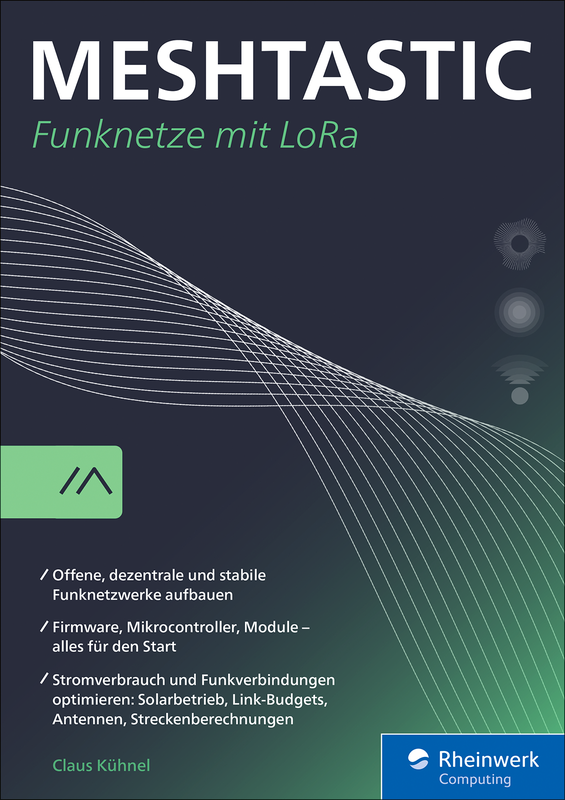
Meshtastic
Eigene Funknetze aufbauen mit LoRa, im heise shop als E-Book erhältlich.Mit der Funktechnologie LoRa als Basis können Sie drahtlose Maker-Projekte realisieren. So weit, so gut: Aber was ist, wenn Sie ein ganzes Netzwerk für den stabilen, dezentralen Austausch von Daten brauchen? Mit Meshtastic bauen Sie sowohl öffentliche als auch lokale Netze auf und sind unabhängig vom Handynetz und Kabelverbindungen. Im Batteriebetrieb oder mit Solarzellen funken Sie off-the-grid und erreichen echt Autarkie, wenn Sie Daten zuverlässig teilen müssen. Wie das geht, zeigt Ihnen Claus Kühnel in dieser Einführung. Aus dem Inhalt: Lokale IoT-Netze aufbauenMikrocontroller für MeshtasticFirmware aufspielen und Geräte konfigurierenEin Meshtastic-Netzwerk aufbauenVerbindungen ins InternetAnwendungstestsSpannungsversorgung mit Batterien und SolarOptimierung der FunkverbindungenBauliche GegebenheitenNetiquette und Traffic Observer

KI für Kreative
Durch die Integration von KI-Technologien in ihre Arbeit können Designer und Designerinnen heute auf eine völlig neue Art kreativ sein. Sie können schneller Daten sammeln und analysieren, Bilder, Texte oder sogar ganze Kreativkonzepte erstellen und vieles mehr. Doch was bedeutet das für die Zukunft des Grafikdesigns? Wie verändert sich die Rolle von Kreativschaffenden in einer Welt, in der KI nun für alle zugänglich ist? Dieses Buch zeigt, wie KI den Designprozess vereinfachen und verbessern kann und wie Sie KI-Systeme effektiv nutzen, um die eigene Kreativität zu beflügeln. Praxiskapitel beschäftigen sich mit den aktuellen KI-Modellen Midjourney, ChatGPT, Adobe Firefly, Stable Diffusion, Magnific AI und dem Einsatz von KI in Photoshop und Illustrator. Durch konkrete und bebilderte Einsatzbeispiele erfahren Sie, wie Sie mithilfe von KI z. B. Ihre Arbeit mit individuellen Mockups eindrucksvoll präsentieren, aufmerksamkeitsstarke Produktfotos kreieren, Bilder bearbeiten oder Bildvarianten erstellen und Schriftzüge entwickeln und generieren. Hilfreich sind auch die zahlreichen Tipps zum Prompten, zu fortgeschrittenen Techniken wie Seeds, durchgängigen Bildstilen und Charakteren, Parametern und zu Negativprompts. Dieses Buch ist Ihr perfekter Begleiter, um die Veränderungen durch KI zu verstehen und zu meistern! Aus dem Inhalt: Grundlegendes: Begriffsdefinitionen, wie lernt generative KI, wie entstehen Bilder und Texte, Möglichkeiten und GrenzenKI als Ideenmaschine für neue und innovative AnsätzeMögliche Rollen von KI im GrafikdesignEinführung in das Prompting und fortgeschrittene Techniken: Textprompts, Bildprompts, Promptgeneratoren im Test, Eigene Prompts entwickeln, Negativprompts, Seeds, Parameter u. v. m.Standardaufgaben mithilfe von KI lösen: Konzeption, Zielgruppenbeschreibung und Persona, Mockups, Recherche, ZielgruppendefinitionKI für die Gestaltung von Illustrationen, Fotos und Schrift nutzenPräsentationen mithilfe von KI gestaltenBilder mit KI optimieren: Bildretusche, Texturen, Composings, Freistellen, Vektorisierung, Upscaling und vieles mehrDie wichtigsten KI-Programme im Einsatz: Midjourney, ChatGPT, Adobe Firefly, Stable Diffusion und Magnific AIHinweise zu Urheberrecht und Nutzungsrechten sowie ethische Denkanstöße mit Blick in die ZukunftBest Practices und Fallstudien: Eigene Mockups erstellen – Bildstile und Bildserien mit Style References und Character Reference – Produktfotografie mit Adobe Firefly – Mit Schrift arbeiten in Adobe Firefly – Schriften suchen und ersetzen mit Illustrator – Storytelling mit ChatGPT – Bildbearbeitung in Photoshop mit KI – Moodboards mit Midjourney – Nahtlose Muster mit Midjourney – KI in der Konzeptionsphase einsetzen – Kreativbriefing mit ChatGPT –Kreativtechniken mit ChatGPT (und Midjourney) – Kreative Mockups mit Vektorgrafiken erstellen –Designvorlagen mit ChatGPT erstellen – Eigene GPTs erstellen – Logodesign und Schriftbilder mit Midjourney – Bildvarianten mit Bildprompts in Stable Diffusion – Vektorisieren von Pixelbildern mit Vectorizer.ai – Mit Magnific AI Bilder generieren, interpolieren und verbessern u. v. m. 1. Künstliche Intelligenz -- eine Einführung ... 12 KI -- ein neues Werkzeug ... 12 Künstliche Intelligenz verstehen ... 18 Einschränkungen und Probleme von KI-Systemen ... 29 Formen und Schnittstellen von KI ... 39 Relevanz von KI im Designbereich ... 46 2. Künstliche Intelligenz und Kreativität ... 52 Ist KI kreativ? ... 52 PRAXIS: KI-Bilder auf Kompositionsregeln analysiert ... 59 Auswirkungen von KI auf die eigene Kreativität ... 63 KI als Ideenmaschine ... 73 PRAXIS: Kreativbriefing mit ChatGPT ... 76 PRAXIS: Kreativtechniken mit ChatGPT (und Midjourney) ... 88 PRAXIS: Namensideen entwickeln mit ChatGPT ... 91 PRAXIS: Storytelling mit ChatGPT ... 94 PRAXIS: Design Thinking mit ChatGPT ... 96 Ist KI nun kreativ? ... 98 3. KI im Designworkflow einsetzen ... 102 Ansätze zur Integration von KI ... 102 PRAXIS: Moodboards mit Midjourney ... 108 PRAXIS: Beispiele zur Anwendung von ChatGPT in der Konzeptionsphase ... 114 KI-Tools mit System auswählen ... 117 4. Prompting für generative KI ... 134 Einführung in das Prompting ... 134 PRAXIS: Promptgenerator für Bild-KI im Test ... 140 PRAXIS: Promptformel für Textprompting -- Beispiel Storytelling ... 145 PRAXIS: Ein Prompt -- verschiedene KI-Modelle ... 150 Prompting für Fortgeschrittene ... 157 PRAXIS: Auflösung und Bildqualität ... 164 PRAXIS: Seeds und ihren Einfluss auf das Ergebnis verstehen ... 166 PRAXIS: Prompt vs. »kreative« Freiheit in drei KI-Bildgeneratoren ... 170 5. KI-Programme im Kreativalltag ... 178 Midjourney ... 178 PRAXIS: Promptinspiration aus der Community ... 188 PRAXIS: Prompthilfe in Midjourney ... 192 PRAXIS: Bildstile und Bildserien mit Style References und Character References ... 202 PRAXIS: Nahtlose Muster generieren ... 206 PRAXIS: Organize -- Bilder suchen, organisieren und filtern ... 208 PRAXIS: Logodesign und Schriftbilder mit Midjourney ... 209 ChatGPT 4o ... 212 PRAXIS: Zielgruppe und Persona mit ChatGPT und Midjourney ... 218 PRAXIS: Präsentationen mit Hilfe von KI erstellen ... 219 PRAXIS: Designs mit ChatGPT und Midjourney entwerfen ... 222 PRAXIS: Eigene GPTs erstellen ... 225 PRAXIS: Schriftzüge mit Ideogram generieren ... 231 PRAXIS: Vektorisieren von Pixelbildern mit Vectorizer.AI ... 232 Adobe Firefly (Webanwendung) ... 234 PRAXIS: Struktur- und Stilreferenzen in Firefly nutzen ... 240 PRAXIS: Produktfotografie mit Hilfe von Firefly ... 242 Adobe Photoshop (Firefly) ... 245 PRAXIS: Fotos retuschieren in Photoshop mit KI ... 251 PRAXIS: Produktmockups mit vorhandenen Produktbildern ... 254 Adobe Illustrator (Firefly) ... 258 PRAXIS: Kreative Mockups mit Vektorgrafiken erstellen ... 269 DreamStudio by stability.ai ... 272 Magnific AI ... 283 PRAXIS: Mockups und Produktbilder mit Magnific AI ... 293 PRAXIS: Bilder generieren mit Magnific AI ... 295 6. Recht und Ethik ... 298 Rechtliches in Verbindung mit KI ... 298 PRAXIS: Nutzung und Vergütung von KI-Bildern ... 309 Ethik und Umwelt ... 314 PRAXIS: Diversität und KI ... 317 7. KI als zukünftige Designassistenz ... 326 Das digitale Dilemma ... 326 Mögliche Entwicklungen in der Zukunft ... 332 Ein erstes Fazit ... 333 Glossar ... 336 Überblick über die im Buch verwendeten KI-Modelle ... 339 Index ... 340

Blender
Das große Handbuch zu allen wichtigen Funktionen von Blender. Dieses Buch bietet einen soliden Einstieg in die 3D-Software und in die Grundlagen des 3D-Designs. Aber es geht noch weiter: Es begleitet Sie vom Modelling über Texturing und Shading, die Beleuchtung, Rigging und Animation bis hin zu Simulation, Rendering und Postproduktion. In Schritt-für-Schritt-Anleitungen konstruieren, texturieren und animieren Sie Ihre eigenen 3D-Objekte und setzen das Gelernte direkt in die Praxis um. Das verlässliche Lern- und Nachschlagewerk für alle Anwender – aktuell zu Version 4.2. Aus dem Inhalt: Arbeitsoberfläche, Navigation und ObjekteModelling und SculptingShading, Texturing und MappingLichtquellen, Kameras und TrackingAnimationen mit Keyframes, Pfaden und DrivernCharacter AnimationPartikelsysteme, Haare und KollisionenRauch, Feuer und FlüssigkeitenGeometry Nodes und Simulation Nodes2D-Animationen mit Grease PencilRendering mit EEVEE Next und CyclesCompositing, Schnitt und Ton, Import und Export TEIL I. Grundlagen ... 17 1. Ihr Einstieg in Blender ... 19 1.1 ... Über Blender ... 19 1.2 ... Über dieses Buch ... 24 1.3 ... Blender installieren ... 26 2. Arbeitsoberfläche ... 29 2.1 ... Splash-Screen ... 29 2.2 ... Die Bedienoberfläche im Überblick ... 32 2.3 ... Fenster, Editoren, Tabs und Panels ... 34 2.4 ... Outliner, Properties Editor und 3D Viewport ... 40 2.5 ... Navigation im Viewport ... 54 2.6 ... Nodes ... 59 3. Arbeiten mit Objekten ... 63 3.1 ... Objekte erzeugen ... 63 3.2 ... Objekte transformieren ... 69 3.3 ... Duplikate, Links und Hierarchien ... 79 3.4 ... Collections ... 87 3.5 ... Annotation-Tool ... 95 4. Datenmanagement ... 97 4.1 ... Datenblöcke, Links und User ... 97 4.2 ... Blend-Files ... 101 4.3 ... Bibliotheken ... 104 4.4 ... Asset Browser ... 109 5. Blender optimal nutzen ... 113 5.1 ... Einstieg und Orientierung ... 113 5.2 ... Workflow optimieren ... 117 5.3 ... Einheiten ... 132 5.4 ... Scripting ... 134 5.5 ... Blender einrichten ... 140 TEIL II. Modelling ... 155 6. Objektarten ... 157 6.1 ... Mesh-Primitives ... 158 6.2 ... Curves und Surfaces ... 169 6.3 ... Metaballs ... 176 6.4 ... Text ... 179 6.5 ... Empty ... 181 6.6 ... Instances ... 184 7. Modelling-Tools ... 187 7.1 ... Selektion ... 189 7.2 ... Werkzeuge ... 194 7.3 ... Proportional Editing ... 207 7.4 ... Transform Snapping ... 209 7.5 ... Measure ... 211 8. Modifier ... 245 8.1 ... Funktionen der Modifier ... 247 8.2 ... Modifier Stack ... 248 8.3 ... Modifier-Arten ... 248 9. Sculpting ... 333 9.1 ... Vorbereitung ... 334 9.2 ... Sculpting-Werkzeuge ... 335 9.3 ... Masken und Face Sets ... 343 9.4 ... Painting ... 346 9.5 ... Dyntopo und Remesh ... 348 TEIL III. Texturing ... 363 10. Materialien und Texturen ... 365 10.1 ... Shading ... 365 10.2 ... Materialien ... 373 10.3 ... Shader ... 377 10.4 ... Texturen ... 390 10.5 ... Mapping ... 393 10.6 ... Material-Nodes ... 396 11. Textur-Mapping ... 431 11.1 ... UV-Abwicklung ... 432 11.2 ... UV-Editing ... 437 11.3 ... Texturing mit UV-Maps ... 441 11.4 ... Texture Painting ... 447 TEIL IV. Ausleuchtung und Inszenierung ... 487 12. Lichtquellen ... 489 12.1 ... Lichtquellen-Arten ... 490 12.2 ... Beleuchtungseffekte ... 507 13. Kamera ... 523 13.1 ... Kamera-Objekt ... 524 13.2 ... Kamera-Parameter ... 527 14. Tracking ... 549 14.1 ... Tracking-Arten ... 550 14.2 ... Tracking-Workflow ... 552 14.3 ... 2D-Stabilisierung ... 581 14.4 ... Linsenverzerrung ... 583 14.5 ... Masking und Rotoscoping ... 586 TEIL V. Animation und Simulation ... 609 15. Keyframe-Animation ... 611 15.1 ... Timeline und Keyframes ... 611 15.2 ... Dope Sheet Editor ... 618 15.3 ... Graph Editor ... 622 15.4 ... Pfad-Animation ... 633 15.5 ... Nonlinear Animation Editor ... 637 15.6 ... Driver ... 643 16. Character-Animation ... 657 16.1 ... Armatures und Bones ... 657 16.2 ... Forward und Inverse Kinematics ... 671 16.3 ... Skinning ... 676 16.4 ... Constraints ... 690 16.5 ... Shape Keys ... 696 16.6 ... Pose Library ... 698 17. Simulation ... 725 17.1 ... Ocean ... 726 17.2 ... Explode ... 729 17.3 ... Partikelsysteme ... 731 17.4 ... Physics ... 750 17.5 ... Volume-Objekt ... 787 17.6 ... Dynamic Paint ... 790 18. Geometry Nodes ... 793 18.1 ... Prozeduraler Ansatz ... 794 18.2 ... Geometry Node Editor ... 800 18.3 ... Node Types und Nodes ... 804 18.4 ... Spreadsheet Editor ... 809 18.5 ... Simulation Zone ... 811 18.6 ... Hair ... 816 19. 2D-Animation ... 841 19.1 ... Aufbau eines Grease Pencil-Objekts ... 842 19.2 ... Arbeitsmodi für Grease Pencil ... 850 19.3 ... Animation in Grease Pencil ... 855 TEIL VI. Rendering, Compositing und Ausgabe ... 863 20. Rendering ... 865 20.1 ... Allgemeine Render-Einstellungen ... 866 20.2 ... Workbench ... 873 20.3 ... EEVEE ... 874 20.4 ... Cycles ... 885 20.5 ... Color Management ... 895 20.6 ... Non-Photorealistic Rendering (NPR) ... 897 21. Compositing ... 901 21.1 ... View Layer ... 902 21.2 ... Passes ... 904 21.3 ... Compositing-Nodes ... 914 22. Schnitt und Ton ... 933 22.1 ... Strips und Channels ... 934 22.2 ... Modifier und Effekte ... 942 23. Import und Export ... 953 23.1 ... Import ... 953 23.2 ... Export ... 956 Index ... 969

Artificial Intelligence-Enabled Businesses
THIS BOOK HAS A MULTIDIMENSIONAL PERSPECTIVE ON AI SOLUTIONS FOR BUSINESS INNOVATION AND REAL-LIFE CASE STUDIES TO ACHIEVE COMPETITIVE ADVANTAGE AND DRIVE GROWTH IN THE EVOLVING DIGITAL LANDSCAPE.Artificial Intelligence-Enabled Businesses demonstrates how AI is a catalyst for change in business functional areas. Though still in the experimental phase, AI is instrumental in redefining the workforce, predicting consumer behavior, solving real-life marketing dynamics and modifications, recommending products and content, foreseeing demand, analyzing costs, strategizing, managing big data, enabling collaboration of cross-entities, and sparking new ethical, social and regulatory implications for business. Thus, AI can effectively guide the future of financial services, trading, mobile banking, last-mile delivery, logistics, and supply chain with a solution-oriented focus on discrete business problems. Furthermore, it is expected to educate leaders to act in an ever more accurate, complex, and sophisticated business environment with the combination of human and machine intelligence. The book offers effective, efficient, and strategically competent suggestions for handling new challenges and responsibilities and is aimed at leaders who wish to be more innovative. It covers the early stages of AI adoption by organizations across their functional areas and provides insightful guidance for practitioners in the suitable and timely adoption of AI. This book will greatly help to scale up AI by leveraging interdisciplinary collaboration with cross-functional, skill-diverse teams and result in a competitive advantage. AUDIENCEThis book is for marketing professionals, organizational leaders, and researchers to leverage AI and new technologies across various business functions. It also fits the needs of academics, students, and trainers, providing insights, case studies, and practical strategies for driving growth in the rapidly evolving digital landscape. SWETA DIXIT, PHD, is an associate professor in the Sharda School of Business Studies, Sharda University, Greater Noida, India. She has authored one book and published research articles and case studies on emotional intelligence, global mobility, performance management, and organizational culture. Dixit also conducts sessions on emotional intelligence, self-awareness, leadership, and negotiation skills. MOHIT MAURYA, PHD, is an associate professor in the Sharda School of Business Studies, Sharda University, Greater Noida, India. He has published several research papers in national and international journals and delivered lectures on hyper-localization, digital marketing, branding, business ethics, etc. He has authored 3 books. His scholarly work won the Emerald - AUC School of Business Cast Writing Competition in 2020. VISHAL JAIN, PHD, is an associate professor at Sharda University, Greater Noida, India. His research interests focus on information retrieval, the semantic web, ontology engineering, data mining, etc. He has edited 50 books for a variety of publishers and authored more than 100 research papers for reputed conferences and journals. Jain has several awards, which include the 2012 Young Active Member Award and the 2019 Best Researcher Award. GEETHA SUBRAMANIAM, PHD, is a professor at the Faculty of Education, Languages, Psychology, and Music, SEGI University, Kuala Lumpur, Malaysia. Her research focuses on labor economics, sustainable development issues, teaching & learning, and educational management issues. She has published more than 100 journals, co-authored two economics textbooks, and is the managing editor of the Malaysian Journal of Qualitative Research. Preface xix1 Crafting Effective AI Adoption Strategies 1Aarti Neema and Rashid Khan2 Role of Artificial Intelligence in Management and Preservation of Old Text Through New Tech 25Veenus Jain, Pallavi Mohanan and Mkrtchyan Naira3 Deployment of AI and ML Techniques in the Form of Ontology for Improving Business Management Perspectives 39Aman Jandwani, Balraj Verma, Amit Mittal, Paras Jandwani and Gagandeep Singh Narula4 Blockchain in Supply Chain Management: Applications, Advantages and Challenges 57Pijush Kanti Dutta Pramanik and Saurabh Pal5 Artificial Intelligence for Supply Chain Optimization: Benefits, Challenges, and Potential Solutions 81Dhruv Kishore Bole and Narasimha Rao Vajjhala6 Fusing New Age Technologies with Marketing Management: Navigating the Digital Frontier 95Ankitha K., Jayapadmini Kanchan, Harish Kunder, Shwetha S. Shetty, Ganaraj K. and Madhura Hegde7 Nth Floor at Accenture--Next-Gen Onboarding Using Metaverse 105Rachna Bansal Jora, Ansh Agrawal, Edoardo Mazzetto, Sweta Dixit and Samson Lallawmkipa Darlong8 Smart HR with Smart Technologies 121Arnav Malhotra, Alka Maurya and Balasundram Maniam9 Securing Business Transactions Using Merkle Tree 137Ambika N.10 InvestoAI-Tailored Investment Recommendation 159Niomi Samani, Tejas Uttare, Rama M. Maliya and Kedar Semani11 Using AI Technology to Enhance Data-Driven Decision-Making in the Financial Sector 187Meng Wu, Geetha Subramaniam, Zeyu Li and Xiuchun Gao12 The Role of Artificial Intelligence (AI) in the Transformation of Small- and Medium-Sized Businesses: Challenges and Opportunities 209Arjita Jain, Kiran Shrimant Kakade and Swati Amit Vispute13 Applications of Artificial Intelligence and Machine Learning-Enabled Businesses: A SWOT Analysis for Human Society 227Santanu Koley, Shatadru Sengupta, Bipasha Biswas, Kankana Datta, Manasi Jana and Apratim Mitra14 Gamified Learning Environments for Higher Education Sustainability in Delhi Metropolitan Region 263Sonia Yadav, Sweta Dixit, Rachna Bansal and Canh Van Ta15 Exploring the Impact of AI on Management and Healthcare for Streamlining Operations and Decision-Making 275Pranshu Mathur and Ajay Kumar16 Empowering Defense: Harnessing AI for Next-Generation Warfare 289Nikki Rani, Komal Jindal, Rita Chikkara and Nidhi Malik17 Industry Augmented Reality Along with Artificial Intelligence: Developments, Resources, and Possible Concerns 311Sarabjeet Singh Sethi and Priyanka Sharma18 Transformative Effects of Smarter Chatbots: Unravelling the Vision, Challenges, and@Capabilities of ChatGPT-Conversational AI 333C. Kishor Kumar Reddy, Patlolla Sathvika Reddy, Ashritha Pilly and Srinath Doss19 Application of Artificial Intelligence in Business Management for Prudent Decision Making 351Syed Tabassum Sultana and T. Venkat Narayana Rao20 Technology-Driven Business Ethics: A Philosophical Discourse 371Sooraj Kumar Maurya, Amarbahadur Yadav and Rajiv Nayan21 Harnessing the Power of Artificial Intelligence for Sustainable Development 391Ayan Harsh Sinha, Alka Maurya and J. Mark Munoz22 University Students' Perception of Artificial Intelligence (AI) for Entrepreneurship Development in Selected Asian Countries of China, India, Indonesia, and Malaysia 397Doris Padmini Selvaratnam, Jaheer Mukhtar K.P., Evi Gravitiani and Wen Meiting23 Clubhouse Unleashed: Harnessing the Power of Voice for Robust Social Networking and Business Growth 421Pooja Darda, Shailesh Pandey, Om Jee Gupta, Manpreet Kaur and Sanjaya Singh Gaur24 Artificial Intelligence (AI) as Strategy to Gain Competitive Advantage for Australian Higher Education Institutions (HEI) Under the New Post COVID-19 Scenario 439Rubaiyet Hasan Khan and Rohini Balapumi25 AI for a Better Future--Perspectives from Young Employees in Malaysia and China 451Geetha Subramaniam, Wang Zhe, Zhu Dan and Narayanaswami Subramaniam26 Personalization and Customer Experience in the Era of Data-Driven Marketing 467Ambarish G. Mohapatra, Anita Mohanty, Subrat Kumar Mohanty, Nitaigour Premchand Mahalik and Sasmita NayakReferences 509Index 513

Building Application with Spec 2.0
Spec is the default UI building framework for Pharo. With Spec, developers focus on user interaction and widget layout. Spec is built around the Model View Presenter pattern. Presenters are responsible for defining the interaction logic of the application. They enforce the interaction of their subelements as well as domain objects.With Spec, existing presenters or even complete UIs are reused and configured to form a new user interface. Spec is widget framework (GTK, Morphic, Toplo) agnostic. It makes desktop applications simple to build.This book shows the basics of Spec in Pharo 12 and how it enables reuse of user interface elements. It focuses on Spec 2.0 features such as new widget layouts, dynamic widget building and more advanced features such as transmissions or commands.The book contains:- Deep explanations of various Spec 2.0 facets.- A tutorial gets you started in less than 20 minutes.- A minimal email client revisiting all Spec 2.0 features.Stéphane Ducasse:Spec is the default UI building framework for Pharo. With Spec, developers focus on user interaction and widget layout. Spec is built around the Model View Presenter pattern. Presenters are responsible for defining the interaction logic of the application. They enforce the interaction of their subelements as well as domain objects.With Spec, existing presenters or even complete UIs are reused and configured to form a new user interface. Spec is widget framework (GTK, Morphic, Toplo) agnostic. It makes desktop applications simple to build.This book shows the basics of Spec in Pharo 12 and how it enables reuse of user interface elements. It focuses on Spec 2.0 features such as new widget layouts, dynamic widget building and more advanced features such as transmissions or commands.The book contains:- Deep explanations of various Spec 2.0 facets.- A tutorial gets you started in less than 20 minutes.- A minimal email client revisiting all Spec 2.0 features.

Building a minimal reflective kernel
What is the class Object? What is the class Class? Why the class Object is an instance of the class Class? If you ever ask yourself such questions, this book is for you.After explaining the impact of representing classes as objects, you will develop step by step a minimal reflective kernel.In this book you will learn:- object instantiation, allocation, and initialization, - classes as objects,- description of classes,- creation of classes,- method lookup and error handling,- examples of metaclasses,- bootstrap of a reflective system.The content of this book has been used to teach reflective architectures for more than 15 years.Stéphane Ducasse:I'm expert in language design and reengineering. I worked on traits. Traits have been introduced in Pharo, Perl, PHP and under a variant into Scala, Groovy and Fortress. I'm expert on software quality, program understanding, program visualisations, reengineering and metamodeling. I'm one of the father of Moose, an open-source software analysis platform http://www.moosetechnology.org/ and https://modularmoose.org. I created Synectique a company building dedicated tools for advanced software analyses. I'm one of creator and the leader of Pharo http://www.pharo.org/ a dynamic reflective object-oriented language supporting live programming. Since 2013, I built the industrial Pharo consortium http://consortium.pharo.org and I lead the consortium engineering team.Our objective is to deliver a highly robust, versatile, compact and productive environment to develop and deploy advanced applications.I work regularly with companies (Thales, Wordline, Siemens, Berger-Levrault, Arolla,...) on software evolution problems. I wrote couple hundred articles and several books. I'm editor of two book collections available at: http://books.pharo.org.

JavaScript for Kids
Welcome to the book “JavaScript for Kids: Start your Coding Adventure”. This book is your introduction to the world of JavaScript. It's your first step towards developing websites and mobile applications. With JavaScript, you can turn your ideas into reality. Learning should be fun, so you will feel like you are reading a story. By the end of this book, you will have a good understanding of JavaScript. You will have taken the first steps in your modern web programming adventure. Have fun programming! Hello, I am Abdelfattah Ragab, a professional software developer with more than 20 years of experience. I am an expert in Angular, CSS, graphic design and all web related technologies. I have published numerous books on modern CSS layouts and Angular as well as complete business solutions for e-commerce and the like. I hope you enjoy my books. With kind regards.

So You Want to Work in Crypto
Gain the necessary technical skills, tools, and insights to succeed in the crypto working environment. Changing market conditions have created new opportunities and working conditions. This book goes beyond just getting a job, as it shares a myriad of hidden tips on how to thrive within this constantly evolving ecosystem. Through examples and detailed typologies, you’ll work out which crypto job is the best fit for you.You’ll begin by reviewing some fun facts and anecdotes illustrating life in a Web3 environment, with a careful examination of the various roles in crypto, blockchain, and digital assets. You’ll then compare roles in the traditional corporate and financial environments with those in the crypto world from a risk and reward perspective. From there you’ll prepare for crypto job interviews with a focus on what to expect and fine-tuning the necessary expertise to excel. Different types of contracts, the onboarding process, communication tools, the intricacies of video conferences, internal storage, and various crypto-specific operational skills will all be clearly explained as well._So You Want to Work in Crypto_ provides all the strategies you’ll need to stay ahead of the curve in the ever-changing crypto world.WHAT YOU'LL LEARN* Examine what job positions exist in Web3 and how to obtain the right one for you.* Prepare yourself for the Web3 environment and the type of job you will get.* See how to strategically evolve your career in the world of crypto.WHO THIS BOOK IS FORAny individual curious about evolving their career, obtaining their first job, or simply looking to find a new, more fulfilling job in an exciting revolutionary industry.Alexander T. Rees-Evans recently moved into the world of crypto, initially collaborating with the luxury asset trading platform, Idoneus. Since then, he has headed up large sales teams in a centralized exchange, private placement platforms and was the international sales director at Kaizen Finance where over 40 projects were built and launched.Rees-Evans is currently a senior advisor at DVerse, a multi-award winning Web3 consultancy firm working with some of the largest companies in this space such as Algorand, Farcana, AnimocaBrands and Assassin’s creed. He also presides over the blockchain and cybernetic commission of the World Business Union, is a mentor at Techstars, Blockstart, AVio and GeniusX, and an accredited partner of the BTCSafezone, the most secure platform for exchanging Bitcoin and USDT.Chapter 1: Introduction to Working in Crypto.- Chapter 2: Corporate vs Crypto.- Chapter 3: Web3 Working Environment.- Chapter 4: Market Conditions and Cycles .- Chapter 5: Web3 Company Structures.- Chapter 6: Types of Jobs in Web3.- Chapter 7: Preparing for Your Crypto Job Interview.- Chapter 8: The Onboarding Process.- Chapter 9: How to prepare for your first day at work.- Chapter 10: How to Keep a Job in Crypto.- Chapter 11: How to Develop Your Crypto Career.- Chapter 12: Words of Wisdom.

Artificial Intelligence-Enabled Businesses
THIS BOOK HAS A MULTIDIMENSIONAL PERSPECTIVE ON AI SOLUTIONS FOR BUSINESS INNOVATION AND REAL-LIFE CASE STUDIES TO ACHIEVE COMPETITIVE ADVANTAGE AND DRIVE GROWTH IN THE EVOLVING DIGITAL LANDSCAPE.Artificial Intelligence-Enabled Businesses demonstrates how AI is a catalyst for change in business functional areas. Though still in the experimental phase, AI is instrumental in redefining the workforce, predicting consumer behavior, solving real-life marketing dynamics and modifications, recommending products and content, foreseeing demand, analyzing costs, strategizing, managing big data, enabling collaboration of cross-entities, and sparking new ethical, social and regulatory implications for business. Thus, AI can effectively guide the future of financial services, trading, mobile banking, last-mile delivery, logistics, and supply chain with a solution-oriented focus on discrete business problems. Furthermore, it is expected to educate leaders to act in an ever more accurate, complex, and sophisticated business environment with the combination of human and machine intelligence. The book offers effective, efficient, and strategically competent suggestions for handling new challenges and responsibilities and is aimed at leaders who wish to be more innovative. It covers the early stages of AI adoption by organizations across their functional areas and provides insightful guidance for practitioners in the suitable and timely adoption of AI. This book will greatly help to scale up AI by leveraging interdisciplinary collaboration with cross-functional, skill-diverse teams and result in a competitive advantage. AUDIENCEThis book is for marketing professionals, organizational leaders, and researchers to leverage AI and new technologies across various business functions. It also fits the needs of academics, students, and trainers, providing insights, case studies, and practical strategies for driving growth in the rapidly evolving digital landscape. SWETA DIXIT, PHD, is an associate professor in the Sharda School of Business Studies, Sharda University, Greater Noida, India. She has authored one book and published research articles and case studies on emotional intelligence, global mobility, performance management, and organizational culture. Dixit also conducts sessions on emotional intelligence, self-awareness, leadership, and negotiation skills. MOHIT MAURYA, PHD, is an associate professor in the Sharda School of Business Studies, Sharda University, Greater Noida, India. He has published several research papers in national and international journals and delivered lectures on hyper-localization, digital marketing, branding, business ethics, etc. He has authored 3 books. His scholarly work won the Emerald - AUC School of Business Cast Writing Competition in 2020. VISHAL JAIN, PHD, is an associate professor at Sharda University, Greater Noida, India. His research interests focus on information retrieval, the semantic web, ontology engineering, data mining, etc. He has edited 50 books for a variety of publishers and authored more than 100 research papers for reputed conferences and journals. Jain has several awards, which include the 2012 Young Active Member Award and the 2019 Best Researcher Award. GEETHA SUBRAMANIAM, PHD, is a professor at the Faculty of Education, Languages, Psychology, and Music, SEGI University, Kuala Lumpur, Malaysia. Her research focuses on labor economics, sustainable development issues, teaching & learning, and educational management issues. She has published more than 100 journals, co-authored two economics textbooks, and is the managing editor of the Malaysian Journal of Qualitative Research.