

Computer und IT
Handbook of Computational Sciences
THE HANDBOOK OF COMPUTATIONAL SCIENCES IS A COMPREHENSIVE COLLECTION OF RESEARCH CHAPTERS THAT BRINGS TOGETHER THE LATEST ADVANCES AND TRENDS IN COMPUTATIONAL SCIENCES AND ADDRESSES THE INTERDISCIPLINARY NATURE OF COMPUTATIONAL SCIENCES, WHICHREQUIRE EXPERTISE FROM MULTIPLE DISCIPLINES TO SOLVE COMPLEX PROBLEMS.This edited volume covers a broad range of topics, including computational physics, chemistry, biology, engineering, finance, and social sciences. Each chapter provides an in-depth discussion of the state-of-the-art techniques and methodologies used in the respective field. The book also highlights the challenges and opportunities for future research in these areas. The volume pertains to applications in the areas of imaging, medical imaging, wireless and WS networks, IoT with applied areas, big data for various applicable solutions, etc. This text delves deeply into the core subject and then broadens to encompass the interlinking, interdisciplinary, and cross-disciplinary sections of other relevant areas. Those areas include applied, simulation, modeling, real-time, research applications, and more. AUDIENCEBecause of the book’s multidisciplinary approach, it will be of value to many researchers and engineers in different fields including computational biologists, computational chemists, and physicists, as well as those in life sciences, neuroscience, mathematics, and software engineering. AHMED A. ELNGAR, PHD, is the founder and head of Scientific Innovation Research Group (SIRG) and assistant professor of Computer Science at the Faculty of Computers and Information, Beni-Suef University, Egypt. VIGNESHWAR. M., is head of R & D and Academic Initiatives, Cybase Technologies, Coimbatore, Tamil Nadu, India. He has around 9 years in industry & research and 8 years in academia. He has an M.E., degree in computer science and engineering, and has published more than 110 international/national conference and journal publications as well as numerous awards. KRISHNA KANT SINGH, PHD, is an associate professor in the Faculty of Engineering & Technology, Jain (Deemed-to-be University), Bengaluru, India. Dr. Singh has acquired BTech, MTech, and PhD (IIT Roorkee) in the area of machine learning and remote sensing. He has authored more than 50 technical books and research papers in international conferences and SCIE journals. ZDZISLAW POLKOWSKI, PHD, is a professor in the Faculty of Technical Sciences, Jan Wyzykowski University, Polkowice, Poland. He has published more than 75 research articles in peer-reviewed journals.

Innovative Engineering with AI Applications
INNOVATIVE ENGINEERING WITH AI APPLICATIONSINNOVATIVE ENGINEERING WITH AI APPLICATIONS DEMONSTRATES HOW WE CAN INNOVATE IN DIFFERENT ENGINEERING DOMAINS AS WELL AS HOW TO MAKE MOST BUSINESS PROBLEMS SIMPLER BY APPLYING AI TO THEM.Engineering advancements combined with artificial intelligence (AI), have resulted in a hyper-connected society in which smart devices are not only used to exchange data but also have increased capabilities. These devices are becoming more context-aware and smarter by the day. This timely book shows how organizations, who want to innovate and adapt, can enter new markets using expertise in various emerging technologies (e.g. data, AI, system architecture, blockchain), and can build technology-based business models, a culture of innovation, and high-performing networks. The book specifies an approach that anyone can use to better architect, design, and more effectively build things that are technically novel, useful, and valuable, and to do so efficiently, on-time, and repeatable. AUDIENCEThe book is essential to AI product developers, business leaders in all industries and organizational domains. Researchers, academicians, and students in the AI field will also benefit from reading this book. ANAMIKA AHIRWAR, PHD, is an associate professor at the Compucom Institute of Information Technology & Management, Jaipur, India. She has about 20 years of experience in teaching and research and has published more than 45 research papers in reputed national/international journals and conferences, authored several books as well as five patents. PIYUSH KUMAR SHUKLA, PHD, is an associate professor in the Department of Computer Science & Engineering, University Institute of Technology, Bhopal, India. He has about 15 years of experience in teaching and research, is the author of 3 books, more than 50 articles and book chapters in international publications, as well as 15 Indian patents. MANISH SHRIVASTAVA, PHD, is the Principal of the Chameli Devi Institute of Technology & Management, Indore, India. He has published more than 100 articles in international journals and spent 7 years as a software engineer. PRITI MAHESHWARY, PHD, is a professor in the Department of CSE and Head of the Centre for Excellence in Internet of Things and Advance Computing Lab, Rabindranath Tagore University, Bhopal, India. BHUPESH GOUR, PHD, is a professor in the Department of Computer Science and Engineering at Lakshmi Narain College of Technology in Bhopal, India. He has 22 years of experience in academia as well as the software industry. He has published more than 50 articles in national and international journals, as well as four patents.

Cloud Security Grundlagen
Die Cloud Technologie scheint der Business Treiber der letzten Jahre zu sein. Entsprechend mehreren Studien suchen international Konzerne sowie kleine und mittlere Unternehmen KMU ihre Informationstechnologie in die Cloud zu verlagern.Cloud Security Grundlagen in der aktualisierten 4. Auflage beschreibt die Situation in 2023 und zeigt, welche Massnahmen erforderlich sind um die Cloud Technologie sicher einsetzen zu können.Nachdem die Cloud Technologie mit ihrer Architektur, den Einsatzvarianten und den unterschiedlichen Objekten, die zur Verfügung stehen, erörtert ist, beschreibt das Buch die erforderlichen organisatorischen und technischen Massnahmen zum Erreichen der Sicherheit.Uwe Irmer:Dipl. Ing. Uwe Irmer studierte Elektrotechnik und Wirtschaftsingenieur mit den Schwerpunkten Energietechnik, Informatik und Projektmanagement. Seit 1990 in vielen nationalen und internationalen Projekten der Fachbereiche Energieverteilung, Informationssicherheit und IT Architektur tätig, befasst er sich seit 1992 mit dem Thema Informationssicherheit und forscht auf den Gebieten Projektmanagement, Informationssicherheit, IT Forensics, Künstliche Intelligenz und Cloud Technologie.
Projekt Eureka bei Investments Unlimited
Ein temporeicher Roman, der Konzepte, Instrumente und praktische Schritte für die Automatisierung von Governance vorstellt- Eine weitere spannende und informative DevOps-Geschichte in der Tradition der Bestseller Projekt Phoenix und Projekt Unicorn- Geschrieben von renommierten Vordenkern der Branche- Zeigt, wie man Sicherheit, Audits und Compliance automatisiert und in den Alltag von Softwareentwickler:innen integriert- Mit zahlreichen Links zu ergänzenden RessourcenDie Zukunft von Investments Unlimited steht akut auf dem Spiel. Zwar hat der Finanzdienstleister geschafft, woran viele andere gescheitert sind: Er hat die digitale Transformation erfolgreich gemeistert. Mithilfe von DevOps-Praktiken liefert Investments Unlimited seinen Kund:innen schnell und agil gute Produkte. Doch nun droht all diese Arbeit zu scheitern, denn aufgrund mangelhafter Governance-Prozesse hat die US-Aufsichtsbehörde dem Unternehmen die MRIA auferlegt, eine letzte Warnung vor der Unterlassungserklärung. Das bunt zusammengewürfelte Rettungsteam hat nur wenige Monate Zeit, das Unternehmen vor einer Katastrophe zu bewahren und ein Governance-Verfahren zu entwickeln, das die Regulierungsbehörde zufriedenstellt.Diese rasante Geschichte im Stil der Bestseller Projekt Phoenix und Projekt Unicorn entwirft eine grundlegend neue Herangehensweise, wie Unternehmen Audits, Compliance und die Sicherheit ihrer Softwaresysteme handhaben können. Komplexe Konzepte werden dabei entmystifiziert und Sie erfahren, wie die Herausforderungen bei Investments Unlimited erfolgreich gemeistert wurden.Helen Beal arbeitet als DevOps- und Ways-of-Working-Coach und ist Chief Ambassador für das DevOps Institute und Botschafterin für die Continuous Delivery Foundation. Sie ist Vorsitzende des Value Stream Management Consortium und bietet strategische Beratungsdienste für DevOps-Branchenführer an. Außerdem ist sie als Analystin bei Techstrong Research tätig und veranstaltet die Day-to-Day-DevOps-Webinarreihe für BrightTalk und die Value-Stream-Evolution-Reihe auf TechStrong TV.Bill Bensing baut Dinge, die Dinge bauen. Er ist ein erfahrener Leader und Architekt für Software, Menschen, Teams und Unternehmen. Bill ist Experte darin, Innovation zu einem allumfassenden Prozess zu machen. Seine Leidenschaft für DevOps kommt von seinem Hintergrund in der Logistik und dem Betriebsmanagement. Automatisierte Governance ist ein Thema, für das sich Bill sehr interessiert. Seiner Meinung nach ist das Fehlen einer guten Governance das zentrale Problem, das bahnbrechende Wertschöpfung verhindert. Bill wird Ihnen sagen: "Eine gute Strategie und gute Governance sind das Schmiermittel und die Leitplanken für den Erfolg."Jason Cox ist Experte für DevOps-Praktiken und setzt sich für neue Technologien und bessere Arbeitsmethoden ein. Es macht ihm Freude, Organisationen dabei zu helfen, leistungsfähiger zu werden und dabei besser, schneller, sicherer und zufriedener zu arbeiten. Er ist ein inspirierender Redner, der Menschen mag und sich daran erfreut, ihre Fähigkeiten durch Technologie zu erweitern. Jason spricht häufig auf Konferenzen, trägt zu Open-Source-Projekten bei und schreibt über Technik- und Leadership-Themen. Er leitet derzeit mehrere SRE-Teams.Michael Edenzon ist ein Senior IT Leader und Engineer, der die technische Landschaft für stark regulierte Unternehmen modernisiert und disruptiv umgestaltet. Michael unterstützt bei technischer Konzeption und der Entscheidungs- und Lösungsfindung über komplexe Domänen hinweg und nutzt Methoden des kontinuierlichen Lernens, um Veränderungen in Unternehmen voranzutreiben. Er ist ein glühender Verfechter der "Developer Experience" und davon überzeugt, dass eine auf die Befähigung der Entwickler ausgerichtete Automatisierung der Schlüssel zu einer regelkonformen Entwicklung von Software in großem Maßstab ist.Topo Pal ist Vordenker, Keynote-Speaker und Evangelist in den Bereichen DevSec-Ops, Continuous Delivery, Cloud Computing, Open-Source-Einsatz und digitale Transformation. Er ist ein praxiserfahrener Entwickler und engagiert sich für Open-Source-Projekte. Topo hat bereits mehrere Brancheninitiativen zu automatisierter Governance im DevOps-Umfeld geleitet oder an ihnen mitgearbeitet.Caleb Queern unterstützt CIOs und CISOs bei der Risikominderung über den gesamten Software-Lebenszyklus hinweg, damit Innovationen schnell eingeführt werden und sich auf dem Markt durchsetzen können.John Rzeszotarski hat Organisationen mit den Schwerpunkten Digitaltechnologie, Zahlungsdienste, Sicherheit und Entwicklung geleitet. Seine größte Leidenschaft ist es, komplexe Geschäfts- und IT-Probleme mithilfe von Technologie zu lösen, schnelle Abläufe zu implementieren und lernende Organisationen zu schaffen. Er liebt es, neue Dinge zu programmieren und Veränderungen in stark regulierten Umgebungen voranzutreiben.Andres Vega unterstützt Technologieunternehmen bei der sicheren Entwicklung umfangreicher, verteilter Software. Dabei nutzt er innovative Ansätze, um den Compliance-Aufwand zu reduzieren, der mit diesem Bereich verbundenen ist. In der Open-Source-Gemeinschaft ist er als Maintainer, Mitwirkender und technischer Pionier bekannt, der sich auf die Verbesserung der Sicherheit von Software-Ökosystemen konzentriert.John Willis ist Autor und als Senior Director des Global Transformation Office bei Red Hat tätig. Er gilt als einer der Gründer der DevOps-Bewegung.

Data Duped
Gives you the superpower to be a healthy skeptic when consuming data and information.Data Duped is a book about how we are commonly deceived by numbers in our everyday lives. From lotteries, product warranties, and weight loss fads to misleading headlines and social media posts, there is no shortage of confusing or misleading information. Numbers are used to manipulate our decisions and impact our lives in ways that may not be immediately apparent. Data Duped will help you avoid being fooled by these messages and to develop a sense of ‘data defense’ by learning what types of questions to ask and how to maintain a healthy level of curiosity and data skepticism.Data Duped guides readers to discern the differences between the plausible and the ridiculous along a journey of informed critical thinking and data literacy. With historical parallels alongside practical and relatable examples, readers will learn how to spot the ‘malarkey’ from the truth and how to avoid being hoodwinked by misinformation.Derek W. Gibson has spent most of his career providing business analytics in financial services guiding business strategy and decision making, primarily with Wachovia and Wells Fargo Banks. He is a Certified Retirement Planning Specialist (CRPS), a Certified Retirement Counselor (CRC), and has held FINRA Series 6 and Series 63 licenses. Derek also serves on the Wake Forest University MS Business Analytics advisory board and has taught as an Adjunct Professor of Data Analytics and Business Models. He is a frequent speaker to the next generation of data scientists on the trends and needs in the business world. He lives in Greensboro, North Carolina.Jeffrey D. Camm is the Inmar Presidential Chair in Analytics, and the Academic Director of the Center for Analytics Impact at the Wake Forest University School of Business. He has consulted for numerous corporations including Procter and Gamble, Owens Corning, GE, Duke Energy, Tyco, Ace Hardware, Starbucks, Kroger, and others. In 2016, he received the Kimball Medal for service to the Operations Research profession and in 2017 he was named an INFORMS Fellow. He is coauthor of ten books in statistics, management science and analytics. He lives in Winston-Salem, North Carolina.

Erfolgreich leben mit Künstlicher Intelligenz
In den letzten Jahrzehnten hat sich die Welt der Technologie rapide weiterentwickelt, und KI hat dabei eine entscheidende Rolle gespielt. Von selbstfahrenden Autos bis hin zu intelligenten Sprachassistenten wie Alexa, Siri und Google Assistant hat KI unseren Alltag revolutioniert.In diesem leicht verständlichen Buch werden wir uns ausführlich mit Künstlicher Intelligenz befassen und die faszinierende Welt hinter dieser Technologie erkunden. Du wirst die Grundlagen der KI kennenlernen, ihre vielseitigen Anwendungen in verschiedenen Bereichen erforschen und einen Blick in die Zukunft werfen, um zu verstehen, welche Auswirkungen KI auf unseren Alltag hat und was dies für dich und deine Zukunft bedeutet.Stefan Stampfli:Stefan Stampfli, geboren 1979, ist Informatiker, Coach, Berater und Autor. Bereits in jungen Jahren sammelte er erste Erfahrungen mit Computern, angefangen mit einem IBM XT 8088. Neben seiner Begeisterung für Künstliche Intelligenz konzentrierte er sich in den letzten Jahren verstärkt auf die menschlichen Aspekte und absolvierte eine Coaching-Ausbildung im Bereich Individualpsychologie. Durch seine Tätigkeiten bei verschiedenen KMU bis hin zu internationalen Grosskonzernen konnte er wertvolle Erfahrungen sammeln, die sein Wissen und seine Expertise bereichern.

Commodore - The Inside Story (dt. Fassung)
30 unerzählte Geschichten über einen Computergiganten.Commodore - The Inside Story entführt die Leser auf eine Reise durch die aufregende Welt von Commodore, dem legendären Technologieunternehmen, das die Computerrevolution maßgeblich geprägt hat – von den bescheidenen Anfängen über den Aufstieg zur unangefochtenen Ikone der Heimcomputer-Ära bis hin zum finalen Crash des Unternehmens durch fatales Missmanagement.Dieses fesselnde Buch bietet nicht nur eine umfassende Darstellung der Entstehung von Commodore mit seinen revolutionären Computermodellen C64, PET und Amiga sowie den vielen gescheiterten Entwicklungen, sondern enthüllt auch die faszinierenden Geschichten der Visionäre, Ingenieure und Entwickler, die das Unternehmen zu dem gemacht haben, was es war.17 der packenden Kapitel stammen direkt von David John Pleasance, dem einstigen Geschäftsführer von Commodore UK. Seine präzisen Schilderungen und viele persönliche Fotos geben exklusive Details und eine intime Perspektive auf die Ereignisse preis.Ehemalige Commodore-Legenden wie RJ Mical, Dave Haynie, Gail Wellington oder Peter Kittel erzählen in 13 weiteren, umfassenden Kapiteln sehr persönlich über ihre bewegte Zeit bei dem amerikanischen Heimcomputergiganten der 80er Jahre. Diese außergewöhnlichen Geschichten gewähren einen tiefen Einblick in die Kultur, die Innovationen und die Leidenschaft, die Commodore geprägt haben.Commodore - The Inside Story ist die ultimative Hommage an eine Ära, die die Computerwelt für immer verändert hat. Mit seinen tiefgehenden Einblicken, fesselnden Anekdoten und den persönlichen Beiträgen von Industrielegenden begeistert David John Pleasance seine Leser und versetzt sie zurück in die goldenen Zeiten der Heimcomputer.Aus dem Inhalt:Teil 1: The Inside StoryAm Anfang …Commodore UK − Die ersten fünf MonateCommodore CorbyZwischenspiel 1: Spirit of the StonesMaidenhead, Teil 1: Wir verkaufen keine Computer, sondern TräumeMaidenhead, Teil 2: Das Händlerbonus−ProgrammCommodore Electronics Limited: Basel, SchweizZwischenspiel 2: Commodore NiederlandeCommodore Inc.: West Chester, Pennsylvania, USAEine Komödie der Fehler: Unser illustrer Anführer, Mehdi AliZwischenspiel 3: Irving GouldDie Markteinführung des CD32Die SCI Amiga 1200 HerstellungssageZwischenspiel 4: Der PC Week GerichtsprozessManagement BuyoutZwischenspiel 5: Chelsea FC Trikot−SponsoringNach CommodoreTeil 2: Erinnerungen an CommodoreRJ Mical: Eine weitere unerzählte Amiga−GeschichteDave Haynie: RUNTim Chaney: Commodore UK − Die frühen TageGail Wellington: Erinnerungen an die softe SeitePeter Kittel: Meine Zeit bei Commodore DeutschlandBeth Richard: Entwickle viel, veröffentliche wenigMiguel De Gracia: Erinnerungen eines jungen RekrutenJoe Benzing: Erinnerungen an CommodoreFrançois Lionet: Wie Amiga mein Leben verändert hatWim Meulders: Tod durch Management, Kunden und UserKieron Sumner: Der Nutzen ist allesStephen Jones: Ein Liebesbrief an AROSCarlo Pastore: Die Geschichte des CommodoreSchon im englischen Original recht wild getextet und mittelmäßig übersetzt, ist ”The Inside Story” höchst subjektiv, aber durchgehend informativ und spannend. Dass es im farbig bebilderten Hardcover mehr um persönliche Highlights und Events als um sachliche Geschichtschronik geht, werten wir eher als Stärke, denn Schwäche: Hier schreiben nicht Journalisten, sondern damalige Manager und Macher – mal selbstkritisch, mal euphorisch.- Winnie Forster auf MANIAC.deÜber den Autor:Mit einer Karriere von mehr als 45 Jahren in der Computerbranche ist der Erfolg von David John Pleasance legendär – es wird geschätzt, dass er für den Verkauf von etwa 2,25 Millionen Computern direkt verantwortlich war.Während seines einflussreichen Wirkens bei Commodore, das die Niederlassungen in Großbritannien, der Schweiz (verantwortlich für 35 Länder) und den USA umfasste, hat David langfristiger Partnerschaften mit weltweit führenden Publishern von Spielen und Produktivitätssoftware gebildet, immer mindestens einen Schritt vor der Konkurrenz. Er hat Maßstäbe im Marketing gesetzt und ist speziell für seine bahnbrechende Idee, kombinierte Computer- und Softwarepakete auf den Markt zu bringen, bekannt geworden.Kein anderer ist besser qualifiziert, diese fesselnde, unglaubliche (aber wahre) Geschichte über das Missmanagement eines globalen Computergigangen zu erzählen.
Agile Transformation
Worauf Sie achten sollten, bevor Ihr Unternehmen in eine agile Transformation startet Rettungsmaßnahmen, die einen feststeckenden Transformationsprozess wieder in Schwung bringen Werkzeuge und Vorgehensweisen, mit denen Ihr Unternehmen von Anfang an einen erfolgreichen Weg zu mehr Business-Agilität einschlagen kann Ihr exklusiver Vorteil: E-Book inside beim Kauf des gedruckten Buches Neu in der 2. Auflage: Tipps zur Erfolgsmessung und zur Transformation im Remote-Zeitalter Skalierung agiler Rollen Wie Sie ein individuelles Skalierungsframework entwickeln Kundenorientierte, wendige und resiliente Unternehmen sind das Ziel agiler Transformationen, die wir in Deutschland und Österreich in allen Größenordnungen und Branchen erleben. Der Weg zu diesem Ziel ist nicht leicht – doch manchmal ist er steiniger, als er sein müsste. Eines ist klar: Die einzig richtige Vorgehensweise – den »Happy Path« – gibt es für keine agile Transformation, denn die individuellen Voraussetzungen unzähliger Organisationen lassen sich nicht in ein Veränderungsschema für alle pressen. Aber es gibt Werkzeuge, die den Weg einfacher und den nachhaltigen Erfolg wahrscheinlicher machen. Selbst für Transformationen in der Krise gibt es also Grund zum Optimismus. Die Autoren und Autorinnen stehen selbst mitten im Geschehen. Sie entwerfen Strategien für agile Transformationen, bringen entgleiste Transformationen wieder auf Schiene und begleiten dabei die Menschen in Organisationen so lange, bis sie die nächsten Etappen des Wandels selbst gestalten können. Alle vorgestellten Vorgehensweisen stammen aus der Praxis und haben ihre Feuertaufe bestanden. AUS DEM INHALT Die agile Transformation –was sie ist und welche Wege zu ihr führen Abzweigung 1: Wie verirrte Transformationen auf den richtigen Weg zurückfinden Abzweigung 2: Das Transformation Team als Guide durch die Veränderung In der Steilwand: Das Transformation Team in der Krise Am Gipfel: Reife und Übergang in den nächsten Change?

Digital Transformation and Public Policies
The extent of digitalization and the use of digital tools no longer need to be demonstrated. While companies have been integrating the challenges of such a transformation for more than 20 years, the public sector is lagging behind.Digital Transformation and Public Policies studies the mechanisms of the digital transformation of public organizations. It explores how this new deal, driven mainly by platforms, resonates with new public policies and how digital technology is redrawing the relationship between the governors and the governed.This book, the result of transdisciplinary collaboration between researchers, aims to answer these questions by focusing on several cases: public innovation policies, health data and social policies with fiscal microsimulation devices. Valérie Revest is Professor of Economics at the Université Jean Moulin Lyon 3, iaelyon School of Management – Magellan, France. Her research focuses on the financing of innovation, digital platforms and the transformation of public innovation policies.Isabelle Liotard is a lecturer in economics at the Université Sorbonne Paris Nord – CEPN, France. Her research focuses on the digital economy, innovation and the effects of digital transformation on companies and the public sector.

Cybercrime During the SARS-CoV-2 Pandemic
The SARS-CoV-2 pandemic has had an undeniable impact on cybercrime. The initial crisis quickly became a global catastrophe with multiple consequences in economics, health, and political and social fields. This book explores how this global emergency has influenced cybercrime. Indeed, since feeding off new vulnerabilities, thanks to the effects of the pandemic crisis in various states around the world, cybercrime has increased and evolved.In 2020, the world was already dealing with numerous tensions and the effects of the global crisis have therefore only tended to exacerbate the issues that relate to cybercrime. For example, radicalization and identity theft has found an environment in which they thrive: the Internet. Criminals have been able to adapt their modus operandi, their targets and their attack vectors. However, on the plus side, the response of law enforcement and public authorities, in terms of the legal, policing and policy side of cybercrime, has also been adapted in order to better combat the increase in this phenomenon. Daniel Ventre has a PhD in Political Science and conducts his research at the CESDIP laboratory, CNRS, Université Paris Saclay, France. His work focuses on cybersecurity and cyberdefense policies.Hugo Loiseau has a PhD in Political Science and is a professor at l’École de politique appliquée at the Université de Sherbrooke, Canada. His research focuses on the political and international issues involving cybersecurity.

Geometric Patterns with Creative Coding
Facilitate coding in generating geometric motives with a special focus on analyzing their geometric formulations. This book aims to teach analytical coding skills by combining arts and mathematics.Geometric patterns are quintessentially important for understanding today’s media arts and their relationship with mathematics. With the main emphasis on this, author Selçuk Artut proposes a certain workflow to mathematically analyze a geometric pattern and use creative coding skills to render it on a computer screen.When done, you'll understand the basics of coding and expand the provided structure to cover issues of creative coding in particular. This book will also present a workflow to geometrically analyze and build patterns with detailed examples.WHAT YOU WILL LEARN* Gain insight into the field of geometric patterns and its cultural value* Review dialectic creativity that takes place between humans and computers* Use code as a creative tool to use human-computer interaction to develop one's creative skillsWHO THIS BOOK IS FORAny person who has an interest in using coding as a creative tool. University students from Arts, Design, Architecture, and Computer Science departments. Artists and designers who are eager to implement creative coding in their artistic production.Selçuk ARTUT’s artistic research and production focus on theoretical and practical dimensions of human-technology relations. Artut’s artworks have been exhibited at Dystopie Sound Art Festival (Berlin, 2018), Moving Image NY (New York, 2015), Art13 London (London, 2013), ICA London (London, 2012), Art Hong Kong (Hong Kong, 2011), Istanbul Biennale (Istanbul, 2007), and received coverage at Artsy, Creative Applications, CoDesign, Visual Complexity, CNN GO. He holds a Ph.D. in Media and Communications from European Graduate School, Switzerland.An author of six books and an editor of one, Artut is an Associate Professor at the Visual Arts and Visual Communication Design Program at Sabanci University, Istanbul where he mainly teaches Sound and Interaction Courses. He has been releasing several albums as a member of the Post-Rock Avant-Garde music band Replikas since 1998. In 2016, Artut founded an audio-visual performance duo named RAW (www.rawlivecoding.com) which produces works through creative coding and live-coding techniques.Chapter 1: Fascinating Universe of Geometric Patterns (Chapter Goal: Presenting basic information on the Universe of Geometric Patterns, paving the path for emphasizing the role of algorithmic thinking in building geometric patterns)Chapter 2: Algorithmic Structures in ArtChapter 3: Generative ArtChapter 4: Extending the Bounds of Creativity (Chapter Goal: Questions the boundaries of creativity by providing basic definitions and frameworks.)Chapter 5: Links between the Geometric Patterns and the Media ArtsChapter 6: Playing with Creative Coding (Chapter Goal: Teaching the basics of coding and expanding the provided structure to cover issues of creative coding in particular)Chapter 7: Generating Geometric Patterns (Chapter Goal: Presenting a certain workflow to geometrically analyze and build patterns with detailed examples.)

CompTIA CySA+ Practice Tests
THE BEST WAY TO PREP FOR THE CS0-003 CYSA+ CERTIFICATION EXAM AND HONE YOUR PRACTICAL CYBERSECURITY SKILLSETIn the newly updated 3rd edition of the CompTIA CySA+ Practice Tests: Exam CS0-003, veteran information security experts and educators Mike Chapple and David Seidl deliver an effective and efficient collection of study resources for the challenging CompTIA Cybersecurity Analyst+ (CySA+) certification exam. In the book, you’ll find 1000 practice questions, complete with answers and explanations, covering every domain tested by Exam CS0-003.You’ll hone your skills in security operations, vulnerability management, incident response and management, and reporting and communication, improving your ability to detect and respond to malicious activity on the job and dramatically increasingly your chances of success on the CySA+ exam. You’ll also get:* Techniques for threat hunting and the collection of threat intelligence* Strategies for effective incident response processes and activities, ensuring you’re able to react appropriately to cybersecurity incidents at work* Complimentary access to Sybex’s superior online test bank, including all the practice questions you need to review and test your knowledge before you walk into the exam roomPerfect for anyone studying for the CompTIA CySA+ CS0-003 certification exam, CompTIA CySA+ Practice Tests: Exam CS0-003, Third Edition, will also benefit IT security practitioners looking to test and improve their skillset.

CompTIA CySA+ Practice Tests
THE BEST WAY TO PREP FOR THE CS0-003 CYSA+ CERTIFICATION EXAM AND HONE YOUR PRACTICAL CYBERSECURITY SKILLSETIn the newly updated 3rd edition of the CompTIA CySA+ Practice Tests: Exam CS0-003, veteran information security experts and educators Mike Chapple and David Seidl deliver an effective and efficient collection of study resources for the challenging CompTIA Cybersecurity Analyst+ (CySA+) certification exam. In the book, you’ll find 1000 practice questions, complete with answers and explanations, covering every domain tested by Exam CS0-003.You’ll hone your skills in security operations, vulnerability management, incident response and management, and reporting and communication, improving your ability to detect and respond to malicious activity on the job and dramatically increasingly your chances of success on the CySA+ exam. You’ll also get:* Techniques for threat hunting and the collection of threat intelligence* Strategies for effective incident response processes and activities, ensuring you’re able to react appropriately to cybersecurity incidents at work* Complimentary access to Sybex’s superior online test bank, including all the practice questions you need to review and test your knowledge before you walk into the exam roomPerfect for anyone studying for the CompTIA CySA+ CS0-003 certification exam, CompTIA CySA+ Practice Tests: Exam CS0-003, Third Edition, will also benefit IT security practitioners looking to test and improve their skillset.
Grundlagen der technischen Informatik (7. Auflg.)
Verknüpfung von Theorie und Praxis - in komplett überarbeiteter und aktualisierter 7. Auflage aus Juli 2023.Dieses Lehrbuch bietet Bachelor-Studierenden der Fachrichtungen Informatik, Elektrotechnik, Informationstechnik und verwandter Studiengänge eine praxisnahe Einführung in die technische Informatik.Inhaltlich richtet es sich dabei nach den typischen Lehrinhalten, die im Grundstudium an Hochschulen und Universitäten vermittelt werden. Durch den anwendungsorientierten und didaktischen Aufbau des Buches kann es sowohl vorlesungsbegleitend als auch zum Selbststudium eingesetzt werden.Neben dem Grundlagenwissen aus den Gebieten der Halbleitertechnik, der Zahlendarstellung und der booleschen Algebra vermittelt das Buch die Entwurfsprinzipien kombinatorischer und sequenzieller Hardware -Komponenten bis hin zur Beschreibung moderner Prozessor- und Speicherarchitekturen. Es spannt dabei den Bogen von den mathematischen Grundlagen digitaler Schaltelemente bis zu ausgefeilten Hardware-Optimierungen moderner Hochleistungscomputer.Aus dem Inhalt:HalbleitertechnikZahlendarstellung und CodesBoolesche AlgebraSchaltnetzeSchaltwerkeMikroprozessortechnikRechnerstrukturen Leseprobe (PDF-Link)
Business Analysis und Requirements Engineering (3. Auflg.)
Wir alle wollen schlanke, effektive Geschäftsprozesse und optimale IT-Unterstützung. Wir finden für jedes Problem eine Lösung – wenn wir uns nur genau darauf einigen könnten, was unser Problem ist.Das Verstehen von Problemen und das Formulieren von Anforderungen, was wir gerne anders hätten, ist das Thema dieses Buches.Viele verschiedene Begriffe werden dafür verwendet (Business Analysis, Systemanalyse, Requirements Engineering, ...) und viele Berufsbezeichnungen für die Beteiligten.Dieses Buch zeigt einen integrierten Ansatz zum Umgang mit Anforderungen. Es stellt Ihnen Methoden, Notationen und viele pragmatische Tipps (Best Practices) zur Verfügung, mit denen Anforderungen effektiv zwischen Auftraggebern und Auftragnehmern behandelt werden können – von Entdeckungstechniken über Dokumentationstechniken, Prüftechniken bis hin zu Verwaltungstechniken.Die 3. Auflage ist gemäß den überarbeiteten Lehrplänen der IREB (Certified Professional for Requirements Engineering) aktualisiert.Dr. Peter Hruschka ist einer der Prinzipale der Atlantic Systems Guild (www.systemsguild.com). Peter widmet sein Arbeitsleben dem Technologietransfer, insbesondere für große Hardware-/Software-Systeme. Er ist Mitbegründer von arc42 und req42 – der Heimat für pragmatische Softwarearchitektur und agiles Requirements-Engineering. Peter hat mehr als zehn Bücher und zahlreiche Artikel über Software- und System-Engineering veröffentlicht und unterrichtet und berät weltweit. Peter lebt in Aachen.

M (2. Auflage)
M. Daten abfragen und verarbeiten mit Excel und Power BI. In 2., überarbeiteter Auflage. Juli 2023.Copy & Paste war gestern! Wer heute Daten in ein Auswertungsmodell einliest, nutzt am besten eine automatisierte und standardisierte Lösung. Microsoft Excel und Microsoft Power BI Desktop enthalten hierfür den Power Query-Editor, mit dem Sie eine Verbindung zu fast jeder Datenquelle herstellen können.In diesem Buch lernen Sie, dieses vielseitige »Programm im Programm« zu nutzen, um Ihren Datenimport zu automatisieren: Nicht nur das Einlesen, sondern auch die komplexe Datenaufbereitung wird einmalig als Abfrage gespeichert und kann anschließend immer wieder ausgeführt werden. Grundlage ist die Technologie Power Query, die zuerst als Add-In für Excel 2010 entwickelt wurde und nun fester Bestandteil von Excel und Power BI ist.Dank der benutzerfreundlichen Oberfläche des Abfrage-Editors lernen Sie schnell, Daten aus verschiedenen Quellen einzulesen und einfache Transformationen wie Filtern, Gruppieren oder Ersetzen durchzuführen. Für komplexe Transformationen greifen Sie auf die integrierte Abfragesprache zurück, die unter dem Kürzel M bekannt ist (offiziell Power Query Formula Language). Mit präzisen Erklärungen und anschaulichen Beispielen hilft Ihnen dieses Buch, das volle Potenzial von Power Query auszuschöpfen und professionelle Abfragen in M zu schreiben.Aus dem Inhalt:Grundlagen des Power Query-Abfrage-EditorsAbfragen auf Dateien, Datenbanken und Online-QuellenMehrere Datenquellen kombinierenKomplexe Transformationen mit MÜber 400 M-Funktionen anschaulich erklärtM-Funktionen selbst erstellenFehlerbehandlung und -vermeidungVBA-Makros und M-Abfragen kombinierenAbfragen effizienter und schneller machen Ignaz A. Schels ist Trainer, Programmierer und Experte zu den Themen Business Intelligence und Microsoft Office. Er begann seine Laufbahn im Journalismus, wechselte aber schon bald zum Online-Marketing. Bei Amazon arbeitete er bei mehreren Automatisierungsprojekten mit und war zum Schluss als Consultant tätig, bis er sich 2016 selbstständig machte. Seither macht er Trainings zu Excel und Power BI und unterstützt kleine und große Unternehmen bei der Datenanalyse und bei Automatisierungen. Er ist Vater von zwei Söhnen und wohnt in Wolnzach, das zwischen München und Ingolstadt liegt.Leseprobe (PDF-Link)

M
InhaltEine ordentliche Datenbasis ist die Grundvoraussetzung für jede Analyse. Lernen Sie, wie Sie hierfür den Abfrage-Editor in Excel, Power BI und Power Query (u.a.) optimal nutzen, um Daten aus verschiedenen Quellen einzulesen und zu modellieren. Das Buch zeigt mit zahlreichen Beispielen, wie Sie unterschiedliche Quelldaten flexibel und automatisiert anpassen, filtern oder zusammenführen. Mit steigendem Schwierigkeitsgrad werden zunächst die Werkzeuge und Techniken der Benutzeroberfläche und später die Feinheiten der zugrundeliegenden Abfragesprache „M“ nahegebracht.Aus dem Inhalt:- Grundlagen des PowerQuery-Abfrage-Editors- Abfragen auf Dateien, Datenbanken und Online-Quellen- Mehrere Datenquellen kombinieren- Komplexe Transformationen mit M- Über 400 M-Funktionen anschaulich erklärt- M-Funktionen selbst erstellen- Fehlerbehandlung und -vermeidung- VBA-Makros und M-Abfragen kombinieren- Abfragen effizienter und schneller machenCopy & Paste war gestern – wer heute Daten in ein Auswertungsmodell einliest, nutzt am besten eine automatisierte und standardisierte Lösung. Microsoft Excel (ab 2016 bzw. v16.0) und Microsoft Power BI Desktop enthalten hierfür den Abfrage-Editor, mit dem Sie eine Verbindung zu fast jeder Datenquelle herstellen können.In diesem Buch lernen Sie, dieses vielseitige „Programm im Programm“ zu nutzen, um Ihren Datenimport zu automatisieren: Nicht nur das Einlesen, sondern auch die komplexe Datenaufbereitung wird einmalig als Abfrage gespeichert und kann anschließend immer wieder ausgeführt werden. Grundlage ist die Technologie Power Query, die zuerst als Add-In für Excel 2010 entwickelt wurde, und nun fester Bestandteil der neuesten Versionen von Excel und Power BI ist.Dank der benutzerfreundlichen Oberfläche des Abfrage-Editors lernen Sie schnell, Daten aus verschiedenen Quellen einzulesen und einfache Transformationen wie Filtern, Gruppieren oder Ersetzen durchzuführen. Für komplexe Transformationen greifen Sie auf die integrierte Abfragesprache zurück, die unter dem Kürzel M bekannt ist (offiziell Power Query Formula Language). Mit präzisen Erklärungen und anschaulichen Beispielen hilft Ihnen dieses Buch, das volle Potenzial von Power Query auszuschöpfen und Abfragen in M zu schreiben wie die Profis.AutorIgnaz A. Schels ist Trainer, Programmierer und Experte zu den Themen Business Intelligence und Microsoft Office. Er begann seine Laufbahn im Journalismus, wechselte aber schon bald zum Online-Marketing. Bei Amazon arbeitete er bei mehreren Automatisierungsprojekten mit und war zum Schluss als Consultant tätig, bis er sich 2016 selbstständig machte.
KI und die Disruption der Arbeit
Mittlerweile ist allen klar geworden: Künstliche Intelligenz wird die Arbeitswelt in Zukunft grundlegend verändern. Schon jetzt zeichnet sich ab, wozu diese Technologie in der Lage ist, aber das ist wohl nichts im Vergleich zu dem, was uns erwartet. Müssen wir Angst vor diesen Veränderungen haben oder dürfen wir sie begrüßen? Sind wir wirklich hilflos einer unaufhaltsamen Macht ausgeliefert? Nein, schließlich sind wir alle, die Expert:innen wie Konsument:innen, auch diejenigen, die diese Entwicklung entfesselt haben und deshalb für ihre Gestaltung mit verantwortlich sind. Dennoch gibt es eine große Unsicherheit und das allgegenwärtige Gefühl des Kontrollverlusts.Dieses Buch wird Ihnen helfen das zu bewerten, was Sie hören, sehen und befürchten. Was viel zu selten geschieht, leistet dieses Buch: Die Betrachtung der anstehenden Veränderungen wird auf eine solide Basis gestellt, die sich schon oft bewährt hat: Wenn wir uns ansehen, woher wir kommen, verstehen wir besser, wohin wir gehen, besser noch, wohin wir wollen sollten. Wenn man verantwortlich mitgestalten will, darf man nicht wie das Kaninchen vor der Schlange verharren, so faszinierend oder erschreckend das alles sein mag.Der Autor überträgt dieses Prinzip auf die Arbeitswelt. Er betrachtet mit Hilfe von Szenarien die Felder, auf denen die größten Umwälzungen zu erwarten sind, und zeigt, dass auch in der Vergangenheit schon oft große Brüche stattgefunden haben. Daraus kann man Schlüsse ziehen und lernen, was die heutigen Entwicklungen bedeuten, welche technischen, ökonomischen und sozialen Triebkräfte diese Innovationen in der Künstlichen Intelligenz und der Robotik vorantreiben. Das erlaubt dem Autor eine mögliche Arbeitswelt der Zukunft zu entwerfen, die eine Welt der gestaltenden und überwiegend überwachenden Tätigkeiten sein könnte. Dies ist nicht als Prognose zu verstehen, sondern als Ergebnis einer technikwissenschaftlich und philosophisch ausgelegten Analyse dessen, was wir mit unseren neuen technischen und organisatorischen Möglichkeiten wollen könnten. Und hier gibt es immer mehrere Alternativen.Um herauszufinden, was wir wollen, lohnt ein Blick auf die Bedeutung der bisherigen Arbeit als Teil unserer Biographie, als Sinn- und Identitätsstiftung, als soziale Teilhabe und nicht zuletzt als Quelle von Eigentum und Wohlstand. Und auch hier gibt es abhängig von Kulturen, geschichtlichen Prozessen und Wirtschaftstheorien völlig unterschiedliche Auffassungen, die Ihnen der Autor so vor Augen führt, dass sie selbst urteilen können.Wenn Sie das Buch gelesen haben, wird Ihnen manches an der derzeitigen Diskussion über die Auswirkungen von KI auf die Arbeitswelt übertrieben vorkommen. Sie werden jedoch besser verstehen, wo die Grenzen der KI liegen, wo unsere eigenen Grenzen liegen, die wir mit KI zu überwinden hoffen und nicht zuletzt, wo wir aus Verantwortung für künftige Generationen Grenzen setzen müssen.Autor:Klaus Kornwachs (geb.1947) studierte Physik, Mathematik und Philosophie. 1979-1992 Fraunhofer-Institut für Arbeitswirtschaft und Organisation, Stuttgart, zuletzt als Leiter der Abteilung für Qualifikationsforschung und Technikfolgenabschätzung, 1991 Forschungspreis der Alcatel SEL-Stiftung für Technische Kommunikation. 1992-2011 Lehrstuhl für Technikphilosophie an der BTU Cottbus. Mitglied der Deutschen Akademie der Technikwissenschaften (acatech), Gastprofessuren in Wien, Budapest, Stuttgart und Dalian (China). Prof. Kornwachs lehrt derzeit an der Universität Ulm, und ist seit 2013 Honorary Professor am Intelligent Urbanization Co-Creation Center der Tongji University, Shanghai. Herausgeber und Autor zahlreicher Fachbücher und Veröffentlichungen

A Guide to UX Design and Development
Gain a thorough understanding of the two pillars of any User Experience project: the mission and the process. The mission is to keep the user in mind at each step or milestone as the developer progresses through the project. The process is how that mission is accomplished through collaboration and the use of research, design and development technologies. This book walks you through a developer's journey through the UX process, from start to finish.A Guide to UX Design and Development concentrates on the intersection of what is called “DesignOps” and “DevOps.” That intersection is where collaboration between all members of the team, including stakeholders and clients, occurs and neither DesignOps nor DevOps can go beyond being considered just buzzwords if they instead silo design and development. To highlight the UX Mission and illustrate the responsibility developers also hold for the user experience, authors Tom Green and Joseph Labrecque take you through a hypothetical project involving the development of a parking app for a municipal parking authority. As the book progresses, they concentrate on the developer's journey through the whole project from discovery to product release. In this journey, you will see how developers can make an impact and contribute to the user experience.This will include such topics as why there is a need for both a user journey map and a technical journey map. The authors explain why prototyping is not as complicated as it is made out to be because it is simply an early low-cost and disposable minimal viable product that gives the developer a deep understanding of the project's intent in support of the UX Mission. You will also explore the creation and use of design systems and why the developer's role is just as important as the people who create the design system. The role and responsibility of the developer in user testing is discussed in the context of a variety of testing and assessment methods conducted to achieve the UX mission.Finally, you’ll gain an understanding of how design and development deliverables are negotiated, prepared and sent out for research at each step of the process, and how the developer is involved.WHAT YOU WILL LEARN* Understand the evolving role of the developer in a team-based environment* Learn the five stages of the UX process * Discover the importance of collaboration and communication with stakeholders, designers, and developers at every stage of the process* Learn a variety of design and development documents created during the UX processWHO THIS BOOK IS FORDevelopers and designers involved in the UX Process, as well as developers trying to make sense of the confusing amount of information out there regarding their role in the UX process.TOM GREEN is a retired Professor of Interactive Multimedia through the School of Media Studies and IT at the Humber Institute of Technology and Advanced Education in Toronto, Canada. He has created over a dozen UX-based courses for LinkedIn Learning. One course--UX Design for Non-Designers, released 2 years ago--has been completed by over 35,000 learners throughout the world. Tom has written numerous books on UX design software for, among others, Apress, Que, Pearson Education, friendsofED, and New Riders. Along with his work with LinkedIn Learning, Tom has developed video-based training courses for Infinite Skills, Envato, Video2Brain, and others. He was the Graphics Software expert with the former About.com and has written hundreds of articles and tutorials for a variety of magazines and websites over the past 20 years. He has spoken and lectured at more than 50 international conferences and over a dozen universities throughout China and the U.S., including the University of Wisconsin, the Central Academy of Fine Arts in Beijing, WuHan Institute of Technology, and Shenzhen Polytechnic. In his spare time, you can catch him hiking a local trail or paddling across a lake in Northern Ontario.JOSEPH LABRECQUE is a creative developer, designer, and educator with nearly two decades of experience creating expressive web, desktop, and mobile solutions. He joined the University of Colorado Boulder College of Media, Communication, and Information as faculty with the Department of Advertising, Public Relations and Media Design in Autumn 2019. His teaching focuses on creative software, digital workflows, user interaction, and design principles and concepts. Before joining the faculty at CU Boulder, he was associated with the University of Denver as adjunct faculty and as a senior interactive software engineer, user interface developer, and digital media designer.Labrecque has authored a number of books and video course publications on design and development technologies, tools, and concepts through publishers which include LinkedIn Learning, Apress, Peachpit, Packt, and Adobe. He has spoken at large design and technology conferences such as Adobe MAX and for a variety of smaller creative communities. He is also the founder of Fractured Vision Media, LLC, a digital media production studio and distribution vehicle for a variety of creative works.Joseph is an Adobe Education Leader, Adobe Community Expert, and member of Adobe Partners by Design. He holds a bachelor’s degree in communication from Worcester State University and a master’s degree in digital media studies from the University of Denver.CHAPTER 1: THE UX PROJECT PROCESSGOALS:· Developan understanding the User Experience Design is broken into two parts- Mission and Process- and where Mission and Process intersect is where collaboration occurs.· Develop an understanding the User Experience Design is broken into two parts- Mission and Process- and where Mission and Process intersect is where collaboration occurs.· Present a Five-Step process involved in The UX project Process.· Understand the deliverables and documentation required for each phase of the UX Process.SUB TOPIC* The UX Mission* Why UX projects fail* The Collaborative UX Process* A brief review of the UX ProcessUX Process Deep Dive * ConclusionCHAPTER 2: DEFINING THE PROBLEMGOALS:· Learn the importance of research to define the problem or the potential market and users.· Discover the role of the developer in the research process.· Learn research is a continuous process in an Agile workflow.· Understand the deliverables and documentation required for each phase of the UX Process.SUB TOPIC* Why research is important for developers* The research process is continuous* Research and systems impact* Artifacts and deliverables* The Developer’s role in the research phase* ConclusionCHAPTER 3: DETERMINING THE SCOPE AND MVPGOALS:· Learn How to think big start small· Discover the raison d'etre of your product· Learn and prioritize high impact high urgency features· Understand how feature creep sets into a product’s Ethos· Understand and build a feedback loop after launchSUB TOPIC* Why scaling our view matters* How to define your product purpose and reason to exist* Diagram the prioritization matrix* Mind the customer gap* Generate new ideas grounded in user behaviours* ConclusionCHAPTER 4: THE PROTOTYPING PROCESSGOALS:· Understand the purpose of a prototype and its many uses.· Present an overview of the various prototyping tools and processes.· Discover the role of the developer in the prototyping process.· Learn prototypes are both a deliverable and are disposable.SUB TOPIC* What is a prototype?* The prototyping tools* Prototyping and collaboration* User Testing the prototype.* ConclusionCHAPTER 5: A VISIT TO THE LIBRARY: DESIGN SYSTEMS/CODE LIBRARYGOALS:· Learn why a Design System is the “single source of truth.”· Learn what is contained in a Design System.· Discover the role of the developer in the construction of a design system.· Understand the importance of getting the support of the organization.SUB TOPIC* What is a Design System?* Create an inventory of the elements for the design system* Establish the key rules and principles* Building the team.Build the elements contained in the Design System * The Developer’s role in the development of the Pattern Library* ConclusionCHAPTER 6: UX DESIGNGOALS:· Provide the developer with an understanding of the role of UX Design in the UX process.· Understand the skills and habits of UX Designers.· Discover how to proactively work with a UX Designer.· Learn how User Testing is a continuing process in the UX Design process.SUB TOPIC* What is UX Design.* The UX Designer’s dance between data and design* UX Design is a team-based sport.* Artifacts and deliverables* User Testing is an iterative process.* Conclusion.CHAPTER 7: UI DESIGNGOALS:· Understand UI Design is both visual and interaction design.· Discover the collaborative role of the developer in the UI Design process.· Understand how visual hierarchy and UI patterns are determined and created.· Learn the variety of UI design documents created that lead to the final designSUB TOPIC* UI Design is a process that supports the UX Mission* Understanding Users and their needs.* Developing a visual hierarchy and UI patterns* Developing and testing UI elements* The visual element principles of UI DesignUI Design is a Team Sport. * Conclusion.CHAPTER 8: DEVELOPMENTGOALS:· Learn the importance of structuring data· Discover the interplay Designers and Developers riff product interaction ideas with every ideation· Understand software sketching in an agile workflow· Understand and chose your process flow wisely (Basic, Agile, Scrum, and CMMI)SUB TOPIC* Opportunity for discovery of new interactions with data structure understanding* Co creation of Interactions with designers and developers* Software sketching is digital doodling in agile process* Agile process flow on the road to Getting the right design and the design right* ConclusionCHAPTER 9: DEALING WITH USER TESTINGGOALS:· Learn why User Testing is important.· Learn how to set usability testing goals.· Discover the variety of User Testing approaches.· Understand how what should be tested and when is decided.SUB TOPIC* Why research and testing is important.* User Testing goals and metrics* Choosing a test and who will participate.* The scripted test* Card Sorting Test* A/B Testing* How to test Mobile and Web projects.* Conclusion.CHAPTER 10: HANDOFF TO THE DEVELOPERGOALS:· Learn what UI elements are handed off to the developer.· Discover the importance of the designer/developer relationship in the process.· Learn why properly preparing content for platforms accelerates the development process.· Understand the role of the prototype in an efficient development process.SUB TOPIC* Preparing for handoff.* All platforms are not created equally.* How the Design System and the UI elements come together* The front end and back end come together.* Consistent feedback and iteration are critical.* ConclusionCHAPTER 11: RELEASE INTO THE WILD AND BEYONDGOALS:· Learn the importance user feedback once product launches.· Sculpt Analytics to make invisible insights visible.· Learn that products initially ship “good enough”.· Understand the Roadmap to future featuresSUB TOPIC* Early Adopters will help our understanding of product pivot* Visualizing with data insights crystalizes blind spots* Be agnostic different methodologies optimize for different goals* Ecosystems and scaling future features* Conclusion
Scripting
Die Kunst, Probleme in 10 Zeilen zu lösen. Das Praxisbuch für Administratoren und DevOps-Teams. Scripting ist die Kunst, Probleme in wenigen Zeilen zu lösen. Denn viele Aufgaben in der IT erfordern keine komplexen Lösungen in einer Hochsprache – oft reichen ein paar Zeilen Python-, Bash- oder PowerShell-Code.Michael Kofler zeigt Ihnen in diesem Praxisbuch, wie Sie die Macht der Scripting-Umgebungen nutzen. Anhand zahlreicher Praxisbeispiele erfahren Sie, wie Sie Aufgaben automatisieren und wie Ihnen Shell- oder Pythonscripts viel Arbeit abnehmen können. Mit dabei ist ein Überblick über moderne Shell-Werkzeuge und IDEs: Visual Studio Code, Git, SSH und mehr.Für alle SystemeEgal, ob Sie mit Linux, Windows oder dem Mac arbeiten, ob Sie lokale Systeme administrieren oder per SSH auf die Cloud zugreifen: Crashkurse für die Bash/ZSH, PowerShell und Python machen Sie fit fürs Scripting.Keep it simple, Stupid!Wenn Sie schon länger in der IT arbeiten, wissen Sie, dass nichts über das KISS-Prinzip geht. Einfache Scripts zerlegen komplexe Probleme in kleine Schritte und erleichtern die Arbeit in der Systemadministration oder der Softwareentwicklung.Musterlösungen und BeispielscriptsMöchten Sie Markdown-Dokumente automatisiert erstellen oder Script-gestützte Sicherungen durchführen? Webinhalte scrapen oder Ihre Lösungen in Docker-Containern weitergeben? Für viele Szenarien finden Sie Musterlösungen, die Sie als Grundlage für eigene Scripts nutzen können.Aus dem Inhalt:Bash, ZSH und die Linux-ToolboxPowerShell und CmdLetsPython und PipSSH, VSCode, Git, Curl: Werkzeugenkasten für moderne ScriptsScripts automatisch ausführen: Cron und Task SchedulerBackups automatisierenBilder verarbeitenMonitoring: Logging-Dateien auswertenWeb-Scraping und -MiningScripting in der AWS-CloudScripte in Docker-ContainernÜber den Autor:Michael Kofler ist der renommierteste Fachbuchautor im deutschsprachigen Raum und behandelt von Linux über Swift bis zur IT-Security alles, was Sie in der Systemadministration oder der Softwareentwicklung wissen müssen.Leseprobe (PDF-Link)
IT-Handbuch für Fachinformatiker*innen (11. Auflg.)
Der Ausbildungsbegleiter. Standardwerk für die Ausbildung in 11. Auflage.Mit diesem bewährtem Klassiker in elfter Auflage haben Sie das ganze Wissen zur Hand, das Fachinformatikerinnen und Fachinformatiker in ihrer Ausbildung benötigen: Hardware, Betriebssysteme, Programmiergrundlagen, Daten- und Prozessanalyse, Netzwerke, Datenbanken und Multimedia. Aktuell und mit neuen Themen zur Neuordnung der IT-Berufe. Die zahlreichen Prüfungsfragen und Praxisübungen unterstützen Sie beim Lernen und bei der Vorbereitung auf die Abschluss- oder Zwischenprüfung.IT-Grundlagen von A bis ZGrundlagen von IT und Betriebssystemen verstehen:Alles, was Sie über die mathematischen und technischen Voraussetzungen von Computern, Dateiformate und -verwaltung sowie Theorie und Praxis der Betriebssysteme wissen müssen.Programmieren lernen und Datenbanken einsetzen:Legen Sie die theoretischen Grundlagen für die Programmierung eigener Anwendungen und lernen Sie, was es auf sich hat mit Algorithmen, Datenstrukturen, Objektorientierung und Datenbanken.Netzwerktechnik in Theorie und Praxis:Mit der vollständigen Einführung in die Begriffswelt der Netzwerke und TCP/IP, die Einrichtung von Servern unter Windows und Linux sowie den Einsatz von Serverdiensten sind Sie für alle Anwendungsfälle gerüstet.Big Data, Machine Learning und Prozessanalyse:Lernen Sie die Themen Datenanalyse, Machine Learning und Künstliche Intelligenz kennen – nicht nur für den Ausbildungsgang FIDP unverzichtbar. Für die Implementierung kommen praxiserprobte Python-Bibliotheken wie NumPy und Scikit-Learn zum Einsatz.Erstellen und gestalten Sie Websites:Lernen Sie die Grundlagen der Website-Programmierung mit HTML5, CSS3, PHP und JavaScript kennen und erstellen Sie eine REST-API und -Clients. Inklusive Node.js und React.Aus dem InhaltÜberblick IT-AusbildungMathematische und technische GrundlagenHardware und Betriebssysteme, DatenbankenWindows, Linux, macOS – Grundlagen und PraxisNetzwerktechnik und -praxis, IT-SicherheitDatenanalyse, Machine Learning, KIProgrammierung in Java, Python, JavaScript und PHPAlgorithmen und DatenstrukturenProzessanalyseSoftware-EngineeringInternet- und WebtechnologienÜber den Autor:Sascha Kersken arbeitet seit vielen Jahren als Softwareentwickler sowie als Trainer für EDV-Schulungen in den Themengebieten Netzwerke und Internet, interaktive Medien und Programmierung.
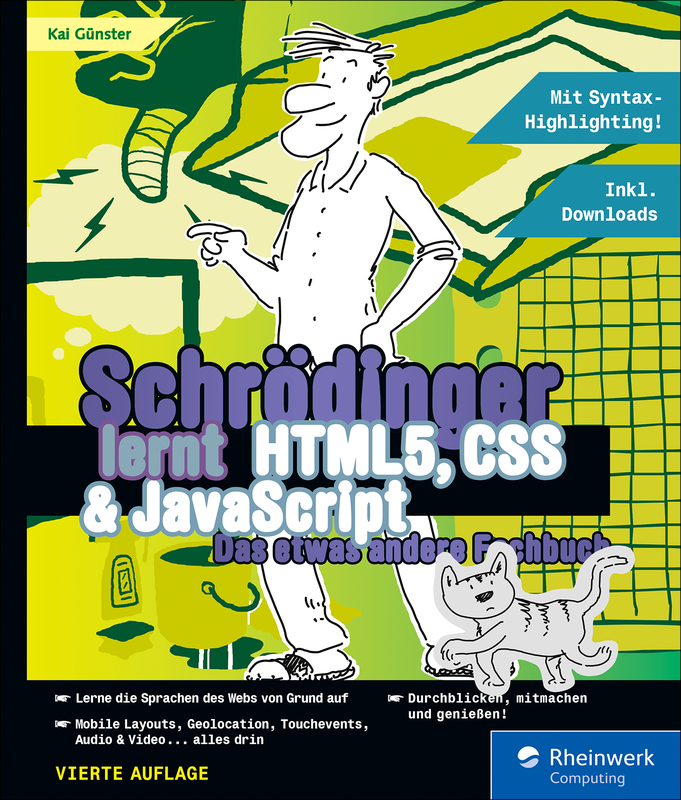
Schrödinger lernt HTML5, CSS und JavaScript (4. Auflg.)
Drei Sprachen in einem Schrödinger-Band! Das etwas andere Fachbuch - 4. aktualisierte Auflage 2023.Eine runde Sache: Schrödinger wird Webentwickler! Zum Glück hat er einen Kumpel, der auf jede Frage eine Antwort weiß, wenn er nur genug Kaffee bekommt. Zusammen lernt ihr HTML, CSS und JavaScript und erstellt die Webauftritte für seine Firma und einen Verein. Mit viel Witz, allen nötigen Erklärungen, Unmengen an Code, Tipps, Übungen und der verdienten Erholung. Von "Hallo Webwelt" über AJAX bis zu Geolocation und TouchScreens: alles auf dem neuesten Stand und, wenn du willst, mit deinem eigenen Webserver. Umwerfende Beispiele, fantastisch illustriert.1. Gründlicher EinstiegSchrödinger ist zwar pfiffig, fängt aber ganz von vorn an zu lernen – und du bist dabei. HTML-Seiten aufbauen, ersten JavaScript-Code schreiben, grafische Gestaltung umsetzen: Alles wird Schritt für Schritt erklärt und ausprobiert.2. Voller Durchblick durch moderne WebstandardsFür Einsteiger und Umsteiger perfekt. Unmengen an Beispielen und Übungen. HTML, CSS und JavaScript von Anfang an – alles in einem Buch und mit farbigem Syntax-Highlighting. Aktuelle Profi-Praxis mit Sinn für guten Code.3. Lernen – Anwenden – WiederholenMit Schrödinger wird immer Hand angelegt. Neue Konzepte und Sprachelemente werden in Ruhe vorgestellt (grün). Dann geht es ab in die Werkstatt (violett), wo ihr Code schreibt oder verbessert. In Schrödingers Wohnzimmer (orange) könnt ihr üben, wiederholen und euch auch etwas Erholung gönnen.Aus dem Inhalt:Ausführlicher Einstieg in HTML, CSS und JavaScriptDesigns umsetzen und gute GUIs erstellenEreignisse behandeln und Funktionen einsetzenServerkommunikation, AJAX und Websockets nutzenMit oder ohne HTML5 und CSS3Karten einbinden und GPS-Daten auswertenZeichnen mit CanvasResponsive Webdesign und ToucheventsWebseiten für einfach alles, was einen Bildschirm hatVideo- und Audiomaterial einbindenÜber den Autor: Kai Günster ist Web- und Softwareentwickler und hat Spaß an immer neuen Details. Er hält HTML5 für die beste Erfindung seit der Laugenbrezel und JavaScript für die Zukunft der GUI-Entwicklung.Leseprobe (PDF-Link)

Pro Spring 6
Master the Spring Framework, its fundamentals and core topics, and share the authors’ insights and real-world experiences. This book goes well beyond the basics: you'll learn how to leverage the latest Spring Framework 6 to build the various tiers and parts of today's modern, complex enterprise Java applications systems, top to bottom, including data access, SQL generation with jOOQ, persistence with Hibernate, transactions, set up security, classic web and presentation tiers and adding in some reactivity. Spring 6 will be based on the latest available Long Term Support (LTS) release, Java 17. So, you will be able to do the following in your Spring applications: use records, use new utility methods in String class; utilize Local-Variable Syntax for Lambda Parameters; Nested Based Access Control, and more. Integrating Spring with the most used frameworks and libraries is covered in this book, such as Testcontainers, Hibernate, jOOQ, Kafka and many others.A full sample application allows you to apply many of the technologies and techniques covered in Pro Spring 6 and see how they work together. This book updates the perennial bestseller with the latest that Spring Framework 6 has to offer. Now in its sixth edition, this popular title is by far the most comprehensive and definitive treatment of Spring available. After reading this book, you'll be armed with the power of Spring to build complex applications, top to bottom. The agile, lightweight, open-source Spring Framework continues to be the de facto leading enterprise Java application development framework for today's Java programmers and developers.WHAT YOU WILL LEARN* What’s new in Spring Framework 6 and how to use it with the latest LTS version of Java, Java 17* How to integrate Spring with the most renowned and practical frameworks and dependencies* How to build complex enterprise cloud-native applications using Spring 6* How to master data access, persistence and transactions* How to use with Spring Batch, Integration and other key Spring projectsTHIS BOOK IS FORExperienced Java and enterprise Java developers and programmers. Some experience with Spring highly recommended.IULIANA COSMINA is a Spring Certified Web Developer and is also Spring Certified Core Spring Professional. She is a Spring certified expert, as defined by Pivotal, the makers of Spring Framework, Boot and other tools. She has authored books with Apress on Core Spring certification and Spring Certified web development. She is a Lead Engineer at Cloudsoft, Edinburgh and is an active coder and software contributor on Apache Brooklyn, GitHub, StackOverflow and more.ROB HARROP is a software consultant specializing in delivering high-performance, highly-scalable enterprise applications. He is an experienced architect with a particular flair for understanding and solving complex design issues. With a thorough knowledge of both Java and .NET, Harrop has successfully deployed projects across both platforms. He also has extensive experience across a variety of sectors, retail and government in particular. Harrop is the author of five books, including Pro Spring, a widely-acclaimed, comprehensive resource on the Spring Framework.CHRIS SCHAEFER is a Principle Software Developer for Spring project at Pivotal, the makers of Spring Framework, Boot and other Spring tools.CLARENCE HO is the Senior Java Architect of a HK-based software consultancy firm, SkywideSoft Technology Limited. Having been worked in the IT field for over 20 years, Clarence had been the team leader of many in-house application development projects, as well as providing consultancy services on enterprise solutions to clients.Chapter 1: Introducing SpringChapter 2: Getting StartedChapter 3: Introducing IoC and DI in SpringChapter 4: Advanced Spring Configuration and Spring BootChapter 5: Spring AOPChapter 6: Spring JDBCChapter 7: Spring with HibernateChapter 8: Spring with JPAChapter 9: Spring Transaction ManagementChapter 10: Spring Data with SQL and NoSQL databasesChapter 11: Validation, Formatting and Type ConversionChapter 12: Task Scheduling - some new things might be needed here.Chapter 13: Spring RemotingChapter 14: Spring Native and Other GoodiesChapter 15: Spring MVCChapter 16: Spring REST SupportChapter 17: Securing Spring Web ApplicationsChapter 18: Monitoring Spring ApplicationsChapter 19: Spring WebSocket SupportChapter 20: Reactive Spring

The Cloud Leader's Handbook
This book is a comprehensive guide covering modern cloud strategies and leadership approaches for building and scaling organizations to maturity on their cloud adoption journey.The book starts by examining technical topics from the perspective of the cloud leader, who is responsible for cloud teams and accountable for cloud products and platforms within their organization. Through a series of practical insights and real-world examples, you will gain a deep understanding of the key considerations for leading a cloud-driven organization.These considerations include understanding the benefits of digital transformation, managing global tech teams, and delivering excellence through platform ownership. Towards the end of the book, you will explore the latest trends and best practices for strategically innovating and scaling your organization in the cloud.With the knowledge gained from this book, you will be able to harness the power of the cloud to drive business success and gain valuable insights and practical strategies to support and empower the adoption of modern cloud platforms and technologies for your clients and organization.The Cloud Leader's Handbook is a must-read for any Cloud Leader who wants to stay ahead of the curve and achieve success in the rapidly evolving world of cloud computing.WHAT WILL YOU LEARN* Develop a strong foundation in the technical aspects of cloud leadership* Understand the benefits of digital transformation and how to lead a cloud-driven organization, including managing global tech teams.* Discover the bleeding-edge cloud trends that are influencing organizational roadmaps* Transition into the role of the modern Cloud Leader by gaining a deeper perspective around what it means to own, manage, administer, govern, and optimize the modern cloud platform* Learn how to effectively envision, manage, and deploy modern cloud transformation projects through successful approaches around innovation, strategy, and excellenceWHO THIS BOOK IS FORExperienced IT professionals and business leaders looking to understand the power of the cloud.RON C. L'ESTEVE is an accomplished author, technology leader, and digital innovation strategist based in Illinois, USA. He is renowned for his impactful books and award-winning articles on Data & AI Architecture and Engineering. With deep technical skills and extensive experience leading modern Cloud Data & AI initiatives for a multitude of global clients, Ron possesses a wealth of knowledge and expertise in his field.As a trusted advisor with several Cloud certifications, Ron has played a pivotal role in some of the most significant and impactful Cloud implementations globally. He has held senior leadership positions at multiple global organizations and has been instrumental in scaling key cloud architectures, defining technology and business intelligence roadmap and strategy, and challenging customers to grow by deeply understanding the fluid business opportunities.Ron has enabled change by translating complex challenges into high-quality and sustainable technical solutions that promote digital innovation and transformation. His insights and strategic thinking have helped clients achieve their goals and realize their potential. Ron's commitment to excellence and innovation is reflected in his track record of delivering high-impact solutions that drive real-world outcomes and impact.Part I: Leadership Essentials.- 1. The Art of Cloud Leadership.- 2. Influencing Change and Driving Cloud Adoption.- 3. Managing Teams in the Digital Age.- 4. Supporting Employee Health & Turnover.- Part II: Innovation Strategies.- 5. Adopting a Cloud Platform.- 6. Democratizing Data & Democratizing Analytics.- 7. Applying DevOps.- 8. New Horizons in Distributed Cloud Computing.- 9. Impacts of Modern AI and ML Trends.- Part III: Platform Ownership.- 10. Owning a Portfolio of Agile Cloud Products.- 11.Designing a Secure Data Lake.- 12. Administering and Auditing the Cloud.- 13. Collaborating with Cloud Vendors and Providers.- Part IV: Delivery Excellence.- 14. Creating a Technology Delivery Roadmap.- 15. Cloud Transformation Roles and Responsibilities.- 16. Delivering Strategic Cloud Innovation and Excellence.- 17. Managing Agile Cloud Projects.- 18. Achieving Digital Transformation Success.