

Allgemein
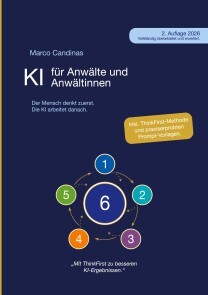
KI für Anwälte und Anwältinnen
Nicht das KI-Tool macht den Unterschied, sondern die Methode, mit der es eingesetzt wird. Die vollständig überarbeitete und erweiterte 2. Auflage von «KI für Anwälte und Anwältinnen» stellt deshalb die von Marco Candinas entwickelte ThinkFirst-Methode in den Mittelpunkt: Der Mensch denkt zuerst, die KI arbeitet danach. ThinkFirst zeigt juristischen Fachpersonen Schritt für Schritt, wie sie Aufgaben zunächst selbst durchdenken, der KI präzise Anweisungen geben und deren Ergebnisse systematisch prüfen und verbessern. So bleibt die juristische Urteilskraft beim Menschen, während die KI mit Struktur, Tempo und Präzision unterstützt. Das Herzstück des Buches bilden neun, für die 2. Auflage vollständig überarbeitete, praxiserprobte ThinkFirst-Prompt-Vorlagen, die direkt übernommen und an konkrete Fälle oder kanzleieigene Abläufe angepasst werden können. Sie unterstützen bei der juristischen Recherche, bei Rechtsabklärungen im öffentlichen Recht, Zivilrecht und Strafrecht, beim Verfassen juristischer Korrespondenz, beim Entkräften gegnerischer Argumente, bei Stellungnahmen und Klageschriften sowie bei der Analyse und Optimierung von Verträgen. Ergänzend vermittelt das Buch die Grundlagen generativer KI und des Promptings und ordnet Werkzeuge und Technologien wie ChatGPT, Claude, Gemini, Microsoft Copilot, RAG, NotebookLM, KI-Agenten, Skills, APIs und MCP ein. Ein besonderer Schwerpunkt liegt auf dem sicheren und verantwortungsvollen Einsatz - von der Quellenprüfung und dem Datenschutz bis zu Berufsrecht, Haftung und Governance. Ein praxisnahes Arbeitsbuch für alle, die KI nicht einfach machen lassen, sondern mit ThinkFirst gezielt bessere und verlässlichere juristische Ergebnisse erzielen wollen.

Agentic AI for Cybersecurity
Agentic AI is no longer theoretical—but most cybersecurity teams are still struggling to move from concept to production. Agentic AI for Cybersecurity fills the critical gap between vendor hype and academic abstraction, delivering a practical, engineering-first guide that security architects can apply immediately. This is the book for professionals who need to build real systems—not just talk about them. At its core, this book argues that agentic AI is not a toolset but a new operating model for the Security Operations Center. That shift changes everything: architecture, governance, and risk. Unlike other titles, it refuses to separate capability from security. Offensive and defensive use cases are treated together, reflecting the real dual-use nature of agentic systems and equipping readers to design—and defend—against both. Timeliness is what makes this book essential. It is the first practitioner-focused guide to unify three converging forces shaping modern security: MCP-based agentic systems, their emerging and largely undocumented attack surface, and the parallel migration to post-quantum cryptography. Each is complex on its own—together, they define the next generation of security architecture. This book addresses them as a single, integrated challenge. Built for real-world use, every chapter follows a ‘what / how / why’ structure and culminates in runnable, production-grade architectures. Readers don’t just learn concepts—they deploy them, using reference implementations drawn from actual environments and supported by a living GitHub repository. From MCP servers and adversary emulation to AI-driven detection and quantum-resistant infrastructure, this is hands-on guidance grounded in reality. For practitioners who need clarity, credibility, and actionable design patterns, Agentic AI for Cybersecurity stands apart. It is unapologetically practical, rigorously honest about risks, and singular in its integration of architecture, security, and emerging AI paradigms—making it a must-have resource for building the next generation of secure systems. What You Will Learn: Master the conceptual architecture of agentic AIBuild, harden, and govern production-grade Model Context Protocol (MCP) servers for network and security operationsOperationalize AI-driven offensive security through Kali Linux integration via MCP and MITRE Caldera as an LLM-driven adversary emulation platformDefend against the agentic AI attack surfacePlan and execute the post-quantum cryptographic migration in AI-era infrastructureApply machine learning and deep learning to autonomous malware detection and threat classification Who this Book is for: The target reader is a working network or security practitioner — a SOC analyst, network engineer, security architect, security engineer, or incident responder — who is being asked, by their employer or by the field, to integrate agentic AI into their operational practice and who needs guidance that is more concrete than vendor whitepapers and more applicable than academic papers. The book does not assume prior experience with agentic AI specifically, but it does assume the reader is comfortable with at least one of the three domains the book unifies: enterprise network operations, security operations, or applied machine learning. Readers from adjacent communities — DevSecOps engineers, cloud security architects, AI/ML platform engineers responsible for AI safety — will also find Part II directly applicable to their work.


Building Effective Agents with Microsoft Copilot Studio
Microsoft Copilot Studio has evolved far beyond traditional chatbots, becoming a powerful platform for building intelligent AI agents that can retrieve knowledge, automate tasks, collaborate with other agents, and operate under enterprise governance. Building Effective Agents with Microsoft Copilot Studio takes you on a practical, end-to-end journey through the modern agent development lifecycle, helping you design, build, deploy, and manage production-ready agents that deliver real business value. Using a realistic business scenario that grows throughout the book, you'll learn not only how the platform works, but also how to apply it effectively in real-world environments. Beginning with the foundations of Microsoft’s agent ecosystem, you'll explore agent planning, conversational design, knowledge grounding, topics, entities, variables, tools, actions, and integrations with enterprise systems. As your skills grow, you'll dive into generative orchestration, autonomous and multi-agent systems, publishing agents across Microsoft Teams, Microsoft 365 Copilot, web, and voice channels, and extending capabilities through Power Automate, APIs, connectors, and external services. Along the way, you'll gain hands-on experience building increasingly sophisticated agents capable of reasoning, acting, and collaborating across business processes. The book goes beyond basic implementation to cover the critical topics often overlooked in documentation, including testing and evaluation, analytics-driven improvement, security, governance, responsible AI, application lifecycle management, deployment pipelines, licensing, cost optimization, and operating agents at scale. By the end, you'll understand proven design patterns, avoid common pitfalls, and be equipped to build governed, enterprise-grade agent solutions that are ready for the next generation of AI-powered business applications. What You Will Learn: Advanced techniques for customizing Microsoft Copilot Studio to suit specific organizational needs. This includes creating custom commands, integrating with other digital tools, and optimizing the AI’s responses to enhance user interaction and productivity.How to leverage the predictive analytics and data interpretation capabilities of Microsoft Copilot Studio to make informed business decisionsUnderstand future trends in artificial intelligence and machine learning, providing you with the knowledge to adapt to and anticipate changes in technologyUnderstanding Copilot studio's core functionalities, interface, and how it integrates with existing software ecosystems Who This Is Book For: Microsoft 365 administrators, AI administrators and developers
Frontend Performance Optimization
Build faster React applications by mastering the performance techniques that actually matter in production. Speed is no longer a differentiator — users expect fast experiences, and even small delays reduce engagement and conversion. Yet most applications still ship with avoidable issues like large bundles, unoptimized images, and inefficient data fetching, problems that stay hidden until users feel them. This book shows you how to approach frontend performance as part of everyday engineering work. You will learn to measure what actually matters using Core Web Vitals, Lighthouse, and real user monitoring data — not just what looks good in lab tests. Following a systematic process, you will identify bottlenecks, understand their root causes, and apply targeted fixes that deliver real results in production. You will work through the full performance stack: JavaScript bundles, image delivery, React rendering behavior, data fetching, caching, and network. You will explore rendering strategies such as SSR, SSG, and streaming, learn which anti-patterns to avoid, and understand how to build a performance-aware engineering culture that keeps your application fast over time. By the end of this book, you will have a clear way to measure, diagnose, and improve performance that will impact not just your application but the way you think about frontend engineering in general. What You Will Learn ● Measure performance using Core Web Vitals, Lighthouse, and real user monitoring data ● Diagnose and fix high-impact bottlenecks in React applications systematically ● Optimize JavaScript bundles, images, fonts, and CSS for faster load times ● Improve runtime efficiency through smarter rendering, data fetching, and caching strategies Who This Book Is For React developers, tech leads, and architects working on production applications who want a practical and systematic approach to frontend performance.

Mastering Oracle Autonomous AI Database
Oracle Autonomous AI Database is evolving quickly, and practitioners need more than a feature overview to keep up. They need to understand how to use its automation, AI-native capabilities, and Oracle Database 26ai features in real cloud and enterprise environments. This practical guide shows how to provision, manage, tune, secure, and scale Oracle Autonomous AI Database on Oracle Cloud Infrastructure using real-world examples and enterprise-focused best practices. It is designed for database professionals, cloud architects, developers, and IT leaders who need to simplify operations, improve performance, strengthen security, and support AI-driven applications. Using a concept-to-implementation approach, the book takes you from initial provisioning decisions through architecture, lifecycle management, performance optimization, security design, and the AI-native capabilities of Oracle AI Database 26ai. You will learn how to integrate Oracle Autonomous AI Database with modern applications and apply built-in AI and machine learning capabilities for analytics, automation, and intelligent decision-making. The book also covers emerging Oracle capabilities including MCP Server, Private Agent Factory, and Autonomous AI Lakehouse, rounding out a practical guide to the current and future capabilities of Oracle Autonomous AI Database. What You Will Learn Understand the architecture, core components, and key capabilities of Oracle Autonomous AI DatabaseProvision, manage, and scale Oracle Autonomous AI Database on OCI, including Serverless and Dedicated deployment optionsTune performance and optimize workloads using Automatic Indexing, Performance Hub, and Query Optimizer enhancementsImplement security by design using TDE, SQL Firewall, Deep Data Security, and post-quantum cryptographyBuild AI-powered applications using AI Vector Search, Select AI, JSON Relational Duality Views, and Oracle APEXApply Oracle Database 26ai features, MCP Server, Private Agent Factory, and Autonomous AI Lakehouse patterns in enterprise environments Who This Book Is For Database professionals, cloud architects, developers, and IT leaders aiming to simplify operations and leverage AI-driven automation with Oracle Autonomous Database. Also useful for technology consultants and data engineers involved in cloud migrations and modern application development.

Azure SQL Hyperscale Unveiled
As organizations build increasingly data-driven and AI-powered applications, they need database platforms that can grow without sacrificing performance or resiliency. In this practical guide, Bob Ward, a Principal Architect on the Microsoft Azure Data team, takes readers inside Hyperscale's distributed architecture, showing how it uses the power of SQL Server to deliver the scale, performance, and resiliency required by modern cloud workloads. You will learn how to deploy Hyperscale, build applications that use JSON, vectors, in-database RAG, AI agents, and GitHub Copilot, and leverage core capabilities such as serverless compute autoscaling, elastic pools, automatic storage growth, high availability and disaster recovery, named replicas, and zone redundancy. Practical design patterns demonstrate how teams can start small, scale as needed, and combine familiar SQL Server skills with new cloud-first, AI-ready techniques. Whether you are modernizing existing applications or building new intelligent systems, this guide equips you to use Azure SQL Hyperscale as a flexible, reliable, AI-enabled cloud database platform for workloads at any scale. What You Will Learn Deploy Azure SQL Hyperscale for workloads of any sizeTranslate existing SQL Server skills to cloud-based developmentUnderstand the distributed architecture and internals of HyperscaleBuild data-driven applications using JSON, vectors, RAG, and AI agentsDevelop Hyperscale solutions using GitHub Copilot and related toolsSecure cloud data and implement high availability and disaster recovery strategiesOptimize performance across Hyperscale workloadsApply practical design patterns for scalability, resiliency, and modernization Who This Book Is For Developers, IT professionals, and SQL Server practitioners who want to build data-driven, AI-powered applications using Azure SQL Hyperscale.

Without Chaos: The AI Catalyst
AI adoption is speeding up across industries, yet most organizations still face confusion and stalled progress. While interest is high and many pilots are underway, nearly 90% of AI projects never reach production or deliver the expected value. The issue isn’t technology—it’s the lack of a clear, scalable operating model. This book provides that missing structure, showing how to move from scattered experiments to a sustainable enterprise AI practice. This book stands at the intersection of strategy and architecture, designed for leaders, architects, and decision-makers responsible for scaling AI responsibly. The book begins by uncovering why AI efforts fail: hype-driven expectations, talent gaps, weak data foundations, poor governance, and ad-hoc delivery models. It then reframes AI as a long-term capability—helping readers understand where AI truly adds value and where it does not. The core of the book is the Sustainable AI Framework, a practical approach for building lasting AI maturity. Readers will learn how to prioritize the right use cases, build platform-based delivery models, create paved paths for teams, and embed trust, accountability, and governance from day one. The book blends strategic mapping, platform engineering, organizational design, and architectural patterns, offering concrete tools and maturity models. Ultimately, it offers guidance for executing at scale, including securing early wins, avoiding innovation theatre, managing platform evolution, and establishing continuous learning loops. This book is a roadmap for moving beyond hype and pilots toward durable, responsible AI capability and long-term business advantage—without chaos. What you will learn: ·Build a practical AI adoption strategy that avoids common pitfalls ·Design a minimal viable platform using platform engineering principles ·Map opportunities using tools like Wardley Mapping, Value Streams and team topologies ·Establish trust frameworks that scale Who this book is for: AI/ML Platform Teams and MLOps Engineers , Principal Engineers and Technical Leaders, Engineering Managers and Tech Leads, Software and Platform Architects

The LangOps Playbook
Sprache beschreibt Produkte, steuert Prozesse, vermittelt Wissen und bildet die Schnittstelle zu Kunden, Partnern und künstlicher Intelligenz. Doch während Daten, Software und Prozesse längst als Infrastruktur geführt werden, bleibt Sprache strukturell unbehandelt: Sie wird produziert, übersetzt und angepasst, ohne dass Bedeutung als stabile, systemische Größe erhalten bleibt – und jede KI-Anwendung skaliert diese Schwäche mit. Dieses Buch führt LangOps (Language Operations) als Operating Model ein, das Sprache erstmals als eigenständige Infrastrukturebene begreift und sie vom Kostenfaktor zum strategischen Asset entwickelt – mit klarer Governance, Kennzahlen wie dem Return on Multilingualism, 40 direkt einsetzbaren Plays und dem 25-Wochen-Pfad Sprint25. Es richtet sich an Führungskräfte global agierender Unternehmen, an Verantwortliche für Content, Lokalisierung und Wissensmanagement sowie an Sprachdienstleister, die sich zum strategischen Partner entwickeln wollen.

Interpretieren zusammen mit KI
Generative Sprachmodelle verändern die qualitative Sozialforschung, weil sie Interpretationen von empirischem Material wie z.B. Interviews, Gruppendiskussionen oder Beobachtungsprotokollen in großer Zahl, hoher Geschwindigkeit und vor dem Hintergrund unterschiedlicher Methodologien erzeugen können. Burkhard Schäffer, Fabio Roman Lieder und Franz Krämer schlagen mit der Distributed Interpretive Analysis (DIA) einen dritten Weg zwischen Ablehnung und naiver Nützlichkeitsbegeisterung vor. Interpretation wird dabei als verteilter Prozess verstanden, in dem Forschende und Sprachmodelle als Hybridakteure zusammenwirken. Das Buch führt verständlich und ohne informatisches Vorwissen in technische Grundlagen, Prompt Engineering, Finetuning und Retrieval Augmented Generation ein, demonstriert Workflows mit der Forschungsunterstützungsplattform Karl AI und fundiert die neue Praxis theoretisch, rechtlich und didaktisch. Im Zentrum steht die Frage, wie aus maschineller Effizienz durch Auswahl, Begründung und methodische Kontrolle wissenschaftliche Effektivität werden kann. In einem ausführlichen, zusätzlich herunterladbaren Whitepaper werden Anleitungen für das Interpretieren zusammen mit Karl AI bereit gestellt, der Software, mit der die im Buch vermittelten Perspektiven praktisch umgesetzt werden können.

IT-Service-Management in der Praxis mit ITIL® (7.Auflg.)
Was Sie für die Foundation-Zertifizierung über ITIL® wissen müssen Ein Überblick über ITIL® sowie ergänzende Standards und Methoden Wie Sie IT-Service-Management erfolgreich gestalten und verankern Zahlreiche Praxistipps und eine umfangreiche Fallstudie Neu in der 7. Auflage: Alle wichtigen Fakten zu ITIL® Version 5 und Bewertung der wichtigsten Änderungen Die IT hat sich zu einem zentralen Erfolgsfaktor für funktionierende Geschäftsprozesse entwickelt. Das verlangt von IT-Organisationen, immer schneller veränderten Anforderungen gerecht zu werden. IT-Verantwortliche können diese Aufgabe meistern, wenn sie auf modernes IT-Service-Management setzen. Hier wird Ihnen gezeigt, wie Sie IT-Service-Management praxisgerecht planen und realisieren. Sie erfahren, wie Sie ITIL® Ihren Zielen entsprechend mit ISO 20000, IT-Kennzahlen und COBIT® 2019 und agilen Methoden richtig kombinieren und einsetzen. Als standardisierte Notation für Prozesse wird BPMN 2.0 beleuchtet. Ein ausführliches Fallbeispiel veranschaulicht, wie Sie das alles in die Praxis umsetzen und auf diese Weise kontinuierlich die Qualität der Services und die Wirtschaftlichkeit der Leistungserbringung verbessern. »Das ist ein Buch sowohl für die Praxis (ITIL Projekte stehen bevor) als auch für Schulungs-Teilnehmer, die sich auf eine ITIL Foundation Prüfung vorbereiten wollen. Das Buch zeigt, wie IT-Service Management mit ITIL® in der Praxis geplant und realisiert werden und wie eine Verzahnung mit weiteren Good Practices Ihren Zielen entsprechend kombiniert werden kann.« it Service Management (itSMF Deutschland e. V.) zur 3. Auflage AUS DEM INHALT // IT-Service-Management / Serviceprinzipien / ITIL® 3 / ITIL® 4 / COBIT® 2019 / ITIL® Version 5 / ISO 20000 / BPMN 2.0 / Leistung und Qualität messen / Praxisbeispiel

Maschinelles Lernen
Entdecken Sie in diesem Buch, wie Sie maschinelles Lernen für die Entwicklung von Empfehlungs- und Entscheidungssystemen praktisch einsetzen – klar erklärt, anwendungsorientiert und direkt auf Ihre Projekte übertragbar. Sie erhalten eine umfangreiche Sammlung anschaulicher Beispiele aus den Bereichen Supervised und Unsupervised Learning, die Ihnen helfen, schnell die passenden Methoden für Ihre Anforderungen zu finden. Ob Sie etwa ein Fraud-Erkennungssystem entwickeln möchten oder nach dem optimalen Algorithmus samt Parameterwahl suchen – dieses Buch liefert konkrete Antworten. Ein weiterer Schwerpunkt liegt auf dem Design und der Umsetzung von Empfehlungssystemen. Schritt für Schritt erfahren Sie, wie zum Beispiel Filmempfehlungen mit gängigen Machine-Learning-Verfahren aufgebaut werden, welche Stärken und Grenzen die einzelnen Algorithmen haben und worauf es in der Praxis wirklich ankommt. Jedes Kapitel verbindet kompakte theoretische Grundlagen mit nachvollziehbaren Pilotimplementierungen und gut dokumentierten Python-Codebeispielen auf Basis von scikit-learn. Zum Abschluss lernen Sie alle Schritte kennen, die notwendig sind, um Machine-Learning-Lösungen erfolgreich in industrielle Prozesse zu integrieren – damit Ihre Modelle nicht nur funktionieren, sondern echten Mehrwert schaffen.

Mobile Systems
Explains how mobile systems are developed and used from start to finish. Provides a solid foundation and offers practical insights for both academic study and professional practice. Presents strategies and proven methods for developing successful and sustainable mobile systems. Introduces new developments, trends, and technologies that will shape the future of the mobile world. “Mobile Systems – Concept, Development, and Operation” is a comprehensive foundational work that delivers in-depth knowledge of mobile technologies, their development, and their practical application. It covers both technical fundamentals and advanced application areas, addressing the entire life cycle of mobile systems. Topics include user experience design, development strategies, application management, green IT, XR technologies, mobile security, and futureoriented subjects such as the mobile metaverse. The aim is to familiarize students of computer science, business informatics, and media informatics, as well as IT managers, with the characteristics, opportunities, and challenges of mobile ecosystems. Readers will learn how to apply mobile technologies in a targeted and sustainable way. The book prepares them to implement innovative mobile projects across various industries. WHAT‘S INSIDE // Mobile Systems: Components and Core Technologies Mobile Devices: Classes, Technology, and Infrastructure Mobile Development Frameworks: Native, Cross-Platform, and Hybrid Mobile User Experience (UX) Mobile Application Lifecycle Management (ALM) and Mobile Application Management (MAM) Mobile Security: Risks and Prevention Mobile Artificial Intelligence (AI) Mobile Business: Business Models and the Global Market Mobile XR and the Mobile Metaverse Green IT and Green Coding Technology Assessment and Sociocultural Implications
M³ - Mensch. Maschine. Mindset.
Künstliche Intelligenz verändert nicht nur die Werkzeuge der Führung, sondern ihren Gegenstand: Geführt wird ein lernendes System im Zusammenspiel von Mensch und Maschine. An die Stelle klassischer Steuerung tritt Synchronisation. Das M³-Modell ordnet diese Verschiebung entlang dreier Dimensionen: Der Mensch steht für Verantwortung, die Maschine für Mustererkennung und Skalierung, das Mindset für die kulturelle Voraussetzung des Lernens mit KI. Neun Leadership-Impulse übersetzen das Modell in die Führungspraxis. Der M³-Loop zeigt, wie Organisationen ihren KI-Reifegrad bestimmen und gezielt entwickeln — gemessen an der Qualität ihrer Rückkopplung, nicht an der Zahl ihrer KI-Systeme.

Hyper-Agile Testing
Software delivery is accelerating. Release confidence is not. Artificial intelligence can generate requirements, code, tests, and documentation in minutes, but faster output does not automatically make software safer to release. This book presents a practical operating model for building confidence as quickly as teams create change by connecting product intent, risk, validation, automation, release readiness, and production learning. As you move through the chapters you will follow the Hyper-Agile Quality Loop from idea to production. You will learn how to turn requirements into test expectations, adjust validation depth to risk, and choose automation by value rather than test count. Additionally you will also gain expertise in keeping continuous integration and continuous delivery signals trustworthy, and using artificial intelligence to support requirements review, impact analysis, defect triage, and release decisions. The chapters are supported by practical examples, diagrams, checklists, and personal stories that will show you how these ideas work under real delivery pressure. This book will guide you in applying the model across delivery stages and risk levels—from prototypes and internal pilots to early adopter and general availability releases, including high-risk or regulated work. You will see how Product, Development, Quality Engineering, Support, and Operations each contribute to quality. It will also help you to understand how production feedback improves the next delivery cycle and how Quality Engineering can move beyond late-stage testing toward quality decision support. By the end of the book, you will have a practical framework for creating safer software and increasing release confidence. Applying it will help you learn faster, make clearer release decisions, and reduce the risk pushed downstream. What You Will Learn Apply the Hyper-Agile Quality Loop from product intent through production learningMatch validation depth to risk, release stage, and customer impactBuild trustworthy automation and CI/CD signals that support release decisionsUse AI responsibly for requirements review, test design and automation, impact analysis, and defect triage Who This Book Is For Quality engineers, QA leads, engineering managers, product managers, and technology leaders working in fast‑moving delivery environments.
Pro State Management in JavaScript
Modern front-end teams face heavy toolchains and abstraction sprawl, while many developers lack a ‘first principles’ understanding of state engines. Pro State Management in JavaScript takes you under the hood, showing you how to build a simple browser-native state management library which tackles dependencies, observability, and inspectability, giving you a practical measure to compare the most popular state management engines of today. This book will teach you to harness the browser’s native strengths like events, the DOM, and closures to craft a minimalist, understandable state management library. Giving you a deep understanding so you can ship a working engine adaptable to real web-based applications. Split into four parts, the book starts by demystifying the event model, exploring topics like capture/target/bubble, DOM vs. custom events, delegation, and ergonomics of closures and module patterns. Part II builds the state engine step-by-step making trade-offs explicit along the way, including micro-benchmarks and surface performance tips. Part III rebuilds popular paradigms to sharpen your intuition. We reconstruct core ideas behind Redux, MobX, Zustand, Recoil and XState (statecharts and transitions) - then compare each to our event-driven engine in terms of clarity, ergonomics, and runtime costs. The final part provides you with projects relating to a searchable/paginated data-table, dashboard widgets with cross-component coordination, and an interactive tree list component. By the end of this book, you will know the “why” behind these libraries by building them in miniature, leaving you with a comparative mental model you can apply in any stack. You Will: Learn to design, implement, and ship a production-ready state engine in plain JavaScriptUnderstand and Explore Redux, MobX, Zustand, Recoil and XStateExplore dependencies, observability, and inspectability, by using browser-native state management libraries This Books is for: Intermediate to advanced level developers and front-end engineers who are looking to turbo charge their understanding of state management and engines with the rights tools, frameworks and thinkings models to implement successfully.
Digital AI Transformation
Artificial intelligence is no longer an emerging capability—it is reshaping how organizations compete, operate, and grow. Yet many organizations struggle to move beyond experimentation toward sustained, enterprise‑wide impact. Digital AI Transformation provides a clear, practical guide to navigating this shift with confidence, discipline, and purpose. This book introduces digital AI transformation as a strategic evolution, not a technology project. It traces the rise of AI as a defining force across business, society, and technology, while grounding that context in practical decision‑making. Readers build a strong foundation through accessible explanations of AI and machine learning concepts that matter at the enterprise level—without requiring a technical background. The book also explores the impact of AI across business functions such as Finance, HR, Marketing, and Operations. Distinctively, the book places equal emphasis on people and systems. Successful transformation depends not only on models and platforms, but on leadership, operating models, and a culture capable of continuous learning. The book explores how organizations can develop the skills, mindset, and governance needed to responsibly adopt AI at scale. Advanced sections address enterprise‑ready architectures, including AI landing zones and multi‑agent systems, demonstrating how coordinated AI capabilities can solve complex organizational and real‑world challenges. The closing chapters look ahead, identifying emerging trends and strategic inflection points while providing a practical roadmap to help organizations anticipate disruption and act ahead of competitors. What sets this book apart is its integrated perspective. It combines strategic foresight, hands‑on guidance, and ethical responsibility—connecting technology decisions to measurable business impact. The approach aligns enterprise AI strategy with execution, measurement, and continuous improvement, delivered in a clear and engaging executive voice. What You Will Learn Evaluate enterprise readiness and shape transformative AI strategies that redefine growthBuild agile, future‑ready organizations empowered by innovation, talent, and intelligent operating modelsUnderstand emerging trends shaping enterprise AI, from multi‑agent systems to industry‑wide disruptionLead with vision and conviction to convert AI opportunities into lasting enterprise value Who This Book is For Whether you are a C-suite executive, digital strategist, innovator, or a professional preparing for tomorrow’s careers, this book equips you with the insight and practical wisdom to navigate and excel in the AI-driven era.

Troubleshooting and Supporting Windows 11
Diagnose, troubleshoot and repair any type of problem on your PC from startup and file access to cloud services and the challenges created by hybrid work. This book contains everything you need to know to keep PC systems running optimally, and to repair problems quickly and efficiently. This book provides a deep dive into the Windows OS, detailing what everything is, and how it works. You will learn of the in-built, additional, and third-party tools and utilities you can use to create reliable, robust and secure PC systems. This updated version will guide you with the latest advancements in Windows 11 and using AI tools for troubleshooting and managing Windows security. This book starts with a deep dive into the Windows OS, detailing what everything is, and how it works. You will learn of the in-built, additional, and third-party tools and utilities you can use to create reliable, robust and secure PC systems. Further, you will learn how to configure Windows 11 so as to avoid problems occurring, and how to support every type of end user, working from home, or in any part of the globe, speaking any language, and taking into account other factors such as ability or personal barriers. You will discover the support tools and support ecosystem you can use to create and manage effective support tracking and remote access. You will discover how to get detailed events and reliability information, and how to manage updating channels. You will deep dive into Windows 11 operating system and folder structure and learn app and software troubleshooting, process and service troubleshooting, network and internet troubleshooting and hardware and peripherals troubleshooting. Finally, you will learn advanced troubleshooting techniques like security and encryption troubleshooting and using PowerShell scripting to repair problems. By the end, you will know how to troubleshoot complex problems and diagnose hardware problems in a PC. You will be able to troubleshoot and repair any type of problem on a Windows 11 PC. New to the book: Using AI to troubleshoot and repair problemsManaging Windows security featuresSupporting Windows 11 on older Windows 10 PCs What You Will Learn How to support home and hybrid workers using their own PCsUsing scripting and PowerShell to troubleshoot and repair systemsManaging networking and internet access to minimize downtimeManaging installation and troubleshooting for updates and patchesHow to use Artificial Intelligence tools to troubleshoot and repair problems Who This Book Is For IT Pros and system administrators who have to maintain small or large networks of connected PCs locally at their organization, or with hybrid workers.
Governance-First AI
As Generative AI shifts from early excitement to real-world implementation, organizations face a critical crossroads. Executives demand rapid returns on investment, yet deployment is frequently stalled by risk, compliance, and governance barriers, and the rise of unmanaged Shadow AI systems has elevated the stakes. Governance-First AI confronts this tension head‑on, offering a practical, execution-ready guide for leaders seeking to move beyond hype and into secure, scalable adoption. This book bridges the gap with a unified, governance‑first approach that enables enterprises to operationalise Generative AI confidently and responsibly. It confronts a landmark MIT NANDA finding — that 95% of enterprise generative AI initiatives deliver no measurable return — and traces the failure to its root: a systemic disconnect between solution architecture and enterprise governance.The authors present a cohesive framework for achieving Certified Operational Velocity, helping organisations evolve from experimental pilots to compliant, production-grade systems. At its core, the book translates stringent governance principles—including platform engineering and platform‑as‑a‑product thinking—into fifteen concrete architectural patterns. These blueprints address the full spectrum of enterprise AI challenges, from retrieval-augmented generation (RAG) deployment to context management, legacy system integration, and the auditable controls required for autonomous Agentic AI systems. Each chapter delivers step-by-step guidance for building secure, measurable, and future-proof AI capabilities. By introducing a unified governance-first architecture and pairing it with repeatable, production-ready use cases, Governance-First AI becomes the missing guide for unlocking AI’s true impact. It equips organizations to achieve transformative productivity gains—without compromising compliance—while preparing for the era of safe, autonomous AI. What you will learn: Implement a unified, governance‑first architectural framework to reliably scale Generative AI from POC experiments to fully compliant enterprise systems.Apply 15 production‑ready architectural blueprints to unlock significant value and achieve 70–80% efficiency gains across core enterprise use cases.Enforce essential technical governance controls—such as DLAC, retrieval‑time access checks, and immutable audit logs—to ensure complete auditability and legal defensibility.Design and deploy autonomous Agentic AI systems with strict safeguards, including policy‑as‑code enforcement, accountability layers, and robust human‑in‑the‑loop protocols. Who this book is for: The book is designed for C‑suite leaders—including CDOs, CTOs, CIOs, CISOs—along with Enterprise Architects and Directors of AI/ML Engineering who are responsible for scaling AI across the enterprise. It also serves Compliance Officers, Risk Managers, and senior ML engineers deploying LLMs in highly regulated sectors such as finance, pharma, manufacturing, and legal. Readers should have foundational knowledge of enterprise IT or cloud architecture and a basic understanding of Generative AI and LLMs.

Sicher im digitalen Alltag
Digitale Sicherheit muss nicht kompliziert sein. Phishing-Mails, gehackte Konten, falsche Bankmitarbeiter, Datenlecks, Identitätsdiebstahl und inzwischen sogar täuschend echte KI-Stimmen und Deepfakes gehören zum digitalen Alltag. Doch um sich wirksam zu schützen, muss man kein IT-Experte sein. "Sicher im digitalen Alltag" erklärt verständlich und ohne unnötiges Technik-Blabla, welche Schutzmaßnahmen wirklich wichtig sind. Du erfährst, wie du deine wichtigsten Konten absicherst, Passwörter sinnvoll verwaltest, Zwei-Faktor-Authentifizierung und Passkeys nutzt und typische Betrugsmaschen rechtzeitig erkennst. Konkrete Praxisfälle zeigen, was bei verdächtigen Nachrichten, übernommenen Konten, falschen Zahlungsaufforderungen oder einem verlorenen Smartphone zu tun ist. Checklisten, Sicherheitswerkstätten und einfache Notfallpläne helfen dabei, das Gelernte direkt im eigenen Alltag umzusetzen. Ein verständlicher Ratgeber für alle, die ihre digitale Sicherheit verbessern möchten - ohne Angst, Fachchinesisch und ständige Paranoia.

Controlling Implementation in SAP S/4HANA
Controlling in SAP S/4HANA represents a fundamental shift from the classic structures and logic of SAP ECC. Many familiar concepts have been modernized—or entirely reimagined—to meet current business demands and align with SAP’s evolving technological landscape. For many organizations, the transition to SAP S/4HANA creates a rare opportunity to redesign fragmented Controlling landscapes, harmonize processes, simplify architectures, and establish a future-ready foundation aligned with SAP Best Practices and SAP’s strategic roadmap. However, these opportunities can only be realized when Controlling is approached not merely as a configuration task, but as a strategic design domain directly linked to business value creation. Controlling Implementation in SAP S/4HANA: From Strategic Design to Business Value provides a structured framework for making key design decisions that shape long-term system architecture, enterprise steering capabilities, reporting transparency, and operational agility. The book explains the conceptual and functional changes introduced in SAP S/4HANA Controlling through direct comparisons with SAP ECC and demonstrates how strategic design choices influence transformation success far beyond technical go-live. Designed for project and workstream leads, solution architects, SAP consultants, and client-side stakeholders, this book helps readers make informed Controlling design decisions that support scalable system architecture and measurable business value. Readers Will Gain: A clear understanding of the strategic challenges and critical design topics in SAP S/4HANA Controlling A structured framework for evaluating key design decisions and their impact on architecture, governance, and process harmonizationPractical guidance for aligning Controlling solutions with SAP Best Practices and SAP’s long-term direction The ability to make informed, future-proof decisions that support scalable architecture and long-term business value This Book is for: SAP S/4HANA project and Controlling leadsSAP S/4HANA system architectsSAP S/4HANA CO consultantsClient-side project management teamsCorporate and business unit controllers on the client side
Introduction to AI Implementation for Managers
This book is a practical guide designed for leaders, managers, and teams who want to adopt AI, not as hype, but as a real, responsible business advantage. Instead of overwhelming readers with jargon and complex theories, it breaks AI down into clear concepts, actionable frameworks, and practical steps to help organizations move from curiosity to confident implementation. The book begins by explaining what AI truly is and isn’t, cutting through media noise and inflated expectations. It explores the real limitations and risks of AI that leaders must understand before jumping in. With that foundation in place, the core framework unfolds across three essential pillars: organizational structure, technical readiness, and human adoption. Readers discover how to build safe environments, align strategy with execution, and foster trust and motivation within teams. Real-world examples and everyday use cases illustrate how AI already shapes work, decision-making, and productivity, and how organizations can stay current without feeling overwhelmed by rapid change. The book concludes by preparing leaders for the future of AI-driven work, emphasizing thoughtful, human-centered leadership. With clear steps and a forward-looking mindset, this book empowers organizations to embrace AI confidently and responsibly. One practical step at a time. What you will learn: Learn a practical three-pillar framework (organizational, technical, and human) to build AI capability that scales responsiblyGain tools to align AI strategy with business goals, build safe technical environments, and foster trust and adoption across teamsExplore real AI use cases, workflows, and daily applications that drive productivity and decision-making in modern workplacesDevelop a future-ready mindset to lead confidently in an AI-driven world, with clear next steps and a human-centered perspective Who this book is for: This book is designed for business leaders, managers, and decision-makers who want to adopt AI confidently without needing deep technical skills. It is also suited for transformation teams, product managers, and operations leaders looking to build AI-ready organizations and drive practical, ethical, and scalable AI adoption across their companies.

Mastering the Microsoft Agent Framework
Design and build enterprise AI agents using the Microsoft Agent Framework with .NET and C#. The Microsoft Agent Framework is Microsoft's foundation for building AI agents on .NET. It unifies the ideas that started in Semantic Kernel and AutoGen and adds what a production system actually needs. This book teaches it from the ground up, one working agent per chapter, from your first conversational agent to agents that call each other and run in the cloud. You start simple: deploy a model, connect your first agent, and understand how models, providers, and credentials fit together. Then you add the capabilities that make an agent genuinely useful. You give it tools so it can call your code. You give it memory so it remembers, both within a conversation and after a restart. You ground it in your own documents so it answers from real sources, with citations. And you put a human in the loop, so risky actions happen only after someone approves them. From there, the book goes further. You connect your agent to outside tools and data through the Model Context Protocol, and package reusable capabilities as skills. You learn to coordinate several agents at once: running them in sequence, in parallel, handing off between them, or letting them collaborate in a group. Then you make agents production-ready, adding guardrails, tracing what they do with OpenTelemetry and Azure Application Insights, and measuring their quality with evaluation. Finally, you connect agents to each other and host them on Azure, and close with a chapter of hard-won best practices for building agents that last. Everything in the book runs. Every code listing is a real program that builds and executes, and a companion GitHub repository gives you the complete source for every chapter. The book pins one framework version throughout, so the code works exactly as written instead of drifting out of date. Each chapter follows the same practical rhythm: here's the problem, here's the code, here's it running, and here's what to watch for in production. What You Will Learn: Deploy a model and give your agent tools to call your own codeAdd memory, ground answers in your documents with retrieval, and require human approval for risky stepsExtend agents with the Model Context Protocol and reusable skillsCoordinate multiple agents: sequential, concurrent, handoff, group chat, and Magentic orchestrationAdd guardrails and trace agents with OpenTelemetry and Azure Application InsightsEvaluate agent quality, connect agents to each other, and host agents in the cloud with Azure Who This Book Is For: .NET developers who want to build real AI agents with C#. You should be comfortable with C# and have used a cloud service before. No machine learning background is needed, you deploy and call models, you don't train them.

The Database Safari
Pack your field kit—this is a guided safari through today’s database ecosystem. In the wild, one size rarely fits all: Modern systems often need specialized databases to deliver real‑world performance and scale. This book is a practical field guide to those less commonly used databases—vector, time‑series, graph, columnar/OLAP, geospatial, event‑stream, and more. It shows you how each engine works, where it excels, and how to choose the right engine for each workload. The book provides clear trade‑off tables, indexing strategies, query patterns, and use‑case recipes you can apply immediately. Starting with foundations in SQL and NoSQL, this book explores each “species” chapter by chapter, emphasizing hands‑on scenarios and pitfalls to avoid. It then brings everything together in polyglot/hybrid architectures, helping you combine engines confidently, whether you’re designing a similarity search with vector databases (ANN), building observability pipelines on time‑series data and event logs, modeling relationships in graph databases, or delivering analytics with columnar/OLAP and geospatial queries. The result is a concise, engineer‑first map of the database landscape that turns theory into pragmatic decision‑making. What You Will Learn Identify the right engine for the job across vector, time‑series, graph, columnar/OLAP, geospatial, and event‑stream databasesEvaluate trade‑offs in performance, scalability, consistency, storage layout, indexing, and operational complexityDesign polyglot architectures that combine multiple engines (e.g., vector + OLAP + event‑stream) for end‑to‑end solutionsApply use‑case patterns for similarity search (ANN), observability metrics, fraud/network analysis, geospatial routing, and analytical reportingUnderstand core internals that matter (index types, retention policies, log‑structured storage, spatial indexes, columnar execution) without vendor lock‑inAvoid common pitfalls in schema design, query planning, and cross‑engine data movementBuild a decision checklist and trade‑off tables to justify engine selection to stakeholders Who This Book Is For Software engineers; back-end developers; data engineers; system architects; site reliability engineers (SREs); technical leads with basic SQL/NoSQL experience who need practical guidance to select, compare, and combine specialized databases for real‑world applications