

Security

Distributed Systems
DISTRIBUTED SYSTEMSCOMPREHENSIVE TEXTBOOK RESOURCE ON DISTRIBUTED SYSTEMS—INTEGRATES FOUNDATIONAL TOPICS WITH ADVANCED TOPICS OF CONTEMPORARY IMPORTANCE WITHIN THE FIELDDistributed Systems: Theory and Applications is organized around three layers of abstractions: networks, middleware tools, and application framework. It presents data consistency models suited for requirements of innovative distributed shared memory applications. The book also focuses on distributed processing of big data, representation of distributed knowledge and management of distributed intelligence via distributed agents. To aid in understanding how these concepts apply to real-world situations, the work presents a case study on building a P2P Integrated E-Learning system. Downloadable lecture slides are included to help professors and instructors convey key concepts to their students. Additional topics discussed in Distributed Systems: Theory and Applications include:* Network issues and high-level communication tools* Software tools for implementations of distributed middleware.* Data sharing across distributed components through publish and subscribe-based message diffusion, gossip protocol, P2P architecture and distributed shared memory.* Consensus, distributed coordination, and advanced middleware for building large distributed applications* Distributed data and knowledge management* Autonomy in distributed systems, multi-agent architecture* Trust in distributed systems, distributed ledger, Blockchain and related technologies.Researchers, industry professionals, and students in the fields of science, technology, and medicine will be able to use Distributed Systems: Theory and Applications as a comprehensive textbook resource for understanding distributed systems, the specifics behind the modern elements which relate to them, and their practical applications. RATAN K. GHOSH, PHD, is formerly a Professor of the Department of CSE at IIT Kanpur. At present, he is affiliated to BITS-Mesra as an Adjunct Professor and to Kaziranga University-Jorhat as a Distinguished Visiting Professor, Mentor and Advisor. He is a Life Member of ACM. He authored the Springer Research Monograph titled Wireless Networking and Mobile Data Management (April 2017). HIRANMAY GHOSH, PHD, is a former Adviser and Principal Scientist of TCS Research. He received his PhD degree from IIT-Delhi and his B.Tech. degree from Calcutta University. He is a Senior Member of IEEE, Life Member of IUPRAI, and a Member of ACM. He authored the Wiley title Computational Models for Cognitive Vision (2020) and co-authored of the CRC Press title Multimedia Ontology: Representation and Applications (2015). About the Authors xvPreface xviiAcknowledgments xxiAcronyms xxiii1 INTRODUCTION 11.1 Advantages of Distributed Systems 11.2 Defining Distributed Systems 31.3 Challenges of a Distributed System 51.4 Goals of Distributed System 61.4.1 Single System View 71.4.2 Hiding Distributions 71.4.3 Degrees and Distribution of Hiding 91.4.4 Interoperability 101.4.5 Dynamic Reconfiguration 101.5 Architectural Organization 111.6 Organization of the Book 12Bibliography 132 THE INTERNET 152.1 Origin and Organization 152.1.1 ISPs and the Topology of the Internet 172.2 Addressing the Nodes 172.3 Network Connection Protocol 202.3.1 IP Protocol 222.3.2 Transmission Control Protocol 222.3.3 User Datagram Protocol 222.4 Dynamic Host Control Protocol 232.5 Domain Name Service 242.5.1 Reverse DNS Lookup 272.5.2 Client Server Architecture 302.6 Content Distribution Network 322.7 Conclusion 34Exercises 34Bibliography 353 PROCESS TO PROCESS COMMUNICATION 373.1 Communication Types and Interfaces 383.1.1 Sequential Type 383.1.2 Declarative Type 393.1.3 Shared States 403.1.4 Message Passing 413.1.5 Communication Interfaces 413.2 Socket Programming 423.2.1 Socket Data Structures 433.2.2 Socket Calls 443.3 Remote Procedure Call 483.3.1 Xml RPC 523.4 Remote Method Invocation 553.5 Conclusion 59Exercises 59Additional Web Resources 61Bibliography 614 MICROSERVICES, CONTAINERIZATION, AND MPI 634.1 Microservice Architecture 644.2 REST Requests and APIs 664.2.1 Weather Data Using REST API 674.3 Cross Platform Applications 684.4 Message Passing Interface 784.4.1 Process Communication Models 784.4.2 Programming with MPI 814.5 Conclusion 87Exercises 88Additional Internet Resources 89Bibliography 895 CLOCK SYNCHRONIZATION AND EVENT ORDERING 915.1 The Notion of Clock Time 925.2 External Clock Based Mechanisms 935.2.1 Cristian’s Algorithm 935.2.2 Berkeley Clock Protocol 945.2.3 Network Time Protocol 955.2.3.1 Symmetric Mode of Operation 965.3 Events and Temporal Ordering 975.3.1 Causal Dependency 995.4 Logical Clock 995.5 Causal Ordering of Messages 1065.6 Multicast Message Ordering 1075.6.1 Implementing FIFO Multicast 1105.6.2 Implementing Causal Ordering 1125.6.3 Implementing Total Ordering 1135.6.4 Reliable Multicast 1145.7 Interval Events 1155.7.1 Conceptual Neighborhood 1165.7.2 Spatial Events 1185.8 Conclusion 120Exercises 121Bibliography 1236 GLOBAL STATES AND TERMINATION DETECTION 1276.1 Cuts and Global States 1276.1.1 Global States 1326.1.2 Recording of Global States 1346.1.3 Problem in Recording Global State 1386.2 Liveness and Safety 1406.3 Termination Detection 1436.3.1 Snapshot Based Termination Detection 1446.3.2 Ring Method 1456.3.3 Tree Method 1486.3.4 Weight Throwing Method 1516.4 Conclusion 153Exercises 154Bibliography 1567 LEADER ELECTION 1577.1 Impossibility Result 1587.2 Bully Algorithm 1597.3 Ring-Based Algorithms 1607.3.1 Circulate IDs All the Way 1617.3.2 As Far as an ID Can Go 1627.4 Hirschberg and Sinclair Algorithm 1637.5 Distributed Spanning Tree Algorithm 1677.5.1 Single Initiator Spanning Tree 1677.5.2 Multiple Initiators Spanning Tree 1707.5.3 Minimum Spanning Tree 1767.6 Leader Election in Trees 1767.6.1 Overview of the Algorithm 1767.6.2 Activation Stage 1777.6.3 Saturation Stage 1787.6.4 Resolution Stage 1797.6.5 Two Nodes Enter SATURATED State 1807.7 Leased Leader Election 1827.8 Conclusion 184Exercises 185Bibliography 1878 MUTUAL EXCLUSION 1898.1 System Model 1908.2 Coordinator-Based Solution 1928.3 Assertion-Based Solutions 1928.3.1 Lamport’s Algorithm 1928.3.2 Improvement to Lamport’s Algorithm 1958.3.3 Quorum-Based Algorithms 1968.4 Token-Based Solutions 2038.4.1 Suzuki and Kasami’s Algorithm 2038.4.2 Singhal’s Heuristically Aided Algorithm 2068.4.3 Raymond’s Tree-Based Algorithm 2128.5 Conclusion 214Exercises 215Bibliography 2169 AGREEMENTS AND CONSENSUS 2199.1 System Model 2209.1.1 Failures in Distributed System 2219.1.2 Problem Definition 2229.1.3 Agreement Problem and Its Equivalence 2239.2 Byzantine General Problem (BGP) 2259.2.1 BGP Solution Using Oral Messages 2289.2.2 Phase King Algorithm 2329.3 Commit Protocols 2339.3.1 Two-Phase Commit Protocol 2349.3.2 Three-Phase Commit 2389.4 Consensus 2399.4.1 Consensus in Synchronous Systems 2399.4.2 Consensus in Asynchronous Systems 2419.4.3 Paxos Algorithm 2429.4.4 Raft Algorithm 2449.4.5 Leader Election 2469.5 Conclusion 248Exercises 249Bibliography 25010 GOSSIP PROTOCOLS 25310.1 Direct Mail 25410.2 Generic Gossip Protocol 25510.3 Anti-entropy 25610.3.1 Push-Based Anti-Entropy 25710.3.2 Pull-Based Anti-Entropy 25810.3.3 Hybrid Anti-Entropy 26010.3.4 Control and Propagation in Anti-Entropy 26010.4 Rumor-mongering Gossip 26110.4.1 Analysis of Rumor Mongering 26210.4.2 Fault-Tolerance 26510.5 Implementation Issues 26510.5.1 Network-Related Issues 26610.6 Applications of Gossip 26710.6.1 Peer Sampling 26710.6.2 Failure Detectors 27010.6.3 Distributed Social Networking 27110.7 Gossip in IoT Communication 27310.7.1 Context-Aware Gossip 27310.7.2 Flow-Aware Gossip 27410.7.2.1 Fire Fly Gossip 27410.7.2.2 Trickle 27510.8 Conclusion 278Exercises 279Bibliography 28011 MESSAGE DIFFUSION USING PUBLISH AND SUBSCRIBE 28311.1 Publish and Subscribe Paradigm 28411.1.1 Broker Network 28511.2 Filters and Notifications 28711.2.1 Subscription and Advertisement 28811.2.2 Covering Relation 28811.2.3 Merging Filters 29011.2.4 Algorithms 29111.3 Notification Service 29411.3.1 Siena 29411.3.2 Rebeca 29511.3.3 Routing of Notification 29611.4 MQTT 29711.5 Advanced Message Queuing Protocol 29911.6 Effects of Technology on Performance 30111.7 Conclusions 303Exercises 304Bibliography 30512 PEER-TO-PEER SYSTEMS 30912.1 The Origin and the Definition of P2P 31012.2 P2P Models 31112.2.1 Routing in P2P Network 31212.3 Chord Overlay 31312.4 Pastry 32112.5 Can 32512.6 Kademlia 32712.7 Conclusion 331Exercises 332Bibliography 33313 DISTRIBUTED SHARED MEMORY 33713.1 Multicore and S-DSM 33813.1.1 Coherency by Delegation to a Central Server 33913.2 Manycore Systems and S-DSM 34013.3 Programming Abstractions 34113.3.1 MapReduce 34113.3.2 OpenMP 34313.3.3 Merging Publish and Subscribe with DSM 34513.4 Memory Consistency Models 34713.4.1 Sequential Consistency 34913.4.2 Linearizability or Atomic Consistency 35113.4.3 Relaxed Consistency Models 35213.4.3.1 Release Consistency 35613.4.4 Comparison of Memory Models 35713.5 DSM Access Algorithms 35813.5.1 Central Sever Algorithm 35913.5.2 Migration Algorithm 36013.5.3 Read Replication Algorithm 36113.5.4 Full Replication Algorithm 36213.6 Conclusion 364Exercises 364Bibliography 36714 DISTRIBUTED DATA MANAGEMENT 37114.1 Distributed Storage Systems 37214.1.1 Raid 37214.1.2 Storage Area Networks 37214.1.3 Cloud Storage 37314.2 Distributed File Systems 37514.3 Distributed Index 37614.4 NoSQL Databases 37714.4.1 Key-Value and Document Databases 37814.4.1.1 MapReduce Algorithm 38014.4.2 Wide Column Databases 38114.4.3 Graph Databases 38214.4.3.1 Pregel Algorithm 38414.5 Distributed Data Analytics 38614.5.1 Distributed Clustering Algorithms 38814.5.1.1 Distributed K-Means Clustering Algorithm 38814.5.2 Stream Clustering 39114.5.2.1 BIRCH Algorithm 39214.6 Conclusion 393Exercises 394Bibliography 39515 DISTRIBUTED KNOWLEDGE MANAGEMENT 39915.1 Distributed Knowledge 40015.2 Distributed Knowledge Representation 40115.2.1 Resource Description Framework (RDF) 40115.2.2 Web Ontology Language (OWL) 40615.3 Linked Data 40715.3.1 Friend of a Friend 40715.3.2 DBpedia 40815.4 Querying Distributed Knowledge 40915.4.1 SPARQL Query Language 41015.4.2 SPARQL Query Semantics 41115.4.3 SPARQL Query Processing 41315.4.4 Distributed SPARQL Query Processing 41415.4.5 Federated and Peer-to-Peer SPARQL Query Processing 41615.5 Data Integration in Distributed Sensor Networks 42115.5.1 Semantic Data Integration 42215.5.2 Data Integration in Constrained Systems 42415.6 Conclusion 427Exercises 428Bibliography 42916 DISTRIBUTED INTELLIGENCE 43316.1 Agents and Multi-Agent Systems 43416.1.1 Agent Embodiment 43616.1.2 Mobile Agents 43616.1.3 Multi-Agent Systems 43716.2 Communication in Agent-Based Systems 43816.2.1 Agent Communication Protocols 43916.2.2 Interaction Protocols 44016.2.2.1 Request Interaction Protocol 44116.3 Agent Middleware 44116.3.1 FIPA Reference Model 44216.3.2 FIPA Compliant Middleware 44316.3.2.1 JADE: Java Agent Development Environment 44316.3.2.2 MobileC 44316.3.3 Agent Migration 44416.4 Agent Coordination 44516.4.1 Planning 44716.4.1.1 Distributed Planning Paradigms 44716.4.1.2 Distributed Plan Representation and Execution 44816.4.2 Task Allocation 45016.4.2.1 Contract-Net Protocol 45016.4.2.2 Allocation of Multiple Tasks 45216.4.3 Coordinating Through the Environment 45316.4.3.1 Construct-Ant-Solution 45516.4.3.2 Update-Pheromone 45616.4.4 Coordination Without Communication 45616.5 Conclusion 456Exercises 457Bibliography 45917 DISTRIBUTED LEDGER 46117.1 Cryptographic Techniques 46217.2 Distributed Ledger Systems 46417.2.1 Properties of Distributed Ledger Systems 46517.2.2 A Framework for Distributed Ledger Systems 46617.3 Blockchain 46717.3.1 Distributed Consensus in Blockchain 46817.3.2 Forking 47017.3.3 Distributed Asset Tracking 47117.3.4 Byzantine Fault Tolerance and Proof of Work 47217.4 Other Techniques for Distributed Consensus 47317.4.1 Alternative Proofs 47317.4.2 Non-linear Data Structures 47417.4.2.1 Tangle 47417.4.2.2 Hashgraph 47617.5 Scripts and Smart Contracts 48017.6 Distributed Ledgers for Cyber-Physical Systems 48317.6.1 Layered Architecture 48417.6.2 Smart Contract in Cyber-Physical Systems 48617.7 Conclusion 486Exercises 487Bibliography 48818 CASE STUDY 49118.1 Collaborative E-Learning Systems 49218.2 P2P E-Learning System 49318.2.1 Web Conferencing Versus P2P-IPS 49518.3 P2P Shared Whiteboard 49718.3.1 Repainting Shared Whiteboard 49718.3.2 Consistency of Board View at Peers 49818.4 P2P Live Streaming 50018.4.1 Peer Joining 50018.4.2 Peer Leaving 50318.4.3 Handling “Ask Doubt” 50418.5 P2P-IPS for Stored Contents 50418.5.1 De Bruijn Graphs for DHT Implementation 50518.5.2 Node Information Structure 50718.5.2.1 Join Example 51018.5.3 Leaving of Peers 51018.6 Searching, Sharing, and Indexing 51118.6.1 Pre-processing of Files 51118.6.2 File Indexing 51218.6.3 File Lookup and Download 51218.7 Annotations and Discussion Forum 51318.7.1 Annotation Format 51318.7.2 Storing Annotations 51418.7.3 Audio and Video Annotation 51418.7.4 PDF Annotation 51418.7.5 Posts, Comments, and Announcements 51418.7.6 Synchronization of Posts and Comments 51518.7.6.1 Epidemic Dissemination 51618.7.6.2 Reconciliation 51618.8 Simulation Results 51618.8.1 Live Streaming and Shared Whiteboard 51718.8.2 De Bruijn Overlay 51818.9 Conclusion 520Bibliography 521Index 525

PC-Netzwerke
Bewährt, praxisnah und randvoll mit wertvollen Informationen – Sie erhalten nicht nur umfassende Grundlagen zur Einrichtung Ihres Netzwerks, sondern finden auch Praxis-Anleitungen, mit denen Sie Ihre Computer, Fernseher, Tablets und Smartphones zu Hause oder im Büro professionell vernetzen. Mit vielen Beispiel-Projekten für eigene Netzwerk- und Hausautomationsideen. Ihr Wissen können Sie zudem mit dem Netzwerkserver »siegfried« direkt ausprobieren. Nutzen Sie ihn für Netzlaufwerke, E-Mail, Netzwerkdrucker, Internettelefonie, DHCP und vieles mehr. Aktuell auch zu Windows 11 und macOS Monterey Aus dem Inhalt: Netzwerk-Grundlagen – alles, was Sie benötigenRichten Sie Ihr LAN oder WLAN einNutzen Sie VoIP - zu Hause und im BüroInternet mit mehreren PCs gleichzeitig nutzenMachen Sie Ihr Netzwerk sicherVirtualisieren Sie Ihr NetzwerkUniversal Plug and PlayWindows, Linux und macOS einrichtenTroubleshootingVerschlüsselungsiegfried - Ihr virtueller HomeserverNetzwerk-BackupMedienstreamingCloud-ComputingHausautomationRaspberry Pi als Media Center Vorwort ... 33 1. Einleitung ... 35 1.1 ... Aufbau des Buches ... 35 1.2 ... Formatierungen und Auszeichnungen ... 36 1.3 ... Listings ... 38 1.4 ... Das Material zum Buch ... 38 2. Schnelleinstieg: für Praktiker ... 41 2.1 ... Planung: Welche Komponenten benötigen Sie? ... 41 2.2 ... Kabel -- wenn ja, welches? ... 42 2.3 ... Beispiel: Familie Müller ... 44 2.4 ... Einkaufen ... 46 2.5 ... Multifunktionsgeräte ... 47 2.6 ... Hardware ein- und aufbauen ... 47 2.7 ... IP konfigurieren ... 49 2.8 ... Funktionstest ... 50 I Netzwerk-Grundwissen ... 51 3. Grundlagen der Kommunikation ... 53 3.1 ... Kommunikation im Alltag ... 53 3.2 ... Kommunikation zwischen Computern ... 54 3.3 ... Was ist nun ein Netzwerk? ... 55 4. Netzwerktopologien ... 57 4.1 ... Bustopologie ... 57 4.2 ... Ringtopologie ... 58 4.3 ... Sterntopologie ... 59 5. Kommunikationsmodelle ... 61 5.1 ... DoD-Modell ... 62 5.2 ... ISO/OSI-Modell ... 63 5.3 ... Ablauf der Kommunikation ... 64 II Lokale Netze ... 69 6. Ethernet ... 71 6.1 ... Ursprung von Ethernet ... 71 6.2 ... Fast Ethernet ... 73 6.3 ... Gigabit-Ethernet ... 74 6.4 ... NBase-T ... 75 6.5 ... IEEE 802.3ae -- 10GBASE ... 75 6.6 ... IEEE 802.3an -- 10GBASE-T ... 76 6.7 ... IEEE 802.3ba/j/m -- 40- und 100-Gigabit-Ethernet ... 76 6.8 ... IEEE 802.3bs -- 200- und 400-Gigabit-Ethernet ... 77 6.9 ... Hub ... 77 6.10 ... Switch ... 78 6.11 ... Virtual LAN ... 82 6.12 ... Das Ethernet-Datagramm ... 83 7. Wireless LAN ... 85 7.1 ... IEEE 802.11 ... 86 7.2 ... IEEE 802.11b ... 90 7.3 ... IEEE 802.11a/h ... 91 7.4 ... IEEE 802.11g ... 91 7.5 ... IEEE 802.11n -- WiFi 4 ... 92 7.6 ... IEEE 802.11ac -- WiFi 5 ... 92 7.7 ... IEEE 802.11ax -- WiFi 6 ... 93 7.8 ... IEEE 802.11be -- WiFi 7 ... 93 7.9 ... IEEE 802.11ad ... 94 7.10 ... IEEE 802.11ay ... 94 7.11 ... IEEE 802.11e ... 94 7.12 ... Wi-Fi Alliance ... 95 7.13 ... Beschleunigertechniken ... 95 7.14 ... Kanalwahl ... 100 7.15 ... Sendeleistung ... 104 7.16 ... Antennenausrichtung und Position ... 105 7.17 ... Sicherheit von WLANs ... 105 7.18 ... Hot Spots ... 106 7.19 ... WLAN-Direktverbindungen ... 108 7.20 ... WLAN-Mesh ... 108 7.21 ... Abgrenzung zu anderer drahtloser Kommunikation ... 111 7.22 ... Ausblick ... 114 8. Netzwerk ohne neue Kabel ... 117 8.1 ... Daten über Stromkabel ... 117 8.2 ... Powerline Telecommunication ... 120 8.3 ... Sicherheit ... 121 9. Glasfasertechnik ... 123 9.1 ... Kabel ... 124 9.2 ... Stecker ... 125 9.3 ... SFP-Module ... 127 III Weitverkehrsnetze ... 129 10. Kabelinternetzugang ... 131 10.1 ... Aufbau ... 132 10.2 ... Marktsituation ... 133 11. DSL ... 135 11.1 ... ADSL ... 135 11.2 ... SDSL ... 137 11.3 ... VDSL ... 138 11.4 ... VDSL2 ... 139 11.5 ... VDSL2-Vectoring ... 139 11.6 ... Supervectoring ... 140 11.7 ... G.fast ... 140 11.8 ... TV über das Telefonkabel ... 141 12. Fibre-Internet ... 143 IV Höhere Protokollschichten ... 145 13. Kabelloser Internetzugang ... 147 13.1 ... Vertragsarten und Anwendung ... 148 13.2 ... Verbindungsaufbau mit MWconn und ixconn ... 148 13.3 ... Verbindungsaufbau mit Huawei HiLink ... 149 13.4 ... Messen der Signalstärke ... 150 13.5 ... Signalverstärkung ... 152 13.6 ... GPRS ... 154 13.7 ... EDGE ... 155 13.8 ... UMTS ... 155 13.9 ... LTE ... 156 13.10 ... 5G ... 161 13.11 ... WiMAX ... 162 14. Das Internetprotokoll ... 165 14.1 ... IP-Broadcast ... 169 14.2 ... IPv4-Multicast ... 170 14.3 ... Routing ... 172 14.4 ... Private IP-Adressen ... 175 14.5 ... Network Address Translation ... 176 14.6 ... Carrier-grade NAT ... 178 14.7 ... IP-Version 6 ... 178 14.8 ... IPv6 ausprobieren ... 183 14.9 ... IPv6-only ... 185 14.10 ... Das IPv4-Datagramm ... 185 14.11 ... Das IPv6-Datagramm ... 187 15. Address Resolution Protocol und Neighbor Discovery Protocol ... 191 15.1 ... Address Resolution Protocol ... 191 15.2 ... Neighbor Discovery Protocol ... 192 15.3 ... Das ARP-Datagramm ... 193 15.4 ... Das NDP-Datagramm ... 194 16. Internet Control Message Protocol ... 195 16.1 ... Paketlaufzeiten ... 195 16.2 ... Das ICMP-Datagramm ... 196 16.3 ... Das ICMPv6-Datagramm ... 197 17. Transmission Control Protocol ... 199 17.1 ... Der Ablauf einer TCP-Verbindung ... 199 17.2 ... Multipath-TCP ... 202 17.3 ... Das TCP-Datagramm ... 203 18. User Datagram Protocol ... 207 18.1 ... Der Ablauf einer UDP-Verbindung ... 207 18.2 ... Das UDP-Datagramm ... 207 19. DHCP ... 209 19.1 ... Die einzelnen Pakete ... 210 19.2 ... Der DHCP-Ablauf ... 212 19.3 ... IPv6-Konfiguration ... 214 19.4 ... Das DHCP-Datagramm ... 217 19.5 ... Das DHCPv6-Datagramm ... 219 20. Namensauflösung ... 221 20.1 ... Die »hosts«-Datei ... 221 20.2 ... NetBIOS ... 222 20.3 ... WINS ... 222 20.4 ... DNS ... 222 20.5 ... Multicast DNS ... 227 20.6 ... LLMNR ... 228 20.7 ... systemd-resolved ... 228 21. Simple Network Management Protocol (SNMP) ... 229 V Praxiswissen ... 231 22. Service Discovery ... 233 22.1 ... Universal Plug and Play ... 233 22.2 ... Zeroconf ... 234 23. Netzwerkkabel ... 239 23.1 ... Kategorien ... 239 23.2 ... Linkklassen ... 240 23.3 ... Schirmung ... 241 23.4 ... Netzwerkstecker anbringen ... 244 23.5 ... Kabeltest ... 247 23.6 ... Patchpanel und Netzwerkdosen anschließen ... 248 23.7 ... Cross-Kabel ... 250 24. Netzwerkkarten ... 251 24.1 ... Kaufhilfe für kabelgebundene Netzwerkkarten ... 251 24.2 ... PCI-Express-Netzwerkkarten ... 252 24.3 ... PCI Express Mini Card ... 253 24.4 ... Next Generation Form Factor oder M.2 ... 254 24.5 ... PC-Card/Cardbus/ExpressCard ... 254 24.6 ... USB-Adapter ... 254 24.7 ... WLAN-Netzwerkkarten ... 256 24.8 ... Sonderfunktionen ... 257 25. Switches ... 259 25.1 ... Einsteiger: Mini-Switches ... 259 25.2 ... Webmanaged Switches ... 261 25.3 ... Fachbegriffe für den Switch-Kauf ... 263 25.4 ... Ein eigenes VLAN und WLAN für Gäste ... 265 26. Windows einrichten ... 269 26.1 ... Windows-Versionen und -Editionen ... 269 26.2 ... Hardwareerkennung ... 274 26.3 ... IPv4-Konfiguration ... 274 26.4 ... IPv6-Konfiguration ... 278 26.5 ... Windows-Firewall ... 280 26.6 ... Jugendschutz ... 283 26.7 ... File History ... 285 26.8 ... Windows Defender ... 288 26.9 ... Microsoft-Konto ... 289 26.10 ... Einstellungen synchronisieren ... 289 26.11 ... Bildcode ... 291 26.12 ... Client HyperV ... 291 26.13 ... Netzwerk- und Freigabecenter ... 292 26.14 ... Microsoft-Konto verknüpfen ... 300 26.15 ... Windows in verschiedenen Netzwerken ... 300 26.16 ... Microsoft Edge ... 301 26.17 ... Windows-Subsystem für Linux ... 302 26.18 ... Smartphone mit Windows verknüpfen ... 303 27. Linux einrichten ... 305 27.1 ... Dokumentation ... 306 27.2 ... Administration ... 307 27.3 ... Predictable Interface Names ... 308 27.4 ... Auswahl des Netzwerkmanagers ... 309 27.5 ... NetworkManager ... 310 27.6 ... Wicd ... 311 27.7 ... Das systemd-Projekt ... 311 27.8 ... Netzwerkkarte unter SUSE einrichten ... 313 27.9 ... IPv4-Konfiguration ... 314 27.10 ... IPv6-Konfiguration ... 317 27.11 ... Firewalld ... 318 27.12 ... WLAN unter Linux ... 320 28. macOS einrichten ... 323 28.1 ... Netzwerkumgebungen ... 323 28.2 ... Schnittstellen verwalten ... 325 28.3 ... Schnittstellen konfigurieren ... 326 28.4 ... WLAN-Karte konfigurieren ... 328 28.5 ... Die Firewalls von macOS ... 330 28.6 ... »networksetup« am Terminal ... 333 28.7 ... Freigaben für Windows unter macOS ... 334 29. Troubleshooting ... 337 29.1 ... Problemursachen finden ... 338 29.2 ... Fehlersuche Schritt für Schritt ... 340 29.3 ... Checkliste ... 343 29.4 ... Windows-Bordmittel ... 345 29.5 ... Linux-Bordmittel ... 354 29.6 ... Bordmittel von macOS ... 363 30. Zusatzprogramme ... 369 30.1 ... Wireshark ... 369 30.2 ... Zusatzprogramme für Windows ... 379 30.3 ... Zusatzprogramme für Linux ... 384 31. Netzwerkgeschwindigkeit ermitteln ... 387 31.1 ... Performancemessung mit NetIO ... 389 31.2 ... Performancemessung mit iPerf ... 391 31.3 ... Intel NAS Performance Toolkit ... 392 32. Fernadministration und Zusammenarbeit ... 395 32.1 ... Telnet ... 396 32.2 ... Secure Shell (SSH) ... 397 32.3 ... X11, das grafische System unter Linux ... 404 32.4 ... Remotedesktop ... 408 32.5 ... Windows Admin Center ... 411 32.6 ... Windows-Remoteunterstützung Easy Connect ... 412 32.7 ... Quick Assist ... 416 32.8 ... TeamViewer ... 418 32.9 ... Virtual Network Computing (VNC) ... 419 32.10 ... Zusammenarbeit im Internet -- Kollaboration ... 426 33. Sicherheit und Datenschutz im LAN und im Internet ... 431 33.1 ... Mögliche Sicherheitsprobleme ... 433 33.2 ... Angriffsarten: Übersicht ... 437 33.3 ... ARP- und NDP-Missbrauch ... 438 33.4 ... Sicherheitslösungen im Überblick ... 440 34. Programme zur Netzwerksicherheit ... 447 34.1 ... Firewalls für Windows ... 447 34.2 ... IPTables, Firewall für Linux ... 448 34.3 ... Firewalls testen ... 449 35. WLAN und Sicherheit ... 451 35.1 ... WEP ... 452 35.2 ... WPA ... 452 35.3 ... WPA2 ... 453 35.4 ... WPA3 ... 453 35.5 ... Access List ... 454 35.6 ... Wi-Fi Protected Setup ... 454 35.7 ... WLAN-Konfiguration per QR-Code ... 455 35.8 ... WLAN-Sicherheit analysieren ... 457 36. Verschlüsselung ... 461 36.1 ... Symmetrische Verschlüsselung ... 461 36.2 ... Asymmetrische Verschlüsselung ... 462 36.3 ... Hybride Verschlüsselung ... 462 36.4 ... Signaturen ... 463 36.5 ... (Un-)Sicherheitsfaktoren der Verschlüsselung ... 463 36.6 ... GNU Privacy Guard (GnuPG) ... 464 36.7 ... E-Mails mit Thunderbird und OpenPGP verschlüsseln ... 472 36.8 ... Volksverschlüsselung ... 476 36.9 ... GPGTools für macOS ... 477 36.10 ... Verschlüsselte Kommunikation mit Servern ... 479 37. Virtual Private Network ... 483 37.1 ... PPTP ... 483 37.2 ... L2TP ... 484 37.3 ... IPsec ... 484 37.4 ... SSL-VPN ... 486 37.5 ... WireGuard VPN ... 486 37.6 ... End-to-Site-VPN ... 488 37.7 ... Site-to-Site-VPN ... 489 37.8 ... VPN zwischen Netzwerken ... 490 37.9 ... FRITZ!Box-VPN ... 491 38. Internetzugang ... 493 38.1 ... Hardware-Router ... 493 38.2 ... OpenWrt -- ein freies Betriebssystem für Router ... 502 38.3 ... Proxy ... 504 39. DynDNS-Dienste ... 505 39.1 ... Anbieter ... 505 40. Netzwerkspeicher ... 509 40.1 ... EasyNAS, FreeNAS, OpenMediaVault und Co. ... 510 40.2 ... Router mit externer USB-Platte ... 510 40.3 ... Hardware-NAS ... 511 41. Virtualisierung ... 519 41.1 ... Hardwarevoraussetzungen ... 520 41.2 ... Oracle VM VirtualBox ... 521 41.3 ... Virtuelle Netzwerke ... 523 41.4 ... VMware Workstation Player ... 524 41.5 ... Anpassungen des Gastbetriebssystems ... 525 41.6 ... Tuning ... 526 41.7 ... Windows Sandbox ... 526 42. Virtuelle Appliances ... 527 42.1 ... IP-Adressen der virtuellen Maschinen ... 527 42.2 ... Web Proxy Appliance ... 528 42.3 ... Incredible PBX Asterisk Appliance ... 535 43. siegfried6 -- ein vielseitiger Server ... 541 43.1 ... Motivation -- oder: Warum ausgerechnet Linux? ... 541 43.2 ... Aufgaben Ihres Netzwerkservers ... 543 43.3 ... Einbinden der virtuellen Maschine ... 544 43.4 ... Das B-Tree-Dateisystem ... 544 43.5 ... Webmin ... 546 43.6 ... DHCP-Server ... 546 43.7 ... Samba als Fileserver ... 551 43.8 ... Windows als Client ... 558 43.9 ... Linux als Client ... 559 43.10 ... macOS als Client ... 562 43.11 ... Windows und macOS als Server ... 563 43.12 ... Drucken im Netzwerk ... 564 43.13 ... Netzwerkdrucker am Client einrichten ... 567 43.14 ... Mailserver ... 568 43.15 ... Postfachinhalte aus dem Internet holen ... 575 43.16 ... Regelmäßiges Abholen der Post ... 578 43.17 ... IMAP-Server für Clients im LAN vorbereiten ... 579 43.18 ... IMAP-Clients im LAN an den Server anbinden ... 581 43.19 ... Shared Folders ... 582 43.20 ... Time-Server ... 583 44. Containertechnologie ... 589 44.1 ... Docker Client ... 590 44.2 ... Dockerfile ... 591 44.3 ... Docker Cloud ... 593 44.4 ... CI/CD ... 595 45. Netzwerkbackup ... 597 45.1 ... Wozu Backup? ... 597 45.2 ... Clonezilla ... 599 45.3 ... Windows-Bordmittel ... 601 45.4 ... Linux »rsync« ... 605 45.5 ... macOS Time Machine ... 605 45.6 ... Cloud-Backup ... 608 46. Medienstreaming ... 611 46.1 ... Protokolle und Codecs ... 613 46.2 ... Streaminghardware ... 616 46.3 ... Streamingsoftware ... 623 46.4 ... Kodi Home Theater ... 627 46.5 ... Plex ... 631 47. Voice over IP ... 633 47.1 ... Grundlagen zu VoIP ... 635 47.2 ... Voraussetzungen für VoIP im Netzwerk ... 640 47.3 ... HD Voice ... 645 47.4 ... VoLTE ... 646 47.5 ... WiFi calling ... 646 47.6 ... SIP-Provider im Internet ... 646 47.7 ... Softphones ... 648 47.8 ... VoIP-Hardware ... 650 47.9 ... Headsets ... 654 48. Cloud-Computing ... 657 48.1 ... Infrastrukturen ... 658 48.2 ... Everything as a Service ... 658 48.3 ... Beispiele aus der Cloud ... 660 48.4 ... Windows Cloud Clipboard ... 669 49. Hausautomation ... 671 49.1 ... Kabel und Funk im Vergleich ... 674 49.2 ... Sensoren und Aktoren ... 677 49.3 ... Zentrale oder dezentrale Steuerung? ... 678 50. FHEM-Steuerzentrale ... 681 50.1 ... FHEM auf dem Raspberry Pi installieren ... 681 50.2 ... Zugriff auf FHEM ... 682 50.3 ... Erste Schritte in FHEM ... 683 50.4 ... Das CUL flashen und einbinden ... 685 50.5 ... Die grundlegende Konfiguration des CUL ... 687 50.6 ... Ein HomeMatic-Funkmodul für den Raspberry Pi ... 687 50.7 ... Weitere FHEM-Module ... 687 50.8 ... Zugriff auf FHEM mit Apps ... 693 50.9 ... Zugriff auf FHEM aus dem Internet ... 694 50.10 ... Einen Sprachassistenten einbinden ... 696 51. Eine FS20-Hausautomation mit FHEM ... 699 51.1 ... Kommunikation im FS20-Netzwerk ... 699 51.2 ... Eine Zeitsteuerung für die Markise ... 703 51.3 ... Der Dimmer der Terrassenüberdachung ... 704 51.4 ... Sensoren anlernen ... 706 52. Eine HomeMatic-Hausautomation mit FHEM ... 709 52.1 ... Funkschnittstelle ... 709 52.2 ... Kommunikation im HomeMatic-Netzwerk ... 711 52.3 ... Steuern des Garagentorantriebes ... 714 52.4 ... Relais zum Brandmelder ... 714 52.5 ... Firmware ... 715 52.6 ... Sicherheit ... 715 53. Selbstgebaute Geräte mit dem ESP8266 ... 717 53.1 ... Hardware ... 717 53.2 ... Firmware flashen ... 721 53.3 ... Tasmota für WLAN konfigurieren ... 723 53.4 ... FHEM als MQTT Broker ... 724 53.5 ... MH-RD ... 724 53.6 ... DHT22 ... 726 53.7 ... Tasmota als MQTT Publisher ... 727 53.8 ... Überwachung der Sensoren ... 728 53.9 ... Taupunktberechnung mit Dewpoint ... 729 53.10 ... Plot erzeugen ... 729 54. Raspberry Pi ... 731 54.1 ... Hardware im Vergleich ... 731 54.2 ... LAN-Performance in der Praxis ... 733 54.3 ... Stromversorgung ... 733 54.4 ... Firmwareeinstellungen ... 734 54.5 ... Auswahl des Betriebssystems für den Raspberry Pi ... 735 54.6 ... Eine bootfähige SD-Karte erstellen ... 736 54.7 ... Erste Schritte mit Raspberry Pi OS ... 737 55. Projekte mit dem Raspberry Pi ... 741 55.1 ... Raspberry Pi als Media Center ... 741 55.2 ... Ihr eigener Router für unterwegs ... 746 55.3 ... Der Raspberry-Pi-Radiowecker ... 752 55.4 ... Raspberry NAS ... 760 55.5 ... Pi-hole als schwarzes Loch für Werbung ... 764 Anhang ... 767 A. Linux-Werkzeuge ... 767 A.1 ... Vorbemerkung ... 767 A.2 ... Grundbefehle ... 768 A.3 ... Der Editor vi ... 778 A.4 ... Shell-Skripte ... 781 B. Glossar ... 783 Index ... 805

SAP Projektsystem in SAP S/4HANA
Entdecken Sie, wie Sie mit der Komponente PS Projekte planen und richtig anlegen, worauf Sie bei der Budgetplanung achten müssen und wie Sie Ihr Projekt zu einem erfolgreichen Abschluss bringen. Lernen Sie, wie Sie mit Apps und anderen Werkzeugen den Projektfortschritt überwachen und die Komponente mit SAP S/4HANA verbinden. Für Projekte aus allen Fachbereichen geeignet! Aus dem Inhalt: Projektstrukturplan und NetzplanMeilensteine, Dokumente, Status Termin-, Ressourcen-, Material-, Kosten- und ErlösplanBudgetierungsfunktionTerminierung und KontierungNachbewertung, Verzinsung und GemeinkostenzuschlägeErgebnisermittlung und KostenprognoseAbrechnungSAP Cloud for Projects Einleitung ... 13 1. Strukturen und Stammdaten ... 19 1.1 ... Grundlagen ... 20 1.2 ... Projektstrukturplan ... 29 1.3 ... Netzplan ... 49 1.4 ... Meilensteine ... 71 1.5 ... Dokumente ... 75 1.6 ... Status ... 78 1.7 ... Bearbeitungsfunktionen ... 84 1.8 ... Werkzeuge zur optimierten Stammdatenpflege ... 98 1.9 ... Versionen ... 115 1.10 ... Archivierung von Projektstrukturen ... 121 1.11 ... Zusammenfassung ... 125 2. Planungsfunktionen ... 127 2.1 ... Terminplanung ... 128 2.2 ... Ressourcenplanung ... 150 2.3 ... Materialplanung ... 173 2.4 ... Planung von Kosten und statistischen Kennzahlen ... 202 2.5 ... Erlösplanung ... 238 2.6 ... Zusammenfassung ... 248 3. Budget ... 249 3.1 ... Funktionen der Budgetierung im Projektsystem ... 250 3.2 ... Integration mit dem Investitionsmanagement ... 268 3.3 ... Zusammenfassung ... 276 4. Prozesse der Projektdurchführung ... 277 4.1 ... Ist-Termine ... 278 4.2 ... Kontierung von Belegen ... 283 4.3 ... Rückmeldungen ... 290 4.4 ... Fremdbeschaffung von Leistungen ... 305 4.5 ... Materialbeschaffung und -lieferung ... 309 4.6 ... Fakturierung ... 323 4.7 ... Projektfortschritt ... 330 4.8 ... Claim-Management ... 345 4.9 ... Zusammenfassung ... 349 5. Periodenabschluss ... 351 5.1 ... Verarbeitungsarten ... 352 5.2 ... Nachbewertung zu Ist-Tarifen ... 356 5.3 ... Gemeinkostenzuschläge ... 358 5.4 ... Template-Verrechnungen ... 362 5.5 ... Verzinsung ... 366 5.6 ... Ergebnisermittlung ... 375 5.7 ... Projektbezogener Auftragseingang ... 393 5.8 ... Kostenprognose ... 399 5.9 ... Abrechnung ... 404 5.10 ... Zusammenfassung ... 421 6. Reporting ... 423 6.1 ... Infosystem Strukturen und Übersichts-Apps ... 424 6.2 ... Infosystem Controlling ... 439 6.3 ... Logistische Berichte ... 467 6.4 ... Projektverdichtung ... 477 6.5 ... Zusammenfassung ... 482 7. Integrationsszenarien mit anderen Projektmanagement-Werkzeugen ... 483 7.1 ... Portfolio and Project Management ... 484 7.2 ... Commercial Project Management ... 499 7.3 ... Erweiterungen auf der SAP Business Technology Platform ... 507 7.4 ... Zusammenfassung ... 512 Anhang ... 513 A ... Ausgewählte Schnittstellen im Projektsystem ... 515 B ... Ausgewählte Datenbanktabellen des Projektsystems ... 519 C ... Transaktionen und Menüpfade ... 521 Das Autorenteam ... 539 Index ... 541

Sichere Windows-Infrastrukturen
Assume the breach! Heutzutage ist nicht mehr die Frage, ob Ihre Infrastruktur Ziel eines Angriffs wird, sondern ob Sie darauf gewappnet sind. Microsoft gibt Ihnen dazu einen Reihe Werkzeuge an die Hand, und dieser Leitfaden zeigt Ihnen, wie Sie sie richtig einsetzen. Mit den richtigen Administrationsmethoden erschweren Sie so den Angriff und sorgen dafür, dass wichtige Daten sicher bleiben und kein Schaden entsteht. Zahlreiche Best Practices und Hinweise aus der Praxis erklären Ihnen, wie Sie Ihre Systeme absichern und sich auf den Ernstfall vorbereiten. Aus dem Inhalt: Angriffsmethoden und WerkzeugeSysteme härten und sichere AdministrationAuthentifizierungsprotokolleLeast-Privilege-Prinzip und Tier-ModellCredential Guard und Remote Credential GuardAdmin Forest und PAM-TrustAdministration: Just in time und Just enoughUpdate-Management mit WSUSPKI und CAAuditing, Monitoring und ReportingDisaster Recovery: Gut vorbereitet für den ErnstfallMigrationsguide: Von der Legacy-Umgebung zur modernen Infrastruktur Materialien zum Buch ... 17 Geleitwort des Fachgutachters ... 19 1. Sichere Windows-Infrastrukturen ... 21 1.1 ... Warum Sicherheitsmaßnahmen? ... 21 1.2 ... Wer hinterlässt wo Spuren? ... 22 1.3 ... Was sollten Sie von den Vorschlägen in diesem Buch umsetzen? ... 23 2. Angriffsmethoden ... 25 2.1 ... Geänderte Angriffsziele oder »Identity is the new perimeter« und »Assume the breach« ... 25 2.2 ... Das AIC-Modell ... 26 2.3 ... Angriff und Verteidigung ... 28 2.4 ... Offline-Angriffe auf das Active Directory ... 39 2.5 ... Das Ausnutzen sonstiger Schwachstellen ... 40 3. Angriffswerkzeuge ... 41 3.1 ... Testumgebung ... 41 3.2 ... Mimikatz ... 43 3.3 ... DSInternals ... 58 3.4 ... PowerSploit ... 62 3.5 ... BloodHound ... 64 3.6 ... Deathstar ... 64 3.7 ... Hashcat und Cain & Abel ... 64 3.8 ... Erhöhen der Rechte ohne den Einsatz von Zusatzsoftware ... 66 3.9 ... Kali Linux ... 69 4. Authentifizierungsprotokolle ... 71 4.1 ... Domänenauthentifizierungsprotokolle ... 71 4.2 ... Remotezugriffsprotokolle ... 94 4.3 ... Webzugriffsprotokolle ... 95 5. Ein Namenskonzept planen und umsetzen ... 97 5.1 ... Planung ... 97 5.2 ... Umsetzung ... 99 6. Das Tier-Modell ... 125 6.1 ... Grundlagen eines Tier-Modells ... 125 6.2 ... Das Tier-Modell gemäß den Empfehlungen Microsofts ... 128 6.3 ... Erweitertes Tier-Modell ... 131 7. Das Least-Privilege-Prinzip ... 165 7.1 ... Allgemeine Punkte zur Vorbereitung des Least-Privilege-Prinzips ... 166 7.2 ... Werkzeuge für das Ermitteln der Zugriffsrechte ... 170 7.3 ... Die Umsetzung des Least-Privilege-Prinzips ... 178 7.4 ... Sicherheitsgruppen im Active Directory für die lokalen und Rollenadministratoren ... 213 7.5 ... Weitere Aspekte nach der Umsetzung ... 217 8. Härten von Benutzer- und Dienstkonten ... 225 8.1 ... Tipps für die Kennworterstellung bei Benutzerkonten ... 225 8.2 ... Kennworteinstellungen in einer GPO für die normalen Benutzerkennungen ... 226 8.3 ... Kennworteinstellungsobjekte (PSOs) für administrative Benutzerkonten ... 228 8.4 ... Kennworteinstellungsobjekte für Dienstkonten ... 229 8.5 ... Multi-Faktor-Authentifizierung (MFA) ... 231 8.6 ... GPO für Benutzerkonten ... 236 8.7 ... Berechtigungen der Dienstkonten ... 238 8.8 ... Anmeldeberechtigungen der Dienstkonten ... 239 9. Just-in-Time- und Just-Enough-Administration ... 243 9.1 ... Just in Time Administration ... 243 9.2 ... Just Enough Administration (JEA) ... 259 10. Planung und Konfiguration der Verwaltungssysteme (PAWs) ... 285 10.1 ... Wo sollten die Verwaltungssysteme (PAWs) eingesetzt werden? ... 286 10.2 ... Dokumentation der ausgebrachten Verwaltungssysteme ... 289 10.3 ... Wie werden die Verwaltungssysteme bereitgestellt? ... 289 10.4 ... Zugriff auf die Verwaltungssysteme ... 290 10.5 ... Design der Verwaltungssysteme ... 294 10.6 ... Anbindung der Verwaltungssysteme ... 298 10.7 ... Bereitstellung von RemoteApps über eine Terminalserver-Farm im Tier-Level 0 ... 301 10.8 ... Zentralisierte Logs der Verwaltungssysteme ... 310 10.9 ... Empfehlung zur Verwendung von Verwaltungssystemen ... 311 11. Härten der Arbeitsplatzcomputer ... 313 11.1 ... Local Administrator Password Solution (LAPS) ... 313 11.2 ... BitLocker ... 329 11.3 ... Mitglieder in den lokalen administrativen Sicherheitsgruppen verwalten ... 343 11.4 ... Weitere Einstellungen: Startmenü und vorinstallierte Apps anpassen, OneDrive deinstallieren und Cortana deaktivieren ... 344 11.5 ... Härtung durch Gruppenrichtlinien ... 352 12. Härten der administrativen Systeme ... 383 12.1 ... Gruppenrichtlinieneinstellungen für alle PAWs ... 383 12.2 ... Administrative Berechtigungen auf den administrativen Systemen ... 389 12.3 ... Verwaltung der administrativen Systeme ... 392 12.4 ... Firewall-Einstellungen ... 395 12.5 ... IPSec-Kommunikation ... 397 12.6 ... AppLocker-Einstellungen auf den administrativen Systemen ... 410 12.7 ... Windows Defender Credential Guard ... 412 13. Update-Management ... 417 13.1 ... Installation der Updates auf Standalone-Clients oder in kleinen Unternehmen ohne Active Directory ... 417 13.2 ... Updates mit dem WSUS-Server verwalten ... 421 13.3 ... Application Lifecycle Management ... 451 14. Der administrative Forest ... 459 14.1 ... Was ist ein Admin-Forest? ... 459 14.2 ... Einrichten eines Admin-Forests ... 462 14.3 ... Privilege Access Management-Trust (PAM-Trust) ... 489 14.4 ... Verwaltung und Troubleshooting ... 501 15. Härtung des Active Directory ... 507 15.1 ... Schützenswerte Objekte ... 507 15.2 ... Das Active Directory-Schema und die Rechte im Schema ... 522 15.3 ... Kerberos-Reset (krbtgt) und Kerberoasting ... 524 15.4 ... Sinnvolles OU-Design für die AD-Umgebung ... 528 16. Netzwerkzugänge absichern ... 531 16.1 ... VPN-Zugang ... 532 16.2 ... DirectAccess einrichten ... 563 16.3 ... NAT einrichten ... 568 16.4 ... Der Netzwerkrichtlinienserver ... 572 16.5 ... Den Netzwerkzugriff absichern ... 591 16.6 ... Absichern des Zugriffs auf Netzwerkgeräte über das RADIUS-Protokoll ... 610 17. PKI und Zertifizierungsstellen ... 625 17.1 ... Was ist eine PKI? ... 625 17.2 ... Aufbau einer CA-Infrastruktur ... 633 17.3 ... Zertifikate verteilen und verwenden ... 670 17.4 ... Überwachung und Troubleshooting der Zertifikatdienste ... 684 17.5 ... Bevorstehende Änderungen und aktuelle Herausforderungen mit einer Microsoft-Zertifizierungsstelle ... 689 18. Sicherer Betrieb ... 693 18.1 ... AD-Papierkorb ... 693 18.2 ... Umleiten der Standard-OUs für Computer und Benutzer ... 699 18.3 ... Mögliche Probleme beim Prestaging ... 700 18.4 ... Sichere Datensicherung ... 701 18.5 ... Die Sicherheitsbezeichner (SIDs) dokumentieren ... 715 19. Auditing ... 717 19.1 ... Die Ereignisanzeige ... 717 19.2 ... Logs zentral sammeln und archivieren ... 725 19.3 ... Konfiguration der Überwachungsrichtlinien ... 735 19.4 ... DNS-Logging ... 744 20. Reporting und Erkennen von Angriffen ... 749 20.1 ... Azure ATP und ATA ... 749 20.2 ... PowerShell-Reporting ... 754 20.3 ... Desired State Configuration ... 767 21. Disaster Recovery ... 773 21.1 ... Disaster Recovery planen ... 773 21.2 ... Forest Recovery ... 777 21.3 ... Die Gruppenrichtlinien-Infrastruktur wiederherstellen ... 778 21.4 ... Snapshots verwenden ... 780 21.5 ... Das DC-Computerpasswort ist »out-of-sync« ... 782 22. Praktische Implementierung der Sicherheitsmaßnahmen ... 785 22.1 ... Bestandsanalyse ... 785 22.2 ... Welche Maßnahmen sind für mich geeignet bzw. wie aufwendig ist die Umsetzung? ... 790 22.3 ... Wie fange ich an? ... 800 Index ... 803
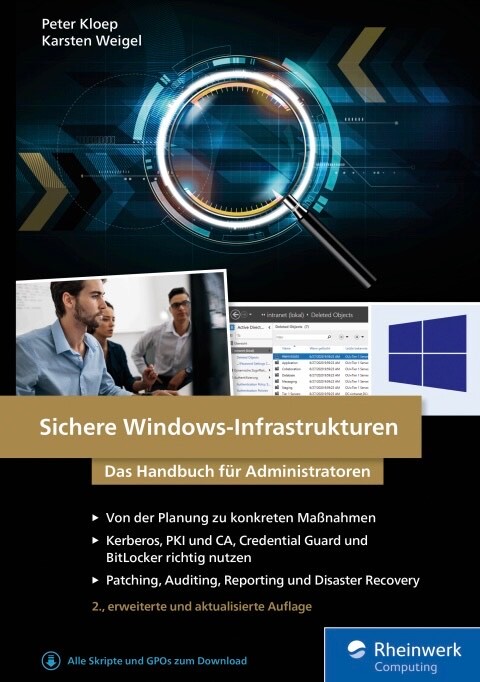
Sichere Windows-Infrastrukturen (2. Auflg.)
Das Handbuch für Administratoren in aktualisierter 2. Auflage, Februar 2023 Heutzutage ist nicht mehr die Frage, ob Ihre Infrastruktur Ziel eines Angriffs wird, sondern wie Sie dafür gewappnet sind. Microsoft gibt Ihnen dazu einen Reihe Werkzeuge an die Hand, und dieser Leitfaden zeigt Ihnen, wie Sie sie effektiv einsetzen. Mit den richtigen Administrationsmethoden machen Sie dem Angreifer das Leben schwer und sorgen dafür, wichtige Daten sicher bleiben und kein Schaden entsteht. Zahlreiche Best Practices und Hinweise aus der Praxis erklären Ihnen, wie Sie Ihre Systeme absichern und sich auf den Ernstfall vorbereiten. Neu in der 2. Auflage: Hinweise für die Migration bestehender Umgebungen und Handlungsvorschläge für die Disaster Recovery Sichere Systeme – von Anfang an Sicherheit lässt sich nicht per Knopfdruck einschalten, sondern will gut geplant sein. Dieses Handbuch zeigt Ihnen, wie Sie Zugriffsrechte und Benutzerkonten sinnvoll einrichten und Ihr Netzwerk so konfigurieren, dass es resilient gegen Angriffe ist und Hackern das Leben schwer macht. Angriffsvektoren kennen und Systeme absichern Nur wenn Sie die wichtigsten Sicherheitsprobleme kennen, können Sie Ihr Netzwerk effektiv absichern. Daher finden Sie hier einen Überblick über einschlägige Hacking-Tools und erfahren so praxisnah, wie ein Angriff abläuft. Sicherheit in der Praxis Das richtige Monitoring und ein gutes Patch-Management sind ein erster Schritt zur sicheren Umgebung. Es gibt allerdings noch viel mehr, was Sie im Administrationsalltag tun können, um Ihre Systeme zu schützen: Just-in-time und Just-enough-Administration, saubere Einordnung der Systeme in Tiers, PAWs und mehr! Aus dem Inhalt: Angriffsmethoden und Werkzeuge Systeme härten und sichere Administration Authentifizierungsprotokolle Least-Privilege-Prinzip und Tier-Modell Credential Guard und Remote Credential Guard Admin Forest und PAM-Trust Administration: Just in time und Just enough Update-Management mit WSUSPKI und CA Auditing, Monitoring und Reporting Disaster Recovery: Gut vorbereitet für den Ernstfall Migrationsguide: Von der Legacy-Umgebung zur modernen Infrastruktur Autoren: Karsten Weigel ist Microsoft Certified Solutions Associate und als Microsoft Certified Technology Specialist ausgewiesener Experte für Netzwerkinfrastruktur, Windows Server und Active Directory. Als technischer Projektverantwortlicher verfügt er über langjährige Erfahrungen in der Systemmigration von heterogenen Windows-Umgebungen. Derzeit ist er als Enterpriseadministrator für ein weltweit betriebenes Active Directory verantwortlich und ist technischer Ansprechpartner gegenüber dem Herstellersupport. Er arbeitet seit über 20 Jahren administrativ und beratend im IT-Umfeld. Peter Kloep ist ein herausragender Experte für sichere Windows-Infrastrukturen im deutschsprachigen Raum. Seit 2002 ist er Microsoft Certified Trainer und hat seitdem zahlreiche technische Trainings zur Windows-Administration durchgeführt. Außerdem ist er Microsoft Certified Systems Engineer und Microsoft Certified Solutions Expert – Windows Server 2012. Er war bei Microsoft als Premier Field Engineer tätig und unterstützte dort Premier-Kunden in den Bereichen Identity Management und Security. Er kennt daher die in diesem Buch beschriebenen Fragestellungen aus der Praxis, ist mit den Ansprüchen der Unternehmen vertraut und geht gezielt auf potentielle Fallstricke und Probleme ein.Leseprobe (PDF-Link)
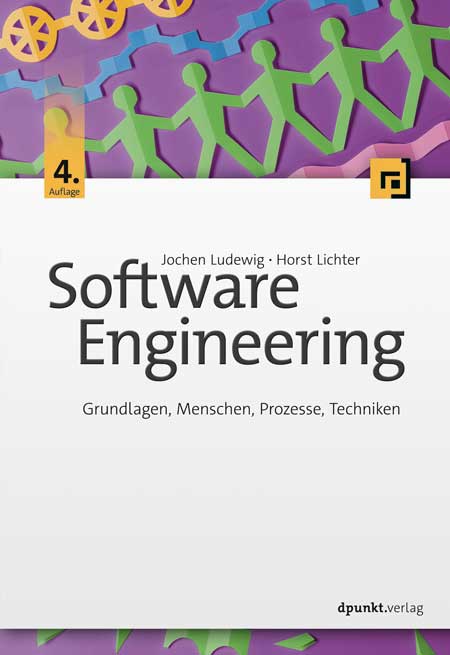
Software Engineering (4. Auflg.)
Grundlagen, Menschen, Prozesse, TechnikenDas Buch vermittelt die Grundlagen, Erfahrungen und Techniken, die den Kern des Software Engineerings bilden. Es ist als Material zu Vorlesungen über Software Engineering konzipiert. Auch für Praktiker, die mit der Softwareentwicklung und -bearbeitung und den dabei auftretenden Problemen vertraut sind, ist das Buch sehr gut geeignet, um die Kenntnisse im Selbststudium zu ergänzen und zu vertiefen. Der Inhalt des Buches ist in fünf Hauptteile gegliedert:GrundlagenMenschen und ProzesseDaueraufgaben im SoftwareprojektTechniken der SoftwarebearbeitungVerwaltung und Erhaltung von SoftwareAuf die Ausbildung zukünftiger Software Engineers wird ebenfalls eingegangen. Ergänzende Informationen sind auf der Webseite der Autoren verfügbar: https://se-buch.de.Die 4. Auflage enthält neben vielen kleinen Verbesserungen und Aktualisierungen neue Themen wie Schätzung in agilen Projekten, agile Skalierung, Microservices, Domain-Driven Design und automatische Software-Auslieferung. Autoren:Jochen Ludewig, Horst LichterProf. Dr. rer. nat. Jochen Ludewig geboren 1947 in Hannover. Studium der Elektrotechnik (TU Hannover) und Informatik (TU München); Promotion 1981. 1975 bis 1980 Gesellschaft für Kernforschung, Karlsruhe, dann Brown Boveri Forschungszentrum in Baden/Schweiz. 1986 Assistenzprofessor an der ETH Zürich, 1988 Ruf auf den neuen Lehrstuhl Software Engineering an der Universität Stuttgart. Arbeitsgebiete: Softwareprojekt-Management, Software-Prüfung und Software-Qualität, Software-Wartung. Ab 1996 Konzeption und Aufbau des Diplomstudiengangs Softwaretechnik, der inzwischen in einen Bachelor- und einen Masterstudiengang umgewandelt wurde. Seit 2009 Fellow der Gesellschaft für Informatik (GI).Prof. Dr. rer. nat. Horst Lichter geboren 1960 in Trier. Studium der Informatik und Betriebswirtschaftslehr (TU Kaiserslautern). Wissenschaftlicher Mitarbeiter (ETH Zürich und Universität Stuttgart), Promotion 1993. Anschließend Schweizerische Bankgesellschaft Zürich und ABB Forschungszentrum Heidelberg. 1998 Ruf an die RWTH Aachen University, Leiter des Lehr- und Forschungsgebiets Software-Konstruktion. Arbeitsgebiete: Software-Architektur, Qualitätssicherung, Software-Evolution. Seit 2005 Lecturer an der Thai German Graduate School of Engineering (TGGS) in Bangkok. Von 2018-2021 Adjunct Lecturer an der Universiti Teknologi Petronas (UTP) Malaysia.Zielgruppe:Praktiker*innen und Manager*innen mit Verantwortung für Software-ProjekteStudierendeLehrende

Pro Kotlin Web Apps from Scratch
Build production-grade web apps from scratch – without using frameworks – with Kotlin on the Java platform. You’ll learn how to use and compose libraries, how to choose between different libraries, and the benefits of explicit and straight-forward code, vs. the implicit magic, conventions, and inversion of control you often see in frameworks.The book teaches the Kotlin language by building production-ready Kotlin code. You’ll gain a deep understanding of the idiomatic use of the Kotlin language along with knowledge of how to apply Kotlin in production-grade web apps. The book also bridges the gap between building from scratch and using existing frameworks. For example, you’ll learn how to integrate Spring Security-based authentication in web apps written from scratch, so you can leverage existing tooling in your organization without having to take on the entire Spring framework.The first section of the book sets up the base structure of your web app, such as routing, configuration files, and database migrations. The remaining chapters are broken into individual aspects of building production-ready web apps. Appendices at the end of the book explain how to use different libraries than the ones chosen in the main chapters, so you'll learn how to decouple your code from specific libraries, and choose between many different libraries to get the job done in your own web apps.WHAT YOU WILL LEARN* Compose libraries and manage boilerplate code using idiomatic and powerful Kotlin* Manage and query SQL databases without ORMs and mapping layers* Write resilient and change-proof tests in support of test-driven development practices* Create traditional, HTML-based web apps, APIs for JavaScript-based single-page web apps and native mobile apps* Manage parallelism and external service calls using Kotlin co-routines* Deploy to production using embedded servers, WAR files, and serverless approaches* Bridge the gap between custom-built apps and enterprise, using Spring Context and Spring SecurityWHO THIS BOOK IS FORThe expert developer who is ready to take full control of the tech stack, and use the Kotlin language, type system, and standard library, to ship production-ready web apps. Readers should have prior programming experience. Experience with Java or another JVM language is helpful.AUGUST LILLEAAS has built web apps, user interfaces, and real-time systems since 2004, and mobile apps since the app stores opened in the late 2000s. After picking up Clojure in 2012, he left the frameworks and ORMs behind and started to build web apps from scratch, and has shipped to production using Clojure, Groovy, Node.JS, Elixir, and Kotlin. August has worked as a consultant for a decade and is now an independent contractor and startup founder.PART I. UP AND RUNNING WITH A WEB APP1. Setting Up A Development Environment2. Setting Up the Web App Skeleton3. Configuration Files4. Decoupling Web Handlers from Specific LibrariesPART II. LIBRARIES AND SOLUTIONS5. Connecting to and Migrating SQL Databases6. Querying a SQL Database7. Automated Tests with jUnit 58. Parallelizing Service Calls with Coroutines9. Building Traditional Web Apps with HTML and CSS10. Building API Based Backends11. Deploying to Traditional Server Based Environments12. Build and Deploy to a Serverless Environment13. Setup, Teardown and Dependency Injection with Spring Context14. Enterprise Authentication using Spring SecurityPART III. TOOLS OF THE TRADE15. Choosing the Right Library16. An Assortment of Kotlin TricksAppendix A: Using Jooby Instead of KtorAppendix B: Using Hoplite Instead of Typesafe ConfigAppendix C: Using Spek Instead of jUnit 5
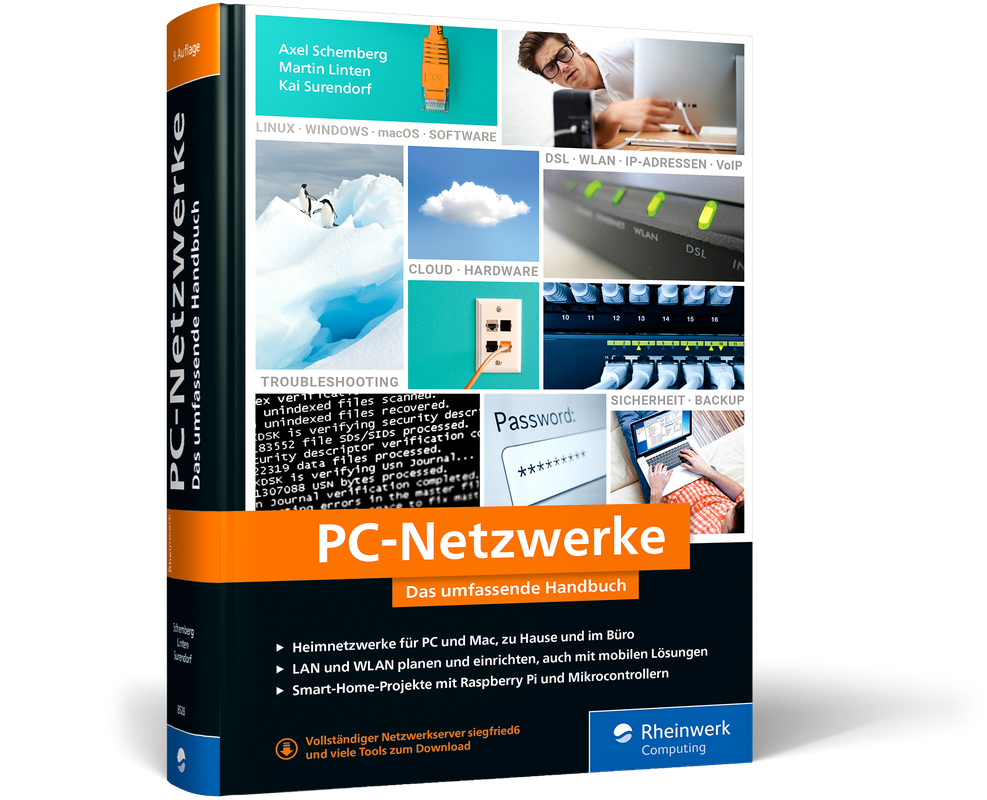
PC-Netzwerke (9. Auflage)
PC-Netzwerke. Das umfassende Handbuch. In 9., aktualisierter und erweiterter Auflage (2023). Bewährt, praxisnah und randvoll mit wertvollen Informationen – Sie erhalten nicht nur umfassende Grundlagen zur Einrichtung Ihres Netzwerks, sondern finden auch Praxis-Anleitungen, mit denen Sie Ihre Computer, Fernseher, Tablets und Smartphones zu Hause oder im Büro professionell vernetzen. Mit vielen Beispiel-Projekten (z. B. UMTS-Router, Radiowecker und Media Player – LibreELEC (Kodi) – mit Raspberry Pi) für eigene Netzwerk- und Hausautomationsideen.Ihr Wissen können Sie zudem mit dem Netzwerkserver »siegfried« direkt ausprobieren. Nutzen Sie ihn für Netzlaufwerke, E-Mail, Netzwerkdrucker, Internettelefonie, DHCP und vieles mehr. Aktuell zu Windows 11 und macOS Monterey.Verstehen und anwenden1. Alles, was Sie für den Netzwerkstart benötigenAngefangen bei den Netzwerkgrundlagen bis hin zu direkt umsetzbaren Praxislösungen für LAN und WLAN finden Sie alles für die erfolgreiche Netzwerk-Einrichtung. Dazu erhalten Sie Tipps zur Auswahl von Router, Switches, NAS, Kabeln und Co.2. Machen Sie Ihr Netzwerk sicherNetzwerk-Sicherheit sollte immer oberste Priorität haben. Daher bietet Ihnen das Buch ausführliche Infos zu Sicherheitssoftware, Verschlüsselungsverfahren, Backup-Möglichkeiten und Netzwerkanalyse-Tools. Für Windows, macOS und Linux.3. Schneller und einfacher mit Cloud & VirtualisierungMit der Software siegfried6 aus dem Download-Bereich können Sie Ihren Rechner z. B. als Druck-, Mail- oder Groupware-Server verwenden. Sie erfahren zudem alles zur Nutzung von Cloud-Diensten.4. Projekte zur HeimautomationMit dem Raspberry Pi oder Mikrocontrollern wie dem ESP8266 setzen Sie Ideen um, mit denen Sie Ihr Zuhause smarter machen.Aus dem InhaltLAN und WLAN einrichtenNetzwerk-TopologienHardware auswählenRouter, Switch und Co.Sicherheit im NetzwerkVerschlüsselungsverfahrenCollaboration ToolsDruck, File- und MailserverBackups automatisieren: NAS-SystemeVirtualisierung und CloudHeimautomation mit FHEM, HomeMatic, Tasmota und mehrStreaming (Fotos, Video, Musik), LibreELEC (Kodi)Leseprobe (PDF-Link)Über die AutorenMartin Linten ist im Bereich Linux-/UNIX-Systemtechnik im Rechenzentrum der Finanzverwaltung Nordrhein-Westfalen tätig, ist »HP certified system administrator« und hat sich mehrere Jahre mit VMware vSphere Server- und Clientvirtualisierung beschäftigt (ESXi/View). Privat beschäftigt er sich am liebsten mit Hausautomation und kleinen Raspberry-Pi-Projekten.Axel Schemberg ist im Bereich Netzwerkadministration im Rechenzentrum der Finanzverwaltung Nordrhein-Westfalen tätig.Kai Surendorf schrieb sein erstes Buch über OS X und UNIX bereits 2003. Zurzeit lebt er in Berlin und arbeitet als Product Owner im E-Commerce-Bereich.

Connecting the Internet of Things
Navigating the fragmented IoT connectivity ecosystem of standards, protocols, and architectures can be a challenge. Not to mention scaling a solution to a viable product. This book guides you through this fractured landscape with real world examples and projects that can be leverage for an IoT product.Backed by an overview of IoT use cases and key connectivity elements of IoT solutions, you'll gain an understanding of the breadth of the IoT landscape and the fragmentation of connectivity standards and solutions and the challenge in navigating the many standards and technologies. You'll also be able to understand the essentials of connectivity including, hardware, software, and business models.IoT is essential for increasing productivity of many industries and quality of life (making the world smart and autonomous). Both wired and wireless connectivity technologies are essential ingredients in an IoT product. Written by Intel engineers and architects, Connecting the Internet of Things understands that connectivity is a key topic of IoT and comprehensively covers the topic from a system engineering and practical perspective.WHAT YOU'LL LEARN* Understand the trade offs between different wireless technologies and network topologies* Use wireless technologies in IoT products* Examine connectivity technologies and considerations on selecting it for the IoT use cases* Assemble all of the components of a working solution * Scale your solution to a product* Review emerging connectivity technologies for addressing new use cases* Advance and optimize the performance of existing technologiesWHO THIS BOOK IS FORResearchers, managers, strategists, technologists, makers, and students in the embedded and Internet of Things (IoT) space trying to understand and implement connectivity in the devices/platforms.ANIL KUMAR is a Principal Engineer at Intel Corporation. As a System Architect in the Client Computing Group, he works with Intel’s partners to unlock people’s potential by bringing computing devices to market, allowing them to focus, create and connect in ways that matter most to them. Before this role, Anil was responsible for the Connectivity Platform Architecture in the Internet of Things Group (IOTG). In IOTG, he successfully drove platform and chip-level integration of several critical connectivity and communication technologies, resulting in a broad set of IoT applications across different vertical markets.Anil joined Intel in 2007 as a design engineer in the Digital Home Group. He served as Platform Architect for several Intel Architecture-based Media Processors for TV and Set Top Box applications. As the chief architect in Intel Media Group, Anil led several designs that resulted in award-winning consumer electronic device designs at CES (Consumer Electronics Show). The world’s first Google TV devices are based on reference designs created by Anil.Before joining Intel, Anil held design engineering positions at multinational companies such as Fujitsu & Alcatel. Anil’s passion and purpose is driven by taking designs from concept to production. Anil is a co-author of Demystifying Internet of Things Security (Apress 2019).JAFER HUSSAIN is a Senior Product Line Manager in the Network and Edge Group (NEX) at Intel Corporation. Jafer is responsible for the product management of Intel’s Core based Smart and Intelligent AI platforms. In his current role, Jafer engages with Intel’s ecosystem partners to drive Intel’s leadership in various IoT markets.Jafer has previously led the development and integration of wireless connectivity solutions and contributed to the development of wireless connectivity strategy. He also led several customer engagements to drive these solutions to the market.Jafer is an accomplished inventor with multiple patents on embedded systems, wireless technologies, and IoT. He received B.S. in Electrical Engineering from University of Engineering and Technology Taxila, Pakistan, and M.S. in Management of Technology from the National University of Singapore.DR. ANTHONY (TONY) CHUN is head of digital access and an Encore.org/CoGenerate Fellow, at The Bridging Tech Charitable Fund, a nonprofit that is closing the digital divide for K-12 students via computers and connectivity. He recently retired from Intel Corporation, where he was the Wi-Fi product manager in the Internet of Things Group.He joined Intel in 2000 and was a research scientist in Intel Labs where he developed architectures for reconfigurable software defined radios and accelerators.He has co-authored 20 patents in wireless architectures and accelerators. He has co-authored several papers in engineering journals and received best paper awards at the Intel Design Technology and Test Conference 2011 and at the IEEE Computer Society Annual Symposium on VLSI, 2009. He has B.S., M.S. and PhD degrees in Electrical Engineering from Stanford University, Stanford, California.Chapter 1: Introduction to IoT ConnectivityChapter Goal: This chapter provides an overview of key IoT use cases and key connectivity elements of IoT solutions. The reader will get an understanding of the breadth of the IoT landscape.• Purpose of this book• Background and Terminology• Key IoT use caseso Smart citieso Asset trackingo Smart factorieso Industrialo Transportationo Digital surveillance systemso Retailo Medicalo Indoor location• End-to-end IoT building blockso Things/devices/sensorso Edge/Gateway/Fogo Cloud• IoT Stakeholders/Value Chaino Chip Vendorso Module Vendorso System Integratorso ODMso ISVso End CustomersChapter 2: Considerations in choosing a connectivity technologyChapter Goals: This chapter highlights the fragmentation of connectivity standards and solutions and the challenge in navigating the many standards and technologies and also discusses the tradeoffs between different wireless technologies and network topologies. Also, this chapter provides the motivation for using wireless technologies in IoT products as well as challenges.• Compute and connect are integral functions that are fully integrated in single SoC-for lower cost and low power solutions• Benefits of wireless• Seamless wireless connectivity for mobility applications• Remote Commissioning, ease of deployment, OTA update, device identification• Challenges of Wireless Connectivity• Fragmentation of the IoT Ecosystemo Discussion of IoT Framework Open Connectivity Foundation etc.o Interoperability (open standards)• Coexistence and interference• Wireless security is vital• Certification (Industry, regulatory, operator)o Certified labs• Antenna design challenges• Considerations in choosing a connectivity technologyo Energy/power/cost tradeoffso Selection of network architectures and topologieso Wireless standards and alignment to use cases-how to choose the right wireless protocol for the jobo Selection criteria-range, data rate, power, security, latency, capacity, etc.• Wireless Standard BodiesSubchapter Goal: Overview of Connectivity standards including 15.4, ZigBee, Thread, 6LoWPAN, wi-fi, BT, LTE, 5G etc. and which is appropriate for each use case; include cost considerationso WiFi Allianceo BT SIGo ZigBee Allianceo Thread Groupo Dot doto Z-Waveo 3GPP (ITU-T)Chapter Goals: The following chapters (3 to 10) provide a deep dive on each connectivity technology and considerations on selecting it for the IoT use casesChapter 3: Wi-Fi• Wi-Fi mesh• WiFi 802.11a/b/g/n/ac• WiFi 6Chapter 4: Bluetooth• BLE• BT mesh• BT direction finding• BT beaconsChapter 5: 802.15.4 (unlicensed)• ZigBee• ThreadChapter 6: LPWAN• Lora• SigFoxChapter 7: Cellular Technologies• NB IoT• 3G• 4G LTE• CBRS (Private LTE) / OnGoChapter 8: 5G• eMBB• mMTC• urLLC• 5G TSNChapter 9: Ethernet• TSN• Industrial Ethernet TechnologiesChapter 10: GNSSChapter 11: IoT Connectivity Frameworks and StacksChapter Goal: This chapter goes into detail on how to assemble all of the components of a working solution and discusses how to scale your solution to a product• Software stacks, drivers, operating systems, RTOS• Gateway architecture including protocolso IoT protocols CoAP MQTT OPCUA• RF: antenna, PA, etc.• Coexistence• Environmental considerations, reliability, long life etc.• Security and privacy• Managing the network• Certification• Putting it together• How to integrate and validate (chip vs pre-certified module)• Scaling from project to product• Putting it together: Sample Projects• Go through the earlier examples and discuss the complete productsChapter 12: The Future of IoT ConnectivityChapter Goal: This chapter discusses emerging connectivity technologies for addressing new use cases as well as advancing and optimizing the performance of existing technologies• Things/sensors (low power, battery powered, low compute, need wireless connectivity, small memory footprint, small RTOS footprint)• Software defined radio• What is coming next?• Future technologies: Wi-Fi 7, etc.• Next steps for the reader• Where to get more informationReferencesIndex
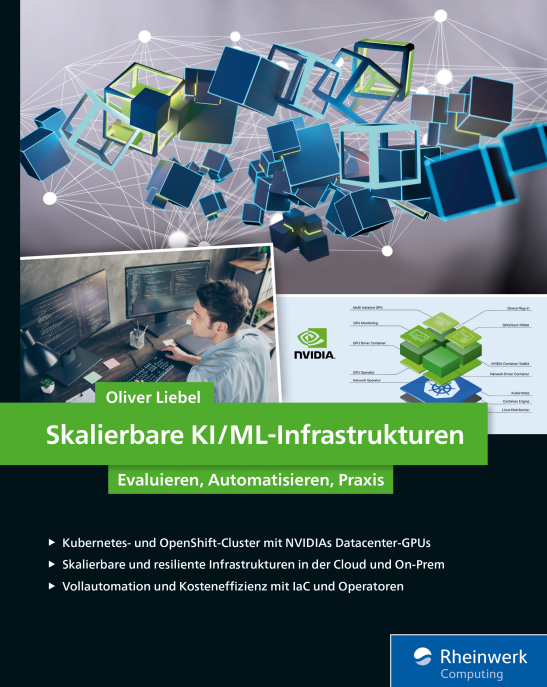
Skalierbare KI/ML-Infrastrukturen
Evaluieren, Automatisieren, Praxis Moderne KI/ML-Modelle brauchen leistungsstarke Infrastrukturen. Wie Sie abseits der Hypes resiliente, hochautomatisierte und autoskalierbare Systeme für Produktiv-Workloads aufbauen, zeigt Ihnen Oliver Liebel in diesem Wegweiser. Sie erfahren, wie Sie NVIDIAs Datacenter-GPUs nahtlos in Hypervisoren und moderne Container-Infrastrukturen integrieren, sie Operator-gestützt mit Kubernetes bzw. OpenShift verwalten und daraus praxistaugliche Setups machen, die im Unternehmenseinsatz und echten Business Cases bestehen.Betrachtet wird der ganze Infrastruktur-Stack, mit Fokus auf effizienter Vollautomation: Von On-Premises-Installationen auf vSphere oder Cloud-Setups auf GCP und AWS über Plattform-Automation per IaaS/IaC sowie den GPU- und Network-Operatoren bis hin zu einem Ausblick auf AI End-to-End-Tool-Stacks.Aus dem Inhalt: KI/ML: Grundlagen und Use CasesInfrastruktur planen: On-Premises, Cloud oder Hybrid?Technischer Background: KI/ML mit NVIDIA-GPUsGPU-Modi: Passthrough-MIG vs. MIG-backed vGPU vs. vGPUNVIDIA-GPUs auf vSphere On-Prem implementierenNVIDIA AI EnterpriseKI/ML-Cluster mit Kubernetes und OpenShiftGPU-spezifische OperatorenGPU-Cluster mit OpenShiftVon CI/CD über GitOps zu MLOpsML-Pipelines & AI End-to-EndAutor:Dipl.-Ing. Oliver Liebel ist LPI-zertifizierter Linux-Enterprise-Experte, Partner von Red Hat und SUSE und steht in engem Kontakt mit NVIDIAs EGX-Abteilung.

SAP Data Warehouse Cloud
Lernen Sie die neue Cloud-Lösung für das Data Warehousing mit SAP kennen. Hier erfahren Sie, wie Sie SAP Data Warehouse Cloud in Ihre Gesamtarchitektur integrieren. Die Lösung wird detailliert vorgestellt: Spaces anlegen und verwalten, auf Datenquellen zugreifen, Auswertungen erstellen. Auch die Anbindung an SAP BW/4HANA und Self-Service-Szenarien werden erläutert. Aus dem Inhalt: ArchitekturModellierungsansätzeDas Space-KonzeptRepository ExplorerData BuilderTabellen und ViewsBusiness BuilderStory BuilderReplikation und MonitoringSicherheit und BerechtigungenÜbernahmen von Querys und ModellierungsobjektenUmfangreiche Praxisbeispiele Vorwort und Einleitung ... 19 TEIL 1. Einführung ... 25 1. Data Warehousing mit SAP im Wandel ... 27 1.1 ... Technologische und konzeptionelle Entwicklungen ... 27 1.2 ... Geänderte Rahmenbedingungen in Fachbereich und IT ... 39 1.3 ... Die Zukunft: Data Warehousing in der Cloud ... 45 2. Einführung in SAP Data Warehouse Cloud ... 51 2.1 ... Einordnung und Positionierung ... 51 2.2 ... Grundlegende Funktionalitäten ... 53 2.3 ... Überblick über Architektur und Modellierung ... 63 2.4 ... Grundkonzepte der Implementierung ... 70 2.5 ... Zusammenfassung ... 88 TEIL 2. Funktionen von SAP Data Warehouse Cloud ... 91 3. Verwaltung von Verbindungen, Dateien und Artefakten ... 93 3.1 ... Space-Konzept ... 93 3.2 ... Space-Management ... 97 3.3 ... Repository Explorer ... 108 3.4 ... Verbindungen ... 115 3.5 ... Zusammenfassung ... 126 4. Datenmodellierung mit dem Data Builder ... 129 4.1 ... Die Objekte des Data Builders ... 132 4.2 ... Tabellen und Remote-Tabellen ... 144 4.3 ... CSV-Datei-Import ... 163 4.4 ... Grafische Views ... 169 4.5 ... SQL-Views ... 183 4.6 ... Datenflüsse ... 197 4.7 ... Intelligente Suche ... 206 4.8 ... Entity-Relationship-Modelle ... 216 4.9 ... Aufgabenketten ... 218 4.10 ... Berechtigungen ... 219 4.11 ... Zusammenfassung ... 219 5. Datenaufbereitung mit dem Business Builder ... 221 5.1 ... Navigation im Business Builder ... 224 5.2 ... Geschäftsentitäten ... 227 5.3 ... Faktenmodelle ... 251 5.4 ... Verbrauchsmodelle ... 259 5.5 ... Perspektiven ... 265 5.6 ... Datenvorschau ... 268 5.7 ... Berechtigungsszenario ... 273 5.8 ... SAP-BW/4HANA-Modellübertragung ... 274 5.9 ... Zusammenfassung ... 285 6. Reporting mit SAP Analytics Cloud ... 287 6.1 ... Verbindung mit SAP Data Warehouse Cloud ... 289 6.2 ... Navigation in SAP Analytics Cloud ... 291 6.3 ... Berichte in SAP Analytics Cloud erstellen ... 293 6.4 ... Zusammenfassung ... 306 7. Verwalten und Überwachen der Datenintegration ... 307 7.1 ... Überblick zu Datenintegrationsszenarien ... 308 7.2 ... Verwalten der Datenintegration ... 315 7.3 ... Datenintegrationsaufgaben einplanen ... 322 7.4 ... Überwachung von Datenintegrationsaufgaben ... 328 7.5 ... Zusammenfassung ... 354 8. Benutzer und Rollen ... 355 8.1 ... Rollen verstehen und verwalten ... 356 8.2 ... Benutzer einrichten und pflegen ... 366 8.3 ... Aktivitäten in SAP Data Warehouse Cloud überwachen ... 382 8.4 ... Datenzugriffskontrolle ... 387 8.5 ... Berechtigungsübernahme aus SAP BW ... 405 8.6 ... Zusammenfassung ... 422 9. Weitere Konfigurationen in SAP Data Warehouse Cloud ... 423 9.1 ... Datenintegration ... 425 9.2 ... Tenant-Links ... 434 9.3 ... Konfiguration der Sicherheit ... 435 9.4 ... Audit ... 437 9.5 ... Überwachung ... 439 9.6 ... IP-Erlaubtliste ... 441 9.7 ... Aufgabenprotokolle ... 442 9.8 ... Datenbankzugriffe ... 444 9.9 ... Tenant Configuration und SAP BW Bridge ... 446 9.10 ... Systemkonfiguration ... 450 9.11 ... Konfiguration der Datenquelle ... 450 9.12 ... Administration der Sicherheit ... 452 9.13 ... App-Integration ... 453 9.14 ... Benachrichtigungen ... 455 9.15 ... Zusammenfassung ... 456 10. Transport von Artefakten ... 457 10.1 ... Überblick der Transporte ... 458 10.2 ... Export von Artefakten ... 462 10.3 ... Import von Artefakten ... 469 10.4 ... Zusammenfassung ... 474 11. Datenmodelle im Kontext von SAP BW und SAP BW Bridge ... 475 11.1 ... Konzepte und Begriffe der SAP-BW-Modellierung ... 476 11.2 ... Mögliche Architekturoptionen ... 485 11.3 ... Datenmigration und Konvertierung nach SAP BW/4HANA ... 495 11.4 ... SAP BW Bridge ... 500 11.5 ... BW-Modellierung ... 518 11.6 ... ABAP-Entwicklungswerkzeuge ... 524 11.7 ... Integriertes-SAP-BW-Cockpit ... 530 11.8 ... Zusammenfassung ... 536 12. Content-Netzwerk ... 537 12.1 ... Inhalte aus dem Content-Netzwerk ... 538 12.2 ... Voraussetzungen für die Nutzung des Content-Netzwerks ... 541 12.3 ... Importieren aus dem Content-Netzwerk ... 545 12.4 ... Zusammenfassung ... 550 13. Data Marketplace und Data Sharing Cockpit ... 551 13.1 ... Data Marketplace ... 552 13.2 ... Data Sharing Cockpit ... 558 13.3 ... Zusammenfassung ... 561 TEIL 3. Einsatzszenarien für SAP Data Warehouse Cloud ... 563 14. Architekturen und Szenarien für den Einsatz von SAP Data Warehouse Cloud ... 565 14.1 ... Szenario 1: Self-Service-Ansätze ... 566 14.2 ... Szenario 2: Hybride Modellierung zur Erweiterung einer SAP-BW-Lösung ... 567 14.3 ... Szenario 3: Echtzeit-Datenanalyse und Reporting ... 569 15. Szenario 1: Self-Service ... 571 15.1 ... Space Management ... 573 15.2 ... CSV-Datei-Upload mit dem Data Builder ... 577 15.3 ... Business Builder ... 586 15.4 ... Zusammenfassung ... 596 16. Szenario 2: Hybride Modellierung zur Erweiterung einer SAP-BW-Lösung ... 597 16.1 ... Überblick über das hybride Szenario ... 598 16.2 ... Migration nach SAP BW Bridge ... 602 16.3 ... Übernahme der Modellkomponenten nach SAP Data Warehouse Cloud ... 623 16.4 ... Vorbereitung externer Modelle ... 628 16.5 ... Erstellen kombinierter Modelle ... 629 16.6 ... Zusammenfassung ... 640 17. Szenario 3: Echtzeit-Datenanalyse und Reporting ... 641 17.1 ... Übersicht zum Szenario ... 642 17.2 ... SAP Business Content für Sales Analysis aktivieren ... 643 17.3 ... Verwendung des SAP Business Contents für Sales Analysis ... 651 17.4 ... Modellierung und Auswertung in der Business-Schicht ... 665 17.5 ... Datenintegration, Monitoring und Optimierung ... 680 17.6 ... Zusammenfassung ... 689 18. Ausblick ... 691 18.1 ... Ausblick auf die zukünftige Entwicklung der Rahmenbedingungen ... 691 18.2 ... Strategische Investitionsfelder von SAP ... 698 Anhang ... 701 A. Literaturverzeichnis ... 701 Das Autorenteam ... 703 Index ... 707

SAP SuccessFactors Employee Central
Straffe HR-Prozesse und zufriedene Mitarbeitende: Lernen Sie, wie Sie Ihre Personalarbeit mit Employee Central auf ein neues Level heben. Schritt für Schritt wird erklärt, wie Sie mit modernster Cloud-Software Mitarbeiter- und Organisationsdaten verwalten, Arbeitszeiten erfassen sowie Gehalt und Zusatzleistungen im Griff behalten. Arbeiten Sie effektiv mit Massenänderungen, nutzen Sie die EC-Standardprozesse, Geschäftsregeln und Workflows, um das Beste aus Ihrem HR-System herauszuholen! Aus dem Inhalt: Grundlagenobjekte (Foundation Objects)PlanstellenmanagementMitarbeiterdatenOrganisationsmanagementGehalt und ZusatzleistungenZeitwirtschaftIntegration mit SAP FieldglassMassenänderungenDokumentenerzeugungReportingRollenbasierte BerechtigungenErweiterbarkeitDaten und SchnittstellenÜberblick über Employee Central Payroll Vorwort des Autorenteams ... 17 Einleitung ... 19 1. Employee Central -- Überblick und Implementierung ... 25 1.1 ... Employee Central auf einen Blick ... 26 1.2 ... Employee Central in die Systemlandschaft einbinden ... 34 1.3 ... Implementierung vorbereiten ... 37 2. Grundlagen der Arbeit in Employee Central ... 51 2.1 ... Mitarbeiterstatus ... 51 2.2 ... Ereignisse und Ereignisgründe ... 54 2.3 ... Workflows nutzen ... 66 2.4 ... Geschäftsregeln ... 101 3. Grundlagenobjekte ... 115 3.1 ... Was sind Grundlagenobjekte? ... 115 3.2 ... Kategorien von Grundlagenobjekten ... 117 3.3 ... Verknüpfungen und Vererbung bei Grundlagenobjekten ... 123 3.4 ... Grundlagenobjekte konfigurieren ... 125 3.5 ... Daten für Grundlagenobjekte erstellen ... 134 4. Planstellenmanagement ... 141 4.1 ... Mit Planstellen arbeiten ... 142 4.2 ... Planstellenmanagement einrichten ... 155 4.3 ... Planstellenmanagement im Zusammenspiel mit weiteren SAP-SuccessFactors-Modulen ... 164 4.4 ... Übersicht über die Firmenstruktur ... 166 5. Mitarbeiterdaten ... 171 5.1 ... Zeitscheiben und Historie nutzen ... 172 5.2 ... Ansichten auf Mitarbeiterdaten ... 174 5.3 ... Self-Services für Mitarbeitende und Vorgesetzte ... 198 5.4 ... Transaktionen zur Pflege des Mitarbeiterlebenszyklus ... 203 5.5 ... Konfiguration ... 209 6. Zusatzleistungen ... 213 6.1 ... Globale Zusatzleistungen ... 213 6.2 ... Grundlagen der Konfiguration ... 214 6.3 ... Globale Zusatzleistungen in ESS ... 218 6.4 ... Länderspezifische Zusatzleistungen ... 222 6.5 ... US-spezifische Zusatzleistungen ... 224 7. Zeitmanagement ... 227 7.1 ... Übersicht über das Zeitmanagement ... 227 7.2 ... Abwesenheit ... 238 7.3 ... Arbeitszeiterfassungsbogen ... 259 7.4 ... Employee Central Time Tracking ... 261 8. Weitere Beschäftigungsarten abbilden ... 271 8.1 ... Grundlegende Konzepte ... 272 8.2 ... Auslandseinsatz ... 272 8.3 ... Mehrfachbeschäftigung ... 285 8.4 ... Auswirkungen von mehreren Beschäftigungsverhältnissen auf andere Module und Prozesse ... 290 8.5 ... Kontingentarbeitende ... 296 9. Dokumentgenerierung ... 301 9.1 ... Dokumentgenerierungsvorlage erstellen ... 302 9.2 ... E-Mail-Einstellungen für eine Dokumentgenerierungsvorlage erstellen ... 305 9.3 ... Inhalte von Feldern in der Dokumentvorlage zuordnen ... 306 9.4 ... Ein Dokument generieren ... 309 10. Reporting ... 317 10.1 ... Bericht-Center ... 318 10.2 ... Überblick verfügbarer Reporttypen im Bericht-Center ... 319 11. Rollenbasierte Berechtigungen ... 355 11.1 ... Einführung in rollenbasierte Berechtigungen ... 356 11.2 ... Berechtigungsgruppen verwalten ... 362 11.3 ... Berechtigungsrollen verwalten ... 366 11.4 ... Berechtigungspflege für MDF-Objekte ... 374 11.5 ... Berechtigungen im Kontext von Employee Central ... 376 11.6 ... Best Practice: Einfachheit, Klarheit und Skalierbarkeit ... 382 12. Erweiterbarkeit ... 387 12.1 ... Metadata Framework ... 388 12.2 ... MDF-Erweiterungen ... 391 12.3 ... Eine Erweiterung erstellen ... 394 12.4 ... Daten mit einer Standarderweiterung pflegen ... 418 12.5 ... Erweiterung einer Standard-MDF-Erweiterung ... 420 12.6 ... SAP Business Technology Platform ... 422 13. Daten und Schnittstellen für Employee Central ... 427 13.1 ... Vorüberlegungen zu Datenimporten für die Migration ... 428 13.2 ... Daten importieren ... 432 13.3 ... Daten exportieren ... 465 13.4 ... Berechtigungen für Importe und Exporte pflegen ... 472 13.5 ... Daten aus SAP ERP Human Capital Management migrieren ... 476 14. Employee Central mit anderen SAP-SuccessFactors-Modulen integrieren ... 477 14.1 ... Benutzerdatendatei ... 479 14.2 ... SAP SuccessFactors Recruiting ... 481 14.3 ... SAP SuccessFactors Onboarding ... 484 14.4 ... SAP SuccessFactors Succession ... 485 14.5 ... SAP-SuccessFactors-Stellenprofile ... 485 14.6 ... SAP SuccessFactors Learning ... 487 14.7 ... SAP SuccessFactors Compensation/Variable Pay ... 487 14.8 ... SAP SuccessFactors Workforce Analytics ... 489 14.9 ... SAP SuccessFactors Employee Central Payroll ... 490 15. Employee Central Payroll ... 493 15.1 ... Vorabüberlegungen zur Einbindung von Employee Central Payroll ... 494 15.2 ... Daten aus Employee Central zur Nutzung in Employee Central Payroll ... 504 15.3 ... Kerndaten von Employee Central Payroll ... 518 15.4 ... Abrechnungsaufgaben in Employee Central zur Pflege von Daten in Employee Central Payroll verwenden ... 533 15.5 ... Gehaltsabrechnung über das Payroll Control Center verwalten ... 537 15.6 ... Besonderheiten beim Einsatz von Employee Central Payroll ... 550 16. Tipps für den Betrieb und Ausblick ... 557 16.1 ... Tipps für den Betrieb ... 557 16.2 ... Aktueller Einsatz und Ausblick ... 562 Das Autorenteam ... 567 Index ... 569

Cybersecurity All-in-One For Dummies
OVER 700 PAGES OF INSIGHT INTO ALL THINGS CYBERSECURITYCybersecurity All-in-One For Dummies covers a lot of ground in the world of keeping computer systems safe from those who want to break in. This book offers a one-stop resource on cybersecurity basics, personal security, business security, cloud security, security testing, and security awareness. Filled with content to help with both personal and business cybersecurity needs, this book shows you how to lock down your computers, devices, and systems—and explains why doing so is more important now than ever. Dig in for info on what kind of risks are out there, how to protect a variety of devices, strategies for testing your security, securing cloud data, and steps for creating an awareness program in an organization.* Explore the basics of cybersecurity at home and in business* Learn how to secure your devices, data, and cloud-based assets* Test your security to find holes and vulnerabilities before hackers do* Create a culture of cybersecurity throughout an entire organizationThis For Dummies All-in-One is a stellar reference for business owners and IT support pros who need a guide to making smart security choices. Any tech user with concerns about privacy and protection will also love this comprehensive guide. This All-in-One gathers the expertise of the leading For Dummies authors in the world of cybersecurity, including JOSEPH STEINBERG, author of Cybersecurity For Dummies; KEVIN BEAVER, author of Hacking For Dummies; TED COOMBS, author of Cloud Security For Dummies; and IRA WINKLER, author of Security Awareness For Dummies. BOOK 1: CYBERSECURITY BASICS 5Chapter 1: What Exactly Is Cybersecurity? 7Chapter 2: Getting to Know Common Cyberattacks 23Chapter 3: The Bad Guys You Must Defend Against 49BOOK 2: PERSONAL CYBERSECURITY 69Chapter 1: Evaluating Your Current Cybersecurity Posture 71Chapter 2: Enhancing Physical Security 93Chapter 3: Cybersecurity Considerations When Working from Home 103Chapter 4: Securing Your Accounts 113Chapter 5: Passwords 131Chapter 6: Preventing Social Engineering Attacks 147BOOK 3: SECURING A BUSINESS 169Chapter 1: Securing Your Small Business 171Chapter 2: Cybersecurity and Big Businesses 195Chapter 3: Identifying a Security Breach 211Chapter 4: Recovering from a Security Breach 229Chapter 5: Backing Up 249Chapter 6: Resetting Your Device 277Chapter 7: Restoring from Backups 287BOOK 4: SECURING THE CLOUD 311Chapter 1: Clouds Aren’t Bulletproof 313Chapter 2: Getting Down to Business 333Chapter 3: Developing Secure Software 349Chapter 4: Restricting Access 377Chapter 5: Implementing Zero Trust 407Chapter 6: Using Cloud Security Services 429BOOK 5: TESTING YOUR SECURITY 451Chapter 1: Introduction to Vulnerability and Penetration Testing 453Chapter 2: Cracking the Hacker Mindset 473Chapter 3: Developing Your Security Testing Plan 485Chapter 4: Hacking Methodology 497Chapter 5: Information Gathering 507Chapter 6: Social Engineering 513Chapter 7: Physical Security 529BOOK 6: ENHANCING CYBERSECURITY AWARENESS 541Chapter 1: Knowing How Security Awareness Programs Work 543Chapter 2: Creating a Security Awareness Strategy 553Chapter 3: Determining Culture and Business Drivers 559Chapter 4: Choosing the Best Tools for the Job 573Chapter 5: Measuring Performance 589Chapter 6: Assembling Your Security Awareness Program 601Chapter 7: Running Your Security Awareness Program 621Chapter 8: Implementing Gamification 641Index 655

Visual Data Insights Using SAS ODS Graphics
SAS ODS graphics users will learn in this book how to visually understand and communicate the significance of data to deliver images for quick and easy insight, with precise numbers.Many charts or plots require the viewer to run the eye from a bar end or plot point to some point on an axis, and then to interpolate between tick marks to estimate the value. Some design choices can lead to wrong conclusions or mistaken impressions. Graphic software relies on defaults to deliver something if you make a minimal effort, but that something is not likely to be exactly what you want.VISUAL DATA INSIGHTS USING SAS ODS GRAPHICS provides examples using experience-based design principles. It presents examples of bar charts, pie charts, and trend lines or time series plots, the graph types commonly used in business, other organizations, and the media for visual insight into data. Newer graphs are also included: dot plots, needle plots, waterfall charts, butterfly charts, heat maps, bubble plots, step plots, high-low plots, and donut charts. In addition, there are basic tools of statistics: scatter plots, box plots, histograms, fit and confidence plots, and distributions.Author LeRoy Bessler introduces unique creations, including sparsely annotated time series, maximally informative bar charts, better box plots, histograms based on interesting atypical rationales, and much more.The examples use SAS sample data sets as input. Any SAS user can experiment with the code presented to see what else is possible, or adapt it to repurpose the design and apply it with a customized version of that code.WHAT YOU’LL LEARN* Create graphs that are easily and quickly interpreted, and without ambiguity* Supply precise data values that are correct on the graph and correctly associated with the graphic visual elements* Take advantage of widely applicable (but not necessarily available elsewhere) design examples* Avoid bad practices that are encouraged by poor examples elsewhere* Get past sub-optimal designs and results that are built into software defaults* Take advantage of less familiar capabilities available in the softwareWHO THIS BOOK IS FORSAS software users who want to understand their data and/or visually deliver their resultsLEROY BESSLER has been a devotee of computer graphics tools in SAS since 1981, and is an award-winning, internationally recognized expert on data visualization. He has been on a continuing quest to find and promote best graphic designs and practices for delivering visual data insights. His book is a long-in-the-making and gradually evolved guiding compendium of his design principles for communication-effective data visualization, with widely applicable examples. He shares his SAS software knowledge, experience, and ideas at conferences in the USA and overseas, and contributes quarterly articles to the VIEWS Newsletter for SAS users.INTRODUCTIONABOUT THIS BOOKPART I: DESIGN PRINCIPLESCHAPTER 1: PRINCIPLES OF COMMUNICATION-EFFECTIVE GRAPHIC DESIGNA. Joseph Pulitzer on Communication (principles for Press are universally applicable)B. Accelerate/Facilitate Visual Data Insights with SimplicityC. The Effects of Needless ComplexityD. SimplicityE. EleganceF. Sparse Image Focuses AttentionG. Sparse Graph more easily, more quickly interpretedH. Whenever possible, make graph title a headlineI. Text readability—often wrongly assumed by graph creatorsJ. Is what the creator sees what the viewer sees?K. How assure text readabilityL. We read horizontallyM. Axis LabelsN. Image Plus Precise Numbers—Both Are NecessaryO. Annotation or On-Image TableP. Sparse Line AnnotationQ. Y Axis for Time Series PlotsR. Ranking and Subsetting InformationS. Scrolling on Web GraphsT. Maximizing Information Delivery in Titles and SubtitlesU. 3DCHAPTER 2: PRINCIPLES OF COMMUNICATION-EFFECTIVE USE OF COLORA. When and Why Color: Communication, Not DecorationB. Benefits of Boring Black and WhiteC. Contrast with BackgroundD. Always Bad Backgrounds1) Image Backgrounds (continuous tone color)2) Color Gradient Backgrounds3) Textured BackgroundsE. Visual DominanceF. Other Choices for Text EmphasisG. Monitor Color vs HardCopy ColorH. ConsistencyI. Purpose/Significance Assumed Even If UnintendedJ. Color-CodingK. Thickness of Lines and TextL. Size of Plot Markers and Legend Color BlocksM. Maximum Number of Distinguishable Shades of One HueN. Other TipsO. Color Control with ODS Graphics Attribute MapsP. Multi-Line Plot That Obviates Need for a LegendPART II: WIDELY APPLICABLE EXAMPLES YOU CAN USECHAPTER 3: TECHNICAL INTRODUCTIONA. Outer Structure of ODS Graphics Code in ExamplesB. Inner Structure of ODS Graphics Code in ExamplesC. Text Parts of ODS Graphics ImagesD. BordersE. From Defaults through Customization for a Simple ExampleF. What FollowsCHAPTER 4: CHARTS FOR DATA IN CATEGORIESA. Getting Your Charts In OrderB. Pie Charts1) The Perils of Pie Chartsa) 3D Pie Charts are ALWAYS misleadingb) Labels Can Collide If All Outsidec) Labels Can Be Hard To Read If Inside If Insufficient Color Fill Contrastd) Slices Too Small To Be Seen Are Not Necessarily a Probleme) Reason to Avoid the OTHER Collective Pie Slice2) Pie Chart Alternativesa) Default Colors vs Better Background for Inside-Of-Slice Labelsb) All Inside Labelsc) All Outside Labels for Name/Category, Value, Percentd) Label Collisions Probleme) Collision Problem Solvedf) Maximally Informative CallOut Labelsg) Default Legendh) Maximally Informative Legendi) The Ineffable Incontrovertible Insightful Power of Simplicity: The Pac-Man Pie Chart—the Extremes of OtherC. Donut ChartsD. Horizontal Bar Charts1) Default Chart2) Easy Bar Annotation3) Adding Percent of Total Measurement4) Key Design Principlesa) Ranking; Show Them What’s Importantb) Subsetting: Let Part Stand for the Whole5) The Maximally Informative Horizontal Bar Chart6) Interlinked Subsets Images Only7) A Tall Horizontal Bar Chart: The Complement of a Subset8) “Nested” Bar Charts (Web Charts)9) Clustered Bar Chart10 Dot Chart11 When to use alphabetical order for bar labels12 ButterFly ChartE. Vertical Bar Charts1) Basic2) Alternative to the Always Unsatisfactory Stacked Bar Chart3) Bar Over Bar (Overlay) Chart4) Needle Plot5) WaterFall ChartsF. Panels of Bar ChartsG. Other Charts Data with a Single Categorical Key1) Series Chart with Block Chart2) Needle Plot with Block ChartH. Single Categorical Key But Two Measurement Variables: Vertical Bar Chart with Overlaid Line ChartI. Charts for Two Categorical Keys1) Bubble Chart2) Heat Mapa) Defaultb) Improvedc) Alternative with Simpler CodeCHAPTER 5: PLOTS FOR TIME-DEPENDENT DATAA. Best Use of Vertical Axis SpaceB. CurveLabels vs LegendC. Single-Line Plots1) Simple2) Band Plot3) With Band As OverLay “Companion” to Highlight Part of Plotted AreaD. All the ways to present a v e r y l o n g plotE. Multiple Line Plots Concurrently Displayed1) Overlaid2) Overlaid and Using Line Color Control3) Overlaid and Using Data Labels and, to Eliminate Need for Legend, Curve Labels4) Overlaid and Using XAxis Table, No Legend or CurveLabels Needed5) In a PanelF. The Ineffable Incontrovertible Insightful Power of Simplicity: Annotated SparseLines1) Single2) Stacked or PaneledG. Spark Tables - SparkLines Used in a TableH. Other Ways To Present Time Series Data1) Needle Plot2) Step Plot3) High-Low Open-Close Plot for Virtual Multi-Line PlotI. Vertical Bar Charts to Show Date/Time DependenceJ. Animation To Show Time EvolutionK. Other Alternatives to Providing Numbers1) Limiting Labels to Y Values by Using Needle Plot to Get to X axis precisely2) Use DropLines to Both Axes3) Using TEXT Statements4) Using ODS Graphics Annotation [LIGHT HERE, a usage example is provided for the US By-State Population Map]L. When all on-image annotation methods are infeasible, or declined1) Web Graph Linked to Excel Table and Back2) Graph and Table Composite in Excel WorkSheet3) Graph and Table Composite in PowerPoint Slide4) Graph and Table Composite in Word Document5) Graph and Table Composite in PDF FileCHAPTER 6: LOOKING FOR RELATIONSHIPS BETWEEN TWO VARIABLESA. Scatter Charts1) SGSCATTER with PLOT Statement vs SGPLOT with SCATTER Statement2) Annotation with DataLabels3) Highly Informative DataLabels4) DropLines Instead of DataLabels5) Annotation with the TEXT Statement6) PROC SGSCATTER Panel of One Y Variable vs Two X Variables7) PROC SGSCATTER Panel of Two Y Variables vs One X Variable8) PROC SGSCATTER Panel of Three Y Variables vs One X Variable9, 10, 11) Use PROC SGPANEL and SCATTER statement to create above examples—possibly retain just this solution12} Overlay of Two Scatter Plots for Different Values of a Categorical Variable (e.g., Gender) to See Correlations and Differences in the y-x Relationship13) SGPANEL of two Gender-Specific SCATTER plots for data in Item 1213) Horizontal or Vertical Panel of the Above Overlay with the Two Individual Scatter Plots as Companion Images for Clarity15) Annotated Scattter Plot using SGPLOT and SCATTER Statement16) Add x values to annotation and suppress the superfluous axis17) Replace y,x annotation with names of people whose data is plotted18) Maximal annotation with Name, y, x19) SGPANEL other examples TBD, maybe noneB. Fit and Confidence Plots1) Introduction2) ELLIPSE3) Linear Regression Plot4) Cubic Regression Plot5) LOESS Fit6) SPLINE7) Penalized B-Spline PlotC. VLINE Plus VBAR on the Same ChartCHAPTER 7: DISTRIBUTION OF A SINGLE VARIABLEA. Histogram1) Basic2) With Density Plot3) With Fringe PlotB. Density Plot with Fringe PlotC. Box PlotsCHAPTER 8: MAPS FOR DATA WITH GEOGRAPHIC KEYSA. Examples for various types of unit area1) By Country2) By State3) By County4) By Point Location, such as CityB. Rationales for Range Setting for the Measurement ReportedC. Automating implementation of the rationaleD. Annotating the map for maximal information communicationE. The “For Color” Map Problem Solved—Color Coding for MapsF. What to do for a unit area that is too tiny to be readily visiblePART III: OTHER FEATURESCHAPTER 9: WAYS TO ENHANCE YOUR GRAPHA. Attribute MapsB. Reference LinesC. Inserting Text with INSET and TEXT StatementsCHAPTER 10: OTHER WAYS TO DELIVER DATA VISUALIZATIONA. Graph and Table Composite in Excel WorkSheetB. Graph and Table Composite in & Other Examples in PowerPoint SlidesC. Graph and Table Composite in Word DocumentD. Graph and Table Composite in PDF FileE. So you want to build an InfoGraphic1) Creating the elements as individual images2) Assembling a composite from those images3) Creating an image file from the slideCHAPTER 11: MISCELLANEOUS TIPSA. Positioning of Titles in ODS Graphics ImagesB. Title and Footnote Text Handling in Web GraphsC. Pseudo-3D Effects That Introduce No Distortion or Needless ComplexityPART IV: APPENDIXESAPPENDIX A: ADDITIONAL RESOURCES1. SAS-Institute-provided Documentation2. Other Resources at support.sas.com3. Online Conference Proceedings (not available from SAS Institute)4. Online Newsletters5. Blogs6. Others TBDAPPENDIX B: POSSIBLE LENGTHY CODE FOR SOME EXAMPLES

CompTIA Server+ (4. Auflg.)
Serversysteme einrichten und betreiben. Vorbereitung auf die Prüfung SK0-005. 4. Auflage 2023.Die Prüfung CompTIA Server+ richtet sich an IT-Fachleute und Administratoren und weist die Fähigkeiten nach, Server in Rechenzentren sowie in lokalen und hybriden Umgebungen zu installieren, zu verwalten und Fehler zu beheben. Die Zertifizierung ist nicht auf eine einzige Plattform beschränkt, so dass Sie die Aufgaben in jeder Umgebung ausführen können. Das Zertifikat ist international anerkannt.Die Prüfung SK0-005 teilt sich in diese Fachgebiete auf:Server-Hardware: Installation und ManagementServeradministrationSicherheit und Disaster RecoveryFehlerbehebungSie lernen in diesem Buch die Eigenschaften, den Einsatz und die Konfiguration von Servern von Grund auf kennen, sowohl was die Hardware als auch was die spezifischen Betriebs-systeme und Applikationen von Servern anbelangt.Des Weiteren erläutern die Autoren die Planung und die physischen Umgebungsbedingungen von Servern sowie aktuelle Themen wie z.B. Hochverfügbarkeit, Cloud Computing und Skripterstellung. Außerdem werden wichtige Fragen zur Sicherheit, Datensicherung und zum Disaster Recovery ausführlich behandelt.So können Sie sich das für die Zertifizierung benötigte Fachwissen aneignen und ein praxistaugliches Verständnis der Thematik entwickeln, das Sie in Ihrem Arbeitsalltag bei der Server-Administration voranbringt.Aus dem Inhalt:Server-Hardware: Prozessoren, Arbeitsspeicher, BIOS/UEFIStorage-Lösungen und -technologien: SSD, SAS, SATA, Fibre Channel, iSCSIFehlertoleranz: RAID, EnergieversorgungServer installieren und aktualisierenHardware im Netzwerk: Kabel, Netzwerkkarten, ÜbertragungsgeräteTCP/IP: IPv4 und IPv6Serverrollen: Datei- und Druckdienste, Internet- und Maildienste, NetzwerkdiensteNetzwerkbetriebssysteme: Windows Server, UNIX/Linux und deren InstallationKonfigurationsbetrachtungen: Dateisystem, Kontingentierung, Verzeichnisdienste, GruppenrichtlinienServer Management: Remote-Verbindungen, Ereignisprotokolle, MonitoringSpeichertechnologien, Virtualisierung und Cloud-DiensteDeployment- und VirtualisierungsszenarienPhysische, technische und organisatorische SicherheitDatensicherung in Theorie und PraxisDisaster Recovery PlanningUnterhalt und Troubleshooting in der PraxisDie CompTIA Server+-Prüfung: Fragen, Antworten sowie ein Simulationstest in EnglischÜber die Autoren:Roland Cattini ist von Beruf Betriebs- und Elektroingenieur und befasst sich seit Windows NT-Zeiten als Microsoft-Experte mit Servern. Er ist aktiv in der Installation und Weiterbildung, nicht nur selber als MCSE, MCT, MCDBA, MCTS und MCITP, sondern auch als Trainer für Expertenschulungen in der Schweiz.Markus Kammermann, ausgebildeter ICT-Projektleiter und CompTIA Server+-Techniker, ist seit mehr als zwanzig Jahren in der System- und Netzwerktechnik tätig, fast ebenso lang als Ausbilder und Autor. Er engagiert sich zudem als Dozent in der höheren beruflichen Bildung.Michael Zaugg ist der UNIX- und Linux-Spezialist unter den drei Autoren. Er arbeitet als Network- und Security-Manager und betreut mit seinem Team eine ganze Reihe verschiedener Unix- und Linux-Server.Leseprobe (PDF-Link)

Software Development with Go
Gain insights into the different challenges that can be solved using Go, with a focus on containers, Linux, security, networking, user interfaces and other relevant cloud based topics. This book reviews the necessary tools to create container-based cloud solutions with Go, a programming language that was born out of the need to address scalable, high availability cloud computing architecture needs inside Google.Go, also known as Golang, has been adopted across different industries and products with many popular Open Source projects that power cloud computing technologies such as Docker and Kubernetes being written with Go. As the complexity of cloud technology increases, so does the need for people to understand how things work under-the-hood and to fix them when they’re broken.WHAT YOU WILL LEARN* Understand how the various components of a container-based system works* Tackle complex technical issues using Go* Integrate tools that can be used as part of your daily operational needs* Build system-based productsWHO THIS BOOK IS FORDevelopers and Engineers familiar with Go who want to know how different parts of the system work and who want to write command line tools. It will also be beneficial to programmers who already have a system-level understanding and want to use Go to build tools for existing projects and applications.NANIK TOLARAM is a big proponent of open source software with over 20 years of industry experience. He has dabbled in different programming languages, including Java, C, and C++. He has developed products from the ground up working in early startup companies. He is a software engineer at heart, but loves to write technical articles and share his knowledge with others.He learned to program with Go during the COVID 19 pandemic and hasn't looked back.SOFTWARE DEVELOPMENT WITH GOPART 1: SYSTEM PROGRAMMINGChapter 1 - System CallsChapter 2 - System Calls Using GoChapter 3 - Accessing proc File SystemPART 2: CONTAINERSChapter 4 - Simple ContainersChapter 5 - Containers with NetworkingChapter 6 - Docker SecurityPART 3: APPLICATION SECURITYChapter 7 - Gosec and ASTChapter 8 – ScorecardPART 4: NETWORKINGChapter 9 - Simple NetworkingChapter 10 - System NetworkingChapter 11 - Google gopacketChapter 12 - Epoll LibraryPART 5: SECURING LINUXChapter 13 - Vulnerability ScannerChapter 14 – CrowdSecPART 6: TERMINAL USER INTERFACEChapter 15 - ANSI and UIChapter 16 - TUI FrameworkPART 7: LINUX SYSTEMChapter 17 – systemdChapter 18 – cadvisor

Cisco ACI: Zero to Hero
It doesn’t matter if you are completely new to Cisco ACI or you already have some experience with the technology, this book will guide you through the whole implementation lifecycle and provide you with a comprehensive toolset to become confident in any ACI-related task.In the beginning, it’s very important to build strong fundamental knowledge about Cisco ACI components. We'll go through underlay networking based on Nexus 9000 switches and describe the APIC controller cluster acting as the management plane of ACI. By building Access Policies, you'll see how to optimally connect servers, storage, routers, switches, or L4-L7 service devices to ACI. Then we'll properly design and implement Logical Application Policies. You will understand all the fabric forwarding behavior when using different ACI settings and architectures while getting a toolset on how to verify and troubleshoot eventual problems.This book also covers external L2 and L3 connectivity in ACI, more advanced features like integration with virtualization hypervisors and Kubernetes, service chaining of L4-L7 devices using Service Graphs, or practical approach to using REST API automation based on Python and Ansible/Terraform._Cisco ACI: Zero to Hero_ can additionally be used as a valuable source of theoretical and practical knowledge for all candidates preparing for CCIE DC v3.0 Written or Lab exams.WHAT YOU'LL LEARN* Understand network evolution and Cisco ACI components * Underlay ACI networking based on Nexus 9000 switches, APIC controllers, and Application Policy Model* Integrate ACI with virtualization hypervisors and Kubernetes* Dynamically and seamlessly include L4-L7 service devices in communication between ACI endpoints * Build ACI Anywhere: ACI Multi-Tier, Stretched Fabric, Multi-POD, Multi-Site, and Remote Leaf* Utilize ACI REST API with Python, related Cobra SDK, Ansible or Terraform, to develop automation and scripts on top of the ACI platformWHO THIS BOOK IS FORNetwork engineers, architects, network developers, administrators or NOC technicians.JAN JANOVIC, 2x CCIE No. 55858 (R&S|DC) and Cisco Certified Instructor (CCSI #35493), is an IT enthusiast with 10+ years of experience with network design, implementation and support for customers from a wide variety of industry sectors. During the last years, he has focused on data center networking, mainly, but not limited to solutions based on Cisco Nexus platforms – traditional vPC architectures, VXLAN BGP EVPN network fabrics and Cisco ACI Software-Defined Networking. All with an emphasis on mutual technology integration, automation and analytic tools. Another significant part of his job is the delivery of professional training for customers all around Europe.During his university studies, he led a group of students to the successful development of the world's first Open-Source EIGRP implementation for the Quagga Linux package (currently under the name FRRouting). He also contributed to OSPF features there.His technical focus additionally expands to public cloud topics connected with the design and deployment of AWS and Azure solutions.Chapter 1: Introduction: Datacenter Network EvolutionCHAPTER GOAL: To put Cisco ACI as a next gen modern datacenter network in the context of network evolution. Why it even exists in the first place, what it can bring for companies, etc.NO OF PAGES 12SUB -TOPICS1. Datacenter Evolution – From traditional 3 tier network architecture through network virtualization (vPC) to Leaf-Spine routed architectures.2. Explained need for new protocol – VXLAN3. Explained need for network automation – centrally managed software defined networking4. Explained need for datacenter network visibilityChapter 2: ACI Fundamentals – Underlay InfrastructureCHAPTER GOAL: Introduce readers to Cisco ACI, its components and basic concepts. It’s very important to establish strong fundamental knowledge of the technology to later build on. This chapter will focus on Underlay Infrastructure – Nexus 9000 and APICs. It explains all the architectural options when building ACI with design considerations for physical cabling and tips for High-Level Design project phases.NO OF PAGES: 46SUB - TOPICS1. Underlay Networking – Nexus 9000 Family Overview. To make sure readers understand advantages of HW based underlay network, its components and to explain main features of N9K CloudScale ASICs.2. APIC controllers. Connecting APICs to fabric, database sharding, Advantages/disadvantages of various cluster options (3, 5, 7 nodes)3. Introduction to ACI Control-plane and Data-plane concepts used in the underlay networking4. ACI Architectures – Introduction to ACI design options – Multi-Tier Fabric, Stretched Fabric, Multi-Pod, Multi-site, Remote Leaf, and Cloud deployments with Nexus Dashboard Orchestrator.Chapter 3: ACI Fabric Initialization & ManagementCHAPTER GOAL: Show readers how to properly configure all the necessary features of Cisco ACI at the beginning of the fabric deployment (including Multi-POD architecture) together with recommended best-practice global configuration and troubleshooting tips for failures in automatic switch discoveryNO OF PAGES : 72SUB - TOPICS:1. Converting standard NX-OS Leaf switch to ACI mode2. APIC Cluster Initialization and Leaf-Spine Fabric Discovery with troubleshooting3. Out-of-band and In-Band connectivity4. Global Best practice configuration and Fabric Policies (Management Access, DNS, NTP, SNMP, Syslog, MP-BGP, ACI Backup)5. Multi-POD deployment with IPN configuration and troubleshooting.Chapter 4: ACI Fundamentals - Access PoliciesCHAPTER GOAL: Introduce readers to the global Access Policies responsible for encapsulation resources management and Leaf access interface configuration. Proper understanding of Access Policies is key for using them later in Logical Tenant Application Models.NO OF PAGES : 24SUB - TOPICS:1. ACI Access Policies – VLAN Pools, Physical domains, AAEP, Interface Policy Group and Profiles, Switch Policy Group and Profiles. All with verification options.Chapter 5: ACI Fundamentals – Application Policy ModelCHAPTER GOAL: It’s crucial to properly understand main Application Policy Model, all its components and design options, when deploying Cisco ACI. Readers will receive practical information from author’s implementation experience.NO OF PAGES: 62SUB - TOPICS1. Application Policy Model – Description of main objects used for creating tenant application policies on top of common underlay network.2. EPG Design – Various approaches when creating your segmentation with EPGs. Description of microsegmentation possibilities using uEPG and ESGs.3. Contract Design – All aspects of implementing security in ACI fabric using contracts with detailed verification and hardware deployment information.4. Recommended Naming Convention – For ACI deployment, it’s crucial to prepare proper object design and naming convention because user cannot rename most of the object later.Chapter 6: Fabric Forwarding & TroubleshootingCHAPTER GOAL: To describe in detail how forwarding in ACI works. Intra-fabric as well as inter fabric use cases with different Bridge Domain Settings for Layer-2 and Layer-3 traffic.NO OF PAGES: 58SUB - TOPICS1. ACI main forwarding concepts – theory behind VXLAN encapsulation, detailed description of ACI’s control-plane mechanisms, followed by unicast and BUM (ARP) traffic forwarding in L2-L3 Bridge Domain settings.2. Multi-POD forwarding – IPN forwarding of unicast and multicast traffic. PIM/IGMP mechanisms.3. Multi-Site forwarding – ISN forwarding, BGP ingress replication of multicast data.4. Troubleshooting Toolset for Fabric Forwarding – Endpoint Tracker, ELAM, fTriage, SPAN, native Visibility & Troubleshooting Tool and interface drop analysisChapter 7: External Layer 2 & Layer 3 ConnectivityCHAPTER GOAL: Explain how to connect ACI to legacy networks for migration purposes and to provide general external connectivity for its Tenants.NO OF PAGES: 69SUB - TOPICS:1. L3 external connectivity – L3OUT components, configuring routing peering with external network – static/dynamic routing, OSPF, EIGPR, BGP routing protocols, prefix filtering, transit routing with verification and troubleshooting tools.2. L2 external connectivity – Best practices when extending legacy VLANs to ACI, Extending BD vs Extending EPG.Chapter 8: Service Chaining with L4-L7 devicesCHAPTER GOAL: Describe all the available options how to include L4-L7 devices in the data-path between ACI EPGs.NO OF PAGES: 401. ACI Service Graph construction – design options2. Routed mode vs Transparent mode, Two-Arm vs. One-Arm Deployment3. Service Graphs with Policy Based Redirect4. Troubleshooting of Service Graphs5. Symmetric Policy Based RedirectChapter 9: Integrating ACI with Virtualization and Container PlatformsCHAPTER GOAL: Introduce readers to advantages of integrating ACI with VM & Container platforms. Access Policies, vSwitch policies, dynamic VM host discovery.NO OF PAGES:521. Principles of VMware vCenter integration and configuration guide. Troubleshooting tips.2. Integrating ACI with Kubernetes – unique complete guide to spin up the Kubernetes cluster and integrate it to ACI in order to gain detailed visibility and enforce security rules.Chapter 10: ACI Automation and ProgrammabilityCHAPTER GOAL: All REST API related information with practical examples for each automation tool. Chapter covers ACI’s Object Model, Data Formats, REST Operation, Tools to access REST API – cURL, Postman, Python Requests, Cobra SDK, Ansible/Terraform orchestrators.NO OF PAGES: 821. REST API Operation – HTTP Methods, Status codes and YAML/JSON/XML data formats2. ACI Object Information Model – Object hierarchy, how to find necessary information about objects from documentation, CLI, Visore tool, API Inspector3. ACI’s REST API – URL and body construction, Authentication4. GUI/CLI tools to access REST API – cURL, Postman5. Python programming – Consuming REST API using requests library and Cobra SDK6. Ansible and Terraform automation of ACI.7. Advanced API features – pre-signed calls and API subscriptions

Practical GitOps
Infrastructure as Code (IaC) is gaining popularity and developers today are deploying their application environments through IaC tools to the cloud. However, it can become extremely difficult and time-consuming to manage the state of the infrastructure that has been deployed. This book will provide a complete walkthrough of deploying a SpringBoot application on AWS with multiple environments like production, staging and development. Everything is orchestrated through GitHub Actions and executed through Terraform Cloud to monitor changes in your infrastructure and manage its state.You'll start by reviewing how your infrastructure can be stored in code by spinning up an EC2 server first through the console, then AWS CLI and then using Terraform. You'll then be presented with a practical scenario of setting up a simple EC2 server in a multi-environment (production, staging and development) using GitHub Actions and Terraform Cloud. In the advanced section that follows, this simple EC2 server is expanded into an application that is deployed on an AWS EKS (Elastic Kubernetes Service) using AWS RDS (Relational Database Service) exposed through an AWS ALB (Application Load Balancer) protected using AWS ACM (AWS Certificate Manager), and accessible by setting the AWS Route53.The book then builds up on this infrastructure and demonstrates how it can be deployed in a multi-environment scenario by implementing accounts through AWS organizations. You'll see how to put in restrictions through Service Control Policies, how to protect secrets using AWS Secrets Manager, and how to work with least privileges using IRSA (IAM Roles for Service Accounts). Finally, you'll make the infrastructure more observable using Graphana, Prometheus, and AWS OpenSearch, run security tools, host Route53 zones dynamically based on environments, and implement CloudWatch Alarms for various use cases.ROHIT SALECHA is a technology enthusiast with over 11 years of experience in IT and the Cybersecurity industry. He loves to find security flaws in the web applications and api's, automate boring tasks and tinker around with new tech and help design secure by default systems. Lately, he has become quite smitten by the DevOps technologies and techniques and loves tinkering around with them.PART I - SETTING UP GITOPSCHAPTER 1: WHAT IS GITOPS?1. The Era of DevOps2. Infrastructure as Code3. What is GitOps?CHAPTER 2: INTRODUCTION TO AWS1. Introduction to AWS2. Creating an EC2 machine from AWS Console3. Creating an EC2 machine using aws-cliCHAPTER 3: INTRODUCTION TO TERRAFORM1. Introduction to Terraform2. Basic Syntaxes3. Creating an EC2 machine using TerraformCHAPTER 4: INTRODUCTION TO TERRAFORM CLOUD AND WORKSPACES1. Preparing for Multi-environment2. Introduction to Terraform Workspaces3. Introduction to Terraform Cloud4. Attaching Github Repo to Terraform CloudCHAPTER 5: INTRODUCTION TO GITHUB ACTIONS1. Drawbacks of connecting to Github Repository2. Introducing Github Actions3. Deploying EC2 terraform code using Github Actions4. Multi-environment strategyCHAPTER 6: WORDPRESS ON AWS EKS1. AWS EKS,EFS,RDS Architecture2. Walkthrough of Terraform Code3. Walkthrough of Kubernetes Manifest Files4. Deploying Wordpress in Dev and Prod.PART II - OPERATING WITH GITOPSCHAPTER 7: AUTHENTICATION AND AUTHORIZATION1. Kubernetes Provider Authentication in Terraform2. Exploring the aws-auth ConfigMap3. Understanding IRSA(IAM Roles and Service Accounts)4. Connect AWS IAM Role with Kubernetes Service Account5. AWS User access in KubernetesCHAPTER 8: SECURITY AND SECRET MANAGEMENT1. Implementing HTTPS using AWS ACM2. Storing Database Password in AWS Secrets Manager3. Integrating Security tools in GitOps pipelineCHAPTER 9: BACKUP AND DISASTER RECOVERY1. Database Snapshot in AWS SSM Parameter Store2. Deploying in Another AWS RegionCHAPTER 10: OBSERVABILITY1. Collecting Metrics and Logs2. Performance Monitoring using Graphana/Prometheus3. Log Collection using EFK (Elastic Filebeat and Kibana)

Practical Spring Cloud Function
Unlike other resources that target only programming communities, this book targets both programming and business communities. With programming models shifting more towards no-code and low-code, citizen programmers from the business side will welcome this book as a guide for how to design and optimize their information pipeline while lowering costs for infrastructure. Programmers, on the other hand, will welcome this book's business-centric programming view, which will get them a step closer to fulfilling real business requirements.Practical Spring Cloud Function touches on the themes of portability, scalability, high performance and high availability. Each theme is explored via a real enterprise use case and code. The use cases target industries including energy (oil pipeline sensors), automotive (event-driven connected vehicles), and retail (conversational AI).After reading this book, you'll come away with the know-how to build and deploy cloud-native Java applications effectively and efficiently.WHAT YOU WILL LEARN* Write functions and deploy to Amazon Web Services, Microsoft Azure, Google Cloud, IBM Cloud, and on-prem clouds such as VMWare Tanzu and RedHat OpenShift* Set up locally with KNative on Kubernetes, as well as on AWS, Azure, GCP, Tanzu, and others* Build, test, and deploy a simple example with Spring Cloud Function* Develop an event-driven data pipeline with Spring Cloud Function* Integrate with AI and machine learning models* Apply Spring Cloud Function to the Internet of Things (IoT)* Get industry-specific examples of Spring Cloud Function in actionWHO THIS BOOK IS FORSoftware and cloud-native application developers with prior programming experience in the cloud and/or Spring Framework. DevOps professionals may find this book beneficial as well.Banu Parasuraman is a Cloud Native Technologist with over 30 years of experience in the IT industry. He provides an advisory role to clients who are looking to move to cloud or implement cloud-native platforms such as Kubernetes, Cloud Foundry and the like. He has engaged over 25 select companies spread across different sectors (Retail, Healthcare, Logistics, Banking, Manufacturing, Automotive, Oil & Gas, Pharmaceuticals, Media & Entertainment ...) in USA, Europe and Asia have interacted at every level of an organization. Banu is a key evangelist for Cloud-Native computing encouraging client and architects to undertake this journey as soon as possible to avoid organizational inertia later. He is experienced in most of the popular cloud platforms such as VMWare-VCF, Pivotal-PCF, IBM-OCP, Google-GCP, Amazon-AWS, Microsoft-Azure. Banu has taken part in external speaking engagements targeted at CXOs and Engineers: VMworld, SpringOne, Spring Days, Spring Developer Forum Meetups. Internal speaking engagements: Developer Workshops on Cloud Native Architecture and Development, Customer Workshops on Pivotal Cloud Foundry, enabling Cloud Native sales plays and strategies for sales and teams. Lastly, Banu has numerous blogs on platforms such a Medium and Linkedin to promote adoption of Cloud Native architecture and development.1. Why Spring Cloud FunctionsThis chapter takes the reader through the need for Spring Cloud Functions and KNative. The rationale for Spring Cloud Functions will be elucidated through example implementation on on-prem and cloud infrastructures. The chapter highlights the “code once deploy anywhere” characteristic of Spring Cloud Functions.Subtitles1. Writing functions and deploying to any hyperscaler2. Example code3. Spring Cloud Functions on AWS (EKS, Fargate)4. Spring Cloud Functions on Azure (AKS)5. Spring Cloud Functions on Google (Cloud Run)6. Spring Cloud Functions on VMWare Tanzu (TKG, PKS)7. Spring Cloud Functions on RedHat OpenShift (OCP)2. Getting Started with Spring Cloud FunctionsThis chapter walks the reader through the steps required to get started with Spring Serverless on their platform of choice, either locally, on-prem or on the cloud. Step by Step instructions take the reader through the process of getting the environment set up for coding.Subtitles1. Step by Step: Setup locally with Kubernetes and KNative with Spring Cloud Functions2. Step by Step: Setup on AWS with EKS and KNative with Spring Cloud Functions3. Step by Step: Setup on GCP with Cloud Run/GKE and KNative with Spring Cloud Functions4. Step by Step: Setup on Azure with AKS and KNative with Spring Cloud Functions5. Step by Step: Setup on VMWare Tanzu TKG and KNative6. Step by Step: Setup on RedHat Openshift and KNative3. Coding, testing, and deploying with Spring Cloud FunctionsThis chapter covers the coding, testing, and deploying using your favorite IDE like Eclipse, Eclipse Che, Intelij IDEA, Redhat Code Ready Workspace. The reader will build an example and deploy to their favorite platforma. Building a simple example with Spring Cloud Functionsb. Testing the example will sample datac. Setting up a CI/CD pipeline for deploying to a target platformd. Deploying to the target platfomi. AWSii. GCPiii. Azureiv. VMWare Tanzuv. RedHat Openshift4. Building Event Driven Data pipelines with Spring Cloud FunctionsEvent Driven data pipelines act as a conduit to flow of data based on a specific event. The event can be a purchase order triggered on the website that initiate a data flow chain that includes aggregation of data from various data sources and splitting the data to various consumers. This chapter will discuss the various ways that Spring Spring Serverless can be implemented in the various Cloud providersSubtitles1. Spring Cloud Functions and Spring Cloud Data Flow and Spring Cloud Streams2. Spring Cloud Functions and AWS Glue3. Spring Cloud Functions and Google Cloud Data Flow4. Spring Cloud Functions and Azure Data Factory5. AI/ML Trained Serverless Endpoints with Spring Cloud FunctionsConversational AI models are one of the complex implementations that may lead to heavy use of resources in the cloud. Leveraging Serverless infra and functions can help alleviate the costs by being invoked only when needed. This chapter will help layout the blueprint of how to leverage Spring Serverless with on-prem or cloud-based AI/ML environmentsSubtitles1. Spring Cloud Functions with Google Cloud Functions and Tensor Flow2. Spring Cloud Functions with AWS Glue and AWS Sage or AI/ML3. Spring Cloud Functions with Azure Data Factory and Azure ML4. Spring Cloud Functions with Apache AI/ML on-prem VMWare Tanzu and Openshift6. Spring Cloud Functions and IOTThis chapter will take the reader through blueprints and architect diagrams of how Spring serverless works in conjunction with IOT on various Hyperscalers (Cloud Providers) or SaaS IOT Gateway providers.Subtitles1. Spring Cloud Functions on the Cloud with AWS IOT2. Spring Cloud Functions on the cloud with Azure IOT3. Spring Cloud Functions on the cloud with GCP IOT4. Spring Cloud Functions on-prem with IOT gateway on a SaaS provider (Eg, SmartSense)7. Industry specific examples with Spring Cloud FunctionsThis chapter will provide industry specific examples and use cases that will help the reader understand how Spring Serverless can be leveraged within their specific business use case1. Oil/ Natural gas pipeline tracking with Spring Cloud Functions, IOT and Spring Cloud Data Flow2. Enabling ubiquitous health care with Spring Cloud Functions and Big Data Pipelines3. Connected vehicles with Spring Cloud Functions4. Conversational AI in Retail with Spring Cloud Functions

Pro Android with Kotlin
Develop Android apps with Kotlin to create more elegant programs than the Java equivalent. This revised book covers the various aspects of a modern Android app that professionals are expected to encounter. You'll use the latest Kotlin APIs as made available in most recent versions of the Android SDK.There are chapters dealing with all the important aspects of the Android platform, including GUI design, file- and data-handling, coping with phone calls, multimedia apps, interaction with location and mapping services, monetizing apps, and much more. Jetpack will also be covered. It is a suite of libraries to help developers follow best practices, reduce boilerplate code, and write code that works consistently across Android versions and devices.Pro Android with Kotlin, Second Edition is an invaluable source for developers wanting to build real-world, state-of-the-art Android apps for modern Android devices using the Kotlin programming language and its APIs as available in the modern Android SDK. After reading this book, you'll come away with the skills and techniques to build modern Android apps that you can sell on Google Play. Free source code is available on this book's Github page as well.WHAT YOU WILL LEARN* Integrate activities, such as intents, services, notifications and more, into your Android apps* Build UIs in Android using layouts, widgets, lists, menus, and action bars* Deal with data in your Android apps using data persistence and cloud access* Design for different Android devices* Create multimedia apps in Android* Secure, deploy, and monetize your Android appsWHO THIS BOOK IS FORProfessional Android app developers.PETER SPÄTH graduated in 2002 as a physicist and soon afterward became an IT consultant, mainly for Java related projects. In 2016 he decided to concentrate on writing books on various subjects, with a primary focus on software development. With a wealth of experience in Java-related languages, the release of Kotlin for building Android Apps made him enthusiastic about writing books for Kotlin development in the Android environment. 1. System.- 2. Application.- 3. Activities.- 4. Services.- 5. Broadcasts 6. Content Providers.- 7. Permissions.- 8. APIs.- 9. User Interface.- 10. Development.- 11. Building.- 12. Communication.- 13. Hardware.- 14. Testing.- 15. Troubleshooting.- 16. Distributing Apps.- 17. Instant Apps.- 18. CLI.

Boozang from the Trenches
Test Automation is a key aspect of delivering high-quality software and reducing time to market. Several tools and approaches are available today, each with its own constraints and specificity. This book introduces Boozang, a codeless web automation tool, using a real-life enterprise project as source for examples.You'll have the opportunity to learn the basic features of Boozang and how to implement end-to-end automated scenarios, mixing GUI and API actions. Integration with JIRA-XRay and Jenkins is also covered to show how Boozang can be used effectively in an enterprise environment. The book is filled with examples that go beyond the Boozang tool, and cover the setup of a test automation project in a real context, with practical solutions as well as open points for which we are still looking for new ideas.YOU WILL LEARN HOW TO:· Install and set up a project with Boozang· Create a modular test suite and use Gherkin to define scenarios· Integrate Boozang with JIRA-XRay and work in a team with code branches· Build a Jenkins pipeline to execute the automated scenarios nightly and reduce the execution time via parallelismTHIS BOOK IS FOR:Testers and test managers, IT projects leads, Release and Delivery Managers, Developers, and Business AnalystsGianni is a simple guy from Livorno (a beautiful port city in Tuscany) who never thought he would end up with a Ph.D. at CERN (European Organization for Nuclear Research, cern.ch) and then working for a prestigious company in Switzerland. But he always knew that at some point in his life, he would have written a book.In his early career as a software developer, he built some C/C++ code but, pretty soon, debugging null pointer exceptions drove him crazy. He then decided he would be better off testing software rather than building it.Wherever he worked, he tried to push for automating tests. Because manual testing, let’s be honest, is not fun, and it can be dangerously repetitive. People at work must have fun, if possible. At Touring Club Suisse, he defined an IT Test Strategy stating “Test automation is developers’ stuff” until he discovered Boozang. And then, in his first two hours of using this tool, he thought, “Man, this is fun!”.Thus, he finally found a good topic for his book.Part 1: Testing web applications in an Enterprise context, why Boozang Chapter 1: Web Test Automation in an Enterprise environmentCHAPTER GOAL: This chapter introduces basic Test Automation concepts that will be used throughout the book. Besides ISTQB standard terminology, I’ll also cover the constraints typical of an Enterprise environment that might not be the same for small startups and IT giants.NO OF PAGES 15SUB -TOPICS1. Common Test Automation challenges2. Test levels, test types and testing roles3. Test automation in agile development4. Test Automation ROI, theory and practiceChapter 2: Selenium, best practices and pain pointsCHAPTER GOAL: This chapter presents the typical approach to testing web applications with coded solutions like Selenium and highlights the main pain points that could undermine a Test Automation initiative's success.NO OF PAGES: 5SUB - TOPICS1. Locators and Page Objects pattern2. Browsers and WebDriver compatibility3. Timing and waits4. Data management5. Reporting and script readability6. Development skillsChapter 3: Meet BoozangCHAPTER GOAL: This chapter introduces Boozang and how it addresses the pain points of a coded solution as described in the previous chapter. It also presents a possible selection approach for selecting an automation tool, particularly the one I followed before adopting Boozang.NO OF PAGES : 11SUB - TOPICS:1. Proof of Concept phase2. Pilot phase3. Why Boozang4. Codeless approach, how important is it?Chapter 4: The TCS projectCHAPTER GOAL: This chapter presents the context of the TCS project used all along the book to provide practical examples. I believe that there is no one size fits all solution for software testing and tools. Therefore, clarifying the context is very important to better understand the examples and consider possible adaptations one will have to make for a different context.NO OF PAGES: 8SUB - TOPICS:1. TCS Organization and Test Automation history2. NIS project introduction3. Test automation stream, NISTA setupChapter 5: How Boozang was bornCHAPTER GOAL: This chapter is a special one about the history behind Boozang. I believe it gives a great idea about this tool's strengths: the two key persons behind it. This input has been kindly provided by Mats Ljunggren.PART 2: Boozang main concepts and use cases Chapter 6: Starting up with BoozangCHAPTER GOAL: One of the advantages of a tool like Boozang versus a coded approach is that setting up your first projects is really easy and fast. Nothing to install, no code or POM files to prepare. This chapter will go over the registration process and the few steps needed to create a project. We will also see how to administer your account and projects and finally show how Boozang works behind the scenes.NO OF PAGES: 22SUB - TOPICS:1. Creating your first project2. The administrative User Interface3. Boozang under the hood4. Practice: NISTA setup part 1Chapter 7: Main concepts and entitiesCHAPTER GOAL: This chapter describes the core objects available in Boozang and starts introducing the Integrated Development Environment (IDE).NO OF PAGES: 38SUB - TOPICS:1. Modules and SubModules2. Application environments3. Tests and Test Suites4. Features and Scenarios5. Searching and bookmarks6. Recording7. Generate and reference Test8. Execution and Reporting9. Projects settings and UI Customization10. Updates from the trenchesChapter 8: Elements location approachCHAPTER GOAL: This chapter describes Boozang’s unique approach for locating WEB GUI elements, one of the features that sets it apart from other tools. Boozang, with its set of locators based on natural language, allows you to focus on the scenario flow rather than the web page DOM.NO OF PAGES: 14SUB - TOPICS:1. Boozang location strategy2. Fine tuning the locators3. Validating the expected resultsChapter 9: Exit conditions, conditional flows, and timersCHAPTER GOAL: The first test you will try with Boozang will be a simple sequential list of actions. But, as soon as you start implementing real scenarios, you will have to use exit conditions, loops, and conditional flows. In combination with this, you may need to adjust the timing of some locators, as some applications may have slow background processes, heavy loading pages, and/or javascripts. In this chapter, we see how to apply these concepts to build solid and reusable building blocks.NO OF PAGES: 21SUB - TOPICS:1. Exit conditions2. Conditional flows3. Loop groups4. TimersChapter 10: Data ManagementCHAPTER GOAL: This is probably one of the most important chapters, as data management is one of the main keys to build reusable components. Boozang is extremely powerful and flexible when it comes to managing test data. But power and flexibility can hide a complexity cost if you don’t use it properly.NO OF PAGES: 13SUB - TOPICS:1. Data management concepts2. Parameters3. Project data ($project)4. Module data ($module)5. Test data ($test)6. Loops ($loop, $group, $action)7. Examples from the trenchesChapter 11: Reporting and troubleshootingCHAPTER GOAL: This chapter covers some standard and more advanced reporting features available in Boozang as well as the best way you can analyze failures with minimal effort.NO OF PAGES: 20SUB - TOPICS:1. Test reports2. Trend reports3. Troubleshooting failuresPART 3: Integrations and Advanced topicsChapter 12: APIs and mixed API/GUI testingCHAPTER GOAL: In today’s world applications are highly interconnected, both with internal and external systems. Restful APIs are becoming the de-facto standard to allow this communication. This chapter explains how to test Restful APIs and create scenarios with both GUI and API actions. Boozang allows you to do API testing as well as mix API calls within your GUI tests.NO OF PAGES: 17SUB - TOPICS:1. Restful APIs2. Why Boozang for testing APIs?3. API Tests in Boozang4. Server side mock with JSON Server5. API Tests from the trenchesChapter 13: Gherkin and Behavior Driven DevelopmentCHAPTER GOAL: This chapter introduces the reader to the Gherkin language and the practice of Behavior Driven Development (BDD), also known as Acceptance Test Driven Development (ATDD).NO OF PAGES: 18SUB - TOPICS:1. Behavior Driven Development2. Gherkin without BDD, pros and cons3. Gherkin language, readability above all,... if possible4. Some good and bad examplesChapter 14: JIRA with Boozang via XRayCHAPTER GOAL: This chapter shows how to effectively manage releases via JIRA, XRAy and Boozang to have a complete quality view on releases when using both manual and automated tests.NO OF PAGES: 17SUB - TOPICS:1. Using JIRA with XRay2. Boozang integration with XRayChapter 15: Jenkins and the Boozang runnerCHAPTER GOAL: This chapter shows how to use Jenkins for scheduling and reporting automated tests results in a CI/CD pipeline. We will see how Boozang can be used with other tools to provide a fully automated pipeline and also how to reduce the execution time through parallel runs.NO OF PAGES: 40SUB - TOPICS:1. Continuous Delivery and the need for automating acceptance tests2. Puppeteer and the Boozang runner3. How to use the Docker runner4. Keeping execution time low with parallel runs5. Reports and log files6. Publishing reports on Jenkins and JIRA7. Complete working pipeline8. Docker in Docker setupChapter 16: Boozang for teamsCHAPTER GOAL: Working with a team increases productivity but brings new challenges. This chapter covers all the Boozang features for collaborative work, but also some specific details on how to effectively collaborate in a Test Automation project.NO OF PAGES: 26SUB - TOPICS:1. Team collaboration2. Explicit lock3. Concurrent development and safe refactoring with branches4. Tests Map5. Quality controlConclusionsAppendix

Cloud Native Applications with Docker and Kubernetes
This book takes developers on a journey into the cloud with Docker and Kubernetes. It walks you through the basics of Docker containers, how they are built, run, and published, and how the Kubernetes system allows you to use containers to better manage a cloud native application. Additionally, it walks you through various issues in cloud architecture, and how to design a cloud architecture that will work with your application and your team.The book takes a unique approach, getting you immersed in each subject with tutorials, then building up your technical knowledge, and finally backing up and thinking about more big-picture issues. Part one introduces Docker, building and working with Docker images, and covering best practices for Docker Containers. Part two covers the practicalities of "cloud native” and managing a Kubernetes application, including a full working example. The last part covers the design of cloud and microservice architectures, including the use of enterprise message queues, multi-site configurations and the common values that such architectures follow.This approach accelerates learning and keeps you moving forward without leaving you behind. The appendices also contain a wealth of worthwhile reference material for routine cloud application management.WHAT YOU WILL LEARN* Understand Docker and containerization* Gain insight into what Kubernetes is* Master essential cloud architecture design principles* Design and implement notes for building cloud architecturesWHO THIS BOOK IS FORPrimarily developers who are moving to the cloud and want to get a sense of the environment they are getting into, and developers who want to move into a larger role of cloud architecture. Jonathan Bartlett is a senior software developer for McElroy Manufacturing. In his career he has served as senior developer and cloud architect roles for several companies in the biking industry, the music industry, the housing industry, and the medical industry. Jonathan has also taught computer science at the college and high school levels. In his spare time he writes for MindMatters.ai and also writes research papers on artificial intelligence, mathematics, and the applications of information theory to other sciences. Chapter 1. Introduction - what they should expect from the book.PART 1: DOCKERChapter 2. Docker Under the Hood - introduction to the history and technology behind Docker. I find that really understanding Docker containers well requires a brief knowledge of their history and implementation.Chapter 3. A Docker Interactive Tutorial - the basics of building and working with Docker imagesChapter 4. Best Practices for Docker Containers - general tips, Debian vs Alpine, etc.PART 2: KUBERNETESChapter 5. The Cloud Native Philosophy - a general intro to the goals behind “Cloud Native” and KubernetesChapter 6. Getting Started with Kubernetes - showing how to deploy a simple system on Kubernetes with the Kubernetes dashboardChapter 7. Managing Kubernetes with kubectl - an introduction to the kubectl toolChapter 8. The Kubernetes environment - now that the user has some hands-on with Kubernetes, we introduce the components themselvesChapter 9. Basic Kubernetes Management - how to work with YAML filesChapter 10. A Full Kubernetes Cloud Example - full Kubernetes code for a cluster for a Message Board systemChapter 11. Going Further in Kubernetes - a brief introduction to other parts of KubernetesPART 3: CLOUD ARCHITECTUREChapter 12. Cloud Architecture Introduction - why architecting mattersChapter 13. Basic Cloud Architectures - basic architectural diagrams for the most common situationsChapter 14. Microservice Architectures - what microservices are, why they are important, and how to build such an architectureChapter 15. Enterprise Message Queues - what message queues are and how they make micro service architectures more flexible and resilientChapter 16. Architecting Data Stores - various database (and other data store) optionsChapter 17. Multi-Site Configurations - introducing terminology and through processes behind multi-site configurationsChapter 18. Architecture Values - a discussion of common themes for cloud architecturesChapter 19. ConclusionAPPENDICES:1. Navigating the Linux Command Shell2. Installing Applications3. Common kubectl commands4. Kubernetes Storage Options5. Kubernetes Pod Scheduling6. Troubleshooting Kubernetes Clusters

Serverless Beyond the Buzzword
Know how Serverless and cloud-native systems work, their benefits and roles in automating and optimizing organizations, and the challenges to be considered. Anyone interested in Serverless architecture will benefit from this book, regardless of their level of technical understanding.This revised and expanded new edition explains many related terms, such as microservices, cloud-native, architecture, several relevant AWS services, and how it all works together to produce cost-effective, scalable solutions in the cloud. The book starts at a high level and gradually gets more in-depth and technical.The less technical decision maker will learn how Serverless can affect finance, security, people, and compliance. The book touches on important decisions, such as selecting and working with external or internal specialists and teams; finding, evaluating, and training them; and the flexibility and dynamics available within digital projects.Deployment automation and DevOps also feature heavily in this book, and you will find real-world use cases and examples of Serverless architecture to get you started. It's worth noting that this book is not a development guide; it gives you a comprehensive understanding of what Serverless is so you can make informed decisions for your organization and projects.WHAT YOU’LL LEARN* Understand Serverless architecture and strategy* Understand modern cloud management strategy, governance, and organizational team structure* Handle budget planning and management* Get started with Serverless architecture design* Gain knowledge of best practices and security, as well as data management and DevOps* Study proactive logging, operations, architecture examples, case studies, and moreWHO THIS BOOK IS FORAnyone interested in a deep understanding of Serverless and how it can impact organizations and projects, regardless of their technical level. Strategic insights are provided for entrepreneurs and executives, planning and team insights for project managers, and technical insights for architects and team leads. Cloud consultants working with enterprises can read everything for a full, in-depth understanding of the topic. Other readers, such as less technical CTOs/CIOs, VPs, entrepreneurs, product owners, project managers, etc., can get what they need from the first 5-7 chapters. More technical readers and those experienced with Serverless can skim through the first 3 chapters and start with the security deep dive in Chapter 4.Thomas Smart has been actively involved with digital projects since 2002. His experience crosses many industries and types and sizes of organisations, giving him a wealth of experience and knowledge to draw upon as part of his consulting services. Since 2020 he has worked as a senior consultant for Sourced Singapore, helping large, regulated enterprises evolve their cloud strategy to productively deliver Serverless applications. This experience has provided many new insights for large enterprises and their unique challenges when adopting modern cloud strategies. About the authorAcknowledgementsPrologueWho is this book for?Technical levels used in this bookWhat will you learn?Amazon Web Services (AWS)Second editionChapter 1: Serverless basicsWhat is Serverless architecture?MicroservicesServerless exampleHistory of ServerlessTypes of projectsKey challengesKey benefitsCommon objectionsPublic case studiesChapter 2: StrategyIntroductionTraditional organization structure vs ServerlessCloud Centre of Excellence (CCoE)Cloud controls as compliance guardrailsSupporting toolsServerless adoption: current stateServerless adoption: desired stateServerless adoption: gap analysisApplication suitability for ServerlessEvent StormingPublic case studiesChapter 3: FinancesTotal Cost of Ownership (TCO)The value of paying for utilizationThe cost to develop ServerlessThe cost of migrating applicationsThe cost of maintenance and operationsEstimating the cloud operational costsCollecting the input data for an estimateCalculating the estimateCost managementCost optimizationChapter 4: SecurityShared responsibilityServerless securityPrinciple of Least PrivilegeIAM Policy tipsSecurity for cloud usersSecurity for microservicesUser input validationStoring credentialsEncryptionProtecting DataSecuring DatabasesPrivacy and GDPRSecurity monitoring with ElectricEyeChapter 5: PeopleServerless rolesServerless roles: Solution ArchitectServerless Roles: Cloud Security EngineerServerless Roles: Deployment Automation EngineerServerless roles: Full Stack DeveloperServerless roles: Database EngineerServerless trainingServerless team structureWorking with Serverless vendorsVetting Serverless capabilitiesChapter 6: DevOps & ToolingWhat is DevOps?Infrastructure as CodeAWS CloudFormationAWS CloudFormation planningTerraformAWS Serverless Application Model (SAM)AWS AmplifyAWS Cloud Development Kit (CDK)CDK technical considerationsServerless FrameworkCode RepositoriesGIT SubmodulesDeveloper ToolingCode quality assuranceChapter 7: DataData is a valuable assetDatabase selectionEvent SourcingData tenancyRelational Database Service (RDS)Redshift ServerlessDynamoDBNoSQLServerless NoSQL databasesManaged NoSQL databasesNoSQL databases comparisonIn-memory databasesAppSyncSimple Storage Solution (S3)Elastic File System (EFS)Chapter 8: Logging & TestingLoggingReactive LoggingProactive LoggingLogging format and contentLog types in the cloudCloud logging servicesCloudWatchExporting logs to S3CloudWatch SubscriptionsManaged services for proactive loggingError MonitoringPerformance OptimisationCost TrackingSecurity MonitoringLogging Best PracticesTestingTesting Challenges in ServerlessTypes of TestsAsynchronous TestingRisk Assessment for TestingTest Pyramid vs Test HoneycombContract Testing for ServerlessDeployment PipelineAWS Testing ServicesChapter 9: ArchitectureChallenges & mitigationsAWS: MicroservicesAWS: Application Programming Interface (API)Design patternsMicroservice example architecturesStateless architectureDecoupling microservicesAWS: DecouplingEvent-driven architectureAsynchronous design patternContainersAWS: EdgeAWS: Internet of Things (IoT)AWS: Managed Machine Learning (ML)AWS: Ledger TechnologyAWS: Call CentreWell-Architected FrameworkServerless tipsChapter 10: Case studiesIntroductionProactive loggingServerless data lakeVideo analysisServerless MinecraftDynamic live streamingSEO-friendly website and CMSVirtual hostTrue Serverless containersEpilogueReferences

Infrastructure Leader's Guide to Google Cloud
Making fast and accurate technology decisions is critical to staying relevant to your customers. And technology needs to add value back to your organization quicker than ever. Google Cloud offers IT leaders the answer to today’s technology challenges. However, to realize its benefits you must navigate your journey without hitting common pitfalls that lead to stalled and unsuccessful cloud adoption.This book distills the lessons learned from guiding and working with hundreds of organizations on their journey to the cloud. Its goal is to give aspiring and current IT leaders the knowledge required to be an infrastructure leader. That is the term author Jeremy Lloyd uses for the person who can lead your organization's Google Cloud adoption strategy.Of course, cloud adoption isn’t a solo endeavor. Jeremy covers the different generations of IT leaders, the team structure, and the skills required for a successful migration to Google Cloud. This book also covers why you should choose Google Cloud, how to build a business case for the cloud, and defining your adoption/migration/modernization strategies and cloud operating model. Finally, the book covers how to empower your developers to deploy cloud-native applications and how to support day two operations once you have moved to Google Cloud.WHAT YOU WILL LEARN* Use Google Cloud to add value to your organization* Define and lead your Google Cloud adoption strategy * Migrate and modernize your workloads* Operate workloads once in Google Cloud and avoid antipatterns* Understand how the infrastructure team can be enablers for cloud-native developmentWHO THIS BOOK IS FORCurrent infrastructure/IT/technology leaders who need guidance for their Google Cloud adoption, migration, and modernization journey; IT managers, IT team leads and IT professionals aspiring to be the next IT leaders who must learn to navigate more than just technical complexity.JEREMY LLOYD has over 20 years of experience in IT. He has spent the last eight years helping organizations worldwide adopt and migrate to the cloud. During this time, he’s guided and advised technology leaders from some of the world’s most well-known companies on their cloud adoption, migration and modernization strategies. In addition, he is a mentor to technology leaders and a speaker at numerous events across the UK and internationally.CHAPTER 1: INTRODUCTIONChapter Goal: Introduce a concept that there are essentially four types of infrastructure leaders as I know them. Let them build a relationship with one of the four which provides them with a lens upon which to view the current state and the path to progress forwards with GCP. Then inform them of the role that an infrastructure leader plays in a GCP adoption and migration strategy. Lay out the challenges they will face adopting GCP/Cloud. Provide guidance on a fundamental shift from a cost centre to a profit centre.No of pages - 12Sub-Topics1. What does an Infrastructure Leader do? Or Who is an Infrastructure Leader?2. Type of Infrastructure Leaders3. Challenges4. Becoming a profit centreCHAPTER 2: ABOUT GOOGLE & GOOGLE CLOUDChapter Goal: Take the reader on a short journey of the history of Google and bring out the narrative around their values and principles and empower them to lead innovation across every sector they touch. Then bring out the core value proposition of Google Cloud itself, underpinned by evidence to backupNo of pages - 28Sub - Topics1. Google short history2. Introducing Google Cloud Platform3. Google Cloud Platform core components4. Why use Google Cloud PlatformCHAPTER 3: FUTURE OF ITChapter Goal: Orient the reader into understanding that their current state has to change. Back up the messaging with trends and data points they can’t refute.No of pages - 3Sub - TopicsCHAPTER 4: THE FOUR STAGES OF GOOGLE CLOUD PLATFORM ADOPTIONChapter Goal: Label and define the four states of GCP/Cloud adoption. Let the reader understand how and where any experience they currently have sits. Help them understand the considerations to going with one strategy over the others.No of pages - 7Sub - Topics1. Shadow IT2. Tactical Adoption3. Strategic Adoption4. Organisation TransformationCHAPTER 5: BUSINESS CASEChapter Goal: Arm the reader with the information they need to write a rapid or detailed business case to justify adoption and migration to GCP. The aim is to make is simple for them to get the right story that will resonate with their organisation.No of pages - 6Sub - Topics1. Rapid Business Case2. Detailed Business Case3. Integrating with an existing business case templateCHAPTER 6: THE CLOUD STRATEGYChapter Goal: Show them the importance of having a well-defined cloud strategy. Then give them almost a blueprint upon which to follow in how to create one.No of pages - 10Sub - Topics1. Version2. Executive Summary3. Current State4. Financial Models5. Alignment to business strategy6. Guiding Principles7. Security8. Compliance9. Risk Management10. Governance11. Ways of Working12. Objectives and Key Results (OKRs)13. Implementation PlanCHAPTER 7: CLOUD OPERATING MODELChapter Goal: With a defined cloud strategy you need the next layer which is to define what your cloud operating model is. This chapter aims to inform what to consider and how their operating model could look and how to ensure it can evolve as the organisation matures with GCP.No of pages - 6Sub - TopicsCHAPTER 8: MIGRATION STRATEGIESChapter Goal: Inform the reader of the industry used migration approaches and Google Cloud’s take on them.No of pages - 3-5Sub - Topics1. Migration Objectives2. Migration Risk management3. Googlers & Office of the CTO4. Partner Ecosystem5. ActionsCHAPTER 9: MODERNISATION STRATEGIESChapter Goal: Inform the reader about modernisation strategies, Google’s tools and some simple methods to help them quickly decide what to modernise.No of pages - 10Sub - Topics1. Modernisation guardrails2. Modernisation roadmap3. Mainframe Modernisation4. Migration Decision Tree5. ActionsCHAPTER 10: ORGANISATIONAL READINESSChapter Goal: Provide the reader with the considerations across key areas that will help them be prepared for cloud adoption/migration.No of pages - 34Sub - Topics1. Paving the roads for cultural change2. Google Cloud Adoption Framework3. Managing The Hype-cycle4. Skillset5. Cloud Adoption Teams (CMO, CCoE etc)6. Building a Cloud Center of Excellence7. Security Readiness8. Governance Readiness9. Operations ReadinessCHAPTER 11: MIGRATION & MODERNISATION TEAM STRUCTURESChapter Goal: Get the reader to understand the people, skills and ways of working that GCP migration and modernisation requiresNo of pages - 2Sub - TopicsCHAPTER 12: MIGRATIONSChapter Goal: Provide guidance across migration assessment, planning and execution. Inform them what good first mover workloads look like.No of pages - 20-22Sub - Topics1. Introducing The Migration Journey2. Assess3. Plan4. Migrate5. OptimiseCHAPTER 13: CLOUD-NATIVE DEVELOPMENTChapter Goal: The infrastructure leader won’t be responsible for cloud-native development but they can/should play a key role in it’s facilitation. It showcases the considerations across new areas that the infrastructure team should be focusing on.No of pages - 20Sub - Topics1. Cloud-Native Advantages2. Containers3. Integrated Development Environment4. Serverless5. BeyondProdCHAPTER 14 : DAY 2 OPERATIONSChapter Goal: Introduce the concept of Day 2 Operations to the reader. Then give them guidance around what the infrastructure team should be thinking about across each of the sub-topics, all staying within a day 2 operations context.No of pages - 60Sub - Topics1. Day 2 Cloud Challenges2. Cloud Foundations3. Landing Zones4. Compute5. Monitoring, Logging And Alerting6. Availability7. Reliability8. Recoverability9. Financial Operations10. Performance11. Security12. Automation13. Governance and Compliance14. Cloud Marketplace15. GCP Managed Services16. Containers17. Data Analytics18. Open Source19. Support20. Day 2 antipatterns21. DevOps/SRE/CRECHAPTER 15: PRODUCTIVITY AND COLLABORATIONChapter Goal: Introduce a Google concept of BeyondCorp and how that ties in with a GCP migration strategy. Introduce Google Workspace and benefits of using it.No of pages - 8Sub - Topics1. BeyondCorp2. Google Workspace