

Software

Java für Dummies (8. Auflg.)
Sie wollen in Java einsteigen oder Ihre Kenntnisse erweitern? »Java für Dummies« ist gleichzeitig Lehrbuch und unverzichtbares Nachschlagewerk für alle Java-Programmierer. Basiswissen zur objektorientierten Programmierung wird genauso vermittelt wie das Prinzip der Wiederverwendbarkeit von Programmbausteinen. Außerdem lernen Sie, wann Variablen innerhalb oder außerhalb von Methoden deklariert werden sollten, wo die Grenzen von Arrays liegen und wie Code mit Exceptions absturzsicher gemacht wird. Diese Auflage von »Java für Dummies« berücksichtigt die Neuerungen der Version Java 17. Barry Burd ist Mathematiker und Professor für Informatik. Er hat alle Auflagen von "Java für Dummies" und "Mit Java programmieren lernen für Dummies" verfasst und schreibt häufig Artikel über Java für Online-Publikationen.Einleitung 23TEIL I: LOS GEHT’S 27Kapitel 1: Alles über Java 29Kapitel 2: Alles über Software 41Kapitel 3: Die grundlegenden Bausteine verwenden 53TEIL II: EIGENE JAVA-PROGRAMME SCHREIBEN 75Kapitel 4: Das Optimum aus Variablen und ihren Werten herausholen 77Kapitel 5: Den Programmablauf mit entscheidungsfindenden Befehlen steuern 115Kapitel 6: Den Programmablauf mit Schleifen steuern 151TEIL III: DAS GROẞE GANZE: OBJEKTORIENTIERTE PROGRAMMIERUNG 169Kapitel 7: Die Sache mit der objektorientierten Programmierung 171Kapitel 8: Zeit und Geld sparen: Code wiederverwenden 211Kapitel 9: Neue Objekte entwerfen 243TEIL IV: INTELLIGENTE JAVA-TECHNIKEN 267Kapitel 10: Variablen und Methoden richtig platzieren 269Kapitel 11: Arrays verwenden, um mit Werten zu jonglieren 301Kapitel 12: Sammlungen und Streams verwenden (wenn Arrays nicht mehr ausreichen) 327Kapitel 13: Gut aussehen, wenn sich die Dinge unerwartet ändern 357Kapitel 14: Namen in Programmteilen gemeinsam nutzen 385Kapitel 15: Referenztypen 411Kapitel 16: Jonglieren mit Java 429Kapitel 17: Datenbankverbindungen aufbauen und nutzen mit Java 449TEIL V: DER TOP-TEN-TEIL 459Kapitel 18: Zehn Ratschläge für neue Softwareentwickler 461Kapitel 19: Zehn Websites für Java 467Abbildungsverzeichnis 469Stichwortverzeichnis 475

SQL für Dummies (8. Auflg.)
Daten und Datenbanken sind quasi überall. Mit der Standardabfragesprache SQL können Daten in relationalen Datenbanken einfach, strukturiert und zielsicher abgefragt werden. Erfahren Sie in diesem Buch, das kein Vorwissen voraussetzt, wie Sie Datenbanken erstellen, Daten ordnen und abfragen und wie Sie SQL-Anweisungen in Programme und Websites einbinden. Nutzen Sie dieses Buch auch als Nachschlagewerk. Ganz wichtig: Sie lernen auch, wie Sie Ihre Datenbanken und Daten schützen und wie Sie typische Fehler vermeiden. Allen G. Taylor ist Datenbank-Experte und Autor vieler Computerbücher, insbesondere über Datenbanksysteme.Über den Autor 9Einleitung 25TEIL I: GRUNDBEGRIFFE 29Kapitel 1: Grundlagen relationaler Datenbanken 31Kapitel 2: SQL-Grundlagen 45Kapitel 3: Die Komponenten von SQL 77TEIL II: DATENBANKEN MIT SQL ERSTELLEN 105Kapitel 4: Eine einfache Datenbankstruktur erstellen und verwalten 107Kapitel 5: Eine relationale Datenbank mit mehreren Tabellen erstellen 131TEIL III: DATEN SPEICHERN UND ABRUFEN 163Kapitel 6: Daten einer Datenbank bearbeiten 165Kapitel 7: Temporale Daten verarbeiten 183Kapitel 8: Das Angeben von Datenwerten 197Kapitel 9: SQL-Wertausdrücke – fortgeschrittener Teil 225Kapitel 10: Daten zielsicher finden 237Kapitel 11: Relationale Operatoren 267Kapitel 12: Mit verschachtelten Abfragen tief schürfen 289Kapitel 13: Rekursive Abfragen 307TEIL IV: KONTROLLMECHANISMEN 317Kapitel 14: Datenbanken schützen 319Kapitel 15: Daten schützen 335Kapitel 16: SQL in Anwendungen nutzen 355TEIL V: SQL IN DER PRAXIS 369Kapitel 17: Datenzugriffe mit ODBC und JDBC 371Kapitel 18: SQL und XML 381TEIL VI: SQL FÜR FORTGESCHRITTENE 401Kapitel 19: Cursor 403Kapitel 20: Prozedurale Möglichkeiten mit dauerhaft gespeicherten Modulen schaffen 413Kapitel 21: Fehlerbehandlung 431Kapitel 22: Trigger 443TEIL VII: DER TOP-TEN-TEIL 449Kapitel 23: Zehn häufige Fehler 451Kapitel 24: Zehn Tipps für Abfragen 455Anhang A: Wie kommt man zu einer Datenbankumgebung? 459Anhang B: SQL: Reservierte Wörter 465Abbildungsverzeichnis 467Stichwortverzeichnis 471
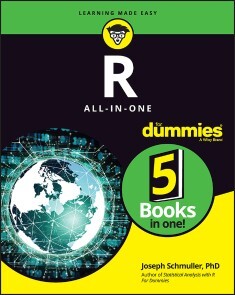
R All-in-One For Dummies
A DEEP DIVE INTO THE PROGRAMMING LANGUAGE OF CHOICE FOR STATISTICS AND DATAWith R All-in-One For Dummies, you get five mini-books in one, offering a complete and thorough resource on the R programming language and a road map for making sense of the sea of data we're all swimming in. Maybe you're pursuing a career in data science, maybe you're looking to infuse a little statistics know-how into your existing career, or maybe you're just R-curious. This book has your back. Along with providing an overview of coding in R and how to work with the language, this book delves into the types of projects and applications R programmers tend to tackle the most. You'll find coverage of statistical analysis, machine learning, and data management with R.* Grasp the basics of the R programming language and write your first lines of code* Understand how R programmers use code to analyze data and perform statistical analysis* Use R to create data visualizations and machine learning programs * Work through sample projects to hone your R coding skillThis is an excellent all-in-one resource for beginning coders who'd like to move into the data space by knowing more about R.JOSEPH SCHMULLER is a cognitive scientist and statistical analyst. His recent work in the For Dummies series includes the 5th edition of Statistical Analysis with Excel For Dummies along with Statistical Analysis with R For Dummies and R Projects For Dummies.Introduction 1BOOK 1: INTRODUCING R 5Chapter 1: R: What It Does and How It Does It 7Chapter 2: Working with Packages, Importing, and Exporting 37BOOK 2: DESCRIBING DATA 51Chapter 1: Getting Graphic 53Chapter 2: Finding Your Center 93Chapter 3: Deviating from the Average 103Chapter 4: Meeting Standards and Standings 113Chapter 5: Summarizing It All 125Chapter 6: What’s Normal? 145BOOK 3: ANALYZING DATA 163Chapter 1: The Confidence Game: Estimation 165Chapter 2: One-Sample Hypothesis Testing 181Chapter 3: Two-Sample Hypothesis Testing 207Chapter 4: Testing More than Two Samples 233Chapter 5: More Complicated Testing 257Chapter 6: Regression: Linear, Multiple, and the General Linear Model 279Chapter 7: Correlation: The Rise and Fall of Relationships 315Chapter 8: Curvilinear Regression: When Relationships Get Complicated 335Chapter 9: In Due Time 359Chapter 10: Non-Parametric Statistics 371Chapter 11: Introducing Probability 393Chapter 12: Probability Meets Regression: Logistic Regression 415BOOK 4: LEARNING FROM DATA 423Chapter 1: Tools and Data for Machine Learning Projects 425Chapter 2: Decisions, Decisions, Decisions 449Chapter 3: Into the Forest, Randomly 467Chapter 4: Support Your Local Vector 483Chapter 5: K-Means Clustering 503Chapter 6: Neural Networks 519Chapter 7: Exploring Marketing 537Chapter 8: From the City That Never Sleeps 557BOOK 5: HARNESSING R: SOME PROJECTS TO KEEP YOU BUSY 573Chapter 1: Working with a Browser 575Chapter 2: Dashboards — How Dashing! 603Index 639

Practical Debugging at Scale
Overhaul your debugging techniques and master the theory and tools needed to debug and troubleshoot cloud applications in production environments. This book teaches debugging skills that universities often avoid, but that typically consume as much as 60% of our time as developers. The book covers the use of debugger features such as tracepoints, object marking, watch renderers, and more. Author Shai Almog presents a scientific approach to debugging that is grounded in theory while being practical enough to help you to chase stubborn bugs through the maze of a Kubernetes deployment.Practical Debugging at Scale assumes a polyglot environment as is common for most enterprises, but focuses on JVM environments. Most of the tooling and techniques described are applicable to Python, Node, and other platforms, as well as to Java and other JVM languages. The book specifically covers debugging in production, an often-neglected discipline but an all too painful reality. You’ll learn modern techniques around observability, monitoring, logging, and full stack debugging that you can put to immediate use in troubleshooting common ailments in production environments.YOU WILL LEARN:* The scientific method underlying the process of debugging* Debugger capabilities such as tracepoints and marker objects* The correct use of less understood features such as exception breakpoints* Techniques for tracing issues in production Kubernetes environments* Observability and monitoring to resolve production problems* Industry best practices for common tooling such as logging * Profiling to understand performance and memory problems WHO THIS BOOK IS FORDevelopers in Java and JVM-related languages who want to improve their debugging skills and production reliability; and developers of cloud applications who are facing the pain of production bugs that are hard to replicate and fixSHAI ALMOG is an entrepreneur, open source hacker, speaker, author, blogger, Java rockstar, and more. He is a former Sun (later Oracle) developer with more than 30 years of experience. Shai has built JVMs, development tools, mobile phone environments, banking systems, startup/enterprise backends, user interfaces, development frameworks, and much more. He speaks at conferences all over the world and has shared the stage with luminaries such as James Gosling (father of Java). Shai is an award-winning, highly rated speaker with deep technical experience to share and he has a knack for engaging his audience. IntroductionPART I. BASICS1. Know Your Debugger2. The Checklist3. The Auxiliary Tools4. Logging, Testing, and Fail Fast5. Time Travel DebuggingPART II. THE MODERN PRODUCTION ENVIRONMENT6. Debugging Kubernetes7. Serverless Debugging8. Fullstack Debugging9. Observability and Monitoring10. Developer ObservabilityPART III. IN PRACTICE11. Tools of Learning12. Performance and Memory13. Security14. Bug Strategies

Pro Deep Learning with TensorFlow 2.0
This book builds upon the foundations established in its first edition, with updated chapters and the latest code implementations to bring it up to date with Tensorflow 2.0.Pro Deep Learning with TensorFlow 2.0 begins with the mathematical and core technical foundations of deep learning. Next, you will learn about convolutional neural networks, including new convolutional methods such as dilated convolution, depth-wise separable convolution, and their implementation. You’ll then gain an understanding of natural language processing in advanced network architectures such as transformers and various attention mechanisms relevant to natural language processing and neural networks in general. As you progress through the book, you’ll explore unsupervised learning frameworks that reflect the current state of deep learning methods, such as autoencoders and variational autoencoders. The final chapter covers the advanced topic of generative adversarial networks and their variants, such as cycle consistency GANs and graph neural network techniques such as graph attention networks and GraphSAGE.Upon completing this book, you will understand the mathematical foundations and concepts of deep learning, and be able to use the prototypes demonstrated to build new deep learning applications.WHAT YOU WILL LEARN* Understand full-stack deep learning using TensorFlow 2.0* Gain an understanding of the mathematical foundations of deep learning * Deploy complex deep learning solutions in production using TensorFlow 2.0* Understand generative adversarial networks, graph attention networks, and GraphSAGEWHO THIS BOOK IS FOR:Data scientists and machine learning professionals, software developers, graduate students, and open source enthusiasts.SANTANU PATTANAYAK works as a Senior Staff Machine Learning Specialist at Qualcomm Corp R&D and is the author of Quantum Machine Learning with Python, published by Apress. He has more than 16 years of experience, having worked at GE, Capgemini, and IBM before joining Qualcomm. He graduated with a degree in electrical engineering from Jadavpur University, Kolkata and is an avid math enthusiast. Santanu has a master’s degree in data science from the Indian Institute of Technology (IIT), Hyderabad. He also participates in Kaggle competitions in his spare time, where he ranks in the top 500. Currently, he resides in Bangalore with his wife.Chapter 1: Mathematical FoundationsChapter Goal: Setting the mathematical base for machine learning and deep learning .No of pages 100Sub -Topics1. Linear algebra2. Calculus3. Probability4. Formulation of machine learning algorithms and optimization techniques.Chapter 2: Introduction to Deep learning Concepts and Tensorflow 2.0Chapter Goal: Setting the foundational base for deep learning and introduction to Tensorflow 2.0 programming paradigm.No of pages: 75Sub - Topics:5. Deep learning and its evolution.6. Evolution of the learning techniques: from perceptron based learning to back-propagation7. Different deep learning objectives functions for supervised and unsupervised learning.8. Tensorflow 2.09. GPUChapter 3: Convolutional Neural networksChapter Goal: The mathematical and technical aspects of convolutional neural networkNo of pages: 801. Convolution operation2. Analog and digital signal3. 2D and 3D convolution, dilation and depth-wise separable convolution4. Common image processing filter5. Convolutional neural network and components6. Backpropagation through convolution and pooling layers7. Translational invariance and equivariance8. Batch normalization9. Image segmentation and localization methods (Moved from advanced Neural Network to here, to make room for Graph Neural Networks )Chapter 4: Deep learning for Natural Language ProcessingChapter Goal: Deep learning methods and natural language processing No of pages:Sub - Topics:1. Vector space model2. Word2Vec3. Introduction to recurrent neural network and LSTM4. Attention5. Transformer network architecturesChapter 5: Unsupervised Deep Learning MethodsChapter Goal: Foundations for different unsupervised deep learning techniquesNo of pages: 60Sub - Topics:1. Boltzmann distribution2. Bayesian inference3. Restricted Boltzmann machines4. Auto Encoders and variation methodsChapter 6: Advanced Neural NetworksChapter Goal: Generative adversarial networks and graph neural networksNo of pages: 70Sub - Topics:1. Introduction to generative adversarial networks2. CycleGAN, LSGAN Wasserstein GAN3. Introduction to graph neural network4. Graph attention network and graph SAGEChapter 7: Reinforcement LearningChapter Goal: Reinforcement Learning using Deep LearningNo of pages: 50Sub - Topics:1. Introduction to reinforcement learning and MDP formulation2. Value based methods3. DQN4. Policy based methods5. Reinforce and actor critic network in policy based formulations6. Transition-less reinforcement learning and bandit methods

Internet of Things Using Single Board Computers
Rapidly prototype and program new IoT and Edge solutions using low-cost Maker tech, such as those from Arduino, Raspberry Pi and Nvidia. With a focus on the electronics, this book allows experienced computer science students as well as researchers, practitioners, and even hobbyists to dive right into actual engineering of prototypes and not just theoretical programming and algorithms.You'll learn to interface sensors, work with various communication mediums, incorporate wired and wireless communication protocols, and more with these single board computers. All while working in the popular Python programming language. Additionally, you’ll discover both scripting-based and drag and drop solutions for different problems. As well as a variety of useful, data gathering approaches. Then you can apply what you’ve learned to IoT projects and troubleshooting Industry 4.0 problems.The rapid growth of technology and new development initiatives has made the Internet of Things and Edge analytics an inevitable platform in all engineering domains. The need for sophisticated and ambient environments controlled by tech has resulted in an exponential growth of automation and artificial intelligence. Internet of Things Using Single Board Computers reflects these recent developments while providing a low-cost, easy ramp into the fields of IoT using single board computers and Python programming.WHAT YOU'LL LEARN* Program Arduino, Raspberry Pi, and Nvidia boards for rapid prototyping in IoT and Edge environments* Interface sensors, communication mediums, and wired and wireless communications into your programs and projects.* Study practical applications of these low-cost solutions in fields such as home automation, smart cities, electrical vehicle charging, and more.WHO THIS BOOK IS FOREngineers and hobbyists working on Internet of Things prototypes and applications. Basic skills in electronics and a working knowledge of Python are recommended. Engineers and scientists working on smart environment projects and smart city applications will also benefit.DR. G. R. KANAGACHIDAMBARESAN completed his Ph.D. at Anna University Chennai in 2017. He is currently an Associate Professor in the Department of CSE at Vel Tech Rangarajan Dr. Sagunthala R&D Institute of Science and Technology. His main research interests include Body Sensor Networks and Fault Tolerant Wireless Sensor Networks. He has published several articles and undertaken consultancy activities for leading MNC companies. He has also guest-edited special issue volumes and books and served as an editorial review board member for peer-reviewed journals. He is presently working on several government sponsored research projects like ISRO, DBT, and DST. Presently, he is the Editor in chief for the Next Generation Computer and Communication Engineering series. INTERNET OF THINGS USING SINGLE BOARD COMPUTERSChapter 1: An Overview of IoTChapter 2: IoT ArchitectureChapter 3: Programming Through pythonChapter 4: Wireless Technology for IoTChapter 5: Building IoT with Raspberry PiChapter 6: Home AutomationChapter 7: Smart Cities and Smart GridsChapter 8: Electric Vehicle ChargingChapter 9: Agriculture

Numerical Methods Using Kotlin
This in-depth guide covers a wide range of topics, including chapters on linear algebra, root finding, curve fitting, differentiation and integration, solving differential equations, random numbers and simulation, a whole suite of unconstrained and constrained optimization algorithms, statistics, regression and time series analysis. The mathematical concepts behind the algorithms are clearly explained, with plenty of code examples and illustrations to help even beginners get started.In this book, you'll implement numerical algorithms in Kotlin using NM Dev, an object-oriented and high-performance programming library for applied and industrial mathematics. Discover how Kotlin has many advantages over Java in its speed, and in some cases, ease of use. In this book, you’ll see how it can help you easily create solutions for your complex engineering and data science problems.After reading this book, you'll come away with the knowledge to create your own numerical models and algorithms using the Kotlin programming language.WHAT YOU WILL LEARN* Program in Kotlin using a high-performance numerical library* Learn the mathematics necessary for a wide range of numerical computing algorithms* Convert ideas and equations into code* Put together algorithms and classes to build your own engineering solutions* Build solvers for industrial optimization problems* Perform data analysis using basic and advanced statisticsWHO THIS BOOK IS FORProgrammers, data scientists, and analysts with prior experience programming in any language, especially Kotlin or Java.HAKSUN LI, PHD, is founder of NM Group, a scientific and mathematical research company. He has the vision of “Making the World Better Using Mathematics”. Under his leadership, the firm serves worldwide brokerage houses and funds, multinational corporations and very high net worth individuals. Haksun is an expert in options trading, asset allocation, portfolio optimization and fixed-income product pricing. He has coded up a variety of numerical software, including SuanShu (a library of numerical methods), NM Dev (a library of numerical methods), AlgoQuant (a library for financial analytics), NMRMS (a portfolio management system for equities), and supercurve (a fixed-income options pricing system). Prior to this, Haksun was a quantitative trader/quantitative analyst with multiple investment banks. He has worked in New York, London, Tokyo, and Singapore. Additionally, Haksun is the vice dean of the Big Data Finance and Investment Institute of Fudan University, China. He was an adjunct professor with multiple universities. He has taught at the National University of Singapore (mathematics), Nanyang Technological University (business school), Fudan University (economics), as well as Hong Kong University of Science and Technology (mathematics). Dr. Haksun Li has a B.S. and M.S. in pure and financial mathematics from the University of Chicago, and an M.S. and a PhD in computer science and engineering from the University of Michigan, Ann Arbor.1: Introduction to Numerical Methods in Kotlin.-2: Linear Algebra.-3: Finding Roots of Equations.-4: Finding Roots of Systems of Equations.-5: Curve Fitting and Interpolation.-6: Numerical Differentiation and Integration.-7: Ordinary Differential Equations.-8: Partial Differential Equations.-9: Unconstrained Optimization.-10: Constrained Optimization.-11: Heuristics.-12: Basic Statistics.-13: Random Numbers and Simulation.-14: Linear Regression.-15: Time Series Analysis.-References.Table of ContentsAbout the Authors...........................................................................................................iPreface............................................................................................................................ii1. Why Kotlin?..............................................................................................................61.1. Kotlin in 2022.....................................................................................................61.2. Kotlin vs. C++....................................................................................................61.3. Kotlin vs. Python................................................................................................61.4. Kotlin in the future .............................................................................................62. Data Structures.......................................................................................................72.1. Function...........................................................................................................72.2. Polynomial ......................................................................................................73. Linear Algebra .......................................................................................................83.1. Vector and Matrix ...........................................................................................83.1.1. Vector Properties .....................................................................................83.1.2. Element-wise Operations.........................................................................83.1.3. Norm ........................................................................................................93.1.4. Inner product and angle ...........................................................................93.2. Matrix............................................................................................................103.3. Determinant, Transpose and Inverse.............................................................103.4. Diagonal Matrices and Diagonal of a Matrix................................................103.5. Eigenvalues and Eigenvectors.......................................................................103.5.1. Householder Tridiagonalization and QR Factorization Methods..........103.5.2. Transformation to Hessenberg Form (Nonsymmetric Matrices)...........104. Finding Roots of Single Variable Equations .......................................................114.1. Bracketing Methods ......................................................................................114.1.1. Bisection Method ...................................................................................114.2. Open Methods...............................................................................................114.2.1. Fixed-Point Method ...............................................................................114.2.2. Newton’s Method (Newton-Raphson Method) .....................................114.2.3. Secant Method .......................................................................................114.2.4. Brent’s Method ......................................................................................115. Finding Roots of Systems of Equations...............................................................125.1. Linear Systems of Equations.........................................................................125.2. Gauss Elimination Method............................................................................125.3. LU Factorization Methods ............................................................................125.3.1. Cholesky Factorization ..........................................................................125.4. Iterative Solution of Linear Systems.............................................................125.5. System of Nonlinear Equations.....................................................................126. Curve Fitting and Interpolation............................................................................146.1. Least-Squares Regression .............................................................................146.2. Linear Regression..........................................................................................146.3. Polynomial Regression..................................................................................146.4. Polynomial Interpolation...............................................................................146.5. Spline Interpolation .......................................................................................147. Numerical Differentiation and Integration...........................................................157.1. Numerical Differentiation .............................................................................157.2. Finite-Difference Formulas...........................................................................157.3. Newton-Cotes Formulas................................................................................157.3.1. Rectangular Rule....................................................................................157.3.2. Trapezoidal Rule....................................................................................157.3.3. Simpson’s Rules.....................................................................................157.3.4. Higher-Order Newton-Coles Formulas..................................................157.4. Romberg Integration .....................................................................................157.4.1. Gaussian Quadrature..............................................................................157.4.2. Improper Integrals..................................................................................158. Numerical Solution of Initial-Value Problems....................................................168.1. One-Step Methods.........................................................................................168.2. Euler’s Method..............................................................................................168.3. Runge-Kutta Methods...................................................................................168.4. Systems of Ordinary Differential Equations.................................................169. Numerical Solution of Partial Differential Equations..........................................179.1. Elliptic Partial Differential Equations...........................................................179.1.1. Dirichlet Problem...................................................................................179.2. Parabolic Partial Differential Equations........................................................179.2.1. Finite-Difference Method ......................................................................179.2.2. Crank-Nicolson Method.........................................................................179.3. Hyperbolic Partial Differential Equations.....................................................1710..................................................................................................................................1811..................................................................................................................................1912. Random Numbers and Simulation ....................................................................2012.1. Uniform Distribution .................................................................................2012.2. Normal Distribution...................................................................................2012.3. Exponential Distribution............................................................................2012.4. Poisson Distribution ..................................................................................2012.5. Beta Distribution........................................................................................2012.6. Gamma Distribution ..................................................................................2012.7. Multi-dimension Distribution ....................................................................2013. Unconstrainted Optimization ............................................................................2113.1. Single Variable Optimization ....................................................................2113.2. Multi Variable Optimization .....................................................................2114. Constrained Optimization .................................................................................2214.1. Linear Programming..................................................................................2214.2. Quadratic Programming ............................................................................2214.3. Second Order Conic Programming............................................................2214.4. Sequential Quadratic Programming...........................................................2214.5. Integer Programming.................................................................................2215. Heuristic Optimization......................................................................................2315.1. Genetic Algorithm .....................................................................................2315.2. Simulated Annealing .................................................................................2316. Basic Statistics..................................................................................................2416.1. Mean, Variance and Covariance................................................................2416.2. Moment......................................................................................................2416.3. Rank...........................................................................................................2417. Linear Regression .............................................................................................2517.1. Least-Squares Regression..........................................................................2517.2. General Linear Least Squares....................................................................2518. Time Series Analysis ........................................................................................2618.1. Univariate Time Series..............................................................................2618.2. Multivariate Time Series ...........................................................................2618.3. ARMA .......................................................................................................2618.4. GARCH .....................................................................................................2618.5. Cointegration .............................................................................................2619. Bibliography .....................................................................................................2720. Index .....................................................................................................

Functional Python Programming, 3rd edition
Not enough developers understand the benefits of functional programming, or even what it is. Author Steven Lott demystifies the approach, teaching you how to improve the way you code in Python and make gains in memory use and performance. If you’re a leetcoder preparing for coding interviews, this book is for you.Starting from the fundamentals, this book shows you how to apply functional thinking and techniques in a range of scenarios, with Python 3.10+ examples focused on mathematical and statistical algorithms, data cleaning, and exploratory data analysis. You'll learn how to use generator expressions, list comprehensions, and decorators to your advantage. You don't have to abandon object-oriented design completely, though – you'll also see how Python's native object orientation is used in conjunction with functional programming techniques.By the end of this book, you'll be well-versed in the essential functional programming features of Python and understand why and when functional thinking helps. You'll also have all the tools you need to pursue any additional functional topics that are not part of the Python language.

Beginning Spring Data
Use the popular Spring Data project for data access and persistence using various Java-based APIs such as JDBC, JPA, MongoDB, and more.This book shows how to easily incorporate data persistence and accessibility into your microservices, cloud-native applications, and monolithic enterprise applications. It also teaches you how to perform unit and performance testing of a component that accesses a database. And it walks you through an example of each type of SQL and NoSQL database covered.After reading this book, you’ll be able to create an application that interacts with one or multiple types of databases, and conduct unit and performance testing to analyze possible problems. Source code is available on GitHub.WHAT YOU’LL LEARN* Become familiar with the Spring Data project and its modules for data access and persistence* Explore various SQL and NoSQL persistence types* Uncover the persistence and domain models, and handle transaction management for SQL* Migrate database changes and versioning for SQL* Dive into NoSQL persistence with Redis, MongoDB, Neo4j, and Cassandra* Handle reactive database programming and access with R2DBC and MongoDB* Conduct unit, integration, and performance testing, and moreWHO THIS BOOK IS FORExperienced Java software application developers; programmers with experience using the Spring framework or the Spring Boot micro frameworkANDRES SACCO is a Technical Lead at Prisma. He has experience using languages such as Java, PHP, and NodeJs. He also has experience using Spring. In his previous job, Andres helped find alternative ways to optimize the transference of data between microservices, which reduced the cost of infrastructure by 55%. He also has written internal courses about new technologies and articles on Medium. Andres shares his knowledge of using different types of databases, depending on the situation. He has experience with various types of testing, to search for problems in queries or repositories that access the database. Part I - IntroductionChapter 1: Architecture of the ApplicationsChapter 2: Spring Basics and BeyondChapter 3: Spring Data and Persistence TypesPart II - SQL PersistenceChapter 4: Persistence and Domain ModelChapter 5: Transaction ManagementChapter 6: Versioning or Migrate the Changes of the DatabasePart III - NO-SQL PersistenceChapter 7: Redis key/value DatabaseChapter 8: MongoDB Document DatabaseChapter 9: Neo4j Graph DatabaseChapter 10: Cassandra wide-column DatabaseChapter 11: Reactive access w/R2DBC and MongoDBChapter 12: Unit/Integration TestingChapter 13: Performance TestingChapter 14: Best PracticesPart I - IntroductionThis part or section contains all the introduction about the basics of the Spring and the architecture of theapplication to use the persistence.Chapter 1: Architecture of the applicationsChapter Goal: In this chapter, the readers will see the different ways of structuring one application and thebest practices to organize all the things related to persistence like the use of DAO (repositories on Spring).• Small history of the methods of persistence (Plain query using the class of Java, ORM)• Different types of architectureso Layerso Hexagonal or onion• Persistence design patterso DAO (Repositories in Spring)o Data Transfer Object (DTO)Chapter 2: Spring basics and beyondChapter Goal: In this chapter, the readers will see the different ways of structuring one application and thebest practices to organize all the things related to persistence like the use of DAO (repositories on Spring).• Spring’s Architecture• Dependency Injection and Inversion of Control• Basic Application SetupChapter 3: Spring Data and different types of persistenceChapter Goal: This chapter will provide a full explanation about Spring Data, how it works and what this librarydoes behind the scenes.• How the Spring Data works• How the Repositories workso Using interfaceso Defining a custom implementationPart II - SQL persistenceThis part or section contains the information about different aspects of the persistence of databases whichhave a rigid schema. Also, the readers will see different strategies of deploying the changes on the schemas.Chapter 4: Persistence and domain modelChapter Goal: In this chapter, the readers will learn the basics about persistence and how it works behind thescenes. Also, the readers will see how to create validations in the schema like the size of the column and thedifferent types of relationship between entities.• JPA configuration using annotationso Entity, Ido Types of relationshipso Pre-update, pre-persist• Ways to define the querieso Using specificationso Define SQL• How validate the schema• Types of InherenceChapter 5: Transaction managementChapter Goal: In this chapter, the readers will learn the basics of the transactions and some concepts of ACID.• Definition of ACID• Isolation Levels• Transactional levelsChapter 6: Versioning or migrate the changes of the databaseChapter Goal: In this chapter the readers will see different tools or strategies to include the changes of thedatabases, e.g use Liquibase/Flyway, running the scripts manually, or using the auto-update of the Spring.Also, this chapter will include some mechanism to move the data from one column to another using featureflags.• Mechanism to migrate the changes• Tools to versioning the changeso Liquibaseo Flyway• Using Feature Flags to new featureso What is a Feature flag?o Benefits of use this approacho Common librariesPart III - NO-SQL persistenceIn this section the idea is to cover one example of each type of the databases NO-SQL like key/value,document, graph, and wide-column database. The idea is not to cover all more than one example of a type ofdatabase because most of them have certain operations similar.Chapter 7: Redis key/value databaseChapter Goal: In this chapter, the readers will see how to run a database and save the information using aspecific key. Also, this chapter will show the readers to create a serializer to persist data that is complex andsome best practices like persist the information in async mode.The last point is how to configure the TTL in the information that the readers persist in the database.• What is Redis and which are the benefits?• Connecting with multiples Redis• Persist synchronous or asynchronous• Object Mapping and ConversionChapter 8: MongoDB Document databaseChapter Goal: In this chapter, the readers will see how to run a mongo database and how to persist theinformation with the definition of the entities using the different operations that are permitted on MongoDB.• What is a document store?• Setting up a Mongo• Access using repositories• Manage transactions in a programmatic wayChapter 9: Neo4j Graph databaseChapter Goal: In this chapter, the readers will see how to run a database and how to create different types ofqueries. Also the reader will see the different aspects of the persistence of the information and the use ofreactive approach.• Modeling the problem as a Grapho Cases of usero Benefits• Persisting the domain• Manage transactionsChapter 10: Cassandra wide-column databaseChapter Goal: In this chapter, the readers will see how to configure the database on Spring and thedeclaration of the entities that need to be used to persist the information. Also, the different ways topersist or modify the information on Cassandra.The last point is how to configure the TTL in the information that the readers persist in the database.• What is Cassandra and how works?• Configuration for Cassandra• Access using repositories• Defining a TTLPart IV – Advanced, testing and best practicesThis part covers some aspects of any type of database to create different types of tests and validate theperformance of the queries. Also, this section covers some best practices to reduce the possible problems ormistakes in the applications that access a database.Chapter 11: Reactive accessChapter Goal: This chapter needs to cover how you can access and obtain the information in a reactive way.• What is reactive access?• Modifying queries to be reactiveo R2DBCo MongoDBChapter 12: Unit/Integration testingChapter Goal: This chapter needs to cover more in detail how you can write unit tests without using anexistent database but using the same motor of the database, to do this the reader will use Test Cointainerswith Junit 5 which is the standard to write unit tests.• Unit Testing with Mocks• Integration Testing with a Databaseo What is Test containers?o Test Containers vs embeddedo How you can use it?o Possible problems in the pipelineChapter 13: Performance testingChapter Goal: In this chapter the reader will use some tools like Gatling or QuickPerform to see how tocreate a performance test and analyze if the queries have some issue related with the use ofCPU/memory.• How check or analyze the performance of the queries?• Analyzing the complexity of queries• Performance test of an endpoint that access to a DBChapter 14: Best practicesChapter Goal: In this chapter the reader will know some strategies to improve the performance of thedatabase including some mechanism of cache to reduce the number of times that anyone accesses toobtain information.• Access to the information◦ Master-slave• Using cache to reduce the accessed to DB• Compress the information• Lazy Loading Issues• Pagination and ways to reduce the response

Perspective Warps and Distorts with Adobe Tools: Volume 2
Gain skills in illustration and logo manipulation that will enhance your designs and make them more appealing--either in your portfolio or for your client’s next graphic project.As Adobe's Photoshop and Illustrator have evolved, new and unique features have been added to these programs that offer different options for warping and distorting graphics and shapes. For the beginner and intermediate student or graphic artist, choosing or knowing which distort or warp tool to use among so many available can become overwhelming and confusing.This book primarily focuses on teaching how to work with various warping tools and effect filters in Illustrator, though you will also be using or comparing graphics from Adobe Photoshop. Knowing how to work between these two applications is a crucial part of understanding how to successfully manipulate your designs. In Illustrator, you'll see how to alter vector graphics, and learn how to do this with your Layers panel in various non-destructive ways.Some of the tools mentioned in this book will be familiar to you, as you may have used them frequently. However, others are well hidden, are new, or perhaps you have never considered that you could use that tool, dialog box, or filter effect to warp or distort.WHAT YOU WILL LEARN* Become proficient in using the warping and distorting tools and effects in Illustrator* Discover how to add perspective to your design or make them look three dimensional * Work with the Appearance panel, Graphic Styles, and Symbols* Combine older tools and newer, enhanced onesWHO THIS BOOK IS FORBeginner- and Intermediate-level readers interested in pursuing careers as graphic artists, photographers, or video artists/animators.Jennifer Harder has worked in the graphic design industry for over ten years. She has a degree in graphic communications and is currently teaching Acrobat, InDesign, and Dreamweaver courses at Langara College.Chapter 1: Introduction to Warps in IllustratorSub -Topics• Setting up the Workspace• Illustrator Panel Review• Saving Your FileChapter 2: Pen and Shape Tools ReviewSub - Topics:• Pen Tools & Curvature Tool• Selection & Direct Selection, Group Selection Tool• Shape tools (Rectangle, Rounded Rectangle, Ellipse, etc.)• Align Panel• Pathfinder Panel• ProjectChapter 3: Working with the Scale, Sheer, Reshape and Free Transform ToolsSub - Topics:• Move (Selection Tool)• Rotate Tool• Reflect Tool• Scale Tool• Shear Tool• Transform Each• Reshape Tool• Free Transform Tools• ProjectChapter 4: Working with Puppet Warp ToolSub - Topics:• Puppet Warp Tool• ProjectChapter 5: Working with Shape Warp (Liquify) ToolsSub – Topics:• Width Tool• Warp Tool• Twirl Tool• Pucker Tool• Bloat Tool• Scallop Tool• Crystalize Tool• Wrinkle Tool• ProjectChapter 6: Working with the Blend ToolSub – Topics: • Blend Tool and Options• Symbols and the Blend Tool• ProjectChapter 7: Warping PatternsSub - Topics:• Pattern Introduction• Repeating Patterns with the Object Menuo Radial Repeato Grid Repeato Mirror Repeat• Pattern Library and Pattern Options Panel• Customizing your Capture Pattern from the Libraries Panel• Patterns and Brushes• ProjectsChapter 8: Gradients, Mesh Tool, and TransparencySub - Topics:• Working with the Gradient Panel and Gradient Toolo Linear Gradiento Radial Gradiento Freeform Gradient• Mesh Tool• Project• Transparency Panel• Gradients and Transparency in Brush PanelChapter 9: Creating Envelope DistortsSub - Topics: • Envelope Distorts on Objects and Type• Make with Warp• Make with Mesh• Make with Top Object• ProjectChapter 10: Working with Text PathsSub - Topics:• Type Tool• Vertical Type Tool• Area Type Tool and Vertical Area Type Toolo Text Wrap• Type on a Path Tool and Vertical Type on a Path Tool• Touch Type Tool• ProjectChapter 11: Working with Effect FiltersSub - Topics:• Illustrator Effectso 3D and Materialso Convert to Shapeo Crop Markso Distort & Transform o Patho Pathfindero Rastero Stylizeo SVG Filterso Warp• Photoshop Effectso Effect Gallery o Blur, Pixelate and Video Effectso Graphic Styles Panel Reviewo Graphic Styles and Symbolso Projecto Where to Acquire Additional effectsChapter 12: Working with Symbol Warping ToolsSub - Topics:• Symbol Creation (Symbol Review)• Symbol Sprayer Tool• Symbol Shifter Tool• Symbol Scruncher Tool• Symbol Sizer Tool• Symbol Spinner Tool• Symbol Stainer Tool• Symbol Screener Tool• Symbol Styler Tool• Creating Graphic Styles for SymbolsChapter 13: Working with 3D and PerspectiveSub - Topics:• Perspective Grid & Perspective Selection Tools• Effect > 3D and Materials (3D Classic)o Rotate (Classic)o Revolve (Classic)o Extrude & Bevel (Classic)• Effect > 3D and Materials Panelo Projecto Rotateo Materialso Revolveo Extrude & Bevelo Inflate• Project• Graph Tools and 3D Effect for creating beginner Infographic IdeaChapter 14: How can I use my warped designs between other Adobe Apps?Sub - Topics:• Workflow of Photoshop and Illustrator Graphics to Other Adobe Applicationso InDesigno Animateo Dreamweavero Saving Exported files or Assets from Photoshop and Illustratoro Other Adobe Applications

Spielkonsolen und Heimcomputer 1972 bis 2022 (5. Auflage)
50 Jahre Bildschirmspaß und digitale Action, chronologisch und fundiert in Klartext, Technik-Tabellen und über 800 Fotos.Die stark erweiterte und aktualisierte Neuauflage des beliebten Fachbuchs zu Videospiel-Hardware zeigt alle Konsolen, Handhelds und Computer aus Amerika, Japan und Europa, präsentiert klassische Software in authentischen Pixeln, nennt Hintergründe und historische Facts. 550 Traumgeräte, Millionenseller von Atari VCS über Commodore Amiga und SNES zu PS5 und Steam Deck, aber auch Entgleisungen und exotische Varianten präsentiert Spielkonsolen und Heimcomputer in durchgehend farbigen Kapiteln und ausführlichen Anhängen - für Alle, die ihr Leben lang spielen, sammeln und wissen wollen. Eine Zeitreise durch die Spielepochen, von der elektromechanischen Urzeit in die Ultra-HD-Gegenwart und von dort in die VR-Zukunft! Über 500 Traumgeräte, Millionenseller vom Commodore 64 zum iPad, vom Atari-Telespiel zur Xbox, und ebenso Flops, Entgleisungen und exotische Varianten präsentiert Spielkonsolen und Heimcomputer in durchgehend farbigen Kapiteln und ausführlichen Anhängen – für alle, die ihr Leben lang spielen, sammeln und wissen wollen.Das Buch wird gelobt als „geeignetes Nachschlagewerk“ und „empfehlens-werte Lektüre“ (c‘t), als „sehr verständlich (...) sehr unterhaltsam“ (Gamestar) oder einfach als „Ass“ (ComputerBILDSpiele) und „Pflichtlektüre“ (PlayZone), und wächst von einst 144 auf 288 Seiten: Eine Zeitreise durch die Spielepochen, von der elektromechanischen Urzeit bis in die Ultra-HD- und VR-Zukunft!Der Autor Winnie Forster, Publizist und Fachmann für digitale Medien, sitzt seit 1982 an der Tastatur, seit 1990 in der Computer- und Videospielbranche. Er war leitender Redakteur beim legendären PowerPlay-Magazin, Mitbegründer von Video Games und – als Redaktionsleiter des Fachverlages Cybermedia – des Multiformat-Magazins Man!ac, das er 1995 ins Netz bringt. Im 21. Jahrhundert arbeitet und spielt Forster am bayerischen Ammersee.

PHP 8 Basics
Take advantage of PHP 8's powerful features to create basic web applications, solve code tests (required for most job interviews nowadays), and begin moving towards more advanced PHP concepts. This book provides an introduction to PHP 8, including modules, attributes, JIT compiler, and union types, as well as related frameworks such as Symfony.You will explore fundamental PHP concepts through both practical and hands-on examples. You'll not only gain a solid understanding of PHP fundamentals, but will also be prepared to handle new concepts and technologies as they emerge.After working through the book and its associated demo code, you will be able to build your first basic web application.WHAT YOU WILL LEARN* Develop web applications with PHP 8* Use Vagrant, Docker, JSON API and more* Work with data, form data, arrays, objections, exceptions, regex, and more* Utilize PHP frameworks like Laravel and SymfonyWHO THIS BOOK IS FORThose new to PHP 8 or PHP in general. Some prior experience in web development and DB handling is recommended.GUNNARD ENGEBRETH began coding at the age of 11 through a “Learning BASIC” book given to him by his father. Technology was changing fast and Gunnard rode the wave from 1200 to 56k baud modems. Logging in to BBSs, Prodigy, Compuserve, Delphi and IRC he could see the world changing and he wanted to be a part of it. He soon got involved in the ansi/demo scene, making several application generators for many groups in the 90’s. Visual Basic was the next language of choice allowing him to develop “tools” for online systems such as AOL. This introduced many aspects of development, security and UI while they were still in their infancy. Once the WWW arrived via Mindspring in Atlanta, Ga. Gunnard quickly joined in the race for the web. Learning HTML, PERL and Linux (Slackware at the time) he began to build his skill-set which lead to a full-time Sysadmin position at the age of 20 (2000) at Activegrams/Silverpop. Gunnard has moved around the IT industry from SAN/NAS storage at IBM to custom Wordpress sites for marketing companies, but one thing has stayed the same, a passion for learning and problem solving. Gunnard also DJ’s Drum and Bass as Section31, Playing drums and baking bread.SATEJ KUMAR SAHU works in the role of Senior Enterprise Architect at Honeywell. He is passionate about technology, people, and nature. He believes through technology and conscientious decision making, each of us has the power to make this world a better place. In his free time, he can be found reading books, playing basketball, and having fun with friends and family.Chapter 1: Getting StartedChapter 2: PHP FundimentalsChapter 3: Functions and ClassesChapter 4: DataChapter 5: Form dataChapter 6: ArraysChapter 7: Cookies and SessionsChapter 8: ObjectsChapter 9: Exceptions, Validation, Regular expressionsChapter 10: PHP & MySQL working togetherChapter 11: Basic Database DesignChapter 12: Creating a DB with PHP and MYsqlChapter 13: Basic Website with DBChapter 14: Basic JSON APIChapter 15: Intro to PHP FrameworksChapter 16: Intro to LaravelChapter 17: Intro to SymfonyChapter 18: Basic Symfony applicationChapter 19: Symfony Json APIChapter 20: Intro to Zend / Laminas ProjectChapter 21: Basic Zend / Laminas Project applicationChapter 22: Zend / Laminas Project JSON APIChapter 23: Intro to Slim PHPChapter 24: Basic Slim PHP applicationChapter 25: Slim PHP JSON APIChapter 26 or appendix: Wordpress developmentChapter 27 or appendix: Shopify development

Blockchain for Teens
Similar to the Internet in the 1990s, Blockchain promises to revolutionize the world by reforming current business models. This book is a beginner-friendly guide for teens looking to build a basic foundation in Blockchain technologies.You'll start with an introduction to Blockchain, learn about the main features, and understand decentralization. Additionally, you'll get to know the current monetary system, major concepts in cryptography, and an overview of cryptocurrency. The book then explores various topics in Bitcoin, including its history, the consensus mechanism and the mining process.You'll also be introduced to non-fungible tokens (NFT)s, one of Blockchain’s most well-known technologies, and delve into its different aspects, including the top NFT marketplaces. There is also a chapter about the Metaverse, another groundbreaking technology that will influence society throughout the next decade. You'll see how Crypto and NFTs enhance the Metaverse, and the relationship between Blockchain and the Metaverse.At the end of the book you'll review topics from previous chapters in a discussion on the future of Blockchain and conclude with an overview of real-life examples of Blockchain across various industries.WHAT YOU'LL LEARN* Examine the basics of Bitcoin and Ethereum* Create your very own Bitcoin wallet* Understand the concept of NFTs and build your first token* Explore the Metaverse in Blockchain* Envision the future of BlockchainTHIS BOOK IS FORTeens who are looking to build a basic understanding of Blockchain technologies.Brian Wu holds a computer science Master's degree and is a senior blockchain architect and consultant. Brian has over 18 years of hands-on experience across various technologies, including Blockchain, Big Data, Cloud, System, Infrastructure, and UI. He has worked on more than 50 projects in his career.He has written several books, published by O'Reilly and Packt, on popular fields within blockchain, including: "Learn Ethereum (First edition)" "Hands-On Smart Contract Development with Hyperledger Fabric V2", "Hyperledger cookbook," "Blockchain Quick Start Guide," "Security Tokens and Stablecoins Quick Start Guide," "Blockchain By Example," and "Seven NoSQL Databases in a Week."Chapter 1: Blockchain: A Groundbreaking TechnologyCHAPTER GOAL:This chapter will talk about the basics of Blockchain. We will discuss how the current monetary system works and how Blockchain technology impacts money, business, and the modern world. Then, we will move on to fundamentals of cryptography. After that, readers will gain a solid understanding of the concept of consensus algorithms. At the end of the chapter, we will provide an overview of cryptocurrency.NO OF PAGES 25SUB -TOPICS1. What is Blockchain?1. The current monetary system2. The basics of cryptography3. Consensus algorithms4. Understanding cryptocurrencyChapter 2: Bitcoin: The Future of MoneyCHAPTER GOAL:This chapter will familiarize the reader with an overview of Bitcoin. We will also cover the history behind this phenomenon. Next, the reader will learn how Bitcoin works and analyze how Bitcoin is currently being used in businesses. By the end of the chapter, the reader will create their very own Bitcoin wallet.NO OF PAGES: 25 -30SUB - TOPICS1. What is Bitcoin?2. The history of Bitcoin3. How Bitcoin works4. The role of Bitcoin in business5. Taking control of your first Bitcoin walletChapter 3: Ethereum: A Gateway to Cryptocurrency CHAPTER GOAL:This chapter will introduce the core features of Ethereum, including the consensus. Then, the reader will explore the smart contract and tokens, as well as create a smart contract. Then, we will explore decentralized applications. We will also take a look at business in the age of Ethereum. At the end, the reader will learn how to use an Ethereum wallet.NO OF PAGES: 25-30SUB - TOPICS1. Getting to know Ethereum2. The history of Ethereum3. How Ethereum works4. Smart contract and tokens5. Writing your first smart contract6. Decentralized Applications (Dapps)7. Business in the age of Ethereum8. Taking control of your first Ethereum walletChapter 4: NFTs: Crypto as CollectiblesCHAPTER GOAL:This chapter will explain the topic of NFTs, provide an overview of how they work, and examine famous examples of NFTs. The reader will delve into the popular marketplace of NFTs. By the end of chapter, we will learn how to create an NFT, as well as discuss what the future of NFTs may look like.NO OF PAGES : 25 -30SUB - TOPICS:1. What are NFTs?2. How NFTs work3. Famous examples of NFT4. NFT market place5. Creating your own NFT6. The future of NFTChapter 5: Metaverse: The World ReimaginedCHAPTER GOAL:In this chapter, readers will come to understand what the Metaverse is and the history behind it. Then, the reader will take a deeper look at Crypto and NFTs in the Metaverse. Lastly, we will provide an overview of the Metaverse in the world of Blockchain.NO OF PAGES: 25SUB - TOPICS:1. What is the Metaverse?2. The history of the Metaverse3. Crypto and NFTs in the Metaverse4. Blockchain and the MetaverseChapter 6: The Future of BlockchainCHAPTER GOAL:In this chapter, we learn about the evolution of the Internet from Web 1.0, 2.0 and 3.0. Then, we will discuss some use cases of Blockchain across various industries, including finance, healthcare, education, At the end of the bookand the supply chain. We end off with a discussion of how Artificial Intelligence is used in Blockchain.NO OF PAGES: 25SUB - TOPICS:1. The Evolution of the Internet2. Blockchain in Finance3. Blockchain in Healthcare4. Blockchain in Education5. Blockchain in Supply chain6. AI in Blockchain

Introducing ReScript
This book serves as a succinct guide on ReScript, a functional language for building web applications. Using examples of ReScript language features along with explanations of fundamental concepts in functional programming, this book will show web developers with a background in JavaScript how to effectively use ReScript to its full potential.In Introducing ReScript, you'll learn how to use features in ReScript that JavaScript lacks, such as type inference, null-safety, algebraic data types, pattern matching, and more. Along the way, you'll pick up functional programming concepts like immutability and higher-order functions. You'll also gain a sense of how ReScript works under the hood and how to leverage interoperability between ReScript and JavaScript.Whether you're a web developer interested in dabbling with functional programming or you just want to learn how to write safer and cleaner code for web applications, this book is a great way for you to get started with ReScript.WHAT YOU WILL LEARN* Use ReScript to write clean, safe, and elegant software* Understand the features of ReScript that set it apart from JavaScript, such as type inference, null-safety, and algebraic data types* Explore functional programming concepts like immutabhigher-orderr order functions, and pattern matching* Use popular JavaScript libraries and frameworks in your ReScript code and integrate ReScript code into JavaScript codebasesWHO THIS BOOK IS FORWeb developers that want a strictly typed, safer alternative to JavaScript, as well as web developers interested in learning functional programming and leveraging the elegant and powerful functional features in ReScript.Danny Yang is a professional software engineer at Meta working on infrastructure for WhatsApp. He has previously worked on Facebook Messenger, including the web interface which was written in ReScript. His technical interests include functional programming, compilers, and data visualization, which he writes about on his blog.Chapter 1, IntroChapter Goal: Learn what functional programming is, and the background of the ReScript language● What is ReScript?● Why should you learn ReScript?● What is functional programming?● Why should you learn functional programming?Chapter 2, BasicsChapter Goal: Learn the basic features of ReScript, like expressions and operators- Development environment setup- Hello, World in ReScript- Expressions- Operators- If expressions- Let expressions- Printing and debuggingChapter 3, FunctionsChapter Goal: learn how functions work in ReScript- Defining a function- Applying a function- Polymorphic functions- Anonymous functionsChapter 4, Lists and ArraysChapter Goal: learn the data structures for ordered data in ReScript, learn about immutable data structures- Building a list- Accessing a list- Mutating a list- Arrays and mutability- IterationChapter 5, Records and ObjectsChapter Goal: learn the ways to represent composite data types in ReScript- Records- ObjectsChapter 6, Pattern Matching and DestructuringChapter Goal: learn one of ReScript's most powerful features and how to work with the shape of your data- Pattern matching/switch- Destructuring with let- Destructuring in functionsChapter 7, Algebraic Data TypesChapter Goal: learn how represent complex data in ReScript's type system- Variants- Polymorphic Variants- Options- TuplesChapter 8, Higher Order ProgrammingChapter Goal:- Higher order functions- Map- Filter- Reduce- Generalizing to other data structures- Piping- CurryingChapter 9, ModulesChapter Goal: Introduce modules in ReScript, and how they can be used for higher order programming- What are modules- Scope/visibility- Signature- Import/Export- FunctorsChapter 10, Using ReScript in ProductionChapter Goal: learn about ReScript's interoperability with JavaScript- Calling ReScript from JavaScript- Calling JavaScript from ReScript- Embedding JavaScript in ReScript- Working with DOM- Working with JSON- Runtime representation

Perspective Warps and Distorts with Adobe Tools: Volume 1
Gain skills in image and logo manipulation that will enhance your designs and make them more appealing--either in your portfolio or for your client’s next graphic project.As Adobe's Photoshop and Illustrator have evolved, new and unique features have been added to these programs that offer different options for warping and distorting graphics and shapes. For the beginner and intermediate student or graphic artist, choosing or knowing which distort or warp tool to use among so many available can become overwhelming and confusing.This book primarily focuses on teaching how to work with various warping tools and filters in Photoshop, though you will also be using graphics acquired from Adobe Illustrator. Knowing how to work between these two applications is a crucial part of understanding how to successfully manipulate your designs. In Photoshop, you'll see how to alter both raster images and vector graphics, and learn how to do this with layers in various non-destructive ways.Some of the filters mentioned in this book will be familiar to you, as you may have used them frequently. However, others are well hidden, are new, or perhaps you have never considered that you could use that tool, dialog box, or filter to warp or distort.WHAT YOU WILL LEARN* Become proficient in using the warping and distorting tools and filters in Photoshop, as well as how to correct basic distortions in photos and add perspective* Grasp transferring illustrations from Illustrator for use in Photoshop* Discover how to warp and distort type* Generate unique patterns* Work with Smart Object Layers and Smart Filters* Work in combination with older tools and newer, enhanced ones WHO THIS BOOK IS FORBeginner- and Intermediate-level readers interested in pursuing careers as graphic artists, photographers, or video artists/animators.Jennifer Harder has worked in the graphic design industry for over ten years. She has a degree in graphic communications and is currently teaching Acrobat, InDesign, and Dreamweaver courses at Langara College.Chapter 1: Introduction to WarpsChapter 2: Basic Warping ToolsSub – Topics:• Blur Tool• Sharpen Tool• Smudge Tool• A review of the Perspective Crop Tool• Brief discussion on other tools you may use to enhance or correct your distort (Example, Stamp Tool or other healing brushes)Chapter 3: Warping with PatternsSub - Topics:• Basic Pattern Creation• Drawing and Erasing with a custom Symmetry Paint and paths panel and create a custom pattern layer in Photoshop• Filter Other > Offset filter• Defining a Pattern (where are they stored)• Live shapes pathfinder properties using Pen and Shapes tools• Edit > Fill pattern built-in scripts• The Layers panel working with adjustment layers and patterns• Working with Patterns in Layer Styles• Library Panel: Adobe sensei Capture Create from Image a pattern• Pattern previewChapter 4: Transform Your Layers in a Non-Destructive Way with Smart ObjectsSub - Topics:• Free Transform• Scale• Rotate• Skew• Distort• Perspective• Warp• Warping with Normal or Smart Object Layers• Applying this knowledge to further warping of patterns, brushes, shapes, and stylesChapter 5: Warping TextSub - Topics:• Create Warp Text• Covert Text to Path, Shape Layer or a Frame.• Warping text while the FX Styles are appliedChapter 6: Working with Puppet WarpSub - Topics:• Edit > Puppet Warp (Tool)Chapter 7: Perspective Warp & Content-Aware ScaleSub - Topics:• Edit > Perspective Warp• Edit > Content Aware Scale• Edit > Sky ReplacementChapter 8: Basic Filters & Smart FiltersSub - Topics:Basic Filters:• Filter Gallery > Distort (Diffuse Glow, Glass and Ocean ripple,) Texture > Stained glass• Filter > Blur (Radial Blur, Shape Blur)• Filter > Blur Gallery (Spin Blur)• Filter > Distort (Displace, Pinch, Polar Coordinates, Ripple, Sheer, Spherize, Twirl, Wave, Zigzag)• Filter > Pixelate (Crystalize, Mosaic, Pointillize)• Stylize > Oil paint• Combining Smart Filters and using Masks• Project: Creating a simple GIF animation from some of the distorts created after using the filters• Tips on the Filter > Render Tree, Flame and Picture FrameChapter 9: Advance Filters working Smart FiltersSub - Topics:• Advanced filters:o Lens Correction (Correcting Distortion) o Adaptive Wide Angle (Correcting Distortion)o Camera Raw Filter > geometry (Correcting Distortion)o Filter > Vanishing Pointo Filter > Liquify (workspace related tools)o Filter > Neural Filters Workspace (Smart Portrait, Landscape Mixer)

Productionizing AI
This book is a guide to productionizing AI solutions using best-of-breed cloud services with workarounds to lower costs. Supplemented with step-by-step instructions covering data import through wrangling to partitioning and modeling through to inference and deployment, and augmented with plenty of Python code samples, the book has been written to accelerate the process of moving from script or notebook to app.From an initial look at the context and ecosystem of AI solutions today, the book drills down from high-level business needs into best practices, working with stakeholders, and agile team collaboration. From there you’ll explore data pipeline orchestration, machine and deep learning, including working with and finding shortcuts using artificial neural networks such as AutoML and AutoAI. You’ll also learn about the increasing use of NoLo UIs through AI application development, industry case studies, and finally a practical guide to deploying containerized AI solutions.The book is intended for those whose role demands overcoming budgetary barriers or constraints in accessing cloud credits to undertake the often difficult process of developing and deploying an AI solution.WHAT YOU WILL LEARN* Develop and deliver production-grade AI in one month* Deploy AI solutions at a low cost* Work around Big Tech dominance and develop MVPs on the cheap* Create demo-ready solutions without overly complex python scripts/notebooksWHO THIS BOOK IS FOR:Data scientists and AI consultants with programming skills in Python and driven to succeed in AI.BARRY WALSH is a software-delivery consultant and AI trainer at Pairview with a background in exploiting complex business data to optimize and de-risk energy assets at ABB/Ventyx, Infosys, E.ON, Centrica, and his own start-up ce.tech. He has a proven track record of providing consultancy services in Data Science, BI, and Business Analysis to businesses in Energy, IT, FinTech, Telco, Retail, and Healthcare, Barry has been at the apex of analytics and AI solutions delivery for 20 years. Besides being passionate about Enterprise AI, Barry spends his spare time with his wife and 8-year-old son, playing the piano, riding long bike rides (and a marathon on a broken toe this year), eating out whenever possible or getting his daily coffee fix.Chapter 1: Introduction to AI & the AI EcosystemChapter Goal: Embracing the hype and the pitfalls, introduces the reader to current and emerging trends in AI and how many businesses and organisations are struggling to get machine and deep learning operationalizedNo of pages: 30Sub -Topics1. The AI ecosystem2. Applications of AI3. AI pipelines4. Machine learning5. Neural networks & deep learning6. Productionizing AIChapter 2: AI Best Practise & DataOpsChapter Goal: Help the reader understand the wider context for AI, key stakeholders, the importance of collaboration, adaptability and re-use as well as DataOps best practice in delivering high-performance solutionsNo of pages: 20Sub - Topics1. Introduction to DataOps and MLOps2. Agile development3. Collaboration and adaptability4. Code repositories5. Module 4: Data pipeline orchestration6. CI / CD7. Testing, performance evaluation & monitoringChapter 3: Data Ingestion for AIChapter Goal: Inform on best practice and the right (cloud) data architectures and orchestration requirements to ensure the successful delivery of an AI project.No of pages : 20Sub - Topics: 1. Introduction to data ingestion2. Data stores for AI3. Data lakes, warehousing & streaming4. Data pipeline orchestrationChapter 4: Machine Learning on CloudChapter Goal: Top-down ML model building from design thinking, through high level process, data wrangling, unsupervised clustering techniques, supervised classification, regression and time series approaches before interpreting results and algorithmic performanceNo of pages: 20Sub - Topics:1. ML fundamentals2. EDA & data wrangling3. Supervised & unsupervised machine learning4. Python Implementation5. Unsupervised clustering, pattern & anomaly detection6. Supervised classification & regression case studies: churn & retention modelling, risk engines, social media sentiment analysis7. Time series forecasting and comparison with fbprophetChapter 5: Neural Networks and Deep LearningChapter Goal: Help the reader establish the right artificial neural network architecture, data orchestration and infrastructure for deep learning with TensorFlow, Keras and PyTorch on CloudNo of pages: 40Sub - Topics:1. An introduction to deep learning2. Stochastic processes for deep learning3. Artificial neural networks4. Deep learning tools & frameworks5. Implementing a deep learning model6. Tuning a deep learning model7. Advanced topics in deep learningChapter 6: The Employer’s Dream: AutoML, AutoAI and the rise of NoLo UIsChapter Goal: Building on acquired ML and DL skills, learn to leverage the growing ecosystem of AutoML, AutoAI and No/Low code user interfacesNo of pages: 20Sub - Topics:1. AutoML2. Optimizing the AI pipeline3. Python-based libraries for automation4. Case Studies in Insurance, HR, FinTech & Trading, Cybersecurity and Healthcare5. Tools for AutoAI: IBM Cloud Pak for Data, Azure Machine Learning, Google Teachable MachinesChapter 7: AI Full Stack: Application DevelopmentChapter Goal: Starting from key business/organizational needs for AI, identify the correct solution and technologies to develop and deliver “Full Stack AI”No of pages: 20Sub - Topics:6. Introduction to AI application development7. Software for AI development8. Key Business applications of AI:• ML Apps• NLP Apps• DL Apps4. Designing & building an AI applicationChapter 8: AI Case StudiesChapter Goal: A comprehensive (multi-sector, multi-functional) look at the main AI use uses in 2022No of pages: 20Sub - Topics:1. Industry case studies2. Telco solutions3. Retail solutions4. Banking & financial services / fintech solutions5. Oil & gas / energy & utilities solutions6. Supply chain solutions7. HR solutions8. Healthcare solutions9. Other case studiesChapter 9: Deploying an AI Solution (Productionizing & Containerization)Chapter Goal: A practical look at “joining the dots” with full-stack deployment of Enterprise AI on CloudNo of pages: 20Sub - Topics:1. Productionizing an AI application2. AutoML / AutoML3. Storage & Compute4. Containerization5. The final frontier…

Practical Spring Cloud Function
Unlike other resources that target only programming communities, this book targets both programming and business communities. With programming models shifting more towards no-code and low-code, citizen programmers from the business side will welcome this book as a guide for how to design and optimize their information pipeline while lowering costs for infrastructure. Programmers, on the other hand, will welcome this book's business-centric programming view, which will get them a step closer to fulfilling real business requirements.Practical Spring Cloud Function touches on the themes of portability, scalability, high performance and high availability. Each theme is explored via a real enterprise use case and code. The use cases target industries including energy (oil pipeline sensors), automotive (event-driven connected vehicles), and retail (conversational AI).After reading this book, you'll come away with the know-how to build and deploy cloud-native Java applications effectively and efficiently.WHAT YOU WILL LEARN* Write functions and deploy to Amazon Web Services, Microsoft Azure, Google Cloud, IBM Cloud, and on-prem clouds such as VMWare Tanzu and RedHat OpenShift* Set up locally with KNative on Kubernetes, as well as on AWS, Azure, GCP, Tanzu, and others* Build, test, and deploy a simple example with Spring Cloud Function* Develop an event-driven data pipeline with Spring Cloud Function* Integrate with AI and machine learning models* Apply Spring Cloud Function to the Internet of Things (IoT)* Get industry-specific examples of Spring Cloud Function in actionWHO THIS BOOK IS FORSoftware and cloud-native application developers with prior programming experience in the cloud and/or Spring Framework. DevOps professionals may find this book beneficial as well.Banu Parasuraman is a Cloud Native Technologist with over 30 years of experience in the IT industry. He provides an advisory role to clients who are looking to move to cloud or implement cloud-native platforms such as Kubernetes, Cloud Foundry and the like. He has engaged over 25 select companies spread across different sectors (Retail, Healthcare, Logistics, Banking, Manufacturing, Automotive, Oil & Gas, Pharmaceuticals, Media & Entertainment ...) in USA, Europe and Asia have interacted at every level of an organization. Banu is a key evangelist for Cloud-Native computing encouraging client and architects to undertake this journey as soon as possible to avoid organizational inertia later. He is experienced in most of the popular cloud platforms such as VMWare-VCF, Pivotal-PCF, IBM-OCP, Google-GCP, Amazon-AWS, Microsoft-Azure. Banu has taken part in external speaking engagements targeted at CXOs and Engineers: VMworld, SpringOne, Spring Days, Spring Developer Forum Meetups. Internal speaking engagements: Developer Workshops on Cloud Native Architecture and Development, Customer Workshops on Pivotal Cloud Foundry, enabling Cloud Native sales plays and strategies for sales and teams. Lastly, Banu has numerous blogs on platforms such a Medium and Linkedin to promote adoption of Cloud Native architecture and development.1. Why Spring Cloud FunctionsThis chapter takes the reader through the need for Spring Cloud Functions and KNative. The rationale for Spring Cloud Functions will be elucidated through example implementation on on-prem and cloud infrastructures. The chapter highlights the “code once deploy anywhere” characteristic of Spring Cloud Functions.Subtitles1. Writing functions and deploying to any hyperscaler2. Example code3. Spring Cloud Functions on AWS (EKS, Fargate)4. Spring Cloud Functions on Azure (AKS)5. Spring Cloud Functions on Google (Cloud Run)6. Spring Cloud Functions on VMWare Tanzu (TKG, PKS)7. Spring Cloud Functions on RedHat OpenShift (OCP)2. Getting Started with Spring Cloud FunctionsThis chapter walks the reader through the steps required to get started with Spring Serverless on their platform of choice, either locally, on-prem or on the cloud. Step by Step instructions take the reader through the process of getting the environment set up for coding.Subtitles1. Step by Step: Setup locally with Kubernetes and KNative with Spring Cloud Functions2. Step by Step: Setup on AWS with EKS and KNative with Spring Cloud Functions3. Step by Step: Setup on GCP with Cloud Run/GKE and KNative with Spring Cloud Functions4. Step by Step: Setup on Azure with AKS and KNative with Spring Cloud Functions5. Step by Step: Setup on VMWare Tanzu TKG and KNative6. Step by Step: Setup on RedHat Openshift and KNative3. Coding, testing, and deploying with Spring Cloud FunctionsThis chapter covers the coding, testing, and deploying using your favorite IDE like Eclipse, Eclipse Che, Intelij IDEA, Redhat Code Ready Workspace. The reader will build an example and deploy to their favorite platforma. Building a simple example with Spring Cloud Functionsb. Testing the example will sample datac. Setting up a CI/CD pipeline for deploying to a target platformd. Deploying to the target platfomi. AWSii. GCPiii. Azureiv. VMWare Tanzuv. RedHat Openshift4. Building Event Driven Data pipelines with Spring Cloud FunctionsEvent Driven data pipelines act as a conduit to flow of data based on a specific event. The event can be a purchase order triggered on the website that initiate a data flow chain that includes aggregation of data from various data sources and splitting the data to various consumers. This chapter will discuss the various ways that Spring Spring Serverless can be implemented in the various Cloud providersSubtitles1. Spring Cloud Functions and Spring Cloud Data Flow and Spring Cloud Streams2. Spring Cloud Functions and AWS Glue3. Spring Cloud Functions and Google Cloud Data Flow4. Spring Cloud Functions and Azure Data Factory5. AI/ML Trained Serverless Endpoints with Spring Cloud FunctionsConversational AI models are one of the complex implementations that may lead to heavy use of resources in the cloud. Leveraging Serverless infra and functions can help alleviate the costs by being invoked only when needed. This chapter will help layout the blueprint of how to leverage Spring Serverless with on-prem or cloud-based AI/ML environmentsSubtitles1. Spring Cloud Functions with Google Cloud Functions and Tensor Flow2. Spring Cloud Functions with AWS Glue and AWS Sage or AI/ML3. Spring Cloud Functions with Azure Data Factory and Azure ML4. Spring Cloud Functions with Apache AI/ML on-prem VMWare Tanzu and Openshift6. Spring Cloud Functions and IOTThis chapter will take the reader through blueprints and architect diagrams of how Spring serverless works in conjunction with IOT on various Hyperscalers (Cloud Providers) or SaaS IOT Gateway providers.Subtitles1. Spring Cloud Functions on the Cloud with AWS IOT2. Spring Cloud Functions on the cloud with Azure IOT3. Spring Cloud Functions on the cloud with GCP IOT4. Spring Cloud Functions on-prem with IOT gateway on a SaaS provider (Eg, SmartSense)7. Industry specific examples with Spring Cloud FunctionsThis chapter will provide industry specific examples and use cases that will help the reader understand how Spring Serverless can be leveraged within their specific business use case1. Oil/ Natural gas pipeline tracking with Spring Cloud Functions, IOT and Spring Cloud Data Flow2. Enabling ubiquitous health care with Spring Cloud Functions and Big Data Pipelines3. Connected vehicles with Spring Cloud Functions4. Conversational AI in Retail with Spring Cloud Functions

SAP S/4HANA Financial Accounting Configuration
Upgrade your knowledge to learn S/4HANA, the latest version of the SAP ERP system, with its built-in intelligent technologies, including AI, machine learning, and advanced analytics.Since the first edition of this book published as SAP ERP Financial and Controlling: Configuration and Use Management, the perspective has changed significantly as S/4HANA now comes with new features, such as FIORI (new GUI), which focuses on flexible app style development and interactivity with mobile phones. It also has a universal journal, which helps in data integration in a single location, such as centralized processing, and is faster than ECC S/3. It merges FI & CO efficiently, which enables document posting in the Controlling area setup. General Ledger Accounts (FI) and Cost Element (CO) are mapped together in a way that cost elements (both primary and secondary) are part of G/L accounts. And a mandatory setup of customer-vendor integration with business partners is included vs the earlier ECC creation with separate vendor master and customer master.This updated edition presents new features in SAP S/4HANA, with in-depth coverage of the FI syllabus in SAP S/4HANA. A practical and hands-on approach includes scenarios with real-life examples and practical illustrations. There is no unnecessary jargon in this configuration and end-user manual.WHAT YOU WILL LEARN* Configure SAP FI as a pro in S/4* Master core aspects of Financial Accounting and Controlling* Integrate SAP Financial with other SAP modules* Gain a thorough hands-on experience with IMG (Implementation Guide)* Understand and explain the functionalities of SAP FIWHO THIS BOOK IS FORFI consultants, trainers, developers, accountants, and SAP FI support organizations will find the book an excellent reference guide. Beginners without prior FI configuration experience will find the step-by-step illustrations to be practical and great hands-on experience.ANDREW OKUNGBOWA is an accountant and a business advisor with 20+ years of experience solving complex business issues. He is an acclaimed author of several books in accounting and finance. He also co-founded Spoxio App, a sports app design for sports professionals, sports enthusiasts, and fans to network on a mobile app.Andrew holds a combined bachelor’s degree in accounting and IT, a master’s degree in Investment and Finance, and an associate status with the Institute of Financial Accountants. He has over 15 years of experience in SAP FI/CO consulting and over 20 years of accounting and finance experience in a number of FTSE 100/250 companies in the UK and abroad.Andrew has sat on the board of several companies in the UK, such as Changing Lives Housing Trust, and Twenty-Fifth Avenue Ltd.Chapter 1: Organizational Unit.-Chapter 2: Defining Chart of Accounts.-Chapter 3: Document Control.-Chapter 4: Tolerance Group.-Chapter 5: Creating General Ledger (G/L).-Chapter 6: Clearing Open Items.-Chapter 7: Maintaining Currency Types & Currency Pairs.-Chapter 8: GR/IR Clearing.-Chapter 9: House Bank.-Chapter 10: Tax on Sale/Purchase.-Chapter 11: Cash Journal.-Chapter 12: Financial Statement Versions (FSV).-Chapter 13: Integration of FI with Other SAP S4 HANA Modules.-Chapter 14: Accounts Receivable & Accounts Payable.-Chapter 15: Defining Dunning Procedure.-Chapter 16: ISpecial G/L Transactions.-Chapter 17: Ledgers.

Kubernetes Programming with Go
This book begins by introducing the structure of the Kubernetes API and which operations it serves. Following chapters demonstrate how to write native Kubernetes resources definitions using Go structures defined in the API and API Machinery libraries. Miscellaneous utilities are described to help you work with different resource fields and to convert your resource definitions to or from YAML or JSON. Next, you will learn how to interact with the Kubernetes API server to create, delete, update, and monitor resources in a cluster using the client-go library. A complete chapter is devoted to tools provided to test your programs using the client-go library. An example follows to wrap up the first part of the book, describing how to write a kubectl plugin. Next, you will learn how to extend the Kubernetes API using Custom Resource Definitions, and how to write Kubernetes resources in a generic way as well as how to create your own resources using the unstructured concept. The next chapters delve into the controller-runtime library, useful for extending Kubernetes by writing operators, and the kubebuilder framework, which leverages this library, to help you start writing operators in minutes.After reading this book, you will have a deep understanding of the Kubernetes API’s structure and how Kubernetes resources are organized within it, and have at your disposal a complete toolbox to help you write Kubernetes clients and operators.WHAT YOU WILL LEARN* Understand how the Kubernetes API and its resources are organized* Write Kubernetes resources in Go* Create resources in a cluster* Leverage your newly-gained knowledge to write Kubernetes clients and operatorsWHO IS THIS BOOK FOR:Software engineers and (Site Reliability Engineers) SREs wishing to write Kubernetes clients and operators using the Go language.Philippe Martin has been working with Kubernetes for five years, first by creating an operator to deploy video CDNs into the cloud, later helping companies deploy their applications into Kubernetes, then writing a client to help developers work in a Kubernetes environment. Philippe passed the CKAD, CKA and CKS certifications.He has long experience with distributed systems and open-source software: he started his career 20 years ago creating thin clients based on the Linux kernel and open source components. He is currently working at Red Hat on the Development Tools team.Philippe is active in the development of Kubernetes, especially its documentation, and participates in the translation of the official documentation into French, has edited two reference books about the Kubernetes API and kubectl, and is responsible for the French translation of the Kubernetes Dashboard. He participated in Google Season of Docs to create the new Kubernetes API Reference section of the official documentation, and is maintaining it. He is currently participating in the Apps SIG, a group that covers deploying and operating applications in Kubernetes.Chapter 1: Kubernetes API Introduction.Chapter 2: Kubernetes API Operations.Chapter 3: Working with API Resources in Go.Chapter 4: Using Common types.Chapter 5: The API Machinery.Chapter 6: The Client-go library.Chapter 7: Testing Applications using Client-Go.Chapter 8: Extending Kubernetes API with Custom Resources Definitions.Chapter 9: Working with Custom Resources.Chapter 10: Writing Operators with the controller-runtime Library.Chapter 11: Writing the Reconcile Loop.Chapter 12: Testing the Reconcile Loop.Chapter 13: Creating an Operator with Kubebuilder.

Pro Android with Kotlin
Develop Android apps with Kotlin to create more elegant programs than the Java equivalent. This revised book covers the various aspects of a modern Android app that professionals are expected to encounter. You'll use the latest Kotlin APIs as made available in most recent versions of the Android SDK.There are chapters dealing with all the important aspects of the Android platform, including GUI design, file- and data-handling, coping with phone calls, multimedia apps, interaction with location and mapping services, monetizing apps, and much more. Jetpack will also be covered. It is a suite of libraries to help developers follow best practices, reduce boilerplate code, and write code that works consistently across Android versions and devices.Pro Android with Kotlin, Second Edition is an invaluable source for developers wanting to build real-world, state-of-the-art Android apps for modern Android devices using the Kotlin programming language and its APIs as available in the modern Android SDK. After reading this book, you'll come away with the skills and techniques to build modern Android apps that you can sell on Google Play. Free source code is available on this book's Github page as well.WHAT YOU WILL LEARN* Integrate activities, such as intents, services, notifications and more, into your Android apps* Build UIs in Android using layouts, widgets, lists, menus, and action bars* Deal with data in your Android apps using data persistence and cloud access* Design for different Android devices* Create multimedia apps in Android* Secure, deploy, and monetize your Android appsWHO THIS BOOK IS FORProfessional Android app developers.PETER SPÄTH graduated in 2002 as a physicist and soon afterward became an IT consultant, mainly for Java related projects. In 2016 he decided to concentrate on writing books on various subjects, with a primary focus on software development. With a wealth of experience in Java-related languages, the release of Kotlin for building Android Apps made him enthusiastic about writing books for Kotlin development in the Android environment. 1. System.- 2. Application.- 3. Activities.- 4. Services.- 5. Broadcasts 6. Content Providers.- 7. Permissions.- 8. APIs.- 9. User Interface.- 10. Development.- 11. Building.- 12. Communication.- 13. Hardware.- 14. Testing.- 15. Troubleshooting.- 16. Distributing Apps.- 17. Instant Apps.- 18. CLI.

Time Series Algorithms Recipes
This book teaches the practical implementation of various concepts for time series analysis and modeling with Python through problem-solution-style recipes, starting with data reading and preprocessing.It begins with the fundamentals of time series forecasting using statistical modeling methods like AR (autoregressive), MA (moving-average), ARMA (autoregressive moving-average), and ARIMA (autoregressive integrated moving-average). Next, you'll learn univariate and multivariate modeling using different open-sourced packages like Fbprohet, stats model, and sklearn. You'll also gain insight into classic machine learning-based regression models like randomForest, Xgboost, and LightGBM for forecasting problems. The book concludes by demonstrating the implementation of deep learning models (LSTMs and ANN) for time series forecasting. Each chapter includes several code examples and illustrations.After finishing this book, you will have a foundational understanding of various concepts relating to time series and its implementation in Python.WHAT YOU WILL LEARN* Implement various techniques in time series analysis using Python.* Utilize statistical modeling methods such as AR (autoregressive), MA (moving-average), ARMA (autoregressive moving-average) and ARIMA (autoregressive integrated moving-average) for time series forecasting * Understand univariate and multivariate modeling for time series forecasting* Forecast using machine learning and deep learning techniques such as GBM and LSTM (long short-term memory)WHO THIS BOOK IS FORData Scientists, Machine Learning Engineers, and software developers interested in time series analysis.AKSHAY KULKARNI IS an AI and machine learning (ML) evangelist and a thought leader. He has consulted several Fortune 500 and global enterprises to drive AI and data science-led strategic transformations. He has been honoured as Google Developer Expert, and is an Author and a regular speaker at top AI and data science conferences (including Strata, O’Reilly AI Conf, and GIDS). He is a visiting faculty member for some of the top graduate institutes in India. In 2019, he has been also featured as one of the top 40 under 40 Data Scientists in India. In his spare time, he enjoys reading, writing, coding, and helping aspiring data scientists. He lives in Bangalore with his family.ADARSHA SHIVANANDA IS a Data science and MLOps Leader. He is working on creating worldclass MLOps capabilities to ensure continuous value delivery from AI. He aims to build a pool of exceptional data scientists within and outside of the organization to solve problems through training programs, and always wants to stay ahead of the curve. He has worked extensively in the pharma, healthcare, CPG, retail, and marketing domains. He lives in Bangalore and loves to read and teach data science.ANOOSH KULKARNI is a data scientist and a Senior AI consultant. He has worked with global clients across multiple domains and helped them solve their business problems using machine learning (ML), natural language processing (NLP), and deep learning.. Anoosh is passionate about guiding and mentoring people in their data science journey. He leads data science/machine learning meet-ups and helps aspiring data scientists navigate their careers. He also conducts ML/AI workshops at universities and is actively involved in conducting webinars, talks, and sessions on AI and data science. He lives in Bangalore with his family.V ADITHYA KRISHNAN is a data scientist and ML Ops Engineer. He has worked with various global clients across multiple domains and helped them to solve their business problems extensively using advanced Machine learning (ML) applications. He has experience across multiple fields of AI-ML, including, Time-series forecasting, Deep Learning, NLP, ML Operations, Image processing, and data analytics. Presently, he is working on a state-of-the-art value observability suite for models in production, which includes continuous model and data monitoring along with the business value realized. He also published a paper at an IEEE conference, “Deep Learning Based Approach for Range Estimation," written in collaboration with the DRDO. He lives in Chennai with his family.Chapter 1: Getting Started with Time Series.Chapter Goal: Exploring and analyzing the timeseries data, and preprocessing it, which includes feature engineering for model building.No of pages: 25Sub - Topics1 Reading time series data2 Data cleaning3 EDA4 Trend5 Noise6 Seasonality7 Cyclicity8 Feature Engineering9 StationarityChapter 2: Statistical Univariate ModellingChapter Goal: The fundamentals of time series forecasting with the use of statistical modelling methods like AR, MA, ARMA, ARIMA, etc.No of pages: 25Sub - Topics1 AR2 MA3 ARMA4 ARIMA5 SARIMA6 AUTO ARIMA7 FBProphetChapter 3: Statistical Multivariate ModellingChapter Goal: implementing multivariate modelling techniques like HoltsWinter and SARIMAX.No of pages: 25Sub - Topics: 1 HoltsWinter2 ARIMAX3 SARIMAXChapter 4: Machine Learning Regression-Based Forecasting.Chapter Goal: Building and comparing multiple classical ML Regression algorithms for timeseries forecasting.No of pages: 25Sub - Topics:1 Random Forest2 Decision Tree3 Light GBM4 XGBoost5 SVMChapter 5: Forecasting Using Deep Learning.Chapter Goal: Implementing advanced concepts like deep learning for time series forecasting from scratch.No of pages: 25Sub - Topics:1 LSTM2 ANN3 MLP

Beginning Cloud Native Development with MicroProfile, Jakarta EE, and Kubernetes
Get ready to develop microservices using open source Eclipse MicroProfile and Jakarta EE, and deploy them on Kubernetes/Docker. This book covers best practices for developing cloud-native applications with MicroProfile and Jakarta EE.This book introduces you to cloud-native applications and teaches you how to set up your development environment. You'll learn about the various components of MicroProfile, such as fault tolerance, config, health check, metrics, and JWT auth. You'll develop a RESTful web service made up of some microservices. You'll deploy your application on Docker and Kubernetes.After reading this book, you'll come away with the fundamentals you need to build and deploy your first cloud-native Java-based app.WHAT YOU'LL LEARN* Build your first cloud-native Java-based app with the open source MicroProfile platform, and Jakarta EE 10 APIs * Develop a RESTful web service using MicroProfile and Jakarta EE* Discover and explore the key components of the MicroProfile framework, such as config, metrics, health, JWT authentication, and more* Deploy your cloud-native application on the Kubernetes container orchestration platform* Get up to speed with other popular technologies such as Docker containers, Kubernetes clusters, and ZipkinWHO THIS BOOK IS FORProgrammers with at least some prior experience in Java programming who may be new to MicroProfile and Jakarta EE. Some prior experience with Java-based microservices and web development is recommended, but not required.TARUN TELANG is a hands-on technologist with extensive experience in architecture and implementing multi-tiered, highly scalable software applications. He has more than 17 years of expertise developing software applications for well-known companies such as Microsoft, Oracle, and SAP.In 2005, Tarun worked on configuration and management in several enterprise solutions for SAP using the Java Management Extensions (JMX) technology. He also gained expertise in various integration technologies, such as SOAP, XML, and JSON, and used them to develop solutions to handle message-oriented communications across numerous systems. In 2007, Tarun was named SAP Mentor and Community Influencer for his articles and blog posts on emerging technologies and for promoting innovative solutions in the SAP Developer Community.Tarun has the following certifications: Oracle Certified Programmer for Java 6.0 Platform, SAP Certified Development Consultant for NetWeaver 04 Java Web Application Development, SAP Certified Application Management Expert for End-to-End Root Cause Analysis - Solution Manager 4.0, and NASBA Certification on Remote Work.Tarun is an expert in web, mobile, and cloud technologies. He has developed many end-to-end cloud-based solutions using various architectural patterns, including Microservices, RESTful web services, and Service Oriented Architecture.For more than 15 years, Tarun has been actively publishing technical articles and blogs on various software technologies. He frequently writes articles on Java and related technologies. He has also authored multiple books on Java and Jakarta EE 10.Having worked in Canada and Germany, Tarun currently resides in Hyderabad, India, with his wife and child. You can follow him on Twitter at @taruntelang or visit his LinkedIn Profile.Tarun loves mentoring software professionals and programmers, and teaching them about current industry trends and best practices. His blogs at blogs.taruntelang.me are excellent resources for everything related to Java technology.1. Introduction to Cloud-Native Applications1.1. What are Cloud-Native Applications?1.2. Why Use Cloud-Native Applications?1.3. What are the Benefits of Using Cloud-Native Applications?2. Setting Up Your Development Environment2.1. Prerequisites2.2. Installing Java SE 172.3. Installing Kubernetes2.4. Installing Docker3. Creating a Config Component3.1. What is a Config Component?3.2. Setting Up the Config Component3.3. Accessing the Configuration Data in Your Application4. Using the Fault Tolerance Component4.1. What is the Fault Tolerance Component?4.2. Configuring the Fault Tolerance Component4.3. Handling Failures in Your Application5. Using the Health Check Component5.1. What is the Health Check Component?5.2. Configuring the Health Check Component5.3. Checking the Health of Your Application6. Using the Metrics Component6.1. What is the Metrics Component?6.2. Collecting Metrics Data in Your Application7. Using the JWT Authentication Component7.1. What is the JWT Authentication Component?7.2. Configuring the JWT Authentication Component7.3. Authenticating Users in Your Application8. Developing a RESTful Web Service8.1. What is a RESTful Web Service?8.2. Developing a RESTful Web Service8.3. Implementing the HTTP Methods9. Deploying an Application on Kubernetes/Docker9.1. What is Kubernetes?9.2. What is Docker?9.3. Installing Kubernetes9.4. Creating a Kubernetes Cluster9.5. Installing Docker on Kubernetes9.6. Deploying an Application on Kubernetes/Docker9.7. Benefits of using Jakarta EE and Kubernetes/Docker for developing cloud-native applications.
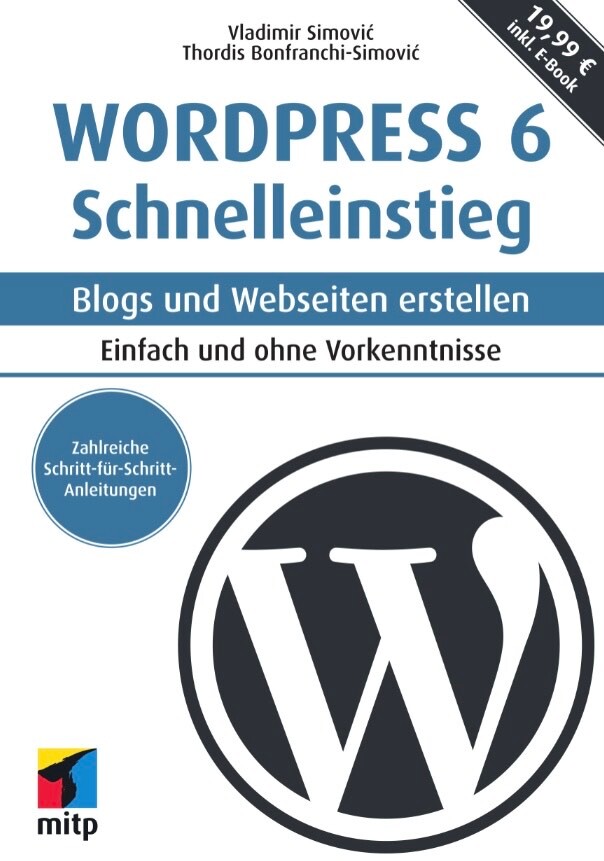
WordPress 6 Schnelleinstieg
Blogs und Webseiten erstellen Dieses Buch ermöglicht Ihnen einen schnellen und einfachen Einstieg in die Website-Erstellung mit WordPress.Mit der 5-Minuten-Installationsanleitung richten Sie WordPress auch ohne Vorkenntnisse schnell und einfach auf Ihrem eigenen Webspace ein. Bebilderte Anleitungen zeigen Ihnen Schritt für Schritt die Verwendung des Gutenberg-Editors mit seinen umfangreichen Gestaltungsmöglichkeiten. So erstellen Sie ganz einfach Beiträge und Seiten, fügen Bilder, Buttons und Videos ein, erstellen eigene Vorlagen und vieles mehr. Darüber hinaus lernen Sie, wie Sie das Design Ihrer Website oder Ihres Blogs mit Themes und Full Site Editing individuell anpassen und den Funktionsumfang von WordPress mit nützlichen Plugins erweitern.Tipps und Tricks zu fortgeschrittenen Themen wie Rechteverwaltung und Sicherheit, Performanceoptimierung und das Umziehen einer WordPress-Installation auf einen anderen Server runden diese praktische Einführung ab.Aktuell zu WordPress Version 6.Aus dem Inhalt:WordPress installieren und einrichtenGrundlegende Einstellungen und BenutzerrollenBeiträge und Seiten erstellen mit dem Gutenberg-EditorWebdesign individuell anpassen mit Themes und Full Site Editing (FSE)Funktionsumfang erweitern mit nützlichen PluginsDatenschutz und Sicherheit, Performance-Optimierung, BarrierefreiheitAutoren:Vladimir Simovic arbeitet seit 2000 mit HTML und CSS und seit Januar 2004 mit WordPress. Er ist geschäftsführender Gesellschafter der Webagentur perun.net webwork gmbh, die umfangreiche Dienstleistungen rund um WordPress und Webdesign anbietet. Als freiberuflicher Autor hat er diverse Fachbücher und Fachartikel publiziert.Dipl.-Geogr. Thordis Bonfranchi-Simovic arbeitet seit Januar 2004 mit WordPress. Seit 2008 arbeitet sie bei der perun.net webwork gmbh, die umfangreiche Dienstleistungen rund um WordPress und Webdesign anbietet.Leseprobe PDF-Datei
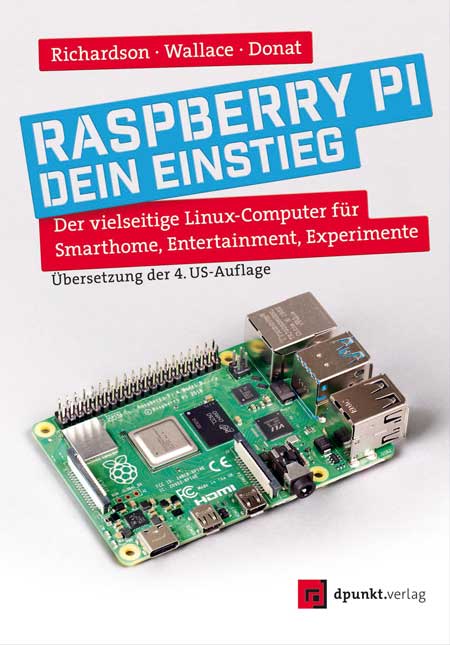
Raspberry Pi - dein Einstieg
Der vielseitige Linux-Computer für Smarthome, Entertainment, Experimente. Ihre Lösung für Office, Multimedia, Entertainment und Smarthome. Der Raspberry Pi ist ein kreditkartengroßer, kostengünstiger Computer, der an Ihren Fernseher und eine Tastatur angeschlossen wird. Er ist ein leistungsfähiger kleiner Computer, der für Elektronikprojekte und für viele Dinge verwendet werden kann, die auch Ihr Desktop-PC erledigt, wie Tabellenkalkulationen, Textverarbeitung, Surfen im Internet und Spiele. Nutzen Sie Ihren Raspi als auf ihre Bedürfnisse abgestimmte Smarthome-Zentrale oder als Mediaplayer – der Computer spielt auch hochauflösende Videos ab.Das Autorenteam stellt die verschiedenen Modelle des Raspberry Pi vor und erläutert ihre jeweiligen Einsatzgebiete. Es geht auf den Betrieb mit Linux und anderen Betriebssystemen ein und begleitet Sie bei den ersten Schritten in der Programmiersprache Python.Die Autoren:Matt Richardson ist Executive Director der Raspberry Pi Foundation und verantwortlich für deren gemeinnützige Arbeit in Nordamerika. Er ist Absolvent des Interactive Telecommunications Program der New York University. Zu den Highlights seiner Arbeit gehören die Descriptive Camera (eine Kamera, die anstelle eines Fotos eine Textbeschreibung ausgibt) und The Enough Already (ein DIY-Gerät, das Prominente zum Schweigen bringt). Matts Arbeiten wurden im Nevada Museum of Art, beim Internationalen Fotofestival in Rom und bei der Mailänder Designwoche ausgestellt und haben die Aufmerksamkeit von The New York Times, Wired und New York Magazine auf sich gezogen.Shawn Wallace lebt in Providence, RI, und entwickelt bei Unruly Studios kreative Coding-Tools für junge Menschen. Er ist der Erfinder von Fluxly, Cryptozoologic und dem Fluxamasynth. Zuvor half erdas FabLab in Providence zu gründen, schrieb und redigierte Bücher für O'Reilly und Maker Media und entwarf Elektronik für Modern Device.Wolfram Donat ist ein Ingenieur, Maker und Autor, der Dinge mit dem Raspberry Pi baut, seit er vor ach so vielen Monden sein erstes Modell 1A+ geliefert bekam. Derzeit ist er Softwarearchitekt bei Arc Machines, Inc. und verwendet den Pi (unter anderem), um intelligente Schweißmaschinen zu bauen und zu steuern. Dies ist sein vierter Streifzug durch Bücher über den Raspberry Pi und seine Verwendung.