

Computer und IT
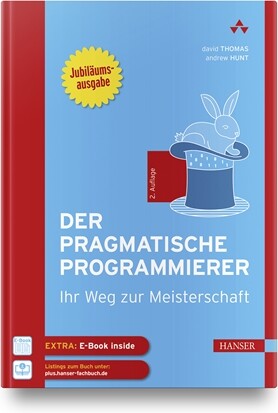
Der pragmatische Programmierer (2. Auflg.)
Ihr Weg zur Meisterschaft - die 2. vollständig überarbeitete Auflage, 04/2021.Der Pragmatische Programmierer ist eines dieser seltenen Fachbücher, die Sie im Lauf der Jahre immer wieder lesen werden. Egal, ob Sie Programmiereinsteiger oder erfahrener Praktiker sind, stets können Sie neue Einsichten gewinnen.David Thomas und Andrew Hunt schrieben 1999 die erste Ausgabe dieses einflussreichen Buches, um ihren Kunden zu helfen, bessere Software zu entwickeln und die Freude am Programmieren wiederzuentdecken. Ihre pragmatischen Profitipps helfen bis heute einer ganzen Generation von Programmierern, den Kosmos der Software-Entwicklung zu erkunden, unabhängig von einer bestimmten Sprache oder Methodik oder einem bestimmten Framework.Ihre »Pragmatische Philosophie« hat den Weg bereitet für Hunderte von Büchern, Screencasts und Hörbüchern sowie Tausende von Karrieren und Erfolgsgeschichten. Zwanzig Jahre später untersuchen die Autoren nun erneut, was einen modernen Programmierer ausmacht. Die Themen reichen von persönlicher Verantwortung über berufliche Entwicklung bis hin zu Architekturtechniken, die Ihren Code flexibel, leicht anpassbar und wiederverwendbar halten.In kurzen Abschnitten, die auch einzeln gelesen werden können, erläutern die Autoren nicht nur die Best Practices, sondern auch Fallstricke bei der Software-Entwicklung. Anschauliche Beispiele und interessante Analogien machen dieses Buch zu einem Lesevergnügen.Egal ob Einsteiger, erfahrener Programmierer oder Manager für Softwareprojekte: Wer die Profitipps der Autoren bei der täglichen Arbeit anwendet, wird seine Produktivität, Genauigkeit und Zufriedenheit rasch steigern und damit als Pragmatischer Programmierer auch langfristig erfolgreich seinErfahren Sie im Buch, wie Sie:den Verfall von Software bekämpfenRedundanz vermeidenflexiblen, dynamischen und anpassungsfähigen Quelltext schreibenIhr Handwerkszeug optimal nutzenvermeiden, mit dem Zufall zu programmierendie richtigen Anforderungen findensich vor Sicherheitslücken schützenProbleme beim nebenläufigen Code lösenTeams aus Pragmatischen Programmierern bildeneffektiv testendas Pragmatic Starter Kit implementierenIhre Anwender begeisternLeseprobe (PDF-Link)
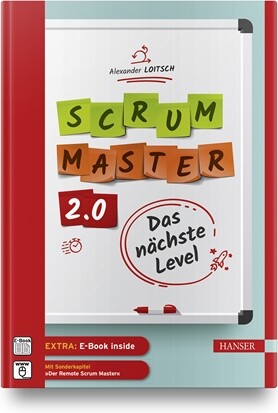
Scrum Master 2.0
Das nächste Level - Neuerscheinung in 04/2021!Dieses Buch ist für Scrum Master geschrieben, die festgestellt haben, dass ihnen die Theorie von Scrum alleine nicht weiterhilft. Denn wir arbeiten mit und für ein Team von Menschen, die ihre Schwächen, Stärken und Eigenheiten haben. Und da ist der offizielle Scrum Guide nur ein kleiner Teil der tatsächlichen Arbeitsinhalte. Hier setzt das Buch »Scrum Master 2.0« an: Nach den theoretischen Grundlagen zu diesem agilen Framework geht es um die Arbeit mit dem Team, um die tägliche Gestaltung des Scrum Master-Alltags, seine Vorgehensweisen, seine Tools, seine Interventionen. Scrum Master 2.0 startet da, wo der Scrum Guide endet.Jedes Kapitel konzentriert sich auf einen anderen Praxisbereich. Angesprochen werden Themen wie Teamentwicklung und -motivation, agile Konzepte, Visualisierung, Stressprävention, Kommunikation, Coaching, Kontaktmanagement, agile Moderation und vieles mehr. Dieses Buch ist somit ein unerlässliches Handwerkszeug für jeden Scrum Master.Kenntnisse des Scrum Frameworks werden für dieses Buch vorausgesetzt. Alle Themen lassen sich einfach und effektiv in den Arbeitsalltag integrieren.Leseprobe (PDF-Link)
Cloud Technologies
CLOUD TECHNOLOGIESCONTAINS A VARIETY OF CLOUD COMPUTING TECHNOLOGIES AND EXPLORES HOW THE CLOUD CAN ENHANCE BUSINESS OPERATIONSCloud Technologies offers an accessible guide to cloud-based systems and clearly explains how these technologies have changed the way organizations approach and implement their computing infrastructure. The author includes an overview of cloud computing and addresses business-related considerations such as service level agreements, elasticity, security, audits, and practical implementation issues. In addition, the book covers important topics such as automation, infrastructure as code, DevOps, orchestration, and edge computing.Cloud computing fundamentally changes the way organizations think about and implement IT infrastructure. Any manager without a firm grasp of basic cloud concepts is at a huge disadvantage in the modern world. Written for all levels of managers working in IT and other areas, the book explores cost savings and enhanced capabilities, as well as identifies different models for implementing cloud technologies and tackling cloud business concerns. This important book:* Demonstrates a variety of cloud computing technologies and ways the cloud can enhance business operations* Addresses data security concerns in cloud computing relevant to corporate data owners* Shows ways the cloud can save money for a business* Offers a companion website hosting PowerPoint slidesWritten for managers in the fields of business, IT and cloud computing, Cloud Technologies describes cloud computing concepts and related strategies and operations in accessible language. ROGER MCHANEY is a University Distinguished Teaching Scholar and holder of the Daniel D. Burke Chair for Exceptional Faculty in the Department of Management at Kansas State University, USA.Preface xiiiAcknowledgments xvAbout the Companion Website xvii1 WHAT IS CLOUD COMPUTING? 1Why Cloud Computing? 1Cloud Computing’s Focus 2Cost Reduction 2Capacity Planning 4Organizational Agility 5How Is Cloud Computing Hosted? 6Private Cloud Deployment 6Public Cloud Deployment 6Hybrid Cloud Deployment 7What Are the Different Types of Cloud Solutions? 7Software as a Service (SaaS) 8Platform as a Service (PaaS) 9Infrastructure as a Service (IaaS) 10SaaS versus PaaS versus IaaS: A Review 12Recovery as a Service (RaaS) 12What Are General Benefits of Cloud Services? 13What Are General Disadvantages of Cloud Services? 14What Is the History Behind Cloud Computing? 14Historic Perspective of Hardware Related to Cloud Computing 16Historic Perspective of Software Related to Cloud Computing 17SOA Explained in Terms of Lego Blocks 18Summary 20References 21Bibliography 212 WHO USES THE CLOUD? 23Individuals Users 23Public Cloud Subscription Storage for Individuals 24Private Cloud Storage (PCS) for Individuals 25Hosted Personal Cloud Storage Using Third Party Hardware 27Public Cloud versus Personal Cloud Storage 28Small and Medium Enterprise (SME) Users 28How Can Cloud Computing Save SMEs Money? 28What Cloud Computing Features Appeal to SMEs? 32SME Cloud Software 32Accounting Software 32Human Resources (HR) Software 33Customer Relationship Management (CRM) 36Project Management/Task Organization 40Office Software 42Data Analytics 44Social Media 45Purchasing and Procurement 46Help Desk and Service Software 47Enterprise Resource Planning (ERP) 48Corporate Managers and Users 49Organizational Users of Cloud Computing 50PaaS Users 50IaaS Users 51File Storage and Backup Users 51Disaster Recovery Users 51Big Data Analytics Users 51Summary 51References 52Further Reading 52Website Resources 52Accounting Software 52CRM Software 53Data Analytics 53ERP for SMEs 53Help Desk 53HR Software 53Office Software 54Project Management Tools 54Purchasing and Procurement 54Social Media 543 WHAT IS VIRTUALIZATION? 55Hardware Virtualization 56Hypervisors 56Types of Hardware Virtualization 57Hardware Virtualization Vendors and Products 59Hardware Virtualization Benefits 60Operating System Virtualization 62Operating-System-Level Virtualization (Containerization) 62Containerization Software 63Containers versus Virtual Machines 65Container Cloud Practices 66Containers as a Service (CaaS) 67Storage Virtualization 67DAS (Direct Attached Storage) 67SAN (Storage Area Networks) 69NAS (Network Attached Storage) 70Storage Virtualization Techniques 71File- Versus Block-Level Virtualization 72Summary 72References 72Further Reading 724 CAN THE CLOUD HELP OPERATIONS? 75Load Balancing 75Load Balancing Algorithms 77Static Load Balancing Algorithms 77Dynamic Load Balancing Algorithms 78Cloud Load Balancing Algorithms 79Hardware Versus Software Load Balancing 81Cloud-Based Balancing 81Cloud Load Balancing Versus DNS Load Balancing 82Scalability and Elasticity 82Elasticity in Cloud Environments 83Challenges for Elasticity 84Learning Curve 84Response Time 84Monitoring Elastic Applications 85Stakeholder Needs 85Multiple Levels of Cloud Control 85Security 85Privacy and Compliance 86Benefits of Cloud Elasticity 86Ease of Implementation 86Failover and Fault Tolerance 86On-Demand Computing 87Pay Only for What You Use 87Standardization of Server Pool 88Summary 88References 89Further Reading 895 HOW ARE CLOUDS MANAGED? 91Automation 91Orchestration 92Automation Tasks 92Implementing Orchestration with IaC 93IaC Example 95IaC Tools 97Push Approach 97Pull Approach 97Puppet 98Chef 98SaltStack 99Terraform 99Cloud Provider Resource Management 99AWS CloudFormation 99Google Cloud Deployment Manager 100Azure Resource Manager 101Access Control for Resource Management Tools 102Customized Policies 104APIs and SDKs 105APIs 105SaaS APIs 105PaaS APIs 105IaaS APIs 105SDKs 106SDKs and APIs 106Cloud Backup and Replication 106Cloud Backup 107Cloud Backup Processes 108Cloud Backup Drawbacks 109Cloud Backup Vendors 110Cloud Replication 111Replication Technologies 112DRaaS 113Summary 114References 115Further Reading 115Website Resources 116Backup Providers 116DRaaS Providers 116IaC Providers 1176 WHAT ARE CLOUD BUSINESS CONCERNS? 119Monitoring and Console Tools 119Resource Consumption Monitoring 120Planning for Monitoring 121Cloud Monitoring Tools 121Monitoring Challenges 123Cost Monitoring 123Costs Associated with Zombie Resource Instances 126Service Level Agreements (SLAs) 128SLA Sources 129SLA Components 129SLA Metrics 130Other Performance Considerations 133Performance Failure Penalties 133SLA Data Ownership Clause 134Data Ownership 134Data Location 134Data Disposition 136Data Breaches 136Governmental Access Requests 137SLA Revisions 138Transferring SLAs 138More on SLAs 138Billing 139Amazon Billing 140Third Party Billing Tools 141Summary 141References 142Further Reading 142Website Resources 143Cost and Monitoring Software 143Zombie Instance Management Software 1437 HOW ARE BUSINESS APPLICATIONS IN THE CLOUD MANAGED SAFELY? 145Cloud Vulnerabilities 145Cloud Security Architecture 146IaaS Security Architecture 146IaaS Resource Misconfiguration 147IaaS Resource Vulnerabilities 147IaaS Zombies Vulnerabilities 149PaaS Security Architecture 149SaaS Security Architecture 151Access and Identity Control in the Cloud 152Identity Governance 153IAM Considerations for Developers 154Identity Provisioning 155Cloud Licenses 156IAM with Third Party Vendors 156FIM Benefits 158FIM Challenges 158Identity and Access Management Products 159Identity Management Standards 160Summary 163References 164Bibliography 164Website Bibliography 165Identity Management 1658 WHAT IS CLOUD GOVERNANCE? 167IT Governance Overview 167IT Governance Boards 169IT Governance Frameworks 169COBIT 2019 170ITIL (Information Technology Infrastructure Library) 171AS 8015-2015 172ISO/IEC 38500:2015 174CMMI 174FAIR 174IT Governance in the Cloud 176Choosing a Governance Framework 177Cloud Risk Factors Related to Governance 177IT Audit Committees 178IT Auditor 179IT Controls 179End-User Controls 181Shadow IT 183Acceptable Risk 184SOA Governance 185Ensuring Secure Cloud Data 185Cloud Provider Data Safety Measures 187Cloud Encryption 187Symmetric Key Encryption 189Asymmetric Key Encryption 190Other Encryption Methods 191Secure Sockets Layer (SSL) 191Key Management 194Key Management System Products 195Summary 195References 196Further Reading 1969 WHAT OTHER SERVICES RUN IN THE CLOUD? 199DevOps 199DevOps Ingredients 200Ingredient #1: Communication 200Ingredient #2: Collaboration 201Ingredient #3: Flow 201Ingredient #4: Continuous Improvement 202Ingredient #5: Lean Computing 202Ingredient #6: Tool Kit 203Ingredient #7: Quality 203Cloud-Based Problem-Solving Approaches 204DMAIC 204TRIZ 205Microservices 206Cloud Database Applications 209Cloud Data Models 209Cloud Database Typical Features 211DBaaS Product Examples 211Amazon 211Microsoft 211Google 211Other DBaaS Vendors 212Cloud Analytics Services 212Microsoft Power BI Service 214Domo 215IBM Analytics 215Tableau 215Hadoop 216Hadoop in the Cloud 216Apache Spark 217Apache Storm 217Open Source Private Cloud Software 218OpenStack 218OpenStack Components 219Other Services 219Compute Services 220Application Services 220Summary 221References 221Further Reading 221Website Resources 222Data Analytics Tools 222DBaaS 222NoSQL 222SQL 222DevOps 223Hadoop Competitors 223Private Clouds 223Virtual Databases 223NoSQL 223SQL 22310 WHAT IS THE CLOUD FUTURE? 225NoOps 225Everything as a Service (EaaS) 226Zero Knowledge Cloud Storage 226Serverless Architecture 226Multicloud 227Small Business Clouds 227Machine Learning 228Internet of Things (IoT) 229Cloud Computing as a Utility 229Cloud Streaming Services 230Edge Computing 230Fog Computing 231Summary 232References 233Further Reading 233Glossary 235Chapter 1 List of Terms 235Chapter 2 List of Terms 237Chapter 3 List of Terms 240Chapter 4 List of Terms 243Chapter 5 List of Terms 245Chapter 6 List of Terms 248Chapter 7 List of Terms 250Chapter 8 List of Terms 252Chapter 9 List of Terms 256Chapter 10 List of Terms 258Index 261
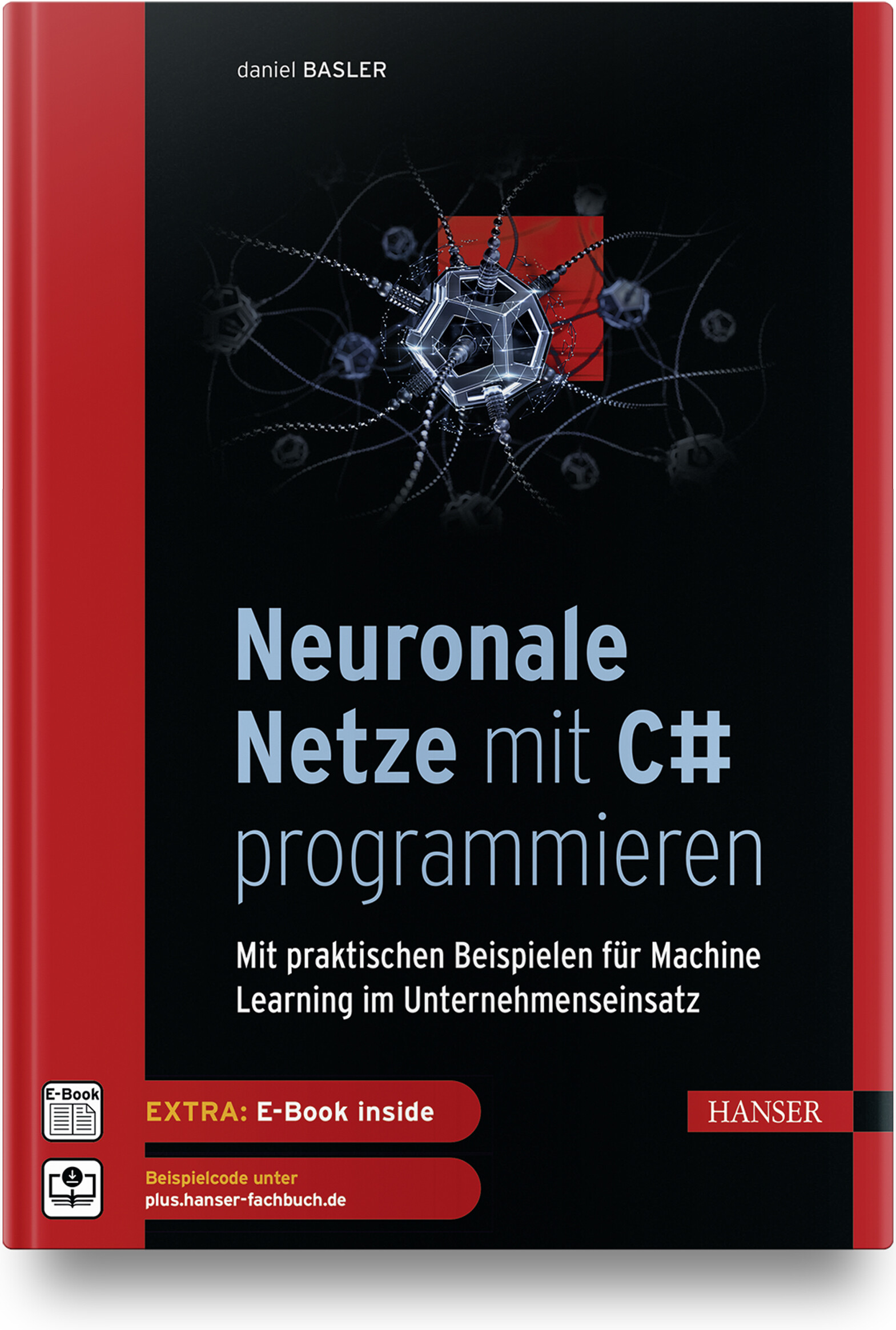
Neuronale Netze mit C# programmieren
Mit praktischen Beispielen für Machine Learning im Unternehmenseinsatz.Sie wollen neuronale Netze und Machine-Learning-Algorithmen mit C# entwickeln? Dann finden Sie in diesem Buch eine gut verständliche Einführung in die Grundlagen und es wird Ihnen gezeigt, wie Sie neuronale Netze und Machine-Learning-Algorithmen in Ihren eigenen Projekten praktisch einsetzen.Mithilfe von Beispielen erstellen und trainieren Sie Ihr erstes neuronales Netz zur vorausschauenden Wartung einer Produktionsmaschine.Im Praxisteil lernen Sie dann, wie Sie TensorFlow-Modelle in ML.NET benutzen oder Infer.NET direkt verwenden können. Des Weiteren nutzen Sie die Predictive- und Sentiment-Analyse, um sich mit Machine-Learning-Algorithmen vertraut zu machen.Alle im Buch vorgestellten Projekte sind in C# programmiert und stehen als Download zur Verfügung. Grundkenntnisse in C# werden für die Arbeit mit dem Buch vorausgesetzt. Alle Projekte lassen sich ohne größere Rechnerressourcen umsetzen.Daniel Basler arbeitet als Lead Developer und Softwarearchitekt. Seine Schwerpunkte liegen auf Cross-Platform-Apps, Android, JavaScript und Microsoft-Technologien. Er entwickelt u.a. Software für Regal- und Flächenlagersysteme sowie Anlagenvisualisierung und setzt in diesem Umfeld verstärkt Machine-Learning-Methoden ein. Darüber hinaus schreibt er regelmäßig Artikel für die Fachzeitschriften dotnetpro und web&mobile Developer.Leseprobe (PDF-Link)
Networking All-in-One For Dummies
YOUR ULTIMATE ONE-STOP NETWORKING REFERENCEDesigned to replace that groaning shelf-load of dull networking books you’d otherwise have to buy and house, Networking All-in-One For Dummies covers all the basic and not-so-basic information you need to get a network up and running. It also helps you keep it running as it grows more complicated, develops bugs, and encounters all the fun sorts of trouble you expect from a complex system. Ideal both as a starter for newbie administrators and as a handy quick reference for pros, this book is built for speed, allowing you to get past all the basics—like installing and configuring hardware and software, planning your network design, and managing cloud services—so you can get on with what your network is actually intended to do.In a friendly, jargon-free style, Doug Lowe—an experienced IT Director and prolific tech author—covers the essential, up-to-date information for networking in systems such as Linux and Windows 10 and clues you in on best practices for security, mobile, and more. Each of the nine minibooks demystifies the basics of one key area of network management.* Plan and administrate your network * Implement virtualization * Get your head around networking in the Cloud * Lock down your security protocols The best thing about this book? You don’t have to read it all at once to get things done; once you’ve solved the specific issue at hand, you can put it down again and get on with your life. And the next time you need it, it’ll have you covered.DOUG LOWE is Information Technology Director for a civil engineering firm and a prolific technology author. He has been managing networks for more than 30 years and has written more than 50 technology guides, many in the For Dummies series.Introduction 1BOOK 1: GETTING STARTED WITH NETWORKING 5Chapter 1: Welcome to Networking 7Chapter 2: Network Infrastructure 23Chapter 3: Switches, Routers, and VLANs 39Chapter 4: Cybersecurity 55Chapter 5: Servers and Virtualization 67Chapter 6: Cloud Computing 79BOOK 2: UNDERSTANDING NETWORK PROTOCOLS 89Chapter 1: Network Protocols and Standards 91Chapter 2: TCP/IP and the Internet 115Chapter 3: IP Addresses 123Chapter 4: Routing 145Chapter 5: Dhcp 155Chapter 6: Dns 173Chapter 7: TCP/IP Tools and Commands 207BOOK 3: PLANNING A NETWORK 235Chapter 1: Local Area Networks 237Chapter 2: Wide Area Networks 253Chapter 3: Server Architecture 267Chapter 4: Virtualization Architecture 277Chapter 5: Storage Architecture 289Chapter 6: Backup Architecture 301Chapter 7: Hyperconverged Infrastructure 319BOOK 4: IMPLEMENTING A NETWORK 331Chapter 1: Network Hardware 333Chapter 2: Wireless Networks 345Chapter 3: Windows Clients 365Chapter 4: Mac Networking 375Chapter 5: Network Printers 383Chapter 6: Virtual Private Networks 389BOOK 5: IMPLEMENTING VIRTUALIZATION 395Chapter 1: Hyper-V 397Chapter 2: VMware 417Chapter 3: Azure 429Chapter 4: Amazon Web Services 445Chapter 5: Desktop Virtualization 463BOOK 6: IMPLEMENTING WINDOWS SERVER 2019 471Chapter 1: Installing Windows Server 2019 473Chapter 2: Configuring Windows Server 2019 489Chapter 3: Configuring Active Directory 499Chapter 4: Configuring User Accounts 511Chapter 5: Configuring a File Server 533Chapter 6: Using Group Policy 549Chapter 7: Typing Windows Commands 561Chapter 8: Using PowerShell 589BOOK 7: ADMINISTERING MICROSOFT OFFICE 365 609Chapter 1: Getting Started with Office 365 Administration 611Chapter 2: Configuring Exchange Online 631Chapter 3: Administering Teams 651BOOK 8: IMPLEMENTING LINUX 667Chapter 1: Installing a Linux Server 669Chapter 2: Linux Administration 683Chapter 3: Basic Linux Network Configuration 715Chapter 4: Running DHCP and DNS 727Chapter 5: Doing the Samba Dance 739Chapter 6: Running Apache 747Chapter 7: Running Postfix 761Chapter 8: Linux Commands 771BOOK 9: MANAGING A NETWORK 801Chapter 1: Welcome to Network Administration 803Chapter 2: Managing Remotely 817Chapter 3: Managing Network Assets 835Chapter 4: Solving Network Problems 847Chapter 5: Managing Software Deployment 863Chapter 6: Managing Mobile Devices 875BOOK 10: DEALING WITH CYBERSECURITY 889Chapter 1: Securing Your Users 891Chapter 2: Managing Firewalls and Virus Protection 901Chapter 3: Dealing with Spam 921Chapter 4: Managing Disaster Recovery and Business Continuity Planning 935APPENDIXES 943Appendix A: Directory of Useful Websites 945Appendix B: Glossary 953Index 975

IT-Sicherheitsmanagement (3. Auflg.)
Das umfassende Praxishandbuch in 3. Auflage (04/2021) für IT-Security und technischen Datenschutz nach ISO 27001.Daten werden in Public Clouds verlagert und dort verarbeitet, auf Mobiltelefonen gespeichert, über Chat-Apps geteilt oder im Rahmen von Industrie 4.0 in einer Größenordnung erfasst, die bislang kaum denkbar war. IT-Security-Manager müssen die entsprechenden Maßnahmen nicht nur an diese Veränderungen anpassen, sondern auch an die EU-Datenschutz-Grundverordnung, das IT-Sicherheitsgesetz, die Anforderungen von Kunden oder das China Cybersecurity Law. Alle diese Regelungen haben immense Auswirkungen darauf, wie Unternehmen Daten erfassen, verarbeiten, speichern oder austauschen dürfen. In der Fülle und der Bandbreite der neuen Regelungen liegt aber immer auch die Gefahr, etwas falsch zu machen.Dieser Praxisleitfaden wird Ihnen dabei helfen, sich in der riesigen Menge an Einzelthemen und Aufgaben, mit denen sich IT-Security-Manager auseinandersetzen müssen, zurechtzufinden und den richtigen Weg zu wählen, um mit all diesen Anforderungen umzugehen.Jedes Kapitel beschreibt ausführlich jeweils einen Bereich der IT-Security. Die notwendigen theoretischen Grundlagen wechseln sich dabei ab mit Tipps aus der Praxis für die Praxis, mit für den Berufsalltag typischen Fragestellungen, vielen konkreten Beispielen und hilfreichen Checklisten. Alle Teilgebiete werden abschließend in einem Kapitel zusammengeführt, das die Einführung und Weiterentwicklung eines IT-Sicherheitsmanagements auf Basis der ISO-27000-Normen-Familie unter Beachtung der datenschutzrechtlichen Bestimmungen der EU-DSGVO behandelt.So erhalten Sie sowohl einen kompetenten Praxisleitfaden – auch für den Berufseinstieg – als auch ein umfassendes Nachschlagewerk für Ihre tägliche Arbeit.Aus dem Inhalt:Umfang und Aufgabe des IT-Security-ManagementsOrganisation der IT-SecurityIT-ComplianceKundenaudits am Beispiel TISAXVerzahnung von Informationssicherheit und DatenschutzOrganisation von RichtlinienBetrieb der IT-SecurityIT Business Continuity ManagementIT-NotfallmanagementVerfügbarkeitsmanagementTechnische IT-SecurityIT-RisikomanagementSicherheitsmonitoringIT-Security-AuditManagement von Sicherheitsereignissen und IT-ForensikKennzahlenPraxis: Aufbau eines ISMSAwareness und SchulungInhalt & Leseprobe (PDF-Link)

Stochastic Approaches to Electron Transport in Micro- and Nanostructures
The book serves as a synergistic link between the development of mathematical models and the emergence of stochastic (Monte Carlo) methods applied for the simulation of current transport in electronic devices. Regarding the models, the historical evolution path, beginning from the classical charge carrier transport models for microelectronics to current quantum-based nanoelectronics, is explicatively followed. Accordingly, the solution methods are elucidated from the early phenomenological single particle algorithms applicable for stationary homogeneous physical conditions up to the complex algorithms required for quantum transport, based on particle generation and annihilation. The book fills the gap between monographs focusing on the development of the theory and the physical aspects of models, their application, and their solution methods and monographs dealing with the purely theoretical approaches for finding stochastic solutions of Fredholm integral equations. Part I Aspets of Electron Transport Modeling: 1. Concepts of Device Modeling.- 2. The Semiconductor Model: Fundamentals.- 3. Transport Theories in Phase Space.- 4. Monte Carlo Computing.- Part II Stochastic Algorithms for Boltzmann Transport: 5. Homogeneous Transport: Empirical Approach.- 6. Homogeneous Transport: Stochastic Approach.- 7. Small Signal Analysis.- 8. Inhomogeneous Stationary Transport.- 9. General Transport: Self-Consistent Mixed Problem.- 10. Event Biasing.- Part III Stochastic Algorithms for Quantum Transport: 11.Wigner Function Modeling.- 12. Evolution in a Quantum Wire.- 13. Hierarchy of Kinetic Models.- 14. Stationary Quantum Particle Attributes.- 15. Transient Quantum Particle Attributes.

Fit für die digitale Zukunft
Die Digitalisierung verändert die Gesellschaft, sie stellt neue Anforderungen an die Menschen und führt zu neuen Herausforderungen. Das ist inzwischen hinreichend bekannt. Was aber werden konkret die Herausforderungen sein, denen sich die Menschen stellen müssen, welche Fähigkeiten müssen sie sich aneignen und wie können sie sich optimal auf die kommenden Veränderungen vorbereiten? In dem Buch geht es nicht um einen theoretischen Blick in die Kristallkugel, sondern der Autor greift die schon erkennbaren Veränderungen auf und entwickelt daraus Handlungsempfehlungen, um eine Vorbereitung auf die Veränderungen zu ermöglichen. Dabei geht es um einen zusammenhängenden Blick auf die Fragen, die in absehbarer Zukunft relevant werden, wie z.B. Veränderungen in der Art des Zusammenlebens, dem Verhältnis von Staat und Bürger oder der Vermittlung von Fähigkeiten und Wissen. Ziel des Buches ist es, dem Leser nicht einen abstrakten Zugang zu wesentlichen Bereichen der Digitalisierung zu ermöglichen, sondern konkrete Themen, die für den Leser schon sichtbar sind, zu analysieren, die Hintergründe aufzuzeigen und ihm die Angst vor den kommenden Veränderungen zu nehmen.
PHP 8 Objects, Patterns, and Practice
Learn how to develop elegant and rock-solid systems using PHP, aided by three key elements: object fundamentals, design principles, and best practices. The 6th edition of this popular book has been fully updated for PHP 8, including attributes, constructor property promotion, new argument and return pseudo-types, and more. It also covers many features new since the last edition including typed properties, the null coalescing operator, and void return types. This book provides a solid grounding in PHP's support for objects, it builds on this foundation to instill core principles of software design and then covers the tools and practices needed to develop, test, and deploy robust code.PHP 8 Objects, Patterns, and Practice begins by covering PHP's object-oriented features. It introduces key topics including class declarations, inheritance, and reflection. The next section is devoted to design patterns. It explains the principles that make patterns powerful. You’ll cover many of the classic design patterns including enterprise and database patterns. The last segment of the book covers the tools and practices that can help turn great code into a successful project. The section shows how to manage multiple developers and releases with git, and how to manage builds and dependencies with Composer. It also explores strategies for automated testing and continuous integration.After reading and using this book, you will have mastered object-oriented enhancements, design patterns, and the essential development tools available for PHP 8.WHAT YOU WILL LEARN* Work with object fundamentals: write classes and methods, instantiate objects, and create powerful class hierarchies using inheritanceMaster advanced object-oriented features, including static methods and properties, managing error conditions with exceptions, and creating abstract classes and interfaces * Understand and use design principles to deploy objects and classes effectively in your projects* Discover a set of powerful patterns that you can implement in your own projects* Guarantee a successful project including unit testing; version control and build, installation, and package management; and continuous integrationWHO THIS BOOK IS FORAnyone with at least a basic knowledge of PHP who wants to use its object-oriented features in their projects. It is also for PHP coders who want to learn about the practices and tools (version control, testing, continuous integration, etc) that can make projects safe, elegant and stable.MATT ZANDSTRA has worked as a web programmer, consultant, and writer for over two decades. He is the author of SAMS Teach Yourself PHP in 24 Hours (three editions) and is a contributor to DHTML Unleashed. He has written articles for Linux Magazine, Zend, IBM DeveloperWorks, and php|architect Magazine, among others. Matt was a senior developer/tech lead at Yahoo and API tech lead at LoveCrafts. Matt works as a consultant advising companies on their architectures and system management, and also develops systems primarily with PHP, and Java. Matt also writes fiction.Part I. Objects.-1. PHP: Design and Management.-2. PHP and Objects.-3. Object Basics.-4. Advanced Features.-5. Object Tools.-6. Objects and Design.-Part II. Patterns.-7. What Are Design Patterns? Why Use Them?.-8. Some Pattern Principles.-9. Generating Objects.-10. Patterns for Flexible Object Programming.-11. Performing and Representing Tasks.-12. Enterprise Patterns.-13. Database Patterns.-Part III. Practice.-14. Good (and Bad) Practice.-15. PHP Standards.-16. PHP Using and Creating Components with Composer.-17. Version Control with Git.-18. Testing.-19. Automated Build with Phing.-20. Vagrant.-21. Continuous Integration.-22. Objects, Patterns, and Practice.-23. App A: Bibliography.-24. App B: A Simple Parser.
Visualizing Data in R 4
Master the syntax for working with R’s plotting functions in graphics and stats in this easy reference to formatting plots. The approach in Visualizing Data in R 4 toward the application of formatting in ggplot() will follow the structure of the formatting used by the plotting functions in graphics and stats. This book will take advantage of the new features added to R 4 where appropriate including a refreshed color palette for charts, Cairo graphics with more fonts/symbols, and improved performance from grid graphics including ggplot 2 rendering speed.Visualizing Data in R 4 starts with an introduction and then is split into two parts and six appendices. Part I covers the function plot() and the ancillary functions you can use with plot(). You’ll also see the functions par() and layout(), providing for multiple plots on a page. Part II goes over the basics of using the functions qplot() and ggplot() in the package ggplot2. The default plots generated by the functions qplot() and ggplot() give more sophisticated-looking plots than the default plots done by plot() and are easier to use, but the function plot() is more flexible. Both plot() and ggplot() allow for many layers to a plot.The six appendices will cover plots for contingency tables, plots for continuous variables, plots for data with a limited number of values, functions that generate multiple plots, plots for time series analysis, and some miscellaneous plots. Some of the functions that will be in the appendices include functions that generate histograms, bar charts, pie charts, box plots, and heatmaps.WHAT YOU WILL LEARN* Use R to create informative graphics* Master plot(), qplot(), and ggplot()* Discover the canned graphics functions in stats and graphicsFormat plots generated by plot() and ggplot()WHO THIS BOOK IS FORThose in data science who use R. Some prior experience with R or data science is recommended.Margot Tollefson, PhD is a semi-retired freelance statistician, with her own consulting business, Vanward Statistics. She received her PhD in statistics from Iowa State University and has many years of experience applying R to statistical research problems. Dr. Tollefson has chosen to write this book because she often creates graphics using R and would like to share her knowledge and experience. Her professional blog is on WordPress at vanwardstat. Social media: @vanstat1) Introduction: plot(), qplot(), and ggplot(), Plus Somea) plot() – arguments, ancillary functions, and methods; par() and layout()b) qplot() and ggplot() – aesthetics, geometries, and other useful functionsc) other plotting functions in graphics and statsPart I. An Overview of plot()2) The plot() Functiona) what the function is and how the function worksb) will use method .xy for example3) The Arguments to plot()a) Type of plot, axis labels, plot titles, display formatb) Plotting characters, character size, fonts, colors, line styles and widths4) Ancillary Functions to use with plot()a) axis(), box(), clip(), grid(), legend(), mtext(), rug()b) abline(), contour(), curve(), lines(), polypath()c) arrows(), image(), points(), polygon(), rect(), segments(), symbols(), text()d) axTicks(), identify(), locator(), pch(), strwidth(),5) The Methods for plot()a) What are methods?b) Methods in the graphics packagec) Methods in the stats package6) How to Use the Functions par() and layout()a) What par() doesb) Arguments specific to par()c) Multiple plotsPart II. A look at the ggplot2 Package7) The Functions qplot(), ggplot(), and the Specialized Notation in ggplot2a) Working with qplot()b) The ggplot() functionc) Specialized notation8) Themesa) The theme() functionb) The element_*() functions9) Aesthetics and Geometriesa) The aes() functionb) The geom_*() functions10) Controlling the Appearancea) The annotate_*() functionsb) The coord_*() functionsc) The facet_*() functionsd) The guide_*() functionse) The position_*() functionsf) The scale_*() functionsg) The stat_*() functionsAppendix I. Plots for Contingency TablesAppendix II. Plots for Continuous VariablesAppendix III. Plots for Data with a Limited Number of ValuesAppendix IV. Functions that Generate Multiple PlotsAppendix V. Plots for Time SeriesAppendix VI. Miscellaneous Plots

R2DBC Revealed
Understand the newest trend in database programming for developers working in Java, Kotlin, Clojure, and other JVM-based languages. This book introduces Reactive Relational Database Connectivity (R2DBC), a modern way of connecting to and querying relational databases from Java and other JVM languages. The book begins by helping you understand not only what reactive programming is, but why it is necessary. Then building on those fundamentals, the book takes you into the world of databases and the newly released Reactive Relational Database Connectivity (R2DBC) specification.Examples in the book are worked using the freely available MariaDB database along with MariaDB’s vendor-implementation of the R2DBC service-provider interface (SPI). Following along with the examples and the provided example code helps prepare you to work with any of the growing number of R2DBC implementations for popular enterprise databases such as Oracle Database and SQL Server. You’ll be well prepared for what is becoming the future of database access from Java and other languages built on the JVM.WHAT YOU WILL LEARN* Understand why R2DBC was created and how it utilizes the Reactive Streams API * Understand the components of the R2DBC service-provider interface* Create and manage reactive database connections and connection pools using an R2DBC client* Programmatically execute queries on a relational database using an R2DBC client* Effectively utilize transactions using an R2DBC client* Build relational database-driven applications that are event-driven and non-blockingWHO THIS BOOK IS FORSoftware developers building solutions using JVM languages and the JVM ecosystem, and developers who need an introduction to the R2DBC specification and reactive programming with relational databases and want to understand what Reactive Relational Database Connectivity is and why it came about. This book includes practical examples of using the R2DBC specification with Java and MariaDB that will provide developers with the knowledge they need to create their own solutions.ROB HEDGPETH is a professional software engineer and developer relations enthusiast residing in the bustling metropolis of Chicago, Illinois. Rob has more than 12 years of professional development experience, primarily in the application development space. Throughout the years he has contributed to the architecture and development of many apps, using a large array of languages and technologies. Now as a developer advocate and evangelist for MariaDB, Rob gets to combine his love for technology with his mission to fuel developers' curiosity and passion. IntroductionPART I. THE REACTIVE MOVEMENT AND R2DBC1. The Case for Reactive Programming2. Introduction to R2DBCPART II. THE R2DBC SERVICE-PROVIDER INTERFACE3. The Path to Implementation4. Connections5. Transactions6. Statements7. Handling Results8. Result Metadata9. Mapping Data Types10. Handling ExceptionsPART III. GETTING STARTED WITH R2DBC AND MARIADB11. Getting Stated with R2DBC12. Managing Connections13. Managing Data14. Managing Transactions15. Connection Pooling16. Practical Applications with Spring Data and R2DBC
Objektorientierte Programmierung (5. Auflg.)
Unverzichtbare Skills für guten Code - das umfassende Handbuch in 5. Auflage.Komplexe Systeme solide strukturieren, tragfähige Designs erstellen, robusten Code schreiben und wartbare Software liefern: Dafür brauchen Sie ein Repertoire, aus dem die Objektorientierung heute nicht mehr wegzudenken ist. Dieses umfassende und praxisnahe Lehrbuch hilft Ihnen, die Prinzipien der Objektorientierung zu verstehen und zur Basis Ihrer Arbeit zu machen.Leseprobe (PDF-Link)

Big Data Analytics
Mit diesem Herausgeberwerk führen die Autoren den Begriff „Big Data Analytics“ ein und geben Fallstudien aus unterschiedlichen Anwendungsgebieten. Unter Big Data Analytics wird das Aufbereiten, Analysieren und Interpretieren von großen, oft heterogenen Datenbeständen verstanden, mit dem Ziel, Muster und Zusammenhänge in den Daten aufzudecken und Entscheidungsgrundlagen für wissenschaftliche, betriebliche oder gesellschaftliche Fragestellungen zu erhalten.Nebst den theoretischen Grundlagen widmet sich das Herausgeberwerk der Vielfalt verschiedener Anwendungsmöglichkeiten. Fallbeispiele geben Einblick in die Anwendung von Big Data Analytics und dessen Nutzenpotenziale.Das Werk richtet sich gleichermaßen an Studierende, Fachleute aller Fachrichtungen als auch an interessierte Anwender. Es hilft den Leserinnen und Leser, die Bedeutungsvielfalt des Begriffs Big Data Analytics zu verstehen und verschiedene Einsatzmöglichkeiten im eigenen Umfeld zu erkennen und zu bewerten.SARA D'ONOFRIO ist IT Business Partner Manager eines der größten Detailhandelsunternehmen der Schweiz, Autorin und Herausgeberin der Zeitschrift HMD - Praxis der Wirtschaftsinformatik bei Springer, Gastdozentin an Hochschulen und Mitglied der Stiftung FMsquare, welche die Anwendung von Fuzzy-Logik zur Lösung von wirtschaftlichen und sozialen Problemen fördert. Sie hat Betriebswirtschaft und Wirtschaftsinformatik studiert und in Informatik promoviert.ANDREAS MEIER hat Musik an der Musikakademie in Wien und Mathematik an der Eidgenössischen Technischen Hochschule (ETH) in Zürich studiert, wo er doktorierte und habilitierte. Er arbeitete bei IBM Schweiz, gehörte zum Direktionskader der internationalen Bank SBV und trug Mitverantwortung in der Geschäftsleitung des Versicherers CSS. In der Forschung war er am IBM Research Lab in Kalifornien tätig und gründete das Research Center Fuzzy Management Methods an der Universität Fribourg in der Schweiz.Grundlagen - Textanalyse - Machine Learning - Prädiktive Modelle - Trendforschung

Robotic Process Automation using UiPath StudioX
Learn about Robotic Processing Automation (RPA) and how to build bots using UiPath. This book uses hands-on examples to explain the basics of UiPath and then walks you through real-world prototypes for testing your knowledge.Organizations around the world are implementing RPA in some capacity, and there is a shortage of RPA developers in the market. Analysts predict that the RPA market size will be worth $4 Billion by 2025. With UiPath as one of the three major players in the RPA market, professionals and students can use this book to get ahead of the curve.This book helps you kick-start your automation journey with a special focus on one of the most popular RPA tools: UiPath. Robotic Process Automation using UiPath explains in detail the various features and functionalities of the RPA platform including development, debugging, and error handling.WHAT YOU'LL LEARN* Create robots from scratch, using one of the market leaders in RPA* Develop automation apps and deploy them to all the computers in your department* Build, test and perform enterprise automation tasks with UiPath* Understand the key building blocks and components of UiPath * Apply UiPath programming techniques to deploy robot configurations* Review email Automation* Automate Excel and PDF interactionsWHO THIS BOOK IS FORRPA developers and business users alike, bringing the power and skill set of automation to anyone interested in citizen-led development, specifically UiPath StudioX. The simple exercises and no-code platform require no prior programming or RPA knowledge to follow along with this beginner's guide.ADEEL JAVED is an intelligent automation architect, an author, and a speaker. He helps organizations automate work using low-code, business process management (BPM), robotic process automation (RPA), analytics, integrations and ML. He loves exploring new technologies and writing about them. He published his first book, "Building Arduino Projects for the Internet of Things", with Apress back in 2015. He shares his thoughts on various technology trends on his personal blog (adeeljaved.com).ANUM SUNDRANI is a business systems analyst and technology enthusiast who specializes in Business Process Management and Robotic Process Automation. Anum is a Certified Appian Analyst, Tableau Author, Six Sigma Green Belt and Scrum Master, alongside her several trainings in the areas of RPA development and the automation delivery lifecycle. She has an inquisitive eye for simplifying complex business processes and has focused on implementing automation solutions for business users since 2017.NADIA MALIK is a Presales Engineer with a background in software development. She has started her journey as a Software Engineer at IBM developing Cloud storage applications and then joining the UiPath rocket-ship in June of 2018 helping customers design, implement, and provide training in robotics process automation. Today she continues to evangelize RPA and mentor young women in STEM.SIDNEY MADISON PRESCOTT is a senior technology leader, keynote speaker, and robotics evangelist specializing in the creation of Robotic Process Automation Centers of Excellence for Fortune 500 companies. Sidney currently heads up the Global Intelligent Automation initiative at music streaming powerhouse Spotify. In addition to her enterprise technology expertise, Sidney is an executive board member for three global non-profit organizations, where she contributes valuable automation insights to enhance overall program objectives. To round out her career accolades, Sidney was also named a global recipient of the 2020 Top 50 Technology Visionaries award.Part I: IntroductionChapter 1. Robotic Process Automation Overview* Overview* Benefits* Market trends* Major vendors* Real-life use cases* Attended/unattendedChapter 2. UiPath StudioX Overview* Download* Install* Interface OverviewPart II: Activities – Your Building BlocksGoal of this section is to list down each activity under these tiles in UiPath StudioX, provide a brief description of what that activity does, screenshots of different configurations, quick examples. Essentially make this as the ultimate reference material.Chapter 3. Common ActivitiesChapter 4. UI AutomationChapter 5. Outlook AutomationChapter 6. Word AutomationChapter 7. Excel AutomationChapter 8. CSV AutomationChapter 9. File AutomationPart III: Building PrototypesGoal of this section is to build couple of real-life prototypes that uses knowledge acquired in prior sections. We have already developed two sample target applications, one browser-based, the other windows-based.Chapter 10. Real-life prototype 1 (Inventory Management)* Outlook Automation* CSV Automation* UI Automation (Browser)* File AutomationChapter 11. Real-life prototype 2 (Order Management)* UI Automation (App)* Excel Automation* Word Automation* File AutomationChapter 12. Real-life prototype 3 (Excel Management)* Excel AutomationPart IV: Scaling UpGoal of this section/chapter is to help people think about next steps. Most organizations have difficulty scaling up the concepts of citizen development.Chapter 13. Scaling RPA – high-level ideas

Deep Reinforcement Learning with Python
Deep reinforcement learning is a fast-growing discipline that is making a significant impact in fields of autonomous vehicles, robotics, healthcare, finance, and many more. This book covers deep reinforcement learning using deep-q learning and policy gradient models with coding exercise.You'll begin by reviewing the Markov decision processes, Bellman equations, and dynamic programming that form the core concepts and foundation of deep reinforcement learning. Next, you'll study model-free learning followed by function approximation using neural networks and deep learning. This is followed by various deep reinforcement learning algorithms such as deep q-networks, various flavors of actor-critic methods, and other policy-based methods.You'll also look at exploration vs exploitation dilemma, a key consideration in reinforcement learning algorithms, along with Monte Carlo tree search (MCTS), which played a key role in the success of AlphaGo. The final chapters conclude with deep reinforcement learning implementation using popular deep learning frameworks such as TensorFlow and PyTorch. In the end, you'll understand deep reinforcement learning along with deep q networks and policy gradient models implementation with TensorFlow, PyTorch, and Open AI Gym.WHAT YOU'LL LEARN* Examine deep reinforcement learning * Implement deep learning algorithms using OpenAI’s Gym environment* Code your own game playing agents for Atari using actor-critic algorithms* Apply best practices for model building and algorithm training WHO THIS BOOK IS FORMachine learning developers and architects who want to stay ahead of the curve in the field of AI and deep learning.Nimish is a passionate technical leader who brings to table extreme focus on use of technology for solving customer problems. He has over 25 years of work experience in the Software and Consulting. Nimish has held leadership roles with P&L responsibilities at PwC, IBM and Oracle. In 2006 he set out on his entrepreneurial journey in Software consulting at SOAIS with offices in Boston, Chicago and Bangalore. Today the firm provides Automation and Digital Transformation services to Fortune 100 companies helping them make the transition from on-premise applications to the cloud.He is also an angel investor in the space of AI and Automation driven startups. He has co-founded Paybooks, a SaaS HR and Payroll platform for Indian market. He has also cofounded a Boston based startup which offers ZipperAgent and ZipperHQ, a suite of AI driven workflow and video marketing automation platforms. He currently hold the position as CTO and Chief Data Scientist for both these platforms.Nimish has an MBA from Indian Institute of Management in Ahmedabad, India and a BS in Electrical Engineering from Indian Institute of Technology in Kanpur, India. He also holds multiple certifications in AI and Deep Learning.Chapter 1: Introduction to Deep Reinforcement LearningChapter Goal: Introduce the reader to field of reinforcement learning and setting the context of what they will learn in rest of the bookSub -Topics1. Deep reinforcement learning2. Examples and case studies3. Types of algorithms with mind-map4. Libraries and environment setup5. SummaryChapter 2: Markov Decision ProcessesChapter Goal: Help the reader understand models, foundations on which all algorithms are built.Sub - Topics1. Agent and environment2. Rewards3. Markov reward and decision processes4. Policies and value functions5. Bellman equationsChapter 3: Model Based AlgorithmsChapter Goal: Introduce reader to dynamic programming and related algorithmsSub - Topics:1. Introduction to OpenAI Gym environment2. Policy evaluation/prediction3. Policy iteration and improvement4. Generalised policy iteration5. Value iterationChapter 4: Model Free ApproachesChapter Goal: Introduce Reader to model free methods which form the basis for majority of current solutionsSub - Topics:1. Prediction and control with Monte Carlo methods2. Exploration vs exploitation3. TD learning methods4. TD control5. On policy learning using SARSA6. Off policy learning using q-learningChapter 5: Function ApproximationChapter Goal: Help readers understand value function approximation and Deep Learning use in Reinforcement Learning.1. Limitations to tabular methods studied so far2. Value function approximation3. Linear methods and features used4. Non linear function approximation using deep LearningChapter 6: Deep Q-LearningChapter Goal: Help readers understand core use of deep learning in reinforcement learning. Deep q learning and many of its variants are introduced here with in depth code exercises.1. Deep q-networks (DQN)2. Issues in Naive DQN3. Introduce experience replay and target networks4. Double q-learning (DDQN)5. Duelling DQN6. Categorical 51-atom DQN (C51)7. Quantile regression DQN (QR-DQN)8. Hindsight experience replay (HER)Chapter 7: Policy Gradient AlgorithmsChapter Goal: Introduce reader to concept of policy gradients and related theory. Gain in depth knowledge of common policy gradient methods through hands-on exercises1. Policy gradient approach and its advantages2. The policy gradient theorem3. REINFORCE algorithm4. REINFORCE with baseline5. Actor-critic methods6. Advantage actor critic (A2C/A3C)7. Proximal policy optimization (PPO)8. Trust region policy optimization (TRPO)Chapter 8: Combining Policy Gradients and Q-LearningChapter Goal: Introduce reader to the trade offs between two approaches ways to connect together the two seemingly dissimilar approaches. Gain in depth knowledge of some land mark approaches.1. Tradeoff between policy gradients and q-learning2. The connection3. Deep deterministic policy gradient (DDPG)4. Twin delayed DDPG (TD3)5. Soft actor critic (SAC)Chapter 9: Integrated Learning and PlanningChapter Goal: Introduce reader to the scalable approaches which are sample efficient for scalable problems.1. Model based reinforcement learning2. Dyna and its variants3. Guided policy search4. Monte Carlo tree search (MCTS)5. AlphaGoChapter 10: Further Exploration and Next StepsChapter Goal: With the backdrop of having gone through most of the popular algorithms, readers are now introduced again to exploration vs exploitation dilemma, central to reinforcement learning.1. Multi arm bandits2. Upper confidence bound3. Thompson sampling

Beginning Machine Learning in the Browser
Apply Artificial Intelligence techniques in the browser or on resource constrained computing devices. Machine learning (ML) can be an intimidating subject until you know the essentials and for what applications it works. This book takes advantage of the intricacies of the ML processes by using a simple, flexible and portable programming language such as JavaScript to work with more approachable, fundamental coding ideas.Using JavaScript programming features along with standard libraries, you'll first learn to design and develop interactive graphics applications. Then move further into neural systems and human pose estimation strategies. For training and deploying your ML models in the browser, TensorFlow.js libraries will be emphasized.After conquering the fundamentals, you'll dig into the wilderness of ML. Employ the ML and Processing (P5) libraries for Human Gait analysis. Building up Gait recognition with themes, you'll come to understand a variety of ML implementation issues. For example, you’ll learn about the classification of normal and abnormal Gait patterns.With Beginning Machine Learning in the Browser, you’ll be on your way to becoming an experienced Machine Learning developer.WHAT YOU’LL LEARN* Work with ML models, calculations, and information gathering* Implement TensorFlow.js libraries for ML models* Perform Human Gait Analysis using ML techniques in the browserWHO THIS BOOK IS FORComputer science students and research scholars, and novice programmers/web developers in the domain of Internet TechnologiesNAGENDER KUMAR SURYADEVARA received his Ph.D. from the School of Engineering and Advanced Technology, Massey University, New Zealand, in 2014. He has authored two books and over 45 publications in different international journals, conferences, and book chapters. His research interests lie in the domains of wireless sensor networks, Internet of Things technologies, and time-series data mining.Chapter 1: What is Machine Learning (ML)?Basics of Java Script (JS)Programming in the browser using Java ScriptGraphics and Interactive processing in the browser using Java Script librariesGetting started with P5.JS and ML5.JSReferencesChapter 2: Human Pose Estimation in the BrowserBrowser based data processingPosenet vs Openpose modelsHuman pose estimation using ML5.PosenetInputs, Outputs and Data structures of Posenet modelReferencesChapter 3: Human Pose ClassificationClassification techniques using ML Neural Network in the browserHuman Pose classification based on the outputs of Posenet modelConsideration of poses using Confidence scores of Posenet modelStorage of data using JSON formats related to the outputs of Posenet modelReferencesChapter 4: Gait AnalysisNormal vs Abnormal Gait patternsDetermination of Gait patterns using threshold values of the modelsUser Interface design and development for monitoring of Gait patternsReal-Time data visualization of the Gait patterns on the browserReferencesChapter 5: Future Possible Applications of Key Concepts

MongoDB Performance Tuning
Use this fast and complete guide to optimize the performance of MongoDB databases and the applications that depend on them. You will be able to turbo-charge the performance of your MongoDB applications to provide a better experience for your users, reduce your running costs, and avoid application growing pains. MongoDB is the world’s most popular document database and the foundation for thousands of mission-critical applications. This book helps you get the best possible performance from MongoDB.MONGODB PERFORMANCE TUNING takes a methodical and comprehensive approach to performance tuning that begins with application and schema design and goes on to cover optimization of code at all levels of an application. The book also explains how to configure MongoDB hardware and cluster configuration for optimal performance. The systematic approach in the book helps you treat the true causes of performance issues and get the best return on your tuning investment. Even when you’re under pressure and don’t know where to begin, simply follow the method in this book to set things right and get your MongoDB performance back on track.WHAT YOU WILL LEARN* Apply a methodical approach to MongoDB performance tuning* Understand how to design an efficient MongoDB application* Optimize MongoDB document design and indexing strategies* Tune MongoDB queries, aggregation pipelines, and transactions* Optimize MongoDB server resources: CPU, memory, disk* Configure MongoDB Replica sets and Sharded clusters for optimal performanceWHO THIS BOOK IS FORDevelopers and administrators of high-performance MongoDB applications who want to be sure they are getting the best possible performance from their MongoDB system. For developers who wish to create applications that are fast, scalable, and cost-effective. For administrators who want to optimize their MongoDB server and hardware configuration.GUY HARRISON is CTO at ProvenDB, a partner at Toba Capital, and a software professional with more than 20 years of experience in database design, development, administration, and optimization. He is the author of Next Generation Databases (Apress) and other books and articles on database technology. He is a MongoDB certified DBA and developer, and an Oracle ACE.MICHAEL HARRISON is the lead developer at ProvenDB, working intimately with MongoDB from both an application and database perspective. He is a co-author of The MongoDB Workshop as well as senior developer of DBKoda, an open-source development environment for MongoDB.PART I. METHODS AND TOOLS1. Methodical Performance Tuning2. MongoDB Architecture and Concepts3. Tools of the TradePART II. APPLICATION AND DATABASE DESIGN4. Schema Modelling5. IndexingPART III. TUNING MONGODB CODE6. Query Tuning7. Tuning Aggregation Pipelines8. Inserts, Updates and Deletes9. Transactions10. Server MonitoringPART IV. SERVER TUNING11. Memory Tuning12. Disk IO13. Replica Sets and Atlas14. Sharding

Automated Unit Testing with ABAP
Write automated unit tests for the ABAP language. This book teaches programmers using simple examples and metaphors and explains the underlying concepts of writing effective automated unit tests. Many, if not most, ABAP programmers learned their programming and testing skills before the ABAP development environment provided an automated unit testing facility.AUTOMATED UNIT TESTING WITH ABAP: A PRACTICAL APPROACH offers hope and salvation to ABAP programmers who continue to toil with antiquated manual unit testing processes, taking them by the hand and lifting them out of that dungeon of despair with a modern and proven alternative. It begins by explaining how the xUnit family of automated testing frameworks provides a quick and effective means of insuring high-quality software. It then focuses on the ABAP Unit Testing Facility, the xUnit framework applicable specifically to the ABAP language, showing how it can be used to bring ABAP applications underautomated testing control, from old legacy applications to those newly written.Whereas xUnit testing has been widely accepted with developers writing in many other programming languages, it is an unfortunate fact in the ABAP community that many programmers still are unfamiliar with xUnit concepts and do not know how to begin implementing automated unit testing into their development process. This book demonstrates how to refactor programs so they become designed for testability, showing how to use process encapsulation and test isolation to facilitate automated testing, including a thorough explanation of test-driven development and the use of test doubles. The book:* Shows how to write automated unit tests for ABAP* Instills ABAP programmers with the confidence to refactor poorly written code* Explains how an automated testing harness facilitates rapid software development* Teaches how to utilize test-driven development (TDD) withABAP* Offers advice and tips on the best ways to write automated unit testsWHAT YOU WILL LEARN* Become familiar with the xUnit approach to testing* Know the ABAP statements that interfere with running automated unit tests and how to accommodate them* Understand what it means to isolate code for testing and how this is achieved* Gain the confidence to refactor poorly written code* Make ABAP programs designed for testability* Reap the benefits of spending less time manually unit testing ABAP programs* Use test-driven development (TDD) with ABAP programming* Use configurable test doubles in ABAPWHO THIS BOOK IS FORABAP programmers who remain unfamiliar with the automated unit testing facility and those who already use it butwant to improve their skill writing and using automated tests. The book addresses the reluctance and trepidation felt by procedural ABAP programmers who need to know some object-oriented concepts to use this facility, expands their horizons, and helps them step through the doorway leading to a different approach to program design. JAMES E. MCDONOUGH received a degree in music education from Trenton State College. After teaching music for only two years in the New Jersey public school system, he spent the past 38 years as a computer programmer while also maintaining an active presence as a freelance jazz bassist between New York and Philadelphia. Having switched from mainframe programming to ABAP in 1997, he now works as a contract ABAP programmer designing and writing ABAP programs on a daily basis. An advocate of using the object-oriented programming features available with ABAP, he has been teaching private ABAP education courses over the past few years, where his background in education enables him to present and explain complicated concepts in a way that makes sense to beginners.Chapter 1: Introduction.- Chapter 2: Preparing to Take the First Step.- Chapter 3: Software Quality.- Chapter 4: The Origins of Automated Unit Testing.- Chapter 5: Automated Unit Testing with ABAP.- Chapter 6: Rudiments.- Chapter 7: Design for Testability.- Chapter 8: Test Doubles.- Chapter 9: Service Locator.- Chapter 10: Leveraging the Service Locator.- Chapter 11: Test-Driven Development.- Chapter 12: Configurable Test Doubles.- Chapter 13: Obtaining Code Coverage Information Through ABAP Unit Testing.- Chapter 14: Cultivating Good Test Writing Skills.- Chapter 15: Welcome to Autropolis.- Appendix A: Requirements Documentation and ABAP Exercise Programs.- Appendix B: Answers to Chapter Quizzes.- Appendix C: Concepts Associated with Defining Local Test Classes.-

Set Up and Manage Your Virtual Private Server
The need for every professional to have a solid presence on the Internet is more important than ever before. Having a presence beyond an email account, such as a custom web page or web application, usually requires a clumsy assortment of outside services or hiring a dedicated administrator. Thus it is more sensible for the average professional to become adept at managing their own private server.In Set Up and Manage Your Virtual Private Server, author Jon Westfall expertly designs interesting, understandable lessons for professionals such as teachers, doctors, lawyers, and more to deploy their own virtual private server. He walks you through choosing the right service and customizing it for your specific business or personal needs, and does this with great ease while instilling invaluable knowledge. Basics such as setting up users, managing security and firewalls, installing and updating software, and troubleshooting by reviewing log files, backing up data, and so much more.Set Up and Manage Your Virtual Private Server equips you with the power of knowledge to set your web presence apart from the rest. You now have complete control over your virtual brand that is your own—separate from any employer or affiliate. Your career mobility is in your hands with the ability to run your own private server at your fingertips. The digital era centers this technical literacy and independence as a critical skillset.WHAT YOU WILL LEARN* Understand basic server terminology and the way servers operate and are networked together* See how software is used on a server and its role (for example, Linux, Apache, MySQL, PHP, and so on)* Get comfortable with the basic command-line operation of a virtual private server to set up users, manage security and firewalls, install software, update software, and troubleshoot by reviewing log files* Store and back up important information* Identify, analyze, and deploy open-source software products that can enhance productivityWHO THIS BOOK IS FORNon-tech professionals, individuals who have an established professional career, looking to understand more about how to set up and manage a private server. Jon Westfall is an award-winning professor, published author, and practicing cognitive scientist. He teaches a variety of courses in psychology, from introduction to psychology to upper-level seminars. His current research focuses on the variables that influence economic and consumer finance decisions, and the retention of college students. With applications to both psychology and marketing, his work finds an intersection between basic and applied science. His current appointment is as an assistant professor of psychology, coordinator of the first year seminar program, and coordinator of the Okra Scholars program at Delta State University. Previously he was a visiting assistant professor at Centenary College of Louisiana, and the associate director for research and technology at the Center for Decision Sciences, a center within Columbia Business School at Columbia University in New York City. He now maintains a role with Columbia as a research affiliate and technology consultant.In addition to his research, Dr. Westfall has career ties in information technology, where he has worked as a consultant since 1997, founding his own firm, Bug Jr. Systems. As a consultant he has developed custom software solutions (including native Windows 32 applications, Windows .NET applications, Windows Phone 7 and Android mobile applications, as well as ASP, ASP.NET, and PHP web applications). He has also served as a senior network and systems architect and administrator (on both Windows and Unix networks, and hybrids) and has also been recognized as a Microsoft Most Valuable Professional (MVP) 2008 – 2012. He has authored several books, and presented at academic as well as technology conferences and gatherings.Chapter 1: What is a Virtual Private Server?Chapter Goal: Go over basic terminology of how the internet operates, how servers run, and how virtualization allows individuals to have their own server for a very small cost per month.• How does the magic happen?o How does a webpage appear on my screen? How does email route through the internet to someone else? How do domain names work?• What options does someone have if they want to get into this?o Who provides services (data centers, co-locations, virtual servers, cloud computing)o How much does it cost?o How much do I have to do?o How much time does it take?• Am I ready for this?o Do I have the necessary skills and time to learn skills I need?o Am I OK with being my own system administrator?o Who do I call if I need help? Or can I call someone?Chapter 2: Selecting a VPS ProviderChapter Goal: Walk the reader through identifying and selecting a VPS provider.• How do I find a provider?o Low-end, High-end, Cloudo Trust and Reliability, what is an SLA?o Warning signs• Resources & Budgetingo What do I really need?o How much does it cost?o Extras that can cost money.• Setting up a New Accounto Security of your account.o Extras you may or may not need.o Terms of Serviceo Choosing your Linux distribution: CentOS or Debian (Throughout the book, commands for both CentOS 8 and Debian 10 will be provided).Chapter 3: Basic Linux Administration via Command-LineChapter Goal: Providing the basic commands to administer your server, finding files, and adding and configuring software.• Logging into your servero Shell accesso SSHo SFTPo Setting up your user account• Basic commandso Linux Directory Structureo Ls, cp, mv, and the most dangerous: rmo Finding fileso Su / sudo and file permissions.o Disk usage, memory usage, and overall server health commands.o How do I edit files: Vim and Nano• How your System Starts up and Shuts Downo Services, what they are and how to enable/disableo The right and wrong way to shutdown, and why it’s important.o Graphical user modes versus command-line.o Files that you might want to keep copies of.• How do I install software?o Package managers (apt / yum)o Compiling from Sourceo Updating / upgrading / removing softwareo Configuring software through configuration files.Chapter 4: Basic Linux Administration via GUI (Webmin)Chapter Goal: To provide a basic overview of the Open Source project “Webmin” for configuration of your server though a graphical interface.• Deciding if a GUI is needed or not. Pros and Cons• Downloading and installing Webmin• Setting up Webmin security, including SSL and 2 Factor authentication.• Delegating tasks to others using Webmin Users.• Basic walkthrough of the modules that you’ll need to access, with an eye on settings you don’t want to change.• Webmin’s Usermin module: GUI for users to access files, mail, databases, and more.Chapter 5: Basics of Linux SecurityChapter Goal: The basics of setting up security on your server, with a discussion of auditing and verifying files haven’t changed.• What is a firewall and how do I set it up?• How do I give some users access to administrative functions, but not all?• Advanced File Permissions, and more on users and groups.• SELinux• Auditing and log file management.Chapter 6: Basics of Backups and Version ControlChapter Goal: How to keep your files backed up and safe.• Backup Basics: What to back up, where to back it up, and how often to back up.• Backup Method 1: Gzipped Tar files and shell scripts.• Backup Method 2: Duplicati GUI• Simulated disaster recovery, and migration to a new server.Chapter 7: Basics of Server Software AdministrationChapter Goal: How to get the most common software up and running on your VPS, customizing it to be secure and reliable.• Web Server Basics (Apache 2)o Extending the Server with PHPo SSL certificates.• Database Server Basics (MySQL)• Mail Server Basics (Postfix)• DNS Server Basics (Bind)• Monitoring your Server (Nagios)Chapter 8: Installing an Open Source Software Product – WordpressChapter Goal: How to get a basic website up and running quickly using an open source content management system, Wordpress.• Do you need a full CMS or are your needs more basic?• Downloading and installing Wordpress• Configuring Wordpress to be secure.• Backing up Wordpress• Extending Wordpress with Plugins.Chapter 9: Administrators Weekly ChecklistChapter Goal: Describe concept of preventive maintenance – what one needs to do regularly to keep the server running smoothly.• Software update basics• Following mailing lists and security discussions.• Monitoring for potential security breaches.• Verifying backups.Chapter 10: Open Source Application PossibilitiesChapter Goal: Introduce the reader to software packages that will allow them to up their productivity by hosting their own content on their server. Basic installations will be covered, but not in-depth customization as was done in Chapter 8.• Moodle: Open Source Learning Management System• osTicket: Open Source Helpdesk / Issue Tracking.• YoURLS: Open Source URL Shortener• OpenVPN: Open Source VPN software• Odoo: Open Source CRM Software• LimeSurvey: Open Source Survey Software (Covered in my previous book, Practical R 4 – but less in-depth here)• Other possibilities, including writing

Der Mensch als Rohstoff
Gentechnik, Nanotechnik, Robotik, Künstliche Intelligenz. Welche Revolutionen stehen uns bevor und wie denken die großen Konzerne darüber? Mit welchen Gefahren ist zu rechnen, wie hat sich unser Leben bereits verändert und wohin führt diese Reise? Zur Beantwortung dieser Fragen wagt Christian Blasge einen Ausflug in die menschliche Psyche und untersucht dabei, inwieweit sich unsere Gesellschaft mittlerweile in einem Modus der vollständigen Konkurrenz befindet.Getrieben ist die Entwicklung durch die Stigmatisierung des Menschen als "Mängelwesen", das überwunden werden soll. Dazu dienen die Digitalisierung und Automatisierung menschlicher Arbeitskraft, deren Auswirkung auf den Arbeitsmarkt und den Menschen selbst untersucht werden. Viele der technologischen Neuerungen des beginnenden 21. Jahrhunderts haben einerseits neue Freiheiten mit sich gebracht, die andererseits zu Überforderung, Entwurzelung und Entfremdung führen können. Verbunden ist das Zeitalter der Digitalisierung aber auch mit dem Mythos, Probleme ließen sich durch Konsum lösen, gekoppelt mit dem Trend, sich (freiwillig oder unfreiwillig) zu dem Vermarkter einer Ware und gleichzeitig selbst zu einer Ware zu machen.Im Kontext von Künstlicher Intelligenz und fortschreitenden persönlicher Optimierung drängt sich die Frage auf: "Was ist der Mensch und darf er so bleiben, wie er ist?" Technik-Utopisten (alb)träumen von Maschinen mit Bewusstsein und von Superintelligenzen, die unsere Lebenswelt neu gestalten. Sie schwärmen von der Überwindung der menschlichen Biologie, der Abschaffung aller Krankheiten bis hin zur Unsterblichkeit; und sie bestehen auf der bestmöglichen genetischen Ausstattung für unsere Nachkommen.Das Buch endet mit der brisanten Debatte über den Trans- bzw. Posthumanismus. Eine (schöne?) neue Gesellschaft mit optimierten Menschen, autonomen Robotern und virtuellen Entitäten wird unsere Lebenswelt von Grund auf verändern. Daher bedarf es, so der Autor, dringend eines neuen Gesellschaftsvertrags, wie mit den Früchten des Fortschritts umgegangen werden soll.Christian Blasge, geboren 1988 in Klagenfurt, ist als Schullehrer sowie als Fachlehrer im Bereich Ethik, Bewegung und Sport an der Pädagogischen Hochschule Steiermark sowie an der Karl-Franzens-Universität Graz tätig.

Sicherheit und Prüfung von SAP-Systemen
Sie wollen sichergehen, dass Ihre SAP-Systeme alle Sicherheitsanforderungen erfüllen und ordnungsgemäß konfiguriert sind? Dann führt kein Weg an diesem Standardwerk vorbei. Der Autor zeigt Ihnen Schritt für Schritt, wie Sie bei der Prüfung vorgehen müssen, und vermittelt Ihnen das nötige Hintergrundwissen. Alle Prüfungsthemen werden systematisch und verständlich behandelt – aktuell zu SAP S/4HANA. Aus dem Inhalt: Umgang mit dem SAP-SystemWerkzeuge zur PrüfungAufbau von SAP-Systemen und -LandschaftenAllgemeine SystemsicherheitProtokollierungSichere Remote Function CallsOrdnungsmäßige VerbuchungsvorgängeBenutzerauswertungenSichere EigenentwicklungenBerechtigungen für SAP-Fiori-AnwendungenSicherheit von SAP HANA Einleitung ... 25 1. Umgang mit dem SAP-System und Werkzeuge zur Prüfung ... 31 1.1 ... Transaktionen und SAP-Fiori-Apps ... 31 1.2 ... Reports ... 35 1.3 ... Anzeigen von Tabellen ... 43 1.4 ... Das Benutzerinformationssystem ... 59 1.5 ... Listen als PDF-Datei speichern ... 62 1.6 ... Nutzung der Zugriffsstatistik für Prüfungen ... 63 1.7 ... Tabelleninhalte mit dem QuickViewer auswerten ... 71 1.8 ... SQL-Trace ... 80 1.9 ... Audit Information System ... 84 1.10 ... SAP Access Control ... 90 1.11 ... SAP Enterprise Threat Detection ... 103 1.12 ... Zugriff auf SAP HANA für Prüfer ... 115 2. Aufbau von SAP-Systemen und Systemlandschaften ... 125 2.1 ... SAP NetWeaver und SAP-Komponenten ... 125 2.2 ... Technischer Aufbau von SAP-Systemen ... 131 2.3 ... Systemlandschaften ... 139 2.4 ... Das Mandantenkonzept ... 145 2.5 ... Sicherheit im Mandanten 000 ... 163 3. Allgemeine Systemsicherheit ... 175 3.1 ... Grundlagen für die Prüfung der Systemsicherheit ... 175 3.2 ... Anmeldesicherheit ... 183 3.3 ... Das Notfallbenutzerkonzept ... 206 3.4 ... Sperren von Transaktionscodes ... 210 3.5 ... Logische Betriebssystemkommandos ... 214 3.6 ... Drucken und Speichern ... 223 3.7 ... Batch-Input ... 232 3.8 ... Funktionen von SAP Business Warehouse ... 241 4. Protokollierungskomponenten ... 249 4.1 ... Security-Audit-Log ... 249 4.2 ... Systemprotokollierung ... 271 4.3 ... Protokollierung von Tabellenänderungen ... 278 4.4 ... Protokollierung über Änderungsbelege ... 304 4.5 ... Versionsverwaltung ... 313 4.6 ... Lesezugriffsprotokollierung ... 320 4.7 ... Zugriffsstatistik ... 331 4.8 ... Weitere Protokollkomponenten ... 342 4.9 ... Systemüberwachung mit SAP Enterprise Threat Detection ... 351 5. Remote Function Calls ... 365 5.1 ... Funktionsbausteine ... 365 5.2 ... RFC-Verbindungen ... 376 5.3 ... Trusted Systems ... 383 5.4 ... Zugriff von externen Programmen ... 391 6. Der Verbuchungsvorgang ... 403 6.1 ... Das Prinzip der Verbuchung ... 403 6.2 ... Abgebrochene Buchungen ... 414 6.3 ... Die Belegnummernvergabe ... 419 7. Benutzerauswertungen ... 429 7.1 ... Organisatorische Regelungen ... 429 7.2 ... Die SAP-Standardbenutzer ... 433 7.3 ... Der Benutzerstammsatz ... 442 7.4 ... Referenzbenutzer ... 459 7.5 ... Benutzergruppen ... 465 7.6 ... Sammelbenutzer ... 471 7.7 ... Benutzervermessungsdaten ... 474 7.8 ... Initialkennwörter und Benutzersperren ... 480 7.9 ... Benutzerstammsätze sperren und löschen ... 492 7.10 ... Kennwortverschlüsselung ... 499 7.11 ... Angemeldete Benutzer ... 505 7.12 ... Die Änderungshistorie zu Benutzern ... 509 8. Customizing des SAP-Systems ... 515 8.1 ... Das ABAP Dictionary ... 515 8.2 ... Das Konzept der Tabellensteuerung ... 526 8.3 ... Zugriffe auf Tabellen ... 546 8.4 ... Berechtigungen für Tabellen und Views ... 558 8.5 ... Tabellenzugriffe auf Spalten und Feldwerte einschränken (GTB-Rollen) ... 574 9. Entwicklung in SAP-Systemen ... 587 9.1 ... Entwicklerrichtlinien ... 587 9.2 ... Entwickler- und Objektschlüssel ... 590 9.3 ... Systemänderbarkeit ... 598 9.4 ... Das Transportsystem ... 604 9.5 ... Eigenentwicklungen in ABAP ... 629 9.6 ... Transaktionen ... 667 9.7 ... Berechtigungen zur Anwendungsentwicklung ... 675 10. Berechtigungskonzept in ABAP-Systemen ... 687 10.1 ... Funktionsweise des Berechtigungskonzepts ... 688 10.2 ... Das Berechtigungskonzept in SAP S/4HANA ... 712 10.3 ... Konzepte zum SAP-Berechtigungswesen ... 731 10.4 ... Customizing zum Berechtigungskonzept ... 750 10.5 ... Prüfung von Zugriffsrechten ... 768 10.6 ... Trace von Benutzerberechtigungen ... 787 10.7 ... Berechtigungen für Prüfer ... 794 11. Praktische Prüfung von Berechtigungen ... 797 11.1 ... Zugriffsrechte im Bereich der Berechtigungsverwaltung ... 797 11.2 ... Gesetzeskritische Berechtigungen ... 805 11.3 ... Kritische Basisberechtigungen ... 808 11.4 ... Berechtigungen für das Hacking von SAP-Systemen ... 815 11.5 ... Customizing-Berechtigungen ... 824 11.6 ... Analyse der Qualität des Berechtigungskonzepts ... 838 11.7 ... Analyse von Berechtigungen in SAP Business Warehouse ... 850 12. SAP HANA ... 867 12.1 ... Einführung in SAP HANA ... 867 12.2 ... Systemsicherheit in SAP HANA ... 876 12.3 ... Anmeldesicherheit ... 891 12.4 ... Benutzerverwaltung in SAP HANA ... 898 12.5 ... SAP HANA XSA ... 912 12.6 ... Das Berechtigungskonzept von SAP HANA ... 924 12.7 ... Das Rollenkonzept von SAP HANA ... 939 12.8 ... Analyse des SAP-HANA-Berechtigungskonzepts ... 950 12.9 ... Auditing in SAP HANA ... 963 A. Leitfäden zur SAP-Systemsicherheit ... 979 B. Glossar ... 981 Der Autor ... 989 Index ... 991

Grundkurs Theoretische Informatik
Theoretische Informatik – der Vorlesungsbegleiter. Berechenbarkeit, formale Sprachen, Algorithmik und Komplexitätstheorie sind theoretische Themen mit praktischer Relevanz, zu denen es ebenso praktische Zugänge gibt. Freuen Sie sich auf eine moderene Didaktik, die streng Formales mit Ihrer Intuition verknüpft, lernfreundlich ausarbeitet und schließlich zu jedem Thema Anwendungsfelder der Informatik vorstellt. Stefan Neubert hat nicht nur selbst Freude an der theoretischen Informatik, sondern widmet sich auch mit Leidenschaft ihrer Vermittlung zu Beginn und im Laufe des Bachelorstudiums. Eine Einführung mit vielen Aufgaben und Beispielen, auch zum Selbststudium geeignet. Aus dem Inhalt: Grundlegende mathematische NotationModelle und Grenzen der BerechenbarkeitFormale Sprachen: Endliche Automaten, kontextfreie Grammatiken, Pumping Lemmata und mehrBeweisverfahren für Korrektheit und Laufzeit von AlgorithmenParadigmen für den AlgorithmenentwurfAmortisierte Analyse und untere Schranke für LaufzeitenNP-Vollständigkeit und Reduktion 1. Einführung ... 15 1.1 ... Kompetenzen für die theoretische Arbeit ... 16 1.2 ... Themen der theoretischen Informatik ... 18 1.3 ... Anleitung fürs Buch ... 20 1.4 ... Danksagungen ... 21 2. Mathematische Notation ... 23 2.1 ... Logische Aussagen ... 24 2.2 ... Mengen ... 27 2.3 ... Relationen und Funktionen ... 32 2.4 ... Graphen ... 37 2.5 ... Unendlichkeiten und Abzählbarkeit ... 40 2.6 ... Beweistechniken ... 42 2.7 ... Aufgaben ... 57 2.8 ... Lösungen ... 58 TEIL I. Berechenbarkeit und formale Sprachen ... 65 3. Einführung in die Berechenbarkeitstheorie ... 67 3.1 ... Algorithmus ... 68 3.2 ... Zu viele Funktionen ... 69 3.3 ... Das Halteproblem ... 70 3.4 ... Kontrollfragen ... 72 3.5 ... Antworten ... 72 4. Problemtypen ... 73 4.1 ... Formalisierung von Problemen ... 73 4.2 ... Funktionen berechnen ... 75 4.3 ... Datencodierung ... 75 4.4 ... Sprachen entscheiden ... 78 4.5 ... Problemklassen der Berechenbarkeitstheorie ... 79 4.6 ... Aufgaben ... 82 4.7 ... Lösungen ... 83 5. Einführung in formale Sprachen ... 85 5.1 ... Definition ... 85 5.2 ... Die Chomsky-Hierarchie ... 88 5.3 ... Aufgaben ... 89 5.4 ... Lösungen ... 90 6. Reguläre Sprachen ... 91 6.1 ... Deterministische endliche Automaten ... 92 6.2 ... Nichtdeterministische endliche Automaten ... 103 6.3 ... Grammatiken ... 111 6.4 ... Reguläre Ausdrücke ... 120 6.5 ... Abschlusseigenschaften ... 127 6.6 ... Entscheidungsprobleme auf regulären Sprachen ... 132 6.7 ... Äquivalenzklassenzerlegung ... 134 6.8 ... Nichtreguläre Sprachen ... 139 6.9 ... Ausblick ... 144 6.10 ... Aufgaben ... 144 6.11 ... Lösungen ... 149 7. Kontextfreie Sprachen ... 161 7.1 ... Kontextfreie Grammatiken ... 162 7.2 ... Eindeutige Ableitungsbäume ... 164 7.3 ... Chomsky-Normalform ... 166 7.4 ... Exkurs: Kellerautomaten ... 170 7.5 ... Abschlusseigenschaften ... 175 7.6 ... Entscheidungsprobleme auf kontextfreien Sprachen ... 176 7.7 ... Nicht-kontextfreie Sprachen ... 181 7.8 ... Ausblick ... 183 7.9 ... Aufgaben ... 184 7.10 ... Lösungen ... 186 8. Kontextsensitive Sprachen ... 193 8.1 ... Kontextsensitive und monotone Grammatiken ... 194 8.2 ... Das Wortproblem auf kontextsensitiven Sprachen ... 195 9. Aufzählbare Sprachen ... 197 9.1 ... Turingmaschinen ... 199 9.2 ... While-Programme ... 202 9.3 ... Gödelnummern ... 218 9.4 ... Das universelle While-Programm ... 220 9.5 ... Das schrittbeschränkte universelle While-Programm ... 223 9.6 ... Diagonalisierung und min-Suche ... 224 9.7 ... Prädikate für semi-entscheidbare Sprachen ... 226 9.8 ... Semi-Entscheidbarkeit vs. Aufzählbarkeit ... 227 9.9 ... Das S-m-n-Theorem ... 228 9.10 ... Das kleenesche Rekursionstheorem ... 230 9.11 ... Weitere Modelle und Charakterisierungen ... 233 9.12 ... Aufgaben ... 233 9.13 ... Lösungen ... 235 10. Nicht Berechenbares ... 241 10.1 ... Beweise mit KRT ... 243 10.2 ... Der Satz von Rice ... 244 10.3 ... Reduktionen ... 246 10.4 ... RE-Vollständigkeit ... 250 10.5 ... Ausblick: Die arithmetische Hierarchie ... 251 10.6 ... Aufgaben ... 252 10.7 ... Lösungen ... 254 TEIL II. Algorithmik ... 259 11. Einführung in Algorithmik ... 261 12. Obere Schranken für Laufzeiten ... 263 12.1 ... Das Maschinenmodell ... 264 12.2 ... Die Laufzeit eines Algorithmus ... 267 12.3 ... Die Größe einer Eingabe ... 268 12.4 ... Die Landau-Notation ... 268 12.5 ... Aufgaben ... 271 12.6 ... Lösungen ... 272 13. Laufzeiten von Datenstrukturen ... 275 13.1 ... Arrays ... 275 13.2 ... Listen ... 277 13.3 ... Verschachtelte Datenstrukturen und Graphen ... 279 13.4 ... Aufgaben ... 281 13.5 ... Lösungen ... 282 14. Brute-Force-Algorithmen ... 285 14.1 ... Lineare Suche ... 286 14.2 ... Backtracking/Tiefensuche ... 288 14.3 ... Aufgaben ... 292 14.4 ... Lösungen ... 293 15. Greedy-Algorithmen ... 295 15.1 ... Beweis mit Austauschargument ... 296 15.2 ... Greedy stays ahead ... 302 15.3 ... Aufgaben ... 304 15.4 ... Lösungen ... 306 16. Divide and Conquer ... 313 16.1 ... Mergesort ... 314 16.2 ... Binäre Suche ... 319 16.3 ... Multiplikation großer Zahlen ... 321 16.4 ... Das Mastertheorem ... 325 16.5 ... Ausblick ... 326 16.6 ... Aufgaben ... 327 16.7 ... Lösungen ... 329 17. Dynamische Programmierung ... 335 17.1 ... Fibonacci-Zahlen ... 336 17.2 ... Rückgeld geben ... 337 17.3 ... Der Algorithmus von Dijkstra ... 341 17.4 ... Aufgaben ... 344 17.5 ... Lösungen ... 346 18. Amortisierte Analyse ... 351 18.1 ... Dynamische Arrays ... 351 18.2 ... Guthabenmethode ... 353 18.3 ... Ausblick ... 353 TEIL III. Komplexitätstheorie ... 355 19. Einführung in die Komplexitätstheorie ... 357 19.1 ... Die Komplexität eines Problems ... 358 19.2 ... Bedingte Schranken ... 358 19.3 ... Auswege für schwierige Probleme ... 359 20. Beweistechniken für untere Schranken ... 361 20.1 ... Die Ausgabegröße ... 362 20.2 ... Das informationstheoretische Argument ... 363 20.3 ... Das Adversary-Argument ... 367 20.4 ... Reduktionen ... 370 20.5 ... Aufgaben ... 372 20.6 ... Lösungen ... 374 21. P vs. NP: Bedingte untere Schranken ... 377 21.1 ... Die Komplexitätsklasse P ... 378 21.2 ... Die Komplexitätsklasse NP ... 380 21.3 ... Polynomialzeitreduktionen ... 388 21.4 ... NP-schwere und NP-vollständige Probleme ... 392 21.5 ... Ausblick: Mehr NP-vollständige Probleme ... 404 21.6 ... Aufgaben ... 405 21.7 ... Lösungen ... 406 22. Ausblick: Parametrisierte Analyse ... 408 Index ... 410

Amazon Marketplace
Um bei Amazon Marketplace als Händler zu bestehen, benötigen Sie einen kompetenten Begleiter. Mit Trutz Fries und Stephan Bruns zeigen Ihnen gleich zwei Profis, welche Produkte sich für den Vertrieb eignen, was ein gutes Produktlisting auszeichnet, und wie Sie Ihre Produkte mit »Fulfillment by Amazon« (FBA) europaweit anbieten. Sie erfahren außerdem, wie der Amazon-Algorithmus funktioniert und wie Sie Ihre Wettbewerber mithilfe von Anzeigen und gesponserten Produkten in den Suchergebnissen überholen können. Auch das Tagesgeschäft bekommen Sie mit diesem Buch mühelos in den Griff – dank konkreten Tipps zur Selbstorganisation, Automatisierung, Markenführung und Erfolgsmessung. Aus dem Inhalt: Verkäuferkonto einrichtenKriterien bei der ProduktauswahlVersand durch Amazon (FBA), internationale ExpansionPerfekte Produktlistings erstellen und bestehende optimieren (SEO)Ideale Produktdarstellung am Desktop und »mobile«Gute Rezensionen erhaltenMaßnahmen zur AbsatzsteigerungGesponserte Produkte, Gutscheine, Rabatte, BlitzangeboteInternational verkaufenErfolgsanalyseMarkenaufbau und PflegeProzessautomatisierung, ERP-Anbindung Vorwort ... 15 1. Einleitung ... 17 2. Amazons Philosophie und die richtige Amazon-Strategie ... 19 2.1 ... Amazons Philosophie ... 19 2.2 ... Die richtige Amazon-Strategie ... 26 2.3 ... Das richtige Mindset ... 41 3. Einrichtung des Verkäuferkontos ... 43 3.1 ... Als Seller registrieren ... 43 3.2 ... Kontoverifizierung ... 63 3.3 ... Wichtige Angaben zum Verkäuferkonto ... 67 3.4 ... Verkäuferprofil ... 73 4. Erstellung von Produktlistings ... 75 4.1 ... Ein Produktlisting von außen betrachtet ... 75 4.2 ... Erstellung von Angeboten und Produktdetailseiten ... 97 4.3 ... Lagerbestandsdateien ... 122 4.4 ... A+ Content erstellen ... 149 4.5 ... Individuelle Artikel mit »Amazon Custom« anbieten ... 158 4.6 ... Internationales Verkaufen ... 167 5. Die Optimierung von Produktlistings (Amazon SEO) ... 177 5.1 ... Was macht ein gutes Produktlisting aus? ... 177 5.2 ... Optimierung der Relevanz ... 177 5.3 ... Optimierung der Konversion ... 204 5.4 ... Fazit ... 224 6. Logistik ... 225 6.1 ... Fulfillment by Amazon (FBA) ... 226 6.2 ... Eigenversand ... 302 6.3 ... Kundenzufriedenheit ... 321 7. Rezensionen ... 333 7.1 ... Darstellung der Rezensionen ... 334 7.2 ... Rezensionstypen ... 338 7.3 ... Ermittlung des Bewertungsdurchschnitts (Sterne) ... 348 7.4 ... Aktuelle Rezensionsrichtlinien ... 353 7.5 ... Kundenkommunikation: Was ist erlaubt, was verboten? ... 356 7.6 ... Nutzung von Produkttester-Gruppen ... 360 8. Amazon Marketing ... 363 8.1 ... Amazon Advertising/Sponsored Ads ... 363 8.2 ... Preismaßnahmen ... 419 8.3 ... Marken-Stores ... 451 8.4 ... Amazon Attribution ... 460 9. Amazon Business ... 465 9.1 ... Vorteile von »Amazon Business« für Einkäufer ... 466 9.2 ... Produkte für »Amazon Business« freischalten ... 468 9.3 ... B2B-Central ... 472 9.4 ... Umsatzsteuer-Berechnungsservice ... 476 10. Organisation des Tagesgeschäfts ... 483 10.1 ... Kundenanfragen ... 484 10.2 ... Kundenfeedback prüfen ... 489 10.3 ... Textrezensionen prüfen ... 490 10.4 ... Öffentliche Kundenfragen prüfen ... 491 10.5 ... Listings überprüfen ... 493 10.6 ... Amazon Support und Fallmanagement ... 494 10.7 ... E-Mails von Amazon und Phishing-E-Mails ... 495 10.8 ... Seller University und Weiterbildung ... 501 10.9 ... Kontosperrung ... 503 11. Analyse des Erfolgs ... 511 11.1 ... Absatz- und Umsatzentwicklung ... 511 11.2 ... Auswertung einzelner Produkte ... 519 11.3 ... Brand Analytics ... 526 11.4 ... Berichte zum Versand durch Amazon ... 531 12. Amazon Brand Registry ... 533 12.1 ... Marke registrieren ... 535 12.2 ... Markenverstoß melden ... 542 12.3 ... Project Zero ... 546 12.4 ... Transparency ... 547 13. Einsatz von Warenwirtschaftssystemen ... 549 13.1 ... JTL ... 550 13.2 ... plentymarkets ... 576 14. Rechtliche Besonderheiten ... 601 14.1 ... Erfüllung gesetzlicher Informationspflichten ... 601 14.2 ... Wettbewerbsrechtliche Aspekte ... 622 15. Buchhaltung, Umsatzsteuer und Co. ... 631 15.1 ... Ermittlung der Umsatzsteuer im Rahmen der Rechnungsstellung ... 632 15.2 ... Erstellung einer korrekten Rechnung ... 637 15.3 ... Umsatzsteuer-Berechnungsservice von Amazon ... 639 15.4 ... Unterlagen für den Steuerberater aufbereiten ... 641 15.5 ... Umsatzsteuerregistrierung im Ausland ... 644 15.6 ... Abgabe der Umsatzsteuermeldungen und Umsatzsteuerzahlung ... 645 15.7 ... Sonstige Nachweise und Meldungen ... 646 Abkürzungsverzeichnis ... 649 Index ... 653

SAP S/4HANA Finance
Schlanke Prozesse, aussagekräftige Finanzberichte! Erfahren Sie, welche Vorteile das Zusammenwachsen von FI und CO für Sie hat und welche Funktionen SAP S/4HANA für die Finanzabteilungen bereithält. Darüber hinaus werden Sie mit den wichtigsten Erfolgsfaktoren für die Migration bekannt gemacht. Egal, ob Sie im (IT-)Management, in der Beratung oder in der Finanzabteilung tätig sind: Sie lernen in diesem Buch die Möglichkeiten von SAPs neuer Finanzsoftware kennen. Verständlich und aktuell zu Release 2020. Aus dem Inhalt: SAP HANA und die In-Memory-TechnologieGeschäftspartnerkonzept (Business Partner)SAP FioriFinanzbuchhaltungKostenrechnung/ControllingUniversal Journal und Central FinanceMaterial LedgerErgebnisrechnung (CO-PA)Planung/SAP BPCReportingKonsolidierungAbschlussarbeiten/Financial Closing Einleitung ... 15 1. Einführung in SAP S/4HANA ... 21 1.1 ... In-Memory-Technologie ... 22 1.2 ... SAP Fiori ... 39 2. Versionen von SAP S/4HANA Finance ... 61 2.1 ... SAP Business Suite powered by SAP HANA ... 63 2.2 ... SAP Simple Finance Add-on ... 64 2.3 ... SAP S/4HANA Finance ... 65 2.4 ... SAP S/4HANA ... 66 3. Finanzbuchhaltung ... 73 3.1 ... Grundlegende Änderungen mit SAP S/4HANA Finance ... 74 3.2 ... Auswirkungen auf bestehendes Customizing im Finanzwesen ... 96 3.3 ... Auswirkungen auf bestehendes Customizing in der CO-FI-Echtzeitintegration ... 107 3.4 ... Verwendung zentraler Geschäftspartner ... 109 3.5 ... Anlagenbuchhaltung in SAP S/4HANA ... 112 3.6 ... Cash Management in SAP S/4HANA ... 127 3.7 ... Accruals Management in SAP S/4HANA ... 139 3.8 ... Advanced Compliance Reporting ... 143 4. Controlling ... 147 4.1 ... Sachkonten und Kostenarten ... 148 4.2 ... Kostenstellen, Aufträge und Projekte ... 160 4.3 ... Profit-Center, Funktionsbereiche und Segmente ... 172 4.4 ... Kostenträgerrechnung und Material-Ledger ... 183 4.5 ... Ergebnisrechnung (CO-PA) ... 197 5. Planung ... 221 5.1 ... Finanzplanung und Reporting ... 222 5.2 ... Finanzplanung mit SAP BPC Optimized for SAP S/4HANA ... 227 5.3 ... Finanzplanung mit SAP Analytics Cloud for Planning ... 238 5.4 ... Die neue Planungstabelle ACDOCP ... 248 5.5 ... Zusammenspiel zwischen neuen und alten Planungstransaktionen ... 249 6. Reporting ... 257 6.1 ... Mehrdimensionales Berichtswesen über das Universal Journal ... 258 6.2 ... SAP Fiori im Berichtswesen ... 273 6.3 ... Klassische Berichte in den SAP S/4HANA (Compatibility Views) ... 287 7. Konsolidierung (Group Reporting) ... 297 7.1 ... Einführung ... 297 7.2 ... Wesentliche Merkmale und Grundprinzipien ... 299 7.3 ... Prozess der Konsolidierung ... 308 8. Finanzabschluss ... 337 8.1 ... Finanzabschlussplanung ... 339 8.2 ... Abschlussvorbereitung ... 369 8.3 ... Abschlussausführung ... 373 8.4 ... Abschlussüberwachung und analyse ... 386 8.5 ... Financial Close Manager -- Smart Business Cockpit mit SAP Fiori ... 390 8.6 ... SAP S/4HANA Cloud for Advanced Financial Closing ... 392 9. Szenarien für die Datenmigration ... 409 9.1 ... Datenbereinigung ... 410 9.2 ... Vorbereitungen für eine SAP S/4HANA Conversion ... 416 9.3 ... Migration auf den zentralen Geschäftspartner ... 429 9.4 ... Schritte für die Migration der Rechnungswesendaten ... 437 9.5 ... Übersicht über die Upgrade-Pfade von SAP ERP auf SAP S/4HANA Finance ... 470 9.6 ... Neuimplementierung von SAP S/4HANA ... 477 9.7 ... Aufbau eines Central-Finance-Systems ... 478 9.8 ... Kompatibilitätsumfangsmatrix für die On-Premise-Version von SAP S/4HANA ... 481 10. Die Digitalisierung der Finanzfunktion ... 483 10.1 ... Aktuelle Herausforderungen der Finanzabteilungen ... 484 10.2 ... IT-Systeme im Wandel ... 491 10.3 ... Die Digitalisierung von Routinetätigkeiten im Finanzwesen ... 501 10.4 ... Die Digitalisierung strategischer Tätigkeiten im Finanzwesen ... 507 10.5 ... Neue Erwartungen an die Finanzfunktion ... 513 10.6 ... Vernetzung ... 517 10.7 ... Datensicherheit ... 520 Anhang ... 525 A. Methoden und Tools zur Umsetzung der digitalen Innovationen ... 526 B. Wichtige SAP-Hinweise ... 534 C. Weiterführende Informationsquellen ... 544 D. Änderungen am Datenmodell ... 548 E. Änderungen an Transaktionen ... 557 Das Autorenteam ... 561 Index ... 564