

Computer und IT

Unbemannte Luftfahrtsysteme
Drohnen sind längst von einer vielversprechenden Zukunftstechnologie zu einer etablierten Größe am Himmel geworden. Durch die zunehmenden Möglichkeiten ziviler Nutzung nimmt ihre Präsenz dabei immer noch zu, wodurch Fragen aufgeworfen werden, die schon heute beantwortet werden müssen. Neben den obligatorischen rechtlichen Fragen geht es dabei auch um den gesellschaftlichen Einfluss, den neue Technologie seit je her mit sich bringen.Welche rechtlichen Rahmenbedingungen sind nötig, wenn immer mehr Drohnen sich den Luftraum mit anderen Luftverkehrsteilnehmern teilen? Wie ist es um die Sicherheit, auch IT-Sicherheit bestellt, wenn zunehmend Drohnen über der Bevölkerung schweben? Welche ethischen Herausforderungen bringen unbemannte Systeme mit sich, die zunehmend autonom operieren?All jenen Fragen widmen sich die Autoren dieses Sammelbandes und schaffen so neue Zugänge und Perspektiven auf das Zukunftsthema der Unbemannten Luftfahrtsysteme.PROF. DR. ANDREAS DEL RE ist Ökonom und Leiter des Instituts für unbemannte Systeme an der NBS Northern Business School Hamburg. Neben seiner Lehrtätigkeit fungierte er unter anderem als Gutachter für die Bundesregierung hinsichtlich Gefahren- und Missbrauchspotentialen von Drohnen.PROF. DR. NORBERT KÄMPER ist Partner der internationalen Rechtsanwaltskanzlei TaylorWessing. In dieser Funktion berät er seit vielen Jahren Unternehmen und Genehmigungsbehörden in allen Fragen des Fachplanungs- und Umweltrechts. Er begleitet Infrastrukturvorhaben wie etwa Flughäfen oder Binnenhäfen von der Vorbereitung der Antragstellung über die Umweltverträglichkeitsprüfung und das Öffentlichkeitsbeteiligungsverfahren bis zur Erstellung von Planfeststellungsbeschlüssen.ANDREAS SCHOCH ist wissenschaftlicher Mitarbeiter am Institut für unbemannte Systeme an der NBS Northern Business School Hamburg, Theologe undWirtschaftsethiker. Er ist Mitautor eines Gutachtens für die Bundesregierung hinsichtlich Gefahren- und Missbrauchspotentialen von Drohnen.PHILIPP SCHEELE ist Ökonom und wissenschaftlicher Mitarbeiter am Institut für unbemannte Systeme an der NBS Northern Business School Hamburg. Neben weiterer Tätigkeiten ist er Mitautor eines Gutachtens für die Bundesregierung hinsichtlich Gefahren- und Missbrauchspotentialen von Drohnen.Wirtschaftliche Möglichkeiten.- Rechtliche Rahmenbedingungen.- Sicherheit der Anwendung.- Gesellschaftliche Akzeptanz.- Ethische Fragestellungen.

Data Privacy in der Praxis
Data Privacy in der Praxis. Datenschutz und Sicherheit in Daten- und KI-Projekten.Noch nie war der Druck, Datenschutz zu gewährleisten, so stark wie heute. Die Integration von Privacy in Datensysteme ist jedoch nach wie vor komplex. Dieser Leitfaden vermittelt Data Scientists und Data Engineers ein grundlegendes Verständnis von modernen Datenschutzbausteinen wie Differential Privacy, Föderalem Lernen und homomorpher Verschlüsselung. Er bietet fundierte Ratschläge und Best Practices für den Einsatz bahnbrechender Technologien zur Verbesserung des Datenschutzes in Produktivsystemen.Privacy-Spezialistin Katharine Jarmul zeigt in diesem Buch, welche Auswirkungen die DSGVO und der California Consumer Privacy Act (CCPA) auf Ihre Data-Science-Projekte haben. Sie erklärt, wie Daten anonymisiert werden, welche Datenschutztechniken für Ihre Projekte geeignet sind und wie Sie sie integrieren. Sie erfahren außerdem, wie Sie einen Plan für Ihr Datenprojekt erstellen, der Datenschutz und Sicherheit von Anfang an berücksichtigt. Katharine Jarmul verbindet dabei eine fundierte technische Perspektive mit leicht verständlichen Übersichten über die neuesten technologischen Ansätze und Architekturen.Zielgruppe: Data Scientists, Data Engineers, DatenschutzbeauftragteÜber die Autorin: Katharine Jarmul ist Datenschutzaktivistin und Data Scientist, ihre Arbeit und Forschung konzentriert sich auf Privacy und Sicherheit in Data-Science-Workflows. Sie arbeitet als Principal Data Scientist bei Thoughtworks und war in zahlreichen Führungspositionen und als unabhängige Beraterin bei großen Unternehmen und Start-ups in den USA und Deutschland tätig, wo sie Daten- und Machine-Lerning-Systeme mit integrierter Privacy und Sicherheit entwickelt hat.
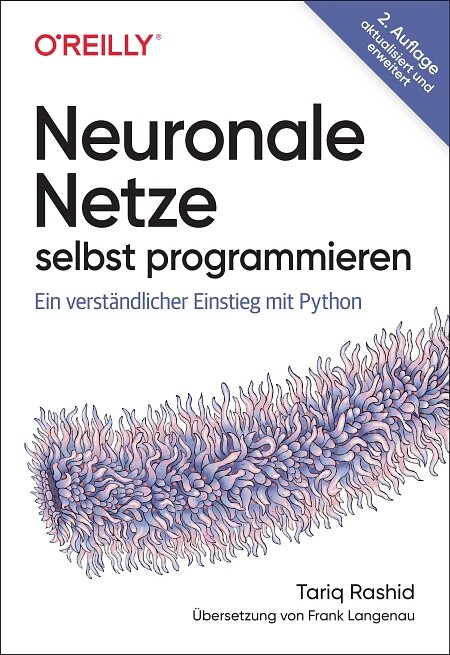
Neuronale Netze selbst programmieren (2. Auflage)
Neuronale Netze selbst programmieren. In 2., aktualisierter und erweiterter Auflage (erscheint Ende Juni)Neuronale Netze sind Schlüsselelemente des Deep Learning und der Künstlichen Intelligenz, die heute zu Erstaunlichem in der Lage sind. Dennoch verstehen nur wenige, wie Neuronale Netze tatsächlich funktionieren.Diese aktualisierte Neuauflage des Bestsellers nimmt Sie mit auf eine unterhaltsame Reise, die mit ganz einfachen Ideen beginnt und Ihnen Schritt für Schritt zeigt, wie Neuronale Netze arbeiten. Dafür brauchen Sie keine tieferen Mathematik-Kenntnisse, denn alle mathematischen Konzepte werden behutsam und mit vielen Illustrationen erläutert.Dann geht es in die Praxis: Sie programmieren Ihr eigenes Neuronales Netz mit Python und bringen ihm bei, handgeschriebene Zahlen zu erkennen, bis es eine optimale Performance erreicht. Zum Schluss erstellen Sie das Neuronale Netz mit PyTorch und lernen so eine professionelle Arbeitsumgebung kennen.Tariq Rashid hat eine besondere Fähigkeit, schwierige Konzepte verständlich zu erklären, dadurch werden Neuronale Netze für jeden Interessierten zugänglich und praktisch nachvollziehbar.Über den Autor:Tariq Rashid ist Physiker, hat einen Master in Machine Learning und Data Mining und leitet die Londoner Python-Meetup-Gruppe mit 3.000 Mitgliedern. Seine persönliche Mission ist es, spannende, aber komplexe technische Ideen besser zu vermitteln.Er hat eine besondere Gabe, schwierige Konzepte verständlich zu erklären. Dadurch werden neuronale Netze für alle technisch Interessierten zugänglich und praktisch nachvollziehbar.
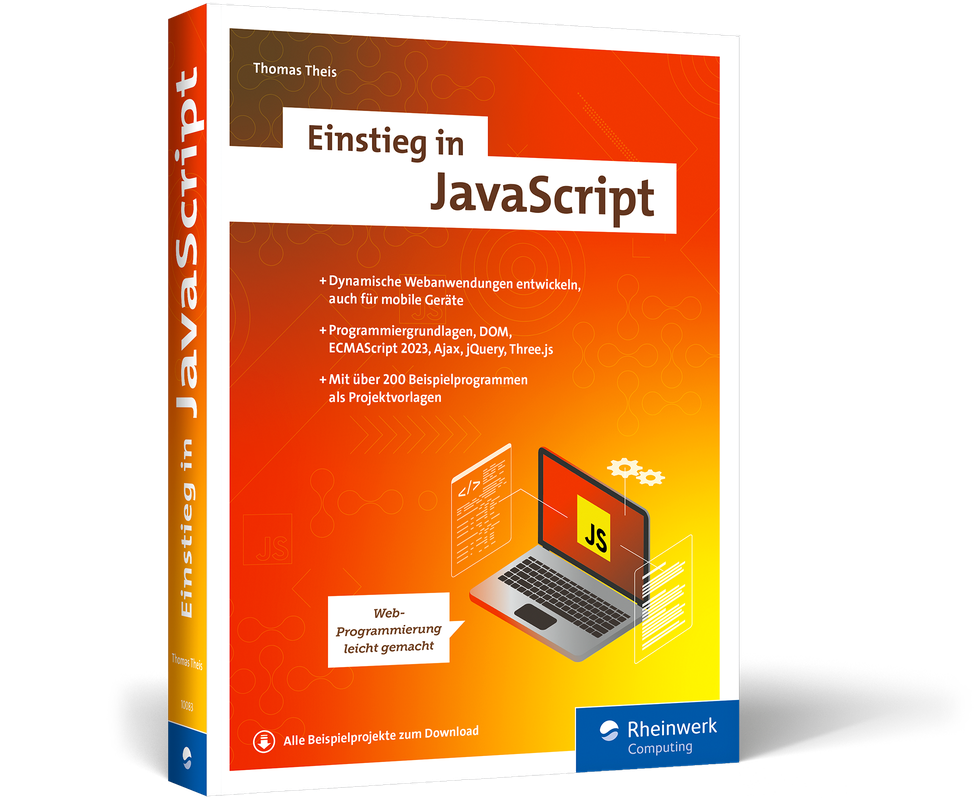
Einstieg in JavaScript (5. Auflg.)
Lernen Sie Schritt für Schritt die Grundlagen der modernen JavaScript-Programmierung. Das Buch führt Sie in alle relevanten Bereiche ein: HTML und CSS, Objekte, anonyme Funktionen, Ereignisbehandlung, jQuery und Ajax. Zahlreiche anschauliche Beispielanwendungen erleichtern das Verständnis und dienen Ihnen als Vorlage für Ihre eigenen Projekte. Schon bald entwickeln Sie anspruchsvolle interaktive Programme für Ihre eigene Website.JavaScript programmieren lernen1. Sprachgrundlagen JavaScriptSchritt für Schritt lernen Sie die Grundlagen der JavaScript-Programmierung. Von der ersten einfachen Textausgabe im Browser bis zur fertigen Anwendung – alles anhand anschaulicher Beispiele aus der Praxis.2. Interaktive und mobile Anwendungen entwickelnSie erfahren, wie Sie XML- und JSON-Daten mit dem Webserver austauschen, CSS-Eigenschaften ändern, Animationen erstellen und was JavaScript auf Smartphones, Tablets und Co. alles kann.3. Viele Beispielprogramme, auch als ProjektvorlagenFeiertagsrechner, Fitnesswerte oder lieber ein Spiel wie Memory oder Snake? Wählen Sie aus über 200 Beispielprojekten aus, wie Sie in JavaScript einsteigen. Erlernen Sie schrittweise den Aufbau der Anwendungen und nutzen Sie sie als Vorlage für eigene Erweiterungen.Aus dem Inhalt:JavaScript-Basics: Sprachgrundlagen, Objekte, Ereignisbehandlung, DOMSchneller Datenaustausch (Ajax)CSS mit JavaScript erweiternHTML-Eigenschaften nutzenBrowserunabhängige Methoden verwenden (jQuery)Dynamische Grafiken erstellenJavaScript für mobile AnwendungenWaytracking, Lage- und BeschleunigungssensorenÜber den Autor:Thomas Theis ist Dipl.-Ing. Technische Informatik. Als Softwareentwickler verfügt er über langjährige Erfahrung, ebenso wie als IT-Dozent unter anderem an der Fachhochschule Aachen; er leitet Programmier-Schulungen zu JavaScript, C/C++, PHP und C# und ist Autor vieler erfolgreicher Fachbücher.Leseprobe (PDF-Link)

Software Development, Design, and Coding
Learn the principles of good software design and then turn those principles into great code. This book introduces you to software engineering — from the application of engineering principles to the development of software. You'll see how to run a software development project, examine the different phases of a project, and learn how to design and implement programs that solve specific problems. This book is also about code construction — how to write great programs and make them work.This new third edition is revamped to reflect significant changes in the software development landscape with updated design and coding examples and figures. Extreme programming takes a backseat, making way for expanded coverage of the most crucial agile methodologies today: Scrum, Lean Software Development, Kanban, and Dark Scrum. Agile principles are revised to explore further functionalities of requirement gathering. The authors venture beyond imperative and object-oriented languages, exploring the realm of scripting languages in an expanded chapter on Code Construction. The Project Management Essentials chapter has been revamped and expanded to incorporate "SoftAware Development” to discuss the crucial interpersonal nature of joint software creation.Whether you're new to programming or have written hundreds of applications, in this book you'll re-examine what you already do, and you'll investigate ways to improve. Using the Java language, you'll look deeply into coding standards, debugging, unit testing, modularity, and other characteristics of good programs.YOU WILL LEARN* Modern agile methodologies* How to work on and with development teams* How to leverage the capabilities of modern computer systems with parallel programming* How to work with design patterns to exploit application development best practices* How to use modern tools for development, collaboration, and source code controlsWHO THIS BOOK IS FOREarly career software developers, or upper-level students in software engineering coursesJOHN F. DOOLEY is the William and Marilyn Ingersoll Professor Emeritus of Computer Science at Knox College in Galesburg, Illinois. Before returning to teaching in 2001, Professor Dooley spent more than 16 years in the software industry as a developer, designer, and manager working for companies such as Bell Telephone Laboratories, McDonnell Douglas, IBM, and Motorola, along with an obligatory stint as head of development at a software startup. He has written more than two dozen professional journal and conference publications and seven books to his credit, along with numerous presentations. He has been a reviewer for the Association for Computing Machinery Special Interest Group on Computer Science Education (SIGCSE) Technical Symposium for the last 36 years and reviews papers for the IEEE Transactions on Education, the journal Cryptologia, and other professional conferences. He has created short courses in software development and three separate Software Engineering courses at the advanced undergraduate level.DR. VERA A. KAZAKOVA is a Computer Science educator and researcher, with expertise in artificial intelligence, experiential learning, and collaborative methodologies. With a PhD in AI focused on nature-inspired computation and emergent division of labor, her research spans CS Education, Evolutionary Computation, Narrative Generation, Decentralized Multi-Agent Systems, and Cyber Social Science. Dr. Kazakova also has extensive experience as a CS educator, having taught programming, artificial intelligence, research, and software development courses. Dr. Kazakova has coined the term "Soft-Aware Development" to encapsulate a holistic approach for building software, building stakeholder relationships, and building up each developer along the way. An ardent proponent of experiential learning and agile methodologies, Dr. Kazakova champions a multi-sprint learning architecture that enables students to adapt and iterate, fostering a shared environment of continuous growth. Her passion for collaboration, from simplistic autonomous agents to human developers, and members of large online communities, sets her apart as an advocate for a more interconnected, empathetic, and empowering approach to CS research, education, and software development.Chapter 1: Introduction to Software Development.- PART ONE: MODELS AND TEAM PRACTICES.- Chapter 2: Software Process Models.- Chapter 3: Project Management Essentials.- Chapter 4: Ethics and Professional Practice.- Chapter 5: Intellectual Property, Obligations, and Ownership.- Chapter 6: Requirements.- PART TWO: DESIGN PRACTICES.- Chapter 7: Software Architecture.- Chapter 8: Design Principles.- Chapter 9: Structured Design.- Chapter 10: Object-Oriented Overview.- Chapter 11: Object-Oriented Analysis and Design.- Chapter 12: Object-Oriented Design Principles.- Chapter 13: Design Patterns.- Chapter 14:Parallel Programming.- Chapter 15:Parallel; Design Patterns.- PART THREE: CODING PRACTICES.- Chapter 16: Code Construction.- Chapter 17: Debugging.- Chapter 18: Unit Testing.- Chapter 19:P Code Reviews and Inspections.- Chapter 20: Wrapping It All Up.

Natürliche und künstliche Intelligenz
Dieses Sachbuch fasst die wissenschaftlichen Grundlagen der natürlichen und künstlichen Intelligenzsysteme zusammen und analysiert ihre Leistungen in einem kritischen Vergleich. Fachkenntnisse sind keine Voraussetzung. Nach einer Einführung in die Intelligenzforschung folgt die Beschreibung menschlicher und tierischer Intelligenz und deren neurobiologischen Grundlagen. Dieser natürlichen Intelligenz wird im Anschluss die künstliche Intelligenz gegenübergestellt, wobei die wichtigsten Grundprinzipien und die Entwicklung hin zu heutigen KI-Systemen betrachtet werden. Dies beinhaltet auch die wichtige Frage, inwiefern KI-Systeme vom Gehirn und dessen Arbeitsweisen lernen können und ob durch das „Nachbauen“ von Nervenzellenverbünden mit den sogenannten neuromorphen Chips vergleichbare Leistungen erreichbar sind oder sein werden. Ein besonderer Fokus liegt auf der kritischen Betrachtung und Einordnung der Fähigkeiten von KI-Systemen in Hinblick auf Denken und Handeln als eine selbstständige Entscheidungsinstanz. Letzteres wirft Fragen hinsichtlich moralischer Entscheidungen und des möglichen Kontrollverlusts über solche Systeme auf, die zurzeit nicht abschließend beantwortet werden können Einleitung.- Menschliche Intelligenz.- Intelligenzleistungen bei nichtmenschlichen Tieren.- Neurobiologische Grundlagen kognitiver Leistungen.- Künstliche Intelligenz.- Gehirne und KI – wer übertrifft wen worin?.- Wie geht unsere Gesellschaft mit den KI-Systemen um?.- Zusammenfassung und Ausblick.

Vermittlung von BIM in der Hochschullehre
Für das Bauwesen ist Building Information Modeling (BIM) ein wichtiger Impulsgeber für den stattfindenden Digitalisierungsprozess. Studierende der baurelevanten Fachdisziplinen müssen daher auf den sicheren Umgang mit dieser Methode vorbereitet werden. Das vorliegende Buch definiert die wichtigsten Lehrinhalte zur Vermittlung von Kenntnissen, Fertigkeiten und Kompetenzen zu BIM, die an deutschen HAWs in Baustudiengängen Berücksichtigung finden sollten. Neben den allgemeinen BIM-Lehrinhalten behandelt das Buch insbesondere die Umsetzung von BIM mit Beispielen aus verschiedenen Hochschulen.
Programming with GitHub Copilot
ACCELERATE YOUR PROGRAMMING WITH THE MOST POPULAR AI CODING TOOL ON THE MARKET: GITHUB COPILOTIn Programming with GitHub Copilot: Write Better Code — Faster, veteran software developer and GitHub community hero Kurt Dowswell delivers an insightful and hands-on exploration of GitHub's powerful, new AI coding assistant, Copilot. In the book, you'll discover how to use the tool's capabilities to push the boundaries of what you thought was possible in programming. Even if you've used autocomplete tools—like VS Code's TabNine extension—before, you'll be floored by GitHub Copilot's potential to transform the way you code. You'll learn how to install, configure, and use the software, from employing it's most common and widely used features to deploying business and enterprise functionality. You'll even discover how to fix runtime and compilation bugs and write unit, integration, and end-to-end tests. You'll also find:* Prompt strategies to get GitHub Copilot to help you brainstorm new code solutions* What the future looks like for AI-assisted coding, including discussions of issues like code licensing and ethics* Directions for chatting with Copilot, including common commands and prompts to help you guide the conversation to where you want it to goPerfect for practicing programmers, developers, and software engineers, Programming with GitHub Copilot is also an essential resource for coders and other IT practitioners-in-training who want to expand their knowledge and improve the scope and depth of their programming skillsets. KURT DOWSWELL is a software architect with over 13 years of experience delivering enterprise-grade software solutions for the Department of Defense. He is one of the first developers to work with GitHub Copilot and is a GitHub “community hero,” evangelizing the AI coding tool to the global developer community. Introduction xviiPART I GETTING STARTED WITH GITHUB COPILOT 1CHAPTER 1 GET STARTED WITH GITHUB COPILOT 3Learn Why GitHub Copilot Matters 4Create a GitHub Account 4Acquire a GitHub Copilot License 4Install an IDE Extension 5First Run: Test Copilot 10Conclusion 15Reference 15CHAPTER 2 DECODING GITHUB COPILOT 17Uncover the AI Behind GitHub Copilot 17Understand Security, Privacy, and Data Handling 18Understand Copyright Protections 20Explore the GitHub Copilot Trust Center 21Conclusion 22References 22PART II GITHUB COPILOT FEATURES IN ACTION 23CHAPTER 3 EXPLORING CODE COMPLETIONS 25Introducing Code Completions 25Working with Copilot Code Completions 26Discovering the Toolbar and Panel 34Updating Copilot Settings 36Leveraging Keyboard Shortcuts 38Conclusion 40CHAPTER 4 CHATTING WITH GITHUB COPILOT 41Discovering Copilot Chat 41Defining Prompt Engineering with Copilot Chat 48Commanding Your Conversation with Precision 52Conclusion 65PART III PRACTICAL APPLICATIONS OF GITHUB COPILOT 67CHAPTER 5 LEARNING A NEW PROGRAMMING LANGUAGE 69Introducing Language Education with Copilot 70Setting Up Your Development Environment 70Learning the Basics 72Creating a Console Application 74Explaining Code with Copilot 77Adding New Code 78Learning to Test 79Conclusion 85Reference 86CHAPTER 6 WRITING TESTS WITH COPILOT 87Establishing the Example Project 87Adding Unit Tests to Existing Code 89Exploring Behavior-Driven Development with Copilot 94Conclusion 99CHAPTER 7 DIAGNOSING AND RESOLVING BUGS 101Establishing the Example Project 101Fixing Syntax Errors 103Resolving Runtime Exceptions 105Resolving Terminal Errors 109Conclusion 111CHAPTER 8 CODE REFACTORING WITH COPILOT 113Introducing Code Refactoring with Copilot 113Establishing the Example Project 114Refactoring Duplicate Code 116Refactoring Validators 122Refactoring Bad Variable Names 127Documenting and Commenting Code 129Conclusion 132CHAPTER 9 ENHANCING CODE SECURITY 133Detailing Code Security 133Establishing the Example Project 134Exploring Code Security 135Finding and Fixing Security Issues 139Conclusion 142CHAPTER 10 ACCELERATING DEVSECOPS PRACTICES 143Detailing DevSecOps 143Simplifying Containers 144Automating Infrastructure as Code 148Streamlining CI/CD Pipelines 152Conclusion 158CHAPTER 11 ENHANCING DEVELOPMENT ENVIRONMENTS WITH COPILOT 159Amplifying Visual Studio with Copilot 159Elevating Azure Data Studio with Copilot 166Boosting JetBrains IntelliJ IDEA with Copilot 171Enhancing Neovim with Copilot 176Consulting Copilot in the GitHub cli 181References 185Conclusion 185CHAPTER 12 UNIVERSAL CONVERSION WITH GITHUB COPILOT 187Translating Natural Language to Programming Languages 188Converting JavaScript Components 190Simplifying CSS Styles 191Enhancing Nontyped Languages with Types 196Transitioning Between Frameworks and Libraries 199Converting Object-Oriented Languages 203Migrating Databases 205Transitioning CI/CD Platforms 206Modernizing Legacy Systems 209Conclusion 213Reference 214PART IV KEY INSIGHTS AND ADVANCED USE CASES FOR GITHUB COPILOT 215CHAPTER 13 CONSIDERING RESPONSIBLE AI WITH GITHUB COPILOT 217Introducing Responsible AI 217Examining How Copilot Implements Responsible AI 218Programming with AI Responsibly 226Conclusion 226References 227CHAPTER 14 AUGMENTING THE SOFTWARE DEVELOPMENT LIFE CYCLE WITH GITHUB COPILOT 229Introducing the SDLC 229Assessing the Adoption of AI in the SDLC 231Detailing Levels of AI Integration in the SDLC 232Showcasing GitHub Copilot in the SDLC 238Addressing Concerns: AI Adoption and the Future of Work 250Conclusion 251References 251CHAPTER 15 EXPLORING COPILOT BUSINESS AND ENTERPRISE 253Introducing Copilot Business and Enterprise 254Chatting with Copilot in GitHub.com 257Indexing Code Repositories to Improve Copilot’s Understanding 262Getting Better Answers with the Knowledge Base 267Leveraging Copilot Chat in Code Repository Files 273Enhancing Pull Requests with Copilot 279Managing GitHub Copilot 288Looking Ahead 292Conclusion 293References 293Conclusion 295APPENDIX RESOURCES FOR FURTHER LEARNING 297GitHub Copilot Overview and Subscription Plans 297Community Engagement and Support 299Legal and Ethical Considerations 299Research and Insights 300Glossary 303Index 311

Data Privacy in der Praxis
Bewährte Praktiken zur Verbesserung von Privacy für Daten aus technischer, organisatorischer und rechtlicher Sicht - Das Buch zeigt, wie Sie dafür sorgen, dass die Daten in Ihrem Projekt privat, anonymisiert und sicher sind - Auf den europäischen Markt zugeschnitten, behandelt die DSGVO eingehend - Umfasst auch Themen wie ChatGPT und Deep Fakes - Katharine Jarmul ist eine renommierte Privacy-Spezialistin. Sie arbeitet für Thoughtworks und ist Mitgründerin der PyLadies Die Anforderungen an den Datenschutz sind in Daten- und KI-Projekten heute so hoch wie nie. Die Integration von Privacy in Datensysteme ist jedoch nach wie vor komplex. Dieser Leitfaden vermittelt Data Scientists und Data Engineers ein grundlegendes Verständnis von modernen Datenschutzbausteinen wie Differential Privacy, Federated Learning und homomorpher Verschlüsselung. Privacy-Spezialistin Katharine Jarmul zeigt Best Practices und gibt praxiserprobte Ratschläge für den Einsatz bahnbrechender Technologien zur Verbesserung des Datenschutzes in Produktivsystemen. Das Buch beantwortet diese wichtigen Fragen: - Wie wirken sich Datenschutzbestimmungen wie die DSGVO oder der California Consumer Privacy Act (CCPA) auf meine Datenworkflows und Data-Science- Anwendungen aus? - Was ist unter »anonymisierten Daten« zu verstehen und wie lassen sich Daten anonymisieren? - Wie funktionieren Federated Learning und Federated Analysis? - Homomorphe Verschlüsselung klingt großartig – doch ist sie auch anwendungsreif? - Wie kann ich datenschutzwahrende Technologien und Verfahren miteinander vergleichen, um die für mich beste Wahl zu treffen? Welche Open-Source-Bibliotheken stehen hierfür zur Verfügung? - Wie stelle ich sicher, dass meine Data-Science-Projekte von vornherein geschützt und sicher sind? - Wie kann ich mit den für Governance und Informationssicherheit verantwortlichen Teams zusammenarbeiten, um interne Richtlinien in geeigneter Weise umzusetzen?
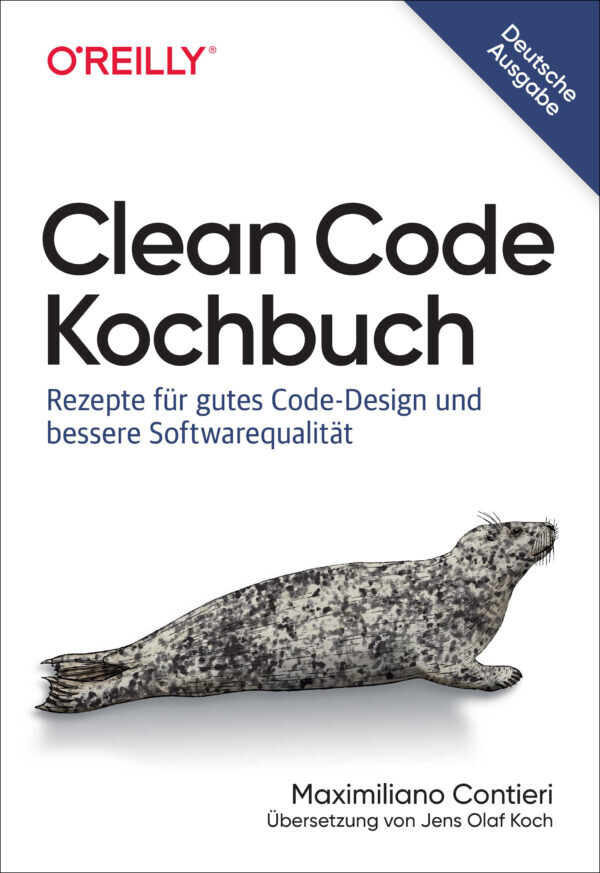
Clean Code Kochbuch
Clean Code Kochbuch. Rezepte für gutes Code Design und bessere Softwarequalität. In 1. Auflage (erscheint Ende Juni 2024)Code Smells erkennen und mithilfe inspirierender Rezepte beseitigenSoftware-Engineers und -Architekten, die mit großen, komplexen Code-Basen arbeiten, müssen diese skalieren und effektiv pflegen. In seinem Kochbuch geht Maximiliano Contieri über das Konzept des Clean Code hinaus: Er demonstriert, wie Sie Verbesserungsmöglichkeiten identifizieren und lernen, deren Auswirkungen auf den Produktionscode zu bewerten. Wenn es um Zuverlässigkeit und die Entwicklungsfähigkeit eines Systems geht, bieten diese Techniken Vorteile, die sich auf Dauer auszahlen werden.Anhand von Beispielen in JavaScript, PHP, Python, Java und vielen anderen Programmiersprachen bietet dieses Kochbuch bewährte Rezepte, die Sie bei der Skalierung und Wartung großer Systeme unterstützen. Jeder Teil behandelt grundlegende Konzepte wie Lesbarkeit, Kopplung, Testbarkeit, Sicherheit und Erweiterbarkeit sowie Code-Smells und Rezepte zu deren Beseitigung.Über den Autor: Maximiliano Contieri ist seit 25 Jahren in der Softwarebranche tätig und arbeitet gleichzeitig als Hochschullehrer. Im Laufe der Jahre war er ein eifriger Autor auf verschiedenen bekannten Blogging-Plattformen und veröffentlichte jede Woche mehrere Artikel zu einer Vielzahl von Themen wie Clean Code, Refactoring, Softwaredesign, testgetriebene Entwicklung und Code Smells.

Neuronale Netze selbst programmieren
Neuronale Netze und Grundlagen der Künstlichen Intelligenz verständlich dargestellt - Der Bestseller hat Furore gemacht, weil der Autor diese sowohl trockene als auch schwierige Materie außergewöhnlich klar erklärt. - Neu in der vollständig aktualisierten 2. Auflage: Das neuronale Netz wird abschließend mit PyTorch erstellt, um es in ein typisches professionelles Szenario zu überführen. - Neuronale Netze sind Grundlage vieler Anwendungen im Alltag wie Spracherkennung, Gesichtserkennung auf Fotos, das selbstfahrende Auto, Umwandlung von Sprache in Text etc. Neuronale Netze sind Schlüsselelemente des Deep Learning und der künstlichen Intelligenz, die heute zu Erstaunlichem in der Lage sind. Sie sind Grundlage vieler Anwendungen im Alltag wie beispielsweise Spracherkennung, Gesichtserkennung auf Fotos oder die Umwandlung von Sprache in Text. Dennoch verstehen nur wenige, wie neuronale Netze tatsächlich funktionieren. Dieser Bestseller, jetzt in erweiterter 2. Auflage, nimmt Sie mit auf eine unterhaltsame Reise, die mit ganz einfachen Ideen beginnt und Ihnen Schritt für Schritt zeigt, wie neuronale Netze arbeiten: - Zunächst lernen Sie die mathematischen Konzepte kennen, die den neuronalen Netzen zugrunde liegen. Dafür brauchen Sie keine tieferen Mathematikkenntnisse, denn alle mathematischen Ideen werden behutsam und mit vielen Illustrationen erläutert. Eine Kurzeinführung in die Analysis unterstützt Sie dabei. - Dann geht es in die Praxis: Nach einer Einführung in die populäre und leicht zu lernende Programmiersprache Python bauen Sie allmählich Ihr eigenes neuronales Netz mit Python auf. Sie bringen ihm bei, handgeschriebene Zahlen zu erkennen, bis es eine Performance wie ein professionell entwickeltes Netz erreicht. - Im nächsten Schritt verbessern Sie die Leistung Ihres neuronalen Netzes so weit, dass es eine Zahlenerkennung von 98 % erreicht – nur mit einfachen Ideen und simplem Code. Sie testen das Netz mit Ihrer eigenen Handschrift und werfen noch einen Blick in das mysteriöse Innere eines neuronalen Netzes. - Neu in der 2. Auflage: Sie erstellen das neuronale Netz abschließend mit PyTorch und überführen es damit in ein typisches professionelles Szenario.

Learn Java Fundamentals
Sharpen your Java skills and boost your potential as an IT specialist. This book introduces you to the basic Java features and APIs needed to prepare for a career in programming and development.You’ll first receive an introduction to Java and then explore language features ranging from comments though exception/error handling, focusing mainly on language syntax and a few select syntax-related APIs. This constitutes the heart of the book, and you’ll use these building blocks to construct simple Java programs, and learn where Java’s implementations of expressions (and operators), and statements diverge from other languages. The final few chapters tour some additional APIs such as the Math class, related types, String and StringBuffer, and System.Along the way you’ll discover some interesting programs, such as Graph (a sine/cosine wave-plotting application) and WC (a word-counting application). Two appendixes provide quick references to Java’s supported reserved words, and to Java’s supported operators. Equipped with this knowledge, _Learn Java Fundamentals_ will provide you the pathway to explore additional APIs on your own, and increase your Java awareness.WHAT YOU’LL LEARN* Understand the basics of Java applications and APIs* Study language features such as comments, identifiers, variables, types, and literals.* Explore operators, expressions, statements, and other key features such as classes, objects, class extension, and class abstraction.WHO THIS BOOK IS FORDevelopers, programmers, and students with little or no Java experienceJEFF FRIESEN is a freelance teacher and software developer with an emphasis on Java. In addition to authoring several books on Java and Android for Apress such as _Java I/O, NIO, and NIO.2_ _Java Threads and the Concurrency Utilities_, Jeff has written numerous articles on Java and other technologies for JavaWorld, informIT, Java.net, SitePoint, and other web sites. Jeff can be contacted via his web site at JavaJeff.ca or via LinkedIn (JavaJeff)Chapter 1: Getting Started with Java.- Chapter 2: Comments, Identifiers, Types, Variables, and Literals.- Chapter 3: Expressions.- Chapter 4: Statements.- Chapter 5: Arrays.- Chapter 6: Classes and Objects.- Chapter 7: Reusing Classes via Inheritance and Composition.- Chapter 8: Changing Type via Polymorphism.- Chapter 9: Static, Non-Static, Local, and Anonymous Classes.- Chapter 10: Packages.- Chapter 11: Exceptions and Errors.- Chapter 12: Math, BigDecimal, and BigInteger.- Chapter 13: String and StringBuffer.- Chapter 14: System.- Appendix A: Reserved Words Quick Reference.- Appendix B: Operators Quick Reference.

Deep Learning Techniques for Automation and Industrial Applications
THIS BOOK PROVIDES STATE-OF-THE-ART APPROACHES TO DEEP LEARNING IN AREAS OF DETECTION AND PREDICTION, AS WELL AS FUTURE FRAMEWORK DEVELOPMENT, BUILDING SERVICE SYSTEMS AND ANALYTICAL ASPECTS IN WHICH ARTIFICIAL NEURAL NETWORKS, FUZZY LOGIC, GENETIC ALGORITHMS, AND HYBRID MECHANISMS ARE USED.Deep learning algorithms and techniques are found to be useful in various areas, such as automatic machine translation, automatic handwriting generation, visual recognition, fraud detection, and detecting developmental delays in children. “Deep Learning Techniques for Automation and Industrial Applications” presents a concise introduction to the recent advances in this field of artificial intelligence (AI). The broad-ranging discussion covers the algorithms and applications in AI, reasoning, machine learning, neural networks, reinforcement learning, and their applications in various domains like agriculture, manufacturing, and healthcare. Applying deep learning techniques or algorithms successfully in these areas requires a concerted effort, fostering integrative research between experts from diverse disciplines from data science to visualization. This book provides state-of-the-art approaches to deep learning covering detection and prediction, as well as future framework development, building service systems, and analytical aspects. For all these topics, various approaches to deep learning, such as artificial neural networks, fuzzy logic, genetic algorithms, and hybrid mechanisms, are explained. AUDIENCEThe book will be useful to researchers and industry engineers working in information technology, data analytics network security, and manufacturing. Graduate and upper-level undergraduate students in advanced modeling and simulation courses will find this book very useful. PRAMOD SINGH RATHORE is an assistant professor in the Department of Computer and Communication Engineering, Manipal University Jaipur, India. He has teaching experience of more than 10 years and has 45 publications in peer-reviewed national and international journals. SACHIN AHUJA, PHD, is a professor in the Department of Computer Science, Chandigarh University, Punjab, India. He has guided several ME and PhD scholars in artificial intelligence, machine learning, and data mining. SRINIVASA RAO BURRI is a senior software engineering manager at Western Union, Denver, Colorado. He completed an MS degree in software development from Boston University. He also has received his certifications in Data Science and Machine Learning from Stanford University, Harvard University and Johns Hopkins University. He started his career as a test automation architect in 2004, and has since worked as a leader for many Fortune 500 Organizations advising them on global compliance, data privatization, cloud migration, and AI & ML. He has published multiple articles in international journals. AJAY KHUNTETA, PHD, is a dean and professor of computer science and engineering, Poornima University, Jaipur, Rajasthan, India. His research focuses on AI, machine learning, and distributing systems. He has published more than 100 articles in international and national journals and guided 44 M.Tech projects. ANUPAM BALIYAN, PHD, is Dean of Academic Planning and Research, Galgotias University, India. His research focuses on artificial intelligence, computer networks, computer vision, and machine learning. Along with being a chair and keynote speaker at international conferences, Baliyan has guided more than 20 M.Tech projects and theses. ABHISHEK KUMAR, PHD, is an associate professor in the Faculty of Engineering, Manipal University, Jaipur, Rajasthan, India and is currently a Post-Doctoral Fellow in Ingenium Research Group Lab, Universidad De Castilla- La Mancha, Ciudad Real, Spain. He has more than 170 publications in peer-reviewed national and international journals and conferences. Preface xiii1 Text Extraction from Images Using Tesseract 1Santosh Kumar, Nilesh Kumar Sharma, Mridul Sharma and Nikita Agrawal2 Chili Leaf Classification Using Deep Learning Techniques 19Chenchupalli Chathurya, Diksha Sachdeva and Mamta Arora3 Fruit Leaf Classification Using Transfer Learning Techniques 31Taha Siddiqui, Surbhit Chopra and Mamta Arora4 Classification of University of California (UC), Merced Land-Use Dataset Remote Sensing Images Using Pre-Trained Deep Learning Models 45Abhishek Maurya, Akashdeep and Rohit Kumar5 Sarcastic and Phony Contents Detection in Social Media Hindi Tweets 69Surbhi Sharma and Nisheeth Joshi6 Removal of Haze from Synthetic and Real Scenes Using Deep Learning and Other AI Techniques 85Pushpa Koranga, Ravindra Singh Koranga, Sumitra Singar and Sandeep Gupta7 HOG and Haar Feature Extraction-Based Security System for Face Detection and Counting 99Prachi Soni and Viplav Soni8 A Comparative Analysis of Different CNN Models for Spatial Domain Steganalysis 109Ankita Gupta, Rita Chhikara and Prabha Sharma9 Making Invisible Bluewater Visible Using Machine and Deep Learning Techniques--A Review 129Dineshkumar Singh and Vishnu Sharma10 Fruit Leaf Classification Using Transfer Learning for Automation and Industrial Applications 151Inam Ul Haq, Gursimran Kaur and Adil Husain Rather11 Green AI: Carbon-Footprint Decoupling System 179Bindiya Jain and Shikha Sharma12 Review of State-of-Art Techniques for Political Polarization from Social Media Network 199Akshita Bhatnagar and B.K. Sharma13 Collaborative Design and Case Analysis of Mobile Shopping Apps: A Deep Learning Approach 223Santosh Kumar, Vipul Jain, Abhishek Bairwa and Pradeep Saharan14 Exploring the Potential of Machine Learning and Deep Learning for COVID-19 Detection 235Saimul Bashir, Faisal Firdous and Syed Zoofa RufaiReferences 253Index 257

CSS Grid Layout
Welcome to "CSS Grid Layout". In this book you will learn all about the CSS grid layout model and how to create complex and responsive grid-based designs. You will learn about all the properties of grid containers and grid elements. By the end of this book, you will be able to use the grid layout to create responsive layouts and handle all kinds of scenarios. Let’s get started. Hello, I am Abdelfattah Ragab, a professional software developer with more than 20 years of experience. I am an expert in Angular, CSS, graphic design and all web related technologies. I have published numerous books on modern CSS layouts and Angular as well as complete business solutions for e-commerce and the like. I hope you enjoy my books. With kind regards.

CSS Flexbox Layout
Welcome to "CSS Flexbox Layout". In this book, we will explore the flexbox layout model, explain the properties of containers and elements, and learn how to create modern and responsive web designs. Hello, I am Abdelfattah Ragab, a professional software developer with more than 20 years of experience. I am an expert in Angular, CSS, graphic design and all web related technologies. I have published numerous books on modern CSS layouts and Angular as well as complete business solutions for e-commerce and the like. I hope you enjoy my books. With kind regards.

CSS Multi-Column Layout
Welcome to "CSS Multi-Column Layout". In this book, you'll learn how to use the Multi-Column Layout module to create elegant and responsive multi-column layouts used in newspapers and magazines. Hello, I am Abdelfattah Ragab, a professional software developer with more than 20 years of experience. I am an expert in Angular, CSS, graphic design and all web related technologies. I have published numerous books on modern CSS layouts and Angular as well as complete business solutions for e-commerce and the like. I hope you enjoy my books. With kind regards.

CSS Typography and Web Fonts
In this book "CSS Typography and Web Fonts" we explore the CSS typography properties that control font sizes, line heights, letter spacing and more... Hello, I am Abdelfattah Ragab, a professional software developer with more than 20 years of experience. I am an expert in Angular, CSS, graphic design and all web related technologies. I have published numerous books on modern CSS layouts and Angular as well as complete business solutions for e-commerce and the like. I hope you enjoy my books. With kind regards.

CSS Box Model and Layouts
In this book "CSS Box Model and Layouts" we will explore the properties of the box model that determine the size, spacing and positioning of elements so that you can precisely control the structure of your website. Hello, I am Abdelfattah Ragab, a professional software developer with more than 20 years of experience. I am an expert in Angular, CSS, graphic design and all web related technologies. I have published numerous books on modern CSS layouts and Angular as well as complete business solutions for e-commerce and the like. I hope you enjoy my books. With kind regards.

CSS Selectors and Specificity
In this book "CSS Selectors and Specificity" we will learn about the different types of selectors, from simple element selectors to advanced attribute selectors and pseudo-classes. We will understand how specificity and cascading work and how to write CSS rules that deliver predictable and desired results. Hello, I am Abdelfattah Ragab, a professional software developer with more than 20 years of experience. I am an expert in Angular, CSS, graphic design and all web related technologies. I have published numerous books on modern CSS layouts and Angular as well as complete business solutions for e-commerce and the like. I hope you enjoy my books. With kind regards.

CISSP For Dummies
SHOWCASE YOUR SECURITY EXPERTISE WITH THE HIGHLY REGARDED CISSP CERTIFICATIONThe CISSP certification, held by more than 150,000 security professionals worldwide, is the gold standard of cybersecurity certifications. The CISSP Exam certifies cybersecurity professionals and opens doors for career advancement. Fully updated and revised to reflect the 2024 ISC2 CISSP Exam Outline, CISSP For Dummies is packed with helpful content for all eight security domains. This book includes access to online study tools such as practice questions and digital flashcards, boosting your likelihood of success on the exam. Plus, you'll feel prepared and ready for test day thanks to a 60-day study plan. Boost your security career with this Dummies study guide.* Review all the content covered in the latest CISSP Exam* Test with confidence and achieve your certification as a cybersecurity professional* Study smarter, thanks to online practice resources and a 60-day study plan* Enhance your career with the in-demand CISSP certification* Continue advancing your career and the profession through speaking and mentoring opportunitiesWith up-to-date content and valuable test prep features, this book is a one-and-done resource for any cybersecurity professional studying for the CISSP exam. LAWRENCE C. MILLER, CISSP, is a Navy veteran, information security professional, and author of more than 250 For Dummies books. PETER H. GREGORY, CISSP, is a seasoned For Dummies author, as well as a security, risk, and technology director with experience in SaaS, retail, telecommunications, non-profit, manufacturing, healthcare, and beyond. Introduction 1PART 1: GETTING STARTED WITH CISSP CERTIFICATION 7CHAPTER 1: ISC2 and the CISSP Certification 9CHAPTER 2: Putting Your Certification to Good Use 23PART 2: CERTIFICATION DOMAINS 43CHAPTER 3: Security and Risk Management 45CHAPTER 4: Asset Security 141CHAPTER 5: Security Architecture and Engineering 167CHAPTER 6: Communication and Network Security 269CHAPTER 7: Identity and Access Management 323CHAPTER 8: Security Assessment and Testing 365CHAPTER 9: Security Operations 395CHAPTER 10: Software Development Security 459PART 3: THE PART OF TENS 493CHAPTER 11: Ten Ways to Prepare for the Exam 495CHAPTER 12: Ten Test-Day Tips 501Glossary 505Index 561

Artificial Intelligence and Machine Learning in Drug Design and Development
THE BOOK IS A COMPREHENSIVE GUIDE THAT EXPLORES THE USE OF ARTIFICIAL INTELLIGENCE AND MACHINE LEARNING IN DRUG DISCOVERY AND DEVELOPMENT COVERING A RANGE OF TOPICS, INCLUDING THE USE OF MOLECULAR MODELING, DOCKING, IDENTIFYING TARGETS, SELECTING COMPOUNDS, AND OPTIMIZING DRUGS.The intersection of Artificial Intelligence (AI) and Machine Learning (ML) within the field of drug design and development represents a pivotal moment in the history of healthcare and pharmaceuticals. The remarkable synergy between cutting-edge technology and the life sciences has ushered in a new era of possibilities, offering unprecedented opportunities, formidable challenges, and a tantalizing glimpse into the future of medicine. AI can be applied to all the key areas of the pharmaceutical industry, such as drug discovery and development, drug repurposing, and improving productivity within a short period. Contemporary methods have shown promising results in facilitating the discovery of drugs to target different diseases. Moreover, AI helps in predicting the efficacy and safety of molecules and gives researchers a much broader chemical pallet for the selection of the best molecules for drug testing and delivery. In this context, drug repurposing is another important topic where AI can have a substantial impact. With the vast amount of clinical and pharmaceutical data available to date, AI algorithms find suitable drugs that can be repurposed for alternative use in medicine. This book is a comprehensive exploration of this dynamic and rapidly evolving field. In an era where precision and efficiency are paramount in drug discovery, AI and ML have emerged as transformative tools, reshaping the way we identify, design, and develop pharmaceuticals. This book is a testament to the profound impact these technologies have had and will continue to have on the pharmaceutical industry, healthcare, and ultimately, patient well-being. The editors of this volume have assembled a distinguished group of experts, researchers, and thought leaders from both the AI, ML, and pharmaceutical domains. Their collective knowledge and insights illuminate the multifaceted landscape of AI and ML in drug design and development, offering a roadmap for navigating its complexities and harnessing its potential. In each section, readers will find a rich tapestry of knowledge, case studies, and expert opinions, providing a 360-degree view of AI and ML’s role in drug design and development. Whether you are a researcher, scientist, industry professional, policymaker, or simply curious about the future of medicine, this book offers 19 state-of-the-art chapters providing valuable insights and a compass to navigate the exciting journey ahead. AUDIENCEThe book is a valuable resource for a wide range of professionals in the pharmaceutical and allied industries including researchers, scientists, engineers, and laboratory workers in the field of drug discovery and development, who want to learn about the latest techniques in machine learning and AI, as well as information technology professionals who are interested in the application of machine learning and artificial intelligence in drug development. ABHIRUP KHANNA is an accomplished professional currently working as an assistant professor at the University of Petroleum and Energy Studies, Dehradun, India. He is an alumnus of The University of Melbourne, Australia. He has authored two books and numerous research publications in the areas of AI, blockchain technology, Internet of Things, and Cloud Computing for international journals and conferences. His research profile demonstrates his commitment to pushing the boundaries of AI and blockchain technology and his potential to drive transformative changes in these fields. MAY EL BARACHI, PHD, is the Director of Computer Science & IT Programs at the University of Wollongong in Dubai, UAE. An Egyptian-Canadian computer scientist, and smart technology expert with degrees in telecom, engineering, computer engineering, and computer science, Dr. El Barachi holds leadership roles in teaching/learning and research. In her current role, she defines the research strategy for the faculty and ensures that the right ecosystem is established for conducting high-impact research. SAPNA JAIN, PHD, is an assistant professor at the University of Petroleum and Energy Studies, Dehradun, India. She has earned her PhD in ‘Synthesis of novel bioactive compounds’ from Delhi University. She has published various research papers in renowned national and international journals, as well as two patents concerning the application of a synergistic combination of synthetic and natural products as an antifungal agent. MANOJ KUMAR, PHD, is an associate professor at the University of Wollongong in Dubai, UAE as well as the Research Head for Network and Cyber Security Cluster at the university. He obtained his PhD from The Northcap University, Haryana, India. Dr. Kumar has more than 14 years of research, teaching, and corporate experience, and has published more than 175 research articles in international refereed journals and conferences. ANAND NAYYAR, PHD, obtained his doctorate from Desh Bhagat University, Punjab, India in 2017 and is currently an assistant professor at the School of Computer Science, Duy Tan University, Viet Nam. He is also the Vice-Chairman of Research and Director of the IoT and Intelligent Systems Lab at Duy Tan University. He has published more than 180 research articles in international refereed journals, 50 books, and has 100+ patents to his credit. He has more than 12,000 citations on Google Scholar. Preface xxi1 The Rise of Intelligent Machines: An Introduction to Artificial Intelligence 1Shamik Tiwari2 Introduction to Bioinformatics 23Bancha Yingngam3 Exploring the Intersection of Biology and Computing: Road Ahead to Bioinformatics 67Ahmed Mateen Buttar, Muhammad Nouman Arshad and Anand Nayyar4 Machine Learning in Drug Discovery: Methods, Applications, and Challenges 93Geetha Mani and Gokulakrishnan Jayakumar5 Artificial Intelligence for Understanding Mechanisms of Antimicrobial Resistance and Antimicrobial Discovery: A New Age Model for Translational Research 117Yashaswi Dutta Gupta and Suman Bhandary6 Artificial Intelligence-Powered Molecular Docking: A Promising Tool for Rational Drug Design 157Nabajit Kumar Borah, Yukti Tripathi, Aastha Tanwar, Deeksha Tiwari, Aditi Sinha, Shailja Sharma, Neetu Jabalia, Ruchi Jakhmola Mani, Seneha Santoshi and Hina Bansal7 Revolutionizing Drug Discovery: The Role of AI and Machine Learning in Accelerating Medicinal Advancements 189Anu Sayal, Janhvi Jha, Chaithra N., Atharv Rajesh Gangodkar and Shaziya Banu S.8 Data Processing Method for AI-Driven Predictive Models or CNS Drug Discovery 223Ajantha Devi Vairamani, Sudipta Adhikary and Kaushik Banerjee9 Machine Learning Applications for Drug Repurposing 251Bancha Yingngam10 Personalized Drug Treatment: Transforming Healthcare with AI 295Abhirup Khanna and Sapna Jain11 Process and Applications of Structure-Based Drug Design 321Shanmuga Sundari M., Sree Aiswarya Thotakura, Mounika Dharmana, Priyanka Gadela and Mayukha Mandya Ammangatambu12 AI-Based Personalized Drug Treatment 369Shanmuga Sundari M., Harshini Reddy Penthala, Akshita Mogullapalli and Mayukha Mandya Ammangatambu13 AI Models for Biopharmaceutical Property Prediction 407Bancha Yingngam14 Deep Learning Tactics for Neuroimaging Genomics Investigations in Alzheimer's Disease 451Mithun Singh Rajput, Jigna Shah, Viral Patel, Nitin Singh Rajput and Dileep Kumar15 Artificial Intelligence Techniques in the Classification and Screening of Compounds in Computer-Aided Drug Design (CADD) Process 473Raghunath Satpathy16 Empowering Clinical Decision Making: An In-Depth Systematic Review of AI-Driven Scoring Approaches for Liver Transplantation Prediction 499Devi Rajeev, Remya S. and Anand Nayyar17 Pushing Boundaries: The Landscape of AI-Driven Drug Discovery and Development with Insights Into Regulatory Aspects 533Dipak D. Gadade, Deepak A. Kulkarni, Ravi Raj, Swapnil G. Patil and Anuj Modi18 Feasibility of AI and Robotics in Indian Healthcare: A Narrative Analysis 563Rahul Joshi and Rhythma Badola19 The Future of Healthcare: AIoMT--Redefining Healthcare with Advanced Artificial Intelligence and Machine Learning Techniques 605Wasswa ShafikReferences 628Index 635
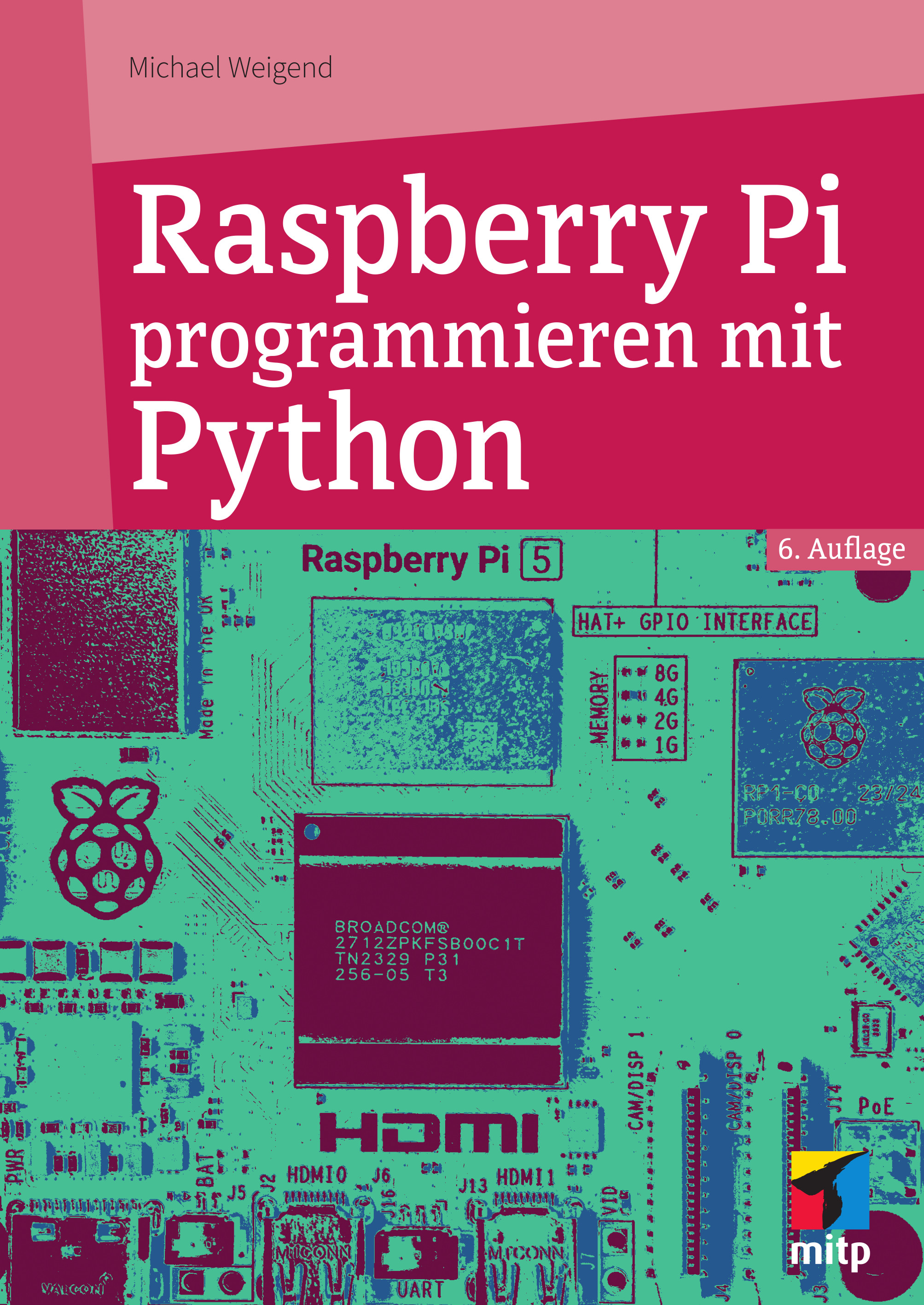
Raspberry Pi programmieren mit Python (6. Auflg.)
Raspberry Pi – der Mini-Computer zum ExperimentierenDer Raspberry Pi ist ein preiswerter Computer in der Größe einer Kreditkarte. In Kombination mit der Programmiersprache Python bietet er eine hervorragende Umgebung für die schnelle Realisierung technischer Ideen und Projekte. In diesem Buch lernen Sie alle Grundlagen, die Sie brauchen, um mit dem Raspberry Pi oder dem Raspberry Pi Zero spannende Projekte zu realisieren.Zahlreiche Projekte mit Sensoren, Kamera u.v.m.Sie finden in diesem Buch eine Fülle von kleinen Projekten, die auf die besondere Hardware des Raspberry Pi und das Linux-Betriebssystem Raspberry Pi OS zugeschnitten sind. Dazu gehören sowohl Schaltungen mit Sensoren (Temperatur, Licht, Alkohol), Relais, AD-Wandlern und LEDs als auch die Verwendung des Kameramoduls und des 1-Wire- sowie SPI-Bus zur Datenkommunikation. Zahlreiche Illustrationen und einfache Beispiele zum Ausprobieren erleichtern das Verständnis.Die Programmiersprache Python als GrundlagePython ist – auch für Programmiereinsteiger – einfach zu lernen und deshalb Teil des Gesamtkonzepts des Raspberry Pi. Dieses Buch vermittelt Ihnen anhand anschaulicher Beispiele sowohl die Grundlagen von Python als auch fortgeschrittene Techniken wie Objektorientierung, Internetprogrammierung und grafische Benutzungsoberflächen. Am Ende jedes Kapitels finden Sie Aufgaben mit Lösungen zum Download, mit denen Sie Ihr Wissen festigen, erweitern und vertiefen können.Aus dem Inhalt:GerätesteuerungMesswerterfassung und -visualisierungInteraktive Spiele mit Schaltern und SensorenAnimationen und SimulationenAutomatische TextproduktionDigitale BildverarbeitungMorsezeichen senden und Signalmuster erkennenProjekte mit dem Sense HATFarben und Bewegung wahrnehmenSteuerung mit Potentiometer und AD-WandlerAuswertung von Daten aus dem InternetWebserver und Webcam Über den Autor:Michael Weigend hat an der Universität Potsdam in Informatik promoviert. Er war für mehr als 30 Jahre als Lehrer tätig und hat 20 Jahre lang an der FernUniversität Hagen Seminare zur Didaktik der Informatik gegeben. An der Universität Münster hält er im Rahmen eines Lehrauftrags Vorlesungen zur Python-Programmierung. Michael Weigend engagiert sich in mehreren nationalen und internationalen Communities für den Computer-Einsatz in der Bildung, darunter Constructionism, International Federation for Information Processing (TC 3 Computers in Education) , Bebras – International Contest on Informatics and Computational Thinking. Er hat über 60 wissenschaftliche Artikel veröffentlicht und mehrere Bücher zu den Themen Programmierung, Web Development und visuelle Modellierung geschrieben.Leseprobe (PDF-Link)

No Social Media!
Haderst du mit Social Media? Kosten sie dich nur Zeit, Geld und Mühe, ohne spürbaren Erfolg für dein Unternehmen? Würdest du lieber auf eine Social-Media-Präsenz verzichten, hast aber Angst, ohne sie nicht erfolgreich zu sein? Dieses Buch hilft dir, dich für oder gegen Social Media zu entscheiden. Alexandra Polunin zeigt, dass der Einsatz sozialer Medien wohlüberlegt sein will und definitiv kein Muss für jedes Unternehmen ist. Früher selbst Social-Media-Beraterin, hat sich die Autorin zur „Aussteigerin“ gewandelt und wirbt für einen maßvollen Einsatz der Plattformen. Sie zeigt wirkungsvolle Alternativen, wie die eigene Website, Blogs, SEO, Newsletter, Podcasts oder auch klassisches E-Mail-Marketing, mit denen Selbstständige und Unternehmen erfolgreich Marketing betreiben können. So gelingt dein Online-Marketing auch ohne Social Media.Erfolgreich ohne Social Media!1. Social Media – ja oder nein?Wenn du den Einsatz von Social Media im Marketing kritisch siehst und unsicher bist, ob du auf sie verzichten solltest oder nicht, findest du hier wichtige Argumente, um eine informierte Entscheidung zu treffen.2. Kein Social Media? Kein Problem!Auch ohne Instagram, Facebook & Co. kann dein Online-Marketing erfolgreich sein. Die Autorin zeigt dir, wie du effektive Alternativen findest und diese in einer durchdachten Strategie einsetzt.3. So gelingt der Ausstieg!Ein Ausstieg aus Social Media muss kein Manko sein, sondern kann zu einem echten Wettbewerbsvorteil werden. Hier erfährst du praxisnah und Schritt für Schritt, wie ein Ausstieg umgesetzt werden kann.Aus dem Inhalt:Social-Media-Marketing – ja oder nein?Chancen, Vorteile, MöglichkeitenNachteile, Risiken, GefahrenEine EntscheidungshilfeOnline-Marketing-Strategie entwickelnCustomer Journey ohne Social MediaWelche Alternativen gibt es?Marketing ohne Social MediaWie gelingt der Ausstieg?Über den Autor:Alexandra Polunin (alexandrapolunin.com) war nach ihrem Studium der Germanistik und Philosophie mehrere Jahre als Beraterin für Pinterest-Marketing tätig, bevor sie 2020 genug von Likes, Reels und Selfies hatte und Social Media den Rücken kehrte. Seitdem unterstützt sie Selbstständige dabei, ohne soziale Medien online sichtbar zu werden und Kund*innen zu gewinnen. Ihr Herz schlägt für wertebasiertes, ethisches Marketing – am liebsten mithilfe von Website, Blog und Newsletter.Leseprobe (PDF-Link)

PKI und CA in Windows-Netzwerken (3. Auflg.)
Wie der Aufbau einer sicheren Public Key Infrastructure mit dem Windows Server gelingt, zeigt Ihnen Peter Kloep in diesem Handbuch mit umfassenden Anleitungen, Hintergrundinformationen und Tipps aus der Praxis. Das Buch liefert Ihnen alle Schritte von der Planung der CA bis zum Ablauf oder Widerruf der Zertifikate und betrachtet damit die gesamte Lebenszeit der Infrastruktur. Lernen Sie, wie Sie für Sicherheit in Ihrem Netzwerk sorgen, indem Sie WLAN- und VPN-Zugangspunkte schützen, BitLocker, S/MIME sowie IPSec einsetzen und Zertifizierungsstellen für Mail- und Webserver konfigurieren.Umfassende Sicherheit, kompetent erklärt1. Einrichtung und GrundlagenErfahren Sie, wie eine Public Key Infrastructure aufgebaut wird und was bei der Einrichtung der Zertifizierungsstelle zu beachten ist. Hintergrundinfos zu Verschlüsselungsalgorithmen und Signaturen führen zum sicheren Umgang mit den anspruchsvollen Features.2. Vereinfachen Sie die AdministrationSorgen Sie für weniger Kopfschmerzen bei der Planung Ihrer Infrastruktur: Sie lernen, wie Zertifikatsvorlagen verwaltet, Schlüssel archiviert und Funktionstests durchgeführt werden. So haben Sie die Komponenten sicher im Griff.3. Integration in Ihr NetzwerkErstellen Sie Zertifikate für Domaincontroller, den WLAN- und VPN-Zugriff sowie Web- und Mailserver. Nutzen Sie zudem Sicherheitstechniken wie BitLocker, IPSec und S/MIME kompetent in Ihrem Unternehmensnetzwerk.Aus dem Inhalt:Grundlagen: Public Key Infrastructure und Certificate AuthorityWas ist eine PKI, wozu wird sie verwendet, aus welchen Komponenten besteht sie?Verschlüsselung vs. Signatur, Algorithmen, Gültigkeit eines Zertifikats prüfenAufbau der Infrastruktur einer Windows-Zertifizierungsstelle: notwendige Parameter und Rahmenbedingungen für eine CA-InstallationInstallation und Konfiguration einer mehrstufigen Windows CA-InfrastrukturVerwalten von Zertifikatsvorlagen, Konfiguration der Schlüsselarchivierung, FunktionstestsEinsatz einer Windows CA-Infrastruktur im UnternehmenZertifikate für Domaincontroller, WLAN- und VPN-Zugriff, BitLocker, IPSec, Web- und Mailserver, S/MIME, Codesignaturen, RegistrierungsagentenSmartcards zur Zweifaktor-AuthentifizierungWartung einer Windows-Zertifizierungsstellen-Infrastruktur. Erneuern von ZertifikatenBackup und RecoveryMigration und Monitoring der ZertifizierungsstelleÜber den Autor:Peter Kloep ist ein herausragender Experte für sichere Windows-Infrastrukturen im deutschsprachigen Raum. Seit 2002 ist er Microsoft Certified Trainer und hat seitdem zahlreiche technische Trainings zur Windows-Administration durchgeführt. Außerdem ist er Microsoft Certified Systems Engineer und Microsoft Certified Solutions Expert – Windows Server 2012.Er war bei Microsoft als Premier Field Engineer tätig und unterstützte dort Premier-Kunden in den Bereichen Identity Management und Security. Er kennt daher die in diesem Buch beschriebenen Fragestellungen aus der Praxis, ist mit den Ansprüchen der Unternehmen vertraut und geht gezielt auf potentielle Fallstricke und Probleme ein.Leseprobe (PDF-Link)