

Software

Simulation with Python
Understand the theory and implementation of simulation. This book covers simulation topics from a scenario-driven approach using Python and rich visualizations and tabulations.The book discusses simulation used in the natural and social sciences and with simulations taken from the top algorithms used in the industry today. The authors use an engaging approach that mixes mathematics and programming experiments with beginning-intermediate level Python code to create an immersive learning experience that is cohesive and integrated.After reading this book, you will have an understanding of simulation used in natural sciences, engineering, and social sciences using Python.WHAT YOU'LL LEARN* Use Python and numerical computation to demonstrate the power of simulation* Choose a paradigm to run a simulation* Draw statistical insights from numerical experiments* Know how simulation is used to solve real-world problemsWHO THIS BOOK IS FOREntry-level to mid-level Python developers from various backgrounds, including backend developers, academic research programmers, data scientists, and machine learning engineers. The book is also useful to high school students and college undergraduates and graduates with STEM backgrounds.RON LI is a long-term and enthusiastic educator. He has been a researcher, data science instructor, and business intelligence engineer. Ron published a highly rated (4.5-star rating out of 5 on amazon) book titled Essential Statistics for Non-STEM Data Analysts. He has also authored/co-authored academic papers, taught (pro bono) data science to non-STEM professionals, and gives talks at conferences such as PyData.AIICHIRO NAKANO is a Professor of Computer Science with joint appointments in Physics & Astronomy, Chemical Engineering & Materials Science, Biological Sciences, and at the Collaboratory for Advanced Computing and Simulations at the University of Southern California. He received a PhD in physics from the University of Tokyo, Japan, in 1989. He has authored more than 360 refereed articles in the areas of scalable scientific algorithms, massive data visualization and analysis, and computational materials science.Chapter 1: Calculating Pi and Beyond: Searching Order in Disorder with Simulation [30]Description: The beginning chapter will use Monte Carlo simulation as a topic to introduce some fundamental concepts in simulation.Topics to be covered:1. Simulating Pi2. The goat problem and uniform sampling3. How to properly set a simulation environmentChapter 2: Markov Chain: A Peek into the Future [20]Description: Markov chain simulation will be introduced from both probabilistic perspective and matrix multiplication perspective.Topics to be covered:1. How to predict weather?2. The transition matrix and stability states3. Markov chain Monte Carlo simulationChapter 3: Multi-Armed Bandits: Probability Simulation and Bayesian Statistics [30]Description: Classical multi-armed bandits’ model will be introduced to continue the probabilistic perspective of the previous chapter. In addition, Bayesian statistics will be introduced.Topics to be covered:1. Introduction to multi-armed bandit2. Greedy versus explorative strategies3. The interpretation of a Bayesian statistician.Chapter 4: Balls in 2D Box: A Simplest Physics Engine [20]Description: This chapter is mainly about event-driven simulation. It is not about simulation in the time space but in the event space.Topics to be covered:1. Introduce the physics laws that govern motion2. Use event-driven paradigm to build a physics engine3. More realistic simulation with frictionChapter 5: Percolation: Threshold and Phase Change [25]Description: Phase changing is an important physics behavior for systems near critical boundaries. We are going to simulate critical behaviors using percolation as examples.Topics to be covered:1. The concept of percolation and2. Why dimension matters: 1D percolation and 2D percolation3. 3D percolation and even higher dimensionsChapter 6: Queuing System: How Stock Trades are Made [30]Description: As the first example in the business world, concepts in queuing systems are introduced and the simulation using basic data structures like queue and deque will be carried out.Topics to be covered:1. Basic data structures in Python2. Microstructure of trading3. Simulating tradingChapter 7: Rock, Scissor and Paper: Multi-Agent Simulation[30]Description: Sometimes we want to simulate a system with multiple agents acting on their own behalf. In this chapter, we are going to run a multi-agent simulation and test the performance of different competing strategies in such a scenario.Topics to be covered:1. Characteristics of multi-agent system2. Baseline strategies3. Analyzing nontrivial strategiesChapter 8: Matthew Effect and Tax Policy: Why the Rich Keeps Getting Richer[30]Description: Differential equation is an important field of study that governs a big group of phenomena. In this chapter, we are going to study it with a very relevant topic: wealth distribution in modern society.Topics to be covered:1. Introduction of differential equations2. Matthew effect and ROI3. How tax policy can gauge social wealth distributionChapter 9: Misinformation Spreading: Simulation on a Graph (Centrality, Networkx)[30]Description: Network simulation is another important domain. Nowadays social media like Twitter, Facebook and reddit can be easily modelled as a network. We will cover a simple simulation to study how misinformation can spread in a network and how we can fight against it.Topics to be covered:1. Concepts of a network2. Simulate misinformation spreading in a directed network3. How to fight misinformation (or suppress freedom of expression)Chapter 10: Simulated Annealing and Genetic Algorithm [30]Description: There are two simulation algorithms widely used in research and industry that mimic natural phenomena. We are going to use them to solve two real world problems and explain the origin of their power.Topics to be covered:4. Simulated Annealing Basics5. Use Simulated Annealing to solve an optimization problem6. Genetic Algorithm7. Use Genetic algorithm to solve an optimization problem

Digital Dictionary
"DIGITAL AGE", "DIGITAL SOCIETY", "DIGITAL CIVILIZATION": MANY EXPRESSIONS ARE USED TO DESCRIBE THE MAJOR CULTURAL TRANSFORMATION OF OUR CONTEMPORARY SOCIETIES.Digital Dictionary presents the multiple facets of this phenomenon, which was born of computers and continues to permeate all human activity as it progresses at a rapid pace. In this multidisciplinary work, experts, academics and practitioners invite us to discover the digital world from various technological and societal perspectives.In this book, citizens, trainers, political leaders or association members, students and users will find a base of knowledge that will allow them to update their understanding and become stakeholders in current societal changes.MARIE CAULI is an anthropologist and professor emeritus at the University of Artois in Arras, France. Her current work explores health, development, training and digital issues.LAURENCE FAVIER is a professor of information and communication sciences at the University of Lille, France. Her current work focuses on the organization of knowledge, archives in the digital age and the digital transformation of the state.JEAN-YVES JEANNAS works at the University of Lille, France. He is an expert in the European working group DigComp, vice-president of the AFUL and a member of the CNIL's national "Digital Education" group.Introduction xiMarie CAULI, Laurence FAVIER and Jean-Yves JEANNASA 1Accessibility 1Nathalie PinèdeAgricultural Robotics 4Philippe Le GuernAnthropology 10Marie CauliArt and Robotics 14Philippe Le GuernArtificial Intelligence 18Jean-Michel LoubesB 23Between Digital Transformation and Cultural Evolution 23Ilham Mekrami-GuggenheimBlockchain 25Jean-Paul DelahayeBrain-Computer Interfaces 28Frédéric Dehais and Fabien LotteC 33Coding 33Nicolas PettiauxCommunication 35Serge TisseronCommunity 37Edwige PierotComputer 40Laurent BlochComputer Science 42Jean-Pierre ArchambaultComputer Security 47Gérard BerryContributory Economy 50François ElieContributory Governance 55Michel BriandCourse Guidance 58Francis DanversCritical Thinking (Education for) 61Marie CauliCrowdsourcing 65Laurence FavierD 69Data Economy 69Bruno DeffainsData, Information, Knowledge 73Serge AbiteboulDigital Commons 76Sébastien ShulzDigital Humanities 79Joana CasenaveDigital Inclusion 83Vincent MeyerDigital Skills Repositories 87Jean-Yves JeannasDigital Sovereignty 90François PellegriniDigital Transition 94Vincent MeyerDisability 98Nathalie PinèdeDiversity 101Samia GhozlaneE 105Eco-digital Responsibility 105Jean-Yves Jeannas and Marie CauliEducational Digital Technology 109Valèse Mapto KengneElectronic Voting 113Chantal EnguehardEmpathy 118Serge TisseronEthics 121Gilles DowekF 125File Formats 125Jean-Yves JeannasFormal Language 128Gilles DowekFree and Open Source Software 132Jean-Yves JeannasFree Licenses 135Jean-Yves JeannasFree Software (in French National Education) 139Jean-Pierre ArchambaultH 145Habitele 145Dominique BoullierHacking 148Éric ZuffereyHealth Data 151Marie CauliHuman-system 155Julien Cegarra and Jordan NavarroI 161Indexing 161Ismaïl TimimiInformation Ethics 164Widad Mustafa El HadiInnovation 170Serge Miranda and Manel GuechtouliInteroperability 174Fabrice PapyIntimacy/extimacy 176Serge TisseronIT (in General Education) 179Jacques BaudéIT (Teaching of) 183Jean-Pierre ArchambaultJ 187Jim Gray's Paradigm 187Serge Miranda and Manel GuechtouliK 191Knowledge Organization 191Widad Mustafa El HadiL 197Law (Professions of -) 197Christophe MondouLethal Autonomous Weapon Systems 201Thierry Berthier and Gérard de BoisboisselLibrary 206Laure Delrue and Julien RocheM 211Medical Imaging 211Marie Cauli and Jean-Pierre PruvoMedicine, Health 216Marie Cauli and Jean-Pierre PruvomHealth 220Bruno BoidinMilitary Robotics 224Thierry Berthier and Gérard de BoisboisselMobiquity 229Serge Miranda and Manel GuechtouliMOOCs 231Serge Miranda and Manel GuechtouliMuseums 234Corinne BaujardO 239Open Science (Dissemination) 239Julien RocheOpen Science (Origins) 243Julien RocheP 247Predictive Justice 247Bruno DeffainsProcessors 251Laurent BlochProprietary Licenses 255Juliette SénéchalR 261Rob'Autisme 261Sophie SakkaRob'Éduc 264Sophie SakkaRobotics and Society 267Sophie SakkaRouting 269Laurent BlochS 275Science Fiction 275Guy ThuillierSeniors (the Internet) 279Aline Chevalier and Mylène SanchizSmart City 283Ornella ZazaSocial Contract 287Bruno DeffainsSocial Network 291Zhenfei FengSociotics 293Vincent MeyerSource Code 297Roberto Di CosmoSurveillance Capitalism 300Christophe MasuttiSurveillance Studies 303Christophe MasuttiT 309Training 309Samia GhozlaneW 313Web 2.0 313Zhenfei FengWork 316Sarah Abdelnour and Dominique MédaGlossary 321List of Authors 329Index 333
Teach Yourself VISUALLY Excel 365
EXCEL-ERATE YOUR EXCEL 365 KNOWLEDGE WITH THE CELEBRATED TEACH YOURSELF VISUALLY SERIESIn Teach Yourself VISUALLY: Excel 365, veteran tech educator and writer Paul McFedries delivers a practical, step-by-step guide to using the latest version of the world’s most popular spreadsheet app. The book is filled with easy two-page lessons containing large-size screenshots and walkthroughs demonstrating common and useful tasks in Excel 365. You’ll learn how to present, analyze, visualize, and organize your data, as well as how to:* Create and fill spreadsheets, charts, tables, and PivotTables* Filter and sort your data, use and create formulas, and organize your information* Visualize your data with a variety of effective charts, graphs, and moreA can’t-miss handbook perfect for anyone looking for straightforward and easy-to-follow tutorials on basic and advanced Excel techniques, Teach Yourself VISUALLY: Excel 365 offers users of previous Excel versions—and complete Excel newbies—a clear roadmap to mastering Excel. CHAPTER 1 GETTING STARTED WITH EXCELGetting to Know Excel 4Start Excel on the Desktop 6Navigate to Excel for the Web 7Tour the Excel Window 8Work with the Excel Ribbon 9CHAPTER 2 ENTERING DATALearning the Layout of a Worksheet 12Understanding the Types of Data You Can Use 13Enter Text into a Cell 14Enter a Number into a Cell 16Enter a Date or Time into a Cell 18Edit Cell Data 20Delete Data from a Cell 22CHAPTER 3 WORKING WITH RANGESSelect a Range 26Fill a Range with the Same Data 28Fill a Range with a Series of Values 30Flash Fill a Range 32Move or Copy a Range 34Insert a Row or Column 36Insert a Cell or Range 38Delete Data from a Range 40Delete a Range 42Hide a Row or Column 44Freeze Rows or Columns 46Merge Two or More Cells 48CHAPTER 4 WORKING WITH RANGE NAMESUnderstanding the Benefits of Using Range Names 52Define a Range Name 54Using Worksheet Text to Define a Range Name 56Navigate a Workbook Using Range Names 58Change a Range Name 60Delete a Range Name 62CHAPTER 5 FORMATTING EXCEL RANGESChange the Font and Font Size 66Apply Font Effects 68Change the Font Color 70Align Text Within a Cell 72Center Text Across Multiple Columns 74Rotate Text Within a Cell 76Add a Background Color to a Range 78Apply a Number Format 80Change the Number of Decimal Places Displayed 82Apply a Conditional Format to a Range 84Apply a Style to a Range 86Change the Column Width 88Change the Row Height 90Wrap Text Within a Cell 92Add Borders to a Range 94Copy Formatting from One Cell to Another 96CHAPTER 6 BUILDING FORMULASUnderstanding Excel Formulas 100Build a Formula 102Understanding Excel Functions 104Add a Function to a Formula 106Add a Range of Numbers 108Build an AutoSum Formula 110Add a Range Name to a Formula 112Reference Another Worksheet Range in a Formula 114Move or Copy a Formula 116Switch to Absolute Cell References 118Troubleshoot Formula Errors 120CHAPTER 7 MANIPULATING WORKSHEETSNavigate a Worksheet 124Rename a Worksheet 125Create a New Worksheet 126Move a Worksheet 128Copy a Worksheet 130Delete a Worksheet 132Zoom In on or Out of a Worksheet 134Split a Worksheet into Two Panes 136Hide and Unhide a Worksheet 138CHAPTER 8 DEALING WITH WORKBOOKSCreate a New Blank Workbook 142Create a New Workbook from a Template 144Save a Workbook 146Open a Workbook 147Find Text in a Workbook 148Replace Text in a Workbook 150CHAPTER 9 FORMATTING WORKBOOKSModify the Workbook Colors 154Set the Workbook Fonts 156Choose Workbook Effects 158Apply a Workbook Theme 160Add a Workbook Header 162Add a Workbook Footer 164CHAPTER 10 IMPORTING DATA INTO EXCELUnderstanding External Data 168Import Data from an Access Table 170Import Data from a Word Table 172Import Data from a Text File 174Import Data from a Web Page 176Import Data from an XML File 178Refresh Imported Data 180Separate Cell Text into Columns 182CHAPTER 11 WORKING WITH TABLESUnderstanding Tables 186Get to Know Table Features 187Convert a Range to a Table 188Select Table Data 190Insert a Table Row 192Insert a Table Column 193Delete a Table Row 194Delete a Table Column 195Add a Column Subtotal 196Convert a Table to a Range 198Apply a Table Style 199CHAPTER 12 ANALYZING WITH PIVOTTABLESUnderstanding PivotTables 202Explore PivotTable Features 203Build a PivotTable from an Excel Range or Table 204Refresh PivotTable Data 206Add Multiple Fields to the Row or Column Area 208Add Multiple Fields to the Data Area 210Move a Field to a Different Area 212Group PivotTable Values 214Apply a PivotTable Filter 216CHAPTER 13 ANALYZING DATASort a Range or Table 220Filter a Range or Table 222Set Data Validation Rules 224Create a Data Table 226Summarize Data with Subtotals 228Group Related Data 230Analyze Data with Goal Seek 232Highlight Cells That Meet Some Criteria 234Highlight the Top or Bottom Values in a Range 236Analyze Cell Values with Data Bars 238Analyze Cell Values with Color Scales 240Analyze Cell Values with Icon Sets 242CHAPTER 14 VISUALIZING DATA WITH CHARTSExamine Chart Elements 246Understanding Chart Types 247Create a Chart 248Create a Recommended Chart 250Add Chart Titles 252Add Data Labels 253Position the Chart Legend 254Display Chart Gridlines 255Display a Data Table 256Change the Chart Layout and Style 257Select a Different Chart Type 258Change the Chart Source Data 260Move or Resize a Chart 262CHAPTER 15 ADDING WORKSHEET GRAPHICSDraw a Shape 266Insert an Online Image 268Insert a Photo from Your PC 270Insert a SmartArt Graphic 272Move or Resize a Graphic 274Format a Picture 276CHAPTER 16 COLLABORATING WITH OTHERSAdd a Comment to a Cell 280Protect a Worksheet’s Data 282Protect a Workbook’s Structure 284Save a Workbook to Your OneDrive 286Send a Workbook as an Email Attachment 288Save Excel Data as a Web Page 290Make a Workbook Compatible with Earlier Versions of Excel 292Mark Up a Worksheet with Digital Ink 294Collaborate on a Workbook Online 296Index 298

Netzwerke mit Windows 11 - für Zuhause und Selbstständige
- Der Ratgeber zum smarten Vernetzen mehrerer Geräte- Problemlösungen und Tricks für den reibungslosen BetriebEin "gut geöltes" Windows 11-Heimnetzwerk macht das Leben sowohl auf privater als auch beruflicher Ebene einfacher. Dieses Buch zeigt, wie Sie mehrere Computer, Drucker, Smartphones und weitere WLAN-kompatible Geräte zu einer funktionalen Einheit verbinden. So werden Zugriffe untereinander, der Austausch von Daten oder Medien und das gemeinsame Arbeiten an Dokumenten zum Kinderspiel. Lernen Sie, wie Sie Ihren WLAN-Router – z. B. die FRITZ!Box – als zentralen Knotenpunkt einrichten und bei Bedarf über das Heimnetz hinaus für Fernzugriffe konfigurieren. Zudem erfahren Sie alles über WLAN Access Points, NAS, VPN, Freigaben, relevante Netzwerkprotokolle und vieles hilfreiches mehr. Christian Immler kennt alle Kniffe, Schwachstellen und versteckten Einstellmöglichkeiten im Netz mit Windows 11. Mit anschaulichen Anleitungen, Beispielen und Praxistipps zeigt er systematisch, wie Sie jedes Problem identifizieren und schnell in den Griff bekommen.Aus dem Inhalt:- Anforderungen an das Heimnetzwerk- FRITZ!Box: die Zentrale im Netzwerk- WLAN konfigurieren und optimieren- Neue Geräte ins Heimnetz integrieren- Benutzer- und Druckerfreigaben einrichten- Datenaustausch über Cloud-Speicher- NAS-Laufwerke im Netzwerk einbinden- Datenaustausch und -synchronisation- Medienstreaming im Heimnetzwerk- OneDrive, Dropbox, MagentaCLOUD & Co.- Netzwerk für Homeoffice & Freiberufler- Per VPN-Verbindung ins Firmennetz- Chats mit Kollegen über MS Teams- Videokonferenzen mit Zoom- Lösungen für häufige NetzwerkproblemeDer Autor:Christian Immler war viele Jahre als Dozent für Computer Aided Design an der Fachhochschule Nienburg und an der University of Brighton tätig. Seit mehr als 25 Jahren befasst er sich als erfolgreicher Autor mit Spezialthemen wie 3-D-Visualisierung, Smartphone-Betriebssysteme, Linux und Windows. Seine Leser schätzen seine Fähigkeit, selbst die kompliziertesten Sachverhalte anschaulich und gut nachvollziehbar zu erklären.

Pragmatic Python Programming
Explore the world of programming languages through Python and learn the building blocks of writing programs. This book covers Python 3.10, explaining it through six key concepts. Each chapter contains a real-world example with practical advice and a section on advanced concepts.You'll start by reviewing the concept of expressions and functions, which are two of the core building blocks of programming languages. You'll then move on to object-oriented concepts to help gain a practical understanding of Python, along with a chapter on control flow constructs. The book also takes a close look at sequences, explaining constructs and additional types, and wraps up with a chapter on modules, focusing on how to use and create packages.Whether you’re new to programming or already an experienced developer, upon finishing this book, you will have a solid understanding of Python's state-of-the-art development features.WHAT YOU WILL LEARN* Study the six main concepts of the programming languages* Learn how to use programming language constructs through examples* Review the core Python language notations and concepts.* Start using Python as a working languageWHO THIS BOOK IS FORSoftware developers wanting to gain professional core Python knowledge quickly, and non-developers wanting to gain an understanding of programming concepts.Gabor Guta has studied and researched at Research Institute for Symbolic Computation, Johannes Kepler University, Linz to gain an understanding of the formal meaning of programming languages. He worked on complex technology transfer and cheminformatics projects where both strong theoretical background and practical software development skills were crucial. Currently, he is developing distributed software for bioinformatics and system biology projects. Beside his software development work, he has been continuously training people both in academic and industrial settings. He has been actively teaching Python since 2017. CHAPTER 1: EXPRESSION- Explains expression as the first key concept of a programming language.1.1. What is an expression?1.2. Expressions containing different types1.3. Variable names1.4. Statements1.5. Deleting variable names1.6. Further language constructs1.7. Expressions and statements in practice1.8. References:CHAPTER 2: FUNCTION- Explains function as the second most important building block.2.1. What is a function?2.2. Calling functions2.3. Functions with side effects2.4. Function parameters2.5. Defining functions2.6. Referencing to variable and function names2.7. Function as parameter2.8. Embedded function definitions2.9. Function in practice2.10. ReferencesCHAPTER 3: CLASS- Explains object-oriented concepts as everything is an object in Python.3.1. What is object-oriented programming?3.2. What is a class?3.3. Creating objects3.4. Using attributes and methods3.5. Defining classes3.6. Connection between classes3.7. Properties3.8. Inheritance3.9. Embedded classes3.10. Special methods3.11. Classes in practice3.12. ReferencesCHAPTER 4. CONTROL FLOW- Explains what control flow constructs and everything related to it (exceptions,recursion, etc.)4.1. What is control flow?4.2. Conditional statement4.3. Condition-controlled loops4.4. Count-controlled loops4.5. Exception handling4.6. Context management4.7. ReferencesCHAPTER 5: SEQUENCE- Explains the list like constructs and additional container types.5.1. What is a sequence?5.2. List and its operations5.3. List comprehension5.4. Tuples5.5. Dictionaries5.6. Sets5.7. ReferencesCHAPTER 6: MODULE- Explains how to use and create packages.6.1. What is a module?6.2. Built-in modules6.3. Create your own modules6.4. Packages6.5. Package management6.6. Interesting third party packages6.7. References

Bitcoin für Dummies
Bitcoin bieten Ihnen neue Möglichkeiten, wie Sie Ihr Geld anlegen und grundlegende Transaktionen im Zahlungsverkehr durchführen können. Der erste Schritt in die Welt der Kryptowährungen kann jedoch verwirrend und einschüchternd sein. Dieses Buch ist Ihre Orientierungshilfe: Peter Kent und Tyler Bain erklären Ihnen die technischen Hintergründe und zeigen Ihnen, wie Sie Bitcoin kaufen, eine Wallet erstellen und mit Bitcoin bezahlen. Außerdem erfahren Sie, was Sie bei der Investition in Bitcoin beachten müssen und wie Sie sich vor Betrügern schützen.Peter Kent ist langjähriger Tech-Autor, der hauptberuflich Online-Unternehmen aufbaut und entwickelt. Tyler Bain ist Elektroingenieur mit Schwerpunkt Stromnetze und außerdem zertifizierter Bitcoin Professional. Er vertraut der Widerstandsfähigkeit der Blockchain und weiß alles über Mining-Mechanik.

Penetration Tester werden für Dummies
Pentests sind für Unternehmen unverzichtbar geworden, denn nur wer die Schwachstellen kennt, kann auch dagegen vorgehen. Robert Shimonski erklärt Ihnen in diesem Buch alles, was Sie brauchen, um selbst Pentests durchzuführen. Von den nötigen Vorbereitungen über Risikoanalyse und rechtliche Belange bis hin zur eigentlichen Durchführung und späteren Auswertung ist alles dabei. Versetzen Sie sich in Hacker hinein und lernen Sie, wo Unternehmen angreifbar sind. Werden Sie selbst zum Penetration Tester.Autor:Robert Shimonski ist Leiter des Service-Managements bei Northwell Health und ein erfahrener Autor. Er hat bereits über 20 Bücher geschrieben. Seine Themen reichen von Penetration Testing über Netzwerksicherheit bis hin zu digitaler Kriegsführung.Leseprobe (PDF-Link)

Objektivierung des subjektiven Insassenempfindens bei längsdynamischen Beschleunigungsmanövern
Um Frontloading bei einer Fahrbarkeitsapplikation von Fahrzeugantrieben zu unterstützen, werden Zielwerte benötigt, die das subjektive Empfinden der Insassen beschreiben. Am Beispiel von Volllastbeschleunigungen stellt Marco Schlüter eine Methode vor, die es ermöglicht, das Insassenempfinden zu prognostizieren. Auf Grundlage von Messungen an realen Fahrzeugen definiert der Autor einen Untersuchungsraum. Im Stuttgarter Fahrsimulator macht er Varianten von Beschleunigungsmanövern erlebbar, die in einer Probandenstudie bewertet werden. Hieraus leitet er eine Metrik zur Objektivierung des Empfindens ab. Abschließend validiert Schlüter diese Metrik in realen Versuchsfahrten. Entwicklung einer Methode zur Objektivierung des Insassenempfindens.- Anwendung der Methode mit Hilfe des Stuttgarter Fahrsimulators.- Validierung mit Hilfe eines elektrisch angetriebenen Fahrzeugs.
Create an Enterprise-Level Test Automation Framework with Appium
Think from a framework design perspective and move beyond straightforward coding skills. You’ll design an enterprise level test framework that is capable of supporting both TDD and BDD at the same time, using the latest open source tools and coding best practices. Taking a less-is-more approach, superfluous information is excised in favor of sleek and direct instruction and focused coding practices.Your framework will be built with Spring-Boot, Gradle, and Junit. And it will support HP QC integration, Allure (TDD, BDD), Extent (BDD), and customized Pdf reporting (TDD, BDD). Extensive utilities are provided, such as HP ALM integration, device management utilities, email reporting, pdf reporting, OCR utility, Log utility, and more! There’s also a special chapter on internationalization/localization testing in multiple languages. After reading this book, you’ll have full confidence in your ability to build new test automation frameworks for yourself.Though primarily written for software professionals who are in test automation, recent engineering graduates who have programming knowledge and want to prepare for a role in mobile test automation will also find what’s taught here helpful. Test engineers and computer science graduates alike can use what they learn here to become absolute pros in test automation.WHAT YOU'LL LEARN* Design an enterprise level mobile test automation framework capable of supporting both TDD and BDD* Work with the latest open source tools and coding best practices* Build with Spring-Boot, Gradle, and Junit while supporting HP QC integration, Allure, Extent, and customized PDF reportingWHO THIS BOOK IS FORSoftware professionals working in test automation. Recent engineering graduates who have programming knowledge and want to prepare for a role in mobile test automation should also find it helpful.KOUSHIK DAS is an Automation Architect with over 18 years of experience in software development, manual testing, and test automation. He has built automation frameworks for mobile, web, and desktop applications using a variety of tools. Koushik believes in leveraging the power of test automation whenever possible and has recently published a book to help mobile test automation engineers graduate to an architect role. When not testing software, Koushik likes reading, traveling, and playing with his baby daughter.IntroductionChapter 1: Automation Framework OverviewFramework Technology StackFramework Key FeaturesScripting Strategy FollowedAutomation Coding Standards FollowedChapter 2: Creating the Wireframes with Spring-BootBootstrapping with Spring-BootOpening Your Project in IntelliJIntelliJ PluginsDeciding on your Folder StructureChapter 3: Configuring GradlePreparing build.gradlePreparing gradle.propertiesCreating Annotations for Gradle TasksPreparing settings.gradleChapter 4: Creating the Properties FilesCreating Your Properties FilesReading from Properties File with Spring-Boot LibraryReading from Properties File Traditional WayChapter 5: Creating Android, iOS and Web Drivers On DemandCreating Driver with Standard Desired CapabilitiesCreating Driver with Default ServiceCreating Drivers for Grid or Cloud ExecutionQuitting Driver and TeardownChapter 6: Enhancing Framework – Common Mobile ActionsCreating VariablesCoding for Common Screen ActionsChapter 7: Creating Page ObjectsInitializing Page Objects and Workflow ClassDeciding on Locator StrategyWriting Page Object MethodsChapter 8: Writing Your First Test SuiteUsing Various AnnotationsWriting Soft AssertionsPlugging in the Reporting ModuleRunning Test Suite in GradleChapter 9: Importing Test Data From Excel, XML or Other FormatsImporting Test Data from ExcelImporting Test Data From XML and Other FormatsChapter 10: Adding BDD Capabilities with CucumberUsing Spring Runner with CucumberGenerating ExtentReport in Runner ClassWriting Step DefinitionsRunning Test Suite in GradleChapter 11: Adding Allure Reporting for TDD and BDDGenerating Allure ReportViewing Allure ReportChapter 12: Making Extent Report Better and Workable with JunitMaking Extent Report Work with JUnitImproving Extent Report to Print Data-TablesCreating Separate Extent Report for each Test-SuiteChapter 13: Creating a PDF Report with ScreenshotsCreating a PDF Util to Generate reports for each Test SuitePassing Parameters to PDF Util from Test SuiteMerging Multiple PDFsChapter 14: Enhancing Framework – ScreenshotsCreating Screenshot and Saving at Default LocationCreating Screenshot and Saving at Variable LocationCreating Screenshot with Page Object NameChapter 15: Testing Multiple Apps and Versions in Same Test SuiteTesting Multiple Versions of App in Same Test SuiteTesting Multiple Apps in Same Test SuiteBest Practices To FollowChapter 16: Running Scripts or Batch Files From Test SuiteScenarios Where Running Script or Batch Files Are RequiredRunning Script or Batch Files from Test SuiteSome ExamplesChapter 17: API TestingTesting REST API with Web ClientExampleChapter 18: Advanced Topic I – Adding Device Management FunctionsOverviewUnlocking DeviceToggling Wi-FiSetting LanguageSetting Device Date, Time, Timezone and Time FormatReading Device PropertiesEnabling and Disabling App NotificationsChapter 19: Advanced Topic 2 – Integrating with HP ALMUsing ALM 15.x APILogin and AuthenticationCRUD Operations in AboutAppTestSuiteChapter 20: Advanced Topic 3 – Adding Localization Testing CapabilitiesDeciding on Approach Based on RequirementsLocalization Testing in AndroidLocalization Testing in iOSChapter 21: Advanced Topic 4 – Implementing Parallel Test ExecutionManaging multiple SessionsUpdating BaseTest ClassUpdating Test Suites and Step DefinitionsChapter 22: Other UtilitiesOverviewOCR UtilImage Comparison UTILEmail UtilAppendixAudience: Intermediate

Getting Started with Grafana
Begin working with the Grafana data visualization platform. This book is a “how-to manual” for deploying and administering Grafana, creating real-time dashboards and alerts, exploring the data you have, and even synthesizing new data by combining and manipulating data from multiple different sources. You’ll be able to see and manage data on any scale, from your laptop or a Raspberry Pi to a production datacenter or even a multi-region cloud environment!GETTING STARTED WITH GRAFANA takes a hands-on approach. You’ll learn by doing with easy-to-follow examples along with pointers to more resources to help you go deeper. The skills you’ll learn will help you provide business value by monitoring your operations in real time and reacting to changing circumstances as they occur. You’ll be able to derive new insights from your existing data through Grafana’s powerful and beautiful graphing capabilities, and you’ll be able to share your dashboards with colleagues so everyone in your organization can benefit.WHAT YOU WILL LEARN* Connect to data "where it lives” and work with multiple sources of data* Build beautiful and informative dashboards that show real-time status* Deploy Grafana at any scale and manage it efficiently* Integrate with other enterprise systems such as LDAP or Active Directory* Automate creation and deployment of Grafana, dashboards, and alerts* Understand what is available in the Enterprise version of GrafanaWHO THIS BOOK IS FORAnyone who has data that they want to understand visually, IT professionals who work with multiple sources of data on a regular basis and need to make sense of the confusion that this data sprawl causes, and people who learn best by doing and want to get hands-on experience quickly with a project and then grow their knowledgeRONALD MCCOLLAM is a “geek of all trades” with experience ranging from full stack development to IT operations management. He has a strong background in open source software dating back to when a stack of 3.5” Slackware floppies was the easy way to install Linux. When not on the road for work or in his lab building robots that can operate a Ouija board, Ronald resides on his back porch in Somerville, MA with a frosty beverage in hand. IntroductionPART I. GETTING STARTED1. Grafana Cloud2. Working with PanelsPART II. DEPLOYING AND MANAGING GRAFANA3. Deploying Grafana Locally4. Connecting to Data Sources5. User AdministrationPART III. MAKING THINGS USEFUL6. Dashboard Design7. Workflow8. Working with Multiple Data Sources9. Advanced Panels10. Dashboard Variables11. AlertingPART IV. ADVANCED GRAFANA12. Advanced Deployment and Management13. Programmatic Grafana14. Grafana Enterprise
Softwarearchitektur pragmatisch
Der Weg von der Software- in die Unternehmens-ArchitekturAls frischgebackener Architekt aus Ihrer IT-Domäne müssen Sie plötzlich mit anderen Architekten zusammenarbeiten und wichtige Entscheidungen treffen. Aber Sie verstehen davon noch zu wenig.Mit diesem Buch ändert sich das. Anhand von Betriebssystemen, die den Zugriff auf gemeinsame Güter regeln, lernen Sie Software-Architekturen zu analysieren. Architektur-Muster werden identifiziert und Architektur-Prinzipien entdeckt. Als Nicht-Software-Entwickler erfahren Sie die Architektur komplexer Software-Systeme, als Software-Entwickler erweiterten Sie Ihren Horizont.Im zweiten Teil schlüpfen Sie in die Rolle des Enterprise-Architekten, dessen Arbeit stark von Einflussfaktoren und Qualitätsmerkmalen geprägt werden. Anhand eines Transformations-Projektes durchlaufen Sie gewisse TOGAF Phasen, entdecken ArchiMate und vertiefen sich in die Informations- und Applikations-Architektur mit dem Gartner PACE Modell und diversen Sichten, die Ihnen helfen, die Architektur zu beschreiben. Dabei finden die Architektur-Muster Anwendung, die Sie bei den Betriebssystemen kennengelernt haben.Aus dem Inhalt:Teil 1: Architektur entdeckenEinführung in die Software-Architektur am Beispiel verschiedener BetriebssystemeParallelisierung von ProzessenTeil 2: Entwerfen einer ArchitekturEinflussfaktoren der ArchitekturTOGAFArchiMateApplikations-ArchitekturIntegrations-ArchitekturScotland Trading – Beispiel einer TransformationChecklisteLeseprobe (PDF-Link)Autor: Philipp Friberg ist SAP Solution Architekt hat Software-Engineering an der Hochschule Rapperswil und Science in Business Information Systems an der Hochschule Liechtenstein studiert. Sein Wissen vermittelt er als Dozent an der TBZ Höheren Fachschule Zürich, als Autor sowie als Speaker auf Fachkonferenzen.

Podcasting
* GANZ EINFACH UND OHNE GROẞES BUDGET ZUM EIGENEN PODCAST* VON DER KONZEPTION ÜBER DIE RICHTIGE AUFNAHMETECHNIK BIS HIN ZUR VERMARKTUNG* BEST PRACTICES FÜR SPANNENDE INHALTE, FREIES SPRECHEN, EFFEKTIVES ZEITMANAGEMENT UND MEHRIn diesem Buch lernen Sie Schritt für Schritt alles, was Sie brauchen, um Ihren eigenen Podcast zu produzieren und auf Plattformen wie Spotify, Google Podcasts und iTunes/Apple Podcasts zu veröffentlichen. Dazu benötigen Sie kein technisches Vorwissen oder teures Equipment.Von den Grundlagen des Podcastings über die Konzeption und die Auswahl des Equipments bis hin zur Aufnahme bekommen Sie leicht verständliche Anleitungen und praktische Tipps an die Hand. Eine Einführung in das kostenlose Audioschnittprogramm Audacity® hilft Ihnen bei der Bearbeitung Ihrer Aufnahmen. Sie erfahren ebenfalls, wie Sie Ihren Podcast perfekt auf Ihre Zielgruppe abstimmen und wie Sie Ihre Inhalte mit verschiedenen Beitragsformen wie Interviews noch abwechslungsreicher gestalten.Darüber hinaus zeigt Ihnen die Autorin ausführlich, wie Sie Ihren Podcast veröffentlichen, möglichst viele Hörerinnen und Hörer erreichen sowie rechtliche Stolpersteine umgehen. Am Ende jedes Kapitels geben Ihnen kurze Interviews mit insgesamt zehn Expertinnen und Experten wertvolle Einblicke in die Praxis.Damit ist dieses Buch der ideale Begleiter auf Ihrem Weg in die Welt des Podcastings.AUS DEM INHALT:* Grundlagen des Podcastings* Konzeption und Planung* Mikrofon und Aufnahmetechnik* Audioschnitt mit Audacity®* Beitragsformen und spannende Inhalte* Rechtliche Grundlagen* Hosting und Veröffentlichung* Vermarktung und Monetarisierung* Zeitmanagement und effizientes Podcasten* Zehn Interviews mit Tipps aus der PraxisBrigitte Hagedorn ist seit 2003 im Audio-Bereich tätig. Sie steht Organisationen und allen, die in den Bereichen Schulung, Beratung, Therapie und Coaching arbeiten, bei der Realisierung ihrer Podcast-Projekte mit Rat und Tat zur Seite. Neben zahlreichen Fachbeiträgen hat sie mehrere Bücher über Podcasting und Audiobearbeitung geschrieben.

Excel 2021 - Stufe 2
- Profiwissen im praktischen Einsatz- Was-wäre-wenn-Analysen, Pivot-Tabellen, Makros u. v. m.- Ausgewählte Funktionen von A wie Anzahl2 bis Z wie ZufallszahlSie arbeiten erfolgreich mit Excel? Dann sind Sie auch mit den wichtigsten Funktionen vertraut. Doch Excel bietet noch weit mehr, darunter viel zu wenig bekannte nützliche Werkzeuge wie Power Query oder PivotTables! Wie Sie damit Ihre Arbeitsvorgänge deutlich effizienter gestalten, zeigt Ihnen dieses Buch. Lernen Sie hilfreiche und neue Funktionen kennen und für komplexe Berechnungen einsetzen. Neben Auswertungs-, Logik-, Datums-, Text- und Verweisfunktionen kommen auch Pivot-Tabellen, der Import externer Daten, die Möglichkeiten der bedingten Formatierung, Werkzeuge zur Datenanalyse (Was-wäre-wenn) sowie Makros und besondere Diagrammtypen nicht zu kurz. Mit leicht nachvollziehbaren Anleitungen, anschaulichen Bildern und vielen praktischen Beispielen begleitet Sie dieses Buch auf dem Weg zum Excel-Profi. Freuen Sie sich auf zahlreiche Tipps der Autorin und profitieren Sie von ihrer langjährigen Erfahrung als Dozentin in der Erwachsenenbildung!Aus dem Inhalt:- Formeln und Funktionen, auch verschachtelt, eingeben - Eingabefehler durch Datenüberprüfung vermeiden- Auswertungs- und Statistikfunktionen verwenden- Nachschlage- und Verweisfunktionen einsetzen- Ausgewählte Datums-, Logik- und Textfunktionen- Daten aus mehreren Tabellen zusammenführen- Was-wäre-wenn-Analysen- Daten aus externen Quellen abrufen und aufbereiten (Power Query)- Tabellen mit PivotTable und PivotChart auswerten- Besondere Diagrammtypen (Histogramm, Wasserfall, Geodaten)- Makros und Steuerelemente einsetzen

Office 2021 und Microsoft 365 – Praxisbuch
Lernen Sie den optimalen Umgang mit OfficeDieses praktische Handbuch hilft Ihnen, Office 2021 bzw. Microsoft 365 auf dem PC, Notebook oder Tablet im Nu zu beherrschen. Ob im Büro, Studium, in der Ausbildung, für private Anlässe oder Ihren Verein, konkrete Fallbeispiele und leicht nachvollziehbare Praxislösungen unterstützen Sie dabei, Ihre Office-Projekte umzusetzen. So finden Sie sich mühelos in Word, Excel, Outlook und PowerPoint zurecht, erstellen Dokumente, Tabellen und Präsentationen und machen sie dank Cloud-Anbindung überall verfügbar.Mit diesem preislich sehr attraktiven Nachschlagewerk sind Sie für den Office-Alltag gut gerüstet.Aus dem Inhalt:Die Highlights von Office 2021: Was ist neu, was ist anders?Die wichtigsten Arbeiten im optimalen Umgang mit OfficeWord – Texte überzeugend gestaltenExcel – Daten übersichtlich aufbereitenPowerPoint – beeindruckend präsentierenOutlook – Mailen und OrganisierenOptimale Zusammenarbeit zwischen den Office-ModulenOffice goes mobile – Arbeiten in der CloudLeseprobe (PDF-Link)

Einstieg in SAPUI5
Lernen Sie die UI-Technologie von SAP mit all ihren Funktionen kennen. Ob Anfängerin, Junior-Entwickler oder Dynpro-Profi – dieses praktische Einsteigerbuch vermittelt Ihnen, wie Sie Webanwendungen mit SAPUI5 entwickeln. Dank der Beispiele zu den neuen Entwicklungsumgebungen Visual Studio Code und SAP Business Application Studio sowie nützlicher Gestaltungstipps gelingt Ihnen der Einstieg in SAPUI5 mühelos. Aus dem Inhalt: Erste Schritte in SAPUI5 und OpenUI5JavaScript, CSS3 und HTML5Entwicklungsumgebung einrichtenLaufzeitumgebungSystemanbindung mit ODataSAP Fiori AppsSAP Business Application StudioVisual Studio Code Einleitung ... 13 Zum Aufbau des Buches ... 14 Danksagung ... 16 Danksagung zur dritten Auflage ... 17 1. HTML5 und CSS3 ... 19 1.1 ... Einführung in HTML5 ... 20 1.2 ... Einführung in CSS ... 34 2. JavaScript ... 45 2.1 ... Grundlagen ... 45 2.2 ... Variablen ... 56 2.3 ... Operatoren ... 59 2.4 ... Kontrollstrukturen - Bedingungen und Schleifen ... 62 2.5 ... Document Object Model ... 73 2.6 ... Ereignisse ... 80 3. jQuery ... 83 3.1 ... Grundlagen ... 83 3.2 ... Selektoren und Ereignisse ... 84 3.3 ... DOM-Manipulation ... 92 3.4 ... AJAX ... 96 4. Entwicklungsumgebung einrichten ... 105 4.1 ... SAP Business Application Studio ... 105 4.2 ... Visual Studio Code ... 112 4.3 ... ECMAScript6-Entwicklung ... 116 4.4 ... Vergleich von Visual Studio Code mit SAP Business Application Studio ... 118 5. Erste Schritte in SAPUI5 ... 119 5.1 ... Webentwicklung auf dem SAP NetWeaver Application Server ABAP ... 120 5.2 ... Model-View-Controller-Architekturmuster ... 128 5.3 ... SAPUI5-Entwicklungsprojekt anlegen ... 130 5.4 ... SAPUI5-Demokit ... 142 5.5 ... Ihre ersten SAPUI5-Anwendungen ... 144 5.6 ... Debugging ... 162 6. SAPUI5-Laufzeitumgebung ... 169 6.1 ... Initialisierung der Anwendung ... 169 6.2 ... Modelle zur Datenbindung ... 195 6.3 ... Datenbindungstypen ... 216 7. Weitere Techniken in SAPUI5 ... 239 7.1 ... SAPUI5-Datentypisierung ... 239 7.2 ... Layoutanpassungen ... 248 7.3 ... Components ... 266 7.4 ... Fragments ... 290 7.5 ... Kundeneigene Controls ... 298 7.6 ... Kommunikation mit dem SAP-Backend ... 303 8. Systemanbindung mit OData ... 309 8.1 ... Open Data Protocol ... 309 8.2 ... SAP Gateway ... 314 8.3 ... OData-Service implementieren ... 315 8.4 ... OData-Service konsumieren ... 337 8.5 ... Smart Controls ... 362 8.6 ... Mit Mockdaten arbeiten ... 368 9. Beispielentwicklung einer Portalanwendung ... 371 9.1 ... User-Interface-Design entwerfen ... 371 9.2 ... Datenmodell erstellen ... 379 9.3 ... Benutzeroberfläche implementieren ... 380 10. Beispielentwicklung einer SAP-Fiori-App ... 447 10.1 ... Mobile Lösungen mit SAPUI5 entwickeln ... 449 10.2 ... Anwendungsbeispiel ... 452 10.3 ... Bereitstellung über das SAP Fiori Launchpad ... 464 Über den Autor ... 475 Index ... 477

Einstieg in VBA mit Excel
Sie möchten Berechnungen automatisieren, eigene Dialogfelder erstellen und ganz einfach Excel in jeder Hinsicht an Ihre Bedürfnisse anpassen? Dieses Buch zeigt Ihnen, wie Sie Ihr Ziel schnell und einfach erreichen. Unser Autor Thomas Theis führt Sie Schritt für Schritt in VBA ein und zeigt Ihnen an zahlreichen Praxisbeispielen, wie Sie Makros für die verschiedensten Anwendungszwecke erstellen. Die Erläuterungen sind anschaulich und verständlich, so dass sich auch Programmieranfänger mühelos zurechtfinden werden. Das Buch enthält zahlreiche Übungsaufgaben inklusive Musterlösungen und ist somit perfekt zum Selbststudium geeignet. Aus dem Inhalt: Erste SchritteMakros aufzeichnen & anpassenObjekte & EreignisseGrundlagen von VBAFehler finden & vermeidenVBA für FortgeschritteneDiagramme & GrafikenVBA- & Worksheet-FunktionenDaten im- & exportierenAuf Access, Outlook & Word zugreifenEin- & Ausgabedialoge entwickelnVBA in der PraxisÜbungen & LösungenViele Beispielprojekte Materialien zum Buch ... 16 Geleitwort des Fachgutachters ... 17 1. Einführung ... 19 1.1 ... Was wird besser durch Makros und VBA? ... 19 1.2 ... Mit Makros arbeiten ... 21 1.3 ... Visual Basic Editor ... 31 1.4 ... Makrocode verstehen und ändern ... 34 1.5 ... Makro per Schaltfläche ausführen ... 36 1.6 ... Relative Verweise verwenden ... 37 1.7 ... Persönliche Makroarbeitsmappe ... 39 1.8 ... Code schreiben für einfache Ausgaben ... 40 1.9 ... Microsoft 365 ... 44 1.10 ... Web-Apps ... 45 2. Grundlagen von Objekten und Ereignissen ... 47 2.1 ... Objekthierarchie und Auflistungen ... 47 2.2 ... Arbeitsmappen bearbeiten ... 48 2.3 ... Tabellenblätter bearbeiten ... 56 2.4 ... Auf Zellen und Zellbereiche zugreifen ... 63 2.5 ... Ereignisprozeduren schreiben ... 88 3. Grundlagen der Programmierung mit VBA ... 93 3.1 ... Allgemeines ... 93 3.2 ... Variablen und Datentypen ... 95 3.3 ... Operatoren ... 103 3.4 ... Verzweigungen ... 113 3.5 ... Schleifen ... 118 4. Fehlerbehandlung ... 131 4.1 ... Eine Anwendung entwickeln ... 131 4.2 ... Syntaxfehler ... 132 4.3 ... Laufzeitfehler ... 133 4.4 ... Logische Fehler und Debugging ... 137 5. Mehr über die Programmierung mit VBA ... 141 5.1 ... Gültigkeitsbereiche ... 141 5.2 ... Datenfelder ... 143 5.3 ... Prozeduren und Funktionen ... 154 5.4 ... Benutzerdefinierter Datentyp ... 171 5.5 ... Modular programmieren ... 174 5.6 ... Module exportieren und importieren ... 177 6. Mehr über Objekte ... 181 6.1 ... Objektkatalog ... 181 6.2 ... Objekte referenzieren ... 182 6.3 ... Mit »With« auf Objekte zugreifen ... 184 6.4 ... Mit Objektvariablen arbeiten ... 185 6.5 ... For-Each-Schleife ... 190 6.6 ... Collections ... 192 6.7 ... Hauptobjekt »Application« ... 193 6.8 ... Filtern ... 195 7. Diagramme und Grafiken ... 199 7.1 ... Diagramm erstellen ... 200 7.2 ... Diagramm ändern ... 204 7.3 ... Diagramm verwalten ... 208 7.4 ... Beispiel: Formatiertes Kreisdiagramm ... 211 7.5 ... Shapes ... 214 7.6 ... WordArt ... 224 7.7 ... Bedingte Formatierungen ... 226 7.8 ... Sparklines ... 232 7.9 ... SmartArt ... 236 7.10 ... Grafiken aus Bilddateien ... 237 8. VBA- und Worksheet-Funktionen ... 243 8.1 ... Formeln zuweisen und lesen ... 244 8.2 ... Benutzereingaben ... 246 8.3 ... Einfacher Dialog mit dem Benutzer ... 251 8.4 ... Zeichenketten ... 259 8.5 ... Datum und Uhrzeit ... 265 8.6 ... Weitere Funktionen ... 273 9. Externe Daten ... 281 9.1 ... Ein Überblick ... 281 9.2 ... Einfache Textdateien ... 282 9.3 ... CSV-Dateien ... 286 9.4 ... Dateien mit wahlfreiem Zugriff ... 289 9.5 ... Mit Dateien arbeiten ... 295 9.6 ... Daten mit MS Word austauschen ... 301 9.7 ... Daten mit MS Outlook austauschen ... 311 9.8 ... Daten mit MS Access austauschen ... 332 9.9 ... Export in PDF-Dateien ... 347 10. Dialogfelder ... 355 10.1 ... Integrierte Dialogfelder ... 355 10.2 ... Eigene Dialogfelder ... 359 10.3 ... Mit Steuerelementen arbeiten ... 363 11. Funktionen aus Excel 2021 ... 377 11.1 ... Gleichmäßige Abfolge von Werten ... 377 11.2 ... Bereich mit zufälligen Werten ... 379 11.3 ... Alle unterschiedlichen Werte ... 382 11.4 ... Zellbereich filtern ... 384 11.5 ... Zellbereich sortieren ... 387 12. Beispielprojekte ... 391 12.1 ... Memory ... 391 12.2 ... Snake ... 400 12.3 ... Vokabeln ... 409 12.4 ... Puzzle ... 416 A. Lösungen der Übungsaufgaben ... 429 Index ... 449

Windows 11 (3. Auflg.)
So bedienen Sie Windows 11 schneller und besser. In diesem Buch finden Sie alle Tipps und Tricks, die Ihnen den Windows-Alltag leichter machen. Schreiben Sie E-Mails, spielen Sie Musik und Filme ab, bearbeiten Sie Fotos, oder sichern Sie Ihre Daten. Folgen Sie den Anleitungen einfach Bild für Bild, und bedienen Sie Windows noch besser und geschickter. Aus dem Inhalt: Windows schneller machenInternet und Netzwerk einrichtenFotos verwalten und bearbeitenDesktop und Startseite anpassenMusik und Filme abspielenMehrere Benutzer anmeldenMit Dateien und Ordnern arbeitenDen PC warten und pflegenTipps für E-Mails und OneDriveApps effizienter nutzenUnter der Haube: Die Registry

Softwaretesten nach ISTQB für Dummies (2. Auflage)
Soll in Ihrem Unternehmen neue Software eingeführt werden und Sie müssen sie testen? Und Sie wissen nicht, wie Sie das angehen sollen? Oder wollen Sie als Entwickler über den Tellerrand schauen und sich auch mit dem Softwaretesten beschäftigen? Dieses Buch erläutert alle vom ISTQB® Certified Tester Foundation Level geforderten Lerninhalte sowohl für den Anwender mit Fachkenntnissen, der Software später einsetzen wird, als auch für den Programmierer. Die Übungen sind leicht in die eigene Praxis übertragbar und sorgen für eine optimale Prüfungsvorbereitung. Darüber hinaus wird für alle Testaktivitäten gezeigt, wie diese jeweils im klassischen oder im agilen Kontext aussehen.Leseprobe (PDF-Link)Autor:Maud Schlich coacht seit mehr als 25 Jahren Testmanager und Qualitätssicherungsteams im klassischen und im agilen Kontext. Sie ist Certified Tester Full Advanced Level, seit 2007 Mitglied des German Testing Board und lebt in Dannenfels in der Nordpfalz.

Twitch For Dummies
FIND YOUR OWN STREAMING SUCCESS WITH DUMMIESTwitch For Dummies will get you up to date with Twitch, the breakthrough streaming platform where you can set up a channel, increase your viewership, and find your people. Step-by-step guides and helpful, real-life examples get you ready to go live and, who knows, maybe even earn a little money while having fun online. Check out this new edition for all the details on the new Creator Dashboard interface, streaming in the metaverse, and details you need to know to get the world watching. This handy reference even covers the latest Twitch integrations for streaming from your mobile devices. Community-based entertainment has never been hotter, and Dummies shows you how to get on board.* Discover why the streaming platform Twitch is taking the world by storm* Set up your first channel, stream gameplay, create highlight reels, and find viewers* Understand the ad revenue structure so you can earn cash from your stream* Get current on going live from the latest console models to Virtual RealityThis is the perfect Dummies guide for new and established Twitch streamers who want to improve their audience and skills.TEE MORRIS, an early adopter of podcasting, is no stranger to building audiences and releasing original content online. Now he adds Twitch to his online arsenal of creativity, managing his own streaming channel featuring a variety of gaming, cooking, and talk shows. Tee is co-author of Podcasting For Dummies, 4th Edition, a contributor to Making YouTube Videos, 2nd Edition (Dummies Junior), and a writer of science fiction and fantasy, including the award-winning steampunk series The Ministry of Peculiar Occurrences.Foreword xiINTRODUCTION 1About This Book 1How to Use This Book 2Icons Used in This Book 3Beyond the Book 4Where to Go from Here 4PART 1: GETTING YOUR GAME ON 5CHAPTER 1: WELCOME TO THE WORLD OF TWITCH 7Creating a Twitch Account 8Press X to begin: The basics 9“New Twitch, who dis?”: Completing the Profile 11All in the details: Channel and Videos settings 13Controlling the signal: From privacy to connected third parties 16Learning at the Feet of Masters: Following and Subscribing to Twitch Channels 17Following on Twitch 18Subscribing on Twitch 19Other Twitch Resources 22CHAPTER 2: TURNING A CONSOLE INTO A STREAMER’S STUDIO 25What’s Your Preferred Platform? 26PlayStation 27Xbox 30Nonessentials That Are Essential 33Video cameras 33Audio gear 34Laptop computer or mobile device (on a stand) 35Green screen 35Virtual assistants 35CHAPTER 3: MAKING FIRST IMPRESSIONS 39Creating a Complete Twitch Channel 40Creating an Info Panel 40Deciding which Info Panels to create 42Editing and deleting Info Panels 44Streaming Off Your Console 47Setting up your PlayStation for streaming 48Setting up your Xbox for streaming 50CHAPTER 4: AND WE’RE LIVE! (WAIT, WE’RE LIVE?!) 55Streaming Your First Gameplay 56OMG! I’m live! What do I do now?! 57Wrapping up your stream 59Post-Show Production: What to Do After a Stream 61Take a bow: Social media shout-outs 61YouTube: Your content, on demand 62Creating a highlight 65CHAPTER 5: SETTING SCHEDULES AND MANAGING SOCIAL MEDIA 69Same Bat-Time, Same Bat-Channel: Setting Your Schedule 70From start to finish: A basic schedule 71Your own pocket of time: The length of your stream 73Consistency and Communication 75Notifications on Twitch 76Notifications on Social Media 78Notifications on Discord 80When Life Happens: Changes in the Schedule 84CHAPTER 6: IMPROVING YOUR STREAM: BEING YOUR OWN HARSHEST CRITIC 87G, PG, PG-13, or R: What’s the Rating? 88Setting the Mature Content option 90The parameters of adult content 91Popularity Versus Pleasure: What Are You Streaming? 92Streaming popular games 93Streaming games you enjoy 94Streaming retro games 96Beyond Consoles: Streaming without Video Games 98PART 2: CREATING YOUR BROADCASTING STUDIO 105CHAPTER 7: STREAMING WITHOUT CONSTRAINTS: STREAMING FROM A PC 107Looking under the Hood: What a PC Needs 108The computer processor 108Cooling systems 109Random access memory 111Graphics card 111Capture card 111Power supply 112Setting Up Your Console 112Making Creativity and Interactivity Happen with StreamElements and OBS 114Downloading a template from Nerd or Die 115Setting up OBS with StreamElements 117Incorporating your template 118Customizing your template 120Adding a camera to your template 122Adding a console to your template 124Setting Up Audio: Easier Said than Done 125Setting up your audio in OBS 126Using Discord as your Party Chat solution 128CHAPTER 8: BELLS & WHISTLES: NIFTY ADD-ONS FOR YOUR TWITCH STREAM131Stand By for Stream: Introduction and Intermission B-roll 132Second-in-Command: Channel Moderators 135StreamElements: Your Friendly Neighborhood Virtual Assistant 137Say it again and again: Using custom commands 138Locking it down: Spam protection 139Complete Control: The Elgato Stream Deck 142CHAPTER 9: ALL THE WORLD’S YOUR STAGE 147Quiet on the Set: A Critical Look at Your Twitch Studio 148Couchcasting 148Streaming from the office studio 149Streaming from the set 150Twitch on the Go: Streaming from a Mobile Phone 152Setting up your mobile stream with Streamlabs 155Customizing your mobile stream on Streamlabs 157Live from the Metaverse: Streaming in Virtual Reality 160Setting up your PC for VR streaming 161Launching a VR stream 163PART 3: LEVELLING UP WITH TWITCH 169CHAPTER 10: LET’S GOOOOO, CHAT: WELCOME TO THE SHOW! 171Announcing Who, What, Where: Your Show Intro 172Gittin’ Gud at Multitasking: Responding to Chat 173Checking in with Chat in real time 174Checking in with Chat at specific points 175Creating Content for Two (or More): Hosting Interviews 176Extending interview requests 177Asking really great questions 178Avoiding really bad questions 180Taking a Bow: Ending Your Stream 182CHAPTER 11: IN BETWEEN THE STREAMS 185Meanwhile, at Penguin’s Secret Lair: Your Channel between Streams 186Why host other streamers? 187Selecting other streamers 189Twitch on Demand: Past Broadcasts 192Past broadcasts on Twitch 193Past broadcasts on YouTube 194Highlight Reels, Revisited 195Creating highlight reels with iMovie 196Leveling up: video editing with HitFilm Express 200CHAPTER 12: FROM HOBBY TO SIDE HUSTLE TO FULL-TIME JOB? 207Semi-Pro: The Affiliate Streamer 209Expressing yourself: Emotes 210Patrons of the Arts: Subscribers 215Expressing your loyalty: Subscriber badges 216A penny for your thoughts: Bits 217Skipping the intermediary: the Tip 218Achievement Unlocked: Partnership 219Why become a Twitch Partner? 220The checklist for a Twitch Partner 221Show Me the Money: Revenue Opportunities 222This Twitch stream is sponsored by 222Affiliate programs: Working together 223So, Chat, let me tell you about this amazing product from 223Show me your swag! 224Don’t Quit Your Day Job Just Yet 224PART 4: BEYOND THE CONSOLE 227CHAPTER 13: BUILDING YOUR TWITCH COMMUNITY 229Check Me Out Now: Publicizing Your Stream 230Twitter 230TikTok 231Instagram 234Hover 236YouTube 239Creating a social media strategy 241Who Is “The Fam” and Why Do They Matter? 241Oh hai, Mark: Talking to Chat 242The Fam includes other streamers too 243The Community Board: Discord 244Setting up channels 244Share with the class: Talking to your Chat 246Family Matters: The Unseen Community Members 247The significant other 248When your kids want to stream 249CHAPTER 14: TWITCH ETIQUETTE 251Don’t Let the Door Hit You on the Way Out: Bad Behavior on Twitch 252Yo, check out my stream 252Hey, Streamer! Hey! Listen! Pay attention to ME! 253Well, I support this stream, so you owe me 254They See Me Trollin’ and Hatin’ 255You just earned a timeout, kiddo: Muting trolls in stream 256Hate raids 259Not-So-Merry Melodies: Twitch, the RIAA, and the DMCA 262What the DMCA is 263When the DMCA leveled up 264The simple (but complicated) relationship between the RIAA and Twitch 264Where to find stream-safe music 265Positive Impressions: Putting your best foot forward on Twitch 266CHAPTER 15: GAME OVER: TWITCH OUTSIDE OF GAMING 269Game On: The Rise of Esports 269NASA TV: Going Live in the Sky 272The Food of Love on Twitch: Music 273Harping on a passion: Meadow Fox 273Sing a song: Ashley Abbink and Camila Knight 274The Sounds of Serenity: ASMR 276Phasmo for Real: Old Spirits Investigations Live 277Gaming for Good: Charity Streaming 279Remembering rule 1: Charity streaming is not about you! 279Setting up a Tiltify profile 280Doing a little prep before you get started 284PART 5: THE PART OF TENS 287CHAPTER 16: TEN (OR MORE) LIFE LESSONS FROM TWITCH 289Twitch Enabled Me to Take Center Stage 290Twitch Opened the World to Me 290Twitch Helped Me Realize I Am Not Alone 290Success Is Waiting for You If You’re Willing to Work for It 291Twitch Encourages Me to Look for Improvement 291You Always Have Someone Watching Your Back 291Twitch Can Surprise You in the Best of Ways 292One Life Lesson from Twitch 292It’s a Glimpse of How Good We Can Be 293Twitch Took My Education and Leveled It Up 293Twitch Restored My Faith in People 293To Thine Own Self Be True 294Twitch Doesn’t Believe in a Comfort Zone, and That’s a Good Thing 294Twitch Opened Doors I Didn’t Know Existed 294There Are a Lot of Good People in the World — Connect with Them 295Twitch Taught Me the Power of Community 295If You Have Something to Share, You Have to Make It Happen 296Twitch Proves the Power of Paying It Forward 296CHAPTER 17: TEN FINAL THOUGHTS FROM A TEEMONSTER ON TWITCH 297Five Lessons from Five Years 297Grow at your own pace 298Don’t let life pass you by 298Stream fearlessly 299Make yourself your stream’s top priority 300Stream because you love it 300Five Goals for the Streams to Come 301Don’t define yourself by analytics 301A good mantra to focus on: My stream is a fun place to be 302Remember, there’s no silver bullet to success 303To thine own self be true 304Partnership is not the endgame 304Index 307

Raspberry Pi Image Processing Programming
Understand the concepts of image processing with Python 3 and create applications using Raspberry Pi 4. This book covers image processing with the latest release of Python 3, using Raspberry Pi OS and Raspberry Pi 4B with the 8 GB RAM model as the preferred computing platform.This second edition begins with the installation of Raspberry Pi OS on the latest model of Raspberry Pi and then introduces Python programming language, IDEs for Python, and digital image processing. It also illustrates the theoretical foundations of Image processing followed by advanced operations in image processing. You'll then review image processing with NumPy, and Matplotlib followed by transformations, interpolation, and measurements of images.Different types of filters such as Kernels convolution filters, low pass filters, high pass filters, and Fourier filters are discussed in a clear, methodical manner. Additionally, the book examines various image processing techniques such as Morphology, Thresholding, and Segmentation, followed by a chapter on live webcam input with OpenCV, an image processing library with Python. The book concludes with an appendix covering a new library for image processing with Python, pgmagik, followed by a few important tips and tricks relevant to RPi.WHAT YOU'LL LEARN* Get started with Raspberry Pi and Python* Understand Image Processing with Pillow* See how image processing is processed using Numpy and Matplotlib* Use Pi camera and webcamWHO THIS BOOK IS FORRaspberry Pi and IoT enthusiasts, and Python and Open Source professionalsASHWIN PAJANKAR earned a Master of Technology in Computer Science Engineering from IIIT Hyderabad and has over 25 years of programming experience. He started his journey in programming and electronics at the tender age of 7 with a MS-DOS computer and BASIC programming language. He is now proficient in Assembly programming, C, C++, Java, Shell Scripting, JavaScript, Go Programming, HTML, and Python. His other technical expertise includes single board computers such as Raspberry Pi and Banana Pro, and microcontroller boards (Arduino), and embedded boards (BBC Micro Bit). He has worked extensively on domains such as Software/Product Testing, Software Automation, Databases, Data Analytics, Computer Vision, and Web Development.Ashwin is currently a freelance online instructor teaching programming and electronics to more than 8200 professionals. He also regularly conducts live programming boot camps for software professionals. His growing Youtube channel has an audience of more than 11000 subscribers. He has published more than 20 books on programming and electronics with many international publications, including Apress and regularly reviews books on programming written by other authors.Chapter 1: Introduction to Single Board Computers and RPiChapter Goal: Brief intro into SBCs and RPiNo of pagesSub -Topics1. SBCs2. Raspberry Pi3. Raspberry Pi Imager and setup4. Configuring the PiChapter 2: Introduction to Python and Digital Image ProcessingChapter Goal: Brief acquaintance with the subject of the bookNo of pages:Sub - Topics:1. History of Python2. Features3. Installation of Python on Raspberry Pi4. IDEs for Python5. Digital Image ProcessingChapter 3: Getting Started with Image ProcessingChapter Goal: Getting to understand the basicsNo of pages:Sub - Topics:1. Image Sources (Standard Image Datasets)2. Various Cameras for RPi3. Pillow Basics4. Tk Basics5. Reading and displaying images with Pillow and Tk6. Image PropertiesChapter 4: Basic Operations on ImagesChapter Goal: Getting to know PillowNo of pages:Sub - Topics:1. Image modulea) Image channelsb) Mode Conversionc) Blendingd) Resizinge) Rotationf) Crop and pasteg) Alpha compositionh) Mandelbrot seti) Noise and gradient2. ImageChops module3. ImageOps moduleChapter 5: Advanced Operations on ImagesChapter Goal: Filtering and Enhancements1. Image filter (will cover more filters in the second edition)2. Image enhancements (will cover additional effects)3. Color quantization4. Histogram and equalizationChapter 6: Scientific PythonChapter Goal: Introduction to the Scientific Python1. The SciPy stack2. NumPy, SciPy, and Matplotlib3. Image Processing with NumPy and MatplotlibChapter 7: Transformations, Interpolation, and MeasurementsChapter Goal: Transformations and Measurements1. Transformations and Interpolationsa) Affine_transformb) Geometric_transformc) Map_coordinatesd) Rotatee) Shiftf) Spline_filterg) Spline_filter1dh) Zoom2. Measurementsa) Center_of_massb) Extremac) Find_objectsd) Histograme) Labelf) Labeled_comprehensiong) Maximumh) Maximum_positioni) Meanj) Mediank) Minimuml) Minimum_positionm) Standard_deviationn) Sum_labelso) Variancep) Watershed_iftChapter 8: Filters and their ApplicationChapter Goal: Study Various types of filters1. Kernels, Convolution, Filters2. Correlation3. Low Pass Filtersa) Blurring Filter (Gaussian, Gaussian 1D, uniform, uniform 1D, percentile, rank)b) Noise Removal (Gaussian, Median, Maximum, Minimum, rank)4. High Pass filtersa) Prewittb) Sobelc) Laplaciand) Gaussian Gradient Magnitudee) Gaussian Laplace5. Fourier FiltersChapter 9: Morphology, Thresholding, and SegmentationChapter Goal: Study operations1. Morphologya) Distance transformb) Structuring Element (generate_binary_structure)c) Binary Morphological Operationsd) Greyscale Morphological Operationse) More Morphological Operations2. Thresholding and SegmentationChapter 10: pgmagikChapter Goal: Learn pgmagic library in detail1. Installation2. Creating images3. Draw text4. Image filter and transformation5. Bezier curve6. Blob7. Circle8. Animation

Corona und die anderen Wissenschaften
Die Corona-Pandemie hat die gesamte Welt weitestgehend unvorbereitet getroffen, Entscheidungsträger*innen auf allen gesellschaftlichen Ebenen vor enorme Herausforderungen gestellt und ihnen schwerwiegende Entscheidungen unter weitestgehend unbekannten Voraussetzungen abverlangt. Gerade deswegen braucht es ein stärkeres Hinhören, was die anderen Wissenschaften, denen weniger Aufmerksamkeit zukam als etwa der Virologie, Epidemiologie, Pneumologie, zur Bewältigung beizutragen haben: Was können wir aus den vielfältigen Perspektiven der vielen anderen Wissenschaften zur Bewältigung der Corona-Krise und zukünftiger Pandemien lernen? Welche Erkenntnisse der vielen anderen Fächer wurden in den zurückliegenden Jahren und Monaten nicht ausreichend wahrgenommen und beherzigt? Welchen gesamtgesellschaftlichen Beitrag können diese Fächer zur Krisenbewältigung leisten und welche Voraussetzungen müssen dafür erfüllt sein?PETER KLIMCZAK (Priv.-Doz. Dr. phil. et Dr. rer. nat. habil.) forscht als Senior Research Fellow der Alexander von Humboldt Foundation an der University of Wroclaw zu digitalen/sozialen Medien, kognitiven Systemen sowie dem Einsatz künstlicher Sprachen in den Medien- und Kulturwissenschaften.DENIS NEWIAK (Dr. des.) promovierte an der Brandenburgischen Technischen Universität und forscht zu Ästhetiken und Narrativen der Einsamkeit in aktuellen Fernsehserien sowie deren gemeinschaftsstiftenden Funktionen und lehrt Medien-, Film- und Fernsehtheorie sowie Kommunikations- und Organisationsmanagement.CHRISTER PETERSEN (Prof. Dr. phil.) ist Inhaber des Lehrstuhls für Angewandte Medienwissenschaften an der Brandenburgischen Technischen Universität. Seine Forschungsschwerpunkte liegen auf den Gebieten der Methodologie der Medienwissenschaften sowie der Semiotik technischer, politischer und künstlerischer Medien.Einleitung.- Wahrheitsrelativismus, Wissenschaftsskeptizismus und die politischen Folgen.- Von Fakes und Frauds: Können wissenschaftliche „Hoaxes“ ein legitimes Erkenntnisinstrument sein?.- Fiction, Fake and Fact.- Stranger than Fiction.- Die marxistisch-leninistische Faschismusdefinition und der Mauerbau.- Vorsicht: mögliche „Fake News“ – ein technischer Ansatz zur frühen Erkennung.- Fake News technisch begegnen – Detektions- und Behandlungsansätze zur Unterstützung von NutzerInnen.- NewsDeps: Visualizing the Origin of Information in News Articles.

Pro C# 10 with .NET 6
Welcome to the most comprehensive foundational guide available on the topic of C# coding and .NET. This book goes beyond “do this, to achieve this” to drill down into the core stuff that makes a good developer, great. This expanded 11th edition delivers loads of new content on Entity Framework, Razor Pages, Web APIs and more. You will find the latest C# 10 and .NET 6 features served up with plenty of “behind the curtain” discussion designed to expand developers’ critical thinking skills when it comes to their craft. Coverage of ASP.NET Core, Entity Framework Core, and more sits alongside the latest updates to the new unified .NET platform, from performance improvements to Windows Desktop apps on .NET 6, updates in XAML tooling, and expanded coverage of data files and data handling. Going beyond the latest features in C# 10, all code samples are rewritten for this latest release.Dive in and discover why this essential classic is a favorite of C# developers worldwide. Gain a solid foundation in object-oriented development techniques, attributes and reflection, generics and collections, and numerous advanced topics not found in other texts (such as CIL opcodes and emitting dynamic assemblies). PRO C# 10 WITH .NET 6 will build your coding confidence putting C# into practice, and exploring the .NET universe and its vast potential on your own terms.WHAT YOU WILL LEARN* Explore C# 10 features and updates in records and record structs, global and implicit using directives, file level namespaces, extended property patterns, and more* Develop applications with C# and modern frameworks for services, web, and smart client applications* Hit the ground running with ASP.NET Core web applications using MVC and Razor Pages, including view components, custom tag helpers, custom validation, GDPR support, and areas* Build ASP.NET RESTful services complete with versioning, enhanced swagger, and basic authentication* Embrace Entity Framework Core for building real-world, data-centric applications, with deeply expanded coverage new to this edition including SQL Server temporal table support* Dive into Windows Desktop Apps on .NET 6 using Windows Presentation Foundation* Understand the philosophy behind .NET* Discover the new features in .NET 6, including single file applications, smaller container images, and moreWHO THIS BOOK IS FORDevelopers of any level who want to either learn C# and .NET or want to take their skills to the next level.“Amazing! Provides easy-to-follow explanations and examples. I remember reading the first version of this book; this is a ‘must-have’ for your collection if you are learning .NET!”– Rick McGuire, Senior Application Development Manager, Microsoft“Phil is a journeyman programmer who brings years of experience and a passion for teaching to make this fully revised and modernized ‘classic’ a ‘must-have’. Any developer who wants full-spectrum, up-to-date coverage of both the C# language and how to use it with .NET and ASP.NET Core should get this book.”– Brian A. Randell, Partner, MCW Technologies and Microsoft MVPANDREW TROELSEN has more than 20 years of experience in the software industry. Over this time he has worked as a developer, educator, author, public speaker, and now team lead and lead engineer. He is the author of numerous books in the Microsoft universe. He holds a master of science degree in software engineering (MSSE) from the University of St. Thomas and another in computational linguistics (CLMS) from the University of Washington.PHIL JAPIKSE is an international speaker, Microsoft MVP, ASPInsider, Professional Scrum Trainer, and a passionate member of the developer community. He is the lead director of the Cincinnati .NET User Group and the Cincinnati Software Architect Roundtable, and he founded the CincyDeliver conference, Currently, he works as a Director of Consulting and Enterprise Architect. Follow him on his blog (skimedic.com) or on Twitter @skimedic.Part 1: Introducing C# and .NET 61 Introducing C# and .NET (Core) 62 Building C# ApplicationsPart 2: Core C# Programming3 Core C# Programming Constructs, Part 14 Core C# Programming Constructs, Part 2Part 3: Object Oriented Programming with C#5 Understanding Encapsulation6 Understanding Inheritance and Polymorphism7 Understanding Structured Exception Handling8 Working with Interfaces9 Understanding Object LifetimePart 4: Advanced C# Programming10 Collections and Generics11 Advanced C# Language Features12 Delegates, Events, and Lambda Expressions13 LINQ To Objects14 Processes, AppDomains, and Load Contexts15 Multithreaded, Parallel, and Async ProgrammingPart 5: Programming with .NET Core Assemblies16 Building and Configuring Class Libraries17 Type Reflection, Late Binding, Attributes, and Dynamic Types18 Understanding CIL and the Role of Dynamic AssembliesPart 6: File Handling, Object Serialization, and Data Access19 File I/O and Object Serialization20 Data Access with ADO.NETPart 7: Entity Framework Core21 Introducing Entity Framework Core22 Exploring EF Core23 Build a Data Access Layer with Entity Framework Core24 Test Driving the Autolot Data Access LayerPart 8: Windows Client Development25 Introducing Windows Presentation Foundation and XAML26 WPF Controls, Layouts, Events, and Data Binding27 WPF Graphics Rendering Services28 WPF Resources, Animations, Styles, and Templates29 WPF Notifications, Validations, Commands, and MVVMPart 9: ASP.NET Core30 Introducing ASP.NET Core31 Diving into ASP.NET Core32 RESTful Services with ASP.NET Core33 Web Applications using MVC34 Web Applications using Razor Pages
Das DevOps-Handbuch (2. Auflage)
Teams, Tools und Infrastrukturen erfolgreich umgestaltenDie IT ist heute das Herzstück eines jeden Unternehmens, unabhängig vom Geschäftsmodell oder Produkt. DevOps-Praktiken werden daher immer häufiger nicht nur in der IT-Abteilung genutzt, sondern im gesamten Unternehmen eingeführt. Diese Entwicklung veranschaulichen auch die zahlreichen neuen Fallstudien beispielsweise von Adidas oder American Airlines, um die die Neuauflage dieses Standardwerks erweitert wurde.Das DevOps-Handbuch – jetzt aktualisiert und durch neueste Erkenntnisse und Methoden ergänzt – erläutert, wie die DevOps-Philosopie praktisch implementiert wird: Sie lernen konkrete Tools und Techniken kennen, die Ihnen helfen, Software schneller und sicherer zu produzieren. Zudem stellt das Autorenteam Ihnen Maßnahmen vor, die die Zusammenarbeit aller Abteilungen optimieren, die Arbeitskultur verbessern und die Profitabilität Ihres Unternehmens steigern.Die 2. Auflage wurde vollständig aktualisiert und durch die neuesten Forschungsergebnisse und 15 neue Case Studies erweitert.Themen des Buchs sind: Die Drei Wege: Die obersten Prinzipien, von denen alle DevOps-Maßnahmen abgeleitet werdenEinen Ausgangspunkt finden: Eine Strategie für die DevOps-Transformation entwickeln, Wertketten und Veränderungsmuster kennenlernen, Teams schützen und fördernFlow beschleunigen: Den schnellen Fluss der Arbeit von Dev hin zu Ops ermöglichen durch eine optimale Deployment-Pipeline, automatisierte Tests, Continuous Integration und Continuous DeliveryFeedback verstärken: Feedback-Schleifen verkürzen und vertiefen, Telemetriedaten erzeugen und Informationen unternehmensweit sichtbar machenKontinuierliches Lernen ermöglichen: Eine »Just Culture« aufbauen und ausreichend Zeit reservieren, um das firmenweite Lernen zu fördern
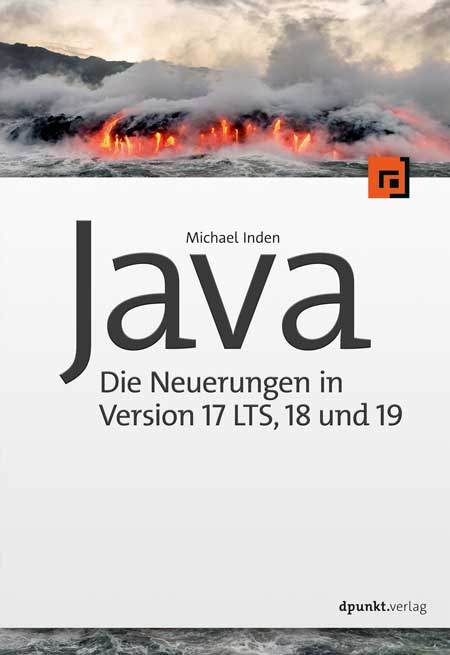
Java - die Neuerungen in Version 17 LTS, 18 und 19
Dieses Buch von Michael Inden eignet sich für alle, die ihr Java-Wissen auf den neuesten Stand bringen und es durch eine Vielzahl an Übungen festigen möchten. Es beschreibt alle wichtigen Neuerungen in Java 17 – der aktuellen LTS-Version – sowie in den brandaktuellen Versionen 18 und 19.»Java – die Neuerungen in Version 17 LTS, 18 und 19« behandelt alle wesentlichen Änderungen der aktuellen Java-Versionen. Einen Schwerpunkt bildet die Beschreibung einer Vielzahl an Syntaxverbesserungen. Beispiele sind die prägnantere Syntax bei switch sowie die mehrzeiligen Strings und records, welche die Definition von Werteklassen erleichtern. Auch das immer populärer werdende Pattern Matching für instanceof und switch wird vorgestellt. Nicht nur in der Syntax, sondern auch in den APIs finden sich einige Neuerungen, etwa der HTTP/2-Support sowie diverse Detailverbesserungen, beispielsweise im Stream-API. Schließlich werden nennenswerte Neuerungen in der JVM beschrieben, unter anderem Direct Compilation, die JShell zum interaktiven Ausprobieren, JMH zum Erstellen von Microbenchmarks sowie jpackage zum Bereitstellen von installierbaren Distributionen.Zielgruppe: Java-Programmierer*innenSoftwareentwickler*innenAutor: Dipl.-Inform. Michael Inden ist Oracle-zertifizierter Java-Entwickler. Nach seinem Studium in Oldenburg hat er bei diversen internationalen Firmen in verschiedenen Rollen etwa als Softwareentwickler, -architekt, Consultant, Teamleiter, CTO sowie Leiter Academy gearbeitet. Nach rund 1,5 Jahren als freiberuflicher Autor und Trainer ist er seit Januar 2022 als Head of Development in Zürich tätig.Michael Inden hat über zwanzig Jahre Berufserfahrung beim Entwurf komplexer Softwaresysteme gesammelt und an diversen Fortbildungen sowie mehreren Java-One-Konferenzen teilgenommen. Sein besonderes Interesse gilt dem Design qualitativ hochwertiger Applikationen sowie dem Coaching. Sein Wissen gibt er gerne als Trainer in internen und externen Schulungen und auf Konferenzen weiter, etwa bei der JAX/W-JAX, JAX London, Oracle Code One, ch.open sowie bei der Java User Group Switzerland.