

Allgemein

Interface for an App
This book is an account of how I addressed the need for a smartphone app that would allow someone with Type 1 diabetes to self-manage their condition.Its presentation highlights the major features of the app’s interface design. They include the selection of metaphors appropriate to a user’s need to form a mental model of the app; the importance of visible context; the benefits of consistency; and considerations of a user’s cognitive and perceptual abilities. The latter is a key feature of the book.But the book is also about the design process, and especially about the valuable contributions made by the many focus group meetings in which design ideas were first presented to people with Type 1 diabetes. Their critique, and sometimes their rejection, of interface ideas were crucial to the development of the app.I hope this book will prove useful for teaching and design guidance.* Terminology * Affordance * Mental Models and Metaphors * Dialogue * Exploration * Chapter Summaries * Introduction * The Requirements * Structure and Layout * Interface Metaphors * Dialogue * Data Entry * Explore * Favourites * Photographs * Exercise * Health * Advice * A Dialogue Check * Conclusions * Reflections on Affordance and Design * Colleagues * Appendix 1: Interaction Consistency Appendix 2: A Novel Usability Tool * References * Author Biography
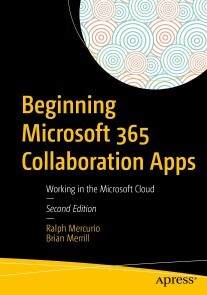
Beginning Microsoft 365 Collaboration Apps
Start making the most of the latest collaboration tools in Microsoft 365—including Teams, SharePoint, Power Apps, Power BI, Power Automate, Microsoft Groups, Office ProPlus, Yammer, Planner, Stream, Forms, and OneDrive. Integrate these collaboration tools into your team’s projects to boost productivity, engagement, innovation, and enjoyment at work. This book walks you through all the latest features, teaching you how to choose the right tools and get the most out of them for your situation.While technologies for collaboration are more advanced than ever before, there also are more of them, making it all the more confusing. BEGINNING MICROSOFT 365 COLLABORATION APPS will help you make sense of what is available and provide prescriptive guidance to you and your team on how to be more productive.This fully updated and expanded new edition contains lots of new content, screenshots and samples, and all new chapters on Power BI and Power Apps.WHAT YOU WILL LEARN* Know the collaboration applications and features available across Microsoft 365, and how to choose the ones that are right for you and your colleagues in any given situation* Understand the software-as-a-service (SaaS) model and how it enables users to be more effective and productive in remote situations* Discover how multi-device usability and real-time cloud synchronization can help your team collaborate anytime, anywhere, across the apps* Find out how Planner can help you manage projects and tasks, even without a project manager* Explore Microsoft Power Automate and Power Apps to connect applications and services and create codeless applications and workflowsWHO THIS BOOK IS FORMicrosoft 365 business users with a limited technical background. You should be familiar with the Microsoft Office suite of products such as Word and Outlook, and work in a team environment. An active Microsoft 365 would be useful as well.RALPH MERCURIO is a Microsoft Certified Professional with 18 years of experience. He works for the City of Durham in North Carolina and focuses his efforts on providing collaborative solutions to its many departments. He has held various roles in the technology field, including as a SharePoint infrastructure architect consulting for various companies in the New York City metro area.Ralph also has experience architecting and deploying solutions that leverage the best features of SharePoint/Microsoft 365 and provide real business value while solving user experience issues. He has seen many technology changes throughout the years and he discovered a passion for helping users find ways to leverage what they need to know to learn a new technology. With Microsoft 365, he has made it his goal to help users realize the potential of this powerful platform in order to get the most out of these ever-changing applications.BRIAN MERRILL is a Microsoft Certified Educator (MCE) and a Microsoft Certified trainer (MCT). He is currently the Educational Technology Analyst for one of the largest school districts in Pennsylvania. In that role he serves as the global administrator of the district’s Microsoft 365 environment, managing Microsoft Teams and SharePoint, and training faculty and staff on new technologies and systems. Brian is also adjunct faculty at the University of Harrisburg of Science and Technology, where he teaches courses in the Learning Technology and Media Studies program. Teaching courses on Learning Technologies and Solutions as well as Microsoft tools. Brian is a Microsoft Innovative Educator Expert and a member of the Minecraft for Education Advisory Board.PART 1: GETTING STARTED* Chapter 1: Welcome to Microsoft 365PART 2: THE APPLICATIONS* Chapter 2: SharePoint Online* Chapter 3: OneDrive* Chapter 4: Microsoft 365 Groups* Chapter 5: Teams* Chapter 6: Yammer* Chapter 7: Office* Chapter 8: Planner* Chapter 9: Stream* Chapter 10: Forms* Chapter 11: Power Automate* Chapter 12: Power BI* Chapter 13: PowerApps* Chapter 14: Making sense of it all

Azure Data Factory by Example
Data engineers who need to hit the ground running will use this book to build skills in Azure Data Factory v2 (ADF). The tutorial-first approach to ADF taken in this book gets you working from the first chapter, explaining key ideas naturally as you encounter them. From creating your first data factory to building complex, metadata-driven nested pipelines, the book guides you through essential concepts in Microsoft’s cloud-based ETL/ELT platform. It introduces components indispensable for the movement and transformation of data in the cloud. Then it demonstrates the tools necessary to orchestrate, monitor, and manage those components.The hands-on introduction to ADF found in this book is equally well-suited to data engineers embracing their first ETL/ELT toolset as it is to seasoned veterans of Microsoft’s SQL Server Integration Services (SSIS). The example-driven approach leads you through ADF pipeline construction from the ground up, introducing important ideas and making learning natural and engaging. SSIS users will find concepts with familiar parallels, while ADF-first readers will quickly master those concepts through the book’s steady building up of knowledge in successive chapters. Summaries of key concepts at the end of each chapter provide a ready reference that you can return to again and again.WHAT YOU WILL LEARN* Create pipelines, activities, datasets, and linked services* Build reusable components using variables, parameters, and expressions* Move data into and around Azure services automatically* Transform data natively using ADF data flows and Power Query data wrangling* Master flow-of-control and triggers for tightly orchestrated pipeline execution* Publish and monitor pipelines easily and with confidenceWHO THIS BOOK IS FORData engineers and ETL developers taking their first steps in Azure Data Factory, SQL Server Integration Services users making the transition toward doing ETL in Microsoft’s Azure cloud, and SQL Server database administrators involved in data warehousing and ETL operationsRICHARD SWINBANK is a data engineer and Microsoft Data Platform MVP. He specializes in building and automating analytics platforms using Microsoft technologies from the SQL Server stack to the Azure cloud. He is a fervent advocate of DataOps, with a technical focus on bringing automation to both analytics development and operations. An active member of the data community and keen knowledge-sharer, Richard is a volunteer, organizer, speaker, blogger, open source contributor, and author. He holds a PhD in computer science from the University of Birmingham (UK).1. Creating an Azure Data Factory Instance2. Your First Pipeline3. The Copy Data Activity4. Expressions5. Parameters6. Controlling Flow7. Data Flows8. Integration Runtimes9. Power Query in ADF10. Publishing to ADF11. Triggers12. Monitoring

Pro Windows Subsystem for Linux (WSL)
This book covers everything a developer needs to know to hit the ground running and get the most out of Windows Subsystem for Linux (WSL).Since its release, Windows Subsystem for Linux (WSL) has been growing in popularity, moving from curious early adopters to wide-scale interest, including enterprise development teams using WSL in production. This authoritative guide to WSL covers the gamut, introducing developers to WSL architecture, installation and configuration, the WSL command line, all the way to advanced use cases and performance tunings. Practical examples are sprinkled throughout to reinforce understanding. This book is designed to efficiently and effectively get developers comfortable using this highly useful platform for open-source development on Windows. WSL is uniquely suited to cloud and cross-platform development, and system administrator workflows on Windows.Windows developers will begin with the basics of installation and then be introduced to the vast library of open source tools that they can integrate into their own workflows, using their existing development tools, such as Code, Visual Studio, and JetBrains IDEs. Readers will learn, hands on, about using WSL to develop cross-platform and cloud-native applications, work with containers, and deploy a local Kubernetes cluster on WSL.“Much of what WSL is, is what developers make of it” is expert Barnes’ guiding mantra, a theme that is reinforced throughout this valuable cross-platform learning journey. Developers will get excited about the many new opportunities at their fingertips and be astounded at what they can do and achieve with WSL.WHAT YOU WILL LEARN* Install and configure WSL, a unique and novel configuration process* Receive an unbiased overview of WSL, its architecture, installation, the command line, practical use cases, and advanced configuration* Create a development workstation using WSL* Compare and contrast the differences between WSL 1 and WSL 2* Explore, in depth, some of the more popular workflows in WSL, including Docker containers* Consider and plan key factors for a large scale enterprise deployment of WSLWHO THIS BOOK IS FORDevelopers who need to know WSL and how to build a development stack, integrating it with their preferred code editor or IDE if they so choose; existing Windows and Linux system administrators who want to learn how to install, deploy, and manage WSL; power users who are comfortable in a command line, but may be new to Linux or WSLHAYDEN BARNES is Engineering Manager for Ubuntu on Windows Subsystem for Linux (WSL) at Canonical, and a recognized Microsoft MVP. Hayden regularly presents on the topic of WSL at conferences such as Microsoft Build and is the founder of WSLConf. He has consulted for enterprises, academic institutions, and government agencies to help them deploy WSL. Before joining Canonical, Hayden founded Pengwin, the first company to create a custom Linux distribution built specifically for Windows. He is passionate about WSL because it opens up a myriad of opportunities for cross-platform development, open source development, and collaboration between Linux and other communities.Chapter 1: WSL ArchitectureChapter 2: Enabling WSLChapter 3: Managing WSL DistrosChapter 4: Linux Distro MaintenanceChapter 5: Configuring WSL DistrosChapter 6: Configuring WSL 2Chapter 7: Rolling Your Own Init SystemChapter 8: Going Further with WSL 2Chapter 9: Maximizing Windows InteroperabilityChapter 10: Using WSL for Enterprise DevelopmentChapter 11: Troubleshooting WSLChapter 12: Deploying WSL at Scale

Visual Studio Code Distilled
Use Visual Studio Code to write and debug code quickly and efficiently on any platform, for any device, using any programming language, and on the operating system of your choice.Visual Studio Code is an open source and cross-platform development tool that focuses on code editing across a variety of development scenarios, including web, mobile, and cloud development. This second edition of VISUAL STUDIO CODE DISTILLED has been updated and expanded with two new chapters on writing apps with Python and building apps for the cloud and deployment to Azure.The book teaches you how to be immediately productive with Visual Studio Code, from the basics to some of the more complex topics. You will learn how to work on individual code files, complete projects, and come away with an understanding of advanced code-editing features that will help you focus on productivity, and source code collaboration with Git.WHAT YOU WILL LEARN* Get started with practical guidance on Visual Studio Code, including expansive guidance on writing apps with C# and Python* Comprehend Visual Studio Code in a way that is not just theory or a list of features, but an approach driven by developer tasks and needs* Understand integrated support for team collaboration with Git for executing and debugging code, and the many ways you can extend and customize Visual Studio Code* Debug code on multiple platforms through real-world guidance, such as working under corporate networks* Expand your coding intelligence from web to mobile to the cloud* Acquire valuable tips, tricks, and suggestions from hard-earned, real-world experience to be more productiveWHO THIS BOOK IS FORAll developers (including JavaScript, Java, NodeJS), not just those with a Microsoft background, who will benefit from learning and using VS code as a cross-platform and cross-language toolALESSANDRO DEL SOLE is Senior Software Engineer for a healthcare company, building mobile apps for doctors and dialysis patients. He has been in the software industry for more than 20 years, focusing on Microsoft technologies such as .NET, C#, Visual Studio, and Xamarin. He has been a trainer, consultant, and a Microsoft MVP since 2008 and is the author of many technical books. He is a Xamarin Certified Mobile Developer, Microsoft Certified Professional, and a Microsoft Programming Specialist in C#.Chapter 1: Introducing Visual Studio CodeChapter 2: Getting to Know the EnvironmentChapter 3: Language Support and Code Editing FeaturesChapter 4: Working with Files and FoldersChapter 5: Customizing Visual Studio CodeChapter 6: Installing and Managing ExtensionsChapter 7: Source Control with GitChapter 8:Automating TasksChapter 9: Building and Debugging Applications: .NET 5 and Other PlatformsChapter 10: Building Applications with PythonChapter 11: Deploying Applications to Azure

Choose Your InfoSec Path
Cybersecurity is a pressing issue across industries, as well as increasingly important in people’s personal lives. Learning the basic fundamentals is essential in order for companies and individuals to thrive. Although much of the literature around this hot-button topic can seem impenetrable and convoluted to a new learner, Choose Your InfoSec Path is an informative, fun, interactive cybersecurity adventure that has been written specifically with beginners in mind.Step into the shoes of a Chief Information Security Officer (CISO) and find out what could possibly go wrong during a breach. Author Alexander J. Roxon weaves together essential InfoSec concepts with an exciting and fast-paced storyline to make the lessons relatable and easy to understand. Determine what steps your character takes next and affect the outcome of your path. Will you emerge from the breach unscathed? With over 50 different endings, you can explore the what-ifs and experience a new path each time. A supporting glossary makes this book a resource you can return to long after your story is completed.Crucially, the integrity of the cybersecurity concepts is maintained and all events are genuinely plausible from a technical perspective. The book includes commentary to examine key concepts and reflect on decisions. This book is for those who are interested in understanding what cybersecurity is about but without a high technical barrier of entry. Learn some of the basics of incident response, how to dampen the effects of a breach, and get the jump on the bad guys. Your journey starts now.WHAT YOU’LL LEARN* Understand some of the basic concepts of incident response.* Experience how a real-life incident can go from zero to chaos very rapidly.* Find out how being proactive can significantly improve how information security breaches play out.* Discover how to dampen the effects of a breach.WHO THIS BOOK IS FORThis book is for those who are interested in understanding what cybersecurity is about but without a high technical barrier of entry. People who like to laugh as well as learn.Alexander J. Roxon likes to take complicated subjects and problems, then make them simpler and less intimidating. Alex works for the Cyber Defense team within Accenture, helping companies implement appropriate cyber security solutions and strategies. In his spare time, he likes to contribute to the industry with things like phishing awareness blogs full of fish puns, or a deck of playing cards designed to teach people about cyber security (The Infosec Deck). Inspired by the Give Yourself Goosebumps series, he decided to write his own interactive story in an effort to make information security more accessible. He is a Systems Security Certified Professional (SSCP) and Factor Analysis Information Risk (FAIR) accredited.

Integrating D3.js with React
Integrate D3.js into a React TypeScript project and create a chart component working in harmony with React. This book will show you how utilize D3 with React to bring life to your charts.Seasoned author Elad Elrom will show you how to create simple charts such as line, bar, donut, scatter, histogram and others, and advanced charts such as a world map and force charts. You'll also learn to share the data across your components and charts using React Recoil state management. Then integrate third-party chart libraries that are built on D3 such as Rechart, Visx, Nivo, React-vi, and Victory and in the end deploy your chart as a server or serverless app on popular platforms.React and D3 are two of the most popular frameworks in their respective areas – learn to bring them together and take your storytelling to the next level.WHAT YOU'LL LEARN* Set up your project with React, TypeScript and D3.js* Create simple and advanced D3.js charts* Work with complex charts such as world and force charts* Integrate D3 data with React state management * Improve the performance of your D3 components* Deploy as a server or serverless app and debug testWHO THIS BOOK IS FORReaders that already have basic knowledge of React, HTML, CSS and JavaScript.ELAD ELROM is a technical coach. As a writer, he authored and co-authored several technical books. Elad consulted for a variety of clients, from large corporations such as AT&T, HBO, Viacom, NBC Universal, and Weight Watchers, to smaller startups. Aside from coding, Elad is also a PADI diving instructor and a pilot.INTEGRATING D3.JS WITH REACT1. Setting Our Technology Stack2. Graphics and Interactions3. Basic Charts: Part 14. Basic Charts: Part 25. Integrating State Management6. World Chart: Part 17. World Chart: Part 28. Force Charts: Part 19. Force Charts: Part 210. Integrating Popular Chart Libraries Built on D311. Performance Knick-Knacks12. Publishing Your React d3 App

Societal Responsibility of Artificial Intelligence
The digital world is characterized by its immediacy, its density of information and its omnipresence, in contrast to the concrete world. Significant changes will occur in our society as AI becomes integrated into many aspects of our lives.This book focuses on this vision of universalization by dealing with the development and framework of AI applicable to all. It develops a moral framework based on a neo-Darwinian approach - the concept of Ethics by Evolution - to accompany AI by observing a certain number of requirements, recommendations and rules at each stage of design, implementation and use. The societal responsibility of artificial intelligence is an essential step towards ethical, eco-responsible and trustworthy AI, aiming to protect and serve people and the common good in a beneficial way.JEROME BERANGER is a scientific expert on the ethical approach of the digital revolution and Ethics by Evolution. He is cofounder and CEO of ADELIAA and is also an associate researcher in the Inserm 1295 BIOETHICS team at the University of Toulouse III, France.
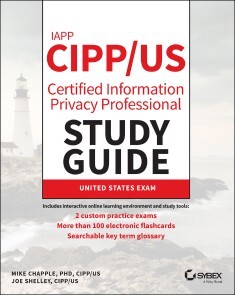
IAPP CIPP / US Certified Information Privacy Professional Study Guide
PREPARE FOR SUCCESS ON THE IAPP CIPP/US EXAM AND FURTHER YOUR CAREER IN PRIVACY WITH THIS EFFECTIVE STUDY GUIDE - NOW INCLUDES A DOWNLOADABLE SUPPLEMENT TO GET YOU UP TO DATE ON THE 2022 CIPP EXAM!Information privacy has become a critical and central concern for small and large businesses across the United States. At the same time, the demand for talented professionals able to navigate the increasingly complex web of legislation and regulation regarding privacy continues to increase.Written from the ground up to prepare you for the United States version of the Certified Information Privacy Professional (CIPP) exam, Sybex’s IAPP CIPP/US Certified Information Privacy Professional Study Guide also readies you for success in the rapidly growing privacy field.You’ll efficiently and effectively prepare for the exam with online practice tests and flashcards as well as a digital glossary. The concise and easy-to-follow instruction contained in the IAPP/CIPP Study Guide covers every aspect of the CIPP/US exam, including the legal environment, regulatory enforcement, information management, private sector data collection, law enforcement and national security, workplace privacy and state privacy law, and international privacy regulation.* Provides the information you need to gain a unique and sought-after certification that allows you to fully understand the privacy framework in the US* Fully updated to prepare you to advise organizations on the current legal limits of public and private sector data collection and use* Includes access to the Sybex online learning center, with chapter review questions, full-length practice exams, hundreds of electronic flashcards, and a glossary of key termsPerfect for anyone considering a career in privacy or preparing to tackle the challenging IAPP CIPP exam as the next step to advance an existing privacy role, the IAPP CIPP/US Certified Information Privacy Professional Study Guide offers you an invaluable head start for success on the exam and in your career as an in-demand privacy professional.MIKE CHAPPLE, PHD, CIPP/US, is Teaching Professor of Information Technology, Analytics, and Operations at Notre Dame’s Mendoza College of Business. He is a bestselling author of over 25 books and serves as the Academic Director of the University’s Master of Science in Business Analytics program. He holds multiple additional certifications, including the CISSP, CySA+, CISM, PenTest+, and Security+.JOE SHELLEY, M.A., CIPP/US, is currently the Vice President for Libraries and Information Technology at Hamilton College in New York. Among other responsibilities he oversees information security and privacy programs, IT risk management, business intelligence and analytics, and data governance. He has also held certifications and certificates for ITIL, Project Management, and Scrum.Introduction xxiAssessment Test xxxCHAPTER 1 PRIVACY IN THE MODERN ERA 1Introduction to Privacy 2What Is Privacy? 3What Is Personal Information? 4What Isn’t Personal Information? 5Why Should We Care About Privacy? 7Generally Accepted Privacy Principles 8Management 9Notice 10Choice and Consent 10Collection 10Use, Retention, and Disposal 11Access 11Disclosure to Third Parties 12Security for Privacy 13Quality 14Monitoring and Enforcement 14Developing a Privacy Program 15Crafting Strategy, Goals, and Objectives 15Appointing a Privacy Official 17Privacy Roles 18Building Inventories 18Conducting a Privacy Assessment 19Implementing Privacy Controls 20Ongoing Operation and Monitoring 20Online Privacy 21Privacy Notices 21Privacy and Cybersecurity 22Cybersecurity Goals 23Relationship Between Privacy and Cybersecurity 24Privacy by Design 25Summary 26Exam Essentials 26Review Questions 27CHAPTER 2 LEGAL ENVIRONMENT 31Branches of Government 32Legislative Branch 32Executive Branch 33Judicial Branch 34Understanding Laws 36Sources of Law 36Analyzing a Law 41Legal Concepts 43Legal Liability 44Torts and Negligence 45Summary 46Exam Essentials 46Review Questions 48CHAPTER 3 REGULATORY ENFORCEMENT 53Federal Regulatory Authorities 54Federal Trade Commission 54Federal Communications Commission 60Department of Commerce 61Department of Health and Human Services 61Banking Regulators 62Department of Education 63State Regulatory Authorities 63Self-Regulatory Programs 64Payment Card Industry 64Advertising 65Trust Marks 66Safe Harbors 67Summary 67Exam Essentials 68Review Questions 69CHAPTER 4 INFORMATION MANAGEMENT 73Data Governance 74Building a Data Inventory 74Data Classification 75Data Flow Mapping 77Data Lifecycle Management 78Workforce Training 79Cybersecurity Threats 80Threat Actors 80Incident Response 85Phases of Incident Response 86Preparation 87Detection and Analysis 87Containment, Eradication, and Recovery 88Post-incident Activity 88Building an Incident Response Plan 90Data Breach Notification 92Vendor Management 93Summary 94Exam Essentials 94Review Questions 96CHAPTER 5 PRIVATE SECTOR DATA COLLECTION 101FTC Privacy Protection 103General FTC Privacy Protection 103The Children’s Online Privacy Protection Act (COPPA) 104Future of Federal Enforcement 107Medical Privacy 110The Health Insurance Portability and Accountability Act (hipaa) 110The Health Information Technology for Economic and Clinical Health Act 118The 21st Century Cures Act 120Confidentiality of Substance Use Disorder Patient Records Rule 120Financial Privacy 121Privacy in Credit Reporting 121Gramm–Leach–Bliley Act (GLBA) 125Red Flags Rule 128Consumer Financial Protection Bureau 129Educational Privacy 130Family Educational Rights and Privacy Act (FERPA) 130Telecommunications and Marketing Privacy 132Telephone Consumer Protection Act (TCPA) and Telemarketing Sales Rule (TSR) 132The Junk Fax Prevention Act (JFPA) 135Controlling the Assault of Non-solicited Pornography and Marketing (CAN-SPAM) Act 135Telecommunications Act and Customer Proprietary Network Information 137Cable Communications Policy Act 138Video Privacy Protection Act (VPPA) of 1988 139Summary 140Exam Essentials 141Review Questions 143CHAPTER 6 GOVERNMENT AND COURT ACCESS TO PRIVATE SECTOR INFORMATION 147Law Enforcement and Privacy 148Access to Financial Data 149Access to Communications 153National Security and Privacy 157Foreign Intelligence Surveillance Act (FISA) of 1978 157USA-PATRIOT Act 159The USA Freedom Act of 2015 162The Cybersecurity Information Sharing Act of 2015 163Civil Litigation and Privacy 164Compelled Disclosure of Media Information 164Electronic Discovery 166Summary 168Exam Essentials 168Review Questions 170CHAPTER 7 WORKPLACE PRIVACY 175Introduction to Workplace Privacy 176Workplace Privacy Concepts 176U.S. Agencies Regulating Workplace Privacy Issues 177U.S. Antidiscrimination Laws 178Privacy Before, During, and After Employment 181Employee Background Screening 182Employee Monitoring 185Investigation of Employee Misconduct 189Termination of the Employment Relationship 191Summary 193Exam Essentials 193Review Questions 195CHAPTER 8 STATE PRIVACY LAWS 199Federal vs. State Authority 200Financial Data 200Credit History 201California Financial Information Privacy Act 201Data Security 202Recent Developments 204Data Breach Notification Laws 212Elements of State Data Breach Notification Laws 212Key Differences Among States Today 214Recent Developments 215Marketing Laws 216Summary 217Exam Essentials 218Review Questions 219CHAPTER 9 INTERNATIONAL PRIVACY REGULATION 223International Data Transfers 224European Union General Data Protection Regulation 225Adequacy Decisions 228U.S.- EU Safe Harbor and Privacy Shield 228Binding Corporate Rules 230Standard Contractual Clauses 230Other Approved Transfer Mechanisms 231APEC Privacy Framework 231Cross- Border Enforcement Issues 233Global Privacy Enforcement Network 233Resolving Multinational Compliance Conflicts 234Summary 234Exam Essentials 235Review Questions 236APPENDIX ANSWERS TO REVIEW QUESTIONS 241Chapter 1: Privacy in the Modern Era 242Chapter 2: Legal Environment 243Chapter 3: Regulatory Enforcement 245Chapter 4: Information Management 247Chapter 5: Private Sector Data Collection 249Chapter 6: Government and Court Access to Private Sector Information 251Chapter 7: Workplace Privacy 252Chapter 8: State Privacy Laws 254Chapter 9: International Privacy Regulation 256Index 259

Mastering Microsoft Teams
Do you need to learn how to use Microsoft Teams? Are you questioning how to drive user adoption, govern content, and manage access for your Teams deployment? Either way, the second edition of this bestseller is your one-stop-shop to learning everything you need to know to find success with Microsoft Teams.Microsoft’s popular chat-based collaboration software has many rich features that enable teams to be more efficient, and save valuable time and resources. However, as with all software, there is a learning curve and pitfalls that should be avoided.Begin by learning the core components and use cases for Teams. From there, the authors guide you through ideas to create governance and adoption plans that make sense for your organization or customer. Wrap up with an understanding of features and services in progress, and a roadmap to the future of the product.WHAT YOU WILL LEARN* Implement, use, and manage Microsoft Teams* Understand how Teams drives productivity and engagement by combining the functionality of Microsoft 365 Groups, SharePoint, OneDrive, Outlook, and other services in one location* Govern, explain, and use Teams in your organization* Use Teams in a structured way to reduce users’ time spent in meetings* Know the pitfalls to avoid that may create challenges in your usage of Teams* Become familiar with the functionality and components of Teams via walk-throughs, including opportunities for automating business processes in Teams* See how educators and students can use Teams to improve remote learning* Be aware of business productivity in a remote world with Microsoft VivaWHO THIS BOOK IS FORAnyone who wants to learn Microsoft Teams. To get the most out of the book, a basic understanding of Microsoft 365 and a subscription, including a Microsoft Teams license, is useful.MELISSA HUBBARD specializes in driving productivity, collaboration, and communication in the modern workplace. She is a former Microsoft MVP and early adopter of Microsoft Teams, with a background in project management and the implementation of collaboration and business process automation solutions. She is particularly passionate about the topic areas of user adoption, governance, and trainingMATTHEW J. BAILEY is a Microsoft MVP and Microsoft Certified Trainer (MCT) for Noteworthy Technology Training, specializing in SharePoint, Microsoft 365 (including Teams), Azure, and Power BI. He combines his business expertise and his technical knowledge to resolve corporate challenges. He is a highly regarded presenter, avid blogger, and author, most recently of The SharePoint Business Analyst Guide.D’ARCE HESS is a Microsoft MVP who specializes in the creation of custom portals and experiences in SharePoint, Microsoft Teams and Microsoft 365. As a UI/UX designer and developer, she uses industry and Microsoft best practices as a base for creating solutions that simplify processes, and drive user adoption and governance from the start. She has worked with Fortune 500 companies and has become a trusted partner to her clients in the industries of healthcare, pharmaceuticals, legal, travel and tourism, and entertainment. She loves to volunteer in the community and is the leader of the Rhode Island SharePoint & Microsoft 365 User Group.MÅRTEN HELLEBRO is an Office Apps and Services MVP focused on Microsoft Teams and an expert in enterprise voice. As an infrastructure, migration, and user adoption lead, Mårten has extensive experience managing numerous Teams and Skype for Business implementation projects. He regularly speaks at Microsoft conferences and organizes one of the largest Microsoft Teams conference in the Nordics “Teamsdagen”. He also runs the Microsoft Teams blog msteamsswe.se, and co-hosts the Teams podcast “Teamspodden“.Chapter 1: Introduction to Microsoft TeamsChapter 2: Working in TeamsChapter 3: Communicating in TeamsChapter 4: Meetings in TeamsChapter 5: User Adoption in TeamsChapter 6: GovernanceChapter 7: Automating Business Processes in TeamsChapter 8: Known Challenges and the FutureChapter 9: Teams for EducationChapter 10: Introduction to Microsoft Viva

ABAP in Eclipse
Master Advanced Business Application Programming (ABAP) Development Tools by installing, customizing, and using them in Eclipse.The book begins by describing the installation and customization of ABAP Development Tools in Eclipse and how to adjust the IDE to meet your requirements. You will discover the ABAP Development Tools functionality that helps you be more efficient in programming in the ABAP language, including refactoring, markers, quick fixes, unit testing, and much more. Moving on, you will cover the available Eclipse plugins that you can use with ABAP Development Tools to make Eclipse even more developer-friendly: ABAP Continuous Integration and ABAP Extensions. Finally, you will learn how to create your own Eclipse plugin that is integrated with ABAP Development Tools.This book is perfect for every ABAP developer who wants to get started with ABAP Development Tools in Eclipse, as well as experienced ADT users who would like to take advantage of hidden functions or external extensions for ADT and Eclipse.WHAT YOU WILL LEARN* Install and configure your ABAP in Eclipse to meet your personal requirements* Discover the functionalities of ABAP in Eclipse that will accelerate your development* Use additional extensions to make your work with Eclipse more enjoyable* Create your own plugin that works with ABAP in EclipseWHO THIS BOOK IS FORABAP developers that want or need to switch to Eclipse and current ABAP in Eclipse users who want to learn its possibilities and hidden features.Łukasz is IT manager for SAP applications at Hager Group. He has been active in the SAP community for more than ten years. He mostly shares his knowledge on his blog (Abap Blog). He is a creator of the following Eclipse plugins: ABAP Favorites, ABAP Extensions, and ABAP Quick Fix. He also shares his ABAP projects or frameworks on GitHub as fidley; these include: Fast ALV Grid, JSON2ABAPType, Customers, and ALV Grid in a Nutshell. He was a speaker at the last four #sitWROs and attended a few others around Europe. SAP Developer Hero 2016 and SAP Champion from 2019. He can also teach you how to brew a beer. Chapter 1: Installation, Basic ConfigurationCHAPTER GOAL: PROVIDE INFORMATION ABOUT HOW TO GET STARTED WITH ABAP IN ECLIPSESUB -TOPICS1. How to install Eclipse & ABAP Development Tools2. How to create ABAP Projects and structure of the project explorer3. Perspectives4. Standard Eclipse and ADT Views5. Eclipse PreferencesChapter 2: Eclipse and ADT PreferencesCHAPTER GOAL: EXPLAIN POSSIBILITIES OF CONFIGURATION OF YOUR ECLIPSE ENVIRONMENTSUB -TOPICS1. Update sites2. Debug preferences3. ABAP Development Preferences4. Syntax highlighting5. Eclipse PreferencesChapter 3: How to Use ABAP in Eclipse to Accelerate your WorkCHAPTER GOAL: DESCRIBE ALL KNOWN FUNCTIONALITIES OF ABAP IN ECLIPSE THAT WILL MAKE THE DEVELOPER LIFE EASIERSUB - TOPICS1. Refactoring2. Quick fixes3. Completion assistant4. Markers5. Formatting, Formatting of block6. Block Selection7. ATC8. Unit Test9. etc.. all functionalities of10. Shortcuts CheatSheetChapter 4: Eclipse Extensions that will make the differenceCHAPTER GOAL: DESCRIPTION OF ECLIPSE PLUGINS FOR ABAP AND GLOBAL, THAT CAN ENHANCE HUGELY THE WORK WITH ADTNO OF PAGES :SUB - TOPICS:1. ABAP CI plugin2. abapGit Plugin3. ABAP Favorites4. ABAP Extensions5. ABAP Quick Fixes6. ABAP Tags7. Darkest Dark8. Any Edit9. etc.Chapter 5: CHAPTER GOAL: EXPLAIN THE WAY OF CREATION OF ECLIPSE PLUGINSSUB - TOPICS:1. Basic information about creating an Eclipse plugin2. Creation of Eclipse plugin with TreeView or Table control and testing it3. Explanation of features and update sitesChapter 6: Extending ABAP Development ToolsCHAPTER GOAL: SHOW EXAMPLE OF SIMPLE ECLIPSE PLUGIN THAT WORKS WITH ABAP DEVELOPMENT TOOLS TO SUPPORT THE DEVELOPER & HOW TO CREATE YOUR OWN QUICK FIXES FOR ATC CHECKSSUB - TOPICS:1. Creation of Eclipse plugins calling ABAP backend2. Creating quick fix for ATC Checks

Mastering Voice Interfaces
Build great voice apps of any complexity for any domain by learning both the how's and why's of voice development. In this book you’ll see how we live in a golden age of voice technology and how advances in automatic speech recognition (ASR), natural language processing (NLP), and related technologies allow people to talk to machines and get reasonable responses. Today, anyone with computer access can build a working voice app. That democratization of the technology is great. But, while it’s fairly easy to build a voice app that runs, it's still remarkably difficult to build a great one, one that users trust, that understands their natural ways of speaking and fulfills their needs, and that makes them want to return for more.We start with an overview of how humans and machines produce and process conversational speech, explaining how they differ from each other and from other modalities. This is the background you need to understand the consequences of each design and implementation choice as we dive into the core principles of voice interface design. We walk you through many design and development techniques, including ones that some view as advanced, but that you can implement today. We use the Google development platform and Python, but our goal is to explain the reasons behind each technique such that you can take what you learn and implement it on any platform.Readers of Mastering Voice Interfaces will come away with a solid understanding of what makes voice interfaces special, learn the core voice design principles for building great voice apps, and how to actually implement those principles to create robust apps. We’ve learned during many years in the voice industry that the most successful solutions are created by those who understand both the human and the technology sides of speech, and that both sides affect design and development. Because we focus on developing task-oriented voice apps for real users in the real world, you’ll learn how to take your voice apps from idea through scoping, design, development, rollout, and post-deployment performance improvements, all illustrated with examples from our own voice industry experiences.WHAT YOU WILL LEARN* Create truly great voice apps that users will love and trust* See how voice differs from other input and output modalities, and why that matters* Discover best practices for designing conversational voice-first applications, and the consequences of design and implementation choices* Implement advanced voice designs, with real-world examples you can use immediately.* Verify that your app is performing well, and what to change if it doesn't Who This Book Is ForAnyone curious about the real how’s and why’s of voice interface design and development. In particular, it's aimed at teams of developers, designers, and product owners who need a shared understanding of how to create successful voice interfaces using today's technology. We expect readers to have had some exposure to voice apps, at least as users.Ann Thymé-Gobbel's career has focused on how people use speech and natural language to communicate with each other and with technology. After completing her PhD in cognitive science and linguistics from UC San Diego, she's held a broad set of voice-related UI/UX design roles in both large corporations and small start-ups, working with diverse teams in product development, client project engagements, and R&D. Her past work includes design, data analysis and establishing best practices at Nuance, voice design for mobile and in-home devices at Amazon Lab 126, and creating natural language conversations for multimodal healthcare apps at 22otters. Her research has covered automatic language detection, error correction, and discourse structure. She is currently Director of UI/UX Design at Loose Cannon Systems, the team bringing to market Milo, a handsfree wearable communicator. Ann never stops doing research: she collects and analyzes data at every opportunity and enjoys sharing her findings with others, having presented and taught at conferences internationally.Charles Jankowski has over 30 years’ experience in industry and academia developing applications and algorithms for real-world users incorporating advanced speech recognition, speaker verification, and natural language technologies. He has used state-of-the-art machine learning processes and techniques for data analysis, performance optimization, and algorithm development. Charles has highly in-depth technical experience with state-of-the-art technologies, effective management of cross-functional teams for all facets of application deployment, and outstanding relationships with clients. Currently, he is Director of NLP at Brain Technologies, creating the Natural iOS application with which you can “Say it and Get it.” Previously he was Director of NLP and Robotics at CloudMinds, Director of Speech and Natural Language at 22otters, Senior Speech Scientist at Performance Technology Partners, and Director of Professional Services at Nuance. He has also been an independent consultant. Charles holds S.B., S.M., and Ph.D. degrees from MIT, all in electrical engineering.PART 1 – Voice System FoundationsChapter 1: Say Hello to Voice SystemsChapter goal: Introduce the reader to voice-first technology, its core concepts, and typical phases of development through an explanatory background for the current state and challenges of voice.No of pages - 20Sub-topics1. Voice-first, voice-only, and conversational everything2. Introduction to voice technology components (Speech to text, Natural languageunderstanding, Dialog management, Natural language generation, Text to speech)3. The phases of voice development success (Plan, Design, Build, Test, Deploy &Assess, Iterate)4. Hope is not a strategy – but to plan & execute isChapter 2: Keeping Voice in MindChapter goal: Explain to the reader how humans and computers “talk” and “listen.”What’s easy and hard for the human user and the technology in a dialog, and why.No of pages - 15Sub-topics1. Why voice is different2. Hands-on: A pre-coding thought experiment3. Voice dialog and its participants• The Human: spoken natural language understanding• The Computer: voice system recognition and interpretation• Human-computer voice dialog - Successful voice-first development is all aboutcoordinating human abilities with the technology to allow conversations betweentwo very different dialog participants.Chapter 3: Running a Voice Implementation—and Noticing IssuesChapter goal: Allow the reader to put into practice their newly learned foundation byimplementing and running a simple voice application in the Google Assistant framework,and experiencing how quickly even a simple voice interaction needs improvement.No of pages - 15Sub-topics1. Hands-on: Preparing a restaurant finder2. Introducing voice platforms3. Hands-on: Implementing the restaurant finderBasic setup, Specifying a first intent, Doing something, What the user says,What the VUI says, Connecting Dialogflow to Actions on Google, Testingthe app, Saving the voice interaction4. Google’s voice development ecosystem, and why we're using it here5. The pros and cons of relying on tools6. Hands-on: Making changes - testing and iterating (Adding phrases to handle the same meaning, additional content, and more specific)PART 2 – Planning Voice System InteractionsChapter 4: Defining your Vision: Building What, How, and Why for WhomChapter goal: Introduce voice-focused requirement discovery, highlighting differencesfrom other modalities and devices and showingNo of pages - 25Sub-topics1. Functional requirements: What are you building? (General and detailed functionality)2. Non-functional business requirements: Why are you building it? (Purpose, underlyingservice and existing automation, branding and terminology, data needs, access andavailability, legal and business constraints)3. Non-functional user requirements: Who will use it and what do they want? (Userpopulation demographics and characteristics, engagement patterns, mental modelsand domain knowledge, environment and state of mind)4. Non-functional system requirements; How will you build it? (Available options forrecognizer, parser, and interpreter, external data sources, data storage and data access, other system concerns)Chapter 5: From Discovery to UX and UI Design: Tools of the Voice-First TradeChapter goal: Show how to turn discovery findings into high-level architectural designs,using flows diagrams, sample dialogs, and detailed dialog management specs.No of pages - 20Sub-topics1. Where to find early user data on any budget (online research, crowd sourcing, dialogparticipant observation, focus groups, interviews, and surveys)2. How discovery results feed into VUI design decisions (dialog manager graphs)3. Capturing and documenting VUI design (dialog flows, sample dialogs, detaileddesign specifications, VUI design documentation approaches)4. Prototyping and testing your assumptions (early voice UX and prototypingapproaches)PART 3 – Building Voice System InteractionsChapter 6: Applying Human 'Rules of Dialog' to Reach Conversation ResolutionChapter goal: Learn that voice-first dialogs have resolutions. Learn how to design andimplement fully specified requests in the 3 core dialog types: question-answer, actionrequests, and task completion requests.No of pages - 30Sub-topics1. Dialog acts, games and turns – and Grice2. Question answering3. Action requests4. Task completion requests5. Fully specified request (Single slot and Multi-slot requests)6. Determining dialog acts based on feature discovery7. Dialog completion (Responding to 'goodbye' and 'thanks')Chapter 7: Resolving Incomplete Requests Through DisambiguationChapter goal: Explain how to handle incomplete and ambiguous requests, includingcommon disambiguation methods (yes/no, A/B sets, lists and menus) and when to apply each.No of pages - 30Sub-topics1. Incomplete requests - how to reach completeness2. Ambiguous requests3. Disambiguation methods (Logic-based assumptions, Yes/No questions, A/B sets,Static lists, Dynamic lists, Open sets, Menus)4. Testing on the device to find and solve issues5. Toward code independence: using webhooks (fulfillment, contexts, contextparameters, and follow-up)Chapter 8: Conveying Reassurance with Confidence and ConfirmationChapter goal: Teach the importance of conveying reassurance and how to apply different confirmation strategies. Introduce discourse markers and backchannels.No of pages - 30Sub-topics1. Conveying reassurance and shared certainty - Setting expectations2. Webhooks, Take 2 (Dialogflow system architecture, webhook request and response,Implementing the webhook)3. Confirmation methods (Non-verbal confirmation, Generic acknowledgment, Implicitand Explicit confirmations)4. Confirmation placement – confirming slots versus intents5. Disconfirmation: dealing with “no”6. Additional reassurance techniques and pitfalls (System pronunciation, Backchannels,Discourse markers, VUI architecture)7. Choosing the right reassurance methodChapter 9: Helping Users Succeed Through ConsistencyChapter goal: Explore how to navigate an audio interaction that is by nature fleeting andsequential. Provide design and implementation that incorporates consistency throughcorrectly scoped global commands, landmarks, non-verbal audio.No of pages - 20Sub-topics1. Universals (Uses: clarification and additional information, allow a do-over, providean exit)2. Navigation (Landmarks, Non-verbal audio, Content playback navigation, Listnavigation)3. Consistency, variation and randomization (built-in global intents, consistency acrossVUIs and frameworksChapter 10: Creating Robust Coverage for Speech-to-Text ResolutionChapter goal: Teach the nuts and bolts of the computer-side of "listening," starting withthe mapping of sounds to words and how to create solid synonym coverage. Topicsinclude different approaches to recognition, including regular expressions and statisticalmodels, dictionaries, domain knowledge, normalizing, and bootstrapping.No of pages - 25Sub-topics1. Recognition is speech-to-text interpretation2. Recognition engines3. Grammar concepts (Coverage, Recognition space, Static or dynamic, End-pointing,Multiple hypotheses)4. Types of grammars (Rule-based grammars, Statistical models, Hot words, Wakewords and invocation names)5. Working with grammars (Writing rule-based regular expressions)6. How to succeed with grammars (Bootstrapping, Normalizing punctuation andspellings, Handling unusual pronunciations, Using domain knowledge, the strengthsand limitations of STT)7. A simple example (Sample phrases in Dialogflow, Regular expressions in thewebhook)8. Limitations on grammar creation and useChapter 11: Reaching Understanding Through Parsing and Intent ResolutionChapter goal: Explore the second part of computer "listening": interpreting the meaning.Topics cover intent resolution, parsing and multiple passes, the use of tagging guides and middle layers.No of pages - 20Sub-topics1. From words to meaning (NLP, NLU)2. Parsing3. Machine learning and NLU4. Ontologies, knowledge bases and content databases5. Intents (Intent tagging and tagging guides, Middle layers: semantic tags versus systemendpoints)6. Putting it all together (Matching wide or narrow, Multiple grammars, multiple passes)7. A simple example (The Stanford Parser revisited, Determining intent, Machinelearning and using knowledge)Chapter 12: Applying Accuracy Strategies to Avoid MisunderstandingsChapter goal: Explain how misunderstandings happen and how to avoid them throughtechniques that minimize errors and the need to start over. Topics include design andimplementation of a wide set of robustness techniques, including powerful advancedtechniques.No of pages - 25Sub-topics1. Accuracy robustness underlying concepts2. Accuracy robustness strategies (Examples, Providing help, Just-in-time information,Hidden options and "none of those", Recognize-and-reject, One-step-correction,Tutorials, Spelling, Narrowing recognition space)3. Advanced techniques (Multi-tiered behavior and confidence scores, N-best and skiplists, Probabilities, Contextual latency)Chapter 13: Choosing Strategies to Recover from MiscommunicationChapter goal: Explore how to recover when miscommunication happens. Show how torecover and get users back on track quickly, and when to stop trying. Topics includedesign and implementation of several recovery strategies.No of pages - 15Sub-topics1. Recovery from what?2. Recovery strategies (Meaningful contextual prompts, Escalating prompts, Taperedprompts, Rapid reprompt, Backoff strategies)3. When to stop trying (Max error counts, Transfers)4. Choosing recovery strategy (Recognition, intent, or fulfillment errors)Chapter 14: Using Context and Data to Create Smarter ConversationsChapter goal: Explain why context is king in spoken conversation. Show how to accessand update data from various sources, and how to use that data within and across dialogs to create smarter interactions. Topics focus on how to design and implement context aware dialogs using anaphora, proactive behaviors, proximity, geo-location, domain knowledge, and other powerful methods.No of pages - 25Sub-topics1. Why there’s no conversation without context2. Reading and writing data (External accounts and services)3. Persistence within and across conversations4. Context-aware and context-dependent dialogs (Discourse markers andacknowledgments, Anaphora resolution, Follow-up dialogs and linked requests,Proactive behaviors, Topic, domain and world knowledge, Geo location-basedbehavior, Proximity and relevance, Number and type of devices, Time and day, Useridentity, preferences and account types, User utterance wording, System conditions5. Tracking context in modular and multiturn dialogsChapter 15: Creating Secure Personalized ExperiencesChapter goal: Cover personalization and customization. Topics include identification,authentication, privacy and security concerns, system persona audio, and working withTTS versus recorded prompts.No of pages - 25Sub-topics1. The importance of knowing who’s talking2. Individualized targeted behaviors (Concepts in personalization and customization,Implementing individualized experiences3. Authorized secure access4. Approaches to identification and authentication (Implementing secure gated access)5. Privacy and security concerns6. System persona (Defining and implementing a system persona, How persona affectsdialogs7. System voice audio (TTS or voice talent, generated or recorded, Finding and workingwith voice talents, One or several voices, Prompt management)8. Emotion and style9. Voice for specific user groupsPART 4 – Verifying and Deploying Voice System InteractionsChapter 16: Testing and Measuring Performance in Voice SystemsChapter goal: Explain the do’s and don’ts of QA testing a voice system. Topics includeuser testing methods that work best for voice, the code needed to support them, and how to improve system performance based on findings.No of pages - 20Sub-topics1. Testing voice system performance (Recognition testing, Dialog traversal: functionalend-to-end testing, Wake word and speech detection testing, Additional systemintegration testing)2. Testing usability and task completion (Voice usability testing concepts, Wizard of Ozstudies)3. Tracking and measuring performance (Recognition performance metrics, Taskcompletion metrics, User satisfaction metrics)Chapter 17: Tuning and Deploying Voice SystemsChapter goal: Show how to improve, or tune, voice solutions before and after deploying a voice system. Teach what real user data says about the system performance, what to log and track, how to measure accuracy, and how to interpret the data.No of pages - 25Sub-topics1. Tuning: what is it and why do you do it? (Why recognition accuracy isn’t enough,Analyzing causes of poor system performance)2. Tuning types and approaches (Log-based versus transcription-based tuning, Coveragetuning, Recognition accuracy tuning, Finding and using recognition accuracy data,Task completion tuning, Dialog tuning, Prioritizing tuning efforts)3. Mapping observations to the right remedy (Reporting and using tuning results)4. How to maximize deployment success (Know when to tune, Understand tuningcomplexities to avoid pitfalls)

Database-Driven Web Development
Learn to operate at a professional level with HTML, CSS, DOM, JavaScript, PERL and the MySQL database. With plain language explanations and step-by-step examples, you will understand the key facets of web development that today’s employers are looking for. Encapsulating knowledge that is usually found in many books rather than one, this is your one-stop tutorial to becoming a web professional.You will learn how to use the PERL scripting language and the MySQL database to create powerful web applications. Each chapter will become progressively more challenging as you progress through experimentation and ultimately master database-driven web development via the web applications studied in the last chapters.Including practical tips and guidance gleaned from 20+ years of working as a web developer, Thomas Valentine provides you with all the information you need to prosper as a professional database-driven web professional.WHAT YOU'LL LEARN* Leverage standard web technologies to benefit a database-driven approach* Create an effective web development workstation with databases in mind* Use the PERL scripting language and the MySQL database effectively* Maximize the Apache Web Server WHO THIS BOOK IS FORThe primary audience for this book are those who know already know web development basics and web developers who want to master database driven web development. The skills required to understand the concepts put forth are a working knowledge of PERL and basic MySQL.THOMAS VALENTINE has 20 years of experience as both a professional web developer and writer. He is a LAMP, Perl, PHP and MySQL web developer, programmer and expert. He writes for various magazines and web sites and has been a technical consultant for large scale, database driven web sites such as FedEx.ca and Texas Instruments (ti.com).Chapter 1 (Formerly 6 and 7) - Database-Driven Web Development FundamentalsChapter 2 (Formerly 8 through 10) - Perl CGI and MySQL EssentialsChapter 3 (Formerly 11) - Essential MySQL SkillsChapter 4 (Formerly 13) - Nuts and BoltsChapter 5 (Originally 5, then 1) – Practical JavaScript Concepts and ProjectsChapter 6 - Images: Uploads and Scripted ManipulationChapter 7 (Formerly Chapter 15) – Installing and Using the PERL ServerChapter 8 (Formerly 16) – Installing and Using the MySQL Database ServerChapter 9 (Formerly 17) – Installing and Using the Apache Web ServerChapter 10 (Formerly 18) – A Database Driven Menu System

Extending Kubernetes
Rely on this comprehensive guide to understand the extension patterns and discover the extension plugins for Kubernetes.In this book, state-of-the-art extension patterns and extension points of Kubernetes are covered in depth with real-life use cases and examples. There are comprehensive discussions in the text on all possible aspects of Kubernetes, starting from end-user to the fully-automated controller development. The book focuses on creating applications that work on Kubernetes and also interact and operate Kubernetes itself.The book starts with a recap of Kubernetes, its rich configuration options, extension patterns, and points. The journey of extending Kubernetes starts with the CLI tool plugins. By the end of this section, you will be able to create and manage kubectl plugins. Then, the API access plugins with authentication and authorization webhooks are presented. In this section, you will learn how to extend and interfere with the API flow of Kubernetes. You then move on to learn how to extend Kubernetes API with new resources and controllers. You will make Kubernetes API work for you by creating a Kubernetes operator. Extensions for Kubernetes schedulers are covered to create a custom scheduler and run it side-by-side with the default scheduler. Finally, the last extension points will be discussed for the infrastructure, such as networking or storage. At the end of the text, you will learn the upcoming extension points. This book is designed to cover all the extension points of Kubernetes with state-of-the-art implementations.This book is intended for those who wish to understand Kubernetes in depth and go further by making Kubernetes work for their custom requirements. By the end of this book, readers with a cloud-native mindset will broaden their vision to create future-proof applications. Rather than focus on overwhelming theoretical information and YAML files for Kubernetes resources, readers are provided with the philosophy behind Kubernetes extensions. With real-life examples and hands-on development steps, you will be more confident in working with Kubernetes.WHAT YOU WILL LEARN* Know the Kubernetes extension patterns and available extension points * Be familiar with the philosophy behind Kubernetes extensions and how they should be integrated into the clusters* Design Kubernetes extensions and make Kubernetes work for you* Develop, deploy, and operate plugins for Kubernetes ranging from the CLI tool to custom resources, schedulers, infrastructure, and more * Study real-life use cases for extending Kubernetes with code examplesWHO THIS BOOK IS FORSoftware engineers, developers, DevOps engineers, cloud security analysts, architects, and managers who have Kubernetes in their short- and long-term plansONUR YILMAZ is a senior software engineer at a multinational enterprise software company. He is a Certified Kubernetes Administrator (CKA) and works on Kubernetes and cloud management systems. He is a keen supporter of cutting-edge technologies, including Docker, Kubernetes, and cloud-native applications. He is the author of multiple books on Kubernetes, Docker, serverless architectures, and cloud-native continuous integration and delivery. He has one master and two bachelor degrees in the engineering field.Chapter 1: IntroductionCHAPTER GOAL: Provide an introduction to Kubernetes, configuration options, extension patterns, and extension points with real-life use casesNO OF PAGES: 25-30SUB-TOPICS:1. Kubernetes Recap2. Configuring Kubernetes Cluster3. Kubernetes Extension Patterns4. Kubernetes Extension PointsChapter 2: kubectl pluginsCHAPTER GOAL: Understand how to extend Kubernetes CLI tool, kubectl, for the custom requirements. How to develop, install and release new plugins for kubectlNO OF PAGES: 30-35SUB-TOPICS:* kubectl Installation and Usage* kubectl Plugin Design* Create Your First kubectl Plugin* Plugin Repository and LifecycleCHAPTER 3: API FLOW EXTENSIONSCHAPTER GOAL: Understand the flow of Kubernetes API server to handle requests. Learn how to extend the flow with authentication, authorization, and admission controls.NO OF PAGES: 25-30SUB -TOPICS:* Authentication WebhooksAuthorization Webhooks * Dynamic Admission ControlCHAPTER 4: EXTENDING KUBERNETES APICHAPTER GOAL: Discuss how Kubernetes API can be extended with custom resources and the automation of the custom resources, namely operators.NO OF PAGES: 50-55SUB-TOPICS:* Kubernetes API Overview* Kubernetes Client Libraries* Custom Resources in Kubernetes* Operator Pattern in Kubernetes* kubebuilder Framework* Operators in ActionCHAPTER 5: SCHEDULER EXTENSIONSCHAPTER GOAL: Learn how Kubernetes scheduling mechanism works and how it could be extended. Write, deploy, and use a custom scheduler for Kubernetes cluster.NO OF PAGES: 35-40SUB-TOPICS:* Kubernetes Scheduler OverviewDevelop and Deploy a Custom Scheduler * Configure and Manage Multiple Schedulers CHAPTER 6: INFRASTRUCTURE EXTENSIONSCHAPTER GOAL: Discover how Kubernetes interacts with the infrastructure in terms of storage and networking. Learn how to extend Kubernetes clusters with new pod networking and volume drivers.NO OF PAGES: 25-30SUB-TOPICS:* Storage Plugins* Network Plugins (They are still in development, and in alpha stage, if they become stable, it is an excellent asset to have in the book) CHAPTER 7: UPCOMING EXTENSION POINTSCHAPTER GOAL: Summarize the extension points of Kubernetes and discuss the upcoming trends and libraries in the market.NO OF PAGES: 20-25

Demystifying the Azure Well-Architected Framework
Use the Azure well-architected framework to deploy your workloads in Azure and align them with Microsoft recommended best practices. This book takes a deep dive into the five architecture elements (cost optimization, performance efficiency, operational excellence, reliability, and security) and provides practical guidance on incorporating them into your architecture.The book starts with an introduction to the relevance of the well-architectured framework and why it should form the baseline of your design decisions when deploying applications in Azure. You will learn how customers can optimize the cost of deployment in Azure and understand all aspects of implementation. The book takes you through the practices and processes to be followed to run applications smoothly and you will understand the end-to-end process of design, deployment, and monitoring. You will go through paradigms for designing environments to meet different performance demands. The book covers how to build resilient and highly available applications in Azure with a sample configuration for monitoring. And you will learn how to enable security to ensure confidentiality and integrity of workloads in Azure.After reading this book, you will know the practical nuances of designing high-performing applications in the Microsoft cloud.WHAT YOU WILL LEARN* Understand the five pillars of the well-architected framework* Use tools and services to optimize cost* Design for performance efficiency* Deal with threat vectors in the cloudWHO THIS BOOK IS FORSolution architects and cloud teams in AzureSHIJIMOL AMBI KARTHIKEYAN has more than 15 years of experience in data center management, server administration, virtualization, and cloud technologies. She is currently working as Technical Delivery Manager focusing on Azure infrastructure, automation, DevOps, serverless, and related technologies. She is a tech enthusiast and loves writing about the latest developments in IT infrastructure and cloud computing on her blog (thetechnologychronicle).CHAPTER 1: AZURE WELL-ARCHITECTED FRAMEWORK: THE WHAT AND WHY?CHAPTER GOAL: This chapter will introduce readers to the relevance of well-architected framework and why it should form the baseline of all their design decisions while deploying applications in AzureNO OF PAGES : 10SUB -TOPICS1. Digital transformation through Azure2. Why do you need a framework for architecture excellence?3. What is Azure Well architected framework?4. The five pillars of Azure well architected framework5. Practical annotationsCHAPTER 2: COST OPTIMIZATION: RETURN ON YOUR CLOUD INVESTMENTChapter Goal: This chapter will focus on how customers can optimize cost of deployments in Azure, covering practical aspects of implementationNO OF PAGES: 30SUB - TOPICS1. How to design for optimal ROI2. Tools and services for optimizing cost3. Understand the tradeoffs4. Configure reports for visibilityCHAPTER 3: OPERATIONAL EXCELLENCE: KEEP THE LIGHTS ONCHAPTER GOAL: This chapter will focus on framework, practices and processes to be followed to ensure that applications run without disruption. It will cover end to end processes starting from the design, deployment and ongoing monitoringNO OF PAGES :30SUB - TOPICS:1. Start with the application design2. Adopt “Everything as code”3. Enable peak performance for deployment ecosystem4. Always “Shift Left” for testing5. Integrated monitoringCHAPTER 4: PERFORMANCE EFFICIENCY: MEET THE DEMAND SPIKESCHAPTER GOAL: This chapter will explore the paradigms for designing environments to meet varying performance demands. The practical considerations of scalability for the same will be explainedNO OF PAGES:30SUB - TOPICS:1. Design principles for performance efficiency2. Make best use of cloud scalability3. Identify bottlenecks through testing4. Monitoring metrics for performanceCHAPTER 5: RELIABILITY: BUILD RESILIENT APPLICATIONS IN THE CLOUDCHAPTER GOAL: This chapter will focus on considerations for building resilient and highly available applications in Azure, with sample configuration for monitoringNO OF PAGES:30SUB - TOPICS:1. Best practices for building resilient applications2. Popular adoption strategies3. How to meet the defined SLAs4. Testing and monitoringCHAPTER 6: SECURITY: PROTECT YOUR WORKLOADS IN THE CLOUDCHAPTER GOAL: This chapter will cover the practical aspects of enabling security to ensure confidentiality and integrity of workloads in AzureNO OF PAGES:30SUB - TOPICS:1. Understanding threat vectors in the cloud2. Adaptable security for new world threats3. Secure compute, storage , network and code4. Identity is the new security perimeter5. Azure Native security tools for your SOC team

Pro PHP 8 MVC
Examine the building blocks that make any good MVC framework using PHP 8. This book exposes all the considerations that many developers take for granted when using a popular framework, and teaches you how to make this MVC framework your own.You'll quickly get started writing your first bit of framework code, then, you build a variety of examples using aspects of an MVC framework, including a router, a template engine, a database library, a persistence engine (ORM), and a testing framework. In the next section, you'll implement sessions, caches, file systems, queues, logging, and mail. You'll wrap up by building a larger scale sample web application: a sales website for a company that sells rockets.Along the way, this book lays bare all the secret parts of MVC to take with you to apply to your own PHP-based MVC projects.WHAT YOU WILL LEARN* Build PHP-based web applications using the model view controller (MVC) architecture * Write your first bit of framework code* Compare the code you write with how the popular frameworks do the same kinds of thingsCreate various aspects of applications, engines, and other frameworks * Wrap up with a sample case study applicationWHO THIS BOOK IS FORExperienced PHP and web developers. Some prior experience with PHP and web development at least recommended.Christopher Pitt is an experienced PHP and JavaScript/CSS web developer and writer, working at SilverStripe. He usually works on application architecture, though sometimes you’ll find him building compilers or robots. He is also the author of several web development books and is a contributor on various open source projects such as AdonisJs and Masonite.1: Ways to Use PHP2: Writing Our First Bit of Code3: Building a Router4: Building a Template Engine5: Building a Validator6: Building a Database Library7: Building an Object-Relational Mapper Library8: Building a Dependency Injection Container9: Testing Our Framework10: Config, Cache, Sessions, Filesystems11: Queues, Logging, Emails12: Publishing Your CodeAfterword: Wrapping Up

Implementing Machine Learning for Finance
Bring together machine learning (ML) and deep learning (DL) in financial trading, with an emphasis on investment management. This book explains systematic approaches to investment portfolio management, risk analysis, and performance analysis, including predictive analytics using data science procedures.The book introduces pattern recognition and future price forecasting that exerts effects on time series analysis models, such as the Autoregressive Integrated Moving Average (ARIMA) model, Seasonal ARIMA (SARIMA) model, and Additive model, and it covers the Least Squares model and the Long Short-Term Memory (LSTM) model. It presents hidden pattern recognition and market regime prediction applying the Gaussian Hidden Markov Model. The book covers the practical application of the K-Means model in stock clustering. It establishes the practical application of the Variance-Covariance method and Simulation method (using Monte Carlo Simulation) for value at risk estimation. It also includes market direction classification using both the Logistic classifier and the Multilayer Perceptron classifier. Finally, the book presents performance and risk analysis for investment portfolios.By the end of this book, you should be able to explain how algorithmic trading works and its practical application in the real world, and know how to apply supervised and unsupervised ML and DL models to bolster investment decision making and implement and optimize investment strategies and systems.WHAT YOU WILL LEARN* Understand the fundamentals of the financial market and algorithmic trading, as well as supervised and unsupervised learning models that are appropriate for systematic investment portfolio management* Know the concepts of feature engineering, data visualization, and hyperparameter optimization* Design, build, and test supervised and unsupervised ML and DL models* Discover seasonality, trends, and market regimes, simulating a change in the market and investment strategy problems and predicting market direction and prices* Structure and optimize an investment portfolio with preeminent asset classes and measure the underlying riskWHO THIS BOOK IS FORBeginning and intermediate data scientists, machine learning engineers, business executives, and finance professionals (such as investment analysts and traders)TSHEPO CHRIS NOKERI harnesses big data, advanced analytics, and artificial intelligence to foster innovation and optimize business performance. In his functional work, he has delivered complex solutions to companies in the mining, petroleum, and manufacturing industries. He initially completed a bachelor’s degree in information management. He then graduated with an honors degree in business science at the University of the Witwatersrand on a TATA Prestigious Scholarship and a Wits Postgraduate Merit Award. They unanimously awarded him the Oxford University Press Prize. He has authored the Apress book Data Science Revealed: With Feature Engineering, Data Visualization, Pipeline Development, and Hyperparameter Tuning.Chapter 1: Introduction to the Financial Markets and Algorithmic TradingForeign exchange market- Exchange rate- Exchange rates quotationThe Interbank marketThe retail marketBrokerage- Understanding leverage and margin- Contract for difference tradingThe share marketRaising capital- Public listing- Stock exchange- Share tradingSpeculative nature of foreign exchange marketTechniques for speculating market movementAlgorithmic trading- Supervised machine learningThe parametric method- The non-parametric methodBinary classificationMulticlass classification- The ensemble method- Unsupervised learning - Deep learning- Dimension reductionChapter 2: Forecasting Using ARIMA, SARIMA and Additive ModelTime series in actionSplit data into training and test dataTest for stationaryTest for white noiseAutocorrelation functionPartial autocorrelation functionThe moving averages smoothing techniqueThe exponential smoothing techniqueRate of returnThe ARIMA ModelARIMA Hyperparameter Optimization- Develop the ARIMA model- Forecast prices using the ARIMA modelThe SARIMA model- Develop SARIMA model- Forecast using the SARIMA modelAdditive model- Develop the additive model- Forecast prices the additive model- Seasonal decompositionConclusionChapter 3: Univariate Time Series using Recurrent Neural NetsWhat is deep learning?Activation functionLoss functionOptimize an artificial neural networkThe sequential data problemThe recurrent net modelThe recurrent net problemThe LSTM modelGatesUnfolded LSTM networkStacked LSTM networkLSTM in action- Split data into training, test and validation- Normalize data- Develop LSTM model- Forecasting using the LSTM- Model evaluation- Training and validation loss across epochs - Training and validation accuracy across epochsConclusionChapter 4: Discover Market RegimesHMMHMM application in finance- Develop GaussianHMMMean and varianceExpected returns and volumesConclusionsChapter 5: Stock ClusteringInvestment Portfolio DiversificationStock market volatilityK-Means clusteringK-Means in practiceConclusionsChapter 6: Future Price Prediction using Linear RegressionLinear Regression in PracticeDetect missing valuesPearson correlationCovariancePairwise scatter plotEigen matrixSplit data into training and test data.Normalize dataLeast squares model hyperparameter optimizationStep 1: Fit least squares model with default hyperparametersStep 2: Determine the mean and standard deviation of the cross-validation scoresStep 3: Determine Hyper-parameters that yield the best score.Develop least squares modelFind an interceptFind the estimated coefficientTest least squares model performance using SciKit-LearnPlotting actual values and predicted valuesConclusionChapter 7: Stock Market SimulationUnderstanding value at riskEstimate VAR using the Variance-Covariance MethodUnderstanding Monte CarloApplication of Monte Carlo simulation in finance- Run Monte Carlo simulation- Plot simulationsConclusionsChapter 8: Market Trend Classification using ML and DLClassification in practiceData preprocessingSplit Data into training and test dataLogistic regression- Finalize a logistic classifier- Evaluate a logistic classifier- Learning curveMultilayer layer perceptron- Architecture- Finalize model- Training and validation loss across epochs- Training and validation accuracy across epochsConclusionsChapter 9: Investment Portfolio and Risk AnalysisInvestmentInvestment AnalysisInvestment Risk ManagementInvestment Portfolio Management Pyfolio in actionPerformance statisticsDrawbackRate of returnsAnnual rate of returnRolling returns- Monthly rate of returnsConclusions

How to Make a Game
Get a head start on making your games efficiently by avoiding common design and development pitfalls. Video games combine art and programming; this unique position has opened up opportunities for many pitfalls. This book takes you through the fundamentals of game making and the usual mistakes and bad practices that can harm your games.We start with the common difficulties and challenges, ways to find the gaps, and game design. Next, we discuss game engines and other tools you need to choose while making a game, how you should choose them, and the design documents you need to make. We also cover simple but important tweaks in game mechanics as well as the look and feel of your game. We will also discuss conventions for naming, code structuring, project structuring, and coding.Your thought process will be guided in a way that you can look for the proper approach to make a successful game. The book sheds light upon how to improve the overall game experience and finalize the game for release. Along the journey, we will explore some interesting stories of games and mythology as well.By the end of the book, you will know about the basic life cycle of a game development process and how to not make a game.WHAT YOU WILL LEARN* Discover the fundamentals of game design * See some intermediate coding tricks to make your games better* Grasp the pitfalls to avoid while designing and programming games* Master the different conventions and practices for file naming and structuring your projects WHO THIS BOOK IS FORPeople who want to make games. Basic programming experience is assumed.MINHAZ-US-SALAKEEN FAHME is the co-founder and CEO of Battery Low Interactive Ltd—a company that makes wishes come true. It started as a game studio in 2015 and over the years, grew into a bunch of wings- each working dedicatedly on serious games; web and app development; business and marketing solutions using augmented reality and virtual reality; digital marketing; and small-scale indie games. With their outreach campaigns, Battery Low has reached half a million kids with the experience of immersive technology for the first time. Fahme also conducts sessions on AR, VR, MR, game design, entrepreneurship, career, and leadership for youth and entrepreneurs in educational institutions, national, and international events. He is a blogger and game designer/writer by passion while cats, travels, live concerts, epic fantasies keep him running.TANIMUL HAQUE KHAN is the head of the Unity department of Brain Station 23, a service-based company. He along with his team has been providing AR/VR enterprise solutions since 2018. He has been working with Unity technologies since 2015. He has played an uncountable number of games across multiple platforms mostly on PC and console. He is one of the most well-recognized Unity developers in Bangladesh. Aside from the tech industry he has also co-founded the very first cat cafe in Bangladesh known as Capawcino.Chapter 1: Don'tChapter Goal: In this chapter, you will get introduced to the core difficulties and challenges of the game making journey.Chapter 2: The Fault in Our StarsChapter Goal: This chapter will discuss the first encounters with games as well as the process of finding the gaps and lacking. We will also discuss game analysis in this chapter.Chapter 3: Don't Reinvent the WheelChapter Goal: We will discuss the game engine and the purpose they serve as powerful and necessary tools in game development.Chapter 4: Choose Your ArsenalChapter Goal: We will learn about game engines in greater detail including their pros n cons by building a RPG.Chapter 5: It's All in My Head/ Don't Keep It All in Your HeadChapter Goal: Learn to make Game Design Document, writing practices, and hurdles that may be stopping you from writing it.Chapter 6: A Stitch in Time Saves NineChapter Goal: This chapter teaches conventions of file naming, structuring, project structuring, coding (with some examples)Chapter 7: Git GoodChapter Goal: We will learn about version controlChapter 8: Get Smart!Chapter Goal: This chapter shows the ill effects of hard code. This would enable you to differentiate between good and bad approaches towards code and learn how to eliminate them.Chapter 9: Game Design - The Three musketeers!Chapter Goal: You will learn the overall journey of game design, understanding all the components, their role, and how to roll them properly.Chapter 10: Game Feel and EffectsChapter Goal: We will learn about camera effect, audio effect, particle effect in this chapter.Chapter 11: Input MattersChapter Goal: Learn about choosing input styles properly.Chapter 12: Help!Chapter Goal: This chapter will helping you transcend through reality (pseudo code), dynamic difficulty.Chapter 13: Platform Choosing (Pros n Cons)Chapter Goal: This chapter will help you choose the right platform to publish your game.Chapter 14: The Great Filter/Fermi ParadoxChapter Goal: In this chapter, you will learn how to test your game and how to approach publishing and assessing the success.Chapter 15: Gameover - The Myth of Sisyphus/Insanity Loop/Core LoopChapter Goal: In the final chapter, we will evaluate all we have learnt by studying this game, its success, and the future

Pro Power BI Theme Creation
Use JSON theme files to standardize the look of Power BI dashboards and reports. This book shows how you can create theme files using the Power BI Desktop application to define high-level formatting attributes for dashboards as well as how to tailor detailed formatting specifications for individual dashboard elements in JSON files. Standardize the look of your dashboards and apply formatting consistently over all your reports. The techniques in this book provide you with tight control over the presentation of all aspects of the Power BI dashboards and reports that you create.Power BI theme files use JSON (JavaScript Object Notation) as their structure, so the book includes a brief introduction to JSON as well as how it applies to Power BI themes. The book further includes a complete reference to all the current formatting definitions and JSON structures that are at your disposal for creating JSON theme files. Finally, the book includes dozens of theme files, from the simple to the most complex, that you can adopt and adapt to suit your own requirements.WHAT YOU WILL LEARN* Produce designer output without manually formatting every individual visual in a Power BI dashboard* Standardize presentation for families of dashboard types* Switch presentation styles in a couple of clicks* Save dozens, or hundreds, of hours laboriously formatting dashboards* Define enterprise-wide presentation standards* Retroactively apply standard styles to existing dashboardsWHO THIS BOOK IS FORPower BI users who want to save time by defining standardized formatting for their dashboards and reports, IT professionals who want to create corporate standards of dashboard presentation, and marketing and communication specialists who want to set organizational standards for dashboard deliveryADAM ASPIN is an independent business intelligence consultant based in the United Kingdom. He has worked with SQL Server for over 25 years, and now focuses on Power BI. During this time, he has developed several dozen BI and analytics systems based on the Microsoft BI product suite. Adam has been creating JSON theme files since the feature was first introduced in Power BI Desktop, and has delivered corporate Power BI themes for dozens of clients across Europe.Adam is a graduate of Oxford University. He has applied his skills for a range of clients in finance, banking, utilities, telecoms, construction, and retail. He is the author of Apress books: SQL Server Data Integration Recipes; Business Intelligence with SQL Server Reporting Services; High Impact Data Visualization in Excel with Power View, 3D Maps, Get and Transform and Power BI; Pro Power BI Desktop; and Data Mashup with Microsoft Excel Using Power Query and M. 1. Introduction to Power BI Themes2. Create and Customize a Theme In Power BI Desktop3. High-Level Theme Definition4. Default Visual Styles5. Object Visual Styles6. Card and Table Visual Styles7. Classic Chart Visual Styles8. Complex Chart Visual Styles9. Other Chart Visual Styles10. Maps11. Miscellaneous Visual Styles12. Dashboard Styling13. Cascading Styles

Encountering Technology
Technology has changed the world. Most of us love technology. It has evolved. It has become more complex. We now carry a combined computer, telephone and camera in the form of a smartphone. It’s hard to believe that a smartphone contains, in addition to other technology, billions of transistors.In this fascinating book the author, George Gerstman, shares his story of technology that he has seen evolve over his lifetime. Encountering Technology takes you from the 1940s to the present, with photographs showing much of the technology that Gerstman used and enjoyed. The book includes scores of examples of the technology, such as digital computers that Gerstman programmed during the 1950s which weighed tons and weren’t nearly as powerful as the computer in an iPhone, radios that he listened to before television became popular, the advent of video games, the evolution of the Internet, film cameras that he used before digital cameras were invented, and so much more. Gerstman describes how he personally encountered the digital revolution.Encountering Technology directs you through the most popular technology of the past 80 years. The book is a must-read for everyone with any interest in television, telephones, radios, computers, cameras, the Internet, watches, video, or other technology. Using photographs and clear narrative, Gerstman describes engrossing aspects of the technical devices. His background in electrical engineering and patent law, as well as being a consumer, has given him insights that are certain to inform and excite the reader.

Data Engineering 4.0
Digitale Systeme und Infrastrukturen werden in der Regel gemeinsam oder wie im öffentlichen Sprachgebrauch üblich, „geteilt“ genutzt.Das gilt sowohl für die Systeme und Infrastrukturen selbst, als auch für Daten, die häufig als das Öl der Digitalisierung bezeichnet werden.In industriellen Nutzungen sind Daten in den meisten Fällen eine geschäftskritische Ressource und können nicht, wie im privaten Nutzungsumfeld, bedingungslos und uneigennützig Dritten überlassen werden. Dennoch ist das Teilen von Daten für industrielle Anwendungen gewünscht und häufig auch zwingend notwendig, aber ebenso häufig unzulässig und gefährlich. Genauso zwingend wie das Teilen von Daten ist in industriellen Anwendungen das nutzungsgerechte und passgerechte Zusammenführen von Daten unterschiedlicher Bedeutung zu Daten-Konglomeraten.Um die digitale Souveränität gemeinsam berechtigter Nutzer von Daten gewährleisten zu können, muss zur Bewältigung dieser beiden Aufgaben ein systematisches Data Engineering bereitgestellt werden.HERBERT WEBEr war Universitätsprofessor im Fachbereich Informatik der Technischen Universität Berlin sowie Gründer und langjähriger Leiter des Fraunhofer-Instituts für Software und Systemtechnik. Informationen und Informationsmodelle.- Informationsmodellierung für industrielle Anwendungen.- Methoden der Informationsmodellierung.- Kompositionale konstruierte Informationsmodelle.- Extensionale Konstruktionen.- Intensionale Konstruktionen.- Das HERMES Komponentenmodell.- Zusammenfassung.

Multi-Site Network and Security Services with NSX-T
Know the basics of network security services and other stateful services such as NAT, gateway and distributed firewalls (L2-L7), virtual private networks (VPN), load balancing (LB), and IP address management. This book covers these network and security services and how NSX-T also offers integration and interoperability with various other products that are not only created by VMware, but are also referred by VMware as third-party integrated vendors.With the integration of VMware vRealize Automation, you can automate full application platforms consisting of multiple virtual machines with network and security services orchestrated and fully automated.From the operational perspective, this book provides best practices on how to configure logging, notification, and monitoring features and teaches you how to get the required visibility of not only your NSX-T platform but also your NSX-T-enabled network infrastructure.Another key part of this book is the explanation of multi-site capabilities and how network and security services can be offered across multiple on-premises locations with a single management pane. Interface with public cloud services also is included. The current position of NSX-T operation in on-premises private clouds and the position and integration with off-premises public clouds are covered as well.This book provides a good understanding of integrations with other software to bring the best out of NSX-T and offer even more features and capabilities.WHAT YOU WILL LEARN* Understand the NSX-T security firewall and advanced security* Become familiar with NAT, DNS, DHCP, and load balancing features* Monitor your NSX-T environment* Be aware of NSX-T authentication and authorization possibilities* Understand integration with cloud automation platforms* Know what multi-cloud integrations are possible and how to integrate NSX-T with the public cloudWHO THIS BOOK IS FORVirtualization administrators, system integratorsIWAN HOOGENDOORN started his IT career in 1999 as a help desk agent. Soon after, he started to learn Microsoft products and obtained MCP, MCSA, MCDBA, and MCSE certifications. While working as a Microsoft Systems Engineer, Iwan developed additional skills and knowledge in computer networking. Networking became a passion in his life. This passion resulted in learning networking with Cisco products. One of Iwan's dreams was to work for Cisco. But before this could happen, he first needed to finish his bachelor's degree in ICT, which he completed in 2009. In early 2010, he started working for his dream company, Cisco. After finishing his master's degree (part-time) in computer science at the University of Amsterdam and becoming a CCIE (#13084) in six different technology areas, Iwan wanted to learn something new, and that was virtualization. Because networking was something that ran through his veins, network virtualization was the next logical step. So he decided to learn VMware NSX.Iwan got the opportunity to work for VMware in 2016 as Senior NSX PSO Consultant. In his time at VMware, he gained more knowledge on private and public clouds and the related products that VMware developed to build the Software-Defined Data Center (SDDC). As new technology is growing at a rapid pace (especially within VMware and the VMware cloud space), Iwan is trying to keep up.After working for four years as Senior NSX PSO Consultant (primarily with VMware NSX-v and NSX-T), Iwan was promoted to Staff SDDC Consultant, focusing on the full SDDC stack that includes Hyperscaler offerings on the main public clouds such as AWS (VMC on AWS), Microsoft (Azure VMware Solution), and Google (Google Cloud VMware Engine).Iwan is certified on multiple VMware products, including NSX, and he is actively working together with VMware certification to develop network-related exams for VMware. Next to his VMware certifications, Iwan is also AWS and TOGAF certified.Iwan is the author of the Apress book, Getting Started with NSX-T: Logical Routing and Switching.· CHAPTER 1o Title: NSX-T SECURITY | FIREWALLo Chapter Goal: The theory about the Basic Security Services offered by NSX-T followed by the deployment’s details and steps with proper verification.o Number of Pages: 20o Subtopics:§ Gateway Firewalls§ Distributed Firewall§ Security Profiles§ Time-Based Firewall Policy· CHAPTER 2o Title: NSX-T ADVANCED SECURITYo Chapter Goal: The theory about the Advanced Security Services/features offered by NSX-T.o Number of Pages: 20o Subtopics:§ Distributed IDS§ Layer-7 Context Profiles§ Identity based Firewall§ Bare Metal Server Security· CHAPTER 3o Title: NSX-T SERVICE INSERTIONo Chapter Goal: The theory about the Security Services/features offered by 3rd Party vendors from VMware’s perspective and how the integration works.o Number of Pages: 15o Subtopics:§ East/West Third-party service insertion§ North/South Third-party service insertion§ End-Point Protection§ Network Introspection Settings· CHAPTER 4o Title: NETWORK ADDRESS TRANSLATION (NAT), DNS AND DHCPo Chapter Goal: Know the difference between SNAT and DNAT and explanation on how to configure NAT, DNS and DHCP IP address Management using the internal NSX-T.o Number of Pages: 20o Subtopics:§ SNAT§ DNAT§ Configure NAT Services§ DNS Zone§ DNS Forwarding Zone§ DHCP Profile§ IP Address Pool§ IP Address Block· CHAPTER 5o Title: LOAD BALANCING (LB)o Chapter Goal: Discuss Load Balancing capabilities and configuration.o Number of Pages: 30o Subtopics:§ Load Balancing Concepts§ Distributed Load Balancer§ Setting up the Load Balancer Components· CHAPTER 6o Title: VIRTUAL PRIVATE NETWORK (VPN)o Chapter Goal: Know the differ types of VPN and how to configure and monitor them.o Number of Pages: 25o Subtopics:§ IPSEC (L3 VPN)§ L2 VPN§ Configuration of VPN· L3· L4§ Monitoring of VPN sessions· CHAPTER 7o Title: NSX-T MONITORINGo Chapter Goal: Tools to verify the Routing and Routing performance.o Number of Pages: 30o Subtopics:§ Network Monitoring§ Logging§ vRealize Network insight integration§ IPFIX§ Network Performance Testing using IPERF Tools§ Monitoring / Events and Alarms§ Logging§ vRealize Log insight integration§ vRealize Operations integration§ Other Operation Tools Integration· CHAPTER 8o Title: AUTHENTICATION AND AUTHORIZATIONo Chapter Goal: Information on how to integrate NSX-T with an external LDAP server and create user (groups) with different roles and rights (RBAC).o Number of Pages: 15o Subtopics:§ vIDM Integration & LDAP Integration§ LDAP only integration§ RBAC· CHAPTER 9o Title: MULTI-SITE AND FEDERATIONo Chapter Goal: Design Principles regarding Multi Site routingo Number of Pages: 40o Subtopics:§ Multi-Site Capabilities§ NSX-T Federation overview§ Networking with Federation§ Security with Federation§ Backup & Restore with Federation· CHAPTER 10o Title: PUBLIC CLOUD INTEGRATIONo Chapter Goal: NSX-T is also used in all major Public Clouds. This chapter gives you an overview on what is deployed there and how NSX-T can be consumed in these Public Clouds.o Number of Pages: 30o Subtopics:§ Forwarding Policies§ VMC on AWS§ Azure VMware Solution (AVS)§ Google Cloud VMware Engine· CHAPTER 11o Title:CLOUD MANAGEMENT PLATFORM INTEGRATION & AUTOMATIONo Chapter Goal: Get familiar on the out-of-the-box automation capabilities and vRO extensibility.o Number of Pages: 20o Subtopics:§ vCloud Director· Allowing Tenants to Create / Use NSX-T Related automated network and security Services§ vRealize Automation / vRealize Orchestration· Allowing Tenants to Create / Use NSX-T Related automated network and security Services§ NSX-T API Capabilities

Monitoring Cloud-Native Applications
Introduce yourself to the nuances of modern monitoring for cloud-native applications running on Kubernetes clusters. This book will help you get started with the concepts of monitoring, introduce you to popular open-source monitoring tools, and help with finding the correct set of use cases for their implementation. It covers the in-depth technical details of open-source software used in modern monitoring systems that are tailor made for environments running microservices.Monitoring Cloud-Native Applications is divided into two parts. Part 1 starts with an introduction to cloud-native applications and the foundational concepts of monitoring. It then walks you through the various aspects of monitoring containerized workloads using Kubernetes as the de-facto orchestration platform. You will dive deep into the architecture of a modern monitoring system and look at its individual components in detail.Part 2 introduces you to popular open-source tools which are used by enterprises and startups alike and are well established as the tools of choice for industry stalwarts. First off, you will look at Prometheus and understand its architecture and usage. You will also learn about InfluxDB, formerly called TICK Stack (Telegraf, InfluxDB, Chronograf, and Kapacitor). You will explore the technical details of its architecture and the use cases which it solves. In the next chapter, you will be introduced to Grafana, a multi-platform open source analytics and interactive visualization tool that can help you with visualization of data and dashboards.After reading this book, you will have a much better understanding of key terminologies and general concepts around monitoring and observability. You will also be able to select a suitable monitoring solution from the bouquet of open-source monitoring solutions available for applications, microservices, and containers. Armed with this knowledge, you will be better prepared to design and lead a successful agile operations team.What You Will LearnMonitor and observe of metrics, events, logs, and tracesCarry out infrastructure and application monitoring for microservices architectureAnalyze and visualize collected dataUse alerting, reporting, and automated actions for problem resolutionWho This Book Is ForDevOps administrators, cloud administrators, and site reliability engineers (SREs) who manage and monitor applications and cloud infrastructure on a day-to-day basis within their organizations.MAINAK CHAKRABORTY works as a senior solutions architect at a leading public cloud company, specializing in cloud management and automation tools. He has been instrumental in shaping the cloud journey of customers across industry segments whether they be established enterprises or born-in-the-cloud startups. Mainak is an open source enthusiast and regularly presents at industry technical events on his favorite topics of automation, cloud native applications, and cloud computing.AJIT PRATAP KUNDAN stands at the leading edge of the innovative technologies of todays’ information technology world. He’s worked with HPE, VMware, Novell, Redington, and PCS and helped their customers in transforming their datacenters through software-defined services. Ajit is a valued author on cloud technologies and has authored two books VMware Cross-Cloud Architecture and Intelligent Automation with VMware published by Packt and has reviewed one book Deep Learning with Pytorch.PART I: INTRODUCTION TO MONITORINGCHAPTER 1: BASIC CONCEPTS OF MONITORINGCHAPTER GOAL: This chapter is about the foundational concepts of monitoring and the associated terminology. It starts with explaining why monitoring is important and also discusses the parameters which can be monitored. We will take a look at the different ways in which monitoring can be done —some systems generate data continuously and others produce data when some event happens. It is most useful for identifying and investigating problems within your systems.No of pages: 20 PagesSub -Topics:1. Overview of Monitoring Concepts2. Proactive and Reactive Monitoring3. Importance of Observability4. What to Monitor – Infrastructure, Application and Services5. Advanced Monitoring of Business KPIs and User ExperienceCHAPTER 2: COLLECTION OF EVENTS, LOGS AND METRICSCHAPTER GOAL: This chapter will explain the difference between Events, Logs and Metrics. It also goes into the details of collection of telemetry from Work Metric and Resource Metric. We will take a look at which data to collect and how to collect that data.No of pages: 40 PagesSub - Topics1. Granularity and Resolution – observations at fixed time interval2. Types of Metrics – Histograms, Gauges, Counters and Timers3. Statistical functions – Count, Sum, Average etc.4. Work Metric – Throughput, Success, Error, Performance5. Resource Metric – Utilization, Saturation, Errors, Availability6. Introduction to Telegraf, collectd, statdCHAPTER 3: ARCHITECTURE OF A MODERN MONITORING SYSTEMCHAPTER GOAL: In this chapter we would take a look at the architecture of a modern monitoring system, its components and the integrations. We would look at how to configure a modern monitoring system, how to manage the collected data, run a query on the data, integrations with alerting tools and the reporting of the analysis.No of pages : 20 PagesSub - Topics:1. Architecture and Components2. Data management3. Query Engine4. Alerting Tools5. VisualizationPART 2- OPEN SOURCE MONITORING TOOLSCHAPTER 4: PROMETHEUSCHAPTER GOAL: This chapter will introduce Prometheus as an open-source monitoring and alerting tool. We will cover the basic concepts, installation and configuration and integration with other tools. We will also look at the use cases which can be delivered with Prometheus and its advantages when compared to Open Source tools like Graphite.No of pages: 50Sub - Topics:1. Introduction to Prometheus2. Architecture and Data Model3. Installation and Configuration4. Instrumenting Prometheus5. Integrations with other solutionsCHAPTER 5: TICK PLATFORMCHAPTER GOAL: We would take a look at Open Source TICK Stack collectively, Telegraf, InfluxDB, Chronograf and Kapacitor. The TICK Stack is a loosely coupled yet tightly integrated set of open source projects designed to handle massive amounts of time-stamped information to support the metrics analysis needs.No of pages: 50Sub - Topics:1. Architecture of TICK Stack2. Deep Dive into Telegraf3. Introduction to Influx DB4. Chronograf and Kapacitor5. Use cases delivered by Tick StackCHAPTER 6: ELASTIC STACK – ELASTIC SEARCHCHAPTER GOAL: In this chapter we will take a look at the open source Elastic Stack – formerly known as the ELK Stack, to understand the practical application of this tool. We would understand the primary areas where we can use it and how is it different from other tools available in the market today.No of pages: 50Sub - Topics:1. Introduction to Elastic Search, Log Stash and Kibana2. Architecture and Data Model3. Installation and Configuration4. Integrations with other solutionsPart 3- Visualization and DashboardsPART 3- VISUALIZATION AND DASHBOARDSCHAPTER 7: ANALYZE AND INVESTIGATECHAPTER GOAL: This chapter is focused on explaining the techniques around choosing the right set of graphs for visualizing your data, specifically time series data. It is important to know the different types, how they work and when to use them. We will also look at how to find a co-relation amongst millions of metrics and arrive at a resolution.No of pages: 20CHAPTER 8: TYPE OF TIME SERIES GRAPHSCHAPTER GOAL: This chapter is focused on explaining the techniques around choosing the right set of visualization for your data, specifically time series data. It is important to know the different types, how they work and when to use them.No of pages: 20Sub - Topics:1. Line Graphs2. Stacked Area Graphs3. Bar Graphs4. Heat MapsCHAPTER 9:TYPE OF SUMMARY GRAPHSCHAPTER GOAL: This chapter will cover summary graphs, which are visualizations that flatten a particular span of time to provide a summary window into your infrastructure. For each graph type, we’ll explain how it works and when to use it. But first, we’ll quickly discuss two concepts that are necessary to understand infrastructure summary graphs: aggregation across time (which you can think of as “time flattening” or “snapshotting”), and aggregation across space.NO OF PAGES: 20SUB - TOPICS:1. Single Value Summaries2. Toplists3. Change Graphs4. Host Maps5. DistributionsCHAPTER 10:GRAPHANACHAPTER GOAL: In this chapter will take a look at Open Source Grafana tool which allows users to query, visualize, alert on and understand metrics wherever they might be stored. It can integrate with Graphite, Influx DB, Prometheus, AWS CloudWatch etc. as a data source and can act as a single visualization option to help better understand your environment.NO OF PAGES: 50PART 4 - ACTING ON THE DATACHAPTER 11:ALERTING AND NOTIFICATIONSChapter Goal: The chapter is focused on how to start your journey to notifications – set up alerts with a simple click or perform complex anomaly detection based on machine learning algorithms. We will look at sending alerts to popular services like Slack, SMS and PagerDuty. We will also explain using automatic action on alerts through orchestration and how to create custom triggers to perform any action.NO OF PAGES: 20SUB - TOPICS:1. False Alarms2. Notifications3. Setup integration with alerting tools4. Setup integration with ITSM tools5. Automated actions

Test-Driven Development with React
Learn to use accelerated test-driven development (TDD) to build a React application from scratch. This book explains how your React components will be integrated, and how to refactor code to make it more concise and flexible.With TDD you can develop a robust test suite to catch bugs, and develop modular, flexible code. Applying your understanding of how HTML, CSS, and JavaScript work in the browser you'll build a web application called Bookish using TDD and mainstream React stack technologies such as React, React-router, and Redux.Using higher code quality you'll be able to write executable documentation using Cucumber. This is just one of many essentials in maintaining a practical TDD workflow in your daily workload. Test-Driven Development with React highlights best practices and design patterns that will enable you to write more maintainable and reusable React components.WHAT YOU'LL LEARN* Manage your application’s state using Redux* Employ professional techniques for backend services* Use Cypress as an end-to-end testing framework* Utilize React-testing-library for unit and integration testsWHO THIS BOOK IS FORIdeal for web application developers who wants to learn how to write high quality code using Test-Driven Development.Juntao Qiu is a senior web application developer at ThoughtWorks. Over the past ten years, he has helped his clients to build solid, extensible and high-quality web applications on a range of projects including traditional web applications using jQuery and JSP (Java Server Pages) to single page applications (SPAs) using Backbone, AngularJS, and React. Juntao knows how to handle the complexity of real-world projects by applying appropriate methodologies including writing clean code and effective automation tests.He also is a technical author who has already published two books in the Chinese language: JavaScript Core Concepts and Practices (2013) and Lightweight Web Application Development (2015). He is passionate about writing blogs and speaking at events. He has a real passion for clean code, refactoring, and Test-Driven Development.Additionally, he does Muay Thai and Boxing in his spare time.* A Very Brief History of Test-Driven Development* Test-Driven Development (TDD)Techniques that can help implement TDD * Summary* Further readingReferences* Getting Started with Jest* Set up the environment* Jest at first glance* Using matchers in Jest* Mock & Stub* Summary* Test-Driven Development 101* Writing tests* Triangulation method* How to implement tasking with TDD* Summary* Project Setup* Application RequirementsCreate the project * Summary* Creating the Book List* Acceptance tests for book list* Talk to the book server* Adding a loading indicator* Implementing Book Detail View* Acceptance testsUnit tests * Testing data* User Interface refinementHandling default value * One last? change* Searching by Keyword* Acceptance test* Moving forward* Summary* State Management* State management* Implementing State Management* Reducer* Integration test for redux store* Migration the application* Summary* Further readings* References* Managing Book Reviews* Business requirements* End to end test* Add more fields* Review Editing* Behaviour-Driven Development* Play with Cucumber* Live Document with CucumberTest Report * SummaryAppendix: Design the State Shape of Your Application* Error handling* The data shapeAppendix: Background of Testing Strategies* Different layers of tests