

Allgemein
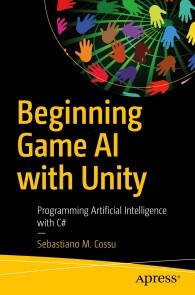
Beginning Game AI with Unity
Game developers will use this book to gain a basic knowledge of programming artificial intelligence using Unity and C#. You will not be bored learning the theory underpinning AI. Instead, you will learn by experience and practice, and complete an engaging project in each chapter.AI is the one of the most popular subjects in gaming today, ranging from controlling the behavior of non-player characters to procedural generated levels. This book starts with an introduction to AI and its use in games. Basic moving behaviors and pathfinding are covered, and then you move through more complex concepts of pathfinding and decision making.WHAT YOU WILL LEARN* Understand the fundamentals of AI* Create gameplay-based AI to address navigation and decision-making problems* Put into practice graph theory and behavior models* Address pathfinding problems* Use the A* algorithm, the deus ex machina of pathfinding algorithms* Create a mini stealth gameWHO THIS BOOK IS FORDevelopers and programming enthusiasts with a basic knowledge of Unity and C# who want to understand and master the foundations of artificial intelligence in gamesSEBASTIANO COSSU is a software engineer and game developer. He studied computer science at the University of Rome "La Sapienza". He is currently working as Game UI Developer at Feral Interactive Ltd. in London. He wrote the Apress book, Game Development with GameMaker Studio 2.CHAPTER 1: INTRODUCTIONChapter Goal: An introduction to the book where goals and main topics are introduced to the reader.Sub -Topics1. What is AI?2. AI in games3. Intelligent agents4. Knowledge representationCHAPTER 2: MOVEMENTSChapter Goal: Introducing the reader to steering and basic AI moving behaviors, in particular wandering and following the player.Sub - Topics1. Moving in a 2D world2. Moving in a 3D world3. Steering4. Moving behaviors (wandering vs following)5. A case study: car games6. Project: mini car traffic simulatorCHAPTER 3: PATHFINDINGChapter Goal: Introducing the reader to pathfinding algorithms and problem-solving approaches.Sub - Topics:1. Graphs2. Pathfinding algorithms: Dijkstra3. Pathfinding algorithms: A*4. World representation5. Constraint Satisfaction Problems (CSP)6. Improving on pathfinding7. A case study: Warcraft8. Project: LabyrinthCHAPTER 4: DECISION MAKINGChapter Goal: How does AI takes decisions? In this chapter, the reader will understand how to implement the ability to reason and plan actions using data structures to represent knowledge and search algorithms to find the best sequence of actions.Sub - Topics:1. Decision trees2. Finite-state machines (FSM)3. Behavior trees4. Fuzzy logic5. Goal-oriented behavior7. Rule-based systems9. A case study: Halo10. Project: Wumpus’ Cave ExplorerCHAPTER 5: TACTICS AND STRATEGYChapter Goal: Putting together all the knowledge acquired in the previous chapters to build intelligent agents that can perform well against the player.Sub - Topics:1. Putting things together: intelligent agents in action2. Strategy planning3. Tactical pathfinding4. Coordination and tactics in PVE: ambushing the player5. A case study: 007 Goldeneye6. Project: Chess with guns

Quick Guide for Obtaining Free Remote Desktop Protocol (RDP) Services
Remote Desktop Protocol (RDP) is a proprietary protocol developed by Microsoft which provides a user with a graphical interface to connect to another computer over a network connection. The user employs RDP client software for this purpose, while the other computer must run RDP server software.RDP refers to Remote Desktop protocol which connects your remotely connected computers or system over a RDP connected network. RDP gives a graphical interface to a client to be able to associate with another PC, system or network. RDP servers are built on Windows OS, but can be enabled to other OS as well. The major benefit of a remote desktop connection is being able to connect to your data from anywhere in the world. Your data is in one place that is easy to see and you no longer have to have software installed on your own computer.In Simple term RDP is a short form of Remote Desktop Protocol RDP specifies for home windows servers, it works as an icon to get in touch with an additional computer system, usually, it is utilized for attaching to a server organized in a data center to carry out jobs that typically do not need much user interaction and runs 24/7.Several of the extra usual uses of RDP servers are running bots, SEO devices, bitcoin mining, on-line video clip streaming, running forex trading software and so on.Most RDP servers providers that provide free services during trial period will request debit/credit card information, which is risky for us as they can claim any payment from the card. So that encouraged me to search for RDP services providers that can provide services during free trial period without requesting credit/debit card information. This report will investigate the possible ways to get free RDP server account or RDP server account at lowest cost. The report will consist from the following parts: 1.Some RDP Services Providers with free trials2.Some RDP servers providers that sell RDP with Credit Card, Debit Card, Bitcoin, PayPal or other E-wallets 3.Getting free RDP from freerdpserver.com4.Getting free RDP from Google Cloud5.Getting Google Cloud RDP/VPS for free for one month through Qwiklabs.com 6.Creating RDP through Alibabacloud.com7.Getting free RDP/VPS for seven days from CloudSigma.com8.Getting RDP/VPS through Microsoft Azure9.Getting Microsoft Azure RDP/VPS for free through Sandbox subscription10.How to get university email11.How to get RDP service for free through Microsoft Azure for students12.Getting free RDP from AWS Amazon13.How to get free RDP service with Amazon AWS Educate14.Some free websites that can be used to receive SMS online using numbers from some countries15.Generating virtual debit/credit cards using namso gold CC BIN generator for verification of some online services accountsI am Dr. Hidaia Mahmoud Mohamed Alassouli. I completed my PhD degree in Electrical Engineering from Czech Technical University by February 2003, and my M. Sc. degree in Electrical Engineering from Bahrain University by June 1995. I completed also one study year of most important courses in telecommunication and computer engineering courses in Islamic university in Gaza. So, I covered most important subjects in Electrical Engineering, Computer Engineering and Telecommunications Engineering during my study. My nationality is Palestinian from gaza strip.I obtained a lot of certified courses in MCSE, SPSS, Cisco (CCNA), A+, Linux.I worked as Electrical, Telecommunicating and Computer Engineer in a lot of institutions. I worked also as a computer networking administrator. I had considerable undergraduate teaching experience in several types of courses in many universities. I handled teaching the most important subjects in Electrical and Telecommunication and Computer Engineering. I could publish a lot of papers a top-tier journals and conference proceedings, besides I published a lot of books in Publishing and Distribution houses.I wrote a lot of important Arabic articles on online news websites. I also have my own magazine website that I publish on it all my articles: http:// www.anticorruption.000space.comMy personal website: www.hidaia-alassouli.000space.comEmail: hidaia_alassouli@hotmail.com
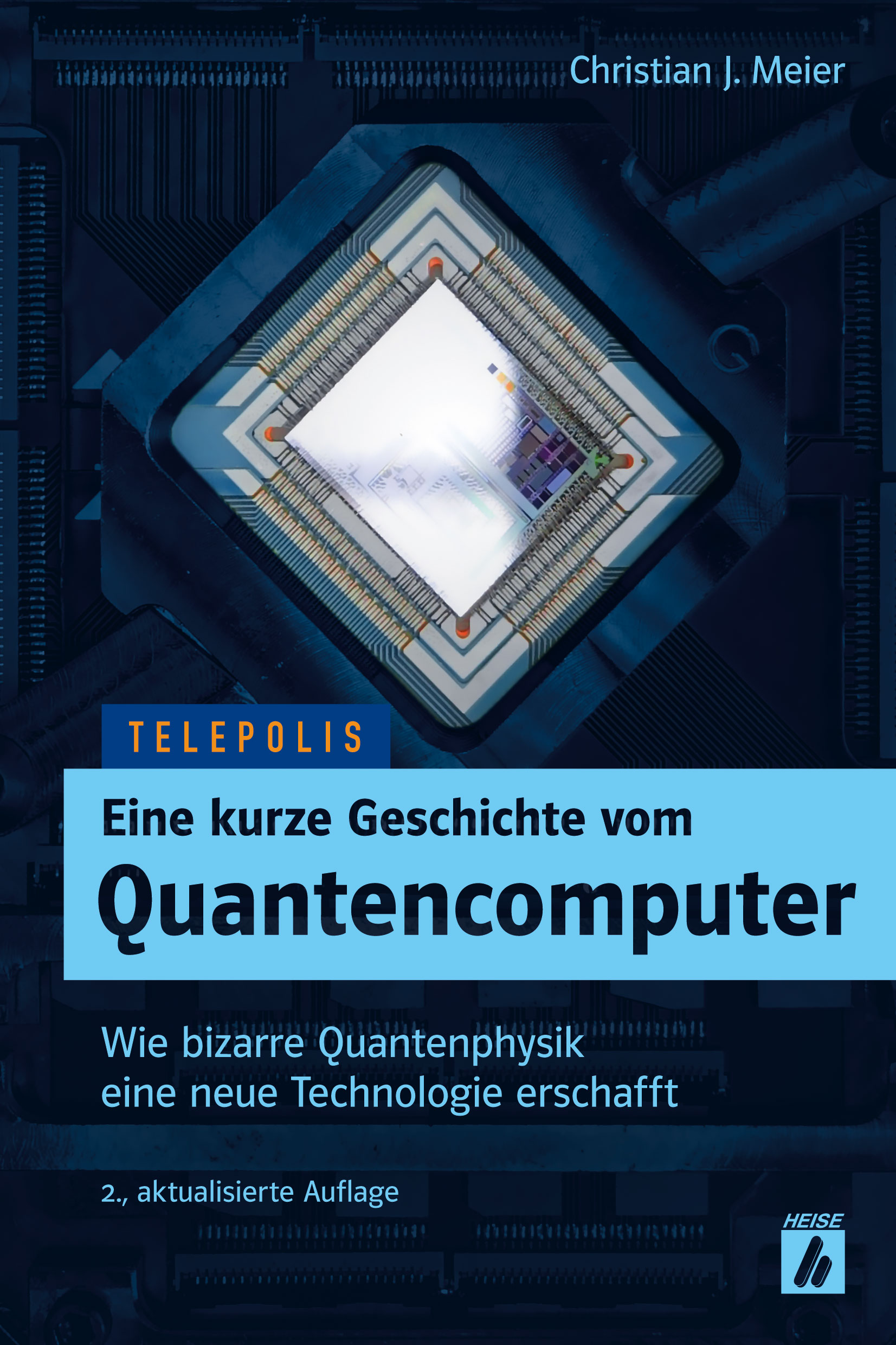
Eine kurze Geschichte vom Quantencomputer (2. Auflg.) - TELEPOLIS
Quantencomputer anschaulich erklärtDie Welt der Quanten ist total verrückt. Teilchen befinden sich gleichzeitig hier und dort. Sie verständigen sich über tausend Kilometer wie durch Telepathie. Forscher haben diese Phänomene inzwischen so gut im Griff, dass sie einen riesigen technologischen Schritt wagen: Den Bau des ersten Quantencomputers – eine ganz neue, überlegene Art von Rechner.Das Buch erklärt verständlich und unterhaltsam die magisch anmutenden Phänomene der Quantenphysik und wie sie für unbegreiflich schnell rechnende Computer genutzt werden können. Es zeigt, wie der Quantencomputer und andere Technologien, die auf der Quantenphysik basieren, den Alltag ähnlich umwälzen könnten wie einst die Dampfmaschine oder die Entdeckung der Elektronik. Werden Quantencomputer die gängigen Verschlüsselungsverfahren aushebeln? Werden sie eine blitzschnelle Entwicklung neuer Arzneien ermöglichen? Wird es einmal ein Quanteninternet geben und wenn ja, was bringt es? Werden es hyperempfindliche Quantensensoren erlauben, die Gedanken eines Menschen zu lesen? Neben Beispielen schon existierender Quantentechnologie (etwa Flash-Speicher oder Verschlüsselungsverfahren) gibt der Wissenschaftsjournalist Christian J. Meier einen Überblick über die wichtigsten Laborentwicklungen und zeigt auf, wohin sie führen könnten. Schließlich erfahren Sie, warum manche Physiker glauben, das Universum sei ein einziger Quantencomputer.Christian J. Meier (geb. 1968), promovierter Physiker und freier Journalist, beschäftigt sich seit mehreren Jahren mit den Themen Quantencomputer und Quantentechnologie und berichtet darüber für verschiedene Medien, unter anderem für die Neue Zürcher Zeitung, bild der wissenschaft, Berliner Zeitung, Frankfurter Rundschau, Spektrum.de und VDI nachrichten. Inhalt (PDF-Link)Leseprobe (PDF-Link)

Chatbots
Chatbots setzen sich in vielen Bereichen für die Kommunikation mit Kunden, Mitarbeitern und Bürgern durch. Sie beantworten automatisch Anfragen, entlasten Hotlines oder beraten Kunden. In diesem Buch werden die technischen wie auch die sprachlichen Grundlagen von Chatbots ausführlich vorgestellt und anhand von praxisnahen Beispielen erläutert. Weiterhin werden wichtige Aspekte wie Kosten, Akzeptanz und rechtliche Grundlagen beleuchtet. Abschließend wird anhand eines konkreten Beispiels ein Chatbot-Projekt exemplarisch beschrieben.ANDREAS KOHNE ist promovierter Informatiker und leitet den Bereich Business Development eines mittelständigen IT-Unternehmens in Dortmund.PHILIPP KLEINMANNS eitet eine Beratungsabteilung mit Schwerpunkten auf Internet of Things und Customer Service bei einem mittelständischen IT-Anbieter in Dortmund.CHRISTIAN ROLF ist Projektmanager für Digitalprojekte im Bereich Chatbots und Digital Signage bei einer Agentur in Witten.MORITZ BECK ist Gründer und Geschäftsführer einer Unternehmensberatung für Messenger-Kommunikation und Chatbots mit Sitz in Hamburg. Grundlagen.- Bekannte Bots.- Technik.-Anwendungsgebiete.- Design eines Chatbots.- Finanzen.- Recht.- zukünftige Anwendungen.

IT-Prüfung, Datenschutzaudit und Kennzahlen für die Sicherheit
Dieses Buch aus der Reihe „Neue Ansätze für die IT-Revision“ entwickelt aktuelle und neuartige Methoden für die Arbeit der Revision sowie für Prüfungen und Tests von IT-Systemen. Berücksichtigt werden dabei Aspekte des Datenschutzes, der Cybersicherheit, Effektivität und Funktionalität, und es werden Ansätze für Datenschutzbeauftragte, IT-Sicherheitsbeauftragte, CISOs, Compliance-Manager etc. vorgestellt.Die Schwerpunkte des Buches liegen auf Datenschutz, Kennzahlensystemen sowie Internet of Things und Künstlicher Intelligenz. Besondere Beachtung erfahren Themen wie Prüfung des Datenschutzmanagementsystems (DSMS), Prüfung der Auftragsverarbeitung sowie Meldepflichten gemäß DSGVO.Die präsentierten Ansätze zur Bewertung der Informationssicherheit mittels Kennzahlen, zu Tests für IoT-Geräte und zur Zertifizierung der Softwareentwicklung ermöglichen den Revisoren, diese Themen als systematische Prüfungen, Tests und Audits zu erfassen und umzusetzen.DR. ALEKSANDRA SOWA leitete zusammen mit dem deutschen Kryptologen Hans Dobbertin das Horst Görtz Institut für Sicherheit in der Informationstechnik. Sie ist zertifizierte Datenschutzbeauftragte und Datenschutzauditorin, IT-Compliance-Managerin (ITCM) und IT Information Security Practitioner (ITISP). Aleksandra ist Autorin diverser Bücher und Fachpublikationen, trat als Sachverständige für IT-Sicherheit im Innenausschuss des Bundestages auf, war u. a. für den Vorstand Datenschutz, Recht und Compliance (DRC) der Deutschen Telekom AG tätig und ist aktuell Senior Manager und Prokuristin in einer Wirtschaftsprüfungsgesellschaft.Prüfung des Datenschutzmanagementsystems (DSMS) - Prüfung der Auftragsverarbeiter gem. Art. 28 DSGVO - Meldepflichten für „Data Breaches“ gemäß Art. 33 DSGVO - Kennzahlensysteme für Bewertung der Informationssicherheit - Reife der Informationssicherheit - IoT-Penetrationstest - Zertifizierung der Softwareentwicklung
Machine Learning for Time Series Forecasting with Python
LEARN HOW TO APPLY THE PRINCIPLES OF MACHINE LEARNING TO TIME SERIES MODELING WITH THIS INDISPENSABLE RESOURCEMachine Learning for Time Series Forecasting with Python is an incisive and straightforward examination of one of the most crucial elements of decision-making in finance, marketing, education, and healthcare: time series modeling.Despite the centrality of time series forecasting, few business analysts are familiar with the power or utility of applying machine learning to time series modeling. Author Francesca Lazzeri, a distinguished machine learning scientist and economist, corrects that deficiency by providing readers with comprehensive and approachable explanation and treatment of the application of machine learning to time series forecasting.Written for readers who have little to no experience in time series forecasting or machine learning, the book comprehensively covers all the topics necessary to:* Understand time series forecasting concepts, such as stationarity, horizon, trend, and seasonality * Prepare time series data for modeling * Evaluate time series forecasting models’ performance and accuracy * Understand when to use neural networks instead of traditional time series models in time series forecasting Machine Learning for Time Series Forecasting with Python is full real-world examples, resources and concrete strategies to help readers explore and transform data and develop usable, practical time series forecasts.Perfect for entry-level data scientists, business analysts, developers, and researchers, this book is an invaluable and indispensable guide to the fundamental and advanced concepts of machine learning applied to time series modeling.FRANCESCA LAZZERI is an accomplished economist who works with machine learning, artificial intelligence, and applied econometrics. She works at Microsoft as a data scientist and machine learning scientist to develop a portfolio of machine learning services. She is a sought-after speaker and has given popular talks at AI conferences and academic seminars at Berkeley, Harvard, and MIT.Acknowledgments viiIntroduction xvCHAPTER 1 OVERVIEW OF TIME SERIES FORECASTING 1Flavors of Machine Learning for Time Series Forecasting 3Supervised Learning for Time Series Forecasting 14Python for Time Series Forecasting 21Experimental Setup for Time Series Forecasting 24Conclusion 26CHAPTER 2 HOW TO DESIGN AN END-TO-END TIME SERIES FORECASTING SOLUTION ON THE CLOUD 29Time Series Forecasting Template 31Business Understanding and Performance Metrics 33Data Ingestion 36Data Exploration and Understanding 39Data Pre-processing and Feature Engineering 40Modeling Building and Selection 42An Overview of Demand Forecasting Modeling Techniques 44Model Evaluation 46Model Deployment 48Forecasting Solution Acceptance 53Use Case: Demand Forecasting 54Conclusion 58CHAPTER 3 TIME SERIES DATA PREPARATION 61Python for Time Series Data 62Common Data Preparation Operations for Time Series 65Time stamps vs. Periods 66Converting to Timestamps 69Providing a Format Argument 70Indexing 71Time/Date Components 76Frequency Conversion 78Time Series Exploration and Understanding 79How to Get Started with Time Series Data Analysis 79Data Cleaning of Missing Values in the Time Series 84Time Series Data Normalization and Standardization 86Time Series Feature Engineering 89Date Time Features 90Lag Features and Window Features 92Rolling Window Statistics 95Expanding Window Statistics 97Conclusion 98CHAPTER 4 INTRODUCTION TO AUTOREGRESSIVE AND AUTOMATED METHODS FOR TIME SERIES FORECASTING 101Autoregression 102Moving Average 119Autoregressive Moving Average 120Autoregressive Integrated Moving Average 122Automated Machine Learning 129Conclusion 136CHAPTER 5 INTRODUCTION TO NEURAL NETWORKS FOR TIME SERIES FORECASTING 137Reasons to Add Deep Learning to Your Time Series Toolkit 138Deep Learning Neural Networks Are Capable of Automatically Learning and Extracting Features from Raw and Imperfect Data 140Deep Learning Supports Multiple Inputs and Outputs 142Recurrent Neural Networks Are Good at Extracting Patterns from Input Data 143Recurrent Neural Networks for Time Series Forecasting 144Recurrent Neural Networks 145Long Short-Term Memory 147Gated Recurrent Unit 148How to Prepare Time Series Data for LSTMs and GRUs 150How to Develop GRUs and LSTMs for Time Series Forecasting 154Keras 155TensorFlow 156Univariate Models 156Multivariate Models 160Conclusion 164CHAPTER 6 MODEL DEPLOYMENT FOR TIME SERIES FORECASTING 167Experimental Set Up and Introduction to Azure Machine Learning SDK for Python 168Workspace 169Experiment 169Run 169Model 170Compute Target, RunConfiguration, and ScriptRun Config 171Image and Webservice 172Machine Learning Model Deployment 173How to Select the Right Tools to Succeed with Model Deployment 175Solution Architecture for Time Series Forecasting with Deployment Examples 177Train and Deploy an ARIMA Model 179Configure the Workspace 182Create an Experiment 183Create or Attach a Compute Cluster 184Upload the Data to Azure 184Create an Estimator 188Submit the Job to the Remote Cluster 188Register the Model 189Deployment 189Define Your Entry Script and Dependencies 190Automatic Schema Generation 191Conclusion 196References 197Index 199

Migrating a Two-Tier Application to Azure
Understand and build a proof of concept by migrating a multi-tiered .NET Core web application to the Azure public cloud, leveraging different Azure Infrastructure as a Service (IAAS), Azure Platform as a Service (PaaS), and Azure Container offerings. These include Azure Container Instance (ACI), Azure Kubernetes Services (AKS), and CI/CD pipeline deployments using Azure DevOps.After a first chapter in which you set up the baseline for the lab scenarios, you will start with the basics of automating Azure resource deployments using Visual Studio and powerful Azure Resource Manager (ARM) templates. Next, you’ll learn about the importance of performing proper assessments and the tools Microsoft offers to help in this migration preparation phase. After that, you will validate the virtual machine deployment and learn about SQL Server database migration to SQL Azure PaaS, as well as deploying and migrating web applications to Azure Web Apps.After covering these foundational platform components, the next chapters focus on the core concepts and advantages of using containers for running business workloads. These labs are based on Docker, Azure Container Registry (ACR), ACI, and Web App for Containers, and show you how to enable container orchestration and cloud-scale using AKS.In the last part of the book, you will work with Azure DevOps, the Microsoft application lifecycle environment, building a CI/CD pipeline to publish workloads using the DevOps principles and concepts. You’ll see the integration with the rest of the Azure services, closing with a module on overall Azure monitoring and operations and what tools Azure has available to assist your IT teams in this challenge.WHAT YOU WILL LEARN* Use Azure to enable digital transformation* Carry out Azure automated deployments using ARM templates and Azure DevOps* Run VM-based workloads on Azure* Migrate VM-based workloads to Azure platform services * Monitor Azure running workloads with Azure Monitor and Log AnalyticsWHO THIS BOOK IS FORAnyone who wants to learn about different Azure architectures by going through hands-on exercises.Peter De Tender has more than 20 years’ experience in architecting and deploying Microsoft datacenter technologies. Since early 2012, he started shifting to cloud technologies (Office 365, Intune) and quickly jumped onto the Azure platform, working as cloud solution architect and trainer, out of his own company. Since September 2019, Peter moved into an FTE role within Microsoft Corp in the prestigious Azure Technical Trainer team, providing Azure readiness workshops to larger customers and partners across the globe.Peter was an Azure MVP for 5 years, a Microsoft Certified Trainer for more than 12 years, and is still actively involved in the community as speaker, technical writer, and author.You can follow Peter on twitter @pdtit and check his technical blog, 007ffflearning.CHAPTER 1: DIGITAL TRANSFORMATION OVERVIEWThis chapter provides an introduction to “digital transformation” and how public cloud environments like Azure can help with that. You learn about business benefits in moving to public cloud such as high availability, scalability, security, and governance.CHAPTER 2: AUTOMATING AZURE DEPLOYMENTS USING ARM TEMPLATESIn this chapter, you will learn the core concepts of automated deployments of Azure resources, using ARM Templates. Starting from a preconfigured set of templates allowing deploying the baseline of the hands-on exercises, you also learn about optimizing ARM templates for virtual machine (VM) configuration management using PowerShell Desired State Configuration and Azure VM custom script extensions.CHAPTER 3: PERFORMING AZURE ASSESSMENTSA successful cloud migration of existing on-premises workloads starts with performing proper assessments. Azure has several tools helping with this process, to identify virtual machine supportability, as well as web applications and SQL Server databases. This chapter guides readers through different assessment tools, reflecting in another hands-on exercise on how to effectively use them to prepare a lift-and-shift migration to Azure.Chapter 4: Deploying Azure SQL as a ServiceAfter performing the recommended assessments, this chapter will detail the aspects of deploying and running SQL Server database in an Azure SQL Platform as a service architecture. Starting from the different topologies available, such as Azure SQL Single Instance, Azure SQL Managed Instance, and Azure SQL Elastic Pools, we will also touch on the actual migration of a traditional VM-based SQL Server database to Azure SQL in this chapter.CHAPTER 5: DEPLOYING AND RUNNING WEB APPS IN AZURE APPLICATION SERVICESAzure App services is the overall service allowing for running web apps, mobile apps, API apps, and Azure Function apps. Going back to our original running web application, the goal of this chapter is migrating this workload to Azure Web Apps. Before performing the actual migration and deployment, you will learn about several core Web App capabilities and features, such as deployment slots, integrated backup, high availability architecture, and load balancing. The exercise in this chapter covers several situations, starting from a Visual Studio web deploy, simulating a greenfield deployment, as well as guiding you through a lift-and-shift migration process using Azure App Services Assessment tool.CHAPTER 6: CONTAINERIZING WEB APPLICATIONS USING DOCKERIn the previous chapters, you learned about running an existing two-tier workload to Azure Infrastructure as a Service (IaaS) as well as migrating to Platform as a Service (PaaS). In this chapter and the next, we reuse the same application architecture, but moving it into a containerized architecture. Starting from the basics of Docker, you will practice the base Docker commands, as well as get guided through the configuration parameters in a Dockerfile. Next, we will take you to the Azure services allowing for running Docker containers, such as Azure Container Registry, Azure WebApp for Containers, and Azure Container Instance.CHAPTER 7: DEPLOYING AND RUNNING CONTAINERIZED WORKLOADS IN AZURE KUBERNETES SERVICES (AKS)As you learned by now, Azure offers several container-supporting services. While they do a really good job in providing adequate performance, ease of use and nice integration with other Azure services, you might also consider running the containers in a Kubernetes environment for several reasons. Starting from the base characteristics of Kubernetes and how it differs from other Azure container-supporting services, you will learn how to deploy an AKS cluster, how to manage it with Kubectl, and how to run your containerized workloads. To experiment with the powers and intelligence of Kubernetes, you will also learn about the built-in scalability, high availability, and rolling upgrade features of AKS.CHAPTER 8: MANAGING AND MONITORING AKS USING AZURE MONITOR AND KUBERNETES DASHBOARDGiven the complexity of Azure Kubernetes Service’s architecture, having a monitoring tool available at hand is crucial for your business-critical workloads. Azure Kubernetes Service can be managed and monitored using the “Kubernetes” way, relying on the standard Kubernetes dashboard. This could be beneficial if you use Kubernetes in a multi-cloud environment. However, Azure also provides an extensive and powerful integration with Azure Monitor, using Azure Insights. This chapter will describe both methodologies, after which you will also deploy and use both of them in the practical in this chapter.CHAPTER 9: DEPLOYING AZURE WORKLOADS USING AZURE DEVOPS CI/CD PIPELINESThis chapter will take all covered deployment scenarios to the next level and introduce you to Azure DevOps. Building on the experiences from Visual Studio Team Services (VSTS) and Team Foundation Server (TFS), allowing developers and application management teams in deployment platform rollouts for +10 years, one can use Azure DevOps to build out an end-to-end deployment pipeline covering continuous integration (CI) and continuous deployment (CD). This chapter guides readers through the core components available in Azure DevOps, and reusing several of the earlier performed tasks, but now using a DevOps methodology.
Digitalisierung und Künstliche Intelligenz
Für jeden von uns ist heute die Frage wichtig, wie in Zukunft Menschen und Maschinen zum Wohle des Menschen zusammenarbeiten und welche Anforderungen an Menschen hierbei entstehen. Dieses essential bietet für Interessierte den Einstieg. Wenn wir die Entwicklung in geeignete Bahnen lenken, dürfen wir dieser auch gespannt entgegensehen: Dann wirken – verbunden mit KI – Achtsamkeit, Anstrengung, Aufklärung, Anleitung und auch ein Stück weit Abenteuer im positiven Sinne zusammen. Grundlagen zu Digitalisierung, Vernetzung und KI.- Anwendungsfelder und Herausforderungen beim Einsatz von KI.- Kompetenzanforderungen.

Practical Natural Language Processing with Python
Work with natural language tools and techniques to solve real-world problems. This book focuses on how natural language processing (NLP) is used in various industries. Each chapter describes the problem and solution strategy, then provides an intuitive explanation of how different algorithms work and a deeper dive on code and output in Python.Practical Natural Language Processing with Python follows a case study-based approach. Each chapter is devoted to an industry or a use case, where you address the real business problems in that industry and the various ways to solve them. You start with various types of text data before focusing on the customer service industry, the type of data available in that domain, and the common NLP problems encountered. Here you cover the bag-of-words model supervised learning technique as you try to solve the case studies. Similar depth is given to other use cases such as online reviews, bots, finance, and so on. As you cover the problems in these industries you’ll also cover sentiment analysis, named entity recognition, word2vec, word similarities, topic modeling, deep learning, and sequence to sequence modelling.By the end of the book, you will be able to handle all types of NLP problems independently. You will also be able to think in different ways to solve language problems. Code and techniques for all the problems are provided in the book.WHAT YOU WILL LEARN* Build an understanding of NLP problems in industry* Gain the know-how to solve a typical NLP problem using language-based models and machine learning* Discover the best methods to solve a business problem using NLP - the tried and tested ones* Understand the business problems that are tough to solve Who This Book Is ForAnalytics and data science professionals who want to kick start NLP, and NLP professionals who want to get new ideas to solve the problems at hand.Mathangi is a renowned data science leader in India. She has 11 patent grants and 20+ patents published in the area of intuitive customer experience, indoor positioning, and user profiles. She has 16+ years of proven track record in building world-class data science solutions and products. She is adept in machine learning, text mining, NLP technologies, and NLP tools. She has built data science teams across large organizations including Citibank, HSBC, and GE, and tech startups such as 247.ai, PhonePe, and Gojek. She advises start-ups, enterprises, and venture capitalists on data science strategy and roadmaps. She is an active contributor on machine learning to many premier institutes in India. She is recognized as one of “The Phenomenal SHE” by the Indian National Bar Association in 2019.Chapter 1: Text Data in Real WordChapter Goal: This chapter focuses on various types of text data. The information it offers and the commercial value that each of the data could potentially offer. Understanding of the data provides the reader the landscape that they are getting intoNo of pages: 10Sub -Topics* NLP* Search * Reviews* Tweets/FB Posts* Chat data* SMS data* Content data* IVR utterance dataChapter 2: NLP in Customer ServiceChapter Goal: Case studies for problems in customer service and how they could be solved.No of pages: 39Sub - Topics1. A quick overview of the customer service industry2. Voice Calls3. Chats.4. Tickets Data5. Email Data6. Voice of customer analysis7. Intent Mining8. NPS/CSAT drivers9. Insights in Sales Chats10. Reasons for non purchase11. Survey Comment Analysis12. Mining Voice transcriptsChapter 3: NLP in Online ReviewsChapter Goal: Case studies for problems in online reviews and how they could be solved.No of pages: 39Sub - Topics:1. Sentiment Analysis2. Emotion Mining3. Approach 1 :Lexicon based approach4. Approach 2 : Rules based approach5. Approach 3 - Machine Learning based approach (Neural Network)6. Attribute ExtractionChapter 4: NLP in BFSIChapter Goal: case studies for problems in the banking industrySub - Topics:1. NLP in Fraud2. Method 1 (For extracting NER, popular libraries)3. Method 2 (For extracting NER, rules based approach)4. Method 3 (Classifier based approach using word embeddings and neural networks)5. Other use cases of NLP in BFSI6. Natural Language Generation in banksNo of pages: 47Chapter 5: NLP in Virtual AssistantsChapter Goal: Case study in building state of the art natural language botsSub- Topics1. Overview2. Approach 1 : The “Classic” approach using LSTMs3. Approach 2 : Generating Responses4. BERT5. Further nuances in building conversational bots:No of pages: 43

AR and VR Using the WebXR API
Gain an in-depth knowledge in immersive web development to create augmented reality (AR) and virtual reality (VR) applications inside web browsers using WebXR API, WebGL, Three.js, and A-Frame. This project-based book will provide the practice and portfolio content to make the most of what the futures of spatial computing and immersive technology have to offer.Beginning with technical analysis of how web browsers function, the book covers programming languages such as WebGL, JavaScript, and HTML, with an eye on a complete understanding of the WebXR lifecycle. You'll then explore how contemporary web browsers work at the code level and see how to set up a local development server and use it with the Visual Studio Code IDE to create 3D animation in the WebGL programming language.With a familiarity of the web-rendering pipeline in place, you’ll venture on to WebGL abstractions such as the Three.js JavaScript library and Mozilla’s A-Frame XR Framework, which use WebXR to create high-end visual effects. In the final projects of the book, you’ll create an augmented reality web session for an Android phone device, and create a VR scene in A-Frame (built on Three.js) to demo essential components of the WebXR API pertaining to user positioning and interaction.Game engines have become common-place for the creation of mixed reality content. However, developers not interested in learning entirely new workflows may be better suited to work within a medium almost universally open to all—the web; AR and VR Using the WebXR API will show you the way.WHAT YOU'LL LEARN* Master the creation of virtual reality and augmented reality features for web page* Prepare to work as an immersive web developer with a portfolio of projects in sought-after technologies* Review the fundamentals of writing shaders in WebGL* Experience the unity between client, server, and cloud architecture as it applies to location-based ARWHO THIS BOOK IS FORAspiring immersive web developers and developers already familiar with the fundamentals of web development who want to further explore topics such as spatial computing, computer vision, spatial anchors, and cloud-computing for multi-user social experiences. Rakesh Baruah is a writer and creator with 15 years of experience in new media, film, and television in New York City. After completing an MFA in screenwriting and directing for film from Columbia University, Rakesh joined the writers’ room of a hit, primetime, network drama as an assistant. The experience opened his eyes to the limits of television and the opportunities promised by 3D, immersive content. In 2016 he began a self-guided journey toward mixed reality design that has taken him through startups, bootcamps, the Microsoft offices, and many, many hours in front of a computer. He is the author of one previous book on virtual reality and the Unity Game Engine and has received an Nvidia-certified nanodegree in Computer Vision. He shares what he’s learned with you in a style and format designed specifically for the person who, in high school, preferred English class to Trigonometry. Chapter 1: IntroductionSub-Topics:- The Components of WebXR• Pose tracking• Camera data• Scene understanding- Hit-Testing- Anchors- Point-clouds- Surfaces- light-estimation• The webXR API- WebGL 1 → WebGL 2 → WebGPU → WebVR → WebXR- Khronos Group and WC3• The webXR emulator• Industry Standard XR Guidelines (Microsoft, Google)Chapter 2: SetupSub-Topics:- Types of Browsers and Requirements- Chrome Canary- Firefox Reality- Oculus Browser• How to setup a local server for development- Node, Python, Servez• Local machine setup- Download and install Visual Studio Code- Create GitHub account• Playgrounds vs. Local development while executive the code in the bookChapter 3: Introduction to Web BrowsersSub-Topics:• The Workings of the World Wide Web- Client - Server relationship- HTML, CSS, and Javascript• The Workings of a Web Page- The Document Object Model- The Render Engine- HTML5 and Canvas• Toward Native Code in the Browser- WebAssemblyPhysics and the GPUChapter 4: A Brief Introduction to WebGLSub-Topics:• The Big Picture of WebGL- A Crash Course in 3D Graphics- The Graphics Rendering → Rasterizing Pipeline• The Difference Between WebGL and JavaScript- CPU vs GPU- Browser vs Native- The Value of Many Threads• The Components of a WebGL Application- Vertex and Fragment Shaders- Uniforms, Attributes, and Buffers- ViewMatrix, ProjectionMatrix, and the WebGL Matrix Math Library• The Cognitive Dissonance between WebGL and Web ProgrammersChapter 5: WebXR Libraries -- Three.jsSub-Topics:• An Overview of JavaScript Libraries• Introduction to Three.js, which Makes Programming WebGL Easier• Async and Await vs Promises in JavaScript• JavaScript and the GPUChapter 6: WebXR Frameworks: Mozilla’s A-FrameSub-Topics:• A-Frame makes Three.js easier• The Components of A-Frame:- Scenes, Cameras, Objects, Interactions- Light and Shadows- 3D Objects and the gLTF file formatChapter 7: WebXR Engines: Babylon.jsSub-Topics:• TypeScript vs JavaScript- Type safety- Parallel Processing• The Babylon.js Tools- Playground- Inspector- Node Creator• What Makes an Engine vs. a Framework?- The role of physics in XR creationChapter 8: Web Augmented Reality in Chrome CanarySub-Topics:• An Overview of the WebXR Features in the Chrome Canary XR API- Hit-Testing- Camera access• Accessing Developer Features in Chrome• The Browser and Hardware Connection- Final Project: Client-Server database connection for data persistence in ARChapter 9: The Future of WebXRSub-Topics:• Computer Vision and WebXR- Facial Recognition and Filters• Multi-user Interaction- Spatial / Cloud Anchors- Social XR• Hand Gestures and Voice Commands- Motion Tracking• Cloud-Computing and Privacy- The ethical responsibility of the Immersive Web developer
Kubernetes
Master all the concepts and tools necessary to start administering a Kubernetes cluster and deploying applications to production. You will cover the entire curricula of the two Kubernetes certifications (for application developers and administrators).The initial chapters guide you through deployment of a Kubernetes cluster on virtual machines and explore the different components of the control plane. Next, you will work with the kubectl command-line tool; namespaces, labels, selectors, and annotations—common resources used through the Kubernetes API. The following chapters describe the principle of controllers and detail how workload controllers work as well as the possibilities for configuring deployed applications.You will also learn how to deploy a scalable and self-healing application, how pods are scheduled to nodes, how parts of the application can communicate, and how the application is discoverable from the outside. Next, you will cover security concerns describing the different authentication methods, the RBAC authorization mode, security contexts, network policies, and how to secure container images. You will also cover using persistent volumes for your containers to store long-term data, monitoring your clusters and applications and implementing design patterns for multi-container pods. The concluding chapters guide you through the upgrade of your deployed cluster.After reading this book, you will have enough knowledge to deploy a complex application using a Kubernetes cluster and be ready for the certification exams.WHAT YOU WILL LEARN* Deploy a Kubernetes cluster with kubeadm and learn how the control plane works* Discover how the Kubernetes API is structured* Deploy secure, auto-scaled, and self-healing applications* Master the kubectl command-line toolWHO THIS BOOK IS FORAdministrators and application developers with good knowledge of micro-services development and deployment.Philippe Martin has been working with Kubernetes for three years, first by creating an operator to deploy video CDNs into the cloud, later helping companies deploy their applications into Kubernetes. Philippe passed the CKAD certification about a year ago and the CKA certification recently.He has long experience with distributed systems and open-source software: he started his career 20 years ago creating thin clients based on the Linux kernel and open source components.Philippe is active in the development of Kubernetes, especially its documentation, and participates in the translation of the official documentation into French, has edited two reference books about the Kubernetes API and kubectl, and is responsible for the French translation of the Kubernetes Dashboard.Chapter 1: Creating a Cluster with kubeadm• Provisioning Compute Resources• Install Docker on the hosts• Install kubeadm, kubelet, and kubectl on the hosts• Initialize the control plane node• Join the workersChapter 2: Control Plane Components• Explore the Control Plane servicesChapter 3: Accessing the Cluster• Install kubectl on your dev machine• Access the cluster from the dev machineChapter 4: Kubernetes Resources• Namespaces• Labels and selectors• AnnotationsChapter 5: The Workloads• Pod specs• Container specs• Pod controllers• ReplicaSet controller• Deployment controller• Update and rollback• Deployment strategiesChapter 6: Configuring Applications• Arguments to the command• Environment variables• Configuration file from ConfigMap• Configuration file from Secret• Configuration file from Pod fields• Configuration file from container resources fields• Configuration file from different sourcesChapter 7: Scaling an Application• Manual scaling• Auto-scalingChapter 8: Application Self-Healing• Controller to the rescue• Liveness probes• Resource limits and quality of service classesChapter 9: Scheduling Pods• Using label selectors to schedule pods on specific nodes• DaemonSets• Static pods• Resource requests• Running multiple schedulersChapter 10: Discovery and Load Balancing• Services• Services types• IngressChapter 11: Security• Authentication• Authorization• Security contexts• Network policies• Working with private Docker registriesChapter 12: Storage• Persistent volumes• Claiming a persistent volume• Using auto-provisioned persistent volumesChapter 13: Monitoring and Logging• Basic loggingChapter 14: Upgrading the Cluster• Upgrade the controller• Upgrade the workers• Upgrading the operating system• Backup a cluster• Restore a clusterChapter 15: kubectl• Managing kubeconfig file• Generic commands• Creating applications resources• Managing clusters• Getting documentationA. Curriculum CKAB. Curriculum CKAD
Foundation Gatsby Projects
Enhance your Gatsby skillset by building a series of ready-to-use web sites. With the aid of four projects, this book teaches you how to use Gatsby alongside the latest technologies, including Contentful, Twillio, and Stackbit.In the first project, you will create a simple agency site with a contact form and deploy it to Netlify. You'll then quickly be able to create other basic client sites. Next, you will learn to set up a blog site using Stackbit and Dev CMS. Other projects include a large site built with Contentful and a video chat using Twilio.Many Gatsby tutorials out there today only cover how to create blog sites – get ahead of the crowd using this book today.WHAT YOU'LL LEARN* Use Contentful CMS with Gatsby* Build sites quickly with Stackbit service* Develop a video chat site similar to Skype with Twilio services * Deploy all sites in Netlify* Add functionalities with the powerful Gatsby plugin ecosystem * Integrate advertisementsWHO THIS BOOK IS FORAnyone who wants to create a site using Gatsby. A little knowledge of React is expected but is not a necessity. You will need to be familiar with JavaScript concepts and be confident with basic web development.NABENDU BISWAS is a full stack JavaScript developer who has been working in the IT industry for the past 15 years and has worked for some of the world’s top development firms and investment banks. He is a passionate tech blogger who publishes on dev.to and medium.com and on thewebdev.tech. He is an all-round nerd, passionate about everything JavaScript, React and Gatsby. You can find him on Twitter @nabendu82.Chapter One-Agency SiteThe SetupBasic StylesSectionsWork and About PageDeploying SiteChapter Two-Blog Site using StackbitThe SetupDomain AddGatsby PluginsAdding AdvertisementsChapter Three-Tourism site with Contentful - Part OneThe SetupNavbar and FooterSimpleHero ComponentAbout SectionHot Tips SectionDeploy SiteImage OptimizationPage TransitionContact FormContentful SetupPlaces ComponentBlogComponentPhotos ComponentGatsby PluginsAdd AdvertisementsChapter Four-Tourism site with Contentful - Part TwoChapter Five-Tourism site with Contentful - Part ThreeChapter Six-Tourism site with Contentful - Part FourChapter Seven-Video Chat SiteThe SetupTwilio FunctionThe CodeVideo ImplementationCSS Changes

Systematische Steigerung der Energieeffizienz im Karosseriebau
Die vorliegende Dissertation präsentiert ein Konzept zur Steigerung der Energieeffizienz im Karosseriebau um durchschnittlich 10-15%. Die dafür benötigte Energietransparenz wird durch die strukturierte energetische Analyse bestehender Karosseriebauanlagen erreicht. Weiterhin besteht bereits im Karosseriebauplanungsprozess die Möglichkeit einer Energieprognose der zu planenden Arbeitsgruppen als auch des energetischen Lastprofils. In Abhängigkeit der energetischen Bewertung werden mit Hilfe eines Expertensystems entsprechend zu ergreifende Maßnahmen dem Planer zur Verfügung gestellt.Einleitung.- Grundlagen und Stand der Technik.- Stand der Forschung.- Konzeptentwicklung.- Anwendung des Gesamtkonzeptes am Beispiel des Karosseriebaus.- Zusammenfassung und Ausblick.

Applied Neural Networks with TensorFlow 2
Implement deep learning applications using TensorFlow while learning the “why” through in-depth conceptual explanations.You’ll start by learning what deep learning offers over other machine learning models. Then familiarize yourself with several technologies used to create deep learning models. While some of these technologies are complementary, such as Pandas, Scikit-Learn, and Numpy—others are competitors, such as PyTorch, Caffe, and Theano. This book clarifies the positions of deep learning and Tensorflow among their peers.You'll then work on supervised deep learning models to gain applied experience with the technology. A single-layer of multiple perceptrons will be used to build a shallow neural network before turning it into a deep neural network. After showing the structure of the ANNs, a real-life application will be created with Tensorflow 2.0 Keras API. Next, you’ll work on data augmentation and batch normalization methods. Then, the Fashion MNIST dataset will be used to train a CNN. CIFAR10 and Imagenet pre-trained models will be loaded to create already advanced CNNs.Finally, move into theoretical applications and unsupervised learning with auto-encoders and reinforcement learning with tf-agent models. With this book, you’ll delve into applied deep learning practical functions and build a wealth of knowledge about how to use TensorFlow effectively.WHAT YOU'LL LEARN* Compare competing technologies and see why TensorFlow is more popular* Generate text, image, or sound with GANs* Predict the rating or preference a user will give to an item* Sequence data with recurrent neural networksWHO THIS BOOK IS FORData scientists and programmers new to the fields of deep learning and machine learning APIs.ORHAN GAZI YALÇIN is a joint Ph.D. candidate at the University of Bologna & the Polytechnic University of Madrid. After completing his double major in business and law, he began his career in Istanbul, working for a city law firm, Allen & Overy, and a global entrepreneurship network, Endeavor. During his academic and professional career, he taught himself programming and excelled in machine learning. He currently conducts research on hotly debated law & AI topics such as explainable artificial intelligence and the right to explanation by combining his technical and legal skills. In his spare time, he enjoys free-diving, swimming, exercising as well as discovering new countries, cultures, and cuisines.Chapter 1: Introduction* How to Make the Most out of this Book* What is Tensorflow?* What’s New in Tensorflow 2.0* Google Colab and Jupyter Notebook* Installation and Environment SetupChapter 2: Machine Learning● What is Machine Learning?● Types of Machine Learninga. Supervised Learning: Regression, Classification (Binary or Multiclass)b. Unsupervised Learningc. Semi-Supervised Learningd. Reinforcement Learning● Machine Learning Terms:a. Data and Datasets: Train, Test, and Validationb. Cross-Validationc. Overfittingd. Bias & Variance,e. Fine-Tuningf. Performance Terms: Accuracy, Recall, Precision, F1 Score, Confusion Matrix● Introduction to and Comparison of ML Models:a. Regression (Linear and Logistic), Decision Trees, K-Nearest Neighbors, SupportVector Machines, K-Means Clustering, Principal Component Analysis● Steps of Machine Learning: Data Cleaning, Model Building, Dataset Split: Training, Testing,and Validation, and Performance EvaluationChapter 3: Deep Learning● Introduction to Deep Learning● Introduction to Perceptron● Activation Functions● Cost (Loss) Function● Gradient Descent Backpropagation● Normalization and Standardization● Loss Function and Optimization Functions● OptimizerChapter 4: Relevant Technologies Used for Machine Learning● Numpy● Matplotlib● Pandas● Scikit Learn● Deployment with FlaskChapter 5: TensorFlow 2.0● Tensorflow vs. Other Deep Learning Libraries● Keras API vs. Estimator● Keras API Syntax● Hardware Options and Performance Evaluation: CPUs vs. GPUs vs. TPUsChapter 6: Artificial Neural Networks (ANNs)● Introduction to ANNs● Perceptron Model● Linear (Shallow) Neural Networks● Deep Neural Networks● ANN Application Example with TF 2.0 Keras APIChapter 7: Convolutional Neural Networks (CNNs)● Introduction to CNN Architecture● CNN Basics: Strides and Filtering● Dealing with Image Data● Batch Normalization● Data Augmentation● CNN for Fashion MNIST with TF 2.0 Keras API● CNN for CIFAR10 with TF 2.0 Keras API (Pre-Trained Model)● CNN with Imagenet with TF 2.0 Keras API (Pre-Trained Model)Chapter 8: Recurrent Neural Networks (RNNs)● Introduction to RNN Architectures● Sequence Data (incl. Time Series)● Data Preparation● Simple RNN Architecture● Gated Recurrent Unit (GRU) Architecture● Long-Short Term Memory (LSTM) Architecture● Simple RNN, GRU, and LSTM ComparisonChapter 9: Natural Language Processing (RNN and CNN applications)● Introduction to Natural Language Processing● Text Processing● NLP Application with RNN● NLP Application with CNN● Text GenerationChapter 10: Recommender Systems● Introduction to Recommender Systems● Recommender System Using MovieLens Dataset● Recommender System Using Jester DatasetChapter 11: Auto-Encoders● Introduction to Auto-Encoders● Dimensionality Reduction● Noise Removal● Auto-Encoder for ImagesChapter 12: Generative Adversarial Networks (GANs)● Introduction to Generative Adversarial Networks● Generator and Discriminator Structures● Image Generation with GANs● Text Generation with GANsChapter 13: Conclusion

Games and Ethics
The number of digital gamers is increasing worldwide, but public debates about digital games commonly focus on questionable game content or problematic gaming behavior. This book offers a broader ethical perspective on digital game cultures, presenting theoretical and empirical work on the ethical dimensions of the development, production and distribution of digital games, as well as issues relating to responsible gaming and the pedagogical use of digital games. Questions of the communicative-cultural change in game cultures are linked with questions of media education and media ethics. With such a comprehensive approach, the volume promotes ethical discourse on digital game cultures.

Hyperparameter Optimization in Machine Learning
Dive into hyperparameter tuning of machine learning models and focus on what hyperparameters are and how they work. This book discusses different techniques of hyperparameters tuning, from the basics to advanced methods.This is a step-by-step guide to hyperparameter optimization, starting with what hyperparameters are and how they affect different aspects of machine learning models. It then goes through some basic (brute force) algorithms of hyperparameter optimization. Further, the author addresses the problem of time and memory constraints, using distributed optimization methods. Next you’ll discuss Bayesian optimization for hyperparameter search, which learns from its previous history.The book discusses different frameworks, such as Hyperopt and Optuna, which implements sequential model-based global optimization (SMBO) algorithms. During these discussions, you’ll focus on different aspects such as creation of search spaces and distributed optimization of these libraries.Hyperparameter Optimization in Machine Learning creates an understanding of how these algorithms work and how you can use them in real-life data science problems. The final chapter summaries the role of hyperparameter optimization in automated machine learning and ends with a tutorial to create your own AutoML script.Hyperparameter optimization is tedious task, so sit back and let these algorithms do your work.WHAT YOU WILL LEARN* Discover how changes in hyperparameters affect the model’s performance.* Apply different hyperparameter tuning algorithms to data science problems* Work with Bayesian optimization methods to create efficient machine learning and deep learning models* Distribute hyperparameter optimization using a cluster of machines* Approach automated machine learning using hyperparameter optimizationWHO THIS BOOK IS FORProfessionals and students working with machine learning.Tanay is a deep learning engineer and researcher, who graduated in 2019 in Bachelor of Technology from SMVDU, J&K. He is currently working at Curl Hg on SARA, an OCR platform. He is also advisor to Witooth Dental Services and Technologies. He started his career at MateLabs working on an AutoML Platform, Mateverse. He has worked extensively on hyperparameter optimization. He has also delivered talks on hyperparameter optimization at conferences including PyData, Delhi and PyCon, India.* Chapter 1: HyperparametersChapter Goal: To introduce what hyperparameters are, how they can affect themodel training. Also gives an intuition of how hyperparameter affects general machinelearning algorithms, and what value should we choose as per the training dataset.Sub - Topics1. Introduction to hyperparameters.2. Why do we need to tune hyperparameters3. Specific algorithms and their hyperparameters4. Cheatsheet for deciding Hyperparameter of some specific Algorithms.Chapter 2: Brute Force Hyperparameter TuningChapter Goal: To understand the commonly used classical hyperparameter tuningmethods and implement them from scratch, as well as use the Scikit-Learn library to do so.Sub - Topics:1. Hyperparameter tuning2. Exhaustive hyperparameter tuning methods3. Grid search4. Random search5. Evaluation of models while tuning hyperparameters.Chapter 3: Distributed Hyperparameter OptimizationChapter Goal: To handle bigger datasets and a large number of hyperparameterwith continuous search spaces using distributed algorithms and distributedhyperparameter optimization methods, using Dask Library.Sub - Topics:1. Why we need distributed tuning2. Dask dataframes3. IncrementalSearchCVChapter 4: Sequential Model-Based Global Optimization and Its HierarchicalMethodsChapter Goal: A detailed theoretical chapter about SMBO Methods, which usesBayesian techniques to optimize hyperparameter. They learn from their previous iterationunlike Grid Search or Random Search.Sub - Topics:1. Sequential Model-Based Global Optimization2. Gaussian process approach3. Tree-structured Parzen Estimator(TPE)Chapter 5: Using HyperOptChapter Goal: A Chapter focusing on a library hyperopt that implements thealgorithm TPE discussed in the last chapter. Goal to use the TPE algorithm to optimizehyperparameter and make the reader aware of how it is better than other methods.MongoDB will be used to parallelize the evaluations. Discuss Hyperopt Scikit-Learn and Hyperas with examples.1. Defining an objective function.2. Creating search space.3. Running HyperOpt.4. Using MongoDB Trials to make parallel evaluations.5. HyperOpt SkLearn6. HyperasChapter 6: Hyperparameter Generating Condition Generative Adversarial NeuralNetworks(HG-cGANs) and So Forth.Chapter Goal: It is based on a hypothesis of how, based on certain properties of dataset, one can train neural networks on metadata and generate hyperparameters for new datasets. It also summarizes how these newer methods of Hyperparameter Tuning can help AI to develop further.Sub - Topics:1. Generating Metadata2. Training HG-cGANs3. AI and hyperparameter tuning

Traefik API Gateway for Microservices
Use Traefik as a load balancer or a reverse proxy for microservices-based architecture. This book covers Traefik integration for microservices architecture concerns such as service discovery, telemetry, and resiliency.The book focuses on building an in-depth understanding of Traefik. It starts with the fundamentals of Traefik, including different load balancing algorithms available, and failure handling for application resiliency. Examples are included for the failure scenarios. TLS support is explained, including scenarios of TLS termination and TLS forwarding. Traefik supports TLS termination using Let's Encrypt. Traefik deployment in prominent microservices ecosystems is discussed, including Docker and Kubernetes.Traefik is a language-neutral component. This book presents examples of its deployment with Java-based microservices. The examples in the book show Traefik integration with Jaeger/Zipkin, Prometheus, Grafana, and FluentD. Also covered is Traefik for Python-based services and Java-based services deployed in the Kubernetes cluster. By the end of the book, you will confidently know how to deploy and integrate Traefik into prominent microservices ecosystems.WHAT YOU WILL LEARN* Understand Traefik basics and its components* Explore different load balancing scenarios and TLS termination* Configure service discovery, circuit breakers, timeouts, and throttling* Monitor Traefik using Prometheus and request tracingWHO THIS BOOK IS FORDevelopers and project managers who have developed microservices and are deploying them in cloud and on-premise environments with Kubernetes or Docker. The book is not specifically written for any particular programming language. The examples presented use Java or Python.RAHUL SHARMA is a seasoned Java developer with over 15 years of industry experience. In his career he has worked with companies of various sizes from enterprises to startups. During this time he has developed and managed microservices on the cloud (AWS/GCE/DigitalOcean) using open source software. He is an open source enthusiast and shares his experience at local meetups. He co-authored Java Unit Testing with JUnit 5 (Apress) and Getting Started with Istio Service Mesh (Apress).AKSHAY MATHUR is a software engineer with 15 years of experience, mostly in Java and web technologies. Most of his career has been spent building B2B platforms for enterprises, dealing with concerns such as scalability, configurability, multi-tenancy, and cloud engineering. He has hands-on experience implementing and operating microservices and Kubernetes in these ecosystems. Currently, he enjoys public speaking and blogging on new cloud native technologies (especially plain Kubernetes) and effective engineering culture.Chapter 1: Introduction to TraefikCHAPTER GOAL: THE CHAPTER COVERS THE NEED OF A BETTER LOAD BALANCER USING MICROSERVICES COMPONENTS. IT COVERS TRAEFIK COMPONENTS AND BUILD THE BASIC UNDERSTANDING. THE READER WILL SETUP THE ENVIRONMENT WHICH WILL GET STARTED WITH TRAEFIKNO OF PAGES: 20SUB -TOPICS1. Monolith to microservices architecture evolution1. Static configuration challenges2. Observability challenges3. TLS as identity2. Traefik components1. CLI2. DashboardChapter 2: Configure TraefikCHAPTER GOAL: THE CHAPTER WILL COVER ROUTING BASICS. IT WILL DISCUSS THE VARIOUS COMPONENTS.NO OF PAGES: 20SUB - TOPICS1. Entrypoint2. Routers3. ServicesChapter 3: Load Balancing and Failure DetectionCHAPTER GOAL: THE CHAPTER WILL COVER DIFFERENT LOAD BALANCING OPTIONS AVAILABLE IN TRAEFIK.NO OF PAGES : 30SUB - TOPICS:1. Configuring HTTP servicea. Round robinb. Weighted round robinc. Mirroringd. Health checks2. Configuring TCP servicea. Round robinb. Weighted round robinChapter 4: Configure TLSCHAPTER GOAL: TLS IS AN IMPORTANT PART OF LOAD BALANCING. WE WILL COVER HOW TO DO TLS TERMINATION AND TLS PASS THROUGH USING TRAEFIK.NO OF PAGES: 15SUB - TOPICS:1. Configure TLS terminationa. Using lets encrypt2. Configure TLS pass-throughChapter 5: Logs, Request Tracing and Black ListingCHAPTER GOAL: THE CHAPTER WILL COVER OBSERVABILITY FEATURES OF TRAEFIKNO OF PAGES: 30SUB - TOPICS:1. Trafik logging2. Access logs3. Request tracing4. IP blacklisting5. MetricesChapter 6: Traefik as MicroservicesCHAPTER GOAL: THE CHAPTER WILL USE TRAEFIK FOR MICROSERVICES TRAFFIC ROUTING. IT WILL LOAD CONFIGURATION AND DISCOVER SERVICES FROM A BACKEND. IT WILL CONFIGURE CIRCUIT BREAKERS, THROTTLING AND RETRIES.NO OF PAGES: 30SUB - TOPICS:1. Routing using service discovery2. configure circuit breakers and retries3. configure throttling4. Supporting canary routesChapter 7: Traefik as Kubernetes IngressCHAPTER GOAL: THE CHAPTER WILL SETUP TRAEFIK AS KUBERNETES INGRESS. IT WILL SETUP MUTUAL TLS AUTHENTICATION FOR IDENTITY AND ROLE BASED ACCESS CONTROL. IT WILL SEND METRICES AND TRACING TO PROMETHEUS AND JAGGER K8S COMPONENTS.NO OF PAGES: 30SUB - TOPICS:1. Configure Kubernetes ingress2. Enable mTLS authenticationa. configure RBAC3. Configure TLS termination for user requests4. Configure request tracing with Jaeger5. Capture metrices in prometheus

Machine Learning for Economics and Finance in TensorFlow 2
Machine learning has taken time to move into the space of academic economics. This is because empirical research in economics is concentrated on the identification of causal relationships in parsimonious statistical models; whereas machine learning is oriented towards prediction and is generally uninterested in either causality or parsimony. That leaves a gap for students, academics, and professionals who lack a standard reference on machine learning for economics and finance.This book focuses on economic and financial problems with an empirical dimension, where machine learning methods may offer something of value. This includes coverage of a variety of discriminative deep learning models (DNNs, CNNs, LSTMs, and DQNs), generative machine learning models (GANs and VAEs), and tree-based models. It also covers the intersection of empirical methods in economics and machine learning, including regression analysis, natural language processing, and dimensionality reduction.TensorFlow offers a toolset that can be used to define and solve any graph-based model, including those commonly used in economics. This book is structured to teach through a sequence of complete examples, each framed in terms of a specific economic problem of interest or topic. This simplifies otherwise complicated concepts, enabling the reader to solve workhorse theoretical models in economics and finance using TensorFlow.WHAT YOU'LL LEARN* Define, train, and evaluate machine learning models in TensorFlow 2* Apply fundamental concepts in machine learning, such as deep learning and natural language processing, to economic and financial problems * Solve theoretical models in economicsWHO THIS BOOK IS FORStudents, data scientists working in economics and finance, public and private sector economists, and academic social scientistsISAIAH HULL received his PhD in Economics from Boston College in 2013 and has since worked in the Research Division at Sweden’s Central Bank. He has published numerous articles in academic journals primarily concentrated in computational economics with applications in macroeconomics, finance, and housing. Most of his recent work makes use of techniques from machine learning. He also regularly presents at conferences on machine learning and big data in economics. And Isaiah is an accomplished teacher with experience teaching TensorFlow 2.0. Currently, he’s working on a project to introduce quantum computing to economists.Chapter 1: TensorFlow 2.0Chapter Goal: Introduce TensorFlow 2 and discuss preliminary material on conventions and practices specific to TensorFlow.· Differences between TensorFlow iterations· TensorFlow for economics and finance· Introduction to tensors· Review of linear algebra and calculus· Loading data for use in TensorFlow· Defining constants and variablesChapter 2: Machine Learning and EconomicsChapter Goal: Provide a high-level overview of machine learning models and explain how they can be employed in economics and finance. Part of the chapter will review existing work in economics and speculate on future use-cases.· Introduction to machine learning· Machine learning for economics and finance· Unsupervised machine learning· Supervised machine learning· Regularization· Prediction· EvaluationChapter 3: RegressionChapter Goal: Explain how regression models are used primarily for prediction purposes in machine learning, rather than hypothesis testing, as is the case in economics. Introduce evaluation metrics and optimization routines used to solve regression models.· Linear regression· Partially-linear regression· Non-linear regression· Logistic regression· Loss functions· Evaluation metrics· OptimizersChapter 4: TreesChapter Goal: Introduce tree-based models and the concept of ensembles.· Decision trees· Regression trees· Random forests· Model tuningChapter 5: Gradient BoostingChapter Goal: Introduce gradient boosting and discuss how it is applied, how models are tuned, and how to identify important features.· Introduction to gradient boosting· Boosting with regression models· Boosting with trees· Model tuning· Feature importanceChapter 6: ImagesChapter Goal: Introduce the high level Keras and Estimators APIs. Explain how these libraries can be used to perform image classification using a variety of deep learning models. Also, discuss the use of pretrained models and fine-tuning. Speculate on image classification uses in economics and finance.· Keras· Estimators· Data preparation· Deep neural networks· Convolutional neural networks· Recurrent neural networks· Capsule networks· Pretrained models· Model fine-tuningChapter 7: TextChapter Goal: Introduce text analysis, which has been applied extensively in economics. Cover the process of cleaning text and converting it into a numerical format, as well as a selection of unsupervised, supervised, and generative models. Discuss state-of-the-art models in the literature.· The natural language toolkit· Data cleaning and preparation· Tokenization· Word embeddings· The bag-of-words model· Sentiment analysis· Static and dynamic topic modeling· Text classification· Text generation· Pretrained modelsChapter 8: Time SeriesChapter Goal: Empirical work in macroeconomics and finance relies extensively on time series analysis. Methods from machine learning for sequential data analysis currently have low penetration in the economics literature. This chapter will speculate on how machine learning methods could be used in time series analysis.· Text and time series· Sequential models of machine learning· Recurrent neural networks· Long short-term memory· Forecasting· Model evaluation· Comparison with methods in economics and financeChapter 9: Dimensionality ReductionChapter Goal: Discuss dimensionality reduction as it is used in economics. Explain commonly used tools in machine learning for dimensionality reduction, including those which are also used in economics and finance.· Dimensionality reduction in economics· Principal component analysis· Partially linear regression· The autoencoder modelChapter 10: Generative ModelsChapter Goal: Introduce the concept of generative machine learning, including a discussion of existing models. Review the few applications of generative machine learning in economics and finance and speculate on potential future uses.· Introduction to generative machine learning· Variational autoencoders· Generative adversarial networks· Applications in economics and financeChapter 11: Theoretical ModelsChapter Goal: Discuss how theoretical models in economics and finance can be defined and solved using TensorFlow. Provide complete definitions and solutions for several workhorse models.· Defining mathematical models· Automatic differentiation· Optimizers· Performance evaluation· Solving models in economics and finance

Pro .NET 5 Custom Libraries
Leverage .NET 5, Microsoft’s bold new cross-platform implementation, for developing your very own cross-platform custom data types and libraries for Windows, Linux, and macOS.The book starts with the purpose and benefits of a custom cross-platform model of .NET data types and its architectural implementation in detail. Next, you will learn fundamental operations such as the equality and inequality operations in .NET 5, demonstrated with sample projects in C#. Implementation of comparison and sorting operations is discussed next followed by a discussion on cloning operations. Here you will learn details of overriding the clone virtual method and its implementation. Moving forward, you will understand custom formatting with specialized .NET data types in various functions and how to implement it. You will then go through .NET reference types along with developing a custom library for working with the software project. Finally, you will explore .NET 5 assemblies and modules followed by their APIs.After reading Pro .NET 5 Custom Libraries, you will be able to work on fundamental operations for productivity and quality in your designs of .NET 5 custom data types.WHAT YOU WILL LEARN* Work with .NET 5 assembliesWork with .NET 5 modules * Understand the logical and physical organization of .NET 5 modules* Implement custom .NET reference types from scratch* Implement a custom .NET value type from scratchWHO THIS BOOK IS FORSoftware developers working on .NET and .NET Core platform.ROGER VILLELA is a software engineer and entrepreneur with almost 30 years of experience in the industry and works as an independent professional. Currently, he is focused on his work as a book author and technical educator and specializes in the inner works of orthogonal features of the following Microsoft development platforms and specialized APIs:* Microsoft Windows operating system base services* Microsoft Windows APIs architecture and engineering* Microsoft Universal Windows Platform (UWP)* Microsoft WinRT platform* Microsoft .NET Framework implementation of the runtime environment (CLR)His works are based on Microsoft Windows SDK tools and libraries, Microsoft Visual Studio platform (Microsoft Windows), platform foundational APIs: architectures and engineering, and Microsoft Windows operating system using the following programming languages, extensions, and projections:* C/C++* Assembly (Intel IA-32/Intel 64 (x64/amd64))* Component extensions/projections for runtimes :* C++/CLI* C++/CX* C++/WinRT* C#* Common Intermediate Language (MSIL) implementation for CLR platformCHAPTER 1: IMPLEMENTING A CUSTOM .NET DATA TYPE FROM SCRATCH.CHAPTER GOAL: IN THIS CHAPTER WE WILL LEARN ABOUT THE PURPOSE AND BENEFITS OF A CUSTOM CROSS-PLATFORM MODEL OF .NET DATA TYPE, AND ABOUT THE IMPLEMENTATION ARCHITECTURE IN CUSTOM LIBRARIES.NO OF PAGES: 50-90SUB - TOPICS1. Acronym's.2. Architecture for implementation.3. Logical Organization.4. Data structures.5. Deriving from System.Object:1. Constructors.2. Implementing ReferenceEquals static method.3. Overriding ToString virtual method.4. Overriding Clone virtual method – first steps.5. Implementing MemberwiseClone protected method – first steps.6. Implementing others inherited methods.7. "Destructors".6. Sample projectsC# programming language.Custom Libraries.7. Do's and Don'ts.CHAPTER 2: IMPLEMENTING EQUALITY AND INEQUALITY.CHAPTER GOAL: IN THIS CHAPTER WE WILL LEARN ABOUT THE IMPLEMENTATION OF EQUALITY AND INEQUALITY OPERATIONS.NO OF PAGES: 50-90SUB - TOPICS1. Acronym's.2. Overriding Equals virtual method.3. Implementing the required operators.4. Implementing System.IEquatable interface.5. Sample projectsC# programming language.Custom Libraries.6. Do's and Don'ts.CHAPTER 3: IMPLEMENTING COMPARISON AND SORTING.CHAPTER GOAL: IN THIS CHAPTER WE WILL LEARN ABOUT THE IMPLEMENTATION OF COMPARISON AND SORTING OPERATIONS.NO OF PAGES: 50-90SUB - TOPICS1. Acronym's.2. Implementing System.IComparable and System.IComparable interfaces.3. Implementing the required operators.4. Sample projectsC# programming language.Custom Libraries.5. Do's and Don'ts.CHAPTER 4: IMPLEMENTING CLONING OPERATION.CHAPTER GOAL: IN THIS CHAPTER WE WILL LEARN ABOUT THE IMPLEMENTATION OF CLONING OPERATION.NO OF PAGES: 50-90SUB - TOPICS1. Acronym's.2. Working with clone operation.3. Overriding Clone virtual method – Details.4. Implementing MemberwiseClone protected method - Details.5. Sample projectsC# programming language.Custom Libraries.6. Do's and Don'ts.CHAPTER 5: IMPLEMENTING A CUSTOM FORMATTER.CHAPTER GOAL: IN THIS CHAPTER WE WILL LEARN ABOUT THE IMPLEMENTATION OF CUSTOM FORMATTING USING SPECIALIZED .NET DATA TYPES.NO OF PAGES: 50-90SUB - TOPICS1. Acronym's.2. Implementing the System.IFormattable .NET interface.3. Overriding System.Object.ToString virtual method.4. Working with System.IFormatProvider .NET interface.5. Working with System.ICustomFormatter .NET interface.6. Sample projectsC# programming language.Custom Libraries.7. Do's and Don'tsCHAPTER 6: WORKING WITH .NET VALUE TYPES.CHAPTER GOAL: IN THIS CHAPTER WE WILL LEARN ABOUT .NET SYSTEM.VALUETYPE THE IMPLEMENTATION OF A CUSTOM .NET VALUE TYPE AND THE DEVELOPMENT FOR A CUSTOM LIBRARY FOR WORKING WITH IN OUR SOFTWARE PROJECTS.NO OF PAGES : 50-90SUB - TOPICS:1. Acronym's.2. Implementing a .NET value type from scratch.3. The purpose of a .NET value type.4. Implementing the equality and inequality operations.5. Implementing comparisons and sorting operations.6. Implementing custom formatting.7. Implementing the required operators.8. Sample projectsC# programming language.Custom Libraries.9. Do's and Don'ts.CHAPTER 7: WORKING WITH .NET REFERENCE TYPES.CHAPTER GOAL: IN THIS CHAPTER WE WILL LEARN ABOUT .NET REFERENCE TYPE THE IMPLEMENTATION OF A CUSTOM .NET REFERENCE TYPE AND THE DEVELOPMENT FOR A CUSTOM LIBRARY FOR WORKING WITH IN OUR SOFTWARE PROJECTS.NO OF PAGES : 50-90SUB - TOPICS:1. Acronym's.2. Implementing a .NET reference type from scratch.3. The purpose of a .NET reference type.4. Implementing the equality and inequality operations.5. Implementing comparisons and sorting operations.6. Implementing custom formatting.7. Implementing the required operators.8. Sample projectsC# programming language.Custom Libraries.9. Do's and Don'ts.CHAPTER 8: WORKING WITH .NET INTERFACE TYPESCHAPTER GOAL: IN THIS CHAPTER WE WILL LEARN ABOUT .NET INTERFACE TYPE THE IMPLEMENTATION OF A CUSTOM .NET INTERFACE TYPE AND THE DEVELOPMENT FOR A CUSTOM LIBRARY FOR WORKING WITH IN OUR SOFTWARE PROJECTS.NO OF PAGES : 50-90SUB - TOPICS:1. Acronym's.2. Implementing a .NET interface type from scratch.3. The purpose of a .NET interface type.4. Implementing the equality and inequality operations.5. Implementing comparisons and sorting operations.6. Implementing custom formatting.7. Implementing the required operators.8. Sample projectsC# programming language.Custom Libraries.9. Do's and Don'ts.CHAPTER 9: WORKING WITH .NET ASSEMBLIES AND .NET MODULESCHAPTER GOAL: IN THIS CHAPTER WE WILL LEARN ABOUT THE .NET ASSEMBLIES AND .NET MODULES AND DEVELOPMENT OF A CUSTOM LIBRARY FOR WORKING WITH INFORMATION, AND THEIR USES IN OUR SOFTWARE PROJECTS.NO OF PAGES : 50-90SUB - TOPICS:1. Acronym's.2. Working with .NET Assembly.3. Working with .NET Module.4. Logical Organization.5. Physical organization.6. Data structures.7. .NET APIs for working with information about .NET Assemblies.8. .NET APIs for working with information about .NET Modules.9. Sample projectsC# programming language.Libraries.10. Conclusion.

Beginning Unreal Engine 4 Blueprints Visual Scripting
Discover how Unreal Engine 4 allows you to create exciting games using C++ and Blueprints. This book starts with installing, launching, and examining the details of Unreal Engine.Next, you will learn about Blueprints and C++ and how to leverage them. The following chapters talk in detail about gameplay, basic physics, and ray-casting for game development in Unreal Engine. Furthermore, you’ll create material, meshes, and textures.The last chapter brings all the concepts together by building a demo game. By the end of the book, you’ll be equipped with the know-how and techniques needed to develop and deploy your very own game in Unreal Engine.WHAT YOU WILL LEARN* Discover Blueprints and how to apply them in Unreal Engine 4* Get started with C++ programming in Unreal Engine 4* Apply the concepts of physics and ray-casting* Work with the Gameplay Framework WHO THIS BOOK IS FORBeginners interested in learning Blueprints visual scripting and C++ for programming games in Unreal Engine 4 would find this book useful.Satheesh Pv is a game programmer living in Mumbai, India. He started his career as a game developer in 2012 by making a first-person multiplayer game with his brother and close friend using Unreal Development Kit and created Unreal X-Editor, which was an IDE developed for UnrealScript, the native scripting language of Unreal Engine 3. He was selected by Epic Games as one of the closed beta testers for Unreal Engine 4 before its public release. He is also a moderator at Unreal Engine forums as well as a spotlight member and Engine contributor.CHAPTER 1: INTRODUCTION TO UNREAL ENGINE 4Chapter Goal: The reader is given a brief introduction to Unreal Engine 4 and how to get both binary version and source code version of the Engine. After installing the Engine, we will create a sample project from one of the given templates and learn about the Unreal Editor and its various settings.Sub -Topics1. Getting Unreal Engine by Epic Games Launcher2. Getting Unreal Engine from GitHub and compiling3. Getting to know more about Unreal EditorCHAPTER 2: INTRODUCTION TO BLUEPRINTSChapter Goal: This is an introduction to the visual scripting language of Unreal Engine 4 called Blueprints. The reader will learn about what are Blueprints, the various types of Blueprints, and how to create and use it in a game.Sub - Topics1. What are Blueprints?2. Blueprint types3. Creating a sample BlueprintCHAPTER 3: C++ AND UNREAL ENGINEChapter Goal: C++ is a powerful language, and in Unreal Engine 4, it is of no exception. In this chapter, we will go through the basics of Unreal C++ by creating C++ classes and accessing various properties and functions in Blueprint and communicating between these two powerful tools.Sub - Topics:1. Creating a new C++ class2. Exposing variables and functions to Blueprints3. Calling C++ functions in BlueprintsCHAPTER 4: GAMEPLAY FRAMEWORKChapter Goal: Introduction to various important gameplay classes that actually make a game. The reader will learn about how to get input from the player and show data to the user through HUD.Sub - Topics:1. Gameplay classes2. Creating character and controller classes to get input from player3. Show relevant data to the player through user interfaceCHAPTER 5: BASIC PHYSICS AND RAYCASTINGChapter Goal: Physics is one of the main driving forces behind any game. If you want to interact with an object in the world or to destroy something in the game world, you need raycasting and physics. In this chapter, the reader will learn how to raycast and pickup an item as well as shoot and destroy something in the world.Sub - Topics: 1. Physics and raycasting2. Using raycasting to pick up an item3. Using physics to destroy something in the game worldCHAPTER 6: IMPORTING MESHES, TEXTURES, AND CREATING MATERIALSChapter Goal: In this chapter, readers will be introduced to the concept of materials and how to create and use them as well as creating instances to modify the material quickly. The reader will also learn how to import a custom 3D models and textures.Sub - Topics:1. Importing meshes and textures2. Material types3. Creating material and material instances4. Modifying the material at runtime using Blueprints and C++CHAPTER 7: PROJECT: DEMO GAMEChapter Goal: Using all the above knowledge, we will create a sample game and package it.Sub - Topics:1. Sample game using Blueprints and C++

Blockchain
Wer noch nie über Blockchain gehört hat, würde bestimmt das Buch gerade nicht in der Hand halten. Das Thema ist heiß diskutiert und hat bereits viele Befürworter sowie Gegner. In diesem Buch erwartet Sie eine klare und verständliche Erklärung der Blockchain-Technologie mit ausführlichen Erläuterungen zu deren Entstehung, Technik und Umsetzung. Damit möchten wir die Debatte um Blockchain-Hype versachlichen und Ihnen die Entscheidung überlassen, ob Blockchain für Sie tatsächlich ein Hype oder eine Innovation ist. Christoph Meinel (Univ.-Prof., Dr. sc. nat., Dr. rer. nat., 1954) ist wissenschaftlicher Direktor und Geschäftsführer des Hasso-Plattner-Instituts für Digital Engineering gGmbH (HPI). Christoph Meinel ist ordentlicher Professor (C4) für Informatik und hat den Lehrstuhl für Internet-Technologien und Systeme am HPI inne. Seine besonderen Forschungsinteressen liegen in den Bereichen Internet- und Informationssicherheit und Digitale Bildung. Daneben ist er aktiv in der Innovationsforschung rund um die Stanforder Innovationsmethode des Design Thinking.Tatiana Gayvoronskaya ist seit März 2016 in der Forschung in den Bereichen Blockchain-Technologie, Identitätsmanagement und IT-Sicherheit am Hasso-Plattner-Institut für Digital Engineering gGmbH (HPI) tätig. Zusammen mit Prof. Dr. Christoph Meinel hat sie bereits im Juli 2018 einen MOOC auf OpenHPI-Plattform zum Thema Blockchain erarbeitet und durchgeführt.

Strategie, Planung und Organisation von Testprozessen
Das Buch gibt konkrete Tipps zur erfolgreichen Organisation von Softwaretests. Denn: Für erfolgreiche Testprojekte sind Planung und Konzeption im Vorfeld essentiell. Die richtigen Weichenstellungen verhindern von Anfang an Probleme und zeigen notwendige Handlungsbedarfe im Softwaretest auf. Dieses Werk zeigt neben theoretischen Grundlagen die Umsetzung in der Praxis auf und behandelt dabei typische Probleme. Frank Witte erläutert die entscheidenden Aspekte, die im Testkonzept zu berücksichtigen sind, um den Testprozess optimal zu unterstützen und zu begleiten.FRANK WITTE verfügt über langjährige Erfahrung im Softwaretest in unterschiedlichen Unternehmen und Branchen. Bei jedem neuen Softwareprojekt ist es für ihn erforderlich, Testaktivitäten umfassend zu planen und den Test zu organisieren. Daher hat er bereits mehrere Testkonzepte selbst verfasst und erfahren, worauf es dabei besonders ankommt und welche Probleme bereits im Vorfeld und am Beginn von Testprozessen erkannt, aber auch proaktiv verhindert oder verringert werden können.Testdokumente nach IEEE 829.- Teststrategie.- Testziele.- Testplanung.- Bezeichnung des Testkonzepts und Einleitung.- Testorganisation.- Prozessbeschreibung.-Testobjekte und Testphasen.-Teststufen.- Zu testende Leistungsmerkmale.-Leistungsmerkmale, die nicht getestet werden.-Priorisierung von Testfällen.-Permanente Testorganisation.-Abnahmekriterien .-Kriterien für Testabbruch und Testfortsetzung.-Testrisiken.-Testdaten.-Testdokumentation.-Testaufgaben.-Testumgebung.-Verantwortlichkeiten, Zuständigkeiten und Kommunikation.-Personal, Einarbeitung, Ausbildung.-Zeitplan/ Arbeitsplan.-Planungsrisiken und Unvorhersehbares.-Genehmigung und Freigabe.-Projektorganisation.-Testmethoden.-Reifegrad des Testmanagements.-Besonderheiten der Testorganisation in agilen Projekten.-Künstliche Intelligenz und kognitives Testen.

Practical Machine Learning with AWS
Successfully build, tune, deploy, and productionize any machine learning model, and know how to automate the process from data processing to deployment.This book is divided into three parts. Part I introduces basic cloud concepts and terminologies related to AWS services such as S3, EC2, Identity Access Management, Roles, Load Balancer, and Cloud Formation. It also covers cloud security topics such as AWS Compliance and artifacts, and the AWS Shield and CloudWatch monitoring service built for developers and DevOps engineers. Part II covers machine learning in AWS using SageMaker, which gives developers and data scientists the ability to build, train, and deploy machine learning models. Part III explores other AWS services such as Amazon Comprehend (a natural language processing service that uses machine learning to find insights and relationships in text), Amazon Forecast (helps you deliver accurate forecasts), and Amazon Textract.By the end of the book, you will understand the machine learning pipeline and how to execute any machine learning model using AWS. The book will also help you prepare for the AWS Certified Machine Learning—Specialty certification exam.WHAT YOU WILL LEARN* Be familiar with the different machine learning services offered by AWS * Understand S3, EC2, Identity Access Management, and Cloud Formation* Understand SageMaker, Amazon Comprehend, and Amazon Forecast* Execute live projects: from the pre-processing phase to deployment on AWSWHO THIS BOOK IS FORMachine learning engineers who want to learn AWS machine learning services, and acquire an AWS machine learning specialty certificationHIMANSHU SINGH is Technology Lead and Senior NLP Engineer at Legato Healthcare (an Anthem Company). He has seven years of experience in the AI industry, primarily in computer vision and natural language processing. He has authored three books on machine learning. He has an MBA from Narsee Monjee Institute of Management Studies, and a postgraduate diploma in Applied Statistics.Part-I – Introduction to Amazon Web Services (100 Pages)Chapter 1: AWS Concepts and TechnologiesIntroduction to services like S3, EC2, Identity Access Management, Roles, Load Balancer, Cloud Formation, etc.Chapter 2: AWS Billing and PricingUnderstanding AWS pricing, billing, group and tagging, etc.Chapter 3: AWS Cloud SecurityDescription about AWS compliance and artifacts, AWS Shield, Cloudwatch, Cloud Trail, etc.Part-II – Machine Learning in AWS (300 Pages)Chapter 4: Data Collection and PreparationConcepts include AWS data stores, migration and helper tools. It also includes pre-processing concepts like encoding, feature engineering, missing values removal, etc.Chapter 5: Data Modelling and AlgorithmsIn this section, we will talk about all the algorithms that AWS supports, including regression, clustering, classification, image, and text analytics, etc. We will then look at Sagemaker service and how to make models using it.Chapter 6: Data Analysis and VisualizationThis chapter talks about the relationship between variables, data distributions, the composition of data, etc.Chapter 7: Model Evaluation and OptimizationThis chapter talks about the monitoring of training jobs, evaluating the model accuracy, and fine-tuning models.Chapter 8: Implementation and OperationIn this chapter, we’ll look at the deployment of models, security, and monitoring.Chapter 9: Building a Machine Learning WorkflowIn this chapter, we’ll look at the machine learning workflow in AWS .Part-IV – Projects (100 Pages)Chapter 10: Project – Building skills with AlexaChapter 11: Project - Time series forecasting using Amazon forecastChapter 12: Project – Modelling and deployment using XGBoost in SagemakerChapter 13: Text classification using Amazon comprehend and textractChapter 14: Building a complete project pipeline

Pro Cryptography and Cryptanalysis
Utilize this comprehensive, yet practical, overview of modern cryptography and cryptanalysis to improve performance. Learn by example with source code in C# and .NET, and come away with an understanding of public key encryption systems and challenging cryptography mechanisms such as lattice-based cryptography.Modern cryptography is the lifeboat of a secure infrastructure. From global economies and governments, to meeting everyday consumer needs, cryptography is ubiquitous, and used in search, design, data, artificial intelligence, and other fields of information technology and communications. Its complexity can lead to misconfiguration, misuse, and misconceptions. For developers who are involved in designing and implementing cryptographic operations in their applications, understanding the implications of the algorithms, modes, and other parameters is vital.PRO CRYPTOGRAPHY AND CRYPTANALYSIS is for the reader who has a professional need or personal interest in developing cryptography algorithms and security schemes using C# and .NET. You will learn how to implement advanced cryptographic algorithms (such as Elliptic Curve Cryptography Algorithms, Lattice-based Cryptography, Searchable Encryption, Homomorphic Encryption), and come away with a solid understanding of the internal cryptographic mechanisms, and common ways in which the algorithms are correctly implemented in real practice. With the new era of quantum computing, this book serves as a stepping stone to quantum cryptography, finding useful connections between current cryptographic concepts and quantum related topics.WHAT YOU WILL LEARN* Know when to enlist cryptography, and how it is often misunderstood and misused* Explore modern cryptography algorithms, practices, and properties* Design and implement usable, advanced cryptographic methods and mechanisms* Understand how new features in C# and .NET impact the future of cryptographic algorithms* Use the cryptographic model, services, and System.Security.Cryptography namespace in .NET* Modernize your cryptanalyst mindset by exploiting the performance of C# and .NET with its weak cryptographic algorithms* Practice the basics of public key cryptography, including ECDSA signatures* Discover how most algorithms can be brokenWHO THIS BOOK IS FORInformation security experts, cryptologists, software engineers, developers, data scientists, and academia who have experience with C#, .NET, as well as IDEs such as Visual Studio, VS Code, or Mono. Because this book is for an intermediate to advanced audience, readers should also possess an understanding of cryptography (symmetric and asymmetric) concepts.MARIUS IULIAN MIHAILESCU, PHD is CEO of Dapyx Solution Ltd., a company focused on security- and cryptography-related research. He has authored and co-authored more than 50 articles, journal contributions, and conference proceedings, and three books related to security and cryptography. He lectures at well-known national and international universities, teaching courses on programming, cryptography, information security, and other technical topics. He holds a PhD (thesis on applied cryptography over biometrics data) and two MSc in information security and software engineering.STEFANIA LOREDANA NITA, PHD is a software developer and researcher at the Institute for Computers. Prior to that she was an assistant lecturer at the University of Bucharest, where she taught courses on advanced programming techniques, simulation methods, and operating systems. She has authored and co-authored more than 15 papers and journals, most recently Advanced Cryptography and Its Future: Searchable and Homomorphic Encryption, as well as two books. She holds a PhD (thesis on advanced cryptographic schemes using searchable encryption and homomorphic encryption), an MSc in software engineering and two BSc in computer science and mathematics.PART I: FOUNDATIONAL TOPICSChapter 1: Cryptography FundamentalsChapter 2: Mathematical Background and Its ApplicabilityChapter 3: Large Integer ArithmeticChapter 4: Floating-Point ArithmeticChapter 5: What's New in C# 8.0Chapter 6: Secure Coding GuidelinesChapter 7: .NET Cryptography ServicesChapter 8: Overview of System.Cryptography NamespaceChapter 9: Cryptography Libraries in C# and .NETPART II: CRYPTOGRAPHYChapter 10: Elliptic-Curve CryptographyChapter 11: Lattice-based CryptographyChapter 12: Searchable EncryptionChapter 13: Homomorphic EncryptionChapter 14: (Ring) Learning with Errors CryptographyChapter 15: Chaos-based CryptographyChapter 16: Big Data CryptographyChapter 17: Cloud Computing CryptographyPART III: PRO CRYPTANALYSISChapter 18: Getting Started with CryptanalysisChapter 19: Cryptanalysis Attacks and TechniquesChapter 20: Linear and Differential CryptanalysisChapter 21: Integral CryptanalysisChapter 22: AttacksChapter 23: Text CharacterizationChapter 24: Implementation and Practical Approach of Cryptanalysis Methods