

Computer und IT

Machine Learning and AI with Simple Python and Matlab Scripts
A PRACTICAL GUIDE TO AI APPLICATIONS FOR SIMPLE PYTHON AND MATLAB SCRIPTSMachine Learning and AI with Simple Python and Matlab Scripts: Courseware for Non-computing Majors introduces basic concepts and principles of machine learning and artificial intelligence to help readers develop skills applicable to many popular topics in engineering and science. Step-by-step instructions for simple Python and Matlab scripts mimicking real-life applications will enter the readers into the magical world of AI, without requiring them to have advanced math and computational skills. The book is supported by instructor only lecture slides and sample exams with multiple-choice questions. Machine Learning and AI with Simple Python and Matlab Scripts includes information on:* Artificial neural networks applied to real-world problems such as algorithmic trading of financial assets, Alzheimer’s disease prognosis* Convolution neural networks for speech recognition and optical character recognition* Recurrent neural networks for chatbots and natural language translators* Typical AI tasks including flight control for autonomous drones, dietary menu planning, and route planning* Advanced AI tasks including particle swarm optimization and differential and grammatical evolution as well as the current state of the art in AI toolsMachine Learning and AI with Simple Python and Matlab Scripts is an accessible, thorough, and practical learning resource for undergraduate and graduate students in engineering and science programs along with professionals in related industries seeking to expand their skill sets. M. ÜMIT UYAR is a Professor at the City College of the City University of New York, USA. Dr. Uyar is an IEEE Fellow, author, co-author and co-editor of seven books, holder of seven U.S. patents, and developer of AI and game theory-based algorithms for applications in topology control in mobile networks and personalized cancer treatment. About the Author xiiiPreface xvAcknowledgments xviiAbout the Companion Website xix1 INTRODUCTION 11.1 Artificial Intelligence 11.2 A Historical Perspective 11.3 Principles of AI 21.4 Applications That Are Impossible Without AI 21.5 Organization of This Book 32 ARTIFICIAL NEURAL NETWORKS 72.1 Introduction 72.2 Applications of ANNs 72.3 Components of ANNs 82.3.1 Neurons 82.3.2 Sigmoid Activation Function 92.3.3 Rectilinear Activation Function 92.3.4 Weights of Synapses 102.4 Training an ANN 112.5 Forward Propagation 122.5.1 Forward Propagation from Input to Hidden Layer 132.6 Back Propagation 132.6.1 Back Propagation for a Neuron 132.6.2 Back Propagation – from Output to Hidden Layer 152.6.3 Back Propagation – from Hidden Layer to Input 162.7 Updating Weights 172.8 ANN with Input Bias 172.9 A Simple Algorithm for ANN Training 182.10 Computational Complexity of ANN Training 182.11 Normalization of ANN Inputs and Outputs 192.12 Concluding Remarks 202.13 Exercises for Chapter 2 203 ANNS FOR OPTIMIZED PREDICTION 233.1 Introduction 233.2 Selection of ANN Inputs 243.3 Selection of ANN Outputs 243.4 Construction of Hidden Layers 253.5 Case Study 1: Sleep-Study Example 253.5.1 Using Matrices for ANN Training 263.5.2 Forward Propagation 283.5.3 Back Propagation 283.5.4 Updating Weights 293.5.5 Forward Propagation with New Weights 293.5.6 Back Propagation with New Weights 303.5.7 Using Normalized Input and Output Values 313.5.8 Reducing Errors During Training 343.5.9 Implementation of Sleep-Study ANN in Python 343.5.10 Implementation of Sleep-Study ANN in Matlab 373.6 Case Study 2: Prediction of Bike Rentals 413.6.1 Python Script for Bike Rentals Using an ANN 413.6.2 Matlab Script for Bike Rentals Using an ANN 463.7 Concluding Remarks 483.8 Exercises for Chapter 3 484 ANNS FOR FINANCIAL STOCK TRADING 514.1 Introduction 514.2 Programs that Buy and Sell Stocks 514.3 Technical Indicators 514.3.1 Simple Moving Average 524.3.2 Momentum 534.3.3 Exponential Moving Average 544.3.4 Bollinger Bands 544.4 A Simple Algorithmic Trading Policy 554.5 A Simple ANN for Algorithmic Stock Trading 574.5.1 ANN Inputs and Outputs 574.5.2 ANN Architecture 584.6 Python Script for Stock Trading Using an ANN 594.7 Matlab Script for Stock Trading Using an ANN 634.8 Concluding Remarks 654.9 Exercises for Chapter 4 655 ANNS FOR ALZHEIMER’S DISEASE PROGNOSIS 675.1 Introduction 675.2 Alzheimer’s Disease 675.3 A Simple ANN for AD Prognosis 685.4 Python Script for AD Prognosis Using an ANN 715.5 Matlab Script for AD Prognosis Using an ANN 755.6 Concluding Remarks 805.7 Exercises for Chapter 5 816 ANNS FOR NATURAL LANGUAGE PROCESSING 836.1 Introduction 836.2 Impact of Text Messages on Stock Markets 846.3 A Simple ANN for NLP 856.3.1 ANN Inputs and Outputs 856.3.2 Keywords 856.3.3 Formation of Training Data 866.3.4 ANN Architecture 886.4 Python Script for NLP Using an ANN 896.5 Matlab Script for NLP Using an ANN 926.6 Concluding Remarks 966.7 Exercises for Chapter 6 977 CONVOLUTIONAL NEURAL NETWORKS 997.1 Introduction 997.1.1 Training CNNs 1007.2 Variations of CNNs 1017.3 Applications of CNNs 1017.4 CNN Components 1027.5 A Numerical Example of a CNN 1027.6 Computational Cost of CNN Training 1087.7 Concluding Remarks 1127.8 Exercises for Chapter 7 1128 CNNS FOR OPTICAL CHARACTER RECOGNITION 1158.1 Introduction 1158.2 A Simple CNN for OCR 1158.3 Organization of Training and Reference Files 1178.4 Python Script for OCR Using a CNN 1198.5 Matlab Script for OCR Using a CNN 1248.6 Concluding Remarks 1308.7 Exercises for Chapter 8 1309 CNNS FOR SPEECH RECOGNITION 1339.1 Introduction 1339.2 A Simple CNN for Speech Recognition 1349.3 Organization of Training and Reference Files 1369.4 Python Script for Speech Recognition Using a CNN 1389.5 Matlab Script for Speech Recognition Using a CNN 1449.6 Concluding Remarks 1509.7 Exercises for Chapter 9 15010 RECURRENT NEURAL NETWORKS 15110.1 Introduction 15110.2 One-to-One Single RNN Cell 15310.2.1 A Simple Alphabet and One-Hot Encoding 15610.2.2 Forward and Back Propagation 15710.3 A Numerical Example 15810.4 Multiple Hidden Layers 16310.5 Embedding Layer 16510.5.1 Forward and Back Propagation with Embedding 16710.5.2 A Numerical Example with Embedding 16810.6 Concluding Remarks 17210.7 Exercises for Chapter 10 17211 RNNS FOR CHATBOT IMPLEMENTATION 17511.1 Introduction 17511.2 Many-to-Many RNN Architecture 17511.3 A Simple Chatbot 17611.4 Python Script for a Chatbot Using an RNN 17911.5 Matlab Script for a Chatbot Using an RNN 18311.6 Concluding Remarks 18811.7 Exercises for Chapter 11 18912 RNNS WITH ATTENTION 19112.1 Introduction 19112.2 One-to-One RNN Cell with Attention 19112.3 Forward and Back Propagation 19312.4 A Numerical Example 19512.5 Embedding Layer 20012.6 A Numerical Example with Embedding 20212.7 Concluding Remarks 20712.8 Exercises for Chapter 12 20713 RNNS WITH ATTENTION FOR MACHINE TRANSLATION 20913.1 Introduction 20913.2 Many-to-Many Architecture 21013.3 Python Script for Machine Translation by an RNN-Att 21113.4 Matlab Script for Machine Translation by an RNN-Att 21613.5 Concluding Remarks 22313.6 Exercises for Chapter 13 22314 GENETIC ALGORITHMS 22514.1 Introduction 22514.2 Genetic Algorithm Elements 22614.3 A Simple Algorithm for a GA 22714.4 An Example of a GA 23014.5 Convergence in GAs 23114.6 Concluding Remarks 23214.7 Exercises for Chapter 14 23215 GAS FOR DIETARY MENU SELECTION 23515.1 Introduction 23515.2 Definition of the KP 23615.3 A Simple Algorithm for the KP 23815.4 Variations of the KP 23915.5 GAs for KP Solution 24015.6 Python Script for Dietary Menu Selection Using a GA 24215.7 Matlab Script for Dietary Menu Selection Using a GA 24515.8 Concluding Remarks 24815.9 Exercises for Chapter 15 24816 GAS FOR DRONE FLIGHT CONTROL 25116.1 Introduction 25116.2 UAV Swarms 25116.3 UAV Flight Control 25216.4 A Simple GA for UAV Flight Control 25316.4.1 Virtual Force-Based Fitness Function 25416.4.2 FGA Progression 25516.4.3 Chromosome for FGA 25716.5 Python Script for UAV Flight Control Using a GA 26016.6 Matlab Script for UAV Flight Control Using a GA 26416.7 Concluding Remarks 27016.8 Exercises for Chapter 16 27117 GAS FOR ROUTE OPTIMIZATION 27317.1 Introduction 27317.2 Definition of the TSP 27417.3 A Simple Algorithm for the TSP 27617.4 Variations of the TSP 27717.5 GA Solution for the TSP 27717.6 Python Script for Route Optimization Using a GA 27917.7 Matlab Script for Route Optimization Using a GA 28417.8 Concluding Remarks 28717.9 Exercises for Chapter 17 28918 EVOLUTIONARY METHODS 29118.1 Introduction 29118.2 Particle Swarm Optimization 29118.2.1 Applications of PSO 29218.2.2 PSO Operation 29318.2.3 Remarks for PSO 29818.3 Differential Evolution 29818.3.1 Different Versions of DE 29918.3.2 Applications of DE 29918.3.3 A Simple Algorithm for DE 29918.3.4 Numerical Example: Maximum of sinc by DE 30218.3.5 Remarks for DE 30518.4 Grammatical Evolution 30618.4.1 A Simple Algorithm for GE 30618.4.2 Definition of GE 30718.4.3 A Simple GA to Implement GE 31418.4.4 Remarks on GE 315Appendix A ANNs with Bias 317A.1 Introduction 317A.2 Training with Bias Input 317A.3 Forward Propagation 318A.3.1 Forward Propagation from Input to Hidden Layer 319A.3.2 Neuron Back Propagation with Bias Input 319Appendix B Sleep Study ANN with Bias 321B.1 Inclusion of Bias Term in ANN 321B.1.1 Inclusion of Bias in Matrices 321B.1.2 Forward Propagation with Biases 322Appendix C Back Propagation in a CNN 327Appendix D Back Propagation Through Time in an RNN 331D.1 Back Propagation in an RNN 331D.2 Embedding Layer 335Appendix E Back Propagation Through Time in an RNN with Attention 337E.1 Back Propagation in an RNN-Att 337E.2 Embedding Layer 340Bibliography 343Index 353

Data Governance
- Setzt den Rahmen für erfolgreiches Datenmanagement und sorgt für die umsatzsteigernde Nutzung der Organisationsdaten - Konzipiert ein qualitätsorientiertes Datenmanagement für die gesamte Organisation - Hat die Entstehungs- und Verarbeitungsprozesse von Organisationsdaten im Blick - Liefert Standards, Methoden und Instrumente für eine hohe Datenqualität - Neu in der 2. Auflage: umfangreiche Aktualisierung aller Kapitel und Ergänzung von u. a. Data-Governance-Formen, Datenprinzipien, Datendomänen, Data Office sowie einer Vielzahl von Tools und neuen Anwendungsfällen. - Ihr exklusiver Vorteil: E-Book inside beim Kauf des gedruckten Buches Daten sind eine wichtige strategische Ressource im digitalen Wettbewerb. Damit sie gewinnbringend genutzt werden können, muss ein Rahmen in Organisationen geschaffen werden. Diesen Rahmen bietet Data Governance. Doch welchen Mehrwert bietet Data Governance für Organisationen und wie lässt es sich in die Praxis umsetzen? Dieses Buch zeigt Ihnen, was wirklich funktioniert. Profitieren Sie von den Ergebnissen intensiver praxisnaher Forschung und der jahrelangen Projekterfahrung der Autorinnen in Organisationen unterschiedlicher Größe und Branchen. Das qualitätsorientierte Data Governance Framework adressiert unterschiedliche Handlungsebenen und unterscheidet nicht zwischen verschiedenen Datendomänen. Die Autorinnen geben einen wertvollen Überblick zum Thema Datenqualität und dessen Relevanz für Organisationen. Konkrete Handlungsempfehlungen ermöglichen Ihnen, die ersten Data-Governance-Aktivitäten in Ihrer Organisation schnell vorzubereiten und umzusetzen. AUS DEM INHALT // - Begriffe und Grundlagen, Überblick über Data Governance Frameworks - Das qualitätsorientierte Data Governance Framework - Rollen und Gremien - Bedeutung von Datenqualität in der Praxis - Instrumente, Techniken und Tools zur Umsetzung in Unternehmen - Anwendungsbeispiele aus über fünfzehn Jahren Erfahrung

Task Programming in C# and .NET
At a high level, to understand asynchronous programming, you need to be familiar with task programming, efficient use of the async and await keywords, and a few more important topics. However, task programming is the first major step towards modern-day asynchronous programming. This book tries to simplify the topic with simple examples, Q&A sessions, and exercisesThe book starts with an introduction to asynchronous programming and covers task creation and execution. Next, you will learn how to work with continuing and nested tasks. Next, it demonstrates exception handling with different scenarios. Towards the end, you will understand how to manage task cancellations through examples and case studies. After reading this book, you can write efficient codes for multithreaded, asynchronous, and parallel development in C#.WHAT YOU WILL LEARN:* Dig deep into task programming which is an essential part of the concurrent and multithreaded developments.* Learn modern-day C# features that are foundations of asynchronous programming* How the advanced features in C# such as delegates, lambdas, generics, etc. can be used in concurrencyWHO THIS BOOK IS FOR:C# and .NET developersVaskaran Sarcar obtained his Master of Engineering in Software Engineering from Jadavpur University, Kolkata (India), and an MCA from Vidyasagar University, Midnapore (India). He was a National Gate Scholar (2007-2009) and has over 12 years of experience in Education and the IT industry. He devoted his early years (2005-2007) to the teaching profession at various engineering colleges, and later he joined HP India PPS R&D Hub Bangalore. He worked there until August 2019. At the time of his retirement from HP, he was a Senior Software Engineer and Team Lead at HP. To follow his dream and passion, Vaskaran is now an independent full-time author.Chapter 1: Asynchronous Programming and Tasks.- Chapter 2: Tasks Creation and Execution.- Chapter 3: Continuation and Nested Tasks.- Chapter 4: Exception Handling.- Chapter 5: Managing Cancellations.- Chapter 6: Bonus.- App A & App B.

Secure RESTful APIs
Secure your RESTful APIs with confidence and efficiency. This straightforward guide outlines the essential strategies and best practices for protecting sensitive data when developing RESTful APIs for your applications.Inside, you’ll explore the fundamental functionalities to implement industry-standard authentication authorization mechanisms for Java applications. With chapters covering key security concerns, data protection, and designing and testing secure APIs, this book provides a hands-on approach to protecting user data, validating inputs, and implementing security mechanisms such as JSON Web Tokens (JWT) and OAuth2 authentication.This book offers a focused introduction without unnecessary complexity. Whether you are a beginner or busy professional, this is the only book designed to help you secure your RESTful APIs in no time.WHAT YOU WILL LEARN* Understand the fundamentals of RESTful APIs and why it is critical to secure them* Identify common security risks concerning RESTful APIs and explore effective protection techniques* Know how to design and test RESTful APIs, including with input and response data validation* Review examples of how to secure JSON Web Token (JWT) and OAuth3 with RestFUL APIsWHO THIS BOOK IS FORWeb developer beginners who want to learn how to develop Security RESTful APIs applicationsMASSIMO NARDONE has more than 29 years of experience in information and cybersecurity for IT/OT/IoT/IIoT, web/mobile development, cloud, and IT architecture. His true IT passions are security and Android. He holds an MSc degree in computing science from the University of Salerno, Italy. Throughout his working career, he has held various positions, starting as a programming developer, and then security teacher, PCI QSA, auditor, assessor, lead IT/OT/SCADA/SCADA/cloud architect, CISO, BISO, executive, program director, OT/IoT/IIoT security competence leader, VP OT security, etc. In his last working engagement, he worked as a seasoned cyber and information security executive, CISO and OT, IoT and IIoT security competence leader helping many clients to develop and implement cyber, information, OT, IoT security activities. He is currently working as Vice President of OT Security for SSH Communications Security. He is an Apress co-author of numerous books, including _Pro Spring Security_, _Pro JPA 2 in Java EE 8_ ,_Pro Android Games_, and has reviewed more than 70 titles.1. Introduction of RESTful APIs.- 2. Key Security Concerns and Risks for RESTFUL APIs.- 3. Data Protection and Validation for RESTful APIS.- 4. Securing JSON Web Token (JWT).- 5. Securing OAtuh2 Authentication Flow.
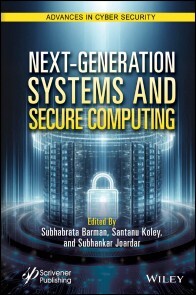
Next-Generation Systems and Secure Computing
NEXT-GENERATION SYSTEMS AND SECURE COMPUTING IS ESSENTIAL FOR ANYONE LOOKING TO STAY AHEAD IN THE RAPIDLY EVOLVING LANDSCAPE OF TECHNOLOGY. IT OFFERS CRUCIAL INSIGHTS INTO ADVANCED COMPUTING MODELS AND THEIR SECURITY IMPLICATIONS, EQUIPPING READERS WITH THE KNOWLEDGE NEEDED TO NAVIGATE THE COMPLEX CHALLENGES OF TODAY’S DIGITAL WORLD.The development of technology in recent years has produced a number of scientific advancements in sectors like computer science. The advent of new computing models has been one particular development within this sector. New paradigms are always being invented, greatly expanding cloud computing technology. Fog, edge, and serverless computing are examples of these revolutionary advanced technologies. Nevertheless, these new approaches create new security difficulties and are forcing experts to reassess their current security procedures. Devices for edge computing aren’t designed with the same IT hardware protocols in mind. There are several application cases for edge computing and the Internet of Things (IoT) in remote locations. Yet, cybersecurity settings and software upgrades are commonly disregarded when it comes to preventing cybercrime and guaranteeing data privacy. Next-Generation Systems and Secure Computing compiles cutting-edge studies on the development of cutting-edge computing technologies and their role in enhancing current security practices. The book will highlight topics like fault tolerance, federated cloud security, and serverless computing, as well as security issues surrounding edge computing in this context, offering a thorough discussion of the guiding principles, operating procedures, applications, and unexplored areas of study. Next-Generation Systems and Secure Computing is a one-stop resource for learning about the technology, procedures, and individuals involved in next-generation security and computing. SUBHABRATA BARMAN is an assistant professor in the Department of Computer Science and Engineering, Haldia Institute of Technology, West Bengal, India, with over 19 years of teaching and research experience. He has edited a number of internationally published books and journals. Additionally, he is a professional member of the Computer Society of India, the Institute for Electrical and Electronics Engineers, the International Association of Computer Science and Information Technology, and the International Association of Engineers. His research interests include wireless networks, computational intelligence, remote sensing and geoinformatics, precision agriculture, and parallel and grid computing. SANTANU KOLEY, PHD, is a professor in the Computer Science and Engineering Department at Haldia Institute of Technology, West Bengal, India, with more than 19 years of teaching experience and more than eighteen years of research experience. He has published over 50 research publications in numerous national and international journals, conferences, books, and book chapters. His main areas of research include machine learning, cloud computing, digital image processing, and artificial intelligence. SUBHANKAR JOARDAR, PHD, is a professor and head of the Department of Computer Science and Engineering, Haldia Institute of Technology, India. He has published over 20 technical papers in referred journals and conferences. Additionally, he has served as an organizing chair and program committee member for several international conferences and is a member of the Computer Society of India. His current research interests include swarm intelligence, routing in mobile ad hoc networks, and machine learning.

Design and Forecasting Models for Disease Management
THE BOOK PROVIDES AN ESSENTIAL OVERVIEW OF AI TECHNIQUES IN DISEASE MANAGEMENT AND HOW THESE COMPUTATIONAL METHODS CAN LEAD TO FURTHER INNOVATIONS IN HEALTHCARE.Design and Forecasting Models for Disease Management is a resourceful volume of 13 chapters that elaborates on computational methods and how AI techniques can aid in smart disease management. It contains several statistical and AI techniques that can be used to acquire data on many different diseases. The main objective of this book is to demonstrate how AI techniques work for early disease detection and forecasting useful information for medical experts. As such, this volume intends to serve as a resource to elicit and elaborate on possible intelligent mechanisms for helping detect early signs of diseases. Additionally, the book examines numerous machine learning and data analysis techniques in the biomedical field that are used for detecting and forecasting disease management at the cellular level. It discusses various applications of image segmentation, data analysis techniques, and hybrid machine learning techniques for illnesses, and encompasses modeling, prediction, and diagnosis of disease data. AUDIENCEResearchers, engineers and graduate students in the fields of computational biology, information technology, bioinformatics, and epidemiology. PIJUSH DUTTA, PHD, is an assistant professor and head of the Department of Electronics and Communication Engineering at Greater Kolkata College of Engineering and Management, West Bengal, India, with over 11 years of teaching and over seven years of research experience. He has published eight books, as well as 14 patents and over 100 research articles in national and international journals and conferences. His research interests include sensors and transducers, nonlinear process control systems, the Internet of Things (IoT), and machine and deep learning. SUDIP MANDAL, PHD, is an assistant professor in the Electronics and Communication Engineering Department at Jalpaiguri Government Engineering College, India. He has over 50 publications in national and international peer-reviewed journals and conferences, as well as two Indian patents and two books. He is a member of the Institute of Electrical and Electronics Engineers’ Computational Intelligence Society. KORHAN CENGIZ, PHD, is an associate professor in the Department of Computer Engineering at Istinye University, Istanbul, Turkey. He has published over 40 articles in international peer-reviewed journals, five international patents, and edited over ten books. His research interests include wireless sensor networks, wireless communications, and statistical signal processing. ARINDAM SADHU, PHD, is an assistant professor in the Electronics and Communication Engineering Department at Swami Vivekananda University, West Bengal, India, with over five years of teaching and over three years of research experience. He has published two international patents and over ten articles in national and international journals and conferences. His research interests include post-complementary metal-oxide-semiconductor transistors, quantum computing, and quantum dot cellular automata. GOUR GOPAL JANA is an assistant professor in the Electronics and Communication Engineering Department at Greater Kolkata College of Engineering and Management, West Bengal, India, with over 13 years of teaching and over three years of research experience. He has published two international patents and over ten research articles in national and international journals and conference proceedings. His research interests include metal thin film sensors, biosensors, nanobiosensors, and nanocomposites.

Computer-Netzwerke (8. Auflg.)
Wissen für Ausbildung und Beruf. In 8. Auflage vom Rheinwerk Verlag aus März 2025.Für Informatikerinnen und Informatiker in Studium, Beruf und Ausbildung ist solides Grundlagenwissen zur Arbeit mit moderner Netzwerktechnik essenziell. In diesem Buch finden Sie Antworten auf Ihre Fragen und praxisnahe Lösungen für gängige Anwendungsfälle. Harald Zisler vermittelt Ihnen die wichtigen Grundlagen zu Planung, Aufbau und Betrieb von Netzwerken mithilfe vieler anschaulicher Beispiele, Anleitungen und Fehlertafeln. Mit umfangreichem Netzwerk-Glossar und Übersicht über alle relevanten RFCs.Alle Grundlagen und Praxistipps: Netzwerktechnik: Theorie und Praxis verstehen Von MAC-, IPv4- und IPv6-Adressen über Netzmasken, DNS und Adressumsetzungen bis zu Datentransport mit TCP und UDP, Protokollen, Ports oder Sockets: Gehen Sie das OSI-Modell schrittweise durch und lernen Sie alle Grundlagen. Netzwerk planen, aufbauen und betreiben Welche Hardware ist für welche Anforderung am besten geeignet? Wie konfigurieren Sie benötigte Switches oder Router? Was müssen Sie bei der Planung von Kabeltrassen beachten und wie sorgen Sie umfassend für Sicherheit in Ihrem Netzwerk? Dieses Buch liefert konkrete Lösungen! Ihr Begleiter für die Praxis Praxisbeispiele, Anleitungen, Fehlertafeln, Netzwerk-Glossar oder Prüfungsfragen mit Lösungen: Zahlreiche Hilfsmittel unterstützen Sie gezielt im beruflichen Alltag oder bei der Prüfungsvorbereitung. Aus dem Inhalt: Netzwerkplanung und -aufbau TCP/IP, MAC-Adressen, IPv4- und IPv6-Adressen DHCP, Routing, Adressierung Datei-, Druck- und Nachrichtendienste, PAT/NAT Switches, Bridges, Hubs Lichtwellenleiter, Funktechniken, PLC Netzwerksicherheit, Firewalls, Proxies Leseprobe (PDF-Link)Über die Autoren:Tobias Aubele ist Professor für Usability und Conversion-Optimierung an der Hochschule Würzburg-Schweinfurt und hier für den Studiengang E-Commerce verantwortlich. Er ist aber auch in der Praxis tätig und seit vielen Jahren Berater für Usability, Conversion-Optimierung sowie Webanalyse. Barrierefreiheit spielt eine große Rolle in seiner Beratung und im Studiengang, da er in den Prinzipien grundsätzlich einen Gewinn sieht – für Benutzerführung und Verständlichkeit. Und für jeden Menschen.Detlef Girke ist als Experte für barrierefreie IT seit über 20 Jahren in diesem Bereich tätig. Seine Erfahrungen umfassen die Entwicklung von Prüfverfahren, Workshops, die Durchführung von Tests, Projektmanagement sowie begleitende Beratung. Zu seinen Hauptinteressen gehören Musik, Soziales, Kommunikation, vernetztes Arbeiten, Webtechnologien – und Menschen.
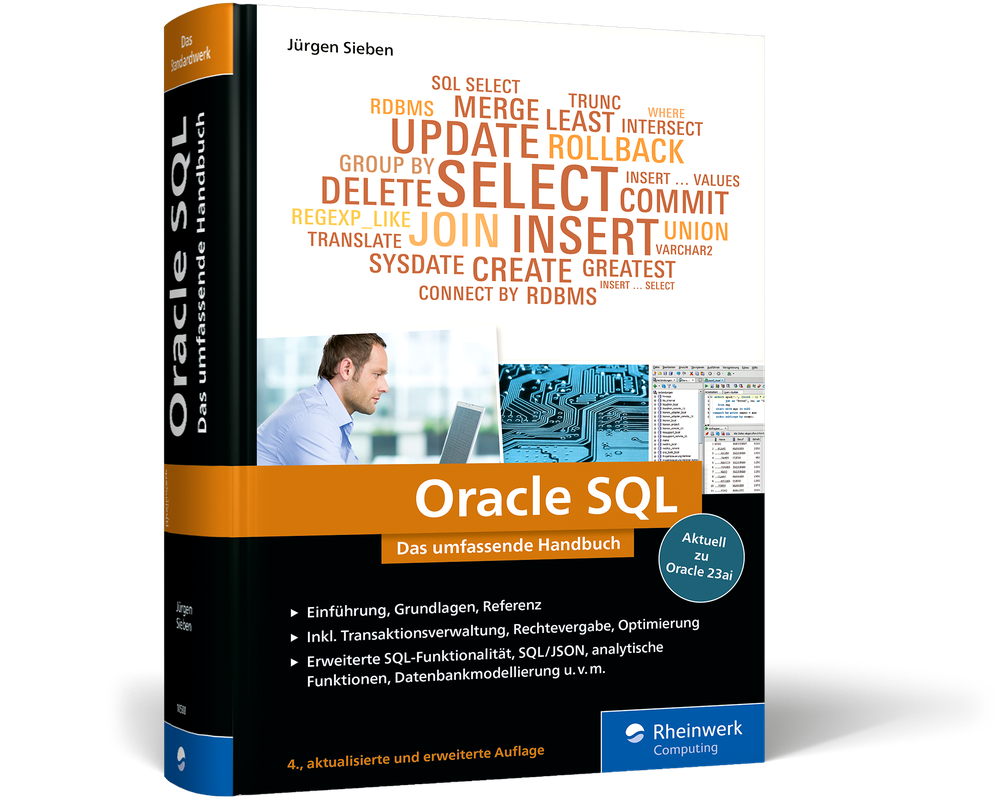
Oracle SQL (4. Auflg.)
Oracle SQL effizient einsetzen (4. Auflage)Wenn Sie sich professionell mit Oracle beschäftigen, sind umfassende Kenntnisse des entsprechenden SQL-Dialekts unverzichtbar. Jürgen Sieben, vielen bereits bekannt durch seine Bücher zu Oracle PL/SQL und Oracle APEX, hat nun auch sein Buch zu Oracle SQL aktualisiert. Er zeigt Ihnen darin, wie Oracle und SQL zusammenspielen und welche Strategien Sie nutzen können, um Daten in der Datenbank zu speichern, zu analysieren oder auch zu löschen. Die vierte Auflage berücksichtigt die umfassenden Erleichterungen und Syntaxänderung der Datenbankversion 23ai und gibt auch erfahrenen Anwendern einen profunden Einstieg in die verbesserten Möglichkeiten der Sprache SQL.Einstieg in Oracle SQLZu Beginn lernen Sie, wie Sie eine Datenbank planen und aufsetzen. Anschließend machen Sie sich mit der SQL-SELECT-Abfrage vertraut und lernen, wie Sie Zeilen- und Gruppenfunktionen einsetzen.2. Leistungsfähige AbfragenSie werden an typische Abfrageprobleme aus dem Alltag herangeführt und lernen Techniken zur Erzeugung von XML, zur Abfrage hierarchischer Daten, zur Bewältigung von Datumsangaben u. v. m.3. Datenmanipulation für ProfisIm weiteren Verlauf manipulieren Sie Daten und erzeugen Tabellen, Views und weitere Datenbankobjekte. So haben Sie jederzeit die volle Kontrolle über gespeicherte Daten.4. Weiterführende InformationenJürgen Sieben gibt Ihnen einen Einblick in fortgeschrittene Themen wie Data Warehousing, die Modellierung von Datenbanken und grundlegende administrative Themen.Aus dem InhaltSELECT-AnweisungZeilen & GruppenfunktionenLogische Verbindungen mit JoinsUnterabfragenAnalytische FunktionenDatenbankmanipulation/DatenbankobjekteViews, Tabellen, IndizesRechtevergabeSpezielle AbfragetechnikenXML-Abfragen, MODEL-KlauselLeseprobe (PDF-Link)
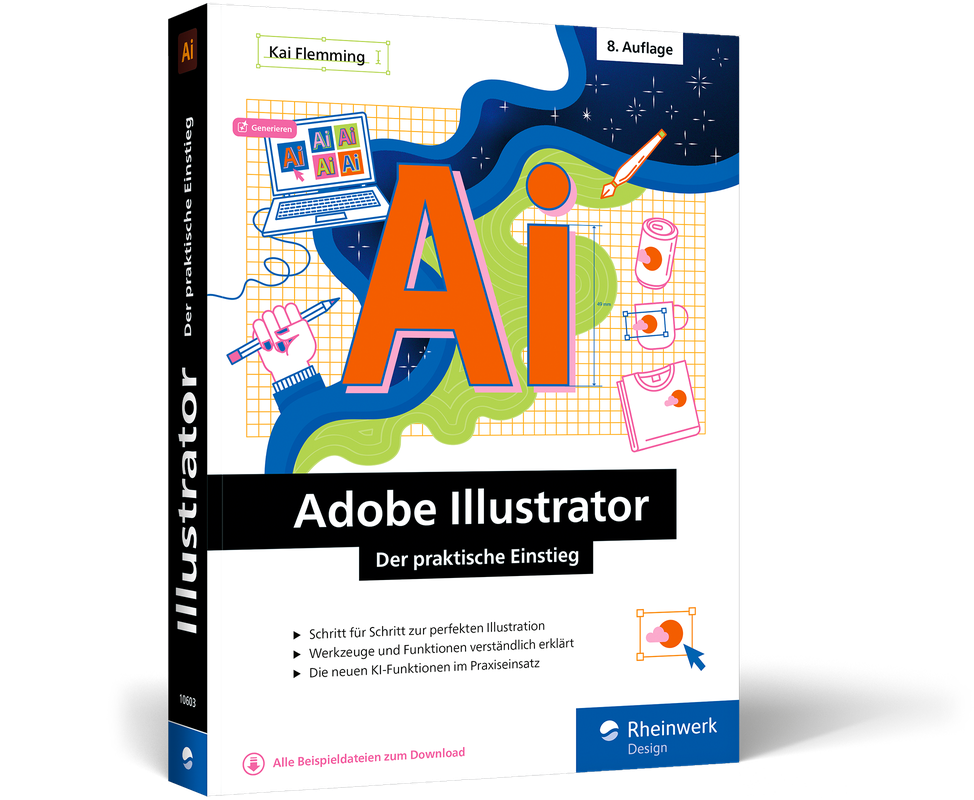
Adobe Illustrator (8. Auflg.)
Der praktische Adobe Illustrator-Einstieg: alle wichtigen Funktionen Schritt für Schritt erklärt. In 8. Auflage aus März 2025.Erstellen Sie beeindruckende Illustrationen, Diagramme und Logos mit Adobe Illustrator – mit unserem umfassenden Einsteigerbuch gelingt Ihnen der perfekte Start. Durch einfache Schritt-für-Schritt-Anleitungen und wertvolle Tipps erlernen Sie die Grundlagen im Handumdrehen und erhalten auch einen Einblick in fortgeschrittene Techniken. Erfahren Sie, wie Sie Vektorgrafiken erstellen, Farben und Typografie effektiv einsetzen und komplexe Designs realisieren. Und mit den neuen Möglichkeiten durch KI optimieren Sie Ihren Workflow und werden schnell kreativ. Schnell einsteigen, sofort loslegen Hier lernen Sie all die Grundlagen, Techniken und Werkzeuge kennen, die Sie für die Arbeit mit Illustrator benötigen. So erhalten Sie das Rüstzeug, um mit eigenen Kreationen zu überzeugen. Illustrator kreativ einsetzen Arbeiten Sie die Workshops des Buchs durch und setzen Sie das Gelernte direkt um: Sie erstellen Comics, Infografiken und Animationen für das Web und geben ihnen mit Verläufen, Mustern und Effekten den letzten Schliff. Sie werden sehen: Der Weg von der ersten Freihandzeichnung bis zu überzeugenden Illustrationen, Logos und Diagrammen ist ganz einfach. Fortgeschrittene Themen schnell beherrschen Kai Flemming bringt Ihnen auch die anspruchsvollen Funktionen von Illustrator nahe: 3D, Transparenzen, Perspektive, Effekte und die Zusammenarbeit mit den Programmen der Creative Cloud. Arbeiten mit den KI-Funktionen Optimieren Sie Ihren Workflow mit den neuen KI-Funktionen: Durch intelligente Werkzeuge wie das automatische Vektorisieren von Skizzen, das Generieren von Farbpaletten basierend auf Bildvorlagen und die Erstellung von Vektorgrafiken per Prompt können Sie Ihre Designs schneller und präziser umsetzen. Aus dem Inhalt: Die Arbeitsoberfläche, alle Werkzeuge Pfade zeichnen leicht gemacht Ebenen und Aussehen Objekte erstellen, transformieren, ausrichten, verzerren Generative KI, Generieren von Vektorgrafiken mit einem Text-Prompt Farben und Verläufe Neufärben von Grafiken per Prompt, Farberstellung per Text-Prompt Muster, Pinsel und Symbole, Transparenzen und Effekte Illustrator 3D Diagramme erstellen Ausgabe für Print, Web, Video Leseprobe (PDF-Link)
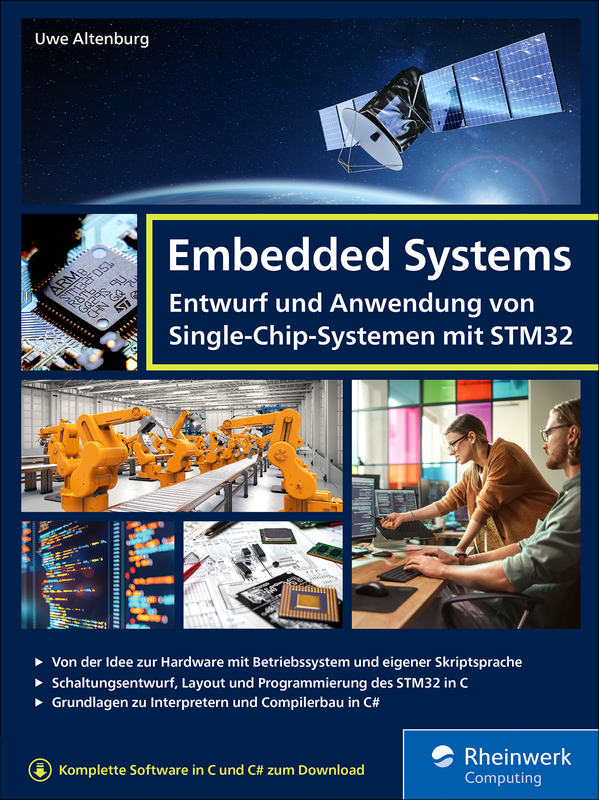
Embedded Systems
Embedded Systems entwickeln – von der Hardware über alle Ebenen bis zur konfigurierbaren Anwendung! Uwe Altenburg zeigt Ihnen in diesem Buch alles, was Sie brauchen, um ein Komplettsystem samt eigener Skriptsprache zu entwerfen und zu implementieren. Das praktische Konzept mit erprobten Lösungen, umfangreicher Software und vielen Hinweisen ist ideal für alle, denen fundierte, praxisrelevante Kenntnisse wichtig sind.Was Sie in diesem Buch lernenEigene Hardware entwerfen Hardware: Sie beginnen mit dem Schaltplan und entwerfen schließlich ein EMV-gerechtes Leiterplattenlayout für ein Breakout-Board mit dem Mikrocontroller STM32F412. Software entwickeln Komplexität: Am Anfang ist es nur ein Bootloader, dann ein einfaches Multitasking-Betriebssystem – und schließlich eine Skiptsprache mit Compiler. Schritt für Schritt werden die Aufgaben und Beispiele komplexer und interessanter. Externe Hardware ansteuern Zusammenspiel: Treiber für das weit verbreitete Modbus-RTU Protokoll sowie zum Ansteuern verschiedener LCD-Grafik-Displays runden die umfangreiche Software ab und ermöglichen vielfältige praktische Anwendungen. Testen und optimieren Qualität: Software ist immer nur so gut wie ihre Tests. Tausende davon auf Knopfdruck? Nutzen Sie die Möglichkeiten moderner Entwicklungswerkzeuge! Eine Software für ganz verschiedene Plattformen? Auch diese Herausforderung meistern Sie mit diesem Buch – und noch einige mehr! Aus dem InhaltEinführung in Embedded SystemsEntwicklungstools und TestumgebungSchaltungsentwurf und LeiterplattenlayoutBootloader-Funktion implementierenBetriebssystem mit MultitaskingEine Skriptsprache implementierenInterpreter und LaufzeitsystemLexikalische und syntaktische AnalyseCode-GenerierungLeseprobe (PDF-Link)
Data Structures in Depth Using C++
Understand and implement data structures and bridge the gap between theory and application. This book covers a wide range of data structures, from basic arrays and linked lists to advanced trees and graphs, providing readers with in-depth insights into their implementation and optimization in C++.You’ll explore crucial topics to optimize performance and enhance their careers in software development. In today's environment of growing complexity and problem scale, a profound grasp of C++ data structures, including efficient data handling and storage, is more relevant than ever. This book introduces fundamental principles of data structures and design, progressing to essential concepts for high-performance application.Finally, you’ll explore the application of data structures in real-world scenarios, including case studies and use in machine learning and big data. This practical, step-by-step approach, featuring numerous code examples, performance analysis and best practices, is written with a wide range of C++ programmers in mind. So, if you’re looking to solve complex data structure problems using C++, this book is your complete guide.WHAT YOU WILL LEARN* Write robust and efficient C++ code.* Apply data structures in real-world scenarios.* Transition from basic to advanced data structures* Understand best practices and performance analysis.* Design a flexible and efficient data structure library.WHO THIS BOOK IS FORSoftware developers and engineers seeking to deepen their knowledge of data structures and enhanced coding efficiency, and ideal for those with a foundational understanding of C++ syntax. Secondary audiences include entry-level programmers seeking deeper dive into data structures, enhancing their skills, and preparing them for more advanced programming tasks. Finally, computer science students or programmers aiming to transition to C++ may find value in this book.MAHMMOUD A. MAHDI is a computer science professional with over 18 years of experience in the field, specializing in machine learning, natural language processing, and programming languages, including C++. As an Assistant Professor in the Computer Science Department at Zagazig University, he has a deep understanding of both the theoretical and practical aspects of computer science, which he brings to his writing. His decision to write "Data Structures in Depth Using C++" stems from a desire to share his knowledge and experience in a way that bridges the gap between theory and practical application. This book aims to provide readers with a thorough understanding of data structures, optimizing performance, and applying them in real-world scenarios, making it a valuable resource for both students and professionals. This book is the culmination of his years of teaching, research, and hands-on experience in the field.Chapter 1: Introduction.- Chapter 2: Primary Building Blocks.- Chapter 3: Arrays and Dynamic Arrays.- Chapter 4: Linked List.- Chapter 5: Stack and Queue.- Chapter 6: Hash Tables.- Chapter 7: Trees.- Chapter 8: Graphs.- Chapter 9: Specialized Data Structures and Techniques.- Chapter 10: Applications and Real-World Examples.

Information Visualization for Intelligent Systems
INFORMATION VISUALIZATION FOR INTELLIGENT SYSTEMS PROVIDES READERS WITH ESSENTIAL INSIGHTS INTO CUTTING-EDGE ADVANCEMENTS IN MACHINE INTELLIGENCE AND EXPLORES HOW THESE TRANSFORMATIVE TECHNOLOGIES ARE REVOLUTIONIZING DATA ANALYSIS AND DECISION-MAKING IN AN INCREASINGLY COMPLEX WORLD.The book explores advanced computing, or machine intelligence, which enables technology—machines, devices, or algorithms—to interact intelligently with their surroundings, make decisions, and take actions to achieve objectives. Unlike natural human intelligence, artificial intelligence (AI) is demonstrated by machines. Modern advancements in high-speed computing drive paradigm shifts, enabling complex machine intelligence systems and novel cyber systems that utilize data to perform specific tasks. While standalone cyber systems are common, integrating multiple systems into cohesive, intelligent structures interacting deeply with physical systems remains underexplored and primarily philosophical in existing literature. These technological breakthroughs have revolutionized data generation, cloud storage, global information exchange, and rapid computing. For example, machine intelligence models analyze video surveillance to identify threats, support early infection detection in healthcare, and enhance chemical industry processes. While promising, these advancements remain in their infancy, offering significant potential for further development. PREMANAND SINGH CHAUHAN, PHD, is a director at the Sushila Devi Bansal College of Technology, Indore, India with seven years of industry experience and 20 years of teaching experience. He has edited one book, authored two books and 55 research articles, and has published three patents, one of which was granted. He is the editor of the proceedings of many reputed international conferences, technical adviser for many industries working in the field of manufacturing, and also a member of many professional bodies. RAJESH ARYA, PHD, is a principal at the Sushila Devi Bansal College of Engineering, Indore, India. He has more than 15 years of experience teaching courses related to electrical and computer engineering. He has published more than 45 research papers in the journals and conferences of repute publishers and is an Associate Member of the Institution of Engineers. RAJESH KUMAR CHAKRAWARTI, PHD, is a professor and dean at the Department of Computer Science and Engineering/Information Technology, Sushila Devi Bansal College, Indore, India with over 21 years of experience in academia and industry. He is actively involved in teaching courses at both the undergraduate and postgraduate levels and is eagerly involved in teaching, training, research and development, and department, institution, and university development activities. He has organized and attended over 100 seminars, workshops, conferences, and certifications and has presented and published over 100 research papers, chapters in books, and abstracts in national and international conferences and journals. ELAMMARAN JAYAMANI, PHD, is an associate professor in the Mechanical Engineering program in the Faculty of Engineering, Computing, and Science at the Swinburne University of Technology, Sarawak Campus. Dr. Elammaran has been a creative educator for over 23 years, promoting sustainable materials research and development and is well-versed in training and mentoring students, research scholars, and educators. He is a member of the Institution of Mechanical Engineers as a Chartered Engineer. NEELAM SHARMA, PHD, is an associate professor and the head of Electronics and Communication Engineering at Sushila Devi Bansal College of Technology, Indore, India with over 18 years of teaching experience. She has been published in various SCI and Scopus journals and IEEE conferences and is a life member of the International Society for Technology in Education. ROMIL RAWAT has attended several research programs and received research grants from the United States, Germany, Italy, and the United Kingdom. He has chaired international conferences and hosted several research events, in addition to publishing several research patents. His research interests include cyber security, Internet of Things, dark web crime analysis and investigation techniques, and working towards tracing illicit anonymous contents of cyber terrorism and criminal activities.

Edge of Intelligence
THE BOOK OFFERS CUTTING-EDGE INSIGHTS AND PRACTICAL APPLICATIONS FOR EDGE AI, MAKING IT ESSENTIAL FOR ANYONE LOOKING TO STAY AHEAD IN THE RAPIDLY EVOLVING LANDSCAPE OF ARTIFICIAL INTELLIGENCE AND EDGE COMPUTING.Edge of Intelligence: Exploring the Frontiers of AI at the Edge examines the transformative potential of edge AI, showcasing how artificial intelligence is being seamlessly integrated with Edge computing to revolutionize various industries. This book offers a comprehensive overview of the latest research, trends, and practical applications of Edge AI, providing readers with valuable insights into how this cutting-edge technology is enhancing efficiency, reducing latency, and enabling real-time decision-making. From optimizing vehicular networks in the era of 6G to the innovative use of AI in crop monitoring and educational technology, this book covers a broad spectrum of topics, making it an essential read for anyone interested in the future of AI and Edge computing. Featuring contributions from leading experts and researchers, Edge of Intelligence highlights real-world examples and case studies that demonstrate the practical implementation of edge AI in diverse sectors such as smart cities, recruitment, and nano-process optimization. The book also addresses critical issues related to privacy, security, and the fusion of blockchain with edge computing, providing a holistic view of the challenges and opportunities in this rapidly evolving field. AUDIENCEEngineers, data scientists, IT professionals, researchers, and academics in the fields of artificial intelligence, computer science, and telecommunications, as well as industry professionals in sectors such as the automotive, agriculture, education, and urban planning industries. SHUBHAM MAHAJAN, PHD, is an assistant professor at Amity University, Haryana with a remarkable track record in the field of artificial intelligence and image processing. He has published over 77 articles in peer-reviewed journals and conferences, as well as eleven Indian, one Australian, and one German patent. His research includes video compression, image segmentation, fuzzy entropy, nature-inspired computing methods, optimization, data mining, machine learning, robotics, and optical communication. SATHYAN MUNIRATHINAM, PHD, is a senior manager on the Customer Service Data and Diagnostics team for the ASML Corporation with over 24 years of experience in business intelligence and 17 years in the semiconductor industry. His responsibilities involve developing and executing a roadmap for data and diagnostics innovation for customer service engineers, aiming to transition equipment from unscheduled downtime to scheduled maintenance. In addition to this role, he has authored numerous papers and participated in numerous international conferences. PETHURU RAJ, PHD, is a chief architect in the Edge AI division of Reliance Jio Platforms Ltd., Bangalore. with over 23 years of IT industry and 9 years of research experience. He has been granted two international research fellowships from the Japan Society for the Promotion of Science and the Japan Science and Technology Agency. His research interests include the industrial Internet of Things (IIoT), efficient, explainable, and Edge AI, blockchain, digital twins, cloud-native and edge computing, green and generative AI, and quantum computing.
Explainable and Responsible Artificial Intelligence in Healthcare
THIS BOOK PRESENTS THE FUNDAMENTALS OF EXPLAINABLE ARTIFICIAL INTELLIGENCE (XAI) AND RESPONSIBLE ARTIFICIAL INTELLIGENCE (RAI), DISCUSSING THEIR POTENTIAL TO ENHANCE DIAGNOSIS, TREATMENT, AND PATIENT OUTCOMES.This book explores the transformative potential of explainable artificial intelligence (XAI) and responsible AI (RAI) in healthcare. It provides a roadmap for navigating the complexities of healthcare-based AI while prioritizing patient safety and well-being. The content is structured to highlight topics on smart health systems, neuroscience, diagnostic imaging, and telehealth. The book emphasizes personalized treatment and improved patient outcomes in various medical fields. In addition, this book discusses osteoporosis risk, neurological treatment, and bone metastases. Each chapter provides a distinct viewpoint on how XAI and RAI approaches can help healthcare practitioners increase diagnosis accuracy, optimize treatment plans, and improve patient outcomes. Readers will find the book:* explains recent XAI and RAI breakthroughs in the healthcare system;* discusses essential architecture with computational advances ranging from medical imaging to disease diagnosis;* covers the latest developments and applications of XAI and RAI-based disease management applications; * demonstrates how XAI and RAI can be utilized in healthcare and what problems the technology faces in the future. AUDIENCEThe main audience for this book is targeted to scientists, healthcare professionals, biomedical industries, hospital management, engineers, and IT professionals interested in using AI to improve human health. RISHABHA MALVIYA, PHD, is an associate professor in the Department of Pharmacy, School of Medical and Allied Sciences, Galgotias University. He has authored more than 150 research/review papers for national/international journals of repute. He has been granted more than 10 patents from different countries while a further 40 patents have either been published or under evaluation. His areas of interest include formulation optimization, nanoformulation, targeted drug delivery, localized drug delivery, and characterization of natural polymers as pharmaceutical excipients. SONALI SUNDRAM, PHD AND MPHARM, completed her doctorate in pharmacy and is an assistant professor at Galgotias University, Greater Noida. Her areas of interest are neurodegeneration, clinical research, and artificial intelligence. She has edited four books.
ChatGPT For Dummies
UPDATED TO PROVIDE A DEEPER AND CLOSER LOOK AT CHATGPTExpanded and extended, this new edition of ChatGPT For Dummies covers the latest tools, models, and options available on the popular generative AI platform. You'll learn best practices for using ChatGPT as a text and media generation tool, research assistant, and content reviewer. If you're new to the world of AI, you'll get all the basic know-how needed to add ChatGPT to your professional toolbox. And if you've been doing the genAI thing for a while already, this book will sharpen your skills as you apply AI to real-world projects in an ethical manner. You'll get insight on the best practice for using ChatGPT to make your life and work easier and how to write prompts that result in high-quality output.* Understand what generative AI is and how ChatGPT produces human-like responses* Get tips on writing effective prompts and using ChatGPT to generate sound and images* Apply ChatGPT to your daily work or personal life* Discover the best way to fact-check AI-generated content to avoid errors and hallucinationsAnyone using ChatGPT to enhance their work—whether for professional or personal use—will get better results with ChatGPT For Dummies.PAM BAKER is an author and a trainer with over two decades of experience as a journalist focused on the tech industry. She recently won an AZBEE award from the American Society of Business Publication Editors for B2B writing. She is author of the first edition of ChatGPT For Dummies and Generative AI For Dummies.

Visualisierung in der Medizin
Dieses Buch fasst die jüngsten Fortschritte in der visualisierten Medizin zusammen, sowohl hinsichtlich der grundlegenden Prinzipien als auch der Entwicklung neuer Techniken und deren Grenzen. Besonders in Kombination mit künstlicher Intelligenz (KI), medizinischen Bildgebungsverfahren und medizinischen Robotern wurden intelligente Medizintechnologien entwickelt und klinisch angewendet, um die Diagnose, Behandlung, Prognose und Datenanalyse von lebensbedrohlichen Krankheiten zu verbessern. Diese Philosophie revolutioniert umfassend die Behandlungsstrategie im Gesundheitswesen und wird die Präzisionsmedizin und Präzisionschirurgie weiter intuitiv erfassbar, intelligent analysierbar und präzise umsetzbar machen. Das Buch beinhaltet folgende Themen und fasst sie zusammen: 1. Die hochmoderne Definition der visualisierten Medizin. 2. Fortschrittliche Techniken und klinische Anwendungen der visualisierten Medizin im vergangenen Jahrzehnt. 3. Neue Grenzen und brandneue Technologien, z.B. künstliche Intelligenz (KI), chirurgische Roboter, etc. 4. Revolutionäre Auswirkungen auf Diagnose, Behandlung und Prognose von Krankheiten. 5. Zukünftige Herausforderungen und Perspektiven.

The Art of Decoding Microservices
Stay competitive in today’s software industry by mastering microservices. As microservices architecture becomes the modern standard, this book demystifies the transition from monoliths to microservices with clear guidance and practical examples for easier adoption and implementation.The book starts with the basics, explaining what microservices are, their benefits, and how they compare to monolithic architectures. From there, you will explore a wide range of topics including service discovery, load balancing, authentication and authorization, resilience, fault tolerance, and much more as well as practical Java examples throughout. Each chapter is meticulously crafted to offer a balance of theory and hands-on application, ensuring you not only understand the concepts but also apply them effectively in real-world scenarios.By the end of the book, you will be ready to design, implement, and manage scalable and efficient microservices-based systems. Additionally, you will gain a forward-looking perspective on emerging trends and the integration of microservices in AI and IoT.WHAT YOU WILL LEARN* Compare microservices and monolithic systems, understanding the basics, benefits and key differences* Understand key principles for decomposing monoliths and designing for failure* Master synchronous vs. asynchronous communication and when to use each* Explore containerization, orchestration with Kubernetes, and scaling strategies* Secure microservices and monitor health and performance in distributed systemsWHO THIS BOOK IS FORNovice and experienced developers who are new to microservices and want to master the topic to drive successful software projects. The book is programming language-agnostic, and can be understood by developers of any language, but those with some familiarity with Java will benefit more from the specific examples provided.SUMIT BHATNAGAR has nearly two decades of hands-on experience in the IT industry, serving as a visionary leader and a respected authority in the realm of modern software architecture. Specializing in J2EE, microservices, and cloud-based applications, Sumit has a proven track record of delivering cutting-edge solutions in the financial domain.An accomplished project leader, Sumit combines deep technical expertise with strategic insight, seamlessly bridging the gap between innovation and implementation. His contributions to the industry have earned prestigious accolades at a global platform. As a distinguished member of the Forbes Technology Council, and IEEE, Sumit is at the forefront of technological advancement, continually shaping the future of software development. His extensive portfolio of published research papers and thought leadership in renowned journals underscores his commitment to pushing the boundaries of what’s possible.In this book Sumit leverages his vast experience and deep understanding to provide readers with a comprehensive guide to mastering microservices. Whether you’re a seasoned developer or an aspiring architect, this book is your gateway to understanding and implementing robust, scalable, and resilient software solutions.ROSHAN MAHANT is a seasoned expert in strategizing and designing IT solutions, with a strong emphasis on successful execution. As a Senior Technical Consultant at Launch IT Corp, he specializes in e-governance platform enhancements, particularly in public sector IT modernization using the Microservices Architecture, and Amanda e-governance licensing platform. Over his 15-year career, Roshan has mastered holistic analysis, systems integration, architecture design, and strategic consulting, enabling the transformation of critical governance functions across various state agencies. His work has significantly impacted several government boards, including the Iowa Board of Nursing and the Michigan Gaming Control Board.Before joining LaunchIT Corp, Roshan served as the Director of Access Technologies, where he developed innovative mentoring techniques and software products. With a master’s degree in CAD/CAM from Nagpur University, Roshan continues to contribute to the field through research papers, conference reviews, and technical book critiques, earning him various esteemed memberships and awards.Chapter 1: Evolution of Software Architecture.- Chapter 2: Overview of Microservices.- Chapter 3: Designing Microservices.- Chapter 4: Developing Microservices.- Chapter 5: Testing, Deploying, and Scaling Microservices.- Chapter 6: Microservices Security, Monitoring, and Maintenance.- Chapter 7: Lessons from Case Studies, Avoiding Pitfalls, and Shaping the Future.- Chapter 8: Conclusion and Quick Recap.- Appendix A: Glossary.- Appendix B: Closure and Final Thoughts.
Ihr Smart Home mit Home Assistant
Home Assistant schnell und einfach einrichtenIn diesem Quickstart-Guide erhalten Sie alles nötige Wissen, um Home Assistant in Betrieb zu nehmen und Ihr Smart Home an Ihre persönlichen Bedürfnisse anzupassen. Hierbei liegt ein besonderer Schwerpunkt auf der Sicherheit, Flexibilität und Stabilität. Ein kurzer Rundgang durch die Benutzeroberfläche macht Sie mit allen wichtigen Funktionen hierfür vertraut.Automatisierung für Einsteiger und FortgeschritteneAutomatisierungen sind das Herzstück jedes Smart Homes. Sie erhalten nicht nur eine grundlegende Einführung in die Automatisierung mit Szenen und Blaupausen, sondern darüber hinaus vielseitig einsetzbare Beispiele und Erweiterungen an die Hand, wie z.B. smarte App-Benachrichtigungen, automatisierte Backups oder die Verarbeitung von Wetterdaten. Für technisch versierte Nutzer gibt es eine Einführung in das Erstellen eigener Skripte für eine noch individuellere Kontrolle.Aus der Praxis für die PraxisSie profitieren von der jahrelangen Erfahrung des Autors mit dem Einsatz von Home Assistant. Praktische Tipps und unverzichtbare Must-have-Einstellungen helfen Ihnen, typische Stolperfallen von vornherein zu vermeiden und Ihr Smart Home ganz nach Ihren Vorstellungen einzurichten.Über den Autor:Oliver Kluth beschäftigt sich seit 2018 täglich mit Home Assistant und teilt seine gemachten Erfahrungen und hierauf aufbauende Tipps unter smarterkram.de und auf YouTube. Als Familienvater liegt sein Fokus darauf, das eigene Smart Home in den bestmöglichen Einklang mit dem Familienleben zu bringen, ohne hierbei auf Komfort verzichten zu müssen.

AWS Certified Advanced Networking - Specialty (ANS-C01) Certification Guide
The AWS Certified Advanced Networking – Specialty certification exam focuses on leveraging AWS services alongside industry standards to create secure, resilient, and scalable cloud networks.Written by industry experts with decades of experience in the field, this comprehensive exam guide will enable you to transform into an AWS networking expert, going beyond the ANS-C01 exam blueprint to maximize your impact in the field. You’ll learn all about intricate AWS networking options and services with clear explanations, detailed diagrams, and practice questions in each chapter. The chapters help you gain hands-on experience with essential components, such as VPC networking, AWS Direct Connect, Route 53, security frameworks, and infrastructure as code. With access to mock exams, interactive flashcards, and invaluable exam tips, you have everything you need to excel in the AWS ANS-C01 exam.This book not only prepares you to confidently take the exam, but also deepens your understanding and provides practical insights that are vital for a successful career in AWS cloud networking.By the end of this exam guide, you’ll be thoroughly trained to take the AWS ANS-C01 exam and efficiently design and maintain network architectures across a wide range of AWS services.

MuleSoft for Salesforce Developers
Salesforce developers often need help with complex integrations to manage multi-cloud environments, data mapping, data security, API scalability, and real-time integration issues. Written by industry veterans with 20+ years of experience, this revised edition will help you overcome these challenges and unlock data with MuleSoft.In this second edition, you’ll learn about MuleSoft’s newest IDE (aka Anypoint Code Builder) and its tools and capabilities. The chapters will show you how to use AI-enabled APIs to maximize productivity, integration of Data Cloud with MuleSoft, Mule APIs with AI agents, and Mule AI Chain connectors. You’ll grasp the fundamentals of APIs and integration and confidently design your APIs, while also utilizing a no-code visual editor for API design to build your Mule applications using MuleSoft’s Anypoint Code Builder. The chapters will teach you about data transformation, API management, deployment models, and MuleSoft’s security features. Progressively, you’ll leverage MuleSoft connectors to integrate with Salesforce, Data Cloud, and other systems. You’ll explore AI-driven integrations and automation, and get practical tips to ace MuleSoft interviews and achieve MCD Level 1 certification.By the end of this book, you’ll be able to implement the entire API lifecycle and manage complex integrations with MuleSoft like a pro.

The Infinite Retina
What is Spatial Computing, and why are companies like Tesla, Apple, and Meta investing billions into it? In The Infinite Retina, Irena Cronin and Robert Scoble explore how spatial computing—where humans and machines interact in a digital–physical space—has progressed beyond theory into real-world applications.This second edition has many substantial updates, including two new chapters on the relevance of Generative AI in Spatial Computing and a new chapter on the impact of Apple Vision Pro. Each existing chapter has been updated to have the most current information and commentary. The book offers a fresh look at seven major industries, including healthcare and retail, featuring updated case studies, expert commentary, and real-world examples. Additionally, it addresses crucial risks and challenges, such as data privacy, automation's impact on employment, and ethical concerns. This edition moves beyond speculation to critically analyze what Spatial Computing means for businesses and individuals today.

Mastering AutoCAD 2025
AutoCAD helps you communicate your design intent by plotting your designs to drawings, in both paper and electronic format. But using AutoCAD can be daunting, even for an experienced user who wants to get their designs into the AutoCAD native DWG file format.Written by an Autodesk Certified Instructor at Platinum level with 30+ years of industry experience, this book will guide you on how to use new and existing AutoCAD tools to work smarter, not harder, and it will familiarize you with the processes needed to use AutoCAD much more effectively. As you work through the chapters, you’ll get used to these new methodologies in AutoCAD and build up "muscle memory" so that these skills become second nature. You’ll also take advantage of the author's expertise and experience, learning some highly effective AutoCAD tips and tricks along the way.By the end of this AutoCAD book, you’ll have gained valuable insights into the knowledge needed to confidently prepare for your Autodesk AutoCAD certification.

Unmanned Aerial Vehicles Swarm for Protecting Smart Cities
Explore the intersection between unmanned aerial vehicles (UAVs) and the evolving landscape of smart cities. With the increasing integration of technology into urban environments, there is a growing need to understand how UAV swarms can contribute to the safety, efficiency, and resilience of these complex urban ecosystems. The book aims to provide a technical understanding of UAV swarms and their applications within the context of smart cities.It begins by laying the groundwork with an introduction to UAV swarms and smart cities, establishing the foundational concepts and motivations behind their integration. As the book progresses, it delves into various aspects of smart cities, exploring concepts, technologies, and challenges inherent in their development and operation. This includes discussions on cloud computing, cybersecurity, machine learning applications, surveillance and monitoring systems, urban planning, and infrastructure management. It also examines the integration of IoT devices with UAV swarms, highlighting the synergies between these emerging technologies and their potential impact on urban environments.The book examines cutting-edge topics such as edge computing, blockchain applications, 5G integration, and augmented reality/virtual reality (AR/VR) visualization techniques in the context of UAV swarm operations. It concludes with reflections on innovations and future directions, offering insights into the evolving landscape of UAV swarm technologies and their implications for the protection and advancement of smart cities.The book serves as a comprehensive guide for researchers, practitioners, and policymakers interested in understanding the technical, social, and economic dimensions of UAV swarm technology within the context of smart city development and management.WHAT YOU WILL LEARNIdentify practical applications of UAV swarms in surveillance monitoring, urban planning, disaster management, and infrastructure resilienceGain comprehensive understanding of UAV swarms by exploring diverse disciplinesApply insights from emerging technologies like cloud computing, machine learning, blockchain, IoT devices, and so on to UAV swarm technologyWHO IS THIS BOOK FORThis book appeals to a wide range of readers with different interests and backgrounds, including researchers, policymakers, industry stakeholders, practitioners, experts, and general fans who are curious in the confluence of smart cities with UAV swarm technologies with little to no experience or knowledge of UAV swarms.OROOS ARSHI is a Research Scientist at AI-EYS and was awarded the Young Researcher award at the International Conference on Emerging Trends and Innovations (ICETI) 2024 held in Pakistan. She is a dedicated Research Scholar at the University of Petroleum and Energy Studies in Dehradun, India. She was the speaker at the International Conference on Emerging Trends and Innovations held in Pakistan. She has contributed significantly to the technological discourse with some Scopus, SCI, and a noteworthy publication with Springer. Since then, Oroos has embarked on an intricate exploration of diverse technological realms, displaying a profound interest in the Natural Processing Language (NLP), Computer Vision, Internet of Things (IoT), Artificial Intelligence (AI), Cybersecurity, and Cloud Computing.DR. INAM ULLAH KHAN is the Founder of AI-EYS. He was a visiting researcher at King’s College London, UK and was a faculty member at different universities in Pakistan including the Center for Emerging Sciences Engineering & Technology (CESET), Islamabad, Abdul Wali Khan University, Garden Campus, Timergara Campus, University of Swat & Shaheed Zulfikar Ali Bhutto Institute of Science and Technology (SZABIST), Islamabad Campus. He has authored/co-authored more than 30 research articles in reputable journals, conferences, and book chapters. His research interests include Network System Security, Intrusion Detection, Intrusion Prevention, cryptography, Optimisation techniques, WSN, IoT, Mobile Ad Hoc Networks (MANETS), Flying Ad Hoc Networks, and Machine Learning. He was a technical program committee member at an international workshop on intelligent systems for sustainable smart cities, New Delhi, India, February 19–20, 2022.KESHAV KAUSHIK is an experienced educator with around ten years of teaching and research experience in Cybersecurity, Digital Forensics, and the Internet of Things. He is working as an Assistant Professor (Senior Scale) in the systemic cluster under the School of Computer Science at the University of Petroleum and Energy Studies, Dehradun, India. He has published 100+ research papers in International Journals and has presented at reputed International Conferences. Currently, he is also serving as à Vice Chairperson of the Meerut ACM Professional Chapter and is also a brand ambassador for Bentham Science.NADEEM IQBAL (Senior Member IEEE) received a Ph.D. degree in bio and brain engineering from the Korea Advanced Institute of Science and Technology (KAIST), Daejeon, South Korea, in 2013. He has completed a Fulbright Fellowship at St. John’s University in New York, USA. Dr. Iqbal was a postdoctoral fellow at the School of Mechanical Engineering, University of Leeds, UK. He is currently working as an Associate Professor with the Department of Computer Science, Abdul Wali Khan University Mardan, Pakistan. His research interests include biological information processing mechanisms in the brain, Natural Language Processing, the Internet of Things, and Pattern recognition.INAM ULLAH received a B.Sc. degree in Electrical Engineering (Telecommunication) from the Department of Electrical Engineering, University of Science and Technology Bannu (USTB), KPK, Pakistan, in 2016 and a Master's and Ph.D. degree in Information and Communication Engineering from the College of Internet of Things (IoT) Engineering, Hohai University (HHU), China, in 2018 and 2022, respectively. He is currently an Assistant Professor at the Department of Computer Engineering, Gachon University, S Korea. His research interests include Robotics, Internet of Things (IoT), Wireless Sensor Networks (WSNs), Underwater Communication and Localization, Underwater Sensor Networks (USNs), Artificial Intelligence (AI), Big data, Deep learning, etc. He has authored more than 70 peer-reviewed articles on various research topics.DR. KHADIJA SLIMANI completed her PhD, which was jointly supervised by the University of Ibn Tofail in Morocco and the University of Technology of Belfort Montbeliard (UTBM) in France. This collaborative international effort showcased her commitment to academic excellence and cross-cultural research. For her doctoral studies, Dr. Slimani delved into the realms of machine learning, deep learning, pattern recognition, and computer vision, with a specific focus on academic emotion recognition. This interdisciplinary approach, spanning both Moroccan and French academic environments, enriched her research experience and contributed to the global perspective of her work. Dr. Slimani's academic contributions extended to various engineering schools in Paris, France, where she took on teaching responsibilities across multiple modules, including data science, deep learning, machine learning, data bases, and computer vision. She currently holds the title of Associate Professor at the Graduate School of Automatic Electronic Computing in Paris, France. Through her diverse roles, Dr. Slimani consistently inspires and contributes to shaping the next generation of researchers.Chapter 1: Introduction to UAV Swarms and Smart Cities.- Chapter 2: Fundamentals of UAV Swarms.- Chapter 3: Smart Cities: Concepts and Technologies.- Chapter 4: Cloud Computing for UAV Swarms.- Chapter 5: Cybersecurity in UAV Swarm Operations.- Chapter 6: Machine Learning Applications in UAV Swarms.- Chapter 7: Surveillance and Monitoring in Smart Cities.- Chapter 8: Urban Planning and Infrastructure Management.- Chapter 9: Public Perception and Acceptance.- Chapter 10: Infrastructure Resilience and Disaster Management.- Chapter 11: International Perspectives on UAV Swarms.- Chapter 12: Real-world Deployments of UAV Swarms.- Chapter 13: Integration of IoT Devices with UAV Swarms.- Chapter 14: Smart Infrastructure for IoT and UAV Swarms.- Chapter 15: Economic Analysis of IoT and UAV Swarm Integration.- Chapter 16: Edge Computing for UAV Swarm Operations.- Chapter 17: Blockchain Applications in UAV Swarm Security.- Chapter 18: 5G Integration for Enhanced UAV Swarm Connectivity.- Chapter 19: Augmented Reality (AR) and Virtual Reality (VR) for UAV Swarm Visualization.- Chapter 20: Innovations and Future Directions in UAV Swarm for Protecting Smart Cities.

TypeScript 5 Design Patterns and Best Practices
Design patterns are the backbone of many world-renowned software applications, both commercial and open source. Written by a well-known author and accomplished software developer, this in-depth guide will empower you to build robust and scalable TypeScript apps with design patterns in TypeScript 5, making it your go-to resource for mastering TypeScript and leveraging design patterns effectively.This second edition has been updated with TypeScript 5 features, such as improved type inference, union enums, and decorators to write clean and maintainable code that can adapt to future changes. The chapters teach you the classic Gang of Four design patterns, providing traditional and modern real-world implementations. You’ll also get a clear understanding of the power of functional and reactive programming patterns that have been specifically designed for idiomatic TypeScript development.By the end of this book, you’ll be a design pattern pro, capable of confidently identifying and applying the right pattern for any scenario, as well as crafting well-structured, maintainable, and testable TypeScript code.