

Computer und IT

Swarm Intelligence
SWARM INTELLIGENCETHIS IMPORTANT AUTHORED BOOK PRESENTS VALUABLE NEW INSIGHTS BY EXPLORING THE BOUNDARIES SHARED BY COGNITIVE SCIENCE, SOCIAL PSYCHOLOGY, ARTIFICIAL LIFE, ARTIFICIAL INTELLIGENCE, AND EVOLUTIONARY COMPUTATION BY APPLYING THESE INSIGHTS TO SOLVING COMPLEX ENGINEERING PROBLEMS.Motivated by the capability of the biologically inspired algorithms, “Swarm Intelligence: An Approach from Natural to Artificial” focuses on ant, cat, crow, elephant, grasshopper, water wave and whale optimization, swarm cyborg and particle swarm optimization, and presents recent developments and applications concerning optimization with swarm intelligence techniques. The goal of the book is to offer a wide spectrum of sample works developed in leading research throughout the world about innovative methodologies of swarm intelligence and foundations of engineering swarm intelligent systems; as well as applications and interesting experiences using particle swarm optimization, which is at the heart of computational intelligence. Discussed in the book are applications of various swarm intelligence models to operational planning of energy plants, modeling, and control of robots, organic computing, techniques of cloud services, bioinspired optimization, routing protocols for next-generation networks inspired by collective behaviors of insect societies and cybernetic organisms. AUDIENCEThe book is directed to researchers, practicing engineers, and students in computational intelligence who are interested in enhancing their knowledge of techniques and swarm intelligence. KULDEEP SINGH KASWAN, PHD, is working in the School of Computing Science & Engineering, Galgotias University, Uttar Pradesh, India. He received his PhD in computer science from Banasthali Vidyapith, Rajasthan, and D. Engg. from Dana Brain Health Institute, Iran. His research interests are in brain-computer interface, cyborg, and data sciences. JAGJIT SINGH DHATTERWAL, PHD, is an associate professor in the Department of Artificial Intelligence & Data Science, Koneru Lakshmaiah Education Foundation, Vaddeswaram, AP, India. He completed his doctorate in computer science from Mewar University, Rajasthan, India. He has numerous publications in international/national journals and conferences. AVADHESH KUMAR, PHD, is Pro Vice-Chancellor at Galgotias University, India. He obtained his doctorate in computer science with a specialization in software engineering from Thapar University, Patiala, Punjab. He has more than 22 years of teaching and research experience and has published more than 40 research papers in SCI international journals/conferences. His research areas are aspect-oriented programming (AOP), software metrics, software quality, component-based software development (CBSD), artificial intelligence, and autonomic computing. Preface xi1 INTRODUCTION OF SWARM INTELLIGENCE 11.1 Introduction to Swarm Behavior 11.1.1 Individual vs. Collective Behaviors 11.2 Concepts of Swarm Intelligence 21.3 Particle Swarm Optimization (PSO) 21.3.1 Main Concept of PSO 31.4 Meaning of Swarm Intelligence 31.5 What Is Swarm Intelligence? 41.5.1 Types of Communication Between Swarm Agents 41.5.2 Examples of Swarm Intelligence 41.6 History of Swarm Intelligence 51.7 Taxonomy of Swarm Intelligence 61.8 Properties of Swarm Intelligence 101.8.1 Models of Swarm Behavior 111.8.2 Self-Propelled Particles 111.9 Design Patterns in Cyborg Swarm 121.9.1 Design Pattern Creation 141.9.2 Design Pattern Primitives and Their Representation 161.10 Design Patterns Updating in Cyborg 191.10.1 Behaviors and Data Structures 201.10.2 Basics of Cyborg Swarming 201.10.3 Information Exchange at Worksites 211.10.4 Information Exchange Center 221.10.5 Working Features of Cyborg 231.10.6 Highest Utility of Cyborg 241.10.7 Gain Extra Reward 251.11 Property of Design Cyborg 251.12 Extending the Design of Cyborg 311.12.1 Information Storage in Cyborg 321.12.2 Information Exchange Any Time 341.12.3 The New Design Pattern Rules in Cyborg 341.13 Bee-Inspired Cyborg 351.14 Conclusion 362 FOUNDATION OF SWARM INTELLIGENCE 372.1 Introduction 372.2 Concepts of Life and Intelligence 382.2.1 Intelligence: Good Minds in People and Machines 402.2.2 Intelligence in People: The Boring Criterion 412.2.3 Intelligence in Machines: The Turing Criterion 422.3 Symbols, Connections, and Optimization by Trial and Error 432.3.1 Problem Solving and Optimization 432.3.2 A Super-Simple Optimization Problem 442.3.3 Three Spaces of Optimization 452.3.4 High-Dimensional Cognitive Space and Word Meanings 462.4 The Social Organism 492.4.1 Flocks, Herds, Schools and Swarms: Social Behavior as Optimization 502.4.2 Accomplishments of the Social Insects 512.4.3 Optimizing with Simulated Ants: Computational Swarm Intelligence 522.5 Evolutionary Computation Theory and Paradigms 542.5.1 The Four Areas of Evolutionary Computation 542.5.2 Evolutionary Computation Overview 572.5.3 Evolutionary Computing Technologies 572.6 Humans – Actual, Imagined, and Implied 582.6.1 The Fall of the Behaviorist Empire 592.7 Thinking is Social 612.7.1 Adaptation on Three Levels 622.8 Conclusion 623 THE PARTICLE SWARM AND COLLECTIVE INTELLIGENCE 653.1 The Particle Swarm and Collective Intelligence 653.1.1 Socio-Cognitive Underpinnings: Evaluate, Compare, and Imitate 663.1.2 A Model of Binary Decision 683.1.3 The Particle Swarm in Continuous Numbers 703.1.4 Pseudocode for Particle Swarm Optimization in Continuous Numbers 713.2 Variations and Comparisons 723.2.1 Variations of the Particle Swarm Paradigm 723.2.2 Parameter Selection 723.2.3 Vmax 723.2.4 Controlling the Explosion 733.2.5 Simplest Constriction 733.2.6 Neighborhood Topology 743.2.7 Sociometric of the Particle Swarm 743.2.8 Selection and Self-Organization 763.2.9 Ergodicity: Where Can It Go from Here? 773.2.10 Convergence of Evolutionary Computation and Particle Swarms 783.3 Implications and Speculations 783.3.1 Assertions in Cuckoo Search 793.3.2 Particle Swarms Are a Valuable Soft Intelligence (Machine Learning Intelligent) Approach 803.3.3 Information and Motivation 823.3.4 Vicarious vs. Direct Experience 833.3.5 The Spread of Influence 833.3.6 Machine Adaptation 843.3.7 Learning or Adaptation? 853.4 Conclusion 864 ALGORITHM OF SWARM INTELLIGENCE 894.1 Introduction 894.1.1 Methods for Alternate Stages of Model Parameter Reform 904.1.2 Ant Behavior 904.2 Ant Colony Algorithm 924.3 Artificial Bee Colony Optimization 954.3.1 The Artificial Bee Colony 964.4 Cat Swarm Optimization 984.4.1 Original CSO Algorithm 984.4.2 Description of the Global Version of CSO Algorithm 1004.4.3 Seeking Mode (Resting) 1004.4.4 Tracing Mode (Movement) 1014.4.5 Description of the Local Version of CSO Algorithm 1014.5 Crow Search Optimization 1034.5.1 Original CSA 1044.6 Elephant Intelligent Behavior 1054.6.1 Elephant Herding Optimization 1074.6.2 Position Update of Elephants in a Clan 1084.6.3 Pseudocode of EHO Flowchart 1094.7 Grasshopper Optimization 1094.7.1 Description of the Grasshopper Optimization Algorithm 1114.8 Conclusion 1125 NOVEL SWARM INTELLIGENCE OPTIMIZATION ALGORITHM (SIOA) 1135.1 Water Wave Optimization 1135.1.1 Objective Function 1155.1.2 Power Balance Constraints 1155.1.3 Generator Capacity Constraints 1165.1.4 Water Wave Optimization Algorithm 1165.1.5 Mathematical Model of WWO Algorithm 1175.1.6 Implementation of WWO Algorithm for ELD Problem 1185.2 Brain Storm Optimization 1195.2.1 Multi-Objective Brain Storm Optimization Algorithm 1205.2.2 Clustering Strategy 1205.2.3 Generation Process 1215.2.4 Mutation Operator 1225.2.5 Selection Operator 1225.2.6 Global Archive 1235.3 Whale Optimization Algorithm 1235.3.1 Description of the WOA 1245.4 Conclusion 1256 SWARM CYBORG 1276.1 Introduction 1276.1.1 Swarm Intelligence Cyborg 1296.2 Swarm Cyborg Taxis Algorithms 1326.2.1 Cyborg Alpha Algorithm 1356.2.2 Cyborg Beta Algorithm 1366.2.3 Cyborg Gamma Algorithm 1386.3 Swarm Intelligence Approaches to Swarm Cyborg 1396.4 Swarm Cyborg Applications 1406.4.1 Challenges and Issues 1456.5 Conclusion 1467 IMMUNE-INSPIRED SWARM CYBERNETIC SYSTEMS 1497.1 Introduction 1497.1.1 Understanding the Problem Domain in Swarm Cybernetic Systems 1507.1.2 Applying Conceptual Framework in Developing Immune-Inspired Swarm Cybernetic Systems Solutions 1517.2 Reflections on the Development of Immune-Inspired Solution for Swarm Cybernetic Systems 1557.2.1 Reflections on the Cyborg Conceptual Framework 1557.2.2 Immunology and Probes 1577.2.3 Simplifying Computational Model and Algorithm Framework/Principle 1587.2.4 Reflections on Swarm Cybernetic Systems 1597.3 Cyborg Static Environment 1617.4 Cyborg Swarm Performance 1627.4.1 Solitary Cyborg Swarms 1627.4.2 Local Cyborg Broadcasters 1627.4.3 Cyborg Bee Swarms 1637.4.4 The Performance of Swarm Cyborgs 1637.5 Information Flow Analysis in Cyborgs 1657.5.1 Cyborg Scouting Behavior 1657.5.2 Information Gaining by Cyborg 1667.5.3 Information Gain Rate of Cyborgs 1697.5.4 Evaluation of Information Flow in Cyborgs 1707.6 Cost Analysis of Cyborgs 1707.6.1 The Cyborg Work Cycle 1717.6.2 Uncertainty Cost of Cyborgs 1727.6.3 Cyborg Opportunity Cost 1757.6.4 Costs and Rewards Obtained by Cyborgs 1767.7 Cyborg Swarm Environment 1797.7.1 Cyborg Scouting Efficiency 1797.7.2 Cyborg Information Gain Rate 1807.7.3 Swarm Cyborg Costs 1807.7.4 Solitary Swarm Cyborg Costs 1817.7.5 Information-Cost-Reward Framework 1817.8 Conclusion 1838 APPLICATION OF SWARM INTELLIGENCE 1858.1 Swarm Intelligence Robotics 1858.1.1 What is Swarm Robotics? 1868.1.2 System-Level Properties 1868.1.3 Coordination Mechanisms 1878.2 An Agent-Based Approach to Self-Organized Production 1898.2.1 Ingredients Model 1908.3 Organic Computing and Swarm Intelligence 1938.3.1 Organic Computing Systems 1958.4 Swarm Intelligence Techniques for Cloud Services 1978.4.1 Context 1988.4.2 Model Formulation 1988.4.3 Decision Variable 1988.4.4 Objective Functions 1998.4.5 Solution Evaluation 2018.4.6 Genetic Algorithm (GA) 2038.4.7 Particle Swarm Optimization (PSO) 2048.4.8 Harmony Search (HS) 2068.5 Routing Protocols for Next-Generation Networks Inspired by Collective Behaviors of Insect Societies 2068.5.1 Classification Features of Network Routing Protocols 2098.5.2 Nearest Neighbor Behavior in Ant Colonies and the ACO Metaheuristic to Network Routing Protocols Inspired by Insect Societies 2138.5.3 Useful Ideas from Honeybee Colonies 2148.5.4 Colony and Workers Recruitment Communications 2158.5.5 Stochastic Food Site Selection 2158.6 Swarm Intelligence in Data Mining 2168.6.1 Steps of Knowledge Discovery 2168.7 Swarm Intelligence and Knowledge Discovery 2178.8 Ant Colony Optimization and Data Mining 2218.9 Conclusion 222References 223Index 231

Computer und Künstliche Intelligenz
Das Buch beginnt mit einer Erklärung der menschlichen Intelligenz und der Beschreibung von Intelligenztests. Die Künstliche Intelligenz, die auf Computerprogrammen beruht, beginnt mit der Dartmouth – Konferenz 1956, an der sich berühmte Informatiker dieser Zeit beteiligten. Diese damit eingeleitete Entwicklung wurde von großen Fortschritten der Kybernetik und der Spieltheorie begleitet.Es folgen Beschreibungen wichtiger Methoden und Anwendungen:* Maschinelles Lernen und Neuronale Netze * Sehr publikumswirksam waren die Entwicklungen von Programmen für strategische Spiele, die nach einem kurzen Training die jeweiligen Weltmeister besiegen konnten. * Die Sprachübersetzer von Google und DeepL sind mittlerweile vielen bekannt. * Es wird erklärt, wie intelligente Systeme mit Datenbanken zusammenarbeiten, wie beliebige Daten digitalisiert werden können. Große Mengen an Daten werden unter dem Stichwort „Big Data“ behandelt. * Ausführlich beschrieben werden die Bildverarbeitung, die Erkennung von Tumoren und Viren. * Robotik ist ein weiterer Punkt, der ausführlich dargestellt wird. Roboter in der Chirurgie und in der Pflege sind ebenfalls sehr bedeutsam. * „Exotische Ausreißer“ sind die Anwendungen in der Kunst. * Sehr bedeutsam für die zukünftige Entwicklung sind Anwendungen in der Rechtssprechung.DR. CHRISTIAN POSTHOFF war von 1983 bis 1993 Professor für Theoretische Informatik und Künstliche Intelligenz an der TU in Karl-Marx-Stadt (Chemnitz) und von 1994 bis 2010 Professor of Computer Science an der University of The West Indies in Trinidad & Tobago.Während dieser Zeit hat er etwa 30 Bücher geschrieben über Computerschach, binäre Logik und Künstliche Intelligenz.Definitionen der menschlichen Intelligenz - Intelligenztests - Die Anfänge der Entwicklung - Die Dartmouth – Konferenz - Algorithmen und Programmierung - Die Turing-Maschine - Spieltheorie - Kybernetik - Simulation - Beispiele aus der realen Welt, interessante Systeme und die Konsequenzen ihrer Anwendung - Lernprozesse und Neuronale NetzeDie Bedeutung der Mathematik - Das Problem der interdisziplinären Zusammenarbeit - Die Komplexität der Probleme und der Systeme - Anwendungsbereiche - Roboter und autonomes Fahren - Juristische Probleme, die sich aus diesen Systemen ergeben (Urheberrecht, Garantien, Haftung etc.) - Das Zusammenwachsen von Digitalisierung und KI - Probleme der Aus- und Weiterbildung

Firewalls Don't Stop Dragons
Rely on this practical, comprehensive guide to significantly improve your cyber safety and data privacy. This book was written expressly for regular, everyday people -- though even technically savvy readers will find many useful tips here. This book contains everything you need to protect yourself-step by step, without judgment, and with as little jargon as possible.Protecting your digital domain is much like defending a medieval castle. Wide moats, towering walls and trained guards provide defense in depth, safeguarding the people and property within against the most common threats. But attempting to dragon-proof your castle would be counterproductive and costly. The goal of this book is to keep your devices and data safe from the most likely and impactful hazards - not a targeted attack by the NSA. Like wearing seat belts and sunscreen in the real world, there are dozens of simple, effective precautions we need to take in the virtual world.Author Carey Parker has structured this book to give you maximum benefit with minimum effort. If you just want to know what you need to do, each chapter includes a detailed checklist of expert tips. But the book also explains why you need to do these things, using entertaining analogies and straightforward explanations. This revised and expanded fifth edition includes:* Updated for Windows 11, macOS 13 (Ventura), iOS 16 and Android 13. * Updated recommendations for most secure and private products. * Over 200 tips with complete step-by-step instructions and screenshots. WHAT YOU WILL LEARN* Maximize your computer and smartphone security. * Minimize your vulnerabilities and data footprint. * Solve your password problems and use two-factor authentication. * Browse the web safely and confidently with a secure, private browser. * Shop and bank online with maximum security and peace of mind. * Defend against identity theft, ransomware and online scams. * Safeguard your children online, at home and in school. * Block online tracking, data mining and malicious online ads. * Send files and messages with end-to-end encryption. * Secure your home network and keep your smart devices from spying on you. * Create automated backups of all your devices. * Learn how to deal with account hacks, data. breaches and viruses. * Understand how computers, the internet, VPNs and encryption really work * And much more!CAREY PARKER, CIPM was born and raised in Indiana, an only child who loved to tear apart his electronic toys and reassemble them in interesting ways. He began programming computers in middle school when personal computers were just starting to become popular. For years, these twin interests percolated until he attended Purdue University and learned that you could get paid to do this stuff—it was called electrical engineering! After obtaining both bachelor and master degrees in electrical engineering, Carey launched his career in telecommunications software development at Bell Northern Research (aka the "Big Nerd Ranch"). Over the next 20 years, he wrote software for multiple companies, large and small, and lived in various cities across the southern United States. In recent years, particularly after the Edward Snowden revelations in 2013, Carey became deeply concerned about computer security and privacy. In 2014, he began combining his passion for computers, cybersecurity,and fantasy novels with his long-time desire to write a book, and the result is Firewalls Don't Stop Dragons. This eventually launched a blog, newsletter, and weekly podcast of the same name.Chapter 1: Before We Begin.- Chapter 2: Cybersecurity 101.- Chapter 3: First Things First.- Chapter 4: Passwords.- Chapter 5: Computer Security.- Chapter 6: Lan Sweet Lan.- Chapter 7: Practice Safe Surfing.- Chapter 8: Secure Communication.- Chapter 9: Online Accounts and Social Media.- Chapter 10: Parental Guidance.- Chapter 11: Don’t Be a Smart Phone Dummy.- Chapter 12: Odds and Ends.- Chapter 13: Parting Thoughts.- Chapter 14: Glossary.
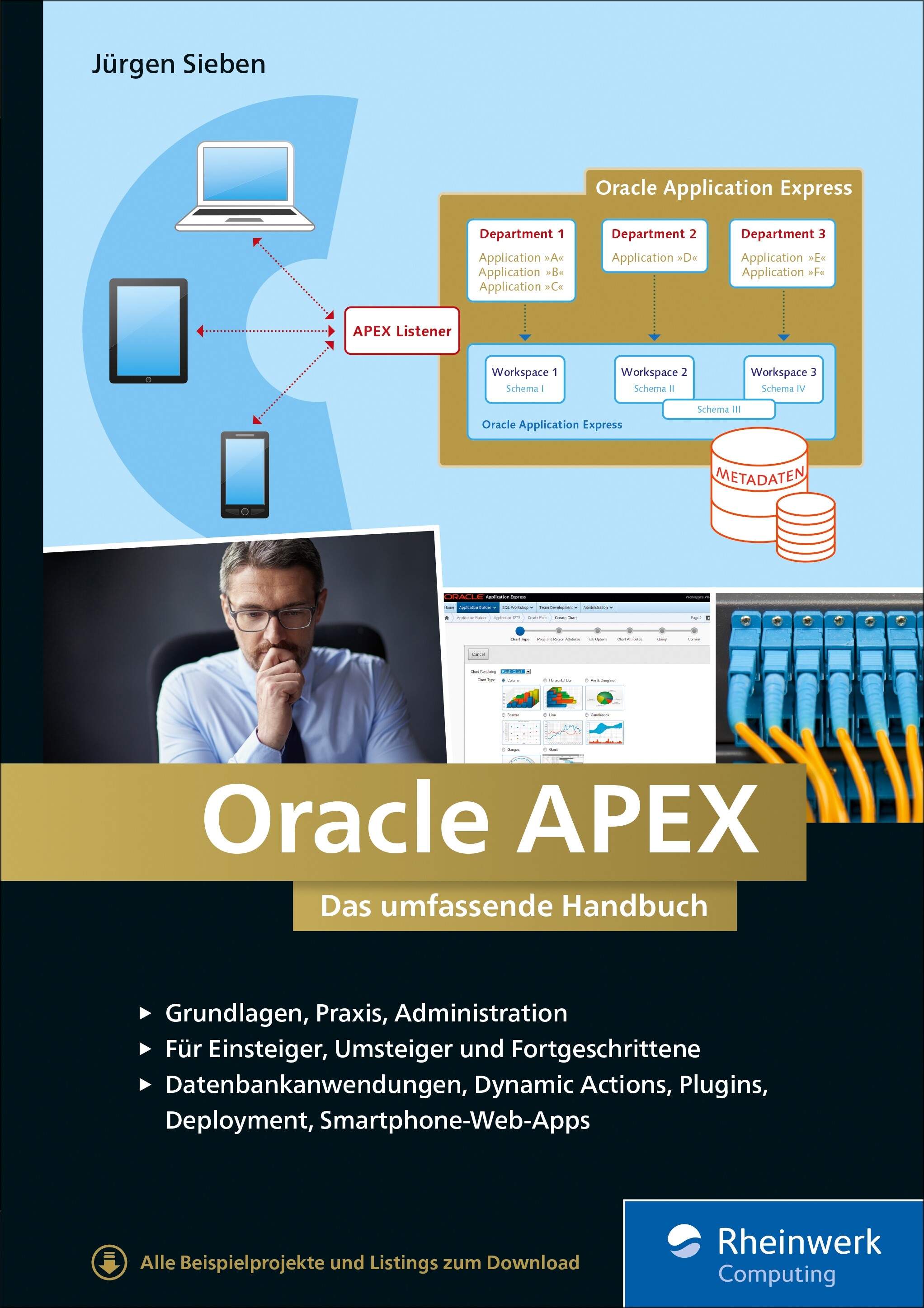
Oracle APEX
Das umfassende Handbuch Jürgen Sieben macht Sie in diesem Handbuch mit Oracle APEX vertraut und zeigt Ihnen ausführlich, wie Sie darin unternehmenstaugliche, webbasierte Datenbankanwendungen entwickeln – fachlich anspruchsvoll und didaktisch routiniert. Kenntnisse in SQL und PL/SQL werden vorausgesetzt. Inkl. Installations- und Upgrade-Anleitung.

Digital Transformation
Digital Transformation in Industry 4.0/5.0 requires the effective and efficient application of digitalization technologies in the area of production systems. This book elaborates on concepts, techniques, and technologies from computer science in the context of Industry 4.0/5.0 and demonstrates their possible applications. Thus, the book serves as an orientation but also as a reference work for experts in the field of Industry 4.0/5.0 to successfully advance digitization in their companies.PROFESSOR DR.-ING. BIRGIT VOGEL-HEUSER is head of the Department of Automation and Information Systems at the Technical University of Munich.PROFESSOR DR. MANUEL WIMMER is head of the Institute of Business Informatics - Software Engineering at the Johannes Kepler University Linz.PART I - DIGITAL REPRESENTATION: Engineering Digital Twins and Digital Shadows as Key Enablers for Industry 4.0.- Designing Strongly-decoupled Industry 4.0 applications across the stack: a use case.- Variability in Products and Production.- PART II - DIGITAL INFRASTRUCTURES: Reference Architectures for closing the IT/OT gap.- Edge Computing: Use Cases and Research Challenges.- Dynamic Access Control in Industry 4.0 Systems.- Challenges in OT-Security and their Impacts on Safety-related Cyber-Physical Production Systems.- Runtime Monitoring for Systems of System.- Blockchain technologies in the design and operation of cyber-physical systems.- PART III - DATA MANAGEMENT: Big Data Integration for Industry 4.0.- Tons of data - is data quality still an issue?.- Coupling of Top Floor Internal and External Data Exchange Matters.- PART IV - DATA ANALYTICS: Conceptualizing Analytics: An Overview of Business Intelligence and Analytics from a Conceptual Modeling Perspective.- Discovering Actionable Knowledge for Industry 4.0: From Data Mining to Predictive and Prescriptive Analytics.- Process Mining - Discovery, Conformance, and Enhancement of Manufacturing Processes.- Symbolic artificial intelligence methods for prescriptive analytics.- Machine Learning for Cyber-Physical Systems.- Visual Data Science for Industrial Applications.- PART V - DIGITAL TRANSFORMATION TOWARDS INDUSTRY 5.0: Self-Adaptive Digital Assistance Systems for Work 4.0.- Digital Transformation - Towards flexible human-centric enterprises.

Quick Start Guide to FFmpeg
Create, edit, modify and convert multimedia files using FFmpeg, the most versatile open source audio and video processing tool available for Linux, Mac and Windows users. After reading this book, you will be able to work with video and audio files, images, text, animations, fonts, subtitles and metadata like a pro.It begins with a simple introduction to FFmpeg executables — ffmpeg, ffprobe and ffplay, and explains how you can use them to process multimedia containers, streams, audio channels, maps and metadata. It then describes how you can easily edit, enhance and convert audio, video, image and text files. There are dedicated chapters for filters, audio, subtitles and metadata, as well as FFmpeg tips and tricks. Sample lists of FFmpeg filters, encoders, decoders, formats and codecs are also available as appendices.Quick Start Guide to FFmpeg is for anyone who needs to edit or process multimedia files including studio professionals, broadcast personnel, content creators, podcasters, librarians, archivists and webmasters. It will be indispensable for those wanting to process a variety of multimedia files from the command line and inside shell scripts or custom-built software.YOU WILL LEARN TO:* Convert from one format to another e.g. video-to-video, video-to-audio, video-to-image, image-to-video, video-to-animation, animation-to-video, text-to-audio, text-to-video* Edit video files by cutting them with and without re-encoding, appending, resizing, changing frame rate and aspect ratio, mixing in audio* Use filters to rotate, flip, crop, overlay (side-by-side or inset), remove logos, blur, smooth and sharpen, apply transitions as well as speed up or down playback* Edit audio files by changing, normalizing or compressing volume, mixing and splitting channels and detecting silence. Also, learn to generate waveforms as video or images* Add subtitles, place them anywhere on the screen, use custom fonts and colors, and use different languages* Learn how to import, export and remove metadata, add MP3 tags (including album art), set global and stream-specific metadata, export and remove metadataTHIS BOOK FOR:Content creators and bloggers from professional studio employees to Youtubers and hobbyists who need to process their own multimedia content; multimedia archivists and librarians; regular Linux desktop usersV. SUBHASH is an Indian writer, programmer and illustrator. He is the author of over two dozen mostly non-fiction books including Linux Command-Line Tips & Tricks, CommonMark Ready Reference, PC Hardware Explained, Cool Electronic Projects and How To Install Solar. He wrote, illustrated, designed and produced all of his books using only open-source software. Subhash has programmed in more than a dozen languages (as varied as assembly, Java and Javascript); published software for desktop (NetCheck), mobile (Subhash Browser & RSS Reader) and web (TweetsToRSS); and designed several websites. As of early 2023, he is working on a portable Javascript-free CMS using plain-jane PHP and SQLite. Subhash also occasionally writes for Open Source For You magazine and CodeProject.com.QUICK START GUIDE TO FFMPEGChapter 1: Installing FFmpegChapter 2: Starting with FFmpegChapter 3: Formats and CodecsChapter 4: Media Containers and FFmpeg NumberingChapter 5: Format ConversionChapter 6: Editing VideosChapter 7: Using FFmpeg FiltersChapter 8: All About AudioChapter 9: All About SubtitlesChapter 10: All About MetadataChapter 11: FFmpeg Tips 'n' TricksChapter 12: Annexures

Oracle on Docker
Discover the benefits of running Oracle databases in Linux containers. This book approaches containers from the perspective of database administrators, developers, and systems administrators. It explains the differences between containers and virtual machines and describes why containers deliver greater speed, flexibility, and portability, with lower resource requirements. You’ll learn how running Oracle databases in containers complements existing database infrastructure and accelerates development, and you’ll understand the advantages they offer for test and validation environments.This book teaches you how to begin working with Oracle databases in Docker, covering the steps for preparing and installing software on Windows, Mac, and Linux systems. It describes the steps for deploying Oracle databases, separating data and configurations from database software, and networking and communicating with your containers. It introduces the Docker commands you’ll use for managing containers, including tips and shortcuts to make everyday tasks easier. Databases have unique demands for performance and reliability, and this book addresses those qualities with discussions on protecting, persisting, and distributing data. Other books may overlook these topics and approach containers as disposable commodities in serverless environments or convenient coding platforms. You’ll gain battle-tested insights for customizing and extending your containers to meet different needs.The opening chapters concentrate on the practical steps of running Oracle databases in Docker. Once you’re comfortable with container terminology and methods, you’ll look deeper at the real power behind containers—preparing and building images, and the templates that form the foundation beneath every container. You’ll begin by modifying publicly available image manifests, or Dockerfiles, following multiple examples that add functionality and capabilities to your databases. You’ll discover methods for using run-time options to create flexible and extensible images that adapt to real-world requirements.Within the pages, you’ll see how Oracle and Docker empower you to confidently build and deploy systems. It’s written with databases and database users in mind and delivers practical advice based on the author’s real-world, battle-tested experiences deploying and running Oracle databases in containers since 2014. With Oracle databases in containers, database administrators have the ideal platform for evaluating performance, practicing database upgrades and migrations, validating backup and recovery processes, and hardening environments. Developers will find that the marriage of Oracle and Docker simplifies code and application tests. Docker’s unique ability to isolate data artifacts improves reliability and confidence in test and QA processes. If you’re a database administrator, this book will help you join the container revolution sweeping the industry and making IT professionals more productive than ever!WHAT YOU WILL LEARN* Recognize when and why to use containers for an Oracle database* Understand container terminology and architecture* Create and customize Oracle databases in containers* Build and extend images and containers for multiple uses* Store and persist data beyond the container ecosystem* Use popular database tools with databases in containers* Explore container networking and connect multiple container databases* Manage, monitor, and secure containers* Write Dockerfiles to support custom requirements* Package and deploy data artifacts that accelerate development, test, and QA activitiesWHO THIS BOOK IS FORDatabase administrators, developers, and systems administrators who want to be more productive by running Oracle databases in Linux containersSEAN SCOTT is an Oracle ACE Pro and Oracle Certified Professional. His Oracle career spans over 25 years as an application developer, database administrator, systems and database architect, and database reliability engineer. He specializes in Oracle's Engineered Systems; migrations, upgrades, and database consolidations; cloud implementations; database reliability and resilience; automation; virtualization; and containers. Sean is active in the user community as a volunteer and has presented at Oracle OpenWorld, Collaborate, IOUG, and as a featured speaker at regional user groups worldwide. IntroductionPART I. INTRODUCTION TO CONTAINERS1. Introducing Docker and Oracle2. Understanding the Container Landscape3. Container Foundations4. Oracle Database Quick Start Guide5. Differences in Database Containers6. Customize Container Environments7. Persistence8. Basic Networking9. Container Networks10. Container Creation Quick ReferencePART II. BUILDING AND CUSTOMIZING IMAGES11. Customizing Images12. Dockerfile Syntax13. Dockerfiles for Orcale Databases14. Building Images15. Debugging and Troubleshooting16. Docker Hub and Image Repositories17. ConclusionPART III. APPENDIXESA. Installing Docker Desktop
Google Cloud Certified Associate Cloud Engineer Study Guide
QUICKLY AND EFFICIENTLY PREPARE FOR THE GOOGLE ASSOCIATE CLOUD ENGINEER CERTIFICATION WITH THE PROVEN SYBEX METHODIn the newly updated Second Edition of Google Cloud Certified Associate Cloud Engineer Study Guide, expert engineer and tech educator Dan Sullivan delivers an essential handbook for anyone preparing for the challenging Associate Cloud Engineer exam offered by Google and for those seeking to upgrade their Google Cloud engineering skillset. The book provides readers with coverage of every domain and competency tested by the Associate Cloud Engineer exam, including how to select the right Google compute service from the wide variety of choices, how to choose the best storage option for your services, and how to implement appropriate security controls and network functionality. This guide also offers:* A strong emphasis on transforming readers into competent, job-ready applicants, with a focus on building skills in high demand by contemporary employers* Concrete test-taking strategies, techniques, and tips to help readers conquer exam anxiety* Complimentary access to a comprehensive online learning environment, complete with practice testsA must-have resource for practicing and aspiring Google Cloud engineers, Google Cloud Certified Associate Cloud Engineer Study Guide allows you to prepare for this challenging certification efficiently and completely. ABOUT THE AUTHORDAN SULLIVAN is a data architect specializing in data architecture, data analytics, and machine learning. Dan has also written the official Google Cloud study guides for the Professional Architect and Professional Data Engineer certification exams. He has taught courses on machine learning, data science, and cloud computing for LinkedIn Learning and Udemy, and holds a PhD in genetics, bioinformatics, and computational biology with a focus on infectious disease genomics. Introduction xxiAssessment Test xxxiiiCHAPTER 1 OVERVIEW OF GOOGLE CLOUD 1Types of Cloud Services 2Compute Resources 3Storage 4Networking 7Specialized Services 8Cloud Computing vs. Data Center Computing 8Rent Instead of Own Resources 8Pay- as- You- Go- for- What- You- Use Model 9Elastic Resource Allocation 9Specialized Services 10Summary 10Exam Essentials 10Review Questions 12CHAPTER 2 GOOGLE CLOUD COMPUTING SERVICES 17Computing Components of Google Cloud 18Computing Resources 19Storage Components of Google Cloud 23Storage Resources 23Databases 26Networking Components of Google Cloud 28Networking Services 28Identity Management and Security 30Development Tools 30Additional Components of Google Cloud 31Management and Observability Tools 31Specialized Services 32Summary 33Exam Essentials 33Review Questions 36CHAPTER 3 PROJECTS, SERVICE ACCOUNTS, AND BILLING 41How Google Cloud Organizes Projects and Accounts 42Google Cloud Resource Hierarchy 42Organization Policies 45Managing Projects 46Roles and Identities 49Roles in Google Cloud 50Granting Roles to Identities 50Service Accounts 52Billing 53Billing Accounts 53Billing Budgets and Alerts 56Exporting Billing Data 57Enabling APIs 59Summary 60Exam Essentials 61Review Questions 62CHAPTER 4 INTRODUCTION TO COMPUTING IN GOOGLE CLOUD 67Compute Engine 68Virtual Machine Images 68Virtual Machines Are Contained in Projects 77Virtual Machines Run in a Zone and Region 78Users Need Privileges to Create Virtual Machines 79Preemptible Virtual Machines 80Custom Machine Types 81Use Cases for Compute Engine Virtual Machines 82App Engine 83Structure of an App Engine Application 84App Engine Standard and Flexible Environments 85Use Cases for App Engine 86Kubernetes Engine 87Kubernetes Functionality 88Kubernetes Cluster Architecture 88Kubernetes Engine Use Cases 89Anthos 90Cloud Run 90Cloud Run Use Cases 91Cloud Functions 91Cloud Functions Execution Environment 91Cloud Functions Use Cases 93Summary 93Exam Essentials 95Review Questions 96CHAPTER 5 COMPUTING WITH COMPUTE ENGINE VIRTUAL MACHINES 101Creating and Configuring Virtual Machines with the Console 102Main Virtual Machine Configuration Details 104Advanced Configuration Details 109Creating and Configuring Virtual Machines with Cloud SDK 117Installing Cloud SDK 117Example Installation on Ubuntu Linux 118Creating a Virtual Machine with Cloud SDK 119Creating a Virtual Machine with Cloud Shell 120Basic Virtual Machine Management 121Starting and Stopping Instances 121Network Access to Virtual Machines 121Monitoring a Virtual Machine 123Cost of Virtual Machines 123Guidelines for Planning, Deploying, and Managing Virtual Machines 125Summary 125Exam Essentials 126Review Questions 127CHAPTER 6 MANAGING VIRTUAL MACHINES 131Managing Single Virtual Machine Instances 132Managing Single Virtual Machine Instances in the Console 132Managing a Single Virtual Machine Instance with Cloud Shell and the Command Line 141Introduction to Instance Groups 147Creating and Removing Instance Groups and Templates 147Instance Groups Load Balancing and Autoscaling 149Guidelines for Managing Virtual Machines 150Summary 150Exam Essentials 151Review Questions 152CHAPTER 7 COMPUTING WITH KUBERNETES 157Introduction to Kubernetes Engine 158Kubernetes Cluster Architecture 159Kubernetes Objects 159Deploying Kubernetes Clusters 162Deploying Kubernetes Clusters Using Cloud Console 162Deploying Kubernetes Clusters Using Cloud Shell and Cloud SDK 167Deploying Application Pods 168Monitoring Kubernetes 172Summary 172Exam Essentials 173Review Questions 174CHAPTER 8 MANAGING STANDARD MODE KUBERNETES CLUSTERS 179Viewing the Status of a Kubernetes Cluster 180Viewing the Status of Kubernetes Clusters Using Cloud Console 180Pinning Services to the Top of the Navigation Menu 182Viewing the Status of Kubernetes Clusters Using Cloud SDK and Cloud Shell 188Adding, Modifying, and Removing Nodes 193Adding, Modifying, and Removing Nodes with Cloud Console 193Adding, Modifying, and Removing Nodes with Cloud SDK and Cloud Shell 195Adding, Modifying, and Removing Pods 196Adding, Modifying, and Removing Pods with Cloud Console 196Adding, Modifying, and Removing Pods with Cloud SDK and Cloud Shell 200Adding, Modifying, and Removing Services 203Adding, Modifying, and Removing Services with Cloud Console 203Adding, Modifying, and Removing Services with Cloud SDK and Cloud Shell 205Creating Repositories in the Artifact Registry 207Viewing the Image Repository and Image Details with Cloud Console 207Summary 209Exam Essentials 209Review Questions 210CHAPTER 9 COMPUTING WITH CLOUD RUN AND APP ENGINE 215Overview of Cloud Run 216Cloud Run Services 216Cloud Run Jobs 217Creating a Cloud Run Service 218Creating a Cloud Run Job 222App Engine Components 223Deploying an App Engine Application 226Deploying an App Using Cloud Shell and SDK 226Scaling App Engine Applications 228Splitting Traffic Between App Engine Versions 229Summary 230Exam Essentials 231Review Questions 232CHAPTER 10 COMPUTING WITH CLOUD FUNCTIONS 237Introduction to Cloud Functions 238Events, Triggers, and Functions 238Runtime Environments 239Cloud Functions Receiving Events from Cloud Storage 241Deploying a Cloud Function for Cloud Storage Events Using Cloud Console 241Deploying a Cloud Function for Cloud Storage Events Using gcloud Commands 244Cloud Functions Receiving Events from Pub/Sub 245Deploying a Cloud Function for Cloud Pub/Sub Events Using Cloud Console 245Deploying a Cloud Function for Cloud Pub/Sub Events Using gcloud Commands 246Summary 247Exam Essentials 247Review Questions 249CHAPTER 11 PLANNING STORAGE IN THE CLOUD 253Types of Storage Systems 254Cache 255Persistent Storage 257Object Storage 258Storage Types When Planning a Storage Solution 264Storage Data Models 265Object: Cloud Storage 266Relational: Cloud SQL and Cloud Spanner 266Analytical: BigQuery 268NoSQL: Cloud Firestore and Bigtable 270Choosing a Storage Solution: Guidelines to Consider 277Summary 278Exam Essentials 278Review Questions 280CHAPTER 12 DEPLOYING STORAGE IN GOOGLE CLOUD 285Deploying and Managing Cloud SQL 286Creating and Connecting to a MySQL Instance 286Creating a Database, Loading Data, and Querying Data 288Backing Up MySQL in Cloud SQL 289Deploying and Managing Firestore 292Adding Data to a Firestore Database 292Backing Up Firestore 294Deploying and Managing BigQuery 294Estimating the Cost of Queries in BigQuery 294Viewing Jobs in BigQuery 296Deploying and Managing Cloud Spanner 297Deploying and Managing Cloud Pub/Sub 302Deploying and Managing Cloud Bigtable 306Deploying and Managing Cloud Dataproc 308Managing Cloud Storage 314Summary 316Exam Essentials 316Review Questions 317CHAPTER 13 LOADING DATA INTO STORAGE 321Loading and Moving Data to Cloud Storage 322Loading and Moving Data to Cloud Storage Using the Console 322Loading and Moving Data to Cloud Storage Using the Command Line 327Importing and Exporting Data 328Importing and Exporting Data: Cloud SQL 328Importing and Exporting Data: Cloud Firestore 332Importing and Exporting Data: BigQuery 332Importing and Exporting Data: Cloud Spanner 337Exporting Data from Cloud Bigtable 339Importing and Exporting Data: Cloud Dataproc 340Streaming Data to Cloud Pub/Sub 341Summary 342Exam Essentials 342Review Questions 344CHAPTER 14 NETWORKING IN THE CLOUD: VIRTUAL PRIVATE CLOUDS AND VIRTUAL PRIVATE NETWORKS 349Creating a Virtual Private Cloud with Subnets 350Creating a Virtual Private Cloud with Cloud Console 350Creating a Virtual Private Cloud with gcloud 354Creating a Shared Virtual Private Cloud Using gcloud 355Deploying Compute Engine with a Custom Network 357Creating Firewall Rules for a Virtual Private Cloud 359Structure of Firewall Rules 360Creating Firewall Rules Using Cloud Console 361Creating Firewall Rules Using gcloud 364Creating a Virtual Private Network 364Creating a Virtual Private Network Using Cloud Console 364Creating a Virtual Private Network Using gcloud 368Summary 368Exam Essentials 369Review Questions 370CHAPTER 15 NETWORKING IN THE CLOUD: DNS, LOAD BALANCING, GOOGLE PRIVATE ACCESS, AND IP ADDRESSING 375Configuring Cloud DNS 376Creating DNS Managed Zones Using Cloud Console 376Creating DNS Managed Zones Using gcloud 381Configuring Load Balancers 382Types of Load Balancers 382Configuring Load Balancers Using Cloud Console 383Configuring Load Balancers Using gcloud 386Google Private Access 389Managing IP Addresses 389Expanding CIDR Blocks 390Reserving IP Addresses 390Summary 391Exam Essentials 392Review Questions 394CHAPTER 16 DEPLOYING APPLICATIONS WITH CLOUD MARKETPLACE AND CLOUD FOUNDATION TOOLKIT 399Deploying a Solution Using Cloud Marketplace 400Browsing Cloud Marketplace and Viewing Solutions 400Deploying Cloud Marketplace Solutions 403Building Infrastructure Using the Cloud Foundation Toolkit 411Deployment Manager Configuration Files 411Deployment Manager Template Files 414Launching a Deployment Manager Template 414Cloud Foundation Toolkit 415Config Connector 418Summary 418Exam Essentials 418Review Questions 420CHAPTER 17 CONFIGURING ACCESS AND SECURITY 425Managing Identity and Access Management 426Viewing Account IAM Assignments 426Assigning IAM Roles to Accounts and Groups 428Defining Custom IAM Roles 432Managing Service Accounts 436Managing Service Accounts with Scopes 436Assigning a Service Account to a VM Instance 438Viewing Audit Logs 440Summary 441Exam Essentials 441Review Questions 443CHAPTER 18 MONITORING, LOGGING, AND COST ESTIMATING 447Cloud Monitoring 448Creating Dashboards 449Using Metric Explorer 450Creating Alerts 454Cloud Logging 458Log Routers and Log Sinks 458Configuring Log Sinks 459Viewing and Filtering Logs 459Viewing Message Details 462Using Cloud Diagnostics 463Overview of Cloud Trace 463Viewing Google Cloud Status 464Using the Pricing Calculator 464Summary 467Exam Essentials 468Review Questions 469Appendix Answers to Review Questions 473Chapter 1: Overview of Google Cloud 474Chapter 2: Google Cloud Computing Services 476Chapter 3: Projects, Service Accounts, and Billing 478Chapter 4: Introduction to Computing in Google Cloud 480Chapter 5: Computing with Compute Engine Virtual Machines 482Chapter 6: Managing Virtual Machines 485Chapter 7: Computing with Kubernetes 487Chapter 8: Managing Standard Mode Kubernetes Clusters 489Chapter 9: Computing with Cloud Run and App Engine 491Chapter 10: Computing with Cloud Functions 494Chapter 11: Planning Storage in the Cloud 496Chapter 12: Deploying Storage in Google Cloud 498Chapter 13: Loading Data into Storage 500Chapter 14: Networking in the Cloud: Virtual Private Clouds and Virtual Private Networks 502Chapter 15: Networking in the Cloud: DNS, Load Balancing, Google Private Access, and IP Addressing 504Chapter 16: Deploying Applications with Cloud Marketplace and Cloud Foundation Toolkit 507Chapter 17: Configuring Access and Security 509Chapter 18: Monitoring, Logging, and Cost Estimating 511Index 515

Modern Enterprise Architecture
Enterprise Architecture (EA) frameworks such as TOGAF and Zachman are still valid, but enterprise architects also need to adapt to the new reality of agile, DevOps, and overall disruption through digital transformation. This book will help do just that.The Change to Modern Enterprise Architecture will teach you how to use known frameworks in the new world of digital transformation. Over the course of the book, you'll learn how modern EA is helping drive strategic business decisions, create continuous and agile (“floating”) architecture for scalability, and how to address quality and speed in architecture using and integrating DevSecOps frameworks in EA.This book is divided into three parts: the first explains what modern enterprise architecture is and why it’s important to any business. It covers the different EA frameworks and explains what they are. In the second part, you will learn how to integrate modern development frameworks into EA, and why this knowledge will enable you to deftly respond to various business challenges. The final section of the book is all about scaling the enterprise using modern enterprise architecture. You will also see how the role of the enterprise architect is changing and how to remain in control of your architecture.Upon completing this book, you'll understand why the enterprise architect is no longer just a role overseeing the architecture strategy of a business, but has become more of a leader in driving engineering excellence.WHAT YOU'LL LEARN* Integrate DevSecOps as artifact to modern EA* Use Enterprise Architecture to scale up your business* Understand the changing role of the enterprise architect* Define a floating architecture to enhance business agilityWHO THIS BOOK IS FOREnterprise architects, IT architects, lead engineers, business architects, business leaders, product managers.JEROEN MULDER is a certified enterprise and business architect who holds certifications in various cloud technologies, DevOps, and security. As an architect and consultant, he has executed many complex projects in digital transformation for a wide variety of companies. He’s the author of the books Multi-Cloud Architecture and Governance, Enterprise DevOps for Architects, and Transformation Healthcare using DevOps. His current role is principal consultant at Fujitsu, a Japan-based leading IT company.Jeroen believes that anyone, any team or business will perform better and reach further if they are truly inspired. That’s his mission: to inspire, by inviting people to be creative and bold, so they take that one step further.Chapter 1: Why Any Business Needs Enterprise ArchitectureCHAPTER GOAL: EXPLAIN WHAT EA IS AND WHY IT’S IMPORTANT TO ANY BUSINESS. INTRODUCING VARIOUS EA FRAMEWORKS AND SHOWING THE RELEVANCY OF THESE FRAMEWORKS.NO OF PAGES 35SUB -TOPICS1. Introduction to Enterprise Architecture2. The benefits of EA3. Using Zachman and TOGAF4. Starting with architecture vision from the business5. Collecting business requirements6. Change management is keyChapter 2: The Transformation to Modern EACHAPTER GOAL: DESCRIBING HOW EA (AND THE ROLE OF THE ENTERPRISE ARCHITECT) IS CHANGING DUE TO NEW BUSINESS GOALS.NO OF PAGES: 30SUB - TOPICS1. Modern Enterprise Architecture2. Learning from IT4IT3. Using modern EA techniques and tools4. Defining a target architecture and operating model5. Applying best practices from EAChapter 3: The Real World of Digital TransformationCHAPTER GOAL: HOW DO EARTH-BORN (TRADITIONAL) COMPANIES START THE JOURNEY TO MODERN COMPANIES USING SCALABLE CLOUD-NATIVE TECHNOLOGY, AGILE FRAMEWORKS AND DEVSECOPS? WHAT ARE THE MODERN BUSINESS CHALLENGES AND HOW CAN EA ADDRESS THESE.NO OF PAGES : 30SUB - TOPICS:1. The challenge of the earth-born enterprise2. Starting the journey: earth-born migrants3. Guiding the transformation from EA4. Application Portfolio Management5. Controlling risksChapter 4: Creating the Floating ArchitectureCHAPTER GOAL: INTEGRATING NEW PRACTICES IN EA: AGILE, SCRUM, DEVSECOPS.NO OF PAGES: 30SUB - TOPICS:1. Becoming agile by leveraging the power of small2. Including DevOps principles in architecture3. Security is intrinsic in EA4. Change management in floating architecture5. Putting it all together in the architectural vision1. Best practices from real cases: what defines success?Chapter 5: Scaling the Business with EACHAPTER GOAL:1. Setting strategic objectives in EA2. Why businesses need to be scalable3. Enabling development speed4. Identifying stakeholders in modern EA5. Scaling the organization6. Scaling the businessChapter 6: The Changing Role of the Enterprise ArchitectCHAPTER GOAL:1. The role of the architect in frameworks2. From architect to servant leader3. Creating an architecture culture and engineering excellence in the enterprise4. The future of architecture and the architect5. Training new talents – we need you (conclusion)

Gemeinsam sind wir stärker
Kollaboration: Kaum ein Begriff hat sich in den vergangenen Jahren und Monaten in der Arbeitswelt so verbreitet wie dieser. Teams werden immer internationaler, Organisationen gehen von festen Teams über zu aufgabenabhängigen Arbeitsgruppen. Grund genug, die grundsätzliche Arbeitsweise zu überdenken, und das nicht nur in der Arbeitswelt, sondern auch im Privaten. Mit den richtigen Tools, lassen sich wunderbar einfach im Team Termine abstimmen, Projekte starten und verwalten, Dokumente erstellen und bearbeiten - und niemand verliert den Überblick. Solche Tools sind meist kostenlos und sehr leistungsfähig. In diesem eBook steht, wie Ihr vorgehen solltet, wenn Ihr Termine abstimmt und/oder mit anderem im Team arbeiten wollt. Das spart eine Menge Zeit und macht Spaß.Jörg Schieb ist einer der bekanntesten deutschsprachigen Autoren für Digitalthemen und arbeitet auch für ARD, WDR und andere Sender.

Artificial Intelligence Applications and Reconfigurable Architectures
ARTIFICIAL INTELLIGENCE APPLICATIONS AND RECONFIGURABLE ARCHITECTURESTHE PRIMARY GOAL OF THIS BOOK IS TO PRESENT THE DESIGN, IMPLEMENTATION, AND PERFORMANCE ISSUES OF AI APPLICATIONS AND THE SUITABILITY OF THE FPGA PLATFORM.This book covers the features of modern Field Programmable Gate Arrays (FPGA) devices, design techniques, and successful implementations pertaining to AI applications. It describes various hardware options available for AI applications, key advantages of FPGAs, and contemporary FPGA ICs with software support. The focus is on exploiting parallelism offered by FPGA to meet heavy computation requirements of AI as complete hardware implementation or customized hardware accelerators. This is a comprehensive textbook on the subject covering a broad array of topics like technological platforms for the implementation of AI, capabilities of FPGA, suppliers’ software tools and hardware boards, and discussion of implementations done by researchers to encourage the AI community to use and experiment with FPGA. Readers will benefit from reading this book because* It serves all levels of students and researcher’s as it deals with the basics and minute details of Ecosystem Development Requirements for Intelligent applications with reconfigurable architectures whereas current competitors’ books are more suitable for understanding only reconfigurable architectures.* It focuses on all aspects of machine learning accelerators for the design and development of intelligent applications and not on a single perspective such as only on reconfigurable architectures for IoT applications.* It is the best solution for researchers to understand how to design and develop various AI, deep learning, and machine learning applications on the FPGA platform.* It is the best solution for all types of learners to get complete knowledge of why reconfigurable architectures are important for implementing AI-ML applications with heavy computations.AUDIENCEResearchers, industrial experts, scientists, and postgraduate students who are working in the fields of computer engineering, electronics, and electrical engineering, especially those specializing in VLSI and embedded systems, FPGA, artificial intelligence, Internet of Things, and related multidisciplinary projects. ANURADHA THAKARE, PHD, is a Dean of International Relations and Professor in the Department of Computer Engineering at Pimpri Chinchwad College of Engineering, Pune, India. She has more than 22 years of experience in academics and research and has published more than 80 research articles in SCI journals as well several books. SHEETAL BHANDARI,PHD, received her degree in the area of reconfigurable computing. She is a postgraduate in electronics engineering from the University of Pune with a specialization in digital systems. She is working as a professor in the Department of Electronics and Telecommunication Engineering and Dean of Academics at Pimpri Chinchwad College of Engineering. Her research area concerns reconfigurable computing and embedded system design around FPGA HW-SW Co-Design.

Convergence of Cloud with AI for Big Data Analytics
CONVERGENCE OF CLOUD WITH AI FOR BIG DATA ANALYTICSTHIS BOOK COVERS THE FOUNDATIONS AND APPLICATIONS OF CLOUD COMPUTING, AI, AND BIG DATA AND ANALYSES THEIR CONVERGENCE FOR IMPROVED DEVELOPMENT AND SERVICES.The 17 chapters of the book masterfully and comprehensively cover the intertwining concepts of artificial intelligence, cloud computing, and big data, all of which have recently emerged as the next-generation paradigms. There has been rigorous growth in their applications and the hybrid blend of AI Cloud and IoT (Ambient-intelligence technology) also relies on input from wireless devices. Despite the multitude of applications and advancements, there are still some limitations and challenges to overcome, such as security, latency, energy consumption, service allocation, healthcare services, network lifetime, etc. Convergence of Cloud with AI for Big Data Analytics: Foundations and Innovation details all these technologies and how they are related to state-of-the-art applications, and provides a comprehensive overview for readers interested in advanced technologies, identifying the challenges, proposed solutions, as well as how to enhance the framework. AUDIENCEResearchers and post-graduate students in computing as well as engineers and practitioners in software engineering, electrical engineers, data analysts, and cyber security professionals. DANDA B RAWAT, PHD, is a Full Professor in the Department of Electrical Engineering & Computer Science (EECS), Founder and Director of the Howard University Data Science and Cybersecurity Center, Director of DoD Center of Excellence in Artificial Intelligence & Machine Learning, Director of Cyber-security and Wireless Networking Innovations Research Lab, Graduate Program Director of Howard CS Graduate Programs, and Director of Graduate Cybersecurity Certificate Program at Howard University, Washington, DC, USA. Dr. Rawat has published more than 250 scientific/technical articles and 11 books. LALIT K AWASTHI, PHD, is the Director of Dr. B. R. Ambedkar National Institute of Technology Jalandhar, India). He received his PhD degree from the Indian Institute of Technology Roorkee in computer science and engineering. He has published more than 150 research papers in various journals and conferences of international repute and guided many PhDs in these areas. VALENTINA E BALLAS, PHD, is aFull Professor in the Department of Automatics and Applied Software at the Faculty of Engineering, “Aurel Vlaicu” University of Arad, Romania. Dr. Ballas is the author of more than 280 research papers in refereed journals and international conferences. She is the Editor-in-Chief of International Journal of Advanced Intelligence Paradigms and International Journal of Computational Systems Engineering. MOHIT KUMAR, PHD, is an assistant professor in the Department of Information Technology at Dr. B R Ambedkar National Institute of Technology, Jalandhar, India. He received his PhD degree from the Indian Institute of Technology Roorkee in the field of cloud computing in 2018. His research topics cover the areas of cloud computing, fog computing, edge computing, Internet of Things, soft computing, and blockchain. He has published more than 25 research articles in international journals and conferences. JITENDRA KUMAR SAMRIYA, PHD, has afaculty position in the Department of Information Technology, Dr. B.R. Ambedkar National Institute of Technology, Jalandhar. His research interest is cloud computing, artificial intelligence, and multi-objective evolutionary optimization techniques. He has published 15 research articles in international journals and has published five Indian and international patents. Preface xv1 INTEGRATION OF ARTIFICIAL INTELLIGENCE, BIG DATA, AND CLOUD COMPUTING WITH INTERNET OF THINGS 1Jaydip Kumar1.1 Introduction 21.2 Roll of Artificial Intelligence, Big Data and Cloud Computing in IoT 31.3 Integration of Artificial Intelligence with the Internet of Things Devices 41.4 Integration of Big Data with the Internet of Things 61.5 Integration of Cloud Computing with the Internet of Things 61.6 Security of Internet of Things 81.7 Conclusion 10References 102 CLOUD COMPUTING AND VIRTUALIZATION 13Sudheer Mangalampalli, Pokkuluri Kiran Sree, Sangram K. Swain and Ganesh Reddy Karri2.1 Introduction to Cloud Computing 142.1.1 Need of Cloud Computing 142.1.2 History of Cloud Computing 142.1.3 Definition of Cloud Computing 152.1.4 Different Architectures of Cloud Computing 162.1.4.1 Generic Architecture of Cloud Computing 162.1.4.2 Market Oriented Architecture of Cloud Computing 172.1.5 Applications of Cloud Computing in Different Domains 182.1.5.1 Cloud Computing in Healthcare 182.5.1.2 Cloud Computing in Education 192.5.1.3 Cloud Computing in Entertainment Services 192.5.1.4 Cloud Computing in Government Services 192.1.6 Service Models in Cloud Computing 192.1.7 Deployment Models in Cloud Computing 212.2 Virtualization 222.2.1 Need of Virtualization in Cloud Computing 222.2.2 Architecture of a Virtual Machine 232.2.3 Advantages of Virtualization 242.2.4 Different Implementation Levels of Virtualization 252.2.4.1 Instruction Set Architecture Level 252.2.4.2 Hardware Level 262.2.4.3 Operating System Level 262.2.4.4 Library Level 262.2.4.5 Application Level 262.2.5 Server Consolidation Using Virtualization 262.2.6 Task Scheduling in Cloud Computing 272.2.7 Proposed System Architecture 312.2.8 Mathematical Modeling of Proposed Task Scheduling Algorithm 312.2.9 Multi Objective Optimization 342.2.10 Chaotic Social Spider Algorithm 342.2.11 Proposed Task Scheduling Algorithm 352.2.12 Simulation and Results 362.2.12.1 Calculation of Makespan 362.2.12.2 Calculation of Energy Consumption 372.3 Conclusion 37References 383 TIME AND COST-EFFECTIVE MULTI-OBJECTIVE SCHEDULING TECHNIQUE FOR CLOUD COMPUTING ENVIRONMENT 41Aida A. Nasr, Kalka Dubey, Nirmeen El-Bahnasawy, Gamal Attiya and Ayman El-Sayed3.1 Introduction 423.2 Literature Survey 443.3 Cloud Computing and Cloudlet Scheduling Problem 463.4 Problem Formulation 473.5 Cloudlet Scheduling Techniques 493.5.1 Heuristic Methods 503.5.2 Meta-Heuristic Methods 513.6 Cloudlet Scheduling Approach (CSA) 523.6.1 Proposed CSA 523.6.2 Time Complexity 533.6.3 Case Study 543.7 Simulation Results 563.7.1 Simulation Environment 563.7.2 Evaluation Metrics 563.7.2.1 Performance Evaluation with Small Number of Cloudlets 573.7.2.2 Performance Evaluation with Large Number of Cloudlets 573.8 Conclusion 64References 644 CLOUD-BASED ARCHITECTURE FOR EFFECTIVE SURVEILLANCE AND DIAGNOSIS OF COVID- 19 69Shweta Singh, Aditya Bhardwaj, Ishan Budhiraja, Umesh Gupta and Indrajeet Gupta4.1 Introduction 704.2 Related Work 714.2.1 Proposed Cloud-Based Network for Management of COVID- 19 734.3 Research Methodology 754.3.1 Sample Size and Target 764.3.1.1 Sampling Procedures 774.3.1.2 Response Rate 774.3.1.3 Instrument and Measures 774.3.2 Reliability and Validity Test 784.3.3 Exploratory Factor Analysis 784.4 Survey Findings 804.4.1 Outcomes of the Proposed Scenario 824.4.1.1 Online Monitoring 824.4.1.2 Location Tracking 824.4.1.3 Alarm Linkage 824.4.1.4 Command and Control 824.4.1.5 Plan Management 824.4.1.6 Security Privacy 834.4.1.7 Remote Maintenance 834.4.1.8 Online Upgrade 834.4.1.9 Command Management 834.4.1.10 Statistical Decision 834.4.2 Experimental Setup 834.5 Conclusion and Future Scope 85References 865 SMART AGRICULTURE APPLICATIONS USING CLOUD AND IOT 89Keshav Kaushik5.1 Role of IoT and Cloud in Smart Agriculture 895.2 Applications of IoT and Cloud in Smart Agriculture 945.3 Security Challenges in Smart Agriculture 975.4 Open Research Challenges for IoT and Cloud in Smart Agriculture 1005.5 Conclusion 103References 1036 APPLICATIONS OF FEDERATED LEARNING IN COMPUTING TECHNOLOGIES 107Sambit Kumar Mishra, Kotipalli Sindhu, Mogaparthi Surya Teja, Vutukuri Akhil, Ravella Hari Krishna, Pakalapati Praveen and Tapas Kumar Mishra6.1 Introduction 1086.1.1 Federated Learning in Cloud Computing 1086.1.1.1 Cloud-Mobile Edge Computing 1096.1.1.2 Cloud Edge Computing 1116.1.2 Federated Learning in Edge Computing 1126.1.2.1 Vehicular Edge Computing 1136.1.2.2 Intelligent Recommendation 1136.1.3 Federated Learning in IoT (Internet of Things) 1146.1.3.1 Federated Learning for Wireless Edge Intelligence 1146.1.3.2 Federated Learning for Privacy Protected Information 1156.1.4 Federated Learning in Medical Computing Field 1166.1.4.1 Federated Learning in Medical Healthcare 1176.1.4.2 Data Privacy in Healthcare 1176.1.5 Federated Learning in Blockchain 1186.1.5.1 Blockchain-Based Federated Learning Against End-Point Adversarial Data 1186.2 Advantages of Federated Learning 1196.3 Conclusion 119References 1197 ANALYZING THE APPLICATION OF EDGE COMPUTING IN SMART HEALTHCARE 121Parul Verma and Umesh Kumar7.1 Internet of Things (IoT) 1227.1.1 IoT Communication Models 1227.1.2 IoT Architecture 1247.1.3 Protocols for IoT 1257.1.3.1 Physical/Data Link Layer Protocols 1257.1.3.2 Network Layer Protocols 1277.1.3.3 Transport Layer Protocols 1287.1.3.4 Application Layer Protocols 1297.1.4 IoT Applications 1307.1.5 IoT Challenges 1327.2 Edge Computing 1337.2.1 Cloud vs. Fog vs. Edge 1347.2.2 Existing Edge Computing Reference Architecture 1357.2.2.1 FAR-EDGE Reference Architecture 1357.2.2.2 Intel-SAP Joint Reference Architecture (RA) 1357.2.3 Integrated Architecture for IoT and Edge 1367.2.4 Benefits of Edge Computing Based IoT Architecture 1387.3 Edge Computing and Real Time Analytics in Healthcare 1407.4 Edge Computing Use Cases in Healthcare 1487.5 Future of Healthcare and Edge Computing 1517.6 Conclusion 151References 1528 FOG-IOT ASSISTANCE-BASED SMART AGRICULTURE APPLICATION 157Pawan Whig, Arun Velu and Rahul Reddy Nadikattu8.1 Introduction 1588.1.1 Difference Between Fog and Edge Computing 1598.1.1.1 Bandwidth 1638.1.1.2 Confidence 1648.1.1.3 Agility 1648.1.2 Relation of Fog with IoT 1658.1.3 Fog Computing in Agriculture 1678.1.4 Fog Computing in Smart Cities 1698.1.5 Fog Computing in Education 1708.1.6 Case Study 171Conclusion and Future Scope 173References 1739 INTERNET OF THINGS IN THE GLOBAL IMPACTS OF COVID-19: A SYSTEMATIC STUDY 177Shalini Sharma Goel, Anubhav Goel, Mohit Kumar and Sachin Sharma9.1 Introduction 1789.2 COVID-19 – Misconceptions 1819.3 Global Impacts of COVID-19 and Significant Contributions of IoT in Respective Domains to Counter the Pandemic 1839.3.1 Impact on Healthcare and Major Contributions of IoT 1839.3.2 Social Impacts of COVID-19 and Role of IoT 1879.3.3 Financial and Economic Impact and How IoT Can Help to Shape Businesses 1889.3.4 Impact on Education and Part Played by IoT 1919.3.5 Impact on Climate and Environment and Indoor Air Quality Monitoring Using IoT 1949.3.6 Impact on Travel and Tourism and Aviation Industry and How IoT is Shaping its Future 1979.4 Conclusions 198References 19810 AN EFFICIENT SOLAR ENERGY MANAGEMENT USING IOT-ENABLED ARDUINO-BASED MPPT TECHNIQUES 205Rita Banik and Ankur BiswasList of Symbols 20610.1 Introduction 20610.2 Impact of Irradiance on PV Efficiency 21010.2.1 PV Reliability and Irradiance Optimization 21110.2.1.1 PV System Level Reliability 21110.2.1.2 PV Output with Varying Irradiance 21110.2.1.3 PV Output with Varying Tilt 21210.3 Design and Implementation 21210.3.1 The DC to DC Buck Converter 21510.3.2 The Arduino Microcontroller 21710.3.3 Dynamic Response 21910.4 Result and Discussions 22010.5 Conclusions 223References 22411 AXIOMATIC ANALYSIS OF PRE-PROCESSING METHODOLOGIES USING MACHINE LEARNING IN TEXT MINING: A SOCIAL MEDIA PERSPECTIVE IN INTERNET OF THINGS 229Tajinder Singh, Madhu Kumari, Daya Sagar Gupta and Nikolai Siniak11.1 Introduction 23011.2 Text Pre-Processing – Role and Characteristics 23211.3 Modern Pre-Processing Methodologies and Their Scope 23411.4 Text Stream and Role of Clustering in Social Text Stream 24111.5 Social Text Stream Event Analysis 24211.6 Embedding 24411.6.1 Type of Embeddings 24411.7 Description of Twitter Text Stream 25011.8 Experiment and Result 25111.9 Applications of Machine Learning in IoT (Internet of Things) 25111.10 Conclusion 252References 25212 APP-BASED AGRICULTURE INFORMATION SYSTEM FOR RURAL FARMERS IN INDIA 257Ashwini Kumar, Dilip Kumar Choubey, Manish Kumar and Santosh Kumar12.1 Introduction 25812.2 Motivation 25912.3 Related Work 26012.4 Proposed Methodology and Experimental Results Discussion 26212.4.1 Mobile Cloud Computing 26612.4.2 XML Parsing and Computation Offloading 26612.4.3 Energy Analysis for Computation Offloading 26712.4.4 Virtual Database 26912.4.5 App Engine 27012.4.6 User Interface 27212.4.7 Securing Data 27312.5 Conclusion and Future Work 274References 27413 SSAMH – A SYSTEMATIC SURVEY ON AI-ENABLED CYBER PHYSICAL SYSTEMS IN HEALTHCARE 277Kamalpreet Kaur, Renu Dhir and Mariya Ouaissa13.1 Introduction 27813.2 The Architecture of Medical Cyber-Physical Systems 27813.3 Artificial Intelligence-Driven Medical Devices 28213.3.1 Monitoring Devices 28213.3.2 Delivery Devices 28313.3.3 Network Medical Device Systems 28313.3.4 IT-Based Medical Device Systems 28413.3.5 Wireless Sensor Network-Based Medical Driven Systems 28513.4 Certification and Regulation Issues 28513.5 Big Data Platform for Medical Cyber-Physical Systems 28613.6 The Emergence of New Trends in Medical Cyber-Physical Systems 28813.7 Eminence Attributes and Challenges 28913.8 High-Confidence Expansion of a Medical Cyber-Physical Expansion 29013.9 Role of the Software Platform in the Interoperability of Medical Devices 29113.10 Clinical Acceptable Decision Support Systems 29113.11 Prevalent Attacks in the Medical Cyber-Physical Systems 29213.12 A Suggested Framework for Medical Cyber-Physical System 29413.13 Conclusion 295References 29614 ANN-AWARE METHANOL DETECTION APPROACH WITH CUO-DOPED SNO 2 IN GAS SENSOR 299Jitendra K. Srivastava, Deepak Kumar Verma, Bholey Nath Prasad and Chayan Kumar Mishra14.1 Introduction 30014.1.1 Basic ANN Model 30014.1.2 ANN Data Pre- and Post-Processing 30314.1.2.1 Activation Function 30414.2 Network Architectures 30514.2.1 Feed Forward ANNs 30514.2.2 Recurrent ANNs Topologies 30714.2.3 Learning Processes 30814.2.3.1 Supervised Learning 30814.2.3.2 Unsupervised Learning 30814.2.4 ANN Methodology 30914.2.5 1%CuO–Doped SnO 2 Sensor for Methanol 30914.2.6 Experimental Result 311References 32715 DETECTING HEART ARRHYTHMIAS USING DEEP LEARNING ALGORITHMS 331Dilip Kumar Choubey, Chandan Kumar Jha, Niraj Kumar, Neha Kumari and Vaibhav Soni15.1 Introduction 33215.1.1 Deep Learning 33315.2 Motivation 33415.3 Literature Review 33415.4 Proposed Approach 36615.4.1 Dataset Descriptions 36715.4.2 Algorithms Description 36915.4.2.1 Dense Neural Network 36915.4.2.2 Convolutional Neural Network 37015.4.2.3 Long Short-Term Memory 37215.5 Experimental Results of Proposed Approach 37615.6 Conclusion and Future Scope 379References 38016 ARTIFICIAL INTELLIGENCE APPROACH FOR SIGNATURE DETECTION 387Amar Shukla, Rajeev Tiwari, Saurav Raghuvanshi, Shivam Sharma and Shridhar Avinash16.1 Introduction 38716.2 Literature Review 39016.3 Problem Definition 39216.4 Methodology 39216.4.1 Data Flow Process 39416.4.2 Algorithm 39516.5 Result Analysis 39716.6 Conclusion 399References 39917 COMPARISON OF VARIOUS CLASSIFICATION MODELS USING MACHINE LEARNING TO PREDICT MOBILE PHONES PRICE RANGE 401Chinu Singla and Chirag Jindal17.1 Introduction 40217.2 Materials and Methods 40317.2.1 Dataset 40317.2.2 Decision Tree 40317.2.2.1 Basic Algorithm 40417.2.3 Gaussian Naive Bayes (GNB) 40417.2.3.1 Basic Algorithm 40517.2.4 Support Vector Machine 40517.2.4.1 Basic Algorithm 40617.2.5 Logistic Regression (LR) 40717.2.5.1 Basic Algorithm 40717.2.6 K-Nearest Neighbor 40817.2.6.1 Basic Algorithm 40917.2.7 Evaluation Metrics 40917.3 Application of the Model 41017.3.1 Decision Tree (DT) 41117.3.2 Gaussian Naive Bayes 41117.3.3 Support Vector Machine 41217.3.4 Logistic Regression 41217.3.5 K Nearest Neighbor 41317.4 Results and Comparison 41317.5 Conclusion and Future Scope 418References 418Index 421
Using Microsoft Dynamics 365 for Finance and Operations
Precise instructions and descriptions in this book enable users, consultants, IT managers, and students to understand Microsoft Dynamics 365 for Finance and Operations rapidly. Dynamics 365 for Finance and Operations is a comprehensive business management solution for large and mid-sized organizations, which includes the core products Dynamics 365 Supply Chain Management and Dynamics 365 Finance. This book provides the required knowledge to handle all basic business processes in the application. The exercises in the book also make it a good choice for self-study.DR. ANDREAS LUSZCZAK Is a project manager, consultant, and trainer for Microsoft Dynamics 365/AX. Apart from his engagement in numerous implementation projects, he has been teaching it at renowned universities in Austria. Before focusing on Dynamics 365/AX, he has been working as an IT manager/CIO and consultant for other business solutions (including Microsoft Dynamics NAV).Basics and Technology - Navigation and User Interface - Supply Chain Management - Trade and Logistics - Advanced Warehouse Management - Manufacturing - Financial Management
Agile Software Development
AGILE SOFTWARE DEVELOPMENTA UNIQUE TITLE THAT INTRODUCES THE WHOLE RANGE OF AGILE SOFTWARE DEVELOPMENT PROCESSES FROM THE FUNDAMENTAL CONCEPTS TO THE HIGHEST LEVELS OF APPLICATIONS SUCH AS REQUIREMENT ANALYSIS, SOFTWARE TESTING, QUALITY ASSURANCE, AND RISK MANAGEMENT. Agile Software Development (ASD) has become a popular technology because its methods apply to any programming paradigm. It is important in the software development process because it emphasizes incremental delivery, team collaboration, continuous planning, and learning over delivering everything at once near the end. Agile has gained popularity as a result of its use of various frameworks, methods, and techniques to improve software quality. Scrum is a major agile framework that has been widely adopted by the software development community. Metaheuristic techniques have been used in the agile software development process to improve software quality and reliability. These techniques not only improve quality and reliability but also test cases, resulting in cost-effective and time-effective software. However, many significant research challenges must be addressed to put such ASD capabilities into practice. With the use of diverse techniques, guiding principles, artificial intelligence, soft computing, and machine learning, this book seeks to study theoretical and technological research findings on all facets of ASD. Also, it sheds light on the latest trends, challenges, and applications in the area of ASD. This book explores the theoretical as well as the technical research outcomes on all the aspects of Agile Software Development by using various methods, principles, artificial intelligence, soft computing, and machine learning. AUDIENCEThe book is designed for computer scientists and software engineers both in research and industry. Graduate and postgraduate students will find the book accessible as well. SUSHEELA HOODA,PHD, is an assistant professor in the Department of Computer Science & Engineering, Chitkara University Institute of Engineering & Technology, Punjab, India. VANDANA MOHINDRU SOOD,PHD, is an assistant professor in the Department of Computer Science & Engineering, Chitkara University Institute of Engineering & Technology, Punjab, India. YASHWANT SINGH, PHD, is an associate professor & Head of the Department of Computer Science and Information Technology, Central University of Jammu, J&K, India. SANDEEP DALAL,PHD, is an assistant professor in the Department of Computer Science & Applications, Maharshi Dayanand University, Rohtak, Haryana, India. MANU SOOD,PHD. is a professor in the Department of Computer Science, Himachal Pradesh University, Shimla, India.

Auf dem Tablet visualisiert
Wie Sie Ihre guten Ideen für sich und andere visuell umsetzenSie müssen schnell eine Präsentation oder ein Logo erstellen, ein virtuelles Meeting vorbereiten und dann noch ein Titelbild für die Website gestalten? Ach ja, die Social-Media-Accounts wollen auch noch schönen Content ... Der normale tägliche Wahnsinn.Sandra Schulze, Illustratorin und Grafikdesignerin, packt ihre »schmutzigen Tricks« aus, wie Sie mit ein paar Apps schnell Ihre alltäglichen Aufgaben umsetzen können. Sie finden hier hilfreiche Tipps und Anleitungen, wie Sie Inhalte visualisieren und strukturieren, Ideen sammeln, Entwürfe erstellen und sie mit anderen teilen und bearbeiten. Egal wo Sie sind: Das Buch zeigt Ihnen den bequemen Weg, mit dem Tablet zu arbeiten und auch noch Freude dabei zu haben.Über die Autorin: Sandra Schulze ist studierte Kommunikationsdesignerin und Illustratorin. Nach dem Studium an der Hochschule Mannheim hat sie in verschiedenen Agenturen gearbeitet und sich 2010 selbstständig gemacht. Die Technik des Graphic Recording hat sie für sich schon seit jeher benutzt, um Botschaften in Meetings und Vorträgen schnell zu visualisieren und festzuhalten. Im Laufe ihrer Arbeit als freie Designerin hat sie diese Technik zu einer Kunstform weiterentwickelt, die heute von vielen Unternehmen und öffentlichen Institutionen für Workshops und Vorträge angefragt wird.Die Illustratorin und Visualisierungskünstlerin war als Dozentin an den Hochschulen Ludwigshafen und Karlsruhe tätig, hat mehrere Bücher illustriert und zwei Bücher zu ihrer Arbeitstechnik veröffentlicht. Sie hält Vorträge, bietet Seminare an und bildet Unternehmensmitarbeiter in der Kunst des spontanen Illustrierens aus. Sandra Schulze lebt samt Mann und Dackelhündin in Heidelberg.www.sandraschulze.comZielgruppe:Personen aus dem Dienstleistungsbereich, insb. Projektleitung, Management, Vertrieb, Marketing, Training, Beratung

Foundations of ARM64 Linux Debugging, Disassembling, and Reversing
Gain a solid understanding of how Linux C and C++ compilers generate binary code. This book explains the reversing and binary analysis of ARM64 architecture now used by major Linux cloud providers and covers topics ranging from writing programs in assembly language, live debugging, and static binary analysis of compiled C and C++ code. It is ideal for those working with embedded devices, including mobile phones and tablets.Using the latest version of Red Hat, you'll look closely at the foundations of diagnostics of core memory dumps, live and postmortem debugging of Linux applications, services, and systems. You'll also work with the GDB debugger and use it for disassembly and reversing. This book uses practical step-by-step exercises of increasing complexity with explanations and many diagrams, including some necessary background topics. In addition, you will be able to analyze such code confidently, understand stack memory usage, and reconstruct original C/C++ code.And as you'll see, memory forensics, malware, and vulnerability analysis, require an understanding of ARM64 assembly language and how C and C++ compilers generate code, including memory layout and pointers. This book provides the background knowledge and practical foundations you’ll need to understand internal Linux program structure and behavior.Foundations of ARM64 Linux Debugging, Disassembling, and Reversing is the perfect companion to Foundations of Linux Debugging, Disassembling, and Reversing for readers interested in the cloud or cybersecurity.WHAT YOU'LL LEARN* Review the basics of ARM64 assembly language* Examine the essential GDB debugger commands for debugging and binary analysis * Study C and C++ compiler code generation with and without compiler optimizations* Look at binary code disassembly and reversing patterns* See how pointers in C and C++ are implemented and usedWHO THIS BOOK IS FORSoftware support and escalation engineers, cloud security engineers, site reliability engineers, DevSecOps, platform engineers, software testers, Linux C/C++ software engineers and security researchers without ARM64 assembly language background, and beginners learning Linux software reverse engineering techniques.Dmitry Vostokov is an internationally recognized expert, speaker, educator, scientist, inventor, and author. He is the founder of the pattern-oriented software diagnostics, forensics, and prognostics discipline (Systematic Software Diagnostics), and Software Diagnostics Institute (DA+TA: DumpAnalysis.org + TraceAnalysis.org). Vostokov has also authored books on software diagnostics, anomaly detection and analysis, software and memory forensics, root cause analysis and problem solving, memory dump analysis, debugging, software trace and log analysis, reverse engineering, and malware analysis. He has over 25 years of experience in software architecture, design, development, and maintenance in various industries, including leadership, technical, and people management roles. In his spare time, he presents various topics on Debugging.TV and explores Software Narratology, its further development as Narratology of Things and Diagnostics of Things (DoT), Software Pathology, and Quantum Software Diagnostics. His current interest areas are theoretical software diagnostics and its mathematical and computer science foundations, application of formal logic, artificial intelligence, machine learning, and data mining to diagnostics and anomaly detection, software diagnostics engineering and diagnostics-driven development, diagnostics workflow, and interaction. Recent interest areas also include cloud native computing, security, automation, functional programming, and applications of category theory to software development and big data. He is based out of Dublin, Ireland.CHAPTER 1 - A64.1: MEMORY, REGISTERS, AND SIMPLE ARITHMETIC 11Memory and Registers inside an Idealized Computer 11Memory and Registers inside ARM 64-bit Computer 12“Arithmetic” Project: Memory Layout and Registers 13“Arithmetic” Project: A Computer Program 14“Arithmetic” Project: Assigning Numbers to Memory Locations 15Assigning Numbers to Registers 18“Arithmetic” Project: Adding Numbers to Memory Cells 19Incrementing/Decrementing Numbers in Memory and Registers 22Multiplying Numbers 25CHAPTER 2 - A64.2: CODE OPTIMIZATION 29“Arithmetic” Project: C/C++ Program 29Downloading GDB 31GDB Disassembly Output – No Optimization 32GDB Disassembly Output – Optimization 37CHAPTER 3 - A64.3: NUMBER REPRESENTATIONS 39Numbers and Their Representations 39Decimal Representation (Base Ten) 40Ternary Representation (Base Three) 41Binary Representation (Base Two) 42Hexadecimal Representation (Base Sixteen) 43Why are Hexadecimals Used? 44CHAPTER 4 - A64.4: POINTERS 47A Definition 47“Pointers” Project: Memory Layout and Registers 48“Pointers” Project: Calculations 50Using Pointers to Assign Numbers to Memory Cells 51Adding Numbers Using Pointers 58Incrementing Numbers Using Pointers 62Multiplying Numbers Using Pointers 65CHAPTER 5 - A64.5: BYTES, HALF WORDS, WORDS, AND DOUBLE WORDS 69Using Hexadecimal Numbers 69Byte Granularity 70Bit Granularity 71Memory Layout 72CHAPTER 6 - A64.6: POINTERS TO MEMORY 75Pointers Revisited 75Addressing Types 76Registers Revisited 81NULL Pointers 82Invalid Pointers 83Variables as Pointers 84Pointer Initialization 85Initialized and Uninitialized Data 86More Pseudo Notation 87“MemoryPointers” Project: Memory Layout 88CHAPTER 7 - A64.7: LOGICAL INSTRUCTIONS AND PC 99Instruction Format 99Logical Shift Instructions 100Logical Operations 101Zeroing Memory or Registers 102Instruction Pointer 103Code Section 105CHAPTER 8 - A64.8: RECONSTRUCTING A PROGRAM WITH POINTERS 107Example of Disassembly Output: No Optimization 107Reconstructing C/C++ Code: Part 1 110Reconstructing C/C++ Code: Part 2 112Reconstructing C/C++ Code: Part 3 114Reconstructing C/C++ Code: C/C++ program 116Example of Disassembly Output: Optimized Program 117CHAPTER 9 - A64.9: MEMORY AND STACKS 119Stack: A Definition 119Stack Implementation in Memory 120Things to Remember 122Stack Push Implementation 123Stack Pop Implementation 124Register Review 125Application Memory Simplified 126Stack Overflow 127Jumps 128Calls 130Call Stack 131Exploring Stack in GDB 133CHAPTER 10 - A64.10: FRAME POINTER AND LOCAL VARIABLES 137Stack Usage 137Register Review 138Addressing Array Elements 139Stack Structure (No Function Parameters) 140Function Prolog 141Raw Stack (No Local Variables and Function Parameters) 142Function Epilog 144“Local Variables” Project 145Disassembly of Optimized Executable 148CHAPTER 11- A64.11: FUNCTION PARAMETERS 149“FunctionParameters” Project 149Stack Structure 150Function Prolog and Epilog 152Project Disassembled Code with Comments 154Parameter Mismatch Problem 158CHAPTER 12 - A64.12: MORE INSTRUCTIONS 159PSTATE Flags 159Testing for 0 160TST - Logical Compare 161CMP – Compare Two Operands 162TST or CMP? 163Conditional Jumps 164Function Return Value 165CHAPTER 13 - A64.13: FUNCTION POINTER PARAMETERS 167“FunctionPointerParameters” Project 167Commented Disassembly 168CHAPTER 14 - A64.14: SUMMARY OF CODE DISASSEMBLY PATTERNS 173Function Prolog / Epilog 173ADR (Address) 174Passing Parameters 175Accessing Saved Parameters and Local Variables 176

Foundations of Linux Debugging, Disassembling, and Reversing
Review topics ranging from Intel x64 assembly language instructions and writing programs in assembly language, to pointers, live debugging, and static binary analysis of compiled C and C++ code. This book is ideal for Linux desktop and cloud developers.Using the latest version of Debian, you’ll focus on the foundations of the diagnostics of core memory dumps, live and postmortem debugging of Linux applications, services, and systems, memory forensics, malware, and vulnerability analysis. This requires an understanding of x64 Intel assembly language and how C and C++ compilers generate code, including memory layout and pointers.This book provides the background knowledge and practical foundations you’ll need in order to master internal Linux program structure and behavior. It consists of practical step-by-step exercises of increasing complexity with explanations and ample diagrams. You’ll also work with the GDB debugger and use it for disassembly and reversing.By the end of the book, you will have a solid understanding of how Linux C and C++ compilers generate binary code. In addition, you will be able to analyze such code confidently, understand stack memory usage, and reconstruct original C/C++ code. Foundations of Linux Debugging, Disassembling, and Reversing is the perfect companion to Foundations of ARM64 Linux Debugging, Disassembling, and Reversing for readers interested in the cloud or cybersecurity.WHAT YOU'LL LEARN* Review the basics of x64 assembly language* Examine the essential GDB debugger commands for debugging and binary analysis * Study C and C++ compiler code generation with and without compiler optimizations * Look at binary code disassembly and reversing patterns* See how pointers in C and C++ are implemented and usedWHO THIS BOOK IS FORSoftware support and escalation engineers, cloud security engineers, site reliability engineers, DevSecOps, platform engineers, software testers, Linux C/C++ software engineers and security researchers without Intel x64 assembly language background, beginners learning Linux software reverse engineering techniques, and engineers coming from non-Linux environments.Dmitry Vostokov is an internationally recognized expert, speaker, educator, scientist, inventor, and author. He is the founder of the pattern-oriented software diagnostics, forensics, and prognostics discipline (Systematic Software Diagnostics), and Software Diagnostics Institute (DA+TA: DumpAnalysis.org + TraceAnalysis.org). Vostokov has also authored books on software diagnostics, anomaly detection and analysis, software and memory forensics, root cause analysis and problem solving, memory dump analysis, debugging, software trace and log analysis, reverse engineering, and malware analysis. He has over 25 years of experience in software architecture, design, development, and maintenance in various industries, including leadership, technical, and people management roles. In his spare time, he presents various topics on Debugging.TV and explores Software Narratology, its further development as Narratology of Things and Diagnostics of Things (DoT), Software Pathology, and Quantum Software Diagnostics. His current interest areas are theoretical software diagnostics and its mathematical and computer science foundations, application of formal logic, artificial intelligence, machine learning, and data mining to diagnostics and anomaly detection, software diagnostics engineering and diagnostics-driven development, diagnostics workflow, and interaction. Recent interest areas also include cloud native computing, security, automation, functional programming, and applications of category theory to software development and big data. He is based out of Dublin, Ireland.CHAPTER ONE - X64.1: MEMORY, REGISTERS, AND SIMPLE ARITHMETIC 11Memory and Registers inside an Idealized Computer 11Memory and Registers inside Intel 64-bit PC 12“Arithmetic” Project: Memory Layout and Registers 13“Arithmetic” Project: A Computer Program 14“Arithmetic” Project: Assigning Numbers to Memory Locations 15Assigning Numbers to Registers 17“Arithmetic” Project: Adding Numbers to Memory Cells 18Incrementing/Decrementing Numbers in Memory and Registers 21Multiplying Numbers 24CHAPTER TWO - X64.2: CODE OPTIMIZATION 27“Arithmetic” Project: C/C++ Program 27Downloading GDB 28GDB Disassembly Output – No Optimization 29GDB Disassembly Output – Optimization 32CHAPTER THREE - X64.3: NUMBER REPRESENTATIONS 33Numbers and Their Representations 33Decimal Representation (Base Ten) 34Ternary Representation (Base Three) 35Binary Representation (Base Two) 36Hexadecimal Representation (Base Sixteen) 37Why are Hexadecimals Used? 38CHAPTER FOUR - X64.4: POINTERS 41A Definition 41“Pointers” Project: Memory Layout and Registers 42“Pointers” Project: Calculations 43Using Pointers to Assign Numbers to Memory Cells 44Adding Numbers Using Pointers 50Incrementing Numbers Using Pointers 53Multiplying Numbers Using Pointers 56CHAPTER FIVE - X64.5: BYTES, WORDS, DOUBLE, AND QUAD WORDS 61Using Hexadecimal Numbers 61Byte Granularity 62Bit Granularity 63Memory Layout 64CHAPTER SIX - X64.6: POINTERS TO MEMORY 67Pointers Revisited 67Addressing Types 68Registers Revisited 73NULL Pointers 74Invalid Pointers 75Variables as Pointers 76Pointer Initialization 77Initialized and Uninitialized Data 78More Pseudo Notation 79“MemoryPointers” Project: Memory Layout 80CHAPTER SEVEN - X64.7: LOGICAL INSTRUCTIONS AND RIP 89Instruction Format 89Logical Shift Instructions 90Logical Operations 91Zeroing Memory or Registers 92Instruction Pointer 93Code Section 95CHAPTER EIGHT - X64.8: RECONSTRUCTING A PROGRAM WITH POINTERS 97Example of Disassembly Output: No Optimization 97Reconstructing C/C++ Code: Part 1 99Reconstructing C/C++ Code: Part 2 101Reconstructing C/C++ Code: Part 3 103Reconstructing C/C++ Code: C/C++ program 104Example of Disassembly Output: Optimized Program 105CHAPTER NINE - X64.9: MEMORY AND STACKS 107Stack: A Definition 107Stack Implementation in Memory 108Things to Remember 110PUSH Instruction 111POP instruction 112Register Review 113Application Memory Simplified 115Stack Overflow 116Jumps 117Calls 119Call Stack 121Exploring Stack in GDB 123CHAPTER TEN - X64.10: FRAME POINTER AND LOCAL VARIABLES 127Stack Usage 127Register Review 128Addressing Array Elements 129Stack Structure (No Function Parameters) 130Function Prolog 131Raw Stack (No Local Variables and Function Parameters) 132Function Epilog 134“Local Variables” Project 135Disassembly of Optimized Executable 138CHAPTER ELEVEN - X64.11: FUNCTION PARAMETERS 139“FunctionParameters” Project 139Stack Structure 140Function Prolog and Epilog 142Project Disassembled Code with Comments 144Parameter Mismatch Problem 147CHAPTER TWELVE - X64.12: MORE INSTRUCTIONS 149CPU Flags Register 149The Fast Way to Fill Memory 150Testing for 0 152TEST - Logical Compare 153CMP – Compare Two Operands 154TEST or CMP? 155Conditional Jumps 156The Structure of Registers 157Function Return Value 158Using Byte Registers 159CHAPTER THIRTEEN - X64.13: FUNCTION POINTER PARAMETERS 161“FunctionPointerParameters” Project 161Commented Disassembly 162CHAPTER FOURTEEN - X64.14: SUMMARY OF CODE DISASSEMBLY PATTERNS 169Function Prolog / Epilog 169LEA (Load Effective Address) 171Passing Parameters 172Accessing Parameters and Local Variables 173

Handbuch Unternehmenssicherheit
Mit diesem Handbuch identifizieren Sie Risiken, bauen wegweisendes effizienzförderndes Handlungswissen auf und sichern so Ihr Unternehmen sowie seine Prozesse, Ressourcen und die Organisation ab. Der Autor führt Sie von den gesetzlichen, regulatorischen, normativen und geschäftspolitischen Sicherheits-, Kontinuitäts- und Risikoanforderungen bis zu Richtlinien, Konzepten und Maßnahmen. Die dreidimensionale Sicherheitsmanagementpyramide V sowie die innovative und integrative RiSiKo-Management-Pyramide V liefern ein durchgängiges, praxisorientiertes und systematisches Vorgehensmodell für den Aufbau und die Weiterentwicklung des Sicherheits-, Kontinuitäts- und Risikomanagements. Beispiele und Checklisten unterstützen Sie. Der Online-Service des Autors bietet Ihnen zusätzliche News, Links und ergänzende Beiträge.DR.-ING. KLAUS-RAINER MÜLLER berät als Senior Management Consultant in den Themenfeldern Unternehmenssicherheit, Sicherheits-, Kontinuitäts- und Risikomanagement, IT-Governance, Service Level Management und Sourcing.Unternehmensweites integratives Sicherheits-, Kontinuitäts- und Risikomanagement – RiSiKo-Pyramide mit Lebenszyklus – Gesetze, Normen, Standards, Practices – Compliance, Haftung – Managementsysteme – Geschäftsprozesse, Ressourcen, Interdependenzen, Organisation – Von der RiSiKo-Politik bis zu Maßnahmen – Sicherheitsprinzipien, Sicherheitsschalenmodell – Business Continuity Management, Sourcing – Firewall, Schadsoftwarescanner, Datensicherung, Verschlüsselung, Mobile Device Management, BYOD, Cloud-Computing – Arbeits-, Betriebs- und Angriffssicherheit – Kennzahlen, Reporting, Balanced Pyramid Scorecard®

Engineering Document Control, Correspondence and Information Management (Includes Software Selection Guide) for All
The book is the Who, What, When, Where, How and, very importantly, Why of Engineering Document Control with related "metadata" management and includes a comprehensive software guide, and free Access based DC software tool (time limited) with examples and drills etc.

Einstieg in ChatGPT
Lernen Sie innert kürzester Zeit auf einfache Weise den Umgang mit ChatGPT. Mit vielen Tipps, Tricks & Hacks. Über 400 Praxisbeispiele runden diesen Ratgeber ab. Das Buch bringt Ihnen alles bei, was Sie wissen müssen, um ChatGPT optimal zu nutzen.ChatGPT ist der Beginn einer grossen Revolution. Künstliche Intelligenz ist für jeden zugänglich und die Möglichkeiten sind unvorstellbar gross. Lernen Sie den Umgang mit ChatGPT und anderen künstlichen Intelligenzen noch heute. Dieses Buch ist Ihr einfacher Einstieg dazu. Erfahren Sie, welche Möglichkeiten der Dialog mit künstlicher Intelligenz bietet und was Herausforderungen und Grenzen sind.

Swarm Intelligence
SWARM INTELLIGENCETHIS IMPORTANT AUTHORED BOOK PRESENTS VALUABLE NEW INSIGHTS BY EXPLORING THE BOUNDARIES SHARED BY COGNITIVE SCIENCE, SOCIAL PSYCHOLOGY, ARTIFICIAL LIFE, ARTIFICIAL INTELLIGENCE, AND EVOLUTIONARY COMPUTATION BY APPLYING THESE INSIGHTS TO SOLVING COMPLEX ENGINEERING PROBLEMS.Motivated by the capability of the biologically inspired algorithms, “Swarm Intelligence: An Approach from Natural to Artificial” focuses on ant, cat, crow, elephant, grasshopper, water wave and whale optimization, swarm cyborg and particle swarm optimization, and presents recent developments and applications concerning optimization with swarm intelligence techniques. The goal of the book is to offer a wide spectrum of sample works developed in leading research throughout the world about innovative methodologies of swarm intelligence and foundations of engineering swarm intelligent systems; as well as applications and interesting experiences using particle swarm optimization, which is at the heart of computational intelligence. Discussed in the book are applications of various swarm intelligence models to operational planning of energy plants, modeling, and control of robots, organic computing, techniques of cloud services, bioinspired optimization, routing protocols for next-generation networks inspired by collective behaviors of insect societies and cybernetic organisms. AUDIENCEThe book is directed to researchers, practicing engineers, and students in computational intelligence who are interested in enhancing their knowledge of techniques and swarm intelligence. KULDEEP SINGH KASWAN, PHD, is working in the School of Computing Science & Engineering, Galgotias University, Uttar Pradesh, India. He received his PhD in computer science from Banasthali Vidyapith, Rajasthan, and D. Engg. from Dana Brain Health Institute, Iran. His research interests are in brain-computer interface, cyborg, and data sciences. JAGJIT SINGH DHATTERWAL, PHD, is an associate professor in the Department of Artificial Intelligence & Data Science, Koneru Lakshmaiah Education Foundation, Vaddeswaram, AP, India. He completed his doctorate in computer science from Mewar University, Rajasthan, India. He has numerous publications in international/national journals and conferences. AVADHESH KUMAR, PHD, is Pro Vice-Chancellor at Galgotias University, India. He obtained his doctorate in computer science with a specialization in software engineering from Thapar University, Patiala, Punjab. He has more than 22 years of teaching and research experience and has published more than 40 research papers in SCI international journals/conferences. His research areas are aspect-oriented programming (AOP), software metrics, software quality, component-based software development (CBSD), artificial intelligence, and autonomic computing. Preface xi1 INTRODUCTION OF SWARM INTELLIGENCE 11.1 Introduction to Swarm Behavior 11.1.1 Individual vs. Collective Behaviors 11.2 Concepts of Swarm Intelligence 21.3 Particle Swarm Optimization (PSO) 21.3.1 Main Concept of PSO 31.4 Meaning of Swarm Intelligence 31.5 What Is Swarm Intelligence? 41.5.1 Types of Communication Between Swarm Agents 41.5.2 Examples of Swarm Intelligence 41.6 History of Swarm Intelligence 51.7 Taxonomy of Swarm Intelligence 61.8 Properties of Swarm Intelligence 101.8.1 Models of Swarm Behavior 111.8.2 Self-Propelled Particles 111.9 Design Patterns in Cyborg Swarm 121.9.1 Design Pattern Creation 141.9.2 Design Pattern Primitives and Their Representation 161.10 Design Patterns Updating in Cyborg 191.10.1 Behaviors and Data Structures 201.10.2 Basics of Cyborg Swarming 201.10.3 Information Exchange at Worksites 211.10.4 Information Exchange Center 221.10.5 Working Features of Cyborg 231.10.6 Highest Utility of Cyborg 241.10.7 Gain Extra Reward 251.11 Property of Design Cyborg 251.12 Extending the Design of Cyborg 311.12.1 Information Storage in Cyborg 321.12.2 Information Exchange Any Time 341.12.3 The New Design Pattern Rules in Cyborg 341.13 Bee-Inspired Cyborg 351.14 Conclusion 362 FOUNDATION OF SWARM INTELLIGENCE 372.1 Introduction 372.2 Concepts of Life and Intelligence 382.2.1 Intelligence: Good Minds in People and Machines 402.2.2 Intelligence in People: The Boring Criterion 412.2.3 Intelligence in Machines: The Turing Criterion 422.3 Symbols, Connections, and Optimization by Trial and Error 432.3.1 Problem Solving and Optimization 432.3.2 A Super-Simple Optimization Problem 442.3.3 Three Spaces of Optimization 452.3.4 High-Dimensional Cognitive Space and Word Meanings 462.4 The Social Organism 492.4.1 Flocks, Herds, Schools and Swarms: Social Behavior as Optimization 502.4.2 Accomplishments of the Social Insects 512.4.3 Optimizing with Simulated Ants: Computational Swarm Intelligence 522.5 Evolutionary Computation Theory and Paradigms 542.5.1 The Four Areas of Evolutionary Computation 542.5.2 Evolutionary Computation Overview 572.5.3 Evolutionary Computing Technologies 572.6 Humans – Actual, Imagined, and Implied 582.6.1 The Fall of the Behaviorist Empire 592.7 Thinking is Social 612.7.1 Adaptation on Three Levels 622.8 Conclusion 623 THE PARTICLE SWARM AND COLLECTIVE INTELLIGENCE 653.1 The Particle Swarm and Collective Intelligence 653.1.1 Socio-Cognitive Underpinnings: Evaluate, Compare, and Imitate 663.1.2 A Model of Binary Decision 683.1.3 The Particle Swarm in Continuous Numbers 703.1.4 Pseudocode for Particle Swarm Optimization in Continuous Numbers 713.2 Variations and Comparisons 723.2.1 Variations of the Particle Swarm Paradigm 723.2.2 Parameter Selection 723.2.3 Vmax 723.2.4 Controlling the Explosion 733.2.5 Simplest Constriction 733.2.6 Neighborhood Topology 743.2.7 Sociometric of the Particle Swarm 743.2.8 Selection and Self-Organization 763.2.9 Ergodicity: Where Can It Go from Here? 773.2.10 Convergence of Evolutionary Computation and Particle Swarms 783.3 Implications and Speculations 783.3.1 Assertions in Cuckoo Search 793.3.2 Particle Swarms Are a Valuable Soft Intelligence (Machine Learning Intelligent) Approach 803.3.3 Information and Motivation 823.3.4 Vicarious vs. Direct Experience 833.3.5 The Spread of Influence 833.3.6 Machine Adaptation 843.3.7 Learning or Adaptation? 853.4 Conclusion 864 ALGORITHM OF SWARM INTELLIGENCE 894.1 Introduction 894.1.1 Methods for Alternate Stages of Model Parameter Reform 904.1.2 Ant Behavior 904.2 Ant Colony Algorithm 924.3 Artificial Bee Colony Optimization 954.3.1 The Artificial Bee Colony 964.4 Cat Swarm Optimization 984.4.1 Original CSO Algorithm 984.4.2 Description of the Global Version of CSO Algorithm 1004.4.3 Seeking Mode (Resting) 1004.4.4 Tracing Mode (Movement) 1014.4.5 Description of the Local Version of CSO Algorithm 1014.5 Crow Search Optimization 1034.5.1 Original CSA 1044.6 Elephant Intelligent Behavior 1054.6.1 Elephant Herding Optimization 1074.6.2 Position Update of Elephants in a Clan 1084.6.3 Pseudocode of EHO Flowchart 1094.7 Grasshopper Optimization 1094.7.1 Description of the Grasshopper Optimization Algorithm 1114.8 Conclusion 1125 NOVEL SWARM INTELLIGENCE OPTIMIZATION ALGORITHM (SIOA) 1135.1 Water Wave Optimization 1135.1.1 Objective Function 1155.1.2 Power Balance Constraints 1155.1.3 Generator Capacity Constraints 1165.1.4 Water Wave Optimization Algorithm 1165.1.5 Mathematical Model of WWO Algorithm 1175.1.6 Implementation of WWO Algorithm for ELD Problem 1185.2 Brain Storm Optimization 1195.2.1 Multi-Objective Brain Storm Optimization Algorithm 1205.2.2 Clustering Strategy 1205.2.3 Generation Process 1215.2.4 Mutation Operator 1225.2.5 Selection Operator 1225.2.6 Global Archive 1235.3 Whale Optimization Algorithm 1235.3.1 Description of the WOA 1245.4 Conclusion 1256 SWARM CYBORG 1276.1 Introduction 1276.1.1 Swarm Intelligence Cyborg 1296.2 Swarm Cyborg Taxis Algorithms 1326.2.1 Cyborg Alpha Algorithm 1356.2.2 Cyborg Beta Algorithm 1366.2.3 Cyborg Gamma Algorithm 1386.3 Swarm Intelligence Approaches to Swarm Cyborg 1396.4 Swarm Cyborg Applications 1406.4.1 Challenges and Issues 1456.5 Conclusion 1467 IMMUNE-INSPIRED SWARM CYBERNETIC SYSTEMS 1497.1 Introduction 1497.1.1 Understanding the Problem Domain in Swarm Cybernetic Systems 1507.1.2 Applying Conceptual Framework in Developing Immune-Inspired Swarm Cybernetic Systems Solutions 1517.2 Reflections on the Development of Immune-Inspired Solution for Swarm Cybernetic Systems 1557.2.1 Reflections on the Cyborg Conceptual Framework 1557.2.2 Immunology and Probes 1577.2.3 Simplifying Computational Model and Algorithm Framework/Principle 1587.2.4 Reflections on Swarm Cybernetic Systems 1597.3 Cyborg Static Environment 1617.4 Cyborg Swarm Performance 1627.4.1 Solitary Cyborg Swarms 1627.4.2 Local Cyborg Broadcasters 1627.4.3 Cyborg Bee Swarms 1637.4.4 The Performance of Swarm Cyborgs 1637.5 Information Flow Analysis in Cyborgs 1657.5.1 Cyborg Scouting Behavior 1657.5.2 Information Gaining by Cyborg 1667.5.3 Information Gain Rate of Cyborgs 1697.5.4 Evaluation of Information Flow in Cyborgs 1707.6 Cost Analysis of Cyborgs 1707.6.1 The Cyborg Work Cycle 1717.6.2 Uncertainty Cost of Cyborgs 1727.6.3 Cyborg Opportunity Cost 1757.6.4 Costs and Rewards Obtained by Cyborgs 1767.7 Cyborg Swarm Environment 1797.7.1 Cyborg Scouting Efficiency 1797.7.2 Cyborg Information Gain Rate 1807.7.3 Swarm Cyborg Costs 1807.7.4 Solitary Swarm Cyborg Costs 1817.7.5 Information-Cost-Reward Framework 1817.8 Conclusion 1838 APPLICATION OF SWARM INTELLIGENCE 1858.1 Swarm Intelligence Robotics 1858.1.1 What is Swarm Robotics? 1868.1.2 System-Level Properties 1868.1.3 Coordination Mechanisms 1878.2 An Agent-Based Approach to Self-Organized Production 1898.2.1 Ingredients Model 1908.3 Organic Computing and Swarm Intelligence 1938.3.1 Organic Computing Systems 1958.4 Swarm Intelligence Techniques for Cloud Services 1978.4.1 Context 1988.4.2 Model Formulation 1988.4.3 Decision Variable 1988.4.4 Objective Functions 1998.4.5 Solution Evaluation 2018.4.6 Genetic Algorithm (GA) 2038.4.7 Particle Swarm Optimization (PSO) 2048.4.8 Harmony Search (HS) 2068.5 Routing Protocols for Next-Generation Networks Inspired by Collective Behaviors of Insect Societies 2068.5.1 Classification Features of Network Routing Protocols 2098.5.2 Nearest Neighbor Behavior in Ant Colonies and the ACO Metaheuristic to Network Routing Protocols Inspired by Insect Societies 2138.5.3 Useful Ideas from Honeybee Colonies 2148.5.4 Colony and Workers Recruitment Communications 2158.5.5 Stochastic Food Site Selection 2158.6 Swarm Intelligence in Data Mining 2168.6.1 Steps of Knowledge Discovery 2168.7 Swarm Intelligence and Knowledge Discovery 2178.8 Ant Colony Optimization and Data Mining 2218.9 Conclusion 222References 223Index 231

Introduction to Unity ML-Agents
Demystify the creation of efficient AI systems using the model-based reinforcement learning Unity ML-Agents - a powerful bridge between the world of Unity and Python.We will start with an introduction to the field of AI, then discuss the progression of AI and where we are today. We will follow this up with a discussion of moral and ethical considerations. You will then learn how to use the powerful machine learning tool and investigate different potential real-world use cases. We will examine how AI agents perceive the simulated world and how to use inputs, outputs, and rewards to train efficient and effective neural networks. Next, you'll learn how to use Unity ML-Agents and how to incorporate them into your game or product.This book will thoroughly introduce you to ML-Agents in Unity and how to use them in your next project.WHAT YOU WILL LEARN* Understand machine learning, its history, capabilities, and expected progression* Gives a step-by-step guide to creating your first AI* Presents challenges of varying difficulty, along with tips to reinforce concepts covered* Broad concepts within AIWHO IS THIS BOOK FORTthose interested in machine learning using Unity ML-Agents. To get the best out of this book, you should have a fundamental understanding of C#, some background in Python, and are well versed in Unity.DYLAN ENGELBRECHT is a Unity gameplay engineer and author of Building Multiplayer Games in Unity: Using Mirror Networking. He has extensive experience in both enterprise and commercial game development. With work showcased by invitation at Comic-Con Africa and rAge Expo, he has an exceptional understanding of all things Unity.Chapter 1: IntroductionSub -Topics:● About the book● Required softwareChapter 2: What is Machine Learning?Sub - Topics● Introduction to machine learning● How it’s used currently in the modern day● Briefly discuss the technologies that power AIChapter 3: A History of AI and Where We Are TodaySub - Topics:● The first AI● Early days of computing● The evolution of AI● Where we are nowChapter 4: The Future of AI and Ethical ImplicationsSub - Topics:● Why AI?● Discussing the moral and ethical implications● Bias and why we need diverse datasets● Avoiding a bad future● The potential for good● The future of AIChapter 5: Flavours of AISub - Topics:● AI Classification● Types of AI and what ML-Agents use● How different AI can solve different real-world challengesChapter 6: Dopamine for Machines - The Reward SystemSub - Topics:● How and when to reward your AI agents● A good reward system makes for a good AI● Discuss various techniques for rewarding and punishing AI agents● Team-based rewardsChapter 7: Inputs and OutputsSub - Topics:● Inputs● Using various sensors● Building a sensor● OutputsChapter 8: Unity ML-AgentsSub - Topics:● What is Unity ML-Agents?● Project and python setup● What is training and how does it work?● Exploring the various forms of training● A snapshot of a trained AI’s brainChapter 9: Creating Your First AI in UnitySub - Topics:● Confirming project versions and correct setup● Introduction to what we’re going to build● Discussing how we’re going to build it● Planning the inputs, outputs, and rewards● Explaining how we’ll leverage these inputs and rewards to get meaningful results● Setting up the AI Agent and environment● Create a training environment● Scaling the training● Training our first AI● Reflecting on the data to make improvements● Training again● Watching the reader’s first AI become efficient and effectiveChapter 10: Solve a Challenge with AISub - Topics:● The challenge● Working through the challenge with the reader● Tips and adviceChapter 11: Challenges and TipsSub - Topics:● An easy challenge and tips to solve it● An intermediate challenge and tips to solve itChapter 12: Next StepsSub - Topics:● Where to next?Chapter 13: ConclusionSub - Topics:● Conclusion● ThanksChapter 14: Final words
PC-Netzwerke (9. Auflage)
PC-Netzwerke. Das umfassende Handbuch. In 9., aktualisierter und erweiterter Auflage (2023). Bewährt, praxisnah und randvoll mit wertvollen Informationen – Sie erhalten nicht nur umfassende Grundlagen zur Einrichtung Ihres Netzwerks, sondern finden auch Praxis-Anleitungen, mit denen Sie Ihre Computer, Fernseher, Tablets und Smartphones zu Hause oder im Büro professionell vernetzen. Mit vielen Beispiel-Projekten (z. B. UMTS-Router, Radiowecker und Media Player – LibreELEC (Kodi) – mit Raspberry Pi) für eigene Netzwerk- und Hausautomationsideen.Ihr Wissen können Sie zudem mit dem Netzwerkserver »siegfried« direkt ausprobieren. Nutzen Sie ihn für Netzlaufwerke, E-Mail, Netzwerkdrucker, Internettelefonie, DHCP und vieles mehr. Aktuell zu Windows 11 und macOS Monterey.Verstehen und anwenden1. Alles, was Sie für den Netzwerkstart benötigenAngefangen bei den Netzwerkgrundlagen bis hin zu direkt umsetzbaren Praxislösungen für LAN und WLAN finden Sie alles für die erfolgreiche Netzwerk-Einrichtung. Dazu erhalten Sie Tipps zur Auswahl von Router, Switches, NAS, Kabeln und Co.2. Machen Sie Ihr Netzwerk sicherNetzwerk-Sicherheit sollte immer oberste Priorität haben. Daher bietet Ihnen das Buch ausführliche Infos zu Sicherheitssoftware, Verschlüsselungsverfahren, Backup-Möglichkeiten und Netzwerkanalyse-Tools. Für Windows, macOS und Linux.3. Schneller und einfacher mit Cloud & VirtualisierungMit der Software siegfried6 aus dem Download-Bereich können Sie Ihren Rechner z. B. als Druck-, Mail- oder Groupware-Server verwenden. Sie erfahren zudem alles zur Nutzung von Cloud-Diensten.4. Projekte zur HeimautomationMit dem Raspberry Pi oder Mikrocontrollern wie dem ESP8266 setzen Sie Ideen um, mit denen Sie Ihr Zuhause smarter machen.Aus dem InhaltLAN und WLAN einrichtenNetzwerk-TopologienHardware auswählenRouter, Switch und Co.Sicherheit im NetzwerkVerschlüsselungsverfahrenCollaboration ToolsDruck, File- und MailserverBackups automatisieren: NAS-SystemeVirtualisierung und CloudHeimautomation mit FHEM, HomeMatic, Tasmota und mehrStreaming (Fotos, Video, Musik), LibreELEC (Kodi)Leseprobe (PDF-Link)Über die AutorenMartin Linten ist im Bereich Linux-/UNIX-Systemtechnik im Rechenzentrum der Finanzverwaltung Nordrhein-Westfalen tätig, ist »HP certified system administrator« und hat sich mehrere Jahre mit VMware vSphere Server- und Clientvirtualisierung beschäftigt (ESXi/View). Privat beschäftigt er sich am liebsten mit Hausautomation und kleinen Raspberry-Pi-Projekten.Axel Schemberg ist im Bereich Netzwerkadministration im Rechenzentrum der Finanzverwaltung Nordrhein-Westfalen tätig.Kai Surendorf schrieb sein erstes Buch über OS X und UNIX bereits 2003. Zurzeit lebt er in Berlin und arbeitet als Product Owner im E-Commerce-Bereich.

Betriebswirtschaftliche KI-Anwendungen
Digitalisierung und Künstliche Intelligenz ermöglichen Unternehmen disruptive Erweiterungen ihrer Geschäftsmodelle. Wer rechtzeitig digitale KI-Geschäftsmodelle einführt, wird seinen Erfolg nachhaltig sichern können. Aber wie und wo können solche Modelle Anwendung finden? Diese Publikation gibt Antworten, wo KI-Geschäftsmodelle greifen können, und wie diese von der ersten Idee bis zur produktiven Anwendung realisiert werden können.KI-Anwendungen in der Betriebswirtschaft.- Grundlagen und Technik.- Digitale Geschäftsmodelle auf Basis Künstlicher Intelligenz.- Prototyp einer digitalen KI-Anwendung.- Beispielanwendung 1.- Beispielanwendung 2.- Beispielanwendung 3.- Der Weg zum Erfolg mit KI.