

Computer und IT

Das Medium aus der Maschine
»Die Informatik entwirft drei sehr unterschiedliche Bilder von Computer: Maschine – Werkzeug – Medium. Wie können so gegensätzliche Vorstellungen im gleichen Artefakt einen technologischen Ausdruck finden? Zu welchen Widersprüchen führen so differierende Sichtweisen in der Forschungspraxis der Informatik? Welches sind die Konzepte, über die sie sich verbinden lassen? Und wie verändert sich das Gewicht der Bilder von Maschine, Werkzeug und Medium in der Entwicklungsgeschichte des Computers und der Informatik?«Aus der EinleitungUnveränderter NachdruckHeidi Schelhowe, Prof. Dr., ist Professorin für Digitale Medien in der Bildung in der Informatik an der Universität Bremen und leitet dort die Arbeitsgruppe "Digitale Medien in der Bildung" (dimeb).
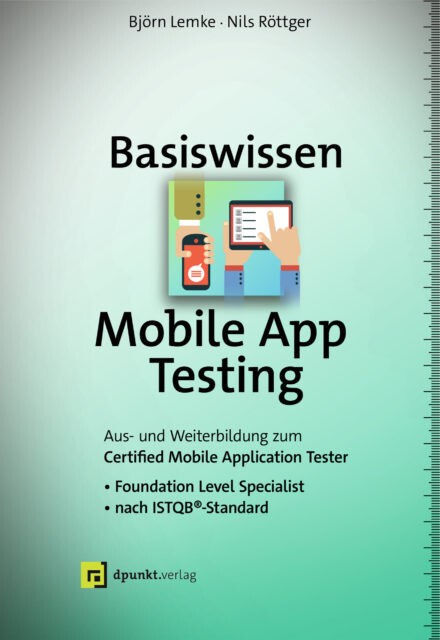
Basiswissen Mobile App Testing
Grundlegende Methoden, Verfahren und Werkzeuge zum Testen von mobilen Applikationen.»Basiswissen Mobile App Testing« vermittelt die Grundlagen des Testens mobiler Apps und gibt einen fundierten Überblick über geeignete Testarten, Testmethoden, den Testprozess und das Testkonzept für mobile Anwendungen. Auch auf Qualitätskriterien, mobile App-Plattformen, Werkzeuge und die Automatisierung der Testausführung wird eingegangen. Viele Beispiele aus realen Kundenprojekten erleichtern die Umsetzung des Gelernten in die Praxis.Die Themen im Einzelnen:Geschäftliche & technische Faktoren, Herausforderungen & Risiken, Teststrategien für mobile AppsTests mit Bezug zur mobilen PlattformÜbliche Testarten und der Testprozess für mobile AppsMobile App-Plattformen, Werkzeuge und UmgebungenAutomatisierung der TestausführungDas Buch ist konform zum ISTQB®-Lehrplan »Certified Mobile Application Tester« und eignet sich mit vielen Beispielen und Übungen nicht nur bestens für die Prüfungsvorbereitung, sondern dient gleichzeitig als kompaktes Basiswerk zum Thema in der Praxis und an Hochschulen.Über die Autoren:Björn Lemke ist Managing Consultant bei der trendig technology services GmbH. Die Schwerpunkte seiner Arbeit sind Softwarequalitätssicherung, Integrated Technology and Operations (ITOps), IT-Service-Management (ITIL), Testmanagement, Testdatenmanagement, Testinfrastrukturmanagement sowie Mobile Application Testing in kleinen bis hin zu sehr grossen Projekten.Nils Röttger arbeitet bei der imbus AG in Möhrendorf als Berater, Projektleiter und Speaker und ist u. a. verantwortlich für die Ausbildung und den Bereich Mobile Testing. In seinen Vorträgen beschäftigt er sich immer wieder mit Themen wie exploratives Testen, Usability oder Ethik im Softwaretest.

Introducing .NET for Apache Spark
Get started using Apache Spark via C# or F# and the .NET for Apache Spark bindings. This book is an introduction to both Apache Spark and the .NET bindings. Readers new to Apache Spark will get up to speed quickly using Spark for data processing tasks performed against large and very large datasets. You will learn how to combine your knowledge of .NET with Apache Spark to bring massive computing power to bear by distributed processing of extremely large datasets across multiple servers.This book covers how to get a local instance of Apache Spark running on your developer machine and shows you how to create your first .NET program that uses the Microsoft .NET bindings for Apache Spark. Techniques shown in the book allow you to use Apache Spark to distribute your data processing tasks over multiple compute nodes. You will learn to process data using both batch mode and streaming mode so you can make the right choice depending on whether you are processing an existing dataset or are working against new records in micro-batches as they arrive. The goal of the book is leave you comfortable in bringing the power of Apache Spark to your favorite .NET language.WHAT YOU WILL LEARN* Install and configure Spark .NET on Windows, Linux, and macOS * Write Apache Spark programs in C# and F# using the .NET bindings* Access and invoke the Apache Spark APIs from .NET with the same high performance as Python, Scala, and R* Encapsulate functionality in user-defined functions* Transform and aggregate large datasets * Execute SQL queries against files through Apache Hive* Distribute processing of large datasets across multiple servers* Create your own batch, streaming, and machine learning programsWHO THIS BOOK IS FOR.NET developers who want to perform big data processing without having to migrate to Python, Scala, or R; and Apache Spark developers who want to run natively on .NET and take advantage of the C# and F# ecosystemsED ELLIOTT is a data engineer who has been working in IT for 20 years and has focused on data for the last 15 years. He uses Apache Spark at work and has been contributing to the Microsoft .NET for Apache Spark open source project since it was released in 2019. Ed has been blogging and writing since 2014 at his own blog as well as for SQL Server Central and Redgate. He has spoken at a number of events such as SQLBits, SQL Saturday, and the GroupBy conference.IntroductionPART I. GETTING STARTED1. Understanding Apache Spark2. Setting up Spark3. Programming with .NET for Apache SparkPART II. THE APIS4. User-Defined Functions5. The DataFrame API6. Spark SQL and Hive Tables7. Spark Machine Learning APIPART III. EXAMPLES8. Batch Mode Processing9. Structured Streaming10. Troubleshooting11. Delta LakePART IV. APPENDICESAppendix A. Running in the CloudAppendix B. Implementing .Net for Apache Spark Code
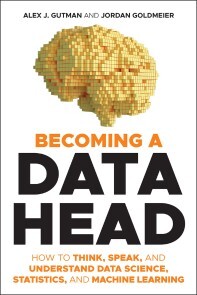
Becoming a Data Head
"TURN YOURSELF INTO A DATA HEAD. YOU'LL BECOME A MORE VALUABLE EMPLOYEE AND MAKE YOUR ORGANIZATION MORE SUCCESSFUL."Thomas H. Davenport, Research Fellow, Author of Competing on Analytics, Big Data @ Work, and The AI AdvantageYOU'VE HEARD THE HYPE AROUND DATA—NOW GET THE FACTS.In Becoming a Data Head: How to Think, Speak, and Understand Data Science, Statistics, and Machine Learning, award-winning data scientists Alex Gutman and Jordan Goldmeier pull back the curtain on data science and give you the language and tools necessary to talk and think critically about it.You'll learn how to:* Think statistically and understand the role variation plays in your life and decision making* Speak intelligently and ask the right questions about the statistics and results you encounter in the workplace* Understand what's really going on with machine learning, text analytics, deep learning, and artificial intelligence* Avoid common pitfalls when working with and interpreting dataBecoming a Data Head is a complete guide for data science in the workplace: covering everything from the personalities you’ll work with to the math behind the algorithms. The authors have spent years in data trenches and sought to create a fun, approachable, and eminently readable book. Anyone can become a Data Head—an active participant in data science, statistics, and machine learning. Whether you're a business professional, engineer, executive, or aspiring data scientist, this book is for you.ALEX J. GUTMAN, PHD, is a Data Scientist, Corporate Trainer, and Accredited Professional Statistician. His professional focus is on statistical and machine learning and he has extensive experience working as a Data Scientist for the Department of Defense and two Fortune 50 companies.JORDAN GOLDMEIER is a Data Scientist, author, speaker, and community leader. He is a seven-time recipient of the Microsoft Most Valuable Professional Award and he has taught analytics to members of the Pentagon and Fortune 500 companies.Acknowledgments xiiiForeword xxiiiIntroduction xxviiPART ONE THINKING LIKE A DATA HEADCHAPTER 1 WHAT IS THE PROBLEM? 3Questions a Data Head Should Ask 4Why Is This Problem Important? 4Who Does This Problem Affect? 6What If We Don’t Have the Right Data? 6When Is the Project Over? 7What If We Don’t Like the Results? 7Understanding Why Data Projects Fail 8Customer Perception 8Discussion 10Working on Problems That Matter 11Chapter Summary 11CHAPTER 2 WHAT IS DATA? 13Data vs. Information 13An Example Dataset 14Data Types 15How Data Is Collected and Structured 16Observational vs. Experimental Data 16Structured vs. Unstructured Data 17Basic Summary Statistics 18Chapter Summary 19CHAPTER 3 PREPARE TO THINK STATISTICALLY 21Ask Questions 22There Is Variation in All Things 23Scenario: Customer Perception (The Sequel) 24Case Study: Kidney-Cancer Rates 26Probabilities and Statistics 28Probability vs. Intuition 29Discovery with Statistics 31Chapter Summary 33PART TWO SPEAKING LIKE A DATA HEADCHAPTER 4 ARGUE WITH THE DATA 37What Would You Do? 38Missing Data Disaster 39Tell Me the Data Origin Story 43Who Collected the Data? 44How Was the Data Collected? 44Is the Data Representative? 45Is There Sampling Bias? 46What Did You Do with Outliers? 46What Data Am I Not Seeing? 47How Did You Deal with Missing Values? 47Can the Data Measure What You Want It to Measure? 48Argue with Data of All Sizes 48Chapter Summary 49CHAPTER 5 EXPLORE THE DATA 51Exploratory Data Analysis and You 52Embracing the Exploratory Mindset 52Questions to Guide You 53The Setup 53Can the Data Answer the Question? 54Set Expectations and Use Common Sense 54Do the Values Make Intuitive Sense? 54Watch Out: Outliers and Missing Values 58Did You Discover Any Relationships? 59Understanding Correlation 59Watch Out: Misinterpreting Correlation 60Watch Out: Correlation Does Not Imply Causation 62Did You Find New Opportunities in the Data? 63Chapter Summary 63CHAPTER 6 EXAMINE THE PROBABILITIES 65Take a Guess 66The Rules of the Game 66Notation 67Conditional Probability and Independent Events 69The Probability of Multiple Events 69Two Things That Happen Together 69One Thing or the Other 70Probability Thought Exercise 72Next Steps 73Be Careful Assuming Independence 74Don’t Fall for the Gambler’s Fallacy 74All Probabilities Are Conditional 75Don’t Swap Dependencies 76Bayes’ Theorem 76Ensure the Probabilities Have Meaning 79Calibration 80Rare Events Can, and Do, Happen 80Chapter Summary 81CHAPTER 7 CHALLENGE THE STATISTICS 83Quick Lessons on Inference 83Give Yourself Some Wiggle Room 84More Data, More Evidence 84Challenge the Status Quo 85Evidence to the Contrary 86Balance Decision Errors 88The Process of Statistical Inference 89The Questions You Should Ask to Challenge the Statistics 90What Is the Context for These Statistics? 90What Is the Sample Size? 91What Are You Testing? 92What Is the Null Hypothesis? 92Assuming Equivalence 93What Is the Significance Level? 93How Many Tests Are You Doing? 94Can I See the Confidence Intervals? 95Is This Practically Significant? 96Are You Assuming Causality? 96Chapter Summary 97PART THREE UNDERSTANDING THE DATA SCIENTIST’S TOOLBOXCHAPTER 8 SEARCH FOR HIDDEN GROUPS 101Unsupervised Learning 102Dimensionality Reduction 102Creating Composite Features 103Principal Component Analysis 105Principal Components in Athletic Ability 105PCA Summary 108Potential Traps 109Clustering 110k-Means Clustering 111Clustering Retail Locations 111Potential Traps 113Chapter Summary 114CHAPTER 9 UNDERSTAND THE REGRESSION MODEL 117Supervised Learning 117Linear Regression: What It Does 119Least Squares Regression: Not Just a Clever Name 120Linear Regression: What It Gives You 123Extending to Many Features 124Linear Regression: What Confusion It Causes 125Omitted Variables 125Multicollinearity 126Data Leakage 127Extrapolation Failures 128Many Relationships Aren’t Linear 128Are You Explaining or Predicting? 128Regression Performance 130Other Regression Models 131Chapter Summary 131CHAPTER 10 UNDERSTAND THE CLASSIFICATION MODEL 133Introduction to Classification 133What You’ll Learn 134Classification Problem Setup 135Logistic Regression 135Logistic Regression: So What? 138Decision Trees 139Ensemble Methods 142Random Forests 143Gradient Boosted Trees 143Interpretability of Ensemble Models 145Watch Out for Pitfalls 145Misapplication of the Problem 146Data Leakage 146Not Splitting Your Data 146Choosing the Right Decision Threshold 147Misunderstanding Accuracy 147Confusion Matrices 148Chapter Summary 150CHAPTER 11 UNDERSTAND TEXT ANALYTICS 151Expectations of Text Analytics 151How Text Becomes Numbers 153A Big Bag of Words 153N-Grams 157Word Embeddings 158Topic Modeling 160Text Classification 163Naïve Bayes 164Sentiment Analysis 166Practical Considerations When Working with Text 167Big Tech Has the Upper Hand 168Chapter Summary 169CHAPTER 12 CONCEPTUALIZE DEEP LEARNING 171Neural Networks 172How Are Neural Networks Like the Brain? 172A Simple Neural Network 173How a Neural Network Learns 174A Slightly More Complex Neural Network 175Applications of Deep Learning 178The Benefits of Deep Learning 179How Computers “See” Images 180Convolutional Neural Networks 182Deep Learning on Language and Sequences 183Deep Learning in Practice 185Do You Have Data? 185Is Your Data Structured? 186What Will the Network Look Like? 186Artificial Intelligence and You 187Big Tech Has the Upper Hand 188Ethics in Deep Learning 189Chapter Summary 190PART FOUR ENSURING SUCCESSCHAPTER 13 WATCH OUT FOR PITFALLS 193Biases and Weird Phenomena in Data 194Survivorship Bias 194Regression to the Mean 195Simpson’s Paradox 195Confirmation Bias 197Effort Bias (aka the “Sunk Cost Fallacy”) 197Algorithmic Bias 198Uncategorized Bias 198The Big List of Pitfalls 199Statistical and Machine Learning Pitfalls 199Project Pitfalls 200Chapter Summary 202CHAPTER 14 KNOW THE PEOPLE AND PERSONALITIES 203Seven Scenes of Communication Breakdowns 204The Postmortem 204Storytime 205The Telephone Game 206Into the Weeds 206The Reality Check 207The Takeover 207The Blowhard 208Data Personalities 208Data Enthusiasts 209Data Cynics 209Data Heads 209Chapter Summary 210CHAPTER 15 WHAT’S NEXT? 211Index 215

Practical Internet Server Configuration
Learn the skills to complete the full installation, configuration, and maintenance of an enterprise class internet server, no matter what Unix-like operating system you prefer. This book will rapidly guide you towards real system administration, with clear explanations along the way.After a chapter explaining the most important Unix basics, you will start with a vanilla server as delivered by a hosting provider and by the end of the book, you will have a fully functional and well-secured enterprise class internet server. You will also be equipped with the expertise needed to keep your server secured and up to date. All configuration examples are given for FreeBSD, Debian and CentOS, so you are free to choose your operating system.No single blueprint exists for an internet server, and an important part of the work of a system administrator consists of analyzing, interpreting and implementing specific wishes, demands and restrictions from different departments and viewpoints within an organization. Practical Internet Server Configuration provides the information you need to succeed as a sysadmin.WHAT YOU'LL LEARN* Configure DNS using Bind 9* Set up Apache and Nginx* Customize a mail server: IMAP (Dovecot) and SMTP (Postfix), spam filtering included* Authenticate mail users using LDAP* Install and maintain MariaDB and PostgreSQL databases* Prepare SSL/TLS certificates for the encryption of web, mail and LDAP traffic* Synchronize files, calendars and address books between devices* Build a firewall: PF for FreeBSD and nftables for LinuxWHO THIS BOOK IS FORThis book can be used by aspiring and beginning system administrators who are working on personal servers, or more experienced system administrators who may know Unix well but need a reference book for the more specialized work that falls outside the daily routine. Basic understanding of Unix and working on the command line is necessary.Robert La Lau has been active on the internet since the mid-90s. What started as a hobby – playing around with Linux, and developing small games and applications using Perl, HTML and JavaScript – turned into a job when he became a full-time freelance web developer in 1999. Shortly thereafter, a web hosting server and freelance Linux and FreeBSD administration were added. In the years that followed, new programming languages were learned, and software development was added to the range of services offered. In his spare time, Rob was involved in several smaller and larger open source projects; among other things, he was the initiator and first administrator for the official online KDE forums. After 15 years of freelance IT work, Rob thought he'd had enough of IT work, finished his running affairs, and left the Netherlands to discover the world. However, the IT kept calling him, and once installed in his new home country France, he decided to return to his old métier. Only this time, it was not to get his own hands dirty in the field, executing orders for clients, but to transfer his knowledge and experience onto the next generations of system administrators and developers. He rebooted his IT career translating and narrating educational books and videos, taught some Unix classes, and seems to have found his destination publishing books now.1. Introduction and Preparations2. Unix and POSIX in a Few Words3. Software management4. Network (Base) and Firewall5. User Management and Permissions6. Domain Name System (DNS)7. Secure shell (SSH)8. Task Scheduling9. Web Server Part 1: Apache/Nginx Basics10. Traffic Encryption: SSL/TLS11. Databases12. Email Basics13. Web Server Part 2: Advanced Apache/Nginx14. Advanced Email15. Backup and Monitoring16. Taking it Further

Essential TypeScript 4
Learn the essentials and more of TypeScript, a popular superset of the JavaScript language that adds support for static typing. TypeScript combines the typing features of C# or Java with the flexibility of JavaScript, reducing typing errors and providing an easier path to JavaScript development.Author ADAM FREEMAN explains how to get the most from TypeScript 4 in this second edition of his best-selling book.He begins by describing the TypeScript language and the benefits it offers and then shows you how to use TypeScript in real-world scenarios, including development with the DOM API, and popular frameworks such as Angular and React. He starts from the nuts-and-bolts and builds up to the most advanced and sophisticated features.Each topic is covered clearly and concisely, and is packed with the details you need to be effective. The most important features are given a no-nonsense, in-depth treatment and chapters include common problems and teach you how to avoid them.WHAT YOU WILL LEARN* Gain a solid understanding of the TypeScript language and tools* Use TypeScript for client- and server-side development* Extend and customize TypeScript* Test your TypeScript code* Apply TypeScript with the DOM API, Angular, React, and Vue.js WHO THIS BOOK IS FORJavaScript developers who want to use TypeScript to create client-side or server-side applicationsADAM FREEMAN is an experienced IT professional who has held senior positions at a range of companies, most recently serving as chief technology officer and chief operating officer of a global bank. Now retired, he spends his time writing and long-distance running.PART 1 - GETTING STARTED WITH TYPESCRIPT1. Your First TypeScript Application2. Understanding TypeScript3. JavaScript Types Primer, Part 14. JavaScript Types Primer, Part 25. Using the TypeScript Compiler6. Testing and Debugging TypeScriptPART 2 - WORKING WITH TYPESCRIPT7. Understanding Status Types8. Using Functions9. Using Arrays, Tuples and Enums10. Working with Objects11. Working with Classes and Interfaces12. Using Generic Types13. Advanced Generic Types14. Working with JavaScriptPART 3 - CREATING WEB APPLICATIONS15. Creating a Stand-Alone Web App, Part 116. Creating a Stand-Alone Web App, Part 217. Creating an Angular App, Part 118. Creating an Angular App, Part 219. Creating a React App, Part 120. Creating a React App, Part 221. Creating a Vue.js App, Part 122. Creating a Vue.js App, Part 2

Pro ASP.NET Core Identity
Get the most from ASP.NET Core Identity. Best-selling author ADAM FREEMAN teaches developers common authentication and user management scenarios and explains how they are implemented in applications. He covers each topic clearly and concisely, and the book is packed with the essential details you need to be effective.The book takes a deep dive into the Identity framework and explains how the most important and useful features work in detail, creating custom implementations of key components to reveal the inner workings of ASP.NET Core Identity. ASP.NET Core Identity provides authentication and user management for ASP.NET Core applications. Identity is a complex framework in its own right, with support for a wide range of features, including authenticating users with services provided by Google, Facebook, and Twitter.WHAT YOU WILL LEARN* Gain a solid understanding of how Identity provides authentication and authorization for ASP.NET Core applications* Configure ASP.NET Core Identity for common application scenarios, including self-service registration, user management, and authentication with services provided by popular social media platforms* Create robust and reliable user management tools* Understand how Identity works in detailWHO THIS BOOK IS FORDevelopers with advanced knowledge of ASP.NET Core who are introducing Identity into their projects. Prior experience and knowledge of C#, ASP.NET Core is required, along with a basic understanding of authentication and authorization concepts.ADAM FREEMAN is an experienced IT professional who has held senior positions in a range of companies, most recently serving as chief technology officer and chief operating officer of a global bank. Now retired, he spends his time writing and long-distance running. Part 1 - Using ASP.NET Core Identity1. Getting Ready2. Your First Identity Application3. Creating the Example Project4. Using the Identity UI5. Configuring Identity6. Adapting Identity UI7. Using the Identity API8. Signing In and Out and Managing Passwords9. Creating and Deleting Accounts10. Using Roles and Claims11. Two-Factor and External Authentication12. Authenticating API ClientsPart 2 - Understanding ASP.NET Core Identity13. Creating the Example Project14. Working with ASP.NET Core15. Authorizing Requests16. Creating a User Store17. Claims, Roles, and Confirmations18. Signing In with Identity19. Creating a Role Store20. Lockouts and Two-Factor Sign Ins21. Authenticators and Recovery Codes22. External Authentication - Part 123. External Authentication - Part 2

Practical Machine Learning for Streaming Data with Python
Design, develop, and validate machine learning models with streaming data using the Scikit-Multiflow framework. This book is a quick start guide for data scientists and machine learning engineers looking to implement machine learning models for streaming data with Python to generate real-time insights.You'll start with an introduction to streaming data, the various challenges associated with it, some of its real-world business applications, and various windowing techniques. You'll then examine incremental and online learning algorithms, and the concept of model evaluation with streaming data and get introduced to the Scikit-Multiflow framework in Python. This is followed by a review of the various change detection/concept drift detection algorithms and the implementation of various datasets using Scikit-Multiflow.Introduction to the various supervised and unsupervised algorithms for streaming data, and their implementation on various datasets using Python are also covered. The book concludes by briefly covering other open-source tools available for streaming data such as Spark, MOA (Massive Online Analysis), Kafka, and more.WHAT YOU'LL LEARN* Understand machine learning with streaming data concepts* Review incremental and online learning* Develop models for detecting concept drift* Explore techniques for classification, regression, and ensemble learning in streaming data contexts* Apply best practices for debugging and validating machine learning models in streaming data context* Get introduced to other open-source frameworks for handling streaming data.WHO THIS BOOK IS FORMachine learning engineers and data science professionalsDr. Sayan Putatunda is an experienced data scientist and researcher. He holds a Ph.D. in Applied Statistics/ Machine Learning from the Indian Institute of Management, Ahmedabad (IIMA) where his research was on streaming data and its applications in the transportation industry. He has a rich experience of working in both senior individual contributor and managerial roles in the data science industry with multiple companies such as Amazon, VMware, Mu Sigma, and more. His research interests are in streaming data, deep learning, machine learning, spatial point processes, and directional statistics. As a researcher, he has multiple publications in top international peer-reviewed journals with reputed publishers. He has presented his work at various reputed international machine learning and statistics conferences. He is also a member of IEEE.Chapter 1: An Introduction to Streaming DataChapter Goal: Introduce the readers to the concept of streaming data, the various challenges associated with it, some of its real-world business applications, various windowing techniques along with the concepts of incremental and online learning algorithms. This chapter will also help in understanding the concept of model evaluation in case of streaming data and provide and introduction to the Scikit-Multiflow framework in Python.No of pages- 35Sub -Topics1. Streaming data2. Challenges of streaming data3. Concept drift4. Applications of streaming data5. Windowing techniques6. Incremental learning and online learning7. Illustration : Adopting batch learners into incremental learners8. Introduction to Scikit-Multiflow framework9. Evaluation of streaming algorithmsChapter 2: Change DetectionChapter Goal: Help the readers to understand the various change detection/concept drift detection algorithms and its implementation on various datasets using Scikit-Multiflow.No of pages : 35Sub - Topics:1. Change detection problem2. Concept drift detection algorithms3. ADWIN4. DDM5. EDDM6. Page HinkleyChapter 3: Supervised and Unsupervised Learning for Streaming DataChapter Goal: Help the readers to understand the various regression and classification (including Ensemble Learning) algorithms for streaming data and its implementation on various datasets using Scikit-Multiflow. Also, discuss some approaches for clustering with streaming data and its implementation using Python.No of pages: 35Sub - Topics:1. Regression with streaming data2. Classification with streaming data3. Ensemble Learning with streaming data4. Clustering with streaming dataChapter 4: Other Tools and the Path ForwardChapter Goal: Introduce the readers to the other open source tools for handling streaming data such as Spark streaming, MOA and more. Also, educate the reader about additional reading for advanced topics within streaming data analysis.No of pages: 35Sub - Topics:1. Other tools for handling streaming data1.1.1. Apache Spark1.1.2. Massive Online Analysis (MOA)1.1.3. Apache Kafka2. Active research areas and breakthroughs in streaming data analysis3. Conclusion

Protective Security
This book shows you how military counter-intelligence principles and objectives are applied. It provides you with valuable advice and guidance to help your business understand threat vectors and the measures needed to reduce the risks and impacts to your organization. You will know how business-critical assets are compromised: cyberattack, data breach, system outage, pandemic, natural disaster, and many more.Rather than being compliance-concentric, this book focuses on how your business can identify the assets that are most valuable to your organization and the threat vectors associated with these assets. You will learn how to apply appropriate mitigation controls to reduce the risks within suitable tolerances.You will gain a comprehensive understanding of the value that effective protective security provides and how to develop an effective strategy for your type of business.WHAT YOU WILL LEARN* Take a deep dive into legal and regulatory perspectives and how an effective protective security strategy can help fulfill these ever-changing requirements* Know where compliance fits into a company-wide protective security strategy* Secure your digital footprint* Build effective 5 D network architectures: Defend, detect, delay, disrupt, deter* Secure manufacturing environments to balance a minimal impact on productivity* Securing your supply chains and the measures needed to ensure that risks are minimizedWho This Book Is ForBusiness owners, C-suite, information security practitioners, CISOs, cybersecurity practitioners, risk managers, IT operations managers, IT auditors, and military enthusiastsJIM (JAMES) SEAMAN has been dedicated to the pursuit of security for his entire adult life. He served 22 years in the RAF Police, covering a number of specialist areas (physical security, aviation security, information security management, IT security management, cyber security management, security investigations, intelligence operations, incident response and disaster recovery), before successfully transitioning his skills to corporate environments (financial services, banking, retail, manufacturing, ecommerce, marketing, etc.) to help businesses enhance their cyber/InfoSec defensive measures working with various industry security standards.CHAPTER 1: WHAT IS PROTECTIVE SECURITY (PS)?An introduction to the term ‘Protective Security’ and a description of why this differs to other industry terms (e.g. Cyber Security, Information Security, IT Security, Network Security, etc.)?Why PS should be an integral for your business operations?CHAPTER 2: PROTECTIVE SECURITY (PS) IN TERMS OF THE LEGAL & REGULATORY PERSPECTIVE.A deep dive into the Legal and Regulatory perspectives and how an effective PS strategy can help fulfil these ever-changing requirements?PS and the European Union General Data Protection Act (EU-GDPR).CHAPTER 3: THE INTEGRATION OF COMPLIANCE WITH PROTECTIVE SECURITY (PS).A description of where compliance fits into a company-wide PS strategy.PS and the Payment Card Industry Data Security Standard (PCI DSS).CHAPTER 4: THE DEVELOPMENT OF AN EFFECTIVE PROTECTIVE SECURITY (PS) STRATEGY.A comprehensive guide to the development of an effective strategy, aligning business assets to their importance for the business objectives and goals, to incorporate the threats, risks, and core components of any strategy.Strategic alignment with the business context.CHAPTER 5: CYBER SECURITY.A deep dive into the concept of Cyber Security, with a focus on Point of Origins (PoO) that occur in the ‘Badlands’ (e.g. outside the corporate network) to compromise internet-facing technologies (e.g. Ecommerce, Digital, Mobile, etc.)Securing your Digital Footprint.CHAPTER 6: NETWORK/IT SECURITY.The importance of secure by design/default networks to help safeguard your most important business IT assets from compromise.Lateral Movement Attacks.CHAPTER 7: INFORMATION SYSTEMS SECURITY.Providing a guide to the securing of these systems, as a separate asset type, based upon the value of the data assets to the business and to aid the application of the 5 Ds of Security (Defend, Detect, Delay, Disrupt & Deter).Building Effective 5 Ds Network Architectures.CHAPTER 8: PHYSICAL SECURITY.A comprehensive guide to the development of appropriate physical security measures and its importance within the Protective Security strategy.Fortifying Your Business Operations.CHAPTER 9: INDUSTRIAL SYSTEMS SECURITYIncreasingly, Manufacturing systems are vulnerable to cyber-attacks. Gain an insight how securing these environments can be balanced with a minimal impact on productivity.Manufacturing Secure Operations.CHAPTER 10: SECURING YOUR SUPPLY CHAINGain an appreciation for securing your Supply Chains and the measures needed to ensure that the Supply Chain risks are minimized.The Weakest Link?CHAPTER 11: DEVELOPING YOUR INTERNAL FIREWALL.A focus on the development of a robust Security Culture, through the proactive engagement with a business’ personnel assets.Security Is Not A Dirty Word.CHAPTER 12: STRICT ACCESS RESTRICTIONSThe ‘Need To Know’/’Need To Access’ are the fundamental principles for any effective Protective Security strategy. Gain an insight into why this is the case and how to ensure that this is the case within your organization.The Keys To Your Empire.CHAPTER 13: BUILDING RESILIENT SYSTEMSGain an appreciation for the business value of building resilient systems and an understanding on what is required to develop resilience into your PS strategy.The Ability To ‘Bounce Back’.CHAPTER 14: DEMONSTRATING THE PROTECTIVE SECURITY (PS) RETURN ON INVESTMENTS (ROI)The value of an effective PS strategy is often underappreciated by business leaders. Gain an understanding on how to demonstrate to that their investments continue to deliver a robust security posture and continues to ensure that they remain a less viable target.The Value of PS.

Datenschutz nach DS-GVO und Informationssicherheit gewährleisten
In vielen Unternehmen und Behörden gibt es zahlreiche Verfahren, die sowohl die Anforderungen des Datenschutzes als auch die der Informationssicherheit erfüllen müssen. Was liegt da näher als die Auswahl der erforderlichen Sicherungsmaßnahmen in einem einheitlichen Vorgehen zu ermitteln. Mit diesem Werk gibt der Autor dem Praktiker einen Leitfaden an die Hand, den dieser gleichermaßen bei einfachen als auch komplexen Verfahren anwenden kann.Im ersten Teil wird auf Basis des Prozesses ZAWAS die Umsetzung der Anforderungen der DS-GVO (einschl. DSFA) aufgezeigt. Zusätzlich zeigt der Autor im zweiten Teil des Buches auf, wie durch eine kleine Prozesserweiterung dieses Vorgehen auch auf die Ermittlung der erforderlichen Sicherungsmaßnahmen für die Informationssicherheit genutzt werden kann.Dieses Vorgehen reduziert den Gesamtaufwand und führt zu einem höheren Schutzniveau.STEFAN MIEROWSKI, MSc., Dipl. Finanzwirt (FH), studierte Informatik und Rechtswissenschaft, Referent bei der Landesbeauftragten für den Datenschutz Niedersachsen, ehemaliger Referent beim BSI und zertifizierter ISO 27001 Auditor, Schöpfer des Prozesses ZAWAS. Ausgangslage: Anforderung der Digitalisierung.- Darstellung der Informationssicherheit und des Datenschutzes.- Der Prozess zur Auswahl angemessener Sicherungsmaßnahmen (ZAWAS).- Prüfung der Übertragbarkeit des Prozesses ZAWAS auf die Informationssicherheit.- Fazit.- Zusammenfassung
Introducing Blockchain with Lisp
Implement blockchain from scratch covering all the details with Racket, a general-purpose Lisp. You'll start by exploring what a blockchain is, so you have a solid foundation for the rest of the book. You'll then be ready to learn Racket before starting on your blockchain implementation. Once you have a working blockchain, you'll move onto extending it. The book's appendices provide supporting resources to help you in your blockchain projects.The recommended approach for the book is to follow along and write the code as it’s being explained instead of reading passively. This way you will get the most out of it. All of the source code is available for free download from GitHub.WHAT YOU WILL LEARN* Discover the Racket programming language and how to use it* Implement a blockchain from scratch using Lisp* Implement smart contracts and peer-to-peer support* Learn how to use macros to employ more general abstractionsWHO THIS BOOK IS FORNovices that have at least some experience with programming, as well as some basic working experience with computers. The book also assumes some experience with high school mathematics, such as functions.Boro Sitnikovski has over ten years of experience working professionally as a software engineer. He started programming with assembly on an Intel x86 at the age of ten. While in high school, he won several prizes in competitive programming, varying from 4th, 3rd, and 1st place. He is an informatics graduate - his bachelor’s thesis was titled “Programming in Haskell using algebraic data structures”, and his master’s thesis was titled “Formal verification of Instruction Sets in Virtual Machines”. He has also published a few papers on software verification. Other research interests of his include programming languages, mathematics, logic, algorithms, and writing correct software. He is a strong believer in the open-source philosophy and contributes to various open-source projects. In his spare time, he enjoys some time off with his family.1: Introduction to Blockchain2: Racket Programming Language3: Blockchain Implementation4: Extending the BlockchainConclusionFurther ReadingAppendix A: Macros
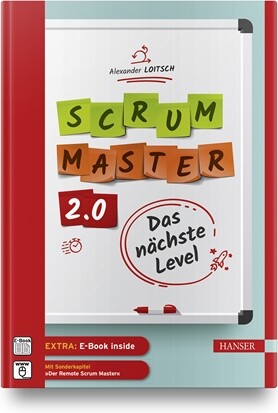
Scrum Master 2.0
Das nächste Level - Neuerscheinung in 04/2021!Dieses Buch ist für Scrum Master geschrieben, die festgestellt haben, dass ihnen die Theorie von Scrum alleine nicht weiterhilft. Denn wir arbeiten mit und für ein Team von Menschen, die ihre Schwächen, Stärken und Eigenheiten haben. Und da ist der offizielle Scrum Guide nur ein kleiner Teil der tatsächlichen Arbeitsinhalte. Hier setzt das Buch »Scrum Master 2.0« an: Nach den theoretischen Grundlagen zu diesem agilen Framework geht es um die Arbeit mit dem Team, um die tägliche Gestaltung des Scrum Master-Alltags, seine Vorgehensweisen, seine Tools, seine Interventionen. Scrum Master 2.0 startet da, wo der Scrum Guide endet.Jedes Kapitel konzentriert sich auf einen anderen Praxisbereich. Angesprochen werden Themen wie Teamentwicklung und -motivation, agile Konzepte, Visualisierung, Stressprävention, Kommunikation, Coaching, Kontaktmanagement, agile Moderation und vieles mehr. Dieses Buch ist somit ein unerlässliches Handwerkszeug für jeden Scrum Master.Kenntnisse des Scrum Frameworks werden für dieses Buch vorausgesetzt. Alle Themen lassen sich einfach und effektiv in den Arbeitsalltag integrieren.Leseprobe (PDF-Link)
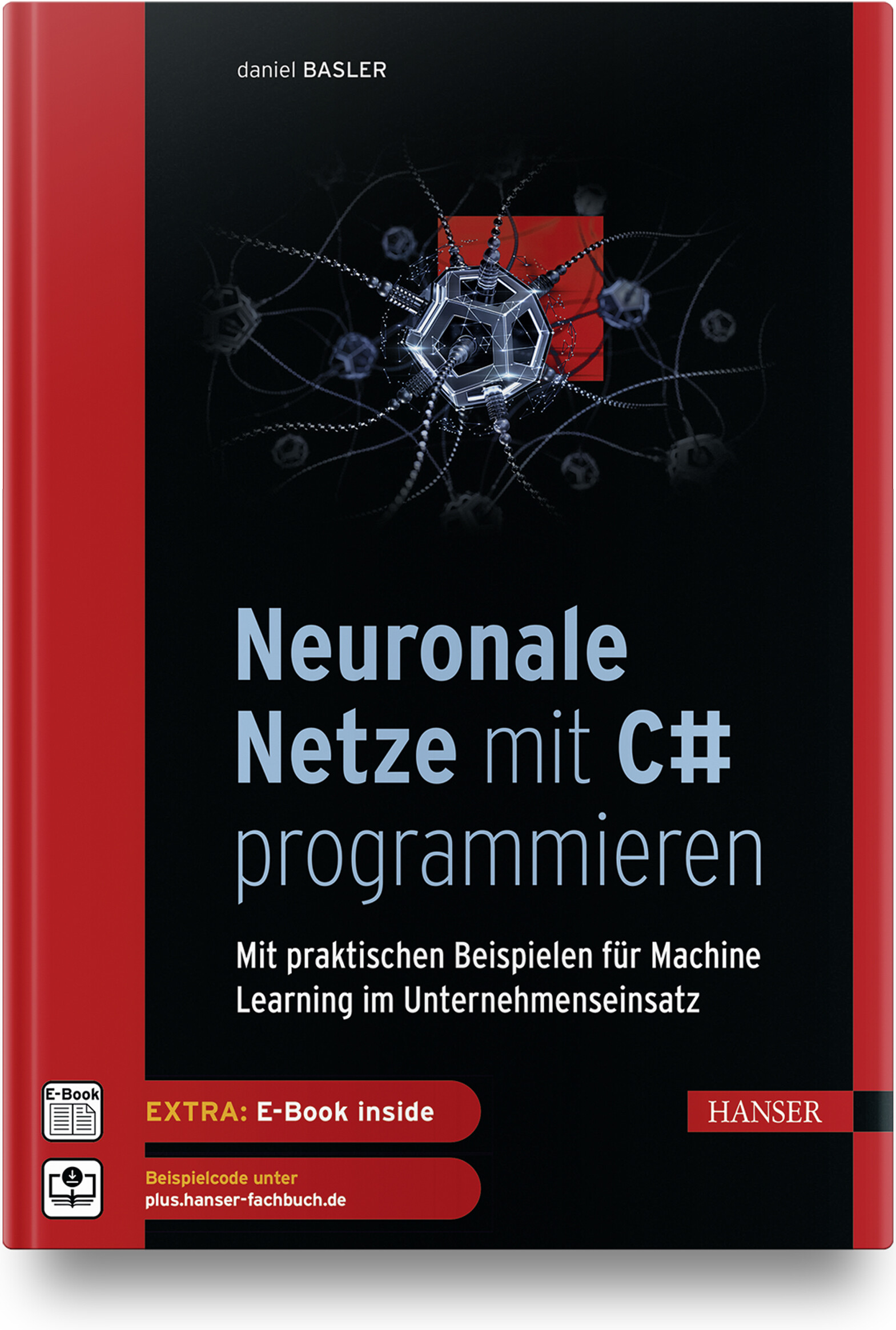
Neuronale Netze mit C# programmieren
Mit praktischen Beispielen für Machine Learning im Unternehmenseinsatz.Sie wollen neuronale Netze und Machine-Learning-Algorithmen mit C# entwickeln? Dann finden Sie in diesem Buch eine gut verständliche Einführung in die Grundlagen und es wird Ihnen gezeigt, wie Sie neuronale Netze und Machine-Learning-Algorithmen in Ihren eigenen Projekten praktisch einsetzen.Mithilfe von Beispielen erstellen und trainieren Sie Ihr erstes neuronales Netz zur vorausschauenden Wartung einer Produktionsmaschine.Im Praxisteil lernen Sie dann, wie Sie TensorFlow-Modelle in ML.NET benutzen oder Infer.NET direkt verwenden können. Des Weiteren nutzen Sie die Predictive- und Sentiment-Analyse, um sich mit Machine-Learning-Algorithmen vertraut zu machen.Alle im Buch vorgestellten Projekte sind in C# programmiert und stehen als Download zur Verfügung. Grundkenntnisse in C# werden für die Arbeit mit dem Buch vorausgesetzt. Alle Projekte lassen sich ohne größere Rechnerressourcen umsetzen.Daniel Basler arbeitet als Lead Developer und Softwarearchitekt. Seine Schwerpunkte liegen auf Cross-Platform-Apps, Android, JavaScript und Microsoft-Technologien. Er entwickelt u.a. Software für Regal- und Flächenlagersysteme sowie Anlagenvisualisierung und setzt in diesem Umfeld verstärkt Machine-Learning-Methoden ein. Darüber hinaus schreibt er regelmäßig Artikel für die Fachzeitschriften dotnetpro und web&mobile Developer.Leseprobe (PDF-Link)

Stochastic Approaches to Electron Transport in Micro- and Nanostructures
The book serves as a synergistic link between the development of mathematical models and the emergence of stochastic (Monte Carlo) methods applied for the simulation of current transport in electronic devices. Regarding the models, the historical evolution path, beginning from the classical charge carrier transport models for microelectronics to current quantum-based nanoelectronics, is explicatively followed. Accordingly, the solution methods are elucidated from the early phenomenological single particle algorithms applicable for stationary homogeneous physical conditions up to the complex algorithms required for quantum transport, based on particle generation and annihilation. The book fills the gap between monographs focusing on the development of the theory and the physical aspects of models, their application, and their solution methods and monographs dealing with the purely theoretical approaches for finding stochastic solutions of Fredholm integral equations. Part I Aspets of Electron Transport Modeling: 1. Concepts of Device Modeling.- 2. The Semiconductor Model: Fundamentals.- 3. Transport Theories in Phase Space.- 4. Monte Carlo Computing.- Part II Stochastic Algorithms for Boltzmann Transport: 5. Homogeneous Transport: Empirical Approach.- 6. Homogeneous Transport: Stochastic Approach.- 7. Small Signal Analysis.- 8. Inhomogeneous Stationary Transport.- 9. General Transport: Self-Consistent Mixed Problem.- 10. Event Biasing.- Part III Stochastic Algorithms for Quantum Transport: 11.Wigner Function Modeling.- 12. Evolution in a Quantum Wire.- 13. Hierarchy of Kinetic Models.- 14. Stationary Quantum Particle Attributes.- 15. Transient Quantum Particle Attributes.
PHP 8 Objects, Patterns, and Practice
Learn how to develop elegant and rock-solid systems using PHP, aided by three key elements: object fundamentals, design principles, and best practices. The 6th edition of this popular book has been fully updated for PHP 8, including attributes, constructor property promotion, new argument and return pseudo-types, and more. It also covers many features new since the last edition including typed properties, the null coalescing operator, and void return types. This book provides a solid grounding in PHP's support for objects, it builds on this foundation to instill core principles of software design and then covers the tools and practices needed to develop, test, and deploy robust code.PHP 8 Objects, Patterns, and Practice begins by covering PHP's object-oriented features. It introduces key topics including class declarations, inheritance, and reflection. The next section is devoted to design patterns. It explains the principles that make patterns powerful. You’ll cover many of the classic design patterns including enterprise and database patterns. The last segment of the book covers the tools and practices that can help turn great code into a successful project. The section shows how to manage multiple developers and releases with git, and how to manage builds and dependencies with Composer. It also explores strategies for automated testing and continuous integration.After reading and using this book, you will have mastered object-oriented enhancements, design patterns, and the essential development tools available for PHP 8.WHAT YOU WILL LEARN* Work with object fundamentals: write classes and methods, instantiate objects, and create powerful class hierarchies using inheritanceMaster advanced object-oriented features, including static methods and properties, managing error conditions with exceptions, and creating abstract classes and interfaces * Understand and use design principles to deploy objects and classes effectively in your projects* Discover a set of powerful patterns that you can implement in your own projects* Guarantee a successful project including unit testing; version control and build, installation, and package management; and continuous integrationWHO THIS BOOK IS FORAnyone with at least a basic knowledge of PHP who wants to use its object-oriented features in their projects. It is also for PHP coders who want to learn about the practices and tools (version control, testing, continuous integration, etc) that can make projects safe, elegant and stable.MATT ZANDSTRA has worked as a web programmer, consultant, and writer for over two decades. He is the author of SAMS Teach Yourself PHP in 24 Hours (three editions) and is a contributor to DHTML Unleashed. He has written articles for Linux Magazine, Zend, IBM DeveloperWorks, and php|architect Magazine, among others. Matt was a senior developer/tech lead at Yahoo and API tech lead at LoveCrafts. Matt works as a consultant advising companies on their architectures and system management, and also develops systems primarily with PHP, and Java. Matt also writes fiction.Part I. Objects.-1. PHP: Design and Management.-2. PHP and Objects.-3. Object Basics.-4. Advanced Features.-5. Object Tools.-6. Objects and Design.-Part II. Patterns.-7. What Are Design Patterns? Why Use Them?.-8. Some Pattern Principles.-9. Generating Objects.-10. Patterns for Flexible Object Programming.-11. Performing and Representing Tasks.-12. Enterprise Patterns.-13. Database Patterns.-Part III. Practice.-14. Good (and Bad) Practice.-15. PHP Standards.-16. PHP Using and Creating Components with Composer.-17. Version Control with Git.-18. Testing.-19. Automated Build with Phing.-20. Vagrant.-21. Continuous Integration.-22. Objects, Patterns, and Practice.-23. App A: Bibliography.-24. App B: A Simple Parser.
Visualizing Data in R 4
Master the syntax for working with R’s plotting functions in graphics and stats in this easy reference to formatting plots. The approach in Visualizing Data in R 4 toward the application of formatting in ggplot() will follow the structure of the formatting used by the plotting functions in graphics and stats. This book will take advantage of the new features added to R 4 where appropriate including a refreshed color palette for charts, Cairo graphics with more fonts/symbols, and improved performance from grid graphics including ggplot 2 rendering speed.Visualizing Data in R 4 starts with an introduction and then is split into two parts and six appendices. Part I covers the function plot() and the ancillary functions you can use with plot(). You’ll also see the functions par() and layout(), providing for multiple plots on a page. Part II goes over the basics of using the functions qplot() and ggplot() in the package ggplot2. The default plots generated by the functions qplot() and ggplot() give more sophisticated-looking plots than the default plots done by plot() and are easier to use, but the function plot() is more flexible. Both plot() and ggplot() allow for many layers to a plot.The six appendices will cover plots for contingency tables, plots for continuous variables, plots for data with a limited number of values, functions that generate multiple plots, plots for time series analysis, and some miscellaneous plots. Some of the functions that will be in the appendices include functions that generate histograms, bar charts, pie charts, box plots, and heatmaps.WHAT YOU WILL LEARN* Use R to create informative graphics* Master plot(), qplot(), and ggplot()* Discover the canned graphics functions in stats and graphicsFormat plots generated by plot() and ggplot()WHO THIS BOOK IS FORThose in data science who use R. Some prior experience with R or data science is recommended.Margot Tollefson, PhD is a semi-retired freelance statistician, with her own consulting business, Vanward Statistics. She received her PhD in statistics from Iowa State University and has many years of experience applying R to statistical research problems. Dr. Tollefson has chosen to write this book because she often creates graphics using R and would like to share her knowledge and experience. Her professional blog is on WordPress at vanwardstat. Social media: @vanstat1) Introduction: plot(), qplot(), and ggplot(), Plus Somea) plot() – arguments, ancillary functions, and methods; par() and layout()b) qplot() and ggplot() – aesthetics, geometries, and other useful functionsc) other plotting functions in graphics and statsPart I. An Overview of plot()2) The plot() Functiona) what the function is and how the function worksb) will use method .xy for example3) The Arguments to plot()a) Type of plot, axis labels, plot titles, display formatb) Plotting characters, character size, fonts, colors, line styles and widths4) Ancillary Functions to use with plot()a) axis(), box(), clip(), grid(), legend(), mtext(), rug()b) abline(), contour(), curve(), lines(), polypath()c) arrows(), image(), points(), polygon(), rect(), segments(), symbols(), text()d) axTicks(), identify(), locator(), pch(), strwidth(),5) The Methods for plot()a) What are methods?b) Methods in the graphics packagec) Methods in the stats package6) How to Use the Functions par() and layout()a) What par() doesb) Arguments specific to par()c) Multiple plotsPart II. A look at the ggplot2 Package7) The Functions qplot(), ggplot(), and the Specialized Notation in ggplot2a) Working with qplot()b) The ggplot() functionc) Specialized notation8) Themesa) The theme() functionb) The element_*() functions9) Aesthetics and Geometriesa) The aes() functionb) The geom_*() functions10) Controlling the Appearancea) The annotate_*() functionsb) The coord_*() functionsc) The facet_*() functionsd) The guide_*() functionse) The position_*() functionsf) The scale_*() functionsg) The stat_*() functionsAppendix I. Plots for Contingency TablesAppendix II. Plots for Continuous VariablesAppendix III. Plots for Data with a Limited Number of ValuesAppendix IV. Functions that Generate Multiple PlotsAppendix V. Plots for Time SeriesAppendix VI. Miscellaneous Plots

Microsoft 365 Compliance
Use the information presented in this book to implement an end-to-end compliance program in your organization using Microsoft 365 tools. You will learn about the solutions available in the Microsoft 365 Compliance Center, including best practices and common pitfalls. IT professionals will benefit from the author’s approach of introducing each topic within a practical business context and scenarios behind the “whys” of compliance. Compliance managers will understand how to implement their requirements in Microsoft 365.Compliance and risk management is often a board- or CEO-level issue. The risks of hefty fines and bad PR from non-compliance are severe. IT is usually responsible for implementing compliance controls and for working with compliance and legal officers to manage the day-to-day risk in an organization.After reading Microsoft 365 Compliance, you will be prepared to have a well-informed conversation with your compliance and legal officers to determine how to work together to identify specific compliance requirements for your organization. You will be able to implement those requirements yourself using Microsoft 365 features. Compliance and legal officers will understand how to communicate their technical requirements to IT.Author Erica Toelle helps you build a solid compliance foundation by teaching you about topics such as information protection, retention, records management, eDiscovery, auditing, compliance with common regulations, managing insider risks, supervising communications, data loss prevention, protecting sensitive information, and using machine learning to reduce compliance costs.What You Will Learn* Understand typical business scenarios and requirements for a Microsoft 365 compliance program* Fulfill these compliance scenarios and requirements using out of the box Microsoft 365 solutions and functionality* Ensure that your Microsoft 365 implementation meets standard compliance regulations, such as GDPR and ISO/IEC 27001:2013* Enlist best practices and things to know when implementing Microsoft 365 solutions* Comprehend required Microsoft licensing and how to implement a least permissions model for each compliance solution* Explore what you can accomplish using the compliance center user interface, without custom scripting or codeThis book is for IT professionals, security managers, compliance officers, risk managers, internal audit, records managers, CIOs, and anyone who would like to learn more about Microsoft 365 compliance.·ERICA TOELLE is a Microsoft MVP in Office Apps and Services. She is an internationally recognized speaker on compliance, Office 365, and SharePoint. Erica has been working with customers to deploy these solutions since 2004 and has been hired as an expert by more than 75 Fortune 500 companies and several Microsoft product teams. Erica is a top 15 International SharePoint Influencer from 2016-present.CHAPTER 1: An Introduction to Compliance in Microsoft 365CHAPTER 2: Compliance ManagerCHAPTER 3: Data ClassificationCHAPTER 4: Data ConnectorsCHAPTER 5: Information ProtectionCHAPTER 6: Data Loss Prevention PoliciesCHAPTER 7: Information BarriersCHAPTER 8: Information GovernanceCHAPTER 9: Records ManagementCHAPTER 10: Insider Risk ManagementCHAPTER 11: Communication ComplianceCHAPTER 12: CONTENT SEARCHChapter 13: Core eDiscoveryChapter 14: Advanced eDiscoveryChapter 15: Data InvestigationsChapter 16: The Unified Audit Log

Big Data Analytics
Mit diesem Herausgeberwerk führen die Autoren den Begriff „Big Data Analytics“ ein und geben Fallstudien aus unterschiedlichen Anwendungsgebieten. Unter Big Data Analytics wird das Aufbereiten, Analysieren und Interpretieren von großen, oft heterogenen Datenbeständen verstanden, mit dem Ziel, Muster und Zusammenhänge in den Daten aufzudecken und Entscheidungsgrundlagen für wissenschaftliche, betriebliche oder gesellschaftliche Fragestellungen zu erhalten.Nebst den theoretischen Grundlagen widmet sich das Herausgeberwerk der Vielfalt verschiedener Anwendungsmöglichkeiten. Fallbeispiele geben Einblick in die Anwendung von Big Data Analytics und dessen Nutzenpotenziale.Das Werk richtet sich gleichermaßen an Studierende, Fachleute aller Fachrichtungen als auch an interessierte Anwender. Es hilft den Leserinnen und Leser, die Bedeutungsvielfalt des Begriffs Big Data Analytics zu verstehen und verschiedene Einsatzmöglichkeiten im eigenen Umfeld zu erkennen und zu bewerten.SARA D'ONOFRIO ist IT Business Partner Manager eines der größten Detailhandelsunternehmen der Schweiz, Autorin und Herausgeberin der Zeitschrift HMD - Praxis der Wirtschaftsinformatik bei Springer, Gastdozentin an Hochschulen und Mitglied der Stiftung FMsquare, welche die Anwendung von Fuzzy-Logik zur Lösung von wirtschaftlichen und sozialen Problemen fördert. Sie hat Betriebswirtschaft und Wirtschaftsinformatik studiert und in Informatik promoviert.ANDREAS MEIER hat Musik an der Musikakademie in Wien und Mathematik an der Eidgenössischen Technischen Hochschule (ETH) in Zürich studiert, wo er doktorierte und habilitierte. Er arbeitete bei IBM Schweiz, gehörte zum Direktionskader der internationalen Bank SBV und trug Mitverantwortung in der Geschäftsleitung des Versicherers CSS. In der Forschung war er am IBM Research Lab in Kalifornien tätig und gründete das Research Center Fuzzy Management Methods an der Universität Fribourg in der Schweiz.Grundlagen - Textanalyse - Machine Learning - Prädiktive Modelle - Trendforschung

Robotic Process Automation using UiPath StudioX
Learn about Robotic Processing Automation (RPA) and how to build bots using UiPath. This book uses hands-on examples to explain the basics of UiPath and then walks you through real-world prototypes for testing your knowledge.Organizations around the world are implementing RPA in some capacity, and there is a shortage of RPA developers in the market. Analysts predict that the RPA market size will be worth $4 Billion by 2025. With UiPath as one of the three major players in the RPA market, professionals and students can use this book to get ahead of the curve.This book helps you kick-start your automation journey with a special focus on one of the most popular RPA tools: UiPath. Robotic Process Automation using UiPath explains in detail the various features and functionalities of the RPA platform including development, debugging, and error handling.WHAT YOU'LL LEARN* Create robots from scratch, using one of the market leaders in RPA* Develop automation apps and deploy them to all the computers in your department* Build, test and perform enterprise automation tasks with UiPath* Understand the key building blocks and components of UiPath * Apply UiPath programming techniques to deploy robot configurations* Review email Automation* Automate Excel and PDF interactionsWHO THIS BOOK IS FORRPA developers and business users alike, bringing the power and skill set of automation to anyone interested in citizen-led development, specifically UiPath StudioX. The simple exercises and no-code platform require no prior programming or RPA knowledge to follow along with this beginner's guide.ADEEL JAVED is an intelligent automation architect, an author, and a speaker. He helps organizations automate work using low-code, business process management (BPM), robotic process automation (RPA), analytics, integrations and ML. He loves exploring new technologies and writing about them. He published his first book, "Building Arduino Projects for the Internet of Things", with Apress back in 2015. He shares his thoughts on various technology trends on his personal blog (adeeljaved.com).ANUM SUNDRANI is a business systems analyst and technology enthusiast who specializes in Business Process Management and Robotic Process Automation. Anum is a Certified Appian Analyst, Tableau Author, Six Sigma Green Belt and Scrum Master, alongside her several trainings in the areas of RPA development and the automation delivery lifecycle. She has an inquisitive eye for simplifying complex business processes and has focused on implementing automation solutions for business users since 2017.NADIA MALIK is a Presales Engineer with a background in software development. She has started her journey as a Software Engineer at IBM developing Cloud storage applications and then joining the UiPath rocket-ship in June of 2018 helping customers design, implement, and provide training in robotics process automation. Today she continues to evangelize RPA and mentor young women in STEM.SIDNEY MADISON PRESCOTT is a senior technology leader, keynote speaker, and robotics evangelist specializing in the creation of Robotic Process Automation Centers of Excellence for Fortune 500 companies. Sidney currently heads up the Global Intelligent Automation initiative at music streaming powerhouse Spotify. In addition to her enterprise technology expertise, Sidney is an executive board member for three global non-profit organizations, where she contributes valuable automation insights to enhance overall program objectives. To round out her career accolades, Sidney was also named a global recipient of the 2020 Top 50 Technology Visionaries award.Part I: IntroductionChapter 1. Robotic Process Automation Overview* Overview* Benefits* Market trends* Major vendors* Real-life use cases* Attended/unattendedChapter 2. UiPath StudioX Overview* Download* Install* Interface OverviewPart II: Activities – Your Building BlocksGoal of this section is to list down each activity under these tiles in UiPath StudioX, provide a brief description of what that activity does, screenshots of different configurations, quick examples. Essentially make this as the ultimate reference material.Chapter 3. Common ActivitiesChapter 4. UI AutomationChapter 5. Outlook AutomationChapter 6. Word AutomationChapter 7. Excel AutomationChapter 8. CSV AutomationChapter 9. File AutomationPart III: Building PrototypesGoal of this section is to build couple of real-life prototypes that uses knowledge acquired in prior sections. We have already developed two sample target applications, one browser-based, the other windows-based.Chapter 10. Real-life prototype 1 (Inventory Management)* Outlook Automation* CSV Automation* UI Automation (Browser)* File AutomationChapter 11. Real-life prototype 2 (Order Management)* UI Automation (App)* Excel Automation* Word Automation* File AutomationChapter 12. Real-life prototype 3 (Excel Management)* Excel AutomationPart IV: Scaling UpGoal of this section/chapter is to help people think about next steps. Most organizations have difficulty scaling up the concepts of citizen development.Chapter 13. Scaling RPA – high-level ideas

Deep Reinforcement Learning with Python
Deep reinforcement learning is a fast-growing discipline that is making a significant impact in fields of autonomous vehicles, robotics, healthcare, finance, and many more. This book covers deep reinforcement learning using deep-q learning and policy gradient models with coding exercise.You'll begin by reviewing the Markov decision processes, Bellman equations, and dynamic programming that form the core concepts and foundation of deep reinforcement learning. Next, you'll study model-free learning followed by function approximation using neural networks and deep learning. This is followed by various deep reinforcement learning algorithms such as deep q-networks, various flavors of actor-critic methods, and other policy-based methods.You'll also look at exploration vs exploitation dilemma, a key consideration in reinforcement learning algorithms, along with Monte Carlo tree search (MCTS), which played a key role in the success of AlphaGo. The final chapters conclude with deep reinforcement learning implementation using popular deep learning frameworks such as TensorFlow and PyTorch. In the end, you'll understand deep reinforcement learning along with deep q networks and policy gradient models implementation with TensorFlow, PyTorch, and Open AI Gym.WHAT YOU'LL LEARN* Examine deep reinforcement learning * Implement deep learning algorithms using OpenAI’s Gym environment* Code your own game playing agents for Atari using actor-critic algorithms* Apply best practices for model building and algorithm training WHO THIS BOOK IS FORMachine learning developers and architects who want to stay ahead of the curve in the field of AI and deep learning.Nimish is a passionate technical leader who brings to table extreme focus on use of technology for solving customer problems. He has over 25 years of work experience in the Software and Consulting. Nimish has held leadership roles with P&L responsibilities at PwC, IBM and Oracle. In 2006 he set out on his entrepreneurial journey in Software consulting at SOAIS with offices in Boston, Chicago and Bangalore. Today the firm provides Automation and Digital Transformation services to Fortune 100 companies helping them make the transition from on-premise applications to the cloud.He is also an angel investor in the space of AI and Automation driven startups. He has co-founded Paybooks, a SaaS HR and Payroll platform for Indian market. He has also cofounded a Boston based startup which offers ZipperAgent and ZipperHQ, a suite of AI driven workflow and video marketing automation platforms. He currently hold the position as CTO and Chief Data Scientist for both these platforms.Nimish has an MBA from Indian Institute of Management in Ahmedabad, India and a BS in Electrical Engineering from Indian Institute of Technology in Kanpur, India. He also holds multiple certifications in AI and Deep Learning.Chapter 1: Introduction to Deep Reinforcement LearningChapter Goal: Introduce the reader to field of reinforcement learning and setting the context of what they will learn in rest of the bookSub -Topics1. Deep reinforcement learning2. Examples and case studies3. Types of algorithms with mind-map4. Libraries and environment setup5. SummaryChapter 2: Markov Decision ProcessesChapter Goal: Help the reader understand models, foundations on which all algorithms are built.Sub - Topics1. Agent and environment2. Rewards3. Markov reward and decision processes4. Policies and value functions5. Bellman equationsChapter 3: Model Based AlgorithmsChapter Goal: Introduce reader to dynamic programming and related algorithmsSub - Topics:1. Introduction to OpenAI Gym environment2. Policy evaluation/prediction3. Policy iteration and improvement4. Generalised policy iteration5. Value iterationChapter 4: Model Free ApproachesChapter Goal: Introduce Reader to model free methods which form the basis for majority of current solutionsSub - Topics:1. Prediction and control with Monte Carlo methods2. Exploration vs exploitation3. TD learning methods4. TD control5. On policy learning using SARSA6. Off policy learning using q-learningChapter 5: Function ApproximationChapter Goal: Help readers understand value function approximation and Deep Learning use in Reinforcement Learning.1. Limitations to tabular methods studied so far2. Value function approximation3. Linear methods and features used4. Non linear function approximation using deep LearningChapter 6: Deep Q-LearningChapter Goal: Help readers understand core use of deep learning in reinforcement learning. Deep q learning and many of its variants are introduced here with in depth code exercises.1. Deep q-networks (DQN)2. Issues in Naive DQN3. Introduce experience replay and target networks4. Double q-learning (DDQN)5. Duelling DQN6. Categorical 51-atom DQN (C51)7. Quantile regression DQN (QR-DQN)8. Hindsight experience replay (HER)Chapter 7: Policy Gradient AlgorithmsChapter Goal: Introduce reader to concept of policy gradients and related theory. Gain in depth knowledge of common policy gradient methods through hands-on exercises1. Policy gradient approach and its advantages2. The policy gradient theorem3. REINFORCE algorithm4. REINFORCE with baseline5. Actor-critic methods6. Advantage actor critic (A2C/A3C)7. Proximal policy optimization (PPO)8. Trust region policy optimization (TRPO)Chapter 8: Combining Policy Gradients and Q-LearningChapter Goal: Introduce reader to the trade offs between two approaches ways to connect together the two seemingly dissimilar approaches. Gain in depth knowledge of some land mark approaches.1. Tradeoff between policy gradients and q-learning2. The connection3. Deep deterministic policy gradient (DDPG)4. Twin delayed DDPG (TD3)5. Soft actor critic (SAC)Chapter 9: Integrated Learning and PlanningChapter Goal: Introduce reader to the scalable approaches which are sample efficient for scalable problems.1. Model based reinforcement learning2. Dyna and its variants3. Guided policy search4. Monte Carlo tree search (MCTS)5. AlphaGoChapter 10: Further Exploration and Next StepsChapter Goal: With the backdrop of having gone through most of the popular algorithms, readers are now introduced again to exploration vs exploitation dilemma, central to reinforcement learning.1. Multi arm bandits2. Upper confidence bound3. Thompson sampling

Practical C++20 Financial Programming
Apply C++ to programming problems in the financial industry using this hands-on book, updated for C++20. It explains those aspects of the language that are more frequently used in writing financial software, including the Standard Template Library (STL), templates, and various numerical libraries. Practical C++20 Financial Programming also describes many of the important problems in financial engineering that are part of the day-to-day work of financial programmers in large investment banks and hedge funds. The author has extensive experience in the New York City financial industry that is now distilled into this handy guide.Focus is on providing working solutions for common programming problems. Examples are plentiful and provide value in the form of ready-to-use solutions that you can immediately apply in your day-to-day work. You’ll see examples of matrix manipulations, curve fitting, histogram generation, numerical integration, and differential equation analysis, and you’ll learn how all these techniques can be applied to some of the most common areas of financial software development.These areas include performance price forecasting, optimizing investment portfolios, and more. The book style is quick and to-the-point, delivering a refreshing view of what one needs to master in order to thrive as a C++ programmer in the financial industry.WHAT YOU WILL LEARN* Cover aspects of C++ especially relevant to financial programmingWrite working solutions to commonly encountered problems in finance * Design efficient, numerical classes for use in finance, as well as to use those classes provided by Boost and other librariesWHO THIS BOOK IS FORThose who are new to programming for financial applications using C++, but should have some previous experience with C++.CARLOS OLIVEIRA works in the area of quantitative finance, with more than ten years of experience in creating scientific and financial models in C++. During his career, Carlos has developed several large-scale applications for financial companies such as Bloomberg L.P. and F-Squared Investments. Carlos Oliveira obtained a PhD in operations research and systems engineering from the University of Florida, an MSc in computer science from UFC (Brazil), and a BSc in computer science from UECE (Brazil). He has also performed academic research in the field of combinatorial optimization, with applications in diverse areas such as finance, telecommunications, computational biology, and logistics. Carlos has written more than 30 academic papers on optimization, and authored three books, including Options and Derivatives Programming in C++20 (Apress, 2020).1. The Fixed-Income Market2. The Equities Market3. C++ Programming Techniques in Finance4. Common Libraries for Financial Code5. Designing Numerical Classes6. Plotting Financial Data7. Linear Algebra8. Interpolation9. Calculating Roots of Equations10. Numerical Integration11. Solving Partial Differential Equations12. Algorithm Optimization13. Portfolio Optimization14. Monte Carlo Methods for Equity markets15. Extending Financial Libraries16. C++ with R and Octave17. MultithreadingA. Appendix A: C++20 Features

Beginning Machine Learning in the Browser
Apply Artificial Intelligence techniques in the browser or on resource constrained computing devices. Machine learning (ML) can be an intimidating subject until you know the essentials and for what applications it works. This book takes advantage of the intricacies of the ML processes by using a simple, flexible and portable programming language such as JavaScript to work with more approachable, fundamental coding ideas.Using JavaScript programming features along with standard libraries, you'll first learn to design and develop interactive graphics applications. Then move further into neural systems and human pose estimation strategies. For training and deploying your ML models in the browser, TensorFlow.js libraries will be emphasized.After conquering the fundamentals, you'll dig into the wilderness of ML. Employ the ML and Processing (P5) libraries for Human Gait analysis. Building up Gait recognition with themes, you'll come to understand a variety of ML implementation issues. For example, you’ll learn about the classification of normal and abnormal Gait patterns.With Beginning Machine Learning in the Browser, you’ll be on your way to becoming an experienced Machine Learning developer.WHAT YOU’LL LEARN* Work with ML models, calculations, and information gathering* Implement TensorFlow.js libraries for ML models* Perform Human Gait Analysis using ML techniques in the browserWHO THIS BOOK IS FORComputer science students and research scholars, and novice programmers/web developers in the domain of Internet TechnologiesNAGENDER KUMAR SURYADEVARA received his Ph.D. from the School of Engineering and Advanced Technology, Massey University, New Zealand, in 2014. He has authored two books and over 45 publications in different international journals, conferences, and book chapters. His research interests lie in the domains of wireless sensor networks, Internet of Things technologies, and time-series data mining.Chapter 1: What is Machine Learning (ML)?Basics of Java Script (JS)Programming in the browser using Java ScriptGraphics and Interactive processing in the browser using Java Script librariesGetting started with P5.JS and ML5.JSReferencesChapter 2: Human Pose Estimation in the BrowserBrowser based data processingPosenet vs Openpose modelsHuman pose estimation using ML5.PosenetInputs, Outputs and Data structures of Posenet modelReferencesChapter 3: Human Pose ClassificationClassification techniques using ML Neural Network in the browserHuman Pose classification based on the outputs of Posenet modelConsideration of poses using Confidence scores of Posenet modelStorage of data using JSON formats related to the outputs of Posenet modelReferencesChapter 4: Gait AnalysisNormal vs Abnormal Gait patternsDetermination of Gait patterns using threshold values of the modelsUser Interface design and development for monitoring of Gait patternsReal-Time data visualization of the Gait patterns on the browserReferencesChapter 5: Future Possible Applications of Key Concepts

MongoDB Performance Tuning
Use this fast and complete guide to optimize the performance of MongoDB databases and the applications that depend on them. You will be able to turbo-charge the performance of your MongoDB applications to provide a better experience for your users, reduce your running costs, and avoid application growing pains. MongoDB is the world’s most popular document database and the foundation for thousands of mission-critical applications. This book helps you get the best possible performance from MongoDB.MONGODB PERFORMANCE TUNING takes a methodical and comprehensive approach to performance tuning that begins with application and schema design and goes on to cover optimization of code at all levels of an application. The book also explains how to configure MongoDB hardware and cluster configuration for optimal performance. The systematic approach in the book helps you treat the true causes of performance issues and get the best return on your tuning investment. Even when you’re under pressure and don’t know where to begin, simply follow the method in this book to set things right and get your MongoDB performance back on track.WHAT YOU WILL LEARN* Apply a methodical approach to MongoDB performance tuning* Understand how to design an efficient MongoDB application* Optimize MongoDB document design and indexing strategies* Tune MongoDB queries, aggregation pipelines, and transactions* Optimize MongoDB server resources: CPU, memory, disk* Configure MongoDB Replica sets and Sharded clusters for optimal performanceWHO THIS BOOK IS FORDevelopers and administrators of high-performance MongoDB applications who want to be sure they are getting the best possible performance from their MongoDB system. For developers who wish to create applications that are fast, scalable, and cost-effective. For administrators who want to optimize their MongoDB server and hardware configuration.GUY HARRISON is CTO at ProvenDB, a partner at Toba Capital, and a software professional with more than 20 years of experience in database design, development, administration, and optimization. He is the author of Next Generation Databases (Apress) and other books and articles on database technology. He is a MongoDB certified DBA and developer, and an Oracle ACE.MICHAEL HARRISON is the lead developer at ProvenDB, working intimately with MongoDB from both an application and database perspective. He is a co-author of The MongoDB Workshop as well as senior developer of DBKoda, an open-source development environment for MongoDB.PART I. METHODS AND TOOLS1. Methodical Performance Tuning2. MongoDB Architecture and Concepts3. Tools of the TradePART II. APPLICATION AND DATABASE DESIGN4. Schema Modelling5. IndexingPART III. TUNING MONGODB CODE6. Query Tuning7. Tuning Aggregation Pipelines8. Inserts, Updates and Deletes9. Transactions10. Server MonitoringPART IV. SERVER TUNING11. Memory Tuning12. Disk IO13. Replica Sets and Atlas14. Sharding

Automated Unit Testing with ABAP
Write automated unit tests for the ABAP language. This book teaches programmers using simple examples and metaphors and explains the underlying concepts of writing effective automated unit tests. Many, if not most, ABAP programmers learned their programming and testing skills before the ABAP development environment provided an automated unit testing facility.AUTOMATED UNIT TESTING WITH ABAP: A PRACTICAL APPROACH offers hope and salvation to ABAP programmers who continue to toil with antiquated manual unit testing processes, taking them by the hand and lifting them out of that dungeon of despair with a modern and proven alternative. It begins by explaining how the xUnit family of automated testing frameworks provides a quick and effective means of insuring high-quality software. It then focuses on the ABAP Unit Testing Facility, the xUnit framework applicable specifically to the ABAP language, showing how it can be used to bring ABAP applications underautomated testing control, from old legacy applications to those newly written.Whereas xUnit testing has been widely accepted with developers writing in many other programming languages, it is an unfortunate fact in the ABAP community that many programmers still are unfamiliar with xUnit concepts and do not know how to begin implementing automated unit testing into their development process. This book demonstrates how to refactor programs so they become designed for testability, showing how to use process encapsulation and test isolation to facilitate automated testing, including a thorough explanation of test-driven development and the use of test doubles. The book:* Shows how to write automated unit tests for ABAP* Instills ABAP programmers with the confidence to refactor poorly written code* Explains how an automated testing harness facilitates rapid software development* Teaches how to utilize test-driven development (TDD) withABAP* Offers advice and tips on the best ways to write automated unit testsWHAT YOU WILL LEARN* Become familiar with the xUnit approach to testing* Know the ABAP statements that interfere with running automated unit tests and how to accommodate them* Understand what it means to isolate code for testing and how this is achieved* Gain the confidence to refactor poorly written code* Make ABAP programs designed for testability* Reap the benefits of spending less time manually unit testing ABAP programs* Use test-driven development (TDD) with ABAP programming* Use configurable test doubles in ABAPWHO THIS BOOK IS FORABAP programmers who remain unfamiliar with the automated unit testing facility and those who already use it butwant to improve their skill writing and using automated tests. The book addresses the reluctance and trepidation felt by procedural ABAP programmers who need to know some object-oriented concepts to use this facility, expands their horizons, and helps them step through the doorway leading to a different approach to program design. JAMES E. MCDONOUGH received a degree in music education from Trenton State College. After teaching music for only two years in the New Jersey public school system, he spent the past 38 years as a computer programmer while also maintaining an active presence as a freelance jazz bassist between New York and Philadelphia. Having switched from mainframe programming to ABAP in 1997, he now works as a contract ABAP programmer designing and writing ABAP programs on a daily basis. An advocate of using the object-oriented programming features available with ABAP, he has been teaching private ABAP education courses over the past few years, where his background in education enables him to present and explain complicated concepts in a way that makes sense to beginners.Chapter 1: Introduction.- Chapter 2: Preparing to Take the First Step.- Chapter 3: Software Quality.- Chapter 4: The Origins of Automated Unit Testing.- Chapter 5: Automated Unit Testing with ABAP.- Chapter 6: Rudiments.- Chapter 7: Design for Testability.- Chapter 8: Test Doubles.- Chapter 9: Service Locator.- Chapter 10: Leveraging the Service Locator.- Chapter 11: Test-Driven Development.- Chapter 12: Configurable Test Doubles.- Chapter 13: Obtaining Code Coverage Information Through ABAP Unit Testing.- Chapter 14: Cultivating Good Test Writing Skills.- Chapter 15: Welcome to Autropolis.- Appendix A: Requirements Documentation and ABAP Exercise Programs.- Appendix B: Answers to Chapter Quizzes.- Appendix C: Concepts Associated with Defining Local Test Classes.-