

Allgemein

Solving Identity Management in Modern Applications
Know how to design and use identity management to protect your application and the data it manages.At a time when security breaches result in increasingly onerous penalties, it is paramount that application developers and owners understand identity management and the value it provides when building applications. This book takes you from account provisioning to authentication to authorization, and covers troubleshooting and common problems to avoid. The authors include predictions about why this will be even more important in the future. Application best practices with coding samples are provided.SOLVING IDENTITY AND ACCESS MANAGEMENT IN MODERN APPLICATIONS gives you what you need to design identity and access management for your applications and to describe it to stakeholders with confidence. You will be able to explain account creation, session and access management, account termination, and more.This expanded edition has been revised to provide an overview of the new version of OAuth (2.1)―the primary changes in this version, including features that were removed from 2.1 that were in 2.0 and why they were removed. The discussion of the book's accompanying sample application has been revised to cover in more depth the approach for developing the application (also revised). A new section has been added on the OAuth 2.0 Device Authorization Grant (RFC 8628) specification, which is useful for devices with limited UI capability. Minor additions include the topics of identity proofing, the need to capture and organize consent information, the impact of tracking prevention technology on certain identity protocols, and the availability of additional options for authorization requests such as OAuth 2.0 Rich Authorization Requests and JWT-Secured Authorization Requests (RFC 9101).WHAT YOU’LL LEARN• Understand key identity management concepts• Incorporate essential design principles• Design authentication and access control for a modern application• Know the identity management frameworks and protocols used today (OIDC/OAuth 2.0/2.1, SAML 2.0)• Review historical failures and know how to avoid themWHO THIS BOOK IS FORDevelopers, enterprise or application architects, business application or product owners, and anyone involved in an application's identity management solutionYVONNE WILSON is co-founder and Chief Strategy Officer for XploitDefense. She has had many roles in the software industry related to security and identity management as a security and identity architect; enterprise architect; director of developer success working with identity customers; sr. director of security governance, risk, and compliance (GRC); Chief Strategy Officer; and founder of cloud identity services. Yvonne was responsible for IT security strategy and architecture at Sun Microsystems, founded and designed the identity management services offered through Oracle Managed Cloud Services, created a GRC team at Auth0 and founded a world-wide developer success team for Auth0, working with customers and overseeing the creation of an identity management training program for customer-facing support and professional services engineers. Yvonne is currently Chief Strategy Officer at XploitDefense.In working with business teams at Sun, designing and deploying identity systems for customers at Oracle, and while founding a developer success team at Auth0, Yvonne had the opportunity of working with many customers, from small startups to large enterprises. Her experience spans the implementation of SSO, identity federation, directory services, adaptive knowledge-based authentication, and identity provisioning as well as multilevel authentication systems with certificate-based authentication. She has worked with OIDC, SAML 2.0, WS-Fed, OAuth2.0/2.1, and OpenID. From this depth of experience, Yvonne realized the growing need for a basic overview of identity management concepts that is understandable to business application owners as well as architects and developers.ABHISHEK HINGNIKAR is at Okta, the identity provider for the internet. He has several years of experience designing and demonstrating Identity Management solutions to customers using Auth0 using OAuth 2.0/2.1, OpenID Connect and SAML 2.0. His current focus areas involve Consumer IoT, Device Based Identity and designing solutions that explore web based identity in peripheral domains.

Pro Encryption in SQL Server 2022
This in-depth look at the encryption tools available in SQL Server shows you how to protect data by encrypting it at rest with Transparent Data Encryption (TDE) and in transit with Transport Level Security (TLS). You will know how to add the highest levels of protection for sensitive data using Always Encrypted to encrypt data also in memory and be protected even from users with the highest levels of access to the database. The book demonstrates actions you can take today to start protecting your data without changing any code in your applications, and the steps you can subsequently take to modify your applications to support implementing a gold standard in data protection.The book highlights work that Microsoft has been doing since 2016 to make encryption more accessible, by making TDE available in the standard edition, and the introduction of Always Encrypted that requires minimal work on your part to implement powerful and effective encryption, protecting your data and meeting regulatory requirements. The book teaches you how to work with the encryption technologies in SQL Server with the express goal of helping you understand those technologies on an intuitive level. You’ll come away with a deep level of understanding that allows you to answer questions and speak as an expert. The book’s aim is to make you as comfortable in deploying encryption in SQL Server as you would be in driving your car to buy groceries.Those with a data security mindset will appreciate the discussion of how each feature protects you and what it protects you from, as well as how to implement things in the most secure manner. Database administrators will appreciate the high level of detail around managing encryption over time and the effect of encryption on database performance. All readers will appreciate the advice on how to avoid common pitfalls, ensuring that your projects to implement encryption run smoothly.WHAT YOU WILL LEARN* Architect an effective encryption strategy for new applications* Retrofit encryption into your existing applications* Encrypt data at rest, in memory, and in transit* Manage key and certificate life cycles, including backup and restore* Recover encrypted databases in case of server failure* Work with encryption in cloud-based scenariosWHO THIS BOOK IS FORDatabase developers, architects, and administrators who want to work with encryption in SQL Server; those who want to maintain encryption whether data is at rest or being transmitted over the network; and those who wish to encrypt their data even when in the server’s own memory. Readers should be familiar with SQL Server, but no existing knowledge of encryption is assumed.MATTHEW MCGIFFEN is a Data Architect with over 20 years’ experience working on SQL Server and associated technologies. Matthew has also had the opportunity to collaborate with Microsoft during the development of some of the latest enhancements in encryption. He is the author of a popular blog on SQL Server and has written articles for SQL Server Central. In his spare time, Matthew is an amateur chess player and pianist. IntroductionPART I. UNDERSTANDING THE LANDSCAPE1. Purpose of Encryption and Available Tools.PART II. TRANSPARENT DATA ENCRYPTION (TDE)2. Introducing Transparent Data Encryption3. Setting Up TDE4. Managing TDE5. Backup EncryptionPART III. ALWAYS ENCRYPTED6. What Is Always Encrypted?7. Setting Up Always Encrypted8. Executing Queries Using Always Encrypted9. Encrypting Existing Data with Always Encrypted10. Limitations with Always Encrypted11. Key Rotation with Always Encrypted12. Considerations When Implementing Always EncryptedPART IV. ALWAYS ENCRYPTED WITH ENCLAVES13. Introducing Always Encrypted With Enclaves14. Setting Up Always Encrypted With Enclaves15. In-Place Encryption With Always EncryptedPART V. COMPLETING THE PICTURE16. Rich Querying With Always Encrypted Enclaves17. Setting Up TPM Attestation18. Encryption In Transit Using Transport Level Security19. Hashing and Salting of Passwords20. Extensible Key Management (EKM)APPENDIXESA. Glossary of TermsB. Encryption in the CloudC. Encryption Algorithms.

Introduction to Infrastructure as Code
Get inspired to explore the depths of the DevOps field. In today’s rapidly transforming world, Infrastructure as Code (IaC) has emerged as an effective approach to maintain, scale, and deploy software systems. This book offers a mixture of foundational IaC concepts and practical examples to give you hands-on experience.You will first gain an understanding of DevOps culture as well as how to adapt to IaC. Introduction to Infrastructure as Code begins by reviewing the innovative features that DevOps in general, and IaC in particular, have to offer for adoption and growth for different verticals. With this solid base established, you will then learn the importance, processes, and outcome of building infrastructure solutions.Authors Sneh Pandya and Riya Guha Thakurta then provide hands-on examples utilizing IaC platforms, open source tools, and essential considerations such as security, scalability, and deployments. Each chapter focuses on one vertical (i.e., foundations, architecture patterns, securing infrastructure, preparing for deployment), how it impacts the DevOps toolchain in a holistic manner, and how it can be used to build solutions specific to that vertical, with a detailed walkthrough of code, environments, and other tools.After completing this book, you’ll have launched your own infrastructure solution through an open source stack consisting of platforms and tools such as Terraform, Chef, and Puppet.WHAT YOU WILL LEARN* Understand the fundamentals of DevOps and Infrastructure as Code* Prepare for the ever-evolving ecosystem of modular infrastructure and the needs of the future* Avoid potential pitfalls and breakdowns while working with infrastructure* Build scalable and efficient IaC solutions that work at a small, medium, and large scale in a real-life environment* Understand and be responsibly aware of security concerns related to the domain, and how to address themWHO IS THIS BOOK FORBeginners interested in building a career in DevOps as well as professionals looking to gain expertise and advance their career with greater knowledge of IaC. including Technical Product Managers, and Architects.SNEH PANDYA is an emerging Product Management leader with specialization in strategic leadership. He advocates for product strategy, digital transformation, and sustainable innovation.His qualifications and certifications include a bachelor's degree in Computer Science and Engineering and further studies with majors in Strategy Management and Leadership from The Wharton School, University of Pennsylvania.Sneh is also a Developer Community Leader at Google Developers Group Baroda and has given public talks at several worldwide developer conferences. He is a co-founder of the NinjaTalks podcast, which brings together experiences from the world's leaders, changemakers, and innovators to make knowledge accessible to all.With extensive experience in the field of technology, including mobile and web software applications, DevOps, Cloud, infrastructure automation, and software architecture, he has articles published in various technology publications.RIYA GUHA THAKURTA is a graduate student in Computer Information Systems at Boston University. Her undergraduate education includes a bachelor's degree in Computer Science Application from the Institute of Engineering and Management.She was formerly a Scrum Master in the realm of technology management, and her previous experiences with Johnson Controls include technology development across several business products and software verticals. Riya also leads Women Techmakers Kolkata, a diversity, equality, and inclusion community that encourages women in technology. She is also an Intel Software Innovator for the Internet of Things.She is also a co-founder of the NinjaTalks podcast, which seeks to share experiences from the world's most prominent leaders, changemakers, and innovators in order to make knowledge accessible to all.Her diverse interests include technology and project management, sustainability, public speaking, and Research & Development.PART 1: CONCEPTSChapter 1: Introduction to Infrastructure as CodeChapter Goal: Understand DevOps culture and fundamentals of Infrastructure as CodeChapter 2: Patterns and Principles of IaCChapter Goal: Learn about every layer of Infrastructure as Code stackChapter 3: Infrastructure ManagementChapter Goal: Explains management of infrastructure in a holistic mannerChapter 4: Production Complexity ManagementChapter Goal: Learn how to maintain, deploy, and scale infrastructure with respect to various environmentsChapter 5: Business SolutionsChapter Goal: Helps you familiarize and understand business aspects and future scope of IaCPART 2: HANDS-ON EXPERIENCEChapter 6: Hands-on IaC with Hashicorp TerraformChapter Goal: Helps you gain hands-on experience with popular open-source IaC platform - Hashicorp's TerraformChapter 7: Hands-on IaC with PuppetChapter Goal: Take you through with another popular open-source IaC tool - PuppetChapter 8: Hands-on IoC with ChefChapter Goal: Helps you with hands-on experience with another popular open-source IaC tool - Chef
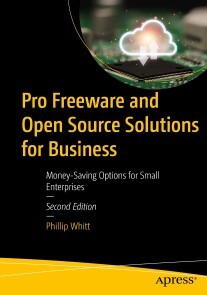
Pro Freeware and Open Source Solutions for Business
This book will point the way to numerous free, low-cost, and open-source software solutions that could provide viable alternatives to their paid counterparts. Pro Freeware and Open Source Solutions for Business is now in its Second Edition; it has been thoroughly revised and updated. This book covers the most up-to-date software versions. Software described in the First Edition that is no longer available has been replaced with comparable titles when possible.The book starts with an office productivity tool known as OfficeLibre and goes on to explain CRM and compression software. You will then learn about desktop publishing, illustration, 3D modeling, and photo editing software. As we progress further, you will learn more about audio-video capture and editing software along with Openshot, an easy-to-use free video editor. You will also learn about available project planning and time tracking software, and much more. By the end of the book, you will have also gained knowledge about security programs, as well as how to use Linux on Windows and MacOS.With the challenging economic times we find ourselves in, this book may be more important than ever to help small business owners eliminate and reduce costs, and keep more money in their business. .WHAT YOU WILL LEARN* Understand the important differences between freeware and open-source software.* Discern which paid commercial software the free version replaces (when applicable).* Gain insight into how organizations and municipalities around the world adopting open-source software to save money on licensing fees.WHO THIS BOOK IS FORPrimarily small business owners, solo entrepreneurs or freelancers on a budget, and cost efficiency experts. PHILLIP W. WHITT is a professional digital retoucher,restoration artist, and author. . As a small business owner, he’s had a good deal of experience in seeking out and using free or inexpensive alternatives to expensive, paid software in his business (starting with his discovery of Open Office in 2009). Even now, most of his work is accomplished using free programs such as LibreOffice for document creation, GIMP or Paint.NET for editing images, and Inkscape for vector drawing. Mr. Whitt has authored several books pertaining to image editing using free software for Apress Publishing. He’s also produced several video tutorials for Apress as well.CHAPTER 1: OFFICE PRODUCTIVITY, NOTE TAKING, ACCOUNTING, AND PDF CREATIONLIBREOFFICE: THE POWERFUL FREE OFFICE SUITELibreOffice ModulesWriterCalcImpressBaseDrawLibreOffice SupportGOOGLE DOCS: CREATE DOCUMENTS AND COLLABORATE ONLINEGoogle DocsGoogle SheetsGoogle SlidesGoogle FormsMoreGoogle Docs SupportGOOGLE KEEP: CREATE, SYNC, AND SHARE NOTESFeature HighlightsGoogle Keep SupportZIM: OPEN-SOURCE NOTE TAKINGFeature HighlightsZim SupportGNUCASH: OPEN-SOURCE ACCOUNTING SOFTWAREFeature HighlightsGnuCash SupportMANAGER: FREE SMALL BUSINESS ACCOUNTING SOFTWAREFeature HighlightsManager SupportPDF REDIRECT: BASIC PDF CREATION FREEWAREFeature HighlightsPDF reDirect SupportChapter SummaryCHAPTER 2: POINT-OF-SALE, CRM, BACKUP, AND COMPRESSION SOFTWAREIMONGO (FREE VERSION): A POINT-OF-SALE UTILITY FOR THE SMALL SHOP OR BOUTIQUEFeature HighlightsImonggo SupportPOS/CASH REGISTER: TURN YOUR OLD PC INTO A CASH REGISTERFeature HighlightsPOS/Cash Register SupportBITRX24 (FREE OPTION): BASIC CRM FOR SMALL BUSINESSFeature HighlightsBitrx24 SupportFBACKUP (FREE OPTION): A FREE BASIC BACKUP UTILITYFeature HighlightsFBackup SupportZZIP: AN OPEN-SOURCE ALTERNATIVE TO WINZIPFeature Highlights7Zip SupportChapter SummaryCHAPTER 3: DESKTOP PUBLISHING, ILLUSTRATION, PAINTING, AND 3D MODELINGGOOGLE DOCS: EASY, BASIC DESKTOP PUBLISHINGFeature HighlightsGoogle Docs SupportSCRIBUS: THE POWERFUL, PROFESSIONAL, OPEN-SOURCE DESKTOP PUBLISHING PROGRAMFeature HighlightsDesign CapabilitiesScribus SupportVECTR:A FREE, BASIC ON-LINE VECTOR DRAWING PROGRAMFeature HighlightsDesign CapabilitiesVectr SupportINKSCAPE: PRO-QUALITY OPEN-SOURCE VECTOR DRAWING SOFTWAREFeature HighlightsGraphics CreationInkscape SupportKRITA: THE POWERFUL OPEN SOURCE DIGITAL DRAWING AND PAINTING PROGRAMFeature HighlightsDocument CreationBrush PresetsKrita SupportFREECAD: OPEN-SOURCE PARAMETRIC 3D MODELING SOFTWAREFeature HighlightsDrafting CapabilitiesFreeCAD SupportBLENDER: THE ULTIMATE OPEN-SOURCE 3D CREATION SOFTWAREFeature HighlightsRendering CapabilitiesBlender SupportChapter SummaryCHAPTER 4: PHOTO EDITING SOFTWAREPHOTOSCAPE: AN EASY-TO-USE PHOTO EDITOR FOR BEGINNERSFeature HighlightsToolsFiltersObjectsPhotoScape SupportPAINT.NET: BASIC IMAGE EDITING FOR WINDOWSFeature HighlightsEditing CapabilitiesGraphics CreationPaint.NET SupportGIMP: THE PREMIER OPEN-SOURCE IMAGE EDITORFeature HighlightsEditing CapabilitiesGraphics CreationGIMP SupportPIXLR: WEB-BASED AND MOBILE DEVICE PHOTO EDITINGFeature HighlightsEditing CapabilitiesDARKTABLE: AN OPEN-SOURCE PHOTOGRAPHY WORKFLOW PROGRAMFeature HighlightsEditing Capabilitiesdarktable SupportFOTOSKETCHER: AUTOMATICALLY TURN PHOTOS INTO DIGITAL ARTFeature HighlightsEditing CapabilitiesFotoSketcher Support SupportChapter SummaryCHAPTER 5: AUDIO-VIDEO CAPTURE, CONVERSION, AND EDITING SOFTWAREFRE:AC: (FREE AUDIO CONVERTER)AN OPEN-SOURCE AUDIO CONVERTER AND CD RIPPERFeature Highlightsfre:ac SupportAUDACITYⓇ: A POWERFUL OPEN-SOURCE AUDIO EDITORFeature HighlightsEditing CapabilitiesAudacityⓇ SupportMPEG STREAMCLIP: A HANDY FREE VIDEO CONVERSION TOOLFeature HighlightsEditing CapabilitiesMPEG Streamclip SupportVIRTUALDUB: OPEN-SOURCE VIDEO PROCESSING FOR WINDOWSFeature HighlightsEditing CapabilitiesVirtualDubSupportOPENSHOT: A SIMPLE, POWERFUL FREE VIDEO EDITORFeature HighlightsEditing CapabilitiesOpenShot SupportKDENLIVE: OPEN-SOURCE VIDEO EDITING FROM BASIC TO PROFeature HighlightsEditing CapabilitiesKdenlive SupportChapter SummaryCHAPTER 6: PROJECT PLANNING, INVENTORY MANAGEMENT, AND TIME TRACKING SOFTWAREPROJECTLIBRE AN OPEN SOURCE ALTERNATIVE TO MICROSOFT PROJECTFeature HighlightsProjectLibre SupportMONDAY.COM: FREE BASIC PROJECT MANAGEMENT SOFTWAREFeature Highlightsmonday.com SupportABC INVENTORY: A FREE OPTION FOR SMALL AND MID-SIZED BUSINESSFeature HighlightsABC Inventory SupportHOMEBASE: FREE ONLINE SCHEDULING AND HR SOFTWAREFeature HighlightsHomebase SupportChapter SummaryCHAPTER 7: WEBSITE CREATION SOFTWARE AND WEB BROWSERSWORDPRESS: FREE, OPEN-SOURCE TOOL AND CONTENT MANAGEMENT SYSTEMFeature HighlightsMulti-Use and Multi-BloggingWordPress SupportWIX: BUILD A BASIC SITE FOR FREEFeature HighlightsWix SupportAVG SECURE BROWSER:BROWSE MORE SECURELY AND PRIVATELYFeature HighlightsFIREFOX: THE BROWSER THAT RESPECTS PRIVACYFeature HighlightsChapter SummaryCHAPTER 8: CONTENT MANAGEMENT SOLUTIONSDRUPAL: AN OPEN-SOURCE, COMMUNITY BASED ALTERNATIVEFeature HighlightsDrupal SupportCONCRETECMS (FORMERLY CONCRETE5): AN OPEN SOURCE CONTENT MANAGEMENT SYSTEMFeature Highlights Concrete CMS SupportGETSIMPLE CMS: A SIMPLE, OPEN-SOURCE CONTENT MANAGEMENT SYSTEMFeature Highlights GetSimple CMS SupportChapter SummaryCHAPTER 9: SECURITY PROGRAMSADVANCED IP SCANNER: FREE SCANNER FOR IP ADDRESSESFeature Highlights Advanced IP Scanner SupportKEEPASS: A FREE AND OPEN-SOURCE PASSWORD MANAGERFeature HighlightsKeepass SupportTCPDUMP: A POWERFUL COMMAND LINE PACKET ANALYZERFeature Highlightstcpdump SupportAVIRA: POWERFUL, FREE ANTIVIRUS PROTECTION FOR PERSONAL PCS AND MACSFeature HighlightsAvira SupportCLAMAV: AN OPEN-SOURCE CROSS PLATFORM ANTI-VIRUS PROGRAMFeature HighlightsClamAV SupportSIGNAL (FORMERLY OPEN WHISPER SYSTEMS): OPEN-SOURCE SECURITY FOR MOBILE DEVICESFeature HighlightsSignal SupportChapter SummaryCHAPTER 10: LINUX: THE FREE ALTERNATIVE TO WINDOWS AND MAC OSWhat is Linux?A Brief History of LinuxThe Advantages of Using LinuxUBUNTU: POWERING MILLIONS OF LAPTOP AND DESKTOP COMPUTERS AROUND THE WORLDEase of UseUbuntu Dashboard and DesktopDownloading and Installing UbuntuUbuntu Software and Software CenterRunning Windows Applications on WINESecurityAccessory CompatibilityUbuntu SupportZORIN OS: ESPECIALLY FOR NEWCOMERS TO LINUXThe Look ChangerDownloading and Installing Zorin OSZorin OS SupportLINUX MINT: A MODERN, ELEGANT OPERATING SYSTEMDownloading and Installing Linux MintLinux Mint SupportChapter Summary

Creating Business Applications with Microsoft 365
Learn how to automate processes, visualize your data, and improve productivity using Power Apps, Power Automate, Power BI, SharePoint, Forms, Teams, and more. This book will help you build complete solutions that often involve storing data in SharePoint, creating a front-end application in Power Apps or Forms, adding additional functionality with Power Automate, and effective reports and dashboards in Power BI.This new edition greatly expands the focus on Power Apps, Power BI, Power Automate, and Teams, along with SharePoint and Microsoft Forms. It starts with the basics of programming and shows how to build a simple email application in .NET, HTML/JavaScript, Power Apps on its own, and Power Apps and Power Automate in combination. It then covers how to connect Power Apps to SharePoint, create an approval process in Power Automate, visualize surveys in Power BI, and create your own survey solution with the combination of a number of Microsoft 365 tools. You’ll work with an extended example that shows how to use Power Apps and SharePoint together to create your own help ticketing system.This book offers a deep dive into Power BI, including working with JSON, XML, and Yes/No data, as well as visualizing learning data and using it to detect inconsistencies between Excel files. You’ll also see how to connect to Remedy and to the help system you will have created. Under author Jeffrey Rhodes’s guidance, you’ll delve into the Power Apps collection to learn how to avoid dreaded "delegation" issues with larger data sets. Back on applications, you will create a training class sign-up solution to only allow users to choose classes with available seats. Digging deeper into Teams, you’ll learn how to send chats, posts, and "adaptive cards" from Power Automate. Rounding things out, you’ll save Forms attachments to SharePoint with Power Automate, create your own "Employee Recognition" app with all of the Power Platform and Teams, add or edit weekly status reports, and learn how to create reservation and scoring applications.After reading the book, you will be able to build powerful applications using Power Apps, Power Automate, Power BI, SharePoint, Forms, and Teams.WHAT YOU WILL LEARN* Create productivity-enhancing applications with Power Apps, Power Automate, SharePoint, Forms, and/or Teams* Transform and visualize data with Power BI to include custom columns, measures, and pivots* Avoid delegation issues and tackle complicated Power Apps issues like complex columns, filtering, and ForAll loops* Build scheduled or triggered Power Automate flows to schedule Teams Meetings, send emails, launch approvals, and much moreWHO THIS BOOK IS FORBusiness and application developers. JEFFREY RHODES is a founder and Chief Technical Officer of Platte Canyon Multimedia Software Corporation, a leader in developing commercial e-learning software. He graduated at the top of his class at the Air Force Academy, where he earned a bachelor's degree in electrical engineering. Jeff received a master’s degree in economics from the London School of Economics, which he attended under a British Marshall Scholarship. He is the author of Creating Business Applications with Office 365: Techniques in SharePoint, PowerApps, Power BI, and More, Programming for e-Learning Developers: ToolBook, Flash, JavaScript, and Silverlight, VBTrain.Net: Creating Computer and Web Based Training with Visual Basic .NET. He also co-wrote The ToolBook Companion. He lives in Colorado Springs with his wife Sue and is the proud father of his sons Derek and Michael.CHAPTER 1. PROGRAMMING IN THE POWER PLATFORMIn this chapter, we will cover the basics of programming: properties, methods, and events. We will then look at how their implementation differs between in each of the Power Platform applications compared with traditional environments like .NET (Windows Forms and ASP.NET) and JavaScript. For Power Apps, we will see how you can set the properties of other objects directly but instead need to make the value of what you want to change (such as the text of a button) a variable and then change the value of that variable elsewhere in the application. We will also explore its Visual Basic-like syntax. In Power Automate, we will look at the different types of actions (variables, loop, parallel branches, conditions, etc.). Finally, in Power BI we will look at the Power Query M formula language.CHAPTER 2. UPDATING A SHAREPOINT LIST USING POWER APPSCHAPTER 3. CREATING AN APPROVAL PROCESS WITH POWER AUTOMATECHAPTER 4. CREATING A SURVEY RESPONSE DASHBOARD WITH MICROSOFT POWER BICHAPTER 5. CREATING A SURVEY SOLUTION WITH MICROSOFT FORMS, FLOW, SHAREPOINT, AND POWER BICHAPTER 6. POWER BI CHALLENGES WITH JSON, XML, AND YES/NO DATACHAPTER 7. POWER BI CASE STUDY: MONITORING BMC REMEDY HELP TICKETSCHAPTER 8. BUILDING A HELP TICKETING SYSTEM IN POWERAPPS AND SHAREPOINT – NEW TICKET FORMCHAPTER 9. CONTINUING THE HELP TICKETING SYSTEM – TECHNICIAN FORMCHAPTER 10. USING POWER BI FOR THE HELP TICKETING SYSTEMCHAPTER 11. OVERCOMING POWER APPS DELEGATION ISSUES WITH SHAREPOINT DATA SOURCESIn this chapter, we look at how to use the technique described in https://tinyurl.com/twzvbgl to overcome delegation limits in Power Apps using a SharePoint data source. We also implement a corresponding Power Automate Flow to copy the ID value to a numeric column each time we create a record.CHAPTER 12. CREATING A CLASS SIGN-UP SOLUTION IN SHAREPOINT AND POWER APPSCHAPTER 13. VISUALIZING LEARNING MANAGEMENT DATA FROM SQL SERVER USING POWER BIThis chapter gives several examples of connecting to multiple tables in a SQL Server database in order to visualize test score, completion, assignments and similar learning management data. It demonstrates custom columns, merging tables, slicers, and much more.CHAPTER 14. DYNAMIC INFORMATION IN POWER APPS AND SENDING AN ADAPTIVE CARD TO TEAMS USING POWER AUTOMATEIn this chapter, we create linked SharePoint lists that display status levels, colors, and associated steps. We then read these lists from PowerApps to create a status display that we display in a tab in Teams. Finally, we create a Power Automate flow so that each time the status changes, we automatically post that to our Teams channel.CHAPTER 15. DYNAMICALLY SETTING OBJECT PROPERTIES IN POWER APPS BASED ON A SHAREPOINT LISTIn this chapter, we explore how to approximate dynamic object references/reflection in Power Apps. We take an "Actions" list in SharePoint and use it to set Text, Tooltip, and Visible properties of each corresponding button in Power Apps.CHAPTER 16. UPLOADING FILES FROM POWERAPPS TO SHAREPOINT AND EMAILING LINKS USING POWER AUTOMATEIn this chapter, we see how to upload multiple attachments from Power Apps to a SharePoint document library using Power Automate. While we are in Power Automate, we create an email of links to these documents and email it to the designated recipient.CHAPTER 17. WORKING WITH SHAREPOINT LOOKUP COLUMNS IN POWER BIIn this chapter, we explore how to use the FieldValuesAsText functionality in Power BI to get the data from within a SharePoint Lookup column. We also explore creating custom columns and filtering by Content Type.CHAPTER 18. JOINING SHAREPOINT/EXCEL TABLES IN POWER BIThis chapter shows two different examples on how to join data in Power BI to make effective visualizations. The first example shows how to access lookup columns in SharePoint lists by doing a join on the lists once you bring them into Power BI. The second one is an extended example on how to verify data between two Excel spreadsheets that share a common value. We first show how to accomplish the task with Microsoft Access with a join query and a set of custom columns that reflect whether columns between the two spreadsheets actually match. We then show how it is easier and more reproducible with later data to do the same thing with Power BI using a merge query.CHAPTER 19. COPYING MICROSOFT FORMS ANSWERS TO SHAREPOINT USING POWER AUTOMATE AND THEN SHOWING THE MOST CURRENT SUBMISSION IN POWER BIIn this chapter, we take a simple Microsoft Form, copy each entry to SharePoint with Power Automate, and then visualize the data in Power BI. The main insight on the Power BI side is to show only the most recent form submission by grouping within Power BI, creating a MaxDate column, and then filtering.CHAPTER 20. COPYING MICROSOFT FORMS ATTACHMENTS TO A SHAREPOINT LIST ITEM USING POWER AUTOMATEIn this chapter, we see how to create a group form in Microsoft Forms, create an associated SharePoint List to hold the data, use Power Automate to copy the form responses to the list, and, most importantly, copy each file uploaded with the form and attach it to the corresponding list item.CHAPTER 21. CREATING AN EMPLOYEE RECOGNITION APP IN POWER APPS, POWER AUTOMATE, POWER BI, TEAMS, AND SHAREPOINTIn this chapter, we demonstrate how to create a Power Apps and Power Automate employee recognition solution that can post the recognition to a Teams channel, send a Teams chat, and/or send via email. We try to make it optional for submitters to include their information, finding it works for chats and email but not posts. We store the information in SharePoint and then use Power BI to visualize the values demonstrated and other data.CHAPTER 22. CREATING A RESERVATIONS BOOKING SOLUTION IN POWER APPS AND SHAREPOINTIn this chapter, we demonstrate how to create a SharePoint list of available appointments and then use Power Apps to allow users to select an available appointment and make that not available to anyone else. It also shows how to allow users to edit or delete their appointments (or those created on their behalf).CHAPTER 23. CREATING A SCORING APPLICATION IN POWER APPS AND SHAREPOINTIn this chapter, we create a scoring application where we patch three different SharePoint records at the same time. Along the way, we use cascading drop-down lists, collections, data tables, and variables.

Workload Automation Using HWA
Apply best practices for deploying and administering HCL Workload automation (HWA) to meet the automation requirements of the digitally transformed platform. This book will provide detailed architecture and deployment options to achieve this goal.Workload automation focuses on real-time processing, predefined event-driven triggers, and situational dependencies. It offers centralized control of managing multiple tasks, making it possible to schedule enterprise-wide tasks. You'll see how it supports the timely completion of tasks and is beneficial for processes that need to happen at a specific time or need to occur as a result of another event.HWA increases efficiency, reduces the turnaround time for workflows, and reduces errors along with delays in end-to-end processes. You'll review proven ways to deliver batch optimization and modernization requirements, and see how solutions can be aligned with the DevSecOps delivery model. Workload Automation Using HWA presents information on how to use the tool and has numerous use cases and implementation procedures to guide every workload automation deployment requirement.WHAT YOU'LL LEARN* Automate and integrate your complex workload, workflow, and business processes across automation platforms, ERP systems, and business applications* Understand event-driven batch automation* Practice alignment of the workload automation solution with the DevSecOps principlesWHO THIS BOOK IS FORSolution Architects, Infrastructure Architects, Technical Architects, Enterprise Architects, Workload Automation Tool Administrators or SME’s, Schedulers, Application owners, Automation Specialists, Service Delivery ManagersNAVIN SABHARWAL, currently is the Chief Architect and Head of Strategy for Autonomics, named ‘DRYiCE’ at HCL Technologies. He is responsible for innovation, presales, and delivery of award-winning autonomics platforms for HCL Technologies. Navin is an innovator, thought leader, author and a consultant in areas of AI and Machine Learning, Cloud Computing, Big Data Analytics, Software Product Development, Engineering and R&D. He is responsible for IP Development & Service Delivery in the Areas of AI and Machine Learning, Automation products, Cloud Computing, Public Cloud AWS, Microsoft Azure, VMWare Private Cloud, Microsoft Private Cloud, Data Center Automation, Analytics for IT Operations, IT Service Management.SUBRAMANI KASIVISWANATHAN is the Solution architect for Application Performance Management and Workload Automation Solutions, also leading the Engineering and R&D function, having overall 16 years of IT experience and 6 years of experience in Academics, currently working as Practice Lead in HCL DRYiCE, responsible for creating solutions catering to APM and Workload Automation, responsible and accountable for the Research and Development in autonomics platform.Chapter 1: Introduction to Workload AutomationSub –Topics1. Workload Automation Concepts2. Introduction to HCL Workload Automation3. HCL Workload Automation strengths4. Common HCL Workload Automation terminologyChapter 2: HCL Workload Automation ArchitectureSub –Topics1. HWA components2. HWA communication path3. Architecture TypesChapter 3: HCL Workload Automation DeploymentsSub - Topics1. Deployment Options4. Planning Deployments5. Stand-Alone Architecture6. High Availability Architecture7. Disaster Recovery Architecture8. Containerized deployments9. Deployment on Kubernetes clusters10. Workload Automation on HCL SofyChapter 4: Workload Design and Monitoring using DWC and CLIChapter 5: Use Case: HWA for managed file transfersChapter 6: Use Case: HWA integration with SAPChapter 7: Use Case: Automate job executions on Microsoft SQL serverChapter 8: Use Case: Working with RESTful Web ServicesChapter 9: Use Case: Submit, orchestrate and monitor jobs on a Kubernetes clusterChapter 10: Use Case: HWA Integration with Hadoop Distributed File SystemChapter 11: Use Case: HWA Integration with Apache SparkChapter 12: Use Case 1: HWA Integration with ServiceNow Use Case 2: Auto Remediation of Job failuresChapter 13: Tool Administration and best practicesChapter 14: Alerting and Troubleshooting issuesChapter 15: HWA ReportingChapter 16: HWA SecurityChapter 17: HWA tuning for best performanceChapter 18: Alignment of HWA with DevSecOps Delivery model.

Modern Full-Stack Development
Explore what React, Node, Python, Django, TypeScript, Webpack, and Docker have to offer individually, and how they all fit together in modern app development. This updated version will show you how to build apps with React, Node.js or Django, and TypeScript, and how Webpack can be used to optimize and organize your code for deployment.You’ll begin by building a solid foundation of knowledge and quickly expand it by constructing three different real-world apps. These aren’t just simple, contrived examples but real apps that you can choose to install on your servers and use for real. You’ll also understand how Docker can be used to run the apps you build in a clear and well-defined way, all of which will be able to springboard you into creating more advanced apps on your own.You'll see why React is one of the most popular web development tools available today, and why Node.js is also frequently used for server-side development. The fact that both utilize JavaScript is a big selling point, but there are shortcomings. Modern Full-Stack Development highlights how adding Django, Webpack, and Docker to the mix resolves any issues by creating a potent full development stack on which to build applications – two possible stacks, really!!WHAT YOU'LL LEARN:* Review the basics of TypeScript and writing both React and Node apps with it* Construct a project with NPM and Webpack, configuration and usage* Utilize client-side and server-side development* Employ REST APIs and database usage across two tech stacks, Node and Python/Django* Deploy apps using DockerWHO THIS BOOK IS FOR:Web developers and software architects.Frank Zammetti is a Principal Full-Stack Developer for a major financial firm with nearly 27 years of professional experience (plus almost 15 years of nonprofessional experience before that). He is an author of, including this one, 13 technical books for Apress. Frank has also authored over two dozen certification exams for SHL as well as several independent articles for various publications. He is also a fiction author (shameless plug: look him up on Amazon if you like sci-fi) and a musician of some renown (and here, “some” should be taken to mean very little). Frank has been married for 27 years (to the same woman even!) and they have two children together. When not doing any of the afermentioned things, Frank can be found sleeping, ‘cause that’s about all there’s time for after all that, and not nearly enough of it either!1. Server-Side Action: Node.js and NPM2. A Few More Words: Advanced Node and NPM3. Client-Side Adventures: React4. A Few More Words: Advanced React5. Building a Strong Foundation: TypeScript6. A Few More Words: Advanced TypeScript7. Tying it up in a Bow: Webpack8. Delivering the Goods: MailBag, the Server9. Delivering the Goods: MailBag, the Client10. Time for Fun: BattleJong, the Server11. Time for Fun: BattleJong, the Client12. Bringing the Dev Ship into Harbor: Docker13. Feed Your Face: Fooderator, The Server14. Feed Your Face: Fooderator, The Client

Künstliche Intelligenz heute
Künstliche Intelligenz wird schon heute in vielen Unternehmen angewendet. Und es werden immer mehr. Schon bald werden KI-Anwender starke Wettbewerbsvorteile erzielen, weil sie bessere Produkte anbieten, die haltbarer sind, effizienter produziert wurden und wahrscheinlich auch nachhaltiger sein werden. Diese Unternehmen haben also gleich mehrere Vorteile. Aber: Dies sind nur selten deutsche Unternehmen. Und es sind noch seltener deutsche Startups. In diesem Buch spricht Gunnar Brune mit Anwendern, Forschern und Investoren aus Wirtschaft, Medizin und Wissenschaft, um zu zeigen, wie Machine Learning und Künstliche Intelligenz erfolgreich und oft überraschend einfach zum Einsatz kommen (Applied AI). Die Lektüre bietet Informationen, Ansätze und Inspiration für den nutzbringenden Einsatz von Künstlicher Intelligenz heute.GUNNAR BRUNE ist Strategieberater und Autor für Wirtschaftsthemen. Gemeinsam mit dem Netzwerk AI.HAMBURG unterstützt er die Anwendung von Künstlicher Intelligenz in der Wirtschaft, damit deren strategische Chancen genutzt werden können.Einführung in die Welt aktueller Anwendungen Künstlicher Intelligenz.- Applied AI und das AI-Paradox.- Mit Künstlicher Intelligenz mehr Market Intelligence generieren.- Mehr Qualität, geringere Kosten, höhere Effizienz. KI in der Produktion von Nahrungsmitteln.- Mit Enthusiasmus für Daten kann jeder Mehrwert für Unternehmen und Mitarbeitende schaffen.- Mit Künstlicher Intelligenz besseren Content produzieren.- Künstliche Intelligenz und der Mensch – together forever.- Mit Künstlicher Intelligenz das Wissen der Chefärzte konservieren.- Mit KI-Unterstützung kann man Krebs spezifischer therapieren und Nebenwirkungen vermeiden.- Künstliche Intelligenz: Wir erkunden eine Terra Incognita für das Marketing.- In Fußball, Wirtschaft und Gesellschaft: Neue Algorithmen lösen Probleme, die man vorher auf diese Art nicht lösen konnte.- Der Umgang mit lernenden Maschinensystemen und Künstlicher Intelligenz ist eine wichtige Bildungsaufgabe.- Mit Künstlicher Intelligenz lassen sich wie nie zuvor technische Verfahren und Produkte optimieren.-Mehr Impact für Künstliche Intelligenz mit mehr KI-Startups aus Deutschland.- Künstliche Intelligenz anwenden. Jetzt.

GameMaker Fundamentals
Master the fundamental programming skills needed to create your own computer games in GameMaker. This book shows how to use GameMaker to build and publish cross-platform games.Each chapter covers a certain programming element, including layers, variables, and so on. You will also learn how to design levels in your games, draw sprites to populate your virtual worlds, and build GUIs for your menus and game interfaces. GameMaker Fundamentals also provides a thorough introduction to the GameMaker Language (GML). Practical example projects reinforce the concept discussed in each chapter.On completing this book, you will have a thorough understanding of how to create games from scratch using game design and programming principles using GameMaker and GML.WHAT YOU WILL LEARN* Review core programming features required for sound knowledge of GameMaker* Master how to combine GML to orchestrate game actions* Utilize GameMaker's layers to create exciting games* Set up player controlWHO IS THIS BOOK FORThose new to GameMaker or game programming in general; it assumes no prior knowledge or skill set.BEN TYERS is an expert GameMaker user, developer, coder, and trainer. He has authored a number of books on GameMaker for game application developers.Chapter 1: Instance LayersSub - Topics● What are layers● Layer types● Layer orders● ProjectsChapter 2: VariablesSub –Topics● Built in variables● Drawing variables● Variable types● ProjectsChapter 3: ConditionalsSub - Topics● What are conditoinals● Examples● ProjectsChapter 4: Drawing ShapesSub - Topics:● Drawing shapes● ProjectsChapter 5: Drawing ContinuedSub - Topics:● Drawing variables● Using fonts● Formatting text● Drawing sprites● Formatting sprites● ProjectsChapter 6: Keyboard Input & Basic ControlsSub - Topics:● Keyboard input● Mouse input● Moving a player instance● ProjectsChapter 7: Objects & EventsSub - Topics:● Alarm event● Create event● Draw event● Step event● Input events● Collision event● Draw GUI event● ProjectsChapter 8: SpritesSub - Topics:● Importing sprites● Strip images● Formatting sprites● ProjectsChapter 9: Health & LivesSub - Topics:● Health● Lives● Score● ProjectsChapter 10: MouseSub - Topics:● Mouse Buttons● Interaction with mouse● ProjectsChapter 11: AlarmsSub - Topics:● Usage● Setting alarms● Example usage● ProjectsChapter 12: CollisionsSub - Topics:● Usage● Events● Collisions using code● Examples● ProjectsChapter 13: RoomsSub - Topics:● Setting a background● Views● ProjectsChapter 14: BackgroundsSub - Topics:● Moving backgrounds● ProjectsChapter 15: SoundsSub - Topics:● Importing audio● Playing sounds● Playing music● Audio control● ProjectsChapter 16: Splash Screens & MenusSub - Topics:● Why use a splash screen● Unlockable levels● ProjectsChapter 17: RandomizationSub - Topics:● Using random values● Random variables examples● ProjectsChapter 18: AISub - Topics: ● Moving towards the player● Bullets● ProjectsChapter 19: INI filesSub - Topics:● What are INI files● Writing data● Reading data● ProjectsChapter 20: EffectsSub - Topics:● Built in effects● Effect layers● ProjectsChapter 21: LoopsSub - Topics:● Types of loops● Effect layers● Projects● Examples● ProjectsChapter 22: ArraysSub - Topics:● Example usage● Two dimensional arrays● Drawing array data● Using for weapon control● ProjectsChapter 23: DS ListsSub - Topics:● Example usage● Adding data● Organizing data● ProjectsChapter 24: PathsSub - Topics:● Creating a path● Manipulating a path● ProjectsChapter 25: FunctionsSub - Topics:● Setting up● Examples● Projects

Beginning Spring Boot 3
Learn the Spring Boot 3 micro framework and build your first Java-based cloud-native applications and microservices. Spring Boot is the lightweight, nimbler cousin to the bigger Spring Framework, with plenty of "bells and whistles." This updated edition includes coverage of Spring Native, which will help you speed up your Spring Boot applications, as well as messaging with Spring Boot, Spring GraphQL, Spring Data JDBC and reactive relational database connectivity (R2DBC) with SQL.This new edition also covers enhancements to actuator endpoints, MongoDB 4.0 support, layered JAR and WAR support, support to build OCI images using Cloud Native Build Packs, changes to the DataSource initialization mechanism, and how bean validation support has moved to a separate spring-boot-validation-starter module. This book will teach you how to work with relational and NoSQL databases for data accessibility using Spring Boot with Spring Data, how to persist data with the Java Persistence APIs (JPA), MyBatis, and much more. You'll learn how to enhance your native cloud or web applications with other APIs such as REST and how to build reactive web applications using Spring Boot with WebFlux.Finally, you'll learn how to test applications using JUnit 5, as well as how to secure and deploy your application or service to cloud providers like Heroku. After reading Beginning Spring Boot 3, you'll have the skills needed to start building your own Spring Boot cloud-native, Java-based applications and microservices with confidence, and to take the next steps in your career.WHAT YOU WILL LEARN* Explore the Spring Boot 3 micro framework using Spring Native for faster, better performance* Build cloud-native Java applications and microservices with Spring Boot* Work with relational and NoSQL databases using Boot with Spring Data* Create reactive web applications using Spring's WebFlux* Secure, test, and deploy applications and servicesWHO THIS BOOK IS FORIT professionals such as cloud architects, infrastructure administrators, and network/cloud operatorsSIVA PRASAD REDDY KATAMAREDDY is a Software Architect with 16 years of experience in building scalable distributed enterprise applications. He has worked in banking and e-commerce domains using Java, Kotlin, GoLang, SpringBoot, JPA/Hibernate, MicroServices, REST APIs, SQL, and NoSQL Databases. His current technical focus is on modern architectures, including MicroServices, CI/CD, and DevOps, as well as infrastructure automation using Jenkins, Terraform, AWS CDK and Pulumi.SAI SUBRAMANYAM UPADHYAYULA is a passionate software engineer who likes to share his knowledge about Java and Spring Boot through his blog and YouTube Channel, "Programming Techie." He has experience working with a variety of technologies, including Java, Kotlin, Typescript, Spring Boot, JPA/Hibernate, MongoDB, Angular, and Golang. He also dabbles with DevOps-related activities by working with Jenkins and AWS.Chapter - 1: Introduction to Spring BootChapter - 2: Getting Started with Spring BootChapter - 3: Spring Boot EssentialsChapter - 4: Web Applications with Spring BootChapter - 5: Working with JDBCChapter - 6: Working with MyBatisChapter - 7: Working with JOOQChapter - 8: Working with JPAChapter - 9: Working with MongoDBChapter - 10: Building REST APIs Using Spring BootChapter - 11: Reactive Programming Using Spring WebFluxChapter - 12: Securing Web ApplicationsChapter - 13: Spring Boot ActuatorChapter - 14: Testing Spring Boot ApplicationsChapter - 15: GraphQL with Spring BootChapter - 16: Deploying Spring Boot ApplicationsChapter - 17: Spring Boot AutoconfigurationChapter - 18: Creating a Custom Spring Boot StarterChapter - 19: Spring Boot With Kotlin, Scala, and GroovyChapter - 20: Introducing JHipsterChapter - 21: Spring Native

A European Perspective on Crisis Informatics
Mobilising helpers in the event of a flood or letting friends know that you are okay in the event of a terrorist attack – more and more people are using social media in emergency, crisis or disaster situations. Storms, floods, attacks or pandemics (esp. COVID-19) show that citizens use social media to inform themselves or to coordinate. This book presents qualitative and quantitative studies on the attitudes of emergency services and citizens in Europe towards social media in emergencies. Across the individual sub-studies, almost 10,000 people are surveyed including representative studies in the Netherlands, Germany, the UK and Italy. The work empirically shows that social media is increasingly important for emergency services, both for prevention and during crises; that private use of social media is a driving force in shaping opinions for organisational use; and that citizens have high expectations towards authorities, especially monitoring social media is expected, and sometimes responses within one hour. Depending on the risk culture, the data show further differences, e.g. whether the state (Germany) or the individual (Netherlands) is seen as primarily responsible for coping with the situation.ABOUT THE AUTHORCHRISTIAN REUTER holds a Ph.D. in Information Systems (University of Siegen) and another Ph.D. in the Politics of Safety and Security (Radboud University Nijmegen) and works as a Professor for Science and Technology for Peace and Security (PEASEC) at Technical University of Darmstadt. Introduction.- The State of the Art in Crisis Informatics.- Attitudes by Emergency Services Staff in Europe.- Citizens’ Perception of Social Media in Emergencies in Europe.- Tailorable Situation Assessment with Social Media.- Self-Organisation of Digital Volunteers across Social Media.- Discussion and Conclusion.- References.

Technology Touchpoints
Analyzes the influence of technology and social media on human development with parents and families in mind.This is a story about a family coming of age at the same time as smartphones and social media; a multiracial family coming into its own as windows into social injustice opened up before our very screens; and a multi-parent multi-professional family with children living differently depending on which house and which combination of family members happen to be home. While it is a story about a family, it is really the story of technological and global changes unfolding on our doorsteps.While many revile the ascendance of smartphones and social media and the way they suck us into the vortex of cyberspace, there are cultural touchpoints that reflect deeper human and technology development patterns, patterns which we would all do well to understand, no matter whether or how we choose to engage in the ever-innovating digital frontiers. Informed by research and interviews with leaders in policy, human development, ethics, and technology Loretta Brady helps readers understand the complex systemic challenges and findings related to technology and human development.We do not have to hate or fear technology. It is neither friend nor foe. But understanding its impact on our daily lives is paramount to cultivating a healthier relationship both with our digital lives and our real, lived ones.Loretta L.C. Brady, PhD, is a licensed clinical psychologist and Professor of psychology at Saint Anselm College where she directs Community Resilience and Social Equity Lab (CRSEL). She previously served as co-director for the Center for Teaching Excellence. She serves on the boards of several task forces and local non-profits including youth serving organizations and healthcare systems. She is the author of Bad Ass & Bold: A Transformative Approach to Planning with Your Loves, Dreams, and Realities in Mind (www.badassandbold.com). Her award-winning writing has been recognized by the New England Society of Children’s Book Writers & Illustrators, Jack Jones Literary Arts, and the New England Press Association. Her work has appeared in New Hampshire Business Review, Business NH Magazine, and she has been a source for the New York Times, USA Today, and the Washington Post. She lives in Manchester, NH, with her family and dog, Zelda.AcknowledgmentsIntroduction1 Parenting in the Age of Anti-Social Media2 Selfies, “Usies,” and Attachment3 Memes, Meaning, and Me4 The Good, the Bad, and the Ugly5 Sensitive Periods, Disparate Impact, and Sensitization6 Technology Touchpoints7 Bonding8 Befriending and Believing9 Becoming10 Building11 Bridging12 Value and Values13 Regulation, but Whose?14 Socializing Social Media15 Memory, Creativity, CourageNotesBibliographyIndexAbout the Author and Contributors

Ambient Intelligence and Internet of Things
AMBIENT INTELLIGENCE AND INTERNET OF THINGSTHE BOOK EXPLORES LONG-TERM IMPLEMENTATION TECHNIQUES AND RESEARCH PATHS OF AMBIENT INTELLIGENCE AND THE INTERNET OF THINGS THAT MEET THE DESIGN AND APPLICATION REQUIREMENTS OF A VARIETY OF MODERN AND REAL-TIME APPLICATIONS.Working environments based on the emerging technologies of ambient intelligence (AmI) and the Internet of Things (IoT) are available for current and future use in the diverse field of applications. The AmI and IoT paradigms aim to help people achieve their daily goals by augmenting physical environments using networks of distributed devices, including sensors, actuators, and computational resources. Because AmI-IoT is the convergence of numerous technologies and associated research fields, it takes significant effort to integrate them to make our lives easier. It is asserted that Am I can successfully analyze the vast amounts of contextual data obtained from such embedded sensors by employing a variety of artificial intelligence (AI) techniques and that it will transparently and proactively change the environment to conform to the requirements of the user. Over time, the long-term research goals and implementation strategies could meet the design and application needs of a wide range of modern and real-time applications.The 13 chapters in Ambient Intelligence and Internet of Things: Convergent Technologies provide a comprehensive knowledge of the fundamental structure of innovative cutting-edge AmI and IoT technologies as well as practical applications.AUDIENCEThe book will appeal to researchers, industry engineers, and students in artificial and ambient intelligence, the Internet of Things, intelligent systems, electronics and communication, electronics instrumentations, and computer science.MD RASHID MAHMOOD, PHD, is a professor in the Department of Electronics and Communication Engineering, Guru Nanak Institutions Technical Campus, Hyderabad, India. He has published 50 research papers in international/national journals as well as 10 patents. ROHIT RAJA, PHD, is an associate professor & Head, IT Department, Guru Ghasidas, Vishwavidyalaya, Bilaspur, (CG), India. He has published 80 research papers in international/national journals as well as 13 patents. HARPREET KAUR, PHD, is an associate professor in the Department of Electronics and Communication Engineering, Guru Nanak Institutions Technical Campus, Hyderabad, India. Her research interests include vehicle detection and tracking in autonomous vehicles, and image processing. SANDEEP KUMAR, PHD, is a professor in the Department of Computer Science and Engineering, Koneru Lakshmaiah Education Foundation, Vaddeswaram, AP, India. He has published 85 research papers in international/national journals as well as 9 patents. KAPIL KUMAR NAGWANSHI, PHD, is an associate professor at SoS E&T, Guru Ghasidas Vishwavidyalaya, Bilaspur, India. He has published more the 25 articles in SCI and Scopus-indexed Journals, and six patents were granted. His area of interest includes AI-ML, computer vision, and IoT. Preface xv1 AMBIENT INTELLIGENCE AND INTERNET OF THINGS: AN OVERVIEW 1Md Rashid Mahmood, Harpreet Kaur, Manpreet Kaur, Rohit Raja and Imran Ahmed Khan1.1 Introduction 21.2 Ambient Intelligent System 51.3 Characteristics of AmI Systems 61.4 Driving Force for Ambient Computing 91.5 Ambient Intelligence Contributing Technologies 91.6 Architecture Overview 111.7 The Internet of Things 141.8 IoT as the New Revolution 141.9 IoT Challenges 161.10 Role of Artificial Intelligence in the Internet of Things (IoT) 181.11 IoT in Various Domains 191.12 Healthcare 201.13 Home Automation 201.14 Smart City 211.15 Security 211.16 Industry 221.17 Education 231.18 Agriculture 241.19 Tourism 261.20 Environment Monitoring 271.21 Manufacturing and Retail 281.22 Logistics 281.23 Conclusion 29References 292 AN OVERVIEW OF INTERNET OF THINGS RELATED PROTOCOLS, TECHNOLOGIES, CHALLENGES AND APPLICATION 33Deevesh Chaudhary and Prakash Chandra Sharma2.1 Introduction 342.1.1 History of IoT 352.1.2 Definition of IoT 362.1.3 Characteristics of IoT 362.2 Messaging Protocols 372.2.1 Constrained Application Protocol 382.2.2 Message Queue Telemetry Transport 392.2.3 Extensible Messaging and Presence Protocol 412.2.4 Advance Message Queuing Protocol (AMQP) 412.3 Enabling Technologies 412.3.1 Wireless Sensor Network 412.3.2 Cloud Computing 422.3.3 Big Data Analytics 432.3.4 Embedded System 432.4 IoT Architecture 442.5 Applications Area 462.6 Challenges and Security Issues 492.7 Conclusion 50References 513 AMBIENT INTELLIGENCE HEALTH SERVICES USING IOT 53Pawan Whig, Ketan Gupta, Nasmin Jiwani and Arun Velu3.1 Introduction 543.2 Background of AML 553.2.1 What is AML? 553.3 AmI Future 583.4 Applications of Ambient Intelligence 603.4.1 Transforming Hospitals and Enhancing Patient Care With the Help of Ambient Intelligence 603.4.2 With Technology, Life After the COVID-19 Pandemic 613.5 Covid-19 633.5.1 Prevention 643.5.2 Symptoms 643.6 Coronavirus Worldwide 653.7 Proposed Framework for COVID- 19 673.8 Hardware and Software 693.8.1 Hardware 693.8.2 Heartbeat Sensor 703.8.3 Principle 703.8.4 Working 703.8.5 Temperature Sensor 713.8.6 Principle 713.8.7 Working 713.8.8 BP Sensor 723.8.9 Principle 723.8.10 Working 723.9 Mini Breadboard 733.10 Node MCU 733.11 Advantages 763.12 Conclusion 76References 764 SECURITY IN AMBIENT INTELLIGENCE AND INTERNET OF THINGS 81Salman Arafath Mohammed and Md Rashid Mahmood4.1 Introduction 824.2 Research Areas 844.3 Security Threats and Requirements 844.3.1 Ad Hoc Network Security Threats and Requirements 854.3.1.1 Availability 864.3.1.2 Confidentiality 864.3.1.3 Integrity 864.3.1.4 Key Management and Authorization 864.3.2 Security Threats and Requirements Due to Sensing Capability in the Network 874.3.2.1 Availability 874.3.2.2 Confidentiality 874.3.2.3 Integrity 874.3.2.4 Key Distribution and Management 874.3.2.5 Resilience to Node Capture 884.3.3 Security Threats and Requirements in AmI and IoT Based on Sensor Network 884.3.3.1 Availability 884.3.3.2 Confidentiality 894.3.3.3 Confidentiality of Location 894.3.3.4 Integrity 894.3.3.5 Nonrepudiation 904.3.3.6 Fabrication 904.3.3.7 Intrusion Detection 904.3.3.8 Confidentiality 914.3.3.9 Trust Management 924.4 Security Threats in Existing Routing Protocols that are Designed With No Focus on Security in AmI and IoT Based on Sensor Networks 924.4.1 Infrastructureless 944.4.1.1 Dissemination-Based Routing 944.4.1.2 Context-Based Routing 984.4.2 Infrastructure-Based 994.4.2.1 Network with Fixed Infrastructure 1004.4.2.2 New Routing Strategy for Wireless Sensor Networks to Ensure Source Location Privacy 1004.5 Protocols Designed for Security Keeping Focus on Security at Design Time for AmI and IoT Based on Sensor Network 1014.5.1 Secure Routing Algorithms 1014.5.1.1 Identity-Based Encryption (I.B.E.) Scheme 1014.5.1.2 Policy-Based Cryptography and Public Encryption with Keyword Search 1024.5.1.3 Secure Content-Based Routing 1024.5.1.4 Secure Content-Based Routing Using Local Key Management Scheme 1034.5.1.5 Trust Framework Using Mobile Traces 1034.5.1.6 Policy-Based Authority Evaluation Scheme 1034.5.1.7 Optimized Millionaire’s Problem 1044.5.1.8 Security in Military Operations 1044.5.1.9 A Security Framework Application Based on Wireless Sensor Networks 1044.5.1.10 Trust Evaluation Using Multifactor Method 1054.5.1.11 Prevention of Spoofing Attacks 1054.5.1.12 QoS Routing Protocol 1064.5.1.13 Network Security Virtualization 1064.5.2 Comparison of Routing Algorithms and Impact on Security 1064.5.3 Inducing Intelligence in IoT Networks Using Artificial Intelligence 1114.5.3.1 Fuzzy Logic- 1 1114.5.3.2 Fuzzy Logic- 2 1124.6 Introducing Hybrid Model in Military Application for Enhanced Security 1134.6.1 Overall System Architecture 1144.6.2 Best Candidate Selection 1144.6.3 Simulation Results in Omnet++ 1154.6 Conclusion 117References 1185 FUTURISTIC AI CONVERGENCE OF MEGATRENDS: IOT AND CLOUD COMPUTING 125Chanki Pandey, Yogesh Kumar Sahu, Nithiyananthan Kannan, Md Rashid Mahmood, Prabira Kumar Sethy and Santi Kumari Behera5.1 Introduction 1265.1.1 Our Contribution 1285.2 Methodology 1295.2.1 Statistical Information 1305.3 Artificial Intelligence of Things 1315.3.1 Application Areas of IoT Technologies 1325.3.1.1 Energy Management 1325.3.1.2 5G/Wireless Systems 1345.3.1.3 Risk Assessment 1365.3.1.4 Smart City 1385.3.1.5 Health Sectors 1395.4 AI Transforming Cloud Computing 1405.4.1 Application Areas of Cloud Computing 1525.4.2 Energy/Resource Management 1545.4.3 Edge Computing 1555.4.4 Distributed Edge Computing and Edge-of-Things (EoT) 1585.4.5 Fog Computing in Cloud Computing 1585.4.6 Soft Computing and Others 1615.5 Conclusion 174References 1746 ANALYSIS OF INTERNET OF THINGS ACCEPTANCE DIMENSIONS IN HOSPITALS 189Subhodeep Mukherjee, Manish Mohan Baral, Venkataiah Chittipaka and Sharad Chandra Srivastava6.1 Introduction 1906.2 Literature Review 1916.2.1 Overview of Internet of Things 1916.2.2 Internet of Things in Healthcare 1916.2.3 Research Hypothesis 1936.2.3.1 Technological Context (TC) 1936.2.3.2 Organizational Context (OC) 1946.2.3.3 Environmental Concerns (EC) 1956.3 Research Methodology 1956.3.1 Demographics of the Respondents 1966.4 Data Analysis 1966.4.1 Reliability and Validity 1966.4.1.1 Cronbach’s Alpha 1966.4.1.2 Composite Reliability 2016.4.2 Exploratory Factor Analysis (EFA) 2016.4.3 Confirmatory Factor Analysis Results 2016.4.3.1 Divergent or Discriminant Validity 2046.4.4 Structural Equation Modeling 2056.5 Discussion 2066.5.1 Technological Context 2066.5.2 Organizational Context 2076.5.3 Environmental Context 2086.6 Conclusion 209References 2097 ROLE OF IOT IN SUSTAINABLE HEALTHCARE SYSTEMS 215Amrita Rai, Ritesh Pratap Singh and Neha Jain7.1 Introduction 2167.2 Basic Structure of IoT Implementation in the Healthcare Field 2177.3 Different Technologies of IoT for the Healthcare Systems 2217.3.1 On the Basis of the Node Identification 2237.3.2 On the Basis of the Communication Method 2237.3.3 Depending on the Location of the Object 2247.4 Applications and Examples of IoT in the Healthcare Systems 2257.4.1 IoT-Based Healthcare System to Encounter COVID-19 Pandemic Situations 2257.4.2 Wearable Devices 2267.4.3 IoT-Enabled Patient Monitoring Devices From Remote Locations 2277.4.3.1 Pulse Rate Sensor 2277.4.3.2 Respiratory Rate Sensors 2297.4.3.3 Body Temperature Sensors 2317.4.3.4 Blood Pressure Sensing 2327.4.3.5 Pulse Oximetry Sensors 2337.5 Companies Associated With IoT and Healthcare Sector Worldwide 2347.6 Conclusion and Future Enhancement in the Healthcare System With IoT 237References 2388 FOG COMPUTING PARADIGM FOR INTERNET OF THINGS APPLICATIONS 243Upendra Verma and Diwakar Bhardwaj8.1 Introduction 2438.2 Challenges 2478.3 Fog Computing: The Emerging Era of Computing Paradigm 2488.3.1 Definition of Fog Computing 2488.3.2 Fog Computing Characteristic 2498.3.3 Comparison Between Cloud and Fog Computing Paradigm 2508.3.4 When to Use Fog Computing 2508.3.5 Fog Computing Architecture for Internet of Things 2518.3.6 Fog Assistance to Address the New IoT Challenges 2528.3.7 Devices Play a Role of Fog Computing Node 2538.4 Related Work 2548.5 Fog Computing Challenges 2548.6 Fog Supported IoT Applications 2628.7 Summary and Conclusion 265References 2659 APPLICATION OF INTERNET OF THINGS IN MARKETING MANAGEMENT 273Arshi Naim, Anandhavalli Muniasamy and Hamed Alqahtani9.1 Introduction 2739.2 Literature Review 2759.2.1 Customer Relationship Management 2769.2.2 Product Life Cycle (PLC) 2779.2.3 Business Process Management (BPM) 2789.2.4 Ambient Intelligence (AmI) 2799.2.5 IoT and CRM Integration 2809.2.6 IoT and BPM Integration 2809.2.7 IoT and Product Life Cycle 2829.2.8 IoT in MMgnt 2829.2.9 Impacts of AmI on Marketing Paradigms 2839.3 Research Methodology 2849.4 Discussion 2849.4.1 Research Proposition 1 2889.4.2 Research Proposition 2 2909.4.3 Research Proposition 3 2919.4.4 Research Proposition 4 2949.4.5 Research Proposition 5 2949.5 Results 2959.4 Conclusions 296References 29710 HEALTHCARE INTERNET OF THINGS: A NEW REVOLUTION 301Manpreet Kaur, M. Sugadev, Harpreet Kaur, Md Rashid Mahmood and Vikas Maheshwari10.1 Introduction 30210.2 Healthcare IoT Architecture (IoT) 30310.3 Healthcare IoT Technologies 30410.3.1 Technology for Identification 30510.3.2 Location Technology 30610.3.2.1 Mobile-Based IoT 30610.3.2.2 Wearable Devices 30810.3.2.3 Ambient-Assisted Living (AAL) 31410.3.3 Communicative Systems 31510.3.3.1 Radiofrequency Identification 31610.3.3.2 Bluetooth 31610.3.3.3 Zigbee 31710.3.3.4 Near Field Communication 31710.3.3.5 Wireless Fidelity (Wi-Fi) 31810.3.3.6 Satellite Communication 31810.4 Community-Based Healthcare Services 31910.5 Cognitive Computation 32110.6 Adverse Drug Reaction 32310.7 Blockchain 32510.8 Child Health Information 32710.9 Growth in Healthcare IoT 32810.10 Benefits of IoT in Healthcare 32810.11 Conclusion 329References 33011 DETECTION-BASED VISUAL OBJECT TRACKING BASED ON ENHANCED YOLO-LITE AND LSTM 339Aayushi Gautam and Sukhwinder Singh11.1 Introduction 34011.2 Related Work 34111.3 Proposed Approach 34311.3.1 Enhanced YOLO-Lite 34411.3.2 Long Short-Term Memory 34611.3.3 Working of Proposed Framework 34711.4 Evaluation Metrics 34911.5 Experimental Results and Discussion 35011.5.1 Implementation Details 35011.5.2 Performance on OTB-2015 35011.5.3 Performance on VOT-2016 35311.5.4 Performance on UAV-123 35411.6 Conclusion 356References 35612 INTRODUCTION TO AMI AND IOT 361Dolly Thankachan12.1 Introduction 36212.1.1 AmI and IoT Characteristics and Definition of Overlaps 36212.1.1.1 Perceptions of “AmI” and the “IoT” 36312.1.2 Prospects and Perils of AmI and the IoT 36412.1.2.1 Assistances and Claim Areas 36412.1.2.2 Intimidations and Contests Relating to AmI and the IoT 36512.2 AmI and the IoT and Environmental and Societal Sustainability: Dangers, Challenges, and Underpinnings 36612.3 Role of AmI and the IoT as New I.C.T.s to Conservational and Social Sustainability 36712.3.1 AmI and the IoT for Environmental Sustainability: Issues, Discernment, and Favoritisms in Tactical Innovation Pursuits 36812.4 The Environmental Influences of AmI and the IoT Technology 36912.4.1 Fundamental Properties 37012.4.2 Boom Properties 37012.4.3 Oblique Outcomes 37112.4.4 Straight Outcome 37212.5 Conclusion 374References 37913 DESIGN OF OPTIMUM CONSTRUCTION SITE MANAGEMENT ARCHITECTURE: A QUALITY PERSPECTIVE USING MACHINE LEARNING APPROACH 383Kundan Meshram13.1 Introduction 38413.2 Literature Review 38613.3 Proposed Construction Management Model Based on Machine Learning 39013.4 Comparative Analysis 39313.5 Conclusion 395References 396Index 399
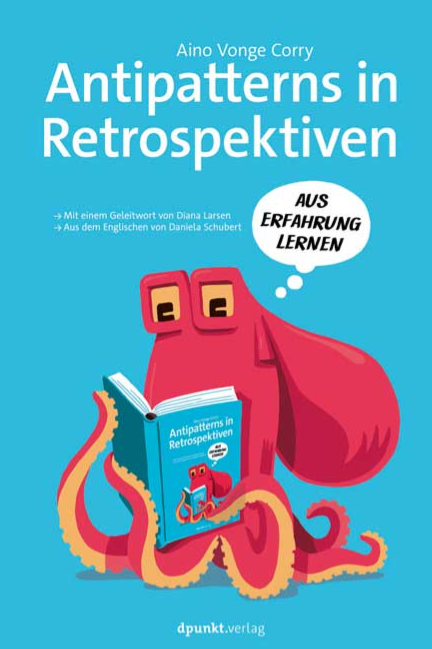
Antipatterns in Retrospektiven
Verbessern Sie mit Retrospektiven die agilen Prozesse und die Zusammenarbeit in Teams!Bei Retrospektiven geht es darum, Teams durch die Reflexion im Rahmen eines strukturierten Meetings dabei zu unterstützen, leistungsfähiger zu werden. Retrospektiven sind für kontinuierliches Lernen und Verbesserung – gerade in Lean-, Agile- und DevOps-Kontexten – unverzichtbar. 24 Antipatterns (Antimuster) helfen dabei, die eigene Moderation zu reflektieren und neue Lösungsansätze anzuwenden.Aino Vonge Corry zeigt auf, wie festgefahrene Retrospektiven wieder in produktive Arbeitsrituale umgewandelt werden können, und geht dabei auf fehlerhafte Planung sowie strukturelle und zwischenmenschliche Probleme in den Retrospektiven ein. Sie berichtet von Fallen, in die sie getappt ist, und Fehlern, die sie in ihrer jahrelangen Erfahrung als Moderatorin von Retrospektiven gemacht hat, und stellt anschließend bewährte Lösungen vor, die für das Team und die Menschen in unterschiedlichen Kontexten bereits funktioniert haben.Mit diesen Erkenntnissen und Anleitungen können Sie Retrospektiven durchführen, die konkrete Verbesserungen und echten Mehrwert bringen – die effektiv sind und auch Spaß machen! Über den Autor:Aino Vonge Corry, PhD, ist unabhängige Beraterin, Agile Coach und Vorsitzende des Programmkomitees mehrerer IT-Konferenzen. Sie hat mehr als 15 Jahre damit verbracht, Meetings zu moderieren, Retrospektiven zu unterrichten und Softwareteams zu helfen, sich zu verbessern. „Retrospective Antipatterns“ ist ihr erstes Buch, erschien 2020 und ist ein großer Erfolg im englischsprachigen Raum.Übersetzerin:Daniela Schubert arbeitet in der IT-Beratung, als agile Führungskraft, moderiert Retrospektiven, gibt Workshops und hält Vorträge auf Konferenzen. Weitere Arbeitsschwerpunkte sind: New Work und ortsunabhängiges Arbeiten sowie DEI-Tranings (Diversity, Equity & Inclusion) für Unternehmen auf Managementebene.Zielgruppe:(Agile) CoachesScrum Master*innenModerator*innenWorkshop-Leiter*innenVerantwortliche in Projektteams

Finding Ghosts in Your Data
Discover key information buried in the noise of data by learning a variety of anomaly detection techniques and using the Python programming language to build a robust service for anomaly detection against a variety of data types. The book starts with an overview of what anomalies and outliers are and uses the Gestalt school of psychology to explain just why it is that humans are naturally great at detecting anomalies. From there, you will move into technical definitions of anomalies, moving beyond "I know it when I see it" to defining things in a way that computers can understand.The core of the book involves building a robust, deployable anomaly detection service in Python. You will start with a simple anomaly detection service, which will expand over the course of the book to include a variety of valuable anomaly detection techniques, covering descriptive statistics, clustering, and time series scenarios. Finally, you will compare your anomaly detection service head-to-head with a publicly available cloud offering and see how they perform.The anomaly detection techniques and examples in this book combine psychology, statistics, mathematics, and Python programming in a way that is easily accessible to software developers. They give you an understanding of what anomalies are and why you are naturally a gifted anomaly detector. Then, they help you to translate your human techniques into algorithms that can be used to program computers to automate the process. You’ll develop your own anomaly detection service, extend it using a variety of techniques such as including clustering techniques for multivariate analysis and time series techniques for observing data over time, and compare your service head-on against a commercial service.WHAT YOU WILL LEARN* Understand the intuition behind anomalies* Convert your intuition into technical descriptions of anomalous data* Detect anomalies using statistical tools, such as distributions, variance and standard deviation, robust statistics, and interquartile range* Apply state-of-the-art anomaly detection techniques in the realms of clustering and time series analysis* Work with common Python packages for outlier detection and time series analysis, such as scikit-learn, PyOD, and tslearn* Develop a project from the ground up which finds anomalies in data, starting with simple arrays of numeric data and expanding to include multivariate inputs and even time series dataWHO THIS BOOK IS FORFor software developers with at least some familiarity with the Python programming language, and who would like to understand the science and some of the statistics behind anomaly detection techniques. Readers are not required to have any formal knowledge of statistics as the book introduces relevant concepts along the way.KEVIN FEASEL is a Microsoft Data Platform MVP and CTO at Faregame Inc, where he specializes in data analytics with T-SQL and R, forcing Spark clusters to do his bidding, fighting with Kafka, and pulling rabbits out of hats on demand. He is the lead contributor to Curated SQL, president of the Triangle Area SQL Server Users Group, and author of PolyBase Revealed. A resident of Durham, North Carolina, he can be found cycling the trails along the triangle whenever the weather is nice enough.PART I. WHAT IS AN ANOMALY?Chapter 1. The Importance of Anomalies and Anomaly DetectionChapter 2. Humans are Pattern MatchersChapter 3. Formalizing Anomaly DetectionPART II. BUILDING AN ANOMALY DETECTORChapter 4. Laying out the FrameworkChapter 5. Building a Test SuiteChapter 6. Implementing the First MethodsChapter 7. Extending the EnsembleChapter 8. Visualize the ResultsPART III. MULTIVARIATE ANOMALY DETECTIONChapter 9. Clustering and AnomaliesChapter 10. Connectivity-Based Outlier Factor (COF)Chapter 11. Local Correlation Integral (LOCI)Chapter 12. Copula-Based Outlier Detection (COPOD)PART IV. TIME SERIES ANOMALY DETECTIONChapter 13. Time and AnomaliesChapter 14. Change Point DetectionChapter 15. An Introduction to Multi-Series Anomaly DetectionChapter 16. Standard Deviation of Differences (DIFFSTD)Chapter 17. Symbolic Aggregate Approximation (SAX)PART V. STACKING UP TO THE COMPETITIONChapter 18. Configuring Azure Cognitive Services Anomaly DetectorChapter 19. Performing a Bake-OffAppendix: Bibliography

SQL Server 2022 Query Performance Tuning
Troubleshoot slow-performing queries and make them run faster. Database administrators and SQL developers are constantly under pressure to provide more speed. This new edition has been redesigned and rewritten from scratch based on the last 15 years of learning, knowledge, and experience accumulated by the author. The book Includes expanded information on using extended events, automatic execution plan correction, and other advanced features now available in SQL Server. These modern features are covered while still providing the necessary fundamentals to better understand how statistics and indexes affect query performance.The book gives you knowledge and tools to help you identify poorly performing queries and understand the possible causes of that poor performance. The book also provides mechanisms for resolving the issues identified, whether on-premises, in containers, or on cloud platform providers. You’ll learn about key fundamentals, such as statistics, data distribution, cardinality, and parameter sniffing. You’ll learn to analyze and design your indexes and your queries using best practices that ward off performance problems before they occur. You’ll also learn to use important modern features, such as Query Store to manage and control execution plans, the automated performance tuning feature set, and memory-optimized OLTP tables and procedures. You will be able to troubleshoot in a systematic way. Query tuning doesn’t have to be difficult. This book helps you to make it much easier.WHAT YOU WILL LEARN* Use Query Store to understand and easily change query performance* Recognize and eliminate bottlenecks leading to slow performance* Tune queries whether on-premises, in containers, or on cloud platform providers* Implement best practices in T-SQL to minimize performance risk* Design in the performance that you need through careful query and index design* Understand how built-in, automatic tuning can assist your performance enhancement efforts* Protect query performance during upgrades to the newer versions of SQL ServerWHO THIS BOOK IS FORDevelopers and database administrators with responsibility for query performance in SQL Server environments, and anyone responsible for writing or creating T-SQL queries and in need of insight into bottlenecks (including how to identify them, understand them, and eliminate them)GRANT FRITCHEY is a Microsoft Data Platform MVP and AWS Community Builder. He has more than 30 years of experience in IT technical support, development, and database administration. He currently works as Product Advocate at Red Gate Software. Grant writes articles for publication at SQL Server Central and Simple-Talk. He has published books, including SQL Server Execution Plans and SQL Server 2017 Query Performance Tuning (Apress). He has written chapters for Beginning SQL Server 2012 Administration (Apress), SQL Server Team-based Development, SQL Server MVP Deep Dives Volume 2, Pro SQL Server 2012 Practices (Apress), Expert Performance Indexing in SQL Server (Apress), and Query Store for SQL Server 2019 (Apress). Grant presents live sessions, virtual sessions, and recorded content online and in-person, all around the world.1. Query Performance Tuning2. Execution Plan Generation and the Query Optimizer3. Methods for Capturing Query Performance Metrics4. Analyzing Query Behavior Using Execution Plans5. Statistics, Data Distribution and Cardinality6. Using Query Store for Query Performance and Execution Plans7. Execution Plan Cache Behavior8. Query Recompilation9. Index Architecture10. Index Behaviors11. Key Lookups and Solutions12. Dealing with Index Fragmentation13. Parameter Sensitive Queries: Causes and Solutions14. Query Design Analysis15. Reduce Query Resource Use16. Blocking and Blocked Processes17. Causes and Solutions for Deadlocks18. Row-By-Row Processing from Cursors and Other Causes19. Memory-Optimized OLTP Tables and Procedures20. Graph Databases21. Intelligent Query Processing22. Automated Tuning in Azure and SQL Server23. A Query Tuning Methodology

Introducing RavenDB
Simplify your first steps with the RavenDB NoSQL Document Database. This book takes a task-oriented approach by showing common problems, potential solutions, brief explanations of how those solutions work, and the mechanisms used. Based on real-world examples, the recipes in this book will show you how to solve common problems with Raven Query Language and will highlight reasons why RavenDB is a great choice for fast prototyping solutions that can sustain increasing amounts of data as your application grows.Introducing RavenDB includes code and query examples that address real-life challenges you’ll encounter when using RavenDB, helping you learn the basics of the Raven Query Language more quickly and efficiently. In many cases, you’ll be able to copy and paste the examples into your own code, making only minor modifications to suit your application. RavenDB supports many advanced features, such full-text search, graph queries, and timeseries; recipes in the latter portion of the book will help you understand those advanced features and how they might be applied to your own code and applications.After reading this book, you will be able to employ RavenDB’s powerful features in your own projects.WHAT YOU WILL LEARN* Set up and start working with RavenDB* Model your objects for persistence in a NoSQL document database* Write basic and advanced queries in the Raven Query Language * Index your data using map/reduce techniques * Implement techniques leading to highly performant systems * Efficiently aggregate data and query on those aggregations WHO THIS BOOK IS FORDevelopers accustomed to relational databases who are about to enter a world of NoSQL databases. The book is also for experienced programmers who have used other non-relational databases and want to learn RavenDB. It will also prove useful for developers who want to move away from using Object-Relational Modeling frameworks and start working with a persistence solution that can store object graphs directly. DEJAN MILIČIĆ is a consultant with more than 20 years’ experience as a professional software developer. His experience includes designing, writing, and maintaining applications, focusing on software architecture and backend development. He advocates domain-driven Design, behavior-driven development, functional programming, and API-first development.Miličić’s passion for RavenDB goes back to 2015, when he started using this NoSQL database for small hobby projects and quickly realized it is applicable to a wide range of applications. He specializes in RavenDB because it is well suited for fast prototyping and development of everything from line-of-business applications to large enterprise distributed systems. 1. Getting Started with RavenDB2. Document Modeling3. Querying4. Indexes5. Map Indexes6. MapReduce Indexes7. Full-Text Search

Convergence of Deep Learning in Cyber-IoT Systems and Security
CONVERGENCE OF DEEP LEARNING IN CYBER-IOT SYSTEMS AND SECURITYIN-DEPTH ANALYSIS OF DEEP LEARNING-BASED CYBER-IOT SYSTEMS AND SECURITY WHICH WILL BE THE INDUSTRY LEADER FOR THE NEXT TEN YEARS. The main goal of this book is to bring to the fore unconventional cryptographic methods to provide cyber security, including cyber-physical system security and IoT security through deep learning techniques and analytics with the study of all these systems. This book provides innovative solutions and implementation of deep learning-based models in cyber-IoT systems, as well as the exposed security issues in these systems. The 20 chapters are organized into four parts. Part I gives the various approaches that have evolved from machine learning to deep learning. Part II presents many innovative solutions, algorithms, models, and implementations based on deep learning. Part III covers security and safety aspects with deep learning. Part IV details cyber-physical systems as well as a discussion on the security and threats in cyber-physical systems with probable solutions. AUDIENCEResearchers and industry engineers in computer science, information technology, electronics and communication, cybersecurity and cryptography. RAJDEEP CHAKRABORTY, PHD, is an assistant professor in the Department of Computer Science and Engineering, Netaji Subhash Engineering College, Kolkata, India. His fields of interest are mainly in cryptography and computer security. He was awarded the Adarsh Vidya Saraswati Rashtriya Puraskar, National Award of Excellence 2019 conferred by Glacier Journal Research Foundation, ANUPAM GHOSH, PHD, is a professor in the Department of Computer Science and Engineering, Netaji Subhash Engineering College, Kolkata, India. He has published more than 80 international papers in reputed international journals and conferences. His fields of interest are mainly in AI, machine learning, deep learning, image processing, soft computing, bioinformatics, IoT, and data mining. JYOTSNA KUMAR MANDAL, PHD, has more than 30 years of industry and academic experience. His fields of interest are coding theory, data and network security, remote sensing & GIS-based applications, data compression error corrections, information security, watermarking, steganography and document authentication, image processing, visual cryptography, MANET, wireless and mobile computing/security, unify computing, chaos theory, and applications. S. BALAMURUGAN, PHD, is the Director of Research and Development, Intelligent Research Consultancy Services (iRCS), Coimbatore, Tamilnadu, India. He is also Director of the Albert Einstein Engineering and Research Labs (AEER Labs), as well as Vice-Chairman, Renewable Energy Society of India (RESI), India. He has published 45 books, 200+ international journals/ conferences, and 35 patents. Preface xviiPART I: VARIOUS APPROACHES FROM MACHINE LEARNING TO DEEP LEARNING 11 WEB-ASSISTED NONINVASIVE DETECTION OF ORAL SUBMUCOUS FIBROSIS USING IOHT 3Animesh Upadhyaya, Vertika Rai, Debdutta Pal, Surajit Bose and Somnath Ghosh1.1 Introduction 31.2 Literature Survey 61.2.1 Oral Cancer 61.3 Primary Concepts 71.3.1 Transmission Efficiency 71.4 Propose Model 91.4.1 Platform Configuration 91.4.2 Harvard Architectural Microcontroller Base Wireless Communication Board 101.4.2.1 NodeMCU ESP8266 Microcontroller 101.4.2.2 Gas Sensor 121.4.3 Experimental Setup 131.4.4 Process to Connect to Sever and Analyzing Data on Cloud 141.5 Comparative Study 161.6 Conclusion 17References 172 PERFORMANCE EVALUATION OF MACHINE LEARNING AND DEEP LEARNING TECHNIQUES: A COMPARATIVE ANALYSIS FOR HOUSE PRICE PREDICTION 21Sajeev Ram Arumugam, Sheela Gowr, Abimala, Balakrishna and Oswalt Manoj2.1 Introduction 222.2 Related Research 232.2.1 Literature Review on Comparing the Performance of the ML/DL Algorithms 232.2.2 Literature Review on House Price Prediction 252.3 Research Methodology 262.3.1 Data Collection 272.3.2 Data Visualization 272.3.3 Data Preparation 282.3.4 Regression Models 292.3.4.1 Simple Linear Regression 292.3.4.2 Random Forest Regression 302.3.4.3 Ada Boosting Regression 312.3.4.4 Gradient Boosting Regression 322.3.4.5 Support Vector Regression 332.3.4.6 Artificial Neural Network 342.3.4.7 Multioutput Regression 362.3.4.8 Regression Using Tensorflow—Keras 372.3.5 Classification Models 392.3.5.1 Logistic Regression Classifier 392.3.5.2 Decision Tree Classifier 392.3.5.3 Random Forest Classifier 412.3.5.4 Naïve Bayes Classifier 412.3.5.5 K-Nearest Neighbors Classifier 422.3.5.6 Support Vector Machine Classifier (SVM) 432.3.5.7 Feed Forward Neural Network 432.3.5.8 Recurrent Neural Networks 442.3.5.9 LSTM Recurrent Neural Networks 442.3.6 Performance Metrics for Regression Models 452.3.7 Performance Metrics for Classification Models 462.4 Experimentation 472.5 Results and Discussion 482.6 Suggestions 602.7 Conclusion 60References 623 CYBER PHYSICAL SYSTEMS, MACHINE LEARNING & DEEP LEARNING— EMERGENCE AS AN ACADEMIC PROGRAM AND FIELD FOR DEVELOPING DIGITAL SOCIETY 67P. K. Paul3.1 Introduction 683.2 Objective of the Work 693.3 Methods 693.4 Cyber Physical Systems: Overview with Emerging Academic Potentiality 703.5 ml and dl Basics with Educational Potentialities 723.5.1 Machine Learning (ML) 723.5.2 Deep Learning 733.6 Manpower and Developing Scenario in Machine Learning and Deep Learning 743.7 dl & ml in Indian Context 793.8 Conclusion 81References 824 DETECTION OF FAKE NEWS AND RUMORS IN THE SOCIAL MEDIA USING MACHINE LEARNING TECHNIQUES WITH SEMANTIC ATTRIBUTES 85Diganta Saha, Arijit Das, Tanmay Chandra Nath, Soumyadip Saha and Ratul Das4.1 Introduction 864.2 Literature Survey 874.3 Proposed Work 884.3.1 Algorithm 894.3.2 Flowchart 904.3.3 Explanation of Approach 914.4 Results and Analysis 924.4.1 Datasets 924.4.2 Evaluation 934.4.2.1 Result of 1st Dataset 934.4.2.2 Result of 2nd Dataset 944.4.2.3 Result of 3rd Dataset 944.4.3 Relative Comparison of Performance 954.5 Conclusion 95References 96PART II: INNOVATIVE SOLUTIONS BASED ON DEEP LEARNING 995 ONLINE ASSESSMENT SYSTEM USING NATURAL LANGUAGE PROCESSING TECHNIQUES 101S. Suriya, K. Nagalakshmi and Nivetha S.5.1 Introduction 1025.2 Literature Survey 1035.3 Existing Algorithms 1085.4 Proposed System Design 1115.5 System Implementation 1155.6 Conclusion 120References 1216 ON A REFERENCE ARCHITECTURE TO BUILD DEEP-Q LEARNING-BASED INTELLIGENT IOT EDGE SOLUTIONS 123Amit Chakraborty, Ankit Kumar Shaw and Sucharita Samanta6.1 Introduction 1246.1.1 A Brief Primer on Machine Learning 1246.1.1.1 Types of Machine Learning 1246.2 Dynamic Programming 1286.3 Deep Q-Learning 1296.4 IoT 1306.4.1 Azure 1306.4.1.1 IoT on Azure 1306.5 Conclusion 1446.6 Future Work 144References 1457 FUZZY LOGIC-BASED AIR CONDITIONER SYSTEM 147Suparna Biswas, Sayan Roy Chaudhuri, Ayusha Biswas and Arpan Bhawal7.1 Introduction 1477.2 Fuzzy Logic-Based Control System 1497.3 Proposed System 1497.3.1 Fuzzy Variables 1497.3.2 Fuzzy Base Class 1547.3.3 Fuzzy Rule Base 1557.3.4 Fuzzy Rule Viewer 1567.4 Simulated Result 1577.5 Conclusion and Future Work 163References 1638 AN EFFICIENT MASKED-FACE RECOGNITION TECHNIQUE TO COMBAT WITH COVID- 19 165Suparna Biswas8.1 Introduction 1658.2 Related Works 1678.2.1 Review of Face Recognition for Unmasked Faces 1678.2.2 Review of Face Recognition for Masked Faces 1688.3 Mathematical Preliminaries 1698.3.1 Digital Curvelet Transform (DCT) 1698.3.2 Compressive Sensing–Based Classification 1708.4 Proposed Method 1718.5 Experimental Results 1738.5.1 Database 1738.5.2 Result 1758.6 Conclusion 179References 1799 DEEP LEARNING: AN APPROACH TO ENCOUNTER PANDEMIC EFFECT OF NOVEL CORONA VIRUS (COVID-19) 183Santanu Koley, Pinaki Pratim Acharjya, Rajesh Mukherjee, Soumitra Roy and Somdeep Das9.1 Introduction 1849.2 Interpretation With Medical Imaging 1859.3 Corona Virus Variants Tracing 1889.4 Spreading Capability and Destructiveness of Virus 1919.5 Deduction of Biological Protein Structure 1929.6 Pandemic Model Structuring and Recommended Drugs 1929.7 Selection of Medicine 1959.8 Result Analysis 1979.9 Conclusion 201References 20210 QUESTION ANSWERING SYSTEM USING DEEP LEARNING IN THE LOW RESOURCE LANGUAGE BENGALI 207Arijit Das and Diganta Saha10.1 Introduction 20810.2 Related Work 21010.3 Problem Statement 21510.4 Proposed Approach 21510.5 Algorithm 21610.6 Results and Discussion 21910.6.1 Result Summary for TDIL Dataset 21910.6.2 Result Summary for SQuAD Dataset 21910.6.3 Examples of Retrieved Answers 22010.6.4 Calculation of TP, TN, FP, FN, Accuracy, Precision, Recall, and F1 score 22110.6.5 Comparison of Result with other Methods and Dataset 22210.7 Analysis of Error 22310.8 Few Close Observations 22310.9 Applications 22410.10 Scope for Improvements 22410.11 Conclusions 224Acknowledgments 225References 225PART III: SECURITY AND SAFETY ASPECTS WITH DEEP LEARNING 23111 SECURE ACCESS TO SMART HOMES USING BIOMETRIC AUTHENTICATION WITH RFID READER FOR IOT SYSTEMS 233K.S. Niraja and Sabbineni Srinivasa Rao11.1 Introduction 23411.2 Related Work 23511.3 Framework for Smart Home Use Case With Biometric 23611.3.1 RFID-Based Authentication and Its Drawbacks 23611.4 Control Scheme for Secure Access (CSFSC) 23711.4.1 Problem Definition 23711.4.2 Biometric-Based RFID Reader Proposed Scheme 23811.4.3 Reader-Based Procedures 24011.4.4 Backend Server-Side Procedures 24011.4.5 Reader Side Final Compute and Check Operations 24011.5 Results Observed Based on Various Features With Proposed and Existing Methods 24211.6 Conclusions and Future Work 245References 24612 MQTT-BASED IMPLEMENTATION OF HOME AUTOMATION SYSTEM PROTOTYPE WITH INTEGRATED CYBER-IOT INFRASTRUCTURE AND DEEP LEARNING–BASED SECURITY ISSUES 249Arnab Chakraborty12.1 Introduction 25012.2 Architecture of Implemented Home Automation 25212.3 Challenges in Home Automation 25312.3.1 Distributed Denial of Service and Attack 25412.3.2 Deep Learning–Based Solution Aspects 25412.4 Implementation 25512.4.1 Relay 25612.4.2 DHT 11 25712.5 Results and Discussions 26212.6 Conclusion 265References 26613 MALWARE DETECTION IN DEEP LEARNING 269Sharmila Gaikwad and Jignesh Patil13.1 Introduction to Malware 27013.1.1 Computer Security 27013.1.2 What Is Malware? 27113.2 Machine Learning and Deep Learning for Malware Detection 27413.2.1 Introduction to Machine Learning 27413.2.2 Introduction to Deep Learning 27613.2.3 Detection Techniques Using Deep Learning 27913.3 Case Study on Malware Detection 28013.3.1 Impact of Malware on Systems 28013.3.2 Effect of Malware in a Pandemic Situation 28113.4 Conclusion 283References 28314 PATRON FOR WOMEN: AN APPLICATION FOR WOMENS SAFETY 285Riya Sil, Snatam Kamila, Ayan Mondal, Sufal Paul, Santanu Sinha and Bishes Saha14.1 Introduction 28614.2 Background Study 28614.3 Related Research 28714.3.1 A Mobile-Based Women Safety Application (I safe App) 28714.3.2 Lifecraft: An Android-Based Application System for Women Safety 28814.3.3 Abhaya: An Android App for the Safety of Women 28814.3.4 Sakhi—The Saviour: An Android Application to Help Women in Times of Social Insecurity 28914.4 Proposed Methodology 28914.4.1 Motivation and Objective 29014.4.2 Proposed System 29014.4.3 System Flowchart 29114.4.4 Use-Case Model 29114.4.5 Novelty of the Work 29414.4.6 Comparison with Existing System 29414.5 Results and Analysis 29414.6 Conclusion and Future Work 298References 29915 CONCEPTS AND TECHNIQUES IN DEEP LEARNING APPLICATIONS IN THE FIELD OF IOT SYSTEMS AND SECURITY 303Santanu Koley and Pinaki Pratim Acharjya15.1 Introduction 30415.2 Concepts of Deep Learning 30715.3 Techniques of Deep Learning 30815.3.1 Classic Neural Networks 30915.3.1.1 Linear Function 30915.3.1.2 Nonlinear Function 30915.3.1.3 Sigmoid Curve 31015.3.1.4 Rectified Linear Unit 31015.3.2 Convolution Neural Networks 31015.3.2.1 Convolution 31115.3.2.2 Max-Pooling 31115.3.2.3 Flattening 31115.3.2.4 Full Connection 31115.3.3 Recurrent Neural Networks 31215.3.3.1 LSTMs 31215.3.3.2 Gated RNNs 31215.3.4 Generative Adversarial Networks 31315.3.5 Self-Organizing Maps 31415.3.6 Boltzmann Machines 31515.3.7 Deep Reinforcement Learning 31515.3.8 Auto Encoders 31615.3.8.1 Sparse 31715.3.8.2 Denoising 31715.3.8.3 Contractive 31715.3.8.4 Stacked 31715.3.9 Back Propagation 31715.3.10 Gradient Descent 31815.4 Deep Learning Applications 31915.4.1 Automatic Speech Recognition (ASR) 31915.4.2 Image Recognition 32015.4.3 Natural Language Processing 32015.4.4 Drug Discovery and Toxicology 32115.4.5 Customer Relationship Management 32215.4.6 Recommendation Systems 32315.4.7 Bioinformatics 32415.5 Concepts of IoT Systems 32515.6 Techniques of IoT Systems 32615.6.1 Architecture 32615.6.2 Programming Model 32715.6.3 Scheduling Policy 32915.6.4 Memory Footprint 32915.6.5 Networking 33215.6.6 Portability 33215.6.7 Energy Efficiency 33315.7 IoT Systems Applications 33315.7.1 Smart Home 33415.7.2 Wearables 33515.7.3 Connected Cars 33515.7.4 Industrial Internet 33615.7.5 Smart Cities 33715.7.6 IoT in Agriculture 33715.7.7 Smart Retail 33815.7.8 Energy Engagement 33915.7.9 IoT in Healthcare 34015.7.10 IoT in Poultry and Farming 34015.8 Deep Learning Applications in the Field of IoT Systems 34115.8.1 Organization of DL Applications for IoT in Healthcare 34215.8.2 DeepSense as a Solution for Diverse IoT Applications 34315.8.3 Deep IoT as a Solution for Energy Efficiency 34615.9 Conclusion 346References 34716 EFFICIENT DETECTION OF BIOWEAPONS FOR AGRICULTURAL SECTOR USING NARROWBAND TRANSMITTER AND COMPOSITE SENSING ARCHITECTURE 349Arghyadeep Nag, Labani Roy, Shruti, Soumen Santra and Arpan Deyasi16.1 Introduction 35016.2 Literature Review 35316.3 Properties of Insects 35516.4 Working Methodology 35716.4.1 Sensing 35716.4.1.1 Specific Characterization of a Particular Species 35716.4.2 Alternative Way to Find Those Previously Sensing Parameters 35716.4.3 Remedy to Overcome These Difficulties 35816.4.4 Take Necessary Preventive Actions 35816.5 Proposed Algorithm 35916.6 Block Diagram and Used Sensors 36016.6.1 Arduino Uno 36116.6.2 Infrared Motion Sensor 36216.6.3 Thermographic Camera 36216.6.4 Relay Module 36216.7 Result Analysis 36216.8 Conclusion 363References 36317 A DEEP LEARNING–BASED MALWARE AND INTRUSION DETECTION FRAMEWORK 367Pavitra Kadiyala and Kakelli Anil Kumar17.1 Introduction 36717.2 Literature Survey 36817.3 Overview of the Proposed Work 37117.3.1 Problem Description 37117.3.2 The Working Models 37117.3.3 About the Dataset 37117.3.4 About the Algorithms 37317.4 Implementation 37417.4.1 Libraries 37417.4.2 Algorithm 37617.5 Results 37617.5.1 Neural Network Models 37717.5.2 Accuracy 37717.5.3 Web Frameworks 37717.6 Conclusion and Future Work 379References 38018 PHISHING URL DETECTION BASED ON DEEP LEARNING TECHNIQUES 381S. Carolin Jeeva and W. Regis Anne18.1 Introduction 38218.1.1 Phishing Life Cycle 38218.1.1.1 Planning 38318.1.1.2 Collection 38418.1.1.3 Fraud 38418.2 Literature Survey 38518.3 Feature Generation 38818.4 Convolutional Neural Network for Classification of Phishing vs Legitimate URLs 38818.5 Results and Discussion 39118.6 Conclusion 394References 394Web Citation 396PART IV: CYBER PHYSICAL SYSTEMS 39719 CYBER PHYSICAL SYSTEM—THE GEN Z 399Jayanta Aich and Mst Rumana Sultana19.1 Introduction 39919.2 Architecture and Design 40019.2.1 Cyber Family 40119.2.2 Physical Family 40119.2.3 Cyber-Physical Interface Family 40219.3 Distribution and Reliability Management in CPS 40319.3.1 CPS Components 40319.3.2 CPS Models 40419.4 Security Issues in CPS 40519.4.1 Cyber Threats 40519.4.2 Physical Threats 40719.5 Role of Machine Learning in the Field of CPS 40819.6 Application 41119.7 Conclusion 411References 41120 AN OVERVIEW OF CYBER PHYSICAL SYSTEM (CPS) SECURITY, THREATS, AND SOLUTIONS 415Krishna Keerthi Chennam, Fahmina Taranum and Maniza Hijab20.1 Introduction 41620.1.1 Motivation of Work 41720.1.2 Organization of Sections 41720.2 Characteristics of CPS 41820.3 Types of CPS Security 41920.4 Cyber Physical System Security Mechanism—Main Aspects 42120.4.1 CPS Security Threats 42320.4.2 Information Layer 42320.4.3 Perceptual Layer 42420.4.4 Application Threats 42420.4.5 Infrastructure 42520.5 Issues and How to Overcome Them 42620.6 Discussion and Solutions 42720.7 Conclusion 431References 431Index 435

Netzbasierte Ansätze zur natürlichsprachlichen Informationsverarbeitung
Für Leser, die bereits die Grundlagen der Wissensverarbeitung und Computernetzwerke beherrschen, gibt das Buch einen Überblick über innovative Verfahren, die die automatisierte Suche, Recherche, Klassifikation und Verwaltung von Texten im Kontext dezentraler Systeme und vor allem im WWW erlauben.Besondere Aufmerksamkeit wird dabei auf eine personalisierte Verarbeitung gerichtet, die auch zeitliche Aspekte, wie z. B. das digitale Vergessen, einbeziehen.An vielen Stellen werden auf interessante und neuartige Art und Weise Analogien aus anderen Wissensgebieten, so z. B. zur Verarbeitung von Informationen und zum Lernen im menschlichen Gehirn sowie der Natur schlechthin genutzt.PROF. DR. HERWIG UNGER, DR. MARIO KUBEK UND DR. PANCHALEE SUKJIT kommen aus unterschiedlichen Wissensgebieten der Informatik, die seit 2008 die gemeinsame Vision vereint, die meist textbasierten Ressourcen des WWW besser nutzbar zu machen. Von ihnen sind eine Vielzahl von Fachbeiträgen zum Thema auf wissenschaftlichen Tagungen, in Journalen bzw. Fachbüchern erschienen. Wissensverarbeitung im menschlichen Gehirn - Lernen - Netzwerke für die Textanalyse - Digitale Updates und digitales Vergessen - Exploration von Netzwerkstrukturen - Konzepte des Text Minings in dezentralen Systemen - Informationsmanagement im Web

Beginning MATLAB and Simulink
Employ essential tools and functions of the MATLAB and Simulink packages, which are explained and demonstrated via interactive examples and case studies. This revised edition covers features from the latest MATLAB 2022b release, as well as other features that have been released since the first edition published.This book contains dozens of simulation models and solved problems via m-files/scripts and Simulink models which will help you to learn programming and modelling essentials. You’ll become efficient with many of the built-in tools and functions of MATLAB/Simulink while solving engineering and scientific computing problems.Beginning MATLAB and Simulink, Second Edition explains various practical issues of programming and modelling in parallel by comparing MATLAB and Simulink. After studying and using this book, you'll be proficient at using MATLAB and Simulink and applying the source code and models from the book's examples as templates for your own projects in data science or engineering.WHAT YOU WILL LEARN* Master the programming and modelling essentials of MATLAB and Simulink* Carry out data visualization with MATLAB* Build a GUI and develop App with MATLAB* Work with integration and numerical root finding methods* Apply MATLAB to differential equations-based models and simulations* Use MATLAB and Simulink for data science projectsWHO THIS BOOK IS FOREngineers, programmers, data scientists, and students majoring in engineering and scientific computing who are new to MATLAB and Simulink.SULAYMON L. ESHKABILOV, PhD is an assistant professor in the Department of Agricultural and Biosystems Engineering at North Dakota State University. He obtained a Master of Engineering degree from Tashkent Automobile Road Institute, a Master of Sciences from Rochester Institute of Technology, NY, and a PhD from the Cybernetics Institute of Academy Sciences of Uzbekistan in 1994, 2001 and 2005, respectively. He was an associate professor at Tashkent Automobile Road Institute from December 2006 through January 2017. He held visiting professor and researcher positions at Ohio and North Dakota State Universities, for 2010/2011 and Johannes Kepler University, from January through September 2017. He teaches a number of courses, including “Instrumentation and Measurement,” “System Modelling with MATLAB,” “Machine Design Analysis,” “Agricultural Power,” and “Advanced MATLAB/Simulink Modelling” for undergraduate and graduate students.His research interests are image processing, machine learning applications, mechanical vibrations, micro-electro-mechanical systems, mechatronic system design, and simulation of system dynamics. He has developed simulation and data analysis models for various image data, additive manufacturing process optimization, vibrating systems, autonomous vechicle control, and studies of mechanical properties of bones. He is an author of four books devoted to MATLAB/Simulink applications for Mechanical Engineering students and Numerical Analysis. He has worked as an external academic expert for the European Commission to assess academic projects from 2009 through 2022.1. Introduction to MATLAB.-2. Programming Essentials.-3. Graphical User Interface Model Development.-4. MEX files, C/C++ and Standalone Applications.-5. Simulink Modeling Essentials.-6. Plots.-7. Matrix Algebra.-8. Ordinary Differential Equations.

Convergence: Artificial Intelligence and Quantum Computing
PREPARE FOR THE COMING CONVERGENCE OF AI AND QUANTUM COMPUTINGA collection of essays from 20 renowned, international authors working in industry, academia, and government, Convergence: Artificial Intelligence and Quantum Computing explains the impending convergence of artificial intelligence and quantum computing. A diversity of viewpoints is presented, each offering their view of this coming watershed event. In the book, you’ll discover that we’re on the cusp of seeing the stuff of science fiction become reality, with huge implications for ripping up the existing social fabric, global economy, and current geopolitical order. Along with an incisive foreword by Hugo- and Nebula-award winning author David Brin, you’ll also find:* Explorations of the increasing pace of technological development* Explanations of why seemingly unusual and surprising breakthroughs might be just around the corner* Maps to navigate the potential minefields that await us as AI and quantum computing come togetherA fascinating and thought-provoking compilation of insights from some of the leading technological voices in the world, Convergence convincingly argues that we should prepare for a world in which very little will remain the same and shows us how to get ready. GREG VIGGIANO, PHD, is an Adjunct Professor in the Department of Physics at George Mason University. His research interests include new technology applications and their macro social effects. He earned his doctorate in Mass Communication from Florida State University and is also the pro bono Executive Director for the Museum of Science Fiction in Washington, D.C. Preface xiForeword xixPART I POLICY AND REGULATORY IMPACTS 1Chapter 1 Quantum Inflection Points 3Jim GableChapter 2 Quantum Delegation 11Mandy Sweeney and Chris GauthierChapter 3 The Problem of Machine Actorhood 23Patrick Thaddeus JacksonChapter 4 Data Privacy, Security, and Ethical Governance Under Quantum AI 37Sarah PearceChapter 5 The Challenge of Quantum Noise 45Philip JohnsonChapter 6 A New Kind of Knowledge Discovery 53Ramin Ayanzadeh and Milton HalemPART II ECONOMIC IMPACTS 61Chapter 7 Quantum Tuesday: How the U.S. Economy Will Fall, and How to Stop It 63Alexander W. ButlerChapter 8 Quantum-AI Space Communications 83Mason PeckChapter 9 Quantum Planet Hacking 93Philip L. FranaChapter 10 Ethics and Quantum AI for Future Public Transit Systems 111Benjamin CrawfordChapter 11 The Road to a Better Future 119Denise Ruffner and André M. KönigPART III SOCIAL IMPACTS 127Chapter 12 The Best Numbers Are in Sight. But Understanding? 129Roald Hoffmann and Jean-Paul MalrieuChapter 13 The Advancement of Intelligence or the End of It? 143Kate JefferyChapter 14 Quantum of Wisdom 157Colin Allen and Brett KarlanChapter 15 Human Imagination and HAL 167Erik ViirreChapter 16 A Critical Crossroad 175Joseph N. PeltonChapter 17 Empathetic AI and Personalization Algorithms 183Philippe Beaudoin and Alexander W. ButlerChapter 18 Should We Let the Machine Decide What Is Meaningful? 193J. M. TaylorChapter 19 The Ascent of Quantum Intelligence in Steiner’s Age of the Consciousness Soul 205Stephen R. WaiteChapter 20 Quantum Computing’s Beautiful Accidents 213Christopher SavoieAppendix A What Is Quantum Computing? 221Philip L. FranaAppendix B What Is Artificial Intelligence? 239Philip L. FranaGlossary 247References 251Index 259About the Editor 271

SQL Server 2022 Revealed
Know how to use the new capabilities and cloud integrations in SQL Server 2022. This book covers the many innovative integrations with the Azure Cloud that make SQL Server 2022 the most cloud-connected edition ever. The book covers cutting-edge features such as the blockchain-based Ledger for creating a tamper-evident record of changes to data over time that you can rely on to be correct and reliable. You'll learn about built-in Query Intelligence capabilities to help you to upgrade with confidence that your applications will perform at least as fast after the upgrade than before. In fact, you'll probably see an increase in performance from the upgrade, with no code changes needed. Also covered are innovations such as contained availability groups and data virtualization with S3 object storage.New cloud integrations covered in this book include Microsoft Azure Purview and the use of Azure SQL for high availability and disaster recovery. The book covers Azure Synapse Link with its built-in capabilities to take changes and put them into Synapse automatically.Anyone building their career around SQL Server will want this book for the valuable information it provides on building SQL skills from edge to the cloud.WHAT YOU WILL LEARN* Know how to use all of the new capabilities and cloud integrations in SQL Server 2022* Connect to Azure for disaster recovery, near real-time analytics, and security* Leverage the Ledger to create a tamper-evident record of data changes over time* Upgrade from prior releases and achieve faster and more consistent performance with no code changes* Access data and storage in different and new formats, such as Parquet and S3, without moving the data and using your existing T-SQL skills* Explore new application scenarios using innovations with T-SQL in areas such as JSON and time seriesWHO THIS BOOK IS FORSQL Server professionals who want to upgrade their skills to the latest edition of SQL Server; those wishing to take advantage of new integrations with Microsoft Azure Purview (governance), Azure Synapse (analytics), and Azure SQL (HA and DR); and those in need of the increased performance and security offered by Query Intelligence and the new Ledger BOB WARD is a Principal Architect for the Microsoft Azure Data team, which owns the development for all SQL Server versions. Bob has worked for Microsoft for 28+ years on every version of SQL Server shipped from OS/2 1.1 to SQL Server 2012, including Azure SQL. He is a well-known speaker on SQL Server and Azure SQL, often presenting talks on new releases, internals, and specialized topics at events such as PASS Summit, SQLBits, SQL Server and Azure SQL Conference, Microsoft Inspire, Microsoft Ignite, and many different virtual events. You can follow him at @bobwardms. Bob is the author of Apress books: Pro SQL Server on Linux, SQL Server 2019 Revealed, and Azure SQL Revealed. 1. Project Dallas Becomes SQL Server 20222. Install and Upgrade3. Connect Your Database to the Cloud4. Built-in Query Intelligence5. Built-in Query Intelligence Gets Even Better6. The Meat and Potatoes of SQL Server7.Data Virtualization and Object Storage8. New Application Scenarios with T-SQL9. SQL Server 2022 on Linux, Containers, and Kubernetes10. SQL Server 2022 on Azure Virtual Machines11. SQL Edge to Cloud
Advances in Data Science and Analytics
ADVANCES IN DATA SCIENCE AND ANALYTICSPRESENTING THE CONCEPTS AND ADVANCES OF DATA SCIENCE AND ANALYTICS, THIS VOLUME, WRITTEN AND EDITED BY A GLOBAL TEAM OF EXPERTS, ALSO GOES INTO THE PRACTICAL APPLICATIONS THAT CAN BE UTILIZED ACROSS MULTIPLE DISCIPLINES AND INDUSTRIES, FOR BOTH THE ENGINEER AND THE STUDENT, FOCUSING ON MACHINING LEARNING, BIG DATA, BUSINESS INTELLIGENCE, AND ANALYTICS.Data science is an interdisciplinary field that uses scientific methods, processes, algorithms, and systems to extract knowledge and insights from many structural and unstructured data. Data science is related to data mining, deep learning, and big data. Data analytics software is a more focused version of this and can even be considered part of the larger process. Analytics is devoted to realizing actionable insights that can be applied immediately based on existing queries. For the purposes of this volume, data science is an umbrella term that encompasses data analytics, data mining, machine learning, and several other related disciplines. While a data scientist is expected to forecast the future based on past patterns, data analysts extract meaningful insights from various data sources. Although data mining and other related areas have been around for a few decades, data science and analytics are still quickly evolving, and the processes and technologies change, almost on a day-to-day basis. This volume provides an overview of some of the most important advances in these areas today, including practical coverage of the daily applications. Valuable as a learning tool for beginners in this area as well as a daily reference for engineers and scientists working in these areas, this is a must-have for any library. M. NIRANJANAMURTHY, PHD, is an assistant professor in the Department of Computer Applications, M. S. Ramaiah Institute of Technology, Bangalore, Karnataka, India. He earned his PhD in computer science at JJTU. He has over 13 years of teaching experience and two years of industry experience as a software engineer. He has published four books and 85 papers in technical journals and conferences. He has six patents to his credit and has won numerous awards. HEMANT KUMAR GIANEY, PHD, is a senior assistant professor in the Computer Science Department at Vellore Institute of Technology, AP, India. He also worked at Thapar Institute of Engineering and Technology, Patiala, Punjab, India and worked as a post-doctoral researcher in the Computer Science and Engineering Department at National Cheng Kung University in Taiwan. He has over 15 years of teaching and industry experience. He has conducted many workshops and has been a guest speaker in various universities. He has also published many research papers on in scientific and technical journals. AMIR H. GANDOMI, PHD, is a professor of data science in the Department of Engineering and Information Technology, University of Technology Sydney. Before joining UTS, he was an assistant professor at the School of Business, Stevens Institute of Technology, NJ, and a distinguished research fellow at BEACON Center, Michigan State University. He has published over 150 journal papers and four books and collectively has been cited more than 14,000 times. He has been named as one of the world’s most influential scientific minds and a Highly Cited Researcher (top 1%) for three consecutive years, from 2017 to 2019. He has also served as associate editor, editor, and guest editor in several prestigious journals and has delivered several keynote talks. He is also part of a NASA technology cluster on Big Data, Artificial Intelligence, and Machine Learning. Preface xv1 IMPLEMENTATION TOOLS FOR GENERATING STATISTICAL CONSEQUENCE USING DATA VISUALIZATION TECHNIQUES 1Dr. Ajay B. Gadicha, Dr. Vijay B. Gadicha, Prof. Sneha Bohra and Dr. Niranjanamurthy M.1.1 Introduction 21.2 Literature Review 41.3 Tools in Data Visualization 41.4 Methodology 141.4.1 Plotting the Data 141.4.2 Plotting the Model on Data 151.4.3 Quantifying Linear Relationships 161.4.4 Covariance vs. Correlation 171.5 Conclusion 18References 182 DECISION MAKING AND PREDICTIVE ANALYSIS FOR REAL TIME DATA 21Umesh Pratap Singh2.1 Introduction 222.2 Data Analytics 232.2.1 Descriptive Analytics 232.2.2 Diagnostic Analytics 232.2.3 Predictive Analytics 232.2.4 Prescriptive Analytics 242.3 Predictive Modeling 242.4 Categories of Predictive Models 242.5 Process of Predictive Modeling 252.5.1 Requirement Gathering 262.5.2 Data Gathering 262.5.3 Data Analysis and Massaging 262.5.4 Machine Learning Statistics 262.5.5 Predictive Modeling 262.5.6 Prediction and Decision Making 272.6 Predictive Analytics Opportunities 272.6.1 Detecting Fraud 272.6.2 Reduction of Risk 272.6.3 Marketing Campaign Optimization 282.6.4 Operation Improvement 282.6.5 Clinical Decision Support System 282.7 Classification of Predictive Analytics Models 282.7.1 Predictive Models 282.7.2 Descriptive Models 292.7.3 Decision Models 292.8 Predictive Analytics Techniques 292.8.1 Predictive Analytics Software 292.8.2 The Importance of Good Data 302.8.3 Predictive Analytics vs. Business Intelligence 302.8.4 Pricing Information 302.9 Data Analysis Tools 302.9.1 Excel 302.9.2 Tableau 312.9.3 Power BI 312.9.4 Fine Report 312.9.5 R & Python 312.10 Advantages & Disadvantages of Predictive Modeling 312.10.1 Advantages 312.10.2 Disadvantages 322.10.2.1 Data Labeling 322.10.2.2 Obtaining Massive Training Datasets 322.10.2.3 The Explainability Problem 322.10.2.4 Generalizability of Learning 332.10.2.5 Bias in Algorithms and Data 332.11 Predictive Analytics Biggest Impact 332.11.1 Predicting Demand 332.11.2 Transformation Using Technology and Process 342.11.3 Improved Pricing 342.11.4 Predictive Maintenance 352.12 Application of Predictive Analytics 352.12.1 Financial and Banking Services 352.12.2 Retail 352.12.3 Health and Insurance 362.12.4 Oil and Gas Utilities 362.12.5 Public Sector 362.13 Future Scope of Predictive Modeling 362.13.1 Technological Advancements 372.13.2 Changes in Work 372.13.3 Risk Mitigation 372.14 Conclusion 37References 383 OPTIMIZING WATER QUALITY WITH DATA ANALYTICS AND MACHINE LEARNING 39Bin Liang, Zhidong Li, Hongda Tian, Shuming Liang, Yang Wang and Fang Chen3.1 Introduction 393.2 Related Work 413.3 Data Sources and Collection 423.4 Water Demand Forecasting 433.4.1 Network Flow and Zone Demand Estimation 433.4.2 Demand Forecasting 443.4.2.1 Feature Importance 453.4.2.2 Forecast Horizon 463.4.3 Performance Characterization 463.5 Re-Chlorination Optimization 493.5.1 Data 513.5.2 Water Age Estimation 523.5.2.1 Travel Time Estimation 533.5.2.2 Residential Time Estimation 543.5.3 Ammonia Prediction 543.5.4 Optimization Model Definition 573.5.5 Improvements in Customer Water Quality 593.5.6 Plant Dosing Optimization 623.6 Conclusion 63Acknowledgements 63References 634 LIP READING FRAMEWORK USING DEEP LEARNING AND MACHINE LEARNING 67Hemant Kumar Gianey, Parth Khandelwal, Prakhar Goel, Rishav Maheshwari, Bhannu Galhotra and Divyanshu Pratap Singh4.1 Introduction 684.1.1 Overview 684.1.2 Motivation 684.1.3 Lip Reading System Outcomes and Deliverables 694.2 The Emergence and Definition of the Lip-Reading System 704.2.1 Background of Domain 704.2.2 Identified Problems 784.2.3 Tools and Technologies Used 784.2.4 Implementation Aspects 784.2.4.1 Data Preparation 794.3 Design and Components of Lip-Reading System 824.4 Lip Reading System Architecture 824.5 Testing 844.6 Problems Encountered During Implementation 844.6.1 Assumptions and Constraints 854.7 Conclusion 854.8 Future Work 85References 865 NEW PERSPECTIVE TO MANAGEMENT, ECONOMIC GROWTH AND DEBT NEXUS ANALYSIS: EVIDENCE FROM INDIAN ECONOMY 89Edmund Ntom Udemba, Festus Victor Bekun, Dervis Kirikkaleli and Esra Sipahi Döngül5.1 Introduction 905.2 Literature Review 925.2.1 External Debt and Economic Growth 925.2.2 Trade Openness, FDI, and Economic Growth 945.2.3 FDI and Economic Growth 945.3 Data 955.3.1 Analytical Framework and Data Description 965.3.2 Theoretical Background and Specifications 965.3.2.1 Model Specification 985.4 Methodology and Findings 995.4.1 Unit Root Testing 995.4.2 Cointegration 995.4.3 Vector Error Correction Model 1035.4.4 Long-Run Relationship Estimation 1055.4.5 Causality Test 1075.5 Conclusion and Policy Implications 108Declarations 109Availability of Data and Materials 109Competing Interests 110Funding 110Authors’ Contributions 110Acknowledgments 110References 1106 DATA-DRIVEN DELAY ANALYSIS WITH APPLICATIONS TO RAILWAY NETWORKS 115Boyu Li, Ting Guo, Yang Wang and Fang Chen6.1 Introduction 1166.2 Related Works 1186.3 Background Knowledge 1196.3.1 Background and Problem Formulation 1206.3.1.1 Train Delay 1206.3.1.2 Delay Propagation 1216.3.2 Preliminaries 1226.3.2.1 Bayesian Inference 1236.3.2.2 Markov Property 1236.4 Delay Propagation Model 1236.4.1 Conditional Bayesian Delay Propagation 1236.4.1.1 Delay Self-Propagation 1246.4.1.2 Incremental Run-Time Delay 1256.4.1.3 Incremental Dwell Time Delay 1256.4.1.4 Accumulative Departure Delay 1266.4.2 Cross-Line Propagation, Backward Propagation and Train Connection Propagation 1276.5 Primary Delay Tracing Back 1306.5.1 Delay Candidates Selection 1306.5.2 Relation Construction 1316.5.2.1 Preceding and Following Trains 1316.5.2.2 Preceding and Connecting Trains 1316.6 Evaluation on Dwell Time Improvement Strategy 1326.7 Experiments 1356.7.1 Experiment Setting 1356.7.2 Temporal Prediction of Delay Propagation 1376.7.3 Spatial Prediction of Delay Propagation 1386.7.4 Case Study of Primary Delay Tracing Down 1396.7.5 Evaluation of Dwell Time Improvement Strategy 1406.8 Conclusion 142References 1427 PROPOSING A FRAMEWORK TO ANALYZE BREAST CANCER IN MAMMOGRAM IMAGES USING GLOBAL THRESHOLDING, GRAY LEVEL CO-OCCURRENCE MATRIX, AND CONVOLUTIONAL NEURAL NETWORK (CNN) 145Ms. Tanishka Dixit and Ms. Namrata Singh7.1 Introduction & Purpose of Study 1467.1.1 Segmentation 1467.1.1.1 Types of Segmentation 1477.1.2 Compression 1507.2 Literature Review & Motivation 1537.3 Proposed Work 1617.3.1 Algorithm 1617.3.2 Explanation 1627.3.3 Flowchart 1627.4 Observation Tables and Figures 1637.5 Conclusion 1767.6 Future Work 176References 1768 IOT TECHNOLOGIES FOR SMART HEALTHCARE 181Rehab A. Rayan, Imran Zafar and Christos Tsagkaris8.1 Introduction 1828.2 Literature Review 1838.2.1 IoT-Based Smart Health 1838.2.2 Advantages of Applying IoT in Health 1868.3 Findings 1878.3.1 Significant Features and Applications of IoT in Health 1878.3.1.1 Simultaneous Monitoring and Reporting 1898.3.1.2 End-to-End Connectivity and Affordability 1908.3.1.3 Data Analysis 1908.3.1.4 Tracking, Alerts, and Remote Medical Care 1908.3.1.5 Research 1918.3.1.6 Patient-Generated Health Data (PGHD) 1918.3.1.7 Management of Chronic Diseases and Preventative Care 1918.3.1.8 Home-Based and Short-Term Care 1928.4 Case Study: CyberMed as an IoT-Based Smart Health Model 1928.5 Discussions 1938.5.1 Limitations of Adopting IoT in Health 1938.5.1.1 Data Security and Privacy 1938.5.1.2 Connectivity 1948.5.1.3 Compatibility and Data Integration 1958.5.1.4 Implementation Cost 1958.5.1.5 Complexity and Risk of Errors 1958.6 Future Insights 1968.7 Conclusions 197References 1979 ENHANCEMENT OF SCALABILITY OF SVM CLASSIFIERS FOR BIG DATA 203Vijaykumar Bhajantri, Shashikumar G. Totad and Geeta R. Bharamagoudar9.1 Introduction 2049.2 Support Vector Machine 2059.2.1 Challenges 2089.3 Parallel and Distributed Mechanism 2099.3.1 Shared-Memory Parallelism 2099.4 Distributed Big Data Architecture 2109.4.1 Hadoop MapReduce 2109.4.2 Spark 2109.4.3 Akka 2119.5 Distributed High Performance Computing 2129.5.1 GASNet 2129.5.2 Charm++ 2139.6 GPU Based Parallelism 2149.6.1 Cuda 2159.6.2 OpenCL 2159.7 Parallel and Distributed SVM Algorithms 2179.7.1 Ls-svm 2189.7.2 Cascade SVM 2199.7.3 dc Svm 2209.7.4 Parallel Distributed Multiclass SVM Algorithms 2229.8 Conclusion and Future Research Directions 222References 22510 ELECTRICAL NETWORK-RELATED INCIDENT PREDICTION BASED ON WEATHER FACTORS 233Hongda Tian, Jessie Nghiem and Fang Chen10.1 Introduction 23310.2 Related Work 23510.3 Methodology 23510.3.1 Binary Classification of Incident and Normality 23510.3.2 Incident Categorization Using Natural Language Processing 23610.3.3 Classification of Multiple Types of Incidents 23610.4 Experiments 23710.4.1 Data Sets 23710.4.2 Evaluation Metrics 23910.4.3 Binary Classification 23910.4.4 Incident Categorization 24110.4.5 Multi-Class Classification 24210.5 Conclusion and Future Work 244Acknowledgements 244References 24511 GREEN IOT: ENVIRONMENT-FRIENDLY APPROACH TO IOT 247Abhishek Goel and Siddharth Gautam11.1 Introduction 24711.2 G-IoT (Green Internet of Things) 24911.3 Layered Architecture of G-IoT 25111.3.1 Data Center/Cloud 25211.3.2 Data Analytics and Control Applications It 25211.3.3 Data Aggregation and Storage 25311.3.4 Edge Computing 25311.3.5 Communication and Processing Unit 25411.4 Techniques for Implementation of G-IoT 25711.5 Power Saving Methods Based on Components 26611.6 Applications of G-IoT 26611.7 Challenges and Future Scope 26911.8 Case Study 26911.9 Conclusion 270References 27112 BIG-DATA ANALYTICS: A NEW PARADIGM SHIFT IN MICRO FINANCE INDUSTRY 275Vinay Pal Singh, Rohit Bansal and Ram Singh12.1 Introduction 27612.2 Reality of Area and Transcendent Difficulties 27612.2.1 Probable Overlending 27812.2.2 Information Imbalance 27812.2.3 Retreating Not-for-Profit Sector 27812.2.4 Neighbourhood Pressure 27912.3 Data Analytics in Microfinance 28012.3.1 Types of Data Analytics Used in Microfinance 28012.3.2 Use of Big Data in Microfinance Industry 28112.3.3 Risk and Data Based Credit Decisions 28212.3.4 Product Development and Selection 28312.3.5 Product or Service Positioning 28312.3.6 M-Commerce and E-Payments 28312.3.7 Making Reliable Credit Decisions 28412.3.8 Big Data-Driven Model Promises Psychometric Evaluations 28412.3.9 Product Build-Up, Service Positioning, and Offering 28412.4 Opportunities and Risks in Using Data Analytics 28412.5 Risk in Utilizing Big Data 28712.6 Conclusion 290References 29013 BIG DATA STORAGE AND ANALYSIS 293Namrata Dhanda13.1 Introduction 29313.1.1 6 V’s of Big Data 29413.1.2 Types of Data 29513.1.3 Issues in Handling Big Data 29713.2 Hadoop as a Solution to Challenges of Big Data 29713.2.1 The Hadoop Ecosystem 29813.2.2 Rack Awareness Policy in HDFS 30713.3 In-Memory Storage and NoSQL 30813.3.1 Key-Value Data Stores 30913.3.2 Document Stores 30913.3.3 Wide Column Stores 31013.3.4 Graph Stores 31013.3.5 Multi-Modal Databases 31013.4 Advantages of NoSQL Database 31013.5 Conclusion 311References 31114 A FRAMEWORK FOR ANALYSING SOCIAL MEDIA AND DIGITAL DATA BY APPLYING MACHINE LEARNING TECHNIQUES FOR PANDEMIC MANAGEMENT 313Mutyala Sridevi14.1 Introduction 31414.2 Literature Review 31414.3 Understanding Pandemic Analogous to a Disaster 31714.4 Application of Machine Learning Techniques at Various Phases of Pandemic Management 31814.4.1 Mitigation Phase 31914.4.2 Preparedness Phase 32014.4.3 Response Phase 32114.4.4 Recovery Phase 32114.5 Generalized Framework to Apply Machine Learning Techniques for Pandemic Management 32214.6 Conclusion 324References 324About the Editors 327Index 329

Cybersecurity Law
CYBERSECURITY LAWLEARN TO PROTECT YOUR CLIENTS WITH THIS DEFINITIVE GUIDE TO CYBERSECURITY LAW IN THIS FULLY-UPDATED THIRD EDITION Cybersecurity is an essential facet of modern society, and as a result, the application of security measures that ensure the confidentiality, integrity, and availability of data is crucial. Cybersecurity can be used to protect assets of all kinds, including data, desktops, servers, buildings, and most importantly, humans. Understanding the ins and outs of the legal rules governing this important field is vital for any lawyer or other professionals looking to protect these interests. The thoroughly revised and updated Cybersecurity Law offers an authoritative guide to the key statutes, regulations, and court rulings that pertain to cybersecurity, reflecting the latest legal developments on the subject. This comprehensive text deals with all aspects of cybersecurity law, from data security and enforcement actions to anti-hacking laws, from surveillance and privacy laws to national and international cybersecurity law. New material in this latest edition includes many expanded sections, such as the addition of more recent FTC data security consent decrees, including Zoom, SkyMed, and InfoTrax. Readers of the third edition of Cybersecurity Law will also find:* An all-new chapter focused on laws related to ransomware and the latest attacks that compromise the availability of data and systems* New and updated sections on new data security laws in New York and Alabama, President Biden’s cybersecurity executive order, the Supreme Court’s first opinion interpreting the Computer Fraud and Abuse Act, American Bar Association guidance on law firm cybersecurity, Internet of Things cybersecurity laws and guidance, the Cybersecurity Maturity Model Certification, the NIST Privacy Framework, and more* New cases that feature the latest findings in the constantly evolving cybersecurity law space* An article by the author of this textbook, assessing the major gaps in U.S. cybersecurity law* A companion website for instructors that features expanded case studies, discussion questions by chapter, and exam questions by chapterCybersecurity Law is an ideal textbook for undergraduate and graduate level courses in cybersecurity, cyber operations, management-oriented information technology (IT), and computer science. It is also a useful reference for IT professionals, government personnel, business managers, auditors, cybersecurity insurance agents, and academics in these fields, as well as academic and corporate libraries that support these professions. JEFF KOSSEFF, JD, MPP, is Associate Professor of Cybersecurity Law at the United States Naval Academy in Annapolis, Maryland. He frequently speaks and writes about cybersecurity and was a journalist covering technology and politics at The Oregonian, a finalist for the Pulitzer Prize, and a recipient of the George Polk Award for national reporting. About the Author xviiAcknowledgment and Disclaimers xixForeword to the Third Edition (2022) xxiForeword to the Second Edition (2019) xxiiiIntroduction to First Edition xxviiAbout the Companion Website xxxv1 DATA SECURITY LAWS AND ENFORCEMENT ACTIONS 11.1 FTC Data Security 21.1.1 Overview of Section 5 of the FTC Act 21.1.2 Wyndham: Does the FTC Have Authority to Regulate Data Security Under Section 5 of the FTC Act? 61.1.3 LabMD: What Constitutes “Unfair” Data Security? 101.1.4 FTC June 2015 Guidance on Data Security, and 2017 Updates 131.1.5 FTC Data Security Expectations and the NIST Cybersecurity Framework 181.1.6 Lessons from FTC Cybersecurity Complaints 181.1.6.1 Failure to Secure Highly Sensitive Information 191.1.6.1.1 Use Industry-standard Encryption for Sensitive Data 201.1.6.1.2 Routine Audits and Penetration Testing Are Expected 201.1.6.1.3 Health-related Data Requires Especially Strong Safeguards 211.1.6.1.4 Data Security Protection Extends to Paper Documents 231.1.6.1.5 Business-to-business Providers Also Are Accountable to the FTC for Security of Sensitive Data 251.1.6.1.6 Companies Are Responsible for the Data Security Practices of Their Contractors 271.1.6.1.7 Make Sure that Every Employee Receives Regular Data Security Training for Processing sensitive Data 281.1.6.1.8 Privacy Matters, Even in Data Security 281.1.6.1.9 Limit the Sensitive Information Provided to Third Parties 291.1.6.1.10 Children’s Data Requires Special Protection 291.1.6.2 Failure to Secure Payment Card Information 301.1.6.2.1 Adhere to Security Claims about Payment Card Data 301.1.6.2.2 Always Encrypt Payment Card Data 311.1.6.2.3 Payment Card Data Should Be Encrypted Both in Storage and at Rest 311.1.6.2.4 In-store Purchases Pose Significant Cybersecurity Risks 321.1.6.2.5 Minimize Duration of Storage of Payment Card Data 341.1.6.2.6 Monitor Systems and Networks for Unauthorized Software 351.1.6.2.7 Apps Should Never Override Default App Store Security Settings 351.1.6.3 Failure to Adhere to Security Claims 361.1.6.3.1 Companies Must Address Commonly Known Security Vulnerabilities 361.1.6.3.2 Ensure That Security Controls Are Sufficient to Abide by Promises About Security and Privacy 371.1.6.3.3 Omissions about Key Security Flaws Also Can Be Misleading 401.1.6.3.4 Companies Must Abide by Promises for Security-related Consent Choices 401.1.6.3.5 Companies That Promise Security Must Ensure Adequate Authentication Procedures 411.1.6.3.6 Adhere to Promises About Encryption 421.1.6.3.7 Promises About Security Extend to Vendors’ Practices 431.1.6.3.8 Companies Cannot Hide Vulnerable Software in Products 431.1.7 FTC Internet of Things Security Guidance 431.2 State Data Breach Notification Laws 461.2.1 When Consumer Notifications Are Required 471.2.1.1 Definition of Personal Information 481.2.1.2 Encrypted Data 491.2.1.3 Risk of Harm 491.2.1.4 Safe Harbors and Exceptions to Notice Requirement 491.2.2 Notice to Individuals 501.2.2.1 Timing of Notice 501.2.2.2 Form of Notice 501.2.2.3 Content of Notice 511.2.3 Notice to Regulators and Consumer Reporting Agencies 511.2.4 Penalties for Violating State Breach Notification Laws 521.3 State Data Security Laws 521.3.1 Oregon 541.3.2 Rhode Island 551.3.3 Nevada 561.3.4 Massachusetts 571.3.5 Ohio 591.3.6 Alabama 601.3.7 New York 611.4 State Data Disposal Laws 612 CYBERSECURITY LITIGATION 632.1 Article III Standing 642.1.1 Applicable Supreme Court Rulings on Standing 662.1.2 Lower Court Rulings on Standing in Data Breach Cases 712.1.2.1 Injury-in-fact 712.1.2.1.1 Broad View of Injury-in-fact 712.1.2.1.2 Narrow View of Injury-in-fact 762.1.2.1.3 Attempts at Finding a Middle Ground for Injury-in-fact 812.1.2.2 Fairly Traceable 822.1.2.3 Redressability 832.2 Common Causes of Action Arising from Data Breaches 842.2.1 Negligence 842.2.1.1 Legal Duty and Breach of Duty 852.2.1.2 Cognizable Injury 872.2.1.3 Causation 902.2.2 Negligent Misrepresentation or Omission 922.2.3 Breach of Contract 952.2.4 Breach of Implied Warranty 1012.2.5 Invasion of Privacy 1052.2.6 Unjust Enrichment 1072.2.7 State Consumer Protection Laws 1092.3 Class Action Certification in Data Breach Litigation 1122.4 Insurance Coverage for Data Breaches 1202.5 Protecting Cybersecurity Work Product and Communications from Discovery 1242.5.1 Attorney–client Privilege 1262.5.2 Work Product Doctrine 1292.5.3 Nontestifying Expert Privilege 1312.5.4 Genesco v. Visa 1322.5.5 In re Experian Data Breach Litigation 1352.5.6 In re Premera 1362.5.7 In re United Shore Financial Services 1382.5.8 In re Dominion Dental Services USA, Inc. Data Breach Litigation 1382.5.9 In re Capital One Consumer Data Security Breach Litigation 1403 CYBERSECURITY REQUIREMENTS FOR SPECIFIC INDUSTRIES 1413.1 Financial Institutions: GLBA Safeguards Rule 1423.1.1 Interagency Guidelines 1423.1.2 SEC’s Regulation S-P 1443.1.3 FTC Safeguards Rule 1463.2 New York Department of Financial Services Cybersecurity Regulations 1493.3 Financial Institutions and Creditors: Red Flags Rule 1513.3.1 Financial Institutions or Creditors 1553.3.2 Covered Accounts 1563.3.3 Requirements for a Red Flags Identity Theft Prevention Program 1573.4 Companies that Use Payment and Debit Cards: PCI DSS 1573.5 IoT Cybersecurity Laws 1603.6 Health Providers: HIPAA Security Rule 1613.7 Electric Transmission: FERC Critical Infrastructure Protection Reliability Standards 1673.7.1 CIP-003-6: Cybersecurity—Security Management Controls 1673.7.2 CIP-004-6: Personnel and Training 1683.7.3 CIP-006-6: Physical Security of Cyber Systems 1683.7.4 CIP-007-6: Systems Security Management 1683.7.5 CIP-009-6: Recovery Plans for Cyber Systems 1693.7.6 CIP-010-2: Configuration Change Management and Vulnerability Assessments 1693.7.7 CIP-011-2: Information Protection 1703.8 NRC Cybersecurity Regulations 1703.9 State Insurance Cybersecurity Laws 1714 CYBERSECURITY AND CORPORATE GOVERNANCE 1754.1 SEC Cybersecurity Expectations for Publicly Traded Companies 1764.1.1 10-K Disclosures: Risk Factors 1784.1.2 10-K Disclosures: Management’s Discussion and Analysis of Financial Condition and Results of Operations (MD&A) 1794.1.3 10-K Disclosures: Description of Business 1804.1.4 10-K Disclosures: Legal Proceedings 1804.1.5 10-K Disclosures: Financial Statements 1814.1.6 10K Disclosures: Board Oversight of Cybersecurity 1814.1.7 Disclosing Data Breaches to Investors 1824.1.8 Yahoo! Data Breach 1854.1.9 Cybersecurity and Insider Trading 1854.2 Fiduciary Duty to Shareholders and Derivative Lawsuits Arising from Data Breaches 1864.3 CFIUS and Cybersecurity 1894.4 Law Firms and Cybersecurity 1915 ANTIHACKING LAWS 1935.1 Computer Fraud and Abuse Act 1945.1.1 Origins of the CFAA 1945.1.2 Access Without Authorization and Exceeding Authorized Access 1955.1.2.1 Narrow View of “Exceeds Authorized Access” and “Without Authorization” 1985.1.2.2 Broader View of “Exceeds Authorized Access” and “Without Authorization” 2035.1.2.3 Finding Some Clarity: Van Buren v. United States 2055.1.3 The Seven Sections of the CFAA 2085.1.3.1 CFAA Section (a) (1): Hacking to Commit Espionage 2095.1.3.2 CFAA Section (a) (2): Hacking to Obtain Information 2105.1.3.3 CFAA Section (a) (3): Hacking a Federal Government Computer 2145.1.3.4 CFAA Section (a) (4): Hacking to Commit Fraud 2165.1.3.5 CFAA Section (a) (5): Hacking to Damage a Computer 2185.1.3.5.1 CFAA Section (a) (5) (A): Knowing Transmission that Intentionally Damages a Computer Without Authorization 2195.1.3.5.2 CFAA Section (a) (5) (B): Intentional Access Without Authorization that Recklessly Causes Damage 2225.1.3.5.3 CFAA Section (a) (5) (C): Intentional Access Without Authorization that Causes Damage and Loss 2235.1.3.5.4 CFAA Section (a) (5): Requirements for Felony and Misdemeanor Cases 2245.1.3.6 CFAA Section (a) (6): Trafficking in Passwords 2265.1.3.7 CFAA Section (a) (7): Threatening to Damage or Obtain Information from a Computer 2285.1.4 Civil Actions Under the CFAA 2315.1.5 Criticisms of the CFAA 2355.1.6 CFAA and Coordinated Vulnerability Disclosure Programs 2375.2 State Computer Hacking Laws 2405.3 Section 1201 of the Digital Millennium Copyright Act 2435.3.1 Origins of Section 1201 of the DMCA 2445.3.2 Three Key Provisions of Section 1201 of the DMCA 2455.3.2.1 DMCA Section 1201(a) (1) 2455.3.2.2 DMCA Section 1201(a) (2) 2505.3.2.2.1 Narrow Interpretation of Section (a) (2): Chamberlain Group v. Skylink Technologies 2515.3.2.2.2 Broad Interpretation of Section (a) (2): MDY Industries, LLC v. Blizzard Entertainment 2545.3.2.3 DMCA Section 1201(b) (1) 2585.3.3 Section 1201 Penalties 2615.3.4 Section 1201 Exemptions 2625.3.5 The First Amendment and DMCA Section 1201 2695.4 Economic Espionage Act 2745.4.1 Origins of the EEA 2745.4.2 Criminal Prohibitions on Economic Espionage and Theft of Trade Secrets 2755.4.2.1 Definition of “Trade Secret” 2765.4.2.2 “Knowing” Violations of the EEA 2795.4.2.3 Purpose and Intent Required under Section 1831: Economic Espionage 2795.4.2.4 Purpose and Intent Required under Section 1832: Theft of Trade Secrets 2815.4.3 Civil Actions for Trade Secret Misappropriation: The Defend Trade Secrets Act of 2016 2845.4.3.1 Definition of “Misappropriation” 2855.4.3.2 Civil Seizures 2885.4.3.3 Injunctions 2895.4.3.4 Damages 2895.4.3.5 Statute of Limitations 2905.5 Budapest Convention on Cybercrime 2916 U.S. GOVERNMENT CYBER STRUCTURE AND PUBLIC–PRIVATE CYBERSECURITY PARTNERSHIPS 2936.1 U.S. Government’s Civilian Cybersecurity Organization 2936.2 Department of Homeland Security Information Sharing under the Cybersecurity Act of 2015 2976.3 Critical Infrastructure Executive Order and the NIST Cybersecurity Framework 3016.4 U.S. Military Involvement in Cybersecurity and the Posse Comitatus Act 3096.5 Vulnerabilities Equities Process 3116.6 Executive Order 14028 3147 SURVEILLANCE AND CYBER 3177.1 Fourth Amendment 3187.1.1 Was the Search or Seizure Conducted by a Government Entity or Government Agent? 3197.1.2 Did the Search or Seizure Involve an Individual’s Reasonable Expectation of Privacy? 3247.1.3 Did the Government Have a Warrant? 3327.1.4 If the Government Did Not Have a Warrant, Did an Exception to the Warrant Requirement Apply? 3357.1.5 Was the Search or Seizure Reasonable Under the Totality of the Circumstances? 3377.2 Electronic Communications Privacy Act 3387.2.1 Stored Communications Act 3407.2.1.1 Section 2701: Third-party Hacking of Stored Communications 3447.2.1.2 Section 2702: Restrictions on Service Providers’ Ability to Disclose Stored Communications and Records to the Government and Private Parties 3457.2.1.3 Section 2703: Government’s Ability to Require Service Providers to Turn Over Stored Communications and Customer Records 3497.2.2 Wiretap Act 3547.2.3 Pen Register Act 3587.2.4 National Security Letters 3597.3 Communications Assistance for Law Enforcement Act (CALEA) 3617.4 Encryption and the All Writs Act 3627.5 Encrypted Devices and the Fifth Amendment 3648 CYBERSECURITY AND FEDERAL GOVERNMENT CONTRACTORS 3698.1 Federal Information Security Management Act 3708.2 NIST Information Security Controls for Government Agencies and Contractors 3728.3 Classified Information Cybersecurity 3768.4 Covered Defense Information, CUI, and the Cybersecurity Maturity Model Certification 3779 PRIVACY LAWS 3859.1 Section 5 of the FTC Act and Privacy 3869.2 Health Insurance Portability and Accountability Act 3889.3 Gramm–Leach–Bliley Act and California Financial Information Privacy Act 3909.4 CAN-SPAM Act 3919.5 Video Privacy Protection Act 3929.6 Children’s Online Privacy Protection Act 3949.7 California Online Privacy Laws 3969.7.1 California Online Privacy Protection Act (CalOPPA) 3969.7.2 California Shine the Light Law 3989.7.3 California Minor “Online Eraser” Law 4009.8 California Consumer Privacy Act 4019.9 Illinois Biometric Information Privacy Act 4049.10 NIST Privacy Framework 40610 INTERNATIONAL CYBERSECURITY LAW 40910.1 European Union 41010.2 Canada 42010.3 China 42510.4 Mexico 43010.5 Japan 43411 CYBER AND THE LAW OF WAR 43911.1 Was the Cyberattack a “Use of Force” that Violates International Law? 44111.2 If the Attack Was a Use of Force, Was that Force Attributable to a State? 44411.3 Did the Use of Force Constitute an “Armed Attack” that Entitles the Target to Self-defense? 44511.4 If the Use of Force Was an Armed Attack, What Types of Selfdefense Are Justified? 44811.5 If the Nation Experiences Hostile Cyber Actions that Fall Short of Use of Force or Armed Attacks, What Options Are Available? 44912RANSOMWARE 45312.1 Defining Ransomware 45412.2 Ransomware-related Litigation 45512.3 Insurance Coverage for Ransomware 46212.4 Ransomware Payments and Sanctions 46612.5 Ransomware Prevention and Response Guidelines from Government Agencies 46712.5.1 Department of Homeland Security 46712.5.2 Federal Trade Commission 46912.5.3 Federal Interagency Guidance for Information Security Executives 47012.5.4 New York Department of Financial Services Guidance 472Appendix A: Text of Section 5 of the FTC Act 473Appendix B: Summary of State Data Breach Notification Laws 483Appendix C: Text of Section 1201 of the Digital Millennium Copyright Act 545Appendix D: Text of the Computer Fraud and Abuse Act 557Appendix E: Text of the Electronic Communications Privacy Act 565Appendix F: Key Cybersecurity Court Opinions 629Appendix G: Hacking Cybersecurity Law 781Index 825