

Software
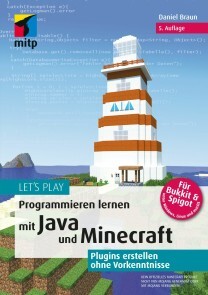
Let‘s Play.Programmieren lernen mit Java und Minecraft
* FÜR BUKKIT UND SPIGOT* ERSCHAFFE DEINE EIGENE WELT: MÄCHTIGE NEUE WAFFEN ERSTELLEN WIE Z.B. EIN FEUERSCHWERT, AUF KNOPFDRUCK TÜRME UND GANZE HÄUSER BAUEN, AUTOMATISCH AUF VERÄNDERUNGEN IN DER WELT REAGIEREN* NEUE CRAFTING-REZEPTE UND EIGENE SPIELMODI ENTWICKELN WIE Z.B. EINE SCHNEEBALLSCHLACHT MIT HIGHSCORE-LISTE* MIT UMFANGREICHER REFERENZ ZU ALLEN PROGRAMMIERBEFEHLENDu spielst schon lange Minecraft und denkst, du hast schon alles gesehen? Kennst du schon das Feuerschwert, den Enderbogen oder den Spielmodus »Schneeballschlacht«? Du willst auf Knopfdruck Türme, Mauern oder sogar ganze Häuser bauen? Vollautomatisch auf Geschehnisse in der Spielwelt reagieren? Mit eigenen Plugins kannst du all das und noch viel mehr entdecken und ganz nebenbei auch noch programmieren lernen.Daniel Braun zeigt dir, wie du mit Java und Bukkit oder Spigot Erweiterungen für Minecraft programmierst, sogenannte Plugins, die du dann zusammen mit deinen Freunden auf deinem eigenen Minecraft-Server ausprobieren kannst. Dafür sind keine Vorkenntnisse erforderlich, du lernst alles von Anfang an.Nach dem Programmieren einfacher Chat-Befehle wirst du coole Plugins zum Bauen erstellen, so dass mit einem einzigen Befehl sofort z.B. ein fertiges Haus oder eine Kugel vor dir steht. Außerdem erfährst du, wie deine Plugins automatisch auf Geschehnisse in der Spielwelt reagieren können.Du kannst auch eigene Crafting-Rezepte entwerfen, um z.B. mächtige neue Waffen zu kreieren wie das Feuerschwert, das alles in Brand setzt, worauf es trifft. Am Ende lernst du sogar, wie du eigene Spielmodi entwickeln kannst, also ein Spiel im Spiel. Ob eine Schneeballschlacht mit Highscore-Liste oder ein Wettsammeln mit Belohnung für den Sieger, hier ist jede Menge Spaß garantiert.Für das alles brauchst du keine Vorkenntnisse, nur Spaß am Programmieren. Es beginnt mit ganz einfachen Beispielen, aber mit jedem Kapitel lernst du mehr Möglichkeiten kennen, um Minecraft nach deinen Wünschen anzupassen. Am Ende kannst du richtig in Java programmieren, um deine eigene Minecraft-Welt zu erschaffen. So sind deiner eigenen Kreativität keine Grenzen mehr gesetzt.AUS DEM INHALT:* Eigenen Minecraft-Server mit Bukkit oder Spigot installieren und einrichten* Eigene Befehle definieren und Chat-Nachrichten versenden* Java-Grundlagen: Variablen, Schleifen, Verzweigungen, Funktionen, Klassen und Objekte* Häuser, Kreise und Kugeln bauen* Schilder errichten und beliebig beschriften* Plugins programmieren, die auf Veränderungen in der Welt reagieren* Eigene Crafting-Rezepte erstellen* Informationen dauerhaft speichern* Eigene Spielmodi entwickeln wie z.B. eine Schneeballschlacht oder ein Sammelspiel* Umfangreiche Referenz zu allen ProgrammierbefehlenDaniel Braun ist seit den ersten Tagen Minecraft-Anhänger und kennt als Profi alle Facetten des Spiels. Er hat bereits mehrere Bücher zu Minecraft geschrieben.

Photoshop Elements 2024 For Dummies
GET IN TOUCH WITH YOUR CREATIVE SIDE USING PHOTOSHOP ELEMENTSPhotoshop Elements 2024 For Dummies covers the newest version of Adobe’s beginner-friendly photo editing software. With the help of this Dummies guide, you’ll discover the ins and outs of Photoshop Elements, so you can transform your images from ordinary to extraordinary. The software is packed with all the photo editing tools you need to turn your images into showstoppers. With the help of the easy-to-understand instructions in this book, you’ll learn how to use the editing tools, utilize layers, make one-click fixes, brighten colors, add filters, and beyond.* Get started with Photoshop Elements and make basic edits in quick mode* Create different views of an image and use the history panel to find the best version of your image* Replace backgrounds, merge photos, and do other neat editing tricks* Understand camera raw to turn your camera’s image data into a stunning photoThis bestselling Dummies guide is the book you need to get started with Elements and learn the insider tips that will give your images that “wow factor.” BARBARA OBERMEIER is the principal of Obermeier Design and is Chair of the Visual Arts Department at California Lutheran University. TED PADOVA is adjunct professor of visual arts and digital photography at Sillman University in Dumaguete, Philippines. The two have combined to author or co-author over 90 books.

Master React in 5 Days
Do you dream of learning React without spending months in endless tutorials? Then this book is for you! In just five days, you will acquire the fundamental skills to start developing exceptional applications using this revolutionary technology. Whether you prefer to follow the book independently or alongside other online resources, it will provide you with a solid foundation to harness the full potential of React.Immerse yourself in an accelerated learning method that will allow you to make giant strides. Chapters are carefully designed to teach you the essential concepts of React, such as components, props, state, events, lifecycle, and hooks, without wasting time on complex explanations. Thanks to a clear and accessible writing style, you'll be able to dive into the intricacies of React from the first page. Code examples are accompanied by detailed explanations, enabling you to quickly grasp the subtleties of this technology. You don't need to be an expert in programming; the book is suitable for all levels, from beginners to more experienced developers looking to get up and running with React.You'll create React applications, reinforcing your understanding and consolidating your skills. You will be amazed at how quickly you progress with this hands-on approach that includes practical exercises to apply what you learn immediately. Don't wait any longer and dive into this exciting adventure right now. Master React in 5 Days will open the doors to a world of endless possibilities in web development.WHAT YOU'LL LEARN* Create React components* Study JavaScript XML (JSX) syntax and handling events* Understand React hooks* Manage lists and states WHO THIS BOOK IS FORProgrammers and web developer students with knowledge of JavaScriptERIC SARRION is a trainer, web developer, and an independent consultant. He has been involved in all kinds of IT projects for over 30 years. He is also a long-time author of web development technologies and is renowned for the clarity of his explanations and examples. He resides in Paris, France.
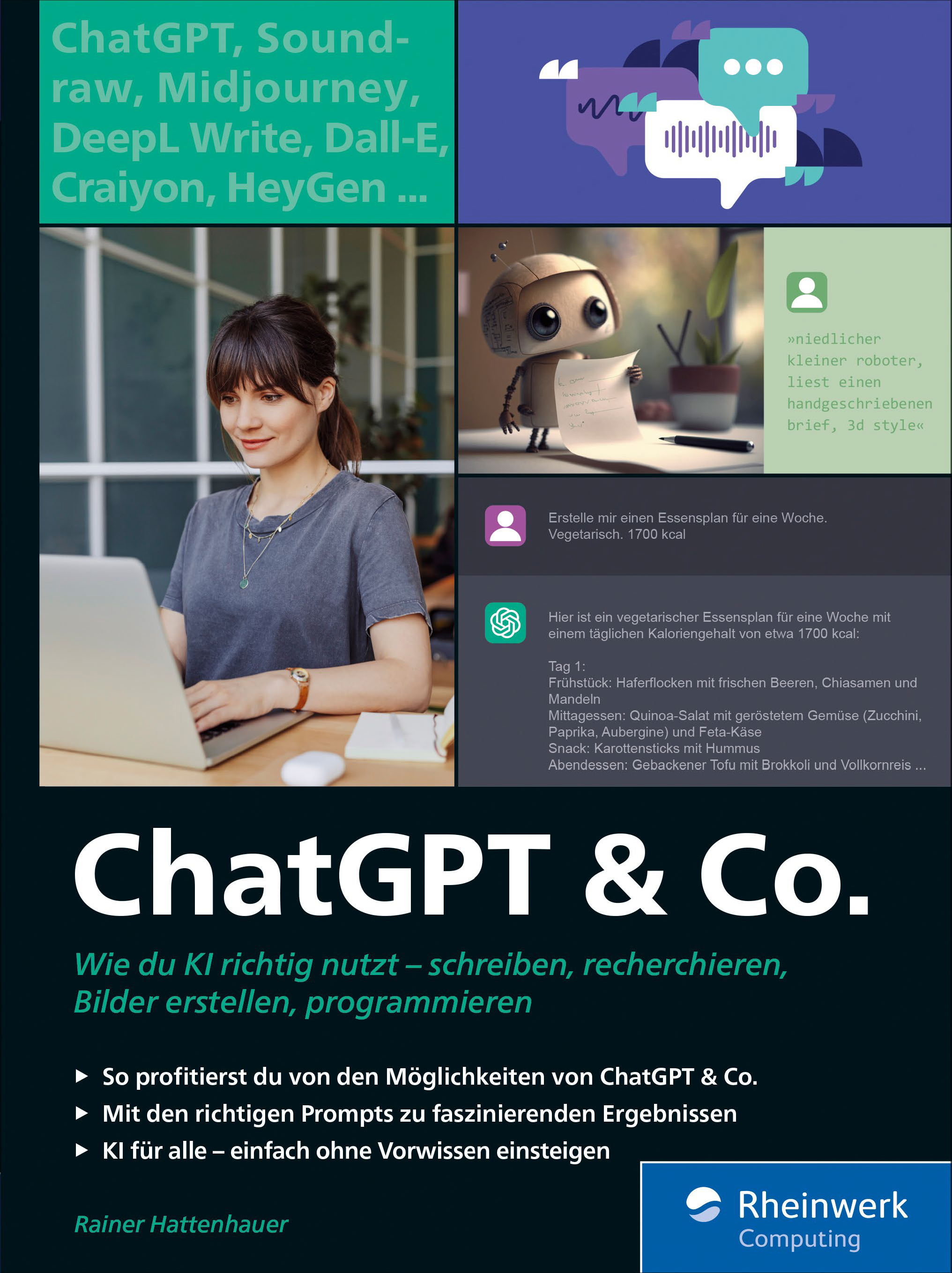
ChatGPT & Co. (Rheinwerk Verlag)
Das einführende Workbook zum Thema KI. Wie du KI richtig nutzt - schreiben, recherchieren, Bilder erstellen, programmieren.Du möchtest wissen, wie du KI richtig nutzt und davon profitieren kannst? Dann wird dir dieses Workbook eine große Hilfe sein. Rainer Hattenhauer zeigt anhand vieler praktischer Beispiele aus den unterschiedlichsten Anwendungsbereichen ganz konkret, wie Künstliche Intelligenz dir das Leben erleichtern kann. Egal, ob du Texte schreiben, recherchieren, Bilder generieren oder deinen eigenen Programmcode erstellen möchtest. Hier kannst du ohne Vorkenntnisse direkt loslegen und die gängigsten KI-Frontends ausprobieren.Lass die KI für dich arbeitenLerne die wichtigsten KI-Tools und ihre Stärken kennen. Eine Vielzahl an praktischen Beispielen zeigen dir, wie du einen konkreten Nutzen aus den neuen Möglichkeiten ziehen kannst. Alle notwendigen Erläuterungen und Informationen werden dir in kurzen Exkursen bereitgestellt.Beste Ergebnisse durch gute PromptsUm von der KI zu profitieren, musst du die richtigen Fragen stellen und klare Anweisungen geben. Du erfährst, was einen guten Prompt ausmacht. So kannst du mit dem KI-Tool richtig recherchieren und sogar eigenen Programmcode erstellen.Alle wichtigen KI-Tools in einem BuchJe nach Einsatzgebiet eignet sich ein bestimmtes KI-Tool. Hier lernst du nicht nur die wichtigsten Chatbots kennen, der Autor zeigt dir hilfreiche Synergieeffekte beim Einsatz unterschiedlicher KI-Systeme. Inklusive ChatGPT, DALL-E, Midjourney, DeepL Write etc.Aus dem Inhalt:KI-Bots – die Kreativitäts-BoosterProduktivität steigern durch KIIntelligente TextverarbeitungKI in Bildung und WissenschaftKunst schaffen mit KINützliche KI im AlltagProgrammiereinstieg mit KITipps und Tricks für FortgeschritteneAusblick: KI und kein Ende?Zum Autor:Rainer Hattenhauer ist promovierter Physiklehrer und unterrichtet zudem Mathematik an einem Internatsgymnasium.Leseprobe (PDF-Link)

Autodesk Revit 2024
* ARCHITEKTURKONSTRUKTIONEN VOM GRUNDRISS BIS ZUM 3D-MODELL UND PLOT* DIE WICHTIGSTEN KONSTRUKTIONS- UND BEARBEITUNGSBEFEHLE MIT ZAHLREICHEN BEISPIELEN* PRAXISNAHES ANWENDUNGSBEISPIEL EINES EINFAMILIENHAUSES VOM KELLER BIS ZUM DACHDieses Grundlagen- und Lehrbuch zeigt Ihnen die typischen Befehle der Architektursoftware Revit 2024 anhand einer vollständigen Beispielkonstruktion sowie einzelner Demonstrationsbeispiele. Der Autor richtet sich insbesondere an Revit-Neulinge, die einen fundierten, praxisnahen Einstieg suchen. Mit dem Buch und einer 30-Tage-Revit-Testversion von der Autodesk-Webseite können Sie sofort beginnen und in Kürze Ihre ersten Grundrisse und Häuser erstellen.Die wichtigsten Vorgehensweisen werden sowohl mit einem vollständigen Projektbeispiel als auch anhand vieler einzelner Detailbeispiele erklärt und geübt. Bei Revit ist es besonders wichtig, die verschiedenen Befehlsoptionen und Bedienelemente über Beispiele kennenzulernen, weil bei deren Anwendung stets die Element-Eigenschaften und Typvorgaben sowie die Einstellungen der Optionsleiste und der Eingabeaufforderungen beachtet werden müssen, was viel praktische Übung erfordert. Am Ende jedes Kapitels finden Sie Testfragen mit dazugehörigen Lösungen im Anhang.Neben der traditionellen Konstruktionsweise für einzelne Stockwerke mit Wänden, Türen, Fenstern, Geschossdecken, Treppen und Dächern wird auch das konzeptionelle Design vorgestellt, bei dem zunächst als Basis die Gebäudeform als Volumenkörper entworfen wird.Schließlich führt ein Beispiel in den Familien-editor ein, der die Erstellung eigener Architekturkomponenten erlaubt.Abschließend wird auch die Vorgehensweise bei der Gebäudetechnik an einem Beispiel aus dem Sanitärbereich gezeigt.AUS DEM INHALT:* Installation und Benutzeroberfläche* Dokumentiertes Beispielprojekt (Download)* Elemente in andere Geschosse kopieren* Bearbeitungsfunktionen zum Ändern und Anpassen* Bemaßung und Beschriftung im Grundriss und im Schnitt* Ausrichtung des Projekts: Gelände, Himmelsrichtung, Höhe* Außen-, Innen-, Detail- und Schnittansichten* Stützen, Träger, Streben sowie Einführung in den Stahlbau* Verschiedene Dachformen* Fotorealistische Darstellungen mit Rendern* Auswertungen mit Raumstempeln und Elementlisten* Wege über Routen-Analyse bestimmen* Ausgabe mehrerer Pläne und Ansichten als PDF* Alternatives konzeptionelles Design* Einführung in den Familieneditor* BIM-Austausch von und zu Inventor* Arbeiten mit Gebäudetechnik-KomponentenZUM DOWNLOAD:Das Beispielprojekt für das Einfamilienhaus steht zum kostenlosen Download zur Verfügung.Detlef Ridder hat bereits zahlreiche Bücher zu AutoCAD, Inventor, Revit und ArchiCAD veröffentlicht und gibt Schulungen zu diesen Programmen und im Bereich CNC.

IT Service Management
Konkrete Hilfestellungen zur effektiven Einführung eines IT Service ManagementsIT-Prozesse etablieren sowie Dienstleistungen messen und auswertenMit vielen praktischen Beispielen und anschaulichen Grafiken Fritz Kleiner zeigt in dieser aktualisierten Neuauflage, wie Sie IT Service Management ganzheitlich in einem Unternehmen einführen und betreiben können. Anhand vieler Praxisbeispiele erfahren Sie, wie Sie IT-Dienstleistungen standardisieren, IT Service Management in der Führungsebene verankern oder Business IT Services bilden. Besondere Schwerpunkte sind dabei u.a. das Etablieren der Prozesse des IT Service Managements wie Service Level Management, Configuration Management oder Requirement Management. Mit diesem Handbuch verstehen Sie das IT Service Management-Konzept von Grund auf und werden es weitgehend erfolgreich selbstständig im Unternehmen etablieren können. +27 Jahre Erfahrung von ITSM inkl. Tool-Einführungen+31 Prozesse/Fähigkeiten der IT+117 Vorlagen und Vorgaben für Lieferobjekte+175 Mögliche Prinzipien für Prozesse Zielgruppe: IT-LeiterIT Service ManagerIT-DienstleistungserbringerIT-Berater IT-FachpersonalInformatik-DozentenInformatik-Studenten Fritz Kleiner ist CEO der Firma Futureways GmbH und hat sich auf die Beratung und Lehre im Bereich des IT Service Managements spezialisiert. Er hat rund 30 Jahre Erfahrung im Bereich der Informatik, die er in zahlreichen nationalen und internationalen Kundenmandaten im Outsourcing, Versicherungs-, Banken-, Pharma- und Verwaltungs-Umfeld als Managing Senior Consultant und Principal erwarb.

iPhone und iPad - Alle Einstellungen & Funktionen - Mit Schritt-für-Schritt-Anleitungen für alle Innovationen und Tricks
Die besten Funktionen entdecken und nutzen Smartphones und Tablets haben mittlerweile in zahlreichen Haushalten den klassischen Computer oder den Laptop weitgehend ersetzt. Im Arbeitsleben spielen sie ebenfalls eine immer bedeutendere Rolle. Auch wenn es am Markt ähnlich leistungsfähige Geräte gibt, gehören das iPad und das iPhone nach wie vor zu den beliebtesten. Egal ob Apple-Einsteiger oder -Umsteiger: Dieser Ratgeber erklärt Ihnen Schritt für Schritt Ihr neues iPhone und iPad – von den Grundfunktionen für jeden Tag über sichere, nützliche Apps bis zu den spannendsten Funktionen des neuen Betriebssystems iOS 17 und iPadOS 17. Einrichten und bedienen Bevor Sie Ihr neues iPhone oder iPad verwenden, müssen Sie es aktivieren und einrichten. Übertragen Sie Ihre Daten und Kontakte sicher auf Ihr neues iPhone und lernen Sie alles über Kurzbefehle und Sprachbedienung mit Siri. Auch die Anwendung grundlegender Apps und die Konfiguration des Bildschirms werden mit diesem Ratgeber zu einer Leichtigkeit. Praktische Apps für Navigation, Videotelefonie, Podcasts, Fitness sowie Apps von Drittanbietern warten darauf, von Ihnen entdeckt zu werden. Dank zahlreicher Screenshots, Abbildungen und Schritt-für-Schritt-Anleitungen gelingt das Einrichten Ihres iPhones oder iPads mühelos. - Konto einrichten: Steigen Sie reibungslos auf Ihr neues iPhone oder iPad um oder richten Sie es erstmalig ein - Apps entdecken: Finden und nutzen Sie praktische Apps für Navigation, Videotelefonie, Podcasts, Fitness und mehr - Kamera und Bildbearbeitung nutzen: Holen Sie das Beste aus Ihren Fotos heraus und sichern Sie sie per Backup - Sicher sein: Schützen Sie Ihre Daten, Medien und Zugänge. Dr. Uwe Albrecht ist freiberuflicher Journalist und Autor. Als Verfasser zahlreicher Werke zum Thema Mac, iPhone und iPad kennt und nutzt er die meisten Apple-Produkte. Im Buchprogramm der Stiftung Warentest sind von ihm bereits die Ratgeber iPhone und iPad, Apple Watch sowie Alexa und Amazon Echo erschienen.

AVR-Mikrocontroller
Dieses Buch bietet einen eingehenden Blick auf die 8-Bit-AVR-Architektur in ATtiny- und ATmega-Mikrocontrollern, hauptsächlich aus der Sicht der Software und der Programmierung. Erforschen Sie die AVR-Architektur unter Verwendung von C und Assembler in Microchip Studio (früher Atmel Studio) mit ATtiny-Mikrocontrollern.> Lernen Sie die Details der internen Funktionsweise von AVR-Mikrocontrollern kennen, einschließlich der internen Register und des Speicherplans von ATtiny-Bausteinen.> Programmieren Sie ATtiny-Mikrocontroller mit einem Atmel-ICEProgrammiergerät/ Debugger oder verwenden Sie ein preiswertes Hobby-Programmiergerät oder sogar einen Arduino Uno als Programmiergerät.> Die meisten Code-Beispiele können mit dem Microchip Studio AVR-Simulator ausgeführt werden.> Lernen Sie, Programme für ATtiny-Mikrocontroller in Assembler zu schreiben.> Erfahren Sie, wie Assemblersprache in Maschinencodebefehle umgewandelt wird.> Finden Sie heraus, wie Programme, die in der Programmiersprache C geschrieben wurden, in Assemblersprache und schließlich in Maschinencode umgewandelt werden.> Verwenden Sie den Microchip Studio Debugger in Kombination mit einem Hardware-USB-Programmierer/Debugger, um Assemblerund C-Programme zu testen oder verwenden Sie den Microchip Studio AVR-Simulator.> ATtiny-Mikrocontroller im DIP-Gehäuse werden verwendet, um eine einfache Nutzung auf Breadboards zu ermöglichen.> Erfahren Sie mehr über Timing und Taktimpuls in AVR-Mikrocontrollern mit ATtiny-Bausteinen.> Werden Sie zu einem AVR-Experten mit fortgeschrittenen Debugging- und Programmierfähigkeiten.Warwick A. Smith ist ein Elektronikingenieur und Embedded-Programmierer aus Südafrika mit Erfahrung in der Industrie, im Handel und in der Luft- und Raumfahrttechnik. Warwick hat großes Interesse an verschiedenen Technologiethemen, darunter Hardware für eingebettete Systeme, Software und Informationstechnologie.

Programmieren lernen mit Kotlin
Programmieren lernen mit Kotlin. Grundlagen, Objektorientierung und fortgeschrittene Konzepte. 2., aktualisierte Auflage, Oktober 2023.Fundierter Einstieg in die objektorientierte Programmierung mit Kotlin:Zahlreiche Praxisbeispiele, Erklärbilder und anschauliche AlltagsmetaphernDurchstarten ohne Vorkenntnisse und eigene Apps entwickelnVermittelt Hintergrundwissen und wie man guten Code gestaltetQuellcode und Zusatzmaterial unter plus.hanser-fachbuch.deIhr exklusiver Vorteil: E-Book inside beim Kauf des gedruckten BuchesSteigen Sie ein in die funktionale und objektorientierte Programmierung mit Kotlin. Das Buch richtet sich an Studierende und Quereinsteiger, die erstmalig eine Programmiersprache lernen. Kotlin eignet sich sehr gut als Anfängersprache: Erste Erfolge werden schnell erzielt und der Code ist kurz, präzise, leicht verständlich und robust. Gleichzeitig erlaubt Kotlin die professionelle Entwicklung und die Umsetzung umfangreicher Software-Architekturen.Das Buch erklärt anschaulich die Grundlagen des Programmierens, z. B. Variablen, Ausdrücke, Kontrollstrukturen und Funktionen. Objektorientierte Konzepte wie Abstraktion, Vererbung, Polymorphie, Kapselung und Komposition werden anhand von praktischen Beispielen eingeführt. In den vertiefenden Abschnitten lernen Sie Android-Apps umzusetzen, Algorithmen und Datenstrukturen selber zu implementieren, z. B. verkettete Listen, und das Entwickeln mit Coroutinen. Anhand eines durchgehenden Beispiels entwickeln Sie ein Simulationsspiel für Android. Prof . Dr. Christian Kohls beschäftigt sich seit vielen Jahren mit den Einsatzmöglichkeiten interaktiver Whiteboards und hat sein Praxiswissen in diesem Handbuch zusammengetragen. Eingeflossen sind dabei sowohl seine Erfahrungen als Anwender als auch die wissenschaftliche Auseinandersetzung mit den pädagogisch-didaktischen Vorteilen dieser Systeme. Er lehrt an der TH Köln.Alexander Dobrynin (M.Sc.) lehrt an der TH Köln in den Bereichen Programmierung, Entwurfsmuster und App-Design. Er hat frühzeitig auf Kotlin als Einstiegssprache gesetzt, damit Studierende produktiver und eleganter Software entwickeln.
Programmieren trainieren (3. Auflg.)
Programmieren trainieren. Mit über 150 Workout in Java und Python. 3. Auflage, Oktober 2023.Der Programmier-Trainingsplan für alle, die weiter kommen wollen.In diesem Übungsbuch trainierst du anhand von kurzweiligen und praxisnahen Aufgaben deine Programmierfähigkeiten. Jedes Kapitel beginnt mit einem kurzen Warmup zum behandelten Programmierkonzept; die Umsetzung übst du dann anhand von zahlreichen Workout-Aufgaben. Du startest mit einfachen Aufgaben und steigerst dich hin zu komplexeren Fragestellungen. Damit dir nicht langweilig wird, gibt es über 150 praxisnahe Übungen. So lernst du z. B. einen BMI-Rechner oder einen PIN-Generator zu programmieren oder wie du eine Zeitangabe mit einer analogen Uhr anzeigen kannst.Solltest du mal nicht selbstständig vorankommen, dann werden dir in jedem Workout Lösungshinweise als Hilfestellung angeboten. Die kommentierten Lösungen liegen für Dich in den Programmiersprachen Java und Python in GitHub oder auf der Hanser-Plus-Seite zum Download bereit. Für ein möglichst ballastfreies Training wird für die elementaren Programmierkonzepte die Entwicklungsumgebung Processing eingesetzt. Für fortgeschrittenere Anwender wird auch der Einsatz von Eclipse und PyCharm gezeigt. Die Installation und Verwendung der Tools ist im Buch beschrieben.Ihr exklusiver Vorteil: E-Book inside beim Kauf des gedruckten Buches Prof. Dr. Luigi Lo Iacono ist lehrt und forscht am Fachbereich Informatik der Hochschule Bonn-Rhein-Sieg und leitet dort das Institut für Cyber Security & Privacy. Seine Forschungs- und Entwicklungsinteressen liegen im Bereich sicherer verteilter Softwaresysteme.Dr. Stephan Wiefling forscht am Institut für Cyber Security & Privacy der Hochschule Bonn-Rhein-Sieg. Seine Expertise hat er bereits in mehrere der 500 weltweit größten Unternehmen eingebracht.Michael Schneider ist Softwarearchitekt hochflexibler und komplexer Softwaresysteme für die Fondsindustrie in Frankfurt/Main und zertifizierter Enterprise Application Developer für das .NET-Framework.Leseprobe (PDF-Link)
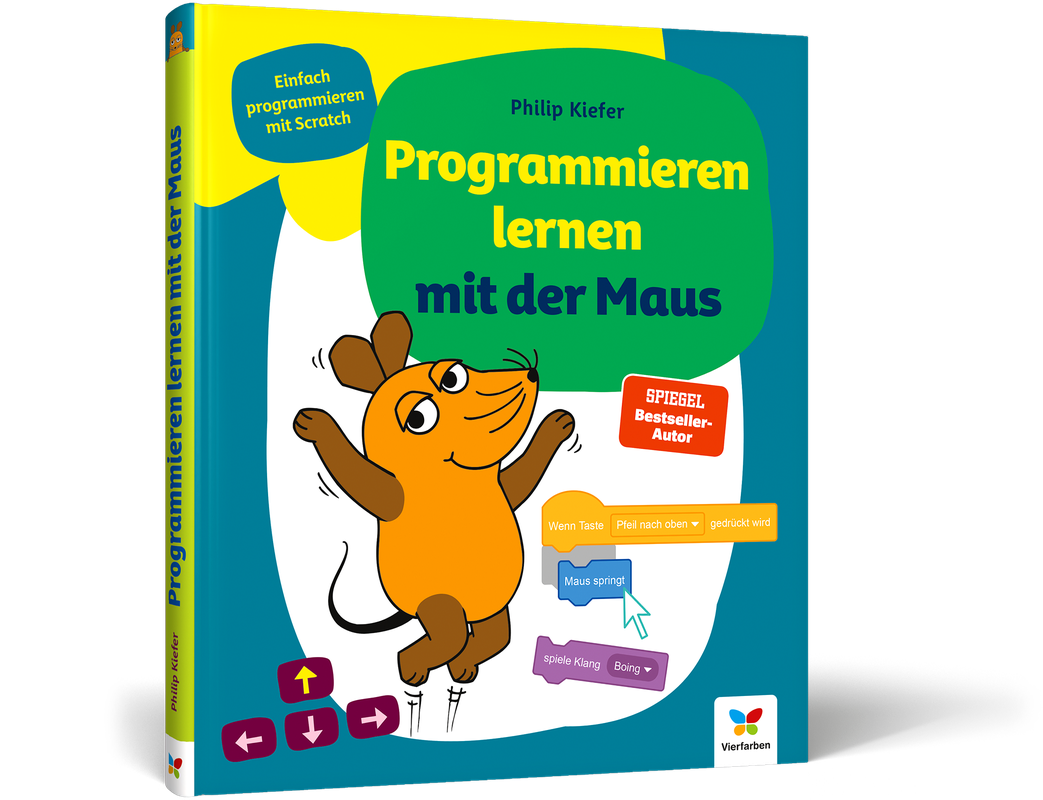
Programmieren lernen mit der Maus (2. Auflg.)
Einfach programmieren mit Scratch! In komplett aktualisierter 2. Auflage aus Oktober 2023.Programmieren lernen und Spaß haben? Geht das überhaupt? Klar! Mit der Maus und der Programmiersprache Scratch. Lass' Figuren einfach laufen, hüpfen und Geräusche machen. Zieh' ihnen Kostüme an und drehe deinen eigenen Zeichentrickfilm. Scratch wurde extra für Kinder entwickelt und ist spielend leicht zu lernen. Du kannst sofort loslegen, im Internet oder lokal auf deinem Computer. Dabei lernst du die ersten Grundlagen, die ein echter Programmierer kennen muss. Viele aufregende Projekte warten auf dich – natürlich mit Deinem Lieblingsstar, der Maus!Dein kinderleichter Start in die Programmierung:Lerne Scratch kennen, die Sprache für deinen ProgrammiereinstiegWichtige Tasten und Wörter – damit du wie eine echter Programmierer redestLass die Katze sprechen: dein erstes Programm mit ScratchHier kommt die Maus: bring eine zweite Figur ins SpielDank Schleifen: deinen ersten abendfüllenden Zeichentrickfilm drehenMit Operatoren einen cleveren Rechentrainer programmierenTolle Funktionen für FortgeschritteneLeseprobe (PDF-Link)Zum Autor:Philip Kiefer zählt zu den bekanntesten Computer-Fachbuchautoren in Deutschland. Doch nicht nur Erwachsene profitieren von seiner Kunst, komplexe Sachverhalte anschaulich und verständlich darzustellen.
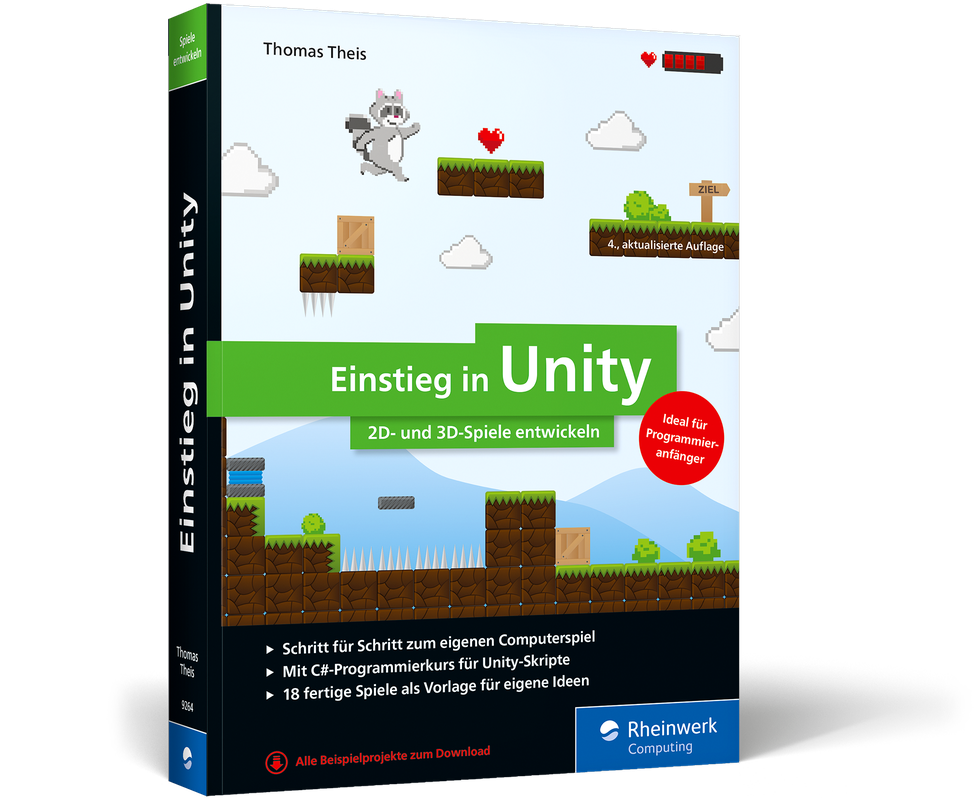
Einstieg in Unity (4. Auflage)
Einstieg in Unity - 2D- und 3D-Spiele entwickeln. 4. aktualisierte Auflage, 2023. Eigene Spiele entwickeln – mit diesem Buch und der genialen Game Engine Unity ist das kein Problem! Von der ersten Scene bis zum komplexen Multiplayer-Spiel zeigt Ihnen Erfolgsautor Thomas Theis, wie es geht. Sie brauchen keine Vorkenntnisse mitzubringen: Dank dem integrierten C#-Programmierkurs lernen Sie alle Objekte und Befehle direkt so kennen, wie Sie in Unity-Skripten aussehen. Ob es um Zusammenstöße, Flugkurven, Explosionen oder die richtige Perspektive geht: Lernen Sie mit 2D- und 3D-Spielen, wie Sie die mächtigen Werkzeuge nutzen und Ihre eigenen Ideen umsetzen.Aus dem Inhalt Unity installierenProjekte, Scenes und Assets verwaltenFlummi oder Stahlkugel? Objekteigenschaften festlegenFertige Bausteine entdecken und einsetzenSkripte schreiben und gut strukturierenSound und Animation hinzufügenMit Kameras und Perspektiven umgehenJump&Run, Breakout, Multiplayer, Shooter, Geschicklichkeitsspiel, Gedächtnistraining, Rennen, Adventure u. v. m.Leseprobe (PDF-Link)

QuickBooks Online For Dummies
LEARN THE WORLD’S MOST POPULAR CLOUD ACCOUNTING PLATFORMQuickBooks Online For Dummies, 2024 Edition, helps you benefit from fast and easy mobile accounting. This beginner-friendly guide covers the key features of QuickBooks Online, including selecting the subscription version that’s right for you and your business -- Simple Start, Plus, or Advanced. From there, you’ll find everything you need to get started creating invoices and credit memos, recording and paying bills, setting up inventory items, processing payroll and preparing payroll tax returns, balancing accounts, and beyond. You’ll discover how to access your accounts from any device, anywhere—and how to keep your data safe and backed up. For a world on the go, QuickBooks Online makes it easy to keep solid books and be prepared at tax time. With the clear how-tos in this book, you’ll be up and running in no time.* Get started with QuickBooks Online and set up your accounts* Manage customers, inventory, purchases, payroll, and billing—from anywhere* Generate financial reports and simplify your taxes* Discover new features and tips in the latest version of the cloud softwareFor small business owners, managers, and employees responsible for business accounting, QuickBooks Online For Dummies helps you make the most of the go-to platform for fluid accounting access. DAVID H. RINGSTROM, CPA, is president of Accounting Advisors, Inc. David is the author or co-author of six books and has consulted on accounting software and spreadsheets for more than 30 years. He began writing freelance articles about spreadsheets in 1995 and has served as the technical editor for more than three dozen books in the For Dummies series. Introduction 1PART 1: CORE FUNCTIONALITY 7Chapter 1: Getting Started with QuickBooks 9Chapter 2: Recording Sales and Accounts Receivable 31Chapter 3: Posting Expenses, Checks, and Credit Card Charges 67Chapter 4: Paying Employees and Contractors 85Chapter 5: Carrying Out Banking and Account Reconciliations 103Chapter 6: Utilizing QuickBooks Reports 125Chapter 7: Employing Apps and Automation 145PART 2: QUICKBOOKS ONLINE ESSENTIALS FEATURES 163Chapter 8: Managing Bills, Accounts Payable, and Multicurrency 165Chapter 9: Creating Bundles, Managing Users, and Tracking Time 185PART 3: QUICKBOOKS ONLINE PLUS FEATURES 201Chapter 10: Tracking Inventory and Purchase Orders 203Chapter 11: Utilizing Classes, Locations, and Projects 221Chapter 12: Creating Budgets 233PART 4: QUICKBOOKS ONLINE ADVANCED FEATURES 243Chapter 13: Desktop App, Backups, and Customizable Security 245Chapter 14: Custom Reports and Charts 259Chapter 15: Tasks, Workflows, and Other Advanced Features 269Chapter 16: Spreadsheet Sync 291PART 5: QUICKBOOKS ONLINE ACCOUNTANT FEATURES 313Chapter 17: Client and Team Management 315Chapter 18: Accountant Tools and Pages 329Chapter 19: Practice Management 349PART 6: MICROSOFT EXCEL ANALYSIS 363Chapter 20: Analyzing QuickBooks Data in Excel 365Chapter 21: Automating QuickBooks Analysis with Power Query 385

Core Data Services für ABAP
Welche Rolle spielt das virtuelle Datenmodell von SAP S/4HANA für Sie in der Entwicklung? In diesem Buch erfahren Sie, wie Sie CDS-Views anlegen und in analytischen oder transaktionalen ABAP-Anwendungen verwenden. Von der Syntax über Annotationen bis hin zu Zugriffskontrollen lernen Sie alles, was Sie für die Datenmodellierung mit Core Data Services wissen müssen. Die 3. Auflage dieses Bestsellers wurde vollständig aktualisiert und an die Neuerungen des Release 2023 angepasst. Aus dem Inhalt: CDS und SAP HANACDS-Syntax und -SprachelementeABAP Editor in EclipseHierarchienAnnotationenAssoziationenSuchfunktionenABAP-Managed Database ProceduresAnalytische QueriesZugriffskontrollenTestautomatisierung für CDS-ViewsProblembehandlungen Einleitung ... 17 1. Schritt für Schritt zu Ihren ersten CDS-Views ... 23 1.1 ... Datenmodell der Anwendung definieren ... 24 1.2 ... Datenmodell der Anwendung implementieren ... 27 2. Grundlagen der CDS-Datenmodellierung ... 59 2.1 ... Überblick über die CDS-Modelle ... 60 2.2 ... Überblick über die CDS-View-Syntax ... 65 2.3 ... Schlüsselfelder ... 68 2.4 ... Cast-Anweisungen ... 70 2.5 ... Typisierte Literale ... 72 2.6 ... CDS-Simple-Types ... 74 2.7 ... Case-Anweisungen ... 76 2.8 ... CDS-Sitzungsvariablen ... 78 2.9 ... Mandantenbehandlung ... 79 2.10 ... Select-Distinct-Anweisungen ... 81 2.11 ... Union-Views ... 82 2.12 ... Intersect- und Except-Anweisungen ... 89 2.13 ... Join-Verknüpfungen ... 91 2.14 ... SQL-Aggregationsfunktionen ... 97 2.15 ... Projektionsfelder ... 100 2.16 ... Parameter ... 102 2.17 ... Referenzfelder ... 108 2.18 ... Konvertierungsfunktionen für Währungen und Mengeneinheiten ... 110 2.19 ... CDS-Provider-Kontrakte ... 114 2.20 ... Entitätspufferdefinitionen ... 116 3. CDS-Assoziationen ... 119 3.1 ... Assoziationsdefinitionen ... 120 3.2 ... Exponierung von Assoziationen ... 123 3.3 ... Modellierung von Kompositionsbeziehungen ... 124 3.4 ... Modellierung von m:n-Beziehungen ... 127 3.5 ... Projizierte Assoziationen ... 130 3.6 ... Verwendung von Assoziationen in CDS-Views ... 131 3.7 ... Verwendung von Assoziationen in ABAPImplementierungen ... 143 4. CDS-Annotationen ... 145 4.1 ... Annotationsdefinitionen ... 146 4.2 ... Auswirkungen der Annotationen ... 159 4.3 ... Propagationslogik für Annotationen ... 161 4.4 ... CDS-Metadatenerweiterungen ... 172 4.5 ... Aktive Annotationen ... 176 5. CDS-Zugriffskontrollen ... 179 5.1 ... Grundlagen der CDS-Zugriffskontrollen ... 180 5.2 ... Wirkungsweise der CDS-Zugriffskontrollen ... 185 5.3 ... Implementierungsmuster für CDS-Zugriffskontrollen ... 190 5.4 ... CDS-Zugriffskontrollen testen ... 230 6. Business-Services ... 235 6.1 ... Projektions-Views definieren ... 236 6.2 ... Servicedefinitionen erstellen ... 241 6.3 ... Service-Bindings festlegen ... 247 6.4 ... Business-Services testen ... 257 7. Native SAP-HANA-Funktionen in CDS ... 261 7.1 ... Implementierung einer CDS-Tabellenfunktion ... 262 7.2 ... Anwendungsszenarien ... 271 7.3 ... Performance verbessern und Fehler vermeiden ... 272 8. CDS-Modelle für Anwendungsdaten ... 275 8.1 ... Anwendungsarchitektur in SAP S/4HANA ... 276 8.2 ... Feldbezeichner ... 280 8.3 ... Semantik von Feldern ... 284 8.4 ... Fremdschlüsselbeziehungen ... 291 8.5 ... Textbeziehungen ... 297 8.6 ... Kompositionsbeziehungen ... 299 8.7 ... Zeitabhängige Daten ... 302 9. Das virtuelle Datenmodell von SAP S/4HANA ... 305 9.1 ... Warum ein virtuelles Datenmodell? ... 307 9.2 ... SAP-Objekttypen und SAP-Objektknotentypen ... 308 9.3 ... Kategorien von CDS-Entitäten im VDM ... 311 9.4 ... Namensgebung im virtuellen Datenmodell ... 318 9.5 ... Der Basic-Interface-View für den Kundenauftrag ... 321 9.6 ... Tipps zum Finden von VDM-Views ... 329 10. Modellierung analytischer Anwendungen ... 337 10.1 ... Analysen in SAP S/4HANA ... 338 10.2 ... Analytische Views ... 339 10.3 ... Analytische Queries ... 361 10.4 ... Analytische Infrastruktur ... 395 11. Modellierung transaktionaler Anwendungen ... 399 11.1 ... Transaktionale Anwendungen ... 400 11.2 ... Transaktionale Infrastruktur in SAP S/4HANA ... 402 11.3 ... Transaktionale Objektmodelle ... 405 11.4 ... Verhaltensdefinitionen ... 411 11.5 ... Transaktionale Projektionsobjektmodelle ... 517 11.6 ... Interface-Verhaltensdefinitionen ... 528 11.7 ... Projektionsverhaltensdefinitionen ... 536 11.8 ... Laufzeitorchestrierung ... 545 11.9 ... SAP Fiori und Verwendung über OData ... 551 11.10 ... SAP Event Mesh und lokale Event-Handler ... 564 12. Hierarchien in CDS ... 569 12.1 ... Grundbegriffe und Typen von Hierarchien ... 570 12.2 ... Annotationsbasierte Vater-Kind-Hierarchien ... 572 12.3 ... CDS-Hierarchien ... 581 13. CDS-basierte Suchfunktionen ... 605 13.1 ... Wertehilfen ... 606 13.2 ... Freitext-Suchfunktionen in OData-Services ... 629 13.3 ... Enterprise-Search-Funktion ... 637 14. Lebenszyklus und Stabilität von Core Data Services ... 643 14.1 ... Stabilitätskontrakte ... 644 14.2 ... Lebenszyklus von Entwicklungsobjekten ... 649 14.3 ... Abkündigung von Entwicklungsobjekten ... 651 14.4 ... Verwendung von CDS-Modellen und unterstützte Funktionen ... 654 15. Erweiterungen von CDS-Views und weiteren Entitäten ... 659 15.1 ... Produkte und Sprachversionen ... 660 15.2 ... Stabile CDS-Erweiterungen ... 662 15.3 ... Erweiterungen von transaktionalen Modellen ... 677 16. Testautomatisierung ... 693 16.1 ... Selektionslogik der Anwendungen testen ... 694 16.2 ... Transaktionale Applikationslogik testen ... 721 17. Problembehandlung ... 735 17.1 ... Performance-Aspekte ... 736 17.2 ... Mögliche Fallstricke ... 753 17.3 ... CDS-Implementierungsprobleme behandeln ... 765 17.4 ... CDS-Aktivierungsprobleme behandeln ... 774 17.5 ... Anwendungen des ABAP RESTful Application Programming Model analysieren ... 779 Anhang ... 783 A ... CDS-Annotationsreferenz ... 783 B ... Migration vom ABAP Programming Model for SAP Fiori zum ABAP RESTful Application Programming Model ... 797 Die Autoren ... 805 Index ... 807

Power Apps und Power Automate
Die richtigen Werkzeuge machen die Anwendungsentwicklung einfacher und treiben die Digitalisierung Ihrer Prozesse voran. Mit Power Apps und Power Automate erstellen Sie dazu Apps, die Ihren Arbeitsalltag erleichtern und Abläufe vereinfachen. Microsoft-MVP Stefan Riedel zeigt Ihnen in diesem Handbuch die Möglichkeiten der Power Platform. Von den ersten Schritten der Planung bis zur Umsetzung im PowerApps Studio begleitet er Sie auf dem Weg zur fertigen Anwendung. Aus dem Inhalt: Digitalisierung mit der Power PlatformDie Power Platform im ÜberblickGrundlagen für Power AppsLizenzierungCanvas Apps erstellenShare Point anbindenDataVerse for TeamsSharePoint-Formulare erstellenPower Automate FlowUmgebungsstrategien und Adoption Materialien zum Buch ... 17 1. Digitalisierung mit der Power Platform ... 19 1.1 ... Der Low-Code-Ansatz ... 20 1.2 ... Aufgabenbereiche: Wer ist wofür zuständig? ... 25 1.3 ... Geschichten aus dem Projektalltag ... 27 1.4 ... Von der Idee zur App ... 37 2. Die Power Platform im Überblick ... 45 2.1 ... Die Power Platform vorgestellt ... 45 2.2 ... Die wichtigsten Begriffe neben Apps und Flows ... 54 2.3 ... Power Apps und Power Automate im mobilen Einsatz ... 60 2.4 ... Lizenzierung der Power Platform ... 66 3. Grundlagen für die Power-Apps-Entwicklung ... 81 3.1 ... Einrichtung einer Entwicklungsumgebung ... 81 3.2 ... Das Power Apps Maker Portal ... 86 3.3 ... Canvas Apps erstellen ... 90 3.4 ... Konnektoren integrieren ... 111 3.5 ... Apps verwalten ... 117 3.6 ... Wechseln der Umgebung ... 136 3.7 ... Einstellungen ... 136 3.8 ... Hilfe ... 142 4. Die ersten Schritte mit dem Power Apps Studio ... 143 4.1 ... Aufbau des Power Apps Studios ... 143 4.2 ... Einstellungen ... 180 5. Apps entwickeln ... 189 5.1 ... Power Fx: Programmierung in Power Apps ... 189 5.2 ... Gestaltungselemente einer Canvas App ... 245 5.3 ... Komponenten ... 336 5.4 ... Fehlerbehandlung ... 357 5.5 ... Benannte Formeln (Named Formulas) ... 364 5.6 ... Das App-Objekt und der Lebenszyklus einer App ... 366 5.7 ... Sensorik ... 373 5.8 ... Offline-Betrieb ... 375 5.9 ... Programmierrichtlinien ... 380 5.10 ... Ausgewählte einfache Anwendungsfälle ... 384 6. Erweiterte Tools ... 397 6.1 ... Power Apps Test Studio ... 397 6.2 ... Power Apps Monitor ... 408 7. Eine App für Dataverse for Teams entwickeln ... 421 7.1 ... Die Power Apps App einrichten ... 421 7.2 ... Der Startbereich ... 422 7.3 ... Eine App erstellen ... 423 7.4 ... Datenstruktur aufbauen ... 427 7.5 ... Beziehungen ... 430 7.6 ... App-Verwaltung ... 431 7.7 ... Berechtigungen ... 433 7.8 ... Die App teilen ... 435 7.9 ... Limitierungen ... 436 8. SharePoint-Formulare mit Power Apps designen ... 437 8.1 ... Voraussetzungen und Einschränkungen ... 438 8.2 ... Architekturentscheidung ... 439 8.3 ... Die Vorbereitung ... 440 8.4 ... Die Entwicklungsumgebung ... 441 8.5 ... Aufbau einer SharePoint-Formular-App ... 443 8.6 ... Das Formular veröffentlichen ... 449 8.7 ... SharePoint-Formular wiederherstellen ... 450 8.8 ... Formular-App verwalten ... 451 9. Power Automate Cloud-Flows verwalten ... 455 9.1 ... Das Maker Portal der Cloud-Flows ... 455 9.2 ... Grundlegende Architektur ... 457 9.3 ... Der Flow-Designer ... 461 9.4 ... Einen Flow auf Basis einer Vorlage erstellen ... 475 9.5 ... Einsatz der KI: Einen Flow beschreiben und entwerfen lassen ... 476 9.6 ... Flows verwalten ... 479 9.7 ... Genehmigungen ... 489 9.8 ... Benachrichtigungen und Monitoring ... 494 9.9 ... Einstellungen ... 496 10. Die ersten Schritte mit Power Automate Cloud-Flows ... 497 10.1 ... Aufbau eines Flows ... 497 10.2 ... Trigger konfigurieren ... 519 10.3 ... Programmieren mit Flows ... 550 10.4 ... Fehlerbehandlung (Debugging) ... 595 10.5 ... Erweiterte Einstellungen von Triggern ... 607 10.6 ... Erweiterte Einstellungen von Aktionen ... 613 11. Ausgewählte Konnektoren in Cloud-Flows ... 617 11.1 ... Datenvorgang ... 617 11.2 ... Datum und Uhrzeit ... 625 11.3 ... Der SharePoint-Konnektor (OneDrive) ... 629 11.4 ... Der Outlook-Konnektor ... 648 11.5 ... Der Teams-Konnektor ... 659 11.6 ... Genehmigungen (Approvals) ... 673 11.7 ... Flows aufrufen ... 680 12. Anwendungsbeispiele aus dem Projektalltag ... 687 12.1 ... Wer bin ich? Der Office 365-Benutzer-Konnektor ... 687 12.2 ... In welcher Gruppe bin ich? Der Office 365-Gruppen-Konnektor ... 695 12.3 ... Reiterleiste ... 700 12.4 ... Buchstabenfilter ... 703 12.5 ... Tabellen-Kopfzeile ... 707 12.6 ... Suche ... 709 12.7 ... Deeplinks in Ihrer Power App ... 711 12.8 ... Dateien hochladen ... 715 12.9 ... Dokumentenerstellung ... 719 13. Umgebungen ... 745 13.1 ... Was sind Umgebungen ... 745 13.2 ... Umgebungsarten ... 746 13.3 ... Verwaltungsoberfläche für Umgebungen: das Power Platform Admin Center ... 747 13.4 ... Zugriff und Rollen ... 748 13.5 ... Verwaltung von Umgebungen ... 750 13.6 ... Richtlinien gegen Datenverlust ... 753 14. Lösungen ... 757 14.1 ... Apps als Lösungen verteilen ... 757 14.2 ... Lösung erstellen ... 761 14.3 ... Lösungen verteilen ... 764 15. Community ... 775 15.1 ... Was sind Microsoft MVPs? ... 776 15.2 ... Wie organisiert sich die Community? ... 777 15.3 ... Wie werde ich Mitglied der Community? ... 777 15.4 ... Meetups, Online-Communities, Projekte und Hashtags ... 777 Index ... 781

Texten können
Erfahren Sie, mit welchen Textstrategien Sie den Kunden oder Besucher im Content-Zeitalter begeistern und sanft zum Kauf führen. Wie Sie den Texten Charakter verleihen und Sie Ihren Leser mit Ihrem Schreibstil bei der Stange halten. Mit praktischen Übungen und Checklisten, um das Gelernte gleich praktisch anzuwenden. Und mit genauen Schreibanleitungen für alle wichtigen Elemente und Texte im Online- und Content-Marketing, damit Sie gleich loslegen können. Mit dem neuen Texten Aus dem Inhalt: Leser verstehenTextformeln: Überzeugen mit SystemStorytellingCredibility schaffenUnverwechselbarkeit schaffenGuter SchreibstilUnterstützung beim Texten durch ChatGPT und Co.TextkonzeptionTexte redigierenSchreibanleitungen für TextbausteineSchreibanleitungen für Website-Texte wie Landingpages, Blogbeiträge, Anzeigen, E-Mails, Feed Posts auf Facebook, Twitter, Instagram und mehr Vorwort ... 19 TEIL I. Überzeugen ohne Verkäufermasche ... 21 1. Das neue Texten: warum gute Texte für modernes Marketing unverzichtbar sind ... 23 1.1 ... Content machen heißt Texte schreiben ... 24 1.2 ... Warum Marketing-Blabla nicht mehr wirkt ... 25 1.3 ... Alles Content -- oder brauchen wir noch Copywriting? ... 27 1.4 ... Egotrip zu Ende -- Empathie ist gefragt ... 28 1.5 ... Die Seriositätsfalle -- raus aus dem Einheitsbrei ... 29 1.6 ... Die drei Komponenten für wirksame Texte ... 30 1.7 ... Texten lernen ... 32 1.8 ... Der KI-Elefant im Raum ... 33 1.9 ... Welcher Typ Copywriter sind Sie? ... 36 2. Verstehen, was die Leserschaft motiviert ... 43 2.1 ... Emotionale Benefits -- damit der Text Leserinnen und Leser etwas angeht ... 44 2.2 ... Feature -- Ergebnis -- Benefit: Fakten mit Wünschen verknüpfen ... 46 2.3 ... Benefits subtil vermitteln ... 49 3. Textformeln -- überzeugen mit System ... 55 3.1 ... Die Textformel BELA ... 58 3.2 ... AIDA ... 72 3.3 ... Schmerz, Qual, Medizin -- die schnelle Textformel SQM ... 77 3.4 ... Die PASTOR-Formel ... 80 3.5 ... Die QUEST-Formel ... 84 3.6 ... Die 4P-Formel ... 90 3.7 ... Die supersimple 5-Punkte-Formel ... 92 3.8 ... Übungen zu Textformeln ... 93 4. Storytelling als Würze -- Argumente mit Ministorys untermauern ... 95 4.1 ... Die Parallele -- finden Sie die Verbindung ... 100 4.2 ... Die Anekdote -- ein Schwank aus Ihrem Leben ... 103 4.3 ... Die Action-Szene -- werfen Sie Leute mitten rein ... 105 4.4 ... Der Dialog -- bleiben Sie nah am Menschen ... 107 4.5 ... Die Parabel -- beweisen Sie Ihr Argument in einer perfekten Welt ... 109 4.6 ... Die Beichte -- teilen Sie ein Geheimnis ... 111 4.7 ... Übungen zu Ministorys ... 114 5. Psychologie des Textens -- einnehmen, überzeugen und bestärken ... 115 5.1 ... Schreibtechniken, die einnehmen ... 116 5.2 ... Schreibtechniken, die überzeugen ... 119 5.3 ... Schreibtechniken, die bestärken ... 124 TEIL II. Mit Charakter und Stil ... 129 6. Die unverwechselbare Markenstimme ... 131 6.1 ... Der Sympathiefaktor Nummer eins ... 133 6.2 ... Die Writer Persona -- wer möchten Sie fürs Publikum sein? ... 135 6.3 ... Die Markentonalität ... 150 6.4 ... Persönliche Powerwörter ... 152 7. Was ist ein guter Schreibstil? ... 159 7.1 ... Gendersprache und Gerechtigkeit -- Stilkiller oder ein Muss? ... 160 7.2 ... Ansprechend und aktiv schreiben -- trinken Sie mit Ihrem Publikum Tee ... 165 7.3 ... Einfach schreiben und warum es nicht reicht, etwas wegzulassen ... 171 7.4 ... Spannend schreiben -- was Sie von Krimis lernen können ... 185 7.5 ... Malen mit Worten ... 194 8. Witzig schreiben und dabei seriös wirken ... 213 8.1 ... Was ist witzig, und was ist peinlich? ... 215 8.2 ... Mehr Blabla -- Soundeffekte ... 216 8.3 ... Auf die Kacke hauen, aber richtig -- die stilvolle Übertreibung ... 217 8.4 ... Ungewöhnliche Wörter ... 219 8.5 ... Reim dich, oder ich schlag dich ... 220 8.6 ... Billiger Buchstabentrick -- Alliterationen ... 221 8.7 ... Sagen Sie's mit Star Trek -- Popkultur-Referenzen ... 222 8.8 ... Vorsicht mit Ironie ... 222 8.9 ... Übungen zu witzigem Schreiben ... 225 TEIL III. Schreibtechniken ... 227 9. Ins Schreiben kommen ... 229 9.1 ... Das Schreib-Mindset ... 231 9.2 ... Zwei Methoden, um ins Schreiben zu kommen ... 235 10. Das 5-Schritte-Redigiersystem, das aus Texten geschliffene Diamanten macht ... 247 10.1 ... Das Big Picture ... 249 10.2 ... Schreibstil-Check ... 250 10.3 ... Charaktertest ... 252 10.4 ... Richtig? Rechtschreibung, Grammatik, Zeichensetzung ... 253 10.5 ... Schön formatieren ... 255 11. Schreiben mit KI ... 257 11.1 ... So arbeitet die KI Ihnen zu ... 260 11.2 ... Besser prompten ... 267 TEIL IV. Schreibanleitung ... 273 12. Baukasten: Standardkomponenten wirksamer Texte ... 275 12.1 ... Teaser oder wie Sie Appetit machen ... 276 12.2 ... Headlines für Marketingtexte, Blogs und E-Mails ... 281 12.3 ... Zwischenüberschriften, die Struktur schaffen und Leselust wecken ... 295 12.4 ... Zündende Intros, die direkt in den Text katapultieren ... 299 12.5 ... Ein starker Schluss ... 305 12.6 ... Mit Bulletpoints ins Leserherz treffen ... 308 12.7 ... Glaubwürdige Testimonials ... 314 12.8 ... Klickbare Button- und Linktexte ... 318 12.9 ... Menütexte auf der Website ... 323 12.10 ... Übungen zum Textbaukasten ... 326 13. Webtexte ... 327 13.1 ... Wie viel Recycling verträgt ein Website-Relaunch? ... 328 13.2 ... Aufbau einer Business-Website ... 329 13.3 ... Startseite ... 331 13.4 ... About-Seite oder Über-mich-Seite ... 337 13.5 ... Verkaufsseite ... 341 13.6 ... Landingpage ... 347 13.7 ... Produkttexte ... 357 13.8 ... Die SEO-Strategie, mit der Ihr Content gefunden wird ... 359 14. Unternehmensdarstellung ... 367 14.1 ... Claim ... 369 14.2 ... Kurzporträt ... 372 14.3 ... Brandstory mit angewandtem Storytelling: 5 nützliche Plots ... 373 14.4 ... Übungen zur Unternehmensdarstellung ... 379 15. Blog-Content ... 381 15.1 ... Was einen Blog erfolgreich macht ... 382 15.2 ... Die Blogmission ... 385 15.3 ... How-to-Anleitung ... 387 15.4 ... Liste ... 388 15.5 ... Komplettlösung ... 389 15.6 ... Hintergrundartikel ... 389 15.7 ... Reportage ... 390 15.8 ... Meinungsartikel (Plädoyer/Tirade) ... 391 15.9 ... Pillar Pages oder Themenbäume ... 392 16. Social-Media-Content ... 397 16.1 ... X -- früher Twitter ... 398 16.2 ... Facebook ... 404 16.3 ... Instagram ... 407 16.4 ... LinkedIn ... 412 17. E-Mail-Marketing ... 417 17.1 ... Die Begrüßungsserie oder der E-Mail-Flirt ... 419 17.2 ... Der regelmäßige Newsletter ... 422 17.3 ... Die Verkaufsserie oder die Kampagne ... 431 18. Anzeigen am Beispiel von Facebook Ads ... 439 18.1 ... Die optimale Länge ... 443 18.2 ... Anzeigenideen ... 444 Nachwort ... 449 Glossar ... 451 Index ... 459

Content matters
Fernsehstudio, Radiostation, Textbüro – all das steckt heute in unserer Hosentasche. Jeder kann jederzeit jede Medienform produzieren und in die Welt schicken. Nur: Wie Du Inhalte so aufbereitest, dass sie auch wirklich ankommen – das haben die wenigsten von der Picke aus gelernt. Podcast-Interviews sind oft ein reines Gefälligkeitsgeplänkel und ob ein Postingtext zu Ende gelesen wird, scheint keine Rolle zu spielen – man kann ja gleich den nächsten Post hinterherschicken.Wie fällst Du in all diesem Lärm überhaupt noch auf? Die Lösung: Durch eine Rückbesinnung auf journalistisches Handwerk. Hier lernst Du die Grundsätze kennen, wie man Themen auswählt, Beiträge gestaltest und Redaktionspläne erstellst, mit denen Du regelmäßig Inhalte schaffst und zudem aktuell bleibst. Aus dem Inhalt: Mit Content Vertrauen schaffenThemen- und FormatauswahlContentplanungRecherchierenJournalistische Text-KniffeMit Gesprächen faszinierenBilder, die begeisternInhalte überarbeiten Vorwort ... 9 1. Deine Grundhaltung: Wie journalistisch soll dein Content sein? ... 15 1.1 ... Treue Follower waren gestern: Warum heute jeder Post ein Hit sein muss ... 23 1.2 ... Deine Grundeinstellung: Verlerne alles, was du weißt ... 25 1.3 ... Geh weg vom Schreibtisch und nimm mich mit! ... 29 1.4 ... Mit Content Vertrauen schaffen ... 32 1.5 ... Wie wichtig bist du als Content Creator? Wie subjektiv wird dein Content? ... 53 1.6 ... Bist du die Zeit, die Gala oder Stiftung Warentest? Was wir von unterschiedlichen Genres lernen können ... 56 2. Themen und Formate: Wo steckt die Geschichte und wie erzähle ich sie? ... 65 2.1 ... Relevanz ermitteln: Inwiefern ist das neu, wichtig, interessant? ... 66 2.2 ... Nachricht? Interview oder Reportage? Reel oder Blogartikel? Ein Thema -- viele mögliche Formate ... 73 2.3 ... Schon wieder Ostern. Neue Zugänge zum immer gleichen Thema finden ... 85 2.4 ... Wie deine Community mit dir Themen setzt ... 90 3. Content-Planung: Regelmäßige gute Inhalte sind kein Zufall ... 95 3.1 ... Wie feste Formate und Designs dich unterstützen ... 96 3.2 ... Was liegt in der Luft? Aktuelle Themen aufgreifen -- trotz Plan ... 100 3.3 ... Einen Stehsatz schaffen für die Saure-Gurken-Zeit ... 103 3.4 ... Content-Recycling: Einmal ist keinmal ... 105 4. Recherchieren wie Karla Kolumna ... 113 4.1 ... Let's talk Zielgruppe: Für wen ist dein Content? ... 115 4.2 ... Von Fragen leiten lassen -- wie du gezielt recherchierst, ohne dich in deinem Thema zu verlieren ... 119 4.3 ... Wie du Recherchegespräche führst ... 127 4.4 ... Erleben statt erzählen: Wie kannst du deine Community mitnehmen? ... 131 5. Journalistische Textkniffe, die deinen Content verbessern ... 135 5.1 ... In Schlagzeilen denken und Headlines texten ... 136 5.2 ... Von Einstiegen und Teasern -- catch me if you can ... 146 5.3 ... Hilfe, wo bin ich? Orientierung und Textaufbau ... 158 5.4 ... Storytelling im Mikroformat ... 170 5.5 ... Von Long Content zu Short Content ... 176 6. Gespräche führen, die faszinieren ... 181 6.1 ... Was ein gutes Interview von einem langweiligen unterscheidet ... 183 6.2 ... Moderation: Gespräche mit mehreren Teilnehmerinnen planen und dirigieren ... 200 6.3 ... Alleine live auf Sendung ... 205 7. Bilder, die begeistern -- Tricks aus der TV- und Bildredaktion für deinen Content ... 211 7.1 ... Und wie bebildern wir das jetzt? Fotos und Grafiken ... 213 7.2 ... Geschichten in bewegten Bildern erzählen ... 222 8. Spannend -- und jetzt? Wie dein Content verkauft ... 237 8.1 ... Wohin führt dein Content? Was ist der nächste Schritt? ... 240 8.2 ... Brücken bauen: Zielführender Content mit dem richtigen Callto-Action für jede Phase ... 245 9. Der entscheidende Feinschliff: Inhalte überarbeiten ... 255 9.1 ... Wie du den hilfreichen Abstand gewinnst und deine eigenen Inhalte überarbeitest ... 256 9.2 ... Geht das einfacher? ... 260 9.3 ... Geht das kürzer? ... 263 9.4 ... Können wir das noch stückeln? ... 268 9.5 ... Texte, Grafiken, Audio und Video überarbeiten -- die Checkliste ... 269 9.6 ... Klingt komisch? Der Bauch hat immer recht! ... 274 10. Ausblick: Kreativ und einzigartig bleiben -- trotz und mit KI ... 277 Literaturverzeichnis ... 283 Index ... 285

Beginning C++23
Begin your programming journey with C++ , starting with the basics and progressing through step-by-step examples that will help you become a proficient C++ programmer. This book includes new features from the C++23 standard. All you need are Beginning C++23 and any recent C++ compiler and you'll soon be writing real C++ programs.There is no assumption of prior programming knowledge. All language concepts that are explained in the book are illustrated with working program examples, and all chapters include exercises for you to test and practice your knowledge. Free source code downloads are provided for all examples from the text and solutions to the exercises.This latest edition has been fully updated to the latest version of the language, C++23, and to all conventions and best practices of modern C++. This book also introduces elements of the C++ Standard Library that provide essential support for C++23. After completing this book, you will have the knowledge and skills needed to build your first C++ applications.WHAT YOU WILL LEARN* Begin programming with the C++23 standard* Carry out modular programming in C++* Work with arrays and loops, pointers and references, strings, and more* Write your own functions, types, and operators* Discover the essentials of object-oriented programming* Use overloading, inheritance, virtual functions, and polymorphism* Write generic function and class templates, and make them safer using concepts * Learn the ins and outs of containers, algorithms, and ranges* Use auto type declarations, exceptions, move semantics, lambda expressions, and much moreWHO THIS BOOK IS FORProgrammers new to C++ and those who may be looking for a refresh primer on C++ in general. IVOR HORTON is self-employed in consultancy and writes programming tutorials. He is the author of many programming books. Ivor worked for IBM for many years and holds a bachelor's degree, with honors, in mathematics. Horton's experience at IBM includes programming in most languages (including assembler and high-level languages on a variety of machines), real-time programming, and designing and implementing real-time closed loop industrial control systems. He has extensive experience teaching programming to engineers and scientists (Fortran, PL/1, APL, etc.). Horton is an expert in mechanical, process, and electronic CAD systems; mechanical CAM systems; and DNC/CNC systems.PETER VAN WEERT works for Danaher in its R&D unit for digital dentistry software, developing software for the dental practice of tomorrow. In his spare time, he has co-authored two books on C++ and two award-winning Windows 8 apps and is a regular expert speaker at, and board member of, the Belgian C++ Users Group. He is a software engineer whose main interests and expertise are application software development, programming languages, algorithms, and data structures.He received his master of science degree in computer science summa cum laude with congratulations of the Board of Examiners from the University of Leuven. In 2010, he completed his PhD thesis there on the design and efficient compilation of rule-based programming languages at the research group for declarative programming languages and artificial intelligence. During his doctoral studies, he was a teaching assistant for object-oriented programming (Java), software analysis and design, and declarative programming. After graduating, Peter worked at Nikon Metrology for more than six years on large-scale, industrial application software in the area of 3D laser scanning and point cloud inspection. He learned to master C++ and refactoring and debugging of very large code bases, and he gained further proficiency in all aspects of the software development process, including the analysis of functional and technical requirements, and agile and scrum-based project and team management.1. Basic Ideas2. Introducing Fundamental Types of Data3. Working Fundamental Types4. Making Decisions5. Arrays and Loops6. Pointers and References7. Working with Strings8. Defining Functions9. Vocabulary Types10. Function Templates11. Modules and Namespaces12. Defining your own Data Types13. Operator Overloading14. Inheritance15. Polymorphism16. Runtime Errors and Exceptions17. Class Templates18. Move Semantics19. First-Class Functions20. Containers and Algorithms21. Constrained Templates and ConceptsAppendix A (online only; to be offered as part of source code download)

Python for Data Science For Dummies
LET PYTHON DO THE HEAVY LIFTING FOR YOU AS YOU ANALYZE LARGE DATASETSPython for Data Science For Dummies lets you get your hands dirty with data using one of the top programming languages. This beginner’s guide takes you step by step through getting started, performing data analysis, understanding datasets and example code, working with Google Colab, sampling data, and beyond. Coding your data analysis tasks will make your life easier, make you more in-demand as an employee, and open the door to valuable knowledge and insights. This new edition is updated for the latest version of Python and includes current, relevant data examples.* Get a firm background in the basics of Python coding for data analysis* Learn about data science careers you can pursue with Python coding skills* Integrate data analysis with multimedia and graphics * Manage and organize data with cloud-based relational databasesPython careers are on the rise. Grab this user-friendly Dummies guide and gain the programming skills you need to become a data pro. JOHN PAUL MUELLER is a freelance author and technical editor who has written 124 books on topics ranging like networking, home security, database management, and heads-down programming. LUCA MASSARON is a data scientist specialized in solving real-world problems with AI, machine learning, and algorithms. He is also a Kaggle Grandmaster and a Google Developer Expert.

Processing for Android
Learn how to use the Processing programming language and environment to create Android applications with ease. This book covers the basics of the Processing language, allowing users to effectively program interactive graphics in 2D, 3D, and Extended Reality (XR). It also details the application of these techniques to different types of Android devices (smartphones, tablets, wearables, and smartwatches).This updated edition walks you through the entire process of creating an app, from the initial idea to release of the final app via the Google Play App Store. Over the course of the book, you’ll learn to write engaging apps driven by user interaction and sensor data. A comprehensive series of hands-on projects, ranging from simple sketches to more complex projects involving shaders, VR, and AR will give you the firsthand experience you need to begin developing your own projects.And once you have your Processing projects completed, you’ll be able to upload them to the Google Play store to be shared with the world!WHAT YOU WILL LEARN* Write apps and live wallpapers for smartphones and tablets* Design and implement interactive watch faces* Create Extended Reality (VR/AR) experiences* Incorporate GLSL shaders into your Processing apps* Integrate Processing sketches into larger apps and Android Studio* Learn how to write your own libraries to share with the community* Export projects as completed apps ready to distribute through Google Play StoreWHO THIS BOOK IS FORArtists, designers, students, researchers, and hobbyists who are not necessarily Android experts, but are looking to write mobile apps that make creative use of interactive graphics, sensor data, and extended reality. ANDRÉS COLUBRI is a core member of the Processing project, and the main developer of the OpenGL renderer, the video library, and Processing for Android. He originally studied Physics and Mathematics in Argentina and later did an MFA at the UCLA Design Media Arts program. He uses Processing as the main tool to bridge his interests in computer graphics, data visualization, and biomedical research. He is currently an assistant professor at the University of Massachusetts. INTRODUCTIONPART I: FIRST STEPS WITH PROCESSING FOR ANDROIDThis section will guide you through the initial setup of Processing for Android, a quick introduction to the basics of the Processing language, and all the steps required uploading a simple app created with Processing to the Google Play Store.Chapter 1: Installing the Android Mode1) The Processing Development Environment2) Installing the Android Mode with the Contributions Manager3) Interface of the Android Mode4) Devices and emulatorsChapter 2: The Processing Language1) A digital sketchbook for artists and designers2) The setup/draw structure of a Processing sketch3) Drawing with code4) Responding to user input from the touchscreen5) Creating an interactive sketch for mobile devicesChapter 3: From Sketch to App Store1) Sketching and debugging2) Adjusting for device resolution3) Creating icons4) Exporting the sketch as a signed packagePART II: DRAWING & INTERACTIONThe chapters in this section delve into the different functions available to draw shapes, images, and text; and how to handle user input through the touchscreen. It includes a complete project to create an Android live wallpaper with graphics responding to user input.Chapter 4: Drawing Shapes, Images, and Text1) Creating and loading shapes2) Transformation and movement1) Loading and rendering images2) Loading fonts and rendering text3) Off-screen renderingChapter 5: Touchscreen Interaction1) Touch events in Android2) Capturing single- and multi-touch from Processing3) Designing interaction around touch-based inputChapter 6: Live Wallpapers1) Ideas for live wallpapers2) Interaction and visual design3) Using libraries in Processing for Android4) Accessing the Android SDK from Processing5) Uploading the completed wallpaper to the Play StorePART III: SENSORSAndroid devices are equipped with multiple sensors that allow measuring movement, geographical location, and environmental conditions in real time. Accessing this information from Processing opens up endless possibilities for creative applications.Chapter 7: Reading Sensor Data1) Types of sensors2) Creating a sensor manager3) Setting permissions to access sensor dataChapter 8: Driving Graphics and Sound with Sensor Data1) Counting steps with the accelerometer2) Controlling animation with the gyroscope3) Implementing a compass with the magnetic sensorChapter 9: Geolocation1) Accessing location services from Processing2) Displaying the current location on a map3) Sending location data between devices4) Storing and representing pathsPART IV: WEARABLES AND WATCH FACESWearables are a whole new category of Android devices that became very popular in the past few years, particularly in the form of fitness bands and smartwatches. Processing for Android lets you run your sketches on these devices and take advantage of their multiple affordances.Chapter 10: Wearable Devices1) Android wear and wearable devices2) Smartwatches and their unique capabilities3) Adapting Processing sketches to run on smartwatches4) Special considerations when creating watch facesChapter 11: Visualizing Time1) Time API in Processing2) Representing time visually3) Sketching watch faces for time display4) Refining a visual concept and preparing for distributionChapter 12: Visualizing Physical Activity1) Pedometer and heart rate sensors2) Visualizing activity in real-time3) Storing activity data for later usePART V: 3D AND SHADERSInteractive 3D scenes are an important part of creating visualizations and immersive experiences on mobile devices, especially with the recent rise in popularity of Virtual Reality. The programming of 3D scenes adds further complexity to the code sketching, but Processing provides a simplified 3D API to help with this task, while also giving access to advanced programming techniques such as GLSL shaders.Chapter 13: 3D in Processing1) Coordinates in 3D space2) Positioning and moving the camera3) Creating 3D primitives4) Applying geometric transformations5) Creating arbitrary shapes in 3D6) Loading OBJ shapesChapter 14: Lighting and Texturing1) Texture images and coordinates2) Using an off-screen buffer as a texture3) Lighting in a 3D scene4) Combining lights with texturesChapter 15: GLSL Shaders1) How Processing renders a scene behind the scenes2) The shader stages in the graphics pipeline3) Geometry shaders and vertex manipulation4) Fragment shaders and texturingPART VI: EXTENDED REALITY: VR AND ARChapter 16: Basics of VR1) Google VR SDK2) VR in Processing3) VR interaction and selection4) Movement in VRChapter 17: Basics of AR1) The ARCore SDK in Android2) Drawing trackables3) Using anchors4) Hitting trackablesChapter 19: Interactive Experiences in XR1) Creating successful XR experience2) Implementing UIs in VR and AR3) Handling movement and interaction4) Packaging an XR applicationPART VII APPENDIXESAppendix A: Integration with Android StudioThis appendix shows how to use the Android core library in Processing in larger apps developed with Android Studio.Appendix B: Processing libraries for AndroidProcessing can be extended with libraries written by members of the community and adding new functionality. This chapter goes over some of the libraries available for Processing for Android.Appendix C: How to create your own libraryThis appendix goes through the steps required to create a new Processing library for the Android mode, using Android SDK
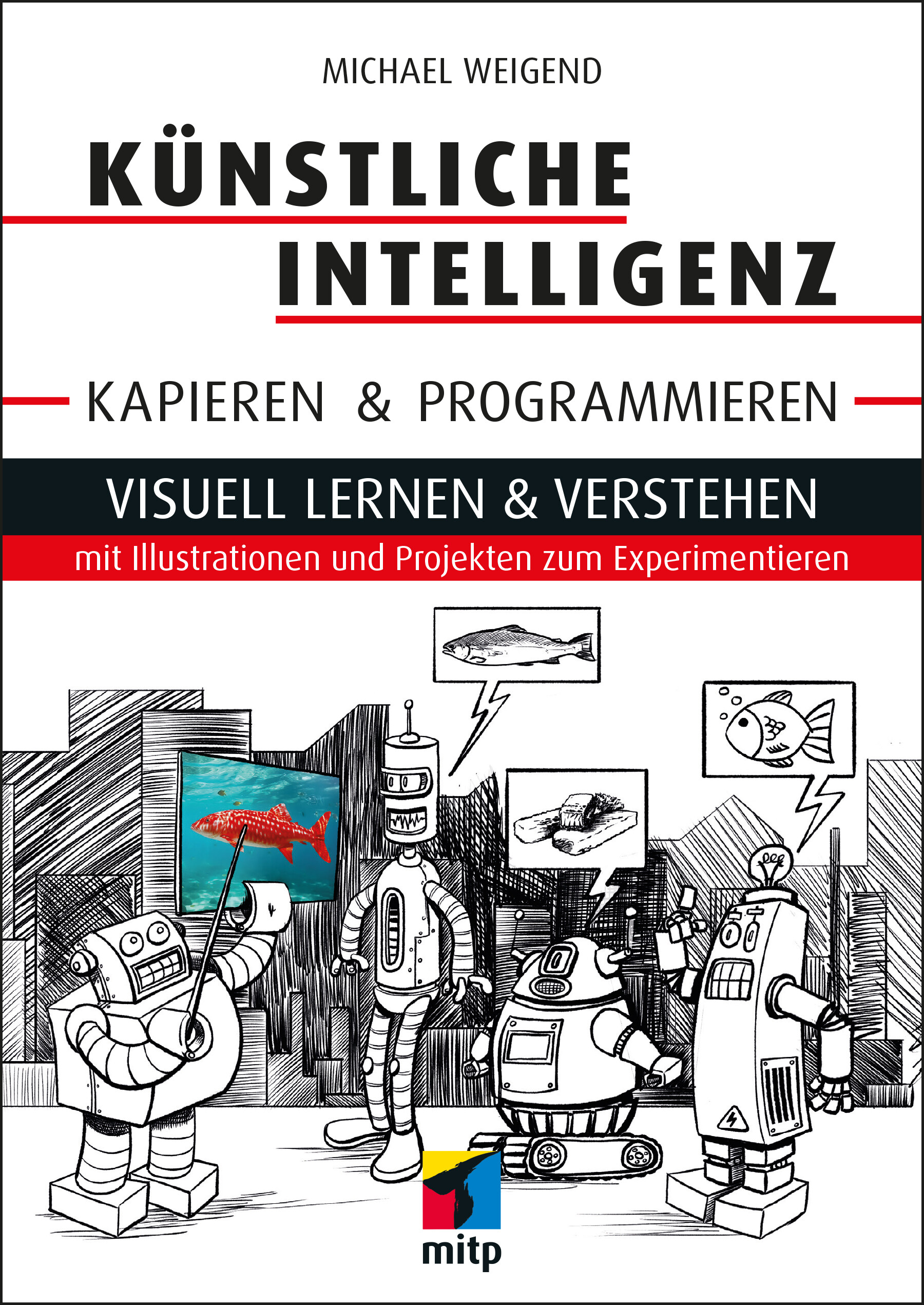
Künstliche Intelligenz kapieren & programmieren
Visuell lernen & verstehen mit Illustrationen und Projekten zum Experimentieren. In Erstauflage aus September 2023.Du möchtest wissen, was hinter künstlicher Intelligenz und neuronalen Netzen steckt und deine eigenen selbstlernenden Programme schreiben?In diesem Buch erfährst du mit anschaulichen Erklärungen und vielen Bildern, wie KI funktioniert und wie du neuronale Netze ganz einfach selbst programmieren kannst. Dafür brauchst du keine Vorkenntnisse. Alle notwendigen mathematischen Konzepte werden von Grund auf und sehr anschaulich erklärt. Ganz nebenbei erhältst du eine Einführung in die Programmiersprache Python.In jedem Kapitel erwarten dich spannende Projekte von ersten kleinen Programmen wie einem selbstlernenden Währungsrechner bis hin zu praxistauglicher Bilderkennung.Denkaufgaben und Programmierübungen mit Lösungen zum Download helfen dir, dein Wissen zu testen und zu vertiefen. So lernst du Schritt für Schritt, wie du mit einfachen Programmiertechniken deine eigenen künstlichen neuronalen Netze entwickelst und trainierst.Aus dem Inhalt:EntscheidungsbäumeÜberwachtes und nicht überwachtes LernenClusteringPerzeptronVorhersagen treffenDatenvisualisierung mit matplotlibNeuronale Netze programmieren und trainierenAktivierungsfunktionenVerborgene SchichtenBerechnungen mit NumPyBilderkennungPython Imaging Library (PIL)Computer VisionMathematisches GlossarInhalt & Leseprobe (PDF-Link) | Downloads (ZIP-Link)Über den Autor:Michael Weigend war mehr als 30 Jahre lang als Lehrer tätig und hält an der Universität Münster Vorlesungen zur Python-Programmierung. Er hat bereits mehrere Bücher zu den Themen Programmierung, Web Development und visuelle Modellierung geschrieben.
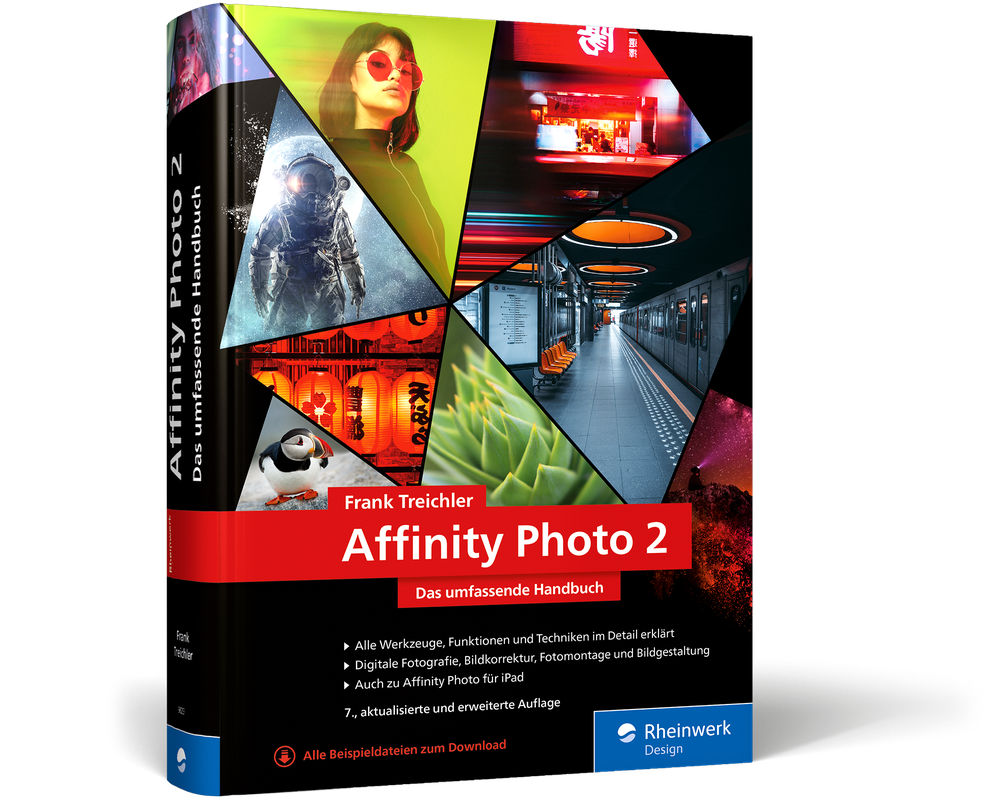
Affinity Photo 2 (7. Auflg.)
Alle Funktionen der Software im Blick: Das umfassende Handbuch in 7. aktualisierter und erweiterter Auflage 2023.Mit diesem Handbuch haben Sie Affinity Photo 2.1 fest im Griff! Ob professionelle Bildretusche, punktgenaue Bildoptimierung oder Fotomontage – Frank Treichler erklärt Ihnen alle Funktionen der Software ausführlich und verständlich. Sie korrigieren Farbstiche, verschönern Porträts, erstellen Schwarzweißfotos und retuschieren Bildfehler. Die zahlreichen Workshops und Profi-Tricks helfen Ihnen dabei, das Beste aus Ihren Fotos herauszuholen. Sehen Sie, was alles mit der Photoshop-Alternative möglich ist – inklusive Affinity Photo fürs iPad.Ergänzend zum Buch können Sie hier kostenlos einen Artikel auf der Rheinwerk-Website zu den Neuerungen in Affinity Photo 2.2 lesen.Aus dem Inhalt:Arbeitsoberfläche und BedienungUnterschiede zu Adobe PhotoshopArbeiten mit Ebenen, Formen und EffektenAuswahlen, freistellenHelligkeit und Kontrast anpassen, SchwarzweißbilderGesichts- und BeautyretuscheHDR und Panoramen, Liquify-StudioRAW-Bilder bearbeitenBild- und Objektivfehler behebenMalen, färben und kolorieren, TextwerkzeugeAusgabe für Print und WebMit einem Kapitel zum Arbeiten auf dem iPadLeseprobe (PDF-Link)

Virtual Reality kompakt
Virtual Reality ist immer noch eine Technologie, die sich extrem schnell verändert. Ständig wird neue Hardware entwickelt, die neue Anwendungen hervorbringt und die Weiterentwicklung der dafür nötigen Softwaren erzwingt. Die Themen Immersion, Interaktivität und die Gestaltung des User Interfaces in einer immersiven Anwendung haben au den Konferenzen wie der IEEE VR oder der ISMAR immer noch einen großen Stellenwert.Dieses Buch konzentriert sich auf die Software-Entwicklung von VR-Anwendungen. Dabei werden Werkzeuge aus der Praxis wie Unity, Unreal und andere frei verfügbare SDKs vorgestellt und in Fallstudien eingesetzt. Nach einer Einführung in die Grundlagen der virtuellen Realität konzentrieren wir uns auf allgemeine Aspekte der Software-Entwicklung. Hauptthema sind Portabilität am Beispiel von OpenXR und generische und wiederverwendbare Bausteine für die Implementierung von Benutzungsoberflächen. Wie wir diese Bausteine in den Werkzeugen vorfinden oder selbst implementieren ist anschließend das Thema. Letztendlich werden die Leser ein eigenes Framework für diese Techniken entwickeln, die anschließend in den eigenen Anwendungen verwendet werden können. Die Lösungen der Aufgaben, insbesondere die Quelltexte der vorgestellten Software sind in einem öffentlichen GitHub-Repository verfügbar. Im letzten Abschnitt des Buchs werden immersive Anwendungen im Bereich der Strömungsdynamik, der Volumengrafik und des Immersive Learnings vorgestellt, realisiert und weiter entwickelt.DR. MANFRED BRILL ist Professor für Informatik und Mathematik an der Hochschule Kaiserslautern am Campus Zweibrücken. Schwerpunkte in der Lehre und der angewandten Forschung sind visuelle Datenanalyse, Computergrafik und Anwendungen von AR und VR in der Praxis.Das Thema meiner an der TU Kaiserslautern erstellten Doktorarbeit stammt aus dem Bereich der angewandte und numerischen Mathematik. Das konkrete Thema stammte aus dem Bereich der Regularisierung von inversen Problemen. Schon in der Endphase der Promotion arbeitete ich in einem Startup im Technologiezentrum Kaiserslautern, das aus dem Fachbereich Mathematik entstand. In diesem Startup haben wir erfolgreich angewandte Mathematik, Informatik und insbesondere Software-Entwicklung verknüpft. Hauptkunden des Startups war die deutsche Automobilindustrie. Meine Hauptthemen während dieser Berufstätigkeit waren die Entwicklung von Software in den Bereichen CAD und CAE. Im vom VDA finanzierten Projekt "RAMSIS" haben wir ein CAD-fähiges Mensch-Modell erstellt, das heute noch weltweit eingesetzt wird.Im Wintersemester 1994/95 habe ich einen Ruf für "Mathematik und Informatik" an den damals gerade gegründeten Campus Zweibrücken der Hochschule Kaiserslautern angenommen. Neben den Lehrveranstaltungen war ich Mitglied im Gründungsausschuss für diesen Campus und nach Gründung der Fachbereich war ich Gründungsdekan und insbesondere Studiengangsleiter des Diplomstudiengangs "Digitale Medien", der später in den Bachelorstudiengang "Medieninformatik" umgeformt wurde. Aktuell bin ich Mitglied im Hochschulrat der Hochschule Kaiserslautern und Studiengangsleiter für den Master-Studiengang Informatik.Ab 1995 wurden in den Entwicklungsabteilungen der deutschen Automobilindustrie die ersten CAVE- und Powerwall-Installation aufgebaut. Durch meinen engen Kontakt mit diesen Firmen aus meiner Berufszeit habe ich schon in den neunziger Jahren erste Diplomarbeiten bei BWM oder Daimler in diesem Umfeld betreut. Gute Lehrveranstaltungen und eine gute Betreuung solcher Abschlussarbeiten kann nur gelingen mit einer profunden praktischen Erfahrung des Betreuers. Aus diesem Grund habe ich von Juli 2001 bis Juni 2002 im Rahmen einer Freistellung von der Lehre einen Gastaufenthalt am Engineering Research Center der Mississippi State University absolviert. Als Gast-Wissenschaftler hatte ich sehr freien Zugriff auf den dort installierten CAVE und konnte gemeinsam mit Projekten dort VR-Anwendungen auf der Basis von C++, OpenGL, OpenPerformer und den SDKs VRJuggler und CAVELib implementieren. Nach diesem Aufenthalt wurden eine ganze Reihe von Praxissemestern und Abschlussarbeiten im VR-Bereich erfolgreich bearbeitet, teilweise in U.S.A. (finanziert durch den DAAD), teilweise am Campus Zweibrücken. Hauptthema der Projekte war die immersive Visualisierung von Strömungsdynamik-Simulationen, von Freiformflächen-Qualität und von Daten aus der Klimaforschung, insbesondere Hurricane-Simulationen. Diese Projekte stellen die Basis für mein bei Springer im Jahr 2009 erschienen Buch "Virtuelle Realität" dar.Seit der ersten Oculus Rift hat sich das Gebiet der VR sehr stark verändert. Die Hardware-Kosten für den Einsatz von VR haben sich drastisch verringert, so dass VR in vielen Bereichen eingesetzt werden. Auch die Game-Industrie hat dieses Thema aufgegriffen, Head-Mounted Diplays oder Anwendungen auf einem Smartphone sind nun im Consumer-Bereich angekommen. Natürlich haben wir dieser Entwicklung im VR-Labor am Campus Zweibrücken Rechnung getragen, statt einer projektions-basierten VR-Umgebung setzen wir inzwischen HMDs von Oculus, HTC und HP ein. Thema unserer Projekte sind nachwievor die immersive Visualisierung von Klimadaten. Auch medizinische Anwendungen in der Radiologie werden aktuell im Labor entwickelt. Seit 2020, noch vor der Pandemie, haben wir begonnen AR- und VR-Anwendungen für den Einsatz in der Hochschul-Lehre zu entwickeln - dieses Anwendungsgebiet wird inzwischen als "Immersive Learning" bezeichnet.Einleitung - Anwendungs-Entwicklung mit Unity und C# - VR-Systeme - VR-Anwendungen mit Unity XR, XRI Toolkit und HTC Vive Input Utility - Bausteine für interaktive immersive Anwendungen - Systemsteuerung - Auswahl und Manipulation von virtuellen Objekten - Fortbewegung in der virtuellen Welt

Information Assurance and Risk Management Strategies
Learn how to deploy information assurance risk management strategies that align with the National Institute of Standards and Technology’s recommendations. This book will show you how to implement information assurance risk management strategies within your organization. Aimed at system administrators and cybersecurity practitioners, author Bradley Fowler first walks you through how to assess known risks in your organization, understand why using a risk mitigation security strategy control profile is essential, and how to create one for your organization. You will then learn how to develop a risk factor table, outlining descriptions for each risk factor within your organization and which software applications you’ll need to rely on for daily business communication and operations. You will also see how to assess and categorize the level of risk within each technology tool, as well as the impact of an information security breach on the organization. As you progress through the book, you'll review privacy issues relating to your organization, develop and manage a privacy compliance risk profile, and develop and manage a privacy compliance control profile. Additionally, you will gain insight into creating a privacy compliance risk mitigation strategy that helps protect your organization even as security threats evolve. Take the first step to safeguarding your company’s highly valuable information assets today! What You'll Learn * Understand what information assurance is and how it relates to risk management strategies * Assess, develop, implement, and manage risk management strategies for corporate information systems, technology, and cloud environments * Develop and utilize information usage profiles and risk factor tables * Understand the value of data encryption and usage of private and public key exchange for information assurance and security Who This Book Is For Information system and cloud architects responsible for developing, implementing, and managing corporate information systems and cloud environments. Chapter 1: Information Assurance Analysis.- Chapter 2: Technology Risk Analysis & Management Strategies.- Chapter 3: Privacy Compliance Strategies.- Chapter 4: Intrusion Detection and AWS Cloud Services.- Chapter 5: Corporation Enterprise Architecture ISTC Strategies.- Chapter 6: IT Strategy Policy.Glossary.References.