

Computer und IT
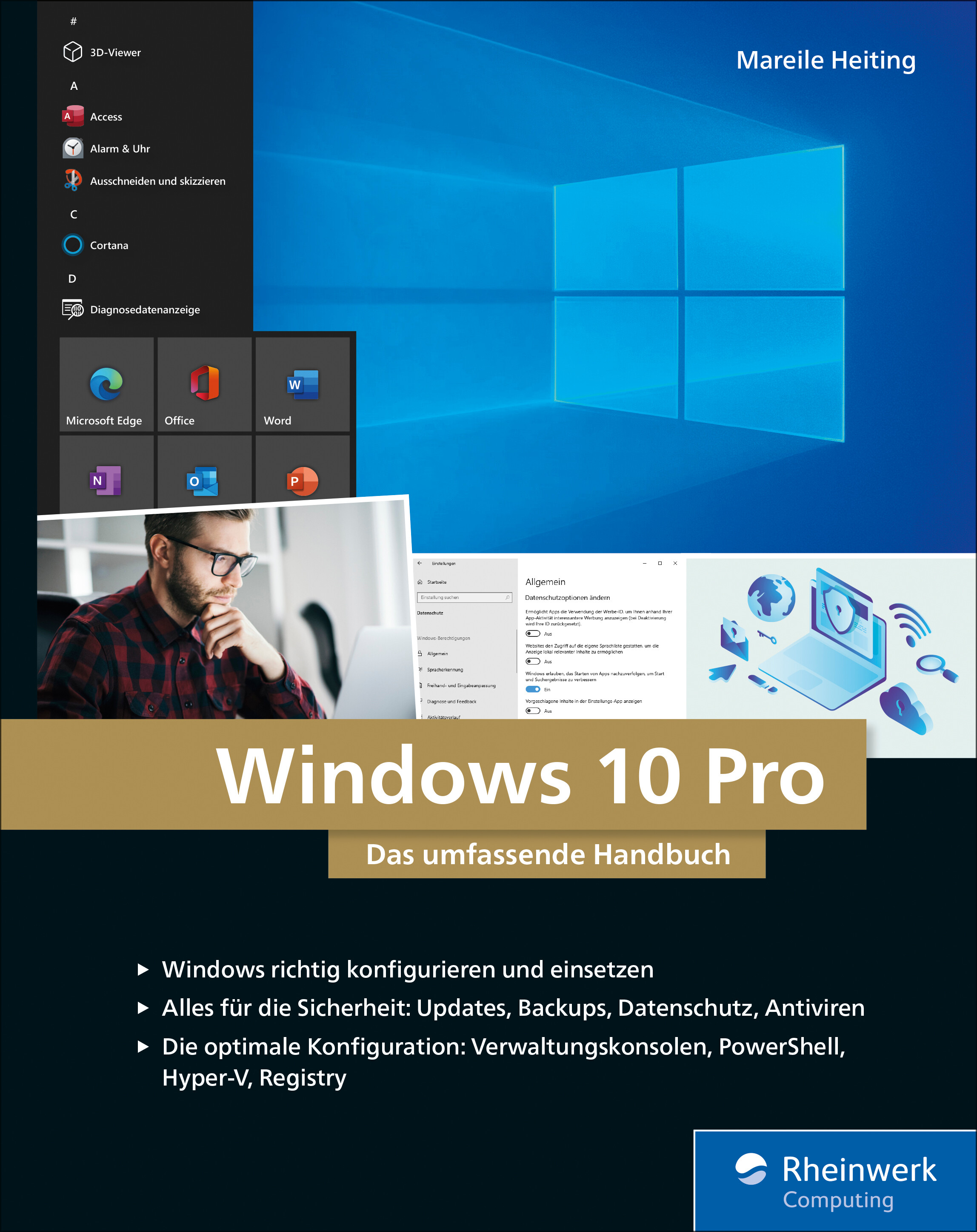
Windows 10 Pro
Das umfassende Handbuch - umfassendes Praxiswissen für Windows-Profis, aktuelle Auflage Februar 2021.Dieses Buch bietet Ihnen auf über 900 Seiten fundiertes Wissen für Windows-Anwender. Praxisnah dank der zahlreichen Anwendungsbeispiele und mit einer Fülle an Profitipps durchleuchtet Mareile Heiting alle Ecken und Winkel des Windows-Systems. Erfahren Sie, welche Features sich unter der Oberfläche verstecken und wie Sie Ihren Workflow spürbar verbessern. Profitieren Sie von aktuellen, effektiven Tipps für ein rundum abgesichertes System. Meistern Sie die Arbeit mit Windows-Rechnern und setzen Sie auch anspruchsvolle Anforderungen um: Netzwerk & VPN einrichten, Aufgaben automatisieren, Daten verschlüsseln und vieles mehr. Ideal als Nachschlagewerk für Power User und erfahrene Anwender von Windows 10.Alles zu Windows 10Updates und InstallationWindows 10 richtig nutzen: Desktop & AppsDaten verwalten und sichern: BitLocker, DatensicherungAlle Optionen und KonfigurationsmöglichkeitenSystemdienste und VerwaltungskonsolenTreiberprobleme lösen, Hardware einrichtenDatenschutz und PrivatsphäreVirenschutz und FirewallDatenfreigabe im NetzwerkRemotezugriff und VPNPowerShell & Windows Subsystem für LinuxVirtualisierung mit Hyper-VLeseprobe (PDF-Link)

Integrierte Werteflüsse mit SAP S/4HANA
Mit diesem Buch optimieren Sie den Wertefluss von der Beschaffung über die Produktion bis hin zum Vertrieb. Andrea Hölzlwimmer weiß genau, wo Probleme in der Integration zwischen MM, PP, SD und FI/CO auftreten, und hilft Ihnen, Ihre Prozesse perfekt aufeinander abzustimmen. Viele Beispiele und Tipps aus der Praxis unterstützen Sie dabei, Optimierungspotenziale zu nutzen und die Kosten zu senken. Profitieren Sie von der Erfahrung, die die Autorin in zahlreichen Optimierungsprojekten gesammelt hat. Praktische Beispiele und eine verständliche Sprache machen es Ihnen leicht, die Abläufe in Ihrem Unternehmen zu verbessern. Diese 4. Auflage ist aktuell zu SAP S/4HANA und behandelt alle wichtigen Neuerungen: Material Ledger, CO-PA u.v.m. Aus dem Inhalt: KreditorenstammRechnungsprüfungPreiskalkulationWarenausgangBesteuerungPlankalkulationPeriodenabschlussErgebnisrechnungMaterial LedgerWerteflüsse zusammenführen Einleitung ... 13 1. Konzept der integrierten Werteflüsse ... 21 1.1 ... Der Begriff »integrierter Wertefluss« ... 21 1.2 ... Definition von Unternehmensprozessen ... 26 1.3 ... Wechselwirkung von Prozessgestaltung und Controllingphilosophie ... 27 1.4 ... Zusammenfassung ... 29 2. Grundlagen der Integration im SAP-System ... 31 2.1 ... Aufbau von SAP-S/4HANA-Systemen ... 32 2.2 ... Entitätenmodell ... 35 2.3 ... Anforderungen der parallelen Rechnungslegung ... 46 2.4 ... Werteflussorientiertes Stammdatenkonzept ... 51 2.5 ... Geschäftspartner ... 67 2.6 ... Zusammenfassung ... 80 3. Beschaffungsprozess ... 83 3.1 ... Beschaffungsprozess und Belegfluss ... 84 3.2 ... Bestellung als Basis des Beschaffungsprozesses ... 86 3.3 ... Fortschreibung von Obligos ... 95 3.4 ... Integration von MM und FI/CO ... 101 3.5 ... Wareneingang ... 128 3.6 ... Rechnungsprüfung ... 130 3.7 ... WE/RE-Konto ... 144 3.8 ... Einkaufskontenabwicklung ... 152 3.9 ... Integration der Kreditorenbuchhaltung ... 153 3.10 ... Darstellung der Umsatzsteuer ... 168 3.11 ... Einbehalt von Quellensteuer ... 172 3.12 ... Zusammenfassung ... 176 4. Vertriebsprozess ... 179 4.1 ... Vertriebsprozess und Belegfluss ... 180 4.2 ... Kundenauftrag als Basis der weiteren Kontierung ... 182 4.3 ... Preiskalkulation als Basis der Wertermittlung ... 189 4.4 ... Warenausgang ... 199 4.5 ... Besteuerung von Verkäufen ... 203 4.6 ... Darstellung von Forderungen ... 216 4.7 ... Abbildung von Umsatzerlösen ... 232 4.8 ... Zusammenfassung ... 255 5. Produktionsprozess ... 257 5.1 ... Produktionsprozess und Belegfluss ... 259 5.2 ... Relevante Stammdaten ... 261 5.3 ... Customizing der Kalkulationsvariante ... 274 5.4 ... Produktkostenplanung ... 301 5.5 ... Kostenträgerrechnung ... 320 5.6 ... Projektfertigung ... 376 5.7 ... Unterstützung der Produktkostenrechnung durch das Material-Ledger ... 392 5.8 ... Zusammenfassung ... 402 6. Der Abschlussprozess im SAP-System ... 405 6.1 ... Vorbereitende Tätigkeiten ... 405 6.2 ... Tätigkeiten in der Anlagenbuchhaltung ... 411 6.3 ... Periodensteuerung ... 426 6.4 ... Fremdwährungsbewertung ... 431 6.5 ... Umgliederung von Forderungen und Verbindlichkeiten ... 437 6.6 ... Wertberichtigung auf Forderungen ... 440 6.7 ... Saldovortrag ... 440 6.8 ... Manuelle Buchungen ... 442 6.9 ... Umlagen und Verteilungen ... 443 6.10 ... Abrechnung ... 451 6.11 ... Abstimmung ... 453 6.12 ... Konsolidierungsvorbereitung ... 457 6.13 ... Zusammenfassung ... 469 7. Zusammenführen der Werteflüsse ... 471 7.1 ... Berichtswesen im Finanzwesen ... 472 7.2 ... Berichtswesen im Controlling ... 477 7.3 ... Berichtswesen in der Ergebnisrechnung ... 478 7.4 ... Aufbau der Deckungsbeitragsrechnung ... 493 7.5 ... Zusammenfassung ... 535 8. Beispiele aus der Praxis ... 537 8.1 ... Redesign der Ergebnisrechnung ... 537 8.2 ... SAP-ERP-Optimierung bei einem Energieversorger ... 548 8.3 ... Upgrade von SAP ERP auf SAP S/4HANA ... 557 8.4 ... Zusammenfassung ... 566 Anhang ... 567 A. Beispiel für einen Abschlussplan ... 569 B. Transaktionen und Menüpfade ... 577 C. Die Autorin ... 605 Index ... 607

Microsoft 365 Education
Endlich einfach erklärt: Mit Microsoft 365 können sich Lehrende digital organisieren und Unterricht multimedial gestalten. Wie Sie Microsoft Office in der Schule einsetzen und im Alltag viel Zeit sparen, zeigt Stefan Malter mit vielen Beispielen aus der Praxis. Präsentieren und kommunizieren Sie online per Video, gestalten Sie Unterrichtsmaterial multimedial und fördern Sie die digitalen Kompetenzen Ihrer Schülerinnen und Schüler. Profitieren Sie und Ihr Kollegium von den Microsoft-Apps und ihren vielfältigen Möglichkeiten zur Zusammenarbeit. Aus dem Inhalt: Unterrichtsmaterial und Arbeitsblätter mit Word und OneNote erstellenDigitale Tafelbilder und Präsentationen mit PowerPoint und Whiteboard-AppTermine, Aufgaben und Kontakte mit Outlook und Windows-AppsChats in Teams-Arbeitsgruppen und -KanälenOnline-Unterricht live in Teams durchführen und moderierenGemeinsam an Dateien und Projekten arbeitenOneNote-Kursnotizbücher für Schülerinnen und SchülerLehrerkonferenzen und Elternabende als VideokonferenzExcel: Grundlagen für Lehrende und Schüler*innenIndividuell Feedback zu Leistungen geben und Tests in Forms durchführenAudio-visuelle Medien erstellen und barrierefreie Tools einsetzenMicrosoft 365 auf mobilen GerätenDateien mit OneDrive und SharePoint synchron haltenGeräte einrichten, Daten speichern und schützen, Benutzerkonten verwaltenTipps für Schulorganisation und Administration Vorwort ... 13 Teil I. Microsoft 365 Education kennenlernen ... 15 1. Voraussetzungen für den digitalen Schulalltag mit Microsoft 365 ... 17 1.1 ... Hardware und Software: Voraussetzungen ... 19 1.2 ... Datenschutz - leidiges Thema, wichtiges Thema ... 21 2. Microsoft 365 Education: Was ist das? Was steckt da drin? ... 25 2.1 ... Unterschiedliche Lizenzen - unterschiedliche Möglichkeiten ... 25 2.2 ... Benutzerkonten in Microsoft 365 ... 26 2.3 ... Online-Portal von Microsoft 365 ... 28 2.4 ... Online arbeiten mit Microsoft 365 ... 34 2.5 ... Online und offline arbeiten mit Windows-Apps und Office-Programmen ... 36 3. Windows 10 einrichten und bedienen ... 37 3.1 ... Windows 10 auf einem neuen PC einrichten ... 37 3.2 ... Windows Updates - nervig, aber wichtig! ... 44 3.3 ... Windows-Sicherheit ... 48 3.4 ... Windows-Einstellungen: Produktiv arbeiten, persönlich wohlfühlen ... 50 3.5 ... Mehrere Benutzerkonten mit Windows 10 nutzen ... 62 3.6 ... PC zurücksetzen und Windows 10 neu installieren ... 65 4. Dateien speichern und verwalten mit Microsoft 365 und Windows 10 ... 69 4.1 ... Dateien online speichern mit OneDrive ... 69 4.2 ... Dateien offline speichern mit Windows 10 ... 81 4.3 ... Systempflege und Backups ... 101 5. Apps und Tools in Windows 10 ... 111 5.1 ... Apps in Windows 10 nutzen und verwalten ... 111 5.2 ... Microsoft Edge - Internetbrowser ... 120 5.3 ... Kurznotizen (Sticky Notes) - digitale Klebezettel ... 124 5.4 ... Microsoft To Do - digitale Aufgabenlisten ... 126 5.5 ... Ausschneiden und skizzieren - Screenshot-App ... 127 5.6 ... Fotos - einfache Bild- und Videobearbeitung ... 128 5.7 ... Kamera - Fotos und Videos aufnehmen ... 131 5.8 ... Filme & TV - Videos abspielen ... 133 5.9 ... Microsoft Whiteboard - die digitale Tafel ... 136 5.10 ... Paint und Paint 3D - digital zeichnen ... 139 5.11 ... Ihr Smartphone ... 142 5.12 ... Weitere Windows-Apps im Überblick ... 143 6. Office-Programme und Dienste in Microsoft 365 ... 149 6.1 ... Microsoft Office installieren und einrichten ... 150 6.2 ... Microsoft Teams - Dreh- und Angelpunkt für digitalen Unterricht ... 155 6.3 ... Microsoft Outlook für EMails, Kontakte und Kalender ... 164 6.4 ... Microsoft OneNote - digitale Notizbücher ... 166 6.5 ... Microsoft Word - Textverarbeitung mit festem Layout ... 169 6.6 ... Microsoft PowerPoint - Präsentationen und mehr ... 172 6.7 ... Microsoft Sway - interaktive Web-Präsentationen ... 174 6.8 ... Microsoft Excel - Tabellenkalkulation ... 176 6.9 ... Microsoft Forms ... 178 6.10 ... Microsoft Stream ... 180 6.11 ... Weitere Apps und Dienste in Microsoft 365 Education ... 182 Teil II. Microsoft 365 in Schule und Unterricht einsetzen ... 187 7. Unterrichtsmaterial recherchieren, erstellen und organisieren ... 189 7.1 ... Inhalte in OneNote sammeln ... 189 7.2 ... Internetrecherche mit Office-Apps und Microsoft Edge ... 204 7.3 ... Arbeitsblätter digital erstellen ... 217 7.4 ... Präsentationen für den Unterricht vorbereiten ... 232 8. Dokumente verteilen und zur Verfügung stellen ... 243 8.1 ... Ausdrucken mit Windows 10 ... 243 8.2 ... Per EMail versenden ... 248 8.3 ... Teilen per OneDrive ... 254 8.4 ... Dokumente bereitstellen in Microsoft Teams ... 261 8.5 ... Inhalte teilen mit OneNote und OneNote-Kursnotizbüchern (Class Notebooks) ... 268 9. Korrigieren, Feedback geben und prüfen mit Microsoft 365 ... 279 9.1 ... Aufsätze und Arbeiten korrigieren und kommentieren mit Microsoft Edge und Microsoft Word ... 279 9.2 ... Schüleraufgaben in OneNote-Kursnotizbüchern korrigieren und kommentieren ... 284 9.3 ... Aufgaben mit Microsoft Teams verteilen und bewerten ... 288 9.4 ... Tests und Quizze mit Microsoft Forms ... 296 9.5 ... Mündliche Prüfungen per Videokonferenz mit Microsoft Teams ... 310 10. Digitale Inhalte im Unterricht präsentieren ... 311 10.1 ... Beamer, Smartboard, TV - Projizieren mit Windows 10 ... 311 10.2 ... Präsentieren mit OneNote ... 315 10.3 ... Tafelbilder erstellen mit Microsoft Whiteboard ... 319 10.4 ... Präsentieren mit PowerPoint ... 324 11. Selbstorganisation im Lehrerbüro ... 331 11.1 ... Aufgaben und To-Do-Listen mit Sticky Notes, OneNote, Microsoft To Do und Outlook ... 331 11.2 ... Kalender und Termine mit Outlook ... 341 11.3 ... Gesprächsnotizen und Protokolle mit OneNote ... 348 11.4 ... Punkte und Noten ausrechnen mit Microsoft Excel ... 352 12. Kommunikation mit Kollegium, Schüler*innen und Eltern ... 361 12.1 ... Kontakte verwalten in Outlook und Microsoft 365 ... 361 12.2 ... Kommunikation per EMail mit Outlook ... 366 12.3 ... Chat-Nachrichten - Microsoft Teams als Messenger ... 376 12.4 ... Sprach- und Videoanrufe mit Microsoft Teams ... 382 12.5 ... Online-Besprechungen planen und durchführen mit Microsoft Teams ... 389 12.6 ... Online-Unterricht mit Microsoft Teams ... 396 Teil III. Weitere Möglichkeiten mit Microsoft 365 ... 405 13. Audio- und Videoproduktionen für den Unterricht ... 407 13.1 ... Audioaufnahmen mit dem Sprachrekorder für Windows 10 ... 407 13.2 ... Videoaufnahmen mit der Kamera-App für Windows 10 ... 411 13.3 ... Videoschnitt mit dem Video-Editor der Fotos-App ... 414 13.4 ... Erklärvideos mit PowerPoint produzieren ... 423 13.5 ... Videos verteilen mit OneDrive und Stream ... 431 14. Barrierefreiheit und erleichterte Bedienung mit Microsoft 365 ... 441 14.1 ... Erleichterte Bedienung mit Windows 10 ... 442 14.2 ... Barrierearme Dokumente mit den Office-Apps ... 454 15. Microsoft-Apps für mobile Geräte wie Smartphone und Tablet ... 459 15.1 ... Microsoft Office als mobile App ... 460 15.2 ... OneDrive als mobile App ... 471 15.3 ... OneNote als mobile App ... 473 15.4 ... Microsoft To Do als mobile App ... 477 15.5 ... Outlook als mobile App ... 479 15.6 ... Microsoft Teams als mobile App ... 486 15.7 ... Microsoft Edge als mobile App ... 490 15.8 ... Begleiter für Ihr Smartphone - Verbindung per App zu Windows 10 ... 494 16. Projekte mit Microsoft 365: Ideen für die Praxis ... 499 16.1 ... Klassenfahrt digital organisieren ... 499 16.2 ... Medienproduktion mit Schüler*innen ... 506 17. Tipps für die Administration von Microsoft 365 ... 511 17.1 ... Benutzerkonten im Admin Center erstellen und verwalten ... 514 17.2 ... Schülergeräte einrichten und verwalten ... 524 18. Hilfe bei Fragen und Problemen ... 533 18.1 ... Reparaturversuche mit Windows 10 ... 534 18.2 ... Hilfe und Support von Microsoft 365 ... 540 18.3 ... Online-Community »Microsoft 365 für Lehrer« ... 544 Index ... 547

SAP Conversational AI
Lassen Sie Bots für sich sprechen! Ob Kundenservice oder digitaler Assistent – mit diesem Buch lernen Sie, wie Sie mit SAP Conversational AI eigene Chatbots programmieren. Die Autoren führen Sie durch alle Phasen der Entwicklung vom Training des Bots bis zur Anbindung an die SAP-Systeme. Sie erhalten wertvolle Tipps zur Auswahl geeigneter Anwendungsfälle sowie für Monitoring und Optimierung. Aus dem Inhalt: Conversational User ExperienceTerminologie und GrundkonzepteSAP Conversational AIFrage-und-Antwort-Bots (Q&A) und reguläre BotsChatbots trainieren, verbinden und verbessernAnwendungsfälleDeployment und Betrieb von BotsFallback und DisambiguierungBerechtigungen und Datenschutz Einleitung ... 15 TEIL I. Einführung ... 21 1. Ziele und Einsatzgebiete von Conversational User Experience ... 23 1.1 ... Was ist Conversational User Experience? ... 23 1.2 ... Terminologie und Grundkonzepte ... 26 1.3 ... Geschichte der Chatbots ... 38 1.4 ... Chatbot vs. digitaler Assistent ... 41 1.5 ... Zusammenfassung ... 46 2. Einführung in SAP Conversational AI ... 47 2.1 ... Die Plattform SAP Conversational AI im Überblick ... 48 2.2 ... Verwaltungs- und Einstellungsmöglichkeiten im Benutzerprofil ... 57 2.3 ... Arten von Bots ... 71 2.4 ... Erste Schritte zur Erstellung eines Chatbots ... 73 2.5 ... Verwendung vordefinierter Chatbot-Bestandteile ... 80 2.6 ... Zusammenfassung ... 82 TEIL II. Entwicklung eines Chatbots ... 83 3. Einen Chatbot trainieren ... 85 3.1 ... Überblick über die Registerkarte »Train« ... 86 3.2 ... Gesprächsabsichten mit Intents definieren ... 95 3.3 ... Das Entitätenkonzept ... 100 3.4 ... Entitätsanreicherungen hinzufügen ... 115 3.5 ... Das Datenset testen ... 120 3.6 ... Unterstützte Sprachen ... 122 3.7 ... Anwendung von NLP-Technologien ... 123 3.8 ... Training des Beispiel-Bots ... 125 3.9 ... Zusammenfassung ... 129 4. Einen Chatbot aufbauen ... 131 4.1 ... Überblick über die Registerkarte »Build« ... 132 4.2 ... Skills verwalten ... 138 4.3 ... Trigger verwenden ... 145 4.4 ... Voraussetzungen definieren ... 150 4.5 ... Aktionen erstellen ... 155 4.6 ... Zusammenfassung ... 177 5. Den Chatbot verbinden ... 179 5.1 ... Bereitstellungskanäle ... 179 5.2 ... SAP Conversational AI Web Client ... 189 5.3 ... Fallback-Kanäle ... 194 5.4 ... Slack-Kanal für den Beispiel-Bot konfigurieren ... 197 5.5 ... Zusammenfassung ... 200 6. Den Chatbot verbessern ... 201 6.1 ... Einträge filtern ... 202 6.2 ... Protokoll der Sprachverarbeitung auswerten ... 204 6.3 ... Verwendungsmetriken ... 208 6.4 ... Trainingsanalyse ... 212 6.5 ... Konversationsprotokolle ... 218 6.6 ... Zusammenfassung ... 220 7. Bot-Einstellungen ... 221 7.1 ... Einstellungen eines Chatbots ... 223 7.2 ... Versionen ... 234 7.3 ... Umgebungen verwenden ... 240 7.4 ... Zusammenfassung ... 245 8. Frage-Antwort-Bots ... 247 8.1 ... Frage-Antwort-Bot trainieren ... 249 8.2 ... Frage-Antwort-Bots bauen ... 256 8.3 ... Frage-Antwort-Bot verbessern ... 259 8.4 ... Einen eigenen Frage-Antwort-Bot erstellen ... 261 8.5 ... Zusammenfassung ... 266 TEIL III. Fortgeschrittene Chatbot-Konzepte ... 267 9. Weiterführende Konzepte ... 269 9.1 ... Laufzeitverhalten eines Chatbots testen ... 269 9.2 ... Nutzung von API-Endpunkten ... 275 9.3 ... Feinheiten des Laufzeitverhaltens eines Chatbots ... 288 9.4 ... Mehrsprachigkeit und Ermittlung der Sprache ... 298 9.5 ... Skill-Disambiguierung ... 303 9.6 ... Zusammenfassung ... 308 10. Das Bot-Entwicklungsprojekt -- ein Praxisbeispiel ... 309 10.1 ... Von der Idee zum Chatbot-Projekt ... 310 10.2 ... Vor Beginn der Implementierung ... 317 10.3 ... Implementierung des Chatbots ... 331 10.4 ... Den fertigen Bot bereitstellen ... 347 10.5 ... Zusammenfassung ... 352 11. Integration von SAP Conversational AI ... 353 11.1 ... Integration externer Ressourcen ... 354 11.2 ... Integration in die SAP Integration Suite ... 369 11.3 ... Integration ins SAP Fiori Launchpad ... 381 11.4 ... Berechtigungskonzept und Single Sign-on ... 391 11.5 ... Konfiguration eines SAP-S/HANA-Frontend-Servers ... 394 11.6 ... Automatisierte Tests der Enterprise Edition ... 396 11.7 ... Zusammenfassung ... 404 12. Ausblick und zukünftige Technologien ... 405 12.1 ... Zukünftige Funktionalität von SAP Conversational AI ... 405 12.2 ... Trends im Bereich der künstlichen Intelligenz ... 408 12.3 ... Trends im Bereich Conversational User Experience ... 412 12.4 ... Zusammenfassung ... 414 A. Glossar ... 419 B. Literaturverzeichnis ... 421 C. Das Autorenteam ... 425 Index ... 427

Produktionsplanung mit SAP S/4HANA in der Prozessindustrie
Effektiv planen in der Prozessindustrie! Mit diesem Buch lernen Sie alle Funktionen von PP-PI in SAP S/4HANA detailliert kennen und erfahren, wie Sie Ihre Prozesse im System abbilden. Viele Beispiele und Tipps aus der Pharma-, Chemie- und Lebensmittelindustrie unterstützen Sie bei der Auftragsabwicklung, dem Reporting sowie der Koordination und Dokumentation Ihrer Prozesse. Auch der Einsatz von SAP Digital Manufacturing Cloud und die Integration mit anderen SAP-Komponenten und Drittanbietersystemen werden ausführlich erklärt. Aus dem Inhalt: StammdatenProzessauftragsabwicklungProzesskoordinationProduktionsprozesse mit PP-PIReportingProzessdatendokumentationIntegration in andere SAP-KomponentenSchnittstellen und Anbindung von FremdsystemenSAP Digital Manufacturing Cloud (DMC)SAP Extended Warehouse Management (EWM)Embedded Production Planning/Detailed Scheduling (ePP/DS) Einleitung ... 15 1. Einführung in die Produktionsplanung und -steuerung in der Prozessindustrie ... 19 1.1 ... Abgrenzung zwischen PP und PP-PI ... 20 1.2 ... Integration von PP-PI in andere SAP S/4HANA-Komponenten ... 29 1.3 ... Integration von PP-PI in andere SAP-Lösungen ... 31 1.4 ... Zusammenfassung ... 32 2. Stammdaten ... 33 2.1 ... Materialien ... 34 2.2 ... Ressourcen ... 39 2.3 ... Integrierte Stammdatenpflege über Fertigungsversionen ... 55 2.4 ... Struktur und Pflege von Planungsrezepten ... 62 2.5 ... Zusammenfassung ... 96 3. Produktionssteuerung über Prozessaufträge ... 97 3.1 ... Struktur eines Prozessauftrags ... 97 3.2 ... Lebenszyklus eines Prozessauftrags ... 101 3.3 ... Erforderliche Customizing-Objekte einrichten ... 104 3.4 ... Eröffnung eines Prozessauftrags ... 115 3.5 ... Prozessplanung und Auftragsfreigabe ... 131 3.6 ... Materialbereitstellung mit MM und WM ... 152 3.7 ... Materialbereitstellung mit EWM ... 166 3.8 ... Rückmeldung von Prozessaufträgen ... 171 3.9 ... Warenbewegungen zum Prozessauftrag ... 194 3.10 ... Auftragspapiere drucken ... 202 3.11 ... Prozessauftragsabschluss und Archivierung ... 212 3.12 ... Zusammenfassung ... 217 4. Erweiterte Funktionen für die Produktionsabwicklung ... 219 4.1 ... Berücksichtigung von Schichten ... 219 4.2 ... Verteilung von Materialdifferenzen aus der Produktion ... 230 4.3 ... Zusammenfassung ... 236 5. Prozesskoordination ... 237 5.1 ... Elemente und Funktionsweise der Prozesskoordination ... 238 5.2 ... Steuerrezepte ... 242 5.3 ... Prozessmeldungen ... 256 5.4 ... Prozessvorgaben ... 278 5.5 ... XSteps ... 289 5.6 ... SAP-Herstellanweisungen ... 320 5.7 ... Zusammenfassung ... 341 6. Produktionsprozesse mit PP-PI ... 343 6.1 ... Zweistufige prozessindustriespezifische Herstellung ... 343 6.2 ... Kuppel- und Nebenprodukte ... 350 6.3 ... Regulierte Produktion ... 355 6.4 ... Zusammenfassung ... 363 7. Reporting ... 365 7.1 ... Prozessauftragsinformationssystem ... 365 7.2 ... Massenbearbeitung ... 378 7.3 ... Weitere Berichte aus dem Produktionsumfeld ... 394 7.4 ... Zusammenfassung ... 402 8. Integration ... 403 8.1 ... Integration mit QM ... 404 8.2 ... Integration mit SAP APO und ePP/DS ... 429 8.3 ... Integration mit SAP MII ... 453 8.4 ... Anbindung von Fremdsystemen mit der PI-PCS-Schnittstelle ... 476 8.5 ... Integration mit der SAP Rezeptentwicklung ... 485 8.6 ... SAP Digital Manufacturing Cloud ... 499 8.7 ... Zusammenfassung ... 514 9. Prozessdatendokumentation ... 517 9.1 ... Auftragsprotokoll ... 517 9.2 ... Elektronisches Chargenprotokoll ... 521 9.3 ... Zusammenfassung ... 527 Anhang ... 529 A ... Transaktionsverzeichnis ... 529 B ... Das Autorenteam ... 541 Index ... 545

Unternehmensplanung mit SAP Analytics Cloud
Nutzen Sie integrierte Daten für eine fundierte Entscheidungsfindung! Mit diesem Buch lernen Sie, die Planungsfunktionen von SAP Analytics Cloud einzusetzen. Sie werden Schritt für Schritt durch die Datenmodellierung und den Umgang mit Storys geführt: Ein durchgängiges, mit Screenshots illustriertes Beispiel veranschaulicht die praktische Arbeit mit SAP Analytics Cloud. Dazu gehören die Berechtigungen genauso wie der von SAP zur Verfügung gestellte vordefinierte Planungs-Content. Sie lernen auch, wie Sie alle an der Planung Beteiligten mit Kollaborationstools ins Boot holen und Machine-Learning-Werkzeuge für eine vorausschauende Planung verwenden. Aus dem Inhalt: DatenmodellierungErstellung einer StoryBerechtigungs- und SperrkonzeptPlanungskalender und KollaborationAnalytics DesignerSAP Analytics Cloud Add-in für Microsoft 365Planungs-Content Einleitung ... 13 1. Planung mit SAP Analytics Cloud ... 19 1.1 ... SAP Analytics Cloud im Überblick ... 20 1.2 ... Integrierte Unternehmensplanung ... 31 1.3 ... Weitere Produkte im Umfeld der Planung ... 35 1.4 ... Beispiel: Umsatzplanung ... 40 1.5 ... Zusammenfassung ... 43 2. Datenmodellierung ... 45 2.1 ... Einführung ... 46 2.2 ... Die Modellierungsumgebung ... 49 2.3 ... Merkmalsbeziehungen ... 74 2.4 ... Datenintegration ... 77 2.5 ... Zusammenfassung ... 90 3. Planungsintegration in die Story ... 93 3.1 ... Die Story als Umgebung zur Plandatenerfassung ... 94 3.2 ... Die Versionsverwaltung ... 101 3.3 ... Das Planungs-Panel ... 108 3.4 ... Mit der Tabelle arbeiten ... 113 3.5 ... Zusammenfassung ... 151 4. Fortgeschrittene Planungsfunktionen ... 153 4.1 ... Werttreiberbäume ... 154 4.2 ... Datenaktionen ... 168 4.3 ... Kopierschritt ... 180 4.4 ... Modellübergreifender Kopierschritt ... 186 4.5 ... Allokation ... 194 4.6 ... Erweiterte Formeln ... 205 4.7 ... Eingebettete Datenaktionsschritte ... 241 4.8 ... Zusammenfassung ... 245 5. Predictive Planning ... 247 5.1 ... Einführung ... 248 5.2 ... Smart Predict ... 249 5.3 ... Zeitreihenanalyse ... 254 5.4 ... Klassifikation ... 265 5.5 ... Regressionsanalyse ... 273 5.6 ... Zusammenfassung ... 279 6. Steuerung von Planungsprozessen ... 281 6.1 ... Berechtigungskonzept ... 282 6.2 ... Datensperren ... 314 6.3 ... Planungskalender ... 321 6.4 ... Kollaboration ... 351 6.5 ... Auditierfunktionen ... 353 6.6 ... Zusammenfassung ... 359 7. Kundenindividuelle Planungsanwendungen ... 361 7.1 ... Analytics Designer ... 362 7.2 ... Benutzerdefinierte Widgets ... 397 7.3 ... SAP Analytics Cloud, Add-in für Microsoft Office ... 407 7.4 ... Zusammenfassung ... 420 8. Vordefinierter Planungs-Content ... 423 8.1 ... Die Business-Content-Bibliothek ... 424 8.2 ... Integrierte Finanzplanung für SAP S/4HANA ... 431 8.3 ... Zusammenfassung ... 457 Anhang ... 459 A ... Glossar ... 459 B ... Der Autor ... 465 Index ... 467

Objektorientierte Programmierung
Komplexe Projekte solide strukturieren, tragfähige Designs erstellen, guten Code schreiben und wartbare Software liefern: Dafür brauchen Entwickler ein Repertoire, aus dem Objektorientierung nicht wegzudenken ist. In diesem Buch finden Sie alles, was Sie brauchen, um sich gründlich einzuarbeiten und die Prinzipien der OOP zur Basis Ihrer eigenen Arbeit zu machen. Die Autoren erläutern alle Themen anschaulich und verständlich anhand einer Vielzahl typischer Beispiele. Mit UML-Diagrammen und gut kommentierten Codebeispielen in den gängigsten objektorientierten Sprachen bringen sie Ihnen die Umsetzung nahe. Da so manches lehrreiche Detail erst auftaucht, wenn Sie konkrete Probleme lösen, ziehen sie viele praktische Anwendungsfälle heran und geben immer wieder Tipps, wie Sie bad smells vermeiden und sauberen Code schreiben. Anhand eines größeren Projekts bekommen Sie zudem einmal von Anfang bis Ende gezeigt, wie Sie objektorientierte Programmierung konsequent realisieren können. So profitieren Sie von der langjährigen Erfahrung der Autoren mit allen Aspekten der Entwicklung komplexer Software. Aus dem Inhalt: Prinzipien des objektorientierten EntwurfsKapselung von DatenPolymorphieStruktur objektorientierter SoftwareKlassen und PrototypenKonkrete und abstrakte DatentypenBeziehungen zwischen ObjektenKlassen von Werten und ObjektenVererbungsbeziehungenMehrfachvererbungStatische und dynamische KlassifizierungPersistenzErzeugung und Zerstörung von ObjektenObjekte in Aktion und in InteraktionObjekte als VertragspartnerModule als konfigurierbare und änderbare KomponentenMVCAspekte und ObjektorientierungBeispielprojektGlossar Materialien zum Buch ... 12 1. Einleitung ... 13 1.1 ... Was ist Objektorientierung? ... 13 1.2 ... Hallo liebe Zielgruppe ... 14 1.3 ... Was bietet dieses Buch (und was nicht)? ... 16 1.4 ... Warum überhaupt Objektorientierung? ... 22 2. Die Basis der Objektorientierung ... 27 2.1 ... Die strukturierte Programmierung als Vorläufer der Objektorientierung ... 28 2.2 ... Die Kapselung von Daten ... 31 2.3 ... Polymorphie ... 33 2.4 ... Die Vererbung ... 34 3. Die Prinzipien des objektorientierten Entwurfs ... 39 3.1 ... Prinzip 1: Prinzip einer einzigen Verantwortung ... 40 3.2 ... Prinzip 2: Trennung der Anliegen ... 46 3.3 ... Prinzip 3: Wiederholungen vermeiden ... 48 3.4 ... Prinzip 4: offen für Erweiterung, geschlossen für Änderung ... 51 3.5 ... Prinzip 5: Trennung der Schnittstelle von der Implementierung ... 54 3.6 ... Prinzip 6: Umkehr der Abhängigkeiten ... 57 3.7 ... Prinzip 7: mach es testbar ... 63 4. Die Struktur objektorientierter Software ... 65 4.1 ... Die Basis von allem: das Objekt ... 65 4.2 ... Klassen: Objekte haben Gemeinsamkeiten ... 85 4.3 ... Beziehungen zwischen Objekten ... 120 4.4 ... Klassen von Werten und Klassen von Objekten ... 137 5. Vererbung und Polymorphie ... 155 5.1 ... Die Vererbung der Spezifikation ... 155 5.2 ... Polymorphie und ihre Anwendungen ... 195 5.3 ... Die Vererbung der Implementierung ... 242 5.4 ... Mehrfachvererbung ... 265 5.5 ... Statische und dynamische Klassifizierung ... 295 6. Persistenz ... 305 6.1 ... Serialisierung von Objekten ... 305 6.2 ... Speicherung in Datenbanken ... 306 6.3 ... Abbildung auf relationale Datenbanken ... 313 6.4 ... Normalisierung und Denormalisierung ... 326 7. Abläufe in einem objektorientierten System ... 343 7.1 ... Erzeugung von Objekten mit Konstruktoren und Prototypen ... 344 7.2 ... Fabriken als Abstraktionsebene für die Objekterzeugung ... 355 7.3 ... Objekte löschen ... 404 7.4 ... Objekte in Aktion und in Interaktion ... 419 7.5 ... Kontrakte: Objekte als Vertragspartner ... 463 7.6 ... Exceptions: wenn der Kontrakt nicht eingehalten werden kann ... 480 8. Module und Architektur ... 511 8.1 ... Module als konfigurierbare und änderbare Komponenten ... 511 8.2 ... Die Präsentationsschicht: Model, View, Controller (MVC) ... 520 9. Aspekte und Objektorientierung ... 533 9.1 ... Trennung der Anliegen ... 533 9.2 ... Aspektorientiertes Programmieren ... 545 9.3 ... Anwendungen der Aspektorientierung ... 556 9.4 ... Annotations ... 569 10. Objektorientierung am Beispiel: eine Webapplikation in JavaScript ... 579 10.1 ... OOP in JavaScript ... 581 10.2 ... Die Anwendung im Überblick ... 589 10.3 ... Das Framework ... 594 10.4 ... Die Applikation ... 612 10.5 ... Ein Fazit -- und was noch übrig bleibt ... 636 Anhang ... 639 A. Verwendete Programmiersprachen ... 641 B. Glossar ... 661 C. Die Autoren ... 675 Index ... 677

Der eigene Webshop mit Shopify
So gelingt Ihr Start in den Onlinehandel. Egal, ob Sie bereits ein Ladenlokal besitzen oder erst Ihr eigenes Business starten wollen – mit diesem Ratgeber erhalten Sie schnelle und verständliche Lösungen. Sie erfahren, wie Sie selbst hergestellte Produkte verkaufen oder Ihre Dienstleistungen anbieten können. Jens Jacobsen zeigt Ihnen alles, was Sie für einen erfolgreich laufenden Webshop benötigen. Sie erhalten das Wissen, den Shop mit Shopify richtig einzurichten und zu gestalten, Sie lernen die grundlegenden Marketingstricks und SEO-Maßnahmen kennen. Inklusive wichtiger Hinweise zu den rechtlichen Voraussetzungen. Aus dem Inhalt: Onlineshopping – Trends & MöglichkeitenDer schnelle Weg zum eigenen ShopIhre Geschäftsidee – Grundlage Ihres ErfolgsDie Startseite als SchaufensterDie ProduktdetailseiteSuche & NavigationWarenkorb & Check-outVersand, Kontakt & ServiceAGB, Datenschutz, ImpressumDie KundendatenbankWarenwirtschaft richtig nutzenSEO, Marketing & Werbung Vorwort ... 13 1. Onlineshopping -- Trends und Möglichkeiten ... 17 1.1 ... Der Handel geht online -- die Vorteile ... 18 1.2 ... Was möchten/können Sie erreichen? ... 20 1.3 ... Chancen für neue Anbieter ... 21 1.4 ... Möglichkeiten für etablierte Geschäfte ... 22 1.5 ... Warum Shopify? ... 23 1.6 ... Weshalb ein Online-Marktplatz nicht reicht ... 28 1.7 ... Fazit ... 30 1.8 ... Interview mit Nina Danelon und Ingrid Hottner -- Ina Bonheur ... 30 2. Für Ungeduldige -- in nur einem Tag zum eigenen Shop ... 35 2.1 ... Anmelden bei Shopify ... 35 2.2 ... Das erste Produkt einstellen ... 38 2.3 ... Den Shop kundenfertig machen ... 43 2.4 ... Geld entgegennehmen ... 55 2.5 ... Interview mit Stefan Matte, Geschäftsführer Paper & Tea GmbH ... 65 3. Ihre Geschäftsidee -- Grundlage Ihres Erfolgs ... 69 3.1 ... Was wollen Sie verkaufen? ... 69 3.2 ... Von der Konkurrenz lernen ... 71 3.3 ... Das können nur Sie -- Ihre USP ... 71 3.4 ... Ihre Kunden kennenlernen ... 74 3.5 ... Kunden greifbar machen mit Personas ... 80 3.6 ... Kalkulation -- jetzt wird Geld verdient ... 83 4. Der erste Eindruck entscheidet -- die Startseite als Schaufenster ... 91 4.1 ... Besucher mit der richtigen Domain locken ... 91 4.2 ... Was erwartet der Besucher auf der Startseite? ... 96 4.3 ... Die Startseite für Käufe(r) optimieren ... 100 4.4 ... Gut aussehen auf Smartphone und Tablet ... 116 4.5 ... Interview mit Izar Carazo, Unai Rollan, Sergio Errandonea, Iñigo Echeverria -- Indigraph ... 120 5. Produktdetailseite -- Umkleide, Showroom und Verkaufsgespräch ... 123 5.1 ... Die vielen Aufgaben der Produktdetailseite (PDS) ... 123 5.2 ... Produkte vorbereiten ... 124 5.3 ... Produkte einstellen ... 132 5.4 ... Bewertungen und Rezensionen ... 150 6. Kategorieseiten, Suche, Navigation -- vom Stöbern und Finden ... 159 6.1 ... Fundament jedes Shops: Informationsarchitektur ... 159 6.2 ... Kategorieseiten einstellen ... 162 6.3 ... Kategorien anlegen ... 164 6.4 ... Menüs organisieren ... 168 6.5 ... Besuchern beim Suchen helfen ... 174 6.6 ... Suchfunktion und Suchergebnisseite -- finden und inspirieren ... 176 7. Warenkorb und Checkout -- jetzt rollt der Rubel ... 181 7.1 ... Die meisten Bestellungen werden abgebrochen ... 182 7.2 ... Zahlungsmethoden auswählen ... 183 7.3 ... Zahlung testen ... 190 7.4 ... Stolpersteine auf dem Weg zur Kasse ausräumen ... 193 7.5 ... Umsatzsteuer korrekt erheben ... 196 8. Die Ware verschicken -- das müssen Sie beim Versand beachten ... 201 8.1 ... Versandkostenfrei verschicken? ... 202 8.2 ... Den richtigen Versanddienstleister aussuchen ... 202 8.3 ... Versandkosten korrekt angeben ... 204 8.4 ... Versandkosten im Shop richtig angeben ... 210 8.5 ... Rechnungen stellen ... 214 8.6 ... Das Paket packen ... 219 8.7 ... Und ab die Post ... 223 8.8 ... Lokale Zustellung und Abholung vor Ort ... 224 9. Kontakt und Service -- Ihr Kunde ist König ... 229 9.1 ... Das erwarten Ihre Kunden ... 229 9.2 ... Kontakt via E-Mail ... 231 9.3 ... Kontakt via Telefon und Messenger ... 233 9.4 ... Kontakt per Chat und sozialen Medien ... 234 9.5 ... Arbeitserleichterung mit der Shopify-App ... 236 9.6 ... Professionelle Support-Systeme ... 237 9.7 ... Anfragen reduzieren mit Selbstbedienung ... 237 10. AGB, Datenschutzhinweis, Impressum -- lästig, aber notwendig ... 245 10.1 ... Was ist überhaupt eine Abmahnung? ... 246 10.2 ... Brauche ich AGB? ... 247 10.3 ... Wer hilft beim Erstellen der AGB? ... 248 10.4 ... Welche Rechtstexte Sie unbedingt brauchen ... 249 10.5 ... Die Rechtstexte bei Shopify einbauen ... 250 10.6 ... Keine Angst vor der DSGVO ... 251 10.7 ... Cookie-Banner hinzufügen ... 254 10.8 ... Weitere Abmahngründe ... 256 10.9 ... Auch Rechtstexte sind für Menschen ... 259 10.10 ... Buttons richtig beschriften ... 261 10.11 ... Interview mit Michael Rohrlich, Rechtsanwalt ... 261 11. Ihre Kundendatenbank -- ein ungehobener Schatz ... 265 11.1 ... Kundendaten pflegen ... 265 11.2 ... E-Mails an Kundengruppen schicken ... 267 11.3 ... Rabattcodes erstellen ... 268 11.4 ... Geschenkgutscheine ... 272 11.5 ... Abgebrochene Bestellungen ansehen ... 274 11.6 ... Aus abgebrochenen Bestellungen lernen ... 282 11.7 ... Conversion Tracking/Analytics ... 283 12. Die Warenwirtschaft richtig nutzen ... 285 12.1 ... Inventarverwaltung mit Shopify ... 286 12.2 ... Mehr Ordnung mit SKUs ... 293 12.3 ... Bestellungen vor Ort und per Telefon aufnehmen ... 295 12.4 ... Warenwirtschaft professionalisieren ... 297 13. Marketing und Werbung -- gut fürs Geschäft ... 299 13.1 ... Pflicht: Über-uns-Seite ... 300 13.2 ... Das eigene Blog ... 304 13.3 ... Wenn's denn sein muss: Logo und Briefpapier ... 309 13.4 ... Der eigene Newsletter ... 310 13.5 ... Social-Media-Marketing ... 316 13.6 ... Links zu Social Media einbauen ... 321 13.7 ... Werbung bei Google, Facebook, Instagram und Co. ... 325 13.8 ... Altmodisch, aber wirkungsvoll: Werbung offline ... 331 14. Suchmaschinen-Optimierung -- entspannt zu noch mehr Kunden ... 333 14.1 ... Die gelassene Suchmaschinen-Strategie ... 334 14.2 ... Linkaufbau -- Off-Page-Optimierung ... 350 14.3 ... Performance -- wichtig für SEO und Kunden ... 350 Stichwortverzeichnis ... 355

GitHub - Eine praktische Einführung
GitHub - praktisch und anschaulich erklärt. Von den ersten Schritten bis zu eigenen GitHub Actions.GitHub ist derzeit die größte Internetplattform für Open-Source-Entwicklungsprojekte und bietet ein grafisches Webinterface mit vielen Funktionen für die gemeinsame Arbeit sowie interessante Community-Features. Technisch setzt es auf der bekannten Versionsverwaltung Git auf.Aber was ist ein Repository, Branch, Commit, Pull-Request oder Fork? Wie lege ich ein eigenes Projekt an? Was muss ich beim Mergen beachten und wann sind »etwas Git« oder Actions und Apps ein guter nächster Schritt?Einsteiger*innen lernen alle wichtigen Werkzeuge und Begriffe kennen, spielen typische Arbeitsschritte durch und erhalten über die Funktionalität der Plattform hinaus viele Infos und Praxistipps. Mit diesem verständlichen und humorvollen Leitfaden gelingt der unfallfreie Einstieg in die Open-Source-Welt – garantiert.GitHub – die Plattform kennenlernen Die Oberfläche erkunden und einen eigenen Account anlegenDas erste GitHub-Projekt Mit Repositories, Issues und Branches arbeiten, Pull-Requests erstellen und mergenOpen-Source-Lizenzen Unterschiede verstehen und eine passende Lizenz auswählenAuf eigenen und fremden Projekten zusammenarbeiten Projekte für Mitstreiter attraktiver machen, Maintainer einsetzen, Pull-Requests einreichen und Projekte forkenEinstieg in Git Git installieren und wichtige Befehle ausprobierenGit und GitHub im Zusammenspiel Projekte mit GitHub und Git bearbeiten und synchron halten, Repositories forken und Merge-Konflikte lösenMit Actions und Apps effizienter arbeiten Apps und Actions aus dem Marketplace installieren und eine eigene Action programmieren
Learn FileMaker Pro 19
Discover how easy it is to create multi-user, cross-platform custom solutions with FileMaker Pro, the relational database platform published by Apple subsidiary Claris International, Inc. Meticulously rewritten with clearer lessons, more real-world examples and updated to include feature changes introduced in recent versions, this book makes it easier to get started planning, building and deploying a custom database solution.The material is presented in an easy to follow manner with each chapter building on the last. After an initial review of the user environment and application basics, it begins a deep exploration of the integrated development environment that seamlessly combines the full stack of data table schema, business logic and interface layers into one visual programming experience. This book includes everything needed to get started building custom databases and contains advanced material that seasoned professionals will appreciate.Written by a professional developer with decades of real-world experience, Learn FileMaker Pro 19 is your comprehensive learning and reference guide. Join millions of users and developers worldwide in achieving a new level of workflow efficiency with FileMaker Pro.WHAT YOU’LL LEARN* Discover interface and feature changes in FileMaker 17-19* Create and maintain healthy files* Plan and create custom tables, fields, relationships* Write calculations using built-in and custom functions* Build recursive and repeating formulas* Discover advanced features using cURL, JSON, SQL, ODBC and FM URL* Manipulate data files in the computer directory with scripts* Deploy solutions to a server and share with desktop, iOS and web clients WHO THIS BOOK IS FORCasual programmers, full time consultants, and IT professionalsMark Conway Munro is a software developer and the author of AppleScript: Developer Reference (2010, Wiley) and Learn FileMaker Pro 16 (2017, Apress). After a 1988 introduction to FileMaker, Mark began using AppleScript and FileMaker for information management and process automation tasks. In 1994, Mark founded Write Track Media, a computer consultancy firm that develops custom database and workflow automation solutions. Mark builds time-saving custom systems for a diverse list of clients across industries, including education, entertainment, finance, news, publishing, and manufacturing, and more. Understanding the virtue of using technology to free human focus from repetitive tasks so they can pursue a higher level of productivity, Mark is unwavering in his commitment to developing the highest quality workflow management solutions.PART I USING FILEMAKERPages01 Introducing FileMakerProduct family changesApp now includes version numberMention file compatibility across recent versions and how to convert older formatsMaybe combine with Chapter 2 if I can compress the two enough1602 Exploring the ApplicationLaunch window changes2603 Exploring a Database Window1604 Working with Records3805 Transferring DataNew Import Dailog20PART II DEFINING DATABASE STRUCTURES006 Working with Database Files3607 Working with TablesMention Add-on tables (refer to layout/portals)1608 Defining FieldsDefault Fields3209 Connecting Tables with Relationships3010 Managing Containers1011 Managing Value ListsFix typo on conditional value list and clarify greatly16PART III — WRITING FORMULAS AND FUNCTIONS012 Writing Formulas3413 Exploring Built in FunctionsOne chapter to replace the previous function reference chaptersFocus on specific examplesAccessing machine/enviorment values (Get Functions)Using Logical Functions (Case, Choose, Let, Self, GetNth, While, etc.)Using Aggregate Functions (Count, List, Sum,Manipulating Text (Filter, FilterValues, Left, Right, Middle, GetValues, Length, Substitute, Sort, unique, etc.)Formatting Text in formulas (mention layout vs formula)Manipulating DatesNumeric (Rounding, Fomratting (layout vs formula)4014 Manipulating JSON ObjectsExpand examples1515 Creating Custom FunctionsExpand examplesSet RecursionChanges to limits for non-tail recursion2016 Introducing ExecuteSQLFix three typos from last book22PART IV — DESIGNING INTERFACES017 Introducing Layout Mode1818 Getting Started with Layouts4019 Exploring Layout PalettesIntegrated PaletteField Palette changesObject Palette changes3020 Creating Layout ObjectsPortals, add on tablesPortals, master-detail layout7221 Manipulating ObjectsSelect objects in groupMove objects with shift+arrow key (10+ larger increment)2022 Using Themes and Styles1223 Customizing MenusMenus can now be copy-pasted within and between files24PART V — AUTOMATING TASKS WITH SCRIPTS024 Introduction to Scripting2825 Common Scripting TasksMaybe expand examples and mention new script stepsCreate directoriesCreate-Delete-Read-Write-Rename-Etc Files4426 Debugging Scripts827 Using Script Triggers1428 Extending Features with Plug-ins4PART VI — SHARING DATABASES ON A NETWORK029 Introducing Network SharingFileMakerURL now version specific3030 Securing Database AccessNew Interface, features2831 Advanced Sharing and Analysis16ESTIMATE PAGE TOTAL775

Aerodynamic Study on the Vehicle Shape Parameters with Respect to Ground Simulation
Chenyi Zhang analyzes the influences of moving ground simulation technique in wind tunnel tests. In his work, the classical investigations on vehicle shape parameters with fixed ground conditions are reviewed with modern moving ground simulation technique. The investigations are performed by means of CFD simulations and model scale wind tunnel tests at IFS, University of Stuttgart. The shape parameters of two reference vehicles – the DrivAer and the AeroSUV model with notchback, fastback and estate back – are varied and investigated. The author presents different results in drag and lift for the varied geometry parameters. The classical results of the parametric study on the vehicle basic shapes for vehicle aerodynamics could be complemented with the findings of the present research. Basic Theories and State of the Art.- Results of the DrivAer Model.- Statistical Analysis of the Parameters.- Transferability Study on the SUV Model.
Data Science (2. Auflg.)
Know-how für Data Scientists. Grundlagen, Architekturen und Anwendungen in 2. Auflage 02/2021Data Science steht derzeit wie kein anderer Begriff für die Auswertung großer Datenmengen mit analytischen Konzepten des Machine Learning oder der künstlichen Intelligenz. Nach der bewussten Wahrnehmung der Big Data und dabei insbesondere der Verfügbarmachung in Unternehmen sind Technologien und Methoden zur Auswertung dort gefordert, wo klassische Businss Intelligence an ihre Grenzen stößt.Dieses Buch bietet eine umfassende Einführung in Data Science und deren praktische Relevanz für Unternehmen. Dabei wird auch die Integration von Data Science in ein bereits bestehendes Business-Intelligence-Ökosystem thematisiert. In verschiedenen Beiträgen werden sowohl Aufgabenfelder und Methoden als auch Rollen- und Organisationsmodelle erläutert, die im Zusammenspiel mit Konzepten und Architekturen auf Data Science wirken.Diese 2., überarbeitete Auflage wurde um neue Themen wie Feature Selection und Deep Reinforcement Learning sowie eine neue Fallstudie erweitert.
Wissensmanagement (7. Auflg.)
Grundlagen, Methoden und technische Unterstützung - ein aktueller und umfassender Überblick über das Thema Wissensmanagement.Die Entwicklung der letzten zehn Jahre zeigt, dass in Organisationen das Interesse am Wissensmanagement wächst. Dennoch ist festzustellen, dass der Nutzen des Wissensmanagements von einem tieferen Verständnis der verfügbaren Konzepte abhängt und nicht von der Unternehmensgröße.Das Themenfeld des Wissensmanagements wird in diesem Buch systematisch geordnet und in Verbindung mit den aktuellen Entwicklungen auf einem anspruchsvollen Niveau aufbereitet. Ziele sind eine umfassende Einführung und ein ganzheitlicher Überblick. Der Fokus wird dabei auch auf die praktische Umsetzung und auf ungelöste Probleme und Herausforderungen gelenkt. Damit bietet das Buch Orientierung in einem innovativen und zukunftsorientierten Anwendungsfeld, das mittlerweile in der Wissenschaft und in der Praxis gleichermaßen akzeptiert ist. Neu in der 7. Auflage ist das Thema KI in Verbindung mit Wissensmanagement und Fallbeispiele zu Wissensmanagement in Coronazeiten.AUS DEM INHALT:Die Herausforderung: Wandel und Bewältigung von Wandel in Unternehmen // Grundlagen des Wissensmanagements // Referenzdisziplinen des Wissensmanagements // Methodische und softwaretechnische Unterstützung des Wissensmanagements // Wissensmanagement in der Praxis

Integration von Sensitivitätsanalysemethoden in den Entwicklungsprozess für Fahrwerkregelsysteme
Die zunehmende Komplexität mechatronischer Systeme steht im Zielkonflikt mit kürzeren Entwicklungszyklen, der mithilfe skalierbarer, digitaler Untersuchungsmethoden teilweise aufzulösen ist. Dies erfordert eine durchgängig anwendbare, digitale Entwicklungsplattform einschließlich geeigneter Untersuchungsmethoden, sodass datenbasierte Entscheidungen getroffen werden können. Die digitalen Analyseschritte sind in den Entwicklungsprozess zu integrieren. Christopher Braunholz zeigt diese Aktualisierungen der konventionellen Entwicklung am Beispiel der Fahrwerkregelsystementwicklung. Varianzbasierte Sensitivitätsanalysen einer Gesamtfahrzeugsimulation offenbaren Zielkonflikte und Wechselwirkungen der Funktionen und Systeme in der Entwurfs- und Integrationsphase. Auslegungsmethodik und Aktualisierung des Entwicklungsprozesses.- Virtuelle Entwicklungsumgebung.- Integration der Sensitivitätsanalysemethode.- Anwendung der Entwicklungsmethode.
Versionsverwaltung mit Git
* Von grundlegenden Funktionen über die Handhabung von Branches und Remote-Repositorys bis zu Tipps und Tricks für (nicht nur) alltägliche Funktionen * Auswahl sinnvoller Workflows und Einsatz in Teams * Git-Repositorys hosten mit GitHub und GitLab Git ist in der Softwareentwicklung bereits weit verbreitet – sowohl in Firmen als auch in Open-Source-Projekten. Zum Einstieg lernen Anfänger häufig nur die wichtigsten Befehle, die schnell nicht mehr ausreichen, vor allem wenn die ersten Fehler auftreten. Dieses Buch behandelt einerseits die gängigen Befehle, die Sie beim täglichen Arbeiten mit Git brauchen. Andererseits geht es dem Autor auch darum, dass Sie Git als Ganzes verstehen, um es effektiv im Entwicklungsprozess einsetzen zu können. Der Fokus des Buchs liegt auf dem praktischen Arbeiten mit Git. Sie lernen anhand eines Projekts, welche Befehle es gibt, wie diese arbeiten und wie Sie auftretende Probleme lösen können. Neben alltäglichen Funktionen finden Sie auch seltener gebrauchte Kommandos, die aber ebenfalls wichtig sind. Dabei legt der Autor großen Wert auf die Einbindung und Anpassung des Entwicklungsprozesses. Im zweiten Teil des Buchs werden fortgeschrittene Themen behandelt. Der Schwerpunkt liegt auf dem Einsatz von Git in Teams. Darunter etwa das Hosten verteilter Repositorys mit GitHub und GitLab. Ein weiteres Kapitel behandelt die Workflows, die je nach Anzahl der beteiligten Personen, Branches und Repositorys eines Projekts variieren. Darüber hinaus gibt Ihnen der Autor hilfreiche Informationen für den Umstieg von Subversion, einen Überblick über grafische Git-Programme, Hinweise für eine langfristig nachvollziehbare Git-Historie sowie eine Einführung in DevOps, wofür Git die technische Grundlage bildet. Ein Kapitel zu häufig gestellten Fragen rundet diesen Praxiseinstieg ab. Das Buch richtet sich sowohl an blutige Einsteiger als auch an erfahrene Leser. Aus dem Inhalt: * Konfiguration * Arbeiten mit Branches * Verteilte Repositorys * Hosting mit GitHub und GitLab * Workflows * Hooks * Umstieg von Subversion * Zahlreiche Tipps für die tägliche Arbeit * Grafische Clients * Tipps für nachvollziehbare Git-Historien * Frequently Asked Questions * Einstieg in DevOps * Befehlsreferenz

Der Computer erscheint im Holozän
Die sieben Weltwunder wurden bereits in der Antike beschrieben, etwa zur selben Zeit wie die mechanische Rechenhilfe Abacus, ein Zählrahmen mit Holz- oder Glasperlen. Dieses Buch beschreibt und diskutiert die sieben Weltwunder der IT, ohne die unsere digitale Wirtschaft und Gesellschaft kaum überlebensfähig scheint: Computermaus, Datenbanken, Kryptografie, Graphgrammatiken, Internet, Blockchain und Soft Computing.Jedes Weltwunder der IT wird kurz charakterisiert, bevor Anwendungsoptionen für Wirtschaft und Gesellschaft exemplarisch aufgezeigt und gewürdigt werden.Das Werk richtet sich an alle, die sich mit der digitalen Transformation auseinandersetzen. Es soll helfen, digitale Entwicklungen im eigenen Unternehmen, in der Verwaltung oder im öffentlichen wie im privaten Leben zu positionieren und zu reflektieren.ANDREAS MEIER hat Musik an der Musikakademie in Wien und Mathematik an der ETH in Zürich studiert, wo er doktorierte und habilitierte. Er arbeitete in internationalen Forschungsinstitutionen und Organisationen und war an der Universität Fribourg, Schweiz für eBusiness und eCommerce verantwortlich. Er gründete und leitete das Forschungszentrum Fuzzy Management Methods (FMsquare.org).FABRICE TSCHUDI hat Kommunikationswissenschaften an der Universität Fribourg und Wirtschaftsinformatik an der Universität Bern studiert. Er setzt sich für eine Vision von digitalen Systemen ein, die zu einer lebensdienlichen Wirtschaft und Gesellschaft im Sinne von nachhaltigem Wohlergehen beitragen. Er begleitet Organisationen auf dem Weg zu „wertvoller Digitalisierung“ und ist überzeugt, dass partizipative Lern- und Arbeitsformate hierfür ein zentraler Erfolgsfaktor sind.De septem mundi miraculis - Vom Abacus zur digitalen Rechenmaschine - Die 7 Weltwunder der IT - Wo führt die Reise hin? - Literatur
Beginning Rust Programming
QUICKLY LEARN THE ROPES WITH THE RUST PROGRAMMING LANGUAGE USING THIS PRACTICAL, STEP-BY-STEP GUIDEIn Beginning Rust Programming, accomplished programmer and author Ric Messier delivers a highly practical, real-world guide to coding with Rust. Avoiding dry, theoretical content and “Hello, world”-type tutorials of questionable utility, the book dives immediately into functional Rust programming that takes advantage of the language’s blazing speed and memory efficiency.Designed from the ground up to give you a running start to using the multiparadigm system programming language, this book will teach you to:* Solve real-world computer science problems of practical importance * Use Rust’s rich type system and ownership model to guarantee memory-safety and thread-safety * Integrate Rust with other programming languages and use it for embedded devices Perfect for programmers with some experience in other languages, like C or C++, Beginning Rust Programming is also a great pick for students new to programming and seeking a user-friendly and robust language with which to start their coding career.ABOUT THE AUTHORRIC MESSIER is Senior Information Security Consultant with FireEye Mandiant. He is an author, consultant, and educator who holds GCIH, GSEC, CEH, and CISSP certifications and has published several books on information security and digital forensics. He is familiar with a wide variety of languages, including BASIC, Pascal, C, C++, C#, Rexx, Perl, Python, Java, Go, Swift, and Objective-C. VISIT US AT WROX.COM FOR FREE CODE SAMPLES.Introduction xixCHAPTER 1: GAME OF LIFE: THE BASICS 1Game of Life: The Program 2Starting with Cargo 4Putting the Pieces Together 5Bringing In External Functionality 5Namespaces 6Generating the Game Grid 7Dissecting Main 8Defining Functions 8Defining Variables 9Datatypes 11Arrays 12Control Structures 14Looking at More Function Functions 16Returning Values 16Passing Parameters 18Scope 21Compiling Programs 22Summary 24Exercises 25Additional Resources 25CHAPTER 2: EXTENDED LIFE 27Understanding Ownership 28Extending Life 30Adding Modules 32Working with Command-Line Arguments 34Option Types 36Reading from Files 39Extracting Values 41Populating from the Vector 42Outputting to the Terminal 43Using Colors 44Printing Generations 44Summary 46Exercises 48Additional Resources 48CHAPTER 3: BUILDING A LIBRARY 49References 50First Pass 53Traits and Implementations 56Self-Identification 60The Rest 60Second Pass 62The Driver 65Summary 67Exercises 69Additional Resources 69CHAPTER 4: HANGMAN 71Our Data 74The Traits 77Implementations 79Using the Option Enum 82Finishing Up the Implementation 83Reading Files and Selecting Words 84Handling Errors Concisely 85Generics and Bounds 87A Vector of Lines 88The Rest of the Story 90Initialization 91Playing the Game 92Summary 94Exercises 95Additional Resources 95CHAPTER 5: IN CONCURRENCE 97The Dining Philosophers 98Mutexes and Semaphores 101Interprocess Communications 103The Main Event 106Unix Sockets 107File and Directory Handling 109Closures 112Threading in the Main 114Creating Streams 115Cryptographic Hashing 116Creating Threads 117Summary 118Exercises 119Additional Resources 119CHAPTER 6: CLIENTS AND SERVERS 121Planning 123Network Programming 125Programming Sockets 128Rust TCP Server 131Handling Requests 134Operating System Calls 137Summary 139Exercises 140Additional Resources 140CHAPTER 7: CLIENT-SIDE APPLICATIONS 141Encryption 142Encryption Algorithms 144Going Hybrid 145Encryption Algorithms 147Transport Layer Security (TLS) 147TLS Server 151Remote Access Client 154Creating the Connection 156Validating Input 157Regular Expressions 157The Final Function 159Summary 163Exercises 164Additional Resources 164CHAPTER 8: GOING RELATIONAL 165Application Architectures 166n-Tier Applications 167Microservices 169Model-View-Controller 171Databases 172Structured Query Language 172Server or Embedded 175Accessing Databases 176Writing a Database Program 177Main and Modules 178Database Functions 183Adding Records 184Listing Records 186Summary 189Exercises 190Additional Resources 190CHAPTER 9: NO(SQL) GOING 191Assertions 192Design by Contract 195NoSQL 198Working with MongoDB 202Inserting Data 202Reading in Data from a File 206Populating the Database 207Retrieving Values 209Summary 213Exercises 214Additional Resources 214CHAPTER 10: WEB COMMUNICATIONS 215Style Guides 216Hypertext Transfer Protocol 219Programmatic Communication 222Web Communication Over TLS 227Client Communication 229Jumping Ahead 232Jumping Back 237Summary 238Exercises 239Additional Resources 240CHAPTER 11: WEB SERVER 241Offensive vs. Defensive Programming 242Web Application Communications 245Web Application Parameters 245Asynchronous JavaScript and XML 248Representational State Transfer 249APIs in Node.js and Python 250API Server in Rust 252Rust Rocket 255Summary 262Exercises 262Additional Resources 263CHAPTER 12: GETTING TO THE SYSTEM 265Extending Functionality 266Windows Registry 272Programmatic Access to the Registry 275Using Rust to Access the Registry 277System Information with Rust 282Persistence (for Fun) 287Summary 289Exercises 290Additional Resources 290CHAPTER 13: DEVICE PROGRAMMING 291Logging 292Using syslog 292Using Windows Event Logs 299Working with Raspberry Pi 305Lighting Lights 310Reading GPIO 315Summary 318Exercises 319Additional Resources 319CHAPTER 14: COLLECTING STUFF 321Arrays and Vectors 322Linked Lists 329Stacks 333Queues 336Sorting 337Search Trees 340Summary 345Exercises 346Additional Resources 346CHAPTER 15: ODDS AND SODS 347Unit Testing 348Testing Types 350Test Plans 351Unit Tests 353Recursion 360Machine Learning 364Chatbots 366Neural Networks 369Summary 371Exercises 373Additional Resources 373Index 375

Samsung Galaxy M11
Die verständliche Anleitung für Ihr Smartphone:- Alle Funktionen & Einstellungen auf einen Blick- Schritt für Schritt erklärt – mit praktischen TippsMit diesem smarten Praxisbuch gelingt Ihnen der schnelle und sichere Einstieg in Ihr Smartphone. Lernen Sie Ihr Handymodell von Grund auf kennen und beherrschen! Anschauliche Anleitungen, Beispiele und Bilder zeigen Ihnen gut nachvollziehbar, wie Sie Ihr mobiles Gerät optimal handhaben – von der Ersteinrichtung und Personalisierung über die große Funktionsvielfalt bis zu den wichtigsten Anwendungen. Nutzen Sie darüber hinaus die übersichtlichen Spicker-Darstellungen: Damit können Sie jene Bedienungsschritte, die man am häufigsten braucht, aber immer wieder vergisst, auf einen Blick finden und umsetzen. Freuen Sie sich auf viele hilfreiche Tipps und legen Sie ganz einfach los!Aus dem Inhalt:- Alle Bedienelemente des Smartphones auf einen Blick- Ersteinrichtung und Tipps zum Umzug- Google-Konto erstellen und verwalten- Die Benutzeroberfläche Ihres Smartphones personalisieren- Apps aus dem Play Store herunterladen- Kontakte anlegen und im Adressbuch verwalten- Anrufe tätigen und SMS austauschen - Nachrichten über Mail und WhatsApp versenden und empfangen- Uhr, Kalender, Maps und andere praktische Apps nutzen - Fotos sowie Videos aufnehmen, verwalten und teilen- Ins Internet gehen über WLAN und mobile Daten - Updates, Datenschutz und Sicherheit

Security by Design
Der Softwareingenieur von heute muss die grundlegende Disziplin der Entwicklung sicherer informationstechnischer Systeme verstehen. Nicht, weil es eine ein „gute Idee“ ist, sondern weil unsere Arbeits- und Lebenswelten zunehmend auf die Funktionsfähigkeit und die Sicherheit hochkomplexer und dynamischer informationstechnischer Infrastrukturen angewiesen sind. Die Vorstellung, dass die Sicherheit informationstechnischer Systeme etwas Besonderes ist, ist ein Trugschluss. Tatsächlich ist Sicherheit nur ein Aspekt der Zuverlässigkeit. Wir können keine zuverlässigen Anwendungen und Systeme haben, wenn diese nicht sicher sind.Vor diesem Hintergrund gehen die Autoren der Frage nach, ob und in welchem Ausmaß die mit dem Einsatz der Artefakte der digitalen Revolution einhergehenden Risiken beherrschbar bleiben, und welche Möglichkeiten wir bereits heute haben, die Eindämmung von Risiken und Gefahren schon beim Entwurf informationstechnischer Systeme zu berücksichtigen. Die Antwort ist ein systematischer praxis- und modellbasierter Ansatz für das Security-Engineering von Informationssystemen.DR. ARMIN LUNKEIT ist Informatiker und widmet sich seit mehr als 20 Jahren der Entwicklung und dem Einsatz sicherheitskritischer Anwendungen und Systeme. Er hat sich in diesem Zeitraum intensiv mit der Integration des Security Engineerings in die Systementwicklung auseinandergesetzt und dazu mehrere Artikel veröffentlicht.DR. WOLF ZIMMER ist Physiker und war mehr als 25 Jahre in der Softwareentwicklung und Strategieberatung eines weltweit agierenden IT-Unternehmens tätig. Er hat in diesem Umfeld bereits mehrere Bücher und Artikel veröffentlicht.Was ist das Problem? - Der IT-Sicherheitsstack - Systems Engineering ist Security Engineering - Modell-basiertes Design - Die SmartFit AG - Fragile Kryptografie - The Proof of the Pudding is in the eating - Die Vermessung der (Un-)Sicherheit - Ausblick

Zoom - Der leichte Einstieg in die Onlinekommunikation
Alle Grundlagen, Profitipps und detaillierte Anleitungen auf einen Blick:- So gelingen Videokonferenzen und Teamwork- Nutzen Sie die App optimal - privat, geschäftlich und im VereinFür die digitale Kommunikation mit Kollegen und Geschäftspartnern ist Zoom die optimale Wahl. Auch private Onlinetreffen lassen sich über die Software entspannt, zuverlässig und sicher durchführen. Wie Sie das Programm gezielt einsetzen und seine vielen praktischen Funktionen effizient nutzen, erfahren Sie in dieser Anleitung.Lernen Sie Schritt für Schritt und anhand anschaulicher Beispielbilder, wie Sie mit Zoom Meetings, Onlineseminare oder Plauschabende mit Ihren Freunden abhalten, Präsentationen vorführen, mit Ihrem Team Dateien austauschen und vieles mehr. Zahlreiche Tipps helfen Ihnen dabei, im Homeoffice stressfrei zu arbeiten und online Kontakte zu pflegen.Aus dem Inhalt:- Das Programm Zoom und seine Funktionen - Überblick über die verschiedenen Versionen - Voraussetzungen, Kosten und Wissenswertes- So funktionieren Installation und Einladung- Videokonferenzen erfolgreich durchführen- Teamwork: Chatten und Austausch von Dateien- Die professionelle Moderation eines Meetings - Screensharing: Präsentationen über Zoom halten- Die Software für private Kommunikation verwenden- Ein Webinar reibungslos durchführen- Zoom auf unterschiedlichen Geräten nutzen

Getting Started with NSX-T: Logical Routing and Switching
This primer on NSX-T helps you understand the capabilities and features of NSX-T, how to configure and manage NSX-T, and integrate NSX-T with other software. The book is the first in a series that will teach you the basics of NSX-T, which is an update of VMware's original software-defined networking (SDN) architecture aimed at making networks agile and flexible.You will become familiar with VMware's software-defined data center (SDDC) ecosystem and how NSX-T fits in. You will understand NSX-T components such as NSX-T Manager, NSX-T Edge Transport Nodes, and NSX-T Host Transport Nodes. And you will learn how to install and configure network services such as East/West and North/South routing capabilities, layer two switching, VRF, EVPN, multicast, and layer two bridging.The book provides best practices on how to configure routing and switching features, and teaches you how to get the required visibility of not only your NSX-T platform but also your NSX-T-enabled network infrastructure.The book explains security, advanced network features, and multi-site capabilities and demonstrates how network and security services can be offered across multiple on-premise locations with a single pane of glass for networking and security policy management. The interface with public cloud services is discussed and the book explains NSX-T operation in an on-premise private cloud and positioning and integrating NSX-T on a public cloud (off premises).WHAT YOU WILL LEARN* Understand how NSX-T fits in the VMware SDDC ecosystem* Know what NSX-T is, its components, and the terminology used* Install NSX-T* Configure NSX-T network services* Manage the NSX-T networkWHO THIS BOOK IS FORVirtualization administrators, system integrators, and network administratorsIWAN HOOGENDOORN started his IT career in 1999 as a help desk agent. He began learning Microsoft products and obtained MCP, MCSA, MCDBA, and MCSE certifications.While working as a Microsoft Systems Engineer, he developed additional skills and knowledge in computer networking with Cisco products. He dreamed of working for Cisco but first needed to finish his bachelor's degree in ICT, which he completed in 2009.In 2010, Iwan began working for his dream company, Cisco. After finishing his master's degree in computer science at the University of Amsterdam and becoming a CCIE (#13084) in six different technology areas, he wanted to learn something new and network virtualization was the next logical step.Iwan decided to learn VMware NSX and got the opportunity to work for VMware in 2016 as a Senior NSX PSO Consultant. In his time at VMware, he gained more knowledge on private and public clouds and the related products that VMware developed to build the Software-Defined Data Center (SDDC).After working for four years as a Senior NSX PSO Consultant (primarily with VMware NSX-v and NSX-T), Iwan was promoted to Staff SDDC Consultant focusing on the full SDDC stack, including Hyperscaler offerings on public clouds such as AWS (VMC on AWS), Microsoft (Azure VMware Solution), and Google (Google Cloud VMware Engine).Iwan is certified on multiple VMware products, including NSX, and is actively working with VMware certification to develop network-related exams for VMware. He is also AWS and TOGAF certified.· CHAPTER 1o Title: NSX-T AND THE VMWARE SDDC ECOSYSTEMo Chapter Goal: Provide information on the SDDC and what the position is of NSX-T.o Number of Pages: 5o Subtopics:§ The VMware’s SDDC ecosystem§ Compute§ Storage§ Software Defined Networking· CHAPTER 2o Title: AN INTRODUCTION TO NSX-To Chapter Goal: Provide information on the product, the problem that can be solved and use-cases that can be satisfied.o Number of Pages: 10o Subtopics:§ NSX-T Components§ NSX-T Use Cases· CHAPTER 3o Title: THE NSX-T INSTALLATION ON A VSPHERE ENVIRONMENTo Chapter Goal: Explain the components of NSX-T and how these are deployed including the prerequisites.o Number of Pages: 20o Subtopics:§ NSX-T Installation Planning & Prerequisites§ NSX-T Manager Installation§ Edge Transport Installation (VM)§ Edge Transport Installation (BM)§ Host Transport Node Installation (ESXi)· CHAPTER 4o Title: TIER-0 GATEWAYSo Chapter Goal: Configure North/South Routing using the T0 Gateway with different kind of features.o Number of Pages: 20o Subtopics:§ Deploy a T0 Gateway§ Configure Routing§ Configure Multicast§ IPv6 Routing§ T0 High Availability§ VRF Deployment§ EVPN Deployment· CHAPTER 5o Title: TIER-1 GATEWAYSo Chapter Goal: Create and Configure T1 Gateways.o Number of Pages: 5o Subtopics:§ Deploy a T0 Gateway§ Configure Routing· CHAPTER 6o Title: SEGMENTSo Chapter Goal: Create and Configure L2 Segments with various service capabilities.o Number of Pages: 10o Subtopics:§ Attach segments§ DHCP & DHCP Static Binds§ L2 Bridging§ Add a Metadata Proxy Server· CHAPTER 7o Title: HOST SWITCHESo Chapter Goal: Explanation on the interrogability with the vSphere Distributed Switch and the defense between the N-VDS.o Number of Pages: 5o Subtopics:§ NSX-T with the vSphere Distributed Switch§ NSX-T N-VDS§ Enhanced Networking StackCHAPTER 8o Title: VIRTUAL PRIVATE NETWORK (VPN)o Chapter Goal: Know the differ types of VPN and how to configure and monitor them.o Number of Pages: 10o Subtopics:§ IPSEC (L3 VPN)§ L2 VPN§ Configuration of VPN· L3· L4§ Monitoring of VPN sessions· CHAPTER 9o Title: NETWORK ADDRESS TRANSLATION (NAT)o Chapter Goal: Know the difference between SNAT and DNAT and explanation on how to configure NAT.o Number of Pages: 5o Subtopics:§ SNAT§ DNAT§ Configure NAT Services· CHAPTER 10o Title: LOAD BALANCING (LB)o Chapter Goal: Discuss Load Balancing capabilities and configuration.o Number of Pages: 10o Subtopics:§ Load Balancing Concepts§ Distributed Load Balancer§ Setting up the Load Balancer Components· CHAPTER 11o Title: IP ADDRESS MANAGEMENT (IPAM)o Chapter Goal: DNS and DHCP IP address Management using the internal NSX-T Tools.o Number of Pages: 5o Subtopics:§ DNS Zone§ DNS Forwarding Zone§ DHCP Profile§ IP Address Pool§ IP Address Block· CHAPTER 12o Title: NETWORK SETTINGSo Chapter Goal: Getting to know the Network setting that can be configured to finetune your network services.o Number of Pages: 10o Subtopics:§ Multicast§ VNI Pools§ Gateway Settings§ Gateway QoS Profile§ BFD Profile§ IP Discovery Profiles§ MAC Discovery Profiles· CHAPTER 13o Title: SECURITYo Chapter Goal: The theory about the Security Services offered by NSX-T followed by the deployment’s details and steps with proper verification.o Number of Pages: 35o Subtopics:§ Identity based Firewall§ Layer-7 Context Profiles§ Gateway Firewalls§ Distributed Firewall§ Distributed IDS§ East/West Third-party service insertion§ North/South Third-party service insertion§ Security Profiles§ Time-Based Firewall Policy§ Network Introspection Settings§ End-Point Protection§ Bare Metal Server Security· CHAPTER 14o Title: MULTI-SITEo Chapter Goal: Design Principles regarding Multi Site routingo Number of Pages: 30o Subtopics:§ Multi-Site Capabilities§ NSX-T Federation overview§ Networking with Federation§ Security with Federation§ Backup & Restore with Federation· CHAPTER 15o Title: SYSTEM OPERATIONSo Chapter Goal: Monitoring of the NSX-T Fabric using different VMware related tools.o Number of Pages: 15o Subtopics:§ Monitoring / Events and Alarms§ Logging§ vRealize Log insight integration§ vRealize Operations integration§ Other Operation Tools Integration· CHAPTER 16o Title: NETWORK OPERATIONSo Chapter Goal: Tools to verify the Routing and Routing performance.o Number of Pages: 10o Subtopics:§ Network Monitoring§ Logging§ vRealize Network insight integration§ IPFIX§ Network Performance Testing using IPERF Tools· CHAPTER 17o Title: AUTHENTICATION AND AUTHORIZATIONo Chapter Goal: Information on how to integrate NSX-T with an external LDAP server and create user (groups) with different roles and rights (RBAC).o Number of Pages: 5o Subtopics:§ vIDM Integration & LDAP Integration§ LDAP only integration§ RBAC· CHAPTER 18o Title: PUBLIC CLOUD INTEGRATIONo Chapter Goal: NSX-T is also used in all major Public Clouds. This chapter gives you an overview on what is deployed there and how NSX-T can be consumed in these Public Clouds.o Number of Pages: 10o Subtopics:§ Forwarding Policies§ VMC on AWS§ Azure VMware Solution (AVS)§ Google Cloud VMware Engine· CHAPTER 19o Title: AUTOMATIONo Chapter Goal: Get familiar on the out-of-the-box automation capabilities and vRO extensibility.o Number of Pages: 20o Subtopics:§ vCloud Director· Allowing Tenants to Create / Use NSX-T Related automated network and security Services§ vRealize Automation / vRealize Orchestration· Allowing Tenants to Create / Use NSX-T Related automated network and security Services§ NSX-T API Capabilities
Python Challenge
Ihr persönlicher Python-Coach: Fit für Prüfung, Job-Interview und Praxis – mit 100 Aufgaben und MusterlösungenMit 100 Übungsaufgaben und Programmierpuzzles inklusive Lösungen zum Knobeln und Erweitern Ihrer Kenntnisse bietet Ihnen die »Python Challenge« ein kurzweiliges Lernen, eine fundierte Vorbereitung auf die nächste Prüfung oder ein Jobinterview. Dabei werden viele praxisrelevante Themengebiete wie Strings, Datenstrukturen, Rekursion, Arrays usw. berücksichtigt.Jedes Themengebiet wird in einem eigenen Kapitel behandelt, wobei zunächst kurz auf die Grundlagen eingegangen wird. Danach folgen rund 10 bis 15 Übungsaufgaben verschiedener Schwierigkeitsgrade.So lassen sich die Python-Programmierkenntnisse effektiv verbessern. Dabei helfen insbesondere detaillierte Musterlösungen inklusive der genutzten Algorithmen zu allen Aufgaben. Ebenso werden von Michael Inden alternative Lösungswege beschrieben, aber auch mögliche Fallstricke und typische Fehler im Python-Code analysiert.Abgerundet wird das Buch durch drei Anhänge. Einer beschäftigt sich mit dem Python-Kommandozeileninterpreter, der zum Ausprobieren der Codeschnipsel und Beispiele des Buchs oftmals hilfreich ist. Der zweite gibt einen Überblick über Pytest zum Unit Testen und Prüfen der Lösungen. Der dritte erläutert die O-Notation zur Abschätzung der Performance.Leseproben:Einleitung — DownloadInhaltsverzeichnis — DownloadStrings (Auszug) — DownloadSuchen und Sortieren (Auszug) — DownloadZusatzmaterial:Python_Challenge_Import — DownloadPythonChallenge — Download
MATLAB Recipes
Learn from state-of-the-art examples in robotics, motors, detection filters, chemical processes, aircraft, and spacecraft. With this book you will review contemporary MATLAB coding including the latest MATLAB language features and use MATLAB as a software development environment including code organization, GUI development, and algorithm design and testing.Features now covered include the new graph and digraph classes for charts and networks; interactive documents that combine text, code, and output; a new development environment for building apps; locally defined functions in scripts; automatic expansion of dimensions; tall arrays for big data; the new string type; new functions to encode/decode JSON; handling non-English languages; the new class architecture; the Mocking framework; an engine API for Java; the cloud-based MATLAB desktop; the memoize function; and heatmap charts._MATLAB Recipes: A Problem-Solution Approach, Second Edition__ _provides practical, hands-on code snippets and guidance for using MATLAB to build a body of code you can turn to time and again for solving technical problems in your work. Develop algorithms, test them, visualize the results, and pass the code along to others to create a functional code base for your firm.WHAT YOU WILL LEARN* Get up to date with the latest MATLAB up to and including MATLAB 2020b* Code in MATLAB* Write applications in MATLAB* Build your own toolbox of MATLAB code to increase your efficiency and effectivenessWHO THIS BOOK IS FOREngineers, data scientists, and students wanting a book rich in examples using MATLAB.MICHAEL PALUSZEK is the co-author of MATLAB Recipes published by Apress. He is President of Princeton Satellite Systems, Inc. (PSS) in Plainsboro, New Jersey. Mr. Paluszek founded PSS in 1992 to provide aerospace consulting services. He used MATLAB to develop the control system and simulation for the Indostar-1 geosynschronous communications satellite, resulting in the launch of PSS's first commercial MATLAB toolbox, the Spacecraft Control Toolbox, in 1995. Since then he has developed toolboxes and software packages for aircraft, submarines, robotics, and fusion propulsion, resulting in PSS's current extensive product line. He is currently leading a US Army research contract for precision attitude control of small satellites and working with the Princeton Plasma Physics Laboratory on a compact nuclear fusion reactor for energy generation and propulsion.Prior to founding PSS, Mr. Paluszek was an engineer at GE Astro Space in East Windsor, NJ. At GE he designed the Global Geospace Science Polar despun platform control system and led the design of the GPS IIR attitude control system, the Inmarsat-3 attitude control systems and the Mars Observer delta-V control system, leveraging MATLAB for control design. Mr. Paluszek also worked on the attitude determination system for the DMSP meteorological satellites. Mr. Paluszek flew communication satellites on over twelve satellite launches, including the GSTAR III recovery, the first transfer of a satellite to an operational orbit using electric thrusters. At Draper Laboratory Mr. Paluszek worked on the Space Shuttle, space station and submarine navigation. His space station work included designing of control moment gyro based control systems for attitude control. Mr. Paluszek received his bachelors in electrical engineering, and master's and engineer’s degrees in aeronautics and astronautics from the Massachusetts Institute of Technology. He is author of numerous papers and has over a dozen US patents.STEPHANIE THOMAS is the co-author of MATLAB Recipes, published by Apress. She received her bachelor's and master's degrees in aeronautics and astronautics from the Massachusetts Institute of Technology in 1999 and 2001. Ms. Thomas was introduced to PSS's Spacecraft Control Toolbox for MATLAB during a summer internship in 1996 and has been using MATLAB for aerospace analysis ever since. She built a simulation of a lunar transfer vehicle in C++, LunarPilot, during the same internship. In her nearly 20 years of MATLAB experience, she has developed many software tools including the Solar Sail Module for the Spacecraft Control Toolbox; a proximity satellite operations toolbox for the US Air Force; collision monitoring Simulink blocks for the Prisma satellite mission; and launch vehicle analysis tools in MATLAB and Java, to name a few. She has developed novel methods for space situation assessment such as a numeric approach to assessing the general rendezvous problem between any two satellites implemented in both MATLAB and C++. Ms. Thomas has contributed to PSS's Attitude and Orbit Control textbook, featuring examples using the Spacecraft Control Toolbox, and written many software user guides. She has conducted SCT training for engineers from diverse locales such as Australia, Canada, Brazil, and Thailand and has performed MATLAB consulting for NASA, the US Air Force, and the European Space Agency.PART I CODING IN MATLAB1 CODING HANDBOOK2 MATLAB STYLE3 VISUALIZATION4 INTERACTIVE GRAPHICS5 TESTING AND DEBUGGING6 CLASSESPART II APPLICATIONS7 THE DOUBLE INTEGRATOR8 ROBOTICS9 ELECTRIC MOTORS10 FAULT DETECTION11 CHEMICAL PROCESSES12 AIRCRAFT13 SPACECRAFT14 AUTOMOBILES

PowerShell - kurz & gut
Der kompakte Schnellstart für die PowerShell 7 Handlich und übersichtlich: ideal zum Nachschlagen der PowerShell-Features Themen sind Objektorientierung und Pipelining, Systemadministration, Webservices, Remoteadministration Zeigt die Unterschiede zwischen PowerShell 7 und Windows PowerShell 5 Expertenwissen vom deutschen PowerShell-Kenner Thorsten Butz Die PowerShell ist in der Version 7 zu einer plattformunabhängigen Lösung für Windows, Linux und MacOS gereift. Längst ist sie mehr als ein Werkzeug zur Windowsadministration. Sie verfolgt einen für eine Scriptsprache einzigartigen Ansatz: Objektorientierung und Pipeling kombiniert sie mit einer einprägsamen, leicht erlernbaren Skriptsprache. Gleichzeitig erweitert sich mit PowerShell 7 der Anwendungsbereich spürbar – ihre Verwendung in Microsoft 365, Azure, AWS und GoogleCloud beschleunigt die Entwicklung zu einer flexibel erweiterbaren Shell. Thorsten Butz beschreibt in diesem Buch die Grundlagen der PowerShell 7. Sie lernen, Skripte zu schreiben, den Funktionsumfang der Shell zu erweitern und Befehle remote auszuführen. Ein besonderes Augenmerk liegt hierbei auf der Kompatibilität zur Windows PowerShell 5 und möglichen Besonderheiten, die sich im Zusammenspiel mit älteren Schnittstellen ergeben.