

Computer und IT
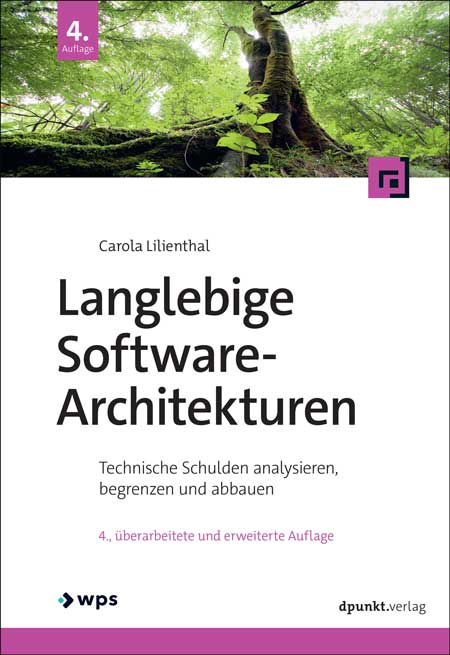
Langlebige Software-Architekturen (4. Auflg.)
Langlebige Software-Architekturen. Technische Schulden analysieren, begrenzen und abbauen. In 4., überarbeiteter und erweiterter Auflage (April 2024).Je nachdem, wo Sie gerade stehen, ob Sie ein neues Entwicklungsprojekt planen oder das Ausmaß an technischen Schulden in einem bestehenden System reduzieren wollen, in diesem Buch finden Sie die passenden Antworten, um zu verhindern, dass die Architektur Ihres Systems erodiert, die Komplexität zunimmt, ständig weitere technische Schulden entstehen und Wartung und Erweiterung immer aufwendiger werden.In diesem Buch zeigt Ihnen die Autorin, worauf Sie bei der Umsetzung der Architektur achten sollten und welche Prinzipien eingehalten werden müssen, damit Sie in Ihren Softwareprojekten langlebige Architekturen entwerfen oder Ihre bestehenden Systeme durch kleine und große Refactorings in langlebige Architekturen überführen können. Es werden Muster in Softwarearchitekturen und Mustersprachen sowie verschiedene Architekturstile erläutert und aufgezeigt, welche Vorgaben letztlich zu Architekturen führen, die für Entwickler noch gut durchschaubar sind.Mit über 200 farbigen Bildern aus real existierenden Softwaresystemen und etlichen Fallbeispielen werden schlechte und gute Lösungen verständlich und nachvollziehbar dargestellt. Empfehlungen und vielfältige Hinweise aus Praxisprojekten erlauben dem Leser einen direkten Transfer zu seiner täglichen Arbeit.In der 4. Auflage wurde dem Thema Modularity Maturity Index (MMI) ein eigenes Kapitel gewidmet und der Text inhaltlich so erweitert, dass der gesamte Algorithmus zur Berechnung des MMI zugänglich wird. Nun kann jedes Team den MMI für sein System selbst bestimmen.Leseprobe (PDF-Link)Zielgruppe: Softwarearchitekt*innen, Softwareentwickler*innen, IT-Consultants, Systemanalytiker*innen, Technische ProjektleitendeÜber die Autorin:Dr. Carola Lilienthal ist Geschäftsführerin der WPS – Workplace Solutions GmbH in Hamburg und verantwortet dort den Bereich Softwarearchitektur. Sie hat 1995 an der Universität Hamburg ihr Diplom in Informatik gemacht und dort zum Thema »Komplexität von Softwarearchitekturen« promoviert. Seit 2003 analysiert sie international im Auftrag ihrer Kund*innen die Architektur von Softwaresystemen und berät Entwicklungsteams, wie sie die Langlebigkeit ihrer Softwaresysteme verbessern können. Insgesamt hat sie mit ihrem Team über dreihundert Softwaresysteme zwischen 30.000 und 15 Mio. LOC in Java, C++, C#, ABAP, PHP und TypeScript untersucht. Besonders am Herzen liegt ihr die Ausbildung von Softwarearchitekt*innen und Entwickler*innen, weshalb sie aktives Mitglied im iSAQB, International Software Architecture Qualification Board, ist und ihr Wissen aus über 25 Jahren Softwareentwicklung regelmäßig auf Konferenzen, in Artikeln und bei Schulungen weitergibt.

Basiswissen Digital Design
Zunehmende Komplexität, steigende Anforderungen an die Digitalisierung und immer neue Möglichkeiten digitaler Technologien stellen die Industrie vor neue Herausforderungen. Das Fachgebiet »Digital Design« begegnet diesen Herausforderungen mit einem ganzheitlichen Gestaltungsanspruch durch die Integration von drei Kompetenzfeldern: Gestaltungskompetenz, Kompetenz in digitalen Technologien und Querschnittskompetenz für interdisziplinäres Arbeiten.Dieses Buch vermittelt die Grundlagen und gibt einen fundierten Überblick über alle relevanten Aspekte der ganzheitlichen Gestaltung digitaler Lösungen. Es beschreibt• die Kompetenzfelder des Digital Designs,• das Design mit digitalem Material und den Bauprozess,• die Strukturierung von Bauprozessen aus Sicht des Digital Designs,• wichtige digitale Technologien,• Designkompetenz und Designarbeit auf Lösungs-, System- und Elementebene sowie• die ganzheitliche Gestaltarbeit entlang des Bauprozesses.Abschließend werden Frameworks für den Bauprozess und die soziale Dimension des Bauprozesses behandelt. Das Buch orientiert sich am Lehrplan zum »Digital Design Professional – Foundation Level« (DDP) des International Requirements Engineering Board (IREB) und eignet sich daher nicht nur bestens zur Prüfungsvorbereitung, sondern dient gleichzeitig als kompaktes Grundlagenwerk zu diesen Themen in der Praxis und an Hochschulen.Kim Lauenroth gestaltet seit 2011 digitale Lösungen und vertritt seit 2022 das Lehrgebiet Digital Design an der Fachhochschule Dortmund. Er ist Mitinitiator und Erstunterzeichner des Bitkom Digital-Design-Manifests und engagiert sich ehrenamtlich für die berufliche Aus- und Weiterbildung als erster Vorsitzender des IREB e.V. Kim hat Informatik, Betriebswirtschaft und Psychologie an der Technischen Universität Dortmund studiert und im Bereich Requirements Engineering für Produktlinien an der Universität Duisburg-Essen promoviert.
CompTIA Network+ Practice Tests
ASSESS AND IMPROVE YOUR NETWORKING SKILLSET WITH PROVEN SYBEX PRACTICE TESTSIn the freshly revised Third Edition of CompTIA Network+ Practice Tests Exam N10-009, IT expert and author Craig Zacker delivers a set of accessible and useful practice tests for the updated Network+ Exam N10-009. You'll prepare for the exam, learn the information you need in an industry interview, and get ready to excel in your first networking role.These practice tests gauge your skills in deploying wired and wireless devices; understanding network documentation and the purpose of network services; work with datacenter, cloud, and virtual networking concepts; monitor network activity; and more.This book also offers:* Comprehensive coverage of all five domain areas of the updated Network+ exam, including network concepts, implementation, operations, security, and troubleshooting* Practical and efficient preparation for the Network+ exam with hundreds of domain-by-domain questions* Access to the Sybex interactive learning environment and online test bankPerfect for anyone preparing for the CompTIA Network+ Exam N10-009, the CompTIA Network+ Practice Tests Exam N10-009 is also an indispensable resource for network administrators seeking to enhance their skillset with new, foundational skills in a certification endorsed by industry leaders around the world.And save 10% when you purchase your CompTIA exam voucher with our exclusive WILEY10 coupon code.ABOUT THE AUTHORCRAIG ZACKER, is the author or co-author of dozens of books, manuals, articles, and web sites on computer and networking topics. Introduction xiiiCHAPTER 1 NETWORKING CONCEPTS 11.1 Explain concepts related to the Open Systems Interconnection (OSI) reference model 81.2 Compare and contrast networking appliances, applications, and functions 151.3 Summarize cloud concepts and connectivity options 251.4 Explain common networking ports, protocols, services, and traffic types 291.5 Compare and contrast transmission media and transceivers 371.6 Compare and contrast network topologies, architectures, and types 481.7 Given a scenario, use appropriate IPv4 network addressing 531.8 Summarize evolving use cases for modern network environments 59CHAPTER 2 NETWORK IMPLEMENTATION 632.1 Explain characteristics of routing technologies 662.2 Given a scenario, configure switching technologies and features 732.3 Given a scenario, select and configure wireless devices and technologies 832.4 Explain important factors of physical installations 94CHAPTER 3 NETWORK OPERATIONS 1033.1 Explain the purpose of organizational processes and procedures 1083.2 Given a scenario, use network monitoring technologies 1183.3 Explain disaster recovery (DR) concepts 1243.4 Given a scenario, implement IPv4 and IPv 6 network services 1313.5 Compare and contrast network access and management methods 138CHAPTER 4 NETWORK SECURITY 1454.1 Explain the importance of basic network security concepts 1484.2 Summarize various types of attacks and their impact to the network 1604.3 Given a scenario, apply network security features, defense techniques, and solutions 167CHAPTER 5 NETWORK TROUBLESHOOTING 1775.1 Explain the troubleshooting methodology 1815.2 Given a scenario, troubleshoot common cabling and physical interface issues 1875.3 Given a scenario, troubleshoot common issues with network services 2015.4 Given a scenario, troubleshoot common performance issues 2115.5 Given a scenario, use the appropriate tool or protocol to solve networking issues 219CHAPTER 6 PRACTICE TEST 1 241CHAPTER 7 PRACTICE TEST 2 267APPENDIX ANSWERS TO REVIEW QUESTIONS 293Chapter 1: Networking Concepts 294Chapter 2: Network Implementation 328Chapter 3: Network Operations 351Chapter 4: Network Security 375Chapter 5: Network Troubleshooting 396Chapter 6: Practice Test 1 428Chapter 7: Practice Test 2 443Index 457

Deep Learning Tools for Predicting Stock Market Movements
DEEP LEARNING TOOLS FOR PREDICTING STOCK MARKET MOVEMENTSTHE BOOK PROVIDES A COMPREHENSIVE OVERVIEW OF CURRENT RESEARCH AND DEVELOPMENTS IN THE FIELD OF DEEP LEARNING MODELS FOR STOCK MARKET FORECASTING IN THE DEVELOPED AND DEVELOPING WORLDS.The book delves into the realm of deep learning and embraces the challenges, opportunities, and transformation of stock market analysis. Deep learning helps foresee market trends with increased accuracy. With advancements in deep learning, new opportunities in styles, tools, and techniques evolve and embrace data-driven insights with theories and practical applications. Learn about designing, training, and applying predictive models with rigorous attention to detail. This book offers critical thinking skills and the cultivation of discerning approaches to market analysis. The book:* details the development of an ensemble model for stock market prediction, combining long short-term memory and autoregressive integrated moving average;* explains the rapid expansion of quantum computing technologies in financial systems;* provides an overview of deep learning techniques for forecasting stock market trends and examines their effectiveness across different time frames and market conditions;* explores applications and implications of various models for causality, volatility, and co-integration in stock markets, offering insights to investors and policymakers.AUDIENCEThe book has a wide audience of researchers in financial technology, financial software engineering, artificial intelligence, professional market investors, investment institutions, and asset management companies. RENUKA SHARMA, PHD, is a professor of finance at the Chitkara Business School, Punjab, India. She has authored more than 70 research papers published in international and national journals as well as authoring books on financial services. She is a much sought-after speaker on the international circuit. Her current research concentrates on SMEs and innovation, responsible investment, corporate governance, behavioral biases, risk management, and portfolios. KIRAN MEHTA, PHD, is a professor and dean of finance at Chitkara Business School, Punjab, India. She has published one book on financial services. Currently, her research endeavors focus on sustainable business and entrepreneurship, cryptocurrency, ethical investments, and women’s entrepreneurship. Additionally, Dr. Kiran is the founder and director of a research and consultancy firm.

IT Security managen
- Die Basis für Ihren Erfolg in der Verantwortung ür das IT Security Management - Einführung in die wichtigen Themen des IT Security Managements - Hilfe für das Management der vielfältigen Anforderungen in der Praxis - Neu in der 2. Auflage: Ausführliche Darstellung des Themenblocks IT Security Policy, Management der Sicherheit von operativer Technologie (OT-Security), Aktualisierte gesetzliche Regelungen, z.B. DSGVO, EU Cybersecurity Act, DDG, TTD - Ihr exklusiver Vorteil: E-Book inside beim Kauf des gedruckten Buches IT-Sicherheit ist weit mehr als nur der Einsatz technischer Sicherheitsmaßnahmen wie Firewalls oder Virenschutz. Eine beständige und wirtschaftliche Sicherheit für Ihre IT erreichen Sie nur, wenn Sie die IT-Risiken kontinuierlich managen und die ITSicherheit ganzheitlich betrachten, wozu neben der physischen und technischen Situation auch die Einbeziehung von personellen und organisatorischen Faktoren gehören. Dieses Praxishandbuch geht nicht nur auf die Methodik des IT Security Managements ein, so wie dies viele andere Bücher über das Thema tun, sondern widmet sich vor allem den Dingen dahinter, zum Beispiel unternehmenspolitischen Einflüssen, organisatorischen Fragestellungen oder taktischen Überlegungen. Damit beschäftigt es sich mit den Managementaspekten, mit denen Sie in der Verantwortung für das IT Security Management in Ihrer täglichen Arbeit konfrontiert werden und geht auf die Aspekte ein, die Sie berücksichtigen müssen, um in Ihrer Tätigkeit erfolgreich zu sein. AUS DEM INHALT // Stellenwert der Informationssicherheit/Risiko und Sicherheit/Entstehung und Auswirkungen von Risiken/Sicherheitsorganisation/IT Security Policy/ Sicherheit definieren und vorgeben/Risiken erkennen und bewerten/Reporting/Business Continuity/Notfallmanagement/Der Mensch in der Informationssicherheit/Incident Handling und IT-Forensik/IT-Sicherheit und externe Partner/Rechtliche Einflüsse

Mensch-Roboter-Interaktion (2. Auflg.)
Die Rolle der Roboter in der Gesellschaft wächst und diversifiziert sich ständig und bringt eine Vielzahl von Fragen mit sich, die die Beziehung zwischen Robotern und Menschen betreffen. Dieses Lehrbuch zur Mensch-Roboter-Interaktion bietet einen umfassenden Überblick über die interdisziplinären Themen, die für die moderne Forschung von zentraler Bedeutung sind. Studenten und Forscher aus den Bereichen Robotik, künstliche Intelligenz, Informatik, Elektrotechnik sowie Psychologie, Soziologie und Design finden darin einen prägnanten und verständlichen Leitfaden zum aktuellen Stand des Fachgebiets:- Funktion, Design und Leistungsbewertung von Robotern- Kommunikationsmodalitäten wie Sprache, nonverbale Kommunikation und die Verarbeitung von Emotionen- ethische Fragen rund um den Einsatz von Robotern heute und im Kontext unserer künftigen Gesellschaft.Zahlreiche Beispiele und farbige Abbildungen veranschaulichen die verschiedenen Themenfelder. Diskussionsfragen und relevante Literatur am Ende des Kapitels tragen zur Vertiefung bei.Aus dem Inhalt:- Was ist Mensch-Roboter-Interaktion?- Wie ein Roboter funktioniert- Design- Interaktion im Raum- Nonverbale Interaktion- Verbale Interaktion- Wie Menschen Roboter wahrnehmen- Emotionen- Forschungsmethoden- Anwendungen- Roboter in der Gesellschaft- Die ZukunftNeu in der 2. Auflage: Abschnitte zu kollaborativen Robotern, Roboterteams, Roboterschnittstellen; Maschinelles Lernen; Roboter in der Gesellschaft, in denen neue technische Entwicklungen sowie gesellschaftliche Veränderungen berücksichtigt werden. Christoph Bartneck ist außerordentlicher Professor im Fachbereich Informatik und Softwaretechnik an der Universität Canterbury, Neuseeland. Er hat einen Werdegang in Industriedesign und Mensch-Computer-Interaktion. Seine Projekte und Studien werden in führenden Zeitschriften, Zeitungen und Konferenzen veröffentlicht. Seine Interessen liegen in den Bereichen Mensch-Computer Interaktion, Naturwissenschaft und Technologie, sowie visuelles Design. Insbesondere beschäftigt Christoph sich mit den Auswirkungen von Anthropomorphismus auf HRI. Als sekundäres Forschungsinteresse arbeitet er an Projekten im Bereich der Sporttechnologie und der kritischen Untersuchung von Prozessen und Richtlinien in der Wissenschaft. Im Bereich Design beschäftigt sich Christoph mit der Geschichte des Produktdesigns, Mosaiken und Fotografie.Tony Belpaeme ist Professor an der Universität Gent, Belgien, und war zuvor Professor für Robotik und kognitive Systeme an der Universität Plymouth, Großbritannien. Er promovierte in künstlicher Intelligenz an der Vrije Universiteit Brussel (VUB). Ausgehend von der Prämisse, dass Intelligenz in sozialer Interaktion verwurzelt ist, versuchen Tony und sein Forschungsteam, die künstliche Intelligenz sozialer Roboter zu fördern. Dieser Ansatz führt zu einer Reihe an Ergebnissen, die von theoretischen Erkenntnissen bis zu praktischen Anwendungen reicht. Er ist an groß angelegten Projekten beteiligt, in denen untersucht wird, wie Roboter zur Unterstützung von Kindern in der Bildung eingesetzt werden können. Er untersucht, wie kurze Interaktionen mit Robotern zu langfristigen werden können und wie Roboter in der Therapie eingesetzt werden können.Friederike Eyssel ist Professorin für Angewandte Sozialpsychologie und Geschlechterforschung am Zentrum für Kognitive Interaktionstechnologie der Universität Bielefeld. Friederike interessiert sich für verschiedene Forschungsthemen, die von sozialer Robotik, sozialen Agenten und Ambient Intelligenz bis hin zu Einstellungsänderungen, Vorurteilsabbau und der sexuellen Objektivierung von Frauen reichen. Als Quereinsteigerin hat Friederike zahlreiche Publikationen in den Bereichen Sozialpsychologie, Human-Agent Interaction (HAI) und soziale Robotik veröffentlicht.Takayuki Kanda ist Professor für Informatik an der Universität Kyoto, Japan. Außerdem ist er Gastgruppenleiter bei Advanced Telecommunications Research (ATR), Interaction Science Laboratories, Kyoto, Japan. Er erhielt seinen Bachelor in Ingenieurwesen, seinen Master in Ingenieurwesen und seinen Doktortitel in Informatik von der Universität Kyoto, in den Jahren 1998, 2000 bzw. 2003. Er ist eines der Gründungsmitglieder des Kommunikationsroboter-Projekts am Advanced Telecommunications Research (ATR) in Kyoto. Er hat den Kommunikationsroboter Robovie entwickelt und ihn in alltäglichen Situationen eingesetzt, z. B. als Nachhilfelehrer in einer Grundschule und Ausstellungsführer in einem Museum. Zu seinen Forschungsinteressen gehören HAI, interaktive humanoide Roboter und Feldversuche.Merel Keijsers ist Assistenzprofessorin für Psychologie an der John Cabot University in Rom. Sie hat einen Abschluss in Sozialpsychologie und Statistik und promovierte an der Universität Canterbury, über das Thema „Roboter-Mobbing“. In ihrer Doktorarbeit untersuchte sie, welche bewussten und unbewussten psychologischen Prozesse Menschen dazu veranlassen, Roboter zu missbrauchen und zu schikanieren. In jüngster Zeit interessiert sie sich dafür, wie Roboter beeinflussen, auf welche Art Menschen sich selbst sehen. Da sie aus dem Bereich der Sozialpsychologie kommt, interessiert sie sich vor allem für die Gemeinsamkeiten und Unterschiede im Umgang von Menschen mit Robotern im Vergleich zu anderen Menschen.Selma Šabanović ist Professorin für Informatik und Kognitionswissenschaften an der Indiana University, Bloomington, USA, wo sie als Gründerin das R-House Human-Robot Interaction Lab leitet. Ihre Forschungsarbeit umfasst Studien zu Design, Nutzung und Folgen von sozial interaktiven und assistierenden Robotern in verschiedenen sozialen und kulturellen Kontexten, darunter Gesundheitseinrichtungen, Haushalten und verschiedene Länder. Sie befasst sich auch mit der kritischen Untersuchung der gesellschaftlichen Bedeutung und der potenziellen Auswirkungen der Entwicklung und des Einsatzes von Robotern in Kontext auf den Alltag. Sie promovierte 2007 in Wissenschafts- und Technologiestudien am Rensselaer Polytechnic Institute mit einer Dissertation über die kulturübergreifende Untersuchung der sozialen Robotik in Japan und den Vereinigten Staaten. Von 2017 bis 2023 war sie Chefredakteurin der Zeitschrift ACM Transactions on Human-Robot Interaction.

Reinforcement Learning
In uralten Spielen wie Schach oder Go können sich die brillantesten Spieler verbessern, indem sie die von einer Maschine produzierten Strategien studieren. Robotische Systeme üben ihre Bewegungen selbst. In Arcade Games erreichen lernfähige Agenten innerhalb weniger Stunden übermenschliches Niveau. Wie funktionieren diese spektakulären Algorithmen des bestärkenden Lernens? Mit gut verständlichen Erklärungen und übersichtlichen Beispielen in Java und Greenfoot können Sie sich die Prinzipien des bestärkenden Lernens aneignen und in eigenen intelligenten Agenten anwenden. Greenfoot (M.Kölling, King’s College London) und das Hamster-Modell (D.Bohles, Universität Oldenburg) sind einfache, aber auch mächtige didaktische Werkzeuge, die entwickelt wurden, um Grundkonzepte der Programmierung zu vermitteln. Wir werden Figuren wie den Java-Hamster zu lernfähigen Agenten machen, die eigenständig ihre Umgebung erkunden. Die zweite Auflage enthält neue Themen wie "Genetische Algorithmen" und "Künstliche Neugier" sowie Korrekturen und Überarbeitungen.UWE LORENZ war nach seinem Studium der Informatik und Philosophie mit Schwerpunkt künstliche Intelligenz und maschinelles Lernen an der Humboldt-Universität in Berlin und einigen Jahren als Projektingenieur für 10 Jahr als Gymnasiallehrer für Informatik und Mathematik tätig. Seit seinem Erstkontakt mit Computern Ende der 80er Jahre hat ihn das Thema Künstliche Intelligenz nicht mehr losgelassen. Derzeit arbeitet er als wissenschaftlicher Mitarbeiter in der Arbeitsgruppe Didaktik der Informatik bei Prof. Dr. Romeike an der Freien Universität Berlin in einem Projekt zur Thematik "Verantwortungsvolle Künstliche Intelligenz in der Lehramtsausbildung".Bestärkendes Lernen als Teilgebiet des Maschinellen Lernens.- Grundbegriffe des Bestärkenden Lernens.- Optimale Entscheidungen in einem bekannten Umweltsystem.- Entscheiden und Lernen in einem unbekannten Umweltsystem.- Neuronale Netze als Schätzer für Zustandsbewertungen und Aktionspreferenzen.- Werden digitale Agenten bald intelligenter als Menschen sein?.- Leitbilder in der KI.

Maschinelles Lernen für Dummies
ALGORITHMEN FÜR KÜNSTLICHES LERNEN VERSTEHENMaschinelles Lernen ist eines der wichtigsten Teilgebiete der künstlichen Intelligenz und das Verstehen und Entwickeln von passenden Algorithmen bleibt die große Herausforderung. Dieses Buch bietet einen außergewöhnlich umfassenden Überblick über die neuesten Algorithmen und die bereits bewährten Verfahren. Jörn Fischer beschreibt nicht nur deren Funktionsweise, sondern gibt für alle Bereiche verständliche Beispiele, die detailliert beschrieben und leicht nachvollziehbar sind. Außerdem werden hilfreiche Methoden zur Fehlersuche und -beseitigung an die Hand gegeben. SIE ERFAHREN* Wie Sie mit Python und Frameworks starten* Wie Sie Optimierung, Clustering und Klassifizierung umsetzen * Wie generative Methoden und Reinforcement Learning funktionieren * Wie neuronale Netze arbeiten und erklärbar werdenJÖRN FISCHER lehrt und forscht als Professor der Informatik an der Hochschule Mannheim. Sein Interesse für neuronale Netze und maschinelles Lernen geht zurück bis in die frühen 1990-er Jahre. Seit 2010 hält er Vorlesungen im Bereich maschinelles Lernen und begleitet die Umsetzung der Algorithmen in zahlreichen Projekten. Einleitung 17TEIL I: EINFÜHRUNG INS MASCHINELLE LERNEN 23Kapitel 1: Die Welt der KI 25Kapitel 2: Ein kleiner Mathe-Exkurs 29Kapitel 3: Python-Grundlagen 55Kapitel 4: Das Wichtigste: die Daten 69TEIL II: GRUNDLEGENDE OPTIMIERUNGS- UND LERNALGORITHMEN 83Kapitel 5: Einfach besser werden 85Kapitel 6: Natürlich – künstliche Evolution 97Kapitel 7: Clustering 115Kapitel 8: Klassifikation 123Kapitel 9: Regression 145TEIL III: NEURONALE NETZE 153Kapitel 10: Und was ist mit neuronalen Netzen? 155Kapitel 11: Tiefe Netze 193Kapitel 12: Generative Netze 219Kapitel 13: Rückgekoppelte Netze 237Kapitel 14: Neuronale Netze erklärbar 259TEIL IV: VERSTÄRKENDES LERNEN 271Kapitel 15: Reinforcement Learning 273Kapitel 16: Reinforcement Learning kombiniert 289Kapitel 17: Ein kleiner Blick in die Zukunft 305TEIL V: DER TOP-TEN-TEIL 313Kapitel 18: Zehn Tipps, damit es funktioniert 315Kapitel 19: Zehn Kategorien für die Anwendung 319Literaturverzeichnis 327Abbildungsverzeichnis 329Stichwortverzeichnis 337

Introduction to One Digital Identity
Explore the dynamics of digital identity, a crucial component in today’s modern technology-driven era. This engaging book offers a deep understanding of how digital identity is evolving rapidly, why it’s so significant, and offers organizations, regulatory bodies, and academicians the strategies needed to adopt secure decentralized digital identity features effectively. It’s a must-read for those aiming to grasp the intricacies of digital identity and leverage it for future innovation and security.The book begins by redefining digital identity, examining its evolution and the profound impact it has on both individuals and organizations. It then delves into the development of digital identity strategies, laying the foundation for future digital transformations. Covering a wide range of topics, the book discusses the innovation, challenges, and technological exploration in digital identity. A special focus is given to biometric technologies and the implementation of decentralized digital identities, addressing critical areas such as identity governance, blockchain, AI and advanced biometrics. The book also investigates the implications of digital identity across various industries, including cross border travel, healthcare, social media, finance, metaverse, IoT etc. finally the book provides not only emerging trends but offers a glimpse into the future digital identity.Whether you’re a tech professional, business leader, student or simply keen on understanding the impact of digital advancements, this book promises to offer insightful perspectives and practical solutions for navigating the complex world of digital identity. It underscores the importance of identity in spearheading digital innovation, making it a key resource for anyone looking to stay ahead in the digital landscape. As you reach its conclusion, you’ll be equipped with a wealth of knowledge and insights that are crucial in today’s digital era.WHAT YOU'LL LEARN* Digital identity strategies and their role in shaping the future of digital identity* Different facets of digital identity* Specifics of biometric technologies and decentralized digital identity * Industry specific digital identity and its implementation* Crucial aspects of privacy, ethics, and secure in the context of digital identityWHO THIS BOOK IS FORSoftware professionals, security practitioners, architects, senior managers, executives, and students who are interested in digital identity.Shivakumar R Goniwada is a renowned author, inventor, and technology leader with more than 23 years of experience in architecting cutting-edge cloud-native, data analytics, and event-driven systems. He currently holds a position as Chief Enterprise Architect at Accenture, where he leads a team of highly skilled technology enterprise and cloud architects. Throughout his career, Shivakumar has successfully led numerous complex projects across various industries and geographical locations. His expertise has earned him ten software patents in areas such as cloud computing, polyglot architecture, software engineering, and IoT. He is a sought-after speaker at global conferences and has made significant contributions to the field through his publications. Shivakumar R Goniwada holds a Master's degree in Technology Architecture and certifications in Google Professional, AWS, and data science. He also completed an Executive MBA at the prestigious MIT Sloan School of Management. His notable books include "Cloud-Native Architecture and Design" and "Introduction to Datafication," both published by Apress.Chapter 1: Redefining Digital Identity in New ERA.- Chapter 2: Digital Identity Strategy.- Chapter 3: Foundation of Future Digital Identity.- Chapter 4: The Rise of Biometric Systems.- Chapter 5: Decentralized Digital Identity (DID).- Chapter 6: Cross Border Travel with Digital Identity.- Chapter 7: Decentralized Identity in Social Media.- Chapter 8: Health Care and Financial Systems with Decentralized Identity.- Chapter 9:Next Generation Digital Frontier.- Chapter 10: Regulatory Landscape and Digital Rights.- Chapter 11: The Human Aspects – Societal and Psychological Implication.- Chapter 12: Peering into the Future – Next Frontier in Digital Identity.

Deep Learning Tools for Predicting Stock Market Movements
DEEP LEARNING TOOLS FOR PREDICTING STOCK MARKET MOVEMENTSTHE BOOK PROVIDES A COMPREHENSIVE OVERVIEW OF CURRENT RESEARCH AND DEVELOPMENTS IN THE FIELD OF DEEP LEARNING MODELS FOR STOCK MARKET FORECASTING IN THE DEVELOPED AND DEVELOPING WORLDS.The book delves into the realm of deep learning and embraces the challenges, opportunities, and transformation of stock market analysis. Deep learning helps foresee market trends with increased accuracy. With advancements in deep learning, new opportunities in styles, tools, and techniques evolve and embrace data-driven insights with theories and practical applications. Learn about designing, training, and applying predictive models with rigorous attention to detail. This book offers critical thinking skills and the cultivation of discerning approaches to market analysis. The book:* details the development of an ensemble model for stock market prediction, combining long short-term memory and autoregressive integrated moving average;* explains the rapid expansion of quantum computing technologies in financial systems;* provides an overview of deep learning techniques for forecasting stock market trends and examines their effectiveness across different time frames and market conditions;* explores applications and implications of various models for causality, volatility, and co-integration in stock markets, offering insights to investors and policymakers.AUDIENCEThe book has a wide audience of researchers in financial technology, financial software engineering, artificial intelligence, professional market investors, investment institutions, and asset management companies. RENUKA SHARMA, PHD, is a professor of finance at the Chitkara Business School, Punjab, India. She has authored more than 70 research papers published in international and national journals as well as authoring books on financial services. She is a much sought-after speaker on the international circuit. Her current research concentrates on SMEs and innovation, responsible investment, corporate governance, behavioral biases, risk management, and portfolios. KIRAN MEHTA, PHD, is a professor and dean of finance at Chitkara Business School, Punjab, India. She has published one book on financial services. Currently, her research endeavors focus on sustainable business and entrepreneurship, cryptocurrency, ethical investments, and women’s entrepreneurship. Additionally, Dr. Kiran is the founder and director of a research and consultancy firm.
Softwaretesten nach ISTQB CTFL 4.0 für Dummies
NEUE HAUPTVERSION 4.0: NEUER LEHRPLAN, GEÄNDERTER PRÜFUNGSUMFANG! Soll in Ihrem Unternehmen neue Software eingeführt werden und Sie müssen sie testen? Oder wollen Sie als Entwickler über den Tellerrand schauen und sich auch mit dem Softwaretesten beschäftigen? Leicht verständlich erläutert Ihnen Maud Schlich alle vom ISTQB® Certified Tester Foundation Level geforderten Lerninhalte sowohl für Programmierer als auch mit Blick auf Fachanwender, die die Software später einsetzen. Zahlreiche praxisorientierte Beispiele und übungen sorgen für eine optimale Prüfungsvorbereitung. Darüber hinaus erfahren Sie für alle Testaktivitäten, wie sie jeweils im klassischen oder im agilen Kontext geplant und durchgeführt werden. SIE ERFAHREN* Aus welchen Aktivitäten der Testprozess besteht* Wie Sie unterschiedliche Testverfahren nutzen* Wie Entwickler und Tester optimal zusammenarbeiten* Wie Sie prüfen, ob Sie noch im Plan sindMAUD SCHLICH coacht seit mehr als 25 Jahren Testmanager und Qualitätssicherungsteams im klassischen und im agilen Kontext. Sie ist Certified Tester Full Advanced Level und seit 2007 Mitglied des German Testing Board.
Large Language Model-Based Solutions
LEARN TO BUILD COST-EFFECTIVE APPS USING LARGE LANGUAGE MODELSIn Large Language Model-Based Solutions: How to Deliver Value with Cost-Effective Generative AI Applications, Principal Data Scientist at Amazon Web Services, Shreyas Subramanian, delivers a practical guide for developers and data scientists who wish to build and deploy cost-effective large language model (LLM)-based solutions. In the book, you'll find coverage of a wide range of key topics, including how to select a model, pre- and post-processing of data, prompt engineering, and instruction fine tuning. The author sheds light on techniques for optimizing inference, like model quantization and pruning, as well as different and affordable architectures for typical generative AI (GenAI) applications, including search systems, agent assists, and autonomous agents. You'll also find:* Effective strategies to address the challenge of the high computational cost associated with LLMs* Assistance with the complexities of building and deploying affordable generative AI apps, including tuning and inference techniques* Selection criteria for choosing a model, with particular consideration given to compact, nimble, and domain-specific modelsPerfect for developers and data scientists interested in deploying foundational models, or business leaders planning to scale out their use of GenAI, Large Language Model-Based Solutions will also benefit project leaders and managers, technical support staff, and administrators with an interest or stake in the subject. SHREYAS SUBRAMANIAN, PHD, is a principal data scientist at AWS, one of the largest organizations building and providing large language models for enterprise use. He is currently advising both internal Amazon teams and large enterprise customers on building, tuning, and deploying Generative AI applications at scale. Shreyas runs machine learning-focused cost optimization workshops, helping them reduce the costs of machine learning applications on the cloud. Shreyas also actively participates in cutting-edge research and development of advanced training, tuning and deployment techniques for foundation models.

Identity Attack Vectors
Today, it’s easier for threat actors to simply log in versus hack in. As cyberattacks continue to increase in volume and sophistication, it’s not a matter of if, but when, your organization will have an incident. Threat actors target accounts, users, and their associated identities—whether human or machine, to initiate or progress their attack. Detecting and defending against these malicious activities should be the basis of all modern cybersecurity initiatives.This book details the risks associated with poor identity security hygiene, the techniques that external and internal threat actors leverage, and the operational best practices that organizations should adopt to protect against identity theft, account compromises, and to develop an effective identity and access security strategy. As a solution to these challenges, Identity Security has emerged as a cornerstone of modern Identity and Access Management (IAM) initiatives. Managing accounts, credentials, roles, entitlements, certifications, and attestation reporting for all identities is now a security and regulatory compliance requirement.In this book, you will discover how inadequate identity and privileged access controls can be exploited to compromise accounts and credentials within an organization. You will understand the modern identity threat landscape and learn how role-based identity assignments, entitlements, and auditing strategies can be used to mitigate the threats across an organization’s entire Identity Fabric.WHAT YOU WILL LEARN* Understand the concepts behind an identity and how its associated credentials and accounts can be leveraged as an attack vector* Implement an effective identity security strategy to manage identities and accounts based on roles and entitlements, including the most sensitive privileged accounts* Know the role that identity security controls play in the cyber kill chain and how privileges should be managed as a potential weak link* Build upon industry standards and strategies such as Zero Trust to integrate key identity security technologies into a corporate ecosystem* Plan for a successful identity and access security deployment; create an implementation scope and measurable risk reduction; design auditing, discovery, and regulatory reporting; and develop oversight based on real-world strategies to prevent identity attack vectorsWHO THIS BOOK IS FORManagement and implementers in IT operations, security, and auditing looking to understand and implement an Identity and Access Management (IAM) program and manage privileges in these environmentsMOREY J. HABER is the Chief Security Officer at BeyondTrust. He has more than 25 years of IT industry experience and has authored four books: Privileged Attack Vectors, Asset Attack Vectors, Identity Attack Vectors, and Cloud Attack Vectors. He is a founding member of the industry group Transparency in Cyber, and in 2020 was elected to the Identity Defined Security Alliance (IDSA) Executive Advisory Board. Morey currently oversees BeyondTrust security and governance for corporate and cloud-based solutions and regularly consults for global periodicals and media. He originally joined BeyondTrust in 2012 as a part of the eEye Digital Security acquisition where he served as a Product Owner and Solutions Engineer since 2004. Prior to eEye, he was Beta Development Manager for Computer Associates, Inc. He began his career as Reliability and Maintainability Engineer for a government contractor building flight and training simulators. He earned a Bachelor of Science degree in Electrical Engineering from the State University of New York at Stony Brook.DARRAN ROLLS is CISO and Chief Technology Officer at SailPoint, where he is responsible for directing the company’s technology strategies and security operations, and is co-author of Asset Attack Vectors. He joined BeyondTrust in 2012 as a part of the eEye Digital Security acquisition. He currently oversees BeyondTrust technology management solutions for vulnerability, and privileged and remote access. In 2004, he joined eEye as Director of Security Engineering and was responsible for strategic business discussions and vulnerability management architectures for Fortune 500 clients. Prior to eEye, he was Development Manager for Computer Associates, Inc. (CA), responsible for new product beta cycles and named customer accounts. He began his career as Reliability and Maintainability Engineer for a government contractor building flight and training simulators. He earned a Bachelor of Science degree in Electrical Engineering from the State University of New York at Stony Brook. He has a long history in identity management and security at companies such as Tivoli Systems, IBM, Waveset Technologies, and Sun Microsystems. He has helped design, build, and deliver innovative, ground-breaking technology solutions that have defined and shaped the Identity and Access Management (IAM) industry. He frequently speaks at industry events and to customers about IAM and next-generation enterprise security solutions.Chapter 1: Introduction: The Machine.- Chapter 2: Introduction.- Chapter 3:.- Chapter 4:.- Chapter 5: Identity Access Denied.- Chapter 6: Understanding Enterprise Identity.- Chapter 7. Identity and Access Management.- Chapter 8: Privileged Access Management (PAM).- Chapter 9: Identity Threat Detection and Response.- Chapter 10: Indicators of Compromise.- Chapter 11: Identity Attack Vectors.- Chapter 12: The Identity Cyber Kill Chain.- Chapter 13: Six Steps to Identity Security.- Chapter 14: Emerging Identity Security Threats.- Chapter 15: Complexity Inherent in the IAM System.- Chapter 16: Identity Technical Debt.- Chapter 17: Identity Digital Transformation.- Chapter 18: Just in Time Access Management.- Chapter 19: Zero Trust for Identity Security.- Chapter 20: Identity Obfuscation.- Chapter 21: Regulatory Compliance.- Chapter 22: Key Takeaways.- Chapter 23: A Final Thought on Vendors.- Chapter 24: Conclusion.- Appendix A: Identity Security Sample RFP Questions.- Appendix B: Zero Trust Department of Defense (DoD) Framework.

Automatic Speech Recognition and Translation for Low Resource Languages
AUTOMATIC SPEECH RECOGNITION AND TRANSLATION FOR LOW-RESOURCE LANGUAGESTHIS BOOK IS A COMPREHENSIVE EXPLORATION INTO THE CUTTING-EDGE RESEARCH, METHODOLOGIES, AND ADVANCEMENTS IN ADDRESSING THE UNIQUE CHALLENGES ASSOCIATED WITH ASR AND TRANSLATION FOR LOW-RESOURCE LANGUAGES. Automatic Speech Recognition and Translation for Low Resource Languages contains groundbreaking research from experts and researchers sharing innovative solutions that address language challenges in low-resource environments. The book begins by delving into the fundamental concepts of ASR and translation, providing readers with a solid foundation for understanding the subsequent chapters. It then explores the intricacies of low-resource languages, analyzing the factors that contribute to their challenges and the significance of developing tailored solutions to overcome them. The chapters encompass a wide range of topics, ranging from both the theoretical and practical aspects of ASR and translation for low-resource languages. The book discusses data augmentation techniques, transfer learning, and multilingual training approaches that leverage the power of existing linguistic resources to improve accuracy and performance. Additionally, it investigates the possibilities offered by unsupervised and semi-supervised learning, as well as the benefits of active learning and crowdsourcing in enriching the training data. Throughout the book, emphasis is placed on the importance of considering the cultural and linguistic context of low-resource languages, recognizing the unique nuances and intricacies that influence accurate ASR and translation. Furthermore, the book explores the potential impact of these technologies in various domains, such as healthcare, education, and commerce, empowering individuals and communities by breaking down language barriers. AUDIENCEThe book targets researchers and professionals in the fields of natural language processing, computational linguistics, and speech technology. It will also be of interest to engineers, linguists, and individuals in industries and organizations working on cross-lingual communication, accessibility, and global connectivity. L. ASHOK KUMAR, PHD, is a professor in the Department of Electrical and Electronics Engineering, PSG of Technology, Tamil Nadu, India. He has published more than 175 papers in international and national journals and received 26 awards for his PhD project on wearable electronics at national and international levels. He has created eight Centres of Excellence at PSG in collaboration with government agencies and industries such as the Centre for Audio Visual Speech Recognition and the Centre for Excellence in Solar Thermal Systems. Twenty-three out of 27 of his products have been technologically transferred to government funding agencies. D. KARTHIKA RENUKA, PHD, is a professor at PSG of Technology, Tamil Nadu, India. Her main areas of study focus on data mining, evolutionary algorithms, and machine learning. She is a recipient of the Indo-U.S. Fellowship for Women in STEMM. She has organized two international conferences on The Innovation of Computing Techniques and Information Processing and Remote Computing.BHARATHI RAJA CHAKRAVARTHI, PHD, is an assistant professor in the School of Computer Science, University of Galway, Ireland. His studies focus on multimodal machine learning, abusive/offensive language detection, bias in natural language processing tasks, inclusive language detection, and multilingualism. He has published many papers in international journals and conferences. He is an associate editor of the journal Expert System with Application and an editorial board member for Computer Speech & Language. THOMAS MANDL, PHD, is a professor of Information Science and Language Technology, University of Hildesheim, Germany. His research interests include information retrieval, human-computer interaction, and internationalization of information technology and he has published more than 300 papers on these topics. He coordinated tracks at the Cross Language Evaluation Forum (CLEF), the European information retrieval evaluation initiative. Thomas Mandl is the co-chair at FIRE, the evaluation initiative for Indian languages, since 2020 and coordinates the HASOC track on hate speech detection.

Metaheuristics for Machine Learning
METAHEURISTICS FOR MACHINE LEARNINGTHE BOOK UNLOCKS THE POWER OF NATURE-INSPIRED OPTIMIZATION IN MACHINE LEARNING AND PRESENTS A COMPREHENSIVE GUIDE TO CUTTING-EDGE ALGORITHMS, INTERDISCIPLINARY INSIGHTS, AND REAL-WORLD APPLICATIONS.The field of metaheuristic optimization algorithms is experiencing rapid growth, both in academic research and industrial applications. These nature-inspired algorithms, which draw on phenomena like evolution, swarm behavior, and neural systems, have shown remarkable efficiency in solving complex optimization problems. With advancements in machine learning and artificial intelligence, the application of metaheuristic optimization techniques has expanded, demonstrating significant potential in optimizing machine learning models, hyperparameter tuning, and feature selection, among other use-cases. In the industrial landscape, these techniques are becoming indispensable for solving real-world problems in sectors ranging from healthcare to cybersecurity and sustainability. Businesses are incorporating metaheuristic optimization into machine learning workflows to improve decision-making, automate processes, and enhance system performance. As the boundaries of what is computationally possible continue to expand, the integration of metaheuristic optimization and machine learning represents a pioneering frontier in computational intelligence, making this book a timely resource for anyone involved in this interdisciplinary field. Metaheuristics for Machine Learning: Algorithms and Applications serves as a comprehensive guide to the intersection of nature-inspired optimization and machine learning. Authored by leading experts, this book seamlessly integrates insights from computer science, biology, and mathematics to offer a panoramic view of the latest advancements in metaheuristic algorithms. You’ll find detailed yet accessible discussions of algorithmic theory alongside real-world case studies that demonstrate their practical applications in machine learning optimization. Perfect for researchers, practitioners, and students, this book provides cutting-edge content with a focus on applicability and interdisciplinary knowledge. Whether you aim to optimize complex systems, delve into neural networks, or enhance predictive modeling, this book arms you with the tools and understanding you need to tackle challenges efficiently. Equip yourself with this essential resource and navigate the ever-evolving landscape of machine learning and optimization with confidence. AUDIENCEThe book is aimed at a broad audience encompassing researchers, practitioners, and students in the fields of computer science, data science, engineering, and mathematics. The detailed but accessible content makes it a must-have for both academia and industry professionals interested in the optimization aspects of machine learning algorithms. KANAK KALITA, PHD, is a professor in the Department of Mechanical Engineering, Vel Tech Rangarajan Dr. Sagunthala R&D Institute of Science and Technology, Avadi, India. He has more than 190 articles in international and national journals and 5 edited books. Dr. Kalita’s research interests include machine learning, fuzzy decision-making, metamodeling, process optimization, finite element method, and composites. NARAYANAN GANESH, PHD, is an associate professor at the Vellore Institute of Technology Chennai Campus. His extensive research encompasses a range of critical areas, including software engineering, agile software development, prediction and optimization techniques, deep learning, image processing, and data analytics. He has published over 30 articles and written 8 textbooks and has been recognized for his contributions to the field with two international patents from Australia. S. BALAMURUGAN, PHD, is the Director of Research and Development, Intelligent Research Consultancy Services (iRCS), Coimbatore, Tamilnadu, India. He is also Director of the Albert Einstein Engineering and Research Labs (AEER Labs), as well as Vice-Chairman, Renewable Energy Society of India (RESI), India. He has published 45 books, 200+ international journals/ conferences, and 35 patents.

Beginning Shadow DOM API
Leverage the power of the Shadow DOM API to quickly create encapsulated code that keeps markup and styles separate within websites. Using little more than a text editor or free software, this project-oriented book simplifies the process of creating and manipulating the Shadow DOM API code in the browser for websites or online applications.You'll use a starting toolset to develop future projects, incorporate them into an existing workflow, and allow them to simplify complex components. This makes them more robust and less brittle when used in websites. You'll also see that websites do not have to convert the whole work process immediately; you can incorporate as little or as much as needed of the API, and build on this as your skills develop.We live in an age where speed and simplicity are of the essence. _Beginning Shadow DOM API_ shows you the perfect way to create encapsulated code that can run in multiple frameworks with a minimum of fuss.YOU YOU'LL LEARN* Implement the Shadow DOM API in a project* Gain an appreciation of pointers using the Shadow DOM API* Manage issues and security when using the Shadow DOM API* Make components and code more reusable, while maintaining desired stylingWHO THIS BOOK IS FORWebsite developers who are already familiar with frameworks that Shadow DOM API, but do not want to have to use the heavy weight of a full-sized framework to add features such as DOM encapsulation to their code.ALEX LIBBY is a frontend developer and seasoned computer book author, who hails from England. His passion for all things open-source dates back to his student days, when he first came across web development, and has been hooked ever since. His daily work involves extensive use of JavaScript, HTML, and CSS to manipulate existing website content; Alex enjoys tinkering with different open-source libraries to see how they work. He has spent a stint maintaining the jQuery Tools library, and enjoys writing about open-source technologies, principally for front-end UI development.1.Getting Started.- 2. Creating Components.- 3. Applying Shadow DOM API in Apps.- 4. Supporting other Frameworks.
Writing AI Prompts For Dummies
LEARN THE ART OF WRITING EFFECTIVE AI PROMPTS AND BREAK INTO AN EXCITING NEW CAREER FIELDWriting AI Prompts For Dummies gets you started on the path toward becoming an “AI psychologist” capable of getting all types of output from AI systems. This book walks you through the process of mining great results from leading platforms, so you can save time, solve problems, explore creative ideas, conduct research, and beyond. Even if you’re brand new to using AI chatbots, you’ll be able to follow the jargon-free explanations and instructions inside to learn how to ask questions and make requests in terms any AI can understand. Then, you can convert your new skill into greater productivity in your life, or even into a new career. Prompt engineering is a fast-growing career opportunity with six-figure salaries attached. Who knows? This Dummies guide could be your launchpad to a future as an AI whisperer.* Explore the top AI chatbots, creativity engines, and productivity tools* Learn how to write basic text prompts that generate concise, effective output* Create AI-generated photos and illustrations that match your vision* Save time writing code, designing websites, or conducting research When asked “Who needs to learn prompt engineering?” ChatGPT clarifies: professionals, creatives, educators, scientists, and entrepreneurs in many fields can benefit an enhanced ability to use AI productively. And for anyone working in AI, natural language processing, or related areas, Writing AI Prompts For Dummies is simply a must. STEPHANIE DIAMOND is a marketing professional and author or coauthor of more than two dozen books, including Digital Marketing All-in-One For Dummies and Facebook Marketing For Dummies. JEFFREY ALLAN is the Director of the Institute for Responsible Technology and Artificial Intelligence (IRT) at Nazareth University.

Topics in Artificial Intelligence Applied to Industry 4.0
TOPICS IN ARTIFICIAL INTELLIGENCE APPLIED TO INDUSTRY 4.0FORWARD THINKING RESOURCE DISCUSSING EMERGING AI AND IOT TECHNOLOGIES AND HOW THEY ARE APPLIED TO INDUSTRY 4.0 Topics in Artificial Intelligence Applied to Industry 4.0 discusses the design principles, technologies, and applications of emerging AI and IoT solutions on Industry 4.0, explaining how to make improvements in infrastructure through emerging technologies. Providing a clear connection with different technologies such as IoT, Big Data, AR and VR, and Blockchain, this book presents security, privacy, trust, and other issues whilst delving into real-world problems and case studies. The text takes a highly practical approach, with a clear insight on how readers can increase productivity by drastically shortening the time period between the development of a new product and its delivery to customers in the market by 50%. This book also discusses how to save energy across systems to ensure competitiveness in a global market, and become more responsive in how they produce products and services for their consumers, such as by investing in flexible production lines. Written by highly qualified authors, Topics in Artificial Intelligence Applied to Industry 4.0 explores sample topics such as:* Quantum machine learning, neural network implementation, and cloud and data analytics for effective analysis of industrial data * Computer vision, emerging networking technologies, industrial data spaces, and an industry vision for 2030 in both developing and developed nations * Novel or improved nature-inspired optimization algorithms in enhancing Industry 5.0 and the connectivity of any components for smart environment * Future professions in agriculture, medicine, education, fitness, R&D, and transport and communication as a result of new technologies Aimed at researchers and students in the interdisciplinary fields of Smart Manufacturing and Smart Applications, Topics in Artificial Intelligence Applied to Industry 4.0 provides the perfect overview of technology from the perspective of modern society and operational environment. MAHMOUD RAGAB AL-REFAEY is a Professor of Data Science with the Information Technology Department, Faculty of Computing and Information Technology (FCIT), King Abdulaziz University (KAU), Jeddah, Saudi Arabia and the Mathematics Department, Faculty of Science, Al-Azhar University, Egypt. He obtained his PhD. from the faculty of Mathematics and Natural Sciences of the Christian-Albrechts-University at Kiel (CAU), Germany. AMIT KUMAR TYAGI is an Assistant Professor of Department of Fashion Technology, National Institute of Fashion Technology, New Delhi, India. Previously he has worked as Assistant Professor (Grade-2) and Senior Researcher at the School of Computer Science and Engineering, Vellore Institute of Technology (VIT), Chennai, Tamilnadu, India. He received his PhD. Degree in 2018 from Pondicherry Central University, India. ABDULLAH SAAD AL-MALAISE AL-GHAMDI is a Professor of Information Systems Department, Faculty of Computing and Information Technology (FCIT), King Abdulaziz University (KAU), Jeddah, Saudi Arabia and Information Systems Department, School of Engineering, Computing and Design, Dar Al-Hekma University, Jeddah, Saudi Arabia. He is the Secretary General of the Scientific Council at KAU. He received his PhD. degree in Computer Science, George Washington University, USA. SWETTA KUKREJA is Associate Professor in the Computer Science and Engineering, Amity University, Mumbai, India. She has more than 10 years of teaching and research experience.

Tidy First?
Unordentlicher Code ist ein Ärgernis und schwer zu lesen. In diesem praktischen Leitfaden demonstriert Kent Beck, Schöpfer von Extreme Programming, wann und wie Sie kleinere Aufräumarbeiten durchführen können, um Ihren Code zu optimieren und dabei die Gesamtstruktur Ihres Systems immer besser zu verstehen.Anstatt sich mit zu viel Aufräumen auf einmal zu überfordern, zeigt Kent Beck, wie Sie pragmatisch vorgehen. Sie lernen etwa, wie Sie eine Funktion mit vielen Codezeilen logisch in kleinere Stücke aufteilen. Und nebenbei verstehen Sie wichtige Aspekte der Theorie wie Kopplung, Kohäsion, abgezinste Zahlungsströme und Optionalität.Dieses Buch unterstützt Sie dabei:• die grundlegende Theorie zu verstehen, wie SoftwareDesign funktioniert und welche Kräfte darauf einwirken• unterschiedliche Auswirkungen bei Änderungen am Verhalten eines Systems und bei Änderungen an seiner Struktur einzuschätzen• Ihr Programmiererlebnis zu verbessern, indem Sie manchmal zuerst aufräumen und manchmal später• zu lernen, wie Sie große Veränderungen in kleinen, sicheren Schritten vornehmen• Softwareentwicklung als ein Pflegen menschlicher Beziehungen zu verstehenKent Beck ist Programmierer, Erfinder von Extreme Programming, Pionier im Bereich der Software Patterns, Mitautor von JUnit, Wiederentdecker der testgetriebenen Entwicklung und engagierter Beobachter von 3X: Explore/Expand/Extract. Beck ist – in der alphabetischen Reihenfolge – der erste Unterzeichner des Agilen Manifests. Er lebt in San Francisco, Kalifornien, und ist Chief Scientist bei Mechanical Orchard. Dort vermittelt er Entwicklerinnen und Entwicklern Fähigkeiten, die Geeks dabei helfen sollen, sich in der Welt sicher zu fühlen. Kents Website ist hier zu finden: https://www.kentbeck.com
Einstieg in Ethical Hacking
Penetration Testing und Hacking-Tools für die IT-Security. Erstauflage von Jürgen Ebner aus März 2024.Ethical Hacking spielt eine wesentliche Rolle für die IT-Sicherheit in Unternehmen. Mit diesem Buch lernen Sie, wie ein Angreifer zu denken, um die Systeme von Unternehmen vor Cyberangriffen zu schützen.Sie erfahren, welche gängigen Angriffe es gibt und wie Sie diese in einer sicheren Testumgebung durchführen, um Sicherheitslücken im System aufzuspüren. Hierzu richten Sie Kali Linux auf einer virtuellen Maschine ein und nutzen die zahlreichen integrierten Tools für verschiedene Angriffstechniken wie das Hacken von Passwörtern, Codeinjection, Social Engineering und mehr. Die notwendigen Grundlagen zu Netzwerken, Active Directory und Shell Scripting sind ebenfalls Bestandteil des Buches.Darüber hinaus erfahren Sie, wie ein professioneller Penetrationstest abläuft, welche Rahmenbedingungen dafür notwendig sind und welche Richtlinien eingehalten werden müssen, um legal und ethisch zu hacken.Über den Autor:Jürgen Ebner ist u.a. IT-Techniker und zertifizierter Datenschutz- und IT-Security-Experte. Bei der IT-Betreuung setzt er auf proaktive Services, um für mehr Sicherheit in den Unternehmen zu sorgen. Mit seinem IT-Unternehmen ICTE bietet er neben Managed Services vor allem Security Assessments und die Erarbeitung von Datenschutzkonzepten an.

Spring Boot 3 Recipes
Solve all your Spring Boot 3 micro-framework problems using complete, real-world Java-based code snippets and examples inspired by various problems and corresponding solutions to those problems . When you start a new project, you’ll be able to copy the code and configuration files from this book, and then modify them for your own specific software programming needs. This can save you a great deal of work over creating a project from scratch.Spring Boot 3 Recipes has been revised to include new features like the new Spring Native, newly repackaged Spring Data, Spring Kafka for messaging and more on Kubernetes/deployment than in the previous edition. It includes Java 17 long term support code and Jakarta EE 9+ code as a base for Spring Boot 3. This handy code reference takes advantage of these things as it introduces you to VMWare's Spring Boot 3 and Spring Native. Quickly, it dives into code snippets on how to apply and integrate SpringBoot 3 with the Spring MVC web framework, web sockets and WebFlux for the rapid development of web applications, web services, microservices and more.You'll also get solutions to common problems with data persistence, integrating Spring Boot with batch processing, algorithmic programming via Spring Batch, and much more. These enable you to enhance or round out your web applications or microservices with a data and/or transaction-tier to boot. Other recipes cover topics such as using and integrating Boot with Spring's enterprise services, Spring Integration, testing, monitoring and more.At the end of the book, you'll have the code snippets and packages to deploy your Spring Boot-created microservices or applications on a cloud platform like Amazon using the popular Kubernetes container. Finally, this code reference is a must have for your Spring library.WHAT YOU'LL LEARN* Get reusable code recipes and snippets for the Spring Boot 3 micro-framework * Discover how Spring Boot 3 integrates with other Spring APIs, tools, and frameworks* Access Spring MVC, web sockets and WebFlux for easier web development* Work with microservices for web services development and integration with your Spring Boot applications* Add persistence and a data tier seamlessly to make your Spring Boot web application do more* Integrate enterprise services via Spring Integration and Jakarta EE to create a more complex Java application using Spring BootWHO THIS BOOK IS FORThis book is for experienced Java and Spring software programmers, developers.MARTEN DEINUM is a submitter on the open source Spring Framework project. He is also a Java/software consultant working for Conspect. He has developed and architected software, primarily in Java, for small and large companies. He is an enthusiastic open source user and long-time fan, user, and advocate of the Spring Framework. He has held a number of positions, including Software Engineer, Development Lead, Coach, and also as a Java and Spring Trainer.1. Spring Boot Introduction.- 2. Spring Boot - Basics.- 3. Spring MVC.- 4. WebFlux.- 5. Spring Security.- 6.Spring Boot - Data Access.- 7. Java Enterprise Services.- 8. Spring Messaging.- 9. Spring Boot - Actuator.- 10.Spring Boot - Packing.

Building Generative AI-Powered Apps
Generative AI has gone beyond the responsibility of researchers and data scientists and is being used by production engineers. However, there is a lot of confusion where to get started when building an end-to-end app with generative AI. This book consolidates core models, frameworks, and tools into a single source of knowledge. By providing hands-on examples, the book takes you through the generative AI ecosystem to build applications for production.The book starts with a brief and accessible introduction to transformer models before delving into some of the most popular large language models and diffusions models (image generation). These models are the foundations of both AI and your potential new apps. You will then go through various tools available to work with these models, starting with Langchain, a framework to develop foundational models, which is the next building block you should grasp after understanding generative AI models. The next chapters cover databases, caching, monitoring, etc., which are the topics necessary to build larger-scale applications. Real-world examples using these models and tools are included.By the end of this book, you should be able to build end-to-end apps that are powered by generative AI. You also should be able to apply the tools and techniques taught in this book to your use cases and business.WHAT YOU WILL LEARN* What is Generative AI?* What is ChatGPT and GPT4?* What are language models and diffusions models?* How do we deploy LangChain and HuggingFace?WHO THIS BOOK IS FORSoftware engineers with a few years of experience building applications in any language or infrastructureAARUSHI KANSAL is an experienced principal engineer. She has worked in a variety of technologies, including mobile development, Python, Go, and cloud, along with booming generative AI space. She has spearheaded AI initiatives in the workplace and regularly works on creative POCs in her spare time to stay at the top of the generative AI space.Chapter 1: Introduction to Generative AI.- Chapter 2: LangChain + AI.- Using Chains.- Chapter 3: AI + Embeddings.- Chapter 4: AI + Text at Scale.- Chapter 5: AI and Audio.- Chapter 6: Finetuning GPT.- Chapter 7: Monitoring.- Chapter 8: UI + UX.- Appendix A: .

Generative Art with JavaScript and SVG
This book introduces you to the exciting world of generative art (artwork that are solely or partially created with the use of an autonomous system) through the medium of SVG and JavaScript. More specifically, it will teach the use of Graphery SVG (gySVG), a JavaScript library that closely mirrors the SVG spec and makes scripting SVG very intuitive and enjoyable. Armed with gySVG, the reader will be taught tried and trusted techniques in producing generative imagery. Each chapter will build upon the previous one, and those completely new to programming will be given a primer to help them find their feet.Beginning with a simple generative sketch that illustrates, and then explains, fundamental programming concepts such as variables, data types, operators, loops, conditionals and functions - the reader will go on to explore the power of Scalable Vector Graphics, how to play with randomness and regularity, how to use noise to create organic variance, and how to make sketches interactive and dynamic. More advanced topics will then be tackled, such as paths, filter effects, trigonometry, shape packing, flow fields and fractals.It will be a fun journey, easy to follow, peppered with plenty of attractive sketches throughout. The goal will be to visually inspire readers with compelling examples of what’s possible - rather than bare-bones, make-do illustrations - thereby breathing life into the underlying theoretical concepts.WHAT YOU'LL LEARN:* Generative art is and its creative process* How to use the gySVG library locally with Node.js or online via Codepen* Consolidation of JavaScript fundamentals, using modern ES6+ syntax* Creating a variety of SVG shapes generatively* Creating iterative variations of sketches by randomizing parameters* Using noise to create organic variance* Creating complex SVG paths generatively* How to make sketchesinteractiveWHO IS IT FOR:Web developers and designers and creative coders with an interest in digital and generative art as well as artists who are interested in learning to code with JavaScript.DAVID MATTHEW is a web developer, designer and musician with over 11 years of industry experience who is passionate about generative art and web development, music visualization and in particular, SVG and the often untapped potential it offers.David blogs on topics including JavaScript, CSS WorldPress and creative coding and as a regular producer of generative art, he showcases his work on his Instagram page: instagram.com/davidmatthew_ie 1. The Beginner’s Path.- 2. A Programming Primer.- 3. All About SVG.- 4. Randomness and Regularity.- 5. The Need for Noise.- 6. The All-Powerful Path.- 7. Motion and Interactivity.- 8. Filter Effects.- 9. The Generative Way.

Azure Data Factory by Example
Data engineers who need to hit the ground running will use this book to build skills in Azure Data Factory v2 (ADF). The tutorial-first approach to ADF taken in this book gets you working from the first chapter, explaining key ideas naturally as you encounter them. From creating your first data factory to building complex, metadata-driven nested pipelines, the book guides you through essential concepts in Microsoft’s cloud-based ETL/ELT platform. It introduces components indispensable for the movement and transformation of data in the cloud. Then it demonstrates the tools necessary to orchestrate, monitor, and manage those components.This edition, updated for 2024, includes the latest developments to the Azure Data Factory service:* Enhancements to existing pipeline activities such as Execute Pipeline, along with the introduction of new activities such as Script, and activities designed specifically to interact with Azure Synapse Analytics.* Improvements to flow control provided by activity deactivation and the Fail activity.* The introduction of reusable data flow components such as user-defined functions and flowlets.* Extensions to integration runtime capabilities including Managed VNet support.* The ability to trigger pipelines in response to custom events.* Tools for implementing boilerplate processes such as change data capture and metadata-driven data copying.WHAT YOU WILL LEARN* Create pipelines, activities, datasets, and linked services* Build reusable components using variables, parameters, and expressions* Move data into and around Azure services automatically* Transform data natively using ADF data flows and Power Query data wrangling* Master flow-of-control and triggers for tightly orchestrated pipeline execution* Publish and monitor pipelines easily and with confidenceWHO THIS BOOK IS FORData engineers and ETL developers taking their first steps in Azure Data Factory, SQL Server Integration Services users making the transition toward doing ETL in Microsoft’s Azure cloud, and SQL Server database administrators involved in data warehousing and ETL operationsRICHARD SWINBANK is a data engineer and Microsoft Data Platform MVP. He specializes in building and automating analytics platforms using Microsoft technologies from the SQL Server stack to the Azure cloud. He is a fervent advocate of DataOps, with a technical focus on bringing automation to both analytics development and operations. An active member of the data community and keen knowledge-sharer, Richard is a volunteer, organizer, speaker, blogger, open source contributor, and author. He holds a PhD in computer science from the University of Birmingham (UK).1. Creating an Azure Data Factory Instance.- 2. Your First Pipeline.- 3. The Copy Data Activity.- 4. Expressions.- 5. Parameters.- 6. Controlling Flow.- 7. Data Flows.- 8. Integration Runtimes.- 9. Power Query in ADF.- 10. Publishing to ADF.- 11. Triggers.- 12. Change Monitoring.- 13. Tools and Other Services.