

Allgemein

Brain Rush
After decades of false starts, artificial intelligence (AI) is entering the mainstream of society. That is largely due to the rapid adoption of ChatGPT, a service that responds to almost any natural language question with cogent paragraphs. ChatGPT is the leading example of generative AI -- technology that creates original text, images, video and computer code based on uncovering patterns in training data.The book will explain how generative AI works and how much economic value it could create and will map out the industry value network. For each value network stage, the book will define the industry, estimate its size, growth rate, and profit potential, identify the most successful participants, and explain how they have achieved their success and where they will compete in the future. The book will conclude with a section on what investors and business leaders should do to make an informed decision on where to place their bets.WHAT YOU WILL LEARNInsights on how best to assemble the resources – whether by hiring a consultant or bringing on board a generative AI expert -- to build, train, and operate company specific generative AI applicationsHow management can brainstorm, evaluate and execute the right opportunitiesConcepts and processes to enable investors to place bets with the highest risk-adjusted returnsWHO THIS BOOK IS FORBusiness and enterprises seeking to get value from generative AI, current or potential suppliers of technology and services to companies that build generative AI, and venture capitalists and public equity investors seeking to make profitable bets on generative AI companiesPeter S. Cohan is an Associate Professor of Management Practice at Babson College. He teaches strategy, leadership and entrepreneurship to students in its undergraduate, Master of Science in Entrepreneurial Leadership, Master of Science in Advanced Entrepreneurial Leadership, MBA, and Executive Education programs. He is coordinator of Babson’s required undergraduate strategy course and the creator and teacher of advanced strategy courses for undergraduate and MSEL students. Cohan is the founding principal of Peter S. Cohan & Associates, a management consulting and venture capital firm. He has completed over 150 growth-strategy consulting projects for global technology companies and invested in seven startups -- three of which were sold for about $2 billion and one of which went public in 2021 at an $18 billion valuation. He has written 16 books including Net Profit: How to Invest and Compete in the Wild World of Internet Business. Since 2011 he has been a contributor to Forbes and Inc. He is a frequent media commentator who has appeared on ABC's Good Morning America, Bloomberg, CNN, CNBC, Fox Business News, American Public Media's MarketPlace, WBUR, WGBH, New England Cable News and the Boston ABC, NBC, and CBS affiliates. He has been quoted in the Associated Press, the Christian Science Monitor, the London Evening Standard, the Times of London, the New York Times, Nikkei, USA Today, the Wall Street Journal, the Washington Post, Portugal's Expresso, the Economist, Time, BusinessWeek, and Fortune. He also appeared in the 2016 documentary film, We the People: the Market Basket Effect. Prior to starting his firm, he worked as a case team leader for Harvard Business School Professor Michael Porter's consulting firm. He has taught at MIT, Stanford, Columbia, Tel Aviv University, New York University, Bentley University, The Vienna University of Technology, School of Management Fribourg, Barcelona's EADA, Singapore's Nanyang Technological University, the University of Coimbra, the University of Chile, the University of Hong Kong and Tecnologico de Monterrey. RETHINK Retail chose him as a Top 100 Retail Influencer of 2021, 2022, and 2023. He earned an MBA from Wharton, did graduate work in computer science at MIT, and holds a BS in Electrical Engineering from Swarthmore College.Chapter 1 title: Brain Rush.- Part I: Mining Generative AI’s End User Value.- Chapter 2 title: Generative AI Customer End Uses.- Part II: Mapping The Generative AI Ecosystem.- Chapter 3 title: Generative AI Application Software.- Chapter 4 title: Generative AI Cloud Services.- Chapter 5 title: Generative AI Network Technology.- Chapter 6 title: Generative AI Semiconductors.- Part II: Panning For Generative AI Gold.- Chapter 7 title: How Companies Can Profit From Generative AI.- Chapter 8 title: Supplying The Generative AI Picks And Shovels.- Chapter 9 title: Capitalizing The Generative AI Winners.- Chapter 10 title: After the Brain Rush.

Beginning Mathematica and Wolfram for Data Science
Enhance your data science programming and analysis with the Wolfram programming language and Mathematica, an applied mathematical tools suite. This second edition introduces the latest LLM Wolfram capabilities, delves into the exploration of data types in Mathematica, covers key programming concepts, and includes code performance and debugging techniques for code optimization.You’ll gain a deeper understanding of data science from a theoretical and practical perspective using Mathematica and the Wolfram Language. Learning this language makes your data science code better because it is very intuitive and comes with pre-existing functions that can provide a welcoming experience for those who use other programming languages. Existing topics have been reorganized for better context and to accommodate the introduction of Notebook styles. The book also incorporates new functionalities in code versions 13 and 14 for imported and exported data.You’ll see how to use Mathematica, where data management and mathematical computations are needed. Along the way, you’ll appreciate how Mathematica provides an entirely integrated platform: its symbolic and numerical calculation result in a mized syntax, allowing it to carry out various processes without superfluous lines of code. You’ll learn to use its notebooks as a standard format, which also serves to create detailed reports of the processes carried out.WHAT YOU WILL LEARN* Create datasets, work with data frames, and create tables* Import, export, analyze, and visualize data* Work with the Wolfram data repository* Build reports on the analysis* Use Mathematica for machine learning, with different algorithms, including linear, multiple, and logistic regression; decision trees; and data clusteringWHO THIS BOOK IS FORData scientists who are new to using Wolfram and Mathematica as a programming language or tool. Programmers should have some prior programming experience, but can be new to the Wolfram language.JALIL VILLALOBOS ALVA is a Wolfram language programmer and Mathematica user. He graduated with a degree in engineering physics from the Universidad Iberoamericana in Mexico City. His research background comprises quantum physics, bionformatics, proteomics, and protein design. His academic interests cover the topics of quantum technology, bioinformatics, machine learning, artificial intelligence, stochastic processes, and space engineering. During his idle hours he likes to play soccer, swim, and listen to music.1. Introduction to Mathematica.- 2. Data Manipulation.- 3. Working with Data and Datasets.- 4. Import and Export.- 5. Data Visualization.- 6. Statistical Data Analysis.- 7. Data Exploration.- 8. Machine Learning with the Wolfram Language.- 9. Neural Networks with the Wolfram Language.- 10. Neural Network Framework.

Vorschriften und Betriebstechnik des Amateurfunks
So bestehen Sie Ihre Amateurfunkprüfung mit Bravour! Für das erfolgreiche Bestehen der Amateurfunkprüfung benötigen Sie nicht nur umfassendes Technik-Wissen, sondern Sie müssen sich auch mit den Vorschriften und Gesetzen sowie der Betriebstechnik auskennen. Dazu finden Sie in diesem E-Book alles, was Sie für das sichere Bestehen der Prüfungen in den Klassen N, E und A und den souveränen Funkbetrieb wissen müssen. Inklusive Beispielen und Übungsfragen, aktuell zur AFuV 2024. Bei Ihren ersten Schritten in der Funkpraxis unterstützt Sie mit den notwendigen Grundlagen »Amateurfunk. Das umfassende Handbuch« von Harald Zisler DL 6 RAL und Thomas Lauterbach DL 1 NAW. Aus dem Inhalt: Grundwissen über die gesetzlichen Grundlagen und VorschriftenSicherheitsvorschriftenElektromagnetische UmweltverträglichkeitAmateurfunkbetrieb unterwegsBandpläne: Für ein gutes MiteinanderVerkehrsregeln im FunkbetriebNotfunk und Verhalten im NotfallLogbücher und QSL-KartenMit Übungen und Musterlösungen

Beginning Python
Gain a fundamental understanding of Python’s syntax and features with this revised introductory and practical reference. Covering a wide array of Python–related programming topics, including addressing language internals, database integration, network programming, and web services, you’ll be guided by sound development principles.Updated to reflect the latest in Python programming paradigms and several of the most crucial features found in Python 3, _Beginning Python, Fourth Edition_ also covers advanced topics such as extending Python and packaging/distributing Python applications. Ten accompanying projects will ensure you can get your hands dirty in no time.YOU WILL:* Become a proficient Python programmer by following along with a friendly, practical guide to the language’s key features* Write code faster by learning how to take advantage of advanced features such as magic methods, exceptions, and abstraction* Gain insight into modern Python programming paradigms including testing, documentation, packaging, and distribution* Work through several interesting projects, including a P2P file–sharing application, chat client, video game, remote text editor, and moreWHO THIS BOOK IS FORProgrammers, novice and otherwise, seeking a comprehensive introduction to the Python programming language.MAGNUS LIE HETLAND is an experienced Python programmer, having used the language since the late 1990s. He is also an associate professor of algorithms at the Norwegian University of Science and Technology, having taught algorithms for the better part of a decade. Hetland is the author of Practical Python and Beginning Python, first and second editions, as well as several scientific papers.FABIO NELLI is an IT Scientific Application Specialist at IRBM Science Park, a private research center in Pomezia, Roma, Italy. He has been a computer consultant for many years at IBM, EDS, Merck Sharp, and Dohme, along with several banks and insurance companies. He has an Organic Chemistry degree and many years of experience in Information technologies and Automation systems applied to Life Sciences (Tech Specialist at Beckman Coulter Italy and Spain). He is currently developing Java applications that interface Oracle databases with scientific instrumentation generating data and web server applications providing analysis of the results to researchers in real time.Ch. 1 Instant hacking : the basics.- Ch. 2 Lists and tuples.- Ch. 3 Working with strings.- Ch. 4 Dictionaries : when indices won't do.- Ch. 5 Conditionals, loops, and some other statements.- Ch. 6 Abstraction.- Ch. 7 More abstraction.- Ch. 8 Exceptions.- Ch. 9 Magic methods, properties, and iterators.- Ch. 10 Batteries included.- Ch. 11 Files and stuff.- Ch. 12 Graphical user interfaces.- Ch. 13 Database support.- Ch. 14 Network programming.- Ch. 15 Python and the Web.- Ch. 16 Testing, 1-2-3.- Ch. 17 Extending Python.- Ch. 18 Packaging your programs.- Ch. 19 Playful programming.- Ch. 20 Project 1 : instant markup.- Ch. 21 Project 2 : painting a pretty picture.- Ch. 22 Project 3 : XML for all occasions.- Ch. 23 Project 4 : in the news.- Ch. 24 Project 5 : a virtual tea party.- Ch. 25 Project 6 : remote editing with CGI.- Ch. 26 Project 7 : your own bulletin board.- Ch. 27 Project 8 : file sharing with XML-RPC.- Ch. 28 Project 9 : file sharing II - now with GUI!.- Ch. 29 Project 10 : do-it-yourself arcade game.- Appendix A: The Short Version.- Appendix B: Python Reference.

KI in Gesundheit und Pflege
Zu Risiken und Nebenwirkungen fragen Sie Ihre KIKünstliche Intelligenz durchdringt alle Bereiche des Lebens - auch das Gesundheitswesen. Walter Swoboda zeigt in seinem Buch, wie die KI funktioniert, welche Varianten dieser neuen Technologie in Gesundheit und Pflege zum Einsatz kommen können und welche Einsatzgebiete sich kurz- und langfristig ergeben. Auf Chancen, Risiken und ethische Herausforderungen geht er ein. Auch experimentelle Verfahren der Zukunft berücksichtigt er.Das Buch richtet sich an Praktizierende, Forschende und Studierende in den Bereichen Gesundheitswesen, Gesundheitsmanagement, Gesundheitsinformatik, Medizin, Pflegewissenschaften sowie Medizinethik.Prof. Dr. Walter Swoboda ist Arzt und Informatiker. Er ist zudem Forschungsprofessor an der Hochschule Neu-Ulm. Als Leiter der gemeinsamen Ethikkommission der Hochschulen Bayerns (GEHBa) beschäftigt er sich mit ethischen Fragen zu neuen Technologien aus Medizin und Informatik.1 Versuch und Irrtum: Die Geschichte der künstlichen Intelligenz2 Wie funktioniert unser Gehirn?3 Nachgebaut: Künstliche neuronale Netzwerke4 Einsatz in Medizin und Pflege5 Der mehr oder weniger mündige Patient und seine KI6 Experimentelle Krankheitsmodelle in der Forschung7 "Bin ich?" oder "die KI und das Bewusstsein"8 Eine leicht überraschende ethische Bewertung

Automatisiertes Fahren 2022
Künstliche Intelligenz, Machine- oder Deep-Learning sind Treiber des automatisierten Fahrens. Das Zusammenspiel von künstlicher und menschlicher Intelligenz sowie die Fähigkeit von Mensch und Maschine zu kooperieren müssen in neuen Interaktionsebenen gestaltet und für zukünftige Mobilität nutzbar gemacht werden. Dafür ist es notwendig, dass die Gesellschaft diese Entwicklung akzeptiert. Vor diesem Hintergrund gewinnen Methoden, Werkzeuge und Prozesse ebenso an Relevanz wie Sensoren und Connectivity. Die Sessions der AUFA 2022 beschäftigten sich mit: Architekturen und Standardisierung.- Versicherungsthemen.- Manöverplanung.- Neue Fahrzeug- und Innenraumkonzepte.- Testverfahren und Absicherung.- Datengenerierung und Datensicherheit.- Verkehrsplanung und Geschäftsmodelle.- HMI und Fahrzeugmonitoring.

The Decision Maker's Handbook to Data Science
Data science is expanding across industries at a rapid pace, and the companies first to adopt best practices will gain a significant advantage. To reap the benefits, decision makers need to have a confident understanding of data science and its application in their organization. This third edition delves into the latest advancements in AI, particularly focusing on large language models (LLMs), with clear distinctions made between AI and traditional data science, including AI's ability to emulate human decision-making.Author Stylianos Kampakis introduces you to the critical aspect of ethics in AI, an area of growing importance and scrutiny. The narrative examines the ethical considerations intrinsic to the development and deployment of AI technologies, including bias, fairness, transparency, and accountability. You’ll be provided with the expertise and tools required to develop a solid data strategy that is continuously effective. Ethics and legal issues surrounding data collection and algorithmic bias are some common pitfalls that Kampakis helps you avoid, while guiding you on the path to build a thriving data science culture at your organization. This updated edition also includes plenty of case studies, tools for project assessment, and expanded content for hiring and managing data scientists.Data science is a language that everyone at a modern company should understand across departments. Friction in communication arises most often when management does not connect with what a data scientist is doing or how impactful data collection and storage can be for their organization. The Decision Maker’s Handbook to Data Science bridges this gap and readies you for both the present and future of your workplace in this engaging, comprehensive guide.WHAT YOU WILL LEARN* Integrate AI with other innovative technologies * Explore anticipated ethical, regulatory, and technical landscapes that will shape the future of AI and data science* Discover how to hire and manage data scientists* Build the right environment in order to make your organization data-drivenWHO THIS BOOK IS FORStartup founders, product managers, higher level managers, and any other non-technical decision makers who are thinking to implement data science in their organization and hire data scientists. A secondary audience includes people looking for a soft introduction into the subject of data science.DR. STYLIANOS (STELIOS) KAMPAKIS is a data scientist who lives and works in London, UK. He holds a PhD in Computer Science from University College London, as well as an MSc in Informatics from the University of Edinburgh. He also holds degrees in Statistics, Cognitive Psychology, Economics and Intelligent Systems. He is a member of the Royal Statistical Society and an honorary research fellow in the UCL Centre for Blockchain Technologies. He has many years of academic and industrial experience in all fields of data science like statistical modelling, machine learning, classic AI, optimization and more.Throughout his career, Stylianos has been involved in a wide range of projects: from using deep learning to analyze data from mobile sensors and radar devices, to recommender systems, to natural language processing for social media data to predicting sports outcomes. He has also done work in the areas of econometrics, Bayesian modelling, forecasting and research design. He also has many years of experience in consulting for startups and scale-ups, having successfully worked with companies of all stages, some of which have raised millions of dollars in funding. He is still providing services in data science and blockchain, as a partner in Electi Consulting.In the academic domain, he is one of the foremost experts in the area of sports analytics, having done his PhD in the use of machine learning for predicting football injuries. He has also published papers in the areas neural networks, computational neuroscience and cognitive science. Finally, he is also involved in blockchain research and more specifically in the areas of tokenomics, supply chains and securitization of assets.Stylianos is also very active in the area of data science education. He is the founder of The Tesseract Academy, a company whose mission is to help decision makers understand deep technical topics such as machine learning and blockchain. He is also teaching “Social Media Analytics”, and “Quantitative Methods and Statistics with R” in the Cyprus International Institute of Management, and runs his own data science school in London called Datalyst.He often writes about data science, machine learning, blockchain and other topics at his personal blog: The Data Scientist (thedatascientist.com).Chapter 1: Demystifying Data Science, AI and All the Other Buzzwords.- Chapter 2: Data Management.- Chapter 3: Data Collection Problems.- Chapter 4: How to Keep Data Tidy.- Chapter 5: Thinking like a Data Scientist (Without Being One).- Chapter 6: A Short Introduction to Statistics.- Chapter 7: A Short Introduction to Machine Learning.- Chapter 8: An introduction to AI.- Chapter 9: Problem Solving.- Chapter 10: Pitfalls.- Chapter 11: Hiring and Managing Data Scientists.- Chapter 12: Building a Data-Driven Culture.- Chapter 13: AI Ethics.- Chapter 14: The Future of AI and Data Science. Epilogue: Data Science Rules the World.- Appendix: Tools for Data Science.

Mastering Cybersecurity
The modern digital landscape presents many threats and opportunities, necessitating a robust understanding of cybersecurity. This book offers readers a broad-spectrum view of cybersecurity, providing insights from fundamental concepts to advanced technologies.Beginning with the foundational understanding of the ever-evolving threat landscape, the book methodically introduces many cyber threats. From familiar challenges like malware and phishing to more sophisticated attacks targeting IoT and blockchain, readers will gain a robust comprehension of the attack vectors threatening our digital world.Understanding threats is just the start. The book also delves deep into the defensive mechanisms and strategies to counter these challenges. Readers will explore the intricate art of cryptography, the nuances of securing both mobile and web applications, and the complexities inherent in ensuring the safety of cloud environments. Through meticulously crafted case studies tailored for each chapter, readers will witness theoretical concepts' practical implications and applications. These studies, although fictional, resonate with real-world scenarios, offering a nuanced understanding of the material and facilitating its practical application.Complementing the knowledge are reinforcement activities designed to test and solidify understanding. Through multiple-choice questions, readers can gauge their grasp of each chapter's content, and actionable recommendations offer insights on how to apply this knowledge in real-world settings. Adding chapters that delve into the intersection of cutting-edge technologies like AI and cybersecurity ensures that readers are prepared for the present and future of digital security. This book promises a holistic, hands-on, and forward-looking education in cybersecurity, ensuring readers are both knowledgeable and action-ready.WHAT YOU WILL LEARN* The vast array of cyber threats, laying the groundwork for understanding the significance of cybersecurity* Various attack vectors, from malware and phishing to DDoS, giving readers a detailed understanding of potential threats* The psychological aspect of cyber threats, revealing how humans can be manipulated into compromising security* How information is encrypted and decrypted to preserve its integrity and confidentiality* The techniques and technologies that safeguard data being transferred across networks* Strategies and methods to protect online applications from threats* How to safeguard data and devices in an increasingly mobile-first world* The complexities of the complexities of cloud environments, offering tools and strategies to ensure data safety* The science behind investigating and analyzing cybercrimes post-incident* How to assess system vulnerabilities and how ethical hacking can identify weaknessesWHO THIS BOOK IS FOR:CISOs, Learners, Educators, Professionals, Executives, Auditors, Boards of Directors, and more.JASON EDWARDS'S career is a blend of extensive cybersecurity experience and academic achievement, with impactful roles in the military and corporate sectors, including leadership positions at major technology, financial, insurance, and energy companies. Jason is also a retired military officer who served in numerous capacities and earned the Bronze Star for service in Iraq. His academic journey culminated in a doctorate in IT and Cybersecurity, focusing on regulatory compliance within cybersecurity. Jason teaches for several college programs, designs college-level training courses, and is a prolific writer. Active on LinkedIn, he leverages his platform to offer free cybersecurity training, mentorship, and advice to over 70,000 followers. Edwards' commitment to education, both as a learner and a teacher, underscores his dedication to enhancing cybersecurity practices and shaping the next generation of professionals.Chapter 1: Threat Landscape.- Chapter 2: Types of Cyber Attacks.- Chapter 3: Social Engineering.- Chapter 4: Cryptography.- Chapter 5: Network Security.- Chapter 6: Web Application Security.- Chapter 7: Mobile Security.-Chapter 8: Cloud Security.- Chapter 9: IoT Security.- Chapter 10: Digital Forensics.- Chapter 11: Vulnerability Assessment and Penetration Testing.- Chapter 12: Security Policies and Procedures.- Chapter 13: Data Privacy and Protection.- Chapter 14: Insider Threats.

Internationaler Motorenkongress 2023
In diesem Tagungsband werden von anerkannten Experten der Automobil- und Nutzfahrzeugbranche eine Fülle neuer technischer Lösungen aufgezeigt. Die Tagung ist eine unverzichtbare Plattform für den Wissens- und Gedankenaustausch von Forschern und Entwicklern aller Unternehmen und Institutionen. Der Inhalt Nachhaltige Mobilität: vollständige LCA.- Gesamtsystem Verbrennungsmotoren und Kraftstoffe:CO2-Reduzierung, Emissionierung, Elektrifizierung.- Klimagerechte Verbrennungsmotoren.- Effizienzsteigerung in Produkten und Prozessen.- Nutzung von Wasserstoff und synthetischen Kraftstoffen. Die Zielgruppen Fahrzeug- und Motoreningenieure sowie Studierende, die aktuelles Fachwissen im Zusammenhang mit Fragestellungen ihres Arbeitsfeldes suchen - Professoren und Dozenten an Universitäten und Hochschulen mit Schwerpunkt Kraftfahrzeug- und Motorentechnik - Gutachter, Forscher und Entwicklungsingenieure in der Automobil- und Zulieferindustrie Die Veranstalter ATZlive steht für Spitzenqualität, hohes Niveau in Sachen Fachinformation und ist Bestandteil von Springer Nature. Hier wird unter einem Dach das Know-how der renommiertesten Wirtschafts-, Wissenschafts- und Technikverlage Deutschlands vereint. VDI Wissensforum vermittelt als ein führender Weiterbildungsspezialist das Wissen aus praktisch allen Technikdisziplinen und den wichtigsten außerfachlichen Gebieten. Dabei wird großer Wert auf Nachhaltigkeit und Praxisrelevanz gelegt.

Malware Development for Ethical Hackers
Malware Development for Ethical Hackers is a comprehensive guide to the dark side of cybersecurity within an ethical context.This book takes you on a journey through the intricate world of malware development, shedding light on the techniques and strategies employed by cybercriminals. As you progress, you’ll focus on the ethical considerations that ethical hackers must uphold. You’ll also gain practical experience in creating and implementing popular techniques encountered in real-world malicious applications, such as Carbanak, Carberp, Stuxnet, Conti, Babuk, and BlackCat ransomware. This book will also equip you with the knowledge and skills you need to understand and effectively combat malicious software.By the end of this book, you'll know the secrets behind malware development, having explored the intricate details of programming, evasion techniques, persistence mechanisms, and more.

Unbemannte Luftfahrtsysteme
Drohnen sind längst von einer vielversprechenden Zukunftstechnologie zu einer etablierten Größe am Himmel geworden. Durch die zunehmenden Möglichkeiten ziviler Nutzung nimmt ihre Präsenz dabei immer noch zu, wodurch Fragen aufgeworfen werden, die schon heute beantwortet werden müssen. Neben den obligatorischen rechtlichen Fragen geht es dabei auch um den gesellschaftlichen Einfluss, den neue Technologie seit je her mit sich bringen.Welche rechtlichen Rahmenbedingungen sind nötig, wenn immer mehr Drohnen sich den Luftraum mit anderen Luftverkehrsteilnehmern teilen? Wie ist es um die Sicherheit, auch IT-Sicherheit bestellt, wenn zunehmend Drohnen über der Bevölkerung schweben? Welche ethischen Herausforderungen bringen unbemannte Systeme mit sich, die zunehmend autonom operieren?All jenen Fragen widmen sich die Autoren dieses Sammelbandes und schaffen so neue Zugänge und Perspektiven auf das Zukunftsthema der Unbemannten Luftfahrtsysteme.PROF. DR. ANDREAS DEL RE ist Ökonom und Leiter des Instituts für unbemannte Systeme an der NBS Northern Business School Hamburg. Neben seiner Lehrtätigkeit fungierte er unter anderem als Gutachter für die Bundesregierung hinsichtlich Gefahren- und Missbrauchspotentialen von Drohnen.PROF. DR. NORBERT KÄMPER ist Partner der internationalen Rechtsanwaltskanzlei TaylorWessing. In dieser Funktion berät er seit vielen Jahren Unternehmen und Genehmigungsbehörden in allen Fragen des Fachplanungs- und Umweltrechts. Er begleitet Infrastrukturvorhaben wie etwa Flughäfen oder Binnenhäfen von der Vorbereitung der Antragstellung über die Umweltverträglichkeitsprüfung und das Öffentlichkeitsbeteiligungsverfahren bis zur Erstellung von Planfeststellungsbeschlüssen.ANDREAS SCHOCH ist wissenschaftlicher Mitarbeiter am Institut für unbemannte Systeme an der NBS Northern Business School Hamburg, Theologe undWirtschaftsethiker. Er ist Mitautor eines Gutachtens für die Bundesregierung hinsichtlich Gefahren- und Missbrauchspotentialen von Drohnen.PHILIPP SCHEELE ist Ökonom und wissenschaftlicher Mitarbeiter am Institut für unbemannte Systeme an der NBS Northern Business School Hamburg. Neben weiterer Tätigkeiten ist er Mitautor eines Gutachtens für die Bundesregierung hinsichtlich Gefahren- und Missbrauchspotentialen von Drohnen.Wirtschaftliche Möglichkeiten.- Rechtliche Rahmenbedingungen.- Sicherheit der Anwendung.- Gesellschaftliche Akzeptanz.- Ethische Fragestellungen.

Software Development, Design, and Coding
Learn the principles of good software design and then turn those principles into great code. This book introduces you to software engineering — from the application of engineering principles to the development of software. You'll see how to run a software development project, examine the different phases of a project, and learn how to design and implement programs that solve specific problems. This book is also about code construction — how to write great programs and make them work.This new third edition is revamped to reflect significant changes in the software development landscape with updated design and coding examples and figures. Extreme programming takes a backseat, making way for expanded coverage of the most crucial agile methodologies today: Scrum, Lean Software Development, Kanban, and Dark Scrum. Agile principles are revised to explore further functionalities of requirement gathering. The authors venture beyond imperative and object-oriented languages, exploring the realm of scripting languages in an expanded chapter on Code Construction. The Project Management Essentials chapter has been revamped and expanded to incorporate "SoftAware Development” to discuss the crucial interpersonal nature of joint software creation.Whether you're new to programming or have written hundreds of applications, in this book you'll re-examine what you already do, and you'll investigate ways to improve. Using the Java language, you'll look deeply into coding standards, debugging, unit testing, modularity, and other characteristics of good programs.YOU WILL LEARN* Modern agile methodologies* How to work on and with development teams* How to leverage the capabilities of modern computer systems with parallel programming* How to work with design patterns to exploit application development best practices* How to use modern tools for development, collaboration, and source code controlsWHO THIS BOOK IS FOREarly career software developers, or upper-level students in software engineering coursesJOHN F. DOOLEY is the William and Marilyn Ingersoll Professor Emeritus of Computer Science at Knox College in Galesburg, Illinois. Before returning to teaching in 2001, Professor Dooley spent more than 16 years in the software industry as a developer, designer, and manager working for companies such as Bell Telephone Laboratories, McDonnell Douglas, IBM, and Motorola, along with an obligatory stint as head of development at a software startup. He has written more than two dozen professional journal and conference publications and seven books to his credit, along with numerous presentations. He has been a reviewer for the Association for Computing Machinery Special Interest Group on Computer Science Education (SIGCSE) Technical Symposium for the last 36 years and reviews papers for the IEEE Transactions on Education, the journal Cryptologia, and other professional conferences. He has created short courses in software development and three separate Software Engineering courses at the advanced undergraduate level.DR. VERA A. KAZAKOVA is a Computer Science educator and researcher, with expertise in artificial intelligence, experiential learning, and collaborative methodologies. With a PhD in AI focused on nature-inspired computation and emergent division of labor, her research spans CS Education, Evolutionary Computation, Narrative Generation, Decentralized Multi-Agent Systems, and Cyber Social Science. Dr. Kazakova also has extensive experience as a CS educator, having taught programming, artificial intelligence, research, and software development courses. Dr. Kazakova has coined the term "Soft-Aware Development" to encapsulate a holistic approach for building software, building stakeholder relationships, and building up each developer along the way. An ardent proponent of experiential learning and agile methodologies, Dr. Kazakova champions a multi-sprint learning architecture that enables students to adapt and iterate, fostering a shared environment of continuous growth. Her passion for collaboration, from simplistic autonomous agents to human developers, and members of large online communities, sets her apart as an advocate for a more interconnected, empathetic, and empowering approach to CS research, education, and software development.Chapter 1: Introduction to Software Development.- PART ONE: MODELS AND TEAM PRACTICES.- Chapter 2: Software Process Models.- Chapter 3: Project Management Essentials.- Chapter 4: Ethics and Professional Practice.- Chapter 5: Intellectual Property, Obligations, and Ownership.- Chapter 6: Requirements.- PART TWO: DESIGN PRACTICES.- Chapter 7: Software Architecture.- Chapter 8: Design Principles.- Chapter 9: Structured Design.- Chapter 10: Object-Oriented Overview.- Chapter 11: Object-Oriented Analysis and Design.- Chapter 12: Object-Oriented Design Principles.- Chapter 13: Design Patterns.- Chapter 14:Parallel Programming.- Chapter 15:Parallel; Design Patterns.- PART THREE: CODING PRACTICES.- Chapter 16: Code Construction.- Chapter 17: Debugging.- Chapter 18: Unit Testing.- Chapter 19:P Code Reviews and Inspections.- Chapter 20: Wrapping It All Up.

Natürliche und künstliche Intelligenz
Dieses Sachbuch fasst die wissenschaftlichen Grundlagen der natürlichen und künstlichen Intelligenzsysteme zusammen und analysiert ihre Leistungen in einem kritischen Vergleich. Fachkenntnisse sind keine Voraussetzung. Nach einer Einführung in die Intelligenzforschung folgt die Beschreibung menschlicher und tierischer Intelligenz und deren neurobiologischen Grundlagen. Dieser natürlichen Intelligenz wird im Anschluss die künstliche Intelligenz gegenübergestellt, wobei die wichtigsten Grundprinzipien und die Entwicklung hin zu heutigen KI-Systemen betrachtet werden. Dies beinhaltet auch die wichtige Frage, inwiefern KI-Systeme vom Gehirn und dessen Arbeitsweisen lernen können und ob durch das „Nachbauen“ von Nervenzellenverbünden mit den sogenannten neuromorphen Chips vergleichbare Leistungen erreichbar sind oder sein werden. Ein besonderer Fokus liegt auf der kritischen Betrachtung und Einordnung der Fähigkeiten von KI-Systemen in Hinblick auf Denken und Handeln als eine selbstständige Entscheidungsinstanz. Letzteres wirft Fragen hinsichtlich moralischer Entscheidungen und des möglichen Kontrollverlusts über solche Systeme auf, die zurzeit nicht abschließend beantwortet werden können Einleitung.- Menschliche Intelligenz.- Intelligenzleistungen bei nichtmenschlichen Tieren.- Neurobiologische Grundlagen kognitiver Leistungen.- Künstliche Intelligenz.- Gehirne und KI – wer übertrifft wen worin?.- Wie geht unsere Gesellschaft mit den KI-Systemen um?.- Zusammenfassung und Ausblick.
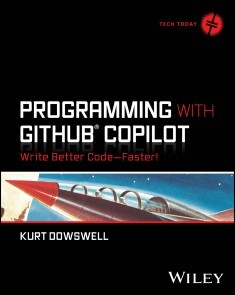
Programming with GitHub Copilot
ACCELERATE YOUR PROGRAMMING WITH THE MOST POPULAR AI CODING TOOL ON THE MARKET: GITHUB COPILOTIn Programming with GitHub Copilot: Write Better Code — Faster, veteran software developer and GitHub community hero Kurt Dowswell delivers an insightful and hands-on exploration of GitHub's powerful, new AI coding assistant, Copilot. In the book, you'll discover how to use the tool's capabilities to push the boundaries of what you thought was possible in programming. Even if you've used autocomplete tools—like VS Code's TabNine extension—before, you'll be floored by GitHub Copilot's potential to transform the way you code. You'll learn how to install, configure, and use the software, from employing it's most common and widely used features to deploying business and enterprise functionality. You'll even discover how to fix runtime and compilation bugs and write unit, integration, and end-to-end tests. You'll also find:* Prompt strategies to get GitHub Copilot to help you brainstorm new code solutions* What the future looks like for AI-assisted coding, including discussions of issues like code licensing and ethics* Directions for chatting with Copilot, including common commands and prompts to help you guide the conversation to where you want it to goPerfect for practicing programmers, developers, and software engineers, Programming with GitHub Copilot is also an essential resource for coders and other IT practitioners-in-training who want to expand their knowledge and improve the scope and depth of their programming skillsets. KURT DOWSWELL is a software architect with over 13 years of experience delivering enterprise-grade software solutions for the Department of Defense. He is one of the first developers to work with GitHub Copilot and is a GitHub “community hero,” evangelizing the AI coding tool to the global developer community. Introduction xviiPART I GETTING STARTED WITH GITHUB COPILOT 1CHAPTER 1 GET STARTED WITH GITHUB COPILOT 3Learn Why GitHub Copilot Matters 4Create a GitHub Account 4Acquire a GitHub Copilot License 4Install an IDE Extension 5First Run: Test Copilot 10Conclusion 15Reference 15CHAPTER 2 DECODING GITHUB COPILOT 17Uncover the AI Behind GitHub Copilot 17Understand Security, Privacy, and Data Handling 18Understand Copyright Protections 20Explore the GitHub Copilot Trust Center 21Conclusion 22References 22PART II GITHUB COPILOT FEATURES IN ACTION 23CHAPTER 3 EXPLORING CODE COMPLETIONS 25Introducing Code Completions 25Working with Copilot Code Completions 26Discovering the Toolbar and Panel 34Updating Copilot Settings 36Leveraging Keyboard Shortcuts 38Conclusion 40CHAPTER 4 CHATTING WITH GITHUB COPILOT 41Discovering Copilot Chat 41Defining Prompt Engineering with Copilot Chat 48Commanding Your Conversation with Precision 52Conclusion 65PART III PRACTICAL APPLICATIONS OF GITHUB COPILOT 67CHAPTER 5 LEARNING A NEW PROGRAMMING LANGUAGE 69Introducing Language Education with Copilot 70Setting Up Your Development Environment 70Learning the Basics 72Creating a Console Application 74Explaining Code with Copilot 77Adding New Code 78Learning to Test 79Conclusion 85Reference 86CHAPTER 6 WRITING TESTS WITH COPILOT 87Establishing the Example Project 87Adding Unit Tests to Existing Code 89Exploring Behavior-Driven Development with Copilot 94Conclusion 99CHAPTER 7 DIAGNOSING AND RESOLVING BUGS 101Establishing the Example Project 101Fixing Syntax Errors 103Resolving Runtime Exceptions 105Resolving Terminal Errors 109Conclusion 111CHAPTER 8 CODE REFACTORING WITH COPILOT 113Introducing Code Refactoring with Copilot 113Establishing the Example Project 114Refactoring Duplicate Code 116Refactoring Validators 122Refactoring Bad Variable Names 127Documenting and Commenting Code 129Conclusion 132CHAPTER 9 ENHANCING CODE SECURITY 133Detailing Code Security 133Establishing the Example Project 134Exploring Code Security 135Finding and Fixing Security Issues 139Conclusion 142CHAPTER 10 ACCELERATING DEVSECOPS PRACTICES 143Detailing DevSecOps 143Simplifying Containers 144Automating Infrastructure as Code 148Streamlining CI/CD Pipelines 152Conclusion 158CHAPTER 11 ENHANCING DEVELOPMENT ENVIRONMENTS WITH COPILOT 159Amplifying Visual Studio with Copilot 159Elevating Azure Data Studio with Copilot 166Boosting JetBrains IntelliJ IDEA with Copilot 171Enhancing Neovim with Copilot 176Consulting Copilot in the GitHub cli 181References 185Conclusion 185CHAPTER 12 UNIVERSAL CONVERSION WITH GITHUB COPILOT 187Translating Natural Language to Programming Languages 188Converting JavaScript Components 190Simplifying CSS Styles 191Enhancing Nontyped Languages with Types 196Transitioning Between Frameworks and Libraries 199Converting Object-Oriented Languages 203Migrating Databases 205Transitioning CI/CD Platforms 206Modernizing Legacy Systems 209Conclusion 213Reference 214PART IV KEY INSIGHTS AND ADVANCED USE CASES FOR GITHUB COPILOT 215CHAPTER 13 CONSIDERING RESPONSIBLE AI WITH GITHUB COPILOT 217Introducing Responsible AI 217Examining How Copilot Implements Responsible AI 218Programming with AI Responsibly 226Conclusion 226References 227CHAPTER 14 AUGMENTING THE SOFTWARE DEVELOPMENT LIFE CYCLE WITH GITHUB COPILOT 229Introducing the SDLC 229Assessing the Adoption of AI in the SDLC 231Detailing Levels of AI Integration in the SDLC 232Showcasing GitHub Copilot in the SDLC 238Addressing Concerns: AI Adoption and the Future of Work 250Conclusion 251References 251CHAPTER 15 EXPLORING COPILOT BUSINESS AND ENTERPRISE 253Introducing Copilot Business and Enterprise 254Chatting with Copilot in GitHub.com 257Indexing Code Repositories to Improve Copilot’s Understanding 262Getting Better Answers with the Knowledge Base 267Leveraging Copilot Chat in Code Repository Files 273Enhancing Pull Requests with Copilot 279Managing GitHub Copilot 288Looking Ahead 292Conclusion 293References 293Conclusion 295APPENDIX RESOURCES FOR FURTHER LEARNING 297GitHub Copilot Overview and Subscription Plans 297Community Engagement and Support 299Legal and Ethical Considerations 299Research and Insights 300Glossary 303Index 311
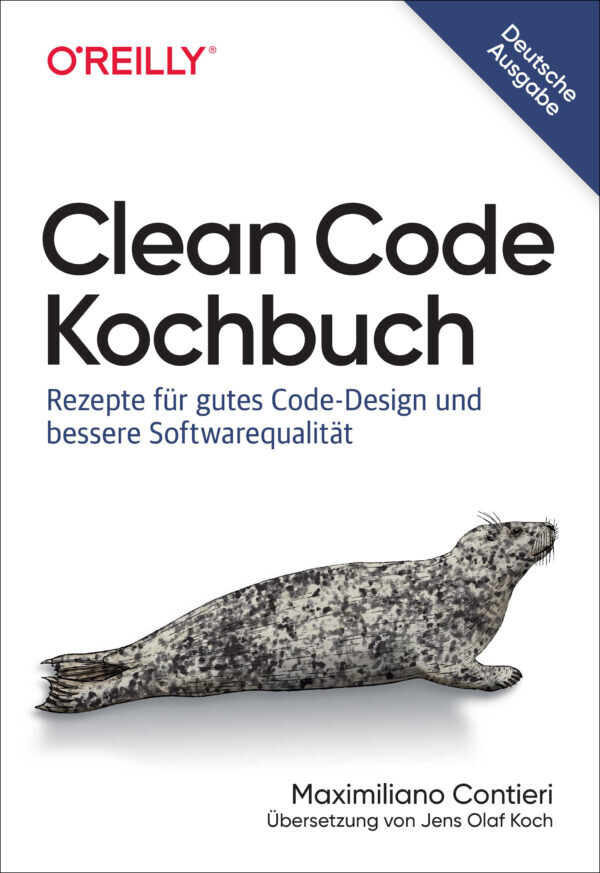
Clean Code Kochbuch
Clean Code Kochbuch. Rezepte für gutes Code Design und bessere Softwarequalität. In 1. Auflage (erscheint Ende Juni 2024)Code Smells erkennen und mithilfe inspirierender Rezepte beseitigenSoftware-Engineers und -Architekten, die mit großen, komplexen Code-Basen arbeiten, müssen diese skalieren und effektiv pflegen. In seinem Kochbuch geht Maximiliano Contieri über das Konzept des Clean Code hinaus: Er demonstriert, wie Sie Verbesserungsmöglichkeiten identifizieren und lernen, deren Auswirkungen auf den Produktionscode zu bewerten. Wenn es um Zuverlässigkeit und die Entwicklungsfähigkeit eines Systems geht, bieten diese Techniken Vorteile, die sich auf Dauer auszahlen werden.Anhand von Beispielen in JavaScript, PHP, Python, Java und vielen anderen Programmiersprachen bietet dieses Kochbuch bewährte Rezepte, die Sie bei der Skalierung und Wartung großer Systeme unterstützen. Jeder Teil behandelt grundlegende Konzepte wie Lesbarkeit, Kopplung, Testbarkeit, Sicherheit und Erweiterbarkeit sowie Code-Smells und Rezepte zu deren Beseitigung.Über den Autor: Maximiliano Contieri ist seit 25 Jahren in der Softwarebranche tätig und arbeitet gleichzeitig als Hochschullehrer. Im Laufe der Jahre war er ein eifriger Autor auf verschiedenen bekannten Blogging-Plattformen und veröffentlichte jede Woche mehrere Artikel zu einer Vielzahl von Themen wie Clean Code, Refactoring, Softwaredesign, testgetriebene Entwicklung und Code Smells.

Learn Java Fundamentals
Sharpen your Java skills and boost your potential as an IT specialist. This book introduces you to the basic Java features and APIs needed to prepare for a career in programming and development.You’ll first receive an introduction to Java and then explore language features ranging from comments though exception/error handling, focusing mainly on language syntax and a few select syntax-related APIs. This constitutes the heart of the book, and you’ll use these building blocks to construct simple Java programs, and learn where Java’s implementations of expressions (and operators), and statements diverge from other languages. The final few chapters tour some additional APIs such as the Math class, related types, String and StringBuffer, and System.Along the way you’ll discover some interesting programs, such as Graph (a sine/cosine wave-plotting application) and WC (a word-counting application). Two appendixes provide quick references to Java’s supported reserved words, and to Java’s supported operators. Equipped with this knowledge, _Learn Java Fundamentals_ will provide you the pathway to explore additional APIs on your own, and increase your Java awareness.WHAT YOU’LL LEARN* Understand the basics of Java applications and APIs* Study language features such as comments, identifiers, variables, types, and literals.* Explore operators, expressions, statements, and other key features such as classes, objects, class extension, and class abstraction.WHO THIS BOOK IS FORDevelopers, programmers, and students with little or no Java experienceJEFF FRIESEN is a freelance teacher and software developer with an emphasis on Java. In addition to authoring several books on Java and Android for Apress such as _Java I/O, NIO, and NIO.2_ _Java Threads and the Concurrency Utilities_, Jeff has written numerous articles on Java and other technologies for JavaWorld, informIT, Java.net, SitePoint, and other web sites. Jeff can be contacted via his web site at JavaJeff.ca or via LinkedIn (JavaJeff)Chapter 1: Getting Started with Java.- Chapter 2: Comments, Identifiers, Types, Variables, and Literals.- Chapter 3: Expressions.- Chapter 4: Statements.- Chapter 5: Arrays.- Chapter 6: Classes and Objects.- Chapter 7: Reusing Classes via Inheritance and Composition.- Chapter 8: Changing Type via Polymorphism.- Chapter 9: Static, Non-Static, Local, and Anonymous Classes.- Chapter 10: Packages.- Chapter 11: Exceptions and Errors.- Chapter 12: Math, BigDecimal, and BigInteger.- Chapter 13: String and StringBuffer.- Chapter 14: System.- Appendix A: Reserved Words Quick Reference.- Appendix B: Operators Quick Reference.

Deep Learning Techniques for Automation and Industrial Applications
THIS BOOK PROVIDES STATE-OF-THE-ART APPROACHES TO DEEP LEARNING IN AREAS OF DETECTION AND PREDICTION, AS WELL AS FUTURE FRAMEWORK DEVELOPMENT, BUILDING SERVICE SYSTEMS AND ANALYTICAL ASPECTS IN WHICH ARTIFICIAL NEURAL NETWORKS, FUZZY LOGIC, GENETIC ALGORITHMS, AND HYBRID MECHANISMS ARE USED.Deep learning algorithms and techniques are found to be useful in various areas, such as automatic machine translation, automatic handwriting generation, visual recognition, fraud detection, and detecting developmental delays in children. “Deep Learning Techniques for Automation and Industrial Applications” presents a concise introduction to the recent advances in this field of artificial intelligence (AI). The broad-ranging discussion covers the algorithms and applications in AI, reasoning, machine learning, neural networks, reinforcement learning, and their applications in various domains like agriculture, manufacturing, and healthcare. Applying deep learning techniques or algorithms successfully in these areas requires a concerted effort, fostering integrative research between experts from diverse disciplines from data science to visualization. This book provides state-of-the-art approaches to deep learning covering detection and prediction, as well as future framework development, building service systems, and analytical aspects. For all these topics, various approaches to deep learning, such as artificial neural networks, fuzzy logic, genetic algorithms, and hybrid mechanisms, are explained. AUDIENCEThe book will be useful to researchers and industry engineers working in information technology, data analytics network security, and manufacturing. Graduate and upper-level undergraduate students in advanced modeling and simulation courses will find this book very useful. PRAMOD SINGH RATHORE is an assistant professor in the Department of Computer and Communication Engineering, Manipal University Jaipur, India. He has teaching experience of more than 10 years and has 45 publications in peer-reviewed national and international journals. SACHIN AHUJA, PHD, is a professor in the Department of Computer Science, Chandigarh University, Punjab, India. He has guided several ME and PhD scholars in artificial intelligence, machine learning, and data mining. SRINIVASA RAO BURRI is a senior software engineering manager at Western Union, Denver, Colorado. He completed an MS degree in software development from Boston University. He also has received his certifications in Data Science and Machine Learning from Stanford University, Harvard University and Johns Hopkins University. He started his career as a test automation architect in 2004, and has since worked as a leader for many Fortune 500 Organizations advising them on global compliance, data privatization, cloud migration, and AI & ML. He has published multiple articles in international journals. AJAY KHUNTETA, PHD, is a dean and professor of computer science and engineering, Poornima University, Jaipur, Rajasthan, India. His research focuses on AI, machine learning, and distributing systems. He has published more than 100 articles in international and national journals and guided 44 M.Tech projects. ANUPAM BALIYAN, PHD, is Dean of Academic Planning and Research, Galgotias University, India. His research focuses on artificial intelligence, computer networks, computer vision, and machine learning. Along with being a chair and keynote speaker at international conferences, Baliyan has guided more than 20 M.Tech projects and theses. ABHISHEK KUMAR, PHD, is an associate professor in the Faculty of Engineering, Manipal University, Jaipur, Rajasthan, India and is currently a Post-Doctoral Fellow in Ingenium Research Group Lab, Universidad De Castilla- La Mancha, Ciudad Real, Spain. He has more than 170 publications in peer-reviewed national and international journals and conferences. Preface xiii1 Text Extraction from Images Using Tesseract 1Santosh Kumar, Nilesh Kumar Sharma, Mridul Sharma and Nikita Agrawal2 Chili Leaf Classification Using Deep Learning Techniques 19Chenchupalli Chathurya, Diksha Sachdeva and Mamta Arora3 Fruit Leaf Classification Using Transfer Learning Techniques 31Taha Siddiqui, Surbhit Chopra and Mamta Arora4 Classification of University of California (UC), Merced Land-Use Dataset Remote Sensing Images Using Pre-Trained Deep Learning Models 45Abhishek Maurya, Akashdeep and Rohit Kumar5 Sarcastic and Phony Contents Detection in Social Media Hindi Tweets 69Surbhi Sharma and Nisheeth Joshi6 Removal of Haze from Synthetic and Real Scenes Using Deep Learning and Other AI Techniques 85Pushpa Koranga, Ravindra Singh Koranga, Sumitra Singar and Sandeep Gupta7 HOG and Haar Feature Extraction-Based Security System for Face Detection and Counting 99Prachi Soni and Viplav Soni8 A Comparative Analysis of Different CNN Models for Spatial Domain Steganalysis 109Ankita Gupta, Rita Chhikara and Prabha Sharma9 Making Invisible Bluewater Visible Using Machine and Deep Learning Techniques--A Review 129Dineshkumar Singh and Vishnu Sharma10 Fruit Leaf Classification Using Transfer Learning for Automation and Industrial Applications 151Inam Ul Haq, Gursimran Kaur and Adil Husain Rather11 Green AI: Carbon-Footprint Decoupling System 179Bindiya Jain and Shikha Sharma12 Review of State-of-Art Techniques for Political Polarization from Social Media Network 199Akshita Bhatnagar and B.K. Sharma13 Collaborative Design and Case Analysis of Mobile Shopping Apps: A Deep Learning Approach 223Santosh Kumar, Vipul Jain, Abhishek Bairwa and Pradeep Saharan14 Exploring the Potential of Machine Learning and Deep Learning for COVID-19 Detection 235Saimul Bashir, Faisal Firdous and Syed Zoofa RufaiReferences 253Index 257

CISSP For Dummies
SHOWCASE YOUR SECURITY EXPERTISE WITH THE HIGHLY REGARDED CISSP CERTIFICATIONThe CISSP certification, held by more than 150,000 security professionals worldwide, is the gold standard of cybersecurity certifications. The CISSP Exam certifies cybersecurity professionals and opens doors for career advancement. Fully updated and revised to reflect the 2024 ISC2 CISSP Exam Outline, CISSP For Dummies is packed with helpful content for all eight security domains. This book includes access to online study tools such as practice questions and digital flashcards, boosting your likelihood of success on the exam. Plus, you'll feel prepared and ready for test day thanks to a 60-day study plan. Boost your security career with this Dummies study guide.* Review all the content covered in the latest CISSP Exam* Test with confidence and achieve your certification as a cybersecurity professional* Study smarter, thanks to online practice resources and a 60-day study plan* Enhance your career with the in-demand CISSP certification* Continue advancing your career and the profession through speaking and mentoring opportunitiesWith up-to-date content and valuable test prep features, this book is a one-and-done resource for any cybersecurity professional studying for the CISSP exam. LAWRENCE C. MILLER, CISSP, is a Navy veteran, information security professional, and author of more than 250 For Dummies books. PETER H. GREGORY, CISSP, is a seasoned For Dummies author, as well as a security, risk, and technology director with experience in SaaS, retail, telecommunications, non-profit, manufacturing, healthcare, and beyond. Introduction 1PART 1: GETTING STARTED WITH CISSP CERTIFICATION 7CHAPTER 1: ISC2 and the CISSP Certification 9CHAPTER 2: Putting Your Certification to Good Use 23PART 2: CERTIFICATION DOMAINS 43CHAPTER 3: Security and Risk Management 45CHAPTER 4: Asset Security 141CHAPTER 5: Security Architecture and Engineering 167CHAPTER 6: Communication and Network Security 269CHAPTER 7: Identity and Access Management 323CHAPTER 8: Security Assessment and Testing 365CHAPTER 9: Security Operations 395CHAPTER 10: Software Development Security 459PART 3: THE PART OF TENS 493CHAPTER 11: Ten Ways to Prepare for the Exam 495CHAPTER 12: Ten Test-Day Tips 501Glossary 505Index 561

Artificial Intelligence and Machine Learning in Drug Design and Development
THE BOOK IS A COMPREHENSIVE GUIDE THAT EXPLORES THE USE OF ARTIFICIAL INTELLIGENCE AND MACHINE LEARNING IN DRUG DISCOVERY AND DEVELOPMENT COVERING A RANGE OF TOPICS, INCLUDING THE USE OF MOLECULAR MODELING, DOCKING, IDENTIFYING TARGETS, SELECTING COMPOUNDS, AND OPTIMIZING DRUGS.The intersection of Artificial Intelligence (AI) and Machine Learning (ML) within the field of drug design and development represents a pivotal moment in the history of healthcare and pharmaceuticals. The remarkable synergy between cutting-edge technology and the life sciences has ushered in a new era of possibilities, offering unprecedented opportunities, formidable challenges, and a tantalizing glimpse into the future of medicine. AI can be applied to all the key areas of the pharmaceutical industry, such as drug discovery and development, drug repurposing, and improving productivity within a short period. Contemporary methods have shown promising results in facilitating the discovery of drugs to target different diseases. Moreover, AI helps in predicting the efficacy and safety of molecules and gives researchers a much broader chemical pallet for the selection of the best molecules for drug testing and delivery. In this context, drug repurposing is another important topic where AI can have a substantial impact. With the vast amount of clinical and pharmaceutical data available to date, AI algorithms find suitable drugs that can be repurposed for alternative use in medicine. This book is a comprehensive exploration of this dynamic and rapidly evolving field. In an era where precision and efficiency are paramount in drug discovery, AI and ML have emerged as transformative tools, reshaping the way we identify, design, and develop pharmaceuticals. This book is a testament to the profound impact these technologies have had and will continue to have on the pharmaceutical industry, healthcare, and ultimately, patient well-being. The editors of this volume have assembled a distinguished group of experts, researchers, and thought leaders from both the AI, ML, and pharmaceutical domains. Their collective knowledge and insights illuminate the multifaceted landscape of AI and ML in drug design and development, offering a roadmap for navigating its complexities and harnessing its potential. In each section, readers will find a rich tapestry of knowledge, case studies, and expert opinions, providing a 360-degree view of AI and ML’s role in drug design and development. Whether you are a researcher, scientist, industry professional, policymaker, or simply curious about the future of medicine, this book offers 19 state-of-the-art chapters providing valuable insights and a compass to navigate the exciting journey ahead. AUDIENCEThe book is a valuable resource for a wide range of professionals in the pharmaceutical and allied industries including researchers, scientists, engineers, and laboratory workers in the field of drug discovery and development, who want to learn about the latest techniques in machine learning and AI, as well as information technology professionals who are interested in the application of machine learning and artificial intelligence in drug development. ABHIRUP KHANNA is an accomplished professional currently working as an assistant professor at the University of Petroleum and Energy Studies, Dehradun, India. He is an alumnus of The University of Melbourne, Australia. He has authored two books and numerous research publications in the areas of AI, blockchain technology, Internet of Things, and Cloud Computing for international journals and conferences. His research profile demonstrates his commitment to pushing the boundaries of AI and blockchain technology and his potential to drive transformative changes in these fields. MAY EL BARACHI, PHD, is the Director of Computer Science & IT Programs at the University of Wollongong in Dubai, UAE. An Egyptian-Canadian computer scientist, and smart technology expert with degrees in telecom, engineering, computer engineering, and computer science, Dr. El Barachi holds leadership roles in teaching/learning and research. In her current role, she defines the research strategy for the faculty and ensures that the right ecosystem is established for conducting high-impact research. SAPNA JAIN, PHD, is an assistant professor at the University of Petroleum and Energy Studies, Dehradun, India. She has earned her PhD in ‘Synthesis of novel bioactive compounds’ from Delhi University. She has published various research papers in renowned national and international journals, as well as two patents concerning the application of a synergistic combination of synthetic and natural products as an antifungal agent. MANOJ KUMAR, PHD, is an associate professor at the University of Wollongong in Dubai, UAE as well as the Research Head for Network and Cyber Security Cluster at the university. He obtained his PhD from The Northcap University, Haryana, India. Dr. Kumar has more than 14 years of research, teaching, and corporate experience, and has published more than 175 research articles in international refereed journals and conferences. ANAND NAYYAR, PHD, obtained his doctorate from Desh Bhagat University, Punjab, India in 2017 and is currently an assistant professor at the School of Computer Science, Duy Tan University, Viet Nam. He is also the Vice-Chairman of Research and Director of the IoT and Intelligent Systems Lab at Duy Tan University. He has published more than 180 research articles in international refereed journals, 50 books, and has 100+ patents to his credit. He has more than 12,000 citations on Google Scholar. Preface xxi1 The Rise of Intelligent Machines: An Introduction to Artificial Intelligence 1Shamik Tiwari2 Introduction to Bioinformatics 23Bancha Yingngam3 Exploring the Intersection of Biology and Computing: Road Ahead to Bioinformatics 67Ahmed Mateen Buttar, Muhammad Nouman Arshad and Anand Nayyar4 Machine Learning in Drug Discovery: Methods, Applications, and Challenges 93Geetha Mani and Gokulakrishnan Jayakumar5 Artificial Intelligence for Understanding Mechanisms of Antimicrobial Resistance and Antimicrobial Discovery: A New Age Model for Translational Research 117Yashaswi Dutta Gupta and Suman Bhandary6 Artificial Intelligence-Powered Molecular Docking: A Promising Tool for Rational Drug Design 157Nabajit Kumar Borah, Yukti Tripathi, Aastha Tanwar, Deeksha Tiwari, Aditi Sinha, Shailja Sharma, Neetu Jabalia, Ruchi Jakhmola Mani, Seneha Santoshi and Hina Bansal7 Revolutionizing Drug Discovery: The Role of AI and Machine Learning in Accelerating Medicinal Advancements 189Anu Sayal, Janhvi Jha, Chaithra N., Atharv Rajesh Gangodkar and Shaziya Banu S.8 Data Processing Method for AI-Driven Predictive Models or CNS Drug Discovery 223Ajantha Devi Vairamani, Sudipta Adhikary and Kaushik Banerjee9 Machine Learning Applications for Drug Repurposing 251Bancha Yingngam10 Personalized Drug Treatment: Transforming Healthcare with AI 295Abhirup Khanna and Sapna Jain11 Process and Applications of Structure-Based Drug Design 321Shanmuga Sundari M., Sree Aiswarya Thotakura, Mounika Dharmana, Priyanka Gadela and Mayukha Mandya Ammangatambu12 AI-Based Personalized Drug Treatment 369Shanmuga Sundari M., Harshini Reddy Penthala, Akshita Mogullapalli and Mayukha Mandya Ammangatambu13 AI Models for Biopharmaceutical Property Prediction 407Bancha Yingngam14 Deep Learning Tactics for Neuroimaging Genomics Investigations in Alzheimer's Disease 451Mithun Singh Rajput, Jigna Shah, Viral Patel, Nitin Singh Rajput and Dileep Kumar15 Artificial Intelligence Techniques in the Classification and Screening of Compounds in Computer-Aided Drug Design (CADD) Process 473Raghunath Satpathy16 Empowering Clinical Decision Making: An In-Depth Systematic Review of AI-Driven Scoring Approaches for Liver Transplantation Prediction 499Devi Rajeev, Remya S. and Anand Nayyar17 Pushing Boundaries: The Landscape of AI-Driven Drug Discovery and Development with Insights Into Regulatory Aspects 533Dipak D. Gadade, Deepak A. Kulkarni, Ravi Raj, Swapnil G. Patil and Anuj Modi18 Feasibility of AI and Robotics in Indian Healthcare: A Narrative Analysis 563Rahul Joshi and Rhythma Badola19 The Future of Healthcare: AIoMT--Redefining Healthcare with Advanced Artificial Intelligence and Machine Learning Techniques 605Wasswa ShafikReferences 628Index 635

No Social Media!
Haderst du mit Social Media? Kosten sie dich nur Zeit, Geld und Mühe, ohne spürbaren Erfolg für dein Unternehmen? Würdest du lieber auf eine Social-Media-Präsenz verzichten, hast aber Angst, ohne sie nicht erfolgreich zu sein? Dieses Buch hilft dir, dich für oder gegen Social Media zu entscheiden. Alexandra Polunin zeigt, dass der Einsatz sozialer Medien wohlüberlegt sein will und definitiv kein Muss für jedes Unternehmen ist. Früher selbst Social-Media-Beraterin, hat sich die Autorin zur „Aussteigerin“ gewandelt und wirbt für einen maßvollen Einsatz der Plattformen. Sie zeigt wirkungsvolle Alternativen, wie die eigene Website, Blogs, SEO, Newsletter, Podcasts oder auch klassisches E-Mail-Marketing, mit denen Selbstständige und Unternehmen erfolgreich Marketing betreiben können. So gelingt dein Online-Marketing auch ohne Social Media.Erfolgreich ohne Social Media!1. Social Media – ja oder nein?Wenn du den Einsatz von Social Media im Marketing kritisch siehst und unsicher bist, ob du auf sie verzichten solltest oder nicht, findest du hier wichtige Argumente, um eine informierte Entscheidung zu treffen.2. Kein Social Media? Kein Problem!Auch ohne Instagram, Facebook & Co. kann dein Online-Marketing erfolgreich sein. Die Autorin zeigt dir, wie du effektive Alternativen findest und diese in einer durchdachten Strategie einsetzt.3. So gelingt der Ausstieg!Ein Ausstieg aus Social Media muss kein Manko sein, sondern kann zu einem echten Wettbewerbsvorteil werden. Hier erfährst du praxisnah und Schritt für Schritt, wie ein Ausstieg umgesetzt werden kann.Aus dem Inhalt:Social-Media-Marketing – ja oder nein?Chancen, Vorteile, MöglichkeitenNachteile, Risiken, GefahrenEine EntscheidungshilfeOnline-Marketing-Strategie entwickelnCustomer Journey ohne Social MediaWelche Alternativen gibt es?Marketing ohne Social MediaWie gelingt der Ausstieg?Über den Autor:Alexandra Polunin (alexandrapolunin.com) war nach ihrem Studium der Germanistik und Philosophie mehrere Jahre als Beraterin für Pinterest-Marketing tätig, bevor sie 2020 genug von Likes, Reels und Selfies hatte und Social Media den Rücken kehrte. Seitdem unterstützt sie Selbstständige dabei, ohne soziale Medien online sichtbar zu werden und Kund*innen zu gewinnen. Ihr Herz schlägt für wertebasiertes, ethisches Marketing – am liebsten mithilfe von Website, Blog und Newsletter.Leseprobe (PDF-Link)

Introduction to Python Network Automation Volume I - Laying the Groundwork
Welcome to _Introduction to Python Network Automation Volume I: Laying the Groundwork_. In this first part of our comprehensive guide, you'll embark on a transformative journey into the world of network automation. Whether you're new to the IT field or seeking to strengthen your existing skills, this book serves as your roadmap to mastering the foundational skills essential for success in network automation.You'll begin your exploration by delving into the fundamentals of Python network automation, laying a solid foundation for your learning journey. Equipped with essential Python skills, you'll leverage them for network administration tasks, particularly on the Windows platform. Reinforce your understanding through targeted exercises designed to enhance your proficiency and navigate the complexities of VMware Workstation as you master virtualization techniques crucial for setting up your network automation environment.You’ll then venture into Linux fundamentals, learning to set up and configure server environments tailored for network automation tasks while gaining a deep understanding of file systems and TCP/IP services in Linux. Explore the power of regular expressions as you streamline network automation tasks with precision and efficiency. Discover GNS3, a vital tool for network emulation, enabling you to test and validate network designs and put your skills to the test by tackling real-world network challenges in a comprehensive lab scenario. This book provides the essential knowledge and practical experience needed to thrive in the rapidly evolving field of network automation. Whether you're new to network automation or seeking to strengthen your existing skills, this book will unlock the vast potential of network automation and empower you to excel in this exciting field.WHAT YOU'LL LEARN* Learn Python fundamentals and effective network automation strategies.* Use Python for various network administration tasks, improving efficiency.* Understand Linux basics and IP service installation techniques.* Apply regular expressions in Python for data processing.* Create a network automation lab with VMware Workstation for hands-on practice.WHO THIS BOOK IS FORIT engineers and developers, network managers and students, who would like to learn network automation using Python.Brendan Choi is a highly accomplished Tech Lead at Secure Agility, possessing over 19 years of extensive hands-on experience in Enterprise Network Automation and diverse IT technologies. As a Certified Cisco, VMware, and Fortinet Engineer, Brendan has worked with globally renowned enterprises including Cisco Systems, Telstra, NTT (Dimension Data), Fujitsu and various reputable Enterprise IT integrators. He is dedicated to streamlining work processes and ensuring uninterrupted IT service delivery through infrastructure and business process automation. Brendan is the author of "Python Network Automation: By building an integrated virtual lab" for Acorn Publishing and has authored the 1st and 2nd editions of "Introduction to Python Network Automation: The first journey". He is currently writing “Introduction to Ansible Network Automation: KISS” for Apress and has trained over 200 Network and Systems Engineers on Python and Ansible Network Automation. Brendan's keen interest lies in Cloud, Enterprise Networking, Security, and Virtualization technologies, and he shares his knowledge, experience, and enthusiasm with the community through his blog and YouTube channel.Chapter 1: Introduction to Python Network Automation.- Chapter 2: Learning Python Fundamentals on Windows.- Chapter 3: Practicing More Python Exercises.- Chapter 4: Navigating VMware Workstation.- Chapter 5: Creating an Ubuntu Linux Server.- Chapter 6: Creating a Fedora Linux Server.- Chapter 7: Mastering File Systems in Linux.- Chapter 8: Understanding TCP/IP Services in Linux.- Chapter 9: Using Regular Expressions for Network Automation.- Chapter 10: Exploring GNS3 Essentials.- Chapter 11: Cisco IOS, Linux, TFTP, and Telnet Lab.- Chapter 12: Setting Up a Python Automation Lab.- Chapter 13: Basic Telnet Lab.-Chapter 14: SSH, Paramiko, and Netmiko Lab.- Chapter 15: Automating Tasks with Cron in Python Lab.- Chapter 16: SNMP Discovery with Python Lab.- Chapter 17: Ansible and pyATS in virtualenv Lab.- Chapter 18: Sendmail and Twilio Notifications via Docker Lab.- Chapter 19: Cisco IOS Upgrade Tools Development 1.- Chapter 20: Cisco IOS Upgrade Tools Development 2.- Chapter 21: Building a Cisco IOS Upgrade Application.- Chapter 22: Upgrading Cisco IOS Routers Lab.- Chapter 23: Installing NetBox with Python.

PHP by Example
Learn to create web applications in PHP with minimal previous experience. This book is a practical guide to using PHP for web development.Loaded with examples and step-by-step instructions, each chapter is dedicated to a specific area or function. You’ll first review the main principles of PHP and what is needed to program and develop in it. You’ll then study variables, data types, control statements, arrays, and functions, all critical for creating efficient PHP programs.The book then moves on to object-oriented programming (OOP) and how to implement those principles in PHP, as well as inheritance, interfaces, testing, error handling, and exceptions. By the end of _PHP by Example_, you will have the knowledge and confidence to implement PHP for your web projects both large and small.WHAT YOU’LL LEARN* Understand PHP from the ground up* Create scripts and implement them in real-world projects* Work with a broad toolkit of ready-made exercises and solutions* Investigate the main constructions of the PHP ALEX VASILEV (aka Oleksii Vasyliev) is a Professor of Software Systems and Technologies in the Faculty of Information Technology, Taras Shevchenko National University of Kyiv in Ukraine. He has taught programming for 20 years (C++, C#, Java, JavaScript, Python, PHP) and to date has written over 30 programming books in his native Ukraine. This is his first book directly published in English.1: The First Program.-2: Variables and Data Types.-3: The Control Statements.- 4: Arrays.- 5: Functions.- 6: Useful Tricks and Operations.- 7: Classes and Objects.- 8: Inheritance.- 9: Advanced OOP Mechanisms.- 10: Error Handling.-11: Generators and Iterators.- 12: Using PHP.- 13: Conclusion: What Was and What Will Be.
Machine Learning For Network Traffic and Video Quality Analysis
This book offers both theoretical insights and hands-on experience in understanding and building machine learning-based Network Traffic Monitoring and Analysis (NTMA) and Video Quality Assessment (VQA) applications using JavaScript. JavaScript provides the flexibility to deploy these applications across various devices and web browsers.The book begins by delving into NTMA, explaining fundamental concepts and providing an overview of existing applications and research within this domain. It also goes into the essentials of VQA and offers a survey of the latest developments in VQA algorithms. The book includes a thorough examination of machine learning algorithms that find application in both NTMA and VQA, with a specific emphasis on classification and prediction algorithms such as the Multi-Layer Perceptron and Support Vector Machine. The book also explores the software architecture of the NTMA client-server application. This architecture is meticulously developed using HTML, CSS, Node.js, and JavaScript. Practical aspects of developing the Video Quality Assessment (VQA) model using JavaScript and Java are presented. Lastly, the book provides detailed guidance on implementing a complete system model that seamlessly merges NTMA and VQA into a unified web application, all built upon a client-server paradigm.By the end of the book, you will understand NTMA and VQA concepts and will be able to apply machine learning to both domains and develop and deploy your own NTMA and VQA applications using JavaScript and Node.js.What You Will Learn* What are the fundamental concepts, existing applications, and research on NTMA?* What are the existing software and current research trends in VQA?* Which machine learning algorithms are used in NTMA and VQA?* How do you develop NTMA and VQA web-based applications using JavaScript, HTML, and Node.js?Who This Book Is ForSoftware professionals and machine learning engineers involved in the fields of networking and telecommunicationsDR. TULSI PAWAN FOWDUR received his BEng (Hons) degree in Electronic and Communication Engineering with honors from the University of Mauritius in 2004. He was also the recipient of a Gold medal for having produced the best degree project at the Faculty of Engineering in 2004. In 2005 he obtained a full-time PhD scholarship from the Tertiary Education Commission of Mauritius and was awarded his PhD degree in Electrical and Electronic Engineering in 2010 by the University of Mauritius. He is also a Registered Chartered Engineer of the Engineering Council of the UK, Fellow of the Institute of Telecommunications Professionals of the UK, and a Senior Member of the IEEE. He joined the University of Mauritius as an academic in June 2009 and is presently an Associate Professor at the Department of Electrical and Electronic Engineering of the University of Mauritius. His research interests include mobile and wireless communications, multimedia communications, networking and security, telecommunications applications development, the Internet of Things, and AI. He has published several papers in these areas and is actively involved in research supervision, reviewing papers, and also organizing international conferences.LAVESH BABOORAM received his BEng (Hons) degree in Telecommunications Engineering with Networking with honors from the University of Mauritius in 2021. He was also awarded a Gold medal for having produced the best degree project at the Faculty of Engineering in 2021. Since 2022, he has been an MSc Applied Research student at the University of Mauritius. With in-depth knowledge of telecommunications applications design, analytics, and network infrastructure, he aims to pursue research in networking, multimedia communications, Internet of Things, artificial intelligence, and mobile and wireless communications. He joined Mauritius Telecom in 2022 and is currently working in the Customer Experience and Service Department as a Pre-Registration Trainee Engineer.Chapter 1: Introduction to NTMA and VQA.- Chapter 2: Network Traffic Monitoring and Analysis.- Chapter 3: Video Quality Assessment.- Chapter 4: Machine Learning Techniques for NTMA and VQA.- Chapter 5: NTMA Application with JavaScript.- Chapter 6: Video Quality Assessment Application Development with JavaScript.- Chapter 7: NTMA and VQA Integration.
How Machine Learning is Innovating Today's World
PROVIDES A COMPREHENSIVE UNDERSTANDING OF THE LATEST ADVANCEMENTS AND PRACTICAL APPLICATIONS OF MACHINE LEARNING TECHNIQUES.Machine learning (ML), a branch of artificial intelligence, has gained tremendous momentum in recent years, revolutionizing the way we analyze data, make predictions, and solve complex problems. As researchers and practitioners in the field, the editors of this book recognize the importance of disseminating knowledge and fostering collaboration to further advance this dynamic discipline. How Machine Learning is Innovating Today's World is a timely book and presents a diverse collection of 25 chapters that delve into the remarkable ways that ML is transforming various fields and industries.It provides a comprehensive understanding of the practical applications of ML techniques. The wide range of topics include:* An analysis of various tokenization techniques and the sequence-to-sequence model in natural language processing* explores the evaluation of English language readability using ML models* a detailed study of text analysis for information retrieval through natural language processing* the application of reinforcement learning approaches to supply chain management* the performance analysis of converting algorithms to source code using natural language processing in Java* presents an alternate approach to solving differential equations utilizing artificial neural networks with optimization techniques* a comparative study of different techniques of text-to-SQL query conversion* the classification of livestock diseases using ML algorithms* ML in image enhancement techniques* the efficient leader selection for inter-cluster flying ad-hoc networks* a comprehensive survey of applications powered by GPT-3 and DALL-E* recommender systems' domain of application* reviews mood detection, emoji generation, and classification using tokenization and CNN* variations of the exam scheduling problem using graph coloring* the intersection of software engineering and machine learning applications* explores ML strategies for indeterminate information systems in complex bipolar neutrosophic environments* ML applications in healthcare, in battery management systems, and the rise of AI-generated news videos* how to enhance resource management in precision farming through AI-based irrigation optimization.AUDIENCEThe book will be extremely useful to professionals, post-graduate research scholars, policymakers, corporate managers, and anyone with technical interests looking to understand how machine learning and artificial intelligence can benefit their work.ARINDAM DEY, PHD, is an associate professor at the School of Computer Science, VIT-AP University, India. He has published more than 50 research articles in national and international peer-reviewed journals. Dr. Dey has 14 years of teaching and research experience in the areas of optimization and genetic algorithms. SUKANTA NAYAK, PHD, is an assistant professor in the Department of Mathematics, School of Advanced Sciences (SAS) at VIT-AP University, Amaravati, Andhra Pradesh, India. He completed his doctoral research at NIT Rourkela, has authored three books, and published numerous research articles in international journals. RANJAN KUMAR, PHD, is an assistant professor in the Department of Mathematics, School of Advanced Sciences (SAS) at VIT-AP University, Amaravati, Andhra Pradesh, India. He has numerous peer-reviewed research articles to his name and is the recipient of numerous awards and titles including an Honorary Professorship from Cypress International Institute University, Texas, USA. SACHI NANDAN MOHANTY, PHD, is in the School of Computer Science and Engineering (SCOPE) at VIT-AP University, Amaravati, Andhra, Pradesh, India. He has edited 25 books and published 60 international journals of international repute. His research areas include data mining, big data analysis, cognitive science, fuzzy decision-making, brain-computer interface, cognition, and computational intelligence. In 2015, he was awarded the first prize of the Best Thesis Award by the Computer Society of India. Preface xviiPART 1: NATURAL LANGUAGE PROCESSING (NLP) APPLICATIONS 11 A Comprehensive Analysis of Various Tokenization Techniques and Sequence-to-Sequence Model in Natural Language Processing 3Kuldeep Vayadande, Ashutosh M. Kulkarni, Gitanjali Bhimrao Yadav, R. Kumar and Aparna R. Sawant2 A Review on Text Analysis Using NLP 13Kuldeep Vayadande, Preeti A. Bailke, Lokesh Sheshrao Khedekar, R. Kumar and Varsha R. Dange3 Text Generation & Classification in NLP: A Review 25Kuldeep Vayadande, Dattatray Raghunath Kale, Jagannath Nalavade, R. Kumar and Hanmant D. Magar4 Book Genre Prediction Using NLP: A Review 37Kuldeep Vayadande, Preeti Bailke, Ashutosh M. Kulkarni, R. Kumar and Ajit B. Patil5 Mood Detection Using Tokenization: A Review 47Kuldeep Vayadande, Preeti A. Bailke, Lokesh Sheshrao Khedekar, R. Kumar and Varsha R. Dange6 Converting Pseudo Code to Code: A Review 57Kuldeep Vayadande, Preeti A. Bailke, Anita Bapu Dombale, Varsha R. Dange and Ashutosh M. KulkarniPART 2: MACHINE LEARNING APPLICATIONS IN SPECIFIC DOMAINS 697 Evaluating the Readability of English Language Using Machine Learning Models 71Shiplu Das, Abhishikta Bhattacharjee, Gargi Chakraborty and Debarun Joardar8 Machine Learning in Maximizing Cotton Yield with Special Reference to Fertilizer Selection 89G. Hannah Grace and Nivetha Martin9 Machine Learning Approaches to Catalysis 101Sachidananda Nayak and Selvakumar Karuthapandi10 Classification of Livestock Diseases Using Machine Learning Algorithms 127G. Hannah Grace, Nivetha Martin, I. Pradeepa and N. Angel11 Image Enhancement Techniques to Modify an Image with Machine Learning Application 139Shiplu Das, Sohini Sen, Debarun Joardar and Gargi Chakraborty12 Software Engineering in Machine Learning Applications: A Comprehensive Study 159Kuldeep Vayadande, Komal Sunil Munde, Amol A. Bhosle, Aparna R. Sawant and Ashutosh M. Kulkarni13 Machine Learning Applications in Battery Management System 173Ponnaganti Chandana and Ameet Chavan14 ML Applications in Healthcare 201Farooq Shaik, Rajesh Yelchurri, Noman Aasif Gudur and Jatindra Kumar Dash15 Enhancing Resource Management in Precision Farming through AI-Based Irrigation Optimization 221Salina Adinarayana, Matha Govinda Raju, Durga Prasad Srirangam, Devee Siva Prasad, Munaganuri Ravi Kumar and Sai babu veesam16 An In-Depth Review on Machine Learning Infusion in an Agricultural Production System 253Sarthak Dash, Sugyanta Priyadarshini and Sukanya PriyadarshiniPART 3: ARTIFICIAL INTELLIGENCE AND OPTIMIZATION TECHNIQUES 27117 Reinforcement Learning Approach in Supply Chain Management: A Review 273Rajkanwar Singh, Pratik Mandal and Sukanta Nayak18 Alternate Approach to Solve Differential Equations Using Artificial Neural Network with Optimization Technique 303Ramanan R., Sukanta Nayak and Arun Kumar Gupta19 GPT-3- and DALL-E-Powered Applications: A Complete Survey 329Kuldeep Vayadande, Chaitanya B. Pednekar, Priya Anup Khune, Vinay Sudhir Prabhavalkar and Varsha R. Dange20 New Variation of Exam Scheduling Problem Using Graph Coloring 343Angshu Kumar Sinha, Soumyadip Laha, Debarghya Adhikari, Anjan Koner and Neha DeoraPART 4: EMERGING TOPICS IN MACHINE LEARNING 35321 A Comparative Study of Different Techniques of Text-to-SQL Query Converter 355Kuldeep Vayadande, Preeti A. Bailke, Vikas Janu Nandeshwar, R. Kumar and Varsha R. Dange22 Trust-Based Leader Election in Flying Ad-Hoc Network 367Joydeep Kundu, Sahabul Alam and Sukanta Oraw23 A Survey on Domain of Application of Recommender System 375Sudipto Dhar24 New Approach on M/M/c/K Queueing Models via Single Valued Linguistic Neutrosophic Numbers and Perceptionization Using a Non-Linear Programming Technique 383Antony Crispin Sweety C. and Vennila B.25 The Rise of AI-Generated News Videos: A Detailed Review 423Kuldeep Vayadande, Mustansir Bohri, Mohit Chawala, Ashutosh M. Kulkarni and Asif MursalReferences 449Index 453