

Allgemein

Gemeinsam sind wir stärker
Kollaboration: Kaum ein Begriff hat sich in den vergangenen Jahren und Monaten in der Arbeitswelt so verbreitet wie dieser. Teams werden immer internationaler, Organisationen gehen von festen Teams über zu aufgabenabhängigen Arbeitsgruppen. Grund genug, die grundsätzliche Arbeitsweise zu überdenken, und das nicht nur in der Arbeitswelt, sondern auch im Privaten. Mit den richtigen Tools, lassen sich wunderbar einfach im Team Termine abstimmen, Projekte starten und verwalten, Dokumente erstellen und bearbeiten - und niemand verliert den Überblick. Solche Tools sind meist kostenlos und sehr leistungsfähig. In diesem eBook steht, wie Ihr vorgehen solltet, wenn Ihr Termine abstimmt und/oder mit anderem im Team arbeiten wollt. Das spart eine Menge Zeit und macht Spaß.Jörg Schieb ist einer der bekanntesten deutschsprachigen Autoren für Digitalthemen und arbeitet auch für ARD, WDR und andere Sender.

Artificial Intelligence Applications and Reconfigurable Architectures
ARTIFICIAL INTELLIGENCE APPLICATIONS AND RECONFIGURABLE ARCHITECTURESTHE PRIMARY GOAL OF THIS BOOK IS TO PRESENT THE DESIGN, IMPLEMENTATION, AND PERFORMANCE ISSUES OF AI APPLICATIONS AND THE SUITABILITY OF THE FPGA PLATFORM.This book covers the features of modern Field Programmable Gate Arrays (FPGA) devices, design techniques, and successful implementations pertaining to AI applications. It describes various hardware options available for AI applications, key advantages of FPGAs, and contemporary FPGA ICs with software support. The focus is on exploiting parallelism offered by FPGA to meet heavy computation requirements of AI as complete hardware implementation or customized hardware accelerators. This is a comprehensive textbook on the subject covering a broad array of topics like technological platforms for the implementation of AI, capabilities of FPGA, suppliers’ software tools and hardware boards, and discussion of implementations done by researchers to encourage the AI community to use and experiment with FPGA. Readers will benefit from reading this book because* It serves all levels of students and researcher’s as it deals with the basics and minute details of Ecosystem Development Requirements for Intelligent applications with reconfigurable architectures whereas current competitors’ books are more suitable for understanding only reconfigurable architectures.* It focuses on all aspects of machine learning accelerators for the design and development of intelligent applications and not on a single perspective such as only on reconfigurable architectures for IoT applications.* It is the best solution for researchers to understand how to design and develop various AI, deep learning, and machine learning applications on the FPGA platform.* It is the best solution for all types of learners to get complete knowledge of why reconfigurable architectures are important for implementing AI-ML applications with heavy computations.AUDIENCEResearchers, industrial experts, scientists, and postgraduate students who are working in the fields of computer engineering, electronics, and electrical engineering, especially those specializing in VLSI and embedded systems, FPGA, artificial intelligence, Internet of Things, and related multidisciplinary projects. ANURADHA THAKARE, PHD, is a Dean of International Relations and Professor in the Department of Computer Engineering at Pimpri Chinchwad College of Engineering, Pune, India. She has more than 22 years of experience in academics and research and has published more than 80 research articles in SCI journals as well several books. SHEETAL BHANDARI,PHD, received her degree in the area of reconfigurable computing. She is a postgraduate in electronics engineering from the University of Pune with a specialization in digital systems. She is working as a professor in the Department of Electronics and Telecommunication Engineering and Dean of Academics at Pimpri Chinchwad College of Engineering. Her research area concerns reconfigurable computing and embedded system design around FPGA HW-SW Co-Design.

Convergence of Cloud with AI for Big Data Analytics
CONVERGENCE OF CLOUD WITH AI FOR BIG DATA ANALYTICSTHIS BOOK COVERS THE FOUNDATIONS AND APPLICATIONS OF CLOUD COMPUTING, AI, AND BIG DATA AND ANALYSES THEIR CONVERGENCE FOR IMPROVED DEVELOPMENT AND SERVICES.The 17 chapters of the book masterfully and comprehensively cover the intertwining concepts of artificial intelligence, cloud computing, and big data, all of which have recently emerged as the next-generation paradigms. There has been rigorous growth in their applications and the hybrid blend of AI Cloud and IoT (Ambient-intelligence technology) also relies on input from wireless devices. Despite the multitude of applications and advancements, there are still some limitations and challenges to overcome, such as security, latency, energy consumption, service allocation, healthcare services, network lifetime, etc. Convergence of Cloud with AI for Big Data Analytics: Foundations and Innovation details all these technologies and how they are related to state-of-the-art applications, and provides a comprehensive overview for readers interested in advanced technologies, identifying the challenges, proposed solutions, as well as how to enhance the framework. AUDIENCEResearchers and post-graduate students in computing as well as engineers and practitioners in software engineering, electrical engineers, data analysts, and cyber security professionals. DANDA B RAWAT, PHD, is a Full Professor in the Department of Electrical Engineering & Computer Science (EECS), Founder and Director of the Howard University Data Science and Cybersecurity Center, Director of DoD Center of Excellence in Artificial Intelligence & Machine Learning, Director of Cyber-security and Wireless Networking Innovations Research Lab, Graduate Program Director of Howard CS Graduate Programs, and Director of Graduate Cybersecurity Certificate Program at Howard University, Washington, DC, USA. Dr. Rawat has published more than 250 scientific/technical articles and 11 books. LALIT K AWASTHI, PHD, is the Director of Dr. B. R. Ambedkar National Institute of Technology Jalandhar, India). He received his PhD degree from the Indian Institute of Technology Roorkee in computer science and engineering. He has published more than 150 research papers in various journals and conferences of international repute and guided many PhDs in these areas. VALENTINA E BALLAS, PHD, is aFull Professor in the Department of Automatics and Applied Software at the Faculty of Engineering, “Aurel Vlaicu” University of Arad, Romania. Dr. Ballas is the author of more than 280 research papers in refereed journals and international conferences. She is the Editor-in-Chief of International Journal of Advanced Intelligence Paradigms and International Journal of Computational Systems Engineering. MOHIT KUMAR, PHD, is an assistant professor in the Department of Information Technology at Dr. B R Ambedkar National Institute of Technology, Jalandhar, India. He received his PhD degree from the Indian Institute of Technology Roorkee in the field of cloud computing in 2018. His research topics cover the areas of cloud computing, fog computing, edge computing, Internet of Things, soft computing, and blockchain. He has published more than 25 research articles in international journals and conferences. JITENDRA KUMAR SAMRIYA, PHD, has afaculty position in the Department of Information Technology, Dr. B.R. Ambedkar National Institute of Technology, Jalandhar. His research interest is cloud computing, artificial intelligence, and multi-objective evolutionary optimization techniques. He has published 15 research articles in international journals and has published five Indian and international patents. Preface xv1 INTEGRATION OF ARTIFICIAL INTELLIGENCE, BIG DATA, AND CLOUD COMPUTING WITH INTERNET OF THINGS 1Jaydip Kumar1.1 Introduction 21.2 Roll of Artificial Intelligence, Big Data and Cloud Computing in IoT 31.3 Integration of Artificial Intelligence with the Internet of Things Devices 41.4 Integration of Big Data with the Internet of Things 61.5 Integration of Cloud Computing with the Internet of Things 61.6 Security of Internet of Things 81.7 Conclusion 10References 102 CLOUD COMPUTING AND VIRTUALIZATION 13Sudheer Mangalampalli, Pokkuluri Kiran Sree, Sangram K. Swain and Ganesh Reddy Karri2.1 Introduction to Cloud Computing 142.1.1 Need of Cloud Computing 142.1.2 History of Cloud Computing 142.1.3 Definition of Cloud Computing 152.1.4 Different Architectures of Cloud Computing 162.1.4.1 Generic Architecture of Cloud Computing 162.1.4.2 Market Oriented Architecture of Cloud Computing 172.1.5 Applications of Cloud Computing in Different Domains 182.1.5.1 Cloud Computing in Healthcare 182.5.1.2 Cloud Computing in Education 192.5.1.3 Cloud Computing in Entertainment Services 192.5.1.4 Cloud Computing in Government Services 192.1.6 Service Models in Cloud Computing 192.1.7 Deployment Models in Cloud Computing 212.2 Virtualization 222.2.1 Need of Virtualization in Cloud Computing 222.2.2 Architecture of a Virtual Machine 232.2.3 Advantages of Virtualization 242.2.4 Different Implementation Levels of Virtualization 252.2.4.1 Instruction Set Architecture Level 252.2.4.2 Hardware Level 262.2.4.3 Operating System Level 262.2.4.4 Library Level 262.2.4.5 Application Level 262.2.5 Server Consolidation Using Virtualization 262.2.6 Task Scheduling in Cloud Computing 272.2.7 Proposed System Architecture 312.2.8 Mathematical Modeling of Proposed Task Scheduling Algorithm 312.2.9 Multi Objective Optimization 342.2.10 Chaotic Social Spider Algorithm 342.2.11 Proposed Task Scheduling Algorithm 352.2.12 Simulation and Results 362.2.12.1 Calculation of Makespan 362.2.12.2 Calculation of Energy Consumption 372.3 Conclusion 37References 383 TIME AND COST-EFFECTIVE MULTI-OBJECTIVE SCHEDULING TECHNIQUE FOR CLOUD COMPUTING ENVIRONMENT 41Aida A. Nasr, Kalka Dubey, Nirmeen El-Bahnasawy, Gamal Attiya and Ayman El-Sayed3.1 Introduction 423.2 Literature Survey 443.3 Cloud Computing and Cloudlet Scheduling Problem 463.4 Problem Formulation 473.5 Cloudlet Scheduling Techniques 493.5.1 Heuristic Methods 503.5.2 Meta-Heuristic Methods 513.6 Cloudlet Scheduling Approach (CSA) 523.6.1 Proposed CSA 523.6.2 Time Complexity 533.6.3 Case Study 543.7 Simulation Results 563.7.1 Simulation Environment 563.7.2 Evaluation Metrics 563.7.2.1 Performance Evaluation with Small Number of Cloudlets 573.7.2.2 Performance Evaluation with Large Number of Cloudlets 573.8 Conclusion 64References 644 CLOUD-BASED ARCHITECTURE FOR EFFECTIVE SURVEILLANCE AND DIAGNOSIS OF COVID- 19 69Shweta Singh, Aditya Bhardwaj, Ishan Budhiraja, Umesh Gupta and Indrajeet Gupta4.1 Introduction 704.2 Related Work 714.2.1 Proposed Cloud-Based Network for Management of COVID- 19 734.3 Research Methodology 754.3.1 Sample Size and Target 764.3.1.1 Sampling Procedures 774.3.1.2 Response Rate 774.3.1.3 Instrument and Measures 774.3.2 Reliability and Validity Test 784.3.3 Exploratory Factor Analysis 784.4 Survey Findings 804.4.1 Outcomes of the Proposed Scenario 824.4.1.1 Online Monitoring 824.4.1.2 Location Tracking 824.4.1.3 Alarm Linkage 824.4.1.4 Command and Control 824.4.1.5 Plan Management 824.4.1.6 Security Privacy 834.4.1.7 Remote Maintenance 834.4.1.8 Online Upgrade 834.4.1.9 Command Management 834.4.1.10 Statistical Decision 834.4.2 Experimental Setup 834.5 Conclusion and Future Scope 85References 865 SMART AGRICULTURE APPLICATIONS USING CLOUD AND IOT 89Keshav Kaushik5.1 Role of IoT and Cloud in Smart Agriculture 895.2 Applications of IoT and Cloud in Smart Agriculture 945.3 Security Challenges in Smart Agriculture 975.4 Open Research Challenges for IoT and Cloud in Smart Agriculture 1005.5 Conclusion 103References 1036 APPLICATIONS OF FEDERATED LEARNING IN COMPUTING TECHNOLOGIES 107Sambit Kumar Mishra, Kotipalli Sindhu, Mogaparthi Surya Teja, Vutukuri Akhil, Ravella Hari Krishna, Pakalapati Praveen and Tapas Kumar Mishra6.1 Introduction 1086.1.1 Federated Learning in Cloud Computing 1086.1.1.1 Cloud-Mobile Edge Computing 1096.1.1.2 Cloud Edge Computing 1116.1.2 Federated Learning in Edge Computing 1126.1.2.1 Vehicular Edge Computing 1136.1.2.2 Intelligent Recommendation 1136.1.3 Federated Learning in IoT (Internet of Things) 1146.1.3.1 Federated Learning for Wireless Edge Intelligence 1146.1.3.2 Federated Learning for Privacy Protected Information 1156.1.4 Federated Learning in Medical Computing Field 1166.1.4.1 Federated Learning in Medical Healthcare 1176.1.4.2 Data Privacy in Healthcare 1176.1.5 Federated Learning in Blockchain 1186.1.5.1 Blockchain-Based Federated Learning Against End-Point Adversarial Data 1186.2 Advantages of Federated Learning 1196.3 Conclusion 119References 1197 ANALYZING THE APPLICATION OF EDGE COMPUTING IN SMART HEALTHCARE 121Parul Verma and Umesh Kumar7.1 Internet of Things (IoT) 1227.1.1 IoT Communication Models 1227.1.2 IoT Architecture 1247.1.3 Protocols for IoT 1257.1.3.1 Physical/Data Link Layer Protocols 1257.1.3.2 Network Layer Protocols 1277.1.3.3 Transport Layer Protocols 1287.1.3.4 Application Layer Protocols 1297.1.4 IoT Applications 1307.1.5 IoT Challenges 1327.2 Edge Computing 1337.2.1 Cloud vs. Fog vs. Edge 1347.2.2 Existing Edge Computing Reference Architecture 1357.2.2.1 FAR-EDGE Reference Architecture 1357.2.2.2 Intel-SAP Joint Reference Architecture (RA) 1357.2.3 Integrated Architecture for IoT and Edge 1367.2.4 Benefits of Edge Computing Based IoT Architecture 1387.3 Edge Computing and Real Time Analytics in Healthcare 1407.4 Edge Computing Use Cases in Healthcare 1487.5 Future of Healthcare and Edge Computing 1517.6 Conclusion 151References 1528 FOG-IOT ASSISTANCE-BASED SMART AGRICULTURE APPLICATION 157Pawan Whig, Arun Velu and Rahul Reddy Nadikattu8.1 Introduction 1588.1.1 Difference Between Fog and Edge Computing 1598.1.1.1 Bandwidth 1638.1.1.2 Confidence 1648.1.1.3 Agility 1648.1.2 Relation of Fog with IoT 1658.1.3 Fog Computing in Agriculture 1678.1.4 Fog Computing in Smart Cities 1698.1.5 Fog Computing in Education 1708.1.6 Case Study 171Conclusion and Future Scope 173References 1739 INTERNET OF THINGS IN THE GLOBAL IMPACTS OF COVID-19: A SYSTEMATIC STUDY 177Shalini Sharma Goel, Anubhav Goel, Mohit Kumar and Sachin Sharma9.1 Introduction 1789.2 COVID-19 – Misconceptions 1819.3 Global Impacts of COVID-19 and Significant Contributions of IoT in Respective Domains to Counter the Pandemic 1839.3.1 Impact on Healthcare and Major Contributions of IoT 1839.3.2 Social Impacts of COVID-19 and Role of IoT 1879.3.3 Financial and Economic Impact and How IoT Can Help to Shape Businesses 1889.3.4 Impact on Education and Part Played by IoT 1919.3.5 Impact on Climate and Environment and Indoor Air Quality Monitoring Using IoT 1949.3.6 Impact on Travel and Tourism and Aviation Industry and How IoT is Shaping its Future 1979.4 Conclusions 198References 19810 AN EFFICIENT SOLAR ENERGY MANAGEMENT USING IOT-ENABLED ARDUINO-BASED MPPT TECHNIQUES 205Rita Banik and Ankur BiswasList of Symbols 20610.1 Introduction 20610.2 Impact of Irradiance on PV Efficiency 21010.2.1 PV Reliability and Irradiance Optimization 21110.2.1.1 PV System Level Reliability 21110.2.1.2 PV Output with Varying Irradiance 21110.2.1.3 PV Output with Varying Tilt 21210.3 Design and Implementation 21210.3.1 The DC to DC Buck Converter 21510.3.2 The Arduino Microcontroller 21710.3.3 Dynamic Response 21910.4 Result and Discussions 22010.5 Conclusions 223References 22411 AXIOMATIC ANALYSIS OF PRE-PROCESSING METHODOLOGIES USING MACHINE LEARNING IN TEXT MINING: A SOCIAL MEDIA PERSPECTIVE IN INTERNET OF THINGS 229Tajinder Singh, Madhu Kumari, Daya Sagar Gupta and Nikolai Siniak11.1 Introduction 23011.2 Text Pre-Processing – Role and Characteristics 23211.3 Modern Pre-Processing Methodologies and Their Scope 23411.4 Text Stream and Role of Clustering in Social Text Stream 24111.5 Social Text Stream Event Analysis 24211.6 Embedding 24411.6.1 Type of Embeddings 24411.7 Description of Twitter Text Stream 25011.8 Experiment and Result 25111.9 Applications of Machine Learning in IoT (Internet of Things) 25111.10 Conclusion 252References 25212 APP-BASED AGRICULTURE INFORMATION SYSTEM FOR RURAL FARMERS IN INDIA 257Ashwini Kumar, Dilip Kumar Choubey, Manish Kumar and Santosh Kumar12.1 Introduction 25812.2 Motivation 25912.3 Related Work 26012.4 Proposed Methodology and Experimental Results Discussion 26212.4.1 Mobile Cloud Computing 26612.4.2 XML Parsing and Computation Offloading 26612.4.3 Energy Analysis for Computation Offloading 26712.4.4 Virtual Database 26912.4.5 App Engine 27012.4.6 User Interface 27212.4.7 Securing Data 27312.5 Conclusion and Future Work 274References 27413 SSAMH – A SYSTEMATIC SURVEY ON AI-ENABLED CYBER PHYSICAL SYSTEMS IN HEALTHCARE 277Kamalpreet Kaur, Renu Dhir and Mariya Ouaissa13.1 Introduction 27813.2 The Architecture of Medical Cyber-Physical Systems 27813.3 Artificial Intelligence-Driven Medical Devices 28213.3.1 Monitoring Devices 28213.3.2 Delivery Devices 28313.3.3 Network Medical Device Systems 28313.3.4 IT-Based Medical Device Systems 28413.3.5 Wireless Sensor Network-Based Medical Driven Systems 28513.4 Certification and Regulation Issues 28513.5 Big Data Platform for Medical Cyber-Physical Systems 28613.6 The Emergence of New Trends in Medical Cyber-Physical Systems 28813.7 Eminence Attributes and Challenges 28913.8 High-Confidence Expansion of a Medical Cyber-Physical Expansion 29013.9 Role of the Software Platform in the Interoperability of Medical Devices 29113.10 Clinical Acceptable Decision Support Systems 29113.11 Prevalent Attacks in the Medical Cyber-Physical Systems 29213.12 A Suggested Framework for Medical Cyber-Physical System 29413.13 Conclusion 295References 29614 ANN-AWARE METHANOL DETECTION APPROACH WITH CUO-DOPED SNO 2 IN GAS SENSOR 299Jitendra K. Srivastava, Deepak Kumar Verma, Bholey Nath Prasad and Chayan Kumar Mishra14.1 Introduction 30014.1.1 Basic ANN Model 30014.1.2 ANN Data Pre- and Post-Processing 30314.1.2.1 Activation Function 30414.2 Network Architectures 30514.2.1 Feed Forward ANNs 30514.2.2 Recurrent ANNs Topologies 30714.2.3 Learning Processes 30814.2.3.1 Supervised Learning 30814.2.3.2 Unsupervised Learning 30814.2.4 ANN Methodology 30914.2.5 1%CuO–Doped SnO 2 Sensor for Methanol 30914.2.6 Experimental Result 311References 32715 DETECTING HEART ARRHYTHMIAS USING DEEP LEARNING ALGORITHMS 331Dilip Kumar Choubey, Chandan Kumar Jha, Niraj Kumar, Neha Kumari and Vaibhav Soni15.1 Introduction 33215.1.1 Deep Learning 33315.2 Motivation 33415.3 Literature Review 33415.4 Proposed Approach 36615.4.1 Dataset Descriptions 36715.4.2 Algorithms Description 36915.4.2.1 Dense Neural Network 36915.4.2.2 Convolutional Neural Network 37015.4.2.3 Long Short-Term Memory 37215.5 Experimental Results of Proposed Approach 37615.6 Conclusion and Future Scope 379References 38016 ARTIFICIAL INTELLIGENCE APPROACH FOR SIGNATURE DETECTION 387Amar Shukla, Rajeev Tiwari, Saurav Raghuvanshi, Shivam Sharma and Shridhar Avinash16.1 Introduction 38716.2 Literature Review 39016.3 Problem Definition 39216.4 Methodology 39216.4.1 Data Flow Process 39416.4.2 Algorithm 39516.5 Result Analysis 39716.6 Conclusion 399References 39917 COMPARISON OF VARIOUS CLASSIFICATION MODELS USING MACHINE LEARNING TO PREDICT MOBILE PHONES PRICE RANGE 401Chinu Singla and Chirag Jindal17.1 Introduction 40217.2 Materials and Methods 40317.2.1 Dataset 40317.2.2 Decision Tree 40317.2.2.1 Basic Algorithm 40417.2.3 Gaussian Naive Bayes (GNB) 40417.2.3.1 Basic Algorithm 40517.2.4 Support Vector Machine 40517.2.4.1 Basic Algorithm 40617.2.5 Logistic Regression (LR) 40717.2.5.1 Basic Algorithm 40717.2.6 K-Nearest Neighbor 40817.2.6.1 Basic Algorithm 40917.2.7 Evaluation Metrics 40917.3 Application of the Model 41017.3.1 Decision Tree (DT) 41117.3.2 Gaussian Naive Bayes 41117.3.3 Support Vector Machine 41217.3.4 Logistic Regression 41217.3.5 K Nearest Neighbor 41317.4 Results and Comparison 41317.5 Conclusion and Future Scope 418References 418Index 421

Using Microsoft Dynamics 365 for Finance and Operations
Precise instructions and descriptions in this book enable users, consultants, IT managers, and students to understand Microsoft Dynamics 365 for Finance and Operations rapidly. Dynamics 365 for Finance and Operations is a comprehensive business management solution for large and mid-sized organizations, which includes the core products Dynamics 365 Supply Chain Management and Dynamics 365 Finance. This book provides the required knowledge to handle all basic business processes in the application. The exercises in the book also make it a good choice for self-study.DR. ANDREAS LUSZCZAK Is a project manager, consultant, and trainer for Microsoft Dynamics 365/AX. Apart from his engagement in numerous implementation projects, he has been teaching it at renowned universities in Austria. Before focusing on Dynamics 365/AX, he has been working as an IT manager/CIO and consultant for other business solutions (including Microsoft Dynamics NAV).Basics and Technology - Navigation and User Interface - Supply Chain Management - Trade and Logistics - Advanced Warehouse Management - Manufacturing - Financial Management

Foundations of ARM64 Linux Debugging, Disassembling, and Reversing
Gain a solid understanding of how Linux C and C++ compilers generate binary code. This book explains the reversing and binary analysis of ARM64 architecture now used by major Linux cloud providers and covers topics ranging from writing programs in assembly language, live debugging, and static binary analysis of compiled C and C++ code. It is ideal for those working with embedded devices, including mobile phones and tablets.Using the latest version of Red Hat, you'll look closely at the foundations of diagnostics of core memory dumps, live and postmortem debugging of Linux applications, services, and systems. You'll also work with the GDB debugger and use it for disassembly and reversing. This book uses practical step-by-step exercises of increasing complexity with explanations and many diagrams, including some necessary background topics. In addition, you will be able to analyze such code confidently, understand stack memory usage, and reconstruct original C/C++ code.And as you'll see, memory forensics, malware, and vulnerability analysis, require an understanding of ARM64 assembly language and how C and C++ compilers generate code, including memory layout and pointers. This book provides the background knowledge and practical foundations you’ll need to understand internal Linux program structure and behavior.Foundations of ARM64 Linux Debugging, Disassembling, and Reversing is the perfect companion to Foundations of Linux Debugging, Disassembling, and Reversing for readers interested in the cloud or cybersecurity.WHAT YOU'LL LEARN* Review the basics of ARM64 assembly language* Examine the essential GDB debugger commands for debugging and binary analysis * Study C and C++ compiler code generation with and without compiler optimizations* Look at binary code disassembly and reversing patterns* See how pointers in C and C++ are implemented and usedWHO THIS BOOK IS FORSoftware support and escalation engineers, cloud security engineers, site reliability engineers, DevSecOps, platform engineers, software testers, Linux C/C++ software engineers and security researchers without ARM64 assembly language background, and beginners learning Linux software reverse engineering techniques.Dmitry Vostokov is an internationally recognized expert, speaker, educator, scientist, inventor, and author. He is the founder of the pattern-oriented software diagnostics, forensics, and prognostics discipline (Systematic Software Diagnostics), and Software Diagnostics Institute (DA+TA: DumpAnalysis.org + TraceAnalysis.org). Vostokov has also authored books on software diagnostics, anomaly detection and analysis, software and memory forensics, root cause analysis and problem solving, memory dump analysis, debugging, software trace and log analysis, reverse engineering, and malware analysis. He has over 25 years of experience in software architecture, design, development, and maintenance in various industries, including leadership, technical, and people management roles. In his spare time, he presents various topics on Debugging.TV and explores Software Narratology, its further development as Narratology of Things and Diagnostics of Things (DoT), Software Pathology, and Quantum Software Diagnostics. His current interest areas are theoretical software diagnostics and its mathematical and computer science foundations, application of formal logic, artificial intelligence, machine learning, and data mining to diagnostics and anomaly detection, software diagnostics engineering and diagnostics-driven development, diagnostics workflow, and interaction. Recent interest areas also include cloud native computing, security, automation, functional programming, and applications of category theory to software development and big data. He is based out of Dublin, Ireland.CHAPTER 1 - A64.1: MEMORY, REGISTERS, AND SIMPLE ARITHMETIC 11Memory and Registers inside an Idealized Computer 11Memory and Registers inside ARM 64-bit Computer 12“Arithmetic” Project: Memory Layout and Registers 13“Arithmetic” Project: A Computer Program 14“Arithmetic” Project: Assigning Numbers to Memory Locations 15Assigning Numbers to Registers 18“Arithmetic” Project: Adding Numbers to Memory Cells 19Incrementing/Decrementing Numbers in Memory and Registers 22Multiplying Numbers 25CHAPTER 2 - A64.2: CODE OPTIMIZATION 29“Arithmetic” Project: C/C++ Program 29Downloading GDB 31GDB Disassembly Output – No Optimization 32GDB Disassembly Output – Optimization 37CHAPTER 3 - A64.3: NUMBER REPRESENTATIONS 39Numbers and Their Representations 39Decimal Representation (Base Ten) 40Ternary Representation (Base Three) 41Binary Representation (Base Two) 42Hexadecimal Representation (Base Sixteen) 43Why are Hexadecimals Used? 44CHAPTER 4 - A64.4: POINTERS 47A Definition 47“Pointers” Project: Memory Layout and Registers 48“Pointers” Project: Calculations 50Using Pointers to Assign Numbers to Memory Cells 51Adding Numbers Using Pointers 58Incrementing Numbers Using Pointers 62Multiplying Numbers Using Pointers 65CHAPTER 5 - A64.5: BYTES, HALF WORDS, WORDS, AND DOUBLE WORDS 69Using Hexadecimal Numbers 69Byte Granularity 70Bit Granularity 71Memory Layout 72CHAPTER 6 - A64.6: POINTERS TO MEMORY 75Pointers Revisited 75Addressing Types 76Registers Revisited 81NULL Pointers 82Invalid Pointers 83Variables as Pointers 84Pointer Initialization 85Initialized and Uninitialized Data 86More Pseudo Notation 87“MemoryPointers” Project: Memory Layout 88CHAPTER 7 - A64.7: LOGICAL INSTRUCTIONS AND PC 99Instruction Format 99Logical Shift Instructions 100Logical Operations 101Zeroing Memory or Registers 102Instruction Pointer 103Code Section 105CHAPTER 8 - A64.8: RECONSTRUCTING A PROGRAM WITH POINTERS 107Example of Disassembly Output: No Optimization 107Reconstructing C/C++ Code: Part 1 110Reconstructing C/C++ Code: Part 2 112Reconstructing C/C++ Code: Part 3 114Reconstructing C/C++ Code: C/C++ program 116Example of Disassembly Output: Optimized Program 117CHAPTER 9 - A64.9: MEMORY AND STACKS 119Stack: A Definition 119Stack Implementation in Memory 120Things to Remember 122Stack Push Implementation 123Stack Pop Implementation 124Register Review 125Application Memory Simplified 126Stack Overflow 127Jumps 128Calls 130Call Stack 131Exploring Stack in GDB 133CHAPTER 10 - A64.10: FRAME POINTER AND LOCAL VARIABLES 137Stack Usage 137Register Review 138Addressing Array Elements 139Stack Structure (No Function Parameters) 140Function Prolog 141Raw Stack (No Local Variables and Function Parameters) 142Function Epilog 144“Local Variables” Project 145Disassembly of Optimized Executable 148CHAPTER 11- A64.11: FUNCTION PARAMETERS 149“FunctionParameters” Project 149Stack Structure 150Function Prolog and Epilog 152Project Disassembled Code with Comments 154Parameter Mismatch Problem 158CHAPTER 12 - A64.12: MORE INSTRUCTIONS 159PSTATE Flags 159Testing for 0 160TST - Logical Compare 161CMP – Compare Two Operands 162TST or CMP? 163Conditional Jumps 164Function Return Value 165CHAPTER 13 - A64.13: FUNCTION POINTER PARAMETERS 167“FunctionPointerParameters” Project 167Commented Disassembly 168CHAPTER 14 - A64.14: SUMMARY OF CODE DISASSEMBLY PATTERNS 173Function Prolog / Epilog 173ADR (Address) 174Passing Parameters 175Accessing Saved Parameters and Local Variables 176

Foundations of Linux Debugging, Disassembling, and Reversing
Review topics ranging from Intel x64 assembly language instructions and writing programs in assembly language, to pointers, live debugging, and static binary analysis of compiled C and C++ code. This book is ideal for Linux desktop and cloud developers.Using the latest version of Debian, you’ll focus on the foundations of the diagnostics of core memory dumps, live and postmortem debugging of Linux applications, services, and systems, memory forensics, malware, and vulnerability analysis. This requires an understanding of x64 Intel assembly language and how C and C++ compilers generate code, including memory layout and pointers.This book provides the background knowledge and practical foundations you’ll need in order to master internal Linux program structure and behavior. It consists of practical step-by-step exercises of increasing complexity with explanations and ample diagrams. You’ll also work with the GDB debugger and use it for disassembly and reversing.By the end of the book, you will have a solid understanding of how Linux C and C++ compilers generate binary code. In addition, you will be able to analyze such code confidently, understand stack memory usage, and reconstruct original C/C++ code. Foundations of Linux Debugging, Disassembling, and Reversing is the perfect companion to Foundations of ARM64 Linux Debugging, Disassembling, and Reversing for readers interested in the cloud or cybersecurity.WHAT YOU'LL LEARN* Review the basics of x64 assembly language* Examine the essential GDB debugger commands for debugging and binary analysis * Study C and C++ compiler code generation with and without compiler optimizations * Look at binary code disassembly and reversing patterns* See how pointers in C and C++ are implemented and usedWHO THIS BOOK IS FORSoftware support and escalation engineers, cloud security engineers, site reliability engineers, DevSecOps, platform engineers, software testers, Linux C/C++ software engineers and security researchers without Intel x64 assembly language background, beginners learning Linux software reverse engineering techniques, and engineers coming from non-Linux environments.Dmitry Vostokov is an internationally recognized expert, speaker, educator, scientist, inventor, and author. He is the founder of the pattern-oriented software diagnostics, forensics, and prognostics discipline (Systematic Software Diagnostics), and Software Diagnostics Institute (DA+TA: DumpAnalysis.org + TraceAnalysis.org). Vostokov has also authored books on software diagnostics, anomaly detection and analysis, software and memory forensics, root cause analysis and problem solving, memory dump analysis, debugging, software trace and log analysis, reverse engineering, and malware analysis. He has over 25 years of experience in software architecture, design, development, and maintenance in various industries, including leadership, technical, and people management roles. In his spare time, he presents various topics on Debugging.TV and explores Software Narratology, its further development as Narratology of Things and Diagnostics of Things (DoT), Software Pathology, and Quantum Software Diagnostics. His current interest areas are theoretical software diagnostics and its mathematical and computer science foundations, application of formal logic, artificial intelligence, machine learning, and data mining to diagnostics and anomaly detection, software diagnostics engineering and diagnostics-driven development, diagnostics workflow, and interaction. Recent interest areas also include cloud native computing, security, automation, functional programming, and applications of category theory to software development and big data. He is based out of Dublin, Ireland.CHAPTER ONE - X64.1: MEMORY, REGISTERS, AND SIMPLE ARITHMETIC 11Memory and Registers inside an Idealized Computer 11Memory and Registers inside Intel 64-bit PC 12“Arithmetic” Project: Memory Layout and Registers 13“Arithmetic” Project: A Computer Program 14“Arithmetic” Project: Assigning Numbers to Memory Locations 15Assigning Numbers to Registers 17“Arithmetic” Project: Adding Numbers to Memory Cells 18Incrementing/Decrementing Numbers in Memory and Registers 21Multiplying Numbers 24CHAPTER TWO - X64.2: CODE OPTIMIZATION 27“Arithmetic” Project: C/C++ Program 27Downloading GDB 28GDB Disassembly Output – No Optimization 29GDB Disassembly Output – Optimization 32CHAPTER THREE - X64.3: NUMBER REPRESENTATIONS 33Numbers and Their Representations 33Decimal Representation (Base Ten) 34Ternary Representation (Base Three) 35Binary Representation (Base Two) 36Hexadecimal Representation (Base Sixteen) 37Why are Hexadecimals Used? 38CHAPTER FOUR - X64.4: POINTERS 41A Definition 41“Pointers” Project: Memory Layout and Registers 42“Pointers” Project: Calculations 43Using Pointers to Assign Numbers to Memory Cells 44Adding Numbers Using Pointers 50Incrementing Numbers Using Pointers 53Multiplying Numbers Using Pointers 56CHAPTER FIVE - X64.5: BYTES, WORDS, DOUBLE, AND QUAD WORDS 61Using Hexadecimal Numbers 61Byte Granularity 62Bit Granularity 63Memory Layout 64CHAPTER SIX - X64.6: POINTERS TO MEMORY 67Pointers Revisited 67Addressing Types 68Registers Revisited 73NULL Pointers 74Invalid Pointers 75Variables as Pointers 76Pointer Initialization 77Initialized and Uninitialized Data 78More Pseudo Notation 79“MemoryPointers” Project: Memory Layout 80CHAPTER SEVEN - X64.7: LOGICAL INSTRUCTIONS AND RIP 89Instruction Format 89Logical Shift Instructions 90Logical Operations 91Zeroing Memory or Registers 92Instruction Pointer 93Code Section 95CHAPTER EIGHT - X64.8: RECONSTRUCTING A PROGRAM WITH POINTERS 97Example of Disassembly Output: No Optimization 97Reconstructing C/C++ Code: Part 1 99Reconstructing C/C++ Code: Part 2 101Reconstructing C/C++ Code: Part 3 103Reconstructing C/C++ Code: C/C++ program 104Example of Disassembly Output: Optimized Program 105CHAPTER NINE - X64.9: MEMORY AND STACKS 107Stack: A Definition 107Stack Implementation in Memory 108Things to Remember 110PUSH Instruction 111POP instruction 112Register Review 113Application Memory Simplified 115Stack Overflow 116Jumps 117Calls 119Call Stack 121Exploring Stack in GDB 123CHAPTER TEN - X64.10: FRAME POINTER AND LOCAL VARIABLES 127Stack Usage 127Register Review 128Addressing Array Elements 129Stack Structure (No Function Parameters) 130Function Prolog 131Raw Stack (No Local Variables and Function Parameters) 132Function Epilog 134“Local Variables” Project 135Disassembly of Optimized Executable 138CHAPTER ELEVEN - X64.11: FUNCTION PARAMETERS 139“FunctionParameters” Project 139Stack Structure 140Function Prolog and Epilog 142Project Disassembled Code with Comments 144Parameter Mismatch Problem 147CHAPTER TWELVE - X64.12: MORE INSTRUCTIONS 149CPU Flags Register 149The Fast Way to Fill Memory 150Testing for 0 152TEST - Logical Compare 153CMP – Compare Two Operands 154TEST or CMP? 155Conditional Jumps 156The Structure of Registers 157Function Return Value 158Using Byte Registers 159CHAPTER THIRTEEN - X64.13: FUNCTION POINTER PARAMETERS 161“FunctionPointerParameters” Project 161Commented Disassembly 162CHAPTER FOURTEEN - X64.14: SUMMARY OF CODE DISASSEMBLY PATTERNS 169Function Prolog / Epilog 169LEA (Load Effective Address) 171Passing Parameters 172Accessing Parameters and Local Variables 173

Handbuch Unternehmenssicherheit
Mit diesem Handbuch identifizieren Sie Risiken, bauen wegweisendes effizienzförderndes Handlungswissen auf und sichern so Ihr Unternehmen sowie seine Prozesse, Ressourcen und die Organisation ab. Der Autor führt Sie von den gesetzlichen, regulatorischen, normativen und geschäftspolitischen Sicherheits-, Kontinuitäts- und Risikoanforderungen bis zu Richtlinien, Konzepten und Maßnahmen. Die dreidimensionale Sicherheitsmanagementpyramide V sowie die innovative und integrative RiSiKo-Management-Pyramide V liefern ein durchgängiges, praxisorientiertes und systematisches Vorgehensmodell für den Aufbau und die Weiterentwicklung des Sicherheits-, Kontinuitäts- und Risikomanagements. Beispiele und Checklisten unterstützen Sie. Der Online-Service des Autors bietet Ihnen zusätzliche News, Links und ergänzende Beiträge.DR.-ING. KLAUS-RAINER MÜLLER berät als Senior Management Consultant in den Themenfeldern Unternehmenssicherheit, Sicherheits-, Kontinuitäts- und Risikomanagement, IT-Governance, Service Level Management und Sourcing.Unternehmensweites integratives Sicherheits-, Kontinuitäts- und Risikomanagement – RiSiKo-Pyramide mit Lebenszyklus – Gesetze, Normen, Standards, Practices – Compliance, Haftung – Managementsysteme – Geschäftsprozesse, Ressourcen, Interdependenzen, Organisation – Von der RiSiKo-Politik bis zu Maßnahmen – Sicherheitsprinzipien, Sicherheitsschalenmodell – Business Continuity Management, Sourcing – Firewall, Schadsoftwarescanner, Datensicherung, Verschlüsselung, Mobile Device Management, BYOD, Cloud-Computing – Arbeits-, Betriebs- und Angriffssicherheit – Kennzahlen, Reporting, Balanced Pyramid Scorecard®

Engineering Document Control, Correspondence and Information Management (Includes Software Selection Guide) for All
The book is the Who, What, When, Where, How and, very importantly, Why of Engineering Document Control with related "metadata" management and includes a comprehensive software guide, and free Access based DC software tool (time limited) with examples and drills etc.

Einstieg in ChatGPT
Lernen Sie innert kürzester Zeit auf einfache Weise den Umgang mit ChatGPT. Mit vielen Tipps, Tricks & Hacks. Über 400 Praxisbeispiele runden diesen Ratgeber ab. Das Buch bringt Ihnen alles bei, was Sie wissen müssen, um ChatGPT optimal zu nutzen.ChatGPT ist der Beginn einer grossen Revolution. Künstliche Intelligenz ist für jeden zugänglich und die Möglichkeiten sind unvorstellbar gross. Lernen Sie den Umgang mit ChatGPT und anderen künstlichen Intelligenzen noch heute. Dieses Buch ist Ihr einfacher Einstieg dazu. Erfahren Sie, welche Möglichkeiten der Dialog mit künstlicher Intelligenz bietet und was Herausforderungen und Grenzen sind.

Swarm Intelligence
SWARM INTELLIGENCETHIS IMPORTANT AUTHORED BOOK PRESENTS VALUABLE NEW INSIGHTS BY EXPLORING THE BOUNDARIES SHARED BY COGNITIVE SCIENCE, SOCIAL PSYCHOLOGY, ARTIFICIAL LIFE, ARTIFICIAL INTELLIGENCE, AND EVOLUTIONARY COMPUTATION BY APPLYING THESE INSIGHTS TO SOLVING COMPLEX ENGINEERING PROBLEMS.Motivated by the capability of the biologically inspired algorithms, “Swarm Intelligence: An Approach from Natural to Artificial” focuses on ant, cat, crow, elephant, grasshopper, water wave and whale optimization, swarm cyborg and particle swarm optimization, and presents recent developments and applications concerning optimization with swarm intelligence techniques. The goal of the book is to offer a wide spectrum of sample works developed in leading research throughout the world about innovative methodologies of swarm intelligence and foundations of engineering swarm intelligent systems; as well as applications and interesting experiences using particle swarm optimization, which is at the heart of computational intelligence. Discussed in the book are applications of various swarm intelligence models to operational planning of energy plants, modeling, and control of robots, organic computing, techniques of cloud services, bioinspired optimization, routing protocols for next-generation networks inspired by collective behaviors of insect societies and cybernetic organisms. AUDIENCEThe book is directed to researchers, practicing engineers, and students in computational intelligence who are interested in enhancing their knowledge of techniques and swarm intelligence. KULDEEP SINGH KASWAN, PHD, is working in the School of Computing Science & Engineering, Galgotias University, Uttar Pradesh, India. He received his PhD in computer science from Banasthali Vidyapith, Rajasthan, and D. Engg. from Dana Brain Health Institute, Iran. His research interests are in brain-computer interface, cyborg, and data sciences. JAGJIT SINGH DHATTERWAL, PHD, is an associate professor in the Department of Artificial Intelligence & Data Science, Koneru Lakshmaiah Education Foundation, Vaddeswaram, AP, India. He completed his doctorate in computer science from Mewar University, Rajasthan, India. He has numerous publications in international/national journals and conferences. AVADHESH KUMAR, PHD, is Pro Vice-Chancellor at Galgotias University, India. He obtained his doctorate in computer science with a specialization in software engineering from Thapar University, Patiala, Punjab. He has more than 22 years of teaching and research experience and has published more than 40 research papers in SCI international journals/conferences. His research areas are aspect-oriented programming (AOP), software metrics, software quality, component-based software development (CBSD), artificial intelligence, and autonomic computing. Preface xi1 INTRODUCTION OF SWARM INTELLIGENCE 11.1 Introduction to Swarm Behavior 11.1.1 Individual vs. Collective Behaviors 11.2 Concepts of Swarm Intelligence 21.3 Particle Swarm Optimization (PSO) 21.3.1 Main Concept of PSO 31.4 Meaning of Swarm Intelligence 31.5 What Is Swarm Intelligence? 41.5.1 Types of Communication Between Swarm Agents 41.5.2 Examples of Swarm Intelligence 41.6 History of Swarm Intelligence 51.7 Taxonomy of Swarm Intelligence 61.8 Properties of Swarm Intelligence 101.8.1 Models of Swarm Behavior 111.8.2 Self-Propelled Particles 111.9 Design Patterns in Cyborg Swarm 121.9.1 Design Pattern Creation 141.9.2 Design Pattern Primitives and Their Representation 161.10 Design Patterns Updating in Cyborg 191.10.1 Behaviors and Data Structures 201.10.2 Basics of Cyborg Swarming 201.10.3 Information Exchange at Worksites 211.10.4 Information Exchange Center 221.10.5 Working Features of Cyborg 231.10.6 Highest Utility of Cyborg 241.10.7 Gain Extra Reward 251.11 Property of Design Cyborg 251.12 Extending the Design of Cyborg 311.12.1 Information Storage in Cyborg 321.12.2 Information Exchange Any Time 341.12.3 The New Design Pattern Rules in Cyborg 341.13 Bee-Inspired Cyborg 351.14 Conclusion 362 FOUNDATION OF SWARM INTELLIGENCE 372.1 Introduction 372.2 Concepts of Life and Intelligence 382.2.1 Intelligence: Good Minds in People and Machines 402.2.2 Intelligence in People: The Boring Criterion 412.2.3 Intelligence in Machines: The Turing Criterion 422.3 Symbols, Connections, and Optimization by Trial and Error 432.3.1 Problem Solving and Optimization 432.3.2 A Super-Simple Optimization Problem 442.3.3 Three Spaces of Optimization 452.3.4 High-Dimensional Cognitive Space and Word Meanings 462.4 The Social Organism 492.4.1 Flocks, Herds, Schools and Swarms: Social Behavior as Optimization 502.4.2 Accomplishments of the Social Insects 512.4.3 Optimizing with Simulated Ants: Computational Swarm Intelligence 522.5 Evolutionary Computation Theory and Paradigms 542.5.1 The Four Areas of Evolutionary Computation 542.5.2 Evolutionary Computation Overview 572.5.3 Evolutionary Computing Technologies 572.6 Humans – Actual, Imagined, and Implied 582.6.1 The Fall of the Behaviorist Empire 592.7 Thinking is Social 612.7.1 Adaptation on Three Levels 622.8 Conclusion 623 THE PARTICLE SWARM AND COLLECTIVE INTELLIGENCE 653.1 The Particle Swarm and Collective Intelligence 653.1.1 Socio-Cognitive Underpinnings: Evaluate, Compare, and Imitate 663.1.2 A Model of Binary Decision 683.1.3 The Particle Swarm in Continuous Numbers 703.1.4 Pseudocode for Particle Swarm Optimization in Continuous Numbers 713.2 Variations and Comparisons 723.2.1 Variations of the Particle Swarm Paradigm 723.2.2 Parameter Selection 723.2.3 Vmax 723.2.4 Controlling the Explosion 733.2.5 Simplest Constriction 733.2.6 Neighborhood Topology 743.2.7 Sociometric of the Particle Swarm 743.2.8 Selection and Self-Organization 763.2.9 Ergodicity: Where Can It Go from Here? 773.2.10 Convergence of Evolutionary Computation and Particle Swarms 783.3 Implications and Speculations 783.3.1 Assertions in Cuckoo Search 793.3.2 Particle Swarms Are a Valuable Soft Intelligence (Machine Learning Intelligent) Approach 803.3.3 Information and Motivation 823.3.4 Vicarious vs. Direct Experience 833.3.5 The Spread of Influence 833.3.6 Machine Adaptation 843.3.7 Learning or Adaptation? 853.4 Conclusion 864 ALGORITHM OF SWARM INTELLIGENCE 894.1 Introduction 894.1.1 Methods for Alternate Stages of Model Parameter Reform 904.1.2 Ant Behavior 904.2 Ant Colony Algorithm 924.3 Artificial Bee Colony Optimization 954.3.1 The Artificial Bee Colony 964.4 Cat Swarm Optimization 984.4.1 Original CSO Algorithm 984.4.2 Description of the Global Version of CSO Algorithm 1004.4.3 Seeking Mode (Resting) 1004.4.4 Tracing Mode (Movement) 1014.4.5 Description of the Local Version of CSO Algorithm 1014.5 Crow Search Optimization 1034.5.1 Original CSA 1044.6 Elephant Intelligent Behavior 1054.6.1 Elephant Herding Optimization 1074.6.2 Position Update of Elephants in a Clan 1084.6.3 Pseudocode of EHO Flowchart 1094.7 Grasshopper Optimization 1094.7.1 Description of the Grasshopper Optimization Algorithm 1114.8 Conclusion 1125 NOVEL SWARM INTELLIGENCE OPTIMIZATION ALGORITHM (SIOA) 1135.1 Water Wave Optimization 1135.1.1 Objective Function 1155.1.2 Power Balance Constraints 1155.1.3 Generator Capacity Constraints 1165.1.4 Water Wave Optimization Algorithm 1165.1.5 Mathematical Model of WWO Algorithm 1175.1.6 Implementation of WWO Algorithm for ELD Problem 1185.2 Brain Storm Optimization 1195.2.1 Multi-Objective Brain Storm Optimization Algorithm 1205.2.2 Clustering Strategy 1205.2.3 Generation Process 1215.2.4 Mutation Operator 1225.2.5 Selection Operator 1225.2.6 Global Archive 1235.3 Whale Optimization Algorithm 1235.3.1 Description of the WOA 1245.4 Conclusion 1256 SWARM CYBORG 1276.1 Introduction 1276.1.1 Swarm Intelligence Cyborg 1296.2 Swarm Cyborg Taxis Algorithms 1326.2.1 Cyborg Alpha Algorithm 1356.2.2 Cyborg Beta Algorithm 1366.2.3 Cyborg Gamma Algorithm 1386.3 Swarm Intelligence Approaches to Swarm Cyborg 1396.4 Swarm Cyborg Applications 1406.4.1 Challenges and Issues 1456.5 Conclusion 1467 IMMUNE-INSPIRED SWARM CYBERNETIC SYSTEMS 1497.1 Introduction 1497.1.1 Understanding the Problem Domain in Swarm Cybernetic Systems 1507.1.2 Applying Conceptual Framework in Developing Immune-Inspired Swarm Cybernetic Systems Solutions 1517.2 Reflections on the Development of Immune-Inspired Solution for Swarm Cybernetic Systems 1557.2.1 Reflections on the Cyborg Conceptual Framework 1557.2.2 Immunology and Probes 1577.2.3 Simplifying Computational Model and Algorithm Framework/Principle 1587.2.4 Reflections on Swarm Cybernetic Systems 1597.3 Cyborg Static Environment 1617.4 Cyborg Swarm Performance 1627.4.1 Solitary Cyborg Swarms 1627.4.2 Local Cyborg Broadcasters 1627.4.3 Cyborg Bee Swarms 1637.4.4 The Performance of Swarm Cyborgs 1637.5 Information Flow Analysis in Cyborgs 1657.5.1 Cyborg Scouting Behavior 1657.5.2 Information Gaining by Cyborg 1667.5.3 Information Gain Rate of Cyborgs 1697.5.4 Evaluation of Information Flow in Cyborgs 1707.6 Cost Analysis of Cyborgs 1707.6.1 The Cyborg Work Cycle 1717.6.2 Uncertainty Cost of Cyborgs 1727.6.3 Cyborg Opportunity Cost 1757.6.4 Costs and Rewards Obtained by Cyborgs 1767.7 Cyborg Swarm Environment 1797.7.1 Cyborg Scouting Efficiency 1797.7.2 Cyborg Information Gain Rate 1807.7.3 Swarm Cyborg Costs 1807.7.4 Solitary Swarm Cyborg Costs 1817.7.5 Information-Cost-Reward Framework 1817.8 Conclusion 1838 APPLICATION OF SWARM INTELLIGENCE 1858.1 Swarm Intelligence Robotics 1858.1.1 What is Swarm Robotics? 1868.1.2 System-Level Properties 1868.1.3 Coordination Mechanisms 1878.2 An Agent-Based Approach to Self-Organized Production 1898.2.1 Ingredients Model 1908.3 Organic Computing and Swarm Intelligence 1938.3.1 Organic Computing Systems 1958.4 Swarm Intelligence Techniques for Cloud Services 1978.4.1 Context 1988.4.2 Model Formulation 1988.4.3 Decision Variable 1988.4.4 Objective Functions 1998.4.5 Solution Evaluation 2018.4.6 Genetic Algorithm (GA) 2038.4.7 Particle Swarm Optimization (PSO) 2048.4.8 Harmony Search (HS) 2068.5 Routing Protocols for Next-Generation Networks Inspired by Collective Behaviors of Insect Societies 2068.5.1 Classification Features of Network Routing Protocols 2098.5.2 Nearest Neighbor Behavior in Ant Colonies and the ACO Metaheuristic to Network Routing Protocols Inspired by Insect Societies 2138.5.3 Useful Ideas from Honeybee Colonies 2148.5.4 Colony and Workers Recruitment Communications 2158.5.5 Stochastic Food Site Selection 2158.6 Swarm Intelligence in Data Mining 2168.6.1 Steps of Knowledge Discovery 2168.7 Swarm Intelligence and Knowledge Discovery 2178.8 Ant Colony Optimization and Data Mining 2218.9 Conclusion 222References 223Index 231

Introduction to Unity ML-Agents
Demystify the creation of efficient AI systems using the model-based reinforcement learning Unity ML-Agents - a powerful bridge between the world of Unity and Python.We will start with an introduction to the field of AI, then discuss the progression of AI and where we are today. We will follow this up with a discussion of moral and ethical considerations. You will then learn how to use the powerful machine learning tool and investigate different potential real-world use cases. We will examine how AI agents perceive the simulated world and how to use inputs, outputs, and rewards to train efficient and effective neural networks. Next, you'll learn how to use Unity ML-Agents and how to incorporate them into your game or product.This book will thoroughly introduce you to ML-Agents in Unity and how to use them in your next project.WHAT YOU WILL LEARN* Understand machine learning, its history, capabilities, and expected progression* Gives a step-by-step guide to creating your first AI* Presents challenges of varying difficulty, along with tips to reinforce concepts covered* Broad concepts within AIWHO IS THIS BOOK FORTthose interested in machine learning using Unity ML-Agents. To get the best out of this book, you should have a fundamental understanding of C#, some background in Python, and are well versed in Unity.DYLAN ENGELBRECHT is a Unity gameplay engineer and author of Building Multiplayer Games in Unity: Using Mirror Networking. He has extensive experience in both enterprise and commercial game development. With work showcased by invitation at Comic-Con Africa and rAge Expo, he has an exceptional understanding of all things Unity.Chapter 1: IntroductionSub -Topics:● About the book● Required softwareChapter 2: What is Machine Learning?Sub - Topics● Introduction to machine learning● How it’s used currently in the modern day● Briefly discuss the technologies that power AIChapter 3: A History of AI and Where We Are TodaySub - Topics:● The first AI● Early days of computing● The evolution of AI● Where we are nowChapter 4: The Future of AI and Ethical ImplicationsSub - Topics:● Why AI?● Discussing the moral and ethical implications● Bias and why we need diverse datasets● Avoiding a bad future● The potential for good● The future of AIChapter 5: Flavours of AISub - Topics:● AI Classification● Types of AI and what ML-Agents use● How different AI can solve different real-world challengesChapter 6: Dopamine for Machines - The Reward SystemSub - Topics:● How and when to reward your AI agents● A good reward system makes for a good AI● Discuss various techniques for rewarding and punishing AI agents● Team-based rewardsChapter 7: Inputs and OutputsSub - Topics:● Inputs● Using various sensors● Building a sensor● OutputsChapter 8: Unity ML-AgentsSub - Topics:● What is Unity ML-Agents?● Project and python setup● What is training and how does it work?● Exploring the various forms of training● A snapshot of a trained AI’s brainChapter 9: Creating Your First AI in UnitySub - Topics:● Confirming project versions and correct setup● Introduction to what we’re going to build● Discussing how we’re going to build it● Planning the inputs, outputs, and rewards● Explaining how we’ll leverage these inputs and rewards to get meaningful results● Setting up the AI Agent and environment● Create a training environment● Scaling the training● Training our first AI● Reflecting on the data to make improvements● Training again● Watching the reader’s first AI become efficient and effectiveChapter 10: Solve a Challenge with AISub - Topics:● The challenge● Working through the challenge with the reader● Tips and adviceChapter 11: Challenges and TipsSub - Topics:● An easy challenge and tips to solve it● An intermediate challenge and tips to solve itChapter 12: Next StepsSub - Topics:● Where to next?Chapter 13: ConclusionSub - Topics:● Conclusion● ThanksChapter 14: Final words
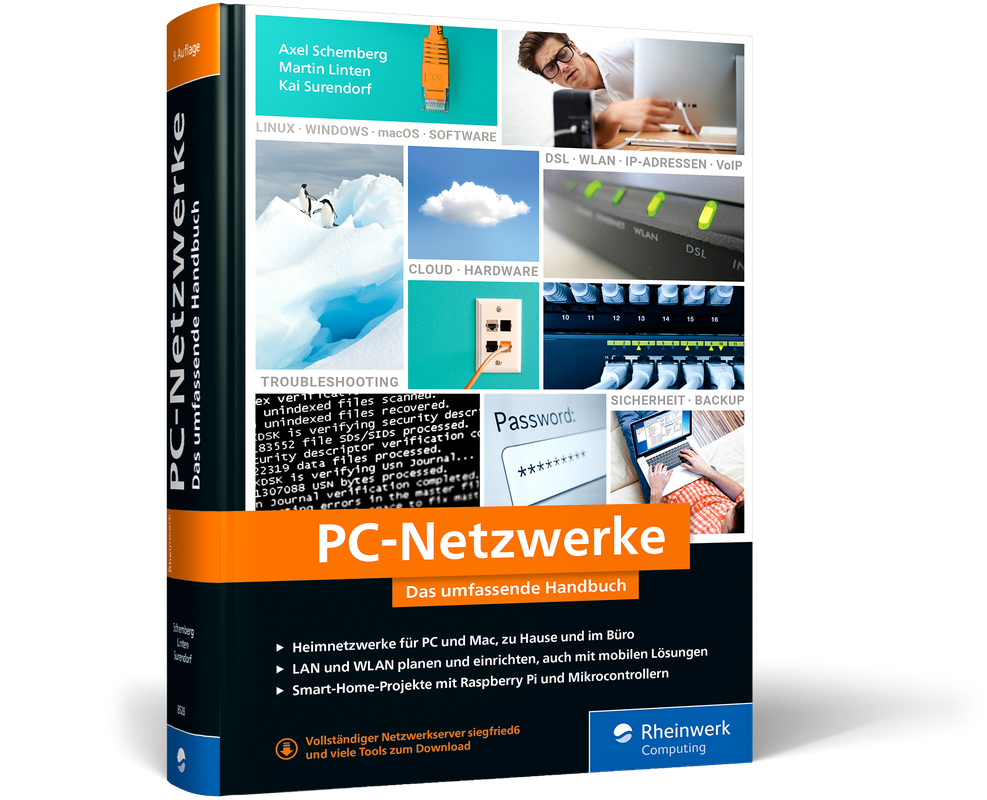
PC-Netzwerke (9. Auflage)
PC-Netzwerke. Das umfassende Handbuch. In 9., aktualisierter und erweiterter Auflage (2023). Bewährt, praxisnah und randvoll mit wertvollen Informationen – Sie erhalten nicht nur umfassende Grundlagen zur Einrichtung Ihres Netzwerks, sondern finden auch Praxis-Anleitungen, mit denen Sie Ihre Computer, Fernseher, Tablets und Smartphones zu Hause oder im Büro professionell vernetzen. Mit vielen Beispiel-Projekten (z. B. UMTS-Router, Radiowecker und Media Player – LibreELEC (Kodi) – mit Raspberry Pi) für eigene Netzwerk- und Hausautomationsideen.Ihr Wissen können Sie zudem mit dem Netzwerkserver »siegfried« direkt ausprobieren. Nutzen Sie ihn für Netzlaufwerke, E-Mail, Netzwerkdrucker, Internettelefonie, DHCP und vieles mehr. Aktuell zu Windows 11 und macOS Monterey.Verstehen und anwenden1. Alles, was Sie für den Netzwerkstart benötigenAngefangen bei den Netzwerkgrundlagen bis hin zu direkt umsetzbaren Praxislösungen für LAN und WLAN finden Sie alles für die erfolgreiche Netzwerk-Einrichtung. Dazu erhalten Sie Tipps zur Auswahl von Router, Switches, NAS, Kabeln und Co.2. Machen Sie Ihr Netzwerk sicherNetzwerk-Sicherheit sollte immer oberste Priorität haben. Daher bietet Ihnen das Buch ausführliche Infos zu Sicherheitssoftware, Verschlüsselungsverfahren, Backup-Möglichkeiten und Netzwerkanalyse-Tools. Für Windows, macOS und Linux.3. Schneller und einfacher mit Cloud & VirtualisierungMit der Software siegfried6 aus dem Download-Bereich können Sie Ihren Rechner z. B. als Druck-, Mail- oder Groupware-Server verwenden. Sie erfahren zudem alles zur Nutzung von Cloud-Diensten.4. Projekte zur HeimautomationMit dem Raspberry Pi oder Mikrocontrollern wie dem ESP8266 setzen Sie Ideen um, mit denen Sie Ihr Zuhause smarter machen.Aus dem InhaltLAN und WLAN einrichtenNetzwerk-TopologienHardware auswählenRouter, Switch und Co.Sicherheit im NetzwerkVerschlüsselungsverfahrenCollaboration ToolsDruck, File- und MailserverBackups automatisieren: NAS-SystemeVirtualisierung und CloudHeimautomation mit FHEM, HomeMatic, Tasmota und mehrStreaming (Fotos, Video, Musik), LibreELEC (Kodi)Leseprobe (PDF-Link)Über die AutorenMartin Linten ist im Bereich Linux-/UNIX-Systemtechnik im Rechenzentrum der Finanzverwaltung Nordrhein-Westfalen tätig, ist »HP certified system administrator« und hat sich mehrere Jahre mit VMware vSphere Server- und Clientvirtualisierung beschäftigt (ESXi/View). Privat beschäftigt er sich am liebsten mit Hausautomation und kleinen Raspberry-Pi-Projekten.Axel Schemberg ist im Bereich Netzwerkadministration im Rechenzentrum der Finanzverwaltung Nordrhein-Westfalen tätig.Kai Surendorf schrieb sein erstes Buch über OS X und UNIX bereits 2003. Zurzeit lebt er in Berlin und arbeitet als Product Owner im E-Commerce-Bereich.

Betriebswirtschaftliche KI-Anwendungen
Digitalisierung und Künstliche Intelligenz ermöglichen Unternehmen disruptive Erweiterungen ihrer Geschäftsmodelle. Wer rechtzeitig digitale KI-Geschäftsmodelle einführt, wird seinen Erfolg nachhaltig sichern können. Aber wie und wo können solche Modelle Anwendung finden? Diese Publikation gibt Antworten, wo KI-Geschäftsmodelle greifen können, und wie diese von der ersten Idee bis zur produktiven Anwendung realisiert werden können.KI-Anwendungen in der Betriebswirtschaft.- Grundlagen und Technik.- Digitale Geschäftsmodelle auf Basis Künstlicher Intelligenz.- Prototyp einer digitalen KI-Anwendung.- Beispielanwendung 1.- Beispielanwendung 2.- Beispielanwendung 3.- Der Weg zum Erfolg mit KI.

Der agile Festpreis
- Warum brauchen agil entwickelte IT-Projekte einen anderen Vertragsrahmen als Projekte nach der Wasserfallmethode? - Wie ein partnerschaftliches Miteinander zu größeren Projekterfolgen führt - Erfahren Sie, wie Sie Schritt für Schritt einen agilen Festpreisvertrag ausarbeiten, verhandeln und umsetzen - Nutzen Sie die Vertragsvorlage als Anregung für Ihre eigenen agilen Festpreisverträge - Reale Beispiele aus der Praxis illustrieren den Weg zum passenden Vertrag - Ihr exklusiver Vorteil: E-Book inside beim Kauf des gedruckten Buches Agiles Arbeiten ist in der Softwareentwicklung eine Selbstverständlichkeit und selbst Großkonzerne definieren im Zuge von Digitalisierungsinitiativen die Rahmenbedingungen ihrer Produktentwicklung neu. Sich mit den vertraglichen Bedingungen zwischen Kunden und Lieferanten unter agilen Vorzeichen auseinanderzusetzen, ist für den Projekterfolg ausschlaggebend und angesichts hochdynamischer Marktsituationen notwendiger denn je. Schließlich ist konstruktive Zusammenarbeit das maßgebliche Prinzip agiler Methoden und genau das wird von traditionellen Vertragsformen oft verhindert. Agile IT-Projekte brauchen Verträge, die den Spagat zwischen festem Kostenrahmen und agiler Entwicklung – etwa mit Scrum – schaffen. Der Agile Festpreis balanciert die Interessen von Anbieter und Kunde und formt ein kooperatives Modell, indem er Grundsätze der Zusammenarbeit und Flexibilität in der Ausgestaltung von Anforderungen bestmöglich vereint. Die 4. Auflage enthält neue Erfahrungsberichte und wurde um weitere Aspekte des Verhandelns sowie neue Praxisbeispiele ergänzt. Kunden, Lieferanten und Einkäufern bietet dieses Buch Best Practices, Vertragsvorlagen und Argumentarien. AUS DEM INHALT // - Wie der Agile Festpreisvertrag Sicherheit und Flexibilität vereinbart - Die 6 Schritte zum neuen Vertragsmodell - Muster für einen Agilen Festpreisvertrag - Ausschreibung und Preisfindung - Vor- und Nachteile verschiedener Vertragsformen
Data Quality
DISCOVER HOW TO ACHIEVE BUSINESS GOALS BY RELYING ON HIGH-QUALITY, ROBUST DATAIn Data Quality: Empowering Businesses with Analytics and AI, veteran data and analytics professional delivers a practical and hands-on discussion on how to accelerate business results using high-quality data. In the book, you’ll learn techniques to define and assess data quality, discover how to ensure that your firm’s data collection practices avoid common pitfalls and deficiencies, improve the level of data quality in the business, and guarantee that the resulting data is useful for powering high-level analytics and AI applications. The author shows you how to:* Profile for data quality, including the appropriate techniques, criteria, and KPIs * Identify the root causes of data quality issues in the business apart from discussing the 16 common root causes that degrade data quality in the organization.* Formulate the reference architecture for data quality, including practical design patterns for remediating data quality* Implement the 10 best data quality practices and the required capabilities for improving operations, compliance, and decision-making capabilities in the businessAn essential resource for data scientists, data analysts, business intelligence professionals, chief technology and data officers, and anyone else with a stake in collecting and using high-quality data, Data Quality: Empowering Businesses with Analytics and AI will also earn a place on the bookshelves of business leaders interested in learning more about what sets robust data apart from the rest. PRASHANTH SOUTHEKAL, PHD, is a data, analytics, and AI consultant, author, and professor. He has worked and consulted for over 80 organizations including P&G, GE, Shell, Apple, FedEx, and SAP. Dr. Southekal is the author of Data for Business Performance and Analytics Best Practices (ranked #1 analytics books of all time by BookAuthority) and writes regularly on data, analytics, and AI in Forbes and CFO.University. He serves on the Editorial Board of MIT CDOIQ Symposium and is an advisory board member at BGV (Benhamou Global Ventures) a Silicon Valley-based venture capital firm. Apart from his consulting and advisory pursuits, he has trained over 3,000 professionals worldwide in data and analytics. Dr. Southekal is also an adjunct professor of data and analytics at IE Business School (Madrid, Spain). CDO Magazine included him in the top 75 global academic data leaders of 2022. He holds a PhD from ESC Lille (FR), an MBA from the Kellogg School of Management (US), and holds the ICD.D designation from the Institute of Corporate Directors (Canada).Forewordby Bill InmonPrefaceAbout the BookQuality Principles Applied in This BookOrganization of the BookWho Should Read This Book?ReferencesAcknowledgmentsDefine PhaseChapter 1: IntroductionIntroductionData, Analytics, AI, and Business PerformanceData as a Business Asset or LiabilityData Governance, Data Management, and Data QualityLeadership Commitment to Data QualityKey TakeawaysConclusionReferencesChapter 2: Business DataIntroductionData in BusinessTelemetry DataPurpose of Data in BusinessBusiness Data ViewsKey Characteristics of Business DataCritical Data Elements (CDE)Key TakeawaysConclusionReferencesChapter 3: Data Quality in BusinessIntroductionData Quality DimensionsContext in Data QualityConsequences and Costs of Poor Data QualityData Depreciation and Its FactorsData in IT SystemsData Quality and Trusted InformationKey TakeawaysConclusionReferencesAnalyze PhaseChapter 4: Causes for Poor Data QualityIntroductionData Quality RCA TechniquesTypical Causes of Poor Data QualityKey TakeawaysConclusionReferencesChapter 5: Data Lifecycle and LineageIntroductionBusiness-Enabled DLC StagesIT Business-Enabled DLC StagesData LineageKey TakeawaysConclusionReferencesChapter 6: Profiling for Data QualityIntroductionCriteria for Data ProfilingData Profiling Techniques for Measures of CentralityData Profiling Techniques for Measures of VariationIntegrating Centrality and Variation KPIsKey TakeawaysConclusionReferencesRealize PhaseChapter 7: Reference Architecture for Data QualityIntroductionOptions to Remediate Data QualityDataOpsData ProductData Fabric and Data MeshData EnrichmentKey TakeawaysConclusionReferencesChapter 8: Best Practices to Realize Data QualityIntroductionOverview of Best PracticesBP 1: Identify the Business KPIs and the Ownership of These KPIs and the Pertinent DataBP 2: Build and Improve the Data Culture and Literacy in the OrganizationBP 3: Define the Current and Desired state of Data QualityBP 4: Follow the Minimalistic Approach to Data CaptureBP 5: Select and Define the Data Attributes for Data QualityBP 6: Capture and Manage Critical Data with Data Standards in MDM SystemsKey TakeawaysConclusionReferencesChapter 9: Best Practices to Realize Data QualityIntroductionBP 7: Automate the Integration of Critical Data ElementsBP 8: Define the SoR and Securely Capture Transactional Data in the SoR/OLTP SystemBP 9: Build and Manage Robust Data Integration CapabilitiesBP 10: Distribute Data Sourcing and Insight ConsumptionKey TakeawaysConclusionReferencesSustain PhaseChapter 10: Data GovernanceIntroductionData Governance PrinciplesData Governance Design ComponentsImplementing the Data Governance ProgramData ObservabilityData Compliance – ISO 27001 and SOC2Key TakeawaysConclusionReferencesChapter 11: Protecting DataIntroductionData ClassificationData SafetyData SecurityKey TakeawaysConclusionReferencesChapter 12: Data EthicsIntroductionData EthicsImportance of Data EthicsPrinciples of Data EthicsModel Drift in Data EthicsData PrivacyManaging Data EthicallyKey TakeawaysConclusionReferencesAppendix 1: Abbreviations and AcronymsAppendix 2: GlossaryAppendix 3: Data Literacy CompetenciesAbout the AuthorIndex
IAPP CIPM Certified Information Privacy Manager Study Guide
AN ESSENTIAL RESOURCE FOR ANYONE PREPARING FOR THE CIPM CERTIFICATION EXAM AND A CAREER IN INFORMATION PRIVACYAs cybersecurity and privacy become ever more important to the long-term viability and sustainability of enterprises in all sectors, employers and professionals are increasingly turning to IAPP’s trusted and recognized Certified Information Privacy Manager qualification as a tried-and-tested indicator of information privacy management expertise. In IAPP CIPM Certified Information Privacy Manager Study Guide, a team of dedicated IT and privacy management professionals delivers an intuitive roadmap to preparing for the CIPM certification exam and for a new career in the field of information privacy. Make use of pre-assessments, the Exam Essentials feature, and chapter review questions with detailed explanations to gauge your progress and determine where you’re proficient and where you need more practice. In the book, you’ll find coverage of every domain tested on the CIPM exam and those required to succeed in your first—or your next—role in a privacy-related position. You’ll learn to develop a privacy program and framework, as well as manage the full privacy program operational lifecycle, from assessing your organization’s needs to responding to threats and queries. The book also includes:* A head-start to obtaining an in-demand certification used across the information privacy industry* Access to essential information required to qualify for exciting new career opportunities for those with a CIPM credential* Access to the online Sybex learning environment, complete with two additional practice tests, chapter review questions, an online glossary, and hundreds of electronic flashcards for efficient studyingAn essential blueprint for success on the CIPM certification exam, IAPP CIPM Certified Information Privacy Manager Study Guide will also ensure you hit the ground running on your first day at a new information privacy-related job. ABOUT THE AUTHORSMIKE CHAPPLE, PHD, CIPM, is Teaching Professor of Information Technology, Analytics, and Operations at Notre Dame’s Mendoza College of Business. He is the bestselling author of over 25 books and serves as the Academic Director of the University’s Master of Science in Business Analytics program.JOE SHELLEY, CIPM, is the Vice President for Libraries and Information Technology at Hamilton College in New York. He oversees information security and privacy programs, IT risk management, business intelligence and analytics, and data governance. Introduction xviiAssessment Test xxviiCHAPTER 1 DEVELOPING A PRIVACY PROGRAM 1INTRODUCTION TO PRIVACY 3What Is Privacy? 4What Is Personal Information? 5What Isn’t Personal Information? 5Why Should We Care about Privacy? 8Generally Accepted Privacy Principles 9Management 10Notice 11Choice and Consent 11Collection 12Use, Retention, and Disposal 12Access 13Disclosure to Third Parties 14Security for Privacy 14Quality 15Monitoring and Enforcement 16Developing a Privacy Program 16Crafting Vision, Strategy, Goals, and Objectives 17Structuring the Privacy Team 20Creating a Program Scope and Charter 22Privacy Roles 25Building Inventories 25Conducting a Privacy Assessment 26Implementing Privacy Controls 27Ongoing Operation and Monitoring 27Data Governance 28Data Governance Approaches 28Data Governance Roles 29Access Requirements 29Governing Information Processing 31Managing the Privacy Budget 31Organizational Budgeting 32Expense Types 32Budget Monitoring 33Communicating about Privacy 34Creating Awareness 34Building a Communications Plan 35Privacy Program Operational Life Cycle 36Summary 36Exam Essentials 37Review Questions 38CHAPTER 2 PRIVACY PROGRAM FRAMEWORK 43Develop the Privacy Program Framework 44Examples of Privacy Frameworks 44Develop Privacy Policies, Procedures, Standards, and Guidelines 51Define Privacy Program Activities 52Implement the Privacy Program Framework 57Communicate the Framework 57Aligning with Applicable Laws and Regulations 58Develop Appropriate Metrics 78Identify Intended Audience for Metrics 79Define Privacy Metrics for Oversight and Governance per Audience 80Summary 83Exam Essentials 84Review Questions 86CHAPTER 3 PRIVACY OPERATIONAL LIFE CYCLE: ASSESS 91Document Your Privacy Program Baseline 93Education and Awareness 94Monitoring and Responding to the Regulatory Environment 94Assess Policy Compliance against Internal and External Requirements 94Data, Systems, and Process Assessment 95Risk Assessment Methods 96Incident Management, Response, and Remediation 97Perform Gap Analysis against an Accepted Standard or Law 97Program Assurance 97Processors and Third- Party Vendor Assessment 98Evaluate Processors and Third- Party Vendors 99Understand Sources of Information 99Risk Assessment 100Contractual Requirements and Ongoing Monitoring 102Physical Assessments 102Mergers, Acquisitions, and Divestitures 103Privacy Assessments and Documentation 105Privacy Threshold Analyses (PTAs) 105Define a Process for Conducting Privacy Assessments 105Summary 108Exam Essentials 108Review Questions 110CHAPTER 4 PRIVACY OPERATIONAL LIFE CYCLE: PROTECT 115Privacy and Cybersecurity 117Cybersecurity Goals 117Relationship between Privacy and Cybersecurity 118Cybersecurity Controls 119Security Control Categories 120Security Control Types 120Data Protection 121Data Encryption 121Data Loss Prevention 122Data Minimization 123Backups 124Policy Framework 125Cybersecurity Policies 126Cybersecurity Standards 128Cybersecurity Procedures 129Cybersecurity Guidelines 130Exceptions and Compensating Controls 131Developing Policies 133Identity and Access Management 133Least Privilege 134Identification, Authentication, and Authorization 134Authentication Techniques 135Provisioning and Deprovisioning 137Account and Privilege Management 138Privacy by Design 139Privacy and the SDLC 140System Development Phases 141System Development Models 142Integrating Privacy with Business Processes 146Vulnerability Management 146Vulnerability Scanning 147Vulnerability Remediation 147Data Policies 149Data Sharing 149Data Retention 149Data Destruction 150Summary 151Exam Essentials 151Review Questions 153CHAPTER 5 PRIVACY OPERATIONAL LIFE CYCLE: SUSTAIN 157Monitor 158Monitoring the Environment 159Monitor Compliance with Privacy Policies 160Monitor Regulatory Changes 160Compliance Monitoring 161Audit 162Aligning with Audits 163Audit Focus 164Summary 167Exam Essentials 168Review Questions 170CHAPTER 6 PRIVACY OPERATIONAL LIFE CYCLE: RESPOND 175Data Subject Rights 176Access 177Managing Data Integrity 178Right of Erasure 178Right to Be Informed 180Control over Use 180Complaints 181Handling Information Requests 181Incident Response Planning 182Stakeholder Identification 182Building an Incident Oversight Team 183Building the Incident Response Plan 184Integrating the Plan with Other Functions 187Incident Detection 187Security and Privacy Incidents 187Security Events and Incidents 188Privacy Incidents 188Reporting Privacy Incidents 189Coordination and Information Sharing 190Internal Communications 191External Communications 191Breach Notification 192Incident Handling 192Risk Assessment 193Containment Activities 193Remediation Measures 194Ongoing Communications 195Post- Incident Activity 196Planning for Business Continuity 198Project Scope and Planning 200Business Impact Analysis 204Continuity Planning 211Plan Approval and Implementation 213Summary 218Exam Essentials 219Review Questions 221Appendix Answers to Review Questions 225Chapter 1: Developing a Privacy Program 226Chapter 2: Privacy Program Framework 228Chapter 3: Privacy Operational Life Cycle: Assess 229Chapter 4: Privacy Operational Life Cycle: Protect 231Chapter 5: Privacy Operational Life Cycle: Sustain 233Chapter 6: Privacy Operational Life Cycle: Respond 235Index 239

Threats
A PRACTICAL GUIDE TO WRITING SECURE APPLICATIONS, WITH HELP FROM YOUR FAVORITE JEDI MASTERS, SITH LORDS, AND DROIDS Have you ever wondered what R2-D2, Darth Vader, Han Solo, or even Yoda could teach you about software security? Well, wonder no more. In Threats: What Every Engineer Should Learn from Star Wars, veteran game designer and software engineer Adam Shostack delivers a fun and hands-on guide to developing secure software. The book is easy to read and immediately useful, demonstrating how to write more secure applications code with wisdom and insights from the Star Wars universe. You’ll discover practical security models—like STRIDE—that are relevant to a wide variety of applications and systems. You’ll also learn ways that attackers use various strategies, like tampering, spoofing, and denial of service—to achieve their nefarious goals. Modern application development has to account for security, usability, and rapid delivery. We can’t wait for “reviews” and interminable debates in the Galactic Senate. That’s what makes good security engineering so critical. Threats is an engaging and hilarious roadmap to writing secure apps from the ground up that you’ll actually want to read from cover to cover. Secure your applications with help from your favorite Jedi masters In Threats: What Every Engineer Should Learn From Star Wars, accomplished security expert and educator Adam Shostack delivers an easy-to-read and engaging discussion of security threats and how to develop secure systems. The book will prepare you to take on the Dark Side as you learn—in a structured and memorable way—about the threats to your systems. You’ll move from thinking of security issues as clever one-offs and learn to see the patterns they follow. This book brings to light the burning questions software developers should be asking about securing systems, and answers them in a fun and entertaining way, incorporating cybersecurity lessons from the much-loved Star Wars series. You don’t need to be fluent in over 6 million forms of exploitation to face these threats with the steely calm of a Jedi master. You’ll also find: * Understandable and memorable introductions to the most important threats that every engineer should know * Straightforward software security frameworks that will help engineers bake security directly into their systems * Strategies to align large teams to achieve application security in today’s fast-moving and agile world * Strategies attackers use, like tampering, to interfere with the integrity of applications and systems, and the kill chains that combine these threats into fully executed campaigns An indispensable resource for software developers and security engineers, Threats: What Every Engineer Should Learn From Star Wars belongs on the bookshelves of everyone delivering or operating technology: from engineers to executives responsible for shipping secure code. ADAM SHOSTACK is a technologist, entrepreneur, and game designer. One of the world’s leading experts on threat modeling, he wrote Threat Modeling: Designing for Security and is an Affiliate Professor at the University of Washington. He is a member of the BlackHat Review Board and the founder of Shostack + Associates, a specialized security consultancy dedicated to helping organizations deliver secure systems. Preface xi Introduction xv 1 Spoofing and Authenticity 1 2 Tampering and Integrity 41 3 Repudiation and Proof 63 4 Information Disclosure and Confidentiality 95 5 Denial of Service and Availability 131 6 Expansion of Authority and Isolation 151 7 Predictability and Randomness 187 8 Parsing and Corruption 211 9 Kill Chains 249 Epilogue 291 Glossary 295 Bibliography 303 Story Index 317 Index 323

Procedural Generation in Godot
Learn the tricks of simple procedural generation and how various genres, such as racing simulators, platformers, and roguelikes, can all benefit from these techniques.In this book, you'll learn how to combine hand-crafted content with algorithms to create immersive and beautiful environments. You'll learn how to create a seeding system, so that you can replay great levels with your friends. We'll cover how to create good tilesets, how to use the tilemap editor effectively, and how to inject just the right amount of logic into an otherwise automated machine that is your own personal procedural content generation engine.We will use 2D examples to demonstrate the concepts covered throughout the book. By the time you complete this book, you’ll have a good handle on how to add procedural generation to your games.WHAT YOU WILL LEARN* Learn to set up the perfect content generation system * Master the tools for randomization and repeatability* Understand how much content to craft versus how much to generateWHO THIS BOOK IS FORBasic familiarity with the Godot engine and GDScript is essential. While all concepts are explained in the book, it can be overwhelming learning these techniques at the same time as learning the engine.Christopher Pitt is a developer living in South Africa. He has published a bunch of indie games, many of which use procedural content generation, on mobile, and desktop environments. Most of his games have been built in JavaScript or the Godot engine. He also likes to bake sweet things and build wood things.Chapter 1: Hand crafted vs. ProceduralSub -Topics• A study of hand-crafted content• Case study of Limbo• A study of procedural content• Case study of Oxygen Not Included• How much of each is good?• Case study of Diablo 2• Brief overview of different approaches we'll take in the rest of the bookChapter 2: Generating with NodesSub - Topics• Set up new project• Create node hierarchy (with limited inheritance)• Use randomization to place nodes in an area• Vary node behavior to create realismChapter 3: Generating with TilesSub - Topics:• Create Tilemaps and Tilesets• Change tiles via code• Creating and using Autotile via the editor• Using Autotile via codeChapter 4: Recreating SokobanSub - Topics:• Create a new project (rapid)• Create a player character• Add movement to the player character• Create a push able crate• Create a storage location• Create different levels with code• Add level transitionsChapter 5: Designing Levels in Pixel ArtSub - Topics: • Brief introduction to Aseprite• Importing map assets into Godot• Reading image data• Defining map cell types• Drawing cells into a gameChapter 6: Creating a Seeding SystemSub - Topics:• Using seeded PRNG randomization• Loading word lists into a game• Displaying, storing, and using seeds in generationChapter 7: Recreating Bouncy CarsSub - Topics:• Create a new project (rapid)• Create a seed screen• Create a few maps in pixel art, read them into the game• Manipulate quadrant maps to form a loop• Put players into the loop• Trace the "correct" path, display helper direction arrowChapter 8: Navigating in Generated LevelsSub - Topics:• Intro to navigation polygons in tile maps• Combining collision shapes with navigation meshes• Exploring alternatives to mesh manipulation• Randomizing specific obstacles to optionally include navigation or collisionChapter 9: Randomized Collective Nodes within a Generated MapSub - Topics:• Identifying collections of cells• Representing these as larger structures in a generated space• Adding variability to these structuresChapter 10: Recreating InvasionSub - Topics:• Create a new project (rapid)• Prototype a global generator, rooms, levels, tiles, and doodads• Generate rooms• Handle room transitions• Collect compound doodads• Create houses with variability• Spawn survivors, add acquisition and rescue• Spawn soldiers, add capture and harass• Create exit pointChapter 11: Paths and Path FollowersSub - Topics:• Create path by hand• Create node to follow• Make node follow path• Create path via pixel art• Connect multiple separate paths together (train switch)Chapter 12: Interaction SystemsSub - Topics:• Create player and intractable nodes• Create area-based (proximity) nodes that can be reused• Implement event-based interaction• Brief intro for dialogic add-on, as a means of extending the interaction systemChapter 13: Recreating This War of MineSub - Topics:• Create new project (rapid)• Prototype rooms, make pixel art map• Create paths• Create playable characters with path followers• Create intractable nodes in rooms• Add dialogic add-on for interaction between playable characters

IBM Software Systems Integration
Examine the working details for real-world Java programs used for system integration with IBM Software, applying various API libraries (as used by Banking and Insurance companies). This book includes the step-by-step procedure to use the IBM FileNet Case Manager 5.3.3 Case Builder solution and the similar IBM System, IBM Business Automation Workflow to create an Audit System.You'll learn how to implement the workflow with a client Java Message Service (JMS) java method developed with Workflow Custom Operations System Step components. Using IBM Cognos Analytics Version 11.2, you'll be able to create new views for IBM Case Manager Analytics for custom time dimensions. The book also explains the SQL code and procedures required to create example Online Analytical Processing (OLAP) cubes with multi-level time dimensions for IBM Case Manager analytics.IBM Software Systems Integration features the most up to date systems software procedures using tested API calls.WHAT YOU WILL LEARN* Review techniques for generating custom IBM JMS code* Create a new custom view for a multi-level time dimension* See how a java program can provide the IBM FileNet document management API calls for content store folder and document replication* Configure Java components for content engine eventsWHO THIS BOOK IS FORIT consultants, Systems and Solution Architects.ALAN BLUCK has over 45 years IT experience. He has been a Solutions Architect for IBM for over 10 years. Elected as an IBM Champion (2022), he is now the Director and owner of ASB Software Development Limited, an IBM PartnerWorld partner, and a consultancy providing systems architecture for a broad range of services. He is a Member of the British Computer Society (MBCS, CITP).Chapter 1IBM FileNet Case Manager 5.3.3 Case Builder Solution Development Steps for The Audit SystemCHAPTER GOAL: Building the initial IBM Case Manager Audit SolutionNO OF PAGES 90SUB -TOPICSSECTIONS* Bill of Materials* Add a new solution* Add properties and Business Objects* Add Roles* Add properties to the Inbaskets for each role* Add Document class* Add Business Objects* Add Business Object Types as Case propertiesAdd Case Types* Audit Department Task* Add Business Objects to be searched* Audit Solution First Test* Remove the Case Search Business Objects* Edit the Cases Page to allow Case Search to work correctly* Debug the Case Manager Client* Check FileNet Version* Check FileNet Health* Check FileNet Object Store Upgrade Status* Check FileNet Workflow Upgrade StatusFix / Workaround for Error on Case Search * Other Fixes (Recommended)Chapter 2: Configuring Java Custom ComponentsCHAPTER GOAL: CREATION AND CONFIGURATION OF THE JAVA CUSTOMISATIONSNO OF PAGES: 20SUB - TOPICSSECTIONS* Configuring Java Components for Content Engine Events* Custom Code Module java JAR API call development* Adding a Code ModuleCreating a Custom Event Object* Configuring Workflow Subscriptions* Configuring Component Manager for WebSphere control* Component Manager Extension MBean Provider* Creating the Component Manager Custom Service* DbExecute system function* Setting DbExecute connections* Example DB2 Stored procedure* Example Oracle Stored procedure* Example SQL*Server Stored procedureChapter 3: IBM JMS (Java Message Service) Interface Development IBM FileNet 5.5.x WorkflowCHAPTER GOAL: Theexample development of a java jar file for the IBM Java Messaging Service calls and its deployment for use in an IBM Case Manager Workflow.NO OF PAGES : 240SUB - TOPICS:* MQ Series 7.5 Install and Configure* Notification of successful repository load into FileNet* Custom Operations Component Development- JMSMessage Operation* Custom Operations Component Development- Fix list for WebSphere MQ Version 7.5* IBM MQ Series 7.x Fix Pack Installation* Linux: Applying maintenance level updates on WebSphere MQ version* Setting up the client on Windows* Setting up the client on Linux* Sending a message from a client to a server* AuditOperations method parameterisation* AuditOperations.java Code Development* AuditOperations re-build and deploy .jar* Final pre-build test AuditOperations.jar* FileNet Workflow System Component AuditOperations.jar deployment* Checking deployment in the Component Manager and Workflow* Transfer Workflow and set up Workflow subscriptionsChapter 4: A Replication Java Program for IBM FileNet Object StoresCHAPTER GOAL: The development of the java API calls and the configuration required to replicate an IBM FileNet Document Management ObjectStore.NO OF PAGES: 100SUB - TOPICS:* Setting up the Creator Property* Setting Object Store Access Rights* Batch Jobs* Required supporting Library .jar files* The Configuration set up file* Encryption of the administrator user password in a config.xml Configuration file* Update of the Config.xml Start Date* Event Set-up * Folder Class - Update Event and Deletion Events* Document Class - Deletion Events* Unit Test results ( New Folder and Document )* Existing Folder Name and Security updatesNew Folder Name and Document updatesChapter 5: Cognos RTM Custom DevelopmentCHAPTER GOAL: Create a new Custom View for a Multi-level Time DimensionNO OF PAGES: 90SUB - TOPICS:SECTIONS* Creation and test of Multilevel Time Dimension for a new OLAP Database* Update to add Year YearNumber and Month* Update to add Hour* Create a new View for Workflow Tasks* Create a new data stream in Cognos RTM – Task Load Data Stream* Create a new Cube including the Multilevel Time Dimension* Case Attribute Review for Exposed Dimensions* Creation and test of Multilevel Time Dimensions* Create a new Multilevel Time Dimension Cube* Average Age Hours* Average Wait Time Hours* Average Processing Time Hours* Average Ready Time Hours* Average Failed Time HoursCHAPTER 6: PDF Document Creation using iTextCHAPTER GOAL: A Java Program to generate PDF document using the iText libraryNO OF PAGES: 20SUB - TOPICS:SECTIONS1. Adding an Image to a PDF2. Adding a Table to a PDF3. Creating a PdfWriter object4. Creating a PdfDocument object5. Creating the Document object6. Creating an Image object7. Adding image to the documentClosing the Document

Pro SQL Server 2022 Wait Statistics
Use this practical guide to analyze and troubleshoot SQL Server performance using wait statistics. You'll learn to identify precisely why your queries are running slowly. And you'll know how to measure the amount of time consumed by each bottleneck so you can focus attention on making the largest improvements first. This edition is updated to cover analysis of wait statistics current with SQL Server 2022. Whether you are new to wait statistics, or already familiar with them, this book provides a deeper understanding on how wait statistics are generated and what they mean for your SQL Server instance’s performance.The book goes beyond the most common wait types into the more complex and performance-threatening wait types. You’ll learn about per-query wait statistics and session-based wait statistics, and the types of problems they can help you solve. The different wait types are categorized by their area of impact, including CPU, IO, Latching, Locking, and many more.Clear examples are included to help you gain practical knowledge of why and how specific wait times increase or decrease, how they impact your SQL Server’s performance, and what you can do to improve performance. After reading this book, you won’t want to be without the valuable information that wait statistics provide regarding where you should be spending your limited tuning time to maximize performance and value to your business.WHAT YOU'LL LEARN* Understand how the SQL Server engine processes requests* Identify resource bottlenecks in a running SQL Server instance* Locate wait statistics information inside DMVs and Query Store* Analyze the root cause of sub-optimal performance* Diagnose I/O contention and locking contention* Benchmark SQL Server performance* Improve database performance by lowering overall wait time WHO THIS BOOK IS FORDatabase administrators who want to identify and resolve performance bottlenecks, those who want to learn more about how the SQL Server engine accesses and uses resources inside SQL Server, and administrators concerned with achieving—and knowing they have achieved—optimal performance__THOMAS LAROCK has over 20 years of IT experience holding roles such as programmer, developer, analyst, and database administrator. He is a Microsoft Certified Master in SQL Server and a Microsoft Data Platform MVP since 2009. Thomas has spent much of his career working with data and databases, which led to his selection as Technical Advocate for Confio Software in 2010 for the software now known as SolarWinds Database Performance Analyzer (DPA).Currently, Thomas serves as Head Geek for SolarWinds, a company specializing in software for enterprise infrastructure monitoring. This role allows him to work with a variety of customers, helping to solve questions regarding network, application, and database performance tuning and virtualization. You can reach him through his blog (thomaslarock.com/blog) and find him on Twitter @SQLRockstar).ENRICO VAN DE LAAR has been working with data in various formats and sizes for over 15 years. He is a data and advanced analytics consultant for Dataheroes where he helps organizations optimize their data platform environment and helps them with their first steps in the world of advanced analytics. He is a Data Platform MVP since 2014 and a frequent speaker on various data-related events throughout the world. He frequently blogs about technologies such as Microsoft SQL Server and Azure Machine Learning on his blog at enricovandelaar.com. You can contact Enrico on Twitter @evdlaar.PART I: FOUNDATIONS OF WAIT STATISTICS ANALYSIS1. Wait Statistics Internals2. Querying SQL Server Wait Statistics3. The Query Store4. Building a Solid BaselinePART II: WAIT TYPES5. CPU-Related Wait Types6. IO-Related Wait Types7. Backup-Related Wait Types8. Lock-Related Wait Types9. Latch-Related Wait Types10. High-Availability and Disaster-Recovery Wait Types11: Preemptive Wait Types12: Background and Miscellaneous Wait Types13. In-Memory OLTP-Related Wait Types14. Appendix I. Example SQL Server Machine Configurations15. Appendix II. Spinlocks16. Appendix III. Latch Classes

Microsoft Conversational AI-Platform für Entwickler
Erstellen Sie einen Chatbot mit der Microsoft Conversational AI-Plattform. In diesem Buch lernen Sie Schritt für Schritt, wie Sie Zeit und Geld sparen können, indem Sie Chatbots in die Strategie Ihres Unternehmens integrieren. Sie werden lernen, wie Sie jede Phase der Entwicklung beherrschen, von der Zusammenarbeit an einem Chatbot in einem End-to-End-Szenario über die erste Mock-up-Phase bis hin zur Einsatz- und Bewertungsphase. Microsoft hat ein Cloud-Service-Ökosystem für die Ausführung von künstlichen Intelligenz-Workloads in öffentlichen Cloud-Szenarien und eine robuste KI-Plattform aufgebaut, die eine breite Palette von Diensten für konversationelle künstliche Intelligenz-Lösungen wie Chatbots bietet. Die Entwicklung eines Chatbots erfordert nicht nur Programmierkenntnisse von Entwicklern, sondern auch besondere Überlegungen, einschließlich des Inputs von Geschäftsinteressenten wie Fachexperten und Power-Usern. Sie werden anhand von Beispielen lernen, wie Sie eine Reihe von Tools und Diensten nutzen können, um die Kluft zwischen Unternehmen und Technik zu überbrücken.Sie werden lernen, wie Sie Geschäftsanforderungen erfolgreich in umsetzbare IT- und technische Anforderungen umwandeln können. Sie lernen den Bot Framework Composer kennen, der es Power-Usern ermöglicht, die Erstellung eines Chatbots zu initiieren, der dann an das Entwicklungsteam weitergegeben werden kann, um durch Code weitere Funktionen hinzuzufügen. Der Prozess der Aufteilung der Implementierungsaufgaben und des Arbeitsaufwands zwischen Power-Usern, die einen Low-Code- oder No-Code-Ansatz verwenden, und Entwicklern, die die erweiterten Funktionen für den Chatbot entwickeln, wird ebenfalls behandelt.Was Sie lernen werden:* Verstehen Sie Microsofts umfassendes KI-Ökosystem und seine Dienste und Lösungen* Erkennen Sie, welche Lösungen und Dienste in jedem Geschäftsszenario angewendet werden sollten* Entdecken Sie No-Code-/Low-Code-Ansätze für die Erstellung von Chatbots* Entwickeln Sie Chatbots unter Verwendung des Conversational AI Stacks* Richten Sie Geschäft und Entwicklung für verbesserte Chatbot-Ergebnisse und kürzere Markteinführungszeiten ausDieses Buch richtet sich an Entwickler und Power-User, die Chatbots erstellen möchten. Ein Verständnis für die Grundprinzipien des Programmierens moderner Webanwendungen (.NET oder JavaScript) wird vorausgesetzt.STEPHAN BISSER ist technischer Leiter bei Solvion und ein Microsoft MVP für künstliche Intelligenz. In seiner aktuellen Rolle konzentriert er sich auf Conversational AI, Microsoft 365 und Azure. Seine Leidenschaft gilt der Conversational AI Plattform und dem Cognitive-Services-Ökosystem. Stephan und mehrere andere MVPs gründeten die Community-Initiativen BotBuilderCommunity und SelectedTech, die sich auf Bot-Framework-SDKs, Tools und technische Themen im Zusammenhang mit Microsoft 365 und KI konzentrieren.Kapitel 1: Einführung in die Microsoft Conversational AI PlatformKapitel 2: Einführung in das Microsoft Bot FrameworkKapitel 3: Einführung in Azure Cognitive ServicesKapitel 4: Gestaltungsprinzipien eines ChatbotsKapitel 5: Aufbau eines ChatbotsKapitel 6: Testen eines ChatbotsKapitel 7: Veröffentlichung eines ChatbotsKapitel 8: Verbinden eines Chatbots mit Kanälen

Connecting the Internet of Things
Navigating the fragmented IoT connectivity ecosystem of standards, protocols, and architectures can be a challenge. Not to mention scaling a solution to a viable product. This book guides you through this fractured landscape with real world examples and projects that can be leverage for an IoT product.Backed by an overview of IoT use cases and key connectivity elements of IoT solutions, you'll gain an understanding of the breadth of the IoT landscape and the fragmentation of connectivity standards and solutions and the challenge in navigating the many standards and technologies. You'll also be able to understand the essentials of connectivity including, hardware, software, and business models.IoT is essential for increasing productivity of many industries and quality of life (making the world smart and autonomous). Both wired and wireless connectivity technologies are essential ingredients in an IoT product. Written by Intel engineers and architects, Connecting the Internet of Things understands that connectivity is a key topic of IoT and comprehensively covers the topic from a system engineering and practical perspective.WHAT YOU'LL LEARN* Understand the trade offs between different wireless technologies and network topologies* Use wireless technologies in IoT products* Examine connectivity technologies and considerations on selecting it for the IoT use cases* Assemble all of the components of a working solution * Scale your solution to a product* Review emerging connectivity technologies for addressing new use cases* Advance and optimize the performance of existing technologiesWHO THIS BOOK IS FORResearchers, managers, strategists, technologists, makers, and students in the embedded and Internet of Things (IoT) space trying to understand and implement connectivity in the devices/platforms.ANIL KUMAR is a Principal Engineer at Intel Corporation. As a System Architect in the Client Computing Group, he works with Intel’s partners to unlock people’s potential by bringing computing devices to market, allowing them to focus, create and connect in ways that matter most to them. Before this role, Anil was responsible for the Connectivity Platform Architecture in the Internet of Things Group (IOTG). In IOTG, he successfully drove platform and chip-level integration of several critical connectivity and communication technologies, resulting in a broad set of IoT applications across different vertical markets.Anil joined Intel in 2007 as a design engineer in the Digital Home Group. He served as Platform Architect for several Intel Architecture-based Media Processors for TV and Set Top Box applications. As the chief architect in Intel Media Group, Anil led several designs that resulted in award-winning consumer electronic device designs at CES (Consumer Electronics Show). The world’s first Google TV devices are based on reference designs created by Anil.Before joining Intel, Anil held design engineering positions at multinational companies such as Fujitsu & Alcatel. Anil’s passion and purpose is driven by taking designs from concept to production. Anil is a co-author of Demystifying Internet of Things Security (Apress 2019).JAFER HUSSAIN is a Senior Product Line Manager in the Network and Edge Group (NEX) at Intel Corporation. Jafer is responsible for the product management of Intel’s Core based Smart and Intelligent AI platforms. In his current role, Jafer engages with Intel’s ecosystem partners to drive Intel’s leadership in various IoT markets.Jafer has previously led the development and integration of wireless connectivity solutions and contributed to the development of wireless connectivity strategy. He also led several customer engagements to drive these solutions to the market.Jafer is an accomplished inventor with multiple patents on embedded systems, wireless technologies, and IoT. He received B.S. in Electrical Engineering from University of Engineering and Technology Taxila, Pakistan, and M.S. in Management of Technology from the National University of Singapore.DR. ANTHONY (TONY) CHUN is head of digital access and an Encore.org/CoGenerate Fellow, at The Bridging Tech Charitable Fund, a nonprofit that is closing the digital divide for K-12 students via computers and connectivity. He recently retired from Intel Corporation, where he was the Wi-Fi product manager in the Internet of Things Group.He joined Intel in 2000 and was a research scientist in Intel Labs where he developed architectures for reconfigurable software defined radios and accelerators.He has co-authored 20 patents in wireless architectures and accelerators. He has co-authored several papers in engineering journals and received best paper awards at the Intel Design Technology and Test Conference 2011 and at the IEEE Computer Society Annual Symposium on VLSI, 2009. He has B.S., M.S. and PhD degrees in Electrical Engineering from Stanford University, Stanford, California.Chapter 1: Introduction to IoT ConnectivityChapter Goal: This chapter provides an overview of key IoT use cases and key connectivity elements of IoT solutions. The reader will get an understanding of the breadth of the IoT landscape.• Purpose of this book• Background and Terminology• Key IoT use caseso Smart citieso Asset trackingo Smart factorieso Industrialo Transportationo Digital surveillance systemso Retailo Medicalo Indoor location• End-to-end IoT building blockso Things/devices/sensorso Edge/Gateway/Fogo Cloud• IoT Stakeholders/Value Chaino Chip Vendorso Module Vendorso System Integratorso ODMso ISVso End CustomersChapter 2: Considerations in choosing a connectivity technologyChapter Goals: This chapter highlights the fragmentation of connectivity standards and solutions and the challenge in navigating the many standards and technologies and also discusses the tradeoffs between different wireless technologies and network topologies. Also, this chapter provides the motivation for using wireless technologies in IoT products as well as challenges.• Compute and connect are integral functions that are fully integrated in single SoC-for lower cost and low power solutions• Benefits of wireless• Seamless wireless connectivity for mobility applications• Remote Commissioning, ease of deployment, OTA update, device identification• Challenges of Wireless Connectivity• Fragmentation of the IoT Ecosystemo Discussion of IoT Framework Open Connectivity Foundation etc.o Interoperability (open standards)• Coexistence and interference• Wireless security is vital• Certification (Industry, regulatory, operator)o Certified labs• Antenna design challenges• Considerations in choosing a connectivity technologyo Energy/power/cost tradeoffso Selection of network architectures and topologieso Wireless standards and alignment to use cases-how to choose the right wireless protocol for the jobo Selection criteria-range, data rate, power, security, latency, capacity, etc.• Wireless Standard BodiesSubchapter Goal: Overview of Connectivity standards including 15.4, ZigBee, Thread, 6LoWPAN, wi-fi, BT, LTE, 5G etc. and which is appropriate for each use case; include cost considerationso WiFi Allianceo BT SIGo ZigBee Allianceo Thread Groupo Dot doto Z-Waveo 3GPP (ITU-T)Chapter Goals: The following chapters (3 to 10) provide a deep dive on each connectivity technology and considerations on selecting it for the IoT use casesChapter 3: Wi-Fi• Wi-Fi mesh• WiFi 802.11a/b/g/n/ac• WiFi 6Chapter 4: Bluetooth• BLE• BT mesh• BT direction finding• BT beaconsChapter 5: 802.15.4 (unlicensed)• ZigBee• ThreadChapter 6: LPWAN• Lora• SigFoxChapter 7: Cellular Technologies• NB IoT• 3G• 4G LTE• CBRS (Private LTE) / OnGoChapter 8: 5G• eMBB• mMTC• urLLC• 5G TSNChapter 9: Ethernet• TSN• Industrial Ethernet TechnologiesChapter 10: GNSSChapter 11: IoT Connectivity Frameworks and StacksChapter Goal: This chapter goes into detail on how to assemble all of the components of a working solution and discusses how to scale your solution to a product• Software stacks, drivers, operating systems, RTOS• Gateway architecture including protocolso IoT protocols CoAP MQTT OPCUA• RF: antenna, PA, etc.• Coexistence• Environmental considerations, reliability, long life etc.• Security and privacy• Managing the network• Certification• Putting it together• How to integrate and validate (chip vs pre-certified module)• Scaling from project to product• Putting it together: Sample Projects• Go through the earlier examples and discuss the complete productsChapter 12: The Future of IoT ConnectivityChapter Goal: This chapter discusses emerging connectivity technologies for addressing new use cases as well as advancing and optimizing the performance of existing technologies• Things/sensors (low power, battery powered, low compute, need wireless connectivity, small memory footprint, small RTOS footprint)• Software defined radio• What is coming next?• Future technologies: Wi-Fi 7, etc.• Next steps for the reader• Where to get more informationReferencesIndex
MCA Microsoft 365 Certified Associate Modern Desktop Administrator Complete Study Guide with 900 Practice Test Questions
COMPLETE, UPDATED STUDY GUIDE FOR MCA MODERN DESKTOP ADMINISTRATOR CERTIFICATION EXAMS, MD-100 AND MD-101. COVERS NEW WINDOWS 11, SERVICES, TECHNOLOGIES, AND MORE!MCA Microsoft 365 Certified Associate Modern Desktop Administrator Complete Study Guide, Second Edition, is your all-in-one guide to preparing for the exams that will earn you the MCA Modern Desktop Administrator certification! In this book, well-known Windows guru and five-time Microsoft MVP, William Panek, guides you through the latest versions of the Windows Client exam (MD-100) and the Managing Modern Desktops exam (MD-101). This one-stop resource covers 100% of the objectives for both exams, providing real world scenarios, hands-on exercises, and challenging review questions. You’ll also dive deeper into some of the more complex topics and technologies, including deploying, maintaining, and upgrading Windows; managing devices and data; configuring storage and connectivity; managing apps and data; and more.* Learn everything you need to know to pass the MD-100 and MD-101 exams* Earn your MCA Modern Desktop Administrator certification to launch or advance your career* Access exercises, review questions, flashcards, and practice exams, in the book and online* Master all of the test objectives for the latest exam versions—updated for Windows 11With this study guide, you also get access to Sybex’s superior online learning environment, including an assessment test, hundreds of practice exams, flashcards, searchable glossary, and videos for many of the chapter exercises. This is the perfect test prep resource for admins preparing for certification and anyone looking to upgrade their existing skills to Microsoft’s latest desktop client. ABOUT THE AUTHORWILLIAM PANEK is a Five-Time Microsoft MVP Winner. He has taught at Boston University, Clark University, and the University of Maryland, and presently conducts live online classes for StormWind Studios (www.stormwindstudios.com). Will has been a consultant and trainer for the United States Secret Service, Cisco, the United States Air Force, and the United States Army. He also creates training videos to help students prepare for various Microsoft exams. Introduction xxixAssessment Test – MD- 100 xliiiAssessment Test – MD- 101 xlixAnswers to Assessment Test – MD- 100 lvAnswers to Assessment Test – MD- 101 lviiiPART I EXAM MD-100 1CHAPTER 1 WINDOWS CLIENT INSTALLATION 3Understanding the Basics 4Windows 10/11 Features 9Windows 10 vs. Windows 11 11What Has Been Changed in Windows 11? 12Windows 10 and 11 Architecture 13Preparing to Install Windows 14Windows Home 15Windows Pro 15Windows Enterprise 16Windows 10 Enterprise E3 and E 5 17Windows Client Requirements 18New Installation or Upgrade? 20Disk Partitioning 24Language and Region Pack 25Installing Windows 10 25Performing a Clean Installation of Windows 10 26Performing an Upgrade to Windows 10 from Windows 8.1 36Installing Windows 11 41Performing a Clean Installation of Windows 11 42Performing an Upgrade to Windows 11from Windows 10 43Troubleshooting Installation Problems 43Supporting Multiple- Boot Options 45Using Windows Activation 47Understanding Automated Deployment Options 48An Overview of the Microsoft Deployment Toolkit 48An Overview of Unattended Installation 54An Overview of Windows Deployment Services 56An Overview of the System Preparation Tool and Disk Imaging 59Overview of the Windows Assessment and Deployment Kit 63Windows Configuration Designer 64Summary of Windows Client Deployment Options 64Deploying Unattended Installations 66Using the System Preparation Tool to Prepare an Installation for Imaging 67Using Windows Configuration Designer to Create a Disk Image 69Using the Deployment Image Servicing and Management Tool 71Using Windows System Image Manager to Create Answer Files 73Windows Update 74The Update Process 75Using Windows Update 76Using Windows Update for Business 78Delivery Optimization 81Using Command- Line Options 83Installing Microsoft Store Updates 83Summary 85Exam Essentials 86Video Resources 87Review Questions 88CHAPTER 2 CONFIGURING USERS 93Understanding User Accounts 94Account Types 95Built- In Accounts 96Local and Domain User Accounts 97Working with User Accounts 98Using the Local Users and Groups Utility 98Using the User Accounts Option in Control Panel 101Creating New Users 102Disabling User Accounts 107Deleting User Accounts 108Renaming User Accounts 109Changing a User’s Password 110Using Windows Hello, Pictures, and Biometrics 111Using Device Guard 112Understanding Windows Defender Credential Guard 114Configuring Device Health Attestation 116Managing User Properties 117Managing User Group Membership 117Setting Up User Profiles, Logon Scripts, and Home Folders 119Troubleshooting User Account Authentication 126Managing and Creating Groups 127Using Built- In Groups 127Creating Groups 131Managing Group Membership 133Deleting Groups 135Managing Security Using GPOs and LGPOs 135Understanding the GPO and LGPO Basics 135Using the Group Policy Result Tool 137Managing and Applying LGPOs 138Configuring Local Security Policies 140Using Account Policies 141Using Local Policies 147Configuring User Account Control 155Privilege Elevation 156Managing Credentials by Using Credential Manager 157Local Administrator Password Solutions (LAPS) 159Registry and File Virtualization 165Understanding Smart Cards 165Configuring Remote Management 167Remote Assistance 168Easy Connect 168Remote Desktop 173Quick Assist 176Windows Admin Center 180Enabling PowerShell Remoting 182Configuring a VPN Connection 182Transparent Caching 185Broadband Tethering 185Using PowerShell 186Summary 189Exam Essentials 189Video Resources 190Review Questions 191CHAPTER 3 MANAGING DATA 197Managing File and Folder Security 198Folder Options/File Explorer Options 199Understanding Dynamic Access Control 203Securing Access to Files and Folders 204Determining and Viewing Effective Permissions for NTFS 208Determining NTFS Permissions for Copied or Moved Files 211Managing Network Access 211Creating and Managing Shared Folders 211Configuring Share Permissions 213Cloud- Based Storage 214Configuring OneDrive 215Understanding Hardware Security 220Using BitLocker Drive Encryption 221Features of BitLocker 222Windows 7 vs. Windows 10/11 224Using the BitLocker Administration and Monitoring Utility 227Use Configuration Manager to Manage BitLocker Drive Encryption (BDE) 228Understanding Smart Cards 229Summary 230Exam Essentials 231Video Resources 231Review Questions 232CHAPTER 4 MANAGING THE WINDOWS CLIENT ENVIRONMENT 239Managing Windows 240Manipulating the Desktop Environment 241Configuring Personalization 251Using Control Panel 259Using the Microsoft Management Console 270Using the System Settings 272Understanding the Settings Window 273Using PowerShell 277Configuring Mobility Options 279Configuring Offline Files and Synchronization 279Configuring Power Policies 281Managing Windows 10/11 Services 288Configuring Internet Browsers 291Cortana 291Browser Controls 293Pinning Sites to the Taskbar 293Searchable Address Bar 293Security and Privacy Enhancements 293Using the Browser’s Compatibility Mode 294Using Enhanced Security Mode in Edge 295Using InPrivate Browsing 297Configuring Internet Options 297Manage and Use Hyper- V on Windows Client 303Hyper- V System Requirements 304Enabling the Hyper- V Role 304Opening the Hyper- V Manager 305Changing Configuration on an Existing Virtual Machine 311Deleting Virtual Machines 313Manage Virtual Switches 314Managing Virtual Hard Disks 316PowerShell Commands 322Windows Sandbox 325Summary 328Exam Essentials 329Video Resources 329Review Questions 330CHAPTER 5 CONFIGURING SECURITY AND DEVICES 335Configuring Disk Storage 336Basic Storage 337Dynamic Storage 337GUID Partition Table 339Using the Disk Management Utility 340Understanding the Disk Management Utility 340Managing Storage 355Managing Dynamic Storage 355Understanding Filesystems 358Filesystem Selection 358Filesystem Conversion 361Configuring NTFS 361Configuring Hardware 365Understanding Devices 365Using Device Manager 366Installing and Updating Device Drivers 370Driver Signing 379Managing I/O Devices 381Configuring Removable Storage Devices 381Managing Printers 385Configuring Windows Defender Firewall 401Understanding the Windows Defender Firewall Basics 401Windows Defender Firewall with Advanced Security 403Managing Windows Security 408Windows Security Center 408Summary 411Exam Essentials 412Video Resources 412Review Questions 413CHAPTER 6 CONFIGURING NETWORK CONNECTIVITY 419Understanding the Basics 420Peer- to- Peer Networks 420On- Site Active Directory Networks 422Cloud- Based Azure Active Directory 424Other Microsoft Networking Terms and Roles 424Configuring NIC Devices 427Configuring a Network Adapter 428Troubleshooting a Network Adapter 434Configuring Wireless NIC Devices 434Configuring Wi- Fi Direct 442Understanding TCP/IP 445Benefits and Features of TCP/IP 446Basics of IP Addressing and Configuration 448Using IPv6 Addresses 452Configuring TCP/IP on Windows 10 463Testing Your IP Configuration 467Configuring Windows Client on a Network 468Configure VPN Clients 470Create a VPN Profile 471Configure and Manage Certificates on Client Devices 475Summary 478Exam Essentials 479Video Resources 479Review Questions 480CHAPTER 7 CONFIGURING RECOVERY 485Understanding Recovery 487Knowing the Startup/Boot Options 488Starting in Safe Mode 489Enabling Boot Logging 492Using Other Startup Setting Options 494Understanding System Restore 495Using the System Image Recovery 497Using the Startup Repair Tool 498Maintaining Windows 10/11 with Backup and Restore 498Creating a Backup 499Restoring Files from a Backup 500Recovering Files from OneDrive 501Using the WBAdmin Command Utility 502Using Advanced Backup Options 503Using System Protection 505Creating Restore Points 506Restoring Restore Points 507Cleaning Up Old Restore Points 507Storage Sense 508Using the Recycle Bin 510Monitoring Windows 511Introducing Performance Monitor 511Using Other Performance- Monitoring Tools 521Manage the Registry 531Summary 532Exam Essentials 533Video Resources 533Review Questions 534PART II EXAM MD- 101 539CHAPTER 8 DEPLOY WINDOWS CLIENT 541Plan a Windows Client Deployment 542Microsoft Endpoint Manager (MEM) Overview 542Endpoint Analytics 544Deploying with Windows Autopilot 551Windows Autopilot Requirements 552Configure Device Registration for Autopilot 557Windows Autopilot Profiles 559Provision Windows Devices by Using Autopilot 563Troubleshoot an Autopilot Deployment 564Using Microsoft Deployment Toolkit (MDT) 567Planning MDT Deployments 567MDT Configuration Options 568Plan and Implement PXE Boot by Using Windows Deployment Services (WDS) 569Summary 576Exam Essentials 576Video Resources 577Review Questions 578CHAPTER 9 MANAGING IDENTITY AND ACCESS 585Active Directory vs. Azure Active Directory 586Understanding Active Directory 586Understanding Azure Active Directory 597Managing Hybrid Networks 625Password Hash Synchronization with Azure AD 625Azure Active Directory Pass-Through Authentication 626Federation with Azure AD 627Common Identity Scenarios 630Azure AD Connect 631Configure Enterprise State Roaming in Azure AD 638Requirements of Enterprise State Roaming 638Enable Enterprise State Roaming 639Plan and Implement Conditional Access Policies 639Create a Conditional Access Policy 642Troubleshooting Conditional Access 643Using PowerShell Commands 645Summary 647Exam Essentials 648Video Resources 649Review Questions 650CHAPTER 10 PLANNING AND MANAGING MICROSOFT INTUNE 655Managing Devices with Microsoft Intune 656Understanding Microsoft Intune Benefits 658Configuring Intune Subscriptions 658Provisioning User Accounts 665Setting Administrator Accounts 665Supporting Applications 687Deploying Applications Using Intune 687Supporting Broadband Connectivity 694Understanding Data Synchronization 695Using Mobile Application Management 697Understanding Updates 699Deploying Software Updates Using Intune 699Using Intune Compliance Reports 705Using Intune Reports 705Implement App Protection and App Configuration Policies 706PowerShell Commands 710Summary 711Exam Essentials 711Video Resources 712Review Questions 713CHAPTER 11 MANAGING DEVICES 719Compliance Policies 721Conditional Access 721Plan Device Compliance Policies 723Device Configuration Profiles 728Summary 740Exam Essentials 741Video Resources 741Review Questions 742CHAPTER 12 MANAGING SECURITY 747Windows Security 748Planning and Implementing Endpoint Protection 749Endpoint Security 751Managing Endpoint Security in Microsoft Intune 752Implementing Microsoft Defender for Endpoint 759Understanding Microsoft Defender Application Guard 771Understanding Microsoft Defender Credential Guard 780Implementing and Managing Microsoft Defender Exploit Guard 783Using Windows Defender Application Control 787Summary 788Exam Essentials 789Video Resources 790Review Questions 791CHAPTER 13 MONITORING DEVICES 797Monitoring Windows 799Monitor Cloud- Based Tools 799Monitor Azure Device Security 809Monitor Devices by Using Endpoint Manager Admin Center 813Monitoring Devices by Using Endpoint Analytics 818Summary 820Exam Essentials 820Video Resources 820Review Questions 821Appendix Answers to Review Questions 827Chapter 1: Windows Client Installation 828Chapter 2: Configuring Users 830Chapter 3: Managing Data 833Chapter 4: Managing the Windows Client Environment 836Chapter 5: Configuring Security and Devices 840Chapter 6: Configuring Network Connectivity 843Chapter 7: Configuring Recovery 846Chapter 8: Deploy Windows Client 850Chapter 9: Managing Identity and Access 855Chapter 10: Planning and Managing Microsoft Intune 858Chapter 11: Managing Devices 862Chapter 12: Managing Security 865Chapter 13: Monitoring Devices 869Index 873

Die Kunst der agilen Entwicklung (2. Auflage)
Grundlagen, Methoden und PraktikenUm agile Entwicklung zu meistern, müssen Sie im Team lernen, unzählige Möglichkeiten von Moment zu Moment zu bewerten und intuitiv die beste Vorgehensweise auszuwählen.Dieses Buch beschreibt umfassend und praxisorientiert die Grundlagen, Methoden und Praktiken agiler Softwareentwicklung. James Shore gibt wertvolle Ratschläge für den Projektstart, inkrementellen Entwurf, Continuous Integration, iterative Planung und testgetriebene Entwicklung sowie die Bereitstellung und Refactoring von Software, die aus über zwei Jahrzehnten Erfahrung mit Agilität stammen. Er bringt den State of the Art aus Extreme Programming, Scrum, Lean, DevOps und mehr in ein zusammenhängendes Ganzes und vermittelt darüber hinaus, dass Agilität zu meistern auch bedeutet, in Abhängigkeit von Projektgegebenheiten und der Organisation, in der Software entwickelt wird, Praktiken anzupassen.Diese 2. Auflage ist vollständig überarbeitet und von Grund auf neu geschrieben worden und berücksichtigt dabei die Weiterentwicklung auf dem Gebiet der agilen Entwicklung der letzten 14 Jahre. Neu aufgenommen wurden Themen wie agile Skalierung, DevOps, die Arbeit mit Remote-Teams sowie das Agile Fluency Model zur Einführung und Anpassung von Agilität an die Bedürfnisse des Unternehmens. Autor:James Shore leitet seit 1999 Teams, die agile Entwicklung praktizieren. Er kombiniert ein tiefes Verständnis der agilen Ideen mit jahrzehntelanger praktischer Erfahrung in der Entwicklung und nutzt diese Erfahrung, um Menschen dabei zu unterstützen, zu verstehen, wie alle Aspekte von Agilität zusammenpassen, um herausragende Ergebnisse zu erzielen. James hat den Gordon Pask Award der Agile Alliance für Beiträge zur agilen Praxis erhalten, ist Moderator mehrerer Screencasts zur Softwareentwicklung und Mitbegründer des Agile Fluency Model. Er ist online unter jamesshore.com zu finden.Zielgruppe: Programmierer*innenSoftwareentwickler*innenProduktverantwortlicheProjektmanager*innenQualitätsverantwortlicheManagementStudierende