

Allgemein

Das datengetriebene Unternehmen
Daten stellen inzwischen einen unverzichtbaren Erfolgsfaktor für jedes Unternehmen dar. Der Weg zur datengetriebenen Organisation ist jedoch mit zahlreichen Herausforderungen gepflastert. Dieses Buch zeigt ein Prozessmodell für den Weg zu einem datengetriebenen Unternehmen auf und gibt Empfehlungen zur Gestaltung aller relevanten Handlungsfelder: Welche Strukturen müssen geschaffen werden? Welche Systeme und Prozesse haben sich als vorteilhaft erwiesen? Wie stellen kann die Qualität der Daten sichergestellt werden und welche Voraussetzungen benötigt die datengetriebene Organisation in den Bereichen Governance und Kommunikation? Und nicht zuletzt: Wie können die Mitarbeiter auf dem Weg mitgenommen werden und welche Implikationen hat die datengetriebene Organisation für unsere Unternehmenskultur? Jonas Rashedi zeigt einen Orientierungs- und Handlungsrahmen zur strategischen und operativen Gestaltung der datengetriebenen Organisation auf, losgelöst von aktuellen technischen Lösungen. Weitere Experten geben prägnante Lösungsvorschläge und Best Practices zu besonders relevanten Aspekten ausgewählter Handlungsfelder.

Python Challenges
Augment your knowledge of Python with this entertaining learning guide, which features 100 exercises and programming puzzles and solutions. Python Challenges will help prepare you for your next exam or a job interview, and covers numerous practical topics such as strings, data structures, recursion, arrays, and more.Each topic is addressed in its own separate chapter, starting with an introduction to the basics and followed by 10 to 15 exercises of various degrees of difficulty, helping you to improve your programming skills effectively. Detailed sample solutions, including the algorithms used for all tasks, are included to maximize your understanding of each area. Author MICHAEL INDEN also describes alternative solutions and analyzes possible pitfalls and typical errors.Three appendices round out the book: the first covers the Python command line interpreter, which is often helpful for trying out the code snippets and examples in the book, followed by an overview of Pytest for unit testing and checking the solutions. The last explains the O notation for estimating performance.After reading this book, you'll be prepared to take the next step in your career or tackle your next personal project. All source code is freely available for download via the Apress website.WHAT YOU WILL LEARNImprove your Python knowledge by solving enjoyable but challenging programming puzzles * Solve mathematical problems, recursions, strings, arrays and more* Manage data processing and data structures like lists, sets, maps* Handle advanced recursion as well as binary trees, sorting and searching* Gamify key fundamentals for fun and easier reinforcementWHO THIS BOOK IS FOR:Programmers, software developers who are either professionals or makers, as well as students and teachers. At least some prior experience with the Python programming is recommended.Michael Inden is an Oracle-certified Java developer with over 20 years of professional experience designing complex software systems for international companies. There, he has worked in various roles such as SW developer, SW architect, consultant, team leader, CTO, head of academy, and trainer. Currently, he is working as a freelancer.His special interests are creating high-quality applications with ergonomic GUIs, developing and solving programming puzzles, and coaching. He likes to pass on his knowledge and has led various courses and talks, both internally and externally, as well as at conferences such as JAX/W-JAX, JAX London, and Oracle Code One.Besides, he is also an author of technical books. His german books, among others "Der Weg zum Java-Profi", Java Challenge", "Python Challenge" are all published by dpunkt.verlag.1. Introduction.- Part I - Fundamentals.- 2. Mathematical Problems.- 3. Recursion.- 4. Strings.- 5. Basic Data Structures: Lists, Sets, and Dictionaries.- 6. Arrays.- Part II - More Advanced and Tricky Topics.- 7. Recursion Advanced.- 8. Binary Trees.- 9. Searching and Sorting.- 10. Conclusion and Supplementary Material.- Part III - Appendices.- Appendix A. Short Introduction to Pytest.- Appendix B. Short Introduction to Decorators.- Appendix C. Quick Start O-Notation.- Appendix D. Short Introduction to Python 3.10.- Bibliography.
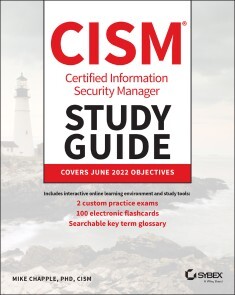
CISM Certified Information Security Manager Study Guide
SHARPEN YOUR INFORMATION SECURITY SKILLS AND GRAB AN INVALUABLE NEW CREDENTIAL WITH THIS UNBEATABLE STUDY GUIDEAs cybersecurity becomes an increasingly mission-critical issue, more and more employers and professionals are turning to ISACA's trusted and recognized Certified Information Security Manager qualification as a tried-and-true indicator of information security management expertise.In Wiley's Certified Information Security Manager (CISM) Study Guide, you'll get the information you need to succeed on the demanding CISM exam. You'll also develop the IT security skills and confidence you need to prove yourself where it really counts: on the job.Chapters are organized intuitively and by exam objective so you can easily keep track of what you've covered and what you still need to study. You'll also get access to a pre-assessment, so you can find out where you stand before you take your studies further.Sharpen your skills with Exam Essentials and chapter review questions with detailed explanations in all four of the CISM exam domains: Information Security Governance, Information Security Risk Management, Information Security Program, and Incident Management.In this essential resource, you'll also:* Grab a head start to an in-demand certification used across the information security industry* Expand your career opportunities to include rewarding and challenging new roles only accessible to those with a CISM credential* Access the Sybex online learning center, with chapter review questions, full-length practice exams, hundreds of electronic flashcards, and a glossary of key termsPerfect for anyone prepping for the challenging CISM exam or looking for a new role in the information security field, the Certified Information Security Manager (CISM) Study Guide is an indispensable resource that will put you on the fast track to success on the test and in your next job.ABOUT THE AUTHORMIKE CHAPPLE, PHD, CISM, is Teaching Professor of Information Technology, Analytics, and Operations at Notre Dame’s Mendoza College of Business. He is a bestselling author of over 25 books and serves as the Academic Director of the University’s Master of Science in Business Analytics program. He holds multiple additional certifications, including the CISSP (Certified Information Systems Security Professional), CySA+ (CompTIA Cybersecurity Analyst), CIPP/US (Certified Information Privacy Professional), CompTIA PenTest+, and CompTIA Security+. Mike provides cybersecurity certification resources at his website, CertMike.com Introduction Assessment Test xxiCHAPTER 1 TODAY’S INFORMATION SECURITY MANAGER 1Information Security Objectives 2Role of the Information Security Manager 3Chief Information Security Officer 4Lines of Authority 4Organizing the Security Team 5Roles and Responsibilities 7Information Security Risks 8The DAD Triad 8Incident Impact 9Building an Information Security Strategy 12Threat Research 12SWOT Analysis 13Gap Analysis 13Creating SMART Goals 16Alignment with Business Strategy 16Leadership Support 17Internal and External Influences 17Cybersecurity Responsibilities 18Communication 19Action Plans 19Implementing Security Controls 20Security Control Categories 21Security Control Types 21Data Protection 23Summary 25Exam Essentials 25Review Questions 27CHAPTER 2 INFORMATION SECURITY GOVERNANCE AND COMPLIANCE 31Governance 33Corporate Governance 33Governance, Risk, and Compliance Programs 35Information Security Governance 35Developing Business Cases 36Third- Party Relationships 37Understanding Policy Documents 38Policies 38Standards 40Procedures 42Guidelines 43Exceptions and Compensating Controls 44Developing Policies 45Complying with Laws and Regulations 46Adopting Standard Frameworks 47Cobit 47NIST Cybersecurity Framework 49NIST Risk Management Framework 52ISO Standards 53Benchmarks and Secure Configuration Guides 54Security Control Verification and Quality Control 56Summary 57Exam Essentials 57Review Questions 59CHAPTER 3 INFORMATION RISK MANAGEMENT 63Analyzing Risk 65Risk Identification 66Risk Calculation 67Risk Assessment 68Risk Treatment and Response 72Risk Mitigation 73Risk Avoidance 74Risk Transference 74Risk Acceptance 75Risk Analysis 75Disaster Recovery Planning 78Disaster Types 78Business Impact Analysis 79Privacy 79Sensitive Information Inventory 80Information Classification 80Data Roles and Responsibilities 82Information Lifecycle 83Privacy- Enhancing Technologies 83Privacy and Data Breach Notification 84Summary 84Exam Essentials 85Review Questions 86CHAPTER 4 CYBERSECURITY THREATS 91CHAPTER 5 EXPLORING CYBERSECURITY THREATS 92Classifying Cybersecurity Threats 92Threat Actors 94Threat Vectors 99Threat Data and Intelligence 101Open Source Intelligence 101Proprietary and Closed Source Intelligence 104Assessing Threat Intelligence 105Threat Indicator Management and Exchange 107Public and Private Information Sharing Centers 108Conducting Your Own Research 108Summary 109Exam Essentials 109Review Questions 111Information Security Program Development and Management 115Information Security Programs 117Establishing a New Program 117Maintaining an Existing Program 121Security Awareness and Training 123User Training 123Role- Based Training 124Ongoing Awareness Efforts 124Managing the Information Security Team 125Hiring Team Members 126Developing the Security Team 126Managing the Security Budget 127Organizational Budgeting 127Fiscal Years 127Expense Types 128Budget Monitoring 129Integrating Security with Other Business Functions 130Procurement 130Accounting 133Human Resources 133Information Technology 135Audit 138Summary 139Exam Essentials 139Review Questions 141CHAPTER 6 SECURITY ASSESSMENT AND TESTING 145Vulnerability Management 146Identifying Scan Targets 146Determining Scan Frequency 148Configuring Vulnerability Scans 149Scanner Maintenance 154Vulnerability Scanning Tools 155Reviewing and Interpreting Scan Reports 159Validating Scan Results 160Security Vulnerabilities 161Patch Management 162Legacy Platforms 163Weak Configurations 164Error Messages 164Insecure Protocols 165Weak Encryption 166Penetration Testing 167Adopting the Hacker Mindset 168Reasons for Penetration Testing 169Benefits of Penetration Testing 169Penetration Test Types 170Rules of Engagement 171Reconnaissance 173Running the Test 173Cleaning Up 174Training and Exercises 174Summary 175Exam Essentials 176Review Questions 177CHAPTER 7 CYBERSECURITY TECHNOLOGY 181Endpoint Security 182Malware Prevention 183Endpoint Detection and Response 183Data Loss Prevention 184Change and Configuration Management 185Patch Management 185System Hardening 185Network Security 186Network Segmentation 186Network Device Security 188Network Security Tools 191Cloud Computing Security 195Benefits of the Cloud 196Cloud Roles 198Cloud Service Models 198Cloud Deployment Models 202Shared Responsibility Model 204Cloud Standards and Guidelines 207Cloud Security Issues 208Cloud Security Controls 210Cryptography 212Goals of Cryptography 212Symmetric Key Algorithms 214Asymmetric Cryptography 215Hash Functions 217Digital Signatures 218Digital Certificates 219Certificate Generation and Destruction 220Code Security 223Software Development Life Cycle 223Software Development Phases 224Software Development Models 226DevSecOps and DevOps 229Code Review 230Software Security Testing 232Identity and Access Management 234Identification, Authentication, and Authorization 234Authentication Techniques 235Authentication Errors 237Single- Sign On and Federation 238Provisioning and Deprovisioning 238Account Monitoring 239Summary 240Exam Essentials 241Review Questions 244CHAPTER 8 INCIDENT RESPONSE 249Security Incidents 251Phases of Incident Response 252Preparation 253Detection and Analysis 254Containment, Eradication, and Recovery 255Post- Incident Activity 267Building the Incident Response Plan 269Policy 269Procedures and Playbooks 270Documenting the Incident Response Plan 270Creating an Incident Response Team 272Incident Response Providers 273CSIRT Scope of Control 273Coordination and Information Sharing 273Internal Communications 274External Communications 274Classifying Incidents 274Threat Classification 275Severity Classification 276Conducting Investigations 279Investigation Types 279Evidence 282Plan Training, Testing, and Evaluation 288Summary 289Exam Essentials 290Review Questions 292CHAPTER 9 BUSINESS CONTINUITY AND DISASTER RECOVERY 297Planning for Business Continuity 298Project Scope and Planning 299Organizational Review 300BCP Team Selection 301Resource Requirements 302Legal and Regulatory Requirements 303Business Impact Analysis 304Identifying Priorities 305Risk Identification 306Likelihood Assessment 308Impact Analysis 309Resource Prioritization 310Continuity Planning 310Strategy Development 311Provisions and Processes 311Plan Approval and Implementation 313Plan Approval 313Plan Implementation 314Training and Education 314BCP Documentation 314The Nature of Disaster 318Natural Disasters 319Human- Made Disasters 324System Resilience, High Availability, and Fault Tolerance 327Protecting Hard Drives 328Protecting Servers 329Protecting Power Sources 331Recovery Strategy 331Business Unit and Functional Priorities 332Crisis Management 333Emergency Communications 334Workgroup Recovery 334Alternate Processing Sites 334Database Recovery 338Recovery Plan Development 340Emergency Response 341Personnel and Communications 341Assessment 342Backups and Offsite Storage 342Utilities 345Logistics and Supplies 345Training, Awareness, and Documentation 345Testing and Maintenance 346Read- Through Test 346Structured Walk- Through 346Simulation Test 347Parallel Test 347Full- Interruption Test 347Lessons Learned 347Maintenance 348Summary 349Exam Essentials 349Review Questions 351Appendix Answers to the Review Questions 357Chapter 1: Today’s Information Security Manager 358Chapter 2: Information Security Governance and Compliance 360Chapter 3: Information Risk Management 362Chapter 4: Cybersecurity Threats 363Chapter 5: Information Security Program Development and Management 365Chapter 6: Security Assessment and Testing 368Chapter 7: Cybersecurity Technology 370Chapter 8: Incident Response 372Chapter 9: Business Continuity and Disaster Recovery 374Index 377

Positive Unlabeled Learning
MACHINE LEARNING AND ARTIFICIAL INTELLIGENCE (AI) ARE POWERFUL TOOLS THAT CREATE PREDICTIVE MODELS, EXTRACT INFORMATION, AND HELP MAKE COMPLEX DECISIONS. They do this by examining an enormous quantity of labeled training data to find patterns too complex for human observation. However, in many real-world applications, well-labeled data can be difficult, expensive, or even impossible to obtain. In some cases, such as when identifying rare objects like new archeological sites or secret enemy military facilities in satellite images, acquiring labels could require months of trained human observers at incredible expense. Other times, as when attempting to predict disease infection during a pandemic such as COVID-19, reliable true labels may be nearly impossible to obtain early on due to lack of testing equipment or other factors. In that scenario, identifying even a small amount of truly negative data may be impossible due to the high false negative rate of available tests. In such problems, it is possible to label a small subset of data as belonging to the class of interest though it is impractical to manually label all data not of interest. We are left with a small set of positive labeled data and a large set of unknown and unlabeled data.Readers will explore this Positive and Unlabeled learning (PU learning) problem in depth. The book rigorously defines the PU learning problem, discusses several common assumptions that are frequently made about the problem and their implications, and considers how to evaluate solutions for this problem before describing several of the most popular algorithms to solve this problem. It explores several uses for PU learning including applications in biological/medical, business, security, and signal processing. This book also provides high-level summaries of several related learning problems such as one-class classification, anomaly detection, and noisy learning and their relation to PU learning.* Preface* Acknowledgments* Introduction* Problem Definition* Evaluating the Positive Unlabeled Learning Problem* Solving the PU Learning Problem* Applications* Summary* Bibliography* Authors' Biographies

Operating AI
A HOLISTIC AND REAL-WORLD APPROACH TO OPERATIONALIZING ARTIFICIAL INTELLIGENCE IN YOUR COMPANYIn Operating AI, Director of Technology and Architecture at Ericsson AB, Ulrika Jägare, delivers an eye-opening new discussion of how to introduce your organization to artificial intelligence by balancing data engineering, model development, and AI operations. You'll learn the importance of embracing an AI operational mindset to successfully operate AI and lead AI initiatives through the entire lifecycle, including key areas such as; data mesh, data fabric, aspects of security, data privacy, data rights and IPR related to data and AI models.In the book, you’ll also discover:* How to reduce the risk of entering bias in our artificial intelligence solutions and how to approach explainable AI (XAI)* The importance of efficient and reproduceable data pipelines, including how to manage your company's data* An operational perspective on the development of AI models using the MLOps (Machine Learning Operations) approach, including how to deploy, run and monitor models and ML pipelines in production using CI/CD/CT techniques, that generates value in the real world* Key competences and toolsets in AI development, deployment and operations* What to consider when operating different types of AI business modelsWith a strong emphasis on deployment and operations of trustworthy and reliable AI solutions that operate well in the real world—and not just the lab—Operating AI is a must-read for business leaders looking for ways to operationalize an AI business model that actually makes money, from the concept phase to running in a live production environment.ULRIKA JÄGARE is the MSc. Director of Technology and Architecture at Ericsson AB. She has over 10 years of experience in data, analytics, and machine learning/artificial intelligence and over 20 years’ experience in telecommunications.Foreword xiiIntroduction xvCHAPTER 1 BALANCING THE AI INVESTMENT 1Defining AI and Related Concepts 3Operational Readiness and Why It Matters 8Applying an Operational Mind- set from the Start 12The Operational Challenge 15Strategy, People, and Technology Considerations 19Strategic Success Factors in Operating AI 20People and Mind- sets 23The Technology Perspective 28CHAPTER 2 DATA ENGINEERING FOCUSED ON AI 31Know Your Data 32Know the Data Structure 32Know the Data Records 34Know the Business Data Oddities 35Know the Data Origin 36Know the Data Collection Scope 37The Data Pipeline 38Types of Data Pipeline Solutions 41Data Quality in Data Pipelines 44The Data Quality Approach in AI/ML 45Scaling Data for AI 49Key Capabilities for Scaling Data 51Introducing a Data Mesh 53When You Have No Data 55The Role of a Data Fabric 56Why a Data Fabric Matters in AI/ML 58Key Competences and Skillsets in Data Engineering 60CHAPTER 3 EMBRACING MLOPS 71MLOps as a Concept 72From ML Models to ML Pipelines 76The ML Pipeline 78Adopt a Continuous Learning Approach 84The Maturity of Your AI/ML Capability 86Level 0— Model Focus and No MLOps 88Level 1— Pipelines Rather than Models 89Level 2— Leveraging Continuous Learning 90The Model Training Environment 91Enabling ML Experimentation 92Using a Simulator for Model Training 94Environmental Impact of Training AI Models 96Considering the AI/ML Functional Technology Stack 97Key Competences and Toolsets in MLOps 103Clarifying Similarities and Differences 106MLOps Toolsets 107CHAPTER 4 DEPLOYMENT WITH AI OPERATIONS IN MIND 115Model Serving in Practice 117Feature Stores 118Deploying, Serving, and Inferencing Models at Scale 121The ML Inference Pipeline 123Model Serving Architecture Components 125Considerations Regarding Toolsets for Model Serving 129The Industrialization of AI 129The Importance of a Cultural Shift 139CHAPTER 5 OPERATING AI IS DIFFERENT FROM OPERATING SOFTWARE 143Model Monitoring 144Ensuring Efficient ML Model Monitoring 145Model Scoring in Production 146Retraining in Production Using Continuous Training 151Data Aspects Related to Model Retraining 155Understanding Different Retraining Techniques 156Deployment after Retraining 159Disadvantages of Retraining Models Frequently 159Diagnosing and Managing Model Performance Issues in Operations 161Issues with Data Processing 162Issues with Data Schema Change 163Data Loss at the Source 165Models Are Broken Upstream 166Monitoring Data Quality and Integrity 167Monitoring the Model Calls 167Monitoring the Data Schema 168Detecting Any Missing Data 168Validating the Feature Values 169Monitor the Feature Processing 170Model Monitoring for Stakeholders 171Ensuring Stakeholder Collaboration for Model Success 173Toolsets for Model Monitoring in Production 175CHAPTER 6 AI IS ALL ABOUT TRUST 181Anonymizing Data 182Data Anonymization Techniques 185Pros and Cons of Data Anonymization 187Explainable AI 189Complex AI Models Are Harder to Understand 190What Is Interpretability? 191The Need for Interpretability in Different Phases 192Reducing Bias in Practice 194Rights to the Data and AI Models 199Data Ownership 200Who Owns What in a Trained AI Model? 202Balancing the IP Approach for AI Models 205The Role of AI Model Training 206Addressing IP Ownership in AI Results 207Legal Aspects of AI Techniques 208Operational Governance of Data and AI 210CHAPTER 7 ACHIEVING BUSINESS VALUE FROM AI 215The Challenge of Leveraging Value from AI 216Productivity 216Reliability 217Risk 218People 219Top Management and AI Business Realization 219Measuring AI Business Value 223Measuring AI Value in Nonrevenue Terms 227Operating Different AI Business Models 229Operating Artificial Intelligence as a Service 230Operating Embedded AI Solutions 236Operating a Hybrid AI Business Model 239Index 241

The Definitive Guide to Security in Jakarta EE
Refer to this definitive and authoritative book to understand the Jakarta EE Security Spec, with Jakarta Authentication & Authorization as its underlying official foundation. Jakarta EE Security implementations are discussed, such as Soteria and Open Liberty, along with the build-in modules and Jakarta EE Security third-party modules, such as Payara Yubikey & OIDC, and OmniFaces JWT-Auth.The book discusses Jakarta EE Security in relation to SE underpinnings and provides a detailed explanation of how client-cert authentication over HTTPS takes place, how certifications work, and how LDAP-like names are mapped to caller/user names. General (web) security best practices are presented, such as not storing passwords in plaintext, using HTTPS, sanitizing inputs to DB queries, encoding output, and explanations of various (web) attacks and common vulnerabilities are included.Practical examples of securing applications discuss common needs such as letting users explicitly log in, sign up, verify email safely, explicitly log in to access protected pages, and go direct to the log in page. Common issues are covered such as abandoning an authentication dialog halfway and later accessing protected pages again.WHAT YOU WILL LEARN* Know what Jakarta/Java EE security includes and how to get started learning and using this technology for today's and tomorrow's enterprise Java applications* Secure applications: traditional server-side web apps built with JSF (Faces) as well as applications based on client-side frameworks (such as Angular) and JAX-RS* Work with the daunting number of security APIs in Jakarta EE* Understand how EE security evolvedWHO THIS BOOK IS FORJava developers using Jakarta EE and writing applications that need to be secured (every application). Basic knowledge of Servlets and CDI is assumed. Library writers and component providers who wish to provide additional authentication mechanisms for Jakarta EE also will find the book useful.ARJAN TIJMS was a JSF (JSR 372) and Security API (JSR 375) EG member, and is currently project lead for a number of Jakarta projects, including Jakarta- Security, Authentication, Authorization, and Faces and Expression Language. He is the co-creator of the popular OmniFaces library for JSF that was a 2015 Duke’s Choice Award winner, and is the author of two books: The Definitive Guide to JSF- and Pro CDI 2 in Java EE 8. Arjan holds an MSc degree in computer science from the University of Leiden, The Netherlands. He has been involved with Jakarta EE Security since 2010, has created a set of tests that most well-known vendors use (IBM, Oracle, Red Hat) to improve their offerings, was part of the JSR 375 (EE Security) EG, and has been the main architect of the security API and its initial RI implementation Soteria. Arjan has also written and certified the MicroProfile JWT implementation for Payara. He was mentored by Sun's (later Oracle's) security expert Ron Monzillo. He wrote a large series of blog posts about EE Security that have attracted a lot of views.WERNER KEIL is a cloud architect, Eclipse RCP, and a microservice expert for a large bank. He helps Global 500 Enterprises across industries and leading IT vendors. He worked for over 30 years as an IT manager, PM, coach, and SW architect and consultant for the finance, mobile, media, transport, and public sectors. Werner develops enterprise systems using Java, Java/Jakarta EE, Oracle, IBM, Spring or Microsoft technologies, JavaScript, Node, Angular, and dynamic or functional languages. He is a Committer at Apache Foundation, and Eclipse Foundation, a Babel Language Champion, UOMo Project Lead, and active member of the Java Community Process in JSRs such as 321 (Trusted Java), 344 (JSF 2.2), 354 (Money, also Maintenance Lead), 358/364 (JCP.next), 362 (Portlet 3), 363 (Unit-API 1), 365 (CDI 2), 366 (Java EE 8), 375 (Java EE Security), 380 (Bean Validation 2), and 385 (Unit-API 2, also Spec Lead), and was the longest serving Individual Member of the Executive Committee for nine years in a row until 2017. Werner is currently the Community representative in the Jakarta EE Specification Committee. He was among the first five Jakarta EE Ambassadors when it was founded as Java EE Guardians, and is a member of its Leadership Council.TEO BAIS is a Software Development Manager, Scrum Master, and Programmer who contributes to the prosperity of the (software) community in several ways. He is the founder and leader of Utrecht Java User Group, which counts over 2600 members and has hosted over 45 events and amazing speakers (among others, James Gosling, Uncle Bob, and over 20 Java Champions), and is running 3 programs: Devoxx4kids, Speaker Incubator and uJCP. Teo served JSR-385 (JSR of the Year 2019) as an EG Member and was nominated as JCP Participant of the Year in 2019. Teo Bais enjoys sharing his knowledge as a public speaker to help others achieve their goals in career and life.1: Security History2: Jakarta EE Foundations3: Jakarta Authentication4: Jakarta Authorization5: Jakarta Security6: Java SE Underpinnings7: EE Implementations8: MicroProfile JWTAppendix A: Spring SecurityAppendix B: Apache ShiroAppendix C: Identity Management

Projektmanagement kurz & gut
Die essenziellen Bestandteile und Anforderungen des Projektmanagements verstehen und Projekte souverän(er) managen* Kompakte Darstellung aller Phasen, Rollen und Bestandteile des Projektmanagements* Denkanstöße und Praxistipps für Projektmanager mit erster Projekterfahrung * Projektmanagement und Agilität im Projektalltag – eine praxisnahe EinordnungWarum sprengen so viele Projekte den angesetzten Zeit- und Kostenrahmen, wo es doch Projektmanagement-Methoden und -Standards wie IPMA, PMI, Scrum, PRINCE2 oder SAFe gibt?Mehr ist häufig zu viel! Die meisten Ansätze sind umfangreich und weisen Projektleiterinnen und Projektleitern eine Vielzahl von Rollen zu. Anstatt das eigene Projekt gedanklich zu durchdringen, bleibt es vielfach beim Abarbeiten von Prozessschritten und Checklisten.Die Autoren von "Projektmanagement kurz & gut" arbeiten die wesentlichen Aspekte und Kernaufgaben des Projektmanagements heraus. Projektleiter, die diese Essenz im Blick haben, können ihr Projekt gezielter und effektiver steuern und bringen Struktur, Klarheit und Ruhe in die Abläufe.Das Taschenbuch behandelt alle Phasen und wesentlichen Aspekte des Projektmanagements wie z.B. Planung, Ressourcen- und Risikomanagement, Softwarequalität und Dokumentation. Es behandelt aber auch Softfaktoren wie den Umgang mit Schwierigkeiten, dem Team und den Stakeholdern. Zudem beleuchtet es das Zusammenspiel von Projektmanagement und agilen Arbeitsweisen.Christoph Bommer ist bei der Yunex Traffic zuständig für das Engineering von Verkehrs- und Tunnelleittechnikprojekten. Er erwarb ein Diplom als Elektroingenieur an der Hochschule für Technik Rapperswil und begann seine berufliche Laufbahn als Softwareentwicklungsingenieur im Telekommunikationsumfeld bei der Siemens AG. Später leitete er verschiedene Entwicklungsprojekte im internationalen Umfeld und führte Softwareentwicklungsabteilungen in der Telekommunikationsbranche wie auch in der Bahnleittechnik. In dieser Zeit befasste er sich intensiv mit der Verbesserung von Entwicklungsprozessen (CMMI). Daniel Brönimann erwarb ein Diplom als Elektroingenieur an der Hochschule für Technik in Rapperswil. Er begann seine berufliche Laufbahn als Softwareentwicklungsingenieur und arbeitete später als Projektleiter bei verschiedensten Softwareprojekten. Dabei kamen sehr unterschiedliche Entwicklungsprozesse zum Einsatz: von schlanken agilen Projekten bis zu stark strukturierten Großprojekten im sicherheitsrelevanten Umfeld. Als Assessor und Certified Senior Project Manager nach IPMA Level B hat er seit vielen Jahren Einblick in die Projektmanagementpraktiken unterschiedlichster Firmen. Heute ist er bei der Siemens Mobility AG als Abteilungsleiter in der Softwareentwicklung tätig und engagiert sich dort unter anderem für die Einführung eines Lean Project Framework. Mehr zu den Autoren finden Sie auch unter: https://pm-essenz.com.

MC Microsoft Certified Azure Data Fundamentals Study Guide
THE MOST AUTHORITATIVE AND COMPLETE STUDY GUIDE FOR PEOPLE BEGINNING TO WORK WITH DATA IN THE AZURE CLOUDIn MC Azure Data Fundamentals Study Guide: Exam DP-900, expert Cloud Solution Architect Jake Switzer delivers a hands-on blueprint to acing the DP-900 Azure data certification. The book prepares you for the test – and for a new career in Azure data analytics, architecture, science, and more – with a laser-focus on the job roles and responsibilities of Azure data professionals. You’ll receive a foundational knowledge of core data concepts, like relational and non-relational data and transactional and analytical data workloads, while diving deep into every competency covered on the DP-900 exam. You’ll also get:* Access to complimentary online study tools, including hundreds of practice exam questions, electronic flashcards, and a searchable glossary* Additional prep assistance with access to Sybex’s superior interactive online learning environment and test bank* Walkthroughs of skills and knowledge that are absolutely necessary for current and aspiring Azure data pros in introductory rolesPerfect for anyone just beginning to work with data in the cloud, MC Azure Data Fundamentals Study Guide: Exam DP-900 is a can’t-miss resource for anyone prepping for the DP-900 exam or considering a new career working with Azure data. ABOUT THE AUTHORJAKE SWITZER is a Cloud Solution Architect at Microsoft specializing in Big Data and Advanced Analytics. He has worked with major athletics customers like the NBA, NFL, MLB, and the USGA on architecting and proving out big data and advanced analytics solutions in Azure. Introduction xxviAssessment Test xviiAnswers to the Assessment Test xxxixCHAPTER 1 CORE DATA CONCEPTS 1Describe Types of Core Data Workloads 2Data Value 3Data Volume 10Data Variety 11Data Velocity 14Describe Data Analytics Core Concepts 21Data Processing Techniques 21Describe Analytics Techniques 32Describe Data Visualization Techniques 34Summary 40Exam Essentials 41Review Questions 44CHAPTER 2 RELATIONAL DATABASES IN AZURE 49Relational Database Features 51Relational Database Design Considerations 51Relational Database Offerings in Azure 61Azure SQL 63Azure Synapse Analytics Dedicated SQL Pools 90Open- Source Databases in Azure 92Management Tasks for Relational Databases in Azure 96Deployment Scripting and Automation 96Migrating to Azure SQL 105Database Security 106Common Connectivity Issues 113Management Tools 115Query Techniques for SQL 119DDL vs. DML Commands 120Query Relational Data in Azure SQL, MySQL, MariaDB, and PostgreSQL 125Summary 129Exam Essentials 130Review Questions 132CHAPTER 3 NONRELATIONAL DATABASES IN AZURE 139Nonrelational Database Features 140Key- Value Store 141Document Database 142Columnar Database 143Graph Database 144Azure Cosmos DB 145High Availability 146Request Units 148Azure Cosmos DB APIs 150Management Tasks for Azure Cosmos DB 154Deployment Options 154Azure Cosmos DB Security 165Azure Cosmos DB Common Connectivity Issues 167Management Tools 169Summary 170Exam Essentials 171Review Questions 174CHAPTER 4 FILE, OBJECT, AND DATA LAKE STORAGE 177File and Object Storage Features 178Azure Storage 179Performance Tiers 180Data Redundancy 181Deploying through the Azure Portal 182Azure Storage Services 187Management Tasks for Azure Storage 198Deployment Scripting and Automation 198Azure Storage Security 201Azure Storage Common Connectivity Issues 212Management Tools 213Summary 217Exam Essentials 218Review Questions 221CHAPTER 5 MODERN DATA WAREHOUSES IN AZURE 225Analytical Workload Features 226Transactional vs. Analytical Workloads 226Data Processing Techniques 229Modern Data Warehouse Components 233Data Modeling Best Practices for Data Warehouses 233Azure Services for Modern Data Warehouses 234End- to- End Analytics with Azure Synapse Analytics 268Deploying an Azure Synapse Analytics Workspace 270Contents xvNavigating the Synapse Studio UI 271Dedicated SQL Pools 275Serverless SQL Pools 287Summary 292Exam Essentials 293Review Questions 295CHAPTER 6 REPORTING WITH POWER BI 301Power BI at a Glance 302Working with Power BI 303Summary 324Exam Essentials 325Review Questions 326Appendix Answers to the Review Questions 329Chapter 1: Core Data Concepts 330Chapter 2: Relational Databases in Azure 331Chapter 3: Nonrelational Databases in Azure 333Chapter 4: File, Object, and Data Lake Storage 334Chapter 5: Modern Data Warehouses in Azure 335Chapter 6: Reporting with Power BI 337Index 339
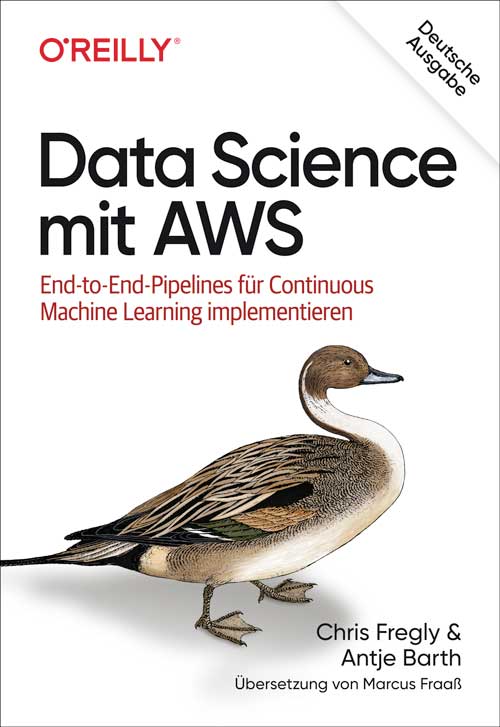
Data Science mit AWS
End-to-End-Pipelines für Continuous Machine Learning implementieren Mit diesem Buch lernen Machine-Learning- und KI-Praktiker:innen, wie sie erfolgreich Data-Science-Projekte mit Amazon Web Services erstellen und in den produktiven Einsatz bringen. Das praxisorientierte Handbuch stellt den KI- und Machine-Learning-Stack von Amazon vor, der Data Science, Data Engineering und Anwendungsentwicklung umfasst. Chris Fregly und Antje Barth zeigen Ihnen, wie Sie ML-Pipelines in der Cloud anlegen und die Ergebnisse innerhalb von Minuten in Anwendungen integrieren. Sie erfahren zudem, wie Sie Kosten senken können und die Performance Ihrer Anwendungen optimieren.Aus dem Inhalt: Wenden Sie den KI- und ML-Stack von Amazon auf reale Use Cases an, insbesondere aus den Bereichen Natural Language Processing, Computer Vision, Betrugserkennung oder dialogfähige GeräteNutzen Sie AutoML, um sich wiederholende Aufgaben mit Amazon SageMaker Autopilot zu automatisierenTauchen Sie tief in den kompletten Lebenszyklus einer NLP-Modellentwicklung auf BERT-Basis ein und lernen Sie dabei, wie Sie Daten einlesen und analysieren sowie Modelle trainieren und deployenBündeln Sie alle Teilschritte eines Workflows zu einer wiederverwendbaren MLOps-PipelineVerwenden Sie Amazon Kinesis und Amazon Managed Streaming for Apache Kafka für Echtzeit-ML, Anomalieerkennung und Streaming-AnalysenProfitieren Sie von bewährten Sicherheitspraktiken für das Identitäts- und Zugriffsmanagement, die Authentifizierung und AutorisierungAutoren: Chris Fregly ist Principal Developer Advocate für KI und Machine Learning bei AWS in San Francisco. Er spricht regelmäßig auf Konferenzen auf der ganzen Welt zu KI und Machine Learning, unter anderem bei der O'Reilly AI Superstream Series. Zuvor hat er PipelineAI gegründet, war Solutions Engineer bei Databricks und Software Engineer bei Netflix. In den letzten zehn Jahren hat er sich auf den Aufbau von KI- und Machine-Learning-Pipelines mit AWS konzentriert. Antje Barth ist Senior Developer Advocate für KI und Machine Learning bei AWS in Düsseldorf. Sie ist Mitbegründerin der Düsseldorfer Gruppe von „Women in Big Data“ und spricht häufig auf KI- und Machine Learning-Konferenzen und Meetups auf der ganzen Welt. Außerdem leitet und kuratiert sie Inhalte für O'Reilly-AI-Superstream-Veranstaltungen. Zuvor war sie als Software Engineer bei Cisco und MapR tätig und beschäftigte sich mit Infrastrukturen für Rechenzentren, Big Data und KI-Anwendungen.Zielgruppe: Data ScientistsData EngineersMachine Learning Engineers

Mastering the Microsoft Kinect
Know how to program the Microsoft Kinect and use the device for applications that interact directly with humans through gestures and motion. This book covers the mathematics and theoretical background needed for depth sensing, motion tracking, and object recognition while maintaining a practical focus on getting things done. You will learn to track the human body in three-dimensional space, analyze the human motion, and remove the background to isolate the person being tracked. You will see how to recognize objects and voice, and transform between the three-dimensional physical space and a computer’s two-dimensional screen.The book is written with real-world applications in mind. It provides step-by-step tutorials and source code for common use cases. The author has worked with startups and Fortune 500 companies, and all of the examples are taken directly from the industry. The book’s practical focus simplifies the core principles, removes the clutter, and allows developers to start writing code right away. Also covered is the use of Azure Cognitive Services on Microsoft’s cloud platform and their use for object and voice recognition, enabling your applications to “see” objects and respond to their environment.WHAT YOU WILL LEARN* Visualize color, depth, and body data* Calculate angles between different body joints* Analyze human motion and create fitness applications* Recognize objects and voice using cloud-powered artificial intelligence* Remove the background from a scene to create virtual worldsWHO THIS BOOK IS FORDevelopers who want to build demanding Kinect apps and games, and those who are looking for a careful balance between theoretical knowledge and practical application that favors the practical. Readers should have a basic knowledge of C# and some familiarity with the Unity3D engine.VANGOS PTERNEAS is a professional software engineer and an award-winning Microsoft Most Valuable Professional. Since 2012, Vangos has been helping Fortune 500 companies and ambitious startups create demanding motion-tracking applications. He is obsessive about analyzing and modeling every aspect of the human motion using computer vision and mathematics. Kinect programming started as a hobby and quickly evolved into a full-time business. Vangos is sharing his passion by regularly publishing articles and open-source projects that help fellow developers understand the fascinating Kinect technology. PART I. MEET THE KINECT1. Mixed Reality and Kinect2. The Developer ToolboxPART II. THE BASICS3. Configuring the Device4. Color Data5. Depth Data6. Body TrackingPART III. THE MAGIC7. Streaming Data in the Background8. Coordinate Mapping9. Augmented Reality – Removing the Background of the Users10. Motion AnalysisPART IV. THE "AZURE" IN KINECT11. Azure Cognitive Services12. Computer Vision and Object Detection

Automotive Cybersecurity
Die aktuellen technologischen Veränderungen, allen voran die Digitalisierung, die Vernetzung von Verkehrssystemen und das Autonome Fahren, schaffen einerseits neue Mobilitätslösungen, andererseits rücken dadurch Fahrzeuge und die Automotive Infrastruktur als zunehmend attraktive Angriffsziele in den Fokus von Hackern und Cyberkriminellen. Die höhere Komplexität elektronischer Systeme hat eine größere Angriffsoberfläche zur Folge. Ein strukturierter und ganzheitlicher Ansatz macht diese Herausforderung beherrschbar. Dieses Buch verschafft dem Leser einen Überblick über die für ein umfassendes Securitykonzept erforderlichen Security-Bausteine. Die detaillierte Darstellung verschiedener Security-Mechanismen beschreibt einerseits wie Fahrzeugsysteme vor bestimmten Angriffen geschützt werden und macht andererseits deutlich, welche Herausforderungen und Abhängigkeiten deren Implementierung in ein Automotive Deeply-Embedded System mit sich bringt. Cybersecurity im Automobilbereich.- Security-Strategie.- Security-Organisation und -Management.- Sicherer Produktlebenszyklus.- Technische Security-Bausteine.- ECU-Schutzkonzepte.- Sichere E/E-Architektur.- Sichere Außenschnittstellen.- Sichere Fahrzeug-Infrastruktur

Theoretische Informatik
Das Buch führt umfassend in das Gebiet der theoretischen Informatik ein und behandelt den Stoffumfang, der für das Bachelor-Studium an Universitäten und Hochschulen in den Fächern Informatik und Informationstechnik benötigt wird. Die Darstellung und das didaktische Konzept verfolgen das Ziel, einen durchweg praxisnahen Zugang zu den mitunter sehr theoretisch geprägten Themen zu schaffen.Theoretische Informatik muss nicht trocken sein! Sie kann Spaß machen und genau dies versucht das Buch zu vermitteln. Die verschiedenen Methoden und Verfahren werden anhand konkreter Beispiele eingeführt und durch zahlreiche Querverbindungen wird gezeigt, wie die fundamentalen Ergebnisse der theoretischen Informatik die moderne Informationstechnologie prägen.Das Buch behandelt die Themengebiete: Logik und Deduktion, Automatentheorie, formale Sprachen, Entscheidbarkeitstheorie, Berechenbarkeitstheorie und Komplexitätstheorie. Die Lehrinhalte aller Kapitel werden durch zahlreiche Übungsaufgaben komplettiert, so dass sich die Lektüre neben der Verwendung als studienbegleitendes Lehrbuch auch bestens zum Selbststudium eignet. Prof. Dr. Dirk W. Hoffmann ist Dozent an der Fakultät für Informatik und Wirtschaftsinformatik der Hochschule Karlsruhe – Technik und Wirtschaft.

Deep Natural Language Processing
Einstieg in Word Embedding, Sequence-to-Sequence-Modelle und Transformer mit PythonDas Buch bietet eine leicht verständliche Einführung in Machine-Learning-Algorithmen im Allgemeinen und in die Verarbeitung von Textdaten mit Deep-Learning-Verfahren im Besonderen. Es veranschaulicht die theoretischen Konzepte bewährter und neuerer NLP-Ansätze und führt in die praktische Umsetzung ein.Im Fokus stehen insbesondere folgende Verfahren:Vektorisierung von Wörtern mit Word EmbeddingVerarbeitung von Texten mit rekurrenten und konvolutionalen neuronalen Netzen.Aufbau von Sequence-to-Sequence-Modellen zur Übersetzung und für Textzusammenfassungen.Arbeit mit der Transformers-Bibliothek und Hugging Face.Anhand praktischer Anwendungen (Klassizierung von Texten, Rechtschreibkorrektur, Übersetzung, Frage-Antwort-System) wird gezeigt, wie sich Textdaten vorbereiten und effektive Lernmodelle mit Bibliotheken wie Transformers, TensorFlow/Keras und Scikit-Learn aufbauen, trainieren und produktiv einsetzen lassen.Über den Autor:Dr. Jochen Hirschle ist IT-Trainer und Consultant für Machine Learning und Deep Learning in Braunschweig. Er ist erfahrener Programmierer in Python und Java und war als Wissenschaftler und Dozent an den Universitäten in Köln, Innsbruck und Frankfurt tätig. Er kennt die Fallstricke der statistischen Datenanalyse und die Tricks maschinellen Lernens aus seiner langjährigen Praxis und er weiß, wie sich komplexe Sachverhalte einfach erklären lassen.Leseprobe (PDF-Link)


Unity® Virtual Reality Development with VRTK4
Get hands-on practical knowledge of concepts and techniques for VR development using Unity® and VRTK version 4. This book is a step-by-step guide to learning VRTK 4 for developing immersive VR experiences.Unity is a powerful game engine for developing VR experiences. With its built-in support for all major VR headsets, it's the perfect tool for developers to realize their vision in VR. VRTK is a battle-tested VR solution for Unity; VRTK 4, in conjunction with Unity, has changed the dynamics of VR development.This book focuses on creating deep understanding of how advanced VR mechanics and techniques are built and utilized as a part of a VR framework. You will start off by setting up your devices for VR development and learn about the advantages of using VRTK 4 over alternate SDKs. You will learn to setup your very own custom VRTK Rig, find out how to setup various advanced VR mechanics and locomotion techniques, how to create several spatial UI objects, and how to setup Unity 2D UI controls. You will also cover advanced topics such as using angular and linear drives, setting up a VR Simulator to work with a XBox Controller, and realistic physics VR hands.By the end of this book, you will know how to create advanced VR mechanics that can be used within any VR experience, game, or App and deployed across several platforms and hardware.WHAT YOU WILL LEARN* Understand how to develop Immersive VR experiences* Create a VR simulator to test your project* Generate advanced Spatial UI that you can interact with physically using your handsWHO THIS BOOK IS FOR?Unity game developers conversant with Unity's Editor. Basic knowledge of how Unity Prefabs function, how events work in general, and programming logic would be beneficial.CHRISTOPHER COUTINHO is the founder of GameWorks, a Mumbai-based game development studio specializing in VR and virtual product development using Unity® and VRTK 4. GameWorks provides development services to clients in game creation, Unity® tools creation, and VR simulation training development. He is highly active on the VRTKs discord channel. He is also known for his online virtual reality courses using Unity® and VRTK 4 on Udemy that students have highly appreciated.Chapter 1: IntroductionChapter 2: A New Reality Through Virtual RealityChapter 3: Setting Up Your Project for VR DevelopmentChapter 4: Importing VRTK Version 4 Tilia PackagesChapter 5: Setting Up VRTKs Camera RigsChapter 6: Setting Up Interactors and Virtual HandsChapter 7: Configuring Interactor Functionality and Setting Up Velocity TrackersChapter 8: Interactable Game ObjectsChapter 9: Moving Around the Virtual World - TeleportationChapter 10: Seamless LocomotionChapter 11: Arm Swinging MovementChapter 12: Setting Up a Pseudo-BodyChapter 13: Climbing in VRChapter 14: Movement AmplifierChapter 15: Distance GrabbingChapter 16: Snap ZonesChapter 17: Creating Spatial 3D User Interface Game ObjectsChapter 18: Using Unity's UI Controls with VRTKChapter 19: Angular DrivesChapter 20: Linear DrivesChapter 21: Tips, Tricks, and RecipesChapter 22: Mini-Game
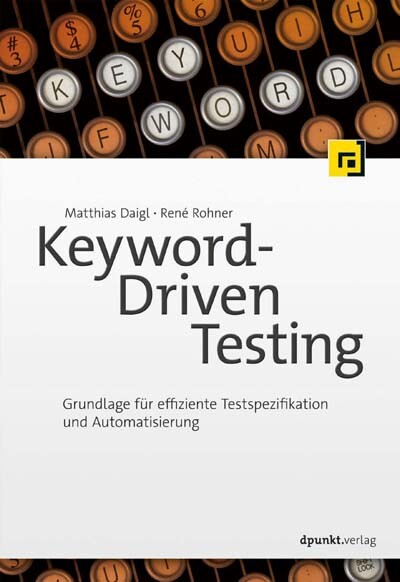
Keyword-Driven Testing
Grundlage für effiziente Testspezifikation und AutomatisierungWirksame und gleichzeitig kosteneffiziente Tests sind ein wesentlicher Erfolgsfaktor beim Softwaretest. Dazu verhilft die Methode »schlüsselwortbasierter Test« oder »Keyword-Driven Testing«, mit der Tests aus wiederverwendbaren Bausteinen zusammengesetzt werden. Diese Bausteine werden dem Team als Test-Know-how zur Verfügung gestellt, das jederzeit abgerufen werden kann. Die Autoren bieten einen fundierten Überblick über die technischen und organisatorischen Aspekte des Keyword-Driven Testing und vermitteln das notwendige Praxiswissen, um Keyword-gesteuerte Tests zu erstellen sowie Keywords auszuwählen und zu strukturieren. Auch auf die Herausforderungen und Werkzeuge für das Keyword-Driven Testing wird eingegangen. Im Einzelnen werden behandelt: Unterschiedliche Ansätze für Keyword-Driven TestingAuswahl und Strukturierung von Keywords sowie QualitätssicherungNormen im Testen und speziell zu KeywordsTestautomatisierungsarchitekturKeyword-Driven Testing FrameworksPraxis mit Robot Framework Verbindung mit Testpraktiken wie Test-Driven, Behavior-Driven oder Acceptance Test-Driven Development Autoren: Matthias Daigl ist Product Owner bei der imbus AG. Er ist als Sprecher auf internationalen Konferenzen unterwegs, arbeitet in Arbeitsgruppen des German Testing Board, des ISTQB® und im Normungsausschuss von DIN und ISO mit, war Editor der Norm ISO/IEC/IEEE 29119-5 „Keyword-Driven Testing“ und ist Autor des Buches „ISO 29119: Die Softwaretest-Normen verstehen und anwenden“. René Rohner ist Product Owner des Value Streams Testautomatisierung sowie Senior Berater mit den Spezialgebieten Keyword-Driven Testing und Testautomatisierung bei der imbus AG. Er ist als Softwareentwickler, Trainer und Chairman of the Board der Robot Framework® Foundation international im Bereich des Keyword-Driven Testing tätig. Nach dem Lesen des Buches haben Sie ein fundiertes Verständnis für die unterschiedlichen Facetten des Keyword-Driven Testing, kennen die Vorteile und Werkzeuge und können so selbst entscheiden, wie Sie Keyword-gesteuerte Tests gestalten und welche der beschriebenen Konzepte Sie in der Praxis einsetzen möchten. Zielgruppe: Testanalyst*innenTestmanager*innenTestautomatisierer*innenQualitätsmanager*innenSoftwareentwickler*innen

Data Science - Analytics and Applications
Organizations have moved already from the rigid structure of classical project management towards the adoption of agile approaches. This holds also true for software development projects, which need to be flexible to adopt to rapid requests of clients as well to reflect changes that are required due to architectural design decisions. With data science having established itself as corner stone within organizations and businesses, it is now imperative to perform this crucial step for analytical business processes as well. The non-deterministic nature of data science and its inherent analytical tasks require an interactive approach towards an evolutionary step-by-step development to realize core essential business applications and use cases.The 4th International Data Science Conference (iDSC) 2021 brought together researchers, scientists, and business experts to discuss means of establishing new ways of embracing agile approaches within the various domains of data science, such as machine learning and AI, data mining, or visualization and communication as well as case studies and best practices from leading research institutions and business companies.The proceedings include all full papers presented in the scientific track and the corresponding German abstracts as well as the short papers from the student track.Among the topics of interest are:* Artificial Intelligence and Machine Learning * Implementation of data mining processes * Agile Data Science and Visualization * Case Studies and Applications for Agile Data Science---Organisationen sind bereits von der starren Struktur des klassischen Projektmanagements zu agilen Ansätzen übergegangen. Dies gilt auch für Softwareentwicklungsprojekte, die flexibel sein müssen, um schnell auf die Wünsche der Kunden reagieren zu können und um Änderungen zu berücksichtigen, die aufgrund von Architekturentscheidungen erforderlich sind. Nachdem sich die Datenwissenschaft als Eckpfeiler in Organisationen und Unternehmen etabliert hat, ist es nun zwingend erforderlich, diesen entscheidenden Schritt auch für analytische Geschäftsprozesse durchzuführen. Die nicht-deterministische Natur der Datenwissenschaft und die ihr innewohnenden analytischen Aufgaben erfordern einen interaktiven Ansatz für eine evolutionäre, schrittweise Entwicklung zur Realisierung der wichtigsten Geschäftsanwendungen und Anwendungsfälle.Die 4. Internationale Konferenz zur Datenwissenschaft (iDSC 2021) brachte Forscher, Wissenschaftler und Wirtschaftsexperten zusammen, um Möglichkeiten zu erörtern, wie neue Wege zur Umsetzung agiler Ansätze in den verschiedenen Bereichen der Datenwissenschaft, wie maschinelles Lernen und KI, Data Mining oder Visualisierung und Kommunikation, sowie Fallstudien und Best Practices von führenden Forschungseinrichtungen und Wirtschaftsunternehmen etabliert werden können.Der Tagungsband umfasst alle im wissenschaftlichen Track vorgestellten Volltexte und die Kurzbeiträge aus dem studentischen Track auf Englisch und die dazugehörigen Abstracts auf Deutsch.Zu den Themen, die sie interessieren, gehören unter anderem:* Künstliche Intelligenz und Maschinelles Lernen * Implementierung von Data-Mining-Prozessen * Agile Datenwissenschaft und Visualisierung * Fallstudien und Anwendungen für Agile DatenwissenschaftPETER HABER is Assistant Professor of Information and Communication Technology, in particular for analog and digital signal processing, and responsible coordinator for system theory and electrical engineering at Salzburg University of Applied Sciences. He is a researcher and project manager, leading and coordinating national and international projects in the field of IT and IT management, while also integrating data science solutions at businesses. Since 2009 he has been a member of the international advisory board for the IATED conferences.THOMAS LAMPOLTSHAMMER is an Assistant Professor for ICT and Deputy Head of the Centre for E-Governance at the Department of E-Governance and Administration, Danube University Krems, Austria. His current research focus is on the domain of data governance, the effects of ICT application in a connected society, and the effects on a data-driven society. He has a substantial background in the design and implementation of expert and decision-making systems, data analytics, and semantic-based reasoning.HELMUT LEOPOLD is the Head of Center for Digital Safety&Security at the AIT Austrian Institute of Technology and is responsible for research areas such as artificial intelligence and cyber security. Prior to AIT, Mr. Leopold was at Alcatel and at Telekom Austria where he played a major role in the digitalization transformation of the organisation. He graduated in computer science from the TU Vienna and holds a PhD from the Lancaster University in England.MANFRED MAYR is the Academic Program Director for “Business Informatics and Digital Transformation” as well department head for IT-Management at Salzburg University of Applied Sciences. He is a lecturer at international conferences and the author of various publications in the field of business informatics and business applications. The digitalisation of ERP applications in the industrial environment is a long-standing and important field of his research. In addition, he has coordinated several national and international research projects.---PETER HABER ist Professor für Informations- und Kommunikationstechnik, insbesondere für analoge und digitale Signalverarbeitung, und verantwortlicher Koordinator für Systemtheorie und Elektrotechnik an der Fachhochschule Salzburg. Er ist Forscher und Projektleiter, leitet und koordiniert nationale und internationale Projekte im Bereich IT und IT-Management und integriert datenwissenschaftliche Lösungen in Unternehmen. Seit 2009 ist er Mitglied des internationalen Beirats für die IATED-Konferenzen.THOMAS LAMPOLTSHAMMER ist Assistenzprofessor für IKT und stellvertretender Leiter des Zentrums für E-Governance am Lehrstuhl für E-Governance und Verwaltung, Donau-Universität Krems, Österreich. Sein aktueller Forschungsschwerpunkt liegt auf dem Gebiet der Datenverwaltung, den Auswirkungen der IKT-Anwendung in einer vernetzten Gesellschaft und den Auswirkungen auf eine datengesteuerte Gesellschaft. Er verfügt über einen substantiellen Hintergrund im Design und in der Implementierung von Experten- und Entscheidungssystemen, Datenanalyse und semantisch-basierter Argumentation.HELMUT LEOPOLD leitet das Center for Digital Safety&Security am AIT Austrian Institute of Technology und ist verantwortlich für Forschungsbereiche wie Künstliche Intelligenz und Cybersecurity. Davor war er bei Alcatel und Telekom Österreich tätig, wo er eine maßgebliche Rolle bei der digitalen Transformation spielte. Er hat Informatik an der TU Wien studiert und an der Lancaster University in England promoviert.MANFRED MAYR ist Akademischer Programmdirektor für "Wirtschaftsinformatik und digitale Transformation" sowie Abteilungsleiter für IT-Management an der Fachhochschule Salzburg. Er ist Vortragender bei internationalen Konferenzen und Autor verschiedener Publikationen im Bereich der Wirtschaftsinformatik und forscht zu betriebswirtschaftlichen Anwendungen der Datenwissenschaft. Die Digitalisierung von ERP-Anwendungen im industriellen Umfeld ist ein langjähriges und wichtiges Feld seiner Forschung. Darüber hinaus hat er mehrere nationale und internationale Forschungsprojekte koordiniert.Die Herausgeber sind die Konferenzvorsitzenden der International Data Science Conference.Preface - An overview of AI solutions “Made in Austria” - Data boost industry-academia link - Research Track - German Abstracts - Full Papers - Peer Reviewed - Industry Track - Abstracts - Provided Papers - Non Reviewed

CompTIA A+ Complete Review Guide
A COMPREHENSIVE AND EFFICIENT WAY TO PREPARE FOR THE A+ EXAM AND SUCCEED AS A COMPUTER TECHNICIANThe newly revised Fifth Edition of the CompTIA A+ Complete Review Guide: Core 1 Exam 220-1101 and Core 2 Exam 220-1102 delivers essential and accessible exam prep material for the sought-after A+ certification. It offers full coverage of all of the A+ exam objectives covered on the latest Core 1 and Core 2 exams, ensuring you'll have the knowledge and skills you need to succeed on the test and in the real world. This book covers mobile devices, networking, hardware, virtualization and cloud computing, hardware and network troubleshooting, operating systems, security, software troubleshooting, and operational procedures. Its comprehensive discussions of all exam competencies will prepare you for your first role as a computer technician and let you hit the ground running. The book also offers:* Accessible and easy-to-follow organization perfect for quick review and reinforcement of key topics* Practical examples and insights drawn from the real-world experience of actual computer technicians* Access to the Sybex online test bank, with chapter review questions, full-length practice exams, hundreds of electronic flashcards, and a glossary of key termsIdeal for anyone preparing for the Core 1 and Core 2 A+ exams, CompTIA A+ Complete Review Guide: Core 1 Exam 220-1101 and Core 2 Exam 220-1102 is also perfect for all aspiring and early-career computer technicians who seek to improve their performance in the field. TROY MCMILLAN holds more than 30 IT certifications including A+ and Network+. He is a Product Developer and Technical Editor for CyberVista (formerly Kaplan IT), helping individuals and organizations train on technology and prepare for technology certifications. Troy is also a full-time trainer, teaching CompTIA, Cisco, Microsoft, and Wireless classes. He authored previous editions of CompTIA® A+® Complete Review Guide from Sybex.INTRODUCTION XXIIIPART I COMPTIA A+ CORE 1 EXAM 220- 1101 1CHAPTER 1 MOBILE DEVICES 31.1 Given a scenario, install and configure laptop hardware and components 5Hardware/device replacement 5Physical privacy and security components 9Exam essentials 101.2 Compare and contrast the display components of mobile devices 10Types 11Mobile display components 13Exam essentials 141.3 Given a scenario, set up and configure accessories and ports of mobile devices 14Connection methods 15Accessories 20Exam essentials 261.4 Given a scenario, configure basic mobile- device network connectivity and application support 26Wireless/cellular data network (enable/disable) 27Bluetooth 29Location services 32Mobile device management (MDM)/mobile application management (MAM) 32Mobile device synchronization 36Exam essentials 40Review Questions 41CHAPTER 2 NETWORKING 452.1 Compare and contrast Transmission Control Protocol (TCP) and User Datagram Protocol (UDP) ports, protocols, and their purposes 50Ports and protocols 50TCP vs. UDP 53Exam essentials 542.2 Compare and contrast common networking hardware 54Routers 55Switches 55Access points 55Patch panel 56Firewall 56Power over Ethernet (PoE) 56Hub 58Cable modem 58Digital subscriber line (DSL) 58Optical network terminal (ONT) 59Network interface card (NIC) 59Software- defined networking (SDN) 60Exam essentials 612.3 Compare and contrast protocols for wireless networking 61Frequencies 61Channels 62Bluetooth 63802.11 63Long- range fixed wireless 64NFC 65Radio- frequency identification (RFID) 65Exam essentials 652.4 Summarize services provided by networked hosts 66Server roles 66Internet appliances 68Legacy/embedded systems 69Internet of Things (IoT) devices 70Exam essentials 702.5 Given a scenario, install and configure basic wired/wireless small office/home office (SOHO) networks 71Internet Protocol (IP) addressing 71Exam essentials 792.6 Compare and contrast common network configuration concepts 79DNS 79DHCP 81Virtual LAN (VLAN) 82Virtual private network (VPN) 83Exam essentials 832.7 Compare and contrast Internet connection types, network types, and their features 84Internet connection types 84Network types 85Exam essentials 872.8 Given a scenario, use networking tools 87Crimper 87Cable stripper 87WiFi analyzer 87Toner probe 88Punchdown tool 88Cable tester 88Loopback plug 89Network tap 89Exam essentials 89Review Questions 90CHAPTER 3 HARDWARE 953.1 Explain basic cable types and their connectors, features, and purposes 102Network cables 102Peripheral cables 107Video cables 108Hard drive cables 111Adapters 117Connector types 119Exam essentials 1243.2 Given a scenario, install the appropriate RAM 124RAM types 124Single- channel/Dual- channel 127Triple Channel 127Quad- channel 128Exam essentials 1283.3 Given a scenario, select and install storage devices 129Hard drives 129SSDs 131Drive configurations 132Removable storage 134Exam essentials 1393.4 Given a scenario, install and configure motherboards, central processing units (CPUs), and add- on cards 139Motherboard form factor 139Motherboard connector types 142Motherboard compatibility 148Basic Input/Output System (BIOS)/Unified Extensible Firmware Interface (UEFI) settings 153Encryption 155CPU architecture 155Expansion cards 156Cooling 159Exam essentials 1603.5 Given a scenario, install or replace the appropriate power supply 160Input 115V vs. 220V 161Output 3.3V vs. 5V vs. 12V 16120- PIN TO 24- PIN MOTHERBOARD ADAPTER 161Redundant power supply 162Modular power supply 162Wattage rating 162Exam essentials 1633.6 Given a scenario, deploy and configure multifunction devices/printers and settings 163Properly unboxing a device – setup location considerations 163Use appropriate drivers for a given OS 164Device connectivity 164Public/shared devices 165Configuration settings 167Security 168Network scan services 169Automatic document feeder (ADF)/flatbed scanner 169Exam essentials 1703.7 Given a scenario, install and replace printer consumables 170Laser 170Inkjet 181Thermal 184Impact 186Exam essentials 188Review Questions 190CHAPTER 4 VIRTUALIZATION AND CLOUD COMPUTING 1974.1 Summarize cloud computing concepts 199Common cloud models 199Cloud characteristics 200Desktop virtualization 201Exam essentials 2014.2 Summarize aspects of client- side virtualization 202Purpose of virtual machines 202Exam essentials 205Review Questions 206CHAPTER 5 HARDWARE AND NETWORK TROUBLESHOOTING 2095.1 Given a scenario, apply the best practice methodology to resolve problems 213Always consider corporate policies, procedures, and impacts before implementing changes 2131. Identify the problem 2142. Establish a theory of probable cause (question the obvious) 2143. Test the theory to determine cause 2154. Establish a plan of action to resolve the problem and implement the solution 2155. Verify full system functionality and, if applicable, implement preventive measures 2166. Document the findings, actions, and outcomes 216Exam essentials 2165.2 Given a scenario, troubleshoot problems related to motherboards, RAM, CPU, and power 216Common symptoms 217Exam essentials 2245.3 Given a scenario, troubleshoot and diagnose problems with storage drives and RAID arrays 225Common symptoms 225Exam essentials 2285.4 Given a scenario, troubleshoot video, projector, and display issues 229Common symptoms 229Exam essentials 2325.5 Given a scenario, troubleshoot common issues with mobile devices 232Common symptoms 233Exam essentials 2375.6 Given a scenario, troubleshoot and resolve printer issues 238Common symptoms 238Exam essentials 2445.7 Given a scenario, troubleshoot problems with wired and wireless networks 244Common symptoms 244Exam essentials 247Review Questions 248PART II COMPTIA A+ CORE 2 EXAM 220- 1102 251CHAPTER 6 OPERATING SYSTEMS 2531.1 Identify basic features of Microsoft Windows editions 263Windows 10 editions 263Windows 11 264Feature differences 264Upgrade paths 266Exam essentials 2671.2 Given a scenario, use the appropriate Microsoft command- line tool 268Navigation 268Command- line tools 271Exam essentials 2901.3 Given a scenario, use features and tools of the Microsoft Windows 10 operating system (OS) 290Task Manager 291Microsoft Management Console (MMC) snap- in 296Additional tools 312Exam essentials 3201.4 Given a scenario, use the appropriate Microsoft Windows 10 Control Panel utility 320Internet Options 320Devices and Printers 327Programs and Features 329Network and Sharing Center 331System 331Windows Defender Firewall 335Mail 335Sound 336User Accounts 337Device Manager 339Indexing Options 340Administrative Tools 340File Explorer Options 342Power Options 346Ease of Access 348Exam essentials 3491.5 Given a scenario, use the appropriate Windows settings 349Time and Language 350Update and Security 351Personalization 352Apps 355Privacy 356System 357Devices 357Network and Internet 359Gaming 361Accounts 362Exam essentials 3621.6 Given a scenario, configure Microsoft Windows networking features on a client/desktop 364Workgroup vs. domain setup 364Local OS firewall settings 368Client network configuration 369Establish network connections 370Proxy settings 371Exam essentials 3731.7 Given a scenario, apply application installation and configuration concepts 374System requirements for applications 374OS requirements for applications 375Distribution methods 376Other considerations for new applications 377Exam essentials 3781.8 Explain common OS types and their purposes 378Workstation OSs 378Cell phone/tablet OSs 379Various filesystem types 380Vendor life- cycle limitations 381Compatibility concerns between OSs 381Exam essentials 3821.9 Given a scenario, perform OS installations and upgrades in a diverse OS environment 382Boot methods 382Types of installations 384Partitioning 388Drive format 389Upgrade considerations 390Feature updates 390Exam essentials 3911.10 Identify common features and tools of the macOS/desktop OS 391Installation and uninstallation of applications 391Apple ID and corporate restrictions 392Best practices 393System Preferences 394Features 398Disk Utility 401FileVault 402Terminal 402Force Quit 403Exam essentials 4041.11 Identify common features and tools of the Linux client/desktop OS 404Common commands 404Best practices 411Tools 414Exam essentials 415Review Questions 416CHAPTER 7 SECURITY 4192.1 Summarize various security measures and their purposes 427Physical security 427Physical security for staff 432Logical security 435Mobile device management (MDM) 436Active Directory 437Exam essentials 4392.2 Compare and contrast wireless security protocols and authentication methods 439Protocols and encryption 439Authentication 441Exam essentials 4422.3 Given a scenario, detect, remove, and prevent malware using the appropriate tools and methods 443Malware 443Tools and methods 449Exam essentials 4522.4 Explain common social- engineering attacks, threats, and vulnerabilities 452Social engineering 452Threats 455Vulnerabilities 458Exam essentials 4592.5 Given a scenario, manage and configure basic security settings in the Microsoft Windows OS 459Defender Antivirus 459Firewall 461Users and Groups 462Login OS Options 463NTFS vs. share permissions 464Shared files and folders 467Run as administrator vs. standard user 468BitLocker 470BitLocker To Go 470Encrypting File System (EFS) 470Exam essentials 4712.6 Given a scenario, configure a workstation to meet best practices for security 471Data- at- rest encryption 472Password best practices 472End- user best practices 473Account management 474Change default administrator’s user account/password 475Disable AutoRun 475Disable Autoplay 476Exam essentials 4762.7 Explain common methods for securing mobile and embedded devices 476Screen locks 477Remote wipes 478Locator applications 478OS updates 478Device encryption 479Remote backup applications 479Failed login attempts restrictions 479Antivirus/anti- malware 479Firewalls 480Policies and procedures 480Internet of Things (IoT) 480Exam essentials 4802.8 Given a scenario, use common data destruction and disposal methods 481Physical destruction 481Recycling or repurposing best practices 482Outsourcing concepts 484Exam essentials 4842.9 Given a scenario, configure appropriate security settings on small office/home office (SOHO) wireless and wired networks 485Home router settings 485Wireless specific 488Firewall settings 491Exam essentials 4912.10 Given a scenario, install and configure browsers and relevant security settings 492Browser download/installation 492Extensions and plug- ins 492Password managers 493Secure connections/sites – valid certificates 493Settings 493Exam essentials 496Review Questions 497CHAPTER 8 SOFTWARE TROUBLESHOOTING 5013.1 Given a scenario, troubleshoot common Windows OS problems 505Common symptoms 505Common troubleshooting steps 510Exam essentials 5143.2 Given a scenario, troubleshoot common personal computer (PC) security issues 514Common symptoms 514Browser- related symptoms 517Exam essentials 5183.3 Given a scenario, use best practice procedures for malware removal 5181. Investigate and verify malware symptoms 5182. Quarantine infected systems 5193. Disable System Restore in Windows 5194. Remediate infected systems 5195. Schedule scans and run updates 5196. Enable System Restore and create a restore point in Windows 5207. Educate the end user 520Exam essentials 5203.4 Given a scenario, troubleshoot common mobile OS and application issues 520Common symptoms 521Exam essentials 5243.5 Given a scenario, troubleshoot common mobile OS and application security issues 524Security concerns 524Common symptoms 526Exam essentials 527Review Questions 528CHAPTER 9 OPERATIONAL PROCEDURES 5314.1 Given a scenario, implement best practices associated with documentation and support systems information management 538Ticketing systems 538Asset management 540Types of documents 542Knowledge base/articles 545Exam essentials 5454.2 Explain basic change- management best practices 545Documented business processes 546Change management 546Exam essentials 5484.3 Given a scenario, implement workstation backup and recovery methods 548Backup and recovery 548Backup testing 550Backup rotation schemes 550Exam essentials 5514.4 Given a scenario, use common safety procedures 552Electrostatic discharge (ESD) straps 552ESD mats 553Equipment grounding 554Proper power handling 555Proper component handling and storage 555Antistatic bags 555Compliance with government regulations 555Personal safety 555Exam essentials 5574.5 Summarize environmental impacts and local environmental controls 557Material safety data sheet (MSDS)/documentation for handling and disposal 557Temperature, humidity- level awareness, and proper ventilation 559Power surges, brownouts, and blackouts 562Exam essentials 5644.6 Explain the importance of prohibited content/activity and privacy, licensing, and policy concepts 565Incident response 565Licensing/digital rights management (DRM)/end- user license agreement (EULA) 567Regulated data 568Exam essentials 5694.7 Given a scenario, use proper communication techniques and professionalism 569Professional appearance and attire 570Use proper language and avoid jargon, acronyms, and slang, when applicable 570Maintain a positive attitude/project confidence 571Actively listen, take notes, and avoid interrupting the customer 571Be culturally sensitive 571Be on time (if late, contact the customer) 572Avoid distractions 572Dealing with difficult customers or situations 573Set and meet expectations/time line and communicate status with the customer 574Deal appropriately with customers’ confidential and private materials 575Exam essentials 5764.8 Identify the basics of scripting 576Script file types 576Use cases for scripting 577Other considerations when using scripts 578Exam essentials 5794.9 Given a scenario, use remote access technologies 579Methods/tools 579Security considerations of each access method 582Exam essentials 582Review Questions 583Appendix Answers to the Review Questions 587Chapter 1: Mobile Devices 588Chapter 2: Networking 589Chapter 3: Hardware 591Chapter 4: Virtualization and Cloud Computing 595Chapter 5: Hardware and Network Troubleshooting 596Chapter 6: Operating Systems 598Chapter 7: Security 599Chapter 8: Software Troubleshooting 602Chapter 9: Operational Procedures 603Index 607

Applied Deep Learning with TensorFlow 2
Understand how neural networks work and learn how to implement them using TensorFlow 2.0 and Keras. This new edition focuses on the fundamental concepts and at the same time on practical aspects of implementing neural networks and deep learning for your research projects.This book is designed so that you can focus on the parts you are interested in. You will explore topics as regularization, optimizers, optimization, metric analysis, and hyper-parameter tuning. In addition, you will learn the fundamentals ideas behind autoencoders and generative adversarial networks.All the code presented in the book will be available in the form of Jupyter notebooks which would allow you to try out all examples and extend them in interesting ways. A companion online book is available with the complete code for all examples discussed in the book and additional material more related to TensorFlow and Keras. All the code will be available in Jupyter notebook format and can be opened directly in Google Colab (no need to install anything locally) or downloaded on your own machine and tested locally.You will:• Understand the fundamental concepts of how neural networks work• Learn the fundamental ideas behind autoencoders and generative adversarial networks• Be able to try all the examples with complete code examples that you can expand for your own projects• Have available a complete online companion book with examples and tutorials.This book is for:Readers with an intermediate understanding of machine learning, linear algebra, calculus, and basic Python programming.Umberto Michelucci is the founder and the chief AI scientist of TOELT – Advanced AI LAB LLC. He’s an expert in numerical simulation, statistics, data science, and machine learning. He has 15 years of practical experience in the fields of data warehouse, data science, and machine learning. His first book, Applied Deep Learning—A Case-Based Approach to Understanding Deep Neural Networks, was published in 2018. His second book, Convolutional and Recurrent Neural Networks Theory and Applications was published in 2019. He publishes his research regularly and gives lectures on machine learning and statistics at various universities. He holds a PhD in machine learning, and he is also a Google Developer Expert in Machine Learning based in Switzerland.Chapter 1 : Optimization and neural networksSubtopics:How to read the bookIntroduction to the bookChapter 2: Hands-on with One Single NeuronSubtopics:Overview of optimizationA definition of learningConstrained vs. unconstrained optimizationAbsolute and local minimaOptimization algorithms with focus on Gradient DescentVariations of Gradient Descent (mini-batch and stochastic)How to choose the right mini-batch sizeChapter 3: Feed Forward Neural NetworksSubtopics:A short introduction to matrix algebra Activation functions (identity, sigmoid, tanh, swish, etc.)Implementation of one neuron in KerasLinear regression with one neuronLogistic regression with one neuronChapter 4: RegularizationSubtopics:Matrix formalismSoftmax activation functionOverfitting and bias-variance discussionHow to implement a fully conneted network with KerasMulti-class classification with the Zalando dataset in KerasGradient descent variation in practice with a real datasetWeight initializationHow to compare the complexity of neural networksHow to estimate memory used by neural networks in KerasChapter 5: Advanced OptimizersSubtopics:An introduction to regularizationl_p norml_2 regularizationWeight decay when using regularizationDropoutEarly StoppingChapter 6Chapter Title: Hyper-Parameter tuningSubtopics:Exponentially weighted averagesMomentumRMSPropAdamComparison of optimizersChapter 7Chapter Title: Convolutional Neural NetworksSubtopics:Introduction to Hyper-parameter tuningBlack box optimizationGrid SearchRandom SearchCoarse to fine optimization Sampling on logarithmic scaleBayesian optimisationChapter 8Chapter Title: Brief Introduction to Recurrent Neural NetworksSubtopics:Theory of convolutionPooling and paddingBuilding blocks of a CNNImplementation of a CNN with KerasIntroduction to recurrent neural networksImplementation of a RNN with KerasChapter 9: AutoencodersSubtopics:Feed Forward AutoencodersLoss function in autoencodersReconstruction errorApplication of autoencoders: dimensionality reductionApplication of autoencoders: Classification with latent featuresCurse of dimensionalityDenoising autoencodersAutoencoders with CNNChapter 10: Metric AnalysisSubtopics:Human level performance and Bayes errorBiasMetric analysis diagramTraining set overfittingHow to split your datasetUnbalanced dataset: what can happenK-fold cross validationManual metric analysis: an exampleChapter 11Chapter Title: General Adversarial Networks (GANs)Subtopics:Introduction to GANsThe building blocks of GANsAn example of implementation of GANs in KerasAPPENDIX 1: Introduction to KerasSubtopics:Sequential modelKeras LayersFunctional APIsSpecifying loss functionsPutting all together and training a modelCallback functionsSave and load modelsAPPENDIX 2: Customizing KerasSubtopics:Custom callback functionsCustom training loopsCustom loss functionsAPPENDIX 3: Symbols and Abbreviations

Algorithms For Dummies
YOUR SECRET WEAPON TO UNDERSTANDING—AND USING!—ONE OF THE MOST POWERFUL INFLUENCES IN THE WORLD TODAYFrom your Facebook News Feed to your most recent insurance premiums—even making toast!—algorithms play a role in virtually everything that happens in modern society and in your personal life. And while they can seem complicated from a distance, the reality is that, with a little help, anyone can understand—and even use—these powerful problem-solving tools!In Algorithms For Dummies, you'll discover the basics of algorithms, including what they are, how they work, where you can find them (spoiler alert: everywhere!), who invented the most important ones in use today (a Greek philosopher is involved), and how to create them yourself.You'll also find:* Dozens of graphs and charts that help you understand the inner workings of algorithms* Links to an online repository called GitHub for constant access to updated code* Step-by-step instructions on how to use Google Colaboratory, a zero-setup coding environment that runs right from your browserWhether you're a curious internet user wondering how Google seems to always know the right answer to your question or a beginning computer science student looking for a head start on your next class, Algorithms For Dummies is the can't-miss resource you've been waiting for.JOHN MUELLER has published more than 100 books on technology, data, and programming. John has a website and blog where he writes articles on technology and offers assistance alongside his published books.LUCA MASSARON is a data scientist specializing in insurance and finance. A Google Developer Expert in machine learning, he has been involved in quantitative analysis and algorithms since 2000. Introduction 1PART 1: GETTING STARTED WITH ALGORITHMS 7Chapter 1: Introducing Algorithms 9Chapter 2: Considering Algorithm Design 23Chapter 3: Working with Google Colab 41Chapter 4: Performing Essential Data Manipulations Using Python 59Chapter 5: Developing a Matrix Computation Class 79PART 2: UNDERSTANDING THE NEED TO SORT AND SEARCH 97Chapter 6: Structuring Data 99Chapter 7: Arranging and Searching Data 117PART 3: EXPLORING THE WORLD OF GRAPHS 139Chapter 8: Understanding Graph Basics 141Chapter 9: Reconnecting the Dots 161Chapter 10: Discovering Graph Secrets 195Chapter 11: Getting the Right Web page 207PART 4: WRANGLING BIG DATA 223Chapter 12: Managing Big Data 225Chapter 13: Parallelizing Operations 249Chapter 14: Compressing and Concealing Data 267PART 5: CHALLENGING DIFFICULT PROBLEMS 289Chapter 15: Working with Greedy Algorithms 291Chapter 16: Relying on Dynamic Programming 307Chapter 17: Using Randomized Algorithms 331Chapter 18: Performing Local Search 349Chapter 19: Employing Linear Programming 367Chapter 20: Considering Heuristics 381PART 6: THE PART OF TENS 401Chapter 21: Ten Algorithms That Are Changing the World 403Chapter 22: Ten Algorithmic Problems Yet to Solve 411Index 417ntroduction 1PART 1: GETTING STARTED WITH ALGORITHMS 7Chapter 1: Introducing Algorithms 9Chapter 2: Considering Algorithm Design 23Chapter 3: Working with Google Colab 41Chapter 4: Performing Essential Data Manipulations Using Python 59Chapter 5: Developing a Matrix Computation Class 79PART 2: UNDERSTANDING THE NEED TO SORT AND SEARCH 97Chapter 6: Structuring Data 99Chapter 7: Arranging and Searching Data 117PART 3: EXPLORING THE WORLD OF GRAPHS 139Chapter 8: Understanding Graph Basics 141Chapter 9: Reconnecting the Dots 161Chapter 10: Discovering Graph Secrets 195Chapter 11: Getting the Right Web page 207PART 4: WRANGLING BIG DATA 223Chapter 12: Managing Big Data 225Chapter 13: Parallelizing Operations 249Chapter 14: Compressing and Concealing Data 267PART 5: CHALLENGING DIFFICULT PROBLEMS 289Chapter 15: Working with Greedy Algorithms 291Chapter 16: Relying on Dynamic Programming 307Chapter 17: Using Randomized Algorithms 331Chapter 18: Performing Local Search 349Chapter 19: Employing Linear Programming 367Chapter 20: Considering Heuristics 381PART 6: THE PART OF TENS 401Chapter 21: Ten Algorithms That Are Changing the World 403Chapter 22: Ten Algorithmic Problems Yet to Solve 411Index 417ntroduction 1PART 1: GETTING STARTED WITH ALGORITHMS 7Chapter 1: Introducing Algorithms 9Chapter 2: Considering Algorithm Design 23Chapter 3: Working with Google Colab 41Chapter 4: Performing Essential Data Manipulations Using Python 59Chapter 5: Developing a Matrix Computation Class 79PART 2: UNDERSTANDING THE NEED TO SORT AND SEARCH 97Chapter 6: Structuring Data 99Chapter 7: Arranging and Searching Data 117PART 3: EXPLORING THE WORLD OF GRAPHS 139Chapter 8: Understanding Graph Basics 141Chapter 9: Reconnecting the Dots 161Chapter 10: Discovering Graph Secrets 195Chapter 11: Getting the Right Web page 207PART 4: WRANGLING BIG DATA 223Chapter 12: Managing Big Data 225Chapter 13: Parallelizing Operations 249Chapter 14: Compressing and Concealing Data 267PART 5: CHALLENGING DIFFICULT PROBLEMS 289Chapter 15: Working with Greedy Algorithms 291Chapter 16: Relying on Dynamic Programming 307Chapter 17: Using Randomized Algorithms 331Chapter 18: Performing Local Search 349Chapter 19: Employing Linear Programming 367Chapter 20: Considering Heuristics 381PART 6: THE PART OF TENS 401Chapter 21: Ten Algorithms That Are Changing the World 403Chapter 22: Ten Algorithmic Problems Yet to Solve 411Index 417

Security Awareness For Dummies
MAKE SECURITY A PRIORITY ON YOUR TEAMEvery organization needs a strong security program. One recent study estimated that a hacker attack occurs somewhere every 37 seconds. Since security programs are only as effective as a team’s willingness to follow their rules and protocols, it’s increasingly necessary to have not just a widely accessible gold standard of security, but also a practical plan for rolling it out and getting others on board with following it. Security Awareness For Dummies gives you the blueprint for implementing this sort of holistic and hyper-secure program in your organization.Written by one of the world’s most influential security professionals—and an Information Systems Security Association Hall of Famer—this pragmatic and easy-to-follow book provides a framework for creating new and highly effective awareness programs from scratch, as well as steps to take to improve on existing ones. It also covers how to measure and evaluate the success of your program and highlight its value to management.* Customize and create your own program * Make employees aware of the importance of security * Develop metrics for success * Follow industry-specific sample programs Cyberattacks aren’t going away anytime soon: get this smart, friendly guide on how to get a workgroup on board with their role in security and save your organization big money in the long run.Introduction 1PART 1: GETTING TO KNOW SECURITY AWARENESS 5Chapter 1: Knowing How Security Awareness Programs Work 7Chapter 2: Starting On the Right Foot: Avoiding What Doesn’t Work 19Chapter 3: Applying the Science Behind Human Behavior and Risk Management 33PART 2: BUILDING A SECURITY AWARENESS PROGRAM 51Chapter 4: Creating a Security Awareness Strategy 53Chapter 5: Determining Culture and Business Drivers 61Chapter 6: Choosing What to Tell The Users 75Chapter 7: Choosing the Best Tools for the Job 89Chapter 8: Measuring Performance 107PART 3: PUTTING YOUR SECURITY AWARENESS PROGRAM INTO ACTION 119Chapter 9: Assembling Your Security Awareness Program 121Chapter 10: Running Your Security Awareness Program 143Chapter 11: Implementing Gamification 165Chapter 12: Running Phishing Simulation Campaigns 181PART 4: THE PART OF TENS 207Chapter 13: Ten Ways to Win Support for Your Awareness Program 209Chapter 14: Ten Ways to Make Friends and Influence People 215Chapter 15: Ten Fundamental Awareness Topics 221Chapter 16: Ten Helpful Security Awareness Resources 227Appendix: Sample Questionnaire 233Index 253

Build Your Own IoT Platform
Every solution that is in some way related to the IoT needs a platform; learn how to create that platform with us. This book is about being agile and reducing your time to market without breaking the bank. It is about designing something that can scale incrementally without rework and potentially disrupting the current work.So, the key questions are: What does it take? How long does it take? And, how much does it take to build your own IoT platform? This book answers these questions and provides you with step-by-step guide to building your own IoT platform.In this book, the author highlights what the core of an IoT platform looks like. There are always some must-haves and some nice-to-haves. This book distinguishes the two and focuses on building the must-haves. Building your IoT platform is not only the most significant cost-saver but can also be a satisfying learning experience. This edition will extend your work with a sample project to clarify the concepts and show you the possibilities. Additional chapters will also shed some light on the hardware interface and considerations.WHAT YOU WILL LEARN· Master how to architect an interconnected system and develop a flexible platform architecture· Understand how to prioritize system requirements with a bottom-up approach· Design and build a robust IoT communications platform· Create an end-to-end application using guidelines in this bookWHO IS THIS BOOK FORIoT developers with basic-to-intermediate programming skills, small business owners, as well as entrepreneurs and startup founders would benefit from this bookANAND is an award-winning author, innovator, professional speaker, and futurist. A sought-after thought leader, he helps people adapt, leverage technology, and transform with the power of creativity and innovation.Anand specializes in areas that intersect technology and people. As a technology, innovation, and transformation specialist, he is well-known for bringing ideas and strategies to life.Being a polymath, he often sheds new light on a topic you think is "done to death." Having worked with several Fortune 500 multinationals for the past two decades, he has cross-industry, multi-cultural experience.* Chapter 1: So… You Want to Build Your Own!· The Background of IoT and Our Focus· How Many Platforms Are Out There?· Platforms Supporting Network Servicing· Platforms Sitting Between Networks and Applications· Application-Layer Development Platforms· What Should a Good IoT Platform Have?· Why Should You Build Your Own IoT Platform?· SummaryChapter 2: The Building Blocks of an IoT Solution· The Functional Blocks of an IoT Solution· The Detailed Block Diagram of an IoT Platform· Is Everything from this Block Architecture Mandatory?· What Is the Proposed Approach?· SummaryChapter 3: The Essentials for Building Your Own Platform· Deciding Cloud Instance Specifics· Additional Specifications· Where Do We Get this Cloud Instance?· What About Our Own Machine?· Expanding on the IoT Platform Block Diagram· Edge Interface, Message Broker, and Message Bus· Message Router and Communications Management· Time-Series Storage and Data Management· REST API Interface· Microservices· Rule Engine· Device Manager and Application Manager· Our Own IoT Platform Block Diagram· SummaryChapter 4: Let’s Create Our Platform Wish List· Connecting with the Platform in Real Time· Using MQTT as the Message Broker· How Do We Want to Store the Data?· Data Storage Schema· Accessing Platform Resources Through APIs· Data Accessing APIs· Elementary Microservices and Utilities· Routing and Filtering Data and Messages· Updated Block Diagram of Our IoT Platform· SummaryChapter 5: Here We Go!· Initializing the Cloud Instance· Register and Create· Choosing an Operating System Image· Choosing the Size· Choosing a Datacenter Region· Finalizing and Creating the Instance· Connecting to Our Cloud Instance· Installing Basic Software Stacks· Installing Apache· Installing MySQL· Installing PHP· Securing the Instance and Software· It’s Easier with a Domain Name· Add Virtual Hosts to Our Web Server· Installing SSL Certificates· Installing Node.js and Node-RED· Modifying Node-RED Settings· Securing our Node-RED Editor· SummaryChapter 6: The Message Broker· What Is MQTT?· Publish and Subscribe Paradigm· Other Features of a Message Broker and MQTT· Quality of Service· Keep Alive Period· Last Will and Testament· The Retained Message· The Best Part: WebSocket· Are We Using the Best Message Broker Option?· When to Utilize a Message Broker and When Not To· Installing a Message Broker· Securing a Message Broker· SummaryChapter 7: Building the Critical Components· Creating a Time-Series Core Database· Installing Required Nodes in Node-RED· Creating First Flow for Our Platform· Adding MQTT Publish Capability· REST API Message Publisher· Creating the Database Listener· REST API Message Retriever· Verifying that Everything Is Working as Expected· Running Node-RED in the Background Continuously· SummaryChapter 8: Configuring the Message Broker· The Difference Between WebSocket and Normal MQTT· Why Is WebSocket Important?· Adding WebSocket to Our MQTT Configuration· Testing WebSocket· Let’s Add User Access Controls· Let’s Check If This Is Working· Using the Forever Tool with the Message Broker· SummaryChapter 9: Creating a REST Interface· Data Access APIs· Adding Time-Based Filters· Data Deletion APIs· Removing Data Records Completely· Adding Microservices to the Platform· Getting the Current Timestamp· Random Code Generator· Adding New Modules to Node-RED· UUID Generator· Email and Text Message Microservice APIs· Configuration of Nodes· SMS Sending Utility· Email-Sending Utility· SummaryChapter 10: Rule Engine and Authentication· Start with the Rule Engine Logic· Creating a Database· Building the Flow Sequence· Testing the Rule Engine· Rule Management APIs· Enable and Disable a Specific Rule· Enable and Disable All Rules· Create a New Rule· Building Another Rule Engine with Node-RED· Adding Authentication to the Data API· What Are Our Options?· What Is the Plan?· Adding Authentication Middleware· Enable and Test Authentication· Our Core Platform Is Ready Now· SummaryChapter 11: Documentation and Testing· Preparing a Valid OpenAPI Specification Document· Platform API Specification File Explained· Preparing Distribution Package for Final Upload· Upload API Docs and Make It Live· Authorize and Test API· SummaryChapter 12: Connecting Your Hardware· Why learn hardware alongwith IoT platform?· Available hardware options· Creating bespoke designs· Choosing the best option for your project· Connectivity options and suitability for project· Various topologies and arrangements§ The “why” behind each topology and arrangement· Connecting our hardware to the platform§ Two possible modeso Using REST APIo Using MQTTo Can you use both? Why and when?§ Requirements for each modeo Circuit specifico Firmware specific§ How to incorporate them in hardwareo Circuit specifico Firmware specific· Other considerations for connecting the hardware· SummaryChapter 13: Let's Build a Better Mousetrap· Backstory of better mousetrap case study§ How I got this opportunity§ What does “better” mean?§ How I decided to approach this problem§ Importance of top-down approach· System architecture§ High level system design process§ Block diagram and explanation· Hardware selection§ What are different scenarios§ What are potential options§ What is on our shortlist· Connectivity choice§ What are different scenarios§ What are potential options§ What is on our shortlist· Front-end application§ What are different scenarios§ What are potential options§ What is on our shortlist· Hardware arrangement§ Hardware construction (overview)§ How it works§ Testing the hardware· Backend buildup on the platform§ What additions we need on the platform side§ How to build them (details)§ Testing the backend· Dashboard for visualization§ Building a basic dashboard§ How to pool the data· Additional services I built in the mousetrap application§ Workflow for CRM§ Client alert mechanism§ Operator Scheduling§ Compliance reporting§ Machine learning provision for intelligent pest management§ Other business benefits· Project takeaways – real life and for you (as a reader)· SummaryChapter 14: Unlimited Possibilities· What do I mean by unlimited possibilities?· Why is this platform so capable?· Five ideas you can work on§ One button – based on my 1btn projecto The concepto Block diagramo Key ideas and things to work ono Potential applications§ Smart street lampso The concepto Block diagramo Key ideas and things to work ono Potential applications§ Council garbage collection managemento The concepto Block diagramo Key ideas and things to work ono Potential applications§ Datacenter climate controlo The concepto Block diagramo Key ideas and things to work ono Potential applications§ People counter for Covid-19 gathering compliance in shops & storeso The concepto Block diagramo Key ideas and things to work ono Potential applications· SummaryChapter 15: What We Built and the Takeaways· Increasing Security for the Cloud Instance· What About SQL Injection Through APIs?· Should We Have Used MongoDB Instead of MySQL?· Some Experts Might Still Try to Talk You Out of This· How Is Our Platform Different from AWS, Google, and Azure?· There Is a New Version of MQTT· My Platform Is Ready. Now What?· The Next Big Thing· If You Need to Find More Resources· Finally

Introducing Charticulator for Power BI
Create stunning and complex visualizations using the amazing Charticulator custom visuals in Power BI.Charticulator offers users immense power to generate visuals and graphics. To a beginner, there are myriad settings and options that can be combined in what feels like an unlimited number of combinations, giving it the unfair label, “the DAX of the charting world”. This is not true.This book is your start-to-finish guide to using Charticulator, a custom visualization software that Microsoft integrated into Power BI Desktop so that Power BI users can create incredibly powerful, customized charts and graphs. You will learn the concepts that underpin the software, journeying through every building block of chart design, enabling you to combine these parts to create spectacular visuals that represent the story of your data.Unlike other custom Power BI visuals, Charticulator runs in a separate application window within Power BI with its own interface and requires a different set of interactions and associated knowledge. This book covers the ins and outs of all of them.WHAT YOU WILL LEARN* Generate inspirational and technically competent visuals with no programming or other specialist technical knowledge* Create charts that are not restricted to conventional chart types such as bar, line, or pie* Limit the use of diverse Power BI custom visuals to one Charticulator custom visual* Alleviate frustrations with the limitations of default chart types in Power BI, such as being able to plot data on only one categorical axis* Use a much richer set of options to compare different sets of data* Re-use your favorite or most often used chart designs with Charticulator templatesWHO THIS BOOK IS FORThe average Power BI user. It assumes no prior knowledge on the part of the reader other than being able to open Power BI desktop, import data, and create a simple Power BI visual. User experiences may vary, from people attending a Power BI training course to those with varying skills and abilities, from SQL developers and advanced Excel users to people with limited data analysis experience and technical skills.ALISON BOX is a director of Burningsuit Ltd and an IT trainer and consultant with over 30 years of experience delivering computer applications training to people at all skill levels, from basic users to advanced technical experts. Currently, she specializes in delivering training in Microsoft Power BI Service and Desktop, Data Modeling, DAX (Data Analysis Expressions), and Excel. Alison also works with organizations as a DAX and Data Analysis consultant. Part of her job entails promoting Burningsuit as a knowledge base for Power BI and includes writing regular blog posts on all aspects of Power BI that are published on her website. When Charticulator was incorporated into Power BI in April 2021, she felt there was a need for more detailed documentation that takes the learner from no knowledge to being able to design complex and challenging visuals. With this in mind, she started to write a series of blog posts but soon realized the sheer weight of information regarding Charticulator had outgrown the blog post approach and that writing a book might be more helpful as a means to understanding Charticulator. This book is the result of her own journey of discovery in learning how to use Charticulator.Chapter 1 – Introduction to CharticulatorChapter 2 – Marks, Symbols & LinesChapter 3 – Binding DataChapter 4 – Using SymbolsChapter 5 – 2D Region Plot SegmentsChapter 6 – Using Two Categorical AxesChapter 7 – Using Numerical AxesChapter 8 – Charticulator ExpressionsChapter 9 – Scales & LegendsChapter 10 – Guides & AnchoringChapter 11 – Working with Multiple 2D Region Plot SegmentsChapter 12 – Horizontal & Vertical Line ScaffoldsChapter 13 – Polar ScaffoldsChapter 14 – Plotting Multiple MeasuresChapter 15 – Links & Data LinkingChapter 16 – The Line Plot SegmentChapter 17 – Templates & Nested ChartsChapter 18 – Integrating with Power BIChapter 19 – Taking it to the Next Level

Bioinformatics and Medical Applications
BIOINFORMATICS AND MEDICAL APPLICATIONSTHE MAIN TOPICS ADDRESSED IN THIS BOOK ARE BIG DATA ANALYTICS PROBLEMS IN BIOINFORMATICS RESEARCH SUCH AS MICROARRAY DATA ANALYSIS, SEQUENCE ANALYSIS, GENOMICS-BASED ANALYTICS, DISEASE NETWORK ANALYSIS, TECHNIQUES FOR BIG DATA ANALYTICS, AND HEALTH INFORMATION TECHNOLOGY.Bioinformatics and Medical Applications: Big Data Using Deep Learning Algorithms analyses massive biological datasets using computational approaches and the latest cutting-edge technologies to capture and interpret biological data. The book delivers various bioinformatics computational methods used to identify diseases at an early stage by assembling cutting-edge resources into a single collection designed to enlighten the reader on topics focusing on computer science, mathematics, and biology. In modern biology and medicine, bioinformatics is critical for data management. This book explains the bioinformatician’s important tools and examines how they are used to evaluate biological data and advance disease knowledge. The editors have curated a distinguished group of perceptive and concise chapters that presents the current state of medical treatments and systems and offers emerging solutions for a more personalized approach to healthcare. Applying deep learning techniques for data-driven solutions in health information allows automated analysis whose method can be more advantageous in supporting the problems arising from medical and health-related information. AUDIENCEThe primary audience for the book includes specialists, researchers, postgraduates, designers, experts, and engineers, who are occupied with biometric research and security-related issues. A. SURESH, PHD is an associate professor, Department of the Networking and Communications, SRM Institute of Science & Technology, Kattankulathur, Tamil Nadu, India. He has nearly two decades of experience in teaching and his areas of specialization are data mining, artificial intelligence, image processing, multimedia, and system software. He has published 6 patents and more than 100 papers in international journals.S. VIMAL, PHD is an assistant professor in the Department of Artificial Intelligence & DS, Ramco Institute of Technology, Tamilnadu, India. He is the editor of 3 books and guest-edited multiple journal special issues. He has more than 15 years of teaching experience. Y. HAROLD ROBINSON, PHD is currently working in the School of Technology and Engineering, Vellore Institute of Technology, Vellore, India. He has published more than 50 papers in various international journals and presented more than 70 papers in both national and international conferences. DHINESH KUMAR RAMASWAMI, BE in Computer Science, is a Senior Consultant at Capgemini America Inc. He has over 9 years of experience in software development and specializes in various .net technologies. He has published more than 15 papers in international journals and national and international conferences. R. UDENDHRAN, PHD is an assistant professor, Department of Computer Science and Engineering at Sri Sairam Institute of Technology, Chennai, Tamil Nadu, India. He has published about 20 papers in international journals. Preface xv1 PROBABILISTIC OPTIMIZATION OF MACHINE LEARNING ALGORITHMS FOR HEART DISEASE PREDICTION 1Jaspreet Kaur, Bharti Joshi and Rajashree Shedge1.1 Introduction 21.1.1 Scope and Motivation 31.2 Literature Review 41.2.1 Comparative Analysis 51.2.2 Survey Analysis 51.3 Tools and Techniques 101.3.1 Description of Dataset 111.3.2 Machine Learning Algorithm 121.3.3 Decision Tree 141.3.4 Random Forest 151.3.5 Naive Bayes Algorithm 161.3.6 K Means Algorithm 181.3.7 Ensemble Method 181.3.7.1 Bagging 191.3.7.2 Boosting 191.3.7.3 Stacking 191.3.7.4 Majority Vote 191.4 Proposed Method 201.4.1 Experiment and Analysis 201.4.2 Method 221.5 Conclusion 25References 262 CANCEROUS CELLS DETECTION IN LUNG ORGANS OF HUMAN BODY: IOT-BASED HEALTHCARE 4.0 APPROACH 29Rohit Rastogi, D.K. Chaturvedi, Sheelu Sagar, Neeti Tandon and Mukund Rastogi2.1 Introduction 302.1.1 Motivation to the Study 302.1.1.1 Problem Statements 312.1.1.2 Authors’ Contributions 312.1.1.3 Research Manuscript Organization 312.1.1.4 Definitions 322.1.2 Computer-Aided Diagnosis System (CADe or CADx) 322.1.3 Sensors for the Internet of Things 322.1.4 Wireless and Wearable Sensors for Health Informatics 332.1.5 Remote Human’s Health and Activity Monitoring 332.1.6 Decision-Making Systems for Sensor Data 332.1.7 Artificial Intelligence and Machine Learning for Health Informatics 342.1.8 Health Sensor Data Management 342.1.9 Multimodal Data Fusion for Healthcare 352.1.10 Heterogeneous Data Fusion and Context-Aware Systems: A Context-Aware Data Fusion Approach for Health-IoT 352.2 Literature Review 352.3 Proposed Systems 372.3.1 Framework or Architecture of the Work 382.3.2 Model Steps and Parameters 382.3.3 Discussions 392.4 Experimental Results and Analysis 392.4.1 Tissue Characterization and Risk Stratification 392.4.2 Samples of Cancer Data and Analysis 402.5 Novelties 422.6 Future Scope, Limitations, and Possible Applications 422.7 Recommendations and Consideration 432.8 Conclusions 43References 433 COMPUTATIONAL PREDICTORS OF THE PREDOMINANT PROTEIN FUNCTION: SARS-COV-2 CASE 47Carlos Polanco, Manlio F. Márquez and Gilberto Vargas-Alarcón3.1 Introduction 483.2 Human Coronavirus Types 493.3 The SARS-CoV-2 Pandemic Impact 503.3.1 RNA Virus vs DNA Virus 513.3.2 The Coronaviridae Family 513.3.3 The SARS-CoV-2 Structural Proteins 523.3.4 Protein Representations 523.4 Computational Predictors 533.4.1 Supervised Algorithms 533.4.2 Non-Supervised Algorithms 543.5 Polarity Index Method® 543.5.1 The PIM® Profile 543.5.2 Advantages 553.5.3 Disadvantages 553.5.4 SARS-CoV-2 Recognition Using PIM® Profile 553.6 Future Implications 593.7 Acknowledgments 60References 604 DEEP LEARNING IN GAIT ABNORMALITY DETECTION: PRINCIPLES AND ILLUSTRATIONS 63Saikat Chakraborty, Sruti Sambhavi and Anup Nandy4.1 Introduction 634.2 Background 654.2.1 LSTM 654.2.1.1 Vanilla LSTM 654.2.1.2 Bidirectional LSTM 664.3 Related Works 674.4 Methods 684.4.1 Data Collection and Analysis 684.4.2 Results and Discussion 694.5 Conclusion and Future Work 714.6 Acknowledgments 71References 715 BROAD APPLICATIONS OF NETWORK EMBEDDINGS IN COMPUTATIONAL BIOLOGY, GENOMICS, MEDICINE, AND HEALTH 73Akanksha Jaiswar, Devender Arora, Manisha Malhotra, Abhimati Shukla and Nivedita Rai5.1 Introduction 745.2 Types of Biological Networks 765.3 Methodologies in Network Embedding 765.4 Attributed and Non-Attributed Network Embedding 825.5 Applications of Network Embedding in Computational Biology 835.5.1 Understanding Genomic and Protein Interaction via Network Alignment 835.5.2 Pharmacogenomics 845.5.2.1 Drug-Target Interaction Prediction 845.5.2.2 Drug-Drug Interaction 845.5.2.3 Drug-Disease Interaction Prediction 855.5.2.4 Analysis of Adverse Drug Reaction 855.5.3 Function Prediction 865.5.4 Community Detection 865.5.5 Network Denoising 875.5.6 Analysis of Multi-Omics Data 875.6 Limitations of Network Embedding in Biology 875.7 Conclusion and Outlook 89References 896 HEART DISEASE CLASSIFICATION USING REGIONAL WALL THICKNESS BY ENSEMBLE CLASSIFIER 99Prakash J., Vinoth Kumar B. and Sandhya R.6.1 Introduction 1006.2 Related Study 1016.3 Methodology 1036.3.1 Pre-Processing 1036.3.2 Region of Interest Extraction 1046.3.3 Segmentation 1056.3.4 Feature Extraction 1066.3.5 Disease Classification 1076.4 Implementation and Result Analysis 1086.4.1 Dataset Description 1086.4.2 Testbed 1086.4.3 Discussion 1086.4.3.1 K-Fold Cross-Validation 1106.4.3.2 Confusion Matrix 1106.5 Conclusion 115References 1157 DEEP LEARNING FOR MEDICAL INFORMATICS AND PUBLIC HEALTH 117K. Aditya Shastry, Sanjay H. A., Lakshmi M. and Preetham N.7.1 Introduction 1187.2 Deep Learning Techniques in Medical Informatics and Public Health 1217.2.1 Autoencoders 1227.2.2 Recurrent Neural Network 1237.2.3 Convolutional Neural Network (CNN) 1247.2.4 Deep Boltzmann Machine 1267.2.5 Deep Belief Network 1277.3 Applications of Deep Learning in Medical Informatics and Public Health 1287.3.1 The Use of DL for Cancer Diagnosis 1287.3.2 DL in Disease Prediction and Treatment 1297.3.3 Future Applications 1337.4 Open Issues Concerning DL in Medical Informatics and Public Health 1357.5 Conclusion 139References 1408 AN INSIGHT INTO HUMAN POSE ESTIMATION AND ITS APPLICATIONS 147Shambhavi Mishra, Janamejaya Channegowda and Kasina Jyothi Swaroop8.1 Foundations of Human Pose Estimation 1478.2 Challenges to Human Pose Estimation 1498.2.1 Motion Blur 1508.2.2 Indistinct Background 1518.2.3 Occlusion or Self-Occlusion 1518.2.4 Lighting Conditions 1518.3 Analyzing the Dimensions 1528.3.1 2D Human Pose Estimation 1528.3.1.1 Single-Person Pose Estimation 1538.3.1.2 Multi-Person Pose Estimation 1538.3.2 3D Human Pose Estimation 1538.4 Standard Datasets for Human Pose Estimation 1548.4.1 Pascal VOC (Visual Object Classes) Dataset 1568.4.2 KTH Multi-View Football Dataset I 1568.4.3 KTH Multi-View Football Dataset II 1568.4.4 MPII Human Pose Dataset 1578.4.5 BBC Pose 1578.4.6 COCO Dataset 1578.4.7 J-HMDB Dataset 1588.4.8 Human3.6M Dataset 1588.4.9 DensePose 1588.4.10 AMASS Dataset 1598.5 Deep Learning Revolutionizing Pose Estimation 1598.5.1 Approaches in 2D Human Pose Estimation 1598.5.2 Approaches in 3D Human Pose Estimation 1638.6 Application of Human Pose Estimation in Medical Domains 1658.7 Conclusion 166References 1679 BRAIN TUMOR ANALYSIS USING DEEP LEARNING: SENSOR AND IOT-BASED APPROACH FOR FUTURISTIC HEALTHCARE 171Rohit Rastogi, D.K. Chaturvedi, Sheelu Sagar, Neeti Tandon and Akshit Rajan Rastogi9.1 Introduction 1729.1.1 Brain Tumor 1729.1.2 Big Data Analytics in Health Informatics 1729.1.3 Machine Learning in Healthcare 1739.1.4 Sensors for Internet of Things 1739.1.5 Challenges and Critical Issues of IoT in Healthcare 1749.1.6 Machine Learning and Artificial Intelligence for Health Informatics 1749.1.7 Health Sensor Data Management 1759.1.8 Multimodal Data Fusion for Healthcare 1759.1.9 Heterogeneous Data Fusion and Context-Aware Systems a Context-Aware Data Fusion Approach for Health-IoT 1769.1.10 Role of Technology in Addressing the Problem of Integration of Healthcare System 1769.2 Literature Survey 1779.3 System Design and Methodology 1799.3.1 System Design 1799.3.2 CNN Architecture 1809.3.3 Block Diagram 1819.3.4 Algorithm(s) 1819.3.5 Our Experimental Results, Interpretation, and Discussion 1839.3.6 Implementation Details 1839.3.7 Snapshots of Interfaces 1849.3.8 Performance Evaluation 1869.3.9 Comparison with Other Algorithms 1869.4 Novelty in Our Work 1869.5 Future Scope, Possible Applications, and Limitations 1889.6 Recommendations and Consideration 1889.7 Conclusions 188References 18910 STUDY OF EMISSION FROM MEDICINAL WOODS TO CURB THREATS OF POLLUTION AND DISEASES: GLOBAL HEALTHCARE PARADIGM SHIFT IN 21ST CENTURY 191Rohit Rastogi, Mamta Saxena, Devendra Kr. Chaturvedi, Sheelu Sagar, Neha Gupta, Harshit Gupta, Akshit Rajan Rastogi, Divya Sharma, Manu Bhardwaj and Pranav Sharma10.1 Introduction 19210.1.1 Scenario of Pollution and Need to Connect with Indian Culture 19210.1.2 Global Pollution Scenario 19210.1.3 Indian Crisis on Pollution and Worrying Stats 19310.1.4 Efforts Made to Curb Pollution World Wide 19410.1.5 Indian Ancient Vedic Sciences to Curb Pollution and Related Disease 19610.1.6 The Yajna Science: A Boon to Human Race From Rishi-Muni 19610.1.7 The Science of Mantra Associated With Yajna and Its Scientific Effects 19710.1.8 Effect of Different Woods and Cow Dung Used in Yajna 19710.1.9 Use of Sensors and IoT to Record Experimental Data 19810.1.10 Analysis and Pattern Recognition by ML and AI 19910.2 Literature Survey 20010.3 The Methodology and Protocols Followed 20110.4 Experimental Setup of an Experiment 20210.5 Results and Discussions 20210.5.1 Mango 20210.5.2 Bargad 20310.6 Applications of Yagya and Mantra Therapy in Pollution Control and Its Significance 20710.7 Future Research Perspectives 20710.8 Novelty of Our Research 20810.9 Recommendations 20810.10 Conclusions 209References 20911 AN ECONOMICAL MACHINE LEARNING APPROACH FOR ANOMALY DETECTION IN IOT ENVIRONMENT 215Ambika N.11.1 Introduction 21511.2 Literature Survey 21811.3 Proposed Work 22911.4 Analysis of the Work 23011.5 Conclusion 231References 23112 INDIAN SCIENCE OF YAJNA AND MANTRA TO CURE DIFFERENT DISEASES: AN ANALYSIS AMIDST PANDEMIC WITH A SIMULATED APPROACH 235Rohit Rastogi, Mamta Saxena, Devendra Kumar Chaturvedi, Mayank Gupta, Puru Jain, Rishabh Jain, Mohit Jain, Vishal Sharma, Utkarsh Sangam, Parul Singhal and Priyanshi Garg12.1 Introduction 23612.1.1 Different Types of Diseases 23612.1.1.1 Diabetes (Madhumeha) and Its Types 23612.1.1.2 TTH and Stress 23712.1.1.3 Anxiety 23712.1.1.4 Hypertension 23712.1.2 Machine Vision 23712.1.2.1 Medical Images and Analysis 23812.1.2.2 Machine Learning in Healthcare 23812.1.2.3 Artificial Intelligence in Healthcare 23912.1.3 Big Data and Internet of Things (IoT) 23912.1.4 Machine Learning in Association with Data Science and Analytics 23912.1.5 Yajna Science 24012.1.6 Mantra Science 24012.1.6.1 Positive Impact of Recital of Gayatri Mantra and OM Chanting 24112.1.6.2 Significance of Mantra on Indian Culture and Mythology 24112.1.7 Usefulness and Positive Aspect of Yoga Asanas and Pranayama 24112.1.8 Effects of Yajna and Mantra on Human Health 24212.1.9 Impact of Yajna in Reducing the Atmospheric Solution 24212.1.10 Scientific Study on Impact of Yajna on Air Purification 24312.1.11 Scientific Meaning of Religious and Manglik Signs 24412.2 Literature Survey 24412.3 Methodology 24612.4 Results and Discussion 24912.5 Interpretations and Analysis 25012.6 Novelty in Our Work 25812.7 Recommendations 25912.8 Future Scope and Possible Applications 26012.9 Limitations 26112.10 Conclusions 26112.11 Acknowledgments 262References 26213 COLLECTION AND ANALYSIS OF BIG DATA FROM EMERGING TECHNOLOGIES IN HEALTHCARE 269Nagashri K., Jayalakshmi D. S. and Geetha J.13.1 Introduction 26913.2 Data Collection 27113.2.1 Emerging Technologies in Healthcare and Its Applications 27113.2.1.1 RFID 27213.2.1.2 WSN 27313.2.1.3 IoT 27413.2.2 Issues and Challenges in Data Collection 27713.2.2.1 Data Quality 27713.2.2.2 Data Quantity 27713.2.2.3 Data Access 27813.2.2.4 Data Provenance 27813.2.2.5 Security 27813.2.2.6 Other Challenges 27913.3 Data Analysis 28013.3.1 Data Analysis Approaches 28013.3.1.1 Machine Learning 28013.3.1.2 Deep Learning 28113.3.1.3 Natural Language Processing 28113.3.1.4 High-Performance Computing 28113.3.1.5 Edge-Fog Computing 28213.3.1.6 Real-Time Analytics 28213.3.1.7 End-User Driven Analytics 28213.3.1.8 Knowledge-Based Analytics 28313.3.2 Issues and Challenges in Data Analysis 28313.3.2.1 Multi-Modal Data 28313.3.2.2 Complex Domain Knowledge 28313.3.2.3 Highly Competent End-Users 28313.3.2.4 Supporting Complex Decisions 28313.3.2.5 Privacy 28413.3.2.6 Other Challenges 28413.4 Research Trends 28413.5 Conclusion 286References 28614 A COMPLETE OVERVIEW OF SIGN LANGUAGE RECOGNITION AND TRANSLATION SYSTEMS 289Kasina Jyothi Swaroop, Janamejaya Channegowda and Shambhavi Mishra14.1 Introduction 28914.2 Sign Language Recognition 29014.2.1 Fundamentals of Sign Language Recognition 29014.2.2 Requirements for the Sign Language Recognition 29214.3 Dataset Creation 29314.3.1 American Sign Language 29314.3.2 German Sign Language 29614.3.3 Arabic Sign Language 29714.3.4 Indian Sign Language 29814.4 Hardware Employed for Sign Language Recognition 29914.4.1 Glove/Sensor-Based Systems 29914.4.2 Microsoft Kinect–Based Systems 30014.5 Computer Vision–Based Sign Language Recognition and Translation Systems 30214.5.1 Image Processing Techniques for Sign Language Recognition 30214.5.2 Deep Learning Methods for Sign Language Recognition 30414.5.3 Pose Estimation Application to Sign Language Recognition 30514.5.4 Temporal Information in Sign Language Recognition and Translation 30614.6 Sign Language Translation System—A Brief Overview 30714.7 Conclusion 309References 310Index 315