

Knowhow

Windows 11 Reparaturhandbuch
- Windows 11 aktivieren, optimieren, absichern und reparieren- Fehler im Betriebssystem finden, beiseitigen und umgehen- Sicherheit: den Computer vor Viren und Hackern schützenSeit dem Windows 11-Update läuft Ihr PC oder Laptop nicht mehr so "rund" wie bisher und es ist einfach der Wurm drin? Ihr Windows braucht ewig zum Starten und Ihr Netzwerk ist viel langsamer als gewöhnlich? Oder haben Sie Ihr Windows-Passwort vergessen? Dann ist dieses Handbuch der ideale Helfer für Sie! Der Experte Christian Immler kennt alle Kniffe, Schwachstellen und auch die verstecktesten Checkboxen von Windows 11. Übersichtlich gegliedert führt er Sie durch die Fallstricke des Betriebssystems und zeigt systematisch, wie Sie jedes Problem identifizieren und schnell wieder in den Griff bekommen. Freuen Sie sich auf 270 leicht verständliche Schritt-für-Schritt-Anleitungen sowie auf praktische Tipps und Tricks zur Selbsthilfe, mit denen Sie Windows 11 entmüllen, optimieren und reparieren. Selbst Änderungen an der Registry werden kein Hindernis mehr darstellen: Denn die wichtigsten .reg-Dateien zur Verbesserung Ihres Systems stehen zum kostenlosen Download bereit.Aus dem Inhalt:- Alle Neuerungen von Windows 11- Vertraute Komponenten aus Windows 10 wiederfinden und nachinstallieren- Windows 11 reparieren und optimieren- Gewohnte Desktop-Optik wiederherstellen - Systembremsen erkennen- Einstellungen optimieren und richtige Konfigurationen vornehmen- Probleme beim Booten beheben- Hardware und Treiber korrekt einrichten- Netzwerkfunktionen optimieren und Fallstricke umgehen- Festplattenfehler beheben und Daten retten- Sicherheitssperren und Passwörter richtig verwenden

Beginning VFX with Autodesk Maya
Dive into the nuances of visual effects (VFX) design, from planning to execution, using Autodesk Maya. This book introduces the methods and techniques required for your first foray into 3D FX generation from scratch.You will start with the fundamentals of visual effects, including a history of VFX, tools and techniques for creating believable visual effects, and popular tools used in the industry. Next, you are introduced to Autodesk Maya and its various components that make it a favorite among professionals. You will learn how to create rigid body collisions and simulate realistic particles such as dust, fire, water, and more.This book also presents strategies for creating a vortex, rain, hair, fluids, and other soft body simulations and also demonstrates nature element simulations for computer-generated production.At the end of the book, there is a capstone project to make your own visual effects scene in a practical way. After going through this book, you will be able to start building computer-generated visual effects from your imagination through to production.WHAT YOU WILL LEARN* Understand the basic physics behind effect creation* Create 3D visual effects scenes from scratch* Know the details of dynamic simulation in the computer generation space using various functionalities available in Autodesk MayaWHO THIS BOOK IS FORBeginning-level users; students from the field of visual effects design, 3D modeling, and simulation; game designers; those creating computer graphics; FX artists and aspirants looking for a career in the field of 3DDR ABHISHEK KUMAR is an Apple Certified Associate, Adobe Education Trainer, and certified by Autodesk. He received a PhD in computer applications and a master’s degree in animation and computer science. He also received a post-doctoral fellowship at Imam Mohammad Ibn Saud Islamic University, Saudi Arabia.Dr Kumar is actively involved in course development in animation and design engineering for various institutions and universities. He has published a number of research papers and covered a wide range of topics in various digital scientific areas (image analysis, visual identity, graphics, digital photography, motion graphics, 3D animation, visual effects, editing, composition). He holds 10 patents in the field of AI, design, and IoT.Dr Kumar has completed professional studies related to animation, computer graphics, virtual reality, stereoscopy, filmmaking, visual effects, and photography from Norwich University of Arts, University of Edinburg, and Wizcraft MIME & FXPHD, Australia. He is passionate about the media and entertainment industry and has directed two animation short films. Dr Kumar has trained more than 100,000 students across the globe from 153 countries (top five: India, Germany, USA, Spain, Australia). His alumni have worked for national and international movies.Dr Kumar has delivered sessions for more than 100 workshops and seminars as a subject matter expert and resource person at universities, institutes, and colleges such as Delhi University, GGU Central University, Savitribai Phule University, Anna University, Rajiv Gandhi Central University, Allahabad University, Banaras Hindu University, MANNU Hyderabad, Gujrat Technological University ,TMU, GIET University, NIT’s, IIT’s, and several international institutes and universities to make career opportunities and immersive technology opportunities for educators in awareness about the future of elearning, MOOCs, virtual reality, animation design, and the VFX industry.Chapter 1: Introduction to Visual Effects• Scope of this book• Topics to be covered• The importance of Visual Effects• The need for the creation of the visual magicChapter 2: History of VFX• The Evolution of Science in visual design• The State of Art technology in the Digital EraChapter 3: Industrial application for VFX• How to approach the planning of a VFX shot• Industry practices• Software, tools, and techniques used in the rendition of the visual splendor on ScreenChapter 4: Introduction to FX in Maya• Maya Nucleus• nParticle System• Fluids• ncloth • nHairChapter 5: Working with nParticle FX• Fun with Emitter• nParticle tool• Identical object creation with InstancerChapter 6: Creating effects with Particle Emission, Fields/Solvers• Real-life simulation with Gravity• Creation of galaxy• Tinker bell magical dust particle generationChapter 7: Maya Rigid and Soft Body Systems• Introduction to Rigid Body and Constraints• Rigid & Soft Body exampleChapter 8: Working with Maya Fluids• Introduction to fluid -working with container• Working with 2D container• Working with 3D containerChapter 9: Maya Effects• Get Effect Asset Library• Collision with effects• Creating fire, fireworks, lightening, shatter, and smoke effectsChapter 10: Playing with MAYA nucleus Cloth & nConstraint• Creating nCloth• Working with passive collider• Play with nCloth Attributes• Power of nConstraints for effective and efficient simulation.Chapter 11: Working with Hair and Fur Styling• Foundation concept of hair and fur creation• Long hair creation and simulation• Maya Hair libraryChapter 12: Technical Fluid Simulation with Bifrost• Importance of Bifrost Fluids• Working with Bifrost library• Learn to compute and execute water simulation shot EfficientlyChapter 13: FX Capstone Project• Creating a 3D Scene• Integrating the 2D and the 3D worlds• Render FX scene• Conclusion

Scott Kelbys 7-Punkte-System für die perfekte RAW-Entwicklung in Lightroom
SO ENTWICKELN SIE IHRE BILDER EFFIZIENT UND ZIELSICHER * Kelbys 7-Schritte-System gibt Ihnen Orientierung und Sicherheit * Herunterladbare Beispielbilder erlauben Ihnen das genaue Nachvollziehen aller Entwicklungsschritte * Die Workshops behandeln viele Foto-Genres und auch komplexe Bearbeitungen Ihre Bilder zielsicher und effizient in Lightroom entwickeln – das lernen Sie mit diesem Buch. Scott Kelbys einfach zu merkendes 7-Schritte-System gibt Ihnen Orientierung und Sicherheit, damit Sie in Zukunft bei der Bearbeitung Ihrer Bilder optimale Ergebnisse erhalten. In 21 Workshops wenden Sie Scott Kelbys 7-Schritte-System in ganz unterschiedlichen Genres an – von Reise- und Landschaft- über Porträt- bis zu Hochzeits- und Nachthimmelfotorafie. Dabei lernen Sie die Funktionen von Lightrooms Entwicklungsmodul nacheinander kennen und setzen sie auch für fortgeschrittene Bearbeitungen wie Schwarzweiß-Konvertierung oder Color-Grading ein. Jeder Workshop zeigt genau, wie Sie die 7 Schritte durchlaufen und vom Ausgangsbild zum Ergebnis gelangen. Die Bildbeispiele aus jedem Workshop können Sie herunterladen, alle Bearbeitungsschritte selbst nachvollziehen und so das Gelernte üben und festigen. Alle Workshops bauen aufeinander auf, so dass Sie am Ende des Buches auch komplexe Bearbeitung vornehmen können – sogar in Photoshop.
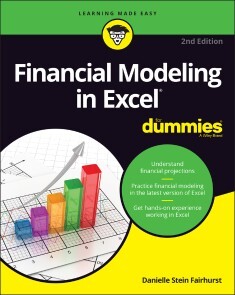
Financial Modeling in Excel For Dummies
TURN YOUR FINANCIAL DATA INTO INSIGHTFUL DECISIONS WITH THIS STRAIGHTFORWARD GUIDE TO FINANCIAL MODELING WITH EXCELInterested in learning how to build practical financial models and forecasts but concerned that you don’t have the math skills or technical know-how? We’ve got you covered! Financial decision-making has never been easier than with Financial Modeling in Excel For Dummies. Whether you work at a mom-and-pop retail store or a multinational corporation, you can learn how to build budgets, project your profits into the future, model capital depreciation, value your assets, and more.You’ll learn by doing as this book walks you through practical, hands-on exercises to help you build powerful models using just a regular version of Excel, which you’ve probably already got on your PC. You’ll also:* Master the tools and strategies that help you draw insights from numbers and data you’ve already got * Build a successful financial model from scratch, or work with and modify an existing one to your liking * Create new and unexpected business strategies with the ideas and conclusions you generate with scenario analysis Don’t go buying specialized software or hiring that expensive consultant when you don’t need either one. If you’ve got this book and a working version of Microsoft Excel, you’ve got all the tools you need to build sophisticated and useful financial models in no time!DANIELLE STEIN FAIRHURSTis a Sydney-based financial modeling consultant who helps her clients create meaningful financial models for business analysis. She is regularly engaged around Australia and globally as a speaker and course facilitator. She received the Microsoft MVP Award in 2021 in recognition of her technical expertise and contributions to the community.INTRODUCTION 1About This Book 1Foolish Assumptions 2Icons Used in This Book 2Beyond the Book 3Where to Go from Here 3PART 1: GETTING STARTED WITH FINANCIAL MODELING 5CHAPTER 1: INTRODUCING FINANCIAL MODELING 7Defining Financial Modeling 7What it is 8Who uses it 9Why it matters 10Looking at Examples of Financial Models 10Project finance models 11Pricing models 12Integrated financial statement models 12Valuation models 12Reporting models 13CHAPTER 2: GETTING ACQUAINTED WITH EXCEL 15Making Sense of the Different Versions of Excel 15A rundown of recent Excel versions 16Focusing on file formats 23Defining Modern Excel 23Recognizing the Dangers of Using Excel 25Capacity 26Lack of discipline 27Errors 28Looking at Alternatives and Supplements to Excel 31CHAPTER 3: PLANNING AND DESIGNING YOUR FINANCIAL MODEL 35Identifying the Problem That Your Financial Model Needs to Solve 35Designing How the Problem’s Answer Will Look 39Gathering Data to Put in Your Model 45Documenting the Limitations of Your Model 46Considering the Layout and Design of Your Model 47Structuring your model: What goes where 49Defining inputs, calculations, and output blocks 50Determining your audience 51CHAPTER 4: BUILDING A FINANCIAL MODEL BY THE RULEBOOK 53Document Your Assumptions 53Create Dynamic Formulas Using Links 59Only Enter Data Once 61Model with Consistent Formulas 62Build in Error Checks 64Allowing tolerance for error 66Applying conditional formatting to an error check 67Format and Label for Clarity 68CHAPTER 5: USING SOMEONE ELSE’S FINANCIAL MODEL 71Considering Templates for Building a Financial Model 72Why templates can be appealing 72What’s wrong with using templates 72Why you should build your own model 74Inheriting a File: What to Check For 75Meeting a model for the first time 76Inspecting the workbook 77Using Audit Tools to Find and Correct Errors 84Checking a model for accuracy 85Making sense of the formulas 88Sharing and Version Control 95PART 2: DIVING DEEP INTO EXCEL 97CHAPTER 6: EXCEL TOOLS AND TECHNIQUES FOR FINANCIAL MODELING 99Referencing Cells 100Relative cell referencing 101Absolute cell referencing 103Mixed cell referencing 106Naming Ranges 109Understanding why you may want to use a named range 109Creating a named range 110Finding and using named ranges 111Editing or deleting a named range 113Dynamic Ranges 113Linking in Excel 114Internal links 115External links 117Using Shortcuts 120Restricting and Validating Data 123Restricting user data entry 124Creating drop-down boxes with data validations 125Protecting and locking cells 126Goal Seeking 127Limiting project costs with a goal seek 128Calculating a break-even point with a goal seek 129CHAPTER 7: USING FUNCTIONS IN EXCEL 131Identifying the Difference between a Formula and a Function 131Finding the Function You Need 132Getting Familiar with the Most Important Functions 133SUM 134MAX and MIN 135AVERAGE 139COUNT and COUNTA 140ROUND, ROUNDUP, and ROUNDDOWN 146IF 153COUNTIF and SUMIF 156Reporting sales with SUMIF 158VLOOKUP, HLOOKUP, and XLOOKUP 161Being Aware of Advanced Functions and Functionality 170CHAPTER 8: APPLYING SCENARIOS TO YOUR FINANCIAL MODEL 173Identifying the Differences among Types of Analysis 174Building Drop-Down Scenarios 175Using data validations to model profitability scenarios 175Applying formulas to scenarios 178Applying Sensitivity Analysis with Data Tables 181Setting up the calculation 181Building a data table with one input 182Building a data table with two inputs 184Applying probability weightings to your data table 186Using Scenario Manager to Model Loan Calculations 189Setting up the model 189Applying Scenario Manager 191CHAPTER 9: CHARTING AND PRESENTING MODEL OUTPUT 195Deciding Which Data to Display 196Conveying Your Message by Charting Scenarios 198Deciding Which Type of Chart to Use 200Line charts 201Bar charts 206Combo charts 209Pie charts 211Charts in newer versions of Excel 214Dynamic Charting 219Building the chart on formula-driven data 219Linking the chart titles to formulas 220Creating dynamic text 221Preparing a Presentation 225PART 3: BUILDING YOUR FINANCIAL MODEL 227CHAPTER 10: BUILDING AN INTEGRATED FINANCIAL STATEMENTS MODEL 229Getting to Know the Case Study 230Entering Assumptions 231Revenue assumptions 232Expense assumptions 233Other assumptions 234Calculating Revenue 234Projecting sales volume 235Projecting dollar sales 237Calculating Expenses 238Staff costs 238Other costs 239Depreciation and amortization 240Building the Income Statement 243Building the Cash Flow Statement 248Building the Balance Sheet 252Building Scenarios 258Entering your scenario assumptions 258Building a drop-down box 259Building the scenario functionality 260CHAPTER 11: BUILDING A DISCOUNTED CASH FLOW VALUATION 263Understanding How the Discounted Cash Flow Valuation Works 264Step 1: Calculating Free Cash Flow to Firm 265Step 2: Calculating Weighted Average Cost of Capital 268Step 3: Finding the Terminal Value 269Discounting Cash Flows and Valuation 270CHAPTER 12: BUDGETING FOR CAPITAL EXPENDITURE AND DEPRECIATION 273Getting Started 274Making a reusable budget model template 274Creating dynamic titles 277Output 1: Calculating Cash Required for Budgeted Asset Purchases 277Output 2: Calculating Budgeted Depreciation 282Useful life 283Written-down date 284The depreciation schedule for the current year 285Depreciation in prior periods 287Output 3: Calculating the Written-Down Value of Assets for the Balance Sheet 288PART 4: THE PART OF TENS 291CHAPTER 13: TEN STRATEGIES FOR REDUCING ERROR 293Using the Enter Key 293Checking Your Work 294Checking It Again 295Getting Someone Else to Check Your Work 296Documenting Assumptions 297Documenting Methodology with a Flowchart 297Stress-Testing with Sensitivity Analysis 298Conducting a Scenario Analysis 299Taking Note of Excel Error Values 300Including Error Checks 302CHAPTER 14: TEN COMMON PITFALLS TO AVOID 303The Numbers Don’t Add Up 303You’re Getting #REF! Errors 304You Have Circular References 304The Model Has Too Much Detail 307The File Size Is Out of Control 307Your Model Is Full of “Spaghetti” Links 309The Formulas Are Unnecessarily Long and Complicated 311No One Is Paying Attention to the Model 312You Don’t Want to Let Go 313Someone Messes Up Your Model 313Index 315

Microsoft 365 - Das Praxisbuch für Anwender (2. Auflg.)
Die Zusammenarbeit mit Teams, SharePoint Online, OneDrive for Business, Outlook und Co. Sie stehen vor der Aufgabe, Microsoft 365 in Ihrem Team für die Online-Zusammenarbeit einzuführen, oder nutzen es bereits als Anwender? Dieses Praxisbuch unterstützt Sie dabei als Anleitung, Ratgeber und Nachschlagewerk. Microsoft 365- und SharePoint-Expertin Melanie Schmidt zeigt Ihnen in diesem Buch, welche Anwendungen wie Teams, SharePoint Online und OneDrive for Business Ihnen mit Microsoft 365 im Unternehmen zur Verfügung gestellt werden, wofür Sie welche App nutzen und worin ihre Unterschiede bestehen. Sie lernen nicht nur das Microsoft 365-Portal kennen, sondern erkunden die bereitgestellten Tools und deren Einsatz anhand von einfachen Schritt-für-Schritt-Anleitungen und vielen Praxisbeispielen, sodass Sie die für Sie relevanten Anwendungen schnell auswählen und meistern können. Mit zahlreichen nützlichen Tipps und Empfehlungen steht Ihnen die Autorin beim Einsatz von Microsoft 365 im Unternehmen zur Seite, ganz gleich, ob am Windows-PC, Mac, Smartphone oder Tablet, im Büro, im Homeoffice oder von unterwegs, sodass Sie effektiv und erfolgreich am Arbeitsplatz 4.0 mit Ihrem Team, Ihrer Arbeitsgruppe, Ihrer Abteilung oder Ihrem Fachbereich zusammenarbeiten können. Zielgruppe: Anwender*innenBerater*innenTrainer*innenAutorin: Melanie Schmidt ist seit 1991 in der IT-Branche tätig. Sie arbeitet freiberuflich als Business Consultant für Microsoft 365 und SharePoint für zahlreiche IT-Dienstleister und Kunden. Außerdem verfasst sie anwenderspezifische Fachbücher und Videotrainings für Microsoft-Produkte, in denen sie ihr Praxiswissen an alle Anwendergruppen weitergibt.
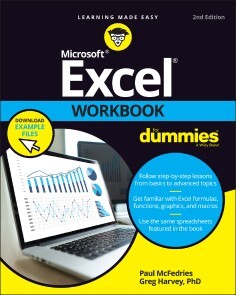
Excel Workbook For Dummies
GET PRACTICAL WALKTHROUGHS FOR THE MOST USEFUL EXCEL FEATURESLooking for easy-to-understand, practical guidance on how to go from Excel newbie to number crunching pro? Excel Workbook For Dummies is the hands-on tutorial you've been waiting for.This step-by-step guide is packed with exercises that walk you through the basic and advanced functions and formulas included in Excel. At your own speed, you'll learn how to enter data, format your spreadsheet, and apply the mathematical and statistical capabilities of the program.Work through the book from start to finish or, if you'd prefer, jump right to the section that's giving you trouble, whether that's data visualization, macros, analysis, or anything else. You can also:* Brush up on and practice time-saving keyboard shortcuts for popular commands and actions* Get a handle on multi-functional and practical pivot tables with intuitive practice exercises* Learn to secure your data with spreadsheet password protectionsPerfect for new users of Excel, Excel Workbook For Dummies is also the ideal resource for those who know their way around a spreadsheet but need a refresher on some of the more advanced features of this powerful program.PAUL MCFEDRIES has published over 100 books, with topics ranging from Windows 10 to Microsoft Office, Apple gadgets, and Amazon Alexa. He is the author of the recently released Excel Data Analysis For Dummies and Google’s G Suite For Dummies.GREG HARVEY, PHD was author of over 30 For Dummies titles covering Excel. Introduction 1PART 1: BUILDING WORKSHEETS 5Chapter 1: Getting Familiar with the Excel Interface 7Chapter 2: Entering the Worksheet Data 21Chapter 3: Formatting the Worksheet 37Chapter 4: Printing Worksheet Reports 59Chapter 5: Modifying the Worksheet 79PART 2: USING FORMULAS AND FUNCTIONS 101Chapter 6: Building Formulas 103Chapter 7: Copying and Correcting Formulas 123Chapter 8: Creating Date and Time Formulas 145Chapter 9: Financial Formulas and Functions 155Chapter 10: Using Math Functions 167Chapter 11: Using Common Statistical Functions 179Chapter 12: Using Lookup Functions 187Chapter 13: Using Logical Functions 197Chapter 14: Text Formulas and Functions 209PART 3: WORKING WITH GRAPHICS 217Chapter 15: Charting Worksheet Data 219Chapter 16: Adding Graphics to Worksheets 231PART 4: MANAGING AND SECURING DATA 249Chapter 17: Building and Maintaining Tables 251Chapter 18: Protecting Workbooks and Worksheet Data 271PART 5: DOING DATA ANALYSIS 283Chapter 19: Performing What-If Analysis 285Chapter 20: Generating PivotTables 299PART 6: MACROS AND VISUAL BASIC FOR APPLICATIONS 315Chapter 21: Using Macros 317Chapter 22: Using the Visual Basic Editor 327PART 7: THE PART OF TENS 341Chapter 23: Top Ten Features in Excel 343Chapter 24: Top Ten Tips for Using Excel Like a Pro 347Index 355

Software-Architekturen dokumentieren und kommunizieren
Dokumentation wird oft als lästige Pflicht angesehen und in vielen Softwareprojekten stark vernachlässigt, die Architektur wird manchmal überhaupt nicht beschrieben. Damit das in Ihren Projekten nicht passiert, schlägt dieses Buch praxiserprobte und schlankere Bestandteile für eine wirkungsvolle Architekturdokumentation vor.Anhand eines durchgängigen Beispiels erfahren Sie, wie Sie architekturrelevante Einflussfaktoren erfassen und Ihre Softwarelösung angemessen und ohne Ballast festhalten. Sie lernen nicht nur die Vorgehensweise für das Dokumentieren während des Entwickelns kennen, sondern auch, wie Sie bestehende Systeme im Nachhinein beschreiben. Neben der Methodik diskutiert das Buch auch typische Formate und Werkzeuge wie Wikis, UML-Werkzeuge unter anderem, mit denen Sie Architekturdokumentation erfassen, verwalten und verbreiten kann.Checklisten und Übungsaufgaben geben Ihnen die nötige Sicherheit, um die Architekturdokumentation zu einem integralen Bestandteil Ihres Softwarevorhabens zu machen. Autor:Stefan Zörner arbeitet als Softwarearchitekt und Berater bei embarc in Hamburg. Er wirkt bei Entwurfs- und Umsetzungsfragen mit, unterstützt beim Festhalten von Architektur und beleuchteten Lösungsansätzen in Bewertungen. Sein Wissen und seine Erfahrung teilt er regelmäßig in Vorträgen, Artikeln und Workshops.

Hands-On Guide to AgileOps
Discover the best practices for transforming cloud and infrastructure operations by using Agile, Scrum, Kanban, Scrumban and Spotify models. This book will help you gain an in-depth understanding of these processes so that you can apply them to your own work.The book begins by offering an overview of current processes and methods used in IT Operations using ITIL and IT4IT. The Authors provide a background of the Agile, Scrum, Kanban, SaFe, Scrumban, and Spotify models used in software development. You’ll then gain in-depth guidance and best practices to implement Agile in the Operations world. You’ll see how Agile, Site Reliability Engineering and DevOps work in tandem to provide the foundation for modern day infrastructure and cloud operations. The book also offers a comparison of various agile processes and their suitability to the infrastructure and cloud operations world.After completing this is hands-on guide, you’ll know how to adopt Agile, DevOps and SRE and select the most suitable processes for your organization to achieve higher reliability, agility and lower costs while running cloud and infrastructure operations.WHAT YOU WILL LEARN* Understand how cloud computing and microservices architecture are changing operations dynamics* Understand ITIL, IT4IT, and Lean* Learn how Site Reliability Engineering, Agile and DevOps work in tandem* Leverage Agile, Scrum, Kanban, Scrumban, and Spotify models to run cloud operations* Use Site Reliability techniques along with Agile and DevOps* Study the different agile frameworks (Spotify, SAFe, LeSS, DAD, Nexus), their purpose, benefits and implementation approaches.* Learn a step-by-step process to identify and implement these frameworks in your organizationWHO THIS BOOK IS FORInfrastructure architects, DevOps architects, Agile practitioners, DevSecOps Experts, Product Managers/Scrum Masters, DevOps Engineers.NAVIN SABHAWAL, currently is the Chief Architect and Head of Strategy for Autonomics, named ‘DRYiCE’ at HCL Technologies. He is responsible for innovation, presales, and delivery of award-winning autonomics platforms for HCL Technologies.He is an innovator, thought leader, author and a consultant in areas of AI and Machine Learning, Cloud Computing, Big Data Analytics, Software Product Development, Engineering and R&D. He is responsible for IP Development & Service Delivery in the Areas of AI and Machine Learning, Automation products, Cloud Computing, Public Cloud AWS, Microsoft Azure, VMWare Private Cloud, Microsoft Private Cloud, Data Center Automation, Analytics for IT Operations, IT Service Management.RAMINDER RATHORE , an enthusiastic IT Practitioner with close to about two decades of work experience ranging from research and development to product management, to enabling organizations towards digitalization through agile ways of working. She currently leads the DevOps Centre of Excellence (CoE) at HCL Technologies, Canada.She holds a Master’s degree in Computer Science and is certified in a couple of areas on IBM Rational tools, Microsoft Azure, Scrum and ITIL methodologies. She started her career as a developer and progressed into product lifecycle management and consulting. She has been driving enterprise transformative programs on Automation (CI/CD), Cloud and DevOps for multiple customers. She has strong expertise in analyzing ecosystems, designing transformation roadmaps with milestones, building, and implementing accelerators / tools that drive end to end product traceability with agility and resiliency.UDITA AGRAWAL , an agile and automation transformation expert with over seventeen years of work experience, working with HCL Technologies. She holds a Master's degree in Business Administration in Information Technology and is also a PMP certified professional. She has wide experience in managing and leading engagements across different domains that includes Java, Data science and Automation. She is a passionate consultant running digital transformation programs for various customers. She also delivers enablement sessions on Agile and DevOps and works closely with product teams to practice agile methods. She also runs workshops on planning and implementing automated pipelines using various tools that includes COTS and open-source tools.Chapter 1: IntroductionCHAPTER GOAL: UNDERSTANDING THE AGILE JOURNEY AND THE NEED TO BRIDGE DEVELOPMENT AND OPERATIONS AREANO OF PAGES 17SUB -TOPICS1. Agile History2. Evolving software teams3. Bridging the gap4. Complementing Agile5. Agile in InfraOps6. Agile ManifestoChapter 2: Traditional Infrastructure OperationsCHAPTER GOAL: QUICK BRIEF ON TRADITIONAL ITSM APPROACH AND THE NEED TO TRANSITION TO AGILE OPERATIONS.No of pages: 20SUB - TOPICS1. ITSM and its phase2. Drawbacks3. Need to changeChapter 3: Agile and DevOpsCHAPTER GOAL: INTRODUCE CORE CONCEPTS TO AGILE AND DEVOPS AND UNDERSTAND ITS RELEVANCE IN THE PRODUCT LIFECYCLE.NO OF PAGES : 13SUB - TOPICS:1. When to adopt Agile2. Agile principles and values3. Scaling Agile with DevOps4. When to adopt DevOps5. DevOps in product lifecycleChapter 4: Factors leading to Agile OperationsCHAPTER GOAL: GET TO LEARN THE FACTORS THAT ARE MOTIVATING ORGANIZATIONS TO TRANSITION THEIR INFRASTRUCTURE OPERATIONS TO AGILE OPERATIONSNO OF PAGES: 29SUB - TOPICS:1.Shift towards Agile2.Benefits with Agility3.Cloud Computing4. Microservices5. Deployment patterns6. Shift left testing7. Changes in architectureChapter 5: Introduction to Agile MethodsCHAPTER GOAL: Introduce agile methods, roles, ceremonies and best practicesNO OF PAGES: 40SUB - TOPICS:1. Scrum2. Kanban3. ScrumbanChapter 6: Introduction to Agile FrameworksChapter Goal: INTRODUCE AGILE FRAMEWORKS, ROLES, AND STUDY THEIR COMPARISON.NO. OF PAGES : 47SUB - TOPICS:1. Agile ITSM2. IT4IT3. Lean IT4. SAFe5. Spotify6. LeSS7. Nexus8. DAD9. Site Reliability EngineeringChapter 7: Using Agile for Infrastructure OperationsCHAPTER GOAL:WITH THE BASIC UNDERSTANDING ON AGILE, THIS CHAPTER FOCUSES ON THE STRATEGY FOR ADOPTING AGILE IN INFRASTRUCTURE OPERATIONS SPACE.NO. OF PAGES : 22SUB - TOPICS:1. Adopting the right agile method2. Identify the right tools3. Upskill teams4. Redefine roles and responsibilities5. Continuously monitoring team performance6. Pilot-Expand-SustainChapter 8: Infrastructure as CodeCHAPTER GOAL:LEARN HOW TO LEVERAGE AGILE METHODS WHILE IMPLEMENTING INFRASTRUCTURE AS CODE PIPELINES AND EXTEND ITS INTEGRATION WITH DEVELOPMENT PIPELINES.NO. OF PAGES : 21SUB - TOPICS:1. Getting started with Scrum2. Estimating stories3. Defining acceptance criteria4. Integrating IaC with development pipelines5. IaC ExampleChapter 9: Success PathCHAPTER GOAL:THIS CHAPTER SHARES THE JOURNEY OF AN IMAGINARY COMPANY ON HOW THEY TRANSITION INTO AGILE OPS WITH A WELL-DEFINED TRANSFORMATION MAP AND MILESTONES.NO. OF PAGES : 7SUB - TOPICS:1. Enterprise Alpha2. New operating model3. OutcomesChapter 10: Learnings and Way forwardCHAPTER GOAL:AS ORGANIZATIONS ADOPT AGILE, THEY ALSO NEED TO PLAN FOR THE TRENDING TECHNOLOGIES THAT WILL BENEFIT THEM. THIS LAST CHAPTER SUMMARIZES THE LEARNINGS FROM THE EARLIER CHAPTERS AND SHARES UPCOMING TRENDS AND NEXT STEPS TO CONSIDER.NO. OF PAGES : 6SUB - TOPICS:1. Our Learnings2. Emerging Trends3. Next Steps
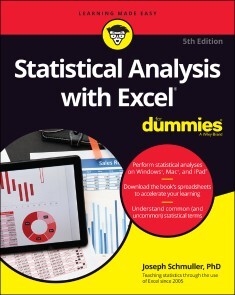
Statistical Analysis with Excel For Dummies
BECOME A STATS SUPERSTAR BY USING EXCEL TO REVEAL THE POWERFUL SECRETS OF STATISTICSMicrosoft Excel offers numerous possibilities for statistical analysis—and you don’t have to be a math wizard to unlock them. In Statistical Analysis with Excel For Dummies, fully updated for the 2021 version of Excel, you’ll hit the ground running with straightforward techniques and practical guidance to unlock the power of statistics in Excel.Bypass unnecessary jargon and skip right to mastering formulas, functions, charts, probabilities, distributions, and correlations. Written for professionals and students without a background in statistics or math, you’ll learn to create, interpret, and translate statistics—and have fun doing it!In this book you’ll find out how to:* Understand, describe, and summarize any kind of data, from sports stats to sales figures * Confidently draw conclusions from your analyses, make accurate predictions, and calculate correlations * Model the probabilities of future outcomes based on past data * Perform statistical analysis on any platform: Windows, Mac, or iPad * Access additional resources and practice templates through Dummies.com For anyone who’s ever wanted to unleash the full potential of statistical analysis in Excel—and impress your colleagues or classmates along the way—Statistical Analysis with Excel For Dummies walks you through the foundational concepts of analyzing statistics and the step-by-step methods you use to apply them.JOSEPH SCHMULLER works on the Digital & Enterprise Architecture Team at Availity. He has taught statistics at the undergraduate and graduate levels. He has created and delivered courses for LinkedIn Learning, and he is the author of all previous editions of Statistical Analysis with Excel For Dummies.INTRODUCTION 1About This Book 2What’s New in This Edition 2What’s New in Excel (Microsoft 365) 3Foolish Assumptions 3Icons Used in This Book 4Where to Go from Here 5Beyond This Book 5PART 1: GETTING STARTED WITH STATISTICAL ANALYSIS WITH EXCEL: A MARRIAGE MADE IN HEAVEN 7CHAPTER 1: EVALUATING DATA IN THE REAL WORLD 9The Statistical (and Related) Notions You Just Have to Know 9Samples and populations 10Variables: Dependent and independent 11Types of data 12A little probability 13Inferential Statistics: Testing Hypotheses 14Null and alternative hypotheses 15Two types of error 16Some Excel Fundamentals 18Autofilling cells 22Referencing cells 25CHAPTER 2: UNDERSTANDING EXCEL’S STATISTICAL CAPABILITIES 29Getting Started 30Setting Up for Statistics 32Worksheet functions 32Quickly accessing statistical functions 36Array functions 38What’s in a name? An array of possibilities 41Creating Your Own Array Formulas 50Using data analysis tools 51Additional data analysis tool packages 56Accessing Commonly Used Functions 58The New Analyze Data Tool 59Data from Pictures! 60PART 2: DESCRIBING DATA 63CHAPTER 3: SHOW-AND-TELL: GRAPHING DATA 65Why Use Graphs? 65Examining Some Fundamentals 67Gauging Excel’s Graphics (Chartics?) Capabilities 68Becoming a Columnist 69Stacking the Columns 73Slicing the Pie 74A word from the wise 76Drawing the Line 77Adding a Spark 80Passing the Bar 82The Plot Thickens 84Finding Another Use for the Scatter Chart 88CHAPTER 4: FINDING YOUR CENTER 91Means: The Lore of Averages 91Calculating the mean 92AVERAGE and AVERAGEA 93AVERAGEIF and AVERAGEIFS 95TRIMMEAN 99Other means to an end 100Medians: Caught in the Middle 102Finding the median 102MEDIAN 103Statistics à la Mode 104Finding the mode 104MODE.SNGL and MODE.MULT 104CHAPTER 5: DEVIATING FROM THE AVERAGE 107Measuring Variation 108Averaging squared deviations: Variance and how to calculate it 108VAR.P and VARPA 111Sample variance 113VAR.S and VARA 114Back to the Roots: Standard Deviation 114Population standard deviation 115STDEV.P and STDEVPA 115Sample standard deviation 116STDEV.S and STDEVA 116The missing functions: STDEVIF and STDEVIFS 117Related Functions 121DEVSQ 121Average deviation 122AVEDEV 123CHAPTER 6: MEETING STANDARDS AND STANDINGS 125Catching Some Z’s 126Characteristics of z-scores 126Bonds versus the Bambino 127Exam scores 128STANDARDIZE 128Where Do You Stand? 131RANK.EQ and RANK.AVG 131LARGE and SMALL 133PERCENTILE.INC and PERCENTILE.EXC 134PERCENTRANK.INC and PERCENTRANK.EXC 137Data analysis tool: Rank and Percentile 138CHAPTER 7: SUMMARIZING IT ALL 141Counting Out 141COUNT, COUNTA, COUNTBLANK, COUNTIF, COUNTIFS 141The Long and Short of It 144MAX, MAXA, MIN, and MINA 144Getting Esoteric 145SKEW and SKEW.P 146KURT 148Tuning In the Frequency 150FREQUENCY 150Data analysis tool: Histogram 152Can You Give Me a Description? 154Data analysis tool: Descriptive Statistics 154Be Quick About It! 156Instant Statistics 159CHAPTER 8: WHAT’S NORMAL? 161Hitting the Curve 161Digging deeper 162Parameters of a normal distribution 163NORM.DIST 165NORM.INV 167A Distinguished Member of the Family 168NORM.S.DIST 169NORM.S.INV 170PHI and GAUSS 170Graphing a Standard Normal Distribution 171PART 3: DRAWING CONCLUSIONS FROM DATA 173CHAPTER 9: THE CONFIDENCE GAME: ESTIMATION 175Understanding Sampling Distributions 176An EXTREMELY Important Idea: The Central Limit Theorem 177(Approximately) simulating the Central Limit Theorem 178The Limits of Confidence 183Finding confidence limits for a mean 183CONFIDENCE.NORM 186Fit to a t 187CONFIDENCE.T 188CHAPTER 10: ONE-SAMPLE HYPOTHESIS TESTING 189Hypotheses, Tests, and Errors 190Hypothesis Tests and Sampling Distributions 191Catching Some Z’s Again 193Z.TEST 196t for One 197T.DIST, T.DIST.RT, and T.DIST.2T 198T.INV and T.INV.2T 200Visualizing a t-Distribution 201Testing a Variance 203CHISQ.DIST and CHISQ.DIST.RT 205CHISQ.INV and CHISQ.INV.RT 206Visualizing a Chi-Square Distribution 208CHAPTER 11: TWO-SAMPLE HYPOTHESIS TESTING 211Hypotheses Built for Two 211Sampling Distributions Revisited 212Applying the Central Limit Theorem 213Z’s once more 215Data analysis tool: z-Test: Two Sample for Means 216t for Two 219Like peas in a pod: Equal variances 220Like p’s and q’s: Unequal variances 221T.TEST 222Data analysis tool: t-Test: Two Sample 223A Matched Set: Hypothesis Testing for Paired Samples 227T.TEST for matched samples 228Data analysis tool: t-Test: Paired Two Sample for Means 230t-tests on the iPad with StatPlus 232Testing Two Variances 235Using F in conjunction with t 237F.TEST 238F.DIST and F.DIST.RT 240F.INV and F.INV.RT 241Data analysis tool: F-test: Two Sample for Variances 242Visualizing the F-Distribution 244CHAPTER 12: TESTING MORE THAN TWO SAMPLES 247Testing More than Two 247A thorny problem 248A solution 249Meaningful relationships 253After the F-test 254Data analysis tool: Anova: Single Factor 258Comparing the means 260Another Kind of Hypothesis, Another Kind of Test 262Working with repeated measures ANOVA 262Getting trendy 264Data analysis tool: Anova: Two-Factor Without Replication 268Analyzing trend 271ANOVA on the iPad 272ANOVA on the iPad: Another Way 274Repeated Measures ANOVA on the iPad 277CHAPTER 13: SLIGHTLY MORE COMPLICATED TESTING 281Cracking the Combinations 281Breaking down the variances 282Data analysis tool: Anova: Two-Factor Without Replication 284Cracking the Combinations Again 286Rows and columns 286Interactions 287The analysis 288Data analysis tool: Anova: Two-Factor With Replication 289Two Kinds of Variables — at Once 292Using Excel with a Mixed Design 293Graphing the Results 298After the ANOVA 300Two-Factor ANOVA on the iPad 300CHAPTER 14: REGRESSION: LINEAR AND MULTIPLE 303The Plot of Scatter 303Graphing a line 305Regression: What a Line! 307Using regression for forecasting 309Variation around the regression line 309Testing hypotheses about regression 311Worksheet Functions for Regression 317SLOPE, INTERCEPT, STEYX 318FORECAST.LINEAR 319Array function: TREND 319Array function: LINEST 323Data Analysis Tool: Regression 325Working with tabled output 327Opting for graphical output 329Juggling Many Relationships at Once: Multiple Regression 330Excel Tools for Multiple Regression 331TREND revisited 331LINEST revisited 333Regression data analysis tool revisited 336Regression Analysis on the iPad 338CHAPTER 15: CORRELATION: THE RISE AND FALL OF RELATIONSHIPS 341Scatterplots Again 341Understanding Correlation 342Correlation and Regression 345Testing Hypotheses about Correlation 347Is a correlation coefficient greater than zero? 348Do two correlation coefficients differ? 349Worksheet Functions for Correlation 350CORREL and PEARSON 350RSQ 351COVARIANCE.P and COVARIANCE.S 352Data Analysis Tool: Correlation 353Tabled output 354Multiple correlation 355Partial correlation 356Semipartial correlation 357Data Analysis Tool: Covariance 358Using Excel to Test Hypotheses about Correlation 358Worksheet functions: FISHER, FISHERINV 359Correlation Analysis on the iPad 360CHAPTER 16: IT’S ABOUT TIME 363A Series and Its Components 363A Moving Experience 364Lining up the trend 365Data analysis tool: Moving Average 365How to Be a Smoothie, Exponentially 368One-Click Forecasting 369Working with Time Series on the iPad 374CHAPTER 17: NONPARAMETRIC STATISTICS 379Independent Samples 380Two samples: Mann-Whitney U test 380More than two samples: Kruskal-Wallis one-way ANOVA 382Matched Samples 383Two samples: Wilcoxon matched-pairs signed ranks 384More than two samples: Friedman two-way ANOVA 386More than two samples: Cochran’s Q 387Correlation: Spearman’s rS 389A Heads-Up 391PART 4: PROBABILITY 393CHAPTER 18: INTRODUCING PROBABILITY 395What Is Probability? 395Experiments, trials, events, and sample spaces 396Sample spaces and probability 396Compound Events 397Union and intersection 397Intersection, again 398Conditional Probability 399Working with the probabilities 400The foundation of hypothesis testing 400Large Sample Spaces 400Permutations 401Combinations 402Worksheet Functions 403FACT 403PERMUT and PERMUTIONA 403COMBIN and COMBINA 404Random Variables: Discrete and Continuous 405Probability Distributions and Density Functions 405The Binomial Distribution 407Worksheet Functions 409BINOM.DIST and BINOM.DIST.RANGE 409NEGBINOM.DIST 411Hypothesis Testing with the Binomial Distribution 412BINOM.INV 413More on hypothesis testing 414The Hypergeometric Distribution 415HYPGEOM.DIST 416CHAPTER 19: MORE ON PROBABILITY 419Discovering Beta 419BETA.DIST 421BETA.INV 423Poisson 424POISSON.DIST 425Working with Gamma 427The gamma function and GAMMA 427The gamma distribution and GAMMA.DIST 428GAMMA.INV 430Exponential 431EXPON.DIST 431CHAPTER 20: USING PROBABILITY: MODELING AND SIMULATION 433Modeling a Distribution 434Plunging into the Poisson distribution 434Visualizing the Poisson distribution 435Working with the Poisson distribution 436Using POISSON.DIST again 437Testing the model’s fit 437A word about CHISQ.TEST 440Playing ball with a model 441A Simulating Discussion 444Taking a chance: The Monte Carlo method 444Loading the dice 444Data analysis tool: Random Number Generation 445Simulating the Central limit Theorem 448Simulating a business 452CHAPTER 21: ESTIMATING PROBABILITY: LOGISTIC REGRESSION 457Working Your Way Through Logistic Regression 458Mining with XLMiner 460PART 5: THE PART OF TENS 465CHAPTER 22: TEN (12, ACTUALLY) STATISTICAL AND GRAPHICAL TIPS AND TRAPS 467Significant Doesn’t Always Mean Important 467Trying to Not Reject a Null Hypothesis Has a Number of Implications 468Regression Isn’t Always Linear 468Extrapolating Beyond a Sample Scatterplot Is a Bad Idea 469Examine the Variability Around a Regression Line 469A Sample Can Be Too Large 470Consumers: Know Your Axes 470Graphing a Categorical Variable as a Quantitative Variable Is Just Plain Wrong 471Whenever Appropriate, Include Variability in Your Graph 472Be Careful When Relating Statistics Textbook Concepts to Excel 472It’s Always a Good Idea to Use Named Ranges in Excel 472Statistical Analysis with Excel on the iPad Is Pretty Good! 473CHAPTER 23: TEN TOPICS (THIRTEEN, ACTUALLY) THAT JUST DON’T FIT ELSEWHERE 475Graphing the Standard Error of the Mean 475Probabilities and Distributions 479PROB 479WEIBULL.DIST 479Drawing Samples 480Testing Independence: The True Use of CHISQ.TEST 481Logarithmica Esoterica 484What is a logarithm? 484What is e? 486LOGNORM.DIST 489LOGNORM.INV 490Array Function: LOGEST 491Array Function: GROWTH 494The logs of Gamma 497Sorting Data 498PART 6: APPENDICES 501APPENDIX A: WHEN YOUR DATA LIVE ELSEWHERE 503APPENDIX B: TIPS FOR TEACHERS (AND LEARNERS) 507Augmenting Analyses Is a Good Thing 507Understanding ANOVA 508Revisiting regression 510Simulating Data Is Also a Good Thing 512When All You Have Is a Graph 514APPENDIX C: MORE ON EXCEL GRAPHICS 515Tasting the Bubbly 515Taking Stock 516Scratching the Surface 518On the Radar 519Growing a Treemap and Bursting Some Sun 520Building a Histogram 521Ordering Columns: Pareto 522Of Boxes and Whiskers 5233D Maps 524Filled Maps 527APPENDIX D: THE ANALYSIS OF COVARIANCE 529Covariance: A Closer Look 529Why You Analyze Covariance 530How You Analyze Covariance 531ANCOVA in Excel 532Method 1: ANOVA 533Method 2: Regression 537After the ANCOVA 540And One More Thing 542Index 545
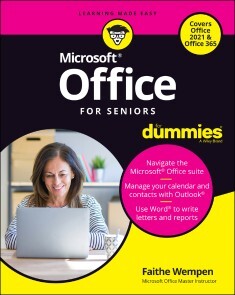
Office For Seniors For Dummies
SEND EMAILS, STAY ON TOP OF YOUR FINANCES, AND MANAGE YOUR EVERYDAY LIFE WITH THIS NO-EXPERIENCE-NECESSARY OFFICE 2021 HANDBOOKMicrosoft Office offers huge benefits to people of all ages. The popular software suite has always made creating to-do lists, sending emails, drafting documents, and processing spreadsheets a breeze, and the updates and upgrades found in Office 2021 make those tasks even easier. Office For Seniors For Dummies offers step-by-step instructions to learn every part of Office 2021, including Word, Excel, and PowerPoint. This trusted guide starts at the very beginning, showing you how to start each application and understand the interface. It walks you through the most commonly used functions of each program and explains how to apply it in your everyday life. Written in large, crystal-clear type and full of helpful images and screenshots, the book also demonstrates how to:* Stay in touch with friends and family using Office 2021's built-in communications tools, including Outlook* Keep your finances up to date with functional spreadsheets in Excel* Take advantage of existing Office templates for things like budgets, letters, faxes, and moreYou don't have to be a computer scientist to get the most out of Office 2021. Let this handy guide clarify and demystify some of the most practical and user-friendly applications available today. FAITHE WEMPEN, M.A., is a Microsoft Office Master Instructor who has been writing and teaching about Microsoft Office for more than 25 years. She is an adjunct professor of Computer Information Technology with more than 150 books to her credit, including Computers For Seniors For Dummies and Outlook For Dummies, as well as a CompTIA A+ certified computer technician.INTRODUCTION 1About This Book 1Foolish Assumptions 3Icons Used in This Book 3Beyond the Book 4Where to Go from Here 4PART 1: GETTING STARTED WITH OFFICE 5CHAPTER 1: THE TWO-DOLLAR TOUR 7Start an Office Application 8Start a New Document 9Explore the Office Ribbon and Tabs 10Understand the File Menu (Backstage View) 15Create a Document 16Type Text 17Insert a Picture 19Move Around in a Document 20Select Content 22Zoom In and Out 24Change the View 25CHAPTER 2: EXPLORING THE COMMON FEATURES OF OFFICE APPLICATIONS 27Edit Text 28Move and Copy Content 29Choose Fonts and Font Sizes 33Apply Text Formatting 36Use the Mini Toolbar 38Work with Themes 39Check Your Spelling and Grammar 43CHAPTER 3: OPENING, SAVING, AND PRINTING FILES 49Save Your Work 50The Basic Save 50Changing the Save Location 52Choosing a File Type 57Open a Previously Saved File 57Change the File Listing View 59Email Your Work to Others 60Emailing a Link to a Document 61Emailing a Copy of a Document 63Share Your Work in Other Formats 65Print Your Work 68Recover Lost Work 70PART 2: WORD 73CHAPTER 4: COMPOSING YOUR THOUGHTS IN WORD 75Examine the Word Interface 76Move Around and Select Text 77Choose Paper Size and Orientation 79Set Margins 80Select the Right Screen View 82Align and Indent Paragraphs 84Change Line Spacing 90Create Bulleted and Numbered Lists 92CHAPTER 5: DRESSING UP YOUR DOCUMENTS 95Apply Styles and Style Sets 96Insert Pictures 101Size and Format a Picture 105Position a Picture 106Add a Page Border 108Apply a Background Color to a Page 110Create Tables 112Format a Table 115CHAPTER 6: TAKING WORD TO THE NEXT LEVEL 117Number the Pages 118Use Headers and Footers 120Insert Cover Pages and Other Building Blocks 123Print an Envelope 125Perform a Mail Merge 127Insert the Date and Time 133PART 3: EXCEL 135CHAPTER 7: CREATING BASIC SPREADSHEETS IN EXCEL 137Understand Excel’s Unique Features 138Get Familiar with Spreadsheet Structure 140Move the Cell Cursor 140Select a Range 142Type and Edit Cell Contents 145Insert and Delete Rows, Columns, and Cells 147Work with Worksheets 151CHAPTER 8: DOING THE MATH: FORMULAS AND FUNCTIONS 155Learn How Formulas Are Structured 156Write Formulas That Reference Cells 156Move and Copy Cell Content 157Reference a Cell on Another Sheet 159Understand Functions 160Take a Tour of Some Basic Functions 163Explore Financial Functions 165CHAPTER 9: CREATING VISUAL INTEREST WITH FORMATTING AND CHARTS 169Adjust Row Height and Column Width 170Wrap Text in a Cell 172Apply Gridlines or Borders 172Apply Fill Color 176Format Text in Cells 177Format the Spreadsheet as a Whole 179Create a Basic Chart 181Identify the Parts of a Chart 183Format a Chart 185CHAPTER 10: USING EXCEL AS A DATABASE 189Understand Databases 190Prepare a List for a Mail Merge 190Store Data in a Table 191Sort a Table 193Filter Data in a Table 196Split a Column’s Content 199Merge the Contents of Columns 201PART 4: OUTLOOK 205CHAPTER 11: MANAGING EMAIL WITH OUTLOOK 207Set Up Outlook for the First Time 208Set Up Additional Mail Accounts 209Troubleshoot Mail Setup Problems 210Take a Quick Tour of Outlook’s Mail Feature 214Choose a Ribbon Layout 216Receive and Read Your Mail 216View and Download Photos and Other Attachments 218Reply to a Message 219Forward a Message 221Compose a Message 221Attach a File to a Message 224Avoid Frauds, Scams, and Viruses 226CHAPTER 12: MANAGING THE DETAILS: CONTACTS, NOTES, AND TASKS 229Store Contact Information 230Edit and Delete Contacts 233Choose How the Contacts List Appears 235Use the Contacts List 235Create Notes 238Categorize Notes 240Use Tasks and the To-Do List 243Update the Status of a Task 246Set a Task Reminder 247CHAPTER 13: YOUR BUSY LIFE: USING THE CALENDAR 249View Your Calendar 250Create and Delete a Calendar Event 252Set an Event to Recur 254Configure Event Reminders 255Add Holidays 257Print a Hard Copy of Your Calendar 258PART 5: POWERPOINT 261CHAPTER 14: GETTING STARTED WITH POWERPOINT 263Explore the PowerPoint Interface 264Work with PowerPoint Files 266Understand PowerPoint Views 266Create New Slides 268Use Slide Placeholders 270Turn Text AutoFit Off or On 271Change Slide Layouts 273Move or Resize Slide Content 274Manually Place Text on a Slide 275Navigate and Select Text 276Select Content 277CHAPTER 15: DRESSING UP YOUR PRESENTATIONS 279Understand and Apply Themes and Variants 280Change the Presentation Colors 281Edit Slide Masters 283Format Text Boxes and Placeholders 284Insert Pictures 286Create a Photo Album Presentation 290CHAPTER 16: ADDING MOVEMENT AND SOUND 293Animate Objects on a Slide 294Add Slide Transition Effects 301Set Slides to Automatically Advance 302Add a Musical Soundtrack 303CHAPTER 17: PRESENTING THE SHOW 305Display a Slide Show On-Screen 306Use the Slide Show Tools 308Print Copies of a Presentation 311Package a Presentation for Distribution 313Make a Video of the Presentation 316PART 6: GOING DEEPER WITH OFFICE 319CHAPTER 18: INTEGRATING OFFICE WITH OTHER APPS 321Use Microsoft Money in Excel to Track Bank Accounts 322Subscribe to a Google Calendar in Outlook 324Import a Google Calendar Into Outlook 327Access Gmail Contacts in Outlook 329Integrating Office with iCloud 332Share Content Between Google Apps and Office Apps 337Include Online Videos in PowerPoint Presentations 339CHAPTER 19: CUSTOMIZING OFFICE APPLICATIONS 341Customize the Quick Access Toolbar 342Customize the Ribbon 346Customize the Status Bar 349Set Options in Word, Excel, and PowerPoint 351Set Outlook Options 352CHAPTER 20: TROUBLESHOOTING COMMON PROBLEMS 355Recover Lost Work 356Repair a Malfunctioning App 357Fix Inconsistent Formatting in Word 360Improve an Ugly Presentation in PowerPoint 363Fix Formula Errors in Excel 364Pick the Right Function in Excel 365Minimize Document File Size 367Move Outlook Data Files to Another PC 368Index 373
WPF 4.5 und XAML
Grafische Benutzeroberflächen für Windows inkl. Entwicklung von Windows Store Apps Mit der Windows Presentation Foundation verfügen .NET-Entwickler über ein mächtiges und flexibles Instrument zur Entwicklung moderner Desktop-Applikationen – von der einfachen Oberfläche bis hin zur geschäftlichen Anwendung. Diese Bandbreite gibt den Rahmen für dieses Buch vor: Jörg Wegener beschreibt detailliert die zentralen Elemente der WPF 4.5, ihre zugrunde liegenden Konzepte und die in WPF implementierte Beschreibungssprache XAML. Zahlreiche Beispiele zeigen Ihnen den professionellen Einsatz des Frameworks in Situationen, mit denen Sie als Entwickler tagtäglich konfrontiert sind. Einen Schwerpunkt dieser Neuauflage bilden die Neuerungen von WPF 4.5 und Visual Studio 2012. Hier geht es u.a. um die Entwicklung von Apps für Windows 8 mit XAML und der Windows Runtime. Außerdem neu hinzugekommen sind die Themen: Eingabesteuerung via Maus, Tastatur und Touchscreen; das Entwurfsmuster Model-View-View-Model; Installation und Aktualisierung von Anwendungen beim Kunden; Gestaltung mit Expression Blend. Aus dem Inhalt: Einführung in WPF&XAMLLayout&SteuerelementeAufbau von AnwendungenStyles, TemplatesDaten&Datenbindungen2D-Grafik&Multimedia3D-Grafik, AnimationenIndividuelle AnpassungenEingabesteuerung in WPFWPF&Windows FormsDokumente&DruckenMehrsprachigkeit Browseranwendungen MVVM-EntwurfsmusterWindows Store Apps&WinRTAnwendungen installieren&verteilenExpression BlendAutor: Jörg Wegener hat mit seiner Firma Identage Business Services GmbH bereits zahlreiche Projekte begleitet, darunter auch internationale aus den Branchen der Telekommunikation, Energiewirtschaft und Buchhaltung. Er unterstützt seine Kunden u.a. in der richtigen Auswahl der Technologie, Architektur und Vorgehensweisen und arbeitet bevorzugt mit der Windows Presentation Foundation.
Datenvisualisierung mit Power BI
Visualisieren Sie Ihre Daten schnell und ausdrucksstark mit Power BI, um praktisch umsetzbare Ergebnisse zu erhalten. Alexander Loth und Peter Vogel zeigen Ihnen Schritt für Schritt, wie Sie ganz einfach visuelle Analysen erstellen und so selbst komplexe Datenstrukturen verstehen sowie gewonnene Erkenntnisse effektiv kommunizieren können.Das Buch richtet sich an die folgenden Zielgruppen:Alle, die Zugang zu Daten haben und diese verstehen möchtenFührungskräfte, die Entscheidungen auf Grundlage von Daten treffennAnalysten und Entwickler, die Visualisierungen und Dashboards erstellen angehende Data ScientistsZum Verständnis dieses Buches und dem Erwerb von Power BI Kenntnissen sind weder besondere mathematische Fähigkeiten noch Programmiererfahrung nötig. Es eignet sich daher auch für Einsteiger und Anwender, die sich dem Thema Datenvisualisierung und -analysepraxisbezogen nähern möchten, ohne ausschweifende theoretische Abhandlungen. Die grundlegenden Funktionen von Power BI werden Schritt für Schritt erläutert und Sie lernen, welche Visualisierungsmöglichkeiten wann sinnvoll sind. Die Autoren zeigen Fallbeispiele auf, die weit über eine »Standardanalyse« hinausreichen und gehen auf Funktionen ein, die selbst erfahrenen Nutzern oft nicht hinlänglich bekannt sind. Sie geben Ihnen außerdem wertvolle Hinweise und Tipps, die das Arbeiten mit Power BI merklich erleichtern. So können Sie zukünftig Ihre eigenen Daten bestmöglich visualisieren und analysieren.Aus dem Inhalt:Einführung und erste Schritte in Power BIDatenquellen in Power BI anlegenVisualisierungen erstellenAggregationen, Berechnungen und ParameterDimensionsübergreifende Berechnungen mit DAX-AusdrückenMit Karten zu weitreichenden ErkenntnissenTiefgehende Analysen mit Trends, Prognosen, Clustern und VerteilungInteraktive DashboardsAnalysen teilenLeseprobe (PDF-Link)

Das iPad-Buch für Senioren (3. Auflg.)
Wegweiser durch den Fachbegriff-Dschungel* Klare, verständliche Sprache* Fachbegriffe werden erläutert* Ausführliche Beispiele zu typischen AnwendungenTablet-Computer sind wegen ihrer einfachen Handhabung und vielfältigen Einsatzmöglichkeiten beliebt. Z.B. Videotelefonate mit den Enkeln haben in den Corona-Monaten für viele einen besonderen Stellenwert erlangt. Apples iPads stehen im Ruf, verlässlich zu sein, nicht so schnell zu veralten und durch ihr Design zu überzeugen. Der Umgang ist allerdings für viele nicht selbst erklärend. Gerade erste Versuche können so schnell zu einer Enttäuschung werden.Phillip Kiefer hat auch die dritte Auflage seiner bewährten Anleitung zu Apples Tablet überarbeitet und aktualisiert. Das Buch bahnt für Sie einen Weg durch den Fachbegriff-Dschungel und erläutert die Bedienung und die Funktionen der Apple-Tablets. Die Standard-Programme der iPads erklärt der Autor Ihnen mit anschaulichen Beispielen: So lernen Sie beispielsweise "Fotos" kennen, das Programm zum Betrachten, Bearbeiten, Ordnen und Versenden Ihrer Bilder. Sie erfahren, wie Sie Dokumente und Daten in der iCloud, Apples Datenspeicher im Internet, ablegen. Auch erklärt das Buch, wie Sie Ihre Passwörter einfach, aber geschützt handhaben, und vieles mehr.Erläuterungen und Bilder sind auf das neue iPadOS 15 aktualisiert.Philip Kiefer, geboren in Friedrichshafen am Bodensee, studierte Literaturwissenschaften und Philosophie in Tübingen und Oxford. Nebenher jobbte er in verschiedenen Verlagen sowie in einem Altenpflegeheim. Ende 2001 machte er sich als Autor selbstständig und hat bis heute über 150 Bücher in namhaften Verlagen veröffentlicht, darunter zahlreiche Computerbücher speziell für Senioren.
Handbuch Infrastructure as Code (2. Auflg.)
Prinzipien, Praktiken und Patterns für eine cloudbasierte IT-Infrastruktur In diesem praktischen Handbuch beschreibt Kief Morris von ThoughtWorks, wie Sie Ihre IT-Infrastruktur im Cloud-Zeitalter erfolgreich aufsetzen und betreiben. Sie erfahren, wie Sie hierfür die von zahlreichen DevOps-Teams entwickelten und erprobten Prinzipien, Praktiken und Patterns nutzen können. Diese aktualisierte Auflage wendet sich an Mitarbeitende in der Systemadministration, Infrastruktur- und Softwareentwicklung, Teamleitung und Architekturabteilung von Unternehmen. Kief Morris zeigt Ihnen, wie Sie Cloud- und Automatisierungs-Technologien einsetzen, um Änderungen einfach, sicher, schnell und verantwortungsvoll vorzunehmen. Sie lernen, wie Sie alles als Code definieren und Praktiken aus dem Softwaredesign und der Entwicklung einsetzen, um Ihr System aus kleinen und lose gekoppelten Elementen aufzubauen. Zielgruppe: Mitarbeiter*innen in Systemadministration, Softwareentwicklung und -architektur Autor:Kief Morris ist Global Director of Cloud Engineering bei ThoughtWorks.Er unterstützt Teams dabei, Cloud- und Infrastrukturtechnologien so einzusetzen, dass Unternehmen mit ihnen schnell und zuverlässig einen größeren Mehrwert schaffen können. Kief entwirft, baut und betreibt seit über 20 Jahren automatisierte IT-Server-Infrastrukturen. Angefangen hat er mit Shell-Skripten und Perl, später ist er auf CFengine, Puppet, Chef und Terraform und andere Technologien umgestiegen.

Introducing Blockchain Applications
Deepen your understanding of blockchain technology and develop your own blockchain applications. This book provides a thorough review of distribution-based systems on blockchain technology, starting from the fundamental concepts that underlie it, all the way through the implementation of a blockchain network for business purposes.Author JOSEPH THACHIL GEORGE begins by introducing you to blockchain and some basic concepts of technology, including distributed systems, systems of systems, cyber-physical systems, the Byzantine Consensus, the CAP theorem, and cryptographic techniques. Next, he analyzes the structure of blocks and smart contracts and the mother of all blockchain platforms, Bitcoin. That sets the stage for an examination of transaction structure, validation, and flow, from creation to registration in the ledger and structure of the blocks, the Nakamoto consensus, and finally forks. From there, you’ll experience a deep dive into Ethereum; including the concepts of Gas and Message, smart contracts and the Ethereum virtual machine. From there, you’ll learn about the Ethereum consensus protocol, Ethereum Casper, and the Ethereum Proof-of-Stake algorithm. You’ll then see how blockchain can be connected to a distributed system, followed by a demonstration of how you can model a distributed system using Blockly4SoS and Kilobots. The concluding chapters offer a practical example that combines distributed systems with blockchain technology.After reading this book, you will understand how to implement blockchain technology in a distributed system and be able to leverage this knowledge in your own projects.WHAT YOU WILL LEARN* Learn the concept of blockchains by way of a practical example * Grasp the connection between distributed systems and blockchain technology* Learn the design of blockchain with hyperledger fabric* Learn the design of cyber-physical systems in a distributed environment WHO IS THIS BOOK FORDevelopers who are enthusiastic about the design and implementation of distributed systems.Joseph Thachil George is a Technical Consultant for International Game Technology (IGT), Rome, Italy. Additionally, Joseph is pursuing doctorate (PhD) in Computer Science and Engineering at the University of Lisbon, Portugal. He has completed M.S. in Cyber Security from the Università degli Studi di Firenze, Italy. In addition, he is also part of the research group (DISIA) of the University of Florence, Italy, and the research group (INESC-ID Lisbon) of the University of Lisbon, Portugal. His research interests cover dynamic malware analysis, Blockchain technology - hyperledger fabric, and cyber security. In IGT, he has been a part of various project related to game configuration and integration in various platform. Specialized in Java and spring boot-based projects. He has also worked in various companies in India, Angola, Portugal, and UK; he has seven years of experience in various IT companies.1: INTRODUCING BLOCKCHAIN APPLICATIONS THROUGH DISTRIBUTED SYSTEMS2: INTRODUCTION TO BLOCKCHAIN3: BITCOIN4: ETHEREUM5: PROOF OF STAKE: CONSENSUS OF THE FUTURE6: HYPERLEDGER FABRIC7: CONSENSUS ALGORITHMS FOR BLOCKCHAINS8: SAMPLE PROJECT EXERCISE: CONSENSUS ALGORITHMS FOR BLOCKCHAINS9: REAL-TIME SYSTEMS10: SCHEDULING IN REAL-TIME SYSTEMS11: ENGINEERING BASED ON MODELS12: BLOCKLY 4 SOS13: PROJECT: CYBER PHYSICAL SYSTEMS14: PROJECT USING MATLAB: SMART FARM15: PLATOON PROJECT16: BLOCKCHAIN TECHNOLOGY AND DISTRIBUTED SYSTEMS FUTURE SCOPE AND B-COIN PROJECT17: AI AND BLOCKCHAIN: MONITORING AUTONOMOUS VEHICLES MANAGEMENT PROJECT18: SUMMARY
Office 365 All-in-One For Dummies
MULTIPLY YOUR PRODUCTIVITY WITH THE WORLD'S MOST STRAIGHTFORWARD GUIDE TO THE WORLD'S MOST POPULAR OFFICE SOFTWAREMicrosoft Office 365 contains straightforward tools for virtually every office task you could possibly think of. And learning how to use this powerful software is much easier than you might expect! With the latest edition of Office 365 All-in-One For Dummies, you'll get a grip on some of the most popular and effective office software on the planet, including Word, Excel, PowerPoint, Outlook, Access, Publisher, and Teams. This expanded handbook walks you through the ins and outs of reviewing and composing documents with Word, hosting and joining meetings with Teams, crunching numbers with Excel, and answering emails with Outlook. And it's ideal for anyone who's brand new to Office and those who just need a quick refresher on the latest useful updates from Microsoft. In this one-stop reference, you'll find:* Step-by-step instructions on the installation, maintenance, and navigation of all the critical components of Office 365* Guidance for using Office 365's built-in online and cloud functionality* Complete explanations of what every part of Office 365 is used for and how to apply them to your lifeOffice 365 All-in-One For Dummies is the last handbook you'll ever need to apply Microsoft's world-famous software suite to countless everyday tasks. PETER WEVERKA is a veteran tech writer who has written dozens of Dummies titles, including the first edition of Office 365 All-in-One For Dummies. He has also authored books on PowerPoint, OneNote, Word, and Quicken.Introduction 1BOOK 1: COMMON OFFICE TASKS 5Chapter 1: Office Nuts and Bolts 7Chapter 2: Wrestling with the Text 29Chapter 3: Speed Techniques Worth Knowing About 49BOOK 2: WORD 365 57Chapter 1: Speed Techniques for Using Word 59Chapter 2: Laying Out Text and Pages 79Chapter 3: Word Styles 105Chapter 4: Constructing the Perfect Table 123Chapter 5: Taking Advantage of the Proofing Tools 147Chapter 6: Desktop Publishing with Word 167Chapter 7: Getting Word’s Help with Office Chores 185Chapter 8: Tools for Reports and Scholarly Papers 205BOOK 3: EXCEL 365 229Chapter 1: Up and Running with Excel 231Chapter 2: Refining Your Worksheet 249Chapter 3: Formulas and Functions for Crunching Numbers 265Chapter 4: Making a Worksheet Easier to Read and Understand 299Chapter 5: Advanced Techniques for Analyzing Data 317BOOK 4: POWERPOINT 365 337Chapter 1: Getting Started in PowerPoint 339Chapter 2: Fashioning a Look for Your Presentation 361Chapter 3: Entering the Text 377Chapter 4: Making Your Presentations Livelier 393Chapter 5: Delivering a Presentation 409BOOK 5: OUTLOOK 365 431Chapter 1: Outlook Basics. 433Chapter 2: Maintaining the People App 445Chapter 3: Handling Your Email 457Chapter 4: Managing Your Time and Schedule 479BOOK 6: ACCESS 365 491Chapter 1: Introducing Access 493Chapter 2: Building Your Database Tables 509Chapter 3: Entering the Data 537Chapter 4: Sorting, Querying, and Filtering for Data 547Chapter 5: Presenting Data in a Report 567BOOK 7: PUBLISHER 365 573Chapter 1: Introducing Publisher 575Chapter 2: Refining a Publication 587Chapter 3: Putting on the Finishing Touches 599BOOK 8: WORKING WITH CHARTS AND GRAPHICS 609Chapter 1: Creating a Chart 611Chapter 2: Making a SmartArt Diagram 631Chapter 3: Handling Graphics and Photos 651Chapter 4: Drawing and Manipulating Lines, Shapes, and Other Objects 667BOOK 9: OFFICE 365: ONE STEP BEYOND 701Chapter 1: Customizing an Office Program 703Chapter 2: Ways of Distributing Your Work 717BOOK 10: MICROSOFT TEAMS 725Chapter 1: Getting around in Teams 727Chapter 2: Getting Up to Speed with Teams and Channels 753Chapter 3: Communicating through Channels and Private Chat 769Chapter 4: Organizing Your Files in Teams 793Chapter 5: Getting Together for Online Meetings 809BOOK 11: FILE SHARING AND COLLABORATING 835Chapter 1: File Sharing and Collaborating 837Chapter 2: Making the Most of OneDrive 851Chapter 3: Collaborating in SharePoint 865Index 895
Outlook For Dummies
LEARN ALL ABOUT THE BEST APPLICATION FOR EMAILING, SCHEDULING, COLLABORATING, AND JUST PLAIN GETTING STUFF DONEDid you know that Microsoft Outlook can do everything, including cook your dinner? Okay, it can’t cook your dinner. But it can deliver your email, filter out the junk, help you organize your life, sync data to the cloud, integrate with iOS and Android, and about a zillion other things. Outlook For Dummies shows you how to work all the basic and advanced features of the Office 2021 version.Outlook is loaded with interesting productivity tools that most people—even in business environments—don’t know about. Did you know you can create automated mail-handling rules? Translate messages into other languages? Share your calendar with other people? It’s true, and when people start wondering how you suddenly got to be so productive, you can tell them: Outlook For Dummies.* Take a stroll around the basic interface and emailing capabilities of Outlook for Office 2021 * Use Outlook to create daily and monthly schedules, manage a to-do list, organize messages into folders, and make notes for later reference * Discover advanced and little-known features that will help you get organized and stay on top of things * Sync email across your devices and access Outlook from any computer, tablet, or phone For users who are brand-new to Outlook and those upgrading to the latest version, this book makes it simple to get going.FAITHE WEMPEN, M.A., is a Microsoft Office Specialist Master Instructor and the author of over 150 books on Windows, Office, and computer technology.Introduction 1PART 1: GETTING STARTED WITH OUTLOOK 9Chapter 1: A First Look at Outlook 11Chapter 2: Taking a Tour of the Outlook Interface 25Chapter 3: Getting on the Fast Track with Handy Shortcuts 43PART 2: TAMING THE EMAIL BEAST 57Chapter 4: Email Essentials 59Chapter 5: Taking Email to the Next Level 81Chapter 6: Conquering Your Mountain of Messages 103Chapter 7: Managing Multiple Email Accounts and Data Files 143PART 3: KEEPING TRACK OF CONTACTS, DATES, TASKS, AND MORE 165Chapter 8: Your Little Black Book: Managing Your Contacts 167Chapter 9: Organizing Your Schedule with the Calendar 191Chapter 10: Staying on Task: To-Do Lists and More 219PART 4: TAKING OUTLOOK TO THE NEXT LEVEL 245Chapter 11: Merging Mail From Outlook to Microsoft Word 247Chapter 12: Integrating Outlook with Google and iCloud 261Chapter 13: Outlook for iOS and Android Devices 273Chapter 14: Seeing It Your Way: Customizing Outlook 285PART 5: OUTLOOK AT WORK 305Chapter 15: Outlook on the Job 307Chapter 16: Using Outlook on the Web: Your Outlook Away From Outlook 329PART 6: THE PART OF TENS 347Chapter 17: Ten Shortcuts Worth Taking 349Chapter 18: Ten Things You Can’t Do with Outlook 359Chapter 19: Ten Things You Can Do After You’re Comfy 365Index 371

Handbuch Infrastructure as Code
CLOUD-INFRASTRUKTUREN ERFOLGREICH AUTOMATISIEREN: STRATEGIEN FÜR DIE PRAXIS * Mithilfe von Patterns und Antipatterns Automatisierung verstehen und erfolgreich umsetzen * Pseudocode-Beispiele veranschaulichen die konkrete Umsetzung * Diese Auflage beschreibt neben dem Managen von Servern jetzt auch komplexe Container-Plattformen Kief Morris von ThoughtWorks zeigt in diesem Praxisbuch, wie Sie die von DevOps-Teams entwickelte Prinzipien, Praktiken und Patterns effektiv verwenden, um in der Cloud sicher und flexibel Infrastruktur zu managen. Es vermittelt, wie nicht nur Server, sondern auch komplexe Container-Plattformen (Stacks) aufgesetzt werden. Sie erfahren, wie sie mithilfe von Cloud- und Automatisierungstechnologien Änderungen einfach, sicher und schnell vornehmen. Sie lernen, wie Sie nahezu alles als Code definieren und setzen Praktiken aus dem Softwaredesign ein, um ein System aus kleinen, lose gekoppelten Elementen aufzubauen. Zielgruppen sind Mitarbeiterinnen und Mitarbeiter in der Systemadministration, Infrastruktur-Entwicklung, Softwareentwicklung und Architektur.

Heimautomation mit KNX, Dali, 1-Wire und Co. (3. Auflage)
Der Begleiter für Ihr Smart-Home-Vorhaben In diesem großen Standardwerk zur Heimautomation begleitet Sie KNX-Integrator Stefan Heinle auf dem Weg zu Ihrem smarten Zuhause. Sie finden darin nützliche Planungshilfen und Einkaufslisten, Checklisten zur Abnahme sowie unzählige Praxistipps. Von der Planung Ihrer Installation über die Auswahl der Komponenten bis hin zu Einbau, Parametrierung, Vernetzung und Absicherung wird kein Schritt ausgelassen. Selbstverständlich mit dabei: zentrale Grundlagen der Elektrik, der intelligenten Gebäudetechnik und der Programmierung. Aus dem Inhalt: Alle Grundlagen: Elektrik, intelligente Gebäudetechnik, Bus-Systeme, Vernetzung, Programmierung, Linux-AdministrationKonzepte, Standards, Vorgehensweisen und PlanungKomplette Ausstattung: Sensoren, Aktoren, Antriebe, Schnittstelle, Gateways, Logik-Maschinen, Visualisierung u. v. m.Zentrale Software: ETS, Home Server Experte, Kodi, MPD u. v. m.Multi-Room-Audio, Heimkino und Netzwerk aufbauenModerne LED-Beleuchtung, biorythmisches LichtKostenlos automatisieren: eibd, linknx, OWFS, OpenHAB, FHEM, SmartHome.pyVisualisierung/Steuerung: per Raum-Controller, Touch-Panel PC, Sprachsteuerung, Smartphone oder Web-BrowserHeimsicherheit mit Alarmanlage, Kameras und ZutrittskontrolleFunkbasierte Lösungen für den Bestandsbau nachrüstenTelefon, Türkommunikation, intelligente Haushaltsgeräte, Smart Metering u. v. m. einbindenGeldwerte Einkaufstipps und sofort einsetzbare Praxislösungen Autor: Stefan Heinle (Dipl-Ing.) plant individuelle Heimautomationslösungen und setzt Smart-Home-Projekte professionell in die Praxis um. Leseprobe (PDF-Link)

Tableau for Business Users
Learn Tableau by working through concrete examples and issues that you are likely to face in your day-to-day work.Author Shankar Arul starts by teaching you the fundamentals of data analytics before moving on to the core concepts of Tableau. You will learn how to create calculated fields, and about the currently available calculation functionalities in Tableau, including Basic Expressions, Level of Detail (LOD) Expressions, and Table Calculations. As the book progresses, you’ll be walked through comparisons and trend calculations using tables. A concluding chapter on dashboarding will show you how to build actionable dashboards to communicate analysis and visualizations. You’ll also see how Tableau can complement and communicate with Excel.After completing this book, you will be ready to tackle the challenges of data analytics using Tableau without getting bogged down by the technicalities of the tool.WHAT WILL YOU LEARNMaster the core concepts of Tableau * Automate and simplify dashboards to help business users* Understand the basics of data visualization techniques* Leverage powerful features such as parameters, table calculations, level of detail expressions, and more WHO IS THIS BOOK FORBusiness analysts, data analysts, as well as financial analysts.Shankar Arul holds a Masters in industrial engineering from Virginia Tech, USA and an MBA in Finance from ESSEC, France. He has more than 15 years of hands-on experience in the field of Data Visualization and data science. Having faced the frustrations of Business users in data-driven decision making, in companies such as BNP, Apple, Groupon and Kering, he decided to enable the Business users with the power of data visualization and Tableau through this book. Chapter 1: IntroductionCHAPTER GOAL: THE NEED FOR DATA VISUALIZATION TOOLS SUCH AS TABLEAU FOR BUSINESS USERSNO OF PAGES 4SUB -TOPICS1. Why visualize data2. Who is this book for3. How is this book differentChapter 2: Installation and SetupChapter Goal: Onboard readers with the setup of tableau.NO OF PAGES: 3SUB - TOPICS1. Installation of tableau2. Data sources required for the exercisesChapter 3: Fundamentals of DataCHAPTER GOAL: GENTLE INTRODUCTION TO THE FUNDAMENTALS OF DATANo of pages : 6SUB - TOPICS:1. Data types2. Data sources3. Data preparation4. Converting business questions to the language of dataChapter 4: The Crux of TableauCHAPTER GOAL: DISTILLATION OF THE CORE CONCEPTS OF TABLEAUNO OF PAGES: 17SUB - TOPICS:1. 4 Building pillars2. Putting it all together3. Show me3. Sheets & DashboardsChapter 5: CalculationsCHAPTER GOAL: ENRICH THE DATA BY CREATING CALCULATED FIELDSNo of pages: 16SUB - TOPICS:1. Grouping Values2. Calculated Fields3. Row level, Aggreation & Dis-Aggregation4. Bringin more data5. Importance of Cardinality6. Data ModelingChapter 6: Tables & Table CalculationsChapter Goal: Comparisons and trend calculations through tablesNO OF PAGES: 15SUB - TOPICS:1. Show me or start from scratch ?2. Table totals3. Table calculations4. SortingChapter 7: Advanced TipsCHAPTER GOAL: ADVANCED FUNCTIONALITIES OF TABLEAUNo of pages: 15SUB - TOPICS:1. Dynamic Inputs - Parameters2. Top 10/20/50 filters3. Dual Axis4. Shapes & Icons5. Level of detail calculations6. Reference lines & forecast7. Order of operationsChapter 8: DashboardsCHAPTER GOAL: BRING IT ALL TOGETHER BY ENABLING USERS TO BUILD INTERACTIVE DASHBOARDSNO OF PAGES: 9SUB - TOPICS:1. Less I more2. Dashboards: A view from 10000ft3. Fit & Layout4. Filters & Interaction

iPad in Schule und Unterricht
Ihre Schule ist endlich mit Apple-Tablets ausgestattet worden! Doch wie integrieren Sie diese nun sinnvoll in Ihren Unterricht und Schulalltag? In diesem Praxis-Handbuch lernen Sie auch als Einsteiger auf dem iPad alles dafür Notwendige von einem erfahrenen Kollegen und Apple-Experten. Felix Kolewe vermittelt Ihnen das technische und methodische Know-how, hilft Ihnen bei der Einrichtung und Organisation auf dem iPad und zeigt Ihnen an zahlreichen Beispielen, wie auch Sie Ihren Unterricht mit den Apps und digitalen Möglichkeiten Schritt für Schritt gestalten und bereichern. Aus dem Inhalt: iPad-Gerätemodelle und wichtiges Zubehör für den UnterrichtVerwaltungsmöglichkeiten in der Schule: Classroom, JAMF Teacher, SchoolworkGeräte der Schüler*innen während des Unterrichts verwalten und steuernDas Schul-iPad mit Apple-ID und Cloud-Speicher in Betrieb nehmenNützliche Einstellungen und Hilfsmittel für den SchulalltagAirDrop, Split Screen und Suchfunktion richtig nutzenDateienmanagement und Freigaben auf dem iPadKeynote als Präsentationstool, Aufgabenportfolio und WhiteboardVideos im Unterricht produzierenUnterrichtsmaterial und Arbeitsblätter mit PagesExplain Everything für die interaktive ZusammenarbeitTipps zum Troubleshooting und mehr 1. Der didaktische Mehrwert des Unterrichts mit dem iPad ... 11 1.1 ... Welchen Effekt haben digitale Lerngeräte auf den Lernerfolg? ... 12 1.2 ... Einsatzmöglichkeiten des iPads im Unterricht ... 14 1.3 ... Projektbasiertes Lernen mit dem iPad ... 15 1.4 ... Vorbereitung auf ein digitales Arbeitsleben ... 16 2. Das passende iPad-Modell und Zubehör auswählen ... 19 2.1 ... Welche Modelle gibt es? ... 19 2.2 ... Welches Modell eignet sich für den Unterricht? ... 22 2.3 ... Betriebssystem und Apps auf dem neusten Stand ... 23 2.4 ... Ihr iPad aufladen ... 25 2.5 ... Nützliches iPad-Zubehör ... 26 3. Verwaltung des iPads in der Schule ... 31 3.1 ... Private Verwaltung ... 31 3.2 ... Zentrale Verwaltung ... 32 3.3 ... Wenn möglich, zentral verwalten ... 46 4. Apple-ID und iCloud - Das Schul-iPad in Betrieb nehmen ... 47 4.1 ... Was ist eine Apple-ID? ... 47 4.2 ... Über den Webbrowser auf die iCloud zugreifen ... 58 4.3 ... Das bietet Ihnen die Apple-ID ... 61 5. Die iPad-Oberfläche kennenlernen und richtig nutzen ... 63 5.1 ... Das iPad sperren und entsperren ... 63 5.2 ... Der Home-Bildschirm ... 64 5.3 ... Das Dock ... 71 5.4 ... Das Kontrollzentrum ... 77 5.5 ... Dateien senden mit AirDrop ... 80 5.6 ... Bildschirmsynchronisation über AirPlay ... 82 5.7 ... Der Split View ... 84 5.8 ... Mitteilungen auf dem iPad ... 89 5.9 ... Apps herunterladen ... 95 5.10 ... Quick Notes ... 98 6. Einstellungen und Hilfsmittel für den Schulalltag ... 101 6.1 ... Der Apple Pencil ... 101 6.2 ... Externe Tastaturen anschließen ... 102 6.3 ... Interne Tastaturen hinzufügen ... 103 6.4 ... Die Vorlesefunktion des iPads ... 108 6.5 ... Einen Timer stellen ... 109 6.6 ... Erinnerungen ... 111 6.7 ... Der Kalender ... 116 7. Das Dateimanagement auf dem iPad ... 123 7.1 ... Die Dateien-App ... 123 7.2 ... Aufbau der App ... 123 7.3 ... Funktionen der Seitenleiste ... 125 7.4 ... Eine Ordner- und Dateistruktur anlegen ... 130 7.5 ... Unterrichtsmaterialien digitalisieren ... 133 8. Multimedial unterrichten und Medienkompetenz vermitteln ... 139 8.1 ... Die Funktionsweise der Kamera ... 139 8.2 ... Die Fotos-App ... 146 8.3 ... Ein Erklärvideo schnell und einfach erstellen ... 155 9. Keynote als Allrounder für den Unterricht ... 163 9.1 ... Wie funktioniert Keynote? ... 163 9.2 ... Vorteile von Keynote im Unterricht ... 171 9.3 ... Eine Präsentation für den Unterricht vorbereiten ... 174 9.4 ... Keynote als Whiteboard ... 188 10. Videos mit iMovie erstellen ... 195 10.1 ... Die iMovie-Benutzeroberfläche und ihre Funktionen ... 195 10.2 ... Eine Aufnahme schneiden ... 200 10.3 ... Medien hinzufügen ... 202 10.4 ... Einen Titel hinzufügen ... 204 10.5 ... Die Geschwindigkeit des Clips ändern ... 206 10.6 ... Das Video exportieren ... 206 10.7 ... Praxisbeispiel: Ein Nachrichtenvideo erstellen ... 209 11. Arbeitsmaterialien mit Pages erstellen ... 215 11.1 ... Die Benutzeroberfläche ... 215 11.2 ... Ein Arbeitsblatt erstellen ... 222 12. Das digitale Whiteboard »Explain Everything« ... 229 12.1 ... Die zwei Versionen von Explain Everything ... 229 12.2 ... Ein neues Projekt anlegen ... 231 12.3 ... Ein Video mit Explain Everything aufnehmen ... 237 12.4 ... Ein Tafelbild mit Explain Everything erstellen ... 239 12.5 ... Lehrertipps für den Einsatz von Explain Everything ... 243 13. Hilfreiche Apps für den Schulunterricht ... 247 13.1 ... Notizen verfassen mit Notability ... 247 13.2 ... Karteikarten erstellen mit Quizlet ... 256 13.3 ... Zeichnen mit Sketches School ... 261 13.4 ... Spielerisch lernen mit Kahoot ... 263 13.5 ... App-Ideen für Ihr Unterrichtsfach ... 266 14. Troubleshooting ... 277 14.1 ... Flugmodus ein- und ausschalten ... 277 14.2 ... Das iPad neu starten ... 278 14.3 ... Der Soft Reset ... 280 14.4 ... Der Hard Reset ... 280 Index ... 283

Excel 2021
Plötzlich wird Excel ganz leicht. Was immer Sie tun wollen, in diesem Buch finden Sie die passende Anleitung. Rechnen, Tabellen gestalten, Daten sortieren, Diagramme erstellen, Formeln und Funktionen nutzen, Tabellen ausdrucken und vieles andere mehr. Sie sehen Bild für Bild, was zu tun ist. Zusätzlich gibt es eine Menge Vorlagen und Beispiele, die Sie direkt für Ihre Arbeit übernehmen können. So erreichen Sie Ihr Ziel. Garantiert. Aus dem Inhalt: Mit Tabellen arbeitenBereiche kopieren, verschieben, löschenTabellen professionell gestaltenSchnelles Arbeiten mit DesignsZahlen formatierenBedingte FormatierungSchriftarten, -größen und -farben ändernDruckenSeitenumbrüche festlegen und löschenFormeln und FunktionenSumme, Mittelwert, Datum und UhrzeitDiagramme und GrafikenSparklines oder Mini-DiagrammeGrafiken einfügenArbeitsblätter einfügen, umbenennen, verschieben, kopierenListen gekonnt auswertenFenster, Zeilen, Spalten fixierenPDFs erstellen und Daten aus Excel in Word einfügenSerienbriefe auf Basis von Excel-ListenNützliche Vorlagen: Sparplan, Fahrtenbuch, Musterrechnung u.v.m. Vorwort ... 4 Vorlagen und Beispieldateien ... 5 1. Ein erster Überblick ... 12 Excel starten und beenden ... 14 Was ist wo in Excel 2021? ... 16 Das Anwendungsfenster ... 18 Was möchten Sie suchen? ... 20 Befehle über das Menüband aufrufen ... 22 Kontextmenüs nutzen ... 24 Effektiv mit Smarttags arbeiten ... 26 Tastenkombinationen gezielt einsetzen ... 28 Excel auf dem Touchdisplay bedienen ... 30 Die Registerkarte »Zeichnen« ... 32 2. Mit Tabellen arbeiten ... 34 Im Tabellenblatt bewegen ... 36 Daten eingeben, ändern, löschen ... 38 Excel als Taschenrechner ... 42 Einfache Formeln eingeben ... 44 Tipparbeit durch Zeigen reduzieren ... 46 Arbeitsergebnisse speichern ... 48 Eine Arbeitsmappe öffnen ... 50 Eine neue Arbeitsmappe erzeugen ... 52 3. Es geht noch viel schneller! ... 56 Weniger Aufwand durch Autoausfüllen ... 58 Benutzerdefinierte Datenreihen ... 60 Blitzvorschau (Flash Fill) ... 64 Bereiche markieren ... 66 Bereiche kopieren, ausschneiden und löschen ... 68 Drag & Drop ... 70 Zeilen und Spalten einfügen ... 72 Zeilen und Spalten löschen ... 74 Spaltenbreite und Zeilenhöhe ändern ... 76 Überblick: Excel-Cursor ... 80 4. Tabellen professionell gestalten ... 82 Zellen formatieren ... 84 Zellinhalte ausrichten ... 86 Zellen verbinden und Textumbrüche vornehmen ... 88 Zahlen formatieren ... 90 Schriftart, -größe und -farbe von Text ändern ... 94 Rahmenlinien verwenden ... 98 Hintergrundfarbe von Zellen festlegen ... 102 Die Zellformatierung übertragen ... 104 Tabelle drehen ... 106 Einheitliche Gestaltung mit Zellenformatvorlagen ... 108 Intelligente Tabellen mit »Als Tabelle formatieren« ... 110 Mit Designs die gesamte Arbeitsmappe gestalten ... 112 Highlights setzen mit der bedingten Formatierung ... 114 Eigene Regel für die bedingte Formatierung erstellen ... 120 Verbesserung der Barrierefreiheit ... 122 5. Drucken ... 126 Ein erster Druckversuch ... 128 Die Arbeitsmappen-Ansichten ... 130 Die Seitenansicht kontrollieren ... 132 Die Ausrichtung -- hoch oder quer? ... 134 Seitenränder einstellen ... 136 Kopf- und Fußzeilen einfügen ... 138 Seitenumbrüche festlegen und löschen ... 144 Zeilen oder Spalten wiederholen ... 148 6. Formeln und Funktionen ... 150 Formeln als Text wiedergeben mit FORMELTEXT ... 152 Formeln per Ausfüllfunktion erzeugen ... 154 Relative und absolute Adressierung ... 156 Die Funktionsbibliothek ... 160 Sich vom Funktionsassistenten helfen lassen ... 162 Summe, Mittelwert und Co. ... 164 Statistik mit ZÄHLENWENN ... 172 Jahre, Monate, Tage ... 174 Arbeitstage ... 180 Mit dem Datum rechnen ... 182 Eine Geburtstagsliste erstellen ... 186 Mit Zeitangaben rechnen ... 190 Die WENN-Funktion am Beispiel erklärt ... 194 Funktionen verschachteln ... 198 Die Funktionen SVERWEIS und XVERWEIS ... 200 Finanzmathematik? RMZ hilft! ... 206 Einsatz von Variablen für Formeln ... 210 Übersicht über weitere Funktionen ... 214 7. Diagramme und Grafiken ... 224 Diagramme erstellen ... 226 Diagrammelemente bearbeiten und ergänzen ... 232 Den richtigen Diagrammtyp wählen ... 236 Diagramme für besondere Anlässe ... 240 Sparklines oder Minidiagramme ... 242 Der Einsatz von Grafiken ... 246 Einen Screenshot einfügen ... 252 Ein Piktogramm einfügen ... 256 Ein 3D-Modell einfügen und drehen ... 258 Analoge Tabellen per Foto digitalisieren ... 260 8. Arbeitsmappen umfangreich nutzen ... 262 Mehrere Arbeitsmappen verwenden ... 264 Mit Tabellenblättern umgehen ... 266 Der Gruppenmodus ... 272 Tabellenblattübergreifende Formeln ... 276 Arbeitsblätter und Zellen schützen ... 280 Excel im Team nutzen ... 286 9. Listen gekonnt auswerten ... 288 Daten sortieren ... 290 Den AutoFilter anwenden ... 292 Listen gekonnt aufbereiten ... 294 Fenster fixieren -- Zeilen und Spalten feststellen ... 298 Statistik ohne Formeln mithilfe der Pivot-Tabelle ... 300 Daten in der Pivot-Tabelle neu anordnen ... 304 Auswertung nach Jahren und Monaten ... 306 Pivot-Tabellen schnell formatieren ... 308 PivotCharts anlegen ... 310 Automatisch erstellte Pivot-Tabellen ... 314 Einen Datenschnitt einfügen ... 316 Neue Datentypen ... 320 10. Zusammenarbeit mit anderen Apps ... 322 Eine PDF der Arbeitsmappe erstellen ... 324 Intelligente Tabellen in Word ... 326 Serienbriefe auf Basis von Excel-Listen ... 330 11. Nützliche Vorlagen ... 336 Persönlicher Jahreskalender ... 338 Sparplan ... 340 Taschengeldverwaltung ... 342 Nordic-Walking-Laufkalender ... 344 Fahrtenbuch ... 346 Turniertabelle ... 348 Musterrechnung allgemein ... 350 Gemischte Musterrechnung mit 7 % und 19 % MwSt. ... 352 Musterrechnung für Kleinunternehmer*innen ... 354 Musterrechnung für Kleinbeträge bis 150 Euro ... 356 Arbeitszeitentabelle ... 358 Stundenplan ... 360 Wichtige Tasten und Tastenkombinationen ... 362 Stichwortverzeichnis ... 377

Schrift. Wahl und Mischung
Und immer wieder die gleiche Frage: Welche Schrift ist die richtige für mein Projekt? Oliver Linke und Kai Büschl, beide Schriftexperten und Schriftdesigner, haben hier ein umfassendes Werk geschaffen, das sich systematisch den Themen Schriftwahl und Schriftmischung nähert und fundierte Hilfestellungen bietet. Wie Sie ästhetische, funktionale, technische, aber auch rechtliche Aspekte richtig einschätzen und damit Schriften professionell auswählen und kombinieren, wird Ihnen in diesem Buch erstmals ausführlich und mit vielen Beispielen erläutert. Aus dem Inhalt: Schrift formal beleuchtenStilgeschichte, Wesensmerkmale von Schriftformen, Klassifikationsmöglichkeiten, Anmutung und CharakterSchrift technisch verstehenFontformate, Schriftsysteme, Glyphensätze, OpenType Features, Variable FontsSchrift funktional einordnenLeserlichkeit, Rhythmus, Grauwert, Textarten, BildschirmschriftSchrift auswählenWelche Schrift eignet sich für welchen Anwendungsbereich (Roman, Zeitung, CD, Magazin, Plakat, Verpackung, Leitsystem, Website, Leichte Sprache, Kartografie ...)Schrift mischenMethoden der Schriftmischung, Schriftmischung in der AnwendungSchrift einrichtenMengensatz, Wortmarken, Schrift modifizieren, Custom FontsSchrift suchen und findenFoundries, Websites, Apps, Free Fonts, Testfonts, LizenzierungAnhangVerzeichnis von Schriften und Foundries, Glossar mit Fachbegriffen 1.. Schrift formal betrachten ... 8 1.1. ... Stilgeschichte der Schriftformen ... 10 1.2. ... Grundlegende Eigenschaften ... 26 1.3. ... Der Schnittausbau ... 36 1.4. ... Wesensmerkmale von Schriftformen ... 46 1.5. ... Klassifikationsmöglichkeiten ... 54 1.6. ... Anmutung und Charakter ... 60 1.7. ... Was ist eigentlich »modern«? ... 82 2.. Schrift technisch verstehen ... 86 2.1. ... Fontformate und Standards ... 88 2.2. ... Umformatierung von Schriftensoftware ... 92 2.3. ... Der Inhalt einer Schriftdatei ... 94 2.4. ... Schriftsysteme ... 96 2.5. ... Der Glyphensatz ... 98 2.6. ... OpenType-Features ... 112 2.7. ... Rasterung und Hinting ... 116 2.8. ... Variable Fonts ... 118 2.9. ... Responsive Schriften ... 122 3.. Schrift funktional beleuchten ... 124 3.1. ... Optische Eigentümlichkeiten ... 126 3.2. ... Lesbarkeit und Leserlichkeit ... 128 3.3. ... Kriterien der Schriftbeurteilung ... 136 3.4. ... Fair Fonts ... 156 4.. Schrift beurteilen ... 158 4.1. ... Schriftprofile erstellen ... 160 4.2. ... Beispiel für ein Schriftprofil ... 166 5.. Schrift auswählen ... 168 5.1. ... Anwendungsbereiche ... 170 5.2. ... Entwicklung eigener Anforderungsprofile ... 262 6.. Schrift mischen ... 264 6.1. ... Methoden der Schriftmischung ... 266 6.2. ... Schriftmischung in der Anwendung ... 286 7.. Schrift einrichten ... 306 7.1. ... Mengensatz einrichten ... 308 7.2. ... Wortmarken ... 316 7.3. ... Schrift modifizieren ... 320 7.4. ... Custom Fonts ... 324 7.5. ... Checkliste für Custom Fonts ... 333 8.. Schrift suchen und finden ... 334 8.1. ... Foundries groß und klein ... 336 8.2. ... Schriften finden ... 340 8.3. ... Freefonts ... 346 8.4. ... Fonts vor dem Kauf testen ... 350 8.5. ... Schriftlizenzierung ... 352 8.6. ... Schrift- und Lizenzverwaltung ... 357 ANHANG. Schrift- und Lizenzverwaltung ... 360 A ... Bibliografie ... 362 B ... Bildnachweis ... 364 C ... Schriftenverzeichnis ... 370 D ... Die Anatomie der Buchstaben ... 382 E ... Stichwortverzeichnis ... 384
Word For Dummies
WRITE ON WITH MICROSOFT WORD!If you create professional-looking documents on a regular basis, you require a mighty word processor that offers all the power and capabilities to create them. Enter Microsoft Word! Pair it with Word For Dummies to hone all your word-processing skills. The book is filled with useful tips and suggestions that allow you to get the most out of Word, as well as helpful information on the latest features. It also shows you how to customize and configure Word for your optimal workflow. Get details on the new Word interface; tools to quickly edit and format your documents; methods to organize your text with tables; techniques to insert charts, photos, and other graphics for visual interest; ways to automate routine document creation tasks; and how best to collaborate, share, and exchange documents with co-workers.* Use Windows tools to quickly access Word and optimize your productivity* Seamlessly integrate Word with other Office applications (Outlook, PowerPoint, and Excel)* Employ document formatting features to create a clean layout and text presentation* Exchange comments with co-workers using @mention notifications* Customize the Word interface, including the dark mode feature* Have a friendly, useful guide on Microsoft Word on hand when you need itWith Word For Dummies by your side, you can once again make working with Word a pleasure. Soon, you'll be creating picture-, letter- and word-perfect documents. DAN GOOKIN wrote the first-ever For Dummies book back in 1991. He has authored a number of bestsellers, and his books have been published in 32 languages and have more than 11 million copies in print. Introduction 1PART 1: YOUR INTRODUCTION TO WORD 5Chapter 1: Hello, Word! 7Chapter 2: The Typing Chapter 21PART 2: YOUR BASIC WORD 33Chapter 3: To and Fro in a Document 35Chapter 4: Text Editing 43Chapter 5: Search for This, Replace It with That 51Chapter 6: Blocks o’ Text 61Chapter 7: Spell It Write 73Chapter 8: Documents New, Saved, and Opened 87Chapter 9: Publish Your Document 99PART 3: FUN WITH FORMATTING 111Chapter 10: Character Formatting 113Chapter 11: Paragraph Formatting 125Chapter 12: Tab Formatting 139Chapter 13: Page Formatting 155Chapter 14: Section Formatting 169Chapter 15: Style Formatting 183Chapter 16: Template and Themes Formatting 197Chapter 17: Random Drawer Formatting 207PART 4: SPRUCE UP A DULL DOCUMENT 217Chapter 18: They’re Called Borders 219Chapter 19: Able Tables 227Chapter 20: Columns of Text 239Chapter 21: Lots of Lists 247Chapter 22: Here Come the Graphics 257Chapter 23: Insert Tab Insanity 271PART 5: THE REST OF WORD 281Chapter 24: Multiple Documents, Windows, and File Formats 283Chapter 25: Word for Writers 291Chapter 26: Let’s Work This Out 303Chapter 27: Mail Merge Mania 313Chapter 28: Labels and Envelopes 329Chapter 29: A More Custom Word 337PART 6: THE PART OF TENS 345Chapter 30: The Ten Commandments of Word 347Chapter 31: Ten Cool Tricks 351Chapter 32: Ten Bizarre Things 361Chapter 33: Ten Automatic Features Worthy of Deactivation 367Index 373