

Allgemein

The Official (ISC)2 CISSP CBK Reference
THE ONLY OFFICIAL, COMPREHENSIVE REFERENCE GUIDE TO THE CISSPThoroughly updated for 2021 and beyond, this is the authoritative common body of knowledge (CBK) from (ISC)2 for information security professionals charged with designing, engineering, implementing, and managing the overall information security program to protect organizations from increasingly sophisticated attacks. Vendor neutral and backed by (ISC)2, the CISSP credential meets the stringent requirements of ISO/IEC Standard 17024.This CBK covers the current eight domains of CISSP with the necessary depth to apply them to the daily practice of information security. Revised and updated by a team of subject matter experts, this comprehensive reference covers all of the more than 300 CISSP objectives and sub-objectives in a structured format with:* Common and good practices for each objective* Common vocabulary and definitions* References to widely accepted computing standards* Highlights of successful approaches through case studiesWhether you've earned your CISSP credential or are looking for a valuable resource to help advance your security career, this comprehensive guide offers everything you need to apply the knowledge of the most recognized body of influence in information security.Foreword xixIntroduction xxiDOMAIN 1: SECURITY AND RISK MANAGEMENT 1Understand, Adhere to, and Promote Professional Ethics 2(ISC)2 Code of Professional Ethics 2Organizational Code of Ethics 3Understand and Apply Security Concepts 4Confidentiality 4Integrity 5Availability 6Limitations of the CIA Triad 7Evaluate and Apply Security Governance Principles 8Alignment of the Security Function to Business Strategy, Goals, Mission, and Objectives 9Organizational Processes 10Organizational Roles and Responsibilities 14Security Control Frameworks 15Due Care and Due Diligence 22Determine Compliance and Other Requirements 23Legislative and Regulatory Requirements 23Industry Standards and Other Compliance Requirements 25Privacy Requirements 27Understand Legal and Regulatory Issues That Pertain to Information Security in a Holistic Context 28Cybercrimes and Data Breaches 28Licensing and Intellectual Property Requirements 36Import/Export Controls 39Transborder Data Flow 40Privacy 41Understand Requirements for Investigation Types 48Administrative 49Criminal 50Civil 52Regulatory 53Industry Standards 54Develop, Document, and Implement Security Policy, Standards, Procedures, and Guidelines 55Policies 55Standards 56Procedures 57Guidelines 57Identify, Analyze, and Prioritize Business Continuity Requirements 58Business Impact Analysis 59Develop and Document the Scope and the Plan 61Contribute to and Enforce Personnel Security Policies and Procedures 63Candidate Screening and Hiring 63Employment Agreements and Policies 64Onboarding, Transfers, and Termination Processes 65Vendor, Consultant, and Contractor Agreements and Controls 67Compliance Policy Requirements 67Privacy Policy Requirements 68Understand and Apply Risk Management Concepts 68Identify Threats and Vulnerabilities 68Risk Assessment 70Risk Response/Treatment 72Countermeasure Selection and Implementation 73Applicable Types of Controls 75Control Assessments 76Monitoring and Measurement 77Reporting 77Continuous Improvement 78Risk Frameworks 78Understand and Apply Threat Modeling Concepts and Methodologies 83Threat Modeling Concepts 84Threat Modeling Methodologies 85Apply Supply Chain Risk Management Concepts 88Risks Associated with Hardware, Software, and Services 88Third-Party Assessment and Monitoring 89Minimum Security Requirements 90Service-LevelRequirements 90Frameworks 91Establish and Maintain a Security Awareness, Education, and Training Program 92Methods and Techniques to Present Awareness and Training 93Periodic Content Reviews 94Program Effectiveness Evaluation 94Summary 95DOMAIN 2: ASSET SECURITY 97Identify and Classify Information and Assets 97Data Classification and Data Categorization 99Asset Classification 101Establish Information and Asset Handling Requirements 104Marking and Labeling 104Handling 105Storage 105Declassification 106Provision Resources Securely 108Information and Asset Ownership 108Asset Inventory 109Asset Management 112Manage Data Lifecycle 115Data Roles 116Data Collection 120Data Location 120Data Maintenance 121Data Retention 122Data Destruction 123Data Remanence 123Ensure Appropriate Asset Retention 127Determining Appropriate Records Retention 129Records Retention Best Practices 130Determine Data Security Controls and Compliance Requirements 131Data States 133Scoping and Tailoring 135Standards Selection 137Data Protection Methods 141Summary 144DOMAIN 3: SECURITY ARCHITECTURE AND ENGINEERING 147Research, Implement, and Manage Engineering Processes Using Secure Design Principles 149ISO/IEC 19249 150Threat Modeling 157Secure Defaults 160Fail Securely 161Separation of Duties 161Keep It Simple 162Trust, but Verify 162Zero Trust 163Privacy by Design 165Shared Responsibility 166Defense in Depth 167Understand the Fundamental Concepts of Security Models 168Primer on Common Model Components 168Information Flow Model 169Noninterference Model 169Bell–LaPadula Model 170Biba Integrity Model 172Clark–Wilson Model 173Brewer–Nash Model 173Take-Grant Model 175Select Controls Based Upon Systems Security Requirements 175Understand Security Capabilities of Information Systems 179Memory Protection 180Secure Cryptoprocessor 182Assess and Mitigate the Vulnerabilities of Security Architectures, Designs, and Solution Elements 187Client-Based Systems 187Server-Based Systems 189Database Systems 191Cryptographic Systems 194Industrial Control Systems 200Cloud-Based Systems 203Distributed Systems 207Internet of Things 208Microservices 212Containerization 214Serverless 215Embedded Systems 216High-Performance Computing Systems 219Edge Computing Systems 220Virtualized Systems 221Select and Determine Cryptographic Solutions 224Cryptography Basics 225Cryptographic Lifecycle 226Cryptographic Methods 229Public Key Infrastructure 243Key Management Practices 246Digital Signatures and Digital Certificates 250Nonrepudiation 252Integrity 253Understand Methods of Cryptanalytic Attacks 257Brute Force 258Ciphertext Only 260Known Plaintext 260Chosen Plaintext Attack 260Frequency Analysis 261Chosen Ciphertext 261Implementation Attacks 261Side-Channel Attacks 261Fault Injection 263Timing Attacks 263Man-in-the-Middle 263Pass the Hash 263Kerberos Exploitation 264Ransomware 264Apply Security Principles to Site and Facility Design 265Design Site and Facility Security Controls 265Wiring Closets/Intermediate Distribution Facilities 266Server Rooms/Data Centers 267Media Storage Facilities 268Evidence Storage 269Restricted and Work Area Security 270Utilities and Heating, Ventilation, and Air Conditioning 272Environmental Issues 275Fire Prevention, Detection, and Suppression 277Summary 281DOMAIN 4: COMMUNICATION AND NETWORK SECURITY 283Assess and Implement Secure Design Principles in Network Architectures 283Open System Interconnection and Transmission Control Protocol/Internet Protocol Models 285The OSI Reference Model 286The TCP/IP Reference Model 299Internet Protocol Networking 302Secure Protocols 311Implications of Multilayer Protocols 313Converged Protocols 315Microsegmentation 316Wireless Networks 319Cellular Networks 333Content Distribution Networks 334Secure Network Components 335Operation of Hardware 335Repeaters, Concentrators, and Amplifiers 341Hubs 341Bridges 342Switches 342Routers 343Gateways 343Proxies 343Transmission Media 345Network Access Control 352Endpoint Security 354Mobile Devices 355Implement Secure Communication Channels According to Design 357Voice 357Multimedia Collaboration 359Remote Access 365Data Communications 371Virtualized Networks 373Third-PartyConnectivity 374Summary 374DOMAIN 5: IDENTITY AND ACCESS MANAGEMENT 377Control Physical and Logical Access to Assets 378Access Control Definitions 378Information 379Systems 380Devices 381Facilities 383Applications 386Manage Identification and Authentication of People, Devices, and Services 387Identity Management Implementation 388Single/Multifactor Authentication 389Accountability 396Session Management 396Registration, Proofing, and Establishment of Identity 397Federated Identity Management 399Credential Management Systems 399Single Sign-On 400Just-In-Time 401Federated Identity with a Third-Party Service 401On Premises 402Cloud 403Hybrid 403Implement and Manage Authorization Mechanisms 404Role-Based Access Control 405Rule-Based Access Control 405Mandatory Access Control 406Discretionary Access Control 406Attribute-Based Access Control 407Risk-Based Access Control 408Manage the Identity and Access Provisioning Lifecycle 408Account Access Review 409Account Usage Review 411Provisioning and Deprovisioning 411Role Definition 412Privilege Escalation 413Implement Authentication Systems 414OpenID Connect/Open Authorization 414Security Assertion Markup Language 415Kerberos 416Remote Authentication Dial-In User Service/Terminal Access Controller Access Control System Plus 417Summary 418DOMAIN 6: SECURITY ASSESSMENT AND TESTING 419Design and Validate Assessment, Test, and Audit Strategies 420Internal 421External 422Third-Party 423Conduct Security Control Testing 423Vulnerability Assessment 423Penetration Testing 428Log Reviews 435Synthetic Transactions 435Code Review and Testing 436Misuse Case Testing 437Test Coverage Analysis 438Interface Testing 439Breach Attack Simulations 440Compliance Checks 441Collect Security Process Data 442Technical Controls and Processes 443Administrative Controls 443Account Management 444Management Review and Approval 445Management Reviews for Compliance 446Key Performance and Risk Indicators 447Backup Verification Data 450Training and Awareness 450Disaster Recovery and Business Continuity 451Analyze Test Output and Generate Report 452Typical Audit Report Contents 453Remediation 454Exception Handling 455Ethical Disclosure 456Conduct or Facilitate Security Audits 458Designing an Audit Program 458Internal Audits 459External Audits 460Third-Party Audits 460Summary 461DOMAIN 7: SECURITY OPERATIONS 463Understand and Comply with Investigations 464Evidence Collection and Handling 465Reporting and Documentation 467Investigative Techniques 469Digital Forensics Tools, Tactics, and Procedures 470Artifacts 475Conduct Logging and Monitoring Activities 478Intrusion Detection and Prevention 478Security Information and Event Management 480Continuous Monitoring 481Egress Monitoring 483Log Management 484Threat Intelligence 486User and Entity Behavior Analytics 488Perform Configuration Management 489Provisioning 490Asset Inventory 492Baselining 492Automation 493Apply Foundational Security Operations Concepts 494Need-to-Know/Least Privilege 494Separation of Duties and Responsibilities 495Privileged Account Management 496Job Rotation 498Service-LevelAgreements 498Apply Resource Protection 499Media Management 500Media Protection Techniques 501Conduct Incident Management 502Incident Management Plan 503Detection 505Response 506Mitigation 507Reporting 508Recovery 510Remediation 510Lessons Learned 511Operate and Maintain Detective and Preventative Measures 511Firewalls 512Intrusion Detection Systems and Intrusion Prevention Systems 514Whitelisting/Blacklisting 515Third-Party-Provided Security Services 515Sandboxing 517Honeypots/Honeynets 517Anti-malware 518Machine Learning and Artificial Intelligence Based Tools 518Implement and Support Patch and Vulnerability Management 519Patch Management 519Vulnerability Management 521Understand and Participate in Change Management Processes 522Implement Recovery Strategies 523Backup Storage Strategies 524Recovery Site Strategies 527Multiple Processing Sites 527System Resilience, High Availability, Quality of Service, and Fault Tolerance 528Implement Disaster Recovery Processes 529Response 529Personnel 530Communications 531Assessment 532Restoration 533Training and Awareness 534Lessons Learned 534Test Disaster Recovery Plans 535Read-through/Tabletop 536Walkthrough 536Simulation 537Parallel 537Full Interruption 537Participate in Business Continuity Planning and Exercises 538Implement and Manage Physical Security 539Perimeter Security Controls 541Internal Security Controls 543Address Personnel Safety and Security Concerns 545Travel 545Security Training and Awareness 546Emergency Management 546Duress 547Summary 548DOMAIN 8: SOFTWARE DEVELOPMENT SECURITY 549Understand and Integrate Security in the Software Development Life Cycle (SDLC) 550Development Methodologies 551Maturity Models 561Operation and Maintenance 567Change Management 568Integrated Product Team 571Identify and Apply Security Controls in Software Development Ecosystems 572Programming Languages 572Libraries 577Toolsets 578Integrated Development Environment 579Runtime 580Continuous Integration and Continuous Delivery 581Security Orchestration, Automation, and Response 583Software Configuration Management 585Code Repositories 586Application Security Testing 588Assess the Effectiveness of Software Security 590Auditing and Logging of Changes 590Risk Analysis and Mitigation 595Assess Security Impact of Acquired Software 599Commercial Off-the-Shelf 599Open Source 601Third-Party 602Managed Services (SaaS, IaaS, PaaS) 602Define and Apply Secure Coding Guidelines and Standards 604Security Weaknesses and Vulnerabilities at the Source-Code Level 605Security of Application Programming Interfaces 613API Security Best Practices 613Secure Coding Practices 618Software-Defined Security 621Summary 624Index 625

Data through Movement
WHEN YOU PICTURE HUMAN-DATA INTERACTIONS (HDI), WHAT COMES TO MIND? THE DATAFICATION OF MODERN LIFE, ALONG WITH OPEN DATA INITIATIVES ADVOCATING FOR TRANSPARENCY AND ACCESS TO CURRENT AND HISTORICAL DATASETS, HAS FUNDAMENTALLY TRANSFORMED WHEN, WHERE, AND HOW PEOPLE ENCOUNTER DATA. PEOPLE NOW RELY ON DATA TO MAKE DECISIONS, UNDERSTAND CURRENT EVENTS, AND INTERPRET THE WORLD. WE FREQUENTLY EMPLOY GRAPHS, MAPS, AND OTHER SPATIALIZED FORMS TO AID DATA INTERPRETATION, YET THE FAMILIARITY OF THESE DISPLAYS CAUSES US TO FORGET THAT EVEN BASIC REPRESENTATIONS ARE COMPLEX, CHALLENGING INSCRIPTIONS AND ARE NOT NEUTRAL; THEY ARE BASED ON REPRESENTATIONAL CHOICES THAT IMPACT HOW AND WHAT THEY COMMUNICATE. THIS BOOK DRAWS ON FRAMEWORKS FROM THE LEARNING SCIENCES, VISUALIZATION, AND HUMAN-COMPUTER INTERACTION TO EXPLORE EMBODIED HDI. THIS EXCITING SUB-FIELD OF INTERACTION DESIGN IS BASED ON THE PREMISE THAT EVERY DAY WE PRODUCE AND HAVE ACCESS TO QUINTILLIONS OF BYTES OF DATA, THE EXPLORATION AND ANALYSIS OF WHICH ARE NO LONGER CONFINED WITHIN THE WALLS OF RESEARCH LABORATORIES. THIS VOLUME EXAMINES HOW HUMANS INTERACT WITH THESE DATA IN INFORMAL (NOT WORK OR SCHOOL) ENVIRONMENTS, PARITCULARLY IN MUSEUMS.The first half of the book provides an overview of the multi-disciplinary, theoretical foundations of HDI (in particular, embodied cognition, conceptual metaphor theory, embodied interaction, and embodied learning) and reviews socio-technical theories relevant for designing HDI installations to support informal learning. The second half of the book describes strategies for engaging museum visitors with interactive data visualizations, presents methodologies that can inform the design of hand gestures and body movements for embodied installations, and discusses how HDI can facilitate people's sensemaking about data.This cross-disciplinary book is intended as a resource for students and early-career researchers in human-computer interaction and the learning sciences, as well as for more senior researchers and museum practitioners who want to quickly familiarize themselves with HDI.* Figure Credits List* Foreword by Niklas Elmqvist* Acknowledgments* Introduction* Understanding Human-Data Interaction* Theoretical Foundations: Embodiment* Background: Designing for Learning in Museums* Background: Visualizations to Support Learning* Designing Engaging Human-Data Interactions* Designing Hand Gestures and Body Movements for HDI* Embodiment and Sensemaking* Conclusion* Bibliography* Authors’ Biographies

Hyperreality
What is the similarity between battery chicken, iris scans, Facebook friends, and porn videos? They are all features of a technical system built to satisfy our desires and to suppress our fears. It is a so-called hyperreality, an improved version of natural reality, promising wealth, security, and belonging. However, behind the shiny appearance we can detect a few dangerous mechanisms. Increasingly our tools are controlling us, instead of the other way around, and we are steadily rebuilding the world into a machine with laws we are unable to change. What are the risks of this machine? How can we discern the illusions of hyperreality? With insights derived from Rene Girard and Jacques Ellul, among others, this book calls for a joyful spiritual life, in the midst of stubborn reality. Frank Mulder is a freelance journalist in the Netherlands writing for different magazines and newspapers. With his wife and four children he lives in a community with refugees in a poor neighborhood. He likes technological products like his bicycle, but he has no smartphone.

Computational Analysis and Deep Learning for Medical Care
The book details deep learning models like ANN, RNN, LSTM, in many industrial sectors such as transportation, healthcare, military, agriculture, with valid and effective results, which will help researchers find solutions to their deep learning research problems.We have entered the era of smart world devices, where robots or machines are being used in most applications to solve real-world problems. These smart machines/devices reduce the burden on doctors, which in turn make their lives easier and the lives of their patients better, thereby increasing patient longevity, which is the ultimate goal of computer vision. Therefore, the goal in writing this book is to attempt to provide complete information on reliable deep learning models required for e-healthcare applications. Ways in which deep learning can enhance healthcare images or text data for making useful decisions are discussed. Also presented are reliable deep learning models, such as neural networks, convolutional neural networks, backpropagation, and recurrent neural networks, which are increasingly being used in medical image processing, including for colorization of black and white X-ray images, automatic machine translation images, object classification in photographs/images (CT scans), character or useful generation (ECG), image caption generation, etc. Hence, reliable deep learning methods for the perception or production of better results are a necessity for highly effective e-healthcare applications. Currently, the most difficult data-related problem that needs to be solved concerns the rapid increase of data occurring each day via billions of smart devices. To address the growing amount of data in healthcare applications, challenges such as not having standard tools, efficient algorithms, and a sufficient number of skilled data scientists need to be overcome. Hence, there is growing interest in investigating deep learning models and their use in e-healthcare applications.AUDIENCEResearchers in artificial intelligence, big data, computer science, and electronic engineering, as well as industry engineers in transportation, healthcare, biomedicine, military, agriculture.AMIT KUMAR TYAGI is an assistant professor and senior researcher at Vellore Institute of Technology (VIT), Chennai Campus, India. He received his PhD in 2018 from Pondicherry Central University, India. He has published more than 8 patents in the area of deep learning, Internet of Things, cyber physical systems and computer vision.Preface xixPART I: DEEP LEARNING AND ITS MODELS 11 CNN: A REVIEW OF MODELS, APPLICATION OF IVD SEGMENTATION 3Leena Silvoster M. and R. Mathusoothana S. Kumar1.1 Introduction 41.2 Various CNN Models 41.2.1 LeNet-5 41.2.2 AlexNet 71.2.3 ZFNet 81.2.4 VGGNet 101.2.5 GoogLeNet 121.2.6 ResNet 161.2.7 ResNeXt 211.2.8 SE-ResNet 241.2.9 DenseNet 241.2.10 MobileNets 251.3 Application of CNN to IVD Detection 261.4 Comparison With State-of-the-Art Segmentation Approaches for Spine T2W Images 281.5 Conclusion 28References 332 LOCATION-AWARE KEYWORD QUERY SUGGESTION TECHNIQUES WITH ARTIFICIAL INTELLIGENCE PERSPECTIVE 35R. Ravinder Reddy, C. Vaishnavi, Ch. Mamatha and S. Ananthakumaran2.1 Introduction 362.2 Related Work 392.3 Artificial Intelligence Perspective 412.3.1 Keyword Query Suggestion 422.3.1.1 Random Walk–Based Approaches 422.3.1.2 Cluster-Based Approaches 422.3.1.3 Learning to Rank Approaches 432.3.2 User Preference From Log 432.3.3 Location-Aware Keyword Query Suggestion 442.3.4 Enhancement With AI Perspective 442.3.4.1 Case Study 452.4 Architecture 462.4.1 Distance Measures 472.5 Conclusion 49References 493 IDENTIFICATION OF A SUITABLE TRANSFER LEARNING ARCHITECTURE FOR CLASSIFICATION: A CASE STUDY WITH LIVER TUMORS 53B. Lakshmi Priya, K. Jayanthi, Biju Pottakkat and G. Ramkumar3.1 Introduction 543.2 Related Works 563.3 Convolutional Neural Networks 583.3.1 Feature Learning in CNNs 593.3.2 Classification in CNNs 603.4 Transfer Learning 613.4.1 AlexNet 613.4.2 GoogLeNet 623.4.3 Residual Networks 633.4.3.1 ResNet-18 653.4.3.2 ResNet-50 653.5 System Model 663.6 Results and Discussions 673.6.1 Dataset 673.6.2 Assessment of Transfer Learning Architectures 673.7 Conclusion 73References 744 OPTIMIZATION AND DEEP LEARNING-BASED CONTENT RETRIEVAL, INDEXING, AND METRIC LEARNING APPROACH FOR MEDICAL IMAGES 79Suresh Kumar K., Sundaresan S., Nishanth R. and Ananth Kumar T.4.1 Introduction 804.2 Related Works 824.3 Proposed Method 854.3.1 Input Dataset 864.3.2 Pre-Processing 864.3.3 Combination of DCNN and CFML 864.3.4 Fine Tuning and Optimization 884.3.5 Feature Extraction 894.3.6 Localization of Abnormalities in MRI and CT Scanned Images 904.4 Results and Discussion 924.4.1 Metric Learning 924.4.2 Comparison of the Various Models for Image Retrieval 924.4.3 Precision vs. Recall Parameters Estimation for the CBIR 934.4.4 Convolutional Neural Networks–Based Landmark Localization 964.5 Conclusion 104References 104PART II: APPLICATIONS OF DEEP LEARNING 1075 DEEP LEARNING FOR CLINICAL AND HEALTH INFORMATICS 109Amit Kumar Tyagi and Meghna Mannoj Nair5.1 Introduction 1105.1.1 Deep Learning Over Machine Learning 1115.2 Related Work 1135.3 Motivation 1155.4 Scope of the Work in Past, Present, and Future 1155.5 Deep Learning Tools, Methods Available for Clinical, and Health Informatics 1175.6 Deep Learning: Not-So-Near Future in Biomedical Imaging 1195.6.1 Types of Medical Imaging 1195.6.2 Use and Benefits of Medical Imaging 1205.7 Challenges Faced Toward Deep Learning Using Biomedical Imaging 1215.7.1 Deep Learning in Healthcare: Limitations and Challenges 1225.8 Open Research Issues and Future Research Directions Biomedical Imaging (Healthcare Informatics) 1245.9 Conclusion 127References 1276 BIOMEDICAL IMAGE SEGMENTATION BY DEEP LEARNING METHODS 131K. Anita Davamani, C.R. Rene Robin, S. Amudha and L. Jani Anbarasi6.1 Introduction 1326.2 Overview of Deep Learning Algorithms 1356.2.1 Deep Learning Classifier (DLC) 1366.2.2 Deep Learning Architecture 1376.3 Other Deep Learning Architecture 1396.3.1 Restricted Boltzmann Machine (RBM) 1396.3.2 Deep Learning Architecture Containing Autoencoders 1406.3.3 Sparse Coding Deep Learning Architecture 1416.3.4 Generative Adversarial Network (GAN) 1416.3.5 Recurrent Neural Network (RNN) 1416.4 Biomedical Image Segmentation 1456.4.1 Clinical Images 1466.4.2 X-Ray Imaging 1466.4.3 Computed Tomography (CT) 1476.4.4 Magnetic Resonance Imaging (MRI) 1476.4.5 Ultrasound Imaging (US) 1486.4.6 Optical Coherence Tomography (OCT) 1486.5 Conclusion 149References 1497 MULTI-LINGUAL HANDWRITTEN CHARACTER RECOGNITION USING DEEP LEARNING 155Giriraj Parihar, Ratnavel Rajalakshmi and Bhuvana J.7.1 Introduction 1567.2 Related Works 1577.3 Materials and Methods 1607.4 Experiments and Results 1617.4.1 Dataset Description 1627.4.1.1 Handwritten Math Symbols 1627.4.1.2 Bangla Handwritten Character Dataset 1627.4.1.3 Devanagari Handwritten Character Dataset 1627.4.2 Experimental Setup 1627.4.3 Hype-Parameters 1647.4.3.1 English Model 1647.4.3.2 Hindi Model 1657.4.3.3 Bangla Model 1657.4.3.4 Math Symbol Model 1657.4.3.5 Combined Model 1667.4.4 Results and Discussion 1677.4.4.1 Performance of Uni-Language Models 1677.4.4.2 Uni-Language Model on English Dataset 1687.4.4.3 Uni-Language Model on Hindi Dataset 1687.4.4.4 Uni-Language Model on Bangla Dataset 1697.4.4.5 Uni-Language Model on Math Symbol Dataset 1697.4.4.6 Performance of Multi-Lingual Model on Combined Dataset 1717.5 Conclusion 177References 1788 DISEASE DETECTION PLATFORM USING IMAGE PROCESSING THROUGH OPENCV 181Neetu Faujdar and Aparna Sinha8.1 Introduction 1828.1.1 Image Processing 1838.2 Problem Statement 1838.2.1 Cataract 1838.2.1.1 Causes 1848.2.1.2 Types of Cataracts 1848.2.1.3 Cataract Detection 1858.2.1.4 Treatment 1868.2.1.5 Prevention 1868.2.1.6 Methodology 1868.2.2 Eye Cancer 1928.2.2.1 Symptoms 1948.2.2.2 Causes of Retinoblastoma 1948.2.2.3 Phases 1958.2.2.4 Spreading of Cancer 1968.2.2.5 Diagnosis 1968.2.2.6 Treatment 1978.2.2.7 Methodology 1998.2.3 Skin Cancer (Melanoma) 2028.2.3.1 Signs and Symptoms 2038.2.3.2 Stages 2038.2.3.3 Causes of Melanoma 2048.2.3.4 Diagnosis 2048.2.3.5 Treatment 2058.2.3.6 Methodology 2068.2.3.7 Asymmetry 2078.2.3.8 Border 2088.2.3.9 Color 2088.2.3.10 Diameter Detection 2098.2.3.11 Calculating TDS (Total Dermoscopy Score) 2108.3 Conclusion 2108.4 Summary 212References 2129 COMPUTER-AIDED DIAGNOSIS OF LIVER FIBROSIS IN HEPATITIS PATIENTS USING CONVOLUTIONAL NEURAL NETWORK 217Aswathy S. U., Ajesh F., Shermin Shamsudheen and Jarin T.9.1 Introduction 2189.2 Overview of System 2199.3 Methodology 2199.3.1 Dataset 2209.3.2 Pre-Processing 2219.3.3 Feature Extraction 2219.3.4 Feature Selection and Normalization 2239.3.5 Classification Model 2259.4 Performance and Analysis 2279.5 Experimental Results 2329.6 Conclusion and Future Scope 232References 233PART III: FUTURE DEEP LEARNING MODELS 23710 LUNG CANCER PREDICTION IN DEEP LEARNING PERSPECTIVE 239Nikita Banerjee and Subhalaxmi Das10.1 Introduction 23910.2 Machine Learning and Its Application 24010.2.1 Machine Learning 24010.2.2 Different Machine Learning Techniques 24110.2.2.1 Decision Tree 24210.2.2.2 Support Vector Machine 24210.2.2.3 Random Forest 24210.2.2.4 K-Means Clustering 24210.3 Related Work 24310.4 Why Deep Learning on Top of Machine Learning? 24510.4.1 Deep Neural Network 24610.4.2 Deep Belief Network 24710.4.3 Convolutional Neural Network 24710.5 How is Deep Learning Used for Prediction of Lungs Cancer? 24810.5.1 Proposed Architecture 24810.5.1.1 Pre-Processing Block 25010.5.1.2 Segmentation 25010.5.1.3 Classification 25210.6 Conclusion 253References 25311 LESION DETECTION AND CLASSIFICATION FOR BREAST CANCER DIAGNOSIS BASED ON DEEP CNNS FROM DIGITAL MAMMOGRAPHIC DATA 257Diksha Rajpal, Sumita Mishra and Anil Kumar11.1 Introduction 25711.2 Background 25811.2.1 Methods of Diagnosis of Breast Cancer 25811.2.2 Types of Breast Cancer 26011.2.3 Breast Cancer Treatment Options 26111.2.4 Limitations and Risks of Diagnosis and Treatment Options 26211.2.4.1 Limitation of Diagnosis Methods 26211.2.4.2 Limitations of Treatment Plans 26311.2.5 Deep Learning Methods for Medical Image Analysis: Tumor Classification 26311.3 Methods 26511.3.1 Digital Repositories 26511.3.1.1 DDSM Database 26511.3.1.2 AMDI Database 26511.3.1.3 IRMA Database 26511.3.1.4 BreakHis Database 26511.3.1.5 MIAS Database 26611.3.2 Data Pre-Processing 26611.3.2.1 Advantages of Pre-Processing Images 26711.3.3 Convolutional Neural Networks (CNNs) 26811.3.3.1 Architecture of CNN 26911.3.4 Hyper-Parameters 27211.3.4.1 Number of Hidden Layers 27311.3.4.2 Dropout Rate 27311.3.4.3 Activation Function 27311.3.4.4 Learning Rate 27411.3.4.5 Number of Epochs 27411.3.4.6 Batch Size 27411.3.5 Techniques to Improve CNN Performance 27411.3.5.1 Hyper-Parameter Tuning 27411.3.5.2 Augmenting Images 27411.3.5.3 Managing Over-Fitting and Under-Fitting 27511.4 Application of Deep CNN for Mammography 27511.4.1 Lesion Detection and Localization 27511.4.2 Lesion Classification 27911.5 System Model and Results 28011.5.1 System Model 28011.5.2 System Flowchart 28111.5.2.1 MIAS Database 28111.5.2.2 Unannotated Images 28111.5.3 Results 28211.5.3.1 Distribution and Processing of Dataset 28211.5.3.2 Training of the Model 28311.5.3.3 Prediction of Unannotated Images 28611.6 Research Challenges and Discussion on Future Directions 28611.7 Conclusion 288References 28912 HEALTH PREDICTION ANALYTICS USING DEEP LEARNING METHODS AND APPLICATIONS 293Sapna Jain, M. Afshar Alam, Nevine Makrim Labib and Eiad Yafi12.1 Introduction 29412.2 Background 29812.3 Predictive Analytics 29912.4 Deep Learning Predictive Analysis Applications 30512.4.1 Deep Learning Application Model to Predict COVID-19 Infection 30512.4.2 Deep Transfer Learning for Mitigating the COVID-19 Pandemic 30812.4.3 Health Status Prediction for the Elderly Based on Machine Learning 30912.4.4 Deep Learning in Machine Health Monitoring 31112.5 Discussion 31912.6 Conclusion 320References 32113 AMBIENT-ASSISTED LIVING OF DISABLED ELDERLY IN AN INTELLIGENT HOME USING BEHAVIOR PREDICTION—A RELIABLE DEEP LEARNING PREDICTION SYSTEM 329Sophia S., Sridevi U.K., Boselin Prabhu S.R. and P. Thamaraiselvi13.1 Introduction 33013.2 Activities of Daily Living and Behavior Analysis 33113.3 Intelligent Home Architecture 33313.4 Methodology 33513.4.1 Record the Behaviors Using Sensor Data 33513.4.2 Classify Discrete Events and Relate the Events Using Data Analysis Algorithms 33513.4.3 Construct Behavior Dictionaries for Flexible Event Intervals Using Deep Learning Concepts 33513.4.4 Use the Dictionary in Modeling the Behavior Patterns Through Prediction Techniques 33613.4.5 Detection of Deviations From Expected Behaviors Aiding the Automated Elderly Monitoring Based on Decision Support Algorithm Systems 33613.5 Senior Analytics Care Model 33713.6 Results and Discussions 33813.7 Conclusion 341Nomenclature 341References 34214 EARLY DIAGNOSIS TOOL FOR ALZHEIMER’S DISEASE USING 3D SLICER 343V. Krishna Kumar, M.S. Geetha Devasena and G. Gopu14.1 Introduction 34414.2 Related Work 34514.3 Existing System 34714.4 Proposed System 34714.4.1 Usage of 3D Slicer 35014.5 Results and Discussion 35314.6 Conclusion 356References 356PART IV: DEEP LEARNING – IMPORTANCE AND CHALLENGES FOR OTHER SECTORS 36115 DEEP LEARNING FOR MEDICAL HEALTHCARE: ISSUES, CHALLENGES, AND OPPORTUNITIES 363Meenu Gupta, Akash Gupta and Gaganjot Kaur15.1 Introduction 36415.2 Related Work 36515.3 Development of Personalized Medicine Using Deep Learning: A New Revolution in Healthcare Industry 36715.3.1 Deep Feedforward Neural Network (DFF) 36715.3.2 Convolutional Neural Network 36715.3.3 Recurrent Neural Network (RNN) 36915.3.4 Long/Short-Term Memory (LSTM) 36915.3.5 Deep Belief Network (DBN) 37015.3.6 Autoencoder (AE) 37015.4 Deep Learning Applications in Precision Medicine 37015.4.1 Discovery of Biomarker and Classification of Patient 37015.4.2 Medical Imaging 37115.5 Deep Learning for Medical Imaging 37215.5.1 Medical Image Detection 37215.5.1.1 Pathology Detection 37215.5.1.2 Detection of Image Plane 37315.5.1.3 Anatomical Landmark Localization 37315.5.2 Medical Image Segmentation 37315.5.2.1 Supervised Algorithms 37415.5.2.2 Semi-Supervised Algorithms 37415.5.3 Medical Image Enhancement 37515.5.3.1 Two-Dimensional Super-Resolution Techniques 37515.5.3.2 Three-Dimensional Super-Resolution Techniques 37515.6 Drug Discovery and Development: A Promise Fulfilled by Deep Learning Technology 37515.6.1 Prediction of Drug Properties 37615.6.2 Prediction of Drug-Target Interaction 37715.7 Application Areas of Deep Learning in Healthcare 37715.7.1 Medical Chatbots 37715.7.2 Smart Health Records 37715.7.3 Cancer Diagnosis 37815.8 Privacy Issues Arising With the Usage of Deep Learning in Healthcare 37915.8.1 Private Data 37915.8.2 Privacy Attacks 38015.8.2.1 Evasion Attack 38015.8.2.2 White-Box Attack 38015.8.2.3 Black-Box Attack 38015.8.2.4 Poisoning Attack 38115.8.3 Privacy-Preserving Techniques 38115.8.3.1 Differential Privacy With Deep Learning 38115.8.3.2 Homomorphic Encryption (HE) on Deep Learning 38215.8.3.3 Secure Multiparty Computation on Deep Learning 38315.9 Challenges and Opportunities in Healthcare Using Deep Learning 38315.10 Conclusion and Future Scope 386References 38716 A PERSPECTIVE ANALYSIS OF REGULARIZATION AND OPTIMIZATION TECHNIQUES IN MACHINE LEARNING 393Ajeet K. Jain, PVRD Prasad Rao and K. Venkatesh Sharma16.1 Introduction 39416.1.1 Data Formats 39516.1.1.1 Structured Data 39516.1.1.2 Unstructured Data 39616.1.1.3 Semi-Structured Data 39616.1.2 Beginning With Learning Machines 39716.1.2.1 Perception 39716.1.2.2 Artificial Neural Network 39816.1.2.3 Deep Networks and Learning 39916.1.2.4 Model Selection, Over-Fitting, and Under-Fitting 40016.2 Regularization in Machine Learning 40216.2.1 Hamadard Conditions 40316.2.2 Tikhonov Generalized Regularization 40416.2.3 Ridge Regression 40616.2.4 Lasso—L1 Regularization 40616.2.5 Dropout as Regularization Feature 40716.2.6 Augmenting Dataset 40816.2.7 Early Stopping Criteria 40816.3 Convexity Principles 40916.3.1 Convex Sets 41016.3.1.1 Affine Set and Convex Functions 41116.3.1.2 Properties of Convex Functions 41116.3.2 Optimization and Role of Optimizer in ML 41316.3.2.1 Gradients-Descent Optimization Methods 41416.3.2.2 Non-Convexity of Cost Functions 41616.3.2.3 Basic Maths of SGD 41816.3.2.4 Saddle Points 41816.3.2.5 Gradient Pointing in the Wrong Direction 42016.3.2.6 Momentum-Based Optimization 42316.4 Conclusion and Discussion 424References 42517 DEEP LEARNING-BASED PREDICTION TECHNIQUES FOR MEDICAL CARE: OPPORTUNITIES AND CHALLENGES 429S. Subasree and N. K. Sakthivel17.1 Introduction 43017.2 Machine Learning and Deep Learning Framework 43117.2.1 Supervised Learning 43317.2.2 Unsupervised Learning 43317.2.3 Reinforcement Learning 43417.2.4 Deep Learning 43417.3 Challenges and Opportunities 43517.3.1 Literature Review 43517.4 Clinical Databases—Electronic Health Records 43617.5 Data Analytics Models—Classifiers and Clusters 43617.5.1 Criteria for Classification 43817.5.1.1 Probabilistic Classifier 43917.5.1.2 Support Vector Machines (SVMs) 43917.5.1.3 K-Nearest Neighbors 44017.5.2 Criteria for Clustering 44117.5.2.1 K-Means Clustering 44217.5.2.2 Mean Shift Clustering 44217.6 Deep Learning Approaches and Association Predictions 44417.6.1 G-HR: Gene Signature–Based HRF Cluster 44417.6.1.1 G-HR Procedure 44617.6.2 Deep Learning Approach and Association Predictions 44617.6.2.1 Deep Learning Approach 44617.6.2.2 Intelligent Human Disease-Gene Association Prediction Technique (IHDGAP) 44717.6.2.3 Convolution Neural Network 44717.6.2.4 Disease Semantic Similarity 44917.6.2.5 Computation of Scoring Matrix 45017.6.3 Identified Problem 45017.6.4 Deep Learning–Based Human Diseases Pattern Prediction Technique for High-Dimensional Human Diseases Datasets (ECNN-HDPT) 45117.6.5 Performance Analysis 45317.7 Conclusion 45717.8 Applications 458References 45918 MACHINE LEARNING AND DEEP LEARNING: OPEN ISSUES AND FUTURE RESEARCH DIRECTIONS FOR THE NEXT 10 YEARS 463Akshara Pramod, Harsh Sankar Naicker and Amit Kumar Tyagi18.1 Introduction 46418.1.1 Comparison Among Data Mining, Machine Learning, and Deep Learning 46518.1.2 Machine Learning 46518.1.2.1 Importance of Machine Learning in Present Business Scenario 46718.1.2.2 Applications of Machine Learning 46718.1.2.3 Machine Learning Methods Used in Current Era 46918.1.3 Deep Learning 47118.1.3.1 Applications of Deep Learning 47118.1.3.2 Deep Learning Techniques/Methods Used in Current Era 47318.2 Evolution of Machine Learning and Deep Learning 47518.3 The Forefront of Machine Learning Technology 47618.3.1 Deep Learning 47618.3.2 Reinforcement Learning 47718.3.3 Transfer Learning 47718.3.4 Adversarial Learning 47718.3.5 Dual Learning 47818.3.6 Distributed Machine Learning 47818.3.7 Meta Learning 47818.4 The Challenges Facing Machine Learning and Deep Learning 47818.4.1 Explainable Machine Learning 47918.4.2 Correlation and Causation 47918.4.3 Machine Understands the Known and is Aware of the Unknown 47918.4.4 People-Centric Machine Learning Evolution 48018.4.5 Explainability: Stems From Practical Needs and Evolves Constantly 48018.5 Possibilities With Machine Learning and Deep Learning 48118.5.1 Possibilities With Machine Learning 48118.5.1.1 Lightweight Machine Learning and Edge Computing 48118.5.1.2 Quantum Machine Learning 48218.5.1.3 Quantum Machine Learning Algorithms Based on Linear Algebra 48218.5.1.4 Quantum Reinforcement Learning 48318.5.1.5 Simple and Elegant Natural Laws 48318.5.1.6 Improvisational Learning 48418.5.1.7 Social Machine Learning 48518.5.2 Possibilities With Deep Learning 48518.5.2.1 Quantum Deep Learning 48518.6 Potential Limitations of Machine Learning and Deep Learning 48618.6.1 Machine Learning 48618.6.2 Deep Learning 48718.7 Conclusion 488Acknowledgement 489Contribution/Disclosure 489References 489Index 491

Cyber Threat Intelligence
Understand the process of setting up a successful cyber threat intelligence (CTI) practice within an established security team. This book shows you how threat information that has been collected, evaluated, and analyzed is a critical component in protecting your organization’s resources. Adopting an intelligence-led approach enables your organization to nimbly react to situations as they develop. Security controls and responses can then be applied as soon as they become available, enabling prevention rather than response.There are a lot of competing approaches and ways of working, but this book cuts through the confusion. Author Aaron Roberts introduces the best practices and methods for using CTI successfully. This book will help not only senior security professionals, but also those looking to break into the industry. You will learn the theories and mindset needed to be successful in CTI.This book covers the cybersecurity wild west, the merits and limitations of structured intelligence data, and how using structured intelligence data can, and should, be the standard practice for any intelligence team. You will understand your organizations’ risks, based on the industry and the adversaries you are most likely to face, the importance of open-source intelligence (OSINT) to any CTI practice, and discover the gaps that exist with your existing commercial solutions and where to plug those gaps, and much more.WHAT YOU WILL LEARN* Know the wide range of cybersecurity products and the risks and pitfalls aligned with blindly working with a vendor* Understand critical intelligence concepts such as the intelligence cycle, setting intelligence requirements, the diamond model, and how to apply intelligence to existing security information* Understand structured intelligence (STIX) and why it’s important, and aligning STIX to ATT&CK and how structured intelligence helps improve final intelligence reporting* Know how to approach CTI, depending on your budget* Prioritize areas when it comes to funding and the best approaches to incident response, requests for information, or ad hoc reporting* Critically evaluate services received from your existing vendors, including what they do well, what they don’t do well (or at all), how you can improve on this, the things you should consider moving in-house rather than outsourcing, and the benefits of finding and maintaining relationships with excellent vendorsWHO THIS BOOK IS FORSenior security leaders in charge of cybersecurity teams who are considering starting a threat intelligence team, those considering a career change into cyber threat intelligence (CTI) who want a better understanding of the main philosophies and ways of working in the industry, and security professionals with no prior intelligence experience but have technical proficiency in other areas (e.g., programming, security architecture, or engineering)AARON ROBERTS is an intelligence professional specializing in Cyber Threat Intelligence (CTI) and Open-Source Intelligence (OSINT). He is focused on building intelligence-led cyber capabilities in large enterprises and conducting online investigations and research. He has worked within several the public and private sectors as well as the British Military. As such he understands how intelligence can and should be utilized within a range of environments and the fundamental approach that businesses must take to get the maximum value out of their cyber threat intelligence program.CHAPTER 1: INTRODUCTIONThis chapter is designed to introduce the reader to me, why I’m knowledgeable on the subject and to set the expectations of what they’ll learn throughout the book.CHAPTER 2: THE CYBERSECURITY WILD WESTThis chapter discusses the wide-range of cybersecurity products and understanding the risks and pitfalls aligned with blindly working with a vendor. How to understand what you get for your money and how to get the most out of any commercial partnerships you enter into.CHAPTER 3: CYBER THREAT INTELLIGENCE – WHAT DOES IT EVEN MEAN?This chapter discusses critical intelligence concepts such as the intelligence cycle, setting intelligence requirements, the diamond model and how we apply intelligence to existing security information (by way of Mitre ATT&CK).CHAPTER 4: STRUCTURED INTELLIGENCE – WHAT’S THE POINT?This chapter builds on chapter 3, and discusses the benefits of adding structure to intelligence data. We’ll discuss STIX and why it’s important, aligning STIX to ATT&CK and how structured intelligence helps improve final intelligence reporting.CHAPTER 5: DETERMINING WHAT YOUR BUSINESS NEEDSThis chapter will look at how to approach CTI depending on your budget, the business itself (and its underlying sector/industry), what already exists within the organization and how you could expand and automate some aspects of the collection.CHAPTER 6: HOW CAN I IMPLEMENT THIS? (NO MATTER WHAT BUDGET YOU HAVE)This chapter will look at the main factors of CTI, accepting what gaps might exist (if you have no budget), and how you could potentially consider trying to fill them. We’ll discuss how to priorities areas when it comes to funding and the best approaches to incident response, requests for information or ad-hoc reporting.CHAPTER 7: THINGS TO CONSIDER WHEN IMPLEMENTING CTIThis chapter will look at an organizations footprint and understanding the risks associated with your organization—the gaps left by funding or vendor/IT black holes in your estate and staffing and resourcing.CHAPTER 8: THE IMPORTANCE OF OSINTOpen-Source Intelligence is a significant part of a successful CTI practice. This chapter will look at what OSINT is (and can be), what an analyst or investigator needs in terms of necessary tooling to succeed, how to create and maintain accounts for research purposes and what to do if you can’t immediately employ Human Intelligence (HUMINT) into your collection.CHAPTER 9: I ALREADY PAY FOR VENDOR X. SHOULD I BOTHER?This chapter is designed to assist the reader in critically evaluating the service they receive from their existing vendors. This includes what they do well, what they don’t do well (or at all), how you can improve on this, what things you should consider moving in-house rather than outsourcing, and the benefits of finding and maintaining relationships with excellent vendors.CHAPTER 10: SUMMARYThis chapter will summaries the main themes discussed in each chapter. The next steps that should be imperative to any organization, how the reader could follow up with me for any questions or comments, and if they can’t do anything today, what they should take away from the book to try and improve their CTI practice.CHAPTER 11: USEFUL RESOURCESThis chapter will list several useful resources the reader could investigate to help them on their way to set up a successful CTI team, broken down into sub-headings.

Salt Open
There is a rapid growth of automation in server rooms and data centers. The days of having many administrators running around busily configuring and maintaining servers are gone and have been replaced with droves of Salt-Minions; agents beavering away on the target nodes ensuring the configuration is as specified. This book covers Salt Open (also known as SaltStack Open) from the ground up and shows you how to work with two Linux distributions.You'll see how Salt Open is duplicated with ArubaOS and IOS networking devices, which can be configured without the underlying OS. As you step through the configuration options, you'll learn how to run remote execution modules from the CLI before looking at stateful configuration using SLS files. Moving on, you'll learn how to configure the systems where you also need to monitor your devices and that is when reactors and beacons come into play. Creating beacons to alert the server when thresholds are exceeded, you will be able to create reactors to mitigate the issues identified by the beacons.By the end of this book, you will be able to deploy Salt to your servers and network infrastructure. You will be able to install the Salt-Master and Salt-Minion, executing commands from both the Master and the Minion. The networking devices you need to manage will be controlled through the Salt_Proxy Minions that you have configured. Finally, you will be able to load-balance connections to the master with Salt-Syndic.WHAT YOU'LL LEARN* Install Salt Services on Ubuntu and CentOS based systems* Work with remote execution modules* Format YAML files correctly* Provide defined configuration using state files* Use Salt-Proxy to configure network devices* Automate the configuration of Linux servers and networking devices* Add value for both the server and network automation teamWHO THIS BOOK IS FORSystem administrators experienced in Linux administration, who desire to expand their horizons into the world of automation, moving from scripts to states.Andrew is a well known Linux consultant and trainer, his YouTube Channel has over 65K subscribers and more than 1000 videos. Working mainly online now Andrew has authored courses on both Pluralsight and Udemy and regularly teaches classes online to a worldwide audience. Andrew is familiar with Linux and UNIX and has worked with them for over 20 years. Scripting and automation is one of his passions as he is inherently lazy and will always seek the most effective way of getting the job done. The Urban Penguin, his alter-ego, is a UK based company where his work is created from and currently employs 5 people.Chapter 1: Understanding Salt and Configuration AutomationCHAPTER GOAL: LEARN ABOUT SALT OPEN AND ITS' COMMERCIAL SIBLING, SALTCONFIG, FROM VMWARENO OF PAGES 8SUB - TOPICS-Salt Open and the SaltProjectSaltConfig and VMwareSpeed, the Salt advantageSpeed, the Salt advantageChapter 2: Installing SaltCHAPTER GOAL: IN THIS CHAPTER WE WILL OUTLINE THE LABS SYSTEMS USED THROUGHOUT THE BOOK AND OPTIONAL NETWORKING EQUIPMENT BEFORE MOVING ONTO INSTALLING THE SALT-MASTER SALT-MINIONS AND PROVIDING BASIC TESTSNO OF PAGES: 12SUB - TOPICS1. Identity Lab setup2. Install latest version of Salt Master and Minions3. Configuring Master and Minions4. Configuring Times Services5. Signing Keys6. Implementing basic tests7. Implement firewalling on the Salt MasterChapter 3: Installing Additional MinionsCHAPTER GOAL: WE HAVE JUST ONE SERVER AND A MINION ON THE SAME SERVER. WE WILL NOW EXPAND THIS TO INCLUDE ADDITIONAL LINUX DISTRIBUTION AND LEARN MORE ABOUT SALT AUTHENTICATIONNO OF PAGES : 8SUB - TOPICS:1. Authenticating with Minion public keys and key management2. Automating key signing3. Locating the Salt Master4. Automating the Minion IDChapter 4: Targeting MinionsCHAPTER GOAL: LEARN HOW WE CAN TARGET TASKS TO THE REQUIRED MINIONS IN SALT OPENNO OF PAGES: 12SUB - TOPICS:1. Salt Targeting2. Understanding grains and using them as targets3. Targeting using regular expressions and IP notation4. Creating Node groups and using them as targetsChapter 5: Working with Remote Execution Modules in Salt OpenCHAPTER GOAL: AT THE HEART OF SALT WE HAVE REMOTE EXECUTION MODULES AND WE STALE A LOOK AT THE CONSTRUCTION IN PYTHON AND HOW WE USE THEM AND FIND THEIR DOCUMENTATIONNO OF PAGES: 15Sub topics1. Using Modules and Functions2. Listing the salt module indices3. Using salt and salt-call to execute modules4. Locate command line help5. The big three: packages, services, and filesChapter 6: Writing YAMLCHAPTER GOAL: LEARN TO WRITE AND UNDERSTAND YAML FILES. CONFIGURE YOUR COMMAND LINE EDITOR FOR YAMLNO OF PAGES: 8SUB - TOPICS:1. YAML Ain't Markup Language2. Using Online Parser to process YAML3. Configuring the nano editor4. Configuring the vim editor for YAML and SLS filesChapter 7: Writing Salt State FilesChapter Goal: Create repeatable configurations using SLS filesNO OF PAGES: 15SUB - TOPICS:1. State vs Flow2. Jinja and YAML Parsing3. Creating Jinja2 templates4. Installing packages with Salt states5. Managing services with state files6. Delivering files with salt states7. Syntax checking state filesChapter 8: Building an effective state treeCHAPTER GOAL: THE TOP.SLS FILE CAN BE REFERENCED AS THE INVERTED ROOT OF THE STATE TREE TO INCLUDE THE REQUIRED STATES FOR DIFFERENT SYSTEMSNO OF PAGES: 8SUB - TOPICS:1. Creating the top file2. Understanding state.sl, state.apply and state.highstate3. Targeting in the top fileChapter 9: Creating Reusable State FilesCHAPTER GOAL: LEARN TO IMPLEMENT STATES THAT FIT A VARIETY OF SYSTEMSNO OF PAGES: 15SUB - TOPICS:1. Using variables and Jinja2. Using grains3. Configuring Salt Pillar4. Using logic to remove reliance on external data5. Speeding the process with map files6. Accessing templated dataChapter 10: Implementing Reactors and BeaconsCHAPTER GOAL: THE SALT MASTER MAINTAIN THE HIGH-SPEED MESSAGE BUS. EVENTS ARE WRITTEN TO THIS BUST AND WE CAN VIEW THE EVENTS TO HELP UNDERSTAND AND DEBUG THE SALT SYSTEM. WORKING WITH EVENTS WE CAN CONFIGURE THE MASTER TO REACT TO EVENTS USING REACTORS. THIS CAN MOVE CONFIGURATION MANAGEMENT INTO THE REALMS OF ORCHESTRATION. TAKING THIS FURTHER WE CAN CONFIGURE BEACONS ON MINIONS TO SEND EVENTS TO THE BUS WHEN TRIGGERED BY THRESHOLDS ON THE MANAGED DEVICENO OF PAGES: 18SUB - TOPICS:1. Reading and Identify events on the event bus2. Configuring reactors on the Salt Master3. Configuring Beacons on MinionsChapter 11: Using Salt-SSHCHAPTER GOAL: WHERE A LONG RUNNING MINION SERVICE IS NOT DESIRABLE WE CAN USE SALT-SSH TO DEPLOY CONFIGURATIONNO OF PAGES: 8SUB - TOPICS:1. Salt-SSH2. Deploy key based ssh authentication3. Using Salt-SSHChapter 12: Deploy Virtual Machines Using Salt-CloudChapter Goal: Using salt-cloud the single utility can be used to manage your virtual machine deployment irrespective of the cloud system usedNO OF PAGES: 10SUB - TOPICS:1. Managing VMs with salt-cloud2. Using salt-cloud with AWS3. Configuring providers and profiles4. Using map files5. Managing systemsChapter 13: Scaling Configuration Management Using Salt-SyndicCHAPTER GOAL: IMPLEMENTING SALT-SYNDIC YOU ADD ADDITIONAL MASTERS TO THE SYSTEM THAT REPORT BACK TO THE MASTER OR MASTERS. THIS CAN LOAD BALANCE YOUR MINIONS OR ACT TO TRAVERSE A NETWORK LINKNO OF PAGES: 6SUB - TOPICS:1. Installing Salt Syndic2. Configuring Syndic on minion3. Configuring Minions to use SyndicChapter 14: Automating Network Infrastructure with Salt ProxyChapter Goal: Salt Proxy is used to connect to devices that don’t maintain a long running Minion such as network devicesNO OF PAGES: 15SUB - TOPICS:1. Configuring Pillar Data for Proxy2. Installing NAPALM modules3. Configuring Proxy Systems4. Enabling SSH on Cisco IOS5. Configuring NTP services on Cisco Devices6. Backing up Configuration on Cisco and Aruba systems7. Restoring configurations8. Using salt-sproxy as a Proxy Minion alternative

Data Science
Die Methoden der Datenanalyse gewinnen mit der exponentiell wachsenden Rechnerleistung und dem Aufschwung des Machine Learnings bzw. der Künstlichen Intelligenz immer mehr an Bedeutung. Das vorliegende Lehrbuch bietet einen anwendungsorientierten Einstieg in die für die modernen Verfahren der Datenanalyse („Data Science“) notwendigen Grundlagen.Das Buch behandelt im ersten Teil die deskriptive Statistik, mit der die Datenanalyse beginnen sollte. Im zweiten Teil wird die Wahrscheinlichkeitsrechnung behandelt, die als Grundlage für die weiteren Kapitel benötigt wird. Teil drei behandelt die klassischen Themen der induktiven Statistik. Danach werden im vierten Teil verschiedene weiterführende Methoden der Datenanalyse behandelt. Neben klassischen Methoden wie Faktoren- oder Clusteranalyse werden hier beispielsweise auch die Einsatzmöglichkeiten von Neuronalen Netzen gezeigt.Das Buch setzt keine besonderen mathematischen Kenntnisse voraus. Die Methoden sind in klarer, verständlicher Sprache beschrieben und durch zahlreiche praxisrelevante Beispiele illustriert. Praxisnahe Übungsaufgaben vertiefen das Verständnis. Herleitungen werden nur insoweit ausgeführt, wie sie zum Verständnis beitragen. Ziel des Buches ist es, eine verständliche, anschauliche Einführung in die oft als schwierig empfundene Statistik zu geben, ohne auf eine exakte Darstellung zu verzichten. Dr. Sandro Scheid und Prof. Dr. Stefanie Vogl sind beide an der Hochschule für angewandte Wissenschaften München an der Fakultät für Betriebswirtschaft tätig.

Algorithms and Architectures for Cryptography and Source Coding in Non-Volatile Flash Memories
In this work, algorithms and architectures for cryptography and source coding are developed, which are suitable for many resource-constrained embedded systems such as non-volatile flash memories. A new concept for elliptic curve cryptography is presented, which uses an arithmetic over Gaussian integers. Gaussian integers are a subset of the complex numbers with integers as real and imaginary parts. Ordinary modular arithmetic over Gaussian integers is computational expensive. To reduce the complexity, a new arithmetic based on the Montgomery reduction is presented. For the elliptic curve point multiplication, this arithmetic over Gaussian integers improves the computational efficiency, the resistance against side channel attacks, and reduces the memory requirements. Furthermore, an efficient variant of the Lempel-Ziv-Welch (LZW) algorithm for universal lossless data compression is investigated. Instead of one LZW dictionary, this algorithm applies several dictionaries to speed up the encoding process. Two dictionary partitioning techniques are introduced that improve the compression rate and reduce the memory size of this parallel dictionary LZW algorithm.MALEK SAFIEH is a research scientist in the field of cryptography and data compression.1 Introduction.- 2 Elliptic curve cryptography.- 3 Elliptic curve cryptography over Gaussian integers.- 4 Montgomery arithmetic over Gaussian integers.- 5 Architecture of the ECC coprocessor for Gaussian integers.- 6 Compact architecture of the ECC coprocessor for binary extension fields.- 7 The parallel dictionary LZW algorithm for flash memory controllers.- 8 Conclusion.
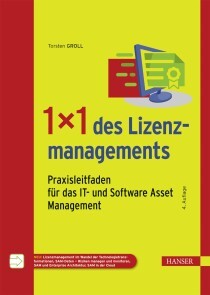
1x1 des Lizenzmanagements
- Das Standardwerk von einem erfahrenen Insider zum Thema IT- und Software Asset Management- Relevante und aktuelle Aspekte des heutigen Verwaltens von Softwarelizenzbedarfen in On-Premises und Cloud-Umgebungen- Erfahren Sie, warum SAM in der Enterprise-Architektur eine wichtige Funktion erfüllt und welche neuen Aufgaben der operative SAM-Betrieb hat.- Neu in der 4. Auflage: Transformation des Lizenzmanagements in der IT, Guideline zur Erfassung von Lizenznachweisen und Softwareverträgen, Monitoring und Management der Cyberrisiken von Software Assets, Umsetzung und Einhaltung der DSGVO im Umgang mit personenbezogenen Daten- Auf der Autorenwebsite apogiz.com: weitere Informationen zu SAM-Wissen und -Technologien, weiterführenden Seminaren und Workshops.- Ihr exklusiver Vorteil: E-Book inside beim Kauf des gedruckten BuchesUnter dem Leitsatz »Lizenzmanagement im Wandel der Technologietransformation« wurde die 4. Auflage ausführlich überarbeitet und aktualisiert. Die Transparenz der IT-Assets, ist ein wesentlicher Bestandteil für die Sicherstellung eines wirtschaftlichen und risikoarmen IT-Betriebs in Hybrid-Umgebungen. Die verstärkte Migration der lokalen IT in die Cloud erhöht die Komplexität im Verwalten von Softwarelizenzbedarfen.Zudem sind Cyberrisiken der Software Assets sowie DSGVO-Schwachstellen im IT-Betrieb risikoarm zu managen. Dadurch unterliegt das heutige SAM enormen Veränderungen. Der neue Fokus auf einen lizenzkonformen und wirtschaftlich optimierten SAM-Betrieb bewegt sich weg vom »Zählen, Messen, Wiegen« hin zu Abonnement und Verbrauchsabrechnungsmodellen. Die neuen Herausforderungen, lokale IT-Assets mit Cloud-Services im Hybrid-Modus zu verwalten und zu steuern, bedingen verstärkt ein Nutzungsmanagement statt eines Lizenzmanagements.Althergebrachte Lizenzmodelle werden immer mehr durch Sourcing- und Servicemodelle ersetzt, die eine Berücksichtigung vielfältiger Parameter im SAM-Betrieb erfordern.AUS DEM INHALT //Grundlagen des Lizenzmanagements/Der SAM-Lifecycle-Prozess als Steuerungsinstrument/Die technische und kaufmännische Bestandsaufnahme durchführen/Die Lizenznachweise erfassen: Best-Practice-Vorgehensweise/Das SAM-Projekt planen und umsetzen/Ein SAM-Tool evaluieren, implementieren, betreiben/Die SAM-Daten: Berichte erstellen und monitoren/ Die SAM-Daten: Cyberrisiken monitoren sowie DSGVO und PII-Daten managen/Die SAM-Transformationen in Server- und Cloud-Umgebungen/Der operative SAM-Betrieb: die wichtigsten Aspekte/Das Software-Audit: mögliche Risiken erkennen und managen Der SAM-Experte Torsten Groll hat über 35 Jahre Erfahrung in der IT mit Schwerpunkten im Lizenz- sowie IT- und Software Asset Management, dem Erstellen und Umsetzen von SAM-Strategien und -Prozessen und deren Verzahnung im Business Process Management von Unternehmen.Seine umfangreichen Erfahrungen gibt er auf Veranstaltungen, Kongressen, in Seminaren, Webinarenund in zahlreichen Fachartikeln weiter.

Mein SMART Board
Sie suchen nach Ideen, Tipps & Tricks und Notebook-Software für das Arbeiten mit SMART Board? Dann lesen Sie sich schlau mit Mein SMART Board. Das Buch begleitet Sie in den folgenden Unterrichtsphasen:Vorbereiten und Material erstellenAktivieren und motivierenInformationen sammeln und Strukturen erarbeitenKompetenzen üben und anwendenIdeen entwickeln und gestaltenFeedback geben und Ergebnisse sichernDas Buch enthält über 40 Unterrichtsmethoden mit Erläuterungen zur didaktischen Zielsetzung und möglichen Stolpersteinen sowie über 200 Unterrichtsideen zur erfolgreichen Einbindung des SMART Boards in den Unterricht. In einem gesonderten Kapitel geht es um das Thema Distanz-Lernen und die Produktion von Online-Videos am SMART Board.Aus dem Inhalt:SchnelleinstiegSMART Notebook zum NachschlagenKreativität und gestalterisches ArbeitenVorbereiten und Material erstellenAktivieren und MotivierenInformationen sammeln und Strukturen erarbeitenÜben und AnwendenIdeen entwickeln und gestalten/Online-Videos zum Vor- und NachbereitenLeseprobe (PDF-Link)

The Definitive Guide to Azure Data Engineering
Build efficient and scalable batch and real-time data ingestion pipelines, DevOps continuous integration and deployment pipelines, and advanced analytics solutions on the Azure Data Platform. This book teaches you to design and implement robust data engineering solutions using Data Factory, Databricks, Synapse Analytics, Snowflake, Azure SQL database, Stream Analytics, Cosmos database, and Data Lake Storage Gen2. You will learn how to engineer your use of these Azure Data Platform components for optimal performance and scalability. You will also learn to design self-service capabilities to maintain and drive the pipelines and your workloads.The approach in this book is to guide you through a hands-on, scenario-based learning process that will empower you to promote digital innovation best practices while you work through your organization’s projects, challenges, and needs. The clear examples enable you to use this book as a reference and guide for building data engineering solutions in Azure. After reading this book, you will have a far stronger skill set and confidence level in getting hands on with the Azure Data Platform.WHAT YOU WILL LEARN* Build dynamic, parameterized ELT data ingestion orchestration pipelines in Azure Data Factory* Create data ingestion pipelines that integrate control tables for self-service ELT* Implement a reusable logging framework that can be applied to multiple pipelines* Integrate Azure Data Factory pipelines with a variety of Azure data sources and tools* Transform data with Mapping Data Flows in Azure Data Factory* Apply Azure DevOps continuous integration and deployment practices to your Azure Data Factory pipelines and development SQL databases* Design and implement real-time streaming and advanced analytics solutions using Databricks, Stream Analytics, and Synapse Analytics* Get started with a variety of Azure data services through hands-on examplesWHO THIS BOOK IS FORData engineers and data architects who are interested in learning architectural and engineering best practices around ELT and ETL on the Azure Data Platform, those who are creating complex Azure data engineering projects and are searching for patterns of success, and aspiring cloud and data professionals involved in data engineering, data governance, continuous integration and deployment of DevOps practices, and advanced analytics who want a full understanding of the many different tools and technologies that Azure Data Platform providesRON L’ESTEVE is a professional author residing in Chicago, IL, USA. His passion for Azure Data Engineering stems from his deep experience with implementing, leading, and delivering Azure Data projects for numerous clients. He is a trusted architectural leader and digital innovation strategist, responsible for scaling key data architectures, defining the road map and strategy for the future of data and business intelligence (BI) needs, and challenging customers to grow by thoroughly understanding the fluid business opportunities and enabling change by translating them into high quality and sustainable technical solutions that solve the most complex business challenges and promote digital innovation and transformation. Ron has been an advocate for data excellence across industries and consulting practices, while empowering self-service data, BI, and AI through his contributions to the Microsoft technical community. IntroductionPART I. GETTING STARTED1. The Tools and Pre-Requisites2. Data Factory vs SSIS vs Databricks3. Design a Data Lake Storage Gen2 AccountPART II. AZURE DATA FACTORY FOR ELT4. Dynamically Load SQL Database to Data Lake Storage Gen 25. Use COPY INTO to Load Synapse Analytics Dedicated SQL Pool6. Load Data Lake Storage Gen2 Files into Synapse Analytics Dedicated SQL Pool7. Create and Load Synapse Analytics Dedicated SQL Pool Tables Dynamically8. Build Custom Logs in SQL Database for Pipeline Activity Metrics9. Capture Pipeline Error Logs in SQL Database10. Dynamically Load Snowflake Data Warehouse11. Mapping Data Flows for Data Warehouse ETL12. Aggregate and Transform Big Data Using Mapping Data Flows13. Incrementally Upsert Data14. Loading Excel Sheets into Azure SQL Database Tables15. Delta LakePART III. REAL-TIME ANALYTICS IN AZURE16. Stream Analytics Anomaly Detection17. Real-time IoT Analytics Using Apache Spark18. Azure Synapse Link for Cosmos DBPART IV. DEVOPS FOR CONTINUOUS INTEGRATION AND DEPLOYMENT19. Deploy Data Factory Changes20. Deploy SQL DatabasePART V. ADVANCED ANALYTICS21. Graph Analytics Using Apache Spark’s GraphFrame API22. Synapse Analytics Workspaces23. Machine Learning in DatabricksPART VI. DATA GOVERNANCE24. Purview for Data Governance
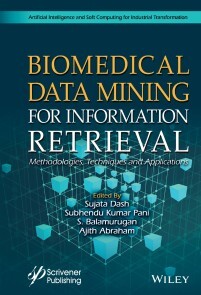
Biomedical Data Mining for Information Retrieval
BIOMEDICAL DATA MINING FOR INFORMATION RETRIEVALTHIS BOOK NOT ONLY EMPHASIZES TRADITIONAL COMPUTATIONAL TECHNIQUES, BUT DISCUSSES DATA MINING, BIOMEDICAL IMAGE PROCESSING, INFORMATION RETRIEVAL WITH BROAD COVERAGE OF BASIC SCIENTIFIC APPLICATIONS.Biomedical Data Mining for Information Retrieval comprehensively covers the topic of mining biomedical text, images and visual features towards information retrieval. Biomedical and health informatics is an emerging field of research at the intersection of information science, computer science, and healthcare and brings tremendous opportunities and challenges due to easily available and abundant biomedical data for further analysis. The aim of healthcare informatics is to ensure the high-quality, efficient healthcare, better treatment and quality of life by analyzing biomedical and healthcare data including patient’s data, electronic health records (EHRs) and lifestyle. Previously, it was a common requirement to have a domain expert to develop a model for biomedical or healthcare; however, recent advancements in representation learning algorithms allows us to automatically to develop the model. Biomedical image mining, a novel research area, due to the vast amount of available biomedical images, increasingly generates and stores digitally. These images are mainly in the form of computed tomography (CT), X-ray, nuclear medicine imaging (PET, SPECT), magnetic resonance imaging (MRI) and ultrasound. Patients’ biomedical images can be digitized using data mining techniques and may help in answering several important and critical questions relating to healthcare. Image mining in medicine can help to uncover new relationships between data and reveal new useful information that can be helpful for doctors in treating their patients. AUDIENCEResearchers in various fields including computer science, medical informatics, healthcare IOT, artificial intelligence, machine learning, image processing, clinical big data analytics. SUJATA DASH received her PhD in Computational Modeling from Berhampur University, Orissa, India in 1995. She is an associate professor in P.G. Department of Computer Science & Application, North Orissa University, at Baripada, India. She has published more than 80 technical papers in international journals, conferences, book chapters and has authored 5 books. SUBHENDU KUMAR Pani received his PhD from Utkal University Odisha, India in 2013. He is working as Professor in the Krupajal Computer Academy, BPUT, Odisha, India. S. BALAMURUGAN is the Director-Research and Development, Intelligent Research Consultancy Services(iRCS), Coimbatore, Tamilnadu, India. His PhD is in Infomation Technology and he has published 45 books, 200+ international journals/conferences and 35 patents. AJITH ABRAHAM received PhD in Computer Science from Monash University, Melbourne, Australia in 2001. He is Director of Machine Intelligence Research Labs (MIR Labs) which has members from 100+ countries. Ajith’s research experience includes over 30 years in the industry and academia. He has authored / co-authored over 1300+ publications (with colleagues from nearly 40 countries) and has an h-index of 86+. Preface xv1 MORTALITY PREDICTION OF ICU PATIENTS USING MACHINE LEARNING TECHNIQUES 1Babita Majhi, Aarti Kashyap and Ritanjali Majhi1.1 Introduction 21.2 Review of Literature 31.3 Materials and Methods 81.3.1 Dataset 81.3.2 Data Pre-Processing 81.3.3 Normalization 81.3.4 Mortality Prediction 101.3.5 Model Description and Development 111.4 Result and Discussion 151.5 Conclusion 161.6 Future Work 16References 172 ARTIFICIAL INTELLIGENCE IN BIOINFORMATICS 21V. Samuel Raj, Anjali Priyadarshini, Manoj Kumar Yadav, Ramendra Pati Pandey, Archana Gupta and Arpana Vibhuti2.1 Introduction 212.2 Recent Trends in the Field of AI in Bioinformatics 222.2.1 DNA Sequencing and Gene Prediction Using Deep Learning 242.3 Data Management and Information Extraction 262.4 Gene Expression Analysis 262.4.1 Approaches for Analysis of Gene Expression 272.4.2 Applications of Gene Expression Analysis 292.5 Role of Computation in Protein Structure Prediction 302.6 Application in Protein Folding Prediction 312.7 Role of Artificial Intelligence in Computer-Aided Drug Design 382.8 Conclusions 42References 433 PREDICTIVE ANALYSIS IN HEALTHCARE USING FEATURE SELECTION 53Aneri Acharya, Jitali Patel and Jigna Patel3.1 Introduction 543.1.1 Overview and Statistics About the Disease 543.1.1.1 Diabetes 543.1.1.2 Hepatitis 553.1.2 Overview of the Experiment Carried Out 563.2 Literature Review 583.2.1 Summary 583.2.2 Comparison of Papers for Diabetes and Hepatitis Dataset 613.3 Dataset Description 703.3.1 Diabetes Dataset 703.3.2 Hepatitis Dataset 713.4 Feature Selection 733.4.1 Importance of Feature Selection 743.4.2 Difference Between Feature Selection, Feature Extraction and Dimensionality Reduction 743.4.3 Why Traditional Feature Selection Techniques Still Holds True? 753.4.4 Advantages and Disadvantages of Feature Selection Technique 763.4.4.1 Advantages 763.4.4.2 Disadvantage 763.5 Feature Selection Methods 763.5.1 Filter Method 763.5.1.1 Basic Filter Methods 773.5.1.2 Correlation Filter Methods 773.5.1.3 Statistical & Ranking Filter Methods 783.5.1.4 Advantages and Disadvantages of Filter Method 803.5.2 Wrapper Method 803.5.2.1 Advantages and Disadvantages of Wrapper Method 823.5.2.2 Difference Between Filter Method and Wrapper Method 823.6 Methodology 843.6.1 Steps Performed 843.6.2 Flowchart 843.7 Experimental Results and Analysis 853.7.1 Task 1—Application of Four Machine Learning Models 853.7.2 Task 2—Applying Ensemble Learning Algorithms 863.7.3 Task 3—Applying Feature Selection Techniques 873.7.4 Task 4—Appling Data Balancing Technique 943.8 Conclusion 96References 994 HEALTHCARE 4.0: AN INSIGHT OF ARCHITECTURE, SECURITY REQUIREMENTS, PILLARS AND APPLICATIONS 103Deepanshu Bajaj, Bharat Bhushan and Divya Yadav4.1 Introduction 1044.2 Basic Architecture and Components of e-Health Architecture 1054.2.1 Front End Layer 1064.2.2 Communication Layer 1074.2.3 Back End Layer 1074.3 Security Requirements in Healthcare 4.0 1084.3.1 Mutual-Authentications 1094.3.2 Anonymity 1104.3.3 Un-Traceability 1114.3.4 Perfect—Forward—Secrecy 1114.3.5 Attack Resistance 1114.3.5.1 Replay Attack 1114.3.5.2 Spoofing Attack 1124.3.5.3 Modification Attack 1124.3.5.4 MITM Attack 1124.3.5.5 Impersonation Attack 1124.4 ICT Pillar’s Associated With HC4.0 1134.4.1 IoT in Healthcare 4.0 1144.4.2 Cloud Computing (CC) in Healthcare 4.0 1154.4.3 Fog Computing (FC) in Healthcare 4.0 1164.4.4 BigData (BD) in Healthcare 4.0 1174.4.5 Machine Learning (ML) in Healthcare 4.0 1184.4.6 Blockchain (BC) in Healthcare 4.0 1204.5 Healthcare 4.0’s Applications-Scenarios 1214.5.1 Monitor-Physical and Pathological Related Signals 1214.5.2 Self-Management, and Wellbeing Monitor, and its Precaution 1244.5.3 Medication Consumption Monitoring and Smart-Pharmaceutics 1244.5.4 Personalized (or Customized) Healthcare 1254.5.5 Cloud-Related Medical Information’s Systems 1254.5.6 Rehabilitation 1264.6 Conclusion 126References 1275 IMPROVED SOCIAL MEDIA DATA MINING FOR ANALYZING MEDICAL TRENDS 131Minakshi Sharma and Sunil Sharma5.1 Introduction 1325.1.1 Data Mining 1325.1.2 Major Components of Data Mining 1325.1.3 Social Media Mining 1345.1.4 Clustering in Data Mining 1345.2 Literature Survey 1365.3 Basic Data Mining Clustering Technique 1405.3.1 Classifier and Their Algorithms in Data Mining 1435.4 Research Methodology 1475.5 Results and Discussion 1515.5.1 Tool Description 1515.5.2 Implementation Results 1525.5.3 Comparison Graphs Performance Comparison 1565.6 Conclusion & Future Scope 157References 1586 BIOINFORMATICS: AN IMPORTANT TOOL IN ONCOLOGY 163Gaganpreet Kaur, Saurabh Gupta, Gagandeep Kaur, Manju Verma and Pawandeep Kaur6.1 Introduction 1646.2 Cancer—A Brief Introduction 1656.2.1 Types of Cancer 1666.2.2 Development of Cancer 1666.2.3 Properties of Cancer Cells 1666.2.4 Causes of Cancer 1686.3 Bioinformatics—A Brief Introduction 1696.4 Bioinformatics—A Boon for Cancer Research 1706.5 Applications of Bioinformatics Approaches in Cancer 1746.5.1 Biomarkers: A Paramount Tool for Cancer Research 1756.5.2 Comparative Genomic Hybridization for Cancer Research 1776.5.3 Next-Generation Sequencing 1786.5.4 miRNA 1796.5.5 Microarray Technology 1816.5.6 Proteomics-Based Bioinformatics Techniques 1856.5.7 Expressed Sequence Tags (EST) and Serial Analysis of Gene Expression (SAGE) 1876.6 Bioinformatics: A New Hope for Cancer Therapeutics 1886.7 Conclusion 191References 1927 BIOMEDICAL BIG DATA ANALYTICS USING IOT IN HEALTH INFORMATICS 197Pawan Singh Gangwar and Yasha Hasija7.1 Introduction 1987.2 Biomedical Big Data 2007.2.1 Big EHR Data 2017.2.2 Medical Imaging Data 2017.2.3 Clinical Text Mining Data 2017.2.4 Big OMICs Data 2027.3 Healthcare Internet of Things (IoT) 2027.3.1 IoT Architecture 2027.3.2 IoT Data Source 2047.3.2.1 IoT Hardware 2047.3.2.2 IoT Middleware 2057.3.2.3 IoT Presentation 2057.3.2.4 IoT Software 2057.3.2.5 IoT Protocols 2067.4 Studies Related to Big Data Analytics in Healthcare IoT 2067.5 Challenges for Medical IoT & Big Data in Healthcare 2097.6 Conclusion 210References 2108 STATISTICAL IMAGE ANALYSIS OF DRYING BOVINE SERUM ALBUMIN DROPLETS IN PHOSPHATE BUFFERED SALINE 213Anusuya Pal, Amalesh Gope and Germano S. Iannacchione8.1 Introduction 2148.2 Experimental Methods 2168.3 Results 2178.3.1 Temporal Study of the Drying Droplets 2178.3.2 FOS Characterization of the Drying Evolution 2198.3.3 GLCM Characterization of the Drying Evolution 2208.4 Discussions 2248.4.1 Qualitative Analysis of the Drying Droplets and the Dried Films 2248.4.2 Quantitative Analysis of the Drying Droplets and the Dried Films 2278.5 Conclusions 231Acknowledgments 232References 2329 INTRODUCTION TO DEEP LEARNING IN HEALTH INFORMATICS 237Monika Jyotiyana and Nishtha Kesswani9.1 Introduction 2379.1.1 Machine Learning v/s Deep Learning 2409.1.2 Neural Networks and Deep Learning 2419.1.3 Deep Learning Architecture 2429.1.3.1 Deep Neural Networks 2439.1.3.2 Convolutional Neural Networks 2439.1.3.3 Deep Belief Networks 2449.1.3.4 Recurrent Neural Networks 2449.1.3.5 Deep Auto-Encoder 2459.1.4 Applications 2469.2 Deep Learning in Health Informatics 2469.2.1 Medical Imaging 2469.2.1.1 CNN v/s Medical Imaging 2479.2.1.2 Tissue Classification 2479.2.1.3 Cell Clustering 2479.2.1.4 Tumor Detection 2479.2.1.5 Brain Tissue Classification 2489.2.1.6 Organ Segmentation 2489.2.1.7 Alzheimer’s and Other NDD Diagnosis 2489.3 Medical Informatics 2499.3.1 Data Mining 2499.3.2 Prediction of Disease 2499.3.3 Human Behavior Monitoring 2509.4 Bioinformatics 2509.4.1 Cancer Diagnosis 2509.4.2 Gene Variants 2519.4.3 Gene Classification or Gene Selection 2519.4.4 Compound–Protein Interaction 2519.4.5 DNA–RNA Sequences 2529.4.6 Drug Designing 2529.5 Pervasive Sensing 2529.5.1 Human Activity Monitoring 2539.5.2 Anomaly Detection 2539.5.3 Biological Parameter Monitoring 2539.5.4 Hand Gesture Recognition 2539.5.5 Sign Language Recognition 2549.5.6 Food Intake 2549.5.7 Energy Expenditure 2549.5.8 Obstacle Detection 2549.6 Public Health 2559.6.1 Lifestyle Diseases 2559.6.2 Predicting Demographic Information 2569.6.3 Air Pollutant Prediction 2569.6.4 Infectious Disease Epidemics 2579.7 Deep Learning Limitations and Challenges in Health Informatics 257References 25810 DATA MINING TECHNIQUES AND ALGORITHMS IN PSYCHIATRIC HEALTH: A SYSTEMATIC REVIEW 263Shikha Gupta, Nitish Mehndiratta, Swarnim Sinha, Sangana Chaturvedi and Mehak Singla10.1 Introduction 26310.2 Techniques and Algorithms Applied 26510.3 Analysis of Major Health Disorders Through Different Techniques 26710.3.1 Alzheimer 26710.3.2 Dementia 26810.3.3 Depression 27410.3.4 Schizophrenia and Bipolar Disorders 28110.4 Conclusion 285References 28611 DEEP LEARNING APPLICATIONS IN MEDICAL IMAGE ANALYSIS 293Ananya Singha, Rini Smita Thakur and Tushar Patel11.1 Introduction 29411.1.1 Medical Imaging 29511.1.2 Artificial Intelligence and Deep Learning 29611.1.3 Processing in Medical Images 30011.2 Deep Learning Models and its Classification 30311.2.1 Supervised Learning 30311.2.1.1 RNN (Recurrent Neural Network) 30311.2.2 Unsupervised Learning 30411.2.2.1 Stacked Auto Encoder (SAE) 30411.2.2.2 Deep Belief Network (DBN) 30611.2.2.3 Deep Boltzmann Machine (DBM) 30711.2.2.4 Generative Adversarial Network (GAN) 30811.3 Convolutional Neural Networks (CNN)—A Popular Supervised Deep Model 30911.3.1 Architecture of CNN 31011.3.2 Learning of CNNs 31311.3.3 Medical Image Denoising using CNNs 31411.3.4 Medical Image Classification Using CNN 31611.4 Deep Learning Advancements—A Biological Overview 31711.4.1 Sub-Cellular Level 31711.4.2 Cellular Level 31911.4.3 Tissue Level 32311.4.4 Organ Level 32611.4.4.1 The Brain and Neural System 32611.4.4.2 Sensory Organs—The Eye and Ear 32911.4.4.3 Thoracic Cavity 33011.4.4.4 Abdomen and Gastrointestinal (GI) Track 33111.4.4.5 Other Miscellaneous Applications 33211.5 Conclusion and Discussion 335References 33612 ROLE OF MEDICAL IMAGE ANALYSIS IN ONCOLOGY 351Gaganpreet Kaur, Hardik Garg, Kumari Heena, Lakhvir Singh, Navroz Kaur, Shubham Kumar and Shadab Alam12.1 Introduction 35212.2 Cancer 35312.2.1 Types of Cancer 35412.2.2 Causes of Cancer 35512.2.3 Stages of Cancer 35512.2.4 Prognosis 35612.3 Medical Imaging 35712.3.1 Anatomical Imaging 35712.3.2 Functional Imaging 35812.3.3 Molecular Imaging 35812.4 Diagnostic Approaches for Cancer 35812.4.1 Conventional Approaches 35812.4.1.1 Laboratory Diagnostic Techniques 35912.4.1.2 Tumor Biopsies 35912.4.1.3 Endoscopic Exams 36012.4.2 Modern Approaches 36112.4.2.1 Image Processing 36112.4.2.2 Implications of Advanced Techniques 36212.4.2.3 Imaging Techniques 36312.5 Conclusion 375References 37613 A COMPARATIVE ANALYSIS OF CLASSIFIERS USING PARTICLE SWARM OPTIMIZATION-BASED FEATURE SELECTION 383Chandra Sekhar Biswal, Subhendu Kumar Pani and Sujata Dash13.1 Introduction 38413.2 Feature Selection for Classification 38513.2.1 An Overview: Data Mining 38513.2.2 Classification Prediction 38713.2.3 Dimensionality Reduction 38713.2.4 Techniques of Feature Selection 38813.2.5 Feature Selection: A Survey 39213.2.6 Summary 39413.3 Use of WEKA Tool 39513.3.1 WEKA Tool 39513.3.2 Classifier Selection 39513.3.3 Feature Selection Algorithms in WEKA 39513.3.4 Performance Measure 39613.3.5 Dataset Description 39813.3.6 Experiment Design 39813.3.7 Results Analysis 39913.3.8 Summary 40113.4 Conclusion and Future Work 40113.4.1 Summary of the Work 40113.4.2 Research Challenges 40213.4.3 Future Work 404References 404Index 409

The Trouble With Sharing
PEER-TO-PEER EXCHANGE IS A TYPE OF SHARING THAT INVOLVES THE TRANSFER OF VALUED RESOURCES, SUCH AS GOODS AND SERVICES, AMONG MEMBERS OF A LOCAL COMMUNITY AND/OR BETWEEN PARTIES WHO HAVE NOT MET BEFORE THE EXCHANGE ENCOUNTER. It involves online systems that allow strangers to exchange in ways that were previously confined to the realm of kinship and friendship. Through the examples in this book, we encounter attempts to foster the sharing of goods and services in local communities and consider the intricacies of sharing homes temporarily with strangers (also referred to as hospitality exchange or network hospitality). Some of the exchange arrangements discussed involve money while others explicitly ban participants from using it. All rely on digital technologies, but the trickiest challenges have more to do with social interaction than technical features. This book explores what makes peer-to-peer exchange challenging, with an emphasis on reciprocity, closeness, and participation: How should we reciprocate? How might we manage interactions with those we encounter to attain some closeness but not too much? What keeps people from getting involved or draws them into exchange activities that they would rather avoid?This book adds to the growing body of research on exchange platforms and the sharing economy. It provides empirical examples and conceptual grounding for thinking about interpersonal challenges in peer-to-peer exchange and the efforts that are required for exchange arrangements to flourish. It offers inspiration for how we might think and design differently to better understand and support the efforts of those involved in peer-to-peer exchange. While the issues cannot be simply “solved” by technology, it matters which digital tools an exchange arrangement relies on, and even seemingly small design decisions can have a significant impact on what it is like to participate in exchange processes. The technologies that support exchange arrangements—often platforms of some sort—can be driven by differing sets of values and commitments. This book invites students and scholars in the Human–Computer Interaction community, and beyond, to envision and design alternative exchange arrangements and future economies.* Preface* Acknowledgments* Introduction* Situating the Sharing Economy* What Do We Talk About When We Talk About the Sharing Economy?* Reciprocity and Indebtedness* Closeness and Intimacy* Participation and Inclusion* Future Direction* Epilogue* References* Author Biography

Spektrum Kompakt- Algorithmen im Alltag
Algorithmen, die unser Leben beeinfussen, sind längst keine Zukunftsmusik mehr, sondern stecken überall tief in unserem Alltag. Sie unterstützen Ärztinnen und Ärzte bei der Diagnose, lassen die Vergangenheit bunt werden und Personen in Kinoflmen auftauchen, die gar nicht am Dreh waren. Im Hochleistungssport verraten sie, ob und warum sich Athleten und Athletinnen verletzen könnten und leiten uns mehr oder weniger offen durch digitale Welten - was entsprechende Sorgen vor unbewusster Manipulation weckt. Ein Kompakt rund um programmierte Helfer im Hintergrund.

Designing and Building Enterprise Knowledge Graphs
This book is a guide to designing and building knowledge graphs from enterprise relational databases in practice. It presents a principled framework centered on mapping patterns to connect relational databases with knowledge graphs, the roles within an organization responsible for the knowledge graph, and the process that combines data and people. The content of this book is applicable to knowledge graphs being built either with property graph or RDF graph technologies. Knowledge graphs are fulfilling the vision of creating intelligent systems that integrate knowledge and data at large scale. Tech giants have adopted knowledge graphs for the foundation of next-generation enterprise data and metadata management, search, recommendation, analytics, intelligent agents, and more. We are now observing an increasing number of enterprises that seek to adopt knowledge graphs to develop a competitive edge. In order for enterprises to design and build knowledge graphs, they need to understand the critical data stored in relational databases. How can enterprises successfully adopt knowledge graphs to integrate data and knowledge, without boiling the ocean? This book provides the answers. * Preface * Foreword by an Anonymous CDO * Foreword by Tom Plasterer * Acknowledgments * Disclaimer * Introduction * Designing Enterprise Knowledge Graphs * Mapping Design Patterns * Building Enterprise Knowledge Graphs * What's Next? * Conclusions * Bibliography * Authors' Biographies

CASP+ CompTIA Advanced Security Practitioner Practice Tests
PREPARE FOR SUCCESS ON THE CHALLENGING CASP+ CAS-004 EXAMIn the newly updated Second Edition of CASP+ CompTIA Advanced Security Practitioner Practice Tests Exam CAS-004, accomplished cybersecurity expert Nadean Tanner delivers an extensive collection of CASP+ preparation materials, including hundreds of domain-by-domain test questions and two additional practice exams.Prepare for the new CAS-004 exam, as well as a new career in advanced cybersecurity, with Sybex’s proven approach to certification success. You’ll get ready for the exam, to impress your next interviewer, and excel at your first cybersecurity job.This book includes:* Comprehensive coverage of all exam CAS-004 objective domains, including security architecture, operations, engineering, cryptography, and governance, risk, and compliance * In-depth preparation for test success with 1000 practice exam questions * Access to the Sybex interactive learning environment and online test bank Perfect for anyone studying for the CASP+ Exam CAS-004, CASP+ CompTIA Advanced Security Practitioner Practice Tests Exam CAS-004 is also an ideal resource for anyone with IT security experience who seeks to brush up on their skillset or seek a valuable new CASP+ certification.NADEAN H. TANNER, CASP+, CISSP, MCSA, ITILV3, has worked in technology for more than 20 years, learning about every aspect of the field as a marketer, trainer, web developer, and hardware technician. She has served as an IT director and technology instructor at the postgraduate level, and has been a cybersecurity trainer and consultant for Fortune 500 companies as well as for the U.S. Department of Defense.Introduction xixChapter 1 Security Architecture 1Chapter 2 Security Operations 61Chapter 3 Security Engineering and Cryptography 123Chapter 4 Governance, Risk, and Compliance 175Chapter 5 Practice Test 1 207Chapter 6 Practice Test 2 227Appendix Answers to Review Questions 247Chapter 1: Security Architecture 248Chapter 2: Security Operations 278Chapter 3: Security Engineering and Cryptography 308Chapter 4: Governance, Risk, and Compliance 333Chapter 5: Practice Test 1 346Chapter 6: Practice Test 2 353Index 363

Unmanned Aerial Vehicles for Internet of Things (IoT)
UNMANNED AERIAL VEHICLES FOR INTERNET OF THINGSTHIS COMPREHENSIVE BOOK DEEPLY DISCUSSES THE THEORETICAL AND TECHNICAL ISSUES OF UNMANNED AERIAL VEHICLES FOR DEPLOYMENT BY INDUSTRIES AND CIVIL AUTHORITIES IN INTERNET OF THINGS (IOT) SYSTEMS. Unmanned aerial vehicles (UAVs) has become one of the rapidly growing areas of technology, with widespread applications covering various domains. UAVs play a very important role in delivering Internet of Things (IoT) services in small and low-power devices such as sensors, cameras, GPS receivers, etc. These devices are energy-constrained and are unable to communicate over long distances. The UAVs work dynamically for IoT applications in which they collect data and transmit it to other devices that are out of communication range. Furthermore, the benefits of the UAV include deployment at remote locations, the ability to carry flexible payloads, reprogrammability during tasks, and the ability to sense for anything from anywhere. Using IoT technologies, a UAV may be observed as a terminal device connected with the ubiquitous network, where many other UAVs are communicating, navigating, controlling, and surveilling in real time and beyond line-of-sight. The aim of the 15 chapters in this book help to realize the full potential of UAVs for the IoT by addressing its numerous concepts, issues and challenges, and develops conceptual and technological solutions for handling them. Applications include such fields as disaster management, structural inspection, goods delivery, transportation, localization, mapping, pollution and radiation monitoring, search and rescue, farming, etc. In addition, the book covers:* Efficient energy management systems in UAV-based IoT networks* IoE enabled UAVs* Mind-controlled UAV using Brain-Computer Interface (BCI)* The importance of AI in realizing autonomous and intelligent flying IoT* Blockchain-based solutions for various security issues in UAV-enabled IoT* The challenges and threats of UAVs such as hijacking, privacy, cyber-security, and physical safety.AUDIENCE: Researchers in computer science, Internet of Things (IoT), electronics engineering, as well as industries that use and deploy drones and other unmanned aerial vehicles. VANDANA MOHINDRU PhD is an assistant professor in the Department of Computer Science and Engineering, Chandigarh Group of Colleges, Mohali, Punjab, India. Her research interests are in the areas of Internet of Things, wireless sensor networks, security, blockchain and cryptography, unmanned aerial vehicles. She has published more than 20 technical research papers in leading journals and conferences.YASHWANT SINGH PhD is an associate professor & Head in the Department of Computer Science & Information Technology at the Central University of Jammu. His research interests lie in the area of Internet of Things, wireless sensor networks, unmanned aerial vehicles, cybersecurity. He has published more than 70 research articles in the international journals and conferences. RAVINDARA BHATT PhD is an assistant professor at Jaypee University of Information Technology, Solan, H.P., India. He has over 20 years of experience in academics and industry in India. He has published more than 30 research papers in leading journals and conferences. His areas of research include sensor networks, deployment modeling, communication, and energy-efficient algorithms, security and unmanned aerial vehicles. ANUJ KUMAR GUPTA PhD is professor & Head in CSE at Chandigarh Group of Colleges, Mohali, Punjab, India. He has published 100+ research papers in reputed journals. Preface xvii1 UNMANNED AERIAL VEHICLE (UAV): A COMPREHENSIVE SURVEY 1Rohit Chaurasia and Vandana Mohindru1.1 Introduction 21.2 Related Work 21.3 UAV Technology 31.3.1 UAV Platforms 31.3.1.1 Fixed-Wing Drones 31.3.1.2 Multi-Rotor Drones 41.3.1.3 Single-Rotor Drones 51.3.1.4 Fixed-Wing Hybrid VTOL 61.3.2 Categories of the Military Drones 61.3.3 How Drones Work 81.3.3.1 Firmware—Platform Construction and Design 91.3.4 Comparison of Various Technologies 101.3.4.1 Drone Types & Sizes 101.3.4.2 Radar Positioning and Return to Home 101.3.4.3 GNSS on Ground Control Station 111.3.4.4 Collision Avoidance Technology and Obstacle Detection 111.3.4.5 Gyroscopic Stabilization, Flight Controllers and IMU 121.3.4.6 UAV Drone Propulsion System 121.3.4.7 Flight Parameters Through Telemetry 131.3.4.8 Drone Security & Hacking 131.3.4.9 3D Maps and Models With Drone Sensors 131.3.5 UAV Communication Network 151.3.5.1 Classification on the Basis of Spectrum Perspective 151.3.5.2 Various Types of Radio communication Links 161.3.5.3 VLOS (Visual Line-of-Sight) and BLOS (Beyond Line-of-Sight) Communication in Unmanned Aircraft System 181.3.5.4 Frequency Bands for the Operation of UAS 191.3.5.5 Cellular Technology for UAS Operation 191.4 Application of UAV 211.4.1 In Military 211.4.2 In Geomorphological Mapping and Other Similar Sectors 221.4.3 In Agriculture 221.5 UAV Challenges 231.6 Conclusion and Future Scope 24References 242 UNMANNED AERIAL VEHICLES: STATE-OF-THE-ART, CHALLENGES AND FUTURE SCOPE 29Jolly Parikh and Anuradha Basu2.1 Introduction 302.2 Technical Challenges 302.2.1 Variations in Channel Characteristics 322.2.2 UAV-Assisted Cellular Network Planning and Provisioning 332.2.3 Millimeter Wave Cellular Connected UAVs 342.2.4 Deployment of UAV 352.2.5 Trajectory Optimization 362.2.6 On-Board Energy 372.3 Conclusion 37References 373 BATTERY AND ENERGY MANAGEMENT IN UAV-BASED NETWORKS 43Santosh Kumar, Amol Vasudeva and Manu Sood3.1 Introduction 433.2 The Need for Energy Management in UAV-Based Communication Networks 453.2.1 Unpredictable Trajectories of UAVs in Cellular UAV Networks 463.2.2 Non-Homogeneous Power Consumption 473.2.3 High Bandwidth Requirement/Low Spectrum Availability/Spectrum Scarcity 473.2.4 Short-Range Line-of-Sight Communication 483.2.5 Time Constraint (Time-Limited Spectrum Access) 483.2.6 Energy Constraint 493.2.7 The Joint Design for the Sensor Nodes’ Wake-Up Schedule and the UAV’s Trajectory (Data Collection) 493.3 Efficient Battery and Energy Management Proposed Techniques in Literature 503.3.1 Cognitive Radio (CR)-Based UAV Communication to Solve Spectrum Congestion 513.3.2 Compressed Sensing 523.3.3 Power Allocation and Position Optimization 533.3.4 Non-Orthogonal Multiple Access (NOMA) 533.3.5 Wireless Charging/Power Transfer (WPT) 543.3.6 UAV Trajectory Design Using a Reinforcement Learning Framework in a Decentralized Manner 553.3.7 Efficient Deployment and Movement of UAVs 553.3.8 3D Position Optimization Mixed With Resource Allocation to Overcome Spectrum Scarcity and Limited Energy Constraint 563.3.9 UAV-Enabled WSN: Energy-Efficient Data Collection 573.3.10 Trust Management 573.3.11 Self-Organization-Based Clustering 583.3.12 Bandwidth/Spectrum-Sharing Between UAVs 593.3.13 Using Millimeter Wave With SWIPT 593.3.14 Energy Harvesting 603.4 Conclusion 61References 674 ENERGY EFFICIENT COMMUNICATION METHODS FOR UNMANNED ARIEL VEHICLES (UAVS): LAST FIVE YEARS’ STUDY 73Nagesh Kumar4.1 Introduction 734.1.1 Introduction to UAV 744.1.2 Communication in UAV 754.2 Literature Survey Process 774.2.1 Research Questions 774.2.2 Information Source 774.3 Routing in UAV 784.3.1 Communication Methods in UAV 784.3.1.1 Single-Hop Communication 794.3.1.2 Multi-Hop Communication 804.4 Challenges and Issues 824.4.1 Energy Consumption 824.4.2 Mobility of Devices 824.4.3 Density of UAVs 824.4.4 Changes in Topology 854.4.5 Propagation Models 854.4.6 Security in Routing 854.5 Conclusion 85References 865 A REVIEW ON CHALLENGES AND THREATS TO UNMANNED AERIAL VEHICLES (UAVS) 89Shaik Johny Basha and Jagan Mohan Reddy Danda5.1 Introduction 895.2 Applications of UAVs and Their Market Opportunity 905.2.1 Applications 905.2.2 Market Opportunity 925.3 Attacks and Solutions to Unmanned Aerial Vehicles (UAVs) 925.3.1 Confidentiality Attacks 935.3.2 Integrity Attacks 955.3.3 Availability Attacks 965.3.4 Authenticity Attacks 975.4 Research Challenges 995.4.1 Security Concerns 995.4.2 Safety Concerns 995.4.3 Privacy Concerns 1005.4.4 Scalability Issues 1005.4.5 Limited Resources 1005.5 Conclusion 101References 1016 INTERNET OF THINGS AND UAV: AN INTEROPERABILITY PERSPECTIVE 105Bharti Rana and Yashwant Singh6.1 Introduction 1066.2 Background 1086.2.1 Issues, Controversies, and Problems 1096.3 Internet of Things (IoT) and UAV 1106.4 Applications of UAV-Enabled IoT 1136.5 Research Issues in UAV-Enabled IoT 1146.6 High-Level UAV-Based IoT Architecture 1176.6.1 UAV Overview 1176.6.2 Enabling IoT Scalability 1196.6.3 Enabling IoT Intelligence 1206.6.4 Enabling Diverse IoT Applications 1216.7 Interoperability Issues in UAV-Based IoT 1216.8 Conclusion 123References 1247 PRACTICES OF UNMANNED AERIAL VEHICLE (UAV) FOR SECURITY INTELLIGENCE 129Swarnjeet Kaur, Kulwant Singh and Amanpreet Singh7.1 Introduction 1307.2 Military 1327.3 Attack 1337.4 Journalism 1347.5 Search and Rescue 1367.6 Disaster Relief 1387.7 Conclusion 139References 1398 BLOCKCHAIN-BASED SOLUTIONS FOR VARIOUS SECURITY ISSUES IN UAV-ENABLED IOT 143Madhuri S. Wakode and Rajesh B. Ingle8.1 Introduction 1448.1.1 Organization of the Work 1458.2 Introduction to UAV and IoT 1458.2.1 UAV 1458.2.2 IoT 1468.2.3 UAV-Enabled IoT 1478.2.4 Blockchain 1508.3 Security and Privacy Issues in UAV-Enabled IoT 1518.4 Blockchain-Based Solutions to Various Security Issues 1538.5 Research Directions 1548.6 Conclusion 1548.7 Future Work 155References 1559 EFFICIENT ENERGY MANAGEMENT SYSTEMS IN UAV-BASED IOT NETWORKS 159V. Mounika Reddy, Neelima K. and G. Naresh9.1 Introduction 1609.2 Energy Harvesting Methods 1619.2.1 Basic Energy Harvesting Mechanisms 1629.2.2 Markov Decision Process-Based Energy Harvesting Mechanisms 1639.2.3 mm Wave Energy Harvesting Mechanism 1649.2.4 Full Duplex Wireless Energy Harvesting Mechanism 1659.3 Energy Recharge Methods 1659.4 Efficient Energy Utilization Methods 1669.4.1 GLRM Method 1669.4.2 DRL Mechanism 1679.4.3 Onboard Double Q-Learning Mechanism 1689.4.4 Collision-Free Scheduling Mechanism 1689.5 Conclusion 170References 17010 A SURVEY ON IOE-ENABLED UNMANNED AERIAL VEHICLES 173K. Siddharthraju, R. Dhivyadevi, M. Supriya, B. Jaishankar and Shanmugaraja T.10.1 Introduction 17410.2 Overview of Internet of Everything 17610.2.1 Emergence of IoE 17610.2.2 Expectation of IoE 17710.2.2.1 Scalability 17710.2.2.2 Intelligence 17810.2.2.3 Diversity 17810.2.3 Possible Technologies 17910.2.3.1 Enabling Scalability 17910.2.3.2 Enabling Intelligence 18010.2.3.3 Enabling Diversity 18010.2.4 Challenges of IoE 18110.2.4.1 Coverage Constraint 18110.2.4.2 Battery Constraint 18110.2.4.3 Computing Constraint 18110.2.4.4 Security Constraint 18210.3 Overview of Unmanned Aerial Vehicle (UAV) 18210.3.1 Unmanned Aircraft System (UAS) 18310.3.2 UAV Communication Networks 18310.3.2.1 Ad Hoc Multi-UAV Networks 18310.3.2.2 UAV-Aided Communication Networks 18410.4 UAV and IoE Integration 18410.4.1 Possibilities to Carry UAVs 18410.4.1.1 Widespread Connectivity 18510.4.1.2 Environmentally Aware 18510.4.1.3 Peer-Maintenance of Communications 18510.4.1.4 Detector Control and Reusing 18510.4.2 UAV-Enabled IoE 18610.4.3 Vehicle Detection Enabled IoE Optimization 18610.4.3.1 Weak-Connected Locations 18610.4.3.2 Regions with Low Network Support 18610.5 Open Research Issues 18710.6 Discussion 18710.6.1 Resource Allocation 18710.6.2 Universal Standard Design 18810.6.3 Security Mechanism 18810.7 Conclusion 189References 18911 ROLE OF AI AND BIG DATA ANALYTICS IN UAV-ENABLED IOT APPLICATIONS FOR SMART CITIES 193Madhuri S. Wakode11.1 Introduction 19411.1.1 Related Work 19511.1.2 Contributions 19511.1.3 Organization of the Work 19511.2 Overview of UAV-Enabled IoT Systems 19611.2.1 UAV-Enabled IoT Systems for Smart Cities 19711.3 Overview of Big Data Analytics 19711.4 Big Data Analytics Requirements in UAV-Enabled IoT Systems 19811.4.1 Big Data Analytics in UAV-Enabled IoT Applications 19911.4.2 Big Data Analytics for Governance of UAV-Enabled IoT Systems 20111.5 Challenges 20211.6 Conclusion 20211.7 Future Work 203References 20312 DESIGN AND DEVELOPMENT OF MODULAR AND MULTIFUNCTIONAL UAV WITH AMPHIBIOUS LANDING, PROCESSING AND SURROUND SENSE MODULE 207Lakshit Kohli, Manglesh Saurabh, Ishaan Bhatia, Nidhi Sindhwani and Manjula Vijh12.1 Introduction 20812.2 Existing System 20812.3 Proposed System 21012.4 IoT Sensors and Architecture 21212.4.1 Sensors and Theory 21212.4.2 Architectures Available 21312.4.2.1 3-Layer IoT Architecture 21312.4.2.2 5-Layer IoT Architecture 21412.4.2.3 Architecture & Supporting Modules 21512.4.2.4 Integration Approach 21512.4.2.5 System of Modules 21612.5 Advantages of the Proposed System 21712.6 Design 21812.6.1 System Design 21912.6.2 Auto-Leveling 21912.6.3 Amphibious Landing Module 22112.6.4 Processing Module 22312.6.5 Surround Sense Module 22312.7 Results 22412.8 Conclusion 22712.9 Future Scope 228References 22813 MIND CONTROLLED UNMANNED AERIAL VEHICLE (UAV) USING BRAIN–COMPUTER INTERFACE (BCI) 231Prasath M.S., Naveen R. and Sivaraj G.13.1 Introduction 23213.1.1 Classification of UAVs 23213.1.2 Drone Controlling 23213.2 Mind-Controlled UAV With BCI Technology 23313.3 Layout and Architecture of BCI Technology 23413.4 Hardware Components 23513.4.1 Neurosky Mindwave Headset 23513.4.2 Microcontroller Board—Arduino 23613.4.3 A Computer 23713.4.4 Drone for Quadcopter 23813.5 Software Components 23913.5.1 Processing P3 Software 23913.5.2 Arduino IDE Software 24013.5.3 ThinkGear Connector 24013.6 Hardware and Software Integration 24113.7 Conclusion 243References 24414 PRECISION AGRICULTURE WITH TECHNOLOGIES FOR SMART FARMING TOWARDS AGRICULTURE 5.0 247Dhirendra Siddharth, Dilip Kumar Saini and Ajay Kumar14.1 Introduction 24714.2 Drone Technology as an Instrument for Increasing Farm Productivity 24814.3 Mapping and Tracking of Rice Farm Areas With Information and Communication Technology (ICT) and Remote Sensing Technology 24914.3.1 Methodology and Development of ICT 25014.4 Strong Intelligence From UAV to the Agricultural Sector 25214.4.1 Latest Agricultural Drone History 25214.4.2 The Challenges 25414.4.3 SAP’s Next Wave of Drone Technologies 25414.4.4 SAP Connected Agriculture 25614.4.5 Cases of Real-World Use 25714.4.5.1 Crop Surveying 25714.4.5.2 Capture the Plantation 25814.4.5.3 Image Processing 25814.4.5.4 Working to Create GeoTiles and an Image Pyramid 25914.5 Drones-Based Sensor Platforms 26014.5.1 Context and Challenges 26014.5.2 Stakeholder and End Consumer Benefits 26114.5.3 The Technology 26214.5.3.1 Provisions of the Unmanned Aerial Vehicles 26214.6 Jobs of Space Technology in Crop Insurance 26314.7 The Institutionalization of Drone Imaging Technologies in Agriculture for Disaster Managing Risk 26714.7.1 A Modern Working 26714.7.2 Discovering Drone Mapping Technology 26814.7.3 From Lowland to Uplands, Drone Mapping Technology 26914.7.4 Institutionalization of Drone Monitoring Systems and Farming Capability 26914.8 Usage of Internet of Things in Agriculture and Use of Unmanned Aerial Vehicles 27014.8.1 System and Application Based on UAV-WSN 27014.8.2 Using a Complex Comprehensive System 27114.8.3 Benefits Assessment of Conventional System and the UAV-Based System 27114.8.3.1 Merit 27214.8.3.2 Saving Expenses 27214.8.3.3 Traditional Agriculture 27314.8.3.4 UAV-WSN System-Based Agriculture 27314.9 Conclusion 273References 27315 IOT-BASED UAV PLATFORM REVOLUTIONIZED IN SMART HEALTHCARE 277Umesh Kumar Gera, Dilip Kumar Saini, Preeti Singh and Dhirendra Siddharth15.1 Introduction 27815.2 IoT-Based UAV Platform for Emergency Services 27915.3 Healthcare Internet of Things: Technologies, Advantages 28115.3.1 Advantage 28115.3.1.1 Concurrent Surveillance and Tracking 28115.3.1.2 From End-To-End Networking and Availability 28215.3.1.3 Information and Review Assortment 28215.3.1.4 Warnings and Recording 28215.3.1.5 Wellbeing Remote Assistance 28315.3.1.6 Research 28315.3.2 Complications 28315.3.2.1 Privacy and Data Security 28315.3.2.2 Integration: Various Protocols and Services 28415.3.2.3 Overload and Accuracy of Data 28415.3.2.4 Expenditure 28415.4 Healthcare’s IoT Applications: Surgical and Medical Applications of Drones 28515.4.1 Hearables 28515.4.2 Ingestible Sensors 28515.4.3 Moodables 28515.4.4 Technology of Computer Vision 28615.4.5 Charting for Healthcare 28615.5 Drones That Will Revolutionize Healthcare 28615.5.1 Integrated Enhancement in Efficiency 28615.5.2 Offering Personalized Healthcare 28715.5.3 The Big Data Manipulation 28715.5.4 Safety and Privacy Optimization 28715.5.5 Enabling M2M Communication 28815.6 Healthcare Revolutionizing Drones 28815.6.1 Google Drones 28815.6.2 Healthcare Integrated Rescue Operations (HiRO) 28915.6.3 EHang 28915.6.4 TU Delft 28915.6.5 Project Wing 28915.6.6 Flirtey 28915.6.7 Seattle’s VillageReach 29015.6.8 ZipLine 29015.7 Conclusion 290References 290Index 295

Security Issues and Privacy Concerns in Industry 4.0 Applications
SECURITY ISSUES AND PRIVACY CONCERNS IN INDUSTRY 4.0 APPLICATIONSWRITTEN AND EDITED BY A TEAM OF INTERNATIONAL EXPERTS, THIS IS THE MOST COMPREHENSIVE AND UP-TO-DATE COVERAGE OF THE SECURITY AND PRIVACY ISSUES SURROUNDING INDUSTRY 4.0 APPLICATIONS, A MUST-HAVE FOR ANY LIBRARY.The scope of Security Issues and Privacy Concerns in Industry 4.0 Applications is to envision the need for security in Industry 4.0 applications and the research opportunities for the future. This book discusses the security issues in Industry 4.0 applications for research development. It will also enable the reader to develop solutions for the security threats and attacks that prevail in the industry. The chapters will be framed on par with advancements in the industry in the area of Industry 4.0 with its applications in additive manufacturing, cloud computing, IoT (Internet of Things), and many others. This book helps a researcher and an industrial specialist to reflect on the latest trends and the need for technological change in Industry 4.0. Smart water management using IoT, cloud security issues with network forensics, regional language recognition for industry 4.0, IoT-based health care management systems, artificial intelligence for fake profile detection, and packet drop detection in agriculture-based IoT are covered in this outstanding new volume. Leading innovations such as smart drone for railway track cleaning, everyday life-supporting blockchain and big data, effective prediction using machine learning, classification of dog breed based on CNN, load balancing using the SPE approach and cyber culture impact on media consumers are also addressed. Whether a reference for the veteran engineer or an introduction to the technologies covered in the book for the student, this is a must-have for any library. SHIBIN DAVID is an assistant professor in the Department of Computer Science and Engineering at Karunya Institute of Technology and Sciences, India. His research interest includes cryptography, network security and mobile computing. He has an industry certification from Oracle, several awards, and a number of publications to his credit.R. S. ANAND is a researcher in the field of mechanical engineering at the Karunya Institute of Technology and Sciences, India, after being an assistant professor at the Narayana Guru College of Engineering from 2014 to 2016. He has numerous papers and presentations to his credit. V. JEYAKRISHNAN, PhD, is an assistant professor at Saintgits College of Engineering, Kottayam, India. His research area includes wireless networks, cloud computing and its applications. He has a number of publications in his research area. M. NIRANJANAMURTHY, PhD, is an assistant professor in the Department of Computer Applications, M S Ramaiah Institute of Technology, Bangalore, Karnataka. He received his doctorate in computer science from JJTU, Rajasthan. He has over ten years of teaching experience and two years of industry experience as a software engineer. He has published four books, 70 papers, and has filed for 17 Patents with three so far granted. He is a reviewer for 22 international academic journals and has twice won Best Research Journal Reviewer award. He has numerous other awards and in is active in research associations. Preface xiii1 INDUSTRY 4.0: SMART WATER MANAGEMENT SYSTEM USING IOT 1S. Saravanan, N. Renugadevi, C.M. Naga Sudha and Parul Tripathi1.1 Introduction 21.1.1 Industry 4.0 21.1.2 IoT 21.1.3 Smart City 31.1.4 Smart Water Management 31.2 Preliminaries 41.2.1 Internet World to Intelligent World 41.2.2 Architecture of IoT System 41.2.3 Architecture of Smart City 61.3 Literature Review on SWMS 71.3.1 Water Quality Parameters Related to SWMS 81.3.2 SWMS in Agriculture 81.3.3 SWMS Using Smart Grids 91.3.4 Machine Learning Models in SWMS 101.3.5 IoT-Based SWMS 111.4 Conclusion 11References 122 FOURTH INDUSTRIAL REVOLUTION APPLICATION: NETWORK FORENSICS CLOUD SECURITY ISSUES 15Abdullah Ayub Khan, Asif Ali Laghari, Shafique Awan and Awais Khan Jumani2.1 Introduction 162.1.1 Network Forensics 162.1.2 The Fourth Industrial Revolution 172.1.2.1 Machine-to-Machine (M2M) Communication 182.1.3 Cloud Computing 182.1.3.1 Infrastructure-as-a-Service (IaaS) 192.1.3.2 Challenges of Cloud Security in Fourth Industrial Revolution 192.2 Generic Model Architecture 202.3 Model Implementation 242.3.1 OpenNebula (Hypervisor) Implementation Platform 242.3.2 NetworkMiner Analysis Tool 252.3.3 Performance Matrix Evaluation & Result Discussion 272.4 Cloud Security Impact on M2M Communication 282.4.1 Cloud Computing Security Application in the Fourth Industrial Revolution (4.0) 292.5 Conclusion 30References 313 REGIONAL LANGUAGE RECOGNITION SYSTEM FOR INDUSTRY 4.0 35Bharathi V, N. Renugadevi, J. Padmapriya and M. Vijayprakash3.1 Introduction 363.2 Automatic Speech Recognition System 393.2.1 Preprocessing 413.2.2 Feature Extraction 423.2.2.1 Linear Predictive Coding (LPC) 423.2.2.2 Linear Predictive Cepstral Coefficient (LPCC) 443.2.2.3 Perceptual Linear Predictive (PLP) 443.2.2.4 Power Spectral Analysis 443.2.2.5 Mel Frequency Cepstral Coefficients 453.2.2.6 Wavelet Transform 463.2.3 Implementation of Deep Learning Technique 463.2.3.1 Recurrent Neural Network 473.2.3.2 Long Short-Term Memory Network 473.2.3.3 Hidden Markov Models (HMM) 473.2.3.4 Hidden Markov Models - Long Short-Term Memory Network (HMM-LSTM) 483.2.3.5 Evaluation Metrics 493.3 Literature Survey on Existing TSRS 493.4 Conclusion 52References 524 APPROXIMATION ALGORITHM AND LINEAR CONGRUENCE: AN APPROACH FOR OPTIMIZING THE SECURITY OF IOT-BASED HEALTHCARE MANAGEMENT SYSTEM 55Anirban Bhowmik and Sunil Karforma4.1 Introduction 564.1.1 IoT in Medical Devices 564.1.2 Importance of Security and Privacy Protection in IoT-Based Healthcare System 574.1.3 Cryptography and Secret Keys 584.1.4 RSA 584.1.5 Approximation Algorithm and Subset Sum Problem 584.1.6 Significance of Use of Subset Sum Problem in Our Scheme 594.1.7 Linear Congruence 604.1.8 Linear and Non-Linear Functions 614.1.9 Pell’s Equation 614.2 Literature Survey 624.3 Problem Domain 634.4 Solution Domain and Objectives 644.5 Proposed Work 654.5.1 Methodology 654.5.2 Session Key Generation 654.5.3 Intermediate Key Generation 674.5.4 Encryption Process 694.5.5 Generation of Authentication Code and Transmission File 704.5.6 Decryption Phase 714.6 Results and Discussion 714.6.1 Statistical Analysis 724.6.2 Randomness Analysis of Key 734.6.3 Key Sensitivity Analysis 754.6.4 Security Analysis 764.6.4.1 Key Space Analysis 764.6.4.2 Brute-Force Attack 774.6.4.3 Dictionary Attack 774.6.4.4 Impersonation Attack 784.6.4.5 Replay Attack 784.6.4.6 Tampering Attack 784.6.5 Comparative Analysis 794.6.5.1 Comparative Analysis Related to IoT Attacks 794.6.6 Significance of Authentication in Our Proposed Scheme 854.7 Conclusion 85References 865 A HYBRID METHOD FOR FAKE PROFILE DETECTION IN SOCIAL NETWORK USING ARTIFICIAL INTELLIGENCE 89Ajesh F, Aswathy S U, Felix M Philip and Jeyakrishnan V5.1 Introduction 905.2 Literature Survey 915.3 Methodology 945.3.1 Datasets 945.3.2 Detection of Fake Account 945.3.3 Suggested Framework 955.3.3.1 Pre-Processing 975.3.3.2 Principal Component Analysis (PCA) 985.3.3.3 Learning Algorithms 995.3.3.4 Feature or Attribute Selection 1025.4 Result Analysis 1035.4.1 Cross-Validation 1035.4.2 Analysis of Metrics 1045.4.3 Performance Evaluation of Proposed Model 1055.4.4 Performance Analysis of Classifiers 1055.5 Conclusion 109References 1096 PACKET DROP DETECTION IN AGRICULTURAL-BASED INTERNET OF THINGS PLATFORM 113Sebastian Terence and Geethanjali Purushothaman6.1 Introduction 1136.2 Problem Statement and Related Work 1146.3 Implementation of Packet Dropping Detection in IoT Platform 1156.4 Performance Analysis 1206.5 Conclusion 129References 1297 SMART DRONE WITH OPEN CV TO CLEAN THE RAILWAY TRACK 131Sujaritha M and Sujatha R7.1 Introduction 1327.2 Related Work 1327.3 Problem Definition 1347.4 The Proposed System 1347.4.1 Drones with Human Intervention 1347.4.2 Drones without Human Intervention 1357.4.3 Working Model 1377.5 Experimental Results 1377.6 Conclusion 139References 1398 BLOCKCHAIN AND BIG DATA: SUPPORTIVE AID FOR DAILY LIFE 141Awais Khan Jumani, Asif Ali Laghari and Abdullah Ayub Khan8.1 Introduction 1428.1.1 Steps of Blockchain Technology Works 1448.1.2 Blockchain Private 1448.1.3 Blockchain Security 1458.2 Blockchain vs. Bitcoin 1458.2.1 Blockchain Applications 1468.2.2 Next Level of Blockchain 1468.2.3 Blockchain Architecture’s Basic Components 1498.2.4 Blockchain Architecture 1508.2.5 Blockchain Characteristics 1508.3 Blockchain Components 1518.3.1 Cryptography 1528.3.2 Distributed Ledger 1538.3.3 Smart Contracts 1538.3.4 Consensus Mechanism 1548.3.4.1 Proof of Work (PoW) 1558.3.4.2 Proof of Stake (PoS) 1558.4 Categories of Blockchain 1558.4.1 Public Blockchain 1568.4.2 Private Blockchain 1568.4.3 Consortium Blockchain 1568.4.4 Hybrid Blockchain 1568.5 Blockchain Applications 1588.5.1 Financial Application 1588.5.1.1 Bitcoin 1588.5.1.2 Ripple 1588.5.2 Non-Financial Applications 1598.5.2.1 Ethereum 1598.5.2.2 Hyperledger 1598.6 Blockchain in Different Sectors 1608.7 Blockchain Implementation Challenges 1608.8 Revolutionized Challenges in Industries 1638.9 Conclusion 170References 1729 A NOVEL FRAMEWORK TO DETECT EFFECTIVE PREDICTION USING MACHINE LEARNING 179Shenbaga Priya, Revadi, Sebastian Terence and Jude Immaculate9.1 Introduction 1809.2 ML-Based Prediction 1809.3 Prediction in Agriculture 1829.4 Prediction in Healthcare 1839.5 Prediction in Economics 1849.6 Prediction in Mammals 1859.7 Prediction in Weather 1869.8 Discussion 1869.9 Proposed Framework 1879.9.1 Problem Analysis 1879.9.2 Preprocessing 1889.9.3 Algorithm Selection 1889.9.4 Training the Machine 1889.9.5 Model Evaluation and Prediction 1889.9.6 Expert Suggestion 1889.9.7 Parameter Tuning 1899.10 Implementation 1899.10.1 Farmers and Sellers 1899.10.2 Products 1899.10.3 Price Prediction 1909.11 Conclusion 192References 19210 DOG BREED CLASSIFICATION USING CNN 195Sandra Varghese and Remya S10.1 Introduction 19510.2 Related Work 19610.3 Methodology 19810.4 Results and Discussions 20110.4.1 Training 20110.4.2 Testing 20110.5 Conclusions 203References 20311 METHODOLOGY FOR LOAD BALANCING IN MULTI-AGENT SYSTEM USING SPE APPROACH 207S. Ajitha11.1 Introduction 20711.2 Methodology for Load Balancing 20811.3 Results and Discussion 21311.3.1 Proposed Algorithm in JADE Tool 21311.3.1.1 Sensitivity Analysis 21811.3.2 Proposed Algorithm in NetLogo 21811.4 Algorithms Used 21911.5 Results and Discussion 21911.6 Summary 226References 22612 THE IMPACT OF CYBER CULTURE ON NEW MEDIA CONSUMERS 229Durmuş KoÇak12.1 Introduction 22912.2 The Rise of the Term of Cyber Culture 23112.2.1 Cyber Culture in the 21st Century 23112.2.1.1 Socio-Economic Results of Cyber Culture 23212.2.1.2 Psychological Outcomes of Cyber Culture 23312.2.1.3 Political Outcomes of Cyber Culture 23412.3 The Birth and Outcome of New Media Applications 23412.3.1 New Media Environments 23612.3.1.1 Social Sharing Networks 23712.3.1.2 Network Logs (Blog, Weblog) 24012.3.1.3 Computer Games 24012.3.1.4 Digital News Sites and Mobile Media 24012.3.1.5 Multimedia Media 24112.3.1.6 What Affects the New Media Consumers’ Tendencies? 24212.4 Result 244References 245Index 251

Datenschutz für Softwareentwicklung und IT
Dieses Buch beschreibt das Thema Datenschutz aus der Sicht von Softwareentwicklung und IT. Die Verantwortlichen in diesen Bereichen gestalten die praktische Umsetzung des Datenschutzes zu erheblichen Teilen mit, benötigen dafür aber entsprechende Kenntnisse über die rechtlichen Rahmenbedingungen und Möglichkeiten zu deren Umsetzung. Der Fokus dieses Buchs liegt daher auf den Aspekten des Datenschutzes, die durch Softwareentwicklung stark beeinflusst werden, wie z.B. Privacy by Design, Privacy by Default, Datenminimierung, Umsetzung von Auskunftsrechten sowie Datenlöschung. RALF KNEUPER ist Professor für Wirtschaftsinformatik und Informatik an der IUBH Internationale Hochschule im Bereich Fernstudium. Daneben arbeitet er als Berater für Softwarequalitätsmanagement und Prozessverbesserung sowie als externer Datenschutzbeauftragter bei mehreren IT-Unternehmen.Einführung - Allgemeine Grundlagen des Datenschutzes nach DSGVO - Grundsätze des Datenschutzes und deren Umsetzung - Rechte der Betroffenen und deren Umsetzung - Austausch von Daten zwischen Beteiligten - Technische und organisatorische Gestaltung des Datenschutzes - Grundbegriffe der IT-Sicherheit - Datenschutz innerhalb einer IT-Organisation
Sketchnotes in der IT
Abstrakte Themen mit Leichtigkeit visualisieren. Die praktische Einführung mit Tipps, Tricks und Symbolen.Im IT-Berufsalltag sammeln sich unzählige Notizen – zu Vorträgen, Meetings, Aufzeichnungen zu komplexen Aufgaben … Häufig sind sie hässlich, lang, unleserlich – und landen schnell im Altpapier. Sketchnotes dagegen sehen nicht nur schick aus, sie helfen auch dabei, sich an die wichtigsten Dinge zu erinnern, und erfreuen Kolleginnen und Kollegen.Dieses Buch gibt eine praktische Einführung in die Welt der Sketchnotes. Schon auf den ersten Seiten erstellst du deine erste Sketchnote – unabhängig von Vorwissen oder Talent. Nach einem Grundlagenkapitel, das Hilfen für den Einstieg bietet, zeigt die Softwareentwicklerin Lisa-Maria Moritz, in welchen Bereichen deines Arbeitsalltags in der IT du Sketchnotes einsetzen kannst. Um dabei die passende Visualisierung zu finden, hat sie eine umfangreiche Bibliothek mit zahlreichen Symbolideen zu abstrakten Begriffen der IT zusammengestellt, deren Erstellung sie in Schritt-für-Schritt-Anleitungen zeigt.

Essential Java for AP CompSci
Gain the essential skills for computer science using one of today's most popular programming languages, Java. This book will prepare you for AP CompSci Complete, but you don’t need to be sitting that class to benefit. Computer science has become a basic life skill that everyone is going to need to learn. Whether you are going into a career or side hustle in business, technology, creativity, architecture, or almost any other field, you will find coding and computer science play a role.So when we learn programming we are going to focus on three things: what is the process; what is the syntax; and what is the flow. The process is represented as a flowchart. We will learn how to make these to help you plan out what you are going to do before you write a line of code. At first, the flowcharts will be pretty simple, but then they will get more complex. The syntax is the code: this is what you write that translates the process you create in a flowchart to the instructions that the computer can understand. Finally, there is the flow. This is where you trace through the code and see how the data and information it stores along the way changes. You can see how the operation of the program cascades from line to line. You will be building charts that will capture the programming flow so you can better understand how the computer processes code to make your next program easier to conceive and code.Along the way to aid in the learning of the essential Java skills, there will be three kinds of project types throughout this book: business software projects for applications where you work for a company and need to complete an internal project for a team such as the sales, marketing, or data science teams; social good projects where you are working for non-profits or for agencies that are trying to research and provide solutions to economic, environmental, medical, or humanitarian projects; and game development projects for games based on player input, random chance, or other mechanics for the use of entertainment.What is unique about computer science is how it has become a skill, and not just a career. While there are jobs and titles of “computer scientist”, the skill of computer science, and specifically programming, are almost everywhere. After reading and using this book, you'll have the essential skills to think like a computer scientist, even if you are not. As a result you’ll be of greater value to your clients, your company, and yourself.WHAT YOU WILL LEARNDiscover the primary building blocks of programming using the Java programming language * See terminology and best practices of software development* Work with object-oriented programming concepts* Use common-language definitions and examples to help drive understanding and comprehension of computer science fundamentalsWHO THIS BOOK IS FORThose who want to learn programming and want to think like a computer scientist. Ideal for anyone taking AP CompSci Complete.Doug Winnie is director of learning experience at H&R Block, responsible for learning and development platforms supporting associates across the organization. Previously, Doug was principal program manager at Microsoft and LinkedIn leading the LinkedIn Learning instructor community, curriculum strategy for technology learning content, and as a member the Windows Insider team supporting educational and career growth for millions of Windows Insiders worldwide.Throughout his career and consulting with companies such as Adobe, PG&E, Safeway, HP, and the US Army, Doug has worked to help developers and designers through education, product management, and interactive development. Doug was honored with two Webby award nominations with projects for Industrial Light and Magic and has written multiple publications to teach beginners how to code. He is also an AP Computer Science teacher, teaching the next generation of developers. Doug lives in the Kansas City metro area and Palm Springs, California.1. WELCOME TO COMPUTER SCIENCE2. SPRINT 01: INTRODUCTION3. SPRINT 02: SETTING UP THE JAVA JDK AND INTELLIJ4. SPRINT 03: SETTING UP GITHUBa. QUIZ 01b. QUIZ 025. SPRINT 04: PROGRAMMING LANGUAGES6. SPRINT 05: HISTORY AND USES OF JAVA7. SPRINT 06: HOW JAVA WORKSa. QUIZ 038. SPRINT 07: FLOWCHARTINGa. ASSIGNMENT 01: PBJ’Db. QUIZ 049. SPRINT 08: HELLO, WORLDa. QUIZ 0510. SPRINT 09: SIMPLE JAVA PROGRAM STRUCTURE11. SPRINT 10: TEXT LITERALS AND OUTPUTa. ASSIGNMENT 02: EE’D12. SPRINT 11: VALUE LITERALS13. SPRINT 12: OUTPUT FORMATTING14. SPRINT 13: COMMENTS AND WHITESPACE15. SPRINT 14: ABSTRACTION OF NUMBERS16. SPRINT 15: BINARYa. QUIZ 0617. SPRINT 16: UNICODE18. SPRINT 17: VARIABLES19. SPRINT 18: MATH. UGH.a. QUIZ 07b. ASSIGNMENT 03: SILO’D20. SPRINT 19: MATH FUNCTIONS21. SPRINT 20: MANAGING TYPEa. ASSIGNMENT 04: SPACE’Db. QUIZ 08c. QUIZ 09d. QUIZ 10e. QUIZ 1122. SPRINT 21: RANDOM NUMBERS23. SPRINT 22: CAPTURE INPUT24. SPRINT 23: CREATING TRACE TABLES25. SPRINT 24: FUNCTIONSa. ASSIGNMENT 05: ORC’D26. SPRINT 25: NESTED FUNCTIONS27. SPRINT 26: FUNCTIONS AND VALUESa. QUIZ 1228. SPRINT 27: FUNCTIONS AND SCOPEa. QUIZ 13b. QUIZ 14c. QUIZ 15d. ASSIGNMENT 06: ULTIMA’De. ASSIGNMENT 07: CYCLONE’D29. SPRINT 28: BOOLEAN VALUES AND EQUALITYa. QUIZ 16b. ASSIGNMENT 08: SPRINT’Dc. USER STORY: 52-PICKUP30. SPRINT 29: SIMPLE CONDITIONAL STATEMENTSa. USER STORY: YAHTZEEb. USER STORY: YAHTZEE TESTINGc. QUIZ 17d. QUIZ 18e. QUIZ 1931. SPRINT 30: MATCHING CONDITIONS WITH THE SWITCH STATEMENT32. SPRINT 31: THE TERNARY OPERATOR33. SPRINT 32: THE STACK AND THE HEAP34. SPRINT 33: TESTING EQUALITY WITH STRINGSa. ASSIGNMENT 09: ESCAPE’Db. USER STORY: ESCAPE’D WHITE BOX35. SPRINT 34: DEALING WITH ERRORS36. SPRINT 35: DOCUMENTING WITH JAVADOC37. SPRINT 36: FORMATTED STRINGS38. SPRINT 37: THE WHILE LOOPa. QUIZ 20b. QUIZ 21c. QUIZ 2239. SPRINT 38: AUTOMATIC PROGRAM LOOPS40. SPRINT 39: THE DO/WHILE LOOPa. ASSIGNMENT 10: SEQUENCE’Db. USER STORY: DICEYc. USER STORY SOLUTION: DICEYd. USER STORY: CONVERTERe. USER STORY SOLUTION: CONVERTER41. SPRINT 40: PROBABILITY42. SPRINT 41: SIMPLIFIED ASSIGNMENT OPERATORS43. SPRINT 42: THE FOR LOOPa. QUIZ 23b. ASSIGNMENT 11: ODDS’D44. SPRINT 43: NESTING LOOPSa. USER STORY: MAP BUILDER45. SPRINT 44: STRINGS AS COLLECTIONSa. ASSIGNMENT 12: PALINDROME’Db. QUIZ 2446. SPRINT 45: MAKE COLLECTIONS USING ARRAYSa. QUIZ 2547. SPRINT 46: CREATING ARRAYS FROM STRINGSa. ASSIGNMENT 13: ELECTION’Db. QUIZ 2648. SPRINT 47: MULTIDIMENSIONAL ARRAYS49. SPRINT 48: LOOPING THROUGH MULTIDIMENSIONAL ARRAYSa. QUIZ 27b. QUIZ 2850. SPRINT 49: BEYOND ARRAYS WITH ARRAYLISTS51. SPRINT 50: INTRODUCING GENERICS52. SPRINT 51: LOOPING WITH ARRAYLISTSa. ASSIGNMENT 14: LIST’D53. SPRINT 52: USING FOR…EACH LOOPSa. ASSIGNMENT 15: NUMBER’Db. QUIZ 29c. QUIZ 3054. SPRINT 53: THE ROLE-PLAYING GAME CHARACTERa. ASSIGNMENT 16: ROLL’D55. SPRINT 54: POLYMORPHISMa. ASSIGNMENT 17: EXTEN’D56. SPRINT 55: MAKE ALL THE THINGS…CLASSES57. SPRINT 56: CLASS, EXTEND THYSELF!a. QUIZ 3158. SPRINT 57: I DON'T COLLECT THOSE; TOO ABSTRACT.59. SPRINT 58: ACCESS DENIED: PROTECTED AND PRIVATEa. QUIZ 32b. QUIZ 3360. SPRINT 59: INTERFACING WITH INTERFACESa. QUIZ 34b. QUIZ 35c. QUIZ 36d. QUIZ 37e. ASSIGNMENT 18: STARSHIP’D61. SPRINT 60: ALL I'M GETTING IS STATIC62. SPRINT 61: AN ALL-STAR CAST, FEATURING NULL63. ANSWER KEY
Digitale Transformation, Arbeit und Gesundheit
Die digitale Transformation verändert die Arbeitswelt. Wie wird die Digitalisierung gesundheitsgerecht in kleinen und mittleren Unternehmen umgesetzt? Der aktuelle Wissensstand wird zusammengefasst, mit detaillierten Einblicken in die Praxis und Werkzeugen zur Bewältigung betrieblicher Digitalisierungsprojekte.THOMAS ENGEL, Leiter ZeTT – Zentrum Digitale Transformation Thüringen, Friedrich-Schiller-Universität Jena, forscht zum Wandel von Arbeit und Beschäftigung in der Digitalisierung.CHRISTIAN ERFURTH, Professor für Informatik, Ernst-Abbe-Hochschule Jena, beschäftigt sich mit den technologischen und organisatorischen Gestaltungsmöglichkeiten der digitalen Arbeitswelt.STEPHANIE DRÖSSLER arbeitet am Institut und Poliklinik für Arbeits- und Sozialmedizin der Medizinischen Fakultät der TU Dresden zu gesundheitlichen Belastungen und Prävention im digitalen Wandel.SANDRA LEMANSKI arbeitet am Lehrstuhl Gesundheit und Prävention der Universität Greifswald zu Stress im Arbeitskontext und den Gestaltungsmöglichkeiten von Arbeit in der und durch die digitale Transformation.

SQL Server on Kubernetes
Build a modern data platform by deploying SQL Server in Kubernetes. Modern application deployment needs to be fast and consistent to keep up with business objectives and Kubernetes is quickly becoming the standard for deploying container-based applications, fast. This book introduces Kubernetes and its core concepts. Then it shows you how to build and interact with a Kubernetes cluster. Next, it goes deep into deploying and operationalizing SQL Server in Kubernetes, both on premises and in cloud environments such as the Azure Cloud.You will begin with container-based application fundamentals and then go into an architectural overview of a Kubernetes container and how it manages application state. Then you will learn the hands-on skill of building a production-ready cluster. With your cluster up and running, you will learn how to interact with your cluster and perform common administrative tasks. Once you can admin the cluster, you will learn how to deploy applications and SQL Server in Kubernetes. You will learn about high-availability options, and about using Azure Arc-enabled Data Services. By the end of this book, you will know how to set up a Kubernetes cluster, manage a cluster, deploy applications and databases, and keep everything up and running.WHAT YOU WILL LEARN* Understand Kubernetes architecture and cluster components* Deploy your applications into Kubernetes clusters* Manage your containers programmatically through API objects and controllers* Deploy and operationalize SQL Server in Kubernetes* Implement high-availability SQL Server scenarios on Kubernetes using Azure Arc-enabled Data Services* Make use of Kubernetes deployments for Big Data ClustersWHO THIS BOOK IS FORDBAs and IT architects who are ready to begin planning their next-generation data platform and want to understand what it takes to run SQL Server in a container in Kubernetes. SQL Server on Kubernetes is an excellent choice for those who want to understand the big picture of why Kubernetes is the next-generation deployment method for SQL Server but also want to understand the internals, or the how, of deploying SQL Server in Kubernetes. When finished with this book, you will have the vision and skills to successfully architect, build and maintain a modern data platform deploying SQL Server on Kubernetes.ANTHONY E. NOCENTINO is the Founder and President of Centino Systems as well as a Pluralsight author, a Microsoft Data Platform MVP, and an industry-recognized Kubernetes, SQL Server, and Linux expert. In his consulting practice, Anthony designs solutions, deploys the technology, and provides expertise on system performance, architecture, and security. He has bachelor's and master's degrees in computer science, with research publications in machine virtualization, high performance/low latency data access algorithms, and spatial database systems.BEN WEISSMAN is the owner and founder of Solisyon, a consulting firm based in Germany and focused on business intelligence (BI), business analytics, and data warehousing. He is a Microsoft Data Platform MVP, the first German BimlHero, and has been working with SQL Server since SQL Server 6.5. Ben is also an MCSE, Charter Member of the Microsoft Professional Program for Big Data, Artificial Intelligence and Data Science, and he is a Certified Data Vault Data Modeler. If he is not currently working with data, he is probably travelling to explore the world. You can find him online at @bweissman on Twitter.PART I. CONTAINER AND KUBERNETES FOUNDATIONS1. Getting Started2. Container Fundamentals3. Kubernetes ArchitecturePART II. KUBERNETES IN PRACTICE4. Installing Kubernetes5. Interacting with your Kubernetes Cluster6. Storing Persistent Data in KubernetesPART III. SQL SERVER IN KUBERNETES7. Deploying SQL Server in Kubernetes8. Monitoring SQL Server in Kubernetes9. Azure Arc-enabled Data Services and High Availability for SQL Server in Kubernetes10. Big Data Clusters

Towards Sustainable Artificial Intelligence
So far, little effort has been devoted to developing practical approaches on how to develop and deploy AI systems that meet certain standards and principles. This is despite the importance of principles such as privacy, fairness, and social equality taking centre stage in discussions around AI. However, for an organization, failing to meet those standards can give rise to significant lost opportunities. It may further lead to an organization’s demise, as the example of Cambridge Analytica demonstrates. It is, however, possible to pursue a practical approach for the design, development, and deployment of sustainable AI systems that incorporates both business and human values and principles.This book discusses the concept of sustainability in the context of artificial intelligence. In order to help businesses achieve this objective, the author introduces the sustainable artificial intelligence framework (SAIF), designed as a reference guide in the development and deployment of AI systems.The SAIF developed in the book is designed to help decision makers such as policy makers, boards, C-suites, managers, and data scientists create AI systems that meet ethical principles. By focusing on four pillars related to the socio-economic and political impact of AI, the SAIF creates an environment through which an organization learns to understand its risk and exposure to any undesired consequences of AI, and the impact of AI on its ability to create value in the short, medium, and long term.WHAT YOU WILL LEARN* See the relevance of ethics to the practice of data science and AI* Examine the elements that enable AI within an organization* Discover the challenges of developing AI systems that meet certain human or specific standards* Explore the challenges of AI governance* Absorb the key factors to consider when evaluating AI systemsWHO THIS BOOK IS FORDecision makers such as government officials, members of the C-suite and other business managers, and data scientists as well as any technology expert aspiring to a data-related leadership role.GHISLAIN TSAFACK is Head of Data Science at Elemental Concept 2016 LTD (EC), where he leads the organization’s AI strategy. As part of this, he leads the company’s work in leveraging the latest advances in AI to help clients create value from their data and auditing AI systems developed by third parties on behalf of potential investors.Ghislain’s work in the healthcare industry at EC involves supporting the development of data related healthcare products for his clients. This made him appreciate the challenges and the complexity of developing AI systems that people trust to make the right decision for them and stimulated him to write this book.Before joining EC Ghislain held positions as data scientist in the telecommunications and energy sectors. Prior to this, Ghislain worked as an academic at the French National Institute for Research and Automation (INRIA) and the University of Lyon 1. His work primarily focused on analyzing the behaviors of high performance systems to improve their energy efficiency and gave him the opportunity to co-author several scientific books presenting methodologies for improving the energy efficiency for large scale computing infrastructures. He holds a PhD in computer science from Ecole Normale Supérieure of Lyon, France.● Chapter 1: AI in our Society● Chapter goal: Reviews the place of AI within our society, discuss the various challenges that it AI faces, and introduces the foundational concepts of our sustainable AI framework○ 1.1 The Need for Artificial Intelligence○ 1.2 Challenges of Artificial Intelligence○ 1.3 Sustainable Artificial Intelligence● Chapter 2 Ethics of the Data Science Practice● Chapter goal: Reviews the human factor pillar of artificial intelligence, the relevance of ethics in AI and the source of ethical hazards in AI○ 2.1 Introduction○ 2.2 Ethics and their relevance to AI○ 2.3 Ethical nature of AI inferencing capability○ 2.4 Data – The business asset○ 2.5 AI regulatory outlook○ 2.6 Conclusion● Chapter 3 Overview of the Sustainable Artificial Intelligence Framework (SAIF)● Chapter goal: Summarises the SAIF framework for the development and deployment of AI applications● Chapter 4 Intra-organizational understanding of AI: Towards Transparency● Chapter goal: Discusses the need for understanding AI at the organization’s level and introduces concepts of AI governance○ 4.1 Introduction○ 4.2 Data Science Development Process○ 4.3 AI development process Controls○ 4.4 Governance■ 4.4.1 Expectations from AI governance■ 4.4.2 People and Values■ 4.4.3 Assessment of AI governance arrangements○ 4.5 Conclusion● Chapter 5 AI Performance Measurement: Think business values and objectives● Chapter goal: Summarises performance metrics for evaluating AI systems and introduces a framework to account for the human factor of AI○ 5.1 Introduction○ 5.2 AI performance metrics overview■ 5.2.1 Supervised problems■ 5.2.2 Unsupervised problems○ 5.3 Beyond traditional AI performance metrics■ 5.3.1 Soft performance metrics■ 5.3.2 From AI performance metrics to business objectives○ 5.4 Conclusion● Chapter 6 SAIF in Action● Chapter goal: This chapter illustrates how SAIF would work in practice through use cases● Chapter 7 Alternatives avenues for regulating AI systems● Chapter goal: Draws from experiences in academic, Telecom/Utility, and healthcare sectors to explore and examine the need for industry specific regulations.● Chapter 8 AI decision-making – from expectations to reality: The use case of healthcare● Chapter goal: Explores the use of artificial intelligence in the healthcare, its practical limitations an implications● Chapter 9 Conclusions and discussion● Chapter goal: Presents concluding remarks and discuss current lack of standards○ 9.1 Conclusions○ 9.2 Need for standards and definitions