

Computer und IT
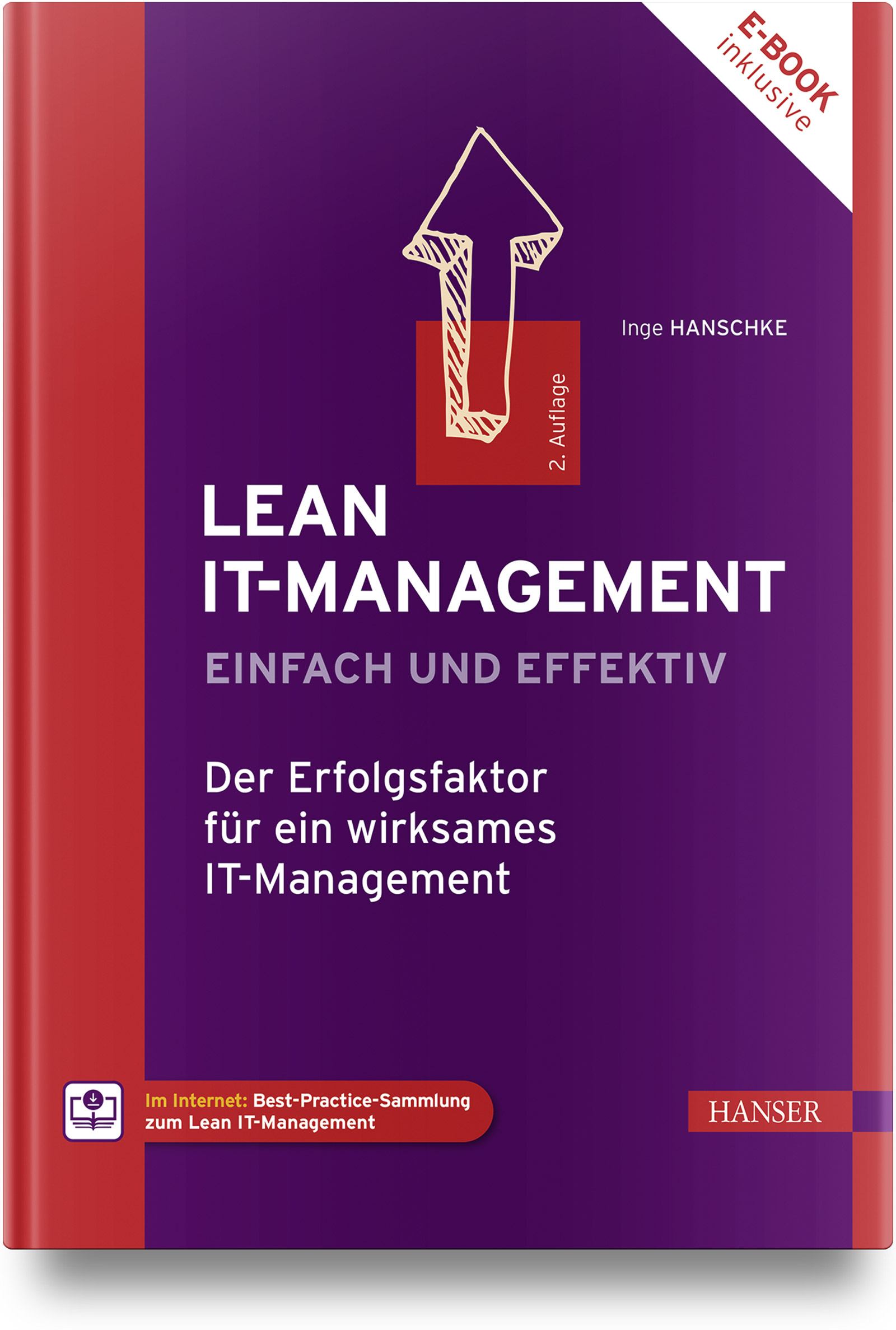
Lean IT-Management - einfach und effektiv (2. Auflg.)
Lean IT-Management – einfach und effektivIn diesem Buch erhalten Sie als IT-Manager oder CIO Best-Practices zur Bewältigung Ihrer Herausforderungen in der Planung und Steuerung der IT an die Hand. Wählen Sie die für Sie relevanten Bausteine für das Enterprise Architecture Management, Prozessmanagement, Demand Management, Projektportfoliomanagement oder die IT-Organisation und die IT-Steuerung aus. Mithilfe der Leitfäden schaffen Sie für sich ein einfaches und gleichzeitig effektives Instrumentarium, um einerseits die IT-Komplexität zu beherrschen und andererseits die Veränderungen und Weiterentwicklung der IT-Landschaft zielgerichtet zu planen und zu steuern.Mit den praktischen Anleitungen und Best-Practices können Sie schnell die für Sie relevanten Quick-wins verwirklichen und Ihr Lean IT-Management-Instrumentarium Schritt für Schritt wertorientiert gestalten und etablieren.Aus dem Inhalt:Lean IT-ManagementIT-Planung IT-SteuerungEAM und UnternehmensarchitekturProzessmanagementDemand ManagementIT-GovernanceGlossar für das IT-ManagementÜber die Autorin: Inge Hanschke hat in über 35 Berufsjahren als IT-Managerin bei Anwenderunternehmen, in einem ERP-Produkthaus und bei verschiedenen IT-Dienstleistern die IT strategisch und an den Geschäftsanforderungen ausgerichtet und das IT-Management professionalisiert. Die langjährigen Erfahrungen münden in die Methode zum Lean IT-Management (siehe www. Hanschke-Consulting.com).

Computer für Senioren
Computer für SeniorenComputer einschalten, Buch aufschlagen, loslegen! So einfach kann Ihr Start mit Windows 11 sein. Mit diesem Werk bringen Sie sich alles rund um Ihren neuen PC selbst bei, und das ganz ohne Vorwissen: im Internet surfen, E-Mails schreiben, Fotos bearbeiten, Briefe ausdrucken – der Autor Philip Kiefer zeigt Ihnen alle nötigen Schritte am Bild und kommt ohne komplizierte Fachbegriffe aus. Die Anleitungen eignen sich für PC und Notebook gleichermaßen. So macht der Einstieg in die digitale Welt Spaß!Den Computer einrichten, im Internet surfen, E-Mails schreiben, Fotos ansehen, Geräte anschließen u. v. m.Für PC und NotebookAktuell zu Windows 11Aus dem InhaltAlles problemlos einrichtenSich am Bildschirm zurechtfindenPC und Notebook mit Maus und Touchpad bedienenIm Internet surfenE-Mails schreiben und empfangenKamera und Drucker anschließenFotos verschönern und präsentierenTexte schreiben und ausdruckenSicher sein vor Viren & Co.Texte und Bilder geordnet ablegen und schnell auffindenZum Autor:Philip Kiefer zählt zu den renommiertesten Computer-Fachbuchautoren Deutschlands und zeichnet sich besonders durch sein Talent aus, komplexe technische Inhalte leicht verständlich zu vermitteln.

Unleashing AI
UNLEASHING AI: HARNESSING ARTIFICIAL INTELLIGENCE FOR BUSINESS SUCCESS IS A COMPREHENSIVE GUIDE FOR BUSINESS LEADERS, PROFESSIONALS, AND ENTREPRENEURS LOOKING TO UNDERSTAND AND LEVERAGE THE TRANSFORMATIVE POTENTIAL OF AI TECHNOLOGIES.Unleashing AI is an actionable resource that equips the readers with the knowledge and strategies to harness the power of AI for competitive advantage. This book goes beyond the hype and technical jargon, offering a clear and accessible exploration of AI's applications, implementation challenges, and ethical considerations. It reviews the fundamental concepts of AI, its applications across various business functions, and the ethical considerations associated with its deployment. Through detailed chapters and practical insights, readers will gain a deep understanding of how to integrate AI into their business strategies to drive innovation, efficiency, and competitive advantage.By combining expert insights, and practical frameworks, Unleashing AI empowers readers to navigate the AI landscape, identify opportunities, and develop effective AI strategies aligned with their business goals.

Expert Scripting and Automation for SQL Server DBAs
The market is trending toward a much smaller ratio of DBAs to SQL Server instances, but this book will help you meet this new reality by harnessing automation to continue building and maintaining reliable database platform services for your SQL Server enterprise. The book will help you automate your workload and manage more databases and instances with greater ease and efficiency by combining metadata-driven automation with the power of PowerShell. You'll soon be able to automate your new instance-builds and centralize your maintenance.This book walks you through automating the SQL Server build processes and maintenance of multiple instances from a single location, as well as how to use database metadata to drive your automation. With a heavier focus on PowerShell, this 2nd edition highlights modern techniques, such as configuration management. Also new in this edition, you will learn how to use PowerShell modules such as SqlServer and DBATools, which is a popular community module that you can rely on to keep your database estate running smoothly. You will understand the benefits of centralizing maintenance to better keep your enterprise responding with reliable performance to the loads placed upon it by your business. The book helps you become faster and better at what you do for a living, and thus will boost your value within the job market.WHAT YOU WILL LEARN* Automate SQL Server installation and configuration* Apply techniques such as Desired State Configuration to prevent drift on your servers and instances* Increase your value to your organization by automating low-value tasks and focusing your time on the higher-value ones * Take advantage of database metadata to drive automation, allowing you to build intelligent automated routines* Promote and demonstrate how to modernize database maintenance across your enterprise * Apply tools such as PowerShell with modern techniques to increase your value in the job market WHO THIS BOOK IS FORSQL Server DBAs who want to increase their productivity by embracing automationPETER CARTER is a SQL Server expert with two decades of experience developing, administering, and architecting SQL Server platforms and data-tier applications. Peter was awarded an MCC by Microsoft in 2011, and currently leads a team of platform engineers within a major UK company. His passion for SQL Server shows through in everything he does, and has written a number of SQL Server books (Apress), including _Pro SQL Server 2022 Administration_, _SQL Server Advanced Data Types_, _Securing SQL Server,_ and _SQL Server 2019 AlwaysOn_.1. T-SQL Technique For DBAs.- 2. PowerShell Fundamentals.- 3. PowerShell DSC.- 4. Working With The sqlserver Module.- 5. Working With DbaTools.- 6. Automating Installation.- 7. Metadata Driven Automation.- 8. Building an Inventory Database.- 9. Implementing Configuration Management For SQL Server.- 10. Centralizing Maintenance.- 11. Automating Routine Maintenance and Break/Fix Scenarios.

Scaling Enterprise Solutions with Large Language Models
Artificial Intelligence (AI) is the bedrock of today's applications, propelling the field towards Artificial General Intelligence (AGI). Despite this advancement, integrating such breakthroughs into large-scale production-grade enterprise applications presents significant challenges. This book addresses these hurdles in the domain of large language models within enterprise solutions.By leveraging Big Data engineering and popular data cataloguing tools, you’ll see how to transform challenges into opportunities, emphasizing data reuse for multiple AI models across diverse domains. You’ll gain insights into large language model behavior by using tools such as LangChain and LLamaIndex to segment vast datasets intelligently. Practical considerations take precedence, guiding you on effective AI Governance and data security, especially in data-sensitive industries like banking.This enterprise-focused book takes a pragmatic approach, ensuring large language models align with broader enterprise goals. From data gathering to deployment, it emphasizes the use of low code AI workflow tools for efficiency. Addressing the challenges of handling large volumes of data, the book provides insights into constructing robust Big Data pipelines tailored for Generative AI applications. _Scaling Enterprise Solutions with Large Language Models_ will lead you through the Generative AI application lifecycle and provide the practical knowledge to deploy efficient Generative AI solutions for your business.WHAT YOU WILL LEARN* Examine the various phases of an AI Enterprise Applications implementation.* Turn from AI engineer or Data Science to an Intelligent Enterprise Architect.* Explore the seamless integration of AI in Big Data Pipelines.* Manage pivotal elements surrounding model development, ensuring a comprehensive understanding of the complete application lifecycle.* Plan and implement end-to-end large-scale enterprise AI applications with confidence.WHO THIS BOOK IS FOREnterprise Architects, Technical Architects, Project Managers and Senior Developers.Arindam Ganguly is an experienced Data Scientist in one of the leading Multi-National Software Service Firm where he is responsible for developing and designing intelligent solutions leveraging his expertise in Artificial Intelligence and Data Analytics. He has over 8 years of experience delivering enterprise products and applications and has proven skill sets in developing and managing a number of software products with various technical stacks.Arindam also is well-versed in developing automation and hyper-automation solutions leveraging automated workflow engines and integrating them with AI. Additionally, he is the author of _Build and Deploy Machine Learning Solutions using IBM Watson_, which teaches how to build artificial intelligent applications using the popular IBM Watson toolkit.Chapter 1_Machine Learning Primer.- Chapter 2_Natural Language Processing Primer.- Chapter_3: RNN to Transformer and BERT.- Chapter_4: Large Language Models.- Chapter_5: Retrieval Augmented Generation.- Chapter_6: LLM Evaluation and Optimization.- Chapter_7: AI Governance and Responsible AI.- Chapter_8: Adding Intelligence to a Large Enterprise Applications.- Chapter_9: Data Pipelines in Generative AI.- Chapter_10: Putting it all Together.

Metaverse Technologies, Security, and Applications for Healthcare
UNLOCK THE TRANSFORMATIVE POTENTIAL OF THE METAVERSE WITH THIS CRUCIAL BOOK THAT DELVES INTO VITAL INFORMATION, SECURITY CONCERNS, AND INNOVATIVE APPLICATIONS THAT CAN SIGNIFICANTLY ENHANCE PERSONALIZED PATIENT CARE IN A RAPIDLY EVOLVING DIGITAL LANDSCAPE.This book explores insights into information security concerns, preventive measures, and their impact on healthcare applications in the Metaverse. The Metaverse is an amplified virtual world derived from the conjunction of virtual and physical space, where users can interact in an augmented world to meet each other virtually and engage in virtual activities that give authentic practice. The healthcare industry will tremendously benefit from this technology by using it to enhance personalized care for clients. Public health experts believe that while much has been said about the potential of the Metaverse in the entertainment and gaming industry, healthcare is another industry where its impact could be transformational. This volume provides a better understanding of healthcare applications in the Metaverse and why digital information security is of major concern. Recently, the world saw the impacts of the COVID-19 pandemic, which physically stopped mobility. Life is taken care of using digital interactions and the movement of information digitally through the Metaverse. This book explores implementation issues and performance evaluations of emerging technologies, along with research results and networking methods to demonstrate the immense benefits of this emerging technology. Readers will find this book:* Provides comprehensive coverage of the Metaverse, including theoretical modeling of Metaverse architecture and protocols, prospective challenges, and information security;* Explores wide applications of the Metaverse and their relevance in healthcare;* Introduces solutions to real-life problems and the future prospects of the Metaverse.AUDIENCEResearchers, students, educators, and healthcare professionals focused on information communication technologies and their benefits in healthcare. AJAY KUMAR VYAS, PHD is an associate professor and the head of the Information and Communication Technology Department at Adani University, India with over 18 years of teaching and research experience. He is the author of over 50 research papers in peer-reviewed international journals and conferences, books, and many book chapters. His research interests include optical devices, AI applications for optics, and 5G and 6G communication. HARLEEN KAUR, PHD is an associate professor and chief investigator in the School of Engineering Sciences and Technology at Jamia Hamdard and a visiting professor at The World Academy of Sciences in Italy. She has published over 100 publications in refereed journals and conferences. Her key research includes information analytics, applied machine learning, and predictive modeling. SOURABH SHARMA, PHD is an associate professor in the School of Engineering at Avantika University with over 12 years of academic experience. He is a life member of the Soft Computing Research Society and provides his support and guidance as a reviewer in various international journals and conferences. His research expertise includes image processing applications, soft computing using optimization algorithms, and information security and mining. BHAVYA ALANKAR, PHD is an associate professor in the Department of Computer Science and Engineering at Jamia Hamdard with over 20 years of teaching and research experience. He has authored and edited several books on very-large-scale integration, machine learning, and Internet of Things. His research interests include VLSI design, cloud computing, deep learning, and reconfigurable computing. Preface xviiAcknowledgments xxiPART I: METAVERSE TECHNOLOGY 11 INTRODUCTION TO METAVERSE FOR HEALTHCARE 3Amit Sharma1.1 Introduction of Metaverse 31.2 Metaverse in Healthcare 51.3 Potential Uses of Metaverse in Healthcare 61.3.1 Telemedicine and Virtual Consultations 61.3.2 Medical Education and Training 71.3.3 Patient Education and Engagement 101.3.4 Mental Health 111.3.5 Rehabilitation 131.4 Technological Infrastructure 141.4.1 Technologies 151.4.2 Wearable and Hardware 181.5 Benefits and Opportunities 221.5.1 Improved Accessibility 221.5.2 Enhanced Patient Experience 231.5.3 Cost Reduction 241.6 Challenges and Risks 251.6.1 Hardware 251.6.2 Ethical Concerns 251.6.3 Privacy and Data Security 261.6.4 Identity Hacking 261.6.5 Addiction and Mental Health 271.6.6 Regulatory and Legal Issues 271.6.7 Currency and Digital Payment 271.6.8 Technical Challenges 281.7 Metaverse’s Prospects for the Future in Healthcare 281.7.1 Predictions for the Future 281.7.2 Potential Technological Advancements 291.7.3 Long-Term Implications 291.8 Conclusion 30References 302 METAVERSE AND VIRTUAL HEALTHCARE: OPPORTUNITIES AND CHALLENGES 37Diksha Dani, Gaurav Agrawal and Abha Kiran Rajpoot2.1 Introduction 382.2 Metaverse Enabling Technologies 402.2.1 Extended Reality 402.2.2 Blockchain 412.2.3 Internet of Things 412.2.4 Spatial and Edge Computing 422.2.5 3D Modeling and Reconstruction 432.2.6 Brain-Computer Interface 432.2.7 Artificial Intelligence 442.2.8 Advanced Wi-Fi Technology 442.3 Application in Healthcare 452.3.1 Metaverse in Surgeries 452.3.2 Education and Training 472.3.3 Medical Diagnosis and Consultation 482.3.4 Metaverse in Pain Management 482.3.5 Medical Health Data Management 492.4 Limitations and Challenges 492.4.1 Privacy and Security 492.4.2 Health Concerns 502.4.3 Dependence on the Internet 502.4.4 Interoperability 512.4.5 High Cost of Technology 512.4.6 Environmental Impact 522.5 Conclusion 52References 533 INNOVATION AND ACCOUNTABILITY: AN ETHICAL PERSPECTIVE ON METAVERSE HEALTHCARE 57Ajay Sudhir Bale3.1 Introduction 583.2 Methodology 593.2.1 Medical Training Metaverse 603.2.1.1 Osso Vr 633.2.1.2 MediVizor 693.2.2 Virtual Clinical Trials 693.3 Discussion 75Conclusion and Future Scope 77References 784 THE HEALTHCARE METAVERSE: UTILIZATIONS, OBSTACLES, AND PROSPECTS 81Shilpa MahajanIntroduction 81Metaverse 82Metaverse Components 83AR/VR Technologies 83Digital Avatars 843D Virtual Environments 85Blockchain and Cryptocurrencies 85Issues Faced by Healthcare Industries 87Applications of Metaverse in Healthcare Industry 89Limitation of AR/VR in Healthcare 90Challenges of Metaverse in Healthcare 94Future Directions 95Conclusion 96References 965 CREATING THE HEALTHCARE OF TOMORROW: THE METAVERSE’S OPPORTUNITIES AND CHALLENGES 101Vedanshee Upadhyay and Sourabh Sharma5.1 Introduction 1025.2 Analysis: Metaverse and Healthcare 1055.3 Discussion and Synthesis 1105.4 Conclusion 112References 1136 THE ROLE OF METAVERSE, AI, AND 5G IN MODERNIZING HEALTHCARE PLATFORMS 121Baby Chithra R., Salna Joy and Ajay Sudhir Bale6.1 Introduction 1226.1.1 Metaverse 1226.1.2 Ai 1246.1.3 5G and Beyond 1266.2 Application of Metaverse in Healthcare 1286.3 5G and AI Integration with Metaverse 1356.4 Conclusion and Future Scope 140References 1427 METAVERSE MAKEOVER: TRANSFORMING PATIENT CARE AND WELLNESS IN VIRTUAL REALMS 147Ritesh Kumar Jain, Ajay Kumar Vyas, Vishnu Agarwal and Paras Kothari7.1 Introduction 1487.2 The Evolution of Healthcare in Virtual Environments 1507.3 Applications of the Metaverse in Patient Care 1537.4 Improving Healthcare Education and Training 1577.5 Challenges and Considerations 1617.6 Future Directions and Opportunities 1657.7 Conclusion 167References 1698 METAVERSE IN MEDICAL TRAINING AND EDUCATION 173Avnish Bora and Sunil Vyas8.1 Introduction 1748.2 Virtual Reality 1808.3 Augmented Reality 1828.4 The Technology 1858.4.1 Augmented Reality (AR) 1858.4.2 Virtual Reality (VR) 1868.5 Market of AR and VR in Healthcare Practice 1878.6 Case Studies 1928.7 Future Directions 1938.8 Conclusion 195References 195PART II: SECURITY FOR METAVERSE 1999 SECURING HEALTHCARE IN THE METAVERSE: ADVANCE DEEP LEARNING ALGORITHMS FOR NON-TATA PROMOTER CLASSIFICATION IN GENOME SEQUENCING 201Om Varshney, Yashasvi Agrawal, Yashasvi Kanathey, Yoginii Waykole, Om Mishra and Harsh S. Dhiman9.1 Introduction 2029.2 Literature Review 2029.3 Methodology 2059.3.1 Preprocessing 2069.3.2 Sequence Modeling 2069.3.3 Convolutional Models 2069.3.4 Combining Sequence Modeling and Feature Extraction 2079.3.5 WaveNet 2079.4 Experimental Setup 2089.4.1 Data Collection 2089.5 Evaluation Metrics 2099.6 Training Parameters 2099.7 Results and Discussion 2109.7.1 Lstm 2109.7.2 Cnn 2119.7.3 ConvoLSTM 2129.7.4 WaveNet 2139.8 Conclusion 216References 21610 DATA PROTECTION REGULATION FOR E-HEALTH DEVICES 219Satwika Dash, Kumash Patel and Manivel Kandasamy10.1 Introduction to E-Health Devices 22010.1.1 Definition of E-Health Devices 22110.1.2 Scope and Trends in E-Health Devices 22110.1.2.1 Scope of E-Health Devices 22110.1.2.2 Trends in E-Health Devices 22210.1.3 E-Health Devices in Healthcare and Important Roles 22310.1.3.1 Patient Empowerment and Self- Management 22310.1.3.2 Healthcare Provider Efficiency and Effectiveness 22310.1.3.3 Healthcare System Optimization 22410.2 Importance of Data Protection Regulations 22410.2.1 Overview of General Data Protection Regulation (gdpr) 22410.2.2 Health Insurance Portability and Accountability Act (HIPAA) 22510.2.3 Accountability Act and Relevant Regulations (CCPA and PIPEDA) 22510.2.4 Important Guidelines and International Standards 22610.3 Security Principles and Data Privacy 22710.3.1 Overview of Data Minimization 22710.3.2 Data Integrity 22710.3.3 Data Confidentiality 22810.3.4 Transparency and Accountability of Data Privacy 22910.3.4.1 Transparency 22910.3.4.2 Rights of Data Security 23010.4 Regulatory Requirements and Compliance Framework 23110.4.1 Data Preprocessing, Retention, and Storage 23110.4.1.1 Data Preprocessing 23110.4.1.2 Data Retention 23110.4.1.3 Data Storage 23110.4.2 Data-Sharing Access 23210.4.3 Risk Assessment of E-Health Devices 23210.4.4 Data Protection and Privacy 23310.4.5 Security Mechanisms for Regulatory Requirements 23410.5 Data Transfer and Standard Regulations 23510.5.1 Global Data Transfer and Legal Frameworks 23510.5.2 Binding Corporate Rules (BCR) 23610.5.3 Standard Contractual Clauses (SCC) 23710.5.4 Decision-Making for Data Transfer 23810.6 Future Data Protection for the E-Health Sector 23910.6.1 Future Technologies and Impact of the E-Health Sector 23910.6.2 Emerging Technologies in Data Protection 24010.6.2.1 AI and Machine Learning in Data Protection 24210.6.2.2 Role of Blockchain in Data Protection Management 24310.6.2.3 Data Protection Regulatory Evaluation 24410.6.3 Security Measures and Ethical Considerations 24510.6.4 Enhancing the Protection Control over Personal Health Data 24610.6.5 Industry Standards in Data-Sharing Mechanisms 24710.6.6 Future Challenges and Solutions for Data Protection 24810.6.7 Summary of the Data Protection 24910.6.7.1 Applications of Data Privacy and Security in E-Health 25010.6.7.2 Future Trends in Data Protection for E-Health 251References 25311 AN EXTENSIVE REVIEW OF CURRENT CYBERSECURITY TRENDS IN THE HEALTHCARE SECTOR 255Manoj Dhawan and Lalit Purohit11.1 Introduction 25611.2 Related Work 25811.3 Findings from the Review 26611.4 Limitations and Suggestions for Future Research 27011.5 Conclusion 272References 27212 IMPLEMENTATION OF METAVERSE TECHNOLOGIES AND ITS SECURITY 277Manas Tiwari, Kamal Kumar Kushwah, Hameed Khan and Ajay Kumar Vyas12.1 Introduction 27812.2 Unpacking the Metaverse and Its Key Ingredients 28012.2.1 Virtual Reality (VR) 28112.2.2 Augmented Reality (AR) 28112.2.3 Mixed Reality (MR) 28112.2.4 Metaverse Enables in Health Space 28112.2.5 Telemedicine and Remote Consultations 28212.3 Patient Engagement and Therapy in the Metaverse 28312.3.1 Virtual Reality Treatment 28412.3.2 Involved Patients and Personalized Therapy 28512.3.3 Establishing Networks and Communities 28512.4 Case Study for the Global Health Initiative 28612.5 Ethical Factors in VR Therapy 28812.5.1 Informed Consent 28812.5.2 Individualized 28812.5.3 Constant Monitoring 28812.6 Technological Challenges and Solutions 28912.6.1 The Metaverse’s Potential for Healthcare 28912.6.2 Prospective Applications in the Future 29012.6.3 Potential Limitations and Challenges 29212.7 Conclusion 292References 29313 METAVERSE TECHNOLOGIES, SECURITY, AND APPLICATIONS FOR HEALTHCARE 297Shilpi Jindal, Shristi Chaudhary, Shalini Sharma, Meenu Rani and Sonia Bajaj13.1 Introduction to the Metaverse 29813.2 Metaverse Technologies: Back to the Basics and Beyond 29813.2.1 Virtual Reality (VR) and Augmented Reality (AR) 29813.2.2 Blockchain and Decentralized Technologies 29913.2.3 AI and ml 29913.2.4 5G and Edge Computing 29913.2.5 Innovations in Human-Computer Interaction (HCI) 29913.3 Security Challenges in the Metaverse for Healthcare 30013.3.1 Data Privacy and Confidentiality 30013.3.2 Identity Management and Authentication 30013.3.3 Cybersecurity Threats and Attack Vectors 30013.3.4 Data Integrity and Reliability 30113.3.5 Compliance with Regulatory Requirements 301References 30714 LEADING-EDGE KEY MANAGEMENT TECHNIQUES IN THE CRYPTOGRAPHY: THE METAVERSE-DRIVEN STRATEGY 313Devendra Kuril, Manoj Dhawan and Lalit Purohit14.1 Introduction 31414.2 Association of Sections 31514.3 Significant and Consequence of the Leading-Edge Key Management 31514.4 Recommended Approaches 31714.5 An Extremely Efficient Encipher/Decipher Suggested Algorithm 31914.5.1 Essential Key Elements 31914.5.2 Approaches in the Process of Encipher/Decipher 31914.6 Observation and Examination 32114.6.1 Considering an Instance as All Factors Remained Null During Leading-Edge Key Generation 32114.7 Summarization and Future Work 321References 322PART III: APPLICATIONS OF METAVERSE 32515 IMPLEMENTATION OF METAVERSE FOR HEALTHCARE SYSTEM MODELING 327Naureen Afrose, Rideb Chakraborty, Ahana Hazra, Pratibha Bhowmick and Mithun Bhowmick15.1 Introduction 32815.2 Key Technologies of the Metaverse for Healthcare 32915.2.1 Virtual Reality (VR) 32915.2.2 Mixed Reality (MR) 33115.2.3 Extended Reality (XR) 33215.2.4 Augmented Reality (AR) 33415.2.5 Artificial Intelligence (AI) 33515.3 Metaverse Implementation in Healthcare Modeling 33615.3.1 Integrating Healthcare Data Sources: EHRs, Imaging, Demographics, and Facility Layouts 33815.3.2 Patient Pathway Simulation: Optimizing Care Delivery and Patient Flow 34015.3.3 Healthcare Facility Design: Virtual Prototyping for Improved Efficiency 34115.3.4 Epidemiological Forecasting: Simulating Disease Spread and Resource Allocation 34115.4 Benefits of Metaverse for Healthcare System Modeling 34315.4.1 Improved Patient Outcomes 34315.4.2 Better Decision-Making 34415.4.3 Increased Efficiency 34415.5 Challenges and Considerations 34515.6 The Future of Metaverse in Healthcare System Modeling 34615.7 Conclusion 347References 34716 5G SPEEDS FOR METAVERSE HEALTHCARE PROMISES AND CHALLENGES 351Mamta B. Savadatti, Ajay Sudhir Bale, Achyutesh Dixit and Subhashish Tiwari16.1 Introduction 35216.2 5G Network Requirements for Metaverse Healthcare 35416.2.1 Low Latency 35616.2.2 Key Performance Indicators for 5G Healthcare 35716.2.3 High Connection Density 35816.2.4 Reliability 35816.2.5 Architecture of Smart Healthcare System 35916.3 Enabling Metaverse Healthcare Applications with 5G 36116.3.1 Real-Time Patient Monitoring 36216.3.2 High-Fidelity Medical Visualization 36316.3.3 Virtual Collaborative Environments 36416.3.4 Haptic Feedback and Immersion 36516.4 Challenges in 5G Rollout for Healthcare Metaverse 36816.4.1 Network Coverage 36816.4.2 Spectrum Allocation 36916.4.3 Technical Obstacles 37116.5 Risks and Uncertainties 37216.6 Conclusion and Future Directions 373References 37317 INCORPORATING DIGITAL TWIN TECHNOLOGY IN HEALTHCARE: PROSPECTS AND CONSTRAINTS 379Krupa Purohit17.1 Introduction 38017.2 Leveraging Digital Twin Technology to Enhance Patient Care 38117.2.1 Customized Healthcare 38217.2.2 Healthcare Administration and Preventive Treatment 38217.2.3 Training and Planning for Surgery 38317.2.4 Hospital and Healthcare System Administration 38317.3 Prospects and Constraints 38317.3.1 Prospects 38317.3.2 Constraints 38417.4 Healthcare Facilities Utilizing Digital Twins 38517.5 Prospective Avenues for Further Investigation 390References 39118 APPLICATION PERSPECTIVES OF DIGITAL TWIN IN HEALTHCARE USING METAVERSE 393Bablu Kumar Singh and Ajay Kumar Vyas18.1 Introduction 39318.2 Need for Digital Twin for Healthcare 39718.3 Opportunity 39918.4 Applications 39918.5 Metaverse: Challenges and Opportunity 40318.6 Conclusion 404References 40519 OPTIMIZING DHD FOR HEALTHCARE APPLICATIONS IN THE METAVERSE 409Vrunda Patel, Mansvi Patel, Khush Patel and Jignesh Thaker19.1 Introduction 41019.2 Materials Used in Dynamic Holography Display 41119.2.1 Experimental Details 41419.3 How to Train Network Through CNN for the Optimization of Phase-Only Hologram 41619.4 Metaverse Technology in Healthcare with Holographic Display 41919.4.1 Metaverse Interfacing 41919.4.2 Employment of Healthcare Technologies with Metaverse 422References 42720 XAI WITH DIFFERENT METHODS AND APPLICATIONS IN HEALTHCARE 431Mamta Motiramani, Nainsiben Patel and Alok Kumar Singh20.1 Introduction 43220.2 Leveraging Open Data and XAI 43320.2.1 Explainable Open Data 43420.2.2 XAI in Healthcare 43520.3 Knowledge Graph 43620.4 Metaverse Using Immersive Technology 43720.4.1 Technologies for Metaverse Healthcare 43720.5 Deep Learning–Based Medical Image Analysis 43920.6 Dynamic Pruning via XAI 44020.7 Predictive Analytics of Pancreatic Cancer 44120.8 Approach to Interpretable Healthcare Model 44120.9 Challenges 44420.10 Conclusion 446References 446Index 451

Anwendungsbezogenes Projektmanagement
Die Intention dieses Buches ist es, Projektleitern zu helfen handwerkliche Fehler im Projektmanagement zu vermeiden und sie in ihrer Professionalität zu unterstützen. Neben einem ausführlichen IT-Praxisfall sind Mustervorlagen eines Projektauftrags sowie eines Projektabschlussberichts enthalten. Mit der zweiten Auflage wurden die Facetten des Projektmanagements erweitert und um agiles Projektmanagement ergänzt. Gleichzeitig dient das Buch aber auch als Grundlage für Hochschulkurse zum Projektmanagement. Es ist durch die Kombination aus langjähriger, intensiver Projektleitererfahrung sowie akademischer Betrachtung des Themas in Vorlesungen an verschiedenen Universitäten und Hochschulen entstanden.CHRISTIAN BÄR ist Professor für Wirtschaftsinformatik mit Schwerpunkt Projektmanagement und verbindet, als Chief Technology Officer der DATEV eG, die Lehre mit der Praxis.JENS FIEGE ist Geschäftsführer bei der b4value.net GmbH. Er hat umfassende Erfahrungen im klassischen und agilen Projektmanagement und war Lehrbeauftragter der DHBW Mannheim.MARKUS WEIẞ ist als Product Owner bei der DATEV eG für die Steuerung eines Softwareentwicklungsbereichs verantwortlich und daneben als Dozent tätig.MARTIN ERTEL ist als Projektleiter für den Aufbau eines Entwicklungsstandorts in Polen und als Staffing Manager für das Staffing von Entwicklungsprojekten bei der DATEV eG verantwortlich.Teil I: Pragmatische und methodische Vorgehensweise.-Begriffsbestimmungen und Definitionen.- Projektwürdigkeitsanalyse.- Projektorganisation und Durchführung.- SMART formulierter Projektauftrag.- Rahmenbedingungen für die Projektsteuerung.- Projektkoordination.- Projektcontrolling.- Projektabschluss.- Teil II: Praxisfall.- Das Softwareprojekt bei der Muster GmbH.- Index.

Artificial Intelligence in Remote Sensing for Disaster Management
INVEST IN ARTIFICIAL INTELLIGENCE IN REMOTE SENSING FOR DISASTER MANAGEMENT TO GAIN INVALUABLE INSIGHTS INTO CUTTING-EDGE AI TECHNOLOGIES AND THEIR TRANSFORMATIVE ROLE IN EFFECTIVELY MONITORING AND MANAGING NATURAL DISASTERS.Artificial Intelligence in Remote Sensing for Disaster Management examines the involvement of advanced tools and technologies such as Artificial Intelligence in disaster management with remote sensing. Remote sensing offers cost-effective, quick assessments and responses to natural disasters. In the past few years, many advances have been made in the monitoring and mapping of natural disasters with the integration of AI in remote sensing. This volume focuses on AI-driven observations of various natural disasters including landslides, snow avalanches, flash floods, glacial lake outburst floods, and earthquakes. There is currently a need for sustainable development, near real-time monitoring, forecasting, prediction, and management of natural resources, flash floods, sea-ice melt, cyclones, forestry, and climate changes. This book will provide essential guidance regarding AI-driven algorithms specifically developed for disaster management to meet the requirements of emerging applications. NEELAM DAHIYA, PHD is an assistant professor in the Department of Computer Applications at Chitkara University, Punjab, India. She has authored over ten articles in international journals and filed more than ten patents with the Indian Patent Office, five of which were granted. She has also reviewed various articles for renowned journals and conferences. Her research interests include remote sensing, digital image processing, deep learning, and hyperspectral imaging. GURWINDER SINGH, PHD is an associate professor at the Institute of Computing at Chandigarh University, India. He has internationally published over 35 articles, conference papers, and book chapters, as well as one patent. He also serves as a member of the International Society for Photogrammetry and Remote Sensing and the Indian Society of Remote Sensing. His research interests include remote sensing, digital image processing, agricultural land use classification, machine learning, and deep learning. SARTAJVIR SINGH, PHD is a professor and the Associate Director for the University Institute of Engineering at Chandigarh University, Punjab, India. He has filed over 50 patents with the Indian Patent Office, with over half granted. He has authored over 50 articles in international journals and edited various proceedings for conferences and symposia in addition to serving as an editor for several international journals. His research interests include electronics, remote sensing, and digital image processing. APOORVA SHARMA is a digital analyst and assistant professor in the Department of Computer Science and Engineering, Chandigarh University, Punjab, India. She has published three articles in internationally reputed journals and conferences and contributed to innovative wearable and geospatial technologies. Her research interests include remote sensing, digital image processing, agriculture and cryosphere studies, machine learning, and deep learning.

ChatGPT & Co. in der Schule
Unterricht vorbereiten und Schulaufgaben korrigieren mit KI-Tools Datenschutzkonformer Einsatz von KI im Unterricht Zahlreiche Praxisbeispiele für verschiedene Schulformen und -fächer KI als Assistent für Lehrkräfte KI-Modelle wie ChatGPT sind bereits Teil des Schulalltags und werden von vielen Schülerinnen und Schülern regelmäßig genutzt. Dieses Buch zeigt Ihnen, wie Sie als Lehrkraft ebenfalls KI praxisnah, produktiv und datenschutzkonform einsetzen können. Praktischer Einsatz im Schulalltag Die Autoren zeigen Ihnen, wie Sie zielführende Anfragen an die KI stellen und so Unterstützung für verschiedene Einsatzzwecke erhalten: von der inhaltlichen Unterrichtsplanung über Vorschläge zu interaktiven Lehrmethoden bis hin zur Korrektur von Texten und Tipps für die Förderung von Schülerinnen und Schülern. Für alle Schulformen und -fächer Alle Praxisbeispiele sind nach Schulformen und -fächern gegliedert, sodass Sie schnell passende Anregungen für Ihren eigenen Unterricht finden. Darüber hinaus werden zentrale Fragen wie die Vermittlung von KI-Kompetenz als Lernziel, moderne Prüfungsformen im KI-Zeitalter sowie ethische Herausforderungen diskutiert. Aus dem Inhalt: Funktionsweise von KIs wie ChatGPT Strategien für den effektiven Einsatz Unterrichtsvorbereitung Prüfungsvorbereitung und Korrigieren Einsatz von KI im Unterricht Praxisbeispiele für Grundschule, Mittelschule sowie Realschule und Gymnasium Konkrete Beispiele für den Einsatz für verschiedene Fächer: Deutsch Englisch, Spanisch, Französisch Geschichte & Erdkunde Mathematik & Naturwissenschaften Kunst & Musik u.v.m. KI-Kompetenz als Lernziel Prüfungsformen und Hausaufgaben im KI-Zeitalter Rechtliche Aspekte und Datenschutz Barbara Engelke hat Germanistik und Theologie für das Lehramt an Gymnasien studiert und arbeitet als Lehrkraft sowie Fachschaftsleitung Deutsch an einem bayerischen Gymnasium. Im Vordergrund ihrer pädagogischen Tätigkeit steht, junge Menschen an neue Herausforderungen heranzuführen und sie für die Zukunft mit den nötigen Kompetenzen sowie einer kritisch-unabhängigen Haltung auszustatten. Ulrich Engelke hat das erste Staatsexamen in Germanistik und Anglistik sowie einen Magister in Linguistik. Nach einem kurzen Ausflug in das Verlagswesen und freiberuflicher Tätigkeit als Fachautor hat er eine Internetagentur gegründet. Heute ist er als freier KI-Trainer und IT-Unternehmensberater tätig. Sein besonderes Interesse gilt technologischen Innovationen und deren ökonomischen wie gesellschaftlichen Auswirkungen. Zusammen bieten Ulrich und Barbara Engelke Fortbildungen für Lehrkräfte und Schulleitungen zu Künstlicher Intelligenz in Schule und Unterricht sowie ChatGPT an: lehren-mit-ki.de

Design und Management von IT-Services
Handbuch für den qualitätsgesicherten Aufbau des IT-Servicemanagements im UnternehmenUnterstützung für IT-Unternehmen, die sich serviceorienterit und marktfähig aufstellen oder weiterentwickeln wollenZahlreiche Praxistipps, Checklisten und Templates für die sofortige Umsetzung im IT-BetriebInterviews mit IT-Service-Managern und CIOsDieses Handbuch bietet einen praxisorientierten Leitfaden für den Aufbau des IT-Servicemanagements oder die Optimierung eines ganzheitlichen Servicebetriebs im Unternehmen. Dabei wird mit »DAMOS« (Design And Management Of Services) ein Konzept zur Einführung, Steuerung, Überwachung und Weiterentwicklung von qualitätsgesicherten Services im Unternehmen vorgestellt. Mit den beschriebenen Praktiken können bestehende Services oder Strukturen (z.B. ein Servicekatalog) evaluiert, verglichen und auf Korrektheit überprüft werden. Konzeptionsfehler werden so frühzeitig vor der Implementierung erkannt und vermieden, bevor sie zu einem späteren Zeitpunkt hohe Kosten verursachen.Auf diese Weise ist es möglich, ein ITIL-zertifizierbares Servicemanagement aufzubauen, ohne über langjährige Service-Expertise oder umfassende ITIL-Kenntnisse verfügen zu müssen. Sowohl für Einsteiger als auch für Experten bietet das Buch eine ideale Unterstützung zu ITIL. Denn DAMOS liefert konkrete Handlungsanweisungen vom Service Backlog über SLAs und Service Value Chains bis hin zum Service Value System. Die Struktur des Buches spiegelt eine systematische Herangehensweise wider, die dabei hilft, sowohl theoretische als auch praktische Kenntnisse effektiv zu erwerben und anzuwenden.Über den Autor:Dr. Robert Scholderer ist Principal Service Level Manager und Geschäftsführer der Scholderer GmbH und seit über 28 Jahren als IT-Consultant für Konzerne tätig. Er erstellt, verwaltet und bewertet SLAs und IT-Servicekataloge für Kunden und deren Lieferanten. In seiner beruflichen Laufbahn hat er fundierte Erfahrungen in allen Feldern dieses Buches gesammelt. Robert Scholderer ist bei allen namhaften Schulungsunternehmen als Trainer zu den Themen IT-Servicekatalog, Service Level Agreements, Service Owner, Servicedesk und Self-Service-Portal tätig.Im Jahr 2001 meldete er ein Verfahren und eine Anordnung zur Qualitätsüberwachung von IT-Services zum Patent an, bei dem die in einem SLA festgeschriebenen Leistungen mit Sollvereinbarungen und Schadensersatzangaben verknüpft und abgespeichert werden und die so gewonnenen Daten zur kundenspezifischen Steuerung von Servicesimulatoren dienen. Im Jahr 2018 hat er mit ITSL (IT Standard Service Language) eine neue Standardsprache für IT-Infrastruktur und SLAs als Alternative zu ITIL auf den Markt gebracht. 2019 ging der erste Prototyp seines Service-Design-Tools SEAMLESS an den Start.Von 2009 bis 2013 war Robert Scholderer Mitglied des Beirats der central europe computer measurement group (cecmg) und wurde 2021 zum ersten Vorsitzenden des itSMF in Österreich gewählt. Für sein unternehmerisches Wirken und die von ihm für SLA entwickelten Modelle wie SOUSIS oder den IT-Servicekatalog CECAR wurde er mehrfach mit Innovationspreisen ausgezeichnet.

systemd for Linux SysAdmins
Explore the world of systemd—yes, all lower-case, even at the beginning of a sentence— which is the modern replacement for init and SystemV init scripts. It is also much more. It can evoke a wide range of reactions from SysAdmins and others responsible for keeping Linux systems up and running. The fact that systemd is taking over so many tasks in modern Linux systems has engendered push-back and discord among certain groups of developers and SysAdmins.You will learn systemd’s strengths and weaknesses, and why there’s no truth in the myth that systemd is a monolithic monstrosity.Learn how systemd is the mother of all processes, and is responsible for bringing the Linux host up to a state in which productive work can be done. You’ll learn about the functions assumed by systemd, which is far more extensive than the old init program, and how it manages many aspects of a running Linux host, including:* Mounting filesystems* Managing hardware* Creating new systemd services and understanding existing ones* Creating timers that trigger system maintenance events* Starting and managing the system services that are required to have a productive Linux host* Using the systemd journal to access critical performance and problem solving information.* Why the systemd plan to take over the world is actually a good thing_systemd for Linux SysAdmins_ is your one-stop shop, giving you everythiing you need to get started and utilize this software suite for Linux operatiing systems.YOU WILL LEARN:* How to use systemd, what it is, and what it does* To manage each of the major functional components of systemd and learn from real-world examples to illustrate their typical usage by SysAdmins* Pragmatic work-arounds, hints and tricks to minimize issues to ensure you have greater systemd functionalityTHIS BOOK IS FOR:Linux system administrators (SysAdmins) who need to or are already in the process of switching from SystemV to systemd. It’s also intended for SysAdmins with more systemd experience but who want to improve their knowledge and skills with systemd.DAVID BOTH, SCSA, RHCT, RHCE is an Open Source Software and Linux advocate, trainer, writer, and speaker. He has been working with Linux and Open Source Software since 1996 and has been working with computers for over 50 years. He is a strong proponent of and evangelist for the "Linux Philosophy for System Administrators."He has taught RHCE classes for Red Hat and has worked at MCI Worldcom, Cisco, and the State of North Carolina. He has taught classes on Linux ranging from Lunch'n'Learns to full five day courses.David has written articles for magazines including, Linux Magazine, Linux Journal, and OS/2 Magazine back when there was such a thing. David wrote for Opensource.com (OSDC) before it was closed by Red Hat. He now writes for Both.org while working with a core group of OSDC alumni to recreate the community that made OSDC so successful.David has published eight books with Apress, “_The Linux Philosophy for SysAdmins_,” August 2018, and a three volume self-study training course, “_Using and Administering Linux — From Zero to SysAdmin_,” released in December, 2019, and "_Linux for the Small Business,_" released in late 2022. The second edition of “_Using and Administering Linux — From Zero to SysAdmin_,” was released in 2023.He has found some interesting and unusual ways of problem solving, including sitting on one computer on which he was working.Chapter 1: Learning to Love systemd.- Chapter 2: Linux Boot and Startup.- Chapter 3: Understanding Linux startup with systemd.-Chapter 4: How I Manage startup Using system.- Chapter 5: Using the systemctl Command to Manage systemd Units.- Chapter 6: Control Your Computer Time and Date with system.- Chapter 7: Use systemd Timers.- Chapter 8: Analyzing systemd Calendar and Timespans.- Chapter 9: firewalld.- Chapter 10: Managing Resources with cgroups in system.- Chapter 11: Using systemd-Resolved Name Service.- Chapter 12: Replacing rc.local in systemd Linux Systems.- Chapter 13: Using systemd Journals to Troubleshoot Transient Problems.- Chapter 14: Analyze Linux startup Performance.- Chapter 15: How to use systemd as a Troubleshooting Tool.- Chapter 16: Why I Support the systemd Plan to Take over the World.

Artificial Intelligence All-in-One For Dummies
A COMPREHENSIVE ROADMAP TO USING AI IN YOUR CAREER AND IN YOUR LIFEArtificial intelligence is everywhere. Major software organizations like Microsoft, Google, and Apple have built AI directly into products and invited the world to become part of the AI revolution. And it's impossible to use these tools to their fullest potential without understanding the basics of what AI is and what it can do. Artificial Intelligence All-in-One For Dummies compiles insight from the expert authors of AI books in the For Dummies series to provide an easy-to-follow walkthrough for anyone interested in learning how to use AI. You'll learn how to put artificial intelligence to work for you and your company in a wide variety of situations, from creating office assistants to managing projects and marketing your products. INSIDE THE BOOK:* How to prompt AI platforms like ChatGPT and Copilot while avoiding “hallucinations” and other bugs* Strategies for adding artificial intelligence tools to your company's existing workflows to improve efficiency and generate new opportunities* Techniques to improve your programming capabilities with AI or create new AI-powered toolsPerfect for professionals curious about the potential and pitfalls associated with generative artificial intelligence, Artificial Intelligence All-in-One For Dummies shows you exactly how AI works and how you can apply it in your own professional and personal life. This collection gathers the work of top authors of AI topics in the For Dummies series including CHRIS MINNICK, author of Coding with AI For Dummies;JOHN PAUL MUELLER, LUCA MASSARON and STEPHANIE DIAMOND, co-authors of Artificial Intelligence For Dummies, 3rd Edition; PAM BAKER, author of ChatGPT For Dummies;SHIV SINGH, author of Marketing with AI For Dummies;DANIEL STANTON, author of Project Management with AI For Dummies;PAUL MLADJENOVIC, author of AI Investing For Dummies; SHERYL LINDSELL-ROBERTS, author of Business Writing with AI For Dummies; and JEFFREY ALLAN, co-author of Writing AI Prompts For Dummies.

Wissensmanagement (8. Auflg.)
Aktueller und umfassender Überblick über das Thema Wissensmanagement in 8. Auflage aus dem Mai 2025.Die Entwicklung der letzten zehn Jahre zeigt, dass in Organisationen das Interesse am Wissensmanagement wächst. Dennoch ist festzustellen, dass der Nutzen des Wissensmanagements von einem tieferen Verständnis der verfügbaren Konzepte abhängt und nicht von der Unternehmensgröße.Das Themenfeld des Wissensmanagements wird in diesem Buch systematisch geordnet und in Verbindung mit den aktuellen Entwicklungen auf einem anspruchsvollen Niveau aufbereitet. Ziele sind eine umfassende Einführung und ein ganzheitlicher Überblick. Der Fokus wird dabei auch auf die praktische Umsetzung und auf ungelöste Probleme und Herausforderungen gelenkt. Damit bietet das Buch Orientierung in einem innovativen und zukunftsorientierten Anwendungsfeld, das mittlerweile in der Wissenschaft und in der Praxis gleichermaßen akzeptiert ist.AUS DEM INHALT:Die Herausforderung: Wandel und Bewältigung von Wandel in Unternehmen // Grundlagen des Wissensmanagements // Referenzdisziplinen des Wissensmanagements // Methodische und softwaretechnische Unterstützung des Wissensmanagements // Wissensmanagement in der Praxis

Quantencomputing
In Erstauflage aus dem Mai 2025: Grundlagen, Algorithmen, Anwendung. Mit Python-Beispielen zur direkten Umsetzung.Was ist ein Qubit? Können sie wirklich zwei Zustände gleichzeitig annehmen? Und was bedeutet Quantenüberlegenheit? Quantencomputing schafft eine neue Dimension in der Verarbeitung von Informationen und liefert Ansätze für Probleme, die bisher nicht effizient gelöst werden können.In diesem Leitfaden gibt Ihnen Dr. Kaveh Bashiri einen ausführlichen Einblick in die Grundlagen und Anwendungsszenarien des Quantencomputings. Sie lernen zunächst das theoretische Fundament kennen, bevor Sie auf diesem Verständnis bahnbrechende Quantenalgorithmen nachvollziehen. Dabei erwartet Sie ein praxisorientierter Zugang mit vielen Beispielen, die Sie selbst in Qiskit programmieren können.Mehr als Einsen und Nullen. Grundlagen verstehen Qubits, Gatter, Superposition: Die mathematischen Grundlagen des Quantencomputings werden verständlich erklärt und eingeordnet. Auf diesem Fundament starten Sie eigene Programmierexperimente. Mit Qiskit arbeiten Wenn Sie mit Quantencomputern arbeiten wollen, brauchen Sie nicht unbedingt die Ausstattung eines Forschungslabors. Mit Qiskit emulieren Sie die Funktion echter Quantenrechner und probieren Quantenalgorithmen ganz einfach aus. Von der Theorie zur Anwendung Viele Aspekte des Quantencomputings sind noch Zukunftsmusik, und trotzdem ist der Einfluss groß. In einem Ausblick erfahren Sie, welche Auswirkungen die Quantentheorie auf die Informatik hat und wie Sie die Entwicklung von Kryptografie-Algorithmen beeinflusst. Aus dem Inhalt: Hintergründe und Theorie Warum brauchen wir überhaupt Quantencomputer? Mathematische Grundlagen: Lineare Algebra, Dirac-Notation, Wahrscheinlichkeitstheorie Von der klassischen Informatik zu den Quanten Elemente der Quantenmechanik Quantenschaltkreismodelle und Qubits Quantenverschränkungen Algorithmen und Anwendung: Deutsch-Jozsa, Simon, Shor, Grover und mehr Post-Quanten-Kryptografie Über den Autor: Dr. Kaveh Bashiri arbeitet in der IT-Sicherheit und beschäftigt sich hauptsächlich mit kryptografischen Auswirkungen von Quantenalgorithmen sowie mit Post-Quanten-Verfahren.

Distributed Time-Sensitive Systems
THE BOOK PROVIDES INVALUABLE INSIGHTS INTO CUTTING-EDGE ADVANCEMENTS ACROSS MULTIPLE SECTORS OF SOCIETY 5.0, WHERE CONTEMPORARY CONCEPTS AND INTERDISCIPLINARY APPLICATIONS EMPOWER YOU TO UNDERSTAND AND ENGAGE WITH THE TRANSFORMATIVE TECHNOLOGIES SHAPING OUR FUTURE. Distributed Time-Sensitive Systems offers a comprehensive array of pioneering advancements across various sectors within Society 5.0, underpinned by cutting-edge technological innovations. This volume delivers an exhaustive selection of contemporary concepts, practical applications, and groundbreaking implementations that stand to enhance diverse facets of societal life. The chapters encompass detailed insights into fields such as image processing, natural language processing, computer vision, sentiment analysis, and voice and gesture recognition and feature interdisciplinary approaches spanning legal frameworks, medical systems, intelligent urban development, integrated cyber-physical systems infrastructure, and advanced agricultural practices. The groundbreaking transformations triggered by the Industry 4.0 paradigm have dramatically reshaped the requirements for control and communication systems in the factory systems of the future. This revolution strongly affects industrial smart and distributed measurement systems, pointing to more integrated and intelligent equipment devoted to deriving accurate measurements. This volume explores critical cybersecurity analysis and future research directions for the Internet of Things, addressing security goals and solutions for IoT use cases. The interdisciplinary nature and focus on pioneering advancements in distributed time-sensitive systems across various sectors within Society 5.0 make this thematic volume a unique and valuable contribution to the current research landscape. AUDIENCEResearchers, engineers, and computer scientists working with integrations for industry in Society 5.0
Künstliche Intelligenz heute
Künstliche Intelligenz wird schon heute in vielen Unternehmen angewendet. Und es werden immer mehr. Schon bald werden KI-Anwender starke Wettbewerbsvorteile erzielen, weil sie bessere Produkte anbieten, die haltbarer sind, effizienter produziert wurden und wahrscheinlich auch nachhaltiger sein werden. Diese Unternehmen haben also gleich mehrere Vorteile. Aber: Dies sind nur selten deutsche Unternehmen. Und es sind noch seltener deutsche Startups. In diesem Buch spricht Gunnar Brune mit Anwendern, Forschern und Investoren aus Wirtschaft, Medizin und Wissenschaft, um zu zeigen, wie Machine Learning und Künstliche Intelligenz erfolgreich und oft überraschend einfach zum Einsatz kommen (Applied AI). Die Lektüre bietet Informationen, Ansätze und Inspiration für den nutzbringenden Einsatz von Künstlicher Intelligenz heute.Die zweite Auflage erweitert das Buch um aktuelle Themen wie Generative Künstliche Intelligenz, KI-Storytelling und KI-Unternehmensstrategien.GUNNAR BRUNE ist Strategieberater und Autor für Wirtschaftsthemen. Gemeinsam mit dem Netzwerk AI.HAMBURG unterstützt er die Anwendung von Künstlicher Intelligenz in der Wirtschaft, damit deren strategische Chancen genutzt werden können..- 1 Einführung in die Welt aktueller Anwendungen Künstlicher Intelligenz (Applied AI)..- 1.1 Künstliche Intelligenz: aktuelles Werkzeug und Science Fiction..- 1.2 Künstliche Intelligenz in Deutschland: viele Fragen und wenig Wissen..- 1.3 Künstliche Intelligenz am Arbeitsplatz: Furcht und Staunen..- 1.4 Künstliche Intelligenz in der Medizin: Wenig Vertrauen bei Patienten..- 1.5 Künstliche Intelligenz im Alltag: Unterstützung wird gerne angenommen..- 1.6 Künstliche Intelligenz und Nachhaltigkeit: Deutschland denkt ans Auto..- 2 Applied AI und das AI-Paradox..- 3 Mit Künstlicher Intelligenz mehr Market Intelligence generieren..- 3.1 Portrait Dr. Robin P. G. Tech..- 3.2 Interview..- 4 Mehr Qualität, geringere Kosten, höhere Effizienz. KI in der Produktion von Nahrungsmitteln..- 4.1 Portrait Dr. Ralph Grothmann..- 4.2 Interview..- 5 Mit Enthusiasmus für Daten kann jeder Mehrwert für Unternehmen und Mitarbeitende schaffen..- 5.1 Portrait Dr. Robert Friedrich..- 5.2 Interview..- 6 Mit Künstlicher Intelligenz besseren Content produzieren..- 6.1 Portrait Eugen L. Gross..- 6.2 Interview..- 7 Künstliche Intelligenz und der Mensch – together forever..- 7.1 Portrait Andreas Wartenberg..- 7.2 Interview..- 8 Mit Künstlicher Intelligenz das Wissen der Chefärzte konservieren...- 8.1 Portrait Matthias Steffen..- 8.2 Interview..- 9 Mit KI-Unterstützung kann man Krebs spezifischer therapieren und Nebenwirkungen vermeiden..- 9.1 Portrait Felix Faber..- 9.2 Interview..- 10 Künstliche Intelligenz: Wir erkunden eine Terra Incognita für das Marketing..- 10.1 Portrait Prof. Dr. Raoul V. Kübler..- 10.2 Interview..- 11 Neue Algorithmen lösen Probleme, die man vorher auf diese Art nicht lösen konnte..- 11.1 Portrait Prof. Dr. Ulf Brefeld..- 11.2 Interview..- 12 Der Umgang mit lernenden Maschinensystemen ist eine wichtige Bildungsaufgabe..- 12.1 Portrait Prof. Dr. Sascha Spoun..- 12.2 Interview..- 13 Mit Künstlicher Intelligenz lassen sich wie nie zuvor technische Verfahren und Produkte optimieren..- 13.1 Portrait Prof. Dr. Andreas Timm-Giel..- 13.2 Interview..- 14 Mehr Impact für Künstliche Intelligenz mit mehr KI-Startups aus Deutschland..- 14.1 Portraits Petra Vorsteher und Ragnar Kruse..- 14.2 Interview..- 15 Künstliche Intelligenz anwenden. Jetzt..- 15.1 Wir haben viele Chancen. Nutzen wir unsere besten Energien und Fähigkeiten..- 15.2 KI: ein Modewort und ein großes Missverständnis..- 15.3 Künstliche Intelligenz ist ein Werkzeug für heute..- 15.4 Künstliche Intelligenz braucht Mentoren..- 15.5 Mit Künstlicher Intelligenz: besser entscheiden, effizienter wirtschaften..- 15.6 Die Arbeit mit Künstlicher Intelligenz in der Wirtschaft..- 15.7 Die Arbeit mit Künstlicher Intelligenz in der Medizin..- 15.8 Mensch und Maschine werden in Zukunft zusammenarbeiten..- 15.9 Digitalisierung und Künstliche Intelligenz lassen sich nicht trennen..- 15.10 Künstliche Intelligenz heute: Die Zeit ist gekommen.

Die Tesla-Files (3. Auflg.)
Enthüllungen aus dem Reich von Elon Musk. In 3. Auflage aus dem Mai 2025.Elon Musk ist der mächtigste Mann der Welt. Tesla machte ihn zum dreihundertfachen Milliardär, mit seinem Satellitennetzwerk Starlink beeinflusst er das Kriegsgeschehen in der Ukraine. Sein Social-Media-Netzwerk X nutzt Musk als Bühne für seine persönliche Propaganda. Im Herbst 2024 kaufte er sich auch noch in die US-Regierung ein.Musk inszeniert sich als Retter der Zivilisation, doch sein Geniegestus birgt eine erschreckende Kehrseite: Ungewöhnlich viele Arbeitsunfälle in seinen Fabriken, gefährliche Fehler des Tesla-Autopiloten und zahllose gebrochene Versprechen werfen einen dunklen Schatten auf seinen Erfolg.Die Investigativjournalisten Sönke Iwersen und Michael Verfürden reißen in diesem Buch Musks Fassade ein. Sie analysieren interne Tesla-Daten, werten Gerichtsakten aus und sprechen mit Kunden, Mitarbeitern und Hinterbliebenen. Ihre Recherchen zeigen einen Konzern außer Kontrolle und einen Chef ohne Skrupel. Sie sind ein Vorgeschmack darauf, was die Welt von Musk als erstem globalen Oligarchen zu erwarten hat."Ich habe kein Problem damit, gehasst zu werden", sagt Elon Musk. Seine Biografie gleicht einer Kaskade von Kämpfen – mit seinen Mitarbeitern, seinen Geschäftspartnern und in seinen privaten Beziehungen. Nun ist er der Schattenpräsident der USA und greift über sein Netzwerk X weltweit in die Politik ein. Musk geriert sich als Schutzpatron für rechte und rechtsextreme Politiker. Die preisgekrönten Investigativjournalisten Sönke Iwersen und Michael Verfürden zeichnen das Porträt eines libertären Techno-Autokraten, der keine Grenzen akzeptiert. Sein Motto: Die Welt gehört ihm, alle anderen leben nur darin. Zum Inhalt: Vorwort: Gefangen in Elons Spiel – Seite 9 Kapitel 1: Anruf von Unbekannt – Seite 15 Endlose Excel-Tabellen – Seite 18 Projekt T. – Seite 22 Das Dilemma der Journalisten – Seite 26 Der Informant macht Druck – Seite 30 Eine frühe Weihnachtsbescherung – Seite 33 Plötzlich steht Jan Marsalek auf dem Bildschirm – Seite 37 Übergabe im Kinder-Café – Seite 39 Kapitel 2: Elon Musk, Superstar – Seite 42 Elons erste Jahre – Seite 44 Die erste Firma – Seite 47 Musk wird Bankier – Seite 49 Musk und die Frauen – Seite 52 Ein Chef auf Drogen – Seite 56 Die Eroberung des Weltalls – Seite 59 Revolution des Straßenverkehrs – Seite 62 Nebentätigkeiten eines Vielbeschäftigten – Seite 66 Fickt euch – Seite 67 Kapitel 3: Eine nervenaufreibende Recherche – Seite 72 Angst vor der Zip-Bombe – Seite 74 Teslas Heiliger Gral – Seite 76 Der Jira-Faktor – Seite 78 Zugriff für alle – Seite 82 Recherche mit Existenzrisiko – Seite 85 «Eine total verrückte Welt» – Seite 87 Post aus Teslas Rechtsabteilung – Seite 90 Kapitel 4: Zweifel am Autopiloten – Seite 96 Fast eine Scheidung – Seite 100 Eine tödliche Gefahr? – Seite 104 Musks ewiges Versprechen – Seite 108 Nicht für den Gebrauch geeignet – Seite 111 Bitte nichts Schriftliches – Seite 115 Kapitel 5: Versprochen, gebrochen – Seite 118 Raketen, Tunnel und 258 Milliarden Dollar Schaden – Seite 121 Cyberstuck – Seite 124 Verspätete Taxis, tanzende Roboter – Seite 128 Kapitel 6: Der Whistleblower – Seite 133 Die Razzia – Seite 136 Vom Bauernhof zu Tesla – Seite 137 Pornos und Feuer – Seite 139 Verbannt und überwacht – Seite 143 Gegenangriff – Seite 145 Musks Geheimagenten – Seite 147 Hat Netflix schon angerufen? – Seite 150 Lukasz kämpft weiter – Seite 155 Kapitel 7: Elons DNA – Seite 159 Armer reicher Mann – Seite 162 Ein gottgleicher Chef – Seite 165 Musks Liebe zur Menschheit – Seite 170 Kapitel 8: Mitarbeiterhölle Tesla – Seite 175 Teslas Hauselfen – Seite 179 Gebrochene Nase, verbrannte Haut – Seite 184 Kontrolle ist besser – Seite 187 Nicht mehr alle Tassen im Schrank – Seite 191 Kampf mit der IG Metall – Seite 197 Kapitel 9: Keine Daten im Todesfall – Seite 202 Todesfalle Tesla – Seite 205 Drei Hacker aus Berlin – Seite 209 Ohnmacht der Ermittler – Seite 211 Falsches Spiel – Seite 215 Ein brisanter Fund – Seite 218 Musks Blackbox – Seite 222 Kapitel 10: Epilog – Musk, der Politiker – Seite 224 Bloß nicht politisch agieren – Seite 228 Was kostet ein Präsident? – Seite 231 Warum erschießt keiner die Demokraten? – Seite 233 Schicksalstage – Seite 237Die Realität überholt uns – Seite 242Pressestimmen:„Wenn Sie wissen wollen, wer in einem Streit zwischen Musk und der Tesla-KI gewinnt, warum seine eigenen Anwälte ihn vor Gericht als Schaumschläger bezeichnen und weshalb es bei Tesla Panikräume für Mitarbeiter gibt – lesen Sie dieses Buch!“Handelsblatt, Sebastian Matthes„Wie Elon Musk sein ganzes Reich errichtet hat, sein Führungsstil ohne Rücksicht auf Verluste - darüber klärt jetzt das Buch ‚Die Tesla-Files‘ auf.“3SAT Kulturzeit, Christine Rohmann

Gamified Tabletop Exercises for Effective Disaster Recovery Testing
Tabletop exercises are a common way to test disaster recovery and business continuity plans, but they can also be some of the most dry and boring meetings any professional can attend. Following a set script with no variation can cause folks to lose interest and question the value of such exercises, even when they are required for compliance frameworks such as SOC2. What is a security professional to do? Simple—introduce variability by adding dice!Gamification isn't a new idea, but applying some principles of gamification to a traditional tabletop exercise can breathe new life into a potentially monotonous activity. This book covers how to build a gamified tabletop exercise from the ground up, and provides example exercises you can build upon for your own needs. Not only will participation improve, but you will have reusable exercises to work with as each walk-through can produce different results, helping to cover multiple outcomes when testing your recovery capabilities.By providing examples and a methodical approach on how to build gamification into a traditional tabletop, the goal is to provide a new perspective on tabletop exercises that should be more engaging for all participants, and thus more beneficial for everyone involved. Avoid the monotony and start practicing with realistic consequences for decisions with dice rolls!WHAT YOU WILL LEARN* Plan, build, and execute tabletop exercises with participants* Understand and explain gamification benefits and how to add it to traditional tabletop exercises* Understand why and how to introduce such concepts to a traditional tabletop exercise* Get up to speed on the purpose of tabletop exercises as well as how to improve participation and retention of exercise participants* Compile tips and tricks to help when encountering unexpected issues during tabletop exercises, from unexpected decisions to difficult participants* Know tools and techniques, such as using mind maps, to help plan and build gamified tabletop exercisesWHO THIS BOOK IS FORGRC or security professionals who would are responsible for executing a tabletop exercise or otherwise tasked with annual testing of the company disaster recovery/business continuity plans. Even participants who are looking for alternatives to traditional "happy path" tabletops may be interested.JOHN SVAZIC is the founder and principal consultant of EliteSec Information Security Consultants, a boutique information security consultancy near Toronto, Ontario, Canada. He has been writing and running gamified tabletops since 2017. He used to run an infosec podcast called Purple Squad Security, in which he had a few episodes running gamified tabletops with hosts from other infosec podcasts. He also had a talk at Tactical Edge 2020 and the True North 2018 where he led live tabletop exercises with volunteers.John has been in the IT field for over 25 years, with the last 13 years focused on information security. He holds a number of certifications, including CISSP, CISM, OSCP, and others. His goal is to share knowledge and experience, as well as to get a bit more recognition for his efforts. He is not the first to try to gamifying tabletops, but his approach is a lot more approachable than others not in the infosec space.Chapter 1: Tabletops, Gamification, and Dice.- Chapter 2: Roles, Rules, and Goals.- Chapter 3: Gamified Tabletops - An Overview.- Chapter 4: Building the Exercise.- Chapter 5: Adding Randomness.- Chapter 6: Preparing for the Unknown.- Chapter 7: Running a Gamified Tabletop Exercise.

Practical Front-End Testing
In the fast-paced and ever-evolving field of front-end development, one of the biggest challenges is maintaining high-quality code while producing work rapidly. This is why testing has become crucial. Deciding on the right testing approach and how to write and execute tests is a key issue every developer must consider. Code without tests is difficult to guarantee in terms of quality, and the solution lies in developing a solid testing strategy. This book provides practical guidance in front-end testing that will help you master a variety of techniques and understand how to apply them in real-world applications.This book dives deep into the types and implementation of front-end testing to teach you best practices for building flexible, maintainable test code. By guiding you through various strategies, the book will help you produce test code efficiently. Its pragmatic approach promises to be useful if you encounter challenges when writing tests and are searching for solutions.The book provides detailed explanations supported by visuals and code examples, helping you learn, practice, and apply various front-end tests. It presents clear principles and approaches to guide you in evaluating testing strategies and costs, so you can make the best choices. Additionally, the book contains thorough explanations of various challenges through easy-to-understand examples, enabling you to tackle testing obstacles with ease.It begins with the fundamentals of testing, discussing basics like types of tests and naming conventions. The subsequent chapters cover how to write and use unit testing, integration testing, end-to-end testing, and visual testing. Additionally, the book includes a chapter on how to perform these tests. The final chapters focus on frequently asked questions about front-end testing, serving as a quick reference for developers. The book concludes with material on how to use AI in testing to boost productivity.YOU WILL LEARN:* How to write and employ a wide variety of tests, including unit testing, integration testing, end-to-end testing, and visual testing* Effectively using AI tools to generate test code and enhance productivity* Make informed decisions in testing, based on both cost and effectivenessWHO IS THIS BOOK FOR:Front-end developers, full-stack developers, software testers, and QA automation developers.Hsin-Hao 'Summer' Tang is passionate about front-end development, with a strong focus on creating products that deliver excellent user experiences and high performance. She is a skilled SEO expert and an active blogger and writer. Her technical books in Chinese have been very well-received by developers.Chapter 1 - Getting Started with Testing.- Chapter 2 - Unit Testing.- Chapter 3 - Integration Testing.- Chapter 4 - End-to-end Testing.- Chapter 5 - Visual Testing.- Chapter 6 - After Writing the Test: What’s Next? When and How to Perform Testing.- Chapter 7 - FAQ.- Chapter 8 - Leveraging AI for Writing Tests.- Chapter 9 - Summary.

Wissensmanagement
Aktueller und umfassender Überblick über das Thema Wissensmanagement Die Entwicklung der letzten zehn Jahre zeigt, dass in Organisationen das Interesse am Wissensmanagement wächst. Dennoch ist festzustellen, dass der Nutzen des Wissensmanagements von einem tieferen Verständnis der verfügbaren Konzepte abhängt und nicht von der Unternehmensgröße. Das Themenfeld des Wissensmanagements wird in diesem Buch systematisch geordnet und in Verbindung mit den aktuellen Entwicklungen auf einem anspruchsvollen Niveau aufbereitet. Ziele sind eine umfassende Einführung und ein ganzheitlicher Überblick. Der Fokus wird dabei auch auf die praktische Umsetzung und auf ungelöste Probleme und Herausforderungen gelenkt. Damit bietet das Buch Orientierung in einem innovativen und zukunftsorientierten Anwendungsfeld, das mittlerweile in der Wissenschaft und in der Praxis gleichermaßen akzeptiert ist. AUS DEM INHALT: Die Herausforderung: Wandel und Bewältigung von Wandel in Unternehmen // Grundlagen des Wissensmanagements // Referenzdisziplinen des Wissensmanagements // Methodische und softwaretechnische Unterstützung des Wissensmanagements // Wissensmanagement in der Praxis

Lean IT-Management - einfach und effektiv
- Profitieren Sie vom Know-how der Autorin und von einem Vorgehen, das in der Praxis vielfach erprobt ist. - Systematische ganzheitliche Methode und Best-Practice-Sammlung für die Ableitung Ihres Instrumentariums für eine handhabbare Planung und Steuerung Ihrer IT - Neu in der 2. Auflage: Agiler Wandel, Agile lernende Organisation Im Internet: - IT-Management-Instrumentarium und ITM-Featuremap - Weitere Hilfestellungen finden Sie unter www.hanschke-consulting.com - Ihr exklusiver Vorteil: E-Book inside beim Kauf des gedruckten Buches In diesem Buch erhalten Sie als IT-Manager oder CIO Best-Practices zur Bewältigung Ihrer Herausforderungen in der Planung und Steuerung der IT an die Hand. Wählen Sie die für Sie relevanten Bausteine für das Enterprise Architecture Management, Prozessmanagement, Demand Management, Projektportfoliomanagement oder die IT-Organisation und die IT-Steuerung aus. Mithilfe der Leitfäden schaffen Sie für sich ein einfaches und gleichzeitig effektives Instrumentarium, um einerseits die IT-Komplexität zu beherrschen und andererseits die Veränderungen und Weiterentwicklung der IT-Landschaft zielgerichtet zu planen und zu steuern. Mit den praktischen Anleitungen und Best-Practices können Sie schnell die für Sie relevanten Quick-wins verwirklichen und Ihr Lean IT-Management-Instrumentarium Schritt für Schritt wertorientiert gestalten und etablieren. AUS DEM INHALT // - Lean IT-Management - IT-Planung - IT-Steuerung - EAM und Unternehmensarchitektur - Prozessmanagement - Demand Management - IT-Governance - Glossar für das IT-Management
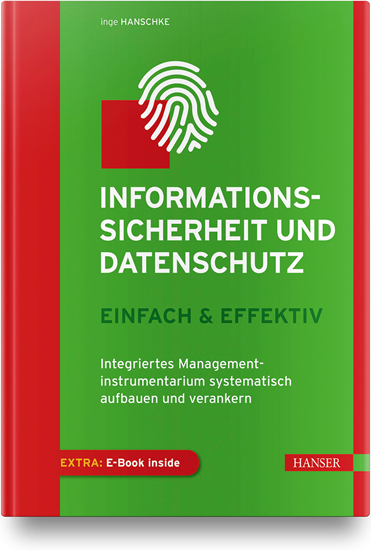
Informationssicherheit und Datenschutz - einfach & effektiv
Ein handhabbares und integriertes Instrumentarium ist notwendig, um sowohl die EU-Datenschutz-Grundverordnung (EU-DSGVO) als auch die Anforderungen der Informationssicherheit (u.a. BSI und ISO27001) nachhaltig zu erfüllen. Im Buch werden sowohl die Anforderungen der EU-Datenschutz-Grundverordnung als auch das Themenfeld Informationssicherheit eingeführt und aufgezeigt, welche wesentlichen Bestandteile für ein einfaches & effektives Management-Instrumentarium erforderlich sind. Durch die Kombination mit Enterprise Architecture Management und weiteren Disziplinen kann die Wirksamkeit noch erhöht werden. Nur so kann der Datenschutz und die Informationssicherheit wirksam sichergestellt werden.Im Kontext der Informationssicherheit werden sowohl die Einhaltung von Normen, wie ISO27001 abgedeckt als auch insbesondere das Themenfeld Cyber-Security adressiert. Die Bedrohungslage im Cyberspace nimmt immer weiter zu. Von daher nimmt die Bedeutung von Cyber-Security immer weiter zu.Cyber-Security beschreibt den Schutz vor technischen, organisatorischen und naturbedingten Bedrohungen, die die Sicherheit des Cyberspace inklusive Infrastruktur- und Datensicherheit gefährden. Es beinhaltet alle Konzepte und Maßnahmen, um Gefährdungen zu erkennen, zu bewerten und zu verfolgen, vorzubeugen sowie Handlungs- und Funktionsfähigkeit möglichst schnell wiederherzustellen.
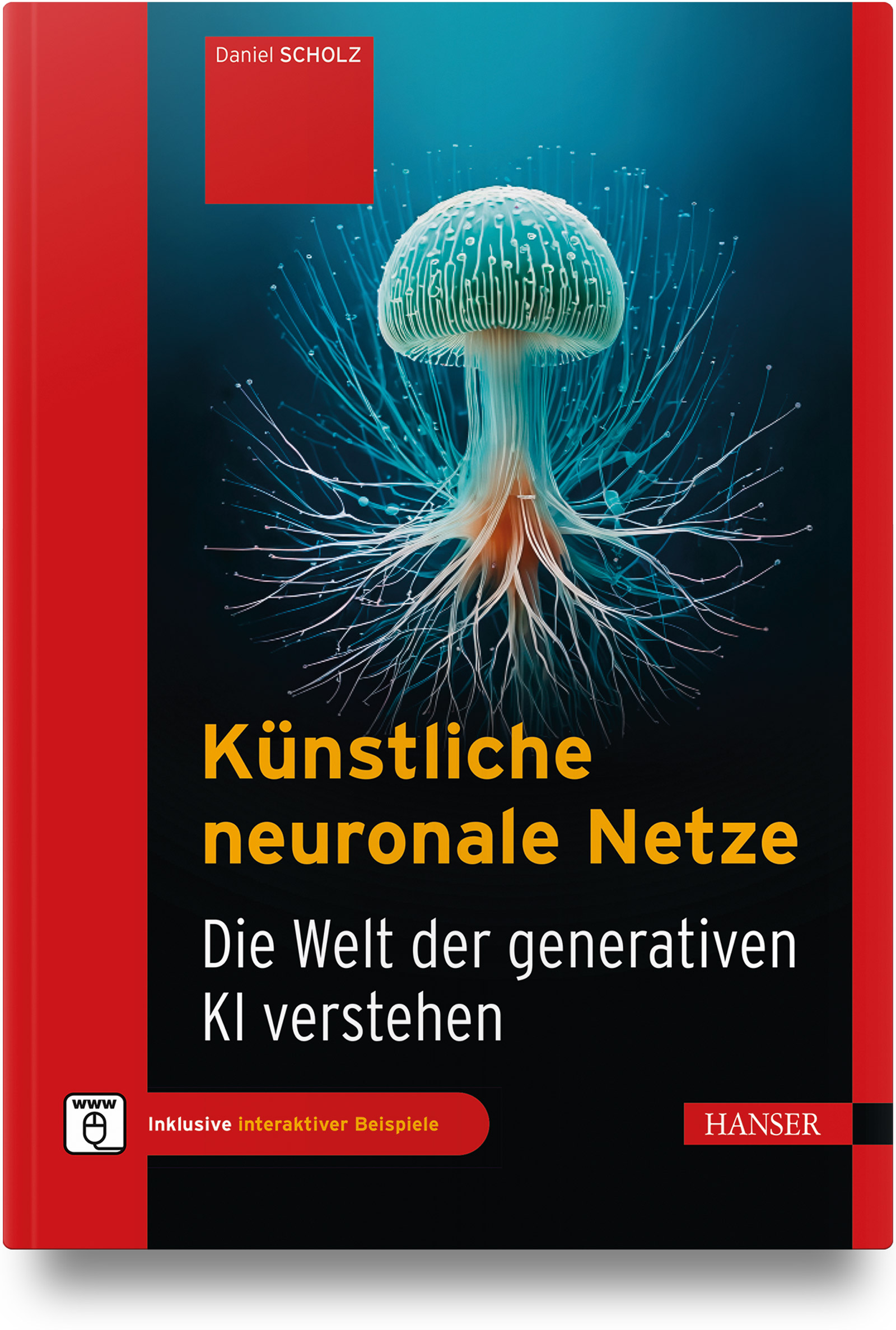
Künstliche neuronale Netze
Künstliche neuronale NetzeDieses Lehrbuch bietet eine verständliche Einführung in die Welt der neuronalen Netze, die für ein breites Publikum zugänglich ist. Es erklärt grundlegende Algorithmen und Verfahren, die neuronale Netze antreiben, ohne tiefere mathematische Vorkenntnisse oder Programmiererfahrung vorauszusetzen.Die Leser:innen lernen, wie einfache neuronale Netzwerke aufgebaut, trainiert und getestet werden. Darauf aufbauend werden fortgeschrittene Themen wie Convolutional Neural Networks (CNNs), Autoencoder, autoregressive Modelle und Diffusionsmodelle erläutert. Zahlreiche praktische Beispiele und leicht nachvollziehbare Erklärungen machen das Werk zu einem praxisnahen Lehrbuch für alle, die sich in dieses zukunftsweisende Thema einarbeiten möchten.Über den Autor:Dr. Daniel Scholz ist in der Weiterbildung KI&Data Science bei einem großen deutschen Automobilhersteller tätig und darüber hinaus aktiv im Bereich der schulischen Lehre und Weiterbildung.

AI for Robotics
This book approaches robotics from a deep learning perspective. Artificial intelligence (AI) has transformed many fields, including robotics. This book shows you how to reimagine decades-old robotics problems as AI problems and is a handbook for solving problems using modern techniques in an era of large foundation models.The book begins with an introduction to general-purpose robotics, how robots are modeled, and how physical intelligence relates to the movement of building artificial general intelligence, while giving you an overview of the current state of the field, its challenges, and where we are headed. The first half of this book delves into defining what the problems in robotics are, how to frame them as AI problems, and the details of how to solve them using modern AI techniques. First, we look at robot perception and sensing to understand how robots perceive their environment, and discuss convolutional networks and vision transformers to solve robotics problems such as segmentation, classification, and detection in two and three dimensions. The book then details how to apply large language and multimodal models for robotics, and how to adapt them to solve reasoning and robot control. Simulation, localization, and mapping and navigation are framed as deep learning problems and discussed with recent research. Lastly, the first part of this book discusses reinforcement learning and control and how robots learn via trial and error and self-play.The second part of this book is concerned with applications of robotics in specialized contexts. You will develop full stack knowledge by applying the techniques discussed in the first part to real-world use cases. Individual chapters discuss the details of building robots for self-driving, industrial manipulation, and humanoid robots. For each application, you will learn how to design these systems, the prevalent algorithms in research and industry, and how to assess trade-offs for performance and reliability. The book concludes with thoughts on operations, infrastructure, and safety for data-driven robotics, and outlooks for the future of robotics and machine learning.In summary, this book offers insights into cutting-edge machine learning techniques applied in robotics, along with the challenges encountered during their implementation and practical strategies for overcoming them.WHAT YOU WILL LEARN* Explore ML applications in robotics, covering perception, control, localization, planning, and end-to-end learning* Delve into system design, and algorithmic and hardware considerations for building efficient ML-integrated robotics systems* Discover robotics applications in self-driving, manufacturing, and humanoids and their practical implementations* Understand how machine learning and robotics benefit current research and organizationsWHO THIS BOOK IS FORSoftware and AI engineers eager to learn about robotics, seasoned robotics and mechanical engineers looking to stay at the cutting edge by integrating modern AI, and investors, executives or decision makers seeking insights into this dynamic fieldALISHBA IMRAN is a machine learning and robotics developer focusing on robot learning for manipulation and perception. She is currently conducting research in reinforcement learning and unsupervised learning with Pieter Abbeel at the Berkeley AI Research Lab. Alishba has worked on perception at Cruise, developed simulation object manipulation methods at NVIDIA, and led efforts to reduce prosthetics costs at SJSU. At Hanson Robotics, she improved manipulation in Sophia the Robot, and at Kindred.AI, she contributed to robots that have picked up over 140 million units in production.KEERTHANA GOPALAKRISHNAN is a senior research scientist at Google Deepmind, working on robot manipulation and the Gemini project. She was educated at Carnegie Mellon University and Indian Institute of Technology. Her research concerns large language models for robotic planning, scaling visual language models for low level control, and cross-embodiment robot learning.Chapter 1: Introduction: General Purpose Robotics.- Chapter 2: Robot Perception: Sensors and Image Processing.- Chapter 3: Robot Perception: 3D Data and Sensor Fusion.- Chapter 4: Foundation Models in Robotics.- Chapter 5: Simulation.- Chapter 6: Mapping, Localization, and Navigation.- Chapter 7: Reinforcement Learning and Control.- Chapter 8: Self Driving Cars.- Chapter 9: Industrial Robotics.- Chapter 10: Humanoid Robotics.- Chapter 11: Data-Driven Robotics in Practice.