

Computer und IT

Supply Chain Software Security
Delve deep into the forefront of technological advancements shaping the future of supply chain safety and resilience. In an era where software supply chains are the backbone of global technology ecosystems, securing them against evolving threats has become mission critical. This book offers a comprehensive guide to understanding and implementing next-generation strategies that protect these intricate networks from most pressing risks.This book begins by laying the foundation of modern software supply chain security, exploring the shifting threat landscape and key technologies driving the future. Delve into the heart of how AI and IoT are transforming supply chain protection through advanced predictive analytics, real-time monitoring, and intelligent automation. Discover how integrating application security practices within your supply chain can safeguard critical systems and data.Through real-world case studies and practical insights, learn how to build resilient supply chains equipped to defend against sophisticated attacks like dependency confusion, backdoor injection, and adversarial manipulation. Whether you’re managing a global software operation or integrating DevSecOps into your CI/CD pipelines, this book offers actionable advice for fortifying your supply chain end-to-end.YOU WILL:* Learn the role of AI and machine learning in enhancing supply chain threat detection* Find out the best practices for embedding application security within the supply chain lifecycle* Understand how to leverage IoT for secure, real-time supply chain monitoring and controlWHO IS THIS BOOK FORThe target audience for a book would typically include professionals and individuals with an interest or involvement in cloud-native application development and DevOps practices. It will cover fundamentals of cloud-native architecture, DevOps principles, and provide practical guidance for building and maintaining scalable and reliable applications in a cloud-native environment. The book's content will cater to beginner to intermediate level professionals seeking in-depth insights.Aamiruddin Syed is a seasoned security professional specializing in DevSecOps, cloud security, supply chain security, and penetration testing. With dual master’s degrees in Cybersecurity from Northeastern University and Jadavpur University, he excels in automating security within CI/CD pipelines and embedding security practices in cloud infrastructure.A recognized security advocate, Aamiruddin is a frequent speaker at industry conferences, including DEFCON and chairs technical conferences like ICCTICT. His work focuses on integrating security seamlessly into engineering processes, securing products across diverse industries, including manufacturing. He is also an author on supply chain security and a judge for the Globee Cybersecurity Awards.Beyond his professional endeavours, Aamiruddin contributes to open-source security tools and actively shares knowledge through his podcast, _CyberGPT Pulse_, and hands-on engagements like TryHackMe challenges.PART I: FOUNDATION OF NEXT-GEN SUPPLY CHAIN SECURITY.- Chapter 1: The New Era of Supply Chain Security.- Chapter 2: Key Technologies Shaping the Future.- PART II: APPLICATION SECURITY IN THE SUPPLY CHAIN.- Chapter 3: The Anatomy of Supply Chain Applications.- Chapter 4: Application Security Best Practices.- Chapter 5: DevSecOps in Supply Chain Management.- PART III: LEVERAGING AI AND IOT FOR SECURITY.- Chapter 6: AI-Powered Threat Detection and Response.- Chapter 7: IoT Security and Monitoring.- PART IV: CASE STUDIES AND PRACTICAL IMPLEMENTATION.- Chapter 8: Case Studies in Next-Gen Supply Chain Security.- Chapter 9: Implementing Next-Gen Security in Your Supply Chain.- PART V: FUTURE TRENDS AND CHALLENGES.- Chapter 10: Future Trends in Supply Chain Security.- Chapter 11: Navigating Emerging Challenges.

CCNA Certification Practice Tests
THE BEST PRACTICE AND PREPARATION FOR THE UPDATED CCNA CERTIFICATION EXAMCCNA Certification Practice Tests, Second Edition, is the perfect way to practice for updated certification Exam 200-301 v1.1 as you prepare to take your IT career to the next level. The book includes 1,200 domain-by-domain practice questions, so you can hone your test-taking skill and succeed in obtaining your certification. The CCNA certification has been revised and redesigned, and this updated second edition covers the latest exam objectives, including network fundamentals, network access, IP connectivity, IP services, security fundamentals, and automation and programmability. You also get one year of FREE access to the online text bank, so you can work through practice questions from anywhere, reinforcing your skills and knowledge. The CCNA certification proves your skill in a broad range of fundamentals, helping you progress in any IT career. And after you work through these test questions, you'll be thoroughly ready to pass the exam!* Study 100% of the topics covered on the Cisco CCNA certification exam* Get access to 1,200 practice questions, in the book and online* Gain familiarity with the wording of test questions so you're prepared on test day* Identify the test objectives you need the most work in so you can maximize your study timeThis Sybex collection of practice questions is perfect for anyone wanting to earn their CCNA certification, and it pairs well with the CCNA Certification Study Guide: Exam 200-301 v1.1, Second Edition.ABOUT THE AUTHORJON BUHAGIAR, CCNA, MCSA, MCSE, N+, A+, BS/ITM, is an information technology professional with over two decades of experience in higher education. Currently he is a director of information technology for RareMed Solutions. Over the past two decades, he served as an instructor where he has taught courses for Microsoft and Cisco certification. He has avidly pursued certifications and taught in the Pittsburgh area since 1998. Some of his certifications are Windows Server Microsoft Certified Solutions Expert (MCSE), Cisco Certified Network Associate (CCNA), CompTIA Network+, CompTIA A+, and CompTIA Project+, in addition to many other IT certifications. Introduction xiiiChapter 1 Network Fundamentals (Domain 1) 1Chapter 2 Network Access (Domain 2) 43Chapter 3 IP Connectivity (Domain 3) 85Chapter 4 IP Services (Domain 4) 137Chapter 5 Security Fundamentals (Domain 5) 159Chapter 6 Automation and Programmability (Domain 6) 189Chapter 7 Practice Exam 1 207Chapter 8 Practice Exam 2 229Appendix Answers to Review Questions 249Chapter 1: Network Fundamentals (Domain 1) 250Chapter 2: Network Access (Domain 2) 277Chapter 3: IP Connectivity (Domain 3) 301Chapter 4: IP Services (Domain 4) 332Chapter 5: Security Fundamentals (Domain 5) 344Chapter 6: Automation and Programmability (Domain 6) 363Chapter 7: Practice Exam 1 377Chapter 8: Practice Exam 2 389Index 403

OCP Oracle Certified Professional Java SE 21 Developer Study Guide
UNLOCK YOUR JAVA POTENTIAL AND MASTER THE OCP JAVA SE 21 DEVELOPER EXAM WITH CONFIDENCEDive into the OCP Oracle Certified Professional Java SE 21 Developer Study Guide: Exam 1Z0-830 for a comprehensive journey through the Java SE 21 Developer certification exam. Crafted by a team of seasoned Java professionals, this guide not only prepares you for the 1Z0-830 exam but also equips you with essential skills for both new and existing Java development roles. Enhance your knowledge, refine your skills, and discover new techniques with this expertly written roadmap. Explore the depths of Java development, from writing methods that utilize pattern matching to building applications with virtual threads. This guide covers all you need to ace the certification and excel in your Java development career. Additionally, it provides exclusive access to Sybex's online learning environment and test bank, featuring a wealth of practice questions, electronic flashcards, and a glossary to ensure you're fully prepared for exam day. You'll also:* Gain a solid understanding of Java SE 21 features and how to apply them effectively in your development projects* Boost your preparation with hundreds of practice questions and valuable online resources from the Sybex online learning environment* Quickly reference key concepts thanks to a searchable glossary, making it an indispensable tool for both junior and senior Java developersWhether you're gearing up for the OCP Java SE 21 Developer exam or seeking to solidify your Java expertise, this study guide is an essential resource. It not only serves as a comprehensive preparatory material for the certification but also as a go-to reference for your daily programming needs. Embrace this opportunity to reduce test anxiety, enhance your Java skills, and step confidently into your role as a Java developer. Make this book your coding companion today and set the stage for a thriving career in Java development. ABOUT THE AUTHORSJEANNE BOYARSKY is a Java Champion and has worked as a Java developer for a major bank for more than 22 years. She is a senior moderator at CodeRanch, and trains and mentors students of all levels. SCOTT SELIKOFF has been a professional Java Enterprise architect for almost 25 years. He currently works as a Staff Software Engineer at Google, specializing in Architecture and Cloud Services. He is a Leader of the Garden State Java User Group, helping to facilitate discussions and exchange of ideas within the community.

CCNA Certification Study Guide Volume 2
YOUR UPDATED GUIDE TO SUCCESS ON THE CCNA CERTIFICATION EXAMIn the newly revised second edition of the CCNA Certification Study Guide – Volume 2: Exam 200-301 v1.1, renowned Cisco educator and network engineer Todd Lammle and Donald Robb deliver a practical and effective test prep and roadmap to the challenging CCNA Certification exam. Volume 2 of the updated Study Guide covers objectives for network fundamentals and access, IP connectivity and services, security fundamentals, automation, programmability, artificial intelligence, and more. You'll also learn about topics like network device security, IPv6, QoS, wireless technologies, wireless controllers, automation, and REST APIs. The CCNA Certification Study Guide comes with one year of free access after activation to a robust set of online study tools designed to assess and advance your exam readiness. You'll find:* Up-to-date information relevant to the latest Cisco technologies and job roles* An interactive online test bank, including hundreds of practice test questions, flashcards, and a glossary of key terms and definitions* Discussions of everything from enhanced switching and ACLs to FHRP, SDN, configuration management, and morePerfect for anyone preparing to pursue the updated CCNA Certification, the CCNA Certification Study Guide – Volume 2 is a must-read for practicing IT professionals looking for a refresher on Cisco networking fundamentals. ABOUT THE AUTHORS TODD LAMMLE, Cisco certified in almost every category, is the authority on Cisco networking and certification. His three decades of real-world experience is prevalent in his writing. He is an experienced networking engineer with very practical experience working on the largest bounded and unbounded networks in the world at such companies as Xerox, Hughes Aircraft, Texaco, AAA, Cisco, and Toshiba, among many others. Todd has published over 60 books, including the very popular and bestselling CCNA Cisco Certified Network Associate Study Guide and Cisco Firepower NGIPS. Todd runs an international training company from Texas, and a large-scale consulting business out of Colorado. You can reach Todd through his forum and blog at www.lammle.com/ccna. DONALD ROBB has over 15 years of experience with most areas of IT, including networking, security, collaboration, data center, cloud, SDN, and automation/devops. He’s earned many advanced certifications and specializations. Currently he’s a SDN/Cloud/DevOps SME. Visit his blog at https://www.the-packet-thrower.com and YouTube channel at https://www.youtube.com/c/ThePacketThrower.

Model Optimization Methods for Efficient and Edge AI
COMPREHENSIVE OVERVIEW OF THE FLEDGLING DOMAIN OF FEDERATED LEARNING (FL), EXPLAINING EMERGING FL METHODS, ARCHITECTURAL APPROACHES, ENABLING FRAMEWORKS, AND APPLICATIONSModel Optimization Methods for Efficient and Edge AI explores AI model engineering, evaluation, refinement, optimization, and deployment across multiple cloud environments (public, private, edge, and hybrid). It presents key applications of the AI paradigm, including computer vision (CV) and Natural Language Processing (NLP), explaining the nitty-gritty of federated learning (FL) and how the FL method is helping to fulfill AI model optimization needs. The book also describes tools that vendors have created, including FL frameworks and platforms such as PySyft, Tensor Flow Federated (TFF), FATE (Federated AI Technology Enabler), Tensor/IO, and more. The first part of the text covers popular AI and ML methods, platforms, and applications, describing leading AI frameworks and libraries in order to clearly articulate how these tools can help with visualizing and implementing highly flexible AI models quickly. The second part focuses on federated learning, discussing its basic concepts, applications, platforms, and its potential in edge systems (such as IoT). Other topics covered include:* Building AI models that are destined to solve several problems, with a focus on widely articulated classification, regression, association, clustering, and other prediction problems* Generating actionable insights through a variety of AI algorithms, platforms, parallel processing, and other enablers* Compressing AI models so that computational, memory, storage, and network requirements can be substantially reduced* Addressing crucial issues such as data confidentiality, data access rights, data protection, and access to heterogeneous data* Overcoming cyberattacks on mission-critical software systems by leveraging federated learningWritten in an accessible manner and containing a helpful mix of both theoretical concepts and practical applications, Model Optimization Methods for Efficient and Edge AI is an essential reference on the subject for graduate and postgraduate students, researchers, IT professionals, and business leaders. PETHURU RAJ CHELLIAH, PHD, is the Chief Architect of the Edge AI division of Reliance Jio Platforms Ltd. (JPL), Bangalore, India. AMIR MASOUD RAHMANI, PHD, is an artificial intelligence faculty member at the National Yunlin University of Science and Technology, Taiwan. ROBERT COLBY is a Principal Engineer in IT Infrastructure responsible for Manufacturing Network Architecture and IoT Infrastructure at Intel Corporation. GAYATHRI NAGASUBRAMANIAN, PHD, is an Assistant Professor with the Department of Computer Science and Engineering at GITAM University in Bengaluru, India. SUNKU RANGANATH is a Principal Product Manager for Edge Infrastructure Services at Equinix.

Computational Intelligence for Autonomous Finance
THE BOOK SERVES AS AN ESSENTIAL GUIDE AND A DEEP DIVE INTO THE INTERSECTION OF AI AND FINANCE, PROVIDING READERS WITH A THOROUGH UNDERSTANDING OF THE CURRENT STATE, CHALLENGES, AND FUTURE POSSIBILITIES OF AUTONOMOUS FINANCIAL SYSTEMS.In the rapidly evolving domain of autonomous finance, the convergence of computational intelligence techniques and financial technologies has paved the way for a new era of financial services. This transformation is driven by the integration of artificial intelligence (AI), machine learning (ML), blockchain, and big data analytics into financial systems, leading to the development of more responsive, efficient, and personalized financial products and services. Computational Intelligence for Autonomous Finance delves into the heart of this technological revolution, offering a comprehensive exploration of the theoretical foundations, practical applications, and future prospects of computational intelligence in the financial sector. The backbone of autonomous finance is a complex, interconnected ecosystem that leverages computational intelligence to automate decision-making processes, optimize financial operations, and enhance customer experiences. The book introduces the concept of an Intelligent Autonomous Financial Network (IAFN), which integrates various computational intelligence techniques with cutting-edge financial technologies to create a self-organizing, adaptive, and scalable financial system. The IAFN framework facilitates seamless interactions between diverse financial entities, enabling the provision of innovative financial services such as automated trading, real-time risk management, personalized financial planning, and fraud detection. The book meticulously analyzes the key challenges including data security and privacy concerns, algorithmic biases, regulatory compliance, and the need for interoperable standards. It also presents state-of-the-art solutions and best practices for overcoming these challenges, emphasizing the importance of ethical AI, robust data protection mechanisms, transparent algorithms, and collaborative regulatory frameworks. It discusses emerging trends such as quantum computing, edge computing, and decentralized finance (DeFi), highlighting their potential to further transform the financial landscape. The book also addresses the societal implications of autonomous finance, including its impact on employment, wealth distribution, and financial inclusion, advocating for a balanced approach that maximizes benefits while minimizing negative outcomes. AUDIENCEThis book is aimed at researchers, industry professionals, policymakers, and graduate students in finance, computational intelligence, and related fields. DEEPA GUPTA, PHD, is the Dean at GL Bajaj Institute of Management, Greater Noida, India. Her expertise extends to organized development, corporate relations, and international collaborations. Dr. Gupta is an active researcher who has published 15 national/international patents and has contributed more than 45 research papers to various international and national conferences and journals. MUKUL GUPTA, PHD, is a principal at GL Bajaj Institute of Management, Greater Noida, India. His research focuses on consumer behavior to help understand the human-centric aspects of autonomous finance systems. He has published 12 national/international patents, more than 40 research papers, and authored books. RAJESH KUMAR DHANARAJ, PHD, is a professor at the School of Computing Science and Engineering at Galgotias University in India. He has authored/edited more than 25 books on various technologies, 21 patents, and 50+ articles and papers in various refereed journals and international conferences. BALAMURUGAN BALUSAMY, PHD, is an associate dean of students at Shiv Nadar University at the Delhi-NCR Campus in Noida, India. He has authored/edited more than 80 books and more than 200 contributions to international journals and conferences. PARTH MUKUL GUPTA, is an innovative entrepreneur and the director at Zarthcorp Tech Pvt. Ltd. and of the Shri Sai Memorial Foundation, Greater Noida, India. He has experience in brand building, organizational development, and global collaborations and spearheads advancements in autonomous finance through technological innovation and strategic growth initiatives. Preface xvii1 THE ROLE OF AUTONOMOUS FINANCE IN THE ERA OF AUTOMATIC CIVILIZATION 1Sanjeet Singh, Geetika Madaan and Jaskiran Kaur1.1 Introduction 21.2 The Concept of Autonomous Finance 21.3 Autonomous Finance: Prospects and Developments 91.4 Key Considerations for Implementing Autonomous Finance 141.5 Conclusion 152 ANALYZING THE LATEST TOOLS AND TECHNIQUES FOR STOCK MARKET ANALYSIS 21Ochin Sharma, Raj Gaurang Tiwari, Suvarna Sharma and Annu Priya2.1 Introduction 212.2 Need for Trading Softwares 232.3 How Software for Technical Analysis of the Indian Stock Market Operates 232.4 Helpful Tools to Analyze Stock Market 242.5 Conclusion 393 CHALLENGES AND SECURITY ISSUES IN AUTONOMOUS FINANCE 43Mukul Gupta, Deepa Gupta, Nitin Agrawal and Parth Mukul Gupta3.1 Introduction 443.2 A Review of the Literature 453.3 Concerns Regarding the Protection of Identity and Privacy in Autonomous Finance 463.4 Using Algorithms to Make Decisions Can be Biased 493.5 Ensuring Fairness in Autonomous Finance 503.6 Compliance with Regulations in the Field of Autonomous Finance 513.7 Gaining an Understanding of the Fundamentals of Operational Risk 543.8 Risks Encountered in the Operation of Autonomous Finance 553.9 Concerns Regarding Ethical Issues in Autonomous Finance 573.10 Consumer Trust in Autonomous Finance 594 INVOLVEMENT OF ARTIFICIAL INTELLIGENCE IN EMERGING FINTECH INDUSTRY 4.0: A TCCM FRAMEWORK 65Annu and Ravindra Tripathi4.1 Introduction 664.2 Data and Methodology 694.3 Results and Discussion 704.4 Finding, Conclusion, and Research Directions 764.5 Summary 775 ROBOTIC PROCESS AUTOMATION IN THE FINANCIAL SECTOR 81Neha Sonik, Deepa Gupta and Parul Gupta5.1 Introduction 815.2 How are Financial Institutions Making Use of Robotics and Automation? 835.3 Major Use Cases of Robotic Process Automation in Banking and Finance 845.4 Minding Gaps in Financial Process Automation 915.5 The Key Benefits of Finance Automation 925.6 A List of Accounting and Financial Services Companies That are Using RPA 955.7 Steps to Deploy RPA in Banking and Finance 975.8 Conclusion 996 INTEGRATION OF FINTECH WITH DATA SCIENCE (DS) AND ARTIFICIAL INTELLIGENCE (AI): A CHALLENGING FOOTSTEP 101Ankur Goel, Monisha Awasthi, Anamika Rana and Sushma Malik6.1 Introduction 1026.2 Historical Background of Fintech 1026.3 Advantages of Fintech 1046.4 Role of Data Science and AI 1086.5 Data Science and AI (DSAI) Making Smart Fintech 1116.6 Use Cases of Data Science in Fintech 1166.7 Conclusion 1197 EVALUATION OF FINTECH: THE TECHNO-FUNCTIONAL APPLICATION IN DIGITAL BANKING 123Priyanka Verma, Rajesh Kumar Dhanaraj, Deepa Gupta and Mukul Gupta7.1 Introduction 1237.2 Overview of Fintech 1247.3 Theoretical Overview 1367.4 Measurement of the Success Factor of Fintech in Digital Banking 1377.5 Summary 1398 REAL-TIME DATA VISUALIZATION AND AUTONOMOUS FINANCE: USES OF EMERGING TECHNOLOGIES 143Govind Singh, Lokesh Verma and Anshika Baliyan8.1 Introduction 1448.2 Thriving in the Tech Age: How Businesses Adapt to Emerging Technologies 1488.3 The Future of Work and Innovation: Emerging Technologies Transforming Businesses 1518.4 Major Emerging Technologies in Finance 1598.5 Risk Associated with Emerging Technologies 1648.6 Conclusion 1659 AI AND ML MODELING AND AUTONOMOUS FINANCE IN MICROFINANCE: AN OVERVIEW 167D. N. Rao and Maheswaran Mahalingam9.1 Understanding Autonomous Finance and Microfinance 1689.2 Readiness of MFIs for Autonomous Finance Transformation 1709.3 Solution Drivers in the Life Cycle Journey of an MFI Customer 1739.4 Readiness of MFIs for Autonomous Finance Operations 1779.5 Technology and AI and ML Enablers of Autonomous Finance for MFIs 1809.6 Critical Business Needs of Autonomous Finance 1829.7 AI and ML Analytical Models for MFIs 1829.8 Overall Deployment and Suitability 1889.9 Roadmap for Autonomous Finance in MFIs 1889.10 Stage-1: Operation Moonwalk 1909.11 Stage 2—Operation Sun Shine 1929.12 Stage 3 Operation Bloomsdale 1939.13 Improvement Opportunities of Autonomous Finance for MFIs 1939.14 Embracing Future AI Agents and Robotics of Autonomous Finance 19510 APPLICATION OF MACHINE LEARNING MODELS IN THE FIELD OF AUTONOMOUS FINANCE 199Umesh Gupta, Shriyash Saxena, Sachin Kumar Yadav and Aditya Bhardwaj10.1 Overview 19910.2 Introduction 20110.3 Reinforcement Learning 20310.4 Neural Network Basics 20910.5 Management of Information for Credit Risk 21310.6 Sentiment Analysis with Data Mining Approach 21510.7 Conclusion 21611 MACHINE LEARNING ALGORITHM IN INDIAN STOCK MARKET FOR REVISING AND REFINING THE EQUITY VALUATION MODELS 221Nitha K. P., Suraj E. S. and Ranjith Karat11.1 Introduction 22111.2 Objectives of the Study 22311.3 Methodology 22311.4 Review of Literature 22511.5 Machine Learning for Equity Valuation Models 22811.6 Architecture of Refined Equity Models 23211.7 Analysis—Checking the Valuation Accuracy of Revised and Refined Models Using Machine Learning Approach 23411.8 Conclusion 24012 HYPER AUTOMATION AND ITS APPLICABILITY IN AUTOMATION FINANCE 243Pushpendra Pal Singh, Rakesh Kumar Dixit and Rajesh Kumar Dhanaraj12.1 Introduction 24412.2 Background 24512.3 Hyper Automation: Evolution, Technologies, and Impact in the Digital Era 24712.4 Automation-(2)-Hyper Automation: Gartner 24912.5 Could Hyper Automation be a Name for AI Plus RPA? 25012.6 Sophistication of the Automation 25212.7 Hyper Automation Process Flow 25412.8 Banking and Finance Applications 26012.9 Conclusions 26413 PRE- AND POST-COVID AUTONOMOUS FINANCE: GLOBAL PERSPECTIVE 269Shikha Singh, Deepa Gupta, Roshan Kumar and Balamurugan Balusamy13.1 Introduction 27013.2 Literature Review 27113.3 Factors Behind the Digitalization of Financial Services During the COVID Pandemic 27313.4 Challenges/Barriers for FinTech 27913.5 Advantages and Disadvantages of Market Structure Modifications Towards the Digitalization of FinTech Services 28013.6 Conclusion 28314 EMERGING TRENDS AND FUTURE DIRECTIONS IN ARTIFICIAL INTELLIGENCE FOR NEXT-GENERATION COMPUTING 289Rafael Vargas-Bernal14.1 Introduction 29014.2 Concepts of Neuromorphic Computing, Artificial Intelligence, and Memristor 29114.3 Advantages of Two-Dimensional Materials Used in Neuromorphic Computing 29414.4 Devices Implemented with Two-Dimensional Materials to Evolve Artificial Intelligence 29814.5 Future Research Directions 30814.6 Summary 309Acknowledgments 310References 310Index 313
Data Science Essentials For Dummies
FEEL CONFIDENT NAVIGATING THE FUNDAMENTALS OF DATA SCIENCEData Science Essentials For Dummies is a quick reference on the core concepts of the exploding and in-demand data science field, which involves data collection and working on dataset cleaning, processing, and visualization. This direct and accessible resource helps you brush up on key topics and is right to the point—eliminating review material, wordy explanations, and fluff—so you get what you need, fast.* Strengthen your understanding of data science basics* Review what you've already learned or pick up key skills* Effectively work with data and provide accessible materials to others* Jog your memory on the essentials as you work and get clear answers to your questionsPerfect for supplementing classroom learning, reviewing for a certification, or staying knowledgeable on the job, Data Science Essentials For Dummies is a reliable reference that's great to keep on hand as an everyday desk reference. LILLIAN PIERSON, PE, is the founder and fractional CMO at Data-Mania, as well as a globally recognized growth leader in technology. To date, she has helped educate approximately 2 million professionals on how to leverage AI, data strategy, and data science to drive business growth.

CCNA Certification Study Guide Volume 1
YOUR COMPREHENSIVE GUIDE TO SUCCEEDING ON THE UPDATED CCNA CERTIFICATION EXAMIn the newly revised second edition of the CCNA Certification Study Guide Volume 1: Exam 200-301 v1.1, celebrated Cisco educator and network guru Todd Lammle and expert Donald Robb deliver an intuitive and efficient roadmap to the challenging CCNA Certification test. The updated Study Guide covers many topics, including network fundamentals and access, IP connectivity and services, security fundamentals, automation, programmability, artificial intelligence, and more. The CCNA Certification Study Guide comes with complementary access to a robust set of online study tools designed to assess and advance your exam readiness. You'll find:* Up-to-date information relevant to the latest Cisco technologies and job roles* An interactive online test bank, including hundreds of practice test questions, flashcards, and a glossary of key terms and definitions* Discussions of everything from VLANs and Inter-VLAN Routing to switching, OSPF, IP routing, and morePerfect for anyone preparing to pursue the updated CCNA Certification, the CCNA Certification Study Guide Volume 1: Exam 200-301 v1.1, Second Editon, is a must-read for practicing IT professionals looking for a refresher on Cisco networking fundamentals. ABOUT THE AUTHORSTODD LAMMLE, Cisco certified in almost every category, is the authority on Cisco networking and certification. His three decades of real-world experience is prevalent in his writing. He is an experienced networking engineer with very practical experience working on the largest bounded and unbounded networks in the world at such companies as Xerox, Hughes Aircraft, Texaco, AAA, Cisco, and Toshiba, among many others. Todd has published over 60 books, including the very popular and bestselling CCNA Cisco Certified Network Associate Study Guide and Cisco Firepower NGIPS. Todd runs an international training company from Texas, and a large-scale consulting business out of Colorado. You can reach Todd through his forum and blog at www.lammle.com/ccna. DONALD ROBB has over 15 years of experience with most areas of IT, including networking, security, collaboration, data center, cloud, SDN, and automation/devops. He’s earned many advanced certifications and specializations. Currently he’s a SDN/Cloud/DevOps SME. Visit his blog at https://www.the-packet-thrower.com and YouTube channel at https://www.youtube.com/c/ThePacketThrower.
KI und Recht
KI UND RECHT Die Nutzung von KI-Anwendungen im beruflichen Alltag bringt zahlreiche Herausforderungen mit, mit denen sich Unternehmen wie Behörden frühzeitig beschäftigen sollten. Das Urheberrecht, das Datenschutzrecht oder auch allgemeine Persönlichkeitsrechte sind betroffen. In diesem Buch werden die komplexen rechtlichen Fragen, die mit dem Einsatz von künstlicher Intelligenz (KI) einhergehen, umfassend betrachtet:Wem gehört ein KI-Werk?Erlangt ein KI-Erzeugnis Schutz nach dem Urheberrecht, wenn es von einem Menschen bearbeitet wird? Verliert das Werk eines Menschen das Urheberrecht, wenn es von der KI bearbeitet wird?Müssen von einer KI generierte Inhalte gekennzeichnet werden?Darf ein Mensch sich als "Urheber" eines KI-Werks ausgeben?Was ist bei der Verarbeitung personenbezogener Daten durch KI zu beachten?Darf eine KI frei verfügbare Online-Daten zu Trainingszwecken verwenden? Auf diese und weitere Fragen erhalten Sie Antworten und lernen, wie Sie KI-Tools bei der täglichen Arbeit verantwortlich einsetzen.AUS DEM INHALT Was ist KI und welche rechtlichen Problemfelder gibt esKI und Urheberrecht KI-Trainingsdaten KI und DatenschutzrechtKI und allgemeines Persönlichkeitsrecht KI-GuidelinesKI-Regulierung (KI-VO und KI-Haftungs-RL)KI und Markenrecht KI und E-Mail-MarketingÜber den Autor:Michael Rohrlich ist Rechtsanwalt, Fachautor und Dozent aus Würselen (Nähe Aachen). Seine beruflichen Schwerpunkte liegen insbesondere auf den Gebieten E-Commerce-, Datenschutz- und KI-Recht. Seit vielen Jahren schreibt er regelmäßig für diverse Print- und Onlinepublikationen. Darüber hinaus ist er Autor mehrerer Bücher sowie als Video-Trainer für LinkedIn Learning tätig.
Blended Learning mit MOODLE (2. Auflg.)
• Moodle-Infrastruktur aufbauen und verstehen• Moodle professionell verwalten• Kurse gestalten und in das Unterrichtsprogramm integrieren• Unterstützender Einsatz von Hot Potatoes und H5P im Präsenzunterricht• Erfolgreich und zuverlässig Prüfungen mit Moodle durchführen• Neu in der 2. Auflage: Infos zu neuen Systemvoraussetzungen, überarbeitete Aktivitätsmodule, Migration von 3.x auf 4.x, CI/CD und KurskommunikationBei „Moodle“ bzw. „E-/Blended Learning“ geht es vor allem darum, gezielt Kurse zu entwickeln, die sich ideal in das didaktische Konzept der Lehre integrieren und diese unterstützen. Auch die Durchführung von Prüfungen und Lernzielkontrollen sowie die Abgabe von Hausaufgaben sind ein wichtiges Thema. Das Lehrpersonal und der menschliche Kontakt sollen dadurch aber nicht ersetzt werden. Vorbereitende Übungen zur Vertiefung des Stoffs sollen kurzweilig gestaltet und auch für kurze Übungssequenzen geeignet sein. Einen Einblick in externe Software, die über den SCORM-Standard (Sharable Content Object Reference Model) in Moodle integriert werden kann, gibt die Vorstellung von Hot Potatoes. In der Zukunft wird für die Unterstützung der Präsenzlehre und der Fernschulung sowie als motivierendes Recherchemedium die Integration multimedialer, interaktiver Technologien wie H5P in Moodle immer wichtiger. Blended-Learning-Technologien (hier am Beispiel des am weitesten verbreiteten LMS Moodle) sollen eine Unterstützung der Aus- und Fortbildung sein, nicht jedoch als eine disruptive Konkurrenz zu einer zwischenmenschlich geprägten Pädagogik aufgefasst werden. Dazu soll dieses Werk beitragen.AUS DEM INHALT //Teil I – Allgemeine Ansätze• Potenzielle Zielgruppen• Potenzielle EinsatzbereicheTeil II – Technik• Der Moodle-Server• Moodle-Grundinstallation• Benutzerverwaltung• Rollen im Moodle-System• Bereichs- und Kursverwaltung• E-Mail-Kommunikation• DesignsTeil III – Moodle in der Praxis• Moodle im Überblick• Aktivitäten• Werkzeuge zur Kursgestaltung• Ergänzende Lernhilfen für Moodle• Fragenkataloge in Moodle• Lernzielkontrollen und Prüfungen Robert Schoblick studierte Nachrichtentechnik sowie Elektround Informationstechnik. Als zertifizierter Fachtrainer nach EN ISO 17024 (SystemCERT, Austria) arbeitet er in der Erwachsenenbildung und in der Lehrlingsausbildung u. a. in den Fachgebieten Informatik, Informationstechnik, Elektrotechnik und Mechatronik. Außerdem ist er freiberuflich als Fachjournalist (IT, Energietechnik, Elektromobilität) und als Buchautor tätig.Seine besonderen Interessen sind:- Blended Learning in der (sinnvollen) Praxis- Didaktischer Nutzen digitaler Lehr/Lernunterstützung (im Rahmen eigener Kursgestaltung)- Moodle (lernbegleitendes Angebot für die Kursteilnehmer, Durchfüh-rung von Lernzielkontrollen)- Virtuelle Klassenzimmer- Lernen „on Demand“ in der beruflichen Weiterbildung (Mitarbeiterschulung etc.).- Regenerative Energietechnik- Elektromobilität

Shrova Mall
Welcome to the book "Shrova Mall: A-to-Z e-commerce full-stack application". In this book, I explain how you can create a full-stack e-commerce application using Angular and NestJS. The application provides payment and shipping functionalities by integrating Stripe for payments and Shippo for shipping. To begin, I will show you the application we are going to build and then start by creating the database. Next, I will explain the backend and finally the frontend application. By the end of this book, you will be able to create your online e-commerce store and cover all possible scenarios. Let’s get started. Hello, I am Abdelfattah Ragab, a professional software developer with more than 20 years of experience. I am an expert in Angular, CSS, graphic design and all web related technologies. I have published numerous books on modern CSS layouts and Angular as well as complete business solutions for e-commerce and the like. I hope you enjoy my books. With kind regards.

Generative AI in Education
As artificial intelligence (AI) rapidly transforms education, tools like ChatGPT and Claude are revolutionizing the way we teach and learn. This book is a groundbreaking book that empowers parents and students to navigate this exciting new frontier, filling a critical gap in the current literature.As the first comprehensive guide to generative AI in education designed for parents and students, _Generative AI in Education_ is positioned to become an indispensable resource. It provides the knowledge and strategies needed to effectively integrate AI into their learning journeys, transforming educational outcomes and preparing students for success in a rapidly changing world. You’ll gain a deep understanding of how tools like ChatGPT and Claude work, and how they can be leveraged to support learning across various subjects and grade levels.You’ll then see how to create clear, specific, and engaging prompts that elicit valuable responses from AI-powered tools. This book contains all the techniques for tailoring prompts to different learning objectives, styles, and contexts, and how they can use AI tools to support reading comprehension, writing skills, problem-solving, and creative thinking.WHAT YOU WILL LEARN* Apply generative AI in education* Craft effective prompts for personalized learning experiences* Utilize AI tools to support learning, creativity, and problem-solving WHO THIS BOOK IS FORParents and students who are eager to harness the power of generative AI to enhance learning experiences and prepare for success in an AI-driven futurePaolo Narciso is the founder of Core Immersive Academy, a Maryland Institute College of Art finalist for Creative Entrepreneurship in 2022. He was the former head of Product and Program Development at AARP Foundation, a Washington, DC based national non-profit. He holds a Doctorate in Education from Creighton University and sits on multiple 2 Confidential // Paolo Narcico // 05/31/2024 technology boards, advising on the use of artificial intelligence, and blockchain in healthcare and to secure property rights for marginalized populationsChapter 1. Getting to Know Your AI Education Partner.- Chapter 2. Staying Safe and Smart with AI.- Chapter 3. The Magic of Prompts: Unleashing AI's Potential 3.- Chapter 4. Your AI Toolkit: ChatGPT, Claude, and Gemini.- Chapter 5. Bringing AI Home: Enhancing Learning Outside the Classroom.- Chapter 6. Teaming Up with Teachers: AI in the Classroom.- Chapter 7. Tracking Your AI Adventure: Progress and Impact.- Chapter 8. The Future of Learning with AI.- Chapter 9. Wrapping Up Your AI Journey.- Appendix A: Exploring Generative AI for Art, Graphics, and Videos in Education.

Computational Intelligence for Autonomous Finance
Computational Intelligence for Autonomous Finance recognizes a new age of automatic civilization. The book is a seminal exploration of the dynamic domain of finances and banking. Designed to navigate the intricate interplay between emerging technologies and financial services, this book addresses both the profound opportunities and the intricate challenges that lie ahead. The genesis of this book lies in recognizing the new age of automatic civilization. Not only does it suit academic needs, but this book aims to inspire a new generation of practitioners to embrace the challenges and opportunities presented by autonomous finance.Each chapter provides a unique lens for the potential of computational intelligence to revolutionize the market. The first section of this book talks about the transformative potential of computational intelligence in finance. The book systematically unfolds the multifaceted aspects of the revolution and provides insights into cutting-edge technologies that shape stock market strategies. In subsequent chapters, the book expands on its exploration of AI and the fintech industry. Delve into discussions of the ongoing evolution of financial technologies. The narrative then shifts towards more specialized applications of AI and ML in finance, with chapters dedicated to autonomous finance in microfinance along with the use of machine learning algorithms.

Data Science Essentials For Dummies
FEEL CONFIDENT NAVIGATING THE FUNDAMENTALS OF DATA SCIENCEData Science Essentials For Dummies is a quick reference on the core concepts of the exploding and in-demand data science field, which involves data collection and working on dataset cleaning, processing, and visualization. This direct and accessible resource helps you brush up on key topics and is right to the point—eliminating review material, wordy explanations, and fluff—so you get what you need, fast.* Strengthen your understanding of data science basics* Review what you've already learned or pick up key skills* Effectively work with data and provide accessible materials to others* Jog your memory on the essentials as you work and get clear answers to your questionsPerfect for supplementing classroom learning, reviewing for a certification, or staying knowledgeable on the job, Data Science Essentials For Dummies is a reliable reference that's great to keep on hand as an everyday desk reference. LILLIAN PIERSON, PE, is the founder and fractional CMO at Data-Mania, as well as a globally recognized growth leader in technology. To date, she has helped educate approximately 2 million professionals on how to leverage AI, data strategy, and data science to drive business growth.
Power BI mit Excel (4. Auflage)
Power BI mit Excel (4. Auflage)So bekommen Sie die Datenflut in den Griff! Mit Power BI und Excel lassen sich große Datenmengen analysieren und aufbereiten. In diesem Buch erfahren Sie alles, was Sie für den Arbeitsalltag benötigen: umfassende und verständliche Erklärungen anhand anschaulicher Szenarien aus der Praxis. Stephan Nelles zeigt Ihnen den Umgang mit Rohdaten aus vielfältigen Datenquellen und deren Bereinigung, Verknüpfung, Analyse und Visualisierung. Sie erfahren, wie Ihnen das Zusammenspiel von Excel mit Power Query, Power Pivot und Power BI Desktop effizient gelingt.Leseprobe (PDF)Aus dem Inhalt:Was ist Self-BI? Was leisten die Tools?Power Query-GrundlagenPower Query statt TextfunktionenPower Query Formula Language: MPower Pivot-GrundlagenBedingte Kalkulationen: CALCULATE()Kalendertabellen einbindenSparklines und bedingte FormatePower BI Desktop-GrundlagenDatenvisualisierungDashboards veröffentlichenPower BI Service – effizientes TeamworkÜber den Autor:Stephan Nelles ist Experte für Excel im Controlling und Finanzwesen. Er schult Anwender und berät Unternehmen, vor allem zum Thema Business Intelligence, Reporting und Controlling.

Das große Mac-Buch für Einsteiger und Umsteiger (12. Auflage)
Das große Mac-Buch für Einsteiger und Umsteiger (12. Auflage)Sie sind ganz neu in der Mac-Welt oder waren bisher ein Windows-Anwender? Mit dieser Anleitung steigen Sie direkt ein! Jörg Rieger Espindola und Markus Menschhorn navigieren Sie sicher und unterhaltsam durch die Benutzeroberfläche und alle Anwendungen des Macs: Sie erfahren, wie Sie Ihre Bilder mit der Fotos-App bearbeiten und Musik abspielen – ob in Apples Musik-App, als Streaming oder im Radio. Bald schon schreiben Sie E-Mails, surfen im Internet, und behalten in der iCloud jederzeit den Überblick über Ihre Dateien und Kontakte.Leseprobe (PDF)Aus dem Inhalt:Ihren Mac in Betrieb nehmenTastatur, Trackpad und Maus bedienenSchreibtisch, Finder und Fenster im ÜberblickProgramme installieren und öffnen – die Apps am MacDateien, Ordner und Laufwerke verwaltenTexte schreiben und gestaltenAdressbuch, Kalender und Notizen im Griff – auch geräteübergreifendiCloud, Siri und das KontrollzentrumSicher und schnell im Internet surfenE-Mails, Videotelefonie und ChatFotos, Musik und FilmeUpdates, Problemlösungen, DatensicherungÜber die Autoren:Markus Menschhorns Leidenschaft gilt der Vermittlung von Wissen und Kompetenzen. Der promovierte Germanist arbeitet seit mehr als zehn Jahren als Lehrer und ist auch in der Erwachsenenbildung tätig.»Kompliziertes ganz einfach« – so lautet das Motto von Jörg Rieger Espindola. Der freiberufliche Redakteur ist seit Jahren für verschiedene Online- und Printmedien tätig und hat bereits mehrere Bücher für Computereinsteiger veröffentlicht.

Design and Deploy IoT Network & Security with Microsoft Azure
Unlock the potential of IoT with Microsoft Azure through this comprehensive guide, designed to elevate your understanding and implementation of cutting-edge IoT network and security solutions. Whether you are a beginner or a seasoned professional, this book offers clear, actionable insights to help you master the intricacies of IoT with Azure. This book equips you with the expertise to design and deploy secure, efficient, and scalable IoT networks using Microsoft Azure. It is your key to becoming a proficient IoT architect and security specialist.WHAT YOU WILL LEARN* Know the fundamentals of IoT networks and security, including key concepts, terminologies, and the importance of securing IoT deployments* Dive into Azure Edge Services to design and deploy edge solutions that bring computation and data storage closer to the data source, enhancing speed and efficiency* Explore the architecture and deployment of Azure IoT networks to gain practical knowledge on setting up scalable, reliable, and secure IoT networks tailored to your needs* Study best practices and strategies for securing your IoT environment and ensuring robust protection against emerging threats* Monitor and manage your IoT solutions effectively via tools and techniques for maintaining optimal performance, diagnosing issues, and ensuring seamless operation of your IoT networksWHO THIS BOOK IS FORIoT network and security engineers, architects, and Azure IoT developersPUTHIYAVAN UDAYAKUMAR is a seasoned infrastructure architect and senior infrastructure consultant with over 15 years of experience in the IT industry. He is a Master Certified Architect by OpenGroup and holds numerous IT certifications. Throughout his career, he has excelled as an infrastructure solution architect and senior engineer, specializing in designing, deploying, and rolling out advanced on-premises, cloud, IoT, and cybersecurity solutions. He possesses robust expertise in on-premises, cloud, IoT, and cybersecurity, including project management and Agile delivery services. He has also authored more than ten books on various topics related to information technology.DR. R. ANANDAN completed his undergraduate degree, doctorate in Computer Science and Engineering, and post-doctoral degree (D.Sc.) in Computer Science and Engineering in Mexico. He is an IBMS/390 Mainframe professional and a Chartered Engineer from the Institution of Engineers in India and received a fellowship from Bose Science Society, India. He completed seven certification courses (mainly from CISCO). He has published more than 140 research papers in various international journals such as Scopus and SCI. He has presented 90 papers at various international conferences. He received 18 awards from national and international agencies He authored and edited 27 books. He is also an editor for companies such as Springer, Wiley, World Scientific Press, and Nova Publishers.Chapter 1: Get Started with IoT Network and Security.- Chapter 2: Design and Deploy Azure Edge Services.- Chapter 3 : Design and Deploy Azure IoT Networks.- Chapter 4 - Design and Deploy Azure IoT Security.- Chapter 5: Design and Deploy Azure IoT Monitoring and Management.- Additional Resources.- Glossary of Terms.

AI Essentials Guide
This is a comprehensive exploration into the world of Artificial Intelligence, designed to bridge the gap between theoretical concepts and practical, real-world applications.This book unravels the mystique of AI, breaking down its components into understandable elements. From the early dawn of AI's inception to its current state of rapid evolution, we cover the essential building blocks necessary for leveraging AI in business, and personal development, and understanding its broader impacts on society. Through an engaging conversational format, readers are guided through the intricacies of AI, covering topics such as machine learning, AI governance,, data security, and the ethical challenges facing AI today. This book is an invaluable resource for those looking to understand the fundamentals of AI, its practical applications, and its significant implications for the future.After reading this book, you will be able to integrate AI into your business strategies and learn the intricacies of AI advancements.WHAT YOU WILL LEARN:* Key concepts and definitions within AI, including types of AI, machine learning, and neural networks and how they are utilized in AI apps like M365 Copilot* Practical applications of AI for personal and business growth, focusing on the pillars of using AI to evolve these fronts effectively and sustainably* How AI is transforming businesses and what organizational shifts must be made to realize the value* Navigating the challenges and ethical considerations in AI to ensure informed and responsible usageWHO THIS BOOK IS FOR:Professionals looking to integrate AI into their business strategies or organizations.As an AI Engineer and Data Scientist, Will's career has been a testament to the transformative power of technology. Starting as an econometrician using machine learning to solve academic problems, his journey from a citizen developer to an influential AI Specialist in the Microsoft community is a story of passion, perseverance, and the pursuit of excellence.Will's professional odyssey is marked by a series of groundbreaking achievements in the realm of Data & AI. From using convolutional neural networks to value online commodities to building custom Copilots across the Microsoft stack, his work stands as a paragon of innovation.His ventures into Digital Twins, Reinforcement Learning, Microsoft Fabric and the Onelake data model highlight his ability to transcend conventional boundaries, integrating IoT, AI, and various analytical tools to drive business transformation.Will embodies the spirit of responsible AI engineering, underpinned by his credentials as a 5x Microsoft Certified professional. His holistic approach to technology, emphasizing ethical application and accessibility, makes him not just an expert but a visionary leader aiming to democratize AI’s evolving role in our world.Chapter 1: The Break of Dawn.- Chapter 2: Glimpses of a Digital Mind.- Chapter 3: Illuminating the Enigma: Deciphering the Basics of AI.- Chapter 4: Radiant Ascension: AI's Role in Personal Elevation.- Chapter 5: Guided by the Constellation: Navigating the Business Galaxy with AI.- Chapter 6: Navigating the Shadows: The Ethical Maze of AI.- Chapter 7: Guardians of Intelligence: Building A Robust AI Governance Framework.- Chapter 8: Charting the Course: Equipping Your Knowledge and Skills for the AI Horizon.- Chapter 9: Dawn of Tomorrow: Embracing AI's Transformative Journey.
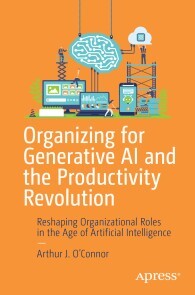
Organizing for Generative AI and the Productivity Revolution
As leaders plan to make significant investments to harness the power of foundational models such as ChatGPT, they need to understand the changes in organizational behaviors required for the successful implementation of such systems. The size, complexity and nature of this new wave of technologies requires a refresh in roles and responsibilities in conventional IT organizations. This book reveals practical and no-nonsense guidance on how to leverage generative AI to transform your business processes and organizational structures to achieve breakthroughs in efficiency, effectiveness and competitive advantage.Written in a lively, engaging, and often humorous style, this work provides practical insights and timely survival skills for leaders with anonymous but real-world experiences and case studies. If you’re looking to understand how large language foundation models such as ChatGPT are reshaping managerial roles and organizational structures, and how they can leverage this knowledge to survive and thrive in this brave new world then _Organizing for Generative AI and the Productivity Revolution_ is the book for you.WHAT YOU WILL LEARN* Review the key changes in current state roles and responsibilities that are required to successfully deploy generative AI systems* Examine the organizational reporting structures and associated incentives that form a strong generative AI system* Understand the financial, regulatory, and operational risks created by organizational behavioral issues that arise when organizations build and deploy large language models* Compare the strategic differences in emerging versus traditional organizational behaviors, incentives, roles and responsibilitiesWHO THIS BOOK IS FORExecutives and team leaders at enterprises large and small.Arthur J. O’Connor is the head of the MS in Data Science and BS in Information Systems degree programs at the City University of New York. He has over 20 years of experience as a senior corporate executive and IT management consultant. A graduate of the Newhouse School of Journalism at Syracuse University, he earned his MBA from Fordham University and his Doctorate of Professional Studies from the Lubin School of Business at Pace University.Part 1: Yesterday, Today, and Tomorrow.- Chapter 1. The History and Potential Future of Human-Machine Collaboration.- Chapter 2. Data Governance: The Foundation for Generative AI.- Chapter 3. The Challenges to Corporate Governance.- Part 2: Organizational Transformation – Current and Future States.- Chapter 4. Lessons Learned.- Chapter 5. The Intelligent Organization of the Future.- Chapter 6. Leadership in the Intelligent Organization.- Part 3: What Regulators and Academics Are Saying.- Chapter 7. Regulation and Compliance.- Chapter 8. Views from the Ivory Tower.- Chapter 9. Preparing for the Next Big Thing.- Appendix A: Data Governance Best Practices.- Appendix B: 12 Pivotal IT Roles in Organizational Transformation.
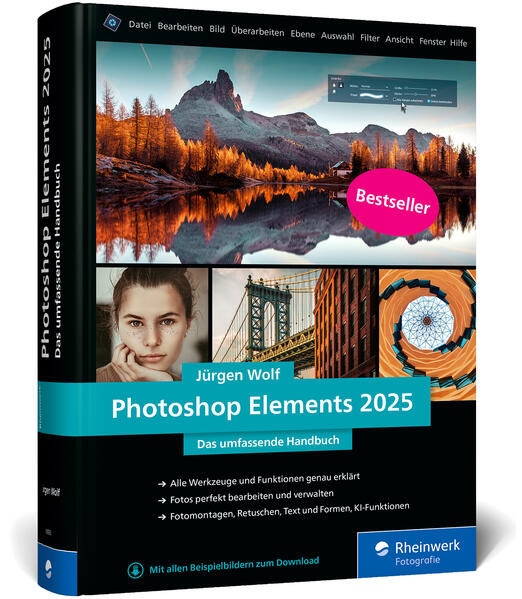
Photoshop Elements 2025 (16. Auflage)
Photoshop Elements 2025Eingescannte alte Familienfotos, die Bilder vom letzten Urlaub oder kreative Experimente mit der Kamera – Ihre fotografischen Schätze sind viel zu schade, um sie einfach nur auf der Festplatte zu lagern. In diesem umfassenden Handbuch erklärt Ihnen der passionierte Digitalfotograf Jürgen Wolf verständlich und praxisnah, wie Sie mit Photoshop Elements 2025 mehr aus Ihren Fotos herausholen.Mit dem Organizer bringen Sie Ordnung in Ihre Sammlung, mit dem Fotoeditor und Camera Raw korrigieren Sie Bildfehler und die Belichtung. Erfahren Sie außerdem, was es mit den KI-basierten Funktionen der Software auf sich hat und wie Sie diese optimal nutzen. Eine eigene Grußkarte mit Ihrem liebsten Naturmotiv gestalten? Auch das ist kein Problem! Zahlreiche Workshops und Profi-Tipps helfen Ihnen auch bei kniffligen Aufgaben. Damit Sie alle Schritte anschaulich nachvollziehen können, stehen Ihnen Beispielbilder zum Download zur Verfügung. Was auch immer Sie mit Photoshop Elements 2025 machen wollen – in diesem Buch erfahren Sie, wie es geht.Leseprobe (PDF)Aus dem Inhalt:Organizer und Fotoeditor kennenlernenDie KI-Funktionen verstehen und nutzenLokal und via Cloud mit der App und im Web arbeitenTiefen, Lichter, Kontraste und Farben korrigierenAuswahlen erstellen und Objekte freistellenMit Ebenen gezielt und kreativ arbeitenPorträts perfekt retuschierenTexte und Formen einsetzenReels, Collagen, Montagen und Panoramen erstellenBilder wirkungsvoll präsentierenFarbprofile, Plug-ins und Tastenkürzel nutzenMit vielen Beispielbildern zum DownloadÜber den Autor:Jürgen Wolf ist passionierter Digitalfotograf und weiß, worauf es in der Bildbearbeitung ankommt. Er arbeitet seit der ersten Version mit Adobe Photoshop Elements und zeigt Ihnen, was Version 2025 kann.

Dynamics 365 Business Central Developer Certification Companion
Embark on a journey into Dynamics 365 Business Central development with this comprehensive guide to the MB-820 certification exam. This book will help you prepare for the examination and also help you understand Dynamics 365 Business Central better with real-world examples, exercises, and tips.The book starts with an introduction to the Exam pattern to help you understand the overall requirements. Next, you will delve into the fundamentals of Dynamics 365 Business Central Development, exploring its development tools and environment. After that, you will explore the installation, development, and deployment processes for Dynamics 365 Business Central. AL objects for Dynamics 365 Business Central are discussed next and you will go through creating and modifying AL objects along with their best practices. Further coverage is given to development tools essential for Dynamics 365 Business Central, followed by their integration with other applications. To end your journey, you will be guided with practice tests and exercises to help you prepare for the exam.After reading this book, you will be able to prepare yourself for the MB-820 Exam and be equipped with the basics of Dynamics 365 Business Central.WHAT YOU WILL LEARN* Understand application life cycle management principles and techniques* Gain proficiency in debugging and troubleshooting Dynamics 365 Business Central solutions* Apply advanced development techniques and concepts in real-world scenarios* Understand AL language syntax and best practicesWHO THIS BOOK IS FORNew Dynamics 365 Business Central developers and Individuals preparing for the MB-820 certification examDR. GOMATHI S. is a Microsoft MVP, MCT, and Microsoft Learn Expert with more than 13 years of experience as a technical trainer. She is passionate about educating urban students and specializes in Power BI, Business Central, and Azure AI. Known for her engaging webinars and training sessions, Dr. Gomathi covers a range of topics, including Azure AI Vision, Power BI, Tableau, Python, Power Apps, and Business Central. She authored the Apress book _Mastering Microsoft Dynamics 365 Business Central: A Comprehensive Guide to Successful Implementation_ and mentors through the Code Without Barriers program. Her educational content, including video series such as _AL Coding Carnival_ and _Business Central Chronicles_, aims to advance knowledge in emerging technologies and tools.Chapter 1: Introduction to Dynamics 365 Business Central Development.- Chapter 2: Installation, Development, and Deployment for Business Central.- Chapter 3: AL Objects Development in Business Central.- Chapter 4: Working with Development Tools in Business Central.- Chapter 5: Integration of Business Central with Other Applications.- Chapter 6: Exam Preparation and Practice.

Model Optimization Methods for Efficient and Edge AI
Comprehensive overview of the fledgling domain of federated learning (FL), explaining emerging FL methods, architectural approaches, enabling frameworks, and applications Model Optimization Methods for Efficient and Edge AI explores AI model engineering, evaluation, refinement, optimization, and deployment across multiple cloud environments (public, private, edge, and hybrid). It presents key applications of the AI paradigm, including computer vision (CV) and Natural Language Processing (NLP), explaining the nitty-gritty of federated learning (FL) and how the FL method is helping to fulfill AI model optimization needs. The book also describes tools that vendors have created, including FL frameworks and platforms such as PySyft, Tensor Flow Federated (TFF), FATE (Federated AI Technology Enabler), Tensor/IO, and more. The first part of the text covers popular AI and ML methods, platforms, and applications, describing leading AI frameworks and libraries in order to clearly articulate how these tools can help with visualizing and implementing highly flexible AI models quickly. The second part focuses on federated learning, discussing its basic concepts, applications, platforms, and its potential in edge systems (such as IoT). Other topics covered include: Building AI models that are destined to solve several problems, with a focus on widely articulated classification, regression, association, clustering, and other prediction problemsGenerating actionable insights through a variety of AI algorithms, platforms, parallel processing, and other enablersCompressing AI models so that computational, memory, storage, and network requirements can be substantially reducedAddressing crucial issues such as data confidentiality, data access rights, data protection, and access to heterogeneous dataOvercoming cyberattacks on mission-critical software systems by leveraging federated learning Written in an accessible manner and containing a helpful mix of both theoretical concepts and practical applications, Model Optimization Methods for Efficient and Edge AI is an essential reference on the subject for graduate and postgraduate students, researchers, IT professionals, and business leaders. Pethuru Raj Chelliah, PhD, is the Chief Architect of the Edge AI division of Reliance Jio Platforms Ltd. (JPL), Bangalore, India. Amir Masoud Rahmani, PhD, is an artificial intelligence faculty member at the National Yunlin University of Science and Technology, Taiwan. Robert Colby is a Principal Engineer in IT Infrastructure responsible for Manufacturing Network Architecture and IoT Infrastructure at Intel Corporation. Gayathri Nagasubramanian, PhD, is an Assistant Professor with the Department of Computer Science and Engineering at GITAM University in Bengaluru, India. Sunku Ranganath is a Principal Product Manager for Edge Infrastructure Services at Equinix. About the Editors xxi List of Contributors xxiii 1 Fundamentals of Edge AI and Federated Learning 1 Atefeh Hemmati, Hanieh Mohammadi Arzanagh, and Amir Masoud Rahmani 2 AI Applications – Computer Vision and Natural Language Processing 25 Balakrishnan Chinnaiyan, Sundaravadivazhagan Balasubaramanian, Mahalakshmi Jeyabalu, and Gayathry S. Warrier 3 An Overview of AI Platforms, Frameworks, Libraries, and Processors 43 Pavan Kumar Akkisetty 4 Model Optimization Techniques for Edge Devices 57 Yamini Nimmagadda 5 AI Model Optimization Techniques 87 G. Victor Daniel, M. Trupthi, G. Sridhar Reddy, A. Mallikarjuna Reddy, and K. Hemanth Sai 6 Federated Learning: Introduction, Evolution, Working, Advantages, and Its Application in Various Domains 109 Manoj Kumar Pandey, Naresh Kumar Kar, and Priyanka Gupta 7 Application Domains of Federated Learning 127 S. Annamalai, N. Sangeetha, M. Kumaresan, Dommaraju Tejavarma, Gandhodi Harsha Vardhan, and A. Suresh Kumar 8 Advanced Architectures and Innovative Platforms for Federated Learning: A Comprehensive Exploration 145 Neha Bhati and Narayan Vyas 9 Federated Learning: Bridging Data Privacy and AI Advancements 157 D. Sumathi, Likitha Chowdary Botta, Mure Sai Jaideep Reddy, and Avi Das 10 Securing Edge Learning: The Convergence of Block Chain and Edge Intelligence 169 Rakhi Mutha 11 Training on Edge 197 Yamini Nimmagadda 12 Architectural Patterns for the Design of Federated Learning Systems 223 Vijay Anand Rajasekaran, Jayalakshmi Periyasamy, Madala Guru Brahmam, and Balamurugan Baluswamy 13 Federated Learning for Intelligent IoT Systems: Background, Frameworks, and Optimization Techniques 241 Partha Pratim Ray 14 Enhancing Cybersecurity Through Federated Learning: A Critical Evaluation of Strategies and Implications 281 M. Ashok Kumar, Aliyu Mohammed, S. Sumanth, and V. Sivanantham 15 Blockchain for Securing Federated Learning Systems: Enhancing Privacy and Trust 299 Tarun Kumar Vashishth, Vikas Sharma, Bhupendra Kumar, Kewal Krishan Sharma, Sachin Chaudhary, and Rajneesh Panwar 16 Blockchain-Enabled Secure Federated Learning Systems for Advancing Privacy and Trust in Decentralized AI 321 Pawan Whig, Rattan Sharma, Nikhitha Yathiraju, Anupriya Jain, and Seema Sharma 17 An Edge Artificial Intelligence Federated Recommender System for Virtual Classrooms 341 M. Sirish Kumar, T. Rupa Rani, U. Rakesh, Dyavarashetty Sunitha, and G. Sunil Kumar 18 Federated Learning in Smart Cities 351 Seyedeh Yasaman Hosseini Mirmahaleh and Amir Masoud Rahmani Index 391

Machine Learning and Metaheuristic Computation
LEARN TO BRIDGE THE GAP BETWEEN MACHINE LEARNING AND METAHEURISTIC METHODS TO SOLVE PROBLEMS IN OPTIMIZATION APPROACHESFew areas of technology have greater potential to revolutionize the globe than artificial intelligence. Two key areas of artificial intelligence, machine learning and metaheuristic computation, have an enormous range of individual and combined applications in computer science and technology. To date, these two complementary paradigms have not always been treated together, despite the potential of a combined approach which maximizes the utility and minimizes the drawbacks of both. Machine Learning and Metaheuristic Computation offers an introduction to both of these approaches and their joint applications. Both a reference text and a course, it is built around the popular Python programming language to maximize utility. It guides the reader gradually from an initial understanding of these crucial methods to an advanced understanding of cutting-edge artificial intelligence tools. The text also provides:* Treatment suitable for readers with only basic mathematical training* Detailed discussion of topics including dimensionality reduction, clustering methods, differential evolution, and more* A rigorous but accessible vision of machine learning algorithms and the most popular approaches of metaheuristic optimizationMachine Learning and Metaheuristic Computation is ideal for students, researchers, and professionals looking to combine these vital methods to solve problems in optimization approaches. ERIK CUEVAS, PHD, is a Full Professor in the Department of Electronics at the University of Guadalajara. He is a Member of the Mexican Academy of Sciences and the National System of Researchers. He has provided editorial services on several specialized journals. JORGE GALVEZ, PHD, is a Full Professor in the Department of Innovation Based on Information and Knowledge at the University of Guadalajara. He is a Member of the Mexican Academy of Sciences and the National System of Researchers. OMAR AVALOS, PHD, is a Professor in the Electronics and Computing Division of the University Center for Exact Sciences and Engineering at the University of Guadalajara. He is a Member of the Mexican Academy of Sciences and the National System of Researchers. FERNANDO WARIO, PHD, is a Professor at the University of Guadalajara and an Associate Researcher at the Institute of Cognitive Sciences and Technologies (ISTC) in Rome, Italy. He is a Member of the Mexican Academy of Sciences and the National System of Researchers.

Comprehensive Hypertext Markup Language (HTML).
This course is intended for aspiring web designers and developers who need to comprehend HTML thoroughly as well as its straightforward overview and useful examples. You'll have all the tools you need from this course to get started using HTML and advance to a greater degree of proficiency. This book, written in the author's approachable and simple-to-read style, covers all the most recent innovations and advancements in responsive web design, such as strategies for greater accessibility, changeable fonts and font loading, and the most recent color manipulation features reaching browsers.Additionally, the author has written a book on JavaScript. A Comprehensive manual for creating dynamic, responsive websites and applications. This book shows off JavaScript's potential for developing web applications by mixing in-depth theory instruction with enjoyable assignments that will push your limits. To gain a thorough knowledge of the ideas, you can experiment with them in your own editor or browser console as you learn them.