

Computer und IT

Mathematical Models Using Artificial Intelligence for Surveillance Systems
THIS BOOK GIVES COMPREHENSIVE INSIGHTS INTO THE APPLICATION OF AI, MACHINE LEARNING, AND DEEP LEARNING IN DEVELOPING EFFICIENT AND OPTIMAL SURVEILLANCE SYSTEMS FOR BOTH INDOOR AND OUTDOOR ENVIRONMENTS, ADDRESSING THE EVOLVING SECURITY CHALLENGES IN PUBLIC AND PRIVATE SPACES.Mathematical Models Using Artificial Intelligence for Surveillance Systems aims to collect and publish basic principles, algorithms, protocols, developing trends, and security challenges and their solutions for various indoor and outdoor surveillance applications using artificial intelligence (AI). The book addresses how AI technologies such as machine learning (ML), deep learning (DL), sensors, and other wireless devices could play a vital role in assisting various security agencies. Security and safety are the major concerns for public and private places in every country. Some places need indoor surveillance, some need outdoor surveillance, and, in some places, both are needed. The goal of this book is to provide an efficient and optimal surveillance system using AI, ML, and DL-based image processing. The blend of machine vision technology and AI provides a more efficient surveillance system compared to traditional systems. Leading scholars and industry practitioners are expected to make significant contributions to the chapters. Their deep conversations and knowledge, which are based on references and research, will result in a wonderful book and a valuable source of information. PADMESH TRIPATHI, PHD, completed his Ph.D. from Sharda University, Greater Noida, UP, India. Currently, Dr Tripathi is working as Professor of Mathematics in Department of AIDS at Delhi Technical Campus, Greater Noida, UP, India. He has more than 23 years of teaching experience, published 22 papers/book chapters in reputed journals/publishers and 4 Indian innovation patents. His research areas include Data Science, Machine Learning, Inverse Problems, Optimization, Signal/Image Processing, etc. Dr Tripathi has been listed in lifetime achievement by Marquis Who's Who and received the best academician of 2021 award from SEMS Foundation, Noida, India. Dr Tripathi has been associated with several reputed publishers like IGI Global, Wiley-Scrivener, Taylor & Francis, Elsevier, Springer, Inderscience, etc. in various roles like author, reviewer, editor, guest editor, etc. Dr Tripathi received grants from prestigious institutes like Cambridge University, UK; University of California at Los Angeles, USA; INRIA, Sophia Antipolis, France; University of Eastern Finland, Kuopio, Finland; RICAM, Linz, Austria, etc and visited these places.MRITUNJAY RAI, PHD, has completed his Ph.D. in Thermal imaging applications in the department of Electrical Engineering from IIT-ISM Dhanbad, Master of Engineering (with distinction) in Instrumentation and Control from Birla Institute of Technology-Mesra, Ranchi, and B.Tech in ECE from Shri Ramswaroop Memorial College of Engineering and Management, Lucknow. Currently, Dr. Rai is working as Assistant Professor in Shri Ramswaroop Memorial University, Barabanki, U.P., India. Dr. Rai has more than 12 years of working experience in research as well as academics. In addition, he has guided several UG and PG projects. He has published many research articles in reputed journals published by Springer, Elsevier, IEEE, Inderscience, and MECS. He has contributed many chapters to books published by Intech Open Access, CRC, IGI Global, and Elsevier. He is an editor of books (edited) published by reputed publishers Wiley, AAP, NOVA & IGI, He is an active reviewer and has reviewed many research papers in journals and at international and national conferences. His areas of interest lie in image processing, speech processing, artificial intelligence, machine learning, deep learning, Intelligent Traffic Monitoring System, the Internet of Things (IoT), and robotics and automation.NITENDRA KUMAR, PHD, an accomplished scholar with a PhD in Mathematics from Sharda University and a master’s degree in mathematics and Statistics from Dr. Ram Manohar Lohia Avadh University, boasts over a decade of expertise as an Assistant Professor at Amity Business School, Amity University, Noida. His diverse research interests encompass Wavelets and its Variants, Data Mining, Inverse Problems, Epidemic Modelling, Fractional Derivatives Business Analytics, and Statistical Methods, reflecting a profound commitment to advancing knowledge across multiple domains. Dr. Kumar's prolific contributions to academia are evidenced by his extensive publication record, comprising over 30 research papers in esteemed journals, 16 book chapters, and 12 authored books on engineering mathematics, computation, and Business Analytics and related topics. Notably, his scholarly impact extends beyond traditional research avenues, as evidenced by his involvement in patenting two innovative solutions. Beyond his individual achievements, Dr. Kumar actively engages with the academic community, serving as editor for two edited books and as Guest Editor for reputable journals like the Journal of Information and Optimization Sciences, Journal of Statistical and Management Sciences, and Environment and Social Psychology. His editorial roles underscore his dedication to fostering intellectual discourse and shaping the trajectory of scholarly inquiry. Dr Nitendra Kumar epitomizes academic excellence, blending profound expertise with a steadfast commitment to advancing mathematical knowledge and its interdisciplinary applications.SANTOSH KUMAR, PHD, is Assistant Professor in the Department of Mathematics, Sharda School of Basic Sciences and Research, Sharda University, Greater Noida, India. He obtained his Ph.D. degree from Aligarh Muslim University Aligarh, in 2016. He is actively involved in the research areas, namely nonlinear partial differential equations, diffusion models, wavelet transform, mathematical modeling, image processing, etc. He has taught undergraduate subjects such as linear algebra, differential equations, complex analysis, advanced calculus, and probability and statistics. He has taught real analysis, topology, functional analysis, partial differential equations, and many more at the post-graduation level. Besides attending, presenting scientific papers, delivering invited talks, and chairing sessions at national/international conferences and seminars, he has organized several workshops and conferences as an organizing secretary. He has published many research papers in reputed national and international journals and book chapters published in an edited book published by international publishers. He is also reviewer of many reputed journals.Preface xv1 Elevating Surveillance Integrity-Mathematical Insights into Background Subtraction in Image Processing 1S. Priyadharsini2 Machine Learning and Artificial Intelligence in the Detection of Moving Objects Using Image Processing 19K. Janagi, Devarajan Balaji, P. Renuka and S. Bhuvaneswari3 Machine Learning and Imaging-Based Vehicle Classification for Traffic Monitoring Systems 51Parthiban K. and Eshan Ratnesh Srivastava4 AI-Based Surveillance Systems for Effective Attendance Management: Challenges and Opportunities 69Pallavi Sharda Garg, Samarth Sharma, Archana Singh and Nitendra Kumar5 Enhancing Surveillance Systems through Mathematical Models and Artificial Intelligence: An Image Processing Approach 91Tarun Kumar Vashishth, Vikas Sharma, Bhupendra Kumar, Kewal Krishan Sharma, Sachin Chaudhary and Rajneesh Panwar6 A Study on Object Detection Using Artificial Intelligence and Image Processing—Based Methods 121Vidushi Nain, Hari Shankar Shyam, Nitendra Kumar, Padmesh Tripathi and Mritunjay Rai7 Application of Fuzzy Approximation Method in Pattern Recognition Using Deep Learning Neural Networks and Artificial Intelligence for Surveillance 149M. Geethalakshmi, Sriram V. and Vakkalagadda Drishti Rao8 A Deep Learning System for Deep Surveillance 169Aman Anand, Rajendra Kumar, Nikita Verma, Akash Bhasney and Namita Sharma9 Study of Traditional, Artificial Intelligence and Machine Learning Based Approaches for Moving Object Detection 187Apoorv Joshi, Amrita, Rohan Sahai Mathur, Nitendra Kumar and Padmesh Tripathi10 Arduino-Based Robotic Arm for Farm Security in Rural Areas 215Canute Sherwin, Shahid D. P., N. R. Hritish, Sujan Kumar S. N., Nikhil R. and K. Raju11 Graph Neural Network and Imaging Based Vehicle Classification for Traffic Monitoring System 241Shivam Sinha, Nilesh kumar Singh and Lidia Ghosh12 A Novel Zone Segmentation (ZS) Method for Dynamic Obstacle Detection and Flawless Trajectory Navigation of Mobile Robot 271Rapti Chaudhuri, Jashaswimalya Acharjee and Suman Deb13 Artificial Intelligence in Indoor or Outdoor Surveillance Systems: A Systematic View, Principles, Challenges and Applications 293Varun Gupta, Tushar Bansal, Vinay Kumar Yadav and Dhrubajyoti BhowmikReferences 330Index 335
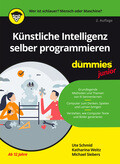
Künstliche Intelligenz selber programmieren für Dummies Junior (2. Auflg.)
WAS KÖNNEN INTELLIGENTE COMPUTER – UND WAS NICHT?Finde heraus, wie Künstliche Intelligenz funktioniert. Dieses Buch hilft dir dabei. Kapitel für Kapitel beantwortet es folgende Fragen: Was ist Künstliche Intelligenz? Wie denken Computer? Wie lernen Computer? Wie kannst du mit Computern sprechen? Wie generieren Computer Texte und Bilder? Spielen Computer auch? Und können Computer fühlen? Grundlegende Methoden und Anwendungsbereiche von Künstlicher Intelligenz werden anhand von anschaulichen Beispielen erklärt. Beispielprogramme in Python zeigen, wie KI-Methoden konkret umgesetzt werden können und es werden Anregungen für eigene Experimente gegeben. DU LERNST* GEMEINSAMKEITEN UND UNTERSCHIEDE ZWISCHEN MENSCHLICHEM DENKEN UND KI##SINGLE_LINE##* WIE PROGRAMME FUNKTIO-NIEREN, DIE LERNEN KÖNNEN##SINGLE_LINE##* WIE DU EINEN EIGENEN CHATBOT PROGRAMMIEREN KANNST##SINGLE_LINE##* WIE DU EINEM COMPUTER BEIBRINGEN KANNST, GEGEN DICH TIC-TAC-TOE ZU SPIELEN##SINGLE_LINE####SINGLE_LINE## UTE SCHMID, KATHARINA WEITZ UND MICHAEL SIEBERS haben alle drei Informatik und Psychologie studiert. Sie forschen in den Themenbereichen Künstliche Intelligenz und maschinelles Lernen und geben ihr Wissen in Vorträgen und Workshops an Kinder und Jugendliche weiter. Widmung 7EINFÜHRUNG 9Über Künstliche Intelligenz 9Über dieses Buch 11Über dich 11Über die Symbole, die wir in diesem Buch verwenden 12KAPITEL 1: DENKEN 13Wie denken eigentlich Menschen? 13Netze ohne Spinnen – dafür mit Knoten und Kanten 15Schlussfolgerndes Denken mit semantischen Netzen 17Wissensfragen 17Schlussfolgerungsfragen 18Komplizierte Schlussfolgerungsfragen 18Baue dein eigenes semantisches Netz 21Was heißt eigentlich »Denken«? 22Deduktives Denken 22Abduktives Denken 23Induktives Denken 24Denken mit Wahrscheinlichkeiten 25KAPITEL 2: LERNEN 27Warum Lernen so wichtig ist 27Wie lernen wir Menschen? 28Wie kann ein Computer lernen? 28Geschenke, Katzen und andere Konzepte 30Lernen mit Perzeptron 31Testen des Perzeptrons 35Schwierigere Paketprobleme 36Vom Perzeptron zum neuronalen Netz 37Vom neuronalen Netz zum tiefen Lernen 39Auswendiglernen vermeiden 41Lernen aus ganz wenigen Beispielen 42Lernen mit Bäumen 42Lernen und Vorurteile 48Und die Profis? 49Lösung: Welche Pakete enthalten ein Geschenk? 50KAPITEL 3: SPRECHEN UND SCHREIBEN 51Natürliche und künstliche Sprachen 51Sprachverarbeitung mit Künstlicher Intelligenz 52Muster suchen und erkennen 52Porzellankisten sind nicht immer Porzellankisten 52Computer, die Sprache verstehen – von SHRDLU, WATSON und ELIZA 53Hallo LILI 55Familiengespräche 55Schreiben statt sprechen 56Mensch oder Computer? 56Die Chatbots kommen 57Der Chatbot, der alle zum Staunen bringt 57Ein Blick hinter die Kulissen 58Sehr überzeugend – bei völliger Ahnungslosigkeit! 59Wo bleibt der Link zu ChatGPT? 60KAPITEL 4: BILDER GENERIEREN 61Ein Prompt, aber prompt! 61So malst du mit Generativer KI 62Tipps und Tricks für bessere Ergebnisse 65SDXL – kein Buchstabensalat, sondern eine KI, die Bilder generiert 66KAPITEL 5: SPIELEN 69Roboterfußball – Toooor 69Schlangen und ärgerliche Vögel 70Brett vorm Kopf? Nicht bei Brettspielen! 72Tic-Tac-Toe 73Die Regeln 73Tic-Tac-Toe mit einem Computer spielen 73Gute Spieler, schlechte Spieler 74Warum kann man nicht alle Züge ausprobieren? 76Schieben und rutschen 78KAPITEL 6: FÜHLEN 81Über die Emotionen 81Computer, die einen ärgern 82Kreise und Dreiecke mit Absichten 83Ein emotionaler Staubsauger? 84Erklären, was die Künstliche Intelligenz sieht 85KAPITEL 7: WAS DU JETZT ÜBER KI WEIẞT 87Wie unterscheiden sich KI-Systeme von Standard-Software? 88KI ist nicht immer korrekt, aber trotzdem nützlich 90Was unterscheidet menschliche und künstliche Intelligenz? 90Geschichte der KI 92KI vor der KI 92Von Informatik- und KI-Pionieren 94Wo steht KI jetzt? 95Ein Blick in die Glaskugel 96KAPITEL 8: KI SELBER PROGRAMMIEREN MIT PYTHON 97Schnelleinstieg Python 98Der Python-Editor IDLE 98Einfache Datentypen und Variablen 100Listen und Tupel 102Bedingte Anweisungen 104Schleifen 106Funktionen 109Module 110Klassen 112Denken 113Netze ohne Spinnen – dafür mit Knoten und Kanten 113Semantische Netze in Python 115Darf’s ein bisschen komplizierter werden? 119Lernen 120Pakete wahrnehmen 121Das Perzeptron lernt aus Fehlern 122Testen des Perzeptrons 124Schwierigere Paketprobleme 126Entscheidungsbäume in Python 128Testen des Entscheidungsbaums 131Sprechen und Schreiben 132Familiengespräche 134Schreiben statt Sprechen 135LILI spricht 139Spielen 140Tic-Tac-Toe in Python 140Der Minimax-Algorithmus 142Wer gewinnt? 145Zum Wiederfinden 147Über die Autoren 151Danksagung 153Was du jetzt denkst 155

Mastering AI
An urgent book on generative artificial intelligence exploring the risk and benefits looming in this seminal moment'Easily the best exploration to date on the perils and promise of AI." —ASHLEE VANCE author of When the Heavens Went on Sale'Mastering AI is a must-read. It's hard to put down'. —BETHANY McLEAN, coauthor of The Smartest Guys in the Room and The Big Fail'A timely and urgent exploration of AI's dizzying acceleration' —BRAD STONE, author of The Everything StoreThe debut of ChatGPT on November 30th was a watershed moment in the history of technology. We stand on the threshold of a new age — one where content of all kinds, even software itself, will be conjured, seemingly from thin air, with simple conversation.In a culture fraught with misinformation, Mastering AI pierces through the thicket of exaggerated claims, explaining how we arrived at this moment and mapping the likely long-term impacts on business, economics, culture and society this potent technology will have.This book will serve as a guide to those dangers — as well as highlighting the technology's transformative potential — and will pinpoint concrete steps that should be taken to regulate generative AI.Jeremy Kahn is a veteran technology and business journalist who has covered artificial intelligence for more than seven years, first at Bloomberg and then at Fortune.

Integrating Metaheuristics in Computer Vision for Real-World Optimization Problems
A COMPREHENSIVE BOOK PROVIDING HIGH-QUALITY RESEARCH ADDRESSING CHALLENGES IN THEORETICAL AND APPLICATION ASPECTS OF SOFT COMPUTING AND MACHINE LEARNING IN IMAGE PROCESSING AND COMPUTER VISION.Researchers are working to create new algorithms that combine the methods provided by CI approaches to solve the problems of image processing and computer vision such as image size, noise, illumination, and security. The 19 chapters in this book examine computational intelligence (CI) approaches as alternative solutions for automatic computer vision and image processing systems in a wide range of applications, using machine learning and soft computing. Applications highlighted in the book include:* diagnostic and therapeutic techniques for ischemic stroke, object detection, tracking face detection and recognition;* computational-based strategies for drug repositioning and improving performance with feature selection, extraction, and learning;* methods capable of retrieving photometric and geometric transformed images;* concepts of trading the cryptocurrency market based on smart price action strategies; comparative evaluation and prediction of exoplanets using machine learning methods; the risk of using failure rate with the help of MTTF and MTBF to calculate reliability; a detailed description of various techniques using edge detection algorithms;* machine learning in smart houses; the strengths and limitations of swarm intelligence and computation; how to use bidirectional LSTM for heart arrhythmia detection;* a comprehensive study of content-based image-retrieval techniques for feature extraction;* machine learning approaches to understanding angiogenesis;* handwritten image enhancement based on neutroscopic-fuzzy.AUDIENCEThe book has been designed for researchers, engineers, graduate, and post-graduate students wanting to learn more about the theoretical and application aspects of soft computing and machine learning in image processing and computer vision. SHUBHAM MAHAJAN, PHD, is an assistant professor in the School of Engineering at Ajeekya D Y Patil University, Pune, Maharashtra, India. He has eight Indian, one Australian, and one German patent to his credit in artificial intelligence and image processing. He has authored/co-authored more than 50 publications including peer-reviewed journals and conferences. His main research interests include image processing, video compression, image segmentation, fuzzy entropy, nature-inspired computing methods with applications in optimization, data mining, machine learning, robotics, and optical communication. KAPIL JOSHI, PHD, is an assistant professor in the Computer Science & Engineering Department, Uttaranchal Institute of Technology in Dehradun, India. His doctorate was on image quality enhancement using fusion techniques. He has 8 years of academic experience and has published patents, research papers, and two books. In 2021, he was awarded the ‘Best Young Researcher’ Award in Global Education and Corporate Leadership received by Life Way Tech India Pvt. Ltd. AMIT KANT PANDIT, PHD, is an associate professor in the School of Electronics & Communication Engineering Shri Mata Vaishno Devi University, India. He has authored/co-authored more than 60 publications including peer-reviewed journals and conferences. He has two Indian and one Australian patent to his credit in artificial intelligence and image processing. His main research interests are image processing, video compression, image segmentation, fuzzy entropy, and nature-inspired computing methods with applications in optimization. NITISH PATHAK, PHD, is an associate professor in the Department of Information Technology, Bhagwan Parshuram Institute of Technology, New Delhi, India. He has 17 years of engineering education experience and has published more than 80 journal articles, in peer-reviewed journals as well as book chapters, patents, and conference papers. His research areas include intelligent computing techniques, empirical software engineering, and artificial intelligence. Preface xv1 ADVANCEMENT IN DIAGNOSTIC AND THERAPEUTIC TECHNIQUES FOR ISCHEMIC STROKE 1Mukul Jain, Divya Patil, Shubham Gupta and Shubham Mahajan1.1 Introduction 21.2 Diagnostic Tools of Ischemic Stroke 41.3 Artificial Intelligence–Based Diagnostic Tools 71.4 Blood-Based Protein Biomarker for Stroke 81.5 Markers for Endothelial Damage 81.6 Markers of Brain Injury 91.7 Therapeutic Advances in Ischemic Stroke 91.8 Nanoparticles 111.9 Conclusion 132 OBJECT DETECTION AND TRACKING FACE DETECTION AND RECOGNITION 25Varsha K. Patil, Pawan Nawade, Rudra Nagarkar and Paresh Kadale2.1 Introduction 252.2 Motivation 302.3 The Basics of Computer Vision 312.4 Face Detection 342.5 Facial Expression 382.6 Object Detection 412.7 Face Detection and Identification in Practical Situations 442.8 Future Direction in Object Detection and Tracking 472.9 Conclusion 523 PRINTING ORGANS WITH 3D TECHNOLOGY 55Shaik Aminabee3.1 Introduction 553.2 Bioprinting in Three Dimensions (3D) 563.3 3D Printing Types 573.4 Applications for 3D Printing in Cells 603.5 New Developments 653.6 Progress in India 663.7 Limitation 673.8 A Future Point of View 673.9 Conclusion 684 COMPARATIVE EVALUATION OF MACHINE LEARNING ALGORITHMS FOR BANK FRAUD DETECTION 71Kiran Jot Singh, Divneet Singh Kapoor, Kunal Ranjan Singh, Chirag Kalucha, Gatik Alagh, Khushal Thakur and Anshul Sharma4.1 Introduction 714.2 Proposed Framework 734.3 Results 744.4 Concluding Remarks and Future Scope 775 AN OVERVIEW OF COMPUTATIONAL-BASED STRATEGIES FOR DRUG REPOSITIONING 81Shalu Verma, Nidhi Nainwal, Alka Singh, Gauree Kukreti and Kiran Dobhal5.1 Introduction 815.2 Drug Repositioning 825.3 Challenges and Opportunities for Drug Repurposing 935.4 Conclusion 946 IMPROVING PERFORMANCE WITH FEATURE SELECTION, EXTRACTION, AND LEARNING 99Varsha K. Patil, Vrinda Shinde, Ritika Singh and Vipul Singh6.1 Introduction 996.2 Feature Selection 1006.3 Feature Extraction 1106.4 Feature Learning 1156.5 Future Research and Development 1236.6 Future Scope 1246.7 Conclusion 1257 FUSION OF PHASE AND LOCAL FEATURES FOR CBIR 129Pooja Sharma7.1 Introduction 1297.2 Overview of the Proposed System 1327.3 Proposed Hybrid-Shape Descriptors 1327.4 Similarity Measurement 1377.5 Experimental Study and Performance Evaluation 1397.6 Conclusions 1478 TRADING BOT FOR CRYPTOCURRENCY MARKET BASED ON SMART PRICE ACTION STRATEGIES 151Divneet Singh Kapoor, Kiran Jot Singh, Anshoom Jain, Rhythm Chauhan, Khushal Thakur and Anshul Sharma8.1 Introduction 1518.2 Background 1548.3 Proposed Framework 1568.4 Results 1588.5 Conclusion and Future Scope 1619 COMPARATIVE EVALUATION AND PREDICTION OF EXOPLANETS USING MACHINE LEARNING METHODS 163Divneet Singh Kapoor, Kiran Jot Singh, Ashirvad Singh, Benarji Mulakala, Karan Singh, Prashant, Ramanjeet Singh and Shubham Mahajan9.1 Introduction 1649.2 Background 1679.3 Proposed Framework 1699.4 Results 1719.5 Conclusion and Future Scope 18210 THE RISK OF USING FAILURE RATE WITH THE HELP OF MTTF AND MTBF TO CALCULATE RELIABILITY 185Harpreet Kaur and Shiv Kumar Sharma10.1 Introduction 18510.2 Failure 18610.3 Conclusion 19111 A DETAILED DESCRIPTION ON VARIOUS TECHNIQUES OF EDGE DETECTION ALGORITHMS 193Pritha A. and G. Fathima11.1 Introduction 19311.2 Edge Detection Techniques 19411.3 Experimental Results 20311.4 Comparative Results 20311.5 Conclusion 20311.6 Future Work 20412 ADVANCEMENT OF ML IN SMART HOUSE 207Gokula Udhayan V., K. Mahaeshwari and N. Vinoth Kumar12.1 Objective 20712.2 Introduction 20712.3 Smart House System With IoT 20812.4 Future Scope 22312.5 Conclusion 22313 MULTI-ROBOT NAVIGATION: A BIOLOGICALLY INSPIRED FRAMEWORK 225Imran Mir and Faiza Gul13.1 Introduction 22513.2 Optimization Algorithms 22613.3 Algorithms and Self-Organization 23613.4 Future Research Directions 23813.5 Conclusion 23914 BIDIRECTIONAL LSTM FOR HEART ARRHYTHMIA DETECTION 243Nikhil M. Agrawal, H. D. Bhanu Cheitanya, Abhishek Kumar Rai and Shubham Mahajan14.1 Introduction 24314.2 About the Dataset 24514.3 Flow of the Model 24614.4 Results 24814.5 Conclusion 24815 STUDY ON CONTENT-BASED IMAGE RETRIEVAL 253Thanga Subha Devi M., R. Suji Pramila and Tibbie Pon Symon15.1 Introduction 25415.2 Related Works 25615.3 Extraction of Features 26115.4 User Interactions for CBIR System 26615.5 Conclusions 26916 MACHINE LEARNING AND ANGIOGENESIS IN CANCER 273Dharambir Kashyap, Riya Sharma, Neelam Goel and Vivek Kumar Garg16.1 Introduction 27316.2 History of Angiogenesis Discovery 27416.3 Overview of Angiogenesis 27416.4 Angiogenesis in Carcinogenesis 27516.5 Molecular Mechanisms of Angiogenesis Formation 27616.6 Angiogenesis as a Target in Cancer Therapy 27616.7 Machine Learning Approaches in Angiogenesis 27716.8 Conclusion 27817 HANDWRITTEN IMAGE ENHANCEMENT BASED ON NEUTROSCOPIC-FUZZY AND K-MEAN CLUSTERING 283Jaspreet Kaur, Divya Gupta, Simarjeet Kaur and Amrinder Singh17.1 Introduction 28417.2 Application of Image Processing 28617.3 Enhancement of Handwritten Document 28717.4 Clustering Techniques 28817.5 Performance Parameters 29017.6 Results and Discussion 29317.7 Conclusion 29518 A TEXTURE CLASSIFICATION SYSTEM BASED ON AN ADAPTIVE HISTOGRAM EQUALIZED SHEARLET TRANSFORM 299K. Gopalakrishnan, V. Karthikeyan and P.T. Vanathi18.1 Introduction 29918.2 Literature Survey 30318.3 Materials and Methods 30518.4 Proposed Methodology 30918.5 Result and Discussion 31118.6 Conclusion 32019 A THYROID NODULE DETECTION USING L1-NORM INCEPTION DEEP NEURAL NETWORK 323Saranya G.19.1 Introduction 32319.2 Related Work 32419.3 Methodology 32519.4 Results and Discussion 32919.5 Conclusion 336References 337Index 339

Machine Learning for Industrial Applications
THE MAIN GOAL OF THE BOOK IS TO PROVIDE A COMPREHENSIVE AND ACCESSIBLE GUIDE THAT EMPOWERS READERS TO UNDERSTAND, APPLY, AND LEVERAGE MACHINE LEARNING ALGORITHMS AND TECHNIQUES EFFECTIVELY IN REAL-WORLD SCENARIOS.Welcome to the exciting world of machine learning! In recent years, machine learning has rapidly transformed from a niche field within computer science to a fundamental technology shaping various aspects of our lives. Whether you realize it or not, machine learning algorithms are at work behind the scenes, powering recommendation systems, autonomous vehicles, virtual assistants, medical diagnostics, and much more. This book is designed to serve as your comprehensive guide to understanding the principles, algorithms, and applications of machine learning. Whether a student diving into this field for the first time, a seasoned professional looking to broaden your skillset, or an enthusiast eager to explore cutting-edge advancements, this book has something for you. The primary goal of Machine Learning for Industrial Applications is to demystify machine learning and make it accessible to a wide audience. It provides a solid foundation in the fundamental concepts of machine learning, covering both the theoretical underpinnings and practical applications. Whether you’re interested in supervised learning, unsupervised learning, reinforcement learning, or innovative techniques like deep learning, you’ll find comprehensive coverage here. Throughout the book, a hands-on approach is emphasized. As the best way to learn machine learning is by doing, the book includes numerous examples, exercises, and real-world case studies to reinforce your understanding and practical skills. AUDIENCEThe book will enjoy a wide readership as it will appeal to all researchers, students, and technology enthusiasts wanting a hands-on guide to the new advances in machine learning. KOLLA BHANU PRAKASH, PHD, is a professor and associate dean and R & D head for A.I. & Data Science Research Group at K L University, Vijayawada, Andhra Pradesh, India. He is also an adjunct professor at Taylors University, Malaysia. He has published 150+ research papers in international and national journals and conferences. He has authored two and edited 12 books as well as published 15 patents. His research interests include deep learning, data science, and quantum computing. He has received the ‘Best Researcher Award’ 4 times. Preface xix1 Overview of Machine Learning 12 Machine Learning Building Blocks 213 Multilayer Perceptron (in Neural Networks) 514 Kernel Machines 635 Linear and Rule-Based Models 736 Distance-Based Models 877 Model Ensembles 1038 Binary and Beyond Binary Classification 1179 Model Selection 12710 Support Vector Machines 14911 Clustering 17712 Reinforcement Learning 20513 Recommender Systems 22514 Advancements in Deep Learning 24515 Advanced Deep Learning Using Julia Programming 27716 Machine Learning for Industrial Applications 297Index 317

Blockchain, IoT, and AI Technologies for Supply Chain Management
Examine the synergistic possibilities of combining blockchain, IoT, and AI technologies in supply chain management. This book will address the difficulties and possibilities of integrating these technologies and offer helpful implementation advice.The current state of supply chain management involves several challenges, including lack of transparency, limited visibility into product movements, inefficient inventory management, and difficulty in tracking and tracing products. Blockchain, IoT, and AI can potentially address some of these challenges and improve supply chain management.To help illustrate this, case studies and actual instances of businesses implementing or experimenting with blockchain, IoT, and AI technology in their supply chains are included in the book. You’ll review helpful advice on implementation and highlight successful deployments, lessons learned, and the impact of these technologies on supply chain visibility, agility, sustainability, and customer experience. This book further elaborates the fundamental concepts of AI and ML algorithms and demonstrates how AI can process enormous volumes of supply chain data to produce actionable insights, improve inventory control, forecast demand, and increase forecasting precision.This collective work will serve as a comprehensive guide for supply chain professionals, researchers, and technology enthusiasts interested in understanding the potential of blockchain, IoT, and AI technologies in revolutionizing supply chain management practices.WHAT YOU WILL LEARN* Discuss the evolving landscape of technology, potential advancements, and how Blockchain, IoT, and AI can shape the future of supply chains* Gain Insight into upcoming developments and prepare for changing dynamics of the industry* Understand intricate details of blockchain, IoT, and AI Technologies in real-life scenariosWHO IS THIS BOOK FORIndustry Professionals working in the domain of supply chain management who would be interested in understanding how these technologies can enhance efficiency, transparency, and optimization in their supply chains.DR. VEENA GROVER is a Professor in Department of Management at Noida Institute of Engineering & Technology, India. Her interests include Micro Finance, Sustainability, Macro Economic Variables, and Innovation Strategy. She has published multiple articles in various journals and presented papers in various conferences. At present, she is guiding four research scholars and serves as an Editor of International Journal of Advanced Trends in Technology, Management & Applied Science.DR. BALAMURUGAN BALUSAMY is currently working as Associate Dean–Student Engagement in Shiv Nadar University, India. He has 15 years of experience in the field of computer science. His areas of interest are Internet of Things, Big data, Networking. He has published more than 100 papers and contributed multiple book chapters.PROF. SEIFEDINE KADRY focuses on Data Science, education using technology, system prognostics, stochastic systems, and applied mathematics. He is an ABET program evaluator for computing and ABET program evaluator for Engineering Tech. He is a Fellow of IET, Fellow of IETE, and Fellow of IACSIT. He is a distinguish speaker of IEEE Computer Society.DR. A. YOVAN FELIX has mentored students in the project areas of Big Data, Deep Learning, and Data Mining. He has published technical papers in national and international journals. He has over 17 years of experience and expertise in data analytics, smart prediction systems, and deep learning algorithms. He also coordinated in organizing several events at both national and international levels.Chapter 1: Supply Chain Management Strategy and Practices: Traditional Vs Advanced.- Chapter 2: Convergence of IoT, Artificial Intelligence and Blockchain Approaches for Applications in Supply Chain Management.- Chapter 3: Value Creation in Blockchain-Driven Supply Chain Financing Opportunities.- Chapter 4: Artificial Intelligence Applications for Demand Forecasting & Optimization.- Chapter 5: AI-Enabled Supply Chain Planning and Execution: A Pathway to Sustainability.- Chapter 6: Leveraging IOT In Supply Chain Sustainability: A Provenance Perspective.- Chapter 7: AI And Machine Learning in Supply Chain Optimization: Mapping the Territory.- Chapter 8: Blockchain and IoT Integration Based Transparency of Supply Chain Social Sustainability.- Chapter 9: Integration of Blockchain, IoT, And AI In Supply Chain Management: A New Paradigm for Supply Chain Integration and Collaboration.- Chapter 10: Challenges of Supply Chain Management Post COVID-19: Mitigation Strategies and Practical Lessons Learned.- Chapter 11: Supply Chain 4.0: Autonomous Vehicles and Delivery Robots in Supply Chain Management.- Chapter 12: Blockchain for the Future of Sustainable Supply Chain Management in Industry 4.0.- Chapter 13: Managing the Dynamics of New Technologies in The Global Supply Chain.- Chapter 14: Future Trends and Challenges in Supply Chain Technology.- Chapter 15: Real-World Applications of Generative AI for Data Augmentation.- Chapter 16: Case Studies and Best Practices in Supply Chain Management.

Practical GitLab Services
Learn all about GitLab administration, the open-source DevOps platform helping millions develop and deploy safe and secure software. This book__is designed to be your one-stop shop to get up and running with complete ease.Start with the basics like setting up a GitLab account and exploring user options before moving on to GitLab’s primary function as a source code management tool. From there, you’ll learn about one of the most unique features of GitLab: CI/CD configuration files. The next step on the journey is a discussion of how to organize code into projects and groups, along with defining access permissions using roles. You’ll also examine the various planning tools provided by GitLab.With the basic features out of the way, you’ll delve into more specialized services such as the built-in Docker image repository, the package registry, web page creation, and binary file storage. The book concludes with more advanced administrative topics such as working with GitLab’s REST and GraphQL APIs, setting up a proof-of-concept GitLab service using Amazon Web Services (AWS), and spinning up a production service that takes high availability and disaster recovery into account.With an abundance of information available for deploying secure software, selecting the right documentation can often be daunting. From planning to monitoring, _Practical GitLab Services_ eliminates the unknown in your DevOps lifecycle.WHAT YOU WILL LEARN* Use GitLab to manage source code files, track and plan issues, run builds and tests, and deploy software* See how administrators can support developers using GitLab* Set up your own standalone installation using AWSWHO THIS BOOK IS FORSoftware developers, potential GitLab administrators, supporting team members such as testers and project managers.JEFFREY PAINTER has spent the last 45 years in software development, working as a developer in various languages ranging from Fortran, C, C++, Java as well as Python and in a variety of roles from development to administration. The last seven years have been spent at Here Technologies as a system engineer first maintaining a farm of Jenkins servers for entire project teams and then prototyping and maintaining several self-managed GitLab servers.1. Only the Beginning.- 2. Just the Source.- 3. Working the Remote Life.- 4. Build, Test, Rinse and Repeat.- 5. Under One Condition.- 6. You Build It, You Keep It.- 7. Let's Get Organized.- 8. I Have an Issue with That.- 9. The Best Laid Plans.- 10. It's Nice to Share.- 11. There's an API for That.- 12. Well, Isn't That Special.- 13. I Can Do This on My Own.- 14. Things That Lurk in the Background.- 15. The Proof is in the Cloud.- 16. Working the Never-ending Queue.- 17. But Wait, There's More.- 18. It's an Admin's Life.- 19. Lights, Camera, Action.

Practical Cyber Intelligence
OVERVIEW OF THE LATEST TECHNIQUES AND PRACTICES USED IN DIGITAL FORENSICS AND HOW TO APPLY THEM TO THE INVESTIGATIVE PROCESSPractical Cyber Intelligence provides a thorough and practical introduction to the different tactics, techniques, and procedures that exist in the field of cyber investigation and cyber forensics to collect, preserve, and analyze digital evidence, enabling readers to understand the digital landscape and analyze legacy devices, current models, and models that may be created in the future. Readers will learn how to determine what evidence exists and how to find it on a device, as well as what story it tells about the activities on the device. Over 100 images and tables are included to aid in reader comprehension, and case studies are included at the end of the book to elucidate core concepts throughout the text. To get the most value from this book, readers should be familiar with how a computer operates (e.g., CPU, RAM, and disk), be comfortable interacting with both Windows and Linux operating systems as well as Bash and PowerShell commands and have a basic understanding of Python and how to execute Python scripts. Practical Cyber Intelligence includes detailed information on:* OSINT, the method of using a device’s information to find clues and link a digital avatar to a person, with information on search engines, profiling, and infrastructure mapping* Window forensics, covering the Windows registry, shell items, the event log and much more * Mobile forensics, understanding the difference between Android and iOS and where key evidence can be found on the device Focusing on methodology that is accessible to everyone without any special tools, Practical Cyber Intelligence is an essential introduction to the topic for all professionals looking to enter or advance in the field of cyber investigation, including cyber security practitioners and analysts and law enforcement agents who handle digital evidence. ADAM TILMAR JAKOBSEN works for the Danish National Police Agency’s special crime unit hunting down cyber criminals. Throughout his career he has worked on international cases with Europol and the FBI. Adam’s journey into cybersecurity and intelligence began in the Danish Army Intelligence, where he honed his skills in SIGINT, OSINT, HUMINT, and all-source intelligence. In this role, he executed a wide range of defense, intelligence, and attack missions. Transitioning to Bluewater Shipping, Adam initially served as a Solution Architect before pivoting towards information security, where he oversaw critical security operations. About the Author xviiiPreface xixAcknowledgments xxIntroduction xxi1 INTELLIGENCE ANALYSIS 11.1 Intelligence Life Cycle 11.2 Cyber Threat Intelligence Frameworks 101.3 Summary 132 DIGITAL FORENSICS 152.1 Device Collection 162.2 Preservation 172.3 Acquisition 182.4 Processing 192.5 Analysis 202.6 Documentation and Reporting 212.7 Summary 223 DISK FORENSICS 233.1 Acquisition 233.2 Preparation 253.3 Analysis 253.4 File and Data Carving 313.5 Summary 324 MEMORY FORENSICS 334.1 Acquisition 344.2 Analysis 354.3 Summary 385 SQLITE FORENSICS 395.1 Analyzing 405.2 Summary 436 WINDOWS FORENSICS 456.1 New Technology File System (NTFS) 456.2 Acquisition 516.3 Analysis 526.4 Evidence Location 606.5 Summary 937 MACOS FORENSICS 957.1 File System 957.2 Security 977.3 Acquisition 987.4 Analysis 1007.5 Evidence Location 1007.6 Summary 1048 LINUX FORENSICS 1058.1 File System 1058.2 Security 1078.3 Acquisition 1088.4 Analysis 1098.5 Evidence Location 1098.6 Summary 1159 IOS 1179.1 File System 1179.2 Security 1189.3 Applications 1199.4 Acquisition 1209.5 iCloud 1229.6 Analysis 1229.7 Evidence of Location 1249.8 Summary 13410 ANDROID 13710.1 File Systems 13710.2 Security 13710.3 Application 13810.4 Acquisition 13810.5 Analysis 14510.6 Evidence of Location 14611 NETWORK FORENSICS 15311.1 Acquisition 15311.2 Analysis 15811.3 Summary 16512 MALWARE ANALYSIS 16712.1 Acquiring Malware Samples 16812.2 Handling Malware Samples 16912.3 Analysis 17012.4 Summary 17413 OSINT 17713.1 Methodology 17813.2 Documentation 17913.3 Securing Yourself (OPSEC) 18013.4 Search Engines 18213.5 Profiling 18413.6 Hunt for Data 18913.7 Infrastructure Mapping 19413.8 Automation of OSINT Tasks 20813.9 Summary 20914 CASE STUDIES 21114.1 Case of “The Missing Author” 21114.2 The Insider Threat 21215 ENDING 21315.1 What’s the Next Step? 213Index 215

Cloud Security in der Praxis
Cloud-typische Sicherheitsthemen verständlich und praxisnah erklärt - Strategien und Lösungsansätze für alle gängigen Cloud-Plattformen, u.a. AWS, Azure und IBM Cloud - Deckt das breite Spektrum der Security-Themen ab - Gezieltes Einarbeiten durch den modularen Aufbau; mithilfe von Übungen können Sie Ihren Wissensstand überprüfen - Experten-Autor: IBM Distinguished Engineer mit zahlreichen Zertifizierungen und 25 Jahren Branchenerfahrung In diesem Praxisbuch erfahren Sie alles Wichtige über bewährte Sicherheitsmethoden für die gängigen Multivendor-Cloud-Umgebungen – unabhängig davon, ob Ihr Unternehmen alte On-Premises-Projekte in die Cloud verlagern oder eine Infrastruktur von Grund auf neu aufbauen möchte. Entwicklerinnen, IT-Architekten und Sicherheitsexpertinnen lernen Cloud-spezifische Techniken zur sicheren Nutzung beliebter Plattformen wie Amazon Web Services, Microsoft Azure und IBM Cloud kennen. Sie erfahren, wie Sie Data Asset Management, Identity and Access Management (IAM), Vulnerability Management, Netzwerksicherheit und Incident Response effektiv in Ihrer Cloud-Umgebung umsetzen. - Informieren Sie sich über neueste Herausforderungen und Bedrohungen im Bereich der Cloud-Sicherheit - Managen Sie Cloud-Anbieter, die Daten speichern und verarbeiten oder administrative Kontrolle bereitstellen - Lernen Sie, wie Sie grundlegende Prinzipien und Konzepte wie Least Privilege und Defense in Depth in der Cloud anwenden - Verstehen Sie die entscheidende Rolle von IAM in der Cloud - Machen Sie sich mit bewährten Praktiken vertraut, um häufig auftretende Sicherheitszwischenfälle zu erkennen, zu bewältigen und den gewünschten Zustand wiederherzustellen - Erfahren Sie, wie Sie mit verschiedensten Sicherheitslücken, insbesondere solchen, die in Multi-Cloud- und Hybrid-Cloudarchitekturen auftreten, umgehen - Überwachen Sie PAM (Privileged Access Management) in Cloud-Umgebungen
High Performance with Java
Building high performance into your applications is key to creating an optimal user experience, although it is not the only consideration for the performant nature of your apps. High performance applications can lead to cost-effective resource utilization, especially when scalability and cloud computing are involved. They can also provide highly reliable systems that are easier to maintain.High Performance with Java begins by helping you explore the Java Virtual Machine (JVM) and understand how to push it to its limits to further optimize your programs. You’ll take a hands-on approach to go through memory optimization strategies, input/output operations, concurrency, networking, as well as frameworks and libraries focused on performance. You’ll also learn key strategies and best practices by using industry-relevant examples to architect scalable and resource-efficient applications. The concluding chapters provide valuable insights on optimizing your Java code when interacting with databases and show you how to leverage artificial intelligence (AI) for high performance Java applications.By the end of this book, you’ll grasp the importance of developing high performance Java applications and gain practical experience in implementing key strategies to help ensure your Java applications perform optimally.
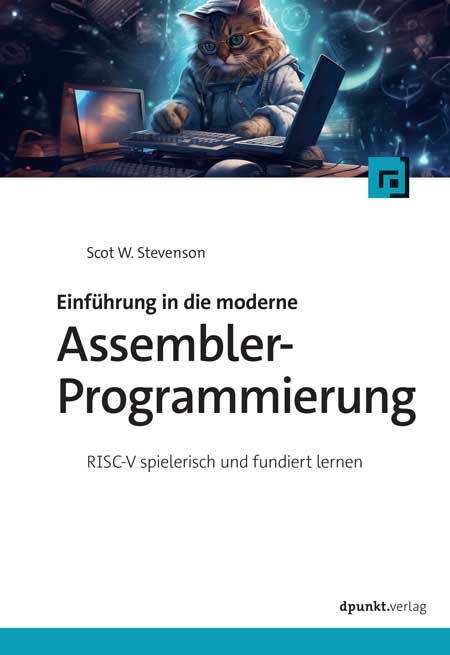
Einführung in die moderne Assembler-Programmierung
Einführung in die moderne Assembler-Programmierung. RISC-V spielerisch und fundiert lernen.Wir nutzen dabei den offenen Prozessor-Standard RISC-V, der auch gezielt für Forschung und Lehre entwickelt wurde. Das macht die Sache für alle einfacher, denn der Kern-Befehlssatz, den wir hier vorstellen, umfasst weniger als 50 Instruktionen. Noch besser: Wer RISC-V lernt, lernt fürs Leben, denn der Befehlssatz ist »eingefroren« und ändert sich nicht mehr.Leseprobe (PDF-Link)Über den Autor:Scot W. Stevenson programmiert seit den Tagen von Acht-Bit-Prozessoren, wie dem 6502 in Assembler. Vom Bytegeschiebe konnten ihn weder sein Medizinstudium, ein Graduiertenkolleg Journalismus, mehr als zwei Jahrzehnte als Nachrichtenredakteur noch ein Blog über die USA abbringen. Er behauptet trotzdem, jederzeit damit aufhören zu können.Für alle, die speziell RISC-V-Assembler-Programmierung lernen wollen, gehen wir im Mittelteil den Aufbau des Prozessors durch, wobei der Schwerpunkt auf der Software liegt. Wir stellen die einzelnen Befehle vor, warnen vor Fallstricken und verraten Tricks. Die Schwachstellen des Standards werden beleuchtet und der Einsatz von KI als Hilfsmittel besprochen. Als offener, freier Standard wird RISC-V auch zunehmend für Hobby- und Studentenprojekte eingesetzt, wo der Compiler nur schlecht oder gar nicht an die Hardware angepasst ist, falls es überhaupt einen gibt.Der letzte Teil zeigt, dass dieses Buch auch aus schierer Begeisterung für Assembler heraus entstand. Wer sich diebisch über jedes eingesparte Byte freut, wird es lieben.

Introducing Microsoft Copilot for Managers
Embark on an exhilarating journey through the digital landscape with Microsoft Copilots, a suite of AI-powered tools that help you create, edit, and optimize content, code, and data across various Microsoft platforms. This book will be your indispensable guide to harnessing the power of generative AI within the Microsoft ecosystem, introducing you to various copilots and their impact on your business processes. The book will guide you as a manager to leverage Microsoft Copilot to improve your personal productivity, your team's productivity, and achieve your business goals with success.This book is organized into five parts. The first part introduces you to Microsoft Copilot and its features and benefits. In the second part, you will get an overview of the integration of Microsoft Copilot with M365 tools. The third part teaches you about the maker copilot in Power Platform services followed by the business expert copilot for Sales and Service for Business Applications such as Dynamics 365 and Salesforce. The book also introduces you to Copilot Studio to help you extend the copilots or build your own.By the end of this book, you will have a solid understanding of Microsoft Copilot and how to use copilots effectively and efficiently with various transformation platforms. You will also have a collection of tips, tricks, and best practices to help you get the most out of Microsoft Copilot.WHAT WILL YOU LEARN* Set up and activate Microsoft Copilot on various Microsoft platforms* Use Microsoft Copilot to generate and enhance content, code, and data with M365, Power Platform, and Business Applications tools* Understand tips, tricks, and best practices to get the most out of Microsoft Copilot* Build your own copilot using your own organization dataWHO THIS BOOK IS FORManagers, team leaders, and business practitioners who want to improve their and their team's productivity and creativity with Microsoft platformsMOHAMMAD ADEEL KHAN is a distinguished Senior Technical Specialist at Microsoft, renowned for his expertise in driving enterprise-grade digital transformations. His nearly two decades of experience encompass a deep understanding of Cloud Solutions, AI & ML, and data management solution architectures that have consistently delivered customer success and profitability. Adeel's global professional journey has taken him across Pakistan, UAE, Malaysia, and Singapore, enriching his perspective and enhancing his ability to navigate complex technological landscapes. Adeel's academic achievements are notable, with an MBA from Coventry University and an AI certification from MIT. His multilingual fluency in English, Urdu, and Arabic complements his global leadership role. As an author and speaker, Adeel has shared his thought leadership at various regional and global events, inspiring audiences with his insights into the future of technology. In his role at Microsoft Operations in Singapore, Adeel has been recognized as an AI-Copilot Champion and has achieved the remarkable feat, helping fortune 500 organizations adopt and transform future of work.Section: ChapterPart I- Part I: Chapter 1- Introduction.- Part II- Part II: Chapter 2- Microsoft Copilot in Word.- Part II: Chapter 3- Microsoft Copilot in Power Point.- Part II: Chapter 4- Microsoft Copilot in Excel .- Part II: Chapter 5- Microsoft Copilot in Communication and Collaboration.- Chapter 6: Microsoft Copilot Chat.- Part III- Part III: Chapter 7- Microsoft Copilot for Power Apps.- Part III: Chapter 8- Microsoft Copilot for Power Automate.- Part III: Chapter 9- Microsoft Copilot for Power Pages.- Part III: Chapter 10- Microsoft Copilot for Power BI.- Part IV-Part IV: Chapter 11 - Microsoft Copilot for Sales.- Part IV: Chapter 12- Microsoft Copilot For Sales with Salesforce.- Part IV: Chapter 13- Microsoft Copilot For Sales with Dynamics 365 Sales.- Part IV: Chapter 14- Microsoft Copilot for Service.- Part IV: Chapter 15 - Microsoft Copilot For Service with Cloud Solutions.- Part IV: Chapter 16 - Microsoft Copilot For Service with Dynamics 365 Customer Service.- Part V-Part V: Chapter 17 - Copilot Studio.- Chapter 18- Copilot , Generative AI and Future of work.- Annex - A: Annex – A.

Empowering the Public Sector with Generative AI
This is your guide book to Generative AI (GenAI) and its application in addressing real-world challenges within the public sector. The book addresses a range of topics from GenAI concepts and strategy to public sector use cases, architecture patterns, and implementation best practices. With a general background in technology and the public sector, you will be able to understand the concepts in this book.The book will help you develop a deeper understanding of GenAI and learn how GenAI differs from traditional AI. You will explore best practices such as prompt engineering, and fine-tuning, and architectural patterns such as Retrieval Augmented Generation (RAG). And you will discover specific nuances, considerations, and strategies for implementation in a public sector organization.You will understand how to apply these concepts in a public sector setting and address industry-specific challenges and problems by studying a variety of use cases included in the book in the areas of content generation, chatbots, summarization, and program management.WHAT YOU WILL LEARN* GenAI concepts and how GenAI differs from traditional AI/ML * Prompt engineering, fine-tuning, RAG, and customizing foundation models* Strategy, methodologies, and frameworks for the public sector* Public sector use cases in the areas of content generation, summarization, and chatbots, plus program management, analytics, business intelligence, and reporting* Architecture and design patterns * Implementation, operations, and maintenance of GenAI applicationsWHO THIS BOOK IS FORTechnology and business leaders in the public sector who are new to AI/ML and are keen on exploring and harnessing the potential of Generative AI in their respective organizations.SANJEEV PULAPAKA is Principal Solutions Architect at Amazon Web Services (AWS). He leads the development of AI/ML and Generative AI solutions for the US Federal Civilian team. Sanjeev has extensive experience in leading, architecting, and implementing high-impact technology solutions that address diverse business needs in multiple sectors (including commercial, federal, and state and local governments). He has published numerous blogs and white papers on AI/ML and is an active speaker and panelist at various industry conferences, including AWS Public Sector Summit and AWS re:Invent. Sanjeev has an undergraduate degree in engineering from the Indian Institute of Technology and an MBA degree from the University of Notre Dame.SRINATH GODAVARTHI has over 20 years of experience serving public sector customers and he held leadership positions with global technology and consulting companies ,including Amazon and Accenture. In his previous roles, Srinath led cloud strategy, architecture, and digital transformation efforts for a number of federal, state, and local agencies. Srinath specializes in AI/ML technologies and has published over a dozen white papers and blogs on various topics (including AI, ML, and Healthcare). He has been a speaker at various industry conferences, including the AWS Public Sector Summit, AWS re:Invent, and the American Public Human Services Association. He holds a master’s degree in computer science from Temple University and completed a Chief Technology Officer program from the University of California, Berkeley.SHERRY DING is an artificial intelligence and machine learning (AI/ML) technologist and evangelist with 20 years of experience in AI/ML research and applications. She currently works at Amazon Web Services as an AI/ML Specialist Solutions Architect, serving public sector customers on their AI/ML related business challenges, and guiding them to build highly reliable and scalable AI/ML applications on the cloud. Sherry holds a PhD in computer science from Korea University. She has authored more than 30 publications (including journal articles, book chapters, white papers, conference proceedings, and blogs) on different topics related to AI/ML. She is an active public speaker who has presented at various academia and industry conferences such as IEEE conferences, AWS re:Invent, and AWS Summits.Chapter 1: Introduction to Generative AI.- Chapter 2: Generative AI in the Public Sector.- Chapter 3: Gen AI Strategy: A Blueprint for Successful Adoption.- Chapter 4: Building a Generative AI Application.- Chapter 5: Content Generation.- Chapter 6: Chatbots and Enterprise Search.- Chapter 7: Summarization.- Chapter 8: Program Management, Business Intelligence, and Reporting.- Chapter 9: Implementation Considerations.- Chapter 10: Conclusion.- Appendix A.- Appendix B.- Appendix C.- Appendix D.- Appendix E.

Human Proxies in Cryptographic Networks
Human Proxies offer new directions to end-to-end encryption: End-A-to-End-Z encryption must be rethought when it turns out to be an End-B-to-End-Z encryption. And, Human Proxies raise questions that were neither answered by science, journalists nor the public. Regular Proxies on a network are forwarding Internet requests, e.g., to download a webpage. Also, in political and social settings a Proxy as an intermediate, deputy or representative with a similar function is given. Human Proxies now enable within the Encryption and Messenger Application Spot-On to choose a friend as a Human Proxy. The Spot-On program is a most modern and elaborated encryption suite available for several operation systems and provides many innovations in applied cryptography. It builds based on the Echo Protocol a cryptographic network, that is beyond Cryptographic Routing. With Human Proxies now a friend from the Messenger friends list sends out the chat message instead of the original sender. The construct of the "Inner Envelope" behind the Human Proxy function also creates new cryptographic challenges, provides plausible deniability to included nodes, and offers new perspectives in encryption, its analysis and decryption: As all messages in the network are encrypted, end-to-end encryption is new defined and gets with Human Proxies a potential second and plausible deniable start point. The essay in this book discusses some related aspects of Human Proxies and their referring's to encryption, networking, graph theory and comparable social and political processes of Proxies. This leads to a further general approach: Endpoints in Encryption are equipped by the application Spot-On with the vision of interoperability of endpoints in communications. | English & German language. Uni Nurf: Uni Nurf is author of the essay "Human Proxies in Cryptographic Networks - Establishing a new direction to end-to-end encryption with the introduction of the inner envelope in the echo protocol".

Automatisiertes Fahren 2024
Automatisiertes Fahren hilft Unfälle zu vermeiden. KI-unterstützte Roboterautos sind aber auch Grundlage für datengetriebene Geschäftsmodelle der OEMs. Konzepte zukünftiger Mobilitätslösungen müssen aus der Perspektive der Nutzer, der urbanen sowie der ländlichen Region und zielführender Geschäftsmodelle entwickelt werden, um erfolgreich zu sein. Im Fokus stehen dabei Verkehrssicherheit und Leistungsfähigkeit ebenso wie ökologische, ökonomische und soziale Nachhaltigkeit. Die internationale Konferenz „Automatisiertes Fahren“ widmet sich als Informations- und Kommunikationsplattform den zentralen Aspekten des Mobilitätswandels. Um die zentralen Herausforderungen künftiger ADAS-Systeme zu erfüllen, müssen Bereiche wie Sensorfusion, Rechnertechnik, KI oder V2X-Kommunikation optimiert werden, um die dafür notwendigen System-of-Systems-Architekturen entwickeln zu können. Die seit Jahren etablierte internationale ATZlive-Fachkonferenz "Automatisiertes Fahren" wird daher um die Themen DevOps, Tooling, Algorithmenentwicklung, Programmierung sowie SDW und E/E-Architektur erweitert. ADAS-Systeme werden fortlaufend weiterentwickelt, um Nutzerinnen und Nutzer nachhaltig zu unterstützen. Dabei ist es wichtig, sowohl die Verkehrssicherheit zu steigern als auch die Verfügbarkeit zu verbessern sowie die Akzeptanz der Systeme im Markt zu erreichen. Dafür müssen Bereiche wie Sensorfunktion, Umfeldmodellierung, Situationsprädiktion, Trajektorenplanung und Entscheidungsfindung auf der einen Seite und die Rechnertechnik und die V2X-Kommunikation auf der anderen Seite – unterstützt durch KI – optimiert werden, um die dafür notwendigen System-of-Systems-Architekturen entwickeln zu können. Die 9. Internationale ATZ-Tagung „Automatisiertes Fahren“ ist ein Forum für Entwicklungsmethodik, Technologiestacks und Security. Sie steht für Engineering AVF Level 2X und diskutiert Engineering und Technologien für das automatisierte Fahren ab Level 2+. Architekturen und Standardisierung.- Versicherungsthemen.- Manöverplanung.- Neue Fahrzeug- und Innenraumkonzepte.- Testverfahren und Absicherung.- Datengenerierung und Datensicherheit.- Verkehrsplanung und Geschäftsmodelle.- HMI und Fahrzeugmonitoring.

Programming PIC Microcontrollers with XC8
Are you tired of copying and pasting code into your embedded projects? Do you want to write your own code from scratch for microcontrollers and understand what your code is doing without all the frills and math? This book uses a practical approach to show you how to develop embedded systems with 8-bit PIC microcontrollers using the XC8 compiler.Written for those who want more than an Arduino, but less than the more complex microcontrollers on the market, this new edition is fully updated and covers embedded design principles such as foreground-background loops and event driven programming. You’ll learn how to interface with things like Motors, PID loop control and writing a browser-based monitoring system! This book is heavy on code, schematics, and images and focuses less on the theoretical aspects of using microcontrollers.Coverage includes writing a display driver, using the DAC for a multitude of waveform generation techniques, and building 8-bit IoT systems, real time telemetry, a countdown timer, and new peripherals. These topics are important if you want to learn more about PIC microcontroller devices as a whole. You'll also see the advantage that MPLAB X offers by running on Windows, Mac and Linux environments. You don't need to be a command line expert to work with PIC microcontrollers, so you can focus less on setting up your environment and more on your application.If you want to move beyond the Arduino, _Programming PIC Microcontrollers with XC8 _is your complete guide to understanding modern PIC microcontrollers.WHAT YOU’LL LEARN* Set up the MPLAB X and XC8 compilers for microcontroller development* Use GPIO and PPS* Review EUSART and Software UART communications* Use the eXtreme Low Power (XLP) options of PIC microcontrollers* Explore wireless communications with WiFi and BluetoothWHO THIS BOOK IS FORThose with basic electronic device and electronic equipment experience and some knowledge of the C programming and digital electronics. Also targeted towards students wanting a practical overview of microcontrollers outside of the classroom.ARMSTRONG SUBERO began learning electronics at the age of 8. One of the happiest memories in his childhood was when he finally figured out how to make a light bulb. It took off from there as he taught himself more advanced topics in electronics, before delving into computer architecture, and eventually discovering the joys of microcontrollers and FPGAs. From there he honed his C programming skills and learned a myriad of languages and technologies.Armstong currently works for the Ministry of National Security in Trinidad and Tobago, and writes software, design circuits, courses, robots, and software for embedded systems at angelstemlabs.com. He is also a contributing author to Free Code Camp and has degrees in Computer Science and Liberal Arts and Sciences from Thomas Edison State University where he also studies Mathematics and Natural Science. He is the author of _Programming PIC Microcontrollers in XC8_, _Codeless Data Structures and Algorithms_, and _Programming Microcontrollers with Python_ published by Apress Media LLC.Chapter 1: Preparing For Development.- Chapter 2: The C Programming Language.- Chapter 3: Basic Electronics for Embedded Systems.- Chapter 4: PIC® Microcontrollers..- Chapter 5: Input and Output.- Chapter 6: Interfacing Actuators.- Chapter 7: Interrupts, Timers, Counters and PWM.- Chapter 8: USART, SPI and I2C.- Chapter 9: Interfacing Displays.- Chapter 10: ADC and DAC.- Chapter 11: CLC, NCO, Comparator and FVR.- Chapter 12: Wi-Fi and Bluetooth.- Chapter 13: Watchdog Timer and Low Power.- Chapter 14: PIC® Microcontroller Projects.

Learning Analytics und Künstliche Intelligenz in Studium und Lehre
In dem Sammelband werden die Ergebnisse aus dem Projekt „KI:edu.nrw - Didaktik, Ethik und Technik von Learning Analytics und KI in der Hochschulbildung“ im Zeitraum 2020-2023 vorgestellt. Ziel des Projekts war es, sowohl an der im Schwerpunkt geförderten Ruhr-Universität Bochum als auch an der partnerschaftlich verbundenen RWTH Aachen exemplarisch zu erarbeiten, wie Regeln, Konzepte, Prozesse und Technik für den Einsatz von Learning Analytics und KI in Studium und Lehre ausgestaltet werden können. Die Besonderheit: Alle lehrbezogenen Akteurinnen und Akteure wurden in einem umfassenden Ansatz einbezogen, um zu verstehen, wie Hochschulen sich als Gesamtorganisationen auf die kommenden Herausforderungen in diesem Bereich einstellen müssen. Der Band zeigt damit Wege in eine zukünftige Hochschulwelt, die nicht mehr in allzu weiter Ferne liegt.

Online Machine Learning
Dieses Buch beschreibt Theorie und Anwendungen aus dem Bereich des Online Maschine Learnings (OML), wobei der Fokus auf Verfahren des überwachten Lernens liegt. Es werden Verfahren zur Drifterkennung und -behandlung beschrieben. Verfahren zur nachträglichen Aktualisierung der Modelle sowie Methoden zur Modellbewertung werden dargestellt. Besondere Anforderungen aus der amtlichen Statistik (unbalancierte Daten, Interpretierbarkeit, etc.) werden berücksichtigt. Aktuelle und mögliche Anwendungen werden aufgelistet. Ein Überblick über die verfügbaren Software-Tools wird gegeben. Anhand von zwei Studien (“simulierten Anwendungen”) werden Vor- und Nachteile des OML-Einsatz in der Praxis experimentell analysiert.PROF. DR. THOMAS BARTZ-BEIELSTEIN ist ein Experte für KI mit über 30 Jahren Erfahrung. Als Professor für Angewandte Mathematik an der TH Köln und Leiter des Instituts für Data Science, Engineering und Analytics (IDE+A) hat er sich auf die Forschung in den Bereichen KI, maschinelles Lernen, Simulation und Optimierung spezialisiert. Seine Arbeit umfasst eine Vielzahl von Themen aus der angewandten Mathematik und Statistik, Versuchsplanung, simulationsbasierter Optimierung und Anwendungen in Bereichen wie Wasserwirtschaft, Aufzugssteuerung und Maschinenbau.EVA BARTZ ist auf KI und Datenschutz spezialisierte Juristin. Seit 2014 führt sie die angesehene Unternehmensberatung Bartz & Bartz GmbH. Diese bietet KI-basierte Lösungen für die Praxis in industriellen Anwendungen an.Die herausragende Arbeit der Unternehmensberatung führte zur Erstellung einer Expertise für das Statistische Bundesamt, aus der schließlich dieses wegweisende Buch entstand.Einleitung: Theorie und Anwendungen von Online Machine Learning.-Supervised Learning: Klassifikation und Regression.- Drifterkennung und -behandlung.- Initiale Auswahl und nachträgliche Aktualisierung von OML-Modellen.- Evaluation, Performance-Messung.- Besondere Anforderungen.- Anwendungen.- Software.- Simulierte Anwendungen.- Zusammenfassung und Ausblick.
Taming Your Dragon
Technical debt is an often-overlooked problem that the software industry needs to take more seriously. All organizations are impacted by it, most wish that they had less of it, but need help in understanding the nature of the beast. This book aims to clear up any misconceptions and show you how to implement a sound technical debt management program to suit your company’s needs.You’ll learn the greatest challenge in solving the technical debt dilemma is not to find solutions to it, but rather to find solutions to the human and organizational issues that lead to that debt. For example, convincing senior stakeholders of the importance of addressing technical debt, getting stakeholders to acknowledge how their actions lead to unintentional debt, and enabling teams to prioritize technical debt over short-term goals.Therefore, this book is divided into three parts: defining technical debt, understanding technical debt, and tackling technical debt. It begins by explaining why technical debt should not be considered a technical problem, but rather a problem of how trade-off decisions are made. You’ll then examine how making decisions using the affect heuristic, more commonly known as a “gut feeling,” can lead to unnecessary technical debt, followed by some techniques for combating your vulnerability to this trap.Reducing your organization’s level of technical debt is not easy. _Taming Your Dragon_ will show you how to implement a technical debt management program.WHAT YOU WILL LEARN* Review a new paradigm based on technical debt being a combination of trade-off problems and system problems* Understand the many ways that technical debt adversely affects an organization’s ability to deliver IT change* Create an effective process for addressing technical debt* See why analogies are importantWHO THIS BOOK IS FORSoftware teams supporting DevOps, managers, and other business stakeholderslooking to implement a technical debt management program.Andrew Richard Brown has worked in the software industry since 1999. He started as an SAP programmer fixing Y2K bugs, although he admits that he sometimes inadvertently replaced them with Y-2050 bugs. Later, he realized that the biggest problems in software development were not technical but human. What’s more, nobody had yet figured out what to do about them! Since then, he has helped teams improve their performance through understanding and addressing these problems.Andrew also coaches organizations on software development, quality engineering, and addressing issues driven by human factors. He is particularly active in addressing long-standing issues, like technical debt, risk in complex systems, and project underestimation. He investigates how software development problems are driven by cognitive biases, plus how to address them using behavioral science techniques.His research has led to new and counterintuitive insights into the true causes of software development problems, as well as fresh approaches to solving them. He is a regular speaker at international software conferences and has a growing YouTube channel dedicated to understanding these problems.Part 1: Exploring Technical Debt.- Chapter 1 What is technical debt?.- Chapter 2: Why you need to address technical debt.- Chapter 3: Why has technical debt proved so resistant to solutions?.- Part 2: Understanding the Technical Debt Problem.- Chapter 4: The broken analogy.- Chapter 5: Technical debt as a trade-off problem.- Chapter 6: Technical debt as a systems problem.- Chapter 7: Technical debt as an economics problem.- Chapter 8: Technical debt as a wicked problem.- Chapter 9: Common technical debt anti-patterns.- Part 3: Tackling Technical Debt.- Chapter 10: Convincing everyone.- Chapter 11: Modelling technical debt with system modelling tools.- Chapter 12: A program to address technical debt.- Chapter 13: Preliminary information gathering.- Chapter 14: Workshops for problem understanding.- Chapter 15: Additional information gathering.- Chapter 16: Workshops for solution development.- Chapter 17: Pilot solutions.- Chapter 18: Rollout and stabilization.- Appendix.

Mastering REST APIs
Embark on a transformative journey into the nuances of API design and implementation. This comprehensive guide will equip you with the prowess to craft APIs that exemplify excellence, optimize performance, fortify security, and elevate user experience.From grasping the core tenets of REST architecture to navigating diverse frameworks like Node.js with Express, Ruby on Rails, Django, Laravel with PHP, ASP.NET Core with C#, and Spring Boot with Java, this compendium empowers you to create APIs that set new industry benchmarks. In-depth tutorials will empower you to master data serialization, robust authentication protocols, and impervious security measures. This book also delves into the more advanced topics encompassing API governance, meticulous versioning strategies, cross-origin resource sharing (CORS) considerations, real-time capabilities, and microservices communication intricacies.You'll gain insights into vigilant monitoring, astute analytics, and optimization techniques that truly differentiate your APIs. Moreover, this book navigates the ever-evolving legal and privacy landscape confidently, ensuring compliance and upholding user trust, and provides the expertise needed to craft more efficient APIs that stand at the forefront of modern digital innovation.Presenting real-world case studies, comprehensive explanations, and practical illustrations, _Mastering REST APIs_ is your compass to navigate the complex world of web development.WHAT YOU'LL LEARN* REST architectures and how it shapes modern API development.* Effectively develop and build APIs using a diverse set of web development frameworks* Dive into advanced topics such as API governance, real-time features, microservices communication.* Review real-world case studies and hands-on examples, helping you to actively design, implement and optimize APIs.WHO THIS BOOK IS FORExperienced web developers, software engineers, and tech enthusiasts who are looking to supercharge their API development knowledge and take it to the next levelSIVA SELVARAJ work focuses on modern technologies and industry best practices. These topics include frontend development techniques using HTML5, CSS3, and JavaScript frameworks; implementing responsive web design and optimizing user experience across devices; building dynamic web applications with server-side languages such as PHP, WordPress, and Laravel; and Database management and integration using SQL and MySQL databases He loves to share his extensive knowledge and experience to empower readers to tackle complex challenges and create highly functional and visually appealing websites.1. Introduction to REST APIs.- 2. Building REST APIs with Node.js and Express.- 3. Building REST APIs with Ruby on Rails.- 4. Building REST APIs with Django.- 5. Building REST APIs with Laravel.- 6. Building REST APIs with ASP.NET Core.- 7. Building REST APIs with Spring Boot.- 8. Building REST APIs with Serverless Cloud Platforms.- 9. Advanced Topics and Case Studies.- 10. Advanced API Design Patterns and Future Trends.
Mastering GitHub Enterprise Management and Administration
This book is a comprehensive guide to GitHub Enterprise Cloud and provides a detailed overview of how to set up, manage, administer, and configure GitHub for organizations. In addition to this, you will also learn identity management and the CI/CD pipeline.The book starts with a thorough introduction to GitHub administration and its benefits. You will then learn how to set up and manage a GitHub Enterprise account and organization, guiding administrators through each step. Next, you will go through GitHub Repository Secure Management and Best Practices along with an understanding of how to manage access to GitHub using SAML SSO. GitHub enterprise support strategies and their usage and adoption are discussed next in detail. Moving ahead, you will learn about GitHub Action and Packages followed by GitHub Copilot management. How to automate repetitive tasks and workflows using GitHub Actions and enhancing productivity is discussed in detail with the help of case studies. Towards the end, you will demonstrate securing the software development lifecycle through advanced security and use GitHub Actions for automating business processes.After reading this book, you will be able to leverage the full potential of GitHub Enterprise Cloud for your software development needs.WHAT WILL YOU LEARN* How to set up and configure GitHub Enterprise for optimal collaboration, security, and scalability in an enterprise environment.* Best practices for managing organizations, repositories, and user access permissions effectively to foster efficient teamwork and code collaboration.* Strategies to implement robust CI/CD pipelines using GitHub Actions, automating build, testing, and deployment processes for faster and more reliable software delivery.* Proven techniques for ensuring top-notch security and compliance, including authentication methods, access controls, and vulnerability scanning, to protect code repositories and sensitive data.WHO IS THIS BOOK FORSoftware Development teams, DevOps engineers, and IT professionals who are looking to use GitHub Enterprise Cloud for code collaboration, management, and deployment.BALU ILAG is a Microsoft Certified Trainer (MCT), Microsoft 365 Certified Teams Administrator Associate, and Microsoft Certified Solutions Expert (MCSE) for communication and productivity. He has written several blog posts on unified communication and collaboration technologies including subjects ranging from a how-to guide to best practices and troubleshooting.He is currently working as an Office 365 and collaboration specialist at Juniper networks. Balu has over 13 years' experience in messaging, telecom and unified communications and collaboration and is focused on Microsoft Teams and Microsoft Office 365 collaboration. His role is a combination of product administration, product development, and strategic guidance for enterprise customers.Chapter 1: Introduction to GitHub Administration.- Chapter 2: GitHub Enterprise Account and Organization Setup and Administration.- Chapter 3: GitHub Repository Secure Management and Best Practices.- Chapter 4: GitHub Identity Access Management (SAML SSO and Enterprise Managed User) with User Onboarding and Offboarding.- Chapter 5: GitHub Enterprise Support and Adoption.- Chapter 6: GitHub Usage and Adoption.- Chapter 7: GitHub Action and GitHub Packages Management.- Chapter 8: GitHub Copilot Management.- Chapter 9: GitHub Monitoring and Reporting.- Chapter 10: Automate Development Tasks and Workflows with GitHub Actions.- Chapter 11: Secure Software Development Lifecycle through GitHub Advanced Security.- Chapter 12: Use GitHub Actions for Automating Business Processes.

CompTIA DataX Study Guide
DEMONSTRATE YOUR DATA SCIENCE SKILLS BY EARNING THE BRAND-NEW COMPTIA DATAX CREDENTIALIn CompTIA DataX Study Guide: Exam DY0-001, data scientist and analytics professor, Fred Nwanganga, delivers a practical, hands-on guide to establishing your credentials as a data science practitioner and succeeding on the CompTIA DataX certification exam. In this book, you'll explore all the domains covered by the new credential, which include key concepts in mathematics and statistics; techniques for modeling, analysis and evaluating outcomes; foundations of machine learning; data science operations and processes; and specialized applications of data science. This up-to-date Study Guide walks you through the new, advanced-level data science certification offered by CompTIA and includes hundreds of practice questions and electronic flashcards that help you to retain and remember the knowledge you need to succeed on the exam and at your next (or current) professional data science role. You'll find:* Chapter review questions that validate and measure your readiness for the challenging certification exam* Complimentary access to the intuitive Sybex online learning environment, complete with practice questions and a glossary of frequently used industry terminology* Material you need to learn and shore up job-critical skills, like data processing and cleaning, machine learning model-selection, and foundational math and modeling conceptsPerfect for aspiring and current data science professionals, CompTIA DataX Study Guide is a must-have resource for anyone preparing for the DataX certification exam (DY0-001) and seeking a better, more reliable, and faster way to succeed on the test. ABOUT THE AUTHORFRED NWANGANGA is a technology professional and professor in the IT, Analytics, and Operations Department within the University of Notre Dame – Mendoza College of Business. He teaches undergraduate and graduate courses in Python for Data Analytics, Machine Learning, and Unstructured Data Analytics. He has over 20 years of experience in technology management and analytics. He is the author of several LinkedIn Learning machine learning courses and the founder of the Early Bridges to Data Science Program in the Notre Dame Lucy Family Institute for Data & Society. Introduction xxiiiChapter 1 What Is Data Science? 1Chapter 2 Mathematics and Statistical Methods 25Chapter 3 Data Collection and Storage 63Chapter 4 Data Exploration and Analysis 97Chapter 5 Data Processing and Preparation 131Chapter 6 Modeling and Evaluation 167Chapter 7 Model Validation and Deployment 195Chapter 8 Unsupervised Machine Learning 225Chapter 9 Supervised Machine Learning 249Chapter 10 Neural Networks and Deep Learning 271Chapter 11 Natural Language Processing 293Chapter 12 Specialized Applications of Data Science 315APPENDIX ANSWERS TO REVIEW QUESTIONS 337Chapter 1: What Is Data Science? 338Chapter 2: Mathematics and Statistical Methods 339Chapter 3: Data Collection and Storage 341Chapter 4: Data Exploration and Analysis 343Chapter 5: Data Processing and Preparation 345Chapter 6: Modeling and Evaluation 346Chapter 7: Model Validation and Deployment 347Chapter 8: Unsupervised Machine Learning 349Chapter 9: Supervised Machine Learning 350Chapter 10: Neural Networks and Deep Learning 352Chapter 11: Natural Language Processing 353Chapter 12: Specialized Applications of Data Science 355Index 357

Next Generation Digital: Digitalisierung & KI strategisch einsetzen
Information, Anfragen, Daten, Kommunikation, Krisen werden rasch weiter zunehmen. Bei stark steigenden Anforderungen und gleichzeitigem Arbeitskräftemangel reicht es nicht, wenn wir jedes Jahr einfach nur schneller arbeiten. Wir müssen anders arbeiten.Zum InhaltEin Buch für Executives und IT-Professionals, die Digitalisierung und KI strategisch einsetzen wollen.Übersicht der für digitale Tools und KI relevanten Compliance, mit der wiederum digitale Tools und KI helfen können: NIS 2, EU AI Act, Digital Services Act, Product Liability Directive u.v.m.Scouting einer Auswahl der für betrieblichen Einsatz relevantesten Technologien und Bewertung von Nutzen und Einsatzmöglichkeiten.Strategie, wie sie sein soll, legt fest, WIE wir gewinnen werden. Das Buch führt von der systematischen Bedarfsfeststellung zur Toolwahl.Best Practice Cases runden das Werk ab.Die Abkehr von der Beliebigkeit.Die für ihre konsequent systematischen Konzepte und Strategien be-kannte Autorin wurde bereits als Top CIO des Jahres ausgezeichnet und ist in einer Reihe von nationalen und internationalen Digitalisierungs- und KI-Beiräten im Einsatz. Isabella Mader lehrt seit 15 Jahren IT-Strategie. Sie legt mit diesem Werk ein praktisches Arbeitsbuch vor, das entlang aktueller Herausforderungen zu einer rasch umsetzbaren Strategie führt.

Master Vue.js in 6 Days
Prepare for an exciting journey into the world of Vue.js. Organized into six days of learning Vue.js, this book will guide you through the key concepts needed to become a proficient developer with this versatile framework.Backed by clear explanations, concrete examples, hands-on exercises, and development tips, you’ll examine the main ingredients needed to build web user interfaces. From creating components to handling events, delving into HTTP requests, and custom directives, each day promises a new skill and practical knowledge that you can immediately apply to your projects.Whether it's for creating professional web applications or simply expanding your horizons in web development, this book will equip you with the necessary skills to excel in with Vue.js. So, dive into this adventure and become a Vue.js master in just six days!WHAT YOU’LL LEARN* Understand key Vue.js principles and concepts. * Create Reactive user interfaces.* Acquire a comprehensive understanding of the Vue.js framework.WHO THIS BOOK IS FORWeb Developers, programmers, students, and teachers who are looking to learn or brush up on Vue.jsERIC SARRION is a trainer, web developer, and an independent consultant. He has been involved in all kinds of IT projects for over 30 years. He is also a long-time author of web development technologies and is renowned for the clarity of his explanations and examples. He resides in Paris, France. Some of his recent publications include _Master React in 5 Days_ (Apress), _ChatGPT for Beginners_ (Apress), and _JavaScript from Frontend to Backend _(Packt)Chapter 1. Day 1: Mastering Components in Vue.js.- Chapter 2. Day 2: Mastering Directives in Vue.js.- Chapter 3. Day 3: Mastering Events in Vue.js.- Chapter 4. Day 4: Mastering HTTP Requests in Vue.js.- Chapter 5. Day 5: Mastering the Creation of Directives in Vue.js.- Chapter 6. Day 6: Mastering the Creation of Composables in Vue.js.- Chapter 7. JavaScript Reminders.- Chapter 8. Book Summary.