

Computer und IT

Privacy in the Age of Innovation
This book will help you comprehend the impact of artificial intelligence (AI) on information security, data privacy, and data security.The book starts by explaining the basics and setting the goals for a complete understanding of how AI, Information Security, Data Privacy, and Data Security all connect. Then, it gives you important information about the basics of AI, machine learning, and deep learning in simple terms. It also talks about the ethics of using AI in privacy and security, making sure you understand the power and responsibility that come with AI. Next, it takes you through the complex world of information security and data privacy. It covers everything from the current state of security to how AI can detect threats and protect privacy. Additionally, it delves into ethical considerations to ensure the responsible use of AI in managing data privacy. Later chapters discuss strategies and future trends in using AI for data security, finding the right balance between security and privacy, and giving useful advice for organizations.In the end, this book examines the current landscape and foresees the future, underscoring the vital importance of maintaining a balance between innovation and privacy in AI-powered security.What you will learn:* How AI is being used to detect and prevent cyberattacks in real-time* What are the AI-powered techniques for anonymizing and de-identifying data,* What are the latest advancements in AI-powered privacy-enhancing technologies (PETs)* How to find the right balance between security and privacyWho this book is for:Information security professionals, data scientists, and software developers seeking to gain an understanding of the latest trends and techniques in AI for information securityRANADEEP REDDY PALLE has over 12 years of experience and specializes in the development of distributed and scalable Microservices. His proficiency extends to deploying these Microservices on major cloud platforms like AWS and Azure, always prioritizing strict adherence to privacy and cybersecurity standards. Ranadeep has contributed extensively to journals, particularly in critical domains such as machine learning, AI, Cloud Computing, and data analytics. Holding diverse certifications in both Amazon Web Services (AWS) and Microsoft Azure, he currently serves as a Senior Software Engineer at Zoom in Austin, TX. In this role, he leads a team in implementing cutting-edge solutions and plays a crucial part in the design and development of Microservices for Consent Management, ensuring compliance with global privacy regulations. Ranadeep holds a Master's degree in Computer Science from the University of Houston, Texas.KRISHNA CHAITANYA RAO KATHALA is a prominent researcher in the field of Data Science, Analytics, Machine Learning, and AI, a Ph.D Candidate at the University of Massachusetts Amherst. With over 8 years of specialized experience in AI, Krishna's expertise covers a wide range of topics within Artificial Intelligence, including Generative AI, Ethics, Bias, Fairness, and Safe/Secure AI. He is a prolific scholar, having co-authored 2 books and secured more than 5 international patents. Additionally, Krishna has authored over 8 research papers published in prestigious journals. His influence in the academic and professional realms is widespread, often serving as a judge at more than 10 national and international events, including research symposiums and hackathons. Krishna also contributes actively to the academic community through roles on editorial boards, reviews, and program committees at various conferences. Krishna's merit in the field has led to invitations to speak at distinguished international forums such as the United Nations, the Ministry of Foreign Affairs Ukraine, UNESCO, UNDP, United Nations Women, the Office of the United Nations High Commissioner for Human Rights, and the Talent AI Foundation. His research excellence has been recognized with numerous significant awards and scholarships, highlighting his impactful contributions to AI and technology. He currently holds a leadership position as a Co-Chair at the Northeastern Educational Research Association, Inc., based in Boston, Massachusetts.Krishna is also an active member of the International Society for Technology in Education (ISTE) and the International Association of Engineers - Hong Kong. Beyond his research and professional activities, Krishna is deeply committed to mentoring, particularly focused on supporting first-generation, under-represented, and marginalized students in STEM fields. His dedication to fostering inclusivity and diversity within the tech community underscores his commitment to using his expertise to make a positive societal impact. Krishna holds a Masters degree in Data Science from University of Massachusetts Amherst.1. INTRODUCTION.- 2. UNDERSTANDING AI AND ETHICS.- 3. INFORMATION SECURITY AND DATA PRIVACY LANDSCAPE.- 4. AI FOR THREAT DETECTION AND PREVENTION.- 5. PRIVACY-PRESERVING AI TECHNIQUES.- 6. DATA PROTECTION AND COMPLIANCE.- 7. SECURING AI MODELS.- 8. CASE STUDIES.- 9. AI IN DATA PRIVACY AND ETHICS.- 10. AI AND DATA SECURITY.- 11. BALANCE BETWEEN SECURITY AND PRIVACY.- 12. BEST PRACTICES AND RECOMMENDATIONS.- 13. FUTURE TRENDS AND CHALLENGES.

Generative Artificial Intelligence
This book explains the field of Generative Artificial Intelligence (AI), focusing on its potential and applications, and aims to provide you with an understanding of the underlying principles, techniques, and practical use cases of Generative AI models.The book begins with an introduction to the foundations of Generative AI, including an overview of the field, its evolution, and its significance in today’s AI landscape. It focuses on generative visual models, exploring the exciting field of transforming text into images and videos. A chapter covering text-to-video generation provides insights into synthesizing videos from textual descriptions, opening up new possibilities for creative content generation. A chapter covers generative audio models and prompt-to-audio synthesis using Text-to-Speech (TTS) techniques. Then the book switch gears to dive into generative text models, exploring the concepts of Large Language Models (LLMs), natural language generation (NLG), fine-tuning, prompt tuning, and reinforcement learning. The book explores techniques for fixing LLMs and making them grounded and indestructible, along with practical applications in enterprise-grade applications such as question answering, summarization, and knowledge-based generation.By the end of this book, you will understand Generative text, and audio and visual models, and have the knowledge and tools necessary to harness the creative and transformative capabilities of Generative AI.WHAT YOU WILL LEARN* What is Generative Artificial Intelligence?* What are text-to-image synthesis techniques and conditional image generation?* What is prompt-to-audio synthesis using Text-to-Speech (TTS) techniques?* What are text-to-video models and how do you tune them?* What are large language models, and how do you tune them?WHO THIS BOOK IS FORThose with intermediate to advanced technical knowledge in artificial intelligence and machine learningSHIVAM SOLANKI is an accomplished Senior Advisory Data Scientist leading the AI team for a worldwide partner ecosystem to solve challenging problems using Artificial Intelligence (AI). Shivam holds a master’s degree from Texas A&M University with major coursework in Applied Statistics. Throughout his career, he has delved into various AI fields, including Machine Learning, Deep Learning, and Natural Language Processing (NLP). His expertise extends to Generative AI, where his practical experience and in-depth knowledge empower him to navigate its intricacies. As a researcher in Artificial Intelligence, Shivam has filed two patents for Machine Learning and Natural Language Processing (NLP), co-authored a book on Deep Learning, and published a paper in Generative AI.DRUPAD KHUBLANI is a skilled Senior Data Scientist and part of the revenue management team in a real estate company. His leadership in partnering with teams across marketing, call center operations, product management, customer experience, and operations has cultivated a wealth of experience, empowering him to extract actionable insights and co-create innovative solutions Drupad completed his graduate and postgraduate studies from the Indian Institute of Technology (Indian School of Mines) and Texas A&M University. Collaborating with Dr. Jean-Francois Chamberland on the development of technology to identify obstacles and gauge distances using only a monocular camera highlights Drupad's inventive approach and dedication to real-world applications, alongside his accomplishments in both the commercial and academic arenas.Chapter 1: Introduction to Generative AI.- Chapter 2: Text-to-Image Generation.- Chapter 3: From Script to Screen: Unveiling Text-to-Video Generation .- Chapter 4: Bridging Text and Audio in Generative AI.- Chapter 5: Introduction to Language Models (LLMs).- Chapter 6: Generative LLMs.- Chapter 7: Advanced Techniques for LLMs.- Chapter 8: Building Demo Applications using LLMs.- Chapter 9: Enterprise-Grade Apps using LLMs.

Digital Presences of Organizations
Organizations communicate in complex and various ways, and the context is mainly characterized by the pervasiveness of the digital ecosystem, including the Web, social networks and the Internet of data. However, its information delivery cannot overlook the requirements of multicultural communications at a variety of levels.Digital Presences of Organizations highlights the communication roadblocks faced by organizations as they emerge, arising not only from issues encountered on their own websites, but also as they construct online narratives. This multi-faceted and multi-strategy digital presence of organizations is addressed via three main thematic axes.The first focuses on differentiated strategies (content, services, interaction) that can be observed depending on the types of organizations and their users. The second examines the cultural dimension of websites, ranging from the local to the global. Finally, the third focuses on the role of narration in organizations' online communication strategies.NATHALIE PINÈDE is Professor of Information and Communication Sciences at Bordeaux Montaigne University, France.LUC MASSOU is Professor of Information and Communication Sciences at the University of Lorraine, France.PATRICK MPONDO-DICKA is a lecturer in Information and Communication Sciences at the University of Toulouse – Jean-Jaurès, France.Foreword xiiiPeter STOCKINGERIntroduction xviiNathalie PINÈDE, Luc MASSOU and Patrick MPONDO-DICKAPART 1. WEBSITES AND ORGANIZATIONAL STRATEGIES 1CHAPTER 1. WEBSITES AND THE AGENCY OF CIRCULATING ENTITIES 3Mariannig LE BÉCHEC1.1. Introduction 31.2. From website analysis to website network analysis 41.3. The concept of digital territories of brands 71.4. Conclusion 161.5. References 16CHAPTER 2. DANONE'S "DID YOU KNOW?": NARRATIVE STRATEGY AND IDENTITY DIALOGUE 21Stela RAYTCHEVA, Thierry CÔME and Gilles ROUET2.1. Introduction 212.2. Culture, strategy and narratives 232.3. Danone: storytelling of a culture 292.4. Danone's history and the use of the "Did you know?" insets on Facebook 412.5. A coherent communication strategy 452.6. Conclusion 472.7. References 49CHAPTER 3. WEBSITE AND MEDIA ETHOS: A CASE STUDY OF PHOTOGRAPHIC EQUIPMENT MANUFACTURERS 51Marion ROLLANDIN3.1. Introduction 513.2. The communication situation induced by a photographic equipment manufacturer's website 533.3. Initiating the photographic equipment manufacturer's media ethos 593.4. Media ethos and discursive strategy 633.5. Media ethos and audience segmentation 733.6. Conclusion 803.7. References 82CHAPTER 4. ANALYSES OF DIGITAL COMMUNICATION STRATEGIES FOR FAMILY CAREGIVERS 83Sébastien ROUQUETTE and Christelle CHAUZAL-LARGUIER4.1. Introduction 834.2. Methodology 854.3. Analytical corpus 874.4. The central position of websites in digital communication strategies 904.5. Websites: advantages for associative actors 944.6 Conclusion 1054.7. Appendix 1074.8. References 109CHAPTER 5. ASSOCIATIONS' ONLINE COMMUNICATION AND DISCURSIVE STRATEGIES: A CASE STUDY. 111Marcy Delsione OVOUNDAGA5.1. Introduction 1115.2. Theoretical framework 1135.3. Methodological approach 1145.4. Digital social media at the heart of organizations' new communication strategy 1185.5. Online discursive strategies at the heart of associations' social marketing 1225.6. Conclusion 1355.7. References 136PART 2. WEBSITES AND CULTURAL DYNAMICS 139CHAPTER 6. WEBSITE LOCALIZATION AND THE CULTURAL DIMENSION: PROFESSIONAL SKILLS 141Alexander FRAME and Will NOONAN6.1. Introduction 1416.2. Field-testing cultural localization: from words to action 1436.3. From (intercultural) communication to localization services 1516.4. Attempts and experiments for a complex, non-essentialist approach to cultural localization 1556.5. Conclusion 1636.6. References 165CHAPTER 7. REPRESENTATIVITY OF INDIGENOUS MINORITIES AND CULTURAL IDENTITY ON THE WEB 171Cécile-Marie MARTIN7.1. Introduction 1717.2. "Indigenous minorities", a terminology to designate without discriminating 1727.3. Web access routes for indigenous minorities 1787.4. Access strategies, from consultation to contribution 1867.5. Conclusion 1937.6. References 193CHAPTER 8. CULTURAL AND POLITICAL ANCHORS OF ENVIRONMENTAL COMMUNICATION ON THE WEB 199Sandra MELLOT, Anh Ngoc HOANG, Magali PRODHOMME and Anaïs THEVIOT8.1. Introduction 1998.2. Methodological approach: analysis of the ecological ethos in a digital regime 2028.3. Ethos of action (Greenpeace) 2088.4. Ethos of the will (WWF) 2118.5. Ethos of justice (L'Affaire du Siècle) 2148.6. Ethos of belief 2188.7. Structuring an ecological homonoia on the Web: emergency, praise and blame 2238.8. Conclusion 2278.9. References 228CHAPTER 9. COVID-19 AND DIGITAL FUNDRAISING: ACTORS, STRATEGIES AND PERSPECTIVES 231Géraud AHOUANDJINOU, Ornheilia ZOUNON, Agnès BADOU and Ismène KPÉDJO9.1. Introduction 2319.2. Theoretical and methodological framework 2339.3. Results and discussion 2469.4. Conclusion 2579.5. References 258Part 3. Communication of Organizations and Online Narrative 261CHAPTER 10. COMMUNICATING THROUGH NARRATIVE: ORGANIZATIONS FACING THE CHALLENGE OF THEIR COLLECTIVE DIMENSION? 263Julien FALGAS10.1. Introduction 26310.2. Defining the act of narrating by the storytelling, narration and story triad 26410.3. Application to the Web page analysis: the analysis framework of the manufacturing of representations 26910.4. From the manufacturing of the narration to a critique of the narrative communication of organizations on digital social networking sites 28010.5. Conclusion 28310.6. References 285CHAPTER 11. TRANSMEDIA AND ONLINE STORYTELLING: FROM EPHEMERAL UNIVERSES TO ARCHIVES 289Mélanie BOURDAA11.1. Introduction 28911.2. New term, old creations: a quick historical overview 29111.3. Evolutionary transmedia websites: a progression of and in storytelling 29311.4. Apps and social media: an engaging transmedia strategy 29911.5. Fans' archives: preserving ephemeral devices 30311.6. Conclusion 30511.7. References 306CHAPTER 12. AUGMENTED STORYTELLING AND NETFLIX SERIES PROMOTION STRATEGY 309Frédéric AUBRUN and Thomas BIHAY12.1. Introduction 30912.2. Augmented storytelling from explicit, implicit and zero textures 31212.3. Unadvertization of promotional discourse of series 31612.4. Conclusion 32212.5. References 325List of Authors 327Index 331

Game Development with Unreal Engine 5 Volume 1
Dive into the heart of game development with Unreal Engine 5 (UE5), the latest revolution in creating immersive and visually stunning game worlds. Crafted to encourage your imaginative and inventive skills, Volume 1 of this two-part guide stands as a crucial tool in your journey towards developing incredible video games with UE5 and serves as a transition into the programming dimensions of game creation with C++ featured in Volume 2.Blending artistic mastery with technical prowess, you’ll journey from the basics of UE5’s environment to creating expansive landscapes with procedural content generation and combining materials for lifelike terrains. Discover the power of Quixel Bridge and Megascans to bring realistic textures and models into your projects, and master Nanite for rendering complex scenes with cinematic fidelity.You’ll also learn to create dynamic lighting and shadow effects with Lumen, enrich your game’s atmosphere with sophisticated particle systems using Niagara. Then integrate characters and adversaries into our worlds, making them come alive with interactive elements. From designing large open landscapes to implementing advanced visual effects, _Game Development with UE 5, Volume 1 _is your gateway to elevating the visual appeal and interactive experience of your game.WHAT YOU WILL LEARN* Sculpt vast, open worlds with UE5's advanced landscape tools and Heightmaps.* Construct highly detailed environments with Nanite, achieving unparalleled visual quality without sacrificing performance.* Introduce dynamic global illumination with Lumen, crafting stunning lighting and shadow effects that respond to changes in the game world in real-time.* Implement Real-Time Virtual Textures to significantly enhance texture streaming efficiency in large-scale environments.* Use Procedural Content Graph to populate your game worlds with dynamic, lifelike vegetation that adds depth and realism to your landscapes.* Explore Niagara's powerful visual effects system to create complex and captivating effects that elevate the aesthetic appeal of your game.WHO THIS BOOK IS FORGame developers who want to learn how to use Unreal Engine 5 would benefit from this book.Dr. Tiow Wee Tan is an Associate Professor at Department of Game Department, Inland Norway University of Applied Science (INN), Norway. He is also serves as the Course Co-ordinator for the Augmented and Virtual Reality Add-On Program at the Game School.Tiow Wee's interests revolve around the development of Extended Reality (XR) for cross-disciplinary enterprise application. He was actively participated in projects on Neural Networks and Artificial Intelligent (AI) for gaming. Some of his works focus on the utilization of AR & VR technology within games engine; the creation of hybrid version of AR and VR research application for healthcare, art, and tourism; and the exploration of cognitive aspects in human-computer interaction environments, integrated into neural network systems.Chapter 1. Getting Started with Unreal Engine 5.- Chapter 2. From Heightmap to Large Open World Landscape.- Chapter 3.- Auto-Blend Landscape Materials.- Chapter 4. Revitalizing Visuals: Asset Import and Procedural Creation.- Chapter 5. Enhancing Visual Realism with Realtime Virtual Textures and Material Blending.- Chapter 6. Mastering Lumen Global Illumination in Unreal Engine 5.- Chapter 7. Harnessing the Power of Niagara: Practical Examples in Unreal Engine 5.

Deep Reinforcement Learning with Python
Gain a theoretical understanding to the most popular libraries in deep reinforcement learning (deep RL). This new edition focuses on the latest advances in deep RL using a learn-by-coding approach, allowing readers to assimilate and replicate the latest research in this field.New agent environments ranging from games, and robotics to finance are explained to help you try different ways to apply reinforcement learning. A chapter on multi-agent reinforcement learning covers how multiple agents compete, while another chapter focuses on the widely used deep RL algorithm, proximal policy optimization (PPO). You'll see how reinforcement learning with human feedback (RLHF) has been used by chatbots, built using Large Language Models, e.g. ChatGPT to improve conversational capabilities.You'll also review the steps for using the code on multiple cloud systems and deploying models on platforms such as Hugging Face Hub. The code is in Jupyter Notebook, which canbe run on Google Colab, and other similar deep learning cloud platforms, allowing you to tailor the code to your own needs.Whether it’s for applications in gaming, robotics, or Generative AI, Deep Reinforcement Learning with Python will help keep you ahead of the curve.WHAT YOU'LL LEARN* Explore Python-based RL libraries, including StableBaselines3 and CleanRL * Work with diverse RL environments like Gymnasium, Pybullet, and Unity ML* Understand instruction finetuning of Large Language Models using RLHF and PPO* Study training and optimization techniques using HuggingFace, Weights and Biases, and Optuna WHO THIS BOOK IS FORSoftware engineers and machine learning developers eager to sharpen their understanding of deep RL and acquire practical skills in implementing RL algorithms fromscratch.Nimish is a seasoned entrepreneur and an angel investor, with a rich portfolio of tech ventures in SaaS Software and Automation with AI across India, the US and Singapore. He has over 30 years of work experience. Nimish ventured into entrepreneurship in 2006 after holding leadership roles at global corporations like PwC, IBM, and Oracle.Nimish holds an MBA from Indian Institute of Management, Ahmedabad, India (IIMA), and a Bachelor of Technology in Electrical Engineering from Indian Institute of Technology, Kanpur, India (IITK).Chapter 1: Introduction to Reinforcement Learning.- Chapter 2: The Foundation – Markov Decision Processes.- Chapter 3: Model Based Approaches.- Chapter 4: Model Free Approaches.- Chapter 5: Function Approximation and Deep Reinforcement Learning.- Chapter 6: Deep Q-Learning (DQN).- Chapter 7: Improvements to DQN.- Chapter 8: Policy Gradient Algorithms.- Chapter 9: Combining Policy Gradient and Q-Learning.- Chapter 10: Integrated Planning and Learning.- Chapter 11: Proximal Policy Optimization (PPO) and RLHF.- Chapter 12: Introduction to Multi Agent RL (MARL).- Chapter 13: Additional Topics and Recent Advances.

Exact and Approximate Solutions for Mathematical Models in Science and Engineering
On Spectroscopy of Sampled Signals Using the Hilbert Transform (Bodmann).- Approximation of Solution for Bending of an Elastic Plate: Interior vs Exterior Cases (Constanda).- A PDE method for modelling the soil temperature of cropfields with data fromWireless Sensor Networks (Fresneda-Portillo).- Extreme cases in boundary homogenization for the linear elasticity system (Perez-Martinez).- A Model of the Spread of a Disease Through a Population With Different Age Groups (Harris).- A survey on the boundary behavior of the double layer potential in Schauder spaces in the frame of an abstract approach (Cristoforis).- The Dirichlet Problem on Rough Domains and Herz Spaces (Mitrea).- Analytical Solution of Slug Low SalinityWaterflooding (Pires).- PN synthetic acceleration for the source iteration scheme in slab-geometry discrete ordinates transport calculations (Barros).- Dynamic iteration error analysis (Zubik-Kowal).
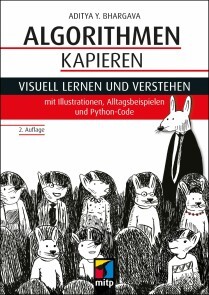
Algorithmen kapieren
* VISUELLE ERLÄUTERUNGEN MIT ÜBER 400 ANSCHAULICHEN ILLUSTRATIONEN* MIT EINFACHEN BEISPIELEN AUS DEM ALLTAG UND ZAHLREICHEN ÜBUNGEN* AUSFÜHRLICH KOMMENTIERTER BEISPIELCODE IN PYTHONALGORITHMEN KAPIEREN OHNE GRAUE THEORIEAb sofort sind Algorithmen nicht mehr langweilig und trocken! Mit diesem Buch wird es dir leichtfallen, ihre Funktionsweise zu verstehen. Alle Algorithmen werden mithilfe von Beispielen aus dem täglichen Leben erläutert, z.B. der Unterschied zwischen Arrays und verketteten Listen anhand der Aufgabe, freie Plätze in einem Kinosaal zu finden.FÜR DEN EINSATZ IN DER PRAXISDu lernst die wichtigsten Algorithmen kennen, die dir dabei helfen, deine Programme zu beschleunigen, deinen Code zu vereinfachen und die gängigsten Aufgaben bei der Programmierung zu lösen. Dabei beginnst du mit einfachen Aufgaben wie Sortieren und Suchen. Mit diesen Grundlagen gerüstet kannst du auch schwierigere Aufgaben wie Datenkomprimierung oder künstliche Intelligenz in Angriff nehmen.VISUELL UND PRAXISNAHZu allen Erläuterungen findest du anschauliche Illustrationen und Diagramme sowie ausführlich kommentierten Beispielcode in Python. Übungsaufgaben mit Lösungen für jedes Kapitel helfen dir, dein Wissen zu testen und zu festigen.AUS DEM INHALT:* Such-, Sortier- und Graphenalgorithmen* Performance von Algorithmen analysieren (Landau-Notation)* Arrays, verkettete Listen und Hashtabellen* Bäume und balancierte Bäume* Rekursion und Stacks* Quicksort und das Teile-und-herrsche-Verfahren* Dijkstra-Algorithmus für die Ermittlung des kürzesten Pfads* Approximationsalgorithmen und NP-vollständige Probleme* Greedy-Algorithmen* Dynamische Programmierung* Klassifikation und Regression mit dem k-Nächste-Nachbarn-AlgorithmusSTIMMEN ZUM BUCH»Das Buch schafft das Unmögliche: Mathe macht Spaß und ist einfach.« (- Sander Rossel, COAS Software Systems)»Algorithmen sind nicht langweilig! Die Lektüre des Buchs hat mir und meinen Studenten Spaß gemacht und war lehrreich.« (- Christopher Haupt, Mobirobo, Inc.)»Heutzutage gibt es praktisch keinen Aspekt des Lebens, der nicht durch einen Algorithmus optimiert wird. Dieses Buch sollte Ihre erste Wahl sein, wenn Sie eine gut erklärte Einführung in dieses Thema suchen.« (- Amit Lamba, Tech Overture, LLC)Aditya Bhargava ist Softwareentwickler und beschäftigt sich nicht nur mit Informatik, sondern auch mit bildender Kunst. Er bloggt über Programmierung unter adit.io.

DevSecOps Adventures
Discover a groundbreaking approach to introducing DevSecOps. _DevSecOps Adventures_ uses three innovative games to help you to maximize engagement in your training and transform learners’ mindsets, turning even reluctant sceptics into supporters and advocates of the DevOps culture.The book’s first coaching game uses LEGO, Chocolate, and role cards to explore the roles and interdependencies of Dev, Ops, and Security. Readers will experience Aha! moments, expand their individual roles, develop T-shaped skills, and experiment with changing organizational culture. The simulations depict an end-to-end product delivery process, highlighting bottlenecks in the value delivery flow. Additionally, the book is updated with two new games, "Fear in the Workplace" and "Safety in the Workplace" which provide insights into safety culture, drawing inspiration from the works of Ron Westrum, William Kahn, Amy C. Edmondson, and Dr. David Rock. Through open conversations, participants learn to identify signs of a fear-ridden culture and apply safety-enhancing practices to foster a culture of experimentation and learning.This Second Edition is enhanced with real-life examples and includes the insights from important State of DevOps reports. The updated “Key Takeaway” chapter and the new FAQ chapter prepare trainers to deliver an impactful learning experience. It serves as a facilitation guide for gamified experiential learning, provides ideas for effective debriefing, and helps readers relate the issues highlighted in the coaching games to similar challenges they may face in their organizations.WHAT YOU WILL LEARN:* Gain fundamental understanding of DevOps, DevSecOps, and Safety Culture.* Develop the capability to prepare, facilitate, and effectively debrief these coaching games with your teams.* Showcase how playfulness can help teams bring down a "wall of confusion" between the different functional silos. WHO THIS BOOK IS FORProgrammers or system admins/project managers who are new to DevOps.DevOps trainers and Agile Coaches who are interested in offering a collaborative and engaging learning experience to their teams.DANA PYLAYEVA is a business games designer, trainer and DevOps Culture coach, who is known for infusing playfulness into the most serious workplaces. She offers a unique blend of expert-level knowledge, exceptional facilitation skills, professional coaching mindset, and a diverse technical background as a former Java Developer, DBA Manager and Application Architect.Dana is equally effective in coaching teams, coaching leaders, and navigating the complexity of enterprise transformations. She enjoys working with clients across diverse industries such as legal publishing, automotive, digital marketing, retail, fintech, music streaming, non-profits, etc. In her 25+ years of experience, she has collaborated with clients from the US, Canada, the UK, Ireland, France, India, Japan, Malaysia, and Australia. She speaks at conferences internationally and has led workshops at 80 conferences in 18 countries.Dana holds a Certified Enterprise Coach (CEC) designation from Scrum Alliance, Professional Certified Coach (PCC) credentials from the International Coaching Federation (ICF), and a Certified Professional Co-Active Coach (CPCC) certification from Co-Active Training Institute.Dana is passionate about helping others grow and supporting the Agile/Scrum community. Through the years, she has been involved in various community roles as a volunteer, reviewer, track chair, program chair and conference chair at Agile Alliance and Scrum Alliance organizations. She is the founder of the Big Apple Scrum Day conference in NYC, and a co-organizer of several local user groups.1. Introduction.- 2. About this Book.- 3. Brief History of DevOps and DevSecOps.- 4. What You Will Teach with LEGO and Chocolate Simulation.- 5. LEGO and Chocolate - Rules of the Game.- 6. Game Components.- 7. Setting the Space.- 8. Know Your Timebox.- 9. Be a Gamemaster.- 10. Fear in the Workplace Game.- 11. Safety in the Workplace Coaching Game.- 12. Master Your Debriefing.- 13. Key Takeaways.- 14. Frequently Asked Questions.- 15. Play History and Modifications - It's All About the Feedback!- 16. Kickstarting Transformations with Games - Field Stories.- Appendix.

Augmented Reality and Virtual Reality in Special Education
DISCOVER THE GROUNDBREAKING POTENTIAL OF AUGMENTED REALITY IN SPECIAL EDUCATION WITH THIS COMPREHENSIVE BOOK, WHICH FILLS A SIGNIFICANT RESEARCH GAP AND EXPLORES THE TRANSFORMATIVE IMPACT OF AR/VR ON TEACHING AND LEARNING EXPERIENCES FOR INDIVIDUALS WITH DISABILITIES.Millions of young people across the world have impairments. Because of their apparent problems, these young people have typically been marginalized or excluded from schools. Studies on augmented reality applications in education for special children are still in their early stages and there is a dearth of research on the effects and implications of augmented reality in education for special children or individuals with special needs, such as intellectual disabilities, autism spectrum disorder, attention deficit hyperactivity disorder, and physical disabilities. Technological advancements have enabled the creation of whole new learning environments, vastly expanding the breadth and sophistication of teaching and learning activities. For example, several studies have shown that virtual reality and augmented reality can help autistic people understand facial emotions and improve their social skills. By compiling a collection of conceptual and research chapters investigating the infiltration of AR/VR into teaching and learning practices and experiences for disabled people, this book will fill a significant gap in current research literature. V. AJANTHA DEVI, PhD is a research head at AP3 Solutions, Chennai, Tamil Nadu, India. She is a Microsoft Certified Application Developer (MCAD) and Microsoft Certified Technical Specialist (MCTS) with more than 35 papers in international journals and conference proceedings to her credit. She has written, co-authored, and edited several books in the field of computer and has five Australian patents and one Indian patent to her credit in the areas of artificial intelligence, image processing, and medical imaging. WILLIAMJEET SINGH, PhD is an assistant professor in the Department of Computer Science and Engineering at Punjabi University, Patiala, Punjab, India. He has over 12 years of teaching and research experience and is the author of many research papers and articles published in national and international journals and conferences of repute. He is working on techno-social projects, one of which was awarded to him by the Department of Science and Technology (DST), New Delhi, India. Most recently, his work includes developing a mobile app for hearing-impaired individuals called World of Indian Sign Language. YOGESH KUMAR, PhD is an associate professor in the Department of Computer Engineering, Indus University, Ahmedabad, Gujarat. He has more than 14 years of experience in research and teaching. He has published ten papers, six book chapters, 12 papers in international conferences, 28 articles in peer-reviewed journals, and has been granted four patents. Preface xiii1 Digital Learning Environments--Constructing Augmented and Virtual Reality in Educational Applications 1Kapil Mehta and Chamkaur Singh2 Role of AR and VR Technology in Transforming Education Ecology 33Gagandeep Kaur, Harpreet Kaur, Sonia Goyal, Veerpal Kaur and Prabhleen Kaur3 Enhancing Social Skills Development Through Augmented Reality (AR) and Virtual Reality (VR) in Special Education 65Ajantha Devi Vairamani4 Immersive Learning's Promise: The Educational Potential of Augmented and Virtual Reality 91Priya Trivedi5 Influence of Augmented Reality and Virtual Reality in Special Education in India 103Ravichandran K.6 Exploring the Untapped Potential of the Metaverse in Special Education: A Comprehensive Analysis of Applications and AI Integration 121K. B. Priya Iyer and Ajantha Devi Vairamani7 Fostering and Integrating Augmented Reality/Virtual Reality Experiences for Learners with Autism Spectrum Disorders (ASDs) 141Usha Nandhini R. and P. Senthamizh Pavai8 Impact of AR/VR in the Learning Process of Children with Dyslexia 161C.V. Suresh Babu and Vinutha S.9 Immersive Experience in the Education of Special Kids Using the Metaverse Platform 189Magesh Kasthuri10 Privacy and Security Concerns with Augmented Reality/Virtual Reality: A Systematic Review 209Sukhpreet Kaur, Saumya Rajvanshi and Gurleen KaurAcknowledgement 228Conflict of Interest Statement 228References 228Index 233

Bio-Inspired Optimization for Medical Data Mining
THIS BOOK IS A COMPREHENSIVE EXPLORATION OF BIO-INSPIRED OPTIMIZATION TECHNIQUES AND THEIR POTENTIAL APPLICATIONS IN HEALTHCARE.Bio-Inspired Optimization for Medical Data Mining is a groundbreaking book that delves into the convergence of nature’s ingenious algorithms and cutting-edge healthcare technology. Through a comprehensive exploration of state-of-the-art algorithms and practical case studies, readers gain unparalleled insights into optimizing medical data processing, enabling more precise diagnosis, optimizing treatment plans, and ultimately advancing the field of healthcare. Organized into 15 chapters, readers learn about the theoretical foundation of pragmatic implementation strategies and actionable advice. In addition, it addresses current developments in molecular subtyping and how they can enhance clinical care. By bridging the gap between cutting-edge technology and critical healthcare challenges, this book is a pivotal contribution, providing a roadmap for leveraging nature-inspired algorithms. In this book, the reader will discover* Cutting-edge bio-inspired algorithms designed to optimize medical data processing, providing efficient and accurate solutions for complex healthcare challenges;* How bio-inspired optimization can fine-tune diagnostic accuracy, leading to better patient outcomes and improved medical decision-making;* How bio-inspired optimization propels healthcare into a new era, unlocking transformative solutions for medical data analysis;* Practical insights and actionable advice on implementing bio-inspired optimization techniques and equipping effective real-world medical data scenarios;* Compelling case studies illustrating how bio-inspired optimization has made a significant impact in the medical field, inspiring similar success stories. AUDIENCEThis book is designed for a wide-ranging audience, including medical professionals, healthcare researchers, data scientists, and technology enthusiasts. SUMIT SRIVASTAVA, PHD, is the director of Information Technology at Manipal University, Jaipur, India. He obtained his doctorate in data mining from the University of Rajasthan, India. His areas of research involve algorithms, data science, knowledge, and engineering education. He has published more than 70 research papers in review journals.ABHINEET ANAND, PHD, is a professor in computer science and engineering at Chandigarh University, Mohali, Punjab. He is also the director of the institution. His research includes artificial intelligence, machine learning, cloud computing, optical fiber, etc. He has published in various international journals and conferences, along with four book chapters.ABHISHEK KUMAR, PHD, is an associate professor in the Computer Science & Engineering Department at Chandigarh University, Punjab, India, and is affiliated with the University of Castilla-La Mancha (UCLM), Toledo, Spain. His research areas include artificial intelligence, renewable energy, image processing, and machine learning. In total, he has more than 100 publications in peer-reviewed journals. Kumar is a keynote speaker and a member of various national and international societies in the field of engineering and research. He was awarded the CV Ramen National Award in 2018 in the young researcher and faculty category.BHAVNA SAINI, PHD, is an assistant professor at Central University, Rajasthan, India. His areas of research include face recognition and fingerprint recognition, data management systems, machine learning, and computer vision. He has numerous books and research papers at national and international levels.PRAMOD SINGH RATHORE is an assistant professor in the Department of Computer and Communication Engineering, Manipal University Jaipur, India. He has teaching experience of more than 10 years and has 45 publications in peer-reviewed national and international journals.Preface xv1 BIOINSPIRED ALGORITHMS: OPPORTUNITIES AND CHALLENGES 1Shweta Agarwal, Neetu Rani and Amit Vajpayee1.1 Introduction 21.2 Bioinspired Principles and Algorithms 31.3 Opportunities of Bioinspired Algorithms 71.4 Challenges of Bioinspired Algorithms 91.5 Prominent Bioinspired Algorithms 121.6 Applications of Bioinspired Algorithms 181.7 Future Research Directions 211.8 Conclusion 232 EVALUATION OF PHYTOCHEMICAL SCREENING AND IN VITRO ANTIUROLITHIATIC ACTIVITY OF MYRISTICA FRAGRANS BY TITRIMETRY METHOD USING MACHINE LEARNING 31G. Lalitha, S. Surya and M.P. Karthikeyan2.1 Introduction 322.2 Methodology 332.3 Result and Discussion 352.4 Conclusion 383 PARKINSON'S DISEASE DETECTION USING VOICE AND SPEECH--SYSTEMATIC LITERATURE REVIEW 41Ronak Khatwad, Suyash Tiwari, Yash Tripathi, Ajay Nehra and Ashish Sharma3.1 Introduction 423.2 Research Questions 433.3 Method 443.4 Algorithms 603.5 Features 633.6 Conclusion 674 TUMOR DETECTION AND CLASSIFICATION 75Hermehar P.S. Bedi, Sukhpreet Kaur and Saumya Rajvanshi4.1 Introduction 764.2 Methods Used for Detection of Tumors 774.3 Methods Used for Classification of Tumours 804.4 Machine Learning 844.5 Deep Learning (DL) 894.6 Performance Metrics 954.7 Method Wise Trend of Using Techniques for Detection of Brain Tumor 974.8 Conclusion 975 ADVANCEMENTS IN TUMOR DETECTION AND CLASSIFICATION 103Mayank Puri, Aman Garg and Lekha Rani5.1 Introduction 1045.2 Imaging Techniques Used in Tumor Detection and Classification 1055.3 Molecular Biology Techniques 1115.4 Machine Learning and Artificial Intelligence 1155.5 Tumor Classification 1215.6 Challenges and Future Directions 1256 CLASSIFICATION OF BRAIN TUMOR USING MACHINE LEARNING TECHNIQUES: A COMPARATIVE STUDY 129Gandla Shivakanth, Bhaskar Marapelli, A. Shivakumar Reddy, Dasari Manasa and Samtha Konda6.1 Introduction 1306.2 Related Work 1316.3 Datasets 1326.4 Experimental Setup 1336.5 Results and Discussion 1346.6 Conclusion 1367 EXPLORING THE POTENTIAL OF DINGO OPTIMIZER: A PROMISING NEW METAHEURISTIC APPROACH 141Anju Yadav and Vivek Kumar Varma7.1 Introduction 1417.2 Architecture of Dingo Optimizer 1427.3 Initialization Process 1447.4 Iteration Phase 1487.6 Other Optimization Techniques 1507.7 Conclusion 1518 BIOINSPIRED GENETIC ALGORITHM IN MEDICAL APPLICATIONS 155Krati Taksali, Arpit Kumar Sharma and Manish Rai8.1 Introduction 1568.2 The Genetic Algorithm 1578.3 Radiology 1588.4 Oncology 1608.5 Endocrinology 1618.6 Obstetrics and Gynecology 1628.7 Pediatrics 1628.8 Surgery 1638.9 Infectious Diseases 1648.10 Radiotherapy 1648.11 Rehabilitation Medicine 1658.12 Neurology 1658.13 Health Care Management 1668.14 Conclusion 1669 ARTIFICIAL IMMUNE SYSTEM ALGORITHMS FOR OPTIMIZING NANOPARTICLE DESIGN IN TARGETED DRUG DELIVERY 169Ashish Kumar and Vivek Verma9.1 Introduction 1709.2 Artificial Immune Cells 1719.3 The Artificial Immune System Architecture 17210 DIABETIC RETINOPATHY DETECTION BY RETINAL BLOOD VESSEL SEGMENTATION AND CLASSIFICATION USING ENSEMBLE MODEL 185Gandla Shivakanth, K. Aruna Bhaskar, Bechoo Lal, A. Shivakumar Reddy and D. Manasa10.1 Introduction 18610.2 Literature Review 18710.3 Proposed System 18810.4 Conclusion and Future Scope 19811 DIABETES PROGNOSIS MODEL USING VARIOUS MACHINE LEARNING TECHNIQUES 201Pawan Kumar Patidar, Manish Bhardwaj and Sumit Kumar11.1 Introduction 20211.2 Literature Review 20911.3 Proposed Model 21111.4 Experimental Results and Discussion 21311.5 Conclusion 22212 DIAGNOSIS OF NEUROLOGICAL DISEASE USING BIOINSPIRED ALGORITHMS 227Inam Ul Haq12.1 Introduction 22812.2 Neurological Disease Diagnosis 24412.3 Challenges and Future Directions 26012.4 Conclusion 26413 OPTIMIZING ARTIFICIAL NEURAL-NETWORK USING GENETIC ALGORITHM 269Bhavy Pratap and Sulabh Bansal13.1 Introduction 27013.2 Methodology 27813.3 Brief Study on Existing Implementations 28313.4 Comparative Study on Different Implementations 28514 BIOINSPIRED APPLICATIONS IN THE MEDICAL INDUSTRY: A CASE STUDY 289Alankrita Aggarwal and Mohit Lalit14.1 Introduction 29014.2 Overview of Bioinspired Algorithms 29114.3 Applications of Bioinspired Algorithms in Medical Field 29614.4 Review of the Case Studies 29714.5 Case Study 29714.6 Some Examples of the Case Studies Related to Medical Field and Can Be Solved with Bioinspired Algorithms 30014.7 Future Directions and Recommendations for Future Research 30214.8 Conclusion and Summary of Findings 306References 307Index 309

Praxisbuch ISO/IEC 27001
- Das umfassende Praxisbuch zum Management der Informationssicherheit- Enthält die vollständige Norm DIN EN ISO/IEC 27001:2024- Unentbehrlich für Betreiber kritischer Infrastrukturen (-> IT-Sicherheitsgesetz)- Mit 80 Prüfungsfragen zur Vorbereitung auf die Foundation-Zertifizierung- Ihr exklusiver Vorteil: E-Book inside beim Kauf des gedruckten BuchesInformationen sind das wertvollste Kapital vieler Organisationen. Geraten sie in falsche Hände, kann sogar das Überleben eines Unternehmens gefährdet sein. Zur Informationssicherheit müssen alle ihren Beitrag leisten, von der Arbeitsebene bis zum Topmanagement. Die ISO / IEC 27001 stellt dabei die wichtigste internationale Norm dar, an der man praktisch in keiner Branche vorbeikommt. Ein dieser Norm entsprechendes Informationssicherheitsmanagementsystem (ISMS) ist zunehmend Voraussetzung für die Erfüllung von Kunden-Anforderungen sowie von gesetzlichen und behördlichen Vorgaben, u. a. im Rahmen des IT-Sicherheitsgesetzes.In diesem Buch erhalten Sie die optimale Unterstützung für den Aufbau eines wirksamen ISMS. Die Autoren vermitteln zunächst das notwendige Basiswissen zur ISO / IEC 27001 sowie zur übergeordneten Normenreihe und erklären anschaulich die Grundlagen. Im Hauptteil finden Sie alle wesentlichen Teile der deutschen Fassung der Norm, DIN EN ISO / IEC 27001, im Wortlaut. Hilfreiche Erläuterungen, wertvolle Praxistipps für Maßnahmen und Auditnachweise helfen Ihnen bei der Umsetzung der Norm. Ebenfalls enthalten sind Prüfungsfragen und -antworten, mit deren Hilfe Sie sich optimal auf Ihre persönliche Foundation-Zertifizierung vorbereiten können. Das Buch schließt mit einem Abdruck der kompletten Norm DIN EN ISO/ IEC 27001:2024.Die Autoren: Michael Brenner, Nils gentschen Felde, Wolfgang Hommel, Stefan Metzger, Helmut Reiser und Thomas Schaaf arbeiten u. a. an der Ludwig-Maximilians-Universität München, der Universität der Bundeswehr München und am Leibniz-Rechenzentrum der Bayerischen Akademie der Wissenschaften. Als Mitglieder der Forschungsgruppe Munich Network Management Team (www.mnmteam.org) forschen und lehren sie alle zu den Themen Informationssicherheitsmanagement und IT-Service-Management.AUS DEM INHALT //- Einführung und Basiswissen- Die Standardfamilie ISO / IEC 27000 im Überblick- Grundlagen von Informationssicherheitsmanagementsystemen- ISO / IEC 27001- Spezifikationen und Mindestanforderungen- Maßnahmen im Rahmen des ISMS- Verwandte Standards und Rahmenwerke- Zertifizierungsmöglichkeiten und Begriffsbildung nach ISO/ IEC 27000- Abdruck der vollständigen DIN EN ISO / IEC 27001:2024- Vergleich der Normenfassungen von 2017 und 2024- Prüfungsfragen mit Antworten zur ISO / IEC 27000 Foundation

Optimized Computational Intelligence Driven Decision-Making
THIS BOOK COVERS A WIDE RANGE OF ADVANCED TECHNIQUES AND APPROACHES FOR DESIGNING AND IMPLEMENTING COMPUTATIONALLY INTELLIGENT METHODS IN DIFFERENT APPLICATION DOMAINS WHICH IS OF GREAT USE TO NOT ONLY RESEARCHERS BUT ALSO ACADEMICIANS AND INDUSTRY EXPERTS.Optimized Computational Intelligence (OCI) is a new, cutting-edge, and multidisciplinary research area that tackles the fundamental problems shared by modern informatics, biologically-inspired computation, software engineering, AI, cybernetics, cognitive science, medical science, systems science, philosophy, linguistics, economics, management science, and life sciences. OCI aims to apply modern computationally intelligent methods to generate optimum outcomes in various application domains. This book presents the latest technologies-driven material to explore optimized various computational intelligence domains.* includes real-life case studies highlighting different advanced technologies in computational intelligence;* provides a unique compendium of current and emerging hybrid intelligence paradigms for advanced informatics;* reflects the diversity, complexity, and depth and breadth of this critical bio-inspired domain;* offers a guided tour of computational intelligence algorithms, architecture design, and applications of learning in dealing with cognitive informatics challenges;* presents a variety of intelligent and optimized techniques designed to represent, enhance, and empower multi-disciplinary and multi-institutional data analytics research in intelligent decision-making system dynamics;* includes architectural models and applications-based augmented solutions for optimized computational intelligence.AUDIENCEThe book will interest a range of engineers and researchers in information technology, computer science, and artificial intelligence working in the interdisciplinary field of computational intelligence. HRUDAYA KUMAR TRIPATHY, PHD, is an associate professor in the School of Computer Engineering, KIIT Deemed to be University, He has more than 20 years of teaching experience and his research interests include neural networks, pattern recognition, software engineering, machine learning, and big data. He has published several books and research papers in various journals and conferences. Tripathy received the 2013 Young IT Professional Award from the Computer Society of India. SUSHRUTA MISHRA, PHD, is an associate professor in the School of Computer Engineering, KIIT Deemed to be University, Odisha, India. He obtained his doctorate in 2017 and his research interests include image processing, machine learning, the Internet of Things, and cognitive computing. He has published 130+ research articles in international journals and conferences. MINAKHI ROUT, PHD, is an associate professor in the School of Computer Engineering, KIIT Deemed to be University, Odisha, India. She obtained her PhD in 2015 and her research interests focus on computational finance, data mining, and machine learning. Rout has published 50+ research papers in international journals and conferences. S. BALAMURUGAN, PHD, is the Director of Research and Development, Intelligent Research Consultancy Services (iRCS), Coimbatore, Tamilnadu, India. He is also Director of the Albert Einstein Engineering and Research Labs (AEER Labs), as well as Vice-Chairman, Renewable Energy Society of India (RESI), India. He has published 45 books, 200+ international journals/ conferences, and 35 patents. SAMARESH MISHRA, PHD, is the director of student affairs at KIIT Deemed to be University. He obtained a PhD in computer science from Utkal University. His research areas focus on software testing, machine learning, and cloud computing. He has published 30+ academic papers. Preface xv1 EMERGENCE OF ADVANCED COMPUTATIONAL INTELLIGENCE COUPLED WITH SMART ENVIRONMENT 1Risha Rani and Tirtha Deb1.1 Introduction 21.2 Background Works 31.3 Integrated Smart Environment 41.4 Proposed Models for Smart Intelligent Environment 51.5 IoT Architecture 161.6 Smart Environment and Advanced Computational Intelligence 231.7 Advanced Computational Intelligences: Possible Uses in Smart Environment 241.8 Conclusion 262 MACHINE LEARNING-ENABLED INTEGRATED INFORMATION PLATFORM FOR EDUCATIONAL UNIVERSITIES 29Sai Smurti Sahu, Rishav Kumar, Soumya Sahoo, Balwant Kumar and Padmabati Mohanta2.1 Introduction 302.2 Cloud-Based Web Application for University 302.3 Integrated Information Platform of Indian Universities Using Machine Learning 362.4 Applications Used to Designed This Web Platform 372.5 Analysis Result 383 FALSE DATA INJECTION ATTACK DETECTION USING MACHINE LEARNING IN INDUSTRIAL INTERNET OF THINGS 49Hafizunisa, Prerna Rai and Damini Sinha3.1 Introduction 503.2 Literature Review 543.3 Technical Methodology 563.4 Proposed Model for Detecting False Data and its Correction 593.5 Complexity Analysis of Proposed Model 633.6 Advantages of the Model 643.7 Future Scope and Limitations of the Proposed Model 653.8 Conclusion 654 FAKE NEWS DETECTION: RESTRICTING SPREADING OF MISINFORMATION USING MACHINE LEARNING 69Shubham Choudhary and Pratyush Mishra4.1 Introduction 704.2 Scope of False News Detection 734.3 Main Highlights of the Analysis 734.4 A Novel Model for False News Detection 764.5 Literature Review 784.6 Results and Analysis 804.7 Conclusion 815 ADAPTABILITY, FLEXIBILITY, AND ACCESSIBILITY THROUGH TELEMEDICINE 85Dipti Verma, Somyajyoti Talukdar and Kumari Alankrita Sharma5.1 Introduction 865.2 Related Works 895.3 Proposed Model for Remote Health Monitoring System 935.3.1 Microcontroller and Sensor 955.4 Benefits of the Proposed Model 965.5 Constraints of the Proposed Model 985.6 Conclusion 1015.7 Future Works 1026 CROP PREDICTION BY IMPLEMENTING MACHINE LEARNING IN AN IOT-BASED SYSTEM 107Vivian Rawade and Shubham Sahoo6.1 Introduction 1086.2 Literature Review 1106.3 Proposed Model for Crop Prediction 1126.4 Results and Analysis 1236.5 Challenges Faced 1256.6 Advantages of the Proposed Model 1276.7 Disadvantages of the Proposed Model 1276.8 Conclusion 1287 RELEVANCE OF SMART MANAGEMENT OF ROAD TRAFFIC SYSTEM USING ADVANCED INTELLIGENCE 131Koustab Chowdhury and Rishabh Kapoor7.1 Introduction 1327.2 Related Works 1357.3 Proposed Model of Traffic Management System 1397.4 Role of AI in Traffic Management 1467.5 Conclusion and Future Works 1488 VISUALIZATION OF TEXTUAL CORPORA USING SOCIAL NETWORK ANALYSIS 151Indu Rodda and Durga Bhavani S.8.1 Introduction 1528.2 Related Literature 1548.3 Proposed Method 1568.4 Implementation and Results 1638.5 Conclusion and Future Work 1699 AUTONOMOUS INTELLIGENT VEHICLES: IMPACT, CURRENT MARKET, FUTURE TRENDS, CHALLENGES, AND LIMITATIONS 173Kamalanathan Shanmugam, Muhammad Ehsan Rana and Felix Ting Yu Hong9.1 Introduction 1749.2 The Global Impact of the AV Industry 1769.3 Role of Machine Learning in Autonomous Vehicles 1779.4 Significance of the AV Industry in Various Sectors 1799.5 Current Market and Future Trends in AV Industry 1849.6 Challenges and Limitations 1899.7 Conclusion 19210 ROLE OF SMART AND PREDICTIVE HEALTHCARE IN MODERN SOCIETY 195Muhammad Ehsan Rana and Manoj Jayabalan10.1 Introduction 19610.2 Healthcare System 19710.3 Role of Predictive Analytics in Healthcare 19810.4 Application of IoT in Healthcare 19910.5 IoT Based Healthcare Management Framework 20010.6 Future Recommendations for Research 21010.7 Conclusion 21111 AN ANALYTICAL STUDY ON DEPRESSION DETECTION USING MACHINE LEARNING 215Angelia Melani Adrian and Junaidy Budi Sanger11.1 Introduction 21611.2 Literature Survey 21711.3 Proposed System 22011.4 Challenges of Machine Learning in Depression Detection 22511.5 Conclusion and Future Work 22612 REVOLUTIONIZING HEALTHCARE: EMPOWERING FASTER TREATMENT WITH IOT-POWERED SMART HEALTHCARE 229Prerna Kumari, Rupali Agarwal and Shruti Kumari12.1 Introduction 23012.2 Scope/Motivation 23312.3 Literature Survey 23412.4 Smart Technology 23512.5 Methods and Materials 23612.6 Result 24512.7 Conclusion 24813 MACHINE LEARNING ALGORITHMS FOR INITIAL DIAGNOSIS OF PARKINSON’S DISEASE 251Udayan Das, Manish Jena and Manish Roy13.1 Overview of Parkinson’s Disease 25113.2 Scope 25413.3 Related Works 25513.4 Comparative Analysis of Parkinson’s Disease 26013.5 Pros and Cons Using ML Algorithms 26713.6 Conclusion and Future Works 27113.7 Bibliography 27114 TOWARDS A SUSTAINABLE FUTURE: HARNESSING THE POWER OF COMPUTATIONAL INTELLIGENCE TO TRACK CLIMATE CHANGE 275Satyam Sinha, Shreyash Kumar Agnihotri and Oshmita Sarkar14.1 Introduction 27614.2 Artificial Intelligence and Climate Change Adaptation 27714.3 Related Works 27814.4 Comparative Analysis of Technological Frameworks to Handle Climate Crisis 28014.5 Future Scope of Climatic Crisis Handling with AI 29914.6 Conclusion 30015 IMPACT OF COMPUTATIONAL INTELLIGENCE AND MODELING IN TACKLING WEATHER FLUCTUATION 305Rohan Karn, Aniket Rouniyar, Ranjit Kumar Das and Amit Gupta15.1 Introduction 30615.2 Objective 30815.3 Causes of Climate Crisis 30915.4 Significance of AI and Modeling on Climate Crisis 31115.5 Plastic Waste Detection Model 31915.6 Forest Fire Prediction Models Using AI 32515.7 Results 32915.8 Conclusion 331References 332Index 335
Algorithmic Trading Systems and Strategies: A New Approach
Design and develop a complex trading system from idea to operation. Old approaches were based on manually searching for strategy ideas. This book shows you how to create a system that will generate, optimize, and launch profitable strategies into a fully automatic mode.Imagine a system that only requires access to the Internet and electricity from a trader. This book describes the architecture and features of such a system and provides recommendations for further development. Most books cover only the implementation stage and overlook the design and maintenance of these systems. Here, you’ll walk through the entire process of creating a complex, scalable and easily supported system.For example, you’ll design an application based on microservice architecture and learn about development environments. You’ll also examine the advantages of horizontal scaling in the context of creating trading systems. Along the way, you’ll set up Kubernetes, connect the monitoring system. and understand the intricacies of continuous integration and continuous delivery.Testing and identifying only dozens of strategies is a thing of the past. _Algorithmic Trading Systems and Strategies: A New Approach_ shows you how to analyze thousands in the same amount of time.Since childhood, I dreamed of being a programmer, namely from the moment when the first computer appeared in our house. Since then, I have regularly participated in programming competitions for children. And now many years have passed and at the moment I have more than 10 years of experience in developing complex systems from scratch.My professional passion has become complex design of various applications. At the same time, in my daily life I was attracted to the idea of algorithmic trading. And at that moment the stars aligned. I was interested in building a system that would search for and find profitable strategies on its own. At that time, developing such a system for algorithmic trading became one of the most interesting and difficult tasks for me.This project was my personal one, so, unfortunately, I filled the cones myself. The process was quite long, but by the end everything in my head lined up into a logical and correct model. Now I want to share my findings and conclusions with the world, so that everyone who wants to build their own algorithmic systems will not be like blind people and waste time creating ineffective systems. I want my readers to adopt my experience and their developments to bring maximum benefit to their creators.1. Popular Approaches.- 2.Introduction to Developing Trading Systems.- 3.Architectural Solution. - 4. Services and Subsystems.- 5. Technology Stack and Libraries.- 6. Optimization Algorithms.- 7. Implementation of Optimization Algorithms .- 8. Implementation of Core Modules.- 9. Approaches to Final implementation.

Elternratgeber: Sicher im Netz für Dummies
SICHERE MEDIENNUTZUNG BEGLEITEN Welche Apps und Dienste fördern und unterhalten Ihr Kind, wo lauert Gefahr? Mit diesem Buch richten Sie Smartphones, Tablets, PCs und Spielekonsolen altersgerecht ein und vermitteln Ihrem Kind fundiert den richtigen Umgang mit (Online-)Medien. Sie verstehen, wie bei Kindern und Jugendlichen verbreitete Apps oder Dienste auf allen gängigen Gerätetypen funktionieren und vernetzt sind. Und wie Sie die Zugriffsmöglichkeiten so steuern, wie Sie es für Ihr Kind für geeignet halten. So kann Ihr Kind sicher surfen, spielen oder soziale Netzwerke nutzen. SIE ERFAHREN* Wie Kinder digitale Medien nutzen* Was erlaubt ist und was nicht* Welche Einstellungen Sie kennen sollten* Wie Sie sich und Ihre Kinder vor digitalen Angriffen schützenMARKUS WIDL ist Vater von drei Kindern und mit einer Erzieherin verheiratet. Als Informatiker und IT-Spezialist ist es ihm ein Anliegen, Kinder und Eltern für mögliche Gefahren zu sensibilisieren, damit sie die Vorteile der IT unbeschwert nutzen können. Über den Autor 7Einleitung 19TEIL I: DIGITALE MEDIEN – MÖGLICHKEITEN, PROBLEME UND GEFAHREN 25Kapitel 1: Unsere Kinder und aktuelle Medien 27Kapitel 2: Soziales Miteinander im Netz 63Kapitel 3: Gefahren durch Betrüger 87TEIL II: SICHERER UMGANG MIT SOCIAL MEDIA, INSTANT MESSAGING, SPIELEN UND STREAMING 101Kapitel 4: Social- Media- Apps 103Kapitel 5: Instant- Messaging- Dienste 129Kapitel 6: Spiele auf Smartphone, Konsole und PC 153Kapitel 7: Videos und Musik 171Kapitel 8: Streaming- Anbieter für Filme und Serien 193TEIL III: DEN JUGENDSCHUTZ IM GERÄTE- ZOO AKTIVIEREN 209Kapitel 9: Sicheres Heimnetzwerk 211Kapitel 10: Smartphones und Tablets 231Kapitel 11: Betriebssysteme 259Kapitel 12: Spielekonsolen und Steam 291TEIL IV: SCHWIERIGE SITUATIONEN MEISTERN 327Kapitel 13: Kostenfallen 329Kapitel 14: Abmahnungen 343Kapitel 15: Hacker- Angriff 353Kapitel 16: Kontakte zu Anbietern, Herstellern, Beratungsstellen und Behörden 359TEIL V: DER TOP- TEN- TEIL 363Kapitel 17: Zehn weitere Social- Media- und Instant- Messaging- Apps, die Sie kennen sollten 365Kapitel 18: Zehn Dinge, mit denen Sie jetzt beginnen sollten 369Stichwortverzeichnis 377

Brain Rush
After decades of false starts, artificial intelligence (AI) is entering the mainstream of society. That is largely due to the rapid adoption of ChatGPT, a service that responds to almost any natural language question with cogent paragraphs. ChatGPT is the leading example of generative AI -- technology that creates original text, images, video and computer code based on uncovering patterns in training data.The book will explain how generative AI works and how much economic value it could create and will map out the industry value network. For each value network stage, the book will define the industry, estimate its size, growth rate, and profit potential, identify the most successful participants, and explain how they have achieved their success and where they will compete in the future. The book will conclude with a section on what investors and business leaders should do to make an informed decision on where to place their bets.WHAT YOU WILL LEARNInsights on how best to assemble the resources – whether by hiring a consultant or bringing on board a generative AI expert -- to build, train, and operate company specific generative AI applicationsHow management can brainstorm, evaluate and execute the right opportunitiesConcepts and processes to enable investors to place bets with the highest risk-adjusted returnsWHO THIS BOOK IS FORBusiness and enterprises seeking to get value from generative AI, current or potential suppliers of technology and services to companies that build generative AI, and venture capitalists and public equity investors seeking to make profitable bets on generative AI companiesPeter S. Cohan is an Associate Professor of Management Practice at Babson College. He teaches strategy, leadership and entrepreneurship to students in its undergraduate, Master of Science in Entrepreneurial Leadership, Master of Science in Advanced Entrepreneurial Leadership, MBA, and Executive Education programs. He is coordinator of Babson’s required undergraduate strategy course and the creator and teacher of advanced strategy courses for undergraduate and MSEL students. Cohan is the founding principal of Peter S. Cohan & Associates, a management consulting and venture capital firm. He has completed over 150 growth-strategy consulting projects for global technology companies and invested in seven startups -- three of which were sold for about $2 billion and one of which went public in 2021 at an $18 billion valuation. He has written 16 books including Net Profit: How to Invest and Compete in the Wild World of Internet Business. Since 2011 he has been a contributor to Forbes and Inc. He is a frequent media commentator who has appeared on ABC's Good Morning America, Bloomberg, CNN, CNBC, Fox Business News, American Public Media's MarketPlace, WBUR, WGBH, New England Cable News and the Boston ABC, NBC, and CBS affiliates. He has been quoted in the Associated Press, the Christian Science Monitor, the London Evening Standard, the Times of London, the New York Times, Nikkei, USA Today, the Wall Street Journal, the Washington Post, Portugal's Expresso, the Economist, Time, BusinessWeek, and Fortune. He also appeared in the 2016 documentary film, We the People: the Market Basket Effect. Prior to starting his firm, he worked as a case team leader for Harvard Business School Professor Michael Porter's consulting firm. He has taught at MIT, Stanford, Columbia, Tel Aviv University, New York University, Bentley University, The Vienna University of Technology, School of Management Fribourg, Barcelona's EADA, Singapore's Nanyang Technological University, the University of Coimbra, the University of Chile, the University of Hong Kong and Tecnologico de Monterrey. RETHINK Retail chose him as a Top 100 Retail Influencer of 2021, 2022, and 2023. He earned an MBA from Wharton, did graduate work in computer science at MIT, and holds a BS in Electrical Engineering from Swarthmore College.Chapter 1 title: Brain Rush.- Part I: Mining Generative AI’s End User Value.- Chapter 2 title: Generative AI Customer End Uses.- Part II: Mapping The Generative AI Ecosystem.- Chapter 3 title: Generative AI Application Software.- Chapter 4 title: Generative AI Cloud Services.- Chapter 5 title: Generative AI Network Technology.- Chapter 6 title: Generative AI Semiconductors.- Part II: Panning For Generative AI Gold.- Chapter 7 title: How Companies Can Profit From Generative AI.- Chapter 8 title: Supplying The Generative AI Picks And Shovels.- Chapter 9 title: Capitalizing The Generative AI Winners.- Chapter 10 title: After the Brain Rush.

Beginning Mathematica and Wolfram for Data Science
Enhance your data science programming and analysis with the Wolfram programming language and Mathematica, an applied mathematical tools suite. This second edition introduces the latest LLM Wolfram capabilities, delves into the exploration of data types in Mathematica, covers key programming concepts, and includes code performance and debugging techniques for code optimization.You’ll gain a deeper understanding of data science from a theoretical and practical perspective using Mathematica and the Wolfram Language. Learning this language makes your data science code better because it is very intuitive and comes with pre-existing functions that can provide a welcoming experience for those who use other programming languages. Existing topics have been reorganized for better context and to accommodate the introduction of Notebook styles. The book also incorporates new functionalities in code versions 13 and 14 for imported and exported data.You’ll see how to use Mathematica, where data management and mathematical computations are needed. Along the way, you’ll appreciate how Mathematica provides an entirely integrated platform: its symbolic and numerical calculation result in a mized syntax, allowing it to carry out various processes without superfluous lines of code. You’ll learn to use its notebooks as a standard format, which also serves to create detailed reports of the processes carried out.WHAT YOU WILL LEARN* Create datasets, work with data frames, and create tables* Import, export, analyze, and visualize data* Work with the Wolfram data repository* Build reports on the analysis* Use Mathematica for machine learning, with different algorithms, including linear, multiple, and logistic regression; decision trees; and data clusteringWHO THIS BOOK IS FORData scientists who are new to using Wolfram and Mathematica as a programming language or tool. Programmers should have some prior programming experience, but can be new to the Wolfram language.JALIL VILLALOBOS ALVA is a Wolfram language programmer and Mathematica user. He graduated with a degree in engineering physics from the Universidad Iberoamericana in Mexico City. His research background comprises quantum physics, bionformatics, proteomics, and protein design. His academic interests cover the topics of quantum technology, bioinformatics, machine learning, artificial intelligence, stochastic processes, and space engineering. During his idle hours he likes to play soccer, swim, and listen to music.1. Introduction to Mathematica.- 2. Data Manipulation.- 3. Working with Data and Datasets.- 4. Import and Export.- 5. Data Visualization.- 6. Statistical Data Analysis.- 7. Data Exploration.- 8. Machine Learning with the Wolfram Language.- 9. Neural Networks with the Wolfram Language.- 10. Neural Network Framework.

Vorschriften und Betriebstechnik des Amateurfunks
So bestehen Sie Ihre Amateurfunkprüfung mit Bravour! Für das erfolgreiche Bestehen der Amateurfunkprüfung benötigen Sie nicht nur umfassendes Technik-Wissen, sondern Sie müssen sich auch mit den Vorschriften und Gesetzen sowie der Betriebstechnik auskennen. Dazu finden Sie in diesem E-Book alles, was Sie für das sichere Bestehen der Prüfungen in den Klassen N, E und A und den souveränen Funkbetrieb wissen müssen. Inklusive Beispielen und Übungsfragen, aktuell zur AFuV 2024. Bei Ihren ersten Schritten in der Funkpraxis unterstützt Sie mit den notwendigen Grundlagen »Amateurfunk. Das umfassende Handbuch« von Harald Zisler DL 6 RAL und Thomas Lauterbach DL 1 NAW. Aus dem Inhalt: Grundwissen über die gesetzlichen Grundlagen und VorschriftenSicherheitsvorschriftenElektromagnetische UmweltverträglichkeitAmateurfunkbetrieb unterwegsBandpläne: Für ein gutes MiteinanderVerkehrsregeln im FunkbetriebNotfunk und Verhalten im NotfallLogbücher und QSL-KartenMit Übungen und Musterlösungen

Beginning Python
Gain a fundamental understanding of Python’s syntax and features with this revised introductory and practical reference. Covering a wide array of Python–related programming topics, including addressing language internals, database integration, network programming, and web services, you’ll be guided by sound development principles.Updated to reflect the latest in Python programming paradigms and several of the most crucial features found in Python 3, _Beginning Python, Fourth Edition_ also covers advanced topics such as extending Python and packaging/distributing Python applications. Ten accompanying projects will ensure you can get your hands dirty in no time.YOU WILL:* Become a proficient Python programmer by following along with a friendly, practical guide to the language’s key features* Write code faster by learning how to take advantage of advanced features such as magic methods, exceptions, and abstraction* Gain insight into modern Python programming paradigms including testing, documentation, packaging, and distribution* Work through several interesting projects, including a P2P file–sharing application, chat client, video game, remote text editor, and moreWHO THIS BOOK IS FORProgrammers, novice and otherwise, seeking a comprehensive introduction to the Python programming language.MAGNUS LIE HETLAND is an experienced Python programmer, having used the language since the late 1990s. He is also an associate professor of algorithms at the Norwegian University of Science and Technology, having taught algorithms for the better part of a decade. Hetland is the author of Practical Python and Beginning Python, first and second editions, as well as several scientific papers.FABIO NELLI is an IT Scientific Application Specialist at IRBM Science Park, a private research center in Pomezia, Roma, Italy. He has been a computer consultant for many years at IBM, EDS, Merck Sharp, and Dohme, along with several banks and insurance companies. He has an Organic Chemistry degree and many years of experience in Information technologies and Automation systems applied to Life Sciences (Tech Specialist at Beckman Coulter Italy and Spain). He is currently developing Java applications that interface Oracle databases with scientific instrumentation generating data and web server applications providing analysis of the results to researchers in real time.Ch. 1 Instant hacking : the basics.- Ch. 2 Lists and tuples.- Ch. 3 Working with strings.- Ch. 4 Dictionaries : when indices won't do.- Ch. 5 Conditionals, loops, and some other statements.- Ch. 6 Abstraction.- Ch. 7 More abstraction.- Ch. 8 Exceptions.- Ch. 9 Magic methods, properties, and iterators.- Ch. 10 Batteries included.- Ch. 11 Files and stuff.- Ch. 12 Graphical user interfaces.- Ch. 13 Database support.- Ch. 14 Network programming.- Ch. 15 Python and the Web.- Ch. 16 Testing, 1-2-3.- Ch. 17 Extending Python.- Ch. 18 Packaging your programs.- Ch. 19 Playful programming.- Ch. 20 Project 1 : instant markup.- Ch. 21 Project 2 : painting a pretty picture.- Ch. 22 Project 3 : XML for all occasions.- Ch. 23 Project 4 : in the news.- Ch. 24 Project 5 : a virtual tea party.- Ch. 25 Project 6 : remote editing with CGI.- Ch. 26 Project 7 : your own bulletin board.- Ch. 27 Project 8 : file sharing with XML-RPC.- Ch. 28 Project 9 : file sharing II - now with GUI!.- Ch. 29 Project 10 : do-it-yourself arcade game.- Appendix A: The Short Version.- Appendix B: Python Reference.

KI in Gesundheit und Pflege
Zu Risiken und Nebenwirkungen fragen Sie Ihre KIKünstliche Intelligenz durchdringt alle Bereiche des Lebens - auch das Gesundheitswesen. Walter Swoboda zeigt in seinem Buch, wie die KI funktioniert, welche Varianten dieser neuen Technologie in Gesundheit und Pflege zum Einsatz kommen können und welche Einsatzgebiete sich kurz- und langfristig ergeben. Auf Chancen, Risiken und ethische Herausforderungen geht er ein. Auch experimentelle Verfahren der Zukunft berücksichtigt er.Das Buch richtet sich an Praktizierende, Forschende und Studierende in den Bereichen Gesundheitswesen, Gesundheitsmanagement, Gesundheitsinformatik, Medizin, Pflegewissenschaften sowie Medizinethik.Prof. Dr. Walter Swoboda ist Arzt und Informatiker. Er ist zudem Forschungsprofessor an der Hochschule Neu-Ulm. Als Leiter der gemeinsamen Ethikkommission der Hochschulen Bayerns (GEHBa) beschäftigt er sich mit ethischen Fragen zu neuen Technologien aus Medizin und Informatik.1 Versuch und Irrtum: Die Geschichte der künstlichen Intelligenz2 Wie funktioniert unser Gehirn?3 Nachgebaut: Künstliche neuronale Netzwerke4 Einsatz in Medizin und Pflege5 Der mehr oder weniger mündige Patient und seine KI6 Experimentelle Krankheitsmodelle in der Forschung7 "Bin ich?" oder "die KI und das Bewusstsein"8 Eine leicht überraschende ethische Bewertung

Automatisiertes Fahren 2022
Künstliche Intelligenz, Machine- oder Deep-Learning sind Treiber des automatisierten Fahrens. Das Zusammenspiel von künstlicher und menschlicher Intelligenz sowie die Fähigkeit von Mensch und Maschine zu kooperieren müssen in neuen Interaktionsebenen gestaltet und für zukünftige Mobilität nutzbar gemacht werden. Dafür ist es notwendig, dass die Gesellschaft diese Entwicklung akzeptiert. Vor diesem Hintergrund gewinnen Methoden, Werkzeuge und Prozesse ebenso an Relevanz wie Sensoren und Connectivity. Die Sessions der AUFA 2022 beschäftigten sich mit: Architekturen und Standardisierung.- Versicherungsthemen.- Manöverplanung.- Neue Fahrzeug- und Innenraumkonzepte.- Testverfahren und Absicherung.- Datengenerierung und Datensicherheit.- Verkehrsplanung und Geschäftsmodelle.- HMI und Fahrzeugmonitoring.
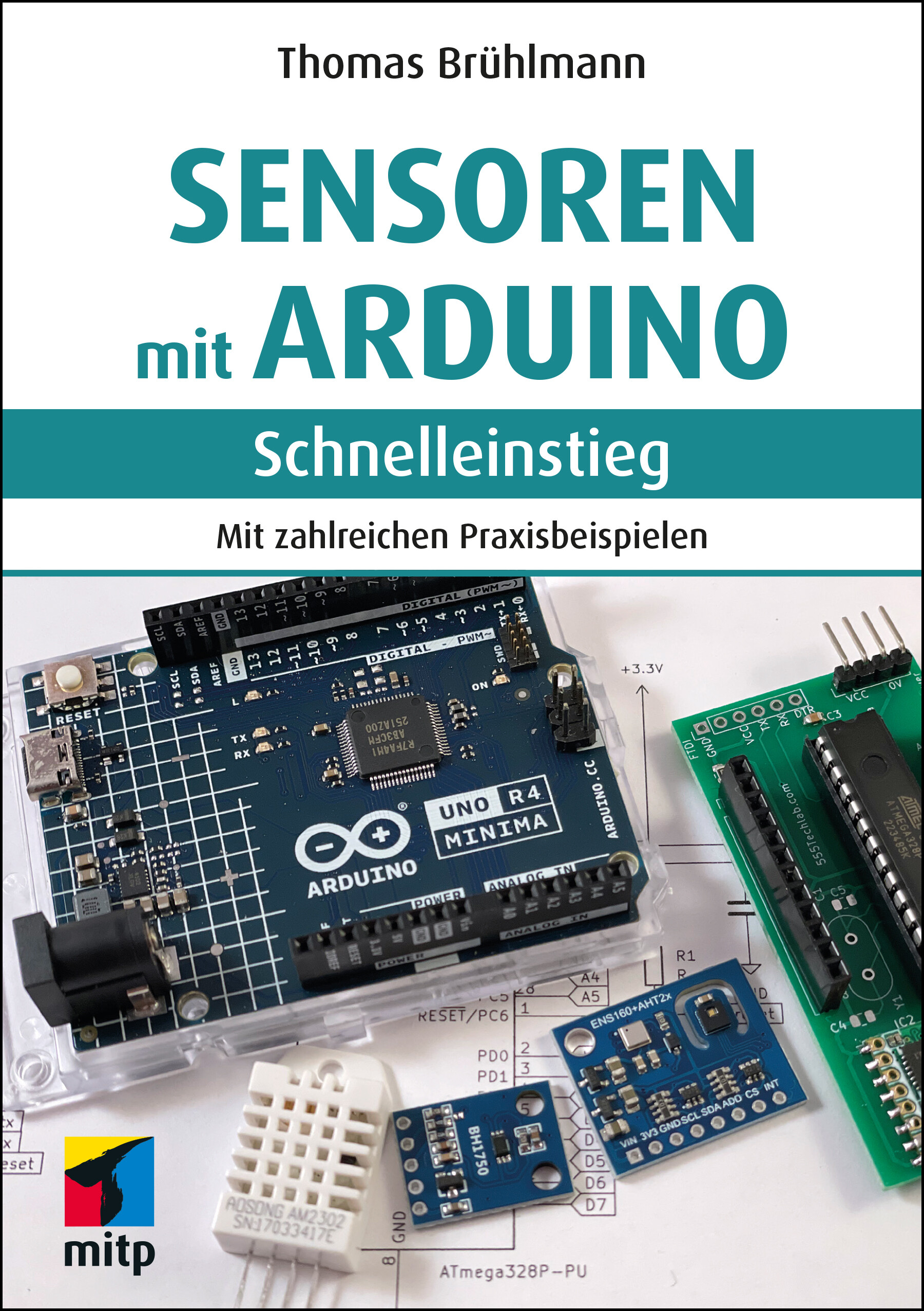
Sensoren mit Arduino - Schnelleinstieg
Sensoren mit Arduino - Schnelleinstieg. In 1. Auflage aus dem Juni 2024.Dieses Buch bietet einen praktischen Einstieg in die faszinierende Welt der Sensoren, die zusammen mit dem Arduino eingesetzt werden können. So kann der Arduino auf seine Umgebung reagieren und zahlreiche Werte erfassen, die vom Arduino-Board weiterverarbeitet und dargestellt werden können.Die vielen Beispielprojekte richten sich an Einsteiger, die bereits etwas Erfahrung mit dem Arduino-Board gesammelt haben und nun neue Anwendungen realisieren wollen. Mit den im Handel erhältlichen Sensoren, ein paar Erweiterungsplatinen und etwas Fantasie können Sie sich ein eigenes Netzwerk an Sensoren zur Erfassung Ihrer Umwelt aufbauen.Thomas Brühlmann zeigt Ihnen zahlreiche Sensoren und Beispielanwendungen zum Messen, Erfassen und Verarbeiten von Daten – immer detailliert mit Stückliste, Steckbrettaufbau und Beispielcode – zu den Themen Warm & Kalt, Licht, Umwelt sowie Distanz & Bewegung wie z.B.:Temperatur, Licht: Temperatur-, Infrarot-, Farb- und UV-Sensoren, lichtabhängiger Widerstand (LDR)Distanz und Bewegung: Ultraschall-, PIR-, Piezo- und Tilt-SensorenKräfte messen mit Flex- und druckempfindlichen Force-SensorenOrt erfassen mit KompassEinsatz von Gas- und Alkohol-SensorenHaus und Garten: Temperatur und Luftfeuchtigkeit mit Umweltsensoren sowie Luftdruck und CO2-Werte messenDatenübertragung: seriell, drahtlos mit LoRa-Modul sowie über WifiDaten anzeigen mit LEDs und OLEDDaten speichern: SD-KarteEinsatz eines Sensor-Shields und Sensor-BoardsMit dem Wissen aus diesem Praxis-Handbuch können Sie Ihre eigenen Ideen kreativ umsetzen.Projekte aus dem Buch:Nachtlampe mit LDRLuxmeterInfrarot-FernbedienungUV-Index-MonitorAbstandsmesser für Garage und Garagentor-WächterSüßigkeitenschrank-WächterTouch-KeyboardsDigitaler Kompass mit LED-AnzeigeAlkohol-MessgerätFensterkontakt überwachenFernsteuerungUmweltdaten sammeln und an IoT-Plattform sendenSensordaten via LoRa-Modul übertragenÜber den Autor:Thomas Brühlmann ist Maker und Buchautor mit 20-jähriger Erfahrung in der Hard- und Software-entwicklung. Er ist bekannt als Autor des Titels Arduino Praxiseinstieg, hält Vorträge und Workshops zum Thema Arduino und realisiert hauptsächlich drahtlose Arduino-Projekte mit Sensoren.Leseprobe (PDF-Link)

The Decision Maker's Handbook to Data Science
Data science is expanding across industries at a rapid pace, and the companies first to adopt best practices will gain a significant advantage. To reap the benefits, decision makers need to have a confident understanding of data science and its application in their organization. This third edition delves into the latest advancements in AI, particularly focusing on large language models (LLMs), with clear distinctions made between AI and traditional data science, including AI's ability to emulate human decision-making.Author Stylianos Kampakis introduces you to the critical aspect of ethics in AI, an area of growing importance and scrutiny. The narrative examines the ethical considerations intrinsic to the development and deployment of AI technologies, including bias, fairness, transparency, and accountability. You’ll be provided with the expertise and tools required to develop a solid data strategy that is continuously effective. Ethics and legal issues surrounding data collection and algorithmic bias are some common pitfalls that Kampakis helps you avoid, while guiding you on the path to build a thriving data science culture at your organization. This updated edition also includes plenty of case studies, tools for project assessment, and expanded content for hiring and managing data scientists.Data science is a language that everyone at a modern company should understand across departments. Friction in communication arises most often when management does not connect with what a data scientist is doing or how impactful data collection and storage can be for their organization. The Decision Maker’s Handbook to Data Science bridges this gap and readies you for both the present and future of your workplace in this engaging, comprehensive guide.WHAT YOU WILL LEARN* Integrate AI with other innovative technologies * Explore anticipated ethical, regulatory, and technical landscapes that will shape the future of AI and data science* Discover how to hire and manage data scientists* Build the right environment in order to make your organization data-drivenWHO THIS BOOK IS FORStartup founders, product managers, higher level managers, and any other non-technical decision makers who are thinking to implement data science in their organization and hire data scientists. A secondary audience includes people looking for a soft introduction into the subject of data science.DR. STYLIANOS (STELIOS) KAMPAKIS is a data scientist who lives and works in London, UK. He holds a PhD in Computer Science from University College London, as well as an MSc in Informatics from the University of Edinburgh. He also holds degrees in Statistics, Cognitive Psychology, Economics and Intelligent Systems. He is a member of the Royal Statistical Society and an honorary research fellow in the UCL Centre for Blockchain Technologies. He has many years of academic and industrial experience in all fields of data science like statistical modelling, machine learning, classic AI, optimization and more.Throughout his career, Stylianos has been involved in a wide range of projects: from using deep learning to analyze data from mobile sensors and radar devices, to recommender systems, to natural language processing for social media data to predicting sports outcomes. He has also done work in the areas of econometrics, Bayesian modelling, forecasting and research design. He also has many years of experience in consulting for startups and scale-ups, having successfully worked with companies of all stages, some of which have raised millions of dollars in funding. He is still providing services in data science and blockchain, as a partner in Electi Consulting.In the academic domain, he is one of the foremost experts in the area of sports analytics, having done his PhD in the use of machine learning for predicting football injuries. He has also published papers in the areas neural networks, computational neuroscience and cognitive science. Finally, he is also involved in blockchain research and more specifically in the areas of tokenomics, supply chains and securitization of assets.Stylianos is also very active in the area of data science education. He is the founder of The Tesseract Academy, a company whose mission is to help decision makers understand deep technical topics such as machine learning and blockchain. He is also teaching “Social Media Analytics”, and “Quantitative Methods and Statistics with R” in the Cyprus International Institute of Management, and runs his own data science school in London called Datalyst.He often writes about data science, machine learning, blockchain and other topics at his personal blog: The Data Scientist (thedatascientist.com).Chapter 1: Demystifying Data Science, AI and All the Other Buzzwords.- Chapter 2: Data Management.- Chapter 3: Data Collection Problems.- Chapter 4: How to Keep Data Tidy.- Chapter 5: Thinking like a Data Scientist (Without Being One).- Chapter 6: A Short Introduction to Statistics.- Chapter 7: A Short Introduction to Machine Learning.- Chapter 8: An introduction to AI.- Chapter 9: Problem Solving.- Chapter 10: Pitfalls.- Chapter 11: Hiring and Managing Data Scientists.- Chapter 12: Building a Data-Driven Culture.- Chapter 13: AI Ethics.- Chapter 14: The Future of AI and Data Science. Epilogue: Data Science Rules the World.- Appendix: Tools for Data Science.

Mastering Cybersecurity
The modern digital landscape presents many threats and opportunities, necessitating a robust understanding of cybersecurity. This book offers readers a broad-spectrum view of cybersecurity, providing insights from fundamental concepts to advanced technologies.Beginning with the foundational understanding of the ever-evolving threat landscape, the book methodically introduces many cyber threats. From familiar challenges like malware and phishing to more sophisticated attacks targeting IoT and blockchain, readers will gain a robust comprehension of the attack vectors threatening our digital world.Understanding threats is just the start. The book also delves deep into the defensive mechanisms and strategies to counter these challenges. Readers will explore the intricate art of cryptography, the nuances of securing both mobile and web applications, and the complexities inherent in ensuring the safety of cloud environments. Through meticulously crafted case studies tailored for each chapter, readers will witness theoretical concepts' practical implications and applications. These studies, although fictional, resonate with real-world scenarios, offering a nuanced understanding of the material and facilitating its practical application.Complementing the knowledge are reinforcement activities designed to test and solidify understanding. Through multiple-choice questions, readers can gauge their grasp of each chapter's content, and actionable recommendations offer insights on how to apply this knowledge in real-world settings. Adding chapters that delve into the intersection of cutting-edge technologies like AI and cybersecurity ensures that readers are prepared for the present and future of digital security. This book promises a holistic, hands-on, and forward-looking education in cybersecurity, ensuring readers are both knowledgeable and action-ready.WHAT YOU WILL LEARN* The vast array of cyber threats, laying the groundwork for understanding the significance of cybersecurity* Various attack vectors, from malware and phishing to DDoS, giving readers a detailed understanding of potential threats* The psychological aspect of cyber threats, revealing how humans can be manipulated into compromising security* How information is encrypted and decrypted to preserve its integrity and confidentiality* The techniques and technologies that safeguard data being transferred across networks* Strategies and methods to protect online applications from threats* How to safeguard data and devices in an increasingly mobile-first world* The complexities of the complexities of cloud environments, offering tools and strategies to ensure data safety* The science behind investigating and analyzing cybercrimes post-incident* How to assess system vulnerabilities and how ethical hacking can identify weaknessesWHO THIS BOOK IS FOR:CISOs, Learners, Educators, Professionals, Executives, Auditors, Boards of Directors, and more.JASON EDWARDS'S career is a blend of extensive cybersecurity experience and academic achievement, with impactful roles in the military and corporate sectors, including leadership positions at major technology, financial, insurance, and energy companies. Jason is also a retired military officer who served in numerous capacities and earned the Bronze Star for service in Iraq. His academic journey culminated in a doctorate in IT and Cybersecurity, focusing on regulatory compliance within cybersecurity. Jason teaches for several college programs, designs college-level training courses, and is a prolific writer. Active on LinkedIn, he leverages his platform to offer free cybersecurity training, mentorship, and advice to over 70,000 followers. Edwards' commitment to education, both as a learner and a teacher, underscores his dedication to enhancing cybersecurity practices and shaping the next generation of professionals.Chapter 1: Threat Landscape.- Chapter 2: Types of Cyber Attacks.- Chapter 3: Social Engineering.- Chapter 4: Cryptography.- Chapter 5: Network Security.- Chapter 6: Web Application Security.- Chapter 7: Mobile Security.-Chapter 8: Cloud Security.- Chapter 9: IoT Security.- Chapter 10: Digital Forensics.- Chapter 11: Vulnerability Assessment and Penetration Testing.- Chapter 12: Security Policies and Procedures.- Chapter 13: Data Privacy and Protection.- Chapter 14: Insider Threats.

Internationaler Motorenkongress 2023
In diesem Tagungsband werden von anerkannten Experten der Automobil- und Nutzfahrzeugbranche eine Fülle neuer technischer Lösungen aufgezeigt. Die Tagung ist eine unverzichtbare Plattform für den Wissens- und Gedankenaustausch von Forschern und Entwicklern aller Unternehmen und Institutionen. Der Inhalt Nachhaltige Mobilität: vollständige LCA.- Gesamtsystem Verbrennungsmotoren und Kraftstoffe:CO2-Reduzierung, Emissionierung, Elektrifizierung.- Klimagerechte Verbrennungsmotoren.- Effizienzsteigerung in Produkten und Prozessen.- Nutzung von Wasserstoff und synthetischen Kraftstoffen. Die Zielgruppen Fahrzeug- und Motoreningenieure sowie Studierende, die aktuelles Fachwissen im Zusammenhang mit Fragestellungen ihres Arbeitsfeldes suchen - Professoren und Dozenten an Universitäten und Hochschulen mit Schwerpunkt Kraftfahrzeug- und Motorentechnik - Gutachter, Forscher und Entwicklungsingenieure in der Automobil- und Zulieferindustrie Die Veranstalter ATZlive steht für Spitzenqualität, hohes Niveau in Sachen Fachinformation und ist Bestandteil von Springer Nature. Hier wird unter einem Dach das Know-how der renommiertesten Wirtschafts-, Wissenschafts- und Technikverlage Deutschlands vereint. VDI Wissensforum vermittelt als ein führender Weiterbildungsspezialist das Wissen aus praktisch allen Technikdisziplinen und den wichtigsten außerfachlichen Gebieten. Dabei wird großer Wert auf Nachhaltigkeit und Praxisrelevanz gelegt.