

Computer und IT

Inside Abacus und die verrückte Geschichte der Schweizer IT-Branche
Die drei HSG-Absolventen Claudio Hintermann, Eliano Ramelli und Thomas Köberl hatten keinen Plan, als sie 1985 die Software-Firma Abacus gründeten – ausser, dass sie nicht angestellt sein wollten. Sie und der später dazugestossene Daniel Senn zuckten mit den Schultern, als man sie im New-Economy-Hype zu Millionären machen wollte und legten sich immer wieder mit Behörden oder grossen Konzernen an. Ihr Fokus lag auf den Mitarbeitenden und auf gutem Essen, gutem Wein, tollen Partys und Kultur. Und darauf, die beste Software zu programmieren.In der zweiten Hälfte der 1980er- Jahre gab es in der Schweiz zahlreiche Firmen, die betriebswirtschaftliche Software entwickelten. Viele gingen unter. Auch multinationale Unternehmen wie Microsoft und SAP kündigten an, den Schweizer KMU-Markt zu erobern – und scheiterten.Christoph Hugenschmidt, IT-Journalist und Autor, erzählt die aussergewöhnliche Geschichte von Abacus und der Schweizer Software-Industrie.PrologGier und Grössenwahn«Eine Packung Fischstäbchen kostete 2.80»Freitags BierHilfe! Die Multis kommen!Sackgassen, Irr- und UmwegeGeier, Gemeinden, Goldgruben … und der Neubau der SoftwareÈ un gruppo di pazziDas Prinzip Blätterteig – Eine Reportage von Lukas Tobler«Jetzt sind sie zu weit gegangen»Die neue AbacusEpilog – Das Abacus-GeheimnisAnhang

Balkonkraftwerke - Verstehen und einfach einsteigen
Mit wenig Aufwand viel Energie sparen. Ganz neu im heise shop aus Oktober 2023.Die Stromrechnung senken und gleichzeitig die Umwelt schützen? Gar nicht so schwierig, wie man vielleicht denken mag! Wie's geht, zeigt Ihnen Jörg Rippel Schritt für Schritt in diesem Ratgeber. Neben Hinweisen zum Stromsparen finden Sie praktische Hilfestellungen und Tipps rund um Balkonkraftwerke. Sie beginnen mit der Erfassung des eigenen Strombedarfs, richten Ihr persönliches Sonnenkraftwerk ein, kümmern sich um ein bisschen Papierkram und erzeugen flugs Ihren eigenen Strom. Aus dem Inhalt:Off the Grid: unterwegs Strom erzeugenDer Papierkram: Anmeldung, Förderung, VersicherungDas Balkonkraftwerk installierenDer richtige Platz: Ausrichtung und AufstellungDas passende Modell findenDo it yourself: was Sie selbst machen könnenDen Verbrauch im Blick behaltenStrom (und Geld) sparenWie viel Strom brauche ich überhaupt?Ist das wirklich alles so einfach? Einstieg in die Photovoltaik

Softwareentwicklung für Kraftfahrzeuge
Im ersten Teil dieses Lehrbuchs werden Funktions- und Softwareentwicklung für Kraftfahrzeuge eingeführt. Dabei wird auf den Prozess der strukturierten Funktions- und Softwareentwicklung von der Erhebung der Anforderungen über die Softwareerstellung bis zum Test sowie Reifegradmodelle eingegangen. Im zweiten Teil werden diese Prozesse aus Wissenschaft und Lehre mit etablierten Vorgehensweisen aus der industriellen Praxis konkretisiert. Die pragmatische Beschreibung der konkreten Vorgehensweisen ist eine Basis für die Ausgestaltung detaillierter Prozesse im Unternehmensalltag sowie deren tägliche Anwendung im Projektgeschäft. Funktions- und Softwareentwicklung.- Softwareentwicklungsprozess in der Automobilindustrie.
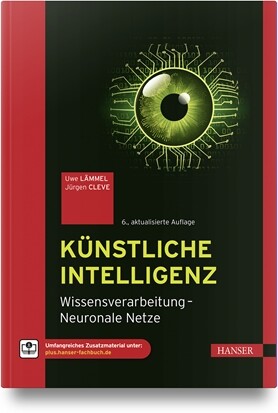
Künstliche Intelligenz (6. Auflg.)
Künstliche Intelligenz. Wissensverarbeitung - Neuronale Netze. 6., aktualisierte Auflage, Oktober 2023.Künstliche Intelligenz (KI) ganz praktischSymbolverarbeitende künstliche Intelligenz und künstliche neuronale Netze in einem BuchBusiness Rules und WissensnetzeConvolutional Neural Networks und Deep LearningÜbungen in PROLOG sowie mit JavaNNS und PythonDie künstliche Intelligenz hat unseren Alltag erreicht: Wir nutzen Chatbots, reden mit Sprachassistenten, KI digitalisiert die Dokumentenverarbeitung, die Muster-, Bild- oder Objekt-Erkennung. Sie ermöglicht neue, intelligentere Lösungen in vielen Bereichen, von der Medizin bis zum autonomen Fahren.Das Buch gibt eine Einführung in die KI. Es wird gezeigt, wie symbolverabeitende KI in Form von Wissensnetzen oder Geschäftsregeln heute angewendet und wie künstliche neuronale Netze in der Mustererkennung oder auch im Data Mining eingesetzt werden können. Wissensrepräsentation und -verarbeitung auf Basis der Logik wird unter Nutzung der logischen Programmiersprache PROLOG eingeführt. Logische Schlussfolgerungen lassen sich in PROLOG wesentlich leichter als in Python oder Java implementieren. Die Konzepte neuronaler Netze werden mit dem System JavaNNS und mittels Python praktisch vertieft. Fragen und Aufgaben am Ende eines Abschnittes fordern zum aktiven Lesen und Lernen auf. Die Webseiten zum Buch enthalten Demo-Programme, die diskutierte Vorgehensweisen veranschaulichen und das Verständnis fördern.Aus dem Inhalt:Überblick zur künstlichen IntelligenzDarstellung und Verarbeitung von WissenProblemlösung mittels SucheWissensverarbeitung mit PROLOGKünstliche neuronale NetzeVorwärtsgerichtete neuronale NetzeWettbewerbslernenAutoassoziative NetzeEntwicklung neuronaler NetzeNeu in der 6. Auflage sind Abschnitte zu den Themen ChatGPT sowie Decision Model and Notation (DMN) bei Prozessbeschreibungen.Leseprobe (PDF-Link)

Beginning C++23
Begin your programming journey with C++ , starting with the basics and progressing through step-by-step examples that will help you become a proficient C++ programmer. This book includes new features from the C++23 standard. All you need are Beginning C++23 and any recent C++ compiler and you'll soon be writing real C++ programs.There is no assumption of prior programming knowledge. All language concepts that are explained in the book are illustrated with working program examples, and all chapters include exercises for you to test and practice your knowledge. Free source code downloads are provided for all examples from the text and solutions to the exercises.This latest edition has been fully updated to the latest version of the language, C++23, and to all conventions and best practices of modern C++. This book also introduces elements of the C++ Standard Library that provide essential support for C++23. After completing this book, you will have the knowledge and skills needed to build your first C++ applications.WHAT YOU WILL LEARN* Begin programming with the C++23 standard* Carry out modular programming in C++* Work with arrays and loops, pointers and references, strings, and more* Write your own functions, types, and operators* Discover the essentials of object-oriented programming* Use overloading, inheritance, virtual functions, and polymorphism* Write generic function and class templates, and make them safer using concepts * Learn the ins and outs of containers, algorithms, and ranges* Use auto type declarations, exceptions, move semantics, lambda expressions, and much moreWHO THIS BOOK IS FORProgrammers new to C++ and those who may be looking for a refresh primer on C++ in general. IVOR HORTON is self-employed in consultancy and writes programming tutorials. He is the author of many programming books. Ivor worked for IBM for many years and holds a bachelor's degree, with honors, in mathematics. Horton's experience at IBM includes programming in most languages (including assembler and high-level languages on a variety of machines), real-time programming, and designing and implementing real-time closed loop industrial control systems. He has extensive experience teaching programming to engineers and scientists (Fortran, PL/1, APL, etc.). Horton is an expert in mechanical, process, and electronic CAD systems; mechanical CAM systems; and DNC/CNC systems.PETER VAN WEERT works for Danaher in its R&D unit for digital dentistry software, developing software for the dental practice of tomorrow. In his spare time, he has co-authored two books on C++ and two award-winning Windows 8 apps and is a regular expert speaker at, and board member of, the Belgian C++ Users Group. He is a software engineer whose main interests and expertise are application software development, programming languages, algorithms, and data structures.He received his master of science degree in computer science summa cum laude with congratulations of the Board of Examiners from the University of Leuven. In 2010, he completed his PhD thesis there on the design and efficient compilation of rule-based programming languages at the research group for declarative programming languages and artificial intelligence. During his doctoral studies, he was a teaching assistant for object-oriented programming (Java), software analysis and design, and declarative programming. After graduating, Peter worked at Nikon Metrology for more than six years on large-scale, industrial application software in the area of 3D laser scanning and point cloud inspection. He learned to master C++ and refactoring and debugging of very large code bases, and he gained further proficiency in all aspects of the software development process, including the analysis of functional and technical requirements, and agile and scrum-based project and team management.1. Basic Ideas2. Introducing Fundamental Types of Data3. Working Fundamental Types4. Making Decisions5. Arrays and Loops6. Pointers and References7. Working with Strings8. Defining Functions9. Vocabulary Types10. Function Templates11. Modules and Namespaces12. Defining your own Data Types13. Operator Overloading14. Inheritance15. Polymorphism16. Runtime Errors and Exceptions17. Class Templates18. Move Semantics19. First-Class Functions20. Containers and Algorithms21. Constrained Templates and ConceptsAppendix A (online only; to be offered as part of source code download)

Hands-On Web Scraping with Python
Web scraping is a powerful tool for extracting data from the web, but it can be daunting for those without a technical background. Designed for novices, this book will help you grasp the fundamentals of web scraping and Python programming, even if you have no prior experience.Adopting a practical, hands-on approach, this updated edition of Hands-On Web Scraping with Python uses real-world examples and exercises to explain key concepts. Starting with an introduction to web scraping fundamentals and Python programming, you’ll cover a range of scraping techniques, including requests, lxml, pyquery, Scrapy, and Beautiful Soup. You’ll also get to grips with advanced topics such as secure web handling, web APIs, Selenium for web scraping, PDF extraction, regex, data analysis, EDA reports, visualization, and machine learning.This book emphasizes the importance of learning by doing. Each chapter integrates examples that demonstrate practical techniques and related skills. By the end of this book, you’ll be equipped with the skills to extract data from websites, a solid understanding of web scraping and Python programming, and the confidence to use these skills in your projects for analysis, visualization, and information discovery.

TypeScript Basics
Jumpstart your working knowledge of Typescript with a quick, practical guide and start using this open source, object orientated language with confidence. This book highlights how Typescript works with JavaScript and its frameworks, giving it greater functionality, especially for larger enterprise projects. You'll start by reviewing some fundamentals such as how to run a TypeScript file and compile it to JavaScript as well as understand how it sits within the full ecosystem alongside React, Redux, Angular and Webpack. Using a practical project-led approach, you'll go through key concepts and aspects of Typescript such as compilers, arrays, classes and interfaces. Once you complete the fundamental basics, you'll move onto more complex topics like advanced types. You'll also learn about Decorators, which are a must-have feature in Angular. The book then presents a small To-do list project followed by a larger 'Drag and Drop' project. You'll see how to divide the drag and drop project into small manageable modules and learn to make the project more efficient with Webpack. Lastly, you'll create two more React projects, a party app with React and then one with React and Redux. Typescript Basics reveals how this JavaScript extension is currently the fastest growing language for web development with more and more developers and companies looking to utilize and adopt it within their current workflows and projects. You will: * Understand the particulars of Typescript and how it feeds into the JS and Web development eco-system * Implement Typescript for enterprise projects * Use Typescript with practical projects and examples * See how Typescript interacts with major frameworks like React and Angular Jumpstart your working knowledge of Typescript with a quick, practical guide and start using this open source, object orientated language with confidence. This book highlights how Typescript works with JavaScript and its frameworks, giving it greater functionality, especially for larger enterprise projects. You'll start by reviewing some fundamentals such as how to run a TypeScript file and compile it to JavaScript as well as understand how it sits within the full ecosystem alongside React, Redux, Angular and Webpack. Using a practical project-led approach, you'll go through key concepts and aspects of Typescript such as compilers, arrays, classes and interfaces. Once you complete the fundamental basics, you'll move onto more complex topics like advanced types. You'll also learn about Decorators, which are a must-have feature in Angular. The book then presents a small To-do list project followed by a larger 'Drag and Drop' project. You'll see howto divide the drag and drop project into small manageable modules and learn to make the project more efficient with Webpack. Lastly, you'll create two more React projects, a party app with React and then one with React and Redux. Typescript Basics reveals how this JavaScript extension is currently the fastest growing language for web development with more and more developers and companies looking to utilize and adopt it within their current workflows and projects. What You'll Learn * Understand the particulars of Typescript and how it feeds into the JS and Web development eco-system * Implement Typescript for enterprise projects * Use Typescript with practical projects and examples * See how Typescript interacts with major frameworks like React and Angular Who This Book Is For Those who want to learn about TypeScript and implement it in their Enterprise or hobby projects with React and Angular. Beginners will find it easy to learn the basic concepts and principles to get started and to progress onto more advanced projects and how to implement them. Nabendu Biswas is a Full Stack JavaScript developer, who has been working in the IT industry for the past 16 years for some of world's top development firms and investment banks. He is a passionate tech blogger, YouTuber, and currently runs an EdTech company, specializing in teaching students about web-app development and the JavaScript ecosystem. He is also the author of five Apress books focusing on topics such as Gatsby, MERN, and React Firebase, all of which can be found on Amazon. 1.Getting Started.- 2. TypeScript Basics.- 3. TypeScript Compilers.- 4. Classes and Interfaces 5. Advanced Types 6. Generics & Decorators.- 7. To-do List With TypeScript.- 8.Drag Drop Project.- 9.Modules and Webpack.- 10. React TypeScript Project.- 11. React Redux with TypeScript..

Practical Implementation of a Data Lake
This book explains how to implement a data lake strategy, covering the technical and business challenges architects commonly face. It also illustrates how and why client requirements should drive architectural decisions. Drawing upon a specific case from his own experience, author Nayanjyoti Paul begins with the consideration from which all subsequent decisions should flow: what does your customer need? He also describes the importance of identifying key stakeholders and the key points to focus on when starting a new project. Next, he takes you through the business and technical requirement-gathering process, and how to translate customer expectations into tangible technical goals. From there, you’ll gain insight into the security model that will allow you to establish security and legal guardrails, as well as different aspects of security from the end user’s perspective. You’ll learn which organizational roles need to be onboarded into the data lake, their responsibilities, the services they need access to, and how the hierarchy of escalations should work. Subsequent chapters explore how to divide your data lakes into zones, organize data for security and access, manage data sensitivity, and techniques used for data obfuscation. Audit and logging capabilities in the data lake are also covered before a deep dive into designing data lakes to handle multiple kinds and file formats and access patterns. The book concludes by focusing on production operationalization and solutions to implement a production setup. After completing this book, you will understand how to implement a data lake, the best practices to employ while doing so, and will be armed with practical tips to solve business problems. You will: * Understand the challenges associated with implementing a data lake * Explore the architectural patterns and processes used to design a new data lake * Design and implement data lake capabilities * Associate business requirements with technical deliverables to drive success This book explains how to implement a data lake strategy, covering the technical and business challenges architects commonly face. It also illustrates how and why client requirements should drive architectural decisions. Drawing upon a specific case from his own experience, author Nayanjyoti Paul begins with the consideration from which all subsequent decisions should flow: what does your customer need? He also describes the importance of identifying key stakeholders and the key points to focus on when starting a new project. Next, he takes you through the business and technical requirement-gathering process, and how to translate customer expectations into tangible technical goals. From there, you’ll gain insight into the security model that will allow you to establish security and legal guardrails, as well as different aspects of security from the end user’s perspective. You’ll learn which organizational roles need to be onboarded into the data lake, their responsibilities, the services they need access to, and how the hierarchy of escalations should work. Subsequent chapters explore how to divide your data lakes into zones, organize data for security and access, manage data sensitivity, and techniques used for data obfuscation. Audit and logging capabilities in the data lake are also covered before a deep dive into designing data lakes to handle multiple kinds and file formats and access patterns. The book concludes by focusing on production operationalization and solutions to implement a production setup. After completing this book, you will understand how to implement a data lake, the best practices to employ while doing so, and will be armed with practical tips to solve business problems. What You Will Learn * Understand the challenges associated with implementing a data lake * Explore the architectural patterns and processes used to design a new data lake * Design and implement data lake capabilities * Associate business requirements with technical deliverables to drive success Who This Book Is For Data Scientists and Architects, Machine Learning Engineers, and Software Engineers. Nayanjyoti Paul is an Associate Director and Chief Azure Architect for GenAI and LLM CoE for Accenture. He is the product owner and creator of a patented asset. Presently, he leads multiple projects as a lead architect around generative AI , large language models, data analytics, and machine learning. Nayan is a certified Master Technology Architect, certified Data Scientist, and certified Databricks Champion with additional AWS and Azure certifications. He is a speaker at conferences like Strata Conference, Data Works Summit, and AWS Reinvent. He also delivers guest lectures at Universities. Chapter 1: Understanding the Customer Needs.- Chapter 2: Security Model.- Chapter 3: Organizational Model.- Chapter 4: Data Lake Structure.- Chapter 5: Production Playground.- Chapter 6: Production Operationalization.- Chapter 7: Miscellaneous.

Attribute-based Encryption (ABE)
ATTRIBUTE-BASED ENCRYPTION (ABE)ENABLES READERS TO UNDERSTAND APPLICATIONS OF ATTRIBUTE-BASED ENCRYPTION SCHEMES IN CLOUD COMPUTING WITH THE SUPPORT OF BLOCKCHAIN TECHNOLOGYWith a focus on blockchain technology, Attribute-based Encryption (ABE) provides insight into the application of attribute-based encryption (ABE) schemes, discussing types of blockchains, fundamentals of blockchain, and how blockchains are constructed. Comprised of 16 chapters, the text provides an overview of the components that go into creating a dual ABE system of encryption proofs within the following: composite bilinear groups, dual pairing vector space framework, matrix pairing framework, framework for matrix pairing, and the application of cryptographic scheme on blockchain. The team of authors discuss the basic construction components of ABE and share the security models, including the selective and semi- adaptive security models, applying these to either prime order or composite order groups. The book also discusses the tools used for converting a composite order ABE scheme to prime order and an adaptive secure ABE scheme based on prime order. In Attribute-based Encryption (ABE), readers can expect to find information on:* Mathematical background of ABE, covering group and cyclic group, elliptic curves, curve selection, supersingular curves, ordinary curves, and weil and tate pairing* Basic construction components of ABE, covering access structure, monotone Boolean formula, linear secret-sharing scheme, and ordered binary decision diagram* Tools for converting composite order ABE schemes to prime order, covering security assumptions and conversion based on vectors for preliminaries, scheme construction, and security proof technique* Foundations of blockchain technology, covering blocks, miners, hash functions, and public key cryptographyAttribute-based Encryption (ABE) is an essential resource for professionals working in the field of design and cybersecurity who wish to understand how to use blockchain and the ABE scheme to provide fine-grained access control in outsourced data on third-party cloud servers. QI XIA received her PhD in Computer Science from the University of Electronic Science and Technology of China in 2010. JIANBIN GAO received his PhD in Computer Science from the University of Electronic Science and Technology of China in 2012. ISAAC AMANKONA OBIRI received his Master’s and PhD in Computer Science and Technology from the University of Electronic Science and Technology of China. KWAME OMONO ASAMOAH received his Master’s and PhD in Computer Science and Technology from the University of Electronic Science and Technology of China. DANIEL ADU WORAE is currently pursuing his Master’s degree in Computer Science and Technology at the University of Electronic Science and Technology of China. About the Authors xiiiPreface xvAcknowledgments xviiPart I Attribute-Based Encryption (ABE) 11 Foundation of Attribute-Based Encryption 31.1 Introduction 31.1.1 Symmetric Encryption 41.1.2 Asymmetric Key Encryption 41.1.3 Identity-Based Encryption 51.2 Functional Encryption 71.2.1 Applications of Attribute-Based Encryption 81.2.2 Problems with Attribute-Based Encryption 91.2.3 A Brief History of Security Proof of Functional Encryption 91.2.4 Dual System of Encryption 101.2.5 Summary 11References 122 Mathematical Background 152.1 Group Theory 152.1.1 Law of Composition 152.1.2 Groups 152.1.3 Subgroups 162.1.4 Homomorphisms 172.1.5 Cyclic Group 172.2 Ring Theory 202.2.1 Ideals and Quotient Rings 212.2.2 Euler’s Totient Function 222.2.3 Polynomial Rings 222.2.4 Irreducible and Monic Polynomials 222.2.5 Field Theory 232.2.5.1 Quotient Field 242.2.6 Field Characteristic 24Trim Size: 7in x 10in Single Column Xia989356 ftoc.tex V1 - 06/28/2023 7:58pm Page vi[1][1] [1][1]vi Contents2.2.7 Algebraic Extension Felds 242.3 Elliptic Curves 242.3.1 Plane Curve 242.3.2 Group Operations on Elliptic Curves 262.3.2.1 Point Addition 262.3.2.2 Point Doubling 272.4 Divisors and Bilinear Map 282.4.1 Divisors 282.4.2 The Degree and Support ofD 292.4.3 The Divisor of a Function f onE 292.4.4 Equivalence of Divisors 302.4.5 Bilinear Map 312.4.6 Weil Pairing 312.4.7 Miller’s Algorithm 322.4.8 The Tate Pairing 342.5 Summary 36References 363 Attribute-Based Encryption 373.1 Introduction 373.2 Basic Components of ABE Construction 393.2.1 Secret-Sharing Schemes 393.2.2 Polynomial Interpolation 413.2.2.1 Polynomials Over the Reals 413.2.2.2 Polynomials ModulusP 443.2.3 Shamir Secret Sharing 453.2.4 Verifiable Secret Sharing (VSS) 473.2.4.1 Algorithm for Converting Access Structure Into LSSS Matrix 473.2.4.2 Access Structure Example 483.2.4.3 Algorithms in Attribute-Based Encryption 493.2.5 Properties of Attribute-Based Encryption 513.2.6 Prime Order Group 513.3 Cryptographic Hard Assumptions 513.3.1 Composite Order Bilinear Groups 543.3.2 Complexity Assumptions 553.4 Provable Security 563.5 Security Notions 573.5.1 Summary 57References 584 Data Access Control 614.1 Introduction 614.1.1 Coarse-Grained 624.1.2 Fine-Grained Access Control 634.1.3 Importance of Fine-Grained Access Control 644.2 Concerns About Cloud-Based Access Control that Are Trustworthy 654.2.1 Encryption Access Control 65Trim Size: 7in x 10in Single Column Xia989356 ftoc.tex V1 - 06/28/2023 7:58pm Page vii[1][1] [1][1]Contents vii4.2.2 Requirements for Encryption-Based Access Control 674.3 Summary 67References 675 Selective Secure ABE Schemes Based on Prime Order Group 695.1 Introduction 695.1.1 Selective Security Model for KP-ABE 705.1.2 Selective Security Model for CP-ABE 705.1.3 ABE Schemes 715.2 The KP-ABE Scheme 715.2.1 Concrete Scheme Construction 715.2.2 Security Proof 735.3 The CP-ABE Scheme 745.3.1 Concrete Scheme Construction 745.3.2 Security Proof 765.4 Summary 77References 776 Fully Secure ABE Schemes Based on Composite and Prime Order Groups 796.1 Introduction 796.2 A Fully Secure CP-ABE from Composite Order Group 816.2.1 CP-ABE Construction 826.2.2 Adaptive Security Proof 836.2.2.1 Description of Hybrids 836.2.3 Security Proof 846.3 A Fully Secure KP-ABE Scheme Based on Dual Vector Space 846.3.1 KP-ABE Construction 856.3.2 Adaptive Security 876.3.3 Security Proof 886.4 KP-ABE Scheme Based on Matrix 896.4.1 The Scheme 896.4.2 Adaptive Security 906.4.3 Security Proof 916.5 Summary 91References 92Part II Concepts of Blockchain Technology 957 Blockchain Technology 977.1 Introduction 977.1.1 History 977.1.2 Preliminary Concepts of Blockchain Technology 987.1.3 Characteristics of Blockchain 1007.1.4 Evolution and Types of Blockchain 1047.1.4.1 The Blockchain 1.0 1047.1.4.2 Blockchain 2.0 104Trim Size: 7in x 10in Single Column Xia989356 ftoc.tex V1 - 06/28/2023 7:58pm Page viii[1][1] [1][1]viii Contents7.1.4.3 Blockchain 3.0 1057.1.5 Permissionless vs Permissioned Blockchains 1057.1.6 Types of Blockchain 1057.2 Architecture of Blockchain 1067.2.1 Architecture of Blockchain 1.0 (Cryptocurrencies) 1067.2.2 Block 1067.2.3 Node 1077.2.4 Types of Blockchain Nodes 1077.2.5 Consensus 1107.3 Architecture of Blockchain 2.0 (Smart Contracts) 1107.3.1 Introduction to Smart Contracts 1107.3.2 How Smart ContractsWork 1117.3.3 Example of Smart Contract 1117.3.4 Uses of Smart Contracts 1117.3.5 Advantages of Smart Contracts 1127.3.6 Limitations of Smart Contracts 1127.4 Architecture of Blockchain 3.0 (Blockchain Applications) 1137.4.1 Consensus Mechanism 1137.5 Blockchain 4.0 1187.5.1 Blockchain 4.0 Applications 1197.5.2 Metaverse 1197.5.3 Industrial Revolution 4.0 1207.5.4 Blockchain 4.0 for Businesses 120References 1208 Scaling-Out Blockchains with Sharding 1258.1 Introduction 1258.1.1 Scalability Trilemma 1268.1.2 Nakamoto-Based – Monoxide – Chu-ko-nu Mining 1288.1.3 Elastico 1288.1.4 OmniLedger 1298.1.5 Rapid Chain 1308.1.6 Learnings 1318.1.7 General Improvements 1328.1.7.1 Reducing Transaction Latency 1338.1.7.2 Inter-Communication Protocol 1338.1.7.3 Shards Ledger Pruning 1348.1.7.4 Decentralized Bootstrapping 1348.1.7.5 Securing the Epoch Reconfiguration 1348.1.7.6 Sharded Smart Contract 1358.1.7.7 Replay Attacks and Defenses Against Cross-Shard Protocols 1358.2 Off-Chain Solution: Layer 2 Solutions 1368.2.1 State Channels 1368.2.2 Side Chains of the Plasma 1388.2.3 Problems with Data Accessibility 1398.3 Rollups 139Trim Size: 7in x 10in Single Column Xia989356 ftoc.tex V1 - 06/28/2023 7:58pm Page ix[1][1] [1][1]Contents ix8.3.1 Rollups Based on Zero Knowledge 1408.3.2 Proofs of Zero-Knowledge 1408.3.3 Protocol Schnorr 1428.3.4 Protocol Pedersen 1438.3.5 zk-SNARKs 1448.4 Summary 144References 145Part III Applying Blockchain with Real-Time Technologies 1479 Blockchain Technology for Supply Management 1499.1 Introduction 1499.1.1 System Design 1539.1.2 System Architecture 1539.1.3 Entities of the System 1549.1.3.1 Users 1549.1.4 Smart Contract Control 1579.1.5 Blockchain Network 1579.1.5.1 Processing Nodes 1579.1.5.2 System Application Layer 1589.1.5.3 Storage Infrastructure 1589.1.6 System Decryption 1589.1.7 Blocks 1599.1.7.1 Block Design 1609.2 System Flow 1639.2.1 System Advantages 1639.2.2 Conclusion 164References 16510 Satellite Communication 16710.1 Introduction 16710.1.1 Low-Orbit Constellation Communication Networks 16910.1.2 Interstellar Link Length 17110.1.3 Model of Satellite Motion 17110.1.4 Edge Computing Technologies 17210.2 Analysis of Edge Computing Requirements of Low-Orbit ConstellationCommunication Networks 17510.2.1 Design of Edge Computing Architecture for Low-Orbit Constellation CommunicationNetworks 17510.2.2 Satellite 17610.2.3 System Entities 18010.2.4 System Process Flow 18010.2.5 Security Properties 18310.3 Summary 183References 183Trim Size: 7in x 10in Single Column Xia989356 ftoc.tex V1 - 06/28/2023 7:58pm Page x[1][1] [1][1]x Contents11 Foundation of Information-Centric Communication 18511.1 Introduction 18511.2 Information-Centric Communication 18511.3 Name-Based Routing of Content 18711.4 Benefits of Using ICN 18711.5 Cost-Efficient and Scalable Distribution of Content Design Principles 18911.6 ICN Design Challenges 19011.6.1 Content Naming 19011.6.2 Caching of Content 19111.6.3 Data Integrity 19211.6.4 Resolution System’s Scalability and Name-Based Routing 192References 19312 Security Overall in Information-Centric Networks 19512.1 Introduction 19512.2 Content-Centric Network (CCN) Architecture 19512.3 Naming System Design 19712.4 Secure Naming Scheme for Information-Centric Networks 19812.5 Data Transmission – Content Delivery 19812.6 Traffic Load in Network Caching 19912.6.1 Store Unique Naming of Content in Caches 20012.6.2 Storage Limitation in Caching Space Devices 20112.7 Content’s Freshness Detection 20112.8 ICN Security 20112.9 Attacks in ICN Architectures 20212.10 ICN Attributes to Ensure Security Threats 20412.11 Traffic Analysis and Prediction 20412.12 Some Key Problem Statements 20512.13 Blockchain-Based ICN Scheme Improvement 20612.13.1 Protection Against DDos 20612.14 A Secured Information-Centric Network Based on Blockchain 20612.14.1 Blockchain-Based ICN Structure 20712.14.1.1 Data Integrity 20712.15 Attribute-Based Encryption Scheme for the Information-Centric Network 20812.15.1 Applying Ciphertext-Policy ABE (CP-ABE) Scheme in ICN 20912.15.2 System Design of CP-ABE Scheme in ICN 210References 21213 Subscriber Data Management System Based on Blockchain 21513.1 Introduction 21513.1.1 Motivation 21613.1.2 Problem Statement 21613.1.3 Contributions 21613.2 Literature Review 21713.3 System Design Description 21713.3.1 Assumptions 217Trim Size: 7in x 10in Single Column Xia989356 ftoc.tex V1 - 06/28/2023 7:58pm Page xi[1][1] [1][1]Contents xi13.3.2 Ciphertext-Policy Attribute-Based Encryption (CP-ABE) 21813.3.3 CP-ABE Construction 21813.3.4 System Components 21913.3.4.1 Data Subscribers (DSs) 21913.3.4.2 Data Providers (DPs) 22013.3.4.3 Key Generation and Distribution Center (KGDC) 22013.3.4.4 IPFS Distributed Storage 22013.3.4.5 Blockchain Platform 22013.3.5 Process Description 22213.3.5.1 Subscriber Registration 22413.3.5.2 Subscriber Data Storage 22413.3.5.3 Subscriber Data Request 22413.3.6 Benefits of Proposed Design 22513.3.7 Security Requirements 22613.4 Summary 227References 22714 A Secure Data-Sharing Blockchain-Based Crowdfunding System 22914.1 Introduction 22914.2 Literature Review 23114.2.1 Present-Day Centralized Crowdfunding 23114.2.2 Crowdfunding Models 23314.2.3 Problems of Traditional Crowdfunding 23414.2.4 Blockchain-Based Crowdfunding 23414.2.5 Advantages of Blockchain-Based Crowdfunding 23514.3 Proposed System 23614.3.1 System Model 23614.3.1.1 Key Components 23714.3.2 System Framework Overview 23814.3.2.1 Application Layer 23914.3.2.2 Blockchain Layer 23914.3.2.3 Data Storage Layer 23914.3.3 System Assumptions and Threat Model 24014.3.4 Process Description 24014.3.5 Smart Contract Interactions 24114.3.5.1 User Registration Contract (URC) 24114.3.5.2 User Verification Contract (UVC) 24114.3.5.3 Project Data Access Contract (PDAC) 24114.3.6 Concrete Implementation 24114.3.6.1 User Register 24214.3.6.2 Data Encrypt 24214.3.6.3 Data Search 24214.3.6.4 Fine-Grained Access Authorization 24214.3.6.5 Data Decrypt 24314.3.6.6 Transaction Confirmation 24314.3.7 Security Requirements 24314.3.7.1 Fine-Grained Access Control 24314.3.7.2 Key Counterfeiting 24314.3.7.3 Data Integrity 24414.4 Summary 244References 244Index 247

Processing for Android
Learn how to use the Processing programming language and environment to create Android applications with ease. This book covers the basics of the Processing language, allowing users to effectively program interactive graphics in 2D, 3D, and Extended Reality (XR). It also details the application of these techniques to different types of Android devices (smartphones, tablets, wearables, and smartwatches).This updated edition walks you through the entire process of creating an app, from the initial idea to release of the final app via the Google Play App Store. Over the course of the book, you’ll learn to write engaging apps driven by user interaction and sensor data. A comprehensive series of hands-on projects, ranging from simple sketches to more complex projects involving shaders, VR, and AR will give you the firsthand experience you need to begin developing your own projects.And once you have your Processing projects completed, you’ll be able to upload them to the Google Play store to be shared with the world!WHAT YOU WILL LEARN* Write apps and live wallpapers for smartphones and tablets* Design and implement interactive watch faces* Create Extended Reality (VR/AR) experiences* Incorporate GLSL shaders into your Processing apps* Integrate Processing sketches into larger apps and Android Studio* Learn how to write your own libraries to share with the community* Export projects as completed apps ready to distribute through Google Play StoreWHO THIS BOOK IS FORArtists, designers, students, researchers, and hobbyists who are not necessarily Android experts, but are looking to write mobile apps that make creative use of interactive graphics, sensor data, and extended reality. ANDRÉS COLUBRI is a core member of the Processing project, and the main developer of the OpenGL renderer, the video library, and Processing for Android. He originally studied Physics and Mathematics in Argentina and later did an MFA at the UCLA Design Media Arts program. He uses Processing as the main tool to bridge his interests in computer graphics, data visualization, and biomedical research. He is currently an assistant professor at the University of Massachusetts. INTRODUCTIONPART I: FIRST STEPS WITH PROCESSING FOR ANDROIDThis section will guide you through the initial setup of Processing for Android, a quick introduction to the basics of the Processing language, and all the steps required uploading a simple app created with Processing to the Google Play Store.Chapter 1: Installing the Android Mode1) The Processing Development Environment2) Installing the Android Mode with the Contributions Manager3) Interface of the Android Mode4) Devices and emulatorsChapter 2: The Processing Language1) A digital sketchbook for artists and designers2) The setup/draw structure of a Processing sketch3) Drawing with code4) Responding to user input from the touchscreen5) Creating an interactive sketch for mobile devicesChapter 3: From Sketch to App Store1) Sketching and debugging2) Adjusting for device resolution3) Creating icons4) Exporting the sketch as a signed packagePART II: DRAWING & INTERACTIONThe chapters in this section delve into the different functions available to draw shapes, images, and text; and how to handle user input through the touchscreen. It includes a complete project to create an Android live wallpaper with graphics responding to user input.Chapter 4: Drawing Shapes, Images, and Text1) Creating and loading shapes2) Transformation and movement1) Loading and rendering images2) Loading fonts and rendering text3) Off-screen renderingChapter 5: Touchscreen Interaction1) Touch events in Android2) Capturing single- and multi-touch from Processing3) Designing interaction around touch-based inputChapter 6: Live Wallpapers1) Ideas for live wallpapers2) Interaction and visual design3) Using libraries in Processing for Android4) Accessing the Android SDK from Processing5) Uploading the completed wallpaper to the Play StorePART III: SENSORSAndroid devices are equipped with multiple sensors that allow measuring movement, geographical location, and environmental conditions in real time. Accessing this information from Processing opens up endless possibilities for creative applications.Chapter 7: Reading Sensor Data1) Types of sensors2) Creating a sensor manager3) Setting permissions to access sensor dataChapter 8: Driving Graphics and Sound with Sensor Data1) Counting steps with the accelerometer2) Controlling animation with the gyroscope3) Implementing a compass with the magnetic sensorChapter 9: Geolocation1) Accessing location services from Processing2) Displaying the current location on a map3) Sending location data between devices4) Storing and representing pathsPART IV: WEARABLES AND WATCH FACESWearables are a whole new category of Android devices that became very popular in the past few years, particularly in the form of fitness bands and smartwatches. Processing for Android lets you run your sketches on these devices and take advantage of their multiple affordances.Chapter 10: Wearable Devices1) Android wear and wearable devices2) Smartwatches and their unique capabilities3) Adapting Processing sketches to run on smartwatches4) Special considerations when creating watch facesChapter 11: Visualizing Time1) Time API in Processing2) Representing time visually3) Sketching watch faces for time display4) Refining a visual concept and preparing for distributionChapter 12: Visualizing Physical Activity1) Pedometer and heart rate sensors2) Visualizing activity in real-time3) Storing activity data for later usePART V: 3D AND SHADERSInteractive 3D scenes are an important part of creating visualizations and immersive experiences on mobile devices, especially with the recent rise in popularity of Virtual Reality. The programming of 3D scenes adds further complexity to the code sketching, but Processing provides a simplified 3D API to help with this task, while also giving access to advanced programming techniques such as GLSL shaders.Chapter 13: 3D in Processing1) Coordinates in 3D space2) Positioning and moving the camera3) Creating 3D primitives4) Applying geometric transformations5) Creating arbitrary shapes in 3D6) Loading OBJ shapesChapter 14: Lighting and Texturing1) Texture images and coordinates2) Using an off-screen buffer as a texture3) Lighting in a 3D scene4) Combining lights with texturesChapter 15: GLSL Shaders1) How Processing renders a scene behind the scenes2) The shader stages in the graphics pipeline3) Geometry shaders and vertex manipulation4) Fragment shaders and texturingPART VI: EXTENDED REALITY: VR AND ARChapter 16: Basics of VR1) Google VR SDK2) VR in Processing3) VR interaction and selection4) Movement in VRChapter 17: Basics of AR1) The ARCore SDK in Android2) Drawing trackables3) Using anchors4) Hitting trackablesChapter 19: Interactive Experiences in XR1) Creating successful XR experience2) Implementing UIs in VR and AR3) Handling movement and interaction4) Packaging an XR applicationPART VII APPENDIXESAppendix A: Integration with Android StudioThis appendix shows how to use the Android core library in Processing in larger apps developed with Android Studio.Appendix B: Processing libraries for AndroidProcessing can be extended with libraries written by members of the community and adding new functionality. This chapter goes over some of the libraries available for Processing for Android.Appendix C: How to create your own libraryThis appendix goes through the steps required to create a new Processing library for the Android mode, using Android SDK
Using and Administering Linux: Volume 2
Learn to be a Linux sysadmin and an expert user of the Linux operating system, even with no previous Linux experience. This second edition of the popular and highly rated Linux self-study training course has been fully updated to Fedora Linux 37 with expanded and revised content and figures as well new chapters on the BTRFS file system, using Zram for swap, NetworkManager, automation with Ansible, and systemd.Like the previous version, this edition has been reviewed for technical accuracy by a highly respected Linux expert and will prepare you to manage complex systems with ease and equip you for a new career. It has also been reviewed by a student who took this course to ensure its readability and flow for those with little or no previous experience with Linux. This second volume builds upon what you learned in the first and depends upon the virtual network and virtual machine created there.You’ll see how to manage and monitor running processes, discover the power of the special filesystems, monitor and tune the kernel while it is running – without a reboot. You’ll then turn to regular expressions and the power that using them for pattern matching can bring to the command line, and learn to manage printers and printing from the command line and unlock the secrets of the hardware on which your Linux operating system is running.Experiment with command line programming and how to automate various administrative tasks, networking, and the many services that are required in a Linux system. Use the logs and journals to look for clues to problems and confirmation that things are working correctly, and learn to enhance the security of your Linux systems and how to perform easy local and remote backups.WHAT YOU WILL LEARN* Understand Logical Volume Management, using file managers, and special filesystems* Exploit everything is a file* Perform command line programming and basic automation* Configure printers and manage other hardware* Manage system services with systemd, user management, security, and local and remote backups using simple and freely available toolsWHO THIS BOOK IS FORAnyone who wants to continue to learn Linux in depth as an advanced user and system administrator at the command line while using the GUI desktop to leverage productivity.DAVID BOTH is an Open Source Software and GNU/Linux advocate, trainer, writer, and speaker. He has been working with Linux and Open Source Software for more than 20 years and has been working with computers for over 45 years. He is a strong proponent of and evangelist for the "Linux Philosophy for System Administrators." David has been in the IT industry for over forty years.He worked for IBM for 21 years and, while working as a Course Development Representative in Boca Raton, FL, in 1981, wrote the training course for the first IBM PC. He has taught RHCE classes for Red Hat and has worked at MCI Worldcom, Cisco, and the State of North Carolina. In most of the places he has worked since leaving IBM in 1995, he has taught classes on Linux ranging from Lunch'n'Learns to full five day courses. Helping others learn about Linux and open source software is one of his great pleasures.David had some amazing teachers and mentors in his 40 years in IT and more than 20 years working with Linux. At their core, Linux and open source in general are about sharing and helping others and about contributing to the community. These books, along with “The Linux philosophy for SysAdmins,” are a continuation of his desire to pass on his knowledge and to provide mentoring to anyone interested in learning about Linux.David is the author of The Linux Philosophy for SysAdmins (Apress, 2018), co-author of Linux for Small Business Owners (Apress, 2022) and can be found on Twitter @linuxgeek46

Using and Administering Linux: Volume 3
In Using and Administering Linux: Volume 3 you’ll work with multiple VMs on a single physical host to create a network in which to sharpen your sysadmin skills. Chapters have been fully updated to Fedora Linux 38 with expanded content and figures as well brand new material on the BTRFS file system, using Zram for swap, NetworkManager, automation with Ansible, as well as systemd.Focusing on network and other advanced services, this second edition of the final series volume builds upon the skills you have learned so far in volumes 1&2 and will depend upon the virtual network and VMs created there. Start by reviewing the administration of Linux servers and install and configure various Linux server services such as DHCP, DNS, NTP, and SSH server that will be used to provide advanced network services. You’ll then learn to install and configure servers such as BIND for name services, DHCP for network host configuration, and SSH for secure logins to remote hosts.Other topics covered include public/private keypairs to further enhance security, SendMail and IMAP and antispam protection for email, using Apache and WordPress to create and manage web sites, NFS, SAMBA, and Chrony. This volume also covers SELinux and its use in making your systems even more secure., You will learn to build RPMs to be used to distribute automation scripts. All of these services are installed on a single server host over the course of the book and by the time you are finished you will have a single server that provides these services for your network.WHAT YOU WILL LEARN* Install, configure, and manage several Linux server services such as email with spam management and single and multiple web sites* Work with NTP time synchronization, DHCP, SSH, and file sharing with Unix/Linux and Windows clients* Create RPMs for distribution of scripts and administrative programs.* Understand and work with enhanced security. WHO THIS BOOK IS FORThose who are already Linux power users – SysAdmins who can administer Linux workstation hosts that are not servers – who want to learn to administer the services provided by Linux servers such as web, time, name, email, SSH, and more.DAVID BOTH is an Open Source Software and GNU/Linux advocate, trainer, writer, and speaker. He has been working with Linux and Open Source Software for more than 20 years and has been working with computers for over 45 years. He is a strong proponent of and evangelist for the "Linux Philosophy for System Administrators." David has been in the IT industry for over forty years.He worked for IBM for 21 years and, while working as a Course Development Representative in Boca Raton, FL, in 1981, wrote the training course for the first IBM PC. He has taught RHCE classes for Red Hat and has worked at MCI Worldcom, Cisco, and the State of North Carolina. In most of the places he has worked since leaving IBM in 1995, he has taught classes on Linux ranging from Lunch'n'Learns to full five day courses. Helping others learn about Linux and open source software is one of his great pleasures.David had some amazing teachers and mentors in my 40 years in IT and my more than 20 years working with Linux. At their core, Linux and open source in general are about sharing and helping others and about contributing to the community. These books, along with “The Linux philosophy for SysAdmins,” are a continuation of his desire to pass on my knowledge and to provide mentoring to anyone interested in learning about Linux.David is the author of The Linux Philosophy for SysAdmins (Apress, 2018) and can be found on Twitter @linuxgeek46.42. Server Preparation.- 43. Name services.- 44. Routing.- 45. Remote Access with SSH.- 46. Security.- 47. Backup everything - frequently.- 48. Introducing Email.- 49. Advanced Email Topics.- 50. Combating Spam.- 51. Apache Web Server.- 52. WordPress.- 53. Mailing Lists.- 54. Security.- 55. Advanced Package Management.- 56. File Sharing.- 57. Where Do I Go From Here?.- Bibliography.

Metaverse and Immersive Technologies
METAVERSE AND IMMERSIVE TECHNOLOGIESTHE BOOK COVERS THE MULTIDIMENSIONAL PERSPECTIVES OF THE METAVERSE THROUGH THE PRISM OF VIRTUAL REALITY, AUGMENTED REALITY, BLOCKCHAIN, ARTIFICIAL INTELLIGENCE, AND IOT, RANGING FROM RUDIMENTARY TO ADVANCED APPLICATIONS.This book provides a thorough explanation of how the technology behind metaverse and other virtual reality technologies are changing the world. The primary objective is to present the revolutionary innovation of the 21st century—the metaverse—and exhibit its wide range of applications in different domains. Although blockchain and VR/AR were the first popularly known applications of the metaverse, several other applications also exist. While some still believe the metaverse is overhyped, in reality, it is transforming almost every industry—healthcare, 3D, 4D, industry, game industry, business management, artificial intelligence, and IoT, just to name a few. This technological breakthrough not only paved the way for virtual reality but also provided useful solutions for other areas of technology. The unique nature of the technology, which is a single, shared, immersive, persistent, 3D virtual space where humans experience life in ways not possible in the physical world, makes it suitable for all real-world applications; it has great potential to transform business, and companies are already in the race for different product offerings. AUDIENCEAI and computer science researchers, engineers and graduate students, IT personnel in business as well as entrepreneurs and policymakers. CHANDRASHEKHAR A, PHD, is an assistant professor in the Department of Mechatronics, ICFAI Foundation for Higher Education, Hyderabad, Telangana, India. He has 8 patents to his name and has published numerous research articles in international journals. SHAIK HIMAM SAHEB, PHD, is an assistant professor in the Department of Mechatronics Engineering, ICFAI Foundation for Higher Education, Hyderabad, Telangana, India. He has published numerous research articles in international journals. SANDEEP KUMAR PANDA, PHD, is an associate professor in the Department of Data Science and Artificial Intelligence, Faculty of Science and Technology, ICFAI Foundation for Higher Education, Hyderabad, Telangana, India. He has published numerous research articles in international journals and has 18 Indian patents to his name. In 2020, he received the “Research and Innovation of the Year Award 2020” from the Govt. of India. S. BALAMURUGAN, PHD, is the Director of Research and Development, Intelligent Research Consultancy Services (iRCS), Coimbatore, Tamilnadu, India. He is also Director of the Albert Einstein Engineering and Research Labs (AEER Labs), as well as Vice-Chairman, Renewable Energy Society of India (RESI), India. He has published 45 books, 200+ international journals/conferences, and 35 patents. SHENG-LUNG PENG, PHD, is a professor in the Department of Creative Technologies and Product Design, National Taipei University of Business, Taiwan. He is an honorary professor of Beijing Information Science and Technology, University of China, and a supervisor of the Chinese Information Literacy Association and of the Association of Algorithms and Computation Theory. He has published more than 120 international journal and conference papers.

Learn Data Mining Through Excel
Use popular data mining techniques in Microsoft Excel to better understand machine learning methods. Most software tools and programming language packages take data input and deliver data mining results directly, presenting no insight on working mechanics and creating a chasm between input and output. This is where Excel can help, and this book will show you exactly how.This updated edition demonstrates how to work with data in a transparent manner using Excel. When you open an Excel file, data is visible immediately and you can work with it directly. You’ll see how to examine intermediate results even as you are still conducting your mining task, offering a deeper understanding of how data is manipulated, and results are obtained. These are critical aspects of the model construction process that are often hidden in software tools and programming language packages.Over the course of Learn Data Mining Through Excel, you will learn the data mining advantages the application offers when the data sets are not too large. You’ll see how to use Excel’s built-in features to create visual representations of your data, enabling you to present your findings in an accessible format. Author Hong Zhou walks you through each step, offering not only an active learning experience, but teaching you how the mining process works and how to find hidden patterns within the data.Upon completing this book, you will have a thorough understanding of how to use an application you very likely already have to mine and analyze data, and how to present results in various formats.WHAT YOU WILL LEARN* Comprehend data mining using a visual step-by-step approach* Gain an introduction to the fundamentals of data mining* Implement data mining methods in Excel* Understand machine learning algorithms* Leverage Excel formulas and functions creatively* Obtain hands-on experience with data mining and ExcelWHO THIS BOOK IS FORAnyone who is interested in learning data mining or machine learning, especially data science visual learners and people skilled in Excel who would like to explore data science topics and/or expand their Excel skills. A basic or beginner level understanding of Excel is recommended.HONG ZHOU, PHD is a professor of computer science and mathematics and has been teaching courses in computer science, data science, mathematics, and informatics at the University of Saint Joseph for nearly 20 years. His research interests include bioinformatics, data mining, software agents, and blockchain. Prior to his current position, he was as a Java developer in Silicon Valley. Dr. Zhou believes that learners can develop a better foundation of data mining models when they visually experience them step-by-step, which is what Excel offers. He has employed Excel in teaching data mining and finds it an effective approach for both data mining learners and educators.Chapter 1: Excel and Data Mining.- Chapter 2: Linear Regression.- Chapter 3: K-Means Clustering.- Chapter 4: Linear Discriminant Analysis.- Chapter 5: Cross Validation and ROC.- Chapter 6: Logistic Regression.- Chapter 7: K-nearest Neighbors.- Chapter 8: Naïve Bayes Classification.- Chapter 9: Decision Trees.- Chapter 10: Association Analysis.- Chapter 11: Artificial Neural Networks.- Chapter 12: Text Mining.- Chapter 13: Hierarchical Clustering and Dendrogram.- Chapter 14 Exploratory Data Analysis (EDA).- Chapter 15: After Excel.

Toolkit für Agile Coaches und Scrum Master
Viele Organisationen gehen zu einer agilen Arbeitsweise über. Oft werden dazu Scrum, Kanban & Co. eingeführt. Diese Frameworks bringen jedoch nicht automatisch Agilität mit sich, denn den Kern des agilen Arbeitens bilden immer die Menschen und ihre Interaktionen. Doch welche Herausforderungen erwachsen daraus in der Praxis? Und wie geht man am besten damit um?Dieses Arbeitsbuch für Agile Coaches und Scrum Master enthält 99 praxiserprobte Übungen und Workshop-Formate für die vielfältigen Aspekte agilen Arbeitens:- Mit einem Team starten- Teams voranbringen- Managementteams unterstützen- Transparenz schaffen- Product Owner unterstützen- Meetings begleiten- Moderationstechniken- Remote-ArbeitKurze Interventionen wie verschiedene Energizer- und Kennenlernübungen, konkrete Praktiken, Formate und Simulationen, deren Ablauf jeweils kurz und prägnant Schritt für Schritt vorgestellt wird, helfen dir dabei, schnell und gut vorbereitet loszulegen.Das Buch ist Werkzeugkasten und Nachschlagewerk zugleich, das du immer dann zur Hand nehmen kannst, wenn du deine Teamarbeit verbessern, ein Problem angehen oder ein neues Projekt planen möchtest. Profitiere von neuen Formaten, praktischen Impulsen und Inspirationen, um deine Arbeit im Team und in der Organisation effektiver zu gestalten!Charlotte Bendermacher arbeitet als Agile Coach und Trainerin bei Prowareness WeON. In ihrer Rolle als Agile Coach unterstützt sie Kunden bei ihrer agilen Transformation. Mit ihrem Fokus auf Menschen und Teams, die sie in Bewegung bringt und bei der Zusammenarbeit und gemeinsamen Zielerreichung begleitet, sorgt sie dafür, dass der Wandel im Unternehmen stattfindet. Aus dem Coaching, Training und der Moderation schöpft sie viel Energie. Gemeinsam mit Cleo Kampschuur bietet Charlotte unter anderem Trainings zu agilen Arbeitsmethoden an. Cleo Kampschuur ist Agile Coach bei Prowareness WeON und unterstützt in dieser Rolle und als Scrum Master Kunden bei ihrer agilen Transformation. Sie hat bereits mehrere Organisationen auf ihrem Weg zur Agilität durch Training, Coaching und Moderation begleitet. Cleo hat viel Erfahrung in der Unterstützung von (verteilten) Teams und hat dabei eine große Leidenschaft für Kultur entwickelt. Sie ist Expertin darin, diese Teams zu High-Performern zu entwickeln. Gemeinsam mit Charlotte Bendermacher bietet Cleo Trainings zu agilen Arbeitsmethoden an.Rini van Solingen ist CTO bei Prowareness WeOn. In dieser Rolle unterstützt er Kunden dabei, ihr Unternehmen schneller und agiler aufzustellen. Darüber hinaus lehrt er in Teilzeit als Dozent an der TU Delft und hält regelmäßig Vorlesungen an der Universität Nyenrode. Rini ist vor allem als Speaker und Autor tätig. Sein Spezialgebiet ist die Schnelligkeit und Agilität von Menschen und Organisationen. Jedes Jahr hält er etwa 150 Vorträge zu diesem Thema auf Weiterbildungsveranstaltungen, Konferenzen und Firmenevents. Seine bekanntesten (Management-)Bücher sind: Die Kraft von Scrum (mit Eelco Rustenburg und Henning Wolf, dpunkt.verlag 2014), Der Bienenhirte (dpunkt.verlag 2017), Formel X (mit Jurriaan Kamer, dpunkt.verlag 2019) und Agile (dpunkt.verlag 2020). Übersetzer Rolf Dräther ist freiberuflich als Berater und Coach, Autor und Übersetzer tätig. Dabei ist für ihn Freude bei der Arbeit ein zentraler Erfolgsfaktor und besonderes Anliegen.

Crafting Docs for Success
Developer documentation is a powerful tool in developer relations because it provides all the necessary information during the onboarding process and keeps your users informed on changes such as release notes, status reports and new and updated topics. Using a design thinking approach, this book aims to provide an easy to follow blueprint for building successful developer documentation by using the award winning platformOS developer portal as inspiration.You'll work with practical usable templates, workflows, and tools validated and peer-reviewed by international experts in the fields of documentation, technical writing, developer relations, and UX design. This book reveals the many factors that must be considered while crafting developer documentation, such as hitting the right target audience, designing a seamless onboarding experience, and selecting the right workflows and data analysis methods. You'll delve into this complex mix of topics, each with its unique considerations, and understand why it’s difficult for those working on developer documentation to understand the process, as well as all the necessary ingredients, tools, and resources to overcome that challenge.Crafting Docs for Success is your one-stop resource for empowering your team and community to contribute and help maintain your documentation, as well as further improve diversity and inclusion.WHAT YOU'LL LEARN* Examine how user research facilitates documentation development* Utilize design thinking, community-driven documentation, and Docs as Code* Understand editorial workflows and what happens at each step* Write a style guide from scratch and use it for content production* Review how methods and strategies fall into place during technical implementationWHO THIS BOOK IS FORSoftware developers and designers, documentation maintainers and managers, technical writers, developer relations practitioners and advocates, technical community managers, developer marketers, and start-up founders, CTOs, and CEOsDIANA LAKATOS is an experienced Technical Writer specialized in developer documentation. She developed the documentation processes for the multiple award-winning platformOS Developer Portal and manages all phases of the editorial workflow, creates templates, incorporates best practices, and writes, edits, and reviews content. She spoke about various aspects of building world-class developer docs at conferences like Write The Docs, tcworld, DevRelCon, and API The Docs.1: Approaches2: Discovery3: Editorial Workflow4: Content production5: Implementation6: Contribution7: Communication8: Accessibility9: Sustainability10. Team Roles and Responsibilities11: Metrics12:Tools

Optimierung der Fahrzeugdiagnose durch eine cloudbasierte Methode zur Identifikation der Datennetze mit künstlicher Intelligenz
Ralf Thomas Lutchen stellt eine neue Methode zur Erstellung von automatisierten Testabläufen in der Fahrzeugentwicklung auf. Dabei setzt der Autor Cloud- und KI-Modelle ein, durch welche die herausfordernde Optimierung der Durchlaufzeit einer Messaufgabe mit 63 % Reduzierung erreicht werden konnte. Zusätzlich zu dieser Optimierung zeigt er auf, wie gleichzeitig die Aktualität der Messaufgabe verbessert wird, bei ebenfalls steigender Vollständigkeit, indem die Komplexität in die Cloud und damit an die KI übertragen wird. Der dafür notwendige Prozess ist die vollständige Identifizierung der Steuergeräte, ihrer Softwarestände sowie aller Datennetze, die am Testequipment angeschlossen sind. Diese Technologie wird erstmals in dieser Studie hergeleitet und ist der Kern der Methode. Die sich daraus ergebenden ökonomischen und ökologischen Vorteile sind im Verhältnis zu den sich zeigenden Kosten und Energiebedarfen signifikant. Testablauferstellung in der Fahrzeugentwicklung.- Methode zur Identifizierung der Fahrzeug-Netzwerk-Architektur.- Prozess zur Identifikation der physikalischen Netzwerkstruktur.- Anwendung und praktischer Nachweis.
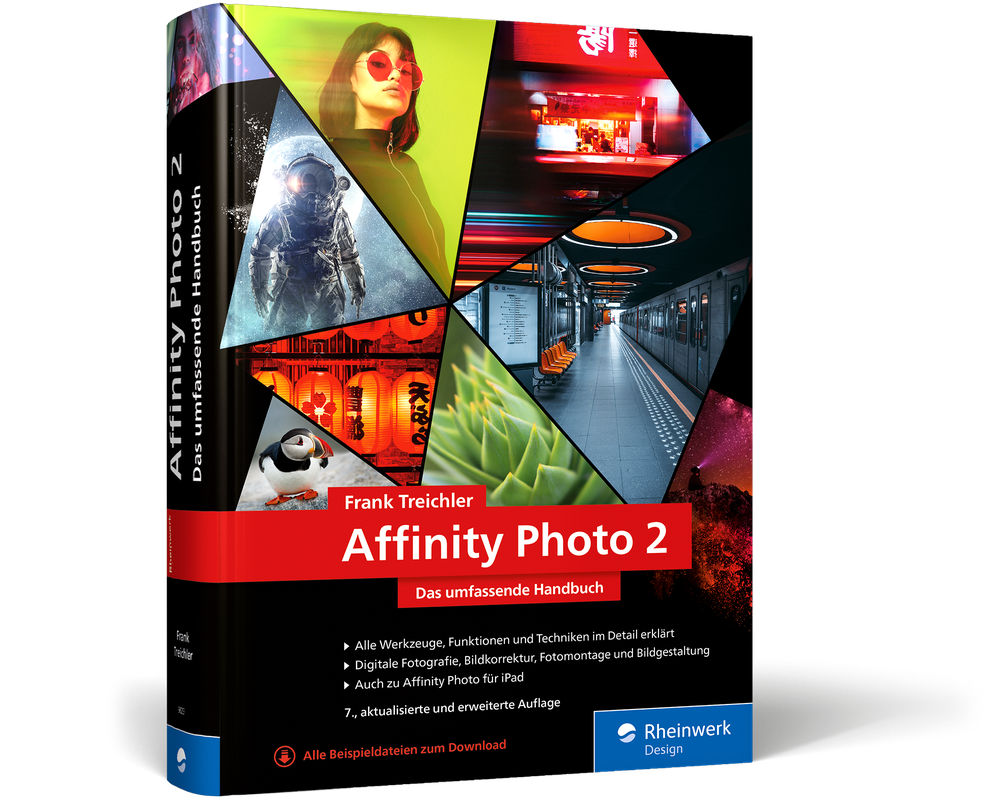
Affinity Photo 2 (7. Auflg.)
Alle Funktionen der Software im Blick: Das umfassende Handbuch in 7. aktualisierter und erweiterter Auflage 2023.Mit diesem Handbuch haben Sie Affinity Photo 2.1 fest im Griff! Ob professionelle Bildretusche, punktgenaue Bildoptimierung oder Fotomontage – Frank Treichler erklärt Ihnen alle Funktionen der Software ausführlich und verständlich. Sie korrigieren Farbstiche, verschönern Porträts, erstellen Schwarzweißfotos und retuschieren Bildfehler. Die zahlreichen Workshops und Profi-Tricks helfen Ihnen dabei, das Beste aus Ihren Fotos herauszuholen. Sehen Sie, was alles mit der Photoshop-Alternative möglich ist – inklusive Affinity Photo fürs iPad.Ergänzend zum Buch können Sie hier kostenlos einen Artikel auf der Rheinwerk-Website zu den Neuerungen in Affinity Photo 2.2 lesen.Aus dem Inhalt:Arbeitsoberfläche und BedienungUnterschiede zu Adobe PhotoshopArbeiten mit Ebenen, Formen und EffektenAuswahlen, freistellenHelligkeit und Kontrast anpassen, SchwarzweißbilderGesichts- und BeautyretuscheHDR und Panoramen, Liquify-StudioRAW-Bilder bearbeitenBild- und Objektivfehler behebenMalen, färben und kolorieren, TextwerkzeugeAusgabe für Print und WebMit einem Kapitel zum Arbeiten auf dem iPadLeseprobe (PDF-Link)

Informatik für Dummies, Das Lehrbuch (2. Auflg.)
Sie studieren und müssen sich mit Informatik auseinandersetzen? Dann dürfen Sie sich freuen:Dieses Buch verschafft Ihnen ? so einfach, schnell und unterhaltsam wie möglich ? einen umfassenden Überblick über die praktische, theoretische und technische Informatik. Sie können das Buch ergänzend zur Vorlesung oder zum Selbststudium nutzen. Der Autor kennt die typischen Probleme der Studierenden. Überwinden Sie Ihre Scheu vor Formalismen. Entdecken Sie den Reiz der Computerwissenschaften! Dies ist das perfekte Buch für den Einstieg in die Informatik.E.-G. Haffner studierte an der Universität Kaiserslautern Informatik und Mathematik und promovierte dort. Seit 2002 ist er Professor an der Hochschule Trier mit Lehrverantwortung für die Studiengänge Elektrotechnik, Medizintechnik sowie Wirtschaftsingenieurwesen.

The DevSecOps Playbook
THE DEVSECOPS PLAYBOOKAN ESSENTIAL AND UP-TO-DATE GUIDE TO DEVSECOPSIn The DevSecOps Playbook: Deliver Continuous Security at Speed, the Chief Information and Information Security Officer at Wiley, Sean D. Mack, delivers an insightful and practical discussion of how to keep your business secure. You’ll learn how to leverage the classic triad of people, process, and technology to build strong cybersecurity infrastructure and practices. You’ll also discover the shared responsibility model at the core of DevSecOps as you explore the principles and best practices that make up contemporary frameworks. The book explains why it’s important to shift security considerations to the front-end of the development cycle and how to do that, as well as describing the evolution of the standard security model over the last few years and how that has impacted modern cybersecurity. A must-read roadmap to DevSecOps for practicing security engineers, security leaders, and privacy practitioners, The DevSecOps Playbook will also benefit students of information technology and business, as well as governance, risk, and compliance specialists who want to improve their understanding of cybersecurity’s impact on their organizations. SEAN D. MACK, MBA, CISO, is the Chief Information Officer at Wiley, an education and research company. He has extensive experience leading DevOps, infrastructure, enterprise applications, security, ad desktop services in the educational technology and publishing industry.

Impact Measurement and Outcomes Evaluation Using Salesforce for Nonprofits
Conduct impact measurement and outcomes evaluation, with a specific focus on nonprofits, using Salesforce Nonprofit Cloud (aka Salesforce for Nonprofits). As funding grows more challenging for nonprofits, having a robust technology system in place allows nonprofits to better seek out funding and receive more when they do. Readers of this book will be better positioned to ensure the long-term success of their organization and make maximum use of their technology.The book begins with an introduction to Salesforce and to Nonprofit Cloud for users who may be new to the platform. Next, you will learn the fundamentals of impact measurement and outcomes evaluation. You will understand why these are important and discover several frameworks that can be used to select outcomes that make sense for your organization to prove that its work is successful. These frameworks include Social Return on Investment (SROI), Cost-Benefit Analysis (CBA), and Pre and Post Comparison (and others).You will use your chosen framework to develop a logic model or theory of change which demonstrates how the work that nonprofits do translates into the outputs and outcomes that clients experience and that nonprofits seek funding to deliver. After covering the theory, author Dustin MacDonald teaches you how to translate the framework you chose into Salesforce. You will learn how to create reports, dashboards, formula fields, roll up summaries, and other basic Salesforce tools in order to collect the information you need to validate your framework.This book also demonstrates how to report on the outcomes you have achieved, tweak results to improve performance, and see the entire end-to-end experience in practice through a set of case studies. The book concludes with a discussion of advanced tools and techniques available inside Salesforce, such as Einstein Prediction Builder, as well as information on how you can immediately apply what you have learned to your own organization.WHAT YOU WILL LEARN* Understand how to use Nonprofit Cloud to collect and analyze data* Know how to create a theory of change that shows your impact* Become adept at working with impact measurement frameworks* Build everything you need in Salesforce without writing a single line of code* Turn your insights into new funding to keep your organization strongWHO THIS BOOK IS FORSalesforce administrators, nonprofit staff members, and others working at nonprofits who are required to conduct impact measurement and outcomes evaluation. Additionally, business analysts and technical architects who are designing and implementing solutions for nonprofits at implementation partners will benefit from this book. DUSTIN K. MACDONALD is 10x Salesforce Certified, including as a nonprofit Cloud Consultant. He holds an Accredited Professional in Einstein Prediction Builder and is currently a Senior Consultant at a mid-sized Salesforce Implementation Partner that focuses exclusively on nonprofits and public sector organizations. He is a former Affiliate Professor in Data Science at Eastern University in St. David’s, Pennsylvania and holds several degrees: Bachelor of Professional Arts in Human Services, Master of Science in Data Science, and Master of Business Administration. Dustin was motivated to write this book because there are no books available on Nonprofit Cloud for nonprofit users who may lack technical knowledge, and the timing is right as Salesforce is increasing its focus on this vertical.

Deep Learning and its Applications using Python
DEEP LEARNING AND ITS APPLICATIONS USING PYTHONTHIS PRACTICAL BOOK GIVES A DETAILED DESCRIPTION OF DEEP LEARNING MODELS AND THEIR IMPLEMENTATION USING PYTHON PROGRAMMING RELATING TO COMPUTER VISION, NATURAL LANGUAGE PROCESSING, AND OTHER APPLICATIONS.This book thoroughly explains deep learning models and how to use Python programming to implement them in applications such as NLP, face detection, face recognition, face analysis, and virtual assistance (chatbot, machine translation, etc.). It provides hands-on guidance in using Python for implementing deep learning application models. It also identifies future research directions for deep learning. Readers/users will discover* A precise description of deep learning history, fundamental concepts, and background information relating to deep learning;* A detailed introduction to several concepts including tensorflow and keras, starting from the fundamentals to the application-based concept implementation using Python;* Explanations of multilayer perceptron, convolutional neural network, recurrent neural network, and long short-term memory in terms of applications like chatbot, face detection and recognition;* Advanced deep learning concepts along with their future research advancements;* Assist in building the reader’s understanding through intuitive explanations and practical examples by exploring challenging concepts in the related applications of computer vision, natural language processing, and other models.AUDIENCEThe book is ideal for computer science researchers, industry professionals, as well as postgraduate and undergraduate students who want to learn how to program deep learning models using Python. NIHA KAMAL BASHA is an assistant professor in the Department of Information Security, School of Computer Science and Engineering, Vellore Institute of Science and Technology, India. She has received a number of awards and published numerous research articles in peer-reviewed journals. SURBHI BHATIA, PHD, is an assistant professor in the Department of Information Systems, College of Computer Sciences and Information Technology, King Faisal University, Saudi Arabia. She has more than 10 years of teaching experience in different universities in India and Saudi Arabia. She has published many articles in peer-reviewed journals, authored or edited 9 books, and has been granted 8 national and international patents. ABHISHEK KUMAR gained his PhD in computer science from the University of Madras, India in 2019. He is assistant director/associate professor in the Computer Science & Engineering Department, Chandigarh University, Punjab, India. He has more than 100 publications in peer-reviewed international and national journals, books & conferences. His research interests include artificial intelligence, image processing, computer vision, data mining, and machine learning. ARWA MASHAT, gained her PhD in Instructional Design and Technology from Old Dominion University, Virginia, USA in 2017. She has a rich 14 years of teaching and academic experience. She is currently an assistant professor at the College of Computing and Information Technology, King Abdulaziz University, Saudi Arabia. She is currently the Vice Dean for two colleges; the College of Computing and Information Technology and the Applied College at King Abdulaziz University. She has published many research papers in reputed journals. Preface ix1 INTRODUCTION TO DEEP LEARNING 11.1 History of Deep Learning 11.2 A Probabilistic Theory of Deep Learning 41.3 Back Propagation and Regularization 141.4 Batch Normalization and VC Dimension 171.5 Neural Nets--Deep and Shallow Networks 181.6 Supervised and Semi-Supervised Learning 191.7 Deep Learning and Reinforcement Learning 212 BASICS OF TENSORFLOW 252.1 Tensors 252.2 Computational Graph and Session 272.3 Constants, Placeholders, and Variables 282.4 Creating Tensor 322.5 Working on Matrices 352.6 Activation Functions 362.7 Loss Functions 392.8 Common Loss Function 392.9 Optimizers 402.10 Metrics 413 UNDERSTANDING AND WORKING WITH KERAS 453.1 Major Steps to Deep Learning Models 453.2 Load Data 473.3 Pre-Process Data 483.4 Define the Model 483.5 Compile the Model 493.6 Fit and Evaluate the Mode 513.7 Prediction 523.8 Save and Reload the Model 523.9 Additional Steps to Improve Keras Models 533.10 Keras with TensorFlow 554 MULTILAYER PERCEPTRON 574.1 Artificial Neural Network 574.2 Single-Layer Perceptron 604.3 Multilayer Perceptron 614.4 Logistic Regression Model 614.5 Regression to MLP in TensorFlow 634.6 TensorFlow Steps to Build Models 634.7 Linear Regression in TensorFlow 634.8 Logistic Regression Mode in TensorFlow 674.9 Multilayer Perceptron in TensorFlow 694.10 Regression to MLP in Keras 724.11 Log-Linear Model 724.12 Keras Neural Network for Linear Regression 734.13 Keras Neural Network for Logistic Regression 734.14 MLPs on the Iris Data 754.15 MLPs on MNIST Data (Digit Classification) 764.16 MLPs on Randomly Generated Data 785 CONVOLUTIONAL NEURAL NETWORKS IN TENSORFLOW 815.1 CNN Architectures 815.2 Properties of CNN Representations 825.3 Convolution Layers, Pooling Layers - Strides - Padding and Fully Connected Layer 825.4 Why TensorFlow for CNN Models? 845.5 TensorFlow Code for Building an Image Classifier for MNIST Data 845.6 Using a High-Level API for Building CNN Models 885.7 CNN in Keras 885.8 Building an Image Classifier for MNIST Data in Keras 885.9 Building an Image Classifier with CIFAR-10 Data 895.10 Define the Model Architecture 905.11 Pre-Trained Models 916 RNN AND LSTM 956.1 Concept of RNN 956.2 Concept of LSTM 966.3 Modes of LSTM 976.4 Sequence Prediction 986.5 Time-Series Forecasting with the LSTM Model 996.6 Speech to Text 1006.7 Examples Using Each API 1026.8 Text-to-Speech Conversion 1056.9 Cognitive Service Providers 1066.10 The Future of Speech Analytics 1077 DEVELOPING CHATBOT'S FACE DETECTION AND RECOGNITION 1097.1 Why Chatbots? 1097.2 Designs and Functions of Chatbot's 1097.3 Steps for Building a Chatbot's 1107.4 Best Practices of Chatbot Development 1167.5 Face Detection 1167.6 Face Recognition 1177.7 Face Analysis 1177.8 OpenCV--Detecting a Face, Recognition and Face Analysis 1177.8.1 Face Detection 1177.8.2 Face Recognition 1207.9 Deep Learning-Based Face Recognition 1247.10 Transfer Learning 1277.11 API's 1318 ADVANCED DEEP LEARNING 1338.1 Deep Convolutional Neural Networks (AlexNet) 1338.2 Networks Using Blocks (VGG) 1378.3 Network in Network (NiN) 1408.4 Networks with Parallel Concatenations (GoogLeNet) 1448.5 Residual Networks (ResNet) 1488.6 Densely Connected Networks (DenseNet) 1518.7 Gated Recurrent Units (GRU) 1548.8 Long Short-Term Memory (LSTM) 1568.9 Deep Recurrent Neural Networks (D-RNN) 1588.10 Bidirectional Recurrent Neural Networks (Bi-RNN) 1598.11 Machine Translation and the Dataset 1608.12 Sequence to Sequence Learning 1619 ENHANCED CONVOLUTIONAL NEURAL NETWORK 1679.1 Introduction 1679.2 Deep Learning-Based Architecture for Absence Seizure Detection 1789.3 EEG Signal Pre-Processing Strategy and Channel Selection 1809.4 Input Formulation and Augmentation of EEG Signal for Deep Learning Model 1889.5 Deep Learning Based Feature Extraction and Classification 1969.6 Performance Analysis 2009.7 Summary 20110 CONCLUSION 20510.1 Introduction 20510.2 Future Research Direction and Prospects 20510.3 Research Challenges in Deep Learning 21010.4 Practical Deep Learning Case Studies 21010.4.1 Medicine: Epilepsy Seizure Onset Prediction 21910.4.2 Using Data from Test Drills to Predict where to Drill for Oil 23210.5 Summary 235References 235Index 239

Scrum - kurz & gut
Die kompakte Referenz für alle, die mit Scrum arbeiten - Scrum-Konzepte, Grundbegriffe und Arbeitsabläufe werden kurz und übersichtlich dargestellt - Mit Praxistipps, Checklisten und ausführlichem Glossar - Komplett überarbeitete 3. Auflage, berücksichtigt alle Aktualisierungen des offiziellen Scrum Guides Scrum ist ein populäres Framework für das agile Projektmanagement. In der Softwareentwicklung ist Scrum mittlerweile weit verbreitet, und auch in anderen Branchen wird es zunehmend als Methode für die Arbeitsorganisation eingesetzt. Dieses Buch bietet allen, die sich für Scrum interessieren oder bereits mit Scrum arbeiten, einen kompakten und praxisbezogenen Überblick über das Framework. Scrum – kurz & gut beschreibt leicht verständlich alle Rollen, Meetings und Artefakte, die Bestandteil von Scrum sind, und bettet diese in den Gesamtkontext der Produktentwicklung ein. Das Buch erläutert auch die agilen Werte und Prinzipien, die dieser Arbeitsmethode zugrunde liegen. Dank wertvoller Praxistipps, Checklisten für die Organisation der Scrum-Meetings und eines umfassenden Glossars mit Definitionen aller Schlüsselbegriffe eignet sich Scrum – kurz & gut gleichermaßen als Kurzeinführung und als Nachschlagewerk. Die überarbeitete und erweiterte 3. Auflage berücksichtigt alle Aktualisierungen des offiziellen Scrum Guides.

AWS Certified Advanced Networking Study Guide
THE LATEST EDITION OF THE OFFICIAL STUDY GUIDE FOR THE AWS ADVANCED NETWORKING CERTIFICATION SPECIALTY EXAMThe newly revised second edition of the AWS Certified Advanced Networking Study Guide: Specialty (ANS-C01) Exam delivers an expert review of Amazon Web Services Networking fundamentals as they relate to the ANS-C01 exam. You’ll find detailed explanations of critical exam topics combined with real-world scenarios that will help you build the robust knowledge base you need for the test—and to succeed in the field as an AWS Certified Networking specialist. Learn about the design, implementation and deployment of AWS cloud-based Networking solutions, core services implementation, AWS service architecture design and maintenance (including architectural best practices), monitoring, Hybrid networks, security, compliance, governance, and network automation. The book also offers one year of free access to Sybex’s online interactive learning environment and expert study tools, featuring flashcards, a glossary of useful terms, chapter tests, practice exams, and a test bank to help you keep track of your progress and measure your exam readiness. The coveted AWS Advanced Networking credential proves your skills with Amazon Web Services and hybrid IT network architectures at scale. It assesses your ability to apply deep technical knowledge to the design and implementation of AWS Networking services. This book provides you with comprehensive review and practice opportunities so you can succeed on the challenging ANS-C01 exam the first time around. It also offers:* Coverage of all relevant exam domains and competencies* Explanations of how to apply the AWS skills discussed within to the real world in the context of an AWS Certified Networking-related career* Complimentary access to the practical Sybex online learning environment, complete with practice exams, flashcards, a glossary, and test bankAWS certification proves to potential employers that you have the knowledge and practical skills you need to deliver forward-looking, resilient, cloud-based solutions. The AWS Certified Advanced Networking Study Guide: Specialty (ANS-C01) Exam, 2nd Edition, is your ticket to the next big step in your career. ABOUT THE AUTHORTODD MONTGOMERY, AWS Certified Advanced Networking, AWS Certified Solutions Architect, AWS Certified Developer, is a Network Automation Engineer for a Fortune 500 company. He is involved with network design and implementation of emerging datacenter technologies, as well as software defined networking design plans, cloud design, and implementation.