

Computer und IT

Android Tablets & Smartphones
OHNE VORWISSEN ANDROID TABLETS ODER SMARTPHONES SICHER BEDIENEN * Erfolgsautor Günter Born behandelt die typischen Fragen von Einsteigern und Senioren * Alle Bedienungsfragen in verständlichen Schritt-für-Schritt-Anleitungen erklärt * Komplett in Farbe, übersichtlich gestaltet und mit größerer Schrift * Der Bestseller deckt jetzt Android 11 ab und sensibilisiert für Sicherheitsfragen Mit diesem praktischen Ratgeber finden Sie sich schnell zurecht und können Schritt für Schritt nachvollziehen, wie Sie Ihr Android-Handy oder -Tablet einrichten, wie Sie surfen, Fotos machen, Kurznachrichten und E-Mails verschicken, die Einsatzmöglichkeiten Ihres Geräts durch neue Apps erweitern und vieles mehr. Schwerpunkt ist die Bedienung von Smartphones und Tablet-PCs mit den Android-Versionen 9 bis 11. Das Buch kann jedoch auch für Geräte mit älteren Android-Versionen genutzt werden, denn vieles ist hier sehr ähnlich.

Getting Started with Open Source Technologies
Using real life examples, learn how open source projects are consumed and explore the nuances within different industries in adopting open source technologies.After gaining a basic understanding of open source and open standards, understand how licensing helps turn community code into an enterprise worthy component. It also helps you understand future governance of the open source software. Once in effect, continuous security becomes a challenge for open source components so we'll examine its ongoing security aspects.This book will also cover different open source domains and industries and discuss how an enterprise can transform itself by applying key open source principles. In the end Getting Started with Open Source Technologies will provide a 360-degree view of open source and show you how to apply it.WHAT YOU'LL LEARN* Understand current trends in open source and why it is relevant today* Gain entry into the open source world to properly license your source code* Review open source usage within different industries and apply the learnings to your enterprises* Evangelize and create advocates in open source communitiesWHO THIS BOOK IS FOREnterprises (Developers/Operators/Management) and academics who want to get a 360-degree view of open source no matter how early or advanced they are in their adoption of any open source technology.SACHIN RATHEE is a Technologist and Business Executive with experience in multiple facets of the software industry. Sachin has led many transformational projects using open source technologies for various enterprises. He is a strong proponent of open source and presented its value in multiple global conferences. Most recently Sachin has been involved in leading the realization of 5G and edge computing use cases in cloud native environments. He holds a Bachelor’s degree in Engineering as well as Master’s in Business Administration.AMOL CHOBE is managing the Solution Architects organization at world's leading enterprise open source software company. Amol brings over 20+ years of experience across numerous industries such as Telecommunications, Financial etc. Amol has been a big advocate of the open source community and has given several presentations around the world focusing on various open source projects. Lately Amol is focusing on adoption of various kinds of everything-as-a-service (XaaS) in rapidly changing markets and an ever-changing technological landscape. He holds a Master's Degree in Computer Engineering.CHAPTER 1:Open source : How we got here( This chapter will cover history , Todays Software and business challenges, How Open source works )Chapter Goal: Provide basic understanding of the Open source world No of pages 15SUB -TOPICS1. How it all started .2. What is really Open source ?3. Where are we now ?CHAPTER 2: Open source and Open standardsCHAPTER GOAL: There are a number of Open standards that coexist with Open source code. Here we look at the relationship between the two.No of pages 15SUB -TOPICS1. What is Open standard with examples2. Comparison on Open source with standards3. How can both coexistCHAPTER 3 : Licensing the Open sourceCHAPTER GOAL: Understanding the ownership of the Open source softwareNo of pages 15SUB -TOPICS1. Understanding various licenses available today2. Pros cons of various licenses3. How to pick the right license for your useCHAPTER 4 : Securing Open SystemsCHAPTER GOAL: Understanding the security challenges of Open source and how to address themNo of pages 15SUB -TOPICS1. Answering the question -- Can Open source be considered secure ?2. Understanding the security aspects of Open source software that you are considering3. Options for securing Open source softwareCHAPTER 5 :Open Source in InfrastructureCHAPTER GOAL: Here we start breaking down the various categories of Open source software available.No of pages 15SUB -TOPICS1. What are the various domains and why we break it down in to such domains2. Understanding the SaaS model and its Open source components.3. Understanding the PaaS model and its Open source components.4. Understanding the IaaS model and its Open source components.CHAPTER 6: Open Source for Emerging TechnologiesCHAPTER GOAL: This chapter provides details on the Infrastructure software available as Open source.No of pages 15SUB -TOPICS1. How to apply Open source infrastructure components to various models2. Cloud infrastructure and management details3. Networking details4. Storage detailsCHAPTER 7: Open source In IndustriesCHAPTER GOAL: This chapter provides details on the application software available as Open source.NO OF PAGES 15SUB -TOPICS1. How to apply Open source applications components to various models2. Integrating applications with different Open source software projects3. Open source applications tooling5. Industry 4.0 / ManufacturingCHAPTER 8: Open source growth and TrendsChapter Goal: Here we discuss how Open source and its culture has driven growth in various companies. We will get views from various industry leaders.No of pages 15SUB -TOPICS1. What is Open Culture2. How companies are adopting Open Culture3. Open Culture success storyCHAPTER 9: Path forward (Cover aspects relating teaching in schools, evangelizing, growing communities )CHAPTER GOAL: Understanding how Open source can be introduced sooner than later into education systemsNo of pages 15SUB -TOPICS1. Barriers to Open source2. Open source in academia3. Supporting Open source communities

Erfolgreich starten mit YouTube
- Videos produzieren, die begeistern- Kanal managen, Reichweite generieren und Geld verdienenDie Social-Media-Plattform YouTube hat sich zur zweitgrößten Suchmaschine im Internet gemausert. Ob Unterhaltung oder Wissenschaft, Kunst, Kultur oder jedes erdenkliche Hobby: Auf YouTube findet sich das geballte Schwarmwissen und die Begeisterung von Generationen. Pro Tag laden Millionen Nutzer Millionen Videos hoch – und einer davon ist Nick Schreger, der Autor dieses Buchs. Was es braucht, um einen YouTube-Kanal zu starten und mit spannenden Inhalten zu füllen, beschreibt er auf lockere, nicht immer ganz ernste Art. Sie erfahren, wie Sie mit relativ einfachen technischen Mitteln gute Videos produzieren, worauf es bei der Themenplanung ankommt und wie Sie Ihren Kanal erfolgreich präsentieren. Auch ambitioniertere Creators kommen dabei nicht zu kurz – ganz wie auf YouTube selbst: In Nicks kreativen Anregungen wird jeder fündig!Aus dem Inhalt:- Stilfindung- Dein Publikum, das unbekannte Wesen- Script vs. Spontanität- So nicht: No-Gos!- Kamera-Einstellungen- Videolicht- Der gute Ton- Das YouTube-Studio- Live-Streaming- Interaktion mit den Zuschauern- Erfolgreiches Selbstmarketing- Begleitende Medien- YouTube-Monetarisierung- Abonnenten – die geheime Währung- Umgang mit KritikDer AutorNick Schreger, Jahrgang 1972, arbeitete nach seiner Berufsausbildung und dem Studium in Sprachwissenschaften als technischer Übersetzer. Als Ausgleich dazu beschäftigte er sich mit verschiedenen Hobbies, machte Musik, Sound-Design für Computerspiele, fotografierte und drehte Dokumentarfilme. Seit 2004 arbeitet er nebenher als Fotograf und Filmemacher und unterhält seit 2016 einen beliebten deutschsprachigen YouTube-Kanal. Nach diversen Auslandsaufenthalten lebt und arbeitet er in der Schweiz.
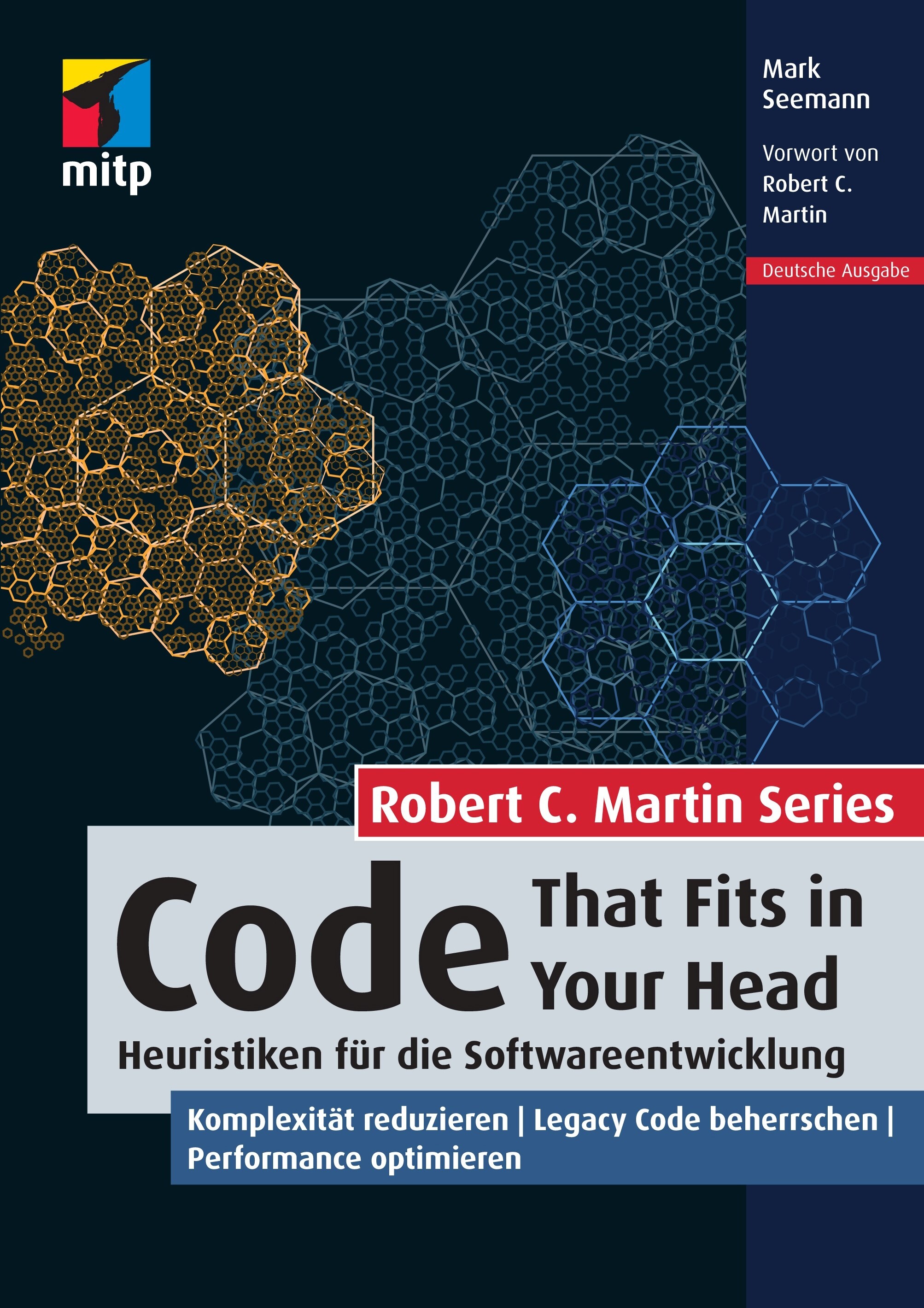
Code That Fits in Your Head
Heuristik in der Softwareentwicklung. Komplexität reduzieren | Legacy Code beherrschen | Performance optimieren.Techniken und Konzepte für nachhaltige Softwareentwicklung sowie sauberen und wartbaren Code Reduktion von Komplexität, strukturierte Arbeitsabläufe und effiziente Fehlerbehandlung. Mit Auszügen aus einem vollständigen Beispielprojekt inklusive Code zum Download.»Mark Seemann ist dafür bekannt, komplexe Konzepte anschaulich und präzise zu erläutern. In diesem Buch kondensiert er seine weitreichende Erfahrung in der Softwareentwicklung zu praktischen, pragmatischen Techniken für nachhaltigen und gut lesbaren Code. Dieses Buch ist ein Must Read für jeden Programmierer.«– Scott Wlaschin, Autor von »Domain Modeling Made Functional«Dieses Buch ist ein praktischer Leitfaden für das Schreiben von nachhaltigem Programmcode und die Reduktion von Komplexität. So können Sie verhindern, dass Softwareprojekte langfristig außer Kontrolle geraten.Mark Seemann unterstützt seit Jahrzehnten Softwareentwickler-Teams bei der erfolgreichen Umsetzung ihrer Projekte. In diesem Buch begleitet er Sie von den ersten Codezeilen bis zum Deployment und zeigt Ihnen, wie Sie im Entwicklungsprozess effizient und nachhaltig bleiben, wenn Sie neue Funktionalitäten implementieren. Dabei legt er auch Wert auf Fehlerbehandlung und disziplinübergreifende Themen. Er gibt Ihnen wertvolle Hinweise, Techniken und Arbeitsabläufe für alle wichtigen Kernprobleme an die Hand: von der Verwendung von Checklisten bis zur Teamarbeit, von Kapselung bis zur verteilten Programmierung, von API-Design bis zu Unit Testing.Seemann veranschaulicht seine Konzepte anhand von Codebeispielen aus einem vollständigen Projektbeispiel in C#. Der Code ist so geschrieben, dass er gut verständlich für jeden ist, der eine objektorientierte Programmiersprache verwendet, einschließlich Java, C++ und Python. Der gesamte Code steht zur weiteren Erkundung zum Download bereit.Wenn Sie jemals negative Erfahrungen bei der Umsetzung von Softwareprojekten oder mit schlecht wartbarem Legacy Code gemacht haben, wird dieses Praxisbuch Ihnen helfen, solchen Schwierigkeiten ab sofort aus dem Weg zu gehen.Über den Autor:Mark Seemann ist in der Softwareentwicklung tätig und beschäftigt sich mit funktionaler Programmierung, objektorientierter Entwicklung und Softwareentwicklung im Allgemeinen. Er hat bereits zwei Bücher und zahlreiche Artikel und Blogbeiträge zu verwandten Themen veröffentlicht. Obwohl er hauptsächlich als .NET-Entwickler tätig ist, nutzt er eine große Bandbreite von Technologien als Ressource, einschließlich Haskell und verschiedene Design-Pattern-Bücher.
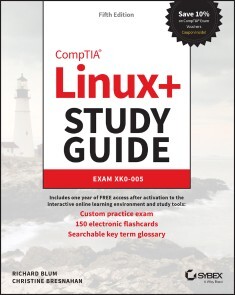
CompTIA Linux+ Study Guide
THE BEST-SELLING, HANDS-ON ROADMAP TO ACING THE NEW LINUX+ EXAMIn the newly updated Fifth Edition of CompTIA Linux+ Study Guide: Exam XK0-005, IT industry veterans and tech education gurus Richard Blum and Christine Bresnahan deliver a concise and practical blueprint to success on the CompTIA Linux+ exam and in your first role as a Linux network or system administrator. In the book, you’ll find concrete strategies and proven techniques to master Linux system management, security, scripting, containers, automation, and troubleshooting. Every competency tested on the Linux+ exam is discussed here. You’ll also get:* Hands-on Linux advice that ensures you’re job-ready on the first day of your new network or sysadmin role* Test-taking tips and tactics that decrease exam anxiety and get you ready for the challenging Linux+ exam* Complimentary access to the Sybex learning environment, complete with online test bank, bonus practice exams, electronic flashcards, and a searchable glossaryPerfect for practicing network and system admins seeking an in-demand and valuable credential for working with Linux servers and computers, CompTIA Linux+ Study Guide: Exam XK0-005, Fifth Edition, will also earn a place in the libraries of people looking to change careers and start down an exciting new path in tech. RICHARD BLUM has over 35 years of experience working as a system and network administrator. He teaches online courses in Linux and Web programming and is co-author with Christine Bresnahan of several Linux titles, including CompTIA Linux+ Study Guide, Linux Essentials, Mastering Linux System Administration, and the Linux Command Line and Shell Scripting Bible.CHRISTINE BRESNAHAN has over 35 years of experience working in the IT industry. She is an Adjunct Professor at Ivy Tech Community College where she teaches Linux certification and Python programming classes. She is co-author with Richard Blum of CompTIA Linux+ Study Guide, Linux Essentials, Mastering Linux System Administration, and the Linux Command Line and Shell Scripting Bible.Introduction xxxiAssessment Test xlivAnswers to Assessment Test lvPART I GATHERING YOUR TOOLS 1Chapter 1 Preparing Your Environment 3Chapter 2 Introduction to Services 17Chapter 3 Managing Files, Directories, and Text 43Chapter 4 Searching and Analyzing Text 89PART II STARTING UP AND CONFIGURING YOUR SYSTEM 131Chapter 5 Explaining the Boot Process 133Chapter 6 Maintaining System Startup and Services 157Chapter 7 Configuring Network Connections 199Chapter 8 Comparing GUIs 235Chapter 9 Adjusting Localization Options 269PART III MANAGING YOUR SYSTEM 289Chapter 10 Administering Users and Groups 291Chapter 11 Handling Storage 329Chapter 12 Protecting Files 363Chapter 13 Governing Software 393Chapter 14 Tending Kernel Modules 423PART IV SECURING YOUR SYSTEM 437Chapter 15 Applying Ownership and Permissions 439Chapter 16 Looking at File and Directory Permissions 440Chapter 17 Implementing Logging Services 503Chapter 18 Overseeing Linux Firewalls 517Chapter 19 Embracing Best Security Practices 547PART V TROUBLESHOOTING YOUR SYSTEM 571Chapter 20 Analyzing System Properties and Remediation 573Chapter 21 Optimizing Performance 607Chapter 22 Investigating User Issues 623Chapter 23 Dealing with Linux Devices 643Chapter 24 Troubleshooting Application and Hardware Issues 667PART VI AUTOMATING YOUR SYSTEM 697Chapter 25 Deploying Bash Scripts 699Chapter 26 Automating Jobs 727Chapter 27 Controlling Versions with Git 749PART VII REALIZING VIRTUAL AND CLOUD ENVIRONMENTS 771Chapter 28 Understanding Cloud and Virtualization Concepts 773Chapter 29 Inspecting Cloud and Virtualization Services 791Chapter 30 Orchestrating the Environment 813Index 897
Productive and Efficient Data Science with Python
This book focuses on the Python-based tools and techniques to help you become highly productive at all aspects of typical data science stacks such as statistical analysis, visualization, model selection, and feature engineering.You’ll review the inefficiencies and bottlenecks lurking in the daily business process and solve them with practical solutions. Automation of repetitive data science tasks is a key mindset that is promoted throughout the book. You’ll learn how to extend the existing coding practice to handle larger datasets with high efficiency with the help of advanced libraries and packages that already exist in the Python ecosystem.The book focuses on topics such as how to measure the memory footprint and execution speed of machine learning models, quality test a data science pipelines, and modularizing a data science pipeline for app development. You’ll review Python libraries which come in very handy for automating and speeding up the day-to-day tasks.In the end, you’ll understand and perform data science and machine learning tasks beyond the traditional methods and utilize the full spectrum of the Python data science ecosystem to increase productivity.WHAT YOU’LL LEARN* Write fast and efficient code for data science and machine learning* Build robust and expressive data science pipelines* Measure memory and CPU profile for machine learning methods* Utilize the full potential of GPU for data science tasks * Handle large and complex data sets efficientlyWHO THIS BOOK IS FORData scientists, data analysts, machine learning engineers, Artificial intelligence practitioners, statisticians who want to take full advantage of Python ecosystem.Dr. Tirthajyoti Sarkar lives in the San Francisco Bay area works as a Data Science and Solutions Engineering Manager at Adapdix Corp., where he architects Artificial intelligence and Machine learning solutions for edge-computing based systems powering the Industry 4.0 and Smart manufacturing revolution across a wide range of industries. Before that, he spent more than a decade developing best-in-class semiconductor technologies for power electronics.He has published data science books, and regularly contributes highly cited AI/ML-related articles on top platforms such as KDNuggets and Towards Data Science. Tirthajyoti has developed multiple open-source software packages in the field of statistical modeling and data analytics. He has 5 US patents and more than thirty technical publications in international journals and conferences.He conducts regular workshops and participates in expert panels on various AI/ML topics and contributes to the broader data science community in numerous ways. Tirthajyoti holds a Ph.D. from the University of Illinois and a B.Tech degree from the Indian Institute of Technology, Kharagpur.Chapter 1: What is Productive and Efficient Data Science?Chapter Goal: To introduce the readers with the concept of doing data science tasks efficiently and more productively and illustrating potential pitfalls in their everyday work.No of pages – 10Subtopics• Typical data science pipeline• Short examples of inefficient programming in data science• Some pitfalls to avoid• Efficiency and productivity go hand in hand• Overview of tools and techniques for a productive data science pipeline• Skills and attitude for productive data scienceChapter 2: Better Programming Principles for Efficient Data ScienceChapter Goal: Help readers grasp the idea of efficient programming techniques and how they can be applied to a typical data science task flow.No of pages – 15Subtopics• The concept of time and space complexity, Big-O notation• Why complexity matters for data science• Examples of inefficient programming in data science tasks• What you can do instead• Measuring code execution timingChapter 3: How to Use Python Data Science Packages more ProductivelyChapter Goal: Illustrate handful of tricks and techniques to use the most well-known Python data science packages – Numpy, Pandas, Matplotlib, Seaborn, Scipy – more productively.No of pages – 20Subtopics• Why Numpy is faster than regular Python code and how much• Using Numpy efficiently• Using Pandas productively• Matplotlib and Seaborn code for and productive EDA• Using SciPy for common data science tasksChapter 4: Writing Machine Learning Code More ProductivelyChapter Goal: Teach the reader about writing efficient and modular machine learning code for productive data science pipeline with hands-on examples using Scikit-learn.No of pages – 15Subtopics• Why modular code for machine learning and deep learning• Scikit-learn tools and techniques• Systematic evaluation of Scikit-learn ML algorithms in automated fashion• Decision boundary visualization with custom function• Hyperparameter search in Scikit-learnChapter 5: Modular and Productive Deep Learning CodeChapter Goal: Teach the reader about mixing modular programming style in deep learning code with hands-on examples using Keras/TensorFlow.No of pages – 25Subtopics• Why modular code and object-oriented style for deep learning• Wrapper functions with Keras for faster deep learning experimentations• A single function to streamline image classification task flow• Visualize activation functions of neural networks• Custom callback functions in Keras and their utilities• Using Scikit-learn wrapper for hyperparameter search in KerasChapter 6: Build Your Own Machine Learning Estimator/PackageChapter Goal: Illustrate how to build a new Python machine learning module/package from scratch.No of pages – 15Subtopics• Why write your own ML package/module?• A simple example vs. a data scientist’s example• A good, old Linear Regression estimator — with a twist• How do you start building?• Add utility functions• Do more with object-oriented approachChapter 7: Some Cool Utility PackagesChapter Goal: Introduce the readers to the idea of executing data science tasks efficiently by going beyond traditional stack and utilizing exciting, new libraries.No of pages – 20Subtopics• The great Python data science ecosystem• Build pipeline using “pdpipe”• Check data integrity and expectations with “great_expectations”• Speed up Numpy and Pandas using Numexpr• Discover best fitted distributions using “distfit”Chapter 8: Testing the Machine Learning CodeChapter Goal: Teach the readers some basic principles of testing Python code and how to apply them to a specific case of machine learning module.No of pages – 20Subtopics• Why testing boosts productivity• Basic principles and variations of testing• Data science or machine learning testing is somewhat different• A PyTest module for a ML moduleChapter 9: Memory and Timing ProfilingChapter Goal: Illustrate how to measure and profile typical data science and machine learning code/ module.No of pages – 15Subtopics• Why profiling is important• Well-known profilers out there• cProfile• Memory_profile• ScaleneChapter 10: Scalable Data ScienceChapter Goal: Demonstrate the importance of scalability in data science tasks with hands-on examples.No of pages – 15Subtopics• Data science pipeline needs to be easily scalable• Common problems - out-of-memory and single-threading• What options are out there?• Hands-on example with Vaex• Hands-on example with ModinChapter 11: Parallelized Data ScienceChapter Goal: Demonstrate the importance of parallel processing in data science tasks with hands-on examples.No of pages – 15Subtopics• Data science pipeline should take advantage of parallel computing• Two great options – Ray and Dask• Hands-on example with Dask cluster• Hands-on example with “Ray serve” and actorsChapter 12: GPU-Based Data Science for High ProductivityChapter Goal: Illustrate how to harness the power of GPU-based hardware for common data science tasks and classical machine learning.No of pages – 20Subtopics• GPU-powered data science (not deep learning)• The RAPIDS ecosystem• CuPy vs. NumPy• CuDF vs. Pandas• CuML vs. Scikit-learnChapter 13: Other Useful Skills to MasterChapter Goal: Give an overview of other related skills to master for executing data science tasks more efficiently.No of pages – 25Subtopics• Key things to learn• Understanding the basics of web technologies• Going from local to cloud• Simple web app to showcase a data science project• GUI programming for a quick demo• Being comfortable with container technologies• Putting it all togetherChapter 14: Wrapping It UpChapter Goal: Show a summary of all the things discussed and some future projections.No of pages – 10Subtopics• Chapter-wise summary• What were not discussed in this book• Future projections• General advice for upcoming data scientists

CompTIA Linux+ Practice Tests
THE BEST TEST PREPARATION RESOURCE FOR THE COMPTIA LINUX+ CERTIFICATION EXAMIn the newly updated Third Edition of CompTIA Linux+ Practice Tests: Exam XK0-005, veteran Linux expert, Steve Suehring, delivers an instructive set of practice questions written to get you ready to ace the new XK0-005 test. Providing hundreds of domain-by-domain questions covering system management, security, scripting, containers, automation, and troubleshooting, the book helps you prepare for the exam with confidence and efficiency. You’ll be able to pinpoint those areas you’ve mastered and those which require more study, as well as get a feel for the structure of the test itself. The book also offers:* Hundreds of practice questions that reinforce your skills and knowledge* A great way for practicing and aspiring Linux network and system administrators to improve their on-the-job skills* One year of complimentary access after activation to the online Sybex test bank, where you can study and work through hundreds of questionsAn indispensable resource for anyone preparing for the CompTIA Linux+ exam, CompTIA Linux+ Practice Tests: Exam XK0-005, Third Edition, is also a must-have for new and experienced sysadmins and network administrators seeking to identify areas of strength and weakness and improve their grasp of Linux systems. ABOUT THE AUTHORSTEVE SUEHRING is a technical architect with extensive experience in technology and Linux. He is the author of several technology education books, and has worked as a systems engineer and security specialist, as well as in roles providing architectural direction to several different technology initiatives. He is an expert in JavaScript, Linux security, Windows Server certifications, Perl, and more. Introduction XIChapter 1 System Management (Domain 1.0) 1Chapter 2 System Operations and Maintenance (Domain 2.0) 49Chapter 3 Scripting, Containers, and Automation (Domain 3.0) 83Chapter 4 Troubleshooting (Domain 4.0) 113Chapter 5 Practice Exam 157Appendix Answers to the Review Questions 175Chapter 1: System Management (Domain 1.0) 176Chapter 2: System Operations and Maintenance (Domain 2.0) 197Chapter 3: Scripting, Containers, and Automation (Domain 3.0) 211Chapter 4: Troubleshooting (Domain 4.0) 224Chapter 5: Practice Exam 241Index 249
Artificial Intelligence in Industry 4.0 and 5G Technology
ARTIFICIAL INTELLIGENCE IN INDUSTRY 4.0 AND 5G TECHNOLOGYEXPLORES INNOVATIVE AND VALUE-ADDED SOLUTIONS FOR APPLICATION PROBLEMS IN THE COMMERCIAL, BUSINESS, AND INDUSTRY SECTORSAs the pace of Artificial Intelligence (AI) technology innovation continues to accelerate, identifying the appropriate AI capabilities to embed in key decision processes has never been more critical to establishing competitive advantage. New and emerging analytics tools and technologies can be configured to optimize business value, change how an organization gains insights, and significantly improve the decision-making process across the enterprise.Artificial Intelligence in Industry 4.0 and 5G Technology helps readers solve real-world technological engineering optimization problems using evolutionary and swarm intelligence, mathematical programming, multi-objective optimization, and other cutting-edge intelligent optimization methods. Contributions from leading experts in the field present original research on both the theoretical and practical aspects of implementing new AI techniques in a variety of sectors, including Big Data analytics, smart manufacturing, renewable energy, smart cities, robotics, and the Internet of Things (IoT).* Presents detailed information on meta-heuristic applications with a focus on technology and engineering sectors such as smart manufacturing, smart production, innovative cities, and 5G networks.* Offers insights into the use of metaheuristic strategies to solve optimization problems in business, economics, finance, and industry where uncertainty is a factor.* Provides guidance on implementing metaheuristics in different applications and hybrid technological systems.* Describes various AI approaches utilizing hybrid meta-heuristics optimization algorithms, including meta-search engines for innovative research and hyper-heuristics algorithms for performance measurement.Artificial Intelligence in Industry 4.0 and 5G Technology is a valuable resource for IT specialists, industry professionals, managers and executives, researchers, scientists, engineers, and advanced students an up-to-date reference to innovative computing, uncertainty management, and optimization approaches.PANDIAN VASANT is Research Associate at MERLIN Research Centre, TDTU, HCMC, Vietnam, and Editor in Chief of International Journal of Energy Optimization and Engineering (IJEOE). He holds PhD in Computational Intelligence (UNEM, Costa Rica), MSc (University Malaysia Sabah, Malaysia, Engineering Mathematics) and BSc (Hons, Second Class Upper) in Mathematics (University of Malaya, Malaysia). He has co-authored research articles in journals, conference proceedings, presentations, special issues Guest Editor, chapters and General Chair of EAI International Conference on Computer Science and Engineering in Penang, Malaysia (2016) and Bangkok, Thailand (2018).ELIAS MUNAPO, PhD, currently heads the Department of Business Statistics and Operations research at North West University-Mafikeng, South Africa. He has published 50+ articles and contributed to five chapters on industrial engineering and management texts.J. JOSHUA THOMAS is an Associate Professor at UOW Malaysia KDU Penang University College. He obtained his PhD (Intelligent Systems Techniques) from University Sains Malaysia, Penang and master’s degree from Madurai Kamaraj University, India. He is working with Deep Learning algorithms, specially targeting on Graph Convolutional Neural Networks (GCNN) and Bi-directional Recurrent Neural Networks (RNN) for drug target interaction and image tagging with embedded natural language processing. His work involves experimental research with software prototypes and mathematical modelling and design.GERHARD-WILLIAM WEBER, PhD, is Professor and Chair of Marketing and Economic Engineering at Poznan University of Technology, Poland. He is also an Adjunct Professor at Department of Industrial and Systems Engineering, College of Engineering at Istinye University, Istanbul, Turkey.List of Contributors xvPreface xixProfile of Editors xxviiAcknowledgments xxx1 DYNAMIC KEY-BASED BIOMETRIC END-USER AUTHENTICATION PROPOSAL FOR IOT IN INDUSTRY 4.0 1Subhash Mondal, Swapnoj Banerjee, Soumodipto Halder, and Diganta Sengupta1.1 Introduction 11.2 Literature Review 21.3 Proposed Framework 51.3.1 Enrolment Phase 51.3.2 Authentication Phase 71.3.2.1 Pre-processing 71.3.2.2 Minutiae Extraction and False Minutiae Removal 121.3.2.3 Key Generation from extracted Minutiae points 131.3.2.4 Encrypting the Biometric Fingerprint Image Using AES 141.4 Comparative Analysis 181.5 Conclusion 19References 192 DECISION SUPPORT METHODOLOGY FOR SCHEDULING ORDERS IN ADDITIVE MANUFACTURING 25Juan Jesús Tello Rodríguez and Lopez-I Fernando2.1 Introduction 252.2 The Additive Manufacturing Process 262.3 Some Background 282.4 Proposed Approach 302.4.1 A Mathematical Model for the Initial Printing Scheduling 322.4.1.1 Considerations 322.4.1.2 Sets 322.4.2 Parameters 332.4.2.1 Orders 332.4.2.2 Parts 332.4.2.3 Printing Machines 332.4.2.4 Process 332.4.3 Decision Variables 332.4.4 Optimization Criteria 332.4.5 Constrains 342.5 Results 352.5.1 Orders 352.6 Conclusions 39References 393 SIGNIFICANCE OF CONSUMING 5G-BUILT ARTIFICIAL INTELLIGENCE IN SMART CITIES 43Y. Bevish Jinila, Cinthia Joy, J. Joshua Thomas, and S. Prayla Shyry3.1 Introduction 433.2 Background and RelatedWork 473.3 Challenges in Smart Cities 493.3.1 Data Acquisition 493.3.2 Data Analysis 503.3.3 Data Security and Privacy 503.3.4 Data Dissemination 503.4 Need for AI and Data Analytics 503.5 Applications of AI in Smart Cities 513.5.1 Road Condition Monitoring 513.5.2 Driver Behavior Monitoring 523.5.3 AI-Enabled Automatic Parking 533.5.4 Waste Management 533.5.5 Smart Governance 533.5.6 Smart Healthcare 543.5.7 Smart Grid 543.5.8 Smart Agriculture 553.6 AI-based Modeling for Smart Cities 553.6.1 Smart Cities Deployment Model 553.6.2 AI-Based Predictive Analytics 573.6.3 Pre-processing 583.6.4 Feature Selection 583.6.5 Artificial Intelligence Model 583.7 Conclusion 60References 604 NEURAL NETWORK APPROACH TO SEGMENTATION OF ECONOMIC INFRASTRUCTURE OBJECTS ON HIGH-RESOLUTION SATELLITE IMAGES 63Vladimir A. Kozub, Alexander B. Murynin, Igor S. Litvinchev, Ivan A. Matveev, and Pandian Vasant4.1 Introduction 634.2 Methodology for Constructing a Digital Terrain Model 644.3 Image Segmentation Problem 654.4 Segmentation Quality Assessment 674.5 Existing Segmentation Methods and Algorithms 684.6 Classical Methods 694.7 Neural Network Methods 724.7.1 Semantic Segmentation of Objects in Satellite Images 744.8 Segmentation with Neural Networks 764.9 Convolutional Neural Networks 794.10 Batch Normalization 834.11 Residual Blocks 844.12 Training of Neural Networks 854.13 Loss Functions 854.14 Optimization 864.15 Numerical Experiments 884.16 Description of the Training Set 884.17 Class Analysis 904.18 Augmentation 904.19 NN Architecture 924.20 Training and Results 934.21 Conclusion 97Acknowledgments 97References 975 THE IMPACT OF DATA SECURITY ON THE INTERNET OF THINGS 101Joshua E. Chukwuere and Boitumelo Molefe5.1 Introduction 1015.2 Background of the Study 1025.3 Problem Statement 1035.4 Research Questions 1035.5 Literature Review 1035.5.1 The Data Security on IoT 1035.5.2 The Security Threats and Awareness of Data Security on IoT 1055.5.3 The DifferentWays to Assist with Keeping Your IoT Device Safer from Security Threats 1055.6 Research Methodology 1065.6.1 Population and Sampling 1065.6.2 Data Collection 1075.6.3 Reliability and Validity 1085.7 Chapter Results and Discussions 1085.7.1 The Demographic Information 1095.7.1.1 Age, Ethnic Group, and Ownership of a Smart Device 1095.7.2 Awareness of Users About Data Security of the Internet of Things 1095.7.3 The Security Threats that are Affecting the Internet of Things Devices 1115.7.3.1 The Architecture of IoT Devices 1125.7.3.2 The botnets Attack 1125.7.4 The Effects of Security Threats on IoT Devices that are Affecting Users 1125.7.4.1 The Slowness or Malfunctioning of the IoT Device 1125.7.4.2 The Trust of Users on IoT 1135.7.4.3 The Safety of Users 1135.7.4.4 The Guaranteed Duration of IoT Devices 1145.7.5 DifferentWays to Assist with Keeping IoT Smart Devices Safer from Security Threats 1145.7.5.1 The Change Default Passwords 1145.7.5.2 The Easy or Common Passwords 1145.7.5.3 On the Importance of Reading Privacy Policies 1145.7.5.4 The Bluetooth and Wi-Fi of IoT Devices 1155.7.5.5 The VPN on IoT 1155.7.5.6 The Physical Restriction 1155.7.5.7 Two-Factor Authentication 1165.7.5.8 The Biometric Authentication 1165.8 Answers to the Chapter Questions 1165.8.1 Objective 1: Awareness on Users About Data Security of Internet of Things (IoT) 1165.8.2 Objective 2: Determine the Security Threats that are Involved in the Internet of Things (IoT) 1175.8.3 Objective 3: The Effects of Security Threats on IoT Devices that are Affecting Users 1175.8.4 Objective 4: DifferentWays to Assist with Keeping IoT Devices Safer from Security Threats 1175.8.5 Other Descriptive Analysis (Mean) 1185.8.5.1 Mean 1 – Awareness on Users About Data Security on IoT 1185.8.5.2 The Effects of Security Threats on IoT Devices that are Affecting Users 1185.8.5.3 DifferentWays to Assist with Keeping an IoT Device Safer 1225.9 Chapter Recommendations 1225.10 Conclusion 122References 1246 SUSTAINABLE RENEWABLE ENERGY AND WASTE MANAGEMENT ON WEATHERING CORPORATE POLLUTION 129Choo K. Chin and Deng H. Xiang6.1 Introduction 1296.2 Literature Review 1316.2.1 Energy Efficiency 1356.2.2 Waste Minimization 1366.2.3 Water Consumption 1376.2.4 Eco-Procurement 1376.2.5 Communication 1386.2.6 Awareness 1386.2.7 Sustainable and Renewable Energy Development 1386.3 Conceptual Framework 1396.4 Conclusion 1396.4.1 Energy Efficiency 1406.4.2 Waste Minimization 1406.4.3 Water Consumption 1406.4.4 Eco-Procurement 1416.4.5 Communication 1416.4.6 Sustainable and Renewable Energy Development 141Acknowledgment 142References 1427 ADAM ADAPTIVE OPTIMIZATION METHOD FOR NEURAL NETWORK MODELS REGRESSION IN IMAGE RECOGNITION TASKS 147Denis Y. Nartsev, Alexander N. Gneushev, and Ivan A. Matveev7.1 Introduction 1477.2 Problem Statement 1497.3 Modifications of the Adam Optimization Method for Training a Regression Model 1517.4 Computational Experiments 1557.4.1 Model for Evaluating the Eye Image Blurring Degree 1557.4.2 Facial Rotation Angle Estimation Model 1587.5 Conclusion 160Acknowledgments 161References 1618 APPLICATION OF INTEGER PROGRAMMING IN ALLOCATING ENERGY RESOURCES IN RURAL AFRICA 165Elias Munapo8.1 Introduction 1658.1.1 Applications of the QAP 1658.2 Quadratic Assignment Problem Formulation 1668.2.1 Koopmans–Beckmann Formulation 1668.3 Current Linearization Technique 1678.3.1 The General Quadratic Binary Problem 1678.3.2 Linearizing the Quadratic Binary Problem 1698.3.2.1 Variable Substitution 1698.3.2.2 Justification 1698.3.3 Number of Variables and Constraints in the Linearized Model 1708.3.4 Linearized Quadratic Binary Problem 1718.3.5 Reducing the Number of Extra Constraints in the Linear Model 1718.3.6 The General Binary Linear (BLP) Model 1718.3.6.1 Convex Quadratic Programming Model 1728.3.6.2 Transforming Binary Linear Programming (BLP) Into a Convex/Concave Quadratic Programming Problem 1728.3.6.3 Equivalence 1738.4 Algorithm 1748.4.1 Making the Model Linear 1758.5 Conclusions 176References 1769 FEASIBILITY OF DRONES AS THE NEXT STEP IN INNOVATIVE SOLUTION FOR EMERGING SOCIETY 179Sadia S. Ali, Rajbir Kaur, and Haidar Abbas9.1 Introduction 1799.1.1 Technology and Business 1819.1.2 Technological Revolution of the Twenty-first Century 1819.2 An Overview of Drone Technology and Its Future Prospects in Indian Market 1829.2.1 Utilities 1839.2.1.1 Delivery 1839.2.1.2 Media/Photography 1839.2.1.3 Agriculture 1849.2.1.4 Contingency and Disaster Management Scenarios 1849.2.1.5 Civil and Military Services: Search and Rescue, Surveillance,Weather, and Traffic Monitoring, Firefighting 1859.2.2 Complexities Involved 1859.2.3 Drones in Indian Business Scenario 1869.3 Literature Review 1879.3.1 Absorption and Diffusion of New Technology 1889.3.2 Leadership for Innovation 1889.3.3 Social and Economic Environment 1899.3.4 Customer Perceptions 1909.3.5 Alliances with Other National and International Organizations 1909.3.6 Other Influencers 1919.4 Methodology 1919.5 Discussion 1939.5.1 Market Module 1959.5.2 Technology Module 1969.5.3 Commercial Module 1989.6 Conclusions 199References 20010 DESIGNING A DISTRIBUTION NETWORK FOR A SODA COMPANY: FORMULATION AND EFFICIENT SOLUTION PROCEDURE 209Isidro Soria-Arguello, Rafael Torres-Esobar, and Pandian Vasant10.1 Introduction 20910.2 New Distribution System 21110.3 The Mathematical Model to Design the Distribution Network 21410.4 Solution Technique 21610.4.1 Lagrangian Relaxation 21610.4.2 Methods for Finding the Value of Lagrange Multipliers 21610.4.3 Selecting the Solution Method 21610.4.4 Used Notation 21710.4.5 Proposed Relaxations of the Distribution Model 21810.4.5.1 Relaxation 1 21810.4.5.2 Relaxation 2 21910.4.6 Selection of the Best Lagrangian Relaxation 21910.5 Heuristic Algorithm to Restore Feasibility 22010.6 Numerical Analysis 22210.6.1 Scenario 2020 22310.6.2 Scenario 2021 22410.6.3 Scenario 2022 22510.6.4 Scenario 2023 22610.7 Conclusions 228References 22811 MACHINE LEARNING AND MCDM APPROACH TO CHARACTERIZE STUDENT ATTRITION IN HIGHER EDUCATION 231Arrieta-M Luisa F and Lopez-I Fernando11.1 Introduction 23111.1.1 Background 23211.2 Proposed Approach 23311.3 Case Study 23411.3.1 Intelligent Phase 23411.3.2 Design Phase 23511.3.3 Choice Phase 23611.4 Results 23811.5 Conclusion 240References 24012 A CONCISE REVIEW ON RECENT OPTIMIZATION AND DEEP LEARNING APPLICATIONS IN BLOCKCHAIN TECHNOLOGY 243Timothy Ganesan, Irraivan Elamvazuthi, Pandian Vasant, and J. Joshua Thomas12.1 Background 24312.2 Computational Optimization Frameworks 24612.3 Internet of Things (IoT) Systems 24812.4 Smart Grids Data Systems 25012.5 Supply Chain Management 25212.6 Healthcare Data Management Systems 25512.7 Outlook 257References 25813 INVENTORY ROUTING PROBLEM WITH FUZZY DEMAND AND DELIVERIES WITH PRIORITY 267Paulina A. Avila-Torres and Nancy M. Arratia-Martinez13.1 Introduction 26713.2 Problem Description 27013.3 Mathematical Formulation 27313.4 Computational Experiments 27513.4.1 Numerical Example 27613.4.1.1 The Inventory Routing Problem Under Certainty 27913.4.1.2 The Inventory Routing Problem Under Uncertainty in the Consumption Rate of Product 27913.5 Conclusions and FutureWork 280References 28114 COMPARISON OF DEFUZZIFICATION METHODS FOR PROJECT SELECTION 283Nancy M. Arratia-Martinez, Paulina A. Avila-Torres, and Lopez-I Fernando14.1 Introduction 28314.2 Problem Description 28614.3 Mathematical Model 28614.3.1 Sets and Parameters 28714.3.2 Decision Variables 28714.3.3 Objective Functions 28714.4 Constraints 28814.5 Methods of Defuzzification and Solution Algorithm 28914.5.1 k-Preference Method 28914.5.2 Integral Value 29114.5.3 SAUGMECON Algorithm 29114.6 Results 29214.6.1 Results of k-Preference Method 29214.6.2 Results of Integral Value Method 29514.7 Conclusions 299References 30015 RE-IDENTIFICATION-BASED MODELS FOR MULTIPLE OBJECT TRACKING 303Alexey D. Grigorev, Alexander N. Gneushev, and Igor S. Litvinchev15.1 Introduction 30315.2 Multiple Object Tracking Problem 30515.3 Decomposition of Tracking into Filtering and Assignment Tasks 30615.4 Cost Matrix Adjustment in Assignment Problem Based on Re-Identification with Pre-Filtering of Descriptors by Quality 31015.5 Computational Experiments 31315.6 Conclusion 315Acknowledgments 315References 316Index 319
Cyber-Physical Systems
CYBER-PHYSICAL SYSTEMSAcknowledgement xix1 A SYSTEMATIC LITERATURE REVIEW ON CYBER SECURITY THREATS OF INDUSTRIAL INTERNET OF THINGS 1Ravi Gedam and Surendra Rahamatkar1.1 Introduction 21.2 Background of Industrial Internet of Things 31.3 Literature Review 61.4 The Proposed Methodology 131.5 Experimental Requirements 141.6 Conclusion 15References 162 INTEGRATION OF BIG DATA ANALYTICS INTO CYBER-PHYSICAL SYSTEMS 19Nandhini R.S. and Ramanathan L.2.1 Introduction 192.2 Big Data Model for Cyber-Physical System 212.2.1 Cyber-Physical System Architecture 222.2.2 Big Data Analytics Model 222.3 Big Data and Cyber-Physical System Integration 232.3.1 Big Data Analytics and Cyber-Physical System 232.3.1.1 Integration of CPS With BDA 242.3.1.2 Control and Management of Cyber-Physical System With Big Data Analytics 242.3.2 Issues and Challenges for Big Data-Enabled Cyber-Physical System 252.4 Storage and Communication of Big Data for Cyber-Physical System 262.4.1 Big Data Storage for Cyber-Physical System 272.4.2 Big Data Communication for Cyber-Physical System 282.5 Big Data Processing in Cyber-Physical System 292.5.1 Data Processing 292.5.1.1 Data Processing in the Cloud and Multi-Cloud Computing 292.5.1.2 Clustering in Big Data 312.5.1.3 Clustering in Cyber-Physical System 322.5.2 Big Data Analytics 322.6 Applications of Big Data for Cyber-Physical System 332.6.1 Manufacturing 332.6.2 Smart Grids and Smart Cities 342.6.3 Healthcare 352.6.4 Smart Transportation 352.7 Security and Privacy 362.8 Conclusion 37References 383 MACHINE LEARNING: A KEY TOWARDS SMART CYBER-PHYSICAL SYSTEMS 43Rashmi Kapoor, Chandragiri Radhacharan and Sung-ho Hur3.1 Introduction 443.2 Different Machine Learning Algorithms 463.2.1 Performance Measures for Machine Learning Algorithms 483.2.2 Steps to Implement ML Algorithms 493.2.3 Various Platforms Available for Implementation 503.2.4 Applications of Machine Learning in Electrical Engineering 503.3 ML Use-Case in MATLAB 513.4 ML Use-Case in Python 563.4.1 ML Model Deployment 593.5 Conclusion 60References 604 PRECISE RISK ASSESSMENT AND MANAGEMENT 63Ambika N.4.1 Introduction 644.2 Need for Security 654.2.1 Confidentiality 654.2.2 Integrity 664.2.3 Availability 664.2.4 Accountability 664.2.5 Auditing 674.3 Different Kinds of Attacks 674.3.1 Malware 674.3.2 Man-in-the Middle Assault 694.3.3 Brute Force Assault 694.3.4 Distributed Denial of Service 694.4 Literature Survey 704.5 Proposed Work 754.5.1 Objective 754.5.2 Notations Used in the Contribution 764.5.3 Methodology 764.5.4 Simulation and Analysis 784.6 Conclusion 80References 805 A DETAILED REVIEW ON SECURITY ISSUES IN LAYERED ARCHITECTURES AND DISTRIBUTED DENIAL SERVICE OF ATTACKS OVER IOT ENVIRONMENT 85Rajarajan Ganesarathinam, Muthukumaran Singaravelu and K.N. Padma Pooja5.1 Introduction 865.2 IoT Components, Layered Architectures, Security Threats 895.2.1 IoT Components 895.2.2 IoT Layered Architectures 905.2.2.1 3-Layer Architecture 915.2.2.2 4-Layer Architecture 915.2.2.3 5-Layer Architecture 935.2.3 Associated Threats in the Layers 935.2.3.1 Node Capture 935.2.3.2 Playback Attack 935.2.3.3 Fake Node Augmentation 935.2.3.4 Timing Attack 945.2.3.5 Bootstrap Attack 945.2.3.6 Jamming Attack 945.2.3.7 Kill Command Attack 945.2.3.8 Denial-of-Service (DoS) Attack 945.2.3.9 Storage Attack 945.2.3.10 Exploit Attack 955.2.3.11 Man-In-The-Middle (MITM) Attack 955.2.3.12 XSS Attack 955.2.3.13 Malicious Insider Attack 955.2.3.14 Malwares 955.2.3.15 Zero-Day Attack 955.3 Taxonomy of DDoS Attacks and Its Working Mechanism in IoT 975.3.1 Taxonomy of DDoS Attacks 995.3.1.1 Architectural Model 995.3.1.2 Exploited Vulnerability 1005.3.1.3 Protocol Level 1015.3.1.4 Degree of Automation 1015.3.1.5 Scanning Techniques 1015.3.1.6 Propagation Mechanism 1025.3.1.7 Impact Over the Victim 1025.3.1.8 Rate of Attack 1035.3.1.9 Persistence of Agents 1035.3.1.10 Validity of Source Address 1035.3.1.11 Type of Victim 1035.3.1.12 Attack Traffic Distribution 1035.3.2 Working Mechanism of DDoS Attack 1045.4 Existing Solution Mechanisms Against DDoS Over IoT 1055.4.1 Detection Techniques 1055.4.2 Prevention Mechanisms 1085.5 Challenges and Research Directions 1135.6 Conclusion 115References 1156 MACHINE LEARNING AND DEEP LEARNING TECHNIQUES FOR PHISHING THREATS AND CHALLENGES 123Bhimavarapu Usharani6.1 Introduction 1246.2 Phishing Threats 1246.2.1 Internet Fraud 1246.2.1.1 Electronic-Mail Fraud 1256.2.1.2 Phishing Extortion 1266.2.1.3 Extortion Fraud 1276.2.1.4 Social Media Fraud 1276.2.1.5 Tourism Fraud 1286.2.1.6 Excise Fraud 1296.2.2 Phishing 1296.3 Deep Learning Architectures 1316.3.1 Convolution Neural Network (CNN) Models 1316.3.1.1 Recurrent Neural Network 1316.3.1.2 Long Short-Term Memory (LSTM) 1346.4 Related Work 1356.4.1 Machine Learning Approach 1356.4.2 Neural Network Approach 1366.4.3 Deep Learning Approach 1386.5 Analysis Report 1396.6 Current Challenges 1406.6.1 File-Less Malware 1406.6.2 Crypto Mining 1406.7 Conclusions 140References 1417 NOVEL DEFENDING AND PREVENTION TECHNIQUE FOR MAN-IN-THE-MIDDLE ATTACKS IN CYBER-PHYSICAL NETWORKS 147Gaurav Narula, Preeti Nagrath, Drishti Hans and Anand Nayyar7.1 Introduction 1487.2 Literature Review 1507.3 Classification of Attacks 1527.3.1 The Perception Layer Network Attacks 1527.3.2 Network Attacks on the Application Control Layer 1537.3.3 Data Transmission Layer Network Attacks 1537.3.3.1 Rogue Access Point 1547.3.3.2 ARP Spoofing 1557.3.3.3 DNS Spoofing 1577.3.3.4 mDNS Spoofing 1607.3.3.5 SSL Stripping 1617.4 Proposed Algorithm of Detection and Prevention 1627.4.1 ARP Spoofing 1627.4.2 Rogue Access Point and SSL Stripping 1687.4.3 DNS Spoofing 1697.5 Results and Discussion 1737.6 Conclusion and Future Scope 173References 1748 FOURTH ORDER INTERLEAVED BOOST CONVERTER WITH PID, TYPE II AND TYPE III CONTROLLERS FOR SMART GRID APPLICATIONS 179Saurav S. and Arnab Ghosh8.1 Introduction 1798.2 Modeling of Fourth Order Interleaved Boost Converter 1818.2.1 Introduction to the Topology 1818.2.2 Modeling of FIBC 1828.2.2.1 Mode 1 Operation (0 to d1 Ts) 1828.2.2.2 Mode 2 Operation (d1 Ts to d2 Ts) 1848.2.2.3 Mode 3 Operation (d2 Ts to d3 Ts) 1868.2.2.4 Mode 4 Operation (d3 Ts to Ts) 1888.2.3 Averaging of the Model 1908.2.4 Small Signal Analysis 1908.3 Controller Design for FIBC 1938.3.1 PID Controller 1938.3.2 Type II Controller 1948.3.3 Type III Controller 1958.4 Computational Results 1978.5 Conclusion 204References 2059 INDUSTRY 4.0 IN HEALTHCARE IOT FOR INVENTORY AND SUPPLY CHAIN MANAGEMENT 209Somya Goyal9.1 Introduction 2109.1.1 RFID and IoT for Smart Inventory Management 2109.2 Benefits and Barriers in Implementation of RFID 2129.2.1 Benefits 2139.2.1.1 Routine Automation 2139.2.1.2 Improvement in the Visibility of Assets and Quick Availability 2159.2.1.3 SCM-Business Benefits 2159.2.1.4 Automated Lost and Found 2169.2.1.5 Smart Investment on Inventory 2179.2.1.6 Automated Patient Tracking 2179.2.2 Barriers 2189.2.2.1 RFID May Interfere With Medical Activities 2189.2.2.2 Extra Maintenance for RFID Tags 2189.2.2.3 Expense Overhead 2189.2.2.4 Interoperability Issues 2189.2.2.5 Security Issues 2189.3 IoT-Based Inventory Management—Case Studies 2189.4 Proposed Model for RFID-Based Hospital Management 2209.5 Conclusion and Future Scope 225References 22610 A SYSTEMATIC STUDY OF SECURITY OF INDUSTRIAL IOT 229Ravi Gedam and Surendra Rahamatkar10.1 Introduction 23010.2 Overview of Industrial Internet of Things (Smart Manufacturing) 23110.2.1 Key Enablers in Industry 4.0 23310.2.2 OPC Unified Architecture (OPC UA) 23410.3 Industrial Reference Architecture 23610.3.1 Arrowgead 23710.3.2 FIWARE 23710.3.3 Industrial Internet Reference Architecture (IIRA) 23810.3.4 Kaa IoT Platform 23810.3.5 Open Connectivity Foundation (OCF) 23910.3.6 Reference Architecture Model Industrie 4.0 (RAMI 4.0) 23910.3.7 ThingsBoard 24010.3.8 ThingSpeak 24010.3.9 ThingWorx 24010.4 FIWARE Generic Enabler (FIWARE GE) 24110.4.1 Core Context Management GE 24110.4.2 NGSI Context Data Model 24210.4.3 IDAS IoT Agents 24410.4.3.1 IoT Agent-JSON 24610.4.3.2 IoT Agent-OPC UA 24710.4.3.3 Context Provider 24710.4.4 FIWARE for Smart Industry 24810.5 Discussion 24910.5.1 Solutions Adopting FIWARE 25010.5.2 IoT Interoperability Testing 25110.6 Conclusion 252References 25311 INVESTIGATION OF HOLISTIC APPROACHES FOR PRIVACY AWARE DESIGN OF CYBER-PHYSICAL SYSTEMS 257Manas Kumar Yogi, A.S.N. Chakravarthy and Jyotir Moy Chatterjee11.1 Introduction 25811.2 Popular Privacy Design Recommendations 25811.2.1 Dynamic Authorization 25811.2.2 End to End Security 25911.2.3 Enrollment and Authentication APIs 25911.2.4 Distributed Authorization 26011.2.5 Decentralization Authentication 26111.2.6 Interoperable Privacy Profiles 26111.3 Current Privacy Challenges in CPS 26211.4 Privacy Aware Design for CPS 26311.5 Limitations 26511.6 Converting Risks of Applying AI Into Advantages 26611.6.1 Proof of Recognition and De-Anonymization 26711.6.2 Segregation, Shamefulness, Mistakes 26711.6.3 Haziness and Bias of Profiling 26711.6.4 Abuse Arising From Information 26711.6.5 Tips for CPS Designers Including AI in the CPS Ecosystem 26811.7 Conclusion and Future Scope 269References 27012 EXPOSING SECURITY AND PRIVACY ISSUES ON CYBER-PHYSICAL SYSTEMS 273Keshav Kaushik12.1 Introduction to Cyber-Physical Systems (CPS) 27312.2 Cyber-Attacks and Security in CPS 27712.3 Privacy in CPS 28112.4 Conclusion & Future Trends in CPS Security 284References 28513 APPLICATIONS OF CYBER-PHYSICAL SYSTEMS 289Amandeep Kaur and Jyotir Moy Chatterjee13.1 Introduction 28913.2 Applications of Cyber-Physical Systems 29113.2.1 Healthcare 29113.2.1.1 Related Work 29313.2.2 Education 29513.2.2.1 Related Works 29513.2.3 Agriculture 29613.2.3.1 Related Work 29713.2.4 Energy Management 29813.2.4.1 Related Work 29913.2.5 Smart Transportation 30013.2.5.1 Related Work 30113.2.6 Smart Manufacturing 30113.2.6.1 Related Work 30313.2.7 Smart Buildings: Smart Cities and Smart Houses 30313.2.7.1 Related Work 30413.3 Conclusion 304References 305Index 311

SQL – kurz & gut (3. Auflage)
Wenn Sie SQL bei Ihrer täglichen Arbeit als Datenanalyst:in, Data Scientist oder Data Engineer verwenden, ist dieses beliebte Taschenbuch das ideale Nachschlagewerk für Sie. Beschrieben werden die wichtigsten Funktionen von SQL und deren Einsatz in Microsoft SQL Server, MySQL, Oracle Database, PostgreSQL und SQLite. Zahlreiche Beispiele verdeutlichen zudem die vielfältigen Möglichkeiten der Sprache.In dieser aktualisierten und deutlich erweiterten Ausgabe zeigt Alice Zhao, wie diese fünf Datenbankmanagementsysteme die SQL-Syntax für Abfragen und für Änderungen an einer Datenbank implementieren. Sie finden Näheres zu Datentypen und Konvertierungen, zur Syntax regulärer Ausdrücke, zu Fensterfunktionen, Pivoting und Unpivoting und vieles mehr.Schlagen Sie schnell nach, wie Sie bestimmte Aufgaben mit SQL ausführenNutzen Sie die Syntaxbeispiele des Buchs für Ihre eigenen AbfragenPassen Sie SQL-Abfragen so an, dass sie auf den fünf verbreitetsten Datenbankmanagementsystemen funktionierenNeu: Verbinden Sie Python und R mit einer relationalen DatenbankNeu: Erhalten Sie in dem Kapitel »Wie mache ich …?« Antworten auf häufig gestellte Fragen zu SQLZielgruppe:Data ScientistsDatenanalyst*innenalle, die mit Daten und SQL zu tun habenAutorin:Alice Zhao ist Data Scientist und liebt es, komplexe Dinge leicht verständlich zu erklären. Als Senior Data Scientist bei Metis und als Mitbegründerin von Best Fit Analytics hat sie zahlreiche Kurse zu SQL, Python und R gegeben. Ihre sehr gut bewerteten technischen Tutorials auf YouTube sind dafür bekannt, gleichermaßen praktisch, unterhaltsam und visuell ansprechend zu sein.In ihrem Blog „A Dash of Data“ schreibt sie über Analytics und Popkultur. Ihre Arbeit wurde bereits in der Huffington Post, Thrillist und Working Mother veröffentlicht. Sie hat auf einer Vielzahl von Konferenzen über Themen wie Natural Language Processing und Datenvisualisierung gesprochen und hat einen Master of Science in Analytics und einen Bachelor of Science in Elektrotechnik erworben, beide von der Northwestern University.

Datenanonymisierung im Kontext von Künstlicher Intelligenz und Big Data
Die fortschreitende Digitalisierung, die immer höhere Verfügbarkeit des Internets in Echtzeit sowie die progressive Entwicklung der IT ermöglichen es Unternehmen und Organisationen, Daten in einem nie zuvor dagewesenen Umfang zu erzeugen und zu verarbeiten, wodurch sie einen enormen Stellen- und Marktwert erhalten haben. Zudem kann mithilfe der künstlichen Intelligenz (KI) das in den Daten enthaltene Wissen extrahiert werden. Oft handelt es sich dabei um gesammelte Daten von Personen, mit denen Vorhersagen über verschiedene Aspekte der Personen getroffen werden können.Das Buch befasst sich mit der Anonymisierung im Kontext der KI und Big Data. Dazu werden die wesentlichen Grundlagen dargestellt sowie pseudonymisierte und anonymisierte Daten mit Personenbezug im Rahmen der Datenschutz-Grundverordnung (DSGVO) und des Bundesdatenschutzgesetzes (BDSG) beleuchtet. Es werden Möglichkeiten zur Pseudonymisierung, zu den jeweiligen Techniken und Verfahren der Anonymisierung sowie entsprechende Risikobetrachtungen behandelt. Abschließend wird die Vorgehensweise der Anonymisierung aus rechtlicher und technischer Sicht unter Anwendung entsprechender Software behandelt.DR. HEINZ-ADALBERT KREBS ist geschäftsführender Gesellschafter der Green Excellence GmbH, welche Unternehmen der Energiewirtschaft bei Softwareimplementierungen, Geschäftsprozessoptimierungen, der Informationssicherheit und des Datenschutzes berät. Daneben lehrt er am Fachbereich Wirtschaftsinformatik der Universität Kassel die Einführung von ERP-Systemen (SAP) und ist zertifizierter Datenschutzbeauftragter sowie ISO 27001 Lead Auditor.DR. PATRICIA HAGENWEILER ist langjährige Mitarbeiterin der Green Excellence GmbH und zertifizierte Datenschutzbeauftragte.Einleitung.- Künstliche Intelligenz.- Big Data und Analysemethoden.- Personenbezogene, pseudonymisierte und anonymisierte Daten.- Techniken der Pseudonymisierung.- Anonymisierung strukturierter Daten.- Anonymisierung unstrukturierter Daten.- Risiken der Nutzung anonymisierter Daten.- Verfahren zur Durchführung der Anonymisierung.- Software zur Unterstützung der Anonymisierung.- Fazit und Ausblick.- Literatur.

If It's Smart, It's Vulnerable
REIMAGINE THE FUTURE OF THE INTERNETAll our devices and gadgets—from our refrigerators to our home security systems, vacuum cleaners, and stereos—are going online, just like our computers did. But once we’ve successfully connected our devices to the internet, do we have any hope of keeping them, and ourselves, safe from the dangers that lurk beneath the digital waters? In If It’s Smart, It’s Vulnerable, veteran cybersecurity professional Mikko Hypponen delivers an eye-opening exploration of the best—and worst—things the internet has given us. From instant connectivity between any two points on the globe to organized ransomware gangs, the net truly has been a mixed blessing. In this book, the author explores the transformative potential of the future of the internet, as well as those things that threaten its continued existence: government surveillance, censorship, organized crime, and more. Readers will also find:* Insightful discussions of how law enforcement and intelligence agencies operate on the internet* Fulsome treatments of how money became data and the impact of the widespread use of mobile supercomputing technology* Explorations of how the internet has changed the world, for better and for worse* Engaging stories from Mikko's 30-year career in infosecPerfect for anyone seeking a thought-provoking presentation of some of the most pressing issues in cybersecurity and technology, If It’s Smart, It’s Vulnerable will also earn a place in the libraries of anyone interested in the future of the internet. MIKKO HYPPONEN is a global cyber security expert with over thirty years’ experience working as a researcher and investigator. He is a sought-after lecturer, and he was profiled in Vanity Fair. His TED Talk has been viewed more than 2 million times.Foreword: Jeff Moss xiiiPreface xviiSaab 9000 Turbo xxiThe Good and the Bad of the Internet 1Prehistoric Internet 2The First Websites 5Linux Is the World’s Most Important System 7iPhone vs. Supercomputer 10Online Communities 11Money Is Data 13Codes All Around Us 14Geopolitics 17Security Tetris 21Who Are We Fighting? 24Schoolboys 24Spammer 26Professional Cybercrime Groups 28Extremists 29The Rolex 30Malware—Then, Now, and in the Near Future 33The History of Malware 34Viruses on Floppies 34Brain.A 35File Viruses 43Macro Viruses 43Email Worms 45Internet Worms 46The Virus Wars 49Web Attacks 51Mobile Phone Viruses 51Worms on Social Media 54Smartphones and Malware 55Law Enforcement Malware 57Case R2D2 58Cracking Passwords 59When a Hacker Spilled Her Coffee 60Ransomware Trojans 61The History of Ransomware Trojans 61Cryptolocker 64Honest Criminals 65Notpetya 65Case Maersk 67Wannacry 71My Week with Wannacry 72Targeted Ransomware Trojans 76Ransomware Trojans v2 77The Human Element 79The Two Problems 80The Heist 82CEO Fraud 89Touring the Headquarters 92Protecting Company Networks 95Zero Trust 100Bug Bounties 101Wi-Fi Terms of Use 110Mikko’s Tips 112Mikko’s Tips for the Startup Entrepreneur 114Boat for Sale 118What If the Network Goes Down? 121Electrical Networks 122Security in Factories 124A Search Engine for Computers 126Slammer 128Hypponen’s Law 130Dumb Devices 132Regulation 134Car Software Updates 136Online Privacy 137Life Without Google 138Murder Charges Never Expire 139Is Google Listening to You? 142Gorillas 143Startup Business Logic 145Biometrics 147Antisocial Media 149Online Influencing and Elections 151Privacy Is Dead 153Before and After Gmail 156Encryption Techniques 160Perfect Encryption 160Unbreakable Encryption 161Criminal Use of Encryption Systems 162Data Is The New Uranium 166CASE Vastaamo 168Patient Registry 169Technologies 170Vastaamo.tar 171Extortion Messages 173The Hunt for the TAR File 175Innocent Victims 177Cryptocurrencies 179The Value of Money 180Blockchains 181Blockchain Applications 182Blockchains and Money 183The Environmental Impacts of Bitcoin 185Playing the Market 187Ethereum, Monero, and Zcash 189NFT 191Bitcoin and Crime 193Border Guards vs. Bitcoin 195Technology, Espionage, and Warfare Online 199Cyberweapons 200Lunch Break at Google 201Technology and Warfare 202Under a False Flag 204Concealability of Cyberweapons 205The Fog of Cyberwar 207Case Prykarpattyaoblenergo 211Case Pyeongchang 213Governments as Malware Authors 214Russia and China 216Case Stuxnet 217Damage Coverage 226Explosion at the White House 227My Boycott of RSA, Inc 229The Future 233Artificial Intelligence 234Wolverines 237AI Will Take Our Jobs 238Smart Malware 239Metaverse 240The Technology of Warfare 241“You Are Under Arrest for a Future Murder” 242Those Who Can Adapt Will Prosper 243Tesla 245Trends in Technology 247Coda 249Index 251

Network Programming with Go Language
Dive into key topics in network architecture implemented with the Google-backed open source Go programming language. Networking topics such as data serialization, application level protocols, character sets and encodings are discussed and demonstrated in Go. This book has been updated to the Go version 1.18 which includes modules, generics, and fuzzing along with updated and additional examples.Beyond the fundamentals, Network Programming with Go, Second Edition covers key networking and security issues such as HTTP protocol changes, validation and templates, remote procedure call (RPC) and REST comparison, and more. Additionally, authors Ronald Petty and Jan Newmarch guide you in building and connecting to a complete web server based on Go. Along the way, use of a Go web toolkit (Gorilla) will be employed.This book can serve as both an essential learning guide and reference on networking concepts and implementation in Go. Free source code is available on Github for this book under Creative Commons open source license.WHAT YOU WILL LEARN* Perform network programming with Go (including JSON and RPC)* Understand Gorilla, the Golang web toolkit, and how to use it* Implement a microservice architecture with Go* Leverage Go features such as generics, fuzzing* Master syscalls and how to employ them with GoWHO THIS BOOK IS FORAnyone interested in learning networking concepts implemented in modern Go. Basic knowledge in Go is assumed, however, the content and examples in this book are approachable with modest development experience in other languages.JAN NEWMARCH, Ph.d., is Head of Higher Education (ICT), Box Hill Institute, Adjunct Senior Research Fellow, Faculty of IT, Monash University, and Adjunct Lecturer, School of Computing and Mathematics Charles Sturt University.RONALD PETTY is a Principal Consultant at RX-M LLC. His programming expertise is in open source languages like Go, Ruby and more. He currently is working on a number of Go code projects on Github.1: Architectural Layers2: Overview of the Go Language3: Socket-Level Programming4: Data Serialization5: Application-Level Protocols6: Managing Character Sets and Encodings7: Security8: HTTP9: Templates10: A Complete Web Server11: HTML12: XML13: Remote Procedure Call14: REST15: WebSockets16: Gorilla17: TestingAppendix A: FuzzingAppendix B: Generics

Accounting Fraud
Dieses Buch beschreibt, welche typischen Fälle von Bilanzmanipulationen auch im Alltag von Konzernen und KMUs vorkommen können, durch Mitarbeiter und Dienstleister. Das Bewusstsein für Accounting Fraud ist oft nicht vorhanden. In diesem Buch werden branchentypische Besonderheiten der Bilanz und GuV aufgegriffen. Die Autoren erläutern verschiedene Manipulationsarten und zeigen, wie diese aufgedeckt werden können. Zudem wird erklärt, welche Maßnahmen Unternehmen zur Früherkennung und Prävention ergreifen können, beispielsweise durch den Einsatz forensischer Datenanalyse. Dieses Buch veranschaulicht, wie wichtig es für Praktiker ist, sich dem Thema zu widmen, auch anhand von Praxisbeispielen.

Automated Deep Learning Using Neural Network Intelligence
Optimize, develop, and design PyTorch and TensorFlow models for a specific problem using the Microsoft Neural Network Intelligence (NNI) toolkit. This book includes practical examples illustrating automated deep learning approaches and provides techniques to facilitate your deep learning model development.The first chapters of this book cover the basics of NNI toolkit usage and methods for solving hyper-parameter optimization tasks. You will understand the black-box function maximization problem using NNI, and know how to prepare a TensorFlow or PyTorch model for hyper-parameter tuning, launch an experiment, and interpret the results. The book dives into optimization tuners and the search algorithms they are based on: Evolution search, Annealing search, and the Bayesian Optimization approach. The Neural Architecture Search is covered and you will learn how to develop deep learning models from scratch. Multi-trial and one-shot searching approaches of automatic neural network design are presented. The book teaches you how to construct a search space and launch an architecture search using the latest state-of-the-art exploration strategies: Efficient Neural Architecture Search (ENAS) and Differential Architectural Search (DARTS). You will learn how to automate the construction of a neural network architecture for a particular problem and dataset. The book focuses on model compression and feature engineering methods that are essential in automated deep learning. It also includes performance techniques that allow the creation of large-scale distributive training platforms using NNI.After reading this book, you will know how to use the full toolkit of automated deep learning methods. The techniques and practical examples presented in this book will allow you to bring your neural network routines to a higher level.WHAT YOU WILL LEARN* Know the basic concepts of optimization tuners, search space, and trials* Apply different hyper-parameter optimization algorithms to develop effective neural networks* Construct new deep learning models from scratch* Execute the automated Neural Architecture Search to create state-of-the-art deep learning models* Compress the model to eliminate unnecessary deep learning layersWHO THIS BOOK IS FORIntermediate to advanced data scientists and machine learning engineers involved in deep learning and practical neural network developmentIVAN GRIDIN is a machine learning expert from Moscow who has worked on distributive high-load systems and implemented different machine learning approaches in practice. One of the primary areas of his research is the design and analysis of predictive time series models. Ivan has fundamental math skills in probability theory, random process theory, time series analysis, machine learning, deep learning, and optimization. He has published books on genetic algorithms and time series analysis. Chapter 1: Introduction to Neural Network Intelligence1.1 Installation1.2 Trial, search space, experiment1.3 Finding maxima of multivariate function1.4 Interacting with NNIChapter 2:Hyper-Parameter Tuning2.1 Preparing a model for hyper-parameter tuning2.2 Running experiment2.3 Interpreting results2.4 DebuggingChapter 3: Hyper-Parameter TunersChapter 4: Neural Architecture Search: Multi-trial4.1 Constructing a search space4.2 Running architecture search4.3 Exploration strategies4.4 Comparing exploration strategiesChapter 5: Neural Architecture Search: One-shot5.1 What is one-shot NAS?5.2 ENAS5.3 DARTSChapter 6: Model Compression6.1 What is model compression?6.2 Compressing your model6.3 Pruning6.4 QuantizationChapter 7: Advanced NNI

SAP S/4 HANA-Systeme in Hyperscaler Clouds
Dieses Buch hilft Ihnen bei der Architektur, dem Setup, der Installation und dem Betrieb von SAP S/4HANA-Systemen in der Public Cloud von Amazon, Microsoft und Google. Blue-Prints, Beispielarchitekturen und konkrete Handlungsanweisungen helfen bei der Erreichung Ihres Ziels.ANDRÉ BÖGELSACK arbeitet als Principal Director bei der Firma Accenture in der Schweiz und berät Kunden aller Industrien bei der Nutzung von Hyperscaler Services für den Betrieb von SAP-Systemen. Er wurde in Informatik über das Thema SAP promoviert und ist weithin in der SAP Community und bei den Hyperscalern bekannt.ELENA WOLZ studierte Wirtschaftsinformatik an der Technischen Universität München. Als Produktverantwortliche für SAP S/4HANA am SAP University Competence Center München beschäftigt sie sich zentral mit der Bereitstellung von SAP S/4HANA-Systemen. Weiterhin begleitete sie ganzheitlich ein S/4HANA Deployment-Projekt in Hyperscaler-Cloud-Umgebung.JOHANNES RANK leitet die Basis am SAP University Competence Center in München und verantwortet seit vielen Jahren den Betrieb von SAP S/4HANA-Systemen in Cloud- und On-Premise Umgebungen.JESSICA TISCHBIEREK übernimmt seit Herbst 2021 die Rolle als SAP GTM Lead EMEA bei Google Cloud mit Standort München. Sie hat zuvor seit 2018 bei Google Cloud im Pre-Sales Umfeld als Customer Engineer Specialist for SAP on Google Cloud Kunden bei ihrer Cloud Transformation beraten. Dabei arbeitet sie mit globalen Unternehmen und Partnern zusammen.DHIRAJ KUMAR arbeitet als Manager bei Accenture in Indien und leitet mit seinem Team die Ausführung der Migrationen von sehr großen und komplexen SAP-Landschaften. Sein Fokus sind der Einsatz von neuartigen Methoden für die Bereitstellung von SAP.UTPAL CHAKRABORTY arbeitet als Manager bei der Accenture GmbH in Deutschland und hat mehrjährige Erfahrung beim Betrieb und der Migration von SAP-Systemen in die Cloud. Er arbeitet branchenübergreifend und hat bereits die SAP-Systeme einer Vielzahl von Kunden in die Cloud gehoben.Einleitung und Einführung zu Hyperscaler Clouds - SAP S/4HANA-Systeme in den Hyperscaler Clouds - Konzepte und Architekturen für SAP S/4HANA-Systeme auf Amazon Web Services – AWS - Konzepte und Architekturen für SAP S/4HANA-Systeme auf Microsoft Azure - Konzepte und Architekturen für SAP S/4HANA-Systeme auf Google Cloud - Installation und Provisionierung von SAP S/4HANA-Systemen auf den Hyperscaler Clouds - Zusammenfassung und Ausblick

Git for Electronic Circuit Design
Work with Git and avoid dangerous mishaps in this popular, cooperative environment, even if you have no software engineering background or previous experience with Git. This book will teach you the basic principles of working cooperatively in Git with software engineers and other team members to handle issues the GUI can’t.You'll start by learning the fundamentals of the Git environment and commands. Concepts such as commits, branches, and Git organization are discussed. To avoid bogging you down with software terminology, advanced topics like setting up a Git server are ignored. Descriptions are worded to keep you away from technical specifications. Examples are presented in easily digestible text files and focus on realistic scenarios and concerns without delving into one-off or advanced, oddball situations. You can see the results without focusing on the jargon.Once you understand the basics of Git, you’ll design a digital system circuit using a computer aided design (CAD) tool. You’ll learn to collaborate effectively through Git between team members, incorporate continuous development philosophy, work with project documentation, and build a solid project structure. Finally, you'll see how Git can also ease maintenance tasks and provide CAD designers unique opportunities.WHAT YOU'LL LEARN* Work with the Git-bash environment* Incorporate continuous development philosophy* Discover the links between Git and modern CAD programsWHO THIS BOOK IS FORElectrical engineers active in device manufacturing and other engineers and students unfamiliar with Git.ALTAY BRUSAN has academic and field experience as a software engineer and digital circuit designer. He has developed opensource and commercial projects in medical applications, such as iBEX software for radiology workstations and medical imaging hardware platforms. Altay is eager to share his ten years of experience to help electronics engineers with less of a software background understand Git.AYTAC DURMAZ received his B.S. degree in Electric and Electronics Engineering from Bilkent University in 2007, and both his M.Sc. (2010) and PhD in Biomedical Engineering (2019) from Boğaziçi University. His current professional focus and researches are on IoT devices and platforms, software development, and medical devices. Durmaz is also founder of several start-up focused on medical devices, IoT, software development, and marine systems.GIT FOR ELECTRONIC CIRCUIT DESIGNChapter 1: BasicsChapter 2: BranchChapter 3: Remote RepositoryChapter 4: Commit ReformingChapter 5: Managing a Circuit Design ProjectChapter 6: Application

Microsoft Orleans for Developers
Use a simple programming model and the .NET language of your choice to build large distributed systems. This book teaches you the Microsoft Orleans framework.Even well-versed professional software developers with expertise in C# (or another language) find themselves unequipped to meet the challenges of distributed systems as infrastructure moves to multi-core; multiple computers are being used for scale, redundancy, and cloud computing; and multi-region deployment is taking place.Orleans handles many of the concerns of distributed computing and cloud infrastructure, allowing you to concentrate on writing application logic.WHAT YOU WILL LEARN* Know the key concepts for building distributed systems* Gain a background in the origin and evolution of Orleans, and why it is important for your projects* Dive into each of the features available in Orleans by building an example application* Develop troubleshooting skills for fixing bugs and running diagnostics* Achieve performance optimization and advanced configuration* Use the Orleans Dashboard to discern valuable insight in system performanceWHO THIS BOOK IS FORExperienced C# developers who want to build a new high-scale application (perhaps for an IoT requirement) and are interested in learning the concepts and features available in OrleansRICHARD ASTBURY works at Microsoft UK, helping software teams build software systems to run in the cloud. Richard is a former Microsoft MVP for Windows Azure. He is often found developing open source software in C# and Node.js, navigating the river on his paddle board, and riding his bike. He lives in rural Suffolk, UK with his wife, three children, and golden retriever. 1. Fundamentals2. Grains and Silos3. Hello World4. Debugging an Orleans Application5. Orleans Dashboard6. Adding Persistence7. Adding ASP.NET Core8. Unit Testing9. Streams10. Timer and Reminders11. Transactions12. Event Sourced Grains13. Updating Grains14. Optimizations15. Advanced Features16. Interviews
Model-based Systems Architecting
Model-based Systems Architecting is a key tool for designing complex industrial systems. It is dedicated to the working systems architects, engineers and modelers, in order to help them master the complex integrated systems that they are dealing with in their day-to-day professional lives.It presents the CESAMES Systems Architecting Method (CESAM), a systems architecting and modeling framework which has been developed since 2003 in close interaction with many leading industrial companies, providing rigorous and unambiguous semantics for all classical systems architecture concepts. This approach is practically robust and easy-to-use: during the last decade, it was deployed in more than 2,000 real system development projects within the industry, and distributed to around 10,000 engineers around the globe. DANIEL KROB is one of the leading world experts in systems architecting and engineering. He was Institute Professor at Ecole Polytechnique, Palaiseau, France, and founder and Director of its Industrial Chair dedicated to complex systems engineering for more than 15 years. He is currently President of the Center of Excellence on Systems Architecture, Management, Economy & Strategy (CESAMES) and has been an INCOSE Fellow since 2014.Preface ixAcknowledgments xvIntroduction xviiCHAPTER 1 INTRODUCTION TO CESAM 11.1 CESAM: a mathematically sound system modeling framework 11.2 CESAM: a framework focused on complex integrated systems 81.3 CESAM: a collaboration-oriented architecting framework 121.4 CESAM: a business-oriented framework 16CHAPTER 2 WHY ARCHITECTING SYSTEMS? 192.1 Product and project systems 192.2 The complexity threshold 222.3 Addressing systems architecting becomes key 252.4 The value of systems architecting 312.5 The key role of systems architects 342.6 How to analyze a systems architect profile? 36CHAPTER 3 CESAM FRAMEWORK 393.1 Elements of systemics 393.1.1 Interface 393.1.2 Environment of a system 413.2 The three architectural visions 423.2.1 Architectural visions definition 423.2.2 Architectural visions overview 463.2.3 Relationships between the three architectural visions 523.2.4 Organization of a system model 553.3 CESAM systems architecture pyramid 573.3.1 The three key questions to ask 573.3.2 The last question that shall not be forgotten 593.4 More systems architecture dimensions 603.4.1 Descriptions versus expected properties 603.4.2 Descriptions 623.4.3 Expected properties 733.5 CESAM systems architecture matrix 78CHAPTER 4 IDENTIFYING STAKEHOLDERS: ENVIRONMENT ARCHITECTURE 834.1 Why identify stakeholders? 834.2 The key deliverables of environment architecture 854.2.1 Stakeholder hierarchy diagram 854.2.2 Environment diagram 87CHAPTER 5 UNDERSTANDING INTERACTIONS WITH STAKEHOLDERS: OPERATIONAL ARCHITECTURE 915.1 Why understand interactions with stakeholders? 915.2 The key deliverables of operational architecture 945.2.1 Need architecture diagram 945.2.2 Lifecycle diagram 955.2.3 Use case diagrams 975.2.4 Operational scenario diagrams 995.2.5 Operational flow diagram 101CHAPTER 6 DEFINING WHAT THE SYSTEM SHALL DO: FUNCTIONAL ARCHITECTURE 1036.1 Why understand what the system does? 1036.2 The key deliverables of functional architecture 1056.2.1 Functional requirement architecture diagram 1066.2.2 Functional mode diagram 1086.2.3 Functional breakdown and interaction diagrams 1096.2.4 Functional scenario diagrams 1116.2.5 Functional flow diagram 112CHAPTER 7 DECIDING HOW THE SYSTEM SHALL BE FORMED: CONSTRUCTIONAL ARCHITECTURE 1157.1 Understanding how the system is formed? 1157.2 The key deliverables of constructional architecture 1177.2.1 Constructional requirement architecture diagram 1187.2.2 Configuration diagram 1207.2.3 Constructional breakdown and interaction diagram 1217.2.4 Constructional scenario diagram 1237.2.5 Constructional flow diagram 124CHAPTER 8 TAKING INTO ACCOUNT FAILURES: DYSFUNCTIONAL ANALYSIS 1278.1 Systems do not always behave as they should 1278.2 The key deliverables of dysfunctional analysis 1348.2.1 Dysfunctional analysis from an operational perspective 1358.2.2 Dysfunctional analysis from a functional perspective 1368.2.3 Dysfunctional analysis from a constructional perspective 138CHAPTER 9 CHOOSING THE BEST ARCHITECTURE: TRADE-OFF TECHNIQUES 1419.1 Systems architecting does not usually lead to a unique solution 1419.2 Trade-off techniques 1439.2.1 General structure of a trade-off process 1439.2.2 Managing trade-offs in practice 145Conclusion 149APPENDICES 157Appendix 1 System Temporal Logic 159Appendix 2 Classical Engineering Issues 163Appendix 3 Example of System Model Managed with CESAM 177Appendix 4 Implementing CESAM through a SysML Modeling Tool 199Appendix 5 Some Good Practices in Systems Modeling 209References 211Index 219
PostgreSQL
Praxisbuch für Administratoren und EntwicklerWenn Sie als Administrator, Entwickler oder IT-/System-Architekt PostgreSQL professionell und erfolgreich in der Praxis einsetzen wollen, finden Sie in diesem Arbeitsbuch die richtige Unterstützung. Administratoren bietet es Anleitung beim täglichen Datenbankbetrieb sowie detaillierte Informationen und Praxistipps zu Themen wie Backup and Recovery, Sicherheit und Überwachung, Performance Tuning oder Hochverfügbarkeit. Einen weiteren Schwerpunkt bildet die Replikation von und nach anderen Datenbanksystemen. IT-Architekten, System-Designer und IT-Manager erfahren, wie PostgreSQL kostengünstig in eine bestehende IT-Infrastruktur platziert werden kann und effektiv mit anderen Datenbanksystemen, wie z. B. Oracle, zusammenarbeitet. Entwickler lernen, wie robuste und performante Datenbankapplikationen erstellt werden und erhalten außerdem einen praktischen Leitfaden für den Umstieg von Oracle auf PostgreSQL. Eigene Kapitel widmen sich den Themen PostgreSQL für Data Science und maschinelles Lernen.Aus dem Inhalt: Konfiguration von Cluster und DatenbankDie Architektur von PostgreSQLHot Standby, Streaming Replication und Logical ReplicationTuning von Datenbanken und SQL-AnweisungenParallelisierung und PartitionierungEntwicklung von Applikationen für PostgreSQLIndexe einsetzenTextverarbeitungReplikation zwischen PostgreSQL und OracleData Science und MLPostgreSQL in der CloudLeseprobe (PDF-Link)Autor: Lutz Fröhlich ist Diplom-Mathematiker und freiberuflicher IT-Berater. Er beschäftigt sich seit 30 Jahren mit Datenbanken und schöpft seine praktischen Erfahrungen aus langjährigen Consulting-Tätigkeiten in den USA und in Europa. Seine Spezialgebiete sind Performance, Hochverfügbarkeit, Exadata sowie Daten-Replikation und Streaming. Er arbeitet seit mehreren Jahren in den Bereichen Data Science und maschinelles Lernen und hält regelmäßig Seminare und Vorträge zu diesen und anderen Themen.
From Logistic Networks to Social Networks
As a result of its widespread implementation in economic and social structures, the network concept appears to be a paradigm of the contemporary world. The need for various services – transport, energy, consumption of manufacturing goods, provision of care, information and communication, etc. – draws users into interwoven networks which are meshes of material and immaterial flows. In this context, the user is a consumer of goods and services from industries and administrations, or they themselves are part of the organization (digital social networks).This book examines the invariants that unify networks in their diversity, as well as the specificities that differentiate them. It provides a reading grid that distinguishes a generic level where these systems find a common interpretation, and a specific level where appropriate analytical methods are used. Three case studies from different fields are presented to illustrate the purpose of the book in detail. Jean-Paul Bourrières is Emeritus Professor at the University of Bordeaux, France.Nathalie Pinède is Associate Professor at Bordeaux Montaigne University, France.Mamadou Kaba Traoré is Professor at the University of Bordeaux, France.Gregory Zacharewicz is Professor at IMT Mines Alès, France.Foreword ixIntroduction xiPART 1. NETWORK VARIETY AND MODELING 1CHAPTER 1. NETWORK TYPOLOGY 31.1. Introduction 31.1.1. Network description levels 31.1.2. Network, graph and flow 41.1.3. Shared or dedicated infrastructure 51.1.4. User inclusion 61.2. The principal networks 61.2.1. (Human) transport networks 61.2.2. (Goods) distribution and collection networks 71.2.3. Dedicated distribution and collection networks (of fluids and energy) 81.2.4. IT networks 91.2.5. Communication networks 91.2.6. Social and digital social networks 101.3. Characterization and typology of networks 111.3.1. Key characteristics 111.3.2. Network integration 121.3.3. Typology 131.4. Engineering issues 161.5. Performance indicators, evaluation, optimization 181.5.1. Performance indicators 181.5.2. Evaluation and optimization 201.6. Conclusion 23CHAPTER 2. MODELING DISCRETE FLOW NETWORKS 252.1. Introduction 252.2. Structure 282.3. Characterization of a discrete flow 302.3.1. Statistical description 302.3.2. Probabilistic description 322.4. Activities 322.5. Control system 372.6. Resources 402.7. Fluid kinematics 412.7.1. Flow/resource/decision synchronization 422.7.2. Congestion phenomenon 482.7.3. Dissemination of information in social networks 512.8. Formalisms for modeling flows in a network 522.8.1. BPM tools 532.8.2. Timed Petri nets 532.8.3. Flow networks 542.8.4. Queuing networks 552.9. Multi-modeling 572.9.1. Multi-formalism versus mono-formalism 572.9.2. The DEVS hierarchical model 602.9.3. Multi-layer networks 622.10. Conclusion 64PART 2. NETWORK ANALYSIS METHODS AND APPLICATIONS 67CHAPTER 3. EXACT METHODS APPLIED TO THE FLOW ANALYSIS OF TOPOLOGICAL NETWORKS 693.1. Introduction 693.2. Additive flow networks – deterministic modelling by flow networks 713.2.1. Two-terminal series–parallel graph 723.2.2. General case – max-flow/min-cut 743.3. Additive flow networks – stochastic modelling by queuing networks 763.4. Synchronized flow networks – modeling by timed event graphs 813.4.1. Steady-state analysis of timed event graphs 813.4.2. Example of application: sizing a flow-shop 833.5. Conclusion 88CHAPTER 4. SIMULATION TECHNIQUES APPLIED TO THE ANALYSIS OF SOCIOLOGICAL NETWORKS 914.1. Introduction 914.2. Simulation techniques 924.2.1. Discrete event simulation (worldviews) 944.2.2. DEVS formalism 964.2.3. Coupling simulation/resolutive methods 1004.2.4. Distributed simulation 1024.2.5. Architectural solutions 1034.2.6. Time management and synchronization 1044.2.7. Pessimistic approach 1044.2.8. Optimistic approach 1054.2.9. HLA 1064.2.10. Cosimulation 1074.2.11. FMI/FMU 1084.2.12. FMI/FMU and HLA coupling 1094.3. Simulation of flows in sociological networks 1104.3.1. Behavioral simulation based on DEVS formalism 1114.3.2. Application study 1134.4. Conclusion 116PART 3. CASE STUDIES 119CHAPTER 5. SMART GRID 1215.1. Summary of the study 1225.2. Demand profile 1225.3. Solar power station, fuel station and regional import 1235.4. Hydroelectric power station and PHES 1235.5. Operational issues 1245.6. Model 1255.6.1. Decision variables 1255.6.2. Constraints 1265.6.3. Objective function 1275.7. Optimization results 128CHAPTER 6. FORESTRY LOGISTICS 1316.1. Summary of the study 1326.2. Forest timber supply problem 1326.3. Tactical planning model 1346.4. Logistics benchmarking 1366.4.1. AS IS scenario (non-collaborative logistics) 1366.4.2. TO BE scenario (collaborative logistics) 1376.4.3. Results 1386.5. Conclusion 139CHAPTER 7. MULTI-LAYERED DIGITAL SOCIAL NETWORKS 1437.1. Summary of the study 1447.2. Digital social networks 1447.3. Studying digital social networks via an interview broadcast 1457.3.1. Pre-interview social network scenario 1467.3.2. Social network audience 1487.4. Modeling and simulation 1487.4.1. Modeling the interview production and broadcast processes 1487.4.2. MSN/HLA simulation architecture 1497.5. Simulation results 1527.6. Conclusion and perspectives 154References 157Index 167

Pro Angular
Welcome to this one-stop shop for learning Angular. Pro Angular is the most concise and comprehensive guide available, giving you the knowledge you need to take full advantage of this popular framework for building your own dynamic JavaScript applications.Angular is an open-source JavaScript library maintained by Google. It has many excellent options when it comes to server-side development and is used in some of the largest and most complex web applications in the world to enhance HTML in the browser. Its cornerstone is the ability to create applications that are extendable, maintainable, testable, and standardized. Knowing Angular’s foundations and understanding its applications is an asset in any developer toolbox.The fifth edition of this popular guide explains how to get the most from Angular, presenting the range of benefits it can offer. You will begin learning how to use Angular in your projects, starting with the nuts-and-bolts concepts, and progressing to more advanced and sophisticated features. Each topic in this full-color book provides you with precisely enough learning and detail to be effective. In true Adam Freeman style, the most important features are given full-court press treatment, while also addressing common problems and how to avoid them.WHAT YOU WILL LEARN* Access accompanying online files for Angular 13 and 14 (when it is released)* Create rich and dynamic web app clients using Angular* Tap into some of the best aspects of server-side development* Know when to use Angular and when to seek an alternative* Use the ng tools to create and build an Angular project* Extend and customize Angular* Take advantage of popular component libraries* Utilize source code located at github.com/Apress/pro-angular-5edWHO THIS BOOK IS FORThis book is for web developers who want to create rich client-side applications. Foundational knowledge of HTML and JavaScript is recommended."Adam's books provide a finely tuned blend of architectural overview, technical depth, and experience-born wisdom. His clear, concise writing style, coupled with project-driven, real-world examples make me comfortable recommending his books to a broad audience, ranging from developers working with a technology for the first time to seasoned professionals who need to learn a new skill quickly."KEITH DUBLIN, STAFF ARCHITECT, Upfront Health Care“Adam’s books are the print version of a chat bot. His investment in learning how developers learn pays off in dividends, making this one of the most comprehensive resources available. Novices and experienced professionals alike will gain knowledge from the accessible and insightful material.”MARK DONILE, SOFTWARE ENGINEER, MS CSADAM FREEMAN is an experienced IT professional who has held senior positions in a range of companies, most recently serving as chief technology officer and chief operating officer of a global bank. Now retired, he spends his time writing and long-distance running.PART I – GETTING READYChapter 1. Getting ReadyChapter 2. Jumping Right InChapter 3. Primer, Part IChapter 4. Primer, Part IIChapter 5. SportsStore: A Real ApplicationChapter 6. SportsStore: Orders and CheckoutChapter 7. SportsStore:AdministrationChapter 8. SportsStore: Progressive Features and DeploymentPART II - WORKING WITH ANGULARChapter 9. Understanding Angular Projects and ToolsChapter 10. Using Data Bindings Chapter 11. Using the Built-In DirectivesChapter 12. Using Events and FormsChapter 13. Creating Attribute DirectivesChapter 14. Creating Structural DirectivesChapter 15. Understanding ComponentsChapter 16. Using and Creating PipesChapter 17. Using ServicesChapter 18. Using Service ProvidersChapter 19. Using and Creating ModulesPART III - ADVANCED ANGULAR FEATURESChapter 20. Creating the Example ProjectChapter 21. Using the Forms API, Part IChapter 22. Using the Forms API, Part IIChapter 23. Making HTTP RequestsChapter 24. Routing and Navigation, Part IChapter 25. Routing and Navigation, Part IIChapter 26. Routing and Navigation, Part IIIChapter 27. Using AnimationsChapter 28. Working with Component LibrariesChapter 29. Angular Unit Testing

Just ›A Machine for Doing Business‹?
An analysis of the informal practices and strategies surrounding the technology implementation process. How is a new intranet involved in an ongoing merger integration process? Katja Schönian analyses internal communication and branding strategies in connection with the implementation of a new company intranet. Based on qualitative data, the study contrasts managerial expectations and everyday usage of the intranet in distinct work settings. Relying on social practice theories and research in Science & Technology Studies, Katja Schönian unpacks the different logics the intranet brings together and, furthermore, interrogates the characteristics that make an (un)workable technology. The book sheds light on the informal practices and politics surrounding the technology implementation process. It provides readers with new insights into the dynamics of a merger integration process, the production of worker subjectivity, and the increasing involvement of technologies in contemporary knowledge work.

Anisotropic hp-Mesh Adaptation Methods
Mesh adaptation methods can have a profound impact on the numerical solution of partial differential equations. If devised and implemented properly, adaptation significantly reduces the size of the algebraic systems resulting from the discretization, while ensuring that applicable error tolerances are met. In this monograph, drawing from many years of experience, the authors give a comprehensive presentation of metric-based anisotropic hp-mesh adaptation methods.A large part of this monograph is devoted to the derivation of computable interpolation error estimates on simplicial meshes, which take into account the geometry of mesh elements as well as the anisotropic features of the interpolated function. These estimates are then used for the optimization of corresponding finite element spaces in a variety of settings. Both steady and time dependent problems are treated, as well as goal-oriented adaptation. Practical aspects of implementation are also explored, including several algorithms. Many numerical experiments using the discontinuous Galerkin method are presented to illustrate the performance of the adaptive techniques.This monograph is intended for scientists and researchers, including doctoral and master-level students. Portions of the text can also be used as study material for advanced university lectures concerning a posteriori error analysis and mesh adaptation. Introduction.- Metric Based Mesh Representation.- Interpolation Error Estimates for Two Dimensions.- Interpolation Error Estimates for Three Dimensions.- Anisotropic Mesh Adaptation, h-Variant.- Anisotropic Mesh Adaptation Method, hp-Variant.- Framework of the Goal-Oriented Error Estimates.- Goal-Oriented Anisotropic Mesh Adaptation.- Implementation Aspects.- Applications.