

Allgemein

CCNA Certification Study Guide Volume 1
YOUR COMPREHENSIVE GUIDE TO SUCCEEDING ON THE UPDATED CCNA CERTIFICATION EXAMIn the newly revised second edition of the CCNA Certification Study Guide Volume 1: Exam 200-301 v1.1, celebrated Cisco educator and network guru Todd Lammle and expert Donald Robb deliver an intuitive and efficient roadmap to the challenging CCNA Certification test. The updated Study Guide covers many topics, including network fundamentals and access, IP connectivity and services, security fundamentals, automation, programmability, artificial intelligence, and more. The CCNA Certification Study Guide comes with complementary access to a robust set of online study tools designed to assess and advance your exam readiness. You'll find:* Up-to-date information relevant to the latest Cisco technologies and job roles* An interactive online test bank, including hundreds of practice test questions, flashcards, and a glossary of key terms and definitions* Discussions of everything from VLANs and Inter-VLAN Routing to switching, OSPF, IP routing, and morePerfect for anyone preparing to pursue the updated CCNA Certification, the CCNA Certification Study Guide Volume 1: Exam 200-301 v1.1, Second Editon, is a must-read for practicing IT professionals looking for a refresher on Cisco networking fundamentals. ABOUT THE AUTHORSTODD LAMMLE, Cisco certified in almost every category, is the authority on Cisco networking and certification. His three decades of real-world experience is prevalent in his writing. He is an experienced networking engineer with very practical experience working on the largest bounded and unbounded networks in the world at such companies as Xerox, Hughes Aircraft, Texaco, AAA, Cisco, and Toshiba, among many others. Todd has published over 60 books, including the very popular and bestselling CCNA Cisco Certified Network Associate Study Guide and Cisco Firepower NGIPS. Todd runs an international training company from Texas, and a large-scale consulting business out of Colorado. You can reach Todd through his forum and blog at www.lammle.com/ccna. DONALD ROBB has over 15 years of experience with most areas of IT, including networking, security, collaboration, data center, cloud, SDN, and automation/devops. He’s earned many advanced certifications and specializations. Currently he’s a SDN/Cloud/DevOps SME. Visit his blog at https://www.the-packet-thrower.com and YouTube channel at https://www.youtube.com/c/ThePacketThrower.

Blended Learning mit MOODLE (2. Auflg.)
• Moodle-Infrastruktur aufbauen und verstehen• Moodle professionell verwalten• Kurse gestalten und in das Unterrichtsprogramm integrieren• Unterstützender Einsatz von Hot Potatoes und H5P im Präsenzunterricht• Erfolgreich und zuverlässig Prüfungen mit Moodle durchführen• Neu in der 2. Auflage: Infos zu neuen Systemvoraussetzungen, überarbeitete Aktivitätsmodule, Migration von 3.x auf 4.x, CI/CD und KurskommunikationBei „Moodle“ bzw. „E-/Blended Learning“ geht es vor allem darum, gezielt Kurse zu entwickeln, die sich ideal in das didaktische Konzept der Lehre integrieren und diese unterstützen. Auch die Durchführung von Prüfungen und Lernzielkontrollen sowie die Abgabe von Hausaufgaben sind ein wichtiges Thema. Das Lehrpersonal und der menschliche Kontakt sollen dadurch aber nicht ersetzt werden. Vorbereitende Übungen zur Vertiefung des Stoffs sollen kurzweilig gestaltet und auch für kurze Übungssequenzen geeignet sein. Einen Einblick in externe Software, die über den SCORM-Standard (Sharable Content Object Reference Model) in Moodle integriert werden kann, gibt die Vorstellung von Hot Potatoes. In der Zukunft wird für die Unterstützung der Präsenzlehre und der Fernschulung sowie als motivierendes Recherchemedium die Integration multimedialer, interaktiver Technologien wie H5P in Moodle immer wichtiger. Blended-Learning-Technologien (hier am Beispiel des am weitesten verbreiteten LMS Moodle) sollen eine Unterstützung der Aus- und Fortbildung sein, nicht jedoch als eine disruptive Konkurrenz zu einer zwischenmenschlich geprägten Pädagogik aufgefasst werden. Dazu soll dieses Werk beitragen.AUS DEM INHALT //Teil I – Allgemeine Ansätze• Potenzielle Zielgruppen• Potenzielle EinsatzbereicheTeil II – Technik• Der Moodle-Server• Moodle-Grundinstallation• Benutzerverwaltung• Rollen im Moodle-System• Bereichs- und Kursverwaltung• E-Mail-Kommunikation• DesignsTeil III – Moodle in der Praxis• Moodle im Überblick• Aktivitäten• Werkzeuge zur Kursgestaltung• Ergänzende Lernhilfen für Moodle• Fragenkataloge in Moodle• Lernzielkontrollen und Prüfungen Robert Schoblick studierte Nachrichtentechnik sowie Elektround Informationstechnik. Als zertifizierter Fachtrainer nach EN ISO 17024 (SystemCERT, Austria) arbeitet er in der Erwachsenenbildung und in der Lehrlingsausbildung u. a. in den Fachgebieten Informatik, Informationstechnik, Elektrotechnik und Mechatronik. Außerdem ist er freiberuflich als Fachjournalist (IT, Energietechnik, Elektromobilität) und als Buchautor tätig.Seine besonderen Interessen sind:- Blended Learning in der (sinnvollen) Praxis- Didaktischer Nutzen digitaler Lehr/Lernunterstützung (im Rahmen eigener Kursgestaltung)- Moodle (lernbegleitendes Angebot für die Kursteilnehmer, Durchfüh-rung von Lernzielkontrollen)- Virtuelle Klassenzimmer- Lernen „on Demand“ in der beruflichen Weiterbildung (Mitarbeiterschulung etc.).- Regenerative Energietechnik- Elektromobilität

Generative AI in Education
As artificial intelligence (AI) rapidly transforms education, tools like ChatGPT and Claude are revolutionizing the way we teach and learn. This book is a groundbreaking book that empowers parents and students to navigate this exciting new frontier, filling a critical gap in the current literature.As the first comprehensive guide to generative AI in education designed for parents and students, _Generative AI in Education_ is positioned to become an indispensable resource. It provides the knowledge and strategies needed to effectively integrate AI into their learning journeys, transforming educational outcomes and preparing students for success in a rapidly changing world. You’ll gain a deep understanding of how tools like ChatGPT and Claude work, and how they can be leveraged to support learning across various subjects and grade levels.You’ll then see how to create clear, specific, and engaging prompts that elicit valuable responses from AI-powered tools. This book contains all the techniques for tailoring prompts to different learning objectives, styles, and contexts, and how they can use AI tools to support reading comprehension, writing skills, problem-solving, and creative thinking.WHAT YOU WILL LEARN* Apply generative AI in education* Craft effective prompts for personalized learning experiences* Utilize AI tools to support learning, creativity, and problem-solving WHO THIS BOOK IS FORParents and students who are eager to harness the power of generative AI to enhance learning experiences and prepare for success in an AI-driven futurePaolo Narciso is the founder of Core Immersive Academy, a Maryland Institute College of Art finalist for Creative Entrepreneurship in 2022. He was the former head of Product and Program Development at AARP Foundation, a Washington, DC based national non-profit. He holds a Doctorate in Education from Creighton University and sits on multiple 2 Confidential // Paolo Narcico // 05/31/2024 technology boards, advising on the use of artificial intelligence, and blockchain in healthcare and to secure property rights for marginalized populationsChapter 1. Getting to Know Your AI Education Partner.- Chapter 2. Staying Safe and Smart with AI.- Chapter 3. The Magic of Prompts: Unleashing AI's Potential 3.- Chapter 4. Your AI Toolkit: ChatGPT, Claude, and Gemini.- Chapter 5. Bringing AI Home: Enhancing Learning Outside the Classroom.- Chapter 6. Teaming Up with Teachers: AI in the Classroom.- Chapter 7. Tracking Your AI Adventure: Progress and Impact.- Chapter 8. The Future of Learning with AI.- Chapter 9. Wrapping Up Your AI Journey.- Appendix A: Exploring Generative AI for Art, Graphics, and Videos in Education.

Computational Intelligence for Autonomous Finance
Computational Intelligence for Autonomous Finance recognizes a new age of automatic civilization. The book is a seminal exploration of the dynamic domain of finances and banking. Designed to navigate the intricate interplay between emerging technologies and financial services, this book addresses both the profound opportunities and the intricate challenges that lie ahead. The genesis of this book lies in recognizing the new age of automatic civilization. Not only does it suit academic needs, but this book aims to inspire a new generation of practitioners to embrace the challenges and opportunities presented by autonomous finance.Each chapter provides a unique lens for the potential of computational intelligence to revolutionize the market. The first section of this book talks about the transformative potential of computational intelligence in finance. The book systematically unfolds the multifaceted aspects of the revolution and provides insights into cutting-edge technologies that shape stock market strategies. In subsequent chapters, the book expands on its exploration of AI and the fintech industry. Delve into discussions of the ongoing evolution of financial technologies. The narrative then shifts towards more specialized applications of AI and ML in finance, with chapters dedicated to autonomous finance in microfinance along with the use of machine learning algorithms.

Data Science Essentials For Dummies
FEEL CONFIDENT NAVIGATING THE FUNDAMENTALS OF DATA SCIENCEData Science Essentials For Dummies is a quick reference on the core concepts of the exploding and in-demand data science field, which involves data collection and working on dataset cleaning, processing, and visualization. This direct and accessible resource helps you brush up on key topics and is right to the point—eliminating review material, wordy explanations, and fluff—so you get what you need, fast.* Strengthen your understanding of data science basics* Review what you've already learned or pick up key skills* Effectively work with data and provide accessible materials to others* Jog your memory on the essentials as you work and get clear answers to your questionsPerfect for supplementing classroom learning, reviewing for a certification, or staying knowledgeable on the job, Data Science Essentials For Dummies is a reliable reference that's great to keep on hand as an everyday desk reference. LILLIAN PIERSON, PE, is the founder and fractional CMO at Data-Mania, as well as a globally recognized growth leader in technology. To date, she has helped educate approximately 2 million professionals on how to leverage AI, data strategy, and data science to drive business growth.

Das große Mac-Buch für Einsteiger und Umsteiger (12. Auflage)
Das große Mac-Buch für Einsteiger und Umsteiger (12. Auflage)Sie sind ganz neu in der Mac-Welt oder waren bisher ein Windows-Anwender? Mit dieser Anleitung steigen Sie direkt ein! Jörg Rieger Espindola und Markus Menschhorn navigieren Sie sicher und unterhaltsam durch die Benutzeroberfläche und alle Anwendungen des Macs: Sie erfahren, wie Sie Ihre Bilder mit der Fotos-App bearbeiten und Musik abspielen – ob in Apples Musik-App, als Streaming oder im Radio. Bald schon schreiben Sie E-Mails, surfen im Internet, und behalten in der iCloud jederzeit den Überblick über Ihre Dateien und Kontakte.Leseprobe (PDF)Aus dem Inhalt:Ihren Mac in Betrieb nehmenTastatur, Trackpad und Maus bedienenSchreibtisch, Finder und Fenster im ÜberblickProgramme installieren und öffnen – die Apps am MacDateien, Ordner und Laufwerke verwaltenTexte schreiben und gestaltenAdressbuch, Kalender und Notizen im Griff – auch geräteübergreifendiCloud, Siri und das KontrollzentrumSicher und schnell im Internet surfenE-Mails, Videotelefonie und ChatFotos, Musik und FilmeUpdates, Problemlösungen, DatensicherungÜber die Autoren:Markus Menschhorns Leidenschaft gilt der Vermittlung von Wissen und Kompetenzen. Der promovierte Germanist arbeitet seit mehr als zehn Jahren als Lehrer und ist auch in der Erwachsenenbildung tätig.»Kompliziertes ganz einfach« – so lautet das Motto von Jörg Rieger Espindola. Der freiberufliche Redakteur ist seit Jahren für verschiedene Online- und Printmedien tätig und hat bereits mehrere Bücher für Computereinsteiger veröffentlicht.

Design and Deploy IoT Network & Security with Microsoft Azure
Unlock the potential of IoT with Microsoft Azure through this comprehensive guide, designed to elevate your understanding and implementation of cutting-edge IoT network and security solutions. Whether you are a beginner or a seasoned professional, this book offers clear, actionable insights to help you master the intricacies of IoT with Azure. This book equips you with the expertise to design and deploy secure, efficient, and scalable IoT networks using Microsoft Azure. It is your key to becoming a proficient IoT architect and security specialist.WHAT YOU WILL LEARN* Know the fundamentals of IoT networks and security, including key concepts, terminologies, and the importance of securing IoT deployments* Dive into Azure Edge Services to design and deploy edge solutions that bring computation and data storage closer to the data source, enhancing speed and efficiency* Explore the architecture and deployment of Azure IoT networks to gain practical knowledge on setting up scalable, reliable, and secure IoT networks tailored to your needs* Study best practices and strategies for securing your IoT environment and ensuring robust protection against emerging threats* Monitor and manage your IoT solutions effectively via tools and techniques for maintaining optimal performance, diagnosing issues, and ensuring seamless operation of your IoT networksWHO THIS BOOK IS FORIoT network and security engineers, architects, and Azure IoT developersPUTHIYAVAN UDAYAKUMAR is a seasoned infrastructure architect and senior infrastructure consultant with over 15 years of experience in the IT industry. He is a Master Certified Architect by OpenGroup and holds numerous IT certifications. Throughout his career, he has excelled as an infrastructure solution architect and senior engineer, specializing in designing, deploying, and rolling out advanced on-premises, cloud, IoT, and cybersecurity solutions. He possesses robust expertise in on-premises, cloud, IoT, and cybersecurity, including project management and Agile delivery services. He has also authored more than ten books on various topics related to information technology.DR. R. ANANDAN completed his undergraduate degree, doctorate in Computer Science and Engineering, and post-doctoral degree (D.Sc.) in Computer Science and Engineering in Mexico. He is an IBMS/390 Mainframe professional and a Chartered Engineer from the Institution of Engineers in India and received a fellowship from Bose Science Society, India. He completed seven certification courses (mainly from CISCO). He has published more than 140 research papers in various international journals such as Scopus and SCI. He has presented 90 papers at various international conferences. He received 18 awards from national and international agencies He authored and edited 27 books. He is also an editor for companies such as Springer, Wiley, World Scientific Press, and Nova Publishers.Chapter 1: Get Started with IoT Network and Security.- Chapter 2: Design and Deploy Azure Edge Services.- Chapter 3 : Design and Deploy Azure IoT Networks.- Chapter 4 - Design and Deploy Azure IoT Security.- Chapter 5: Design and Deploy Azure IoT Monitoring and Management.- Additional Resources.- Glossary of Terms.

AI Essentials Guide
This is a comprehensive exploration into the world of Artificial Intelligence, designed to bridge the gap between theoretical concepts and practical, real-world applications.This book unravels the mystique of AI, breaking down its components into understandable elements. From the early dawn of AI's inception to its current state of rapid evolution, we cover the essential building blocks necessary for leveraging AI in business, and personal development, and understanding its broader impacts on society. Through an engaging conversational format, readers are guided through the intricacies of AI, covering topics such as machine learning, AI governance,, data security, and the ethical challenges facing AI today. This book is an invaluable resource for those looking to understand the fundamentals of AI, its practical applications, and its significant implications for the future.After reading this book, you will be able to integrate AI into your business strategies and learn the intricacies of AI advancements.WHAT YOU WILL LEARN:* Key concepts and definitions within AI, including types of AI, machine learning, and neural networks and how they are utilized in AI apps like M365 Copilot* Practical applications of AI for personal and business growth, focusing on the pillars of using AI to evolve these fronts effectively and sustainably* How AI is transforming businesses and what organizational shifts must be made to realize the value* Navigating the challenges and ethical considerations in AI to ensure informed and responsible usageWHO THIS BOOK IS FOR:Professionals looking to integrate AI into their business strategies or organizations.As an AI Engineer and Data Scientist, Will's career has been a testament to the transformative power of technology. Starting as an econometrician using machine learning to solve academic problems, his journey from a citizen developer to an influential AI Specialist in the Microsoft community is a story of passion, perseverance, and the pursuit of excellence.Will's professional odyssey is marked by a series of groundbreaking achievements in the realm of Data & AI. From using convolutional neural networks to value online commodities to building custom Copilots across the Microsoft stack, his work stands as a paragon of innovation.His ventures into Digital Twins, Reinforcement Learning, Microsoft Fabric and the Onelake data model highlight his ability to transcend conventional boundaries, integrating IoT, AI, and various analytical tools to drive business transformation.Will embodies the spirit of responsible AI engineering, underpinned by his credentials as a 5x Microsoft Certified professional. His holistic approach to technology, emphasizing ethical application and accessibility, makes him not just an expert but a visionary leader aiming to democratize AI’s evolving role in our world.Chapter 1: The Break of Dawn.- Chapter 2: Glimpses of a Digital Mind.- Chapter 3: Illuminating the Enigma: Deciphering the Basics of AI.- Chapter 4: Radiant Ascension: AI's Role in Personal Elevation.- Chapter 5: Guided by the Constellation: Navigating the Business Galaxy with AI.- Chapter 6: Navigating the Shadows: The Ethical Maze of AI.- Chapter 7: Guardians of Intelligence: Building A Robust AI Governance Framework.- Chapter 8: Charting the Course: Equipping Your Knowledge and Skills for the AI Horizon.- Chapter 9: Dawn of Tomorrow: Embracing AI's Transformative Journey.

Dynamics 365 Business Central Developer Certification Companion
Embark on a journey into Dynamics 365 Business Central development with this comprehensive guide to the MB-820 certification exam. This book will help you prepare for the examination and also help you understand Dynamics 365 Business Central better with real-world examples, exercises, and tips.The book starts with an introduction to the Exam pattern to help you understand the overall requirements. Next, you will delve into the fundamentals of Dynamics 365 Business Central Development, exploring its development tools and environment. After that, you will explore the installation, development, and deployment processes for Dynamics 365 Business Central. AL objects for Dynamics 365 Business Central are discussed next and you will go through creating and modifying AL objects along with their best practices. Further coverage is given to development tools essential for Dynamics 365 Business Central, followed by their integration with other applications. To end your journey, you will be guided with practice tests and exercises to help you prepare for the exam.After reading this book, you will be able to prepare yourself for the MB-820 Exam and be equipped with the basics of Dynamics 365 Business Central.WHAT YOU WILL LEARN* Understand application life cycle management principles and techniques* Gain proficiency in debugging and troubleshooting Dynamics 365 Business Central solutions* Apply advanced development techniques and concepts in real-world scenarios* Understand AL language syntax and best practicesWHO THIS BOOK IS FORNew Dynamics 365 Business Central developers and Individuals preparing for the MB-820 certification examDR. GOMATHI S. is a Microsoft MVP, MCT, and Microsoft Learn Expert with more than 13 years of experience as a technical trainer. She is passionate about educating urban students and specializes in Power BI, Business Central, and Azure AI. Known for her engaging webinars and training sessions, Dr. Gomathi covers a range of topics, including Azure AI Vision, Power BI, Tableau, Python, Power Apps, and Business Central. She authored the Apress book _Mastering Microsoft Dynamics 365 Business Central: A Comprehensive Guide to Successful Implementation_ and mentors through the Code Without Barriers program. Her educational content, including video series such as _AL Coding Carnival_ and _Business Central Chronicles_, aims to advance knowledge in emerging technologies and tools.Chapter 1: Introduction to Dynamics 365 Business Central Development.- Chapter 2: Installation, Development, and Deployment for Business Central.- Chapter 3: AL Objects Development in Business Central.- Chapter 4: Working with Development Tools in Business Central.- Chapter 5: Integration of Business Central with Other Applications.- Chapter 6: Exam Preparation and Practice.

Model Optimization Methods for Efficient and Edge AI
Comprehensive overview of the fledgling domain of federated learning (FL), explaining emerging FL methods, architectural approaches, enabling frameworks, and applications Model Optimization Methods for Efficient and Edge AI explores AI model engineering, evaluation, refinement, optimization, and deployment across multiple cloud environments (public, private, edge, and hybrid). It presents key applications of the AI paradigm, including computer vision (CV) and Natural Language Processing (NLP), explaining the nitty-gritty of federated learning (FL) and how the FL method is helping to fulfill AI model optimization needs. The book also describes tools that vendors have created, including FL frameworks and platforms such as PySyft, Tensor Flow Federated (TFF), FATE (Federated AI Technology Enabler), Tensor/IO, and more. The first part of the text covers popular AI and ML methods, platforms, and applications, describing leading AI frameworks and libraries in order to clearly articulate how these tools can help with visualizing and implementing highly flexible AI models quickly. The second part focuses on federated learning, discussing its basic concepts, applications, platforms, and its potential in edge systems (such as IoT). Other topics covered include: Building AI models that are destined to solve several problems, with a focus on widely articulated classification, regression, association, clustering, and other prediction problemsGenerating actionable insights through a variety of AI algorithms, platforms, parallel processing, and other enablersCompressing AI models so that computational, memory, storage, and network requirements can be substantially reducedAddressing crucial issues such as data confidentiality, data access rights, data protection, and access to heterogeneous dataOvercoming cyberattacks on mission-critical software systems by leveraging federated learning Written in an accessible manner and containing a helpful mix of both theoretical concepts and practical applications, Model Optimization Methods for Efficient and Edge AI is an essential reference on the subject for graduate and postgraduate students, researchers, IT professionals, and business leaders. Pethuru Raj Chelliah, PhD, is the Chief Architect of the Edge AI division of Reliance Jio Platforms Ltd. (JPL), Bangalore, India. Amir Masoud Rahmani, PhD, is an artificial intelligence faculty member at the National Yunlin University of Science and Technology, Taiwan. Robert Colby is a Principal Engineer in IT Infrastructure responsible for Manufacturing Network Architecture and IoT Infrastructure at Intel Corporation. Gayathri Nagasubramanian, PhD, is an Assistant Professor with the Department of Computer Science and Engineering at GITAM University in Bengaluru, India. Sunku Ranganath is a Principal Product Manager for Edge Infrastructure Services at Equinix. About the Editors xxi List of Contributors xxiii 1 Fundamentals of Edge AI and Federated Learning 1 Atefeh Hemmati, Hanieh Mohammadi Arzanagh, and Amir Masoud Rahmani 2 AI Applications – Computer Vision and Natural Language Processing 25 Balakrishnan Chinnaiyan, Sundaravadivazhagan Balasubaramanian, Mahalakshmi Jeyabalu, and Gayathry S. Warrier 3 An Overview of AI Platforms, Frameworks, Libraries, and Processors 43 Pavan Kumar Akkisetty 4 Model Optimization Techniques for Edge Devices 57 Yamini Nimmagadda 5 AI Model Optimization Techniques 87 G. Victor Daniel, M. Trupthi, G. Sridhar Reddy, A. Mallikarjuna Reddy, and K. Hemanth Sai 6 Federated Learning: Introduction, Evolution, Working, Advantages, and Its Application in Various Domains 109 Manoj Kumar Pandey, Naresh Kumar Kar, and Priyanka Gupta 7 Application Domains of Federated Learning 127 S. Annamalai, N. Sangeetha, M. Kumaresan, Dommaraju Tejavarma, Gandhodi Harsha Vardhan, and A. Suresh Kumar 8 Advanced Architectures and Innovative Platforms for Federated Learning: A Comprehensive Exploration 145 Neha Bhati and Narayan Vyas 9 Federated Learning: Bridging Data Privacy and AI Advancements 157 D. Sumathi, Likitha Chowdary Botta, Mure Sai Jaideep Reddy, and Avi Das 10 Securing Edge Learning: The Convergence of Block Chain and Edge Intelligence 169 Rakhi Mutha 11 Training on Edge 197 Yamini Nimmagadda 12 Architectural Patterns for the Design of Federated Learning Systems 223 Vijay Anand Rajasekaran, Jayalakshmi Periyasamy, Madala Guru Brahmam, and Balamurugan Baluswamy 13 Federated Learning for Intelligent IoT Systems: Background, Frameworks, and Optimization Techniques 241 Partha Pratim Ray 14 Enhancing Cybersecurity Through Federated Learning: A Critical Evaluation of Strategies and Implications 281 M. Ashok Kumar, Aliyu Mohammed, S. Sumanth, and V. Sivanantham 15 Blockchain for Securing Federated Learning Systems: Enhancing Privacy and Trust 299 Tarun Kumar Vashishth, Vikas Sharma, Bhupendra Kumar, Kewal Krishan Sharma, Sachin Chaudhary, and Rajneesh Panwar 16 Blockchain-Enabled Secure Federated Learning Systems for Advancing Privacy and Trust in Decentralized AI 321 Pawan Whig, Rattan Sharma, Nikhitha Yathiraju, Anupriya Jain, and Seema Sharma 17 An Edge Artificial Intelligence Federated Recommender System for Virtual Classrooms 341 M. Sirish Kumar, T. Rupa Rani, U. Rakesh, Dyavarashetty Sunitha, and G. Sunil Kumar 18 Federated Learning in Smart Cities 351 Seyedeh Yasaman Hosseini Mirmahaleh and Amir Masoud Rahmani Index 391

Machine Learning and Metaheuristic Computation
LEARN TO BRIDGE THE GAP BETWEEN MACHINE LEARNING AND METAHEURISTIC METHODS TO SOLVE PROBLEMS IN OPTIMIZATION APPROACHESFew areas of technology have greater potential to revolutionize the globe than artificial intelligence. Two key areas of artificial intelligence, machine learning and metaheuristic computation, have an enormous range of individual and combined applications in computer science and technology. To date, these two complementary paradigms have not always been treated together, despite the potential of a combined approach which maximizes the utility and minimizes the drawbacks of both. Machine Learning and Metaheuristic Computation offers an introduction to both of these approaches and their joint applications. Both a reference text and a course, it is built around the popular Python programming language to maximize utility. It guides the reader gradually from an initial understanding of these crucial methods to an advanced understanding of cutting-edge artificial intelligence tools. The text also provides:* Treatment suitable for readers with only basic mathematical training* Detailed discussion of topics including dimensionality reduction, clustering methods, differential evolution, and more* A rigorous but accessible vision of machine learning algorithms and the most popular approaches of metaheuristic optimizationMachine Learning and Metaheuristic Computation is ideal for students, researchers, and professionals looking to combine these vital methods to solve problems in optimization approaches. ERIK CUEVAS, PHD, is a Full Professor in the Department of Electronics at the University of Guadalajara. He is a Member of the Mexican Academy of Sciences and the National System of Researchers. He has provided editorial services on several specialized journals. JORGE GALVEZ, PHD, is a Full Professor in the Department of Innovation Based on Information and Knowledge at the University of Guadalajara. He is a Member of the Mexican Academy of Sciences and the National System of Researchers. OMAR AVALOS, PHD, is a Professor in the Electronics and Computing Division of the University Center for Exact Sciences and Engineering at the University of Guadalajara. He is a Member of the Mexican Academy of Sciences and the National System of Researchers. FERNANDO WARIO, PHD, is a Professor at the University of Guadalajara and an Associate Researcher at the Institute of Cognitive Sciences and Technologies (ISTC) in Rome, Italy. He is a Member of the Mexican Academy of Sciences and the National System of Researchers.

Comprehensive Hypertext Markup Language (HTML).
This course is intended for aspiring web designers and developers who need to comprehend HTML thoroughly as well as its straightforward overview and useful examples. You'll have all the tools you need from this course to get started using HTML and advance to a greater degree of proficiency. This book, written in the author's approachable and simple-to-read style, covers all the most recent innovations and advancements in responsive web design, such as strategies for greater accessibility, changeable fonts and font loading, and the most recent color manipulation features reaching browsers.Additionally, the author has written a book on JavaScript. A Comprehensive manual for creating dynamic, responsive websites and applications. This book shows off JavaScript's potential for developing web applications by mixing in-depth theory instruction with enjoyable assignments that will push your limits. To gain a thorough knowledge of the ideas, you can experiment with them in your own editor or browser console as you learn them.

Practical C++ STL Programming
Learn how to use the classes, algorithms, and other programming constructs of C++ STL. This comprehensive and practical guide covers a broad range of STL programming topics and highlights numerous programming constructs from the C++20 and C++23 standards. Mastering use of STL can be daunting for both new and experienced C++ programmers. It doesn’t help that the ISO C++ specification documents are meticulous and verbose. This book is organized to help you quickly understand C++ STL programming, focusing on the real-world aspects of its usage. Rather than spend time providing extensive explanations of the inner workings of STL, author Daniel Kusswurm judiciously explores these intricacies only when they advance the reader’s understanding of a particular topic. This book is accompanied by over 100 source code examples, designed to accelerate learning by emphasizing practical use cases. It coincides with the C++20 and C++23 standards and works with any OS platform that supports these standards including Windows (Visual C++), Linux (GNU C++) and macOS (clang). After reading Practical C++ STL Programming, you’ll be able to exploit the computational capabilities of STL to implement a wide variety of software algorithms and solve unique programming challenges. You will: * Explore STL capabilities, including how to generate formatted output, utilize sequence containers, apply utility classes, exploit smart pointers, manipulate associative containers, and exercise container adaptors. * Apply algorithms and iterators to perform a wide variety of container operations including sorts, searches, insertions, removals, and erasures. * Utilize ranges and range iterators, adaptors, views, compositions, projections, and factories. * Perform file and directory operations using STL’s file system classes. * Execute chronological calculations and formatting using the time classes. * Employ STL’s random number generation and distribution classes. * Implement numerical processing algorithms using STL’s std::valarray and std:complex classes. * Accelerate program performance using STL’s concurrency classes and algorithm execution policies. Learn how to use the classes, algorithms, and other programming constructs of C++ STL. This comprehensive and practical guide covers a broad range of STL programming topics and highlights numerous programming constructs from the C++20 and C++23 standards. Mastering use of STL can be daunting for both new and experienced C++ programmers. It doesn’t help that the ISO C++ specification documents are meticulous and verbose. This book is organized to help you quickly understand C++ STL programming, focusing on the real-world aspects of its usage. Rather than spend time providing extensive explanations of the inner workings of STL, author Daniel Kusswurm judiciously explores these intricacies only when they advance the reader’s understanding of a particular topic. This book is accompanied by over 100 source code examples, designed to accelerate learning by emphasizing practical use cases. It coincides with the C++20 and C++23 standards and works with any OS platform that supports these standards including Windows (Visual C++), Linux (GNU C++) and macOS (clang). After reading Practical C++ STL Programming, you’ll be able to exploit the computational capabilities of STL to implement a wide variety of software algorithms and solve unique programming challenges. What You Will Learn * Explore STL capabilities, including how to generate formatted output, utilize sequence containers, apply utility classes, exploit smart pointers, manipulate associative containers, and exercise container adaptors. * Apply algorithms and iterators to perform a wide variety of container operations including sorts, searches, insertions, removals, and erasures. * Utilize ranges and range iterators, adaptors, views, compositions, projections, and factories. * Perform file and directory operations using STL’s file system classes. * Execute chronological calculations and formatting using the time classes. * Employ STL’s random number generation and distribution classes. * Implement numerical processing algorithms using STL’s std::valarray and std:complex classes. * Accelerate program performance using STL’s concurrency classes and algorithm execution policies. Who This Book Is For Software developers and programmers who understand the basic syntax and semantics of C++ and want/need to learn how to use STL’s classes and algorithms, or programmers who have experience using STL as specified by the C++11/14/17 standards and are interested in learning how to use the new STL classes and algorithms of C++20/23. Computer science/engineering students or hobbyists who want to learn about or better understand the capabilities of STL. Prologue.- Chapter 1: C++ Review.- Chapter 2: Formatted I/O.- Chapter 3: Sequence Containers – Part 1.- Chapter 4: Sequence Containers – Part 2.- Chapter 5: General Utilities Library.- Chapter 6: Smart Pointers.- Chapter 7: Associative Containers.- Chapter 8: Unordered Associative Containers.- Chapter 9: Container Adaptors.- Chapter 10: Algorithms – Part 1.- Chapter 11: Algorithms – Part 2.- Chapter 12: Algorithms – Part 3.- Chapter 13: Algorithms – Part 4.- Chapter 14: Ranges – Part 1.- Chapter 15: Ranges – Part 2.- Chapter 16: Time Library.- Chapter 17: File Systems.- Chapter 18: Numerical Processing – Part 1.- Chapter 19: Numerical Processing – Part 2.- Chapter 20: Concurrency – Part 1.- Chapter 21: Concurrency – Part 2.- Appendix A: Source Code and Development Tools.- Appendix B: References and Resources. Daniel Kusswurm has 40+ years of professional experience as a software developer, computer scientist, and author. During his career, he has developed innovative software for medical devices, scientific instruments, and image processing applications. On many of these projects, he successfully utilized ISO C++ and the standard template libraries to create quality software and solve unique programming challenges. His educational background includes a BS in electrical engineering technology from Northern Illinois University along with an MS and PhD in computer science from DePaul University. Kusswurm is the author multiple computer programming books including Modern X86 Assembly Language Programming (Third Edition), Modern Arm Assembly Language Programming, and Modern Parallel Programming with C++ and Assembly Language, all published by Apress.

Machine Learning and Metaheuristic Computation
LEARN TO BRIDGE THE GAP BETWEEN MACHINE LEARNING AND METAHEURISTIC METHODS TO SOLVE PROBLEMS IN OPTIMIZATION APPROACHESFew areas of technology have greater potential to revolutionize the globe than artificial intelligence. Two key areas of artificial intelligence, machine learning and metaheuristic computation, have an enormous range of individual and combined applications in computer science and technology. To date, these two complementary paradigms have not always been treated together, despite the potential of a combined approach which maximizes the utility and minimizes the drawbacks of both. Machine Learning and Metaheuristic Computation offers an introduction to both of these approaches and their joint applications. Both a reference text and a course, it is built around the popular Python programming language to maximize utility. It guides the reader gradually from an initial understanding of these crucial methods to an advanced understanding of cutting-edge artificial intelligence tools. The text also provides:* Treatment suitable for readers with only basic mathematical training* Detailed discussion of topics including dimensionality reduction, clustering methods, differential evolution, and more* A rigorous but accessible vision of machine learning algorithms and the most popular approaches of metaheuristic optimizationMachine Learning and Metaheuristic Computation is ideal for students, researchers, and professionals looking to combine these vital methods to solve problems in optimization approaches. ERIK CUEVAS, PHD, is a Full Professor in the Department of Electronics at the University of Guadalajara. He is a Member of the Mexican Academy of Sciences and the National System of Researchers. He has provided editorial services on several specialized journals. JORGE GALVEZ, PHD, is a Full Professor in the Department of Innovation Based on Information and Knowledge at the University of Guadalajara. He is a Member of the Mexican Academy of Sciences and the National System of Researchers. OMAR AVALOS, PHD, is a Professor in the Electronics and Computing Division of the University Center for Exact Sciences and Engineering at the University of Guadalajara. He is a Member of the Mexican Academy of Sciences and the National System of Researchers. FERNANDO WARIO, PHD, is a Professor at the University of Guadalajara and an Associate Researcher at the Institute of Cognitive Sciences and Technologies (ISTC) in Rome, Italy. He is a Member of the Mexican Academy of Sciences and the National System of Researchers.

Kubernetes Best Practices
Praktische Anleitungen und Vorlagen zum Bauen erfolgreicher Kubernetes-Anwendungen - Bewährte Vorgehensweisen aus dem Arbeitsalltag von Kubernetes-Mitbegründer Brendan Burns - Praxisnaher Überblick über viele aktuelle und zentrale Themen - Mit Codebeispielen aus erfolgreichen Kubernetes-Projekten In diesem praktischen Leitfaden teilen Brendan Burns und drei weitere Kubernetes-Experten ihre bewährten Vorgehensweisen beim Erstellen von Anwendungen mit Kubernetes mit Ihnen. Sie bündeln jahrzehntelange Erfahrungen aus den unterschiedlichsten Anwendungsbereichen und von Unternehmen, die Kubernetes erfolgreich in der Produktion einsetzen. Konkrete Codebeispiele sowie Strategien zur Fehlervermeidung und -behebung helfen Ihnen bei der Umsetzung in die Praxis. Dieses Buch ist die Übersetzung der zweiten englischen Auflage. Es ist ideal für alle, die mit den grundlegenden Kubernetes-Konzepten vertraut sind und die neuesten Best Practices lernen möchten. Aus dem Inhalt: - Patterns für die Überwachung und Sicherung Ihrer Systeme sowie Verwaltung von Upgrades, Rollouts und Rollbacks - Integration von Diensten und Legacy-Anwendungen - Ausführen von Workloads für Machine Learning in Kubernetes - Sicherstellen der Pod- und Container-Sicherheit - Verstehen von Themen, die für die erfolgreiche Implementierung von Kubernetes immer wichtiger werden, wie z. B. Chaos Engineering/Testing, GitOps, Service Mesh und Observability
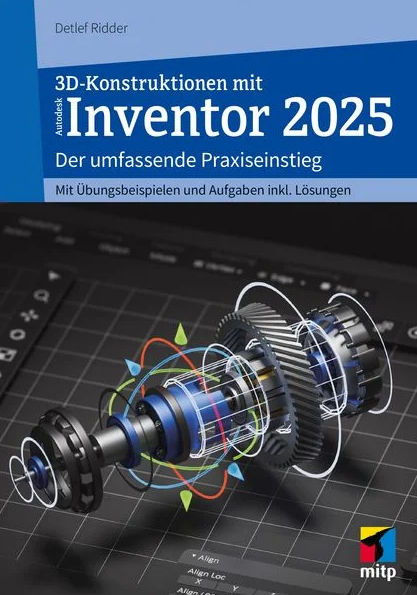
3D-Konstruktionen mit Autodesk Inventor 2025
Der praxisnahe EinstiegDieses Grundlagen- und Lehrbuch zeigt Ihnen anhand vieler einzelner Konstruktionsbeispiele die Möglichkeiten von Inventor 2025 und richtet sich insbesondere an Inventor-Neulinge, die Wert auf einen gründlichen praxisnahen Einstieg legen. Die wichtigsten Vorgehensweisen werden mit vielen einzelnen Beispielen erklärt und können daher leicht für eigene Projekte eingesetzt werden. Inventor von A bis ZAlle wichtigen Befehle werden detailliert vorgestellt: von der Erstellung von 2D-Skizzen mit Bemaßung und Abhängigkeiten über die verschiedenen Arten der Modellierung bis hin zur Erstellung von Baugruppen, Zeichnungsableitung, dem Erstellen von Stücklisten und animierten Präsentationen. Zu jedem Kapitel finden Sie Testfragen mit Lösungen im Anhang, mit denen Sie Ihr Wissen überprüfen und festigen können. Bonuskapitel und Projektdateien zum DownloadDie vollständigen Projekte der 3D-Beispiele inklusive der Bauteile, Baugruppen und Zeichnungen stehen auf der Webseite des Verlags zum Download bereit und helfen Ihnen, alle Übungsbeispiele leicht nachzuvollziehen. Darüber hinaus erhalten Sie zwei digitale Bonuskapitel zu den Spezialthemen »iLogic-Programmierung« und »Module für Blech, Gestell, Welle, Schweißen, BIM-Export, Elektronik«. Aus dem Inhalt:Installation und BenutzeroberflächeSkizzenerstellung in 2D und 3D mit Linie, Bogen, Kreis, Rechteck, Langloch, PolygonAbhängigkeiten und Bemaßungen in der SkizzeAutoCAD-2D-Import3D-Modellierung mit Grundkörpern wie Quader, Zylinder, Kugel und TorusVolumenkörper über Extrusion, Rotation, Sweeping und Lofting (Erhebung)Spezielle Modellierung mit Spirale, Prägen, Ableiten, Rippe und AufklebenVolumenkörper ergänzen: Bohrung, Fase, Rundung, Gewinde, Wandstärke, Flächenverjüngung, Markierungen, Oberflächenbeschaffenheit etc.iFeatures, iMates, iParts, iAssembliesBaugruppen durch Platzieren der Bauteile mit geometrischen Abhängigkeiten oder VerbindungsfunktionenModellzustände, Exemplareigenschaften und GeometrievereinfachungZeichnungsableitung mit Ansichten, Bemaßungen und BeschriftungenErstellen von Stücklisten und PositionsnummernAnimierte Präsentationen, fotorealistische Bilder mit verschiedenen StilenAutoreninfo:Detlef Ridder hat bereits zahlreiche Bücher zu AutoCAD, Inventor, Revit und Archicad veröffentlicht. Er gibt Schulungen zu diesen Programmen und zu CNC und weiß daher, welche Themen für Einsteiger besonders wichtig sind.

Cyber Pandemic
In our increasingly interconnected world, the looming threat of cyber pandemics demands our attention. Cyber Pandemic: A Proactive Look at Blockchain and AI to Prevent the Next Global Shutdown presents a compelling exploration of two cutting-edge technologies and their potential to safeguard our digital landscape. This book combines insightful analysis with practical strategies, empowering individuals and organizations to defend against the catastrophic consequences of cyber-attacks.As cyber threats continue to evolve, a proactive approach is essential. By harnessing the transformative power of blockchain and artificial intelligence (AI), we can fortify our defenses and prevent global shutdowns. This book provides a comprehensive overview of these technologies, highlighting their strengths and synergies in combating cyber threats.With a clear focus on prevention, Cyber Pandemic equips readers with the knowledge and tools needed to anticipate and counter emerging risks. Through real-world examples and expert insights, it explores the proactive measures that individuals, businesses, and policymakers can adopt to enhance cyber resilience.

Microsoft 365 Certified: Collaboration Communications Systems Engineer Associate Certification Companion
This book is designed to help you prepare for Exam MS-721, which is required for Microsoft 365 Certified: Collaboration Communications Systems Engineer Associate certification. The book starts with an introduction to Exam MS -721 and Microsoft Teams. It discusses how to plan and design collaboration communications systems followed by configuration and management of Teams meetings and events. You will learn about Teams Phone and acquire the skills required to configure Direct Routing with Teams Phone. You will go through the configuration of Teams Phone and learn its user settings and features. Teams Meeting Rooms and devices, from deployment to troubleshooting, are discussed along with their Intune policies. And you will learn the configuration of MTRs based on Windows and Surface Hub. What You Will Learn * Understand Microsoft Teams * Plan and design meetings and collaboration * Configure and manage Teams Phone * Optimize the network for Teams and Teams certified devices * Troubleshoot Teams calls and meetings This book is designed to help you prepare for Exam MS-721, which is required for Microsoft 365 Certified: Collaboration Communications Systems Engineer Associate certification. The book starts with an introduction to Exam MS -721 and Microsoft Teams. It discusses how to plan and design collaboration communications systems followed by configuration and management of Teams meetings and events. You will learn about Teams Phone and acquire the skills required to configure Direct Routing with Teams Phone. You will go through the configuration of Teams Phone and learn its user settings and features. Teams Meeting Rooms and devices, from deployment to troubleshooting, are discussed along with their Intune policies. And you will learn the configuration of MTRs based on Windows and Surface Hub. What You Will Learn * Understand Microsoft Teams * Plan and design meetings and collaboration * Configure and manage Teams Phone * Optimize the network for Teams and Teams certified devices * Troubleshoot Teams calls and meetings Who This Book For Individuals aiming to earn the Microsoft 365 Certified: Collaboration Communications Systems Engineer Associate certification, for which Exam MS-721 is a requirement Fabrizio Volpe is an IT professional with more than two decades of experience in networking, security and in the Microsoft ecosystem, with a strong focus on Microsoft collaboration tools. With numerous certifications and awards to his name, he has contributed extensively to the IT community through blogging, authoring books, and delivering engaging presentations at industry conferences. He is a senior consultant at Exponential-e. Chapter 1: Introduction to Exam MS-721.- Chapter 2: Teams Meetings.- Chapter 3: Configure and Manage Audio Conferencing and Live Events.- Chapter 4: Introducing Teams Phone.- Chapter 5: Using Direct Routing with Teams Phone.- Chapter 6: Configuring Teams Phone.- Chapter 7: Teams Phone and Users.- Chapter 8: Teams Rooms and Devices.- Chapter 9: MTRs Based on Windows and Surface Hub Optional Features for MTRs.- Chapter 10: Getting Your Network Ready for the Rollout of Teams.

There's No Such Thing as Crypto Crime
HANDS-ON GUIDANCE FOR PROFESSIONALS INVESTIGATING CRIMES THAT INCLUDE CRYPTOCURRENCYIn There’s No Such Thing as Crypto Crime: An Investigators Guide, accomplished cybersecurity and forensics consultant Nick Furneaux delivers an expert discussion of the key methods used by cryptocurrency investigators, including investigations on Bitcoin and Ethereum type blockchains. The book explores the criminal opportunities available to malicious actors in the crypto universe, as well as the investigative principles common to this realm.The author explains in detail a variety of essential topics, including how cryptocurrency is used in crime, exploiting wallets, and investigative methodologies for the primary chains, as well as digging into important areas such as tracing through contracts, coin-swaps, layer 2 chains and bridges. He also provides engaging and informative presentations of:* Strategies used by investigators around the world to seize the fruits of crypto-related crime* How non-fungible tokens, new alt-currency tokens, and decentralized finance factor into cryptocurrency crime* The application of common investigative principles—like discovery—to the world of cryptocurrencyAn essential and effective playbook for combating crypto-related financial crime, There’s No Such Thing as Crypto Crime will earn a place in the libraries of financial investigators, fraud and forensics professionals, and cybercrime specialists.NICK FURNEAUX is a cybersecurity and forensics consultant specializing in the prevention and investigation of cybercrime. Nick is author of the 2018 book Investigating Cryptocurrencies and has trained thousands of investigators in the skills needed to track cryptocurrency used in crimes. He works within the training academy at TRM Labs, and is an advisor to the Board of Asset Reality. Foreword xiiiIntroduction xvii1 A HISTORY OF CRYPTOCURRENCIES AND CRIME 1Where Did It All Start? 3The Rise of the Smart Contract 7The Next Targets? 14The Future? More Crime! 162 UNDERSTANDING THE CRIMINAL OPPORTUNITIES: MONEY LAUNDERING 19There Is No Such Thing as Crypto Crime 36Money Laundering 40What Is an Investigator Looking For? 42Centralized Exchanges 43NFTs and NFT Gaming 45Mixers 48Decentralized Exchanges 53Casinos. 56Chain Hopping 57Privacy Coins 59Crypto ATMs 62Peer-to-Peer Platforms 643 UNDERSTANDING THE CRIMINAL OPPORTUNITIES: THEFT 67Crypto Thefts 67Social Engineering 67Phishing 68Hacks 71Fraud 73Rug Pull 74Pig-Butchering/Romance Scams 76Investment Scams 79Support Scams 83Simple Theft 84Contract Manipulation 86Fake Contracts 86Exploiting the Contract 87Phishing 89Flash Loans 90Playing by the Rules 92Other Criminal Opportunities 96Yield Farming 96Funding of Groups 97Sanctions Avoidance 99Summary 1084 WHO SHOULD BE A CRYPTOCURRENCY INVESTIGATOR? 109Individual Skills 111Knowledge of Technological Systems 111Knowledge of Digital Currencies 112Understanding of the Cryptocurrency Market 112Extensive Knowledge of Computer Networks 113Cryptography 114Financial Crime 114Fraud Investigators 114Open Source Investigations 115Cybercrime Investigations 116Setting Up a Cryptocurrency Investigation Department 117Other Roles. 1235 THE ROLE OF COMMERCIAL INVESTIGATION TOOLS 125Do You Need a Commercial Tool? 129Two Is One and One Is None 133The Future of Investigation Tools 1356 MINING: THE KEY TO CRYPTOCURRENCIES 139What Really Is Mining? 141Validating Transactions 141Minting New Coins 142Proof of Work (PoW) Mining 142How PoW Mining Works 142Energy Consumption and Environmental Concerns 145Proof of Stake (PoS) Mining 146How PoS Mining Works 146Advantages of PoS Mining 146Does an Investigator Need to Understand Mining Technologies? 146Cryptocurrency Mining Frauds and Scams 147Cloud Mining Scams 147Ponzi and Pyramid Schemes 148Malware and Cryptojacking 149Asset Discovery 149Will Cryptocurrencies Always Be Mined? 1507 CRYPTOCURRENCY WALLETS 153When a Wallet Is Not Really a Wallet 155Types of Cryptocurrency Wallets 156Hot Wallets 157Desktop Wallets. 157Mobile Wallets 158Web/Online Wallets 158Cold Wallets 160Hardware Wallets 160Paper Wallets 161Software Wallets: Functionality and Security 162Functionality 163Security 163Hardware Wallets: Functionality and Security 164Functionality 164Security 164Choosing the Right Wallet 165Wallet Vulnerabilities 166Weak or Reused Passwords 166Phishing Attacks 166Malware 167On-Path Attacks 167Vulnerable Wallet Software 168Lack of Two-Factor Authentication (2FA) 168Social Engineering 169SIM-Swapping Attacks 169Supply Chain Attacks 1708 THE IMPORTANCE OF DISCOVERY 173Premises Searching: Legal Framework and Search Powers 176Search Strategies 177Handling and Securing Evidence 177Evidence Bags 178Body Cameras 179Photography 179Chain of Custody 180Physical Clues. 181Hardware Wallets 181Paper Wallets 183QR Codes 186Documentation 186Questioning 188General Understanding 188Involvement and Knowledge of Cryptocurrencies 188Specific Details of the Alleged Crime 189Technical Details 189Searching Digital Assets 190Legal Framework and Warrants 192Digital Forensics 194Hardware Examination 198Storage Devices 198RAM Analysis 200What are you looking for? 202Handling and Securing Digital Evidence 204The Role of Exchanges 204Senior Officers/Management 206Summary 2069 THE WORKINGS OF BITCOIN AND DERIVATIVES 209Bitcoin Is a Blockchain-Based UTXO Cryptocurrency 210UTXO 211What Does an Transaction Look Like? 215How Does a UTXO Blockchain Help an Investigator? 220Blockchain Explorers 222What Else Can You Learn in a Transaction? 226Times and Dates 227Values 229Omni Layer 231Taproot 232The Lightning Network 235Summary 23710 BITCOIN: INVESTIGATION METHODOLOGY 239Building an Investigation in Bitcoin 251Address Clustering 253How Are Clusters Defined? 255Co-spend Heuristic 255Change Analysis 256Nominal Spend 257Address Type Analysis 259Multisig Analysis 260Round Number Payments 261Some Other Things to Note 262Change of Ownership 263Change of Wallet 263Look at the Amounts 263Address Triage 265Attribution 271Investigating Bitcoin 27111 THE WORKINGS OF ETHEREUM AND DERIVATIVES 273History of the Ethereum Cryptocurrency 274Ethereum Fundamentals 276Types of Tokens 279Ethereum Transaction Types 282One Address for All Tokens 286A User’s Address Can Be the Same on Other Blockchains 288Reading Basic Transactions 290Transaction Methods 291Transaction and Address Types 293What Are These Contracts We Keep Mentioning? 294Identifying Contract Transactions 295Conclusion 29612 ETHEREUM: INVESTIGATION METHODOLOGY 297Following ETH-to-ETH Transactions 297Smart Contracts Deep Dive 304Methods, Functions, and Events 307Code 309Read Contract 310Write Contract. 310Logs 314ETH-to-Contract Transactions 316Token-to-Token Transactions 324NFTs 329Decentralized Exchanges 335Reading Decentralized Finance Contracts 342The Approve Transaction 351Summary 35313 INVESTIGATING BINANCE SMART CHAIN 355What is Binance Smart Chain? 355Investigating Funds on Binance Smart Chain 357What Have You Learned? 36414 APPLYING WHAT YOU HAVE LEARNED TO NEW CRYPTOCURRENCIES 367Stable Coins Such as USDT, USDC, and Paxos 368Tron 372Tron Fee Structure 372What Transactions Look Like 372Layer 2 Chains 377Bridges 383Mixers 388Bitcoin Mixing 389Ethereum Mixing 393Privacy Coins 395Monero (XMR): The Vanguard of Privacy Coins 396Zcash (ZEC): Selective Transparency 396Dash (DASH): Privacy as an Option 397Horizen (ZEN): Extended Privacy with Sidechains 397Grin and Beam: Mimblewimble Protocol 398What Have You Learned? 39815 OPEN SOURCE INTELLIGENCE AND THE BLOCKCHAIN 401Mindset 402Just “Search Engine” It 404Attribution of Individuals 412NFT Metadata 421OSINT and the Dark Web 423Summary 42516 USING WALLETS FOR INVESTIGATIONS 427Understanding Cryptocurrency Wallets 427Seed Words and Wallet Recovery 428Step-by-Step Guide to HD Wallet Re-creation 428What Can Be Seen? 429The Benefits of Wallet Re-creation in Investigations 434Understanding Derivation Paths in Cryptocurrency Wallets 435The Importance of Understanding Derivation Paths for Investigators 435Avoiding Oversight and Ensuring Legal Admissibility 436The Concept of a Derivation Path 436Bitcoin vs Ethereum Derivation Paths 437Changing Derivation Paths in Software Wallets 438To Sum Up 44417 CRYPTO SEIZURE 445What Do You Need to Carry Out a Crypto Seizure? 463Recording Seed Words 466Seizing to Your Own Wallet 467Considerations for a Software Wallet 467Considerations for a Hardware Wallet 468Establishing an Organizational Process 469Document Your Processes 469Methods of Recording 470Paperwork 470Video 470Preparation and Administration 471Documentation in Law Enforcement Systems 471Questions to Ask before Carrying Out a Crypto Seizure 471Preparing for a Time-Sensitive Seizure 472On-Site Seizure Considerations 472Managing Access and Potential Threats 472On-Site Toolkit and Practice 473Where to Store Seized Assets? 473Seizing to an Exchange 473Specialist Custodians 474Seizing to a Law Enforcement–Controlled Wallet 475Final Thoughts 477Acknowledgments 483About the Author 485About the Contributors 487About the Technical Editor 493Index 495

Die Welt der Modelle und Simulationen
Jedem Benutzer eines Computers stehen heute viele Anwendungen über Modellbildungsprobleme zur Verfügung. Darunter gibt es auch viele gemeinfreie Anwendungen, die sich teilweise auch im Privat- und Hobbybereich einsetzen lassen. Das Buch erläutert viele Grundlagen der Modellbildung und Simulation und zeigt den Zusammenhang mit der historischen Entwicklung auf.
Bitcoin - Grundlagen und Programmierung (3. Auflg.)
Bitcoin- Grundlagen und ProgrammierungDieses Handbuch ist Ihr Wegweiser durch die zunächst komplexe Welt von Bitcoin. Es vermittelt Ihnen das technische Wissen, das Sie benötigen, um aktiv am Internet des Geldes teilzuhaben. Ganz gleich, ob Sie die nächste Killer-App entwickeln, in ein Start-up investieren oder einfach nur neugierig auf die Technologie sind: Die überarbeitete und erweiterte Auflage liefert Ihnen die Grundlagen für den praktischen Einstieg. Die dritte Auflage beinhaltet: Eine umfassende Einführung in Bitcoin und die zugrundeliegende Blockchain - ideal für eher nichttechnisch ausgerichtete Nutzer, Investoren und Führungskräfte Eine Erklärung der technischen Grundlagen von Bitcoin und der Kryptowährung für Entwickler, Engineers, Software- und SystemarchitektenDetails des dezentralen Bitcoin-Netzwerks, der Peer-to-Peer-Architektur, des Transaktionslebenszyklus und der Sicherheitsmechanismen Neue Entwicklungen wie Taproot, Tapscript, Schnorr-Signaturen und das Lightning-NetzwerkEinen tiefen Einblick in Bitcoin-Anwendungen, einschließlich der Frage, wie man die Bausteine dieser Plattform zu leistungsstarken neuen Tools kombiniertUser Stories, Beispiele und Codeschnipsel zur Veranschaulichung wichtiger technischer Konzepte
Programmieren mit KI
Der praktische Einstieg in die KI-basierte Programmierung (1. Auflage, Oktober 2024)Nutzen Sie das Potenzial der neuesten KI-Technologien für Ihre Arbeit: Dieser praktische Leitfaden zeigt den Einsatz von KI-Assistenten für die gesamte Softwareentwicklung – einschließlich Planung, Design und Debugging. Sie erfahren, wie Sie eine breite Palette von Werkzeugen verwenden können, um schneller und effizienter zu programmieren – von allgemeinen LLMs (ChatGPT, Gemini und Claude) bis hin zu codespezifischen Systemen (GitHub Copilot, Tabnine, Cursor und Amazon CodeWhisperer).Tom Taulli – bekannt für seinen lockeren und unterhaltsamen Schreibstil – stellt eine modulare Programmiermethodik vor, die optimal auf die Art und Weise abgestimmt ist, wie Prompts KI-generierten Code erzeugen. Er beschreibt auch, wie LLMs genutzt werden können, um eine Programmiersprache zu lernen, Code zu erklären oder Code von einer Sprache in eine andere zu konvertieren. Das Buch behandelt:Die zentralen Funktionen von KI-basierten EntwicklungstoolsVor- und Nachteile sowie Use Cases beliebter Systeme, einschließlich GitHub CopilotDie Einsatzmöglichkeiten von ChatGPT, Gemini, Claude und anderen LLMs für die ProgrammierungKI-Entwicklungswerkzeuge für den gesamten Lebenszyklus der Softwareentwicklung, einschließlich Requirements, Fehlerbehebung und DokumentationPrompt Engineering für die ProgrammierungDen Einsatz von KI-Assistenz für mühsame Aufgaben wie die Erstellung regulärer AusdrückeDie Verwendung von KI-basierten Low-Code- und No-Code-ToolsAutoreninfo:Tom Taulli ist ein Autor, Berater und Investor, der zahlreiche Bücher, darunter den Titel Artificial Intelligence Basics, verfasst hat. Er schreibt auch für Publikationen wie AIBusiness.com, Inc.com, Barrons.com, eSecurity Planet und Kiplingers.com und hat für O'Reilly und Pluralsight Kurse zu Themen wie generative KI, Datenbanken und Python entwickelt.Zielgruppe:Programmierer*innen Softwareentwickler*innen

Datenarchitekturen
Gewinnen Sie Klarheit über verbreitete Datenarchitektur-Konzepte Alle Konzepte im Überblick: Der erste Leitfaden für die verschiedenen Ansätze, der hilft, eine Architektur auszuwählen, die zu den eigenen Anforderungen passt Beschreibt die populärsten Datenarchitekturen, zeigt Vor- und Nachteile und wie sich Theorie und Praxis unterscheiden Inkl. zahlreicher Schaubilder und vergleichender Tabellen Data Fabric, Data Lakehouse und Data Mesh sind als praktikable Alternativen zum Modern Data Warehouse in den Fokus der Unternehmen gerückt. Diese neuen Architekturen haben solide Vorteile, aber ihre fachliche Einordnung ist auch von Missverständnissen und Übertreibungen geprägt. Dieses praxisorientierte Buch bietet eine gut verständliche Einführung in jeden dieser Architekturansätze und hilft damit Datenexpertinnen und -praktikern, die jeweiligen Vor- und Nachteile zu verstehen. James Serra erläutert die Konzepte gängiger Datenarchitekturen und zeigt dabei auch, wie sich Data Warehouses weiterentwickeln mussten, um mit Data-Lake-Funktionen arbeiten zu können. Sie erfahren, was Sie mit Data Lakehouses erreichen können und wie Sie Hype und Realität bei Data Meshs unterscheiden. Nach der Lektüre dieses Buchs werden Sie in der Lage sein, die für Ihre Zwecke am besten geeignete Datenarchitektur zu bestimmen. Entwickeln Sie ein grundlegendes Verständnis für die verschiedenen Datenarchitekturen Informieren Sie sich über die Stärken und Schwächen der einzelnen Ansätze Verstehen Sie die Unterschiede zwischen Data Warehouses und Data Lakes Profitieren Sie von der langjährigen Erfahrung von James Serra und erfahren Sie, wie Theorie und Praxis der jeweiligen Datenarchitekturen voneinander abweichen Wählen Sie die beste Architektur für Ihren Anwendungsfall aus Lernen Sie, wie man eine Architektur-Design-Sitzung durchführt, das Team organisiert und was die Erfolgsfaktoren für ein Projekt sind

Bitcoin - Grundlagen und Programmierung
Bestseller in 3. Auflage: Die verständliche technische Einführung für Entwickler und Interessierte - Andreas M. Antonopoulos ist einer der weltweit führenden Bitcoin- und Open-Blockchain-Experten. - Die Grundlagen von Blockchain und Bitcoin inklusive des dezentralen Bitcoin-Netzwerks, der Peer-to-Peer-Architektur, des Transaktionslebenszyklus und der Sicherheitsverfahren umfassend erklärt. - Deckt neue Entwicklungen wie Taproot, Tapscript, Schnorr-Signaturen und das Lightning Netzwerk ab und bietet wertvolles Know-how für die Developer-Praxis. Bitcoin und Blockchain haben die Finanzwelt revolutioniert und eine milliardenschwere globale Wirtschaft entstehen lassen. Dieses Handbuch ist Ihr Wegweiser durch die zunächst komplexe Welt von Bitcoin. Es vermittelt Ihnen das technische Wissen, das Sie benötigen, um aktiv am Internet des Geldes teilzuhaben. Ganz gleich, ob Sie die nächste Killer-App entwickeln, in ein Start-up investieren oder einfach nur neugierig auf die Technologie sind: Die überarbeitete und erweiterte Auflage liefert Ihnen die Grundlagen für den praktischen Einstieg. Die dritte Auflage beinhaltet: - Eine umfassende Einführung in Bitcoin und die zugrundeliegende Blockchain – ideal für eher nichttechnisch ausgerichtete Nutzer, Investoren und Führungskräfte - Eine Erklärung der technischen Grundlagen von Bitcoin und der Kryptowährung für Entwickler, Engineers, Software- und Systemarchitekten - Details des dezentralen Bitcoin-Netzwerks, der Peer-to-Peer-Architektur, des Transaktionslebenszyklus und der Sicherheitsmechanismen - Neue Entwicklungen wie Taproot, Tapscript, Schnorr-Signaturen und das Lightning-Netzwerk - Einen tiefen Einblick in Bitcoin-Anwendungen, einschließlich der Frage, wie man die Bausteine dieser Plattform zu leistungsstarken neuen Tools kombiniert - User Stories, Beispiele und Codeschnipsel zur Veranschaulichung wichtiger technischer Konzepte