

Computer und IT

Microsoft 365 Excel VBA Programming For Dummies
YOUR STEP-BY-STEP GUIDE TO DOING MORE WITH MICROSOFT EXCELFully updated for the latest version of Office 365, Excel VBA Programming For Dummies will take your Excel knowledge to the next level. With a little background in Visual Basic for Applications (VBA) programming, you can go well beyond basic spreadsheets and functions. Learn the coding basics and syntax you need to write simple or complex macros that can automate your routine Excel tasks. Become an Excel power user by automating data management, user forms, pivot tables, and beyond. When you use VBA to perform Excel operations, you can reduce errors, save time, and integrate with other Microsoft applications. This handy guide also teaches you how to control the security settings for your macros and save macros to use across files and apps. Plus, you'll get updated coverage of Copilot AI integration. Your spreadsheets are about to get much more powerful.* Get stared with VBA coding to create macros and automate tasks in Excel* Follow step-by-step instructions to write and execute your first scripts* Learn about the advanced functions available with the VBA language* Perform tasks faster and integrate excel with other Microsoft appsThis Dummies guide is right up your alley if you're an Excel user looking to learn some next-level features. Students and professionals alike will reap the benefits of automation, thanks to Excel VBA Programming For Dummies.DICK KUSLEIKA has more than 25 years’ experience helping Office users get the most out of Microsoft’s bestselling software. From online forums to blogs, books, and conferences, he delivers sound and straightforward advice to readers of all skill levels.

Microsoft 365 Word For Dummies
TAKE A DEEP DIVE INTO THE MOST POPULAR WORD PROCESSOR ON THE PLANETWord, Microsoft's powerful and popular word processor, is capable of extraordinary things. From template building to fancy formatting and even AI-powered editing and proofing, your copy of Word stands ready to help you supercharge your productivity and save you time and energy. You just need to learn how it's done. And, thanks to this easy-to-understand book, learning is the easy part!This latest edition of Word For Dummies is packed with the essentials you need to turn any old copy of the famous word processor into a document-creating, table-formatting, graphics-editing super app. You'll even learn how to customize your version of Microsoft Word so it's absolutely perfect for you, at home and at work. You'll also find out how to:* Navigate the Word interface and menus and figure out a ton of hotkey shortcuts* Edit, format, and comment documents to make team collaboration a breeze* Use the new Microsoft Copilot's AI capabilities to make Word even more powerfulSo, grab your copy of the latest edition of Word For Dummies today. It's perfect for casual users interested in upgrading their knowledge of this ubiquitous app as well as power users looking for the latest productivity tips and tricks. DAN GOOKIN wrote the first-ever For Dummies book in 1991. The author of several bestsellers, Dan’s books have been translated into 32 languages and have more than 11 million copies in print. Dan is the bestselling author of all editions of Word For Dummies.

Microsoft Copilot For Dummies
STRAIGHTFORWARD GUIDANCE ON THE AI TOOL THAT'S BUILT INTO WINDOWS, MICROSOFT 365, AND MOREMicrosoft is enhancing all its most widely used productivity software—including Windows and apps like Word and Excel—with the power of AI. And now you can learn to make the most of this revolutionary new tool with Microsoft Copilot For Dummies!You'll discover how to write Copilot-friendly prompts, enhance output with integrated Copilot tools, and how to apply Copilot functions to project management and other specific tasks and disciplines. In the book, you'll find out how to:* Use text or your voice to prompt reliable results from Microsoft Copilot* Customize Microsoft Copilot to respond to your unique needs and demands* Add plug-ins to the Microsoft Copilot service to extend its functionality even moreLearn to supercharge your efficiency with Microsoft Copilot For Dummies. This book is perfect for professional and home users of Windows, Microsoft 365, and other Microsoft products and software who want to increase their productivity. Grab a copy today! CHRIS MINNICK is an accomplished author, teacher, and programmer. Minnick has authored or coauthored over 20 books, including titles in the For Dummies series. He has developed video courses for online training providers, and he teaches programming and machine learning to professional developers at leading companies globally. He is author of Coding with AI For Dummies and JavaScript All-in-One For Dummies.

Regenerating Learning
The perfect storm of learning provoked by generative AI is not just about learning how to use the technology to change human patterns of work and life. The technologies are re-orienting how we think we learn, how we communicate with each other, and the economic, social, political, creative, and ethical factors that inform how we navigate human-influenced existence on this planet. This book addresses the need for workers in any industry to take responsibility for learning how to best use generative AI systems in their unique contexts. Generative AI can navigate you towards learning, but also towards conducting research and teaching yourself things; to empower you in reimagining and reinventing how you learn while doing your work. Just like you can regenerate content persistently using generative AI systems, so too can you regenerate what and how you learn. Chapters will prepare you to inform and guide the small team you are a part of, or influence leadership to navigate the territory of leveraging generative AI systems responsibly. Besides pointing to all the more obvious benefits of learning how to use generative AI systems more effectively, this book provides use cases, research and educational theory to propose that interacting with the technology leads to a number of unanticipated learning outcomes. These outcomes challenge the very way in which we have come to learn, what we have learned, and what we may need to unlearn. As generative AI becomes increasingly integrated within workplace environments at some point or other we will each reach a critical point of having to decide if we are going to use the technology and how. The perfect storm of learning provoked by generative AI is not just about learning how to use the technology to change human patterns of work and life. The technologies are re-orienting how we think we learn, what we learn, what we need to learn, when and where we learn about knowledge production, how humans communicate with each other, the economic, social, political, creative, ethical and technological factors that inform how we navigate human influenced existence on this planet. The technology empowers you to reimagine and reinvent how you learn while doing your work. Just like you can regenerate content persistently using generative AI systems, so too can you regenerate what and how you learn. Regenerating Learning will help guide the small team you are a part of, or influence leadership to leverage generative AI systems responsibly. Besides pointing to all the more obvious benefits of learning how to use generative AI systems more effectively, this book provides use cases, research and educational theory to propose that interacting with the technology leads to a number of unanticipated learning outcomes. These outcomes challenge the very way in which we have come to learn, what we have learned, and what we may need to unlearn. As generative AI becomes increasingly integrated within workplace environments at some point or other we will each need to decide if we are going to use the technology and how. What You will Learn • Methods and techniques to re-learn how you learn through your interactions with different generative AI. • Strategic approaches to integrate generative AI within your workflows. • How to iterate, adapt, prototype and learn continuously with generative AI. • A variety of tools and approaches to reconcile your organization’s use of generative AI. • How to develop a road map towards the integration of AI systems within your organization. Who this Book Is For Creatives, team leaders, managers and leadership in different organizations; teams in collaborative and creative industries; managers and employees in organizational learning Patrick Parra Pennefather is an Associate Professor and Researcher at the University of British Columbia within the Faculty of Arts and the Emerging Media Lab. His research is focused on Collaborative Learning Practices, Emerging technology development, Research Creations, and GraphRAG research and development within the field of machine learning. Patrick also works with learning organizations and technology companies around the world to adopt generative AI strategically within complex and inter-dependent team environments, and design learning courses that meets the needs of diverse communities to aid the development of the next generation of technology designers and developers. 1: Ready Yourself to Learn From AI.- 2: Reprogram Your Learning Patterns.- 3: Regulate How You Learn.- 4: Re-Learn While Working.-5: Design Your Own Learning.- 6: Re-energize Doing.- 7: Re-Assess with Generative AI.- 8: Re-Adjust with AI.- 9: Prototype Learning.- 10: Re-Iterate How You Learn.- 11:Reconciling Using Generative AI.- 12: Remember the Algorithms.- 13: Continuously Improve and Learn with AI.- 14: Build Your Own Teaching Bots.- 15: Re-Invent Reinforcement.- 16: Learn with Other Bots.- 17: Transform Your Organization.- 18: Reclaim Your Creative Content.- 19: Fill in the Blanks.- 20: An Intelligent Conclusion.
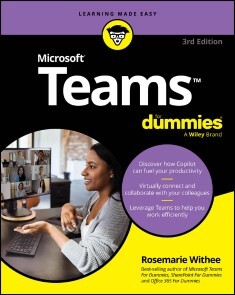
Microsoft Teams For Dummies
Learn to be a good Teams player Microsoft Teams is everyone’s favorite app to use at work. Okay, maybe it’s not your favorite, but you’ll appreciate it more when you discover how it can make your workday easier. Microsoft® Teams™ For Dummies gets you started with the basics, then shows you how to make the most of chatting, file sharing, video conferencing, and beyond. Plus, you’ll get a rundown on Copilot—Microsoft’s new AI assistant—including how it can streamline your processes, summarize meetings, and generally make your life easier. Let’s get Team-ing! Inside… Using the Teams mobile appMaking and receiving callsImproving your Teams meetingsManaging teams and channelsUncovering Teams administrationHosting hybrid meetingsIntegrating other appsUsing Teams for small business Unlock the full power of Microsoft Teams, including brand-new AI functionality, with your friends at For Dummies Looking for a fast and easy guide to Microsoft Teams, the collaboration software used by millions of people and companies around the world? In Microsoft Teams For Dummies, 3rd edition, you'll find the must-know tips, hidden tricks, and handy hacks you need to help you rock your workday and get things done lightning-fast. You'll learn how to incorporate Teams into your everyday workflow and use functionality like chatting, file sharing, team organization, videochat, and more. You'll even learn how to use Microsoft's brand-new AI companion Copilot to help you improve your processes and productivity. You'll find out how to: Connect with colleagues and collaborate remotely, from across the hall or from the other side of the worldUse little-known Teams features to help you supercharge your productivity and get more done in a dayCustomize your Teams installation and make it work better for you and your teammates An engaging and effective roadmap to one of Microsoft's most popular apps, Microsoft Teams For Dummies is a must-read for everyone who uses—or wants to use—this powerful software at work or anywhere else. Grab a copy today! Rosemarie Withee is president of Portal Integrators, a Scrum-based software and services firm. Rosemarie has authored a number of books in the For Dummies series, including the most recent editions of Office 365 For Dummies and SharePoint For Dummies.

GIMP - Einstieg und Praxis (2. Auflg.)
GIMP – Praxisnaher Einstieg für Anfänger und Fortgeschrittene – klar, verständlich, visuell erklärt. In 2. Auflage aus Dezember 2024.GIMP ist eine der beliebtesten Open-Source-Programme für Bildbearbeitung. Dieses Buch hilft Ihnen, sich mit der optimierten Benutzeroberfläche und zahlreichen neuen Funktionen vertraut zu machen. Nach einer Einführung in die wichtigsten Werkzeuge und Funktionen setzen Sie Ihr Wissen direkt praktisch um: Verbessern Sie die Schärfe und den Kontrast Ihrer Fotos, entfernen Sie störende Elemente und bearbeiten Sie gezielt bestimmte Bildbereiche mit den Auswahlwerkzeugen. Für komplexere Anpassungen arbeiten Sie mit Ebenen, und dank Filtern und Effekten verleihen Sie Ihren Bildern einen völlig neuen Stil. Aus dem Inhalt:12 einfach nachvollziehbare Lektionen für beeindruckende Ergebnisse Einführung in Arbeitsoberfläche, Werkzeuge und Voreinstellungen Schnelle sowie anspruchsvolle Bildkorrekturen Effiziente Nutzung von Auswahlwerkzeugen Kreatives Arbeiten mit Ebenen, Filtern und Effekten Erstellung professioneller Schriftzüge Praktische Tastenkombinationen für alle zentralen Funktionen
Nachhaltige Künstliche Intelligenz
Die aus KI entstehenden Möglichkeiten sind immens. Speziell das maschinelle Lernen ist für viele deutsche Unternehmen mittlerweile kein Fremdwort mehr. In durchweg allen Branchen werden die Einsatzmöglichkeiten von trainierten Modellen evaluiert, die neue Geschäftsfelder entstehen lassen oder bestehende Abläufe optimieren. In der Euphorie werden von vielen Akteurinnen und Akteuren Nachhaltigkeitsaspekte vernachlässigt. Zum Beispiel kann das Training von KI-Algorithmen und der Betrieb der Systeme durchaus ressourcenintensiv sein kann. Die derzeitige Entwicklung zielt darauf ab, bestehende Modelle noch akkurater bzw. performanter zu machen. Dabei müssen Performance und Nachhaltigkeit von KI-Systemen kein Widerspruch sein.Dieses Buch verfolgt das Anliegen, die Chancen nachhaltiger KI-Ansätze darzustellen. Es wird detailliert auf Nachhaltigkeit in der IT, Nachhaltigkeit durch KI sowie auf Digitale Ethik eingegangen. Nicht alle 17 UN-Agenda 2030 Ziele werden behandelt, der Fokus liegt auf der ökologischen Nachhaltigkeit. Das Buch ist kein Theoriewerk. Es beinhaltet diverse konkrete Empfehlungen für zur direkten Anwendung für nachhaltigere KI-Projekte.Aus dem Inhalt: Einleitung und Problemstellung – 6 Problemstellung – 8 UN-Agenda 2030: 17 Nachhaltigkeitsziele und KI – 11 Aufbau des Buches – 14 Literatur – 16 Nachhaltigkeit in KI – 18 Deep Learning: Innovation oder ein wachsendes Problem? – 20 Technische Grundlagen – 23 Technische Möglichkeiten zur Reduzierung des Energieverbrauchs – 26 Lösungen für praktische Anwendungen – 29 Literatur – 32 Nachhaltigkeit durch KI – 33 Einleitung – 33 Stand der Forschung – 35 Typen von KI für Nachhaltigkeit – 40 Decision Trees – 40 Support Vector Machines – 42 K-Nearest Neighbor (KNN) – 43 Clustering – 44 Deep Learning und neuronale Netze – 45 Reinforcement Learning – 47 Few Shot Learning – 47 Long-Short-Term-Memory (LSTM) – 49 KI für (mehr) Nachhaltigkeit – 51 Use-Cases KI für Nachhaltigkeit – 58 Leitfaden für die KI-Implementierung im Unternehmen – 69 Phase 1 – Zielsetzung und Folgenabschätzung – 74 Phase 2 – Planung und Gestaltung – 74 Phase 3 – Vorbereitung und Implementierung – 75 Phase 4 – Evaluation und Anpassung – 78 Literatur – 78 Nachhaltigkeitsethik und Künstliche Intelligenz – 81 Ethische Implikationen der Nachhaltigkeit – 81 Ethische und nachhaltige Maßstäbe des Handelns – 82 Die Verantwortung von Unternehmen – 82 Digitale Ethik – 83 Freiwillige Standards vs. gesetzliche Regulierungen – 84 Freiwillige Standards – 84 Gesetzliche Regulierungen – 85 Digitale Ethik im Unternehmen – 86 Fazit – 88 Literatur – 88 Zusammenfassung und Ausblick – 91 Zusammenfassung – 91 Ausblick – 97

Microsoft 365 PowerPoint For Dummies
PRESENT LIKE A PRO, WITH THE TOP-SELLING POWERPOINT BOOK ON THE MARKETSince 1999, PowerPoint For Dummies has been giving readers a jargon-free way to compose compelling presentations. This update covers the latest release of Office and Office 365. Learn the basics of creating a slide deck in PowerPoint, then discover the dynamic features you can use to give your slides a bit of pizazz. Import data from other applications, collaborate in the cloud, and incorporate charts, graphics, and videos into your presentations. Plus, learn how to use Microsoft's new Copilot AI tool—integrated right into the application. Consider this book your first step to making a splash with PowerPoint!* Create your first PowerPoint slide deck and add presentation notes* Improve the design of your slides with templates and best-practice tips* Add animations, change your font style, and insert images and drawings* Share your presentation with audiences in a virtual settingNew and not-so-new PowerPoint users who need a guide to the basics of building a successful presentation will love this up-to-date, beginner-friendly book. DOUG LOWE is the information technology director for a civil engineering firm. He has been managing networks for more than 20 years and is the best-selling author of more than 30 For Dummies books, including Networking For Dummies and Networking All-in-One For Dummies.

Microsoft 365 Excel VBA Programming For Dummies
YOUR STEP-BY-STEP GUIDE TO DOING MORE WITH MICROSOFT EXCELFully updated for the latest version of Office 365, Excel VBA Programming For Dummies will take your Excel knowledge to the next level. With a little background in Visual Basic for Applications (VBA) programming, you can go well beyond basic spreadsheets and functions. Learn the coding basics and syntax you need to write simple or complex macros that can automate your routine Excel tasks. Become an Excel power user by automating data management, user forms, pivot tables, and beyond. When you use VBA to perform Excel operations, you can reduce errors, save time, and integrate with other Microsoft applications. This handy guide also teaches you how to control the security settings for your macros and save macros to use across files and apps. Plus, you'll get updated coverage of Copilot AI integration. Your spreadsheets are about to get much more powerful.* Get stared with VBA coding to create macros and automate tasks in Excel* Follow step-by-step instructions to write and execute your first scripts* Learn about the advanced functions available with the VBA language* Perform tasks faster and integrate excel with other Microsoft appsThis Dummies guide is right up your alley if you're an Excel user looking to learn some next-level features. Students and professionals alike will reap the benefits of automation, thanks to Excel VBA Programming For Dummies.DICK KUSLEIKA has more than 25 years’ experience helping Office users get the most out of Microsoft’s bestselling software. From online forums to blogs, books, and conferences, he delivers sound and straightforward advice to readers of all skill levels.

Microsoft 365 Word For Dummies
TAKE A DEEP DIVE INTO THE MOST POPULAR WORD PROCESSOR ON THE PLANETWord, Microsoft's powerful and popular word processor, is capable of extraordinary things. From template building to fancy formatting and even AI-powered editing and proofing, your copy of Word stands ready to help you supercharge your productivity and save you time and energy. You just need to learn how it's done. And, thanks to this easy-to-understand book, learning is the easy part!This latest edition of Word For Dummies is packed with the essentials you need to turn any old copy of the famous word processor into a document-creating, table-formatting, graphics-editing super app. You'll even learn how to customize your version of Microsoft Word so it's absolutely perfect for you, at home and at work. You'll also find out how to:* Navigate the Word interface and menus and figure out a ton of hotkey shortcuts* Edit, format, and comment documents to make team collaboration a breeze* Use the new Microsoft Copilot's AI capabilities to make Word even more powerfulSo, grab your copy of the latest edition of Word For Dummies today. It's perfect for casual users interested in upgrading their knowledge of this ubiquitous app as well as power users looking for the latest productivity tips and tricks. DAN GOOKIN wrote the first-ever For Dummies book in 1991. The author of several bestsellers, Dan’s books have been translated into 32 languages and have more than 11 million copies in print. Dan is the bestselling author of all editions of Word For Dummies.

Microsoft Teams For Dummies
UNLOCK THE FULL POWER OF MICROSOFT TEAMS, INCLUDING BRAND-NEW AI FUNCTIONALITY, WITH YOUR FRIENDS AT FOR DUMMIESLooking for a fast and easy guide to Microsoft Teams, the collaboration software used by millions of people and companies around the world? In Microsoft Teams For Dummies, 3rd edition, you'll find the must-know tips, hidden tricks, and handy hacks you need to help you rock your workday and get things done lightning-fast. You'll learn how to incorporate Teams into your everyday workflow and use functionality like chatting, file sharing, team organization, videochat, and more. You'll even learn how to use Microsoft's brand-new AI companion Copilot to help you improve your processes and productivity. You'll find out how to:* Connect with colleagues and collaborate remotely, from across the hall or from the other side of the world* Use little-known Teams features to help you supercharge your productivity and get more done in a day* Customize your Teams installation and make it work better for you and your teammatesAn engaging and effective roadmap to one of Microsoft's most popular apps, Microsoft Teams For Dummies is a must-read for everyone who uses—or wants to use—this powerful software at work or anywhere else. Grab a copy today! ROSEMARIE WITHEE is president of Portal Integrators, a Scrum-based software and services firm. Rosemarie has authored a number of books in the For Dummies series, including the most recent editions of Office 365 For Dummies and SharePoint For Dummies.

Microsoft Copilot For Dummies
STRAIGHTFORWARD GUIDANCE ON THE AI TOOL THAT'S BUILT INTO WINDOWS, MICROSOFT 365, AND MOREMicrosoft is enhancing all its most widely used productivity software—including Windows and apps like Word and Excel—with the power of AI. And now you can learn to make the most of this revolutionary new tool with Microsoft Copilot For Dummies!You'll discover how to write Copilot-friendly prompts, enhance output with integrated Copilot tools, and how to apply Copilot functions to project management and other specific tasks and disciplines. In the book, you'll find out how to:* Use text or your voice to prompt reliable results from Microsoft Copilot* Customize Microsoft Copilot to respond to your unique needs and demands* Add plug-ins to the Microsoft Copilot service to extend its functionality even moreLearn to supercharge your efficiency with Microsoft Copilot For Dummies. This book is perfect for professional and home users of Windows, Microsoft 365, and other Microsoft products and software who want to increase their productivity. Grab a copy today! CHRIS MINNICK is an accomplished author, teacher, and programmer. Minnick has authored or coauthored over 20 books, including titles in the For Dummies series. He has developed video courses for online training providers, and he teaches programming and machine learning to professional developers at leading companies globally. He is author of Coding with AI For Dummies and JavaScript All-in-One For Dummies.
Generative AI Apps with LangChain and Python
Future-proof your programming career through practical projects designed to grasp the intricacies of LangChain’s components, from core chains to advanced conversational agents. This hands-on book provides Python developers with the necessary skills to develop real-world Large Language Model (LLM)-based Generative AI applications quickly, regardless of their experience level.Projects throughout the book offer practical LLM solutions for common business issues, such as information overload, internal knowledge access, and enhanced customer communication. Meanwhile, you’ll learn how to optimize workflows, enhance embedding efficiency, select between vector stores, and other optimizations relevant to experienced AI users. The emphasis on real-world applications and practical examples will enable you to customize your own projects to address pain points across various industries._Developing LangChain-based Generative AI LLM Apps with Python_ employs a focused toolkit (LangChain, Pinecone, and Streamlit LLM integration) to practically showcase how Python developers can leverage existing skills to build Generative AI solutions. By addressing tangible challenges, you’ll learn-by-be doing, enhancing your career possibilities in today’s rapidly evolving landscape.WHAT YOU WILL LEARN* Understand different types of LLMs and how to select the right ones for responsible AI.* Structure effective prompts.* Master LangChain concepts, such as chains, models, memory, and agents.* Apply embeddings effectively for search, content comparison, and understanding similarity.* Setup and integrate Pinecone vector database for indexing, structuring data, and search.* Build Q & A applications for multiple doc formats.* Develop multi-step AI workflow apps using LangChain agents.WHO THIS BOOK IS FORPython programmers who aim to develop a basic understanding of AI concepts and move from LLM theory to practical Generative AI application development using LangChain; those seeking a structured guide to enhance their careers by learning to create robust, real-world LLM-powered Generative AI applications; data scientists, analysts, and experienced developers new to LLMs.RABI JAY has over 15 years of experience driving digital transformation with a unique blend of technical depth and business acumen. His background as a Java and SAP ABAP developer provides insights into the enterprise systems LLMs often needed to integrate with. As a leader in Deloitte’s Digital / Cloud Native practice, he has gained cross-industry experience applying AI solutions, positioning him to identify where LLMs offer the greatest potential for business impact.He is passionate about making complex technology accessible, leading him to authoring books on SAP NetWeaver Portal Technology and "Enterprise AI in the Cloud" along with regular contributions to industry publications. His role as a technical reviewer for Large Language Model Based Solutions, Modern Python Development Using ChatGPT, and as Vice President at HCL America, focused on digital transformation, demonstrate his active engagement in the LLM field. Additionally, he runs a LinkedIn newsletter ("Enterprise AI Transformation") and free LinkedIn course (“Generative AI for Business Innovation”).Chapter 1: Introduction to LangChain and LLMs.- Chapter 2: Integrating LLM APIs with LangChain.- Chapter 3: Building Q&A and Chatbot Apps.- Chapter 4: Exploring LLMs.- Chapter 5: Mastering Prompts for Creative Content.- Chapter 6: Building Chatbots and Automated Analysis Systems Using Chains.- Chapter 7: Building Advanced Q&A and Search applications Using Retrieval-Augmented Generation (RAG).- Chapter 8: Your First Agent App.- Chapter 9: Building Different Types of Agents.- Chapter 10: Projects: Building Agent Apps for Common Use Cases. - Chapter 11: Building & Deploying a ChatGPT Like App Using Streamlit.

Hands-on Deep Learning
This book discusses deep learning, from its fundamental principles to its practical applications, with hands-on exercises and coding. It focuses on deep learning techniques and shows how to apply them across a wide range of practical scenarios.The book begins with an introduction to the core concepts of deep learning. It delves into topics such as transfer learning, multi-task learning, and end-to-end learning, providing insights into various deep learning models and their real-world applications. Next, it covers neural networks, progressing from single-layer perceptrons to multi-layer perceptrons, and solving the complexities of backpropagation and gradient descent. It explains optimizing model performance through effective techniques, addressing key considerations such as hyperparameters, bias, variance, and data division. It also covers convolutional neural networks (CNNs) through two comprehensive chapters, covering the architecture, components, and significance of kernels implementing well-known CNN models such as AlexNet and LeNet. It concludes with exploring autoencoders and generative models such as Hopfield Networks and Boltzmann Machines, applying these techniques to a diverse set of practical applications. These applications include image classification, object detection, sentiment analysis, COVID-19 detection, and ChatGPT.By the end of this book, you will have gained a thorough understanding of deep learning, from its fundamental principles to its innovative applications, enabling you to apply this knowledge to solve a wide range of real-world problems.WHAT YOU WILL LEARN* What are deep neural networks?* What is transfer learning, multi-task learning, and end-to-end learning?* What are hyperparameters, bias, variance, and data division?* What are CNN and RNN?WHO THIS BOOK IS FORMachine learning engineers, data scientists, AI practitioners, software developers, and engineers interested in deep learningHARSH BHASIN is a researcher and practitioner. He has completed his PhD in Diagnosis and Conversion Prediction of Mild Cognitive Impairment Using Machine Learning from Jawaharlal Nehru University, New Delhi. He worked as a Deep Learning consultant for various firms and taught at various Universities, including Jamia Hamdard, and DTU. He is currently associated with Bennett University.Harsh has authored 11 books, including _Programming in C#_ and _Algorithms._ He has authored more than 40 papers that have been published in international conferences and renowned journals, including Alzheimer’s and Dementia, Soft Computing, Springer, BMC Medical Informatics & Decision Making, AI & Society, etc. He is the reviewer of a few renowned journals and has been the editor of a few special issues. He has been a recipient of Visvesvaraya Fellowship, Ministry of Electronics and Information Technology.His areas of expertise include Deep Learning, Algorithms and Medical Imaging. Apart from his professional endeavours, he is deeply interested in Hindi Poetry: the progressive era and Hindustani Classical Music: percussion instruments.Chapter 1: Revisiting Machine Learning.- Chapter 2: Introduction to Deep Learning.- Chapter 3: Neural Networks.- Chapter 4: Training Deep Networks.- Chapter 5: Hyperparameter Tuning.- Chapter 6: Convolutional Neural Networks: Part 1.- Chapter 7: Convolutional Neural Networks : Part 2.- Chapter 8: Transfer Learning.- Chapter 9: Recurrent Neural Networks.- Chapter 10: LSTM and GRU.- Chapter 11: Autoencoders.- Chapter 12: Introduction to Generative Models.- Appendices A-G.

Java 23 for Absolute Beginners
Write your first code in Java 23 using simple, step-by-step examples that model real-word objects and events, making learning easy. With this book you will be able to pick up core programming concepts without fuss and write efficient Java code in no time. Clear code descriptions and layout ensure you get your code running as soon as possible. Author Iuliana Cosmina focuses on practical knowledge and getting you up to speed quickly—all the bits and pieces a novice needs to get started programming in Java.In this edition, you will discover how Java has changed since version 17, and how to design and write code using the most recently introduced Java features such as new collection methods, virtual threads, pattern and record matching in switch expressions, structured concurrency tasks, unnamed classes and instance methods, and many more.This book is a complete Java guide, covering the following topics: setting up a development environment, programming concepts and well-known programming principles, writing Java code following industry-specific design patterns and coding conventions, executing it, debugging, testing, documenting it and even using specialized tools such as IntelliJ IDEA for writing Java code, Maven for building, JUnit Jupiter for testing, and in-memory and Docker-hosted databases or data storage. After reading this book, you’ll have all the necessary skills and knowledge to pass an interview for a starting Java development position.WHAT YOU WILL LEARN* Set up a Java development environment* Use the Java language to write high-quality code* Understand fundamental programming concepts and algorithms* Use virtual threads, records, and other Java renown features* Debug, test, and document Java code* Improve performance by customizing the Garbage CollectorWHO THIS BOOK IS FORThose who are new to programming and want to learn Java and use it to build efficient solutionsIULIANA COSMINA is currently a software engineer for Cloudsoft, Edinburgh. She has been writing Java code since 2002 and contributed to various types of applications such as experimental search engines, ERPs, track and trace, and banking. During her career, she has been a teacher, a team leader, software architect, DevOps professional, and software manager. She is a Spring-certified Professional, as defined by Pivotal, the makers of Spring Framework, Boot, and other tools, and considers Spring the best Java framework to work with. When she is not programming, she spends her time reading, blogging, learning to play piano, travelling, hiking, or biking.1. An Introduction to Java and its History.- 2. Preparing your Development Environment.- 3. Getting Your Feet Wet.- 4. Java Syntax.- 5. Data Types.- 6. Operators.- 7. Controlling the Flow.- 8. The Stream API.- 9. Debugging, Testing, and Documenting.- 10. Making Your Application Interactive.- 11. Working With Files.- 12. The Publish-Subscribe Framework.- 13. Garbage Collection.- Appendix A.

Mensch-Computer-Interaktion (3. Auflage)
Jeder hat das schon einmal erlebt: Webseiten, auf denen man die Schrift nicht lesen kann, Informationsterminals, bei denen man nicht erkennt, wo man drücken soll, Programme, die unverständliche Meldungen hervorbringen, kurz: Software, die nicht gebrauchstauglich ist. Dieses Buch enthält Basiswissen, das alle benötigen, die gebrauchstaugliche Software erstellen wollen. Ausgehend von der menschlichen Informationsverarbeitung erläutern die Autoren, wie Benutzungsschnittstellen beschaffen sein müssen und wie bei der Entwicklung von Anwendungen vorzugehen ist, damit Menschen die Software sinnvoll nutzen können. Das Buch berücksichtigt die aktuellen Normen und Vorschriften anhand praktischer Beispiele. Diese dritte erweiterte und komplett überarbeitete Auflage integriert neben aktuellen technologischen Entwicklungen auch die Erfahrungen aus mehr als 20 Jahren Lehre in der Mensch-Computer-Interaktion.Auf der Webseite mci-buch.info sind Lösungen zu den Aufgaben, weitere Beispiele und Übungsaufgaben, inhaltliche Ergänzungen, und weiterführende Links zu finden. Probleme bei der Rechnerbenutzung. Ergonomie in der Mensch-Computer-Interaktion. Die Benutzungsschnittstelle. Entwicklung gebrauchstauglicher Systeme. Physiologie der menschlichen Informationsverarbeitung. Psychologie der menschlichen Informationsverarbeitung. Handlungsprozesse. Standardausgabegeräte. Standardeingabegeräte. Ein- und Ausgabe räumlicher Daten. Nicht visuelle Interaktionsmodalitäten. Gestaltungsprinzipien für Benutzungsschnittstellen. Informationsdarstellung. Visuelle Interaktionselemente. Dialoggestaltung. Benutzerunterstützung. Berücksichtigung spezifischer Benutzerbedürfnisse. DR. ANDREAS M. HEINECKE war bis Ende Februar 2022 hauptamtlich als Professor für interaktive Systeme am Fachbereich Informatik und Kommunikation der Westfälischen Hochschule in Gelsenkirchen tätig. In seinen Lehrveranstaltungen, in der Praxis als Berater und Entwickler sowie in zahlreichen wissenschaftlichen Veröffentlichungen befasst er sich mit Mensch-Computer-Interaktion insbesondere bei multimedialen und mobilen Anwendungen.DR. JENS GERKEN ist seit Juli 2023 Professor für das Fachgebiet Inklusive Mensch-Roboter-Interaktion an der TU Dortmund und beschäftigt sich dort unter anderem mit Fragen der Zugänglichkeit und Barrierefreiheit interaktiver Technologien. Zwischen 2015 und 2023 war er zuvor als Professor für Mensch-Computer-Interaktion am Fachbereich Informatik und Kommunikation der Westfälischen Hochschule in Gelsenkirchen tätig.
Programmieren mit JavaScript
JavaScript hat sich mittlerweile von einer, am Anfang teils nicht ganz ernst genommenen, Skriptsprache im Browser zu einer der wichtigsten Programmiersprachen überhaupt entwickelt. Im Kern immer noch als die Sprache im Webbrowser schlechthin populär, erobert JavaScript nach und nach immer mehr Anwendungsgebiete. Bei der clientseitigen Webentwicklung gibt es im Grunde keine Alternative zu JavaScript für die Entwicklung interaktiver und dynamischer Webanwendungen. Nahezu alle Frameworks basieren zudem auf JavaScript. Aber auch zur Unterstützung vieler weiterer Arten von Software kann man JavaScript einsetzen bzw. gibt es auf JavaScript aufsetzende Frameworks.Insbesondere boomt aber die serverseitige Entwicklung mit JavaScript. Beispielsweise mit Node.js können Entwickler JavaScript auf Serverseite ausführen, was die Entwicklung von skalierbaren und leistungsstarken Webanwendungen ermöglicht. Node.js wird zudem häufig für die Erstellung von APIs, Echtzeit-Anwendungen und Microservices verwendet.Entdecken Sie in diesem Buch nun die mittlerweile fast grenzenlosen Möglichkeiten von JavaScript. Von den Grundlagen bis hin zu fortgeschrittenen Techniken werden alle Aspekte der Sprache abgedeckt. Tauchen Sie ein in die Welt von JavaScript und erweitern Sie Ihr Wissen mit praxisnahen Beispielen und bewährten Methoden. Egal, ob Sie mit JavaScript beginnen und die Grundlagen erlernen möchten, oder als erfahrene(r) Entwicklerin bzw. Entwickler das Können vertiefen wollen. Hier finden Sie das Wissen und die Werkzeuge, um Ihre JavaScript-Fähigkeiten auf das nächste Level zu bringen. Einleitung. Erste Beispiele – Der Sprung ins kalte Wasser. Versionen von JavaScript und Einbindung in Webseiten. Elementare JavaScript-Grundstrukturen. Kontrollflussanweisungen. Arrays, JSON und andere iterierbare Elemente. Funktionen, Prozeduren und Methoden. Module. Objekte und JavaScript. Eingebaute Objektdeklarationen. Der DOM – das Mysterium der JavaScript-Welt. Ausnahmebehandlung. Asynchrone Programmierung. Erweiterte Techniken. Eine Frage der Qualität. RALPH STEYER wurde in Wiesbaden geboren und hat nach dem Abitur in Frankfurt Mathematik studiert. Seit 1996 arbeitet er selbstständig als Diplom-Mathematiker im Bereich EDV-Schulung, Programmierung und Beratung. Seine Spezialgebiete sind Internetprogrammierung und objektorientierte Software-Entwicklung. Unter anderem unterrichtet er an Hochschulen sowie für verschiedene Schulungsanbieter. Ralph Steyer ist zudem Autor zahlreicher Fachbücher und Videotrainings zu verschiedenen Programmierthemen.
Spiele programmieren mit Scratch
* 12 COOLE COMPUTERSPIELE GANZ EINFACH MIT SCRATCH ERSTELLEN* VON DEN GRUNDLAGEN BIS ZU CLEVEREN TRICKS WIE BERÜHRUNGEN ERKENNEN UND PUNKTE ZÄHLEN * FÜR KINDER AB 9 JAHREN OHNE VORKENNTNISSE* AKTUELL ZU SCRATCH 3.0Mit diesem Buch lernen Kinder ganz einfach und spielerisch das Programmieren. Hierzu ist nichts weiter nötig als ein PC, die kostenlose Programmiersprache Scratch und dieses Buch.Scratch ist eine visuelle Programmiersprache und damit besonders gut für Kinder und die ersten Gehversuche in der Welt der Programmierung geeignet. Das Buch enthält eine kurze Einführung in die Verwendung von Scratch sowie Anleitungen für 12 spannende Spiele, die Kinder ganz leicht selbstständig umsetzen können. Durch die intuitive Bedienung von Scratch können die Spiele einfach angepasst werden, um der eigenen Kreativität freien Lauf zu lassen.Während sie die Spiele aus dem Buch umsetzen, lernen Kinder spielerisch wichtige Grundlagen der Programmierung wie z.B. die Funktionsweise von Schleifen, Variablen und Funktionen, die später auf andere Programmiersprachen übertragen werden können.Für das Programmieren kleiner Spiele unterwegs enthält das Buch zusätzlich eine kurze Einführung in die Smartphone-App ScratchJr.SPIELE IM BUCH:* Zahlenraten* Versteckspiel* Baseball* Asteroiden abschießen* Tennis* Adventure: Verwunschenes Haus* und viele mehrThomas Kaffka arbeitet als Dozent für IT an einem Gymnasium und in zwei Bildungseinrichtungen, die Schülerinnen und Schülern die IT näherbringen. Er war viele Jahre als Softwareingenieur und Projektleiter in Softwarehäusern sowie Wirtschaftsprüfungs- und Beratungsgesellschaften tätig.

Snowflake Recipes
Explore Snowflake’s core concepts and unique features that differentiates it from industry competitors, such as, Azure Synapse and Google BigQuery. This book provides recipes for architecting and developing modern data pipelines on the Snowflake data platform by employing progressive techniques, agile practices, and repeatable strategies.You’ll walk through step-by-step instructions on ready-to-use recipes covering a wide range of the latest development topics. Then build scalable development pipelines and solve specific scenarios common to all modern data platforms, such as, data masking, object tagging, data monetization, and security best practices. Throughout the book you’ll work with code samples for Amazon Web Services, Microsoft Azure, and Google Cloud Platform. There’s also a chapter devoted to solving machine learning problems with Snowflake.Authors Dillon Dayton and John Eipe are both Snowflake SnowPro Core certified, specializing in data and digital services, and understand the challenges of finding the right solution to complex problems. The recipes in this book are based on real world use cases and examples designed to help you provide quality, performant, and secured data to solve business initiatives.WHAT YOU’LL LEARN* Handle structured and un- structured data in Snowflake.* Apply best practices and different options for data transformation.* Understand data application development. * Implement data sharing, data governance and security.WHO THIS BOOK IS FORData engineers, scientists and analysts moving into Snowflake, looking to build data apps. This book expects basic knowledge in Cloud (AWS or Azure or GCP), SQL and PythonDillon Dayton is a senior consultant for CDW. Over the last 10 years he has performed in a data engineering and architect role with numerous companies across a slew of industries including healthcare, retail, and finance. Dillon is Snowflake SnowPro Core certified and participates in the Snowflake SME program. In his spare time, he enjoys applying his data and engineering background to hobbies like motorsports, gardening, and fishing.John Eipe is a Senior Solutions Specialist for CDW and has over 10 years of experience in various roles from enterprise application development to data engineering. He worked primarily with customers from the ecommerce and insurance domain. John is Snowflake SnowPro Core certified and has been working extensively on Snowflake in the recent years. Apart from work, he enjoys cooking and time with his kids.Chapter 1: Introduction to Snowflake.- Chapter 2: Bringing Your Data into Snowflake.- Chapter 3: Handling Atypical Data.- Chapter 4: Data Security and Privacy.- Chapter 5: Handling Near and Real Time Data.- Chapter 6: Programmable Data Pipelines.- Chapter 7: Data Reusability and Monetization.- Chapter 8: Data Recovery and Protection.- Chapter 9: Applications Integration.- Chapter 10: Machine Learning.

Project Objectives Management
Manage supplier objectives effectively to align project and organizational success within your organization. This book introduces a dedicated method for suppliers to follow to ensure that all relevant targets and expectations are successfully meet. The method integrates a day-to-day high awareness, urgency, and focus on the management of all relevant objectives within the supplier’s project to provide maximum benefit for its organization.You'll learn that formal targets are routinely established at the start of a project and captured in a contract or project charter. Formal customer expectations, such as timelines, scope, and budget, have high focus and are often pitted against internal day-to-day challenges, such as cost increases and other unexpected changes. These challenges can seem even more daunting as a project progresses, especially when other stakeholders have expectations as well. When not managed properly, this can obstruct the focus of less urgent or informal objectives, such as employee development, process assets, and lessons learned, some of which provide a critical benefit for the supplier’s organization and its future.To combat this, you'll follow detailed instructions on how to handle such potential roadblocks and how to focus on achieving all relevant project objectives by applying the established method. Each chapter expands the dedicated method itself and provides insight into this philosophy. In the end you'll have all the necessary prerequisites for a successful implementation of these principles within your organization.WHAT YOU WILL LEARN* Define organizational objectives aligned with the organization’s purpose and values* Prioritize and align project specific objectives with the organizational objectives* Facilitate to achieve the project objectives* Handle day-to-day challenges with managing the project objectives* Balance customer and supplier targets and expectationsWHO THIS BOOK IS FORProject management professionals with various levels of skill and experience working at small-to-medium sized project suppliers, both for-profit and non-profit organisations.Reitse van der Wekken works as project manager at Allseas, a world-leading contractor in the offshore energy market, where he leads innovative offshore platform decommissioning and installation projects, mostly located on the North Sea in Europe. In 1996 he received his MSc degree in mechanical engineering at the Delft University of Technology in The Netherlands. Thereafter he started working as project manager on international projects at German multinational Siemens, delivering automation, control and electrical systems for harbor cranes. Driven by a long-term interest in offshore engineering and construction, in 2012 Reitse moved on to Allseas. Since then he has continued his research and writing about project objectives management.He lives with his wife and two children in the city of Delft in The Netherlands. When not reading, writing, or relaxing with his family and friends, you might find him at sea sailing. His book _Project Objectives Management _and the project management method introduced in it, is the result of more than two decades of interest and writing about project objectives management, a topic that highly interests and challenges him on a daily basis as a project management professional.Part 1: Why, Towards What, and What?.- Chapter 1: The Customer Perspective – Why Change?.- Chapter 2: The Goal – Where to Change Towards?.- 3 Productive Aspects of Project Subjects – What to Change?.- Part 2: How?.- Chapter 4: The Supplier Perspective – How to Change?.- Chapter 5: Project Objectives – How to Cause this Change?.- Chapter 6: Process – How to Implement this Change?.- 7: Management – How to Integrate this Change?.- 8: Benefits – How to Benefit from this Change?.

Java For Dummies
LEARN TO CODE WITH JAVA AND OPEN THE GATE TO A REWARDING CAREERNow in its 9th edition, Java For Dummies gives you the essential tools you need to understand the programming language that 17 million software developers rely on. This beginner-friendly guide simplifies every step of the learning process. You'll learn the basics of Java and jump into writing your own programs. Along the way, you'll gain the skills you need to reuse existing code, create new objects, troubleshoot when things go wrong, and build working programs from the ground up. Java For Dummies will help you become a Java developer, even if you're brand new to the world of coding.* Learn the basic syntax and building blocks of Java* Begin to write your own programs in the latest Java version* Test out your code and problem-solve any errors you find* Discover techniques for writing code fasterThis is the must-have Dummies resource for beginning programmers and students who need a step-by-step guide to getting started with Java. You'll also love this book if you're a seasoned programmer adding another language to your repertoire. DR. BARRY BURD is a professor of Mathematics and Computer Science at Drew University in Madison, NJ. He’s a co-leader of the Garden State Java User Group and New York JavaSIG. In 2020, he was honored to be named a Java Champion. He’s the author of Beginning Programming with Java For Dummies and Flutter For Dummies.

IAPP CIPP / US Certified Information Privacy Professional Study Guide
PREPARE FOR SUCCESS ON THE IAPP CIPP/US EXAM AND FURTHER YOUR CAREER IN PRIVACY WITH THIS EFFECTIVE STUDY GUIDE - NOW INCLUDES A DOWNLOADABLE SUPPLEMENT TO GET YOU UP TO DATE ON THE CURRENT CIPP EXAM FOR 2024-2025!Information privacy has become a critical and central concern for small and large businesses across the United States. At the same time, the demand for talented professionals able to navigate the increasingly complex web of legislation and regulation regarding privacy continues to increase. Written from the ground up to prepare you for the United States version of the Certified Information Privacy Professional (CIPP) exam, Sybex's IAPP CIPP/US Certified Information Privacy Professional Study Guide also readies you for success in the rapidly growing privacy field. You'll efficiently and effectively prepare for the exam with online practice tests and flashcards as well as a digital glossary. The concise and easy-to-follow instruction contained in the IAPP/CIPP Study Guide covers every aspect of the CIPP/US exam, including the legal environment, regulatory enforcement, information management, private sector data collection, law enforcement and national security, workplace privacy and state privacy law, and international privacy regulation.* Provides the information you need to gain a unique and sought-after certification that allows you to fully understand the privacy framework in the US* Fully updated to prepare you to advise organizations on the current legal limits of public and private sector data collection and use* Includes 1 year free access to the Sybex online learning center, with chapter review questions, full-length practice exams, hundreds of electronic flashcards, and a glossary of key terms, all supported by Wiley's support agents who are available 24x7 via email or live chat to assist with access and login questionsPerfect for anyone considering a career in privacy or preparing to tackle the challenging IAPP CIPP exam as the next step to advance an existing privacy role, the IAPP CIPP/US Certified Information Privacy Professional Study Guide offers you an invaluable head start for success on the exam and in your career as an in-demand privacy professional. ABOUT THE AUTHORSMIKE CHAPPLE, PHD, CIPP/US, is Teaching Professor of Information Technology, Analytics, and Operations at Notre Dame’s Mendoza College of Business. He is the bestselling author of over 25 technical books. He is also the Academic Director of the University’s Master of Science in Business Analytics program. JOE SHELLEY, CIPP/US, is the Vice President for Libraries and Information Technology at Hamilton College in New York. He oversees the information security and privacy programs, IT risk management, business intelligence and analytics, and data governance. ContentsIntroduction xixAssessment Test xxixChapter 1 Privacy in the Modern Era 1Introduction to Privacy 2What Is Privacy? 3What Is Personal Information? 4What Isn’t Personal Information? 5Why Should We Care About Privacy? 7Generally Accepted Privacy Principles 8Management 9Notice 9Choice and Consent 10Collection 10Use, Retention, and Disposal 11Access 11Disclosure to Third Parties 12Security for Privacy 12Quality 14Monitoring and Enforcement 14Developing a Privacy Program 15Crafting Strategy, Goals, and Objectives 15Appointing a Privacy Official 16Privacy Roles 17Building Inventories 18Conducting a Privacy Assessment 18Implementing Privacy Controls 20Ongoing Operation and Monitoring 20Online Privacy 20Privacy Notices 21Privacy and Cybersecurity 21Cybersecurity Goals 22Relationship Between Privacy and Cybersecurity 23Privacy by Design 24Summary 25Exam Essentials 25Review Questions 27Chapter 2 Legal Environment 31Branches of Government 32Legislative Branch 32Executive Branch 33Judicial Branch 34Understanding Laws 36Sources of Law 36Analyzing a Law 41Legal Concepts 43Legal Liability 44Torts and Negligence 45Summary 46Exam Essentials 46Review Questions 48Chapter 3 Regulatory Enforcement 53Federal Regulatory Authorities 54Federal Trade Commission 54Federal Communications Commission 60Department of Commerce 61Department of Health and Human Services 61Banking Regulators 62Department of Education 63State Regulatory Authorities 63Self-Regulatory Programs 64Payment Card Industry 65Advertising 65Trust Marks 66Safe Harbors 66Summary 67Exam Essentials 68Review Questions 69Chapter 4 Information Management 73Data Governance 74Building a Data Inventory 74Data Classification 75Data Flow Mapping 77Data Lifecycle Management 78Workforce Training 79Cybersecurity Threats 80Threat Actors 81Incident Response 86Phases of Incident Response 86Preparation 87Detection and Analysis 88Containment, Eradication, and Recovery 88Post-incident Activity 88Building an Incident Response Plan 90Data Breach Notification 92Vendor Management 93Summary 94Exam Essentials 95Review Questions 97Chapter 5 Private Sector Data Collection 101FTC Privacy Protection 103General FTC Privacy Protection 103The Children’s Online Privacy Protection Act (COPPA) 104Future of Federal Enforcement 107Medical Privacy 110The Health Insurance Portability and AccountabilityAct (HIPAA) 111The Health Information Technology for Economic andClinical Health Act 119The 21st Century Cures Act 120Confidentiality of Substance Use Disorder PatientRecords Rule 121Financial Privacy 122Privacy in Credit Reporting 122Gramm–Leach–Bliley Act (GLBA) 125Red Flags Rule 129Consumer Financial Protection Bureau 130Educational Privacy 131Family Educational Rights and Privacy Act (FERPA) 131Telecommunications and Marketing Privacy 132Telephone Consumer Protection Act (TCPA) andTelemarketing Sales Rule (TSR) 133The Junk Fax Prevention Act (JFPA) 136Controlling the Assault of Non-solicited Pornographyand Marketing (CAN-SPAM) Act 136Telecommunications Act and Customer ProprietaryNetwork Information 138Cable Communications Policy Act 139Video Privacy Protection Act (VPPA) of 1988 140Driver’s Privacy Protection Act (DPPA) 141Digital Advertising and Data Ethics 142Web Scraping 143Summary 143Exam Essentials 144Review Questions 146Chapter 6 Government and Court Access to Private SectorInformation 151Law Enforcement and Privacy 152Access to Financial Data 153Access to Communications 157National Security and Privacy 162Foreign Intelligence Surveillance Act (FISA) of 1978 162FISA Amendments Act Section 702 164USA-PATRIOT Act 165The USA Freedom Act of 2015 167The Cybersecurity Information Sharing Act of 2015 168Civil Litigation and Privacy 169Compelled Disclosure of Media Information 170Electronic Discovery 171Summary 173Exam Essentials 173Review Questions 175Chapter 7 Workplace Privacy 179Introduction to Workplace Privacy 180Workplace Privacy Concepts 180U.S. Agencies Regulating Workplace Privacy Issues 181U.S. Antidiscrimination Laws 182Privacy Before, During, and After Employment 185Automated Employment Decision Tools 186Employee Background Screening 186Employee Monitoring 190Investigation of Employee Misconduct 194Termination of the Employment Relationship 196Summary 197Exam Essentials 198Review Questions 200Chapter 8 State Privacy Laws 205Federal vs. State Authority 206Elements of State Privacy Laws 207Applicability 207Data Subject Rights 208Privacy Notice Requirements 209Data Protection 209Enforcement 211Data Breach Notification 212Elements of State Data Breach Notification Laws 212Key Differences Among States 214Significant Developments 215Other Recent Updates to State Breach Notification Laws 218Comprehensive State Privacy Laws 220California Consumer Privacy Act (2018) andCalifornia Privacy Rights Act (2020) 220Virginia Consumer Data Protection Act 223Colorado Privacy Act 226Connecticut Data Privacy Act 229Utah 231Florida 232Oregon 234Texas 237Montana 239Subject-Specific State Privacy Laws 241Health and Genetic Information 241Online Privacy 243Biometric Information Privacy Regulations 247AI and Automated Decision-Making 249Data Brokers 250Financial Privacy 251California Financial Information Privacy Act 252Recent Developments 253Marketing Laws 254Summary 255Exam Essentials 256Review Questions 258Chapter 9 International Privacy Regulation 263International Data Transfers 264European Union General Data Protection Regulation 265Adequacy Decisions 268Binding Corporate Rules 272Standard Contractual Clauses 273Other Approved Transfer Mechanisms 273APEC Privacy Framework 274Cross-Border Enforcement Issues 276Global Privacy Enforcement Network 276Resolving Multinational Compliance Conflicts 276Summary 277Exam Essentials 277Review Questions 279Appendix Answers to Review Questions 283Chapter 1: Privacy in the Modern Era 284Chapter 2: Legal Environment 285Chapter 3: Regulatory Enforcement 287Chapter 4: Information Management 289Chapter 5: Private Sector Data Collection 291Chapter 6: Government and Court Access to Private SectorInformation 293Chapter 7: Workplace Privacy 294Chapter 8: State Privacy Laws 296Chapter 9: International Privacy Regulation 298Index 301
ChatGPT - Das Praxisbuch
Prompts, Texten, Coden, Schlagwörter: mit vielen Praxisbeispielen KI perfekt nutzen - für Einsteiger und Profi geeignet. In Erstauflage von Markt+Technik aus Dezember 2024.Die rasante Entwicklung der KI eröffnet ständig neue Möglichkeiten und Anwendungsbereiche. In ihrem aktuellen Handbuch entführen Oliver Bock und Florian Knust die Leser in die spannende Welt von ChatGPT. Sie beleuchten aktuelle Trends und Innovationen und geben einen umfassenden Einblick in die Funktionen sowie die vielseitigen Einsatzmöglichkeiten von ChatGPT. Dieses Buch ist unverzichtbar für alle, die das Potenzial von ChatGPT vollständig ausschöpfen möchten. Mit leicht nachvollziehbaren Schritt-für-Schritt-Anleitungen und praktischen Beispielen bringen die Autoren auch Einsteigern die komplexen Themen näher. Der praxisorientierte Teil präsentiert verschiedene Anwendungsszenarien und zeigt, wie ChatGPT nahtlos in den Alltag integriert werden kann.Aus dem Inhalt: ChatGPT leicht gemacht: Alles Wichtige für den schnellen Einstieg. Anwendungsbeispiele: 15 praktische Ideen für den direkten Einsatz im Alltag. Erweiterte Funktionen: Profi-Tipps und Techniken für fortgeschrittene Anwender. KI-Bildgenerierung mit DALL-E: Bilder erstellen und erkennen durch künstliche Intelligenz. Bilderkennung: Die oft übersehene Stärke von ChatGPT im Detail erklärt. CustomGPT: Dein individuelles ChatGPT einrichten und optimal nutzen. Gemeinsam mit KI arbeiten: ChatGPT, DALL-E und Midjourney effektiv kombinieren. Exklusive Vorteile: KI-Updates per E-Mail und Zugang zur kostenlosen KI-Community für Buchleser. Bonus: 50 getestete Power-Prompts für Texte, Social Media, Marketing, Schule und mehr

Windows 11 For Seniors For Dummies, 2nd Edition
THE TOP-SELLING WINDOWS BOOK FOR THE OLDER AND WISER CROWDWindows 11 For Seniors For Dummies, 2nd Edition delivers fluff-free information on making the latest version of Windows work for you. You'll get clear guidance on the basics, troubleshooting tips, and advice for staying safe while you use Windows to get online. Even if you've never used Windows before, this friendly guide will quickly teach you how to get started, without all the jargon and complicated steps. These simple steps and solutions give you the confidence boost you need to navigate the latest interface and even try out the artificial intelligence tools built into Windows. With larger print and clearer graphics, this For Seniors title saves you time and energy as you learn your way around your Windows computer.* Get started with the latest version of Windows—without a lot of unnecessary jargon* Communicate with friends, keep track of files, share photos and videos, and stream your favorite media* Try out Copilot, the Windows AI tool that offers fast answers to any question* Be your own tech guru with step-by-step troubleshooting and maintenance adviceThese days, a new computer or a new Windows update shouldn't have to slow you down. Spend less time learning and more time doing, with this edition of Windows For Seniors For Dummies.CURT SIMMONS is an experienced tech educator who has published on a wide variety of topics, including Microsoft Windows, photo editing apps, networking, and mobile devices. He is also creator of the “Intro to Windows” course at ed2go.com and author of Drone Piloting For Dummies.