

Allgemein

Digital Decarbonization
Decarbonization through optimized energy flows. In this book you will learn how a significant reduction in climate changing greenhouse gas emissions can be achieved through systemic optimization of our energy systems. The authors clearly demonstrate how energy-intensive processes can be optimized flexibly by using technology-neutral simulation methods to ensure that significantly fewer greenhouse gases are emitted. Such field-tested, data-based energy models described in this publication prove that "digital decarbonization" enables an economy that releases significantly fewer climate changing emissions while maintaining its production output. This is a promising message in view of ongoing climate change.

Maschinelles Lernen mit R
Wie bringt man Computern das Lernen aus Daten bei?Diese praxisorientierte Einführung vermittelt anhand zahlreicher Beispiele die Grundlagen des maschinellen Lernens mit R, H2O und Keras. Sie werden in die Lage versetzt, den jeweils zielführenden Ansatz auszuwählen und auf eigene Fragestellungen wie Bild-Klassifizierung oder Vorhersagen anzuwenden. Da fehlerhafte Daten den Lernerfolg gefährden können, wird der Datenvorbereitung und -analyse besondere Aufmerksamkeit gewidmet. R stellt hierfür hochentwickelte und wissenschaftlich fundierte Analyse-Bibliotheken zur Verfügung, deren Funktionsweise und Anwendung gezeigt werden. Sie erfahren, für welche Anwendungsfälle statistische Verfahren wie Regression, Klassifikation, Faktoren-, Cluster- und Zeitreihenanalyse ausreichen und wann Sie besser mit neuronalen Netzen wie z. B. CNNs oder RNNs arbeiten sollten. Hier kommen das Framework H20 sowie Keras zum Einsatz. Anhand von Beispielen wird gezeigt, wie Sie Stolpersteine beim Lernvorgang analysieren oder von vornherein vermeiden können. Darüber hinaus erfahren Sie, unter welchen Umständen Sie die Ergebnisse des maschinellen Lernens weiterverwenden können und wie Sie dabei vorgehen.Leseprobe (PDF-Link)Autor:Prof. Dr. Uli Schell lehrt seit 1997 an der Hochschule Kaiserslautern. Er ist stellvertretender Direktor des „Chinesisch-Deutschen Kollegs für Intelligente Produktion“ an der Shanghai DianJi University sowie Leiter der Technischen Akademie Südwest Kaiserslautern. Zuvor war er Software-Entwickler und Methoden-Berater bei BBC und der SAP AG.
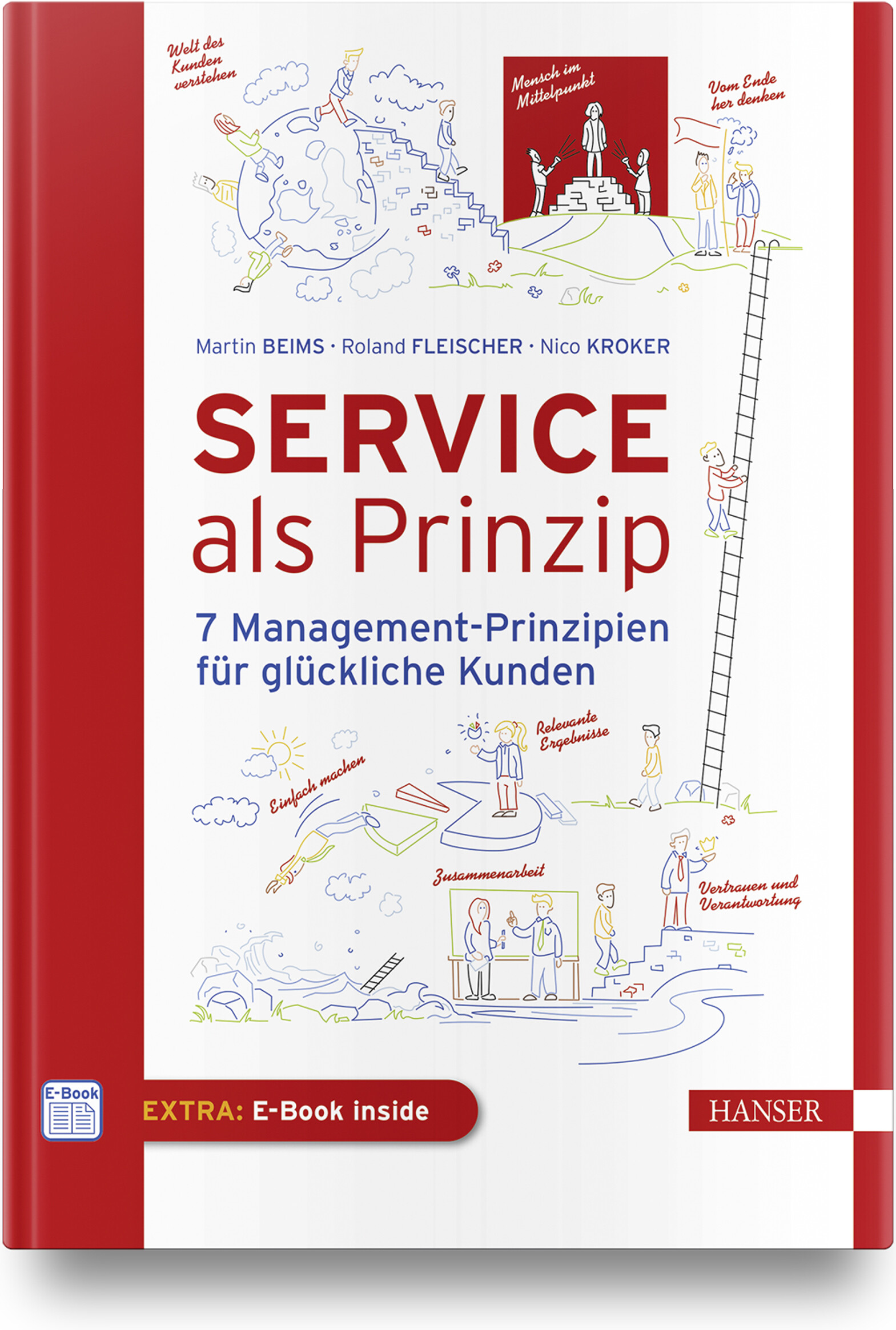
Service als Prinzip
7 Management-Prinzipien für glückliche KundenService ist aus unserem Leben nicht wegzudenken. Jeder von uns nimmt täglich verschiedene Services in Anspruch: Vom Friseur über öffentliche Verkehrsmittel bis hin zu Telefon, Internet und komplexen B2B Services. Das Management solcher Service ist dabei reifer geworden, aber auch komplexer. Und so existiert inzwischen eine unübersichtliche Vielzahl von Methoden, Werkzeugen und Techniken, die sich auch noch nach Branchen unterscheiden. Sie alle spiegeln den Versuch wider, die unterschiedlichsten Erfahrungen in konkrete Handlungsanweisungen zu überführen. Manager wie Mitarbeiter in Serviceorganisationen erhoffen sich davon Unterstützung in der täglichen Arbeit. In der Praxis führt das aber zu unübersichtlich vielen Regeln und Ausnahmen.In dieser Situation helfen wenige einfache, aber starke Prinzipien, die – mit gesundem Menschenverstand eingesetzt – Sinn und Nutzen stiften. Das Buch stellt diese Prinzipien mit Hilfe von Beispielen aus der Praxis vor und gibt Ihnen Anstöße und Tipps zur praktischen Anwendung.Aus dem Inhalt: Der Service der ZukunftDie Welt des Kunden verstehenDen Menschen in den Mittelpunkt stellenSysteme zur Zusammenarbeit schaffenVom Ende her denkenRelevante Ergebnisse erzeugenMit Vertrauen und Verantwortung führenEinfach machenLeseprobe (PDF-Link)Autoren:Martin Beims ist ein geschätzter Impulsgeber für Servicemanagement und Gründer der aretas GmbH. Neben seiner Arbeit als Servicementor gibt er bereits seit vielen Jahren seine Erfahrungen in seinen Büchern weiter.Dr. Roland Fleischer ist geschäftsführender Gesellschafter bei der aretas GmbH. Er verfügt über 20 Jahre Erfahrungen im Service Management.Nico Kroker, MBA Gründer und Geschäftsführer der aretas. Er verfügt über langjährige Erfahrung als Produktmanager, verantwortlicher Prozessmanager und als Managementberater.

Pro Go
Best-selling author Adam Freeman explains how to get the most from Go, starting from the basics and building up to the most advanced and sophisticated features. You will learn how Go builds on a simple and consistent type system to create a comprehensive and productive development experience that produces fast and robust applications that run across platforms.Go, also known as Golang, is the concise and efficient programming language designed by Google for creating high-performance, cross-platform applications. Go combines strong static types with simple syntax and a comprehensive standard library to increase programmer productivity, while still supporting features such as concurrent/parallel programming.Each topic is covered in a clear, concise, no-nonsense approach that is packed with the details you need to learn to be truly effective. Chapters include common problems and how to avoid them.WHAT YOU WILL LEARN* Gain a solid understanding of the Go language and tools* Gain in-depth knowledge of the Go standard library* Use Go for concurrent/parallel tasks* Use Go for client- and server-side development WHO THIS BOOK IS FORExperienced developers who want to use Go to create applicationsADAM FREEMAN is an experienced IT professional who has held senior positions in a range of companies, most recently serving as chief technology officer and chief operating officer of a global bank. Now retired, he spends his time writing and long-distance running.Part 1 - Understanding the Go Language1. Your First Go App2. Putting Go in Context3. Using the Go Tools4. Basic Types, Values, and Pointers5. Operations and Conversions6. Flow Control7. Using Arrays, Slice, and Maps8. Defining and Using Functions9. Using Function Types10. Defining Structs11. Using Methods and Interfaces12. Creating and Using Packages13. Type and Interface Composition14. Using Goroutines and Channels15. Error HandlingPart 2 - Using the Go Standard Library16. String Processing and Regular Expressions 17. Formatting and Scanning Strings 18. Math Functions and Data Sorting 19. Dates, Times, and Durations 20. Reading and Writing Data 21. Working with JSON Data 22. Working with Files 23. Using HTML and Text Templates 24. Creating HTTP Servers 25. Creating HTTP Clients 26. Working with Databases 27. Using Reflection 28. Using Reflection, Part 2 29. Using Reflection, Part 3 30. Coordinating Goroutines 31. Unit Testing, Benchmarking, and LoggingPart 3 - Applying Go32. Creating a Web Platform33. Middleware, Templates, and Handlers34. Actions, Sessions, and Authorization 35. SportsStore: A Real Application 36. SportsStore: Cart and Database 37. SportsStore: Checkout and Administration 38. SportsStore: Finishing and Deployment

Natürliche Kognition technologisch begreifen
Im Kern dieser Arbeit geht es um das Begreifen von Kognition. Der Kognitionsbegriff wird zur Schlüsselkategorie in den basalen Gedanken- bzw. Modellgebäuden und den daraus entwickelten Algorithmen. Es ist eine Arbeit, die unter anderem die philosophischen Positionen des Reduktionismus, Funktionalismus und Konstruktivismus mit einer kognitiven Theorie so in Verbindung bringt, um diese erkenntnistheoretischen Ismen mit den Erkenntnissen einer technologisierten Kognitionswissenschaft zu synchronisieren und als algorithmisierte Theorie im Rahmen eines Entwicklungsprojekt als artifizielle Kognition zu realisieren. Die Arbeit ist somit theoretisch fundiert und praktisch orientiert. PROFESSOR DR. MATTHIAS HAUN ist für die Entwicklung und weltweite Einführung „Kognitiver Lösungen“ verantwortlich. Ziel ist es, durch die Entwicklung solcher intelligenten, lernenden und vorausschauenden Systeme die Digitalisierung und Kognitivierung verantwortungsbewusst voranzutreiben, um damit auch deren Einsatz im Sinne der Nachhaltigkeit auszugestalten. Herr Haun leitet zudem zwei interdisziplinäre Forschungsprogramme, in deren Rahmen unter anderem zukünftige Paradigmen, Methoden und Techniken des Cognitive Computing entwickelt werden. Er hat weltweit mehrere Professuren inne, unter anderem seit Januar 2018 eine Shared Professorship für Kognitive Kybernetik und Philosophie der Kognitionswissenschaften. Hier widmet er sich der Technologisierung der Wissenschaften und der Lebenswelt sowie den Implikationen für die Gesellschaft. Er bringt 30 Jahre Erfahrung in der Entwicklung intelligenter Lösungssysteme im Finanzdienstleistungssektor, in der Forschung und Industrie mit. Herleitung als Motivation.- Methodik als Entwicklungs- und Erkenntnispfad.- Natürliche Kognition als Modell.- Artifizielle Kognition als Simulation.- Wissenschaftsphilosophie als Reflexionsinstrument.- Ausblick als Motivation.

Healthcare CIO
Die digitale Transformation der Gesundheitswirtschaft ist in vollem Gange. Trotzdem weist der digitale Reifegrad in allen Versorgungsbereichen noch deutliche Potentiale auf. Dies betrifft den stationären, ambulanten und post-akutstationären Bereich ebenso wie die Rehabilitation und Pflege. Führungskräfte stehen vor der Herausforderung, sich mit Digitalisierungs-/Health-IT-Strategien auseinanderzusetzen, um die Anforderungen erfüllen zu können.Die Weiterbildung zum Certified Healthcare CIO (CHCIO) qualifiziert Führungskräfte, Digitalisierungsstrategien zu entwickeln und umzusetzen, zugeschnitten auf den Bedarf der eigenen Gesundheitseinrichtung. Das Buch liefert einen Einblick in die wesentlichen Kompetenzfelder, d. h. Krankenhaus-/Digitalstrategie, Technologiemanagement, Change Management, Management des IT-Wertbeitrages, Service Management, Talent Management und Relationship Management.Dr. Pierre-Michael Meier, Geschäftsführer ENTSCHEIDERFABRIK und AHIME Academy und Generalbevollmächtigter der Hospitalgemeinschaft Hosp.Do.IT; Prof. Dr. Gregor Hülsken, Professor für Wirtschafts- und Medizininformatik an der FOM Hochschule für Oekonomie und Management und Geschäftsführer AHIME Academy; Prof. Dr. Björn Maier, Duale Hochschule Baden-Württemberg Mannheim - Gesundheitswirtschaft und Soziale Einrichtungen.

Cyber Security and Digital Forensics
CYBER SECURITY AND DIGITAL FORENSICSCYBER SECURITY IS AN INCREDIBLY IMPORTANT ISSUE THAT IS CONSTANTLY CHANGING, WITH NEW METHODS, PROCESSES, AND TECHNOLOGIES COMING ONLINE ALL THE TIME. BOOKS LIKE THIS ARE INVALUABLE TO PROFESSIONALS WORKING IN THIS AREA, TO STAY ABREAST OF ALL OF THESE CHANGES.Current cyber threats are getting more complicated and advanced with the rapid evolution of adversarial techniques. Networked computing and portable electronic devices have broadened the role of digital forensics beyond traditional investigations into computer crime. The overall increase in the use of computers as a way of storing and retrieving high-security information requires appropriate security measures to protect the entire computing and communication scenario worldwide. Further, with the introduction of the internet and its underlying technology, facets of information security are becoming a primary concern to protect networks and cyber infrastructures from various threats. This groundbreaking new volume, written and edited by a wide range of professionals in this area, covers broad technical and socio-economic perspectives for the utilization of information and communication technologies and the development of practical solutions in cyber security and digital forensics. Not just for the professional working in the field, but also for the student or academic on the university level, this is a must-have for any library. AUDIENCE: Practitioners, consultants, engineers, academics, and other professionals working in the areas of cyber analysis, cyber security, homeland security, national defense, the protection of national critical infrastructures, cyber-crime, cyber vulnerabilities, cyber-attacks related to network systems, cyber threat reduction planning, and those who provide leadership in cyber security management both in public and private sectors MANGESH M. GHONGE, PhD, is currently working at Sandip Institute of Technology and Research Center, Nashik, Maharashtra, India. He authored or co-authored more than 60 published articles in prestigious journals, book chapters, and conference papers. He is also the author or editor of ten books and has organized and chaired many national and international conferences.SABYASACHI PRAMANIK, PhD, is an assistant professor in the Department of Computer Science and Engineering, Haldia Institute of Technology, India. He earned his doctorate in computer science and engineering from the Sri Satya Sai University of Technology and Medical Sciences, Bhopal, India. He has many publications in various reputed international conferences, journals, and online book chapter contributions and is also serving as the editorial board member of many international journals. He is a reviewer of journal articles in numerous technical journals and has been a keynote speaker, session chair and technical program committee member in many international conferences. He has authored a book on wireless sensor networks and is currently editing six books for multiple publishers, including Scrivener Publishing.RAMCHANDRA MANGRULKAR, PhD, is an associate professor in the Department of Computer Engineering at SVKM’s Dwarkadas J. Sanghvi College of Engineering, Mumbai, Maharashtra, India. He has published 48 papers and 12 book chapters and presented significant papers at technical conferences. He has also chaired many conferences as a session chair and conducted various workshops and is also a ICSI-CNSS Certified Network Security Specialist. He is an active member on boards of studies in various universities and institutes in India.DAC-NHUONG LE, PhD, is an associate professor and associate dean at Haiphong University, Vietnam. He earned his MSc and PhD in computer science from Vietnam National University, and he has over 20 years of teaching experience. He has over 50 publications in reputed international conferences, journals and online book chapter contributions and has chaired numerous international conferences. He has served on numerous editorial boards for scientific and technical journals and has authored or edited over 15 books by various publishers, including Scrivener Publishing.Preface xviiAcknowledgment xxvii1 A COMPREHENSIVE STUDY OF SECURITY ISSUES AND RESEARCH CHALLENGES IN DIFFERENT LAYERS OF SERVICE-ORIENTED IOT ARCHITECTURE 1Ankur O. Bang, Udai Pratap Rao and Amit A. Bhusari1.1 Introduction and Related Work 21.2 IoT: Evolution, Applications and Security Requirements 41.2.1 IoT and Its Evolution 51.2.2 Different Applications of IoT 51.2.3 Different Things in IoT 71.2.4 Security Requirements in IoT 81.3 Service-Oriented IoT Architecture and IoT Protocol Stack 101.3.1 Service-Oriented IoT Architecture 101.3.2 IoT Protocol Stack 111.3.2.1 Application Layer Protocols 121.3.2.2 Transport Layer Protocols 131.3.2.3 Network Layer Protocols 151.3.2.4 Link Layer and Physical Layer Protocols 161.4 Anatomy of Attacks on Service-Oriented IoT Architecture 241.4.1 Attacks on Software Service 241.4.1.1 Operating System–Level Attacks 241.4.1.2 Application-Level Attacks 251.4.1.3 Firmware-Level Attacks 251.4.2 Attacks on Devices 261.4.3 Attacks on Communication Protocols 261.4.3.1 Attacks on Application Layer Protocols 261.4.3.2 Attacks on Transport Layer Protocols 281.4.3.3 Attacks on Network Layer Protocols 281.4.3.4 Attacks on Link and Physical Layer Protocols 301.5 Major Security Issues in Service-Oriented IoT Architecture 311.5.1 Application – Interface Layer 321.5.2 Service Layer 331.5.3 Network Layer 331.5.4 Sensing Layer 341.6 Conclusion 35References 362 QUANTUM AND POST-QUANTUM CRYPTOGRAPHY 45Om Pal, Manoj Jain, B.K. Murthy and Vinay Thakur2.1 Introduction 462.2 Security of Modern Cryptographic Systems 462.2.1 Classical and Quantum Factoring of A Large Number 472.2.2 Classical and Quantum Search of An Item 492.3 Quantum Key Distribution 492.3.1 BB84 Protocol 502.3.1.1 Proposed Key Verification Phase for BB84 512.3.2 E91 Protocol 512.3.3 Practical Challenges of Quantum Key Distribution 522.3.4 Multi-Party Quantum Key Agreement Protocol 532.4 Post-Quantum Digital Signature 532.4.1 Signatures Based on Lattice Techniques 542.4.2 Signatures Based on Multivariate Quadratic Techniques 552.4.3 Hash-Based Signature Techniques 552.5 Conclusion and Future Directions 55References 563 ARTIFICIAL NEURAL NETWORK APPLICATIONS IN ANALYSIS OF FORENSIC SCIENCE 59K.R. Padma and K.R. Don3.1 Introduction 603.2 Digital Forensic Analysis Knowledge 613.3 Answer Set Programming in Digital Investigations 613.4 Data Science Processing with Artificial Intelligence Models 633.5 Pattern Recognition Techniques 633.6 ANN Applications 653.7 Knowledge on Stages of Digital Forensic Analysis 653.8 Deep Learning and Modelling 673.9 Conclusion 68References 694 A COMPREHENSIVE SURVEY OF FULLY HOMOMORPHIC ENCRYPTION FROM ITS THEORY TO APPLICATIONS 73Rashmi Salavi, Dr. M. M. Math and Dr. U. P. Kulkarni4.1 Introduction 734.2 Homomorphic Encryption Techniques 764.2.1 Partial Homomorphic Encryption Schemes 774.2.2 Fully Homomorphic Encryption Schemes 784.3 Homomorphic Encryption Libraries 794.4 Computations on Encrypted Data 834.5 Applications of Homomorphic Encryption 854.6 Conclusion 86References 875 UNDERSTANDING ROBOTICS THROUGH SYNTHETIC PSYCHOLOGY 91Garima Saini and Dr. Shabnam5.1 Introduction 915.2 Physical Capabilities of Robots 925.2.1 Artificial Intelligence and Neuro Linguistic Programming (NLP) 935.2.2 Social Skill Development and Activity Engagement 935.2.3 Autism Spectrum Disorders 935.2.4 Age-Related Cognitive Decline and Dementia 945.2.5 Improving Psychosocial Outcomes through Robotics 945.2.6 Clients with Disabilities and Robotics 945.2.7 Ethical Concerns and Robotics 955.3 Traditional Psychology, Neuroscience and Future Robotics 955.4 Synthetic Psychology and Robotics: A Vision of the Future 975.5 Synthetic Psychology: The Foresight 985.6 Synthetic Psychology and Mathematical Optimization 995.7 Synthetic Psychology and Medical Diagnosis 995.7.1 Virtual Assistance and Robotics 1005.7.2 Drug Discovery and Robotics 1005.8 Conclusion 101References 1016 AN INSIGHT INTO DIGITAL FORENSICS: HISTORY, FRAMEWORKS, TYPES AND TOOLS 105G Maria Jones and S Godfrey Winster6.1 Overview 1056.2 Digital Forensics 1076.2.1 Why Do We Need Forensics Process? 1076.2.2 Forensics Process Principles 1086.3 Digital Forensics History 1086.3.1 1985 to 1995 1086.3.2 1995 to 2005 1096.3.3 2005 to 2015 1106.4 Evolutionary Cycle of Digital Forensics 1116.4.1 Ad Hoc 1116.4.2 Structured Phase 1116.4.3 Enterprise Phase 1126.5 Stages of Digital Forensics Process 1126.5.1 Stage 1 - 1995 to 2003 1126.5.2 Stage II - 2004 to 2007 1136.5.3 Stage III - 2007 to 2014 1146.6 Types of Digital Forensics 1156.6.1 Cloud Forensics 1166.6.2 Mobile Forensics 1166.6.3 IoT Forensics 1166.6.4 Computer Forensics 1176.6.5 Network Forensics 1176.6.6 Database Forensics 1186.7 Evidence Collection and Analysis 1186.8 Digital Forensics Tools 1196.8.1 X-Ways Forensics 1196.8.2 SANS Investigative Forensics Toolkit – SIFT 1196.8.3 EnCase 1196.8.4 The Sleuth Kit/Autopsy 1226.8.5 Oxygen Forensic Suite 1226.8.6 Xplico 1226.8.7 Computer Online Forensic Evidence Extractor (COFEE) 1226.8.8 Cellebrite UFED 1226.8.9 OSForeniscs 1236.8.10 Computer-Aided Investigative Environment (CAINE) 1236.9 Summary 123References 1237 DIGITAL FORENSICS AS A SERVICE: ANALYSIS FOR FORENSIC KNOWLEDGE 127Soumi Banerjee, Anita Patil, Dipti Jadhav and Gautam Borkar7.1 Introduction 1277.2 Objective 1287.3 Types of Digital Forensics 1297.3.1 Network Forensics 1297.3.2 Computer Forensics 1427.3.3 Data Forensics 1477.3.4 Mobile Forensics 1497.3.5 Big Data Forensics 1547.3.6 IoT Forensics 1557.3.7 Cloud Forensics 1577.4 Conclusion 161References 1618 4S FRAMEWORK: A PRACTICAL CPS DESIGN SECURITY ASSESSMENT & BENCHMARKING FRAMEWORK 163Neel A. Patel, Dhairya A. Parekh, Yash A. Shah and Ramchandra Mangrulkar8.1 Introduction 1648.2 Literature Review 1668.3 Medical Cyber Physical System (MCPS) 1708.3.1 Difference between CPS and MCPS 1718.3.2 MCPS Concerns, Potential Threats, Security 1718.4 CPSSEC vs. Cyber Security 1728.5 Proposed Framework 1738.5.1 4S Definitions 1748.5.2 4S Framework-Based CPSSEC Assessment Process 1758.5.3 4S Framework-Based CPSSEC Assessment Score Breakdown & Formula 1818.6 Assessment of Hypothetical MCPS Using 4S Framework 1878.6.1 System Description 1878.6.2 Use Case Diagram for the Above CPS 1888.6.3 Iteration 1 of 4S Assessment 1898.6.4 Iteration 2 of 4S Assessment 1958.7 Conclusion 2008.8 Future Scope 201References 2019 ENSURING SECURE DATA SHARING IN IOT DOMAINS USING BLOCKCHAIN 205Tawseef Ahmed Teli, Rameez Yousuf and Dawood Ashraf Khan9.1 IoT and Blockchain 2059.1.1 Public 2089.1.1.1 Proof of Work (PoW) 2099.1.1.2 Proof of Stake (PoS) 2099.1.1.3 Delegated Proof of Stake (DPoS) 2109.1.2 Private 2109.1.3 Consortium or Federated 2109.2 IoT Application Domains and Challenges in Data Sharing 2119.3 Why Blockchain? 2149.4 IoT Data Sharing Security Mechanism On Blockchain 2169.4.1 Double-Chain Mode Based On Blockchain Technology 2169.4.2 Blockchain Structure Based On Time Stamp 2179.5 Conclusion 219References 21910 A REVIEW OF FACE ANALYSIS TECHNIQUES FOR CONVENTIONAL AND FORENSIC APPLICATIONS 223Chethana H.T. and Trisiladevi C. Nagavi10.1 Introduction 22410.2 Face Recognition 22510.2.1 Literature Review on Face Recognition 22610.2.2 Challenges in Face Recognition 22810.2.3 Applications of Face Recognition 22910.3 Forensic Face Recognition 22910.3.1 Literature Review on Face Recognition for Forensics 23110.3.2 Challenges of Face Recognition in Forensics 23310.3.3 Possible Datasets Used for Forensic Face Recognition 23510.3.4 Fundamental Factors for Improving Forensics Science 23510.3.5 Future Perspectives 23710.4 Conclusion 238References 23811 ROADMAP OF DIGITAL FORENSICS INVESTIGATION PROCESS WITH DISCOVERY OF TOOLS 241Anita Patil, Soumi Banerjee, Dipti Jadhav and Gautam Borkar11.1 Introduction 24211.2 Phases of Digital Forensics Process 24411.2.1 Phase I - Identification 24411.2.2 Phase II - Acquisition and Collection 24511.2.3 Phase III - Analysis and Examination 24511.2.4 Phase IV - Reporting 24511.3 Analysis of Challenges and Need of Digital Forensics 24611.3.1 Digital Forensics Process has following Challenges 24611.3.2 Needs of Digital Forensics Investigation 24711.3.3 Other Common Attacks Used to Commit the Crime 24811.4 Appropriateness of Forensics Tool 24811.4.1 Level of Skill 24811.4.2 Outputs 25211.4.3 Region of Emphasis 25211.4.4 Support for Additional Hardware 25211.5 Phase-Wise Digital Forensics Techniques 25311.5.1 Identification 25311.5.2 Acquisition 25411.5.3 Analysis 25611.5.3.1 Data Carving 25711.5.3.2 Different Curving Techniques 25911.5.3.3 Volatile Data Forensic Toolkit Used to Collect and Analyze the Data from Device 26011.5.4 Report Writing 26511.6 Pros and Cons of Digital Forensics Investigation Process 26611.6.1 Advantages of Digital Forensics 26611.6.2 Disadvantages of Digital Forensics 26611.7 Conclusion 267References 26712 UTILIZING MACHINE LEARNING AND DEEP LEARNING IN CYBESECURITY: AN INNOVATIVE APPROACH 271Dushyant Kaushik, Muskan Garg, Annu, Ankur Gupta and Sabyasachi Pramanik12.1 Introduction 27112.1.1 Protections of Cybersecurity 27212.1.2 Machine Learning 27412.1.3 Deep Learning 27612.1.4 Machine Learning and Deep Learning: Similarities and Differences 27812.2 Proposed Method 28112.2.1 The Dataset Overview 28212.2.2 Data Analysis and Model for Classification 28312.3 Experimental Studies and Outcomes Analysis 28312.3.1 Metrics on Performance Assessment 28412.3.2 Result and Outcomes 28512.3.2.1 Issue 1: Classify the Various Categories of Feedback Related to the Malevolent Code Provided 28512.3.2.2 Issue 2: Recognition of the Various Categories of Feedback Related to the Malware Presented 28612.3.2.3 Issue 3: According to the Malicious Code, Distinguishing Various Forms of Malware 28712.3.2.4 Issue 4: Detection of Various Malware Styles Based on Different Responses 28712.3.3 Discussion 28812.4 Conclusions and Future Scope 289References 29213 APPLICATIONS OF MACHINE LEARNING TECHNIQUES IN THE REALM OF CYBERSECURITY 295Koushal Kumar and Bhagwati Prasad Pande13.1 Introduction 29613.2 A Brief Literature Review 29813.3 Machine Learning and Cybersecurity: Various Issues 30013.3.1 Effectiveness of ML Technology in Cybersecurity Systems 30013.3.2 Machine Learning Problems and Challenges in Cybersecurity 30213.3.2.1 Lack of Appropriate Datasets 30213.3.2.2 Reduction in False Positives and False Negatives 30213.3.2.3 Adversarial Machine Learning 30213.3.2.4 Lack of Feature Engineering Techniques 30313.3.2.5 Context-Awareness in Cybersecurity 30313.3.3 Is Machine Learning Enough to Stop Cybercrime? 30413.4 ML Datasets and Algorithms Used in Cybersecurity 30413.4.1 Study of Available ML-Driven Datasets Available for Cybersecurity 30413.4.1.1 KDD Cup 1999 Dataset (DARPA1998) 30513.4.1.2 NSL-KDD Dataset 30513.4.1.3 ECML-PKDD 2007 Discovery Challenge Dataset 30513.4.1.4 Malicious URL’s Detection Dataset 30613.4.1.5 ISOT (Information Security and Object Technology) Botnet Dataset 30613.4.1.6 CTU-13 Dataset 30613.4.1.7 MAWILab Anomaly Detection Dataset 30713.4.1.8 ADFA-LD and ADFA-WD Datasets 30713.4.2 Applications ML Algorithms in Cybersecurity Affairs 30713.4.2.1 Clustering 30913.4.2.2 Support Vector Machine (SVM) 30913.4.2.3 Nearest Neighbor (NN) 30913.4.2.4 Decision Tree 30913.4.2.5 Dimensionality Reduction 31013.5 Applications of Machine Learning in the Realm of Cybersecurity 31013.5.1 Facebook Monitors and Identifies Cybersecurity Threats with ML 31013.5.2 Microsoft Employs ML for Security 31113.5.3 Applications of ML by Google 31213.6 Conclusions 313References 31314 SECURITY IMPROVEMENT TECHNIQUE FOR DISTRIBUTED CONTROL SYSTEM (DCS) AND SUPERVISORY CONTROL-DATA ACQUISITION (SCADA) USING BLOCKCHAIN AT DARK WEB PLATFORM 317Anand Singh Rajawat, Romil Rawat and Kanishk Barhanpurkar14.1 Introduction 31814.2 Significance of Security Improvement in DCS and SCADA 32214.3 Related Work 32314.4 Proposed Methodology 32414.4.1 Algorithms Used for Implementation 32714.4.2 Components of a Blockchain 32714.4.3 MERKLE Tree 32814.4.4 The Technique of Stack and Work Proof 32814.4.5 Smart Contracts 32914.5 Result Analysis 32914.6 Conclusion 330References 33115 RECENT TECHNIQUES FOR EXPLOITATION AND PROTECTION OF COMMON MALICIOUS INPUTS TO ONLINE APPLICATIONS 335Dr. Tun Myat Aung and Ni Ni Hla15.1 Introduction 33515.2 SQL Injection 33615.2.1 Introduction 33615.2.2 Exploitation Techniques 33715.2.2.1 In-Band SQL Injection 33715.2.2.2 Inferential SQL Injection 33815.2.2.3 Out-of-Band SQL Injection 34015.2.3 Causes of Vulnerability 34015.2.4 Protection Techniques 34115.2.4.1 Input Validation 34115.2.4.2 Data Sanitization 34115.2.4.3 Use of Prepared Statements 34215.2.4.4 Limitation of Database Permission 34315.2.4.5 Using Encryption 34315.3 Cross Site Scripting 34415.3.1 Introduction 34415.3.2 Exploitation Techniques 34415.3.2.1 Reflected Cross Site Scripting 34515.3.2.2 Stored Cross Site Scripting 34515.3.2.3 DOM-Based Cross Site Scripting 34615.3.3 Causes of Vulnerability 34615.3.4 Protection Techniques 34715.3.4.1 Data Validation 34715.3.4.2 Data Sanitization 34715.3.4.3 Escaping on Output 34715.3.4.4 Use of Content Security Policy 34815.4 Cross Site Request Forgery 34915.4.1 Introduction 34915.4.2 Exploitation Techniques 34915.4.2.1 HTTP Request with GET Method 34915.4.2.2 HTTP Request with POST Method 35015.4.3 Causes of Vulnerability 35015.4.3.1 Session Cookie Handling Mechanism 35015.4.3.2 HTML Tag 35115.4.3.3 Browser’s View Source Option 35115.4.3.4 GET and POST Method 35115.4.4 Protection Techniques 35115.4.4.1 Checking HTTP Referer 35115.4.4.2 Using Custom Header 35215.4.4.3 Using Anti-CSRF Tokens 35215.4.4.4 Using a Random Value for each Form Field 35215.4.4.5 Limiting the Lifetime of Authentication Cookies 35315.5 Command Injection 35315.5.1 Introduction 35315.5.2 Exploitation Techniques 35415.5.3 Causes of Vulnerability 35415.5.4 Protection Techniques 35515.6 File Inclusion 35515.6.1 Introduction 35515.6.2 Exploitation Techniques 35515.6.2.1 Remote File Inclusion 35515.6.2.2 Local File Inclusion 35615.6.3 Causes of Vulnerability 35715.6.4 Protection Techniques 35715.7 Conclusion 358References 35816 RANSOMWARE: THREATS, IDENTIFICATION AND PREVENTION 361Sweta Thakur, Sangita Chaudhari and Bharti Joshi16.1 Introduction 36116.2 Types of Ransomwares 36416.2.1 Locker Ransomware 36416.2.1.1 Reveton Ransomware 36516.2.1.2 Locky Ransomware 36616.2.1.3 CTB Locker Ransomware 36616.2.1.4 TorrentLocker Ransomware 36616.2.2 Crypto Ransomware 36716.2.2.1 PC Cyborg Ransomware 36716.2.2.2 OneHalf Ransomware 36716.2.2.3 GPCode Ransomware 36716.2.2.4 CryptoLocker Ransomware 36816.2.2.5 CryptoDefense Ransomware 36816.2.2.6 CryptoWall Ransomware 36816.2.2.7 TeslaCrypt Ransomware 36816.2.2.8 Cerber Ransomware 36816.2.2.9 Jigsaw Ransomware 36916.2.2.10 Bad Rabbit Ransomware 36916.2.2.11 WannaCry Ransomware 36916.2.2.12 Petya Ransomware 36916.2.2.13 Gandcrab Ransomware 36916.2.2.14 Rapid Ransomware 37016.2.2.15 Ryuk Ransomware 37016.2.2.16 Lockergoga Ransomware 37016.2.2.17 PewCrypt Ransomware 37016.2.2.18 Dhrama/Crysis Ransomware 37016.2.2.19 Phobos Ransomware 37116.2.2.20 Malito Ransomware 37116.2.2.21 LockBit Ransomware 37116.2.2.22 GoldenEye Ransomware 37116.2.2.23 REvil or Sodinokibi Ransomware 37116.2.2.24 Nemty Ransomware 37116.2.2.25 Nephilim Ransomware 37216.2.2.26 Maze Ransomware 37216.2.2.27 Sekhmet Ransomware 37216.2.3 MAC Ransomware 37216.2.3.1 KeRanger Ransomware 37316.2.3.2 Go Pher Ransomware 37316.2.3.3 FBI Ransom Ransomware 37316.2.3.4 File Coder 37316.2.3.5 Patcher 37316.2.3.6 ThiefQuest Ransomware 37416.2.3.7 Keydnap Ransomware 37416.2.3.8 Bird Miner Ransomware 37416.3 Ransomware Life Cycle 37416.4 Detection Strategies 37616.4.1 Unevil 37616.4.2 Detecting File Lockers 37616.4.3 Detecting Screen Lockers 37716.4.4 Connection-Monitor and Connection-Breaker Approach 37716.4.5 Ransomware Detection by Mining API Call Usage 37716.4.6 A New Static-Based Framework for Ransomware Detection 37716.4.7 White List-Based Ransomware Real-Time Detection Prevention (WRDP) 37816.5 Analysis of Ransomware 37816.5.1 Static Analysis 37916.5.2 Dynamic Analysis 37916.6 Prevention Strategies 38016.6.1 Access Control 38016.6.2 Recovery After Infection 38016.6.3 Trapping Attacker 38016.7 Ransomware Traits Analysis 38016.8 Research Directions 38416.9 Conclusion 384References 384Index 389
Green Internet of Things and Machine Learning
HEALTH ECONOMICS AND FINANCINGENCAPSULATES DIFFERENT CASE STUDIES WHERE GREEN-IOT AND MACHINE LEARNING CAN BE USED FOR MAKING SIGNIFICANT PROGRESS TOWARDS IMPROVISING THE QUALITY OF LIFE AND SUSTAINABLE ENVIRONMENT.The Internet of Things (IoT) is an evolving idea which is responsible for connecting billions of devices that acquire, perceive, and communicate data from their surroundings. Because this transmission of data uses significant energy, improving energy efficiency in IOT devices is a significant topic for research. The green internet of things (G-IoT) makes it possible for IoT devices to use less energy since intelligent processing and analysis are fundamental to constructing smart IOT applications with large data sets. Machine learning (ML) algorithms that can predict sustainable energy consumption can be used to prepare guidelines to make IoT device implementation easier. Green Internet of Things and Machine Learning lays the foundation of in-depth analysis of principles of Green-Internet of Things (G-IoT) using machine learning. It outlines various green ICT technologies, explores the potential towards diverse real-time areas, as well as highlighting various challenges and obstacles towards the implementation of G-IoT in the real world. Also, this book provides insights on how the machine learning and green IOT will impact various applications: It covers the Green-IOT and ML-based smart computing, ML techniques for reducing energy consumption in IOT devices, case studies of G-IOT and ML in the agricultural field, smart farming, smart transportation, banking industry and healthcare. AUDIENCEThe book will be helpful for research scholars and researchers in the fields of computer science and engineering, information technology, electronics and electrical engineering. Industry experts, particularly in R&D divisions, can use this book as their problem-solving guide. ROSHANI RAUT, PHD is an associate professor in the Department of Information Technology at Pimpri Chinchwad College of Engineering, Pune University, India. She has presented and published more than 70 research communications in national/international conferences and journals and has published 13 patents.SANDEEP KAUTISH, PHD is a professor & Dean of Academics with LBEF Campus, Kathmandu Nepal. He has published more than 40 papers in international journals. ZDZISLAW POLKOWSKI, PHD is a professor in the Faculty of Technical Sciences, Jan Wyzykowski University, Polkowice, Poland. He has published more than 75 research articles in peer-reviewed journals. ANIL KUMAR, PHD is a professor of CSE and Head of Department of Information Technology, DIT University, India. He has published more than 200 research papers. CHUAN-MING LIU, PHD is a professor in the Department of Computer Science and Information Engineering (CSIE), National Taipei University of Technology (Taipei Tech), Taiwan. He has published more than 100 research article is international journals.
Smart Systems for Industrial Applications
SMART SYSTEMS FOR INDUSTRIAL APPLICATIONSTHE PRIME OBJECTIVE OF THIS BOOK IS TO PROVIDE AN INSIGHT INTO THE ROLE AND ADVANCEMENTS OF ARTIFICIAL INTELLIGENCE IN ELECTRICAL SYSTEMS AND FUTURE CHALLENGES.The book covers a broad range of topics about AI from a multidisciplinary point of view, starting with its history and continuing on to theories about artificial vs. human intelligence, concepts, and regulations concerning AI, human-machine distribution of power and control, delegation of decisions, the social and economic impact of AI, etc. The prominent role that AI plays in society by connecting people through technologies is highlighted in this book. It also covers key aspects of various AI applications in electrical systems in order to enable growth in electrical engineering. The impact that AI has on social and economic factors is also examined from various perspectives. Moreover, many intriguing aspects of AI techniques in different domains are covered such as e-learning, healthcare, smart grid, virtual assistance, etc. AUDIENCEThe book will be of interest to researchers and postgraduate students in artificial intelligence, electrical and electronic engineering, as well as those engineers working in the application areas such as healthcare, energy systems, education, and others. C. VENKATESH, PHD is Professor and Principal, Sengunthar Engineering College, India, and has 28 years of teaching experience. He has published 5 patents, about 80 research papers in international journals, and about 70 papers in international and national conferences.N. RENGARAJAN, PHD is Professor and Principal, Nandha Engineering College, India and has more than three decades of experience. He has published 8 patents, 70 papers in international journals, and 20 papers in national and international conferences. P. PONMURUGAN, PHD is an associate professor, Sri Krishna College of Technology, India has almost a decade of experience in academics. He has published 11 patents and about 40 papers in international journals and conferences. He was awarded the “Best Young Engineer” by IEI – Erode Local Centre and “Young Scientist” by the International Association of Research and Developed Organization (IARDO). S. BALAMURUGAN, PHD, SMIEEE and ACM Distinguished Speaker, received his PhD from Anna University, India. He has published 57 books, 300+ international journals/conferences, and 100 patents. He is the Director of the Albert Einstein Engineering and Research Labs. He is also the Vice-Chairman of the Renewable Energy Society of India (RESI). He is serving as a research consultant to many companies, startups, SMEs, and MSMEs. He has received numerous awards for research at national and international levels.

Kompatibilitätsverfahren für Profinet-Hardware mit Ethernet Time Sensitive Networks
Die Vernetzung von industriellen Produktionssystemen soll in Zukunft auf Basis von Ethernet Time Sensitive Networks (TSN) umgesetzt werden. Die Einführung einer neuen Netzwerktechnik in die Feldebene der industriellen Produktion stellt jedoch eine besondere Herausforderung dar, da neben Netzwerkfunktionen eine echtzeitfähige Implementierung von Protokollen und spezifischen Anwendungen in die Feldgeräte erforderlich ist. Bei häufig geringen Stückzahlen der anwendungsspezifischen Geräte sind derartige Neuentwicklungen häufig wirtschaftlich nicht tragbar. Migrationsstrategien kommt daher eine entsprechend große Bedeutung zu.Die Forschungsfrage dieser Arbeit lautet: Wie können bestehende Geräte des Echtzeit-Ethernet-Systems PROFINET mit den geforderten Funktions- und Leistungsmerkmalen wie Zeitsynchronisation und synchronisierte Kommunikation kompatibel mit Ethernet TSN-Netzwerken genutzt werden? Der Autor entwickelte Kompatibilitätsverfahren, mit denen dies möglich wird. Das zentrale Kompatibilitätsverfahren ist der Ethernet TSN-kompa¬tible Bridging-Modus Time Aware Forwarding (TAF), der zeitgesteuerte Kommunikation auf der Basis der Empfangszeit zeitrichtig weiterleitet und per Softwareupdate auf bestehender PROFINET-Hardware implementiert werden kann. Diese Geräte können damit in TSN-Netzwerke integriert werden und synchronisierte Kommunikation mit einem Jitter kleiner als 1 µs nutzen.SEBASTIAN SCHRIEGEL absolvierte eine Berufsausbildung als Kommunikationselektroniker und studierte anschließend an der Technischen Hochschule Ostwestfalen-Lippe Elektrotechnik (Dipl.-Ing. FH) und Mechatronische Systeme (M.Sc.). Er arbeitet bei Fraunhofer IOSB-INA in Lemgo und schloss 2021 eine Promotion an der Universität Bielefeld (Dr.-Ing.) ab.Einleitung.- Entwicklung der industriellen Kommunikation und der Anforderungen.- Stand der Wissenschaft und Technik.- Analyse der Kompatibilität von Ethernet TSN und PROFINET-Hardware.- Kompatibilitätsverfahren.- Validierung der Verfahren.- Zusammenfassung und Bewertung.

Intelligent Systems for Rehabilitation Engineering
INTELLIGENT SYSTEMS FOR REHABILITATION ENGINEERINGENCAPSULATES DIFFERENT CASE STUDIES WHERE TECHNOLOGY CAN BE USED AS ASSISTIVE TECHNOLOGY FOR THE PHYSICALLY CHALLENGED, VISUALLY AND HEARING IMPAIRED. Rehabilitation engineering includes the development of technological solutions and devices to assist individuals with disabilities, while also supporting the recovery of the disabled who have lost their physical and cognitive functions. These systems can be designed and built to meet a wide range of needs that can help individuals with mobility, communication, vision, hearing, and cognition. The growing technological developments in machine learning, deep learning, robotics, virtual intelligence, etc., play an important role in rehabilitation engineering. Intelligent Systems for Rehabilitation Engineering focuses on trending research of intelligent systems in rehabilitation engineering which involves the design and development of innovative technologies and techniques including rehabilitation robotics, visual rehabilitation, physical prosthetics, brain computer interfaces, sensory rehabilitation, motion rehabilitation, etc. This groundbreaking book* Provides a comprehensive reference covering different computer assistive techniques for the physically disabled, visually and hearing impaired.* Focuses on trending research of intelligent systems in rehabilitation engineering which involves the design and development of innovative technologies and techniques.* Provides insights into the role of intelligent systems in rehabilitation engineering.AUDIENCEEngineers and device manufacturers working in rehabilitation engineering as well as researchers in computer science, artificial intelligence, electronic engineering, who are working on intelligent systems. ROSHANI RAUT, PHD is an associate professor in the Department of Information Technology at Pimpri Chinchwad College of Engineering, Pune University, India. She has presented and published more than 70 research communications in national/ international conferences and journals and has published 13 patents.PRANAV D. PATHAK, PHD from Visveswaraya National Institute of Technology, Nagpur, India. He is currently an assistant professor at MIT School of Bioengineering Sciences & Research, Pune. SANDEEP KAUTISH, PHD in Computer Science on Intelligent Systems in Social Networks is Professor & Dean of Academics with LBEF Campus, Kathmandu Nepal. He has published more than 40 papers in international journals. PRADEEP N., PHD is an associate professor in Computer Science and Engineering, Bapuji Institute of Engineering and Technology, Karnataka, India. He has a number of edited books and journal research articles to his credit.

SAP Enterprise Portfolio and Project Management
Learn the fundamentals of SAP Enterprise Project and Portfolio management Project Systems (PS), Portfolio and Project Management (PPM) and Commercial Project Management (CPM) and their integration with other SAP modules. This book covers various business scenarios from different industries including the public sector, engineering and construction, professional services, telecom, mining, chemical, and pharmaceutical. Author Joseph Alexander Soosaimuthu will help you understand common business challenges and pain areas faced in portfolio, program and project management, and will provide suitable recommendations to overcome these challenges. This book not only suggests solutions within SAP, but also provides workarounds or integrations with third-party tools based on various Industry-specific business requirements. SAP Portfolio and Project Management addresses commonly asked questions regarding SAP EPPM implementation and deployment, and conveys a framework to facilitate engagement and discussion with key stakeholders. This provides coverage of SAP on-premise solutions with ECC 6.08 and SAP PPM 6.1 deployed on the same client, as well as S/4 HANA On-Premise 2020 with integration to BPC and BI/W systems. Interface with other third-party schedule management, estimation, costing and forecasting applications are also covered in this book. After completing SAP Portfolio and Project Management, you will be able to implement SAP Enterprise Portfolio and Project Management based on industry best practices. For your reference, you’ll also gain a list of development objects and a functionality list by Industry, and a Fiori apps list for Enterprise Portfolio and Project Management (EPPM). What You Will Learn * Understand the fundamentals of project, program and portfolio management within SAP EPPM * Master the art of project forecasting and scheduling integrations with other SAP modules * Gainknowledge of the different interface options for scheduling, estimation, costing and forecasting third party applications * Learn EPPM industry best practices, and how to address industry-specific business challenges * Leverage operational and strategic reporting within EPPM Who This Book For Functional consultants and business analysts who are involved in SAP EPPM (PS, PPM and CPM) deployment and clients who are interested and are in the process of having SAP EPPM deployed for their Enterprise. Chapter 1: Enterprise Project, Program and Portfolio Management – Fundamentals.- Chapter 2: SAP Enterprise Portfolio and Project Management using SAP PS, PPM and CPM.- Chapter 3: Interface with Scheduling, Estimation, Costing and Forecasting Applications.- Chapter 4: Industry Best Practices and Recommendations.- Chapter 5: Reporting and Analytics - Operational and Strategic.

Numerical Methods Using Java
Implement numerical algorithms in Java using NM Dev, an object-oriented and high-performance programming library for mathematics.You’ll see how it can help you easily create a solution for your complex engineering problem by quickly putting together classes.Numerical Methods Using Java covers a wide range of topics, including chapters on linear algebra, root finding, curve fitting, differentiation and integration, solving differential equations, random numbers and simulation, a whole suite of unconstrained and constrained optimization algorithms, statistics, regression and time series analysis. The mathematical concepts behind the algorithms are clearly explained, with plenty of code examples and illustrations to help even beginners get started.WHAT YOU WILL LEARN* Program in Java using a high-performance numerical library* Learn the mathematics for a wide range of numerical computing algorithms* Convert ideas and equations into code* Put together algorithms and classes to build your own engineering solution* Build solvers for industrial optimization problems* Do data analysis using basic and advanced statisticsWHO THIS BOOK IS FORProgrammers, data scientists, and analysts with prior experience with programming in any language, especially Java.HAKSUN LI, PHD, is founder of NM Group, a scientific and mathematical research company. He has the vision of “Making the World Better Using Mathematics”. Under his leadership, the firm serves worldwide brokerage houses and funds, multinational corporations and very high net worth individuals. Haksun is an expert in options trading, asset allocation, portfolio optimization and fixed-income product pricing. He has coded up a variety of numerical software, including SuanShu (a library of numerical methods), NM Dev (a library of numerical methods), AlgoQuant (a library for financial analytics), NMRMS (a portfolio management system for equities), and supercurve (a fixed-income options pricing system). Prior to this, Haksun was a quantitative trader/quantitative analyst with multiple investment banks. He has worked in New York, London, Tokyo, and Singapore.Additionally, Haksun is the vice dean of the Big Data Finance and Investment Institute of Fudan University, China. He was an adjunct professor with multiple universities. He has taught at the National University of Singapore (mathematics), Nanyang Technological University (business school), Fudan University (economics), as well as Hong Kong University of Science and Technology (mathematics). Dr. Haksun Li has a B.S. and M.S. in pure and financial mathematics from the University of Chicago, and an M.S. and a PhD in computer science and engineering from the University of Michigan, Ann Arbor.Table of ContentsAbout the Authors...........................................................................................................iPreface............................................................................................................................ii1. Why Java?..............................................................................................................61.1. Java in 2020.....................................................................................................61.2. Java vs. C++....................................................................................................61.3. Java vs. Python................................................................................................61.4. Java in the future .............................................................................................62. Data Structures.......................................................................................................72.1. Function...........................................................................................................72.2. Polynomial ......................................................................................................73. Linear Algebra .......................................................................................................83.1. Vector and Matrix ...........................................................................................83.1.1. Vector Properties .....................................................................................83.1.2. Element-wise Operations.........................................................................83.1.3. Norm ........................................................................................................93.1.4. Inner product and angle ...........................................................................93.2. Matrix............................................................................................................103.3. Determinant, Transpose and Inverse.............................................................103.4. Diagonal Matrices and Diagonal of a Matrix................................................103.5. Eigenvalues and Eigenvectors.......................................................................103.5.1. Householder Tridiagonalization and QR Factorization Methods..........103.5.2. Transformation to Hessenberg Form (Nonsymmetric Matrices)...........104. Finding Roots of Single Variable Equations .......................................................114.1. Bracketing Methods ......................................................................................114.1.1. Bisection Method ...................................................................................114.2. Open Methods...............................................................................................114.2.1. Fixed-Point Method ...............................................................................114.2.2. Newton’s Method (Newton-Raphson Method) .....................................114.2.3. Secant Method .......................................................................................114.2.4. Brent’s Method ......................................................................................115. Finding Roots of Systems of Equations...............................................................125.1. Linear Systems of Equations.........................................................................125.2. Gauss Elimination Method............................................................................125.3. LU Factorization Methods ............................................................................125.3.1. Cholesky Factorization ..........................................................................125.4. Iterative Solution of Linear Systems.............................................................125.5. System of Nonlinear Equations.....................................................................126. Curve Fitting and Interpolation............................................................................146.1. Least-Squares Regression .............................................................................146.2. Linear Regression..........................................................................................146.3. Polynomial Regression..................................................................................146.4. Polynomial Interpolation...............................................................................146.5. Spline Interpolation .......................................................................................147. Numerical Differentiation and Integration...........................................................157.1. Numerical Differentiation .............................................................................157.2. Finite-Difference Formulas...........................................................................157.3. Newton-Cotes Formulas................................................................................157.3.1. Rectangular Rule....................................................................................157.3.2. Trapezoidal Rule....................................................................................157.3.3. Simpson’s Rules.....................................................................................157.3.4. Higher-Order Newton-Coles Formulas..................................................157.4. Romberg Integration .....................................................................................157.4.1. Gaussian Quadrature..............................................................................157.4.2. Improper Integrals..................................................................................158. Numerical Solution of Initial-Value Problems....................................................168.1. One-Step Methods.........................................................................................168.2. Euler’s Method..............................................................................................168.3. Runge-Kutta Methods...................................................................................168.4. Systems of Ordinary Differential Equations.................................................169. Numerical Solution of Partial Differential Equations..........................................179.1. Elliptic Partial Differential Equations...........................................................179.1.1. Dirichlet Problem...................................................................................179.2. Parabolic Partial Differential Equations........................................................179.2.1. Finite-Difference Method ......................................................................179.2.2. Crank-Nicolson Method.........................................................................179.3. Hyperbolic Partial Differential Equations.....................................................1710..................................................................................................................................1811..................................................................................................................................1912. Random Numbers and Simulation ....................................................................2012.1. Uniform Distribution .................................................................................2012.2. Normal Distribution...................................................................................2012.3. Exponential Distribution............................................................................2012.4. Poisson Distribution ..................................................................................2012.5. Beta Distribution........................................................................................2012.6. Gamma Distribution ..................................................................................2012.7. Multi-dimension Distribution ....................................................................2013. Unconstrainted Optimization ............................................................................2113.1. Single Variable Optimization ....................................................................2113.2. Multi Variable Optimization .....................................................................2114. Constrained Optimization .................................................................................2214.1. Linear Programming..................................................................................2214.2. Quadratic Programming ............................................................................2214.3. Second Order Conic Programming............................................................2214.4. Sequential Quadratic Programming...........................................................2214.5. Integer Programming.................................................................................2215. Heuristic Optimization......................................................................................2315.1. Genetic Algorithm .....................................................................................2315.2. Simulated Annealing .................................................................................2316. Basic Statistics..................................................................................................2416.1. Mean, Variance and Covariance................................................................2416.2. Moment......................................................................................................2416.3. Rank...........................................................................................................2417. Linear Regression .............................................................................................2517.1. Least-Squares Regression..........................................................................2517.2. General Linear Least Squares....................................................................2518. Time Series Analysis ........................................................................................2618.1. Univariate Time Series..............................................................................2618.2. Multivariate Time Series ...........................................................................2618.3. ARMA .......................................................................................................2618.4. GARCH .....................................................................................................2618.5. Cointegration .............................................................................................2619. Bibliography .....................................................................................................2720. Index .....................................................................................................

Pro Microservices in .NET 6
Know the fundamentals of creating and deploying microservices using .NET 6 and gain insight from prescriptive guidance in this book on the when and why to incorporate them.The microservices architecture is a way of distributing process workloads to independent applications. This distribution allows for the independent applications to scale and evolve separately. It also enables developers to dismantle large applications into smaller, easier-to-maintain, scalable parts. While the return is valuable and the concept straightforward, applying it to an application is far more complicated. Where do you start? How do you find the optimal dividing point for your app, and strategically, how should your app be parceled out into separate services?PRO MICROSERVICES IN .NET 6will introduce you to all that and more. The authors get you started with an overview of microservices, .NET 6, event storming, and domain-driven design. You will use that foundational information to build a reference application throughout the book. From there, you will create your first microservice using .NET 6 that you can deploy into Docker and Azure Kubernetes Service. You will also learn about communication styles, decentralizing data, and testing microservices. Finally, you will learn about logging, metrics, tracing, and use that information for debugging.WHAT YOU WILL LEARN* Build a foundation of basic microservices architecture design* Follow an example of using event storming and domain-driven design to understand the monolithic application modified for microservices* Understand, via detailed commands, how Docker is used to containerize applications* Get an overview of creating microservices from a monolithic application* Call microservices using RPC and messaging communication styles with MassTransit* Comprehend decentralizing data and handling distributed transactions* Use Azure Kubernetes Service to host and scale your microservices* Know the methods to make your microservices more robust* Discover testing techniques for RPC and messaging communication styles* Apply the applications you build for actual use* Practice cross-cutting concerns such as logging, metrics, and tracingWHO THIS BOOK IS FORDevelopers and software architects. Readers should have basic familiarity with Visual Studio and experience with .NET, ASP.NET Core, and C#.SEAN WHITESELL is a Microsoft MVP and cloud architect at TokenEx, where he designs cloud-based architectural solutions for hosting internal services for TokenEx. He serves as President of the Tulsa Developers Association. He regularly presents in the community at developer events, conferences, and local MeetUps.ROB RICHARDSON is a software craftsman, building web properties in ASP.NET and Node, React, and Vue. He is a Microsoft MVP, published author, frequent speaker at conferences, user groups, and community events, and a diligent teacher and student of high-quality software development. You can find his recent work at robrich.org/presentations.MATTHEW D. GROVES is a Microsoft MVP who loves to code. From C# to jQuery, or PHP, he will submit pull requests for anything. He got his start writing a QuickBASIC point-of-sale app for his parent's pizza shop back in the 1990s. Currently a Product Marketing Manager for Couchbase, he is the author of the book AOP in .NET, and the video Creating and Managing Your First Couchbase Cluster.1. Introducing Microservices - Sean2. ASP.NET Core Overview- Sean3. Searching for Microservices- Sean4. First Microservice- Sean5. Microservice Messaging- Sean6. Decentralizing Data - Josh7. Testing Microservices - Sean8. Containerization - Matthew9. Healthy Microservices – Rob
Decision Intelligence For Dummies
LEARN TO USE, AND NOT BE USED BY, DATA TO MAKE MORE INSIGHTFUL DECISIONSThe availability of data and various forms of AI unlock countless possibilities for business decision makers. But what do you do when you feel pressured to cede your position in the decision-making process altogether?Decision Intelligence For Dummies pumps the brakes on the growing trend to take human beings out of the decision loop and walks you through the best way to make data-informed but human-driven decisions. The book shows you how to achieve maximum flexibility by using every available resource, and not just raw data, to make the most insightful decisions possible.In this timely book, you’ll learn to:* Make data a means to an end, rather than an end in itself, by expanding your decision-making inquiries * Find a new path to solid decisions that includes, but isn’t dominated, by quantitative data * Measure the results of your new framework to prove its effectiveness and efficiency and expand it to a whole team or company Perfect for business leaders in technology and finance, Decision Intelligence For Dummies is ideal for anyone who recognizes that data is not the only powerful tool in your decision-making toolbox. This book shows you how to be guided, and not ruled, by the data.PAM BAKERis a veteran business analyst and journalist whose work is focused on big data, artificial intelligence, machine learning, business intelligence, and data analysis. She is the author of Data Divination – Big Data Strategies.INTRODUCTION 1About This Book 2Conventions Used in This Book 3Foolish Assumptions 3What You Don’t Have to Read 4How This Book Is Organized 5Part 1: Getting Started with Decision Intelligence 5Part 2: Reaching the Best Possible Decision 5Part 3: Establishing Reality Checks 5Part 4: Proposing a New Directive 6Part 5: The Part of Tens 6Icons Used in This Book 6Beyond the Book 7Where to Go from Here 7PART 1: GETTING STARTED WITH DECISION INTELLIGENCE 9CHAPTER 1: SHORT TAKES ON DECISION INTELLIGENCE 11The Tale of Two Decision Trails 12Pointing out the way 13Making a decision 16Deputizing AI as Your Faithful Sidekick 18Seeing How Decision Intelligence Looks on Paper 20Tracking the Inverted V 21Estimating How Much Decision Intelligence Will Cost You 22CHAPTER 2: MINING DATA VERSUS MINDING THE ANSWER 25Knowledge Is Power — Data Is Just Information 26Experiencing the epiphany 26Embracing the new, not-so-new idea 28Avoiding thought boxes and data query borders 29Reinventing Actionable Outcomes 32Living with the fact that we have answers and still don’t know what to do 32Going where humans fear to tread on data 34Ushering in The Great Revival: Institutional knowledge and human expertise 36CHAPTER 3: CRYPTIC PATTERNS AND WILD GUESSES 39Machines Make Human Mistakes, Too 40Seeing the Trouble Math Makes 42The limits of math-only approaches 42The right math for the wrong question 43Why data scientists and statisticians often make bad question-makers 46Identifying Patterns and Missing the Big Picture 48All the helicopters are broken 48MIA: Chunks of crucial but hard-to-get real-world data 49Evaluating man-versus-machine in decision-making 51CHAPTER 4: THE INVERTED V APPROACH 53Putting Data First Is the Wrong Move 54What’s a decision, anyway? 55Any road will take you there 56The great rethink when it comes to making decisions at scale 57Applying the Upside-Down V: The Path to the Output and Back Again 59Evaluating Your Inverted V Revelations 60Having Your Inverted V Lightbulb Moment 61Recognizing Why Things Go Wrong 63Aiming for too broad an outcome 63Mimicking data outcomes 64Failing to consider other decision sciences 64Mistaking gut instincts for decision science 64Failing to change the culture 65PART 2: REACHING THE BEST POSSIBLE DECISION 67CHAPTER 5: SHAPING A DECISION INTO A QUERY 69Defining Smart versus Intelligent 70Discovering That Business Intelligence Is Not Decision Intelligence 71Discovering the Value of Context and Nuance 72Defining the Action You Seek 73Setting Up the Decision 74Decision science versus data science 75Framing your decision 77Heuristics and other leaps of faith 78CHAPTER 6: MAPPING A PATH FORWARD 81Putting Data Last 82Recognizing when you can (and should) skip the data entirely 83Leaning on CRISP-DM 84Using the result you seek to identify the data you need 85Digital decisioning and decision intelligence 85Don’t store all your data — know when to throw it out 87Adding More Humans to the Equation 88The shift in thinking at the business line level 90How decision intelligence puts executives and ordinary humans back in charge 92Limiting Actions to What Your Company Will Actually Do 94Looking at budgets versus the company will 95Setting company culture against company resources 98Using long-term decisioning to craft short-term returns 99CHAPTER 7: YOUR DI TOOLBOX 101Decision Intelligence Is a Rethink, Not a Data Science Redo 102Taking Stock of What You Already Have 103The tool overview 104Working with BI apps 105Accessing cloud tools 106Taking inventory and finding the gaps 107Adding Other Tools to the Mix 108Decision modeling software 109Business rule management systems 110Machine learning and model stores 110Data platforms 112Data visualization tools 112Option round-up 113Taking a Look at What Your Computing Stack Should Look Like Now 113PART 3: ESTABLISHING REALITY CHECKS 115CHAPTER 8: TAKING A BOW: GOODBYE, DATA SCIENTISTS — HELLO, DATA STRATEGISTS 117Making Changes in Organizational Roles 118Leveraging your current data scientist roles 120Realigning your existing data teams 121Looking at Emerging DI Jobs 122Hiring data strategists versus hiring decision strategists 125Onboarding mechanics and pot washers 127The Chief Data Officer’s Fate 127Freeing Executives to Lead Again 129CHAPTER 9: TRUSTING AI AND TACKLING SCARY THINGS 131Discovering the Truth about AI 132Thinking in AI 133Thinking in human 136Letting go of your ego 137Seeing Whether You Can Trust AI 138Finding out why AI is hard to test and harder to understand 140Hearing AI’s confession 142Two AIs Walk into a Bar 144Doing the right math but asking the wrong question 146Dealing with conflicting outputs 147Battling AIs 148CHAPTER 10: MEDDLING DATA AND MINDFUL HUMANS 151Engaging with Decision Theory 152Working with your gut instincts 153Looking at the role of the social sciences 155Examining the role of the managerial sciences 156The Role of Data Science in Decision Intelligence 157Fitting data science to decision intelligence 157Reimagining the rules 159Expanding the notion of a data source 161Where There’s a Will, There’s a Way 163CHAPTER 11: DECISIONS AT SCALE 165Plugging and Unplugging AI into Automation 167Dealing with Model Drifts and Bad Calls 168Reining in AutoML 170Seeing the Value of ModelOps 173Bracing for Impact 174Decide and dedicate 174Make decisions with a specific impact in mind 175CHAPTER 12: METRICS AND MEASURES 179Living with Uncertainty 180Making the Decision 182Seeing How Much a Decision Is Worth 185Matching the Metrics to the Measure 187Leaning into KPIs 188Tapping into change data 191Testing AI 193Deciding When to Weigh the Decision and When to Weigh the Impact 195PART 4: PROPOSING A NEW DIRECTIVE 197CHAPTER 13: THE ROLE OF DI IN THE IDEA ECONOMY 199Turning Decisions into Ideas 200Repeating previous successes 201Predicting new successes 202Weighing the value of repeating successes versus creating new successes 202Leveraging AI to find more idea patterns 203Disruption Is the Point 205Creative problem-solving is the new competitive edge 205Bending the company culture 207Competing in the Moment 207Changing Winds and Changing Business Models 209Counting Wins in Terms of Impacts 210CHAPTER 14: SEEING HOW DECISION INTELLIGENCE CHANGES INDUSTRIES AND MARKETS 213Facing the What-If Challenge 214What-if analysis in scenarios in Excel 216What-if analysis using a Data Tables feature 217What-if analysis using a Goal Seek feature 218Learning Lessons from the Pandemic 220Refusing to make decisions in a vacuum 221Living with toilet paper shortages and supply chain woes 222Revamping businesses overnight 224Seeing how decisions impact more than the Land of Now 226Rebuilding at the Speed of Disruption 228Redefining Industries 230CHAPTER 15: TRICKLE-DOWN AND STREAMING-UP DECISIONING 231Understanding the Who, What, Where, and Why of Decision-Making 232Trickling Down Your Upstream Decisions 234Looking at Streaming Decision-Making Models 236Making Downstream Decisions 238Thinking in Systems 240Taking Advantage of Systems Tools 241Conforming and Creating at the Same Time 244Directing Your Business Impacts to a Common Goal 245Dealing with Decision Singularities 246Revisiting the Inverted V 248CHAPTER 16: CAREER MAKERS AND DEAL-BREAKERS 251Taking the Machine’s Advice 252Adding Your Own Take 255Mastering your decision intelligence superpowers 257Ensuring that you have great data sidekicks 257The New Influencers: Decision Masters 259Preventing Wrong Influences from Affecting Decisions 262Bad influences in AI and analytics 262The blame game 265Ugly politics and happy influencers 266Risk Factors in Decision Intelligence 268DI and Hyperautomation 270PART 5: THE PART OF TENS 273CHAPTER 17: TEN STEPS TO SETTING UP A SMART DECISION 275Check Your Data Source 275Track Your Data Lineage 276Know Your Tools 277Use Automated Visualizations 278Impact = Decision 279Do Reality Checks 280Limit Your Assumptions 280Think Like a Science Teacher 281Solve for Missing Data 282Partial versus incomplete data 282Clues and missing answers 282Take Two Perspectives and Call Me in the Morning 283CHAPTER 18: BIAS IN, BIAS OUT (AND OTHER PITFALLS) 285A Pitfalls Overview 285Relying on Racist Algorithms 286Following a Flawed Model for Repeat Offenders 287Using A Sexist Hiring Algorithm 287Redlining Loans 287Leaning on Irrelevant Information 288Falling Victim to Framing Foibles 288Being Overconfident 288Lulled by Percentages 289Dismissing with Prejudice 289Index 291

Army of Metalloids
ABOUT THE BOOK:Who will win the race? Humans or Artificial Intelligence? Memory, problem-solving, learning, planning, language, reasoning, and perception are all cognitive functions that artificial intelligence (AI) and human intelligence investigate. Both of these have played significant roles in advancing cultures. In terms of their distinctions, AI is a human-created innovation that is designed to perform specific activities considerably faster and with less effort. Human intelligence, on the other hand, is better at multitasking and may include emotional aspects, human contact, and self-awareness in the cognitive process. Machine intelligence is another name for AI, which was established as an academic discipline in 1956, the same year that John McCarthy invented the term "artificial intelligence."
Intelligent Renewable Energy Systems
INTELLIGENT RENEWABLE ENERGY SYSTEMSTHIS COLLECTION OF PAPERS ON ARTIFICIAL INTELLIGENCE AND OTHER METHODS FOR IMPROVING RENEWABLE ENERGY SYSTEMS, WRITTEN BY INDUSTRY EXPERTS, IS A REFLECTION OF THE STATE OF THE ART, A MUST-HAVE FOR ENGINEERS, MAINTENANCE PERSONNEL, STUDENTS, AND ANYONE ELSE WANTING TO STAY ABREAST WITH CURRENT ENERGY SYSTEMS CONCEPTS AND TECHNOLOGY.Renewable energy is one of the most important subjects being studied, researched, and advanced in today’s world. From a macro level, like the stabilization of the entire world’s economy, to the micro level, like how you are going to heat or cool your home tonight, energy, specifically renewable energy, is on the forefront of the discussion. This book illustrates modelling, simulation, design and control of renewable energy systems employed with recent artificial intelligence (AI) and optimization techniques for performance enhancement. Current renewable energy sources have less power conversion efficiency because of its intermittent and fluctuating behavior. Therefore, in this regard, the recent AI and optimization techniques are able to deal with data ambiguity, noise, imprecision, and nonlinear behavior of renewable energy sources more efficiently compared to classical soft computing techniques. This book provides an extensive analysis of recent state of the art AI and optimization techniques applied to green energy systems. Subsequently, researchers, industry persons, undergraduate and graduate students involved in green energy will greatly benefit from this comprehensive volume, a must-have for any library. AUDIENCEEngineers, scientists, managers, researchers, students, and other professionals working in the field of renewable energy. NEERAJ PRIYADARSHI, PHD, works in the Department of Energy Technology, Aalborg University, Denmark, from which he also received a post doctorate. He received his M. Tech. degree in power electronics and drives in 2010 from the Vellore Institute of Technology (VIT), Vellore, India, and his PhD from the Government College of Technology and Engineering, Udaipur, Rajasthan, India. He has published over 60 papers in scientific and technical journals and conferences and has organized several international workshops. He is a reviewer for a number of technical journals, and he is the lead editor for four edited books, including Scrivener Publishing. AKASH KUMAR BHOI, PHD, is an assistant professor in the Department of Electrical and Electronics Engineering at Sikkim Manipal Institute of Technology (SMIT), India. He is also a research associate at Wireless Networks (WN) Research Laboratory, Institute of Information Science and Technologies, National Research Council (ISTI-CRN) Pisa, Italy. He is a member of several technical associations and is an editorial board member for a number of journals. He has published several papers in scientific journals and conferences and is currently working on several edited volumes for various publishers, including Scrivener Publishing. SANJEEVIKUMAR PADMANABAN, PHD, is a faculty member with the Department of Energy Technology, Aalborg University, Esbjerg, Denmark and works with CTIF Global Capsule (CGC), Department of Business Development and Technology, Aarhus University, Denmark. He received his PhD in electrical engineering from the University of Bologna, Italy. He has almost ten years of teaching, research and industrial experience and is an associate editor on a number of international scientific refereed journals. He has published more than 300 research papers and has won numerous awards for his research and teaching. S. BALAMURUGAN is the Head of Research and Development, QUANTS IS & Consultancy Services, India. He has authored or edited 40 books, more than 200 papers in scientific and technical journals and conferences and has 15 patents to his credit. He is either the editor-in-chief, associate editor, guest editor, or editor for many scientific and technical journals, from many well-respected publishers around the world. He has won numerous awards, and he is a member of several technical societies. JENS BO HOLM-NIELSEN currently works at the Department of Energy Technology, Aalborg University and is head of the Esbjerg Energy Section. He helped establish the Center for Bioenergy and Green Engineering in 2009 and served as the head of the research group. He has served as technical advisor for many companies in this industry, and he has executed many large-scale European Union and United Nation projects. He has authored more than 300 scientific papers and has participated in over 500 various international conferences. Preface xv1 OPTIMIZATION ALGORITHM FOR RENEWABLE ENERGY INTEGRATION 1Bikash Das, SoumyabrataBarik, Debapriya Das and V Mukherjee1.1 Introduction 21.2 Mixed Discrete SPBO 51.2.1 SPBO Algorithm 51.2.2 Performance of SPBO for Solving Benchmark Functions 81.2.3 Mixed Discrete SPBO 111.3 Problem Formulation 121.3.1 Objective Functions 121.3.2 Technical Constraints Considered 141.4 Comparison of the SPBO Algorithm in Terms of CEC-2005 Benchmark Functions 171.5 Optimum Placement of RDG and Shunt Capacitor to the Distribution Network 181.5.1 Optimum Placement of RDGs and ShuntCapacitors to 33-Bus Distribution Network 251.5.2 Optimum Placement of RDGs and Shunt Capacitors to 69-Bus Distribution Network 291.6 Conclusions 33References 342 CHAOTIC PSO FOR PV SYSTEM MODELLING 41Souvik Ganguli, Jyoti Gupta and Parag Nijhawan2.1 Introduction 422.2 Proposed Method 432.3 Results and Discussions 432.4 Conclusions 72References 723 APPLICATION OF ARTIFICIAL INTELLIGENCE AND MACHINE LEARNING TECHNIQUES IN ISLAND DETECTION IN A SMART GRID 79Soham Dutta, Pradip Kumar Sadhu, Murthy Cherikuri and Dusmanta Kumar Mohanta3.1 Introduction 803.1.1 Distributed Generation Technology in Smart Grid 813.1.2 Microgrids 813.3.1.1 Problems with Microgrids 813.2 Islanding in Power System 823.3 Island Detection Methods 833.3.1 Passive Methods 833.3.2 Active Methods 853.3.3 Hybrid Methods 863.3.4 Local Methods 873.3.5 Signal Processing Methods 873.3.6 Classifer Methods 883.4 Application of Machine Learning and Artificial Intelligence Algorithms in Island Detection Methods 893.4.1 Decision Tree 893.4.1.1 Advantages of Decision Tree 913.4.1.2 Disadvantages of Decision Tree 913.4.2 Artificial Neural Network 913.4.2.1 Advantages of Artificial Neural Network 933.4.2.2 Disadvantages of Artificial Neural Network 933.4.3 Fuzzy Logic 933.4.3.1 Advantages of Fuzzy Logic 943.4.3.2 Disadvantages of Fuzzy Logic 943.4.4 Artificial Neuro-Fuzzy Inference System 953.4.4.1 Advantages of Artificial Neuro-Fuzzy Inference System 953.4.4.2 Disadvantages of Artificial Neuro-Fuzzy Inference System 963.4.5 Static Vector Machine 963.4.5.1 Advantages of Support Vector Machine 973.4.5.2 Disadvantages of Support Vector Machine 973.4.6 Random Forest 973.4.6.1 Advantages of Random Forest 983.4.6.2 Disadvantages of Random Forest 983.4.7 Comparison of Machine Learning and Artificial Intelligence Based Island Detection Methods with Other Methods 993.5 Conclusion 99References 1014 INTELLIGENT CONTROL TECHNIQUE FOR REDUCTION OF CONVERTER GENERATED EMI IN DG ENVIRONMENT 111Ritesh Tirole, R R Joshi, Vinod Kumar Yadav, Jai Kumar Maherchandani and Shripati Vyas4.1 Introduction 1124.2 Grid Connected Solar PV System 1134.2.1 Grid Connected Solar PV System 1134.2.2 PhotoVoltaic Cell 1144.2.3 PhotoVoltaic Array 1144.2.4 PhotoVoltaic System Configurations 1144.2.4.1 Centralized Configurations 1154.2.4.2 Master Slave Configurations 1154.2.4.3 String Configurations 1154.2.4.4 Modular Configurations 1154.2.5 Inverter Integration in Grid Solar PV System 1154.2.5.1 Voltage Source Inverter 1164.2.5.2 Current Source Inverter 1174.3 Control Strategies for Grid Connected Solar PV System 1174.3.1 Grid Solar PV System Controller 1174.3.1.1 Linear Controllers 1174.3.1.2 Non-Linear Controllers 1174.3.1.3 Robust Controllers 1184.3.1.4 Adaptive Controllers 1184.3.1.5 Predictive Controllers 1184.3.1.6 Intelligent Controllers 1184.4 Electromagnetic Interference 1184.4.1 Mechanisms of Electromagnetic Interference 1194.4.2 Effect of Electromagnetic Interference 1204.5 Intelligent Controller for Grid Connected Solar PV System 1204.5.1 Fuzzy Logic Controller 1204.6 Results and Discussion 1214.6.1 Generated EMI at the Input Side of Grid SPV System 1224.7 Conclusion 125References 1255 A REVIEW OF ALGORITHMS FOR CONTROL AND OPTIMIZATION FOR ENERGY MANAGEMENT OF HYBRID RENEWABLE ENERGY SYSTEMS 131Megha Vyas, Vinod Kumar Yadav, Shripati Vyas, R.R Joshi and Ritesh Tirole5.1 Introduction 1325.2 Optimization and Control of HRES 1345.3 Optimization Techniques/Algorithms 1355.3.1 Genetic Algorithms (GA) 1365.4 Use of Ga In Solar Power Forecasting 1405.5 PV Power Forecasting 1425.5.1 Short-Term Forecasting 1435.5.2 Medium Term Forecasting 1445.5.3 Long Term Forecasting 1445.6 Advantages 1455.7 Disadvantages 1465.8 Conclusion 146Appendix A: List of Abbreviations 146References 1476 INTEGRATION OF RES WITH MPPT BY SVPWM SCHEME 157Busireddy Hemanth Kumar and Vivekanandan Subburaj6.1 Introduction 1586.2 Multilevel Inverter Topologies 1586.2.1 Cascaded H-Bridge (CHB) Topology 1596.2.1.1 Neutral Point Clamped (NPC) Topology 1606.2.1.2 Flying Capacitor (FC) Topology 1606.3 Multilevel Inverter Modulation Techniques 1616.3.1 Fundamental Switching Frequency (FSF) 1626.3.1.1 Selective Harmonic Elimination Technique for MLIs 1626.3.1.2 Nearest Level Control Technique 1636.3.1.3 Nearest Vector Control Technique 1646.3.2 Mixed Switching Frequency PWM 1646.3.3 High Level Frequency PWM 1646.3.3.1 CBPWM Techniques for MLI 1646.3.3.2 Pulse Width Modulation Algorithms Using Space Vector Techniques for Multilevel Inverters 1676.4 Grid Integration of Renewable Energy Sources (RES) 1676.4.1 Solar PV Array 1676.4.2 Maximum Power Point Tracking (MPPT) 1696.4.3 Power Control Scheme 1706.5 Simulation Results 1716.6 Conclusion 176References 1767 ENERGY MANAGEMENT OF STANDALONE HYBRID WIND-PV SYSTEM 179Raunak Jangid, Jai Kumar Maherchandani, Vinod Kumar and Raju Kumar Swami7.1 Introduction 1807.2 Hybrid Renewable Energy System Configuration & Modeling 1807.3 PV System Modeling 1817.4 Wind System Modeling 1837.5 Modeling of Batteries 1857.6 Energy Management Controller 1867.7 Simulation Results and Discussion 1867.7.1 Simulation Response at Impulse Change in Wind Speed, Successive Increase in Irradiance Level and Impulse Change in Load 1877.8 Conclusion 193References 1948 OPTIMIZATION TECHNIQUE BASED DISTRIBUTION NETWORK PLANNING INCORPORATING INTERMITTENT RENEWABLE ENERGY SOURCES 199Surajit Sannigrahi and Parimal Acharjee8.1 Introduction 2008.2 Load and WTDG Modeling 2048.2.1 Modeling of Load Demand 2048.2.2 Modeling of WTDG 2058.3 Objective Functions 2078.3.1 System Voltage Enhancement Index (SVEI) 2088.3.2 Economic Feasibility Index (EFI) 2088.3.3 Emission Cost Reduction Index (ECRI) 2118.4 Mathematical Formulation Based on Fuzzy Logic 2128.4.1 Fuzzy MF for SVEI 2128.4.2 Fuzzy MF for EFI 2138.4.3 Fuzzy MF for ECRI 2148.5 Solution Algorithm 2158.5.1 Standard RTO Technique 2158.5.2 Discrete RTO (DRTO) Algorithm 2178.5.3 Computational Flow 2198.6 Simulation Results and Analysis 2218.6.1 Obtained Results for Different Planning Cases 2238.6.2 Analysis of Voltage Profile and Power Flow Under the Worst Case Scenarios: 2308.6.3 Comparison Between Different Algorithms 2318.6.3.1 Solution Quality 2348.6.3.2 Computational Time 2348.6.3.3 Failure Rate 2348.6.3.4 Convergence Characteristics 2348.6.3.5 Wilcoxon Signed Rank Test (WSRT) 2368.7 Conclusion 237References 2399 USER INTERACTIVE GUI FOR INTEGRATED DESIGN OF PV SYSTEMS 243SushmitaSarkar, K UmaRao, Prema V, Anirudh Sharma C A, Jayanth Bhargav and ShrikeshSheshaprasad9.1 Introduction 2449.2 PV System Design 2459.2.1 Design of a Stand-Alone PV System 2459.2.1.1 Panel Size Calculations 2469.2.1.2 Battery Sizing 2479.2.1.3 Inverter Design 2489.2.1.4 Loss of Load 2499.2.1.5 Average Daily Units Generated 2499.2.2 Design of a Grid-Tied PV System 2509.2.3 Design of a Large-Scale Power Plant 2519.3 Economic Considerations 2529.4 PV System Standards 2529.5 Design of GUI 2529.6 Results 2559.6.1 Design of a Stand-Alone System Using GUI 2559.6.2 GUI for a Grid-Tied System 2579.6.3 GUI for a Large PV Plant 2599.7 Discussions 2609.8 Conclusion and Future Scope 2609.9 Acknowledgment 261References 26110 SITUATIONAL AWARENESS OF MICRO-GRID USING MICRO-PMU AND LEARNING VECTOR QUANTIZATION ALGORITHM 267Kunjabihari Swain and Murthy Cherukuri10.1 Introduction 26810.2 Micro Grid 26910.3 Phasor Measurement Unit and Micro PMU 27010.4 Situational Awareness: Perception, Comprehension and Prediction 27210.4.1 Perception 27310.4.2 Comprehension 27410.4.3 Projection 28010.5 Conclusion 280References 28011 AI AND ML FOR THE SMART GRID 287Dr M K Khedkar and B RameshAbbreviations 28811.1 Introduction 28811.2 AI Techniques 29111.2.1 Expert Systems (ES) 29111.2.2 Artificial Neural Networks (ANN) 29111.2.3 Fuzzy Logic (FL) 29211.2.4 Genetic Algorithm (GA) 29211.3 Machine Learning (ML) 29311.4 Home Energy Management System (HEMS) 29411.5 Load Forecasting (LF) in Smart Grid 29511.6 Adaptive Protection (AP) 29711.7 Energy Trading in Smart Grid 29811.8 AI Based Smart Energy Meter (AI-SEM) 300References 30212 ENERGY LOSS ALLOCATION IN DISTRIBUTION SYSTEMS WITH DISTRIBUTED GENERATIONS 307Dr Kushal Manohar Jagtap12.1 Introduction 30812.2 Load Modelling 31112.3 Mathematicl Model 31212.4 Solution Algorithm 31712.5 Results and Discussion 31712.6 Conclusion 341References 34113 ENHANCEMENT OF TRANSIENT RESPONSE OF STATCOM AND VSC BASED HVDC WITH GA AND PSO BASED CONTROLLERS 345Nagesh Prabhu, R Thirumalaivasan and M.Janaki13.1 Introduction 34613.2 Design of Genetic Algorithm Based Controller for STATCOM 34713.2.1 Two Level STACOM with Type-2 Controller 34813.2.1.1 Simulation Results with Suboptimal Controller Parameters 34913.2.1.2 PI Controller Without Nonlinear State Variable Feedback 34913.2.1.3 PI Controller with Nonlinear State Variable Feedback 35113.2.2 Structure of Type-1 Controller for 3-Level STACOM 35413.2.2.1 Transient Simulation with Suboptimal Controller Parameters 35713.2.3 Application of Genetic Algorithm for Optimization of Controller Parameters 35713.2.3.1 Boundaries of Type-2 Controller Parameters in GA Optimization 35913.2.3.2 Boundaries of Type-1 Controller Parameters in GA Optimization 36013.2.4 Optimization Results of Two Level STATCOM with GA Optimized Controller Parameters 36013.2.4.1 Transient Simulation with GA Optimized Controller Parameters 36113.2.5 Optimization Results of Three Level STATCOM with Optimal Controller Parameters 36213.2.5.1 Transient Simulation with GA Optimized Controller Parameters 36313.3 Design of Particle Swarm Optimization Based Controller for STATCOM 36413.3.1 Optimization Results of Two Level STATCOM with GA and PSO Optimized Parameters 36513.4 Design of Genetic Algorithm Based Type-1 Controller for VSCHVDC 37113.4.1 Modeling of VSC HVDC 37113.4.1.1 Converter Controller 37413.4.2 A Case Study 37513.4.2.1 Transient Simulation with Suboptimal Controller Parameters 37613.4.3 Design of Controller Using GA and Simulation Results 37813.4.3.1 Description of Optimization Problem and Application of GA 37813.4.3.2 Transient Simulation 37913.4.3.3 Eigenvalue Analysis 37913.5 Conclusion 379References 38614 SHORT TERM LOAD FORECASTING FOR CPP USING ANN 391Kirti Pal and Vidhi Tiwari14.1 Introduction 39214.1.1 Captive Power Plant 39414.1.2 Gas Turbine 39414.2 Working of Combined Cycle Power Plant 39514.3 Implementation of ANN for Captive Power Plant 39614.4 Training and Testing Results 39714.4.1 Regression Plot 39714.4.2 The Performance Plot 39814.4.3 Error Histogram 39914.4.4 Training State Plot 39914.4.5 Comparison between the Predicted Load and Actual Load 40114.5 Conclusion 40314.6 Acknowlegdement 403References 40415 REAL-TIME EVCS SCHEDULING SCHEME BY USING GA 409Tripti Kunj and Kirti Pal15.1 Introduction 41015.2 EV Charging Station Modeling 41315.2.1 Parts of the System 41315.2.2 Proposed EV Charging Station 41415.2.3 Proposed Charging Scheme Cycle 41415.3 Real Time System Modeling for EVCS 41515.3.1 Scenario 1 41515.3.2 Design of Scenario 1 41815.3.3 Scenario 2 41915.3.4 Design of Scenario 2 42115.3.5 Simulation Settings 42215.4 Results and Discussion 42415.4.1 Influence on Average Waiting Time 42415.4.1.1 Early Morning 42515.4.1.2 Forenoon 42515.4.1.3 Afternoon 42615.4.2 Influence on Number of Charged EV 42615.5 Conclusion 428References 428About the Editors 435Index 437
Machine Learning with Dynamics 365 and Power Platform
APPLY CUTTING-EDGE AI TECHNIQUES TO YOUR DYNAMICS 365 ENVIRONMENT TO CREATE NEW SOLUTIONS TO OLD BUSINESS PROBLEMSIn Machine Learning with Dynamics 365 and Power Platform: The Ultimate Guide to Apply Predictive Analytics, an accomplished team of digital and data analytics experts delivers a practical and comprehensive discussion of how to integrate AI Builder with Dataverse and Dynamics 365 to create real-world business solutions. It also walks you through how to build powerful machine learning models using Azure Data Lake, Databricks, Azure Synapse Analytics.The book is filled with clear explanations, visualizations, and working examples that get you up and running in your development of supervised, unsupervised, and reinforcement learning techniques using Microsoft machine learning tools and technologies. These strategies will transform your business verticals, reducing costs and manual processes in finance and operations, retail, telecommunications, and manufacturing industries.The authors demonstrate:* What machine learning is all about and how it can be applied to your organization's Dynamics 365 and Power Platform Projects* The creation and management of environments for development, testing, and production of a machine learning project* How adopting machine learning techniques will redefine the future of your ERP/CRM systemPerfect for Technical Consultants, software developers, and solution architects, Machine Learning with Dynamics 365 and Power Platform is also an indispensable guide for Chief Technology Officers seeking an intuitive resource for how to implement machine learning in modern business applications to solve real-world problems.AURELIEN CLERE is a Microsoft MVP, Global Solution Architect with 10 years of experience in the Dynamics world (ERP, CRM). He is a speaker and organizes weekly webinars.VINNIE BANSAL is an independent Dynamics 365 Business Advisor. He liaises between business and IT teams and serves as technical advisor to clients in assigned subject areas. Foreword viiPreface ixAcknowledgments xiAbout the Authors xiiiCHAPTER 1: DYNAMICS 365, POWER PLATFORM, AND MACHINE LEARNING 1Introduction to Dynamics 365 1Introduction to Power Platform 6What Is Machine Learning: How Has It Evolved? 11Definition of Machine Learning 12CHAPTER 2: ARTIFICIAL INTELLIGENCE AND PRE-BUILT MACHINE LEARNING IN DYNAMICS 365 33Azure AI Platform 33Azure Machine Learning Service 41Knowledge Mining 67CHAPTER 3: ML/AI FEATURES AND THEIR APPLICATIONS IN DYNAMICS 365 71Customer Insights 71Customer Service Insights 77Sales Insights 83Product Insights 95Virtual Agent for Customer Service in Dynamics 365 96Artificial Intelligence in Power Apps with AI Builder 99What Is Mixed Reality? 102CHAPTER 4: DYNAMICS 365 AND CUSTOM ML MODELS USING AZURE ML 107Azure Machine Learning 108Azure Machine Learning Studio 115Azure Machine Learning Service 146CHAPTER 5: DEEP DIVE IN MACHINE LEARNING CUSTOM MODELS 149Azure CLI Extension 149Visual Studio Code 153CHAPTER 6: MACHINE LEARNING WITH DYNAMICS 365 USE CASES 161ML for Finance 162Demand Forecasting 190Connected Store 192ML for Human Resources Management 195Machine Learning at the Workplace 200Afterword 205Index 207
Information Organization of the Universe and Living Things
The universe is considered an expansive informational field subjected to a general organizational law. The organization of the deployment results in the emergence of an autonomous organization of spatial and material elements endowed with permanence, which are generated on an informational substratum where an organizational law is exercised at all scales. The initial action of a generating informational element produces a quantity of basic informational elements that multiply to form other informational elements that will either be neutral, constituting the basic spatial elements, or active, forming quantum elements.The neutral basic elements will form the space by a continuous aggregation and will represent the substrate of the informational links, allowing the active informational elements to communicate, in order to aggregate and organize themselves.Every active element is immersed in an informational envelope, allowing it to continue its organization through constructive communications. The organizational law engages the active quantum elements to aggregate and produce new and more complex quantum elements, then molecular elements, massive elements, suns and planets. Gravity will then be the force of attraction exerted by the informational envelopes of the aggregates depending on their mass, to develop them by acquisition of new aggregates.The organizational communication of the informational envelopes of all of the physical material elements on Earth will enable the organization of living things, with reproduction managed by communications between the informational envelopes of the elements, realizing a continuous and powerful evolution. ALAIN CARDON is Professor in Computer Science, specializing in artificial intelligence and artificial consciousness. He has retired from the LIP6 at Pierre and Marie Curie University, France, and is currently developing his research at the INSA of Rouen, in the LITIS laboratoryIntroduction ixPART 1 INFORMATIONAL GENERATION OF THE UNIVERSE 1CHAPTER 1 THE COMPUTABLE MODEL, COMPUTER SCIENCE AND PHYSICAL CONCEPTS 31.1 The Turning model 31.2 Computer science 61.3 Formation of the Universe in physical sciences 10CHAPTER 2 THE INFORMATIONAL COMPONENTS AND THE ORGANIZATIONAL LAW OF THE FORMATION OF SPACE AND THE ELEMENTS OF THE UNIVERSE 152.1 Informational model of universe generation and organizational law 152.2 The notion of generating information in the Universe 232.3 The generative informational component and the informational energy of the substrate of the Universe 342.4 The formation process of the Universe from the informational components 46CHAPTER 3 AN AGENT MODEL TO REPRESENT INFORMATIONAL COMPONENTS 533.1 Informational and control agents representing the components 533.2 The generation of atoms and molecules in the informational agent model 603.3 The formation of a hydrogen atom agent with informational agents 613.4 Formation of a helium-type atomic agent 68CHAPTER 4 THE GENERATION OF THE FIRST MOLECULES IN THE AGENT APPROACH 734.1 The informational characteristics of the system forming the molecules 734.2 Formation of simple molecules of helium hydride and dihydrogen 75CHAPTER 5 THE FORMATION OF PHYSICAL ELEMENTS IN THE AGENT APPROACH 815.1 The notion of aggregate mass 825.2 The formation of stars and galaxies by the general action of the organizational law 855.3 The informational program for the design of the universal system 94PART 2 LIFE PRODUCED BY THE ORGANIZATIONAL LAW 101INTRODUCTION TO PART 2 103CHAPTER 6 THE CHARACTERISTICS OF SCIENTIFIC THEORIES OF LIFE 1056.1 Evolution and selection: Charles Darwin’s theory of gradual evolution and the biochemical approach 1056.2 The constitution of life, from DNA to developmental biology 1106.3 Genes and their expression: an open problem 113CHAPTER 7 THE INFORMATIONAL INTERPRETATION OF THE LIVING 1197.1 Origin of the living and bifurcation of the organizational law 1207.2 Evolutionary reproduction 1337.3 Informational action of reproduction of life with morphological patterns 1407.4 The application of the organizational law in the reproduction process 1487.5 The continuous evolution of life 1557.6 The human species in the organizational evolution of life 1617.7 The informational envelope of the planet Earth today 171Conclusion 175References 177Index 179
Perceptions and Analysis of Digital Risks
The concept of digital risk, which has become ubiquitous in the media, sustains a number of myths and beliefs about the digital world. This book explores the opposite view of these ideologies by focusing on digital risks as perceived by actors in their respective contexts.Perceptions and Analysis of Digital Risks identifies the different types of risks that concern actors and actually impact their daily lives, within education or various socio-professional environments. It provides an analysis of the strategies used by the latter to deal with these risks as they conduct their activities; thus making it possible to characterize the digital cultures and, more broadly, the informational cultures at work.This book offers many avenues for action in terms of educating the younger generations, training teachers and leaders, and mediating risks. CAMILLE CAPELLE is a Lecturer in Information and Communication Sciences at the University of Bordeaux, France. She has coordinated research on perceptions held by teachers and young adolescents on digital risks and their impact on education.VINCENT LIQUETE is a Professor in Information and Communication Sciences at the University of Bordeaux, France. He has worked on information cultures and info-communication practices in various fields, including education.Foreword xiFranc MORANDIIntroduction xviiCamille CAPELLEPART 1. RISK PERCEPTIONS, EDUCATION AND LEARNING 1CHAPTER 1. DIGITAL RISKS: AN OBSTACLE OR A LEVER FOR EDUCATION? 3Camille CAPELLE1.1. Introduction 31.2. Digital risks and education: what are we talking about? 41.2.1. Digital risks 41.2.2. What are the risks in education? 81.3. Questioning perceptions of digital risks among new teachers 91.3.1. Why was this target audience chosen? 91.3.2. Methodology and data collection 101.4. Teachers’ perceptions of digital risks 111.4.1. When perceptions of risk inhibit any practice 111.4.2. When perceptions of risk freeze practices 141.4.3. When risk perceptions lead us to consider them in order to overcome them 181.5. Reflection on the role of digital risk representations in education 211.6. Conclusion 241.7. References 25CHAPTER 2. TEENAGERS FACED WITH “FAKE NEWS”: PERCEPTIONS AND THE EVALUATION OF AN EPISTEMIC RISK 27Gilles SAHUT and Sylvie FRANCISCO2.1. Introduction 272.2. Fake news: From production to reception 282.2.1. Characterizing the fake news phenomenon 292.2.2. The potential risks associated with fake news 312.2.3. The credibility of fake news 322.3. Methodological framework of the study 342.4. Results of the study 362.4.1. A heterogeneous understanding of the concept 372.4.2. A blurred perception of the goals of fake news 392.4.3. The diversity of fake news sources 402.4.4. Identifying fake news: heuristic processing and analytical strategies 422.4.5. A remote and controlled phenomenon? 452.5. Discussion of the results and reflections on media and information literacy 462.6. Conclusion 492.7. References 50CHAPTER 3. “A BIG NEBULA THAT IS A BIT SCARY” (LOUISE, TRAINEE SCHOOLTEACHER): TRAINING THROUGH/IN DIGITAL TECHNOLOGY, IN SCHOOL AND IN PROFESSIONAL TRAINING 55Anne CORDIER3.1. Social beings, above all else 573.1.1. A “fluid identity” to be grasped 573.1.2. Digital technology in the actors’ personal ecosystem 613.2. Understanding of digital technology in the classroom 623.2.1. Crystallization and awareness of issues 623.2.2. When the socio-technical framework hinders the entry of digital technology into the classroom 643.2.3. Rather modest and low-risk experiments 663.3. Teaching with and through digital technology: Constant risks 683.3.1. Tensions in the classroom 683.3.2. Tensions in training 713.3.3. Desires on both sides 733.4. Potential courses of action 763.5. References 78PART 2. RISKS IN THE LIGHT OF SOCIO-ECONOMIC ISSUES 81CHAPTER 4. TOP MANAGERS CONFRONTED WITH INFORMATION RISKS: AN EXPLORATORY STUDY WITHIN THE TELECOMMUNICATIONS SECTOR 83Dijana LEKIC, Anna LEZON-RIVIÈRE and Madjid IHADJADENE4.1. Introduction 834.2. Information risk: The conceptual field 844.3. Controlling information risks: Security policy 894.4. Information risk and management 914.5. Study methodology and the stakeholder group 934.6. Information risk: The perspective of top telecoms managers 944.6.1. Top managers as responsible for information risk management 944.6.2. Information risk management 974.6.3. Operational challenges related to the information risk management approach 1004.7. Conclusion 1044.8 Acknowledgments 1064.9. References 106CHAPTER 5. CELL PHONES AND SCAMMING RISKS IN CAMEROON: USERS’ EXPERIENCES AND SOCIO-INSTITUTIONAL RESPONSES 111Freddy TSOPFACK FOFACK and Abdel Bernazi RENGOU5.1. Introduction 1115.2. Mechanisms behind cell phone scamming in Cameroon: Exhibiting credulity 1155.2.1. Setting the scene 1165.2.2. Enticing but misleading proposals 1175.2.3. Disguised telephone number confusion 1195.3. The dynamics of cell phone use in Cameroon 1215.3.1. The Ministry of Posts and Telecommunications 1215.3.2. Agence Nationale des Technologies de l’Information et de la Communication 1225.3.3. Agence de Régulation des Télécommunications 1225.3.4. Cell phone operators 1235.3.5. The judicial system and cell phone scams 1245.3.6. Cell phone users and consumer associations 1255.4. Socio-institutional governance of cell phone use in Cameroon: Optimal or approximate mediations? 1265.4.1. Information deficit of the users 1265.4.2. Insufficient means of action 1275.4.3. Mis-selling of SIM cards by mobile operators: An “ingredient” of mobile scammers 1285.4.4. The ease of monetary transactions 1295.4.5. Technological constraints and border porosity 1295.5. Conclusion 1305.6. References 131PART 3. DIGITAL RISKS: PRACTICES AND MEDIATION 135CHAPTER 6. TOWARDS A NORMATIVE PRESCRIPTION OF INFORMATION PRACTICES ON DIGITAL SOCIAL NETWORKS: A STUDY OF DOCUMENTARY PEDAGOGICAL PROJECTS IN MIDDLE SCHOOL 137Adeline ENTRAYGUES6.1. Introduction 1376.2. Contextualization of risk 1386.3. Issues to consider 1386.4. Research objects 1396.5. Research protocol 1426.6. Risk regarding DSNs in the pedagogical approach 1446.6.1. Raising awareness of risks: An obvious approach for teacher librarians 1446.6.2. Considering the views of learners and teachers 1456.6.3. Considering the risks: Learners aware of digital dangers 1486.7. Discovering DSNs in a school context: Dealing with risks 1516.7.1. Pedagogical projects on DSNs to prevent risks: Teachers’ perspectives 1516.7.2. Overcoming risks: Learners’ perspectives 1526.8. Perspectives for an information culture 1536.8.1. Risks, standards and education 1536.8.2. A culture of information in training 1546.9. Conclusion 1556.10. References 155CHAPTER 7. MIL AS A TOOL FOR TEACHERS TO PREVENT RISK AND TRANSMIT DIGITAL CULTURE 159Julie PASCAU7.1. Studying digital technology in schools from the perspective of teachers’ representations 1597.1.1. Why be interested in representations? 1617.1.2. The social representation of digital risks through the analysis of institutional discourses 1637.2. What do digital and media literacy evoke in teachers? 1647.2.1. The weak presence of digital technology and MIL in elementary school 1657.2.2. Risks in the representations of MIL among primary school teachers 1667.2.3. A positive perception of the role of digital technology in the classroom 1697.3. The contours of media and information literacy according to teachers 1717.3.1. The objects of MIL from the discourse of primary school teachers 1727.3.2. What does digital technology mean for teachers? 1737.4. What does the requirement to transmit digital culture mean for teachers? 1787.4.1. Digital culture: A very vague concept 1787.4.2. What primary school teachers think digital literacy means 1807.5. Conclusion 1877.6. References 189Conclusion 193Camille CAPELLEPostface 197Vincent LIQUÈTEList of Authors 201Index 203

Beginning VFX with Autodesk Maya
Dive into the nuances of visual effects (VFX) design, from planning to execution, using Autodesk Maya. This book introduces the methods and techniques required for your first foray into 3D FX generation from scratch.You will start with the fundamentals of visual effects, including a history of VFX, tools and techniques for creating believable visual effects, and popular tools used in the industry. Next, you are introduced to Autodesk Maya and its various components that make it a favorite among professionals. You will learn how to create rigid body collisions and simulate realistic particles such as dust, fire, water, and more.This book also presents strategies for creating a vortex, rain, hair, fluids, and other soft body simulations and also demonstrates nature element simulations for computer-generated production.At the end of the book, there is a capstone project to make your own visual effects scene in a practical way. After going through this book, you will be able to start building computer-generated visual effects from your imagination through to production.WHAT YOU WILL LEARN* Understand the basic physics behind effect creation* Create 3D visual effects scenes from scratch* Know the details of dynamic simulation in the computer generation space using various functionalities available in Autodesk MayaWHO THIS BOOK IS FORBeginning-level users; students from the field of visual effects design, 3D modeling, and simulation; game designers; those creating computer graphics; FX artists and aspirants looking for a career in the field of 3DDR ABHISHEK KUMAR is an Apple Certified Associate, Adobe Education Trainer, and certified by Autodesk. He received a PhD in computer applications and a master’s degree in animation and computer science. He also received a post-doctoral fellowship at Imam Mohammad Ibn Saud Islamic University, Saudi Arabia.Dr Kumar is actively involved in course development in animation and design engineering for various institutions and universities. He has published a number of research papers and covered a wide range of topics in various digital scientific areas (image analysis, visual identity, graphics, digital photography, motion graphics, 3D animation, visual effects, editing, composition). He holds 10 patents in the field of AI, design, and IoT.Dr Kumar has completed professional studies related to animation, computer graphics, virtual reality, stereoscopy, filmmaking, visual effects, and photography from Norwich University of Arts, University of Edinburg, and Wizcraft MIME & FXPHD, Australia. He is passionate about the media and entertainment industry and has directed two animation short films. Dr Kumar has trained more than 100,000 students across the globe from 153 countries (top five: India, Germany, USA, Spain, Australia). His alumni have worked for national and international movies.Dr Kumar has delivered sessions for more than 100 workshops and seminars as a subject matter expert and resource person at universities, institutes, and colleges such as Delhi University, GGU Central University, Savitribai Phule University, Anna University, Rajiv Gandhi Central University, Allahabad University, Banaras Hindu University, MANNU Hyderabad, Gujrat Technological University ,TMU, GIET University, NIT’s, IIT’s, and several international institutes and universities to make career opportunities and immersive technology opportunities for educators in awareness about the future of elearning, MOOCs, virtual reality, animation design, and the VFX industry.Chapter 1: Introduction to Visual Effects• Scope of this book• Topics to be covered• The importance of Visual Effects• The need for the creation of the visual magicChapter 2: History of VFX• The Evolution of Science in visual design• The State of Art technology in the Digital EraChapter 3: Industrial application for VFX• How to approach the planning of a VFX shot• Industry practices• Software, tools, and techniques used in the rendition of the visual splendor on ScreenChapter 4: Introduction to FX in Maya• Maya Nucleus• nParticle System• Fluids• ncloth • nHairChapter 5: Working with nParticle FX• Fun with Emitter• nParticle tool• Identical object creation with InstancerChapter 6: Creating effects with Particle Emission, Fields/Solvers• Real-life simulation with Gravity• Creation of galaxy• Tinker bell magical dust particle generationChapter 7: Maya Rigid and Soft Body Systems• Introduction to Rigid Body and Constraints• Rigid & Soft Body exampleChapter 8: Working with Maya Fluids• Introduction to fluid -working with container• Working with 2D container• Working with 3D containerChapter 9: Maya Effects• Get Effect Asset Library• Collision with effects• Creating fire, fireworks, lightening, shatter, and smoke effectsChapter 10: Playing with MAYA nucleus Cloth & nConstraint• Creating nCloth• Working with passive collider• Play with nCloth Attributes• Power of nConstraints for effective and efficient simulation.Chapter 11: Working with Hair and Fur Styling• Foundation concept of hair and fur creation• Long hair creation and simulation• Maya Hair libraryChapter 12: Technical Fluid Simulation with Bifrost• Importance of Bifrost Fluids• Working with Bifrost library• Learn to compute and execute water simulation shot EfficientlyChapter 13: FX Capstone Project• Creating a 3D Scene• Integrating the 2D and the 3D worlds• Render FX scene• Conclusion

Java 17 for Absolute Beginners
Write your first code in Java 17 using simple, step-by-step examples that model real-word objects and events, making learning easy. With Java 17 for Absolute Beginners you’ll be able to pick up the concepts without fuss. It teaches Java development in language anyone can understand, giving you the best possible start.You’ll see clear code descriptions and layout so that you can get your code running as soon as possible. Author Iuliana Cosmina focuses on practical knowledge and getting you up to speed quickly—all the bits and pieces a novice needs to get started programming in Java.First, you’ll discover what type of language Java is, what it is good for, and how it is executed. With the theory out of the way, you’ll install Java, choose an editor such as IntelliJ IDEA, and write your first simple Java program. Along the way you’ll compile and execute this program so it can run on any platform that supports Java. As part of this tutorial you’ll see how to write high-quality code by following conventions and respecting well-known programming principles, making your projects more professional and efficient.Java 17 for Absolute Beginners gives you all you need to start your Java programming journey. No experience necessary. After reading this book, you'll come away with the basics to get started writing programs in Java.WHAT YOU WILL LEARN* Get started with Java 17 from scratchUse data types, operators, and the stream API * Install and use the IntelliJ IDEA and the Gradle build tool* Exchange data using the new JSON APIs * Play with images using multi-resolution APIs* Implement the publish-subscribe architectureWHO THIS BOOK IS FORThose who are new to programming and who want to start with Java.IULIANA COSMINA is currently a software engineer for NCR Edinburgh. She has been writing Java code since 2002 and contributed to various types of applications such as experimental search engines, ERPs, track and trace, and banking. During her career, she has been a teacher, a team leader, software architect, DevOps professional, and software manager. She is a Spring-certified Professional, as defined by Pivotal, the makers of Spring Framework, Boot, and other tools, and considers Spring the best Java framework to work with. When she is not programming, she spends her time reading, blogging, learning to play piano, travelling, hiking, or biking.Chapter 1: An Introduction to Java- When every version was released, how were they called and what were the particularities- What is Java, how it is executed, what type of language it is and what is it good for-Chapter 2: Preparing your development environment- Installing Java, choosing an editor, choosing a build tool-Chapter 3: Getting your feet wet- Writing a simple program, compile and execute- Adding a dependency of somebody else’s code through dependencies of existing libraries- Mention best tools for java and most used frameworks like SpringChapter 4: Java syntax- what is a package, module- class- enums- interface ( private methods & default methods)- class, constructor, methods… etc- removal of _Chapter 5: Data Types- primitive, object types (emphasis on String, Collections, Calendar API)- String – compact Strings- Collections: Immutable collections, factory methods for Collections(JEP 269)- mention Generics- optional – enhancements- threads, futures – CompletableFuture (JEP 266)Chapter 6: Operators- unary, binary, ternary, logic, and the diamond operator (used in conjunction with anonymous inner classes)Chapter 7: Controlling the flow- if, loops- try catch (try with resources with managed variables)- recursionChapter 8: The Stream API- streams , optional to Stream, enhancementsChapter 9: Debugging , testing and documenting- what is a break point- loggers : unified JVM logging (JEP 264)- mocks and stubs- jmc, jps, jcmd – JDK utilities- The new Doclet API- the JShell Command Line Tool- accessing the process API- @Deprecated enhancements (JEP 277)Chapter 10: Making your application interactive- request data with System.in- Swing- Web applications (use the new HTTP client)- JavaFX UI (JEP 253)- Internationalization (JEP 267)Chapter 11: Writing files- storing data to files, reading it from them- serialization to Binary, XML, JSON, YML (JEP290)- playing with images – multi-resolution APIChapter 12: Publish-Subscribe Framework- reactive streamsChapter 13: Garbage Collection- JEP 214,248,271,291
Azure Arc-Enabled Kubernetes and Servers
Welcome to this introductory guide to using Microsoft’s Azure Arc service, a new multi-cloud management platform that belongs in every cloud or DevOps estate. As many IT pros know, servers and Azure Kubernetes Service drive a huge amount of consumption in Azure—so why not extend familiar management tools proven in Azure to on-premises and other cloud networks? This practical guide will get you up to speed quickly, with instruction that treads light on the theory and heavy on the hands-on experience to make setting up Azure Arc servers and Kubernetes across multiple clouds a lot less complex.Azure experts and MVPs Buchanan and Joyner provide just the right amount of context so you can grasp important concepts, and get right to the business of using and gaining value from Azure Arc. If your organization has resources across hybrid cloud, multi-cloud, and edge environments, then this book is for you. You will learn how to configure and use Azure Arc to uniformly manage workloads across all of these environments.WHAT YOU WILL LEARN* Introduces the basics of hybrid, multi-cloud, and edge computing and how Azure Arc fits into that IT strategy* Teaches the fundamentals of Azure Resource Manager, setting the reader up with the knowledge needed on the technology that underpins Azure Arc* Offers insights into Azure native management tooling for managing on-premises servers and extending to other clouds* Details an end-to-end hybrid server monitoring scenario leveraging Azure Monitor and/or Azure Sentinel that is seamlessly delivered by Azure Arc* Defines a blueprint to achieve regulatory compliance with industry standards using Azure Arc, delivering Azure Policy from Azure Defender for Servers* Explores how Git and GitHub integrate with Azure Arc; delves into how GitOps is used with Azure Arc* Empowers your DevOps teams to perform tasks that typically fall under IT operations* Dives into how to best use Azure CLI with Azure ArcWHO THIS BOOK IS FORDevOps, system administrators, security professionals, and IT workers responsible for servers both on-premises and in the cloud. Some experience in system administration, DevOps, containers, and use of Git/GitHub is helpful.STEVE BUCHANAN is a Director, Azure Platform Lead & Containers Services Lead on a Cloud Transformation team with a large consulting firm. He is a 10-time Microsoft MVP, Pluralsight author, and the author of six technical books. He has presented at tech events, including DevOpsDays, Midwest Management Summit (MMS), Microsoft Ignite, BITCon, Experts Live Europe, OSCON, Inside Azure management, and user groups. He stays active in the technical community and enjoys blogging about his adventures in the world of IT at www.buchatech.com.JOHN JOYNER is Senior Director, Technology at AccountabilIT, a managed services provider of 24x7 Network Operations and Security Operations Center (NOC & SOC) services. As an Azure Solutions Architect Expert, he designs and builds modern management and security solutions based on Azure Lighthouse, Azure Arc, Azure Monitor Logs, Azure Sentinel, Azure Defender, and Microsoft Defender. John is also an authority on System Center products in private cloud and hybrid cloud environments and has been awarded Microsoft MVP 14 times. John is a retired U.S. Navy Lt. Cmdr., where he was a computer scientist, worked for NATO in Europe and was aboard an aircraft carrier in the Pacific. He is a veteran of the Persian Gulf War.1. AZURE ARC AS EXTENSION OF THE AZURE CONTROL PLANE2. AZURE RESOURCE MANAGER INSIGHTS3. AZURE MANAGEMENT INSIGHTS4. AZURE ARC SERVERS: GETTING STARTED5. AZURE ARC SERVERS: USING AT SCALE6. HYBRID SERVER MONITORING SOLUTION7. REGULATORY AND SECURITY COMPLIANCE FOR AZURE ARC SERVERS8. GITOPS INSIGHTS9. AZURE ARC ENABLED KUBERNETES: GETTING STARTED
Practical AI for Healthcare Professionals
PRACTICAL AI FOR HEALTHCARE PROFESSIONALSArtificial Intelligence (AI) is a buzzword in the healthcare sphere today. However, notions of what AI actually is and how it works are often not discussed. Furthermore, information on AI implementation is often tailored towards seasoned programmers rather than the healthcare professional/beginner coder. This book gives an introduction to practical AI in the medical sphere, focusing on real-life clinical problems, how to solve them with actual code, and how to evaluate the efficacy of those solutions. You’ll start by learning how to diagnose problems as ones that can and cannot be solved with AI. You’ll then learn the basics of computer science algorithms, neural networks, and when each should be applied. Then you’ll tackle the essential parts of basic Python programming relevant to data processing and making AI programs. The Tensorflow/Keras library along with Numpy and Scikit-Learn are covered as well.Once you’ve mastered those basic computer science and programming concepts, you can dive into projects with code, implementation details, and explanations. These projects give you the chance to explore using machine learning algorithms for issues such as predicting the probability of hospital admission from emergency room triage and patient demographic data. We will then use deep learning to determine whether patients have pneumonia using chest X-Ray images.The topics covered in this book not only encompass areas of the medical field where AI is already playing a major role, but also are engineered to cover as much as possible of AI that is relevant to medical diagnostics. Along the way, readers can expect to learn data processing, how to conceptualize problems that can be solved by AI, and how to program solutions to those problems. Physicians and other healthcare professionals who can master these skills will be able to lead AI-based research and diagnostic tool development, ultimately benefiting countless patients.Abhinav “Abhi” Suri is a current medical student at the UCLA David Geffen School of Medicine. He completed his undergraduate degree at the University of Pennsylvania with majors in Computer Science and Biology. He also completed a Masters in Public Health (in Epidemiology) at Columbia University Mailman School of Public Health. Abhihas been dedicated to exploring the intersection between computer science and medicine. As an undergraduate, he carried out and directed research on deep learning algorithms for the detection of vertebral deformities and the detection of genetic factors that increase risk of COPD. His public health research focused on opioid usage trends in NY State and the development/utilization of geospatial dashboards for monitoring demographic disease trends in the COVID-19 pandemic.Outside of classes and research, Abhi is an avid programmer and has made applications that address healthcare worker access in Tanzania, aid the discovery process for anti-wage theft cases, and facilitate access to arts classes in underfunded school districts. He also developed (and currently maintains) a popular open-source repository, Flask-Base, which has over 2,000 stars on Github. He also enjoys teaching (lectured a course on JavaScript) and writing. So far, his authored articles and videos have reached over 200,000 people across a variety of platforms.CHAPTER 1: INTRODUCTION TO AI AND FEASIBILITY· AI, ML, Big Data: What do the buzzwords mean?· Defining a problem· What can and cannot be solved· Common algorithmic alternatives· You think you need AI, now what?· Data considerations for Healthcare & Patient Privacy· Cautionary tales of AI Snake Oil in HealthcareCHAPTER 2: AI IN THEORY· Classification problems in the field of healthcare· Decision trees· Logistic regression· Support vector ,achines· Neural Networks and Deep Learning· Convolutional Neural Networks· Evaluation metrics for AI-driven diagnostic toolsCHAPTER 3: OVERVIEW OF PROGRAMMING· Introduction to Python and environment set up· Control Structures & Loops· Data structures· Functions· File I/O· Classes· Packages/Libraries· Numpy & MatplotlibCHAPTER 4: PROJECT #1 ML & DIABETES· Problem overview and why ML might be the best· Introduction to scikit-learn· Data Pre-processing· Try 1: Decision Trees· Try 2: k Nearest Neighbors· k-fold Cross Validation· TakeawaysCHAPTER 5: PROJECT #2 NEURAL NETWORKS & HEART DISEASE· Problem overview and why neural networks might work· Introduction to keras· Data Pre-processing· Model design and implementation· Measure Efficacy· TakeawaysCHAPTER 6: PROJECT #3 CNNS & BRAIN TUMOR DETECTION· Problem overview· Overview of segmentation problems and Mask-RCNN· Data Pre-processing & Working with MRI images· Data Augmentation· Model design and implementation· Measure Efficacy with Dice Score and AP metrics· TakeawaysCHAPTER 7: THE FUTURE OF HEALTHCARE AND AI· Review of book· Problems in Medical AI: Data Issues· Medical Problems waiting to be solved· Misconception of the "death" of traditional Radiology· Ethical AI in medicine· Next steps